
Hillsdale City Zoning Code
ARTICLE I
- IN GENERAL
Sec. 36-1.- Interpretation and purpose.
In interpreting and applying the provisions of this chapter, they shall be held to be the minimum requirements for the promotion of the public safety, health, convenience, comforts, morals, prosperity and general welfare. It is not intended by this chapter to interfere with or abrogate or annul any ordinance, rules, regulations or permits previously adopted or issued, and not in conflict with any of the provisions of this chapter, or which shall be adopted or issued pursuant to law relating to the use of buildings or premises and likewise not in conflict with this chapter; nor is it intended by this chapter to interfere with or abrogate or annul any easements, covenants or other agreements between parties; provided, however, that where this chapter imposes a greater restriction upon the use of buildings or premises or upon height of buildings, or requires larger open spaces or larger lot areas than are imposed or required by such title or agreements, the provisions of this chapter shall control.
(Code 1979, § 17.02.020)
Sec. 36-2. - Scope.
No building or structure, or part thereof, shall hereafter be erected, constructed or altered and maintained, by any person, firm, or corporation, and no new use or change shall be made or maintained of any building, structure or land, or part thereof, by any person, firm or corporation, except in conformity with the provisions of this chapter.
(Code 1979, § 17.02.030)
Sec. 36-3. - Conflict of regulations.
Whenever any provision of this chapter imposes more stringent requirements, regulations, restrictions or limitations than are imposed or required by the provisions of any other law or ordinance, then the provisions of this chapter shall govern. Whenever the provisions of any other law or ordinance impose more stringent requirements than are imposed or required by this chapter, then the provisions of such law or ordinance shall govern.
(Code 1979, § 17.02.040)
Sec. 36-4. - General regulation of buildings and uses.
All buildings and uses in any district shall be subject to the provisions of sections 36-2, 36-3 and 36-5, and articles IV through XI of this chapter.
(Code 1979, § 17.02.050)
Sec. 36-5. - Dwellings.
(a)
No person shall use, occupy, or permit the use or occupancy of a structure as a single-family dwelling or duplex which does not comply with dwelling standards of this section, or standards of the state, and the United States Department of Housing and Urban Development, whichever is applicable, within any district, except in a designated mobile home park and except as hereinafter provided. All single-family dwelling structures and duplexes shall comply with the following minimum standards:
(1)
All single-family dwelling structures and duplexes erected must comply with chart 36-5(1a), below:
36-5(1a)
(2)
Each dwelling shall comply in all respects with the single state construction code as promulgated by the Michigan State Construction Code Commission under provisions of Public Act No. 230 of 1972, as amended, being MCL 125.1501 et seq., including minimum heights for habitable rooms. Where a dwelling is required by law to comply with any federal or state standards or regulations for construction and where such standards or regulations for construction are different than those imposed by the single state construction code, then and in that event such federal or state standard or regulation shall apply.
a.
Each dwelling shall be firmly attached to a permanent foundation constructed on site in accordance with the single state construction code and shall have the same perimeter dimensions of the dwelling and constructed of such materials and type as required in the single state construction code for dwellings, or, in the case of mobile homes that dwelling shall be installed pursuant to the manufacturer's set-up instructions and shall be secured to the foundation by an anchoring system or device complying with the rules and regulations of the state mobile home commission, or single state construction code, whichever is stricter, and with the wheels removed, and shall not have any exposed towing mechanism, undercarriage or chassis.
b.
Framing, structural, insulation shall comply with the single state construction code, or in the case of mobile homes, shall comply with the mobile home construction and safety standards as promulgated by the United States Department of Housing and Urban Development, being 24 CFR 3280, as amended, and which bears a HUD seal of certification by a certified inspector signifying inspection and compliance with same.
c.
Each dwelling, as final finished, shall comply with the single state construction code.
(3)
Each dwelling shall be connected to a public sewer and water supply where available, or to such private facilities as approved by the county health department.
(4)
Each dwelling shall comply with all pertinent building and fire codes. In the case of a mobile home, all construction and all plumbing, electrical apparatus and insulation within and connected to said mobile home shall be of a type and quality conforming to the mobile home construction and safety standards as promulgated by the United States Department of Housing and Urban Development, being 24 CFR 3280, as amended. Additionally, all dwellings shall meet or exceed applicable roof snow load and strength requirements.
(5)
No dwelling shall contain any additions, or rooms, or other areas which are not constructed with similar quality workmanship as the original structure including permanent attachment to the principal structure as long as such attachment does not include a bearing load on a mobile home and construction of a foundation is required herein.
(6)
Each dwelling shall contain a storage area in a basement located under the dwelling, in an attic area, in closet areas, or in a separate structure of standard construction similar to or of better quality than the principal dwelling, which storage area shall be equal to ten percent of the square footage of the dwelling, or 100 square feet, whichever shall be less.
(7)
Each dwelling shall be aesthetically compatible in design and appearance with other residences in the vicinity, with either roof overhang of not less than six inches on all sides, or alternatively with windowsills and roof drainage systems concentrating roof drainage at collection points along the sides of the dwelling; have not less than two exterior doors with one being on either the side or the rear of the dwelling; and containing permanently attached steps connected to the exterior door areas or to porches connected to the door areas where a difference in elevation requires the same.
(8)
If a dwelling is a mobile home, it shall contain skirting along the entire perimeter of the main frame between the ground and the bottom edge of the mobile home body. Said skirting shall be a minimum of 26 gauge metal, or other nonflammable materials having similar design and durability, and be aesthetically compatible in appearance with other residences in the vicinity. If brick or concrete block is used, it shall be securely attached and sealed to the mobile home body and shall contain a rat-proof wall. Adequate screening vents shall be required in the skirting around the perimeter at intervals of not more than 20 feet, to provide adequate cross ventilation.
(b)
The foregoing standards shall not apply to a mobile home located in a licensed mobile home park except to the extent required by state or federal law, or otherwise specifically required in this section pertaining to such parks.
(c)
All construction required by this section is commenced only after a construction permit and zoning permit has been obtained in accordance with the current construction code provisions and requirements, as adopted by the city.
(Code 1979, § 17.02.060; Ord. No. 2024-08, 8-5-2024)
Sec. 36-6. - Definitions.
(a)
General terms defined. For the purposes of this chapter, certain terms or words used in this chapter shall be interpreted as follows: "Person" includes a firm, association, organization, partnership, trust, company, or corporation as well as an individual. The present tense includes the future tense, the singular number includes the plural, and the plural number includes the singular; "shall" is mandatory, and the word "may" is permissive; "used" or "occupied" include the words "intended," "designed," or "arranged to be used or occupied"; "building" includes the word "structure," and the word "dwelling" includes the word "residence"; the word "lot" includes the words "plot" or "parcel."
(b)
Terms not defined. Terms not defined in this chapter shall have the meaning customarily assigned to them.
(c)
Terms defined. The following words, terms and phrases, when used in this chapter, shall have the meanings ascribed to them in this section, except where the context clearly indicates a different meaning:
Accessory use or building means a use or building on the same lot with, and of a nature customarily incident and subordinate to, the main use or building.
Alley means any dedicated public way affording a secondary means of access to abutting property, and not intended for general traffic circulation.
Alterations means any change, addition, or modification in construction or type of occupancy, any changes in the structural members of a building, such as walls or partitions, columns, beams or girders, the consummated act of which may be referred to in this chapter as "altered" or "reconstructed."
Apartments means the dwelling units in a multiple dwelling as defined in this section:
(1)
Efficiency apartment means a dwelling unit of not less than 300 square feet of floor area, and consisting of not more than one room in addition to kitchen and necessary sanitary facilities, and for the purposes of computing density shall be considered as a one-room unit.
(2)
One-bedroom unit means a dwelling unit containing a minimum floor area of at least 450 square feet per unit, consisting of not more than two rooms in addition to kitchen and necessary sanitary facilities, and for the purposes of computing density shall be considered a two-room unit.
(3)
Two-bedroom unit means a dwelling unit containing a minimum floor area of at least 600 square feet per unit, consisting of not more than three rooms in addition to kitchen and necessary sanitary facilities, and for the purposes of computing density shall be considered as a three-room unit.
(4)
Three or more bedroom unit means a dwelling unit wherein for each room in addition to the three rooms permitted in a two-bedroom unit, there shall be provided an additional area of 150 square feet to the minimum floor area of 600 square feet. For the purpose of computing density, the three-bedroom unit shall be considered a four-room unit and each increase in a bedroom over three shall be an increase in the room count by one over the four.
Area of special flood hazard means the land in the floodplain within a community subject to a one percent or greater chance of flooding in any given year.
Auto repair station means a place where, along with the sale of engine fuels, the following services may be carried out: general repair, engine rebuilding, rebuilding or reconditioning of motor vehicles; collision service, such as body, frame, or fender straightening and repair; overall painting and undercoating of automobiles.
Auto service station means a place where gasoline, or any other automobile engine fuel, kerosene, or motor oil and lubricants or grease, for operation of motor vehicles, are retailed directly to the public on the premises, including the sale of minor accessories and the servicing of and minor repair of automobiles.
Base flood means the flood having a one percent chance of being equaled or exceeded in any given year.
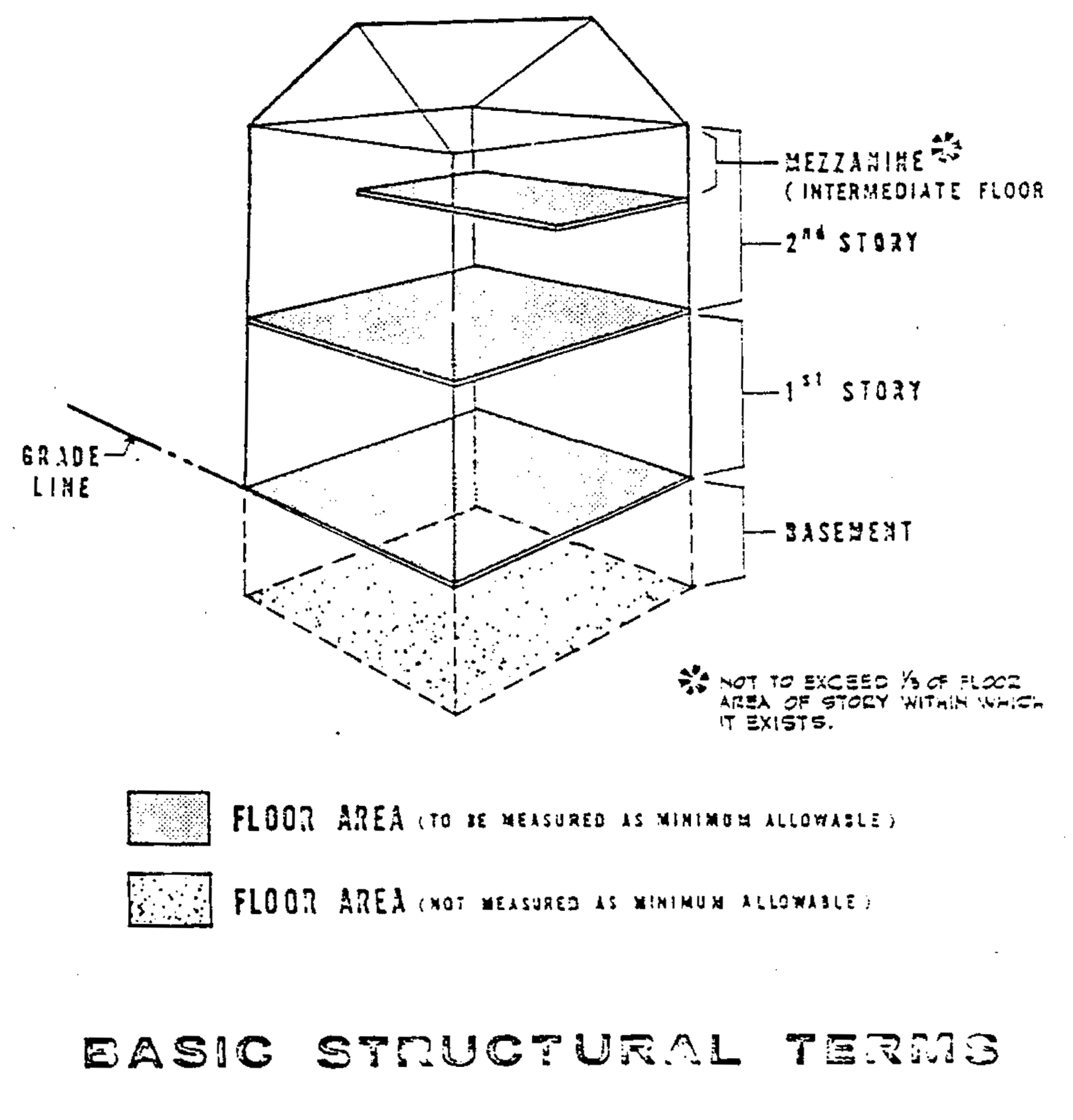
Basement means that portion of a building which is partly or wholly below grade but so located
that the vertical distance from the average grade to the floor is greater than the
vertical distance from the average grade to the ceiling. A "basement" shall not be
counted as a story.
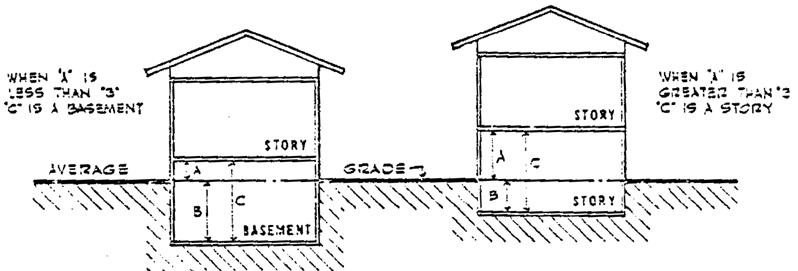
Basement and Story
Bed and breakfast means a family home structure or small hotel, with no more than 15 sleeping rooms, offering accommodation for the night and breakfast the next morning for one inclusive fee.
Bed and breakfast operation means a use subordinate the principal use of a dwelling unit as a single-family dwelling unit in which guests are provided a sleeping room and meals for periods not to exceed 14 consecutive days in return for payment and the dwelling unit functions as the principal residence for the owner during those times when bed and breakfast operations are being conducted.
Berm means a mound of earth constructed to achieve and comply with the buffering requirements of this chapter.
Block means the property abutting one side of a street and lying between the two nearest intersecting streets, or between the nearest such street and railroad right-of-way, unsubdivided acreage, river, or live stream; or between any of the foregoing and any other barrier to the continuity of development.
Building means any structure, either temporary or permanent, having a roof supported by columns or walls, and intended for the shelter or enclosure of persons, animals, chattels, or property of any kind.
Building height means the vertical distance measured from the established grade to the highest point
of the roof surface for flat roofs; to the deck line of mansard roofs; and to the
average height between eaves and ridge for gable, hip and gambrel roofs. Where a building
is located on sloping terrain, the height may be measured from the average ground
level of the grade at the building wall.
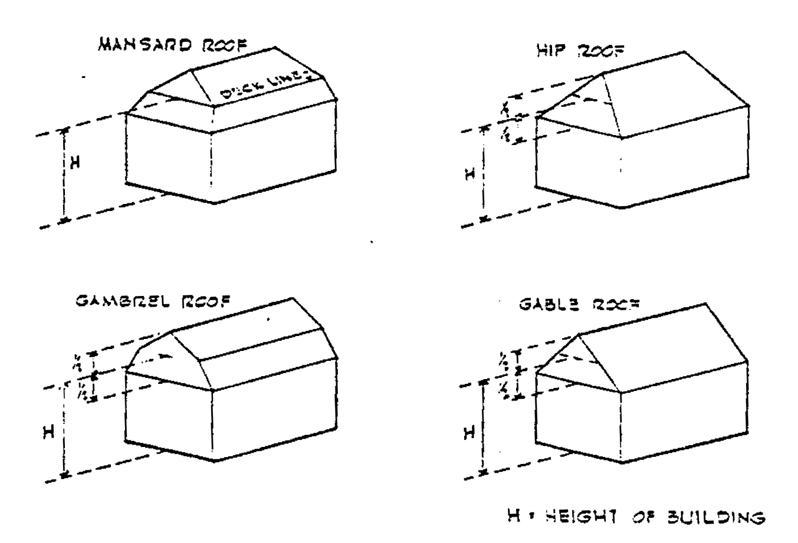
Building Height
Building line means a line formed by the face of the building; and for the purposes of this chapter,
a "minimum building line" is the same as a front setback line.
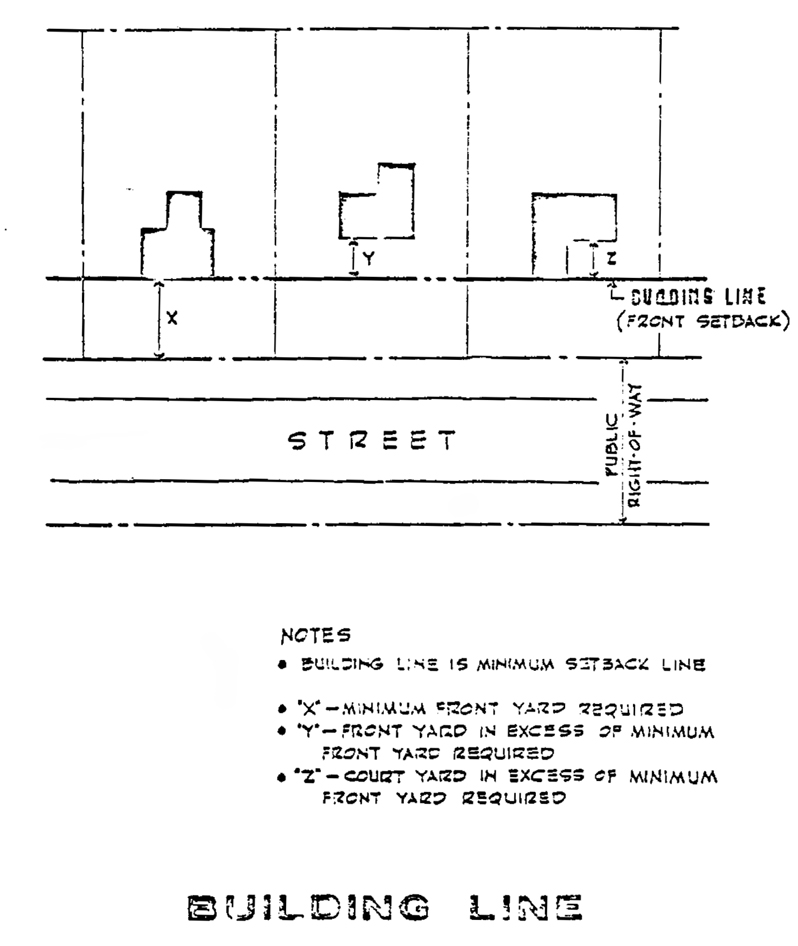
Campground means a use on a parcel or tract of land licensed by the state under the control of a person in which sites are offered for the use of the public or members of an organization either free of charge or for a fee, for the placement and use of three or more travel trailers, as defined in this chapter, or other similar temporary living quarters.
Child care center and day care center mean a facility, other than a private residence, receiving one or more preschool or school-age children for care for periods of less than 24 hours a day, and where the parents or guardians are not immediately available to the child. Child care center or day care center includes a facility that provides care for not less than two consecutive weeks, regardless of the number of hours of care per day. The facility is generally described as a child care center, day care center, day nursery, nursery school, parent cooperative preschool, play group, or drop-in center. Child care center or day care center does not include any of the following:
(1)
A Sunday school, a vacation Bible school, or a religious instructional class that is conducted by a religious organization where children are attending for not more than three hours per day for an indefinite period or for not more than eight hours per day for a period not to exceed four weeks during a 12-month period.
(2)
A facility operated by a religious organization where children are cared for not more than three hours while persons responsible for the children are attending religious services.
(3)
A facility or program for school-age children that is operated at a school by a public school or by a person or entity with whom a public school contracts for services, in accordance with section 1285a(2) of the revised school code, Public Act No. 451 of 1976 (MCL 380.1285a), if that facility or program has been granted an exemption under state law.
Church means a place of religious worship, an institution that people regularly attend to participate in or hold religious services, meetings and other activities.
Club means an organization of persons for special purposes or for the promulgation of sports, arts, sciences, literature, politics, or the like, but not operated for profit.
Communication/transmission tower means a skeletal or monopole structure, or framework, attached directly to the ground or to another structure, used for the transmission or reception of radio, telephone, cellular telephone, television, microwave or any other form of telecommunication signals.
Craft means an activity requiring manual dexterity and skill in making things, such as, by way of example and not limitation, pottery making, carpentry and sewing.
Development means any manmade change to improved or unimproved real estate, including but not limited to buildings or other structures, mining, dredging, filling, grading, paving, excavation or drilling operations.
District means a portion of the incorporated area of the city within which certain regulations and requirements or various combinations thereof apply under the provisions of this chapter.
Dormitory means sleeping quarters intended as a means of temporary housing, such as are found and provided in a boarding school, camp or resort, where persons are cared for or housed for more than 24 consecutive hours at a time.
Drive-in means a business establishment so developed that its retail or service character is dependent on providing a driveway approach or parking spaces for motor vehicles so as to serve patrons while in the motor vehicle, regardless of whether self-service is involved, rather than within a building or structure.
Dwelling means a structure or suite of rooms forming one residence, mobile home, pre-manufactured, or pre-cut structure that is designed and used for the complete living accommodation of a permitted single related family or a permitted single multiple-tenant family, and complies with all other applicable provisions and standards contained in this chapter.
Dwelling, multiple-family, means a building containing three or more separate suites of rooms each of which forms one residence designed exclusively for residential occupancy by any combination of related families and multiple-tenant families, living independently of each other.
Dwelling, one-family, means a building containing one suite of rooms designed exclusively for residential occupancy by one related family.
Dwelling, two-family, means a building containing two separate suites of rooms each of which forms one residence designed exclusively for residential occupancy by any combination of related families and multiple-tenant families, living independently of each other.
Dwelling unit means a structure, or portion thereof, mobile home, pre-manufactured, or pre-cut structure that is designed and used for the complete living accommodation of a single family and which complies with all other applicable provisions and standards contained in this chapter.
Erected means built, constructed, altered, reconstructed or moved upon, or any physical operation on the premises which are required for construction. Excavation, fill, drainage and the like shall be considered a part of erection.
Essential services means the erection, construction, alteration or maintenance of public utilities or municipal departments of underground, surface or overhead gas, electrical, steam, fuel or water transmission or distribution systems; collection, communication, supply or disposal systems; including towers, poles, wires, mains, drains, sewers, pipes, conduits, cables, fire alarm and police call boxes, traffic signals, hydrants and similar accessories in connection therewith; but not including buildings which are necessary for the furnishing of adequate service by such utilities or municipal departments for the general health, safety, or welfare.
Excavation means any breaking of ground, except common household gardening and ground care.
Family means:
(1)
An individual or group of two or more persons related by blood, marriage or adoption, together with foster and step children and servants or the principal occupants, with not more than one additional unrelated person, who are domiciled together as a single, domestic, housekeeping unit in a dwelling unit; or
(2)
A collective number of individuals domiciled together in one dwelling unit whose relationship is of a continuing nontransient domestic character and who are cooking and living as a single nonprofit housekeeping unit. This definition shall not include any society, club, fraternity, sorority, association, lodge, coterie, organization, or group of students or other individuals whose domestic relationship is of a transitory or seasonal nature or for an anticipated limited duration of a school term or other similar determinable period.
Family day care home means a private home in which one but fewer than seven minor children are received for care and supervision for periods of less than 24 hours a day, unattended by a parent or legal guardian, except children related to an adult member of the family by blood, marriage, or adoption. Family day care home includes a home in which care is given to an unrelated minor child for more than four weeks during a calendar year.
Family, multiple-tenant, means two or more persons, not married to each other, who are continuously domiciled and residing together in a single dwelling unit as a single functional domestic household that is anticipated to be permanent or for a committed, limited duration of not less than 30 continuous calendar days. This definition does not include a group of individuals whose occupancy and residence together is through or in connection with membership or participation in any society, club, fraternity, sorority, association, lodge, combine, federation, coterie, or other organization that is not a recognized religious order, or to a group of individuals whose occupancy and residence together is or will be less than 30 continuous calendar days in duration.
Family, related, means any of the following, including their respective descendants and other relatives, whether by blood, marriage or adoption, those in their respective custody in loco parentis or under legal guardianship and not more than two unrelated individuals who are domiciled and living together in a single functional domestic household in a single dwelling unit:
(1)
An individual person;
(2)
A married couple;
(3)
Two or more individual persons who are related but not married to each other.
Farm means and consists of:
(1)
All of the adjoining land operated as a single unit on which the farming of crops is carried on directly by the owner-operator, manager or tenant farmer, by his own labor or with the assistance of members of his household or hired employees; provided, however, that land to be considered a farm under this subsection shall include a continuous parcel of land of five acres, or more, in area; provided further, that farm under this subsection may be considered as including establishments operating as greenhouses, nurseries and orchards; or
(2)
All of the adjoining land operated as a single unit on which the farming of crops is combined with the keeping of livestock or poultry or the operation of riding or boarding stables, commercial dog kennels, chicken hatcheries or apiaries; and the operations are carried on directly by the owner-operator, manager or tenant farmer, by his own labor or with the assistance of members of his household or hired employees; provided, however, that land to be considered a farm under this subsection shall include a continuous parcel of land of 20 acres or more in area; provided further, that the keeping of livestock or poultry, or the operation of riding or boarding stables, commercial dog kennels, chicken hatcheries, or apiaries shall not be considered a farm under the provisions of this section unless combined at all times with a bona fide crop farming operation;
No farms under this section shall be operated as piggeries or feed lots, or for the raising or slaughtering of animals except such animals as have been raised or maintained on the premises for at least one year immediately prior to their slaughter and are for the use and consumption by persons actually residing on said premises.
Fence or wall, obscuring, means a structure of definite height and location to serve as an obscuring screen in carrying out the requirements of this chapter.
Filling means the depositing or dumping of any matter onto or into the ground, except common household gardening and ground care.
Fine art means products of human creativity and skill that are created primarily or solely to be appreciated for their imaginative, aesthetic or intellectual content, such as, by way of example and not limitation paintings, drawings, sculptures, literature, dance or music.
Flood and flooding mean a general and temporary condition of partial or complete inundation of normally dry land areas from:
(1)
The overflow of inland or tidal waters;
(2)
The unusual and rapid accumulation or runoff of surface waters from any source.
Flood hazard area means land which on the basis of available floodplain information is subject to a one-percent or greater chance of flooding in any given area.
Flood hazard boundary map (FHBM) means an official map of a community, issued by the Federal Emergency Management Agency, where the boundaries of the areas of special flood hazards have been designated as zone A.
Flood insurance rate map (FIRM) means an official map of a community on which the Federal Emergency Management Agency has delineated both the areas of special flood hazards and the risk-premium zones applicable to the community.
Flood insurance study means the official report provided by the Federal Emergency Management Agency. The report contains flood profiles, as well as the flood hazard boundary-floodway map and the water surface elevation of the base flood.
Floodplain means any land area susceptible to being inundated by water from any source. (See definition of "Flood.")
Floodway means the channel of a river or other watercourse and the adjacent land areas designated in the flood insurance study which must be reserved in order to discharge the base flood.
Floor area. For the purposes of computing the minimum allowable floor area in a residential dwelling unit, the sum of the horizontal areas of each story of the building shall be measured from the exterior faces of the exterior walls. The floor area measurement is exclusive of areas of basements, unfinished attics, attached garages, breezeways, and enclosed and unenclosed porches.
Fraternity means a social society for men who are students at a college or university, with a name consisting of individually pronounced Greek letters.
Game court means an outdoor area specifically designed and constructed for the purpose of playing games or outdoor activities (e.g., tennis courts, ball diamonds, skating rinks or ramps, putting greens, driving ranges, shooting ranges, soccer/football fields, etc.).
Garage sale means the sale or exchange or offer of sale or exchange of five or more items of household goods, wares, appliances, clothing, jewelry, tools or other personal property of whatever kind or nature, or any combination thereof from a garage or other building or portion thereof on any premises, whether or not attached to or a part of a residence.
Grade means the mean elevation of the street sidewalk along the front of the lot, as established by the city. The reference level, for any building within ten feet of the front lot line, is the official established sidewalk grade opposite the center of the front of such building. For any building more than ten feet from the front lot line, or where no sidewalk grade is established, the reference level is the average level of the finished grade of the ground across the front of such building. When the average finished grade about any portion of a building varies five feet or more from that at the front, such average may be taken as the reference level for such portion of such building.
Greenbelt means a strip of land of definite width and location reserved for and containing specified living and/or nonliving landscape elements, such as, by way of example but not limitation, shrubs, trees, vines, ground cover, crushed rock, and brick, whether used as a vertical element such as a fence or wall, or as a horizontal element such as a walk, to be used as an obscuring screen or buffer step between land uses so as to minimize conflicts between them and to otherwise carry out the requirements and purposes of this chapter.
Group day care home means a private home in which more than six but not more than 12 minor children are given care and supervision for periods of less than 24 hours a day unattended by a parent or legal guardian, except children related to an adult member of the family by blood, marriage, or adoption. Group day care home includes a home in which care is given to an unrelated minor child for more than four weeks during a calendar year.
Harmful increase means an unnaturally high stage on a river, stream or lake which causes or may cause damage to property, threat to life, personal injury, or damage to land or water resources.
Hotel means a building occupied as a more or less temporary abiding place for individuals who are lodged with or without meals, and rooms occupied singly for hire, in which provision is not made for cooking on any individual plan and in which there are more than five sleeping rooms, a public dining room for the accommodation of at least 40 guests and a general kitchen.
Junkyard means an open area where waste, used or secondhand materials are bought and sold, exchanged, stored, baled, packed, disassembled, or handled, including but not limited to scrap iron and other metals, paper, rags, rubber tires and bottles. "Junkyard" includes automobile wrecking yards and includes any area of more than 100 square feet for storage, keeping, or abandonment of junk but does not include uses established entirely within enclosed buildings.
Kennel, commercial, means any lot or premises on which three or more dogs are either permanently or temporarily boarded or kept for sale or breeding.
Landscape elements means living plant material such as, but not limited to, grass, ground covers, shrubs, vines, hedges or trees, and nonliving durable material commonly used in landscape development such as, but not limited to, crushed rock, wood chips, cobblestones, brick, tile or decorative blocks, whether used as a vertical element such as a wall or fence, or as a horizontal element such as a bed, walk or path.
Loading space means an off-street space on the same lot with a building or group of buildings for the temporary parking of a commercial vehicle while loading and unloading merchandise or materials.
Lot means a parcel of land occupied, or to be occupied, by a main building or a group of such buildings and accessory buildings or utilized for the principal use and uses accessory thereto, together with such open spaces as are required under the provisions of this chapter. "Lot" may or may not be specifically designated as such on public records.
Lot area means the total horizontal area within the lot lines of the lot.
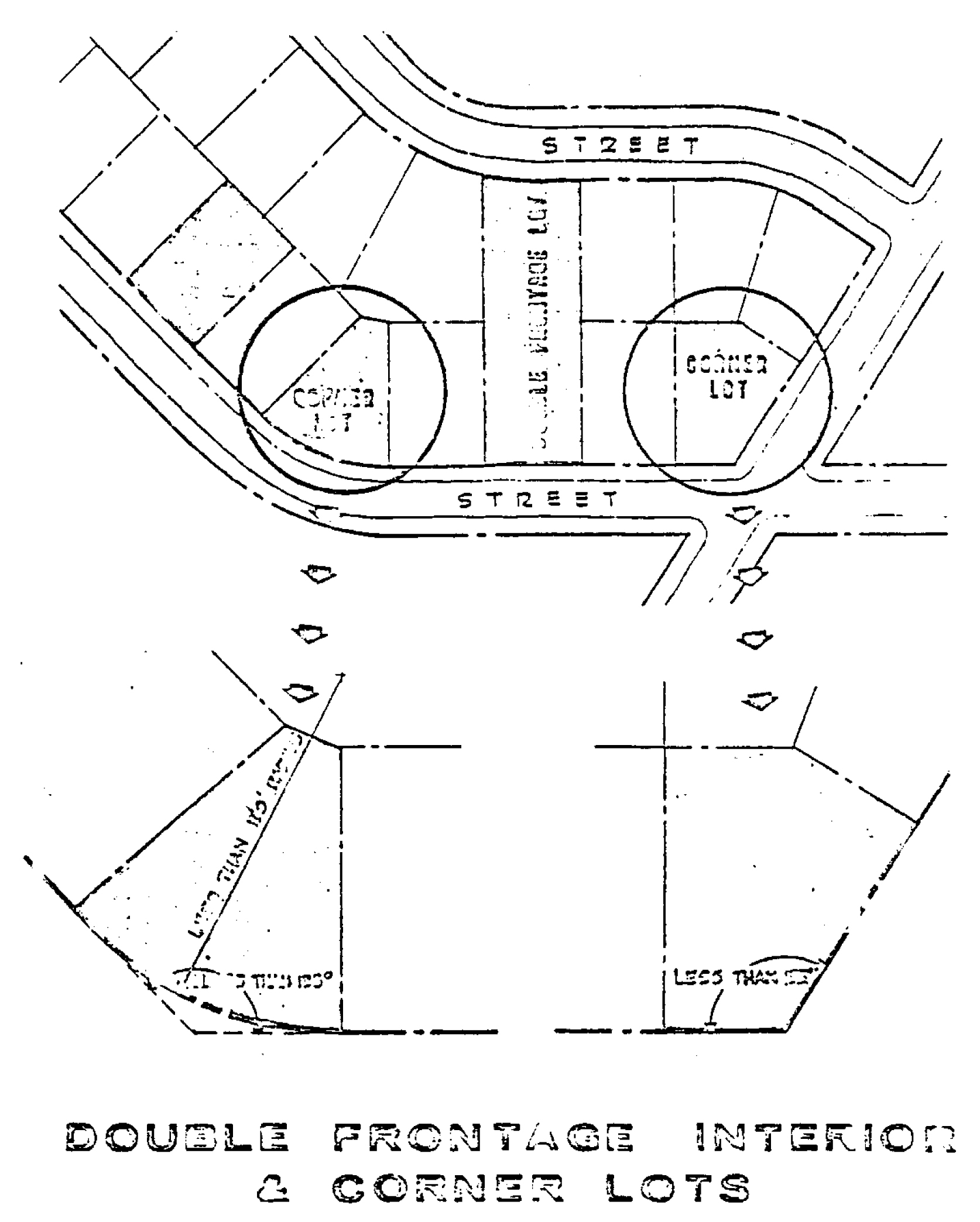
Lot, corner, means a lot where the interior angle of two adjacent sides at the intersection of two streets is less than 135 degrees. A lot abutting upon a curved street or streets shall be considered a corner lot, for the purposes of this chapter, if the arc is of less radius than 150 feet and the tangents to the curve, at the two points where the lot lines meet the curve or the straight street line extended, form an interior angle or less than 135 degrees.
Lot coverage means that part or percent of the lot occupied by buildings including accessory buildings.
Lot depth means the horizontal distance between the front and rear lot lines, measured along the median between the side lot lines.
Lot, double frontage, means any interior lot having frontages on any two more or less parallel streets as distinguished from a corner lot. In the case of a row of double frontage lots, all sides of the lots adjacent to streets shall be considered frontage, and front yards shall be provided as required.
Lot, interior, means any lot other than a corner lot.
Lot lines means the lines bounding a lot, as defined in this section:
(1)
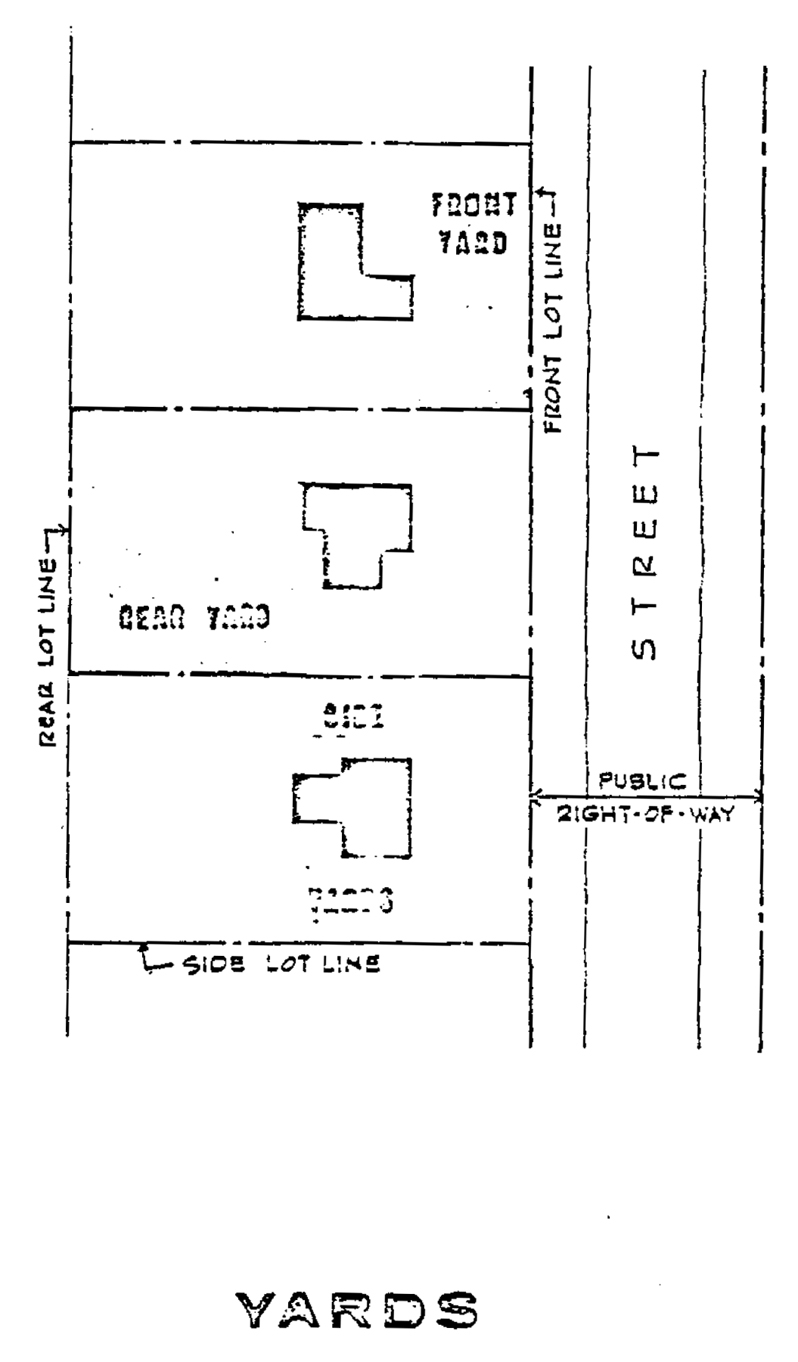
Front lot line, in the case of an interior lot, is that line separating the lot from the street; and, in the case of a corner lot or double frontage lot, is that line separating the lot from that street which is designated as the front street in the plat and in the application for a certificate of occupancy.
(2)
Rear lot line means that lot line opposite the front lot line. In the case of a lot pointed at the rear, the "rear lot line" shall be an imaginary line parallel to the front lot line, not less than ten feet long lying farthest from the front lot line and wholly within the lot.
(3)
Side lot line means any lot line other than the front lot line or rear lot line. A side lot line separating a lot from a street is a side street lot line. A side lot line separating a lot from another lot or lots is an interior side lot line.
Lot of record means a parcel of land, the dimensions of which are shown on a recorded plat on file with the county register of deeds at the time of adoption of the ordinance codified in this chapter, or in common use by municipal or county officials, and which actually exists as so shown, or any part of such parcel held in a record ownership separate from that of the remainder thereof.
Lot width means the horizontal distance between the side lot lines, measured at the two points where the building line or setback intersects the side lot lines.
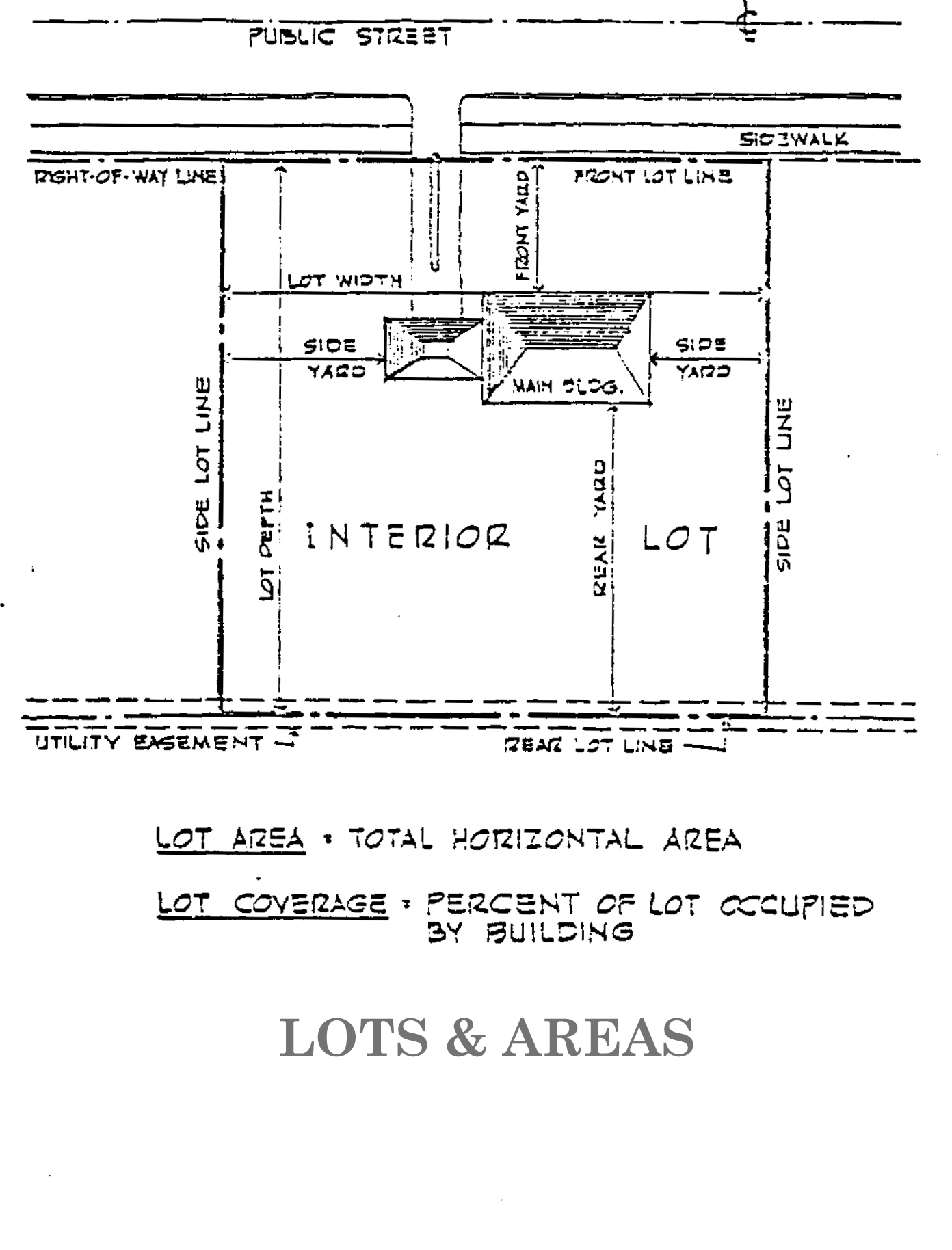
Main building means a building in which is conducted the principal use of the lot upon which it is situated.
Main use means the principal use to which the premises are devoted and the principal purpose for which the premises exist.
Major thoroughfare means an arterial street which is intended to serve as a large volume traffic way for both the immediate municipal area and the region beyond, and may be designated as a major thoroughfare, parkway, freeway, expressway, or equivalent term to identify those streets comprising the basic structure of the street plan. Any street with a width, existing or proposed, of 86 feet shall be considered a "major thoroughfare" for the purposes of this chapter.
Master plan means the comprehensive plan including graphic and written proposals indicating the general location for streets; parks, schools, public buildings and all physical development of the city; and includes any unit or part of such plan, and any amendment to such plan or parts thereof. Such plan may or may not be adopted by the planning commission and/or council.
Mezzanine means an intermediate floor in any story occupying not to exceed one-third of the floor area of such story.
Mobile home means a dwelling, transportable in one or more sections, which is built or installed on a permanent chassis, and designed to be used as a dwelling with or without permanent foundation when connected to the required utilities and containing electrical, plumbing, heating and air conditioning systems, that is installed by a state-licensed mobile home dealer or state-licensed mobile home installer, as required by Public Act No. 96 of 1987 (MCL 125.2301 et seq.), and administrative rules promulgated thereunder.
Mobile home park means a use which is a parcel of land under the control of a person upon which three or more mobile homes are located for single-family residential purposes, and which is offered to the public for that purpose regardless of whether a charge is made therefor, together with any building, structure, or use, as defined in the definition of "accessory use or building" set out in this section, incidental thereto.
Motel means a series of attached, semi-detached or detached rental units containing bedroom, bathroom and closet space. Units shall provide for overnight lodging and are offered to the public for compensation, and shall cater primarily to the public traveling by motor vehicles.
Multiple-family ormultiple-tenant family means and refers to more than three of any combination of one-family and multiple tenant family units living independently of each other in a multiple-family dwelling.
New construction means structures for which the start of construction commenced on or after the effective date of the ordinance codified in this section.
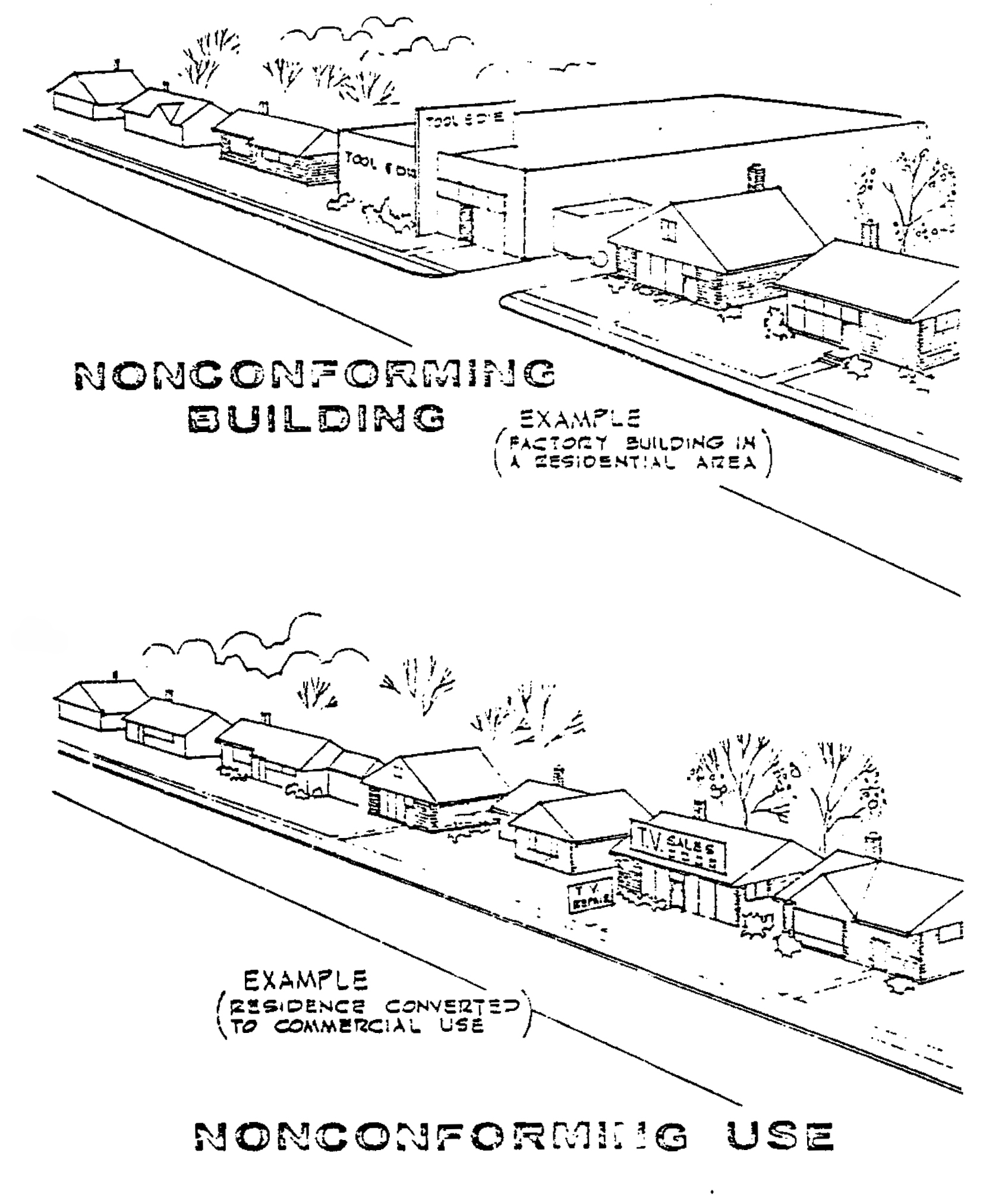
Nonconforming building means a building or portion thereof existing at the effective date of the ordinance codified in this chapter, or amendments thereto, and that does not conform to the provisions of this chapter in the district in which it is located.
Nonconforming use means a use which lawfully occupied a building or land at the effective date of the
ordinance codified in this chapter, or amendments thereto, and that does not conform
to the use regulations of the district in which it is located.
Nursing or convalescent home means a structure with sleeping rooms where persons are housed or lodged and furnished with meals and nursing care for hire.
Occasional sale means the sale or exchange or offer of sale or exchange of five or more items of household goods, wares, appliances, clothing, jewelry or other personal property of whatever kind or nature or any combination thereof whether by garage sale, yard sale, auction or otherwise, not having a duration of more than a total of three days within any period of 90 consecutive days on or from the same premises.
Off-street parking lot means a facility providing vehicular parking spaces along with adequate drives and aisles for maneuvering, so as to provide access for entrance and exit for the parking of more than two vehicles.
One-family means and refers to one related family, as that term is defined herein, domiciled and living together in a single functional domestic household in a single one-family dwelling.
Open front store means a business establishment, other than a drive-in bank, restaurant or gasoline service station, so developed that service to the patron may be extended beyond the walls of the structure, not requiring the patron to enter the structure.
Parking space means an area of definite length and width exclusive of drives, driveways, aisles or entrances giving access thereto, and fully accessible for the storage or parking of permitted vehicles.
Plant material nursery means a space, building or structure or combination thereof for the storage of live trees, shrubs, or plants offered for retail sale on the premises including products used for gardening or landscaping. The definition of nursery within the meaning of this chapter does not include any space, building or structure used for the sale of fruits, vegetables, or Christmas trees.
Playground equipment means outdoor equipment specifically designed for the amusement of children (e.g., swing set, climbing apparatus, playhouses, see-saw, slide, etc.).
Private home means a private residence in which the licensee or registrant permanently resides as a member of the household, which residency is not contingent upon caring for children or employment by a licensed or approved child placing agency. Private home includes a full-time foster family home, a full-time foster family group home, a group day care home, or a family day care home.
Public utility means any person, firm or corporation, municipal department, board, or commission duly authorized to furnish and furnishing under governmental regulations to the public gas, steam, electricity, sewage disposal, communication, telegraph, transportation or water.
Recreational vehicle means a vehicle primarily designed and used as temporary living quarters for recreational, camping, or travel purposes, including a vehicle having its own motor power or a vehicle mounted on or drawn by another vehicle.
Setback means the distance required to obtain front, side, or rear yard open space provisions of this chapter.
Short-term rental means the rental or subletting of any dwelling for a term of 27 days or less, but does not include the use of campgrounds, hotel rooms, transitional housing operated by a nonprofit entity, group homes such as nursing homes and adult foster care homes, hospitals, or housing provided by a substance abuse rehabilitation clinic, mental health facility, or other healthcare related clinic.
Shrubs means self supporting, deciduous and/or evergreen woody species, normally branched near the base, bushy and less than 15 feet in height at maturity.
Sign means a sign as defined in section 26-2.
Sign, accessory, means a sign which is accessory to the principal use of the premises.
Sign, nonaccessory, means a sign which is not accessory to the principal use of the premises.
Sorority means a social society for women who are students at a college or university, with a name consisting of individually pronounced Greek letters.
Stable, private, means a stable for the keeping of horses for the noncommercial use of the residents of the principal use and shall not include the keeping of horses for others, or for commercial boarding.
Stable, public, means a stable other than a private stable, with a capacity for more than two horses, and carried on within an unplatted tract of land of not less than 40 acres.
Story means that part of a building, except a mezzanine as defined in this chapter, included between the surface of one floor and the surface of the next floor, or if there is no floor above, then the ceiling next above. A "story" thus defined shall not be counted as a story when more than 50 percent, by cubic content, is below the height level of the adjoining ground.
Story, half, means an uppermost story lying under a sloping roof, the usable floor area of which, at a height of four feet above the floor, does not exceed two-thirds of the floor area in the story directly below, and the height above at least 200 square feet of floor space is seven feet six inches.
Street means a public thoroughfare which affords the principal means of access to abutting property.
Structure means anything constructed or erected, the use of which requires location on the ground or attachment to something having location on the ground.
Substantial improvement means any repair, reconstruction or improvement of a structure, the cost of which equals or exceeds 50 percent of the market value of the structure either (i) before the improvement or repair is started, or (ii) if the structure has been damaged and is being restored, before the damage occurred. For the purposes of this definition "substantial improvement" is considered to occur when the first alteration of any wall, ceiling, flood, or other structural part of the building commences, whether or not that alteration affects the external dimensions of the structure. The term does not however, include either (i) any project for improvement of a structure to comply with existing state or local health, sanitary or safety code specifications which are solely necessary to assure safe living conditions, or (ii) any alteration of a structure listed on the National Register of Historic Places or a state inventory of historic places.
Temporary use or building means a use or building permitted by the board of appeals to exist during periods of construction of the main building or use, or for special events.
Trees means self-supporting, deciduous and/or evergreen, woody plants with a well-defined central stem which normally grow to a height of 15 feet or more at maturity.
Trellis or trellis works means a frame supporting an open latticework, used as an arch, arbor or in sections for training vines or other creeping plants, or for decorative or screening purposes.
Two-family means and refers to not more than two of any combination of one-family and multiple-tenant family units living independently of each other in a two-family dwelling.
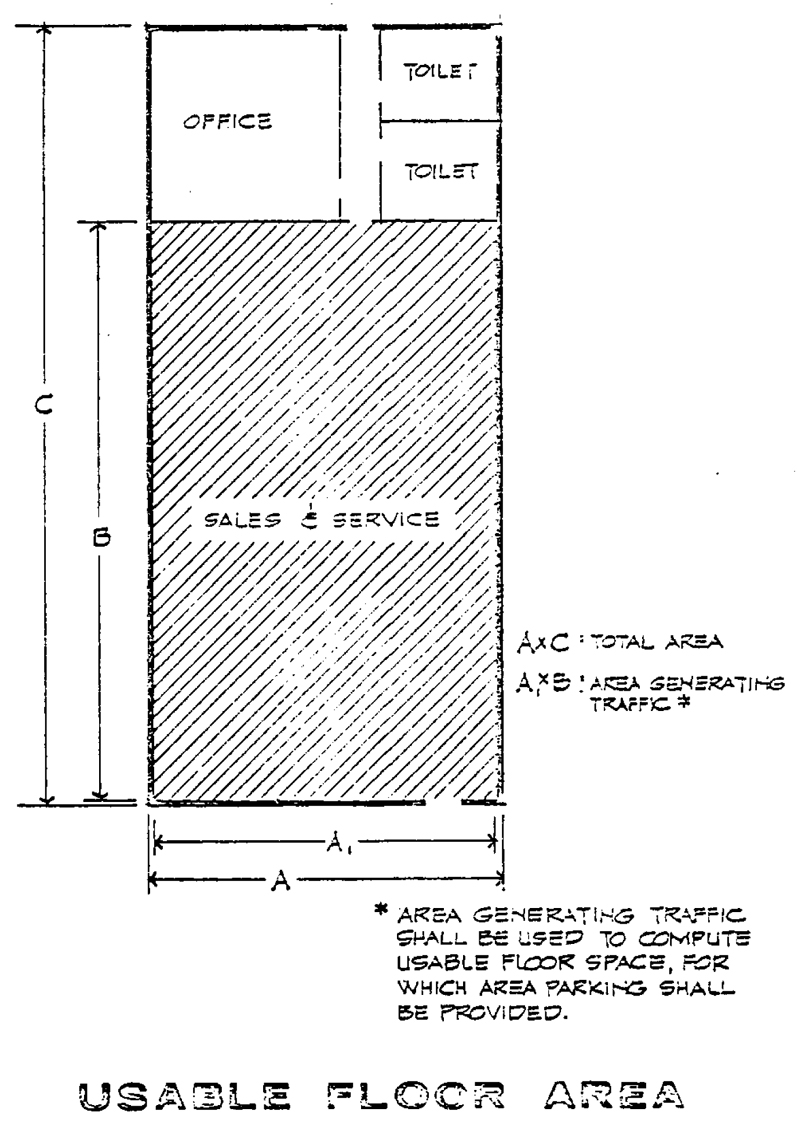
Usable floor area means, for the purposes of computing parking, that area used for or intended to be used for the sale of merchandise or services or for use to serve patrons, clients, or customers. Such floor area which is used or intended to be used principally for the storage or processing of merchandise, or for utilities, shall be excluded from this computation of "usable floor area." Measurement of floor area shall be the sum of the gross horizontal areas of the several floors of the building, measured from the interior faces of the exterior walls.
Use means the purpose for which land or a building is arranged, designed or intended, or for which land or a building is or may be occupied.
Yard sale means the sale or exchange of or offer of sale or exchange of five or more items of household goods, wares, appliances, clothing, jewelry, tools or other personal property of whatever kind or nature, or any combination thereof, from the front, side and/or back yard of any premises.
Yards means the open spaces on the same lot with a main building unoccupied and unobstructed from the ground upward, except as otherwise provided in this chapter, and as defined in this section:
(1)
Front yard means an open space extending the full width of the lot, the depth of which is the minimum horizontal distance between the front lot line and the nearest line of the main building.
(2)
Rear yard means an open space extending the full width of the lot, the depth of which is the minimum horizontal distance between the rear lot line and the nearest line of the main building.
(3)
Side yard means an open space between a main building and the side lot line, extending from the front yard to the rear yard, the width of which is the horizontal distance from the nearest point of the side lot line to the nearest point of the main building.
Zoning exceptions and zoning variance:
(1)
Exception means a use permitted only after review of an application by the board of appeals, or commission other than the administrative official (building inspector), such review being necessary because the provisions of this chapter covering conditions, precedent or subsequent, are not precise enough to all applications without interpretation, and such review is required by this chapter.
(2)
Variance means a modification of the literal provisions of this chapter granted when strict enforcement of this chapter would cause undue hardship owing to circumstances unique to the individual property on which the variance is granted. The crucial points of "variance" are: undue hardship, unique circumstances, and applying to property. A "variance" is not justified unless all three elements are present in the case.
(3)
The exception differs from the variance in several respects. An exception does not require undue hardship in order to be allowable. The exceptions that are found in this chapter appear as special approval or review by planning commission, legislative body, or board of appeals. These land uses could not be conveniently allocated to one or another, or the effects of such uses could not be definitely foreseen as of a given time. The general characteristics of these uses include one or more of the following:
a.
They require large areas;
b.
They are infrequent;
c.
They sometimes create an unusual amount of traffic;
d.
They are sometimes obnoxious or hazardous;
e.
They are required for public safety and convenience.
(Code 1979, §§ 17.04.010—17.04.750; Ord. No. 2005-1, §§ 17.04.277, 17.04.572, 2-21-2005; Ord. No. 2008-8, 9-2-2008; Ord. No. 2015-1, 3-16-2015; Ord. No. 2020-1, 3-16-2020)

