
Hillsdale City Zoning Code
ARTICLE IX
OBSCURING WALLS AND FENCES14
Editor's note— Ord. No. 2014-3, adopted July 21, 2014, in effect repealed the former article IX, §§ 36-681—36-685, and enacted a new § 36-681 as set out herein. The former article IX pertained to similar subject matter and derived from the Code of 1979, §§ 17.40.010—17.40.050.
Sec. 36-681.- Requirements.
All fences, walls, and landscape berms of any nature, type or description located in the city must conform to the following regulations:
(1)
Approval required. The erection, construction or alteration of any fence, wall or other type of protective barrier must be approved by the zoning administrator (or designee) as to conformance with the requirements of the zoning district and this section.
(2)
Permit required. No erection, construction or alteration of any fence shall occur without a fence permit having been obtained from the zoning administrator.
(3)
Application for permit. A fence permit application shall be filled out and submitted to the zoning administrator. The zoning administrator shall require that all applications for zoning compliance permits shall be accompanied by plans and information hereinafter required, as applicable. The property pins and the location of the proposed fence shall be marked prior to the zoning administrator or his designee performing a field inspection. If property pin locations are not known, a survey may be required.
(4)
General fence, wall, and landscape berm standards.
a.
Fence wall, or landscape berm height measurement. The height of a fence, wall, or landscape berm will be measured using the following method:
1.
The permitted height of all fences, walls, and landscape berms will be measured from the finished grade adjacent to the fence, wall, or berm, as determined by the zoning administrator (or designee).
2.
Where elevations differ by more than four feet within ten feet of side or rear lot lines, the zoning administrator (or designee) may allow additional fence, wall, or landscape berm height for the property as measured from the lower elevation.
3.
The permitted height of fences or walls will not be measured from any part of a berm or any area of the ground that has been built-up or constructed in a manner that would have the effect of allowing a taller fence than permitted by this chapter.
4.
Fencing materials should be all weather and low maintenance.
b.
Masonry walls. Masonry walls must be constructed of the same or complementary building material to that of the principal structure and must be un-pierced (except for pedestrian and vehicular connections) and have a decorative cap. Cement or slag blocks will not be permitted.
c.
Visibility at intersections. All fences in the front yards must comply with the requirements of this article, visibility at intersections.
d.
Decorative fences, walls and landscape berms. Fences, walls, and landscape berms which are two and one-half feet or less in height are considered decorative and do not require a permit.
e.
Landscape berms. Where provided, landscape berms must conform to the following standards:
1.
Berms must comply with the height restrictions for fences and walls in subsections (3) and (4) of this section, but in no case may they be maintained at a continuous height. All berms must be undulating and include gaps where deemed necessary.
2.
Sides of the berm must be constructed with slopes no steeper than one foot vertical for each three feet horizontal.
3.
In measuring slope and height, grade elevation will be the average grade elevation adjacent to the proposed berm.
4.
Side slopes must be protected from erosion by sod, seed or other living ground cover. If slopes are seeded, they must be protected until the seed germinates and a permanent lawn is established.
Wall and Fence Height Requirements:
(5)
Fences and walls in the residential districts and manufactured housing communities.
a.
Ornamental fences and walls located in the required and addressed front yard meeting the definition of a non-privacy fence and not intended to restrain animals of any kind may be up to four feet in height, unless otherwise approved by the zoning administrator (or designee), and must be set back at least one foot from the sidewalk/right-of-way line.
b.
All fences or walls must be ornamental in nature and should be made of wrought iron, treated or rot resistant wood, brick, stone and similar replications of these materials. However, when abutting residentially zoned and/or used property, and when used to screen parking or outdoor storage areas, the fence must be constructed of an opaque weatherproof material, woven chain link fencing is not permitted.
c.
Fences and walls located in the required and non-addressed (secondary) front yard of a corner or double frontage lot must be setback from the property line as follows, unless otherwise approved by the zoning administrator (or designee):
1.
No less than one foot for ornamental fences and walls meeting the definition of a non-privacy fence and not intended to restrain animals of any kind up to four feet in height;
2.
No less than four feet for fences and walls up to four feet in height; and
3.
No less than six feet for fences and walls up to six feet in height.
d.
Fences and walls located in the side and rear yards may have a maximum height of six feet, unless otherwise approved by the zoning administrator (or designee), and may be located on the property line assuming the front yard fencing requirements are satisfied.
e.
Residents are encouraged to utilize ornamental materials, including but not limited to materials such as wrought iron, brick, stone, treated wood and similar replications of these materials, such as vinyl fencing that has the appearance of one of these materials.
f.
Chain link or similar fencing is permitted everywhere except within the front yard.
g.
The finished side of a fence or wall must face outward toward any adjacent property or right-of-way.
h.
No fences or walls are permitted within the required site clearance triangles. The same site clearance triangle applies to solid fences abutting detached garages located on the non-addressed frontage of a corner lot, visibility at intersections.
(6)
Fences and walls in commercial and industrial districts.
a.
No fence or wall may exceed eight feet in height, unless otherwise approved by the zoning administrator (or designee).
b.
Fences located in the required non-addressed (secondary) front yard of a corner or double frontage lot, must be set back from the property line, unless otherwise approved by the zoning administrator (or designee), as follows:
1.
No less than one foot for ornamental fences and walls meeting the definition of a non-privacy fence and not intended to restrain animals of any kind up to four feet in height.
2.
No less than four feet for fences up to four feet in height.
3.
No less than six feet for fences up to six feet in height.
4.
No less than eight feet for fences up to eight feet in height.
c.
All fences or walls must be ornamental in nature and should be made of wrought iron, treated or rot resistant wood, brick, stone and similar replications of these materials. However, when abutting residentially zoned and/or used property, and when used to screen parking or outdoor storage areas, the fence must be constructed of an opaque weatherproof material, woven chain link fencing is not permitted.
d.
Chain link or similar fencing is permitted everywhere except within the front yard and when abutting residentially zoned and/or used property.
e.
No fences or walls are permitted within the required site clearance triangles, visibility at intersections.
(7)
Temporary protective fencing associated with construction projects. During construction, protective fencing must be placed around existing vegetation proposed for preservation and other site elements which cannot be easily removed or stored.
a.
Proposed protective fencing must be clearly identified on the landscape plan.
b.
Protective fencing cannot be located closer than one foot outside the perimeter of the following, as identified on the landscape plan:
1.
The drip lines of existing trees and shrubs; and
2.
Planting beds and other site element.
(8)
Prohibited fences. The following fences are prohibited:
a.
A fence consisting in whole or part of coils of barbed wire, concertina wire or razor wire;
b.
A fence with razor edges, broken glass, affixed spikes, projecting nails or other pointed instruments of any kind or description attached; fence gates cannot be constructed so as to create a hazard to the public by the projection of any pointed instrument or member when open or partially open;
c.
A fence charged or connected with an electrical current, provided however, this provision cannot be construed to apply to electrical fences installed below ground as elements of an animal control or security system;
d.
A standard barbed wire fence except upon essential service sites or industrial properties which do not abut property zoned or used for residential purposes; in such locations, standard barbed wire may be installed on the top of a fence on arms or cradles extending inward over the owner's property provided that the fence has a minimum height of six feet above the adjacent grade and the combined height of the fence and barbed wire and arms does not exceed eight feet above the adjacent grade;
e.
A fence which consists in whole or part of woven plastic or other similar materials utilized within a chain link fence;
f.
A fence with all metal opaque paneling (e.g., barn siding, roof material, etc.) unless it is part of a conditional use permit; and
g.
Concrete barrier units such as are used on construction sites or highways to restrict traffic flow.
(9)
Visibility at intersections.
a.
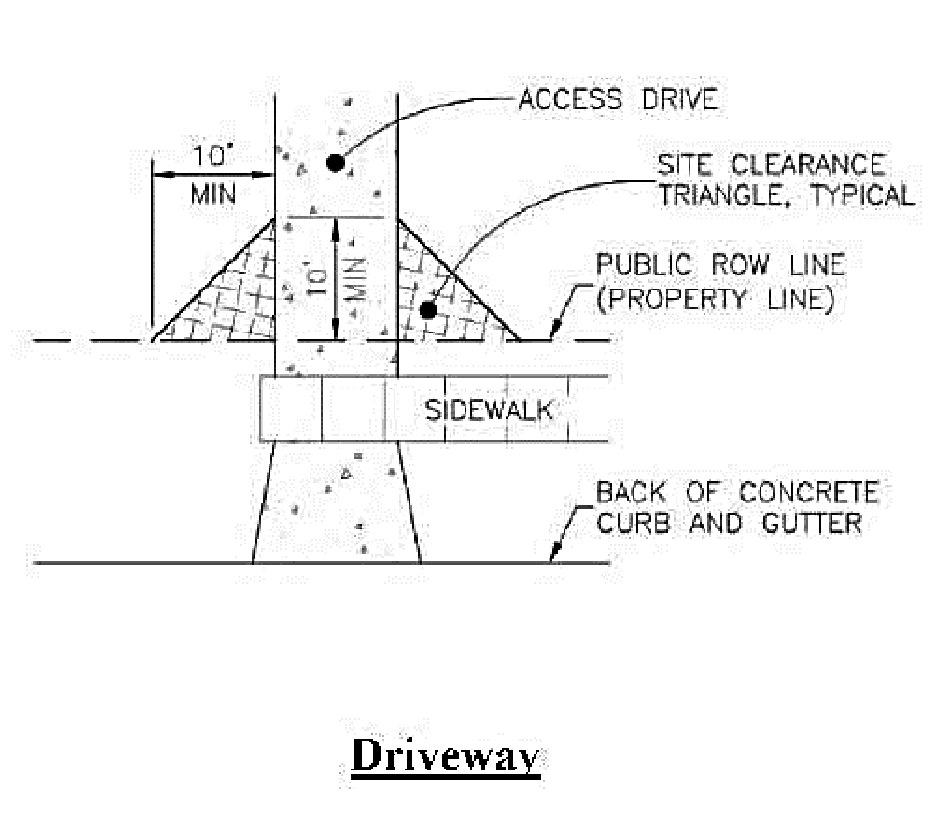
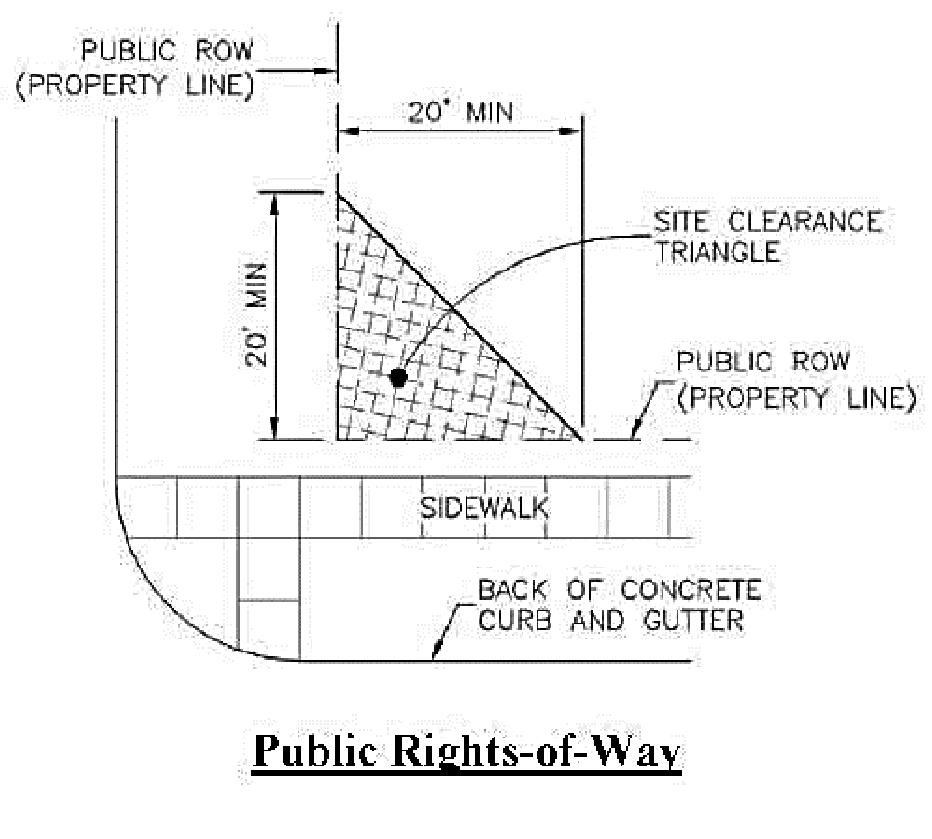
When a driveway intersects a public right-of-way or when the subject property abuts the intersection of public rights-of-way, all fences, walls, berms, hedges, screens, structures, plantings or other landscaping within the site clearance triangle areas described below must permit unobstructed cross-visibility. Shrubs and groundcovers located in a site clearance triangle may not be permitted to grow to a height of more than two and one-half feet above the grade at the edge of the pavement. Portions of required berms located within sight clearance triangle cannot exceed a height of two and one-half feet above the pavement grade at the edge of the pavement. Canopy trees may be maintained in this area provided that all branches are trimmed to maintain a clear vision for a vertical height of ten feet above the roadway surface. Other landscaping, except turf grass or ground cover maintained at a height of two and one-half feet, cannot be located closer than three feet from the edge of a driveway.
b.
The site clearance triangles referred to above are:
1.
The area formed at the corner intersection of a public right-of-way and a driveway, two sides of the triangle area being ten feet in length measured along the right-of-way line and access drive line and the third side being a line connecting these two sides. For the purpose of plantings located in the lawn extension/terrace, the site clearance triangle extends beyond the right-of-way line to the curb/edge of pavement at an angle perpendicular to both of those lines.
2.
The area formed at a corner intersection of two public right-of-way lines, the two sides of the triangular area being 20 feet in length measured along the abutting public right-of-way lines and the third side being a line connecting these two sides. For the purpose of plantings located in the lawn extension/terrace, the site clearance triangle extends beyond the right-of-way line to the curb/edge of pavement at an angle perpendicular to both of those lines.
(Ord. No. 2014-3, 7-21-2014; Ord. No. 2025-03, 5-5-2025)

