
Hinckley City Zoning Code
ARTICLE 2
- RULES AND DEFINITIONS
A. - General.
In the construction of this ordinance, the rules and definitions contained in this Article shall be observed and applied, except when the context clearly indicates otherwise.
B. - Rules for word construction.
The following rules shall apply to the text of this ordinance:
1.
Words used in the present tense shall include the future.
2.
Words used in the singular number shall include the plural number, and the plural the singular.
3.
The words "shall" and "will" are mandatory and not discretionary.
4.
The word "may" is permissive.
5.
The masculine gender includes the feminine and neuter.
6.
The word "person" means an individual, association, corporation, estate, joint venture, partnership, trustee or other legal entity capable of holding title to real property.
7.
Whenever a word or term defined appears in the text of this ordinance, its meaning shall be construed as set forth in the definition, and any word appearing in parentheses directly after a word defined shall be construed in the same tense as the word.
8.
The word "building" includes "structure"; "building" or "structure" includes any part thereof; "used" or "occupied" as applied to any land or building shall be construed to include the word "intended, arranged or designed to be used or occupied."
9.
Terms not herein defined shall be defined as specified in Webster's New Collegiate Dictionary.
C. - Definitions.
The following words and terms, wherever they occur in this title, shall be interpreted as herein defined.
Abandon (use): Relinquished property, or a cessation of the use of the property, by the owner or lessee without any intention of transferring rights to the property to another owner or of resuming the use of the property.
Abut: To physically touch or border upon; to share a common property line but not overlap.
Accessory building: A building that is subordinate to and serves a principal building or principal use; is subordinate in area, extent or purpose to the principal building or principal use served; and contributes to the comfort, convenience or necessity of occupants of the principal building or principal use served.
Accessory use: A use of land or of a building or portion thereof customarily incidental and subordinate to the principal use of the land or building and located on the same lot with the principal use.
Addition: (1) A structure added to the original structure at some time after the completion of the original; (2) an extension or increase in floor area or height of a building or structure.
Adverse impact: A condition that creates, imposes, aggravates, or leads to inadequate, impractical, unsafe, or unhealthy conditions on a site proposed for development or on off-tract property or facilities.
Agriculture: The production, keeping, or maintenance, for sale, lease, or personal use, of plants and animals useful to man, including but not limited to: forages and sod crops; grains and seed crops; dairy animals and dairy products, poultry and poultry products; livestock, including beef cattle, sheep, swine, horses, ponies, mules, or goats or any mutations or hybrids thereof, including the breeding and grazing of any or all such animals; bees and apiary products; fur animals; trees and forest products; fruits of all kinds, including grapes, nuts, and berries; vegetables; nursery, floral, ornamental, and greenhouse products; or lands devoted to a soil conservation or forestry management program.
Aisle: The traveled way by which cars enter and depart parking spaces.
Alley: A service roadway providing a secondary means of public access to abutting property and not intended for general traffic circulation.
Alteration: Any change or rearrangement in the supporting members of an existing building, such as bearing walls, columns, beams, girders, or interior partitions, as well as any change in doors, windows, means of ingress or egress, or any enlargement to diminution of a building or structure, whether horizontally or vertically, or the moving of a building or structure from one location to another.
Animal hospital: Any building, or portion thereof, designed or used for the care, observation or treatment of domestic animals.
Apartment: A room or suite of rooms in a multiple-family structure that is arranged, designed, used or intended to be used as a single housekeeping unit. Complete kitchen facilities, permanently installed, must always be included for each apartment.
Application: The application form and all accompanying documents and exhibits required of an applicant by an approving authority for development review purposes.
Appurtenances: The visible, functional, or ornamental objects accessory to and part of buildings.
Automobile: A self-propelled, free-moving vehicle, with four wheels, usually used to transport not more than six passengers and licensed by the appropriate state agency as a passenger vehicle. As used in this ordinance, this shall also include vans, mini-vans, sport utility vehicles, motorcycles and light trucks (Illinois class B license plate).
Automotive sales: The use of any building, land area, or other premise for the display and sale of new or used automobiles generally but may include light trucks or vans, trailers, or recreation vehicles and including any vehicle preparation or repair work conducted as an accessory use.
Bar, tavern, lounge: An establishment where liquors are sold to be consumed on the premises, but not including restaurants where the principal business is serving food.
Basement: That portion of a building that is partly or completely below grade. Where more than one-half of its height is above the established grade adjacent to the front of the building, a basement shall be counted as a story for purposes of height measurement.
Bed and breakfast: Overnight accommodations and a morning meal in a dwelling unit provided to travelers for compensation.
Bedroom: Refer to Building Code definition.
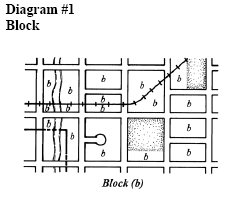
Block: A unit of land bounded by streets or by a combination of streets and public land, cemeteries, railroad rights-of-way, shorelines of waterways, or any other barrier to the continuity of development (See Diagram #1).
Boarding house: A building, other than a motel or restaurant, where meals and sleeping facilities are provided for compensation to four or more persons, but not more than 12, who are not members of the keeper's family.
Building: Any structure with substantial walls and roof securely affixed to the land and entirely separated on all sides from any other structure by space or by walls in which there are not communicating doors, windows or openings; and which is designed or intended for the shelter, enclosure or protection of persons, animals or chattels. Any structure with interior areas not normally accessible for human use, such as gas holders, oil tanks, water tanks, grain elevators, coal bunkers, oil cracking towers and other similar structures are not considered as buildings.
Building, accessory: A subordinate structure on the same lot as the principal or main building or use.
Building face or wall: All window and wall areas of a building in one plane or elevation.
Building height: The vertical distance measured from the established grade adjacent to the front of the building to the highest point of the roof in the case of a flat roof; to the deck line of a mansard roof; and to the mean height level between eaves and the ridge of a gable, hip or gambrel roof; provided, that where buildings are set back from the street line, the height of the building may be measured from the average elevation of the finished lot grade at the front of the building. Also, refer to definition of Basement.
Building inspector: The individual designated by the village to enforce the provisions of the building code.
Building line: A line parallel to the street line touching that part of a building closest to the street.
Building, principal: A building in which is conducted the principal use of the lot on which it is located.
Building setback line: A line parallel to the street line of a distance from it, regulated by the front yard requirements set up by this title.
Canopy: Any structure attached to a building at the inner end and supported on the other end, or a freestanding structure, with one or more supports, meant to provide shelter from weather elements onto which signs may be affixed or incorporated.
Carport: An automobile shelter with two or more sides open.
Cellar: A story having more than one-half of its height below the established grade adjacent to the front of the building. A cellar shall not be counted as a story for the purpose of height measurement.
Clinic or medical health/dental center: An establishment where patients are admitted for special study and treatment by two or more licensed physicians or dentists and their professional associates, practicing medicine together.
Club or lodge, private: A nonprofit association of persons who are bona fide members paying annual dues, which owns, hires or leases a building, or portion thereof, the use of such premises being restricted to members and their guests. It shall be permissible to serve food and meals on such premises provided that adequate dining room space and kitchen facilities are available. The sale of alcoholic beverages to members and their guests shall be allowed in conjunction with the operation of a dining room for the purpose of serving food and meals, though such beverages may be served in a separate room or rooms, and provided that such sale of alcoholic beverages is in compliance with the local, federal and state laws, and county ordinances.
Code official: The appointed building official shall be known as the Code Official.
Concept plan: A drawing or any other accompanying information which shows existing and proposed development conditions as described in the ordinance.
Corner lot: A lot with property lines of two streets bisecting on an angle.
Common open space: The land and water areas that are devoid of buildings and other structures, other than accessory recreational and pedestrian facilities and uses, and are suitable for active and passive recreational activities. Common open space specifically excludes: parking lots, streets, required setbacks for individually-owned lots and buildings, the building footprint of schools, and retention ponds that are unsuitable for water-based recreation. Common open space can include areas intended for active (e.g., softball fields) and passive (e.g., picnic areas) recreation.
Common wall: An interior wall of adjoining structures extending from its footing to the underside of the roof, and which separates and is in common use by such adjoining structures.
Comprehensive plan: The comprehensive land-use plan as adopted by the Village of Hinckley and its amendments.
Court: An open unoccupied space, other than a yard, on the same lot with a building or group of buildings and that is bounded on two or more sides by such building or buildings.
Curb level: The level of the established curb in front of the building measured at the center of such front. Where a building faces on more than one street, the "curb level" shall be the average of the levels of the curbs at the center of the front of each street. Where no curb elevation has been established, the mean level of the land immediately adjacent to the building shall be considered the "curb level".
Day care center: A facility as described in the Child Care Act of 1969 (225 ILCS 10), as amended.
Daycare home: A facility as described in the Child Care Act of 1969 (225 ILCS 10), as amended.
Developer: Any person, firm, or an entity that either applies for, or is actually subdividing land, erecting structures on land, or causing any improvements to be made to land, including the reconfiguration of the land surface. The term "developer" also includes an owner of such land, a subdivider, builder, or any other person, firm, or other entity having an interest in such land. Developer must have a demonstrated contractual interest in the land.
Development: The division of a parcel of land into two or more parcels; the construction, reconstruction, conversion, structural alteration, relocation or enlargement of any structure; any mining, excavation, landfill or land disturbance, and any use or extension of the use of land.
District: A section or part of the unincorporated portion of the village for which the use regulations are uniform.
Dwelling: A building or portion thereof, but not including a house trailer or mobile home, designed or used exclusively for residential occupancy, including one-family dwelling units, two-family dwelling units and multiple-family dwelling units, but not including hotels, motels, or boarding houses.
Dwelling, attached: A dwelling joined to other dwellings by common walls or vertical cavity walls and aboveground physically unifying horizontal structural elements.
Dwelling, detached: A dwelling that is surrounded on all sides by open space on the same lot.
Dwelling, multiple-family: A building, or portion thereof, designed or altered for occupancy by three or more families living independently of each other.
Dwelling, one-family: A dwelling unit designed exclusively for use and occupancy by one family.
Dwelling, two-family: A building designed or altered to provide units for occupancy by two families.
Dwelling unit: One or more rooms in a residential structure which are arranged, designed, used or intended for use by one-family, plus not more than four lodgers, for living or sleeping purposes, and which include complete kitchen facilities permanently installed.
Efficiency unit: A dwelling unit consisting of one principal room, exclusive of bathroom, kitchen, hallway, closets or dining alcove, directly off the principal room.
Erect: The act of placing or affixing a component of a structure upon the ground or upon another such component.
Escape Room: Also known as an "escape game", is a physical adventure game in which players solve a series of puzzles and riddles using clues, hints, and strategy to complete the objectives at hand. Players are given a set time limit to unveil the secret plot which is hidden within the rooms. Games are set in a variety of fictional locations, and usually the various puzzles and riddles themselves follow the theme of the room.
Façade: The face or wall of a building as it is presented to view; the apparent width and/or height of a building as viewed from streets, driveways, and parking lots. Minor changes in wall elevations do not constitute the creation of additional facades.
Family: One or more persons related by blood, marriage or adoption, or a group of not more than five persons (excluding servants) who need not be related by blood, marriage or adoption, living together and maintaining a common household, but not including clubs, sororities, fraternities or other similar organizations.
Fence: See the Village of Hinckley Fence Ordinance.
Flag: A fabric or bunting containing distinctive colors, patterns, or symbols used as a symbol of a government, political subdivision, or other entity.
Frontage: The length of the lot along the street side. The frontage of a lot bordering more than one street is considered separate for each street.
Garage, bus: Any building used or intended to be used for the storage of three or more passenger motor buses or motor coaches used in public transportation, excluding school buses.
Garage, private: An accessory building or an accessory portion of the principal building which is intended for and used to store the private passenger vehicles of the family or families resident upon the premises.
Garage, public: Any building where motorized vehicles are painted, repaired, rebuilt, reconstructed and/or stored for compensation.
Garden shed: A structure located in a rear yard for the storage of outdoor furniture, lawn and garden equipment and other outdoor items.
Gas station (service station): See "Service station".
Grade: The established elevation of the street or sidewalk. Where no such grade has been established, the grade shall be the elevation of the sidewalk at the property line. Where no sidewalks exist, the grade shall be determined by the village engineer.
Gross land area: The entire area of present ownership of a development including lots, streets and alleys, measured to the center line of any bounding streets, if such is the limit of present ownership, or measured to the edge of public right-of-way.
Hospital or sanitarium: An institution devoted primarily to the maintenance and operation of facilities for the diagnosis, treatment or care, for not less than 24 hours in any week, of three or more non-related individuals suffering from illness, disease, injury, deformity or other abnormal physical conditions. The term "hospital", as used in this title, does not apply to institutions operating solely for the treatment of mentally ill persons, drug addicts, liquor addicts or other types of cases necessitating restraint of patients, and the term "hospital" shall not be used for convalescent, nursing, shelter or boarding homes.
Hotel, motel, or inn: An establishment containing lodging accommodations designed for use by transients, or travelers, or temporary guests. Facilities provided may include maid service, laundering of linen used on the premises, telephone and secretarial or desk service, restaurants, cocktail lounges, meeting rooms and ancillary retail uses, provided access to such uses are from the exterior of the principal use.
Interior property line: Property lines other than those forming a dedicated public right-of-way.
Intersection: The point at which two or more, or a combination of streets, highways, or rail lines meet.
Kennel, commercial: Any lot or premises or portion thereof on which more than four dogs, cats and other household domestic animals, over four months of age, are kept for sale, or on which more than two such animals are boarded for compensation.
Laboratory, commercial: A place devoted to experimental study such as testing and analyzing. Manufacturing assembly or packaging of products is not included within this definition.
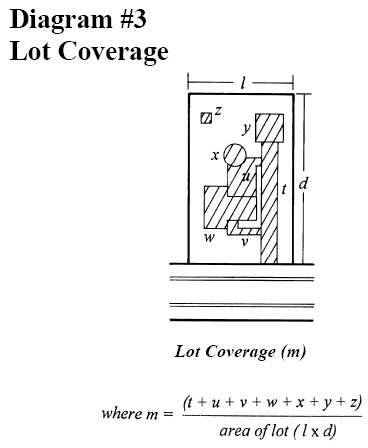
Lot: A parcel of land legally described as a distinct portion or piece of land of record (see Diagram #2).
Lot area: The area of a horizontal plane bounded by the front, side and rear lot lines.
Lot, corner: A lot situated at the junction of and abutting on two or more intersecting streets; or a lot at the point of deflection in alignment of a single street, the interior angle of which is 135 degrees or less (see Diagram #2).
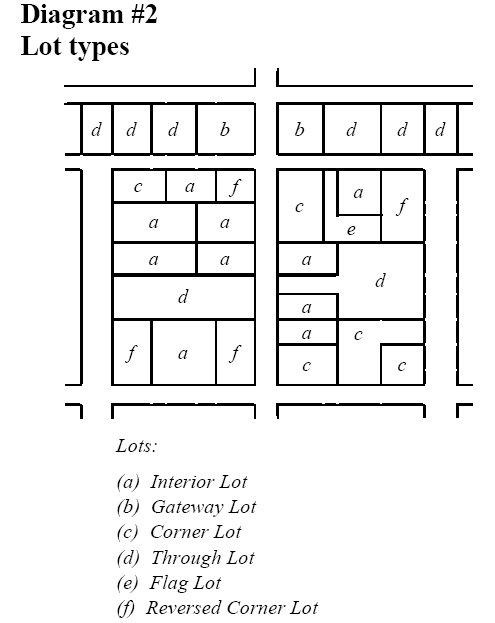
Lot coverage: The area of a zoning lot occupied by the principal building or buildings, accessory building(s) and other impervious surfaces (see Diagram #3).
Lot depth: The mean horizontal distance between the front and rear lot lines of a lot measured within the lot boundaries.
Lot frontage: The front of a lot shall be that boundary of a lot along a public or private street; for a corner lot, the front shall be the narrowest side edge of the lot fronting on a street, provided that the owner may orient his building toward either street.
Lot, interior: A lot other than a corner lot or reversed corner lot (see Diagram #2).
Lot line: A property boundary line of any lot held in single or separate ownership; except that where any portion of the lot extends into the abutting street or alley, the lot line shall be deemed to be the street or alley line.
Lot line, front: The front property line of a zoning lot.
Lot line, interior: A side lot line common with another lot.
Lot line, rear: The rear lot line is the lot line or lot lines most nearly parallel to and more remote from the front lot line.
Lot line, side: Lot lines other than front or rear lot lines are side lot lines.
Lot of record: A lot which is a part of a subdivision or a parcel of land, described by deed, and where both the map and the deed were recorded in the office of the County Recorder.
Lot, reversed corner: A corner lot, the rear of which abuts upon the side of another lot, whether across an alley or not (see Diagram #2).
Lot, through: Any interior lot having frontage on two substantially parallel streets. On a through lot, both street lines shall be deemed front lot lines (see Diagram #2).
Lot width: The mean horizontal distance between the side lot lines measured within the lot boundaries, or the minimum distance between the side lot lines within the buildable area.
Lot, zoning: A plot of ground made up of one or more parcels which are or may be occupied by a use, building or buildings, including the yards and open spaces required by this title.
Mall or strip mall: See "Shopping center".
Manufactured housing: Factory-built, single-family structures that meet the National Manufactured Home Construction and Safety Standards Act (42 U.S.C. Sec. 5401), commonly known as the HUD (U.S. Department of Housing and Urban Development) code.
Mobile Food Vendor: Also known as a person, entity, or business that sells, serves, offers for sale, or gives away prepared food or beverage from any motorized, or non-motorized vehicle or trailer.
Mobile home: See "Manufactured housing".
Modular home: Swelling units of standard size, design, etc., that can be arranged or fitted together in various ways.
Motor vehicle: A self-propelled vehicle capable of being licensed for operation upon the streets and highways of the State of Illinois.
Nonconforming use: Any building, structure or land lawfully occupied by use or lawfully established at the time of the effective date hereof, which does not conform after the effective date hereof with the use regulations of this title.
Nursery school: An instructional facility for preschool children.
Nursing home: A building or structure which is used, designed or intended for the care of the elderly or infirmed, or for those suffering bodily disorders and which does not contain the facilities nor render the services normally associated with a hospital, or facilities which are defined and regulated by the Nursing Home Care Act (210 ILCS 45), as amended.
Open space: Any parcel or area of land or water essentially unimproved, or otherwise devoid of buildings or other structures and paved areas, and set aside, dedicated, designated or reserved for public or private use or enjoyment of owners and occupants of land adjoining or neighboring such open space.
Owner: A person, group of persons, firm or corporation, or any other entity having legal title to the land, recorded as such on official records and including the duly authorized agent or notary, a purchase lessee, or any person having a vested or contingent interest in the property or business in question.
Plan, concept: A drawing or any other accompanying information which shows existing and proposed development conditions as described in this ordinance.
Plan, preliminary: The proposed engineering improvement drawings and other documents presented for review and approval as described in this ordinance.
Planned unit development (PUD): A parcel of land or contiguous parcels of land of sufficient size to create its own environment, controlled by a single landowner or by a group of landowners in common agreement as to control, to be developed as a single entity, the environment of which is compatible with adjacent parcels, and the intent of the zoning district or districts in which it is located.
Planning commission: Members of the Hinckley Planning Commission as constituted by ordinance and appointed by the village president and approved by the village board of trustees.
Plat, final: The engineering improvement drawings and other documents presented for review and approval as described in this ordinance.
Porch: A roofed-over structure, projecting out from the wall or walls of a main structure and commonly open to the weather in part.
Premises: An area of land with its appurtenances and buildings that, because of its unity of use, may be regarded as the smallest conveyable unit of real estate.
Principal use: The main use of land or buildings as distinguished from a subordinate or accessory use.
Right-of-way: A strip of land dedicated to the public and occupied or intended to be occupied by a street, alley, crosswalk, water main, sanitary or storm sewer; and by means of license, permit or agreement, such uses as railroad, electric, telephone, or cable TV transmission lines, oil or gas pipelines or other public or quasi-public use(s). The usage of the term "right-of-way" for land platting purposes shall mean that every right-of-way hereafter established and shown on a final plat is to be separate and distinct from the lots or parcels adjoining such right-of-way, and shall not be included within the dimensions or areas such as lots or parcels. Rights-of-way intended for streets, alleys, crosswalks, water mains, sanitary or storm sewer mains, or any other use involving maintenance by a public agency shall be dedicated to the public use by the preparer of the plat on which such right-of-way is established.
Roadside stand: A structure for the display and sale of only agricultural products that are produced on the property.
Roof line: The highest point of the coping on a flat roof, false mansard, or parapet wall; the deck line of a true mansard roof; the ridge line between the upper and lower slopes of a gambrel roof; or the mean height between the eaves and ridge for a gable or hip roof.
Shopping center: A lot having one or more buildings containing multiple shops, stores, and/or other places of business, and providing off-street parking facilities in common for all of the businesses and their customers (also known as Malls, Strip Malls, etc.).
Service station: Any building, land area, or other premises, or portion thereof, used for the dispensing or sales of vehicular fuels; servicing and repair of automobiles; and including as an accessory use the sale and installation of lubricants, tires, batteries, and similar vehicle accessories.
Sign: See Village of Hinckley Sign Ordinance.
Stable, private: Any building which is located on a lot on which a dwelling is located and which is designed, arranged, used, or intended to be used, for housing horses for the private use of occupants of the dwelling.
Story: That portion of a building included between the surface of any floor and the surface of the floor above it, or if there is no floor above, then the space between the floor and ceiling next above it. Any portion of a story exceeding 14 feet in height shall be considered as an additional story for each 14 feet or fraction thereof.
Story, half: A half-story is that portion of a building under a gable, hip or mansard roof, the wall plates of which, on at least two opposite exterior walls, are not more than four and one-half feet above the finished floor of each story. In the case of one-family dwellings and multiple-family dwellings less than three stories in height, a half-story in a sloping roof shall not be counted as a story for the purpose of this ordinance. In the case of multiple-family dwellings three or more stories in height, a half-story shall be counted as a story.
Street: A right-of-way other than an alley that affords a primary means of access to abutting property.
Street line: A line separating an abutting lot, piece or parcel from a street.
Structural alteration: Any change, other than incidental repairs, which would prolong the life of the supporting members of a building or structure such as bearing walls, columns, beams and girders.
Structure: Anything constructed or erected which requires location on the ground or is attached to something having location on the ground.
Terrace, open: A level and rather narrow plane or platform which, for the purpose of this title, is located adjacent to one or more faces of the principal structure and which is constructed not more than four feet in height above the average level of the adjoining ground.
Title: Reference to "Title" herein shall be constructed to be the Village of Hinckley Zoning Ordinance.
Trailer: Any vehicle or portable structure constructed so as to permit occupancy thereof for lodging or dwelling purposes or for use as an accessory building or structure in the conduct of a business, trade or occupation and which may be used for a conveyance on streets and highways by its own or other motive power.
Trailer camp park: Any premises occupied by or designed to accommodate two or more automobile house trailers or mobile homes, or the parking of two or more trailers for business or storage purposes.
Trailer, camping: A trailer designed and constructed for temporary dwelling purposes, which does not contain built-in sanitary facilities and has a gross floor area of less than 130 square feet.
Use: The purpose or activity, for which land or a building thereon is designed, arranged or intended, or for which it is occupied or maintained, let or leased.
Use, lawful: The use of any building, structure of land that conforms with all of the regulations of this title and which conforms with all of the codes, ordinances and other legal requirements as existing at the effective date hereof for the structure or land that is being examined.
Use, permitted: Any use which is or may be lawfully established in a particular district or districts, provided it conforms with all requirements, regulations, and when applicable, performance standards of this title for the district in which such use is located.
Use, principal: The dominant use of land or buildings as distinguished from a subordinate or accessory use.
Yard: An area that is bounded by the side lot lines, front lot line and the rear lot line.
Yard, front: A yard that is bounded by the side lot lines, front lot line and the front yard line.
Yard, corner side: A yard that is bounded by the front lot line, side yard adjoining a street line and rear lot line.
Yard, interior: A side yard that adjoins another lot or an alley separating such side yard from another lot.
Yard line: A line in a lot that is parallel to the lot line along which the applicable yard extends and which is not nearer to such lot line at any point than the required depth or width of the applicable yard. A building, structure or other obstruction shall not encroach into the area between the "yard line" and such adjacent lot line, except for such permitted obstructions in yards as are set forth in this title.
Yard, rear: A yard that is bounded by side lot lines, rear lot line and the rear yard line.
Yard, side: A yard that is bounded by the rear yard line, front yard line, side yard line and side lot line.
Zone: A district, as defined in this title.
Zoning map: The official map of the Village of Hinckley detailing the distinctive zoning districts within the Village of Hinckley as approved by the village board.
(Ord. No. 2018-10, § 2, 7-23-2018; Ord. No. 2019-06, § 2, 4-8-2019)
D. - Diagrams.
 |  |
 | |

