
Hines City Zoning Code
CHAPTER 14
4 - COMMERCIAL DISTRICTS
14.4A.010 - Purpose and intent.
(Reserved for expansion)
14.4A.020 - Uses.
Buildings and structures hereafter erected, structurally altered, enlarged or moved, or land hereafter used in the Commercial (C) Zone, shall comply with the following regulations. A building permit is required for ALL structural changes and construction in the Commercial Zone. A permit will be issued upon land use, site review and construction plan approval by the appropriate authorities.
14.4A.100 - Permitted uses.
Subject to site plan approval. The intent of this provision is to ensure public safety, aesthetic quality and compatibility of uses, all as set forth in this ordinance. Therefore, the commission shall review and approve a site plan for any development in the Commercial Zone, prior to issuance of a permit for development in said zone.
A.
Retail trade establishments in which the operation takes place solely within an enclosed building.
B.
Business, governmental or professional offices.
C.
Financial institution.
D.
Personal and business services such as barber shop, tailoring shop, printing shop, laundry or electrical repair shops.
E.
Transportation improvements:
1.
Normal operation, maintenance, repair and preservation activities of existing transportation facilities.
2.
Installation of culverts, pathways, medians, fencing, guardrails, lighting and similar types of improvements within the existing right-of-way.
3.
Projects specifically identified in the transportation system plan as not requiring further land use regulation.
4.
Landscaping as part of a transportation facility.
5.
Emergency measures necessary for the safety and protection of property.
6.
Acquisition of right-of-way for public roads, highways, and other transportation improvements designated in the transportation system plan except for those that are located in exclusive farm use or forest zones.
7.
Construction of a street or road as part of an approved subdivision or land partition approved consistent with the applicable land division ordinance.
F.
Lodging (motels/hotels).
G.
All dwelling units, including mobile homes, and associated improvements, provided they were in existing uses on May 8, 2001 are grandfathered, and if destroyed by fire, natural disasters, or any other unforeseen incidents out of the owner's control, may be rebuilt as a residence, or remodeled, in accordance with City of Hines zoning regulations and applicable building codes. Construction must be completed within eighteen months of the incident.
14.4A.200 - Uses permitted subject to standards.
(Reserved for expansion)
14.4A.300 - Conditional uses.
Permitted with approval of the planning commission in accordance with Chapter 14.12 of this ordinance.
A.
Retail trade establishments at which any part of the operation takes place outside an enclosed building.
B.
Churches.
C.
Commercial amusement.
D.
Residential uses located on the second or higher floor of a commercial structure provided there is an existing or proposed commercial use on the ground floor of the structure.
E.
Public park, public recreation areas and community centers.
F.
Recreational vehicle park.
G.
Light industrial uses provided that all activities and operations except off-street parking and loading take place wholly within an enclosed building and that it is not deemed to be incompatible with surrounding uses because of noise, odor, sight or other kinds of environmental pollution.
H.
Lodge for civic or fraternal organization.
I.
Dry cleaning establishment.
J.
Transportation improvements:
1.
Construction, reconstruction, or widening of highways, roads, bridges or other transportation projects that are: (1) not improvements designated in the transportation system plan; or (2) not designed and constructed as part of a subdivision or planned development subject to site plan and/or conditional use review. Transportation projects shall comply with the transportation system plan and criteria.
For state projects that require an Environmental Impact Statement (EIS) or Environmental Assessment (EA), the draft EIS or EA shall be reviewed and used as the basis for findings to comply with the following criteria.
a.
The project is designed to be compatible with existing land use and social patterns, including noise generation, safety, and zoning.
b.
The project is designed to minimize avoidable environmental impacts to identified wetlands, wildlife habitat, air and water quality, cultural resources, and scenic qualities.
c.
The project preserves or improves the safety and function of the facility through access management, traffic calming, or other design features.
d.
The project includes provision for bicycle and pedestrian circulation as consistent with the comprehensive plan and other requirements of this ordinance.
2.
Construction of rest areas, weigh stations, temporary storage, and processing sites.
3.
If review under this section indicates that the use or activity is inconsistent with the transportation system plan, the procedure for a plan amendment shall be undertaken prior to or in conjunction with the conditional use permit review.
4.
Authorization of a conditional use shall be void after a period specified by the applicant as reasonable and necessary based on season, right-of-way acquisition, and other pertinent factors. This period shall not exceed three years.
K.
Cabins, seasonal vacation rentals and other lodging where occupancy occurs on a temporary basis.
L.
Single-family dwelling, subject to the following limitations:
1.
Use of the building or structure located within the 'C' Zone as a single-family dwelling shall have been in existence on July 17, 2017, and shall have been consistent and ongoing by the actual applicant for a period of not less than five years prior to July 11, 2017.
2.
The applicant shall establish through verifiable proof such occupancy of the building or structure located in the 'C' Zone during the time period set forth in subsection 1 above. For purposes of this section, the term "verifiable proof" shall mean written documentation sufficient to establish the property being used as a single-family dwelling during the relevant time period.
3.
The applicant shall apply for a conditional use permit and shall pay for all applicable fees charged by the city for such permit.
4.
Any conditional use permit granted to an applicant under this section shall be personal and shall not run with the land. Upon the grantee of such conditional use permit vacating the premises and/or transferring the property to a third party, the conditional use permit granted pursuant to this ordinance shall become void and the property shall again be subject to all of the applicable zoning ordinance regulations relating to conditional and permitted uses for the 'C' Zone, however the property shall no longer be eligible for the additional conditional use set forth in this ordinance.
14.4A.400 - Temporary uses.
(Reserved for expansion)
14.4A.500 - Property development standards.
The following property development standards apply to all new developments in the C Zone and are intended to provide a consistent development pattern that ensures a safe, orderly, efficient, economically viable and aesthetically pleasing environment throughout each C Zone district.
14.4A.510 - Lot dimension standards.
A.
Minimum Lot Size/Area: None.
B.
Minimum Average Lot Width: 70 feet.
C.
Minimum Lot Depth: 100 feet.
D.
Lot Coverage: Structures may not occupy more than sixty percent of the lot or parcel.
14.4A.520 - Site development standards.
A.
Setbacks Requirements:
1.
Front Yard. No yards adjacent to a street shall be required except when the front lot line abuts a residential zone, in which case the yard shall be ten feet.
2.
Rear Yard. No rear yard shall be required except when the rear lot line abuts a residential zone and there is no alley intervening, in which case the yard shall be twenty feet.
3.
Side Yard. No side yard shall be required except when the side lot line abuts a residential zone in which case the yard shall be ten feet.
4.
Provisions for All Required Yards:
a.
Only parking areas, landscaping areas or allowed display or storage areas are allowed in required yards.
b.
If a front yard is required, the first five feet from the lot line shall not be used for parking or outdoor display or storage, and shall be used for landscaping.
c.
If a side yard is required, the first five feet from the lot line shall be landscaped, or if desired, a parking area or allowed display or storage area may be adjacent to the side lot line providing a screening device is provided that is a least six feet in height.
d.
If a rear yard is required, the first five feet from the lot line shall be landscaped, or if desired, a parking area or allowed outdoor display or storage area may be adjacent to the rear lot line providing a screening device is provided that is at least six feet in height.
e.
Where a side or rear yard abuts an alley, it need not be landscaped in accordance with the above provisions.
B.
Access Management, Driveway and Circulation Standards (See Sections 14.15.500—14.15.530).
C.
Off-street Parking, Loading and Unloading:
1.
Residential Off-Street Parking. For residential uses, same as required in residential zones.
2.
Off-Street Parking: See Chapter 14.8.
3.
All public and commercial parking lots and parking structures may provide a minimum of one bicycle parking space for every ten motor vehicle parking spaces.
D.
Landscaping (See also Sections 14.15.200—14.15.250). All lot area not occupied by structures, parking, or open storage lots authorized as a conditional use shall be landscaped as required by the planning commission.
E.
Pedestrian and Bicycle Facilities (See Sections 14.15.600—14.15.650).
F.
Outdoor Lighting (See Section 14.15.300—14.15.330).
G.
Outdoor Storage (See Sections 14.15.700(F) and (G)).
H.
Vision Clearance Areas (See Section 14.11.200).
I.
Flood Zones, Wetlands and Riparian Areas (See Chapter 14.7, Article A).
J.
Grading and Storm-water Drainage (See Sections 14.15.700(C) and (D)).
K.
Easements (reserved for expansion).
L.
Utilities (reserved for expansion).
M.
Fences (See Section 14.11.300).
N.
Signs (See Chapter 14.10).
14.4A.530 - Building development standards.
A.
Maximum Building Height. Buildings, structures or portions thereto shall not be erected to exceed a height of forty-five feet.
14.4A.600 - Site plan design review criteria and procedures.
(Reserved for expansion)
14.4B.010 - Purpose and intent.
The city goal is to strengthen the Downtown Commercial District (C-D) as the "heart" of the community and as the logical place for people to gather and create a business center. The district is intended to support this goal through elements of design and appropriate mixed use development. This district shall be designated Commercial (C) unless a property owner requests the (C-D) Zone designation on their property.
This chapter provides standards for the orderly improvement and expansion of the Downtown Commercial District based on the following principles:
A.
Efficient use of land and urban services;
B.
A mixture of land uses to encourage walking as an alternative to driving, and provide more employment and housing options;
C.
The Downtown Commercial District provides both formal and informal community gathering places;
D.
There is a distinct storefront character which identifies the Downtown Commercial District;
E.
The Downtown Commercial District is connected to neighborhoods and other employment areas;
F.
Provide visitor accommodations and tourism amenities;
G.
Transit-oriented development reduces reliance on the automobile and reduces parking needs in the Downtown Commercial District.
14.4B.020 - Uses.
Buildings and structures hereafter erected, structurally altered, enlarged, or moved or land hereafter used in the Downtown Commercial (C-D) District shall comply with the following regulations.
14.4B.100 - Permitted uses.
Subject to site plan review approval:
A.
Retail trade establishments in which the operation takes place solely within an enclosed building.
B.
Business, governmental, or professional offices.
C.
Financial institution.
D.
Personal and business service such as barber shop, tailoring shop, printing shop, laundry or dry cleaning establishment, and electrical repair shops.
E.
Public park, public recreation areas and community centers.
F.
Dry cleaning establishment.
G.
Transportation improvements.
1.
Normal operation, maintenance, repair, and preservation activities of existing transportation facilities
2.
Installation of culverts, pathways, medians, fencing, guardrails, lighting, and similar types of improvements within the existing right-of-way.
3.
Projects specifically identified in the transportation system plan as not requiring further land use regulation.
4.
Landscaping as part of a transportation facility.
5.
Emergency measures necessary for the safety and protection of property.
6.
Acquisition of right-of-way for public roads, highways, and other transportation improvements designated in the transportation system plan except for those that are located in exclusive farm use or forest zones.
7.
Construction of a street or road as part of an approved subdivision or land partition approved consistent with the applicable land division ordinance.
14.4B.200 - Uses permitted subject to standards.
(Reserved for expansion)
14.4B.300 - Conditional uses.
Permitted with approval of the planning commission in accordance with Chapter 14.12 of this ordinance:
A.
Retail trade establishments at which any part of the operation takes place outside an enclosed building.
B.
Commercial amusement.
C.
Residential uses located on the second or higher floor of a commercial structure provided there is an existing or proposed commercial use on the ground floor of the structure.
D.
Lodge for civic or fraternal organization.
E.
Transportation improvements:
1.
Construction, reconstruction, or widening of highways, roads, bridges or other transportation projects that are: (1) not improvements designated in the transportation system plan; or (2) not designed and constructed as part of a subdivision or planned development subject to site plan and/or conditional use review. Transportation projects shall comply with the transportation system plan and applicable standards, and shall address the following criteria.
For state projects that require an Environmental Impact Statement (EIS) or Environmental Assessment (EA), the draft EIS or EA shall be reviewed and used as the basis for findings to comply with the following criteria.
a.
The project is designed to be compatible with existing land use and social patterns, including noise generation, safety, and zoning.
b.
The project is designed to minimize avoidable environmental impacts to identified wetlands, wildlife habitat, air and water quality, cultural resources, and scenic qualities.
c.
The project preserves or improves the safety and function of the facility through access management, traffic calming, or other design features.
d.
The project includes provision for bicycle and pedestrian circulation as consistent with the comprehensive plan and other requirements of this ordinance.
2.
Construction of rest areas, weigh stations, temporary storage, and processing sites.
3.
If review under this section indicates that the use or activity is inconsistent with the transportation system plan, the procedure for a plan amendment shall be undertaken prior to or in conjunction with the conditional permit review.
4.
Authorization of a conditional use shall be void after a period specified by the applicant as reasonable and necessary based on season, right-of-way acquisition, and other pertinent factors. This period shall not exceed three years.
F.
Single-family dwelling, subject to the following limitations:
1.
Use of the building or structure located within the C-D Zone as a single-family dwelling shall have been in existence on July 17, 2017, and shall have been consistent and ongoing by the actual applicant for a period of not less than five years prior to July 11, 2017.
2.
The applicant shall establish through verifiable proof such occupancy of the building or structure located in the C-D Zone during the time period set forth in subsection 1 above. For purposes of this section, the term "verifiable proof" shall mean written documentation sufficient to establish the property being used as a single-family dwelling during the relevant time period.
3.
The applicant shall apply for a conditional use permit and shall pay for all applicable fees charged by the city for such permit.
4.
Any conditional use permit granted to an applicant under this section shall be personal and shall not run with the land. Upon the grantee of such conditional use permit vacating the premises and/or transferring the property to a third party, the conditional use permit granted pursuant to this ordinance shall become void and the property shall again be subject to all of the applicable zoning ordinance regulations relating to conditional and permitted uses for the C-D Zone, however the property shall no longer be eligible for the additional conditional use set forth in this ordinance.
14.4B.301 - Land use prohibited.
Only uses specifically listed in Sections 14.4A.100 and 14.4A.300 and uses similar to those in Section 14.4B.560(E), are permitted in this district.
14.4B.400 - Temporary uses.
(Reserved for expansion)
14.4B.500 - Property development standards.
The following property development standards apply to all new developments in the C-D Zone and are intended to provide a consistent development pattern that ensures a safe, orderly, efficient, economically viable and aesthetically pleasing environment throughout the C-D Zone district.
14.4B.510 - Lot dimension standards.
A.
Minimum Lot Size/Area: None.
B.
Minimum Average Lot Width: 70 feet.
C.
Minimum Lot Depth: 100 feet.
14.4B.520 - Site development standards.
A.
Building Setbacks. In the Downtown Commercial District, buildings are placed close to the street to create a vibrant pedestrian environment, to slow traffic down, provide a storefront character to the street, and encourage walking. The setback standards are flexible to encourage public spaces between sidewalks and building entrances (e.g., extra-wide sidewalks, plazas, squares, outdoor dining areas, and pocket parks). The standards also encourage the formation of solid blocks of commercial and mixed use buildings for a walkable Downtown Commercial District.
Building setbacks are measured from the exterior wall to the respective property line. Setbacks for porches are measured from the edge of the deck or porch to the property line. The setback standards, as listed on the following page, apply to primary structures as well as accessory structures.
The standards may be modified only by approval of a Variance, in accordance with Chapter 12 of this Ordinance.
1.
Front Yard Setbacks:
a.
Minimum Setback. There is no minimum front yard setback required.
b.
Maximum Setback. The maximum allowable front yard setback is twenty feet. This standard is met when a minimum of one hundred percent of the front building elevation is placed no more than twenty feet back from the front property line. On parcels with more than one building, this standard applies to the largest building. The setback standard may be increased when a usable public space with pedestrian amenities (e.g., extra-wide sidewalk, plaza, pocket park, outdoor dining area or town square with seating) is provided between the building and front property line. (See also, Pedestrian Amenities Standards in Section 14.4B.550, and Architectural Standards in Section 14.4B.540 for related building entrance standards).
2.
Rear Yard Setbacks:
a.
Minimum Setback. The minimum rear yard setback for all structures shall be eight feet for street-access lots, and eight feet for alley-access lots (distance from building to rear property line or alley easement) in order to provide space for parallel parking.
b.
Through-Lots. For buildings on through-lots (lots with front and rear frontage onto a street), the front yard setbacks in 14.4B.520(A)(1) shall apply.
3.
Side Yard Setbacks. There is no minimum side yard setback required, except that buildings shall conform to the vision clearance standards in Chapter 8 and the applicable fire and building codes for attached structures, fire walls, and related requirements.
4.
Setback Exceptions. Eaves, chimneys, bay windows, overhangs, cornices, awnings, canopies, porches, decks, pergolas, and similar architectural features may encroach into setbacks by no more than two feet, subject to compliance with applicable standards of the Uniform Building Code and Uniform Fire Code. Walls and fences may be placed on the property line.
B.
Block Layout. This section is intended to promote the walkable, storefront character of the Downtown Commercial District by forming short blocks and orienting (placing or locating) buildings close to streets. Placing buildings close to the street also slows traffic down and provides more "eyes on the street", increasing the safety of public spaces. The standards, as listed on the following page and illustrated above, compliment the front yard setback standards in Section 14.4B.520(A)(1).
1.
Applicability. This section applies to new land divisions and all of the following types of development (i.e., subject to site plan review):
a.
Commercial and mixed use buildings subject to site plan review.
b.
Residential occupancies, such as single-family dwellings, duplexes, or apartments, may be located on the second floor of a commercial structure provided there is an existing or proposed commercial use on the ground floor of the structure.
c.
Public and institutional buildings, except that the standard shall not apply to buildings which are not subject to site design review or those that do not receive the public (e.g., buildings used solely to house mechanical equipment, and similar uses); and compliance with all of the provisions of subsections 14.4B.520(B)(2) and (3) and 14.4B.530(B), below, shall be required.
2.
Block Layout Standard. New land divisions and developments which are subject to site plan review shall be configured to provide an alley or interior parking court, as shown above. Blocks (areas bound by public street right-of-way) shall have a length not exceeding four hundred feet, and a depth not exceeding two hundred feet. Pedestrian pathways shall be provided from the street right-of-way to interior parking courts between buildings, as necessary to ensure reasonable safe, direct, and convenient access to building entrances and off-street parking.
FIGURE 14.4B-1 BLOCK LAYOUT (TYPICAL)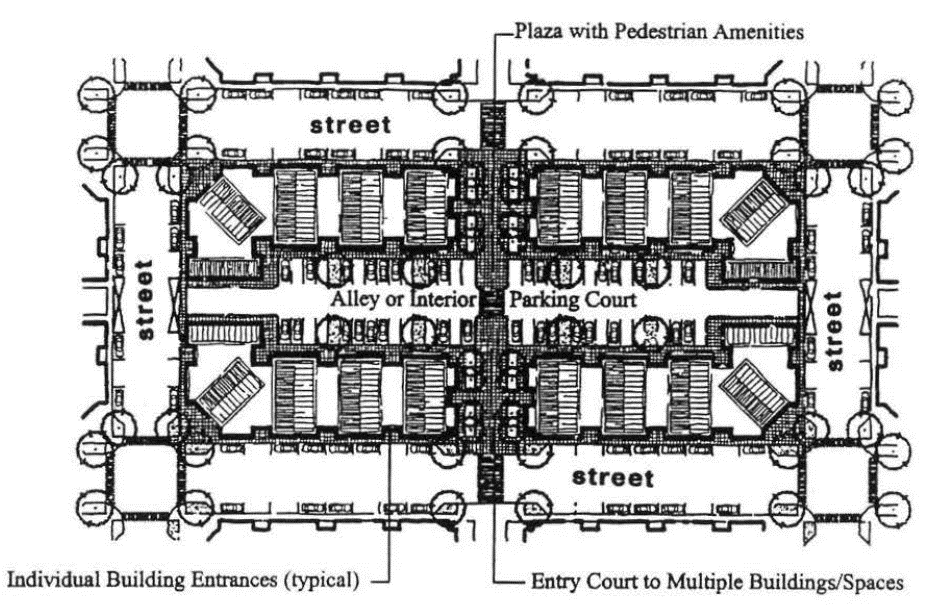
Exceptions to this standard may be approved when all of the provisions of subsection 14.4B.520(B)(3) (Superblock Development) below are met.
3.
Superblock Developments. Commercial and mixed use developments may exceed the block width and depth standards in [subsection] B., above, when the total floor area of those developments (i.e., one or more buildings on one or more lots) exceeds forty thousand square feet on the ground floor. These "superblock developments" shall conform to all of the standards in [subsections] a—b below (See figure):
a.
Create a "Shopping Street". Each development has at least one street or drive designed with the basic elements of a good pedestrian-oriented shopping street: buildings oriented (placed) close to both sides of a "main street", which may be public or private; on-street parking; wide sidewalks (e.g., eight to twelve feet typical), street trees; pedestrian-scale lighting and other similar enhancements.
b.
Provide Usable Pedestrian Space. Pedestrian space means a plaza or extra-wide pathway/sidewalk near one or more building entrances. Each development provides street trees or planters, space for outdoor seating, canopies or awnings, and on-street parking (in selected areas) to improve the pedestrian environment along internal private drives.
FIGURE 14.4B-2 "SUPERBLOCK" LAYOUT (TYPICAL)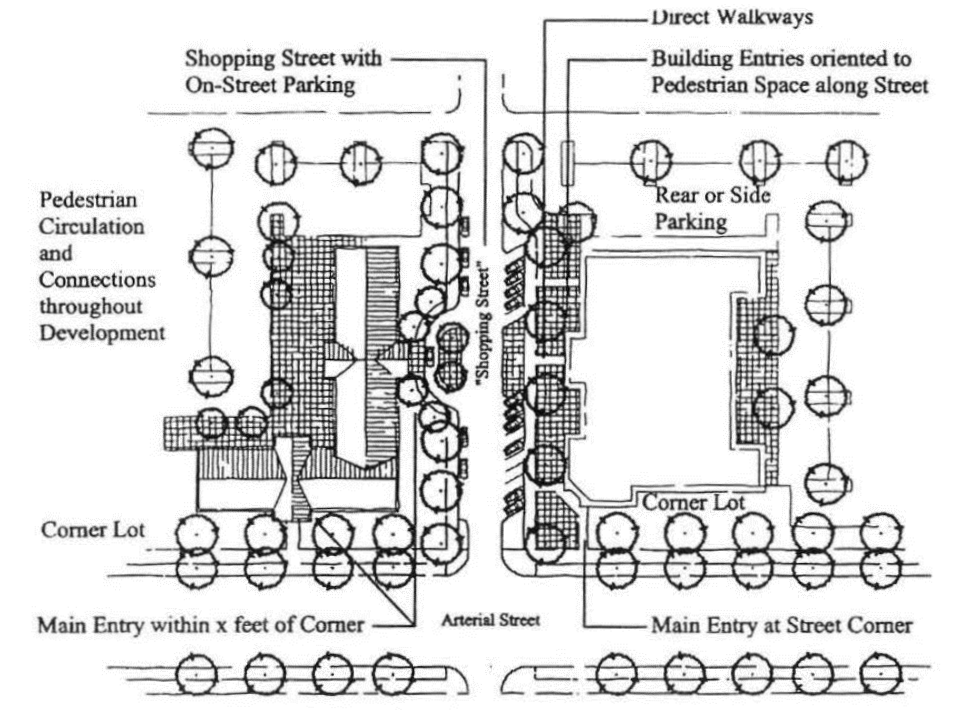
4.
Variances. Standards of this section shall not be changed through a typical variance. The standard may be varied to address topographic or other physical constraint on the site in accordance with the provisions in Chapter 14.13.
C.
Lot Coverage. There is no maximum lot coverage requirement, except that compliance with other Sections of this code may preclude full (one hundred percent) lot coverage for some land uses.
14.4B.530 - Building development standards.
A.
Building Height. All buildings in the Downtown Commercial District shall comply with the following building height standards. The standards are intended to allow for development of appropriately-scaled buildings with a storefront character:
1.
Maximum Height. Buildings shall be no more than three stories or forty-five feet in height, whichever is greater. The maximum height may be increased by ten feet when housing is provided above the ground floor ("vertical mixed use"), as shown above. The building height increase for housing shall apply only to that portion of the building that contains housing.
2.
Method of Measurement. "Building height" is measured as the vertical distance above a reference datum measured to the highest point of the coping of a flat roof or to the deck line of a mansard roof or to the average height of the highest gable of a pitched or hipped roof. The reference datum shall be selected by either of the following, whichever yields a greater height of building:
a.
The elevation of the highest adjoining sidewalk or ground surface within a five-foot horizontal distance of an exterior wall of the building when such sidewalk or ground surface is not more than ten feet above the lowest grade;
b.
An elevation ten feet higher than the lowest grade when the sidewalk or ground surface described in subsection 14.4B.530(A)(1) is more than ten feet above the lowest grade. The height of a stepped or terraced building is the maximum height of any segment of the building. Not included in the maximum height are: chimneys, bell towers, steeples, roof equipment, flag poles, and similar features which are not for human occupancy.
FIGURE 14.4B-3 BUILDING HEIGHT DIAGRAM
(CREDIT FOR HOUSING)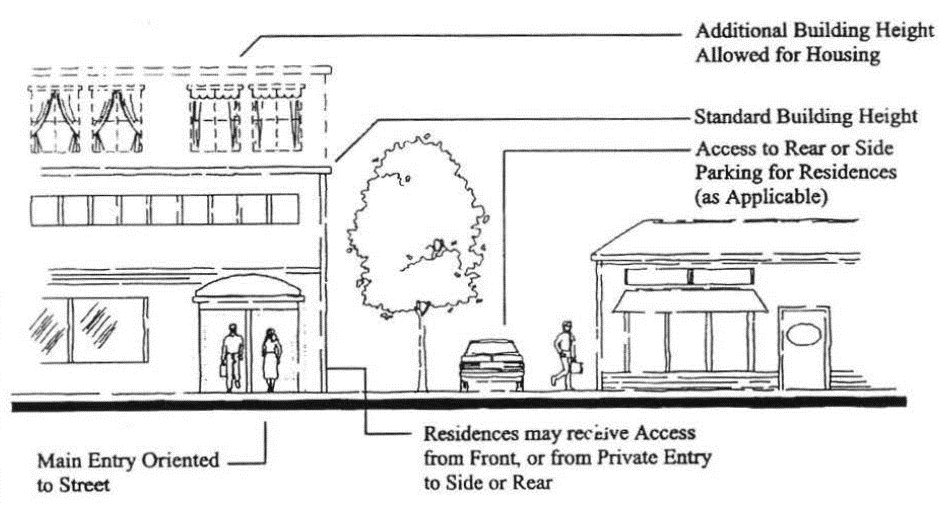
B.
Building Orientation Standards. All of the developments listed in Section 14.4B.520(B)(1) shall be oriented to a street. The building orientation standard is met when all of the following criteria are met:
1.
The minimum and maximum setback standards in Section 14.4B.520(A)(1) and (2) are met.
2.
Buildings have their primary entrance(s) oriented to (facing) the street. Building entrances may include entrances to individual units, lobby entrances, entrances oriented to pedestrian plazas, or breezeway/courtyard entrances (i.e., to a cluster of units or commercial spaces). Alternatively, a building may have its entrance facing a side yard when a direct pedestrian walkway not exceeding twenty feet in length is provided between the building entrance and the street right-of-way.
3.
Off-street parking, driveways or other vehicular circulation shall not be placed between a building and the street which is used to comply with subsection 14.4B.530(B)(2), above. On corner lots, buildings and their entrances shall be oriented to the street corner, as shown above; parking, driveways and other vehicle areas shall be prohibited between buildings and street corners.
4.
Variances. Standards of this section shall not be changed through a typical variance. The standard may be varied to address topographic or other physical constraint on the site in accordance with the provisions in Chapter 14.13.
FIGURE 14.4B-4 BUILDING ORIENTATION (TYPICAL)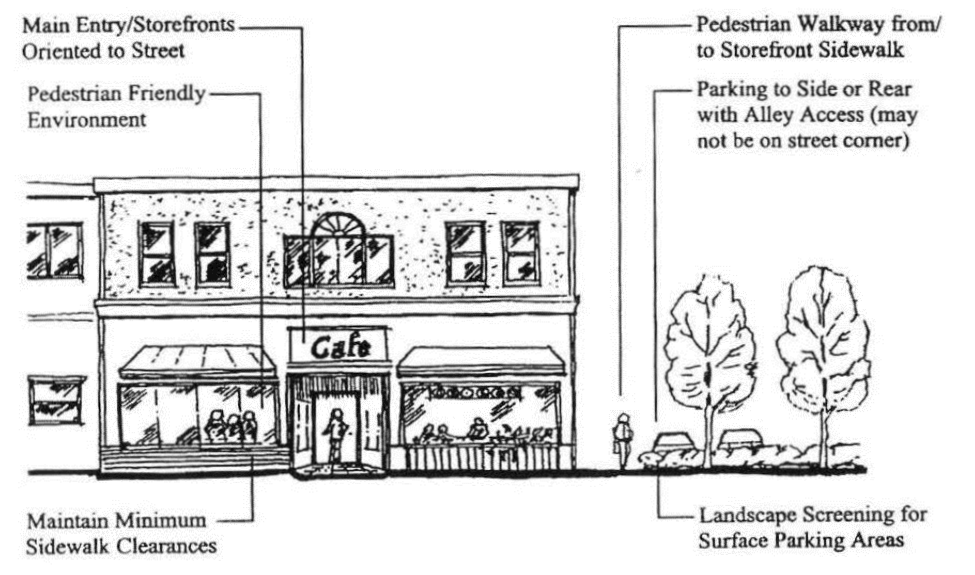
14.4B.540 - Architectural guidelines and standards.
A.
Purpose and Applicability. The Downtown Commercial District architectural guidelines standards are intended to provide detailed, human-scale design, while affording flexibility to use a variety of building styles. This section applies to all of the following types of buildings:
1.
Commercial and mixed use buildings subject to site plan review.
2.
Residential occupancies, such as single-family dwellings, duplexes, or apartments, may be located on the second floor of a commercial structure provided there is an existing or proposed commercial use on the ground floor of the structure.
3.
Public and institutional buildings, except that the standard shall not apply to buildings which are not subject to site plan review or those that do not receive the public (e.g., buildings used solely to house mechanical equipment, and similar uses); and
B.
Guidelines and Standards. Each of the following standards shall be met. An architectural feature used to comply with one standard may be used to comply with another standard.
FIGURE 14.4B.540 DOWNTOWN COMMERCIAL DISTRICT
BUILDING DESIGN ELEMENTS (TYPICAL)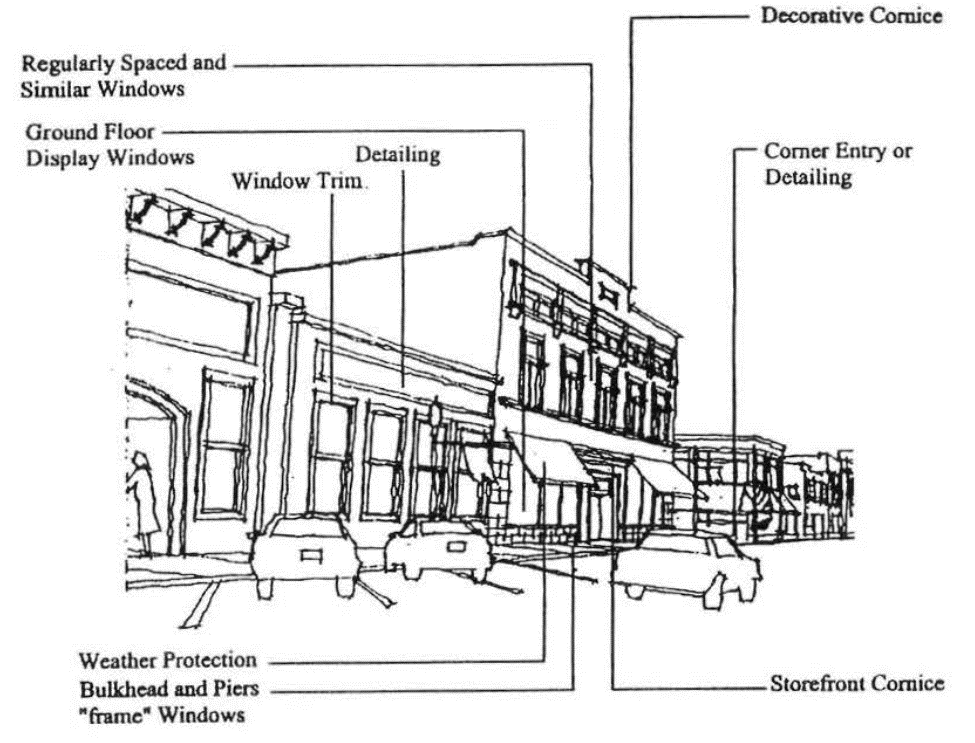
1.
Detailed Storefront Design. All buildings shall contribute to the storefront character and visual relatedness of Downtown Commercial District buildings. This criterion is met by providing all of the architectural features listed in a-d below, along the front building elevation (i.e., facing the street), as applicable. [Note: the example shown above is meant to illustrate required building design elements, and should not be interpreted as a required architectural style.]
a.
Corner building entrances on corner lots. Alternatively, a building entrance may be located away from the corner when the building corner is beveled or incorporates other detailing to reduce the angular appearance of the building at the street corner.
b.
Regularly spaced and similar-shaped windows with window hoods or trim (all building stories).
c.
Large display windows on the ground-floor (non-residential uses only). Display windows shall be framed by bulkheads, piers and a storefront cornice (e.g., separates ground-floor from second story, as shown above).
d.
Decorative cornice at top of building (flat roof); or eaves provided with pitched roof.
2.
Design of Large-Scale Buildings and Developments.
FIGURE 14.4B(7) DESIGN OF LARGE-SCALE BUILDINGS AND DEVELOPMENTS (TYPICAL)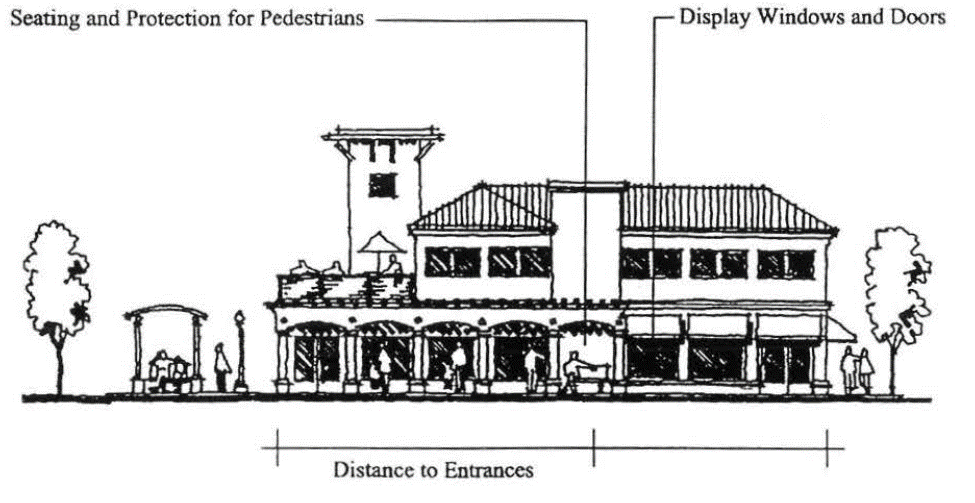
The standards in subsection c below, shall apply to "large-scale buildings and developments," as defined in [subsections] a—b:
a.
Buildings with greater than twenty thousand square feet of enclosed ground-floor space (i.e., "large-scale"). Multi-tenant buildings shall be counted as the sum of all tenant spaces within the same building shell; and
b.
Multiple-building developments with a combined ground-floor space (enclosed) greater than forty thousand square feet (e.g., shopping centers, public/institutional campuses, and similar developments).
c.
All large-scale buildings and developments, as defined in a-b, shall provide human-scale design by conforming to all of the following criteria:
i.
Incorporate changes in building direction (i.e., articulation), and divide large masses into varying heights and sizes, as shown above. Such changes may include building offsets; projections; changes in elevation or horizontal direction; sheltering roofs; terraces; a distinct pattern of divisions in surface materials; and use of windows, screening trees; small-scale lighting (e.g., wall-mounted lighting, or up-lighting); and similar features. [Note: the example shown above is meant to illustrate examples of these buildings design elements, and should not be interpreted as a required architectural style.]
ii.
Every building elevation adjacent to a street with a horizontal dimension of more than one hundred feet, as measured from end-wall to end-wall, shall have a building entrance; except that buildings elevations that are unable to provide an entrance due to the internal function of the building space (e.g., mechanical equipment, areas where the public or employees are not received, etc.) may not be required to meet this standard. Pathways shall connect all entrances to the street right-of-way.
14.4B.550 - Pedestrian and transit amenities.
A.
Purpose and Applicability. This section is intended to complement the building orientation standards in Section 14.4B.530(B), and the street standards in Section 14.15.400, by providing comfortable and inviting pedestrian spaces within the Downtown Commercial District.
Pedestrian amenities serve as informal gathering places for socializing, resting, and enjoyment of the city's Downtown Commercial District and contribute to a walkable district. This section applies to all of the following types of buildings:
1.
Commercial and mixed use buildings subject to site design review.
2.
Residential occupancies, such as single-family dwellings, duplexes, or apartments, may be located on the second floor or a commercial structure provided there is an existing or proposed commercial use on the ground floor of the structure.
3.
Public and institutional buildings, except that the standard shall not apply to buildings which are not subject to site design review or those that do not receive the public (e.g., buildings used solely to house mechanical equipment, and similar uses).
B.
Guidelines and Standards.
FIGURE 14.4B(8) PEDESTRIAN AND TRANSIT AMENITIES (TYPICAL)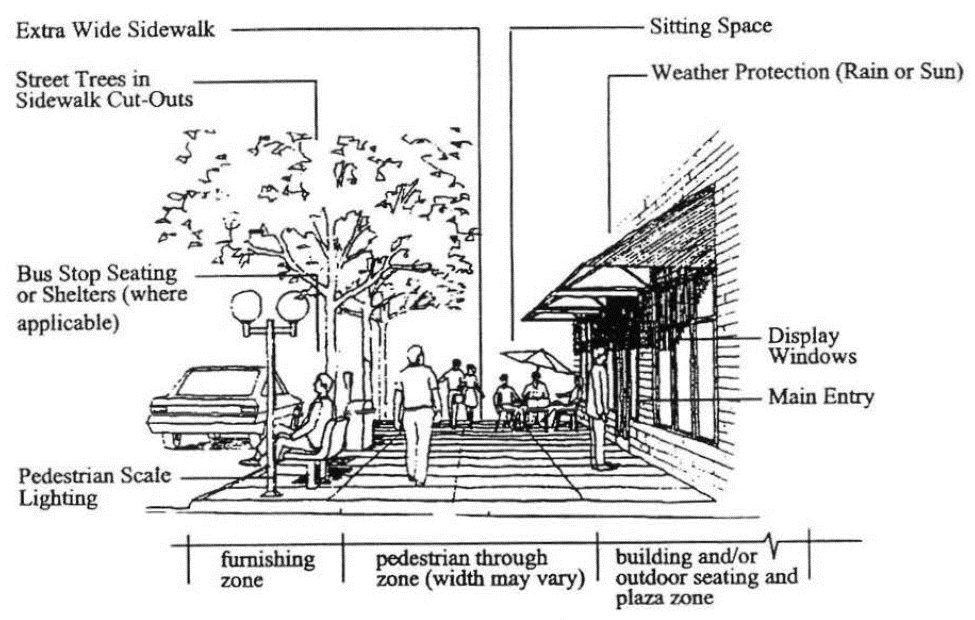
Every development shall provide one or more of the 'pedestrian amenities' listed in [subsections] 1—4, below, and illustrated above. (Note: the example shown above is meant to illustrate examples of pedestrian amenities. Other types of amenities and designs may be used.) Pedestrian amenities may be provided within a public right-of-way when approved by the applicable jurisdiction.
1.
A plaza, courtyard, square or extra-wide sidewalk next to the building entrance (minimum width of ten feet);
2.
Sitting space (i.e., dining area, benches or ledges between the building entrance and sidewalk, minimum of sixteen inches in height and thirty inches in width;
3.
Building canopy, awning, pergola, or similar weather protection (minimum projection of four feet over a sidewalk or other pedestrian space).
4.
Public art which incorporates seating (e.g., fountain, sculpture, etc.).
5.
Transit amenity, such as bus shelter or pullout, in accordance with the city's transportation plan.
14.4B.560 - Special standards for certain uses.
This Section provides standards for the following land uses in order to control the scale and compatibility of those uses within the Downtown Commercial District:
A.
Residential Uses. Higher density residential uses, such as multi-family buildings, are permitted to encourage housing near employment, shopping and services. All residential developments shall comply with the standards in [subsections] 1—6, below, which are intended to require mixed use development; conserve the community's supply of commercial land for commercial uses; provide for designs which are compatible with a storefront character; avoid or minimize impacts associated with traffic and parking; and ensure proper management and maintenance of common areas. Residential uses which existed prior to the effective date of this code are exempt from this section.
1.
Mixed Use Development Required. Residential uses shall be permitted only when part of a mixed use development (residential with commercial or public/institutional use). "Vertical" mixed use (housing above the ground floor) developments are allowed, subject to the standards in [subsections] 2—6.
FIGURE 14.4B(9) MIXED USE DEVELOPMENT IN THE DOWNTOWN COMMERCIAL DISTRICT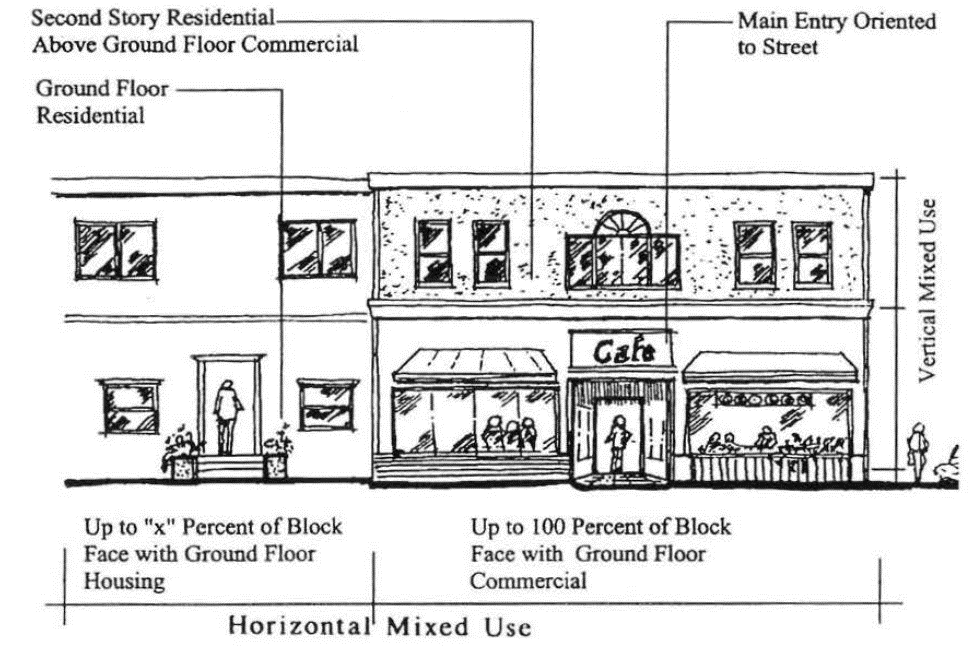
2.
Limitation On Street-Level Housing. No more than ten percent of a single street frontage may be occupied by residential uses. This standard is intended to reserve storefront space for commercial uses and public/institutional uses; it does not limit residential uses above the street level on upper stories, or behind street-level storefronts. For parcels with street access at more than one level (e.g., sloping sites with two street frontages), the limitation on residential building space shall apply to all street frontages.
3.
Density. There is no minimum or maximum residential density standard. Density shall be controlled by the applicable lot coverage and building height standards.
4.
Parking, Garages, and Driveways. All off-street vehicle parking, including surface lots and garages, shall be oriented to alleys, placed underground, placed in structures above the ground floor, or located in parking areas located behind or to the side of the building; except that side-yards facing a street (i.e., corner yards) shall not be used for surface parking. All garage entrances facing a street (e.g., underground or structured parking) shall be recessed behind the front building elevation by a minimum of four feet. On corner lots, garage entrances shall be oriented to a side-street (i.e., away from [(name of "Main Street")]) when access cannot be provided from an alley.
5.
Creation of Alleys. Alleys are not required when existing development patterns or topography make construction of an alley impracticable. As part of a subdivision, the city may require dedication of right-of-way or easements, and construction of pathways between townhome lots (e.g., between building breaks) to provide pedestrian connections through a development site, in conformance with Section 4.19 [14.15.610] - Access and Circulation.
6.
Common Areas. All common areas (e.g., walkways, drives, courtyards, private alleys, parking courts, etc.) and building exteriors shall be maintained by a homeowners association or other legal entity. Copies of any applicable covenants, restrictions and conditions shall be recorded and provided to the city prior to building permit approval.
B.
Bed and Breakfast Inns and Vacation Rentals. (Reserved.)
C.
Public and Institutional Uses. Public and institutional uses are allowed in the Downtown Commercial District, except that automobile-oriented uses shall comply with the standards in [subsection] E, below. Typical automobile oriented uses in this category include public works yards, equipment storage and repair, school bus companies, and similar facilities that store, repair or service automobiles, trucks, buses, heavy equipment and construction materials.
D.
Accessory Uses and Structures. Accessory uses and structures are of a nature customarily incidental and subordinate to the principal use or structure on the same lot. Typical accessory structures in the Downtown Commercial District include small workshops, greenhouses, studios, storage sheds, and similar structures. Accessory uses and structures are allowed for all permitted land uses within the Downtown Commercial District.
Accessory structures shall comply with the following standards:
1.
Primary Use Required. An accessory structure shall not be allowed before or without a primary use.
2.
Setback Standards. Accessory structures shall comply with the setback standards, except that the maximum setback provisions shall not apply.
3.
Design Guidelines. Accessory structures shall comply with the Downtown Commercial District design guidelines, as provided in Section 14.4B.540.
4.
Restrictions. A structure shall not be placed over an easement that prohibits such placement. No structure shall encroach into the public right-of-way.
5.
Compliance with Subdivision Standards. The owner may be required to remove an accessory structure as a condition of land division approval when removal of the structure is necessary to comply with setback standards.
E.
Automobile-Oriented Uses and Facilities. Automobile-oriented uses and facilities, a defined below, shall conform to all of the following standards in the Downtown Commercial District. The standards are intended to provide a vibrant storefront character, slow traffic down, and encourage walking.
1.
Parking, Garages, and Driveways. All off-street vehicle parking, including surface lots and garages, shall be accessed from alleys, placed underground, placed in structures above the ground floor, or located in parking areas located behind or to the side of a building; except that side-yards on corner lots shall not be used for surface parking. All garage entrances facing a street (e.g., underground or structured parking) shall be recessed behind the front elevation by a minimum of four feet. On corner lots, garage entrances shall be oriented to a side-street (i.e., away from the main street) when vehicle access cannot be provided from an alley. Individual surface parking lots shall not exceed a total of ten parking spaces, or one-half city block, whichever is smaller; larger parking areas shall be in multiple story garages.
2.
Automobile-Oriented Uses. "Automobile-oriented use" means automobiles and/or other motor vehicles are an integral part of the use. These uses are restricted because, when unrestricted, they detract from the pedestrian-friendly, storefront character of the district and can consume large amounts of land relative to other permitted uses.
Automobile-oriented uses shall comply with the following standards:
a.
Vehicle repair, sales, rental, storage, service. Businesses that repair, sell, rent, store, or service automobiles, trucks, motorcycles, buses, recreational vehicles/boats, construction equipment, and similar vehicles and equipment are permitted when the use is contained within an enclosed building.
b.
Drive-up, drive-in, and drive-through facilities. Drive-up, drive-in, and drive-through facilities (e.g., associated with restaurants, banks, car washes, and similar uses) are permitted only when accessory to a primary commercial "walk-in" use, and shall conform to all of the following standards:
i.
The facility receives access from an alley or driveway, and not a street;
ii.
None of the drive-up, drive-in, or drive-through facilities (e.g., driveway queuing areas, windows, teller machines, service windows, drop-boxes, and similar facilities) are located within twenty feet of a street and shall not be oriented to a street corner. (Walk-up only teller machines and kiosks may be oriented to a corner);
iii.
The facility is subordinate to a primary permitted use. "Subordinate" means all components of the facility, in total, occupy less street frontage than the primary commercial or public/institutional building; and
iv.
No more than one drive-up, drive-in or drive-through facility shall be permitted on one block, or for a distance of four hundred linear feet along the same street frontage, whichever is less.
F.
Sidewalk Displays. Sidewalk display of merchandise and vendors shall be limited to cards, plants, gardening/floral products, food, books, newspapers, bicycle and similar small item for sale or rental to pedestrians (i.e., non-automobile-oriented). A minimum clearance of four feet shall be maintained. Display of larger items, such as automobiles, trucks, motorcycles, buses, recreational vehicles/boats, construction equipment, building materials and similar vehicles and equipment, is prohibited.
G.
Off-street Parking, Loading and Unloading (See Chapter 14.8).
H.
Landscaping (See Sections 14.15.200—14.15.250).
I.
Outdoor Lighting (See Section 14.15.300—14.15.330).
J.
Outdoor Storage (See Sections 14.15.700(F) and (G)).
K.
Vision Clearance Areas (See Section 14.11.200).
L.
Flood Zones, Wetlands and Riparian Areas (See Chapter 14.7, Article A).
M.
Grading and Storm-water Drainage (See Sections 14.15.700(C) and (D)).
N.
Easements (reserved for expansion).
O.
Utilities (reserved for expansion).
P.
Fences (See Section 14.11.300).
Q.
Signs (See Chapter 14.10).
14.4B.600 - Site plan design review criteria and procedures.
(Reserved for expansion)

