
Hines City Zoning Code
CHAPTER 14
8 - OFF-STREET PARKING AND LOADING
14.8.100 - Off-street parking and loading.
A.
Off-Street Parking Requirements. At the time of construction, reconstruction or enlargement of a structure, or at the time a use is changed in any zone, off-street parking spaces shall be provided as follows unless greater requirements are otherwise established. Where square feet of the structure or use are specified as the basis for the requirements, the area measured shall be the gross floor area primary to the functioning of the particular use of the property. When the requirements are based on the number of employees, the number counted shall be those working on the premises during the largest shift at peak season. Fractional space requirements shall be counted as a whole space.
14.8.200 - Recommended requirements for bicycle parking.
The lack of safe and convenient bicycle parking can waste resources and further discourage bicycling as a transportation mode. The following are recommended requirements.
A.
A minimum of two bicycle parking spaces per use (one sheltered and one unsheltered) may be required.
B.
The following special minimum standards may be considered as supplemental requirements for the number of required bicycle parking spaces:
1.
Multi-family Residences. Every residential use of four or more dwelling units may provide a least one sheltered bicycle parking space for each unit. Sheltered bicycle parking spaces may be located within a garage, storage shed, basement, utility room or similar area. In those instances in which the residential complex has no garage or other easily accessible storage unit, the required bicycle parking spaces shall be sheltered under an eave, overhang an independent structure, or similar cover.
2.
Parking lots. All public and commercial parking lots and parking structures may provide a minimum of one bicycle parking space.
3.
Schools. Elementary and middle schools, both private and public, shall provide one bicycle parking space for every ten students and employees. High schools may provide one bicycle parking space for every five students and employees. All spaces may be sheltered under an eave, overhang, independent structure, or similar cover.
4.
Colleges. Colleges, universities, and trade schools may provide one bicycle parking space for every ten motor vehicle spaces plus one space for every dormitory unit. Fifty percent of the bicycle parking spaces may be sheltered under an eave, overhang, independent structure, or similar cover.
5.
Downtown Area. In downtown areas with on-street parking, bicycle parking for customers may be provided along the street at a rate of at least one space per use. Spaces may be clustered to serve up to six bicycles: at least one cluster per block may be provided. Bicycle parking spaces may be located in front of the stores along the street either on the sidewalks in specially constructed areas such as pedestrian curb extensions. Inverted "U" style racks are recommended. Bicycle parking shall not interfere with pedestrian passage, leaving a clear area of at least five feet. Customer spaces are not required to be sheltered. Sheltered parking (within a building or under an eave, overhang, or similar structure) may be provided at a rate of one space per ten employees, with a minimum of one space per store.
6.
Rural Schools, Service Centers, and Industrial Parks. Where a school, service center, or industrial park is located five or more miles from the closest urban area or rural residential subdivision with a density of more than one dwelling unit per twenty acres, a minimum of two bicycle parking spaces per use may be required.
C.
The following formulas for calculating the number of required bicycle parking spaces are recommended:
1.
Fractional numbers of spaces may be rounded up to the next whole space.
2.
For facilities with multiple uses (such as a commercial center), the bicycle parking requirements may be calculated by using the total number of motor vehicle parking spaces required for the entire development.
14.8.300 - Off-street parking and loading.
Buildings or structures to be built or substantially altered which receive and distribute material and merchandise by trucks shall provide and maintain off-street loading berths in sufficient number and size to handle adequately the needs of the particular use. Off-street parking areas used to fulfill the requirements of this Title shall not be used for loading and unloading operations except during periods of the day when not required to care for parking needs.
General provisions are as follows:
A.
The provision and maintenance of off-street parking and loading space is a continuing obligation of the property owner. Should the owner or occupant of any lot or building change the use to which the lot or building is put, thereby increasing off-street parking and loading requirements, it shall be a violation to begin or maintain such altered use until such time as the increased off-street parking or loading requirements are met.
B.
In the event several uses occupy a single structure or parcel of land, the total requirements for off-street parking shall be the sum of the requirements of the several uses computed separately.
C.
Owners of two or more uses or parcels of land may agree to utilize jointly the same parking and loading spaces when the hours of operation do not overlap, provided that satisfactory legal evidence is presented to the city in the form of deeds, leases or contracts to establish the joint use.
D.
Off-street parking spaces for dwellings shall be located on the same parcel with the dwelling. Other required parking spaces for residential uses shall be located not farther than five hundred feet from the building or use they are required to serve, measured in a straight line from the building.
E.
Bicycle Parking. The development may include the number and type of bicycle parking facilities required in Section 14.8.200. The location and design of bicycle parking facilities shall be indicated on the site plan.
14.8.400 - Design and improvement standards for parking lots.
A.
Areas used for parking for more than two vehicles shall have durable and dustless surfaces adequately maintained.
B.
Except for parking in connection with a single-family residential dwelling, parking and loading areas adjacent to or within a residential zone or adjacent to a dwelling shall be designed to minimize disturbances to residences by the erection between the uses of a sight-obscuring fence or planted screen of not less than six feet in height except where vision clearance is required.
C.
Parking spaces along the outer boundaries of a parking lot shall be contained by a bumper rail or by a curb which is a least four inches high and which is set back a minimum of one and one-half feet from the property line.
D.
Internal pedestrian circulation shall be provided in off-street parking areas for new commercial, office, and multi-family residential developments through the clustering of buildings, construction of hard surface walkways, landscaping, access ways, or similar techniques.
E.
Artificial lighting which may be provided shall not shine or create glare in any residential zone or any adjacent dwelling.
F.
Except for single-family and duplex dwellings, groups of more than two parking spaces shall be so located and served by a driveway that their uses will require no backing movements or other maneuvering with a street right-of-way other than an alley.
G.
The standards set forth in the table shown below shall be the minimum for parking lots approved under this ordinance (all figures are in feet except as noted). The recommended measurements of a standard American automobile parking space shall be ten feet wide by twenty feet long. Proposals using less than that for parking spaces must be supported by data justifying the reduced spatial area.
| KEY | ||
|---|---|---|
| A | Parking Angle | 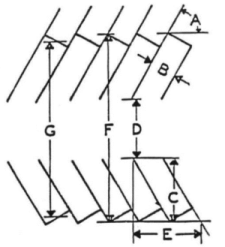 |
| B | Stall Width | |
| C | 19' Stall to Curb | |
| D | Aisle Width | |
| E | Curb Length per Car | |
| F | Curb to Curb | |
| G | Stall Center | |

