
Hitchcock City Zoning Code
ARTICLE II
DEFINITIONS OF TERMS AND PHRASES
Sec. 156.21.- Definitions of terms and phrases.
This section contains definitions of words in the zoning regulations. Words not defined herein shall have the meaning as defined elsewhere in the Code of Ordinances. When a word is defined herein and elsewhere in the Code of Ordinances, the definition used herein shall govern over any conflicting definition.
Abandonment means to cease or discontinue a use or activity without the intent to resume, but excluding temporary or short-term interruptions of a use, e.g. the change of tenancy or ownership, or activity during periods of remodeling, maintaining, or otherwise improving or rearranging a facility, or during normal periods of vacation or seasonal closure. A use is considered abandoned if the facts show the owner's intent to discontinue the use or activity and the discontinuance of the use is for a continuous period as specified in Article 9, Nonconformities.
Accessory building means a subordinate building having a use customarily incident to and located on the lot occupied by the principal building. A building housing an accessory use is considered to be an integral part of the principal building when it has any part of a wall in common with the principal building, or is under an extension of the main roof and designed as an integral part of the principal building.
Accessory use means a use of a building or land which serves an incidental function to the principal use of a building or land. An accessory use is a subordinate use customarily incident to and located on the same lot occupied by the main use.
Agricultural use refers to the use of land where such land is devoted to the production of plants, animals, or horticulture products, including but not limited to forages; grains and feed crops; dairy animals and dairy products; poultry and poultry products; beef cattle; sheep; swine and horses; bees and apiary products; trees and forest products; fruits; nuts and berries; vegetables; or nursery, floral, ornamental and greenhouse products.
Alley means a minor public right-of-way not intended to provide for through traffic or as the primary means of access to abutting lots, which is used primarily for vehicular service access to the back or sides of properties otherwise abutting a street. An alley affords only a secondary means of access to property abutting thereon.
All-weather surface means a covering for driveways and parking spaces that is dust free and not adversely affected by inclement weather.
Alteration, structural means any change or rearrangement in the supporting members of a building or structure, such as bearing walls, columns, beams, or girders, as well as any change in doors or windows, or any enlargement or diminution of a building or structure, whether horizontally or vertically, or moving a building or structure from one location to another; provided, however, that applying exterior siding to an existing building for the purpose of beautifying and modernizing shall not be considered a structural alteration.
Apartment means a room or suite of rooms, with toilet and culinary accommodations, intended, designed, or used as a residence by a single family, located in a building containing three (3) or more such rooms or suites.
Area regulations means the regulations controlling lot area, lot width, lot depth, front yard, side yard, rear yard, lot coverage and floor-area ratio.
Bed and breakfast refers to a house, or portion thereof, where short-term lodging rooms and meals are provided.
Block means an area enclosed by streets, or if said word is used as a term of measurement, it shall mean the distance along a side of a street between two intersecting streets, or if the street is of a dead-end type, a block shall be considered to be measured between the nearest intersecting street and the end of such dead-end street.
Boarding House means a building other than a hotel where, for compensation and by arrangement, meals or lodging are provided for three (3) or more persons, but not exceeding twenty (20) persons.
Building is any structure designed or built for the support, enclosure, shelter, or protection of persons, animals, or property of any kind. When separated by a firewall, each portion of such structure so separated shall be deemed a separate building. This definition shall include structures wholly or partly enclosed with an exterior wall.
Building line refers to a line parallel or approximately parallel to the street right-of-way at a specified distance therefrom, marking the minimum distance from the street right-of-way that a building may be erected. For existing buildings, the building line shall be the exterior wall or omitted wall line which is closest to the street.
Building setback means that area between a lot line and the respective setback line, which shall remain unobstructed by buildings or structures from the ground to the sky, except as may be specifically permitted by other provisions of these regulations.
Carport refers to a roof-covered structure intended for the purpose of storing vehicles and remaining substantially open on at least two of its sides.
Centerline, street or alley means a line designated midway between the bounding right-of-way lines of a street or alley. Where the bounding right-of-way lines are irregular, the centerline shall be determined by the Zoning Official.
Certificate of occupancy means a certificate issued by the City for the use of a building, structure, or land, when it is determined by the City that such building, structure or land complies with the provisions of all applicable City codes, ordinances, and regulations.
Church or place of worship means an institution where people regularly attend or participate in or hold religious services, meetings, and other activities. The term "church" shall not carry a secular connotation and shall include buildings adequately capable of assembly occupancy in which religious services of any denomination are held.
Clinic refers to a building designed and used for diagnosis and treatment of human patients, which does not include overnight care facilities.
Clinic, veterinary means a building designed and used for the prevention, cure, or alleviation of injury in domestic and other animals that may require overnight care.
Commercial districts refer to zoning districts Neighborhood Commerical ("NC") and General Commercial ("GC").
Commercial use refers to an occupation, employment, or enterprise carried on for profit by an owner, lessee, or licensee.
Condominium apartment structure means a structure containing four (4) or more apartments wherein the airspace within the apartment is individually owned by the occupant, together with the right of access and required automobile parking space, and where the lot upon which the building is located is under one ownership.
Convalescent home/nursing and convalescent hospital refers to any place or institution which provides 24-hour care for one or more chronic or convalescent patients, who, by reason of illness or physical infirmity, are unable to properly or adequately care for themselves.
Density means the relationship of dwelling units or rooms to the area of the lot or tract upon which a residential structure is located or erected.
Detached means that a building does not have a wall in common or in contact with another building.
Development means the division of land into two or more parcels; construction, reconstruction, conversion, structural alteration, relocation, or enlargement of any structure; any mining, excavation, landfill, or land disturbance.
Display area means an off-street area designated for the advertisement or display of customary passenger cars, motor vehicles, recreational vehicles, boats, tractors, and other motorized or non-motorized machinery or accessory equipment.
Drive-in/drive-through facility means any portion of a building or structure from which business is transacted, or is capable of being transacted, directly with customers located in a motor vehicle during business transaction(s), to include, but not limited to, the following:
A.
Restaurant, drive-in means a retail outlet where food or beverages are sold for consumption by customers in parked motor vehicles.
B.
Restaurant, fast food means any establishment whose principal business is the sale of foods, frozen desserts, or beverages in ready-to-consume individual servings, for consumption either within the restaurant building or for carryout.
Dwelling means a building designed exclusively for residential occupancy, regardless of whether tenant or owner occupied, including single-family (attached or detached), two-family, and multiple-family dwellings, but not including motels or hotels, to include the following:
A.
Dwelling, single family means a building designed exclusively for residential occupancy, which is constructed on a permanent foundation, not manufactured off-site, and not designed to be transportable.
B.
Dwelling, single family, attached refers to one of two or more residential buildings having a common or party wall separating the individual dwelling units.
C.
Dwelling, single family, detached means a residential building containing not more than one dwelling unit entirely surrounded by open space on the same lot.
D.
Dwelling, two-family (duplex) means a building arranged, intended, or designed for two (2) dwelling units, commonly referred to as a duplex.
E.
Dwelling, multiple family means a building arranged, intended, or designed for three (3) or more dwelling units, and commonly referred to as a triplex, four-plex, townhouse, or apartment building.
Dwelling unit means an enclosure containing sleeping, kitchen, and bathroom facilities and used or held ready for use as a permanent residence by one (1) family.
Family means a person living alone, or any of the following groups living together as a single nonprofit housekeeping unit and sharing common living, sleeping, cooking, and eating facilities: (1) any number of people related by blood, marriage, adoption, guardianship, or duly authorized custodial relationship; (2) two unrelated people; (3) two unrelated people and any children related to either of them; (4) not more than eight people who are: (a) residents of a "Family Home" or "Family Group Home" as defined by State law; or (b) "handicapped" as defined in the Federal Fair Housing Act. This definition does not include persons currently illegally using or addicted to a "controlled substance." Family does not include any society, club, fraternity, sorority, association, lodge combine, federation, or like organization; any group of individuals whose association is temporary or seasonal in nature; or any group of individuals who are in a group living arrangement as a result of criminal offenses.
Flea market refers to an outdoor market held in an open area or structure where goods are offered for sale to the general public by individual sellers from open facilities or temporary structures.
Floor area refers to the sum of the gross horizontal area of all floors of a building measured from the exterior face of the exterior walls, or from the centerline of walls separating two (2) buildings. The floor area of a building shall include basement floor area, but not cellar areas, penthouses for mechanical equipment, or attic space having headroom of seven (7) feet or less.
Frontage, lot means the length of street frontage between property lines or lease lines.
Frontage, street refers to all property on one side of a street between intersecting streets (crossing or terminating), measured along the line of the street, or if the street is dead-ended, then all of the property abutting on one side between an intersecting street and the dead-end of the street.
Garage refers to a building for private use of the owner or occupant of a principal building (situated on the same lot as the principal building) for the storage of motor vehicles with no facilities for mechanical service or repair of a commercial or public nature.
Grade means the average elevation of the highest and lowest elevations measured at the finished surface of the ground at any of the exterior corners of the building or structure.
Group home refers to a dwelling unit occupied as a single housekeeping unit in a family-like environment, providing food and shelter to four (4) or more persons who are unrelated to the proprietor of the establishment. This may include residents with disabilities, or elderly persons with support staff, and includes those facilities defined in the V.T.C.A., Health and Safety Code ch. 247, and V.T.C.A., Human Resources Code ch. 123. State licenses shall be required for such facilities prior to issuance of a certificate of occupancy.
Height of a building or structure means the vertical distance from the average ground level abutting a building or structure to the highest point of the coping of a flat roof, the deck line of a mansard roof, or the average height of the highest gable of a pitched or hipped roof. Height, where not regulated in feet, shall be regulated in stories, which shall equal twelve (12) feet for purposes of measuring structures. The height of structures within the Federal Emergency Management Agency's (FEMA's) 100-year flood plain shall be measured from the 100-year flood elevation, as certified by a licensed professional engineer or professional land surveyor.
Home occupation means an occupation which is an accessory use of a dwelling unit and which is customarily carried on in a home by a resident, incidental to the primary occupancy of the home as a dwelling.
Hotel or motel means a building or group of buildings used primarily for lodging, and secondarily, for meeting areas, meals, entertainment, and personal services, offered to the public for compensation. As such, it is open to the public in contradistinction to a boarding house, or an apartment, which are herein separately defined.
Institution means a building occupied by a nonprofit corporation or a nonprofit establishment for public use.
Industrial district refers to the General Industrial (GI) zoning district.
Kennel means any building, establishment, place, or premises wherein any person engages in the boarding, breeding, buying, selling, letting for hire, or training for a fee, of any canine or feline animal or animals, or wherein any person keeps, harbors, possesses, or maintains more than four (4) dogs or four (4) cats, or a combination of said animals, with the total number exceeding four (4) over three (3) months old.
Licensed day care centers and homes include group day care homes that provide care for less than twenty-four (24) hours per day for seven (7) to twelve (12) children under fourteen (14) years old and day care centers, which are any facility that cares for thirteen (13) or more children under fourteen (14) years old for less than twenty-four (24) hours per day. Day care centers include drop-in care centers and kindergarten and nursery schools.
Loading space refers to a space within the main building or on the same lot therewith, providing for the standing, loading or unloading of trucks, and having a minimum dimension as established in Article 8, Parking Regulations.
Lot means a lot, tract, or parcel of land designated on a subdivision plat duly filed with the County Clerk of Galveston County, or any lot, tract, or parcel of land held in separate ownership and described by metes and bounds upon a deed duly recorded or registered with the County Clerk of Galveston County that existed prior to the date of adoption of applicable subdivision regulations of the City.
Lot area means the total horizontal area within the lot lines of a lot.
Lot, corner is a lot abutting upon two (2) or more streets at their intersection.
Lot coverage refers to the percent of lot area which is covered by a roof, floor or other structure and is not open to the sky. Roof eaves to the extent of thirty (30) inches and the ordinary projections from the building not exceeding twelve (12) inches shall not be counted in computing coverage.
Lot, double frontage. A lot having a frontage on two (2) non-intersecting streets as distinguished from a corner lot.
Lot, reversed corner means a corner lot, the side street line of which is substantially a continuation of the front lot line of the first interior lot to its rear. This situation is also referred to as a "key lot" in the Code of Ordinances of the City.
Lot depth means the mean horizontal distance from the front lot line to the rear lot line.
Lot line, front means the line separating the lot from the street right-of-way in the case of an interior lot, and the line separating the narrowest street frontage of the lot from the street right-of-way in the case of a corner lot.
Lot line, rear means the lot line which is opposite and most distant from the front line and in case of an irregular or triangular-shaped lot, a line ten (10) feet in length within the lot, parallel to and at the maximum distance from the front lot line.
Lot line, side means any lot line not a front lot line or a rear lot line.
Lot width means the horizontal distance between the side lot lines, measured at right angles to the lot depth at a point midway between the front and rear lot lines.
Manufactured home means a structure constructed on or after June 15, 1976, according to the rules of the United States Department of Housing and Urban Development, transportable in one or more sections, which, in the traveling mode, is eight (8) feet or more in width or forty (40) feet or more in length, or when erected on site, is three hundred twenty (320) or more square feet, and which is built on a permanent chassis and designed to be used as a dwelling with or without a permanent foundation when connected to the required utilities, and includes the plumbing, heating, air conditioning and electrical systems.
Manufactured home community means a parcel of land under single entity ownership which has been platted and approved by the City and where lots are planned to be leased for the placement of manufactured homes, accessory uses and service facilities, meeting all requirements of the Code of Ordinances, the City's Subdivision Ordinance, and applicable state laws.
Manufactured home subdivision means a subdivision of land approved by the City as a Manufactured Home subdivision under applicable subdivision regulations of the City and duly filed with the County Clerk of Galveston County, containing lots for single-family residential use, and upon each lot not more than one (1) manufactured home may be placed and occupied.
Membership organization refers to buildings or facilities owned or operated by a corporation, association, or persons for a social, educational, or recreational purpose; but not primarily for profit or to render a service customarily carried on as a business.
Mobile home means a structure that was constructed before June 15, 1976, transportable in one or more sections, which, in the traveling mode, is eight (8) feet or more in width or forty (40) feet or more in length, or when erected on site, is three hundred twenty (320) or more square feet, and which is built on a permanent chassis designed to be used as a dwelling with or without a permanent foundation when connected to the required utilities, and includes the plumbing, heating, air conditioning and electrical systems.
Nonconforming structure means a building or structure lawfully existing at the time the provisions of this Chapter became effective and any portion of which does not comply with the provisions of this Chapter for the zoning district in which it is located.
Nonconforming use means a use lawfully occupying a building, structure or land at the time the provisions of this Chapter became effective and which does not conform to the use regulations of the zoning district in which it is located.
Official Zoning District Map refers to the zoning map adopted by this Chapter, as amended, which defines zoning districts and designations in accordance with the zoning district classifications established within these zoning regulations.
Outdoor sales refers to the display outside of a permanent structure, for the purpose of purchase by consumers, whether immediately or by placing of orders, of any merchandise, services, products, or goods irrespective of whether payment for such is made outdoors or in a permanent structure.
Owner means, as to a particular property, any person, agent, firm, association, or corporation having a legal or equitable interest therein.
Parking area means any portion of a lot used for parking or storage of operable motor vehicles on a temporary (less than 24 hours) basis which is connected with a street or alley by a paved driveway which affords ingress and egress for motor vehicles.
Patio home refers to a single-family detached dwelling unit which may have a zero building setback requirement on one side while maintaining the normal required setback on the other. Patio homes are often constructed on smaller lots and have a higher building coverage ratio than the traditional single-family dwelling.
Planning Board refers to the body, appointed by the City Commission, that is responsible for administering these zoning regulations. The Board may also be referred to as the Planning and Zoning Board.
Principal building means a building in which the primary use of the lot on which the building is located is conducted.
Principal use means the primary use and chief purpose of a lot or structure.
Recreational vehicle shall have the meaning defined in Section 154.01 of Chapter 154 of Title XV (Land Usage) of the Code of Ordinances of the City.
Recreational vehicle park refers to any lot upon which three (3) or more recreational vehicle sites are located, established, or maintained for occupancy by recreational vehicles of the general public as temporary living quarters for recreation, vacation or short-term employment purposes, meeting all requirements of the Code of Ordinances of the City.
Registered family homes means a home in which a caregiver provides care for up to six (6) children under age fourteen (14) and no more than an additional six (6) school-age children, but no more than twelve (12) children, including children of the caregiver, at any time.
Residential districts refers to zoning districts Agricultural Residential ("AR"), Single Family Residential ("SFR"), High Density Residential ("HR"), and Manufactured Home ("MH").
Restaurant means a building where food is prepared and served in ready-to-eat form to the public for human consumption. Restaurant includes, but is not limited to, cafe, cafeteria, grill, pizza parlor, diner, snack shop, hamburger shop and steak or seafood house.
Retirement home, center, or hospice refers to a facility for the transitional residency of elderly and disabled persons, progressing from independent living in single-family units to congregate apartment living where residents share common meals and culminating in a full health and continuing care nursing home facility.
School, private means an institution of learning whose primary purpose is to provide a general education, owned and operated by a an entity other than a governmental agency.
School, public means an institution of learning owned and operated by a governmental agency, including an independent school district.
Setback refers to the required minimum horizontal distance between the building line and the front, side, corner, or rear property line. Required setback dimensions shall be measured from the property line to the outside wall of the structure, not to include normal eave projections of thirty (30) inches or less.
Sexually oriented business shall have the meaning defined in Section 118.03 of Chapter 118 of Title XI (Business Regulations) of the Code of Ordinances of the City.
Sign shall have the meaning defined in Section 150.75 of Chapter 150 of Title XV (Land Usage) of the Code of Ordinances of the City.
Site Plan means a graphic presentation, drawn to scale, in a horizontal plane, delineating the outlines of the land included in the plan and all proposed use locations, accurately dimensioned, the dimensions also indicating the relation of each use to that adjoining and to the boundary of the property. Scale shall be at least 1" to 100' for sites under thirty (30) acres, and at least 1" to 200' for sites greater than thirty (30) acres.
Special event means a temporary outdoor use on private property that extends beyond the normal uses and standards allowed by the zoning regulations of the City and which runs not longer than four (4) days. Special events include, but are not limited to, art shows, garage sales, sidewalk sales, festivals, craft shows, and church bazaars.
Storage facility refers to a building consisting of individual, self-contained and fully enclosed units, which the contents contained therein are not viewable from outside the unit, and are leased or owned for the storage of business and household goods or contractors' supplies.
Story means that portion of a building included between the upper surface of a floor and the upper surface of the floor or roof next above.
Street, arterial means a major roadway designed to carry large volumes of traffic at relatively higher speeds for longer vehicle trips to and between major activity centers and destinations. Arterials also provide for the efficient movement of through traffic entering and leaving an area, so access to abutting property is often controlled. Arterials often carry traffic between local areas and the regional highway system for long-distance travel.
Street, collector means a roadway designed to carry moderate volumes of traffic at relatively low speeds between local neighborhood streets and the major system of arterial streets and highways in the area street network. Collectors are often the principal entrance streets to a residential development and the primary street for traffic circulation within such developments.
Street, private means any private roadway right-of-way which has not been dedicated for public use and which affords interior circulation and /or access to abutting property. A private driveway, which provides only secondary vehicular access to a lot or to an accessory parking or loading facility, or to allow vehicles to take on or discharge passengers at the entrance of a building, shall not be considered a private street.
Street, public means any public roadway right-of-way which has been dedicated to the public for public use and which affords primary access to abutting property.
Structure means anything constructed or erected below, at, or above grade, which requires location on the ground or is attached to something having a permanent location on the ground, and which, out of necessity or precaution, includes support, bracing, tying, anchoring, or other protection against the pressure of the elements.
Temporary use refers to a use, intended for limited duration, which does not create or continue a nonconforming use or building.
Townhouse means a structure on an individual lot, which is one of a series of dwelling units designated for single-family occupancy, which dwelling units are structurally connected or immediately adjacent to and abutting each other, without side yards between individual dwelling units.
Use means the purpose or activity for which the land or building is designed, arranged or intended, or for which it is occupied or maintained.
Variance means a departure from any provision of the zoning regulations for a specific parcel of property, except use, without changing the zoning ordinance or the underlying zoning of the parcel of property.
Vehicle means an instrument of conveyance, such as an automobile, bus, truck, or motor driven cycle, for carrying or transporting persons or goods on land. The term shall also include, for the purposes of regulating parking herein provided, camper trailers, travel trailers, truck campers, water craft trailers, and utility trailers.
Visibility triangle means all of that portion of land lying within a triangular shaped area on each street corner, beginning at the corner of the intersection point of the curb or edge of pavement of each of the two streets forming said corner, and extending a distance of twenty feet along each such curb line or pavement edge from the intersection point, and the third side being determined by drawing a straight line from the ends of the twenty foot extensions, regardless of whether the land is publicly or privately owned.
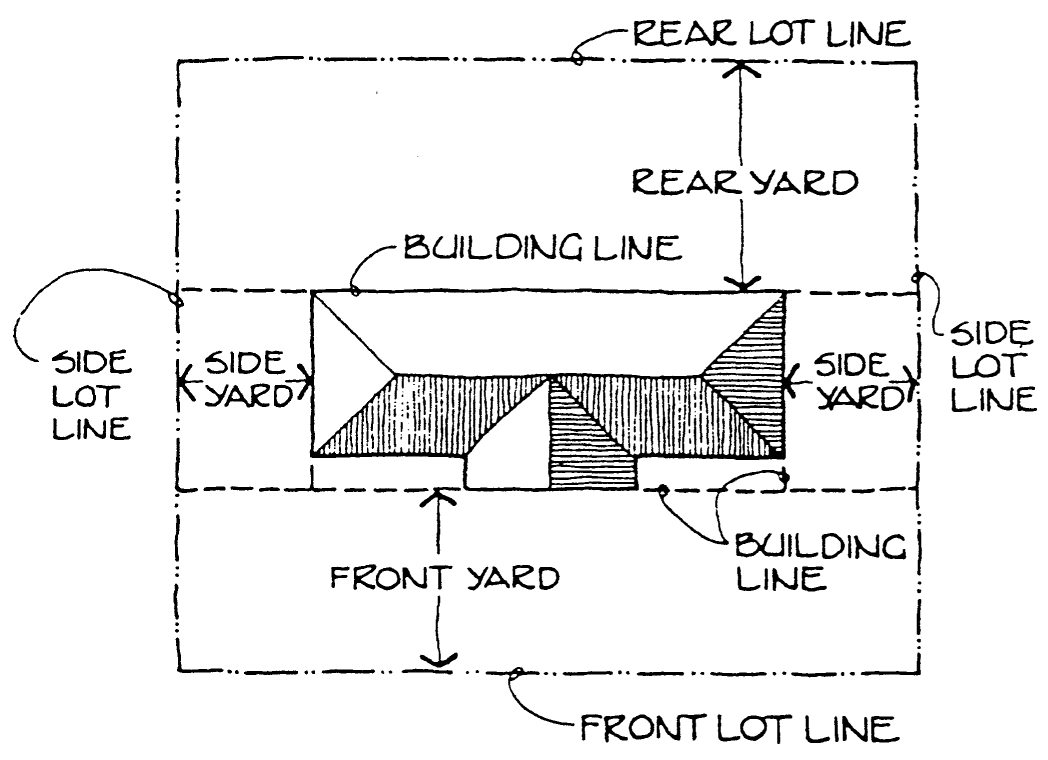
Yard means an open space at grade between a building and adjoining lot lines, unoccupied and unobstructed by any portion of a structure from the ground upward, except as otherwise provided. In measuring a yard for the purpose of determining the width of a side yard or depth of a front or rear yard, the least horizontal distance between a lot line and the building shall be used.
A.
Required front yard means a yard extending across the front of a lot between the side lot lines, and being the required minimum horizontal distance between the street right-of-way and the main building or any projections thereof, other than the projections of the usual uncovered steps. The required front yard line represents the line in front of which no building or structure may be erected. On corner lots, the front yard shall be considered as parallel to the street upon which the lot has its least dimension.
B.
Required rear yard means a yard extending across the full width of the lot and lying between the rear lot line and the nearest line of the building. Rear yard depth shall be measured at right angles to the rear line of the lot.
C.
Required side yard means a yard between any building and the side lot line, extending from the front yard to the rear yard. The width of the required side yard shall be measured horizontally from the nearest point of the side lot line to the nearest point of the building.
D.
Required corner yard means that portion of a yard which abuts street right-of-way along the side of the lot extending from the front lot line to the rear lot line.
Zoning Official means the official of the City appointed by the City Commission as such, and whose duties include administration and enforcement of these zoning regulations.

