
Hitchcock City Zoning Code
ARTICLE IX
NONCONFORMITIES
Sec. 156.155.- Authority for continued existence of nonconforming uses.
(A)
Authority to continue nonconforming uses. The use of land or buildings or structures, which was lawful upon the effective date of the provisions of this Chapter, although not conforming to the provisions hereof, may be continued subject to the terms of this Article.
(B)
Nonconforming accessory uses. No accessory use to a nonconforming use shall continue after termination of the nonconforming use unless such accessory use otherwise complies with the provisions of this Chapter.
Sec. 156.156. - Authority for continued existence of nonconforming structures.
A structure lawfully existing on the effective date of the provisions of this Chapter, although not conforming to the provisions hereof, shall be allowed to continue in existence subject to the terms of this Article.
Sec. 156.157. - Nonconforming status.
The following are hereby declared to be lawfully existing nonconforming uses or structures:
1.
Any existing use or structure not in conformance with the regulations of the zoning district in which it is located but lawfully existing at the time of the adoption of the provisions of this Chapter;
2.
Any existing use or structure not in conformance with the regulations of the zoning district in which it is located but lawfully existing at the time of the adoption of any amendment to this Chapter, the result of which amendment renders such use or structure nonconforming; and,
3.
Any existing use or structure not in conformance with the regulations of the zoning district in which it is located at the time of annexation into the City.
Sec. 156.158. - Change in ownership.
The status of nonconforming uses and nonconforming structures are not affected by ownership and/or occupancy change, except as otherwise provided herein.
Sec. 156.159. - Repair and maintenance.
Normal maintenance and incidental repair may be performed on a complying structure that contains a nonconforming use or on a nonconforming structure. This section shall not be construed to prevent the strengthening or restoration to a safe condition of a structure in accordance with an order of the Building Official who declares a structure to be unsafe and orders its restoration to a safe condition.
Sec. 156.160. - Nonconforming uses.
(A)
Abandonment. Under this Chapter a nonconforming use may be abandoned subject to the following:
1.
Determination. A nonconforming use of land or of a structure that is discontinued or remains vacant for a continuous period of six (6) months shall be presumed to be abandoned and shall not thereafter be reestablished or resumed. Any subsequent use or occupancy of the structure or land site must conform with the regulations for the district in which it is located. This subsection shall not apply to the residential use of a nonconforming dwelling unit in the "NC", "GC" or "GI" districts.
2.
Overcoming presumption of abandonment. The presumption of abandonment may be rebutted upon showing, to the satisfaction of the Zoning Official, that during such period the owner of the land or structure has been:
a.
Maintaining the land and structure in accordance with the building code and did not intend to discontinue the use;
b.
Actively and continuously marketing the land or structure for sale or lease for that particular nonconforming use; or,
c.
Engaged in other activities that would affirmatively prove there was not intent to abandon.
3.
Calculation of period of abandonment. Any period of such discontinuance caused by government action, fire or natural calamities and without any contributing fault by the nonconforming user shall not be considered in calculating the length of discontinuance pursuant to this section.
(B)
Movement, alteration and enlargement. No nonconforming use may be moved, enlarged or altered and no nonconforming use of land may occupy additional land, except as follows:
1.
Enlargement. A nonconforming use may not be enlarged, expanded or extended to occupy all or a part of another structure or land site that it did not occupy on the effective date of the provisions of this Chapter. However, a nonconforming use may be extended within the same structure, provided no structural alteration of the structure is proposed or made for the purpose of the extension. The enlargement, expansion or extension of a nonconforming residential use shall be excepted from this limitation, provided that the enlargement, expansion or extension does not exceed fifty (50) percent of its appraised value as it existed prior to the enlargement, expansion or extension; it was not destroyed to the extent of fifty (50) percent or more; and, it complies with all other regulations, e.g. height, setbacks, etc., for the property on which it is located.
2.
Exterior or interior remodeling or improvements to structure. Exterior or interior remodeling or improvements to a structure containing a nonconforming use shall be allowed, provided there is no expansion of the nonconforming use.
3.
Relocation of structure. A structure containing a nonconforming use may not be relocated to another site unless the use shall conform to the regulations of the district into which the structure is relocated.
4.
Change of nonconforming nonresidential use to another nonconforming use. Upon application to the Zoning Official, a nonconforming use may be changed to another nonconforming use of the same or similar type or intensity or to another nonconforming use of the same or similar type, but of less intensity. Whenever any nonconforming nonresidential use is changed to a less intensive nonconforming nonresidential use, such use shall not be changed back to a more intensive nonconforming nonresidential use. Whenever any nonconforming nonresidential use is changed to a conforming use, such use shall not later be changed to a nonconforming use.
(C)
Destruction of structure with nonconforming use. If a structure that contains a nonconforming use is destroyed to the extent of fifty (50) percent or more of its appraised value by fire or natural calamity or is voluntarily razed or is required by law to be razed, the nonconforming use shall not be resumed. The determination of the extent of damage or destruction under this subsection shall be based on the ratio of the estimated cost of restoring the structure to its condition before the damage or destruction to the estimated cost of duplicating the entire structure as it existed prior to the damage or destruction.
Sec. 156.161. - Nonconforming structures.
Under this Chapter, a nonconforming structure may not be moved, enlarged or altered, except in the manner provided in this section, Section 9-8, Section 9-9, or unless required by law.
1.
Repair, maintenance, alteration and enlargement. Any nonconforming structure may be repaired, maintained, altered or enlarged; provided, however, that no such repair, maintenance, alteration or enlargement shall either create any new noncompliance or increase the degree of the existing noncompliance of all or any part of such structure.
2.
Moving. Except as provided in Sections 9-8 and 9-9, a nonconforming structure shall not be moved in whole or in part, for any distance whatsoever, to any other location on the same or other lot unless the entire structure shall thereafter conform to the regulations of the district in which it is located after being moved.
3.
Damage or partial destruction. If a nonconforming structure is damaged or destroyed by fire or natural calamity to the extent of fifty (50) percent or less of its appraised value, the structure may be restored if restoration is started within six (6) months and diligently pursued to completion. Any delay in starting such restoration that is caused by government action or natural calamities and without contributing fault by the owner shall be deducted in calculating the starting date of restoration.
Sec. 156.162. - Nonconforming mobile homes and manufactured homes.
Mobile Homes lawfully existing and occupied within the City prior to the effective date of the provisions of this Chapter shall be allowed to continue and be maintained. No expansion or enlargement of a Mobile Home shall be allowed; provided, however, Mobile Homes or Manufactured Homes heretofore installed in compliance with City ordinances, being properly permitted thereunder, utilized continuously as a residence, and being connected to all utilities, maybe replaced with newer model Manufactured Homes, subject to the requirements of this Chapter and Chapter 153 of the City's Code of Ordinances. In the event of such replacement, documentation as to the use and connection to utilities must be provided to the City, and the old unit must be removed and the new unit must be installed within ninety (90) days. An extension of such ninety-day limit on replacement may be granted by the Zoning Official if additional time is necessary because of a natural disaster, fire, death, legal proceeding, or other factor beyond the control of the owner.
Sec. 156.163. - Nonconforming manufactured home park and subdivision.
(A)
Any Manufactured Home Park or Manufactured Home Subdivision which is lawfully existing and occupied on the effective date of the provisions of this Chapter and which does not comply with all applicable provisions of this Chapter shall be considered a nonconforming Manufactured Home Park or Manufactured Home Subdivision. Nonconforming Manufactured Home Parks shall comply with the requirements of Chapter 153 of the City's Code of Ordinances.
(B)
Any addition of land to a nonconforming Manufactured Home Park or Manufactured Home Subdivision must conform to all requirements of this Chapter.
(C)
The placement or replacement of a Manufactured Home on any lot within a nonconforming Manufactured Home Park or Manufactured Home Subdivision shall be permitted, provided such placement complies with all requirements of this Chapter and Chapter 153 of the City's Code of Ordinances.
Sec. 156.164. - Nonconforming accessory uses and structures.
The continued existence of nonconforming accessory uses and nonconforming accessory structures shall be subject to the provisions governing principal nonconforming uses and nonconforming structures as set forth herein.
Sec. 156.165. - Nonconforming lots of record.
Notwithstanding the minimum requirements for lot size within the various zoning districts, structures may be constructed, built, moved onto, expanded, reconstructed, occupied, or used on a nonconforming lot of record that existed prior to the effective date of this Chapter, or any amendment hereto, provided all such structures shall meet all other applicable requirements of this Chapter.
Attachment 1:
DISTRICT - USE MATRIX
"X" = Use Permitted Within Respective District
Attachment 2:
HEIGHT AND AREA MATRIX
TABLE NOTES:
1
Maximum height is measured from finished grade.
2
Permitted nonresidential structures located at least 25 feet from a residential property line may increase height at a ratio of one foot for each additional two feet of setback.
3
Minimum lot depth 150 feet when abutting railroad rights-of-way, a high pressure oil or gas line, an arterial street or highway, or a nonresidential district or use. The Planning & Zoning Board may increase the minimum lot depth requirement not to exceed 175 feet. The Board may also require a lot width not to exceed 200 feet when a side yard abuts the above features.
4
High-density residential developments shall have a minimum of 10% percent of the net site area as common area such as a playground, tennis court, swimming pool, exercise path, or natural preserve area, for use by all persons who reside on the premises.
5
A greenbelt/landscape buffer of not less than 25 feet in width shall be located along all Manufactured Home Community or Manufactured Home Subdivision boundary lines. Such greenbelt/landscape buffer shall be continuously maintained and shall be devoted exclusively for common open space and landscaping.
6
Each Manufactured Home Community shall comply with the requirements of § 153.75 of the City's Code of Ordinances regarding provision of adequate recreation areas and facilities. Lots for common facilities shall be of such size to meet the minimum setbacks established in this section, and such that no more than 50% of the common lot is covered by building area, exclusive of parking.
7
Permitted structures located at least 50 feet from all property lines may increase height at a ratio of one (1) foot for each additional two (2) feet of setback.
8
Buildings over 20 feet in height shall set back an additional one (1) foot for each additional two (2) feet in height.
9
Buildings over 20 feet in height shall set back an additional one (1) foot for each additional two (2) feet in height.
10
In all cases where residential or non-residential structures are required to be built as elevated buildings, as defined in § 152.04 of the City Code of Ordinances, to comply with the flood hazard reduction regulations as contained in Chapter 152, Flood Hazard Areas, the height of such structures shall not extend more than thirty-five (35) feet above the first-floor living or occupied elevation, with the maximum overall height of the structure not to exceed fifty (50) feet above finished grade.
GENERAL NOTES:
A
Accessory buildings shall not be placed within any easement on the property.
B
In the "HR" district, the minimum living area of single-story apartment units shall be 650 square feet (plus 250 square feet for each additional story per unit).
C
In the "MH" district, manufactured homes shall be located not less than 20 feet from any exterior wall to the closest exterior wall of the nearest manufactured home. The distance from a manufactured home to a common area or street shall be not less than 25 feet.;eop;
D
Hotels and motels shall not contain less than 200 square feet of floor area in each living unit and shall have at least one (1) complete bathroom for each room or suite of rooms.
E
Order boxes for drive-up and drive-through service associated with a restaurant shall be located a minimum of 30 feet from property zoned "AR", "SFR", "HR" and "MH".
F
In the "HR" district, principal buildings must be separated a minimum of 15 feet.
G
See Article 6, Supplemental Regulations, for additional height and area requirements and clarifications.
(Ord. No. 2022-028, § 1, 11-14-22)
Sec. 156.166. - Nonconforming use of property.
No residential structures shall be built in the Final Phase Buffer Zone Map shown on Exhibit A, adjacent to the City's wastewater treatment plant in accordance with 30 Tex. Admin. Code § 309.13(g).
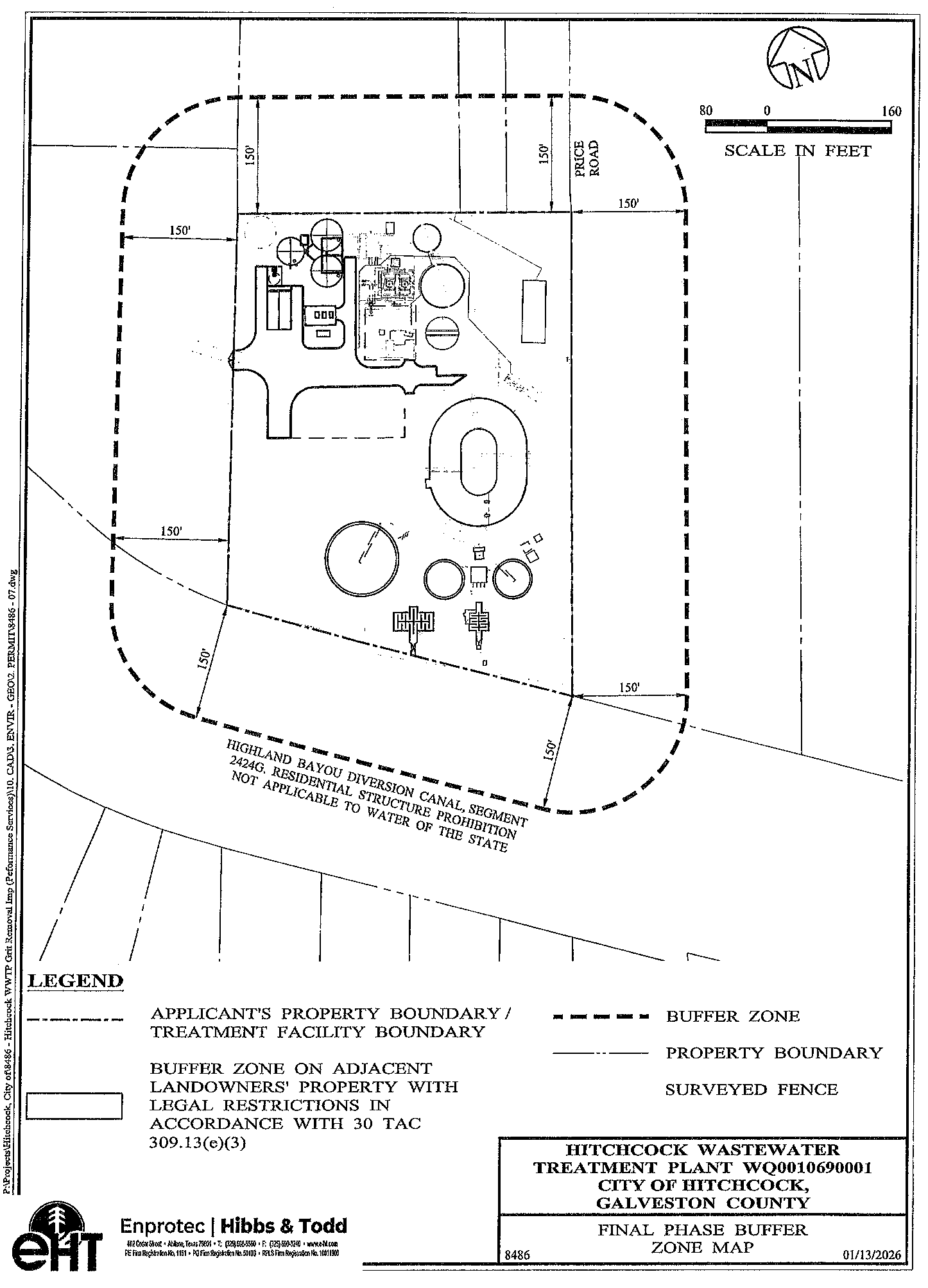
(Ord. No. 2026-001, § 1, 1-26-26)

