


Holland Township City Zoning Code
ARTICLE 22
- GENERAL DEFINITIONS
Sec. 22.1 - Construction of language.
A.
The following listed rules of construction shall apply to the text of this ordinance.
1.
The particular shall control the general.
2.
Except with respect to the definitions which follow in section 22.2, the headings which title an article, section or subsection are for convenience only and are not to be considered in any construction or interpretation of this ordinance or as enlarging or restricting the terms and provisions of this ordinance in any respect.
3.
The word "shall" is always mandatory and not discretionary. The word "may" is permissive.
4.
Unless the context clearly indicates to the contrary:
a.
Words used in the present tense shall include the future tense;
b.
Words used in the singular number shall include the plural number; and
c.
Words used in the plural number shall include the singular number.
5.
A "building" or "structure" includes any part thereof.
6.
The word "person" includes a firm, association, partnership, joint venture, corporation, trust, municipal or public entity or equivalent entity or a combination of any of them as well as a natural person.
7.
The word "used" or "occupied," as applied to any land, building or structure, shall be construed to include the words "intended," "arranged," "designed to be used," or "occupied."
8.
The word "erected" or "erection" as applied to any building or structure, shall be construed to include the words "built," "constructed," "reconstructed," "moved upon," or any physical operation or work on the land on which the building or structure is to be built, constructed, reconstructed or moved upon, such as excavation, filling, drainage or the like.
9.
The word "township" means the Charter Township of Holland, Ottawa County, Michigan.
10.
The words "township board" mean the Holland Charter Township Board.
11.
The words "planning commission" mean the Holland Charter Township Planning Commission.
12.
The words "board of appeals" mean the Holland Charter Township Zoning Board of Appeals.
13.
The words "zoning administrator" mean the Holland Charter Township Zoning Administrator or a designated representative.
14.
The words "legal record" mean the circumstance where the legal description of a lot or parcel of land has been recorded as part of a document on record in the office of the Register of Deeds, Ottawa County, Michigan.
B.
The words "building permit" mean the Holland Charter Township Zoning Permit issued under the rules and regulations of the Holland Charter Township Zoning Ordinance.
C.
For the purpose of their use in this ordinance, the following terms and words are hereinafter defined. Any word or term not defined herein shall be considered to be defined in accordance with its common or standard definition.
Sec. 22.2 - Definitions.
Accessory use. A use of a nature customarily and clearly incidental and subordinate to the main use of the land, lot, building or structure.
Addition. Any construction which increases the size of a building or facility in terms of site coverage, height, length, width or gross floor area, such as a porch, attached garage, or a new room or wing.
Agribusiness. A business and/or commercial use operated primarily for the support of agricultural needs. It may consist of products, materials, and equipment servicing and sales; storage and/or processing of agricultural products and/or animals (but not including slaughtering, rendering or tanning); veterinarian and/or technical support facilities.
Agricultural labor camp. A tract of land and all vehicles, buildings, dwellings, or other structures pertaining thereto, part of which is established, occupied, or used as living quarters for five or more migratory laborers engaged in agricultural activities, including related food processing.
Agritourism. The practice of visiting an agribusiness, horticultural, or agricultural operation, including, but not limited to, a farm, orchard, winery, greenhouse, hunting reserve, a companion animal or livestock show, for the purpose of recreation, education, or active involvement in the operation, other than as a contractor or employee of the operation.
Alley. A publicly controlled right-of-way not more than 30 feet wide affording only secondary means of vehicular access to abutting lots and land and which is not intended for general traffic circulation.
Altered or alteration. Any change, addition or modification in the construction of any building or structure, including, without limitation, any change in the supporting members, bearing walls, columns, posts, beams, girders or roof structure, any architectural change of the interior or exterior of a building or structure which may affect its structural integrity, or any addition to or diminution of a structure or building.
Ambient sound level. The amount of background noise at a given location prior to the installation of a WET(s) which may include, but not be limited to, traffic, machinery, lawnmowers, human activity, and the interaction of wind with the landscape. The ambient sound level is measured on the dB(A) weighted scale as defined by the American National Standards Institute.
Animal, domestic. An animal commonly domesticated as a companion or pet and kept in a home or yard. Examples include dogs, cats, birds, fish, rabbits, small rodents and similar animals, and are not used for commercial purposes. Household or domesticated animals do not present an unusual risk to a person or property and are not considered farm or wild animals.
Animal, farm. An animal or fowl customarily raised on a farm such as equines, cattle, swine, sheep, goats, llamas, alpacas, poultry, waterfowl, rabbits, mink and exotic animals, such as emus, and ostriches.
Animal services, animal clinic/hospital. An establishment used by a veterinarian where animals are treated. This use may include boarding and grooming as accessory uses.
Animal services, kennel. A commercial facility for the boarding, breeding, and/or maintaining of animals that are not owned by the operator for a fee. This use includes pet day care facilities, animal training facilities, and may include grooming as an accessory use. This use includes the breeding of animals in outdoor structures, cages or pens for sale, but does not include animals for sale in pet shops (see "general retail").
Animal services, rescue or shelter. A facility that keeps four or more impounded stray, homeless, abandoned, or unwanted animals.
Animal, wild. An animal not domesticated by humans or any animal which a person is prohibited from possessing by local, state or federal law.
Amateur radio service. A federally licensed radio-communication service for the purpose of self-training, intercommunication and technical investigations carried out by amateurs, that is, duly authorized persons interested in radio technique solely with a personal aim and without pecuniary interest particularly with respect to providing emergency communications. (As per Code of Federal Regulations, Title 47, Part 97)
1.
Amateur radio antenna. Any combination of materials or equipment used exclusively for the purpose of sending and/or receiving electromagnetic waves for amateur radio services.
2.
Amateur radio antenna support structure. Any structure, such as a mast, pole, tower or any combination thereof, whether ground or roof mounted, freestanding or guyed, used exclusively for supporting amateur radio antenna(e).
3.
Ground mounted amateur radio antenna and/or amateur radio antenna support structures means amateur radio antenna and/or amateur radio antenna support structures that are not fixed to any building or accessory structure.
4.
Roof mounted amateur radio antenna and/or amateur radio antenna support structures means amateur radio antenna and/or amateur radio antenna support structures that are fixed to any building or accessory structure.
Aviation. A runway or helicopter landing pad without normal airport facilities.
Banquet Barn. An accessory use which provides rental space in a barn or accessory building for functions such as, but not limited to: wedding parties, conferences, service club meetings and other similar gatherings, along with the catering of food services off the premises.
Banquet hall. A use which provides rental space for such functions as, but not limited to: wedding parties, conferences, service club meetings and other similar gatherings, along with the catering of food services off the premises.
Basement. That portion of a building which is partly or wholly below grade but so located that the vertical distance from the average grade to the floor is greater than the vertical distance from the average grade to the ceiling. A basement is not counted as a story.
Bed and breakfast. A house, or portion of a house, where short-term lodging rooms and breakfast and light snacks are provided to overnight guests and where the operator lives on the premises or in adjacent premises.
Buffer. A strip of land which provides visual separation and aesthetic relief between potentially incompatible uses or provides protection to natural resources through the use of landscaping, preservation of existing vegetation, berms, or screening, or a combination of materials.
Building. A permanent independent structure with a roof, supported by walls, columns or other supports that is designed for the shelter, housing or enclosure of persons, animals, possessions or property of any kind, or to conduct business activities. Shipping containers, cargo containers, semi-trailers, and soft-sided structures shall not be permitted as temporary or permanent structures, whether accessory or principal.
Building, agricultural. Any building, other than a dwelling, which is customarily used in connection with the agricultural activities conducted on the farm.
Building, accessory. A building on the same lot with, and of a nature customarily incidental and subordinate to, the principal building. Accessory buildings also include portable sheds that are not stick-built and not affixed to the ground.
Building footprint. The area of a building measured around the exterior of a building foundation, not including upper stories.
Building, principal. A building in which is conducted the main or principal use of the lot on which the building is located.
Cemetery. One or a combination of more than one of the following: A burial ground for earth interments, a mausoleum for crypt entombments, or a columbarium for the inurnment of cremated remains. For the purposes of this ordinance, a cemetery does not include a crematorium.
Commercial solar energy system. A utility-scale facility of solar energy collectors with the primary purpose of wholesale or retail sales of generated electricity. Also known as a solar farm.
Commercial stable. A structure or land use in or on which equines are kept for sale or hire to the public. Breeding, boarding, or training equines may also be conducted.
Community art. A work of visual art, painting, banner, mural, photograph, drawing, script, sculpture, figure, monument, fountain, clock, arch, or other similar works in other media which are of a permanent character intended for ornament or commemoration and are constructed, displayed, or installed in conjunction with a gateway.
Community cultural facility. A public or non-profit facility that provides educational and cultural experiences for the general public, examples of which include: Aquariums, arboretums, art galleries, botanical gardens, libraries, museums, planetariums, civic centers and theaters predominantly used for live performances, and zoos. May also include accessory retail uses such as a gift/book shop, restaurant, etc.
Condominium, master deed. The condominium document recording the condominium project to which are attached as exhibits and incorporated by reference the bylaws for the project and including those items required in Section 8 of the Condominium Act, P.A. 59 or 1978, as amended.
Condominium project, site. A development in which ownership is divided under the authority of the Condominium Act, P.A. 59 of 1978, as amended, and in which the condominium unit consists of a building site, with or without structures, which along with associated limited common area elements, constitutes the equivalent of a lot.
Condominium unit. The portion of a condominium development designed and intended for occupancy and use by the unit owner consistent with the provisions of the master deed, as defined in the Condominium Act, P.A. 59 of 1978, as amended.
Contractors facility. An office and warehouse facility accommodating a construction contracting business. Examples of these uses include, but are not limited to: excavating companies; building, electrical, mechanical, and plumbing contractors; landscape installers; tree removal companies. This facility may have associated outdoor storage.
Cul-de-sac. A circular vehicle turn-around area constituting the terminus of a street that has only one outlet to another street.
Day care.
1.
Day care, family day care home (1—6 children). A private home in which one, but fewer than seven minor children are received for care and supervision for periods of less than 24 hours a day, unattended by a parent or legal guardian, except children related to an adult member of the family by blood, marriage or adoption. Family day care homes include a home in which care is given to an unrelated minor child for more than four weeks during a calendar year.
2.
Day care, group day care home (7+ children). A private home in which more than six, but not more than 12 minor children are given care and supervision for periods of less than 24 hours a day, unattended by a parent or legal guardian, except children related to an adult member of the family by blood, marriage or adoption. A group day care home includes a home in which care is given to an unrelated minor child for more than four weeks during a calendar year.
Day care, child care center. A facility other than a private residence in which one or more preschool or school age children are given care and supervision for periods of less than 24 hours per day, and where the parents or guardians are not immediately available to the child. A child care center or day care center includes a facility that provides care for not less than two consecutive weeks, regardless of the number of hours of care per day. The facility is generally described as a child care center, day care center, day nursery, nursery school, parent cooperative preschool, play group, before- or after-school program or drop-in center.
Decibel. A unit of measurement used to express the magnitude of sound pressure and sound intensity. Decibels shall be measured on the dB(A) weighted scale as defined by the American National Standards Institute.
Distillery, small. A facility operated by a small distiller duly licensed by the State of Michigan Liquor Control Commission (MLCC) to manufacture spirits within the limits established by the State of Michigan for a small distiller.
Dwelling.
1.
Dwelling, accessory. An attached dwelling subordinate to the principal single-family dwelling that contains an independent living area, including sleeping quarters, a bathroom, living area, and kitchen facilities, but can be internally accessed through the principal dwelling. The inclusion of a secondary kitchen or kitchenette within the principal dwelling does not alone result in classification as an attached accessory dwelling unit.
2.
Dwelling, multi-family. A structure containing three or more dwelling units on a single lot designed for occupancy by three or more families living independently of one another.
3.
Dwelling, single-family. A freestanding dwelling unit that is physically separate from any other dwelling.
4.
Dwelling, single-family attached. A structure containing one dwelling unit on a single lot and connected along a property line to another dwelling unit on an adjoining lot by a common wall or other integral part of the principal building such as a breezeway or carport.
5.
Dwelling, two-family. A structure containing two dwelling units on a single lot designed for or used by two families living independently of one another, may also be referred to as a duplex.
Dwelling unit. A building or portion of a building, designed for use and occupancy by one family, having permanent provisions for living, sleeping, cooking and sanitation. A recreational vehicle, portable building, tent or other transient residential use, such as hotels/motels and bed and breakfasts, are not considered a dwelling.
Easement. A designated area surveyed, legally described, and recorded, which authorizes a person, government, agency or public utility company to use public or private land owned by another for a specific purpose.
Easement, private street. A designated area surveyed, legally described, and recorded, applied to a private street, which authorizes vehicle travel and the installation and maintenance of public utilities.
Family. An individual or group of two or more persons related by blood, marriage or adoption, together with foster children of the principal occupants, with not more than one additional unrelated person, who are domiciled together within a dwelling, or a collective number of individuals domiciled together in one dwelling whose relationship is of a continuing non-transient domestic character. This definition shall not include any society, club, fraternity, sorority, association, lodge, coterie, organization, or group of students or other individuals whose domestic relationship is of a transitory or seasonal nature or for an anticipated limited duration of a school term or terms or other similar determinable period.
Farm. The land, plants, animals, buildings, structures, including ponds used for agricultural or aquacultural activities, machinery, equipment, and other appurtenances used in the commercial production of farm products.
Farmers market. A building or structure designed or used for the seasonal sale of farm or home grown agricultural products, or agriculturally related products, directly to the consumer from a designated area.
Farm operation. The operation and management of a farm or a condition or activity that occurs at any time as necessary on a farm in connection with the commercial production, harvesting, and storage of farm products, and includes, but is not limited to:
1.
Marketing produce at roadside stands or farm markets.
2.
The generation of noise, odors, dust, fumes, and other associated conditions.
3.
The operation of machinery and equipment necessary for a farm including, but not limited to, irrigation and drainage systems and pumps and on-farm grain dryers, and the movement of vehicles, machinery, equipment, and farm products and associated inputs necessary for farm operations on the roadway as authorized by the Michigan vehicle code, Act No. 300 of the Public Acts of 1949, being MCL 257.1 to 257.923.
4.
Field preparation and ground and aerial seeding and spraying.
5.
The application of chemical fertilizers or organic materials, conditioners, liming materials, or pesticides.
6.
Use of alternative pest management techniques.
7.
The fencing, feeding, watering, sheltering, transportation, treatment, use, handling and care of farm animals.
8.
The management, storage, transport, utilization, and application of farm by-products, including manure or agricultural wastes.
9.
The conversion from a farm operation activity to other farm operation activities.
10.
The employment and use of labor.
Farm product. Those plants and animals useful to human beings produced by agriculture and includes, but is not limited to, forages and sod crops, grains and feed crops, field crops, dairy and dairy products, poultry and poultry products, cervidae, livestock, including breeding and grazing, equine, fish, and other aquacultural products, bees and bee products, berries, herbs, fruits, vegetables, flowers, seeds, grasses, nursery stock, trees and tree products, mushrooms, and other similar products, or any other product which incorporates the use of food, feed, fiber, or fur, as determined by the Michigan Department of Agriculture and Rural Development.
Fence. A barrier intended to prevent access, create an enclosure, or to mark a boundary.
Floor area. The area of a building measured around the exterior of a building foundation and the perimeter measurements of upper stories. Floor area below the first floor shall be counted as part of the total floor area if at least one-half of its height is above finished grade and its construction is such that it meets all requirements for use as a living area by the applicable code requirements. Floor area below the first floor shall not be considered in determining the minimum first floor square footage requirement.
Food processing. Industries that transform livestock and agricultural products into products for intermediate or final consumption. Processes convert raw materials (generally of animal or vegetable origin) into food products. The food products manufactured in these establishments are typically sold to wholesalers or retailers for distribution to consumers, but establishments primarily engaged in retailing bakery and candy products made on the premises not for immediate consumption are included.
Food processing, small scale. Establishments primarily engaged in producing and retailing bakery, delicatessen, ice cream and candy products made on the premises not for immediate consumption with no more than five employees.
Food truck. A truck serving or offering food and/or beverages for sale from a mobile food vending unit which means for purposes of this ordinance, a self-contained, fully enclosed vehicle including attached trailers for smokers or grills. This definition does not include food tents or food carts.
Foster care.
1.
Foster care, adult foster care family home (1—6 adults). A private residence with an approved capacity of six or fewer adults, where foster care is provided 24 hours per day, five or more days per week, and for two or more consecutive weeks. It is licensed and regulated under the Adult Foster Care Facility Licensing Act, Act 218 of the Public Acts of 1979, MCL 400.701 et seq., as amended. The person issued the adult foster care family home license is a member of the household and an occupant of the residence.
2.
Foster care, adult foster care group home (7+ adults). A private residence where adults are provided with foster care 24 hours a day, five or more days per week, and for two or more consecutive weeks. A foster care group home with an approved capacity of at least seven, but not more than 12 adults is a "small group home." A group home with an approved capacity of at least 13, but not more than 20 adults is a "large group home". An adult foster care facility is licensed under the Adult Foster Care Facility Licensing Act, Act 218 of the Public Acts of 1979, MCL 400.701 et seq., as amended, and the person issued the adult foster care group home license is a member of the household and an occupant of the residence.
3.
Foster care, foster family home (children). A private home, licensed under Act 116 of the Public Acts of 1973, in which at least one, but not more than seven minor children who are not related to an adult member of the house by blood or marriage, or who are not placed in the household pursuant to the Adoption Code (Act 288 of the Public Acts of 1939, as amended), are given care and supervision 24 hours per day, four or more days per week for two or more consecutive weeks, unattended by a parent or guardian. The person issued the license is a permanent resident of the home. This zoning definition includes the foster family group homes, as defined by the Act.
Funeral home. A building used for the preparation of the deceased for burial or cremation, for the display of the deceased and/or for ceremonies or services related thereto, including the storage of caskets, funeral urns, funeral vehicles and other funeral supplies, and may include cremator furnaces or cremation retorts for ashes.
Garage. A detached accessory building or portion of a principal building for the parking or temporary storage of automobiles, recreational vehicles and/or incidental personal property of the occupants of the premises.
Gateway. A major vehicular or pedestrian entry point which provides access to the township from an adjacent municipality, and includes the street and surrounding properties a person encounters when first entering the township.
Governmental facility. Buildings, structures and facilities that may include administrative offices, public works services, law enforcement, fire protection, libraries, museums, cemeteries, recreational centers and storage areas for public equipment and materials for local, county, state and federal public adjacencies.
Grade, finished. The lowest point of elevation between the exterior wall of the structure and a line five feet from the exterior wall of the structure.
Grade, natural. The elevation of the ground surface in its natural state, before man-made alterations.
Greenhouse and nursery. A retail or wholesale business whose principal activity is the display and sales of plants grown on the site within an enclosed building (greenhouse) or outdoors (nursery).
Housing.
1.
Independent and assisted living. A building or buildings containing individual dwelling units designed for and restricted to occupancy by persons of a specified age who are retired or are nearing retirement and wish to live in a community environment, but do not require nursing or medical supervision. Group dining facilities and non-medical personal care services may also be provided. Such housing does not include a nursing or convalescent home.
2.
Convalescent and nursing. A facility licensed as a "nursing home" by the state department of public health under Article 17 of the Public Health Code, Act No. 368 of the Public Acts of Michigan of 1978 (MCL 333.2010 et seq.), as amended. A "nursing home" shall include an extended care facility, hospice, and convalescent home.
Home occupation. A use which includes any activity which is clearly secondary to a residential use and carried out for economic gain. It is conducted within a dwelling, carried out by its occupants utilizing equipment typically found in a home and is not evident from the outside.
Hotel/motel. A building under single management that provides rooms or suites intended primarily as sleeping accommodations for public rental on a daily basis for registered guests. Other supportive facilities may also be included such as, but not limited to, meeting rooms, incidental retail sales, restaurants, lounges, swimming pools, recreational and fitness facilities and similar facilities/services intended principally to serve registered guests.
Household. All persons occupying a house, apartment, group of rooms or a single room occupied as separate living quarters, regardless of their relationship to one another.
Liquefied petroleum gas (LPG) sales. An establishment providing LPG dispensing and bulk containers for sale.
Loading space. An off-street portion of a lot of record designated for the temporary parking of commercial vehicles while loading or unloading materials used, sold or made on the premises.
Lot of record. Land intended for individual ownership and use, separately described on a deed or other instrument recorded in the office of the register of deeds, whether by metes and bounds, as part of a platted subdivision or site condominium, and assigned a parcel number.
Lot area. The area of land included within a lot as defined by lot lines but excluding any public rights-of-way and private street easements.
Lot, corner. A lot with at least two contiguous sides abutting two intersecting streets, and where the interior angle of the intersecting streets is less than 135 degrees. Also, a lot located on a curved street or streets if tangents of the curve, at the points of beginning with the lot or the points of intersection of the side lot lines with the street line, intersect at an interior angle of less than 135 degrees.
1.
Lot lines. A corner lot shall have one primary front lot line, one secondary front lot line (side street), one interior side lot line, and one rear lot line.
2.
Setbacks. On a corner lot with street frontage on two sides, buildings shall be subject to the following setbacks: Two front setbacks, one side setback, and one rear setback.
3.
Yards. A corner lot has one primary front yard, one secondary front yard, one side yard, and one rear yard.
Lot, interior. A lot other than a corner, multi-frontage, through or corner lot, bordered on three sides by other lots.
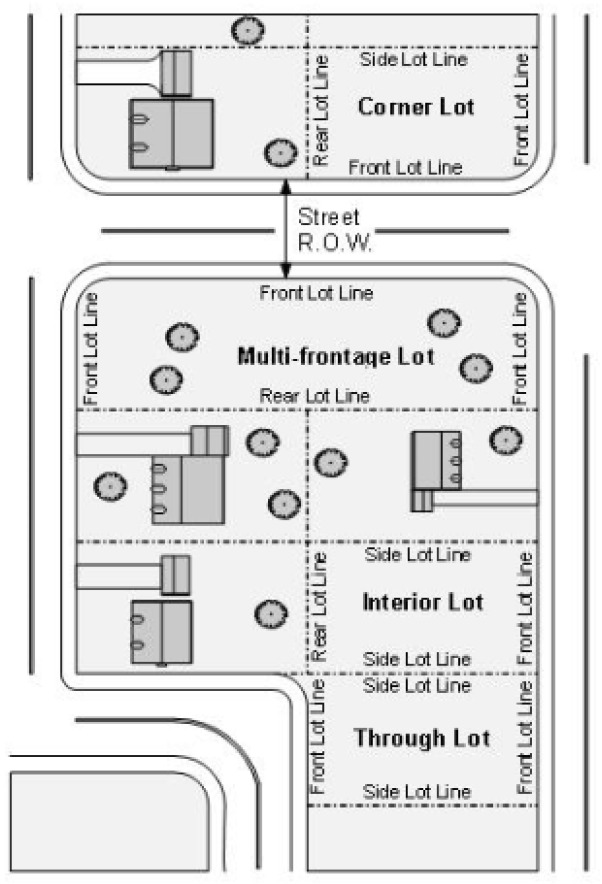
Figure 22-1
1.
Lot lines. Interior lots shall have one front lot line, one front yard, two side lot lines, two side yards, one rear lot line, and one rear yard.
2.
Setbacks. Buildings on interior lots shall be subject to one front setback, two side setbacks, and one rear setback.
3.
Yards. An interior lot has one front yard, two side yards, and one rear yard.
Lot, multi-frontage. A lot bordered by streets on three sides.
1.
Lot lines. If the dwelling is oriented toward one of the two parallel streets, the lot shall have two front lot lines, one secondary front lot line, one interior side lot line, and no rear lot line. If the dwelling is oriented toward the middle street, the lot shall have three primary front lot lines abutting the streets and one rear lot line.
2.
Setbacks. Multi-frontage. If the dwelling is oriented toward one of the two parallel streets, buildings shall be subject to three front yard setbacks, and one side setback. If the dwelling is oriented toward the middle street, buildings shall be subject to three front setbacks and a one rear setback.
3.
Yards. If the dwelling is oriented toward one of the two parallel streets, the lot shall have two front yards, one secondary front yard (street side), one interior side yard, and no rear yard. If the dwelling is oriented toward the middle street, the lot shall have three primary front yards abutting the streets and one rear yard.
Lot, through. An interior lot bordered by two, more or less parallel streets. For the purposes of this definition, if one side of the lot is bordered by an alley opposite of a street the lot is not considered a through lot.
1.
Lot lines. Through lots shall have two front lot lines, and two side lot lines.
2.
Setbacks. Buildings shall be subject to two front setbacks and two side setbacks.
3.
Yards. Through lots shall have two front yards and two side yards.
Lot, waterfront. A lot with one or more of its lot lines adjoining a stream, river, or lake.
Lot coverage. The lot area, stated as a percentage of the total, covered by all buildings and areas under roof, driveways, parking lots, patios, decks, and other impervious surfaces. The zoning administrator shall determine the extent to which partially pervious materials are exempt from lot coverage, such as pervious parking areas, patios, and decks.
Lot depth. The average distance between the front lot line and the rear lot line. The average shall include measurements of the side lot lines, if extending from front lot line to rear lot line, and the shortest measurement from the front lot line to the farthest point of the rear lot line.
Lot frontage. The length of the front lot line measured at the public street right-of-way or private street easement.
Lot lines. The lines bounding a lot, as defined below:
1.
Lot line, front. In the case of an interior lot, the line separating the lot from the street right-of-way or road easement.
2.
Lot line, primary front. On lots with existing buildings, the primary front lot line shall be the location of the traditional front entrance of the building. On corner lots without buildings, it is the shorter of the two front lot lines. Where the front yards are of equal width and/or the primary front lot line is not evident, the Zoning Administrator shall determine the primary front lot line.
3.
Lot line, rear. The lot line opposite and most distant from the front lot line. On a corner lot, the rear lot line is opposite the shorter of the two front lot lines. In the case of a triangular lot, the rear lot line shall be an imaginary line parallel to the front lot line, not less than ten feet long, lying furthest from the front lot line and wholly within the lot. A through lot has no rear lot line. On irregularly-shaped lots, the rear lot line is determined based on a line perpendicular to the front lot line extending to the point where a rear lot line would be ten feet in width and parallel to the front lot line. This rear lot line is intended for the purpose of establishing the rear setback and lot depth only.
4.
Lot line, side. The lot lines connecting the front and rear lot lines of an interior or corner lot or connecting the front lot lines of a through lot.
Lot width. The horizontal distance between side lot lines measured at the two points where the required setback intersects the side lot lines or along the front property line on a curvilinear lot.
Manufactured home. A factory-built, single-family structure that is manufactured under the National Manufactured Home Construction and Safety Standards Act. It is transportable in one or more sections, built on a permanent chassis or foundation and used as a dwelling. It is not constructed with a permanent hitch or other device allowing its transport, other than for its delivery to a permanent site and does not have wheels or axles permanently attached to its body or frame.
Manufactured home community. A single lot of record that contains two or more manufactured homes for use as dwelling units where home sites are leased to individuals who retain customary leasehold rights.
Manufacturing, processing, and packaging.
1.
Heavy. A facility accommodating manufacturing processes that involve and/or produce basic metals, building materials, chemicals, fabricated metals, paper products, machinery, textiles, and/or transportation equipment, where the intensity and/or scale of operations may cause significant impacts on surrounding land uses or the community. Examples of heavy manufacturing uses include the following: Chemical product manufacturing; concrete, gypsum, and plaster product manufacturing; glass product manufacturing; paving and roofing materials manufacturing; petroleum refining and related industries; plastics, other synthetics, and rubber product manufacturing; primary metal industries; pulp and pulp product manufacturing; textile and leather product manufacturing; food products manufacturing.
2.
Light. A facility accommodating manufacturing processes involving less intense levels of fabrication and/or production such as the assembly, fabrication, and conversion of already processed raw materials into products, where the operational characteristics of the manufacturing processes and the materials used are unlikely to cause significant impacts on surrounding land uses or the community. The premises may include secondary retail or wholesale sales. Examples of light manufacturing uses include: Artisan/craft product manufacturing; clothing and fabric product manufacturing; furniture and fixtures manufacturing, cabinet shop, media production, photo/film processing lab not accessory to a retail business, printing and publishing, food preparation and packaging, winery, brewery.
Marina and boat storage. A facility extending into or over a body of water which offers service to the public or members of the marina for docking, loading, servicing, or other activities related to recreational or commercial watercraft. This facility may have associated outdoor storage.
Medical services.
1.
Clinic. A facility other than a hospital where medical, mental health, surgical and other personal health services are provided on an outpatient basis. Examples of these uses include: Medical offices with five or more licensed practitioners and/or medical specialties, outpatient care facilities, urgent care facilities, other allied health services. These facilities may also include incidental medical laboratories and/or pharmacies. Counseling services by other than medical doctors or psychiatrists are included under "Professional and Administrative Services."
2.
Medical office. A facility other than a hospital where medical, dental, mental health, surgical, and/or other personal health care services are provided on an outpatient basis, and that accommodates no more than four licensed primary practitioners (for example, chiropractors, medical doctors, psychiatrists, etc., other than nursing staff) within an individual office suite. A facility with five or more licensed practitioners is classified under "Clinic." Counseling services by other than medical doctors or psychiatrists are included under "Professional and Administrative Services."
3.
Hospital. An institution licensed by the state, where people, including inpatients, receive medical, surgical or psychiatric treatment and nursing care.
Meeting facility. A facility for public or private meetings, including: community centers, meeting halls for clubs and other membership organizations, etc.
Micro-brewery. A facility operated by a micro brewer duly licensed by the State of Michigan Liquor Control Commission (MLCC) to brew ales, beers, meads, and/or similar beverages within the limits established by the State of Michigan for a micro brewer.
Mini-warehouse/self-storage. A building or group of buildings in a controlled access and/or fenced compound that contains varying sizes of individualized, compartmentalized and controlled access rooms, stalls or lockers for the storage of customer's goods or wares.
Mural. Non-commercial message, picture, scene, or diagram exhibited on the outside wall of a building or structure through application of paint, canvas, tile, panels or similar materials such that the wall becomes the background surface or platform for the mural.
Nacelle. On a wind energy turbine, the encasement which houses all of the generating components, gear box, drive tram, and other equipment.
Net-metering. A special metering and billing agreement between utility companies and their customers, which facilitates the connection of renewable energy generating systems to the power grid.
Nonconforming building or structure. A structure or building lawfully constructed that does not conform to the requirements of the area in which it is situated and existed prior to the effective date of this ordinance or any amendment to this ordinance.
Nonconforming lot. A lot lawfully existing on the effective date of this ordinance, or its subsequent amendment, that does not meet the current area and/or dimensional requirements of the zoning district in which it is located.
Nonconforming use. A land use that does not conform to the regulations of the zoning district in which it is situated and lawfully existed on the effective date of this ordinance, or any amendments to the ordinance.
Offices and services.
1.
Bank/financial services. Financial institutions, including, but not limited to: banks, credit agencies, investment companies, security and commodity exchanges, ATM facilities.
2.
Business services. Establishments providing direct services to consumers, including, but not limited to: employment agencies, insurance agent offices, real estate offices, travel agencies, exterminators, carpet cleaners, and contractors' offices without warehouse space or outdoor storage.
3.
Business support services. Establishments providing services to other businesses, including, but not limited to: Computer rental and repair, copying, quick printing, mailing and mailbox services.
4.
Personal services. Establishments providing non-medical services to individuals, including, but not limited to: Barber and beauty shops, commercial health and fitness facilities, tattoo parlors, dry cleaners, small appliance repair, laundromats, massage therapists, pet grooming with no boarding, shoe repair shops, and tanning salons. These uses may include incidental retails sales related to the services they provide.
5.
Professional and administrative services. Office-type facilities occupied by businesses or agencies that provide professional or government services, or are engaged in the production of intellectual property.
6.
Temporary construction office. An office, typically mobile, established at a permitted construction site to accommodate personnel. A location for outdoor storage of materials and equipment is commonly associated with the use.
7.
Temporary sales office. An office, either mobile or located in a model home, used to accommodate real estate agents and associated administrative staff for the purposes of selling or renting real property in subdivisions or other housing developments.
8.
With a drive through facility. Facilities where services may be obtained by motorists without leaving their vehicles. Examples of drive-through services include bank teller windows and drive-up ATMs, dry cleaners, etc.
Outdoor display, sales. The outdoor placement, storage or keeping, for display purposes, of equipment, vehicles, trailers and other similar goods for sale on a premises.
Outdoor display, sales, temporary. Sales associated with a permanent, principal use of a property, for temporary durations and in temporary locations.
Outdoor display, sales, yard and garage sales. A sale of personal household goods and clothing on the same premises as a principal residential use.
Outdoor storage. The outdoor placement of goods such as, building or construction materials, heavy equipment, Class III commercial vehicles (10,001—14,000 pounds gross vehicle weight rating) or larger, commercial trailers, recreational equipment, and other supplies, for future use, production, assembly, preservation or disposal.
Over-the-air reception device. Antennas and dish antennas designed to receive direct broadcast satellite service, including direct-to-home satellite service, to receive or transmit fixed wireless signals via satellite, receive video programming services via broadband radio service (wireless cable), receive or transmit fixed wireless signals other than via satellite, or receive local television broadcast signals.
Parking facility, public or commercial. A public or commercial parking lot or structure providing parking either for free or for a fee. Does not include towing impound and storage facilities.
Place of worship. A building or structure or group of buildings or structures that, by design and construction, are primarily intended for conducting organized religious worship services. Associated accessory uses include, but are not limited to, classrooms, meeting halls, indoor and outdoor recreational facilities, day care, counseling and kitchens.
Planning commission. The Holland Charter Township Planning Commission.
Plat. A map of a subdivision of land, recorded with the County Register of Deeds, pursuant to the Subdivision Control Act, PA 288 of 1967, Land Division Act, PA 591 of 1996 (MCL 560.101 et seq.), as amended.
Pond. An outdoor body of standing water, accumulated in a natural or artificially constructed basin or depression in the earth, either above or below or partly above and partly below grade, capable of holding water to a depth of greater than two feet when filled to capacity.
Pool access structure. A structure or object used to provide access to a pool or complement the use of a pool. Examples of pool access structures include, but are not limited to the following, ladders, decks, and awnings.
Principal use. The primary or predominant use of a lot of record.
Public utility. Any person furnishing to the public, transportation, water, gas, electricity, telephone, cable television, communication, steam, telegraph, sewage disposal or other similar service, including the township. The erection, construction, alteration, or maintenance by a public utility, or municipal department, of underground, surface or overhead gas, communication, telephone, electrical, steam, fuel or water, transmission, distribution collection, supply, or disposal systems. This includes related poles, wires, pipes, conduit, cables, public safety alarm and communication equipment, traffic signals, hydrants and similar accessories that are necessary to furnish adequate service, addressing general public health, safety, convenience, or welfare. These do not include wireless telecommunication towers (unless located on public property and used as part of a municipal emergency communications network); wind energy turbines; offices, utility buildings, substations, or structures that are enclosures or shelters for service equipment; or maintenance depots.
Qualified Residential Treatment Program (QRTP). A program within a child caring institution with an approved capacity of ten or fewer individuals, where registered or licensed nursing and other licensed clinical staff on-site or available 24 hours a day, seven days a week. The program is licensed and regulated under the Child Care Licensing Act, Act 116 of the Public Acts of 1973, MCL 722.110 et seq., as amended.
Recreational equipment. Any of the following: Recreation camper, boat, boat trailer, snowmobile, snowmobile trailer, motorcycle or motorcycle trailer, all-terrain vehicle, all-terrain vehicle trailer, enclosed trailers, utility trailers, or similarly licensed vehicles, trailers, or equipment.
Recreation facility.
1.
Campground. A form of lodging where guests bring tents, travel trailers, campers, or other similar forms of shelter to experience natural environments. Campgrounds rent pads or spaces to guests. May also include accessory uses such as a camp store, shower/bathroom facilities, and recreational facilities.
2.
Community-based, public.
a.
Indoor. A facility providing a variety of indoor recreational opportunities including, but not limited to: Gymnasium, swimming pool, tennis, racquetball and/or handball courts, batting cages, and other indoor sports activities. This use includes all not-for-profit organizations chartered to provide community-based recreation services.
b.
Outdoor. A facility providing a variety of outdoor recreational opportunities including, but not limited to: Playground equipment, playing fields, tennis and basketball courts, swimming pools, boat ramps and fishing piers, and areas for passive recreation such as hiking trails, picnic areas and bird blinds. This use includes all not-for-profit organizations chartered to provide community-based recreation services.
3.
Commercial.
a.
Indoor. A facility providing a variety of indoor recreational opportunities and entertainment services, often for a fee, including, but not limited to: Gymnasium, swimming pool, tennis, racquetball and/or handball courts, batting cages, bowling alleys, coin-operated arcades, movie theaters, ice skating and roller skating rinks, pool and billiard rooms as primary uses. Any establishment with four or more electronic games or amusement devices is considered an indoor recreation facility.
i.
This use does not include adult-oriented businesses.
ii.
Facility may include bars and restaurants as accessory uses.
b.
Outdoor. A facility providing a variety of outdoor recreational opportunities and entertainment services, often for a fee, including, but not limited to amusement and theme parks; go-cart tracks; golf driving ranges; miniature golf courses; marinas; watercraft rentals; and water parks. May also include commercial facilities customarily associated with the above indoor commercial recreational uses, including bars and restaurants, coin-operated arcades, etc.
i.
This use does not include golf courses or campgrounds.
ii.
Marinas may include marine-related retail (bait and tackle, boat supplies), fuel sales, minor boat repair, and boat storage.
4.
Golf course. A use consisting of regulation and par 3 golf courses having nine or more holes, and accessory facilities and uses, including driving ranges, clubhouses with bar and restaurant; locker and shower facilities; "pro shops" for on-site sales of golfing equipment and clothing; and golf cart storage facilities.
Restaurant. A business establishment whose method of operation involves either the delivery of prepared food by servers to customers seated at indoor or outdoor areas, or prepared food is acquired by customers at a counter or cafeteria line and consumed at tables within a completely enclosed building, but does not include drive-through services, which are separately defined and regulated. Service of alcoholic beverages by the drink is incidental to the service of food and food receipts exceed 50 percent of sales.
1.
Restaurant with drive-through. A business establishment whose method of operation involves the delivery of prepared food or beverages to the customer in a motor vehicle, typically through a drive-through window, for consumption off the premises. A drive-through restaurant may also have indoor or outdoor seating.
2.
Restaurant with micro-brewery, small distillery or small winery. A restaurant that serves and brews handcrafted beer, wine, or spirits intended for retail consumption on the premises and on any premises that has a license as a standard full-service restaurant owned and operated in its entirety by the same corporate ownership and management.
Retail. Stores and shops that sell and/or rent goods and merchandise to the general public.
Roadside stand. An accessory structure for the seasonal retail sale of products grown on the site only, with no space for customers within the structure itself.
Salvage or impound operations. Any land or structure used for storing, dismantling, reconditioning, collecting, purchasing or selling of scrap metal or other discarded goods and materials, including the collection, dismantlement and salvage of two or more inoperative vehicles, boats, trucks, or other types of machinery or equipment, or the impounding of any operable or inoperable vehicle associated with towing or wrecker services.
School.
1.
College or university. A facility for post-secondary education that grants associates, bachelors, masters, or doctoral degrees, and may include research functions. Includes professional schools (law, medicine, etc.) and technical colleges.
2.
Private. A private academic educational institution, including elementary (kindergarten through 6th grade), middle and junior high schools (7th and 8th grades), secondary and high schools (9th through 12th grades), and facilities that provide any combination of those levels. May also include any of these schools that also provide room and board.
3.
Specialized training. Small-scale facilities that provide individual and group instruction, education and/or training, including tutoring and vocational training in limited subjects, including, but not limited to: the arts, dance, photography, martial arts training, gymnastics instruction, production studios for individual musicians, painters, sculptors, photographers, and other artists, business and vocational schools, and driver education schools.
4.
Driving and truck instruction. Commercial facilities which provide instruction and education concerning the driving of passenger vehicles and trucks.
Service station. An establishment where vehicle fuel is dispensed for retail sale.
Setback. The minimum horizontal distance that buildings and any structure 30 inches in height or greater shall be separated from a public street right-of-way or private street easement, lot line, shore of a lake, edge of a stream, or river bank, to meet the minimum requirements of this ordinance. On cul-de-sac lots, the front yard setback shall follow the curve of the front lot line.
1.
Setback, front. The line marking the required setback from the public street right-of-way or private street easement, which establishes the required front yard.
2.
Setback, rear. The line marking the required setback distance from the rear lot line, which establishes the required rear yard.
3.
Setback, side. The lines marking the required setback distance from the side lot lines, which establishes the required side yards.
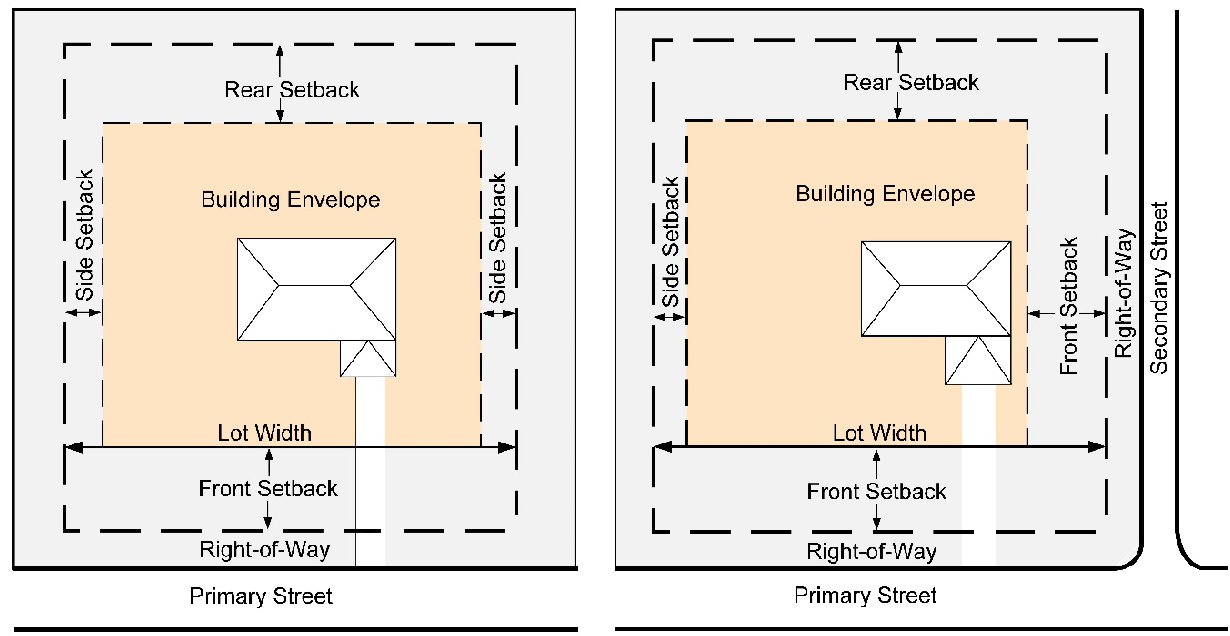
Figure 22-2
Shadow flicker. The moving shadow, created by the sun shining through the rotating blades of a wind energy turbine (WET). The amount of shadow flicker created by a WET is calculated by a computer model that takes into consideration turbine location, elevation, tree cover, location of all structures, wind activity, and sunlight.
Sign. Any object or device containing letters, figures and/or other means of communication, situated outdoors or indoors, of which the effect produced is to advertise, announce, communicate, identify, declare, demonstrate, direct, display, and/or instruct potential users of a use, product and/or service, or to bring attention to a message.
Sign, awning. A sign that is part of or located on a canopy or awning that is attached to and projects from a building wall.
Sign, billboard. A sign advertising a land use, business, general message, product or service, not typically located on, related to, or available upon the premises where the sign is located. These signs are distinguished from other types of freestanding signs by their larger than otherwise permitted size and typical location along Interstate, U.S. and State routes. Additionally, billboards are often erected to attract the attention of motorists that may be unfamiliar with the area, such as tourists, or pass-through travelers.
Sign, community. A sign that is installed, owned, and maintained by the township, or other public agency or entity approved by the township, and is constructed, displayed, or installed in conjunction with a gateway.
Sign, electronic changeable message (ECM). A sign with content can be changed or altered by means of electronically controlled electronic impulses.
Sign face. The portion of a sign structure which includes a message or image. A sign face may be a removable sign panel, permanently attached element(s), trivision, or ECM.
Sign, feather. A freestanding sign typically constructed of a shaft, driven in the ground or standing with supports, with an attached pennant that is vertically elongated and attached to the shaft. Also known as a feather flag.
Sign, government. Any sign erected by the township, county, state, or federal government.
Sign, ground. A freestanding sign that is supported by a standard or base, or installed directly upon the ground.
Sign, human. A sign represented by a person, such as a person covered with a sandwich board or other message or a person holding a sign for commercial purposes.
Sign, incidental. A small sign, not more than one square foot in size.
Sign, inflatable. A tethered sign consisting of an envelope inflated with pressurized or heated air, or a lighter-than-air gas, and displayed for the purpose of advertising or attracting attention.
Sign, menu board. A sign board accommodating drive-in or drive-through businesses.
Sign, permanent. A sign constructed of durable material and affixed, lettered, attached to or placed upon a fixed, non-movable, nonportable supporting structure.
Sign, portable. Any sign designed to be moved easily and not permanently affixed to the ground, a building or a structure. Portable signs shall include, but are not limited to, trailer mounted signs, A-frame signs, sandwich board signs, etc., but not including signs on a motor vehicle. For purposes of this ordinance, a portable sign is also referred to as a temporary sign.
Sign, projecting. A sign attached to and projecting perpendicularly from a building wall, excluding awning/canopy signs, as defined.
Sign, pylon or pole. A sign having a sign face that is elevated above the ground by one or more uprights, pylons or poles.
Sign, roof. A sign erected upon or above the roof or parapet of a building or structure.
Sign, temporary yard. A sign that is intended to be displayed for a limited period of time which is not intended to be lasting and is not constructed from an enduring material such as masonry and metal which remains unchanged in position, character, and condition (beyond normal wear), and is not permanently affixed to the ground, wall or building.
Sign, vehicle. A sign mounted on a vehicle or trailer, designed to be visible to motorists or pedestrians while the sign is being transported. A logo painted on a vehicle identifying the business owning or using the vehicle, or a lettering depicting the name of the owner of the vehicle, is not considered a vehicle sign.
Sign, wall. A sign that is attached directly to a wall, mansard roof, roof overhang, parapet wall, or above a marquee of a building with the exposed face of the sign in a plane parallel to the building wall or to the surface on which it is mounted, not projecting more than 12 inches from the wall, and which does not have any part of such sign or sign supports extending above the uppermost building line not including chimneys, flagpoles, electrical or mechanical equipment, TV antennas or any other similar equipment or extensions. This definition shall include writing, letters or numbers placed or painted directly on a building wall surface.
Sign, window. A sign placed on the inside of a window and intended to be viewed from the outside.
Site plan. A plan of a proposed project that shows all relevant features necessary to determine if it meets the requirements of this ordinance.
Solar energy collector. A panel or panels and/or other devices or equipment, or any combination thereof, that collect, store, distribute and/or transform solar, radiant energy into electrical, thermal or chemical energy for the purpose of generating electric power or other form of generated energy for use in or associated with a principal land use on the lot of record on which the solar energy collector is located and, if permitted, for the sale and distribution of excess available electricity to an authorized public utility for distribution to other lands.
1.
Building-mounted solar energy collector. A solar energy collector attached to the roof or wall of a building, or which serves as the roof, wall or window or other element, in whole or in part, of a building.
2.
Ground-mounted solar energy collector. A solar energy collector that is not attached to and is separate from any building on the lot of record on which the solar energy collector is located.
Special event. A temporary and non-commercial community event, such as a festival, fair, car show, or sporting event.
Special land use. A use of land which can be permitted within a zoned district if certain conditions exist to assure compatibility with surrounding property and within conformance to the provisions of all township ordinances. Special land uses can be approved with stipulations to assure that nuisances are not generated as a result of the land use.
Story. The portion of a building included between the surface of any above floor grade and the surface of the floor next above it, or if there is no floor above it then the space between any floor and the ceiling next above it. A story shall have vertical walls.
Street, private. A privately maintained thoroughfare constructed on a private street easement used for travel by vehicles and which affords traffic circulation, provides access to more than one lot of record, and serves as principal means of access to abutting property (i.e., road).
Street, public. A publicly maintained thoroughfare used for travel by vehicles which affords traffic circulation and serves as principal means of access to abutting property, not including alleys (i.e., road).
Structure. A combination of materials constructed, erected, or placed in or upon the ground, or is attached to something having such a location. Structures may include but are not limited to: Buildings, elevated decks, radio towers, signs and storage bins, but exclude sidewalks and paving on streets, driveways, parking areas or patios placed at grade.
Structure, accessory. A separate and detached structure on the same lot of record as the main building, the use of which is of a nature customarily and clearly incidental and subordinate to that of the main building.
Swimming pool. A structure located inside, outside or partly in each, designed to hold water to a depth of greater than 24 inches when filled, and intended to be used for swimming purposes.
1.
Swimming pool, above-ground. A swimming pool with exposed sides with heights of more than 24 inches, capable of containing water to a depth at any point greater than 24 inches.
2.
Swimming pool, in-ground. A swimming pool whose sides are not exposed and are below the immediate adjacent natural ground, capable of containing water to a depth at any point greater than 24 inches.
Tavern. A commercial establishment licensed to sell at retail and serve beer, wine, liquor or other alcoholic beverages for consumption on the premises and where the service of food is incidental to the sales and consumption of such beverages. Taverns include nightclubs, lounges, and bars.
Theater. A building or part of a building use to show motion pictures or a facility used for drama, dance, musicals, or other live performances.
Traverse line. A series of intersecting lines whose lengths and angles of intersection, at instrument stations, are shown graphically on a map. These lines are located on maps and can be determined by survey in the field.
Tower, wind energy turbine. A freestanding monopole that supports a wind energy turbine (WET).
Township board. The Holland Charter Township Board.
Tree, canopy. A deciduous shade tree.
Tree, evergreen. A tree with foliage that persists and remains green throughout the year.
Tree, ornamental. A small deciduous tree grown for its foliage and/or flowers.
Unwholesome substance. Any trash, garbage, tin can, automobile body, trailer body, stone, junk, offal, refuse, rubbish, food containers, bottles, crockery or utensils, stoves, ashes, clinkers, cinders, night soil, industrial byproducts or waste, flammable matter or substances, debris, filth, or any other material which constitutes a threat or menace to the health, safety, or general welfare of the public.
Upwind turbine. A wind energy turbine (WET) positioned in a manner so that the wind hits the turbine blades before it hits the tower in order to avoid the thumping noise which can occur if the wind is disrupted by hitting the tower before the blades.
Variance. An allowed modification to the spatial and dimensional requirements of this ordinance, as authorized by the zoning board of appeals under the provisions of this ordinance.
Vehicle. Every device in, upon or by which any person or property is or may be transported or drawn upon a street, excepting devices propelled by human power or used exclusively upon stationary rails or tracks.
Vehicle, automobile body. Any vehicle which is unable to be driven upon a street under its own power; and/or lacks all of the necessary component parts to make it operable and serviceable as a vehicle.
Vehicle, trailer body. Any boat trailer, utility trailer, horse or animal trailer, truck trailer, travel trailer or any type of trailer or device used for hauling or moving things which lacks all of the necessary component parts to make it then operative and serviceable as a trailer to be pulled as such on a street.
Vehicles and trailers, commercial. Any vehicle or trailer bearing or required to bear commercial license plates and/or DOT numbers. Examples include, but are not limited to:
1.
Semi-truck tractors;
2.
Semi-truck trailers, which shall include flat beds, stake beds, roll-off containers, tanker bodies, dump bodies, and full or partial box-type enclosures;
3.
Food trucks and vehicles of a type that are commonly used for the delivery of food or vending supplies;
4.
Pickup trucks, vans, and trailers commonly used by construction industry contractors;
5.
Tow trucks and repair service trucks;
6.
Vehicles designed to transport 16 or more passengers, including the driver; and
7.
Commercial trailers designed to haul heavy equipment, materials, and supplies.
Vehicle, recreational equipment, manufactured homes, heavy equipment sales and rental. An operation selling the specified items at retail or wholesale, or renting of the same items. May also include accessory repair shops and the sales of parts and accessories incidental to dealerships.
Vehicle repair.
1.
Major. The repair, rebuilding or reconditioning of heavy equipment, commercial vehicles, vehicles, recreational equipment or parts thereof within an enclosed building. Examples of major repairs include, but are not limited to: engine replacement, transmission repair, collision service, painting, and steam cleaning. This facility may have associated outdoor storage.
2.
Minor. The general maintenance of vehicles other than heavy equipment, commercial vehicles, or recreation equipment within an enclosed building. Examples of minor repairs include, but are not limited to: oil changes and lubrication; servicing and repair of spark plugs, batteries, pumps, belts, hoses, air filters, windshield wipers and distributors; replacement of mufflers and exhaust systems, brakes and shock absorbers; radiator cleaning and flushing; sale and installation of automobile accessories such as tires, radios and air conditioners; wheel alignment and balancing; but excluding tire recapping or grooving or any major vehicle repair. Vehicles awaiting minor repair or service shall be kept within an enclosed building or in approved parking spaces.
Vehicle wash. A building or portion of a building with machine or hand-operated facilities used principally for the cleaning, washing, polishing or waxing of vehicles and heavy equipment.
Warehousing. Facilities for the storage of furniture, household goods, or other commercial goods of any nature. May include an outdoor storage component, provided that the outdoor storage is not the primary use. Does not include mini-storage facilities offered for rent or lease to the general public (see "mini-warehouse/self-storage") or warehouse facilities primarily used for wholesaling and distribution (see "wholesaling and distribution").
Waste management facility. A site used for collecting waste and recyclables, sorting and transferring materials.
Wholesaling and distribution. An establishment engaged in selling merchandise in bulk quantities to retailers; to contractors, industrial, commercial, agricultural, institutional, or professional business users; to other wholesalers; or acting as agents or brokers in buying merchandise for or selling merchandise to such persons or companies.
Wind energy turbine (WET). Any structure-mounted, small, medium, or large wind energy conversion system that converts wind energy into electricity through the use of a wind generator and includes the nacelle, rotor, tower, and pad transformer, if any.
1.
Anemometer. A temporary wind speed indicator constructed for the purpose of analyzing the potential for utilizing a wind energy turbine at a given site. This includes the tower, base plate, anchors, cables and hardware, wind direction vanes, booms to hold equipment, data logger, instrument wiring, and any telemetry devices that are used to monitor or transmit wind speed and wind flow characteristics over a period of time for either instantaneous wind information or to characterize the wind resource at a given location.
2.
Large wind energy turbine (LWET). A tower-mounted wind energy system that converts wind energy into electricity through the use of equipment which includes any base, blade, foundation, generator, nacelle, rotor, tower, transformer, vane, wire, inverter, batteries, or other components used in the system. The LWET has a nameplate above 250 kilowatts, and the main purpose of the LWET is to supply electricity to off-site customers.
3.
Medium wind energy turbine (MWET). A tower-mounted wind energy system that converts wind energy into electricity through the use of equipment which includes any base, blade, foundation, generator, nacelle, rotor, tower, transformer, vane, wire, inverter, batteries, or other components used in the system. The MWET has a nameplate capacity that does not exceed 250 kilowatts. The total height does not exceed 150 feet.
4.
Small tower-mounted wind energy turbine (STMWET). A tower-mounted wind energy system that converts wind energy into electricity through the use of equipment which includes any base, blade, foundation, generator, nacelle, rotor, tower, transformer, vane, wire, inverter, batteries, or other components used in the system. The STMWET has a nameplate capacity that does not exceed 30 kilowatts. The total height does not exceed 120 feet.
5.
Small structure-mounted wind energy turbine (SSMWET). A system that converts wind energy into electricity through the use of equipment which includes any base, blade, foundation, generator, nacelle, rotor, tower, transformer, vane, wire, inverter, batteries, or other components used in the system. A SSMWET is attached to a structure's roof, walls, or other elevated surface. The SSMWET has a nameplate capacity that does not exceed 10 kilowatts. The total height does not exceed 15 feet as measured from the highest point of the roof, excluding chimneys, antennae, and other similar protuberances.
Winery, Small. A facility operated by a small wine maker duly licensed by the State of Michigan Liquor Control Commission (MLCC) to manufacture, bottle and sell wine within the limits established by the State of Michigan for a small wine maker.
Wireless communications.
1.
Wireless communications facility. The plant, equipment and property including, but not limited to, cables, wires, conduits, ducts, pedestals, antennas, electronics and other appurtenances used or to be used to transmit, receive, distribute, provide or offer wireless communications services. Wireless communication facilities shall be specifically excluded from the definition of "essential services."
2.
Wireless communication tower. Any structure, such as a mast, pole, monopole, guyed tower, or lattice tower which is designed and constructed primarily for the purpose of supporting one or more antennas Wireless communication tower shall be specifically excluded from the definition of "essential services."
3.
Alternative tower structure. Manmade trees, clock towers, bell steeples, church spires, light poles, elevator bulkheads and similar alternative-design mounting structures that camouflage or conceal the presence of antennas or towers.
4.
Antenna. Any exterior transmitting or receiving device mounted on a tower, building or structure and used in communications that radiate or capture electromagnetic waves, digital signals, analog signals, radio frequencies (excluding radar signals), wireless communications signals or other communication signals.
5.
FAA. The Federal Aviation Administration.
6.
FCC. The Federal Communications Commission.
7.
Height. When referring to a tower or other building or structure upon which an antenna is mounted, the distance measured from the finished grade of the lot of record at the center of the front of the tower or other building or structure to the highest point on the tower or other building or structure, including the base pad and any antenna.
8.
Lattice tower. A support structure constructed of vertical metal struts and cross braces, forming a triangular and square structure which often tapers from the foundation to the top.
9.
Preexisting towers and preexisting antennas. Any tower or antenna for which a building permit or special use permit has been properly issued prior to the effective date this ordinance, or any amendment to this ordinance, or any tower or antenna for which no building and/or special use permit was required, including permitted towers or antennas that have not yet been constructed so long as such approval is current and not expired.
10.
Tower. Any structure that is designed and constructed primarily for the purpose of supporting one or more antennas, including self-supporting (i.e., without guy wires or other external means of support) lattice towers, guyed towers, or monopole towers, used for the transmission or reception of radio, telephone, cellular telephone, television, microwave or any other form of telecommunication signals. The term includes the structure and any support for the structure.
11.
Tower pair. Any two towers which are located within 100 feet of each other.
Yard. An open space at grade between a building and the adjoining lot lines.
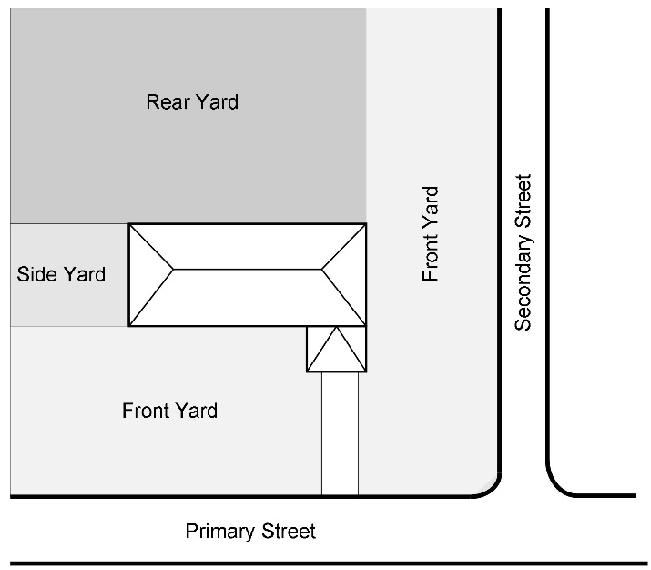
Figure 22-3 Corner Lot
1.
Yard, front. An open space between the front of a principal building and the front lot line, generally adjacent to a street, and extending the full width of the lot of record.
2.
Yard, Lake Macatawa waterfront. An open space between a principal building and Lake Macatawa extending the full width of the lot of record.
3.
Yard, primary front. The narrower of the two front yards. Where the lot lines are of equal length, and/or the primary front yard is not evident, the zoning administrator shall determine the primary front yard.
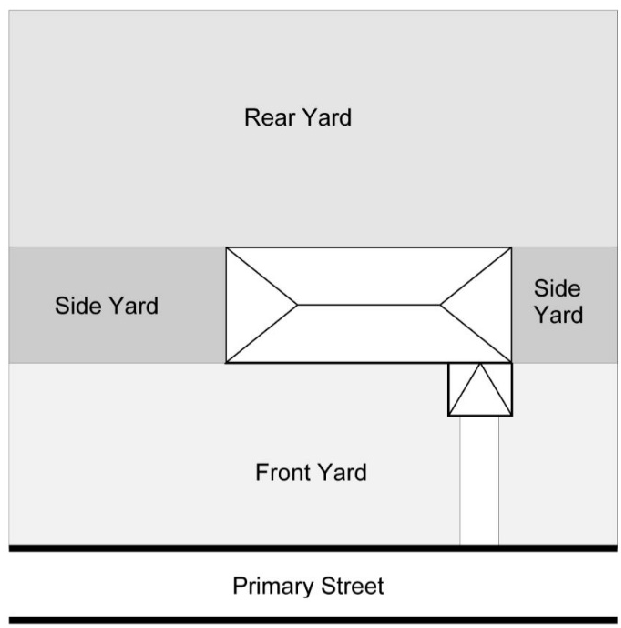
Figure 22-4 Interior Lot
4.
Yard, rear. An open space between the rear of a principal building and the rear lot line and extending the full width of the lot of record.
5.
Yard, Side. An open space between the side of a principal building and the side lot line extending from the front yard to the rear yard.
Zoning administrator. A Township official authorized to administer, interpret, and enforce the Holland Charter Township Zoning Ordinance.
Zoning district. A designation on the Official Township Zoning Map in which requirements for the use and dimensions of the land and buildings are prescribed.
(Ord. No. 596, § 11, 8-15-2019; Ord. No. 647, § 7, 9-7-2023; Ord. No. 657, § 6, 3-20-2025)