
Hurricane City Zoning Code
CHAPTER 37
- SUPPLEMENTARY DEVELOPMENT STANDARDS
Sec. 10-37-1.- Purpose.
This chapter establishes several miscellaneous land development regulations which are applicable throughout the City regardless of zone.
(Ord. 03-5-1, 5-1-2003, eff. 6-1-2003)
Sec. 10-37-2. - Scope.
The requirements of this chapter shall apply in addition to the development and use standards set forth in other chapters of this title, including base zones, special purpose and overlay zones, development regulations of general applicability, and regulations for specific uses. The requirements of this chapter shall not be construed to prohibit or limit other applicable provisions of this title, this Code, and other laws; provided that the requirements of this chapter shall prevail over conflicting provisions of any other requirement in this title unless a different standard is expressly authorized.
(Ord. 03-5-1, 5-1-2003, eff. 6-1-2003)
Sec. 10-37-3. - Abandoned, wrecked, or junk vehicles.
A.
Abandoned vehicles prohibited. It shall be unlawful to park or permit the parking of any licensed or unlicensed motor vehicle or parts thereof in an abandoned condition upon any public or private property within the City for longer than 72 hours, except as follows:
1.
In any residential or agricultural zone, two or less such vehicles or parts thereof may be stored in a building or within a rear yard; or
2.
In a commercial or industrial zone, any number of such vehicles or parts thereof may be permitted if:
a.
Such use is authorized in the zone where the use is located, and
b.
Vehicles and parts thereof are stored within a building or are completely screened by a six foot high, opaque, sight obscuring fence.
B.
Nuisance. The accumulation and storage of more than the permitted number of vehicles or parts thereof on private or public property except as set forth above shall constitute a nuisance, detrimental to the health, safety, and welfare of the inhabitants of the City. It shall be the duty of the owner of such vehicle or parts thereof, or lessee, or other person in possession of private property upon which such vehicle or parts thereof is located, to remove the same from such property.
(Ord. 03-5-1, 5-1-2003, eff. 6-1-2003)
Sec. 10-37-4. - Adequate public facilities.
Land shall be developed only where existing infrastructure is in place or will be timely provided to service proposed development. The City may require an analysis to be completed to determine whether adequate public facilities are available to service a development and whether such development will change existing levels of service or will create a demand which exceeds acceptable levels of service for roadways, intersections, bridges, storm drainage facilities, water lines, water pressure, sewer lines, fire and emergency response times, and other similar public services. The City may disapprove a proposed development if demand for public services exceeds accepted levels of service. No subsequent approval of such development shall be given until either the developer or the City installs improvements calculated to raise service levels to the standard adopted by the City.
(Ord. 03-5-1, 5-1-2003, eff. 6-1-2003)
Sec. 10-37-5. - Accessory uses and structures.
Accessory uses and structures shall be permitted in all zones provided they are incidental to, and do not substantially alter a principal use or structure.
A.
Front yard. No accessory building or structure nor group thereof shall be located in a front yard unless expressly authorized by a provision of this title.
(Ord. 2017-14, 8-17-2017)
Sec. 10-37-6. - Buildable area.
Every lot created after the effective date of this title shall have a buildable area sufficient to place a building or structure thereon which meets the minimum standards of the zone where the lot is located. Buildable area may be required to be depicted on a proposed subdivision plat, site plan, or plot plan for the purpose of notifying future owners of the approved buildable area based on applicable development standards. Area within an easement may not be included within buildable area unless the easement beneficiary executes and records a release of the easement in a form acceptable to the City Attorney.
(Ord. 03-5-1, 5-1-2003, eff. 6-1-2003)
Sec. 10-37-7. - Condominium projects.
A.
State law requirements. The owner of real property may construct a new condominium project or convert existing land and/or structures into a condominium project by complying with the provisions of the Condominium Ownership Act, Utah Code Annotated title 57, chapter 8, as amended, and applicable provisions of this title and other titles of this Code.
B.
Uses permitted. Uses permitted within a condominium project shall be limited to those uses permitted within the zone in which a project is located.
(Ord. 03-5-1, 5-1-2003, eff. 6-1-2003)
Sec. 10-37-8. - Easements.
No dwelling, main building, or permanent accessory building shall be located within a recorded easement area unless the property owner either produces evidence satisfactory to the Zoning Administrator that the easement has been abandoned, or executes a recordable document, in a form approved by the City Attorney, indicating that notwithstanding apparent abandonment of the easement, the structure may be subject to the superior interest of the easement holder and may be required to be relocated at the property owner's expense to accommodate such interest.
A.
Location. Any structure in an easement area shall be located pursuant to the setback and other applicable requirements of this title.
B.
No expansion of legal rights. Nothing in this section is intended to expand or restrict the rights or obligations of any party to any recorded easement.
(Ord. 03-5-1, 5-1-2003, eff. 6-1-2003)
Sec. 10-37-9. - Fences and walls.
A.
Height of fences and walls. No fence, wall, or similar structure exceeding six feet in height shall be erected in any rear or side yard except for accessory buildings and structures permitted by this chapter unless by conditional use permit.
B.
Retaining walls. When a retaining wall protects a cut below natural grade and is located on a line separating lots, such retaining wall may be topped by a fence, wall, or hedge of the same height that would otherwise be permitted at such location if no retaining wall existed. Retaining walls shall not be built in public utility easements.
C.
Fences in front or side yards. No opaque fence or wall or other similar structure exceeding 48 inches in height shall be erected within a front yard except upon written permission from the Planning Commission.
D.
Swimming pools. Swimming pools of permanent construction not enclosed within a building shall be completely surrounded by a fence or wall that satisfies building code requirements.
E.
Visual obstructions. To avoid creating a visual obstruction and promote public safety, a fence, wall, or other similar structure or landscaping located in a required front yard shall meet the following requirements:
1.
No opaque fence, wall, or other similar structure, or landscaping that exceeds two feet in height shall be placed within a triangular area formed by a driveway line, the street property line, and a line connecting them at points 12 feet along the driveway line and 12 feet along the street property line, except for a reasonable number of trees pruned high enough to permit unobstructed vision for drivers of motor vehicles.
2.
No fence, wall, or other similar structure, or landscaping which exceeds two feet in height shall be placed on any corner lot within a triangular area formed by the street property lines and a line connecting them at points 25 feet from the intersection of the street lines, except for a reasonable number of trees pruned high enough to permit unobstructed vision for drivers of motor vehicles. An exception to this requirement may be granted by the City Engineer in unique circumstances and upon a finding that proper sight distances will be maintained.
F.
Prohibited materials. The following fencing materials shall be prohibited on properties containing single-family or two-family dwellings:
1.
Security wire, such as barbed wire, concertina wire, or razor wire, except for agricultural uses; and
2.
Electrified fencing, except for agricultural uses.
G.
Incompatible uses. In addition to the requirements of section 10-39-11, whenever a lot or parcel is developed with a use that is different than a use located on an abutting lot or parcel, the new development shall include installation of a fence or wall along the property line between the different uses. When a lot is developed adjacent to an agricultural property, unless otherwise waived by the affected agricultural property owner, fencing abutting agricultural property shall be required of the developing property owner. Fence shall be at a minimum, six feet high with posts spaced at eight feet apart. The agricultural property owner shall have the option of paying the additional cost to create spacing of the post at six feet. Fencing and post material and design shall be approved in conjunction with the approval of a land use application, building permit, or site plan.
(Ord. 03-5-1, 5-1-2003, eff. 6-1-2003; Ord. 2016-02, 2-4-2016); Ord. 2018-09, 9-6-2018; Ord. No. 2023-17, 9-21-2023)
Sec. 10-37-10. - Flag lots.
A flag lot for one single-family dwelling may be allowed to accommodate the development of property that otherwise could not reasonably be developed under the regulations contained in this title or other titles adopted by the City. The primary purpose of this section is not to make development of property easier and more profitable. Rather, it is to serve as a "last resort" for property which may not otherwise be reasonably developed.
A.
Factors. When property is subdivided, flag lots shall not be approved by right but may be allowed after considering the following:
1.
More than two flag lots with contiguous staffs should be avoided;
2.
Whether development of the property in question under normal City land use and subdivision regulations is reasonable and practical; and
3.
Creation of a flag lot should not foreclose the possibility of future development of other large interior parcels that are not developable unless a street is extended to them across other adjacent properties.
B.
Development standards. When flag lots are permitted, they shall be subject to the following conditions:
1.
A flag lot shall be comprised of a staff (narrow) portion that is contiguous with a flag (wide) portion.
2.
The staff portion of the lot shall front on and be contiguous to a public street. The minimum width of the staff portion at any point shall be 26 feet. However, a greater staff width for lots within the sensitive lands overlay zone may be required. The maximum length of a staff shall be 500 feet. The maximum grade of a staff shall not exceed 12 percent.
3.
The size of the flag portion of a lot shall conform to the minimum lot size requirement of the zone in which the lot is located. Sufficient turnaround space per the fire code shall be provided. Fire turnaround space shall be protected by recorded easements.
4.
No building or structure shall be located within the staff portion of a flag lot.
5.
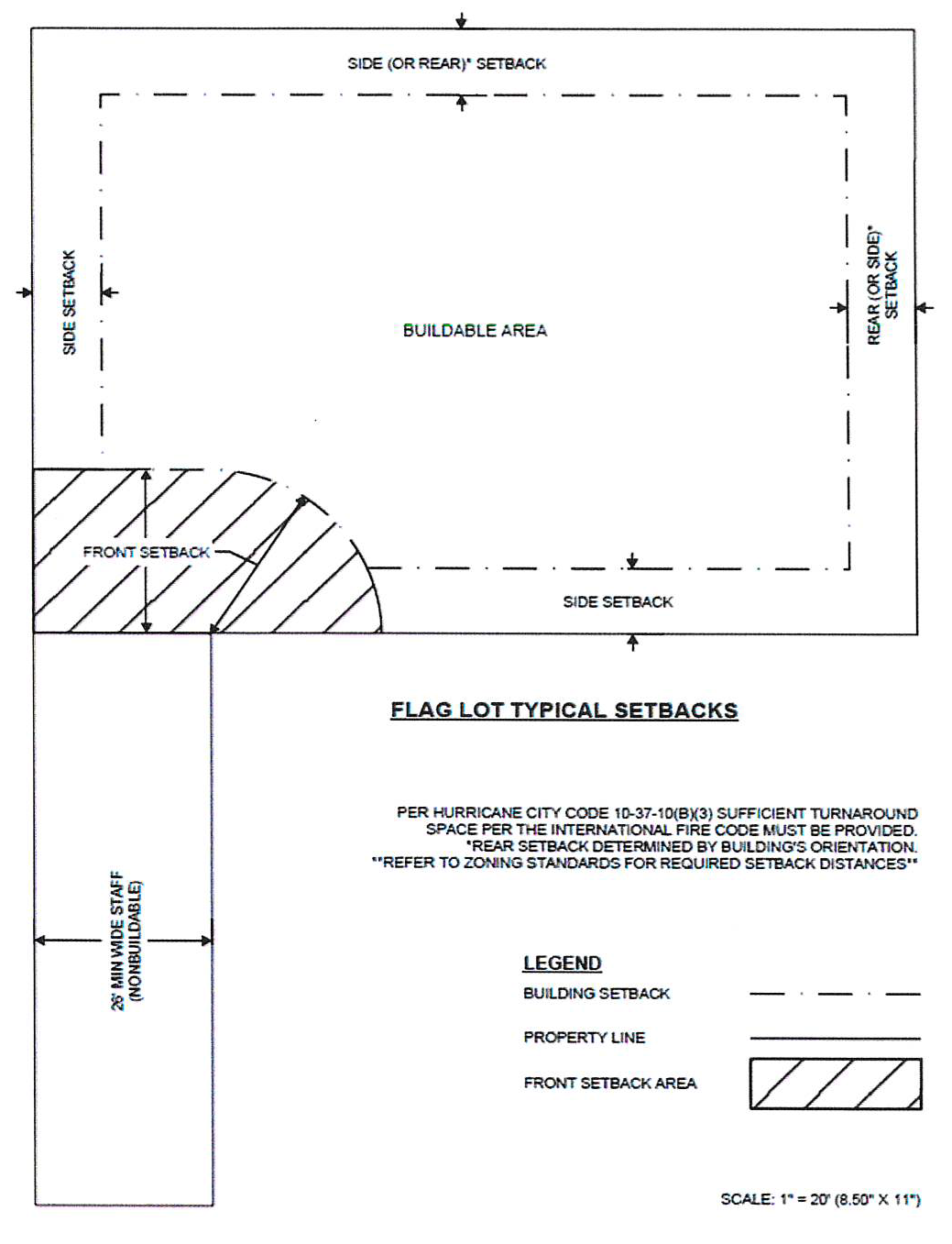
The front yard setback area of a flag lot shall extend the distance required by the applicable zone in which the flag lot is located from the point where the side of the flag portion connects to the staff as depicted in Figure 37-1. Other yard setbacks shall also conform to the setback requirements of the zone in which the flag lot is located.
6.
A main building shall be located no more than 250 feet from a fire hydrant, measured along a public or private right-of-way or along the staff portion of a flag lot. An easement for any fire hydrant located on private property shall be provided to the City for access to and maintenance of the hydrant.
7.
Upon review the City may require installation of curb, gutter and other drainage control measures in the staff portion of a flag lot to prevent runoff from entering neighboring properties.
8.
Clear address signage shall be installed and maintained at the street by the owner, including notice that the driveway is a private right-of-way.
9.
The new residential structure to be constructed on a flag lot shall be no higher than the average height of all residential structures within a 300-foot radius of the proposed structure.
10.
Before a flag lot is approved the joint utility committee must approve the design and location of all facilities needed to accommodate a single-family dwelling. Construction of the approved facilities must be complete before a building permit will be issued for the lot.
FIGURE 37-1
(Ord. 03-5-1, 5-1-2003, eff. 6-1-2003; Ord. 2007-17, 7-5-2007; Ord. 2008-10, 6-5-2008; Ord. No. 2025-24, 12-18-2025)
Sec. 10-37-11. - Height exceptions and limitations.
A.
Exceptions to height limitations. Roof structures for the housing of elevators, stairways, tanks, ventilating fans or similar equipment required to operate and maintain the building, parapet walls, skylights, towers, steeples, chimneys, water tanks, wireless or television masts, theater lofts, silos or similar structures may be erected above the limits herein prescribed, but no space above the height limit shall be allowed for the purpose of providing additional floor space for human occupancy.
B.
Maximum height of accessory buildings. No building which is accessory to a single-family or a multiple-family dwelling with four or fewer dwelling units shall be erected to a height greater than 20 feet unless a greater height is authorized by a conditional use permit.
C.
Minimum height of main buildings. No dwelling shall be erected to a height less than one story above grade except earth sheltered dwellings authorized by the provisions of this title.
(Ord. 03-5-1, 5-1-2003, eff. 6-1-2003; Ord. No. 2026-11, 6-4-2026)
Sec. 10-37-12. - Lots and yards.
A.
Every building on legally created lot. Every building shall be located and maintained on a legally created lot as defined in this title, unless such lot is a legally nonconforming lot. Not more than one single-family dwelling or commercial structure shall occupy any one lot except as authorized by the provisions of this title.
B.
Sale or lease of required land. No land needed to meet the size, width, yard, area, coverage, parking or other requirements of this title shall be sold, leased, or otherwise transferred away, whether by subdivision or metes and bounds, so as to create or increase the nonconformity of a lot, building, or site development. No lot having less than the minimum width and area required by the zone where it is located may be divided from a larger parcel of land, except as permitted by this section or by the Appeals Board pursuant to the requirements of this title.
1.
A reduction in the minimum required area of a lot owned by the City, county, state, or other public entity or utility provider may be granted a special exception approved by the Appeals Board provided:
a.
Such lot is used exclusively for public purposes; and
b.
No living quarters are located on such lot.
2.
If a portion of a lot which meets minimum lot area requirements is acquired for public use in any manner, including dedication, condemnation or purchase, and such acquisition reduces the minimum area required, the remainder of such lot shall nevertheless be considered as having the required minimum lot area if all of the following conditions are met:
a.
The lot contains a rectangular space of at least 30 feet by 40 feet exclusive of applicable front and side yard requirements, and exclusive of one-half of the applicable rear yard requirements, and such rectangular space is usable for a principal use or structure.
b.
The remainder of the lot has an area of at least one-half of the required lot area of the zone in which it is located.
c.
The remainder of the lot has access to a public street.
C.
Reduction of minimum lot width and area requirements. Minimum lot area or lot width requirements of this title shall not be construed to prevent the use of a lot for a single-family dwelling so long as such lot was:
1.
Held in separate ownership on the effective date of this title; and
2.
Was legally created when it became nonconforming as to area or width.
D.
Adjacent lots when used as one building lot. When a common side lot line separating two or more contiguous lots is covered or proposed to be covered by a building, such lots shall constitute a single building site and the setback requirements of this title shall not apply to a common lot line if a document is recorded indicating the owner's intent to use the combined lots as a single development site. The setback requirements of this title shall apply only to the exterior side lot lines of the contiguous lots so joined.
E.
Double frontage lots. Lots having frontage on two or more streets shall be prohibited except for corner lots and double frontage lots in subdivisions which back onto streets shown on the City's road master plan. Such double frontage lots shall be accessed only from an internal subdivision street. Frontage on lots having a front lot line on more than one street shall be measured on one street only. Notwithstanding the foregoing, a double frontage lot is permitted when all of the following conditions are met:
1.
The double frontage is the result of the combination of two or more previously recorded lots;
2.
The double frontage lot will not access a master planned road; and
3.
The front yard setback applicable to the property shall apply to both frontages of the double frontage lot.
F.
Setback measurement. The depth of a required setback area abutting a street shall be measured from the lot line except as set forth below:
1.
In blocks where more than 50 percent of the buildable lots have main buildings which do not meet the current front yard setback of the zone where the block is located, the minimum front setback requirement for new construction shall be equal to the average existing front yard size on the block. In no case shall a front yard setback of more than 30 feet be required.
2.
On lots with frontage on the curve of a cul-de-sac or "knuckle" street, the front setback may be measured from a straight line drawn joining the front corners of the lot. In no case may the living area be any closer than 15 feet from the back of sidewalk or the garage be any closer than 20 feet from the back of sidewalk.
G.
Yards and setback areas to be unobstructed; exceptions. Yard and setback areas shall be open to the sky and unobstructed except for:
1.
Accessory buildings in a rear yard or interior side yard but outside the setback areas;
2.
The ordinary projections of window bays, roof overhangs, skylights, sills, belt courses, cornices, chimneys, flues and other ornamental features, which shall not project into a setback area more than four feet;
3.
Open or lattice enclosed fire escapes and fireproof outside stairways and balconies, which shall not project into a setback area more than five feet; and
4.
Any part of an uncovered deck or patio, excluding nonopaque railings.
H.
Yard space for one building only. No yard or other required open space on an adjoining lot shall be considered as providing a yard or open space on a lot whereon a building is to be erected or established.
I.
Lot coverage. In no zone shall a building or group of buildings with their accessory buildings cover more than 50 percent of the area of the lot.
(Ord. 03-5-1, 5-1-2003, eff. 6-1-2003; Ord. 2005-12, 6-2-2005; Ord. 2017-14, 8-17-2017; Ord. 2018-12, 10-18-2018; Ord. No. 2025-17, 2-5-2026; Ord. No. 2026-12, 5-21-2026)
Sec. 10-37-13. - Private rights-of-way.
The Zoning Administrator shall not authorize a building permit for a dwelling located on a lot accessed only by a private right-of-way except under one of the following conditions:
A.
Nonconforming lot. The lot was legally created and recorded prior to the effective date of this title; or
B.
Variance. A variance is granted by the Appeals Board.
(Ord. 03-5-1, 5-1-2003, eff. 6-1-2003; Ord. 2018-12, 10-18-2018)
Sec. 10-37-14. - Storage of trash and debris prohibited.
No yard or other open space shall be used for the accumulation of trash, debris, or abandoned equipment and no land shall be used for such purposes, except as authorized by and in compliance with the provisions of this title.
(Ord. 03-5-1, 5-1-2003, eff. 6-1-2003; Ord. 2017-03, 1-19-2017)
Sec. 10-37-15. - Numbers of animals and fowl for recreational use and family food production.
Subject to the following conditions, the keeping of chickens, ducks, pigeons, and rabbits, shall be permitted in the R1-10, R1-15, and RA-.5 zoning classifications. In the R1-10 and R1-15 zones, roosters and fighting cocks are specifically prohibited. In the RA-.5 zones fighting cocks are specifically prohibited.
The number of animals permitted on a specific parcel shall be determined on the basis of points. Each full acre lot shall equal 100 animal points. Lots smaller than one acre shall be permitted a proportionate number of points in relation to the percentage of an acre contained in the lot (e.g. 0.25 acre x 100 = 25 animal points).
(For example, a 0.25-acre lot would be allowed eight chickens, ducks, pigeons, or rabbits or combination thereof for a total of eight animals.)
Animal enclosures, including, but not limited to, coops, hutches, or pens, must be located at least five feet from a back or side property line, animal enclosures may not be located in front yards, and no animal enclosure may be located any closer than 25 feet from a neighboring house.
All requirements of title 5, chapter 2, animal control, of this Code shall apply.
(Ord. 2011-9, 9-29-2011; Ord. 2017-03, 1-19-2017)

