
Independence City Zoning Code
SECTION 510
ZONING: TITLE, PURPOSE AND DEFINITIONS
(Ord. No. 88, 12-26-1979, deleted in its entirety; Replaced by Ord. 2005-05)
510.01.- Title.
Sections 510 through 545 of this Code are known as the "Independence Zoning Code."
510.03. - Intent and purpose.
This zoning code is adopted without limitation, for the following purposes:
(a)
To implement the policies of the city's land use plan;
(b)
To provide at appropriate locations, rural residential and agricultural living environments while preserving prime agricultural land and protecting marshes, water ways, lakes, trees, and other natural features and systems;
(c)
To limit development to areas that can economically be served by public services and to obtain maximum usage of such services before expansion;
(d)
To provide limited retail, commercial service, and industrial development;
(e)
To provide housing that will accommodate residents from all income levels;
(f)
To provide a framework within which public and private agencies and individuals can plan their development and expansion;
(g)
To protect the public health, safety, morals, comfort, convenience, and general welfare by guiding the future development of land;
(h)
To preserve the value of the existing and future dwellings by setting minimum standards for housing design and maintenance that will promote and maintain compatibility among widely varying housing choices;
(i)
To provide adequate habitable space and to provide adequate ingress, egress and a suitable shelter in the event of fire, storm, or other emergency.
510.05. - Definitions.
Subd. 1.
The following words and terms, and their derivations have the meanings given in this zoning code:
Subd. 2.
"Accessory dwelling unit." A secondary dwelling unit that is:
(Amended, Ord. No. 2011-09)
(a)
Physically attached to or within a single-family dwelling unit or within a detached a accessory building that has a principal structure on the parcel; and
(b)
Subordinate in size to the single-family dwelling unit; and
(c)
Fully separated from the single-family dwelling unit by means of a wall or floor, with or without a door; and
(d)
Architecturally compatible with the principal structure (using similar materials, finishes, style and colors similar to the principal structure); and
(e)
The lesser of 33 percent of the above ground living area of the principal structure or 1,200 square feet, and no less than 400 square feet. The total square footage shall not include a designated mechanical room or unfinished basement below the accessory dwelling unit; and
(Amended, Ord. No. 2017-03, § 1)
(f)
Not in excess of the maximum square footage for accessory structures as permitted in this Code; and
(g)
Has permanent provisions for cooking, living and sanitation; and
(h)
Has no more than two bedrooms; and
(i)
Limited to relatives of the homesteaded owner occupants or the homesteaded owners of the principal structure. The total number of individuals that reside in both the principal dwelling unit and accessory dwelling unit may not exceed the number that is allowed by the building code; and
(j)
Uses the existing on-site septic system b or an approved holding tank; and
(k)
Respectful of the future subdivision of the property and the primary and secondary septic sites. The city may require a sketch of the proposed future subdivision of a property; and
(l)
In compliance with the adopted building code relating to all aspects of the dwelling unit.
a On lots less than 2.5 acres, the accessory dwelling unit must be attached to the principal dwelling unit or located/constructed within an existing detached accessory structure that meets all criteria of this section.
b The existing on-site septic system will be required to be inspected by the city to ensure compliance with all applicable standards. Any system that does not meet all applicable standards shall be brought into compliance as a part of the approval of the accessory dwelling unit.
Subd. 3.
"Agriculture." The use of land for the growing and/or production of field crops, livestock, and livestock products for the production of income including, but not limited to, the following:
(a)
Field crops, including: barley, soybeans, corn, hay, oats, potatoes, rye, sorghum and sunflowers.
(b)
Livestock as defined in subsection 510.05, subdivision 44.
(c)
Livestock products, including: milk, butter, cheese, eggs, meat, fur and honey.
Subd. 4.
"Animal assisted therapy" or "AAT." A use of land and associated structures for the delivery of therapy to improve human physical, social, emotional, and/or cognitive functioning, in which animals that meet specific criteria are an integral part of the treatment process. AAT is goal-directed and is delivered by a health/human service professional with specialized expertise. AAT may be provided in a group or individual setting.
Subd. 5.
"Animal unit." A unit of measure comparing the size of domestic farm animals as follows:
Subd. 6.
"Application." The documents and written material by which a property owner justifies a request for a building permit, a zoning amendment, a conditional use permit, a variance, an appeal, or other request for approval, relief or consideration, which must include all information on any application form approved by the city administrator-clerk.
Subd. 7.
"Berm." An earthen mound or series of mounds used as a buffer between two uses of land.
Subd. 8.
"Buildable acres." Land that is not classified as floodplain or wetland, that is contiguous and not separated by streams, wetlands, slopes in excess of ten percent or other physical impediments.
Subd. 9.
"Building." A structure having a roof supported by columns or walls.
Subd. 10.
"Building height." The vertical distance from the finished first floor grade to the coping of a flat roof, to the deck line of a mansard roof, to a point on the roof directly above the highest wall of a shed roof, to the uppermost point on a round or other arch-type roof or to the midpoint of the highest gable on a pitched or hip roof.
Subd. 11.
"Bunkhouse." A building accessory to a principal use that contains sleeping quarters for one or more persons who are employed in connection with the principal use of the premises.
(Added, Ord. No. 2025-02, § 1)
Subd. 12.
"Cannabis Business" is a business involved with cannabis.
(Added, Ord. No. 2025-02, § 1)
Subd. 13.
"Cannabis Business Buffer" is a 1,000-foot buffer from public and private schools and a 500-foot buffer from a day care, residential treatment facility, public park, or athletic field for cannabis retailers, cannabis microbusinesses with a retail endorsement, cannabis mezzobusinesses with a retail endorsement, medical cannabis retailers, and medical cannabis combinations businesses. Lower-potency hemp edible retailers have a buffer of 500 feet.
(Added, Ord. No. 2025-02, § 1)
Subd. 14.
"Cannabis Business Retail Endorsement" is a cannabis business that may sell cannabis products directly to the public as regulated by state statute.
(Added, Ord. No. 2025-02, § 1)
Subd. 15.
"Cannabis Business Retail Limit" means that cannabis businesses with a retail endorsement, including cannabis retailers, cannabis mezzobusinesses, and cannabis microbusinesses, except lower-potency hemp edible retailer, shall be limited to one business per 12,500 residents within the city, excluding lower-potency hemp edible retailers.
(Added, Ord. No. 2025-02, § 1)
Subd. 16.
"Cannabis Cultivator" is a cannabis business as defined in state statute.
(Added, Ord. No. 2025-02, § 1)
Subd. 17
"Cannabis Delivery Service" is a cannabis business as defined in state statute.
(Added, Ord. No. 2025-02, § 1)
Subd. 18.
"Cannabis Event Organizer" is a cannabis business as defined in state statute.
(Added, Ord. No. 2025-02, § 1)
Subd. 19.
"Cannabis Manufacturer" is a cannabis business as defined in state statute.
(Added, Ord. No. 2025-02, § 1)
Subd. 20.
"Cannabis Mezzobusiness" is a cannabis business as defined in state statute.
(Added, Ord. No. 2025-02, § 1)
Subd. 21.
"Cannabis Microbusiness" is a cannabis business as defined in state statute.
(Added, Ord. No. 2025-02, § 1)
Subd. 22.
"Cannabis Retailer" is a cannabis business as defined in state statute.
(Added, Ord. No. 2025-02, § 1)
Subd. 23.
"Cannabis Testing Facility" is a cannabis business as defined in state statute.
(Added, Ord. No. 2025-02, § 1)
Subd. 24.
"Cannabis Transporter" is a cannabis business as defined in state statute.
(Added, Ord. No. 2025-02, § 1)
Subd. 25.
"Cannabis Wholesaler" is a cannabis business as defined in state statute.
(Added, Ord. No. 2025-02, § 1)
Subd. 26.
"City." The City of Independence, Hennepin County, Minnesota.
Subd. 27.
"City council." The governing body of the city of Independence.
Subd. 28.
"Church." A building or use of land in which persons regularly assemble for religious worship and which is maintained and controlled by a religious body organized to promote religious worship.
Subd. 29.
"Conditional use." A use permitted in a particular zoning district only upon showing that the use in a specified location will comply with all standards herein for the location or operation of the use. The city may impose additional conditions in specific instances to protect the public health, safety or welfare.
Subd. 30.
"Contractor's office." A building, with accessory outdoor storage, that serves as the headquarters for contractors involved in specialized activities such as plumbing, painting, plastering, masonry, carpentry, roofing, well drilling, landscaping and the like, where office activities take place and where tools, equipment and materials used in the business are stored.
Subd. 31.
"Division." The division of a parcel of land into two or more lots.
Subd. 32.
"Drainage system." Any natural or artificial feature or structure used for the conveyance, drainage, or storage of surface and/or underground water, including, but not limited to, streams, rivers, creeks, ditches, channels, conduits, gullies, ravines, washes, lakes or ponds and structures such as culverts, drainage tile, dams, bridges and water storage basins.
Subd. 33.
"Driveway." A private path for vehicular access to a public road, which is wholly located on the lot that is afforded access.
Subd. 34.
"Driveway, common." An easement encumbered by a common driveway agreement that provides for access, construction, maintenance and financing of private vehicular and pedestrian access to not more than three lots. A common driveway shall be considered if evidence of the following standards is met:
(Added, Ord. No. 2010-06)
(a)
Extension of a public street is not physically feasible as determined by the city. If the city determines that there is need for such extension, this provision shall not apply, and the right-of-way for a public street shall be provided by dedication in the plat; or
(Added, Ord. No. 2010-06)
(b)
The city determines that a public road extension would adversely impact natural amenities, including wetlands or stands of mature trees containing deciduous trees greater than 12 inches in diameter or coniferous trees greater than 25 feet in height; or
(Added, Ord. No. 2010-06)
(c)
There is no feasible present or future means of extending right-of-way from other directions; and
(Added, Ord. No. 2010-06)
(d)
Covenants which assign driveway installation and future maintenance responsibility are submitted and recorded with the titles of the parcels which are benefitted. The city will not provide maintenance or snow plowing for common or shared access driveways; and
(Added, Ord. No. 2010-06)
(e)
Common driveways shall be constructed in accordance with the provisions established in the City of Independence Manual of Standards.
(Added, Ord. No. 2010-06)
Subd. 35.
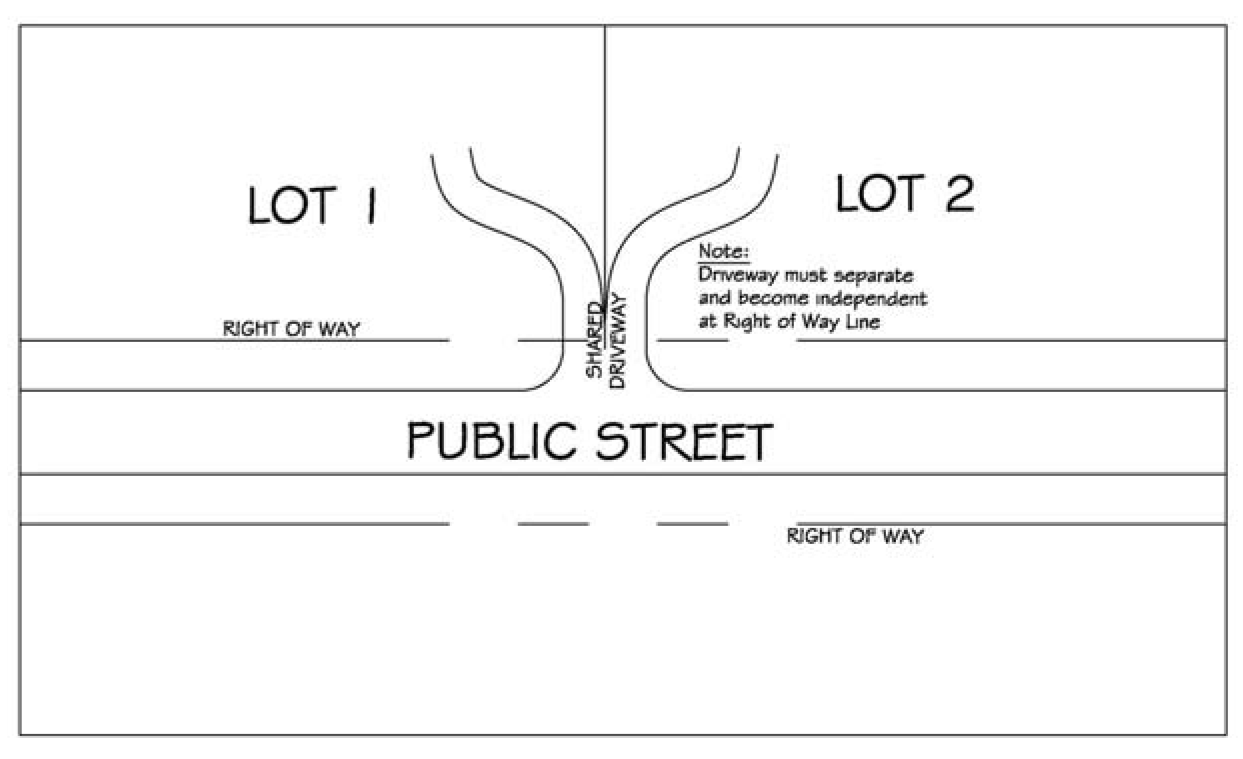
"Driveway, shared access." Means a shared entry off of a public street serving two lots which meets the city's shared driveway configuration standards.
(Added, Ord. No. 2010-06)
Subd. 36.
"Dwelling unit." A single residential accommodation that is arranged, designed, used or intended for use, as the living quarters for one family.
Subd. 37.
"Dwelling, single-family." A building containing no more than one dwelling unit.
Subd. 38.
"Easement." A grant by a landowner for a specific use of land by the grantee.
Subd. 39.
"Essential services." Public conduits, including their appurtenant structures, used to provide sewage removal, water supply, power fuel, communications, and any other public convenience or necessity.
Subd. 40.
"Extraction." The removal of more than 100 cubic yards of sand, gravel, soil, peat, or other earthen deposits from a lot, except when such removal is part of construction under an approved building permit or conditional use permit.
Subd. 41.
"Family." Family is any of the following:
(a)
An individual;
(b)
Two or more persons related by blood, marriage or adoption and maintaining a common household;
(c)
A group of not more than five unrelated persons maintaining a common household.
Subd. 42.
"Farm." A lot, the principal use of which is agriculture.
Subd. 43.
"Farm building." Any accessory building or accessory structure, other than a single-family dwelling, which is used in a farming operation, including, but not limited to, a barn, granary, silo, farm implement storage building or milk house.
Subd. 44.
"Farriery." The establishment or the occupation of the shoeing of horses.
Subd. 45.
"Feedlot." A building or use of land intended for the confined feeding, breeding, raising, or holding of animals and specifically designed as a confinement area in which manure may accumulate, or where the concentration of animals is such that a vegetative cover cannot be maintained within the enclosure. For purposes of the zoning code, open lots used for the feeding and rearing of poultry (poultry ranges) are considered to be feedlots. Pastures are not considered feedlots under this zoning code.
Subd. 46.
"Fence." A partition intended as a dividing marker, a barrier, or an enclosure.
Subd. 47.
"Floor area." The sum of the gross horizontal areas of the several floors of a building, measured from the exterior faces of the exterior walls.
Subd. 48.
"Forestry." The cultivation and management of forests or woods located on the premises, including: felling and trimming of timber; transportation of timber and timber logs, pulpwood, cordwood and similar products; sawing of logs into lumber and similar operations.
Subd. 49.
"Forestry products processing." The storage and processing of trees and tree products (excluding seeds and fruits), including sawmills and chipping operations but excluding the importing, storage or resale of manufactured lumber products or firewood.
Subd. 50.
"Frontage." The distance between the side lot lines of a lot measured along the boundary of the right-of-way designated by the city council to serve the lot.
Subd. 51.
"Garage, private." An accessory building or accessory portion of the principal building that is intended for storage of the private passenger vehicles of the family residing upon the lot.
Subd. 52.
"Glare." A light source that is located, directed or controlled such that the light source itself is visible from a point four feet above the ground or higher at any point off the lot on which the light source is located.
Subd. 53.
"Guest house." A separate building constructed on an existing undivided lot for the sole use of the homesteaded owner occupants of the principal building or their non-paying guests, and consisting only of one or more sleeping rooms with or without bathrooms.
Subd. 54.
"Historical site." A structure or area of land or water of historic, archeological, paleontological or architectural value that has been designated as a historic site in the federal register of historical landmarks, the Minnesota historical society, or by a local governmental unit.
Subd. 55.
"Home occupation." Any occupation, business, or profession carried on within or from a dwelling unit by a person who occupies the dwelling unit as a principal residence which use is clearly secondary to the principal use of the lot as a dwelling unit.
Subd. 56.
"Horticulture." The use of land for the growing or production of fruits, vegetables, flowers, cultured sod and nursery stock, including ornamental plants and trees, for the production of income.
Subd. 57.
"Interim use." A temporary use of property until a particular date, or until the occurrence of a particular event.
Subd. 58.
"Irrigation system." Any structure or equipment, mechanized or otherwise, used to supply water for agriculture or horticulture, including, but not limited to, wells, pumps, motors, pipes, culverts, gates, dams, ditches, tanks, ponds, and reservoirs.
Subd. 59.
"Kennel." Any structure or premises on which four or more dogs over six months of age are kept.
Subd. 60.
"Livestock." Cattle, hogs, horses, bees, sheep, goats, llamas, chickens and other animals and fowl commonly kept for food production.
Subd. 61.
"Local government buildings." Public structures housing public facilities or services including, but not limited to, city halls, police stations, fire stations, libraries and highway maintenance facilities, but excluding schools.
Subd. 62.
"Lot." A parcel of land separated from other parcels by legal description.
Subd. 63.
"Lot area." The contiguous horizontal plane bounded by the lot lines.
Subd. 64.
"Lot, corner yard." Any property line that abuts or is bounded by two or more rights-of-way.
(Amended, Ord. No. 2015-06, § 1)
Subd. 65.
"Lot depth." The average horizontal distance between the front lot line and the rear lot line.
Subd. 66.
"Lot line." A line defining the horizontal plane of a lot.
Subd. 67.
"Lot line, front." The line connecting the side lot lines of a lot measured along the boundary of the right-of-way designated by the city council to serve the lot.
Subd. 68.
"Lot line, rear." The lot line that is opposite the front lot line. If the rear line is less than ten feet in length or if the lot forms a point at the rear, the rear lot line is a line ten feet in length within the lot, parallel to and at the maximum distance from the front lot line.
Subd. 69.
"Lot line, side." Any lot line that is not a front lot line or a rear lot line.
Subd. 70.
"Lot of record." A lot that satisfied the physical standards for width, depth, density, area and right-of-way frontage established by law, either:
(a)
On the date the lot was first subject to a written, verified and recordable contract for deed; or
(b)
On the date the lot was recorded with the Hennepin county recorder, after approval by the city council as a division or subdivision.
Subd. 71.
"Lot width." The maximum horizontal distance between the side lot lines measured parallel to and 50 feet from the front lot line.
Subd. 72.
"Lower-Potency Hemp Edible Manufacturer" is a cannabis business as defined in state statute.
(Added, Ord. No. 2025-02, § 1)
Subd. 73.
"Lower-Potency Hemp Edible Retailer" is a cannabis business as defined in state statute.
(Added, Ord. No. 2025-02, § 1)
Subd. 74.
"Lower-Potency Hemp Edible Retailer Limit" means that a lower-potency hemp edible retailer shall be limited to three businesses per 12,500 residents within the city.
(Added, Ord. No. 2025-02, § 1)
Subd. 75.
"Medical Cannabis Combination Business" is a cannabis business as defined in state statute.
(Added, Ord. No. 2025-02, § 1)
Subd. 76.
"Medical Cannabis Cultivator" is a cannabis business as defined in state statute.
(Added, Ord. No. 2025-02, § 1)
Subd. 77.
"Medical Cannabis Processor" is a cannabis business as defined in state statute.
(Added, Ord. No. 2025-02, § 1)
Subd. 78.
"Medical Cannabis Retailer" is a cannabis business as defined in state statute.
(Added, Ord. No. 2025-02, § 1)
Subd. 79.
"Micro-distillery" means a facility that produces ethyl alcohol, hydrated oxide of ethyl, spirits of wine, whiskey, rum, brandy, gin, or other distiller spirits, including all dilutions and mixtures thereof, for non-industrial use not to exceed 40,000 proof-gallons per calendar year.
(Added, Ord. No. 2025-02, § 1)
Subd. 80.
"Mobile home." A dwelling unit bearing the seal of the state building inspector classifying it as a mobile home.
Subd. 81.
"Non-rental guest apartment." An apartment within the principal residence structure or its garage on an existing undivided lot for the sole use of the homesteaded owner occupants of the principal residence, including their fulltime domestic employees or non-paying guests.
Subd. 82.
"Open space use." A use oriented to and utilizing the outdoors, including an area having an unimproved natural character or an area including parks, trails, waysides, and general recreation uses.
Subd. 83.
"Ordinary high water mark." A mark delineating the highest water level which has been maintained for a sufficient period of time to leave evidence upon the landscape. The ordinary high water mark is commonly that point where the natural vegetation changes from predominantly aquatic to predominantly terrestrial. In areas where the ordinary high water mark is not evident, setbacks must be measured from the stream bank of the following water bodies that have permanent flow or open water; the main channel, adjoining side channels, backwaters, and sloughs.
Subd. 84.
"Poultry facility." A fenced area or structure used intensively for raising, feeding, breeding or holding chickens, turkeys or other poultry for eventual sale.
Subd. 85.
"Principal structure or use." The predominant purpose or activity for which the land, structure or building thereon is designed, arranged, or intended or for which it is occupied or maintained.
Subd. 86.
"Property line." The legal boundaries of a lot.
Subd. 87.
"Recreation, commercial." A privately owned business or lot offering recreational uses, services, or equipment for a fee.
Subd. 88.
"Recreation, public." A recreation use, facility, service, or equipment owned and operated by a governmental unit.
Subd. 89.
"Recreation use." Recreational facilities, services, equipment, or uses which may include water bodies and accessory buildings maintained for active or passive recreation including, without limitation, parks, playgrounds, golf courses, hunting preserves, equestrian facilities, nature trails, bridle paths, ski trails, picnic grounds, wildlife and nature areas.
Subd. 90.
"Relative." A father, mother, brother, sister, son, daughter, son-in-law or daughter-in-law, grandparent or grandchild.
Subd. 91.
"Riding stable, commercial." Stables, barns, and facilities for the keeping and riding of horses, both indoor and outdoor, operated as a livery or boarding stable, or other commercial recreational use.
Subd. 92.
"Right-of-way." Land designated by the city council for public vehicular and pedestrian traffic by easement, dedication, statutory user, common law dedication, or other instrument or legal right.
Subd. 93.
"Road, private." An easement encumbered by a private road agreement that provides for access, construction, maintenance and financing of private vehicular and pedestrian access to one or more lots.
Subd. 94.
"Schools." Includes public and private nursery, elementary, secondary and college institutions.
Subd. 95.
"Setback area." The area of a lot between the lot line and the building setback line in which buildings and structures are prohibited by this zoning code.
Subd. 96.
"Setback, building." A line within a lot that establishes the minimum distance between the lot line and the nearest portion of a structure.
Subd. 97.
"Setback area, front yard." The setback area between the building setback line and the right-of-way.
Subd. 98.
"Setback area, rear yard." The setback area between the building setback line and the rear lot line.
Subd. 99.
"Setback area, side yard." The setback area between the building setback line and the side lot line.
Subd. 100.
"Solar energy system (SES)." A device or structural design feature, a substantial purpose of which is to provide for the collection, storage and distribution of solar energy for space heating or cooling, electricity generating, or water heating.
(Added, Ord. No. 2016-02, § 1)
Subd. 101.
"Solar energy system, building integrated." A solar energy system that is an integral part of a principal or accessory building, rather than a separate mechanical device, replacing or substituting for an architectural or structural component of the building, examples of which are roofing materials, windows, skylights, and awnings.
(Added, Ord. No. 2016-02, § 1)
Subd. 102.
"Solar energy system, ground-mounted." A freestanding solar system mounted directly to the ground using a rack or pole rather than being mounted on a building.
(Added, Ord. No. 2016-02, § 1)
Subd. 103.
"Sign." Any publicly displayed message-bearing device or attention attracting device used for visual communication the primary purpose of which is to bring the subject thereof to the attention of the public, including any banner, pennant, symbol, valance, or similar display. See section 550, Signs, for additional definitions.
Subd. 104.
"Storage barn." A barn constructed for agricultural purposes and used for the storage of materials that are not held for rental or resale to the public.
Subd. 105.
"Street" means a right-of-way improved for vehicular and pedestrian traffic in accordance with the city's adopted road specification standards, and accepted by the city for maintenance and public travel.
(Added, Ord. No. 2010-06)
Subd. 106.
"Street, private," means a street serving as vehicular access for more than three parcels of land in which the right-of-way underlying the street is not dedicated to the public, but is owned by one or more private parties. The construction and maintenance provisions of said private street shall be set forth in writing by the city council and recorded in the office of the Hennepin county recorder. Private roads are strongly discouraged. Private roads may be considered by the city if extenuating circumstances prohibit a public road from being constructed.
(Added, Ord. No. 2010-06)
Subd. 107.
"Structure." Any construction consisting of one or more parts jointed or erected in a definite form and having a temporary or permanent location on the ground.
Subd. 108.
"Use, nonconforming." Any structure or use lawfully existing upon the effective date of this zoning code or an amendment hereto that does not conform to the provisions of this zoning code or amendment. Unless otherwise expressly provided by this zoning code or amendment, a nonconforming use may be continued subject to the conditions in subsection 515.07.
Subd. 109.
"Use, permitted." A use that may be lawfully established in a particular zoning district if it conforms to all requirements, regulations and performance standards in that zoning district.
Subd. 110.
"Variance." Any deviation from the regulations of this zoning code, except deviations from the uses permitted in a zoning district, that is approved by the city council in accordance with subsections 520.15, 520.17 and 520.19.
Subd. 111.
"Wind energy conversion systems (WECS)." A device that converts wind energy into a usable form of power; also known as a wind turbine. The mechanism may include a rotor, shaft or gearing, generator or alternator, supporting structure, foundation and guy wires.
(Amended, Ord. No. 2015-01, § 1)
Subd. 112.
"Small wireless facility," means a wireless facility that meets both of the following qualifications:
(a)
Each antenna is located inside an enclosure of no more than six cubic feet in volume or could fit within such an enclosure; and
(b)
All other wireless equipment associated with the small wireless facility provided such equipment is, in aggregate, no more than 28 cubic feet in volume, not including electric meters, concealment elements, telecommunications demarcation boxes, battery backup power systems, grounding equipment, power transfer switches, cutoff switches, cable, conduit, vertical cable runs for the connection of power and other services, and any equipment concealed from public view within or behind an existing structure or concealment.
(Added, Ord. No. 2018-06, § 1)
Subd.
113. "Wireless support structure," means a new or existing structure in a right-of-way designed to support or capable of supporting small wireless facilities, as reasonably determined by the city.
(Added, Ord. No. 2018-06, § 1)

