
Independence City Zoning Code
SECTION 515
ZONING: GENERAL PROVISIONS
515.01.- Rules of construction.
The following rules of construction apply to this zoning code:
(a)
Words and phrases are construed according to rules of grammar and according to their common and approved usage; technical phrases and other words that have acquired a special meaning, or are defined in this zoning code, are construed according to that special meaning or definition;
(b)
The singular includes the plural, and the plural, the singular, the present tense includes the past and future tenses and the future includes the present;
(c)
Where a general provision conflicts with a more particular provision, the two must be construed, if possible, so as to give effect to both; if the conflict is irreconcilable, the particular provision prevails unless the general provision was enacted later in time, in which case the general provision prevails;
(d)
The council does not intend a result that is absurd, unreasonable, or impossible of execution, and intends to favor the public interest over any private interest;
(e)
The council intends all provisions of this zoning code to be effective but does not intend to violate the constitution or laws of the United States or the State of Minnesota;
(f)
No provision of this zoning code may be deemed ineffective by failure to use or enforce it;
(g)
All measured distances expressed in feet must be rounded to the nearest tenth of a foot.
515.03. - Application.
This zoning code must be applied and enforced as follows:
(a)
In their interpretation and application, the provisions of this zoning code must be held to be the minimum requirements for the promotion of the public health, safety, morals and welfare;
(b)
Where the conditions imposed by any provision of this zoning code are either more restrictive or less restrictive than comparable conditions imposed by any other law, ordinance, statute, resolution or regulation of any kind, the regulations that are more restrictive or that impose higher standards or requirements prevail;
(c)
This zoning code is not intended to abrogate any easements, restrictions or covenants relating to the use of land or imposed on lands within the city by private declaration or agreement, but where the provisions of this zoning code are more restrictive than any easement, restriction or covenant, or the provision of any private agreement, the provisions of this zoning code prevail;
(d)
Except as this zoning code specifically provides, no structure may be erected, moved in, converted, enlarged, reconstructed or altered, and no structure or land may be used for any purpose or in any manner that is not in conformity within this zoning code;
(e)
Whenever in any zoning district a use is neither specifically permitted nor specifically prohibited, the use shall be considered prohibited unless the city council determines that the use is sufficiently similar to a permitted use such that the use should be deemed to be permitted;
(f)
No more than one principal use or structure is permitted on any lot in any zoning district. No accessory structure is permitted prior to the construction of the principal structure. No accessory use is permitted prior to the establishment of the principal use;
(g)
The physical standards of this zoning code relative to the width, depth, area, right-of-way frontage, and density may not prevent a lot of record, as defined herein, from being used for a permitted use within the zoning district.
515.05. - Separability.
Every section, provision or part of this zoning code or any permit issued pursuant to this zoning code is declared separable from every other section, provision or part thereof in accordance with the following:
(a)
If any court of competent jurisdiction adjudges any provisions of this zoning code to be invalid, the judgment will not affect any other provision of this zoning code not specifically included in the judgment.
(b)
If any court of competent jurisdiction adjudges invalid the application of any provision of this zoning code to a particular property, building, or structure, the judgment will not affect other property, buildings, or structures.
515.07. - Nonconforming uses.
Any structure or use lawfully existing upon the effective date of this zoning code or an amendment hereto that does not conform to the provisions of this zoning code or amendment is a nonconforming use. Unless otherwise expressly provided by this zoning code or amendment, a nonconforming use may be continued subject to the following conditions:
(a)
No nonconforming use may be expanded or enlarged without bringing the entire nonconforming use into conformity with the provisions of this zoning code, except as follows:
(Amended, Ord. No. 2011-07)
(1)
There may be no expansion, enlargement, or intensification, of any use or any site element of any non-conforming use except to make it a permitted use or except as otherwise provided in this subdivision. Expansion, enlargement or intensification of conforming aspects of a non-conforming development are excepted from this requirement. For example, if a structure has a non-conforming setback, it may be expanded as long as the expansion itself meets ordinance requirements.
(2)
A variance, pursuant to 520.19 of this section, is required if the expansion will intrude into one or more setback areas beyond the distance of the existing structure or will exceed the height or size limitations in this section by a distance or amount greater than the existing structure. For example, if the building currently has a front setback of 30 feet when 35 feet is required, and the expansion would reduce the setback to 25 feet, then a variance is required.
(b)
If a nonconforming use is discontinued for a period of one year, further use of the structures or lot must conform to this zoning code;
(c)
If a nonconforming use is replaced by another use, the new use must conform to this zoning code;
(d)
If a nonconforming structure is destroyed by any cause to an extent exceeding 50 percent of its fair market value, and no building permit has been applied for within 180 days of when the property is damaged subject to reasonable conditions on the building permit to mitigate any newly created impact on adjacent property, the nonconforming structure may not be rebuilt or repaired unless the structure is brought into conformity with this zoning code. If the property is less than 50 percent destroyed, then the nonconforming use may be continued, irrespective of the 180-day rule so long as the discontinued use or occupancy is not greater than one year;
(Amended, Ord. No. 2011-07)
(e)
Normal maintenance of a building or other structure containing or related to a lawful nonconforming use is permitted, including necessary nonstructural repairs and incidental alterations that do not extend or intensify the nonconforming use.
515.09. - Home occupations.
Subd. 1.
Purposes. The purposes of this subsection are to:
(a)
Allow for home occupations that are appropriate for residential settings; and
(b)
Protect the property rights of neighbors.
Subd. 2.
Compliance required. A home occupation may be established and conducted only in accordance with this subsection.
Subd. 3.
Subordinate use. A home occupation is an accessory use to a residential dwelling unit. The home occupation use must be clearly subordinate to the residential use of the property and must be conducted by a person or persons who reside in the dwelling.
Subd. 4.
Requirements. A home occupation must comply with the following requirements:
(a)
The home occupation must occur entirely within the principal dwelling unit;
(b)
No more than one person not residing in the dwelling unit may be employed or otherwise engaged in the home occupation on the site or report to the site in connection with performing the home occupation;
(c)
No over-the-counter retail sales may occur on-site but a limited number of customers, clients, patients or students may visit the site in connection with the home occupation;
(d)
No outdoor storage of equipment or materials shall be permitted;
(e)
All vehicles used in connection with the home occupation or making deliveries to or pick-ups from the site in connection with the home occupation must comply with all applicable weight restrictions on public roadways within the city;
(f)
No materials, equipment or parts used in the home occupation may be stored on the premises other than within the dwelling unit;
(g)
No signs relating to the home occupation may be visible from the exterior of the dwelling unit or accessory structure except signs that are permitted under subsection 550.09, subdivision 2 of this zoning code;
(h)
No exterior alterations may be made to the dwelling unit to accommodate the home occupation except those alterations customarily found with dwelling units on lots of similar size within the district;
(i)
No light, glare, noise, vibration, dust, smell or other evidence of the home occupation may be perceptible beyond the boundaries of the lot except such as are customarily associated with residential use;
(j)
No traffic shall be generated by the home occupation beyond that which is reasonable and normal for the area in which it is located;
(k)
There must be adequate off-street parking for the anticipated number of persons on the site in connection with the home occupation at any one time;
(l)
The hours and days during which the home occupation conducts business on the premises must be limited so as not to unreasonably interfere with the residential character of the surrounding area;
(m)
The home occupation must be operated in compliance with all other applicable federal, state and local statutes, ordinances, codes and regulations; and
(n)
(Deleted, Ord. No. 2005-11)
515.11. - Solar energy systems.
Subd. 1.
The purpose of this subsection is to provide design and performance standards pertaining to solar energy systems.
(Added, Ord. No. 2016-02, § 2)
Subd. 2.
Compliance required. A solar energy system is permitted only in accordance with this subsection.
(Added, Ord. No. 2016-02, § 2)
Subd. 3.
Permitted districts. Solar energy systems are only permitted in accordance with the following table:
(Added, Ord. No. 2016-02, § 2)
Subd. 4.
Building integrated solar energy systems shall conform to the following standards:
(Added, Ord. No. 2016-02, § 2)
(a)
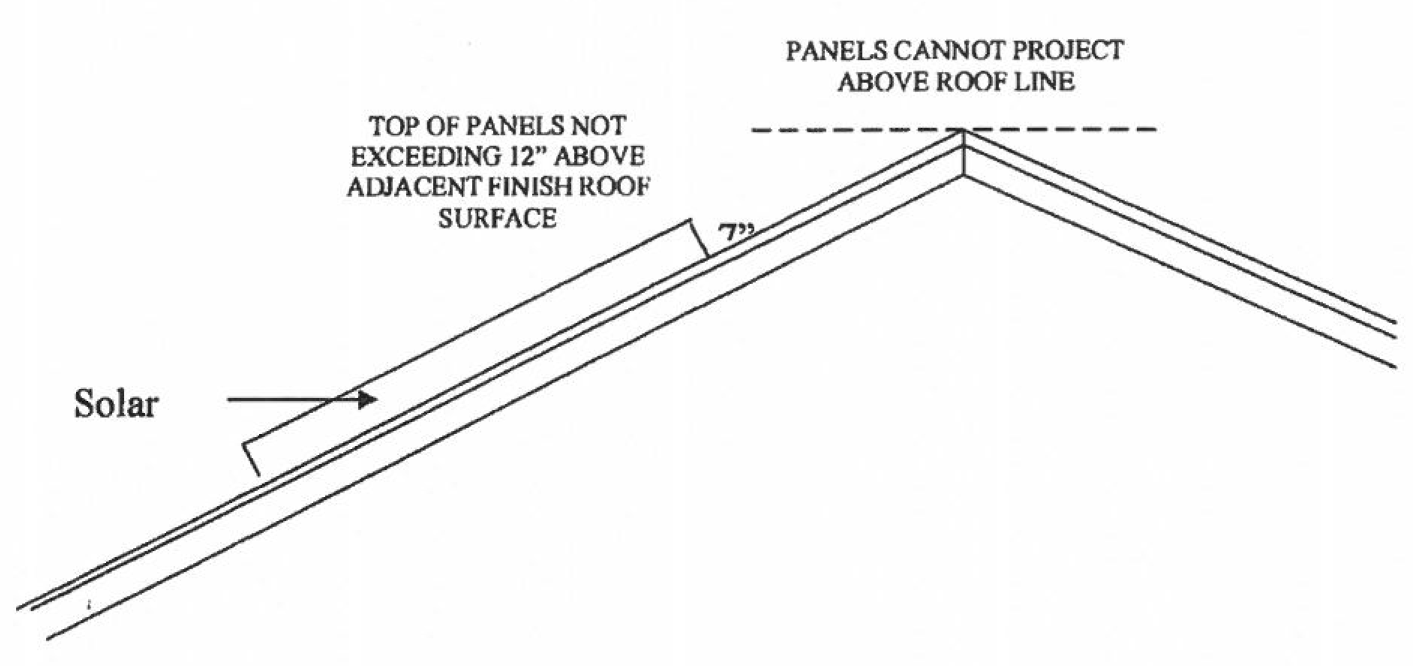
Solar panels (photovoltaic and solar thermal systems) can be located on pitched and flat roofs of all principal and accessory buildings within the city.
(Added, Ord. No. 2016-02, § 2)
(b)
Solar panels mounted on a pitched roof shall not have a highest finished pitch more than five percent steeper than the roof pitch on which the system is mounted, and shall be no higher than 12 inches above the roof. Solar panels mounted on a flat roof shall not extend more than five feet above the roof surface. Solar panels cannot exceed the maximum structure or accessory building height for the structure they are mounted on.
(Added, Ord. No. 2016-02, § 2)
(c)
Solar panels, mounting structures and all accessory components shall be set back a minimum of four feet from the outside edge (or inside edge of the parapet) of a flat roof to minimize visibility and allow roof access.
(Added, Ord. No. 2016-02, § 2)
(d)
Solar panels, solar devices, mechanical equipment and mounting structures shall have non-reflective finishes to eliminate glare.
(Added, Ord. No. 2016-02, § 2)
(e)
Solar panel frames and support structures should be constructed of a neutral color and compatible with the roof surface color.
(Added, Ord. No. 2016-02, § 2)
(f)
Solar panels shall be placed in a uniform manner. Consider the panels as part of the overall roof configuration. Match the slope and proportions of the array with the shape and proportions of the roof.
(Added, Ord. No. 2016-02, § 2)
Subd. 5.
Ground-mounted solar energy systems shall conform to the following standards:
(Added, Ord. No. 2016-02, § 2)
(a)
Ground-mounted systems shall only be allowed on a parcel with an existing principal structure.
(Added, Ord. No. 2016-02, § 2)
(b)
Ground-mounted systems shall be located only in rear or side yards.
(Added, Ord. No. 2016-02, § 2)
(c)
Ground-mounted systems shall not be located in the Shoreland Overlay District.
(Added, Ord. No. 2016-02, § 2)
(d)
Ground-mounted systems shall be wholly screened from view from the public right-of-way and adjacent residential structures. Methods for screening shall include berming, fencing, landscaping and/or combination thereof.
(Added, Ord. No. 2016-02, § 2)
(e)
Ground-mounted systems shall be located on a parcel of at least 2.5 acres.
(Added, Ord. No. 2016-02, § 2)
(f)
Ground-mounted systems shall have a maximum area of 500 SF.
(Added, Ord. No. 2016-02, § 2; Amended by Ord. No. 2024-02, § 1, 5-7-2024)
(g)
Ground mounted systems shall be setback a minimum of 50 feet from all property lines.
(Added, Ord. No. 2016-02, § 2; Amended by Ord. No. 2024-02, § 1, 5-7-2024)
(h)
The maximum height for any component of the system shall be 15 feet.
(Added, Ord. No. 2016-02, § 2; Amended by Ord. No. 2024-02, § 1, 5-7-2024)
(i)
Ground-mounted systems shall be in compliance with any applicable local, state and federal regulatory standards, including building, electrical and plumbing codes.
(Added, Ord. No. 2016-02, § 2; Amended by Ord. No. 2024-02, § 1, 5-7-2024)
(j)
Ground-mounted systems and their support structures shall be designed by a certified professional to meet applicable professional standards for the local soil and climate conditions.
(Added, Ord. No. 2016-02, § 2; Amended by Ord. No. 2024-02, § 1, 5-7-2024)
(k)
The city may permit a ground mounted solar energy system which exceeds 500 SF, if the following additional criteria are wholly satisfied:
(Added by Ord. No. 2024-02, § 1, 5-7-2024)
1.
The ground mounted solar system does not exceed 2,500 SF.
(Added by Ord. No. 2024-02, § 1, 5-7-2024)
2.
The ground mounted solar energy system is located on a property that is 5 acres or larger.
(Added by Ord. No. 2024-02, § 1, 5-7-2024)
3.
The ground mounted solar energy system shall be located a minimum of 100 LF from any property line and 500 LF from any residential structure on an adjoining property.
(Added by Ord. No. 2024-02, § 1, 5-7-2024)
(l)
The city will also consider the following additional criteria to determine if a ground mounted solar energy system will be permitted to exceed the maximum size limitations established in this Code:
(Added by Ord. No. 2024-02, § 1, 5-7-2024)
1.
The ground mounted solar energy system is not visible from any public street or from adjacent properties. Screening can be used to meet this standard.
(Added by Ord. No. 2024-02, § 1, 5-7-2024)
2.
The applicant has provided with the application, the written consent of the owners of privately or publicly owned real estate directly abutting the premises for which the permit is being requested.
(Added by Ord. No. 2024-02, § 1, 5-7-2024)
3.
The city finds that granting permission for a ground mounted solar energy system, that exceeds 500 SF, will not be detrimental to the public or take away from the reasonable use and enjoyment of the surrounding property.
(Added by Ord. No. 2024-02, § 1, 5-7-2024)
515.12. - Minimum size for residential dwellings.
All residential dwellings must be a minimum of 24 feet in width and 30 feet in length, and must contain a minimum of 720 square feet of habitable floor space. Length and width must be measured from the outside of the exterior siding or facia and habitable floor space must be measured from the inside of the interior wall surface. Interior partitions must not be considered.

