
Independence City Zoning Code
ARTICLE 2
- TERMINOLOGY AND MEASUREMENTS
14-200-01 - Generally
14-200-01-A.
Use Groups. This development ordinance classifies land uses into five major groupings: "residential," "public and civic," "commercial," "industrial" and "other." These are referred to as "use groups."
14-200-01-B.
Use Categories. Each use group is further divided into more specific "use categories." Use categories classify land uses and activities based on common functional, product, or physical characteristics. Characteristics include the type and amount of activity, the type of customers or residents, how goods or services are sold or delivered and site conditions.
14-200-01-C.
Typical Uses. Typical uses cited in the description of use categories are not intended to be exclusive or restrictive.
14-200-01-D.
Determination of Most Similar Use Category. When a specific use type cannot be readily classified into a use category or appears to fit into two or more use categories, the Community Development Director is authorized to determine the most similar, thus most appropriate, use category based on the following considerations:
1.
the actual or projected characteristics of the activity in relationship to the stated characteristics of each use type;
2.
the relative amount of site area or floor space and equipment devoted to the activity;
3.
relative amounts of sales from each activity;
4.
the customer type for each activity;
5.
the relative number of employees in each activity;
6.
hours of operation;
7.
building and site arrangement;
8.
vehicles used with the activity;
9.
the relative number of vehicle trips generated by the use;
10.
signs;
11.
how the use advertises itself; and
12.
whether the activity is likely to be found independent of the other activities on the site.
14-200-02 - Residential use group
The residential use group includes uses that provide living accommodations to one or more persons. The group includes two use categories: group living and household living.
14-200-02-A.
Group Living. Residential occupancy of a dwelling by other than a "family," typically providing communal kitchen/dining facilities. Examples of group living uses include but are not limited to fraternities, sororities, convents, monasteries, and the following specific use types:
1.
Group Home, Custodial. A home for nine or more unrelated persons with mental and/or physical handicaps. Such homes may also be occupied by paid staff and caregivers.
2.
Group Home, Residential. In accordance with RSMo 89.020.2. A single-family residence in which eight or fewer unrelated mentally or physically handicapped persons reside, along with up to two additional persons acting as houseparent's or guardians who need not be related to each other or to any of the mentally or physically handicapped persons, residing in the dwelling.
3.
Domestic Violence Residence. A residential building in which temporary housing is provided for up to eight persons who are victims of domestic violence. Any children or support staff using sleeping accommodations at a domestic violence residence will be counted in determining maximum occupancy.
4.
Domestic Violence Shelter. A building in which temporary housing is provided for more than eight persons who are victims of domestic violence.
5.
Substance Abuse Treatment House. A residential building in which temporary housing is provided for up to 12 persons who are undergoing treatment for alcohol or other substance abuse. Any support staff using sleeping accommodations will be counted in determining maximum occupancy.
6.
Penal Halfway House. A residential building in which temporary housing is provided for up to 12 persons who are on probation, on parole, or are participating in a penal institute's pre-release program. Any support staff using sleeping accommodations will be counted in determining maximum occupancy.
7.
Recovery Center. A residential building in which temporary housing is provided for 13 to 50 persons who are either:
(a)
undergoing treatment for alcohol or drug dependence
(b)
on probation, on parole, or are participating in a penal institute's pre-release program
Any support staff using sleeping accommodations will be counted in determining maximum occupancy. Facilities with more that 50 persons are considered detention/correction facilities, see Sections 14-200-04-C and 14-302-03 for further information.
8.
Nursing Home. An extended or intermediate care facility licensed or approved to provide full-time convalescent or chronic care to individuals who, by reason of advanced age, chronic illness or infirmity, are unable to care for themselves. This term shall also include assisted living facilities.
9.
Homeless Shelter. A facility or building where overnight accommodation services are provided on a limited, short-term basis (not to exceed 180 consecutive days) for individuals and families impacted by temporary or chronic homelessness. Such assistance may include food, shelter, necessary medical and clothing needs, religious instruction, counseling, and other incidental services.
10.
Soup Kitchen. An establishment where meals are provided to a person or persons unrelated to the provider at no cost or at a charge that is less than the full cost of providing same and that the provision of such meals is the principal service of the establishment, whether or not additional services are provided; however, lodging is prohibited. A soup kitchen is not a restaurant.
11.
Transitional Housing. A building that provides temporary housing with supportive services to individuals and families experiencing homelessness with the goal of interim stability and support to successfully move to and maintain permanent housing. Transitional housing projects can cover housing costs and accompanying supportive services for program participants for up to 24 months.
(Ord. No. 19418, § 1, 3-6-2023)
14-200-03 - Household living category
Residential occupancy of a dwelling unit by a family with tenancy arranged on a monthly or longer basis. Household living occurs in the following types of residential buildings:
14-200-03-A.
Detached House. A building containing one dwelling unit located on a single lot with private yards on all sides.
14-200-03-B.
Zero Lot Line House. A building containing one dwelling unit located on a single lot. The building is shifted to one side of the lot so that there is a more usable side yard on one side of the house and very little or no private yard on the other side.
14-200-03-C.
Attached House. A building containing multiple dwelling units, each located on its own lot with a common or abutting wall along shared lot lines. Each dwelling unit has its own external entrance.
14-200-03-D.
Two-unit House. A building containing two dwelling units, both of which are located on a single lot or parcel (also referred to as a "duplex" or "two-flat"). The dwelling units are attached and may be located on separate floors or side-by-side.
Figure 200-1. Two-unit House, Multi-unit House and Multiplex Buildings (left to right)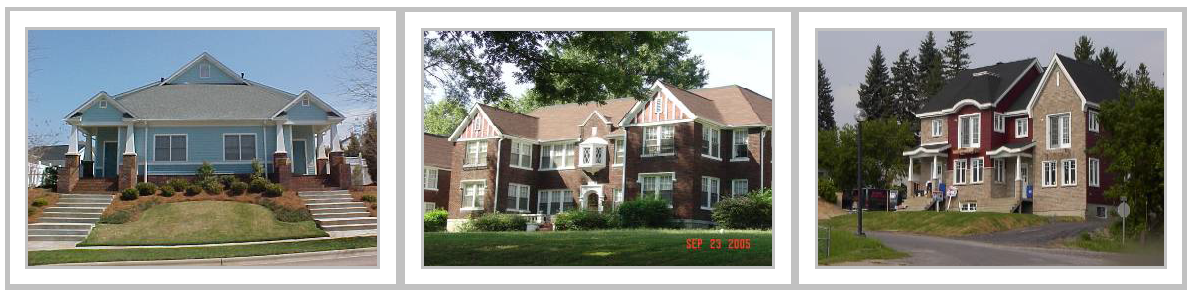
14-200-03-E.
Multi-unit House. A building containing three to eight dwelling units located on a single lot. Multi-unit houses appear as large detached houses and have only one entrance visible from the street.
14-200-03-F.
Multiplex. A building containing three to eight dwelling units, each of which has its own external entrance.
14-200-03-G.
Apartment. A building containing three or more dwelling units that share common walls and/or common floors/ceilings. Apartment/condo buildings are typically served by one or more common building entrances.
14-200-03-H.
Manufactured Housing Unit. A building unit or assembly of closed construction that is fabricated in an off-site facility and constructed in conformance with the City of Independence new construction codes and standards.
14-200-03-I.
Mobile Home. Any vehicle or portable structure having no foundation other than wheels, jacks, blocks and designed or constructed as a self-contained single-family dwelling unit. Structures that meet the definition of a "manufactured housing unit" are not considered mobile homes.
14-200-03-J.
Mobile Home Park. Any plot of ground containing mobile home spaces, regardless of whether or not a charge is made for the occupation of such spaces.
14-200-04 - Public and civic use group
The public and civic use group includes uses that provide public or quasi-public services. The public and civic use group includes the following use categories:
14-200-04-A.
College/University. Colleges and other institutions of higher learning that offer courses of general or specialized study leading to a degree. They are certified by the state or by a recognized accrediting agency. Colleges tend to be in campus-like settings or on multiple blocks. Examples include universities, liberal arts colleges, community colleges, nursing and medical schools not accessory to a hospital, conservatories and seminaries.
14-200-04-B.
Day Care. Uses providing care, protection and supervision for children or functionally impaired adults on a regular basis away from their primary residence for less than 24 hours per day. There are four types of day care:
1.
Home-Based Day Care. Day care, provided within a dwelling unit, for up to four children or adults who are not related to the day care provider.
2.
Family Day Care. Day care for five to 10 children or adults who are not related to the day care provider.
3.
Group Day Care. Day care for 11 to 20 children or adults who are not related to the day care provider.
4.
Day Care Center. Day care for 21 or more children or adults who are not related to the day care provider.
14-200-04-C.
Detention and Correctional Facilities, Other. Facilities for the confinement of persons charged with or convicted of a crime or otherwise confined under a court order and includes but is not limited to prisons, jails, probation centers and juvenile detention homes.
14-200-04-D.
Hospital. Uses providing medical or surgical care to patients and offering inpatient (overnight) care.
14-200-04-E.
Library/Cultural Exhibit. Museum-like preservation and exhibition of objects in one or more of the arts and sciences, gallery exhibition of works of art, or library collection of books, manuscripts, etc., for study and reading.
14-200-04-F.
Park/Recreation. Recreational, social, or multi-purpose uses associated with public parks, public open spaces, public community centers, public play fields, public or private golf courses, or other public recreation areas or buildings.
14-200-04-G.
Religious Assembly. Religious services involving public assembly such as customarily occur in synagogues, temples, mosques and churches.
14-200-04-H.
Safety Services. Public safety services that provide fire, police or life protection, together with the incidental storage and maintenance of necessary vehicles. Typical uses include fire stations, police stations and ambulance services.
14-200-04-I.
School. Public and private schools at the primary, elementary, junior high, or high school level that provide state-mandated basic education.
14-200-04-J.
Utilities and Services.
1.
Minor, Basic. Infrastructure services that need to be located in area where the service is provided. Minor utilities and services generally do not have regular employees at the site and typically have few if any impacts on surrounding areas. Typical uses include water and sewer pump stations; water towers and reservoirs; electrical substations; water conveyance systems; stormwater facilities and conveyance systems; telephone switching equipment and emergency communication broadcast facilities.
2.
Major. Infrastructure services that typically have substantial land-use impacts on surrounding areas. Typical uses include but are not limited to water and waste water treatment facilities and major water storage facilities.
14-200-04-K.
Government Buildings/Facilities. Government buildings and related facilities utilized for its operations. Typical uses include City halls, courthouses, animal shelters, maintenance garages, police buildings, detention and facilities, and training facilities but exclude facilities relating to utility services and parks and recreation.
(Ord. No. 17446; Ord. No. 18210; Ord. No. 18571; Ord. No. 18636; Ord. No. 19585, § 1, 8-19-2024)
14-200-05 - Commercial use group
The commercial use group includes uses that provide a business service or involve the selling, leasing or renting of merchandise to the general public. The commercial use group includes the following use categories:
14-200-05-A.
Animal Services. The following are animal services use types:
1.
Sales and Grooming. Sales and grooming of dogs, cats and similar small animals. Typical uses include pet stores, dog bathing and clipping salons and pet grooming shops.
2.
Shelter or Boarding Kennel. Animal shelters and kennel services for dogs, cats and small animals. Typical uses include boarding kennels, dog training centers and animal rescue shelters.
3.
Veterinary. An animal care facility operated by licensed veterinary practitioners primarily engaged in the practice of veterinary medicine, dentistry, animal surgery, or testing services for licensed veterinary practitioners. Examples include pet clinics, dog and cat hospitals and animal hospitals, veterinarians' offices, and veterinary testing laboratories, or veterinary training facilities. No outdoor grooming or pet boarding is allowed in this use.
4.
Stable. Stables and boarding facilities for horses and similar large animals.
14-200-05-B.
Artist Work or Sales Space. Floor space devoted to the production, showing, or sale of art. Typical uses include art galleries and artist studios, but not including art museums. Art museums are classified in the "Libraries and Cultural Exhibits" use category.
14-200-05-C.
Building Maintenance Services. Provision of maintenance and custodial services to commercial and industrial establishments. Typical uses include janitorial, landscape maintenance and window cleaning services. Also includes exterminator services for residential, commercial or industrial applications.
1.
Carpet and Floor Covering Stores. Supplies, sales and service of carpet, tile, wood, or composite materials for floor finishing. Includes the sale and support of materials incidental to finishing floors such as pre-packaged grout, glues, tools and equipment.
14-200-05-D.
Business Equipment Sales and Services. Sales, rental, or repair of office, professional and service equipment and supplies to companies rather than to individuals. Excludes automotive and heavy equipment sales or service. Typical uses include office equipment and supply firms, small business machine repair shops and hotel equipment and supply firms.
1.
HVAC and Electrical Equipment. Supplies, sales and service of HVAC component and other similar electrical equipment and components, for distribution to retailers or wholesalers for resale.
14-200-05-E.
Business Support Services. Provision of clerical, employment, protective, or minor processing services to firms rather than individuals. Typical uses include employment agencies and telephone answering services and business or trade schools. Business or trades schools that involve outdoor storage or manufacturing processes are not considered business support services, but rather are to be classified in an Industrial use group category.
14-200-05-F.
Communications Service Establishments. Broadcasting and other information relay services accomplished through use of electronic and telephonic mechanisms. Excludes services classified as "major utilities and services" and "Minor Utilities." Typical uses include recording studios, television and radio studios, telecommunication service centers and telegraph service offices.
14-200-05-G.
Health Club and Gyms. Health club, fitness, gymnasium or exercise facility when including equipment and space for weight-lifting and cardiovascular activities.
14-200-05-H.
Eating and Drinking Establishments. Provision of prepared food or beverages for on- or off-premises consumption. Typical uses include restaurants, taverns and nightclubs.
1.
Restaurants Sit-Down. Establishments primarily engaged in providing food services to patrons who order and are served while seated and pay after eating (waitress/waiter services). These establishments may provide this type of food service to patrons in combination with selling alcoholic beverages, providing carryout services, or presenting live nontheatrical entertainment. This also includes establishments know as cafeterias, grill buffets, or buffets, primarily engaged in preparing and serving meals for immediate consumption using cafeteria-style or buffet serving equipment, such as steam tables, refrigerated areas, display grills, and self-service nonalcoholic beverage dispensing equipment.
14-200-05-I.
Entertainment and Spectator Sports. Provision of cultural, entertainment, athletic and other events to spectators. The following are spectator sports and entertainment use types:
1.
Small Venue. Entertainment and spectator sports establishments with a capacity of no more than 149 persons. Typical uses include small theaters and meeting or banquet halls.
2.
Medium Venue. Entertainment and spectator sports establishments with a capacity of more than 149 and fewer than 500 persons. Typical uses include theaters and meeting or banquet halls.
3.
Large Venue. Entertainment and spectator sports establishments with a capacity of 500 persons or more. Typical uses include large theaters, cinemas and meeting or banquet halls.
4.
Outdoor Entertainment and Spectator Sports. Outdoor entertainment and spectator sporting establishments of types and sizes. Typical uses include sports stadiums, amphitheaters, and drive-in movie theaters.
14-200-05-J.
Financial Services. Financial or securities brokerage services. Typical uses include banks, savings and loans, credit unions, consumer investment businesses, pawn shops and short-term loan services.
1.
Short-Term Loan Services. Businesses that loan money on a short-term basis to the general public as an element of their operation, including businesses offering title loans, payday loans, signature loans and small loans under Chapter 367 or RSMo 408.500, and other similar businesses, but not including banks, savings and loan associations or credit unions that are licensed and regulated by appropriate state and federal agencies, or retail credit financing institutions that are licensed under RSMo Chs. 364 or 365, or pawnbrokers governed by RSMo Ch. 367, or retail merchants governed by RSMo Ch. 400.2 or consumer installment loan providers licensed under RSMo. Ch. 408.510.
2.
Pawn Shops. Businesses that lend money on the security of pledged goods or that is engaged in the business of purchasing tangible personal property on condition that it may be redeemed or repurchased by the seller for a fixed price within a fixed period of time. Pawnshops and pawnbrokers are further governed by RSMo Ch. 367.
14-200-05-K.
Food and Beverage Retail Sales. Retail sale of food and beverages for home consumption. Typical uses include groceries, liquor stores and wine stores.
14-200-05-L.
Funeral and Interment Services. Provision of services involving the care, preparation or disposition of human and animal dead. The following are funeral and interment services use types:
1.
Cemetery/Mausoleum/Columbarium. Land or facilities used for burial of the dead.
2.
Cremating. Crematory services involving the purification and reduction of a body by fire. Typical uses include crematories and crematoriums.
3.
Undertaking. Undertaking services such as preparing the dead for burial and arranging and managing funerals. Typical uses include funeral homes and mortuaries.
14-200-05-M.
Gasoline and Fuel Sales. A building or portion thereof used for offering for sale at retail to the public, fuels, oils and accessories for motor vehicles, where repair service and automobile washing is incidental, where no storage or parking space is offered for rent and where no motor vehicles or recreational equipment are offered for sale or rent.
14-200-05-N.
Lodging. Provision of lodging services on a temporary basis with incidental food, drink and other sales and services intended for the convenience of guests. The following are lodging use types:
1.
Short-Term Rental. A lodging use that is rented or leased as a single housekeeping unit to guests for not less than one night and not more than 30 consecutive nights in exchange for a fee, money, goods, services or other performances.
2.
Bed and Breakfast. An owner- or manager-occupied detached house for short-term lodging which does not meet the definition of short-term rental. Meals may be provided to guests. For the purposes of this term, a guest is a person who rents a room in a bed and breakfast establishment for no more than 30 consecutive days.
3.
Hotel/Motel. An establishment, other than a detached house, in which short-term lodging is offered for compensation and that may or may not include the service of one or more meals to guests. Typical uses include hotels, motels and boarding houses. For the purposes of this term, a guest is a person who rents a room in a hotel/motel establishment for no more than 30 consecutive days. A hotel is better defined as a building in which ingress to and from all rooms is made through an inside lobby or office supervised by a person in charge at all hours. A hotel may include restaurants, taverns, club rooms, public banquet halls, ballrooms, and meeting rooms or conferences centers.
4.
Conference and Retreat Center. A facility used for assemblies or meeting of the members or representatives of a group, such as convention centers and banquet halls. This does not include clubs, lodges or other meeting facilities of private or nonprofit groups that are primarily used by group members.
14-200-05-O.
Medical Service. Personal health services including prevention, diagnosis and treatment, rehabilitation services provided by physicians, dentists, nurses and other health personnel and medical testing and analysis services. Typical uses include medical and dental offices, medical/dental laboratories, health maintenance organizations and government-operated health centers. Establishments that provide analytic or diagnostic services, and related services such as medical imaging and forensics. Excludes use types more specifically classified, such as hospitals.
14-200-05-P.
Office. A building or facility for a firm or organization that primarily provides professional, executive, management or administrative services such as accounting, advertising, architectural, consulting, planning, computer software consulting, data management, engineering, medical assistance programs, dental, chiropractic or other care professional service, environmental analysis, insurance, interior design, investment, graphic design, law, real estate offices, or drafting. Information services such as print or software publishing, internet publishing or web production. It includes research and development, scientific and technical research services that do not involve laboratory facilities. It includes medical offices or clinics, banks or financial services, and office that are incidental to retail, production, storage or other activities.
14-200-05-Q.
Parking, Non-Accessory. Parking that is not provided to comply with minimum off-street parking requirements and that is not provided exclusively to serve occupants of or visitors to a particular use, but rather are available to the public at-large. A facility that provides both accessory parking and non-accessory parking is classified as non-accessory parking.
14-200-05-R.
Personal Services. Informational, instructional, personal improvement and similar services of a nonprofessional nature. Typical uses include hair salons, barber shops, beauty shops, nail salons, tattoo parlors, fortune telling studios, health clubs, and yoga or dance studios, driving schools and martial arts studios.
14-200-05-S.
Repair and Laundry Services, Consumer. Provision of repair, dry cleaning or laundry services to individuals and households, but not to firms. Excludes vehicle and equipment repair. Typical uses include laundry/dry cleaning drop-off stations (with no dry cleaning on the premises), hand laundries, appliance repair shops, locksmiths, shoe and apparel repair and musical instrument repair.
14-200-05-T.
Retail Sales. Businesses involved in the sale, lease or rent of new or used products, merchandise to consumers. Typical uses include drug stores, grocery stores, department stores and apparel stores.
14-200-05-U.
Sports and Recreation, Participant. Provision of sports or recreation primarily by and for participants. (Spectators would be incidental and on a nonrecurring basis). Examples include bowling alleys, skating rinks, billiard parlors, driving ranges and miniature golf courses.
14-200-05-V.
Vehicle Sales and Service. Sales of motor vehicles or services related to motor vehicles. The following are vehicle sales and service use types:
1.
Car Wash/Cleaning Service. A building or site containing facilities for washing automobiles. It may use automatic production line methods—a chain conveyor, blower, steam cleaning device, or other mechanical device—or it may provide space, water and equipment for hand washing, cleaning or detailing of automobiles, whether by the customer or the operator.
2.
Heavy Equipment Sales/Rentals. Sale, retail or wholesale and/or rental from the premises of heavy construction equipment, trucks and aircraft, together with incidental maintenance. Typical uses include heavy construction equipment dealers and tractor trailer sales.
3.
Light Equipment Sales/Rentals. Sale, retail, wholesale, or rental from the premises of autos, noncommercial trucks, motorcycles, trailers with less than 10,000 lbs. gross cargo weight, recreational vehicles and boat dealers, together with incidental maintenance. Typical uses include automobile and boat dealers, car rental agencies and recreational vehicle sales and rental agencies.
4.
Motor Vehicle Repair. An establishment primarily engaged in maintenance, repair, servicing, or painting of motor vehicles.
(a)
Limited Motor Vehicle Repair. An establishment for passenger cars and light trucks that provides replacement of a part or repair of vehicle parts and wear parts that does not involve body work or painting or require removal of the engine, head or pan, transmission, or differential. Customers generally wait in the vehicle or on the premises while the service is performed; vehicles are not kept overnight. Such services include, but are not limited to: brake and muffler shops, tire and battery stores, tune-up, quick lube and fluid change businesses, and auto diagnostic centers.
(b)
General Motor Vehicle Repair. Vehicle repair activity other than those outlined in "Limited Motor Vehicle Service". Examples include, but are not limited to: auto body repair and painting, engine overhaul and replacement, transmission repair and replacement, and the repair or servicing of commercial vehicles or heavy equipment. Customers generally do not wait on the premises for the repair to be completed, and vehicles are usually left over night.
5.
Motor Vehicle Equipment Installation. An establishment primarily engaged in integrating a new or replacement part, system, or component into a vehicle after it has been originally manufactured. Installations can involve various items, including: replacement or improvement of existing systems, parts, or components, accessories or additions to the motor vehicle, and adding equipment for specific purposes (e.g., safety features, entertainment systems). Such services include, but are not limited to, auto detailing services, window tinting, radio/stereo/alarm installation, installation of lighting kits, and glass installation.
14-200-05-W.
Data Processing and Hosting. Establishments that provide infrastructure for hosting or data processing services. These establishments may provide specialized hosting activities, such as web hosting, streaming services or application hosting; provide application services provisioning or may provide general timeshare mainframe facilities to clients. An example is a data center.
14-200-05-X.
Research and Development. An establishment primarily engaged in the research, development and controlled production of high technology electronics, industrial or scientific products or commodities for sale. This classification includes biotechnology firms and manufacturers of nontoxic computer components. Includes government research such as space research and technology.
14-200-05-Y.
Vehicle Storage and Towing. The storage of operating, or non-operating, motor vehicles or vehicle towing services. The following are vehicle storage and towing use types:
1.
Vehicle Storage/Tow Lots. An establishment engaged in the temporary storage of operating or non-operating motor vehicles. Typical uses include towing services, private parking tow-aways (tow lots), and impound yards. Does not include the sale, rental, salvage, dismantling or repair of vehicles or automobile salvage or wrecking yards.
2.
Tow Lots, Limited. An establishment for the temporary storage of passenger cars and light trucks usually awaiting insurance adjustment or transport to a repair shop and where motor vehicles are kept for a period of time not exceeding 90 days.
14-200-05-Z.
Construction Services. Establishments that construct, or assist in, the construction of buildings and improvements. This includes, but is not limited to: heating/air conditioning contractors, painters, plumbers, roofers, landscapers, carpenters, and electricians.
14-200-05-AA.
Donation Centers. Places of business that may be considered thrift stores or non-profit organizations that accept donations for charitable purposes such as clothing, home goods, toys, food, or vehicles.
(Ord. No. 17782; Ord. No. 17988; Ord. No. 18946; Ord. No. 19178, § 3, 12-7-2020; Ord. No. 19207, § 1, 4-19-2021; Ord. No. 19412, § 1, 2-6-2023; Ord. No. 19524, § 1, 2-7-2024; Ord. No. 19680, § 1, 6-2-2025)
14-200-06 - Industrial use group
The industrial use group includes uses that produce goods from extracted materials or from recyclable or previously prepared materials, including the design, storage and handling of these products and the materials from which they are produced. It also includes uses that store or distribute materials or goods in large quantities. The industrial use group includes the following use categories:
14-200-06-A.
Junk/Salvage Yard. An open area where waste or scrap materials are bought, sold, exchanged, stored, baled, packed, disassembled, or handled, including but not limited to scrap iron and other metals, rags, and rubber tires. A junk or salvage yard includes an auto wrecking yard, but does not include waste-related uses or recycling facilities.
14-200-06-B.
Manufacturing, Production and Industrial Services.
1.
Artisan. On-site production of goods by hand manufacturing, involving the use of hand tools and small-scale, light mechanical equipment. Typical uses include woodworking and cabinet shops, ceramic studios, jewelry manufacturing and similar types of arts and crafts or very small-scale manufacturing uses that have no negative external impacts on surrounding properties.
2.
Computer Product Manufacturing. Establishments that primarily build computers, computer peripherals, audio and video equipment and similar electronic products but not the manufacture of raw materials.
3.
Light. Manufacturing of finished parts or products, primarily from previously prepared materials. Typical uses included building computers, computer peripherals, communications equipment, and similar electronic products but not the manufacture of raw materials. Assembly of electrical equipment, appliances and other manufacturing and production that typically have no negative external impacts on surrounding properties.
4.
Limited. Manufacturing of finished parts or products, primarily from previously prepared materials. Typical uses include: printing and related support activities; machinery manufacturing; food manufacturing; computer and electronic product manufacturing/assembly; electrical equipment, appliance, component manufacturing/assembly; furniture and related product manufacturing/assembly; and other manufacturing and production establishments that typically have very few, if any, negative external impacts on surrounding properties.
5.
General.
(a)
Manufacturing of finished or unfinished products, primarily from extracted or raw materials, or recycled or secondary materials, or bulk storage and handling of such products and materials. Typical uses include: textile mills; textile product mills; apparel manufacturing; leather and allied product manufacturing; wood product manufacturing; paper manufacturing; chemical manufacturing; plastics and rubber products manufacturing; nonmetallic mineral product manufacturing; transportation equipment manufacturing; primary metal manufacturing; and fabricated metal product manufacturing.
(b)
Industrial service firms engaged in the repair or servicing of industrial or commercial machinery, equipment, products or by-products. Typical uses include: welding shops; machine shops; industrial tool repair; fuel oil distributors; solid fuel yards; laundry, dry-cleaning and carpet cleaning plants; and photofinishing laboratories. Excludes uses classified as "repair or laundry services."
6.
Intensive. Examples include manufacturing of acetylene, cement, lime, gypsum or plaster-of-Paris, chlorine, corrosive acid or fertilizer, insecticides, disinfectants, poisons, explosives, paint, lacquer, varnish, petroleum products, coal products, plastic and synthetic resins and radioactive materials. Also includes smelting, animal slaughtering and oil refining.
14-200-06-C.
Mining/Excavation. Mining or extraction of mineral or aggregate resources from the ground for off-site use. Examples include quarrying or dredging for sand, gravel or other aggregate materials; mining; and oil and gas drilling.
14-200-06-D.
Recycling Service. Any building, portion of building or area in which recyclable material is collected, stored, or processed for the purpose of marketing the material for use as raw material in the manufacturing process of new, reused or reconstituted products. The stripping, dismantling or scrapping of motor vehicles or related equipment is considered a junk or salvage yard operation and not a recycling service.
1.
Limited. A recycling facility in which recyclable materials are temporarily stored or collected, or processed by manual separation. (Note: consumer-oriented collection boxes for newspapers, cans and glass items are considered an accessory use and may be allowed in any zoning district.)
2.
General. A recycling facility that, in addition to any activity permitted as part of a limited recycling service, engages in processing of recyclable materials such as cleaning, bundling, compacting or packing of recyclable materials.
14-200-06-E.
Self-Storage Facility, Outdoor. Storage or warehousing service within a building for individuals to store personal effects and for businesses to store materials for operation of an industrial or commercial enterprise elsewhere, where such storage space is not used for any retail, manufacturing, wholesale, business, or service use.
Self-Storage Facility, Indoor. A fully enclosed self-storage facility with independent, enclosed units for individuals to store personal effects and for businesses to store materials for operation of an industrial or commercial enterprise located elsewhere, where such storage spaces are not used for any retail, manufacturing, wholesale, business, or service use.
14-200-06-F.
Warehousing, Wholesaling and Freight Movement. Storage, wholesale sales and distribution of materials and equipment. Typical uses include storage warehouses, moving and storage firms, trucking or cartage operations, truck staging or storage areas, wholesale sales of materials and equipment to parties other than the general public.
14-200-06-G.
Wholesaling and Warehousing. Wholesale sales, storage and distribution of materials and equipment to the public and to parties other than the general public.
14-200-06-H.
Waste-Related Use. Uses that receive solid or liquid wastes or recyclable material from others for transfer to another location and use that collect sanitary wastes or recyclable material or that manufacture or produce goods or energy from the composting of organic material.
14-200-06-I.
Refuse Collectors. Uses that engage in the business of collecting, transporting, hauling, disposing of refuse over a regular route, operating inside the corporate limits of the City of Independence within or without the City. Refuse shall include putrescible animal or vegetable wastes resulting from the handling, preparation, cooking and the consumption of food; all solid wastes; small tree limbs, tree prunings, shrubbery trimmings, and small crating materials of wood and/or cardboard; brush, wood, cardboard boxes, heavy yard trimmings which cannot be conveniently cut into five foot lengths, discarded fence posts, old lumber, and other earthen, wooden or metal materials; all organic or inorganic matter, which has been discarded, damage thrown away or which no longer has value or use, or is inoperative or unworkable.
(Ord. No. 18395; Ord. No. 19207, § 1, 4-19-2021; Ord. No. 19358, § 1, 8-1-2022; Ord. No. 19631, § 1, 12-16-2024)
14-200-07 - Other use group
The "other" use group includes the following:
14-200-07-A.
Agriculture, Crop. The use of land for the production of row crops, field crops, tree crops; timber, bees, apiary products, or fur-bearing animals.
14-200-07-B.
Agriculture, Animal. The feeding, breeding, raising or holding of cattle, swine, poultry or other livestock, whether held in a confinement area or open pasture.
14-200-07-C.
Agriculture, Urban. The use of land for a home garden or community garden.
1.
Home Garden. A garden maintained by one or more individuals who reside in a dwelling unit located on the subject property to grow and harvest food and/or horticultural products for personal consumption or for sale or donation.
2.
Community Garden. An area of land managed and maintained by a group of individuals to grow and harvest food and/or horticultural products for personal or group consumption or for sale or donation. Community gardens may be divided into separate plots for cultivation by one or more individuals or may be farmed collectively by members of the group and may include common areas maintained and used by group members.
14-200-07-D.
Domestic, Non-Farm Animals. The keeping of domestic, non-farm animals, including hooved animals, such as horses miniature horses, llamas, Alpacas, goats and sheep; small animals and fowl, that are used for purely noncommercial purposes.
14-200-07-E.
Outdoor Advertising. The use of a site for the placement of off-premise signs.
14-200-07-F.
Wireless Communication Facility. Facilities related to the use of the radio frequency spectrum for the purposes of transmitting or receiving radio signals and may include, but are not limited to radio towers, television towers, telephone exchanges, micro-wave relay towers, telephone transmission equipment buildings and commercial mobile radio service facilities. The wireless communication facility use category includes all associated equipment unless the context clearly indicates that another meaning is intended. Associated equipment may include, but is not limited to: antenna, equipment shelter or platform, lighting, towers, security barriers, mounting hardware and supporting electrical or mechanical equipment. Wireless communications service includes wireless facilities of all services licensed to use radio communications pursuant to Section 301 of the Communications Act of 1934, 47 U.S.C. Section 301.47 U.S.C. 301.
1.
Co-located Facility. A wireless telecommunication facility that is attached to an existing pole, tower, or other structure including, but not limited to, a structure that can accommodate the future installation of two or more antenna systems.
2.
Freestanding Facility. A new tower, monopole, or other unattached structure erected to support wireless communication antennas and connecting appurtenances.
3.
Cellular Support Structures/Towers. A structure, such as a monopole, tower, or building capable of supporting wireless facilities, but not including utility poles, that includes the wireless facilities of all services licensed to use radio communications pursuant to Section 301 of the Communications Act of 1934, 47 USC, SS 301.
4.
Non-cellular Support Structures/Towers. A structure, such as a monopole, tower, or building, but not including utility poles, that is capable of supporting non-cellular services to include but not limited to: radio, television, and micro-wave relay transmission.
(Ord. No. 17642; Ord. No. 17727; Ord. No. 18790)
14-201-01 - General terms
Unless otherwise noted, the following words and terms shall apply to this chapter.
ACCESSORY BUILDING. A building that is subordinate in area, extent and purpose to the principal use and building on the lot and that is customarily used or occupied in conjunction with a permitted accessory use.
ACCESSORY STRUCTURE. A structure that is subordinate in area, extent and purpose to the principal use and building on the lot and that is customary and incidental to a permitted accessory use.
ACCESSORY USE. A use that is subordinate in area, extent and purpose to the principal use on the zoning lot and that is customarily found in conjunction with a permitted principal use.
ADMINISTER. The direct application of marijuana to a Qualifying Patient by way of any of the following methods:
i.
Ingestion of capsules, teas, oils, and other marijuana-infused products;
ii.
Vaporization or smoking of dried flowers, buds, plant material, extracts, or oils;
iii.
Application of ointments or balms;
iv.
Transdermal patches and suppositories; or
v.
Consuming marijuana-infused food products.
ALLEY. A public right-of-way that generally affords a secondary means of access to abutting property.
ALTERATION. Any addition, removal, extension, or change in the location of an exterior wall or roof of a principal building or accessory building.
ARTERIAL STREET. A street, identified as an arterial street on the Independence Thoroughfare Plan, intended to move through traffic to and from the major traffic generators and to serve as a route for traffic between communities or large areas.
BAR/TAVERN. An establishment primarily devoted to the serving of alcoholic beverages and in which the service of food is only incidental to the consumption of such beverages.
BERM. A man-made landscape feature generally consisting of a linear mound of soil with stabilized sides capable of holding plants and vegetation. Temporary soil stockpiles and retaining walls are not berms.
BLOCK. A tract of land bounded by streets or by any combination of streets, public parks, cemeteries, railroad rights-of-way, waterways, boundary lines of municipalities, or other natural or man-made features.
BLOCK FACE. All lots abutting one side of a street between the two nearest intersecting streets.
BODY ART SERVICE. Any facility that engages in the activity of tattooing and body piercing as defined and regulated by the State of Missouri. Body art services do not include a facility that only conducts ear piercing and physicians who perform body art procedures as part of a patient treatment.
BUFFERYARD. A continuous area of land along the perimeter of a lot that is provided to satisfy the bufferyard requirements of Section 14-503-07.
BUILDING. An enclosed structure anchored to a permanent foundation and having exterior or party walls and a roof, designed for the shelter of persons, animals, or property. When divided by other than common or contiguous walls, each portion or section of such building is to be considered a separate building.
BUILDING COVERAGE. The proportion of the lot area expressed as a percent that is covered by the maximum horizontal cross-section of a building or buildings.
BUILDING LINE. A line parallel to the street right-of-way line representing the minimum distance which all or any part of the building is set back from said right-of-way line.
CALIPER. A measurement of the size of a tree equal to the diameter of its trunk measured six inches above natural grade or six inches above the tree's root ball if the tree is unplanted.
CANOPY TREES. Those species of trees that reach a height of 30 feet to 70 feet or taller at maturity.
CAR DEALERSHIP. An establishment engaged in the sale, lease or trade of new passenger motor vehicles, including automobiles, sport utility vehicles, light trucks and vans.
CHURCH. A permanent building primarily and regularly used as a place of religious worship.
CITY. The City of Independence, Missouri.
CLUSTER PLANTINGS. A grouping of three or more plants installed in close proximity to one another.
COLLECTOR STREET. A street, identified as a collector street on the Thoroughfare Plan, intended to move traffic from minor streets to arterial streets.
COMMERCIAL ESTABLISHMENT. A business classified in the commercial use group, the ownership, management and physical location of which are separate and distinct from those of any other place of business located on the same lot, as partly evidenced by maintaining separate and distinct doors and access points.
COMMERCIAL MESSAGE. Any sign, wording, logo or other representation that, directly or indirectly, names, advertises or calls attention to a business, product, service or other commercial activity.
COMMERCIAL VEHICLE. Any motor vehicle having at least one of the following attributes:
1.
Having a gross weight, whether loaded or unloaded, in excess of 24,000 pounds or exceeding 18 feet in length and designed to carry passengers, or to haul or tow vehicles, freight, or merchandise; or
2.
Any tractor, backhoe, blade, bucket, bulldozer, compactor, crane scraper, excavator, front-end loader, or other construction equipment or attachment; or
3.
Any tow truck, dump truck, stake-bed truck, flat bed truck, step van, refuse or garbage truck, bus, semi-tractor cab or trailer, or special purpose vehicle in excess of ten feet in total length; or
4.
Any agricultural tractor, farm implement or attachment, moving equipment or attachment, brush hog, trimmer, spreader and other lawn, landscape and turf maintenance equipment or attachments or other similar equipment.
COMMUNITY DEVELOPMENT DIRECTOR. The Community Development Director, as designated by the City Manager, is responsible for administering this development ordinance. The Community Development Director is also the Planning Director. References in the City Charter to the "Planning Director" will be construed as references to the Community Development Director.
COMPREHENSIVE FACILITY. A comprehensive marijuana cultivation facility, comprehensive marijuana dispensary facility or a comprehensive marijuana-infused products manufacturing facility.
COMPREHENSIVE MARIJUANA CULTIVATION FACILITY. A facility licensed by the department to acquire, cultivate, process, package, store on site or off site, transport to or from, and sell marijuana, marijuana seeds, marijuana vegetative cuttings (also known as clones) to a medical facility, comprehensive facility, or marijuana testing facility. A comprehensive marijuana cultivation facility need not segregate or account for its marijuana products as either non-medical marijuana or medical marijuana. A comprehensive marijuana cultivation facility's authority to process marijuana shall include the creation of prerolls, but shall not include the manufacture of marijuana-infused products.
COMPREHENSIVE MARIJUANA DISPENSARY FACILITY. A facility licensed by the Department to acquire, process, package, store on site or off site, sell, transport to or from, and deliver marijuana, marijuana seeds, marijuana vegetative cuttings (also known as clones), marijuana-infused products, and drug paraphernalia used to administer marijuana as provided for in this section to a qualifying patient or primary caregiver, as those terms are defined in section I of Article XIV, or to a consumer, anywhere on the licensed property or to any address as directed by the patient, primary caregiver, or consumer and consistent with the limitations of this Article and as otherwise allowed by law, to a comprehensive facility, a marijuana testing facility, or a medical facility. Comprehensive dispensary facilities may receive transaction orders at the dispensary directly from the consumer in person, by phone, or via the internet including from a third party. A comprehensive marijuana dispensary facility need not segregate or account for its marijuana products as either non-medical marijuana or medical marijuana, but shall collect all appropriate tangible personal property sales tax for each sale, as set forth in this Article and provided for by general or local law. A comprehensive marijuana dispensary facility's authority to process marijuana shall include the creation of prerolls.
COMPREHENSIVE MARIJUANA-INFUSED PRODUCTS MANUFACTURING FACILITY. A facility licensed by the Department to acquire, process, package, store, manufacture, transport to or from a medical facility, comprehensive facility, or marijuana testing facility, and sell marijuana-infused products, prerolls, and infused prerolls to a marijuana dispensary facility, a marijuana testing facility, or another marijuana-infused products manufacturing facility. A comprehensive marijuana-infused products manufacturing facility need not segregate or account for its marijuana products as either non-medical marijuana or medical marijuana.
COMPREHENSIVE PLAN. A document that links City development policy, short- and long-range objectives and implementation strategies to a number of interdependent elements. The elements of the Comprehensive Plan are based on the present and future needs of the City. The elements of the Comprehensive Plan are to be adopted by the Planning Commission and are to be used as a guide for development.
CONSERVATION DISTRICT. An area designated as a "Conservation District" by ordinance of the City Council which possesses special historical, architectural or cultural significance as part of the heritage of the City, but is of lesser historical or architectural significance than a Historic District. A Conservation District has retained a sufficient amount of its historical and architectural character for interpretation as part of the development of the City, including, but not limited to scale, massing, and orientation of buildings, although some alterations have been made.
CONSTITUTION. The Constitution of the State of Missouri.
CONSUMER. A person who is at least 21 years of age.
CONVENIENCE STORE. A retail establishment that sells limited grocery items, magazines, newspapers, and other limited items where there is no dispensing or sales of vehicular fuels and/or vehicle charging. If at any time, tobacco or alcohol becomes the primary sales category, the business can no longer be construed as a convenience store.
CONVENIENCE STORE WITH FUEL SALES. A retail establishment with the sale of gasoline and fuel products that also sells prepackaged food items, package liquor, tobacco products, periodicals and tangible consumer goods, primarily for self-service by the consumer, including hot beverages, fountain beverages and pastries. Such businesses may also sell site-prepared food items including, but not limited to, hot dogs, salads and popcorn.
CUL-DE-SAC. A local street with only one outlet and having an appropriate terminus at one end for the safe and convenient reversal of traffic movement.
DAYCARE. A child-care facility, as defined by section 215.201, RSMo., or successor provisions, that is licensed by the State of Missouri.
DAY LABOR EMPLOYMENT AGENCY. An establishment primarily engaged in supplying workers to clients businesses for limited periods of time to supplement the working force of the client. The individuals provided are employees of the temporary help service establishment but are supervised by the client.
DECIDUOUS TREES. Those trees which drop all of their leaves annually, such as Ash, Sycamore, Willow, Bald Cypress, etc.
DEPARTMENT. The Department of Health and Senior Services, or its successor agency.
DEVELOPER. A person, firm or corporation undertaking development or building on a lot, tract or parcel of land. Includes subdividers, builders and property owners
DIAMETER AT BREAST HEIGHT (DBH). A measurement of the size of a tree equal to the diameter of its trunk measured 4.5 feet above natural grade.
DISABILITY, PERSON WITH. A person who has a condition of physical or mental disability that substantially limits one or more major life activities, as stated in Section 504 of the Federal Rehabilitation Act of 1973.
DISTRICT. Zoning district.
DONATION BIN. An unattended portable receptacle or container designed with a door, slot, or other opening made of metal, steel or any other material designed or intended for the collection and temporary storage of donated clothing or other salvageable personal property usually for charity. This term does not include solid waste collection or processing facilities or recycling collections bins for the collection of recyclable materials.
DRIVE-THROUGH FACILITY. Any service window, automated device or other facility that provides goods or services to individuals in a motor vehicle. Includes drive-in and drive-thru type uses.
DUPLEX DWELLING UNIT. A dwelling situated on one lot occupied exclusively by two families, respectively, in separate dwelling units living independently of each other.
DWELLING. A building or portion of a building designed or used exclusively for residential occupancy. In no case shall a motor home, trailer coach, recreation vehicle, automobile, automobile chassis, tent, portable building or other similar type of building or vehicle be considered a dwelling.
DWELLING UNIT. A single unit providing complete independent living facilities for one or more persons, including provisions for living, sleeping, eating, cooking and sanitation.
EASEMENT. A grant by the property owner to the public, a corporation, or persons of the use of that land for specific purposes.
ELDERLY HOUSING, DEPENDENT LIVING. A residential use including life-care facilities, nursing homes, and skilled care facilities for persons needing a wide range of health related services and personal nursing care.
ELDERLY HOUSING, INDEPENDENT. A residential use reserved for actively mobile older people which include design features making them fully accessible.
ELDERLY HOUSING, SEMI-INDEPENDENT. A residential use with special support services such as central dining, transportation services, with limited medical or nursing support.
EMPLOYMENT AGENCY. An establishment primarily engaged in listing employment vacancies and referring or placing applicants for employment or providing executive search, recruitment and placement services.
EVERGREEN TREES. Those trees which retain their leaves during dormancy, such as Pine, Juniper, Yews, Fir, etc.
FAMILY. The following living arrangements shall constitute a family for the purposes of this chapter:
(a)
One or more persons related by blood, marriage, legal adoption or custodial relationship living as a single housekeeping unit; or,
(b)
Not more than three unrelated persons, all of whom live together in a dwelling unit; or,
(c)
Two unrelated persons, plus their biological, adopted or foster children or other minors for whom they have legally established custodial responsibility, living as a single housekeeping unit.
FENCE. A structure, other than a building, purposely designed for and used as a barrier to provide a boundary, means of confinement or protection, or visual screen for areas of land.
FINE. When used herein shall mean a monetary fine imposed by the Municipal Court for this City.
FLOOR AREA. The sum of the horizontal areas of each floor of a building, measured from the interior faces of the exterior walls or from the centerline of walls separating two buildings. The floor area measurement is exclusive of areas of unfinished attics, attached garages, or space used for off-street parking or loading, breezeways, and enclosed and unenclosed porches, elevator or stair bulkheads and accessory structures.
FOOT CANDLE. A unit of illumination equal to the light flux which falls on a one square foot area one foot distant from a light source of one candlepower.
FOSTER CARE HOME. A residential facility providing 24 hour care in a group setting to children under 18 years of age who are unrelated to the person operating the facility and who are unattended by a parent or guardian. Said home shall have all applicable state licensing in accordance with RSMo 210.481 to 210.536.
GROUND COVER. Low-growing plants or turf grass, installed to form a mostly continuous cover over the ground surface.
HEAVY VEHICLE DEALERSHIP, NEW/USED/LEASE. An establishment engaged in the sale, lease or trade of new and used heavy duty trucks and vans includes utility and hauling trailers.
HISTORIC DISTRICT. An area designated as a "Historic District" by ordinance of the City Council because it meets one or more of the criteria contained in Section 14-907-06.
IMPERVIOUS SURFACE (OR IMPERVIOUS COVER). A surface that has been compacted or covered with a layer of material so that it is highly resistant to infiltration by water. It includes surfaces such as compacted sand, limerock, or clay, as well as most conventionally paved streets, roofs, sidewalks, parking lots, and other similar improvements.
INTERIOR PARKING LOT LANDSCAPING. Landscape located within a paved parking area planted with live plant material, such as trees, shrubs, groundcover, or turf grass.
INTERSECTION. The crossing of two or more streets at the same elevation.
LANDLOCKED. A lot that does not abut any street.
LANDMARK. A property or structure designated as a "Landmark" by ordinance of the City Council because it meets one or more of the criteria contained in Section 14-908-02.
LANDSCAPE MATERIAL. Living material as trees, shrubs, ground cover/vines, turf grasses; nonliving material such as rocks, pebbles, sand, bark, mulch, brick pavers, earthen mounds (excluding pavement); and/or other decorative items such as fountains, pools, walls, fencing, and sculpture.
LANDSCAPED OPEN SPACE. All land within the property lines not covered by building or pavement, except that paved outdoor areas used exclusively for pedestrian walkways, plazas, gathering or seating areas, or water features may be considered landscaped open space.
LANDSCAPING. The act of or the result of bringing the soil surface to a finished grade, or designing the soil surface with berms, installing trees, shrubs, ground cover, grass, and other acceptable materials to soften building lines, provide shade, and generally produce a pleasing visual effect on the premises.
LEVEL OF SERVICE, (LOS). The factor that rates the performance of a roadway by comparing operating conditions to ideal conditions; 'A' is best, 'F' is worst.
LIQUOR STORE. An establishment or place of business primarily engaged in retail sale for consumption off the premises of alcoholic beverages. Typical uses include liquor stores, bottle shops, or any licensed sales of liquor, beer or wine for off-site consumption.
LOT. A tract, plot, portion of a subdivision or other unit of land that may be transferred in ownership or used for building development.
LOT, CORNER. A lot with frontage on two or more intersecting streets.
LOT, FLAG. A lot having the required width at the building line, but having access to a dedicated street only by means of a corridor of less width. Sometimes referred to as "panhandle lots."
LOT, INTERIOR. A lot whose side lines do not abut upon any street.
LOT, THROUGH. An interior lot having frontage on two or more non-intersecting streets. Also known as a double frontage lot.
Figure 200-2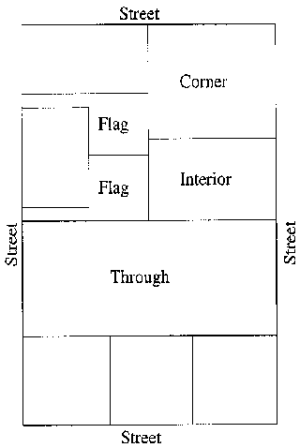
LOT LINES. The lines bounding a lot.
LOT LINE, EXTERIOR. A lot line abutting a street.
Figure 200-3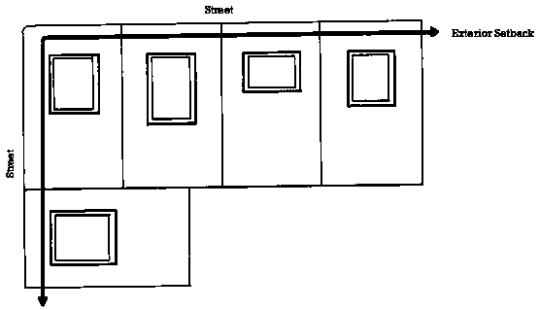
LOT LINE, FRONT. A lot line abutting a street on which the lot fronts.
LOT LINE, INTERIOR. A lot line that does not abut a street.
LOT LINE, REAR. A lot line that is opposite the front street line, except that in the case of uncertainty the Community Development Director will determine the rear lot line.
LOT LINE, SIDE. Any lot line that is not a front lot line or rear lot line. A side lot line may be an interior lot line or an exterior lot line other than a front lot line.
LOT, DEPTH. The average horizontal distance from the front lot line to the rear lot line.
LOT OF RECORD. A lot described by plat or deed and recorded in the Office of the Recorder of Deeds of Jackson County, Missouri.
MAJOR STREET. A street classified on the Thoroughfare Plan of the City of Independence, Missouri, as a major highway, arterial street or collector street.
MAJOR SUBDIVISION. A division of a lot, tract or parcel of land into four or more units or other divisions of land.
MARIJUANA or MARIHUANA. Cannabis indica, Cannabis sativa, and Cannabis ruderalis, hybrids of such species, and any other strains commonly understood within the scientific community to constitute marijuana, as well as resin extracted from the plant and marijuana-infused products. 'Marijuana' or 'Marihuana' do not include industrial hemp containing a crop-wide average tetrahydrocannabinol concentration that does not exceed three-tenths of one percent on a dry weight basis, or commodities or products manufactured from industrial hemp.
MARIJUANA BUSINESS. Any marijuana facility or facility licensed by Department of Health and Senior Services under the authority granted by Article XIV of the Construction.
MARIJUANA DISPENSARY. Either a Medical Marijuana Dispensary, a Comprehensive Marijuana Dispensary, or a Micro-Business as those terms are defined in Article XIV of the Constitution.
MARIJUANA FACILITY. A medical marijuana facility or a comprehensive facility as that term is defined by Article XIV Section 2 of the Constitution, a microbusiness wholesale facility, microbusiness dispensary facility, or any other type of marijuana related facility or business licensed or certified by the Department pursuant to Section 2 of Article XIV.
MARIJUANA-INFUSED PRODUCTS. Products that are infused with marijuana or an extract thereof and are intended for use or consumption other than by smoking, including, but not limited to, edible products, ointments, tinctures and concentrates.
MARIJUANA MICROBUSINESS FACILITY. A facility licensed by the Department as a microbusiness dispensary facility or microbusiness wholesale facility, as defined in this section.
MARIJUANA TESTING FACILITY. A facility certified by the Department to acquire, test, certify, and transport marijuana, including those originally certified as a medical marijuana testing facility.
MEDICAL MARIJUANA CULTIVATION FACILITY. A facility licensed by the Department, to acquire, cultivate, process, store, transport, and sell marijuana to a Medical Marijuana Dispensary Facility, Medical Marijuana Testing Facility, or to a Medical Marijuana-Infused Products Manufacturing Facility and shall also mean a Comprehensive Marijuana Cultivation Facility, as that term is defined in Article XIV of the Constitution.
MEDICAL MARIJUANA DISPENSARY FACILITY. A facility licensed by the State of Missouri to acquire, store, sell, transport, and deliver marijuana, marijuana-infused products, and drug paraphernalia used to administer marijuana as provided in this section to a qualifying patient, a primary caregiver, another licensed medical marijuana dispensary facility, a licensed medical marijuana testing facility, or a licensed medical marijuana infused products manufacturing facility.
MEDICAL MARIJUANA FACILITY. A medical marijuana dispensary, medical marijuana cultivation facility, medical marijuana testing facility, medical marijuana transportation facility and medical marijuana infused products manufacturing facility licensed by the State of Missouri.
MEDICAL MARIJUANA INFUSED PRODUCTS MANUFACTURING FACILITY. A facility licensed by the State of Missouri to acquire, store, manufacture, transport, and sell marijuana-infused products to a medical marijuana dispensary facility, a medical marijuana testing facility, or to another medical marijuana-infused products manufacturing facility.
MEDICAL MARIJUANA TRANSPORTATION FACILITY. A facility certified by the State of Missouri to transport marijuana to a qualifying patient, a primary caregiver, a medical marijuana cultivation facility, a medical marijuana-infused products manufacturing facility, a medical marijuana dispensary facility, a medical marijuana testing facility, or another medical marijuana transportation facility.
MICROBUSINESS DISPENSARY FACILITY. A facility licensed by the department to acquire, process, package, store on site or off site, sell, transport to or from, and deliver marijuana, marijuana seeds, marijuana vegetative cuttings (also known as clones), marijuana-infused products, and drug paraphernalia used to administer marijuana as provided for in this section to a consumer, qualifying patient, as that term is defined in section I of this Article XIV of the Constitution, or primary caregiver, as that term is defined in section 1 of this Article XIV of the Constitution, anywhere on the licensed property or to any address as directed by the consumer, qualifying patient, or primary caregiver and, consistent with the limitations of this Article and as otherwise allowed by law, a microbusiness wholesale facility, or a marijuana testing facility, Microbusiness dispensary facilities may receive transaction orders at the dispensary directly from the consumer in person, by phone, or via the internet, including from a third party. A microbusiness dispensary facility's authority to process marijuana shall include the creation of prerolls.
MICROBUSINESS WHOLESALE FACILITY. A facility licensed by the Department to acquire, cultivate, process, package, store on site or off site, manufacture, transport to or from, deliver, and sell marijuana, marijuana seeds, marijuana vegetative cuttings (also known as clones), and marijuana infused products to a microbusiness dispensary facility, other microbusiness wholesale facility, or marijuana testing facility. A microbusiness wholesale facility may cultivate up to 250 flowering marijuana plants at any given time. A microbusiness wholesale facility's authority to process marijuana shall include the creation of prerolls and infused prerolls.
MINOR STREET. A street that is not a major street and that is intended to provide access to individual properties.
MITIGATION OF IMPACTS. Steps taken to correct adverse effects of proposed development to the levels or requirements established in the policy.
MOBILE HOME SPACE. A plot of ground designed for the accommodation of one mobile home within a mobile home park.
MODEL HOME. A dwelling unit used initially for display purposes that is representative of the type of dwelling units that will be constructed in the subject subdivision.
MOTOR VEHICLE RENTAL AGENCY. An establishment engaged in the leasing or renting of passenger motor vehicles, including automobiles, sport utility vehicles, light trucks and vans.
MOTORCYCLE/RV/ATV/BOAT DEALER, NEW/USED/LEASE. An establishment engaged in the sale, lease or trade of new or used motorcycles, recreational vehicle (RV), boats, all-terrain vehicles (ATVs) and/or similar type of vehicles.
NATIVE GRASSES. Those species of perennial grass other than those designated as noxious weeds by the State of Missouri Department of Agriculture and Entomology.
NIGHTCLUB. An establishment operated as a place of entertainment, characterized by any or all of the following as a principal use: (1) live, recorded or televised entertainment, including, but not limited to performance by magicians, musicians, or comedians; or (2) dancing.
NONCONFORMING LOT. A tract of land lawfully established on a duly recorded subdivision plat, or by a duly recorded deed, or by other lawful means that does not comply with the minimum lot area or lot width standards of the zoning district in which it is located. In order to be deemed "nonconforming," a lot must have complied with all applicable lot area and width standards in effect at the time of the lot's establishment.
NONCONFORMING SIGN. A sign that was lawfully established, in accordance with zoning and other sign regulations in effect at the time of its establishment but that is no longer allowed by the regulations of this development ordinance.
NONCONFORMING STRUCTURE. A building or structure that was lawfully established in accordance with building setback, height, floor area and building coverage regulations in effect at the time of its establishment but that no longer complies with the building setback, height, floor area and coverage regulations of the zoning district in which it is now located.
NONCONFORMING USE. A use that was lawfully established in accordance with zoning regulations and occupational licensing regulations in effect at the time of its establishment but that is no longer allowed by the use regulations of the zoning district in which it is now located.
NONCONFORMITY. Any nonconforming lot, nonconforming sign, nonconforming structure or nonconforming use.
ORNAMENTAL TREES. Low-growing trees, including those species of trees that reach a height between 15 to 30 feet. Sometimes referred to as "understory" trees.
OUTDOOR VENDING MACHINE. Any self-contained or connected appliance, machine, and/or storage container located outside or in a non-enclosed space that dispenses or provides storage of a product or service. Newspaper racks, phones, and automatic teller machines are not considered or regulated as vending machines.
PAD SITE DEVELOPMENT. Separate lots or parcels encompassed by, or contained within a shopping center, office park or business park/PUD that are physically separated from the main shopping center building or buildings, with their primary egress points located from within the shopping center, office park or business park/PUD, and may or may not have direct access to adjoining public streets.
PARCEL. A lot, tract or other division of land.
PARKING LOT PERIMETER. The planted area outside the perimeter of the paved area of a parking lot, measured from the edge of the parking lot outwards.
PLAT. A map, plan, chart or drawing indicating the subdivision or re-subdivision of land filed or intended to be filed for record.
P.M. PEAK HOUR. The hours between 4:00 p.m. and 6:00 p.m. during the weekdays, Monday through and including Friday, at which the average traffic volume is highest.
PRIMARY CAREGIVER. A person designated as such by the Department.
PRINCIPAL BUILDING. A building or buildings in which the principal use or uses of the premises is contained, housed, or situated.
PROPERTY LINES. The lines bounding a lot.
QUALIFYING PATIENT. A person designated as such by the Department.
RECREATIONAL FACILITY, PUBLIC. An outdoor facility such as a tennis court, swimming pool, and other similar facilities that are open to all members of the community.
RECREATIONAL FACILITY, SEMIPRIVATE. An outdoor facility such as a tennis court, swimming pool, and other similar facilities that offers access to a limited, defined group of people including but not limited to residents of a specific neighborhood, apartment complex, or motel or hotel.
RECREATIONAL VEHICLE/EQUIPMENT. Any motor vehicle or trailer designed and used as a travel trailer, camper, motor home, tent trailer, truck camper, boat, personal watercraft, snowmobile, camping trailer or any other vehicle or equipment designed for temporary living purposes or recreational activities. This definition shall not include hauling trailers designed and normally used for over-the-road transporting of property, equipment, merchandise, livestock and other objects but not equipped for human habitation.
RECREATIONAL VEHICLE PARK. A single parcel of land used for the temporary accommodation of recreational vehicles used as living quarters.
RECREATIONAL VEHICLE SPACE. An area of ground within a recreational vehicle park designated for the temporary accommodations of one recreational vehicle.
RESTAURANT. An establishment having at least 50 percent of the gross annual income of which is derived from the sale of prepared food or meals consumed on premises; or which has an annual income of at least $200,000.00 from the sale of prepared meals or food consumed on such premises.
RIGHT-OF-WAY. Land used for a highway, street alley, walkway, drainage facility or other public purpose related to transportation or utilities.
SCREENING (VISUAL). A method by which a view of one site from another adjacent site is shielded, concealed, or hidden. Screening techniques include fences, walls, hedges, tree rows, berms, or other features.
SETBACK. An open, unobstructed area that is required by this development ordinance to be provided from the furthermost projection of a structure to the lot line of the lot on which the building is located.
SETBACK, EXTERIOR. A setback from a street.
SETBACK, FRONT. A setback between a building and the front lot line of the lot on which the building is located, extending along the full length of the front lot line between the side lot lines.
SETBACK, INTERIOR. A setback from an interior (non-street) lot line.
SHOPPING CENTER. A group of two or more commercial or office uses designed as one unified entity under single ownership or control consisting of one or several buildings either attached or detached.
SHORT-TERM LOAN SERVICE. Any business that loans money on a short-term basis to members of the general public as an element of its operation, including businesses offering title loans, payday loans, signature loans and small loans under Chapter 367 or RSMo 408.500, and other similar businesses. This does not include banks, savings and loan associations or credit unions licensed by appropriate State and Federal agencies, or a retail credit financing institution that is licensed under RSMo Chs. 364 or 365, or pawn brokers governed by RSMo Ch. 367, or retail merchants governed by RSMo Ch. 400.2.
SHORT-TERM RENTAL. A lodging use that is rented or leased as a single housekeeping unit to guests for not less than one night and not more than 30 consecutive nights in exchange for a fee, money, service or other performances. Hotels, motels, bed and breakfasts, and other land uses explicitly defined and regulated in the UDO separately from short-term rentals are not considered to be short-term rentals.
SHORT-TERM RENTAL OPERATOR. Any person who is the owner of a dwelling unit established under this title who offers or provides that dwelling unit for short-term rental use as set forth in in 14-424.
SHRUBS. Any self-supporting, woody plant of a species which normally grows to an overall height of less than 15 feet.
SIGN. Any display, figure, painting, drawings, placard, poster or other device that is designed, intended or used to convey a message or direct attention to a person, institution, organization, activity, place, object or product. It may be a structure, part of a structure, or painted or attached directly to a structure. This definition does not include any flag, pennant or insignia of any nation, state, city or other political units.
SIGN, ANIMATED. A sign with action, motion or color changes, including wind-activated devices, video screens, and including intermittent or sudden changes of light intensity, but not including signs defined as changeable copy signs or electronic message center signs.
SIGN, BANNER. A sign which has characters, letters or illustrations applied to cloth, paper or fabric of any kind, with only a non-rigid material for background. For the purposes of this definition, plastic laminate, form core and similar rigid plastic material are considered acceptable banner material.
SIGN, CHANGEABLE COPY. A sign where copy may be manually or electronically changed, including reader-boards, message centers, electronically-controlled time and temperature signs, but not including rapid changes in light intensity or blinking features.
SIGN, CONSTRUCTION. A temporary sign identifying an architect, contractor, subcontractor, material supplier, and others participating in a construction project on the property on which the sign is located.
SIGN, ELECTRONIC MESSAGE CENTER. A sign or component of a sign that uses single or multiple changing colored lights or a video screen to form a message or series of messages that are electronically programmed or modified by electronic processes.
SIGN FACE. The area of a sign on which the copy is placed.
SIGN, FREE SPEECH. A sign that contains a message related to a matter of public interest deemed by the person posting the sign, including but not limited to a candidate for office or a ballot issue, but containing no commercial message.
SIGN, FREESTANDING. A sign on a frame or other permanent support structure that is not attached to a building and is not designed to be moved, but not including signs mounted on a single pole.
SIGN, OFF-PREMISE. A sign that is designed, intended or used to attract attention to an activity, use or product conducted or offered off the property where the sign is located.
SIGN, PORTABLE. Any sign that is not permanently attached to the ground or other permanent structure, or a sign that is designed to be transported by means of wheels, skids or a similar device.
SIGN, PROJECTING. A sign that is suspended from, attached to or supported by a building or structure and extending away from the building or structure a distance of more than 12 inches.
SIGN, ROOF. A sign attached to the roof of a building or structure or otherwise extending vertically above the roof.
SIGN, SUBDIVISION OR NEIGHBORHOOD IDENTIFICATION. A sign containing only the name of the subdivision or neighborhood in which the sign is located.
SIGN, TEMPORARY. A sign of any type that by reason of construction or purpose is designed for use for a limited period of time, including signs to announce special events, sales, or the sale, lease or rental of property.
SIGN, UNSAFE. A sign or sign structure which has a condition or defect to the extent that life, property, or safety of the public is endangered. These defects include, but are not limited to, leaning, vertical sign structures, loose sign cabinets, and exposed electrical elements.
SIGN, VEHICLE. A motor vehicle or trailer containing a commercial message and regularly parked on the exterior side of any business and not customarily used in the operation of the business.
SIGN, VINTAGE OR NOSTALGIC. Original signs or those that have acquired significance by virtue of age or craftsmanship and approved by the City Council in conformance with Sections 14-907-06 and 14-908-02.
SIGN, WALL. A sign painted on or permanently attached to the face of an exterior wall of a building, projecting not more than 12 inches horizontally from the wall and not extending beyond the face of the wall.
SIGN, WIND-BLOWN. A sign consisting of balloons, pennants or objects designed and fashioned in such a manner as to move when subjected to wind pressure.
SINGLE FAMILY DWELLING. A dwelling situated on one lot designed to be occupied exclusively by one family.
SITE PLAN. A drawing that shows all of the existing conditions of a specific area (the site) and all of the improvements and changes proposed to be made on the site. A site plan is the drawing required by the development ordinance for certain new developments and certain additions and must contain all applicable information as specified in this development ordinance.
SMALL BOX DISCOUNT STORE. A retail establishment with a floor area less than 12,000 square feet that offers for sale a combination and variety of convenience shopping goods and consumer shopping goods, and continuously offers a majority of the items in its inventory for sale at a price per item of $10.00 or less, adjusted for inflation. Small box discount store does not include (1) a grocery store; (2) a store that contains a pharmacy where prescription drugs are compounded, dispensed, or distributed; or (3) a retail store where the majority of the products sold are personal hygiene products or cosmetics.
SMALL WIND ENERGY SYSTEM. A wind energy conversion system consisting of a wind turbine, a tower, and associated control or conversion electronics that has a maximum power of no more than 50kW and that is used primarily to reduce on-site consumption of utility power.
SPECIAL EVENT. Any activity to be held in a single location on, or on a route throughout, City streets, sidewalks, parking lots, public parks and nature sanctuaries, rights-of-way, or on or within other City property or facilities, that involves a non-traditional or non-routine use of the property, including but not limited to fundraisers, festivals, circuses, concerts, parades, public performances, weddings, races or other similar gatherings. An event is also a gathering on private property with a significant impact on City resources, traffic, public property, or other public infrastructure or that are not otherwise permitted by the zoning district regulations of this Chapter.
STREET. A public right-of-way that affords the principal means of vehicular access to abutting property.
STREET LINK. The segment of street between intersecting streets that have traffic control devices that interrupt traffic flow.
STREET TREE PLANTING. The planted area within the front setback adjacent to a public or private street.
STREET WIDTH. The measured width of a street from edge of usable pavement to edge of usable pavement, or back-to-back of curbing, which ever is greater.
STRUCTURAL ADEQUACY. A determination by the City that the pavement cross section (or bridge design) is of sufficient depth and design to carry the increased traffic volume generated by the proposed development, including the heavy construction vehicles which will be present, without causing undue failure of the infrastructure.
STRUCTURE. Anything constructed or erected that requires location on the ground or is attached to something having a location on the ground, including but not limited to signs, but not including pavement, utility poles, fences, and retaining walls.
SUBDIVISION PLAT. The final map or drawing, described in this development ordinance, on which the developer's plan of subdivision is presented for approval and that, if approved, is to be submitted to the County Recorder of Deeds for filing.
SWALE. A depression in the ground or a wide shallow ditch, usually grassed.
SWIMMING POOL, PRIVATE. A swimming pool that is located in conjunction with a single-family residence.
SWIMMING POOL, PUBLIC. A swimming pool that is operated by any public agency or private agency or person offering access to the general public.
SWIMMING POOL, SEMIPRIVATE. A swimming pool that is located in conjunction with a multiple-family housing project, apartment complex, motel or hotel or is operated for or by a homeowners' association.
TEMPORARY PORTABLE STORAGE CONTAINER. A purpose-built, fully enclosed, box-like container that is designed for temporary storage of household goods and/or equipment. Such containers are uniquely designed for ease of loading to and from a transport vehicle.
TERMINUS INTERSECTIONS. The intersection of the final connecting street, being evaluated for adequacy, with the street previously determined or considered adequate.
THEN EXISTING. Any school, child day-care center, or church with a written building permit from the City to be constructed, or under construction, or completed and in use at the time a business regulated under this Chapter first applies for either zoning or a building permit, whichever comes first.
THRESHOLD DHV (DESIGN HOUR VOLUME). Maximum allowable design hourly volume (DHV) permitted of a given street link or intersection based on prevailing conditions.
TOBACCO STORE. A commercial establishment primarily for the sale of tobacco related products. Tobacco related products shall include, but not limited to: cigarettes, cigars, pipe tobacco, loose tobacco, cigarette papers, pipes and any smokable product. This definition shall also include electronic and vapor cigarettes.
TOW LOT. The use of a site for temporary storage of motor vehicles not including temporary storage facilities for vehicles that are to be sold, rented, salvaged, dismantled, or repaired.
TOW SERVICE DISPATCH CENTERS. A facility used for the dispatch of tow trucks. Dispatch centers are limited to the parking of operable tow trucks and employee vehicles and are not an accessory use to a tow lot, salvage yard, vehicle repair service, or junk yard.
TREES. Any self-supporting, woody plant of a species that normally grows to an overall minimum height of 15 feet.
TRIP DISTRIBUTION. The method of assigning trips to street network based on projected travel origins and destinations.
TRIP GENERATION. An analytical process that provides the relationship between land use and vehicle trip production. A one-way movement.
TURF GRASS. A species of perennial grass grown as permanent lawns or for landscape purposes as distinguished from those species grown for agricultural or commercial seed purposes.
USE. An activity carried on in a building, structure, or tract of land, including accessory uses that are subordinate in area, extent, and purpose to the principal use and that are customary adjuncts to the principal use.
USED CAR LOT. A lot or parcel of land on which pre-owned or used passenger motor vehicles are displayed for sale, trade or lease.
VARIANCE, USE. A zoning variance that has the effect of allowing a use type that is not otherwise allowed in the subject zoning district.
VARIANCE, ZONING. Relief from or variation of the zoning-related provisions of this development ordinance, other than use regulations. See Section 14-706.
VERTICAL SIGHT DISTANCE. The length of street ahead of an object in the street, of specified height, visible to the driver while traversing a vertical curve.
YARD, FRONT. The actual yard that exists across the full width of the lot from the front lot line to the building line. See also "setback."
YARD, REAR. The actual yard that exists across the full width of the lot between the rear lot line and the rear line of the principal building. See also "setback."
YARD, SIDE. The actual yard that exists between the principal building and the adjacent side lot line extending entirely from the front lot line to the rear lot line. See also "setback."
Figure 200-4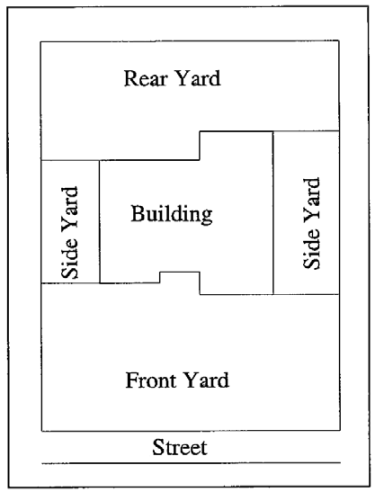
ZERO-LOT LINE DEVELOPMENT. A development that complies with the zero lot line regulations of this development ordinance or the zero lot regulations in effect at the time the development was established.
(Ord. No. 17446; Ord. No. 17534; Ord. No. 17713; Ord. No. 17782; Ord. No. 17843; Ord. No. 18210; Ord. No. 18261; Ord. No. 18571; Ord. No. 18636; Ord. No. 18869; Ord. No. 19023; Ord. No. 19089; Ord. No. 19178, § 4, 12-7-2020; Ord. No. 19207, § 2, 4-19-2021; Ord. No. 19412, § 2, 2-6-2023; Ord. No. 19430, § 1, 4-17-2023; Ord. No. 19499, § 1, 11-6-2023; Ord. No. 19587, § 1, 8-19-2024; Ord. No. 19793, § 1, 3-16-2026)
14-201-02 - Special definitions
The following words and terms shall only apply to Section 14-906, Conservation Overlay District; Section 14-907, Historic Overlay District; and, Section 14-908 Historic Landmark Overlay District.
ALTERATIONS. Any act or process that changes one or more of the exterior architectural features of a building or structure, including, but not limited to, the erection, construction, reconstruction, removal, demolition, or moving of any building, structure or utility.
ARCHAEOLOGICAL SITE. Earthworks, any subsurface remains of historical, archaeological or architectural importance, or any unusual ground formations of archaeological significance.
AREA. A specific, contiguous geographic section of the City of Independence.
BUILDING. A resource created principally to shelter any form of human activity.
BUILDING OFFICIAL. The official who is charged with the administration and enforcement of the City's Building Code.
CERTIFICATE OF APPROPRIATENESS. An approval issued by the City of Independence Heritage Commission or the Historic Preservation Manager authorizing alteration, new construction, removal or demolition effecting a defined feature or improvement of a Landmark, Historic District or Conservation District.
CERTIFICATE OF APPROPRIATENESS APPROVAL MATRIX. A comprehensive listing of alterations or other real property improvements that require no approval, administrative approval, or Heritage Commission approval, as amended from time to time.
CERTIFICATE OF ECONOMIC HARDSHIP. An approval issued by the Heritage Commission authorizing alteration, removal, or demolition, on the basis of the applicant's financial constraints to meet the conditions for the approval of a Certificate of Appropriateness of economic hardship as referenced in Article 9 of this chapter.
CITY COMPREHENSIVE PLAN. The comprehensive planning document adopted by the City Council to direct planning and development activities.
CITY COMPREHENSIVE HISTORIC PRESERVATION PLAN. The comprehensive planning document adopted by the City Council to direct historic preservation activities.
CONSERVATION DISTRICT. An area designated as a "Conservation District" by ordinance of the City Council which possesses special historical, architectural or cultural significance as part of the heritage of the City, but is of lesser historical or architectural significance than a Historic District. A Conservation District has retained a sufficient amount of its historical and architectural character for interpretation as part of the development of the City, including, but not limited to scale, massing, and orientation of buildings, although some alterations have been made.
CONSTRUCTION. The act of adding to an existing building or structure or the erection of a new principal or accessory structure on a lot or property.
CONTRIBUTING PROPERTIES. Buildings, structures, public improvements sites or objects adding to the historic significance of a site or district which by location, design, setting, materials, workmanship, feeling and association add to the site's or district's sense of time and place and historical development. While these buildings, structures, land improvements, sites or objects, by themselves may not meet the definition of "significant properties", they maintain their historical and/or architectural integrity and contribute to their site or district based upon their scale, design, use of materials location, or age, and retain qualities or have the potential to make a positive and compatible contribution to the character and appearance of a defined area.
CULTURAL RESOURCES. Districts, sites, structures, landscape elements and objects that show evidence of some importance to a culture, a subculture, or a community for scientific, engineering, art tradition, religious, or other reasons, significant in providing interpretation of past life ways and for interpreting human behavior.
DEMOLITION. Any act or process which destroys, in part or in whole, a building or a structure.
DESIGN GUIDELINES. A standard by which an appropriate construction activity will preserve/maintain the historic and architectural character of a building, structure, or area.
EXTERIOR ARCHITECTURAL APPEARANCE. The architectural character and general composition of the exterior of a building or structure, including, but not limited to, the type and texture of the building material as well as design and character of all elements visible from the exterior such as windows, doors, siding, trim, roofs, porches and ornamentation.
HERITAGE COMMISSIONERS. Members of the City of Independence Heritage Commission as appointed by the Independence City Council.
HISTORIC DISTRICT. An area designated as a "Historic District" by ordinance of the City Council which meets one or more of the criteria contained in Article 9 of this chapter and that may contain, within definable and contiguous geographical boundaries, one or more contributing resources and which may have within its boundaries other properties or structure that while not of such historical and/or architectural significance to be designated as Landmarks, nevertheless contribute to the overall visual characteristics of the significant, contributing resource(s) located within the historic district.
INTEGRITY. Authenticity of and adherence to a property's historic identity, evidenced by the survival of physical characteristics that existed during the property's historic or prehistoric period.
INVENTORY. A listing of resources which retain levels of historic significance and integrity which includes information regarding their condition, locations, architectural details, history and areas of significance.
LANDMARKS. A building, structure, or property individually designated as a "Landmark" by ordinance of the City Council based upon meeting qualifications of one or more of the criteria contained in Article 9 of this chapter. Such properties are worthy of rehabilitation, restoration and preservation based upon their archaeological, historical, cultural and/or architectural significance to the City of Independence.
LOCAL REGISTER. A listing and a means by which to identify, classify, and recognize various sites, buildings, structures, improvements, and districts as archaeologically, historically and/or architecturally significant.
NATIONAL REGISTER. A federal listing maintained by the United States Department of the Interior of buildings, structures, objects, sites, and districts that have attained a quality of significance as determined by the Historic Preservation Act of 1966, as amended.
NON-CONTRIBUTING PROPERTIES. A building, structure, public improvement or site not contributing to the historic significance of a site or district by virtue of the fact that it lessens the site's or district's sense of time and place and historical development; or one where the integrity of the original design or individual architectural features or spaces has been irretrievably lost; or one where physical deterioration and/or structural damage has made it not feasible to rehabilitate the property. Ordinarily, structures and buildings that have been built within the past 50 years will be considered non-contributing unless a justification concerning their historical or architectural merit can be established or the historical attributes of the district are considered to be less than 50 years old. Any future development of these sites will be of concern because of the effect on the continued quality of the surrounding site or district.
PROPERTY. Any historic resource including, but not limited to, the land on which a historic building, structure, site or object is sited in addition to the building, structure, object, physical attributes, and/or related improvements. Historic properties may also be those resources included within a historically designated local or National district.
PUBLIC IMPROVEMENT PROJECT. An action of the City of any of its departments or agencies involving major modification or replacement of streets, sidewalks, curbs, street lights, street or sidewalk furniture, landscaping or the portions of the public infrastructure. Such projects may also affect publicly or privately owned buildings or structures.
PUBLIC NOTICE. In accordance with City Code, means notice of the time and date of a public hearing shall be published in an official newspaper of general circulation within the City of Independence at least 15 calendar days prior to the date of such hearing.
RECONSTRUCTION. The re-creation of a deteriorated, beyond repair or a non-surviving site, landscape, building, structure or object with all new materials replicating documented species and/or materials which existed on the no longer existing site, landscape, building, structure, or object.
REHABILITATION. The act or process of returning a property to a state of utility through repair or alteration which makes possible an efficient contemporary use while preserving those portions of features of the property which are significant to its historical, architectural, and cultural values.
RELOCATION. The removal of a building or structure from its original orientation, or the moving of a building or structure to a new site whereas the building is no longer in site.
REPAIR. Any change that constitutes basic maintenance that is not construction, relocation or an alteration.
SELF-STORAGE FACILITY, INDOOR. A fully enclosed self-storage facility with independent, enclosed units for individuals to store personal effects and for businesses to store materials for operation of an industrial or commercial enterprise located elsewhere, where such storage space is not used for any retail, manufacturing, wholesale, business or service use.
SELF-STORAGE FACILITY, OUTDOOR. Storage or warehousing services within a building for individuals to store personal effects and for businesses to store materials for operation of an industrial or commercial enterprise located elsewhere, where such storage space is not used for any retail, manufacturing, wholesale, business or service use.
RESTORATION. The act or process of accurately recovering the form and detail of a property and its setting as it appeared at a particular period of time by means of the removal of later work or by the in-kind replacement or repair of missing earlier work.
SIGNIFICANT PROPERTIES. Those historical, architectural, or archaeological resources which are determined eligible for the local or National Register of Historic Places using the Secretary of the Interior's Criteria for Evaluation (36 CFR Part 60). Significance is present in districts, sites, buildings, structures, objects, and land such as viewsheds that possess integrity of location, design, setting, materials, workmanship, feeling, and association.
SITE. Any area or location utilized by humans for a sufficient length of time to construct features or deposit a number of artifacts or any place with evidence of past human activity. Sites include, but are not limited to, occupation, location, work areas, evidence of farming or hunting and gathering, burial remains, artifacts and permanent or temporary structures or dwellings of all types.
SPECIAL USE PERMIT. Authorization granted by the City Council for uses allowed only under special conditions of site development within a zoning classification.
STOP WORK ORDER. An order issued by the Building Official directing an owner, occupant, contractor or subcontractor to halt an action for which a Certificate of Appropriateness is required, and notifying the owner, occupant, contractor or subcontractor of the application process for a Certificate of Appropriateness. A Stop Work Order is also issued to stop work that is being done contrary to the provisions of a Certificate of Appropriateness. Such orders may be requested by the Historic Preservation Manager in order to ensure that preservation guidelines, including any conditions imposed by the Heritage Commission, are met.
STRUCTURE. Anything constructed or erected for the purpose of non-habitation, the use of which requires permanent or temporary location on or in the ground, including but not limited to, garages, sheds, fences, gazebos, and swimming pools.
(Ord. No. 19358, § 2, 8-1-2022)
14-202-01 - Lot size
The following rules apply when measuring compliance with and interpreting exceptions to applicable lot size standards.
14-202-01-A.
Lot Area. Lot area refers to the total land area contained within the lot lines of a lot.
14-202-01-B.
Lot Area Per Unit (Net density). Lot area per unit is a measure of "net" residential density and refers to the amount of lot area required for each dwelling unit on the subject lot. For example, if a minimum lot-area-per-unit standard of 1,450 square feet is applied to 7,000 square foot lot, a maximum of four dwelling units would be allowed on the property.
14-202-01-C.
Lot Frontage. Lot frontage is measured between side lot lines along the front lot line abutting a street. Lot frontage requirements do not apply to lots abutting the bulb end of a cul-de-sac.
14-202-01-D.
Lot Width. Lot width is measured between side lot lines along the front building line.
14-202-02 - Site
The following rules apply when measuring compliance with and interpreting exceptions to applicable site-related standards.
14-202-03 - Site area
Site area refers to the total gross land area of a development site.
14-202-04 - Open space
Open space refers to the total gross land area dedicated or otherwise set aside and protected as permanent open space. See Section 14-609-06
14-202-05 - Site area per unit (gross density)
Site area per unit is a measure of "gross" residential density and refers to the amount of site area required for each dwelling unit on the subject lot. For example, if a minimum site-area-per-unit standard of 3,500 square feet is applied to a site with a gross area of one acre (43,560 square feet), a maximum of 12 dwelling units would be allowed on the property.
14-202-06 - Setbacks
14-202-06-A.
Generally. Required setbacks must be unobstructed and unoccupied from the ground to the sky except as expressly allowed in Section 14-202-06-E.
14-202-06-B.
Exterior Setbacks.
1.
Measurement.
(a)
From Collector and Arterial Streets. When a lot abuts a street that is designated as a collector, minor arterial street, or arterial street on the City's Thoroughfare Plan, all setbacks abutting the collector or arterial street must be measured from a line one-half the proposed right-of-way width from the center line, or from the right-of-way line, whichever provides the greater setback.
(b)
Local Streets. For lots abutting local streets, setbacks abutting the street must be measured as the horizontal distance between (1) the exterior lot line and the furthermost projection of a building or structure located on the subject lot or (2) a line 25 feet from the street center line and the furthermost projection of a building or structure located on the subject lot, whichever method provides the greater setback.
2.
Contextual Exterior Setbacks.
(a)
In lieu of complying with the exterior setback standards of Section 14-300-05-A (Table 300-2), buildings in R districts may be set back from the exterior lot line a distance equal to the average exterior yard depth that exists on the nearest two lots on either side of the subject lot. The decision to comply with fixed exterior setback standards of Section 14-300-05-A (Table 300-2) or the contextual exterior setback standards of this subsection is left to the builder/property owner but in no case extend past any platted building line.
(b)
If one or more of the lots required to be included in the averaging calculation are vacant, such vacant lots will be deemed to have an exterior yard depth equal to the minimum exterior setback requirement of Section 14-300-05-A (Table 300-2):
Figure 200-5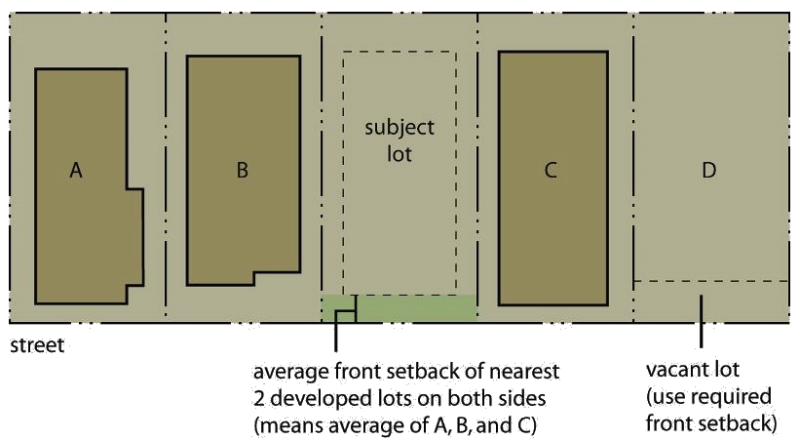
(c)
Lots that front on a different street or that are separated from the subject lot by a street or alley may not be used in computing the average. (See Figure 200-3).
(d)
When the subject lot is a corner lot, the average setback will be computed on the basis of the nearest two lots that front on the same street as the subject lot.
(e)
When the subject lot abuts a corner lot fronting on the same street, the average setback will be computed on the basis of the abutting corner lot and the nearest two lots that front on the same street as the subject lot.
(f)
On properties where contextual exterior setbacks are proposed, street-facing garages may not be located forward of the exterior building line or within 20 feet of the right-of-way, whichever results in a greater garage setback.
Figure 200-6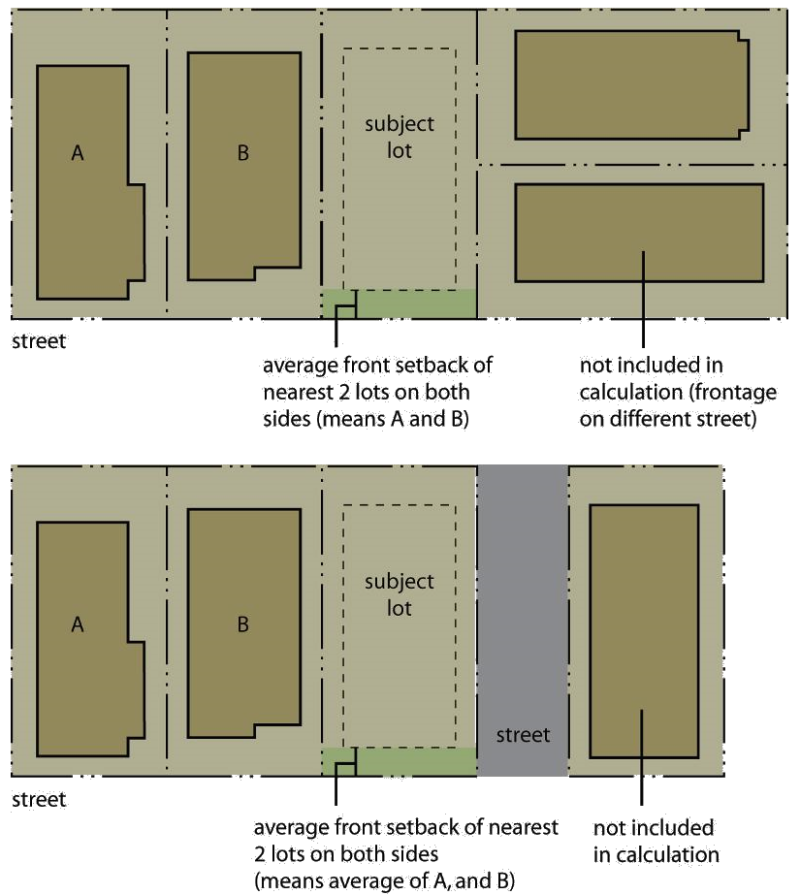
14-202-06-C.
Interior Rear Setbacks.
1.
Measurement. Interior rear setbacks refer to the required horizontal distance between the rear lot line and the furthermost projection of a building wall or structure located on the subject lot.
2.
Through Lots. On through lots, both (opposing) street lines are considered front lot lines and exterior setback standards apply. Interior rear setback standards do not apply.
14-202-06-D.
Interior Side Setbacks.
1.
Measurement. Interior side setbacks refer the required horizontal distance between an interior (non-street) side property and the furthermost projection of a building or structure located on the subject lot.
14-202-06-E.
Features Allowed to Encroach in Setbacks. Required setbacks must be unobstructed and unoccupied from the ground to the sky except that certain building features and structures are allowed to encroach into required setbacks to the extent expressly indicated in this section or in other sections of this development ordinance:
Notes:
[1]
Must be set back at least 35 feet from rear lot line in R-A district; 10-foot minimum separation between buildings.
[2]
Must be set back at least three feet from lot line.
[3]
May not encroach more than 18 inches into required setback.
[4]
May not encroach more than 30 inches into required setback.
[5]
May not encroach more than four feet into required setback.
[6]
May not encroach more than six feet into required setback.
[7]
Must be set back at least one foot from lot lines to which they run approximately parallel; common driveways serving two or more lots are not required to be set back from lot line.
[8]
Fences and walls are subject to the regulations of Section 14-400-01 and Section 14-503-17.
[9]
See Section 14-501-10 for rules governing parking location.
[10]
Must be open on at least three sides.
[11]
Maximum diameter: one meter (39.4 inches).
[12]
Maximum diameter: three meters (118.2 inches).
[13]
May not be more than four feet above grade and may not project more than four feet into the required setback.
[14]
Must comply with federal, state, and local accessibility standards.
(Ord. No. 17446)
14-202-07 - Height
14-202-07-A.
Measurement. The vertical distance between the ground and (1) the highest point of the coping of a flat roof, (2) the deck line of a mansard roof, (3) the average height of the highest gable of a pitched or hipped roof. For the purpose of measuring building height, the "ground" level is the highest of the following three levels: curb level; established or mean street grade if no curb exists; or the average finished ground level adjoining the building if the building is setback more than five feet from an exterior lot line.
Figure 200-7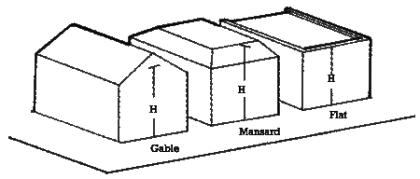
14-202-07-B.
Exceptions to Building Height Limits. The following features are allowed to exceed maximum height limits unless otherwise expressly stated:
1.
antennas,
2.
belfries,
3.
chimneys,
4.
spires,
5.
flag poles,
6.
smokestacks,
7.
parapet walls,
8.
solar panels,
9.
radio towers,
10.
television towers,
11.
microwave relay towers, and
12.
light standards.

