
Independence City Zoning Code
ARTICLE 4
- USE REGULATIONS
14-404 - GROUP LIVING FACILITY[1]
Editor's note— Ord. No. 19418, § 4, adopted March 6, 2023, amended Section 14-404 in its entirety to read as herein set out. Former Section 14-404, §§ 14-404-01—14-404-04, pertained to group living facilities, and derived from Ord. No. 18571; Ord. No. 18636.
14-408 - VEHICLE STORAGE AND TOWING[2]
Note— (Ord. No. 17988)
14-409 - VEHICLE SALES/RENTAL[3]
Editor's note— Ord. No. 19499, § 5, adopted Nov. 6, 2023, repealed the former §§ 14-409-01—14-409-07, and enacted new §§ 14-409-01—14-409-06 as set out herein. The former sections pertained to vehicle/equipment sales and derived from Ord. No. 17642; Ord. No. 18286; the 2020 Code; Ord. No. 19485, § 1, adopted Sept. 18, 2023.
14-416 - BODY ART SERVICE[4]
Note— (Ord. No. 17713)
14-417 - COMMUNITY GARDEN[5]
Note— (Ord. No. 17727)
14-418 - MOTOR VEHICLE REPAIR[6]
Note— (Ord. No. 17942)
14-419 - TOBACCO STORE[7]
Editor's note— Ord. No. 19587, § 2, adopted August 19, 2024, amended the title of Section 14-419 to read as herein set out. The former Section 14-419 was titled "Tobacco/Convenience Store." The user's attention is directed to Section 14-426 for provisions pertaining to convenience stores.
Note— (Ord. No. 18261; Ord. No. 18825)
14-420 - BED AND BREAKFAST[8]
Editor's note— Ord. No. 19412, § 5, adopted Feb. 6, 2023, amended Section 14-420 in its entirety to read as herein set out. Former Section 14-420, §§ 14-420-01—14-420-09, pertained to lodging establishment, and derived from Ord. No. 18946; Ord. No. 19074.
14-421 - MARIJUANA FACILITIES[9]
Editor's note— Ord. No. 19430, § 4, adopted April 17, 2023, amended Section 14-421 in its entirety to read as herein set out. Former Section 14-421, §§ 14-421-01—14-421-10, pertained to medical marijuana facility, and derived from Ord. No. 19023; Ord. No. 19089.
14-400-01 - General
Accessory uses and structures are permitted in connection with any lawfully established principal use unless otherwise expressly provided in this development ordinance. Also, unless otherwise expressly stated, accessory uses and structures are subject to the same regulations as the principal use or structure.
14-400-01-A.
Time of Construction. Unless otherwise noted in this article, accessory structures must be constructed in conjunction with or after the principal building. They may not be built prior to the construction of the principal building. In R-A districts, detached accessory buildings and structures may be constructed prior to the principal structure only in accordance with this section.
14-400-01-B.
Subordinate Nature.
1.
Accessory uses must be subordinate and clearly incidental to the principal use of the property.
2.
Accessory structures must be of secondary importance and subordinate to the principal building on the property.
14-400-01-C.
Lot and Building/Structure Standards.
1.
General. The lot and building standards of the base zoning district apply to accessory structures unless otherwise expressly stated. This provision shall include the use durable building materials and not canvas, plastic, and similar materials.
2.
Interior Setbacks. In the R-A district, detached accessory buildings and structures must be set back at least 35 feet from all interior lot lines. In all other R districts, detached accessory buildings and structures must be set back at least five feet from all interior lot lines.
3.
Exterior Setbacks. Accessory buildings and structures shall be subject to the same required setback as the primary structure. For non-corner lots, accessory buildings and structures shall not project past the front of the primary structure. This provision shall not apply to accessory structures on R-A and R-1 zoned properties of over five acres in size, where detached accessory buildings shall be set back at least 50 feet from all exterior lot lines.
4.
Separation. Accessory buildings must be separated by a minimum distance of five feet from all other accessory and principal buildings subject to meeting the City's latest adopted building codes.
5.
Height of Accessory Structures. Unless otherwise provided in this development ordinance, accessory structures may not exceed 25 feet in height, or the height of the principal building on the same lot, whichever is less. This provision shall not apply to accessory structures on R-A zoned properties of over ten acres in size. In any case, no structure or any appurtenances thereto shall exceed the height limitations prescribed by the Federal Aviation Agency within the flight approach zone of an airport.
6.
Building Coverage. In R districts, detached accessory buildings may not cover more than 15 percent of the actual area of the rear yard or an area exceeding 50 percent of the building coverage of the principal building, whichever is greater, provided that at least 600 square feet of accessory building coverage is allowed on any lot in an R district. This provision shall not apply to accessory buildings on R-A zoned properties of over ten acres in size.
7.
Design and Appearance. In all residential districts, the design and construction of any accessory garage, carport or storage building or shed larger than 120 square feet shall be similar to or compatible with the design and construction of the main building. The exterior building materials and colors shall be similar to the main building or shall be commonly associated with residential construction. This provision shall not apply to accessory structures used for bona-fide agricultural activities on properties over ten acres in size.
8.
Accessory Buildings as Primary Structures, R-A District Only. In R-A Districts, detached accessory buildings may be constructed prior to the principal structure provided that all the following conditions are met:
(a)
The subject property must be at least ten acres in size.
(b)
The accessory building must be setback at least 200 feet from any exterior lot lines, and 100 feet from any interior lot lines.
(c)
The use of the accessory building is limited to agricultural uses including, but not limited, to the keeping of livestock and the storage of farm machinery and equipment.
(Ord. No. 17782; Ord. No. 17942; Ord. No. 18898; Ord. No. 19149, § 1, 8-17-2020; Ord. No. 19793, § 2, 3-16-2026)
14-400-02 - Fences
14-400-02-A.
General. The general regulations of this subsection apply to all fences, regardless of the zoning district in which they are located.
1.
All fences must be constructed in a workman-like manner of customary or normal fencing materials.
2.
The materials used in fence construction must be manufactured and marketed for construction of permanent fences.
3.
Plastic-coated, chain-link fences are allowed only in those instances where chain-link fencing is allowed.
4.
Materials typically used for temporary fences, such as plastic, PVC, or similar materials may not be used for permanent fences.
5.
Bright colors such as orange, yellow or red are not permitted for permanent fences.
6.
Not more than two different types of materials may be used in the construction of any fence.
7.
All fence support structures must be located on the inside of the fence covering material.
8.
All fences must be maintained in a reasonable condition and vertical position, and any missing or deteriorated slats, pickets, other fencing material, or structural elements must be replaced in a timely manner with the same quality of material and workmanship.
9.
No fence may be used to display any sign or advertising material other than a small—maximum one square foot—placard identifying the sign contractor/manufacturer. Advisory 'No Trespassing' and related safety/warning signs of two square feet or less may be posted on fences.
10.
No private fence shall be installed on public property, including in the street right-of-way. Fences are subject to the intersection visibility standards of the Design and Construction Manual.
11.
Fences around public and semipublic recreational facilities, including but not limited to tennis courts, swimming pools and other similar recreational facilities, are limited to ten feet in height. Such fences must comply with any other requirements of the City Code.
12.
Electrically charged fences are prohibited except in the R-A district, where they may be used in conjunction with bona-fide farming activities.
13.
Barbed wire fencing is prohibited except where it may be used in conjunction with bona-fide agricultural activities. Barbed wire fencing may also be approved as an administrative adjustment when deemed necessary to protect health and safety in association with utility structures, landfills, airports or similar facilities. When approved as an administrative adjustment, barbed wire fencing must be located at least seven feet above grade. For the purposes of this chapter, the term "barbed wire" shall include concertina wire, razor wire, razor ribbon and other security wire types.
14-400-02-B.
Residential Zoning Districts. The regulations of this subsection apply to all fences in R zoning districts.
1.
Chain-link fences must be installed with barbs turned down.
2.
No fence or wall in a residential district may exceed eight feet in height.
3.
Residential fencing locations, see Figure 400-1 below.
(a)
Interior Side and Rear Yards — Fences or walls in interior side or rear yards shall not exceed six feet without a fence permit, or up to eight feet with a fence permit.
(b)
Front and Street Side Yards — Except for fencing around bona-fide agricultural activities, no fence or wall located in front yard of a residence, or along a side street in front of a residence, shall exceed three feet in height. Such fence shall be at least 50 percent transparent and may include chain-link, picket, wrought iron, and split rail fencing. Fences or walls in street side yards not in front of a residence, shall not exceed six feet without a permit, or up to eight feet with a fence permit.
Figure 400-1. Residential Fence Locations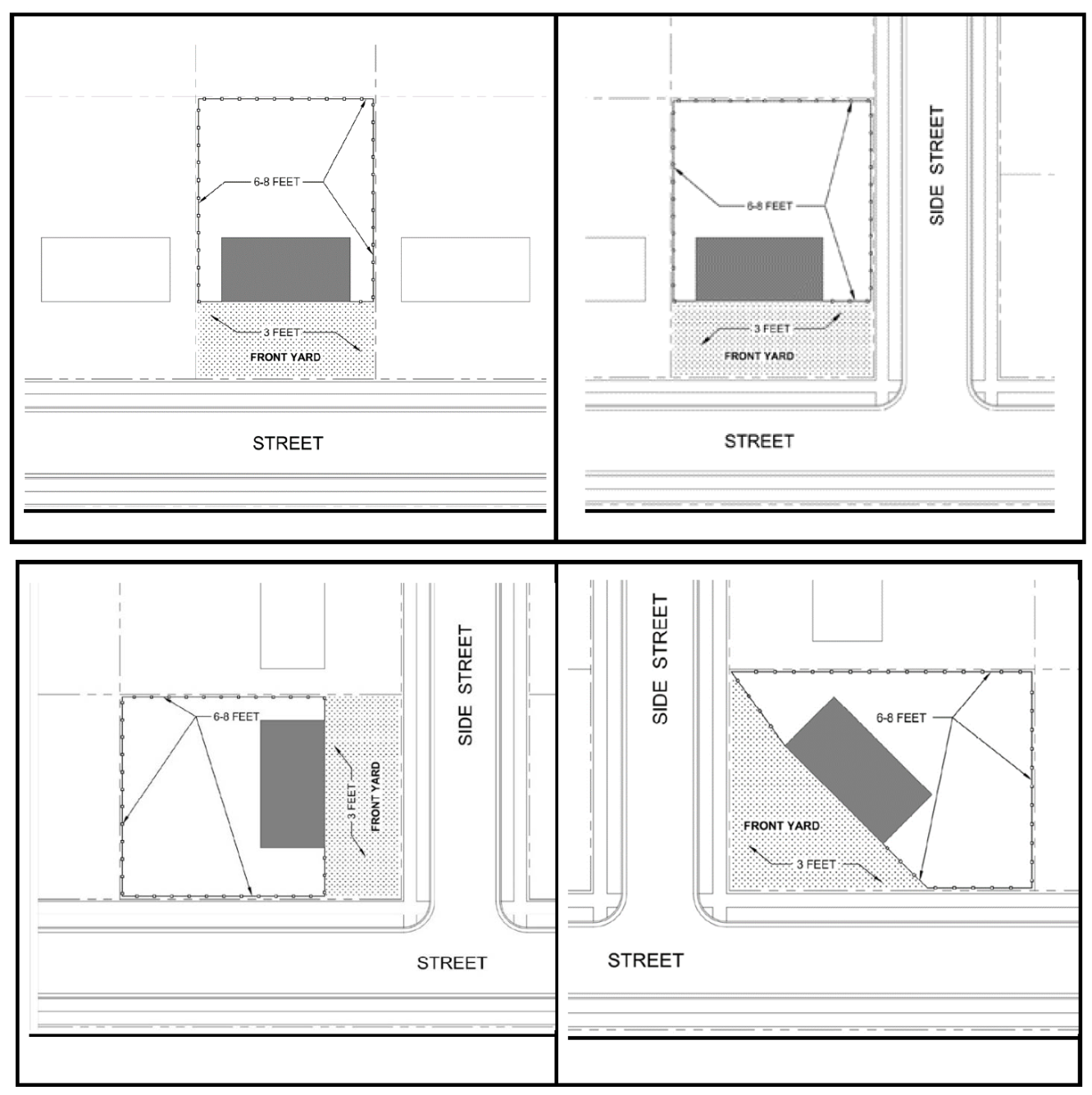
4.
For fencing on through lots, the rear yard fence shall be located no closer to the abutting street than the established building line or the required building setback for that street in the following instances:
(a)
where the rear property abuts a street where the principle building on the adjacent property fronts on that street, or;
(b)
where the adjacent property has the potential to be subdivided into a lot which fronts onto that street.
The Community Development Director shall have the authority to reduce the required rear setback for the through lot upon consideration of the available/proposed sight distance, the height and opaqueness of the fence, the elevation of affected properties, the street's classification, and the character of the neighborhood.
14-400-02-C.
Office, Commercial and Industrial Zoning Districts. The regulations of this subsection apply to all fences in O, C, and I zoning districts.
1.
Location—A fence may be constructed on any side or rear property line but shall not be located in any required exterior setback or be closer to any public or private street than the principal building, whichever is greater.
2.
Height—Fences shall not exceed eight feet in height.
3.
Lots adjacent to arterial, minor arterial and collector streets—Fences shall consist of either brick, stone, integrally colored decorative concrete masonry units (CMU), exterior stucco, pre-cast concrete panels, wrought iron, plastic (PVC) or wood. The Community Development Director may approve alternate materials and designs of similar quality to those listed herein.
4.
Lots adjacent to other streets—Fences shall consist of either vinyl clad chain link fabric or the materials identified in #3 above. The Community Development Director may approve alternate materials and designs of similar quality to those listed herein.
5.
Vacant lots—Vacant lots shall not be fenced. The Community Development Director may waive this prohibition for temporary or seasonal uses.
6.
Anti-graffiti—When possible, fencing shall utilize anti-graffiti materials or treatment.
7.
Permit required—All fencing constructed in O, C, and I districts shall require a permit from the Community Development Department.
(Ord. No. 17446; Ord. No. 17832; Ord. No. 17942; Ord. No. 17496; Ord. No. 19149, § 1, 8-17-2020; Ord. No. 19485, § 1, 9-18-2023; Ord. No. 19793, § 3, 3-16-2026)
14-400-03 - Home-based businesses
14-400-03-A.
Definitions. The following terms shall be given the definitions ascribed below:
GOODS. Any merchandise, equipment, products, supplies, or materials.
HOME-BASED BUSINESS. A business operating in a residential dwelling within the City of Independence that manufactures, provides, or sells goods or services and that is owned and operated by the owner or tenant of the residential dwelling.
HOME-BASED WORK. Any lawful occupation performed by a resident within a residential home or accessory structure, which is clearly incidental and secondary to the use of the dwelling unit for residential purposes and does not change the residential character of the residential building or adversely affect the character of the surrounding neighborhood.
NO-IMPACT, HOME-BASED BUSINESS. A home-based business qualifies as a no-impact, home based business if:
1.
The total number of employees and clients on-site at one time does not exceed the occupancy limit for the residential dwelling; and
2.
The activities of the business:
a.
Are limited to the sale of lawful goods and services; and
b.
May involve having more than one client on the property at one time; and
c.
Do not cause a substantial increase in traffic through the residential area; and
d.
Do not violate any parking regulations established by this City's Code; and
e.
Occur inside the residential dwelling or in the yard of the residential dwelling; and
f.
Are not visible from any public street; and
g.
Do not use any equipment that produces noise, light, odor, smoke, gas, or vibrations that can be seen, felt, heard, or smelled by a person of ordinary senses outside of the property where the business is located; and
h.
Do not sell any goods or services for which a health inspection would be required if the business were not located in a residence unless the owner or tenant provides written consent for the Department of Health to inspect the business during normal business hours or at any other time the business is operating.
14-400-03-B.
No-Impact Home-Based Businesses.
1.
Permitted in Residential Districts, when.
No-impact home-based businesses shall be permitted in all residential districts and in accordance subject to the restrictions and limitations of this chapter. No other business may be operated in a residence at any time.
2.
Restrictions and Limitations.
(a)
A no-impact home-based business must be incidental and subordinate to the principal residential use of the premises and shall not change the residential character of the surrounding neighborhood.
(b)
The owner or operator of the no-impact home-based business must be an owner or tenant of the residence and must reside at the residence.
(c)
The owner or operator of the no-impact home-based business may employ others to work in the no-impact home-based business as long as the occupancy limits are not in excess of what is allowed pursuant to fire and building codes.
(d)
The home occupation may be conducted in an existing detached accessory building that existed at the time this chapter was adopted. A new accessory building shall not be constructed to house a home occupation.
(e)
Outdoor storage of materials or equipment used in the home occupation shall not be permitted if such storage is visible from the street. Alterations to the exterior of the principal residential building shall not be made which change the character of the residence.
(f)
The owner or operator must provide adequate parking for the no-impact home-based business. Parking for the no-impact home-based business may include the driveway or garage of the residence, or a paved parking area located behind the front plane of the residence. Adequate parking may also include parking on the street so long as:
i.
Parking is limited to the side of the street the no-impact home-based business is located on, between the lot lines of the residence, if parking at that location is otherwise lawful.
ii.
If any parking regulations established by the City Code are routinely violated, the business shall not be considered a no-impact home-based business. For the purposes of this section, the term "routinely" shall mean more than twice in a seven-day period.
(g)
The total number of employees and clients in the home at one time may not exceed the maximum occupancy of the residence.
(h)
All no-impact home-based businesses shall follow all lawfully applicable regulations and requirements enacted in the City Code and required by state and federal laws and regulations.
14-400-03-C.
Other Home-Based Businesses.
1.
This section shall not apply to no-impact home-based businesses as defined in this chapter.
2.
All persons operating a home-based business are required to obtain a City occupation license in accordance with Article 1 of Chapter 5 of this Code.
3.
All home-based businesses must be operated in a way that does not constitute a public nuisance under this Code.
4.
No exterior additions to the building structure are permitted in connection with any home-based business without a permit. An existing accessory building may be used for a home-based business, as provided for in this section, but a new accessory building may not be built for a home-based business without a permit. The Planning Commission may approve an exterior addition to the building structure, or a new accessory building, in connection with any home-based business.
5.
Vehicles used to deliver goods to a major home business are limited to passenger vehicles, mail carrier, and express carrier, such as the United Parcel Service, and FedEx.
6.
Owners/operators of a home-based business shall provide adequate off-street parking to accommodate as many customers/clients as will be expected to be on the property at one time. No more than one on-street parking space shall be used for customer/client parking.
7.
Either up to 25 percent of the total floor area of the dwelling unit may be used in conjunction with a home-based business, or one accessory structure, such as a freestanding garage, may be used for a home-based business.
8.
All home-based businesses shall follow all lawfully applicable regulations and requirements enacted in the City Code and required by state and federal laws and regulations.
All home-based business applications to the Planning Commission shall follow the review and application process outlined in Chapter 14, Article 4, Section 14-424-23-B of the Independence Unified Development Ordinance.
14-400-03-D.
Penalties. Any person who operates a business in violation of this article shall, upon conviction, be subject to a fine of not less than $100.00 and up to 90 days in jail or both. Each day of violation shall be considered a separate offense.
(Ord. No. 17782; Ord. No. 18841; Ord. No. 18898; Ord. No. 19586, § 1, 8-19-2024)
14-400-04 - Outdoor vending machines
14-400-04-A.
The provisions of this section apply to outdoor vending machines.
14-400-04-B.
Outdoor vending machines that are visible from public streets are permitted as of right in C-1, C-2 and BP zoning districts. Outdoor vending machines visible from public streets are prohibited in all other districts.
14-400-04-C.
Outdoor vending machines may not be located between an exterior lot line and the building line of the principal building on the lot. Additionally, outdoor vending machines must be set back at least 25 feet from all exterior lot lines and at least seven feet from all interior lot lines.
14-400-04-D.
Outdoor vending machines may not occupy any portion of a required parking space or landscape area.
14-400-04-E.
Outdoor vending machines are allowed only as an accessory use.
14-400-04-F.
Any signs or commercial messages on outdoor vending machines must comply with the sign regulations of Article 14-504.
14-400-05 - Satellite dish antennas
14-400-05-A.
Satellite dish antennas up to one meter (39.4 inches) in diameter are permitted as accessory uses in all districts. They must comply with all setback requirements of the subject district, except as expressly indicated in Section 14-410.
14-400-05-B.
Satellite dish antennas over one meter in diameter, up to three meters (118.2 inches) in diameter, are a permitted as accessory uses in all commercial and industrial districts, subject to the following standards:
1.
Antennas may be erected on the roof or attached to a principal building, provided the maximum height of the installation does not exceed the maximum allowable height of the subject district or more than 15 feet above the top of the building on which it is to be located, whichever is less. Satellite dish antennas that are mounted on the roof or attached to the building must be located in a manner so as to detract as little as possible from the architectural character of the building.
2.
Satellite dish antennas must comply with all setback requirements of the subject district, except as expressly indicated in Section 14-410.
14-400-05-C.
Satellite dish antennas not expressly allowed under the provisions of this section require special use permit approval.
14-400-06 - Swimming pools
14-400-06-A.
Private swimming pools that are accessory to and located on the same lot as an allowed principal residential use may not be located within:
a.
Within any required exterior setback;
b.
Within five feet of interior side lot line;
c.
Within seven feet of a rear lot line;
d.
Within ten feet of any building or structure.
Setbacks are inclusive of the concrete apron or deck surrounding the swimming pool.
14-400-06-B.
All other swimming pools must comply with the setback requirements of the underlying zoning district and must be located at least 50 feet from lots occupied by single family residence. All other swimming pools shall be reviewed in accordance with this development ordinance and other applicable City Code requirements.
(Ord. No. 17988; Ord. No. 19793, § 4, 3-16-2026)
14-400-07 - Temporary portable storage containers
Temporary portable storage containers are an allowed temporary, accessory use on lots containing a dwelling, subject to all of the following.
14-400-07-A.
On lots developed with detached single family dwellings:
1.
Temporary portable storage containers are permitted for a period not to exceed a total of 30 days within any consecutive six-month period. However, in cases where a dwelling has been damaged by natural disaster or casualty, the Community Development Director is authorized to allow a temporary portable storage container for a longer period.
2.
Temporary portable storage containers may not exceed a cumulative gross floor area of 260 square feet.
3.
Temporary portable storage containers must be located on a driveway or other paved surface and may not be located in a required exterior setback.
14-400-07-B.
On lots developed with residential buildings other than detached single family dwellings:
1.
Temporary portable storage containers are permitted for a period not to exceed 72 hours within any consecutive six-month period. However, in cases where a dwelling has been damaged by natural disaster or casualty, the Community Development Director is authorized to allow a temporary portable storage container for a longer period.
2.
Temporary portable storage containers may not exceed a cumulative gross floor area of 130 square feet for each dwelling unit.
3.
Temporary portable storage containers must be located on a driveway or other paved surface and may not be located in a required exterior setback or utilize any required parking spaces.
14-400-07-C.
Temporary portable storage containers may not exceed 8.5 feet in height.
14-400-07-D.
Temporary portable storage containers may not be located in any required open space, landscaped area, on any sidewalk or trail, or in any location that blocks or interferes with any vehicular and/or pedestrian circulation. Such containers are also subject to the intersection visibility requirements of Article 17-100.
14-400-07-E.
Signs on temporary portable storage containers must comply with the sign regulations of Article 14-504.
14-400-07-F.
Rail cars, semi-trailers and similar structures may not be used for temporary or permanent storage.
14-400-08 - Animals
14-400-08-A.
Domestic, Non-Farm Animals. The raising and keeping of domestic, non-farm animals for purely noncommercial purposes shall be considered a permitted accessory use in residential zoning districts. Up to two domestic, non-farm animals may be kept on properties of two acres and larger in R-1, R-2, R-4 and R-6 zoning districts with a minimum of a one-half acre of open space per animal. Fowl may be kept on property in R-1, R-2, R-4, R-6, R-12, R-18 and R-30 zoning districts. Compliance with Chapter 3, 'Animals and Fowl' of the City Code is required.
14-400-08-B.
Livestock and Fowl. The raising, keeping and breeding of livestock and fowl shall be permitted in R-A zoning districts on lots of at least three acres in size. Compliance with Chapter 3, 'Animal and Fowls' of the City Code is required.
14-400-08-C.
Wild Animals. Except for any provisions contained in Chapter 3, Article 4, the keeping of wild animals is prohibited in all zoning districts.
14-400-08-D.
Bees. No bees or bee hive shall be kept in any district except in R-A, R-1, R-2, R-4, R-6, and R-12 districts on lots of at least half an acre in size with two additional hives allowed for each half an acre over the initial half acre. Compliance with Chapter 3, 'Animal and Fowls' of the City Code is required.
(Ord. No. 17534; Ord. No. 17642; Ord. No. 18953)
14-400-09 - Reserved
Editor's note— Ord. No. 19178, § 2, adopted Dec. 7, 2020, repealed § 14-400-09, which pertained to donation bins and derived from Ord. No. 17782; Ord. No. 18860. The user's attention is directed to § 14-422-01 et seq.
14-400-10 - Outdoor seating areas
14-400-10-A.
Generally. This section applies to establishments seeking to add an outdoor seating area to be used for eating and/or drinking. Such establishments must obtain a commercial building permit and be in conformance with the following standards.
14-400-10-B.
Pedestrian Separation. The boundary of the outdoor seating area must be surrounded by pedestrian separation material which shall be sturdy, stable, and in good condition. Pedestrian separation material includes, but is not limited to: plants, planters, railings, fencing or other similar quality materials. All such material shall be maintained in good visual appearance, without visible fading, chipping and/or deterioration. The outdoor seating area must be ADA accessible.
14-400-10-C.
Setbacks. The outdoor seating area must be located at least:
1.
Twenty-five feet from any adjoining R zoned property;
2.
Ten feet from any adjoining O, C or I zoned property;
3.
Ten feet from any drive aisle;
4.
Twenty-five feet from any adjoining minor or collector street right-of-way; and,
5.
Fifty feet from any adjoining minor arterial or arterial street, or highway, right-of-way.
These setback requirements shall not pertain to the Square Redevelopment District and any special purpose or overlay zoning district established per Section 14-900.
14-400-10-D.
Other Requirements. The amount of outdoor seating provided must be reflected in the amount of parking spaces provided in accordance with Section 14-501. Sidewalks interior to the site must be maintained or relocated to provide adequate pedestrian access. Other City Code sections may apply to outdoor seating areas including, but is not limited to: the City's adopted Fire, Building, Electrical, and Health Codes. The hours of operation shall not exceed the hours of operation of the principle use.
14-400-10-E.
Relief from Setbacks. Waivers or modifications of these standards may be approved only through the Administrative Adjustment procedures of Section 14-706-01.
14-400-11 - Outdoor seating areas, located on rooftops
This section applies to establishments seeking to add a rooftop outdoor seating area proposed for eating and/or drinking. Such establishments must obtain a commercial building permit and be in conformance with the following standards.
14-400-11-A.
The roof shall be able to structurally support the proposed use.
14-400-11-B.
The roof shall be surrounded by a wall, parapet, fence or similar guardrail with a minimum height of 42 inches.
14-400-11-C.
The hours of operation shall not exceed the hours of operation of the principle use.
(Ord. No. 18426)
14-400-12 - Residential produce stands
14-400-12-A.
Applicability. A produce stand shall be considered a residential produce stand when located on property that is used or zoned for residential purposes.
14-400-12-B.
Location. Residential produce stands shall be considered a permitted accessory use, and shall be located on private property and not in the public right-of-way.
14-400-12-C.
Products Sold. Products sold at residential produce stands shall have been grown, raised or produced on the same property where the produce stand is located. Agricultural products such as raw, uncut vegetables, uncut fruits, herbs, flowers, plants, and honey may be sold at residential produce stands.
14-400-12-D.
Hours of Operation. Residential produce stands may operate from 7:00 a.m. to sunset.
14-400-12-E.
Parking. Off-street parking, in conformance with Section 15-502-10-B.1.b, is required for residential produce stands if there is not adequate on-street parking on an adjacent street. On-street parking for residential produce stands shall only take place on a local thoroughfare.
14-400-12-F.
Setbacks. Residential produce stands shall comply with requirements of Section 14-400-01-C; however, exterior setback requirements shall not apply to residential produce stands.
14-400-12-G.
Applicability. All signage for residential produce stands shall comply with the requirements of Section 14-504.
(Ord. No. 18649; Ord. No. 18953)
14-401-01 - Child day care
14-401-01-A.
State License. All family day care homes, group day care homes and day care centers must be licensed by, and comply with all requirements of the Missouri Department of Health and Senior Services.
14-401-01-B.
City License. All family day care homes, group day care homes and day care centers must comply with all requirements of the City Health Department.
14-401-01-C.
Outside Play Areas. Outside play areas are permitted in accordance with the Missouri Department of Health requirements. All outdoor play areas must be enclosed by a wall or fence at 42 inches in height and meet the safety requirements of the State and City Fire and Health Departments.
(Ord. No. 17942)
14-401-02 - Family day care
14-401-02-A.
A family child care home is subject to the major home business regulations and permit procedures of Section 14-400-03.
14-401-02-B.
The following exceptions and requirements apply to all family day care home applications:
1.
All care providers must be licensed by, and comply with all requirements of the Missouri Department of Health, Division of Health Standards and Licensure; and the City Health Department.
2.
Outside play areas are permitted in accordance with the Missouri Department of Health requirements. All outdoor play areas must be enclosed by a wall or fence at least 42 inches in height and meet the safety requirements of the State and City Fire and Health Departments.
3.
Up to 50 percent of the total floor area of the dwelling unit may be used in conjunction with a family child care home.
14-401-03 - Adult day care
Adult day care facilities must be licensed by, and comply with all requirements of the Missouri Department of Health and Senior Services and any codes of the City of Independence.
14-402-01 - Applicability
The standards of this article apply to pawn shops and short-term loan services.
14-402-02 - Separation and number of establishments per capita
14-402-02-A.
Pawnshops and short-term loan services may not locate or expand an existing operation within 2,500 feet of the boundary of the City of Independence or within 2,500 feet of another pawn shop or short-term loan service.
14-402-02-B.
Pawnshops and short-term loan services may not locate or expand an existing operation within 1,500 feet from any church, school, day care facility, public building, public park, or hospital.
14-402-02-C.
Pawnshops and short-term loan services may not locate or expand an existing operation within 500 feet from any residential district or use.
14-402-02-D.
The distance between any of these uses will be measured in a straight line, without regard to intervening structures or properties, from the closest exterior structural wall of each business.
14-402-02-E.
No permit may be issued for a short-term loan service or pawn shop where it is determined that the total number of such facilities will exceed a population density factor of one such establishment per 15,000 residents based on the last decennial census.
(Ord. No. 18688)
14-402-03 - Vehicle storage and/or display
No vehicle, including but not limited to motor vehicles, motor homes, trucks, trailers, motorcycles, scooter, boats, and recreational vehicles, that have been repossessed or are owned or controlled by the business shall be stored, or offered or displayed for sale, on the property upon which the business is located.
14-403-01 - Minimum lot area
The minimum lot area for a gas station is 30,000 square feet.
14-403-02 - Landscaping
14-403-02.A.
Gas stations are subject to compliance with the landscape, bufferyard and screening regulations of Article 14-503, expressly including parking lot perimeter landscaping standards of Article 14-503.
14-403-02-B.
Along public and/or private streets, the parking lot perimeter landscape area shall be 50 percent larger in size than would otherwise be required. The required perimeter landscape plantings shall be increased by 25 percent.
14-403-02-C.
At public and/or private street intersections, the parking lot perimeter landscape area shall be 100 percent larger in size than would otherwise be required. The required perimeter landscape plantings shall be increased by 50 percent. Landscaping in this intersection area shall consist of plant specimens having a high degree of visual interest during all times of the year.
(Ord. No. 19499, § 4, 11-6-2023)
14-403-03 - Lighting
All lighting must be directed downward and shielded to prevent illumination of adjoining residential property. Under canopy-mounted lighting must be recessed so that light sources do not extend below the ceiling of the canopy. Lenses and/or light fixtures dropping below the surface of the canopy underside are not permitted. Canopy fascia shall not be externally lit.
(Ord. No. 19499, § 4, 11-6-2023)
14-403-04 - Driveways and access
All driveways must be located and designed to ensure that they will not adversely affect the safety and efficiency of traffic circulation on adjoining streets.
14-403-05 - Canopy locations and appearance
14-403-05.A.
Fueling area canopy shall not be located within 25 feet of a property line abutting a street and 50 feet from a residential use or district. There shall be adequate space to allow up to three cars to stack in a line at a pump without using any portion of the adjacent street. The design, location, covering colors, and screening of the gasoline pumps shall be such that they are compatible with the design of the building.
14-403-05-B.
The cross-section of canopy columns shall have a minimum width of 24 inches and depth of 16 inches, except that round columns shall have a minimum diameter of 24 inches. All columns shall be faced with brick, stone, stucco, or decorative masonry block to match the wall materials of the main building.
(Ord. No. 19499, § 4, 11-6-2023)
14-403-06 - Visual impacts
The visual impact of the uses is minimized and screened from adjacent rights-of-way and properties through placement of buildings, screening, landscaping, and other site design techniques.
14-403-07 - Vehicle servicing and storage
Servicing of vehicles is limited to the checking and adding of fluids and air and the cleaning of windows. No other repair or servicing of vehicles is permitted on site.
No materials, supplies or equipment, including firm owned or operated trucks, shall be stored in any area on a site except inside a closed building or behind a visual barrier or service area that screens the equipment from view of all public street.
14-403-08 - Separation from other automotive uses
The property containing a gasoline and fuel sales facility shall not be located within 750 feet of a property containing the following uses:
•
Used car lot;
•
Car wash;
•
Motor vehicle repair, limited and general;
•
Motor vehicle rental agency;
•
Vehicle storage/tow lot;
•
Tow lot, limited;
•
Heavy vehicle dealership;
•
Gasoline and fuel sales.
This separation requirement shall not apply for properties that are within 400 feet of an interstate.
(Ord. No. 19499, § 4, 11-6-2023; Ord. No. 19730, § 1, 10-6-2025)
14-403-09 - Rehabilitation of existing gasoline and fuel sales facilities
When architectural or site modifications are made to a gasoline and fuel sales facility, at least 15 percent of the total lot area shall be landscaped to the maximum extent practicable. Sites that are restricted by easements, pump and canopy locations, fire lanes, and circulation requirements may include landscape areas in adjacent public or private rights-of-way in the 15 percent calculation. Regardless of site constraints, the total landscaped area may not be reduced below that existing prior to redevelopment.
(Ord. No. 19499, § 4, 11-6-2023)
14-403-10 - Maximum number of pumps
14-403-10.A.
A gasoline and fuel sales use with 25 or fewer pumps may be approved subject to the conditions in Section 14-403.
14-403-10.B.
A gasoline and fuel sales use with more than 25 pump shall be reviewed as a special use permit. Said use shall be reviewed in accordance with Sections 14-704 and the requirements of Section 14-403.
(Ord. No. 19499, § 4, 11-6-2023)
14-404-01 - Purpose
It is the intent of these standards to ensure that all group living facilities conform to the general character of the neighborhood in which they are located. To this end, standards pertaining to exterior appearance of the structure and lot are prescribed, as well as standards pertaining to the occupancy/density of group living facilities in any given neighborhood.
(Ord. No. 19418, § 4, 3-6-2023)
14-404-02 - Minimum standards for group home, residential; and foster care home
14-404-02-A.
Design/Appearance. All buildings and properties must maintain an exterior appearance that reasonably conforms to the neighborhood within which they are proposed to be located.
14-404-02-B.
Occupancy. The number of occupants of a group living facility may not exceed the number of occupants permitted for the subject building by the Building Code or Fire Code, as applicable.
(Ord. No. 19418, § 4, 3-6-2023)
14-404-03 - Minimum standards for group home, custodial; transitional housing and domestic violence residence and shelter
14-404-03-A.
Siting/Separation. A group living facility may not be located within 500 feet of another group living facility, measured as the shortest distance between any portion of the lot on which the group living facility is situated.
14-404-03-B.
Design/Appearance. All buildings and properties must maintain an exterior appearance that reasonably conforms to the neighborhood within which they are proposed to be located.
14-404-03-C.
Occupancy. The number of occupants of a group living facility may not exceed the number of occupants permitted for the subject building by the Building Code or Fire Code, as applicable and HUD standards.
(Ord. No. 19418, § 4, 3-6-2023)
14-404-04 - Minimum standards for substance abuse treatment house, penal halfway house, recovery center, and soup kitchen
14-404-04-A.
Siting/Separation. A group living facility may not be located (nor an existing one expanded) within 2,640 feet of another group living facility, measured as the shortest distance between any portion of the lot on which the group living facility is situated, and 2,640 feet from any church, school, day care facility, public building, or public park.
14-404-04-B.
Design/Appearance. All buildings and properties must maintain an exterior appearance that reasonably conforms to the neighborhood within which they are proposed to be located.
14-404-04-C.
Occupancy. The number of occupants of a group living facility may not exceed the number of occupants permitted for the subject building by the Building Code or Fire Code, as applicable.
(Ord. No. 19418, § 4, 3-6-2023)
14-404-05 - Minimum standards for homeless shelters
14-404-05-A.
Maximum Size. The area of the building housing the overnight sleeping accommodation shall not exceed 15,000 square feet in size.
14-404-05-B.
Maximum Number of People. The shelter shall serve a maximum of 30 individuals with adequate space for sleeping per occupant in accordance with currently adopted building codes. When establishing the maximum number of homeless individuals served under the special use permit the City Council shall consider various factors, including but not limited to:
1.
The operational characteristics of the proposed shelter as outlined in the Management Plan.
2.
The size of the building housing the homeless shelter.
3.
The character of the area, including but not limited to proximity to residences, commercial businesses, schools, and public transportation.
14-404-05-C.
Location. The property where the homeless shelter is located must be within one-half mile of a public transportation stop or the homeless shelter must have reliable access to transportation.
14-404-05-D.
Number of Employees. The homeless shelter shall have at least two employees and/or volunteers on the premises during all operational hours for the first ten guests and one additional employee and/or volunteer for every ten additional guests, or any portion thereof. An alternative staffing plan may be approved as part of the special use permit where the applicant demonstrates adequate supervision of the guests.
14-404-05-E.
Occupancy. Prior to establishing a homeless shelter, an application for and approval of a new certificate of occupancy is required, including compliance with all building and fire codes.
14-404-05-F.
Serving Food. Any provision of food or feeding operations shall comply with Chapter 11 of the City Code.
14-404-05-G.
Donation Bins. A facility operating a donation bin(s) or donation center shall comply with the requirements of Section 14-422.
14-404-05-H.
Exterior Appearance. The exterior appearance of the building and property on which a homeless shelter is located shall be maintained in accordance with applicable property maintenance, building and zoning requirements.
14-404-05-I.
No Loitering. There shall be no loitering immediately around or on the grounds of the facility.
14-404-05-J.
Prohibiting Alcohol and Illegal Drugs. The operator must enforce a policy of prohibiting alcohol and/or illegal drug use on the property.
14-404-05-K.
Parking. Adequate off-street parking for employees, volunteers, and any residents with vehicles must be provided or made available through written agreements. Bicycle parking shall be provided based on anticipated need.
14-404-05-L.
Lighting. Any lighting provided shall be stationary, directed away from adjacent properties and public rights-of-way, and of intensity compatible/comparable with the neighborhood.
14-404-05-M.
Management Plan. A management plan that contains/addresses the following items shall be submitted with any application to establish the homeless shelter use and be approved prior to commencing the use. The management plan shall be integral to the operation of the facility and binding on the operator. Failure of the operator to comply with the approved management plan shall be considered a violation of this code.
1.
A narrative description of the nature and characteristics of the use and descriptions of all supportive services provided. The narrative shall address the sections above and include, but not limited to, any outdoor gathering space and/or smoking areas, the safe storage of belongings, the length of stay allowed, any laundry facilities provided, and any other description/characteristic of the use.
2.
A transportation plan describing how guests will be transported to and from the site.
3.
An interior floor plan showing sleeping areas, common areas, kitchen and bathroom facilities, and emergency exits.
4.
An emergency / security plan that addresses security for staff, volunteers and guests as well as how responses to medical and other emergencies will be handled.
5.
An outline of the "Rules of Conduct" for guests.
6.
A communication plan that establishes how the shelter will regularly communicate with neighbors and the police.
7.
A staffing plan noting the number of employees per guest during daytime and nighttime operating hours.
14-404-05-N.
Special Use Permit. A homeless shelter shall require approval of a special use permit in accordance with Section 14-704. The special use permit for the operation of a homeless shelter may be amended, suspended or revoked in accordance with Section 14-704.
(Ord. No. 19418, § 4, 3-6-2023)
14-404-06 - Use
Each group living facility is unique in the services offered by it. Therefore, it will be permitted only for the exact use of the permitted group living facility. No other group living facility use may be permitted in that location, unless the subsequent group living facility obtains a special use permit. Upon cessation of the particular group living facility use for a period of six months or greater, the special use permit will be deemed abandoned and will require obtaining a new special use permit. Such application will be considered in the same manner as any new application and must conform to all then existing standards, conditions and City codes.
(Ord. No. 19418, § 4, 3-6-2023)
14-405-01 - Recreational vehicle parks
14-405-01-A.
No person, firm or corporation shall occupy any recreational vehicle as living quarters located outside an approved recreational vehicle park.
14-405-01-B.
An application for a recreational vehicle park must be accompanied by a Special Use Permit application, pursuant to Section 14-704, and include the following information prepared by an architect, engineer, landscape architect, or other qualified professional:
1.
North point.
2.
Name of builders, developers and existing property owners.
3.
Recreational vehicle park site dimensions.
4.
Existing topography with a contour interval of not more than five feet.
5.
Proposed arrangement of interior drives and streets.
6.
Ingress and egress from adjoining streets.
7.
Location of proposed sidewalks.
8.
Location of proposed structures, recreational areas and parking areas.
9.
Location of proposed sewage treatment facility.
10.
Proposed arrangement and dimensions of recreational vehicle spaces.
11.
Proposed landscaping.
12.
Proposed street lighting system.
13.
Stages and times of development.
14.
Development of areas within 200 feet of the recreational vehicle park site.
15.
Location of existing and proposed utilities and easements.
16.
Location, height, and material for screening walls, fences and retaining walls.
17.
Location, size and type of ground mounted equipment; (see Section 14-503 for location and screening requirements).
18.
Location of trash dumpsters/bins (see Section 14-503 for location and screening requirements).
19.
Proposed storm drainage flow (using directional arrows) on and off the site.
20.
Supplemental storm water information required by City regulations.
14-405-01-C.
Land that the City Council finds to be detrimental to the public interest if developed as a recreational vehicle park may not be developed as a recreational vehicle park unless and until such objectionable features are corrected.
14-405-01-D.
Recreational vehicle spaces must be provided with a hard surfaced area on which a recreational vehicle may be parked and each space must be clearly and permanently marked and delineated.
14-405-01-E.
Individual recreational vehicles must be so situated on each space that there is at least 14 feet between recreational vehicles and between recreational vehicles and all permanent structures.
14-405-01-F.
Minimum seven-foot setbacks must be maintained along all interior property lines. Minimum 25-foot setbacks must be maintained along all exterior property lines. All required setback areas must be kept free of all structures and recreational vehicles.
14-405-01-G.
On-site open space equal to at least ten percent of the total recreational vehicle park area must be provided. Required setbacks may not be counted toward satisfying on-site open space requirements.
14-405-01-H.
An opaque screen or buffer zone at least eight feet in height must be maintained along all interior property lines. Such screen may be in the form of walls, fencing or landscaping.
14-405-01-I.
Each recreational vehicle park must have a minimum frontage of 200 feet upon a public street.
14-405-01-J.
Each recreational vehicle space within a recreational vehicle park must have direct access to an interior paved drive or street. The minimum width of one-way interior drives serving enclaves of recreational vehicle spaces and permitting no parking is 14 feet, measured from back-to-back of curb. The minimum width of two-way interior drives permitting no parking is 26 feet, measured from back-to-back of curb. The minimum width of one-way interior drives permitting parking on one side only is 18 feet, measured from back-to-back of curb. The minimum width of interior two-way drives permitting parking on one side only is 28 feet, measured from back-to-back of curb. The minimum width of one-way interior drives permitting parking on both sides is 28 feet, measured from back-to-back of curb. All interior drives and public streets must be designed and paved according to City specifications for residential streets contained in the City of Independence Design and Construction Manual and this development ordinance.
14-405-01-K.
Street lights approved by the City staff must be provided.
14-405-01-L.
For recreational vehicle spaces provided with electrical service, the distribution system must be installed according to City specifications. All utilities must be placed underground.
14-405-01-M.
For recreational vehicle spaces provided with a supply of potable water, the supply system must be installed in accordance with City specifications.
14-405-01-N.
For recreational vehicle spaces provided with a sewer, the sewer system must be installed in accordance with City specifications. The sanitary sewer system and sewage treatment system must be designed and installed per the City of Independence Design and Construction Manual.
14-405-01-O.
Fire hydrants must be located in accordance with the fire code and adopted City standards.
14-405-01-P.
Tip-proof garbage and recycling containers with tight-fitting covers must be provided for disposal of all garbage and recyclables. Containers must be kept in a sanitary condition at all times. Garbage and recycling must be collected as frequently necessary to insure that containers do not overflow.
14-405-01-Q.
Service buildings containing separate toilet and shower facilities for each gender and an adequate supply of potable water must be provided. Service buildings must be located not farther than 200 feet from recreational vehicle spaces without sanitary facilities, and must be constructed in accordance with the Building Code.
14-405-01-R.
The maximum length of stay by a recreational vehicle in a recreational vehicle park shall be 14 days within any consecutive 60-day period.
14-405-01-S.
Every owner or operator of a recreational vehicle park must maintain an open register containing a record of all recreational vehicles and occupants. The register must be available to any authorized person inspecting the recreational vehicle park. The register must contain (1) the name and permanent address of the owner or operator of all recreational vehicles and the number of occupants; (2) the make, model and license number of the recreational vehicle; and (3) the dates of arrival and departure of a recreational vehicle or its occupants.
14-405-01-T.
It is unlawful for any person, firm or corporation to operate a recreational vehicle park within the City of Independence unless the recreational vehicle park is licensed by the City of Independence. A business license to operate a recreational vehicle park will be issued by the License Officer in accordance with the procedures and requirements of Chapter 5 of the City Code.
14-405-01-U.
The grounds of the recreational vehicle park and all buildings and structures thereon must be maintained in a clean, visually attractive condition and kept free of any condition that will menace the health of any occupant or the public or create a nuisance.
(Ord. No. 19485, § 1, 9-18-2023; Ord. No. 19588, § 2, 8-19-2024)
14-406-01 - Applicability
Off-premise advertising is permitted in the C-2, C-3, and I-1 districts, subject to the requirements of this section. Off-premise signs that exceed 32 square feet in area require special use permit approval. For off-premise signs of 32 square feet or less, see Section 14-504-15.
(Ord. No. 17832; Ord. No. 19117, § 1, 5-18-2020)
14-406-02 - Location
Billboards may only be located on platted parcels and not the right-of-way. Billboards are allowed only adjacent to streets on the City's Thoroughfare Plan designated as a 'divided highway', 'highway', and 'arterial-major' except the following: Little Blue Parkway, Valley View Parkway and Jackson Drive.
(Ord. No. 19117, § 1, 5-18-2020)
14-406-03 - Setbacks
14-406-03-A.
Generally. Each billboard shall have minimum setbacks of (a) at least 25 feet from its nearest edge to the right-of-way and all property lines, and (b) at least 90 feet from all roofed structures, from all points of the billboard.
14-406-03-B.
From Highway Interchanges and Bridges. No billboard shall be located adjacent to or within 500 feet of any interchange, intersection at grade. Said 500 feet shall be measured from the beginning or ending of the pavement widening at the exit from or entrance to the main traveled way or if there is no pavement widening, then from the midpoint of the intersection.
14-406-03-C.
From Residential Property and Public Areas. No billboard shall be located within 500 feet of land utilized for residential use or for public activity purposes such as schools, parks/recreation, playgrounds, hospitals, and religious assembly, whether said use is located within the City or outside of the City. The distance between the billboard and these uses will be measured in a straight line, without regard to intervening structures or properties, from the closest property line to closest property line.
(Ord. No. 19117, § 1, 5-18-2020; Ord. No. 19702, § 1, 7-21-2025)
14-406-04 - Lighting
14-406-04-A.
Generally. External lighting, such as floodlights, thin line and gooseneck reflectors are permitted, provided the light source is directed upon the face of the billboard and is effectively shielded so as to prevent beams or rays of light from being directed into any portion of the street, highway or adjoining properties.
14-406-04-B.
Maximum Levels. The maximum average lighting intensity level for such billboard shall be 20 foot candles at the light source.
14-406-04-C.
Prohibited. No revolving or rotating beam or beacon of light that simulates any emergency light or device shall be permitted as part of any billboard. No flashing, intermittent, or moving light or lights shall be permitted. No billboard shall be so illuminated that it interferes with the effectiveness of, or obscures, an official traffic sign, device or signal. Nor shall the illumination be directed toward any residential area. The lights shall not be of such intensity so as to cause glare, impair the vision of the driver of a motor vehicle, or otherwise interfere with a driver's operation of a motor vehicle.
14-406-05 - Digital billboards
In addition to those regulations established for general billboards in this section, the following regulations shall also apply to digital electronic billboards.
14-406-05-A.
Display. Digital billboards may utilize the multiple advertisement display format that allows the digital sign face to change, immediately, from one scene or advertisement to another. Each scene or advertisement shall be displayed for a minimum of eight seconds before changing to another so as not to simulate a moving display.
14-406-05-B.
Intensity. Digital billboard intensity of illumination shall be established by the Director at the time of installation and may be adjusted periodically at the Director's request so as not to interfere with the enjoyment of adjacent uses or impair the vision of the driver of a motor vehicle on any portion of the street or highway. The Directors decision may be appealed to the City Council with such documentation necessary to support such appeal.
14-406-06 - Maximum sign area
Billboards adjacent to a 'divided highway' shall not exceed 750 square feet in area. Billboards adjacent to 'highway' and 'arterial-major' streets shall not exceed 350 square feet in area. Billboards shall have a maximum length of 60 feet, and a width of 30 feet, inclusive of border and trim but excluding the base or apron, supports, and other structural members. The maximum size limitations shall apply to each side of a billboard structure, and billboards may be placed back to back, double faced, or in V-type construction with not more than two displays to each facing, but sign structure shall be considered as one billboard
14-406-07 - Spacing requirements
14-406-07-A.
Minimum Distance. All billboards hereafter erected shall not be less than 1,200 feet on the same side of the roadway from any other billboard where such sign is adjacent to a divided highway or highway, and provided that an off-premise advertising sign adjacent to an arterial street shall not be less than 500 feet from any other existing billboard sign.
14-406-07-B.
Measurement Method. The measurement in this section shall be minimum distances between billboard structures measured along the nearest edge of the pavement between points directly opposite the billboard along each side of the highway and shall apply only to billboard structures located on the same side of the street or highway involved.
14-406-08 - Height
The maximum height of each billboard shall be approved as part of the special use permit. In addition, the applicant for permit shall present documentation to the reasonable satisfaction of the Director of Community Development that the applicant has secured the legally enforceable right to prevent the erection of structures within the setback zones. No City building permit shall be issued for construction of any building within the setback/clearance zone for any billboard.
(Ord. No. 19117, § 1, 5-18-2020)
14-406-09 - Landscaping and fencing
Before a permit is issued, the applicant shall receive approval by the Community Development Director for a plan for landscaping and fencing around the proposed billboard to ensure that the structure will be aesthetically compatible with its surrounding and the aesthetic standard of the community and neighboring property. In determining whether the landscaping plan is reasonably suitable, the Director of Community Development shall take into consideration the nature of the location, the impact on surrounding properties, the safety and security of the proposed billboard, and the relative cost of the landscaping, lighting and fencing to the applicant in relationship to the overall impact upon the property values in the immediate area which would be caused by a lack of such landscaping, lighting and fencing for the proposed billboard.
14-406-10 - Nuisances
Any billboard which, because of lack of maintenance, upkeep, vandalism, accumulation of litter, refuse or debris, or the deterioration of landscaping, lighting or fencing, becomes unsightly or unsafe is hereby declared to be a nuisance and shall be subject to abatement by the City in the same manner as all other nuisances on private property.
14-406-11 - Service drives
Direct access to billboards from curb cuts along a highway or service road shall be prohibited. Direct access shall be gained through paved roads and drives which are private and internal to a lot or parcel. All vehicles, equipment, and people used to build, service, maintain and repair such signs must confine their activity so as not to interfere with pedestrian or vehicular traffic on public roads.
14-406-12 - Permits
14-406-12-A.
State Approval The City shall not issue a permit for any new billboard without a permit having first been issued by the Missouri Department of Transportation.
14-406-12-B.
Submission Requirements Before a permit is issued, the applicant shall submit two surveys: (1) a certified boundary survey of the site showing location of the billboard and its setback/clearance zone; and (2) a billboard survey to indicate the relative vertical and horizontal distances between the proposed billboard and all other pole mounted signs within 1,000 feet. If by reason of height, size or spacing, the proposed billboard creates a significant disharmony with pole mounted signs within 1,000 feet, or unreasonable detracts from the visibility of other neighboring signs or properties, the Director of Community Development may require reasonable modification of the billboard's dimensions to cure such deficiencies as a condition to granting a permit.
14-406-13 - Abandoned billboards
Where a billboard structure does not include advertising information other than for the use of the billboard for a period of 180 continuous days, such billboard structure shall be deemed abandoned and shall be removed. Nothing contained herein shall prevent the City from taking such other lawful actions as may be necessary to prevent or remedy any violation.
14-406-14 - Annual inspection required
Owners of all billboards erected after the effective date of this chapter shall be required to submit an annual inspection report from a Missouri licensed engineer concerning the sign's structural integrity. The certification shall be completed and submitted to the City on or before July 1 of each year. Failure to submit a report shall result in the immediate revocation of the sign's permit.
14-407-01 - Location
Public and civic uses subject to the use standards of this section must be located on lots with frontage on collector or higher classification streets.
14-408-01 - Minimum standards for vehicle storage/tow lots
The following minimum standards shall apply to vehicle storage/tow lots.
14-408-01-A.
Location. Any property containing a vehicle storage or a tow lot must be located at least 500 feet from any residential zoning district. Lots occupied by tow lots, impound yards and similar facilities must have frontage on an arterial or higher classification street. Tow lots may not locate or expand an existing operation within 2,500 feet of the boundary of the City of Independence, within 2,500 feet of another low lot, or 2,500 feet from any property zoned O-1 (Office Residential), O-2 (Office), or BP (Business Park).
14-408-01-B.
Outdoor Storage. All outdoor vehicle storage areas must be shielded by an opaque fence or wall that is a minimum of six feet tall and a maximum often feet tall. The interior of the fence or wall must be protected by a guardrail or similar barrier to prevent damage to the fence of wall. All vehicles, equipment and inventory of the business must be stored behind the fence or wall and may not exceed the height of the fence or wall. All storage areas shall be paved in accordance with the requirements of the City Design and Construction Manual.
14-408-01-C.
Number of Establishments per Capita. The number of tow lots in the City shall not exceed a population density factor of one such establishment per 12,000 residents based on the last decennial census.
(Ord. No. 17832; Ord. No. 19485, § 1, 9-18-2023)
14-408-02 - Minimum standards for tow lot, limited
14-408-02-A.
Location. Any property containing a tow lot, limited must be located on a property adjacent to streets on the City's Thoroughfare Plan designated as a "Highway."
14-408-02-B.
Minimum Lot Size. The minimum required lot area for a tow lot, limited establishment is 1.5 acres.
14-408-02-C.
Number of Vehicles. The maximum number of vehicles shall not exceed 30 vehicles.
14-408-02-D.
Type of Vehicles. All vehicles parked or stored shall be limited to passenger cars and light trucks awaiting insurance adjustment or transport to a repair shop and where motor vehicles are kept for a period of time not exceeding 90 days. No commercial vehicles shall be stored at the site.
14-408-02-E.
Storage Area. All outdoor storage area shall be located to the rear of the building. No fence shall be located closer to the "Highway" classified street then the building.
14-408-02-F.
Screening. All outdoor vehicle storage areas must be shielded by an opaque fence or wall that is a maximum of six feet tall. All vehicles, equipment and inventory of the business must be stored behind the fence or wall and may not exceed the height of the fence or wall. All storage areas shall be paved in accordance with the requirements of the City Design and Construction Manual.
14-408-02-G.
On-Site Activity. There shall be no renting, selling, salvaging, dismantling or repair of vehicles in association with the tow lot, limited use. No vehicles shall be loaded, unloaded or otherwise placed either temporarily or permanently outside the enclosed building, fence, or wall or within the public right-of-way.
14-408-02-H.
Parking Surface. All vehicles shall be parked on a hard, durable, all-weather surface such as asphalt or concrete.
14-408-02-I.
Parking of Equipment. All tow vehicles shall be parked or stored inside a fully enclosed building.
14-408-02-J.
Number of Establishments per Capita. The number of tow lot, limited in the City shall not exceed a population density factor of one such establishment per 25,000 residents based on the last decennial census.
(Ord. No. 17988; Ord. No. 19485, § 1, 9-18-2023)
14-408-03 - Minimum standards for tow service dispatch centers
The following minimum standards shall apply to tow service dispatch centers.
14-408-03-A.
Parking of Vehicles and Equipment. The parking and storage of tow vehicles outside of a fully enclosed building shall be completely screened from public view by a solid fence or wall at least eight feet in height that provides total visual screening from adjoining properties and public streets.
14-408-03-B.
Parking Surface. All vehicles shall be parked on a hard, durable, all-weather surface such as asphalt or concrete.
14-408-03-C.
Location. All tow vehicles must be parked or stored at least ten feet from the side and rear property lines, 15 feet from the front property line. Any property containing a tow service dispatch center must be located at least 500 feet from any residential zoning district or any property in residential use.
(Ord. No. 17534; Ord. No. 17832; Ord. No. 17942)
14-409-01 - General provisions
14-409-01-A.
Location and Lot Area.
1.
As a conditional use, a vehicle/equipment sales business may not locate within 100 feet of any residential use or district, church, school, or public park and must have a lot area of at least 1.50 acres.
2.
With special use permit approval, a vehicle/equipment sales business may locate less than 100 feet of any residential use or district, church, school, or public park and may have a lot size less than 1.50 acres. Such special use permit must be approved in accordance with Section 14-704.
3.
Such measurement shall be made from the boundary of any property containing the proposed vehicle/equipment sales business and the boundary of any property zoned residential or in use for a residential purpose, a church, school, or public park.
14-409-01-B.
Hard Surface Parking and Display Areas. All parking and display/sales areas shall be a hard, durable, all-weather surface such as asphalt or concrete. Parking and display/sales areas, other than asphalt or concrete is expressly prohibited. Existing parking areas that are in disrepair or do not comply with this requirement shall be improved to current asphalt or concrete requirements.
14-409-01-C.
Vehicle Quality. All motor vehicles, boats, RVs, etc. parked, stored or displayed shall not have exterior body damage and shall be operable and conform to all applicable Federal and State requirements.
14-409-01-D.
Multi-tenant Building. When a facility is located in a multi-tenant building or structure, proof of adequate parking for customers of all businesses in the building or structure, and storage of vehicles, boats, RVs, etc. shall be provided to the City.
14-409-01-E.
Screening. Screening shall be required between the use and any adjacent residential property as required by Section 14-503.
14-409-01-F.
Off-Street Parking. The off-street parking required for the use shall not be utilized for vehicle, boat, RVs, etc. display or storage.
14-409-01-G.
Overhead Doors. Overhead bay doors that face residential zoning districts shall be set back at least 60 feet from a residential zoning district boundary.
(Ord. No. 19499, § 5, 11-6-2023)
14-409-02 - Used car lots
14-409-02-A.
Number of Establishments per Capita. The number of used car lots in the City shall not exceed a population density factor of one such establishment per 12,000 residents based on the last decennial census.
14-409-02-B.
Permanent Structure. Every used car lot establishment shall include at least one on-site permanent structure with a minimum heated floor area of 1,000 square feet. The on-site permanent structures shall comply with the Nonresidential Design Standards of Section 14-506 and shall be constructed in accordance with all applicable building code requirements.
14-409-02-C.
Minimum Display Area. In order to provide adequate access for customers around each displayed vehicle and to prevent vehicles from being closely parked, a minimum of 200 square feet (encompassing the vehicle) is required around each vehicle displayed for sale in the vehicle sales area. The display area shall not include drive aisles.
14-409-02-D.
Use of Public Right-of-Way Prohibited. Used car lots are prohibited from loading and unloading vehicles or to park or display vehicles for sale in the public right-of-way.
14-409-02-E.
Repairs. Any onsite repair of vehicles shall be conducted in a completely enclosed on-site building. Outside storage of vehicles awaiting repairs or outside repairs is expressly prohibited.
14-409-02-F.
Washing and Cleaning of Vehicles. The incidental washing and cleaning of vehicles for sale shall be conducted in a completely enclosed on-site building.
14-409-02-G.
Licensure and Bonding. Every used car lot shall provide state license and bonding.
14-409-02-H.
Application to Existing Businesses.
A.
The provisions of Sections 14-409-01.B through 14-409-01.F and 14-409-02-C through 14-409-02-G shall apply to all used car lots existing on November 6, 2023, the effective date of Ordinance No. 19499, as well as to all used car lots established after the effective date of Ordinance No. 19499.
B.
Any used car lot lawfully operating on the effective date of Ordinance No. 19499 that is ineligible for licensing solely as a result of the restrictions set forth in Section 14-409-01.G and Section 14-409-02.I through 14-409-02-L herein shall be deemed a lawful nonconforming use.
C.
All nonconforming uses shall be governed by Section 14-800.
14-409-02-I.
Separation from Other Automotive Uses. The property containing a used car lot shall not be located within 750 feet of a property containing the following uses:
•
Used car lot;
•
Car wash;
•
Motor vehicle repair, limited and general;
•
Motor vehicle rental agency;
•
Heavy vehicle dealership;
•
Vehicle storage/tow lot;
•
Tow lot, limited;
•
Gasoline and fuel sales.
14-409-02-J.
Landscaping Previously Developed Lots. In order to assist in mitigating the outdoor display and storage aspects of this use, used car lot facilities on previously developed lots shall landscape at least 20 percent of the gross lot area. Areas required to be landscaped shall be determined by the city through the development process. Special attention shall be paid to right-of-way and buffer areas for such landscaping. All newly developed lots shall follow the landscaping provisions of Section 14-503.
14-409-02-K.
Stormwater. Every used car lot shall provide storm water management to address water runoff in accordance with Chapter 20 of the City Code.
14-409-02-L.
Access Management. Every used car lot shall be evaluated for improving roadway safety and access management. Those driveways not in conformance with the City's Access Management Policy shall be closed.
(Ord. No. 19499, § 5, 11-6-2023)
14-409-03 - Motor vehicle rental agency
14-409-03-A.
On-Site Servicing. On-site servicing of vehicles shall be prohibited.
14-409-03-B.
Display Area. In order to provide adequate access for customers around each displayed vehicle and to prevent vehicles from being closely parked, a minimum of 200 square feet is required for each vehicle displayed for sale in the vehicle sales area.
14-409-03-C.
Washing and Cleaning of Vehicles. The incidental washing and cleaning of vehicles for rent shall be conducted in a completely enclosed on-site building.
(Ord. No. 19499, § 5, 11-6-2023)
14-409-04 - Motorcycle/RV/ATV/boat dealer, new/used/lease
14-409-04-A.
Elevated displays, lifts or metal structures used in conjunction with the display of motor vehicles may be allowed only within such areas are specifically designated upon the approved site plan. Such structures may not be located in any required setback.
14-409-04-B.
Outdoor display/sales areas must incorporate curbs or other substantial permanent barriers to prevent encroachment of the vehicles into required building setback and landscape areas. All vehicle display and parking areas must be paved in accordance with the requirements of Chapter 20 of the City Codes.
14-409-04-C.
Repairs. Any onsite repair of vehicles shall be conducted in a completely enclosed on-site building. Outside storage of vehicles awaiting repairs is permitted provided the vehicles are not visible from a public street. This shall be accomplished by:
a.
Placement. The vehicle(s) shall be located on the property where the vehicles are not visible from public streets; or
b.
Screening. The vehicle(s) shall be screened by 8-foot opaque fence with low-impact screening, identified in Section 14-503, around the fence.
(Ord. No. 19499, § 5, 11-6-2023)
14-409-05 - Car dealerships
14-409-05-A.
Elevated Displays. Elevated displays, lifts or metal structures used in conjunction with the display of motor vehicles may be allowed only within such areas are specifically designated upon the approved site plan. Such structures may not be located in any required setback.
14-409-05-B.
Outdoor Display/Sales Areas. Outdoor display/sales areas must incorporate curbs or other substantial permanent barriers to prevent encroachment of the vehicles into required building setback and landscape areas. All vehicle display and parking areas must be paved in accordance with the requirements of Chapter 20 of the City Codes.
14-409-05-C.
Repairs. Any onsite repair of vehicles shall be conducted in a completely enclosed on-site building. Outside storage of vehicles awaiting repairs is permitted provided the vehicles are not visible from a public street. This shall be accomplished by:
a.
Placement. The vehicle(s) shall be located on the property where the vehicles are not visible from public streets; or
b.
Screening. The vehicle(s) shall be screened in accordance with Section 14-503.
14-409-05-D.
Trash Disposal and Storage. All used tires and parts, trash and similar objects shall be stored and fully screened from view of the public right-of-way.
(Ord. No. 19499, § 5, 11-6-2023)
14-409-06 - Heavy vehicle dealership, new/used/lease
14-409-06-A.
Elevated Displays. Elevated displays, lifts or metal structures used in conjunction with the display of vehicles is prohibited.
14-409-06-B.
Outdoor Display/Sales Areas. Outdoor display/sales areas must incorporate curbs or other substantial permanent barriers to prevent encroachment of the vehicles into required building setback and landscape areas. All vehicle display and parking areas must be paved in accordance with the requirements of Chapter 20 of the City Codes.
14-409-06-C.
Repairs. Any onsite repair of vehicles shall be conducted in a completely enclosed on-site building. Outside storage of vehicles awaiting repairs is permitted provided the vehicles are not visible from a public street. This shall be accomplished by:
a.
Placement. The vehicle(s) shall be located on the property where the vehicles are not visible from public streets; or
b.
Screening. The vehicle(s) shall be screened by 8-foot opaque fence with low-impact screening, identified in Section 14-503, around the fence.
14-409-06-D.
Trash Disposal and Storage. All used tires and parts, trash and similar objects shall be stored and fully screened from view of the public right-of-way.
(Ord. No. 19499, § 5, 11-6-2023)
14-410-01 - Purposes and intent
The standards of this article are intended to accommodate wireless communication facilities while promoting the general purposes of this development ordinance. Other specific purposes of these regulations are to:
14-410-01-A.
Enhance the ability of the providers of telecommunications services to provide such services to the community quickly, effectively, and efficiently;
14-410-01-B.
Assure the highest degree of coordination between residents of the City and the telecommunications industry in achieving the desired objectives of the industry and the general public;
14-410-01-C.
Minimize any adverse impacts of towers and antennas on residential areas and land uses;
14-410-01-D.
Encourage the location of towers in nonresidential areas;
14-410-01-E.
Minimize the total number of towers throughout the City;
14-410-01-F.
Encourage towers that are not taller than reasonably necessary and that they are, to the maximum extent possible, integrated into the landscape and architecture of the surrounding environment;
14-410-01-G.
Encourage users of towers and antennas to configure them in a way that minimizes any adverse visual impact of the towers and antennas through careful design, siting, landscape screening, and innovative camouflaging techniques, consistent with Federal and State requirements;
14-410-01-H.
Encourage the joint use of new and existing tower sites as a primary option rather than construction of additional single-use towers;
14-410-01-I.
Avoid potential damage to adjacent properties from towers; and
14-410-01-J.
Comply with all other regulatory requirements imposed by the Federal and State Government.
14-410-02 - Applicability
The regulations of this article apply to all, cellular and noncellular support structures associated structures and equipment.
14-410-03 - Exemptions
The following are exempt from the regulations of this article to the extent indicated:
14-410-03-A.
Parabolic or other similar antennas not exceeding one meter in diameter, regardless of zoning district.
14-410-03-B.
Parabolic or other similar antennas not exceeding two meters in diameter in nonresidential zoning districts.
14-410-03-C.
Antennas designed to receive local television broadcast signals, regardless of zoning district.
14-410-03-D.
Low-powered networked telecommunications facilities such as micro-cell radio transceivers located on existing utility poles and light standards within public right-of-way.
14-410-03-E.
Send and receive citizen band radio antennas or antennas operated by federally licensed amateur ("ham") radio operators.
14-410-03-F.
Industrial, scientific and medical equipment using frequencies regulated by the FCC.
14-410-03-G.
Military, Federal, State or local government communication towers used exclusively for navigational purposes, emergency preparedness, and public safety purposes.
14-410-04 - Cellular support structures
All freestanding cellular wireless communications antenna support structures must be in conformance with this article. Antennas installed on a building or on supports installed on a building with a height of no more than 12 feet above the main roof of the building, and previously approved co-location sites are permitted as accessory uses.
14-410-05 - Non-cellular support structures
All freestanding non-cellular wireless communications antenna support structures must be in conformance with this article and require special use approval in accordance with Section 14-704. Antennas installed on a building or on supports installed on a building with a height of no more than 12 feet above the main roof of the building, and previously approved co-location sites are permitted as accessory uses.
14-410-06 - Location and height
It is the express intent of the City to encourage the location of new wireless communications antennas on existing structures, including buildings, utility poles, and equipment, and wireless communication support structures designed for co-location. Sites for new installation of support structures are encouraged to be as visually unobtrusive as possible by locating near existing trees, utility poles or towers, or similar elements that serve to screen or divert attention from the new support structure, and locating outside of primary views along major roads. Sites for new installation of support structures are encouraged to be as compatible as possible with surrounding land uses by avoiding locations in or near residential areas and locating in rear service areas, or other low visibility areas of business parks and intensely commercialized areas whenever possible. All antennas and antenna support structures must comply with the following standards:
14-410-06-A.
Setbacks. All antenna support structures and the antennas installed on those support structures, including all associated elements or parts, must comply with the minimum setback standards of the district in which it is to be located.
14-410-06-B.
Additional Setback from Certain Facilities and Structures. In addition to complying with the district setback standards, towers used as antenna support structures must be located on the property so as to provide a minimum distance equal to 50 percent of the height of the structure from any residential structure or any aboveground utility power lines other than applicant's service lines or a distance equal to that from the top of the support structure to a break point certified by a professional engineer or as evidenced by the manufacturer's specifications.
14-410-06-C.
Height. Wireless antennas and associated structures should be installed at the lowest possible height to meet signal coverage needs. It is a goal of the City to minimize new construction of antenna support structures through co-location, however, factors such as compatibility with adjacent land uses and aesthetics should be given consideration in circumstances when it may be more appropriate to construct lower support structures without co-location capability.
14-410-06-D.
Consideration of Alternative Locations. For any proposed location that requires a special use permit, evidence must be submitted to demonstrate that all reasonable alternatives have been exhausted, and that the requested location is the most appropriate site available to serve the need identified considering compatibility with adjacent land uses and visual unobtrusiveness.
14-410-07 - Design and aesthetics
Installations of all antennas, antenna support structures, and accessory equipment must comply with the following standards:
14-410-07-A.
Support Structures. Lattice towers, monopoles, and guy wire towers are acceptable antenna support structures. All antenna support structures over 70 feet in height must be constructed to accommodate at least one additional user while meeting the standards of this section. Guy anchor foundations shall be setback a minimum of ten feet from all property lines.
14-410-07-B.
Antennas. All anticipated antennas and mounting hardware must be shown on drawings for initial approval. Mounting details for similar types of antennas must be visually consistent, and mounting locations for multiple antennas on a single support structure must be coordinated in design, and spaced and balanced to give a planned and uncluttered appearance. Installation of additional antennas beyond those reflected in initial approvals may be approved administratively if they meet these standards.
14-410-07-C.
Equipment Cabinets and Other Ground-Level Equipment. When located in any R district, equipment cabinets and other ground-level equipment must be located within an enclosed building that must be architecturally compatible with surrounding properties. Otherwise, ground-level equipment must be enclosed with an architecturally compatible fence with a landscape buffer, as provided in Article 14-607. This requirement may be waived when the design of the facility does not warrant a fence (e.g., a flag pole design or a similar "stealth" design).
14-410-07-D.
Screening of Building- and Roof-Mounted Antennas. All communication antennas located in nonresidential zoning districts must be architecturally compatible and integrated with the building or structure on which they are located. For purposes of this section "architecturally compatible" is a design intended to convey a clean appearance and help minimize the visual impacts of the antennas and their support structures. Associated rooftop equipment must also be screened from public view with architectural treatment compatible with the building's architecture. Painting of the equipment does not, in and of itself, satisfy this requirement. If not adequately screened by a roof parapet, rooftop screening of associated equipment must be provided with the use of architectural panels, walls or building features of similar appearance and materials.
14-410-07-E.
Illumination. Antennae support structures may not be artificially lighted, unless required by the FAA or other applicable authority. If lighting is required, the lighting alternatives and design chosen must be designed to cause the least disturbance to the surrounding properties.
14-410-07-F.
Plans and Drawings. Plans and drawings submitted with applications must demonstrate compliance with the regulations of this article.
14-410-08 - Special use permit application requirements
In addition to the general application requirements for a special use permit, all applications for non-cellular wireless communication facilities, including those seeking a building permit, must include the following:
14-410-08-A.
The name, address, and telephone number of the owner and lessee of the parcel of land upon which the facilities are to be situated. If the applicant is not the owner of the parcel of land upon which the proposed tower is to be situated, the written consent of the owner must be evidenced in the application. If the applicant is not the owner of the property, a copy of the preliminary lease agreement is required to be provided with the application. A copy of the final agreement must be submitted prior to issuance of a building permit for the structure.
14-410-08-B.
The legal description and address of the parcel of land upon which the proposed tower is to be situated.
14-410-08-C.
A vicinity map, identifying the location of the property in relation to at least one intersection of two streets shown as collector or arterial streets on the City's Major Thoroughfare Plan.
14-410-08-D.
A site plan showing:
1.
The boundary of the property on which the facility is located;
2.
The specific placement of the antenna support structure and all ancillary equipment on the site with dimensioned setbacks from lot lines;
3.
The location of existing structures on the site with dimensioned setbacks from lot lines;
4.
All existing structures, lot lines and roadways within 185 feet of the site;
5.
The type and height of the proposed tower;
6.
Proposed means of access; and
7.
The location of existing trees, and other significant site features, the type and location of plant materials fencing used to screen the facility, and any other proposed structures or improvements.
14-410-08-E.
A visibility evaluation report including architectural renderings and/or photo simulations of views of the tower from nearby properties and streets and architectural drawings of the proposed tower and all associated facilities and equipment at the proposed location.
14-410-08-F.
Documentation demonstrating the need for the proposed tower at the site selected and indicating why design alternatives cannot be utilized to accomplish the criterion of Section 14-410-06.D.
14-410-08-G.
A written statement attesting to the fact that the applicant made diligent efforts to obtain permission to install or collocate the proposed telecommunications facility on existing towers or antenna support structures located within a two-mile radius of the proposed tower site, but due to physical, economic, or technological constraints, no such existing tower or antenna support structure is available or feasible.
14-410-08-H.
A written statement by the applicant assuring that the tower and telecommunications facilities will comply with all standards established by the Electronic Industries Alliance and all applicable Federal, State and local laws and regulations.
14-410-08-I.
If co-location is proposed, the applicant must provide a signed statement indicating that the tower will accommodate co-location of additional antennas for future users and it is their intent to share space on the tower.
14-410-08-J.
If co-location is proposed, the applicant must provide written technical evidence from an engineer of the proposed tower's capability of supporting additional telecommunications facilities comparable in weight, size, and surface area to the telecommunications facilities installed by the applicant on the proposed tower.
14-410-08-K.
Copies of any environmental documents required by any Federal, State, or local agency, if available. These must include the environmental assessment required by FCC Para. 1.1307, or, in the event that a FCC environmental assessment is not required, a statement that describes the specific factors that obviate the requirement for an environmental assessment.
14-410-08-L.
The City may require a qualified, independent third-party review (by a City-approved consultant) to validate and review the technical information contained in the application submittals. The cost of such review must be borne by the applicant.
14-410-09 - Maintenance and inspection
The owner or operator of a wireless communication facility is responsible for maintaining all buildings, structures, supporting structures, wires, fences, and ground areas used in connection with the wireless communication facility in a safe condition and in good working order, as required by City building, fire, or any other applicable code or condition of a special use permit. Such maintenance includes, but is not limited to, maintenance of the paint, landscaping, fencing, equipment enclosure, and structural integrity of any support structure. If the City finds that the facility is not being properly maintained, the owner will be notified of the problem. Failure by the owner to take corrective action within 30 days after being notified constitutes a violation of this development ordinance and the City may initiate formal enforcement proceedings to include civil remedies and revocation of any permits.
14-410-10 - Removal
A wireless communication facility not in use for 12 consecutive months must be removed by the service facility owner. This removal must occur within 90 days of the end of such 12-month period. Upon removal, the site must be restored to its previous appearance and, where appropriate, re-vegetated to blend with the surrounding area.
(Ord. No. 18790)
14-411-01 - General standards
14-411-01-A.
Setback from Residential. No permit shall be granted for an entertainment, outdoor use unless the distance between the areas in which outdoor event is located and the nearest property line used, or zoned for residential purposes, is greater than 500 feet.
14-411-01-B.
Noise. In no case shall the noise generated by the operation of its patrons exceed 55dB (A) at any point along or adjacent to a residential property line.
14-411-01-C.
Hours of Operation. Hours of operation may be restricted to minimize the impact of the commercial use on adjoining properties.
14-411-01-D.
Outdoor Seating/Activity Areas. To protect neighboring property an increase of the land use buffer factor will be required for approved outdoor seating/activity areas.
14-411-01-E.
Traffic Circulation and Parking. Adequate off-street parking shall be provided to meet the needs of the outdoor entertainment. No on-street parking shall be permitted in association with such activities. The use shall not cause undue traffic congestion or accident potential given anticipated business and the design of adjacent streets, intersection and traffic controls.
14-412-01 - Intent
It is the intent of this section to permit the development and use of a winery with permitted accessory uses, as part of a single site subject to the provisions of this section. The developed site must maintain an agricultural environment, be harmonious with the character of the surrounding land uses, and shall not create undue traffic congestion, noise, or other conflict with the surrounding properties.
14-412-02 - General requirements
The following provisions are minimum requirements for the operation of a winery.
14-412-02-A.
Minimum Facility Size and Production Area. At least ten acres under the applicant's control or ownership. Not less than 60 percent of the site included encompassed by the special use permit shall be used for the active production of crops that can be used for wine production, such as fruit growing on vines. All wine must be fermented from grapes grown on the premises.
14-412-02-B.
Required Parking. Paved off-street parking spaces shall be provided in accordance with the table below. Paving specifications are provided in the City Design and Construction Manual.
14-412-02-C.
Buffering. Screening and buffering will be required in accordance with the approved special use permit.
14-412-02-D.
Hours of Operation. Hours of operation shall be limited to 8:00 a.m. to 11:00 p.m.
14-412-02-E.
Signage. Signage shall be limited to one on-site monument sign not exceeding 32 square feet in area and one off-premises monument sign not exceeding ten square feet in area.
14-412-02-F.
Sanitary and Health Facilities. Wineries and related facilities must meet all City and State Health Codes for all business operations.
14-412-02-G.
Licensing. Such facility must maintain all necessary licenses, bonds and permits as required by the Bureau of Alcohol, Tobacco and Firearms, the State of Missouri, Jackson County, and the City of Independence.
(Ord. No. 19485, § 1, 9-18-2023)
14-412-03 - Minimum application requirements
In addition to a complete application form, an applicant for a winery special use permit shall submit a site plan and accompanying written information, which shall show, at minimum, the entire tract proposed for the project and the existing development within 200 feet of the perimeter; existing drainage and other significant natural features; proposed arrangement of buildings and their uses; off-street parking and loading facilities; internal site circulation; ingress and egress from adjoining streets; existing and proposed utilities; landscaping/screening, fences, and walls; size, location, orientation, and type of all signs; proposed lighting of the premises; the amount of wine produced annually; and the characteristics and quantity of the waste produced by the winery and how the waste will be managed.
14-412-04 - Permitted accessory uses
The following uses and activities are permitted at a winery with the prior approval of a site plan by the Planning Commission and City Council.
14-412-04-A.
Owner/Caretaker Residence.
14-412-04-B.
Wine Tasting Area. The area designated for wine tasting shall not exceed 20 percent of the total gross floor area of the principal building used for processing of wine products at the winery.
14-412-04-C.
Facility Tours. Daily tours of the winery shall be permitted during normal business hours.
14-412-04-D.
Gift Shop. Gift display area not to exceed a total of 500 square feet in interior footprint area for the retail sale of wine and winery related promotional items, and gift items.
14-412-04-E.
Bed/Breakfast with an On-site Caretaker Residence. Such facility is limited to six guestrooms.
14-412-04-F.
Cater-only Banquets and Events. Catered special events may be scheduled up to 24 times per year. For the purposes of this section, a special event is one conducted at a winery on a single day for which attendance is allowed only by invitation or reservation and whose participants do not exceed 150 persons. Special events include, but are not limited to, meetings, conferences, banquets, dinners, wedding receptions, private parties and other events. All catering must be done by a company approved and licensed by the City of Independence.
14-413-01 - Intent
These uses generally service motor vehicles and domestic equipment typically owned by residents in the surrounding neighborhoods. However, car washes and related services have the potential to generate undesirable conditions for neighboring properties including airborne mist, chemical odors, vehicle exhaust, and noise from both vehicles and equipment. These impacts can be detrimental to the quality of life for adjacent property owners. The purpose of this section is to establish standards which allow for the typical range of activities for the business while mitigating the associated impacts.
This section does not apply to temporary not-for-profit car wash activities typically used as fund raising activities.
14-413-02 - Lot area and setback requirements
All car washes shall meet the following lot area and setback requirements:
14-413-02-A.
A coin-operated self-service car wash shall have a minimum lot area of 30,000 square feet with a minimum of 100 feet of frontage along a collector or higher classification roadway.
14-413-02-B.
A drive-through automatic car wash shall have a minimum lot area of 30,000 square feet with a minimum of 120 feet of frontage along collector or higher classification roadway.
14-413-02-C.
A conveyor automatic type car wash shall have a minimum lot area of 30,000 square feet with a minimum of 150 feet of frontage along collector or higher classification roadway.
(Ord. No. 19499, § 6, 11-6-2023)
14-413-03 - Stacking and drying areas
A stack space is defined as an area where the car can wait before entering the car wash which shall consist of at least 200 square feet, with a length of 20 feet and a width of ten feet. A dry-off space is defined as an area where the car can be parked after leaving the car wash area so that the car can be dried off which shall consist of at least 200 square feet, with a length of 20 feet, and a width of ten feet.
14-413-03-A.
A coin-operated self-service car wash shall have a minimum of three stack spaces per bay not including the wash bay spaces; one dry-off space per bay in addition to the wash bay space, and one parking space per employee.
14-413-03-B.
The automatic drive-through car wash shall have a minimum of five stack spaces per bay and two parking spaces for dry-off and one parking space for every employee during one shift, when the maximum employees are employed.
14-413-03-C.
The automatic conveyor type car wash shall have a minimum of ten stack spaces per bay and three parking spaces for dry-off and one parking space for every employee employed during one shift, when the maximum employees are employed.
14-413-04 - Drainage and waste water disposal
Catch basins shall be provided at the curb cuts of all exits for drainage from cars leaving the car wash. Waste water from car washing shall be emitted into the sanitary sewer after flowing through grease and mud traps.
14-413-05 - Operations within a building, setbacks
All washing facilities shall occur under a roofed area with at least two walls. Solid windows that do not open, glass block, or other closed material may be used for the wall. The building shall not be less than 100 feet from any residential district.
14-413-06 - Vacuum stations
All vacuum stations and bays shall meet the following requirements:
14-413-06-A.
Vacuum stations and related equipment shall comply with the setbacks for the principal structure.
14-413-06-B.
Vacuum stations and related equipment are prohibited along any side of a building facing a residential use or abuts or is across an alley from the site.
14-413-06-C.
Vacuum stations and related equipment visible from a street shall be screened with landscaping.
14-413-07 - Noise
The sound levels for car washes shall be in accordance with Article 7.10 Noise Control Regulations, as amended.
14-413-08 - Number of establishments per capita
The number of car wash facilities in the City shall not exceed a population density factor of one such establishment per 7,200 residents based on the last decennial census.
(Ord. No. 19499, § 6, 11-6-2023)
14-413-09 - Separation from other automotive uses
The property containing a car wash facility shall not be located within 750 feet of a property containing the following uses:
•
Used car lot;
•
Car wash;
•
Motor vehicle repair, limited and general;
•
Motor vehicle rental agency;
•
Vehicle storage/tow lot;
•
Tow lot, limited;
•
Heavy vehicle dealership;
•
Gasoline and fuel sales.
(Ord. No. 19499, § 6, 11-6-2023)
14-414-01 - Applicability
Quarries, mines, and sand and gravel pits, referred to herein as the operation, may be permitted as authorized by a special use permit, under the following conditions:
14-414-02 - Procedure
The applicant shall file a special use permit application in conformance with the requirements of Section 14-704. The application shall include, at a minimum, the following information in addition to that required by Section 14-704:
14-414-02-A.
Present uses of the land to be included in the requested permit
14-414-02-B.
Location map prepared by a registered professional engineer showing:
1.
The extent of the area to be excavated;
2.
Boundaries of land to be affected by the operation, including the locations of (i) storage sites for overburden, (ii) access and haulage roads, (iii) storage sites for equipment, and (iv) offices and other structures to be used in conjunction with the operation;
3.
Boundaries of adjoining lands owned by persons other than the applicant and the existing uses of those lands;
4.
Location of all watercourses, bodies of water, public rights-of-way, public buildings, public recreation areas or other public property on or within 300 feet of the boundaries of the land to be affected by the operation.
14-414-02-C.
A development plan for the areas to be affected by the operation, prepared by a registered professional engineer shall include the following:
1.
The nature and depth of various strata of overburden above and between mineral seams to be excavated;
2.
The location and quality of underground water known to be present on the line site;
3.
The location of known aquifers and the estimated elevation of the water table;
4.
The nature and thickness of minerals above the seam to be mined;
5.
A transportation study demonstrating truck routing and proposing mitigation measures for off site street damage and traffic impacts.
6.
Existing topography within the boundaries of the project area
14-414-02-D.
A detailed land reclamation plan of the area included within the permit, showing;
1.
Proposed use or uses of the land following the operations;
2.
Proposed topography of land following the operations (indicated by contour lines of not greater interval than five feet);
3.
Actions to be taken during the operation to conserve and replace topsoil removed during the operation;
4.
The effect of the operations and reclamation on surface and subsurface hydrology and drainage patterns;
5.
The sedimentation and erosion control plan for operation including the type of vegetation to be planted for soil stabilization purposes;
6.
The proposed location of future roads, private or public rights-of-way, drainage courses and other proposed improvements;
7.
Reasonable assurance that the applicant will be capable of reclaiming the land in accordance with the plan within one year after completion of the operations to be covered in the requested permit; and
8.
A discussion of how the proposed reclamation plan is consistent with the future potential uses of land, according to the zoning and the City's Comprehensive Plan land use classification.
14-414-02-E.
Such other information as the approval authority may require and which examination of the application may reveal to be necessary in order to determine that the proposed operation will comply with the requirements of this ordinance.
14-414-02-F.
Proof of compliance with applicable Federal and State regulations.
14-414-03 - Minimum setbacks
14-414-03-A.
Adjacent to Residential Districts. Mining, mineral extraction and quarry operations shall be setback 200 feet from all property lines which are adjacent to residential zoning districts.
14-414-03-B.
Adjacent to Nonresidential Districts. Mining, mineral extraction and quarry operations shall be setback 200 feet from all property lines which are adjacent to nonresidential zoning districts.
14-414-04 - Performance standards
14-414-04-A.
Disposal of Refuse and Water-Carried Wastes. The site plan shall show graphically and in written detail the methods that will be employed to dispose of refuse and water waste.
14-414-04-B.
Nuisance Mitigation. The applicant shall state in writing and show graphically in the site plan, as applicable, methods that will be employed to prevent obnoxious or offense odors, dust, smoke, gas, noise or similar nuisance from being emitted beyond the property boundaries of the mine, quarry or mineral extraction operation.
14-414-04-C.
Required Bufferyards. A bufferyard, shall be installed as required by Section 14-503.
14-414-04-D.
Access, Parking and Loading. Access driveways and employee parking lots shall be paved. Operation areas for heavy equipment and storage areas may be gravel. Access shall be provided from highways or arterial streets and no primary access shall be permitted from local streets abutting residential districts.
14-414-05 - Approval criteria
The approval authority shall review and consider approval of the application in conformance with the review criteria in Section 14-704 and the following additional standards:
14-414-05-A.
The use is temporary and restricted to the purpose of extracting minerals.
14-414-05-B.
The land is appropriate for the purpose of extracting minerals.
14-414-05-C.
The proposed location will offer reasonable protection to the neighborhood in which the operation will occur against possible detrimental effects of the operations, taking into consideration the physical relationship of the proposed site to surrounding properties and permitted land uses, access to the site from public roads, streets and other public rights-of-way that must be traveled in removing minerals from the site, and the effect of the mining operations on the public water supply.
14-414-06 - Validity
The quarry, mine, or sand and gravel pit may continue operation until the expiration of the permit as approved by the City Council provided all the terms of the permit are met and the land use is operated in a lawful manner.
14-414-07 - Prohibited activities within the required setback
14-414-07-A.
Location, movement, or stockpiling of mineral and aggregate resources or the disposal or storage of waste products within a required setback is prohibited.
14-414-07-B.
Structures, exterior storage, and parking areas for trucks or equipment are not allowed within the required setbacks.
14-415-01 - Standards
Detention and correctional facilities, and recovery centers are subject to the following minimum standards:
14-415-01-A.
The property must have a minimum lot area of two acres.
14-415-01-B.
No such facility may be located on property located within 1,000 feet of residential zoning district or within 1,000 feet of any residential dwelling unit; school; library, museum, community center; park; religious assembly; or day care use.
14-415-01-C.
All outdoor recreation areas and all structures to be occupied by inmates must be set back a minimum of 50 feet from all property lines.
14-415-01-D.
The property on which the facility is to be located must provide a minimum lot area of 350 square feet per occupant.
14-415-02 - City facilities exempt
Any detention or correctional facility owned by the City of Independence shall not be subject to the standards listed in Section 14-415-01.
(Ord. No. 19585, § 3, 8-19-2024)
14-416-01 - Standards
Body art services are subject to the following minimum standards.
14-416-01-A.
As a conditional use, body art services may not locate within 500 feet of any residential use or district, church, school, or public park. With special use permit approval, a body art service may locate less than 500 feet of any residential use or district, church, school, or public park. Such special use permit must be approved in accordance with Section 14-704.
Such measurement shall be made from the boundary of any property containing the proposed body art service and the boundary of any property zoned residential or in use for a residential purpose, a church, school, or public park.
14-416-01-B.
No body art service establishment shall be issued a business license where it is determined that the total number of such facilities will exceed a population density factor of one such establishment per 15,000 residents based on the last decennial census. This shall not restrict multiple artist from collocating in an establishment.
14-416-01-C.
Body art services are subject to Chapter 11 of the City Code.
(Ord. No. 18055)
14-417-01 - Applicability
The standards of this section apply to community gardens.
14-417-02 - Sales
Retail sales shall b e prohibited on the community garden site, except for the sale of produce grown in the community garden.
14-417-03 - Structures
Structures utilized for the storage of gardening materials and other activities associated with the community garden shall be permitted. All structures shall be set back a minimum of five feet from any interior side and rear property line. All structures shall be set back from an exterior property line equal to the street setback for that zoning district. The combined area of all structures shall not exceed 15 percent of the community garden site lot area.
(Ord. No. 19736, § 1, 10-20-2025)
14-417-04 - Storage
All chemicals and fuels shall be stored in an enclosed, locked structure when the site is unattended.
14-417-05 - Reside
Community garden group members shall not reside on the community garden site.
14-417-06 - Hours of operation
Hours of operation shall be restricted to between dawn to dusk. Community gardens shall adhere to the noise standards of the Independence City Code.
14-417-07 - Parking
No parking shall be required for community gardens on lots located on streets where on-street parking is permitted. For community gardens on lots located on streets where on-street parking is not permitted on either side of the street, a minimum of one on-site parking space shall be provided for every 15,000 square feet of lot area. All off-street parking areas shall comply with the construction specifications in the Design and Construction Manual of the City Code.
(Ord. No. 19485, § 1, 9-18-2023)
14-417-08 - Setbacks
Cultivated areas shall not encroach onto adjacent properties. All cultivated areas shall be set back a minimum of three feet from the property line.
14-417-09 - Signs
One permanent sign shall be permitted. Such sign shall be limited to four square feet in area per side and not exceed four feet in height.
14-417-10 - Run off
The site shall be designed and maintained so that chemicals and water will not drain onto adjacent property.
14-417-11 - Composting
Compost shall be permitted in appropriate composting containers. All containers shall be set back a minimum of five feet from any interior side and rear property line.
14-417-12 - Fencing
A fence may be constructed up to the property line. Fences shall consist of black vinyl-coated chainlink and shall not exceed six feet in height.
(Ord. No. 19736, § 2, 10-20-2025)
14-418-01 - Applicability
The standards of this section apply to both limited and general motor vehicle repair services.
14-418-02 - Activity
All activities must be conducted within a building.
(Ord. No. 19499, § 7, 11-6-2023)
14-418-03 - Outdoor storage
14-418-03.A.
Outside storage of vehicles awaiting repairs is prohibited in exterior yards and shall be confined to the rear and sides of the property behind the front wall of the building. All storage areas must be screened by a six foot opaque fence constructed in accordance with Section 14-400-02 with low-impact screening, identified in Section 14-503, around the fence.
14-418-03.B.
No motor vehicle may be stored outdoors for a period longer than 30 consecutive days.
14-418-03.C.
Equipment, auto parts, and supplies used in conjunction with servicing, repair, painting, or body repair shall be stored inside an enclosed structure at all times. Outdoor storage of auto-related parts and equipment, including but not limited to tires and fluid containers, shall not be allowed.
(Ord. No. 19499, § 7, 11-6-2023)
14-418-04 - Tow service for customer vehicles
A motor vehicle repair service may utilize a company tow vehicle as an accessory use in its business operations. This vehicle may be used to tow customers' vehicles to the business only and not used for any other non-customer vehicle related functions. During non-business hours, the tow vehicle must be stored or parked within a building.
14-418-05 - Use of right-of-way prohibited
Streets, alleys, and public rights-of-way shall not be used for the storage of inoperable vehicles, or for storage of any vehicles awaiting service or work by the establishment, or for performing any motor vehicle servicing, painting, or body repair at any time. Any inoperable vehicles left on streets, alleys, or public rights-of-way shall be moved inside an enclosed structure.
(Ord. No. 19499, § 7, 11-6-2023)
14-418-06 - Screening
Screening shall be required between the use and any adjacent residential property as required by Section 14-503.
(Ord. No. 19499, § 7, 11-6-2023)
14-418-07 - Hard surface parking/storage areas
All parking and vehicle storage areas shall be a hard, durable, all-weather surface such as asphalt or concrete. Parking areas other than asphalt or concrete is expressly prohibited. Existing parking areas that are in disrepair or do not comply with this requirement shall be improved to current asphalt or concrete requirements.
(Ord. No. 19499, § 7, 11-6-2023)
14-418-08 - Application to existing businesses
A.
The provisions of Sections 14-418-02 through 14-418-07 shall apply to all motor vehicle repair facilities existing on November 6, 2023, the effective date of Ordinance No. 19499, as well as to all motor vehicle repair facilities established after the effective date of Ordinance No. 19499.
B.
Any motor vehicle repair use lawfully operating on the effective date of Ordinance No. 19499 that is ineligible for licensing solely as a result of the restrictions set forth in Sections 14-418-09 through 14-418-12 herein shall be deemed a lawful nonconforming use.
C.
All nonconforming uses shall be governed by Section 14-800.
(Ord. No. 19499, § 7, 11-6-2023)
14-418-09 - Overhead doors
Overhead bay doors that face residential zoning districts shall be set back at least 60 feet from a residential zoning district boundary.
(Ord. No. 19499, § 7, 11-6-2023)
14-418-10 - Landscaping previously developed lots
In order to assist in mitigating the aspects of this use, motor vehicle repair facilities on previously developed lots shall landscape at least 20 percent of the gross lot area. Areas required to be landscaped shall be determined by the city through the development process. Special attention shall be paid to right-of-way and buffer areas for such landscaping. All newly developed lots shall follow the landscaping provisions of Section 14-503.
(Ord. No. 19499, § 7, 11-6-2023)
14-418-11 - Access management
Every motor vehicle repair shall be evaluated for improving roadway safety and access management. Those driveways not in conformance with the City's Access Management Policy shall be closed.
(Ord. No. 19499, § 7, 11-6-2023)
14-418-12 - Separation from other automotive uses
The property containing a motor vehicle repair shall not be located within 750 feet of a property containing the following uses:
•
Used car lot;
•
Car wash;
•
Motor vehicle repair, limited and general;
•
Motor vehicle rental agency;
•
Heavy vehicle dealership;
•
Vehicle storage/tow lot;
•
Tow lot, limited;
•
Gasoline and fueling sales.
This separation requirement shall not apply to properties within 1,320 feet of Noland Road between 33rd Street to Aberdeen Street and properties within 400 feet of an interstate.
(Ord. No. 19499, § 7, 11-6-2023; Ord. No. 19539, § 1, 4-15-2024; Ord. No. 19680, § 4, 6-2-2025; Ord. No. 19730, § 2, 10-6-2025)
14-419-01 - Applicability
The standards of this article apply to tobacco store, as defined by this Unified Development Ordinance.
(Ord. No. 19587, § 2, 8-19-2024)
14-419-02 - Separation and number of establishments per capita
14-419-02-A.
As a conditional use, a tobacco store may not locate or expand any existing operation within 500 feet of any residential use or district, church, school, or public park whether such other use or district is located within the City or outside of the City. With special use permit approval, a tobacco store may locate or expand less than 500 feet of any residential use or district, church, school, or public park whether such other use is located within the City or outside of the City. Such special use permit must be approved in accordance with Section 14-704.
14-419-02-B.
The distance between these uses will be measured in a straight line, without regard to intervening structures or properties, from the closest property line to closest property line or zoning district.
14-419-02-C.
No permit may be issued for a tobacco store where it is determined that the total number of such facilities will exceed a population density factor of one such establishment per 15,000 residents based on the last decennial census.
(Ord. No. 19587, § 2, 8-19-2024)
14-419-03 - Video surveillance required
All tobacco stores shall comply with the video surveillance camera requirements of Chapter 5 of the City Code.
(Ord. No. 19587, § 2, 8-19-2024)
14-419-04 - Minimum lighting levels
14-419-04-A.
The minimum outdoor light levels shall be five footcandles maintained at the stores entrance and shall comply with Section 14-508.
(Ord. No. 19587, § 2, 8-19-2024)
14-419-05 - Visibility maintained
14-419-05-A.
All window areas between the height of three feet above grade to seven feet above grade shall be 100 percent free from posters, flyers and other such visibility blockers.
14-419-05-B.
Outside of the window area in the paragraph above, a minimum of 75 percent of window areas shall be free from posters, flyers and other such visibility blockers whether installed on the interior or exterior of the window. Displays set up in front of the window area, inside or outside, shall not inhibit the view from the front counter or cash transaction area.
(Ord. No. 19587, § 2, 8-19-2024)
14-419-06 - Alarm system required
14-419-06-A.
All liquor stores shall provide an alarm system.
14-419-06-B.
The alarm system shall be monitored off-site.
14-419-06-C.
A silent panic alarm shall be provided at each cash register.
14-419-06-D.
Employees shall be provided a remote alarm to wear on their person.
(Ord. No. 19587, § 2, 8-19-2024)
14-419-07 - Automatic door lock required
All tobacco stores shall provide an automatic door lock capable of being locked from the cash transaction counter.
(Ord. No. 19587, § 2, 8-19-2024)
14-419-08 - Height strips
All tobacco stores shall provide height strips at each public entrance in direct view of employees.
(Ord. No. 19587, § 2, 8-19-2024)
14-419-09 - "No loitering/trespass" signs
All tobacco stores shall post at the front entry to the building "No loitering/trespass" signs.
(Ord. No. 19587, § 2, 8-19-2024)
14-419-10 - Application to existing businesses
14-419-10-A.
All tobacco stores legally existing on August 19, 2024, the effective date of Ordinance No. 19587, shall comply with the provisions of Section 14-419-04 within two years from the effective date.
14-419-10-B.
All tobacco stores legally existing on August 19, 2024, the effective date of Ordinance No. 19587, shall comply with the provisions of Sections 14-419-05 through 14-419-09 within six months from the effective date.
(Ord. No. 19587, § 2, 8-19-2024)
14-420-01 - Applicability
The standards of this article apply to bed and breakfasts.
(Ord. No. 19412, § 5, 2-6-2023)
14-420-02 - Business and occupation licenses
14-420-02-A.
All bed and breakfasts shall secure an occupation license in accordance with Article 1, Chapter 5 of the City Code of Independence, Missouri. The occupation license number shall be listed on all advertisements and online platforms.
14-420-02-B.
All bed and breakfasts shall comply with Article 3, Chapter 5 of the City Code of Independence, Missouri.
(Ord. No. 19412, § 5, 2-6-2023)
14-420-03 - Parking
Off street parking shall be provided in accordance with Section 14-501-05. A credit of one space for every 18 feet of lot frontage may be applied to the off-street parking requirement.
(Ord. No. 19412, § 5, 2-6-2023)
14-420-04 - Refuse collection
All bed and breakfasts shall secure refuse collection services from a collector who is licensed to be operating within the City of Independence.
(Ord. No. 19412, § 5, 2-6-2023)
14-420-05 - Safety
14-420-05-A.
All bed and breakfasts shall provide the following:
1.
A map identifying escape routes shall be provided to each guest and posted in each guest room;
2.
Carbon Monoxide detection as required by code;
3.
Child-proofed electrical outlets;
4.
Emergency contact information for the owner or manager shall be provided to each guest and posted in each guest room;
5.
Fire extinguishers as required by code;
6.
Smoke detectors as required by code.
(Ord. No. 19412, § 5, 2-6-2023)
14-420-06 - Review and approval of bed and breakfast
14-420-06-A.
All bed and breakfast shall require the appropriate approval in accordance with Section 14-300, Section 14-301 and Section 14-704.
(Ord. No. 19412, § 5, 2-6-2023)
14-421-01 - Applicability
The standards of this article apply to marijuana facility.
(Ord. No. 19430, § 4, 4-17-2023)
14-421-02 - Buffer requirements
No marijuana facility shall be located within 1,000 feet of any then existing elementary or secondary school, day care, or church. In the case of a freestanding marijuana facility, the distance between the facility and the school, day care, or church shall be measured from the external wall of the facility structure closest in proximity to the school, day care, or church to the closest point of the property line of the school, day care, or church. If the school, day care, or church is part of a larger structure, such as an office building or strip mall, the distance shall be measured to the entrance or exit of the school, day care, or church closest in proximity to the facility. In the case of a facility is part of a larger structure, such as an office building or strip mall, the distance between the facility and the school, daycare, or church shall be measured from the property line of the school, daycare, or church to the facility's entrance or exit closest in proximity to the school, daycare, or church. Measurements shall be made along the shortest path between the demarcation points that can be lawfully traveled by foot.
The City Council may reduce this distance by resolution if an applicant shows good cause for the same. The determination of what constitutes good cause shall be the sole discretion of the City Council.
(Ord. No. 19430, § 4, 4-17-2023)
14-421-03 - Storage and security
A.
All storage of medical marijuana materials, products, or equipment shall be in accordance with the rules as amended and promulgated by the Missouri Department of Health and Senior Services and any successor agency.
B.
Marijuana dispensaries may operate an offsite storage facility for storage of products and inventory. A single offsite storage facility may only be used by a single entity licensed as a marijuana dispensary. An offsite storage facility shall not be open to the public. An offsite storage facility shall comply with the same requirements of a dispensary in regard to location, security, and odor control.
C.
For marijuana-infused products manufacturing facilities, marijuana cultivation and testing facilities, all operations and all storage of materials, products, or equipment shall be within a fully secured area inside the building, structure, or outdoors on the property on the area in an area enclosed by a fence with razor wire at least ten feet) in height, not including the razor wire or other such alternative security measures approved by the City Council.
D.
A marijuana dispensary shall provide adequate security on the premises of the marijuana dispensary including, but not limited to the following:
a.
Security surveillance cameras installed to monitor the main entrance along with the interior and exterior of the premises to discourage and to facilitate the reporting of criminal acts and nuisance activities occurring at the premises. Security videos shall be preserved for at least 72 hours by the permittee;
b.
Alarm systems which are professionally monitored and maintained in good working conditions;
c.
A locking safe permanently affixed to the premises, or locked storage room, that is suitable for storage of all of the saleable inventory of marijuana if marijuana is to be stored overnight on the premises; and
d.
Exterior lighting that illuminates the exterior walls of the business and is compliant with City Code.
(Ord. No. 19430, § 4, 4-17-2023)
14-421-04 - Onsite usage prohibited
No marijuana may be smoked, ingested, or otherwise consumed on the premises of a marijuana dispensary, a marijuana-infused products manufacturing facility, and marijuana cultivation and testing facilities.
(Ord. No. 19430, § 4, 4-17-2023)
14-421-05 - Hours of operation
All marijuana dispensaries shall be closed to the public, no persons not employed by the business shall be on the premises, and no sales or distribution of marijuana shall occur upon the premises or by delivery from the premises between the hours of 10:00 p.m. and 8:00 a.m.
(Ord. No. 19430, § 4, 4-17-2023)
14-421-06 - Display of licenses required
Any applicable marijuana license issued by the State of Missouri shall be displayed in an open and conspicuous place on the premises at all times in accordance with the State of Missouri's requirements.
(Ord. No. 19430, § 4, 4-17-2023)
14-421-07 - Residential dwelling units prohibited
No marijuana dispensary shall be located in a building that contains a residence.
(Ord. No. 19430, § 4, 4-17-2023)
14-421-08 - Ventilation required
All marijuana facilities shall install and operate a ventilation system that will prevent any odor of marijuana from leaving the premises of the business. No odors shall be detectable by a person with a normal sense of smell outside the boundary of the parcel on which the facility is located.
(Ord. No. 19430, § 4, 4-17-2023)
14-421-09 - Business license
A marijuana facility shall be required to have a City business license as required in Chapter 5 of the City Code.
(Ord. No. 19430, § 4, 4-17-2023)
14-421-10 - Conformance with State of Missouri Rules
All marijuana facilities shall be operated in accordance with the rules from the State of Missouri Department of Health and Senior Services.
(Ord. No. 19430, § 4, 4-17-2023)
14-421-11 - Minimum age requirements
No person under the age of 21 who is not a qualifying patient shall be allowed into a comprehensive marijuana dispensary facility. No person under the age of 21 shall be allowed into any microbusiness dispensary. No person under the age of 18 years old shall be allowed into a medical marijuana dispensary. The foregoing notwithstanding, a comprehensive marijuana dispensary, or micro-business, may do so if such qualifying patient is accompanied by a parent or guardian or such qualifying patient has been emancipated and shows proof of emancipation.
(Ord. No. 19430, § 4, 4-17-2023)
14-421-12 - Permanent and fixed locations
Each marijuana dispensary shall be operated from a permanent and fixed location. No marijuana dispensary shall be permitted to operate from a moveable, mobile, or transitory location. This subsection shall not prevent the physical delivery of marijuana to a customer, patient or the patient's primary caregiver at a location off of the premises of the permittee's marijuana dispensary, to the extent so allowed by law, if:
A.
The marijuana was lawfully purchased;
B.
The marijuana was delivered by the permittee or an employee of the permittee;
C.
The marijuana is delivered only by the use of a motor vehicle, bicycle, or other lawful means of transportation; marijuana may not be delivered by drone or any remotely operated vehicle, or by any self-navigating vehicle unless a human occupies such self-navigating vehicle.
(Ord. No. 19430, § 4, 4-17-2023)
14-421-13 - Marijuana paraphernalia
Paraphernalia designated or intended for use in consuming marijuana may be sold at a marijuana dispensary.
(Ord. No. 19430, § 4, 4-17-2023)
14-421-14 - Disposal of medical marijuana
No person shall dispose of marijuana or marijuana-infused products in an unsecured waste receptacle not in possession and control of the licensee and designated to prohibit unauthorized access.
(Ord. No. 19430, § 4, 4-17-2023)
14-422-01 - Donation bins
14-422-01-A.
Applicability. Donation bins, a portable receptacle or container made of metal, steel or any other material designed or intended for the collection and temporary storage of donated clothing or other salvageable personal property. This term does not include solid waste collection or processing facilities or recycling collections bins for the collection of recyclable materials. Donation bins may be kept on property zoned Commercial (O/C) or Industrial (I) when on a parking lot adjacent to the building/tenant space, and on property, of an operating business with a valid City Business License. However, such bins may also be kept on properties used for religious assembly, institutional or community services uses regardless of the property's zoning. No person shall place, use, or operate a donation collection bin without first obtaining a permit issued by the Community Development Department pursuant to this article.
(Ord. No. 19178, § 1, 12-7-2020)
14-422-02 - Location
Donation bins must not be located in any drive aisle, required parking or loading space, fire lanes, walkway, or impede vehicular or pedestrian traffic. Bins shall not be placed in the right-of-way, and shall be setback a minimum of 100 feet from the right-of-way.
14-422-02-A.
Sites of five acres or less are limited to one donation bin, sites over five acres up to two bins. Bins shall be grouped together on the property.
(Ord. No. 19178, § 1, 12-7-2020)
14-422-03 - Maximum bin area
Bins are limited to maximum height of seven feet with a maximum area of 25 square feet made of metal, steel or other durable material. Bins that exceed this maximum height or area shall be considered a non-residential building and comply with the standards of Section 14-506-01.
(Ord. No. 19178, § 1, 12-7-2020; Ord. No. 19523, § 1, 2-7-2024)
14-422-04 - Standards
Donation bins shall comply with the following standards.
14-422-04-A.
At minimum, each bin shall display the name, address and telephone number for the person, business, or organization responsible for placing and maintaining the bin. Signs shall be 12 inches by 18 inches in size.
14-422-04-B.
Each bin shall be located on an improved durable, drainable surface. If placed in a parking area, the bin(s) shall not reduce the number of available parking spaces below the minimum number required for the lot.
14-422-04-C.
Each bin shall clearly display a sign indicating that no donated items, garbage or other debris is to be left outside of the bin. Sign shall be 12 inches by 18 inches in size.
14-422-04-D.
Each bin shall be enclosed by the use of a one-way type door and lockable so that the contents of the bin may not be accessed by anyone other than those responsible for the retrieval of the contents.
(Ord. No. 19178, § 1, 12-7-2020)
14-422-05 - Prohibited
Donation bins are prohibited from collecting hazardous materials and any materials considered by the Department of Natural Resources as hazardous or regulated.
(Ord. No. 19178, § 1, 12-7-2020)
14-422-06 - Maintenance
14-422-06-A.
All donated items shall fit inside the respective donation bin. The bin shall be kept clean and in good repair.
14-422-06-B.
Each bin shall be serviced and emptied as needed or within 24 hours of a request by the property owner or City.
14-422-06-C.
Upon completed use of the donation bin, the bin shall be removed, the site shall be cleaned, all evidence of its use removed, and left in a condition that minimizes adverse impacts to the site itself and to surrounding properties.
14-422-06-D.
All businesses with permitted donation bins must have a valid business license. In the event a business license laps or ceases to exist, all donation bins shall be removed from the site and the area cleaned.
(Ord. No. 19178, § 1, 12-7-2020)
14-422-07 - Permits
Each application for permit shall include the following:
(a)
An authorization form signed by the property owner or property owner's agent authorizing the placement of the donation bin(s) on the private property.
(b)
An authorization form signed by the property owner or property owner's agent authorizing removal by the City of the donation bin(s), its contents and any items dumped outside the bin(s) upon reasonable notice that the maintenance and standards set forth in this article have not been met.
(c)
The name, organization name or business name, and contact information of the owner of the donation bins being placed on the property.
(d)
Site plan drawn to scale 8.5 × 11 size minimum showing the size and location of the donation bin(s), property lines, ingress and egress locations, parking stall and any existing fire hydrants on the property.
(e)
A waiver and consent form from the donation bin owner and property owner Indemnifying and holding the City harmless to remove donation bins not in compliance.
The Director may approve the renewal of the permit for subsequent one-year periods, subject to payment of a new permit fee, if the use has and continues to fully comply with all applicable City codes and conditions of the permit. An approved permit may be repealed at the request of the property owner during the one-year time period.
(Ord. No. 19178, § 1, 12-7-2020)
14-422-08 - Violations
The regulations set herein shall be the responsibility of the owner of the donation bin. Donation bins not in full compliance with the regulations set herein may be deemed rubbish in accordance with Chapter 4 of the City Code. Any removal of a donation bin shall be the responsibility of the owner of the donation bin.
It shall be unlawful for a property owner or donation bin owner to place, use, permit, or allow a donation collection bin to be placed or allow to remain on a property without a permit, or permit or allow operation of a bin that is not in compliance with any requirement of this section. Violations of this section are detrimental to the public health and safety.
It shall be unlawful for any donation bin owner to fail to maintain or keep in good repair any donation collection bin, including without limitation, the prompt removal of graffiti and the repairing of any part of the bin that is missing, broken, damaged, or deteriorated.
It shall be unlawful for any property owner or donation bin owner to fail to maintain the area around a donation bin, including without limitation, the prompt removal of dumped items.
(Ord. No. 19178, § 1, 12-7-2020)
14-422-09 - Donation centers
14-422-09-A.
Purpose. The purpose of this section is to regulate after hour illegal dumping at donation center drop-off areas and donation bins located on the property better described as places of business that may be considered thrift stores or non-profit organizations that accept donations for charitable purposes such as clothing, home goods, toys, food, or vehicles.
14-4220-09-B.
Lighting. Donation center drop-off areas and donation bins placed on the property shall be artificially lighted sufficiently to illuminate all areas accessible by the public where donation activities may occur. The lighting alternatives chosen must be designed to cause the least disturbance to surrounding properties and be in conformance with Section 14-508 of the City's Unified Development Code.
14-422-09-C.
Security. In order to reduce the potential of illegal dumping and break-ins a Video Surveillance System or VSS shall be in place that has continuous digital surveillance including cameras, cabling and or remotes, monitors, and digital video recorders that records in color and at night with cameras and lens. The system shall be capable of producing a retrievable and identifiable images and video recording on media that can be enlarged through projection or other means, and can be made a permanent record for use in criminal investigations. A minimum of two cameras shall be installed, the VSS shall have the correct date and time, have a digital video recording device, and shall keep a minimum of seven days of video. Donation center drop off areas shall have in place means to adequately lock, secure, and monitor drop off areas and donation bins to prevent illegal dumping.
14-422-09-D.
Signage. All donation centers in operation shall place, in clear sight of their drop-off areas and donation bins, signage that clearly prohibits that no donations shall be left on-site outside of regular business hours.
Signage shall be placed, in clear sight of their drop-off areas and donation bins, that prohibits illegal dumping and placement of donated items outside of approved donation bins.
14-422-09-E.
Effective Date of Requirements. All donation centers in operation (doors open to the public on a regular and continuous basis) prior to the effective date of the ordinance codified in this section shall comply with all provisions of this section no later than July 1, 2021.
(Ord. No. 19178, § 1, 12-7-2020)
14-422-10 - Enforcement
The provisions of this article shall be enforced by code enforcement personnel or their abatement contractor for donation bins found to be in violation. As there may be an immediate danger to the health, life, safety, and welfare of any person due to improper donation bins, the Code Official shall have the power to order the recovery, abatement, or collection of such dangerous condition without a notice or hearing.
(Ord. No. 19523, § 2, 2-7-2024)
14-422-11 - Abatement
The Code Official shall have the authority to abate any donation bin on public or private property as allowed by law and pursuant to this article that do not comply with these regulations. The recovery of the abatement costs shall be processed as outlined in City Code Section 4.01.002(109.5.1).
(Ord. No. 19523, § 3, 2-7-2024)
14-423-01 - Self-storage facilities, indoor
14-423-01-A.
Indoor self-storage facilities are subject to the following minimum standards:
1.
All activities shall be carried out inside the structure.
2.
No outside storage of any kind shall be permitted on the premises.
3.
Individual storage units shall be located within the facility and only accessible from the interior corridors.
4.
No unit(s) within the facility shall be utilized as living quarters or as a place of business.
14-423-01-B.
Indoor self-storage facilities are subject to the following minimum building design standards:
1.
All buildings must conform to the Nonresidential Design Standards of Section 14-506.
2.
Facilities shall be designed to be entirely self-contained, with no individual storage unit doors placed on the exterior of the structure.
3.
All newly constructed stand-alone indoor self-storage facilities must be designed with four-sided architecture.
14-423-01-C.
Special Use Permit Required. In addition to the above standards, indoor self-storage facilities in a C-2 General Commercial zoning district shall be subject to the special use permit requirements of Section 14-704.
(Ord. No. 19358, § 5, 8-1-2022)
14-423-02 - Self storage facilities, outdoor
Outdoor self-storage facilities are subject to the following minimum standards:
A.
All activities shall be carried out inside a unit.
B.
No unit(s) within the facility shall be utilized as living quarters or as a place of business.
(Ord. No. 19358, § 5, 8-1-2022)
14-423-03 - Outdoor vehicle storage areas
Outdoor vehicle storage areas associated with self-storage facilities are permitted with the following minimum standards:
A.
Outdoor vehicle storage areas shall only be used for the storage of vehicles, recreational vehicles, boats, trailers, campers, and similar items which are in operational condition.
B.
Outdoor vehicle storage areas shall be set back at least 25 feet from all street right-of-way lines.
C.
No outdoor vehicle storage area shall be located in any required bufferyards or landscaped areas.
D.
The outdoor vehicle storage area shall be screened from view from streets, rights-of-way, public property, and from abutting residential uses and zoning districts in accordance with Section 14-503.
E.
Outdoor vehicle storage areas shall be surfaced with a dust-free material including asphalt, concrete, masonry pavers, or approved equivalent.
Outdoor vehicle storage areas may be added to existing self-storage warehouse facilities in accordance with the standards of this section.
(Ord. No. 19358, § 5, 8-1-2022)
14-424-01 - Purpose
This section provides standards for the establishment of short-term rentals. The regulations are intended to balance the economic opportunity created by short-term rentals with the need to maintain the City's housing supply and protect the rights and safety of owners, guests and neighbors. The purpose of short-term rentals regulations is to provide transient accommodations and to ensure protection of the health and safety of residents and guests while providing procedures and established standards for short-term rental uses.
(Ord. No. 19412, § 6, 2-6-2023)
14-424-02 - Short-term rental, where allowed
Only properties, as authorized under Section 14-300 and Section 14-301 and this chapter, shall be eligible for a short-term rental. Short-term rentals are not permitted in detached accessory dwelling units unless specified elsewhere in this chapter. In residential districts, short-term rentals shall only be allowed in single family dwelling and duplex dwelling units. In other zoning districts, short-term rentals shall be allowed in single family dwellings, duplex dwelling units and residential units in commercial building where the dwelling unit complies with the City's adopted building codes. Short-term rentals are not permitted in multi-family housing units.
(Ord. No. 19412, § 6, 2-6-2023)
14-424-03 - Business license required
All short-term rentals shall secure an occupation license in accordance with Article 1, Chapter 5 of the City Code of Independence, Missouri. The occupation license number shall be listed on all advertisements and online platforms.
(Ord. No. 19412, § 6, 2-6-2023)
14-424-04 - Transient guest tax required
A.
All short-term rentals shall comply with the requirements of Article 3, Chapter 5 of the City Code of Independence, Missouri.
B.
The short-term rental applicant shall present evidence to the City that the City has a voluntary collection agreement in place with any web platform upon which the property will be listed for rental. In the event the City does not have such voluntary collection agreement in place, the property owner will be required to enter into a separate agreement with the City providing for the collection and remission of the taxes to the City by the property owner in accordance with Article 3, Chapter 5 of the City Code of Independence, Missouri, before listing the property for rental on any web platform for which the City does not have a voluntary collection agreement in place.
(Ord. No. 19412, § 6, 2-6-2023)
14-424-05 - Limit on short-term rentals operated by single owner
A single short-term rental operator shall be limited to operate no more than five separate short-term rentals.
(Ord. No. 19412, § 6, 2-6-2023)
14-424-06 - Density limitations
Short-term rentals shall be limited to no more than one per eight residential structures on a block face in residential districts. On block faces with fewer than eight residential structures, one short-term rental shall be permitted. A block face is defined as one side of a street, from one intersecting or intercepting street to the next, excluding alleys. Residential structures are determined by the mailing address assigned to each. No short-term rental shall be proposed within 500 feet from the property line of another existing or proposed short-term rental; this separation shall not apply to short-term rentals located in the ARTS District. There shall be no density limitations or separation requirement in commercial districts.
(Ord. No. 19412, § 6, 2-6-2023)
14-424-07 - Maximum number of guests
No more than two guests, excluding children five years old and under, per bedroom are permitted per guest stay. The total maximum occupancy of ten occupants, which includes adults and children.
(Ord. No. 19412, § 6, 2-6-2023)
14-424-08 - Maximum number of bedrooms
The short-term rental shall contain four or fewer guestrooms for occupancy.
(Ord. No. 19412, § 6, 2-6-2023)
14-424-09 - Responsible Agent required
A.
Each owner of a short-term rental property shall designate a person or company to serve as a Responsible Agent. An owner of a short-term rental may designate himself/herself as the Responsible Agent. The Responsible Agent shall be located within an hour's drive of Independence.
B.
The Responsible Agent shall have access and authority to assume management of the unit and take remedial measures. The Responsible Agent shall be available 24 hours a day seven days a week to respond to complaints, issues of concerns, and violations of this Ordinance. The Responsible Agent must be able to affirmatively respond to complaints within an hour of notification of the complaint.
C.
Any changes to the name, address or telephone number(s) of the local Responsible Agent must be submitted to the City within five business days of the change(s).
(Ord. No. 19412, § 6, 2-6-2023)
14-424-10 - Events
A.
Short-term rentals are prohibited from hosting weddings, banquets, parties, charitable fundraising, or other similar gatherings. Small, informal noncommercial gatherings of family and friends of short-term rental guests are permitted, provided the gathering is not a disturbance to the surrounding neighborhood including but not limited to creating parking issues or noise issues.
(Ord. No. 19412, § 6, 2-6-2023)
14-424-11 - Multiple booking party rental prohibited
A short-term rental shall not be rented to more than one booking party at a time.
(Ord. No. 19412, § 6, 2-6-2023)
14-424-12 - Owner living unit while rented prohibited
A short-term rental operator shall not live in the short-term rental unit when the unit is rented.
(Ord. No. 19412, § 6, 2-6-2023)
14-424-13 - Food/meals prohibited
The short-term rental operator is prohibited from providing food, light snacks or other food and/or meals to guest(s).
(Ord. No. 19412, § 6, 2-6-2023)
14-424-14 - Insurance requirement
Short-term rental operators shall maintain liability insurance appropriate to cover the short-term rental use in the aggregate of not less than $1,000,000.00 or conduct each short-term rental transaction through a platform that provides equal or greater insurance coverage.
(Ord. No. 19412, § 6, 2-6-2023)
14-424-15 - No transferability
The short-term rental permits are not transferable to another operator, owner or location. If a property with an approved Short-Term Rental is sold or transferred to any other person, a new Short-Term Rental Permit shall be required.
(Ord. No. 19412, § 6, 2-6-2023)
14-424-16 - Interior posting of Good Neighbor Guidelines and tenant information
The operator shall post in a prominent location of the dwelling the City's Good Neighbor Guidelines. In addition, the maximum permitted occupancy of the short-term rental, evacuation plan, parking plan, trash disposal plan, the noise management plan, responsible agent name and contact information, the street address of the short-term rental and short-term rental license number shall be posted in a prominent location of the dwelling.
(Ord. No. 19412, § 6, 2-6-2023)
14-424-17 - Noise management plan
All short-term rentals shall maintain a noise management plan. The noise management plan must include the continuous operation of noise monitoring device(s) while the registered property is rented. The on-site posting of the quiet hours and the penalties for violating the City of Independence noise ordinance shall be posted in a prominent location inside the short-term rental.
(Ord. No. 19412, § 6, 2-6-2023)
14-424-18 - Parking
Off street parking shall be provided in accordance with Section 14-501-05. A credit of one space for every 18 feet of lot frontage may be applied to the off-street parking requirement. All parking required for the short-term rental shall be on an approved driveway and adjoining asphalt/concrete pads, or other designated, approved parking areas. Parking on other than asphalt, concrete, paver stones, brick, or other hard durable surface, as determined by the Community Development Director, is expressly prohibited.
(Ord. No. 19412, § 6, 2-6-2023)
14-424-19 - Refuse collection
All short-term rentals shall secure refuse collection services from a collector who is licensed to be operating within the City of Independence. All short-term rental property shall provide a trash disposal and collection plan to ensure that trash containers are not left outdoors in violation of City Code.
(Ord. No. 19412, § 6, 2-6-2023)
14-424-20 - Safety
14-424-20-A.
All short-term rentals shall provide the following:
1.
A map identifying escape routes shall be provided to each guest and posted in each guest room;
2.
Carbon Monoxide detection as required by code;
3.
Child-proofed electrical outlets;
4.
Emergency contact information for the owner or manager shall be provided to each guest and posted in each guest room;
5.
Fire extinguishers as required by code;
6.
Smoke detectors as required by code.
(Ord. No. 19412, § 6, 2-6-2023)
14-424-21 - Rental inspections required
14-424-21-A.
Beginning July 1, 2020, all short-term rentals must obtain a rental ready inspection prior to renewal of their annual business license.
14-424-21-B.
A valid rental unit inspection shall be submitted to the City in the form and manner prescribed by the City as part of the annual business license renewal process.
14-424-21-C.
Any rental dwelling that has been inspected for any reason may submit that inspection report provided the inspection is not older than 12 months.
(Ord. No. 19412, § 6, 2-6-2023)
14-424-22 - Application requirements for short-term rentals
14-424-22-A.
Applications for short-term rentals must be made to the Department of Community Development upon forms provided by the department. Applications shall include a name, phone number and electronic mail address for the property owner and property manager, if applicable.
1.
The following additional documentation shall be submitted to the department, along with the application, prior to processing:
(a)
Applications shall also include the number of bedrooms to be used, as well as a total occupancy of the short-term rental.
(b)
A list of platforms that will be used to solicit booking transactions for the dwelling unit.
(c)
A floor plan depicting all:
i.
entrance and exit doors,
ii.
windows,
iii.
guest bedrooms,
iv.
bathrooms,
v.
kitchens,
vi.
the location of smoke detectors, and
vi.
the location of fire extinguishers and carbon monoxide detectors.
(d)
An evacuation plan indicating the fire exits and escape routes.
(e)
A site plan indicating the location of any required parking.
(f)
An attestation signed by the owner providing that:
i.
The dwelling unit has no outstanding property taxes or City liens associated with the lot-of-record, nor does the owner owe any other outstanding taxes to the City, including taxes and fees owed in connection with the short-term rental;
ii.
The dwelling unit complies, and will comply during any short-term rental of the dwelling unit, with all standards contained in the City's International Property Maintenance Code and all health safety requirements contained in the Building Code;
iii.
The dwelling unit has working smoke detectors inside and a properly maintained and charged fire extinguisher;
iv.
The dwelling unit is not subject to any contractual restrictions precluding the dwelling unit from being used for short-term rentals, including but not limited to: homeowner association agreements, condominium bylaws, restrictive covenants, or building restrictions;
v.
The owner has read, understands, and agrees to comply with all legal duties imposed by this article and the Unified Development Ordinance;
vi.
The owner will not discriminate in guest use or rental of a short-term rental, and will comply with all applicable anti-discrimination laws, including but not limited to: Title VII of the Civil Rights Act of 1968, the Fair Housing Act (FHA), and the Americans with Disabilities Act (ADA); and,
vii.
The owner will make the Good Neighbor Guidelines available to all renters in the rental agreement and will post it in a prominent location within the short-term rental.
(g)
Trash disposal and collection plan
(h)
Noise management plan
(Ord. No. 19412, § 6, 2-6-2023)
14-424-23 - Review process for short-term rentals
14-424-23-A.
Applications for short-term rentals in non-residential buildings in commercial districts. Upon receipt of a completed application, the Community Development Director shall coordinate the review and analysis of this short-term rental to the Development Review Committee for review and comment. The Director or designee may approve the short-term rental provided the applicant presents clear and convincing evidence that the short-term rental conforms to all application requirements of this chapter and the City Code and that all submission requirements have been met.
1.
Appeals. Appeals of the Community Development Director's decision on a short-term rental application may be taken to the Planning Commission by filing a notice of appeal with the Community Development Director. Appeals must be filed within 15 calendar days of the Community Development Director's action. The Planning Commission shall have the right to affirm or overrule the decision of the Community Development Director. Further, an applicant may appeal a decision of the Planning Commission to the City Council if such notice of appeal is made to the Community Development Director within 15 calendar days of the Planning Commission's decision. The City Council shall have the right, by resolution, to affirm or overrule the decision of the Planning Commission.
14-424-23-B.
Applications for short-term rentals in residential districts and residential buildings in non-residential districts. Upon receipt of a completed application, the Community Development Director shall coordinate the review and analysis of this short-term rental to the Development Review Committee for review and comment. After a completed application is submitted, the Community Development Department must notify the property owners within 185 feet by mail of the required public hearing for the short-term rental application, as well as the name, phone number and electronic mail address for the property owner and property manager, if applicable. Notifications shall also include the number of bedrooms to be used, as well as a total occupancy of the short-term rental 15 days prior to the public hearing.
1.
After the submission of a short-term rental application, the application must be reviewed by City officials to determine that all requirements of this section and other codes have been, or can be met.
2.
The applicant must post a sign on the property informing the general public that a public hearing will be held at a specific time and place. The sign must be furnished to the applicant by the City. However, posting on large acreage may require larger signs than those provided. In such case, signs must be provided by the applicant as specified by the Community Development Director. The applicant must make a good faith effort to maintain the sign for at least the 15 days immediately preceding the date of the hearing, through the hearing, and through any continuances of the hearing. The sign must be placed within five feet of the street right-of-way line in a central position on the property that is the subject of the hearing. The sign must be readily visible to the public. If the property contains more than one street frontage, one sign must be placed on each street frontage so as to face each of the streets abutting the land. The sign may be removed at the conclusion of the public hearing(s) and must be removed at the end of all proceedings on the application or upon withdrawal of the application. Failure to maintain such posted notice shall not invalidate any action taken.
3.
The Planning Commission must conduct a public hearing and review the short-term rental application. The Planning Commission may establish specific requirements as to operation and conduct of a short-term rental so as to assure that it will not have a disruptive effect on the neighborhood. Those short-term rental applications that would, in the judgment of the Planning Commission, create excessive noise, pedestrian or vehicular traffic, or any other condition that would interfere with the safety and general welfare of the surrounding neighborhood, may not be approved. The short-term rental application must be approved, approved with conditions, or denied by the Planning Commission. Should the Planning Commission either deny, or approve a short-term rental application with conditions unsuitable to the applicant, the applicant may appeal the application to the City Council, within five business days, requesting that it consider and take final action on the application.
4.
If a legal protest petition against a short-term rental application is submitted and validated before the action of the Planning Commission, any action of the Planning Commission will constitute only a recommendation, with the final decision made by the City Council. In such case when a legal protest has been filed, the Planning Commission may recommend approval, approval with conditions, denial, or it may continue an application for further consideration. A protest against a short-term rental application presented to the Planning Commission, duly signed and acknowledged by the owners of 25 percent or more of the land within an area determined by lines drawn parallel and 185 feet from the boundaries of the parcel proposed for the short-term rental, will constitute a legal protest. A legal protest must be presented to the Planning Commission no later than 24 hours before the beginning of the meeting at which the proposed short-term rental application will be considered.
5.
The City Council must consider and take final action on a short-term rental application on an appeal from an action of the Planning Commission or when a valid legal protest petition was submitted. The City Council must act on a resolution after reviewing the record of the proceedings from the Planning Commission, and may approve, approve with conditions, deny, or remand such application to the Planning Commission for further consideration. No additional public testimony before the City Council will be accepted. A short-term rental application, which is the subject of a legal protest petition, will become effective only by the favorable vote of five of all the members of the City Council.
(Ord. No. 19412, § 6, 2-6-2023)
14-424-24 - Violation, penalties and enforcement
14-424-24-A.
It shall be unlawful for any person to violate any provisions or to fail to comply with any of the requirements of this section.
14-424-24-B.
Any person violating any of the provisions or failing to comply with any of the requirements of this Section is subject to the violation, penalty and enforcement provisions of Section 14-801.
(Ord. No. 19412, § 6, 2-6-2023)
14-424-25 - Short-term rental revocation
14-424-25-A.
In addition to any fine or penalty that may be imposed pursuant to any provision of this chapter, a short-term rental may be suspended or revoked as provided in this section.
14-424-25-B.
A short-term rental granted pursuant to this Chapter may be revoked by the City following a hearing for any violation of the City Code or violation of this chapter. The Community Development Director shall commence the revocation proceedings if any of the following occur:
1.
The short-term rental operator has been cited for two or more offense in a three month period.
2.
A short-term rental operator submits an application or other document as part of the short-term rental review process that contains or represents fraud, misrepresentation or false information.
3.
The short-term rental operator has violated or is currently violating this chapter that significantly endangers the public health, safety and/or welfare.
4.
The short-term rental operator fails to report and pay transient guest tax, sales tax and/or property taxes.
14-424-25-C.
Notice of a public hearing pursuant to this section shall be given to a short-term rental operator in writing at the address shown on the short-term rental application, and to the other parties identified in the short-term rental application. Such notice shall be mailed via regular mail at least 14 calendar days prior to the date set for the public hearing before the Planning Commission. The public hearing on the revocation shall follow the process outlined in Section 14-424-22.
14-424-25-D.
At the revocation hearing, the Planning Commission shall consider the following:
1.
The nature and seriousness of the violation
2.
Impact of the violation on the neighborhood and/or community
3.
Corrective action, if any, taken by the short-term rental operator or the designated Responsible Agent
4.
Prior violations
5.
The likelihood of recurrence of the violation or violations
6.
Entirety of the circumstances surrounding the violation
7.
Length of time the licensee has held a license
14-424-25-E.
After the Planning Commission completes its public hearing, it shall vote to recommend to the City Council if the short-term rental license should be revoked. The City Council shall then hold a hearing on the revocation of the short-term rental. A copy of the record of the Planning Commission hearing must be submitted to the City Council for its deliberation before it votes on revocation. The findings of the City Council shall be final and conclusive and shall be served upon the appellant in the manner provided above for service of notices of revocation.
(Ord. No. 19412, § 6, 2-6-2023)
14-425-01 - Applicability
The standards of this article apply to liquor store, as defined by this Unified Development Ordinance.
(Ord. No. 19587, § 3, 8-19-2024)
14-425-02 - Separation from other uses
14-425-02-A.
No liquor store shall locate or expand within 1,500 feet of another liquor store whether such other liquor store is located within the City or outside of the City.
14-425-02-B.
The distance between these uses shall be measured in a straight line, without regard to intervening structures or properties, from the closest property line to closest property line.
(Ord. No. 19587, § 3, 8-19-2024)
14-425-03 - Video surveillance required
All liquor stores shall comply with the video surveillance camera requirements of Chapter 5 of the City Code.
(Ord. No. 19587, § 3, 8-19-2024)
14-425-04 - Minimum lighting levels
14-425-04-A.
The minimum outdoor light levels shall be five footcandles maintained at the stores entrance and shall comply with Section 14-508.
(Ord. No. 19587, § 3, 8-19-2024)
14-425-05 - Visibility maintained
14-425-05-A.
All window areas between the height of three feet above grade to seven feet above grade shall be 100 percent free from advertisements, posters, flyers and other such visibility blockers.
14-425-05-B.
Outside of the window area in the paragraph above, a minimum of 75 percent of window areas shall be free from advertisements, posters, flyers and other such visibility blockers whether installed on the interior or exterior of the window. Displays set up in front of the window area, inside or outside, shall not inhibit the view from the front counter or cash transaction area.
14-425-05-C.
The Community Development Director is authorized to approve alternative plans if the applicant demonstrates to the satisfaction of the Community Development Director that the proposed plan:
1.
Will comply with all other applicable requirements of this section;
2.
Is consistent with the stated purpose of this development ordinance;
3.
Does not adversely affect visibility considerations; and
4.
Any adverse impacts resulting from the administrative adjustment will be mitigated to the maximum practical extent.
(Ord. No. 19587, § 3, 8-19-2024)
14-425-06 - Alarm system required
14-425-06-A.
All liquor stores shall provide an alarm system.
14-425-06-B.
The alarm system shall be monitored off-site.
14-425-06-C.
A silent panic alarm shall be provided at each cash register.
14-425-06-D.
Employees shall be provided a remote alarm to wear on their person.
(Ord. No. 19587, § 3, 8-19-2024)
14-425-07 - Automatic door lock required
All liquor stores shall provide an automatic door lock capable of being locked from the cash transaction counter.
(Ord. No. 19587, § 3, 8-19-2024)
14-425-08 - Height strips
All liquor stores shall provide height strips at each public entrance in direct view of employees.
(Ord. No. 19587, § 3, 8-19-2024)
14-425-09 - "No loitering/trespass" signs
All liquor stores shall post at the front entry to the building "No loitering/trespass" signs.
(Ord. No. 19587, § 3, 8-19-2024)
14-425-10 - Application to existing businesses
14-425-10-A.
All liquor stores legally existing on August 19, 2024, the effective date of Ordinance No. 19587, shall comply with the provisions of Sections 14-425-04 within two years from the effective date.
14-425-10-B.
All liquor stores legally existing on August 19, 2024, the effective date of Ordinance No. 19587, shall comply with the provisions of Sections 14-425-03 and 14-425-05 through 14-425-09 within six months from the effective date.
(Ord. No. 19587, § 3, 8-19-2024)
14-426-01 - Applicability
The standards of this article apply to convenience store, as defined by this Unified Development Ordinance.
(Ord. No. 19587, § 4, 8-19-2024)
14-426-02 - Separation requirements
14-426-02-A.
As a conditional use, a convenience store may not locate or expand any existing operation within 500 feet of any residential use or district, church, school, or public park whether such other use or district is located within the City or outside of the City. With special use permit approval, a convenience store may locate or expand less than 500 feet of any residential use or district, church, school, or public park whether such other use or district is located within the City or outside of the City. Such special use permit must be approved in accordance with Section 14-704.
14-426-02-B.
The distance between these uses will be measured in a straight line, without regard to intervening structures or properties, from the closest property line to closest property line.
(Ord. No. 19587, § 4, 8-19-2024)
14-426-03 - Video surveillance required
All convenience stores shall comply with the video surveillance camera requirements of Chapter 5 of the City Code.
(Ord. No. 19587, § 4, 8-19-2024)
14-426-04 - Minimum lighting levels
14-426-04-A.
The minimum outdoor light levels shall be five footcandles maintained at the stores entrance and comply with Section 14-508.
(Ord. No. 19587, § 4, 8-19-2024)
14-426-05 - Visibility maintained
14-426-05-A.
All window areas between the height of three feet above grade to seven feet above grade shall be 100 percent free from advertisements, posters, flyers and other such visibility blockers.
14-426-05-B.
Outside of the window area in the paragraph above, a minimum of 75 percent of window areas shall be free from advertisements, posters, flyers and other such visibility blockers whether installed on the interior or exterior of the window. Displays set up in front of the window area, inside or outside, shall not inhibit the view from the front counter or cash transaction area.
(Ord. No. 19587, § 4, 8-19-2024)
14-426-06 - Alarm system required
14-426-06-A.
All liquor stores shall provide an alarm system.
14-426-06-B.
The alarm system shall be monitored off-site.
14-426-06-C.
A silent panic alarm shall be provided at each cash register.
14-426-06-D.
Employees shall be provided a remote alarm to wear on their person.
(Ord. No. 19587, § 4, 8-19-2024)
14-426-07 - Automatic door lock required
All convenience stores shall provide an automatic door lock capable of being locked from the cash transaction counter.
(Ord. No. 19587, § 4, 8-19-2024)
14-426-08 - Height strips
All convenience stores shall provide height strips at each public entrance in direct view of employees.
(Ord. No. 19587, § 4, 8-19-2024)
14-426-09 - "No loitering/trespass" signs
All convenience stores shall post at the front entry to the building "No loitering/trespass" signs.
(Ord. No. 19587, § 4, 8-19-2024)
14-426-10 - Application to existing businesses
14-426-10-A.
All convenience stores legally existing on August 19, 2024, the effective date of Ordinance No. 19587, shall comply with the provisions of Section 14-426-04 within two years from the effective date.
14-426-10-B.
All convenience stores legally existing on August 19, 2024, the effective date of Ordinance No. 19587, shall comply with the provisions of Sections 14-426-05 through 14-426-09 within six months from the effective date.
(Ord. No. 19587, § 4, 8-19-2024)
14-427-01 - Applicability
The standards of this article apply to small box discount store, as defined by this Unified Development Ordinance.
(Ord. No. 19587, § 5, 8-19-2024)
14-427-02 - Separation requirements
14-427-02-A.
No small-box discount store shall locate within 10,560 feet of any other small-box discount store, whether such other small-box discount store is located within the City or outside of the City.
14-427-02-B.
The distance between these uses will be measured in a straight line, without regard to intervening structures or properties, from the closest property line to closest property line.
(Ord. No. 19587, § 5, 8-19-2024)
14-427-03 - Video surveillance required
All small box discount stores shall comply with the video surveillance camera requirements of Chapter 5 of the City Code.
(Ord. No. 19587, § 5, 8-19-2024)
14-428-01 - Applicability
The standards of this article apply to refuse collectors, as defined by this Unified Development Ordinance with the exception of the following: businesses engaging in the local trucking of Roll-Off containers.
(Ord. No. 19631, § 3, 12-16-2024)
14-428-02 - Procedure
The applicant shall file a special use permit application in conformance with the requirements of Section 14-704 and run concurrently with the Certificate of Public Convenience and Necessity in compliance with Chapter 19 Article 5. The application shall include, at a minimum, the information required by Chapter 19 Article 5 in addition to that required by Section 14-428-03.
(Ord. No. 19631, § 3, 12-16-2024)
14-428-03 - Minimum standards for refuse collectors
14-428-03-A.
A development plan for the areas affected by the operation prepared by a registered professional engineer.
1.
Boundaries of adjoining lands owned by persons other than the applicant and the existing uses of those lands.
2.
Present uses of the land.
3.
Location of all watercourses, bodies of water, green spaces, and public rights-of-way.
4.
A transportation study demonstrating truck routing and proposed mitigation measures for off-site street damage and traffic impacts
5.
Existing topography within the boundaries of the project area
6.
Proposed topography of land
7.
The proposed location of future roads, private or public, drainage courses and other proposed improvements.
8.
Such other information as the approval authority may require and which examination of the application may reveal to be necessary in order to determine that the proposed operation will comply with the requirements of this ordinance.
9.
Compliance with the Nonresidential Design Standards in Section 14-506 of this ordinance.
10.
Compliance with Development Standards of Chapter 14 Article 5.
11.
Proof of compliance with all applicable Federal and State regulations.
(Ord. No. 19631, § 3, 12-16-2024)

