
Indian Rocks Beach City Zoning Code
ARTICLE I
- IN GENERAL
Sec. 110-1.- Definitions.
The following words, terms and phrases, when used in this chapter, shall have the meanings ascribed to them in this section, except where the context clearly indicates a different meaning:
Accessory building means a subordinate building, the use of which is clearly incidental to that of the dominant use of the main building or land and specifically excludes a use for human habitation.
Accessory dwelling unit means an ancillary or secondary living unit, which has a separate kitchen, bathroom, and sleeping area, existing either within the same structure, or on the same lot, as the primary dwelling unit. For purposes of calculating density, an accessory dwelling unit shall be counted as one dwelling unit.
Accessory use means a use which is customarily incidental to the main use of the premises.
Adult arcade means a place to which the public is permitted or invited and where coin-operated or slug-operated or electronically, electrically, or mechanically controlled still or motion picture machines, projectors, or other image-producing devices are maintained to show to patrons images whose dominant or predominant character or theme is the depiction of specified sexual activities or specified anatomical areas.
Adult bookstore or video store means an establishment that derives more than half of its gross revenue from selling or renting adult material, or an establishment for which more than half of its stock in trade consists of adult material. In measuring stock in trade for the purpose of this definition, the number of units of articles available for sale or rent shall be counted. Any adult use activity occurring on the premises other than the sale or rental of adult material shall preclude the establishment's qualifying solely as an adult bookstore or video store and shall require the classification of the establishment as an adult use other than an adult bookstore or video store.
Adult booth means a separate enclosure inside an adult use establishment, accessible to any person, regardless of whether a fee is charged for access. The term "adult booth" includes, but is not limited to, a peep show booth, adult arcade booth, or other booth used to view adult material. The term "adult booth" does not include a restroom or a foyer through which any person can enter or exit the establishment.
Adult material means any one or more of the following, regardless of whether it is new or used: books, magazines, periodicals or other printed matter, paintings, drawings, or other publications or graphic media, or photographs, slides, transparencies, films, motion pictures, video or audio cassettes, video or computer disks, or other visual or audio representations or records, or computer data storage media, which have as their primary or dominant theme matter depicting, illustrating, describing or relating to specified sexual activities or specified anatomical areas, or instruments, novelties, devices or paraphernalia which are designed for use in connection with specified sexual activities.
Adult modeling or activity center means an establishment, other than an adult bookstore or video store, adult photographic studio, adult theater or special cabaret, where one or more employees model, demonstrate or present any object for sale, or provide any service to patrons, while the employees exhibit specified anatomical areas.
Adult photographic studio includes any business establishment which offers or advertises as its primary business the use of its premises for the purpose of photographing specified sexual activities or specified anatomical areas.
Adult theater means an enclosed building or an enclosed space within a building, or an open air area, used for presenting, as a preponderance of its entertainment, films, motion pictures, video cassettes or disks, slides or similar photographic reproductions, recordings or other audio matter, or live plays, dances, or other performances, either by individuals or groups, whose dominant or predominant character or theme is the depiction or description of specified sexual activities or specified anatomical areas for the entertainment of patrons therein. The term includes, but is not limited to, an establishment that has one or more adult booths or an adult arcade.
Adult use includes the terms "adult arcade," "adult bookstore or video store," "adult booth," "adult theater," "special cabaret," "adult photographic studio" and "adult modeling or activity center."
Adult use establishment means a site or premises, or portion thereof, upon which adult use activities or operations are conducted.
Alley means a public right-of-way ten feet or less in width and which affords a means of access to properties not adjacent to primary streets or ways.
Ancillary nonresidential use means off-street parking, drainage retention areas and open space buffer areas for adjacent contiguous nonresidential areas.
Apartment means a room or suite of rooms intended or designed for use as a residence by one or more persons within a family type unit, including bath and kitchen accommodations, and the occupancy of which is a tenancy from month-to-month and which is not intended as a transient living accommodation.
Assisted living facility (ALF) means any building or buildings, section or distinct part of a building, private home, boarding home, home for the aged, or other residential facility, whether operated for profit or not, which undertakes through its ownership or management to provide housing, meals, and one or more personal services for a period exceeding 24 hours to one or more adults who are not relatives of the owner or administrator (see F.S. ch. 400). ALFs are licensed and inspected by the State of Florida's Agency for Health Care Administration. All ALFs have a standard license; however they can choose to apply for additional licensure classifications which allow the ALF to provide additional specialized services. The number of residents an ALF is allowed to have is specified by its license. In addition to size, ALFs also vary in appearance, physical structure, services provided, and ages of the residents. New ALFs or the expansion of an existing ALF is prohibited within the coastal storm area, the area inundated by a category 2 hurricane or a floodway. This restriction does not preclude substantial improvements and/or the replacement of a substantially damaged facility.
Base means a concrete pad installed or used to anchor a newsrack unit.
Beach means the zone of unconsolidated material that extends landward from the mean low water line to the place where there is marked change in material or physiographic form, or to the line of permanent vegetation, usually the effective limit of storm waves, limited to oceanic and estuarine shorelines.
Beach access means a platted right-of-way running between Gulf Boulevard and the Gulf of Mexico and providing ingress and egress to the beaches of the Gulf of Mexico.
Bed and breakfast establishments means a building of residential character other than a hotel, motel, resort, or boarding house, which provides daily overnight accommodation and morning meal services to transients in return for payment.
Biotechnical erosion control means a primarily non-structural method of shoreline stabilization which uses native vegetation to stabilize the shoreline.
Block means one side of a street between two consecutive intersecting streets.
Buffer means a land area of specified minimum width, together with required planting and landscaping consisting of native vegetation or other species included on an approved species list used to visibly separate one use from another, or to shield or block noise, lights, or other nuisances. A buffer may also contain a barrier such as a berm, wall, or fence, designed to provide screening.
Building means a structure having a roof supported by columns or walls. The word "building" shall include the word "structure."
Building and zoning official means the official designated by the city and the individual responsible for the administration and enforcement of this chapter.
Building height means the vertical distance from the mean grade to the highest point of the coping of a flat roof or to the deck line of a mansard roof or to the mean height level between eaves and ridges for gable, hip or mansard roofs.
Building line means an imaginary linear extension of the building wall parallel to the street right-of-way line or lot line defining the limits of a yard as defined in this section.
Central business district means a compact urban core of a municipality or unincorporated urbanized area which serves as the primary center for economic activity in the jurisdiction.
Coastal construction control line means the line established by the state from which the construction setback is derived on gulf-front property.
Coastal construction setback line means the line established by the city westward of which a building shall not extend in any direction.
Coastal high hazard area (CHHA) means the area below the elevation of the category 1 storm surge line as established by a sea, lake, and overland surges from hurricanes (SLOSH) computerized storm surge model.
Coastal storm area (CSA) means means the area delineated in the coastal management and conservation element which encompasses all of the following:
(1)
The coastal high hazard area (CHHA);
(2)
All land connected to the main land of Pinellas County by bridges or causeways;
(3)
Those isolated areas that are defined by the SLOSH model to be inundated by a category 2 hurricane or above that area surrounded by the CHHA or by the CHHA and a body of water; and
(4)
All land located within the velocity zone as designated by the Federal Emergency Management Agency.
Commercial recreation use means a private or quasi-public recreation facility designed for participant or spectator sports for a charge, including, but not limited to, marina, miniature golf, dog track, horse race track, jai-alai fronton, stock car race track, sports stadium, and indoor recreation/entertainment uses such as billiard halls, bowling alleys, movie theaters, and video game parlors.
Community residential home means a special living facility for other than a traditional nuclear family for seven to 14 residents as defined by F.S. § 419.001(1)(d).
Compartment means a space or set of divided spaces built into a newsrack with such space or set of divided spaces with each being secured by a single door which provides access to the publication or publications contained therein.
Compatibility means a condition in which land uses or conditions can coexist in relative proximity to each other in a stable fashion over time such that no use or condition is unduly negatively impacted directly or indirectly by another use or condition.
Craft/microbrewery, winery, or distillery: A small-scale, licensed manufacturing establishment which produces, processes, ferments, rectifies or blends craft brews, wines or distilled spirits; may offer tastings, and may provide on-site sale and consumption of the products.
Density means the measure of permitted residential development expressed as a maximum number of dwelling units per net acre of land area.
Detached garage means a garage located in a building separate from and not structurally attached to a primary structure. Structural attachments shall not include breezeways or other attachments to a primary structure which are not fully enclosed.
Development means the carrying out of any building activity or mining operation, the making of any material change in the use or appearance of any structure or land, or the dividing of land into three or more parcels and including:
(1)
A reconstruction, alteration of the size, or material change in the external appearance of a structure on land.
(2)
A change in the intensity of use of land, such as an increase in the number of dwelling units in a structure or on land or material increase in the number of businesses, manufacturing establishments, offices, or dwelling units in a structure or on land.
(3)
Alteration of a shore or bank of a seacoast, river, stream, land pond or canal, including any "coastal construction" as defined in F.S. § 161.021.
(4)
Commencement of drilling, except to obtain soil samples, mining, or excavation on a parcel of land.
(5)
Demolition of a structure.
(6)
Clearing of land as an adjunct of construction.
(7)
Deposit of refuse, solid or liquid waste, or fill on parcel of land. (refer to F.S. § 163.3221 for additional definitional information.)
Development order means any order granting, denying, or granting with conditions an application for a development permit.
Development permit means any building permit zoning permit, subdivision approval, rezoning, certification, special exception, variance, or any other official action of local government having the effect of permitting the development of land.
Development rights means a property owner's entitlement to develop land in accordance with the land development regulations.
District means a section of the city for which zoning regulations governing the use of buildings and premises, the height of buildings, the setback requirements, the size of lots, and the intensity of use are uniform.
Dock, commercial, means a revenue-producing floating structure or a revenue-producing structure built on pilings over the water, which is designed or used to provide a berth for and access to one or more private, charter, commercial or party boats. For the purpose of this chapter, a charter boat is a boat for hire which carries not more than ten paying passengers, and a party boat is a boat for hire which carries more than ten paying passengers. A commercial dock may include services such as electricity and water or commercial activities such as the sale of gas, oil, and bait, and the enclosed storage of supplies; however, no dwelling (structure) shall be permitted.
Dock, residential, means a floating structure or a structure built on pilings over the water, which is designed or used to provide anchorage for and access to one or more boats at anchorage. Necessary services, such as electricity or water, are considered a part of the dock; however, no cooking, sleeping or business activity of any kind or any building (structure) shall be permitted on a residential dock.
Dune means mound or ridge of loose sediments, such as sand and sand-sized sediments, deposited and moved around by wind action, as well as by artificial means. Dune systems are usually held in place by vegetation particularly suited to dune system habitat. Dunes are landward of the shoreline and serve as a transition area between the beach and coastal land, extending inland to the landward toe of the dune which intercepts the 100-year storm surge.
Dwelling means any building or portion thereof designed or used exclusively for residential occupancy, but not including trailers, campers, hotels, motels, motorlodges, boardinghouses and lodginghouses, tents, tourist courts, tourist homes or any other transient living accommodations.
Dwelling, multiple, means a building designed for or occupied by more than two families, or family-type units, living independently of each other, having individual living units, with each unit having cooking facilities, a bathroom, a living room, and/or one or more bedrooms.
Dwelling, single-family, means a building designed for occupancy exclusively by one family or persons forming a family-type unit and containing only one kitchen.
Dwelling, two-family, means a building designed for occupancy exclusively by two families or family-type units living independently of each other, and containing two kitchens.
Dwelling unit means a single unit providing complete, independent living facilities for one or more persons, including permanent provisions for living, sleeping, eating, cooking and sanitation.
Easement means a grant of one or more property rights by the property owner to and/or for the use by the public, utility, corporation, another person, or entity.
Essential services means public utility facilities, either underground or overhead, related to the transmission or distribution systems of water, sanitary or storm sewage, telephone service, gas, electricity, and public safety, including poles, wires, mains, hydrants, drains, pipes, conduits, fire call boxes, law enforcement alarms, traffic signals, and other similar equipment necessary for the furnishing of adequate service, but not including the buildings.
Estuary means a semi-enclosed, naturally existing coastal body of water in which salt water is naturally diluted by fresh water and which has an open connection with oceanic water. Estuaries include bays, embayments, lagoons, sounds, and tidal streams.
Facility-based recreation means recreational activities that typically require a built facility to accommodate them for recreational sporting events such as a playfield, paved court, horse stable, or swimming pool. Uses may include, but are not limited to, softball, baseball, football, tennis, basketball, soccer, playgrounds, fitness trails, and swimming pools. These activities are not natural resource dependent.
Family means one more persons permanently occupying a dwelling unit and living together as a household unit. Family does not include society, club, fraternity, sorority, association or like organization. This definition does not include any group of individuals whose association is temporary or seasonal or similar to a resort, boardinghouse, motel, hotel, or whose association is for an anticipated limited duration or for a determinable period such as a school term or terms. This definition shall be construed to include those individuals protected as a family unit by the Fair Housing Act or other applicable laws that does not result in a fundamental alteration of the city's local zoning scheme.
Family care home means a special living facility for other than a traditional nuclear family for six fewer residents as defined by F.S. § 419.001(1)(d).
Family-type unit means an individual, or two or more persons, related by blood or marriage, or a group of not more than three persons who need not be related by blood or marriage, living together as a housekeeping unit in a dwelling.
Fence means any structure or manmade barrier of any material or combination of materials erected in such a manner and in such location as to enclose, secure, partially enclose or secure, provide privacy, decorate, define or enhance all or any part of the premises. This definition shall include the term "wall" as it is commonly used.
Floor area, gross means the sum of the gross horizontal areas of the several floors of a building measured from the exterior face of exterior walls, or from the centerline of a wall separating two buildings, but not including interior parking spaces, parking garages, or loading space for motor vehicles.
Floor area ratio (FAR) means a measurement of the intensity of building development on a site. A floor area ratio is the relationship between the gross floor area on a site and the net land area. The FAR is calculated by adding together the gross floor areas of all buildings on the site and dividing by the net land area.
Garage, private, means an accessory building or part of the main building designed or used for the storage of motor-driven vehicles owned and used by the occupants of the building to which it is an accessory.
Garage, public, means a building or portion thereof, other than a private or storage garage, designed or used for equipping, servicing, repairing, hiring, selling, or storing motor-driven vehicles, but not including the storage of wrecked or junk vehicles.
Garage, storage, means a building or portion thereof designed or used exclusively for term storage of motor-driven vehicles by prearrangement, as distinguished from daily storage furnished to transients, and at which motor fuels and oils are not sold and motor-driven vehicles are not equipped, repaired, hired, or sold.
Glare means the sensation produced by luminance within the visual field that is sufficiently greater than the luminance to which the eyes are adapted to cause annoyance, discomfort, or loss in visual performance and visibility.
Grade means the highest point on the crown of the road or street which borders on the lot or combination of lots. On corner lots, grade shall mean the highest point on the crowns of the intersecting roads. The finished grade shall mean the ground surface immediately adjacent to the exterior walls or pilings of the building.
Grandfathering means the legal nonconforming use of a building or a portion thereof, or land or a portion thereof, which was legal and conforming under the previous zoning code and made nonconforming by provisions of this chapter or amendments to this chapter.
Ground ownership/condominium means a building or structure used or intended for use as a permanent dwelling for more than one family or family-type dwelling unit wherein common lands as defined by the Florida Condominium Act, F.S. ch. 718 are owned in common with other dwelling unit owners.
Group home means a facility as defined in F.S. ch. 419, which provides a living environment for unrelated residents who operate as the functional equivalent of a family including such supervision and care as may be necessary to meet the physical, emotional, and social needs of the residents. Adult congregate living facilities (ACLFs) comparable in size to group homes are included in this definition. It shall not include rooming or boarding homes, clubs, fraternities, sororities, monasteries or convents, hotels, residential treatment facilities, nursing homes, or emergency shelters.
Habitable story means that portion of a building included between the upper surface of a floor and the upper surface of the floor or roof next above that is air-conditioned or heated for living space. Habitable story does not include a roof terrace that is designed for occupancy.
Home occupation means any business, profession, or other nonresidential activity conducted and pursued within a dwelling unit, which is incidental and subordinate to the use of the dwelling unit for residential purposes.
Hotel, motel and motorlodge mean a building for temporary lodging use in which lodging or boarding and lodging are provided and offered to the public for compensation with or without individual kitchen and cooking facilities and having or not having one or more dining rooms, restaurants, cafes, or personal service facilities; provided, however, that if such dining room, restaurant or personal service facility exists, it is conducted in the same building. For purposes of this code hotel, motel and motorlodge are excluded from the definition of dwelling.
Impervious surface means a surface that has been compacted or covered with a layer of material so that it is highly resistant to or prevents infiltration by stormwater. It includes surfaces such as surfaced streets, roofs, buildings and roofed areas supported by columns or walls, sidewalks, parking lots and other similar surfaces.
Impervious surface ratio (ISR) means a measure of the intensity of hard surfaced development on a site. An impervious surface ratio is the relationship between the total impervious surface area on a site and the net land area. The ISR is calculated by dividing the square footage of the area of all impervious surfaces on the site by the square footage of the net land area.
Institution means a building occupied by a nonprofit corporation or a nonprofit organization for public use.
Intensity means the measure of permitted development expressed as a maximum impervious surface ratio and/or floor area ratio per acre of net land area.
Legal nonconforming use means the use of a building, or a portion thereof, or land, or a portion thereof, which was legal and conforming under the previous zoning code and made nonconforming by provisions of this chapter or amendments hereto.
Level of service means an indicator or the extent or degree of service provided by, or proposed to be provided by a facility based on and related to the operation characteristics of the facility. Level of service indicates the capacity per unit of demand for each public facility.
Loft, mezzanine and attic mean an upper room or floor which is an intermediate level between the floor and ceiling of any story, and covering less than 100 percent of the floor area immediately below.
Lot means a piece of land occupied or intended for occupancy by a building, together with its accessory buildings, including the open space required by this chapter. For the purpose of this chapter, the word "lot" shall be taken to mean any number of contiguous parcels of land or portions of parcels of land upon which one or more main structures for the single use are erected or are to be erected, which parcels of land are under common ownership. This definition of the word "lot" shall control when the word is used generally in conjunction with the interpretation of this chapter.
Lot, corner, means a lot abutting upon two or more streets at their intersection.
Lot coverage means the percentage of the lot area covered or occupied by the base of the building, including attached or unattached accessory buildings.
Lot depth means the distance measured in the mean direction of the side lines of the lot from the midpoint of the front to the opposite midpoint of the opposite mean rear line of the lot.
Lot, double-frontage, means a lot having a frontage on two nonintersecting streets, as distinguished from a corner lot.
Lot, interior, means a lot other than a corner lot, having frontage on one street.
Lot lines means the lines abounding a lot as established by ownership.
Lot of record means a lot which is part of a subdivision or is a parcel of land described by metes and bounds, the plat or description of which has been recorded in the county public records. If a portion of a lot or parcel has been conveyed on or before May 11, 1981, the remaining portion of such lot or parcel shall be considered a lot of record. However, this definition does not include the definitions of the word "lot" as used in density calculations as set forth in this section.
Marine wetlands areas means a water regime determined primarily by tide and the dominant vegetarian is salt tolerant plant species including those species listed in F.A.C. 62-301.200(3), "Submerged Marine Species."
Massage means all or any treatments given by a masseur or masseuse.
Massage establishment means any shop, establishment or place of business wherein treatments given by a masseur or masseuse are administered or practiced.
Masseur and masseuse mean a person who administers or teaches all or any one or more of the following subjects and methods of treatment: Oil rubs, salt glows, hot or cold packs, all kinds of baths including steam rooms, cabinet baths, sitz baths, colon irrigations, body massage either by hand or by any mechanical or electrical apparatus or device (excluding fever therapy), applying such movements as stroking, friction, rolling, vibration, kneading, cupping, petrissage, rubbing, effleurage, tapotement. This definition does not include medical personnel or therapists who are licensed and regulated by the state and who are providing services included under the scope of a state license.
Median means the portion of the right-of-way of a divided roadway that separates the opposing directions of vehicular traffic.
Mean high water means the high-water mark established by the U.S. Coastal and Geodetic Survey in its latest coastal survey of the city.
Mixed use means a development land use type wherein two or more permitted principal uses and/or special exception uses in a zoning district are proposed as part of a single development or building.
Mobile home means any vehicle or portable structure with wheels designed for intermittent movement, having no permanent foundation other than wheel jacks.
Mobile home park means any lot which contains two or more mobile homes occupied for dwellings.
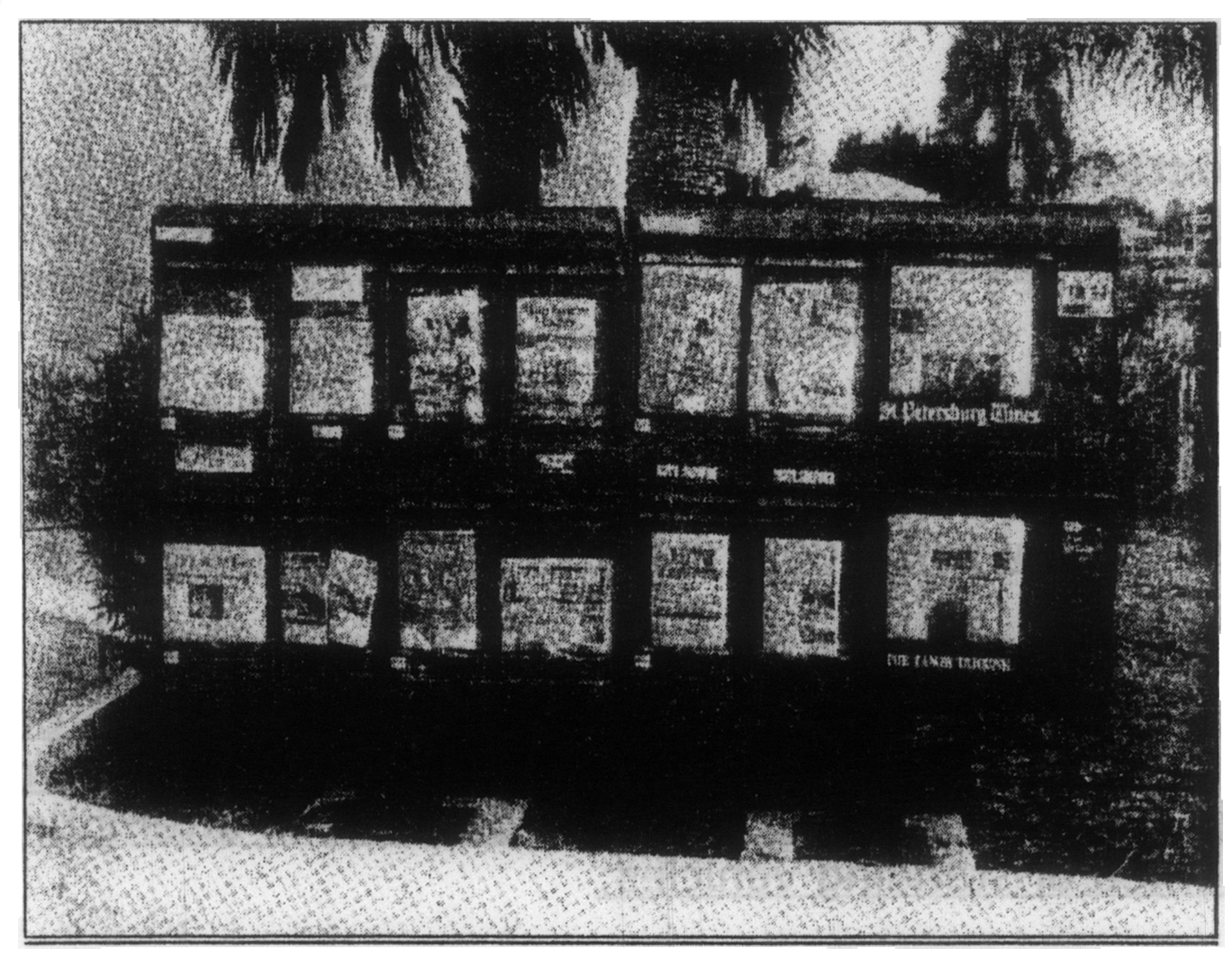
Modular newsrack unit means a hunter green colored, self-service, coin-operated, box or container with multiple-storage units, securely attached to the ground, used or maintained for the sale or free distribution of newspapers or other news periodicals or advertising circulars. For purposes of this chapter, modular newsrack units are further defined as having at least two compartments.
TWO MODULAR NEWSRACK PLACED SIDE BY SIDE
Neighborhood commercial means retail outlets for the sale of wearing apparel, toys, sundries and notions, books and stationery, leather goods and luggage, jewelry, including watch repair, and sporting goods, hobby shops, sale of musical instruments, florists or gift shops, sale of drugs, and sale of similar products.
Neighborhood mixed use. This zoning district provides for a mixture of uses (residential, office and neighborhood commercial). The intensity of the development shall be compatible with the type and scale of the surrounding neighborhood.
Net land area means, for the purpose of computing density/intensity, that total land area within the property boundaries of the subject parcel, and specifically exclusive of any submerged land or public road right-of-way.
Newsrack: For purposes of this section the term newsrack means both single and modular newsrack units. Also for purposes of this section newsracks are not defined as structures, even though they may be permanently attached to the ground.
Nonconforming, lot, use or structure means a lot, use, or structure which was previously legal and at inception conformed to the then applicable regulations, that subsequently fails to conform to the requirements of the countywide plan map, the countywide rules, the city's comprehensive plan, and the zoning and land development regulations as may be amended from time to time.
Open space means undeveloped lands that are suitable for passive recreation, landscape, preservation or conservation uses.
Owner of record, as identified on the application for newsrack installation, means any person, individual, partnership, corporation, association, firm, company, organization or any other legal entity that owns places or maintains a single and/or modular newsrack.
Paid parking lot. Is for the general public to pay for use of parking vehicles and is designed to be consistent with the criteria in division 8, off-street parking and loading facilities, section 110-371 general standards for parking facilities and chapter 106 vegetation in the Land Development Code.
Parking space means a durable surfaced area, enclosed in the main building, enclosed in an accessory building or unenclosed, and designed according to the parking standards chart contained in this chapter.
Personal service/office support use means an occupation or service attending primarily to one's personal care or apparel; examples of which include hair and beauty care, clothing repair or alteration , dry cleaning/laundry service (collection and distribution only), and like personal service uses; animal grooming; and office equipment or supplies, and like office support uses. Any assembly, sale of merchandise or conveyance of a product in support of a personal service or office support use shall be clearly secondary and incidental to the primary use characteristics of the personal service/office support use. No "personal service/office support use" shall include any retail commercial use or commercial business service use, as specifically defined within the countywide rules and the city's comprehensive plan.
Planned development district means a zoning district designed to be maintained and operated as a single unit which may or may not have certain facilities in common, such as yards and open spaces, recreation areas, garages and public areas. PDD rezoning applications may be considered for any property lying within the geographic boundaries of the business district triangle overlay zone as those boundaries are defined by subsection 110-135(b). Planned development districts are not allowed elsewhere in the City of Indian Rocks Beach.
Planned unit development means a project composed of two or more buildings designed to be maintained and operated as a single unit and with a single ownership or controlled by an individual, partnership, corporation, or cooperative group, which may or may not have certain facilities in common, such as yards and open spaces, recreation areas, garages and public areas. Planned unit development is restricted to RM-2 and CT zoning districts.
Planning and zoning board means the planning and zoning board of the city, the powers and duties of which and the legal constitution of which are defined in chapter 2 and in the Charter.
Private educational facilities means elementary schools, special education facilities, alternative education facilities, middle schools, high schools, and area vocational-technical schools not operated by the Pinellas County School District or the State of Florida.
Public access means the ability of the public to physically reach, enter or use recreation sites including beaches and shores.
Public educational facilities means elementary schools, special education facilities, alternative education facilities, middle schools, high schools, and area vocational-technical schools operated by the Pinellas County School District or the State of Florida.
Public land means any right-of-way, roadway, park, easement, building, or any other real property owned by any governmental entity.
Public notice means a legal advertisement given on actions or proposed actions of the city commission. Public notice shall, in all respects, comply with the requirements of Florida Statutes or the Charter or the ordinances of the city. Wherever a conflict exists between statutes of the state and the Charter or ordinances of the city, state law shall take precedence.
Public recreation facility means a publicly owned or leased recreation site or component thereof, used by the public for active or passive recreational pursuits such as a trail, marina, ball court, athletic field or swimming pool. This term includes both facility-based recreation and resource-based recreation, which terms may be distinguished between as to the use characteristics permitted within a given plan category.
Public/semipublic uses means those primary and secondary uses listed under the Institutional Transportation/Utility, Recreation/Open Space and Preservation/Conservation plan categories.
Public transit means passenger services provided by public, private or non-profit entities such as the following surface transit modes: commuter rail, rapid transit, light rail transit, light guideway transit, express bus, and local fixed-route bus.
Public use means the use of land, buildings, or structures by a municipal or other governmental agency to provide protective, administrative, social, and recreational services directly to the general public, including law enforcement and fire stations, municipal buildings, community centers, public parks and any other public facility providing such services.
Ready for highway use means that the recreational vehicle is fully licensed and is on its wheels or jacking system, is attached to the site only by quick-disconnect type utilities and security devices, and has no permanently attached additions.
Recreational vehicle means a ready for highway use vehicle which is built on a single chassis, is 400 square feet or less when measured at the largest horizontal projection, does not exceed eight feet in width, is designed to be self-propelled or permanently towable by a light duty truck (less than one ton), and is designed primarily not for use as a permanent dwelling but as temporary living quarters for recreational, camping, travel, or seasonal use.
Recreational vehicle lot means a subdivision of the recreational vehicle park designed to contain a single recreational vehicle.
Recreational vehicle park means lot or parcel of land upon which spaces are occupied or intended for occupancy on a temporary basis by recreational vehicles designed for travel, recreation, and vacation uses.
Redevelopment means the proposed removal or demolition of structures for the purpose of installing, building, or constructing new structures on the property.
Residential equivalent use means a residential-like accommodation other than a dwelling unit, including bed and breakfast, group home, congregate care, nursing home and comparable assisted living facilities. No such use shall be required or eligible to employ the residential equivalent standards for density/intensity for any household that qualifies as a dwelling unit. This use shall not include any type of use authorized by F.S. ch. 419, Community Residential Homes, which is entitled to be treated as a residential dwelling unit.
Resource-based recreation means recreational activities that typically are dependent on natural resources and a natural outdoor environment. These activities have little, if any, adverse impact on a site and are compatible with natural and/or cultural resource protection. Depending on the site, uses may include picnicking, low-impact camping, educational nature studies, wildlife viewing, horseback riding on trails, fishing, hiking, saltwater beach activities, or freshwater swimming.
Restaurant means a building or lot where meals are prepared and sold on the premises from within a completely enclosed building and where at least 20 seats are provided for customers inside the building.
Retail commercial use means an occupation or service providing primarily for the sale of consumer goods, products, merchandise or services from within an enclosed building; examples of which include grocery, pharmacy, apparel, jewelry, electronics, sporting goods, specialty shops, building supplies, convenience goods, restaurant, indoor recreation/entertainment uses (such as billiard halls, bowling alleys, movie theaters, and video game parlors) and like uses. Any exterior storage or facilities in connection with such use shall be clearly secondary and incidental to the primary use characteristics of the retail commercial use. No "retail commercial use" shall include any commercial/business service use, as specifically defined within the countywide rules and the city's comprehensive plan.
Right-of-way means the land in which the state, county, or city owns the fee or has an easement devoted to or required for use as a transportation facility, such as streets, avenues, alleys, boulevards and land abutting streets, avenues, alleys and boulevards.
Rip-rap means a permanent, erosion-resistant groundcover consisting of loosely placed pieces of natural stone or clean concrete rubble six inches to three feet in diameter (average dimensions), free of attached sediments, reinforcing rods or other similar protrusions.
Service station means any building, structure or land used for dispensing, sale or offering for sale at retail any automobile fuels or oils and/or where batteries, tires or other repair services, except body work or painting, are rendered.
Setback line means the distances from property lines, measured from each property line.
Shelter means a roofed-over structure which shall have no more than four posts or columns, and the sides of the shelter excluding posts shall be completely open.
Sidewalk means the part of a right-of-way designated for pedestrian use.
Single newsrack unit means self-service, or coin-operated, box or container with a single compartment installed, used or maintained for the display, sale or free distribution of newspapers, news periodicals or advertising circulars.
Special exception use means a use which may be allowed within a zoning district subject to the provisions of this chapter and in accordance with the procedures set forth in this chapter.
Specified anatomical area means:
(1)
Less than completely or opaquely covered:
a.
Human genitals or pubic regions; or
b.
The entire cleft of the male or female buttocks. Attire that is insufficient to comply with these requirements include, but is not limited to, G-strings, T-backs, and thongs; or
c.
That portion of the human female breasts directly or laterally below a point immediately above the top of the areola; this definition shall include the entire lower portion of the human female breasts, but shall not include any portion of the cleavage of the human female breasts exhibited by a dress, blouse, shirt, leotard, bathing suit, or other wearing apparel, provided the areola is not exposed.
(2)
Human male genitals in a discernably turgid state, even if completely and opaquely covered.
Specified sexual activity means:
(1)
Human genitals in a state of sexual stimulation, arousal or tumescence;
(2)
Act of anilingus, bestiality, cunnilingus, coprophagy, coprophilia, fellatio, flagellation, masochism, masturbation, necrophilia, pederasty, pedophilia, sadism, sadomasochism, sapphism, sexual intercourse, or sodomy;
(3)
Fondling or other erotic touching of human genitals, pubic region, buttocks, anus or female breasts; or
(4)
Excretory functions as part of or in connection with any of the activities set forth in subsections (1) through (3) of this definition.
Spill light means light which falls outside its intended target area due to improper luminaire light distribution, mounting height and physical location.
Stormwater means the flow of water which results from a rainfall event.
Stormwater basin means the area defined by topographic boundaries which contributes stormwater to a watershed, drainage system, estuarine waters, or oceanic waters, including all areas artificially added to the basin.
Stormwater facilities means manmade structures that are part of a stormwater management system designed to collect, convey, hold, divert, or discharge stormwater, and may include stormwater sewers, canals, detention facilities and retention facilities.
Stormwater management system has the meaning described in F.A.C. 62-40.210(21), (1992).
Story means the portion of a building included between the surface of any floor and the next floor above it, or if there is no floor above it, then the space between such floor and the ceiling next above it. The ground floor of a building may be used for parking, but is not counted as a habitable story.
Street means a public or private thoroughfare which affords the primary means of access to abutting property or through traffic and/or is intended for general traffic circulation or public access to the gulf or bay waterfront. This definition specifically includes the definition of beach access, but is understood to be more comprehensive than the definition of beach access.
Street line means the line between the street and the abutting property, also referred to as the right-of-way line.
Structural alteration means any change in the supporting members of the building, such as the bearing walls or partitions, columns, beams or girders, or a change in the roof or in the exterior walls or the rearrangement of any interior partitions affecting more than five percent of the floor area of the building, except for such repair or replacement as may be required for the safety of the building.
Structural improvement means any repair, reconstruction, improvement or addition, the cost of which equals or exceeds 51 percent of the then physical value of the structure, which physical value is determined at the time immediately prior to the commencement of an improvement or addition. If the structure has been damaged and is being repaired or restored, then the physical value shall be computed on the basis of the structure's value before the damage occurred, as compared to the damage after the loss.
Structure means anything constructed or erected, the use of which requires permanent location on the ground, or attached to something having a permanent location on the ground.
Submerged land means the land area situated below the mean high-water line or the ordinary high-water line of a standing body of water, including ocean, estuary, lake, pond, river or stream. For the purpose of this definition, drainage retention areas to be created as a function of development that are recorded on an approved final site plan or other authorized development order action of the local government with jurisdiction, and wetlands landward of the mean and/or ordinary high-water line, shall not be considered submerged land, and thus may be included in the computation of net land area for the purpose of determining permitted density/intensity.
Temporary building means a nonconforming building which is required for a limited time in connection with major construction work, as a tool shed or field office, or the sales office in a newly developed subdivision.
Temporary lodging unit means an individual room, rooms or suite within a temporary lodging use designed to be occupied as a single unit of temporary occupancy.
Temporary lodging use means a facility, building or structure containing one or more temporary lodging units, used for lodging, boarding, or temporary residential occupancy by one or more individuals possessing a leasehold term of less than three months and offered to the public at large for compensation at a daily, weekly, or seasonal rate. In determining whether a property is used as a temporary lodging use, such determination shall be made without regard to the form of ownership of the property or unit, or whether the occupant has a direct or indirect ownership of the property or unit; and without regard to whether the right of occupancy arises from a rental agreement, other agreement, or the payment of consideration.
Tourist facility use means those facilities and services, such as retail shops, eating and drinking establishments, meeting space and recreation facilities designed primarily to serve tourists, visitors, and seasonal residents in conjunction with the residential and temporary lodging uses where provided for in the resort facilities categories.
Transfer of development rights means the conveyance of development rights by deed, easement, or other legal instrument from a parcel or parcels, or within the same parcel, where such conveyance is from one land use district to another, but separately located, land use district.
Vacant lot means any lot or parcel of land which is completely open, has no use associated with or upon it, and is not utilized as the required yard area of any adjoining uses. This definition shall include any parcel of land upon which there is located no permanent structure or building.
Variance means a modification from the literal interpretation of the provisions of this chapter, other than those provisions relating to use requirements, subject to the procedures set forth in this chapter.
Wetlands means those areas that are inundated or saturated by surface water or groundwater at a frequency and a duration sufficient to support, and under normal circumstances do support, a prevalence of vegetation typically adapted for life in saturate soils. Refer to F.A.C. 9J-5.003 for additional explanation.
Vehicular use area means any area on a lot used for parking, loading or vehicular circulation or shall also mean an area of land provided for off-street storage and circulation or movement of motor vehicles of any type.
Yard means an open space on the same lot with a building unoccupied and unobstructed from the ground upward, except by trees or shrubbery or as otherwise provided in this chapter.
Yard, front, means an open, unoccupied space across the full width of the lot, extending from the front building line, including open porches, to the front line of the lot. The front yard shall be that portion of land closest to the primary property. On corner lots where two or more streets intersect, the front yard shall be that portion of land through which a driveway is provided to the residential structure or which is irrevocably designated by the property owner. On lands fronting the Gulf of Mexico, the front yard shall be that portion of the land westernmost to the lot.
Yard, rear, means an open, unoccupied space extending across the full width of the lot and measured between the rear line of the lot and the rear building line of the main building. This definition shall also include the opposite of "yard, front."
Yard, side, means an open, unoccupied space on the same lot with a building between the building line and the side line of the lot extending through from the front building line to the rear yard, or to the rear line of the lot where no rear yard is required.
Zoning lot means a lot or combination of lots in single ownership but separated from one another by an alley or easement, but not streets, avenues or boulevards, which together meet all appropriate requirements for development.
(Code 1980, § 24-3; Code 1989, § 21-1; Ord. No. 479, § 1, 3-29-1990; Ord. No. 506, § 1, 5-20-1992; Ord. No. 522, 9-15-1993; Ord. No. 575, § 1, 11-16-1994; Ord. No. 631, § 1, 3-5-1997; Ord. No. 97-14, § 24, 8-20-1997; Ord. No. 97-30, § 2, 6-23-1998; Ord. No. 98-01, § 2, 6-18-1998; Ord. No. 98-17, § 1, 12-8-1998; Ord. No. 00-04, § 1, 5-23-2000; Ord. No. 00-17, § 2, 1-23-2001; Ord. No. 2004-22, § 2, 2-15-2005; Ord. No. 2005-01, § 22, 5-5-2005; Ord. No. 2007-01, § 2, 11-7-2007; Ord. No. 2011-03, § 24, 7-12-2011; Ord. No. 2012-08, § 1, 9-9-2012; Ord. No. 2012-04, § 1, 11-13-2012; Ord. No. 2017-08, § 1, 1-9-2018; Ord. No. 2019-01, § 1, 2-12-2019)
Cross reference— Definitions generally, § 1-2.
Sec. 110-2. - Penalty; injunctive relief.
Any person violating any time limitations or provisions of this chapter, or the terms of any decision of the board of adjustments and appeals, the city commission or the building official, shall be punished as provided in section 1-14. Each day any time limitation or provision of this chapter or the terms of any decision of the board of adjustments and appeals, the city commission or the building official is violated shall constitute a separate offense under this chapter. Moreover, in addition to the penalty provided in this section or as alternative thereto, at the discretion of the city, the city may enforce the time limitations or provisions of this chapter or any decision of the board of adjustments and appeals, the city commission or the building official by injunctive relief in a court of appropriate jurisdiction.
(Code 1980, § 24-47; Code 1989, § 21-6)
Sec. 110-3. - Purpose of chapter.
(a)
The purpose of this chapter is to establish comprehensive controls for the development of land in the city based upon a comprehensive plan and enacted in order to protect, promote, and improve the public health, safety and general welfare of the people.
(b)
The objectives of this chapter are to provide efficiency and economy in the process of land use development; the appropriate and best use of land; preservation, protection, development and conservation of natural resources of land, water and air; convenience of traffic and circulation of people and goods; the use and occupancy of buildings; healthful and convenient distribution of population; adequate public utilities and facilities; promotion of the civic amenities of beauty and visual interest and development in accordance with the comprehensive land use plan as enacted.
(Code 1980, § 24-2; Code 1989, § 21-2)
Sec. 110-4. - Interpretation of chapter; conflicting regulations; severability.
(a)
In interpreting and applying this chapter, the provisions of this chapter shall be held to be the minimum requirements for the protection, promotion and improvement of the public health, safety, and general welfare of the community. It is not intended to interfere with or abrogate or annul any easements, covenants or other agreements between parties; provided, however, where this chapter imposes a greater restriction upon the use of buildings or premises or upon the height of buildings or requires larger open spaces than are imposed or required by other ordinances, rules, or regulations, or by easements, covenants, or agreements, the provisions of this chapter shall control. If, because of errors or omissions in the zoning map, any property in the city is not shown as being in a zoning district, the classification of such property shall be "S," unless changed by amendment to the zoning map or by subsequent zoning ordinances.
(b)
If any court of competent jurisdiction should hold any article, section, clause, or provision of this chapter to be invalid, the such holding shall not affect the validity of the chapter as a whole, or part thereof, other than the parts so declared to be invalid.
(Code 1980, § 24-46; Code 1989, § 21-3)
Sec. 110-5. - Authority to enact amendments.
The city commission may, from time to time, on its own motion, or on petition, or on recommendation of the planning and zoning board, or on appropriate initiative petition, amend, supplement or repeal the regulations and provisions of this chapter after public notice and hearing, as provided by law.
(Code 1980, § 24-42; Code 1989, § 21-4)
Sec. 110-6. - Review of amendments by planning and zoning board.
(a)
Every proposed amendment or change to Subpart B, whether initiated by the city commission or by petition, or by initiative, shall be referred to the planning and zoning board for a report thereon. If the planning and zoning board shall fail to submit such report to the city commission within 60 days, it shall be deemed that the planning and zoning board has recommended approval of the proposed amendment or change.
(b)
The city commission shall cause a public hearing to be held on the proposed amendments, and shall cause public notices to be given in accordance with the provisions of Florida Statutes.
(Code 1980, § 24-43; Code 1989, § 21-27; Ord. No. 2014-05, § 1, 1-28-2014)
Sec. 110-7. - Amendment procedure to conform with state law.
All changes, amendments or supplements to this chapter and to the zoning map, which forms a part of this chapter, shall be adopted in accordance with the procedures set forth in Florida Statutes.
(Code 1980, § 24-44; Code 1989, § 21-5)
Sec. 110-8. - Amendment procedure to conform with city Charter.
All changes, amendments or supplements to this chapter and to the zoning map, which forms a part of this chapter, shall be adopted in accordance with the procedures set forth in article XIII of the city's Charter.
All approvals that increase the density (i.e., dwelling units per acre), the intensity (i.e., the maximum floor area ratio and/or impervious surface ratio) or the maximum building height over and above the currently authorized zoning district and/or land use category applicable to a site or development shall require a favorable vote of four or more members of the city commission to be approved, in accordance with section 13.3(d) of the city's Charter.
(Ord. No. 2004-22, § 3, 2-15-2005)

