
Indian Rocks Beach City Zoning Code
ARTICLE VIII
DESIGN STANDARDS10
Editor's note— Ord. No. 2005-03, §§ 2—10, adopted Aug. 2, 2005, supplied provisions to be added to the Code as §§ 110-800—110-807. In order to maintain ease of use, and the style of the Code, at the discretion of the editor, these provisions have been redesingated as §§ 110-820—110-827 to read as set out herein.
Sec. 110-820.- Purpose.
The purpose of these design standards is to enhance new development and substantial renovation projects; and to generate a harmonious architectural character that reflects the city(s unique resident and tourist friendly environment. These design regulations are not intended to limit creativity, rather they are intended to recognize and enhance the character of the surrounding environment. These design regulations shall supplement the other requirements of this Code. In case of a conflict, the more stringent regulation shall apply.
(Ord. No. 2005-03, § 3, 8-2-2005)
Sec. 110-821. - Applicability.
(a)
Zoning districts. Design regulations shall apply to all zoning districts except the "S" single-family district.
(b)
The business district triangle overlay zone. Design regulations shall apply to all buildings located in the business district triangle overlay zone.
(c)
All new structures, and exterior renovations and additions, which exceed 50 percent of the market value of the structure, shall be required to comply with the requirements of this article. Exterior renovations shall mean structural modifications to the exterior facades or roof only and, for the purposes of this article, shall not include interior materials or finishes or changes in facade or roof materials such as shingle roof to a metal roof or stucco finish to siding or windows or shutters.
(Ord. No. 2005-03, § 4, 8-2-2005)
Sec. 110-822. - Review process.
(a)
The applicant shall select an architect licensed in the State of Florida to be the architect of record and who certifies that the architect of record has visited the site and neighborhood and that the proposed project complies with this article and related city ordinances. For nonresidential and mixed-use projects with less than 3,000 square feet of gross floor area and single-family and duplex residences, the applicant may select a representative such as a licensed engineer or contractor in lieu of an architect of record for purposes of this section.
(b)
The applicant and/or the applicant(s representative shall meet with city staff as designated by the city manager to refine the designs in light of these guidelines and city concerns.
(c)
The city manager shall appoint a qualified who shall review the proposed development for compliance with this article during the site plan review process and provide a written determination of compliance with the requirements of this article before issuing the site plan approval.
(d)
Projects requiring approval by the city commission for development plans, such as a planned unit development, shall obtain a determination of compliance with the requirements of this article prior to the execution of a development agreement.
(e)
The applicant and/or the applicant(s representative, and the city manager and/or his qualified designee shall conduct a final walk-through to certify that the development complies with the written determination of compliance approved pursuant to this article prior to issuance of the certificate of occupancy.
(Ord. No. 2005-03, § 5, 8-2-2005)
Sec. 110-823. - Unique structures.
Additions and exterior modifications to single-family homes and residential structures with less than four units and at least 50 years old or structures that have local or historical significance, such as the structures identified by the Indian Rocks Beach Historical Society or registered with the Florida or National Historic Register, may be exempted from some provisions of this article. The exemption may be granted by the city manager upon submission of design and elevation drawings demonstrating that the architectural features and appearance of the structure will be maintained in a manner that preserves the character of the structure.
(Ord. No. 2005-03, § 6, 8-2-2005)
Sec. 110-824. - Non-structural changes.
Minor nonstructural changes to city commission approved architectural designs may be approved by the city manager or his designee. Changes shall be limited to the following:
(1)
Modifications to an ornamental parapet or roof top equipment screening wall that do not exceed four feet in height that are equal to or enhance the approved design. Said parapet or wall shall not be calculated toward overall building height as long as the height of the roof deck is not increased.
(2)
Modifications to the architectural detail, treatment, texture and the like, that are equal to or enhance the approved design.
(3)
Modifications to ensure consistency with this article.
(Ord. No. 2005-03, § 7, 8-2-2005)
Sec. 110-825. - Supplemental application contents.
Applications for site plan review shall be supplemented with the following requirements:
(1)
Basic requirement for review.
a.
Elevation drawings, including all architectural features and building height, drawn to a common horizontal and vertical scale;
b.
Type of building materials;
c.
Roof type, pitch, and material;
d.
Detail of all public entries;
e.
Location and screening of loading bays, garage doors, overhead doors, and outdoor storage;
f.
Location and screening of dumpster, garbage disposal, and recycling areas;
g.
Detail and orientation of all facade-mounted and site lighting fixtures; and
h.
Structural/architectural focal point details, if applicable (e.g. fountains, gazebos).
Colored elevations and perspective drawings, photographic simulations, models and the use of other graphic material are encouraged and may be required by the city manager or his qualified designee to illustrate or fully explain how the development will address the requirements of this article.
(Ord. No. 2005-03, § 8, 8-2-2005)
Sec. 110-826. - Prohibited features.
(1)
Windows that are arranged to create an uninterrupted or continuous band.
(2)
Balconies that are arranged to create an uninterrupted or continuous band, such as motel-style common linear balconies.
(3)
Non-prominent entrance features, such as the use of a narrow staircase to access multiple units.
(4)
Exposed painted concrete masonry units.
(5)
Metallic, neon or fluorescent colors for exterior walls.
(6)
Visible antennas (except approved telecommunication antennas per sections 110-521 through 110-560), satellite dishes (except as allowed per Division 15, Satellite Dish Antennas, section 110-581 et seq.), and garbage containers (enclosures shall meet minimum primary structure setback requirements and all containers shall be kept in a landscaped enclosure constructed per section 50-64).
(7)
Structures or components of structures that are of symbolic design for reasons of advertising (e.g. "twisty" cone-shaped buildings).
(8)
Dirt, gravel or shell driveways (except single-family and duplex residences).
(9)
Asphalt sidewalks.
(10)
Chain link fencing in yards facing the Gulf of Mexico or a right-of-way (excluding alleys, where chain link fences must be coated).
(Ord. No. 2005-03, § 9, 8-2-2005; Ord. No. 2019-04, § 5, 5-14-2019)
Sec. 110-827. - Architectural design.
(1)
Articulation of building mass.
(a)
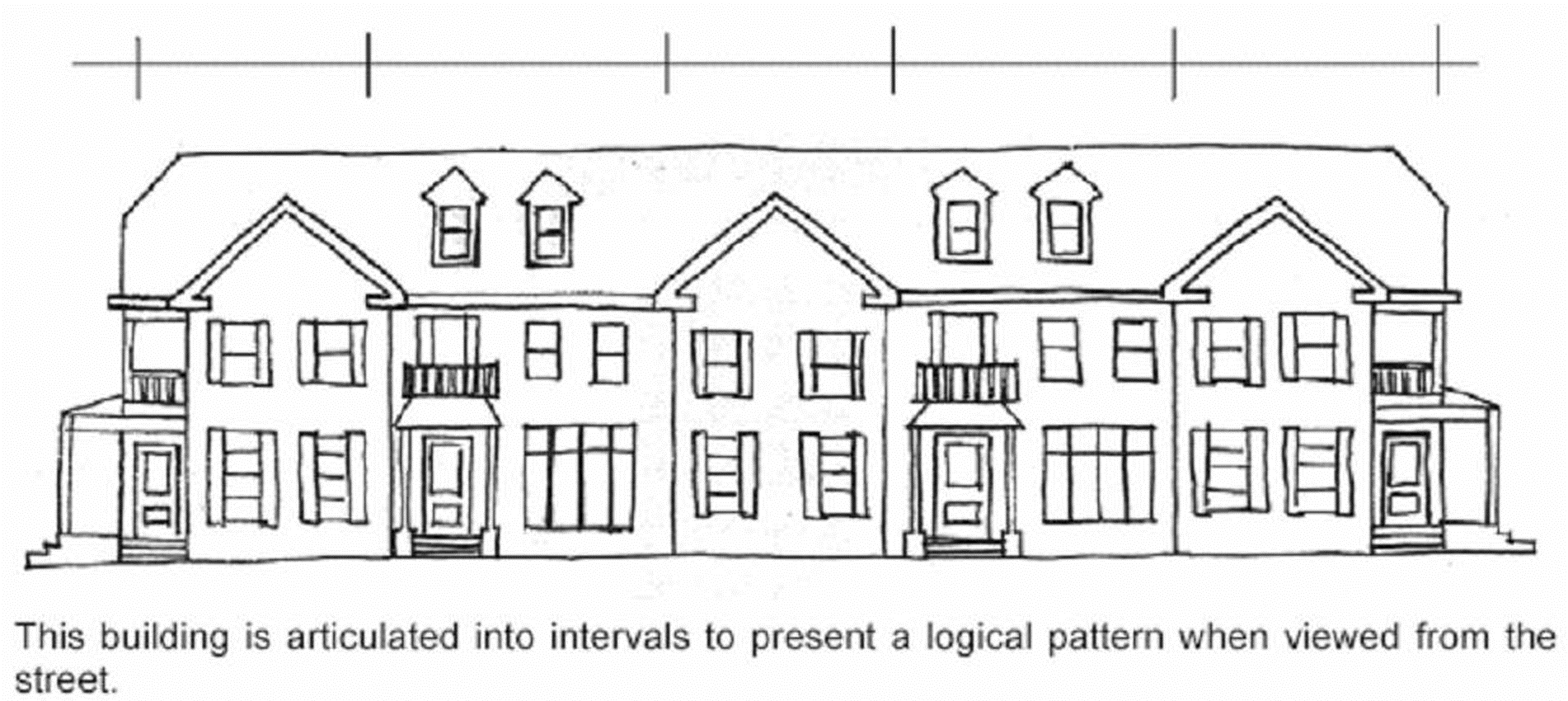
To prevent long stretches of repetitive and undifferentiated wall planes, a building shall be designed in a manner that reduces its apparent bulk by visually dividing the facade into smaller segments that create a complementary pattern or rhythm and divide large buildings into smaller, identifiable pieces. Building proportions with horizontal emphasis are generally desired. Vertical proportions with strong vertical emphasis that exaggerates building height are to be avoided.
(b)
At least two of the following methods shall be used on all facades of a building visible from a right-of way including Beach Trail (except alleys) or public open space:
1.
A minimum step back (recess) or projection of the facade two feet or more for at least 25 percent of the facade area.
2.
Architectural design elements, such as porches, canopies, towers, dormers, bay windows, balconies, and distinctive entry features that provide depth to the facade by breaking up a minimum of 25 percent of the facade area.
3.
Variation of roof and/or wall height to visually break up at least 25 percent of the facade, such as by use of multiple roofs, roof pitches, dormers, and/or parapet heights.
4.
Horizontal and/or vertical variation in texture, or materials and architectural detailing with elements, such as cornices, friezes, reliefs, dentils, architraves, pediments, pilasters, frets, quoins, corbels, to distinguish floors and adjoining units or to signify various elements of the building.
(c)
For any facade facing a right-of-way, including Beach Trail, (except alleys) and exceeding 60 feet in length, articulation of building mass shall be accomplished by the following two methods:
1.
Modulation shall be accomplished by one of the following two methods:
a.
Minimum step back modulation (recess) or projection of the facade three feet or more for at least 25 percent of the facade area.
b.
Each story above the first habitable floor shall have the option to step back a minimum of five feet from the subsequent lower floor.
2.
At least one of the requirements of subsection 110-807(b)1. thru 4.
(2)
Building entrance and parking.
(a)
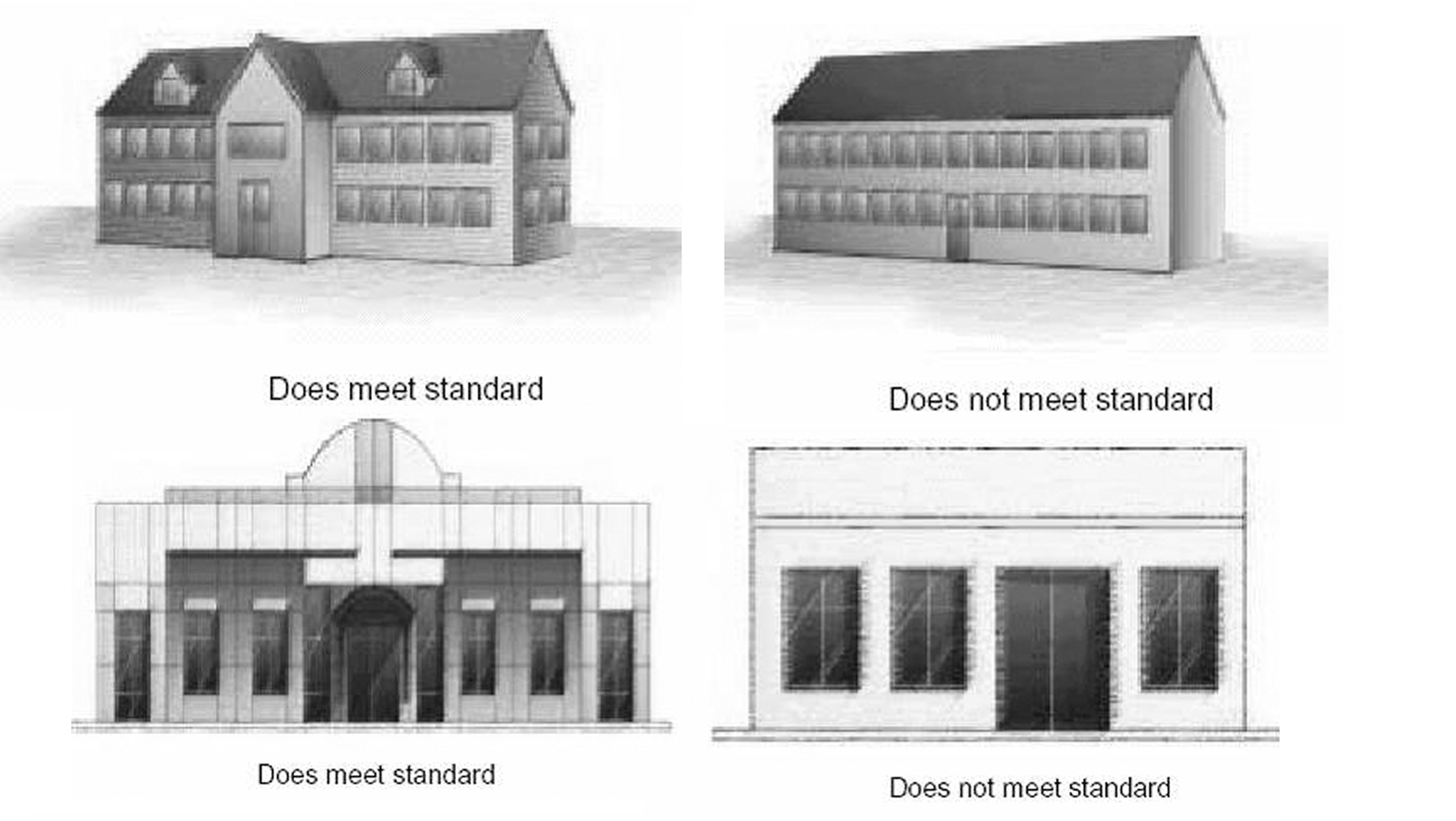
Building entrances or entry features shall be easily identified/visible from the major street and proportionate to the scale of the building through the use of building elements such as:
1.
Recessed or projected entryways, canopies, porches, or porticos.
2.
Varying rooflines.
3.
Changes in material and/or color.
(b)
Building entrances shall provide a pedestrian connection (sidewalk) to the adjoining public sidewalk or street and the private parking area.
entrances
(c)
Access to parking areas or garages in or under buildings shall be from alleys and Beach Trail, wherever possible.
(d)
Parking areas or garages in or under buildings shall be screened and integrated into overall facade to unify with the overall building design. Screening can be accomplished through the use of architectural features and/or vegetative screening such as hedges and ornamental trees.
(3)
Building walls.
(a)
Blank walls shall not exceed ten feet in height and 20 feet in length. Control and expansion joints shall constitute a blank wall, unless used in a decorative pattern at least four inches wide and with varied materials or textures.
(b)
All facades shall be designed and treated with consistent architectural style, detail, and door/window features/trim.
(c)
Openings (doors, windows, recessed porches, etc.) shall comprise a minimum of 20 percent of each facade area.
(4)
Building roof.
(a)
The primary exposed roof shall have a minimum pitch of 4/12 and the ridgeline shall not exceed 60 feet in length without architectural features that break the ridgeline and/or roof plane. Lesser roof pitches are allowed when integrated into a multi-pitched roof design where the primary roof pitch is 4/12 or greater.
(b)
Flat roofs shall incorporate parapets with architectural detailing and decoration.
(5)
Windows and doors.
(a)
Windows and doors shall be defined with decorative details such as frames, sills, lintels, shutters, planters, relief trims, or moldings. Trim or molding shall be at least four inches nominal width to qualify as a special element.
(b)
In addition to the other requirements of this article, individual pedestrian-level retail uses shall include display windows along at least 20 percent of the business' facade.
(6)
Additional design elements.
(a)
Landscaping shall screen undesirable views (e.g., storage buildings and areas, parking areas, pool equipment, garbage containers and dumpster enclosures).
(b)
Mailboxes shall be grouped within an attractive unit or screened from public view.
(c)
Walkways, benches, landscaping, trellises and similar features should be incorporated to enhance common areas.
(d)
Walkways traversing vehicular use areas shall be accented with pavers, bricks, decorative concrete, stamped concrete, or similar decorative pavement treatment.
(e)
Decorative light poles and fixtures shall provide shielded lighting focused on the ground to eliminate spillover lighting.
(f)
Fences or walls should be embellished by architectural elements and punctuated by landscaping.
(g)
One native canopy tree shall be preserved or planted that is visible from Gulf Boulevard, for every 60 feet of street frontage or fraction thereof on properties fronting Gulf Boulevard. Newly planted trees shall be at least 20 feet from a side property line.
(Ord. No. 2005-03, § 10, 8-2-2005)

