
Islamorada City Zoning Code
ARTICLE 30
IV ADMINISTRATIVE PROCEDURES
Cross reference(s)—Administration, ch. 2.
23-16
24-11
15-03
23-07
17-06
15-06
13-21
13-19
15-05
16-17
16-20
19-05
23-15
10-16
15-14
15-04
12-04
14-10
16-19
19-04
10-06
19-14
19-21
25-21
10-10
20-02
14-11
15-02
21-04
25-23
12-06
Sec 30-211 Intent And Purpose
It is the intent and purpose of this article to promote the public health, safety, morals, convenience, comfort, amenities, prosperity, order, appearance, and general welfare of the community.
(Ord. No. 01-16, § 4(4.1.1), 11-8-2001)
Sec 30-212 Generally
- Development permits required. No development shall take place within the jurisdiction of the village except after issuance of all development permits required under any applicable section of this chapter, the Code or village ordinance, and other governmental agencies having jurisdiction to regulate the development of land within the village's jurisdiction.
- Development by governmental agencies. Prior to undertaking development, any governmental agency shall apply for the appropriate permit under the applicable sections of this chapter, the Code or village ordinance. If any governmental agency seeking to undertake development has been specifically exempted by federal or state law from compliance with this chapter, the Code or village ordinance, the agency shall file with the village manager and director of planning and development services evidence of such exemption. In the absence of such an exemption, governmental agencies shall apply for permits in the same manner as other persons.
- Technical codes. The building, plumbing, electrical and other technical codes adopted by the village are expressly recognized as essential to the implementation of the village comprehensive plan and this chapter.
- Application for development.
- Every application for a development permit shall be in a form specified by the planning and development services department for reviewing the application, and shall be accompanied by a fee as is established from time to time by the village council to defray the actual cost of processing the application. After an application is submitted, the director of planning and development services shall determine if the application is complete and includes data necessary to evaluate the application. The village shall be entitled to rely upon the statements or representations made by the applicant on a development permit application. If it is determined that the application is incomplete, or based upon incomplete or inaccurate information or misstatements of fact, notice shall be delivered to the applicant specifying the deficiencies. The director shall take no further action on the application until the deficiencies are remedied. If the applicant fails to correct the deficiencies within 20 working days, the application shall be considered withdrawn. If or when the application is determined complete, it shall be reviewed in accordance with the applicable provisions of this chapter. Notwithstanding anything in this chapter to the contrary, on a case-by-case basis, the director may make a written determination to waive some or all of the required submittals of a development permit application. Annually, the director shall promulgate a calendar, as may be amended, showing application dates and deadlines consistent with the specifications of this chapter. This calendar shall govern all dates and the development review process.
- All applications shall include proof of ownership and, if applicable, consent to be represented by an agent. All owners and any person having a contractual interest in the land shall give their permission for application. Unless otherwise specified in each section describing particular development review procedures, applications for development permits require a concurrency certification by the planning and development services department prior to being placed on the agenda for a public hearing or meeting or proceeding to the subsequent step in the development review process. Unless requested by the village, applications shall not be significantly altered after certifications. In no case shall any changes be made to a development application or development plans within ten working days of any required public hearing on the application, without a continuance of the hearing.
- The director shall be entitled to a continuance, and an applicant shall be entitled to a continuance or withdrawal of an application for development permit if the request is made no later than five working days before final action on the application by the decision-making body or person. Requests for a continuance or withdrawal received later than five working days before the date the decision is to be made, or the public hearing is to take place, shall be granted only by the decision-making body or person with or without prejudice. Applicants in this case shall not be entitled to the return of application fees.
- Whenever any application for a development permit is withdrawn or denied with prejudice, an application for development permit for all or part of the same land shall not be considered for a period of one year after the date of denial, unless the subsequent application involves a development proposal that is materially different from the prior proposal, or unless the person or a majority of the members of the decision-making body that made the final decision on the application determines that the prior denial was based on a material mistake of fact. For the purpose of this subsection, an application for development permit shall be considered materially different if it involves a change in use, or a change in intensity or density of use of 25 percent or more. The body or person charged with conducting the initial development application review or public hearing under such successive application shall resolve any questions concerning the similarity of a second application.
- To the extent practical, applications for development permits may be consolidated for review pursuant to an agreement between the applicant and the director as part of the pre-application conference. When applications for development permits are consolidated pursuant to this subsection, the time for review shall be no less than those established for the application for development permit with the longest review period.
- The director and village council may impose such conditions on the granting of a development permit that are necessary to accomplish the purposes of the comprehensive plan and this chapter. Conditions shall be included if conventional standards are inadequate to protect the public interest and surrounding land uses or if additional improvements are needed to facilitate a more appropriate transition between different uses. Conditions are not intended to restate express provisions of this chapter. Such conditions may include the execution of unity of title and the location of uses on the site to minimize adverse off-site impacts and ensure on-site safety. Further, conditions may be imposed to provide road construction required for the project to meet village concurrency requirements and that allow the applicant to proceed to the subsequent stage of development review. Site-related conditions such as drainage improvements, turn lanes and signalization may be imposed. Conditions shall be reasonable, not be contrary to law and shall be limited to on-site impacts, except for off-site public road improvements or other conveyances reasonably related and proportionate to the project's impact. Conditions shall not amend village council imposed conditions or affect previously approved conditions. For modifications or additions to previously approved site plans, conditions shall only be imposed to address the specific impacts of the new use or development. Fixed times may be set for compliance with conditions and shall be governed by section 30-224.
- Any application for development permit may be suspended during the pendency of a code enforcement proceeding or for any code violation involving all or a portion of the land proposed for development. Development permit applications for properties that have outstanding code violations, liens or fines owed to the village shall be restricted as follows:
- The village shall not approve a final site plan or building permit until the code violation is remedied and payment of outstanding liens or fines is made to the village.
- The village may approve a conditional use application; however, it shall not do so unless, as a condition of approval, the code violation is remedied and the applicant agrees to the payment of all outstanding liens or fines by a date certain or prior to a specific event.
- In the event litigation contesting the code violation or the validity of the lien or fine is initiated before the application for the development permit, the time for compliance or payment shall be established only after the conclusion of litigation.
- Violation of permit condition or time limitation. A violation of any condition or time limitation of any development permit shall be considered a violation of the Code. The violation shall be corrected prior to any public hearing or meeting on the issuance of any subsequent development permit for that project, unless a subsequent permit application seeks to amend the condition or time limitation that has been violated. Unless otherwise specified in the development permit, an approved use must comply with conditions and time limitations before implementing the approval, or before receipt of a certificate of occupancy or certificate of completion. The violation shall be subject to all enforcement procedures available as provided in the Code and by all applicable laws and ordinances.
- Review of conditions imposed.
- The term "Condition" as used in this subsection (f) includes only the following conditions, whether imposed by the Director of the Village land development regulations;
- Dedication requirements (land, public improvements, etc.); or
- Impact fees; or
- Other monetary exactions.
- Dedication requirements (land, public improvements, etc.); or
- If an applicant believes that any Condition imposed on a development does not have a nexus to a legitimate public purpose and/or is not roughly proportionate to the impacts of the proposed development, the applicant shall, as a part of its application, provide empirical evidence of its position. Where appropriate, the applicant should present an expert report on rough proportionality with its application. If the Director has the authority to excuse the applicant from the Condition and does not do, the applicant shall raise the issue before the Village Council as provided by the application process for the particular approval that the applicant is seeking. The Village Council shall be the final arbiter of whether the condition should be imposed. For applications that are reviewed and approved by the Village Council as authorized by Section 30-81 of the Village Code, the challenge to the Condition, including the provision of empirical evidence challenging the Condition, must be presented concurrently with its application. For applications that are reviewed and approved by the department of planning and development services as authorized by Section 30-131 of the Village Code, the challenge to the Condition, including the provision of empirical evidence challenging the condition, must be presented no later than the time within which the applicant must appeal the decision on the application to the Village Council. Any challenge to a Condition that is not made within the time frames provided in this section is deemed waived.
- Upon hearing the evidence presented by the applicant and any testimony by the Director and/or the Director's designee on why the condition was imposed, the Village Council may excuse the applicant from complying with the condition if it finds that:
- The condition does not have an essential nexus to a legitimate public purpose; or
- The condition does not actually further the legitimate public purpose; or
- The condition is not roughly proportionate to the impacts of the development.
- The condition does not have an essential nexus to a legitimate public purpose; or
- However, nothing in this section shall be interpreted as permitting the Village Council to take any action that is inconsistent with the Comprehensive Plan.
- The term "Condition" as used in this subsection (f) includes only the following conditions, whether imposed by the Director of the Village land development regulations;
- Fraud or omission in permit application. If there is evidence that an application for development permit was considered wherein there was misrepresentation, fraud, deceit, or a deliberate error or omission, the village may initiate a rehearing to reconsider the development permit. The village may re-approve, approve with new conditions, deny, or take such other action on the development permit at the rehearing based on the standards in this chapter. If evidence of misrepresentation is discovered during the application review and approval process, the application shall be deemed incomplete and returned to the applicant.
- Development permits that are never implemented. All development permits that are never implemented shall be either:
- Rescinded simultaneously with issuance of a subsequent development permit;
- Revoked after a public hearing; or
- Rescinded upon the expiration of the permit as set forth in table 30-225.
- Zoning in progress, hold on permits or certificate of uses. When an amendment to Chapter 30 or a rezoning of a parcel of land has been approved on first reading by the village council, no development application pending before the village with respect to the area or text which is the subject of the proposed amendment shall be approved unless the development application would be in conformity with both the existing legislation and the proposed legislation for a period of six months from the date of the approval on first reading by the village council. This period may be extended on time for an additional three months by resolution of the village council.
(Ord. No. 01-16, § 4(4.1.2), 11-8-2001)
Amended by Ord. 23-16 on 4/11/2024
Amended by Ord. 24-11 on 8/22/2024
Sec 30-213 Public Hearing And Notice
- When an application for development permit is subject to a public hearing, the director of planning and development services shall ensure that the necessary public hearing is scheduled for the decision-making or advisory body reviewing the application and that, except as provided herein, proper notice of the public hearing is provided as set forth herein. All notices for public hearings shall include the following information:
- Identify the applicant, if other than the village.
- Indicate the date, time, and place of the public hearing.
- Describe the property involved by street address or by legal description, and area of the subject property. A map may be substituted for the legal description or as required by state law.
- Identify the current zoning district designation of the property subject to the application.
- Describe the nature, scope and purpose of the application proposal being noticed.
- Identify the village departments where the public may inspect the application, staff report and related materials during normal business hours.
- Include a statement that affected parties may appear at the public hearing, be heard and submit evidence with respect to the application.
- When the provisions of this chapter require that mailed notice be provided, the applicant shall be responsible for preparing the written notice and for mailing the notice. Notice shall be deemed mailed by its deposit in the United States mail, certified/return receipt required, properly addressed, postage paid and postmarked at least 15 days prior to the public hearing date or upon issuance of the Notice of Intent (NOI). No action taken by the village shall be voided by the failure of any individual property owner to receive such notice.
- When the provisions of this chapter require that notice be published, the applicant shall be responsible for preparing the content of the notice and publishing the notice in the non-legal section of the local newspaper of general circulation that has been selected by the village. This notice shall be published at least 15 days before the required public hearing or upon issuance of the NOI.
- When the provisions of this chapter require that notice be posted on the property subject to the application, the Applicant or Representative shall:
- Place the signs on the property that is the subject of the application for at least 15 days prior to a required or requested hearing or issuance of the NOI.
- Place the signs along each street that is adjacent to or runs through the subject property at intervals of not more than 200 feet in a manner that makes them clearly visible to adjacent residents and passersby.
- Place the signs no more than 25 feet from the street so that the lettering is visible from the street. Where the land does not have frontage on a street, signs shall be erected on the nearest street, with an attached notation indicating generally the direction and distance to the property subject to the application.
- An affidavit and photographic evidence shall be provided by the Applicant or Representative before the public hearing or prior to the issuance of a Notice of Approval (NOA) demonstrating compliance with the applicable notice requirements set forth in this section. Failure to comply with the applicable notice requirements shall result in the postponement and re-noticing of the public hearing or a restart of the appeal period. All costs of re-noticing the public hearing shall be borne by the Applicant or Representative.
- Notice for public hearings on applications for comprehensive plan text or map amendments shall be noticed as follows:
- Text or map amendments initiated by the village shall be noticed by publication in accordance with the provisions of F.S. § 163.3184.
- Text or map amendments initiated by a property owner or governmental agency other than the village shall be noticed by publication in accordance with the provisions of F.S. § 163.3184, and by posting of the property subject to the application at least 15 days prior to the public hearing.
- Notice for public hearings on applications for amendments to this chapter and the official zoning map shall be noticed as follows:
- Text or map amendments initiated by the village shall be noticed by publication in accordance with the provisions of F.S. § 166.041.
- Text or map amendments initiated by a property owner or governmental agency other than the village shall be noticed by publication in accordance with the provisions of F.S. § 166.041, and by posting of the property subject to the application at least 15 days prior to the public hearing.
- Notice of intent to issue and public hearings on applications for development permit approvals including, but not limited to, certificates of compliance, minor and major conditional uses, administrative appeals, variances, administrative variances, alcohol beverage use permits, development status reports and site plans shall be noticed as follows:
- Posting of the property subject to the application.
- Mailed notice to all property owners, including any residents of the property subject to the application, located within 300 feet of the property subject to the application postmarked at least 15 days prior to the public hearing or upon issuance of the NOI. The property owners required to be provided notice by this subsection shall be determined with a copy of the most up-to-date version of the county tax roll.
- By publication.
NOTICE REQUIREMENTS
Permit | Notice Section | Posted | Published | Mailed |
Certificate of compliance | 30-213(h) | Upon issuance of the NOI | 15 days prior to public hearing | Owners within 300 feet |
Site plan | 30-213(h) | Upon issuance of the NOI | 15 days prior to public hearing | Owners within 300 feet |
Administrative variance | 30-213(k) | Upon issuance of the NOI | 15 days prior to public hearing | Owners within 300 feet |
Minor conditional | 30-213(h) | Upon issuance of the NOI | 15 days prior to public hearing | Owners within 300 feet |
Major conditional | 30-213(h) | 15 days prior to public hearing | 15 days prior to public hearing | Owners within 300 feet |
Administrative appeal | 30-213(h) | 15 days prior to public hearing | 15 days prior to public hearing | Owners within 300 feet |
Variance | 30-213(h) | 15 days prior to public hearing | 15 days prior to public hearing | Owners within 300 feet |
Comprehensive plan—Village | 30-213(f)(1) | No | F.S. § 163.3184 |
|
Comprehensive plan—Owner | 30-213(f)(2) | 15 days prior to public hearing | F.S. § 163.3184 |
|
Zoning map and text—Village | 30-213(g)(1) | No | F.S. § 166.041 |
|
Zoning map and text—Owner | 30-213(g)(2) | 15 days prior to public hearing | F.S. § 166.041 |
|
Development permit status report | 30-213(h) | 15 days prior to public hearing | 15 days prior to public hearing | Owners within 300 feet |
Alcohol beverage use permit | 30-213(h) | 15 days prior to public hearing | 15 days prior to public hearing | Owners within 300 feet |
NOI = Notice of Intent
NOA = Notice of Approval
(Ord. No. 01-16, § 4(4.1.3), 11-8-2001; Ord. No. 02-29, § 2, 11-21-2002)
Amended by Ord. 15-03 § 1 on 2/12/2015
Amended by Ord. 23-07 on 10/23/2023
Sec 30-214 Pre-Application Conference
- An initial pre-application conference is optional before the submission of an application for development permit. However, a pre-application conference shall be mandatory prior to submission of an application for a development permit that would be applicable to the administrative design review standards set forth in subsection 30-215(d)(20). The purpose of the pre-application conference is to familiarize the applicant and the village with the applicable provisions of this chapter and the Code, and processes required to completely permit the proposed development.
- Prior to submitting the initial application for development permit, a potential applicant may request in writing a pre-application conference with the director of planning and development services, and other applicable agencies. A pre-application submission in a form established by the director shall accompany the request and be made available to the public.
- The pre-application submission shall include the following:
- The name, address and telephone number of the landowner of record.
- The name, address and telephone number of the applicant.
- A list of all land use, environmental, economic, engineering, legal, or other professionals assisting in the application.
- The real estate number for the land subject to the development, a legal description of the land, and the street address, if applicable.
- A survey, legal sketch or tax map with the property highlighted, and conceptual site plan of the land proposed for development, including, but not limited to, the proposed use, square footage by use type, and lot layout.
- A short description of the existing site conditions of the land, including its future land use map designation and existing zoning district classification.
- The date of the creation of the lot, such as plat book and page number or deed, as applicable.
- The existing utilities on the land, including any on-site sewage and potable water facilities.
- A history of previous development orders for the land, including but not limited to site-specific (future land use map) comprehensive plan amendments, amendments to the official zoning map, conditional uses, variances, environmental permits, concurrency permits, building permits, and lot clearing permits.
- A statement of intent to participate in any special density programs, such as a transfer of development rights (TDR) or voluntary lot aggregation. The indication shall include a short description of reasons why the proposed development is eligible for the special density programs.
- The director shall initiate review of the pre-application submission upon receipt of a complete request for pre-application conference. The applicant shall be notified in advance by the director about the time, date and place of the conference.
- At the pre-application conference, the applicant and village staff shall discuss the proposed development and, based upon the information provided by the applicant and the provisions of this chapter in effect at the time of the pre-application conference, determine in general what provisions of this chapter apply to the proposed development. Review time may vary based on the simplicity or the complexity of a proposed project.
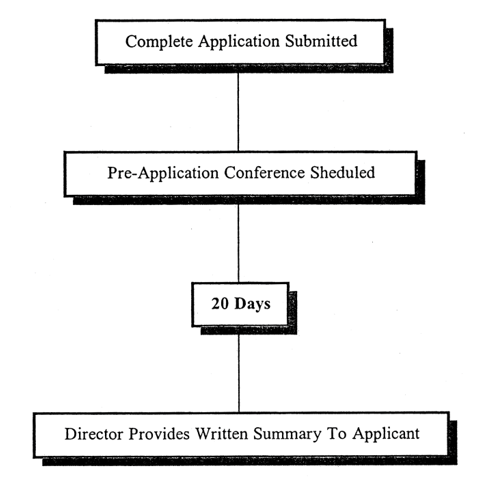
- Within 20 working days of the pre-application conference, the director shall provide the applicant with a written summary of the pre-application conference. The written summary shall identify, based upon the information and materials provided by the applicant and the provisions of this chapter in effect at the time of the pre-application conference, the provisions of this chapter that generally apply to the proposed development.
PRE-APPLICATION CONFERENCE
SECTION 30-214
(Ord. No. 01-16, § 4(4.1.4), 11-8-2001; Ord. No. 10-01, § 2, 1-14-2010)
Sec 30-215 Site Plan Review
- The site plan is the key land development review mechanism for all development permits listed in subsection (b) of this section. It is intended to assure adequate site design in relationship to adjacent development and public facilities. This includes any major landscaping, walls or entrance features being added to an existing project.
- Site plan approval shall be obtained prior to issuance of a building permit for any of the following types of developments:
- New nonresidential or industrial development on vacant parcels of land;
- Residential development of more than two dwelling units;
- Any amendment to a previously approved site plan;
- Any nonresidential development project that would constitute a substantial improvement as defined in this chapter on property with frontage on a major street and all property within the Village Center (VC) zoning district; or
- As otherwise required by this chapter.
- A pre-application conference pursuant to section 30-214 is optional but encouraged, before the submission of a site plan application.
- The site plan shall be prepared by a professional architect, engineer, or landscape architect. The director or his designee shall initiate review of a site plan application upon receipt of a complete application for compliance with this chapter. Concurrently, within 30 days of a complete application representatives from village departments responsible for reviewing land development proposals including but not limited to building, fire, sheriff, public works and utilities shall provide comments, corrections or conditions to the applicant to determine compliance with the Code. Data furnished in the application shall be to scale and shall include the following information, unless waived in writing by the director:
- Name and address of the record owner, the applicant, and the person preparing the site plan.
- Location map.
- Legal description and survey of the proposed site boundaries, made and certified by a state registered land surveyor or engineer. The survey shall reflect existing natural features, such as topography, wetlands/vegetation, water bodies, and any existing structures in paved areas.
- Proposed land use, with indication of size, location and height of structures with approximate dimensions, setbacks, and landscaped yards.
- Adjacent area information, including:
- Existing land use; and
- Zoning classification.
- Vehicular circulation system, both on-site and off-site, with proposed access, which shall comply with traffic engineering standards used by the village. The village shall not be required to widen or in any way alter any existing local road, collector road, or arterial road under the village's jurisdiction, or to accept a dedication of additional road right-of-way for the purpose of widening or altering any existing local road, collector road or arterial road under the village's jurisdiction to accommodate new development, unless such road improvement is included in the Capital Improvements Element of the comprehensive plan.
- Pedestrian circulation system.
- Lighting plan for street and development site.
- The location of existing public utilities, including:
- Location of closest available water supply system or collection lines and fire hydrants.
- Location of closest available wastewater collection system or collection lines.
- Existing provisions for the collection and discharge of surface drainage.
- Provider of water and wastewater facilities.
- The following computations:
- Gross acreage.
- Net acreage excluding road easements and right-of-way, if any.
- Number of dwelling units by number of bedrooms in density for residential uses only.
- Square footage of ground covered by buildings or structures.
- Computation of pervious and impervious areas, and square footage and percentage of site.
- Required and provided number of parking spaces.
- Indication of the boundaries of the project within the overall development plan in the case of a phased development.
- Proposed location of sidewalks, curves, gutters, water mains, sanitary sewers, storm drains, manholes, inlets, underground conduits, seawalls, and the size and shapes and types thereof, the character, width and depth of pavement in sub-base of any roadways, access points or paths located within the proposed development.
- Indication of existing native vegetation that would be preserved.
- Location and width of any proposed permanent utility easements.
- All adjacent rights-of-way, with indication of centerline and width, paved width, existing median cuts and intersections, streetlight poles and utility company facilities, including easements.
- Design features as follows:
- Building separations and setbacks.
- Location of all paved drives and parking areas, including centerlines, dimensions, radius, and elevations, traffic signage and striping.
- Schematic elevations of buildings showing concealment of all mechanical or accessory equipment located on the roof.
- Building floor plans and proposed building materials and colors. Front, side and rear elevations (with any wall signs) showing height to peak of roof.
- Location of trash and garbage disposal system and provisions for accessibility to garbage trucks.
- All trash and garbage disposal systems, dumpsters, recycling collection areas, utility equipment, air conditioning units, vending machines and wastewater treatment plants shall have screening to minimize their visibility from all streets, consisting of one or more of the following:
- A solid, opaque enclosure (with gate, if necessary) of any material allowed by this code, except chain link fences, with a minimum height of one foot above the structure to be screened and painted to complement the principal building.
- Landscaping (e.g., shrubs, canopy and understory trees, continuous hedges); or
- Screening of these structures may be accomplished by site design and orientation of buildings.
- Loading areas and provisions for accessibility to vehicles of the required type and clearances.
- Areas for emergency vehicles and fire engines and provisions for fire lane accessibility for vehicles of the required type.
- Entrance features, walls, buffers, and ground signs.
- Where the site plan covers only a part of contiguous real property owned by the applicant, master phasing plan for such additional acreage unless the applicant certifies that the remaining real property shall not be developed.
- The proposed treatment of the perimeter of the site, including the material and techniques used, such as screens, landscaping buffers, fences and walls.
- The location and size, in acres or square feet, of all areas to be conveyed, dedicated, or reserved as open space, public parks, recreational areas, and similar public or semi-public uses.
- Any additional information as may be reasonably required by the director.
- Demonstration of enhanced and preserved scenic views of the water from public rights-of-way. Structures along the shoreline shall be sited so as to prevent walling-off of water front views.
- Appropriate siting of water dependent and water related uses.
- If the application area has been identified as a working waterfront, then the applicant shall integrate into his traffic study an analysis of the influence of available boat parking on parking demand.
- All nonresidential development projects, which include either development of new structures or substantial improvement of existing structures located on property with frontage on any major street and all property within the Village Center (VC) zoning district, shall adhere to the administrative design review standards set forth below.
- Roof pitch. The maximum roof pitch of all street-facing facades on principal buildings shall be 8/12, expressed as rise over run. Flat roofs shall be allowed provided they are hidden by a parapet or other architectural feature in a style consistent with the building design as approved by the director and any roof-top utilities or equipment are screened from view from all adjacent streets.
- Awnings. Awnings shall not have covers constructed of any transparent, translucent, high gloss or high sheen material and shall not be backlit.
- Building transparency. In order to create a visual connection between a building's interior activities or retail display windows and people outside of a building, the minimum transparency of the lowest floor of all principal buildings shall be 35 percent per each 50 linear feet of each street-facing facade. To count as transparency, windows, retail display windows and doors shall not be opaque or tinted with an inside-to-outside light transmittance value of 45 percent or less. Windows may be operable or non-operable. Doors shall be operable and may include emergency egress doors. All required transparency shall be evenly distributed at pedestrian level across the length of the lowest floor. Transparency is not prohibited from extending higher than seven feet above the bottom of the lowest floor, however the measurement to determine whether this standard is met shall only be between zero feet and seven feet in height above the bottom of the lowest floor. Compliance with the above standard shall be mandatory, unless the director finds that it is impracticable for all or a portion of a principal building, in which case the development shall comply with one of the following standards:
- A professional mural, which constitutes art as defined in this chapter, shall be painted on the entire facade of each street-facing side of a building and be maintained in good condition;
- Foundation landscaping shall be installed consisting of a Class G bufferyard pursuant to division 6 of article V of this chapter, shall be located entirely within 15 feet of a building and shall adhere to the maintenance requirements in section 30-825 of this chapter; or
- Any combination of the above standards, which results in the entire facade of each street-facing side of a building having transparency, a professional mural or foundation landscaping.
- Building articulation. The facades and roofs of all principal buildings shall be articulated through the following techniques:
- Facades and roofs shall have no less than one articulation every 50 linear feet.
- Minimum horizontal facade articulation shall be five feet in depth and 15 feet in width.
- Building facades shall feature some combination of the following elements: arcades, awnings, balconies, canopies, porches, decks, bay windows, recessed entries, retail display windows or other similar features as approved by the director.
- Roof articulation shall be achieved through the use of cornices, dormers, eaves, gables, multi-planed roofs, offsets, parapets, pitched roofs, roof overhangs or other similar features as approved by the director.
- Flat roofs within view from an adjacent street shall be hidden by a parapet or other architectural feature in a style consistent with the building design as approved by the director and of a sufficient height to screen any rooftop utilities.
- A parapet on a flat roof shall not be flat and shall feature cornice treatments.
- Boat barns shall be exempt from this standard.
- Building orientation. Each principal building shall provide an entry that is clearly identifiable from the street. The entry does not necessarily have to face the street. This may be achieved through the architectural design of the building, the use of sidewalks, signage, pavement markings and/or landscaping.
- Drive-throughs and drive-ins. Any drive-through or drive-in components shall be architecturally compatible with on-site principal structures and shall be located behind or to the side of the street-facing facade of a building. Drive-through or drive-in components shall be designed to be located as far as possible from adjacent residential zoning districts and residential uses. In order to protect the public interest and surrounding land uses, the director or village council, as applicable, may impose conditions such as the installation of landscaping and screening walls, and limiting the hours of operation.
- Car washes. Openings, bays and entry/exit doors of all car washes shall be oriented away from adjacent residential areas and streets. If oriented to a street, then openings, bays or entry/exit doors shall be screened with an opaque structure and/or landscaping. In order to protect the public interest and surrounding land uses, the director or village council, as applicable, may impose conditions such as the installation of landscaping and screening walls, limiting the hours of operation, restricting the number and location of driveways, prohibiting the use of outdoor speakers, locating blowers and dryers as far away from residential areas as possible, and limiting the hours of operation.
- Utilities. All rooftop utilities and mechanical equipment shall be completely screened on all sides in a manner consistent with the architectural design of the building.
- Building location. For development 10,000 cumulative square feet in gross floor area or greater on one development site, either a majority (e.g., more than 50 percent) of the facade of each principal building shall be located on the setback line along each major street of the development site, or one of the following alternative standards shall be met:
- Off-street parking located between principal buildings and any major street shall be limited to one row;
- A scenic corridor pursuant to table 30-814 of this chapter shall be installed along all major streets;
- The development shall be divided up so that no single building exceeds 10,000 square feet in floor area; or
- Landscaping for off-street parking areas located between the street-facing facades of principal buildings and any major streets shall be provided as follows:
- Parking landscape islands shall be located no further apart than every six parking spaces and at the terminus of all rows of parking.
- Minimum three-foot-wide landscape strips shall be provided at the front of rows of parking spaces and between rows of parking spaces. A minimum of one native shrub per eight linear feet shall be required within the landscape strips.
- Landscaping for the remainder of the off-street parking areas shall be provided as set forth in section 30-818 of this chapter.
- Pedestrian access. At least one continuous pedestrian walkway shall be provided from the main building entry to the public sidewalk, bike path and/or street edge of pavement. The walkway shall be at least five feet wide and shall meet all applicable ADA Accessibility Guidelines.
- Vehicle access.
- When practical, access to off-street parking shall be made from a collector road or a local road rather than a major street. For example, on a property adjacent to Overseas or Old Highway and a local road, access to off-street parking shall be from the local road. The director or village council, as applicable, shall have the discretion to determine the practicality of access locations and to exempt certain high-intensity uses such as gas stations from meeting this standard due to the high volume of traffic typically associated with them, particularly if they would be located adjacent to residential zoning or uses.
- When practical, access to off-street parking on property adjacent to both U.S. 1 and Old Highway shall be made from U.S. 1. The director or village council, as applicable, shall have the discretion to determine the practicality of access locations.
- When practical, new driveways shall be aligned with existing driveways or streets adjacent to the property. The director or village council, as applicable, shall have the discretion to determine the practicality of access locations.
- Cross access and parking. When practical, contiguous off-street parking areas shall be shared or interconnected through the use of driveways, travel lanes, frontage roads and walkways to provide vehicular and pedestrian ingress and egress cross access between separate parcels, without the need to use a street. The property owners involved shall execute a cross access and parking agreement on a form approved by the village attorney. The director or village council, as applicable, shall have the discretion to determine the practicality of cross access locations.
- Oversized vehicle parking. Additional off-street parking spaces shall be required specifically for oversized vehicles, such as buses, cars towing boats or trailers, recreational vehicles (RVs), travel trailers and similarly large vehicles, as follows:
- On property developed or proposed to be developed with a drive-in or drive-through component and more than ten, but less than 50 required off-street parking spaces, at least one oversized vehicle parking space shall be provided.
- On property developed or proposed to be developed with either 10,000 square feet or more of gross floor area and/or 50 or more required off-street parking spaces, at least two oversized vehicle parking spaces shall be provided.
- All oversized vehicle parking spaces shall have a minimum length of 40 feet with a minimum width of ten feet.
- Multi-use paths and bicycle paths. On property served by the Florida Keys Overseas Heritage Trail multi-use path or a village bicycle path according to the Village's Bicycle/Pedestrian Transportation Master Plan, applicants shall be responsible for making one-time improvements to the path, including installation of standard "Share the Road" or "Bike Route" signage, pavement markings, striping, colored asphalt and widening to a minimum standard width where sufficient right-of-way and clearance exists. This requirement is subject to the applicant obtaining all necessary permits from the Florida Department of Transportation, the Florida Department of Environmental Protection and the Village Public Works Department, as applicable.
- Newspaper boxes. All newspaper boxes visible from any street shall be screened or enclosed on three sides, leaving the front dispensers accessible. The screen or enclosure material shall be architecturally compatible with adjacent buildings and may be of any material allowed by this code, except chain link fences. It shall be the responsibility of the property owner and/or the newspaper box owner to ensure that all newspaper boxes, screens and enclosures are maintained so as to present a neat, clean appearance, kept in safe and good working order.
- Based on compliance with this chapter and after review by responsible village departments, the director shall approve, approve with conditions or deny the site plan application.
- If the director decides to approve, or approve with conditions, the site plan application, the director shall give the applicant written notice of the village's intent to issue the site plan permit. Thereafter, in accordance with the provisions of section 30-213(h), the village shall provide posted and written notice to adjacent property owners of the village's intent to issue the site plan permit. Within 30 days of the last date of the required notice, the applicant or an adjacent property owner may request a public hearing on the site plan application permit in writing to the director. If a public hearing is not requested in accordance with this subsection, the director shall issue a written notice of approval to the applicant, approving, or approving with conditions, the site plan application. The written notice of approval shall be filed with the village clerk. Within ten working days of the filing of the notice of approval with the village clerk, the village shall record a certified copy of the notice of approval in the public records of the county, at the applicant's sole cost and expense.
- If the director decides to deny the site plan application, the director shall give the applicant written notice of the village's intent to deny the site plan permit. Within 30 days of the issuance of the notice of intent to deny, a public hearing on the site plan application may be requested in writing to the director by the applicant.
- If a public hearing is requested, it shall be scheduled for the first available village council meeting upon completion of the planning and development services department review and evaluation of the application, and by the time the public notice requirements can be satisfied, or such time as is mutually agreed upon between the applicant and the director. The village shall be responsible for providing notice of the hearing in accordance with the provisions of section 30-213(h). The village council shall conduct at least one public hearing on a weekday pursuant to the procedures in division 3 of this article.
- At the public hearing, the village council shall consider the application, the relevant support materials, the director's recommendation, and public testimony given at the hearing. If at any time during the public hearing the village council determines that the application is based upon incomplete or inaccurate information or misstatements of fact, it may deny the application or refer the application back to the director for further review and revised recommendations.
- At the close of the public hearing, the village council by not less than a majority of a quorum present shall approve, approve with conditions, or deny the application by resolution, based on the standards in this chapter. The resolution shall be filed with the village clerk. Unless the resolution is appealed, within ten working days of the filing of the resolution with the village clerk, the village shall record a certified copy of the resolution in the public records of the county at the applicant's sole cost and expense.
- Reserved.
- When considering a site plan application, the director and village council shall consider the following factors:
- The site plan is consistent with the purposes, goals, objectives and policies of the comprehensive plan.
- The site plan complies with all applicable provisions of this chapter.
- Issuance of a development permit for a site plan shall be deemed to authorize only the particular site configuration, layout and level of impacts that were approved unless the site plan is rescinded or revoked as provided in this chapter. Permitted uses may occur in conjunction with or in place of the approved use. A site plan approval shall run with the land. Issuance of a development permit for a site plan shall be deemed to authorize the building official to approve an application for a building permit if the applicant has complied with other relevant portions of this chapter and the Code. Unless otherwise specified in the development order for a minor or major conditional use, a development permit for a site plan shall be subject to the time limitations of section 30-224.
- Minor corrections may be made to the site plan upon written approval of the director and upon submission of a letter explaining the need for corrections and payment of the fee established by the adopted fee schedule. Minor corrections include but are not limited to: a change in sign location, minor modifications to parking areas (such as the relocation of a handicapped parking space), relocation of terminal islands to accommodate trees or utility lines, addition of phase lines that correspond to proposed plat or building construction and which are unrelated to traffic performance requirements, reduction in building footprint size, addition of small canopies, removal of excess parking for additional open space (i.e., not required by this chapter), minor revisions to lot lines to be consistent with a recorded plat, temporary sales and construction trailers, and satellite dish location. Except for minor corrections, the site plan may be amended only pursuant to the procedures and standards established for its original approval.
- The applicant, and adjacent property owners of the property subject to the site plan who have opposed it at a public hearing, may appeal the decision of the village council on a site plan by filing a petition for writ of certiorari in the circuit court in and for the county, in accordance with the procedure provided by the Florida Rules of Civil Procedure and the Florida Rules of Appellate Procedure.
SITE PLAN REVIEW
SECTION 30-215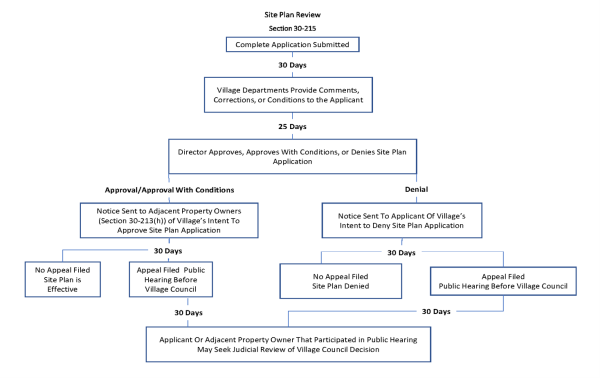
(Ord. No. 01-16, § 4(4.1.5), 11-8-2001; Ord. No. 02-29, § 2, 11-21-2002; Ord. No. 03-04, § 1, 3-27-2003; Ord. No. 09-01, § 2, 1-22-2009; Ord. No. 10-01, § 2, 1-14-2010)
Amended by Ord. 17-06 § 2 on 4/20/2017
Sec 30-216 Conditional Uses In General
- Conditional uses are those uses that are generally compatible with the other uses permitted in a zoning district, but that require individual review of their location, design, configuration and intensity and density of the use and structures, and may require the imposition of conditions pertinent thereto in order to ensure the appropriateness and compatibility of the use at a particular location. Conditional use review shall be accompanied by a site plan consistent with subsection 30-215(d), in addition to those standards listed below.
- A pre-application conference pursuant to section 30-214 is optional but encouraged before the submission of the initial application for a conditional use development permit.
- The director or his designee shall initiate review of a conditional use application upon receipt of a complete application for compliance with this chapter consistent with section 30-215(d).
- When considering an application for development permit for a conditional use, the director and village council shall consider the following factors, and no conditional use shall be approved which fails to meet any standard below. Failure to comply with any standard shall be deemed adverse to the public interest.
- The proposed conditional use is consistent with the purposes, goals, objectives and policies of the comprehensive plan, including standards for building and structural intensities and densities, and intensities of use;
- The proposed conditional use complies with all relevant and appropriate portions of this chapter;
- The proposed conditional use is compatible and generally consistent with the uses and character of the land surrounding and in the vicinity of the land proposed for development;
- The design of the proposed conditional use minimizes adverse effects, including visual impact and intensity of the proposed use on adjacent lands;
- The proposed conditional use complies with division 5 of this article (Concurrency Management);
- The proposed conditional use minimizes environmental impacts, including but not limited to water, air, stormwater management, wildlife, vegetation, wetlands and the natural functioning of the environment; and
- The proposed conditional use will result in logical, timely and orderly development patterns.
- The director, in accordance with the procedures, standards, and limitations of this chapter, shall approve, approve with conditions, or deny an application for a development permit for a minor conditional use after the review based on compliance with this chapter and after review by responsible village departments. When approved, a minor conditional use shall be noted on the official zoning map.
- The village council, in accordance with the procedures, standards, and limitations of this chapter, shall approve, approve with conditions, or deny an application for a development permit of a major conditional use after the review by the director or his designee. When approved, a major conditional use shall be noted on the official zoning map.
- Issuance of a development permit for a conditional use shall be deemed to authorize only the particular site configuration, layout and level of impacts that were approved unless the conditional use approval is rescinded or revoked as provided in this chapter. Permitted uses may occur in conjunction with or in place of the conditional use. A development permit for a conditional use shall run with the land.
- Development of the conditional use shall commence as provided for in this chapter. Phased projects must include 20 percent of the project's land area in the development of each phase, unless a phasing schedule is approved by the village council. Otherwise, the development permit for the conditional use shall be subject to the time limitations of this chapter. Receipt of a development permit for a conditional use shall not ensure that the approved development will receive subsequent approval for other applications for development permits unless the relevant and applicable portions of this chapter are met.
- The director may approve minor deviations from a development permit for a conditional use. Deviations in excess of the limits of this subsection shall be subject to village council review, action and approval, approval with conditions, or denial. Authorized minor deviations are those that allow minor redesign or change to a project that would not substantially change or increase the originally anticipated impacts. Minor deviations shall be limited to the following:
- The relocation of no more than 25 percent of the total approved square footage or other area indicated as being covered by structures, to portions of the site not previously covered, as long as it complies with the standards of this chapter;
- Redesign or change in use, where there is no increase in traffic impact;
- The reduction or relocation of areas set aside for community open space or recreation provided that such changes do not result in a substantial change in the approved amount, boundary configuration, or character of open space or recreation;
- An overall increase of no more than five percent in the total square footage covered by any structure as long as it complies with the requirements of this chapter;
- An overall increase of not more than five percent of the height of any structure as long as it complies with the requirements of this chapter; and
- Relocation of access points.
- A development permit for a conditional use may be amended, extended, varied or altered only pursuant to the standards and procedures established for its original approval, or as otherwise set forth in this chapter. Before any conditional use is amended, extended, varied or altered, the applicant shall demonstrate that a change of circumstances or conditions has occurred which make it necessary to amend, extend, vary or alter the conditional use.
(Ord. No. 01-16, § 4(4.1.6), 11-8-2001; Ord. No. 09-01, § 2, 1-22-2009)
Amended by Ord. 17-06 § 2 on 4/20/2017
Sec 30-217 Minor Conditional Use Review
- Only those uses that are authorized as minor conditional uses in article V of this chapter (Schedule of District Use and Development Standards) may be approved as minor conditional uses. The designation of a use as a minor conditional use does not constitute an authorization of such use or an assurance that such use will be approved under this chapter. Rather, each proposed minor conditional use shall be evaluated by the director of planning and development services for compliance with the standards and conditions set forth in this chapter.
- Based on compliance with this chapter and after review by responsible village departments, the director shall approve, approve with conditions, or deny the minor conditional use application.
- If a public hearing is requested, it shall be scheduled for the first available village council meeting upon completion of the planning and development services department review and evaluation of the application, and by the time the public notice requirements can be satisfied, or such time as is mutually agreed upon between the applicant and the director. The village shall be responsible for providing notice of the public hearing in accordance with the provisions of section 30-213(h) at the sole cost and expense of the person requesting the public hearing. The village council shall conduct at least one public hearing on a weekday pursuant to the procedures in division 3 of this article.
- At the public hearing, the village council shall consider the application, the relevant support materials, the director's recommendations, and public testimony given at the hearing. If at any time during the public hearing the village council determines that the application is based upon incomplete or inaccurate information or misstatements of fact, it may deny the application or refer the application back to the director for further review and revised recommendations.
- At the close of the public hearing, the village council by not less than a majority of a quorum present shall approve, approve with conditions, or deny the application by resolution, based on the standards in this chapter. The resolution shall be filed with the village clerk. Unless the resolution is appealed, the village shall record a certified copy of the resolution in the public records of the county at its sole cost and expense within ten working days of a non-appealable final order.
- The applicant, and adjacent property owners of the property subject to the proposed minor conditional use who have opposed it at a public hearing, may appeal the decision of the village council by filing a petition for writ of certiorari in the circuit court in and for the county, in accordance with the procedure provided by the Florida Rules of Civil Procedure and the Florida Rules of Appellate Procedure.
MINOR CONDITIONAL USE REVIEW
SECTION 30-217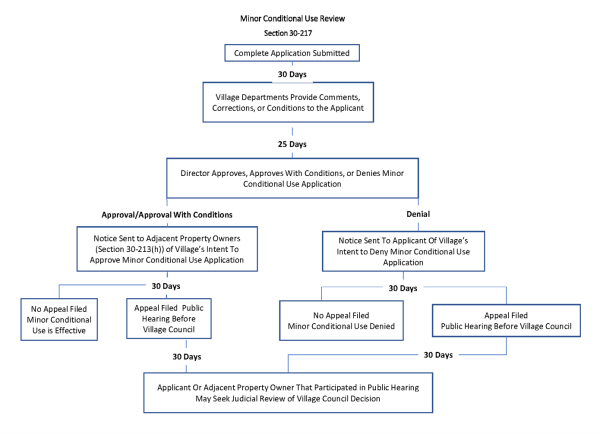
(Ord. No. 01-16, § 4(4.1.7), 11-8-2001; Ord. No. 02-29, § 2, 11-21-2002; Ord. No. 03-04, § 1, 3-27-2003)
Amended by Ord. 17-06 § 2 on 4/20/2017
Sec 30-218 Major Conditional Use Review
- Only those uses that are authorized as major conditional uses in article V of this chapter (Schedule of District Use and Development Standards) may be approved as major conditional uses. The designation of a use as a major conditional use in a zoning district does not constitute an authorization of such use or an assurance that such use will be approved under this chapter. Rather, each proposed major conditional use shall be evaluated by the director of planning and development services and the village council for compliance with the standards set forth in this chapter.
- Upon forwarding of the application to the village council, a public hearing on the application shall be scheduled for the first available regularly scheduled village council meeting upon completion of the planning and development services department review and evaluation of the application, and by the time the public notice requirements can be satisfied, or such time as is mutually agreed upon between the applicant and the director. The village shall be responsible for providing the notice required under section 30-213(i).
- The village council shall hold at least one public hearing on a weekday, pursuant to the procedures in division 3 of this article.
- At the public hearing, the village council shall consider the application, the relevant support materials, the director's recommendation, and public testimony given at the hearing. If at any time during the public hearing the village council determines that the application is based upon incomplete or inaccurate information or misstatements of fact, it may deny the application or refer the application back to the director for further review and revised recommendation.
- At the close of the public hearing, the village council by not less than a majority of a quorum present shall approve, approve with conditions, or deny the application by resolution based on the standards in this chapter. The resolution shall be filed with the village clerk. Unless the resolution has been appealed, the village shall record a certified copy of the resolution in the public records of the county at the applicant's sole cost and expense within ten working days of a non-appealable final order.
- The applicant, and any aggrieved person who has opposed the major conditional use application at a public hearing, may appeal the decision of the village council by filing of a petition for writ of certiorari in the circuit court in and for the county, in accordance with the procedure provided by the Florida Rules of Civil Procedure and the Florida Rules of Appellate Procedure. For the purposes of this subsection, an "aggrieved person" shall mean any person that will suffer an adverse effect because of the decision of the village council. The alleged adverse interest may be shared in common with other members of the community at large, but shall exceed in degree the general interest in community good shared by all persons.
MAJOR CONDITIONAL USE REVIEW
SECTION 30-218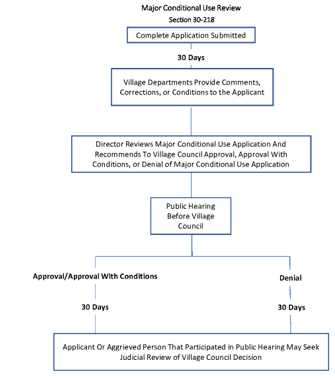
(Ord. No. 01-16, § 4(4.1.8), 11-8-2001; Ord. No. 02-29, § 2, 11-21-2002; Ord. No. 03-04, § 1, 3-27-2003)
Amended by Ord. 17-06 § 2 on 4/20/2017
Sec 30-219 Building Permits And Certificates Of Occupancy
- No building permit shall be issued without written approval from the director of planning and development services that plans submitted conform to applicable provisions of this chapter. No building permit shall be issued by the building official except in conformity with the provisions of this chapter and the Code, unless the applicant receives a written resolution by the village council regarding a variance as provided by this chapter, or unless the applicant receives a written non-appealable final order from a court of competent jurisdiction authorizing the issuance of a building permit.
- All applications for building permits shall, in addition to containing the information required by the building and planning and development services departments, be accompanied by a site plan application as approved by the director of planning and development services. The director's approval of the application shall in no way exempt the applicant from complying with the applicable provisions of this chapter, the Code, and all other applicable regulations, ordinances, codes and laws.
- Building permits issued based on plans and specifications approved by the director authorize only the use, arrangement, and construction set forth in such approved plans and applications, and no other use, arrangement, or construction is permitted. A foundation or spot location survey shall be provided before receiving the second inspection for construction authorized by the permit. This survey shall show the slab or first floor elevation and shall show setbacks to all property lines. Use, arrangement or construction different from that authorized shall be deemed a violation of the Code. The director's approval of the application shall in no way exempt the applicant from strict observation of applicable provisions of this chapter and all other applicable regulations, ordinances, codes and laws.
- A building permit issued in error shall not confer any rights or privileges to the applicant to proceed with construction and the village shall have the power to revoke such permit.
- Prior to receipt of a final certificate of occupancy, all development shall comply with this chapter and any conditions imposed during the development approval process.
- In no event shall any building or structure be occupied or used until a certificate of occupancy is issued by the building official or designee, after issuance of a certificate of compliance by the director in accordance with section 30-220, and after a determination that the building or structure has been constructed in accordance with the provisions of any conditional use permit, plat approval, site plan, other development approval or building permit.
- Whenever the principal use of an existing building or structure is to be changed, or a home occupation is to be established, the owner, agent, lessee or intended occupant thereof shall apply to the director for a certificate of compliance in accordance with section 30-220, and to the building official for a certificate of occupancy stating that the new use is an approved use within the zoning district in which the structure or parcel is located. The building official shall issue a certificate of occupancy only when the new use conforms to the requirements of this chapter, and no site preparation or construction permits are necessary.
- The director and the building official, or designees, shall inspect the property that is the subject of an application for a certificate of occupancy to determine whether the use of the property and the structure comply in all respects with the provisions of this chapter and the Code, including the provisions of any conditional use permit, and to determine whether all construction debris is removed from the site. If the use and building or structure does not comply with this chapter or the Code or with any regulations or rules promulgated by the building official, the building official shall deny the application in writing, setting forth the provisions of the comprehensive plan, this chapter or the Code with which the use, building or structure does not comply. The decision of the building official may be appealed to the village council in accordance with the provisions of section 30-281.
- The building official may revoke any certificate of occupancy if a false statement is contained in the application on which the certificate was issued or if the subsequent use does not conform to the requirements of the land use or zoning district in which the structure or parcel is located. The decision of the building official may be appealed to the village council in accordance with the provisions of section 30-281.
(Ord. No. 01-16, § 4(4.1.9), 11-8-2001; Ord. No. 02-29, § 2, 11-21-2002)
Sec 30-220 Certificate Of Compliance
- A certificate of compliance shall be required before issuance of any building permit when no other development permit is required other than a building permit. Only those uses that are authorized as permitted uses in the applicable zoning district in article V of this chapter (Schedule of District Use and Development Standards) may be granted a certificate of compliance. Each certificate of compliance shall be evaluated by the director of planning and development services for compliance with the provisions of this chapter.
- The director shall advise the applicant in writing whether the application complies with the applicable provisions of this chapter. An applicant shall be provided 20 days after the director's recommendation to satisfy any requirement without the application being denied.
- The director shall approve, approve with conditions or deny the certificate of compliance application.
- If the director decides to approve, or approve with conditions, the certificate of compliance application, the director shall give the applicant written notice of the village's intent to issue the certificate of compliance permit. Thereafter, in accordance with the provisions of section 30-213(h), the village shall provide posted and written notice to adjacent property owners of the intent to issue the certificate of compliance. Within 30 days of the date of the posted and written notice of intent, a public hearing on the certificate of compliance application permit may be requested in writing to the director, by the applicant, or an adjacent property owner. If a public hearing is not requested in accordance with this subsection, the director shall issue a written notice of approval to the applicant, approving, or approving with conditions, the certificate of compliance.
- If it is the decision of the director to deny the certificate of compliance, the director shall give the applicant written notice of the village's intent to deny the certificate of compliance permit. Within 30 days of the issuance of the notice of intent to deny, the applicant may request a public hearing on the certificate of compliance application in writing to the director.
- If a public hearing is requested, it shall be scheduled for the first available village council meeting upon completion of the planning and development services department review and evaluation of the application, and by the time the public notice requirements can be satisfied, or such time as is mutually agreed upon between the applicant and the director. The village shall be responsible for providing notice of the public hearing in accordance with the provisions of section 30-213(h) at the sole cost and expense of the person requesting the public hearing. The village council shall conduct at least one public hearing on a weekday, and shall conduct the public hearing on a weekday and pursuant to the procedures in division 3 of this article.
- At the public hearing, the village council shall consider the application, the relevant support materials, the director's recommendations, and public testimony given at the hearing. If at any time during the public hearing the village council determines that the application is based upon incomplete or inaccurate information or misstatements of fact, it may deny the application or refer the application back to the director for further review and revised recommendations.
- At the close of the public hearing, the village council by not less than a majority of a quorum present shall approve, approve with conditions, or deny the application by resolution based on the standards in this chapter. The resolution shall be filed with the village clerk.
- When considering an application for a certificate of compliance, the director and village council shall consider the following factors, and no certificate of compliance shall be approved which fails to meet any standard below. Failure to comply with any standard shall be deemed adverse to the public interest.
- The proposed certificate of compliance is consistent with the purposes, goals, objectives and policies of the comprehensive plan.
- The proposed certificate of compliance complies with all relevant and appropriate standards of this chapter.
CERTIFICATE OF COMPLIANCE
SECTION 30-220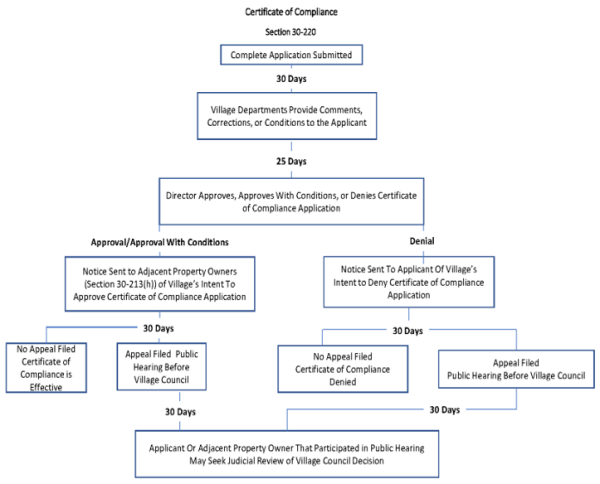
(Ord. No. 01-16, § 4(4.1.10), 11-8-2001; Ord. No. 02-29, § 2, 11-21-2002; Ord. No. 03-04, § 1, 3-27-2003)
Amended by Ord. 17-06 § 2 on 4/20/2017
Sec 30-221 Variances In General
- A variance is relaxation of the terms of this chapter where such action will not be contrary to the public interest and where, owing to conditions peculiar to the property and not the result of actions of the applicant, a literal enforcement of this chapter would result in unnecessary and undue hardship on the property. As used in this section, a variance is authorized only for height, setbacks, parking, and loading requirements, and landscaping, unless otherwise specified in this chapter. Under no circumstances shall the director of planning and development services or the village council grant a variance to permit a floor area ratio or a use not permitted under the terms of this chapter.
- Nonconforming use of neighboring lands, structures, or buildings in the same zoning district, and permitted use of lands, structures, or buildings in any other zoning district, shall not be considered grounds for the granting of a variance. The director or village council shall not grant a variance from the terms of this chapter unless and until every mitigating measure to offset the impact of the relaxed requirement has been taken. Nor shall the director or village council grant a variance that has the effect of providing relief from a requirement of this chapter or the Code that a property owner has been cited for violating, unless and until one of the following events has occurred:
- The code compliance department has determined the violation no longer exists or recurs; or
- The property owner has appeared before the village code compliance hearing officer, who shall determine whether a violation has occurred and there is an appropriate non-appealable final order.
- The director shall initiate review of a variance application upon receipt of a complete application for compliance with this chapter. Concurrently, within 30 days of a complete application representatives from village departments responsible for reviewing land development proposals including but not limited to building, fire, sheriff, public works and utilities shall provide comments, corrections or conditions to the applicant to determine compliance.
- When considering an application for a variance, the director and village council shall consider the following factors, and no variance shall be approved which fails to meet any standard below. Failure to comply with any standard shall be deemed adverse to the public interest.
- Special conditions and circumstances exist which are peculiar to the land, structure, or building involved and which are not applicable to other lands, structures, or buildings in the same zoning district;
- The special conditions and circumstances do not result from the actions of the applicant;
- Literal interpretation of the provisions of this chapter deprives the applicant of rights commonly enjoyed by other properties in the same zoning district under the terms of this chapter and works unnecessary and undue hardship on the applicant;
- Granting the variance requested conveys the same treatment to the individual owner as to the owner of other lands, buildings, or structures in the same zoning district;
- The variance, if granted, is the minimum variance that makes possible the reasonable use of the land, building, or structure; and
- The grant of the variance is in harmony with the general intent and purpose of this chapter, and is not injurious to the neighborhood, or otherwise detrimental to the public welfare.
- The director, in accordance with the procedures, standards, and limitations of this chapter, shall approve, approve with conditions, or deny an application for an administrative variance of up to 25 percent of the height, setbacks, parking, and loading requirements, and landscaping of this chapter, after the review and demonstrated compliance with the criteria established in subsection 30-221(d).
- The village council, in accordance with the procedures, standards, and limitations of this chapter, shall approve, approve with conditions, or deny an application for a variance after the review by the director. When approved, a variance shall be noted on the official zoning map.
- Issuance of a variance shall be deemed to authorize only the particular site configuration, layout and level of impacts that were approved unless the variance is rescinded or revoked as provided in this chapter.
- Receipt of a development permit for a variance shall not ensure that the approved development will receive subsequent approval for other applications for development permits unless the relevant and applicable portions of this chapter are met.
(Ord. No. 01-16, § 4(4.1.11), 11-8-2001; Ord. No. 02-29, § 2, 11-21-2002)
Amended by Ord. 17-06 § 2 on 4/20/2017
Sec 30-222 Administrative Variance Review
- Based on compliance with this chapter and after review by responsible village departments, the director shall approve, approve with conditions, or deny the administrative variance application.
- Reserved.
- If a public hearing is requested, it shall be scheduled for the first available village council meeting upon completion of the planning and development services department review and evaluation of the application, and by the time the public notice requirements can be satisfied, or such time as is mutually agreed upon between the applicant and the director. The village shall be responsible for providing notice of the hearing in accordance with the provisions of section 30-213(k) at the sole cost and expense of the applicant. The village council shall conduct at least one public hearing on a weekday pursuant to the procedures in division 3 of this article.
- At the public hearing, the village council shall consider the application, the relevant support materials, the director's recommendations, and public testimony given at the hearing. If at any time during the public hearing the village council determines that the application is based upon incomplete or inaccurate information or misstatements of fact, it may deny the application or refer the application back to the director for further review and revised recommendations.
- At the close of the public hearing, the village council by not less than a majority of a quorum present shall approve, approve with conditions, or deny the application by resolution, based on the standards in this chapter. The resolution shall be filed with the village clerk. Unless the resolution is appealed, within ten working days of the filing of the resolution with the village clerk, the village shall record a certified copy of the resolution in the public records of the county at the applicant's sole cost and expense.
- The applicant, and adjacent property owners of the property subject to the proposed administrative variance who have opposed it at a public hearing, may appeal the decision of the village council by filing a petition for writ of certiorari in the circuit court in and for the county, in accordance with the procedure provided by the Florida Rules of Civil Procedure and the Florida Rules of Appellate Procedure.
ADMINISTRATIVE VARIANCE
SECTION 30-222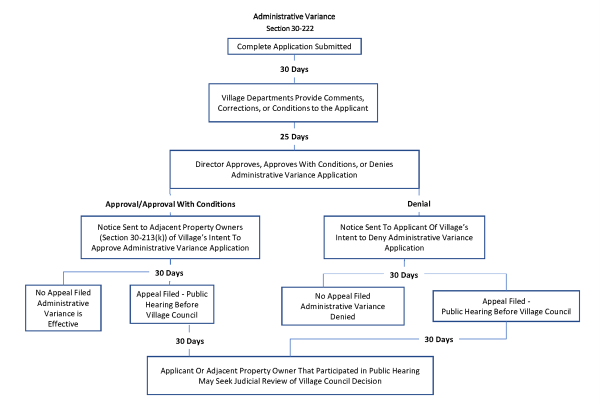
(Ord. No. 01-16, § 4(4.12), 11-8-2001; Ord. No. 02-29, § 2, 11-21-2002; Ord. No. 03-04, § 1, 3-27-2003)
Amended by Ord. 17-06 § 2 on 4/20/2017
Sec 30-223 Procedure For Variances
- Upon forwarding of the application to the village council, a public hearing on the application shall be scheduled for the first available village council meeting upon completion of the planning and development services department review and evaluation of the application, and by the time the public notice requirements can be satisfied, or such time as is mutually agreed upon between the applicant and the director. The village shall be responsible for providing the notice required under section 30-213(j).
- The village council shall hold at least one public hearing on a weekday, pursuant to the procedures in division 3 of this article.
- At the public hearing, the village council shall consider the application, the relevant support materials, the director's recommendation, and public testimony given at the hearing. If at any time during the public hearing the village council determines that the application is based upon incomplete or inaccurate information or misstatements of fact, it may deny the application or refer the application back to the director for further review and revised recommendations.
- At the close of the public hearing, the village council by not less than a majority of a quorum present shall approve, approve with conditions, or deny the variance application by resolution based on the standards in this chapter. The resolution shall be filed with the village clerk. Unless the resolution has been appealed, the village shall record a certified copy of the resolution in the public records of the county at the applicant's sole cost and expense within ten working days of a non-appealable final order.
- The applicant, and any aggrieved person who has opposed the variance application at a public hearing, may appeal the decision of the village council by filing of a petition for writ of certiorari in the circuit court in and for the county, in accordance with the procedure provided by the Florida Rules of Civil Procedure and the Florida Rules of Appellate Procedure. For the purposes of this subsection, an "aggrieved person" shall mean any person that will suffer an adverse effect because of the decision of the village council. The alleged adverse interest may be shared in common with other members of the community at large, but shall exceed in degree the general interest in community good shared by all persons.
VARIANCE REVIEW
SECTION 30-223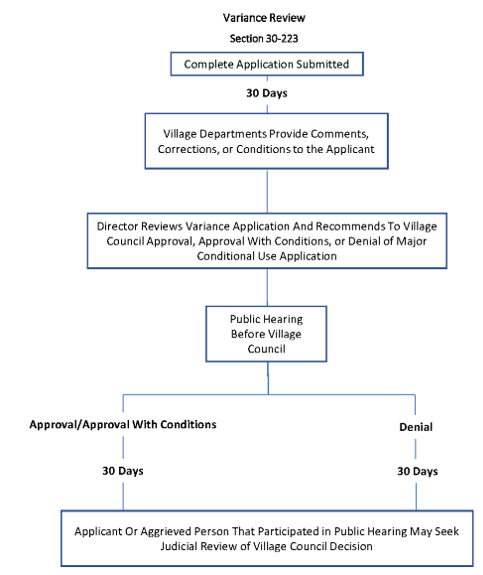
(Ord. No. 01-16, § 4(4.1.13), 11-8-2001; Ord. No. 02-29, § 2, 11-21-2002; Ord. No. 03-04, § 1, 3-27-2003)
Amended by Ord. 17-06 § 2 on 4/20/2017
Sec 30-224 Compliance With Conditions And Time Limitations
- To protect the public welfare, it is the purpose of this section to ensure compliance with specific conditions and time requirements for the completion of activities approved by development permits. Such activities may include, but are not limited to, construction of facilities and provision of services to the development, execution of a unity of title or restrictive covenant, and dedication of improvements or property to the village. This section creates an administrative program to monitor and provide time extensions for activities which must be completed within a certain time period pursuant to a development permit and to ensure that conditions are met and not violated. Unless otherwise established in the development permit, all development permits shall comply with the time limitations established in table 30-225. Timeframes do not change with successive owners. Table 30-225 also provides time requirements for the commencement and completion of the development project.
- The village council recognizes that development is a complicated process. Despite efforts on the part of developers to proceed according to plans, unforeseen factors may interfere with the schedule or development and compliance with conditions of approval. Administrative reviews must be flexible enough to accommodate unforeseen circumstances. The review procedure created in this section is intended to provide a reasonably flexible system for administrative review and monitoring of the progress of development activities and approval of time extensions.
- When the director, village council or any provision of this chapter has imposed a condition of development approval or time limit for the completion or duration of a specific activity or phase of development, the property owner shall be responsible for compliance.
- The review process set forth in this section shall apply to all development permits, except for the rezoning of a single lot to a residential zoning district that corresponds to the minimum density permitted in the comprehensive plan; site plans; variances; and building permits.
- Upon expiration of any time period established by this chapter or development permit, or noncompliance with a condition of approval, no new development permits affecting the property shall be issued by the village, and no action which might tend to vest the development permit shall be permitted, until a determination is made by the director on the status of the development permit. If the director determines that any time period has expired or noncompliance with a condition of approval has occurred, the director shall file with the clerk of the circuit court a notice of such time expiration or noncompliance, which shall be placed with the records governing title to the affected property. The notice may apply only to that portion of the property related to the expired time or unfulfilled condition. The notice shall advise that:
- A time certain activity has not proceeded as required;
- A review of the project will be conducted pursuant to terms of this section;
- Until the review is completed, no new development permits shall be issued by the village, and no action which might tend to vest the development permit shall be permitted; and
- Such other information as may be reasonable and necessary to afford adequate record notice of the effect of this section on the rights of property owners.
- Within 15 days of the recording of the notice, the director shall prepare a status report on the development permit. The status report shall contain a description of the development permit; a summary of the background and current status of the development, including any documentation provided to staff of efforts to comply with conditions or time requirements, or circumstances beyond the control and cause of the property owner, other than economic conditions, which have prevented compliance; a description of any code violations; a description of any uncompleted conditions or time certain requirements; a description of any violation of a condition of approval and circumstances related to the violation; as well as determination of whether the development permit is consistent with the comprehensive plan and with this chapter. The status report shall contain a recommendation as to whether the village council should grant a time extension to the development permit, modify the development permit conditions, revoke the development permit, issue a stop work order, or take any other action authorized by this chapter, the Code or law. A public hearing on the director's status report shall be scheduled for the first available village council meeting upon completion of the planning and development services department review and evaluation of the application, and by the time the public notice requirement can be satisfied, or such time as is mutually agreed upon between the applicant and the director. The director shall be responsible for providing written notice of the hearing to the permit holder and the notice required under section 30-213(j).
- The village council shall hold at least one public hearing on a weekday, and shall conduct the hearing pursuant to the procedures in division 3 of this article. At the public hearing, the village council shall consider the director's report, testimony by the permit holder, and any public testimony given at the hearing. At the close of the public hearing, the village council by not less than a majority of a quorum present shall by resolution take one or more of the following actions:
- Grant a time extension. The time extension may require the permittee to either:
- Commence and complete the development project within 24 months. This time extension shall commence upon the expiration of the date to complete the time certain activity or the expiration of the last extension whichever is applicable. When the village council approves an extension of time for the payment of fees, the amount due shall increase by an interest payment equal to 12 percent a year. If the extension covers a period less than a year, the interest shall be prorated.
- Comply with all conditions of approval within a period not to exceed 24 months.
- Impose additional or modified conditions or allow the permittee to initiate a development application to add or modify conditions. New or modified conditions may include bringing the development into conformity with current codes and regulations.
- Direct staff to pursue code enforcement proceedings.
- Amend or revoke the development permit for the undeveloped or unplatted portion of the project.
- Deny or revoke a development or building permit; issue a stop work order; deny a certificate of occupancy on any building or structure; revoke any concurrency certification; deny or revoke any permit or approval for any developer-owner, commercial-owner, lessee, or user of the subject property.
- In the event that the permit holder has not complied with a condition of development approval or time certain activity at the expiration of a time extension, the development permit shall automatically expire and become void.
- Grant a time extension. The time extension may require the permittee to either:
- If the village council approves further development as provided herein, a second notice shall be filed with the clerk of the court to be placed with the records governing title to the property indicating:
- That the rights to develop have been restored; and
- Such other information as may be reasonable and necessary to afford adequate record notice of the effect of this section on the rights of property owners.
- This second notice shall only be recorded upon payment of all status report fees as established from time to time by the village council, and upon payment of any outstanding liens or debts owed on the subject property to the village. The status report fee may be waived if:
- The property owner is a government agency; or
- The property owner is prevented from complying by a government-caused delay or by litigation that would prevent action by the property owner to bring the approval into compliance.
- In the event litigation contesting the validity of a lien or fine is initiated or pending prior to the time the status report fee is due, the second notice shall be recorded and payment of the lien or fine, if upheld by the courts, shall be deferred until 35 days after the entry of a non-appealable final order. If the court upholds the lien or fine, but the lien or fine is not paid on or before the 35th day, the development permit shall automatically expire and become void.
- If the village council approves further development as provided herein, a second notice shall be filed with the clerk of the court to be placed with the records governing title to the property indicating:
- There will be no suspension of development permits if the director's recommendation in the status report to the village council is to delete a condition of approval.
(Ord. No. 01-16, § 4(4.1.14), 11-8-2001; Ord. No. 03-04, § 1, 3-27-2003)
Sec 30-225 Administrative Time Extensions
The permit holder, owner of record, the current agent, or mortgagor demonstrating a secured interest in the property which is not being protected by the permit holder may file an application with the director of planning and development services for an administrative extension of time of a development permit. The application shall be filed on or before the expiration of the time periods established in table 30-225. The director may thereafter grant an extension of time in accordance with table 30-225. A time extension shall commence upon the expiration of the date to comply with the time requirement, or the expiration of the development permit, whichever is applicable. Table 30-225 provides the maximum length of each administrative time extension except when there is a government-caused delay.
- When a government-caused delay is documented, the director shall grant such extensions as necessary to offset government-caused government-caused delays, not necessarily equal to the time of the delay, and each extension shall be based only on a delay that has already occurred. It is the responsibility of the property owner to notify the director in writing of the delay, and document the cause of the delay; however, no application or fee will be required.
- A one-time extension not to exceed 12 months shall be the maximum length of any administrative extension except for government-caused delays.
- In reviewing applications for administrative time extensions, the director shall approve a time extension provided there are no current code violations or outstanding liens or fines and the development permit is consistent with the comprehensive plan, and with this chapter.
- In reviewing applications for administrative time extensions, the director shall consider the following:
- Attempts by the applicant to complete the unfulfilled condition or time limitation.
- The reliance by other parties on the timely performance of activity.
- Any changed circumstances that have interfered with the ability of the property owner to meet the time certain requirement.
- Actions of other parties that may have precluded compliance.
- The existence of extraordinary mitigating factors.
- When the extension of time is for the payment of fees owed the village, the amount due shall increase by an interest payment equal to 12 percent a year. If the extension covers a period less than a year, then the interest shall be prorated.
- When the director approves an extension of time for completion of a time certain requirement, the director may require the permittee or property owner to guarantee the completion by furnishing a cash deposit, letter of credit, or surety bond.
- An appeal of the director's denial of an administrative time extension may be made to the village council in accordance with the provisions of division 4 of this article.
TABLE 30-225Type of Development Permit
Maximum Number of Phases1
Next Required Action or Development Permit
Maximum Time to Receive Next Development Permit and Commence Development2
Maximum Length of Administrative Time Extension
Action Upon Failure to Comply with Time Requirement Without a Time Extension
Rezoning
2
1. Conditional use (if applicable).
2. Site plan (if applicable).
3. Certificate of compliance/building permit.
4. Commence development.3 years
12 months
Village council review
Conditional use
2
1. Certificate of compliance/building permit.
2. Commence development—construction is required.3 years
12 months
Village council review
Site plan
2
1. Certificate of compliance/building permit.
2. Commence development.2 years
12 months
Village council review
Building permit
1. Commence development.
Per Code
Per Code
Building permit void
Certificate of appropriateness
1. Certificate of compliance/building permit.
2. Commence development.365 days
180 days
Certificate void
;le=2;1 Each phase must contain a minimum of 20 percent of the land area, unless otherwise approved in the development permit.
;le=2;2 Commencement of development shall consist of:
;le=2;1. ;le=2;Receipt of a building permit and first inspection approval; or
;le=2;2. ;le=2;The initiation of significant site improvements such that the improvements would only permit the development of the approved project, and any other pattern of development would require extensive changes to the installed improvements.
;le=2;Commencement of development shall not consist of:
;le=2;1. ;le=2;The dividing of land into parcels;
;le=2;2. ;le=2;Demolition of a structure;
;le=2;3. ;le=2;Deposit of refuse, solid or liquid waste, or fill on the parcel, unless the development order is exclusively and specifically for such; or
;le=2;4. ;le=2;The clearing of land.
(Ord. No. 01-16, § 4(4.1.15), 11-8-2001; Ord. No. 09-17, § 2, 9-24-2009)
Sec 30-251 Intent
The intent of this division is to establish procedures to ensure procedural due process and maintain citizen access to the local government decision-making process for the review of development orders requiring quasijudicial hearings. These procedures shall be applied and interpreted in a manner recognizing both the legislative and judicial aspects of the local government decision-making process in quasijudicial hearings. They shall only apply to the hearings held by the council with the authority to make the final decision in regard to the development order.
(Ord. No. 01-19, § 1(4.2.1), 11-19-2001)
Sec 30-252 Applicability
Except as may otherwise be provided by statute or ordinance, these procedures shall apply to all applications for site-specific rezonings, administrative relief, beneficial use review, conditional use permits, site plan approval, variances, plats, and any other land use proceeding in which the council acts in a quasijudicial capacity.
(Ord. No. 01-19, § 1(4.2.2), 11-19-2001)
Amended by Ord. 15-06 § 2 on 5/28/2015
Sec 30-253 Definitions
The following words, terms and phrases, when used in this division, shall have the meanings ascribed to them in this section, except where the context clearly indicates a different meaning:
Applicant means the owner of record, the owner's agent, or any person with a legal or equitable interest in the property for which an application for a development order has been made and which is subject to quasijudicial proceedings.
Application means an application for any one of the following permits:
- Administrative relief.
- Beneficial use proceedings.
- Conditional use permits.
- Plat approvals.
- Site-specific rezonings.
- Site plan approvals.
- Variances.
- Vested rights determinations.
- Any other site-specific development approval determined to be quasijudicial by the village attorney.
Competent substantial evidence means testimony or other evidence based on personal observation, or fact or opinion evidence offered by an expert on a matter that requires specialized knowledge, that is relevant to the issue to be decided. Competent substantial evidence is evidence a reasonable mind could accept as adequate to support a conclusion.
Comprehensive plan means the village comprehensive plan which has been adopted pursuant to F.S. ch. 163, pt. II (F.S. § 163.3161 et seq.).
Council means the Islamorada, Village of Islands, Village Council.
Councilmember means a village council member hearing the application (see the definition of "council" in this section).
Ex-parte communication means any written, oral, or graphic communication with a councilmember which may relate to or which could influence the disposition of an application, other than those made on the record during a quasijudicial hearing. This term also includes visiting the site of the application, receipt of expert opinions, and any independent investigations by councilmembers.
Expert means a person who is qualified in a subject matter by knowledge, skill, experience, training, or education.
Material fact means a fact that bears a logical relationship to one or more issues raised by the application or the laws and regulations pertaining to the matter requested by the application.
Participants means members of the general public, other than the applicant, including experts and representatives of local governments and governmental agencies, who offer testimony at a quasijudicial hearing for the purpose of being heard on an application.
Party means the applicant, the village staff, and any person recognized by the council as a qualified intervenor.
Quasijudicial proceeding means a hearing held by the council to adjudicate the private rights of an applicant by means of a hearing which comports with this chapter and due process requirements.
Relevant evidence means evidence which tends to prove or disprove a fact that is material to the determination of the application.
Staff means members of the village staff.
(Ord. No. 01-19, § 1(4.2.3), 11-19-2001)
Cross reference(s)—Definitions generally, § 1-2.
Amended by Ord. 15-06 § 2 on 5/28/2015
Sec 30-254 Ex-Parte Communication
- This section is adopted to follow the disclosure processes of F.S. § 286.0115(1), and shall be construed so as to be consistent therewith.
- Any councilmember may choose to discuss the merits of any matter on which action may be taken by the council with any person not otherwise prohibited by statute, Charter provision, or ordinance if the councilmember complies with the procedures of this section.
- Compliance with the procedures of this subsection shall remove the presumption of rejudice arising from ex-parte communication with any councilmember:
- Oral communications. The subject of the communication and the identity of the person, group, or entity with whom the communication took place shall be disclosed and made a part of the record before final action on the application. At the quasijudicial hearing the person or persons responsible for the ex-parte communication, any party to the hearing and any participant shall have the opportunity to contest the accuracy of the matters disclosed.
- Written communications. Any written communication related to an application pending before the council shall be forwarded to the appropriate staff for inclusion in the official file for the application, and shall be disclosed on the record before final action on the matter. It shall be the responsibility of the applicant to review the official file periodically to determine whether written ex-parte communications have been placed in the official file.
- Investigations, site visits and expert opinions. Councilmembers may conduct investigations and site visits and may receive expert opinions regarding a quasijudicial action pending before them. Such activities shall not be presumed prejudicial to the action if the existence and subject matter of the investigations, site visits, or expert opinions is made a part of the record before final action on the matter and an opportunity for the parties and participants to respond is provided prior to or at the hearing.
- Councilmembers must make disclosures of the ex-parte communications listed in subsection (c)(1), (2), or (3) of this section before or during the public meeting at which a vote is taken on the application, to afford persons a reasonable opportunity to refute or respond to the communication.
(Ord. No. 01-19, § 1(4.2.4), 11-19-2001)
Sec 30-255 General Procedures
- Witnesses and evidence. Each party shall have the right to call and examine witnesses, to introduce exhibits, to cross examine opposing witnesses on any relevant matter (subject to the rules contained herein), and to rebut evidence.
- Duties of village staff. Staff shall have the responsibility of presenting the case on behalf of the village. The staff report on the application shall be posted on the Village website at least ten (10) days prior to the quasijudicial hearing on the application.
- Official file. All written communication received by councilmembers or staff concerning an application, the staff report on the application, any petitions or other submissions from the public, and all other documents pertaining to the application upon receipt shall be filed in the official file for the application, which shall be maintained by staff. The comprehensive plan and the village Code shall be deemed to be part of the official file. The official file shall be available for inspection during normal business hours.
- Agenda. The printed agenda for the meeting at which the quasijudicial hearing is scheduled to take place shall briefly explain the procedures and nature of the quasijudicial hearing.
(Ord. No. 01-19, § 1(4.2.5), 11-19-2001)
Amended by Ord. 15-06 § 2 on 5/28/2015
Amended by Ord. 23-07 on 10/23/2023
Sec 30-256 Hearing Procedures
- The hearing shall, to the extent possible, be conducted as follows:
- The mayor or village attorney shall read a statement at the beginning of the quasijudicial hearing portion of the agenda, which shall outline the procedure to be followed. A copy of this division shall be made available at the hearing.
- The applicant, staff, and all participants requesting to speak shall be collectively sworn by oath or affirmation.
- The applicant may waive its right to an evidentiary hearing if it agrees with the staff recommendation and no one from the audience wishes to speak for or against the application. The council may then vote on the item, based upon the staff report and any other materials entered by staff from the official file into the record of the hearing.
- If there is an evidentiary hearing, the order of the presentation shall be as follows, unless the council agrees to a different order, taking proper consideration of fairness and due process:
- Staff shall present a brief synopsis of the application, introduce any additional exhibits from the official file which have not already been transmitted to the council with the agenda materials, summarize issues, and make a recommendation on the application. Staff may also introduce and provide the testimony of any witnesses.
- The applicant shall make its presentation, including offering any exhibits from the official file, and introduce and provide the testimony of any witnesses.
- Participants in support of the application shall make their presentations.
- Participants in opposition to the application shall make their presentations.
- Staff may cross examine any witnesses and respond to any testimony presented. If any witness is unavailable at the hearing to be cross examined, his testimony shall be disregarded.
- The applicant may cross examine any witnesses and respond to any testimony presented. If any witness is unavailable at the hearing to be cross examined, his testimony shall be disregarded.
- The mayor may choose to allow participants to respond to any testimony if the mayor deems the response to be necessary to ensure fairness and due process.
- The council may ask any questions of the staff, applicant and participants.
- Final argument may be made by the staff, related solely to the evidence in the record.
- Final argument may be made by the applicant, related solely to evidence in the record.
- The mayor shall keep order, and without requiring an objection, may direct a party conducting the cross examination to stop a particular line of questioning that merely harasses, intimidates or embarrasses the individual being cross examined, is unduly repetitious, not relevant or beyond the scope of the testimony by the individual being cross examined. If the party conducting the cross examination continuously violates directions from the mayor to end a line of questioning deemed irrelevant and merely designed to harass, intimidate or embarrass the individual, the mayor may terminate the cross examination.
- After the presentations, and at the conclusion of any continuances, the council shall deliberate on the application. Once the council begins its deliberations, no further presentations or testimony shall be permitted except in the sole discretion of the council. The council's decisions must be based upon competent substantial evidence in the record.
- The council may, on its own motion or at the request of any person, continue the hearing to a fixed date, time, and place. A written request by the applicant for a continuance of a maximum of 180 calendar days shall be granted one time by the director of planning and development services, provided that the request is received at least seven working days prior to the date that the public hearing is scheduled to occur. If the request is not received within the time period specified above, the request shall be considered by the village council at its sole discretion. The village council shall not grant a continuance of more than 180 calendar days from the date of the scheduled public hearing at which the applicant made the request.
(Ord. No. 01-19, § 1(4.2.6), 11-19-2001)
Amended by Ord. 15-06 § 2 on 5/28/2015
Sec 30-257 Rules Of Evidence
- The council shall not be bound by the strict rules of evidence, or limited only to consideration of evidence which would be admissible in a court of law.
- The council may exclude evidence or testimony which is not relevant, material, or competent, or testimony which is unduly repetitious or defamatory.
- The council will determine the relevancy of evidence.
- Matters relating to an application's consistency with the village comprehensive plan or this chapter will be presumed to be relevant and material.
- Hearsay evidence may be used for the purpose of supplementing or explaining other evidence, but it shall not be sufficient by itself to support a finding unless it would be admissible over objection in a court.
- Documentary evidence may be presented in the form of a copy of the original, if available. A copy shall be made available to the council and to the staff no later than two days prior to the hearing on the application. Upon request, the applicant and staff shall be given an opportunity to compare the copy with the original. Oversized exhibits shall be copied and reduced for convenient record storage.
- Only the applicant, staff and the council shall be entitled to conduct cross examination when testimony is given or documents are made a part of the record.
- The village attorney shall represent the council and advise the council as to the procedures to be followed and the propriety and admissibility of evidence presented at the hearing.
- The council shall take judicial notice of all state and local laws, ordinances and regulations and may take judicial notice of such other matters as are generally recognized by the courts of the state.
- Supplementing the record after the quasijudicial hearing is prohibited, unless specifically authorized by an affirmative vote of the council under the following conditions:
- The supplementation occurs after a quasijudicial hearing is continued but prior to final action being taken on the application.
- If a question is raised by the council at the hearing which cannot be answered at the hearing, the party to whom the question is directed may submit the requested information in writing to the council after the quasijudicial hearing, with copies to the other parties, provided the hearing has been continued or another hearing has been scheduled for a future date and no final action has been taken by the council. The information requested will be presented to the council at the time of the continued hearing.
- All parties and participants shall have the same right with respect to the additional information as they had for evidence presented at the hearing.
(Ord. No. 01-19, § 1(4.2.7), 11-19-2001)
Sec 30-258 Final Decision By Council
The council shall reach a decision without unreasonable or unnecessary delay. All development orders adopted by the council shall be reduced to writing and dated as of the date issued. Notification of the council's development order shall be provided to the applicant by certified mail, and made available to any person who requests a copy from the village clerk.
(Ord. No. 01-19, § 1(4.2.8), 11-19-2001)
Sec 30-259 Record
All evidence admitted into the record at the hearing, and the adopted development order of the council, shall be maintained by the village clerk for a period of at least 45 days from issuance of the development order. Thereafter, the evidence and the adopted development order shall be maintained in the same manner as are the village public records.
(Ord. No. 01-19, § 1(4.2.9), 11-19-2001)
Sec 30-281 Generally
- Any person aggrieved by an administrative decision or interpretation of the director of planning and development services, the building official or other village administrative official regarding the provisions of this chapter may appeal such decision or interpretation. The appeal shall be initiated within 30 days of the date of receipt by the aggrieved person of mailed, or posted, or published notice of the administrative decision or interpretation by filing an appeal with the director in a form specified by the planning and development services department for reviewing the application, and shall be accompanied by an application fee that is established by the village council from time to time to defray the actual cost of processing the appeal. Failure to file an appeal within the timeframe specified, and exhaust all administrative remedies provided for in this chapter, shall constitute a waiver of all rights to appeal any interpretation or determination made by the village.
- The public hearing on the appeal shall be scheduled for the first available village council meeting upon completion of the planning and development services department review and evaluation of the application, and by the time public notice requirements can be satisfied, or such time as is mutually agreed upon between the applicant and the director. The person appealing the decision shall be responsible for providing notice of the hearing in accordance with the provisions of section 30-213(j). The director and applicant shall be entitled to a continuance, if the request for continuance is made before notice of the public hearing is provided. Thereafter, only the village council may grant a continuance upon good cause shown, and the granting of the continuance will not cause prejudice to the director or applicant. The applicant may withdraw the administrative appeal if the request for withdrawal is received by the director no later than five working days prior to date the public hearing is to take place. Thereafter, only the village council may accept the withdrawal with or without prejudice.
- An appeal stays all development review proceedings, except enforcement proceedings, in furtherance of the action appealed from, unless the director certifies to the village council after the notice of appeal is filed that, for reasons stated in the certificate, a stay would cause imminent peril to life and property.
- The village council shall hold at least one public hearing on a weekday, pursuant to the procedures in division 3 of this article. At the public hearing, the village council shall consider the appeal, the relevant support materials, the director's recommendations, and public testimony given at the hearing. If at any time during the public hearing the village council determines that the appeal is based upon incomplete or inaccurate information or misstatements of fact, it may deny the appeal or refer the application back to the director for further review and revised recommendations. The village council in reviewing the appeal under this section shall presume the original decision of the director, building official or other administrative official was correct and shall only overturn such decision where there has been an error of fact or law.
- When considering an appeal the village council shall consider the following factors. In no event, however, shall an appeal be approved which fails to meet any standard below. Failure to comply with any standard shall be deemed adverse to the public interest.
- The appeal is consistent with the purposes, goals, objectives and policies of the comprehensive plan;
- The appeal complies with all relevant and appropriate portions of this chapter; and
- There was an error of fact or law in the decision of the director, building official or other administrative official.
- At the close of the public hearing, the village council by not less than a majority of a quorum present shall, by resolution, grant, grant with conditions, or deny the appeal. The applicant, or any aggrieved person who has opposed it at the public hearing, may appeal any decision of the village council by filing a petition for writ of certiorari in the circuit court in and for the county, in accordance with the procedures provided by the Florida Rules of Civil Procedure and the Florida Rules of Appellate Procedure.
ADMINISTRATIVE APPEALS
SECTION 30-281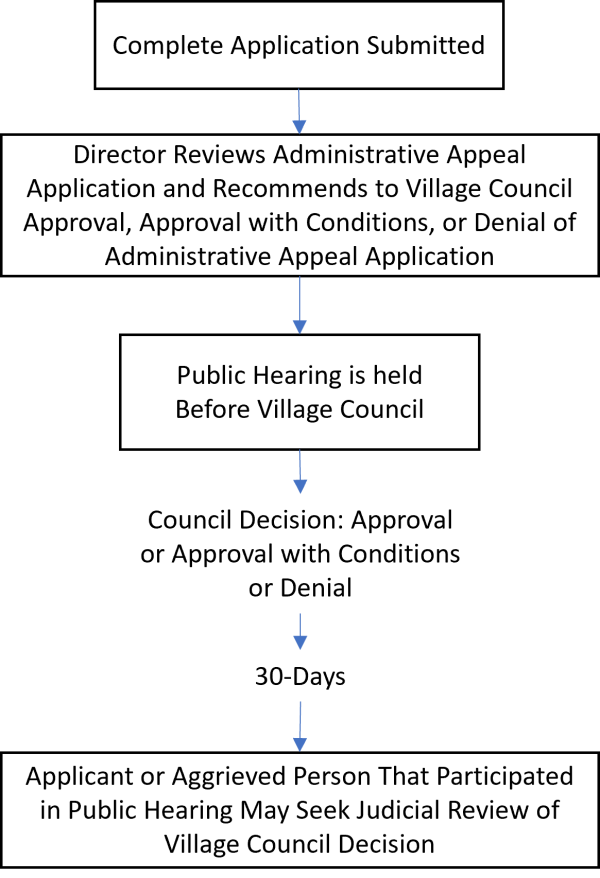
(Ord. No. 01-18, § 1(4.3.1), 11-8-2001; Ord. No. 02-29, § 3, 11-21-2002; Ord. No. 03-04, § 2, 3-27-2003)
Sec 30-301 Intent And Purpose
It is the intent and purpose of this division to establish an ongoing mechanism which ensures that certain public facilities and services needed to support development are available concurrent with the impacts of such development, pursuant to the village comprehensive plan and F.S. § 163.3180. This division applies to wastewater, potable water, solid waste, transportation (roadways), stormwater and recreation and open space facilities.
(Ord. No. 01-19, § 2(4.4.1), 11-19-2001)
Amended by Ord. 13-21 § 2 on 8/22/2013
Amended by Ord. 13-19 § 2 on 8/22/2013
Sec 30-302 Effect Of Payment Of Impact Fees
The payment of impact fees shall not entitle the applicant to a determination of concurrency except as otherwise provided in this chapter. The requirement for a determination of concurrency is a separate, independent and additional requirement imposed by this chapter.
(Ord. No. 01-19, § 2(4.4.2), 11-19-2001)
Sec 30-303 Exemptions
No development order or permit shall be issued that is projected to decrease the existing level of service (LOS) below the adopted standard. However, the following are exempt from the review procedures specified in this division because of their de minimis effect or because they do not decrease the existing level of service:
- Development of a single-family residence on an existing lot, except that review shall be required if the residence's impact will exceed the adopted level of service standard on any designated hurricane evacuation route.
- Development that does not require the public facilities enumerated in section 30-304 and that has sufficient capacity to provide safe and efficient public facilities and services.
- Development that will not reduce the capacity of the affected facilities.
- In addition to the exemptions from development described in the definitions of this chapter, the following construction activities shall not be considered development for the purposes of this division only:
- The rebuilding or restoration of a single-family home damaged or destroyed by fire, calamity, or natural disaster as long as the rebuilding or restoration takes place within the footprint of the destroyed or damaged structure and as long as there is no increase in density or intensity of use.
- The replacement of a mobile home upon the same lot where the original was located as long as there is no increase in density or intensity of use.
- The construction of fences.
- The construction of slabs for existing buildings.
- The pavement of driveways.
- The construction of docks and seawalls.
- The construction of tikis.
- The construction of swimming pools.
- The installation of storm shutters.
- Notwithstanding the above, public transit facilities as defined and provided for within F.S. § 163.3180(5)(h)2., as may be amended, are exempt from transportation concurrency.
(Ord. No. 01-19, § 2(4.4.3), 11-19-2001)
Amended by Ord. 13-19 § 2 on 8/22/2013
Sec 30-304 Levels Of Service For Concurrency Facilities
All development or development of land shall be served by adequate public facilities in accordance with the following standards:
- Transportation/roadways. Sufficient capacity shall be available on affected roadways to accommodate all existing and approved development at the following level of service:
- U.S. 1 shall have sufficient available capacity to operate at or within five percent of LOS C as measured on an overall countywide basis not dependent on any single roadway segment, using the measured median travel speed from the annual report of public facilities capacity.
- All other roadways for which the village is responsible shall have sufficient available capacity to operate at or above LOS D as measured by peak hour volumes at all intersections, including but not limited to all intersections with U.S. 1.
- Solid waste. Sufficient capacity shall be available at a solid waste disposal site to accommodate all existing and approved development for a period of at least three years from the projected date of completion of the proposed development or use, at the following levels of service:
- Residential disposal quantity: 5.44 pounds per capita per day, or 12.2 pounds per day, equivalent residential unit.
- Nonresidential disposal quantity: 6.37 pounds per acre per day.
- Residential collection frequency: Minimum, one time per two weeks for domestic refuse and for yard trash.
- Potable water. Sufficient potable water from an approved and permitted source shall be available to satisfy the projected water needs of the proposed development or use at the levels of service listed below. Approved and permitted sources shall include cisterns, wells, FKAA distribution systems, individual water condensation systems, and any other system which complies with state standards for potable water.
- Residential LOS: 66.5 gallons per capita per day.
- Nonresidential LOS: 0.35 gallons per square foot per day.
- Overall LOS: 177 gallons per capita per day.
- Equivalent residential unit: 371.7 gallons per day.
- Minimum pressure: 20 pounds per square inch at customer service point.
- Minimum quality: As defined by U.S. Environmental Protection Agency, part 143, National Secondary Drinking Water Standards, 40 CFR 143, 44 FR 42198.
- Stormwater.
- Post-development runoff shall not exceed the pre-development runoff rate for a 25-year storm event, up to and including an event with a 24-hour duration.
- Stormwater treatment and disposal facilities shall be designed to meet the design and performance standards established in F.A.C. 62-25.025, with treatment of the runoff from the first one inch of rainfall on-site to meet the water quality standards required by F.A.C. 62-302.500.
- Stormwater facilities which directly discharge into Outstanding Florida Waters (OFW) shall provide an additional treatment pursuant to F.A.C. 62-25.025(9). Stormwater facilities shall be designed so as to not degrade the receiving water body below the minimum conditions necessary to assure the suitability of water for the designated use of its classification as established in F.A.C. ch. 62-302.
- Wastewater. Sufficient wastewater treatment capacity shall be available to satisfy the projected needs of the development or use according to the following level of service standards:
- Design flows less than or equal to 100,000 gallons per day (BAT), in mg/l:
Biological oxygen demand (BOD) 10 mg/l Total suspended solids (TSS) 10 mg/l TN 10 mg/l TP 1 mg/l - Design flows greater than 100,000 gallons per day (AWT), in mg/l:
Biological oxygen demand (BOD) 5 mg/l Total suspended solids (TSS) 5 mg/l TN 3 mg/l TP 1 mg/l
- Design flows less than or equal to 100,000 gallons per day (BAT), in mg/l:
- Recreation and open space. Sufficient available recreation and open space facility capacity shall be available to satisfy the projected needs of the development or use, at a level of service of 3.79 acres per 1,000 population.
(Ord. No. 01-19, § 2(4.4.4), 11-19-2001)
Amended by Ord. 13-21 § 2 on 8/22/2013
Sec 30-305 Review Of Development Orders And Permits
- Purpose. It is the purpose of this section to provide an orderly and equitable procedure for the issuance of development orders and permits, whenever the rate of intensity of growth and development is likely to exceed the capacity of essential public facilities, in order to ensure that the purposes of the village comprehensive plan are achieved.
- Application for development. As a condition of approval of a development order, all applicants for development shall file an application with the village in the form prescribed by the director of planning and development services, accompanied by a fee to be set by resolution of the village council. The application shall include a written evaluation of the impact of the anticipated development on the levels of service for public facilities and services and demonstrate that public facilities and services are available prior to or concurrent with the impacts of development as follows:
- Potable water, sewer, solid waste and drainage. For potable water, sewer, solid waste and drainage, the following standards of F.S. § 163.3180 shall be met:
- A final development order or permit is issued subject to the condition that, at the time of the issuance of a certificate of occupancy or its functional equivalent, the necessary facilities and services are in place and available to serve the new development; or
- At the time a final development order or permit is issued, the necessary facilities and services are guaranteed in an enforceable development agreement, pursuant to F.S. § 163.3220, or an agreement or development order issued pursuant to F.S. ch. 380, to be in place and available to serve new development at the time of the issuance of a certificate of occupancy or its functional equivalent.
- Recreation and open space. For recreation and open space, at a minimum, the following standards shall be met to satisfy the concurrency requirement:
- At the time a final development order or permit is issued, the necessary facilities and services are in place or under actual construction; or
- A final development order or permit is issued subject to the condition that, at the time of the issuance of a certificate of occupancy or its functional equivalent, the acreage for the necessary facilities and services to serve the new development is dedicated to the village. Alternatively, funds equating to the developer's fair share impact fee may be provided to the village to be accumulated in an account dedicated to land acquisition and development of recreation and open space facilities required to meet level of service standards. In either case, the following shall also be met:
- A development order or permit is issued subject to the conditions that the necessary facilities and services needed to serve the new development are scheduled to be in place or under actual construction not more than one year after issuance of a certificate of occupancy or its functional equivalent as provided in the village's adopted five-year schedule of capital improvements; or
- At the time the development order or permit is issued, the necessary facilities and services are the subject of a binding executed agreement which requires the necessary facilities and services to serve the new development to be in place or under actual construction not more than one year after issuance of a certificate of occupancy or its functional equivalent; or
- At the time the development order or permit is issued, the necessary facilities and services are guaranteed in an enforceable development agreement, pursuant to F.S. § 163.3220, or an agreement or development order issued pursuant to F.S. ch. 380, to be in place or under actual construction not more than one year after issuance of a certificate of occupancy or its functional equivalent.
- Transportation/roadway facilities. For transportation/roadway facilities, at a minimum, the village shall ensure that the following standards are met to satisfy concurrency requirements:
- At the time a development order or permit is issued, the necessary facilities and services are in place or under actual construction, at the adopted overall level of service standard; or
- A development order or permit is issued subject to the conditions that the necessary facilities and services needed to serve the new development are scheduled to be in place or under actual construction not more than three years after the issuance of a certificate of occupancy or its functional equivalent as provided in the village's adopted five-year schedule of capital improvements or the first three years of the FDOT adopted work program, with:
- The estimated date of commencement of actual construction; and
- The estimated date of project completion; and
- Assurance that a plan amendment is required to eliminate, defer or delay construction of the required facilities as listed in the five-year schedule; or
- At the time the development order or permit is issued, the necessary facilities and services are the subject of a binding executed agreement which requires the necessary facilities and services to serve the new development to be in place or under actual construction not more than one year after issuance of a certificate of occupancy or its functional equivalent; or
- At the time the development order or permit is issued, the necessary facilities and services are guaranteed in an enforceable development agreement, pursuant to F.S. § 163.3220, or an agreement or development order issued pursuant to F.S. ch. 380, to be in place or under actual construction not more than one year after issuance of a certificate of occupancy or its functional equivalent; or
- A proposed development may be deemed to have a de minimis impact and may be exempted from the transportation concurrency requirements, only if all of the development proposal is for an increase in density or intensity of less than or equal to the density or intensity of the existing development. No impact will be de minimis if it would exceed the adopted level of service standard of any affected designated hurricane evacuation route; or
- The village shall allow an applicant for a development order or permit to satisfy the transportation concurrency requirements of section 30-304(a) when one of the following factors is shown to exist:
- The applicant enters into a binding agreement to pay for or construct its proportionate share of the costs of providing the necessary transportation facilities to serve the proposed development. The applicant shall provide a bond, letter of credit or other similar security interest when construction of transportation facilities are provided for within such agreement; or
- The proportionate share contribution or construction is sufficient to accomplish one or more mobility improvements that will benefit a regionally significant transportation facility.
- Potable water, sewer, solid waste and drainage. For potable water, sewer, solid waste and drainage, the following standards of F.S. § 163.3180 shall be met:
- Facilities impact report.
- An applicant shall prepare a facilities impact report which demonstrates that:
- The development will not reduce the capacity of the facility; or
- The necessary facilities and services are in place at the time a development permit is issued; or
- A development permit is issued subject to the condition that the necessary facilities and services shall be in place when the impacts of the development occur; or
- The necessary facilities and services are under construction at the time a permit is issued; or
- The necessary facilities and services are guaranteed in an enforceable development agreement. An enforceable development agreement may include, but is not limited to, development agreements pursuant to F.S. § 163.3220 and this chapter, or an agreement or development order issued pursuant to F.S. ch. 380; or
- The necessary facilities and services will be served by a concurrency management system which meets the requirements of F.S. ch. 163; or
- At the time the development order or permit is issued, the necessary facilities and services are guaranteed in an enforceable proportionate fair-share mitigation agreement.
- The facilities impact report required by this section shall use acceptable professional methodologies and standards inclusive of a cumulative traffic impact analysis, where necessary, as provided by the director of planning and development services.
- An applicant shall prepare a facilities impact report which demonstrates that:
- Validity period of findings of available capacity. Findings of available capacity under this section shall be valid for a period of two years. An applicant whose finding has expired, but wishes to proceed with development, shall file a new application for review with the village, and obtain a new finding of capacity before proceeding.
- Non-binding determination of capacity; fee. Upon payment of a fee to be set by resolution of the village council, an applicant may seek a non-binding determination of capacity for any property within the village, to assist with the private planning and development of the property.
(Ord. No. 01-19, § 2(4.4.5), 11-19-2001; Ord. No. 06-21, § 2, 11-9-2006)
Amended by Ord. 13-21 § 2 on 8/22/2013
Amended by Ord. 13-19 § 2 on 8/22/2013
Sec 30-306 Annual Report Of Public Facilities Capacity
- Preparation; contents. On or before June 15 of each year, the director of planning and development services shall submit to the village council a report of the capacity of available public facilities, after reviewing the annual report from the county. The report shall be based on standard analytical methodologies and shall include a projection of the amount of residential and nonresidential growth that can be accommodated in each of the service areas during the ensuing year without exceeding safe and efficient provision of essential public facilities. The report shall clearly identify (i) areas of inadequate facility capacity, which are those areas with capacity below the adopted level of service standards as provided in section 30-304, and (ii) areas of marginally adequate facility capacity, which are those areas at the adopted level of service standard or which are projected to reach inadequate capacity within the next 12 months. In addition, the report shall include growth trends and projections and development permit monitoring system for each service area.
- Ratification of annual report of public facilities capacity. No later than July 1 of each year, the village council shall consider and approve or approve with modifications the annual report of public facilities capacity. In the event the council acts to increase the development capacity of any service area, the council shall make specific findings of fact as to the reasons for the increase, including the source of funds to be used to pay for the additional capacity required to serve additional development to be permitted during the next 12-month period.
- Review procedure for development located in areas specified in annual report.
- Applicability. In the event the approved annual report shows that projected growth and development during the next 12 months exceeds public facilities capacity that will be available to serve the projected growth, development in one or more of the affected service areas shall be subject to the procedure established in this section.
- Areas of inadequate facility capacity. The village shall not approve applications for development in areas of the village that are served by inadequate facilities as identified in the annual report, unless the requirements of section 30-305 are satisfied. A facilities impact report shall be prepared for applications for development in these areas to demonstrate the standards have been met.
- Areas of marginally adequate facility capacity. In areas of marginal facility capacity as identified in the current annual report, the village shall either deny the application or condition the approval so that the level of service standard is not violated. A facilities impact report shall be prepared for applications for development in these areas to demonstrate the standards have been met.
(Ord. No. 01-19, § 2(4.4.6), 11-19-2001)
Amended by Ord. 13-19 § 2 on 8/22/2013
Sec 30-307 Transportation Proportionate-Share Mitigation
In order to establish a method whereby the impacts of development on transportation facilities can be mitigated by the cooperative efforts of the public and private sectors, there shall be a program known as the transportation proportionate-share mitigation program (the "mitigation program"), as required by and in a manner consistent with F.S. § 163.3180(5)(h)3. as may be amended. The mitigation program shall apply to all developments in the village that have been notified of a lack of capacity to satisfy transportation concurrency, including transportation facilities maintained by the Florida Department of Transportation (the "FDOT") or another government agency which the village relies upon for concurrency determinations. The mitigation program does not apply to developments exempted from concurrency as provided in section 30-303.
- General requirements.
- An applicant may propose to satisfy the transportation concurrency requirements of the village by making a proportionate-share contribution only if the following requirements are met:
- The proposed development is consistent with the comprehensive plan and applicable land development regulations; and
- The five-year schedule of capital improvements in the village's capital improvements plan ("CIP") includes a transportation improvement(s) that, upon completion, will satisfy the requirements of the village's concurrency management system (the "CMS"). The provisions of subsection b.2. may apply if a proposed project or development which is needed to satisfy concurrency are not presently contained within the village's CIP.
- The village, in its sole discretion, may choose to allow an applicant to satisfy transportation concurrency through the mitigation program by contributing to an improvement that, upon completion, will satisfy the requirements of the village's transportation CMS, but is not contained in the five-year schedule of capital improvements in the CIP, where the following conditions are met:
- The village adopts, by resolution or ordinance, a commitment to add the improvement to the five-year schedule of capital improvements in the CIP no later than the next regularly scheduled update. To qualify for consideration under this section, the proposed improvement shall be reviewed by the village council, and determined to be consistent with the comprehensive plan, and in compliance with the provisions of this section.
- If the funds allocated for the five-year schedule of capital improvements in the village's CIP are insufficient to fully fund construction of a transportation improvement required by the CMS, the village may still enter into a binding proportionate-share agreement with the applicant authorizing construction of that amount of development on which the proportionate-share is calculated if the proportionate-share amount in such agreement is sufficient to pay for one or more improvements which will, in the sole opinion of the governmental entity or entities maintaining the transportation facilities, significantly benefit the impacted transportation system. The improvement or improvements funded by the proportionate-share component shall be adopted into the five-year capital improvements schedule of the comprehensive plan at the next annual capital improvements plan update.
- Any improvement project proposed to meet the developer's proportionate-share obligation shall meet applicable design standards of the jurisdiction which controls.
- It shall be in the village's sole discretion whether the requested addition to the CIP shall be added.
- An applicant may propose to satisfy the transportation concurrency requirements of the village by making a proportionate-share contribution only if the following requirements are met:
- Intergovernmental coordination. Pursuant to policies in the intergovernmental coordination element of the village's comprehensive plan and applicable policies in the South Florida Regional Planning Council's Strategic Regional Policy Plan for South Florida, the village shall coordinate with affected jurisdictions, including FDOT, regarding mitigation to impacted facilities not under the jurisdiction of the local government receiving the application for proportionate-share mitigation. An interlocal agreement may be established with other affected jurisdictions for this purpose.
- Determining proportionate-share obligation.
- Proportionate-share mitigation for concurrency impacts may include, without limitation, separately or collectively, private funds, contributions of land, and construction and contribution of facilities.
- An applicant shall not be held responsible for the additional cost of reducing or eliminating deficiencies. An applicant shall not be required to pay or construct transportation facilities whose costs would be greater than a development's proportionate share of the improvements necessary to mitigate the development's impacts.
- The methodology used to calculate an applicant's proportionate-share obligation shall be as provided for in F.S. § 163.3180(5)(h)3.c.(II), as may be amended, as follows:
- The proportionate-share contribution shall be calculated based upon the number of trips from the proposed development expected to reach roadways during the peak hour from the stage or phase being approved, divided by the change in the peak hour maximum service volume of roadways resulting from construction of an improvement necessary to maintain or achieve the adopted level of service, multiplied by the construction cost, at the time of development payment, of the improvement necessary to maintain or achieve the adopted level of service.
- In using the proportionate-share formula above, the applicant, in its traffic analysis, shall identify those roadways or facilities that have a transportation deficiency in accordance with the transportation deficiency as defined in F.S. § 163.3180(5)(h)3.e., as may be amended. The proportionate-share formula shall only be applied to those facilities that are determined to be significantly impacted by the project traffic under review. If any roadway is determined to be transportation deficient without the project traffic under review, the costs of correcting that deficiency shall be removed from the project's proportionate-share calculation and the necessary transportation improvements to correct that deficiency shall be considered to be in place for purposes of the proportionate-share calculation. The improvement necessary to correct the transportation deficiency is the funding responsibility of the entity that has maintenance responsibility for the facility. The development's proportionate share shall be calculated only for the needed transportation improvements that are greater than the identified deficiency.
- When the provisions of this section have been satisfied for a particular stage or phase of development, all transportation impacts from that stage or phase for which mitigation was required and provided shall be deemed fully mitigated in any transportation analysis for a subsequent stage or phase of development. Trips from a previous stage or phase that did not result in impacts for which mitigation was required or provided may be cumulatively analyzed with trips from a subsequent stage or phase to determine whether an impact requires mitigation for the subsequent stage or phase.
- In projecting the number of trips to be generated by the development under review, any trips assigned to a toll-financed facility shall be eliminated from the analysis.
- For the purposes of determining proportionate-share obligations, the village shall determine improvement costs based upon the actual and/or anticipated cost of the improvement as obtained from the capital improvements element, the MPO transportation improvement program or the FDOT work program. Where such information is not available, improvement cost shall be determined using one of the following methods:
- If the village has accepted an improvement project proposed by the applicant, then the value of the improvement shall be based on an engineer's certified cost estimate provided by the applicant and approved by the village; or
- If the village has accepted non-site related right-of-way dedication for the proportionate-share payment, credit for the dedication of the non-site related right-of-way shall be valued on the date of the dedication at 120 percent of the most recent assessed value by the county property appraiser or, at the option of the applicant, by fair market value established by an independent appraisal approved by the village and at no expense to the village. The applicant shall supply a drawing and legal description of the land, and a certificate of title or title search of the land, to the village at no expense to the village. If the estimated value of the non-site related right-of-way dedication proposed by the applicant is less than the village's estimated total proportionate-share obligation for that development, then the applicant shall also pay the difference. Prior to purchase or acquisition of any real estate or acceptance of donations of real estate intended to be used for proportionate-share mitigation, public or private partners should contact the FDOT for essential information about compliance with federal law and regulations. Whether a right-of-way dedication is non-site related shall be in the sole discretion of the village.
- Impact fee credit for proportionate-share mitigation.
- The applicant shall receive a credit on a dollar-for-dollar basis for impact fees, mobility fees, and other transportation concurrency mitigation requirements paid or payable in the future for the project. The credit shall be reduced up to 20 percent by the percentage share that the project's traffic represents of the added capacity of the selected improvement, or by the amount specified by ordinance, whichever yields the greater credit.
- Proportionate-share agreements.
- Upon the applicant's execution of a proportionate-share agreement in accordance with subsection (c) the applicant shall receive a determination that concurrency requirements have been satisfied. Should the applicant fail to apply for a development permit within 12 months of the execution of the agreement or other timeframe provided in the CMS, then the proportionate-share agreement shall be considered null and void, and the applicant shall be required to reapply.
- Payment of the proportionate-share contribution is due in full prior to issuance of the final development order or recording of the final plat and shall be nonrefundable. If the payment is submitted more than 12 months from the date of execution of the agreement, then the proportionate-share cost shall be recalculated at the time of payment based on the best estimate of the construction cost of the required improvement at the time of payment, pursuant to subsection (c) and adjusted accordingly.
- All developer improvements authorized under this section shall be completed prior to issuance of a development permit, or as otherwise established in a binding agreement that is accompanied by a security instrument that is sufficient to ensure the completion of all required improvements. Any required improvements shall be completed before issuance of building permits or certificates of occupancy.
- Dedication of necessary right-of-way for facility improvements pursuant to a proportionate-share agreement shall be completed prior to issuance of the final development order or recording of the final plat.
- Any requested change to a development project subsequent to a development order may be subject to additional proportionate-share contributions to the extent the change would generate additional trips that would require mitigation.
- Applicants may submit a letter to withdraw from the proportionate-share agreement at any time prior to the execution of the agreement. The application fee and any associated advertising costs to the village will be nonrefundable.
- The village may enter into proportionate-share agreements for selected corridor improvements to facilitate collaboration among multiple applicants on improvements to a shared transportation facility.
- Proportionate-share agreements shall contain a provision setting forth the amount of impact fee credit if applicable.
- Appropriation of proportionate-share revenues.
- Proportionate-share revenues shall be placed in the appropriate project account for funding of scheduled improvements in the village's CIP, or as otherwise established in the terms of the proportionate-share agreement. At the discretion of the village, proportionate-share revenues may be used for operational improvements prior to construction of the capacity project from which the proportionate-share revenues were derived. Proportionate-share revenues may also be used as the 50 percent local match for funding under the FDOT transportation regional incentive program (TRIP).
- In the event a scheduled facility improvement is removed from the CIP, then the revenues collected for its construction may be applied toward the construction of another improvement within that same corridor or sector that would mitigate the impacts of development pursuant to the requirements of subsection (a)2.b.
- Where an impacted regional facility has been designated as a regionally significant transportation facility in an adopted regional transportation plan as provided in Section F.S. § 339.155, then the village may coordinate with other impacted jurisdictions and agencies to apply proportionate-share contributions and public contributions to seek funding for improving the impacted regional facility under the FDOT TRIP. Such coordination shall be ratified by the village through an interlocal agreement that establishes a procedure for earmarking of the developer contributions for this purpose.
- Cross jurisdictional impacts.
- In the interest of intergovernmental coordination and to reflect the shared responsibilities for managing development and concurrency, the village may enter an agreement with one or more adjacent local governments to address cross jurisdictional impacts of development on regional transportations facilities. The agreement shall provide for application of the methodology in this section to address the cross jurisdictional transportation impacts of development.
- A development application submitted to the village subject to a transportation concurrency determination meeting all of the following criteria shall be subject to this section:
- All or part of the proposed development is located within a U.S. 1 road segment which is under the jurisdiction, for transportation concurrency, of an adjacent local government; and
- Using its own concurrency analysis procedures, the village concludes that the additional traffic from the proposed development would use five percent or more of the reserve speed of a regional transportation facility within the concurrency jurisdiction of the adjacent local government "impacted regional facility"; and
- The impacted regional facility is projected to be operating below the level of service standard, adopted by the adjacent local government, when the traffic from the proposed development is included.
- Upon identification of an impacted regional facility pursuant to subsection 8(b), the village shall notify the applicant and the affected adjacent local government in writing of the opportunity to derive an additional proportionate-share contribution, based on the projected impacts of the proposed development on the impacted adjacent facility.
- The adjacent local government shall have up to 90 days in which to notify the village of a proposed specific proportionate-share obligation, and the intended use of the funds when received. The adjacent local government must provide reasonable justification that both the amount of the payment and its intended use comply with the requirements of F.S. § 163.3180(16). Should the adjacent local government decline proportionate-share mitigation under this section, then the provisions of this section would not apply and the applicant would be subject only to the proportionate-share requirements of the village.
- If the subject application is subsequently approved by the village, the approval shall include a condition that the applicant provides, prior to the issuance of any building permit covered by that application, evidence that the proportionate-share obligation to the adjacent local government has been satisfied. The village may require the adjacent local government to declare, in a resolution, ordinance, or equivalent document, its intent for the use of the concurrency funds to be paid by the applicant.
(Ord. No. 06-21, § 2, 11-9-2006)
Amended by Ord. 13-19 § 2 on 8/22/2013
Sec 30-331 Intent And Purpose
The intent and purpose of this division is to ensure that the various costs borne by the village, including its outside consultants, in reviewing and processing applications for development approvals and permits is directly borne by those persons deriving the benefit of the review, not the general public.
Adopted by Ord. 15-05 § 2 on 4/9/2015
Sec 30-332 Cost Recovery
Persons or entities that file any development applications or that file review requests for which cost recovery is applicable and which requires additional review shall pay a flat fee and an initial preliminary cost recovery deposit as established by the village council, and as may be amended from time to time. The flat fee shall be used for internal review of the development application or review request. The cost recovery deposit shall be credited toward the charges for additional review and public hearing and notice requirements as set forth within this division. The person or entities that file any development application or review requests shall pay additional deposits where the costs of such review and/or processing exceeds the cost recovery deposit previously submitted hereunder. Payment of the flat fee and/or cost recovery deposit shall be made, prior to or at the time the application is filed or that the review request is made.
The amount of the cost recovery deposit for the different types of applications or review requests shall be commensurate with the anticipated cost recovery, and shall be established, and may be amended from time to time, by the village council.
The types of applications for development approval or permits that are subject to the provisions of this division include, but are not limited to, alcoholic beverage permit applications, appeal applications, beneficial use applications, building permit allocation system applications, boundary determinations, comprehensive plan map amendments, development agreements, preliminary plats, final plats, habitat evaluation indices, home occupation applications, land development regulation amendments, lot line adjustments, major conditional uses, minor conditional uses, modifications to a conditional use, official zoning map amendments, pre-application conferences, road abandonment applications, sign variances, transfers of development rights, vacation rental determinations, variances, and vested rights determinations.
- Cost for review of revisions. Cost for additional review by village staff shall be charged to the applicant and based on revisions to plans. The amount charged for additional review which results from the submittal of revised plans shall be calculated in the following manner:
- Submittal of the first revised plan shall be processed by planning and development services department at no additional cost to the applicant.
- Submittal of the second revised plan shall be processed by the planning and development services department at no additional cost to the applicant.
- Submittal of the third revision and each revision thereafter shall be processed at an additional charge of ten percent of the flat fee and shall be paid in total at the time of submittal.
- Other costs shall be applicable as provided by subsections (b) and (c) below.
- Additional review. Cost for any and all outside contractors, agents or consultants used by the village in reviewing development applications shall be charged to the applicant in an amount equal to the actual amount charged to the village. The term "additional review", as used herein above, includes all review services provided in circumstances in which the village utilizes the services of an outside contractor, agent or consultant for the application.
- Public hearing and notice requirements. When the provisions of this chapter require that mailed notice and/or require notice to be published, the applicant shall be responsible for payment of the cost thereof.
Amended by Ord. 15-05 § 2 on 4/9/2015
Sec 30-333 Flat Fee And Initial Preliminary Deposit Required
Any person or entity that files any application for a development approval or permit which necessitates village staff or additional review and processing shall pay, prior to or at the time the application is made, a flat fee which shall be used to cover the costs of review completed by village staff. Additionally, any person or entities that files any application for a development approval or permit which necessitates additional review and processing, and/or public hearing and notice requirements as set forth within article IV, division 2 of this chapter, shall pay a cost recovery deposit which shall be credited toward the fee charged for such additional review and processing, and shall pay additional deposits as may be required from time to time. A debit based upon the actual time expended reviewing an application and the applicable actual amount charged to the village shall be charged against the cost recovery deposit.
Adopted by Ord. 15-06 § 2 on 5/28/2015
Sec 30-334 Supplemental Deposit
The village shall monitor the cost recovery deposit on a periodic basis. Whenever the balance is zero or negative, a supplemental cost recovery deposit shall be required. The village shall notify the applicant when a supplemental deposit is required. The amount of the supplemental deposit shall be determined by the village manager or designee, and shall be equal to the costs estimated to complete review of the application. The village shall not issue any development approval or permit until the required supplemental cost recovery deposit has been deposited with the village.
Adopted by Ord. 15-05 § 2 on 4/9/2015
Sec 30-335 Return Of Deposit
Within 90 days from the date that the applicant receives a certificate of occupancy or other applicable final approval from the village, and the planning and development services department determines that no further action is necessary for the review and processing of the application or the applicant voluntarily withdraws the application, the village shall refund any remaining cost recovery deposit funds to the applicant. In no event, however, shall the village refund any remaining cost recovery deposit funds if the applicant fails to obtain a development approval or permit within one calendar year of applying for the approval or permit. In no event shall the village refund the payment of the established flat fee.
Adopted by Ord. 15-05 § 2 on 4/9/2015
Sec 30-336 Records Of Work Performed
The village shall maintain records of the time expended and tasks conducted regarding each application.
Adopted by Ord. 15-05 § 2 on 4/9/2015
Sec 30-337 Review And Appeal Process
- In the event an applicant is financially unable to pay the cost recovery deposit, or believes the village overcharged the applicant for the work performed in reviewing and processing an application, the applicant may:
- Request that the village council waive the cost recovery deposit on the basis of a bona fide financial hardship; or
- Request a review by the village manager or designee of the work performed by the village.
- Upon a determination by the village council that the applicant has demonstrated a bona fide financial hardship, or upon a determination by the village manager or designee that a miscalculation concerning the work performed by the village on the application, the village manager or designee may waive or refund a portion or all of the cost recovery deposit.
Adopted by Ord. 15-05 § 2 on 4/9/2015
Sec 30-338 Exemption For Projects Initiated By Or On Behalf Of Village
This cost recovery program shall not apply to development projects that are originally initiated by or on behalf of the village.
Adopted by Ord. 15-05 § 2 on 4/9/2015
Sec 30-339 Exemption For Development And/Or Redevelopment Of Affordable Housing
This cost recovery program shall not apply to development projects for the development and/or redevelopment of affordable housing which are deed restricted for 99 years or more or in perpetuity. Notwithstanding the foregoing, the applicants or entities that file an application for the development and/or redevelopment of affordable housing shall pay the cost of additional review and public hearing notice requirements as set forth in Code sections 30-332(b) and (c). Notwithstanding the foregoing, all applicable fees shall not be waived for all development approvals for applications for variances to setback, landscaping and/or off-street parking requirements associated with the development and/or redevelopment of affordable housing.
Adopted by Ord. 15-05 § 2 on 4/9/2015
Sec 30-340 Building Permit Fee Schedule Not Affected
The schedule of building permit and related fees established by resolution of the village council as authorized in chapter 6, buildings and building regulation, of this Code are separate from the cost recovery fees and deposits authorized by this division.
Adopted by Ord. 15-05 § 2 on 4/9/2015
Sec 30-341 Replacement Of Conflicting Fee Programs
The cost recovery program set forth in this division shall replace any conflicting or inconsistent fee program or schedule within the village.
Adopted by Ord. 15-05 § 2 on 4/9/2015
Sec 30-361 Authority; Intent And Purpose
This division is enacted pursuant to the authority granted to local governments by section 2(b), article VIII, of the Florida Constitution, F.S. ch. 166, and F.S. §§ 163.3161—163.3244. This division is enacted for the purpose of requiring that new development pay for its fair share of public facilities through the imposition of impact fees that will be used to finance, defray, or reimburse all or a portion of the costs incurred by the village for public facilities and services that serve such development.
(Ord. No. 02-06, § 1(4.6.1), 1-24-2002)
Sec 30-362 Applicability
Unless expressly excepted or exempted, this division applies to all fees which may be imposed by the village to finance capital facilities, the need for which is created by new development, including:
- Park and recreation fees;
- Drainage fees;
- Police fees;
- Fire/EMS fees;
- Transportation improvement fees;
- Public works fees;
- Public art and cultural events fees; and
- General government fees.
(Ord. No. 02-06, § 1(4.6.2), 1-24-2002)
Amended by Ord. 16-17 § 2 on 10/13/2016
Sec 30-363 Exemptions
This division does not apply to fees authorized outside of this division, including but not limited to:
- Taxes and special assessments;
- Fees for processing development applications;
- Fees for enforcement of or inspections pursuant to regulatory ordinances;
- Fees for utility connection or utility impact fees;
- Fees collected under development agreements, other than impact fees;
- Fees imposed pursuant to a reimbursement agreement between the village and a property owner for that portion of the cost of a public facility paid for by the property owner which exceeds the need for the public facility attributable to, reasonably related to, and roughly proportional to the development;
- Fees to mitigate impacts on the environment;
- Fees imposed, levied, or collected by other governmental agencies including subdivisions of the state and federal government;
- Stormwater utility fees which may be authorized by village Code provisions outside of this division;
- Wastewater utility fees which may be authorized by village Code provisions outside of this division;
- Development for which a certificate of occupancy was issued prior to December 31, 2002; or
- Development exempted by an agreement with the village, which was approved prior to the adoption of this division.
(Ord. No. 02-06, § 1(4.6.3), 1-24-2002)
Amended by Ord. 16-20 § 2 on 11/3/2016
Sec 30-364 Definitions
When used in this division, the following words, terms, and phrases, and their derivations, shall have the meanings ascribed to them in this section, except where the context clearly indicates a different meaning:
Benefit area means the geographic area within which impact fees are collected and expended for a particular type of capital improvement serving development projects within such area.
Calculate means to determine the amount of impact fees to be imposed on a particular development project and includes an individualized determination showing a reasonable, and roughly proportional, relationship between: (1) the fee's use and the type of development project on which the fee is imposed; (2) the need for the public facility or service and the type of development project on which the fee is imposed; and (3) the amount of the fee and the cost of the portion of the public facility or service attributable to the development on which the fee is imposed.
Capital improvement means land or facilities for the collection and disposal of stormwater; for flood control purposes; for purposes of transportation and transit, including, without limitation, streets, street lighting and traffic control devices and supporting improvements, roads, overpasses, bridges, and related facilities; for parks and recreational improvements; for public safety, including police facilities; for public art; for public buildings of all kinds; and for any other public works capital project identified in the village's capital improvements plan. Capital improvement also includes design, engineering, inspection, testing, planning, legal, land acquisition, and all other costs associated with construction of a public facility.
Capital improvements plan means the five-year plan for capital improvements adopted annually by the village council, describing the approximate location, size, time of availability and estimated cost of capital improvement projects and identifying sources of funding for capital improvement projects.
Capital improvements project list means the list describing the approximate location, size, time of availability and estimated cost of each capital improvement to be funded from a particular impact fee account.
Collection means the time at which the impact fee is actually paid to the village.
Commitment means earmarking impact fees to fund or partially fund capital improvements serving new development projects.
Density for purposes of this division refers to the measurement of residential uses.
Dwelling unit means one or more rooms in a building or a portion of a room, designed or intended to be used, or actually used, for occupancy by one family for living and sleeping quarters and containing one kitchen only, including a mobile home, but not hotel or motel units.
Impact fee means a monetary exaction, adopted by the village pursuant to section 30-366 at a specified rate and imposed pursuant to this division, as a condition of or in connection with approval of a development project for the purpose of defraying all or some of the village's cost or repaying costs previously expended from other village funds for capital improvements, and as further defined by section 30-362 and section 30-363.
Impose means to determine that a particular development project is subject to the collection of impact fees as a condition of development approval.
Intensity for purposes of this division refers to the measurement of nonresidential uses.
New development or development project means any project undertaken for the purpose of development, including, without limitation, a project involving the issuance of a permit for construction, reconstruction, or change of use, but not a project involving the issuance of a permit to operate or to remodel, rehabilitate, or improve an existing structure, which does not change the density or intensity of use, nor the rebuilding of a structure destroyed or damaged by an act of God, nor the replacement of one mobile home with another on the same pad if no dwelling unit is added, nor the replacement of one single-family residence with another equivalent single-family residence.
Nonresidential development project means all development other than residential development projects.
Residential development project means any development undertaken to create a new dwelling unit.
(Ord. No. 02-06, § 1(4.6.4), 1-24-2002)
Cross reference(s)—Definitions generally, § 1-2.
Sec 30-365 Imposition, Reduction Of Fees For Affordable Housing, Calculation And Collection Of Fees
- The village may only impose impact fees as a condition of approval of new development projects as provided in this division.
- No later than July 2002, and for each year thereafter, the base fee amount of each impact fee for residential and for nonresidential development, for each type of public facility or service funded by impact fees, shall be reviewed annually and adopted by village council resolution. When the village council determines that it is appropriate to the particular public facility or service, the fee amount may be calculated, imposed and expended by benefit area. Until the village adopts the base fees as provided by this subsection, impact fees in the amount as established by the county under the provisions of article X of the Monroe County Land Development Regulations, as existing as of the date of incorporation of the village, shall continue to be collected and expended as provided therein.
- Affordable housing residential development projects may be eligible for a reduction of impact fees.
- Affordable housing residential developments by non-profit entities that receive a donation of property or cash from the village of 25 percent or more of the purchase price of the land shall be eligible for a up to a 50 percent reduction of applicable impact fees.
- Affordable housing residential developments by non-profit entities for which the village made no land donation shall be eligible for up to an 80 percent reduction of applicable impact fees.
- Affordable housing residential developments by individuals, corporations, and/or for-profit entities that receive a donation of property or cash from the village at a value of 25 percent or more of the land purchase price shall be eligible for up to a 20 percent reduction of applicable impact fees.
- Affordable housing residential developments by individuals, corporations, and/or for-profit entities that receive no land donation from the village shall be eligible for up to a 50 percent reduction of applicable impact fees.
- After an individualized determination that each impact fee for a development project has been calculated as provided in this division, impact fees shall be imposed prior to issuance of any building permit.
- Impact fees shall be collected by the village manager at the time and as a condition for issuance of a building permit.
- An administrative fee, in the amount of three percent of the impact fee imposed on a development project, shall be collected from that development project with, and in addition to, the impact fee for the purpose of defraying the village's cost of administering the impact fee program.
(Ord. No. 02-06, § 1(4.6.5), 1-24-2002)
Editor's note(s)—Ord. No. 19-05, § 2, adopted April 4, 2019, changed the title of § 30-365 from "Imposition, calculation and collection of fees" to read as herein set out.
Amended by Ord. 16-17 § 2 on 10/13/2016
Amended by Ord. 19-05 § 2 on 4/4/2019
Sec 30-366 Notice And Hearing Required For Amending Fees
- Prior to amending any particular impact fee, the village council shall hold a public hearing.
- Notice of the time and place of the public hearing, including a general explanation of the matter to be considered, shall be published as required for the adoption of a general ordinance pursuant to F.S. § 166.041.
- At least ten days prior to the public hearing, the village shall make available to the public data showing the amount or the estimated amount of the impact fee and a summary of the basis for the calculation of the impact fee amount.
- Village council action to establish or increase any impact fee shall be taken only by ordinance or resolution containing findings that demonstrate the basis for calculating the fee.
(Ord. No. 02-06, § 1(4.6.6), 1-24-2002)
Sec 30-367 Independent Impact Analysis
- Effective immediately, a developer may choose to use an independent impact analysis to compute the impact fee due as a result of a development.
- The developer shall be responsible for the preparation of the draft independent impact analysis and the village manager may accept, reject, or modify the draft analysis.
- The village manager shall approve the person who prepares the draft independent impact analysis on the basis of the person's professional training and experience in preparing development impact analyses. The independent impact analysis shall follow standard methodologies and format and be approved by the village manager. The village manager may publish acceptable methodologies and formats for impact analyses. Prior to submission of the draft independent impact analysis, the developer shall meet with the village manager to review the requirements for preparing draft independent impact analyses.
(Ord. No. 02-06, § 1(4.6.7), 1-24-2002)
Sec 30-368 Impact Fee Accounts
- The village shall establish an appropriate accounting mechanism for ensuring that the fees collected are appropriately earmarked and spent for each type of capital improvement for which an impact fee is imposed. Where the village council has designated benefit areas, there shall be a separate impact fee accounting for each benefit area. The impact fees collected shall be deposited in each such account according to type of improvement (and benefit area if relevant). The funds of each impact fee account shall not be commingled with other funds of the village. Any account previously established for the deposit of funds that would have been developer impact fees under this division shall be deemed an impact fee account for the purposes of this division.
- Any impact fee funds on deposit but not immediately necessary for expenditure shall be placed in interest-bearing assets, and the accumulated interest shall become part of the impact fee account.
(Ord. No. 02-06, § 1(4.6.8), 1-24-2002)
Sec 30-369 Use Of Proceeds
Impact fees may be expended only for the type of capital improvements for which they were imposed, calculated, and collected and according to the time limits and procedures established in this division. If impact fees were calculated and collected by benefit area, then the fees may be expended only in the benefit area in which they were collected. Impact fees may be used to pay the principal, interest, and other costs of bonds, notes, and other obligations issued or undertaken by or on behalf of the village to finance such improvements.
(Ord. No. 02-06, § 1(4.6.9), 1-24-2002)
Sec 30-370 Refunds
- Upon application of the property owner in the form provided by the village, with supporting documentation, the village shall refund that portion of any impact fee which has been on deposit over six years and which is unexpended and uncommitted, except as described in subsection (b) of this section. The refund shall be made to the then-current owner or owners of lots or units of the development project or projects.
- If fees in any impact fee account are unexpended or uncommitted during the sixth year, the fees are exempt from subsection (a) of this section if the village council makes the following findings:
- A need for the capital improvement still exists;
- The fees will be used for an identified purpose within two years; and
- The purpose for which the fees will be used is substantially similar to the purpose for which the fees were collected.
- The village may refund by direct payment, by offsetting the refund against other impact fees due for development projects by the owner on the same or other property, or otherwise by agreement with the owner.
(Ord. No. 02-06, § 1(4.6.10), 1-24-2002)
Sec 30-371 Statute Of Limitations
Any judicial action or proceeding to challenge, review, set aside, or annul the reasonableness, legality, or validity of any impact fee must be filed and service of process effected within 90 days following the date of imposition of the fee or the final determination of the village council, whichever is later.
(Ord. No. 02-06, § 1(4.6.11), 1-24-2002)
Sec 30-372 Amendment Procedures
Prior to the village council's adoption of the budget and revisions to the capital improvements project list, the village manager shall report at least once each year to the village council with:
- Recommendations for amendments to this division, if any;
- Proposals for changes to the capital improvements project list, identifying capital improvements to be funded in whole or in part by impact fees, if any;
- Proposals for changes in the boundaries of benefit areas, if any; and
- Proposals for changes to impact fee rates and schedules, if any.
(Ord. No. 02-06, § 1(4.6.12), 1-24-2002)
Sec 30-373 Credits
- A property owner who dedicates land or agrees to participate in an assessment district or otherwise contributes funds for capital improvements as defined in this division may be eligible for a credit for such contribution against the impact fee otherwise due.
- The village manager shall determine:
- The value of the developer contribution;
- Whether the contribution meets capital improvement needs for which the particular impact fee has been imposed; and
- Whether the contribution will substitute or otherwise reduce the need for capital improvements anticipated to be provided with impact fee funds.
- Any application for credit must be submitted on forms provided by the village before development project approval. The application shall contain a declaration under oath of those facts that qualify the property owner for the credit, accompanied by the relevant documentary evidence.
(Ord. No. 02-06, § 1(4.6.13), 1-24-2002)
Sec 30-391 Purpose
The village comprehensive plan was adopted pursuant to the requirements and authority of F.S. ch. 163, pt. II (F.S. § 163.3161 et seq.) and F.A.C. ch. 9J-5. The purposes of the plan are defined in F.S. ch. 163, as well as in the plan.
(Ord. No. 01-19, § 3(4.7.1), 11-19-2001)
Sec 30-392 Legal Status Of Plan
No development order shall be issued under the provisions of this chapter unless consistent with the goals, objectives and policies of the adopted comprehensive plan.
(Ord. No. 01-19, § 3(4.7.2), 11-19-2001)
Sec 30-393 Amendments
The comprehensive plan may be amended in accordance with this section and the notice and hearing procedures as set forth in this chapter and applicable Florida Statutes.
- Who may file. An application to amend the text of the comprehensive plan may only be filed by the village manager, director of planning and development services, village council or village council member, or any resident or property owner in the village. Applications for amendments to the future land use map may only be filed by the village manager, director of planning and development services, village council, village council member, or any owner of property subject to the amendment.
- Application requirements. Applications on a form specified by the director of planning and development services shall be accepted during the established filing periods. The applicant shall submit all information required to adequately address the filing requirements adopted by the state department of community affairs. In addition, the applicant shall submit all other information determined by the director of planning and development services to be necessary to address the comprehensive planning criteria of the village. The village council shall establish a fee covering the costs of processing an application for a plan amendment by resolution. The fee shall be submitted with the application.
- Limitations on number of amendments. The director of planning and development services shall establish a schedule for the acceptance of amendments to the comprehensive plan that complies with the limitations of F.S. § 163.3187 et seq. regarding the number and type of amendments that may be filed.
- Notice of public hearings. All public hearings related to amendments to the plan shall be noticed and held in compliance with F.S. § 163.3184(15) and the notice provisions of this chapter.
- Amendment procedure. The procedure for amendment of the plan shall be by ordinance, in accordance with F.S. §§ 163.3184 and 163.3187.
- Local planning agency public hearing. The local planning agency shall hold at least one advertised public hearing on a proposed plan amendment to review the amendment and provide recommendations to the village council. The meeting shall be noticed in compliance with the notice requirements of this chapter.
- Village council public hearings. The village council shall hold at least two advertised public hearings on a proposed plan amendment in compliance with F.S. §§ 163.3184 and 163.3187. The meeting shall be noticed in compliance with the notice requirements of this chapter.
- Transmittal of proposed amendment. Following the first public hearing on a proposed plan amendment, the village shall transmit the proposed amendment to the government agencies and bodies as required by state law.
- Adoption of proposed amendment. Upon receipt of the objections, recommendations and comments report from the state department of community affairs, the village council shall adopt, adopt with changes or deny the proposed amendment in accordance with the provisions of F.S. § 163.3184(7).
(Ord. No. 01-19, § 3(4.7.3), 11-19-2001)
Sec 30-411 Generally
- Purpose. The purpose of this division is to provide a means for changing the text of this chapter or the official zoning map ("zoning map"). It is not intended to relieve particular hardships, nor to confer special privileges or rights on any person, nor to permit a change in community character, as analyzed in the comprehensive plan, but only to make necessary adjustments in light of changed conditions. In determining whether to grant a requested amendment, the village council shall consider, in addition to the factors set forth in this division, the consistency of the proposed amendment with the provisions and intent of the comprehensive plan.
- Authority. The village council may amend the text of this chapter or the zoning map upon the compliance with the provisions of this division. Amendments to the zoning map may be proposed by the village manager, village council, village council member, director of planning and development services, or the owner or other person having a contractual interest in property subject to the map amendment. Amendments to the text of this chapter may be proposed by any of the above persons or any resident or property owner in the village. The director of planning and development services shall have the responsibility to establish the format by which applications can be submitted. The director of planning and development services shall have the authority to screen those amendments, processing only those which are presented on a complete application, and those deemed insufficient shall be returned to the applicant for correction and resubmittal within 21 days. Failure of the applicant to resubmit the application within the timeframe specified above shall require a new submittal.
- Timing. Applications for map and text amendments to this chapter shall be accepted at any time. The director of planning and development services shall review and process the map and text amendment applications as they are received and make recommendations to the village council.
- Procedures.
- Proposals by village council, councilmembers, village manager and director of planning and development services. Proposals for amendments by the village council, or councilmember, the village manager or the director of planning and development services shall be transmitted to the department of planning and development services for review and recommendation to the village council.
- Proposals by affected landowners. Any landowner or other person having a contractual interest in property desiring an amendment to the zoning map or any resident or property owner in the village desiring to amend the text of this chapter shall file an application with the director of planning and development services, accompanied by a nonrefundable application fee as established from time to time by resolution of the village council to defray the actual cost of processing the application. The director of planning and development services shall review the application and prepare a recommendation to the village council.
- Public hearings. The village council shall hold public hearings on a proposed amendment to the text of this chapter or to the zoning map as required by this chapter and F.S. § 166.041.
- Action by village council following public hearings.
- The village council shall consider the report and recommendation of the department of planning and development services, and the testimony given at the public hearings.
- The village council must find that the application is consistent with the comprehensive plan, that the applicant has complied with all procedural requirements of this section and that the maintenance of the existing zoning on the property does not accomplish a legitimate public purpose. The village council shall make its determination on legitimate public purpose based on one or more of the following factors:
- Demand for the proposed zoning district in the village in relation to the amount of land currently zoned and available to accommodate that demand;
- Compatibility of the site's physical, geological, hydrological and other environmental features, with the uses permitted in the proposed zoning district;
- Data errors, including errors in mapping, vegetative types and natural features described in the comprehensive plan;
- New issues;
- Recognition of a need for additional detail or comprehensiveness; or
- Compatibility of the proposed district with the property surrounding the site of the requested rezoning and any applicable neighborhood or redevelopment plan.
- In the event of a written protest against such amendment signed by the owners of 20 percent or more either of the area of the lots or land included in the proposed amendment or of the lots or land immediately adjoining the property to be affected and extending 200 feet therefrom, such amendment shall not become effective except by the favorable vote of four members of the village council.
- Except as provided in subsection (d)(4)c of this section, the village council may take action by a vote of not less than a majority of its total membership as follows:
- Adopt the proposed amendment with or without modifications; or
- Grant another zoning classification that is more restrictive than the proposed classification, but within the same general use classification (i.e., residential, commercial, industrial, etc.) and is consistent with the land use plan designation and comprehensive plan; or
- Reject the proposed amendment; or
- Refer the matter back to village staff for further consideration.
- Typographical or drafting errors. Amendments to the text to correct typographical or drafting errors may be adopted by the village council at any regular meeting without posted notice or public hearing.
- Transmittal to state department of community affairs. As long as the village is designated an area of critical state concern, notice of all amendments provided for in this division shall be transmitted to the state department of community affairs within 30 days.
- Further petitions after withdrawal or denial. When any application for change of zoning district is withdrawn after the initial public hearing by the applicant, or denied by the village council, no other such same type of application for change of zoning district on the same property shall be considered within two years from the date of such withdrawal or denial, unless waiver of this provision is granted for good cause by the village council.
(Ord. No. 01-19, § 4(4.8.1), 11-19-2001; Ord. No. 02-29, § 4, 11-21-2002)
Sec 30-431 Plat Approval And Recording Required
- Except as provided in subsections (b) and (c) of this section, plat approval shall be required for:
- The division of land into three or more parcels; or
- The division of land into two or more parcels where the land involved in the division was previously divided without plat approval within the prior two years; or
- The division of land into two parcels where the disclosure statement required under subsection (g) of this section is not attached to the conveyance.
- No building permit shall be issued for the construction of any building, structure or improvement unless a final plat has been approved in accordance with the provisions of this division and recorded for the lot on which the construction is proposed or unless the building, structure or improvement qualifies for an exemption pursuant to this division.
- No plat approval is required if the subdivision involved consists only of:
- A governmentally required dedication and the director of planning and development services finds that it is not necessary that a plat be recorded. In lieu of recording a plat, the dedication shall be required by deed and shall be subject to compliance with the submission of a grading, paving and drainage plan which will meet the requirements of this chapter and the posting of an improvement guarantee or bond as required under section 30-435 before the acceptance of the dedication by the village council.
- The proposed subdivision is for the purpose of conveying ownership of real property with a single-family unit in a townhouse-type development when such conveyance of real property is the space beneath the unit, plus an area surrounding the unit, which is no greater than the gross ground floor area of the unit. Prerequisites for exceptions to platting in this case are as follows:
- The minimum overall development size shall be the same as required in the zoning district assigned to the property.
- The average building length within the townhouse development shall not exceed 160 feet. However, no such building shall contain more than eight units.
- The proposed subdivision is part of a development project for which the village has granted site plan approval, the proposed subdivision is less than five acres in size, and the lots or parcels from which the proposed subdivision is created have been specifically delineated in a recorded plat.
- The combination of two or more previously platted lots to form a single unified building site. However, such combination must be accompanied by a unity of title, in a form approved by the village attorney and recorded in the public records of the clerk of the circuit court of the county.
- A subdivision of land legally recorded prior to September 15, 1986.
- A change in ownership which would result in the formation of a Condominium Association, pursuant to Florida Statute Chapter 718, however in such a case, review of the proposed condominium documents shall be required by the village at the sole cost of the applicant.
- No plat of any subdivision shall be entitled to be recorded in the office of the clerk of the circuit court until it shall have been approved by the village council in the manner prescribed herein and certified by the village clerk.
- If a plat has been previously approved and recorded, technical or minor changes to the plat may be approved by the director of planning and development services. All other changes shall be considered in accordance with the provisions of this division.
- No division of land through a lot-line modification shall be recorded in the county property appraiser's office until after the village has approved the application.
- The conveyance of land that involves the division of the land into two or more parcels may result in the creation of lots that do not meet the minimum building requirements of this chapter, and thus are not buildable lots. For example, the assignment of a tax parcel number by the county appraiser's office does not signify that a parcel is buildable under this chapter. Therefore, to ensure that the public is provided disclosure additional to that which is otherwise required by law of the possible creation of such unbuildable lots by conveyance of property without platting, whenever land is conveyed that involves the division of land into two or more parcels and where plat approval is not obtained pursuant to this division, such conveyance shall include the following disclosure statement: "The parcel of land described in this instrument is located in incorporated Islamorada, Village of Islands. The use of the parcel of land is subject to and restricted by the goals, policies and objectives of the Islamorada, Village of Islands, Comprehensive Plan and Development Regulations adopted as a part of, and in conjunction with and as a means of implementing the Islamorada, Village of Islands Comprehensive Plan. The land development regulations provide that no building permit shall be issued for any development of any kind unless the proposed development complies with each and every requirement of the regulations, including minimum area requirements for residential development. You are hereby notified that under the Islamorada, Village of Islands land development regulations, the division of land into parcels of land that are not approved as platted lots under the regulations confers no right to develop a parcel of land for any purpose."
(Ord. No. 01-19, § 5(4.9.1), 11-19-2001; Ord. No. 02-29, § 5, 11-21-2002; Ord. No. 09-01, § 3, 1-22-2009)
Amended by Ord. 23-15 on 4/11/2024
Sec 30-432 General Standards For Plat Approval
- No preliminary or final plat shall be approved unless the plat is consistent with the purposes, goals and objectives of the comprehensive plan, this division, applicable provisions of state law, including but not limited to F.S. ch. 177, the provisions governing the development of land set forth in this chapter, and the procedures set forth in this article.
- In those areas where the Florida Keys Aqueduct Authority (FKAA) certifies that it can furnish an adequate supply of water to the property to be platted, water distribution systems shall be provided and constructed and shall become the property of the Florida Keys Aqueduct Authority and shall be maintained and operated by the authority in accordance with its water main extension policy.
- Sewers, sewage treatment plants, and septic systems shall meet all requirements of the state department of environmental protection and the state department of health and rehabilitative services.
- No plat shall be approved which creates an unbuildable lot under the provisions of this chapter unless the plat bears a legend restricting the use of the unbuildable lot according to the provisions of this division.
- No plat shall be approved unless it is prepared by a land surveyor licensed in the state.
- Lands within the R1, R1M, RMH, R2, R3, R4, SR and TA districts shall not be platted, replatted or otherwise reconfigured in any manner that would allow the number of proposed lots or units to exceed the number of parcels that lawfully existed as of September 15, 1986.
- When a tract of land is subject to an open space requirement, the most sensitive habitat within such open space shall be preserved by individual habitat type through the use of a conservation easement or a similar legal instrument.
(Ord. No. 01-19, § 5(4.9.2), 11-19-2001; Ord. No. 02-29, § 5, 11-21-2002)
Sec 30-433 Preliminary Plat Approval
- Generally. All applicants for approval of a plat involving five or more lots or five or more acres of land shall submit a preliminary plat for approval in accordance with the provisions of this section.
- Application. An application for preliminary approval shall be submitted to the director of planning and development services in accordance with the provisions of this section, accompanied by a nonrefundable fee as established from time to time by the village council. The application shall contain the information required on a form provided by the director of planning and development services.
- Staff review. After a determination that the application for preliminary plat approval is complete, the director of planning and development services or his designee shall initiate a review of the application to determine compliance with this division and chapter. Concurrently, within 30 days of a complete application, representatives from village departments responsible for reviewing land development proposals including but not limited to building, fire, sheriff, public works and utilities shall provide comments, corrections or conditions to the applicant until compliance is demonstrated with the Code.
- Effect of approval of preliminary plat. Approval of a preliminary plat shall not constitute approval of a final plat or permission to proceed with development. Such approval shall constitute only authorization to proceed with the preparation of such documents as are required by the director of planning and development services for a final plat.
- Limitation on approval of preliminary plat. An application for final plat approval shall be filed within one year of the date of preliminary plat approval. Unless an extension is granted by the village council, failure to file an application for approval of a final plat shall render the preliminary plat approval null and void with no further council action.
(Ord. No. 01-19, § 5(4.9.3), 11-19-2001)
Amended by Ord. 17-06 § 2 on 4/20/2017
Sec 30-434 Final Plat Approval
- Generally. All applicants for approval of a plat shall submit a final plat for approval in accordance with the provisions of this section.
- Application. It shall be the responsibility of the developer to complete, have in final form, and submit to the director of planning and development services or his designee for final processing the final plat, along with all final construction plans, required documents, exhibits, legal instruments to guarantee performance, certificates properly executed by all required agencies and parties as required in this article, and the recording fee, and any other documents or information as are required by the director of planning and development services. After receipt of a complete application for final plat approval, the director of planning and development services shall initiate a review of the application to determine compliance with this division and chapter.
- Review and action by staff. The director of planning and development services or his designee shall review all applications for final plat approval involving five or more lots or five or more acres. If the plat conforms to the approved preliminary plat and the substantive and procedural requirements of this chapter, as soon as practical after the receipt of a complete application, the director shall recommend to the village council approval of the final plat or approval with conditions. If the director finds that the plat does not substantially conform to the approved preliminary plat or the substantive and procedural requirements of this chapter, the director shall recommend denial, specifying the areas of nonconformity.
- Applications involving fewer than five lots or five acres. If the director determines that a final plat for a subdivision involving fewer than five lots or five acres of land conforms to the substantive and procedural requirements of this chapter, the director shall approve the final plat or approve it with conditions. Final plats which are approved by the director shall be placed on the consent agenda of the next regularly scheduled meeting of the village council and shall become final unless removed from the consent agenda by the affirmative vote of three members of the council. If a final plat is removed from the consent agenda, the council shall not modify or reject the decision of the director unless the council finds that the record does not contain competent substantial evidence to support approval. If the director denies final plat approval, the applicant may appeal such denial to the council, which shall consider the application and any additional testimony submitted by the applicant and other persons and shall approve the final plat, approve it with conditions, or deny final plat approval.
- Public hearing by village council. The village council shall conduct a public hearing on all applications for final plat approval involving five or more lots or five or more acres of land in accordance with the procedures of division 3 of this article.
- Action by village council. For proposed subdivisions involving five or more lots or five or more acres, the village council shall review the application, the recommendation of the director, and the testimony at the public hearing, and shall grant final plat approval, grant approval subject to specified conditions, or deny the application.
(Ord. No. 01-19, § 5(4.9.4), 11-19-2001)
Amended by Ord. 17-06 § 2 on 4/20/2017
Sec 30-435 Improvement Guarantees
- Generally. An improvement guarantee to guarantee installation of all improvements required by this chapter or as a condition of approval shall be required as part of final plat approval in a form and amount approved by the director of planning and development services and the village attorney.
- Guarantee amount. The amount of the improvement guarantee shall cover all construction costs, the owner's engineering and platting costs, the village's engineering and inspection costs, and pre-acceptance maintenance costs. The costs may be reviewed periodically for accuracy and are subject to adjustment upward or downward by the director of planning and development services based on existing economic conditions at the time of review. The estimated cost of the water distribution network and main extensions shall be determined by the Florida Keys Aqueduct Authority (FKAA) after review and approval of the water distribution system. The cost may be estimated by the developer's engineer, but in such event shall be subject to review, revision if necessary, and approval by the FKAA. The guarantee shall be in the following minimum amounts unless the owner can show that certain of the costs have already been paid:
- Construction cost:
- 130 percent of the estimated construction cost approved by the village manager; or
- 110 percent of a binding contract with a contractor qualified for the proposed work.
- Owner's engineering and platting cost: At a cost verified by the engineer and surveyor.
- Village engineering and inspection costs: Based on an estimate by the director of planning and development services of costs to be incurred.
- Pre-acceptance maintenance cost: Ten percent of the construction cost.
- Damage and nuisance guarantee: Five percent of the construction cost.
- Construction cost:
- Forms. One of the following forms of guarantee shall be submitted to the village council as part of an application for final plat approval.
- Cash escrow.
- Establishing account. An escrow account in the amount required shall be established with a federally insured financial institution (hereinafter referred to as the escrowee) in a form that meets the approval of the village attorney. The account shall be administered by the escrowee in accordance with the provisions of the escrow agreement to be negotiated by the village and the owner, developer and/or subdivider and approved by the village attorney. Such agreement shall contain provisions for specific application of such funds, partial contract payouts, contract retention percentages until complete, proration of reduction of deposit excess, final escrow settlement, and other pertinent administrative matters as may be required.
- Fund disbursement. The escrowee shall disburse funds from time to time for the purposes provided upon presentation of, and in accordance with, payouts ordered issued by the owner's engineer and approved by the director of planning and development services. Such disbursements shall not be subject to approval or disapproval by the owner or escrowee or their agents other than the owner's engineer; however, for accounting purposes, the village shall send to the owner a copy of the approved engineer's estimate for payment at the time of village approval. Each payout order shall be accompanied by all appropriate sworn statements, affidavits and supporting waivers of lien in full compliance with state law.
- Excess fund balance. If, at any time, the director of planning and development services shall notify the escrowee in writing that the balance of funds then remaining undisbursed under the escrow account is more than sufficient to cover the cost of construction fees and maintenance hereinabove provided, and the notice shall specify the reduced balance then deemed sufficient, and if the escrowee shall concur in such determination, the escrowee shall pay over to the owner any excess of funds over such reduced balance then remaining undisbursed under the escrow account.
- Letter of credit. The subdivider or owner may file a straight commercial letter of credit from any financial institution acceptable to the village council in a form acceptable to the village attorney. The letter of credit must provide that the issuing financial institutions will pay to the village, or as the village directs, such amounts as may be required to complete the improvements according to the approved specifications. The letter of credit shall provide that its amount will be reduced from time to time as payments for improvements approved by the department of public works are made. The letter of credit shall be irrevocable for at least 36 months from the date of final plat approval and must provide that if any balance remains at the expiration of any time limit placed on it, the balance shall be deposited with the village in a cash escrow, a new letter of credit in the amount of the unpaid balance shall be issued, or a surety bond, as prescribed in subsection (c)(3) of this section, shall be provided. The letter of credit shall also provide that ten percent of the amount shall be retained until the village manager has approved the improvements required.
- Surety bond.
- Form. The bond shall be in a form and with a bonding company approved by the village attorney.
- Time limit. The bond shall be payable to the village and enforceable on or beyond a date 36 months from the date of final plat approval. Release of any bond shall be conditioned on final approval and acceptance of the improvements by the village.
- Cash escrow.
- Insufficient fund balance. If, at any time before the construction of all required improvements has been completed, the balance of funds remaining undisbursed under the escrow account or letter of credit is not sufficient, in the judgment of the director of planning and development services, to cover the cost of construction of the improvements and all engineering costs, including the engineering and inspection fees of the village, or if by reason of any order, decree or writ of any court, or for any other reason the funds in the escrow account are insufficient, the undisbursed balance of funds shall be withheld, shall not be diminished and shall be unavailable for the purposes provided herein, unless the owner increases the balance to such amount as shall be required by the village for such purposes, in the exercise of its judgment, or shall provide such other guarantee of performance as may be required by the village.
- Time limit. All guarantees shall provide that if required improvements are not installed (i.e., construction completed) within two years after approval of the final plat, the village may deem the subdivider in default and proceed in accordance with the provisions of subsection (f) of this section.
- Default. In the event the director of planning and development services determines that the subdivider has failed to install proposed improvements in accordance with the approved plans and specifications or has failed to comply with the terms of the guarantees hereinabove set forth, the director of planning and development services, in consultation with the village attorney, may take one or both of the following actions:
- Cash escrow and letter of credit. Advise the owner, in writing, of the failure, giving the owner 30 days to cure such default. If the owner fails to cure the default, the director of planning and development services may recommend to the village council that it declare the owner in default and, upon written notification to the escrowee of such declaration of default, all moneys on deposit pursuant to the escrow agreement or letter of credit shall and may be disbursed by the escrowee solely upon authorization of the director of planning and development services, and the escrowee shall be released by the owner as to such payment or payments.
- Surety bond. Inform the bonding company in writing of default by the owner and request that it take necessary actions to complete the required improvements.
(Ord. No. 01-19, § 5(4.9.5), 11-19-2001)
Amended by Ord. 17-06 § 2 on 4/20/2017
Sec 30-436 Pre-Acceptance Maintenance Of Public Improvements
Until public improvements have been accepted by the village council, the subdivider shall be responsible for the maintenance of such improvements. A maintenance bond or letter of credit in the amount of 20 percent of the construction cost of the improvements shall be maintained in a form acceptable to the village attorney until acceptance of the public improvement.
(Ord. No. 01-19, § 5(4.9.6), 11-19-2001)
Sec 30-437 Damage And Nuisance Guarantee
The guarantee of completion of public improvements to be executed prior to recording of a final plat of subdivision also shall provide for repair of damages and abatement of nuisances with respect to existing and subsequently installed streets, sidewalks, curbs and gutters, parkways, culverts, catchbasins, and/or storm sewers for a period of 24 months after acceptance of the improvement by the village council.
(Ord. No. 01-19, § 5(4.9.7), 11-19-2001)
Sec 30-438 Acceptance Of Public Improvements
If any plat of subdivision contains public streets, easements or other public improvements which are dedicated thereon as such, the acceptance of public improvements shall be made only by the adoption of a resolution by the village council after there has been filed with the village a certification by the director of planning and development services stating that all, or individual, public improvements required to be constructed or installed have been fully completed, and that the construction or installation thereof has been inspected by and approved by him or his designated representative as being in conformity with the standards of the comprehensive plan.
(Ord. No. 01-19, § 5(4.9.8), 11-19-2001)
Sec 30-439 Limitations As To Village Maintenance Of Improvements
Nothing in this article shall be construed to mean that the village council shall assume responsibility for maintenance of any road, street, alley, public parking or other public area, or drainage facility related thereto, except those improvements designed and built in accordance with the village's standards and requirements and accepted pursuant to section 30-438 or where responsibility for maintenance has been assumed by other specific action of the village council. Nothing in this article shall be construed to obligate the village to drain any land, except that which lies in the public rights-of-way and drainage easements.
(Ord. No. 01-19, § 5(4.9.9), 11-19-2001)
Sec 30-440 Maintenance Of Private Improvements
If any plat of subdivision contains streets, easements or other improvements to be retained for private use, the final plat for recordation shall indicate to the satisfaction of the director of planning and development services and the village attorney the method or entity by which maintenance of the private improvements shall be performed.
(Ord. No. 01-19, § 5(4.9.10), 11-19-2001)
Sec 30-441 Recording Of Final Plat
Upon approval or approval with conditions, the applicant shall record the final plat in the office of the recorder of deeds of the county and a copy of the recorded plat shall be provided to the director of planning and development services. In addition to the printed copy of the final plat, the applicant shall also provide an electronic copy of the plat in a format acceptable to the director of planning and development services. Such recording shall be completed within 90 days of approval of the final plat, or such approval shall be deemed null and void.
(Ord. No. 01-19, § 5(4.9.11), 11-19-2001)
Sec 30-442 Variances To Required Subdivision Improvements
Where the village council finds that exceptional hardship may result from strict compliance with the provisions of the comprehensive plan regarding street design standards, bikeways, drainage standards, easements, permanent markers, sewage and electricity utilities, public sites and excavations within dedicated public rights-of-way, the village council, on the recommendation of the director of planning and development services, may grant variances to the regulations herein; however, in no event shall a variance be granted for more than the minimum necessary to overcome the hardship, or where the variance would create a condition in violation of the specific provisions for that zoning district, reduce the traffic capacity of adjacent streets, or otherwise violate the intent of this chapter. In no event shall a variance be granted which would violate the environmental standards in article VII of this chapter. Any applicant requiring a variance shall state clearly in the original application for plat approval the variance required, and any variances granted shall be clearly delineated as such on the approved and recorded plat.
(Ord. No. 01-19, § 5(4.9.12), 11-19-2001; Ord. No. 02-29, § 5, 11-21-2002)
Sec 30-443 Vacation Of Plat
The vacation of any plat or portion thereof shall be accomplished in the same manner as for approval of the plat.
(Ord. No. 01-19, § 5(4.9.13), 11-19-2001)
Sec 30-444 Amendment Of Recorded Final Plat
An amendment of a recorded final plat or portion thereof shall be accomplished in the same manner as for approval of the plat.
(Ord. No. 01-19, § 5(4.9.14), 11-19-2001)
Sec 30-471 Intent And Purpose
It is the intent and purpose of this division to:
- Facilitate implementation of goals, objectives and policies set forth in the village comprehensive plan;
- Regulate the rate of growth in order to further deter deterioration of public facility service levels, environmental degradation and potential land use conflicts; and
- Encourage redevelopment of residential and nonresidential development and to encourage affordable housing.
(Ord. No. 02-17, § 1(4.10.1), 2-21-2002)
Sec 30-472 Definitions
The words or phrases used herein shall have the meanings prescribed in article II of this chapter, except as otherwise indicated herein:
Affordable - Early Evacuation Residential Allocation:: An affordable allocation issued under the provisions of Chapter 30, Division 11 of the Village Land Development Regulations.
Affordable - Early Evacuation Residential Unit: A deed-restricted affordable unit allocated pursuant to the Village's distribution of affordable allocations from the Affordable-Early Evacuation Pool as set forth in Chapter 30, Division 11. The following criteria shall apply to all Affordable-Early Evacuation Residential Units:
Affordable-Early Evacuation residential units shall:
- be multifamily structures;
- be rental units;
- require, at a minimum, adherence to the latest edition of the Florida Building Code as published by the Florida Building Commission;
- not be placed in the V-Zone or within the Coastal Barrier Resource Systems;
- require on-site property management;
- comply with applicable habitat and other locational criteria and densities for multifamily affordable units;
- shall not be placed in any habitat defined as mangroves, saltmarsh & buttonwood, tropical hardwood hammock or fresh water wetlands (except for disturbed categories);
- incorporate sustainable and resilient design principles into the overall site design;
- ensure accessibility to employment centers and amenities;
- require deed-restrictions ensuring that;
- the property remains workforce-affordable housing in perpetuity;
- tenants evacuate during the period in which transient units are required evacuate;
- rental agreement contain a separate disclosure requiring renters to acknowledge that failure to adhere to the evacuation requirement could result in severe penalties, including eviction, to the the resident;
- onsite property managers are formally trained in evacuation procedures.
- the property remains workforce-affordable housing in perpetuity;
Affordable residential dwelling unit means a dwelling unit that meets the following criteria:
- For all residential dwelling units having deed restrictions recorded before January 1, 2007, where monthly rent not including utilities, or monthly mortgage payment (including taxes and insurance, but not including utilities), does not exceed 30 percent of that amount which represents 120 percent of the monthly median household income for Monroe County, to be enforced by recording of a deed restriction which shall run with and bind the dwelling unit and all subsequent owners of the dwelling unit for a term of 20 years from the date of recording.
- For all residential dwelling units having deed restrictions recorded on or after January 1, 2007, the deed restriction shall run with and bind the dwelling unit and all subsequent owners of the dwelling unit for a term of 30 years from the date of recording, after which time the restriction shall be extended automatically for successive periods of ten years each. All deed restrictions shall be submitted in a form approved by the village attorney. The sales price shall not exceed three and three-quarters times the annual median household income for Monroe County for a one bedroom or efficiency unit, four and one-quarter times the annual median household income for Monroe County for a two bedroom unit and four and three-quarters times the annual median household income for Monroe County for a three or more bedroom unit. Additionally, all rental units shall have monthly rent, not including utilities, not exceeding 30 percent of that amount which represents 100 percent of the monthly median household income for Monroe County.
- Affordable housing shall meet all applicable requirements of the United States Department of Housing and Urban Development minimum property standards as to room sizes, fixtures, landscaping and building materials, when not in conflict with applicable laws of the village; and does not exceed 1,500 square feet of enclosed living area, however, in addition to the 1,500 square feet, may include an enclosed patio of no greater than ten feet in width along one side of the dwelling and a walkway of no greater than three feet around the entire dwelling; and does not receive negative points according to criteria specified under habitat protection, threatened or endangered animal species, or critical habitat areas in section 30-476(a)(5) or (6) or (7) unless said parcel is located within the RMH, R2, R3, R4, MF, MH zoning districts. Additionally, parcels located within the R1, R1M, or SR zoning districts may receive negative points according to criteria specified under habitat protection (including Groups 1 and 2 and excluding Groups 3 or 4), threatened or endangered animal species, or critical habitat areas in section 30-476(a)(5) or (6) or (7). Only those SR parcels having the comprehensive plan future land use map designation of residential medium shall qualify.
Allocation application means the allocation application submitted by applicants seeking allocation of residential or nonresidential building permits.
Allocation award or award means the approval of an application for the issuance of a building permit to authorize construction of new residential dwelling unit(s) or nonresidential floor area.
Allocation award deferral means the granting of a deferral for one BPAS quarter for any residential or nonresidential allocation award.
Allocation period means and refers to a defined period of time within which applications for residential and nonresidential building permit allocations will be accepted and processed.
Annual allocation period means and refers to the 12-month period from January 1 to December 31 of each year.
Annual nonresidential building allocation means the maximum floor area for which building permits may be issued during an annual allocation period.
Annual residential dwelling unit allocation means and refers to the maximum number of dwelling units for which building permits may be issued during an annual allocation system and in succeeding years.
Floor area, nonresidential means the sum of the gross floor area for nonresidential structures, and all covered, unenclosed areas used for commercial activities including outdoor seating areas, except for walkways, stairways, entryways, parking and loading areas or drive-through canopies. Outdoor storage and display areas, temporary uses, temporary structures, and space occupied by transient residential and institutional-residential principal uses are not nonresidential floor area. Additionally, boat barns legally existing prior to January 1, 2008, shall be considered nonresidential floor area, while those limited to 14,000 square feet and approved after January 1, 2008, shall not be considered nonresidential floor area. Additionally, package sewage treatment facilities that are legally existing prior to September 1, 2015 shall be considered nonresidential floor area. Package sewer treatment facilities permitted after September 1, 2015 shall not be considered nonresidential floor area.
Known habitat of threatened/endangered animal species means habitat that has documented evidence of sightings, collection, trapping, or direct evidence of the presence of the animal in a specific habitat area. The village's threatened and endangered species maps shall constitute prima facie evidence of the species unless determined otherwise by the director of planning and development services.
Market rate residential dwelling unit means a residential dwelling unit not meeting the requirements of an affordable residential dwelling unit.
Nonresidential building permit allocation means the maximum amount of nonresidential floor area for which building permits may be issued in a given time period.
Potential habitat of threatened/endangered animal species means habitat where there is a lack of direct evidence documenting the presence of an animal and where the habitat area is not suitably close to an existing population to make colonization possible, but the habitat area is of a size and ecological character sufficient to support the animal. The village's threatened and endangered species maps shall constitute prima facie evidence that an area is potential habitat unless determined otherwise by the director of planning and development services.
Probable habitat of threatened/endangered animal species means habitat where there is a lack of direct evidence documenting the presence of an animal, but where the habitat area is suitably close to an existing population to make colonization possible, and is of a size and ecological character sufficient to support the animal. The village's threatened and endangered species maps shall constitute prima facie evidence that an area is probable habitat unless determined otherwise by the director of planning and development services.
Quarterly allocation period means and refers to the three-month period beginning on January 1 of each year and to successive three-month periods.
Quarterly residential dwelling unit allocation means and refers to the maximum number of dwelling units for which building permits may be issued in a particular quarterly allocation period.
Residential building permit allocation means and refers to the maximum number of dwelling units for which building permits may be issued in an annual allocation period.
Residential dwelling unit means and refers to a dwelling unit as that term is defined in this chapter and expressly includes hotel and motel rooms, recreational vehicle spaces, mobile homes, transient residential units and institutional-residential use, except hospitals.
Wide-ranging threatened or endangered animal species means species which typically move over a large area, usually seasonally. They occur in any of the listed habitats within their mapped ranges. The village's threatened and endangered species maps shall constitute prima facie evidence that an area is probable habitat unless determined otherwise by the director of planning and development services.
(Ord. No. 02-17, § 1(4.10.2), 2-21-2002; Ord. No. 06-16, § 3, 7-27-2006; Ord. No. 07-03, § 3, 2-8-2007; Ord. No. 07-13, § 3, 5-24-2007; Ord. No. 09-01, § 4, 1-22-2009; Ord. No. 09-04, § 2, 4-9-2009)
Cross reference(s)—Definitions generally, § 1-2.
Amended by Ord. 10-16 § 1 on 10/21/2010
Amended by Ord. 15-14 § 3 on 10/22/2015
Sec 30-473 Applicability
- Type of development affected. The building permit allocation system shall apply to the development of all residential dwelling units and all nonresidential floor area for which a building permit is required by this chapter, and which building permit has not been issued prior to the effective date of this division, except as otherwise provided herein.
- Type of residential development not affected.
- Redevelopment or rehabilitation which replaces, but which does not increase the number of legally established residential dwelling units above the number existing on the site prior to redevelopment or rehabilitation as determined pursuant to the criteria contained in subsection (d) below.
- Public/governmental uses, including capital improvements and publicly owned buildings.
- Residential development activity by federally tax exempt not-for-profit educational, scientific, religious, social, cultural and recreational organizations which predominately serve the village's permanent population if approved by the village council after review by the director of planning and development services, based on a finding that such activity is consistent with the goals and objectives of the comprehensive plan, provides a needed public service that is not being provided by existing commercial entities, is compatible with surrounding uses, is not located within moderate- or high-quality tropical hardwood hammock, and does not negatively impact level of service standards or increase hurricane evacuation times. Dormitories and other accessory residential structures within public and semi-public services (PS) future land use category shall require dwelling unit allocations.
- Any other residential use or use accessory to a principal residential use which does not result in a new residential dwelling unit.
- Type of nonresidential development not affected.
- The redevelopment, rehabilitation or replacement of any legally established nonresidential floor area which does not increase the amount of nonresidential floor area greater than the total which existed on the site prior to the redevelopment, rehabilitation or replacement as determined pursuant to the criteria contained in subsection (d) below.
- Public/governmental uses. Public/governmental uses, including capital improvements and publicly owned buildings.
- Nonresidential development activity by federally tax exempt not-for-profit educational, scientific, religious, social, cultural and recreational organizations which predominately serve the village's permanent population if approved by the village council after review by the director of planning and development services, based on a finding that such activity is consistent with the goals and objectives of the comprehensive plan, provides a needed public service that is not being provided by existing commercial entities, is compatible with surrounding uses, is not located within moderate- or high-quality tropical hardwood hammock, and does not negatively impact level of service standards or increase hurricane evacuation times.
- The cumulative expansion, otherwise meeting all regulations of this chapter (including but not limited to article VI, division 8 of this chapter), on a parcel of land on which:
- A nonresidential use has been legally established, for up to 100 square feet of enclosed additions, covered outdoor storage area or one covered storage shed up to 100 square feet; or
- A multi-tenant center has been legally established, for up to 150 square feet of covered outdoor storage area or one covered shed up to 150 square feet; or
- As an alternative to subsection (c)(4)a or b of this section, a restaurant has been legally established, for up to 150 square feet of covered or uncovered, unenclosed outdoor seating area.
- The demolition and transfer off-site of enclosed nonresidential floor area from a sender site and the development of the transferred enclosed nonresidential floor area on a receiver site in accordance with the procedures and criteria of this chapter.
- Criteria. Criteria for determining the existence of a legally established residential dwelling unit or nonresidential floor area. A dwelling unit or an amount of nonresidential floor area shall be determined to legally exist if the parcel meets at a minimum all of the criteria of either (1) or (2) below:
- A permit or other official approval was issued by the village or Monroe County for the unit(s) or floor area for residential dwelling units or nonresidential floor area and the unit(s) or floor area was accounted for in the village comprehensive plan building permit allocation system and ROGO [Rate of Growth Ordinance (Monroe County Ordinance 016-1992 as amended)], which shall be proof that the residential units(s) or amount of floor area was in existence and included in the April 1990 Census or was issued a certificate of occupancy subsequent to April 1990.
- If a permit or other official approval is not available, for residential dwelling units or nonresidential floor area, the criteria listed below shall be used to establish proof that the residential dwelling unit or nonresidential floor area was legally established:
- The structure in which the unit or nonresidential floor area is located is currently habitable as determined by the building official, or utility invoices/receipts from Florida Keys Electric Cooperative or Florida Keys Aqueduct Authority are provided that clearly indicate by separate meter that the unit or nonresidential building was being served during April 1990, or Monroe County property record card showing the existence of the unit or nonresidential floor area in 1990, or occupational license or other state license for 1990 for a nonresidential use of a property, or insurance policy records for the building for a nonresidential use of a property that clearly delineate the amount of floor area; and
- Aerial photograph(s) or signed and sealed survey(s) clearly showing existence of the dwelling unit or nonresidential structure either in 1990, or if not available for 1990 then both prior to and subsequent to 1990; and
- A determination by the village that the use could have been legally permitted under the zoning and building codes in effect for the parcel at the time the structure was constructed or the business was established. This not only refers to the type of use but also to the parameters of the building construction; or
- The applicant meets the criteria listed above in subsections b. and c. but does not meet the criteria in a. then the director shall forward the application to the village council for a determination only if the applicant produces any other documentary evidence showing the existence of a unit or nonresidential floor area consistent with subsections b. and c. above. The council shall hold a quasijudicial hearing to review the application in accordance with the procedures in article IV, division 3 of chapter 30 of the village Code.
- Additional information shall be required to establish the number of units for mobile homes or recreational vehicles ("RVs") if such units are located in either a mobile home park or RV park; including:
- The number of mobile homes and RVs approved by the State of Florida Department of Health as shown on the approved prospectus or any other documents on file with the State of Florida Department of Health for either the mobile home park or RV park;
- Notwithstanding the number of mobile homes and RVs provided in subsection a., the total units recognized shall not exceed the number of mobile home spaces as shown in chapter 3 of the village comprehensive plan data inventory and analysis; and
- A demolition permit(s) for each mobile home that has been removed.
- Redevelopment and demolition. Residential dwelling units and nonresidential floor area that are abandoned may be replaced without the necessity of a BPAS allocation upon application within 24 months from the effective date of this section and a determination that the application meets the criteria of this section. For the purposes of this section, abandoned shall mean the cessation from actively using any premises for its intended use for a time period greater than 24 consecutive months.
- Application. Any person seeking recognition of a legally established unit or an amount of nonresidential floor area shall submit an application to the village on a form approved by the planning and development services director within 180 days of the effective date of this section. The director shall process all complete applications in accordance with the procedures specified in article IV, division 2. The village council shall, by resolution, set a fee for said application.
- Vested rights. The holder of an unexpired building permit issued prior the effective date of this division and pursuant to this chapter shall be exempt from the building permit allocation system, provided that a valid permit has been issued, and construction authorized under the permit has commenced within two years of its issuance, and the holder of the permit holds an active current building permit for the construction authorized under the permit.
(Ord. No. 02-17, § 1(4.10.3), 2-21-2002; Ord. No. 02-29, § 6, 11-21-2002; Ord. No. 05-04, § 1(4.10.3), 3-24-2005; Ord. No. 05-08, § 1(4.10.3), 5-19-2005)
Adopted by Ord. 15-04 § 1 on 3/12/2015
Sec 30-474 Building Permit Allocation
- Annual and quarterly building permit allocation. The allocation of building permits shall be in accordance with the following schedule. Permits shall be allocated quarterly. Excluding those awarded through the beneficial use or administrative relief processes, no more than one development permit per program year may be allocated in a manner which would result in the clearing of high quality hammock.
RESIDENTIAL AND NONRESIDENTIAL SCHEDULEYear
Residential Dwelling Units
Nonresidential Floor Area
Current Year
Maximum Market Rate
Minimum Affordable Housing
Total
Square Feet
22
6
28
2,500
- Vested development. Any building permit for residential dwelling units or nonresidential floor area issued by the village to vested development during an allocation period shall be subtracted from the applicable annual allocation for that allocation period.
- Carryover allocations. Any nonresidential floor area or affordable residential dwelling units not allocated in one allocation period may be made available for allocation awards during the next allocation period into the same allocation category.
- Allocation dates. To be considered for an allocation award, all complete nonresidential and residential applications must be submitted to the department of planning and development services by no later than noon on the specified allocation date.
- Village council action required. By December 1 of each year, the village council shall adopt by resolution the total amount of nonresidential floor area and residential dwelling units that may be made available for the next annual allocation, and the quarterly allocations for that year, and the distribution of this allocation between categories, after receiving recommendations from the director. The village council may make available for allocation all or part of the maximum allocation.
- Affordable - Early Evacuation Pool. The Village thereby, shall establish a new limited category to be known as the "Affordable-Early Evacuation Pool" which will provide 300 workforce-affordable building permit allocations for the Workforce-Affordable Housing Initiative. These allocations are in addition to the maximum allocations identified in Rules 28-19, Florida Administrative Code. At any time, through a public hearing process as prescribed in Chapter 30, Article IV, Division 11 of the Land Development Regulations, the Village may allocated Early Evacuation Allocations to the cumulative total of the remaining 300 workforce-affordable building permit allocations. The Village of Islamorada shall ensure adherence to these requirements through implementing appropriate regulations.
- Distribution of Workforce-Affordable Housing Allocations. Workforce-affordable housing allocations shall be distributed at any time through adequate public notice and hearing procedures as set forth in Chapter 30 of the Village's Land Development Regulations and in accordance with the BPAS ranking procedures established in this division.
- Evacuation exemptions. Persons living in workforce-affordable housing who are exempt from evacuation requirements of Village Comprehensive Plan Policy 2-1.2.9 includes all first responders, correction officers, health care professionals, or other first-response workers required to remain during an emergency, provided that the person claiming exemption under this policy has faithfully certified their status with property management.
- ADA Compliance. All workforce-affordable housing developments must demonstrate compliance with all applicable federal standards for accessibility for persons with disabilities.
- Distribution of Workforce-Affordable Housing Allocations. Workforce-affordable housing allocations shall be distributed at any time through adequate public notice and hearing procedures as set forth in Chapter 30 of the Village's Land Development Regulations and in accordance with the BPAS ranking procedures established in this division.
(Ord. No. 02-17, § 1(4.10.4), 2-21-2002; Ord. No. 02-29, § 6, 11-21-2002; Ord. No. 05-04, § 1(4.10.4), 3-24-2005; Ord. No. 05-06, § 1(4.10.4), 5-19-2005; Ord. No. 07-29, § 2, 11-29-2007; Ord. No. 09-01, § 4, 1-22-2009)
Amended by Ord. 10-16 § 1 on 10/21/2010
Amended by Ord. 12-04 § 1 on 4/12/2012
Amended by Ord. 14-10 § 1 on 6/12/2014
Amended by Ord. 16-19 § 2 on 10/13/2016
Amended by Ord. 19-04 on 1/29/2024
Sec 30-475 Allocation Application Procedures
- Application for allocation. Applications for allocations, in each allocation period, shall be filed in with the director of planning and development services after site plan and conditional use approval as required pursuant to this chapter. The director shall prepare the allocation application form and the criteria for the application submission materials, including but not limited to those criteria to qualify affordable housing applicants. The allocation application form must be accompanied by a completed building permit application in order to be considered in the current allocation period. The building official and the director must certify that the completed building permit application is allocation-ready, in that it meets all requirements of the Village Code except for not having been reviewed under this division. The application must state for which allocation category an award is being sought. The director shall review the allocation application for completeness. If determined to be incomplete, the director shall reject the allocation application and notify the applicant of such rejection, and the reasons therefore, within ten working days. If determined to be complete, the director shall so notify the applicant within ten working days.
- Fee for review of application. Each allocation application shall be accompanied by a processing fee established by resolution of the village council. Such fees shall be nonrefundable. Additional fees are not required for successive review of the same allocation application.
- Compliance with other requirements. The allocation application shall indicate whether the applicant for an allocation has satisfied and complied with all village, state and federal requirements required by this chapter as conditions precedent to issuance of a building permit and the applicant shall certify to such compliance.
- Review by director. The director shall review the allocation application pursuant to the evaluation procedure and criteria set forth in section 30-476.
- Nonvillage time periods. The village shall develop necessary administrative procedures and, if necessary, enter into agreements with other jurisdictional entities which impose requirements as a condition precedent to development in the village, to ensure that such nonvillage approvals, certifications or permits are not lost due to the increased time requirements necessary for the village to process and evaluate and issue allocation awards. The village may accept evidence of compliance with the requirements of other jurisdictional entities to be demonstrated by "coordinating letters" in lieu of approvals or permits.
- Limitation on number of applications.
- An individual entity or organization may submit only one allocation application per dwelling unit and one allocation application per nonresidential development per parcel in each allocation period.
- There shall be no limit on the number of separate parcels on which allocation applications may be submitted by an individual, entity or organization.
- An allocation application for a given parcel shall not be for more dwelling units or floor area than are permitted by the applicable zoning and land use regulations.
- Expiration of allocation award. The applicant shall have no more than 180 calendar days from the date the notice is mailed to pick up the building permit for the applicable residential dwelling unit(s) or nonresidential floor area. If the applicant fails to pick up the building permit associated with the allocation award within the 180-calendar-day period, such building permit and associated allocation award shall expire. Upon expiration, the allocation award shall be returned to the BPAS for future allocation. Unused market rate allocations shall be available for administrative relief. Any unused affordable allocations will roll over to affordable housing.
- Borrowing from future allocations.
- The village council may award additional units from future residential allocation periods to fully grant an application for multifamily residential units, if such an application receives an allocation award for some, but not all, of the units requested because the applicant seeks more units than are available during the allocation period. The village council shall not reduce any future allocation by more than 20 percent, but may apply the reduction over any number of future allocation periods. Multifamily affordable housing projects shall be given priority.
- Withdrawal of application. An applicant may elect to withdraw an application without prejudice at any time up to finalization of the evaluation rankings by the village council. Revision and resubmission of the withdrawn application must be in accordance with subsection (j) of this section.
- Revisions to applications and awards.
- Upon submission of an application, an applicant may revise the application if it is withdrawn and resubmitted prior to the allocation date for the allocation period in which the applicant wishes to compete. Resubmitted applications shall be considered "new," requiring payment of appropriate fees.
- After receipt of an allocation award, and either before or after receipt of a building permit being obtained, but prior to receipt of a certificate of occupancy or final inspection, no revisions shall be made to any aspect of the proposed development which formed the basis for the evaluation, review and allocation rankings, unless such revision would have the effect of increasing the original score.
- After receipt of an allocation award, a building permit and a certificate of occupancy or final inspection, no revision shall be made to any aspect of the completed development which formed the basis for the evaluation, review, and allocation rankings, unless such revisions are accomplished pursuant to a new building permit and unless such revisions would have the net effect of either maintaining or increasing the original score.
- Clarification of application data.
- At any time during the allocation review and approval process, the applicant may be requested by the director of planning and development services to submit additional information to clarify the relationship of the allocation application, or any elements thereof, to the evaluation criteria. If such a request is made, the director shall identify the specific evaluation criteria at issue and the specific information needed and shall communicate such request to the applicant.
- Upon receiving a request from the director for such additional information, the applicant may provide such information or the applicant may decline to provide such information and allow the allocation application to be evaluated as submitted.
- Development pending issuance of building permit. For undeveloped lots, no development other than a fence shall be permitted until a building permit is issued.
- Allocation award deferral. An applicant may elect to defer an allocation award prior to the village council approval of the BPAS quarterly rankings. Prior to village council approval, the draft quarterly allocation rankings shall be posted no later than seven calendar days from the close of the BPAS quarter at the village offices, on the village website and at such other places as may be designated by the village council. Applications for allocation award deferral shall be filed with the planning and development services department, on a form specified by the director, within 30 calendar days from the close of the applicable BPAS quarter.
- Applicants who file and receive an application for an allocation award deferral shall waive any and all rights to seek administrative relief as specified in section 30-477.
- Allocation award deferrals shall only be granted for a maximum time period not to exceed eight BPAS quarters.
- Each application for an allocation award deferral shall be accompanied by a processing fee established by resolution of the village council. Such fees shall be nonrefundable.
- Upon the granting of an allocation award deferral, such application and necessary or related documents shall be recorded with the Monroe County Clerk of the Court.
- Notification to applicants. After the village council finalizes the evaluation rankings, the director shall cause a notice of such rankings to be posted at the village offices, on the village website and at such other places as may be designated by the village council.
- Applicants who receive allocation awards shall be further notified by certified mail, return receipt requested.
- Applicants who fail to receive an allocation award shall remain in the building permit allocation system for reconsideration in the next succeeding allocation period.
- The applicant shall have no more than 180 calendar days from the date the notice is mailed to pick up the building permit for the applicable residential dwelling unit(s) or nonresidential floor area. If the applicant fails to pick up the building permit associated with the allocation award within the 180-calendar-day period, such building permit and associated allocation award shall expire. Upon expiration, the allocation award shall be returned to the BPAS for future allocation. Unused market rate allocations shall be available for administrative relief. Any unused affordable allocations will roll over to affordable housing.
(Ord. No. 02-17, § 1(4.10.5), 2-21-2002; Ord. No. 05-01, § 1(4.10.5), 1-27-2005; Ord. No. 05-06, § 1(4.10.5), 5-19-2005; Ord. No. 07-20, § 2, 7-12-2007; Ord. No. 09-04, § 2, 4-9-2009)
Amended by Ord. 10-06 § 1 on 2/25/2010
Amended by Ord. 10-16 § 1 on 10/21/2010
Sec 30-476 Building Permit Allocation Evaluation Criteria And Award
- Residential building permit allocation evaluation criteria. Applications shall be evaluated and ranked according to the following point values, which are to be applied cumulatively.
- Platted subdivision infill. The following points are intended to encourage the infill of legally platted subdivisions served by existing infrastructure.Criteria: An application which proposes a dwelling unit within a legally platted, recorded subdivision on lots served by existing infrastructure, including, at a minimum, potable water, electricity, and roadways which the operations director determines are paved. In order to be considered served, the necessary infrastructure must be both located along the same street as the lot or parcel proposed for development and in place since December 31, 1997.
Point assignment: +10. - Infrastructure availability. The following points are intended to encourage the infill of lots or parcels served by existing infrastructure.Criteria: An application which proposes a dwelling unit outside of a legally platted, recorded subdivision, but the lot or parcel proposed for development is served by existing infrastructure, including, at a minimum, potable water, electricity, and roadways which the operations director determines are paved. In order to be considered served, the necessary infrastructure must be both located along the same street as the lot or parcel proposed for development and in place since December 31, 1997.
Point assignment: +5. - Lot aggregation. The following points are intended to encourage the voluntary reduction of density through aggregation of contiguous, vacant, legally platted, buildable lots with density allocation by lot.Criteria: An application which proposes aggregation of a contiguous vacant, legally platted, buildable R1, R1M, RMH, R2, R3, R4 or SR lot together with the parcel proposed for development. The application shall include but shall not be limited to an affidavit of ownership of all affected parcels, acreage or land and a legally binding restrictive covenant limiting the number of dwelling units on the aggregated lot, running in favor of the village and enforceable by the village, subject to the approval of the village council prior to filing in the office of the clerk of the county, and such covenant must be approved by the village council before any development approval may be issued pursuant to an award.
Point assignment: +3 per contiguous, vacant, legally platted, buildable lot. - Land dedication. The following points are intended to encourage the voluntary reduction of vacant, buildable land in the village within those areas proposed for acquisition by governmental agencies for the purposes of conservation, resource protection or for affordable housing within the village.Criteria: An application which proposes the dedication to the village of one or more vacant, legally platted buildable lots or at least one acre of unplatted buildable land, including those located within areas proposed for acquisition by governmental agencies for the purposes of conservation, resource protection or for affordable housing within the village. Buildable means construction of a dwelling unit could be permitted pursuant to this chapter, as determined by the director of planning and development services. The application shall include but not be limited to an affidavit of ownership of all affected lots, parcels, acreage or land and a statutory warranty deed, subject to the approval of the village council prior to filing in the office of the clerk of the county, which conveys the dedicated property to the village. Such deed must be approved by the village council before any development approval may be issued pursuant to an award. Applications including land dedication shall be evaluated in a category separate from applications without land dedication. A survey shall accompany all dedications of unplatted buildable lands or partial platted lots.
Point assignment: +10 per vacant, legally platted buildable lot or entire acre of unplatted buildable land. +10 additional per vacant, legally platted buildable lot or entire acre of unplatted buildable land within those areas proposed for acquisition by governmental agencies. - Habitat protection. The following points are intended to discourage the clearing of significant habitat and are based on the type and quality of the existing vegetation located within an area approved for clearing or development as shown on the approved site plan.Additional criteria: If the approved clearing area includes more than one habitat type/habitat quality group, points shall be assigned to the application for development on the basis of the following formula: (area of clearing in Group 1/area in parcel of land to be cleared) × (+1) + (area of clearing in Group 2/area in parcel of land to be cleared) × (-2) + (area of clearing in Group 3/area in parcel of land to be cleared) × (-7) + (area of clearing in Group 4/area in a parcel of land to be cleared) × (-10). The determination of the quality of a tropical hardwood hammock shall be made through the utilization of the habitat analysis applied pursuant to article VII, division 4 of this chapter (Miscellaneous Environmental Standards).
Point assignment and criteria: -10 per application which proposes to clear an area of habitat type and quality from Group 4, which includes high quality tropical hardwood hammock, unscarified beach/berm, and saltmarsh and buttonwood wetlands. -7 per application which proposes to clear an area of habitat type and quality from Group 3, which includes moderate quality tropical hardwood hammock. -2 per application which proposes to clear an area of habitat type and quality from Group 2, which includes low quality tropical hardwood hammock, disturbed land with saltmarsh and buttonwood, disturbed land with tropical hardwood hammock and disturbed land with beach/berm. +1 per application which proposes to develop in an area of habitat type and quality from Group 1, which includes disturbed, disturbed with exotics, and scarified. - Threatened or endangered animal species. The following points are based on probable impacts of a proposed development on the successful protection and recovery of a threatened or endangered animal species in its natural habitat.
Point assignment and criteria: -10 per application which proposes a dwelling unit within a known habitat of a documented threatened/endangered animal species. -10 per application which proposes a dwelling unit within 100 feet of any known sea turtle nesting area, as described in article VII, division 3 of this chapter (Sea Turtle Nesting Protection). -10 per application which proposes a dwelling unit within 500 feet of any known nesting or resting area of the piping plover. -5 per application which proposes a dwelling unit within a probable or potential habitat of a threatened/endangered animal species. -2 per application which proposes a dwelling unit within the habitat of a wide-ranging threatened/endangered animal species or an animal species of special concern. - Critical habitat areas. The following points are intended to discourage development in critical habitat areas.
Point assignment and criteria: -10 per application which proposes a dwelling unit within a Florida Forever acquisition area. - Perseverance points. The following points are intended to reward an application based upon the number of years spent in the building permit allocation system without receiving an allocation award.Additional criteria: If, after gaining a perseverance point or points, an application is withdrawn for any reason, the perseverance point or points gained shall be retained; however, a new submittal date and time shall be established.
Point assignment and criteria: +1 A point shall be awarded on the anniversary date of the submittal date for each year that the application remains in the building permit allocation system up to four years. +2 points shall be awarded on the anniversary of the submittal date for each year over four that the application remains in the building permit allocation system. - Coastal high-hazard area. The following points are intended to discourage development in a coastal high-hazard area.
Point assignment and criteria: -2 per application which proposes development within an AE zone as shown on the most recent Federal Emergency Management Agency (FEMA) flood insurance rate map. -7 per application which proposes development within a VE zone as shown on the most recent FEMA flood insurance rate map. - Coastal barrier resources system (CBRS). The following points are intended to discourage development of the CBRS.
Point assignment and criteria: -10 per application which proposes development within units of the CBRS as shown on the most recent FEMA flood insurance rate map. - Energy conservation. The following points are intended to encourage the use of energy conservation measures.
Point assignment and criteria: +1 per application which includes a dwelling unit with any installed air conditioning units must have an energy efficient rating of 12 or better. +1 per application which proposes a dwelling unit with a heat recovery unit or a solar hot water panel which provides supplemental heating of domestic hot water. - Structural integrity of construction. The following points are intended to encourage high standards of structural integrity.
Point assignment and criteria: +1 per application which proposes a dwelling unit designed to meet a minimum peak wind speed of 160 miles per hour as certified by a qualified engineer or architect. +1 additional point per application which proposes a dwelling unit designed to meet a minimum peak wind speed of 175 miles per hour as certified by a qualified engineer or architect. +1 per application which proposes a dwelling unit with a concrete cistern with a capacity of no less than 2,500 gallons, gutters along the entire roof channeling into the cistern, and a pump-out system for recovery of the water. - Affordable housing. The following points are intended to encourage the development of multifamily affordable housing units.
Point assignment and criteria: +3 per application which proposes affordable housing development with four or more new units within the same structure. - Central sewer. The following points are intended to encourage the development of parcels in areas served by or that would be served by a central sewer system by December 2015, that has committed funding or planned funding sources. Committed or planned funding is funding that is financially feasible and reflected in a capital improvements element of the comprehensive plan approved by the department of community affairs. These points shall be awarded to parcels served by a collection line within a central wastewater facility service area where a central wastewater treatment facility has been constructed that meets the treatment standards of F.S. §§ 381.0065(4)(1) and 403.086(10), and where treatment capacity is available. The points shall only be awarded if a construction permit has been issued for the collection system and the parcel lies within the service area of the wastewater treatment facility.FIGURE 30-476A. BUILDING PERMIT ALLOCATION SYSTEM (BPAS) SCORING WORKSHEET (RESIDENTIAL)
Point assignment and criteria: +2 per application which proposes development within a central wastewater facility service area where a central wastewater treatment facility has been constructed that meets the treatment standards of F.S. §§ 381.0065(4)(1) and 403.086(10), and where treatment capacity is available. The points shall only be awarded if a construction permit has been issued for the collection system and the parcel lies within the service area of the wastewater treatment facility.
This worksheet is not intended to replace information otherwise detailed in this division.Application Score Point Assignment Criteria +10 Platted subdivision infill. The following points are intended to encourage the infill of legally platted subdivisions served by existing infrastructure. +5 Infrastructure availability. The following points are intended to encourage the infill of lots or parcels served by existing infrastructure not within a platted subdivision. +3 per contiguous, vacant, legally platted, buildable lot Lot aggregation. The following points are intended to encourage the voluntary reduction of density through aggregation of contiguous, vacant, legally platted, buildable lots with density allocation by lot. +2 per vacant, legally platted buildable lot or entire acre of unplatted buildable land, additional +2 for lots targeted for acquisition by governmental agencies Land dedication (only applies to applications in the market rate category with land dedication). The following points are intended to encourage the voluntary reduction of vacant, buildable land within those areas proposed for acquisition by governmental agencies for the purposes of conservation, resource protection or affordable housing within the village. Between -2 and -10 depending on habitat type/quality Habitat protection. The following points are intended to discourage the clearing of significant habitat and are based on the type and quality of the existing vegetation located within an area approved for clearing or development as shown on the approved site plan. Between -1 and -15. The determination of the quality of a tropical hardwood hammock shall be made through the utilization of the habitat analysis applied pursuant to article VII, division 4 of this chapter (Environmental Standards). Development clears an area of multiple habitat types/quality types. -10 Development is within a known habitat of a documented threatened/endangered animal species. -5 Development is within a probable or potential habitat of a threatened/endangered animal species. -2 Development is within the habitat of a wide-ranging threatened/endangered animal species or an animal species of special concern. -10 Development is within 100 feet of any known sea turtle nesting area, as described in article VII, division 3 of this chapter (Sea Turtle Nesting Protection). -10 Development is within 500 feet of any known nesting or resting area of the piping plover. -10 Development is within a Florida Forever acquisition area. +1 One point per year during the first four successive years an application has spent in the BPAS without receiving an allocation award. +2 Two points per year after the fourth year an application has spent in the BPAS without receiving an allocation award. -2 Development is within an AE zone as shown on the most recent Federal Emergency Management Agency (FEMA) flood insurance rate map. -7 Development is within a VE zone as shown on the most recent FEMA flood insurance rate map. -10 Coastal barrier resources system (CBRS). The following points are intended to discourage development of the CBRS. +1 Installed air conditioning units have an energy efficient rating of 12 or better. +1 Heat recovery unit or solar hot water panel which provides supplemental heating of domestic hot water. +1 A concrete cistern with a minimum 2,500 gallons in conjunction with the development. +1 Meets a minimum peak wind speed of 160 miles per hour as certified by a qualified engineer or architect. +1 additional point Meets a minimum peak wind speed of 175 miles per hour as certified by a qualified engineer or architect. +3 Affordable housing development with four or more new units within the same structure. +2 Development is within a central wastewater facility service area where a central wastewater treatment facility has been constructed that meets the treatment standards of F.S. §§ 381.0065(4)(1) and 403.086(10), and where treatment capacity is available. The points shall only be awarded if a construction permit has been issued for the collection system and the parcel lies within the service area of the wastewater treatment facility. TOTAL POINTS
- Platted subdivision infill. The following points are intended to encourage the infill of legally platted subdivisions served by existing infrastructure.
- Nonresidential building permit allocation evaluation criteria. Applications shall be evaluated and ranked according to the following point values which are to be applied cumulatively.
- Focus on redevelopment versus new development. The following are intended to encourage redevelopment.
Point assignment and criteria: +5 points per application which proposes development on parcels of land having lawfully existing development, not including fences, grubbing, and clearing. +2 points per application which proposes development within a village activity center (VAC). +2 per application which does not propose an additional driveway access onto U.S. 1. +2 per application which proposes to connect to a contiguous nonresidential parking lot through a shared access easement agreement approved by the planning and development services director. +2 per application which proposes to delete an existing driveway access onto U.S. 1. - Development potential of site. The following are intended to encourage development on parcels with high development potential.
Point assignment and criteria regarding habitat protection: -10 per application which proposes to clear an area of habitat type and quality from Group 4, which includes high quality tropical hardwood hammock, unscarified beach/berm, and saltmarsh and buttonwood wetlands. -7 per application which proposes to clear an area of habitat type and quality from Group 3, which includes moderate quality tropical hardwood hammock. -2 per application which proposes to clear an area of habitat type and quality from Group 2, which includes low quality tropical hardwood hammock, disturbed land with tropical hardwood hammock, disturbed land with saltmarsh and buttonwood, and disturbed land with beach/berm. +1 per application which proposes to develop in an area of habitat type and quality from Group 1, which includes disturbed, disturbed with exotics, and scarified. Additional criteria regarding habitat protection: If the approved clearing area includes more than one habitat type/habitat quality group, points shall be assigned to the application for development on the basis of the following formula: (area of clearing in Group 1/area in parcel of land to be cleared) × (+1) + (area of clearing in Group 2/area in parcel of land to be cleared) × (-2) + (area of clearing in Group 3/area in parcel of land to be cleared) × (-7) + (area of clearing in Group 4/area in a parcel of land to be cleared) × (-10). The determination of the quality of a tropical hardwood hammock shall be made through the utilization of the habitat analysis applied pursuant to article VII, division 4 of this chapter (Miscellaneous Environmental Standards). Point assignment and criteria regarding threatened/endangered animal species: -10 per application which proposes development within a known habitat of a documented threatened/endangered animal species. -10 per application which proposes development within 100 feet of any known sea turtle nesting area, as described in article VII, division 3 of this chapter (Sea Turtle Nesting Protection). -10 per application which proposes development within 500 feet of any known nesting or resting area of the piping plover. -5 per application which proposes development within a probable or potential habitat of a threatened/endangered animal species. -2 per application which proposes development within the habitat of a wide-ranging threatened/endangered animal species or an animal species of special concern. Point assignment and criteria regarding critical habitat areas: -10 per application which proposes development within a Conservation and Resource Lands (CARL) acquisition area. -10 per application which proposes development within a Florida Forever acquisition area. Point assignment and criteria regarding coastal high-hazard area: -2 per application which proposes development within an AE zone as shown on the most recent Federal Emergency Management Agency (FEMA) flood insurance rate map. -7 per application which proposes development within a VE zone as shown on the most recent FEMA flood insurance rate map. Point assignment and criteria regarding coastal barrier resources system (CBRS): -10 per application which proposes development within units of the CBRS as shown on the most recent FEMA flood insurance rate map. - Provision of amenities associated with proposed development. The following are intended to encourage development while providing amenities that benefit the community.
Point assignment and criteria: +1 point per application which proposes a permanent increase in the amount of open space by five percent over the required open space ratio with a conservation easement. +1 additional point per application which proposes permanent increase in the amount of open space by ten percent over the required open space ratio with a conservation easement. +1 additional point per application which proposes permanent increase in the amount of open space by 15 percent or greater over the required open space ratio with a conservation easement. +1 point per application which proposes pervious pavers, geoblock, turfblock or other similar technology approved by the director of planning and development services on 20 percent of the required area for parking, loading, access aisles, and driveways for the entire development. +1 additional point per application which proposes pervious pavers, geoblock, turfblock or other similar technology approved by the director of planning and development services on 40 percent of the required area for parking, loading, access aisles, and driveways for the entire development. +1 additional point per application which proposes pervious pavers, geoblock, turfblock or other similar technology approved by the director of planning and development services on 50 percent or greater of the required area for parking, loading, access aisles, and driveways for the entire development. +1 point per application which proposes scenic corridor or major street landscape buffers one Class greater than the required Class. +1 point per application which proposes parking lot landscaping which exceeds the requirements of article V, division 7 of this chapter by 30 percent - Provision of affordable housing in conjunction with proposed project. The following are intended to encourage the development of affordable housing.
Points and criteria: +5 points per submitted application for an affordable residential dwelling unit. For new affordable housing the allocation must be obtained prior to the issuance of a certificate of occupancy for the proposed project. Existing housing units must be deed restricted as affordable housing prior to the issuance of a certificate of occupancy for the project. Applications for nonresidential development and affordable housing units shall be submitted at the same time with a bond in the amount to be determined by the village manager. - Land dedication. The following points are intended to encourage the voluntary reduction of vacant, buildable land within those areas proposed for acquisition by governmental agencies for the purposes of conservation, resource protection or affordable housing within the village. Lots or parcels that are dedicated to the village may be eligible for exchange pursuant to section 30-478.Criteria: An application which proposes the dedication to the village of one or more vacant, legally platted buildable lots or at least one acre of unplatted buildable land, including those located within areas proposed for acquisition by governmental agencies for the purposes of conservation, resource protection or affordable housing within the village. Buildable means construction of a dwelling unit could be permitted pursuant to this chapter, as determined by the director of planning and development services. The application shall include but not be limited to an affidavit of ownership of all affected lots, parcels, acreage or land and a statutory warranty deed, subject to the approval of the village council prior to filing in the office of the clerk of the county, which conveys the dedicated property to the village. Such deed must be approved by the village council before any development approval may be issued pursuant to an award. Applications including land dedication shall be evaluated in a category separate from applications without land dedication. A survey shall accompany all dedications of unplatted buildable lands or partial platted lots. Lots or parcels that are dedicated to the village may be eligible for exchange pursuant to section 30-478.
Point assignment: +2 per vacant, legally platted buildable lot or entire acre of unplatted buildable land. +2 additional per vacant, legally platted buildable lot or entire acre of unplatted buildable land within those areas proposed for acquisition by governmental agencies. - Central sewer. The following points are intended to encourage the development of parcels in areas served by or that would be served by a central sewer system by December 2015, that has committed funding or planned funding sources. Committed or planned funding is funding that is financially feasible and reflected in a capital improvements element of the comprehensive plan approved by the department of community affairs. These points shall be awarded to parcels served by a collection line within a central wastewater facility service area where a central wastewater treatment facility has been constructed that meets the treatment standards of F.S. §§ 381.0065(4)(1) and 403.086(10) F.S., and where treatment capacity is available. The points shall only be awarded if a construction permit has been issued for the collection system and the parcel lies within the service area of the wastewater treatment facility.FIGURE 30-476B. BUILDING PERMIT ALLOCATION SYSTEM (BPAS) SCORING WORKSHEET (NONRESIDENTIAL)
Point assignment and criteria: +2 per application which proposes development within a central wastewater facility service area where a central wastewater treatment facility has been constructed that meets the treatment standards of F.S. §§ 381.0065(4)(1) and 403.086(10), and where treatment capacity is available. The points shall only be awarded if a construction permit has been issued for the collection system and the parcel lies within the service area of the wastewater treatment facility.
This worksheet is not intended to replace information otherwise detailed in this division.Application Score Point Assignment Criteria +5 Parcel(s) of land having lawfully existing development, not including fences, grubbing, and clearing. +2 Development is within a village activity center (VAC). +2 Development does not require additional driveway access onto U.S. 1. +2 Parcel(s) connect(s) to a contiguous nonresidential parking lot through a shared access easement agreement approved by the planning and development services director. +2 Development deletes an existing driveway access onto U.S. 1. Between +1 and -10 depending on habitat type/quality. Development clears an area of habitat type/quality. Between -1 and -15. The determination of the quality of a tropical hardwood hammock shall be made through the utilization of the habitat analysis applied pursuant to article VII, division 4 of this chapter (Environmental Standards). Development clears an area of multiple habitat types/quality types. -10 Development is within a known habitat of a documented threatened/endangered animal species. -5 Development is within a probable or potential habitat of a threatened/endangered animal species. -2 Development is within the habitat of a wide-ranging threatened/endangered animal species or an animal species of special concern. -10 Development is within 100 feet of any known sea turtle nesting area, as described in article VII, division 3 of this chapter (Sea Turtle Nesting Protection). -10 Development is within 500 feet of any known nesting or resting area of the piping plover. -10 Development is within a Florida Forever acquisition area. -2 Development is within an AE zone as shown on the most recent Federal Emergency Management Agency (FEMA) flood insurance rate map. -7 Development is within a VE zone as shown on the most recent FEMA flood insurance rate map. -10 Development is within units of the coastal barrier resource system as shown on the most recent FEMA flood insurance rate map. +1 +1 point per application which proposes permanent increase in the amount of open space by five percent over the required open space ratio with a conservation easement. +1 additional point +1 point per application which proposes permanent increase in the amount of open space by ten percent over the required open space ratio with a conservation easement. +1 additional point +1 point per application which proposes permanent increase in the amount of open space by 15 percent over the required open space ratio with a conservation easement. +1 Development incorporates pervious pavers, geoblock, turfblock or other similar technology approved by the director of planning and development services on 20 percent of the required area for parking, loading, access aisles, and driveways for the entire development. +1 additional point Development incorporates pervious pavers, geoblock, turfblock or other similar technology approved by the director of planning and development services on 40 percent of the required area for parking, loading, access aisles, and driveways for the entire development. +1 additional point Development incorporates pervious pavers, geoblock, turfblock or other similar technology approved by the director of planning and development services on 50 percent of the required area for parking, loading, access aisles, and driveways for the entire development. +1 Development proposes scenic corridor or major street landscape buffers one Class greater than the required Class. +1 Development incorporates parking lot landscaping which exceeds the requirements of article V, division 7 of this chapter by 30 percent. +5 Development includes an application for an affordable residential dwelling unit. +2 per vacant, legally platted buildable lot or entire acre of unplatted buildable land. Land dedication. +2 per vacant, legally platted buildable lot or entire acre of unplatted buildable land. Development includes the dedication to the village of one or more vacant, legally platted buildable lots or at least one acre of unplatted buildable land located within areas proposed for acquisition by governmental agencies for the purposes of conservation, resource protection or affordable housing within the village. +2 Development is within a central wastewater facility service area where a central wastewater treatment facility has been constructed that meets the treatment standards of F.S. §§ 381.0065(4)(1) and 403.086(10), and where treatment capacity is available. The points shall only be awarded if a construction permit has been issued for the collection system and the parcel lies within the service area of the wastewater treatment facility. TOTAL POINTS
- Focus on redevelopment versus new development. The following are intended to encourage redevelopment.
- Allocation applications receiving an identical ranking.
- Residential allocation categories. Starting in the year 2004 allocation period, if two or more allocations within a residential allocation category receive an identical evaluation and all cannot be granted allocation awards within the allocation period, then the village council shall award allocations within each residential category to the completed application(s) first submitted, based on the date and time of submission.
- Nonresidential allocation category. If two or more allocations within the nonresidential allocation category receive an identical evaluation and all cannot be granted allocation awards within the allocation period, then the village council shall award allocations to the completed application(s) first submitted, based on time and date of submission.
- Annual residential allocation categories. The annual residential allocation categories are as follows:
- Market rate residential dwelling units.
- Not allowing land dedication. There shall be a minimum of eight market rate dwelling units annually available in this category. In quarterly allocation periods where market rate applications with land dedications do not rank higher than those applications without land dedications, the applications which rank highest shall be awarded the allocation(s).
- Allowing land dedication. There shall be a maximum of six market rate dwelling units annually available in this category. Applications in this category shall only be awarded if the application ranks sufficiently to receive a market rate award.
- Affordable residential dwelling units not allowing land dedication. There shall be a minimum of six affordable dwelling units annually available in this category.
- Market rate residential dwelling units.
- Hurricane clearance. The annual allocations as provided above shall be approved provided that hurricane evacuation clearance time shall not exceed 24 hours. The village shall cease issuing permits under the annual allocation once the hurricane evacuation clearance time is exceeded, provided that Monroe County, Key West and Marathon also cease issuing permits.
- Affordable-Early Evacuation Pool.
- Early Evacuation residential units built under this program shall:
- be multifamily structures;
- be rental units;
- require, at a minimum, adherence to the latest edition of the Florida Building Code as published by the Florida Building Commission;
- require on-site property management;
- not be within the Coastal Barrier Resource Systems
- comply with applicable habitat and other locational criteria and densities for multifamily affordable housing units;
- shall not be placed in any habitat defined as mangroves, saltmarsh & buttonwood, tropical hardwood hammock or fresh water wetlands (except for disturbed categories);
- incorporate sustainable and resilient design principles into the overall site design;
- ensure accessibility to employment centers and amenities;
- require deed-restrictions ensuring that:
- the property remains workforce-affordable housing in perpetuity;
- tenants evacuate during the period in which transient units are required to evacuate;
- rental agreements contain a separate disclosure requiring renters to acknowledge that failure to adhere to the evacuation requirement could result in severe penalties, including eviction, to the resident;
- onsite property managers are formally trained in evacuation procedures.
- the property remains workforce-affordable housing in perpetuity;
- be multifamily structures;
- Evacuation exemptions. Persons living in workforce-affordable housing who are exempt from evacuation requirements of Comprehensive Plan Policy 2-1.2.9 includes all first responders, correction officers, health care professionals, or other first-response workers required to remain during an emergency, provided that the person claiming exemption under this policy has faithfully certified their status with property management.
- Early Evacuation residential units built under this program shall:
(Ord. No. 02-17, § 1(4.10.6), 2-21-2002; Ord. No. 02-29, § 6, 11-21-2002; Ord. No. 05-04, § 1(4.10.6), 3-24-2005; Ord. No. 05-06, § 1(4.10.6), 5-19-2005; Ord. No. 07-29, § 3, 11-29-2007; Ord. No. 11-14, § 1, 6-9-2011)
Amended by Ord. 10-16 § 1 on 10/21/2010
Amended by Ord. 19-14 § 1 on 6/27/2019
Amended by Ord. 19-21 § 2 on 10/24/2019
Amended by Ord. 19-04 on 1/29/2024
Amended by Ord. 25-21 on 11/13/2025
Sec 30-477 Administrative Relief
- Eligibility. An applicant is eligible for administrative relief under the provisions of this section if all the following criteria are met:
- The applicant has complied with all requirements of the building permit allocation system;
- The subject application has not been withdrawn;
- The subject application has been considered in at least four consecutive annual allocation periods and has failed to receive an allocation award;
- The applicant for the subject application has not been granted an allocation award deferral pursuant to Code section 30-475(m); and
- The granting of administrative relief in the form of the issuance of a building permit shall be prohibited for lands within the Florida Forever targeted acquisition area unless, after 60 days from receipt of a complete application for administrative relief, it has been determined that the parcel cannot be purchased for conservation purposes by any county, state or federal agency or any private entity. The village shall routinely notify the Department of Environmental Protection of upcoming administrative relief requests at least six months prior to the deadline for administrative relief.
- Application. An application for administrative relief shall be made on a form prescribed by the director and may be filed with the department of planning and development services no earlier than the conclusion of the fourth annual allocation period and no later than 120 days following the close of the fourth annual allocation period.
- Forwarding of records to village council; effect of failure to file application. Upon the filing of an application for administrative relief, the director shall forward to the village council all relevant files and records relating to the subject applications. Failure to file an application shall constitute a waiver of any rights under this section to assert that the subject property has been taken by the village without payment of just compensation as a result of the building permit allocation system.
- Public hearing. Upon receipt of an application for administrative relief, the village council shall notice and hold a public hearing at which the applicant will be given an opportunity to be heard.
- Procedures. The village council shall consider the application under the procedures established in sections 30-552 and 30-553.
- Action by village council. At the conclusion of the public hearing, the village council may take any or a combination of the following actions:
- Grant the applicant an allocation award for all or part of the allocation requested in the next succeeding allocation period or extended pro rata over several succeeding allocation periods.
- Offer to purchase the property at its fair market value.
- Suggest such other relief as may be necessary and appropriate.
(Ord. No. 02-17, § 1(4.10.7), 2-21-2002; Ord. No. 09-04, § 2, 4-9-2009)
Amended by Ord. 10-10 § 1 on 8/12/2010
Sec 30-478 Exchange Of Village Owned Lots Received Through BPAS Land Dedication
Lots or parcels that are dedicated to the village pursuant to section 30-476(a)(4) and section 30-476(b)(5) may be eligible for exchange when a lot or parcel is dedicated to the village consistent with the criteria established in subsection (a). The village shall maintain a list of lots or parcels that have been dedicated to the village that may be eligible for exchange. Lots that were dedicated to the village after the adoption of Ordinance 05-06 may be eligible for exchange but must be determined by the village to not be suitable for the development of affordable housing.
- Eligibility. A lot or parcel proposed for exchange with a village owned dedicated lot or parcel shall meet all of the following criteria:
- The lot or parcel proposed for exchange is vacant;
- The lot or parcel proposed for exchange is buildable;
- The proposed exchange does not create a nonconforming use or structure for either lot or parcel;
- The lot or parcel proposed for exchange contains upland habitat as defined in article VII, division 4 of this chapter, that is the same size or larger than the upland habitat of the village owned lot or parcel;
- The lot or parcel proposed for exchange is equal to or more environmentally sensitive than the village owned lot or parcel based upon HEI and vegetation survey, consistent with article VII, division 4 of this chapter, completed by a qualified biologist, at the expense of the applicant;
- The lot or parcels proposed for exchange has a current assessed value according to the Monroe County Property Appraiser that is equal to or more than the current assessed value village owned lot or parcel.
- Village owned lot(s) or parcel(s) proposed for exchange shall not be adjacent to publicly owned conservation property.
- Village owned lots or parcels that are on or previously were on a governmental acquisition list shall not be eligible for exchange;
- Village owned lot(s) or parcel(s) proposed for exchange within the Residential Medium (RM) or Airport (A) FLUM shall not be eligible for an automatic low-quality hammock classification as referenced in section 30-1613(i). The open space and clearing limitations of the village owned lot or parcel proposed for exchange shall be consistent with article VII, division 4 of this chapter;
- The village owned lot or parcel proposed for exchange shall only be used for accessory uses and structures consistent with article V, division 4 of this chapter, as detailed through a Declaration of Restrictive Covenants that is recorded in the public records with the Monroe County Clerk of the Court, at the expense of the applicant;
- Following an approved exchange, development of the lot or parcel shall comply with the clustering provisions of section 30-1616;
- If the village owned lot or parcel proposed for exchange contains hammock, wetlands and/or beach berm, the environmentally sensitive area not permitted for development of accessory uses and structures shall be maintained in its natural state through a Grant of Conservation Easement Agreement (GOCEA), recorded in the public records with the Monroe County Clerk of the Court, at the expense of the applicant;
- Following an approved exchange, the lot or parcel obtained by the village shall be placed under a Grant of Conservation Easement Agreement (GOCEA) and a Declaration of Restrictive Covenants to remove all development rights from the lot or parcel to prohibit any future development. Additionally, the lot or parcel owned by the village shall no longer be eligible for exchange; and
- The applicant shall be responsible for all costs associated with the exchange, including but not limited to, any and all closing costs, recording fees, title work, grant of conservation easements, declarations of restrictive covenants and surveys for both lots or parcels.
- In order to be approved for exchange, the village owned lot(s) or parcel(s) proposed for exchange must be determined by the village to be unsuitable or impractical for the development of workforce/affordable housing.
- Application. An application for Lot or Parcel Exchange shall be made on a form prescribed by the director and may be filed with the department of planning and development services in accordance with this section, accompanied by a cost recovery fee as established, and as may be amended by resolution, by the village council. The application shall contain the information required on a form provided by the director of planning and development services, including but not limited to:
- Documentation of ownership of the lot or parcel proposed for exchange through the form of a deed or other legal documentation as approved by the village attorney;
- A vegetation survey consistent with article VII, division 4 of this chapter, completed by a qualified biologist, at the expense of the applicant for the lot or parcel proposed for exchange;
- For lots or parcels containing hammock, a habitat analysis consistent with article VII, division 4 of this chapter shall be provided for the lot or parcel proposed for exchange; and
- A survey depicting the location, size and flood zone signed and sealed by a Florida licensed professional land surveyor for the lot or parcel proposed for exchange.
- After review of the application and compliance with criteria established within this section the director of planning and development services shall approve, approve with conditions or deny an application for lot or parcel Exchange.
Adopted by Ord. 19-14 § 1 on 6/27/2019
Sec 30-501 Intent And Purpose
The intent and purpose of this division is to permit and regulate the transfer of development rights (TDRs) between properties within the village in order to ensure that all development is consistent with the goals, objectives and policies of the comprehensive plan. Transfer of development rights will aid in the preservation of environmentally sensitive lands through the removal of existing dwelling units or rights based on permitted densities, the redistribution of existing residential dwelling units to achieve planned densities, the retirement of development rights without increasing the overall amount of development, the encouragement of the placement of conservation easements on environmentally sensitive and flood-prone lands, the facilitation of appropriate redevelopment and revitalization of the village center (VC) zoning district by the concentration of mixed use activities, the preservation of existing affordable housing and encouragement of additional affordable housing, and a reduction of negative environmental impacts from development in balance with protection of private property rights.
(Ord. No. 11-12, § 1, 5-26-2011)
Sec 30-502 Specific Definitions
The words and phrases in this division shall have the meanings prescribed in this division, except as otherwise defined below:
Density, off-site residential are densities in the amount of area, expressed in acreage or square footage, that can be transferred from a sender site and credited to a receiver site.
Density, maximum off-site residential means the maximum amount of transferable area of off-site residential density that can be transferred from a sender site and credited to a receiver site that is calculated by and equal to the pre-existing lot area of the receiver site, expressed in acreage or square footage, prior to any transfer, that can be credited to the receiver site.
Off-site means outside the limits of the area encompassed by the lot where a permitted activity is conducted.
Receiver site means the designated lot to which development rights, density, or floor area may be transferred from a lot designated as a sender site.
Sender site means the designated lot from which development rights, density, or floor area may be severed to be transferred to a lot designated as a receiver site.
Transfer of development rights means the process by which development rights may be transferred from one lot within the village to another lot within the village.
Transferred residential density credit (TRDC) means a development right in the form of off-site residential density that has been successfully transferred and officially credited to a receiver site.
(Ord. No. 11-12, § 1, 5-26-2011)
Amended by Ord. 20-02 § 2 on 7/16/2020
Sec 30-503 Transfer Of Development Rights (TDRs)
The types of development rights that may be transferable are limited to the following activities:
- Intensity and density. The transfer of intensity (FAR) from vacant nonresidential and density from residential sender sites to vacant nonresidential and residential receiver sites that meet the minimum lot area but are nonconforming as to density, so as to permit the development of the receiver site.
- Receiver sites within mixed-use zoning districts are only permitted to apply off-site residential density to the residential component of a development. The transfer of off-site residential density shall not constitute a mechanism to increase the allowable number of dwelling units per acre on a receiver site.
- To ensure clarity, notwithstanding any other provision in the village's land development regulations, for purposes of interpreting and implementing Ordinance No. 20-02, the area encompassed by submerged lands and the area encompassed by tidally influenced mangroves shall be excluded from the density calculation of any parcel or lot.
- Nonresidential floor area. The off-site transfer of existing nonresidential floor area from any lot to any other lot, whereby the following conditions apply:
- The following zoning districts are eligible as sender sites: VC+, TC, CF, MR, HC, NC, I, C, PS, R and M*; and
- The following zoning districts are eligible as receiver sites: VC+, TC, CF, MR, HC, NC, I, PS, R and M*.
*Mariculture (M) zoning district is only eligible as a sender and receiver site if located within the industrial (I) FLUM category. +Village center (VC) zoning district is only eligible as a sender site when the receiver site is within the village center (VC) zoning district.
- Residential dwelling units. The off-site transfer and redevelopment of existing residential dwelling units, Transferable ROGO Exemption (TRE) Certificates and the off-site transfer of building permits for residential dwelling units. Development or redevelopment of additional residential dwelling units shall only be permitted within specifically denoted zoning districts following the successful transfer of residential dwelling units to eligible receiver sites.
(Ord. No. 11-12, § 1, 5-26-2011)
Amended by Ord. 14-11 § 1 on 9/23/2014
Amended by Ord. 15-02 § 1 on 1/22/2015
Amended by Ord. 20-02 § 2 on 7/16/2020
Sec 30-504 Transfer Procedure
- The applicant(s) must provide documentation of ownership of sender and receiver sites through the form of a deed or other legal documentation as approved by the village attorney. For the purposes of this division, sender site and receiver site shall mean those parcels of land as they legally existed on November 29, 2007.
- The receiver site shall be less environmentally sensitive than the sender site, according to a vegetation survey and/or a habitat analysis conducted by a certified biologist, and verified unless otherwise exempted or limited by the director of planning and development services or his designee, pursuant to habitat classifications described in subsection 30-1616(b)(2) of this Code, whereby the following conditions additionally apply:
- Transfer shall be permitted from Class I parcels to Class II or Class III parcels;
- Transfer shall be permitted from Class II parcels to Class II or Class III parcels; and
- Transfer shall be permitted from Class III parcels to Class III parcels.
- Eligible receiver sites shall demonstrate compliance with all applicable criteria set forth in this chapter.
- An application for transfer of development rights shall be submitted to the director of planning and development services, in accordance with the provisions of this section, accompanied by a cost recovery fee as established, and may be amended by resolution, by the village council. The application shall contain the information required on a form provided by the director of planning and development services.
- No application for transfer of development rights (TDRs) shall be processed if the sender or receiver site has any open permits or active code violations; all bonds, assessments, back village taxes, fees and liens (other than mortgages) affecting the lot(s) shall be paid in full prior to approval of transfer of development rights.
- After receipt of a complete application for transfer of development rights, the director of planning and development services shall initiate a review of the application to determine compliance with this division and chapter. The director of planning and development services and/or the village council, in accordance with the procedures, standards, and limitations of this chapter, shall approve, approve with conditions, or deny an application for transfer of development rights (TDRs).
(Ord. No. 11-12, § 1, 5-26-2011)
Amended by Ord. 17-06 § 2 on 4/20/2017
Amended by Ord. 25-21 on 1/8/2026
Sec 30-505 Transfer Of Development Rights (TDRs) For Nonresidential Floor Area
The off-site transfer of legally existing nonresidential floor area shall be subject to the following transfer conditions:
- The transfer of 4,999 square feet of nonresidential floor area or less shall be reviewed using the procedures for minor conditional use review pursuant to section 30-217 and shall be noticed pursuant to the procedures in subsection 30-213(h).
- The transfer of 5,000 square feet of nonresidential floor area or more shall be reviewed using the procedures for major conditional use review pursuant to section 30-218 and shall be noticed pursuant to the procedures in subsection 30-213(i).
- The amount of nonresidential floor area transferred off-site shall be limited to that amount which exceeds the maximum floor area allowed on the sender site pursuant to division 2 of article V of this chapter.
- Both sender and receiver sites shall be in zoning districts that permit nonresidential floor area and shall be subject to the following restrictions:+Village Center (VC) zoning district is only eligible as a sender site when the receiver site is within the Village Center (VC) zoning district.
Nonresidential Sender Sites
Zoning Districts Eligible as Receiver Sites
Village Center (VC)+
VC
Tourist Commercial (TC)
VC, TC, NC, I, M**
Commercial Fishing (CF)
CF
Marine Use (MR)
MR
Highway Commercial (HC)
VC, TC, HC, I, M**
Neighborhood Commercial (NC)
VC, NC, I, M**
Industrial (I)
I, M**
Public and Semi-Public Services (PS)*
PS*
Recreation (R)++
R
Mariculture (M)**
M**
++ Recreation (R) zoning district is only eligible as a sender and receiver site if located within the Mixed Use (MU) FLUM category.
* Public and Semi-Public Services (PS) zoning district is only eligible as a sender and receiver site if located within the Mixed Use (MU) or Industrial (I) FLUM category.
**Mariculture (M) is only eligible as a sender and receiver site if located within the Industrial (I) FLUM category. - The structure cannot be placed in a VE flood zone on the receiver site.
- Parcels not containing any shoreline shall be prohibited from transferring to parcels containing shorelines.
- A declaration of covenants, conditions and restrictions, as approved by the village attorney, shall be placed on the sender site indicating the recorded amount of nonresidential floor area remaining following the transfer and a grant of conservation easement agreement (GOCEA) shall be placed by the owner of the sender site, prohibiting any future development on all hammock areas of the property.
- Following the transfer of nonresidential floor area from a sender site, affordable housing in accordance with article IV, division 11 of this chapter may be developed on the sender site by either the conversion of an existing structure or a portion thereof, or the construction of a new structure. A new or existing structure shall be brought into compliance with all applicable sections of this chapter and the Florida Building Code. This option may only be utilized provided that the applicant applies for and is granted an allocation award for an affordable residential dwelling unit from the Building Permit Allocation System in accordance with article IV, division 11 of this chapter. In no case shall development of the sender site or the receiver site exceed the permitted density or intensity provided for within division 2 of article V of this chapter. Furthermore, the transfer or conversion to affordable housing on the sender site shall be completed prior to the issuance of a building permit on the receiver site. If the above option is not utilized, the applicant shall be required to demolish the transferred nonresidential floor area on the sender site.
(Ord. No. 11-12, § 1, 5-26-2011)
Sec 30-506 Transfer Of Development Rights (TDRs) For Residential Dwelling Units And Density
Off-site redevelopment of all residential TDRs, including Transferable ROGO Exemption (TRE) Certificates and building permit allocations for residential dwelling units, shall, at a minimum, be subject to the following transfer conditions:
- Dwelling units and density.
- The transfer of four or less dwelling units shall be reviewed using the procedures for minor conditional use review pursuant to section 30-217 and shall be noticed pursuant to the procedures in subsection 30-213(h), except that hotels and motels shall not be considered a residential use;
- The transfer of five or more dwelling units shall be reviewed using the procedures for major conditional use review pursuant to section 30-218 and shall be noticed pursuant to the procedures in subsection 30-213(i), except that hotels and motels shall not be considered a residential use; and
- Both sender and receiver sites shall be in zoning districts that permit dwelling units and shall be subject to the following restrictions for the transfer of dwelling units:
- Residential dwelling units may be transferred from any land use district to any land use district in which dwelling units are a permitted use, provided that the transfer of residential dwelling units would not otherwise make the property nonconforming under the existing zoning district regulations;
- A Grant of Conservation Easement Agreement (GOCEA), as approved by the village attorney, shall be placed by the owner of the sender site, prohibiting any future development on all hammock areas of the property; and
- Residential dwelling units may be transferred from any land use district to any land use district in which dwelling units are a permitted use, provided that the transfer of residential dwelling units would not otherwise make the property nonconforming under the existing zoning district regulations;
- The transfer of residential density off-site shall be in the amount of 0.25 per acre and in conformance with the permitted zoning districts in the following table:
Residential Sender Sites
Zoning Districts Eligible as Receiver Sites
Conservation (C)
NR, RE, R1, R1M, RMH, R2, R3, R4, MF, MH, SR, TA, VC, TC, CF, MR, HC, NC
Native Residential (NR)
NR, RE, R1, R1M, RMH, R2, R3, R4, MF, MH, SR, TA, VC, TC, CF, MR, HC, NC
Residential Estate (RE)
RE, R1, R1M, RMH, R2, R3, R4, MF, MH, SR, TA, VC, TC, CF, MR, HC, NC
Residential Single Family (R1) and (R1M)
R1, R1M, RMH, R2, R3, R4, MF, MH, SR, TA, VC, TC, CF, MR, HC, NC
Residential Mobile Home (RMH)
R1, R1M, RMH, R2, R3, R4, MF, MH, SR, TA, VC, TC, CF, MR, HC, NC
Residential Duplex (R2)
R2, R3, R4, MF, MH, SR, TA, VC, TC, CF, MR, HC, NC
Residential Triplex (R3)
R3, R4, MF, MH, SR, TA, VC, TC, CF, MR, HC, NC
Residential Fourplex (R4)
R4, MF, MH, SR, TA, VC, TC, CF, MR, HC, NC
Multifamily (MF)
R1**, R1M**, R2**, R3**, R4**, MF, MH, SR, TA, VC, TC, CF, MR, HC, NC
Mobile Home Park (MH)
R1**, R1M**, R2**, R3**, R4**, MH**, SR**, VC**, TC**, CF**, MR**, HC**, NC**
Settlers Residential (SR)+
R1, R1M, RMH, R2, R3, R4, MF, MH, SR, TA, VC, TC, CF, MR, HC, NC
Tavernaero Airstrip (TA)
MF, MH, SR, TA, VC, TC, CF, MR, HC, NC
**Limited to affordable residential dwelling unit.
+ Limited to lots of record within Residential Medium Use FLUM.
Note: Receiver sites within mixed-use zoning districts are only permitted to apply off-site residential density to the residential component of a development.
- Hotel/motel units.
- The transfer of four or less hotel or motel unit(s) shall be reviewed using the procedures for minor conditional use review pursuant to section 30-217 and shall be noticed pursuant to the procedures in subsection 30-213(h).
- The transfer of five or more hotel or motel units shall be reviewed using the procedures for major conditional use review pursuant to section 30-218 and shall be noticed pursuant to the procedures in subsection 30-213(i).
- The receiver site shall be located in either the village center (VC), tourist commercial (TC) or highway commercial (HC) zoning district.
- Development of a receiver site shall not exceed the greater of either one market rate dwelling unit or the densities provided for within division 2 of article V of this chapter. Additionally, the maximum amount of transferable area of off-site residential density that can be transferred from a sender site and credited to a receiver site is calculated by and equal to the pre-existing lot area of the receiver site, expressed in acreage or square footage, prior to any transfer, that can be credited to the receiver site. A development right in the form of off-site residential density that has been successfully transferred and officially credited to a receiver site is known as transferred residential density credit (TRDC).
- Regardless of the on-site allocated densities available on a lot, exercising the TDR process to remove dwelling units, transfer building permits or density from a lot shall, result in a permanent reduction of density, and no additional density to that remaining on the sender site after the transfer takes place shall be permitted on the sender site. Notwithstanding the foregoing, affordable housing and/or nonresidential floor area may be provided only through the Building Permit Allocation System in instances following the transfer of a hotel or motel unit, but in no case shall the sender or receiver site exceed the permitted density or intensity provided for within division 2 of article V of this chapter. Each TDR shall require that a declaration of covenants, conditions and restrictions, as approved by the village attorney, be placed on the sender site, restricting densities to the number of market-rate, hotel or motel units remaining on the sender site after the transfer takes place.
- Following the transfer of a hotel or motel unit(s) from a sender site, affordable housing and/or nonresidential floor area in accordance with article IV, division 11 of this chapter, may be developed on the sender site by either the conversion of an existing structure or portion thereof, or the construction of a new structure. A new or existing structure shall be brought into compliance with all applicable sections of this chapter and the Florida Building Code. This option may only be utilized provided that the applicant applies for and is granted an allocation award for an affordable residential dwelling unit and/or nonresidential floor area from the Building Permit Allocation System in accordance with article IV, division 11 of this chapter. In no case shall development of the sender site or the receiver site exceed the permitted density or intensity provided for within division 2 of article V of this chapter. Furthermore, the transfer or conversion to affordable housing and/or nonresidential floor area on the sender site shall be completed prior to the issuance of a building permit on the receiver site. If the above option is not utilized, the applicant shall be required to demolish the transferred hotel or motel unit(s) on the sender site.
- A grant of conservation easement agreement (GOCEA), as approved by the village attorney, shall be placed by the owner of the sender site on all areas of the sender site determined to be tropical hardwood hammock and restricting further residential development rights. The sender site shall be required to comply with the landscaping standards pursuant to a restoration plan consistent with Article V, Division 6 of this chapter and approved by the director of planning and development services. Documentation of the recorded GOCEA must be submitted prior to the issuance of a Certificate of Occupancy on the receiver site.
- The following restrictions on residential dwelling unit transfers shall apply:
- Hotel and motel unit TDRs shall be transferable only to hotel and motel units, and furthermore parcels not containing any shoreline shall be prohibited from transferring to parcels containing shorelines;
- Market rate dwelling unit TDRs shall be transferable only to market rate dwelling units or affordable dwelling units, and furthermore parcels not containing any shoreline shall be prohibited from transferring to parcels containing shorelines; and
- Affordable dwelling unit TDRs, including all mobile homes and recreational vehicle spaces from approved mobile home parks, shall be transferable only as affordable dwelling units, in accordance with affordability standards and definitions as specified in section 30-32 of this Code.
(Ord. No. 11-12, § 1, 5-26-2011)
Amended by Ord. 14-11 § 1 on 9/23/2014
Amended by Ord. 15-02 § 1 on 1/22/2015
Amended by Ord. 20-02 § 2 on 7/16/2020
Amended by Ord. 21-04 § 2 on 6/9/2021
Amended by Ord. 25-23 on 12/9/2025
Sec 30-551 Purpose
It is the purpose and intention of the village council to ensure that each and every landowner has a beneficial use of his real property in accordance with the requirements of the state constitution and the Fifth and Fourteenth Amendments to the United States Constitution under this Code and the village's comprehensive plan. This section provides a procedure whereby landowners who believe they are deprived of all beneficial use of a parcel of land may secure relief from the village through a timely administrative procedure. The terms in this section shall be construed consistent with controlling state and federal case law.
(Ord. No. 01-19, § 6(4.12.1), 11-19-2001)
Sec 30-552 Beneficial Use Determination
The legal owner of a parcel of real property may apply for a beneficial use determination for that parcel. The beneficial owner may apply only with the authorization of the legal owner of the parcel. An applicant for a beneficial use determination will be afforded a quasijudicial, evidentiary hearing, before the village council, which will make determination and a statement of remedial action (if necessary). The burden of proof before the village council shall be on the applicant, who shall by a preponderance of the evidence establish his case. During the evidentiary hearing interested persons will be afforded the opportunity to appear and introduce evidence and make arguments for or against the determination.
(Ord. No. 01-19, § 6(4.12.2), 11-19-2001)
Sec 30-553 Procedures, Standards And Criteria For Relief
In making the proposed beneficial use determination, the village council will consider, in addition to those guidelines in the comprehensive plan, the following:
- Whether the comprehensive plan or land development regulations in effect at the time of the filing of the beneficial use application are rationally related to a legitimate government interest.
- Whether the comprehensive plan or land development regulations in effect at the time of the filing of the beneficial use application deny all reasonable economic use of the parcel of real property.
- Relevant parcel.
- Platted lots. If an applicant owns more than one platted lot, a question may exist as to whether more than one of the applicant's platted lots should be considered together as one parcel for the beneficial use determination. In determining the relevant parcel, the village council should focus on "the parcel as a whole" and not on particular segments or portions of the parcel. The village council shall consider three factors to determine whether individual platted lots should be combined and considered as one parcel for the purpose of the beneficial use determination:
- The "physical contiguity" of the lots;
- The "unity of ownership" of the lots (i.e., does the applicant own all of the lots in question);
- The "unity of use" between the lots, i.e., platted urban lots should generally be considered as separate uses, but can be combined for purposes of a beneficial use determination if the lots are part of a larger property, based on an analysis of the following factors, which must be applied to the particular facts and circumstances on a case-by-case basis:
- Was it the intent of the landowner to use the lots for a single use?
- What is the suitability of the lots for a single or separate use versus a combined use?
- Are the lots dependent on each other for the ability to have a single use?
- Is there a reasonable economic use of the lots if unified?
- What is the current zoning of each lot?
- What is the physical size and appearance of the lots and how are adjacent properties used or developed?
- What is the actual current use of the lots?
- What is the possibility of the lots being used together in the next ten years?
- The village council shall not consider anything less than a platted lot to be the parcel of real property.
- Platted lots. If an applicant owns more than one platted lot, a question may exist as to whether more than one of the applicant's platted lots should be considered together as one parcel for the beneficial use determination. In determining the relevant parcel, the village council should focus on "the parcel as a whole" and not on particular segments or portions of the parcel. The village council shall consider three factors to determine whether individual platted lots should be combined and considered as one parcel for the purpose of the beneficial use determination:
- Once the relevant parcel is determined, the village council must analyze the following factors for that parcel:
- The economic impact of the regulation on the parcel; and
- The extent to which the regulation has interfered with the applicant's investment-backed expectations for the parcel, including any relevant factors such as:
- The history of the parcel (i.e., When was it purchased? How much land was purchased? Where was the parcel located? What was the nature of title? What was the natural character of the land and how was it initially used?);
- The history of the development of the parcel (i.e., What was built on the parcel and by whom? How was it subdivided and to whom, when and at what price was it sold? What plats were applied for or approved? What infrastructure is in place?);
- The history of zoning and regulation (i.e., How and when was the parcel classified? How was the use proscribed? What changes in classifications occurred?);
- How development changed when title was passed;
- What is the present nature and extent of the use of the parcel;
- What were the reasonable expectations of the landowner under Florida common law;
- What were the reasonable expectations of the neighboring landowners under Florida common law;
- What was the diminution in the investment-backed expectations of the landowner, if any, after passage of the regulation; and
- What was the appraised fair market value of the parcel immediately before and immediately after the effective date of the regulation.
(Ord. No. 01-19, § 6(4.12.3), 11-19-2001)
Sec 30-554 Relief Under Beneficial Use
- If necessary, the village council may issue a statement of remedial action, providing for beneficial use of the parcel. In order to establish entitlement to relief, an applicant for a beneficial use must demonstrate to the village council that the comprehensive plan and land development regulations in effect at the time of the filing of the beneficial use application deprive the applicant of all reasonable economic use of the parcel.
- The remedies available to an applicant for beneficial use will include issuance of a permit or just compensation by purchase of all or some of the parcel or purchase of the development rights (leaving the parcel in private ownership) at the fair market value immediately prior to the comprehensive plan or land development regulations in effect at the time of the filing of the beneficial use application.
- Just compensation shall be the preferred option if:
- Beneficial use of the parcel has been deprived by operation of environmental policies or objectives contained in the comprehensive plan or land development regulations in effect at the time of the filing of the beneficial use application; or
- A strict, literal application or enforcement of the comprehensive plan or land development regulations in effect at the time of filing of the beneficial use application prevents all reasonable economic use of the parcel, but is required to protect the public health, welfare or safety.
- If just compensation is not preferred, the determination may allow for additional uses or density for the parcel beyond that allowed by a strict, literal application of the comprehensive plan and land development regulations in effect at the time of filing of the beneficial use application on the parcel (i.e., some additional, reasonable economic use), which may include the granting of an:
- Exemption; or
- Permit for development despite the offending regulation (an order shall state which offending regulations are inapplicable or waived and such a permit shall be subject to normal construction deadlines and expiration dates under this chapter); or
- Transferable development rights (TDRs); or
- Any combination of the above; or
- Any other relief the village determines appropriate and adequate to prevent a taking (i.e., which will allow for reasonable economic use of the parcel or just compensation under the goals, objectives and policies of the comprehensive plan and land development regulations in effect at the time of the filing of the beneficial use application).
- Just compensation shall be the preferred option if:
(Ord. No. 01-19, § 6(4.12.4), 11-19-2001)
Sec 30-555 Final Determination By Village Council
The village council shall issue a beneficial use determination after conduct of a public hearing pursuant to division 3 of this article. The public shall be given the opportunity to be heard and make arguments for or against the determination during the village council's public hearing. The applicant and staff shall have the right to respond to any arguments raised by the public at the hearing.
(Ord. No. 01-19, § 6(4.12.5), 11-19-2001)
Sec 30-581 Purpose; Time Limit For Filing Application
- Purpose. Notwithstanding any other provision of this Code, an application for a development approval may be approved if an applicant has demonstrated development rights which are vested under the standards of section 30-583.
- Limitation. An application for a determination of vested rights shall be filed on or before July 1, 2002, or the alleged vested right shall be deemed abandoned.
(Ord. No. 01-19, § 7(4.13.1), 11-19-2001)
Sec 30-582 Procedure For Vested Rights Determinations
The legal owner of a parcel of real property may apply for a vested rights determination for that parcel. The beneficial owner may apply only with the authorization of the legal owner of the parcel. An applicant for vested rights determination will be afforded a quasijudicial, evidentiary hearing in front of the village council which will make a determination and a statement of what rights are vested. The burden of proof before the village council shall be on the applicant, who shall establish his case by a preponderance of the evidence. During the evidentiary hearing, interested persons will be afforded the opportunity to appear and introduce evidence and argument for or against the determination.
(Ord. No. 01-19, § 7(4.13.2), 11-19-2001)
Sec 30-583 Standards And Criteria For Vested Rights
In making the proposed determination, the village council will consider, in furtherance of the guidelines contained in the comprehensive plan, the following criteria:
- The vested rights determination shall be limited to rights acquired prior to adoption of the comprehensive plan or land development regulations in effect at the time of filing of the vested rights application and shall vest only that development specifically and expressly contemplated by the valid, unexpired "official act" of the village.
- The applicant shall have the burden of proof, by a preponderance of the evidence, to demonstrate that he meets the standards of subsections (b)1, 2, 3 and 4 of this section.
- There is a valid, unexpired "official act" (as enumerated below) of the village approving the proposed development, that occurred prior to the effective date of the comprehensive plan or land development regulations in effect at the time of filing of the vested rights application. To be a "valid" act, the act must have been in compliance with the comprehensive plan and land development regulations that existed at the time of approval, and the approval must have been issued by an official or body properly delegated with the authority to issue the approval. Any one of the following may constitute an "official act" of the village for purposes of the vested rights determination:
- A valid, unexpired building permit issued prior to the effective date of the comprehensive plan or land development regulations in effect at the time of filing of the vested rights application; or
- One or more valid, unexpired permits or approvals for development issued by the village (except that mere approval of a land use designation, map amendment, zoning designation or rezoning is insufficient to establish vested rights without additional permits or approvals for a specific development project); or
- A subdivision plat recorded in the official records of the county, which fulfills the criteria set forth in F.S. § 380.05(18), may be an "official act," except that individual lots within the subdivision must also demonstrate that this applicant acquired a vested right to build on the individual lot by obtaining additional governmental approvals or official acts concerning development on the individual lot prior to adoption of the comprehensive plan and land development regulations in effect at the time of the filing of the vested rights application, and an applicant must still demonstrate compliance with subsections (b)2, (b)3 and (b)4 of this section with respect to development on each individual lot.
- This particular applicant:
- Relied upon the official act in "good faith" (for example, the applicant must not have had notice or knowledge of a pending change in zoning, allowable uses or density, etc., such as if notice of the change was published, or there are active and documented efforts to develop and approve the proposed change at the time the property was purchased or expenses were incurred); and
- Had a reliance that was "reasonable" (for example, an act of purchasing the property, entering into contracts or incurring additional obligations after the governing land development regulations and comprehensive plan were pending or became effective does not constitute reasonable reliance).
- This particular applicant incurred such substantial obligations and expenditures that it would be highly inequitable or unjust to require that the development conform with the comprehensive plan and land development regulations in effect at the time of the filing of the vested rights application. To meet this requirement the applicant must demonstrate that: application of the comprehensive plan and land development regulations in effect at the time of the filing of the vested rights application would prevent or prohibit the applicant from completing the proposed development (for example, if the applicant could still complete the proposed development under the comprehensive plan and land development regulations in effect at the time of the filing of the vested rights application without undue hardship merely by making modifications to the development plan, the applicant cannot demonstrate a vested right and must make the modifications required by the comprehensive plan and land development regulations in effect at the time of the filing of the vested rights application). Substantial changes of position or expenditures incurred prior to the "official act" upon which the vested rights claim is based are undertaken at the applicant's own risk and will not be considered in making a vested rights determination.
- Development of the project for which the applicant seeks a vested rights determination has commenced and has continued in good faith without substantial interruption.
- There is a valid, unexpired "official act" (as enumerated below) of the village approving the proposed development, that occurred prior to the effective date of the comprehensive plan or land development regulations in effect at the time of filing of the vested rights application. To be a "valid" act, the act must have been in compliance with the comprehensive plan and land development regulations that existed at the time of approval, and the approval must have been issued by an official or body properly delegated with the authority to issue the approval. Any one of the following may constitute an "official act" of the village for purposes of the vested rights determination:
(Ord. No. 01-19, § 7(4.13.3), 11-19-2001)
Sec 30-584 Limitations On Vested Rights Determinations
- In furtherance of those guidelines listed in the comprehensive plan, a proposed vested rights determination shall also contain the following:
- Verification that the applicant has met the burden of proof for the items listed in section 30-583;
- A clear statement of what part of the applicant's development is vested (e.g., density, setbacks, open space requirements);
- A clear statement of comprehensive plan goals, policies or objectives and land development regulations, in effect at the time of the filing of the application, from which the applicant is vested; and
- A clear statement to the applicant that construction must continue in good faith and meet all construction deadlines contained in this chapter or the vested rights determination will expire and any and all rights acquired under the determination will be forfeited; and
- Notwithstanding any provisions otherwise in this chapter, a vested rights final order will expire in five years from the date of decision of the village council, with no possibility of extension.
- The vested rights determination shall be limited to rights acquired prior to adoption of the comprehensive plan and land development regulations in effect at the time of the filing of the vested rights application. The vested rights determination shall vest only that development specifically and expressly contemplated by a valid, unexpired "official act" of the village.
(Ord. No. 01-19, § 7(4.13.4), 11-19-2001)
Sec 30-611 Intent And Purpose
It is the intent and purpose of this division to regulate the consideration and approval of development agreements between the village and developers, pursuant to the Florida Local Government Development Agreement Act, F.S. §§ 163.3220—163.3243. The purpose of the development agreement is to assure a developer that, upon receipt of his permits under this chapter, he may proceed in accordance with existing ordinances and regulations subject to the conditions of the development agreement.
(Ord. No. 01-19, § 8(4.14.1), 11-19-2001)
Sec 30-612 Development Agreements Supplemental
A development agreement is in addition to, and not in lieu of, all other local development permits or approvals required by the village, and does not relieve the developer of the necessity of complying with all village land development regulations in effect on the date that the development agreement is fully executed.
(Ord. No. 01-19, § 8(4.14.2), 11-19-2001)
Sec 30-613 Criteria For Approval
A development agreement may only be considered for approval if it meets the following criteria:
- The development agreement meets all of the requirements of the Florida Local Government Development Agreement Act, F.S. §§ 163.3220—163.3243.
- The duration of the development agreement shall not exceed an initial period of four years, with up to two additional three-year periods upon approval of the village council pursuant to procedures in section 30-614. Any shorter duration specified in a development agreement shall supersede any conflicting duration otherwise specified in this division.
- The development agreement is consistent with the village comprehensive plan and this chapter.
- The development agreement is signed by the developer prior to execution by the village.
(Ord. No. 01-19, § 8(4.14.3), 11-19-2001)
Sec 30-614 Procedure For Consideration And Approval
- The village council may enter into a development agreement with any person having a legal or equitable interest in real property located within the incorporated area of the village by approval of a resolution, according to the following procedures:
- The development agreement shall be considered at two public hearings of the village council. The day, time and place of the second village council hearing on the development agreement shall be announced at the first hearing, and it shall be held at least seven days after the first hearing.
- The council shall vote whether to approve the resolution approving the development agreement at the second public hearing or thereafter.
- Notice of each public hearing shall be given in accordance with F.S. § 163.3225(2).
- Within 14 days after the development agreement is fully executed, the village clerk shall record the agreement with the clerk of the circuit court for the county. Within 14 days after recording, the village clerk shall submit the agreement to the department of community affairs.
- The development agreement shall become effective 30 days after the department of community affairs receives its copy from the village.
- This division is not intended to amend or repeal any existing village regulation. To the extent of any conflict between this division and other village regulations, the more restrictive is deemed to be controlling.
(Ord. No. 01-19, § 8(4.14.4), 11-19-2001)
Sec 30-615 Extension Of Development Agreement
A development agreement may be extended by mutual consent of the parties or their successors in interest, after a public hearing is held in accordance with subsections 30-614(a)(2) and (3).
(Ord. No. 01-19, § 8(4.14.5), 11-19-2001)
Sec 30-616 Amendment Or Cancellation Of Development Agreement
A development agreement may be amended or canceled by mutual consent of the parties or their successors in interest. If state or federal law enacted after the execution of the development agreement precludes compliance with its terms, then the development agreement shall be modified or cancelled as necessary to comply with the relevant state or federal law.
(Ord. No. 01-19, § 8(4.14.6), 11-19-2001)
Sec 30-617 Compliance With Development Agreement; Enforcement
- The village council shall review the land subject to a development agreement at least once every 12 months to determine if there has been good faith compliance with the agreement. If the village council finds, on the basis of substantial competent evidence, that the developer has failed to comply with the terms of the agreement, then the agreement may be revoked or modified by the village council.
- In years 6 through 10 of a development agreement, the review shall be incorporated into a written report in compliance with the requirements of F.S. § 163.3235.
- Any party and any aggrieved or adversely affected person may enforce the requirements of the development agreement or challenge its compliance with state law as provided in F.S. § 163.3243.
(Ord. No. 01-19, § 8(4.14.7), 11-19-2001)
Sec 30-631 Definitions
For the purposes of this division only, the following words or phrases used herein shall have the following meanings:
Affordable housing trust account means the account established in accordance with subsection 30-641(a) to ensure the in-lieu fees collected pursuant to this section are designated and used for the purposes of planning, subsidizing or developing affordable housing within the village.
Affordable residential dwelling unit or affordable unit mean one of the following:
- An affordable rental dwelling unit shall mean a dwelling unit whose monthly rent, not including utilities, does not exceed 29.32 percent of the monthly household income of the qualifying household, to be enforced by recording of a deed restriction, which shall run with and bind the dwelling unit and all subsequent owners of the dwelling unit, for a term of 30 years from the date of recording, after which time the restriction shall be extended automatically for successive periods of ten years each. All deed restrictions shall be submitted in a form approved by the village attorney.
- An affordable owner-occupied dwelling unit shall mean a dwelling unit whose monthly mortgage payment (including taxes and insurance, but not including utilities) does not exceed 29.32 percent of the monthly household income of the qualifying household, to be enforced by recording of a deed restriction which shall run with and bind the dwelling unit and all subsequent owners of the dwelling unit, for a term of 30 years from the date of recording, after which time the restriction shall be extended automatically for successive periods of ten years each. All deed restrictions shall be submitted in a form approved by the village attorney.
All other residential unit(s) means all other residential units not classified as units occupied by full-time residents.
Average just value means the mean or average estimate of market value for vacant residential lands in the village, as determined by the Monroe County, Florida Property Appraiser, on or about September 1 of each year. The average just value is the quotient of the calculation where the numerator is the sum of the just value for all vacant residential lands and the denominator is the total number of parcels categorized as vacant residential lands in the village.
Employee generating development means residential or nonresidential development designed or intended to permit a use of the land that will increase the size of residential units, contain more dwelling units or nonresidential development than the then existing use of the land, or the making of any material change in the use of any structure or land in a manner that creates an additional need for affordable housing units, unless exempted pursuant to section 30-637.
Existing use is the highest intensity use on a parcel or site within the last 12 months.
Expansion or redevelopment of existing tourist accommodation uses means the expansion or redevelopment of hotels, motels and ancillary spaces within hotels or motels such as restaurants and shops that were existing on the effective date of the ordinance from which this division derives.
Fair market value means the value of land that is determined as part of a provision of land for affordable housing in accordance with subsection 30-639(e). Fair market value shall be established through an appraisal provided by a State of Florida licensed real estate appraiser, or an appraiser who is a member of the American Institute of Real Estate Appraisers or the Society of Real Estate Appraisers.
Governmental uses means governmental office buildings; parks and recreational areas; military facilities; and other publicly owned facilities.
Gross leasable floor area means the sum of the gross floor area for nonresidential structures, and all covered, unenclosed areas used for commercial activities including outdoor seating areas, except for walkways, stairways, entryways, parking and loading areas or drive-through canopies for nonresidential land uses pursuant to subsection 30-639(a)(2)b.
Independent calculation for alternative mitigation study means a study prepared by an applicant in accordance with section 30-640.
Industrial uses means light manufacturing; lumber yards; warehousing and distribution terminals; equipment and materials storage facilities; and other similar uses.
Institutional uses means churches; private schools; colleges; daycares; privately owned hospitals; homes for the aged; orphanages; clubs; cultural organizations; and similar uses.
Land shall have the same meaning as set forth in F.S. § 380.031(7).
Maximum extent practicable means no feasible or practical alternative exists, as determined by the director, and all possible efforts to comply with the relevant standards or minimize potential harmful or adverse impacts have been undertaken by an applicant. Economic considerations may be taken into account but shall not be the overriding factor determining "maximum extent practicable".
New tourist/recreational uses means theatres; auditoriums; nightclubs; bowling alleys; tourist attractions; camps; race tracks; golf courses; new hotels, motels and ancillary spaces within hotels or motels such as restaurants and shops.
Office uses means professional and nonprofessional office buildings, professional services buildings, and insurance company offices.
Retail uses means stores, department stores, supermarkets, shopping centers, restaurants, financial institutions, repair service shops, service stations, auto sales and repair, parking lots, and wholesale outlets.
Unit(s) occupied by full-time residents means a residential unit that an applicant/developer can ensure will be occupied by full-time owners or renters having tenancies of six months or longer, in perpetuity.
Vacant residential land means land that is categorized by the Monroe County, Florida Property Appraiser as "vacant residential land" in the village, and that is defined as being vacant, subdivided land available for development of single-family dwelling unit(s).
Workforce housing study means the document providing the technical support and analysis upon which these affordable housing standards are established. It is titled "Islamorada, Village of Islands, Workforce Housing Support Study" (hereinafter "affordable housing study"), dated September 2007, and is incorporated herein by reference.
(Ord. No. 07-23, § 1, 9-27-2007)
Amended by Ord. 12-06 § 2 on 6/28/2012
Sec 30-632 Findings
The Village Council of Islamorada, Village of Islands, finds that:
- Need resident workforce to ensure sustainable local economy. One of the overarching goals of the village and its comprehensive plan is to maintain a balanced and sustainable local economy that supports the village as a destination resort and sport fishing capital of the world. Maintenance of a balanced and sustainable local economy requires the availability of a stable and qualified workforce.
- Ensuring workforce and their families live in the village is important for maintaining community character. A second important goal of the village and its comprehensive plan is to maintain and enhance the village's community character, including the social, economic, and political fabric, and general sense of community that occurs when persons and families who work in the community, live in the community, attend schools in the community, participate in civic organizations in the community, worship in the community, and vote in the community. One of the primary factors that has allowed this special sense of community, and the maintenance of the village's community character is that for years, the costs of housing was affordable to those persons living and working within the village.
- Provide adequate affordable housing. Another goal of the comprehensive plan is to ensure there is an adequate supply of affordable housing. In addition, the "principles for guiding development" set forth in F.S. § 380.0552(7), requires the village to undertake programs which make adequate affordable housing available for all sectors of its population.
- Housing costs have outpaced ability of workforce to afford housing. Beginning in 2000, a significant second home and tourist market emerged for vacationers and other persons with substantially higher incomes than local workers within the village. This seasonal home and tourist market only spend a portion of the year in the village. The housing demand for persons with substantially higher incomes has contributed to a dramatic increase in land and construction costs, and a substantial increase in the price of all housing within the community. It is this increase in housing prices that has made private housing unaffordable to most all working residents of the village, and forced a number of residents to move elsewhere.
- Unaffordable housing has been documented. Review of state and national census and other wage and labor data, in conjunction with Monroe County and village real estate sales data, demonstrate the amount of housing within the price ranges that are affordable to the village workforce has been declining since 2000, to a point where only a very limited number of market rate residential dwelling units are available today at prices the workforce in the village can afford.
- Forced out migration of workers and their families. This phenomenon has resulted in a number of persons employed in the village and their families being forced to move from the village and outside the county, onto the Florida mainland. Data outlined in the affordable housing study also demonstrates that from 2000—2005, the gap between median household incomes and median housing costs in the village increased to the point that housing is not affordable to workforce households in Islamorada earning the area median income as evidenced by the following:
- In 2000, the cost of a median priced home in the village amounted to 318 percent of the annual income of a family, which had a median family income.
- By 2003, a family with a median annual income had to spend 582 percent of its annual income for a median priced home.
- In 2005, that same family had to spend 1,219 percent of its income for that same home.
- Sales of homes under $200,000.00 went from 246 in the year 2000, to 12 in the year 2005.
- Deterioration of local workforce and local economy. This out-migration of the village workforce and their families has placed increasing stress on the capacity of the local community to maintain a viable workforce. Estimates indicate this problem will continue to worsen in the future, potentially affecting the long-term sustainability of the local economy, unless additional housing is provided within price ranges that are affordable to the workforce.
- Deterioration of community character. If these present trends continue, an essential component of the village's community character will be damaged since most of the workforce and their families will no longer reside in the community, attend schools in the community, participate in local civic organizations, worship in the community, act as emergency services volunteers, or express their ideas at the ballot box.
- Affordable housing goal. To address this serious community problem and to maintain the long-term sustainability of the village's and county's economy, as well as the character of the community, the village council has established the goal of providing housing in the village to 30 percent of the generated local workforce and their families, at prices they can afford, except the nonresidential in-lieu fees shall be temporarily reduced for the next two years beginning on October 1, 2012 as shown in Table 30-639(e)(1)c. The temporary reduction is intended to provide economic relief to property owners and developers to help stimulate the local economy during the current nationwide economic downturn.
- Affordable housing standards. In part to accomplish this affordable housing goal and implement the comprehensive plan and the "principles for guiding development," the affordable housing standards in section 30-639 are hereby adopted by the village council.
(Ord. No. 07-23, § 2, 9-27-2007)
Amended by Ord. 12-06 § 2 on 6/28/2012
Sec 30-633 Purpose
The purpose of these affordable housing standards is to ensure there is an affordable supply of housing for 30 percent of the generated local workforce and their families, except the nonresidential in-lieu fees shall be temporarily reduced for the next two years beginning on October 1, 2012 as shown in Table 30-639(e)(1)c. This is accomplished by the following:
- Requiring affordable housing be provided for all new development or redevelopment in an amount proportionate to the need for affordable housing that the development or redevelopment creates; or
- The payment of a fee in-lieu or the donation of land for affordable housing in an amount proportionate to the need for affordable housing the development or redevelopment creates.
(Ord. No. 07-23, § 3, 9-27-2007)
Amended by Ord. 12-06 § 2 on 6/28/2012
Sec 30-634 Authority
The village council has the authority to adopt these affordable housing standards in accordance with article VIII of the Florida Constitution (1968), and F.S. chs. 163, 166, and 380.
(Ord. No. 07-23, § 4, 9-27-2007)
Sec 30-635 Technical Support
The technical support and analysis upon which these affordable housing standards are established are based upon the workforce housing study.
(Ord. No. 07-23, § 5, 9-27-2007)
Sec 30-636 Applicability
The standards of these affordable housing standards shall apply to the development or redevelopment of all lands within the village, unless exempted in accordance with section 30-637.
(Ord. No. 07-23, § 6, 9-27-2007)
Sec 30-637 Exemptions
The following shall be exempted from these affordable housing standards:
- Development of affordable residential dwelling units. The development or redevelopment of an affordable residential dwelling unit pursuant to section 30-32 of this Code.
- Development of market rate residential dwelling units less than 1,000 square feet. Development or redevelopment of a market rate residential dwelling unit that measures less than 1,000 square feet in area upon completion.
- Redevelopment, remodeling or expansion of pre-existing nonresidential use. Redevelopment, remodeling or expansion of a legally pre-existing nonresidential use if:
- The use is not changed to a different category listed in Table 30-639(a)(2)b.1, and;
- The redevelopment, remodeling or cumulative expansion does not increase the area of the nonresidential use by more than 100 square feet of gross leasable floor area.
- Temporary uses. Development of a temporary use, as listed in chapter 30, article V, division 8.
(Ord. No. 07-23, § 7, 9-27-2007)
Sec 30-638 Procedures
- Submission of affordable housing mitigation plan. An applicant for a development permit for any employee generating development not exempted in accordance with section 30-637 shall submit an affordable housing mitigation plan (hereinafter "mitigation plan") to the director concurrent with the development application for the development permit.
- Contents of mitigation plan. The contents of the mitigation plan shall include the following:
- Affordable housing need. Calculation of the need for affordable housing created by the employee generating development based on the requirements of section 30-639.
- Method. The method by which affordable housing is to be provided to comply with the requirements of section 30-639 shall include either on-site or off-site construction of affordable residential dwelling units; conversion of market rate residential dwelling units; conveyance of land for affordable housing; payment of an in-lieu fee; or a combination of the above. Appropriate justification for the proposed mitigation method must also be included.
- Construction of affordable units. If affordable residential dwelling units are to be constructed (either on or off-site), then the mitigation plan shall include:
- Conceptual site plan. A conceptual site plan and building floor plan illustrating the number of proposed affordable residential dwelling units, their location in relation to the other development on the site and surrounding land uses, and the number of bedrooms and size of each affordable residential dwelling unit.
- Tabular summary of affordable units. A tabular summary of the number of affordable residential dwelling units, the number of bedrooms and size of each affordable residential dwelling unit, the proposed sale/rental mix, and the proposed sales price or rent for each affordable residential dwelling unit.
- Restrictions. The proposed deed restrictions/restrictive covenants to be placed on the affordable residential dwelling units.
- Conversion of market rate to affordable housing. If any existing market rate residential dwelling units are proposed to be converted to affordable residential dwelling units, then the mitigation plan shall include:
- Conceptual site plan. A conceptual site plan illustrating the location and construction quality of the market rate residential dwelling units that are proposed to be converted to affordable residential dwelling units.
- Tabular summary of affordable units. A tabular summary of the number of market rate residential dwelling units that will be converted to affordable residential dwelling units, the number of bedrooms and size of each residential dwelling unit, the proposed sale/rental mix, and the proposed sales price or rent for each affordable residential dwelling unit.
- Restrictions. The proposed deed restrictions/restrictive covenants to be placed on the affordable residential dwelling units.
- Land conveyance. If land is to be conveyed, then the mitigation plan shall include all of the following:
- Survey. A survey depicting the location, size and topography of the land proposed for conveyance;
- Title report. A title report demonstrating clear title, physical and legal access, liens, easements, and other information necessary to fully describe the legal status of the property to be conveyed;
- Appropriate for development of affordable residential dwelling units. Verification that the conditions of the land and any restrictions on the title to the land (such as covenants and easements) allow for the development of affordable residential dwelling units on the land;
- Appraisal. An appraisal of the fair market value of the land; and
- Other information. Any additional information or studies determined by the director to be necessary to verify the suitability of the land for affordable residential dwelling units.
- Payment of in-lieu fee. If payment of an in-lieu fee is proposed, then the mitigation plan shall include the amount of the fee to be paid and the supporting calculations.
- Affordable housing agreement. An affordable housing agreement (hereinafter "agreement") in which the applicant agrees to implement the mitigation plan. The agreement shall be in a form approved by the village attorney, and shall include the following:
- Construction of units. If the mitigation plan proposes the construction of affordable residential dwelling units, then the agreement shall identify the total number, location, and number of bedrooms and size of each of the proposed affordable residential dwelling units; the sales and/or rental terms; a timetable for completion of the affordable residential dwelling units; construction specifications; and the proposed deed restrictions/restrictive covenants to be placed on the affordable residential dwelling units;
- Conversion of units. If the mitigation plan proposes the conversion of market rate residential dwelling units to affordable residential dwelling units, then the agreement shall identify the total number, location, and number of bedrooms and size of the market rate residential dwelling units to be converted; the sales and/or rental terms; a timetable for conversion of the residential dwelling units; and the proposed deed restrictions/restrictive covenants to be placed on the affordable residential dwelling units;
- Conveyance of land. If the mitigation plan proposes the conveyance of land, then the agreement shall identify the land to be conveyed, its fair market value, and the time at which the land will be conveyed to the village;
- In-lieu fees. If the mitigation plan proposes the payment of in-lieu fees, then the agreement shall identify the amount of fees to be paid, and the time of payment; or
- Combination of mitigation methods. If the mitigation plan proposes a combination of these mitigation methods, then the agreement shall identify the appropriate provisions for each method of mitigation.
- Review of mitigation plan.
- Timing of review and approval. The mitigation plan shall be approved, approved with conditions, or denied by the director, based on the standards set forth within section 30-639. A decision on the mitigation plan shall be made prior to a decision on the development permit with which it is submitted. A development permit shall not be approved without a mitigation plan approved in accordance with the procedures and standards of this section.
- Amendment. An approved mitigation plan may be amended or modified only in accordance with the procedures and standards established for its original approval.
(Ord. No. 07-23, § 8, 9-27-2007)
Sec 30-639 Affordable Housing Standards
- General requirements.
- Mitigate affordable housing demand. Each employee generating development not exempted by section 30-637 shall mitigate the demand for affordable housing created by the proposed development or redevelopment by one or a combination of the methods identified below. The director shall approve, approve with conditions, or deny the method of mitigation in accordance with the standards of this section.
- Construction of affordable housing. Affordable residential dwelling units shall be constructed on the site of the employee generating development, or off-site, unless the director finds the provision of affordable housing on-site or off-site is impracticable pursuant to subsection 30-639(b).
- Impracticable to construct. If it is determined that it is impracticable to provide affordable housing on-site or off-site in accordance with subsection 30-639(b), then the affordable housing shall be provided either through the conversion of market rate residential dwelling units to affordable residential dwelling units, through the dedication of land for affordable housing, or through an in-lieu fee. This shall be done through the mitigation plan which shall be consistent with the affordable housing goals of the village and the goals, objectives, and policies of the comprehensive plan.
- If the affordable housing requirement results in less than one affordable residential dwelling unit, then the director may accept a fee in-lieu, pursuant to subsection 30-639(e).
- Amount of affordable housing required.
- Residential development; general. All employee generating development not exempted by section 30-637, shall provide affordable housing for 30 percent of the number of households generated by the employee generating development. All residential development shall provide affordable residential dwelling units in accordance with Table 30-639(a)(2)a.3.
- Tenancy. For all units, except units which the applicant/developer can ensure will be occupied by full-time owners or renters having tenancies of six months or longer (hereinafter "all other units"), the required mitigation is listed in Table 30-639(a)(2)a.3, in the column entitled "units needed for all other residential units.".
For residential dwelling units for which the applicant/developer can ensure will be occupied by full-time owners or renters having tenancies of six months or longer (hereinafter "units occupied by full-time residents"), the required mitigation is listed in Table 30-639(a)(2)a.3, in the column entitled "units needed for residential units occupied by full-time residents." - Estimating unit size. For applications that do not include plans identifying the size of the residential dwelling units proposed to be built on lots, the size of the residential dwelling units shall be estimated based on the average size of residential dwelling units in existing subdivisions of comparably sized and valued lots within the village.
- Residential affordable housing mitigation units schedule. The schedule to determine the number of affordable residential dwelling units needed to support all residential developments will vary based on the size of the residential dwelling units in the development, and the tenancy of the residential dwelling unit being developed. The residential affordable housing mitigation units schedule is shown in Table 30-639(a)(2)a.3, and is based on the formula found in the workforce housing study. For purposes of determining the mitigation requirement, it shall be assumed that 2.56 persons reside in each individual unit.
TABLE 30-639(a)(2)a.3
Number of affordable housing units needed to mitigate residential development at 30 percent goal (all other units and units occupied by full-time residents)Size of residential unit in sq. ft.
Units needed for all other residential units
Units needed for residential units occupied by full-time residents
500
0
0
750
0
0
1,000
0
0
1,500
0.0167
0.0131
2,000
0.0333
0.0261
2,500
0.0423
0.0348
3,000
0.0513
0.0441
3,500
0.0600
0.0528
4,000
0.0693
0.0618
4,500
0.0780
0.0708
5,000
0.0873
0.0798
- Required unit mitigation for 1,001—2,000 square foot units. For residential dwelling units no greater than 2,000 square feet, the required unit mitigation shall be calculated by reducing the mitigation units for a 2,000 square foot unit by one percent for each ten feet under 2,000 square feet, up to a maximum of 100 percent.
- Required unit mitigation for units greater than 2,000 square feet and less than 5,000 square feet. For residential dwelling units greater than 2,000 square feet and less than 5,000 square feet, and that lie between the square footages listed in Table 30-639(a)(2)a.3, the unit mitigation requirement shall be equally apportioned between the unit needs identified in the schedule. For example, the unit need for a 3,350 square foot residential dwelling unit would be calculated by first determining the unit need difference between a 3,000 square foot residential dwelling unit and a 3,500 square foot residential dwelling unit (0.0600 - 0.0513 = 0.0087), then multiplying that difference (0.021) by the percentage of the unit needed (350/500 = 70 percent), and finally adding that amount to the total unit need of the smaller unit (0.0513). The example calculation is [(0.0087 x 70 percent) + 0.0513) = 0.0574].
- Required unit mitigation for units 5,000 square feet or greater. For any residential dwelling unit that is 5,000 square feet or greater in size, the required unit mitigation for that unit will be calculated by determining the per square foot unit mitigation requirement for the 5,000 square foot residential dwelling unit and multiplying that amount times the actual size of the residential dwelling unit greater than 5,000 square feet.
- Size of units estimated.
- General. To ensure mitigation is proportionate to the need for affordable housing created where the size of residential dwelling units are estimated pursuant to subsections 30-639(a)(2)a.1—3, the actual size of the residential dwelling units developed shall be determined prior to the issuance of any development permit, and:
- To the extent the sum of the size(s) of the residential dwelling units exceed the sum of the size(s) of the residential dwelling units originally estimated, the additional sum shall be mitigated (by the developer) through payment of an in-lieu fee. The in-lieu fee shall be based on the difference between the estimated and actual size of the residential dwelling units in the development; or
- To the extent the sum of the size(s) of the residential dwelling units are less than the sum of the size(s) of the residential dwelling units originally estimated, the village shall refund the developer in-lieu fees from the affordable housing trust account established in section 30-641 to off-set the unit mitigation provided. The refund amount shall be based on the difference between the estimated and actual size of the residential dwelling units in the development.
- General. To ensure mitigation is proportionate to the need for affordable housing created where the size of residential dwelling units are estimated pursuant to subsections 30-639(a)(2)a.1—3, the actual size of the residential dwelling units developed shall be determined prior to the issuance of any development permit, and:
- Tenancy. For all units, except units which the applicant/developer can ensure will be occupied by full-time owners or renters having tenancies of six months or longer (hereinafter "all other units"), the required mitigation is listed in Table 30-639(a)(2)a.3, in the column entitled "units needed for all other residential units.".
- Nonresidential development. All employee generating development not exempted by section 30-637 shall provide affordable housing for 30 percent of the number of households generated by the employee generating development, except the nonresidential in-lieu fees shall be temporarily reduced for the next two years beginning on October 1, 2012 as shown in Table 30-639(e)(1)c. All nonresidential development shall provide affordable residential dwelling units in accordance with Table 30-639(a)(2)b.1 and this subsection.
- Nonresidential workforce housing mitigation units schedule. Table 30-639(a)(2)b.1 identifies the number of affordable residential dwelling units needed to house employees that support nonresidential development on a per square foot basis. The number of mitigation units for nonresidential development shall be calculated by multiplying the units needed per square foot for the appropriate type of land use by the actual square footage of the nonresidential development. For purposes of determining the mitigation requirement, it shall be assumed that 2.56 persons reside in each individual unit.
TABLE 30-639(a)(2)b.1
Number of affordable housing units needed to mitigate nonresidential development at 30 percent goalNonresidential land use Units needed per sq. ft. gross leasable area (GLA) Governmental 0.00019 Industrial 0.00026 Institutional 0.00025 Office 0.00034 Retail 0.00028 Tourist—Expansion or redevelopment of existing use 0.00019 Tourist—New development 0.00029 - Unspecified uses. If proposed employee generating development for nonresidential development is not specified in Table 30-639(a)(2)b.1, then the director shall interpret whether the use is comparable to a category listed in Table 30-639(a)(2)b.1, or require the developer to conduct an independent calculation for alternative mitigation pursuant to section 30-640, to determine the appropriate affordable housing requirement.
- Change of use. The affordable housing required for nonresidential development when a new use replaces an existing use shall be calculated based on the incremental increase, if any, in the unit need or in-lieu fee amount.
- Nonresidential workforce housing mitigation units schedule. Table 30-639(a)(2)b.1 identifies the number of affordable residential dwelling units needed to house employees that support nonresidential development on a per square foot basis. The number of mitigation units for nonresidential development shall be calculated by multiplying the units needed per square foot for the appropriate type of land use by the actual square footage of the nonresidential development. For purposes of determining the mitigation requirement, it shall be assumed that 2.56 persons reside in each individual unit.
- Residential development; general. All employee generating development not exempted by section 30-637, shall provide affordable housing for 30 percent of the number of households generated by the employee generating development. All residential development shall provide affordable residential dwelling units in accordance with Table 30-639(a)(2)a.3.
- Remodels, redevelopment and expansion of existing uses. The affordable housing requirement for a remodel, redevelopment or expansion of an existing use, not exempted by section 30-637, shall be calculated based on the incremental increase in the size of the enclosed living area of the residential dwelling unit, the increase in the number of residential dwelling units and the size of their enclosed living area, or gross leasable floor area of a nonresidential use, whichever is applicable.
- Occupancy standards. The affordable residential dwelling units provided to comply with this section shall comply with the occupancy standards in Table 30-639(a)(4). No more than 25 percent of the affordable residential dwelling units required may be satisfied by dormitory units.
TABLE 30-639(a)(4)
Occupancy standardsMinimum bedrooms per person
Affordable residential dwelling units shall provide the following minimum number of bedrooms per person in the unit.Habitable area standards
Affordable residential dwelling units shall comply with the following minimum habitable area requirements. Each unit shall include one kitchen and a minimum of one full bathroom (with a sink, toilet and a bath and/or shower).Number of persons (BR) Number of bedrooms Number of bedrooms (sq.ft.) Min. hab. area of unit 2 1 1 500 3.5 2 2 700 5 3 3 900 8 Dormitory unit Dormitory unit 8 persons 100 sq.ft. per person, max. Example: If 8 units were required, then (8 x 2.56) 20.48 persons would require housing. Options to house 20.48 persons could include: 6-1BR and 2-3BR units; 2-1BR and 5-2BR units; or 5-1BR, 2-2BR and 1-3BR units. - Income standards. Employees either renting or purchasing the affordable residential dwelling units shall demonstrate their income and assets are such that they qualify for affordable residential dwelling units in accordance with this division, the village code, and affordable guidelines established by the village. They shall also comply with restrictions established to ensure the units maintain their affordability.
- Timing of occupancy. All affordable residential dwelling units shall receive a certificate of occupancy no later than the date of the initial (certificate of) occupancy of the employee generating development for which the affordable residential dwelling units are constructed. If the development is approved for phases, then the affordable residential dwelling units may be constructed in proportion to the phases of the development for which the affordable residential dwelling units are constructed.
- Prior agreement. Any agreement by a developer to provide affordable housing as a condition of development approval prior to the effective date of this division shall be implemented under the terms of such agreement, and the provision of the prior agreed upon affordable housing by the developer shall be offset against any additional affordable housing required pursuant to the terms of this section.
- Mitigate affordable housing demand. Each employee generating development not exempted by section 30-637 shall mitigate the demand for affordable housing created by the proposed development or redevelopment by one or a combination of the methods identified below. The director shall approve, approve with conditions, or deny the method of mitigation in accordance with the standards of this section.
- Construction of affordable housing impracticable. Affordable residential dwelling units shall be constructed on the site of the employee generating development or off-site unless the director determines it impracticable by making one or more of the following findings:
- Inconsistent with comprehensive plan. It is inconsistent with the goals, objectives, and policies of the comprehensive plan;
- Proximity to employment, schools, or commercial services. It is not proximate to existing or planned employment, schools, or commercial services;
- Does not comply with this Code. The applicant has attempted, to the maximum extent practicable, to design the affordable housing on-site or off-site, but it does not comply with this Code;
- Does not comply with federal and state requirements. The affordable residential dwelling units cannot be designed and located in compliance with federal and state law;
- Incompatible with surrounding land uses. The affordable residential dwelling units located on-site would be incompatible with surrounding land uses; and/or
- Less than one unit. The number of affordable residential dwelling units required pursuant to Table 30-639(a)(2)b.1 is less than one.
- Conversion of market rate residential dwelling units to affordable residential dwelling units. If the director finds it is impracticable to construct affordable residential dwelling units on the site of the employee generating development or off-site pursuant to subsection 30-639(b), then the applicant may offer to convert existing market rate residential dwelling units to affordable residential dwelling units only if the director makes all of the following findings:
- Consistent with comprehensive plan. The converted residential dwelling units are consistent with the goals, objectives, and policies of the comprehensive plan;
- Proximity to employment, schools, or commercial services. The converted residential dwelling units are proximate to existing or planned employment, schools, or commercial services;
- Complies with this Code. The converted residential dwelling units comply with this Code;
- Complies with federal and state requirements. The converted residential dwelling units are in compliance with federal and state law; and
- Compatible with surrounding uses. The converted residential dwelling units are designed and built compatible with surrounding land uses.
- Conveyance of land.
- General. If the director finds it is impracticable to construct affordable residential dwelling units on the site of the employee generating development or off-site pursuant to subsection 30-639(b), then the applicant may offer to convey land for affordable housing, in an amount that is comparable to the affordable housing need created by the development.
- Appropriateness of land for conveyance. The land offered for affordable housing shall comply with all of the following:
- Consistent with comprehensive plan. Accommodate affordable housing in a way that is consistent with the goals, objectives, and policies of the comprehensive plan;
- Proximity to employment, schools, or commercial services. Be proximate to existing or planned employment, schools, or commercial services; and
- Comply with village Code. Comply with the requirements of this Code.
- Establishment of fair market value. The fair market value of the land to be conveyed shall be established, and shall be sufficient to mitigate the need for affordable housing created by the development.
- Preliminary market value. Fair market value shall be established on a preliminary basis at the time the mitigation plan is reviewed.
- Final fair market value. Fair market value shall be confirmed at the time of review and approval of the development permit for the market rate residential dwelling unit portion of the development.
- Time of conveyance. Land conveyance shall occur prior to or concurrent with approval of the development permit.
- Use of land. Land conveyed shall be used for the development of affordable housing, except conveyed land may be sold by the village in accordance with subsection 30-639(d)(2).
- Appropriateness of land for conveyance. The land offered for affordable housing shall comply with all of the following:
- Sale of land. The village council is permitted to sell land conveyed for affordable housing if it better assists the village in meeting its affordable housing goals. Such proceeds from the sale of the land shall be placed in the affordable housing trust account. Furthermore, proceeds from the sale of the land and any interest accrued shall be used for subsidizing or constructing affordable housing.
- General. If the director finds it is impracticable to construct affordable residential dwelling units on the site of the employee generating development or off-site pursuant to subsection 30-639(b), then the applicant may offer to convey land for affordable housing, in an amount that is comparable to the affordable housing need created by the development.
- Payment of an in-lieu fee. If the director finds it is impracticable to construct affordable residential dwelling units on the site of the employee generating development or off-site pursuant to subsection 30-639(b), then the applicant may offer to mitigate for affordable housing through payment of an in-lieu fee pursuant to this section.
- Fee amount. The in-lieu fees for residential development vary based on the size of the new residential dwelling unit or incremental increase in size of the enclosed living area of an existing residential dwelling unit. The fees for nonresidential development vary, based on the new gross leasable floor area and type of nonresidential development. The in-lieu fee formula shall be used to calculate the in-lieu fee as follows:
- Residential in-lieu fee schedule. The in-lieu fee for residential development varies based on the size of the residential dwelling unit being constructed, redeveloped, or enlarged, and the tenancy of the residential dwelling unit. In-lieu fees for residential dwelling units measuring 1,001 to 1,999 square feet are based on a sliding scale of the base fee calculation found in the workforce housing study. In-lieu fees for residential dwelling units measuring 2,000 square feet or more are based on the base fee calculation found in the workforce housing study. For units occupied by full-time residents and all other units, the affordable housing in-lieu fee shall be based on the following fee schedule shown in Table 30-639(e)(1)a.:
TABLE 30-639(e)(1)a.
In-lieu fee schedule based on residential dwelling unit size and tenancySquare Footage of Residential Unit
In-Lieu Fee for All Other Units
In-Lieu Fee for Full-Time Residents
500
$0
$0
750
$0
$0
1,000
$0
$0
1,500
$1,050.00
$890.00
2,000
$2,100.00
$1,779.00
2,500
$2,653.00
$2,332.00
3,000
$3,205.00
$2,885.00
3,500
$3,758.00
$3,438.00
4,000
$4,311.00
$3,990.00
4,500
$4,864.00
$4,543.00
5,000
$5,417.00
$5,095.00
- In-lieu fee for 1,001—2,000 square foot units. For residential dwelling units no greater than 2,000 square feet, the in-lieu fee shall be calculated by reducing the in-lieu fee for a 2,000 square foot unit by one percent for each ten feet under 2,000 square feet, up to a maximum of 100 percent.
- In-lieu fee for units greater than 2,000 square feet and less than 5,000 square feet. For residential dwelling units greater than 2,000 square feet and less than 5,000 square feet, and that lie between the square footages listed in Table 30-639(e)(1)a., the in-lieu fee requirement shall be equally apportioned between the in-lieu fees identified in the schedule. For example, the in-lieu fee for a 3,350 square foot residential dwelling unit considered to be in the classification "All other units" would be calculated by first determining the in-lieu fee difference between a 3,000 square foot residential dwelling unit and a 3,500 square foot residential dwelling unit ($3,758.00 - $3,205.00 = $553.00), then multiplying that difference by the percentage of the in-lieu fee needed (350/500 = 70 percent), and finally adding that amount to the total in-lieu fee for the smaller unit ($3,205.00). The example calculation is [($553.00 * 70 percent) + $3,205.00 = $3,592.00].
- In-lieu fee for units greater than 5,000 square feet. For any residential dwelling unit that is 5,000 square feet or greater in size, the in-lieu fee for that residential dwelling unit shall be calculated by determining the per square foot in-lieu fee for the 5,000 square foot residential dwelling unit and multiplying that amount times the actual size of the residential dwelling unit greater than 5,000 square feet.
- Nonresidential in-lieu fee schedule. An in-lieu fee schedule which provides the in-lieu fees per square foot of nonresidential development and the type of nonresidential development is shown in Tables 30-639(e)(1)b. and 30-639(e)(1)c. Fees for nonresidential developments shall be calculated by multiplying the per square foot in-lieu fee amount for the appropriate type of land use by the actual square footage of the nonresidential development:
TABLE 30-639(e)(1)b.
Amount of in-lieu fees to mitigate nonresidential development (per square foot)Nonresidential Land Use
Per Square Foot In-Lieu Fee Amount
Governmental
$12.23
Industrial
$32.09
Institutional
$34.64
Office
$37.22
Retail
$11.35
Tourist—Expansion or redevelopment of existing use
$16.45
Tourist—New development
$25.00
- Temporary nonresidential in-lieu fee schedule. The following in-lieu fee schedule provides the temporarily reduced in-lieu fees per square foot of nonresidential development for the two years beginning on October 1, 2012, after which time the fees shall be as set forth in Table 30-639(e)(1)b. The temporary reduction is intended to provide economic relief to property owners and developers to help stimulate the local economy during the current nationwide economic downturn.
TABLE 30-639(e)(1)c.
Temporary amount of in-lieu fees to mitigate nonresidential development (per square foot) for two years beginning October 1, 2012Nonresidential Land Use Per Square Foot In-Lieu Fee Amount Governmental $6.12 Industrial $16.05 Institutional $17.32 Office $18.61 Retail $5.68 Tourist—Expansion or redevelopment of existing use $8.23 Tourist—New development $12.50
- Residential in-lieu fee schedule. The in-lieu fee for residential development varies based on the size of the residential dwelling unit being constructed, redeveloped, or enlarged, and the tenancy of the residential dwelling unit. In-lieu fees for residential dwelling units measuring 1,001 to 1,999 square feet are based on a sliding scale of the base fee calculation found in the workforce housing study. In-lieu fees for residential dwelling units measuring 2,000 square feet or more are based on the base fee calculation found in the workforce housing study. For units occupied by full-time residents and all other units, the affordable housing in-lieu fee shall be based on the following fee schedule shown in Table 30-639(e)(1)a.:
- Update of subsidy and fee schedule. The subsidy amount used in the in-lieu fee formulas for residential and nonresidential development may be modified annually in order to reflect any appropriate adjustments of current land and construction costs. For each annual adjustment, the in-lieu fees shall be multiplied by a fraction, the numerator of which is the average just value per parcel for vacant residential land as shown in the most recent tax roll of the village as prepared by the Monroe County Property Appraiser in the current year and the denominator of which is the average just value per parcel of vacant residential land for the period of one year, prior to the period reflected in the numerator.
- Timing of payment. The in-lieu fee shall be paid prior to issuance of a building permit for the first residential development approved as part of the development permit for which the mitigation plan is approved, or prior to issuance of a building permit for the nonresidential development, whichever is appropriate.
- Fee amount. The in-lieu fees for residential development vary based on the size of the new residential dwelling unit or incremental increase in size of the enclosed living area of an existing residential dwelling unit. The fees for nonresidential development vary, based on the new gross leasable floor area and type of nonresidential development. The in-lieu fee formula shall be used to calculate the in-lieu fee as follows:
(Ord. No. 07-23, § 9, 9-27-2007)
Amended by Ord. 12-06 § 2 on 6/28/2012
Sec 30-640 Independent Calculation For Alternative Mitigation
- Applicability.
- An applicant may elect to prepare an independent calculation for alternative mitigation if the applicant believes the nature, timing, or location of the proposed employee generating development is likely to generate less need for affordable housing than otherwise required in this section.
- If the director determines a proposed use is not a use included in Table 30-639(a)(2)b.1, then the number of employees generated by the proposed use and the required amount of affordable housing shall be computed by an independent calculation for alternative mitigation pursuant to this subsection.
- Applicant to prepare. The applicant shall prepare the independent calculation for alternative mitigation.
- Portion subject to study and method of study.
- Portion subject to study. The independent calculation for alternative mitigation may provide alternative data.
- Method. The applicant shall use generally accepted principles and methods and verifiable local information and data, and other appropriate materials to support the employee generation data or the rate of occupancy.
- Application procedure.
- Submission. An independent calculation for alternative mitigation shall be submitted concurrent with an application for a mitigation plan in a form established by the director and made available to the public.
- Review. Within 30 calendar days of receipt of the application, the director shall determine if the application is complete.
- Determination. If the director determines the application is not complete, then a written notice shall be mailed to the applicant specifying the deficiencies. No further action shall be taken on the application until the deficiencies are remedied. When the application is determined complete, it shall be reviewed pursuant to the procedures and standards of this section. If the applicant fails to correct the deficiencies within 60 calendar days, the application shall be considered withdrawn.
- Review of application. Within 60 calendar days of the submission of a complete application, the director shall review the independent calculation for alternative mitigation and render a decision on the required amount of affordable housing pursuant to subsection (e), below.
- Independent calculation for alternative mitigation standards. The director shall approve, approve with modifications, or deny the independent calculation for alternative mitigation based on generally recognized principles and methodologies of impact analysis and the accuracy of the data, information, and assumptions used to prepare the independent calculation. If the independent calculation is approved or approved with modifications, the amount of affordable housing required for the employee generating development shall be adjusted, consistent with the director's decision and any such adjustment shall be set forth in the affordable housing agreement which shall be made a part of the mitigation plan.
(Ord. No. 07-23, § 10, 9-27-2007)
Sec 30-641 Collection And Accounting For Affordable Housing In-Lieu Fees
- Affordable housing trust account.
- Trust account established. For the purpose of ensuring that any in-lieu fees collected pursuant to subsection 30-639(e), are spent for affordable housing and consequently benefit the fee payers, an interest-bearing affordable housing trust account shall be established.
- Fees deposited into trust account. All fees collected by the village pursuant to subsection 30-639(e), shall be immediately deposited into the affordable housing trust account.
- Interest bearing. All funds in the affordable housing trust account not immediately necessary for expenditure shall be invested in an interest-bearing account. All income derived from these investments shall be retained in the affordable housing trust account until spent or refunded.
- Limitations on expenditures. All funds deposited into the affordable housing trust account and accrued interest shall be expended only for the purposes of planning, subsidizing or developing affordable housing within the village.
- Refund of an in-lieu fee.
- Seven year limit. An in-lieu fee collected pursuant to subsection 30-639(e) shall be returned upon written request to the current owner of the development for which an in-lieu fee was paid if the fee has not been spent within seven years from the date the fee was paid. Notwithstanding, if the village council has earmarked the funds for expenditure on a specific affordable housing project, then the village council may extend the time period by up to three additional years.
- Written request. To obtain the refund, the current owner must submit a written request to the director within one year from the end of the seventh year from the date the fee payment was received by the village, or within one year from the end of the time the refund requirement was extended by the village council pursuant to subsection (b)(1), above.
- Payments determined. For the purpose of this section, fee payments shall be deemed spent on the basis that the first payment in shall be the first payment out.
- Refunds for expired permits. Any in-lieu fee for an employee generating development for which approval has expired due to noncommencement of construction may be refunded upon a written request from the current owner of the property for which the fee was paid. Said request shall be submitted to the director within three months of the date of the expiration of development approval and be accompanied by proof of ownership of the property and a copy of the receipt verifying payment of the in-lieu fee.
(Ord. No. 07-23, § 11, 9-27-2007)
Sec 30-642 Purpose And Intent
The purpose of this section, consistent with Objective 1-4.9 of the Comprehensive Plan, is to ensure that the need for working waterfronts is not exacerbated by non-water dependent uses or conversion of water-dependent facilities and uses. The intent of this section is to protect the existing working waterfront as well as encourage the preservation and development of working waterfronts.
(Ord. No. 09-01, § 5, 1-22-2009)
Sec 30-643 Applicability
Properties, in any zoning district, which have existing working waterfront uses either as a principal use or accessory use, shall be subject to the following preservation incentives and restrictions:
- Those properties which have been identified as working waterfronts shall preserve at least 50 percent of existing working waterfront use or uses, or, upon application for new development, shall develop at least 50 percent of any new use as a working waterfront use. For the purposes of this division, working waterfronts use may include, but not be limited to: nonresidential floor area, outdoor storage and display areas, wet slips, dry slips, broadside dockage and finger piers.
- Unless further restricted or determined under this chapter, the determination of what use, present or historic, constitutes a working waterfront shall be at the sole discretion of the director of planning and development services.
(Ord. No. 09-01, § 5, 1-22-2009)
Sec 30-644 Incentives
In order to allow flexibility for economic change and to provide for an appropriate mix of uses, while preserving and enhancing the working waterfront, the following incentives are provided. These incentives shall apply to working waterfront parcels, as long as all other standards and restrictions specified in the zoning district are met:
- Pursuant to the density limitations in article V, division 2 of this chapter, the owner of a parcel of land may be allowed an intensity bonus of up to 0.05, provided that at least 75 percent of the working waterfront use is preserved as a working waterfront use.
- A property owner shall be allowed an additional 0.05 intensity bonus for either of the following:
- Providing a dedicated easement of at least 20 feet in width for public use (non-vehicular) that accesses the water for the purpose of providing public access to the waterfront; or
- Providing a dedicated boat ramp, open for at least eight hours daily, for public access.
(Ord. No. 09-01, § 5, 1-22-2009)

