
Islamorada City Zoning Code
ARTICLE 30
VI SPECIFIC USE RESTRICTIONS
DIVISION 30-VI-11 RESERVED
Alcoholic Beverage Use Permit - Repealed in its entirety.
Repealed by Ord. 23-08 on 10/12/2023
14-04
17-02
20-06
21-06
23-04
15-01
23-08
Sec 30-1141 Findings
Based on the evidence and testimony presented at the public hearings held before the village council on May 31, 2001, and June 14, 2001, and on the findings incorporated in:
- "Adult Entertainment Businesses in Indianapolis - An Analysis," Indianapolis Department of Metropolitan Development, Division of Planning (February 1984).
- "Adult Bookstore Impact on Property Values - Summary - Real Estate Appraiser Survey," Indianapolis Department of Metropolitan Development, Division of Planning (1984).
- "Study of the Effects of the Concentration of Adult Entertainment Establishments in the City of Los Angeles, prepared for the Planning Committee of the Los Angeles City Council," Los Angeles City Planning Department (June 1977).
- Report of the City of Austin, Texas on Adult Oriented Businesses (1986).
- Report on Enforcement of Orange County's Adult Entertainment Code by the Metropolitan Bureau of Investigation, Ninth Judicial Circuit of Florida, Orlando, Florida (1987).
- "Report on Adult Prostitution in Portland," City Club of Portland, Oregon (August 20, 1984 Special Edition of the City Club Bulletin); "Information Packet," City Club Task Force on Community Control of Adult Prostitution (April 1985); and "Information Report on Adult Prostitution in Portland Revisited," City Club of Portland, Oregon (January 16, 1987 edition of the City Club Bulletin).
- Transcript of Workshop Meeting of City Council, City of Tampa, Florida, regarding "Draft Proposal of Establishing a Locational Criteria for Adult Bookstores, Adult Theatres and Special Cabarets" (July 1, 1982).
- "Review of Studies of Adult Entertainment Uses," by Peter M. Ross, Assistant Director of Broward County Department of Strategic Planning and Growth Management (June 4, 1993).
- Affidavits of Leon Hurse regarding the available sites for sexually oriented businesses in the City of Dallas, Affidavit of Wes Mikel regarding licensing of such uses in Dallas and Affidavit of L.R. Cadena, regarding police inspections of such uses in Dallas, offered in the case of FW/PBS, Inc. v. City of Dallas, Texas, in the U.S. District Court for the Northern District of Texas, Dallas Division (1986).
- Memorandum from Thomas P. Callan, Assistant County Attorney, Palm Beach County, to Members of Palm Beach County Commission regarding "Regulation of Adult Entertainment" (May 27, 1988).
- Letter from Dale R. Tavris, M.D., M.P.H., Chief Epidemiologist, Palm Beach County Health Department to Peep Show Establishments regarding "AIDS, Peep Shows, and Nuisances Injurious to the Public Health" (undated).
- Letter from John W. Ward, M.D., Chief of Surveillance Branch, Division of HIV/AIDS, National Center for Infectious Diseases, to Public Health Officials Responsible for AIDS Surveillance regarding "Advance information before publication of [JAMA] article on cities and states where HIV was the leading cause of death among persons 25-44 years of age" (June 4, 1993).
the village council hereby finds as follows:
- Establishments exist or may exist within the village where books, magazines, motion pictures, videos, prints, photographs, periodicals, records, novelties, and devices that depict, illustrate, describe, or relate to specified sexual activities are possessed, displayed, exhibited, distributed, or sold.
- Establishments exist or may exist within the village where:
- The superficial tissues of one person are manipulated, rubbed, stroked, kneaded, or tapped by a second person, accompanied by the display or exposure of specified anatomical areas;
- Dancers, entertainers, performers, or other individuals, for forms of commercial gain, perform or are presented while displaying or exposing specified anatomical areas; or
- Lap dancing occurs.
- The exploitation of such nudity and seminudity is adverse to the public's interest, quality of life, tone of commerce, and total community environment.
- The exploitation of nudity and seminudity consists of the use of nude and seminude entertainment in connection with or for the promotion of the sale of goods or services, and the receipt of money by the person engaging in nude or seminude entertainment in exchange for or as consideration for nude or seminude performance by such individuals. This exploitation does not encompass the practice of topless sunbathing by customers or patrons at the private beaches of hotels, motels and other tourist accommodations which does not involve the receipt or exchange of money, because such sunbathing does not pose the same adverse impacts on the public interest, quality of life, tone of commerce, and total community environment in the village.
- To promote and preserve the public peace and good order and to safeguard the health, safety, and welfare of the community and the citizens thereof, it is necessary and advisable for the village to prohibit certain forms of nude and seminude acts, exhibitions, entertainment, and establishments at which alcoholic beverages are, or are available to be, sold or consumed.
- To preserve the public peace and good order, and to safeguard the health, safety, and welfare of the community and residents thereof, it is necessary and advisable to regulate and restrict the conduct of owners, operators, agents, employees, entertainers, performers, patrons, spectators, and persons on the premises of the establishment subject hereto.
- There is a direct relationship between the display or depiction of specified anatomical areas as defined herein and an increase in criminal activities, and disturbances of the peace and good order of the community, and the occurrence of these activities is hazardous to the health and safety of those persons in attendance and tends to depreciate the value of adjoining property and harm the economic welfare of the community as a whole. These secondary effects are adverse to the public's interest and quality of life, tone of commerce, and total community environment in the village.
- When the activities described in subsections (a) and (b) take place in establishments within the village, other activities that are illegal or unhealthy tend to accompany them, concentrate around them, and be aggravated by them. Such other activities include but are not limited to prostitution, solicitation for prostitution, lewd and lascivious behavior, possession, distribution and transportation of obscene materials, sale or possession of controlled substances, and violent crimes against persons and property.
- When the activities described in subsections (a) and (b) are present in establishments within the village, they tend to blight neighborhoods, adversely affect neighboring businesses, lower property values, foster an atmosphere that promotes crime, and ultimately lead residents and businesses to move to other locations.
- Physical contact between employees exhibiting specified anatomical areas and customers, within establishments at which the activities described in subsections (a) and (b) occur, poses a threat to the health of both and may lead to the spread of communicable, infectious, and social diseases.
- To preserve and safeguard the health, safety, and general welfare of the people of the village, it is necessary and advisable for the village to regulate the conduct of owners, managers, operators, agents, employees, entertainers, performers, and customers at establishments where the activities described in subsections (a) and (b) occur.
- "Lap dancing" does not contain an element of communication, and is therefore conduct rather than expression.
- "Lap dancing" in establishments poses a threat to the health of the participants and promotes the spread of communicable, infectious, and social diseases.
- Sexually oriented businesses are frequently used for unlawful and unhealthy sexual activities, including prostitution and sexual liaisons of a casual nature.
- The concern over sexually transmitted diseases is a legitimate health concern of the village that demands reasonable regulation of sexually oriented businesses in order to protect the health and well being of its citizens.
- The prevention of sexual contact between patrons and employees at sexually oriented dancing establishments is unrelated to the suppression of free expression but serves to address the concerns raised in the findings contained herein. Although the dancer's erotic message may be slightly less effective from four feet away, the ability to engage in the protected expression is not significantly impaired.
- Separating dancers from patrons and prohibiting dancers and patrons from engaging in sexual fondling and caressing in sexually oriented dancing establishments would reduce the opportunity for prostitution transactions and thus should deter prostitution.
- Removal of doors on sexually oriented booths and requiring sufficient lighting in sexually oriented theaters advances the substantial governmental interest in curbing the illegal and unsanitary sexual activity occurring at sexually oriented theaters.
- Requiring that the facilities of sexually oriented theaters be constructed of materials that are easily cleanable, that the facilities be cleaned on a regular basis, and that the employees cleaning the facilities take reasonable precautions to avoid contact with possible disease transmitting media is reasonably related to the protection of both employees and patrons from sexually transmitted diseases.
(Ord. No. 01-09, § 2, 6-14-2001)
Sec 30-1142 Purpose
It is the intent of the Village Council of Islamorada, Village of Islands, Florida, in enacting this sexually oriented businesses code to establish reasonable and uniform regulations that will reduce the adverse secondary effects that sexually oriented businesses have upon the residents of the village and to protect the health, safety, and general welfare of the people. A mother's breast-feeding of her baby does not under any circumstances violate any provision of this sexually oriented businesses code. Nor does the practice of topless sunbathing at private beaches of tourist accommodations, as described in section 30-1141(d) of the findings above. If applicable, compliance with the zoning distance regulations and limitations of the land development regulations is also required.
(Ord. No. 01-09, § 2, 6-14-2001)
Sec 30-1143 Definitions
In this sexually oriented businesses code, unless the context suggests otherwise, the following terms mean and are defined as follows:
Sexually oriented booth. A small enclosed or partitioned area inside a sexually oriented business that is:
- Designed or used for the viewing of sexually oriented material by one or more persons; and
- Accessible to all persons, regardless of whether a fee is charged for access.
The term "sexually oriented booth" includes but is not limited to a "peep show" booth, or other booth used to view "sexually oriented material." The term "sexually oriented booth" does not include a foyer through which a person can enter or exit the establishment, or a rest room.
Sexually oriented dancing establishment. An establishment where employees display or expose specified anatomical areas to others, regardless of whether the employees actually engage in dancing.
Sexually oriented business.
- A sexually oriented theater, sexually oriented motel, or sexually oriented dancing establishment; or other establishment or business where an employee, operator, or owner exposes his or her specified anatomical area for viewing by patrons, including but not limited to massage establishments, whether or not licensed pursuant to F.S. ch. 480, tanning salons, modeling studios, or lingerie studios.
- Excluded from this definition are educational institutions, as defined herein, where the exposure of specified anatomical areas is associated with a curriculum or program.
Sexually oriented material. One or more of the following, regardless of whether it is new or used:
- Books, magazines, periodicals, or other printed matter, photographs, films, motion pictures, video cassettes, slides, or other visual representations; recordings, other audio matter; and novelties or devices that have, as their primary or dominant theme, subject matter depicting, exhibiting, illustrating, describing, or relating to specified sexual activities or specified anatomical areas; or
- Instruments, novelties, devices, or paraphernalia, which are designed for use in connection with specified sexual activities.
Sexually oriented motel. A hotel, motel, boardinghouse, rooming house, or other place of temporary lodging that includes the word "adult" in a name it uses or otherwise advertises the presentation of sexually oriented material. The term "sexually oriented motel" is included within the definition of "sexually oriented theater."
Sexually oriented theater. An establishment that consists of an enclosed building, or a portion or part thereof, or an open air area used for viewing of sexually oriented material. "Sexually oriented motel," "sexually oriented arcade," "sexually oriented booth," and "sexually oriented motion picture theater" are included within the definition of "sexually oriented theater." An establishment that has "sexually oriented booths" is considered to be a "sexually oriented theater."
Council. The Village Council of Islamorada, Village of Islands, Florida.
Code. The Code of Ordinances of Islamorada, Village of Islands, Florida.
Educational institution. A premises or site upon which there is an institution of learning, whether public or private, which conducts regular classes, courses of study, or both, required for accreditation by or membership in the State Department of Education of Florida, Southern Association of Colleges and Secondary Schools, or the Florida Commission of Independent Schools. The term "educational institution" includes a premises or site upon which there is a day care center, nursery school, pre-kindergarten, elementary school, middle school, high school; professional institution, or an institution of higher education, including a community college, junior college, or four-year college or university; libraries, art galleries and museums open to the public; or special institution of learning.
Employee. A person who works or performs in a sexually oriented business, irrespective of whether the person is paid a salary or wage by the owner or manager of the premises. "Employee" shall include a person who pays a form of consideration to an owner or manager of an establishment for the privilege of working, performing, or exposing his or her specified anatomical areas within the establishment.
Establishment. The site or premises on which the sexually oriented business is located, including the interior of the establishment, or portion thereof, upon which certain activities or operations are being conducted for commercial gain.
Interested party means any person, partnership or corporation which is a permittee or is an applicant for a permit to operate an establishment, or who is an employee of a permittee or an applicant for a permit, or is a person, partnership or corporation which is an officer or director of a corporation which is a permittee or an applicant for a permit.
Lap dance. Also known as a "straddle dance," "face dance," or "flash dance," lap dance means the use by an employee, whether clothed or partially or totally nude, of a part of his or her body to touch, massage, rub, stroke, caress, or fondle the genital or pubic area of a person while at the establishment, or the touching of the genital or pubic area of an employee by a person while at the establishment. It shall be a "lap dance" regardless of whether the "touch" or "touching" occurs while the employee is displaying or exposing a specified anatomical area. It shall also be a "lap dance" regardless of whether the "touch" or "touching" is direct or through a medium.
Operator. A person who engages or participates in an activity that is necessary to or that facilitates the operation of a sexually oriented business, including but not limited to the licensee, manager, owner, doorman, bouncer, bartender, dancer, disc jockey, sales clerk, ticket taker, movie projectionist, or supervisor. The term is not meant to include repair people, janitorial personnel or the like who are only indirectly involved in facilitating the operation of the sexually oriented business.
Patron. Includes any natural person other than an employee, operator, licensee, or governmental officer while such persons are performing duties pursuant to this Code or other law.
Person. Includes, but is not limited to, an individual, firm, association, joint venture, partnership, estate(s), trust, business trust, syndicate, fiduciary, corporation, and other similar entities.
Private performance. The display or exposure of a specified anatomical area by an employee at a sexually oriented business to a person other than another employee while the person is in an area within the establishment not accessible during such display to all other persons in the establishment, or while the person is in an area in which the person is totally or partially screened or partitioned during such display from the view of all persons within the establishment.
Specified anatomical areas.
- Less than completely and opaquely covered:
- Human genitals and pubic region; or
- Cleavage of the human buttocks; or
- That portion of the human female breast encompassed within an area falling below the horizontal line one would have to draw to intersect a point immediately above the top of the areola, including the areola; this definition shall include the entire lower portion of the female breast, but shall not include a portion of the cleavage of the human female breast exhibited by a dress, blouse, shirt, leotard, bathing suit, or other wearing apparel, provided the areola is not so exposed; or
- Human male genitals in a discernible turgid state, even if completely and opaquely covered.
Specified criminal act means any felony or soliciting for prostitution, pandering, prostitution, keeping a house of ill fame, lewd and lascivious behavior, or sale or possession of a controlled substance or narcotic.
Specified sexual activities means:
- Human genitals in a state of sexual stimulation, arousal, or tumescence; or
- Acts of human anilingus, bestiality, buggery, cunnilingus, coprophagy, coprophilia, fellatio, flagellation, masochism, masturbation, necrophilia, pederasty, pedophilia, sadism, sadomasochism, sexual intercourse, or sodomy; or
- Fondling or other erotic touching of human genitals, pubic region, buttock, anus, or female breast; or
- Excretory functions as part of or in connection with the activities set forth in subsections (a)—(c).
(Ord. No. 01-09, § 2, 6-14-2001)
Sec 30-1144 Regulation Of Massage Establishments Subject To State Law
It is not the intent of the village to legislate, limit, or conflict with respect to matters of massage establishments that are regulated by state agency, the department of professional regulation, board of massage, and by general law, F.S. ch. 480.
(Ord. No. 01-09, § 2, 6-14-2001)
Sec 30-1145 Zoning Approval
No application for an occupational license for an activity regulated by this sexually oriented businesses code shall be issued by the village or Monroe County until the appropriate provisions of the land development regulations have been complied with, the required zoning approval obtained, and the zoning official notifies the office in charge of occupational licensing of compliance.
(Ord. No. 01-09, § 2, 6-14-2001)
Sec 30-1146 Miscellaneous
- Immunity from prosecution. Village personnel and the Monroe County Sheriff's Office shall be immune from prosecution, civil or criminal, for reasonable, good-faith trespass upon a sexually oriented business while acting within the scope of their authority under this Code.
- Powers of enforcement. The village, sheriff, or state attorney may bring suit in the circuit court to restrain, enjoin, or otherwise prevent the violation of this chapter.
(Ord. No. 01-09, § 2, 6-14-2001)
Sec 30-1147 General Requirements
- Each sexually oriented business shall observe the following general requirements:
- Conform to all applicable building statutes, codes, ordinances, and regulations, whether federal, state, or local; and
- Conform to all applicable fire statutes, codes, ordinances, and regulations, whether federal, state, or local; and
- Conform to all applicable health statutes, codes, ordinances, and regulations, whether federal, state, or local; and
- Conform to all applicable zoning regulations and land use laws, whether state or local, including but not limited to location restrictions.
(Ord. No. 01-09, § 2, 6-14-2001)
Sec 30-1148 Supplementary Requirements
- Sexually oriented theater. In addition to the general requirements for a sexually oriented business contained in this sexually oriented businesses code, a sexually oriented theater shall observe the following requirements:
- If the sexually oriented theater contains a theatrical hall or auditorium area, the area shall comply with each of the following provisions:
- Have individual or separate seats, not couches, benches, beds, or the like, to accommodate the maximum number of persons who may occupy the area;
- Have a continuous main aisle alongside of the seating areas in order that each person seated in the areas shall be visible from the aisle at all times;
- Have a sign posted in a conspicuous place at or near each entrance way to the hall or auditorium area listing the maximum number of persons who may occupy the hall or auditorium area, which number shall not exceed the number of seats within the auditorium area;
- Premises shall be equipped with overhead lighting fixtures of sufficient intensity to illuminate every place to which patrons are permitted access at an illumination of not less than one foot-candle as measured at floor level;
- It shall be the duty of the permittee, the owners, and operator and it shall also be the duty of any agents and employees present on the premises to ensure that the illumination described above is maintained at all times that any patron is present on the premises; and
- Post an AIDS crisis sign visible to all patrons on the side of the door that opens and allows patrons to enter the theater.
- If the sexually oriented theater contains sexually oriented booths, each sexually oriented booth shall comply with each of the following provisions:
- Have a sign posted in a conspicuous place at or near the entrance way, which states that only one person, may occupy the booth.
- Have a permanently open entrance way for each booth not less than two feet, eight inches wide and not less than seven feet high, which will never be closed or partially closed by a curtain, door, or other partition which would be capable of wholly or partially obscuring a person situated in the booth; no curtains, doors, or other partitions shall be affixed, attached, or connected to the permanently open entrance way of a booth.
- Have one individual seat, not a couch, bench, or the like.
- Have a continuous main aisle alongside the booth in order that each person situated in the booth shall be visible from the aisle at all times.
- Except for the open entranceway of each booth, each booth shall have walls or partitions of solid construction without holes or openings in such walls or partitions.
- Post an AIDS crisis sign visible to all patrons at the open entranceway to each sexually oriented booth.
- Provide and display to the public, at a place near the main entrance of the establishment, any information, brochures, or pamphlets supplied by the Monroe County Public Health Unit dealing with AIDS or communicable diseases.
- Refurbishing of sexually oriented theaters.
- Each sexually oriented theater subject to this sexually oriented businesses code shall cover the floor of areas accessible to patrons with smooth and nonpermeable flooring material, which can withstand frequent effective cleaning in accordance with subsection (4)c. of this subsection (a). Carpeting of any type is prohibited.
- Each sexually oriented theater subject to this sexually oriented businesses code shall use smooth and nonpermeable upholstery material, which can withstand frequent cleaning in accordance with subsection (4)c. of this subsection (a) to cover furniture permitted by this division for use of patrons.
- Each sexually oriented theater subject to this sexually oriented businesses code shall have, in areas accessible to patrons, interior wall surfaces that can withstand frequent cleaning in accordance with subsection (4)c. of this subsection (a).
- Each sexually oriented theater subject to this sexually oriented businesses code shall use only those shades, blinds and vertical blinds, which can withstand frequent cleaning in accordance with subsection (4)c. of this subsection (a). Draperies are prohibited.
- Sanitation.
- All areas of each sexually oriented theater subject to this sexually oriented businesses code, which are accessible to patrons, shall be maintained in a clean and sanitary condition. The surfaces of all floors, furniture, counter tops, shades, blinds, vertical blinds, doors and walls of areas accessible to patrons shall be cleaned in accordance with subsection (4)c. of this subsection (a).
- All floors, furniture, counter tops, shades, blinds, vertical blinds, doors and walls of areas accessible to patrons of sexually oriented theaters subject to this sexually oriented businesses code shall be renovated or be replaced as needed. All furniture must be kept free from holes and rips.
- Cleaning or sanitizing of the areas accessible to patrons shall be accomplished a minimum of one time each 24 hours with a 1:10 bleach solution (one part bleach to ten parts water), mixed daily, as recommended by the U.S. Center for Disease Control as a precaution for the prevention of transmission of the HIV virus and other diseases. A copy of the approved procedure shall be kept on file at the sexually oriented theater and a copy shall be provided to each person cleaning or sanitizing the areas accessible to the patrons. Each such individual shall certify that he or she has read and understood the procedure. The signed copy shall be kept as a part of the records of the sexually oriented theater, which shall be open for inspection by the applicable agencies.
- If the sexually oriented theater is designed to permit outdoor viewing by a person or persons seated in automobiles, it shall have the motion picture screen situated in such a manner and the perimeter of the establishment fenced or screened in such a manner, so that the sexually oriented material to be seen by those persons may not be seen from a public right-of-way or from surrounding properties.
- If the sexually oriented theater contains a theatrical hall or auditorium area, the area shall comply with each of the following provisions:
- Sexually oriented dancing establishment. In addition to the general requirements for a sexually oriented business code, a sexually oriented dancing establishment shall observe the following requirements:
- It shall have a stage provided for the performance by an employee to a person other than another employee consisting of a permanent platform (or other similar permanent structure) raised a minimum of 18 inches above the surrounding floor; and
- The performance by an employee to public view shall be restricted to the stage required in (1) above; and nonemployees or patrons shall not be allowed closer than four feet to the stage edge when an employee is performing; and
- An area in which a private performance occurs shall:
- Have a permanently open entrance way not less than seven feet wide and not less than seven feet high, which entrance way will never be closed or partially closed by a curtain, door or other partition which would be capable of wholly or partially obscuring a person situated in the area; and
- Have a wall-to-wall, floor-to-ceiling partition of solid construction without holes or openings, which partition may be completely or partially transparent and which partition separates the employee from the person viewing the display; and
- Be enclosed by, except for the entranceway, walls or partitions of solid construction which are not completely or partially transparent and do not have holes or openings.
(Ord. No. 01-09, § 2, 6-14-2001)
Sec 30-1149 Violations Of Sexually Oriented Businesses Code
It shall be unlawful for a person to be an operator of a sexually oriented business, which does not satisfy all of the general requirements of this sexually oriented businesses code.
(Ord. No. 01-09, § 2, 6-14-2001)
Sec 30-1150 Indecent Entertainments--Acts Declared Unlawful
The following acts of behavior are hereby declared unlawful if committed within the village:
- The removal by any hostess, waitress, female entertainer, female employee or any other female person at a public place (excluding restrooms) and in the presence of other persons, of her clothing, so as to make nude, or give the illusion of nudity, of any part of either the genital organs, cleavage of the buttocks or that portion of the human female breast encompassed within an area falling below the horizontal line one would have to draw to intersect a point immediately above the top of the areola, including the areola or to employ any device or covering which is intended to give the appearance of or simulate such areas of the female breast as described herein. This definition shall include the entire lower portion of the human female breast, but shall not include a portion of the cleavage of the human female breast exhibited by a dress, blouse, shirt, leotard, bathing suit or other wearing apparel, provided the areola is not so exposed.
- The exposure by a male performer, male employee or any other male person at a public place (excluding restrooms) and in the presence of other persons, of any part of either the genital organs or the cleavage of the buttocks.
- Compliance with the zoning distance regulations and limitations of the land development regulations, if applicable, is also required.
(Ord. No. 01-09, § 2, 6-14-2001)
Sec 30-1151 Nudity Or Partial Nudity On Premises Where Alcoholic Beverages Are Offered For Sale, Are Consumed Or Are Possessed
- It shall be unlawful for any female person, while on the premises of an establishment at which alcoholic beverages are, or are available to be, sold, dispensed, consumed, possessed or offered for sale or consumption on the premises, to expose to public view (excluding restrooms) that portion of the human female breast encompassed within an area falling below the horizontal line one would have to draw to intersect a point immediately above the top of the areola, including the areola or to employ any device or covering which is intended to give the appearance of or simulate such areas of the female breast as described herein. This definition shall include the entire lower portion of the human female breast, but shall not include a portion of the cleavage of the human female breast exhibited by a dress, blouse, shirt, leotard, bathing suit or other wearing apparel, provided the areola is not so exposed.
- It shall be unlawful for any person, while on the premises of an establishment at which alcoholic beverages are, or are available to be, sold, dispensed, consumed, possessed or offered for sale or consumption on the premises, to expose to public view (excluding restrooms) his or her genitals, pubic area, buttocks, anus or anal cleft or cleavage or to employ any device or covering which is intended to give the appearance of or simulate the genitals, pubic area, buttocks, anus or anal cleft or cleavage.
- It shall be unlawful for any person owning, maintaining, operating or leasing any establishment at which alcoholic beverages are, or are available to be, sold, dispensed, consumed, possessed or offered for sale or consumption on the premises, to suffer or permit any person on the premises to engage in any conduct described in this section.
- It shall be unlawful for any entertainer, performer, employee or person, while on the premises of an establishment at which alcoholic beverages are, or are available to be sold, dispensed, consumed, possessed or offered for sale or consumption on the premises, to dance in such a manner as to simulate sexual activity with any patron, spectator, employee or other person not employed therein.
- It shall be unlawful for any entertainer, performer, employee or person, while on the premises of an establishment at which alcoholic beverages are, or are available to be sold, dispensed, consumed, possessed or offered for sale or consumption on the premises, to sit upon or straddle the leg, legs, lap or body of any patron, spectator or other person therein, or to engage in or simulate sexual activity while touching or being touched by said patron, spectator or other person.
- It shall be unlawful for any entertainer, performer, employee or person, while on the premises of an establishment at which alcoholic beverages are, or are available to be sold, dispensed, consumed, possessed or offered for sale or consumption on the premises, to engage in or simulate anilingus, beastiality, buggery, cunnilingus, coprophagy, coprophilia, fellatio, flagellation, masochism, masturbation, necrophilia, pederasty, pedophilia, sadism, sadomasochism, sexual intercourse, sodomy, or sexual act which is prohibited by law, or to engage in or simulate touching, caressing, or fondling of the breasts, buttocks, anus or genitals or any portion thereof.
- It shall be unlawful for any person owning, maintaining, operating or leasing an establishment at which alcoholic beverages are, or are available to be sold, dispensed, consumed, possessed or offered for sale or consumption on the premises, to suffer or permit any violation of this section.
- If applicable, compliance with the zoning distance regulations and limitations of the land development regulations is also required for establishments at which alcoholic beverages are, or are available to be, sold, dispensed, consumed, possessed or offered for sale or consumption on the premises.
(Ord. No. 01-09, § 2, 6-14-2001)
Sec 30-1152 Allowing Employee To Engage In Prohibited Acts
It shall be unlawful for an operator of a sexually oriented business to knowingly, or with reason to know, allow an employee while at the establishment:
- To engage in a lap dance with a person;
- To contract or otherwise agree with a person to engage in a lap dance with a person at the establishment; or
- To contract or otherwise agree with a person to engage in a specified sexual activity with a person at the establishment; or
- To engage in a specified sexual activity; or
- To display or expose a specified anatomical area that is less than completely and opaquely covered unless such employee is continuously positioned at least four feet away from a person other than another employee, and unless such employee is in an area as described in section 30-1148(b)(1) and (2); or
- To engage in the display or exposure of a specified anatomical area while simulating a specified sexual activity with another person, including with another employee; or
- To engage in a private performance unless such employee is in an area which complies with the special requirements set forth in section 30-1148(b)(3); or
- To intentionally touch the clothed or unclothed body of a person, excluding another employee, at a point below the neck and above the knee of the person, excluding that part of the person's arm below the wrist, referred to as the hand, except for the purpose of providing necessary medical assistance to the person being touched; or
- To allow a person, excluding another employee, to touch a portion of the clothed or unclothed body of the employee below the neck and above the knee, excluding that part of the employee's arm below the wrist, referred to as the hand, except for the purpose of providing necessary medical assistance to the person being touched.
(Ord. No. 01-09, § 2, 6-14-2001)
Sec 30-1153 Advertising Prohibited Activity
It shall be unlawful for an operator of a sexually oriented business to advertise the presentation of an activity prohibited by an applicable state statute, local ordinance, or this sexually oriented businesses code.
(Ord. No. 01-09, § 2, 6-14-2001)
Sec 30-1154 Minors Prohibited
It shall be unlawful for an operator of a sexually oriented business to knowingly, or with reason to know, allow:
- Admittance to the establishment of a person under 18 years of age; or
- A person under 18 years of age to remain at the establishment; or
- A person under 18 years of age to purchase goods or services at the establishment; or
- A person to work at the establishment as an employee who is under 18 years of age.
(Ord. No. 01-09, § 2, 6-14-2001)
Sec 30-1155 Engaging In Prohibited Activity
It shall be unlawful for an employee of a sexually oriented business while at the establishment:
- To engage in a lap dance with a person;
- To contract or otherwise agree with a person to engage in a lap dance with a person at the establishment; or
- To contract or otherwise agree with a person to engage in a specified sexual activity with a person at the establishment; or
- To engage in a specified sexual activity; or
- To display or expose a specified anatomical area that is less than completely and opaquely covered unless such employee is continuously positioned at least four feet away from a person other than another employee, and unless such employee is in an area as described in section 30-1148(b)(1) and (2); or
- To engage in the display or exposure of a specified anatomical area while simulating a specified sexual activity with another person, including with another employee; or
- To engage in a private performance unless such employee is in an area which complies with the special requirements set forth in section 30-1148(b)(3); or
- To intentionally touch the clothed or unclothed body of a person, excluding another employee, at a point below the neck and above the knee of the person, excluding that part of the person's arm below the wrist, referred to as the hand, except for the purpose of providing necessary medical assistance to the person being touched; or
- To allow a person, excluding another employee, to touch a portion of the clothed or unclothed body of the employee below the neck and above the knee, excluding that part of the employee's arm below the wrist, referred to as the hand, except for the purpose of providing necessary medical assistance to the person being touched.
(Ord. No. 01-09, § 2, 6-14-2001)
Sec 30-1156 Touching Of Employee By Nonemployee
It shall be unlawful for a person in a sexually oriented business, other than another employee, to intentionally touch the unclothed or clothed body of an employee at a point below the neck and above the knee of the employee, excluding that part of the employee's arm below the wrist, referred to as the hand, except for the purpose of providing necessary medical assistance to the person being touched.
(Ord. No. 01-09, § 2, 6-14-2001)
Sec 30-1157 Exceeding Occupancy Limit Of Sexually Oriented Booth
It shall be unlawful for a person or persons to exceed the occupancy restrictions for a sexually oriented booth.
(Ord. No. 01-09, § 2, 6-14-2001)
Sec 30-1158 Use Of Restrooms Or Dressing Rooms
- Notwithstanding any provision of this sexually oriented businesses code to the contrary, it shall not be unlawful for an employee of a sexually oriented business, regardless of whether it is permitted under this sexually oriented businesses code, to expose a specified anatomical area during the employee's bona fide use of a restroom, or during the employee's bona fide use of a dressing room, which is accessible only to and restricted to employees.
- Notwithstanding any provision of this sexually oriented businesses code to the contrary, it shall not be deemed unlawful for a person to expose a specified anatomical area during that person's bona fide use of a restroom.
(Ord. No. 01-09, § 2, 6-14-2001)
Sec 30-1159 Hours Of Operation
- It shall be unlawful for an operator of a sexually oriented business to allow such establishment to remain open for business, or to allow an employee to engage in a performance, solicit a performance, make a sale, solicit a sale, provide a service, or solicit a service, between the hours of 2:00 a.m. and 8:00 a.m. on all days.
- It shall be unlawful for an employee of a sexually oriented business to engage in a performance, solicit a performance, make a sale, solicit a sale, provide a service, or solicit a service, between the hours of 2:00 a.m. and 8:00 a.m. on all days.
(Ord. No. 01-09, § 2, 6-14-2001)
Sec 30-1160 Violation Subject To Civil Prosecution
The village attorney, the sheriff, the building department, and code compliance department may enforce the provisions of this chapter.
Upon conviction of any operator or patron for a violation of any section in this chapter or any other section in any other chapter of this Code at a sexually oriented business, the prosecuting officials shall notify the office in charge of occupational licensing of the conviction, including the date of the conviction.
(Ord. No. 01-09, § 2, 6-14-2001)
Sec 30-1161 Violation Of Health Codes
Upon a conviction of any operator or patron of a violation of any health code, statute or other regulation not contained within the Code related to a sexually oriented business, the prosecuting officials shall notify the office in charge of occupational licensing of the conviction, including the date of the conviction.
(Ord. No. 01-09, § 2, 6-14-2001)
Sec 30-1162 Regulatory Permits For Sexually Oriented Businesses
- Regulatory permit required; investigation required. An annual regulatory permit shall be required for each establishment, and it shall be unlawful for any person, partnership, corporation, or any other entity to operate an establishment within the village unless such establishment shall have a currently valid regulatory permit therefor. No permit for an establishment shall be issued until an application is made to the village manager or his or her designee, which shall cause an investigation to be made to determine whether the applicant has complied with this chapter and all other requirements of this Code and of the Florida Statutes. Establishments conducting business within the village on the effective date of this chapter shall be required to submit an application for a permit no later than 5:00 p.m. July 31, 2001. Until such date, no permit shall be required for the continued operation of such existing establishment. Notwithstanding any particular timeframes set forth below, final village decisions on whether to grant or deny any such applications or on any appeals to the village council related to such applications shall be made no later than October 31, 2001.
- Application for regulatory permit; application fee. Each application must be accompanied by a fee of $500.00 to cover the cost of investigation and administration. Each application must be sworn to and state the name, address and date of birth of the applicant, or if a partnership, the names, addresses and dates of birth of the persons who constitute such partnership, or if a limited partnership, the names, addresses and dates of birth of the persons who constitute the general partner, or if a corporation, the names, addresses and dates of birth of its directors and officers. Each application must also include the names, addresses and dates of birth of all present employees of the establishment and all independent contractors performing services with the establishment. Each application shall include a statement as to whether any interested party of the applicant has been convicted within ten years of the date of the application of any specified criminal act and, if so, the name of such interested party, the date and place of conviction, and the nature of the crime for which the interested party was convicted.
- Incomplete application for regulatory permit. No application for a regulatory permit or for a renewal of a regulatory permit shall be processed by the village manager or his or her designee unless such application complies with all the requirements of this section. If an incomplete application, or an application not accompanied by a fee as required herein, is received by the village manager or his or her designee, the village manager or his or her designee shall send a notice of intent to deny permit to the applicant with an explanation of the material and fee necessary to make the application complete. Such notice shall include a statement that if a completed application and/or required fee is not submitted, or if an appeal to village council of the determination by the village manager or his or her designee that such application is incomplete is not submitted within ten days of receipt by applicant of such notice, the application shall be finally denied. If the applicant does not return a properly completed application and any required fee, or does not file a notice of appeal as designated in such notice within ten days of receipt by applicant of notice therefor, the village manager or his or her designee shall notify applicant of final denial of the permit application.
- Violation of regulatory permit requirement. No person, partnership, corporation or other entity shall be charged with violation of section 30-1162 for the operation of an establishment without a permit if such permit application is pending as defined herein. A permit application shall be considered to be pending if such application has been submitted by the applicant, no permit has been issued pursuant thereto, and no final denial of such permit has been received by the applicant.
- Occupational license still required. Permits issued pursuant to this section shall be in addition to and not in lieu of an occupational licenses or other permits or licenses required under this Code or County Code.
- Continuing duty to update application for regulatory permit. Applicants for a permit and any person, partnership, corporation or other entity which has been issued a permit under this section are under a continuing duty to update the information contained in the application submitted for a permit, and shall, within 30 days of any change in such information, notify the village manager or his or her designee in writing of such changes.
- Fingerprinting for application for regulatory permit. All interested parties of the applicant must submit fingerprints to the village manager or his or her designee with the application. During the consideration of and after the issuance of the permit, the applicant and permittee must continue to submit the fingerprints of any new interested parties to remain in compliance with this requirement. Fingerprints shall be submitted in a form to be approved by the village manager or his or her designee, and made in the presence of a fingerprint technician approved by the village manager or his or her designee.
- Issuance of regulatory permit following certain convictions. The village manager or his or her designee shall not grant, without specific authorization from village council, a permit or a renewal of a permit to operate an establishment to any applicant if an interested party thereof has been convicted of a specified criminal act and such conviction is final and not on appeal within ten years of the date of application for a permit. Such conviction shall include an adjudication of guilt on a plea of guilty or nolo contendere or the forfeiture of a bond upon a charge of a specified criminal act.
- Issuance of regulatory permit to certain persons following revocation. The village manager or his or her designee shall not grant, without specific authorization from village council, a permit to operate an establishment to a person, if such person was the permittee (or was an interested party of the permittee) of an establishment at the time such permit was revoked under the provisions hereof. The village manager or his or her designee shall not grant, without specific authorization from village council, a permit to operate an establishment to a partnership if any partner thereof was a permittee (or was an interested party of the permittee) of an establishment at the time such permit was revoked under the provisions hereof. The village manager or his or her designee shall not grant, without specific authorization from village council, a permit to operate an establishment to a corporation if any officer or director thereof was a permittee, or was an interested party of the permittee of an establishment at the time such permit was revoked under the provisions hereof.
- Issuance, term and renewal of regulatory permit. If the village manager or his or her designee determines that the applicant is eligible to be issued a permit without specific authorization from village council as provided herein, a regulatory permit shall be issued no later than 15 days the application is complete. Such permit shall be effective for one year from the date of issuance. A permit renewal application shall be decided by the village manager or his or her designee no later than 15 days after an application for renewal has been duly submitted together with a renewal application fee of $200.00. In order for the village manager or his or her designee to grant a renewal without specific authorization from village council, the application for renewal and the investigation thereon must show that the applicant is eligible under the provisions hereof for the issuance of a permit without specific authorization from village council.
- Appeal from action of village manager or his or her designee on regulatory permit.
- If the village manager or his or her designee determines that it may not issue a regulatory permit or renewal regulatory permit to the applicant under the provisions of this chapter without specific authorization from village council, or under the provisions of section 30-1162 relating to incomplete applications or applications not accompanied by the required fee, the village manager or his or her designee shall promptly notify the applicant of its intention to deny the permit. Such notice shall include a copy of this section and the reason(s) for the denial of the permit. The applicant shall have the right to appeal this determination to deny the permit to the village council by filing with the village clerk a notice of appeal within ten days of receipt by applicant of notice of intent to deny.
- If an applicant appeals a determination by the village manager or his or her designee to deny a permit based on failure to submit a properly completed application or for failure to submit the required fee, village council shall, within 15 days of such appeal, hold a public hearing to determine whether such application is sufficiently complete to comply with the requirements of this section and if the required fee was submitted therewith. If so, village council shall direct the village manager or his or her designee to process such application.
- If village council shall determine that such application is not sufficiently complete to comply with the requirements of this section, or that the required fee was not submitted therewith, village council shall direct the village manager or his or her designee to issue a notice of final denial of such application for permit. Notwithstanding the foregoing, if village council finds that the defects in the application or the failure to pay the required fee were the result of excusable neglect or inadvertence on the part of the applicant, village council may grant the applicant a specific time period in which to submit a properly completed application and submit the required fee.
- If an applicant appeals a determination by the village manager or his or her designee to deny a permit based on any grounds other than an incomplete application or failure to submit the required fee, village council shall, within 15 days of such appeal, hold a public hearing to determine whether issuance or renewal of the permit would be detrimental to the public health, morals, safety and welfare. In determining whether issuance or renewal of the permit would be detrimental to the public health, morals, safety and welfare, village council shall consider whether the factor(s) which caused the village manager or his or her designee to not issue a permit without specific authorization from village council are related to the use or operation by the applicant (or an interested party thereof) of the establishment for which a permit application is made (or the use or operation by the applicant or an interested party thereof of any other establishment), on the patrons or employees thereof, or of persons residing or doing business nearby.
- If village council determines that such a factor evidences a flagrant disregard for the health, morals, safety or welfare of such establishment's patrons or employees, or of persons residing or doing business nearby, village council shall direct the village manager or his or her designee to issue a notice of final denial of such application for permit.
- If village council determines that one of the factors which caused the village manager or his or her designee not to issue a permit without specific authorization from village council is related to the use or operation (by the applicant or an interested party thereof) of the establishment for which a permit application is made (or the use or operation by the applicant or an interested party thereof of any other establishment) and that such factor does not evidence a flagrant disregard for the health, morals, safety or welfare of such establishment's patrons or employees, or of persons residing or doing business nearby, village council shall direct the village manager or his or her designee to issue a permit to such applicant forthwith.
- In the event an application is finally denied, applicant shall have the right to appeal such denial to the court having jurisdiction of such matters under the Constitution and laws of the State of Florida.
- Authority to revoke regulatory permit; grounds for revocation. The village council, by majority vote of those present, after a hearing as hereinafter provided, is hereby authorized to revoke any permit issued under the provisions of this section of any permittee under any one or more of the following circumstances if the village council makes an affirmative finding that the continued operation of the permitted establishment would be detrimental to the public health, morals, safety and welfare.
- Permittee is convicted of a specified criminal act.
- If the permittee is a partnership, if any partner thereof is convicted of a specified criminal act.
- If the permittee is a corporation, if any officer or director is convicted of a specified criminal act.
- A nuisance as defined in F.S. § 823.05 is maintained at the permitted premises.
- Permittee or any employee of permittee engages in or allows on the permitted premises disorderly or indecent conduct as defined by those portions of the Florida Statutes held constitutional by applicable case law.
- Permittee fails to comply with the fire prevention ordinances of the village after reasonable notice shall have been given to the permittee to eliminate or correct any condition in violation of such ordinances at the permitted establishment.
- Permittee fails to comply with any provision of the health ordinances of the Village of Islamorada, the County of Monroe or the State of Florida after reasonable notice shall have been given to the permittee to eliminate or correct any condition in violation of such ordinances at the permitted establishment.
- Permittee fails to comply with any provision of the village building code, the village electrical code, the village mechanical code, or the village plumbing code after reasonable notice shall have been given to the permittee to eliminate or correct any condition in violation of such ordinances at the permitted establishment.
- Any employee of permittee has been convicted of a specified criminal act for act(s) committed by the employee at the permitted establishment while employed by the permittee.
- Permittee fails to comply with any provisions of this chapter after reasonable notice or correct any condition in violation of such ordinance at the permitted establishment.
- Permittee furnishes incorrect or incomplete information on its application for permit or application for renewal of permit.
- Permittee fails to comply with the occupational license ordinances for the village and county after reasonable notice shall have been given to the permittee to eliminate or correct any condition in violation of such ordinances related to the permitted establishment.
- Permittee fails to furnish notification of changes in application information as required by this section.
- Any person who has been convicted of a specified criminal act within the last ten years becomes an interested party of the establishment holding a permit under this section.
- Notice of hearing concerning revocation of regulatory permit.
- Whenever the village council shall find any of the grounds for revocation enumerated herein to exist, it shall notify the permittee that village council shall hold a public hearing to determine whether the continued operation of the permitted establishment is detrimental to the public health, morals, safety and welfare. In determining whether the continued operation of the permitted establishment is detrimental to the public health, morals, safety and welfare, village council shall consider whether the grounds for revocation which are found to exist are related to the use or operation by the permittee (or an interested party thereof) of the permitted establishment and whether such condition(s) evidences a flagrant disregard for the health, morals, safety or welfare of such permittee's patrons or employees, or of persons residing or doing business nearby.
- If village council determines that a ground for revocation does exist as to a permitted establishment and that such ground relates to the use or operation by the permittee (or of an interested party thereof) of the permitted establishment and that such ground evidences a flagrant disregard for the health, morals, safety or welfare of such permittee's patrons or employees or of persons residing or doing business nearby, village council shall revoke the permit of the permittee.
- If village council determines that no ground for revocation exists as to a permitted establishment, or that no such ground relates to the use or operation by the permittee (or an interested party thereof) of the permitted establishment, or that no such ground evidences a flagrant disregard for the health, morals, safety or welfare of such permittee's patrons or employees, or of persons residing or doing business nearby, village council shall not revoke the permit of the permittee.
- Such hearing is to be held at a time and place to be specified in the notice and at a time not less than ten days from the date of service of the notice. Such notice shall also list with specificity the acts or occurrence concerning which the hearing will be held.
(Ord. No. 01-09, § 2, 6-14-2001)
Sec 30-1163 Violations
Violations of this division may be prosecuted in accordance with the provisions of chapter 6.3 [sic] of the Village Code. It shall be a misdemeanor of the second degree for any person or entity to violate, or fail to comply with, any provision of this ordinance and, upon conviction, each such violation shall be punishable by a fine not exceeding $500.00, by imprisonment for a term not to exceed 60 days, or both, as provided by Florida Statutes. For each day that a provision of this division is violated, a separate punishable offense shall be deemed to occur with respect to each such provision of the division so violated. Nothing contained in this division, however, shall prohibit the village from enforcing its Code by any other means authorized by law including, but not limited to, a summons, a notice to appear in county court, an arrest, a civil action for injunctive relief, a stop work order or demolition. The enforcement procedures outlined herein are cumulative to all others and shall not be deemed to be prerequisites to filing suit for the enforcement of any section of this division or the Village Code.
(Ord. No. 01-09, § 2, 6-14-2001)
Sec 30-1191 Intent And Purpose
It is the intent and purpose of this division to allow homes to be used for low intensity business purposes under limited circumstances. It is intended that this division will permit persons to use their homes to conduct businesses as long as the residential nature of the neighborhood is not disturbed by substantial traffic, parking or nuisance impacts.
(Ord. No. 01-13, § 2(6.2.1), 7-24-2001)
Sec 30-1192 Home Occupations Permitted In Residential Dwelling Units Located In Residential And Commercial Zoning Districts
Notwithstanding any other provision of this chapter to the contrary, one or more home occupations shall be a permitted use in any lawfully established residential dwelling unit provided the home occupation meets the criteria set forth in this division.
(Ord. No. 01-13, § 2(6.2.2), 7-24-2001)
Sec 30-1193 Criteria For Home Occupations
A home occupation permit may be issued to the owner, tenant, lessee, or occupant of a lawfully established residential dwelling unit, when the home is used only as a location for one or more businesses conducted for the gain or support of the occupant of the residence. The planning and development services department may permit home occupations provided the proposed use meets the following criteria:
- The home occupation employs no more than two persons at the residence who are not occupants of the residential dwelling unit.
- The use of the residential dwelling unit for the home occupation shall be clearly incidental and subordinate to its use for residential purposes by its occupants, and shall not change the essential residential character of the property. The combined area of principal and accessory use space devoted to the home occupation shall not exceed 50 percent of the floor area of the principal use structure.
- There shall be no change in the outside appearance of the building or premises, or other visible evidence of the conduct of such home occupation, including outside storage or signs pertaining to the home occupation. Notwithstanding the foregoing, nothing contained in this division shall prohibit the lawful storage of boats, boat trailers, and associated equipment used in the normal course of business of fishing guide services.
- Stock in trade may be displayed or sold on the premises; however, the display or storage area shall not exceed the maximum floor area restriction set forth in subsection (b) of this section. In no event, however, shall the property owner display or store the stock in trade outside the dwelling unit or accessory structure. The stock in trade shall not be visible from outside the dwelling unit or accessory structure.
- Vehicular traffic shall not exceed the authorized average daily trips for the underlying residential use. No more than two additional parking spaces shall be provided to service the needs of the home occupation, which parking space shall be located on-site and shall meet all design regulations for residential parking otherwise applicable under this chapter. All vehicles kept on the premises or parked overnight in connection with the home occupation, including commercial vehicles for delivery, must comply with off-street parking and driveway standards of this chapter. Any signage on commercial vehicles shall conform to the provisions of the sign regulations of this chapter. Parking of commercial vehicles which have greater than 2 1/2 tons of gross load weight shall be prohibited.
- The home occupation use shall not generate noise, vibration, glare, fumes, odors, or electrical interference beyond what normally occurs in the applicable zoning district. No home occupation shall be conducted which requires manufacturing, assembly or construction which by its nature or character disrupts, disturbs or adversely alters, changes or modifies the residential nature or character of the neighborhood.
(Ord. No. 01-13, § 2(6.2.3), 7-24-2001)
Sec 30-1194 Permit
- The applicant shall submit a completed application for a home occupation permit to the planning and development services department. An application fee, as established by resolution of the village council, shall be submitted in conjunction with the home occupation permit application. Upon a determination that the criteria contained in this division have been met, the director of planning and development services department may issue a home occupation permit to the applicant in accordance with the procedure set forth in section 30-1195. The following information shall be required of all persons making application for a home occupation permit:
- Name and address of applicant.
- Name and address of the homeowner or occupant if different than the applicant.
- Legal description of the property where the home occupation is to be conducted.
- Sketch plan of the property where the home occupation is to be conducted, and the location of the home occupation use within the principal and accessory structures.
- Nature and type of business or businesses to be conducted.
- Printed address labels for notification of the owners of all adjacent properties, as indicated by the current county property tax roll, including property separated by canals and roadways. If adjacent property is in condominium ownership, the condominium association may be substituted for all property owners.
- In issuing a home occupation permit, the director of planning and development services or designee may prescribe appropriate conditions and safeguards as are necessary to protect the public interest and ensure harmony with the intent and purpose of this division. If an applicant fails to meet such conditions, the home occupation permit may be revoked by the director upon providing the applicant with written notice of the revocation. The applicant may appeal the revocation of the home occupation permit to the village planning commission. No home occupation permit issued pursuant to this division shall be transferable, assignable, or otherwise alienable.
(Ord. No. 01-13, § 2(6.2.4), 7-24-2001)
Sec 30-1195 Procedure For Issuance Of Permits
A home occupation permit shall only be granted based on a written determination by the director of planning and development services or designee that the proposed use meets all of the criteria set forth in this division, and all other applicable requirements contained in this chapter. Prior to issuance of the home occupation permit, the director of planning and development services or designee shall give the applicant and adjacent property owners notice by certified U.S. mail, return receipt requested, of the village's intent to issue the permit. Within 30 days of the date of the mailing of the notice of intent, a public hearing on the home occupation permit may be requested in writing to the director of planning and development services or designee, by the applicant or an adjacent property owner. If a public hearing is requested, the village shall schedule a public hearing of the planning commission. The hearing shall be conducted in accordance with section 30-281. The director of planning and development services or designee shall issue the home occupation permit if a public hearing is not requested in accordance with this section.
(Ord. No. 01-13, § 2(6.2.5), 7-24-2001)
Sec 30-1221 Purpose
The regulations set forth in this division are intended to accomplish the following purposes:
- Regulate the placement, construction and modification of new and existing wireless communications towers and facilities without unreasonably discriminating among providers of functionally equivalent personal wireless services or prohibiting personal wireless services in the village;
- Encourage the collocation of antennas, ancillary structures and associated equipment enclosures on existing wireless communications towers in order to minimize the visual, aesthetic, public safety, natural environment and wildlife impacts of new towers, and to reduce the need for additional towers within the village;
- Encourage the placement of antennas, ancillary structures and equipment enclosures on existing buildings in order to minimize the visual, aesthetic, public safety, natural environment and wildlife impacts of new towers, and to reduce the need for additional towers within the village;
- Encourage the replacement of existing wireless communication facilities through the use of collocation;
- Minimize the visual, environmental and safety impacts of new wireless communications facilities to the village by establishing standards for their location and structural integrity to ensure compatibility with surrounding land uses and preservation of the village's community character; and
- Minimize the visual impact to the community character of the village that could occur by the proliferation of wireless communications towers that are disproportionate in number and scale to other structures and natural vegetation existing in the village by encouraging the construction of stealth wireless communications facilities when collocation or placement on existing buildings is not possible.
(Ord. No. 01-20, § 1(6.3.1), 12-13-2001)
Sec 30-1222 Definitions
For purposes of this division, the following words shall mean:
Ancillary structures means foundations, concrete slabs on grade, guy wire anchors, generators, and transmission cable supports.
Antenna means a transmitting or receiving device used in telecommunications that radiates or captures electromagnetic waves, digital signals, analog signals, radio frequency, wireless communications signals and other communications signals, including directional antennas such as panel antennas, parabolic antennas such as microwave dish antennas and omni-directional antennas such as whip antennas; but excluding radar antennas, amateur radio antennas and satellite earth stations.
Antenna array means a single antenna or group of antennas and their associated mounting hardware, transmission lines, or other appurtenances which share a common attachment device such as a mounting frame or mounting support.
Attached wireless communications facility means an antenna or antenna array that is attached to an existing building, including ancillary structures and an equipment enclosure, which may be located inside or outside of the building, which are screened to match the facade of the building. An attached wireless communications facility does not include the use of a tower.
Collocation means a situation in which two or more different wireless communication service providers place antennas, ancillary structures and equipment enclosures on one common wireless communication facility.
Department means the planning and development services department.
Development area means the area occupied by a wireless communications facility or an attached wireless communications facility, including the tower area, ancillary structures, equipment enclosures, accessways, and landscaping.
Equipment enclosure means any structure placed above the base flood elevation, including cabinets, shelters (prefabricated or otherwise), pedestals and other similar structures used exclusively to contain equipment necessary for the transmission or reception of wireless communications signals.
FAA means the Federal Aviation Administration.
FCC means the Federal Communications Commission.
Geographic search area means the geographic area designated by a personal wireless communication service provider and certified by a radio frequency engineer that indicates an area inside or outside of the boundaries of the village in which the provider must place additional antennas in order to maintain existing or provide new wireless communications to its customers.
Guyed tower means a tower consisting of a single truss assembly composed of sections with bracing incorporated, supported by a series of guy wires connected to ground anchors.
Lattice tower means a self-supporting tower consisting of vertical and horizontal supports with multiple legs and cross-bracing, and metal crossed strips or bars to support antennas.
Monopole tower means a self-supporting tower consisting of a single pole attached to a ground foundation designed to support itself without the use of guy wires or other stabilization devices.
Personal wireless communications service provider and provider mean a provider of any personal wireless service, which includes but is not limited to cellular, personal communication services (PCS), specialized mobile radio (SMR), enhanced specialized mobile radio (ESMR), paging services, radio and television broadcast services.
Radio frequency engineer means a person engaged by an applicant or the village capable of certifying the geographic location requirements of a personal communications wireless service provider for the placement of antennas based upon longitude and latitude coordinates, existing infrastructure and call demand.
Replacement tower means the construction and installation of a new tower built to replace an existing tower located on the same site.
Stealth wireless communications facility and stealth facility mean a wireless communications facility that is camouflaged or screened in such a way that it is not readily identifiable as such, and is designed to be aesthetically compatible with existing and proposed uses on a site. A stealth facility may have a secondary function such as a bell tower, spire, steeple, flagpole, lighting fixture, observation or clock tower, or other similar function.
Tower means a guyed, lattice or monopole tower.
Wireless communications facility and facility mean the facilities used by a personal wireless communications services provider or a government entity for the transmission and/or reception of radio frequency signals or other wireless communications, consisting of an antenna or antennas, ancillary structures, equipment enclosures, a tower and any other items incorporated into a development order.
(Ord. No. 01-20, § 1(6.3.2), 12-13-2001)
Cross reference(s)—Definitions generally, § 1-2.
Sec 30-1223 Applicability
- This division shall apply to the following development activities:
- Collocation on existing wireless communications facilities;
- Proposed attached wireless communications facilities;
- Replacement or modification of existing wireless communications facilities;
- Proposed stealth wireless communications facilities;
- Proposed wireless communications facilities; and
- Temporary wireless communications facilities.
- This division shall not apply to the following development activities:
- Amateur radio antennas licensed by the FCC;
- Any satellite earth station antenna that is one meter or less in diameter;
- Any satellite earth station antenna that is two meters in diameter or less and is located or proposed to be located in any area where commercial or industrial uses are generally permitted; and
- Routine permitted maintenance to an existing wireless communication facility, including the substitution or exchange of existing antennas provided that no additional antennas of existing providers or antennas of new providers are placed on the tower.
(Ord. No. 01-20, § 1(6.3.3), 12-13-2001)
Sec 30-1224 Districts Where Permitted; Development Permits; Pre-Application Conference; Hierarchy
- Zoning districts. The placement of wireless communications facilities by zoning district shall be in accordance with section 30-1237.
- Development permits. An application for the particular type of development permit specified in section 30-1237 shall be submitted to the department in accordance with the submittal requirements and development review process set forth in article IV, division 2 of this chapter. All additional submittals required by this division shall be included with the application for the development permit. An application for a development permit shall be acted upon within the timeframes specified in this chapter. Denial of an application shall be in writing and include written findings of fact.
- Pre-application conference. Notwithstanding the provisions of section 30-214, all applicants for a development permit for a replacement tower at an existing wireless communications facility, a new stealth wireless communications facility or a new wireless communications facility shall be subject to a mandatory pre-application conference.
- Hierarchy. In addition to all other development requirements, a hierarchy shall be utilized to determine the approval or denial of an application for a particular development permit under this division. The hierarchy shall be in descending order starting with the facilities listed in subsection 30-1223(a)(1) and ending with subsection 30-1223(a)(5).
(Ord. No. 01-20, § 1(6.3.4), 12-13-2001)
Sec 30-1225 Collocation On Existing Wireless Communications Facility
- Minimum standards. The following minimum standards shall apply:
- Height. The collocation of additional antennas shall not increase the height of the existing tower beyond the existing tower height.
- Structural integrity. The tower, including collocation of additional antennas, shall meet the current wind speed design requirements of the American Society of Civil Engineers (ASCE) Series 7.
- Setbacks. New ancillary structures and equipment enclosures necessary for collocation shall comply with the minimum setback provisions of the applicable zoning district.
- Landscaping. The development area shall be landscaped to meet the requirements of the applicable zoning district. Landscaping shall also be installed around the perimeter of any fence or wall and shall be of a sufficient height and density to screen the fence or wall or equipment enclosure, whichever is highest.
- Security. The development area shall be enclosed by either an opaque fence or a wall, with a minimum height of eight feet measured from the finished grade of the property.
- Lighting. No signals, lights or other type of illumination shall be permitted on any new antenna, unless the applicant demonstrates that the lighting is required by the FCC or the FAA. Strobe lighting shall be prohibited under any circumstances. Security lighting in conformance with article V, division 5 of this chapter may be placed in the area of an equipment shelter.
- Signage. One informational sign for the purpose of identifying the party responsible for the operation and maintenance of the facility with a corresponding phone number, in a size and type approved by the director, shall be required. Security and safety signs shall be placed upon the fence or wall in such frequency, size and type required by the director. No other signage shall be permitted.
- Equipment enclosures. Equipment enclosures shall meet the requirements of section 30-1231.
- Application requirements. The following documents shall be submitted with an application:
- A completed application;
- Applicable review fees;
- One original and two copies of signed and sealed site plans of the development area and the parent tract;
- One original and two copies of a survey of the development area and the parent tract property prepared by a state licensed surveyor which shows all existing uses, structures and improvements;
- A current property record card from the county property appraiser's office, deed, tax bill, or other evidence acceptable to the village evidencing ownership of the site;
- Proof of an FCC license to transmit in the state;
- An affidavit from a radio frequency engineer demonstrating: (i) compliance with FCC radio frequency emission standards, and (ii) that the proposed antenna will not interfere with the transmission or reception of public safety, radio, television or other communications services located in adjacent areas;
- An affidavit from the owner of the wireless communications facility agreeing to allow the collocation of another provider's equipment on the existing facility or a copy of a lease or sublease between the facility's owner and the applicant allowing the same;
- A sealed structural analysis prepared by a state licensed engineer indicating that the existing tower, as well as all existing and proposed antennas, can withstand a peak wind speed gust equivalent to the original design criteria for the tower or the minimum wind speed designated in section 30-1225(a)(2), whichever is greater;
- One original and two copies of a vegetation survey or habitat evaluation index (HEI) as determined by the director; and
- If required, letters of coordination from the U.S. Fish and Wildlife Service, Army Corps of Engineers, South Florida Water Management District, state department of environmental protection, or any other federal or state agency with jurisdictional authority.
- Administrative deviations. The director may approve minor deviations from the requirements listed in subsections (a)(3), (4), (5) and (8) of this section for the placement of ancillary structures and equipment enclosures. A minor deviation shall not exceed ten percent of the applicable Code requirement.
(Ord. No. 01-20, § 1(6.3.5), 12-13-2001)
Sec 30-1226 Attached Wireless Communications Facilities
- Minimum standards. The following minimum standards shall apply:
- Height. An antenna, ancillary structure or equipment room shall not exceed more than 15 feet above the highest point of the roof of the building, notwithstanding the height requirements of this chapter.
- Equipment enclosures. Equipment enclosures shall meet the requirements of section 30-1231.
- Accessory uses. Antennas, ancillary structures and equipment rooms shall be an accessory use as defined in article II of this chapter.
- Screening. Antennas, ancillary structures and equipment rooms shall be screened to minimize their visual impact upon adjacent properties and shall be of a material and color which match the exterior of the building.
- Type of building. New antennas shall not be attached to a single-family residence.
- Hierarchy. The proposed development activity shall comply with the hierarchy requirements of section 30-1224(d).
- Application requirements. The following documents shall be submitted with an application:
- All documents required in section 30-1225(b)(1) through (7) and (9);
- A digital photographic rendering of the development area depicting how the site will appear after construction from all four directions;
- Samples of the color and materials of the screening devices. A manufacturer's brochure may be utilized to meet this requirement;
- If any equipment enclosure is to be installed on the roof of a building, a sealed structural analysis prepared by a state licensed engineer that the roof of the building can structurally support the enclosure; and
- A statement and supporting technical documentary evidence from a radio frequency engineer addressing the following:
- The geographic search area of the proposed facilities.
- The technical need for the proposed facilities.
- An inventory list of all existing wireless communications facilities located within the geographic search area.
- A technical analysis demonstrating why none of the existing wireless communications facilities listed in subsection (b)(5)c of this section located within the applicant's geographic search area can accommodate the applicant's proposed facilities. The analysis shall be based upon the applicant's radio frequency engineering requirements, antenna height requirements, structural support requirements, ground space requirements for associated ancillary structures and equipment enclosures and capacity for collocation on the existing facilities.
(Ord. No. 01-20, § 1(6.3.6), 12-13-2001)
Sec 30-1227 Replacement Of Existing Wireless Communications Facilities
- Minimum standards. The following minimum standards shall apply:
- Height. The height of the replacement tower, including attached antennas, shall not exceed the height of the tower that it is replacing or 100 feet, whichever is greater.
- Structural integrity. The tower shall be designed to meet the criteria of section 30-1225(a)(2). The tower shall be designed to ensure that, in the event of a structural failure or natural disaster, the tower shall collapse in a fall zone that is located entirely within the boundaries of the development area. If a tower cannot be designed to meet the fall zone, notwithstanding the setback requirements of subsection (a)(3) of this section, the tower shall be set back in the development area a minimum distance equal to the height of the tower.
- Setbacks. Ancillary structures and equipment enclosures shall comply with the minimum setback requirements of the applicable zoning district. A replacement tower may be moved within the development area to accommodate collocation of additional providers, provided that the new location provides a setback at least equal to the setback of the existing tower.
- Landscaping. Landscaping shall meet the approval criteria of section 30-1225(a)(4).
- Security. Security shall meet the approval criteria of section 30-1225(a)(5).
- Lighting. Lighting shall meet the approval criteria of section 30-1225(a)(6).
- Signage. Signage shall meet the approval criteria of section 30-1225(a)(7).
- Tower type. A replacement tower shall be of the same type as the existing tower being replaced, unless the director approves a different tower type.
- Color. Color shall meet the approval criteria of section 30-1229(a)(9).
- Collocation. A replacement tower shall be designed to accommodate the maximum number of providers whose antennas can be placed within the height of the replacement tower and whose equipment enclosures can be facilitated in the existing development area.
- Intensity requirements.
- For the purposes of impact fee calculations, the floor area for a wireless communications facility shall be considered as only the total square footage of all equipment enclosures; and
- The following shall be considered as development area and shall be required to meet the setbacks and open space ratio requirements for the zoning district and/or habitat where they are located:
- The area beneath all equipment enclosures; plus
- The area of the tower foundation at or above grade; plus
- The area beneath ancillary structures, excluding that which is beneath guy wires (if applicable); plus
- The area inside the tower framework.
- Equipment enclosures. Equipment enclosures shall meet the requirements of section 30-1231.
- Hierarchy. The proposed development activity shall comply with the hierarchy requirements of section 30-1224(d).
- Application requirements. The following documents shall be submitted with an application:
- All documents required in section 30-1225(b)(1) through (11) and section 30-1226(b)(2) and (5).
- The sealed structural analysis required in section 30-1225(b)(9) shall include an analysis of the tower's fall zone to comply with the requirements of subsection (a)(2) of this section.
(Ord. No. 01-20, § 1(6.3.7), 12-13-2001)
Sec 30-1228 Proposed Stealth Wireless Communications Facilities
- Minimum standards. The following minimum standards shall apply:
- Height. The height of a stealth facility, including attached antennas, shall not exceed 80 feet. Notwithstanding this height restriction, in the following zoning districts the height of a stealth facility shall not exceed 100 feet: I, PS and R.
- Structural integrity. The tower shall be designed to meet the approval criteria of section 30-1227(a)(2).
- Setbacks. The stealth facility shall comply with setback requirements of section 30-1229(a)(3).
- Landscaping. Landscaping shall meet the approval criteria of section 30-1225(a)(4).
- Security. Security shall meet the approval criteria of section 30-1225(a)(5).
- Lighting. Lighting shall meet the approval criteria of section 30-1225(a)(6).
- Signage. Signage shall meet the approval criteria of section 30-1225(a)(7).
- Accessory use. A stealth facility shall be an accessory use as defined in article II of this chapter.
- Tower type. A stealthed monopole tower shall be allowed.
- Collocation. A stealth facility shall be designed to provide for collocation if technically feasible.
- Intensity requirements. A stealth facility shall meet the requirements of section 30-1227(a)(11).
- Equipment enclosures. Equipment enclosures shall meet the requirements of section 30-1231.
- Hierarchy. The proposed development activity shall comply with the hierarchy requirements of section 30-1224(d).
- Application requirements. The following documents shall be submitted with an application:
- All documents required in section 30-1225(b)(1) through (11) and section 30-1226(b)(2) and (5).
- All documents required in section 30-1227(b)(2).
- A manufacturer's brochure of the stealth facility and equipment enclosure if the facilities are of a prefabricated type.
- If collocation is not technically feasible for the particular type of stealth facility, written documentation from the facility's manufacturer evidencing the same.
- Administrative deviations. The director may approve minor deviations from the requirements listed in subsections (a)(3), (4), (5), (6), (10), and (12) of this section for the placement of stealth facilities. A minor deviation shall not exceed ten percent of the applicable Code requirement.
(Ord. No. 01-20, § 1(6.3.8), 12-13-2001)
Sec 30-1229 Proposed Wireless Communications Facilities
- Minimum standards.
- Height. The height of the tower, including attached antennas, shall not exceed 100 feet in height. Notwithstanding this height restriction, the height of a tower may be approved up to a maximum of 150 feet only if the applicant can demonstrate that the additional height is necessary to meet the collocation requirements of subsection (a)(10) of this section.
- Structural integrity. The tower shall be designed to meet the approval criteria of section 30-1227(a)(2).
- Setbacks.
- The tower, equipment enclosures and ancillary structures must meet the environmental design criteria setbacks specified in this chapter;
- The tower or equipment enclosures and ancillary structures shall comply with the minimum setback requirements for the applicable zoning district;
- A tower constructed on a development area which is contiguous to an R1, R1M, RMH, R2, R3, R4, SR, MF, or MH zoned parcel shall be set back from those parcels a distance equal to 30 percent of the height of the tower;
- A tower shall be set back from the right-of-way of U.S. Highway 1 a distance equal to 30 percent of the height of the tower; and
- Notwithstanding the requirements of subsections (a)(3)a, b, c, and d of this section, if a tower cannot be designed to meet the fall zone designated in section 30-1227(a)(2), the tower shall be set back in the development area a minimum distance equal to the height of the tower.
- Landscaping. Landscaping shall meet the approval criteria of section 30-1225(a)(4).
- Security. Security shall meet the approval criteria of section 30-1225(a)(5).
- Lighting. Lighting shall meet the approval criteria of section 30-1225(a)(6).
- Signage. Signage shall meet the approval criteria of section 30-1225(a)(7).
- Tower type. A monopole tower shall be allowed.
- Color. A tower shall have a galvanized gray finish or other compatible color approved by the director. No other color tower shall be approved unless specifically required by the FCC or FAA.
- Collocation. The tower shall be designed to accommodate a minimum of three providers. The development area shall include sufficient ground space to hold ancillary structures and equipment enclosures for a minimum of three providers.
- Intensity requirements. The facility shall meet the requirements of section 30-1227(a)(11).
- Equipment enclosures. Equipment enclosures shall meet the requirements of section 30-1231.
- Hierarchy. The proposed development activity shall comply with the hierarchy requirements of section 30-1224(d).
- Application requirements. The following documents shall be submitted with an application:
- All documents required in section 30-1225(b)(1) through (11) and section 30-1226(b)(2) and (5);
- All documents required in section 30-1227(b)(2);
- A manufacturer's brochure of the tower and equipment enclosures shall also be submitted if the facilities are prefabricated.
(Ord. No. 01-20, § 1(6.3.9), 12-13-2001)
Sec 30-1230 Temporary Towers
- The village manager may authorize the issuance of a permit for a temporary wireless communication facility in order for a provider to provide services when an existing facility has been damaged in a declared emergency or when a development permit has been issued under this division during the construction of the facility.
- The location of the temporary wireless communication facility and the duration of the permit shall be determined by the village manager; however, no permit shall extend beyond 90 days.
- The village manager shall determine minimum insurance and bonding requirements for temporary facilities as a condition of issuance of the permit.
- Temporary facilities may be permitted at the discretion of the village manager for a public assembly as part of a public assembly permit issued under the Code. A permit issued under this subsection shall not exceed the duration of the public assembly permits.
(Ord. No. 01-20, § 1(6.3.10), 12-13-2001)
Sec 30-1231 Equipment Enclosures
- Equipment enclosures shall comply with the minimum bulk and height requirements of the applicable zoning district where such buildings are situated.
- An equipment enclosure shall be considered a permanent structure, shall be unmanned, and shall not exceed 500 square feet in size. Multiple equipment enclosures may be permitted on a development area; provided, however, that the total aggregate square footage of such equipment enclosures shall not exceed 1,000 square feet unless a radio frequency engineer determines by technical review under section 30-1232 that additional square footage is required.
- Mobile or immobile equipment, construction materials or vehicles not used in direct support of a wireless communications facility shall not be stored or parked on the site, unless repairs to the wireless communications facility are being made.
(Ord. No. 01-20, § 1(6.3.11), 12-13-2001)
Sec 30-1232 Expert Review
- The director may require a technical review of the application by applicable independent experts, which may include an engineer, a radio frequency engineer and/or a planner.
- The technical review shall address the following:
- The accuracy and completeness of the required submissions;
- The applicability of analysis, techniques and methodologies;
- The validity of the analysis submitted by the applicant's radio frequency engineer as to the technical needs of the provider to locate the facilities in the particular geographic search area and the inability to locate on existing facilities;
- Whether the proposed wireless communications facility complies with the applicable approval criteria set forth in this division; and
- Other matters deemed by the director to be relevant to determining whether a proposed wireless communications facility complies with the provisions of this division.
- Based on the results of the technical review, the director may require changes to the applicant's application or additional submittals.
- The cost to the village for the expert's technical review shall be paid by the applicant. The applicant shall reimburse the village within five working days of the date of receipt of an invoice for expenses associated with the expert's review of the application. Failure by the applicant to make reimbursement pursuant to this section shall abate further review of the application until the reimbursement is paid in full to the village.
(Ord. No. 01-20, § 1(6.3.12), 12-13-2001)
Sec 30-1233 Inspection
- The department shall require annual inspections of wireless communications facilities to ensure structural and electrical integrity and compliance with the applicable village codes. Based upon the results of the inspection, the village may require additional landscaping, repair or removal of structures or the wireless communications facility.
- The owners of wireless communications facilities shall submit a report to the village performed by a Florida licensed engineer certifying structural and electrical integrity every two years. The report shall be accompanied by a nonrefundable fee of $200.00 to reimburse the village for the cost of review.
(Ord. No. 01-20, § 1(6.3.13), 12-13-2001)
Sec 30-1234 Variances
- A variance to this division shall be submitted to the department in accordance with the submittal requirements and review process set forth in section 30-221.
- When considering an application for a variance, in addition to the standards listed in section 30-221(d)(1) through (6), the following factors shall be considered:
- Whether failure to grant the variance would prohibit or have the effect of prohibiting the provision of personal wireless communications services by the applicant;
- Whether failure to grant the variance would unreasonably discriminate among providers of functionally equivalent personal wireless communications services;
- Physical characteristics of the proposed wireless communications facility for which the variance is requested;
- The importance to the community of the wireless communication services to be provided if the proposed variance is granted;
- The compatibility of the proposed variance with adjacent land uses, the visual impact of the scale of the facilities on adjacent properties, and the availability of alternative sites and technologies in light of existing permitted development in the area;
- Whether granting of the proposed variance will obviate the need for additional new wireless communication facilities due to increased collocation opportunities that would not be possible if the variance were not granted; and
- Whether granting of the proposed variance is necessary to ensure adequate public safety and emergency management communications.
(Ord. No. 01-20, § 1(6.3.14), 12-13-2001)
Sec 30-1235 Nonconforming Towers
- All wireless communication facilities existing as of the effective date of this division shall be considered nonconforming structures under article V, division 3 of this chapter.
- Notwithstanding the provisions of subsection (a) of this section, the replacement of, collocation or the addition of equipment enclosures on an existing wireless communication facility as provided in sections 30-1225 and 30-1227 shall not be considered an expansion of a nonconforming structure.
(Ord. No. 01-20, § 1(6.3.15), 12-13-2001)
Sec 30-1236 Abandoned Wireless Communication Facilities
- If the use of a wireless communications facility is discontinued, the property owner or provider shall provide written notice to the village of its intent to discontinue the use and the effective date of same.
- In the event the use of a wireless communications facility has been discontinued for a period of 180 days whether voluntarily, involuntarily, or upon revocation of the development permit, or the biennial report required in section 30-1233 is not filed, the facility shall be deemed to be abandoned. Upon receipt of a notice of discontinuation specified in subsection (a) of this section or upon an abandonment under subsection (b) of this section, the director shall provide the property owner with written notice of an abandonment determination by certified mail.
- The property owner shall have 120 days from receipt of the notice to: (i) reactivate the use of the wireless communications facility, (ii) transfer the wireless communications facility to another owner who makes actual use of the facility within the 120-day period, or (iii) dismantle and remove the wireless communications facility.
(Ord. No. 01-20, § 1(6.3.16), 12-13-2001)
Sec 30-1237 Zoning Districts In Which Allowed
Land Use District | New Wireless Facility | Replacement of Existing Wireless Facility | Collocation | Attached Facility | Stealth Wireless Facility |
NR |
| Minor | Permitted |
|
|
RE |
|
|
|
|
|
IS |
|
|
|
|
|
R1 |
|
|
|
|
|
R1M |
|
|
|
|
|
R2 |
|
|
|
|
|
R3 |
|
|
|
|
|
R4 |
|
|
|
|
|
RMH |
|
|
|
|
|
MF |
| Minor | Permitted | Minor | Major |
MH |
|
|
|
|
|
SR |
|
|
|
|
|
VC |
| Minor | Permitted | Minor | Major |
TC |
|
|
| Minor | Major |
CF |
|
|
|
|
|
MR |
|
|
| Minor |
|
HC |
|
|
| Minor |
|
NC |
|
|
| Minor |
|
I | Major | Minor | Permitted | Minor | Minor |
C |
| Minor | Permitted |
|
|
TA |
|
|
|
|
|
PS | Major | Minor | Permitted | Minor | Minor |
R | Major | Minor | Permitted | Minor | Minor |
M |
|
|
| Minor |
|
Note: Development is prohibited in a zoning district unless otherwise specified in the Table.
Sec 30-1261 Authority; Intent And Purpose
This division is enacted pursuant to the authority granted to local governments by F.S. § 509.233 (the "Dixie Cup Clary Local Control Act"), granting the village the authority to provide exemptions from section 6-501.115, U.S. Food and Drug Administration Food Code, as adopted and incorporated by the State of Florida Division of Hotels and Restaurants in chapter 61C-4.010(6), Florida Administrative Code, as amended from time to time, which prohibits the presence of live animals in public food service establishments. The purpose of this division is to allow patrons' dogs within certain designated outdoor portions of public food service establishments, with permits, consistent with F.S. § 509.233. No dog shall be in a public food service establishment unless allowed by state law and the public food service establishment has received and maintains an unexpired permit pursuant to this division allowing dogs in designated outdoor seating areas of the public food service establishment.
(Ord. No. 12-13, § 2, 11-29-2013)
Sec 30-1262 Definitions
The following words, terms and phrases, when used in this division, shall have the meanings ascribed to them in this section, except where the context clearly indicates a different meaning:
Dog friendly restaurant shall mean a public food service establishment which has received a permit under this division.
Employee or employees shall include but is not limited to, the owner or owners of the public food service establishment.
Public food service establishment which is also licensed as such an establishment pursuant to Florida Statutes, Chapter 509, Part I, shall mean any restaurant, restaurant general, fast food restaurant or outdoor seating area, as defined in section 30-32 of this chapter; where food or drink is prepared, served, or sold for immediate consumption on or in the vicinity of the premises; called for or taken out by customers; or prepared prior to being delivered to another location for consumption.
(Ord. No. 12-13, § 2, 11-29-2013)
Sec 30-1263 Application Requirements
Public food service establishments shall apply for and receive a permit from the planning and development services department before patrons' dogs are allowed on the premises. The village council shall by resolution establish a reasonable fee to cover the costs associated with processing the permit application and subsequent permit renewals. As provided within section 30-1265(b), permits expire annually on October 1 unless renewed prior. The application for a permit shall require such information from the applicant as is deemed reasonably necessary to enforce provisions of this division, but shall require, at a minimum, the following information:
- The name, location, and mailing address of the public food service establishment.
- The name, mailing address, and telephone contact information of the permit applicant.
- A diagram and description of the outdoor seating area to be designated as available to patrons' dogs, including dimensions of the designated outdoor seating area; a depiction of the number and placement of tables, chairs, and restaurant equipment, if any; the entryways and exits to the designated outdoor seating area; the boundaries of the designated outdoor seating area and of other areas of outdoor dining not available for patrons' dogs; any fences or other barriers; surrounding property lines and public rights-of-ways, including sidewalks and common pathways; and such other information reasonably required by the director of planning and development services. Any designated outdoor seating area shall be legally recognized and approved pursuant to division 9 of article VI of this chapter. The diagram or plan shall be accurate and to scale but need not be prepared by a licensed professional.
- A description of the days of the week and hours of operation that patrons' dogs will be permitted in the designated outdoor seating area.
- Prior to the issuance of a permit, the applicant shall furnish the planning and development services department with a signed and notarized statement that the permittee shall hold harmless and indemnify the village from any claims for damages to property or injury to persons which may be occasioned by any activity carried on under the terms of the permit.
- Permittee shall provide and maintain liability and property damage insurance providing coverage for all claims and damage to property or bodily injury, including death, which may arise out of incidents related to or caused by a dog(s) in the establishment under this division. Such insurance shall provide limits of not less than $1,000,000.00 for bodily injury or property damage, per occurrence. All insurance shall be from companies duly authorized to do business in the State of Florida and acceptable to the village. All policies required under this division shall provide that such policies may not be terminated or cancelled without 45 days' written notice. Permittee shall send notice of termination or cancellation of insurance policies via certified mail to the village licensing official. Termination or cancellation of the insurance required will result in the permit being suspended immediately and revoked as set forth in section 30-1265 of this division.
(Ord. No. 12-13, § 2, 11-29-2013)
Sec 30-1264 Regulations
Public food service establishments that receive a permit for a designated outdoor area pursuant to this division shall require that:
- All public food service establishment employees shall wash their hands promptly after touching, petting or otherwise handling dogs. Employees shall be prohibited from touching, petting, or otherwise handling dogs while serving food or beverages or handling tableware or before entering other parts of the public food service establishment.
- Patrons in a designated outdoor seating area shall be advised that they should wash their hands before eating. Waterless hand sanitizer shall be provided at all tables in the designated outdoor seating area.
- Employees and patrons shall be instructed that they shall not allow dogs to come into contact with serving dishes, utensils, tableware, lines, paper products or any other items involved in food service operations.
- Patrons shall keep their dogs on a leash at all times and shall keep their dogs under reasonable control.
- Dogs shall not be allowed on chairs, tables, or other furnishings.
- All table and chair surfaces shall be cleaned and sanitized with an approved product between seating of patrons. Spilled food and drink shall be removed from the floor or ground between seating of patrons.
- Accidents involving dog waste shall be cleaned immediately and the area sanitized with an approved product. A kit with appropriate materials for this purpose shall be kept near the designated outdoor seating area.
- A sign or signs reminding employees of the applicable rules shall be posted on premises in a conspicuous manner and place as determined by the director of the planning and development services department.
- A sign or signs reminding patrons of the applicable rules shall be posted on premises in a conspicuous manner and place as determined by the director of the planning and development services department.
- A sign or signs shall be posted in a conspicuous manner and place as determined by the director of the planning and development services department that places the public on notice that the designated outdoor seating area is available for the use of patrons and patrons' dogs.
- Dogs shall not be permitted to travel through indoor or non-designated outdoor portions of the public food service establishment, and ingress and egress to the designated outdoor seating portions of the public food service establishment must not require entrance into or passage through any indoor area of the food establishment.
- Permits shall be conspicuously displayed in the designated approved outdoor seating area.
(Ord. No. 12-13, § 2, 11-29-2013)
Sec 30-1265 Permit Expiration, Renewal And Revocation
- A permit issued pursuant to this division shall expire automatically upon the sale of the public food service establishment and shall not be transferred to a subsequent owner. The subsequent owner shall be required to reapply for a permit if the subsequent owner wishes to continue to accommodate and allow patrons' dogs in a designated outdoor seating area.
- Permits issued pursuant to this division shall expire annually on October 1, unless renewed by paying an annual renewal permit fee as established by the village council.
- A permit issued pursuant to this division may be revoked by the village manager or designee if the public food service establishment fails to comply with any condition of approval, fails to comply with approved diagrams, fails to maintain any required state or local license, or is found to be in violation of this division or Village Code. Notice of the permit revocation shall be given to the permit holder 15 days prior to such revocation, under these grounds for revocation or termination. Notwithstanding the foregoing, if the grounds for permit revocation are a failure to maintain any required state or local license, the permit revocation may take effect immediately by the village manager or designee.
- If a public food service establishment's permit is revoked, no new permit may be approved for the establishment for a period of no less than 90 days following the date of permit revocation.
(Ord. No. 12-13, § 2, 11-29-2013)
Sec 30-1266 Complaints, Reporting And Enforcement
- Complaints may be made in writing to the village code compliance officer, which shall accept, document, and respond to all complaints and shall timely report to the state division of hotels and restaurants all complaints and the enforcement responses to such complaints.
- The village shall provide the state division of hotels and restaurants with a copy of all approved applications and permits.
- Violations of this division may be enforced and are subject to the applicable code compliance provisions of the village as set forth in chapter 2, article III of this Code.
(Ord. No. 12-13, § 2, 11-29-2013)
Sec 30-1291 Intent And Purpose
The intent and purpose of this division is to protect single family homes and residential neighborhoods from the adverse impacts of vacation rental uses; to limit new vacation rental properties to residential conservation, residential low, residential high, mixed use and airport future land use map category areas where vacation rental uses are compatible; and to provide a reasonable period of time for the amortization of existing vacation rental uses within residential areas where the continuation of such uses are not compatible with the character of the neighborhoods and the quiet enjoyment of residential properties therein.
(Ord. No. 01-12, § (1), 7-24-2001; Ord. No. 06-03, § 1, 2-23-2006)
Sec 30-1292 Definitions
The words and phrases used in this division shall have the meanings prescribed in this chapter, except as otherwise defined below:
Occupant means any lessee, tenant or other person who, for consideration, occupies a residential dwelling unit pursuant to a vacation rental agreement.
Owner means the fee simple owner of any residential dwelling unit as reflected by the public records of Monroe County, Florida.
Property manager means any person other than an owner who resides in the village and is responsible for the leasing or day-to-day maintenance and operation of a residential dwelling unit used as a vacation rental use.
Vacation rental unit means a single-family or multi-family residential dwelling unit or mobile home that operates for vacation rental use.
Vacation rental use means a use of a single family or multi-family residential dwelling unit or mobile home that is rented, leased or exchanged for a period of 28 days or less, also referred to as transient rental use pursuant to the village comprehensive plan.
Vessel means any boat or watercraft, including personal watercraft, as defined in F.S. ch. 327.
(Ord. No. 01-12, § 1(2), 7-24-2001; Ord. No. 06-03, § 1, 2-23-2006)
Sec 30-1293 Vacation Rental Use Of Residential Properties
The vacation rental use of single-family and multifamily residential properties within the village shall be allowed, including properties located within the residential conservation (RC), residential low (RL), residential medium (RM), residential high (RH), mixed use (MU) and airport (A) future land use map categories. Vacation rental use allowed under this policy shall not be considered as part of the cap on transient units contained in policy 1-2.1.10 of the comprehensive plan.
(Ord. No. 01-12, § 1(3), 7-24-2001; Ord. No. 06-03, § 1, 2-23-2006)
Sec 30-1294 Registration Of Existing Vacation Rental Units
- The owner of a property located in the RC, RL, RM, RH, MU, and A future land use map categories may continue vacation rental use provided that the owner's use of the unit meets all of the following conditions:
- Since December 6, 2001, the owner has continuously either paid or filed for all county tourist development taxes due and paid local impact fees for the unit it wishes to register as a vacation rental use;
- The owner has applied for and received the appropriate state licensure to conduct vacation rental use for the unit;
- The property is not registered for a homestead tax exemption pursuant to Article VII, Section 6 of the Constitution of the State of Florida;
- The unit is not a deed restricted affordable housing unit; and
- The property otherwise meets all requirements of the village land development regulations.
- Notwithstanding the provisions of (a)(2) if the owner has not received the appropriate state licensure to conduct vacation rental at the property, a provisional registration certificate shall be issued effective for only six months. Within six months from the date of application the owner must submit a copy of the appropriate state licensure to the village or the provisional registration certificate shall become null and void.
- An application fee shall be established by resolution of the village council. The application fee shall be paid upon application for an initial vacation rental license and all subsequent annual licenses. Funds collected by the application fee shall be used for code compliance related to vacation rental uses, with any excess funds to be used to further affordable housing programs. For purposes of this section code compliance shall also include all activities required to process the applications, inspections, and prosecutions.
(Ord. No. 01-12, § 1(4), 7-24-2001; Ord. No. 06-03, § 1, 2-23-2006)
Sec 30-1295 Annual Registration Of Vacation Rental Uses
- Every owner operating a vacation rental use within the village shall register the use with the village during the initial annual registration period which shall be determined by the director of planning and development services. At the time of initial registration, each owner shall demonstrate to the satisfaction of the planning and development services director that all necessary state tax, Monroe County tourist development taxes, state licenses and Monroe County occupational licenses have been paid for the year. No vacation rental use may continue unless it has been registered according to this section.
- For each annual registration period after the initial registration period, the following conditions shall additionally apply:
- No new vacation rental unit shall be allowed in any residential medium (RM) future land use map category, in mobile home parks or in the settler's residential zoning district.
- Effective January 1, 2023, no new vacation rental unit in the RH and MU Future Land Use Map categories may be registered unless it is assessed by the Monroe County Property Appraiser at a value in excess of 600% of the current median adjusted gross annual income for households within Monroe County. Notwithstanding the foregoing, for properties that have an approved vacation rental license as of December 31, 2022, the year 2007 HUD income guidelines and 2007 Monroe County Property Appraiser assessed values shall be used. Properties that have transferred through an arm's length of sale or did not have a vacation rental license effective as of December 31, 2022 shall not be eligible to utilize the 2007 Monroe County Property Appraiser assessed values.
- Effective January 1, 2023, no new vacation rental unit in the RC, RL, or A future land use map categories may be registered unless it is assessed by the Monroe County Property Appraiser at a value in excess of 900 percent of the current median adjusted gross annual income for households within Monroe County.
- The annual registration shall allow up to a total of 331 single-family and multifamily vacation rental units. The priority of registration for vacation rental units for all registration periods, for the purpose of setting the order of priority for issuance of licenses for the 331 unit cap, shall be based upon the total number of months that the unit owner has paid the Monroe County tourist development tax, with units registered in ascending order (i.e., those licenses demonstrating the most months of payment shall be the last retired). Notwithstanding the provisions of subsection 30-1294(a), if the 331 unit cap is not reached in any year by those units that have paid the Monroe County tourist development tax, new units may be given priority by registration date.
(Ord. No. 01-12, § 1(5), 7-24-2001; Ord. No. 06-03, § 1, 2-23-2006; Ord. No. 11-08, § 1, 2-24-2011)
Amended by Ord. 14-04 § 1 on 1/23/2014
Amended by Ord. 17-02 § 2 on 1/5/2017
Amended by Ord. 20-06 § 2 on 10/8/2020
Amended by Ord. 21-06 § 2 on 6/9/2021
Amended by Ord. 23-04 on 2/9/2023
Sec 30-1296 Vacation Rental License Regulations
- Generally. Every owner operating a vacation rental use within the village must initially obtain an active village vacation rental license for each vacation rental unit subsequent to approved registration and maintain the license during all terms of rental.
- Application. The application for vacation rental license shall be in the form required by the village planning and development services director and shall contain:
- A signed and notarized acknowledgment that the property owner has read and fully understands the village's vacation rental use regulations.
- A copy of all necessary county occupational licenses.
- A copy of all necessary state licenses, including but not limited to all licenses from the Division of Hotel and Restaurants, Florida Department of Business and Professional Regulation as required by Chapter 509, Florida Statutes, for a public lodging facility, if the property shall so qualify.
- A copy of any deed, subdivision, or condominium restriction applicable to the proposed vacation rental unit.
- The number and location of approved parking spaces on the property;
- The name, address and 24-hour telephone number(s) of the owner, the property manager, and of a secondary contact person residing in Monroe County north of the Seven Mile Bridge in case the property manager or owner is not available; and
- Mailing labels with the current names and addresses of adjacent property owners.
- Name. Each vacation rental unit requires a village vacation rental license in the name of the owner.
- Term of license. Each vacation rental license shall have a term of one year, and must be renewed by the owner or the owner's authorized agent prior to expiration in order to avoid interruption of permitted vacation rental activity. All new and renewal applications shall be accompanied by an inspection report by the village fire chief that the vacation rental unit meets the applicable provisions of Rule 69A-43, Florida Administrative Code and the Florida Fire Prevention Code (as may be amended).
- Delinquent license. Those licenses not renewed when due and payable are delinquent and subject to a delinquency penalty of ten percent for the first month of delinquency, plus a five percent penalty for each subsequent month of delinquency until paid. However, the total delinquency penalty may not exceed 25 percent of the license fee for the unit. The renewal of any license shall require a new license fee. During the period of delinquency, the vacation rental license is deemed inactive and no rental activity may occur. A vacation rental unit that does not have its license renewed within a year of its term will be ineligible for renewal and must re-register.
- Transferability. Property owners permitted vacation rental use of a unit pursuant to this section shall lose their privileges and retire their licenses when ownership (in whole or in part) of the unit is transferred, through an arm's length sale of the property or the asset. If the unit is owned by a natural person, the transfer of the fee simple ownership of the unit to the owner's spouse or children shall not result in termination of the license.
(Ord. No. 01-12, § 1(6), 7-24-2001; Ord. No. 06-03, § 1, 2-23-2006)
Sec 30-1297 Vacation Rental Use And Occupancy Restrictions
All use and occupancy of vacation rental units shall be in accordance with the following:
- No vacation rental use in a residential subdivision shall be for less than seven days, unless otherwise permitted in a tourist commercial zoning district.
- Motor vehicles and vessel trailers shall only be parked in driveways or other areas designed and designated for parking on the vacation rental unit property, and not on the street or extending over the right-of-way or sidewalk. The number of motor vehicles and vessel trailers parked on a vacation rental use unit property shall not exceed the maximum number of permitted parking spaces identified in the application. Only motor vehicles of registered occupants may be parked overnight. No recreational vehicle, sport utility vehicle or any other motor vehicle or vessel parked or moored at the vacation rental unit property shall be used for sleeping, liveaboard use or other overnight accommodations.
- For vacation rental units that contain dock area, the total length of moored vessels shall not exceed the length of the shoreline and no vessel shall be moored against another vessel or create a navigational obstruction or hazard.
- All trash and debris shall be kept in covered trash containers. Each vacation rental unit shall be equipped with adequate covered trash containers for such purposes. Occupants shall comply with all trash provisions and recycling provisions that are applicable to the vacation rental unit. Schedules of garbage pick-up and recycling pickup shall be posted with the rental agreement.
- The maximum occupancy load of any vacation rental unit shall not exceed two adults per bedroom (children over six shall be considered adults for purposes of this section), or the lesser of such other maximum occupancy load level as may be set by either the Florida Fire Prevention Code for the particular residential dwelling unit pursuant to its administration rule making authority or the village building official.
- All vacation rental units shall comply with all building and fire safety codes for public lodging establishments as required by state law or this Code.
- Prior to occupancy of a vacation rental unit, the occupants of each unit shall be provided with a written copy of the use and occupancy restrictions contained herein in the form of a copy of these regulations and a written rental agreement. Each owner or property manager shall have a written agreement requiring an occupant who agrees to be responsible for all occupants during the rental term to comply with such restrictions as a condition of the agreement, signed by such occupant prior to occupancy. A copy of these use and occupancy restrictions shall also be prominently displayed in each vacation rental unit in no less than 16-point type, along with a warning in bold type, that any violation thereof shall constitute grounds for immediate termination of the rental agreement, eviction from the vacation rental unit by the owner or property manager and appropriate fines levied.
- All lease and rental agreements shall contain in bold type, the following:
- Each occupant's (by family) home address and phone number;
- Property manager's address and 24-hour phone number(s); and
- The phone number at the vacation rental unit.
- A copy of the rental agreement must be maintained on the property at all times and made available for review at the request of any village code compliance officer, fire safety inspector, law enforcement officer or other designated village representative. Failure to maintain a copy of the rental agreement and to make it available upon request shall constitute a violation of these regulations.
- A sign no smaller than 12 inches by 12 inches and measuring between two and four feet in height shall be prominently displayed, as determined by the planning and development services director, on each property indicating an effective annual permit and permit number.
- Lease agreements shall disclose village regulatory requirements regarding vacation rental use, noise ordinances and parking regulations. Lease agreements shall also include a provision that authorizes access by code enforcement personnel for purposes of determining compliance with the village Code.
- In addition to complying with these regulations, the owner and property manager of a vacation rental unit shall comply with the provisions of all applicable statutes, administrative rules and this Code, including but not limited to Chapter 509 and Chapter 212, Florida Statutes. A violation of any such statute, rule, or this Code shall also constitute a violation of these regulations. To the extent that a conflict exists between the provisions of these regulations and any statute, rule, or this Code, the more restrictive regulations shall prevail.
- All vacation rental units shall be immediately evacuated upon the posting of a hurricane warning by the National Weather Service or the National Hurricane Center for any portion of the Florida Keys or upon posting of a non-resident evacuation order issued by the village, county or state.
- All advertising of vacation rental units shall require identification of state and village license numbers. Any advertising of vacation rental units that are not lawfully licensed by the village shall constitute a violation of these regulations.
(Ord. No. 01-12, § 1(7), 7-24-2001; Ord. No. 06-03, § 1, 2-23-2006)
Sec 30-1298 Enforcement Of Vacation Rental Regulations
- Operation of any vacation rental unit without a license or in violation of these regulations shall be punishable as to the owner, occupant, and/or property manager in accordance with the village code enforcement procedures, or as authorized by state law, or by a fine established by separate resolution.
- An accumulation of a second violation of these regulations within any 12-month period for the same property shall be punishable by a fine in accordance with this Code and as may be established by separate resolution, and the revocation of the vacation rental license for that property. Vacation rental unit owners shall lose their privileges and their license shall be revoked for a vacation rental property if the property has been found by non-appealable final order on two occasions to have violated the Village Code regarding vacation rental units. The owner may apply for a new license after one year from the date of revocation, but shall have no priority based on past use for purposes of the 331 unit cap, and an additional vacation rental license fee shall be paid to reinstate such license after revocation.
- Occupant violations of these regulations may result in immediate eviction of the occupant by the owner or property manager pursuant to state law, in addition to any other remedies available at law.
- Alleged violations of these regulations may be reported to the village or such other official as designated by the village manager. Any person who reports an alleged violation of these regulations shall identify the location of the violation, the property manager and owner, if known, the date and time of the incident, and the name and address and telephone number of the complainant.
- Non-payment of any assessed fines may result in a lien being placed on the property that is the subject of the violation, and the lien may be foreclosed upon pursuant to this Code or state law.
- Nothing contained in these regulations shall prohibit the village from enforcing these regulations by any other means including, but not limited to issuance of a warning, a notice of violation, a civil citation, a summons, a notice to appear in the county court, an arrest, or a civil action for injunctive relief. The enforcement procedures outlined herein are cumulative to all others and shall not be deemed prerequisites to filing suit for the enforcement of these regulations or any section of this Code.
(Ord. No. 06-03, § 1, 2-23-2006)
Sec 30-1341 Intent And Purpose
It is the intent and purpose of this division to improve and protect the quality of the nearshore waters of the village and the quality of residential areas within the village by regulating the use of live-aboard vessels.
(Ord. No. 02-08, § 1(6.5.1), 1-24-2002)
Sec 30-1342 Definition
The following words, terms and phrases, when used in this division, shall have the meanings ascribed to them in this section, except where the context clearly indicates a different meaning:
Live-aboard vessel means any vessel used solely as a residence or any vessel represented as a place of business, a professional or other commercial enterprise, or a legal residence. A commercial fishing boat is expressly excluded from the term "live-aboard vessel."
(Ord. No. 02-08, § 1(6.5.2), 1-24-2002)
Cross reference(s)—Definitions generally, § 1-2.
Sec 30-1343 Regulations
- Live-aboard vessels of any type shall only be permitted in marinas with on-site or portable wastewater treatment "pump-out" stations and shower and laundry facilities. Such vessels shall not be permanently connected to land-based utilities.
- All marina owners must register each live-aboard vessel slip with the village manager.
- Each live-aboard vessel shall require one parking space.
- Every marina, regardless of size, must provide signage conspicuously posted at dockage sites to educate the live-aboard public about the importance of pumping out wastewater. Signage shall, at a minimum, give clear directions to the nearest pump-out station and include both state and village regulatory requirements. Marinas shall provide signs within 90 days of the effective date of this division.
- Each marina at which a live-aboard vessel is docked, as a condition of permit issuance for substantial improvement to the principal structure or addition of a new accessory structure, excluding fences, must provide an on-site or portable pump-out station and appropriate sewage treatment to accommodate the number of live-aboard slips present, according to state department of environmental protection and state department of health services standards. Marinas with portable pump-out stations must register each station with the village manager.
(Ord. No. 02-08, § 1(6.5.3), 1-24-2002)
Sec 30-1371 Definitions
The following words and phrases shall have the meanings indicated:
Junkyard means the outdoor storage of all or any part of any dismantled, partially dismantled, inoperative or discarded vehicle, recreational vehicle, machinery, appliance, construction equipment, boat, personal watercraft, trailer, truck, motorcycle, bicycle, or scrap metal, which are stored or disassembled for sale or unusable in their original state.
Outdoor display area means the display for sale of goods, materials, merchandise, stock in trade or vehicles in the same area outside a fully enclosed building or structure, or on a parcel of land, either For more than 24 hours, or for part of a 24-hour period for three or more consecutive days. Excluded from this definition is any parcel of land on which a plant nursery is operated as a principal use.
Outdoor storage area means the keeping for commercial purposes of goods, materials, merchandise, stock in trade or vehicles in the same area outside a fully enclosed building or structure, or on a parcel of land, either for more than 24 hours, or for part of a 24-hour period for three or more consecutive days. Outdoor storage includes the parking of all company owned and operated vehicles, with the exception of passenger vehicles. Excluded from this definition isany parcel of land on which a plant nursery is operated as a principal use.
(Ord. No. 02-13, § 1, 2-7-2002)
Cross reference(s)—Definitions generally, § 1-2.
Sec 30-1372 Intent And Purpose
It is the intent and purpose of this division to allow outdoor storage and display areas as either a principal or an accessory use in connection with any lawfully established commercial use, and contemporaneously preserve the aesthetic appearance of the village's residential and commercial zoning districts. It is not the intent of the village to direct enforcement against minor or technical violations, which are not offensive to the intent and purpose of this division.
(Ord. No. 02-13, § 2(6.7.1), 2-7-2002)
Sec 30-1373 Outdoor Storage And Display Areas Permitted In Designated Zoning Districts
Outdoor storage and display areas are a permitted use in designated zoning districts, as specified in article V of this chapter, provided the outdoor storage or display area meets both the requirements of the zoning district in which it is located and the provisions of this division. There shall be no accessory outdoor storage or display by any person operating or conducting a different business than the principal business conducted at such location. This section shall not override or substitute for any other section of this chapter that requires another type of permit, certification or approval for the use or structure.
(Ord. No. 02-13, § 2(6.7.2), 2-7-2002)
Sec 30-1374 Development Standards For Outdoor Storage And Display Areas
- The director of the planning and development services department shall review proposed outdoor storage or display areas in accordance with the applicable provisions of article IV, division 2 of this chapter. The director or village council, as applicable, may approve, approve with conditions (including hours of operation), or deny the application.
- Outdoor storage or display areas shall comply with each of the development standards set forth herein and in article V of this chapter, and failure to comply with any standard shall be deemed adverse to the public interest.
- The outdoor storage or display area as a principal use shall not exceed 75 percent of the net buildable area of the parcel of land proposed for development, and the parcel of land shall comply with the regulations applicable to the zoning district in which the site is located.
- The outdoor storage or display area as an accessory use to a lawfully established commercial business shall not exceed 50 percent of the net buildable area of the parcel of land proposed for development, and the parcel of land shall comply with the regulations applicable to the zoning district in which the site is located.
- No vehicle, camper, trailer, boat, equipment, machinery, or other stock-in-trade merchandise shall be parked or displayed in any area specified on an approved site plan for on-site traffic circulation, landscaping, parking and loading, setback area, stormwater drainage area, open space area or bufferyard.
- The outdoor storage or display area shall not be located within 50 feet from:
- The nearest residential zoning district, or
- Residential use in the Mixed Use (MU) future land use category.
- The storage of materials shall be in such form or manner that they are not transferable off the property by natural causes and do not constitute a nuisance. The paving of the area used for storage or display purposes is not required, provided the area is dust-free.
- The storage and display for commercial sale of vehicles, recreational vehicles, boats and trailers, goods, materials, merchandise, and stock in trade shall be conducted on a site containing a lawfully permitted building or structure containing at least one bathroom, which complies with the village building code and with the regulations applicable to the zoning district in which the site is located, including floor area ratio.
- For the purposes of calculating parking requirements for an accessory outdoor storage or display area, the standards used for the principal use shall apply.
- Except for the manufacture, assembly, repair, maintenance and storage of commercial fishing traps and nets, adjacent properties and rights-of-way shall be screened and buffered from the outdoor storage or display area such that items within the screened area are not visible through such screening. The following screening and buffering provisions are minimum requirements:
- The screen shall be at least six feet in height and a Class C bufferyard and continuous hedge shall be installed around the exterior of the screen if the outdoor storage or display area is adjacent to or visible from a residential use or residential zoning district, excluding on-site housing; and
- The screen shall be at least six feet in height and a Class A bufferyard and continuous hedge shall be installed around the screen if the outdoor storage or display area fronts on, or is visible from, any street right-of-way.
- Storage of hazardous materials shall be in accordance with applicable village, state and federal standards.
- The proposed outdoor storage or display area shall be compatible and generally consistent with the uses and character of the land surrounding and near the land proposed for development.
- The design of the proposed outdoor storage or display area shall minimize adverse effects and impacts of the proposed use on adjacent lands.
- The proposed outdoor storage or display area shall minimize environmental impacts, including but not limited to water, air, stormwater management, wildlife, vegetation, wetlands and the natural functioning of the environment.
(Ord. No. 02-13, § 2(6.7.3), 2-7-2002; Ord. No. 09-01, § 9, 1-22-2009)
Sec 30-1375 Nonresidential Building Permit Allocation System Exempt Outdoor Storage Uses
The following outdoor storage uses may be permitted, only as an accessory use, ancillary to a lawfully established commercial use of a parcel, outside of the nonresidential building permit allocation system:
- An existing lawfully established commercial use may be granted, upon application in accordance with article IV, division 2 of this chapter, up to 100 square feet of covered outdoor storage area or one covered storage shed up to 100 square feet, to be located or screened with native vegetation so as to not be visible from U.S. 1 or the Old Highway. Approval of such accessory use shall be conditional upon the site complying with the density, intensity, parking, environmental, and landscape bufferyard requirements of this chapter, or the site being brought into compliance to the maximum extent practicable through the removal of any impervious surfaces, including asphalt, as necessary to meet this requirement.
- An existing lawfully established multi-tenant commercial use may be granted, upon application in accordance with article IV, division 2 of this chapter, up to 150 square feet of covered outdoor storage area or one covered shed up to 150 square feet, to be located or screened with native vegetation so as to not be visible from U.S. 1 or the Old Highway. Approval of such accessory use shall be conditional upon the site being brought in compliance with the density, intensity, parking, environmental, and landscape bufferyard requirements of this chapter, or the site being brought into compliance to the most reasonable extent practicable through the removal of any impervious surfaces, including asphalt, as necessary to meet this requirement.
(Ord. No. 02-13, § 2(6.7.4), 2-7-2002; Ord. No. 02-29, § 12, 11-21-2002)
Sec 30-1376 Junkyards Prohibited
Junkyards are prohibited.
(Ord. No. 02-13, § 2(6.7.5), 2-7-2002)
Sec 30-1377 Off-Site Storage Areas For Plant Nurseries
Any parcel of land used as an off-site storage area for a plant nursery shall comply with the applicable provisions of this division and this chapter.
(Ord. No. 02-13, § 2(6.7.6), 2-7-2002)
Sec 30-1401 Intent And Purpose
It is the intent and purpose of this division to allow outdoor seating areas in connection with any lawfully established restaurant, café, bar or similar establishment that sells food and beverages for on-site consumption.
(Ord. No. 02-01, § 2(6.8.1), 1-10-2002)
Sec 30-1402 Development Standards For New Outdoor Seating Areas
- The director of the planning and development services department shall review proposed outdoor seating areas in accordance with the applicable provisions of article IV, division 2 of this chapter. The director and village council, as applicable, may approve, approve with conditions (including hours of operation), or deny the application.
- Outdoor seating areas may be authorized in conjunction with a lawfully established commercial business that sells food and beverages for on-site consumption as provided for in article V of this chapter, provided the outdoor seating area complies with each of the development standards set forth herein and in this chapter. The proposed outdoor seating area and maximum number of seats shall be delineated on the required site plan. Failure to comply with any of the standards enumerated below shall be deemed adverse to the public interest:
- The maximum number of allowable outdoor seating shall not exceed the allowable intensity of use of the property as provided for in article V of this chapter. Outdoor seating area shall be considered floor area for purposes of calculating allowable intensity of use, floor area ratio, required bufferyards and landscaping, parking, open space, stormwater drainage requirements, and all other applicable regulations;
- No table, bench, chair, or umbrella shall be placed in any area specified on an approved site plan for on-site traffic circulation, landscaping, parking, loading, setback area, stormwater drainage area, or bufferyard;
- Outdoor seating areas located on water-dependent structures serving commercial uses shall obtain a special approval and comply with the shoreline environmental and development criteria set forth in article VII, division 2 of this chapter. A Class D bufferyard shall be installed in the setback area if the outdoor seating area is adjacent to an unaltered shoreline to ensure compatibility with adjacent properties. A Class B bufferyard shall be installed in the setback area if the outdoor seating area is adjacent to an altered shoreline to ensure compatibility with adjacent properties. The required bufferyard may be reduced 50 percent if the applicant installs a minimum four-foot solid fence on the perimeter of the outdoor seating area;
- No permanent food or beverage preparation structures shall be permitted within the proposed outdoor seating area unless all required development permits are obtained;
- The restaurant, café, bar or similar establishment that sells food and beverages for on-site consumption complies with:
- State department of health (DOH) standards for septic tanks or on-site sewage disposal systems, as may be amended from time to time; or
- State department of environmental protection (DEP) standards for package plants or advanced wastewater systems, as may be amended from time to time;
- The proposed outdoor seating area complies with the accessibility standards set forth in 42 USC 12101 et seq. (Americans with Disabilities Act), and F.S. ch. 553, pt. II (F.S. § 553.501 et seq.) (Florida Americans with Disabilities Accessibility Implementation Act);
- Food and beverage service is not provided to persons in parked cars or through the use of a drive-up window;
- The proposed outdoor seating area does not impede pedestrian or vehicle movement, nor impede pedestrian ingress and egress from any adjacent structure;
- The proposed outdoor seating area is compatible and generally consistent with the uses and character of the land surrounding and in the vicinity of the land proposed for development;
- The proposed outdoor seating area shall be delineated with decking, concrete, fencing, landscaping, overhangs, pavers, shade coverings, or other similar treatment approved in writing by the director;
- The design of the proposed outdoor seating area minimizes adverse effects, including visual impact and intensity of the proposed use on adjacent lands; and
- The proposed outdoor seating area minimizes environmental impacts, including but not limited to water, air, stormwater management, wildlife, vegetation, wetlands and the natural functioning of the environment.
- Proposed new outdoor seating areas adjacent to existing residential uses or residential zoning districts, except for existing on-site housing located on the property where the new outdoor seating is proposed, may only be approved by the village council at a public hearing noticed in accordance with subsection 30-213(h). For the purposes of this subsection, "adjacent residential uses or residential zoning districts" shall be considered all residentially used or zoned property that shares a common boundary line with the property subject to the application. If the property subject to the application is located on a canal or fronts on a public right-of-way, the common boundary shall be considered the midpoint of the canal or right-of-way.
(Ord. No. 02-01, § 2(6.8.2), 1-10-2002; Ord. No. 10-01, § 6, 1-14-2010)
Sec 30-1403 Existing Outdoor Seating Areas
- Within 180 days of the effective date of this division, the owner of any outdoor seating area that existed on January 25, 2001, shall apply for and obtain approval of the existing outdoor seating area in conformance with the review procedures set forth in this division and this chapter. In the event the existing outdoor seating area cannot be brought into compliance with the provisions of this division and chapter it shall be brought into compliance with the provisions of this division and this chapter to the maximum extent practicable. The director may waive in part the requirements of this division and the applicable provisions of this chapter, excluding lot coverage, open space and unaltered shoreline setback requirements, based on a written determination that the existing outdoor seating area does not cause damage, hazard, nuisance or other detriment to persons or property.
- Within 180 days of the effective date of this division, all outdoor seating areas that existed on January 25, 2001, and that are adjacent to existing residential uses or residential zoning districts shall install a Class D bufferyard around the outdoor seating area to ensure compatibility with adjacent properties. For the purposes of this section only, the required bufferyard may be reduced 50 percent if the applicant installs a minimum four-foot solid fence on the perimeter of the outdoor seating area. The director shall have the discretion to decide the configuration and placement of the required bufferyard. For the purposes of this subsection, "adjacent residential uses or residential zoning districts" shall be considered all residentially used or zoned property that shares a common boundary line with the property subject to the application. If the property subject to the application is located on a canal or fronts on a public right-of-way, the common boundary shall be considered the midpoint of the canal or right-of-way.
(Ord. No. 02-01, § 2(6.8.3), 1-10-2002)
Sec 30-1431 Purpose, Substitution And Severability
- The regulations and requirements set forth in this division are intended to promote and protect public health, safety and general welfare by regulating existing and proposed signs within the village. In particular this division is intended to preserve and enhance the unique aesthetic character of the village and its surrounding environ by reducing visual and light pollution. It is intended to encourage signs which help to visually organize the activities of the village, reduce visual clutter, lend order, and are an equitable and easy to read set of regulations which will provide protection to both residential and nonresidential property owners in the village.
- Substitution. It is not the purpose of this division to regulate or control the copy, content or viewpoint of signs nor is it the intent of this division to afford greater protection to commercial speech than to noncommercial speech. Any sign, display or device allowed under this division may contain, in lieu of any other copy, any otherwise lawful noncommercial message that complies with all other requirements of this division. The noncommercial message may occupy the entire sign area, or any portion of the sign area, and may substitute for or be combined with the commercial message. The sign message may be changed from commercial to noncommercial, or from one noncommercial message to another, as frequently as desired by the sign's owner, provided that the sign is not prohibited and the sign continues to comply with all requirements of this division.
- Severability.
- If any part, section, subsection, paragraph, subparagraph, sentence, phrase, clause, term, or word of this division is declared unconstitutional by the final and valid judgment or decree of any court of competent jurisdiction, this declaration of unconstitutionality or invalidity shall not affect any other part, section, subsection, paragraph, subparagraph, sentence, phrase, clause, term, or word of this division.
- Severability where less speech results. This subsection (2) shall not be interpreted to limit the effect of subsection (1) above, or any other applicable severability provisions in the code or any adopting ordinance. The village council specifically intends that severability shall be applied to these sign regulations even if the result would be to allow less speech in the village, whether by subjecting signs currently exempt from permitting to require permitting for such signs, or by some other means.
- Severability of provisions pertaining to prohibited signs. This subsection (3) shall not be interpreted to limit the effect of subsection (1) above, or any other applicable severability provisions in the code or any adopting ordinance. The village council specifically intends that severability shall be applied to section 30-1432(i), "prohibited signs," so that each of the prohibited sign types listed in that section shall continue to be prohibited, irrespective of whether another sign prohibition is declared unconstitutional or invalid.
- Severability of prohibition on off-premises signs. This subsection (4) shall not be interpreted to limit the effect of subsection (1) above, or any other applicable severability provisions in this division or any adopting ordinance. If any or all of this division is declared unconstitutional or invalid by the final and valid judgment of any court of competent jurisdiction, the village council specifically intends that that declaration shall not affect the prohibition on off-premises signs in section 30-1432(i).
Editor's note(s)—Ord. No. 15-01, § 3, adopted Jan. 8, 2015, amended § 30-1431 in its entirety to read as herein set out. Former § 30-1431, pertained to purpose, and derived from Ord. No. 02-20, § 1(6.9.1), adopted Feb. 21, 2002; Ord. No. 02-27, § 1(6.9.1), adopted Nov. 14, 2002; and Ord. No. 05-03, § 1(6.9.1), adopted March 24, 2005.
Adopted by Ord. 15-01 § 3 on 1/8/2015
Sec 30-1432 General Provisions
- Definitions. See section 30-32.
- Type of activities affected. This division shall apply to any person who erects, constructs, enlarges, moves, changes the copy of, modifies, or converts any signs, or causes the same to be done. If a type of sign is not specifically permitted, it shall be considered to be prohibited.
- Types of activities not affected. The following activities shall not be considered as creating a sign and thus are not subject to the provisions of this division. However, such activities must still comply with the village Building Code and other regulations of the village, state and federal governments.
- Required signs. Any sign erected by or at the direction of the federal, state or local government. Such signs shall not reduce the authorized size or number of signs otherwise allowed by this division.
- Manual changeable copy signs, changing of copy. Changing of interchangeable letters on manual changeable copy signs.
- Maintenance. Repainting, cleaning or other normal maintenance and repair of a sign not involving change or modification of copy.
- Changes of copy. A permit is not required for a change of copy which does not otherwise require a building or electrical permit, however in no instance may the change of copy increase the area of the sign face.
- Flags. Each residential or nonresidential property may fly up to three flags visible from any public right-of-way or waterway. No flag shall exceed 60 square feet. A permit is required for the installation of the flagpole pursuant to the Florida Building Code. All flagpoles existing on the effective date of this division will be considered conforming and will be allowed to continue. There shall be no restriction on the number of flags flown on the day of a U.S. or state recognized holiday, on Flag Day, on Armed Forces Day, on any officially declared day of mourning, or on a day upon which the president or governor has called for a display of flags.
- Measurement of sign area.
- Sign face area, individual signs. The sign face shall be computed by means of the smallest square, rectangle or triangle that will encompass the outer limits of the writing, representation, emblem, or other display, together with any material or color forming an integral part of the background of the display, or area used to differentiate the sign from the backdrop against which it is placed. Sign area shall not include the area of the supporting structures, provided the supporting structures are not used for advertising purposes or to draw attention to the sign. In the case of wall-mounted signs without a border or frame, the surface area shall include such reasonable and proportionate space as would be required if a border or frame were used. The sign face area for awning signs shall be computed by means of the smallest square, rectangle or triangle that will encompass the outer limits of the copy.
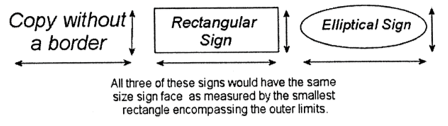
- Sign face area, multiple-faced signs. With the exception of projecting signs, where signs are installed back-to-back, where only one face can be viewed from any point at the same time, and when such sign faces are a part of the same sign structure and are not more than 24 inches apart, the sign area shall be computed by the measurement of one of the faces. In cases where one face is larger than the other the larger of the two will be counted as the area.
- Sign face area, individual signs. The sign face shall be computed by means of the smallest square, rectangle or triangle that will encompass the outer limits of the writing, representation, emblem, or other display, together with any material or color forming an integral part of the background of the display, or area used to differentiate the sign from the backdrop against which it is placed. Sign area shall not include the area of the supporting structures, provided the supporting structures are not used for advertising purposes or to draw attention to the sign. In the case of wall-mounted signs without a border or frame, the surface area shall include such reasonable and proportionate space as would be required if a border or frame were used. The sign face area for awning signs shall be computed by means of the smallest square, rectangle or triangle that will encompass the outer limits of the copy.
- Measurement of sign height. The height of a sign shall be considered to be the vertical distance measured from the top of the structure to the finished ground elevation of the site at the sign. In no event may excess fill be used to raise the sign above the authorized height.
- Location of signs.
- Near street, driveway and bicycle path intersections. No sign shall be erected which is located or designed in such a manner as to, in the opinion of the director of planning and development services, create a safety hazard by obstructing the vision of pedestrians, cyclists, or motorists traveling on or entering streets, driveways or bike paths.
- Clearance from high voltage power lines. Signs shall be located in such a way that they maintain a clearance of ten feet to all overhead electrical conductors and a three-foot clearance on all secondary voltage service drops.
- Setbacks from property lines. The minimum setback for ground-mounted signs on all sides shall be five feet for side and rear yard setbacks and zero feet for front yard setback.
- In the right-of-way. Supports for signs or sign structures shall not be placed in or upon a public right-of-way, public easement or public property.
- Location over right-of-way. Except as is provided for in section 30-1433(a)2, no sign shall project over a public right-of-way.
- Blocking exits, fire escapes, required parking or loading space, etc. No sign or sign structure shall be erected that impedes use of any fire escape, emergency exit, standpipe, or required parking or loading space.
- Sign identification and registration.
- Registration of signage. All signs requiring a permit may be registered with the village. Application for registration shall be made on a form prescribed by the director of planning and development services. The purpose of sign registration is to provide a record of existing signage that may have been lawfully erected, but for which permits or other records may or may not exist. Property owners voluntarily registering their signs may, upon request, receive a written determination as to the conformity of their signage.
- Sign identification. All signs issued a permit shall display the building permit number associated with the construction of the sign on the sign or sign structure, in a location visible from grade.
- Address requirements. All commercial properties shall be required to display the street number in a location that is visible from the closest street by August 28, 2001. The copy height of address signs shall be no less than four inches and no greater than eight inches. If the address is included within a sign area, the size of the sign shall not exceed area requirements; however, if the address is outside of the sign area, such as attached to the sign supports, then the address shall not be included in the calculation of the maximum sign area.
- Prohibited signs. The following signs are prohibited. However, signs existing on August 28, 2000, which are listed herein as prohibited, shall be considered to be nonconforming and shall be subject to all applicable provisions of this division regarding nonconforming signs.
- Abandoned signs. Note: signs that conform to all other provisions of this division shall not be considered abandoned if all copy is either removed or covered by the property owner within 90 days of the cessation of the business advertised.
- Advertising vehicles.
- Animated signs.
- Attention-getting devices.
- Billboards and other off-premises signs. Notwithstanding this provision, any billboard or off-premises sign or advertising matter that has been lawfully erected prior to August 28, 2000, and is entitled to protection pursuant to the provisions of F.S. ch. 479, shall be exempt from the amortization provisions of this division.
- Electronic message center signs.
- Flutter, feather, sail and teardrop flag signs.
- Human signs.
- Illegal signs. Illegal signs existing on August 28, 2000, shall be considered nonconforming only if the sign complies with the code in existence when the sign was erected.
- Light graphics.
- Portable signs if not specifically permitted by this division.
- Roof signs, except as provided for in Code section 30-1436.
- Snipe signs.
- Signs that create traffic hazards.
- Any sign not prescribed as a permitted sign, and permitted signs only to the extent allowed by this division.
- Dangerous and defective signs. No person shall allow any sign which is determined by the building official to be in a dangerous, defective, or dilapidated condition to remain on any premises owned or controlled by him. Any such sign shall be removed or repaired by the owner of the sign or the owner of the premises, or as otherwise provided for in this division.
- Signs not requiring permit. The following do not require a permit but still are subject to the provisions of this division:
- A-frame signs. Every nonresidential developed parcel of land shall be permitted one A-frame sign provided all of the following criteria are met:
- The sign shall be registered with the village with a fee as shall be established by resolution of the village council and the sign shall be registered and/or renewed annually with the department of planning and development services by October 1 of each year;
- The sign permit number shall be permanently affixed to the sign in a plainly visible manner;
- The sign shall be a minimum of six square feet and maximum of nine square feet per face;
- The sign shall not exceed four feet in height, exclusive of the sign legs that shall be no more than six inches in height;
- The sign shall be of an A-frame type construction, with only two sign faces that are joined at the top and no wider than four feet at the base;
- The sign shall be professionally constructed of a durable material including but not limited to aluminum, cast metal, molded plastic, PVC, recycled plastic, lumber, metal, wood or other similar materials;
- No additional attachments shall be permitted to the sign;
- The sign shall be adequately weighted to prevent collapse or floatation; however, the sign shall remain portable and not permanently affixed to the ground;
- The sign shall not be illuminated, animated, electrically powered in any way or have any electric devices attached thereto;
- The sign shall only be displayed during the sign owner's business hours and shall be stored indoors when the business is not open, during tropical storm/hurricane watches and warnings, and other severe weather advisories;
- The sign shall be located on a private parcel of land and identify a business on that same private parcel of land. The sign shall not be located in a clear sight triangle or any village or state right-of-way; and
- Each parcel shall be permitted to have one sign per legally established business; however, in cases where a parcel contains multiple businesses, no one parcel shall have more than three A-frame signs regardless of the number of legally established businesses on the parcel. The A-frame sign shall not count towards ground-mounted or wall-mounted signage.
- Business affiliation and law enforcement signs provided the total sign area of all such signs does not exceed four square feet.
- Business information signs provided that such signs are posted on or near the entrance doors and the total sign area of all such signs does not exceed four square feet.
- Commemorative plaques provided no plaque exceeds 16 square feet per face.
- Construction sign provided the sign does not exceed 24 square feet, does not exceed eight feet in height, is not installed until a building permit is issued and is removed within 14 days of the issuance of the certificate of occupancy or the final inspection if no certificate of occupancy is required.
- Directional signs provided the signs do not exceed four square feet per sign face.
- Directory sign. For multi-business centers, directory signs shall be permitted provided that no directory sign shall exceed eight square feet nor be visible from any right-of-way.
- Diver-down flags. Businesses offering dive or snorkel trips may display one diver-down flag not to exceed 60 square feet, in addition to flags allowed under other provisions of this division.
- Election signs, new business signs and promotional signs, subject to section 30-1433(a). Registration of election signs with the village shall be required.
- Garage and yard sale signs provided they are erected on the day of the sale and are removed within 24 hours following the sale, and provided they do not exceed four square feet per face.
- Holiday decorations provided that such signs shall be displayed for a period of not more than 45 consecutive days nor more than 60 days in any one calendar year. Such decorations shall not interfere with public safety.
- Interior property information signs shall be permitted, provided that the signs meet all applicable provisions of the Florida Building Code.
- Memorial signs or tablets provided the total sign area of all such signs does not exceed eight square feet.
- Nameplates provided the signs do not exceed two square feet per sign face.
- Posted property signs provided they individually do not exceed one and one-half square feet in area per sign and do not exceed four signs per property or are of such number, spacing, and size as is required per Florida Statutes. Such signs shall not be illuminated nor shall they project over any public right-of-way.
- Warning signs provided the sign does not exceed the minimum necessary to inform the public and is removed upon subsidence of danger.
- Window signs. Window signs shall be permitted for nonresidential uses provided that they collectively cover 35 percent or less of the window glass surface area. Note that the above-mentioned business information and business affiliation signs are excluded from the computation of window sign area. Neon light signs may be installed only within windows facing the right-of-way. Neon light signs are limited to 35 percent of the window area and are in lieu of other permitted window signs.
- Real estate signs are allowed as follows, provided that the advertising agency shall be responsible for the maintenance, upkeep and timely removal of the sign.
- Real estate signs in residential zoning districts: One nonilluminated real estate sign not exceeding four square feet per face and not exceeding five feet in height. Waterfront properties may have one additional sign not exceeding four square feet per face and placed adjacent to the waterfront.
- Real estate signs in nonresidential and mixed use zoning districts: One nonilluminated real estate sign shall not exceed 12 square feet and shall not exceed six feet in height if ground-mounted or 12 feet in height if wall-mounted.
- Open house signs: Up to three off-site directional real estate signs for residential sales shall be permitted per sale residence while a sales representative is present at the open house. Each sign shall measure no more than three square feet.
- Real estate signs, other than open house signs which shall be governed by subsection (c) above, may be posted no sooner than the date of listing of the property for sale or lease, and shall be removed no later than three days following the sale closing or signing of the lease.
- Temporary banner signs. One nonilluminated banner sign not exceeding nine square feet per sign face and three feet in height shall be permitted per business when located entirely on the property; and displayed only:
- A period as triggered by the re-entry order of Florida Keys residents into the Florida Keys after an evacuation due to a tropical storm or hurricane warning affecting Monroe or Miami-Dade County, through December 15 of that same year; or
- A period beginning upon the issuance of an emergency order by the governor of the State of Florida affecting Monroe or Miami-Dade County or the village council, and ending upon action of the village council.
- A-frame signs. Every nonresidential developed parcel of land shall be permitted one A-frame sign provided all of the following criteria are met:
(Ord. No. 02-20, § 1(6.9.3), 2-21-2002; Ord. No. 02-27, § 1(6.9.2), 11-14-2002; Ord. No. 05-03, § 1(6.9.2), 3-24-2005; Ord. No. 10-01, § 7, 1-14-2010)
Amended by Ord. 15-01 § 3 on 1/8/2015
Sec 30-1433 Specific Standards For Temporary And Permanent Signs
Upon issuance of a building permit or other applicable permit, if required, the following signs may be posted subject to the applicable requirements and standards provided herein.
- Temporary signs.
- General requirements for all temporary signs. The following requirements shall be generally applicable to all temporary signs allowed by this division:
- Temporary signs shall not be illuminated;
- Temporary signs shall not be located in a visibility triangle; and
- Temporary signs shall not be attached to trees, vegetation, utility poles or other signs.
- Election signs.
- All election signs shall be erected no earlier than 30 days prior to an election and shall be removed within seven days following the election to which the sign pertains.
- Election signs shall not exceed six square feet per face and four feet in height and are limited to one sign per candidate or issue, per each road frontage of the individual property.
- Election signs shall not be located within five feet of any side property yard.
- The candidate or campaign shall receive approval of the property owner prior to erecting any sign on private property.
- New business signs. Once a complete permit application for a permanent sign is submitted to the village, a new business, or a business in a new location, may erect one temporary banner or temporary sign on the property where the new business is located, not to exceed the lesser of either 32 square feet or the allowable size of the permanent signage pursuant to subsection (c) of this section, for a period not to exceed 90 days from the date of submission of the complete permit application for the permanent sign.
- Promotional signs. Signs including banners and temporary A-frame signs posted by the entity conducting an event pursuant to a public assembly or temporary use permit, not exceeding 16 square feet provided that such signs are:
- Located on the premises of the event;
- Limited to two promotional signs on the premises;
- Posted no earlier than 14 days prior to the start of the event and are removed no later than 48 hours after the event; and
- Professionally constructed.
- General requirements for all temporary signs. The following requirements shall be generally applicable to all temporary signs allowed by this division:
- Signs in residential areas. The following signs may be granted a permit:
- Residential subdivision or condominium sign. One permanent wall- or ground-mounted sign, for identification purposes only, giving only the name of the subdivision or residential development, may be granted a permit at each main entrance into such subdivision or development from each abutting arterial roadway provided the following provisions are met:
- The subdivision or development shall have a homeowner's association or similar entity which will be responsible for permits and maintenance of the signs;
- The face of the sign shall not exceed 32 square feet;
- The maximum permitted height shall be eight feet;
- The sign shall not be internally illuminated; and
- The sign may incorporate, or be incorporated into, accessory entrance structural features such as a project wall or landscaping.
- Institutional uses and private parks. Institutional uses, private parks and similar uses shall be permitted one ground-mounted and one wall-mounted sign, subject to the following limitations:
- Maximum sign area shall be 32 square feet per sign face; and
- No ground-mounted sign shall exceed eight feet in height.
- Residential subdivision or condominium sign. One permanent wall- or ground-mounted sign, for identification purposes only, giving only the name of the subdivision or residential development, may be granted a permit at each main entrance into such subdivision or development from each abutting arterial roadway provided the following provisions are met:
- Signs in nonresidential and mixed use zoning districts. Sign allowances in nonresidential and mixed use zoning districts shall be calculated based on the amount of property frontage for ground-mounted signs and business frontage for wall-mounted signs.
- Ground-mounted signs. Every nonresidential developed parcel of land shall be permitted a ground-mounted sign. Ground-mounted signs may not exceed 16 feet in height. Businesses which are substantially adjacent to an elevated portion of U.S. 1 (i.e. bridge), as determined by the director of planning and development services, may erect a ground-mounted sign not to exceed 20 feet in height.
- Allowable area. The allowable area of the sign faces shall be as indicated in the following table:
TABLE A. PERMITTED SIZE OF NONRESIDENTIAL SIGNS PER U.S. 1 FRONTAGE*Signs must be separated by at least 100 feet.Street Frontage (linear feet)
Maximum Area per Sign
Total Signs
Businesses which front on or are visible from U.S. No. 1:
1 foot to 199 feet
64 square feet
1
200 feet to 299 feet
80 square feet
1
OR
40 square feet
2*
300 feet or greater
110 square feet
1
OR
50 square feet
2*
Businesses which front on other roads:
1 foot to 199 feet
32 square feet
1
200 feet to 299 feet
40 square feet
1
300 feet or greater
48 square feet
1
- Manual changeable copy signs. Manual changeable copy signs may be permitted as follows:
- Any nonresidential developed property shall be allowed to use up to 12 square feet of their permitted wall- or ground-mounted signage allowable pursuant to subsection (c) of this section for the purpose of manual changeable copy signage.
- A school, house of worship, day care center or other similar use shall be allowed to include an additional 32 square feet of signage to the ground-mounted sign for the exclusive use of a manual changeable copy sign.
- Businesses dispensing fuel to the public shall be allowed an additional 20 square feet of signage to the ground-mounted sign for the exclusive use of a manual changeable copy sign for posting fuel prices.
- Vacancy signs. Hotels, motels and campgrounds may have up to an additional four square feet of sign face area for a vacancy sign, which may be neon.
- Charter signs. Individual charter boats shall be allowed a ground-mounted sign at the charter boat's dock slip provided the sign does not exceed 12 square feet.
- Drive-through signs. Drive-through or carryout services may have a sign which carries only the name of the establishment and the current list and price of goods or services available in the establishment, not visible from any right-of-way, and provided that the sign is limited to a maximum of 20 square feet.
- Multi-business center signs. In addition to the signage allowed above, businesses within a multi-business center, whereby the individual businesses are not visible from any public right-of-way, will be allowed an additional five square feet of sign area per business, up to an additional 30 square feet.
- Multiple frontage signs. If the rear of a commercial building has permitted access to a public street or is adjacent to a designated bike or pedestrian way, an eight-square-foot ground-mounted sign no taller than six feet, or a wall-mounted sign up to a maximum of eight square feet, may be installed.
- Water frontage signs. Every commercially developed parcel of land which has access to navigable waters whereby no other existing or proposed signage is visible from the waterway may have one additional ground-mounted sign not to exceed 16 square feet, not to exceed 12 feet in height.
- Wayfinding signs, highway. Any nonresidential developed property with frontage on U.S. 1 shall be allowed to use any of the wall- or ground-mounted signage allowable pursuant to subsection (c) of this section for the purpose of identifying and providing directions to establishments which are not readily visible from U.S. 1 but which are accessed from U.S. 1 by an intersecting side street. Said wayfinding signage shall be limited to one sign face per direction on U.S. 1 and located no more than one-half mile from the nearest property line of the establishment identified by the sign. Highway wayfinding signage permitted pursuant to this subsection shall be subtracted from the total amount of signage permitted for the nonresidential developed property on which it is located.
- Time and temperature signs. Banks and lending institutions may have one additional ground-mounted sign not to exceed 12 square feet to be used solely for the display of time, date and temperature.
- Hospitals or other emergency facilities. Hospitals or other emergency medical facilities, excluding individual medical offices, shall be considered the same as for individual establishments. One additional illuminated ground or wall sign not to exceed 16 square feet to identify each emergency entrance shall be permitted.
- Allowable area. The allowable area of the sign faces shall be as indicated in the following table:
- Wall-mounted signs.
- Allowable area. Each individual business frontage shall be entitled to a total area of wall-mounted signage equal in area to two square feet times the length of the individual business frontage. This signage may be distributed on the front and/or sides of the building in which the business is located. The height may not exceed 20 feet.
- Multiple frontage signs. If the rear of a commercial building has permitted access to a public street or is adjacent to a designated bike or pedestrian way, a wall-mounted sign, up to a maximum of eight square feet, or an eight-square-foot ground-mounted sign no taller than six feet, may be installed between the building and the right-of-way.
- Water frontage signs. Every commercially developed parcel of land which has access to navigable waters, and no other existing or proposed signage is visible from the waterway, may have one additional wall-mounted sign not to exceed 16 square feet and a height not to exceed 12 feet. This sign shall not be visible from any public street.
- Special entertainment and assembly facility signs. Theaters, museums, auditoriums, houses of worship and fairgrounds shall be permitted an additional 32 square feet of a manual changeable copy, wall-mounted sign. Along the wall adjacent to the ticket windows, a theater may display, without requiring a sign permit, one poster per screen up to 12 square feet.
- Neon signs. Neon copy can be utilized in lieu of other copy for wall signs. However, the use of neon will result in a 50 percent reduction in the wall sign area allowed under this section.
- Canopy signs. One sign per business entrance may be placed underneath, extending downward from a canopy along the front of a building, to clearly serve the purpose of providing business identification for pedestrians provided:
- The sign does not exceed five square feet per face;
- The sign is permanently attached and does not swing;
- The sign is perpendicular to the facade of the building; and
- The sign is located above a walkway.
- Awning signs. Each business may, in lieu of wall signage, erect an awning sign. The copy area of the awning sign shall be limited to an area two square feet times the business frontage. The lighting must be consistent with the provisions of this chapter.
- Fence signs. Each business may, in lieu of ground-mounted signage, erect a fence sign provided the sign is:
- Limited to the size permitted for a ground-mounted sign under this section. More than one sign may be erected provided the cumulative total does not exceed the permitted square footage;
- Not located on chainlink or wire type fence;
- Permanently and securely fastened;
- Not internally illuminated; and
- Not exceeding the maximum permitted height of the fence.
- Projecting signs. Each business may erect one projecting sign. The copy area of each face of the projecting sign shall be subtracted from the total allowable area of wall-mounted signs, less any existing wall-mounted signs, awning signs and projecting signs. Projecting signs shall adhere to the following criteria:
- The sign shall not extend more than 48 inches perpendicularly from the plane of the building wall;
- The sign shall not project above the facade of a building, be mounted on top of a roof, nor be affixed to the top of any awning; and
- Any sign lighting shall be consistent with the provisions of this chapter.
- Ground-mounted signs. Every nonresidential developed parcel of land shall be permitted a ground-mounted sign. Ground-mounted signs may not exceed 16 feet in height. Businesses which are substantially adjacent to an elevated portion of U.S. 1 (i.e. bridge), as determined by the director of planning and development services, may erect a ground-mounted sign not to exceed 20 feet in height.
Editor's note(s)—Ord. No. 15-01, § 3, adopted Jan. 8, 2015, amended § 30-1433 in its entirety to read as herein set out. Former § 30-1433, pertained to signs requiring permit; specific standards, and derived from Ord. No. 02-20, § 1(6.9.4), adopted Feb. 21, 2002; Ord. No. 02-27, § 1(6.9.3), adopted Nov. 14, 2002; Ord. No. 05-03, § 1(6.9.3), adopted March 24, 2005; and Ord. No. 10-01, § 7, adopted Jan. 14, 2010.
Adopted by Ord. 15-01 § 3 on 1/8/2015
Sec 30-1434 Materials, Construction, Lighting, Maintenance And Responsibility
- Sign materials. Exposed surfaces of signs may be constructed of brick, concrete, MDO plywood, metal, plastic, fiberglass, solid wood, stone, tile, or other similar materials.
- Construction.
- Compliance with Florida Building Code. All signs shall comply with the appropriate detailed provisions of the Florida Building Code, relating to design, structural members and connections. Signs shall also comply with the additional standards hereinafter set forth.
- Licensed contractor required. Except for temporary signs, all signs shall be erected by entities authorized by chapter 6 of the Village Code.
- Structural design. All signs that contain more than 32 square feet in area or are erected over eight feet in height shall be designed by an engineer registered in the state. Structural drawings shall be prepared by the engineer and submitted prior to a permit being issued. Wind load calculations shall be contained in the engineering drawings. Signs shall be constructed to withstand wind loads of 150 miles per hour.
- Electric signs. All electric signs shall require a permit and shall meet the requirements of article 600 of the latest adopted edition of the National Electrical Code (NFPA 70).
- Supports and braces. Supports and braces shall be adequate for wind loadings. Wire or cable supports shall have a safety factor of four times the required strength. All metal, wire cable supports and braces and all bolts used to attach signs to a bracket or brackets and signs to the supporting building or structure shall be of galvanized steel or of an equivalent corrosive-resistant material. All such sign supports shall be an integral part of the sign.
- Sign anchoring. No sign shall be suspended by chains or other devices that will allow the sign to swing due to wind action. Signs shall be anchored to prevent any lateral movement that would cause wear on supporting members or connections.
- Lighting. Sign lighting shall not shine directly onto an adjoining property or into the eyes of motorists, bicyclists or pedestrians using or entering pedestrian ways, driveways, streets or bicycle paths. Signs shall be illuminated only with white light in accordance with the following standards:
- Ground-mounted and wall-mounted signs.
- Internally illuminated signs or cut-out letters. Internally illuminated signs or cut-out letters shall be illuminated pursuant to the following standards:
- Internally illuminated signs shall be constructed of a material such that the lighting is diffuse in nature and that no bulb or lamp component is visible through the sign face; and
- Internally illuminated signs shall be equipped only with low or medium intensity bulbs.
- Externally illuminated signs. Externally illuminated signs shall be illuminated pursuant to the following standards:
- All illumination of signs shall be directional, with the lighting fixture to be designed and positioned so as to confine illumination to the sign face only;
- Halogen, incandescent, fluorescent or metal halide bulbs shall be permitted only if such bulbs are recessed deep into the housing, glare shield, cowl, louver or baffle; and
- A maximum of 250 watts of illumination per sign face shall be permitted.
- Internally illuminated signs or cut-out letters. Internally illuminated signs or cut-out letters shall be illuminated pursuant to the following standards:
- Awnings. Awnings shall not be backlit or internally illuminated. Signs on awnings shall not be constructed of any light reflective materials.
- Ground-mounted and wall-mounted signs.
- Maintenance. All signs for which a permit is required by this division, including their supports, braces, guys and anchors, shall be maintained so as to present a neat, clean appearance. Painted areas and sign surfaces shall be kept in good condition, and illumination, if provided, shall be maintained in safe and good working order. Changeable copy signs shall utilize uniform copy and shall be maintained as to present a clear message (i.e., replacement of missing letters).
- Responsibility. The sign owner, the property owner of the property on which the sign is placed and the sign contractor shall each be held responsible for adherence to the regulations set forth in this division.
(Ord. No. 02-20, § 1(6.9.5), 2-21-2002; Ord. No. 02-27, § 1(6.9.4), 11-14-2002; Ord. No. 10-01, § 7, 1-14-2010)
Sec 30-1435 Nonconforming Signs
Signs existing on August 28, 2000, which are not in compliance with this division may continue except as follows:
- Damage, alterations and modifications to nonconforming signs.
- Change in use. Nonconforming signs shall be brought into compliance whenever there is a change in use of the property. For purposes of this provision, change in use shall mean a change from one permitted, conditional, or nonconforming use to another permitted or conditional use, as provided for under article V, division 2 of this chapter. Change in use shall not mean a change from one type of low/medium intensity office, retail or service establishment to another type within that category as listed under article V, division 2 of this chapter. For example, a property changing ownership or the name of the business, but not changing the type of business, may change the copy of the signage provided it complies with subsection (a)2 of this section. A property changing the use of the property, for example from a restaurant to an office use, would be required to bring their signage into compliance upon application for change of copy.
- Repair or reconstruction. Nonconforming signs may be repaired or reconstructed only where such work would be less than 50 percent of the replacement cost of the sign, inclusive of the support structure. Neither shall the cumulative costs of repair or reconstruction exceed 50 percent of the replacement cost of any nonconforming sign over any consecutive 12-month period.
- Multiple signs. For purposes of bringing nonconforming signs into compliance with this division, ground-mounted signs are treated separately from wall-mounted and all other signage. For example, where both the ground-mounted and wall-mounted signs of a particular business are nonconforming, the change of copy of a wall-mounted sign shall not require that the ground-mounted signage be brought into compliance. However, where a sign other than a ground-mounted sign is required to be brought into compliance, all of the other signs of an establishment shall also be brought into full compliance with this division.
- Ground-mounted multi-business center signs. Ground-mounted multi-business center signs shall be brought into compliance pursuant to subsections (a)2 and (a)3 of this section only.
- Time for compliance, illegal signs. All signs or advertising matter which do not conform to this division shall be deemed illegal and shall be removed immediately.
- Exemptions to nonconforming sign requirements for signs designated as historic structures. Signs may be eligible to receive historic designation pursuant to article VII, division 7 of this chapter provided they are a minimum of 25 years old and meet any other applicable criteria that may apply to historic designation. Signs receiving historic designation may be repaired or reconstructed pursuant to all applicable provisions of article VII, division 7 of this chapter.
- Compliance bonus. Property owners who voluntarily bring all their nonconforming signs into conformance with the provisions of this division will receive a one-time 20 percent increase in the maximum total sign area authorized for the replacement of ground-mounted or wall-mounted signage. The bonus shall apply to replacement of nonconforming signage only. Compliance bonuses shall remain with the property, and may be utilized for subsequent replacement signage. However, the replacement of nonconforming ground-mounted signage with two conforming signs (as permitted under section 30-1433(c)1 shall not receive a bonus.
- Previously granted sign variances. Any sign erected and maintained in compliance with a variance which was granted prior to August 28, 2000, but which is not in compliance with this division, shall be treated hereunder as a nonconforming sign.
(Ord. No. 02-20, § 1(6.9.8), 2-21-2002; Ord. No. 02-27, § 1(6.9.5), 11-14-2002)
Amended by Ord. 15-01 § 3 on 1/8/2015
Sec 30-1436 Sign Permit And Review Procedures; Variances
- Permit required. No sign shall be erected, installed, displayed, enlarged, relocated, or modified without the appropriate permit being issued by the village, except as provided for in section 30-1432(k), "Signs not requiring permit."
- Application. Before any permit is issued, a written application, in the form provided by the village, shall be filed together with such drawings and specifications as may be necessary to fully advise the village with the location, construction, materials, colors, size, manner of illumination, method of securing or fastening, the number of signs applied for, the consent of the property owner, duration of use (if applicable), and the wording of the sign. Every application for a sign permit shall include the square footage and location of all existing signs on the property, a photograph of all building facades and any other necessary information relating to the proposed sign in order for the village to determine compliance with all requirements of this division. In addition, applications for a ground-mounted sign and all other freestanding signs for which a permit is required shall include an accurate and up-to-date survey of the property indicating the lot dimensions, the proposed location of the sign(s) with all setbacks to relevant property lines and/or Mean High Water Line (MHWL) and a site plan.
- Electrical signs. All signs that are electrically illuminated shall require a separate electrical permit and inspection. This shall include signs that are illuminated from an external electrical source.
- Completeness. Upon the submission of an application, staff shall have ten days to determine whether it is complete. If staff finds that the application is not complete, they shall provide the applicant with written notice of the deficiencies within the ten-day period. Upon resubmission of the application, staff shall have ten additional days to determine whether the applicant's revisions are sufficient to complete the application. If they are not, staff will again inform the applicant of any remaining deficiencies in writing. This process shall continue until the applicant has submitted a complete application, or demands in writing that the application be reviewed "as is."
- Permit fees. A non-refundable permit fee is due at the time of submission of a permit application. After the permit application is approved and before it is ready to be issued, the applicant shall pay any remaining balance of the permit fees. More than one sign on one building or group of buildings located on the same parcel of land may be applied for at the same time, but shall be issued separate permits. The permit fee amount shall be established by the village council by resolution.
- Permit review. Based on the application, the director of planning development services (director) or his designee, shall approve, approve with conditions or deny the sign permit application based on compliance with the requirements of this division. The director shall approve, approve with conditions or deny the sign permit within 30 days after the village's receipt of a complete application.
- Failure to commence. Every sign permit issued by the village shall become null and void if installation has not commenced within 180 days from the date of such permit. If work authorized by such permit is suspended or abandoned for 180 days in accordance with the Florida Building Code any time after the work is commenced, then a new permit shall be first obtained to do so, and the fee shall be the full amount required for a new permit for such work.
- Revocation. The village may, in writing, suspend or revoke a permit issued under provisions of this division whenever the permit is issued on the basis of a misstatement of fact or fraud by notice of certified mail, return receipt requested to the property owner. The written revocation shall describe the appeal process as set forth in article IV, division 4 (Administrative Appeals) of this chapter.
- Inspection. After the issuance of the appropriate permit(s), the applicant may install and display the approved sign(s). Once installed, the village shall inspect the sign(s) for conformance with the approved permit(s) and the standards contained herein. In order for a sign application to be approved, the applicant must grant access to the property for sign inspection purposes.
- Removal of sign on occupant's vacation of the premises. Within 90 days after an occupant vacates a lot or structure, the property owner shall remove or cover the vacated occupant's sign.
- Appeals. Any appeal from any decision of the director relating to enforcement of these sign regulations shall be made in accordance with the requirements set forth in article IV, division 4 (Administrative Appeals) of this chapter.
- The village council may grant a variance from the provisions or requirements of this division upon the recommendation of the director of planning and development services whereby the variance meets all of the standards below.
- There are special circumstances or conditions applying to the land, building or use referred to in the application;
- The special circumstances or conditions are preexisting and not created by the property owner or applicant;
- The granting of the requested variance would not be materially detrimental to the property owners in the vicinity;
- The granting of the variance would not be contrary to the general objectives of this division of moderating the size, number and obtrusive placement of signs and the reduction of clutter;
- The variance is granted for a specific sign;
- The applicant has demonstrated that there are no viable solutions within the provisions of this division;
- For a rooftop sign variance, the applicant shall demonstrate, in addition to the requirements contained herein, that the business is substantially adjacent, as determined by the director of planning and development services, to an elevated portion of U.S. 1, thereby rendering other types of signs ineffective, or the property is located on a multi-lane section of U.S. No. 1;
- The village council deems it to be the optimum design for the specific site conditions; and
- In no event shall any variance be granted to allow any sign listed in section 30-1432(i) (prohibited signs), except roof signs pursuant to subsection (g) above.
Editor's note(s)—Ord. No. 15-01, § 3, adopted Jan. 8, 2015, amended § 30-1436 in its entirety to read as herein set out. Former § 30-1436, pertained to sign variances, and derived from Ord. No. 02-20, § 1(6.9.7), adopted Feb. 21, 2002; and Ord. No. 02-27, § 1(6.9.6), adopted Nov. 14, 2002.
Adopted by Ord. 15-01 § 3 on 1/8/2015
Sec 30-1480 Uses Containing Drive-In And Drive-Through Components
Uses containing drive-in or drive-through components shall be approved only as a major conditional use.
(Ord. No. 09-03, § 3, 3-12-2009)

