
Jackson City Zoning Code
ARTICLE III
ZONING DISTRICT REGULATIONS
Sec. 28-71.- Permitted and conditional uses.
The following uses are permitted (P), or conditional (C) within the zoning districts. Conditional uses require approval by the planning commission according to the procedures of section 28-147.
* Permitted by right for residential uses and conditional for nonresidential uses.
(Code 1977, §§ 5.50—5.57; Ord. No. 90-11, §§ 2, 3, 7-17-90; Ord. No. 90-15, § 1, 7-31-90; Ord. No. 92-11, § 1, 6-16-92; Ord. No. 92-18, § 1, 11-10-92; Ord. No. 93-2, § 3, 1-5-93; Ord. No. 93-10, § 2, 7-20-93; Ord. No. 93-16, § 1, 8-31-93; Ord. No. 93-18, § 2, 9-28-93; Ord. No. 93-27, § 1, 11-23-93; Ord. No. 94-8, § 1, 8-23-94; Ord. No. 96-10, § 1, 7-30-96; Ord. No. 97-15, § 1, 8-19-97; Ord. 98-15, § 1, 7-7-98; Ord. No. 98-16, § 1, 7-7-98; Ord. No. 99-9, § 1, 6-1-99; Ord. No. 99-18, § 1, 9-21-99; Ord. No. 2000.5, § 1, 8-22-00; Ord. No. 2001.5, § 1, 2-13-01; Ord. No. 2002.1, § 1, 2-12-02; Ord. No. 2003.7, §§ 1, 2, 5-27-03; Ord. No. 2003.16, § 3, 11-25-03; Ord. No. 2004.8, § 1, 4-13-04; Ord. No. 2006.11, § 1, 7-18-06; Ord. No. 2006.12, § 1, 7-18-06; Ord. No. 2006.13, § 1, 8-15-06; Ord. No. 2006.17, § 1, 11-14-06; Ord. No. 2007.2, § 1, 1-9-07; Ord. No. 2009-6, § 1, 4-7-09; Ord. No. 2011.15, § 3, 8-16-11; Ord. No. 2012.5, § 4, 4-10-12; Ord. No. 2016.04, § 2, 3-15-16; Ord. No. 2016.07, § 2, 3-29-16; Ord. No. 2016-29, § 3, 11-15-16; Ord. No. 2017-06, § 3, 5-2-17; Ord. No. 2018-14, § 2, 12-11-18; Ord. No. 2019-14, § 2, 10-15-19; Ord. No. 2020-16, § 2, 10-13-20; Ord. No. 2020-21, § 2, 12-8-20; Ord. No. 2021-08, § 2, 8-17-21; Ord. No. 2024-07, § 2, 10-8-24)
Sec. 28-72. - Additional compatible uses.
In addition to the uses specifically permitted in each district, any other use that is determined by the zoning board of appeals to be of the same general character and to result in comparable impact upon the surrounding area and property and place comparable demands upon streets and public facilities may also be permitted. This does not include uses that are first permitted in any other zoning district.
(Code 1977, § 5.58)
Sec. 28-73. - Lot area, width, yard, building height requirements—Residential districts.
R-5 districts—All permitted uses, except mobile home parks, shall conform to the provisions in the R-1 district of this chapter.
All nonresidential uses shall meet minimum requirements for lot area, width, yard and height as established for each district.
For the provisions regulating signs, off-street parking and off-street loading, see those sections in the "supplemental regulations" section.
(Code 1977, § 5.60; Ord. No. 2016-29, § 3, 11-15-16; Ord. No. 2025-02, § 2, 5-13-25)
Sec. 28-74. - Same—Commercial districts.
(Code 1977, § 5.61; Ord. No. 2016-29, § 3, 11-15-16; Ord. No. 2017-06, § 3, 5-2-17)
Sec. 28-75. - Same—Industrial districts.
(Code 1977, § 5.62; Ord. No. 2016-29, § 3, 11-15-16)
_____
Sec. 28-76. - Compliance with regulations.
(a)
No building or structure shall be erected or altered contrary to the regulations prescribed for the district in which the building or structure is located.
(b)
No yard or lot existing on shall be reduced in dimension or area below the minimum requirements set forth for the district in which the yard or lot is located. Yards or lots created after the effective date of the ordinance from which this chapter is derived shall meet at least the minimum requirements established by this chapter.
(c)
No part of a yard or other open space required for or in connection with any structure for the purpose of complying with this chapter shall be included as part of a yard or open space required for compliance by any other structure.
(Code 1977, § 5.63; Ord. No. 2025-02, § 2, 5-13-25)
Sec. 28-77. - Yard measurements.
(a)
Lots which abut on more than one (1) street shall provide the required front yards along every street.
(b)
All front, side, and rear yards shall be the minimum perpendicular distance measured from the principal structure, excluding all projections not exceeding three (3) feet in length from the structure wall.
(Code 1977, § 5.64)
Sec. 28-78. - Exceptions and modifications.
The regulations set forth by this chapter within each district shall be subject to the exceptions and modifications embodied in sections 28-79 through 28-84, to be administered by the zoning inspector unless otherwise specified.
(Code 1977, § 5.65; Ord. No. 93-2, § 4, 1-5-93)
Sec. 28-79. - Front and rear yard exceptions.
A primary structure may be constructed up to the front or rear block building line (see section 28-5 for the definition) when more than fifty (50) percent of the principal structures on one (1) side of the street in any one (1) block in a residential or commercial district do not meet the required front or rear yard setbacks, respectively.
(Code 1977, § 5.66; Ord. No. 93-2, § 5, 1-5-93; Ord. No. 2012.5, § 4, 4-10-12)
Sec. 28-80. - Double frontage lots.
Buildings on lots having frontages on two (2) nonintersecting streets shall have applicable front yards on both streets.
(Code 1977, § 5.66; Ord. No. 93-2, § 5, 1-5-93)
Sec. 28-81. - Side yard exceptions in R districts.
(a)
Each side yard shall be increased in width by two (2) inches in any R district for each foot by which the length of the side wall of a building, adjacent to the side yard, exceeds forty (40) feet.
(b)
The width of one (1) side yard may be reduced to a width not less than three (3) feet; provided the sum of the widths of the two (2) side yards is not less than the required minimum, and further provided the distance between the proposed dwelling and another dwelling, existing or proposed on an adjoining lot is not less than the minimum sum of the widths of the two (2) side yards. Such reduction may be authorized only when the zoning board of appeals finds it to be warranted by the location of existing buildings or conducive to the desirable development of two (2) or more lots.
(c)
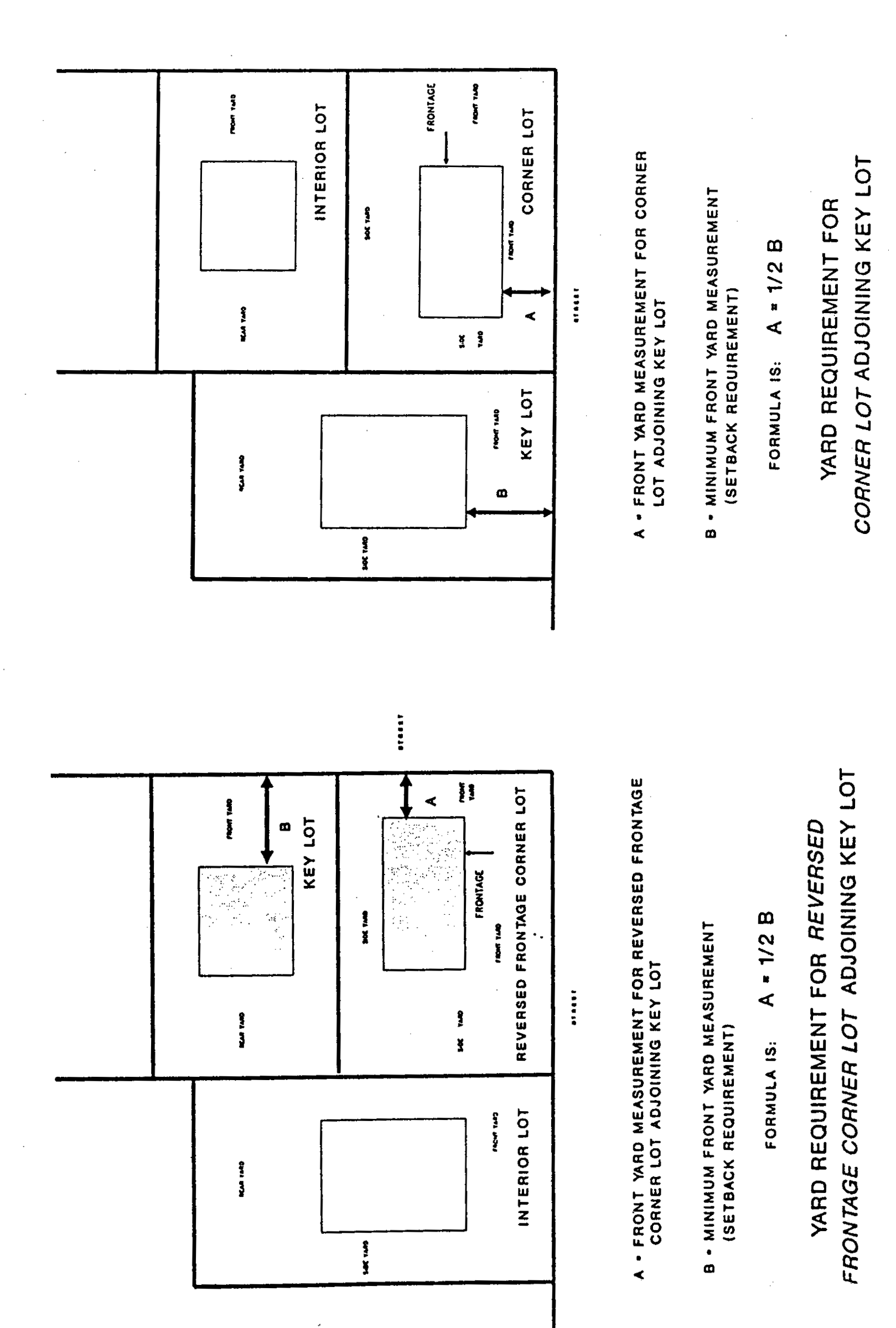
For corner lots which adjoin key lots, the yard setback which is contiguous to a street, but is not the frontage of the structure, shall have a width of not less than one-half (½) the required depth of the front yard setback on the adjoining key lot. (See "yard requirement for corner lot adjoining key lot" diagram following this section.)
(Code 1977, § 5.67; Ord. No. 93-2, § 5, 1-5-93)
Sec. 28-82. - Lot width.
Width of a lot shall be the horizontal straight line distance between the side lot lines, measured between the two (2) points where the front setback line intersects the side lot lines (see "lot lines" diagram); provided however, that the width between side lot lines (where they intersect with the street line) shall not be less than eighty (80) percent of the required lot width, except in the case of lots on the turning circle of culs-de-sac, where the eighty (80) percent requirement shall not apply.
(Code 1977, § 5.68; Ord. No. 93-2, § 5, 1-5-93)
Sec. 28-83. - Height exceptions.
Exceptions to the maximum height regulations for each district specified in this chapter may be permitted subject to the following provisions:
(1)
Height limitations. The limitations affecting the height of structure shall not apply to the following appurtenant appendages and structures provided they comply with all other provisions of this or any other applicable ordinances: parapet walls, chimneys, smokestacks, church spires, flagpoles, radio and television towers, penthouses for mechanical equipment and water tanks.
(2)
Increased height. Building height in excess of the height above average ground level allowed in any district may be permitted by the zoning board of appeals provided all minimum front, side, and rear yard depths are increased one (1) foot for each additional one (1) foot of height and provided that adequate fire protection and compatibility with existing structure heights can be demonstrated.
(Code 1977, § 5.69; Ord. No. 93-2, § 5, 1-5-93)
Sec. 28-84. - Transitional uses in R districts.
In any R-2 or R-3 district, a transitional use shall be permitted on a lot the side lot line of which adjoins, either directly or across an alley, any C or I district. The permitted transitional uses for any such lot in an R-2 district shall be any use permitted in the R-3 district; and the permitted transitional uses for any such lot in the R-3 district shall be any use permitted in the R-4 or R-6 district. In the case of any such lot in an R-2 or R-3 district, the requirements governing lot area per dwelling unit, off-street parking, height and yards shall be the same as for the district.
(Code 1977, § 5.70; Ord. No. 90-11, § 5, 7-17-90; Ord. No. 93-2, § 5, 1-5-93)
Sec. 28-85. - Distance between grouped buildings.
In addition to the required setback lines provided elsewhere in this chapter for dwelling groups (including semidetached and multiple dwellings), the following minimum distances shall be required:
(1)
Where buildings are front to front or front to rear, three (3) times the height of the taller building, but not less than seventy (70) feet.
(2)
Where buildings are side to side, one (1) times the height of the taller building but not less than twenty (20) feet.
(3)
Where buildings are front to side, rear to side, or rear to rear, two (2) times the height of the taller building but not less than forty-five (45) feet.
(Code 1977, § 5.72; Ord. No. 90-11, § 7, 7-17-90)
Sec. 28-86. - Projections into yards.
In any R district, certain architectural and other features may project into required yards as follows:
(1)
Cornices, canopies, eaves, bay windows, balconies, chimneys and other architectural features may project a distance not exceeding three (3) feet.
(2)
Outside stairways and fire escapes may project a distance not exceeding four (4) feet, six (6) inches.
(3)
An uncovered stair with landing which does not extend above the entrance floor of the building except for a railing, and projects not more than six (6) feet.
(4)
Walks, driveways or necessary retaining walls may occupy any yard area.
(5)
Patios or decks that do not extend above the floor of the building or project more than twelve (12) feet into the required rear yard space.
(6)
A ramp may project into the required yards so long as the ramp meets all requirements of the Americans with Disabilities Act and regulations of the American National Standards Institute, and is set back from the front property line a minimum of four (4) feet.
(Code 1977, § 5.73; Ord. No. 90-11, § 8, 7-17-90; Ord. No. 2009-13, § 1, 9-22-09)
Sec. 28-87. - Use by right on a lot.
In all R districts, not more than one (1) use by right and/or principal building shall be placed on one (1) lot of record.
(Code 1977, § 5.160; Ord. No. 2012.16, § 4, 7-17-12)
Editor's note— Ord. No. 2012.16, § 4, adopted July 17, 2012, renumbered the former § 28-131 as § 28-87.
Sec. 28-88. - Required area or space cannot be shared.
No part of a yard, provided about or for any building or structure for the purpose of complying with the provisions of this chapter, shall be included as part of a yard for another building or structure.
(Code 1977, § 5.180; Ord. No. 2012.16, § 4, 7-17-12)
Editor's note— Ord. No. 2012.16, § 4, adopted July 17, 2012, renumbered the former § 28-133 as § 28-88.
Sec. 28-89. - Exemption of essential services.
The erection, construction, alteration or maintenance by public utilities or municipal departments or commissions, of overhead or underground gas, electrical, steam, or water distribution or transmission systems, collection, communication, supply or disposal systems, including mains, drains, sewers, pipes, conduits, wires, cables, fire alarm boxes, police callboxes, traffic signals, hydrants, towers, poles, electrical substations, gas regulator stations, telephone exchange buildings, public utility or municipal buildings and other similar equipment and accessories in connection therewith, reasonably necessary for the furnishing of adequate service by such public utility or municipal department or commission shall be permitted as authorized or regulated by law and other ordinances of the city in any use district, it being the intention hereof to except such erection, construction, alteration, and maintenance from the application of this chapter.
(Code 1977, § 5.190; Ord. No. 2012.16, § 4, 7-17-12)
Editor's note— Ord. No. 2012.16, § 4, adopted July 17, 2012, renumbered the former § 28-134 as § 28-89.
Sec. 28-90. - Required setback from the high water mark of a watercourse.
(a)
Within an established high water mark setback there shall be no: construction; deposit of any material, including structures; removal of any soils, minerals and/or vegetation; dredging, filling or land balancing; constructing or undertaking seasonal or permanent operations, except as authorized in this section.
(b)
The setback shall only contain vegetation unless located within the C-3 zoning district within which a boardwalk/sidewalk may be constructed on public and/or private property as a means of maintaining public access/visibility to the waterfront.
(c)
Additionally, under certain conditions as defined below, a high water mark setback conditional use permit may be authorized by the planning commission to allow limited construction, activity, use, or operations within said setback. All such conditional use permit requests will be evaluated based upon no less than the following general criteria:
(1)
The relative extent of the public and private need for the proposed activity.
(2)
The availability of feasible and prudent alternative locations and methods to accomplish the expected benefits from the activity.
(3)
The extent and permanence of the beneficial or detrimental effects which the proposed activity may have on the public and private use to which the area is suited, including the benefits the natural feature and/or natural feature setback provides.
(4)
The probable impact of each proposal in relation to the cumulative effect created by other existing and anticipated activities in the watershed.
(5)
The probable impact on recognized historic, cultural, scenic, ecological, or recreational values, and on fish, wildlife and the public health.
(6)
The size and quantity of the natural feature setback being considered.
(7)
The amount and quantity of the remaining natural feature setback.
(8)
Proximity of the proposed construction and/or operation in relation to the natural feature, taking into consideration the degree of slope, general topography in the area, soil type and the nature of the natural feature to be protected.
(9)
Economic value, both public and private, of the proposed construction and/or operation, and economic value, both public and private, if the proposed construction and/or operation were not permitted.
(10)
The necessity for the proposed construction and/or operation.
(Ord. No. 2016-29, § 3, 11-15-16)

