
Jackson City Zoning Code
ARTICLE IV
SITE AND BUILDING DESIGN STANDARDS2
Editor's note— Ord. No. 2012.16, § 5, adopted July 17, 2012, repealed the former Art. IV, §§ 28-106—28-159, and enacted a new Art. IV as set out herein. The former Art. IV pertained to supplemental provisions. For a complete derivation see the Code Comparative Table at the end of this volume.
Sec. 28-100.- Off-street parking, loading, and access design standards.
(a)
General provisions for off-street parking.
(1)
The regulations of this article must be met in all districts whenever any uses are established or any building or structure is erected, enlarged, or increased in capacity.
(2)
Plans and specifications showing required off-street parking spaces, including the means of access, ingress, egress, drainage and circulation must be submitted to the zoning administrator (or designee) for review on or before the time of application for a building permit for the erection or enlargement of a building or at the time spaces are added or altered, unless a site plan is required under section 28-135 (site plan review procedures and requirements), in which case this requirement does not apply.
a.
Modification of standards. The zoning administrator (or designee) will perform an independent site review analysis and may allow the applicant to deviate from zoning regulations if unique or restrictive circumstances exist.
(3)
No parking area or parking space which exists at the time this section becomes effective, or which subsequently thereto is provided for the purpose of complying with the provisions of this section, may thereafter be relinquished or reduced in any manner below the requirements established by this section.
(4)
Residential parking.
a.
One-family residential off-street parking spaces must consist of a parking strip, driveway, garage, or combination thereof, and must be located on the premises they are intended to serve.
b.
No parking is permitted on lawns or other unpaved areas on residential lots.
c.
Parking areas in a front yard are limited to a drive or driveway and may not exceed thirty-five (35) percent of the front yard area.
d.
Parking in a front yard is prohibited except in an approved driveway which:
1.
Must be paved in accordance with subsection (g)(3) of this section.
2.
Cannot be more than twenty (20) feet wide, extending from the curb cut, unless otherwise approved by the zoning administrator (or designee).
e.
Carports and garages will be calculated as parking spaces on a one-to-one basis. Carports must be enclosed or obscured at least twenty-five (25) percent along all sides visible from public streets, residential districts or vehicular drives within the site.
(5)
Location.
a.
The parking of vehicles will not be permitted except in an area that has been designated and improved to provide for such vehicle parking in accordance with the provisions of this article.
b.
Off-street parking for uses other than one- or two-family dwellings in the R-3, R-4, and R-6 zoning districts must be located only in the side and rear yards and must meet the setbacks of subsection (a)(6) of this section. The zoning administrator (or designee) may allow parking in the front yard in consideration of site characteristics such as lot size, configuration, site circulation, number of spaces required, topography, existing structures, parking arrangement on adjacent sites, views, uses across the street and similar features.
c.
Off-street parking for uses other than one- or two-family dwellings in the C-1, C-2, C-3, C-4, I-1, and I-2 zoning districts must meet the setbacks of subsection (a)(6) of this section.
d.
Off-street parking for all multiple-family and nonresidential uses must be either on the same lot or within lots under the same ownership and control as the lot or use being served, except where provided in subsection (a)(5)e., below.
e.
Required parking may be provided off-site, on a lot or lots where there is a lease or shared parking agreement to accommodate parking, provided such arrangement is approved by the zoning administrator (or designee). Any lease or shared parking agreement must include a provision that requires notification to the zoning administrator (or designee) of any change in the terms or expiration. The zoning administrator (or designee) may allow modifications to parking agreements where parking compliance is achieved in some other manner or the zoning board of appeals grants a variance.
f.
All off-street parking required to meet the requirements of this section must be within a convenient walking distance of the building entrances, as determined by the zoning administer (or designee), except that valet parking may be provided elsewhere.
g.
Parking is prohibited in the lawn extensions and/or terraces or on sidewalks within public rights-of-way, on lawn areas or otherwise outside of designated parking spaces.
(6)
Parking lot setbacks for uses other than one- or two-family dwellings. Parking lots, including drives and maneuvering aisles, but excluding driveways, must maintain a minimum of a five (5) foot setback from the abutting right-of-way(s) and abutting property lines. Where two (2) unlike zoning districts abut, a minimum of an eight (8) foot setback shall be maintained. However, front yard setbacks for warehousing and marihuana transporter establishments shall be equal to the established front yard building line of the subject parcel. The zoning administrator (or designee) may waive this requirement where a shared access driveway, connected parking lots, or rear service drive is provided, or where landscaping, a wall or a fence is provided to screen views and headlight glare. Required parking lot setback areas must be landscaped according to the standards of section 28-105 of this chapter.
(7)
Change in use or intensity.
a.
Whenever the use of a building or lot is changed, parking facilities must be provided as required by this section for the new use.
b.
When an existing use changes employment, operations or activities that may produce parking demand in excess of available spaces, the city will require documentation showing adequate parking is provided or will be expanded to meet the requirements of this section.
c.
If any building, structure, or lot is increased through the addition of dwelling units, increased floor area, increased seating capacity, or through other means, additional off-street parking must be provided to bring the use or site into compliance with this section.
d.
Any area once designated as required off-street parking must not be altered unless and until equal facilities meeting the standards of this section are provided elsewhere, or the parking requirements of the site change as determined by the zoning administrator (or designee).
e.
Off-street parking existing at the effective date of this section, in connection with the operation of an existing building or use, may not be reduced to an amount less than required for a similar new building or new use.
(8)
Storage and repair. The use of required parking and loading areas for any other purpose is expressly prohibited.
(9)
Shared parking. The shared provision of off-street parking for two (2) or more buildings or uses is permitted where the locational requirements of subsection (a)(5) of this section are met, and a notarized agreement submitted on behalf of all pertinent parties is approved by the zoning administrator (or designee). In such cases, the total number of spaces provided collectively must not be less than the sum of spaces required for each separate use. However, the zoning administrator (or designee) may reduce the total number of spaces by up to thirty (30) percent if it is determined that the operating hours of the buildings or uses do not overlap.
(10)
Construction parking. During construction, gravel surfacing may be permitted for such temporary parking as determined by the zoning administrator (or designee).
(11)
Deferred parking spaces.
a.
The zoning administrator (or designee) may approve a lesser amount of parking, based upon demonstration by the property owner and applicant (if different) that the required amount of parking is greater than the intended use will generate. In order to meet the parking space requirements of this section, the area in which the deferred parking would be located must be retained as open space in the event additional parking is required. The site plan must note the area where parking is being deferred, including dimensions and a dotted parking lot layout. Any required landscaping placed within the "banked" parking area must be replaced by the owner/applicant if the parking area is expanded. The owner must agree to construct the additional parking, based on observed use, within six (6) months of being informed of such request by the city.
b.
Design of the stormwater management facilities for the entire potential parking area (i.e., including the "banked" parking area) must be carried out at the time of the approval of the lesser amount of parking by the zoning administrator (or designee). Only the construction of stormwater management facilities needed to serve the portion of the parking to be built may be required. In such cases, however, the property owner must agree to construct the additional stormwater management facilities when the additional parking is constructed. The site plan must note the area where the deferred stormwater management facilities will be constructed.
(b)
Rules for calculating required number of parking spaces.
(1)
Usable floor area and gross floor area.
a.
Where useable floor area (UFA) or gross floor area (GFA), is the unit for determining the required number of off-street parking spaces, determination of the floor area must be based upon a floor plan submitted as part of the site plan review application (see section 28-5 of this chapter for definitions).
b.
Where the UFA cannot be established at the time of site plan review, it will be considered to be eighty-five (85) percent of the gross floor area.
(2)
Bench seating. In stadiums, sports arenas, churches, and other places of assembly in which those in attendance occupy benches, pews, or similar seating facilities, each twenty-four (24) inches of such seating will be counted as one (1) seat. In cases where a place of assembly has both fixed seats and an open assembly area(s), requirements will be computed separately for each type and added together.
(3)
Employees. For requirements stated in terms of employees, the calculation will be based upon the maximum number of employees likely to be on the premises at one time and may include overlap of employees during shift changes.
(4)
Capacity. For requirements stated in terms of capacity or permitted occupancy, the number will be determined on the basis of the largest ratings by the building, fire or health codes of the city, county, or state.
(5)
Partial spaces. When the number of required parking spaces results in a partial space, any portion of a space up to and including one-quarter (0.25) will be disregarded and portions of a space over one quarter (0.25) will be counted as one (1) additional required space.
(6)
Public parking is available. Where a common municipal parking area is in existence, the off-street parking requirements can be waived or reduced if: (a) sidewalks are provided between the parking area and the use and (b) the parking area is no more than a five hundred-foot distance, as measured along the sidewalks from the entrance of the establishment concerned. A notarized letter or memo containing this information must be submitted to the zoning administrator (or designee). Any change in tenancy or use will be judged as sufficient cause for review by the zoning administrator (or designee) for the purpose of determining off-street parking requirements.
(7)
Two (2) or more uses proposed. The number of parking spaces required for land or buildings used for two (2) or more purposes will be the sum of the requirements for the various uses computed in accordance with this subsection.
If a parking lot serves two (2) or more uses where the operating hours of the uses do not overlap, the total number of required spaces may be less than the sum of requirements for each use. In no case, however, may the number of spaces required be less than the sum of the largest number of spaces required for one use plus one-half (½) of the required spaces for each additional use. A notarized agreement must be submitted to the zoning administrator (or designee) which identifies (1) the hours of operation for each use and (2) the use with the largest parking requirement as the primary use. The zoning administrator (or designee) will determine the conditions of overlapping requirements and the amount of reductions in the required number of spaces which will be permitted, in accordance with this subsection.
(8)
Similar uses. Where a use is not specifically listed in the table of off-street parking space requirements, the parking requirements of a similar use will apply. The zoning administrator (or designee) will make the interpretation. The zoning administrator (or designee) may also refer to national parking generation studies in determining the required parking calculation.
(9)
Reduction or modification of required spaces. The required number of spaces in the tables that follow may be reduced or modified by the zoning administrator (or designee) under the following circumstances:
a.
A shared parking agreement or leased parking is provided as noted in this section.
b.
Convenient municipal off-street parking is available to meet peak time parking demands of the use. The city council may require payment to offset acquisition, construction and maintenance costs.
c.
The number of required spaces may be reduced in consideration of available curbside spaces within a convenient walking distance, but not those located fronting a residential use.
d.
Where the applicant has provided a parking study, conducted by a qualified traffic engineer, which demonstrates that another standard based on actual number of employees, expected level of customer traffic or actual counts at a similar establishment would be more appropriate.
(c)
Off-street parking space requirements.
(1)
General off-street parking requirements. The requirements in this subsection apply to uses outside of the downtown. Please refer to subsection (c)(2) of this section for the off-street parking requirements which apply in the C-3 district.
(2)
Downtown off-street parking requirements.
a.
The requirements in this subsection apply to uses in the downtown, which are reduced requirements in recognition of the opportunities for shared parking and trips in the C-3 district and the proximity to residential areas and public parking areas. Please refer to subsection (c)(1) of this section for the general off-street parking requirements.
b.
If the required spaces above are obtained by participating in the city's meterless parking system, notarized and signed documentation must be provided to the zoning administrator (or designee).
(d)
Storage of recreational vehicles and equipment.
(1)
Recreation vehicles and equipment. Recreational vehicles and equipment includes, but are not limited to: boats and boat trailers; snowmobiles; trail cycles; all-terrain vehicles; travel trailers; camp trailers; tent trailers; motor homes; utility trailers; floats, rafts and similar equipment; trailers; cases and boxes used for transporting recreational equipment; and all equipment designed to be used for a temporary dwelling for travel, recreation and vacation use or periodical and occasional family recreational and vacation use.
(2)
Standards in residential districts. The following standards will apply in all residential districts:
a.
Except as otherwise permitted in this section, recreational vehicles and equipment greater than eight (8) feet in width, twenty-two (22) feet in length, and seven (7) feet in height cannot be parked or stored on any lot or parcel in any residential district, and/or parcel used for residential purposes, unless all of the following applies:
1.
The lot/parcel is located adjacent to a property zoned for commercial use.
2.
The vehicle/equipment is parked adjacent to the commercial use and behind the rear corner of the home.
3.
The front and side yard setbacks are satisfied.
b.
Recreational vehicles and equipment eight (8) feet in width, twenty-two (22) feet in length, and seven (7) feet in height or less may be parked and stored in the rear yard, behind the back building line, on any lot or parcel in any residential district, and/or parcel used for residential purposes, providing the following is satisfied:
1.
No less than a five-foot side yard setback is maintained.
2.
No less than a ten-foot setback is maintained from the adjacent home unless abutting the garage in which case only the five-foot side yard setback will apply.
3.
No less than three (3) feet shall be maintained between the on-site home and the vehicle/equipment.
4.
On a corner lot, vehicles and equipment must be stored behind the established front yards as defined in section 28-5 of this chapter.
c.
No more than one (1) unit can be parked outside of a garage or similar structure. For purpose of this limitation, a unit will be recreational equipment used in conjunction with other recreational equipment (i.e. a recreational vehicle mounted on a trailer shall be considered one (1) unit).
d.
For the purposes of loading and unloading, recreational vehicles and equipment may be parked anywhere in a driveway or parking area on a residential premises for a period not to exceed forty-eight (48) hours, for the purposes of loading and unloading. Parking of self-propelled (i.e. motorized) vehicles (as defined in the motor vehicle code) within the public street shall also be acceptable for the same period, contingent upon other on-street parking regulations contained in this Code.
e.
Such equipment cannot be used for living or sleeping purposes when parked or stored on a residential lot, or in any location not approved for such use, other than as follows:
1.
The location must be in accordance with the above noted provisions, and can never be within the public right-of-way.
2.
Duration cannot exceed two (2) weeks per year.
f.
Recreational vehicles and equipment cannot be parked or stored on any public right-of-way other than as noted above in subsection (d)(2)e. of this section.
g.
Stored recreational vehicles must have a current license plate and be registered to an occupant of the dwelling unit on the parcel(s) on which it is stored.
h.
The following shall apply to all recreation equipment:
1.
Unmounted camper enclosures or boats are not permitted in the front or side yard or driveway and must be stored on a paved surface approved by the zoning administrator (or designee) and stabilized.
2.
Open top utility trailers may not be used to store any material other than recreational equipment.
3.
All boats must be covered.
4.
Refer to subsection (f) of this section for commercial vehicle parking and storage regulations.
(3)
No recreational vehicles or equipment are allowed in multiple family development or manufactured housing communities.
(4)
Repairs in residential districts. Recreational vehicles and equipment may not be stored or parked in residential districts for the purpose of making major repairs (i.e. engine rebuilding, reconditioning of motor vehicles, body work, etc.), refurbishing, or reconstruction of the recreational vehicle or equipment.
(5)
Nonresidential districts. The storage of recreational vehicles, equipment, and any other motorized or non-motorized (excluding bicycles) in nonresidential districts when it is not associated with the business of the property, must provide proper screening (i.e. no less than eight-foot evergreens and/or an eight-foot high solid fence, as approved by the zoning administrator (or designee)) so that it is not visible from the street and abutting residential areas. All such areas must also be maintained in accordance with of chapter 26, article III (grass and noxious weeds) of this Code.
(e)
Repair of vehicles. The carrying out of repair, restoration and maintenance procedures or projects on vehicles in any residential zoning district, when such work is not conducted entirely within the interior of the vehicle, is subject to the following limitations:
(1)
Procedures exceeding forty-eight (48) hours in duration or which require the vehicle to be immobile or inoperable in excess of forty-eight (48) hours must be carried out within an enclosed building.
(2)
Inoperable vehicles and vehicle parts must be stored inside an enclosed building.
(f)
Commercial vehicle parking and storage.
(1)
Commercial vehicles cannot be considered as an accessory use to a residential dwelling except as permitted below:
a.
The vehicle is used as the principal means of transportation for a resident in the conduct of such resident's employment or profession.
b.
The vehicle cannot be a utility trailer, dump truck, stake truck, flat-bed truck, wrecker or semi-tractor.
c.
No part of the vehicle may exceed seven (7) feet in overall height, measured from grade.
d.
The vehicle cannot have outside brackets or holders for ladders, tools, pipes or other similar equipment.
e.
The vehicle cannot have more than four (4) rear wheels.
f.
The vehicle cannot exceed twelve thousand (12,000) pounds gross weight.
(2)
The parking or storage of essential public service vehicles, such as a police vehicle, fire department or vehicle of a public agency where the vehicle is operated by the homeowner or the occupant is exempt from these provisions provided that the vehicle does not exceed the height and weight standards contained in subsection (f)(1) of this section.
(3)
Commercial vehicles which are employed in conjunction with the permitted use of a lot, parcel or any premises must be parked or stored in compliance with the following provisions:
a.
For sites with a site plan approved subsequent to the effective date of this subsection, such vehicles must be parked or stored in parking or loading spaces designated for that purpose on the site plan.
b.
For situations not covered under subsection (f)(3)a. of this section, such vehicles cannot be parked while the commercial establishment is closed to the public or stored in any parking space adjacent to the public right-of-way except when the number of commercial vehicles under control of the owner and/or occupant exceeds the number of available parking spaces.
(4)
Commercial vehicles intended to be used as signs are prohibited. No commercial vehicle may be parked on a business premises or an industrial lot for a time period exceeding forty-eight (48) hours for the intended purpose, as determined by the zoning administrator (or designee), of advertising a product or serving as a business sign.
(5)
In any multiple-family residential district, the property owner or the controlling authority must provide a designated area, approved by the zoning administrator (or designee), to park or store commercial vehicles. Required parking spaces shall not be used for the parking or storage of commercial vehicles and must be hard surfaced, as approved by the zoning administrator (or designee).
(6)
The parking or storage of commercial vehicles and/or for residential, office or storage purposes shall not be permitted, except as allowed in subsection (f)(1) of this section.
(7)
No vehicles used by secured transporters may contain any medical or adult use marihuana when a driver or passenger is not present in the vehicle.
(g)
Off-street parking space layout standards, construction and maintenance. Wherever a parking lot is built, such parking lot must be laid out, constructed and maintained in accordance with the following standards:
(1)
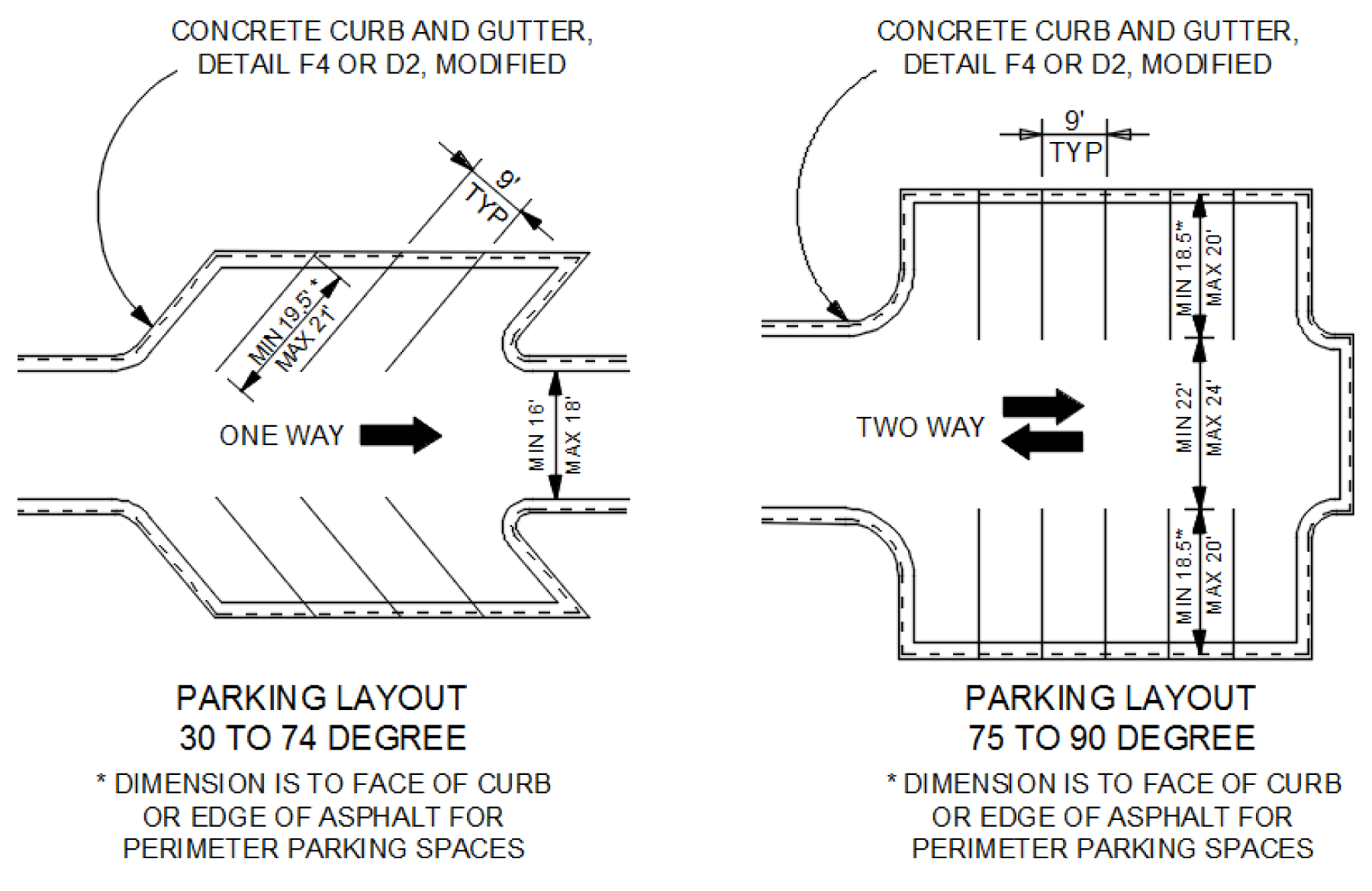
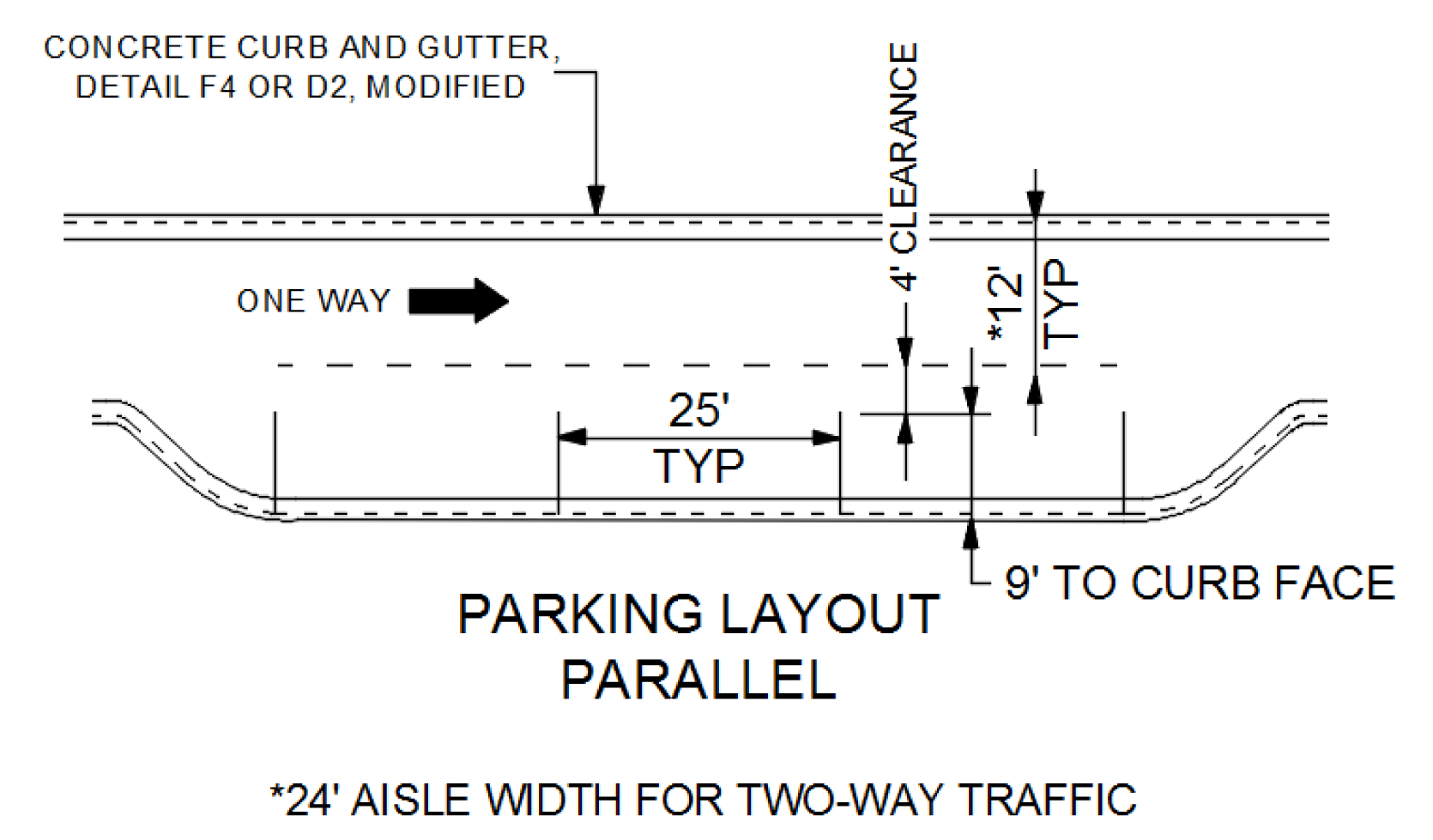
Aisle lane widths, parking space widths and parking space length. Aisle lane widths, parking space widths and parking space lengths are to be provided as shown in the table of off-street parking layout standards and the figure of off-street parking layout standards, unless otherwise approved by the zoning administrator (or designee). All spaces must have adequate access by means of aisles or lanes. Aisles for access to all parking spaces on two-way aisles must be designed and clearly marked for two-way movement. Aisles for angle parking spaces must have one-way movement only and must be clearly marked for one-way movement.
*See subsection 9 of this chapter.
(2)
Stormwater drainage. All off-street parking areas must drain into the appropriate facilities for handling stormwater run-off (per the requirements of the stormwater utility ordinance (section 27-180 et seq.)), and must be directed to prevent direct drainage onto abutting properties, toward buildings, or onto public rights-of-way.
(3)
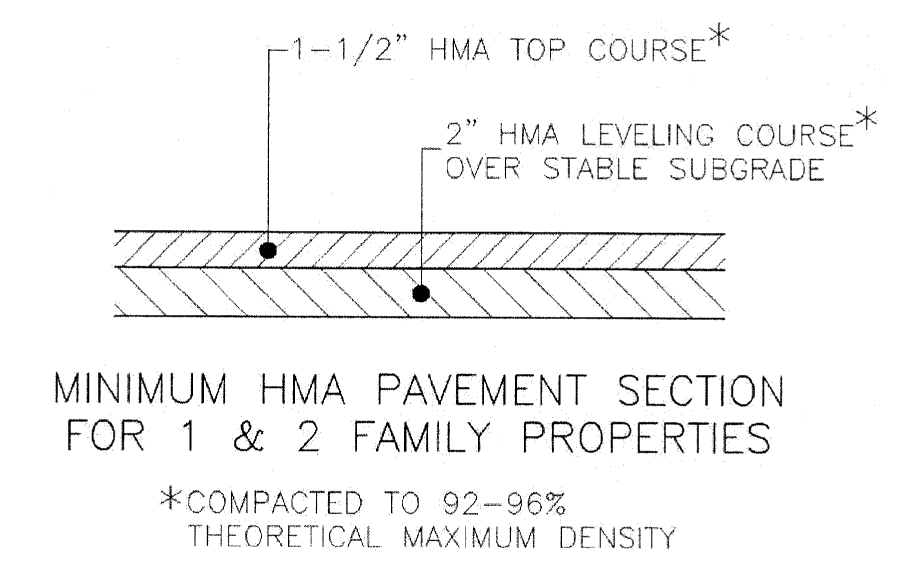
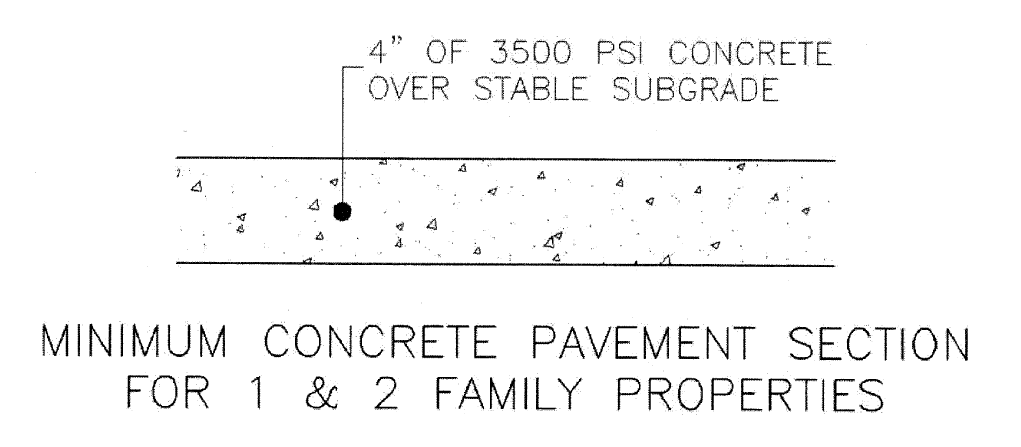
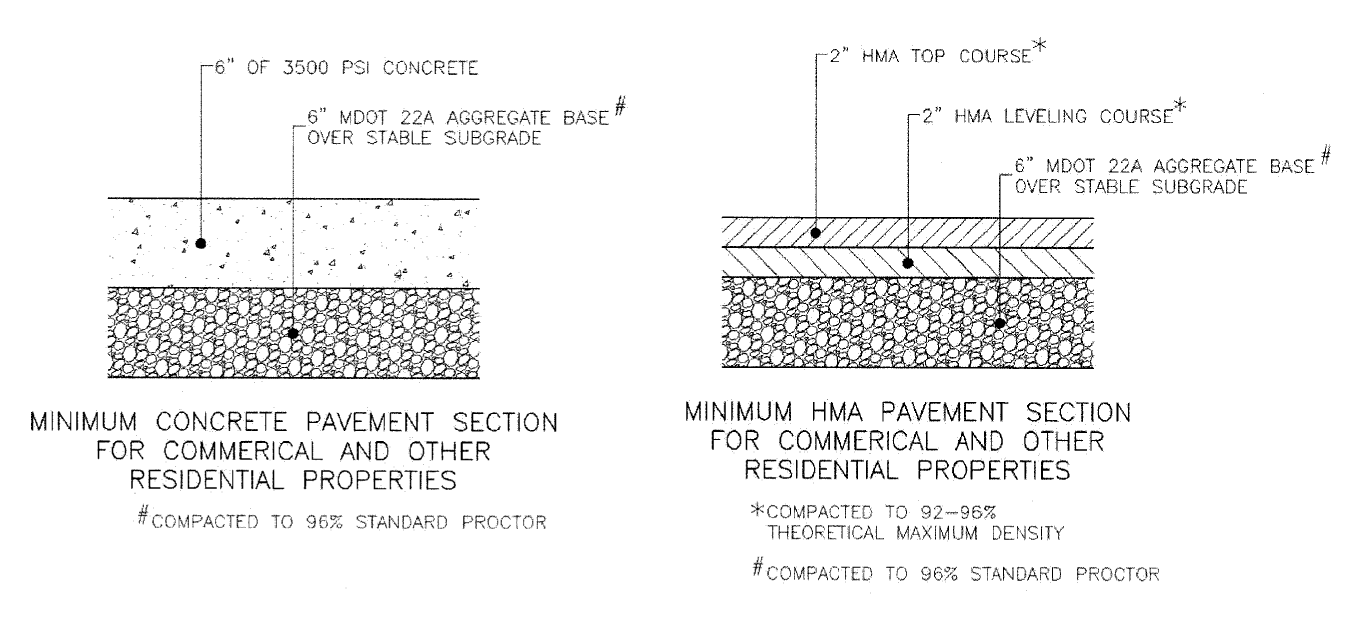
Surface treatment. Surfaces of parking areas or drives must be constructed over an approved and inspected base and maintained in the following manner with concrete or asphalt surfaces and curb and gutters in accordance with city standards. The entire parking lot includes maneuvering lanes, while alternate standards apply for one- and two-family driveways excluding the approach as outlined in subsection (7).
a.
One-and two-family residential. The depth of pavement and base must meet one of the following standards, or as otherwise approved by the city engineer (or designee):
1.
Three and a half (3½) inches of asphalt placed in two (2) lifts; or
2.
Four (4) inches of concrete (does not need to extend the full width of the driveway, can be installed as two (2) tire-width strips of pavement; or
3.
Pavers (full width or two (2) tire-width strips) with no less than the manufacturers specified base.
b.
Other residential and commercial. The depth of pavement and base must meet one of the following standards, or as otherwise approved by the city engineer (or designee):
1.
Four (4) inches of asphalt placed in two (2) lifts with six (6) inches of base comprised of MDOT 22a aggregate compacted to ninety-eight (98) percent proctor for parking spaces and six (6) inches of asphalt placed in two (2) lifts with six (6) inches of base comprised of MDOT 22a aggregate compacted to ninety-eight (98) proctor for maneuvering lanes and loading areas for commercial vehicles; or
2.
Six (6) inches of concrete.
c.
Industrial. The depth of pavement and base must meet one (1) of the following standards, or as otherwise approved by the City Engineer (or designee):
1.
Four (4) inches of asphalt placed in two (2) lifts with six (6) inches of base comprised of MDOT 22a aggregate compacted to ninety-eight (98) proctor for parking spaces and six (6) inches of asphalt placed in a minimum of two (2) lifts with six (6) inches of base comprised of MDOT 22a aggregate compacted to ninety-eight (98) proctor for maneuvering lanes and loading areas used for commercial and industrial vehicles.
2.
Six (6) inches of concrete with six (6) inches of base comprised of MDOT 22a aggregate compacted to ninety-eight (98) proctor.
(4)
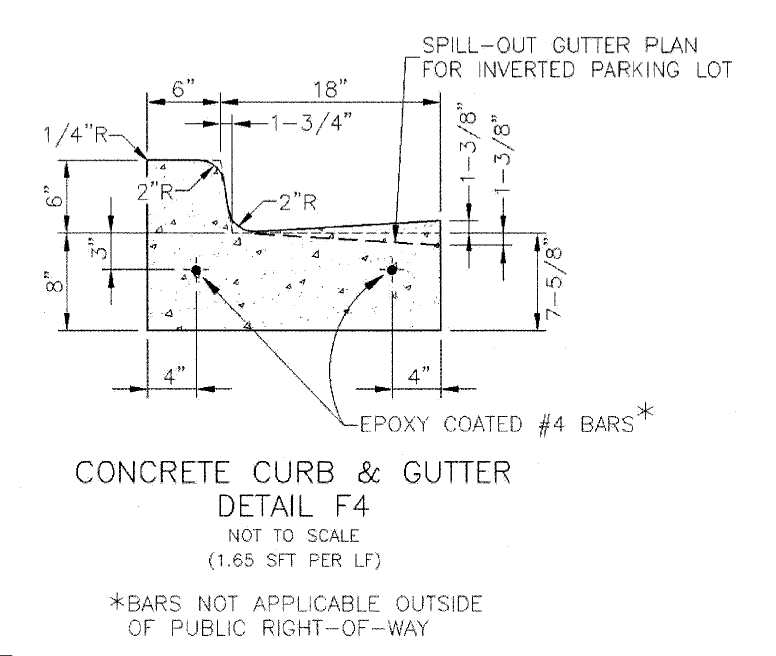
Curbs. A raised or rolled concrete curb and gutter at least six (6) inches in height shall be installed. All curbing shall be installed per the concrete curb and gutter detail illustration below. Parking bumpers or stops, of any material, are strictly prohibited in any zoning district.
a.
New industrial use.
1.
Corner lots: Curbing shall be required in all addressed and non-addressed front yards and designated side yards;
2.
Interior lots: Curbing shall be required for all parking areas located along public rights-of-way. No curbing shall be required for parking areas located in the designated rear yard; and
3.
All lots: All interior islands and access aisles shall be curbed.
b.
New commercial use.
1.
Corner lots: Curbing shall be required in all addressed and non-addressed front yards and designated side yards;
2.
Interior lots: Curbing shall be required for all parking areas located along public rights-of-way and the designated side yards. At the discretion of the zoning administrator (or designee) curbing may be required for parking areas located in the designated rear yard; and
3.
All lots: All interior islands and access aisles shall be curbed.
c.
Existing commercial and industrial use. If the property is determined to be abandoned or discontinued for a period of twelve (12) consecutive months or more, or, if the damage, repair, alteration or improvement costs to the building or structure meets or exceeds one hundred (100) percent of the taxable value, or any expansion, reduction, resurfacing, replacement, or reconstruction of greater than or equal to twenty-five (25) percent of the existing designated off-street parking area then;
1.
Corner lots: Curbing shall be required in all addressed and non-addressed front yards and designated side yards.
2.
Interior lots: Curbing shall be required for all parking areas located in the designated front yard and along public rights-of-way. At the discretion of the zoning administrator (or designee) curbing may be required for parking areas located in the designated side yard and rear yard based on the abutting or adjoining property use or condition.
3.
All lots: All interior islands and access aisles shall be curbed.
(5)
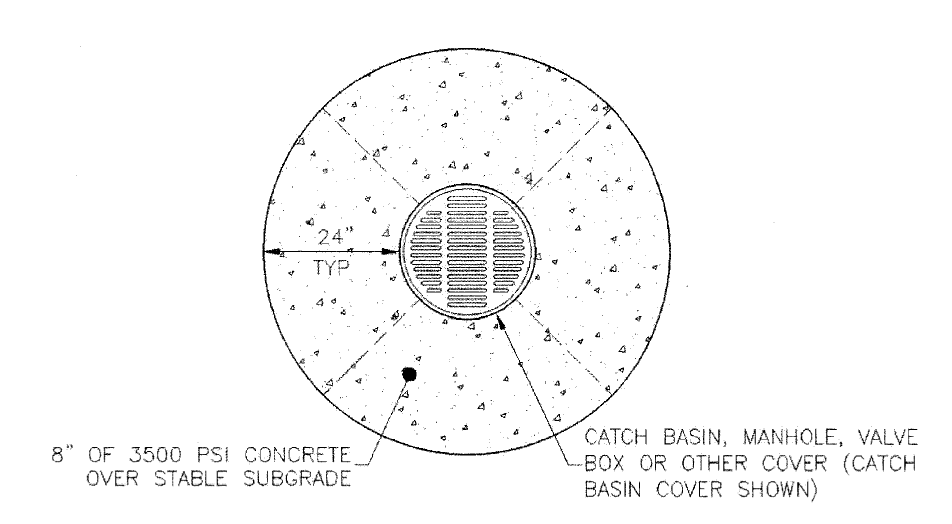
Pavement structures. All catch basins, manhole covers, valve boxes, and similar structures must be encased in eight-inch thick concrete (as illustrated in the figure of pavement structure standards) with a minimum two-foot diameter outside of the structure, or as approved by the city engineer (or designee).
(6)
Maneuvering lanes. All off-street parking areas that make it necessary or possible for vehicles to back directly into a public street are prohibited provided that this prohibition does not apply to off-street parking areas of one-family or two-family dwellings.
(7)
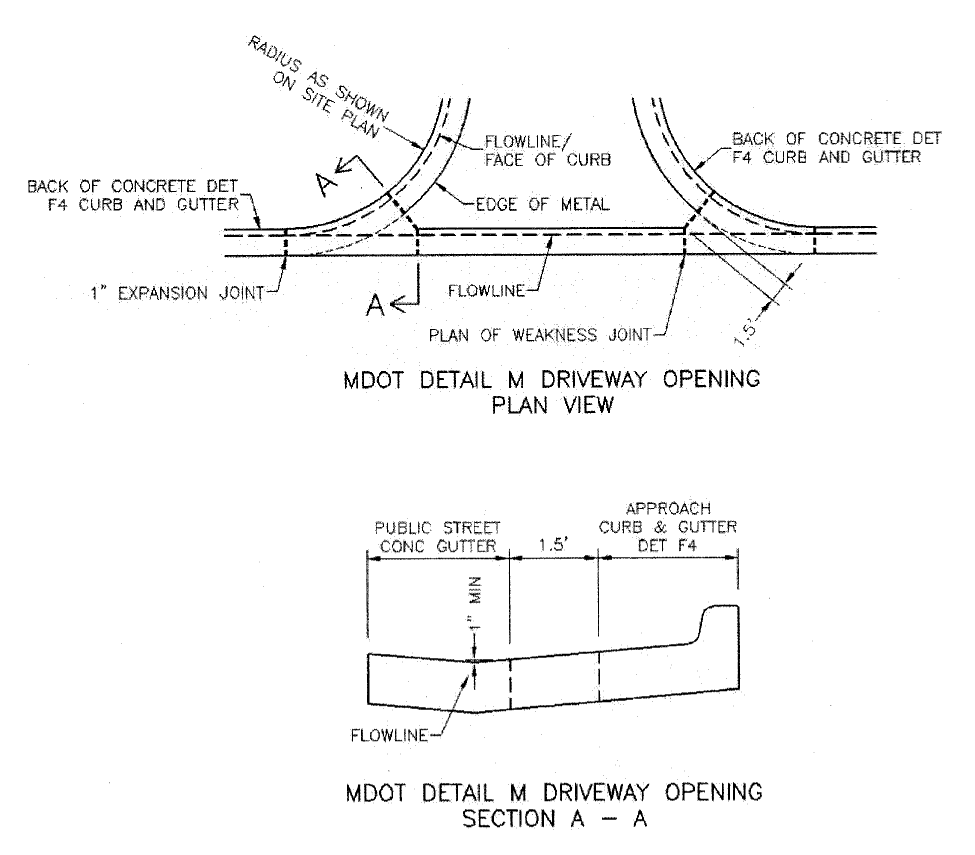
Ingress and egress. Ingress and egress to parking lots must be provided for all vehicles by means of clearly limited and defined drives. One-way driveways must be twelve (12) feet wide and two-way driveways must be twenty-four (24) feet wide to the front building line of a principal structure.
a.
The zoning administrator (or designee) retains the authority to approve or deny the existing ingress and egress based on criteria such as, but not limited to, the following:
1.
Condition of the surface treatment material in place;
2.
If the width meets the minimum allowable dimension per this chapter;
3.
If the design meets general engineering standards and is approved by the city engineer (or designee). As determined by the city engineer (or designee) the Type M standard shown below may not be applicable for all situations.
_____
(8)
Small vehicles. A limited number of spaces in each parking lot may be provided for parking of smaller vehicles. The number of such spaces must not exceed ten (10) percent of the required spaces. The spaces must be clearly identified through the use of signs and/or pavement markings as being for small vehicles. Small vehicle parking spaces must be a minimum of seven and a half (7.5) feet wide and a minimum of eight (8) feet long.
(9)
Parking overhang of curbs abutting sidewalks or landscape areas. The required length of a parking space can be reduced by one and a half (1½) feet if either of the following applies:
a.
The useable (net) width of the sidewalk is no less than five (5.5) feet, once the one and a half-foot vehicle overhangs are accounted for; or
b.
The landscape area is deep enough to accommodate both the one and a half-foot vehicle overhang and the mature widths of any proposed/required shrubbery.
(10)
Stacking spaces. Stacking spaces must be nine (9) feet wide and twenty-five (25) feet long. Stacking spaces must be illustrated on the site plan and must not block driveways, parking aisles or circulation around a building or restrict access to waste receptacles and loading areas.
(11)
Pavement markings. All parking and loading spaces must be delineated with pavement markings. The visibility of pavement markings delineating parking and loading spaces and directional control must be maintained.
(12)
Barrier-free parking.
a.
Off-street parking facilities required for buildings under separate ordinances or zoning laws must be provided in accordance with the provisions of the Americans with Disabilities Act of 1989, as amended.
b.
In no case may that parking be less than the following:
1.
Each reserved parking space must be not less than eight (8) feet wide and adjacent to an access aisle not less than five (5) feet wide.
2.
Where a curb exists between a parking lot surface and a sidewalk surface, an inclined approach or a curb cut with a gradient of not more than one (1) foot in twelve (12) feet, a width of not less than four (4) feet, and a six-foot taper along the sidewalk must be provided for wheelchair access.
c.
Parking spaces for the physically handicapped must be located as close as possible to walkways and entrances. There must be a barrier-free route of travel from the parking space to the front entrance of the building. Where possible this route must not cross parking lot maneuvering lanes. Signs must be provided when necessary indicating the direction of travel to an accessible entrance.
(h)
Off-street loading facilities.
(1)
Applicability. In connection with every building or part thereof hereafter erected, except one- and two-family dwellings, off-street loading and unloading spaces for uses which customarily receive or distribute material or merchandise by vehicles must be provided on the same lot with such buildings. Off-street loading spaces are hereby required in order to avoid interference with public use of streets and parking areas.
(2)
Required parking. Loading areas cannot be included in calculations for off-street parking space requirements.
(3)
Review required. Plans and specifications showing required loading and unloading spaces and the means of ingress and egress and internal circulation must be submitted to the zoning administrator (or designee) and any appropriate state or county agency for review at the time of application for a building permit for the erection or enlargement of a use of a building or structure or at the time such spaces are added or altered, except as required in section 28-135 (site plan review procedures and requirements), in which case this requirement will not apply.
(4)
Size of spaces. The size of all required loading/unloading spaces must be at least ten (10) feet by fifty (50) feet (five hundred (500) square feet) for office uses and at least ten (10) feet by seventy (70) feet (seven hundred (700) square feet) in areas for commercial and industrial uses, with a clearance of at least fourteen (14) feet in height.
(5)
Number of spaces. The minimum number of loading spaces in all zoning districts must be provided in accordance with the following table. The zoning administrator (or designee) may modify these requirements upon making the determination that another standard would be more appropriate because of the number or type of deliveries experienced by a particular business or use.
(6)
Location. Loading spaces must meet the following location requirements:
a.
Loading spaces must be provided off-street in the rear or side yard behind the front building line of the principal structure and will not be permitted in the front yard or where visible from a street or residential district.
b.
Loading spaces must meet the parking space setback requirements of subsection (a)(6) of this section.
c.
Loading spaces must not be closer than twenty-five (25) feet to any residential district property line, unless otherwise approved by the zoning administrator (or designee), upon the installation of additional landscaping and/or a barrier.
d.
Where the loading space requires an overhead door on the building elevation, the overhead doors cannot be visible from the street.
e.
In accordance with section 28-105, the zoning administrator (or designee) has the discretion to require additional screening in order to provide adequate screening of loading areas from abutting properties.
(7)
Access and vehicular movement. Site plans must illustrate expected vehicular path and turning radii of loading/unloading vehicles in order to demonstrate there are no conflicts with internal circulation, parking and accessory structures. Off-street loading facilities that make it necessary or possible to back directly into a public street are prohibited. All maneuvering of trucks and other vehicles must take place on the site and not within a public right-of-way.
(8)
Surface. Loading dock approaches and loading spaces must be surfaced with asphalt or concrete paving in order to provide a permanent, durable, and dustless surface with a base sufficient to accommodate expected vehicle weight.
(9)
Stormwater drainage. Loading areas must be graded and drained consistent with the stormwater drainage standards for parking lots described in subsection (g)(2) of this section.
(10)
Storage and repair. The storage of merchandise, sale of motor vehicles, storage of inoperable vehicles, or repair of vehicles is prohibited in required loading spaces.
(11)
Change in use or intensity.
a.
Whenever the use of a building or lot is changed, loading facilities must be provided as required by this section for the new use.
b.
If any building, structure or lot is increased in floor area or through other means, additional loading must be provided to bring the site into compliance with this section.
c.
Any area designated for required loading must not be changed to any other use unless and until equal facilities meeting the standards of this section are provided elsewhere, or the loading requirements of the site change as determined by the zoning administrator (or designee).
d.
Loading facilities, existing at the effective date of this section, in connection with the operation of an existing building or use, cannot be reduced to an amount less than required for a similar new building or new use.
e.
When changes in activity occur that may produce loading demand in excess of available loading facilities, the city will require documentation showing adequate loading facilities will be provided or will be expanded to meet anticipated needs.
(i)
Site access location and design (access management). The standards of this section are intended to preserve the capacity of the street system and to minimize the potential for traffic collisions, in balance with the need to provide reasonable access to properties.
(1)
Location in general. Driveways must be located to minimize interference with the free movement of traffic, to provide adequate sight distance, and to provide the most favorable driveway grade. Driveways (including the radii but not including right turn lanes, passing lanes, and tapers) must be located entirely within the right-of-way frontage, unless otherwise approved by the city and upon written certification from the adjacent property owner agreeing to such encroachment.
(2)
Number of driveways. The number of commercial driveways (not including driveways for two-family dwelling units or unmanned public utility uses) must be the minimum necessary to provide reasonable access for regular traffic and emergency vehicles, while preserving traffic operations and safety along streets.
(3)
Driveway spacing from an intersection. Minimum spacing requirements between a proposed driveway and an intersection (either adjacent or on the opposite side of the street) may be set on a case-by-case basis but in no instance may not be less than the distances listed in the table of minimum commercial driveway spacing from street intersections, unless approved by the zoning administrator (or designee) in consultation with the city engineer (or designee). The following measurements are from the near edge of the proposed driveway (measured at the throat perpendicular to the street) to the near lane edge of the intersecting street or pavement edge for uncurbed sections.
(4)
Minimum spacing between driveways. Minimum spacing between two commercial driveways is determined based upon posted speed limits along the parcel frontage. The minimum spacing indicated in the table of minimum spacing between commercial driveways are measured from centerline to centerline, and may only be deviated from upon the approval of the zoning administrator (or designee) in consultation with the city engineer (or designee).
(5)
Offset. To reduce left-turn conflicts, commercial driveways must be aligned with driveways or streets on the opposite side of the roadway where possible. If alignment is not possible, driveways should be offset based upon the posted speed limit along the parcel frontage. The minimum spacing indicated below are measured from centerline to centerline.
(6)
Modification of standards. Given the existing built conditions through much of the city, the standards above may be modified by the zoning administrator (or designee) on a case-by-case basis depending upon analysis of existing and expected traffic operations, and restrictions imposed by current development or site conditions. The zoning administrator (or designee) may require preparation by the applicant of a traffic study and/or a review by the city engineer (or designee) to assist in their decision. In no case, however, can the minimum distance between driveways be less than sixty (60) feet. The zoning administrator (or designee) may require a shared access system as described in subsection (i)(7) of this section (see below).
(7)
Shared access system. The zoning administrator (or designee) may require a shared access system where it is determined to have a beneficial impact on traffic operations and safety. This determination will be based on the expected traffic patterns, existing traffic conditions and the feasibility for shared access. This shared access system may involve a shared driveway, connections of parking lots or a drive connecting two (2) or more lots or uses, access from a side street, a shared driveway or service road connecting two (2) or more properties or uses. In such cases a shared access agreement must be provided to the city.
(8)
Changes in use. When a use is proposed to change or expand the zoning administrator (or designee) may require the removal or redesign of access points to bring the site closer to conformity with this section.
(Ord. No. 2012.16, § 5, 7-17-12; Ord. No. 2012.17, § 2, 7-17-12; Ord. No. 2015.12, § 2, 4-14-15; Ord. No. 2016.04, § 3, 3-15-16; Ord. No. 2018-14, § 2, 12-11-18; Ord. No. 2019-14, § 2, 10-15-19; Ord. No. 2020-16, § 2, 10-13-20; Ord. No. 2020-19, § 2, 10-27-20; Ord. No. 2020-21, § 2, 12-8-20; Ord. No. 2023-03, § 2, 1-24-23; Ord. No. 2024-07, § 2, 10-8-24)
Sec. 28-105. - Landscape standards.
(a)
Intent. Landscaping is necessary for the protection and enhancement of the environment and for the continued vitality of all land uses in the city. The intent of this section is to promote the public health, safety and welfare by establishing minimum standards for the design, installation, and maintenance of landscape improvement. The requirements of this section are intended to help achieve a number of functional and environmental objectives such as:
(1)
To promote the implementation of the city's comprehensive plan and any related subarea plans;
(2)
To aid in stabilizing the environment's ecological balance by contributing to the processes of air purification, oxygen regeneration, groundwater recharge, and stormwater runoff retardation, while at the same time aiding in noise, glare and heat abatement;
(3)
To encourage the preservation of existing trees and vegetation;
(4)
To assist in providing adequate light and air and in preventing overcrowding of land;
(5)
To provide visual buffering and enhance the beautification of the city;
(6)
To reduce the physical impact between adjacent land uses by requiring complementary landscape treatments and providing a transitional area adjacent to natural areas;
(7)
To safeguard and enhance property values and to protect public and private investment;
(8)
To preserve, protect and restore the unique identity and environment of the City of Jackson and preserve the economic base attracted to the city by such factors;
(9)
To define, articulate and integrate outdoor spaces, architectural elements, and various site elements;
(10)
To conserve energy, and to protect the public health, safety, and general welfare;
(11)
To provide habitat for living things that might not otherwise occur or be found in urban environs; and
(12)
To provide reasonable standards to bring developed sites that existed prior to the adoption of these standards into compliance with the requirements contained herein.
(b)
Scope of application.
(1)
The requirements set forth in this section will apply to all uses, lots, sites, and parcels that are developed or expanded following the effective date of this section. No site plan that is reviewed in accordance with section 28-135, site plan review procedures and requirements, may be approved unless the site plan shows required landscaping consistent with the provisions of this section.
(2)
Where landscaping is required, a building permit will not be issued until the required landscape plan is submitted and approved, and a certificate of occupancy will not be issued by the chief building official (or designee) unless provisions set forth in this section have been met or by providing either a performance guarantee as authorized by section 28-165; or by entering into a development agreement as authorized by section 28-209
(3)
The zoning administrator (or designee) will determine if the existing landscaping or screening identified for preservation meets the intent of this section (see subsection (d) of this section).
(4)
Each landscape plan will be independently reviewed; the zoning administrator (or designee) may determine that there exist unique circumstances that would prevent the installation of all or a portion of the required site landscaping, greenbelts, buffer zones, and parking lot landscaping or detention/retention basin landscaping requirements.
a.
Such a determination must be made based upon criteria such as the following:
1.
Topography;
2.
Existing woodlands, wetland, floodplain, drainage conditions and poor soils;
3.
Types and distance to adjacent land uses;
4.
Dimensional conditions unique to the parcel;
5.
Provision of adequate sight distances/clearance for motorists and pedestrians;
6.
Health, safety and welfare of the city;
7.
Clearance from overhead utility lines and separation from underground utilities; and
8.
Accessibility to fire hydrants.
b.
In return the applicant will be required to incorporate at least one (1) of the following elements in the landscape plan:
1.
The utilization of credits obtained by preserving existing vegetation per the standards of subsection (c)(3)e. and subsection 28-110(c);
2.
Placing the required plant material elsewhere on the site, as approved by the zoning administration (or designee);
3.
Use of larger plant material (see subsection (c)(1) of this section); or
4.
An alternative proposed by the applicant in writing and approved by the zoning administrator (or designee) (see subsection (g) of this section).
(5)
Landscape plan review required. A separate landscape plan detailing the landscape changes consistent with the standards of this chapter must be submitted to the zoning administrator (or designee) when:
a.
A full site plan (FSP) is mandated, per the requirements of the table of required review process located in subsection 28-135(a) of this chapter;
b.
Where the building and/or parking area is being increased by at least twenty-five (25) percent or reconstructed; or
c.
The building is being changed to a more intense use, as determined by the zoning administrator (or designee). The change in use intensity must consider factors such as required parking, amount of traffic generated, maximum building occupancy or change to a different use category in the building code.
(c)
Landscape plan specifications.
(1)
Minimum requirements. The requirements contained in this section are considered the minimum necessary to achieve the intent of this section, but nothing herein will preclude the use of more extensive landscaping to further improve the function, appearance and value of the property. The use of larger plant material may be used to count towards the overall minimum planting requirements (i.e. planting a twelve-foot tall evergreen when a six-foot is required equals credit for one and one-half (1½) trees).
(2)
Appropriate design professional requirement. The zoning administrator (or designee) may require the landscape plans to be prepared by an appropriate design profession due to the complexity of a project or another compelling issue.
(3)
Required information. The landscape plan must demonstrate that all requirements of this section are met and must include the following information:
a.
Illustration of the location, spacing, species, size and root ball of proposed plant material, including a plant schedule (see "landscaping" under section 28-5 of this chapter for a definition and example);
b.
Separately identify compliance with the minimum numeric requirements (rounded up) for site landscaping, greenbelts, buffer zones, parking lot landscaping, and detention/retention ponds;
c.
Clearly identify and delineate proposed planting beds and turf grass areas;
d.
Provide typical cross sections to illustrate views from adjacent land uses, and the slope, height, and width of proposed berms or landscape elements, as required by the zoning administrator (or designee);
e.
Existing vegetation survey. Provide a survey of existing vegetation in accordance with subsection 28-110(c) of this chapter which denotes the following (see "landscaping" under section 28-5 of this chapter for pertinent definitions):
1.
Trees, noting their size (i.e., caliper or height) and type (i.e., canopy, evergreen, or other ornamental);
2.
Shrubs, noting their size and type/form (i.e., upright or spreading evergreen or small or large deciduous);
3.
Ground covers, noting their size/coverage and type (i.e., woody plants and vines or perennials); and
4.
Identify the vegetation proposed for preservation and the credits (if any) that will be claimed per the standards cited in subsection 28-110(c) of this chapter.
f.
Delineate the location of protective fencing around existing vegetation identified for preservation per the standards of subsection 28-125(e) of this chapter. A detail of all such fencing must be provided on the landscape plan and meet the standards for such fencing included in section 28-125 of this chapter;
g.
Provide construction details to resolve specific conditions such as limits of grading adjacent to areas with trees and vegetative cover to be preserved, tree wells to preserve existing trees or culverts to maintain natural drainage patterns;
h.
Provide details to ensure proper installation and establishment of proposed plant material (e.g., tree stakes, guy wires, protective fencing, etc.), as directed by the zoning administrator (or designee); and
i.
Identify a landscape maintenance program, including a statement that all diseased, damaged or dead materials will be replaced in accordance with the requirements of this section.
_____
(d)
Landscape standards.
(1)
All landscaping must conform to the following standards, unless otherwise approved by the zoning administrator (or designee), each of which will be calculated separately. Please see "landscaping" in section 28-5 of this chapter for definitions of the various plant types cited in the following table:
(2)
Footnotes to the Table of Landscape Standards.
a.
Adjustments in the placement of plantings are subject to any required site clearance triangles, per the requirements of section 28-126 of this chapter.
b.
The type of shrubbery must be a mix of each type noted in subsection (e)(3) of this section.
c.
Pertains to the entire street frontage of a property, as measured from the right-of-way, excluding access drives (i.e., driveway cuts).
d.
Greenbelt plantings must be arranged to emulate the landscape character of the surrounding areas. Subject to zoning administrator (or designee) determination, the greenbelt plantings may be waived within the C-3 (central commercial) district providing the buildings are located at or near the front property line.
e.
Nothing but landscaping, including decorative fencing and landscape features (as identified in subsection 28-125(d) of this chapter), is allowed within the greenbelt.
f.
A berm and/or masonry wall may be required as part of or in place of the buffer when deemed necessary by zoning administration (or designee) to meet the intent of subsection 28-105(e)(9) of this section and must conform to section 28-125 of this chapter.
g.
The location may be modified by the zoning administrator (or designee) upon recommendation of the city engineer (or designee) due to unique circumstances, such as conflicts with underground utilities and better screening provided at alternative locations.
h.
See section 28-125 of this chapter for berm construction standards.
i.
Up to an eight-foot berm and/or wall may be permitted within the commercial and industrial districts.
j.
No branches may remain within five (5) feet above the grade of the parking lot, if the drip line extends outside of the landscape area.
k.
Decorative treatment may be incorporated into the perimeter parking lot landscaping such as the inclusion of tree clusters and decorative fencing and landscape features (as identified in subsection 28-125(d) of this chapter). Treatment provided must be compatible with, or a site improvement to, surrounding properties. This decorative treatment is encouraged on sites within the commercial districts and multiple family developments near the downtown.
l.
The basin slopes must be sculptured to filter and soften the views.
m.
The plantings must be clustered in a natural pattern around the basin with trees above the freeboard line (i.e., the high water mark designed for the pond), and all other plantings must be tolerant of wet/moist soils. (e.g., London Plane Trees (Platanus x acerifolia), Red Maples (Acer rubrum), etc.) The location of plant material will also be done in consideration of the need to provide access for and minimize disruption of plant material during routine pond maintenance.
n.
Parking area(s) located in the designated rear yard of a parcel shall be offered a relief from landscape requirements if location is not visible from the centerline of a public right-of-way within one hundred (100) feet. All landscape modifications shall be approved by the zoning administrator (or designee).
o.
Parking area perimeters not contained by curb and gutter shall contain turf grass to prevent runoff. Additionally, one (1) canopy tree per each twenty (20) linear feet shall be planted.
_____
(e)
Specifications for landscape improvements and plant materials.
(1)
Plant material. All plant material must be hardy to the City of Jackson (i.e., USDA Plant Hardiness Zone 6a), be free of disease and insects, and conform to the American Standard for Nursery Stock of the American Nursery and Landscape Association.
(2)
Minimum sizes and spacing. The minimum plant sizes must be provided in accordance with the following (please see "landscaping" in section 28-5 of this chapter for definitions of the various plant types cited in the following table):
(3)
Footnotes to the Table of Minimum Plant Sizes and Spacing.
a.
Height of coniferous trees shall be measured at the third tine from the top, not a measurement of overall height.
(4)
Mixing of species. The overall landscape plan may not contain more than one-third (33.3%) of any one (1) plant species for each type of planting specified in the Table of Landscape Standards (see subsection (d) of this section). The use of native species and mixture of plants from the same plant community is strongly encouraged.
(5)
Trees not permitted. Various trees are not permitted for the following reasons, although the zoning administrator (or designee) may allow them when associated with an appropriate ecosystem, for historic preservation, or another compelling objective:
a.
Easily damaged or short lived. Including, but not limited to, Black Locusts (Robinia pseudoacacia), Silver Maples (Acer saccharinum), and various Poplars and Cottonwoods (Populus species);
b.
Bears nuisance leaves, fruit, or other characteristics. Including, but not limited to, Weeping Willows (Salix babylonica), nut-bearing Horse Chestnuts (Aesculus species), female Ginkgoes (Ginkgo biloba), various Mulberries (Morus species), Catalpas (Catalpa speciosa), various Poplars and Cottonwoods (Populous species), Honey Locusts with thorns (Gleditsia triacanthos (i.e., not var. inermis)), and Hawthorn, Thornapple, May-tree, Whitethorn, or Hawberry (Crataegus species);
c.
Weedy or invasive. Including, but not limited to, Box Elders (Acer negundo), various Poplars and Cottonwoods (Populus species), Trees of Heaven (Ailanthus altissima), and Black Locusts (Robinia pseudoacacia);
d.
Roots clog drains and sewers and crack sidewalks and foundations. Including, but not limited to, Weeping Willows (Salix babylonica) and Silver Maples (Acer saccharinum); and
e.
Unusually susceptible to disease or insects. Including, but not limited to, American Elms (Ulmus americana) and various Ashes (Fraxinus species).
(6)
Planting beds.
a.
Planting beds are clearly defined areas surrounding a single tree, shrub, or grouping of trees and shrubs and may also include annuals, various other types groundcovers, and mulch (please see "landscaping" in section 28-5 of this chapter for definitions of the various plant types cited in the following table).
There is no size limit for a planting bed as long as dedicated open areas of mulch and annuals do not exceed one-third (33.3%) of its total area. Plant coverage will be determined as follows:
1.
An eighteen-inch radius circle around the trunk of a canopy tree;
2.
The drip-line of an ornamental tree or shrub at the time of planting; and
3.
Groupings of ground cover (excluding annuals) planted to become dense after one (1) complete growing season.
Mulch is required in those areas at the time of planting, but will not be included when determining the percentage of a planting bed dedicated to open areas of mulch and annuals.
b.
Mulch must be maintained at a minimum of two (2) inches deep in order to prevent weed growth and soil erosion and to retain soil moisture.
c.
Material in planting beds shall be identified on the landscape plan and approved by the zoning administrator (or designee) and maintained in good condition.
d.
Mulch and stone landscape beds will be permitted in parking islands contained by curb and gutter.
(7)
Top soil. Top soil must consist of a four (4) inch base for lawn areas and an eight (8) to twelve (12) inch base within planting beds. This also applies to berms.
(8)
Proximity to utilities. Plant material cannot be located in a manner that will interfere with or cause damage to underground or overhead utility lines, public roads or other public facilities.
(9)
Turf grass. Turf (i.e., lawn) grass must be planted in species normally grown as permanent lawns in cool/humid area of the North American Climate Zone. Turf grasses may be seeded or sodded. Only rolled sod, erosion reducing net or suitable mulch may be used in swales or other areas susceptible to erosion and must be staked where necessary for stabilization. When complete sodding or seeding is not possible, nurse grass (i.e., fast growing temporary) seed must be sown and mulched for immediate protection until permanent coverage is achieved. Turf grass sod, seed, and top soil must be free of weeds and noxious pests or disease. Areas of turf grass must be adequately irrigated for the first two (2) growing seasons.
(10)
Regulations pertaining to sight distance. All proposed landscaping adjacent to the intersection of two or more streets or access drives must meet the standards of section 28-126 of this chapter.
(f)
Minimum standards for installation, irrigation and maintenance.
(1)
Timing of planting. All required plant materials must be planted prior to issuing a certificate of occupancy by the chief building official (or designee) in consultation with the zoning administrator (or designee). In the event that the project is completed during a time of year when planting is impractical, a performance guarantee, as authorized by section 28-165 of this chapter, must be provided equal to the amount of installation of the proposed landscaping.
(2)
Completion of improvements. Tree stakes, guy wires, and tree wrap installed to satisfy subsection (c)(3)h. of this section must be removed by the date indicated on the landscape plan.
(3)
Irrigation. All landscaped areas must be provided with a readily available and acceptable water supply (e.g., irrigation systems, exterior faucets and hoses, tree watering bags, etc.); as indicated on the landscape plan and approved by the zoning administrator (or designee); and in accordance with the Michigan Plumbing Code, as applicable.
(4)
Maintenance. The owner of the property is responsible for the regular maintenance of all landscaping. Landscaped areas and plant materials required by this section must be kept free from refuse and debris. Plant materials, including turf grass (i.e., lawns), must be maintained in a healthy growing condition, neat and orderly in appearance per the intent of the approved site plan. Additionally, all plantings approved as part of a site plan must be maintained in perpetuity or an amended landscape plan must be submitted for consideration by the zoning administrator (or designee). However, if any required plant material dies or becomes diseased, it must be replaced. Replacement must be within thirty (30) days unless an extended time period is necessary due to weather in which case a written request may be submitted and reviewed by the zoning administrator (or designee) prior to its potential authorization.
(g)
Proposal by applicant for complying with requirement.
(1)
Proposal by applicant. If the applicant demonstrates that compliance with this section is not feasible on the property, in lieu of complying with all of a part of the specific requirements set forth in this section for landscaping, the applicant may propose in writing an alternative means of compliance. Subject to approval by the zoning administrator (or designee) for a particular property and circumstance, such alternative may include, by way of example, installing landscape materials in the immediate area of the property being developed or paying moneys into the city tree fund in an amount by multiplying the total quantity of plantings that would not be installed by the cost per plant. That proposal must include a timetable for performance, and state whether a performance guarantee (see section 28-165 of this chapter) would be filed to secure such performance.
(2)
Review by the zoning administrator (or designee). The zoning administrator (or designee) will review the written proposal of the applicant and determine whether the proposal would be accepted in place of the landscape requirements that would not be completed in accordance with this section. If and to the extent the zoning administrator (or designee) is satisfied that the applicant has demonstrated that it would not be feasible to fully comply with the landscaping requirements in this section, the determination by the zoning administrator (or designee) on whether to approve an applicant's proposal will be based on the standard of most closely achieving the intent of the ordinance, to the extent reasonably feasible. The expense of complying with this section shall not be a basis of consideration by the zoning administrator (or designee). Any bonding to be a part of the proposal shall be subject to review by the city attorney, and shall conform with customary bonding requirements for development in the city.
(3)
Effect of approval. If the applicant's written proposal is approved by the zoning administrator (or designee), the proposal shall be deemed to be a regulation required under this [section], and a failure to comply with the approved proposal shall be deemed to be a violation of this [section].
(h)
City tree fund.
(1)
All revenues raised in lieu of complying with all of a part of the specific requirements set forth in this section for landscaping (per subsection (g)(1) of this section) must be placed in a city tree fund together with such other revenues from any source or combinations of sources of revenues otherwise legally available which have been designated to be used for the planting of trees and shrubs.
(2)
No part of the funds held in the city tree fund may be transferred to the general operating fund or used for any purpose other than undertaking the planting of trees and shrubs in the city.
(Ord. No. 2012.16, § 5, 7-17-12; Ord. No. 2012.20, § 3, 9-11-12; Ord. No. 2013.07, §§ 1, 2, 4-23-13; Ord. No. 2015.11, § 2, 4-14-15; Ord. No. 2016.04, § 3, 3-15-16)
Sec. 28-109. - Lighting standards.
(a)
Intent and purpose. The purpose of this section is to protect the health, safety and welfare of the public by recognizing the need for buildings and sites to be illuminated for safety, security and visibility for pedestrians and motorists balanced against the often detrimental effects associated with the use of outdoor lighting. This section provides standards for various forms of lighting that will minimize light pollution; reduce the potential for off-site impacts; preserve the restful quality of nighttime by eliminating intrusive artificial light and lighting that unnecessarily contributes to sky glow; reduce light pollution and light trespass from light sources onto adjacent properties; enhance customer and employee safety; contribute to improving visibility by requiring illuminated areas to have uniform light; and curtail the degradation of the nighttime visual environment.
(b)
Applicability. The standards in this chapter apply to any light source visible beyond the property from which it is emanating. The zoning administrator (or designee) may review any building or site to determine compliance with the requirements under this section. Whenever a person is required to obtain a building permit, electrical permit for outdoor lighting or illuminated signs, a conditional use permit, subdivision approval or site plan approval from the city, the applicant must submit sufficient information to enable the zoning administrator (or designee) or planning commission to determine whether the proposed lighting will comply with this section.
(c)
Exemptions.
(1)
Street lights located in a public right-of-way or another public easement are exempt from the lighting requirements of this chapter without any conditions.
(2)
The following are exempt from the lighting requirements of this chapter, provided that they do not shine beyond the property line and have no glare or other detrimental effects on adjoining streets or property owners:
a.
Residential lighting associated with one- and two-family dwellings.
b.
Private swimming pools;
c.
Holiday decorations; and
d.
Window displays.
(d)
Submittal requirements. The following information must be included for all site plan submissions which include any existing or new exterior lighting and where site plan approval is not required, some or all of the items may be required by the zoning administrator (or designee) prior to zoning approval or lighting installation:
(1)
The location of all outdoor lighting fixtures, including but not limited to pole-mounted, building-mounted (including outline lighting), architectural accent, landscape (including walkway bollards), and canopy light fixtures on the site plan and building elevations;
(2)
A photometric grid overlaid on the proposed site plan indicating the light intensity throughout the site (in footcandles (fc)). Measurements must be at ground level and shown at ten-foot spacing;
(3)
The manufacturer's specification sheets and details for the type of fixture being proposed including but not limited to light intensity levels (in footcandles (fc)) at ground level based on fixture mounting height, the total lumen output, type of lamp, distribution type and method of shielding;
(4)
The maximum and minimum footcandle (fc) calculations, minimum-to-maximum and minimum-to-average uniformity ratios, and the light loss factor (LLF) used. These statistics must be provided for areas where vehicular and pedestrian movement is provided for and for other areas as necessary to show compliance with standards of subsection 28-109(f) of this chapter.
(5)
Use of fixture(s) proposed; and
(6)
Any other information deemed necessary by the zoning administrator in accordance with the intent and purpose of this section.
(e)
General standards.
(1)
Unless otherwise permitted within subsection 28-109(c) or subsection 28-109(f), only shielded fixtures as defined in Section 28-5 may be used. Any interior light fixtures that are deemed to be causing glare and therefore not meeting the purpose or intent of this Chapter must be shielded to prevent glare outside the building and do not shine beyond the property line.
(2)
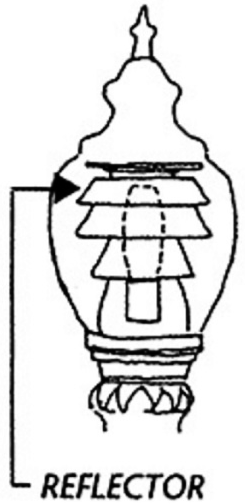
Decorative fixtures using lamps with low wattages do not have to be shielded; these include incandescent lamps of sixty (60) watts or less; glass tubes filled with neon, argon and krypton; and any other light source of fifty (50) watts or less. Decorative luminaries above fifty (50) watts must have internal and/or external reflectors that shield the light source.
(3)
It is recognized that metal halide LED, inductive, and fluorescent lamps are superior lights for color and object recognition when compared to other lamp types such as low and high pressure sodium or mercury vapor. Therefore, use of metal halide, LED, inductive, and fluorescent lamps is required unless the zoning administrator (or designee) or planning commission determines that unique circumstances exist that prevent installation of the required lamp types. It is also recognized that as the lighting industry develops, new lamp types are occasionally introduced that may have similar characteristics as the currently required types that may also be desirable for use in outdoor lighting.
(4)
The intensity of light on a site must not exceed three-tenths (0.3) of a footcandle (fc) at any property line that abuts a residentially zoned property or half (0.5) of a footcandle (fc) for any other zoned property.
(5)
All exterior lighting must be designed in a consistent and coordinated manner for the entire site.
(6)
Indirect internal illumination of signs and canopies is permitted provided a maximum one hundred twenty-five (125) watt bulb is utilized and the transmittal surface is of a color and material that effectively shields lamps. This does not take into consideration fluorescent, LED, or neon light sources typically used in these applications.
(f)
Lighting intensity and uniformity standards.
(1)
Table of standards. The following lighting intensity and uniformity standards must be used in designing an outdoor lighting plan as required within subsection 28-109(d) of this chapter.
(2)
Footnotes to the table.
a.
The above statistics should only be applied to the area of each site devoted to the particular use. For example, a gas station/restaurant combination may have an area dedicated as a parking lot for the restaurant patrons and in addition have a pump island canopy. In this scenario two sets of statistics would need to be generated; one set for the parking lot and the other set for the canopy area.
b.
Measurements for average to minimum uniformity ratio, required minimum footcandle (fc) reading, maximum allowable average illumination and maximum allowable footcandle (fc) reading must be generated at the surface intended to be illuminated (e.g., pavement or area surface). These statistics must be provided for areas where vehicular and pedestrian movement is provided for and other areas as necessary to show compliance with standards.
c.
Building facades and signs cannot be illuminated if they are of glass, polished metal or other glossy surface including painted surfaces. Building facades cannot be entirely illuminated. Rather, illumination can be for architectural ornament and/or the illumination of small areas for visibility and security. For spotlight fixtures, no less than ninety (90) percent of the light beam must be concentrated on the surface intended to be illuminated. For fixtures mounted directly to a wall surface or sign, external shields or dark colored non-reflective surface materials or other appropriate methods must be used to direct the light perpendicular to the ground and minimize reflectance glare.
d.
The maximum height of parking lot light fixtures, from grade, shall be as follows:
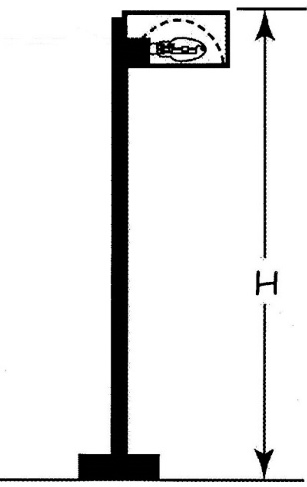
Fixture Height
1.
Up to fifteen (15) feet in a residential district;
2.
Up to eighteen (18) feet in a commercial or industrial district when within one hundred fifty (150) feet of a residential district;
3.
Up to twenty (20) feet in a commercial district when no less than one hundred fifty (150) feet of a residential district; or
4.
Up to twenty-five (25) feet in an industrial district when no less than one hundred fifty (150) feet of a residential district.
(3)
Exterior recreational facilities. For exterior recreational facilities, sufficient information must be submitted in addition to that required in Subsection 28-109(c) that demonstrates that the location, selection and aiming of all lighting fixtures will focus light on the playing areas, minimize glare and visibility from adjacent and nearby properties and roadways and minimize sky glow. A written explanation and statements must be supplied explaining why locations, fixtures types, intensities, orientation of fixtures and other decisions were made. Lighting of sports facilities cannot be operated except during an event and must be turned off no later than forty-five (45) minutes after the event is over.
(4)
Uses not specifically listed. For uses not specifically listed within this Subsection, but determined to be of a type, use and or intensity that may be detrimental to achieving the purpose of this chapter, the zoning administrator, depending on the purpose of the lighting, must classify lighting into one of the categories contained in subsection 28-109(f) of this chapter. An applicant may appeal an initial classification to the zoning administrator, in writing, detailing why more intense lighting or less lighting is necessary. The zoning administrator must either approve or deny the appeal based on whether or not sufficient justification has been submitted and whether the proposal meets the intent of this Code. Final determinations of the zoning administrator may be appealed to the zoning board of appeals.
_____
(g)
Prohibited outdoor lighting.
(1)
The use of a laser light source, searchlights or any similar high intensity light for outdoor advertisement or entertainment is prohibited except in conjunction with a special event as defined in article VI of chapter 16 of this Code.
(2)
Lighting cannot be of a flashing, moving or intermittent type except in conjunction with a special event as defined in article VI of chapter 16 of this Code.
(h)
Lamp or fixture substitution. Should any light fixture regulated under this Chapter, or the type of light source therein, be changed after the permit has been issued, a change request must be submitted to the zoning administrator for approval, together with adequate information to assure compliance with this code, which must be received prior to substitution.
(i)
Administration.
(1)
An outdoor lighting permit must be issued on a form from the zoning administrator (or designee) if it is determined by the zoning administrator (or designee) or planning commission that a proposal fulfills the requirements and intent and purpose of this chapter. The permit must list what is being approved and contain copies of relevant documents.
(2)
The zoning administrator has the discretion to require the re-direction of existing light fixtures when it is determined that the fixture is not in compliance with the requirements of this code.
(Ord. No. 2013.10, § 3, 4-23-13; Ord. No. 2016-29, § 3, 11-15-16)
Editor's note— Ord. No. 2013.10, § 3, adopted April 23, 2013, enacted provisions intended for codification as § 28-125. At the direction of the city, and to avoid duplicate section numbers, said provisions have been redesignated as § 28-109.
Sec. 28-110. - Environmental protection standards.
(a)
Intent. The intent of including environmental protection standards is to ensure that development in the City of Jackson that is reviewed, approved and completed under the regulations of this [chapter] is compatible with the natural systems of this city including woodlands, wetlands, the Grand River and other drainage courses, soils, air and the overall natural quality of life. These features are sensitive and can be negatively impacted by development. The following standards seek to minimize these impacts and are in addition to state regulations related to natural features such as the Natural Resources Environmental Protection Act (PA451 of 1994, MCL 324.101 et sec), as amended.
(b)
Soil removal, filling, and grading standards.
(1)
Applicability. No person is authorized to undertake any tree clearing, grading, stripping, excavating or filling, or undertake any earth change, unless the zoning administrator (or designee) has issued a valid grading permit in consultation with the city engineer (or designee).
(2)
Exceptions to applicability. A grading permit is not required under the circumstances described below. Even though no permits are required for these instances, those operations and construction exempted from obtaining permits must still be in compliance with the rules and regulations concerning grading and erosion specified in this [section] or other applicable laws and ordinances.
a.
The activity is associated with an approved site plan, subdivision plat, site condominium plan or private street approval.
b.
Plowing and tilling of land for purposes of gardening or urban farming provided that:
1.
The activity meets the requirements of this section;
2.
The activity complies with article V, post-construction stormwater management for new development and redevelopment, of chapter 27 and the city's Stormwater Management Manual; and
3.
A soil erosion and sedimentation control permit is obtained from Jackson County, if required by Part 91, Soil Erosion and Sedimentation Control, of the Natural Resources and Environmental Protection Act (PA 451 of 1994, MCL 324.9101), as amended.
c.
The activity involves a volume of soil less than one hundred (100) cubic yards, provided the alteration meets the requirements of this section.
d.
The activity is associated with grading or excavating for a building or structure that was authorized by another valid permit.
e.
If the zoning administrator (or designee) certifies in writing that the planned work and the final structure or topographical changes will not: result in or contribute to soil erosion or sedimentation of the water of the state; interfere with any existing drainage course in such a manner as to cause damage to any adjacent property or result in the depositing of debris or sediment on any public way; create any hazard to any persons or property; or have a detrimental influence upon the public welfare or upon the total development of the watershed.
(3)
Grading permit review and approval procedures. A separate application is required for each grading permit and the following procedure will apply:
a.
Submission of a completed application as required in subsection (b)(4) of this section and the required fee to the zoning administrator (or designee).
b.
The zoning administrator (or designee) will review the application for conformance with subsection (b)(4) and (5) of this section. The zoning administrator (or designee) may require a re-submittal, or additional information. If the zoning administrator (or designee) determines the application complies with the ordinance, the permit will be issued.
c.
The zoning administrator (or designee) will inspect the work upon completion to confirm compliance with the approved plan.
(4)
Application information requirements. The plans must be prepared or approved by a person who is trained and experienced in soil erosion and sedimentation control methods and techniques. The plans and specifications accompanying the grading permit application and required fee will be submitted to the zoning administrator (or designee) and contain the required data listed below.
a.
A vicinity sketch indicating the site location as well as the adjacent properties within one hundred (100) feet of the site boundaries.
b.
Scale and north arrow for the plan.
c.
Name, address and telephone number of the landowner, developer and petitioner.
d.
The location of existing and proposed utility structures, ditches, culverts.
e.
The location and distance of drainage structure to which the site will drain.
f.
The location of existing and proposed buildings and structures.
g.
A description and details of soil erosion control methods.
h.
Existing and proposed spot elevations and indicators of existing and proposed drainage patterns for the site and adjacent properties within one hundred (100) feet of its boundaries. The zoning administrator (or designee), in consultation with the city engineer (or designee), may also require existing and proposed topographic contours at no less than two-foot intervals if he or she determines them to be necessary.
i.
A timing schedule indicating the anticipated starting time and completion dates for the project.
j.
Any additional information deemed necessary by the zoning administrator (or designee) in consultation with the city engineer (or designee).
(5)
Review standards. All applications will comply with the following standards:
a.
New grades must slope away from buildings and structures, thereby causing surface water to drain away from the walls of the building to a natural or established drainage course.
b.
New grades cannot be established that will permit an increase surface water run-off onto adjacent properties and public roadways except through established drainage courses.
c.
New grades cannot result in the creation of standing water; the erosion or filling of a roadside ditch and cannot result in the blockage of public water courses.
d.
Any land development, dredging, filling or other activity requiring a permit pursuant to Part 91 of the Natural Resources and Environmental Protection Act (PA 451 of 1994, MCL 324.9101 et seq.) must obtain said permit from the County of Jackson prior to the issuance of a grading permit. The zoning administrator (or designee) may require the applicant to submit a letter from the county to confirm non-jurisdiction.
e.
Any land development which disturbs the existing grade of more than one (1) acre of land or lies within five hundred (500) feet of a river, stream lake or open drain, requires a soil erosion and sedimentation control (SESC) permit per the requirements of Part 91 of the Natural Resources and Environmental Protection Act (PA 451 of 1994, MCL 324.9101), as amended, prior to issuance of a grading permit.
f.
Any project requiring a grading permit is also required to obtain a letter from the city engineer (or designee) confirming compliance with article V, post-construction stormwater management for new development and redevelopment, of chapter 27 and the city's Stormwater Management Manual.
(6)
Performance guarantee. The city may require a performance guarantee, as authorized by section 28-165 of this chapter, to assure the completion of any improvements shown on the site plan. For the purposes of this section, improvements subject to performance guarantees must include features and actions associated with a project that are considered necessary by the city to protect the natural resources or the health, safety, and welfare of the residents of the City and future users or inhabitants of the proposed project or project area, including roadways, lighting, utilities, sidewalks, screening and drainage.
(7)
Extension of time. If the applicant is unable to complete work within the specified time, he may, at least ten (10) days prior to the expiration of the permit, present in writing to the zoning administrator (or designee) a request or extension of time setting forth the reasons for the requested extension. If such an extension is warranted, the zoning administrator (or designee) may grant additional time for the completion of the work, but no such extension releases the owner from the obligation of the performance guarantee, if required, set forth in subsection (b)(6) above.
(c)
Preserving existing vegetation.
(1)
Intent. The intent of this section is to preserve existing vegetation unless there are no other site design alternatives. Where healthy plant material exists on a site prior to its development or redevelopment, as determined by the zoning administrator (or designee) or the planning commission, variations from the landscape requirements contained in section 28-105 may be approved to allow credit for such plant material if such adjustment is in keeping with the intent of this section.
(2)
Inspection. All existing vegetation must be inspected by the zoning administrator (or designee) to ensure the vegetation is high quality and will fulfill the requirements of this section.
(3)
Credit for trees. Credit for tree preservation will be applied at the following rate:
a.
For preserved trees of equal to or greater than twelve (12) inches in caliper, a credit of three (3) trees is permitted.
b.
For preserved trees less than twelve (12) inches in caliper, a credit of two (2) trees is permitted.
(4)
Credit for shrubs. Shrubs may be credited toward shrub requirements on a one (1) for one (1) basis.
(5)
Removed credit trees. In the event that healthy plant material credited towards required plantings are removed, damaged, or destroyed, as determined by the zoning administrator (or designee), they must be replaced with new plant material meeting the standards of this section.
(6)
Mitigation. Every attempt must be made to preserve healthy mature existing vegetation. In the event that an existing tree with greater than a four-inch caliper or eight (8) feet tall is removed when there are obvious alternatives to its removal, as determined by the zoning administrator (or designee), all such trees must be replaced at a ratio of 2 for 1. Each new tree must have a caliper of no less than three (3) inches or a height of no less than six (6) feet.
(d)
Standards for limiting the external effect of uses. All uses must comply with the following standards which limit their effect on the surrounding area:
(1)
Enclosure of uses. Every use must be operated in its entirety within a completely enclosed structure, unless such mode of operation is deemed impractical by the zoning administrator (or designee) or planning commission.
(2)
Every use must be so operated that it is not obnoxious or dangerous to adjacent properties by reason of the following:
a.
Smoke. It is unlawful for any person, firm or corporation to permit the emission of smoke from any source in an amount which is injurious or substantially annoying to persons residing in the affected area.
b.
Airborne solids. It is unlawful for any person, firm or corporation to operate and maintain (or cause to be operated and maintained) any process or activity that causes injury to neighboring properties.
c.
Odor. The emission of odors found to be obnoxious to any considerable number of persons at their place of residence or place of business is prohibited.
d.
Gases. The emission or release of corrosive or toxic gases (in amounts which are injurious or substantially annoying to persons living or working in the affected area) is prohibited.
e.
Glare and exterior lighting. Glare from any process or operation must be shielded so as to be invisible beyond the property line of the premises on which the process is performed. Exterior lighting must also be shielded so that no more than one-half (0.5) of a foot candle is visible beyond that property line.
f.
Radioactive materials. Radiation, including radioactive materials and electromagnetic radiation such as that emitted by the x-ray process or diathermy, cannot exceed quantities established as safe by federal regulations, when measured at the property line.
g.
Noise. The emission of measurable noises from the premises cannot exceed sixty-five (65) decibels (dBs) as measured at the property lines, except that where normal street traffic noises exceed sixty-five (65) dBs, the measurable noise emanating from the premises may equal, but not exceed, traffic noise levels.
h.
Vibration. Machines or operations which cause vibrations are permitted in industrial districts, provided that vibrations do not cause displacement exceeding three thousandths (.003) of an inch as measured at the property line.
(3)
Outdoor storage and waste disposal.
a.
All outdoor storage and waste disposal facilities must be enclosed by an opaque fence or wall adequate to conceal such facilities from adjacent properties and adjoining rights-of-way and constructed in accordance with the standards established for them in section 28-125 (standards for fences, walls, and landscape berms).
b.
All materials or wastes which might cause fumes or dust or which could constitute a fire hazard or which may be edible by rodents or insects must be stored outdoors in closed containers and screened from the street or adjacent property.
c.
No materials or wastes can be deposited on the property in such form or manner that they may be transferred off the premises by natural causes or forces.
d.
Waste materials cannot be allowed to accumulate on the property in such manner as to be unsightly, constitute a fire hazard, or contribute to unsanitary conditions or conditions which will or would be likely to pollute or impair natural resources. The specific standards are as follows:
1.
Waste material piles shall be no taller than the height of the abutting screen wall/fence.
2.
All waste materials containing unnatural bi-products such as carcinogens from treated wood and all non-tree based products shall be stored on an impervious surface with retaining walls/curbs to avoid polluting the natural environment.
e.
Screening of trash storage areas. Any new or altered use which has an outdoor trash storage area containing a dumpster, must comply with the following requirements:
1.
Any such area is to be limited to normal refuse which is collected on a regular basis and must be maintained in a neat, orderly, and sanitary condition.
2.
In no instance may any such refuse be visible above the wall, as required in subsection (e)(3) of this section.
3.
A wall, six (6) feet in height, must enclose three (3) sides of the storage area. Such wall must be constructed in accordance with the standards established for it in section 28-125 of this chapter. Bollards and/or other protective devices must be installed at the opening and to the rear of any storage area to prevent damage to the screening walls. The surface under any such storage area must be constructed of concrete which complies with local building requirements.
4.
Any such storage area must be located in a rear yard and/or be so located and arranged as to minimize its visibility from adjacent streets and uses. The zoning administrator (or designee) or planning commission may require an obscuring gate when the visibility of such a storage area, from a public street or adjacent use, is deemed to render an adverse influence. In no instance may any such area be located in an addressed front yard.
(e)
Hazardous materials.
(1)
Intent. Protection of groundwater and surface water quality is of paramount importance to the City of Jackson. No uses or developments are permitted which threaten water quality or which violate standards of county, state, and federal agencies.
(2)
Storage of hazardous substances. Uses that utilize, store, or generate hazardous substances in quantities greater than one hundred (100) kilograms (equal to about twenty-five (25) gallons or two hundred and twenty (220) pounds) must provide secondary containment (double enclosure) for all above ground storage containers.
(3)
Outdoor aboveground storage. Secondary containment structures must be designed to protect containers from the effects of storms, wind, fire and vandalism. Structures that are covered and protected from rain and precipitation must provide secondary containment for ten (10) percent of the volume of all containers or the volume of the largest container, whichever is greatest. Structures that are not protected from rain and precipitation must provide secondary storage capacity to hold one hundred fifty percent (150%) of the stored substances unless the zoning administrator (or designee) or planning commission approves a less quantity. Whether open or covered, the above ground storage area shall also be fully screened from view at all abutting parcel perimeters. Outdoor storage of medical marihuana must comply with State law requirements.
(4)
Indoor aboveground storage. Hazardous substances should not be stored indoors in locations which are near a floor drain connecting to soils, groundwater, sanitary sewer lines, or nearby drains and rivers unless secondary containment is provided. Sump pumps and floor depressions to collect and hold leaks and spills may be required by the zoning administrator (or designee) in consultation with the city engineer (or designee).
(5)
Loading/unloading areas. Areas used for the loading and/or unloading of hazardous substances must be designed and constructed to trap hazardous materials spilled or leaked and designed to prevent discharge of hazardous substances to floor drains, sanitary sewer lines, rivers, or storm drains.
(6)
Underground storage tanks.
a.
At a minimum, regulations of the state department of environmental quality, the state fire marshal division, and the city for the installation, inspection, maintenance of a leak detection system, inventory and record keeping, emergency response, and closure must be met.
b.
All underground storage tanks that have been out-of-service for nine (9) months or longer must be removed from the site before a building permit is issued. The fire chief (or designee) may adjust this requirement when a clear timetable for the safe use of the underground tank is established.
(7)
County, state, and federal requirements. At minimum, county, state and federal requirements for storage, leak detection, record keeping, spill prevention, emergency responses, transport and disposal of hazardous substances must be met. It is the responsibility of the commercial facility owner to obtain any applicable county, state, or federal permits or approvals.
(8)
Site plan review and approval. Site plans for facilities with hazardous substances must also be reviewed by the fire chief (or designee) prior to the approval by the zoning administrator (or designee) or planning commission.
(9)
Enforcement and penalties.
a.
Any person who fails to comply with this section is subject, upon adjudication, to the penalty provided in chapter 2.5 (administrative hearings bureau), in addition to any other penalties as may be prescribed herein.
b.
In addition to any other penalty or sanction provided in this section, or by any other applicable state or federal law, any person violating [section 28-110] must pay the costs of removing all hazardous materials that are the subject of the violation, plus the costs of damage to any land, water, wildlife, vegetation or other natural resource, or to any facility which is damaged by the violation.
(f)
Storage of flammable or explosive materials. The location or storage of flammable or explosive materials will be regulated as follows. However, section 28-145 of this chapter may contain additional requirements for certain conditional uses. The storage of normal household chemicals is exempt from these regulations.
(1)
On any parcel of land in any floodplain in an office, commercial or industrial district, the owner or tenant cannot store flammable materials closer than one hundred (100) feet from a residential district and/or three hundred (300) feet from a residential building. Furthermore, no residential building can be constructed within three hundred (300) feet of an existing flammable storage facility.
(2)
The storage of flammable materials must be in containers or storage facilities as approved by the local fire marshal or other designated fire official.
(3)
Said containers or storage facilities must be at least forty (40) feet from any side or rear lot line and one hundred fifty (150) feet from the front lot line as measured from the edge of the street right-of-way, unless a shorter distance is required by state law.
(4)
The storage of explosive materials must be in accordance with applicable state regulations.
(g)
Medical and adult use marihuana regulations. The following regulations shall apply to medical and adult use marihuana facilities:
(1)
The storage of marihuana waste shall be in accordance with the Michigan Medical Marihuana Facilities Licensing Act, the Michigan Regulations and Taxation of Marihuana Act, and the associated rules and advisory bulletins promulgated therefore, as amended.
(2)
Marihuana facilities shall comply with all federal, state, and local stormwater requirements.
(3)
Marihuana facilities shall comply with all federal, state, and local wastewater requirements.
(4)
No outdoor grow operations (medical or adult use) shall be permitted.
(Ord. No. 2012.16, § 5, 7-17-12; Ord. No. 2012.23, § 3, 9-25-12; Ord. No. 2016-29, § 3, 11-15-16; Ord. No. 2017-06, § 3, 5-2-17; Ord. No. 2018-14, § 2, 12-11-18; Ord. No. 2019-14, § 2, 10-15-19; Ord. No. 2020-16, § 2, 10-13-20; Ord. No. 2020-21, § 2, 12-8-20)
Sec. 28-111. - Temporary uses and structures.
(a)
Intent. Temporary uses and structures are necessary for the vitality of the city. The intent of this section is to promote the public health, safety and welfare by establishing minimum standards for the location, design, and duration of temporary uses and structures.
(b)
Temporary uses.
(1)
Garage and yard sales. The incidental sales of personal possessions on an occupied residential lot, by the owner or resident, for a limited period of time.
a.
Exclusions. Sales are excluded from:
1.
Public rights-of-way or other public property; and
2.
Front yards outside of approved driveways.
b.
Duration. Sales are limited to three (3) events per calendar year for no more than three (3) consecutive days per event.
c.
Signage. Signs promoting a sale which comply with the following standards are permitted:
1.
One (1) on-premise sign and one (1) off-premises sign posted on private property with the permission of the owner.
2.
Individual signs are limited to a size of four (4) square feet.
3.
In no case may a sign be located on public property or within public rights-of-way or posted on utility poles or other public structures.
4.
In no case may a sign be posted on a tree.
5.
Signs may only be posted up to two (2) days prior to the sale, as well as during the sale, for a total of no more than five (5) days
d.
Plot site plan (PSP). A PSP complying with the requirements of subsection 28-135(e) of this chapter may be required at the discretion of the zoning administrator (or designee) or under certain circumstances.
(2)
Temporary outdoor sales. The sale of edible items, wares, goods, or merchandise associated with a business located on the same lot(s) from mobile stands, vehicles, temporary structures, and similar devices for a limited period of time.
a.
Plot site plan (PSP). A PSP complying with the requirements of subsection 28-135(e) of this chapter must be submitted for the review and approval of the zoning administrator (or designee), with the exception of property specifically designed to accommodate a special event. This exception does not exempt the organizer(s) from obtaining other required permits.
b.
Exclusions. Sales are excluded from public rights-of-way or other public property.
c.
Duration. Limited to three (3) events per calendar year for no more than fourteen (14) consecutive days per event.
d.
Temporary structures. A temporary structure must comply with the minimum setback and maximum height restrictions of the zoning district in which it is located and be set back a minimum of ten (10) feet from a permanent structure located on the property or an adjoining lot. In all cases, a clear path of egress must be maintained, to the satisfaction of the zoning administrator (or designee).
e.
Dedicated parking. If the temporary use and any associated temporary structures are located on an existing parking lot:
1.
Required parking spaces. The remaining portion of the lot must contain at least seventy-five (75) percent of the spaces required for the primary use(s), as specified in subsection 28-100(c) of this chapter.
2.
Parking lot circulation. Proper parking lot circulation must be maintained during the event, to the greatest extent possible, as specified in subsection 28-100(g) of this chapter, and approved by the zoning administrator (or designee).
f.
Noise and lighting. The temporary use and any associated temporary structures must comply with the standards for noise contained in section 17-76 of this chapter, et seq., of this Code and subsection 28-110(d)(2) of this chapter and the standards for lighting contained in section 28-125 of this chapter, to the fullest extent possible, as determined by the zoning administrator (or designee).
g.
Signage. Signage related to the temporary use must comply with the standards contained in subsection 21.5-22(k) of this Code to the fullest extent possible, as determined by the zoning administrator (or designee).
h.
Other city regulations. The applicant must also comply with chapter 16 of this Code.
(3)
Transient merchants.
a.
Transient outdoor sales. The sale of edible items, wares, goods, or merchandise from mobile stands, vehicles, temporary structures, or similar devices outside of a public right-of-way on appropriately zoned property for a limited period of time.
1.
Plot site plan (PSP). A PSP complying with the requirements of subsection 28-135(e) of this chapter must be submitted for the review and approval of the zoning administrator (or designee), with the following exceptions:
i.
Property specifically designed to accommodate a special event. This exception does not exempt the organizer(s) from obtaining other required permits.
ii.
Private property adjacent to the boundary of a special event located within public rights-of-way and/or publicly owned property and approved by city council.
2.
Exclusions. Sales are excluded from public rights-of-way or other public property.
3.
Duration. Sales are limited to three (3) events per calendar year for no more than fourteen (14) consecutive days per event. However, a sale may last up to forty-five (45) days, if approved by the Zoning Administrator (or designee).
4.
Temporary structures. A temporary structure must comply with the minimum setback and maximum height restrictions of the zoning district in which it is located and be set back a minimum of ten (10) feet from a permanent structure located on the property or an adjoining lot. In all cases, a clear path of egress must be maintained, to the satisfaction of the zoning administrator (or designee).
5.
Parking.
A.
Dedicated parking. If the temporary use and any associated temporary structures are located on an existing parking lot:
i.
Required parking spaces. The remaining portion of the lot must contain at least seventy-five percent (75%) of the spaces required for the primary use(s), as specified in subsection 28-100(c) of this chapter.
ii.
Parking lot circulation. Proper parking lot circulation must be maintained during the event, to the greatest extent possible, as specified in subsection 28-100(g) of this chapter, and approved by the zoning administrator (or designee).
B.
Overflow parking. If extra parking is required to serve the temporary use and any associated temporary structures:
i.
Paving. Paving is required unless otherwise deemed non-objectionable and the event is for public or non-profit sanctioned events and is approved by the zoning administrator (or designee).
ii.
Public infrastructure protection. Vehicles leaving the parking lot cannot track mud onto any public right-of-way.
iii.
Parking lot circulation. Parking lot circulation patterns complying with the requirements specified in subsection 28-100(g) of this chapter must be clearly marked and maintained.
6.
Noise and lighting. The temporary use and any associated temporary structures must comply with the standards for noise contained in section 17-76, et seq., of this Code and subsection 28-110(d)(2) of this chapter and the standards for lighting contained in section 28-125 of this chapter, to the fullest extent possible, as determined by the zoning administrator (or designee).
7.
Signage. Signage related to the temporary use must comply with the standards contained in subsection 21.5-22(k) of this Code to the fullest extent possible, as determined by the zoning administrator (or designee).
8.
Other city regulations. The applicant must also comply with chapter 16 of this Code.
b.
Transient indoor sales.
1.
Appropriate zoning. The property must be zoned appropriately for the temporary use.
2.
Plot site plan (PSP). A PSP complying with the requirements of subsection 28-135(e) of this chapter must be submitted for the review and approval of the zoning administrator (or designee), with the following exceptions:
A.
Property specifically designed to accommodate a special event. This exception does not exempt the organizer(s) from obtaining other required permits.
B.
Private property adjacent to the boundary of a special event located within public rights-of-way and/or publicly owned property and approved by city council.
C.
Temporary marihuana events shall comply with all informational requirements outlined in Rule 62 of the Michigan Regulations and Taxation of Marihuana Act, including verification that the request was submitted to the agency no less than ninety (90) days before the first day of the event.
3.
Exclusions. Sales are excluded from public rights-of-way or other public property, unless approval is also granted for temporary outdoor sales (see subsection 28-111(b)(2) of this section or seasonal outdoor sales and displays (see subsection 28-111(c)(2) of this section).
4.
Duration. Sales are limited to one hundred and eighty (180) days in any given calendar year. However, temporary marihuana events are limited to no more than five (5) events per calendar year for no more than seven (7) consecutive days at any given location.
5.
Dedicated parking. The parking lot, or portion of a parking lot reserved for the temporary use must contain at least seventy-five (75) percent of the required spaces, as specified in subsection 28-100(c) of this chapter. The same standard must be observed for any primary use(s).
6.
Odor, noise and lighting. The temporary use and any associated structures must comply with the standards for odor contained in subsection 28-110(d)(2), noise contained in section 17-76, et seq., of this Code and subsection 28-110(d)(2) of this chapter and the standards for lighting contained in section 28-125 of this chapter, to the fullest extent possible, as determined by the zoning administrator (or designee).
7.
Signage. Signage related to the temporary use must comply with the standards contained in article IX of this Code to the fullest extent possible, as determined by the zoning administrator (or designee). However, temporary marihuana events must also display the requisite signage outlined in Rule 62 of the Michigan Regulations and Taxation of Marihuana Act.
8.
Other city regulations. The applicant must also comply with chapter 16 of this Code.
(4)
Special events. Special events—as defined in chapter 16 of this Code and including street fairs and other events taking place within public-rights-of-way—are permitted provided the following standards are met.
a.
Plot site plan (PSP). A plot site plan complying with the requirements of subsection 28-135(e) of this chapter must be submitted for the review and approval of the zoning administrator (or designee), with the following exceptions:
1.
Property specifically designed to accommodate a special event. This exception does not exempt the organizer(s) from obtaining other required permits.
2.
Private property adjacent to the boundary of a special event located within public rights-of-way and/or publicly owned property and approved by city council.
b.
Exclusions. Special events are excluded from public rights-of-way or other public property unless an exception under subsection (4)(a) of this section applies.
c.
Duration. Special events are limited to three (3) events per calendar year for no more than fourteen (14) consecutive days per event.
d.
Temporary structures. A temporary structure must comply with the minimum setback and maximum height restrictions of the zoning district in which it is located and be set back a minimum of ten (10) feet from a permanent structure located on the property or an adjoining lot. In all cases, a clear path of egress must be maintained, to the satisfaction of the zoning administrator (or designee).
e.
Parking.
1.
Dedicated parking. If the temporary use and any associated temporary structures are located on an existing parking lot:
A.
Required parking spaces. The remaining portion of the lot must contain at least seventy-five (75) percent of the spaces required for the primary use(s), as specified in subsection 28-100(c) of this chapter.
B.
Parking lot circulation. Proper parking lot circulation must be maintained during the event, to the greatest extent possible, as specified in subsection 28-100(g), and approved by the zoning administrator (or designee).
2.
Overflow parking. If extra parking is required to serve the temporary use and any associated temporary structures:
A.
Paving. Paving is not required, although vehicles leaving the parking lot cannot track mud onto any public right-of-way.
B.
Parking lot circulation. Parking lot circulation patterns complying with the requirements specified in subsection 28-100(g) of this chapter must be clearly marked and maintained.
f.
Noise and lighting. The temporary use and any associated temporary structures must comply with the standards for noise contained in section 17-76, et seq., of this Code and subsection 28-110(d)(2) of this chapter and the standards for lighting contained in section 28-125 of this chapter, to the fullest extent possible, as determined by the zoning administrator (or designee).
g.
Signage. Signage related to the temporary use must comply with the standards contained in subsection 21.5-22(k) of this Code to the fullest extent possible, as determined by the zoning administrator (or designee).
h.
Other city regulations. The applicant must also comply with chapter 16 of this Code.
(c)
Seasonal uses.
(1)
Sidewalk cafés. A sidewalk café is permitted provided the following standards are met:
a.
All uses must comply with the following standards which limit their effect on the surrounding area:
i.
The tables, chairs, and other appurtenances must be associated with the building containing the restaurant or business, owned or leased, by the person operating the sidewalk café.
ii.
The tables, chairs, and other appurtenances must be placed in a way that a clear pathway of at least five (5) feet (eight (8) feet on Michigan Avenue) in width—free of street trees, street furniture, signs, and other obstructions—is maintained along the section of the sidewalk closest to the building.
iii.
The tables, chairs, and other appurtenances shall not be permanently anchored to the sidewalk in any manner.
iv.
Ingress and egress from the building or driveway shall not be blocked or obstructed by any such appurtenances.
v.
All temporary fencing shall comply with the provisions of this chapter.
b.
Plot site plan (PSP). A PSP comply with the requirements of subsection 28-135(e) of this chapter must be submitted for the review and approval of the zoning administrator (or designee)
c.
Other city standards. The café must comply with all pertinent municipal regulations.
(2)
Outdoor sales and displays. Outdoor sales and displays—as defined in chapter 16 of this Code and including displays located on the lot(s) occupied by the store—are permitted provided the following standards are met:
a.
Plot site plan (PSP). A PSP complying with the requirements of subsection 28-135(e) of this chapter must be submitted for the review and approval of the zoning administrator (or designee). The PSP must identify the location of the limits of the outdoor sales, if that location is not part of an approved full site plan (FSP).
b.
Other city standards. The outdoor sales and displays must comply with the standards contained in chapter 16 of this Code, as well as other pertinent municipal regulations, as determined by the city clerk (or designee).
(3)
Concessionaires. Edible items, wares, goods, and merchandise sales from mobile stands, vehicles, temporary structures, or similar devices located within a public right-of-way and in the central commercial (C-3) district. Concessionaires must comply with the requirements of chapter 16 of this Code.
(4)
Peddlers. Sale of food, merchandise, and services from place to place. Peddlers must comply with the requirements of chapter 16 of this Code.
(d)
Temporary structures.
(1)
Temporary buildings and accessory structures. A temporary building or accessory structure must comply with the minimum setback and maximum height restrictions of the zoning district in which it is located and be set back a minimum of ten (10) feet from a permanent structure located on the property or an adjoining lot. In all cases, a clear path of egress must be maintained, to the satisfaction of the zoning administrator (or designee). Temporary storage structures, as identified in subsection (d)(2)a. of this section, are excluded from these standards.
a.
Plot site plan (PSP). A PSP must be submitted for the review and approval of the zoning administrator (or designee) for all temporary buildings and accessory structures that are not included on a full site plan (FSP) submitted to the city, including those which do not require a building permit. The PSP must comply with the requirements of subsection 28-135(e) of this chapter.
b.
Construction trailers/buildings. Unless otherwise approved by the zoning administrator (or designee), any structure designed solely to be utilized during the construction of a building or other structure may be erected or placed on a property, provided that it:
1.
Be erected or placed not more than fourteen (14) days prior to the commencement of construction; and
2.
Be removed within fourteen (14) days of the issuance of the certificate of occupancy the city.
c.
Temporary sheds and other temporary accessory structures.
1.
Any temporary sheds or other temporary accessory structures intended for use outside of a permanent, temporary (see subsection (a) of this section), or seasonal (see subsection (b) of this section) use must comply with the standards for permanent accessory structures located in section 28-120 of this chapter.
2.
Tents and other soft-sided structures not utilized during a special event (see subsection (b)(4) of this section) are prohibited.
(2)
Other temporary structures. Other temporary structures, as identified below, are limited to fourteen (14) consecutive days or less at a time, no more than two (2) times per calendar year, unless otherwise approved by the zoning administrator (or designee).
a.
Pods, trailers, truck beds. Pods, trailers, truck beds, or other similar vessels and containers used for storage outside of permanent structures, excluding dumpsters already regulated under subsection 28-110(d)(3) of this chapter.
b.
Temporary pools. Pools twenty-four (24) inches in depth or less and/or designed to be disassembled and/or stored when not in use.
(3)
Donation boxes. Donation boxes —as defined in chapter 16 of this Code—are allowed on the grounds of registered nonprofit organizations located on nonresidential property provided the following standards are met.
a.
Plot site plan (PSP). A PSP complying with the requirements of subsection 28-135(e) of this chapter must be submitted for the review and approval of the zoning administrator (or designee).
b.
Other city standards. The donation box or boxes must comply with the standards contained in chapter 16 of this Code, as well as other pertinent municipal regulations, as determined by the city clerk (or designee).
(4)
Temporary protective fences.
a.
Temporary fencing associated with temporary and seasonal uses.
1.
Materials.
A.
Fencing located in public rights-of-way must be decorative in nature and cannot be more than fifty (50) percent opaque.
B.
Fencing materials must be compatible with the surrounding area, as determined by the zoning administrator (or designee).
C.
Fencing associated with a special event, as defined in chapter 16 of this Code, may also comply with the standards for temporary fencing associated with construction projects located in subsection (d)(4)b of this section.
2.
Installation.
A.
Fencing that is not anchored in the ground must be sufficiently braced to the satisfaction of the zoning administrator (or designee) to ensure that it will not break or fall down.
B.
Fencing must be installed in compliance with the city's building standards located in chapter 5 of this Code.
3.
Maintenance. The temporary fencing must be inspected regularly and any broken sections of fence must be immediately removed and replaced. Bent or leaning posts must be removed, replaced and anchoring methods improved so that the posts remain plumb. Fence fasteners must be visually inspected and replaced should any be found to have come undone or to have torn through the protective fencing.
b.
Temporary fencing associated with construction projects.
1.
Materials.
A.
Fencing must be comprised of high density polyethylene mesh fabric or chain link with a nominal two-inch diamond design not less than forty-eight (48) inches above grade.
B.
Steel posts must be at least eight (8) feet long and at least one (1) inch wide with a nominal weight of one (1.08) pounds per foot exclusive of the anchor plate. Steel posts must include an anchor plate and be notched, studded or have other means for holding the fabric in place on the post.
C.
Fencing must be attached to each post with at least five (5) eleven (11) gauge galvanized or aluminum coated wire fasteners.
2.
Installation.
A.
Install steel posts a maximum of ten (10) feet apart. Steel posts must be installed plumb with a post driver into undisturbed earth. Bent or broken posts are prohibited. Line posts shall have a minimum bury depth of thirty (30) inches. Corner posts shall have a minimum bury depth of forty-two (42) inches and must be braced as necessary to ensure that the posts remains plumb and the protective fencing remains taut once it is attached.
B.
Install line posts with the anchor plate turned to parallel with the fencing. Install corner posts with the steel plate turned to cross the inside of the angle formed by the fence runs on each side of the corner post.
C.
Stretch fence fabric taut and fasten to each post using wire fasteners. Fasteners must be spaced no greater than twelve (12) inches apart on the steel posts with the bottom fastener being located no more than two (2) inches above the ground.
3.
Maintenance. The temporary fencing must be regularly inspected and any broken sections of fence must be immediately removed and replaced. Bent or leaning posts must be removed, replaced and anchoring methods improved so that the posts remain plumb. Fence fasteners must be visually inspected and replaced should any be found to have come undone or to have torn through the protective fencing.
4.
Duration. The installation and removal of temporary fencing associated with a construction project must comply with the same standards established for construction trailers/buildings located in subsection (d)(1)a. of this section.
5.
Temporary fencing associated with construction projects must also comply with the standards contained in section 28-125(e) of this chapter.
(Ord. No. 2013.02, § 3, 3-12-13; Ord. No. 2016-29, § 3, 11-15-16; Ord. No. 2019-14, § 2, 10-15-19; Ord. No. 2020-16, § 2, 10-13-20; Ord. No. 2020-21, § 2, 12-8-20)
Sec. 28-115. - Building design standards.
(a)
Intent. The intent of these regulations is to provide specific design guidelines that achieve the following:
(1)
Encourage development and redevelopment that protects and enhances the traditional character of neighborhoods and other areas of the city, fits within its traditional urban form, and creates a character that reinforces a sense of community identity;
(2)
Encourage a form of development that will achieve the physical qualities necessary to maintain and enhance the economic vitality of the various business districts, maintain the desired character of the city, prevent the creation of blight, and protect property values;
(3)
Promote the preservation and renovation of historic buildings and sites; and ensure new buildings are compatible with, and enhance the character of, the city's cultural, social, economic, and architectural heritage;
(4)
Implement objectives of the comprehensive plan.
(b)
Applicability. All uses except one-family and two-family residential must comply with the design standards of subsections (c) and (e) of this section under the following circumstances;
(1)
New buildings. All uses, except one-family and two-family residential, that receive site plan approval for construction of a new building after the effective date of this section must fully comply with its design standards. Refer to subsection (g) of this section for building design standards for one-family and two-family dwellings.
(2)
Expansions and major improvements to buildings. For buildings existing prior to the effective date of this section, major building improvements or expansions that require site plan approval may be permitted by the zoning administrator (or designee) without the complete upgrade to meet the standards of this section, provided they are reasonable in relation to the scale and construction cost of the building improvements or expansion and they do not increase noncompliance with the requirements of this section. Major exterior renovations must be consistent with the building design standards herein to the extent deemed practical.
(3)
Minor improvements to buildings. For buildings existing prior to the effective date of this Section, minor changes, improvements, and modifications that are approved administratively will be permitted, provided the improvements do not increase noncompliance with the requirements of this section.
(4)
All structures within the C-3, Central Commercial, zoning district.
a.
Change of use. Any change of use within an existing structure in the C-3 zoning district shall be subject to the fenestration requirements of this section, the exterior wall design standards specific to materials. Additionally, to the greatest extent practical as determined by the zoning administrator (or designee), all structures shall comply with the historically accurate restoration option outlined in the Downtown Jackson Facade Study and Use Recommendations and/or via original photographs. All other provisions of this section shall be at the discretion of the Director of Neighborhood and Economic Operation; and/or
b.
Interior and/or exterior modifications to a legal nonconforming structure. Any interior or exterior modifications to a legal nonconforming structure within the C-3 zoning district may be subject to the same provisions as those noted for a change of use. This determination shall be at the discretion of the zoning administrator (or designee); and/or
c.
Applicability if no longer deemed a legal nonconforming structure. For purposes of this section, a legal nonconforming structure within the C-3 zoning district shall consist of any structure within which a use does not cease for a period of less than three (3) months. If the use ceases for greater than three (3) months, the structure will be subject to all of the design standards outlined in subsections (c), (d), and (e) of this section.
(5)
Modification of standards. The zoning administrator (or designee) will perform an independent site review analysis and may allow the applicant to deviate from zoning regulations if unique or restrictive circumstances exist.
_____
(c)
Exterior wall design standards.
(1)
Colors. Information on building colors must be submitted with the site plan and considered to be part of any site plan approval under section 28-135 of this chapter. Colors must be compatible with the surrounding area, as agreed to by the chief building official, zoning administrator (or designee).
(2)
Wall materials. The use of exterior wall materials on walls (including those on accessory structures) that are visible from a public road, alley, or a parking lot must be incompliance with the maximum percentages permitted in the "Table of Acceptable Exterior Wall Materials," unless otherwise provided per the footnotes on subsections (c)(2) through (5) of this section.
Key: NP = Not permitted.
Footnotes to the Table of Acceptable [Exterior] Wall Materials.
a.
Does not include facade areas consisting of doors and windows.
b.
All walls exposed to public view from a public street, alley or an adjacent residential area must be constructed of not less than seventy-five (75) percent brick, face brick, stone or cast stone.
c.
Includes flat sheets and seamed or ribbed panels, including aluminum, porcelain and stainless steel and similar material. Such materials cannot be used where contact with vehicles may occur, such as parking areas, traffic ways, and loading areas, unless such walls are adequately protected to prevent damage.
d.
Includes fiberglass, reinforced concrete, polymer plastic (fypon), exterior insulation and finishing systems (EIFS), plaster, stucco and similar materials. The chief building official, zoning administrator (or designee) may increase the percentage of wall that can be clad in finishes if they are designed to mimic the appearance of another approved finish (e.g., EIFS designed to look like cut stone) or other embellishments are added to the building facade (e.g., window and door trim, cornices, etc.), per the criteria set forth in subsection (c)(4) of this section. Such materials cannot be used where contact with vehicles may occur, such as parking areas, traffic ways, and loading areas, unless such walls are adequately protected to prevent damage.
1.
Material used in the C-3 district shall match the historical characteristic of the district.
e.
Cast stone, including lightweight artificial stone products, must complement other materials found in the surrounding area and be approved by the chief building official, zoning administrator (or designee) upon the review of building facade elevations submitted by the applicant.
f.
A maximum coverage of fifty (50) percent burnished concrete block is permitted in the C-4, I-1, and I-2 districts only upon special approval from the chief building official, zoning administrator (or designee) where the applicant demonstrates special conditions that limit use of other materials and demonstration that other site and building design enhancements are provided. The height limit for burnished concrete block is six (6) feet.
g.
Parking structures may use precast concrete or concrete formed in place if approved by the chief building official, zoning administrator (or designee) upon the review of building facade elevations submitted by the applicant.
h.
Decorative metal and other embellishments may be used if approved by the chief building official, zoning administrator (or designee) upon the review of building facade elevations submitted by the applicant.
i.
Must be clapboard, cedar shingles, or similar materials approved by the chief building official and zoning administrator (or designee) upon the review of building façade elevations submitted by the applicant. Any grade of plywood, oriented strand board (OSB), T-111 siding, and similar materials are strictly prohibited on any portion of a structure because they are not finished building materials and do not under any circumstances weather like the other reference exterior/wall materials.
j.
The exterior wall of the office area of an industrial structure shall consist of any mixture of material permitted in the C-4 zoning district or other materials approved by the chief building official or the zoning administrator (or designee).
_____
(3)
Allowance for other materials. The chief building official, zoning administrator (or designee) may waive strict compliance with the subsection (c)(1) of this section when the qualities listed below can be demonstrated. Review and consultation by the appropriate design professional is encouraged before a final determination is made. The proposed building design and materials schedule must be accompanied by a written design statement which describes how the selected wall materials and material combinations will be consistent with and enhance the building design.
a.
The design and materials are found to be in keeping with the character and history of the neighborhood or other area of the city;
b.
The materials are found to be permanent and durable;
c.
The design and materials are compatible with the type of use and development proposed;
d.
The design and materials can easily be adapted to another use in the future; and
e.
The design and materials meet the intent of this section.
(4)
Mixture of materials. The application of these standards promotes integration and mixture of materials where more than one (1) material is used on a building. If only one (1) material is used, architectural detailing and articulation, massing, texture and form must be introduced into the building design, unless otherwise specified in the Table of Acceptable Exterior Wall Materials (see subsection (c)(2) of this section). Building roof materials must be in harmony with the style and materials used on the building walls.
(5)
Long walls. When building walls are one hundred (100) feet or greater in length, design variations must be applied to assure that the building is not monotonous in appearance. Such variations include but are not limited to the following:
a.
Recesses and projections along the building facade, which must be a minimum of one (1) foot in depth;
b.
Architectural details or features;
c.
Enhanced ornamentation around building entryways;
d.
Landscaping;
e.
Streetscape elements; and
f.
Variations in building height.
(d)
Roof design standards for all structures.
(1)
Compatible design character. Roof design and materials are considered to be key elements to the city character, and thus must be consistent with the character of the neighborhood or other areas of the city regardless of the zoning district. As a part of building design, roofs must be designed in keeping with the overall architecture of the building (see subsection (c)(4) of this section).
(2)
Roof materials. The following regulations apply to roof materials:
a.
Asphalt, fiberglass, tile, slate or cedar shingles may be used in all districts.
b.
Metal roof systems may be permitted by the chief building official, zoning administrator (or designee), based upon installation quality, panel design, coating quality, metal type, and metal thickness. However, a sample must be provided to verify each of the above requirements before its use can be considered. The color must also be subtle and compatible with the exterior building materials.
c.
Roofing materials shall be the same material and color on all on-site structures unless deemed an accent by the chief building official and zoning administrator (or designee).
(3)
Roof style in the residential districts. These districts are intended to maintain a residential character in the city and to be compatible with the neighborhood. To meet this intent the following roof style elements are required:
a.
Peaked roofs are required.
b.
All roofs must be gambrel, hip or gable roof styles. The chief building official, zoning administrator (or designee) may approve the use of shed roofs for porches and other extensions of the primary structure, provided that they comprise (in aggregate) no more that twenty-five percent (25%) of the total square footage of the roofs.
c.
Additional roofline treatments are encouraged and may be required by the chief building official, zoning administrator (or designee) in order to minimize the mass of the roof and in order to promote the residential character. These treatments include, but are not limited to offset rooflines, dormer windows, cupolas, additional accent gables and covered entryways.
(4)
Roof style in the C-3 district. New building construction must blend with the existing established building line of the central business district. The buildings must be a minimum of two (2) stories or have the appearance of multiple stories. Roofs must be flat with a minimum three-foot high parapet and decorative cornices, in keeping with the historic architecture of the central business district. An enclosure must be provided that is at least one (1) foot higher than rooftop mechanical equipment that is taller than three (3) feet.
(5)
Roof style in the C-1 and C-2 districts. New building construction in these districts should attempt to emulate the design character and history of the residential neighborhoods which often surround these districts. At the same time, the buildings must accommodate the types of uses and sites proposed. As such, the following roof styles are required:
a.
A peaked roof is required;
b.
Additional roofline treatments are encouraged and may be required by the zoning administrator (or designee) in order to minimize the mass of the roof and in order to promote the residential character. These treatments include, but are not limited to dormer windows, cupolas, additional accent gables and covered entryways; and
c.
The zoning administrator (or designee) may allow a gentler pitched roof including a flat roof with a minimum three-foot high parapet and decorative cornices consistent with the design standards of subsection (d)(4) of this section.
(6)
Roof style in the C-4, I-1, and I-2 districts. New building construction in these districts should complement their surroundings. At the same time, the buildings must accommodate the types of uses and sites proposed. As such, the following roof styles are required:
a.
The roofs of large buildings (i.e., two thousand (2,000) feet of greater) may be flat as long as a minimum three-foot high parapet at least three (3) feet high and decorative cornices consistent with the design standards of subsection (d)(4) of this section are part of the roof design. A peaked roof is required for smaller structures and extensions of larger buildings; and
(7)
Screening rooftop equipment. New or replacement rooftop equipment, including but not limited to, HVAC, kitchen vents, hood or exhausts equipment, shall be screened from view of adjacent properties and the nearest public rights-of-way and the nearest public rights-of-way on all sides the property. The method to screen rooftop equipment must complement the buildings color sale, materials, and architectural style unless the building official and/or zoning administrator can demonstrate a hardship which requires modification and/or waiving this requirement. Rooftop screening on a one story structures may be accomplished by using ground level vegetation that will mature in growth within five (5) years at the time of planting; location of the planting will be at the discretion of the zoning administrator (or designee). The zoning administrator (or designee) may require cross-section details to confirm compliance.
Roof Styles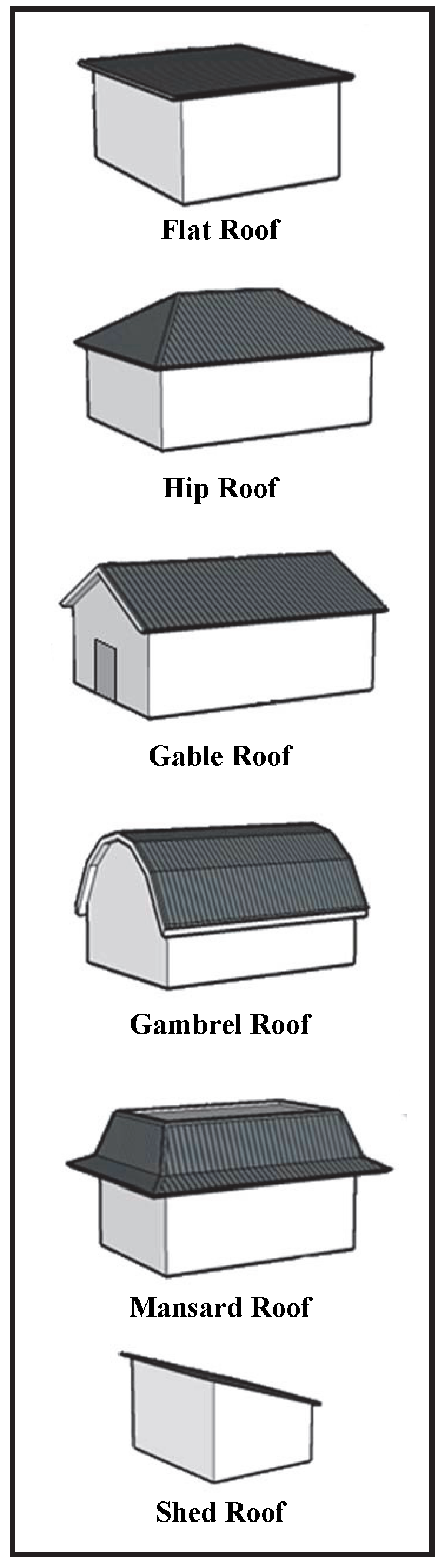
(e)
Fenestration requirements for all new buildings, and in rehabbed building, in the R-4, R-6, C-1, C-2, C-3, and C-4 districts. Also applies to the office portion of a building in the I-1 and I-2 Districts.
(1)
Windows and doors must comprise at least forty-five percent (45%) of the first floor (including the parapet of a single story building) front facade (facing the public rights-of-way) of a building as well as the facade facing the parking lot.
(2)
No window shall start at a point higher than thirty (30) inches above grade.
(3)
Windows above the first floor must be vertical in proportion (whether a single unit or combined units) unless deemed impractical due to structural limitations in which case all windows must be broken-up to maintain the same vertical proportion.
(4)
Windows and glass doors must be clear glass and not tinted. Samples shall be provided in advance of installation to ensure compliance with this requirement.
(5)
Double or fixed hung windows must be used in all retail applications.
(6)
Sliding windows will not be permitted in the C-3 district, while sliding doors will be permitted above the ground floor in the C-3 district provided a balcony is installed in accordance with the Building Code.
(7)
Vinyl windows in the C-3 district are strictly prohibited.
(8)
Windows and doors in the C-3 district shall maintain a uniform finish for all fenestration openings in the building they are installed, and, the windows and doors shall match the historic characteristics of the buildings in the C-3 district.
(9)
Windows and doors in all other districts shall maintain a uniform finish for all fenestration openings in the building they are installed, and, the windows and doors shall match the general characteristics of the buildings in the respective district.
(10)
Replacement windows or doors shall not be a reduction in dimension of the existing opening.
(11)
Window areas cannot be permanently blocked in a manner that obstructs views into the buildings, such as shelving, unless it is clear and used as a display case for products sold on-site.
(12)
Interior shelving shall be oriented to ensure visibility from the abutting roadway/sidewalk, and where practical shall retain no less than a three (3) foot clear walkway between the shelving and the exterior wall of the building.
Fenestration Example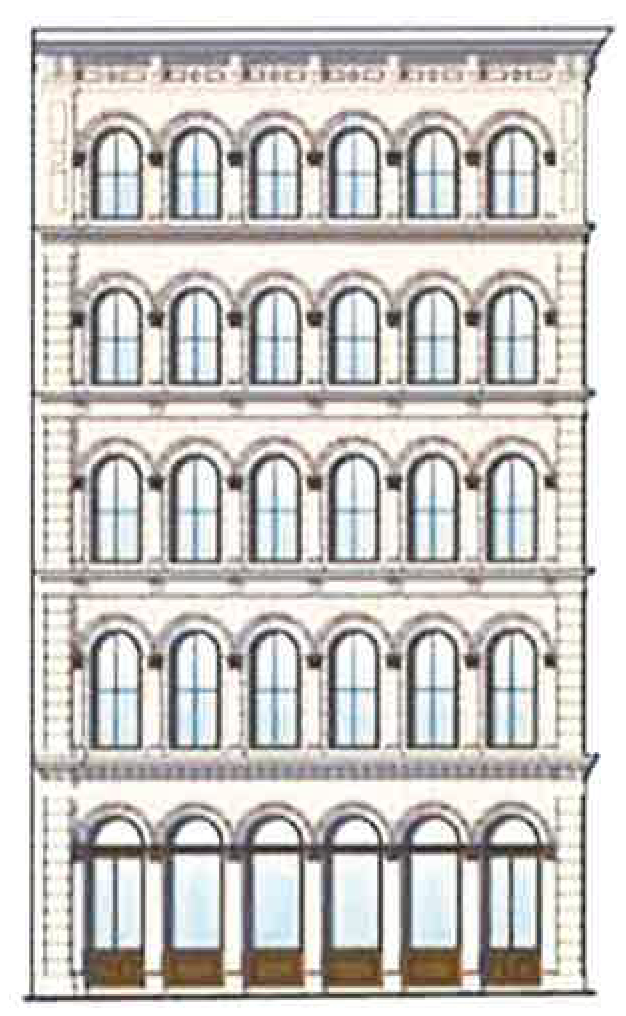
(f)
General building design accent standards.
(1)
Front facade. Blank walls cannot face a public street. Walls facing a public street must include pedestrian scale windows and architectural features customarily found on the front facade of a building, such as awnings, cornice work, edge detailing or other decorative finish materials. A prominent and usable public building entrance must be provided at the front of the building. Wall massing must be broken up with vertical pilasters or other architectural elements to reduce scale.
(2)
Pedestrian orientation. Buildings must be designed at a pedestrian scale with relationship to the street and sidewalk. Buildings must include pedestrian scale windows that face the sidewalk and street. Convenient and safe pedestrian access must be provided between the public sidewalk and the building entrance.
(3)
Awnings. Awnings with straight sheds may supplement facades. Awnings cannot be cubed or curved except over doorways. Translucent or internally lit cloth awnings will not be permitted. However, metal awnings may be internally lit provided there is a solid metal roof and all lighting complies with section 28-109 of the city's code of ordinances. In no case may awnings be designed to cover more than thirty-five percent (35%) of the height of each story of a building.
(4)
Canopies. Canopies, such as over gasoline pumps or drive-through structures, must be designed to be consistent with the approved building materials and colors. Support columns must be brick or comprised of materials compatible with the principal structure. The zoning administrator (or designee) or planning commission may require a peaked roof to complement the principal building. Any canopy lighting must be flush with the canopy.
(5)
Neon. Exposed neon will not be permitted on a building.
(6)
Quality and workmanship. This section is not intended to regulate the quality, workmanship and requirements for materials relative to strength and durability.
(g)
Building design standards for one-family and two-family dwelling units. The following are building design standards for one-family and two-family dwelling units.
(1)
Applicability. The regulations of this subsection apply to one-family and two-family dwelling unit construction under the following circumstances:
a.
New dwellings. All new one-family and two-family dwelling construction that requires a building permit after the effective date of this section must fully comply with the design standards of this subsection.
b.
Expansions to dwellings. For dwellings existing prior to the effective date of this section, major improvements or expansions that require a building permit may be permitted without a complete upgrade to meet the standards of this subsection. Reasonable improvements are required in relation to the scale and construction cost of the project. Major exterior renovations must be consistent with the building design standards herein to the extent deemed practical.
c.
Minor improvements to dwellings. For dwellings existing prior to the effective date of this section, minor changes, improvements, and modifications that require a building permit will not be required to comply with this subsection, provided the improvements do not increase non-compliance with the requirements of this subsection.
(2)
Intent. The purpose of this subsection is to establish standards and regulations governing the location and appearance of one-family and two-family dwelling units in the City of Jackson that are either developed as a new neighborhood or as in-fill housing in an existing neighborhood. It is the intent of these regulations to allow a mix of housing types and living styles in a manner that will not adversely affect existing neighborhoods. For this reason, standards have been set that will regulate the appearance of one-family and two-family dwellings, allowing only those that are compatibly similar in appearance to houses on individual lots in all zoning districts that allow one-family and two-family residences. These regulations will not apply to one-family dwellings located within a state licensed manufacturing housing community.
(3)
Permits. Prior to the construction or installation of a one-family or two-family dwelling unit on a residential lot, the individual must obtain a building permit from the chief building official (or designee).
(4)
General appearance and site standards. To ensure the compatibility in appearance of one-family and two-family dwelling units, such units must meet the following design and site standards:
a.
Be constructed to the most current state or federal building standards. These include the Stille-DeRossett-Hale Single State Construction Code Act (PA 230 of 1972, MCL 125.1501 et seq.), as amended, and the National Manufactured Housing Construction and Safety Standards Act of 1974 (42 U.S.C. 5401 et seq.), as amended (regulations are at 24 CFR parts 3280, 3282, 3284, 3285, 3286, 3288, and 3800).
b.
Have a minimum dimension of twenty (20) feet.
c.
Comply with the gross floor area and lot coverage standards for one-family or two-family dwelling units set forth in section 28-73 of this chapter. To ensure that neighboring dwellings are compatible in scale and mass, the city may require units to be not less than ninety (90) percent and no more than one hundred thirty-five (135) percent of the average floor area and lot coverage of other one-family or two-family dwelling units within three hundred (300) feet of the subject lot, including dwelling units on both sides of the street of the same block.
d.
Have two (2) exterior doors (front and rear, or front and side), and where there is a difference in ground elevation, steps must be permanently attached on a frost depth foundation either to the perimeter wall, as outlined in subsection 28-115(f) below, or to porches connected to the perimeter wall.
e.
Have a minimum eight-inch eave and rake (i.e., overhang), and with a drainage system that will collect and concentrate the discharge of stormwater or snow away from the sides of the dwelling. The roof must have wood shake, asphalt or other acceptable shingles, and meet the snow load standards for this portion of the State of Michigan. Metal roof systems may be permitted by the zoning administrator (or designee) or planning commission, based upon installation quality, panel design, coating quality, metal type, and metal thickness.
f.
Have an exterior finish architecturally compatible to that of other similar homes in the surrounding area. Plywood, oriented strand board (OSB), T-111 siding, and similar materials are strictly prohibited.
g.
Be firmly attached to a permanent foundation constructed on the site in accordance with chapter 5 of this Code and must have a wall of the same perimeter dimensions of the dwelling and constructed of such materials and type as required in the applicable building code for one-family or two-family dwellings. In the event that the dwelling is a manufactured home, as defined herein, such dwelling must be installed pursuant to the manufacturer's setup instructions and must be secured to the premises by an anchoring system or device complying with the rules and regulations of the Michigan Manufactured Housing Commission and must have a perimeter wall as required above.
h.
Have a design and appearance determined to be compatible by the zoning administrator (or designee) upon review of the plans submitted for a particular dwelling. An aggrieved party may appeal the zoning administrator's decision to the Zoning Board of Appeals as required by section 28-239 of this chapter.
Compatibility is based upon the character, design and appearance of one (1) or more residential dwellings within three hundred (300) feet of the subject dwelling provided the surrounding existing dwellings considered are located outside of a manufactured housing community. The foregoing will not be construed to prohibit innovative design concepts involving such matters as solar energy, view, unique land contour, or relief from the common or standard design homes. However, roof mounted solar panels must be flush mounted and mounting brackets must match the color of the roof.
i.
Be connected to a public sewer or water system and/or waste treatment or potable water supply system approved by the City of Jackson, or other applicable agencies such as the Michigan Department of Environmental Quality.
j.
Orient all dwelling units toward the public right-of-way such that the facade that faces the street contains a door, windows and other architectural features customary of the front facade of a residence.
k.
Provide concrete sidewalks in accordance with the city sidewalk policy within the dedicated right-of-way along the frontage length of all parcels. An inclined approach is required where sidewalks intersect curbs for barrier free access. The inclined approach must comply with grades established by MDOT. Required sidewalks may be installed following the construction of the dwelling unit. However, a certificate of occupancy will not be issued until the sidewalk is installed along the individual lot's frontages. If the zoning administrator determines that, due to weather conditions, sidewalk installation should be delayed, a certificate of occupancy may be issued. In which case, a performance guarantee must be provided to the city as required by section 28-165 of this chapter. The sidewalk must be installed within six (6) months of issuance of the certificate of occupancy. The zoning administrator will schedule a follow-up inspection.
l.
All residential driveways shall have a concrete approach and a hard-surfaced driveway of concrete or plant-mixed bituminous material in accordance with specifications of the city or other applicable agencies such as the Michigan Department of Transportation. Approaches must be six (6) inches thick, concrete, with the sidewalk floating separate from approaches. The minimum asphalt depth for driveways must be three (3) inches. The minimum concrete depth for driveways must be four (4) inches. Up to two (2) dwellings may be permitted to share a driveway provided it complies with these construction standards.
m.
The provisions of this subsection will not apply to manufactured homes situated in licensed manufactured housing communities.
n.
Accessory structures must comply with the standards of section 28-120 of this chapter. The exterior material and roof line shall compliment the exterior material and roof style of the principle structure. The chief building official, zoning administrator (or designee) may approve a different siding that compliments the principal structure. Plywood, oriented strand board (OSB), T-111 siding and similar materials are strictly prohibited.
(h)
In addition to the building design standards outlined in sections (a) - (f), the following standards shall apply to all medical and adult use marihuana facilities:
(1)
Except when being transported by a licensed secure transporter, all medical and adult use marihuana must be in an enclosed, locked facility having a permanent foundation, walls, and a roof.
(2)
A roof on a grow facility may consist of a sturdy transparent material, such as glass, approved by the chief building official, to allow for sunlight into the growing area of the building. If such transparent material is utilized, it must be fully covered with a non-transparent material between dusk and dawn that prevents interior lighting to escape through the roof.
(3)
In addition to all State requirements, if any portion of a building is used as a medical or adult use marihuana facility, a partition wall of a height required by applicable building codes shall separate the marihuana from the remainder of the building. A masonry partition wall must include a door, capable of being closed and locked, for ingress and egress between the area containing marihuana and the remainder of the building.
(Ord. No. 2012.16, § 5, 7-17-12; Ord. No. 2012.22, § 2, 9-25-12; Ord. No. 2013.09, § 2, 4-23-13; Ord. No. 2015.10, § 2, 4-14-15; Ord. No. 2016.04, § 3, 3-15-16; Ord. No. 2016-29, § 3, 11-15-16; Ord. No. 2017-06, § 3, 5-2-17; Ord. No. 2018-14, § 2, 12-11-18; Ord. No. 2019-12, § 2, 9-3-19; Ord. No. 2019-14, § 2, 10-15-19; Ord. No. 2020-01, § 2, 1-28-20; Ord. No. 2020-03, § 2, 4-14-20; Ord. No. 2020-16, § 2, 10-13-20; Ord. No. 2020-21, § 2, 12-8-20)
Sec. 28-120. - Accessory structures.
Accessory structures may be erected as an integral part of the principal use or may be erected detached from such principal use.
(1)
Integral part of principal use. Accessory structures or garages may be considered as attached to the principal structure when the distance between structures is solidly covered by a breezeway, portico, covered colonnade or similar architectural device. These types of accessory structures shall comply in all respects with the requirements of this chapter applicable to the principal structure.
(2)
Detached. The following provisions apply to detached accessory structures and garages:
a.
Location and size.
1.
Shall be no larger than the first floor of the principal structure and shall not occupy more than thirty (30) percent of any require rear yard space or more than twenty (20) percent of any required side yard space; and
2.
Shall not be nearer to the side lot line or rear lot line than five (5) feet; and
3.
Shall not exceed fifteen (15) feet in height.
4.
Shall not be located closer than ten (10) feet to the principal structure or any other building or structure located on-site or on an adjacent parcel; and
5.
Shall not occupy any portion of the required front nor be located closer to the road right-of-way than the established front building line; and
6.
Garages/sheds are limited in quantity to two (2); and
7.
All finished materials shall complement the principal structure, inclusive of a roof mounted solar panels which must be flush mounted and mounting brackets must match the color of the roof; and
8.
All exterior utilities (i.e. A/C compressor) shall be shielded from public view at a height no less than that of the structure and constructed of a material complementary to the principal structure.
b.
Replacement, restoration, or reconstruction. Notwithstanding any other provisions of this chapter, in any R district, legal, nonconforming, detached accessory structures and garages constructed prior to the adoption of this chapter may be replaced, restored, or reconstructed subject to the following limitations:
1.
The existing foundation, meeting all building code and ordinance requirements, must be used.
2.
The structure shall not be nearer to the side lot line or rear lot line than the structure being replaced, or two (2) feet, whichever is greater.
3.
The use must be in conformity with this chapter.
c.
Swimming pools. Swimming pools may be erected exclusively for use of residents of the property and their guest, provided that no such portion shall be located within the portion of the prescribed front yard. Side and rear yard setback of at least eight (8) feet in depth must be maintained. Fencing must be provided in advance of utilizing the pool and designed/built as required by the most current edition of the International Building Code.
d.
Satellite dishes. All satellite dishes shall be mounted on the rear wall of a structure and/or in the rear yard, and where practical fully screened from view at the road right-of-way.
e.
Solar panels (ground mounted). Solar panels of up to ten (10) feet in height may be ground mounted providing they comply with the following:
1.
The solar panel may only be located within the rear yard; and
2.
The back of the solar panel must face the property line; and
3.
Where located within ten (10) feet of the side or rear property line, said area shall be landscaped with evergreen plantings of equal height to the peak of the structure and spaced no greater than five (5) feet on center; and
4.
If enclosing around the base of the solar panel, the material shall match/complement that of the principal structure; and
5.
A permanent foundation is not required unless the enclosure exceeds 200 square feet thus requiring a building permit.
(Ord. No. 2012.16, § 5, 7-17-12; Ord. No. 2016-29, § 3, 11-15-16; Ord. No. 2020-03, § 2, 4-14-20)
Sec. 28-125. - Standards for fences, walls, and landscape berms.
All fences, walls, and landscape berms of any nature, type or description located in the City of Jackson must conform to the following regulations:
(a)
Approval required. The erection, construction or alteration of any fence, wall or other type of protective barrier must be approved by the zoning administrator (or designee) as to conformance with the requirements of the zoning district and this section.
(b)
General fence, wall, and landscape berm standards.
(1)
Fence wall, or landscape berm height measurement. The height of a fence, wall, or landscape berm will be measured using the following method:
a.
The permitted height of all fences, walls, and landscape berms will be measured from the ground elevation adjacent to the fence, wall, or berm, as determined by the zoning administrator (or designee).
b.
Where elevations differ by more than four (4) feet within ten (10) feet of side or rear lot lines, the zoning administrator (or designee) may allow additional fence, wall, or landscape berm height for the property at the lower elevation.
c.
The permitted height of fences or walls will not be measured from an area of the ground that has been built-up or constructed in a manner that would have the effect of allowing a taller fence than permitted by this chapter (e.g. the height of fences erected on a berm will be measured from the finished grade adjacent to the edge of the berm).
(2)
Masonry walls. Masonry walls must be constructed of the same or complementary building material to that of the principal structure and must be un-pierced (except for pedestrian and vehicular connections) and have a decorative cap. Cement or slag blocks will not be permitted.
(3)
Visibility at intersections. All fences in the front yards must comply with the requirements of section 28-126 of this article, visibility at intersections.
(4)
Decorative fences, walls and landscape berms. Fences, walls, and landscape berms which are two and a one-half (2½) feet or less in height are considered decorative and do not require a permit.
(5)
Landscape berms. Where provided, landscape berms must conform to the following standards.
a.
Berms must comply with the height restrictions for fences and walls in subsections (c) and (d) of this section, but in no case may they be maintained at a continuous height. All berms must be undulating and include gaps where deemed necessary.
b.
Sides of the berm must be constructed with slopes no steeper than one (1) foot vertical for each three (3) feet horizontal.
c.
In measuring slope and height, grade elevation will be the average ground elevation adjacent to the proposed berm.
d.
Side slopes must be protected from erosion by sod, seed or other living ground cover. If slopes are seeded, they must be protected until the seed germinates and a permanent lawn is established.
(c)
Fences and walls in the residential districts and manufactured housing communities.
(1)
Ornamental fences and walls located in the required and addressed front yard meeting the definition of a non-privacy fence and not intended to restrain animals of any kind may be up to three (3) feet in height, unless otherwise approved by the zoning administrator (or designee), and must be set back at least one (1) foot from the sidewalk/right-of-way line.
(2)
Fences and walls located in the required and non-addressed (secondary) front yard of a corner or double frontage lot must be setback from the property line as follows, unless otherwise approved by the zoning administrator (or designee):
a.
No less than one (1) foot for ornamental fences and walls—meeting the definition of a non-privacy fence and not intended to restrain animals of any kind—up to three (3) feet in height;
b.
No less than one half (1/2) of the established front yard setback for fences and walls up to four (4) feet in height with at least four (4) shrubs per each twenty (20) linear feet in the required setback.
c.
No less than the established front yard setback for fences and walls up to six (6) feet in height with at least four (4) shrubs per each twenty (20) linear feet in the required setback.
(3)
Fences and walls located in the side and rear yards may have a maximum height of six (6) feet, unless otherwise approved by the zoning administrator (or designee), and may be located on the property line assuming the front yard fencing requirements are satisfied.
(4)
Residents are encouraged to utilize ornamental materials, including but not limited to materials such as wrought iron, brick, stone, and similar replications of these materials, such as vinyl fencing that has the appearance of one of these materials.
(5)
Fencing materials must be all weather and zero maintenance. If using treated wood (lattice design is prohibited) it must meet the American Wood Protection Association's UC4B standard for ground contact (heavy duty).
(6)
Chain link or similar fencing is permitted everywhere except within the front yard.
(7)
The finished side of a fence or wall must face outward toward any adjacent property or right-of-way.
(8)
No fences or walls are permitted within the required site clearance triangles (see section 28-126 of this article). The same site clearance triangle applies to solid fences abutting detached garages located on the non-addressed frontage of a corner lot (see section 28-126).
(d)
Fences and walls in commercial and industrial districts.
(1)
No fence or wall may exceed eight (8) feet in height, unless otherwise approved by the Zoning Administrator (or designee).
(2)
No fences or walls may be located in the required and addressed front yard unless it is part of a conditional use permit request for an automobile wrecking and salvage yard (see subsection 28-71 of this chapter), junkyard (see subsection 28-71 of this chapter), or similar use.
(3)
Fences located in the required non-addressed (secondary) front yard of a corner or double frontage lot, must be set back from the property line, unless otherwise approved by the zoning administrator (or designee), as follows:
a.
No less than one (1) foot for ornamental fences and walls meeting the definition of a non-privacy fence and not intended to restrain animals of any kind up to three (3) feet in height;
b.
No less than one half (1/2) of the established front yard setback for fences up to four (4) feet in height with at least four (4) shrubs per each twenty (20) linear feet in the required setback; and
c.
No less than the established front yard setback for fences up to eight (8) feet in height with at least four (4) shrubs per each twenty (20) linear feet in the required setback.
(4)
All fences and walls must be ornamental in nature and should be made of wrought iron, wood (excluding lattice design), brick, stone, and similar replication of these materials. However, when abutting residentially zoned and/or used property, and when used to screen parking or outdoor storage areas, the fence must be constructed of an opaque weatherproof material.
(5)
Fencing materials must be all weather and zero maintenance. Treated wood must meet the American Wood Protection Association's UC4B standard for ground contact (heavy duty).
(6)
Chain link or similar fencing is permitted everywhere except within the front yard and when abutting residentially zoned and/or used property.
(7)
No fences or walls are permitted within the required site clearance triangles (see section 28-126 of this article).
(e)
Temporary protective fencing associated with construction projects. During construction, protective fencing must be placed around existing vegetation proposed for preservation and other site elements which cannot be easily removed or stored.
(1)
Proposed protective fencing must be clearly identified on the landscape plan. The zoning administrator (or designee) must also determine compliance with the standards contained in subsection 28-111(d)(4)b. of this chapter.
(2)
Protective fencing cannot be located closer that one (1) foot outside the perimeter of the following, as identified on the landscape plan:
a.
The drip lines of existing trees and shrubs; and
b.
Planting beds and other site element.
(f)
Prohibited fences. The following fences are prohibited:
(1)
A fence consisting in whole or part of coils of barbed wire, concertina wire or razor wire;
(2)
A fence with razored edges, broken glass, affixed spikes, projecting nails or other pointed instruments of any kind or description attached; fence gates cannot be constructed so as to create a hazard to the public by the projection of any pointed instrument or member when open or partially open;
(3)
A fence charged or connected with an electrical current, provided however, this provision cannot be construed to apply to electrical fences installed below ground as elements of an animal control or security system;
(4)
A standard barbed wire fence except upon essential service sites or industrial properties which do not abut property zoned or used for residential purposes; in such locations, standard barbed wire may be installed on the top of a fence on arms or cradles extending inward over the owner's property provided that the fence has a minimum height of six (6) feet above the adjacent grade and the combined height of the fence and barbed wire and arms does not exceed eight (8) feet above the adjacent grade;
(5)
A chain link or similar fencing, unless otherwise permitted in this section.
(6)
A fence which consists in whole or part of woven plastic or other similar materials utilized within a chain link fence; and
(7)
A fence with all metal opaque paneling (e.g. barn siding roof material, etc.) unless it is part of a conditional use permit request for an automobile wrecking and salvage yard (see subsection 28-71(14) of this chapter), junkyard (see subsection 28-71(80) of this chapter, or similar use. However, the zoning administrator may consider the use of these materials if deemed complementary to the primary structure.
(g)
Standards for construction. Fencing must also comply with pertinent standards located in the city building code (chapter 5).
(Ord. No. 2012.16, § 5, 7-17-12; Ord. No. 2012.19, § 3, 9-11-12; Ord. No. 2013.02, § 4, 3-12-13; Ord. No. 2016-29, § 3, 11-15-16; Ord. No. 2020-01, § 2, 1-28-20)
Sec. 28-126. - Visibility at intersections.
When a driveway intersects a public right-of-way or when the subject property abuts the intersection of public rights-of-way, all fences, walls, hedges, screens, structures, plantings or other landscaping within the site clearance triangle areas described below must permit unobstructed cross-visibility. Shrubs and groundcovers (see 'landscaping' under section 28-5 of this chapter for a definition and example) located in a site clearance triangle may not be permitted to grow to a height of more than two and one-half (2½) feet above the grade at the edge of the pavement. Portions of required berms located within sight clearance triangle cannot exceed a height of two and one-half (2½) feet above the pavement grade at the edge of the pavement. Canopy trees may be maintained in this area provided that all branches are trimmed to maintain a clear vision for a vertical height of ten (10) feet above the roadway surface. Other landscaping, except turf grass or ground cover maintained at a height of two and one-half (2½) feet, cannot be located closer than three (3) feet from the edge of a driveway.
The site clearance triangles referred to above are:
(a)
The area formed at the corner intersection of a public right-of-way and a driveway, two (2) sides of the triangle area being ten (10) feet in length measured along the right-of-way line and access drive line and the third side being a line connecting these two (2) sides. For the purpose of plantings located in the lawn extension/terrace, the site clearance triangle extends beyond the right-of-way line to the curb/edge of pavement at an angle perpendicular to both of those lines.
(b)
The area formed at a corner intersection of two (2) public right-of-way lines, the two (2) sides of the triangular area being twenty (20) feet in length measured along the abutting public right-of-way lines and the third side being a line connecting these two (2) sides. For the purpose of plantings located in the lawn extension/terrace, the site clearance triangle extends beyond the right-of-way line to the curb/edge of pavement at an angle perpendicular to both of those lines.
Sight Clearance Triangle Figures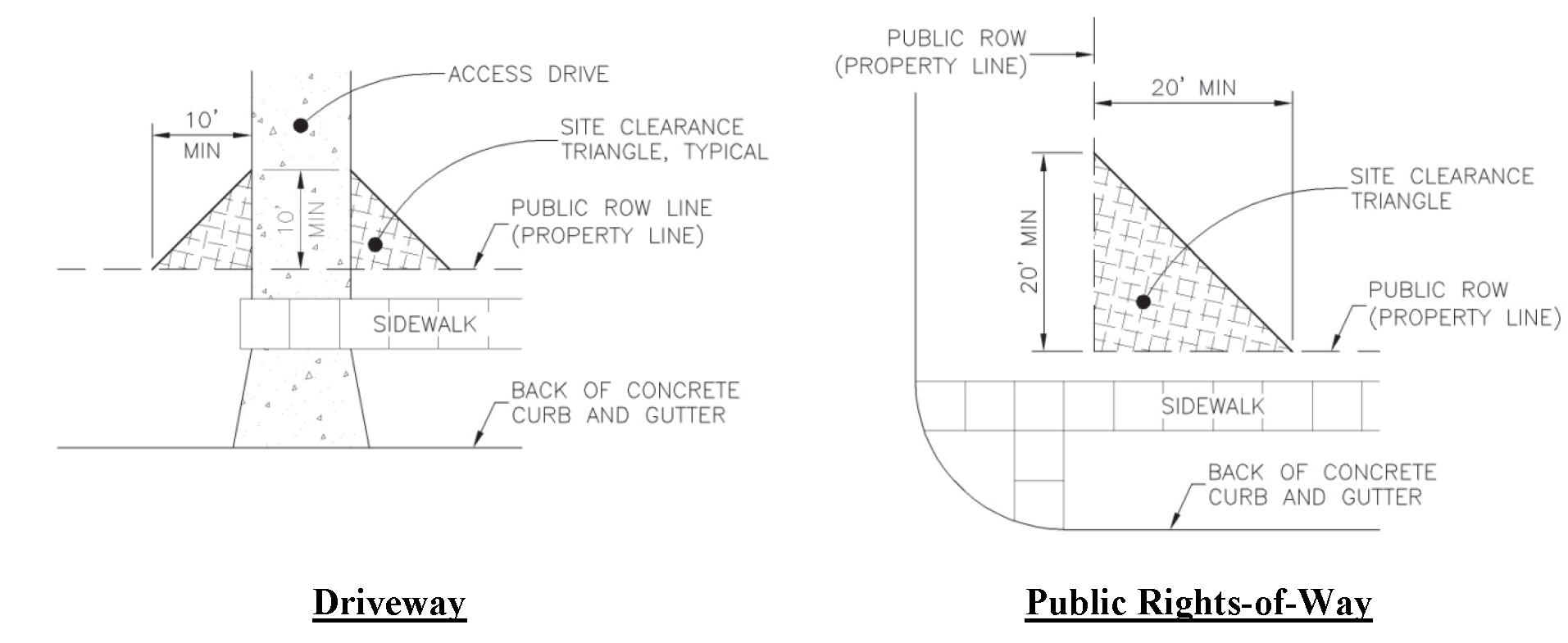
(Ord. No. 2012.24, § 2, 9-25-12)
_____

