
Jackson City Zoning Code
ARTICLE V
- DEVELOPMENT APPROVAL PROCEDURES3
Editor's note— Ord. No. 2012.16, § 5, adopted July 17, 2012, repealed the former Art. V, §§ 28-181—28-183, and enacted a new Art. V as set out herein. The former Art. V, which pertained to district changes and amendments has been redesignated as Art. VI of this chapter. For a complete derivation see the Code Comparative Table at the end of this volume.
Sec. 28-130.- Nonconforming lots, buildings, signs, structures, and uses of buildings, structures and land.
(a)
Purpose and intent.
(1)
Nonconformities permitted. It is recognized that there exists within zoning districts, established by this chapter, certain lots, buildings, structures, site improvements, and uses which were lawful before this chapter was passed or amended, which would be prohibited, regulated, or restricted under the terms of this chapter. It is the intent of this chapter to permit these nonconforming lots, buildings, structures, and uses to continue until they are altered, abandoned, removed, or brought into conformance, but not to encourage their continued use or survival.
(2)
Site improvements. Encourage gradual upgrading to a more conforming status of site and parking lot landscaping, parking (quantity and surface materials), paving/curbing, signage or other features of a site which were developed in compliance with the standards at the time of their construction, but which do not meet the current site plan or other standards of this chapter and its amendments.
(3)
No expansion of nonconformities. Nonconforming lots, buildings, structures, and uses are hereby declared to be incompatible with the zoning districts in which they are located. It is the intent of this chapter that these nonconformities shall not be enlarged upon, expanded, or extended, nor be used as grounds for adding other buildings, structures or uses prohibited elsewhere in the zoning district, except as may be provided for in this chapter.
(4)
Construction prior to effective date of this chapter. Nothing in this chapter shall be deemed to require a change in the plans, construction, or designated use of any building on which actual construction was lawfully begun prior to the effective date of this chapter, or an amendment thereto, and upon which actual building construction has been diligently conducted.
(5)
Acquisition of nonconformities. The city may acquire, through purchase or condemnation, private nonconforming lots, buildings, structures, and uses. The city council may take actions related to acquisition in the manner provided for by law.
(6)
If a nonconformity existing prior to the effective date on this chapter becomes conforming because of the adoption of this chapter, or any subsequent amendment, then it shall no longer have a nonconforming status. A condition that was not a nonconformity prior to the effective date of this chapter does not achieve any nonconforming status under this chapter by repeal of the previous chapter.
(b)
Replacement with a conforming use. If a nonconforming use of a building or structure, or land is replaced with a permitted use for the district, all buildings or structures, land, and site design shall thereafter conform to the standard, regulations, and requirements of this chapter for the district in which such buildings or structures, land, and site is located. The nonconforming use shall not thereafter be resumed.
(c)
Nonconforming lot of record.
(1)
Use permitted.
a.
A nonconforming lot may be used for any use permitted in the zoning district, subject to any approvals required by this chapter, provided that all placement, height and other applicable regulations related to the building are met, except as noted below in subsection b.
b.
A side yard requirement for a building or structure on a nonconforming lot may be reduced by the same percentage the area of the lot bears to the zoning district requirements. For example, a lot that is twenty (20) percent less than the minimum lot area may reduce the required side yard by twenty (20) percent, provided that no side yard shall be less than five (5) feet.
(2)
Contiguous nonconforming lots in common ownership.
a.
Any two (2) or more nonconforming lots of record or combination of lots and portions of lots of record, existing prior to the effective date of this chapter, or an amendment thereto, shall be considered to be an undivided parcel for the purposes of this chapter if they:
1.
Are in common ownership; and
2.
Have continuous frontage; and
3.
Individually do not meet the lot width or lot area requirements of this chapter.
b.
Parcels meeting these requirements shall be combined into a lot or lots complying as nearly as possible with the lot width and lot size requirements of this chapter. No portion of that parcel shall be used or divided in a manner that further diminishes compliance with lot width and area requirements of this chapter.
(d)
Nonconforming buildings or structures.
(1)
Continuation. Where a lawful structure exists at the effective date of adoption or amendment of this chapter, but could not be built under the terms of this chapter by reason of restrictions on area, lot coverage, height, yards, or other characteristics of the structure or its location on the lot, such structure may be continued so long as it remains otherwise lawful.
(2)
Extensions or Expansion. No such building or structure may be enlarged or altered in a way that increases its nonconformity without the granting of a variance from the zoning board of appeals (see section 28-238 of this chapter). Such buildings or structures may be enlarged or altered in a way that does not increase its nonconformity.
(3)
Expansion of a nonconforming residential building. A nonconforming residential building may be expanded into a required yard in a manner that does not comply with the setback standards with approval from the zoning administrator or chief building official, provided it is also in accordance with the following standards:
a.
The expansion does not extend closer to the lot line than any existing, nonconforming part of the structure;
b.
The expansion does not create a new nonconformity on the lot or an adjacent lot.
c.
The addition may be constructed up to the front or rear block building line (see section 28-5 of this chapter for the definition of "block building line, front or rear") when more than fifty (50) percent of the principal structures on one (1) side of the street in any one (1) block do not meet the required front or rear yard setbacks.
d.
The addition may be constructed into the required side yard providing it remains in compliance with section 28-81, side yard exceptions in R districts.
e.
The addition retains compliance with all other setback, lot coverage, and height requirements;
f.
The addition will meet all minimum building code requirements;
g.
The resultant addition, in terms of dimensions and design, would be compatible with the established character of the neighborhood;
h.
The design of the addition must be compatible with the existing structure and not detract from the appearance of the site;
i.
The expansion of a residential building with a nonconforming yard, not meeting the requirements above, is prohibited unless a variance is granted by the zoning board of appeals (see section 28-238 of this chapter).
(4)
Alteration or modification. Should such building or structure be altered or modified so as to eliminate, remove or lessen any or all of its nonconforming characteristics, then such nonconforming characteristics cannot be later reestablished or increased.
(5)
Moving a nonconforming structure. Should such building or structure be moved for any reason for any distance, it must thereafter conform to the regulations for the district in which it is located after it is moved. This does not affect the right to replace, restore, or reconstruct an accessory structure provided it meets all of the other requirements of this chapter (see subsection 28-120(2)(b)).
(e)
Nonconforming use of buildings or structures.
(1)
Extension within a building. Any nonconforming use may be extended throughout any parts of a building which were manifestly arranged or designed for that use at the time of adoption or amendment of this chapter and would have been permitted by right, but the use shall not be extended to occupy any land outside the building.
(2)
Reduction in nonconforming use. If any part of a nonconforming use is moved or reduced in size by action of the owner, the part of the nonconforming use that is moved or reduced in size shall be considered to be abandoned and any subsequent use shall conform to the requirements of this chapter.
(3)
Abandonment.
a.
If a nonconforming use of a building or structure is abandoned or discontinued for any reason for a period greater than twelve (12) consecutive months, any subsequent use of the building or structure shall conform to the requirements of this chapter.
b.
A nonconforming use of a building or structure shall be determined to be abandoned or discontinued if the city is in receipt of a written declaration by the property owner that the nonconforming use of the building or structure will not be continued, or if two (2) or more of the following conditions exist that demonstrate intent on the part of the property owner to abandon or discontinue the nonconforming use of the building or structure:
1.
Foreclosure;
2.
One (1) or more utility meters, such as water, gas, or electricity to the property, have been removed, disconnected, or shut-off;
3.
The property, buildings and/or grounds are unsafe or unsanitary, as described in chapter 14, housing or chapter 17, nuisances;
4.
Cessation of the nonconforming use or business operations during the abandonment or discontinuance period;
5.
Removal of signs or other indications of the existence of the nonconforming use;
6.
Removal of equipment or fixtures necessary for the operation of the nonconforming use;
7.
Failure to maintain current licenses, certificates, permits, registrations or other appropriate documentation; or
8.
Other actions which constitute an intention by the property owner or lessee to abandon or discontinue the nonconforming use.
c.
Exceptions.
1.
Abandonment will not be considered only when a property owner can provide documentation demonstrating a good faith effort to actively sell or lease the premises for a use less intense by function or operation than the previous nonconforming use. This exception shall not apply to discontinued nonconforming uses except as otherwise specifically set forth in this section.
(4)
Change to other nonconforming use of buildings or structures. Prior to a determination of abandonment or discontinuance, a nonconforming use shall only be changed to another nonconforming use provided the zoning board of appeals makes all of the following determinations.
a.
The proposed use is equally compatible, or more compatible, with the surrounding neighborhood, and that the use is equal to or more conforming to the uses allowed in the zoning district than the previous nonconforming use.
b.
The proposed nonconforming use is not enlarged or increased, nor extended to occupy a greater area of land than the previous nonconforming use, except as may otherwise be permitted by the zoning board of appeals.
c.
That buildings and area encompassing the expansion of the nonconforming use complies with all parking, landscaping, or other site development regulations applicable to the area affected by the proposed enlargement, increase or extension of use area as required by this chapter.
(f)
Nonconforming uses of land. The lawful use of any land not involving a building or structure, existing and lawful on the effective date of this chapter or amendment thereto, may be continued even though such use does not conform to the provisions of this chapter or amendments, subject to the following provisions:
(1)
Enlargement or increase.
a.
No nonconforming use of land not involving a building or structure shall be enlarged or increased, nor extended to occupy a greater area of land than was occupied when the use became nonconforming, except as may be permitted by the zoning of board appeals.
b.
In determining if the proposed enlargement, increase, or greater area shall be permitted, the zoning of board appeals shall find that if approved, the use shall:
1.
The use has not lost its nonconforming status due to abandonment;
2.
Not have a substantial detrimental effect on the use and enjoyment of adjacent uses or lots;
3.
Comply with all parking, sign, or other applicable regulations for accessory uses for the area affected by the proposed enlargement, increase, or greater area;
4.
Not occupy an area larger than twenty-five (25) percent of the original nonconforming area.
c.
The zoning board of appeals may impose reasonable conditions that are necessary to ensure that the proposed enlargement, increase, or greater area shall not prove detrimental to adjacent properties, the neighborhood, or the community.
(2)
Relocations. No such nonconforming use can be moved to any other portion of the lot occupied by such use on the effective date of this chapter, or amendments thereto.
(3)
Abandonment.
a.
If a nonconforming use of land not involving a building or structure is abandoned or discontinued for any reason for a period greater than twelve (12) consecutive months, any subsequent use of the land not involving a building or structure shall conform to the requirements of this chapter.
b.
A nonconforming use of the land not involving a building or structure shall be determined to be abandoned or discontinued if the city is in receipt of a written declaration by the property owner that the nonconforming use of the land not involving a building or structure will not be continued, or if two (2) or more of the following conditions exist that demonstrate intent on the part of the property owner to abandon or discontinue the nonconforming use of the land not involving a building or structure:
1.
Foreclosure;
2.
One (1) or more utility meters, such as water, gas, or electricity to the property, have been removed, disconnected, or shut-off;
3.
The property and/or grounds are unsafe or unsanitary, as described in chapter 14, housing or chapter 17, nuisances;
4.
Cessation of the nonconforming use or business operations during the abandonment or discontinuance period;
5.
Removal of signs or other indications of the existence of the nonconforming use;
6.
Removal of equipment for the operation of the nonconforming use;
7.
Failure to maintain current licenses, certificates, permits, registrations or other appropriate documentation; or
8.
Other actions which constitute an intention by the property owner or lessee to abandon or discontinue the nonconforming use.
c.
Exceptions.
1.
Abandonment will not be considered only when a property owner can provide documentation demonstrating a good faith effort to actively sell or lease the premises for a use less intense by function or operation than the previous nonconforming use. This exception shall not apply to discontinued nonconforming uses except as otherwise specifically set forth in this section.
(4)
Change to other nonconforming use of land. Prior to a determination of abandonment or discontinuance, a nonconforming use shall only be changed to another nonconforming use provided the zoning board of appeals makes all of the following determinations.
a.
The proposed use is equally compatible, or more compatible, with the surrounding neighborhood, and that the use is equal to or more conforming to the uses allowed in the zoning district than the previous nonconforming use.
b.
The proposed nonconforming use is not enlarged or increased, nor extended to occupy a greater area of land than the previous nonconforming use, except as may otherwise be permitted by the zoning board of appeals.
c.
That buildings and area encompassing the expansion of the nonconforming use complies with all parking, landscaping, or other site development regulations applicable to the area affected by the proposed enlargement, increase or extension of use area as required by this chapter.
(g)
Repairs, replacement, alterations, or improvements.
(1)
Nonconforming commercial or industrial uses, structures or buildings.
a.
Should the total costs of repairs, replacement, alterations, or improvements to a nonconforming use, building or structure, for any reason, be less than or equal to seventy-four (74) percent of the assessed value of the building or structure, it may be repaired, replaced, altered, or improved in its previously nonconforming location, provided that:
1.
The dimensional characteristics of the building as it existed at the time of passage or amendment of this chapter is not increased. This does not allow for the separation or expansion of utility systems; and
2.
The building, structure or use has not lost its nonconforming status due to abandonment.
b.
Should the total costs of repairs, replacement, alterations, or improvements to a nonconforming use, building or structure, for any reason, be greater than or equal to seventy-five (75) percent of the assessed value of the building or structure,, it shall be repaired, replaced, altered, or improved only in conformance with the provisions of this chapter.
(2)
Nonconforming one-family uses, structures or buildings. A nonconforming one-family detached dwelling and its accessory structures in any zoning districts may be continued, replaced, or repaired if damaged by fire, vandalism, flood or other force of nature, if approved by the zoning administrator or chief building official. Such approval requires a finding that the resulting building footprint and height will be the same size or smaller than that of the building or structure before such change. Replacement of a nonconforming one-family building or structure must commence within one (1) year of the date of damage and work must be diligently pursued toward completion. Failure to complete replacement or diligently work toward completion, or use of the building for a conforming non-residential use for any period of time, will result in the loss of nonconforming status unless good cause for the delay or temporary change in use is accepted by the zoning administrator or building official.
(3)
Assessed value. For the purposes of enforcing the regulations contained in this section, the value (see the definition in section 28-5 of this chapter) of the structure will be determined by the most recent valuation of the structure for the purposes of taxation.
(4)
Ordinary repair/maintenance. Nothing in this section prevents ordinary repair/maintenance, or the strengthening or restoring to a safe condition of any building or structure, or part thereof, deemed to be unsafe by an official charged with protecting the public safety, upon order of such official.
(h)
Nonconforming site design.
(1)
Purpose. This section permits reviews of applications for improvements and minor modifications to a nonconforming lot, building, structure or use that does not require a site to meet all of the site improvement regulations, requirements, and standards of this chapter. Where appropriate, the intent is to allow gradual compliance with site-related requirements for sites that pre-date requirements for landscaping, surface treatment for parking areas or drives, curbing and other non-safety site-related items provided in article IV.
(2)
Improvements or modifications. Improvements or modifications to nonconforming site design may be administratively approved through the site plan review process without a complete upgrade of all site elements under the following conditions:
a.
The applicant provides reasonable site improvements to the site in relation to the scale and construction cost of the building improvements or expansion;
b.
The applicant addresses any safety-related site issues for the site;
c.
The improvements or minor expansion do not increase the nonconforming site elements;
d.
The applicant upgrades the site landscaping consistent with section 28-105, to the degree deemed appropriate by the zoning administrator or chief building official; and
e.
Driveways that do not conform to the access management requirements of this chapter are eliminated, provided that minimum reasonable access is maintained.
(3)
Compliance required. Site design standards and requirements shall be brought into full compliance with this chapter, except as may otherwise be permitted by the zoning board of appeals, if any of the following occur:
a.
Change from nonconforming use to a permitted use.
1.
See section 28-130(b).
b.
Parking lot/area. Any expansion, reduction, resurfacing, replacement, or reconstruction of greater than or equal to twenty-five (25) percent of the existing designated off-street parking area shall require all new, existing, and/or remaining off-street parking area(s), maneuvering lanes, and ingress and egress meet the standards and requirements of article IV. This does not include general maintenance; i.e., sealcoating.
c.
Modification, alteration, replacement, or expansion of existing landscape areas (trees, shrubs, ground cover, or similar materials). This shall also include all proposed landscape installations.
d.
Replacement of nonconforming exterior light fixtures, light poles, or combination thereof shall meet the requirement of section 28-109.
(4)
Nothing in this Section shall be construed to require the removal of vegetation preserved as part of the original construction of the landscaped area.
(5)
In all instances, required screening walls for waste receptacles, fencing of outdoor storage or screening from adjacent residential uses shall be provided.
(6)
The city may require a performance guarantee under the provisions of section 28-165 to insure that all improvements required in this section are made in accordance with the approved plan.
(i)
Nonconforming signs.
(1)
The goal is to eliminate nonconforming signs, except as otherwise specifically set forth in this section. Any lawfully erected sign, which is made unlawful by this chapter, may continue exactly as the sign existed at the time when the sign became unlawful under the provisions of this chapter. However, following ninety (90) days after the discontinuance of the previously approved use associated with the sign, sign panels shall be replaced with blank panels and any interior lighting shall be disconnected. Twelve (12) months after discontinuance, the sign structure shall be removed.
(2)
No nonconforming sign shall:
a.
Be changed to another nonconforming sign without a variance;
b.
Be structurally altered so as to change the shape, size, type or design of the sign;
c.
Be re-established after the activity, business or use to which it relates has been discontinued for ninety (90) days or longer.
(3)
Ordinary repair/maintenance.
a.
The provisions of this chapter shall not apply to the ordinary repair/maintenance of existing signs or changing of sign panels or to the altering of a sign specifically designed for periodic change of message without change in sign structure, such as a bulletin board or similar type of sign. The replacement of a manual changeable message sign with a digital message sign is specifically excluded from this provision.
b.
Repairs may be done to a nonconforming sign to an extent not exceeding fifty (50) percent of the value of the sign, provided that:
1.
The dimensional characteristics of the sign as it existed at the time of passage or amendment of this chapter is not increased; and
2.
The sign has not lost its nonconforming status due to vacancy, discontinuance or abandonment.
c.
In the event that any nonconforming sign requires ordinary repair/maintenance for any reason and in any manner that exceeds fifty (50) percent of the value of the sign, such repairs shall be permitted only in conformity with the provisions of this chapter. However, if complying with this chapter is unfeasible and/or impractical, a property owner may seek a variance from the zoning board of appeals (see section 28-238 of this chapter), assuming it can also be demonstrated that the original structure was consistent with the established character of the area.
(j)
Nonconforming medical and adult use marihuana facility uses. Medical and adult use marihuana facilities, including a grower, provisioning center, retailer, safety compliance facility, secure transporter, microbusiness, or any marihuana facility or establishment of any type, other than that of a licensed caregiver operating within the limits of the Michigan Medical Marihuana Act, which may have been established prior to the effective date of the ordinance from which this section is derived, but which have not gained a license from both the State of Michigan and the City of Jackson shall not be considered nonconforming uses. In addition, no marihuana facilities may be permitted as a home occupation or accessory use.
(Ord. No. 2012.16, § 5, 7-17-12; Ord. No. 2014-25, § 2, 9-23-14, eff. 10-23-14; Ord. No. 2015.9, § 2, 4-14-15; Ord. No. 2016.07, § 2, 3-29-16; Ord. No. 2017-05, § 2, 4-11-17; Ord. No. 2017-12, § 2, 11-28-17; Ord. No. 2018-14, § 2, 12-11-18; Ord. No. 2019-14, § 2, 10-15-19; Ord. No. 2020-16, § 2, 10-13-20; Ord. No. 2020-21, § 2, 12-8-20; Ord. No. 2022-04, § 2, 5-24-22; Ord. No. 2023-03, § 2, 1-24-23)
Sec. 28-135. - Site plan review procedures and requirements.
(a)
Statement of purpose.
(1)
The site plan review procedures and standards set forth herein provide a consistent and uniform method of review of proposed development plans, to ensure full compliance with the standards contained in this chapter, other applicable chapters of this Code, standard engineering practices, and county, state, and federal rules and laws. The procedures set forth herein are further intended to:
a.
Achieve efficient use of the land;
b.
Protect the traditional character of the city;
c.
Minimize adverse impacts on adjoining or nearby properties;
d.
Provide a mechanism for review of new development and redevelopment or reuse of existing site to ensure compliance with current standards; and
e.
Encourage cooperation and consultation between the city and the applicant to facilitate development in accordance with the city's land use objectives.
(2)
Prior to the creation of a use, erection of a building, and those conditions cited below, a site plan or administrative plan must be submitted for approval, in accordance with this section. The extent of review for various types of projects is classified into three (3) types generally described below. The table of required review process provides a specific listing of review classifications:
a.
Planning commission review (PCR). Most new development and major expansions will require a full site plan (FSP) under subsection (b) of this section, full site plan submittal and review procedures. The establishment of a condominium project will require the submission of a comprehensive site plan (CSP) and must also comply with subsection (d), condominium and site condominium development review procedures.
b.
Administrative review (AR). Select projects and expansions or changes in use to existing sites will undergo a less formal review and approval process by the zoning administrator (or designee), and any others deemed necessary. The zoning administrator always reserves the right to send any administratively reviewed plans to the planning commission for final determination, especially when it relates to aesthetics and architecture.
1.
Full site plan (FSP). Select medium and small scale projects and expansions, or changes in use to existing sites, are permitted to provide less detailed information than a comprehensive site plan (CSP). The level of information is intended to be proportionate to the extent of the change and yet insure adequate review for compliance with applicable requirements.
2.
Plot site plan (PSP). Select projects, such as one-family and two-family dwellings on an individual lot, only require the submission of a plot plan (PP) given their relatively low level of impact on adjacent land uses, and given that compliance with applicable zoning regulations can be addressed during the building permit review process. Other applicable approvals are still required such as zoning compliance permits, building permits and inspections.
(b)
Full site plan (FSP) submittal and review procedures for planning commission review (PCR). When a full site plan (FSP) is required for planning commission review (PCR), the following procedure will apply, unless otherwise noted in the table of required review process.
(1)
Pre-application meeting. For the purposes of identifying major issues related to a project and to discuss questions related to this chapter and other chapters of this Code, the applicant must attend a pre-application meeting with the zoning administrator (or designee), and any others deemed necessary. Sufficient information must be submitted prior to the meeting that describes the proposed project. Discussion at this meeting is in no way a formal approval or decision on any aspect of a proposed project.
(2)
Application. Any person with legal interest in a lot or parcel may apply for planning commission review (PCR) of a full site plan (FSP) by filing a completed application form, paying the review fee and providing digital (electronic) and hard copies (size and number to be determined by the zoning administrator (or designee)) of the FSP, according to the submittal schedule prepared by the zoning administrator at the beginning of every calendar year. required site plan contents are listed in subsection (e) of this section.
(3)
Final approval of a full site plan (FSP). A full site plan requiring approval by the planning commission must complete the following process:
a.
Planning commission approval. The planning commission and appropriate city staff will review the full site plan (FSP) for compliance with the standards of this chapter and other appropriate chapters of this Code and statutes. Based upon this review the planning commission may either:
1.
Approve the FSP.
2.
Approve the FSP with conditions which the planning commission determines are reasonable and necessary to ensure conformance with applicable chapters of this Code and statutes. These conditions must be listed in the motion and noted on the FSP, with the planning commission chairperson's signature.
3.
Table the FSP upon determining that it does not meet the standards, spirit and intent of this chapter and other appropriate chapters of this Code and statutes. The planning commission will direct the applicant to make modifications and resubmit the FSP. The applicant will be required to prepare a revised FSP, accompanied by a complete list of all changes with a certification (by the applicant or his/her design professional), that no other changes have been made.
4.
Deny the FSP upon determining that it does not meet the standards, spirit and intent of this chapter and other appropriate chapters of this Code and statutes.
b.
Implementation of planning commission approval. The following provisions apply to a full site plan (FSP) which has received the approval of the planning commission but not the administrative approval required by subsection (e) of this [section]:
1.
The adopted minutes of the planning commission, and the report of the zoning administrator (or designee), will serve as the official record of the planning commission's decision on a full site plan (FSP), including any conditions of approval. The applicant will be responsible for obtaining a copy of the adopted minutes, and submittal of a revised FSP and related documents which demonstrate compliance with any conditions to the zoning administrator (or designee). Any question on the decision may be made in writing to the planning commission prior to the adoption of the minutes.
2.
Upon receipt of approval of the full site plan (FSP) by the planning commission, the applicant will have up to six (6) months to submit a final FSP to the zoning administrator (or designee). However, the planning commission may grant a single one time extension of up to one (1) year provided the request is received in writing prior to the expiration date and presents reasonable evidence to the effect that the development has encountered unforeseen non-self-created difficulties. Should neither of the aforementioned provisions be fulfilled, or an extension has expired without construction activity underway, the FSP will be considered null and void.
3.
Full site plan (FSP) approval by the planning commission does not preclude the zoning administrator (or designee) from enforcing the standards of this chapter and other appropriate chapters of this Code and statutes, as well as the city's engineering standards.
c.
Administrative approval. Upon the receipt of approval of the full site plan (FSP) by the planning commission, the zoning administrator (or designee) will review the (FSP) for compliance with the standards of this chapter and other appropriate chapters of this Code and statutes, as well as the city's engineering standards. Based upon this review the zoning administrator (or designee) may either:
1.
Approve the FSP;
2.
Refer the FSP back to the applicant or his/her design professional for revision because it does not meet the standards, spirit and/or intent of this chapter, other appropriate chapters of this Code and statutes, or the city's engineering standards. The applicant or his/her design professional will be required to prepare a revised FSP, accompanied by a complete list of all changes and certification that no other changes have been made; or
3.
Deny the FSP upon determining that the plans do not meet the standards, spirit and/or intent of this chapter, other appropriate chapters or this Code and statutes, or the city's engineering standards.
The zoning administrator (or designee) is the only city official who can approve a change to a full site plan (FSP) that has received the approval of the planning commission.
(4)
Following approval of the FSP, a digital (electronic) file determined by the zoning administrator (or designee) must be provided to the city on disk or via email.
(5)
A zoning compliance permit will also be required following approval of the final FSP, but prior to issuance of a certificate of occupancy.
(6)
Changes to a full site plan (FSP) that has received final approval. The holder of a FSP that has received final approval will notify the zoning administrator (or designee) of any proposed change to an approved site plan. Documentation outlying conditions necessitating the changes will be provided. Changes to the approved site plan will be permitted only under the following circumstances:
a.
Minor amendments. Minor changes may be approved by the zoning administrator (or designee) upon determining that the proposed revisions(s) will not alter the basic design nor any specific conditions imposed as part of the FSP as originally approved. Minor changes may include the following:
1.
Change in the building size of up to twenty-five (25) percent in total floor area in the event of no impact to other site improvements;
2.
Movement of buildings or other structures by not more than twenty (20) feet;
3.
Replacement of plant material specified in the landscape plan with comparable materials of an equal or greater size;
4.
Changes in building materials to a comparable or higher quality;
5.
Changes in floor plans which do not alter the character of the use; and
6.
Changes required by outside agencies such as county, state or federal departments.
b.
Major amendments. A proposed change not determined by the zoning administrator (or designee) to be minor must be submitted to the planning commission as a site plan amendment and will be reviewed in the same manner as the original application.
The zoning administrator (or designee) is the only city official who can approve a change to a full site plan (FSP) that has received the approval of the planning commission.
(7)
Performance guarantee. The city may require a performance guarantee, as authorized by section 28-165 of this chapter, to assure the completion of any improvements shown on the site plan. For the purposes of this section, improvements subject to performance guarantees must include features and actions associated with a project that are considered necessary by the city to protect the natural resources or the health, safety, and welfare of the residents of the city and future users or inhabitants of the proposed project or project area, including roadways, lighting, utilities, sidewalks, screening and drainage.
(c)
Administrative submittal and review procedures. Those applications that qualify for administrative review in accordance with the table of required review process must comply with the following procedure:
(1)
Pre-application meeting. For the purposes of identifying major issues related to a project and to discuss questions related to this chapter and other chapters of this Code, the applicant is encouraged to attend a pre-application meeting with the zoning administrator (or designee), and any others deemed necessary. Sufficient information must be submitted prior to the meeting that describes the proposed project. Discussion at this meeting is in no way a formal approval or decision on any aspect of a proposed project.
(2)
Application. Any person with legal interest in a lot or parcel that qualifies for administrative review under the criteria set forth in subsection (a) of this section may apply by filing a completed application form, paying a review fee, providing a digital (electronic) file determined by the zoning administrator (or designee), and hard copies (size and number to be determined by the zoning administrator (or designee)) of the full site plan (FSP) or plot site plan (PSP) with the zoning administrator (or designee). Required plan contents are listed in subsection (e) of this section.
(3)
Approval. Upon review of the application, the zoning administrator (or designee) will either:
a.
Request specific revisions and re-submittal of the application upon a finding the application does not meet information requirements or does not meet the intent and regulations of this chapter;
b.
Approve the administrative plan, with or without conditions; or
c.
Upon determining that the administrative plan does not meet the standards, spirit and intent of this chapter and other appropriate chapters of this Code and statutes, deny the administrative plan.
(4)
Effectiveness. Upon administrative plan approval, each project must be under construction within six (6) months after the date of final approval by the zoning administrator and be diligently carried on towards completion. If the applicant does not fulfill this provision, the zoning administrator may grant one (1) one-year extension provided the applicant makes application in writing prior to the expiration date and presents reasonable evidence to the effect that the development has encountered non self-created unforeseen difficulties but is then ready to proceed. Should neither of the aforementioned provisions be fulfilled or the one-year extension has expired without construction activity underway, the administrative plan will be considered null and void.
(5)
Changes to the approved administrative plan. The holder of an approved administrative plan must notify the zoning administrator of any proposed change to an approved administrative plan. Documentation outlying conditions necessitating the changes must be provided. The zoning administrator (or designee) has the authority to review and approve any changes, per subsection (3) of this subsection.
(6)
Performance guarantee. The city may require a performance guarantee, as authorized by section 28-165 of this chapter, to assure the completion of any improvements shown on the site plan. For the purposes of this section, improvements subject to performance guarantees must include features and actions associated with a project that are considered necessary by the city to protect the natural resources or the health, safety, and welfare of the residents of the city and future users or inhabitants of the proposed project or project area, including roadways, lighting, utilities, sidewalks, screening and drainage.
(d)
Condominium and site condominium development review procedures. All plans for all newly created condominiums, expansions of existing condominiums and conversion of condominiums in accordance with the Condominium Act, Public Act 59 of 1978, as amended, will be reviewed under the following procedure:
(1)
Pre-application meeting. For the purposes of identifying major issues related to a project and to discuss questions related to this chapter and other chapters of this Code, the applicant must attend a pre-application meeting with the zoning administrator (or designee), and any others deemed necessary. Sufficient information must be submitted prior to the meeting that describes the proposed project. Discussion at this meeting is in no way a formal approval or decision on any aspect of a proposed project.
(2)
Application. Any person with legal interest in a lot or parcel may apply for planning commission review (PCR) of a full site plan (FSP) for a proposed condominium or site condominium development by filing a completed application form, paying the review fee and providing digital (electronic) and hard copies (size and number to be determined by the zoning administrator (or designee)) of the FSP, according to the submittal schedule prepared by the zoning administrator at the beginning of every calendar year. Required site plan contents are listed in subsection (e) of this section.
(3)
Preliminary approval. A full site plan that meets the information requirements of subsection (e) and review criteria of subsection (f) of this section, must be submitted for preliminary condominium site plan approval by the planning commission. The planning commission will review the site plan according to the procedures of this article and must take action to approve, approve with conditions, or deny. If a condominium site plan is incomplete, the planning commission may table the request and direct the applicant to prepare additional information or revise the plan. Within a phased project, the final plan will constitute only that portion of the approved preliminary plan that the proprietor proposes to record and develop at that time.
An application for a final condominium site plan must be submitted within six (6) months after the date of preliminary condominium site plan approval by the planning commission, or such preliminary approval will be deemed null and void. However, the applicant may be granted one (1) one-year extension by the planning commission provided the request is received in writing prior to the expiration date and presents reasonable evidence to the effect that the development has encountered unforeseen non-self-created difficulties but is then ready to proceed. Should neither of the aforementioned provisions be fulfilled or the one-year extension has expired without construction activity underway, the preliminary condominium site plan will be considered null and void.
No installation or construction of any improvements or land balancing or grading can be made or begun until the final condominium site plan has been approved. No removal of trees and/or other vegetation can be started at this time except for minor clearing required for surveying and staking purposes.
(4)
Agency reviews. Upon receipt of preliminary site plan approval, the proprietor must submit the preliminary condominium site plan to all authorities for necessary permits, as required by city and state regulations, and must deliver two (2) copies of the preliminary condominium site plan to the superintendent of the school.
(5)
Administrative final approval. The zoning administrator (or designee), must review and approve the final site plan if in compliance with all applicable chapters of this Code, statutes, and regulations. The following information must be submitted for final condominium site plan approval by the planning commission:
a.
A full site plan meeting the requirements of this article;
b.
Necessary county permits; and
c.
Condominium master deed, bylaws and restrictive covenants.
(6)
Performance guarantee. The city may require a performance guarantee, as authorized by section 28-165 of this chapter, to assure the completion of any improvements shown on the site plan. For the purposes of this section, improvements subject to performance guarantees must include features and actions associated with a project that are considered necessary by the city to protect the natural resources or the health, safety, and welfare of the residents of the city and future users or inhabitants of the proposed project or project area, including roadways, lighting, utilities, sidewalks, screening and drainage.
_____
(e)
Required site plan contents. The following data must be included with, and as part of, all applications requiring site plan review:
[Table notes:]
(1)
A plot plan may be drawn on the grid sheet contained in the application.
(2)
If needed to determine park and loading requirements (see sections 28-100 and 28-145(d)(12)).
(3)
If applicable.
(4)
If building design standards apply.
(5)
Requires a photometric study, to the satisfaction of the zoning administrator (or designee).
(f)
Site plan review criteria. In the process of reviewing a site plan, the planning commission or zoning administrator (or designee) must consider the following criteria and assure that these conditions are met to the extent practicable:
(1)
Adequacy of information. The site plan must include all required information in sufficiently complete and understandable form to provide an accurate description of the proposed uses(s) and structures;
(2)
Uses. The site plan must state that all proposed uses are permitted in the zoning district in which the site is located;
(3)
Site design characteristics. All elements of site design must be harmoniously and efficiently organized in relation to topography, the size and type of lot, the character of adjoining property, and the type and size of buildings. The site must be developed so as not to impede the normal and orderly development or improvement of surrounding property for uses permitted by this chapter. The site must be designed to conform to all provisions of this chapter. Redevelopment of existing sites must be brought into conformance with all site improvement provisions of this chapter which are relative to and proportionate to the extent of redevelopment, as determined by the planning commission or zoning administrator (or designee);
(4)
Traditional city character/historic preservation. The City of Jackson is a traditional community with many historic characteristics and features. All site plans within the city must demonstrate that they are in keeping with the character and history of the surrounding residential, commercial, industrial, or mixed-use neighborhood;
(5)
Buildings. Buildings and structures will meet or exceed setback standards, height and other dimensional standards, and be consistent with applicable building design standards;
(6)
Emergency vehicle access. All buildings or groups of buildings must be arranged so as to permit emergency vehicle access by some practicable means to all vehicles;
(7)
Ingress and egress. Every structure or dwelling unit must be provided with adequate means of ingress and egress via public streets, private roads and walkways;
(8)
Pedestrian and vehicular orientation. The site plan must provide a system for pedestrian circulation that allows pedestrians to safely access the site, circulate within the site, and access adjacent sites and development areas such as neighborhoods. The arrangement of vehicular and pedestrian circulation must respect the pattern of existing or planned streets and pedestrian or bicycle pathways in the city. The width of streets and drives must be appropriate for the volume of traffic they will carry;
(9)
Drainage. Stormwater management system and facilities must preserve the natural drainage characteristics and enhance the aesthetics of the site to the maximum extent possible. Measures must be taken to ensure stormwater management techniques follow safe practices to treat drainage before it enters the system;
(10)
Soil erosion. The proposed development must include measures to prevent soil erosion and sedimentation;
(11)
Exterior lighting. Exterior lighting must be designed so that it is aimed downward and deflected away from adjacent properties and so that it does not impede the vision of drivers on public streets, adversely impact abutting properties or adversely impact the natural evening sky. Lighting levels may not exceed half (0.5) a foot-candle beyond any perimeter (exterior) lot line;
(12)
Preservation of natural areas. The landscape must be preserved in its natural state, insofar as practicable, by minimizing tree and soil removal, alteration to the natural drainage courses, and the amount of cutting, filling and grading. Insofar as practical, natural features and the site topography, viewsheds, historical markers and environmental areas must be incorporated into the proposed site design;
(13)
Public services. The scale and design of the proposed development must facilitate the adequate provision of services currently furnished by or that may be required of the city or other public agency including, but not limited to, fire and police protection, stormwater management, sanitary sewage removal and treatment, traffic control and administrative services. All new utilities must be installed underground;
(14)
Traffic impact. The expected volume of traffic to be generated by the proposed use cannot adversely impact existing roads and the circulation thereon. Driveways must be located to minimize conflict with traffic operations on the adjoining road. The number of driveways must be the minimum needed to provide reasonable access to the site; and
(15)
Master plan. Sites must be designed to be compatible with and in accordance with the goals and objectives of the City of Jackson Comprehensive Plan.
(Ord. No. 2012.16, § 5, 7-17-12; Ord. No. 2012.20, § 4, 9-11-12; Ord. No. 2016.07, § 2, 3-29-16; Ord. No. 2016-29, § 3, 11-15-16)
Sec. 28-140. - Additional development requirements for certain permitted uses.
The following minimum nondiscretionary standards must be met for the permitted uses specified in this section:
(1)
Work release (halfway) house:
a.
Premises for such purposes shall not be less than seven hundred fifty (750) feet from any residentially zoned land except land zoned R-4 (high density apartment and office).
b.
Work release (halfway) houses shall not be less than seven hundred fifty (750) feet from a school or one thousand (1,000) feet from another premises used for work release (halfway) houses.
c.
The number of allowable beds in each work release (halfway) house shall be limited to twenty (20).
(2)
Medical and adult use marihuana facility use setbacks. Medical and adult use marihuana facilities, excluding a provisioning center/retailer in the C-3 zoning district, transport facilities and safety compliance facilities, must comply with the following use setback requirements:
a.
Setback of five hundred (500) feet of any public or private elementary, vocational, or secondary school or a public or private college, junior college, or university or one hundred (100) feet in the C-4 zoning district;
b.
Setback of five hundred (500) feet of the physical location of any cyber school as defined in section 28-5 and as measured from door to door Or one hundred (100) feet in the C-4 zoning district;
c.
Setback of five hundred (500) feet of a park and/or playground or one hundred (100) feet in the C-4 zoning district;
d.
Setback of five hundred (500) feet of a housing facility owned by a public housing authority or one hundred (100) feet in the C-4 zoning district;
e.
Setback of five hundred (500) feet of a day care facility, including any and all accessory uses/facilities or one hundred (100) feet in the C-4 zoning district;
f.
Setback of five hundred (500) feet of a substance abuse treatment, rehabilitation, or prevention facility as defined and licensed by the Department of Licensing and Regulatory Affairs (LARA) or one hundred (100) feet in the C-4 zoning district;
g.
Setback of two hundred and fifty (250) feet of a residentially zoned parcel or one hundred (100) feet in the C-4 zoning district;
h.
Setback of five hundred (500) feet of a church or other house of worship that has received tax exempt status from the city assessor or one hundred (100) feet in the C-4 zoning district;
i.
Up to two (2) facilities may be located within five hundred (500) feet of another medical or adult use marihuana business establishment as measured from the closest building line unless co-location has been approved by the city as per section 28-140(3);
j.
Setback one hundred (100) feet of a public or private youth center, swimming pool, or video arcade facility;
k.
All distances shall be measured from property line to property line except as noted in subsection (2)b and (2)i. above;
l.
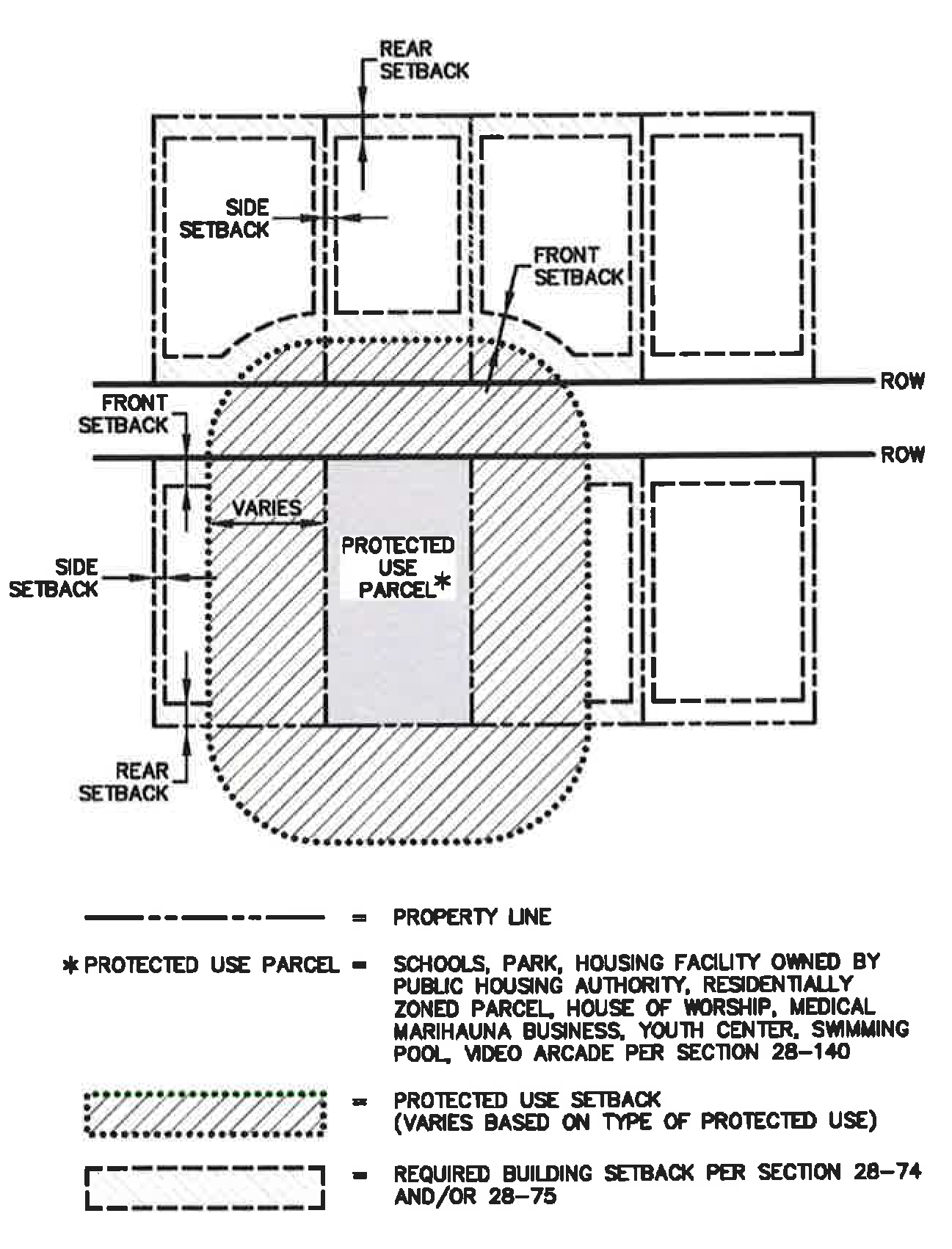
For parcels upon which the use setbacks extend inside the property lines, the building setbacks (see section 28-74 and section 28-75) shall be measured from said use setback instead of the property line (see below). The remaining portion of the parcel that lies within the required use setback must be returned to its natural state (no structures shall remain). All other chapter 28 (zoning) requirements shall apply; and
m.
All other applicable chapter 28 regulations shall apply to such uses.
(3)
Medical and adult use marihuana facility co-location. Medical and adult use marihuana facilities may co-locate in the same suite provided they are under the same ownership structure and each complies with the respective zoning and licensing requirements as outlined in the applicable city and state laws/rules. However, only up to two (2) comparable medical and adult uses may co-locate under one (1) city license. If not comparable, then only up to two (2) use types may [be] co-located on any one (1) parcel provided the ownership structure is identical for each and each will be considered as a separate city license.
(Ord. No. 2012.16, § 5, 7-17-12; Ord. No. 2018-14, § 2, 12-11-18; Ord. No. 2019-06, § 2, 2-12-19; Ord. No. 2019-14, § 2, 10-15-19; Ord. No. 2020-06, 6-16-20; Ord. No. 2020-16, § 2, 10-13-20; Ord. No. 2020-21, § 2, 12-8-20)
Sec. 28-145. - Conditional uses.
In addition to the "permitted" uses in each of the zoning districts, there are certain other compatible uses, as listed in this chapter that are "conditional" uses. Because of their actual or potential impact on natural resources, public utilities, traffic patterns and/or adjacent land use, there is a need to carefully regulate these uses. In these cases, a zoning compliance permit will not be issued until a conditional use permit is approved by the city planning commission. All conditional use permits are granted for a particular site and may not be transferred to a different location. A conditional use permit runs with the land, not with the applicant.
(a)
Conditional uses authorized by the planning commission. The city planning commission shall hear and make determinations regarding applications for conditional uses listed in the district regulations and supplemental provisions of this chapter.
(1)
Procedures. An application for a conditional use shall be submitted to the planning commission for consideration and public hearing. The application must include a site plan which meets the requirements of section 28-135. Notice of such public hearing shall be given as provided for in section 28-8.
(2)
Content of notices. In addition, notice shall be published in a newspaper of general circulation in the city within the time period required in this subsection. The notices required herein shall:
a.
Describe the nature of the conditional use request.
b.
Indicate the property which is the subject of the conditional use request.
c.
State when and where the public hearing on the conditional use request will be considered.
d.
Indicate when and where written comments will be received concerning the request.
(3)
Adjournment of hearings. Upon the day for the hearing of any application, the city planning commission may adjourn the hearing in order to permit the obtaining of additional information, or to cause such further notice as it deems proper to be served upon such other property owners. In the case of an adjourned hearing, persons previously notified and persons already heard need not be notified of the time of resumption of such hearing, unless the city planning commission so decides.
(4)
Conditions upon approval. If the planning commission determines that the proposed conditional use is appropriate, the conditional use permit shall be approved. The conditions should ensure that the proposed use meets the standards of this chapter. The conditions shall:
a.
Be designed to protect natural resources, as well as the health, safety, welfare, and social and economic well-being of those residents and landowners immediately adjacent to the proposed land use or activity, and the community as a whole.
b.
Be related to the valid exercise of the police power in relation to the purposes of the proposed use or activity.
c.
Be necessary to meet the intent and purpose of this chapter; be related to the standards established in the ordinance for the land use or activity under consideration; and be necessary to ensure compliance with those standards.
d.
To the extent applicable, ensure that public services and facilities affected by the proposed land use or activity will be capable of accommodating increased facility loads caused by the land use or activity.
(5)
Status of conditions. Conditions imposed with respect to the approval of a land use or activity shall be made of record at the time of approval and shall remain unchanged except upon the mutual consent of the city planning commission and the owner of the land for which approval of a conditional use has been granted. The city planning commission shall maintain a record of any changes granted in conditions imposed.
(6)
Decisions of the city planning commission. The city planning commission shall decide on all applications within thirty (30) days after the final hearing thereon. The decision shall be incorporated in a statement of findings and conclusions relative to the conditional use which specifies the basis for the decision and shall list any conditions imposed. A copy of the city planning commission's decision shall be transmitted to the applicant, the zoning official, and planning staff. The city planning commission shall have the final decision on all conditional uses.
(7)
Rehearing on applications for conditional uses. Whenever an application for a conditional use is denied, such application shall not be resubmitted for at least one (1) year from the date of the denial, unless it is established to the satisfaction of the city planning commission that there has been a material change in circumstances.
(8)
Violation. A violation of any requirement, condition, or safeguard established in the conditional use permit shall be considered a violation of this chapter and shall be punished as prescribed in section 1-18 of this Code. In addition, any such violation shall constitute a prima facie basis for the planning commission to revoke the conditional use permit.
(b)
Standards on which decisions will be based. The city planning commission shall review the particular circumstances and facts of each proposed use in terms of the following standards:
(1)
Consistency with the intent and purposes of this chapter and with the objectives of the city's land use and/or comprehensive plan.
(2)
Compatibility with the existing and future land use patterns.
(3)
Effect on the health, safety, convenience, or general welfare of persons residing or working in the vicinity. To evaluate the use, the planning commission shall consider the following:
a.
The nature of the proposed site, including its size and shape, and the proposed size, shape and arrangement of structures.
b.
The accessibility and traffic patterns for persons and vehicles, the type and volume of such traffic, and the adequacy of proposed off-street parking and loading.
c.
The safeguards used to prevent noxious or offensive emissions such as noise, glare, dust and odor.
d.
The treatment given, as appropriate, to such aspects as landscaping, screening, open spaces, parking and loading areas, service areas, lighting and signs.
e.
Any other pertinent factors.
(4)
Ability of the use to be designed, constructed, operated, maintained, and managed so as to be harmonious and appropriate in appearance with the existing or intended character of the general vicinity.
(5)
Availability of essential public facilities and services, such as: streets, police and fire protection, drainage, refuse disposal. The persons or agencies responsible for the establishment of the proposed use shall be able to adequately provide any such service.
(6)
For legal nonconformities only. When reviewing a conditional use permit application for a nonconforming building, structure, or use, the planning commission must also consider the following standards together with such relevant facts and circumstances identified during the public hearing:
a.
Whether restoration, reconstruction, substitution, and/or expansion would serve a useful purpose, or whether a useful purpose would be served by pursuing strict enforcement and application of the provisions and requirements of this article.
b.
Whether the development and/or use of property in the surrounding area has materially changed in relation to the condition which existed when the use or structure was established, with the result that a continuation of the use or structure would be offensive to the area.
c.
In considering the establishment of a condition for the approval of the substitution of a nonconforming use of lots, structures, or any combination of lots, structures, or uses of lots and structures, the planning commission must ensure that the nonconforming use of lots and structures is not expanded, and that the substituted use of lots and structures is not of greater nonconformity in terms of its impact upon the area and surrounding properties.
(c)
Voiding of conditional use permit.
(1)
Any conditional use permit granted under this chapter shall become null and void and fees forfeited unless:
a.
Construction or alteration of new or modified facilities, as the case may be, is completed within three hundred sixty-five (365) days of the date of transmittal (by mail or otherwise) of the planning commission's decision to the applicant; or
b.
The use is commenced within three hundred sixty-five (365) days of the date of transmittal (by mail or otherwise) of the planning commission's decision to the applicant, if new or modified facilities are not required.
(2)
After the passage of three hundred sixty-five (365) days during which construction has not been commenced, or during which construction has ceased, or, during which the use has not been commenced, as the case may be, the applicant must apply for a new conditional use permit following all of the procedures outlined in this chapter.
(d)
Additional development requirements for certain conditional uses. A conditional use permit shall not be granted for the uses specified in this section unless the following minimum nondiscretionary standards are met:
(1)
Automobile service station:
a.
Premises used for such purposes shall not be less than two hundred (200) feet from any place of public assembly including any hospital, sanitarium, or institution. Such measurement shall be along the usual lines of street travel. Hereafter no automotive service station shall be permitted if the location constitutes a hazard to public safety and welfare.
b.
Gasoline pumps or building used for automobile servicing or repair work shall not be nearer than fifty (50) feet from any R district.
c.
Any minor automobile servicing or repair work, as defined in this chapter, shall be done within the principal building on the premises.
d.
No overnight or weekend outside storage of trucks, trailers and/or tractors shall be permitted on the premises and no partially dismantled, wrecked or junked vehicles shall be stored for more than a total of eight (8) hours outside the buildings on the premises, unless the facility is also licensed as a towing and storage facility in conformance with this chapter.
These provisions do not pertain to trailers under sixteen (16) feet and trucks with beds under twenty-six (26) feet on the premises for rent. Trucks and trailers for rent must conform to all other provisions of this chapter.
e.
When such use abuts the side and/or rear line of a lot in any R district, a compact evergreen hedge, solid wall, painted board fence or weatherproof board fence not less than five (5) feet high shall be maintained at the property line.
(2)
Child care centers:
a.
At least two hundred (200) square feet of defined play area shall be provided per child. This area shall be effectively screened.
b.
Buildings and activity areas shall not be less than fifty (50) feet away from any lot in a residential district.
(3)
Churches, synagogues and temples:
a.
Buildings must be at least fifty (50) feet from any residential lot line.
b.
All other front, side and rear yard setback requirements of the zoning district must be met.
c.
The height limits of each district must be maintained. To exceed the maximum height, the front, side and rear yard setbacks must be increased one (1) foot for each foot of building height that exceeds the maximum height. Height limitations do not apply to church spires.
d.
All church buildings shall front on a major street as classified on the current Act 51, P.A. 251, as amended, Michigan Department of Transportation (MDOT) map for the City of Jackson. Access to church buildings shall only be provided via major streets.
e.
Off-street parking shall be provided. The parking lot shall be screened and maintained in accordance with section 28-105.
f.
All parking lots in residential zoning districts shall meet the requirements of section 28-145(d)(12) and section 28-100.
g.
A site plan shall be submitted as part of the application for a conditional use permit. The site plan shall show setbacks, access, parking lots, screening and landscaping.
(4)
Recycling collection centers in any R district:
a.
The site is associated with schools or other public facilities.
b.
The site is located on a major street with a minimum eighty (80) feet public right-of-way.
c.
The planning commission may establish the days and hours of operation.
d.
No burning, melting or other reclamation shall be permitted.
e.
A site plan shall be submitted showing how the sign, lighting, landscaping and fencing requirements of the zoning ordinance shall be met. The site plan shall also show traffic circulation on the site.
f.
No materials shall be stored or deposited on the premises in such form or manner that they may be transferred off the premises by natural causes or forces. No storage of materials shall be allowed outside of the semitrailers, bins, barrels or other appropriate container.
g.
The site shall be kept clean and free of litter and debris. Weeds shall be controlled.
h.
Rodents and other pests shall be controlled.
i.
Activity on the site shall be at least one hundred (100) feet from any residentially zoned lot.
(5)
Recycling collection centers in any C or I district:
a.
A site plan shall be submitted showing how the lighting, landscaping, and fencing requirements of this chapter shall be met. The site plan shall also show: (1) traffic circulation on the site; and (2) how the sign requirements of chapter 21.5 shall be met.
b.
No materials shall be stored or deposited on the premises in such form or manner that they may be transferred off the premises by natural causes or forces. No storage of materials shall be allowed outside of the semitrailers, bins, barrels or other appropriate container.
c.
The site shall be kept clean and free of litter and debris. Weeds shall be controlled.
d.
Rodents and other pests shall be controlled.
e.
Activity on the site shall be at least one hundred (100) feet from any residentially zoned lot.
f.
No burning, melting or other reclamation shall be permitted.
(6)
Resource centers:
a.
No activity shall be conducted between the hours of 9:00 p.m. and 8:00 a.m.
b.
Noise levels shall not exceed levels customarily experienced in the R-1 and R-2 districts.
c.
Parking in any front yard shall be prohibited.
(7)
Schools:
a.
Buildings must be at least fifty (50) feet from any residential lot line.
b.
All other front, side and rear yard setback requirements of the zoning district must be met.
c.
The height limits of each district must be maintained. To exceed the maximum height, the front, side and rear yard setbacks must be increased one (1) foot for each foot of building height that exceeds the maximum height.
d.
All school buildings shall front on a major street as defined in the current land use plan. Access to the school buildings shall be only provided via major streets.
e.
Off-street parking shall be provided. The parking lot shall be screened and maintained in accordance with section 28-105.
f.
All parking lots in residential zoning districts shall meet the requirements of section 28-145(d)(12) and section 28-100.
g.
A site plan shall be submitted as part of the application for a conditional use permit. The site plan shall show setbacks, access, parking lots, screening and landscaping.
(8)
Self-service storage facilities:
a.
Buildings, site plans and uses of the property to be used as a self-service storage facility shall be designed and operated to be compatible in appearance and in impact with the surrounding neighborhood.
b.
No facility shall be permitted within any of the city's historic districts.
c.
All storage on the property shall be kept within an enclosed building.
d.
The facility shall be used for the storage of residential goods/property. No storage for commercial or industrial uses shall be permitted.
e.
No activity other than the rental of storage space and the deposit and pick-up of stored goods shall be allowed on the premises.
f.
The repair, construction, or reconstruction of any boat, engine, motor vehicle, or appurtenances, and the storage of any propane or gasoline engine, or propane or gasoline storage tank, is prohibited on the premises.
g.
No owner, operator or lessee of any self-storage facility or portion thereof shall offer for sale, or to sell any item of personal property or to conduct any type of commercial activity of any kind whatsoever other than leasing of the storage space or permit the same to occur upon any area designated as a self-service storage facilities.
h.
The facility shall comply with all landscaping and screening requirements of the zoning ordinance.
(9)
Radio and television broadcasting studios. To mitigate the appearance of multiple satellite dishes and antennas in the vicinity of residential neighborhoods, the following conditions are required:
a.
Ground-mounted satellite dish antennas shall not exceed twelve (12) feet in diameter.
b.
All ground-mounted installations shall include screening treatment located along the antenna's non-reception window axes and low-level ornamental landscape treatments along the reception window axes of the antenna's base. Such treatments shall completely enclose the antenna and consist of landscape elements.
c.
All installations shall employ, to the extent possible, materials and colors that blend with the surroundings.
d.
All ground-mounted antennas shall be considered accessory structures to the principal use of the radio or television station and shall comply with the requirements of section 28-120 (accessory structures) except that ground-mounted antennas shall be permitted to locate closer than ten (10) feet to the principal structure or any other building or structure.
e.
Satellite dishes mounted on any building shall not exceed ten (10) feet in diameter. Roof-mounted dishes and antenna shall not exceed twenty (20) feet in height as measured from the roof.
(10)
Home occupation. A home occupation is an incidental and secondary use of a dwelling unit for business purposes. The intent of this section is to ensure compatibility of home occupations with other permitted uses of residential districts and with the residential character of the neighborhood involved. It is further the intent of this provision to ensure that home occupations are clearly secondary and incidental uses of residential buildings. The following guidelines will be considered:
a.
A home occupation must be conducted in its entirety within a dwelling unit that is the primary residence of the person conducting the business.
b.
Only persons residing at the residence may conduct a home occupation.
c.
All business activity and storage must take place within the interior of the dwelling.
d.
There can be no alteration to or activity at the exterior of the residential dwelling, accessory building, or yard that alters the residential character of the premises.
e.
The home occupation must not generate a volume or character of pedestrian or vehicular traffic beyond that normally generated by homes in the residential neighborhood.
f.
Only off-street parking facilities that are normal for residential use and located on the premises may be used.
g.
No vehicles used in the conduct of the occupation may be parked, or otherwise kept at the premises, other than as are normal for use for domestic or household purposes.
h.
One (1) non-illuminated nameplate no larger than two (2) square feet may be permitted to identify the home occupation. The nameplate must be attached to the building. No other identification is permitted.
i.
The sale, rental, or repair of goods is permitted to the extent that it is incidental to a service profession.
j.
Internet based home occupations involving the sale, rental, or repair of goods is permitted, so long as there are no on-site person-to-person exchanges.
k.
No highly explosive or combustible material can be used or stored on the premises.
l.
No activity that interferes with radio or television transmission is permitted.
m.
No offensive noise, vibration, smoke, dust, odor, heat, or glare noticeable at or beyond the property line is permitted.
n.
Not more than twenty (20) percent of the gross floor area, (or three hundred (300) square feet), whichever is greater, can be used for a home occupation.
o.
The conduct of the home occupation must not violate any of the city's ordinances concerning nuisance, fire or health, or any other city, county, state or other applicable laws or regulations.
(11)
Auto washing station. To mitigate the environmental impacts of traffic, wastewater, and noise, the following conditions are required:
a.
All operations shall be within an enclosed building not less than fifty (50) feet from any Residential (R) district.
b.
All cars waiting for service shall be provided with off-street waiting lanes.
c.
The requirements of section 17-82 shall be met for any blowers installed in the auto washing station.
d.
The doors of a stall which face residentially zoned property must close automatically whenever the blower in that stall is engaged.
e.
Any fencing used for screening must meet the requirements of section 28-105.
f.
None of the wastewater generated by the auto washing station is allowed to flow into the city's stormwater sewer system or directly into a lake, stream, wetland, or other body of water.
g.
The wastewater generated by the auto washing station must be connected to the city's sanitary sewer to the satisfaction of the city engineer, the city's plumbing inspector, and in accordance with all sections of the City Code pertaining to the disposal of wastewater.
h.
If the proposal is limited to hand-washing, the CUP (Conditional Use Permit) will only allow the hand-washing of vehicles.
(12)
Off-street lots in residential districts. The planning commission may authorize the establishment and operation of accessory off-street parking lots in any R-3 or R-4 district as a conditional use, provided:
a.
The required number of parking spaces cannot be provided on the lot on which the principal building is located.
b.
The parking lot shall be accessory to, and for use only in connection with one (1) or more residential, business, industrial, public assembly or institutional buildings. The lot shall be adjacent to the principal use. No charge for parking shall be made.
c.
No sign of any kind, other than one designating entrances, exits and ownership and conditions of use, shall be maintained on such parking lot.
d.
Such accessory parking lot shall be subject to all the requirements of section 28-100.
e.
No parking space or spaces shall be closer to the street than the front building line of the adjoining dwellings or structures, or the established setback line and in any case not less than ten (10) feet from the street right-of-way line.
(13)
Billboards. Billboard structures or signs, are permitted on properties which are not otherwise used or occupied for the uses or purposes described in this chapter subject to the following restrictions:
a.
Location. A billboard is permitted only on property that is located on major streets and which is located in only in the I-2 district.
b.
Size. The billboard may be double-faced and cannot exceed a surface area of three hundred (300) square feet per face, nor thirty-five (35) feet in height. The distance between faces shall be determined by the planning commission.
c.
Illumination. The billboard shall not be back-lit but may be front-lit only if the illumination does not obscure or interfere with an official traffic control device.
d.
Setbacks. The billboard must be set back not less than twenty-five (25) feet from the edge of pavement or the minimum setback for buildings and structures for the sign district within which it is located, whichever is greater; provided, however, that where it is located within one hundred (100) feet of a building, the billboard need only be set back a distance equal to the set back of the front line of the building.
e.
Distance from other billboards. Each billboard must be located at least five hundred (500) feet (measured along the nearest common side of the adjacent major street) from another billboard.
f.
Conformance to state statutes. An billboard must conform to all of the requirements of the Highway Advertising Act of 1972 (PA 106 of 1972, MCL 252.301 et seq.) except where a more restrictive standard is required by this chapter, in which case such billboard must conform to the provisions of this chapter.
g.
Impairment of adjacent property rights. A billboard is not permitted where its size, height, location, or illumination would unreasonably impair visibility, light, or air otherwise enjoyed by adjacent property.
h.
City-wide limited faces of billboards. The total number of billboards with the city may not be increased from that number in existence on the effective date of this chapter. No person may construct a billboard without first removing a billboard equal in the number of faces to the number of faces to be installed. To administer this provision, the Community Development Department will issue a replacement permit to any person who permanently removes a lawful existing billboard face. The zoning administrator will note the number of faces for every sign being removed. Replacement permits may be transferred. No billboard construction permit may be issued unless the applicant for the permit tenders a replacement permit for cancellation that has a total number of faces noted on it that equals at least the number of faces of the sign or signs to be constructed. Any billboard constructed must also comply with all other provisions of this chapter.
(14)
Community garden. Community gardens provide important access to local fresh food, facilitate community development, and may provide care of vacant residential lots/parcels that may otherwise detract from the health, safety, and welfare of a neighborhood. Community gardens strictly prohibit all uses and/or activities in chapter 4 and chapter 16, article XVIII.
Community gardens may be permitted on privately owned vacant lots/parcels in the R-1, R-2, R-3, R-4, and R-6 zoning districts and shall be subject to the following standards and regulations:
a.
All community gardens shall be submit an annual application and permit fee for review and approval of the zoning administrator (or designee). Prior to permit approval, all community garden sites shall be inspected for compliance.
b.
All community garden sites are subject to all building codes and permits.
c.
Community garden sites shall be associated with a nonprofit organization or a community-based group and oversee the operation.
d.
Each community garden site shall designate a sole contact person as garden coordinator.
e.
The garden coordinator shall:
1.
Establish set of operating rules addressing the governance structure of the garden, hours of operation, maintenance and security requirements and responsibilities;
2.
Shall provide operating rules, name, address, and telephone number of the garden coordinator, and a site plan of the community garden to the Neighborhood and Economic Operations (NEO) Department to be kept on file;
3.
Perform the coordinating role for the management of the community garden; and
4.
If more than one (1) organization or group is utilizing one (1) community garden site, assign garden plots in a fair and impartial manner according to the operating rules established for that garden.
f.
The property shall be maintained in an orderly and neat condition and shall not be detrimental to the physical environment or to public health and general welfare, and remains subject to compliance with the Property Maintenance Code, noise ordinance, and related ordinances.
g.
Community garden sites shall not have frontage on any major/primary city or county roadway or state trunk lines within the City of Jackson.
h.
There shall be no onsite sales of any kind.
i.
All plots shall be tended on a regular (minimum weekly) basis. Gardens shall be maintained in a weed-free condition and produce must be harvested and not allowed to go to seed.
j.
Hours of operation. Hours of operation shall be limited to daylight hours.
k.
Lighting. Onsite unnatural light sources of any kind are strictly prohibited.
l.
Sign. One (1) ground sign per community garden site, the total sign area shall not exceed twelve (12) square feet per sign face, and shall not exceed an overall height of four (4) feet above grade. Sign location is subject to article IX of this chapter.
m.
Permitted temporary structures. Not more than two (2) greenhouses, two (2) hoop houses, or two (2) high tunnels may be allowed on/in a single community garden site The total area of one (1) temporary structure shall not exceed two hundred sixty (260) square-feet, the combined total area of two (2) temporary structures shall not exceed five hundred twenty (520) square feet.
1.
Site plan shall include specifications and details showing how the temporary structure will be secured to the ground.
2.
All temporary structures shall be removed from the site within thirty (30) of cessation of the community garden.
3.
Any exterior material of the temporary structure shall be maintained free of breaks, cracks, tears, rips, holes, or other forms of damage at all times. Patching or replacing shall be permitted with like transparent or translucent material.
4.
Any exterior material of the temporary structure that is comprised of plastic, visqueen, or other like materials shall be removed when not in use for growing season.
n.
Setbacks. Temporary structures shall meet all of the following setback and height requirements for principal structures as described in division 3 or as otherwise described.
* Lots which abut on more than one (1) street shall provide the required front yards along every street.
** Side yard requirements are expressed by two (2) numbers (x/xx ft.) The first number is the minimum width of one side yard and the second number is the minimum total width of both side yards required.
_____
o.
Parking. A minimum of two (2) parking spaces with approved access, meeting the standards and regulations of section 28-100, shall be provided on the lot when there is no available public on-street parking adjacent to the community garden property.
p.
Rainwater catchment system. All rain barrels or drums for the purpose of collecting rainwater shall be located in the rear of the structure from which rainwater is collected. If no structure is present, all rain barrels or drums for the purpose of collecting rainwater shall be located at the rear of the property and away from all public rights-of-way.
q.
Fencing. Fencing shall be subject to height, style, material, location, and setback requirements of the zoning district in which they are located.
r.
Drainage. The property shall be maintained so as to prevent the free flow of stormwater, irrigation water, chemicals, dirt, or mud across or onto adjacent lots, properties, public streets, or alleys.
s.
Composting. Composting may be performed onsite within a composting container subject to all of the following:
1.
Compost material shall be only those materials generated onsite.
2.
Composting containers shall be located a minimum of twenty (20) feet from all abutting property lines and rights-of-way. If a greenhouse is installed, composting contains shall be located at the rear of the structure.
3.
Odors and/or fly-breeding shall not be greater than customarily found at a well-maintained residence.
t.
Organic gardening. Organic gardening is strongly encouraged.
u.
Waste, refuse, or recyclables. All waste, refuse, or recyclables, not limited to paper materials, plastic materials, or cardboard materials, generated at community garden sites shall be removed immediately.
v.
Community use only. Food crops grown and harvested are for community use only; commercial sale of produce is not permitted and the community garden shall not be run as a profit-making venture.
w.
Prohibited plants. Planting illegal or invasive plants shall be prohibited. Plants grown must be food crops for human consumption. Planting and cultivation of marijuana in a designated community garden is strictly prohibited.
x.
Enforcement. Subject to article VII.
All other applicable codes and ordinances shall apply to community gardens, including but not limited to grading and noise ordinances. Applicable permits from other departments may be required.
(15)
Resource center with group and/or family shelter. To mitigate impacts in the vicinity of residential neighborhoods, the following conditions shall be met:
a.
A minimum distance of one thousand (1,000) feet shall be maintained between all resource centers with group and/or family shelters as permitted and approved by this chapter.
b.
A resource center with group and/or family shelter shall not be less than five hundred (500) feet from any religious institution, public or private school, or child daycare facility.
c.
Area of lot/parcel shall not be less than 0.75 acres (thirty-two thousand six hundred seventy (32,670) square feet).
d.
Building footprint of existing or new buildings shall not be less than seven thousand five hundred (7,500) square feet.
e.
Site shall be within a reasonable walking distance of a public transportation (bus) stop.
f.
Accessory structure shall meet the standards and requirements of section 28-120.
g.
A security and operations plan shall be submitted with the conditional use permit application. A security and operations plan shall include:
1.
A complaint response program that identifies specific strategies and methods designed to maintain the premises in a clean and orderly condition, minimize potential conflicts with the owners/operators and uses of neighboring property, and prohibit unlawful behavior by occupants of the resource center with group and/or family shelter on the site or adjacent public right of way. The community relations and complaint response program shall include at least the following elements:
i.
Identify a representative of the resource center and shelter, including the representative's name, telephone number, and email, who will meet with neighbors upon request to attempt to resolve any neighborhood complaints regarding operation of the center; and
ii.
A dedicated twenty-four-hour telephone line for the purpose of receiving complaints.
2.
A provision requiring a representative of the resource center and shelter to meet with neighbors upon request to attempt to resolve any neighborhood complaints regarding operation of the center;
3.
All resource centers with group and/or family shelter(s) shall require residents participate in wrap-around services which involve individual case management;
4.
A plan to maintain noise levels in compliance with chapter 17, article IV of this Code;
5.
Design requirements that ensure any areas for queuing take place within the footprint of the principal building and will not occur on any public street or sidewalk;
6.
Designation of a location for smoking tobacco outdoors in conformance with state laws;
7.
A provision stating that any trash strewn on the premises be collected and deposited in a trash receptacle by 6:00 a.m. the following day, including any smoking and parking lot areas; and
8.
A provision stating that portable trash receptacles on the premise be emptied daily and that other receptacles be emptied at a minimum of once per week or as needed.
h.
The building includes windows and doors in sufficient quantities and locations that allow people inside the building to see all exterior areas of the site.
i.
Lighting, meeting the requirements of section 28-109 of this chapter, shall be sufficient to illuminate building site, entrances, and access points from public streets and sidewalks to the building.
j.
Landscaping, meeting the requirements of section 28-105 of this chapter, shall be arranged on the site in a manner that does not create hidden spaces or block sight lines between the building, public spaces, parking areas and landscaped areas.
k.
If the zoning district does not require a landscape buffer, the planning commission may establish a reasonable and appropriate landscape buffering requirements as a condition of approval.
l.
Parking area(s) are secured outside of daylight hours.
m.
Maintenance.
1.
The building and site are maintained free from graffiti, litter, garbage, and other items that constitute a nuisance.
2.
The building is maintained in good repair and all property damage is repaired in a timely manner.
3.
All fencing, walls, paving, walkways and other site features are maintained in good repair, and free from obstruction.
n.
A resource center with group and/or family shelter, and attached or detached accessory structures, shall comply with all applicable building code and zoning ordinance regulations.
(e)
Conditional use for functional equivalent family; additional persons. The limit upon the number of persons who may reside as a functional equivalent of the domestic family may be increased or enlarged from six (6) persons upon a demonstration by the applicant of all of the following:
(1)
There are adequate provisions on the subject property for off-street parking for each adult proposed to reside on the premises, and adequate storage for each person proposed to reside on the premises.
(2)
The extent of increase or enlargement of the limit upon the number of persons shall not, considered cumulatively with existing and reasonably projected population concentration in the area, place an unreasonable burden upon public services, facilities and/or schools.
(3)
There shall be a minimum of one hundred twenty-five (125) square feet of usable floor space per person on the premises.
(4)
If the property in question is not serviced with public water and/or sewer facilities, an approval under this subsection shall be conditioned upon approval by the county health department of the number of persons on the premises in relation to sanitary sewage and water facilities.
(5)
If the planning commission grants an application under this provision, the determination shall include the specific maximum number of persons authorized to reside on the property, and any minimum parking or storage requirements to be maintained.
(Ord. No. 2012.16, § 5, 7-17-12; Ord. No. 2016.07, § 2, 3-29-16; Ord. No. 2022-03, § 2, 4-10-22; Ord. No. 2022-04, § 2, 5-24-22; Ord. No. 2024-07, § 2, 10-8-24)
Sec. 28-150. - Manufactured housing standards.
(a)
Mobile home park regulations. All mobile home parks developed in the R-5 mobile home residence district shall comply with the Mobile Home Act of 1987 (MCL 125.2301 et seq.), as amended. In addition, the following standards shall apply:
(1)
No minimum area is required for a mobile home park development.
(2)
Mobile home sites shall be at least three thousand two hundred thirty (3,230) square feet in area. Setback requirements are determined by Rules 941 and 944 of the Mobile Home Code.
(3)
Minimum widths of roadway within the park shall be as follows:
(b)
Procedure for obtaining mobile home park approval.
(1)
Preapplication conferences are held with the chief building inspector and the city engineer to obtain information and guidance in preparing the application.
(2)
Applications for the mobile home park are submitted with the preliminary site plans and descriptive statement to the city clerk.
(3)
The city clerk shall distribute the copies to appropriate departments for review.
(4)
A public hearing on the preliminary site plan before the planning commission is scheduled and held.
(5)
The planning commission recommendation is sent to the city council for its consideration.
(6)
A public hearing on the preliminary site plan before the city council is scheduled and held.
(7)
Following the approval of the preliminary site plan, the applicant shall submit four (4) copies of a final site plan of the mobile home park project to the city clerk who shall forward the copies to the chief building inspector.
(8)
The chief building inspector shall determine if the site plan, as approved by the planning commission, conforms to the provisions of this chapter. A site plan certificate shall be issued if the site plan conforms to the provisions of this chapter as approved by the planning commission.
(9)
Construction of the mobile home park shall commence within five (5) years following approval by the state department of commerce.
(Ord. No. 2012.16, § 5, 7-17-12)
Sec. 28-155. - Wireless telecommunication facilities.
(1)
Purpose. The purpose of this section is to permit facilities within the city that are necessary for the operation of wireless communications systems.
a.
In recognition of the public need and demand for advanced telecommunication and information technologies and services and the impacts such facilities may have on properties within the city, it is the further intent of this section to:
1.
Maximize the use of existing and future wireless communication facilities by encouraging co-location of multiple antennae on a facility where feasible.
2.
Consider public health and safety in the location and operation of wireless communications facilities, and protect residential areas, community facilities, historic sites and buildings from potential adverse impacts of such facilities.
3.
Minimize the adverse visual and other impacts of such facilities through innovative design, adequate screening, sufficient setback area, and timely removal of facilities upon the discontinuance of use.
4.
Protect the unique aesthetics and public safety of the rights-of-way of the city while meeting the needs of its citizens and businesses to enjoy the benefits of expanded wireless communication facilities without obstructing access to or use of the public rights-of-way, especially handicapped access due to the placement of wireless communication facilities.
5.
Encourage the location and colocation of telecommunication facility equipment on existing structures thereby minimizing new visual, aesthetic, and public safety impacts, and to reduce the need for additional antenna-supporting structures.
6.
Accommodate the growing demand for wireless services and the resulting need for wireless communication facilities.
7.
Regulate wireless communication facilities in accordance with all applicable federal and state laws.
8.
It is not the intent of this section to materially limit wireless transmission or reception, or unnecessarily burden access to wireless services or competition among different communication providers.
b.
It is not the intent of this section to materially limit wireless transmission or reception, or unnecessarily burden access to wireless services or competition among different communication providers.
(2)
Application review.
a.
Application. The City of Jackson shall prepare and make publicly available an application form which shall be limited to the information necessary for the City of Jackson to consider whether an application is an eligible facilities request. The application shall not require the applicant to demonstrate a need or business case for the proposed modification. In addition, site plan review applications shall be made available per section 28-135.
b.
Type of review. Upon receipt of an application for an eligible facilities request pursuant to this chapter, the Community Development Department shall review such application to determine whether the application so qualifies. All applications shall be reviewed for completeness and conformance with city requirements in determining which of the following four (4) development review types apply:
1.
Eligible facilities request: If the application qualifies, the application shall be reviewed administratively.
2.
Collocation or modification that is a substantial change: Such application is a permitted use and may be reviewed administratively per section 28-135.
3.
First location of antenna(s) on an existing structure other than a tower: Such application is a permitted use in a non-residential district and may be reviewed administratively per section 28-135.
4.
New facility:
i.
In the I-1 and I-2 districts, such application is a permitted use and may be reviewed administratively per section 28-135.
ii.
In all other zoning districts, such application is a conditional land use and shall be reviewed in conjunction with section 28-145.
c.
Timeframe for review. Within sixty (60) days of the date on which an applicant submits an application seeking approval under this chapter, the City of Jackson Community Development Department shall approve the application unless it determines that the application is not covered by the provisions in this ordinance for eligible facilities. If the application is deemed by the Community Development Department to be a substantial change or a first location of antenna(s) on an existing tower, but not a new facility, the 60-day review timeframe shall also apply. For new facilities, the review timeline shall not exceed ninety (90) days.
d.
Tolling of the timeframe for review. The review period begins to run when the application is filed, and may be tolled only by mutual agreement by the City of Jackson and the applicant, or in cases where the Community Development Department determines that the application is incomplete. The timeframe for review is not tolled by a moratorium on the review of applications.
1.
To toll the timeframe for incompleteness, the City of Jackson Community Development Department must provide written notice to the applicant within fourteen (14) days of receipt of the application, specifically delineating all missing documents or information required in the application.
2.
The timeframe for review begins running again when the applicant makes a supplemental submission in response to the City of Jackson's notice of incompleteness.
3.
Following a supplemental submission, the City of Jackson Community Development Department will notify the applicant within five (5) days that the supplemental submission did not provide the information identified in the original notice delineating missing information. The timeframe is tolled in the case of second or subsequent notices pursuant to the procedures identified in paragraph (d) of this section. Second or subsequent notices of incompleteness may not specify missing documents or information that were not delineated in the original notice of incompleteness.
(3)
Fees. Review fees shall not exceed the actual review and processing fees or one thousand dollars ($1,000.00), whichever is less.
(4)
Collocations allowed by administrative approval or requiring site plan approval. Any proposed collocation that is determined by the Community Development Department to be an eligible facilities request shall be subject to final action by the Community Development Department as an administrative approval. For eligible facilities, administrative approval shall be granted if the all of the standards of this ordinance are met. For substantial changes to a collocation or the first location of antenna(s) on an existing structure, administrative site plan approval per section 28-135(a)(2)b. shall be granted if all of the standards of this ordinance are met.
(5)
New facilities permitted in the I-1 and I-2 districts. Wireless communication facilities with monopole support structures shall be permitted subject to site plan review in the I-1 and I-2 districts. Such facilities and any other structures connected therewith shall be a maximum of one hundred twenty-five (125) feet in height, and shall not be located in a required front yard. Site plan approval is required, in accordance with section 28-135(a)(2)b.
(6)
New facilities permitted as conditional land uses in all other zoning districts. If an applicant can demonstrate to the satisfaction of the Community Development Department that a location permitted in subsection (5) above cannot reasonably meet the coverage and/or capacity needs of the applicant, and the applicant can demonstrate that it has reasonably exhausted all efforts to locate its facility on existing wireless communications support structures, a wireless communication facility with a monopole support structure not to exceed one hundred ten (110) feet in height may be permitted as a special land use. Such facilities shall not be located in a required front yard. Such facilities shall be located on a priority basis on the following sites:
a.
Municipally owned sites, but not in the public right-of-way;
b.
Other governmentally owned sites, but not in the public right-of-way;
c.
Public park and other large permanent open space area when compatible;
d.
Other sites.
(7)
New facilities that exceed maximum heights as conditional land uses. Applications for wireless communications facilities in the I-1 and I-2 zoning districts that exceed the maximum height, up to twenty (20) percent, for this district in which it is located per subsections (5) and (6) above, may be permitted as a conditional land use, subject to the provisions of section 28-145. The applicant shall demonstrate to the satisfaction of the Community Development Department that the additional height is needed to provide satisfactory coverage such that additional new towers are not needed.
(8)
Required information. The following information shall be provided for all new wireless communication facilities permitted as special land uses in subsection (6) and (7) above:
a.
Site plan. A site plan shall be prepared in accordance with section 28-135 et seq., showing drawings for all proposed attached wireless communication facilities or wireless communication support structures.
b.
Demonstration of need. The applicant shall demonstrate the need for the proposed wireless communication support structure due to a minimum of one of the following:
1.
Proximity to an interstate or limited-access highway or major thoroughfare.
2.
Proximity to areas of population concentration.
3.
Proximity to commercial or industrial business centers.
4.
Avoidance of signal interference due to buildings, woodlands, topography, or other obstructions.
5.
Other specific reasons.
c.
Map of nearby facilities. A map showing existing or proposed wireless communication facilities within the city, and further showing existing and known proposed wireless communication facilities within a six-mile radius which are relevant in terms of potential collocation or in demonstrating the need for the proposed facility. If the information is on file with the city, the applicant shall update as needed. A written request for confidentiality must be prominently stated by the applicant.
d.
Propagation maps. The applicant shall illustrate, through radio frequency propagation maps, the level of coverage with and without the proposed wireless communication facility, and the coverage in relation to coverage of the provider's existing and proposed wireless communications facilities within the city and within six (6) miles of the city limits. Consideration of existing towers from others that have available collocation space shall also be reflected in the maps and analysis.
e.
Data on nearby facilities. For each location identified by the applicant/provider, the applicant shall include the following data, if known, with the applicant/provider expected to exercise reasonable diligence to obtain information:
1.
The structural capacity and whether it can accommodate the applicant's facility, as proposed or modified.
2.
Evidence of property owner approvals.
3.
Whether the location could be used by the applicant/provider for placement of its attached wireless communication facility; if the location cannot be used, a disclosure of the technological considerations involved, with specific reference to how use of the location would prohibit the applicant/provider from providing services.
f.
Fall zone certification. To determine the required setbacks, a State of Michigan registered engineer shall submit a determination and certification regarding the manner in which the proposed structure will fall. The fall zone or collapse distance as cited in the certification shall be the minimum setback required from a property line or occupied structure. In the absence of an engineer's certification, the minimum setback shall equal seventy-five (75) feet or the height of the tower, whichever is greater.
g.
Description of security for removal. A performance guarantee shall be required for the wireless communication support structure to ensure removal and maintenance, in accordance with this section. The security shall be in the form of a performance bond or dedicated escrow account placed with the city for coverage of stated purposes, and may be required as part of a development agreement between the city and the applicant. The security shall be a promise of the applicant and owner of the property to remove the facility in accordance with the requirements of this section, with the provision that the applicant and owner shall pay costs and attorney's fees incurred by the city in securing removal.
h.
FCC and FAA approval. The applicant shall provide proof of approval for the location and design of the wireless communication facility from the Federal Aviation Administration (FAA), Federal Communications Commission (FCC), and Michigan Aeronautics Commission (MCC).
i.
Lot area. All wireless communication facilities shall be located on a minimum lot size of seven thousand five hundred (7,500) square feet and shall have direct or deeded access to a public road right-of-way. Verification of said access shall be provided upon application for approval. On developed lots, the lease area provided for the wireless communications facility may be limited to a portion of the minimum total lot area.
j.
Screening. All existing vegetation shall be shown on the site plan and shall be preserved during and after installation to the maximum extent possible. Furthermore, additional landscaping shall be required in accordance with the provisions of this chapter for the district in which it is located.
k.
Security information and fencing. All wireless communication sites shall be fully fenced. Where the site is visible from a public right-of-way or abuts property not zoned I-1 or I-2, the fence shall be decorative and adhere to the standard of section 28-125(d)(4). All accessory buildings shall be located within the fenced area. In addition, all structures shall be equipped with an anti-climbing device to prevent unauthorized access. The use of barbed wire, electric current or charge of electricity is strictly prohibited.
l.
Setbacks from all zoning districts. Wireless communication support structures abutting any lot zoned for other than residential purposes shall have a minimum setback in accordance with the required setbacks for the principal buildings for the zoning district in which the support structure is located. Wireless facilities shall be set back from any residential use a minimum distance equal to one-half of the proposed tower height.
m.
Variances. The zoning board of appeals may grant variances for the setback of a wireless communication support structure to accommodate a change that would reduce its visual impact or to meet the required collocation standards. In no case shall the setback be less than twenty (20) feet. The setback from any property zoned or used for residential purposes shall not be varied.
n.
Compatibility of accessory structures. Wireless communication facilities proposed on the roof of a building with an equipment enclosure shall be architecturally compatible with the principal building upon which they are located. The equipment enclosure may be located within the principal building or may be an accessory building, provided the accessory building conforms with all district requirements for accessory buildings and is constructed of the same or compatible building material as the principal building. Wireless communication facilities shall adhere to standards set in section 28-115 building design standards and section 28-120 accessory structures. The goal is that any equipment that is approved to be attached to a building or other accessory structure, other than a tower, shall have a "stealth" design, with a similar color to the existing structure and a harmonious design, as determined by the Community Development Department.
o.
Appearance of support structures. The design of wireless communication facilities, support structures and all accessory structures and equipment shall minimize adverse visual impact, visual distraction, and reduction in visibility. Wireless communication support structures and all accessory buildings shall maximize aesthetics and ensure compatibility with its surroundings through careful design, siting, landscaping, screening, camouflaging and stealth design techniques. The following shall be complied with to minimize adverse visual impact:
1.
Camouflaging, screening and stealth installations. Wireless communication facilities, support structures and all accessory structures and equipment shall, to the extent possible, consist of materials, colors, textures, screening and landscaping that will blend them into the natural setting and surrounding buildings. Wireless communication facilities support structures and all accessory structures and equipment and its supporting electrical and mechanical equipment, as well as any equipment mounted to existing utility poles, lights structures, traffic signals or similar structures must be stealth facilities, meaning that such facilities shall be concealed or enclosed as much as reasonably possible in an equipment box, cabinet, or other unit, which may include ventilation openings. External cables and wires on or hanging from wireless communication facilities shall be sheathed and enclosed in a conduit so that wires are protected and not visible to the extent reasonably possible. Wireless communication facilities collocated on an existing or new pole must be designed in such a way that all cabling is contained inside such pole to the extent reasonably possible.
2.
Color of wireless communication facilities. Wireless communication facilities, support structures and all accessory structures and equipment must be of a neutral color so as to exist as visually unobtrusive as possible. Any equipment mounted to a support structure of a wireless communication facility shall also match the support structure in color and general design unless a different color is needed for public safety or service reliability reasons.
3.
Decorative light poles and other decorative structures. Wireless communication facilities, support structures and all accessory structures and equipment shall not be located on a decorative light pole or any decorative structure or fixture that has been specifically designed for its aesthetic value. The reason for this regulation is that the purpose of the decorative light pole, decorative structure or decorative fixture (to be aesthetically pleasing) would be substantially compromised by the placement of wireless communication facilities.
4.
Obstruction of the city rights-of-way. Wireless communication facilities shall not be located anywhere that would obstruct access to or use of the public rights-of-way, especially handicapped access.
5.
Other obstructions. Any new pole and/or equipment and other improvements associated with a new pole or an existing pole must not obstruct any: (i) worker access to any above-ground or underground infrastructure for traffic control, streetlight or public transportation, including without limitation any curb control sign, parking meter, vehicular traffic sign or signal, pedestrian traffic sign or signal, barricade reflectors; (ii) access to any public transportation vehicles, shelters, street furniture or other improvements at any public transportation stop (including, without limitation, bus stops, streetcar stops, and bike share stations); (iii) worker access to above-ground or underground infrastructure owned or operated by any public or private utility agency; (iv) fire hydrant access; (v) access to any doors, gates, sidewalk doors, passage doors, stoops or other ingress and egress points to any building appurtenant to the right-of-way; or (vi) access to any fire escape.
6.
Historic or architecturally significant structures. Any new wireless communication facility and/or equipment and other improvements associated with a new pole or an existing pole may not be placed on, directly in front of, or in a location that would distract or detract visually from any historic or architecturally significant structures in prominent or highly visible locations.
7.
Compliance with historic preservation laws. Wireless communication facilities shall comply with all applicable local, state and federal historic preservation laws and requirements.
8.
Alternate structures. Use of artificial trees, clock towers, bell steeples, church spires, light poles and similar alternative-design mounting structures that conceal and/or camouflage the presence of the wireless telecommunication facility support structures and all accessory structures and equipment are encouraged if available.
9.
Environmental compatibility. Wireless telecommunication facility support structures and all accessory structures and equipment must not disturb the natural aesthetics of any wetland, woodland or an environmental feature.
10.
Clear vision area. Wireless telecommunication facility support structures and all accessory structures and equipment shall not interfere with any clear vision area or sight distance triangle and will not be a distraction to motorists due to its location, size or appearance.
11.
Public safety. In order to protect the public safety, wireless communication facilities shall cause no signal, frequency, nor operational interference with public safety facilities or traffic control devices, or access thereto, and shall not physically interfere with other attachments that may be located on the existing pole or structure.
12.
Signs or lighting. No advertising, signs, logos, or lighting shall be permitted on wireless communication facilities except for official or public notice ow warning signs required by a valid and applicable federal, state, or local law or regulation, or by order of a court of competent jurisdiction.
13.
Undergrounding. Service and utility lines or wires serving wireless communication facilities shall be undergrounded whenever feasible and compatible with the requirements of this section.
p.
Lighting. Lighting on a wireless communication facility shall be prohibited unless otherwise required by the Federal Aviation Administration or Michigan Aeronautics Commission. The planning commission may require a height reduction to eliminate the need for lighting unless the applicant provides adequate technical data demonstrating the need for the requested height, including an analysis demonstrating that other sites are unavailable or inadequate for their purposes. If lighting is required, the lighting alternatives and design chosen must cause the least disturbance to the surrounding views. Lighting required for maintenance must be shielded and directed downward, and only used when necessary.
q.
Collocation offer required. An application for a new wireless communication support structure shall include a letter from the applicant to all potential users offering an opportunity for collocation. If, during a period of thirty (30) days after the notice letters are sent to potential users, a user requests in writing to collocate on the new support structure, the applicant shall accommodate the request(s) unless collocation is not feasible based on the criteria of this section.
r.
Removal. When a wireless communication facility has not been used for one hundred eighty (180) consecutive calendar days, the party who owns or controls such a facility shall notify the city in writing of its discontinued use and shall undertake removal of all or parts of the wireless communication facility by the users or owners or their successors of the facility and owners of the property on which the facility is located within ninety (90) days of notifying the city.
1.
The removal of antennae or other equipment from the facility, or the cessation of operations (transmission or reception of radio signals) shall be considered as the beginning of a period of non-use. The situation(s) in which removal of a wireless communication facility is required may be applied and limited to a portion of the facility.
2.
Upon the occurrence of one (1) or more of the events requiring removal, the property owner or persons who had used the wireless communication facility shall immediately apply for and secure the application for any required demolition or removal permits, and immediately proceed with and complete the demolition/removal, restoring the condition which existed prior to the construction of the facility.
3.
If the required removal of the wireless communication facility or a portion thereof has not been lawfully completed within sixty (60) days of the applicable deadline, and after at least thirty (30) days written notice sent by certified mail, the city may remove or secure the removal of the facility or required portions thereof, with its actual costs and reasonable administrative charges to be drawn or collected from the security posted at the time application was made for establishing the facility or, if necessary, through appropriate judicial remedies.
s.
Effect of approval. Final approval for a wireless communication support structure shall be effective for a period of one hundred eighty (180) calendar days. One (1) extension of up to an additional one hundred eighty (180) calendar days may be granted, provided that a written request is submitted prior to the expiration date.
t.
Additional obligations due to agreements and permits. The provisions of this section are in addition to, and do not replace, any obligations an applicant may have under franchises, license, encroachments or other permits issued by the City.
u.
Wireless communication facilities design manual. The city manager is hereby authorized to draft a City of Jackson Wireless Communication Facilities Design Manual. Approved designs and specific design criteria contained in the City of Jackson Wireless Communication Facilities Design Manual shall apply to all wireless communication facilities.
v.
Changes in federal or state law. In the event that state of federal court decisions, or changes in state or federal legislation, alter the rights and/or obligations of wireless communication facilities or municipalities, the revised law shall supersede the provisions of this section.
(Ord. No. 2012.16, § 5, 7-17-12; Ord. No. 2017-08, § 2, 6-13-17; Ord. No. 2019-07, § 2, 3-12-19; Ord. No. 2022-04, § 2, 5-24-22)
Sec. 28-160. - Planned building group shopping centers.
In any commercial district the owner of a tract may submit to the city planning commission for its review a preliminary plan for the use and development of such tract for a planned building group shopping center.
(a)
Preliminary development plan. In accepting such plan for review, the city planning commission must be satisfied that the proponents of the planned building group shopping center are financially able to carry out the proposed project; that they intend to start construction within a specified time of the approval of the project and necessary change in zoning, and intend to complete it within a reasonable time as determined by the city planning commission. It shall be the duty of the city planning commission to investigate and ascertain whether the location, size and other characteristics of the site, and the proposed plan, comply with the following conditions:
(1)
The need for the proposed center at the proposed location has been demonstrated by the applicant by means of market studies and such other evidence as the city planning commission may require.
(2)
The proposed shopping center is adequate in size to provide shopping facilities for the population which reasonably may be expected to be served by such facilities.
(3)
The proposed shopping center is at a location where traffic congestion can be reduced to a minimum by presently projected improvement of access thoroughfares, and the plan shows the location of entrances, exits and internal arrangement for driving lanes and parking.
(4)
The plan provides for a shopping center consisting of one (1) or more groups of buildings of integrated and harmonious design with adequate and properly arranged traffic and parking facilities and landscaping, which will be an attractive and efficient shopping center, convenient and safe to use, and which will fit harmoniously into, and will have no adverse effects upon the adjoining or surrounding development.
(5)
The uses permitted in the proposed shopping center shall be those of retail business and service uses and no residential or industrial uses shall be permitted.
(b)
Regulations. The following regulations shall apply to a planned building group shopping center:
(1)
Uses by right. Any use by right in the C-3 district is also a use by right in a planned building group shopping center.
(2)
Conditional uses. Upon approval by the city planning commission in accordance with section 28-145(a), an automobile service station may be operated subject to the conditions in section 28-145(d)(1).
(3)
Tract area and coverage. The new land area to be included and designated as a planned building group shopping center shall be not less than one (1) acre in size and the ground area to be occupied by buildings shall not exceed twenty-five (25) percent of the net land area.
(4)
Building heights. No building shall exceed four (4) stories or forty-five (45) feet in height.
(5)
Screening. No building shall be setback less than twenty-five (25) feet from any R zoned parcel and no less than fifty percent (50%) of the building area shall be located within fifteen (15) feet of the road right-of-way. The center shall be permanently screened from all adjoining properties located in any R district by a solid wall or compact evergreen hedge at least six (6) feet in height. All perimeter parking areas shall also be screened with no less than a three (3) foot wall or dense evergreen plantings. Such wall or hedge shall be maintained in good condition.
(6)
Customer parking space. The minimum and maximum parking requirements outline in section 28-100 shall apply to all uses within the shopping center. Customer parking areas, driving lanes, pedestrian walks and loading space shall be properly graded for drainage, surfaced with cement or asphalt pavement and maintained in good condition, free of dust, trash and debris. The outer boundary of customer parking areas shall contain curbing in accordance with section 28-100.
(7)
Entrances and exits. Each entrance to and exit from the shopping center shall not be less than fifty (50) feet from any adjoining property located in any R district. Where applicable, deceleration and acceleration traffic lanes in relation to entrances and exits shall be required to ensure a minimum of traffic congestion.
(8)
Illumination. Illumination facilities for the shopping center, including parking areas and open spaces, shall be so arranged as to reflect the light away from adjoining premises in any R district. Lighting shall also comply with the standards outlined in section 28-109.
(9)
Signs. The signs permitted in a planned building group shopping center shall be as provided in article IX of chapter 28.
(c)
Final development plan and hearing. Upon determination by the city planning commission that the planned building group shopping center, as shown by the preliminary plan, appears to conform to the requirements of this section and all other applicable requirements of this chapter, a public hearing shall be held. Notice of the public hearing shall be provided as required in section 28-8. Following the public hearing, the proponents shall then prepare and submit a final development plan, which plan shall incorporate any changes required or suggested by the planning commission. If the final development is found to comply with requirements set forth in applicable requirements of this chapter, the planning commission shall submit such plan with its report and recommendations together with the required application, by the proponents, to the city council.
(d)
Approval of adjustments.
(1)
Minor adjustments. Minor changes to a previously approved development plan may be approved without the necessity of planning commission or city council action if the heads of the department of engineering and public works, fire, water, and building inspection departments certify in writing that the proposed revision constitutes a minor alteration and does not alter the basic design nor any specific conditions of the plan as approved by the city planning commission and city council. The chief building inspection shall record all such changes on the original PUD development plan and shall advise the city planning commission and city council of all such revisions within thirty (30) days of said administrative approval. Minor adjustments under this section shall be limited to:
a.
Addition or relocation of all fire escapes.
b.
Shifting of building heights and elevations, providing such shifting does not exceed ten (10) percent of the previously approved dimension and providing such shifting does not significantly alter the conceptual integrity of the plan.
c.
Construction of additional or alteration of approved sidewalks, provided that the full intent of pedestrian movement through and around the site is not inhibited thereby.
d.
Shifting of, additions to, or changes in species of landscape materials, provided that such change does not reduce the minimum landscape requirements.
e.
Relocation of refuse collection stations.
f.
Internal rearrangement of parking lots and curb cut locations provided such functional rearrangement does not reduce the total number of parking spaces required; and further provided that the minimum landscape requirements are maintained; and further provided that such rearrangement does not inhibit good traffic flow or circulation.
g.
Any decrease in building size or changes in bedroom counts per dwelling unit in no more ten (10) percent of the total number of units.
h.
Construction and location of bus stop stations.
i.
Installation of recreational or maintenance facilities that do not require erection of a structure intended for human use or occupancy.
(2)
Major adjustments. If the nature of the proposed adjustments causes major revisions to the originally approved development plan in excess of the provisions in section 28-160(d)(1), such adjustments or rearrangements must be authorized by the city planning commission by approval of an adjusted development plan. Such amendment may be made upon application and submission of a revised development plan to the city clerk, for review by the planning commission, in accordance with the procedures provided in this chapter. The revised development plan shall be reviewed based on whether or not the revisions conform to the standards established by the final approved development plan and this chapter.
(3)
Adjustments of projects which received variances. Notwithstanding any other provisions contained in this section, in the event a proposed change is made to a project which received a variance, the adjustments or rearrangements must be authorized by the city planning commission as required in section 28-160(d)(2).
(e)
Zoning map designation. Once a final development plan has been approved by the city council, the location of the property for which the plan has been approved shall be designated "PB" on the official zoning map of the city.
(Ord. No. 2012.16, § 5, 7-17-12; Ord. No. 2016-29, § 3, 11-15-16; Ord. No. 2020-19, § 2, 10-27-20)
Sec. 28-165. - Performance guarantees for improvements.
(a)
Prior to the issuance of a temporary or permanent certificate of occupancy is issued, the zoning administrator (or designee) may require, as a condition to the issuance of the certificate, the following:
(1)
A deposit with the city clerk of cash, certified check, or irrevocable letter of credit covering the cost of improvements associated with the activity or project for which the certificate is sought.
(2)
An easement allowing the city access to the property to make the required improvement(s) associated with the activity or project for which the certificate is sought, if that becomes necessary.
(b)
The deposit requirement shall not be mandated if and to the extent a like deposit has been made pursuant to the Land Division Act (PA 288 of 1967, MCL 560.101, et seq.).
(c)
The applicant may propose to the zoning administrator (or designee) a schedule pursuant to which portions of the deposit are to be returned in relation to the ratio of work completed on the required improvements as work progresses. The zoning administrator (or designee) will review the proposal, and, if reasonable, may establish a schedule as submitted by the applicant or as modified as the zoning administrator (or designee) deems appropriate.
(d)
In establishing the requirement for the performance guarantee, a specific number of days for completion of the improvements and the amount of the security shall be specified by the planning commission.
(e)
If the improvements have not been completed on or before the date specified for completion by the zoning administrator (or designee), all or part of the performance guarantee posted by the applicant, as needed for completion may be utilized upon direction by city council. Any and all costs incurred by the city in completing the improvements shall be taken from the performance guarantee. Any balance remaining following completion of the improvements shall be returned to the applicant.
(f)
If the amount of the deposit is not sufficient to complete the project, the applicant shall be responsible for all deficiency. In addition, the applicant shall be responsible for all costs incurred by the city to enforce this section, including but not limited to court costs and reasonable attorneys fees.
(Ord. No. 2012.16, § 5, 7-17-12; Ord. No. 2013.08, § 2, 4-23-13)
Sec. 28-166. - Reserved.
Editor's note— Ord. No. 2023-09, § 2, adopted Sept. 26, 2023, repealed § 28-166, which pertained to revocable license for signs and/or awnings in the right-of-way and derived from Ord. No. 2016.07, § 2, adopted March 29, 2016; Ord. No. 2022-04, § 2, adopted May 24, 2022.

