
Jacksonville Beach City Zoning Code
ARTICLE III
DEFINITIONS
Sec. 34-300.- General.
Terms in the LDC shall have the following definitions.
Abandon shall mean to discontinue a use for more than a specified period of time.
Abandoned sign means a sign that is not operated or maintained for a period of one hundred eighty (180) calendar days or longer. The following conditions shall be considered as the failure to operate or maintain a sign: (1) the sign displays advertising for a product or service which is no longer available, (2) the sign displays advertising for a business which is no longer licensed, or (3) the sign is blank. An abandoned sign includes a sign on which is advertised a business that no longer has a certificate of occupancy or that is no longer doing business on the parcel where the sign is located. An abandoned sign includes a sign for a purpose for which the purpose has lapsed. If the abandoned sign is on a freestanding sign structure conforming with the city's Land Development Code (LDC) and in compliance with the Florida Building Code, then only the sign face shall be considered abandoned and only the sign face shall be removed. Any replacement sign face must comply with the city's LDC. However, if the abandoned sign is on a freestanding sign structure that is nonconforming with the city's LDC, then both the sign face and the sign structure shall be removed.
Abandoned vehicle shall mean any junked, discarded, or inoperable motor vehicle, including any boat, motorcycle, trailer and the like, with a mechanical or structural condition that precludes its ability for street travel or its intended use, or one that is dismantled, discarded, wrecked, demolished or not bearing current license tags. No such vehicle shall be parked or stored openly in any zoning district unless expressly permitted within that zoning district.
Abutting property shall mean any property that is immediately adjacent to or contiguous to the subject property.
Access, point shall mean a driveway or other opening for vehicles to enter from or exit to a right-of-way. An access point may include multiple ingress and egress lanes and a divider median provided that all features utilize the same apron.
Accessory building means a building which is detached from the main building on the lot and the use of which is subordinate or incidental to that of the main building. For residential districts and land uses, any structure containing a dwelling unit or units shall be considered a principal structure.
Accessory dwelling unit shall mean a detached accessory building, or portion thereof, that is used as an ancillary residential unit and is located on the same lot as the principal single-family dwelling. It has a separate kitchen, bathroom, and sleeping area, and it is intended for use by a separate family of occupants.
Accessory use or structure means a use incidental and subordinate to the principal use of a lot or building located upon the same lot. On the same premises with respect to accessory uses and structures shall be construed as meaning on the same lot or on a contiguous lot in the same ownership. Where a building is attached to the principal building by an air-conditioned hallway of no more than 15 feet in length, it shall be considered a part thereof, and not an accessory building.
Acre, gross, means forty-three thousand five hundred sixty (43,560) square feet.
Addition (to an existing building) means any walled and roofed expansion to the perimeter of a building in which the addition is connected by a common load-bearing wall other than a fire wall. Any walled and roofed addition which is connected by a fire wall or is separated by independent perimeter load-bearing walls is new construction.
Adequate public facilities means compliance with article IX, adequate public facility standards.
Adjacent shall mean next to or adjoining something else.
Adjacent landowner means an owner of land sharing a boundary with another parcel of land.
Adjoining in the context of land shall mean a lot or parcel of land, when the lot or parcel share all or a part of a common lot line. Adjoining in the context of structures shall mean two (2) or more structures sharing all or part of a common wall.
Administration commission means the governor and the cabinet.
Administrator shall mean the City of Jacksonville Beach City Manager, or an administrative official of the City of Jacksonville Beach government designated by the city manager to administer and enforce the provisions of this chapter.
Adult living facility (ALF) means any building or buildings, section of building, or distinct part to a building, residence, private home, boarding home, home for the aged, or other place, whether operated for profit or not, which undertakes through its ownership or management to provide, for a period exceeding twenty-four (24) hours, housing, food service, and one or more personal services for four (4) or more adults, not related to the owner or administrator by blood or marriage, who require such services; or to provide extended congregate care, limited nursing services, or limited mental health services, when specifically licensed to do so pursuant F.S. § 400.407. A facility offering personal services, extended congregate care, limited nursing services, or limited mental health services for fewer than four (4) adults is within the meaning of this definition if it formally or informally advertised to or solicits the public for residents or referrals and holds itself out to the public to be an establishment which regularly provides such services. This type of facility could be deemed to include Community Residential Homes, Group Homes, Residential Treatment Homes, etc.
Adult day care services means any building, whether operated for profit or not, which undertakes through its ownership or management to provide, for a part of a twenty-four (24) hour day, the basic services which may include but are not limited to providing a protective setting, social activities, leisure-time activities, self-care training, rest, and nutritional services, to three (3) or more adults, not related to the owner/operator by blood or marriage, who require such services.
Adult entertainment or service facility means an adult bookstore, adult massage parlor, adult motion picture theater or adult dancing establishment.
Advertising means any commercial sign copy intended to aid, directly or indirectly, in the sale, use or promotion of a product, commodity, service, sales event, activity, entertainment, of real or personal property.
Affected person means persons owning property, residing, or owning or operating a business within the City of Jacksonville Beach, and local governments adjoining Jacksonville Beach that can demonstrate that an amendment of the comprehensive plan as proposed would produce substantial impacts on the increased need for publicly funded infrastructure or substantial impacts on areas designated for protection or special treatment within their jurisdiction. Each person, other than an adjoining local government, in order to qualify under this definition, shall also have submitted oral or written objections during Jacksonville Beach's consideration of a comprehensive plan amendment.
Affidavit attesting to subsequent receipt of certificate of public facilities reservation means an affidavit signed by the applicant that defers the application for a certificate of public facilities reservation until receipt of a final development order for the proposed development, acknowledging that future rights to develop the land are subject to the receipt of a certificate of public facilities reservation and acknowledging that no vested rights are granted by the City of Jacksonville Beach, or acquired by the applicant as it relates to the adequate public facilities standards of article IX, adequate public facility standards.
Aggrieved or adversely affected person means any person or local government which will suffer an adverse effect to an interest protected or furthered by the comprehensive plan, including interests related to health and safety, police and fire protection systems, densities or intensities of development, transportation facilities, health care facilities, equipment or services, or environmental or natural resources. The alleged adverse effect may be shared in common with other members of the community at large but shall exceed in degree the general interest in common good shared by all persons.
Alcoholic beverage means (as provided in F.S. § 561.01) distilled spirits and all beverages containing one-half of one percent or more alcohol by volume.
Alcoholic beverage establishment means any establishment devoted primarily to the sale of alcoholic beverages for consumption on or off-premises, which is licensed by the State of Florida to dispense or sell alcoholic beverages.
Alley means a roadway dedicated to public use or an approved private way, which affords only a secondary means of access to abutting property that is not intended for general traffic circulation.
Alteration means any change or rearrangement in the supporting members of an existing building, such as bearing walls, columns, beams, girders, or interior partitions, as well as any change in doors or windows, or any enlargement to or diminution of a building or structure, whether horizontally or vertically, or moving of a building or structure from one location to another. In the case of a sign, alteration shall include any change of size, shape, illumination, position, construction, or supporting structure.
Alteration of a watercourse. A dam, impoundment, channel relocation, change in channel alignment, channelization, dredging or change in cross-sectional area of the channel or the channel capacity, or any other form of modification which may alter, impede, retard or change the direction and/or velocity of the riverine flow of water during conditions of the base flood.
Animal hospital. See "Veterinary service."
Animated sign means a sign which includes action, motion, or color changes, or the optical illusion of action, motion, or color changes, including signs using electronic ink, signs set in motion by movement of the atmosphere, or made up of a series of sections that turn, including any type of screen using animated or scrolling displays, such as an LED (light emitting diode) screen or any other type of video display.
Appeal (flood zone). A request for a review of the floodplain administrator's interpretation of any provision of this ordinance or a request for a variance.
Applicant shall mean the title owner of record, or his/her authorized representative, of lands that are the subject of a request for a change in zoning classification, a use-by-exception, conditional use, a variance, an appeal, a waiver, a plat, an administrative variance, or any development permit.
Application for development permit means an application submitted to the City of Jacksonville Beach requesting the approval of a development permit.
Appraised value shall mean the value to an improvement or property as determined by the Duval County Property Appraiser or a licensed private appraiser in the manner provided by Florida law.
Approved street means any local street, constructed according to the specifications in article VIII, subdivision standards, and accepted by resolution of the City Council of the City of Jacksonville Beach for maintenance purposes.
Aquifer means a groundwater bearing geologic formation, or formations, that contain enough saturated permeable material to yield significant quantities of water.
Arbor shall mean a landscape element solely to support vines, branches or landscape elements, and which does not contain any type of solid roof.
Architectural detail or embellishment means any projection, relief, change of material, window or door opening, exterior lighting, inlay, or other exterior building features not specifically classified as a sign. The term includes, but is not limited to, relief or inlay features or patterns that distinguish window or door openings, exterior lighting that frames building features, and changes in façade materials to create an architectural effect.
Area of shallow flooding means a designated AO or AH Zone on the Jacksonville Beach Flood Insurance Rate Map (FIRM) with base flood depths from one to three feet where a clearly defined channel does not exist, where the path of flooding is unpredictable and indeterminate, and where velocity flow may be evident. Such flooding is characterized by ponding or sheet flow.
Area of sign means the square foot area within a continuous perimeter enclosing the extreme limits of the sign display, including any frame or border. Curved, spherical, or any other shaped sign face shall be computed on the basis of the actual surface area. In the case of painted wall signs composed of letters, shapes, or figures, or skeleton letters mounted without a border, the sign area shall be the area of the smallest rectangle or other geometric figure that would enclose all of the letters, shapes and figures. The calculation for a double-faced sign shall be the area of one face only. Double-faced signs shall be so constructed that the perimeter of both faces coincide and are parallel and not more than twenty-four (24) inches apart.
Artwork means a two- or three-dimensional representation of a creative idea that is expressed in an art form but does not convey the name of the business or a commercial message. All outdoor artwork shall conform to the maximum height restrictions in any particular zone in which it is located. All outdoor artwork shall also conform to any applicable building code and safety standards.
ASCE 24. A standard titled Flood Resistant Design and Construction that is referenced by the Florida Building Code. ASCE 24 is developed and published by the American Society of Civil Engineers, Reston, VA.
Assessed value shall mean the value of an improvement or property as determined by the Duval County Property Appraiser or licensed appraiser in the manner provided by Florida law.
Attached sign means any sign attached to, on, or supported by any part of a building (e.g., walls, awning, windows, or canopy), which encloses or covers useable space.
Attraction, means an indoor or outdoor spectator event or event which includes the sale of tickets and which is held at one or more facilities.
Automatic irrigation system shall mean an artificial watering system with a programmable controller or timing mechanism designed to automatically transport and deliver water to plants.
Automobile wrecking yard ("junkyard") means a lot or group of contiguous lots used for the dismantling or wrecking of used motor vehicles or trailers, or the storage, sale, or dumping of dismantled or wrecked vehicles or their parts. The presence on any lot or lots of two (2) or more motor vehicles, which, for a period exceeding thirty (30) days, have not been capable of operating under their own power and from which parts have been or are to be removed for reuse or resale shall constitute prima facie evidence of an automobile wrecking yard.
Automotive service station shall mean any facility that performs any type of automotive service or repair with more than two (2) work bays, or any facility that performs the rebuilding or reconditioning of motor vehicles or parts thereof, including collision service, painting and steam cleaning of vehicles, regardless of work bays.
Auto laundry means a structure used for the purposes of cleaning or reconditioning the exterior and interior surfaces of automotive vehicles, but not including an incidental one-bay washing facility in a service station where washing facilities are purely incidental to the operation of said service station. A self-operated vehicular laundering facility not requiring attendants or employees, regardless of capacity is also considered to be an auto laundry.
Auxiliary dwelling unit means a one family dwelling unit subordinate in area to, and attached to a structure containing a listed permitted or approved listed conditional use. Minimum floor area of auxiliary dwelling unit is subject to section 34-615: Residential, multiple family: RM-2 standards for multiple family dwellings.
Available school capacity means that portion of total public school capacity that remains available for the development proposal after the following are subtracted: Current student enrollment; those student stations reserved by a finding of available school capacity; and those student stations reserved for exempt development.
Awning means any secondary covering attached to the exterior wall of a building. It is typically composed of canvas woven of acrylic, cotton or polyester yarn, or vinyl laminated to polyester fabric that is stretched tightly over a light structure of aluminum, iron or steel, or wood.
Awning sign or canopy sign means any sign that is a part of or printed, stamped, stitched or otherwise applied onto a protective awning, canopy, or other fabric, plastic, or structural protective cover over a door, entrance, window, or outdoor service area. A marquee is not a canopy.
Balcony shall mean a platform enclosed by a wall or balustrade on the outside of a building, with access from an upper-floor window or door.
Bandit sign means the same as a snipe sign. See Snipe sign.
Banner shall mean a temporary sign made of wind and weather resistant cloth or other lightweight material, intended to hang either with or without frames or in some other manner as not to be wind activated, and possessing characters, letters, illustrations, or ornamentations applied to paper, plastic or fabric of any kind. Flags shall not be considered banners for the purpose of this definition.
Banner, vertical streetlight means a temporary government sign made of wind and weather resistant cloth or other lightweight material, displaying government speech and hung in the public right-of-way from rods and brackets attached to a government-owned streetlight pole.
Base flood means the flood having a one (1) percent chance of being equaled or exceeded in any year.
Base flood elevation (BFE) shall mean the elevation shown on the FEMA flood insurance rate map for zones AE, AH, A1—A30, AR, AR/A, AR/AE, AR/A1—A30, AR/AO, V1—V30, and VE that indicates the water surface elevation resulting from a flood that has a one-percent chance of equaling or exceeding that level in any given year.
Basement means any portion of a building having its floor sub-grade (below ground level) on all sides.
Beacon sign means a stationary or revolving light which flashes or projects illumination, single color or multicolored, in any manner which has the effect of attracting or diverting attention, except, however, this term does not include any kind of lighting device which is required or necessary under the safety regulations of the Federal Aviation Administration or other similar governmental agency. This definition does not apply to any similar type of lighting device contained entirely within a structure and which does not project light to the exterior of the structure.
Bedroom shall be as defined in F.S. § 381.0065, as may be amended, and means:
(1)
A room that can be used for sleeping and that:
a.
For site-built dwellings, has a minimum of seventy (70) square feet of conditioned space;
b.
For manufactured homes, is constructed according to the standards of the United States Department of Housing and Urban Development and has a minimum of fifty (50) square feet of floor area;
c.
Is located along an exterior wall;
d.
Has a closet and a door or an entrance where a door could be reasonably installed; and
e.
Has an emergency means of escape and rescue opening to the outside in accordance with the Florida Building Code.
(2)
A room may not be considered a bedroom if it is used to access another room except a bathroom or closet.
(3)
"Bedroom" does not include a hallway, bathroom, kitchen, living room, family room, dining room, den, breakfast nook, pantry, laundry room, sunroom, recreation room, media/video room, or exercise room.
Bed and breakfast means a limited occupancy visitor accommodation facility consisting of a residential building or group of residential buildings containing a total of not less than four (4) and not greater than ten (10) guest rooms and a manager's residence, where visitor occupancy is limited to a maximum of seven (7) consecutive days, where such lodging and a daily meal or meals are provided for compensation, and said meals are served only to resident guests of the inn. Bed and breakfast inns are limited to the adaptive conversion and reuse of, or reproductions of, historically or architecturally unique residential structures, which are compatible with the surrounding neighborhood.
Beer, wine and liquor are defined as provided in F.S. §§ 563.01, 564.01, 565.01, as those sections may be amended or renumbered from time to time.
Best management practice (BMP) shall mean that methods that have been determined to be the most effective, practical and sound means to achieve an objective related to water supply, stormwater, vegetative, conservation or environmental resource management.
Billboard means an advertising sign or other commercial sign which directs attention to a business, commodity, service, entertainment, or attraction sold, offered or existing elsewhere than upon the same lot where such sign is displayed.
Block means a parcel of land usually bounded on all sides by streets or other transportation routes such as railroad lines, or by physical barriers such as water bodies or public open space, and not traversed by a through street.
Board of adjustment means the Jacksonville Beach Board of Adjustment (BOA).
Boarding (lodging) house means a building other than a hotel, where rooms are rented and meals may be provided for compensation. Please also see Rooming and boarding house.
Boatyard means a facility for the construction or major repair of watercraft, including overhaul of hull, engines and other major components.
Bona-fide agricultural production means good faith commercial or domestic agricultural use of the land, any such determination of which shall be based upon, but not limited solely to, the following factors:
(1)
The length of time the land will be so utilized;
(2)
Size of the land, as it relates to specific agricultural use;
(3)
Whether such land is subject to a lease, and if so the effective length, terms and conditions of the lease;
(4)
The intent of the landowner to sell or convert the land for or to nonagricultural purposes;
(5)
The productivity of land in its present use;
(6)
The classification placed upon such lands by the property appraiser pursuant to F.S. § 193.461;
(7)
The current zoning classification of such lands.
Bond shall mean any form of security including a cash deposit, surety bond, collateral, property or instrument of credit in any amount and form satisfactory to the city council. All bonds shall be approved by the city council wherever a bond is required by this chapter.
(1)
Maintenance bond: Upon issuance of the certificate of occupancy, or when required improvements are installed prior to recording the plat, surety may be required to be posted in the amount of one hundred (100) percent of the original engineer's estimate of the cost of improvements. The condition of this obligation is such that the city will be protected against any defects resulting from faulty materials or workmanship of the aforesaid improvements for a period of one (1) year from the date of any certificate of occupancy or completion.
(2)
Performance bond: When required improvements are installed after recording the plat, surety may be required to be posted in the amount of one hundred twenty-five (125) percent of the engineer's estimate of costs.
Borrow pit means an excavation in the earth from which natural materials are removed for use off-site and a hole or pit is thereby created which has a depth greater than fifteen (15) feet as measured from the mean elevation of the uppermost rim of the excavation. An operation where earth materials are moved from one location to another on the same site shall not be construed to be a borrow pit usage even though a permanent pit may remain.
Boutique shall mean any retail and dining establishments selling clothing, specialty food goods, gifts, coffees and antiques, located in a freestanding building not more than two (2) stories in height and not containing more than two thousand (2,000) square feet on either floor.
Breakaway wall means a wall that is not part of the structural support of the building and is intended through its design and construction to collapse under specific lateral loading forces without causing damage to the elevated portion of the building or the supporting foundation system.
Buffer shall mean the required treatment of areas between different classifications of uses or incompatible uses. Buffers may incorporate the combinations of landscaping, open space or fences.
Buffer strip means a strip of land, identified on a site plan or by zoning ordinance requirement, established to protect one type of land use from another land use that may be incompatible. The area is landscaped, maintained and kept in open space.
Buffering. See "Screening."
Buildable area means that portion of a lot remaining after required yards have been provided. Buildings may be placed in any part of the buildable area but limitations on the percentage of the lot which may be covered by buildings may require open space within the buildable area.
Building means a structure having a roof supported by columns or walls, that is designed or built for support, enclosure, shelter or protection of any kind.
Building code means the Florida Building Code.
Building height means the vertical distance between the elevation of the crown of the road of the nearest adjacent roadway at the center of the front of the building; and either the highest point of the coping of a flat roof, the deck line of a mansard roof, or the mean height level between eaves and ridge for hip, gable, and gambrel roofs.
Building line means a line across a parcel of land that is the distance a structure must be set back from a lot boundary line, street center line or right-of-way, as defined in article VI, zoning districts, for the zoning district in which the parcel is located.
Building official means the appointed individual in charge of the building division of the Jacksonville Beach Planning and Development Department.
Building permit means a permit required by the Florida Building Code for the construction of or addition to a structure, the installation of a mobile home, or a final development order for those improvements to land not requiring building permits or permits for mobile home installation. Building permits shall include those permits which allow the installation for location of a mobile home or a recreational vehicle to a site or lot.
Building, principal shall mean a building within which is conducted the principal use of the lot or property upon which the building is situated.
Building restriction line (BRL) shall mean the line(s) extending across the front, sides and/or rear of a lot or the property, as depicted on a platted lot of record. Buildings shall be contained within building restriction lines. Building restriction lines, which may require a greater building setback than the minimum yard requirement of the applicable zoning district, and which have been recorded upon a final subdivision plat approved and accepted by the city, shall be enforceable by the city.
Bus stop informational sign means a freestanding or attached noncommercial government sign erected by a public transit agency, which is located at an official bus stop and providing information as to the route, hours or times of service.
Bus terminal means any premises for the storage or parking of buses or the loading or unloading of passengers, excluding public transportation service offered by a public entity.
Business or professional office means an office for such operations as real estate agencies, advertising agencies (but not sign shops), insurance agencies, travel agencies and ticket sales, chambers of commerce, credit bureaus, abstract and title insurance companies, management consultants, stockbrokers and the like; or an office for the use of a person generally classified as a professional such as an architect, engineer, attorney, accountant, doctor, dentist, bail bond agent or agency, psychiatrist, psychologist and the like, building trades contractor or a business office for corporation headquarters and administrative functions of a business as long as the office limits its equipment to standard office equipment such as copiers, furniture, telecommunications equipment and the like and provided there is no on-site storage of nonoffice equipment, machinery, materials, vehicles or any equipment not associated with the office function of the business. No materials shall be used by the business other than office products. For the purpose of this Code, a barber or beauty shop shall not be deemed a business or professional office.
Cabinet sign means a sign that contains all the text and/or logo symbols within a single enclosed cabinet and may or may not be illuminated.
Caliper means the trunk diameter of existing or planted trees. Caliper shall be measured six (6) inches above the ground for trees up to and including four (4) inches in caliper, and measured 12 inches above the ground for trees exceeding four (4) inches in caliper. If the tree has a very enlarged irregular base, then the caliper measurement shall be taken up where the trunk has a more regular circumference, but in no case higher than four and one-half (4½) feet above the ground. If the tree forks between ground level and two (2) feet above ground level, then the tree shall be considered a multi-trunked tree. Caliper for multi-trunked trees shall be determined by measuring each trunk immediately above the fork and adding the total caliper of all trunks.
Camp or RV park means a duly licensed camp, park or other area established to carry on the business of parking or otherwise servicing travel trailers (recreational vehicles or motor homes). The development plan and all sanitary facilities of a travel park must conform to the requirements of the state and county health authorities.
Canopy means an overhead roof or structure that is able to provide shade or shelter.
Capital improvement shall mean physical assets constructed or purchased to provide, improve, or replace a public facility or public infrastructure. The cost of a capital improvement is generally nonrecurring and may require multiyear budgeting and financing. For these land development regulations, physical assets which have been identified as existing or projected needs in the Capital Improvement Element in the city's comprehensive plan shall be considered capital improvements.
Capital improvement element ("CIE") means the capital improvement element of the comprehensive plan.
Car wash shall mean a facility used principally for the cleaning, washing, polishing, or waxing of motor vehicles, but shall not include any type of repair or servicing of motor vehicles or the dispensing of automotive fuels. Any parcel containing a car wash shall provide a minimum setback of one hundred (100) feet from the lot line of any parcel that is residentially zoned or used and shall be treated as a vehicle use area requiring landscaping in accordance with this code.
Carport means a roofed structure providing space for parking or storage of motor vehicles enclosed on not more than two (2) sides.
Cemetery shall mean land used or intended to be used for the burial of animal or human remains and dedicated for cemetery purposes and may include mausoleums and mortuaries if operated in connection with and within the boundaries of such cemetery.
CERCLA means the Comprehensive Environmental Response, Compensation and Liability Act of 1980, as amended.
Certificate of occupancy or certificate of completion shall mean that certificate issued by the City of Jacksonville Beach subsequent to final inspection by the building official verifying that all improvements have been completed in conformance with the requirements of this chapter, any final subdivision plat, and the approved construction plans and the Florida Building Code.
Certificate of public facilities reservation means a written determination, issued by the planning and development director, verifying the current availability of a minimum level of road, potable water, sanitary sewer, solid waste collection, stormwater management, and recreation and open space facilities to serve the proposed project concurrent with the development of that project pursuant to the requirements of article IX, adequate public facilities standards.
Certified survey shall mean a survey, sketch plan, map or other exhibit containing a written statement regarding its accuracy or conformity to specified standards certified and signed by the registered surveyor under whose supervision said survey was prepared. Certified survey is inclusive of all types of surveys as may be required by these land development regulations.
Changeable copy sign means a sign with the capability of content change by means of manual or remote input, including the following types:
(1)
Manually activated. Changeable sign whose message copy can be changed manually on a display surface.
(2)
Electronically activated. Changeable sign whose message copy or content can be changed by means of remote electrically energized on-off switching combinations of alphabetic or pictographic components arranged on a display surface. Illumination may be integral to the components, such as characterized by lamps or other light-emitting devices, or may be from an external light source designed to reflect off of the changeable component display. See also Electronic message sign.
Change of occupancy means a discontinuance of an existing use and the substitution therefor of a use of a different kind or class. Change of occupancy is not intended to include a change of tenants or proprietors unless accompanied by a change in the type of use.
Change of use shall mean discontinuance of an existing use and the substitution of a different use as classified by these land development regulations. In the case of question regarding use, such use shall be determined based upon the Standard Industrial Classification (SIC) Code Manual issued by the United States Office of Management and Budget.
Character means any symbol, mark, logo, or inscription.
Child day care services means an establishment, licensed by the DCF, which provides non-resident day or night care for more than six (6) children on a fee basis. The term includes day nurseries, day care centers, day care agencies, nursery schools, or play schools, but not foster homes or community-based residential facilities.
Church means a building used principally as a place wherein persons regularly assemble for religious worship, including sanctuaries, chapels and cathedrals and on-site buildings adjacent thereto, such as parsonages, friaries, convents, fellowship halls, Sunday schools and rectories, but not including day care centers, community recreation facilities, and private primary and/or secondary educational facilities.
City means the City of Jacksonville Beach.
City council means the City Council of the City of Jacksonville Beach, Florida.
Clinic, medical or dental means an establishment where patients, who are not lodged overnight, are admitted for examination and treatment by one (1) person or a group of persons practicing any form of medical care, whether such persons are medical doctors, chiropractors, osteopaths, chiropodists, naturopath, optometrists, dentists or any such profession, the practice of which is lawful in the State of Florida.
Cluster housing means a residential development pattern with structures arranged in closely related groups such as around cul-de-sac, instead of spreading housing uniformly over a tract, where the remainder of the land is commonly maintained open space. Control takes place through zoning by density.
Coastal construction control line (CCCL) shall mean the line as determined by the Florida Department of Environmental Protection (FDEP) and regulated under authority of the Beach and Shore Preservation Act, F.S. ch. 161, which is administered by the FDEP.
Coastal construction setback line means a line landward of the mean high water line at any riparian coastal location fronting the Atlantic coast shoreline, exclusive of bays, inlets, rivers, bayous, creeks, passes and the like. No construction in this area shall be allowed unless a permit is obtained from the DEP.
Coastal high hazard area (CHHA). The Coastal High Hazard Area (CHHA) for Jacksonville Beach shall consist of the area below the elevation of the Category 1 storm surge line as established by a Sea, Lake, and Overland Surges from Hurricanes (SLOSH) computerized storm surge model (F.S. § 163.3178(2)(h)) as depicted in the 2050 CHHA Map.
Code shall mean the Municipal Code of Ordinances for the City of Jacksonville Beach, Florida.
Code enforcement board means the board appointed and vested with the authority to enforce local codes and ordinances pursuant to F.S. ch. 162.
Code enforcement officer, official or inspector means any designated employee or agent of the City of Jacksonville Beach whose duty it is to enforce codes and ordinances enacted by the City of Jacksonville Beach.
Collective registration means a short-term vacation rental registration certificate issued by the City of Jacksonville Beach to a licensed agent who represents a collective group of short-term vacation rental units found on separate locations. A collective registration may not be issued for more than seventy-five (75) short-term vacation rental units per registration certificate.
Color means any distinct tint, hue or shade including white, black or gray.
Commercial fertilizer applicator, except as provided in F.S. § 482.1562(9), means any person who applies fertilizer for payment or other consideration to property not owned by the person or firm applying the fertilizer or the employer of the applicator.
Commercial message means any sign wording, copy, logo, or other representation or image that directly or indirectly names, advertises, or calls attention to a product, commodity, service, sale, sales event, activity, entertainment or other commercial activity.
Commercial recreational facility means a licensed business for recreational facilities such as a shooting gallery, outdoor skating rink, amusement park, go kart track, miniature golf course and similar uses.
Commercial vehicle means any motor vehicle licensed by the state as a commercial vehicle, any vehicle designed for a commercial or industrial function, or any vehicle marked with commercial advertising.
Common ownership means a shared interest in real property by the same person, or any persons related by marriage or blood within an immediate family including parents, spouses, siblings and children.
Communication tower means a tower which supports communication equipment (such as radio, TV or telecommunications for either transmission or receiving). The term "communication tower" shall include amateur radio operators' equipment, including citizen's band (CB), VHF and UHF Aircraft/Marine, and other similar operators. Design examples of communication towers are described as follows: (i) self-supporting lattice; (ii) guyed; and (iii) monopole.
Community center means a building or land open to the public and used for recreational, social; educational, and cultural activities, usually owned and operated by a public or nonprofit group or agency.
Compatibility shall mean a condition in which land uses or conditions can coexist in relative proximity to each other in a stable fashion over time such that no use or condition is unduly negatively impacted directly or indirectly by another use or condition.
Compatibility setback ("buffer") means a strip of land used to visibly separate one (1) use from another or to shield or block noise, light, or other nuisances.
Completely enclosed building means a building separated on all sides from adjacent open space or from other buildings or structures by a permanent roof and by exterior walls or party walls which are pierced only by windows and normal entrance or exit doors.
Comprehensive plan. The comprehensive plan is the guiding document of the city, required per state statutes, that establishes the visions, intents and strategies for the future economic, social, physical, environmental and fiscal development of the city that reflects community commitments to implement the plan and its elements.
Computation of time. Computation of time means the time within which an act is to be done shall be computed by excluding the first and including the last day; if the last day is a Saturday, Sunday or legal holiday, that day shall be excluded.
Concurrency service area or CSA means the area within the corporate limits of the City of Jacksonville Beach, Florida.
Conditional letter of map revision (CLOMR). A formal review and comment as to whether a proposed flood protection project or other project complies with the minimum NFIP requirements for such projects with respect to delineation of special flood hazard areas. A CLOMR does not revise the effective flood insurance rate map or flood insurance study; upon submission and approval of certified as-built documentation, a letter of map revision may be issued by FEMA to revise the effective FIRM.
Conditional use means a use which is generally not compatible with the other land uses permitted in a zoning district, but with individual review and control of its location, design, configuration and intensity and density of use, buildings and structures, and the imposition of conditions pertinent thereto in order to ensure the appropriateness of the use at a particular location, may be permitted in the zoning district as a conditional use pursuant to the procedures and standards of section 34-546 et seq.
Condominium means a building, or group of buildings, in which units are owned individually, and the structure, common areas and facilities are owned by all of the owners on a proportional, undivided basis.
Conservation—Protected All undeveloped estuarine wetland areas, any undeveloped area within a fifty-foot strip upland of the designated estuarine wetland area, the sandy portion of the beach, and any areas landward of the sandy beach designated by the Federal Emergency Management Agency as lying within a V or velocity coastal hazard zone.
Conservation-restricted land means all designated palustrine or upland wetland areas and any areas designated by the Federal Emergency Management Agency as lying within an A or special flood hazard area.
Construction, actual or start includes substantial improvement and means the date the building permit was issued, provided the actual start of construction, repair, reconstruction, or improvement was within one hundred eighty (180) days of the permit date. The actual start means the first placement of permanent construction of a structure (including a manufactured home) on a site, such as the pouring of slabs or footings, installation of piles, construction of columns, or any work beyond the stage of excavation or the placement of a manufactured home on a foundation. Permanent construction does not include land preparation, such as clearing, grading and filling, nor does it include the installation of streets and/or walkways, nor does it include excavation for a basement, footings, piers or foundations or the erection of temporary forms, nor does it include the installation on the property of accessory buildings, such as garages or sheds not occupied as dwelling units or not part of the main structure.
Construction plans shall mean the construction and engineering drawings, specifications, tests and data necessary to show plans for construction of the proposed improvements to land and shall be in sufficient detail to permit evaluation of the proposals and to determine compliance with the Florida Building Code and City's Code of Ordinances.
Construction sign means a temporary sign erected or placed on premises on which construction is taking place during the period of such construction indicating the names of owners, architects, engineers, landscape architects, contractors, artisans, financial supporters, or others having a role or interest with respect to the structure or project.
Contiguous means a sharing of a common border at more than a single point of intersection.
Contributing structure means a building or structure which is:
(1)
At least fifty (50) years old;
(2)
Within the boundaries of a designated historic district;
(3)
Contributing to the historic or architectural character of the district; and
(4)
Identified by the city council in its designation of the historic district.
Convenience store shall mean an establishment of no less than two thousand (2,000) square feet and no more than five thousand (5,000) square feet of conditioned space used for the retail sale of consumable goods and may include sit-down restaurant areas.
Copy means the linguistic or graphic content of a sign.
Corner lot. See "lot, corner."
Cost per student station estimate means, for each type of public school facility, an estimate of the cost of providing public school facilities for a public school student, as established in the school district's work program. "Cost per student station estimates" shall include all costs of providing instructional and core capacity including land, design, buildings, equipment and furniture, and site improvements. The cost of ancillary facilities that generally support the school district and the capital costs associated with the transportation of students shall not be included in the cost per student station estimate used for proportionate share mitigation.
Covenants shall mean various forms of agreements and deed restrictions recorded in the public records that restrict the use of property.
Cul-de-sac shall mean a street terminated at the end in a vehicular turnaround.
Cultivated landscape area means planted areas that are frequently maintained by mowing, irrigating, pruning, fertilizing, etc.
Curb level means the permanently established elevation or grade of the curb top in front of a lot.
Current student enrollment means the number of students enrolled in all existing public school facilities operated by the school district in a given school year.
Dancing entertainment establishment has the exact same meaning as set forth in section 151.103 (Definitions), Ordinance Code.
Day. Day means a working weekday unless otherwise stated.
D.C.A. or Department of Community Affairs means the Florida Department of Community Affairs and its successor the Florida Department of Economic Opportunity.
DCF means the Department of Children and Families.
D.E.P. means the Florida Department of Environmental Protection.
Decoration means any decoration visible from a public area that does not include lettering or text and is not displayed for commercial advertising.
Delegation of authority. Whenever a provision appears requiring the head of a department or some other city officer or employee to do some act or perform some duty, it is to be construed to authorize the head of the department or other officer to designate, delegate and authorize professional-level subordinates to perform the required act or duty unless the terms of the provision or section specify otherwise.
Density means the number of dwelling units divided by the gross area of the land on which such dwelling units are located. Where used in the LDC, density shall mean gross density. Gross density includes all the land within a particular area excluding nothing.
Department means the planning and development department.
Design flood. The flood associated with the greater of the following two areas: [Also defined in FBC, B, Section 1612.2.]
(1)
Area with a floodplain subject to a 1-percent or greater chance of flooding in any year; or
(2)
Area designated as a flood hazard area on the community's flood hazard map, or otherwise legally designated.
Design flood elevation. The elevation of the "design flood," including wave height, relative to the datum specified on the community's legally designated flood hazard map. In areas designated as Zone AO, the design flood elevation shall be the elevation of the highest existing grade of the building's perimeter plus the depth number (in feet) specified on the flood hazard map. In areas designated as Zone AO where the depth number is not specified on the map, the depth number shall be taken as being equal to two (2) feet. [Also defined in FBC, B, Section 1612.2.]
Detention and retention ponds mean basins designed to temporarily store stormwater runoff. Detention ponds attenuate and slowly release stormwater into the outfall boundaries. Retention ponds attenuate one hundred (100) percent of the captured runoff and release it into the ground via percolation or infiltration over time.
Developed area shall mean any platted or occupied section of the city abutting a public right-of-day in which twenty-five (25) percent of the lots in a block or tract have been developed by the building of a residential or commercial structure.
Developer means the legal or beneficial owner of any land included in a proposed development including the holder of an option or contract to purchase, or other persons having enforceable proprietary interests in such land, including a governmental agency undertaking any development.
Development means the carrying out of any building activity or mining operation, the making of any material change in the use or appearance of any structure or land or the dividing of land into three (3) or more parcels.
(1)
The following activities or uses shall be taken for the purposes of these regulations to involve "development:"
a.
A reconstruction, alteration of the size, or material change in the external appearance of a structure on land or water.
b.
A change in the intensity of use of land, such as an increase in the number of dwelling units in a structure or on land or a material increase in the number of businesses, manufacturing establishments, offices, or dwelling units in a structure or on land.
c.
Alteration of a shore or bank of a seacoast, river, stream, lake, pond, or canal, including "coastal construction" as defined in F.S. § 161.021.
d.
Commencement of drilling, except to obtain soil samples, mining, or excavation on a parcel of land.
e.
Demolition of a structure.
f.
Clearing of land as an adjunct of construction.
g.
Deposit of refuse, solid or liquid waste, or fill on a parcel of land.
(2)
For the purpose of these regulations the following operations or uses shall not be taken to involve "development:"
a.
Work by a highway or road agency or railroad company for the maintenance or improvement of a road or railroad track, if the work is carried out on land within the boundaries of the right-of-way.
b.
Work by any utility and other persons engaged in the distribution or transmission of gas or water, for the purpose of inspecting, repairing, renewing, or constructing on established rights-of-way any sewer mains, pipes, cables, utility tunnels, powerlines, towers, poles, tracts, or the like.
c.
Work for the maintenance, renewal, improvement, or alteration of any structure, if the work affects only the interior or the color of the structure or the decoration of the exterior of the structure.
d.
The use of any structure or land devoted to dwelling units for any purpose customarily incidental to enjoyment of the dwelling.
e.
A change in use of land or structure from a use within a class specified in an ordinance or rule to another use in the class.
f.
A change in the ownership or form of ownership of any parcel or structure.
g.
The creation or termination of rights of access, riparian rights, easements, covenants concerning development of land, or other rights in land unless otherwise specifically required by law.
Development agreement means an agreement entered into between the City of Jacksonville Beach and a person associated with the development of land pursuant to F.S. § 163.3220.
Development order means any order granting or granting with conditions an application for development permit.
Development parcel, or development site (see also definition for single development parcel) shall mean the contiguous or adjacent lands, lots or parcels for which a unified development project is proposed. In the case where more than one (1) parcel, platted lot or lot of record has been combined and developed as a single development parcel, such lots shall not later be developed as single lots unless all requirements for development as single lots shall be met including, but not limited to, lot area, lot width, impervious surface ratio limitations, and provision of all required yards for all structures. The construction of a fence does not constitute the creation of single lots.
Development permit means an amendment to the official zoning atlas, a planned unit development (PUD) zoning district classification, a redevelopment district (RD) zoning district classification, a conditional use, a development plan, subdivision approval, a variance, a building permit or any other official action of the city having the effect of permitting the development of land.
Development plan shall mean a planning document that integrates plans, orders, agreements, designs, and studies to guide development as herein defined and may include, as appropriate, authorized land uses, authorized amounts of horizontal and vertical development, and public facilities, including local and regional water storage for water quality and water supply.
Development proposal means an application for any approval of the following types of residential development, or a phase thereof or amendments thereto: (1) final subdivision plat approval; or (2) development plan approval.
Development of regional impact ("DRI") means any development, exceeding the thresholds established by the State of Florida pursuant to F.S. § 380.06, which because of its character, magnitude or location would have a substantial effect on the health, safety, or welfare of the citizens of more than one county.
Diameter breast height (DBH) means the trunk diameter of an existing tree measured four and one-half (4½) feet above the average ground level at the tree base. If the tree forks between four and one-half (4½) and two (2) feet above ground level, it shall be measured below the swell resulting from the fork. Trunks that fork below two (2) feet above ground level, shall be considered multi-trunk trees. DBH for multi-trunk trees shall be determined by adding together the DBH of the two (2) largest trunks four and one-half (4½) feet above the ground.
Directional or directing sign means an on-premise incidental sign not exceeding a maximum of four square feet in area designed to guide or direct pedestrian or vehicular traffic for information only. Such signs shall not contain any form of advertisement and shall not be included in calculating the maximum area or the number of signs under the Ordinance Code.
Director means the planning and development director or the director's designee.
Discontinued sign means a sign that is not operated or maintained for a period of one hundred eighty (180) calendar days or longer, and the intent of the owner of the sign shall not be a consideration in whether or not the sign is a discontinued sign. The following conditions shall be conclusively considered as the failure to operate or maintain a sign: (1) a sign displays advertising for a product or service which is no longer available, or (2) a sign displays advertising for a business which is no longer licensed, or (3) the sign is blank. A discontinued sign includes a sign advertising a business that no longer has a certificate of occupancy or that no longer does business at the location at which the sign is located. A discontinued sign includes a sign for a purpose for which the purpose has lapsed. If the discontinued sign is on a freestanding sign structure that is conforming with the city's Land Development Code (LDC) and in compliance with the Florida Building Code, then only the sign face will be considered discontinued; however, if the discontinued sign is on a freestanding sign structure that is either nonconforming with the city's LDC or out of compliance with the Florida Building Code, then freestanding sign structure shall be removed.
District shall mean zoning district classifications as established by the official zoning district boundary map and as set forth within article III of this chapter.
Double-faced sign means a sign which has two (2) display surfaces backed against the same background, one face of which is designed to be seen from one direction and the other from the opposite direction, every point on which face being either in contact with the other face or in contact with the same background.
Drainage, where appropriate, shall include, but not be limited to, swales, ditches, storm sewers, seepage basins, culverts, side drains, retention or detention basins, cross drains and canals.
Drip line means a vertical line extending from the outermost branches of a tree to the ground.
Drive-in establishment means a business establishment wherein patrons are usually served while seated in parked vehicles on the same lot. This definition shall be deemed to include "drive-in restaurants," which are more completely described in this section, as well as drive-in service establishments, including banks, carwashes, and dry cleaners that provide this service, and automobile service stations.
Drive-through lane sign shall mean a sign oriented to vehicles utilizing a drive-through lane at an establishment.
Driveway means a short private road that leads to a house or garage and maintained by an individual or group.
Dwelling means a building or portion thereof designed exclusively for residential occupancy, including single-family, duplex, townhouses, and multiple family dwellings, but not including hotels, boarding or lodging houses, or mobile homes, whether such mobile homes are movable or anchored in a stationery fashion.
Dwelling, attached means a housing unit connected to another housing unit, generally with a shared wall, that provides living space for one household or family. Attached houses are considered single-family houses as long as they are not divided into more than one housing unit per lot, and they have an independent outside entrance. A single- family house is contained within walls extending from the ground floor to the roof. Townhouses, rowhouses, and duplexes are considered single-family attached housing units, as long as there is no household living above another one within the walls extending from the ground floor to the roof to separate the units.
Dwelling, multiple family means a structure containing two (2) or more dwelling units.
Dwelling, single-family means the use of land for only one (1) dwelling unit, other than a mobile home, that is developed with open yards on all sides of the dwelling unit. This use includes manufactured single-family units certified by the Florida Department of Community Affairs to be in compliance with the Florida Manufactured Building Act of 1979, Part 4, F.S. ch. 553. Urban single-family refers to the location of the dwelling within the city's boundaries.
Dwelling, townhouse means a structure of two (2) or more single-family units separated by party walls in which each unit has its own front and rear access to the outside and no unit is located over another unit. The party walls separating the dwelling units shall be fire resistant and shall extend to the roof line of the structure and shall have no openings therein.
Dwelling unit means a building, or a portion of a building, that has independent living facilities including provisions for sleeping, cooking, and sanitation, and that is designed for residential occupancy by a group of people; no portion of which building interior, including any kitchen, shall be designed, arranged or closed off in a manner that eliminates interior access to or exit therefrom. This use includes manufactured single-family units certified by the Florida Department of Community Affairs to be in compliance with the Florida Manufactured Building Act of 1979, Part 1, F.S. ch. 553. Buildings with more than one (1) kitchen or set of cooking facilities are considered to contain multiple dwelling units unless the additional cooking facilities are located outside of any building and are clearly accessory, such as an outdoor grill.
Dwelling, zero (0) lot line detached means the use of land for only one dwelling unit, which is not attached to any other dwelling unit that has one (1) wall located on one (1) interior side lot line.
Easement means a grant of the use of land by the land owner to any person, or to the general public for a specified purpose.
Eaves means the lowest horizontal line of a sloping roof.
Educational services means different establishments providing a variety of academic or technical instruction on the elementary, secondary, junior college, college, university, professional, or vocational level.
Egress means an exit.
Electric charging station shall mean a parking space or portion of a property containing a device used to transmit electricity to the batteries of motor vehicles.
Electric vehicle (EV) shall mean a type of vehicle that is powered entirely or partially by electricity. Instead of a traditional internal combustion engine that runs on gasoline, EV's use an electric motor to draw power from batteries or fuel cells.
Electric vehicle (EV) parking space shall mean a parking spot reserved for electric vehicles. EV parking spaces are often marked with signs and have EV chargers nearby.
Electronic message sign means an electronically activated changeable copy sign whose variable message capability can be electronically programmed.
Elevated building means a non-basement building built to have the lowest floor elevated above the ground level by means of fill, solid foundation perimeter walls, pilings, columns (posts and piers), shear walls, or breakaway walls.
Elevation certificate shall mean a survey of the elevation of the lowest finished floor and adjacent ground in the local floodplain datum as required by Federal Emergency Management Agency (FEMA). Elevation certificates shall be prepared and certified by a land surveyor, engineer, or architect who is authorized by the state or local law to certify elevation information.
Encroachment. The placement of fill, excavation, buildings, permanent structures or other development into a flood hazard area which may impede or alter the flow capacity of riverine flood hazard areas.
Engineer means a professional engineer registered to practice by the State of Florida.
Enlargement or expansion shall mean an increase in size of any development that requires a development permit.
Environmental assessment shall mean a study and a written report prepared in accordance with the State of Florida's approved methodology for wetlands determination in accordance with F.S. § 373.421 and Section 62-340.300, F.A.C. for verification and identification of environmental and habitat characteristics.
Environmentally sensitive areas shall include lands, waters or areas within the City of Jacksonville Beach which meet any of the following criteria:
(1)
Wetlands determined to be jurisdictional, and which are regulated by the Florida Department of Environmental Protection (FDEP), the U.S. Army Corps of Engineers, or the St. Johns River Water Management District (SJRWMD);
(2)
Estuaries or estuarine systems;
(3)
Outstanding Florida Waters as designated by the State of Florida and natural water bodies;
(4)
Areas designated pursuant to the Federal Coastal Barrier Resource Act (PL97-348), and those beach and dune areas seaward of the coastal construction control line;
(5)
Areas designated as conservation on the future land use map;
(6)
Essential habitat to listed species as determined by approved methodologies of the Florida Fish and Wildlife Conservation Commission, the Department of Agriculture and Consumer Services, the U.S. Fish & Wildlife Service, and the FDEP.
E.P.A. means the United States Environmental Protection Agency.
Erect means to construct, build, raise, assemble, place, affix, attach, create, paint, draw, or in any way bring into being or establish: but it does not include any of the foregoing activities when performed as an incident to the change of message or customary maintenance or repair of a sign.
Erosion and sediment control measures mean techniques and best practices that are implemented during construction of land improvements to prevent/minimize erosion and the transport of sediment into stormwater systems and surface waters. Examples include silt fences, hay bales, sediment basins, and floating turbidity curtains.
Essential public services means the erection, construction, alteration, or maintenance of underground, surface or overhead utility installations of water, sewer, gas, telephone and electrical systems and the equipment and appurtenances such as substations and lift stations necessary for such systems to furnish an adequate level of service.
Excavation means the digging, stripping or removal by mechanical process from their normal location of natural earth materials, including rock, stone, minerals, shell, sand, clay, marl, muck and soil, creating a hole, including borrow pits. The excavation may not include any type of processing; manufacturing or other activity that converts the natural materials into a product, unless the activity is a permitted use in the district or is specifically approved by exception.
Exceptional specimen tree means any tree which is determined by the city council to be of unique and intrinsic value to the general public because of its size, age, historic association, or ecological value, or any tree designated a Florida State Champion by the American Forestry Association. The planning and development director shall keep a record of all specimen trees and their location.
Exempt development means a development that creates additional impact on public school facilities, but which is not required to receive a finding of available school capacity because it received site plan or final subdivision approval prior to the effective date of this ordinance, and the approval has not expired and remains valid. Approved developments of regional impact are exempt development. Developments of regional impact that submitted applications prior to May 1, 2005, or received approvals are also exempt development.
Existing building and existing structure. Any buildings and structures for which the "start of construction" commenced before March 15, 1977. [Also defined in FBC, B, Section 1612.2.]
Existing grade means the elevation of the ground in its natural state, before man-made alterations, including the deposition of fill, adjacent to and within two (2) feet of the proposed exterior walls of a structure.
Existing manufactured home park or subdivision. A manufactured home park or subdivision for which the construction of facilities for servicing the lots on which the manufactured homes are to be affixed (including, at a minimum, the installation of utilities, the construction of streets, and either final site grading or the pouring of concrete pads) is completed before March 15, 1977.
Expansion to an existing manufactured home park or subdivision. The preparation of additional sites by the construction of facilities for servicing the lots on which the manufactured homes are to be affixed (including the installation of utilities, the construction of streets, and either final site grading or the pouring of concrete pads).
Façade means the exterior wall of a building exposed to public view or that wall viewed by persons not within the building.
Family means any number of individuals related by blood, marriage or legal adoption, and no more than four (4) persons not so related living together as a single housekeeping unit.
Family day care home means an occupied residence in which child care is regularly provided for children and which receives a payment, fee, or grant for any of the children receiving care, whether or not operated for profit. A family day care home shall be allowed to provide care for one of the following groups of children:
(1)
A family day care home may care for a maximum of five (5) preschool children from more than one (1) unrelated family and a maximum of five (5) elementary school siblings of the preschool children in care after school hours. The maximum number of five (5) preschool children includes preschool children in the home and preschool children received for day care who are not related to the resident caregiver. The total number of children in the home may not exceed ten (10) under this paragraph; or
(2)
When the home is licensed and provisions are made for substitute care, a family day care home may care for a maximum of five (5) preschool children from more than one (1) unrelated family, a maximum of three (3) elementary school siblings of the preschool children in care after school hours, and a maximum of two (2) elementary school children unrelated to the preschool children in care after school hours. The maximum number of five (5) preschool children includes preschool children in the home and preschool children received for day care who are not related to the resident caregiver. The total number of children in the home may not exceed ten (10) under this paragraph; or
(3)
When the home is licensed and provisions are made for substitute care, a family day care home may care for a maximum number of seven (7) elementary school children from more than one (1) unrelated family in care after school hours. Preschool children shall not be in care in the home. The total number of elementary school children in the home may not exceed seven (7) under this paragraph.
Feather sign or flutter sign means a sign extending in a sleeve-like fashion down a telescoping or fixed pole that is mounted in the ground or on a building or stand. A feather sign or flutter sign is usually shaped like a sail or feather and attached to the pole support on one vertical side.
Federal Emergency Management Agency (FEMA). The federal agency that, in addition to carrying out other functions, administers the National Flood Insurance Program.
Fence means an artificially constructed barrier of any material or combination of materials erected to enclose or screen areas of land.
Finding of available school capacity means a determination by the school district designee that public school concurrency has been achieved based on the projected impacts of the development proposal. A finding of available school capacity may be based upon an executed proportionate share mitigation agreement.
Finding of no available school capacity means a determination by the school district designee that public school concurrency has not been achieved based on the projected impacts of the development proposal and the failure of the applicant to proffer an acceptable proportionate share mitigation agreement.
Finished floor elevation (FFE) shall mean the surface elevation of the lowest finished floor of a building. Minimum required finished floor elevation is established by the FEMA insurance rate map (FIRM) and expressed as the minimum elevation of the top of the first floor of a building.
Finished grade or finished elevation means the elevation of the ground surface upon the completion of any construction, immediately adjacent to and within two (2) feet of the exterior walls of a structure.
Fixed aerial advertising sign means any aerial advertising medium that is tethered to or controlled from the ground.
Flag means a temporary sign consisting of a piece of cloth, fabric or other non-rigid material.
Flag pole means a pole on which to raise a flag.
Flashing sign means any illuminated sign, on which the artificial source of light is not maintained stationary or constant in intensity and color at all times when such sign is illuminated. For the purposes of this definition, any moving illuminated sign affected by intermittent lighting shall be deemed a flashing sign.
Flat sign. See wall sign.
Flood or flooding means a general and temporary condition of partial or complete inundation of normally dry lands from the overflow of inland or tidal water or the unusual and rapid accumulation of runoff of surface waters from any source.
Flood damage-resistant materials. Any construction material capable of withstanding direct and prolonged contact with floodwaters without sustaining any damage that requires more than cosmetic repair. [Also defined in FBC, B, Section 1612.2.]
Flood hazard area. The greater of the following two areas: [Also defined in FBC, B, Section 1612.2.]
(1)
The area within a floodplain subject to a 1-percent or greater chance of flooding in any year.
(2)
The area designated as a flood hazard area on the community's flood hazard map, or otherwise legally designated.
Flood insurance rate map (FIRM) means an official map of a community, on which the Federal Emergency Management Agency has delineated both the areas of special flood hazard and the risk premium zones applicable to the community.
Flood Insurance Study (FIS). The official report provided by the Federal Emergency Management Agency that contains the flood insurance rate map, the flood boundary and floodway map (if applicable), the water surface elevations of the base flood, and supporting technical data. [Also defined in FBC, B, Section 1612.2.]
Floodplain administrator. The office or position designated and charged with the administration and enforcement of this ordinance (may be referred to as the floodplain manager).
Floodplain development permit or approval. An official document or certificate issued by the community, or other evidence of approval or concurrence, which authorizes performance of specific development activities that are located in flood hazard areas and that are determined to be compliant with this ordinance.
Floodproofing means any combination of structural and non-structural additions, changes, or adjustments to structures, which reduce or eliminate flood damage to real estate or improved real property, water and sanitary facilities, structures and their contents.
Floodway means the channel of a river or other watercourse and the adjacent lands that must be reserved in order to discharge the base flood without cumulatively increasing the water surface elevation more than a designated height.
Floodway encroachment analysis. An engineering analysis of the impact that a proposed encroachment into a floodway is expected to have on the floodway boundaries and base flood elevations; the evaluation shall be prepared by a qualified Florida licensed engineer using standard engineering methods and models.
Floor means the top surface of an enclosed area in a building (including basement), i.e., top of slab in concrete slab construction or top of wood flooring in wood frame construction. The term does not include the floor of a garage used solely for parking vehicles.
Floor area means, except as specifically indicated in relation to particular districts and uses, the sum of the gross horizontal areas of several floors of a building measured from the exterior faces of the exterior walls or from the centerline of walls separating two (2) buildings, excluding attic areas with a headroom of less than seven (7) feet, unenclosed stairs or fire escapes, elevator structures, cooling towers, areas devoted to air conditioning, ventilating, heating or other building machinery and equipment, parking structures and basement space where the ceiling is not more than an average of forty-eight (48) inches above the general finished and graded level of the adjacent portion of the lot.
Florida Building Code. The family of codes adopted by the Florida Building Commission, including: Florida Building Code, Building; Florida Building Code, Residential; Florida Building Code, Existing Building; Florida Building Code. Mechanical; Florida Building Code. Plumbing: Florida Building Code, Fuel Gas.
Footprint means everything under a roof including the eave.
Foster care home means any facility, licensed by the DCF, which houses foster residents and provides a family living environment for the residents, including such supervision and care as may be necessary to meet residents' physical, emotional, and social life needs of the residents. The family foster care home is a service designed to provide substitute family and parenthood relationships to foster care children. Delinquent children, alcohol and drug abusers, and dangerous mentally ill persons are excluded from this definition.
Fraternal club or lodge means those associations and organizations of a civic, fraternal or social character not operated or maintained for profit, for which there is restricted public access or use.
Free-standing (ground) sign means a detached sign which shall include any signs supported by uprights or braces placed upon or in or supported by the ground and not attached to any building. A free-standing (ground) sign may be a pole sign or a monument sign.
Frontage, building means the maximum width of a building measured in a straight line parallel with the abutting street, public parking lot, or pedestrian walkway.
Frontage, lot means the horizontal distance between the side lot lines measured at the point where the side lot lines intersect the street right-of-way. All sides of a lot that abut a street shall be considered lot frontage.
Functionally dependent facility means a facility that cannot be used for its intended purpose unless it is located or carried out close to water, such as a docking or port facility necessary for the loading and unloading of cargo or passengers, shipbuilding, ship repair, or seafood processing facilities. The term does not include long-term storage, manufactured sales, or service facilities.
Functionally dependent use. A use which cannot perform its intended purpose unless it is located or carried out in close proximity to water, including only docking facilities, port facilities that are necessary for the loading and unloading of cargo or passengers, and ship building and ship repair facilities; the term does not include long-term storage or related manufacturing facilities.
Future land use map means the figure entitled "Future Land Use Map 2010, City of Jacksonville Beach, Florida" included as part of the future land use element of the Jacksonville Beach Comprehensive Plan, adopted pursuant to F.S. § 163.3161 et seq., as amended.
Garage means an accessory building or part of the main building used for the parking or storage of four (4) automobiles or less, used by the occupants of the main building.
Garage, apartment building shall mean a building, designed and intended to be used for the housing of vehicles, belonging to the occupants of an apartment building on the same property.
Garage, public shall mean a building or portion thereof, other than a private garage, designed or used for the parking, storage and hiring of motor vehicles.
Gas station shall mean establishments used for the retail sale of gasoline, diesel, propane, hydrogen or other fuels intended for use in motor vehicles.
Gender. Words importing the masculine gender shall be construed to include the feminine and neuter.
Governing body means the City Council of the City of Jacksonville Beach, Florida.
Government sign shall mean any temporary or permanent sign erected by or on the order of a public official or quasi-public entity at the federal, state or local government level in the performance of any duty including, but not limited to, noncommercial signs identifying a government building or service, traffic control signs, street name signs, street address signs, warning signs, safety signs, informational signs, traffic or other directional signs, public notices of events, public notice of government actions, proposed changes of land use, any proposed rezoning, or any other government speech.
Government use means any use which aids in the function of local, state and federal government. Such uses shall include but not be limited to branch government, government owned buildings, post offices, and community centers.
Grade, calculated average shall mean the average elevation of a site calculated prior to: any development; redevelopment; or any future topographic alteration of a site.
Grade, established shall mean the elevation of a site after any duly authorized and approved fill, excavation or topographic alterations have been completed.
Figure 34-300.1: Grade, Established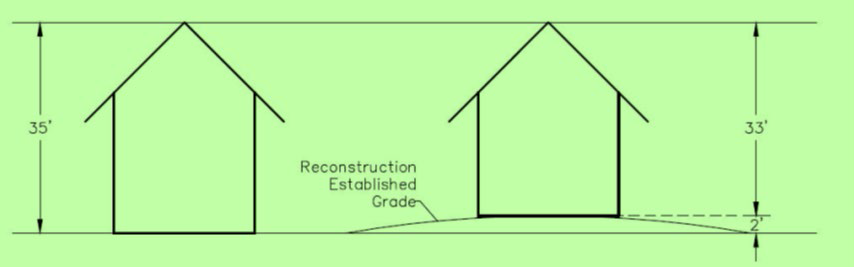
Grade, preconstruction shall mean the elevation of a site prior to development, redevelopment, or any topographic alterations.
Gross area means an entire area without exception.
Ground cover means a low-growing herbaceous or woody plant other than turf, not over two (2) feet high, planted in such a way as to cover the ground. Native ground cover such as dune sunflower are the preferred material.
Groundwater means water that fills all the unblocked voids of underlying material below the natural ground surface, which is the upper limit of saturation, or water which is held in the unsaturated zone by capillarity.
Group home, developmentally or physically disabled means a dwelling unit licensed to serve clients of DCF, providing a living environment for residents who operate as the functional equivalent of a family, including supervision and care by support staff as may be necessary to meet the physical, emotional, and social life needs of residents. A developmentally-disabled resident is a person with a disorder or syndrome which is attributable to retardation, cerebral palsy, autism or spina bifida and which constitutes a substantial handicap that can reasonably be expected to continue indefinitely. A physically-disabled resident is a person who has a physical impairment which substantially limits one (1) or more major life activities, or who has a record of having, or is regarded to have such physical impairment.
Group home, elderly-oriented means a dwelling unit licensed to serve clients of the DCF, providing a living environment for elderly residents who operate as the functional equivalent of a family, including supervision and care by support staff as may be necessary to meet the physical, emotional, and social life needs of residents. An elderly resident is any person age sixty (60) and over who is currently a resident of the state and who, because of a functional impairment, requires personal assistance with the activities of daily living but does not require nursing home or institutional care.
Halfway house means a licensed home for inmates on release from more restrictive custodial confinement or initially placed in lieu of more restrictive custodial confinement, wherein supervision, rehabilitation, and counseling are provided to mainstream residents back into society, enabling them to live independently.
Hedge means a landscape barrier consisting of a continuous, dense planting of shrubs.
Height, building means the vertical distance between the elevation of the crown of the road of the nearest adjacent roadway at the center of the front of the building; and either the highest point of the coping of a flat roof, the deck line of a mansard roof, or the mean height level between eaves and ridge for hip, gable, and gambrel roofs.
Highest adjacent grade. The highest natural elevation of the ground surface prior to construction next to the proposed walls or foundation of a structure.
Historic landmark means a building or structure which is at least fifty (50) years old and meets at certain criteria that has been so designated by the city council, and shall include the location of any significant archeological features or an historical event.
Historic landmark site means the land on which a historic landmark and related buildings and structures are located and the land that provides the grounds, the premises or the setting for the historic landmark.
Historical structure means any of the nine (9) structures identified by the Jacksonville Historical Landmark Commission in the City of Jacksonville Beach, Florida's Comprehensive Plan document.
Holographic display sign means an advertising display that creates a three-dimensional image through projection, OLED (organic light emitting diode), or any similar technology.
Home for the aged, see nursing or personal care facility
Home based business means a business that operates in whole, or in part, from a residential property and meets the criteria in F.S. § 559.955.
Hospital means a building or group of buildings having facilities, including beds, for overnight care of one or more human patients and providing services to inpatients and medical care to the sick and injured, which may include as related facilities laboratories, outpatient services, training facilities, central service facilities and staff facilities; provided, that a related facility shall be incidental and subordinate to the principal hospital use and operation. Only those buildings licensed as a hospital under the laws of the state shall be included within this definition. A hospital is an institutional use under this Zoning Code.
Hotel or motel means a building or other structure kept, used, maintained, advertised as or held out to the public to be a place where sleeping accommodations are supplied for pay to transient guests or tenants, in which four (4) or more rooms are furnished for the accommodation of such guests; whether or not having one (1) or more dining rooms, restaurants or cafes where meals are served. Such sleeping accommodations and dining rooms, restaurants or cafes, and accessory uses such as gift shops, barber shops or other services primarily intended for the use of the hotel guests, being conducted in the same building or accessory buildings in connection therewith.
Housing for the elderly means a facility in the nature of a multiple-family dwelling, the occupancy of which is limited to persons of an elderly age, but where the occupants are generally able to care for themselves and do not require regular personal maintenance or nursing care. The housing may include a medical or nursing facility for the convenience of the occupants. Where this Zoning Code permits housing for the elderly, the housing shall be used only for these purposes and shall not be converted to multiple-dwelling use unless all requirements of this Zoning Code are met for the conversion.
Illuminated sign means any sign or portion thereof which is illuminated by artificial light, either from an interior or exterior source, including outline, reflective or phosphorescent light (including but not limited to plasma or laser), whether or not the source of light is directly affixed as part of the sign, and shall also include signs with reflectors that depend upon sunlight or automobile headlights for an image.
Impervious surface ratio (ISR) shall mean a measurement of those surfaces that prevent the entry of water into the soil. Common impervious surfaces include, but are not limited to, rooftops, sidewalks, patio areas, driveways, parking lots, and other surfaces made of concrete, asphalt, brick, plastic, or any surfacing material with a base or lining of an impervious material. Wood decking elevated two (2) or more inches above the ground shall not be considered impervious provided that the ground surface beneath the decking is not impervious. Pervious areas beneath roof or balcony overhangs that are subject to inundation by stormwater and which allow the percolation of that stormwater shall not be considered impervious areas. The water surface area of swimming pools shall not be calculated as an impervious surface.
Figure 34-300.2: Impervious Surface Ratio (ISR) (same as Lot Coverage exhibit)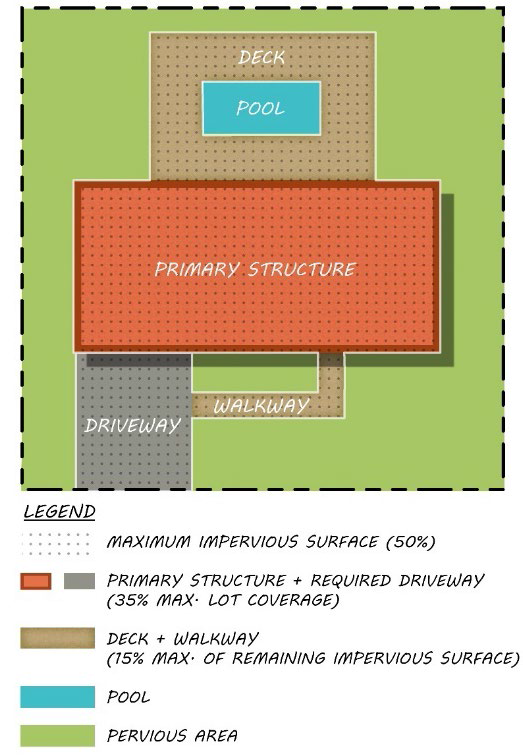
Improvements shall include, but not be limited to, structures, buildings, fences, street pavements, curbs and gutters, sidewalks, alley pavements, walkway pavements, water mains, sanitary sewers, lift stations, storm sewers or drains, signs, street lights, landscaping, monuments, or any other improvement to land.
In compliance means consistent with the requirements of F.S. §§ 163.3177, 163.3178 and 163.3191, the Northeast Florida Regional Policy Plan, the State Comprehensive Plan and Rule 9J-5, F.A.C., where such rule is not inconsistent with F.S. ch. 163, Part II.
Indirect lighting means the illumination of a sign by a light source that is not a component part of the sign.
Indirectly illuminated sign means any sign, the facing of which reflects light from a source intentionally directed upon it.
Inflatable or balloon sign means a sign consisting of a flexible envelope of nonporous materials that gains its shape from inserted air or other gas.
Ingress means an access or entry.
Ingress and egress sign shall mean a sign at the entrance to or exit from a parcel necessary to provide directions for vehicular traffic and provide a warning for pedestrian and/or vehicular traffic safety.
Inlet structures means structures located at the surface level that capture stormwater into the collection and conveyance system. Inlet structures typically include catch basins, curb inlets, and grates.
Institutional use shall mean a use intended for social services, non-profits, or quasi-public institutions. Design standards for each institutional use may vary and should be considered on a case-by-case basis.
Intermittent means more frequently than once per day.
Internally illuminated sign means any sign which has the source of light not visible to the eye and entirely enclosed within the sign.
Intensity shall mean an objective measurement of the extent to which land may be developed or used, including the consumption or use of the space above, on, or below ground; the measurement of the use of or demand on natural resources; and the measurement of the use of or demand on facilities and services.
Intertidal zone (or littoral zone) is the area along a shore that lies between the high and low tide marks, bridging the gap between land and water. At high tide, the intertidal zone is submerged beneath the water, and at low tide it is exposed to air.
Irrigation means the mechanical application of water to plant material in order to sustain plant life.
Irrigation system means a permanent, artificial watering system designed to transport and distribute water to plants.
Irrigation zone shall mean the grouping together of any type of watering emitter and irrigation equipment operated simultaneously by the control of a timer and a single valve.
Junk yard means a place, structure, or lot where junk, waste, discarded, salvaged, or similar materials are bought, sold, exchanged, baled, packed, disassembled, stored, or handled.
Junked vehicle shall mean any abandoned, discarded, or inoperable motor vehicle, including any boat, motorcycle, trailer and the like, with a mechanical or structural condition that precludes its ability for street travel or its intended use, or one that is dismantled, discarded, wrecked, demolished or not bearing current license tags.
Karate and martial arts shall be deemed to be the expressive art form of self-defense.
Kennel, pet means any structure or premises where four (4) or more animals over six (6) months of age, not owned by the occupants of the premises, are kept for sale or for the purpose of breeding or temporary boarding, except in an animal hospital, animal grooming parlor or pet shop.
Kitchen means any room or space used or intended and designed to be used for cooking or the preparation of food. The installation of a cooking appliance constitutes a kitchen within the meaning of this definition, and where such a kitchen is installed or maintained in a room or suite of rooms said room or suite of rooms shall constitute a dwelling unit.
Kitchenette shall mean an area within a building containing limited kitchen facilities such as a bar sink, microwave oven, refrigerator/freezer not exceeding ten (10) cubic feet.
Lake or pond means an excavation in the earth from which natural materials are removed for use elsewhere and a hole or pit is thereby created which has a depth of fifteen (15) feet or less as measured from the mean elevation of the uppermost rim of the excavation and which is designed for and actually used for:
(1)
Boating, swimming, fishing, educational or other recreational purposes, or
(2)
The watering of livestock, commercial production of fish or other bona fide agricultural activity.
Land means the earth, water, and air, above, below, or on the surface, and includes any improvements or structures customarily regarded as land. The word "land" includes the words "marsh" or "swamp."
Land development regulations shall mean this chapter and any other ordinances enacted by the city for the regulation of any aspect of land use and development and includes zoning, rezoning, subdivision, building, construction, or sign regulations or other regulations controlling the use and development of land.
Land development regulation commission means the agency designated to prepare and review the land development regulations in the City of Jacksonville Beach. In Jacksonville Beach, the land development regulation commission is the city council.
Land use shall mean any development that has occurred, any development that is proposed by an applicant, or the use that is permitted or permissible pursuant to the adopted comprehensive plan or element or portion thereof, or land development regulations, as the context may indicate.
Landfill means a disposal site employing an engineering method of disposing of solid waste (includes garbage, refuse, yard trash and clean debris) in a manner that minimizes environmental hazards by spreading, compacting to the smallest volume and applying cover material over all exposed waste at the end of each operating day.
Landscape plant shall mean any native or exotic tree, shrub, or groundcover (excluding turf).
Landscaped area shall mean the vegetated area of a lot or parcel including planted and natural areas.
Landscaping means any of the following materials or combinations thereof; grass, ground covers, shrubs, hedges, trees, rocks, pebbles, decorative mulch, walls or fences but not paving, synthetic plant material or synthetic lawns.
Laundry shall mean a business that provides noncommercial clothes washing and drying or ironing machines to be used by customers on the premises.
LED display sign means any sign or portion thereof that uses light emitting diode technology or other similar semiconductor technology to produce an illuminated image, picture, or message of any kind whether the image, picture, or message is moving or stationary. This type of sign includes any sign that uses LED technology of any kind whether conventional (using discrete LEDs), surface mounted (otherwise known as individually mounted LEDs), transmissive, organic light emitting diodes (OLED), light emitting polymer (LEP), organic electro luminescence (OEL), or any similar technology.
Letter of map change (LOMC). An official determination issued by FEMA that amends or revises an effective flood insurance rate map or flood insurance study. Letters of map change include:
Letter of map amendment (LOMA). An amendment based on technical data showing that a property was incorrectly included in a designated special flood hazard area. A LOMA amends the current effective flood insurance rate map and establishes that a specific property, portion of a property, or structure is not located in a special flood hazard area.
Letter of map revision (LOMR). A revision based on technical data that may show changes to flood zones, flood elevations, special flood hazard area boundaries and floodway delineations, and other planimetric features.
Letter of map revision based on fill (LOMR-F). A determination that a structure or parcel of land has been elevated by fill above the base flood elevation and is, therefore, no longer located within the special flood hazard area. In order to qualify for this determination, the fill must have been permitted and placed in accordance with the community's floodplain management regulations.
Level of service (LOS), public school facilities means the comparison of public school enrollment to school capacity in a given concurrency service area.
Level of service (LOS). An indicator of the extent or degree of service provided by or proposed to be provided by a facility based on and relative to the operational characteristics of the facility. LOS shall indicate the capacity per unit of demand for road, potable water supply, sanitary sewer, solid waste collection, stormwater management, or recreation and open space facilities.
Licensed agent means the operator of a management company that has been licensed by the dwelling or unit owner, through a rental agreement or contract between the two (2) parties, to hold out the dwelling or unit for rent on a transient basis. A licensed agent is not required to hold a license from the division of real estate.
Light-duty truck. As defined in 40 C.F.R. 86.082-2, any motor vehicle rated at eight thousand five hundred (8,500) pounds gross vehicular weight rating or less which has a vehicular curb weight of six thousand (6,000) pounds or less and which has a basic vehicle frontal area of forty-five (45) square feet or less, which is:
(1)
Designed primarily for purposes of transportation of property or is a derivation of such a vehicle, or
(2)
Designed primarily for transportation of persons and has a capacity of more than twelve (12) persons; or
(3)
Available with special features enabling off-street or off-highway operation and use.
Liquor license means, for the purpose of this part of this chapter, a license issued by the state for the retail sale, service and consumption of liquor.
Live-aboard vessel shall mean:
(1)
Any vessel used solely as a residence and not for navigation; or
(2)
Any vessel represented as a place of business, a professional or other commercial enterprise; or
(3)
Any vessel for which a declaration of domicile as a legal residence has been filed with the clerk of the circuit court of Duval County, Florida in accordance with F.S. § 222.17.
A commercial fishing boat is expressly excluded from the term live-aboard vessel, and this definition shall not be construed to include watercraft or cruising vessels that are engaged in recreational activities or navigation and traveling along the intracoastal waterway from anchoring temporarily or overnight.
Live entertainment includes, but is not limited to, singers, pianists, musicians, musical groups, bands, vocal or instrumental dances, theatrical shows, magicians, performers, comedians and all fashions, forms and media of entertainment carried on and conducted in the presence of and for the entertainment and amusement of others and as distinguished from records, tapes, pictures and other forms of reproduced or transmitted entertainment. Live entertainment, as used within these land development regulations, shall not include adult entertainment establishments as defined by F.S. § 847.001(2).
Living area, minimum, shall mean conditioned space within a dwelling unit utilized for living, sleeping, eating, cooking, bathing, washing and sanitation purposes.
Loading space, off-street means an all-weather surfaced area, other than a public street or approved private street, logically and conveniently located for loading, unloading, pickups or deliveries by motor vehicles or trailers and accessible to the vehicles when any required off-street parking spaces are filled.
Local planning agency means the planning commission.
Lot means a parcel, tract, or area of land of varying size established by plat, subdivision, or as otherwise permitted by law, which is designated as a single unit which is intended to be occupied by one building, or group of buildings, and its accessory uses. Means a parcel of land of at least sufficient size to meet minimum zoning requirements for use, coverage and area and to provide the yards and other open spaces herein required; provided, that the portion of a lot lying within a street or other right-of-way or access easement shall not be included in determining whether the lot meets minimum lot area requirements. The lot shall have frontage upon a publicly maintained or approved private street and may consist of:
(1)
A single lot of record.
(2)
A portion of a lot of record.
(3)
A combination of complete lots of record, of complete lots of record and portions of lots of record or of portions of lots of record.
(4)
A parcel of land described by metes and bounds; provided, that, in no case of division or combination, shall a residual lot or parcel be created which does not meet the requirements of this Zoning Code.
Lot area shall mean the area formed by the horizontal plane within the lot lines.
Lot, corner means a lot abutting upon two (2) or more streets at their intersection
Lot coverage means the percentage of a lot's total area that is covered by the primary structure. This does not include unenclosed or unroofed decks, landings, or balconies.
Figure 34-300.3: Lot Coverage
(same as ISR exhibit)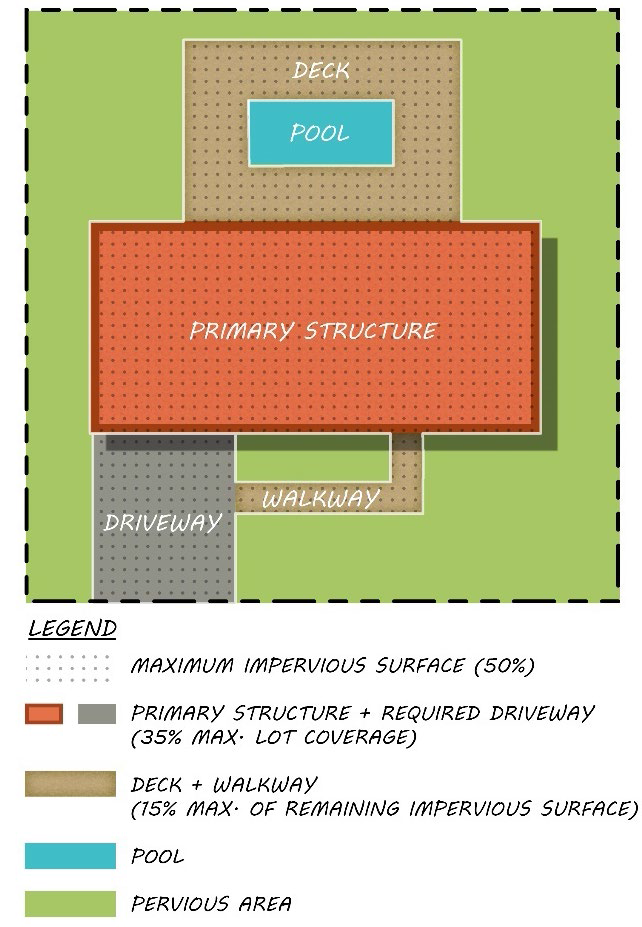
Lot depth means the distance measured in a mean direction of the side lines of the lot from the midpoint of the front line to the midpoint of the opposite rear line of the lot.
Lot frontage means the front of an interior lot construed to be the portion nearest the street. For the purpose of determining yard requirements on corner lots and through lots, all sides of a lot adjacent to streets shall be considered frontage, and yards shall be provided as set out in this Zoning Code.
Lot, interior means a lot other than a corner lot with frontage on only one (1) street.
Lot line means the lines of record bounding a lot which divides one (1) lot from another lot or from a public or private street or any other public space.
Lot measurement, depth means the distance between the midpoints of straight lines connecting the foremost points of the side lot lines in front and the rearmost points of the side lot lines in the rear.
Lot of record means a lot that is part of a subdivision, the map or plat of which has been recorded in the office of the Duval County Clerk of Circuit Court, or a lot or parcel of land, the deed of which has been recorded in the office of the Duval County Clerk of Circuit Court.
Lot, through means a lot other than a corner lot having frontage on two (2) streets.
Lot types mean:
(1)
Corner lot: A lot located at the intersection of two (2) or more streets. A lot abutting on a curved street or streets shall be considered a corner lot if straight lines drawn from the foremost points of the side lot lines to the foremost point of the lot meet at an interior angle of less than one hundred thirty-five (135) degrees. See lots marked A(1) in Diagram 656-1.
(2)
Interior lot: A lot other than a corner lot with only one frontage on a street.
(3)
Through lot: A lot other than a corner lot with frontage on more than one street. Through lots abutting two (2) streets may be referred to as double frontage lots. A lot developed with a single-family dwelling which would otherwise be classified as a through lot, and which meets the following criteria shall not be considered a through lot, but rather shall be classified as a corner or interior lot, as applicable: (i) the lot has frontage but no driveway access along the roadway classified as a collector or higher, and (ii) the single-family dwelling faces and has driveway access to only the local road.
(4)
Reversed frontage lot: A lot on which the frontage is at right angles or approximately right angles (interior angle of less than one hundred thirty-five (135) degrees) to the general pattern in the area. A reversed frontage lot may also be a corner lot (A-D in Diagram 656-1), an interior lot (B-D in Diagram 656-1) or a through lot (C-D in Diagram 656-1).
Figure 34-300.4 illustrates terminology used in this Zoning Code with reference to corner lots, interior lots, reversed frontage lots and through lots:
Figure 34-300.4: Lot Types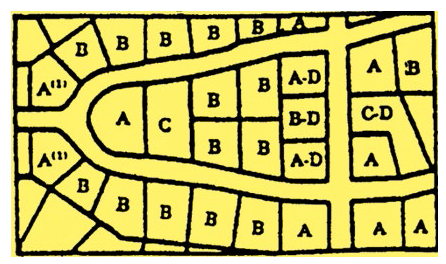
Lot width means the horizontal distance between side lot lines measured at right angles to its depth along a straight line parallel to the front lot line at the minimum required building setback line.
Lowest floor means the lowest floor of the lowest enclosed area (including basement). An unfinished or flood resistant enclosure, used solely for parking of vehicles, building access, or storage, in an area other than a basement, is not considered a building's lowest floor, provided that such enclosure is not built so as to render the structure in violation of the applicable nonelevation design standards of this chapter.
Low intensity retail shall mean those businesses that provide goods for the closely surrounding neighborhood including, but not limited to, the sale of wearing apparel, toys, sundries and notions, books and stationery, luggage, and jewelry.
Low intensity service establishments shall mean those businesses that serve the needs of the closely surrounding neighborhood including, but not limited to, beauty and barber shops, shoe repair, dress makers, and laundry pick-up.
Low maintenance zone means a landscape area a minimum of ten (10) feet wide adjacent to water courses which is planted and managed to minimize the need for fertilization, watering, mowing, etc.
Low volume or micro irrigation shall mean an irrigation system designed to limit the delivery of water within the root zone. Examples include drip, micro, trickle and soaker systems.
Machinery and equipment sign means any sign that is integral to the machinery or equipment and that identifies the manufacturer of the machinery or equipment that is placed on the machinery or equipment at the factory at the time of manufacture.
Maintenance and management practices mean the regular maintenance of stormwater infrastructure is essential to ensure its proper functioning. This may involve cleaning storm drains, removing debris and trash, and inspecting and repairing infrastructure as needed.
Maintenance in the context of article VII, division 4, sign standards means the repairing or repainting of a portion of a sign or sign structure, periodically changing changeable copy, or renewing copy, which has been made unusable by ordinary wear.
Major development means:
(1)
Any residential development containing more than one hundred (100) dwelling units,
(2)
A commercial or office development containing thirty thousand (30,000) or more square feet of floor area,
(3)
Any combination of land uses which will generate one thousand (1,000) or more vehicle trips per day, and
(4)
Any combination of land uses that will generate an increase of one hundred (100) or more new peak hour trips. Trip generation shall be based on the ITE Trip Generation Manual, current edition.
Major life activity. See "disabled person."
Mansard or mansard roof means a style of hip roof characterized by two (2) slopes on each of its four (4) sides with the lower slope being much steeper, almost a vertical wall, while the upper slope, usually not visible from the ground, is usually pitched at the minimum needed to shed water. A mansard roof may combine a steep lower slope with a flat roof.
Manual car wash means a commercial automobile wash facility, either temporary or permanent, where vehicles are primarily washed by hand by individual persons. This definition shall not apply to bona fide automobile dealerships, rental car facilities or to temporary one-day fundraising events by civic, religious, or non-profit entities where volunteers wash vehicles by hand, and the number of fundraising events does not exceed six (6) events per year, and the monetary proceeds from which are used to support the activities or mission of the civic, religious or non-profit entity.
Manufactured building means a closed structure, building assembly, or system of assemblies, which may include structural, electrical, plumbing, heating, ventilating, or other service systems manufactured in manufacturing facilities for installation or erection, with or without specified components, as a finished building or part of a finished building, which shall include, but not be limited to, residential, commercial, institutional, storage, or industrial structures. Manufactured building may also mean, at the option of the manufacturer, any building of open construction made or assembled in manufacturing facilities away from the building site for installation, or assembly and installation, on the building site.
Manufactured home. A structure, transportable in one or more sections, which is eight (8) feet or more in width and greater than four hundred (400) square feet, and which is built on a permanent, integral chassis and is designed for use with or without a permanent foundation when attached to the required utilities. The term "manufactured home" does not include a "recreational vehicle" or "park trailer." [Also defined in 15C-1.0101, F.A.C.]
Manufactured home park or subdivision means a parcel (or contiguous parcels) of land divided into two or more manufactured home lots for rent or sale.
Manufactured home park or subdivision (new). A manufactured home park or subdivision for which the construction of facilities for servicing the lots on which the manufactured homes are to be affixed (including at a minimum, the installation of utilities, the construction of streets, and either final site grading or the pouring of concrete pads) is completed on or after March 15, 1977.
Marina means an establishment with a waterfront for the purpose of storing watercraft and pleasure boats on land, in buildings, in slips or on boat lifts, including accessory facilities for purposes such as refueling, minor repair and launching. The marina may include accessory facilities such as launching, refueling, minor repair services such as lubrication and tune ups, not involving removal of the watercraft from the water or removal of inboard or outboard engines from the watercraft, a snack bar/restaurant, bathroom, showers, laundry, sundries store and other customary accessory facilities.
Market value. The price at which a property will change hands between a willing buyer and a willing seller, neither party being under compulsion to buy or sell and both having reasonable knowledge of relevant facts. As used in this ordinance, the term refers to the market value of buildings and structures, excluding the land and other improvements on the parcel. Market value may be established by a qualified independent appraiser, actual cash value (replacement cost depreciated for age and quality of construction), or tax assessment value adjusted to approximate market value by a factor provided by the property appraiser.
Marquee means any permanent wall or roof-like structure projecting beyond a building or extending along and projecting beyond the wall of the building, generally designed and constructed to provide protection from the weather. A marquee is not an awning or canopy.
Marquee sign means any sign painted or printed onto or otherwise attached to a marquee.
Massing is an architectural term that refers to the perception of shape, form and size of a building.
May. May means permissive.
Mean high water shall mean the average height of the high waters over a 19-year period. For shorter periods of observations, "mean high water" means the average height of the high waters after corrections are applied to eliminate know variations and to reduce the result to the equivalent of a mean 19-year value, as defined in F.S. § 177.27.
Mean high water line shall mean the intersection of the tidal plane of mean high water with the shore, as defined in F.S. § 177.27 and is generally recognized as the boundary between state sovereignty lands and uplands subject to private ownership.
Mean sea level (MSL) means the average height of the sea for all stages of the tide. For the purposes of the LDC, the term is synonymous with National Geodetic Vertical Datum (NGVD).
Medical marijuana treatment center means a facility licensed by the Florida Department of Health that can cultivate, process, transport, or dispense marijuana or marijuana related products.
Medical marijuana treatment center dispensing facility means a facility or business operated by a medical marijuana treatment center (MMTC), or other organization or business holding all necessary state licenses and permits and where marijuana and products derived therefrom are dispensed at retail in accordance with all other applicable local, state and federal laws.
Medical product manufacturing shall mean facilities that manufacture prosthetic appliances, dentures, eyeglasses, hearing aids and similar medical products.
Microbrewery means an establishment which produces, packages, and stores beer or other cereal beverages within an enclosed building, and which produces no more than eight thousand (8,000) barrels or two hundred forty-eight thousand (248,000) gallons of beverages per year, and which may or may not include a tasting room on premises.
Minerals means all solid minerals, including clay, gravel, phosphate rock, lime shells (excluding live shellfish), stone, sand, heavy minerals, and any rare earths, which are contained in the soils or waters of the state.
Mini-warehouses or personal storage facilities shall include all those businesses, which are utilized for the sole purpose of storage of tangible personal property other than motor vehicles. No business activity shall be conducted within mini-warehouses or personal storage facilities.
Mining means the process or business of extracting ore, minerals or materials from the earth.
Mixed use means a development or redevelopment project containing a mix of compatible uses intended to support diversity in housing, walkable communities, the need for less automobile travel and a more efficient use of land. Uses within a particular mixed-use project shall be consistent with the future land use designations set forth in.
Mobile car detailing services means the performance of thorough cleaning, and restoration of the finish of an automobile, both inside and/or out, to produce a show-quality level of detail where the service provider travels to a location for the purpose of detailing a vehicle(s), and is temporary in nature, and shall not remain at the same location in excess of forty-eight (48) hours. Such services are prohibited in all residential zoning districts.
Mobile food dispensing vehicle means any vehicle that is a public food service establishment and that is self-propelled or otherwise moveable from place to place and includes self-contained utilities, including, but not limited to, gas, water, electricity, or liquid waste disposal.
Mobile food vendor means any person or business selling food from a mobile food dispensing vehicle from which food items are sold to the general public.
Mobile home means the use of land for a structure, including the plumbing, heating, air conditioning, and electrical components contained therein, transportable in one (1) or more sections which structure is eight (8) feet or more in width and over forty (40) feet in length, or which, when erected on site, is three hundred twenty (320) or more square feet, and which is built on a metal frame and designed to be used as a dwelling with or without a permanent foundation when connected to the required utilities. If fabricated after June 15, 1976, each section should bear a HUD label certifying that it is built in compliance with the Federal Manufactured Home Construction and Safety Standards, 42 USC 5401 and 24 CFR 3282 and 3283. This use does not include manufactured buildings meeting the criteria contained in the definition of a single-family dwelling. A travel trailer is not to be considered as a mobile home.
Mobile home park, existing means premises existing as of March 6, 1995 (ref. Ord. No. 95-7617), with required improvements and utilities where mobile home spaces are rented or leased for use by mobile homes for residential occupancy which may include services and facilities for the residents.
Mobile home park, expansion to existing means an increase in the number of mobile home sites to an existing mobile home park.
Mobile home park, new means premises approved for development after March 6, 1995 (ref. Ord. No. 95-7617), with required improvements and utilities where mobile home spaces are rented or leased for use by mobile homes for residential occupancy which may include services and facilities for the residents.
Mobile home park means premises with required improvements and utilities where mobile home spaces are rented or leased for use by mobile homes for residential occupancy which may include services and facilities for the residents.
Mobile home site means land within a mobile home park or subdivision designated for the accommodation of not more than one (1) mobile home.
Mobile home subdivision means a parcel of land subdivided into lots and city maintained or privately maintained streets where lots are sold or leased for the purpose of placing mobile homes therein for nontransient living or sleeping purposes and including common facilities and land for use by occupants of mobile homes on the premises.
Monopole means a vertical self-supporting structure, not guyed, made of spin-cast concrete, concrete, steel or similar material, presenting a solid appearance.
Month means a calendar month.
Monument sign means a type of freestanding sign that is not supported by a pole structure and is placed upon the ground independent of support from the face of a building and that is constructed of a solid material such as wood, masonry or high-density urethane.
Motel means a group of attached or detached buildings containing individual sleeping units, with automobile storage or parking space provided in connection therewith, designed for use primarily by transients.
Mulch means nonliving organic materials customarily used in landscape design to retard erosion and retain moisture.
Multi-prism or tri-vision sign means a sign made with a series of triangular sections that rotate and stop, or index, to show multiple images or messages in the same area at different times.
Multi-use building means a structure that serves three (3) or fewer uses that share common parking areas, signage and other necessary infrastructure. These buildings can include a variety of uses, such as residential, commercial, retail, medical, recreational, or industrial.
National Geodetic Vertical Datum (NGVD) means the vertical control, as corrected in 1929, used as a reference for establishing varying elevations within the flood plain.
Natural event means an unusual, extraordinary, sudden, unavoidable or unexpected manifestation of the forces of nature beyond control of any person which may include, but not be limited to, hurricanes, windstorms, floods, storms, fire, acts of war (declared or undeclared), acts of terrorism, failure of energy sources and other catastrophes. An event shall not be considered a natural event if it results from the intentional or deliberate act of the owner.
Neighborhood park means a smaller park that serves as a social and recreational focal point for a neighborhood. Neighborhood parks are generally one (1) to five (5) acres in size and accessible by foot or bicycle with a service radius of about one-half (0.5) miles. Typically serves a population of up to five thousand (5,000) persons.
New construction. For the purposes of administration of this ordinance and the flood resistant construction requirements of the Florida Building Code, structures for which the "start of construction" commenced on or after March 15, 1977 and includes any subsequent improvements to such structures.
Newspaper of general circulation means a newspaper of local origin published at least on a weekly basis, but does not include a newspaper intended primarily for members of a particular professional or occupational group, a newspaper whose primary function is to carry legal notices, or a newspaper that is given away primarily to distribute advertising.
Nightclub means an establishment with the service of liquor, and at least one of the following characteristics: 1) a set-aside area for dancing; 2) live performance of amplified music after 12:00 midnight; 3) a disc jockey or DJ; or 4) other form of amplified live on-site entertainment.
Non-commercial message means any message which is not a commercial message.
Nonconforming building or structure means any building or other structure which was lawfully constructed but which does not comply with all applicable provisions of the LDC, including size and dimensional standards, off-street parking standards, landscape standards, performance standards, or height standards either on the effective date of the LDC or as a result of any subsequent amendment. Such noncomplying building or structure shall be referred to as a nonconformity.
Nonconforming lot of record means a lot which conformed to the relevant land use standards at the time of the creation of the lot, but which does not comply with applicable regulations of the LDC for width and area.
Nonconforming sign means any sign that was validly installed under laws or ordinances in effect prior to the effective date of the LDC or subsequent amendments, but which is in conflict with the provisions of the LDC.
Nonconforming use means any use of a building or structure which, at the time of the commencement of the use, was a permitted use in the zoning district until the effective date of the LDC, but which does not, on the effective date of the LDC or amendment thereto, conform to any one of the current permitted uses of the zoning district in which it is located. Such nonconforming use may be referred to as a nonconformity.
Nonresidential activity means any activity which occurs in any building, structure, or open area which is not used primarily as a private residence or dwelling.
Non-technical and technical words. Words and phrases shall be construed according to the common and approved usage of the language, but technical words and phrases and such others as may have acquired a peculiar and appropriate meaning in law shall be construed and understood according to such meaning.
Number. A word importing the singular number only may extend and be applied to several persons and things as well as to one person and thing. The use of the plural number shall be deemed to include any single person or thing.
Nursing home or personal care facility means any institution, building or buildings, residence, private home, boarding home, home for the aged or other place, whether operated for profit or not, which undertakes through its ownership or management to provide, for a period exceeding twenty-four (24) hours, one (1) or more personal services for adults who by reason of illness, physical infirmity, or advanced age are unable to care for themselves and are not related to the owner or administrator by blood or marriage, and who require such services. Only those homes, buildings or places licensed under the laws of the state as nursing homes shall be included within this definition.
Occupancy frontage means the length of that portion of a building occupied by a single office, business or enterprise abutting a street, alley, parking area, or other means of customer access such as an arcade, mall, or walkway.
Occupied means arranged, designed, built, altered, converted to or intended to be used or filled.
Oceanfront lots means lots fronting or parallel to the ocean.
Office, business or professional means a place, a building or portion of building in which business services are preformed involving predominantly administrative, professional or clerical operations.
Office use shall mean customary administrative functions associated with a business and uses involving professional services conducted within the business that do not involve on-premises production, manufacture, storage or retail sale of products.
Offsite commercial advertising means a nonaccessory billboard or sign which directs attention to a business, commodity, service, entertainment, or attraction that is sold, offered or existing elsewhere than upon the same lot where such sign is displayed.
Offsite commercial sign means a nonaccessory billboard or sign that displays offsite commercial advertising.
Off-site sign/advertising means any combination of structure and message in the form of an outdoor sign, display, device, figure, painting, drawing, message, placard, poster, billboard, advertising structure, advertising logos, symbol or other form, whether placed individually on or a V-type, back-to-back, side-to-side, stacked or double-faced display, designed, intended or used to advertise or inform, any part of the advertising message or informative contents of which is visible from any place on the main or traveled way and which sign relates in its subject matter to offices, products, accommodations, services or activities which are sold, produced, available, conducted or rendered at locations other than on the premises where the sign is located. The term does not include an official traffic control sign, official marker, specific information panel erected, or other form of public information caused to be erected or approved by any government upon its property or right-of-way.
On-site sign means any commercial sign which directs attention to a commercial or industrial occupancy, establishment, commodity, good, product, service or other commercial or industrial activity conducted, sold or offered upon the site where the sign is maintained. The on-site/off-site distinction applies only to commercial message signs. For purposes of article VII, division 4, sign standards of this chapter, all signs with noncommercial speech messages shall be deemed to be "on-site," regardless of location.
Open space shall mean an area open to the sky, which may be on the same lot with a building. The area may include, along with the natural environmental features, landscaping elements, stormwater retention facilities, swimming pools, tennis courts, or similar open air recreational facilities. Streets, structures and screened or impervious roofed structures shall not be allowed in required open space.
Outdoor area shall mean an area not enclosed in a building and which is intended or used as an accessory area to a public food service establishment which provides food and/or drink to patrons for consumption in the area.
Outdoor restaurant or bar means any restaurant or bar, or portion thereof, which exists outside of the permanent exterior walls of the principal building(s) on a lot and has, in place, tables and chairs set up to accommodate patrons for seating during all hours of operation. This definition includes any deck or other area constructed and/or utilized on the roof of a structure.
Outside storage means an area used for the storage of materials not able to be stored in a completely enclosed building for more than twenty-four (24) hours.
Owner means any part or joint owner, tenant in common, tenant in partnership, joint tenant or tenant by the entirety with legal or beneficial title to whole or part of a building or land.
Package liquor store means any establishment devoted primarily to the sale of alcoholic beverages for consumption off-premises, which is licensed by the State of Florida to dispense or sell alcoholic beverages for consumption off-premises.
Pain management clinics shall mean any publicly or privately owned facility that advertises in any medium for any type of pain-management service or where in any month a majority of patients are prescribed opioids, benzodiazepines, barbiturates, or carisoprodol for the treatment of chronic nonmalignant pain, pursuant to state statutes.
Painted wall sign means any sign painted on any surface or roof of any building.
Parapet means the extension of a false front or wall above a roof line and may not exceed fifty (50) percent of one existing floor.
Parcel of land means any quantity of land and water capable of being described with such definiteness that its location and boundaries may be established, which is designated by its owner or developer as land to be used or developed as a unit, or which has been used or developed as a unit. It may be described by metes and bounds or by recorded plat. The terms "lot," "parcel," "land," "site," "development parcel" may be used interchangeably within this Code as appropriate to the context.
Park means an area designed to include a combination of passive recreation (activities not requiring any formal layout such as picnicking, fishing, hiking, walking, etc.) as well as active recreation (organized activities such as tennis, basketball, defined playground areas, jogging trails, etc.) attracting visitors from the community and beyond a one-mile radius.
Parking, accessible shall mean parking spaces designed in compliance with the 2010 Americans with Disabilities Act (ADA) Standards for Accessible Design ("2010 Standards"), as may be amended.
Parking bay means a parking module consisting of one (1) or more rows of parking spaces and the aisle from which motor vehicles enter and leave the spaces.
Parking lot means an off-street, ground level area or plot of land used for the storage or parking of vehicle.
Parking space means a space for the parking of a motor vehicle within a public or private parking area.
Parking space, off-street means an all-weather surfaced off-street storage space, either outside or within a building, for the parking of motor vehicles. Adequate room for parking a standard-size automobile with ample room for the opening of doors on both sides must be provided. In addition, the parking space shall have proper access to a public or approved private street, as well as ample on-site maneuverability so that access to the parking space does not require maneuvering on a public or approved private street except off-street parking areas for two cars or less.
Park trailer. A transportable unit which has a body width not exceeding fourteen (14) feet and which is built on a single chassis and is designed to provide seasonal or temporary living quarters when connected to utilities necessary for operation of installed fixtures and appliances. [Defined in F.S. § 320.01]
Patron shall mean any guest or customer of a public food service establishment.
Pennant means any lightweight plastic, fabric, or other material whether or not containing a message of any kind, suspended from a rope, wire, or string, usually in a series, which will flutter or swing in the wind.
Perimeter landscape means a continuous area of land which is required to be set aside along the perimeter of a lot in which landscaping is used to provide a transition between and to reduce the environmental, aesthetic, and other impacts of one type of land use upon another.
Permanent construction does not include land preparation (such as clearing, grading, or filling), the installation of streets or walkways, excavation for a basement, footings, piers, or foundations, the erection of temporary forms or the installation of accessory buildings such as garages or sheds not occupied as dwelling units or not part of the main buildings. For a substantial improvement, the actual "start of construction" means the first alteration of any wall, ceiling, floor or other structural part of a building, whether or not that alteration affects the external dimensions of the building. [Also defined in FBC, B Section 1612.2.]
Permanent sign means any sign which is intended to be and is so constructed as to be of lasting and enduring condition, remaining unchanged in character, condition (beyond normal wear and tear) and position and in a permanent manner affixed to the ground, wall or building. Unless otherwise provided for herein, a sign other than a temporary sign shall be deemed a permanent sign unless otherwise indicated elsewhere in this Land Development Code.
Permitted use shall mean the uses and activities that are allowed within a particular zoning district as described within this chapter. In the case of a question regarding a typical or similar use, such use shall be determined based upon the North American Industry Classification System (NAICS).
Person means any person, individual, public or private corporation, firm, association, joint venture, partnership, municipality, governmental agency, political subdivision, public officer or any other entity whatsoever or any combination of such, jointly or severally.
Personal wireless service means commercial mobile services, unlicensed wireless services, and common carrier wireless exchange access facilities and those defined by the Communications Act, including but not limited to, the transmission and reception of radio microwave signals used for communication, data, cellular phone, personal communication services, enhanced specialized mobile radio, and any other wireless services licensed by the FCC and unlicensed wireless services.
Personal wireless service facility or personal wireless service facilities means facilities used for the provision of personal wireless service including any freestanding facility, antennae, distributed antennae system, and/or small cell technology. Personal wireless service facilities include, but are not limited to, utility poles, towers, monopoles, communications facilities, and other facilities, equipment, and appurtenances that are used in the delivery or transmission of personal wireless services,
Personal wireless service provider means a company licensed by the Federal Communications Commission (FCC) that provides personal wireless service. A builder or owner of a personal wireless service facility is not a personal wireless service provider unless licensed to provide personal wireless services.
Pervious parking means a land surface which allows for the penetration of water which includes, but is not limited to gravel, mulch, stabilized sod and pervious paving materials and meets a fifty (50) percent runoff co-efficient for gravel or any lesser percentage of run-off.
Pervious paving materials means a porous asphaltic or concrete surface and a high-void aggregate base which allows for rapid infiltration and temporary storage of rain on, or runoff delivered to, paved surfaces.
Pets, household means any domestic animal such as cats, dogs, birds, and hens that are customarily kept for personal use including collection of eggs and/or enjoyment within the home or residential lot. Other poultry, hoofed animals of any type, predatory animals, or any animal which is normally raised for slaughter or commercial sale shall not be considered as household pets.
Pharmacy means a retail store where prescription and other medicines and related products are dispensed and sold retail as the principal use, and where the retail sale of other miscellaneous goods may also be permitted.
Planned unit development means a development of land that is under unified control and is planned for and developed as a whole in a single development operation or programmed series of development stages. The development may include streets, circulation ways, utilities, buildings, open spaces, and other site features or improvements.
Planning agency shall mean the planning commission, or any other agency designated by the city council, to serve those functions as the city's local planning agency, pursuant to F.S. ch. 163, as well as other functions as directed by the city council.
Planning and development director means the person appointed to direct the Planning and Development Department of the City of Jacksonville Beach.
Planning commission means the Jacksonville Beach Planning Commission.
Plant community means a natural association of plants that are dominated by one or more prominent species, or a characteristic physical attribute.
Plant nurseries means an agricultural endeavor devoted exclusively to the raising of ornamental plants or trees for sale or transplanting, does not include the sale of firewood or lumber.
Plat means a map or drawing upon which an exact representation of a subdivision and other information is presented in compliance with the requirements of article VIII, subdivision standards.
Plat, final means the plat to be recorded in accordance with engineering plans, specifications and calculations; certification of improvements, as-built drawings, or performance guarantee; and other required certifications, bonds, agreements, approvals, and materials for a development or a phase of a development or the entire parcel of land proposed for development as required pursuant to section 34-505 of this chapter.
Pocket park means a park designed to provide green space and attract visitors from within the immediate area which is passive in nature, accessed by pedestrians only, and which contains amenities such as landscaping with benches, public art, fountains and sculptures, etc. A pocket park should be no more than one acre in size.
Pole sign means a ground sign that is supported by one or more poles and otherwise separated from the ground by air. A pole sign is not a monument sign, another type of ground sign.
Porch means a roofed-over space, with the roof impervious to weather, attached to the outside of an exterior wall of a building which has no enclosure other than the exterior walls of the building. Open-mesh screening shall not be considered an enclosure.
Portable sign means any sign, banner, or poster that is not permanently attached to the ground or to a structure that is attached to the ground or a sign capable of being transported, including, but not limited to, signs designed to be transported by means of wheels or carried by a person, and signs converted to an A-frame sign or a T-frame sign. For purposes of this division, a cold air inflatable sign shall be considered to be a portable sign.
Porte-cochere means a porch or portico-like structure at a main or secondary entrance to a building, through which it is possible for a vehicle to pass, in order for the occupants to enter or exit under cover, protected from the weather.
Potable water facilities means the planning of, engineering for, acquisition of land for, or construction of potable water facilities necessary to meet the LOS for potable water facilities.
Poultry means fowl normally raised as food for consumption or used to raise food for consumption.
Preserve area means vegetative areas required to be preserved under the jurisdiction of DER, SJRWMD or other governmental regulatory agencies.
Prevailing setback shall mean the most common distance between buildings and the street and property boundaries in a specific development area.
Principal building shall mean a building within which is conducted the main or principal use of the lot or property upon which the building is situated.
Principle use means any use specifically identified as a permitted or permissible use in a given zoning district.
Privacy structures shall mean vertical improvements such as trellises, screens, partitions or walls, that are intended for the purpose of creating privacy for a rear yard, as opposed to a fence which encloses or separates land.
Private well means a shallow aquifer, Hawthorne, or Florida well that is not a public potable water well.
Professional surveyor and mapper shall mean a surveyor and mapper registered under F.S. ch. 472, who is in good standing with the board of professional surveyors and mappers.
Projecting sign means any sign affixed perpendicular, or at any angle to a building or wall in such a manner that its leading edge extends more than twelve (12) inches beyond the surface of such building or wall.
Property line shall mean the exterior lot lines of a single parcel or a group of lots when two (2) or more lots are considered together for the purposes of development.
Proportionate share mitigation means an applicant's voluntary provision of public school facilities proportionate to a development proposal's impact on school capacity. Proportionate share mitigation options may include contribution of or payment for land acquisition; construction or expansion of, or payment for construction of public school facilities; or the creation of mitigation banking based on the construction of public school facilities, in exchange for the right to sell capacity credits to other residential development affecting those facilities. Proportionate share mitigation must be identified in a work program, unless the school district has committed itself in a proportionate share mitigation agreement to include the mitigation in the work program during the next annual update to the work program.
Proportionate share mitigation agreement means a voluntary, legally-binding commitment to provide proportionate share mitigation to ensure public school concurrency can be achieved, where school capacity would not otherwise be adequate to support the demand resulting from approval of a development proposal at the time the development proposal is being considered. The applicant, school district and the city shall be parties to a proportionate share mitigation agreement.
Protected tree means any tree, except those which are hereinafter exempted in section 34-744(b), with a DBH of six (6) inches or more.
Public facilities shall mean major capital improvements, including without limitation transportation, sanitary sewer, solid waste, drainage, potable water, educational, parks and recreational facilities.
Public food service establishment and food service establishment shall mean any building, restaurant, vehicle, place, or structure, or any room, division, or area in or adjacent to a building, vehicle, place or structure where food is prepared, served, or sold for immediate consumption on or in the vicinity of the premises; called for or taken out by customers; or prepared prior to being delivered to another location for consumption.
Public notice shall mean notice required by F.S. § 166.041. The public notice procedures required in this chapter are established as minimum public notice procedures for the City of Jacksonville Beach.
Public open space shall mean open space, land or water areas, available for public use, not restricted to members or residents.
Public potable water well means any water well completed into the Floridan Aquifer, which supplies potable water to a community water system or to a nontransient, noncommunity water system, as those terms are defined in Rule 63-521.200, Florida Administrative Code.
Public potable water supply well means a well withdrawing potable water from the surficial aquifer that serves and is operated by public utilities. For the purposes of section 34-773 public utility shall mean any municipal system that provides service to the public and utilities required to obtain a SJRWMD individual water use permit.
Public protected tree means any tree, except those which are hereinafter exempted in section 34-744(b), with a DBH of six (6) inches or more located on lands owned by the city, its agencies or authorities, or any land upon which easements are imposed for the benefit of the city, its agencies or authorities, or upon which other ownership control may be exerted by the city, its agencies or authorities, including rights-of-way, parks, public areas and easements for drainage, sewer, water and other public utilities.
Public school concurrency means, as provided in F.S. § 163.3180(13)(e), the necessary public school facilities to maintain level of service standards are in place or are scheduled in the work program to be under actual construction within three (3) years of approval of a development proposal.
Public school facilities means permanent public school buildings provided by the school district, as defined by the most current edition of the Florida Inventory of School Houses (FISH), published by the Florida Department of Education, Office of Educational Facilities, or land for a public school facility.
Public school facilities, existing means public school facilities that are already constructed and operational at the time that the school district designee makes a finding regarding school capacity.
Public school facilities, planned means public school facilities in the school district's work program that will be in place or under actual construction within three (3) years after the approval of the development proposal.
Public school facilities, total means existing public school facilities and planned public school facilities.
Public schools interlocal agreement means the interlocal agreement between the county, non-exempt municipalities, and the school district, pursuant to F.S. § 163.31777, which establishes standards and procedures for a coordinated, uniform public school concurrency program throughout Duval County and which ensures the level of service standards for public school facilities are achieved and maintained.
Public water supply utility means the owner of a public potable water well or wellfield.
Real estate sign means a temporary sign advertising the real estate upon which the sign is located as being for sale or rent.
Reasonable use means the appropriate and fair use of one's property that does not unreasonably interfere with another person's use of the property.
Recreation and open space facilities means the planning of, engineering for, acquisition of land for or construction of park and recreation facilities necessary to meet the LOS for recreation and open space facilities.
Recreational vehicle means a vehicle that is:
(1)
Built on a single chassis;
(2)
Four hundred (400) square feet or less when measured at the largest horizontal projection;
(3)
Designed to be self-propelled or permanently towable by a light duty truck; and
(4)
Designed primarily not for use as a permanent dwelling but as temporary living quarters for recreational, camping, travel, or seasonal use. Recreational vehicles shall not include airplanes.
Redevelopment district means an area designated by the city council as blighted and in need of redevelopment pursuant to F.S. ch. 163, pt. III. When indicated as a redevelopment district or RD zone district, reference is made to an area classified in accordance with section 34-621 of the LDC.
Regulated area means that area within the zone of protection surrounding each public potable water supply well.
Regulated substances mean:
(1)
Substances which have one (1) or more of the following characteristics:
a.
They are listed as a priority toxic pollutant and hazardous substance by the EPA in 40 CFR 122.21;
b.
They are an EPA Designation Reportable Quantities and Notification Requirements for Hazardous substances under CERCLA (40 CFR 302);
c.
They are a degradation product which is toxic, which includes petroleum based products;
d.
They are on a restricted use pesticide list promulgated pursuant to F.S. ch. 487, set forth in Chapters 5E-2 and 5E-9, F.A.C.
(2)
As well as the following physical characteristics:
a.
They are prone to be persistent in the environment;
b.
They are water soluble or prone to pass downward through surface soils, to enter into and mix with groundwater, and be transported by the movement of groundwater.
Religious organization means a structure or place in which worship, ceremonies, rituals, and education pertaining to a particular system of beliefs are held.
Restaurant means an establishment whose principal business is the selling of unpackaged food to the customer in a ready-to-consume state, in individual servings, or in nondisposable containers, and where the customer consumes these foods while seated at tables or counters located within the building.
Restaurant, drive-in means an establishment that delivers prepared food and/or beverages to customers in motor vehicles, regardless of whether or not it also serves prepared food to customers who are not in motor vehicles, for consumption either on or off the premises.
Retail establishments shall mean those businesses that provide goods for the surrounding community including, but not limited to, the sale of lumber, hardware, building materials, photo supplies, sporting goods, hobby supplies, pet supplies, home furnishings, and office equipment as well as low intensity commercial establishments.
Right-of-way means the area of a highway, road, street, way, parkway, electric transmission line, gas pipeline, water main, storm or sanitary sewer main, or other such strip of land reserved for public use, whether established by prescription, easement, dedication, gift, purchase, eminent domain or any other legal means.
Road facilities mean the planning of, engineering for, acquisition of land for or construction of roads necessary to meet the LOS for road facilities.
Roof line means the highest continuous horizontal line of a roof. On a sloping roof, the roof line is the principal ridge line, or the highest line common to the principal slope or slopes of the roof. On a flat roof, the roof line is the highest continuous line of the roof or parapet, whichever is higher.
Roof sign means any sign which is mounted on the roof of a building or which extends above the top edge of the wall of a flat roofed building, the eave line of a building with a hip, gambrel, or gable roof.
Rooming and boarding house means a building in which sleeping accommodations are offered to the public where rentals are for a period of a week or longer, occupancy is generally by resident rather than transient, rentals are for use of a bedroom with shared access to the primary kitchen and/or bathroom(s) shared with occupants of other rented bedrooms, and where residents do not operate as a family. Existing rooming houses shall be identified by one or more of the following existing conditions, each of which shall create a rebuttable presumption that a building is a rooming house:
(1)
Signs that indicate rooms, beds, or living spaces for rent;
(2)
Interior locks, partitions, hasps, appliances such as electric fry pans, toaster ovens, refrigerators, etc.;
(3)
Individual storage of food;
(4)
Alphabetical, numeric, or other labeling of bedrooms or living areas;
(5)
Alterations to structures which enhance or facilitate its use as a rooming house.
Rotating sign (or revolving sign) means an animated sign that revolves or turns or has external sign elements that revolve or turn. Such sign may be power-driven or propelled by the force of wind or air.
Salvage yard shall mean a place where discarded or salvaged materials, are bought, sold, exchanged, stored, baled, packed, disassembled or handled. Salvage yards shall include automobile wrecking, house wrecking and structural steel materials and equipment yards, but shall not include places for the purchase or storage of used furniture and household equipment, used cars in operable condition, or used or salvaged materials from manufacturing operations or for any type of automotive repair.
Sand dunes mean naturally occurring accumulations of sand in ridges or mounds landward of the beach.
Sanitarium means a facility for the recuperation and treatment of physical or mental disorders without provision for major surgery.
Sanitary sewer facilities means the planning of, engineering for, acquisition of land for, or construction of sanitary sewer facilities necessary to meet the LOS for sanitary sewer facilities.
Saturated soil means a soil in which the voids are filled with water. Saturation does not require flow. For the purposes of this chapter, soils shall be considered saturated if standing water is present or the pressure of a person standing on the soil causes the release of free water.
School means a private or public educational institution offering students an academic curriculum, including kindergartens, elementary schools, high schools, colleges and universities.
School bus means a motor vehicle regularly used for the transportation of prekindergarten through grade twelve (12) students of the public schools to and from school or to and from school activities, and owned, operated, rented, contracted, or leased by any school board, as defined in F.S. § 234.051.
School capacity means the demand that can be accommodated by a public school facility at the level of service standard, as determined by the school district.
School concurrency allocation means a reservation of school capacity made by the school district after a finding of available school capacity, upon the city's approval of a development proposal. The reservation shall be indicated on the school concurrency schedule.
School concurrency application means an application for the school district to make a finding of available school capacity and issue a school concurrency allocation.
School concurrency schedule means a schedule maintained by the school district that tracks the availability of school capacity over time.
School district means Duval County Public Schools.
School district designee means a person or committee designated to act on behalf of the school district, and to make determinations regarding whether public school concurrency has been achieved for school concurrency applications submitted to the school district by the director.
Screen enclosure means a structural network of metal or wood members with open mesh panels for both walls and roof.
Screening shall mean improvements that conceal the existence of something by obstructing the view of it.
Seat shall mean, for the purpose of determining the number of required off-street parking spaces, the number of chairs. In the case of benches or pers, each linear twenty-four (24) inches of seating shall count as one (1) seat. For areas without fixed seating such as standing areas, dance floors or bars, each seven (7) square feet of floor space shall constitute a required seat.
Service establishments shall mean those businesses that serve the routine and daily needs of the community in which it is located including, but not limited to, low intensity service establishments, barber or beauty shops, shoe repair shops, laundry or dry cleaners, funeral homes, electronics repair shops, lawn care service, pest control companies, and similar service uses but not including manufacturing, warehousing, storage, or high intensity commercial services of a regional nature.
Service island sign means a sign mounted permanently on, under, or otherwise mounted on a service island canopy.
Service station means any building, structure or land used for the dispensing, sale or offering for sale at retail, and any automobile fuel, oils, or accessories in connection with which is performed general automotive servicing, such as tire servicing and repair, and including engine and transmission repair, but excluding body work, straightening of frames, painting, or welding. All work must be done inside of an enclosed building.
Setback shall mean the required distance between the lot line and the building or structure. Unless otherwise provided for within this chapter, setbacks shall be measured from the property line to the exterior vertical wall of a building or structure as opposed to the foundation. See also definition for building setback. When two (2) or more lots under single or unified ownership are developed as a single development parcel, the exterior lot lines of the combined parcel(s) shall be used to determine required building setbacks. Building setback and building restriction line may have the same meaning and may be used interchangeably where such lines are recorded on a final subdivision plat.
Shade tree means a tree with a mature crown spread of at least fifteen (15) feet.
Shall. Shall means mandatory.
Shopping center means a group of four (4) or more retail stores, service establishments or any other business not necessarily owned by one (1) person nor by a single land ownership that is adjacent to and utilizing a common off-street parking area.
Short-term vacation rental means:
(1)
Any individually or collectively owned single-family, townhouse, or multi-family dwelling unit that is also a transient public lodging establishment.
(2)
Single-family, townhouse, or multi-family dwellings subject to deed restrictions and covenants of a home-owners association, condominium units, timeshare projects, and owner-occupied dwelling units renting fifty (50) percent or less shall not be subject to the regulations of this code.
Shrub means a self-supporting woody perennial plant characterized by multiple stems and branches continuous from the base, naturally growing to a mature height between two (2) and twelve (12) feet.
Sight triangle shall mean the area within the limits described by the two (2) intersecting center lines of a street and a line drawn between them from points on each center line that are a prescribed number of feet from the intersection of the center lines.
Sign means any device, fixture, placard or structure, including its component parts, which draws attention to an object, product, place, activity, opinion, person, institution, organization, or place of business, or which identifies or promotes the interests of any person and which is to be viewed from any public street, road, highway, right-of-way or parking area (collectively referred to as a "public area"). For the purposes of these regulations, the term "sign" shall include all structural members. A sign shall be construed to be a display surface or device containing organized and related elements composed to form a single unit. In cases where matter is displayed in a random or unconnected manner without organized relationship of the components, each such component shall be considered to be a single sign. The term "sign" for regulatory purposes shall not include the following objects: Grave yard and cemetery markers visible from a public area, vending machines or express mail drop-off boxes visible from a public area, decorations that do not constitute advertising visible from a public area, artwork that does not constitute advertising or a building's architectural features visible from a public area, or a manufacturer's or seller's markings on machinery or equipment visible from a public area. The foregoing objects are not signs for purpose of regulation herein.
Sign area computation means the method by which the area of each surface of a sign is computed. For signs with fixed boundaries, frames or edges, it shall be computed by calculating the area within and including the exterior boundaries, frames or edges enclosing the letters or graphic matter which composes each sign surface. For signs with fixed boundaries, frames or edges, such as where a sign is composed of separate letters which are placed or painted upon or against a building or upon or through a window or other similar surface no designed, framed or edged specifically for sign presentation, the sign area shall be computed on the basis of the smallest regular geometric shape, such as a triangle, rectangle, square or circle encompassing the outermost exteriors of the outermost individual letters, words or numbers which yields the least total square footage of area. Computation of sign area shall include border trim.
Sign height means the vertical distance from the average finished grade of the ground below the sign excluding any filling, berming, mounding or excavating solely for the purposes of increasing the height of the sign, to the top edge of the highest portion of the sign. The base or structure erected to support or adorn a monument, pole or other freestanding sign is measured as part of the sign height.
Sign size means area of sign.
Sign visibility triangle shall mean the triangle described in section 34-745(b)(4)a.
Site development plan shall mean a plan of development including surveys, maps, drawings, notations and other information as may be required depicting the specific location and design of improvements proposed to be installed or constructed in accordance with the requirements of this chapter.
Snipe sign means a sign made of any material when such sign is tacked, nailed, posted, pasted, glued or otherwise attached to or placed on public property such as but not limited to a public utility pole, a public street sign, a public utility box, a public fire hydrant, a public right-of way, public street furniture, or other public property; except for A-frame and T-frame signs that are temporarily placed on public property under such limitations and constraints as may be set forth in the Land Development Code.
Solid waste facilities mean the planning of, engineering for, acquisition of land for or construction of solid waste facilities necessary to meet the LOS for solid waste facilities.
Soundproof means that sound attenuation shall not exceed fifty (50) dbn through the outside of the structure.
Special exception means a use that would not be appropriate generally or without restriction throughout the zoning district but which, if controlled as to number, area, location or relation to the neighborhood, could promote the public health, safety, welfare, morals, order, comfort, convenience, appearance, prosperity or general welfare. Such uses may be permissible in the zoning district as special exceptions if specific provision for the special exception is made in the Zoning Code and the uses are found by the commission and the council to be in conformity with the standards and criteria set forth in this code.
Special flood hazard area. An area in the floodplain subject to a one (1) percent or greater chance of flooding in any given year. Special flood hazard areas are shown on FIRMs as Zone A, AO, A1—A30, AE, A99, AH, V1—V30, VE or V. [Also defined in FBC, B Section 1612.2.]
Spot zoning means when a small piece of land has different zoning that surrounding areas.
Start of construction. The date of issuance for new construction and substantial improvements to existing structures, provided the actual start of construction, repair, reconstruction, rehabilitation, addition, placement, or other improvement is within one hundred eighty (180) days of the date of the issuance. The actual start of construction means either the first placement of permanent construction of a building (including a manufactured home) on a site, such as the pouring of slab or footings, the installation of piles, the construction of columns.
Statutory sign means a sign the city is required to erect by any statute of the State of Florida or the United States for safety, directional, or traffic control purposes.
Storm drains mean underground pipes or open channels that collect and convey stormwater from streets, parking lots, and other surfaces to a designated discharge point, such as a ditch, canal, or river.
Stormwater management facilities mean the planning of, engineering for, acquisition of land for or the construction of stormwater management facilities necessary to meet the LOS for stormwater management facilities.
Stormwater management system shall mean the system, or combination of systems, designed to treat stormwater, or collect, convey, channel, hold, inhibit, or divert the movement of stormwater on, through and from a site or area.
Stormwater runoff means the portion of the stormwater that flows from the land surface of a site either naturally, in manmade ditches, or in a closed conduit system.
Story means that portion of a building included between the upper surface of any floor and the upper surface of the floor or roof next above. Street means a right-of-way for vehicular traffic, designated as an alley, avenue, boulevard, court, drive, expressway, highway, lane, road, street, or thoroughfare (also referred to as roadway). A street may be dedicated to the public or maintained in private ownership, but open to the public. For the purposes of the LDC, "streets" are divided into the following categories:
(1)
Arterial street means a road which is used to move large volumes of traffic rapidly between population centers, around population centers, or from one section of the urban area to another.
(2)
Collector street means a road designed primarily to connect local streets with arterials or to provide access from residential areas to major destination points such as shopping or employment centers and which may be expected to carry a significant volume of traffic.
(3)
Cul-de-sac means a minor road of short length having one end open to traffic and one end terminating in a vehicular turn-around.
(4)
Local street means a road used primarily for access to abutting properties within a subdivision.
(5)
Approved private street means a street or road that meets the design standards set forth herein corresponding to its intended functional use, that is not dedicated to the City of Jacksonville Beach.
(6)
Approved street means any local street, constructed according to the specifications in article VIII, subdivision standards, and accepted by resolution of the city council of the City of Jacksonville Beach for maintenance purposes.
Street address sign means any sign denoting the street address of the premises on which it is attached or located.
Street frontage means the property line of a lot abutting the right-of-way line of public or approved private streets, excluding alleys to which such property has the legal right of access.
Street line means the line separating the street and abutting property.
Street right-of-way line shall mean the dividing line between a lot or parcel of land and the contiguous street.
Structural alterations mean any change, except for repair or replacement, in the supporting members of a building, such as bearing walls, columns, beams or girders, floor joists or roof joists; or in the dimensions or configurations of the roof or exterior walls.
Structure means anything constructed, installed or portable, the use of which requires location on land. It includes a movable building which can be used for housing, business, commercial, agricultural or office purposes, either temporarily or permanently. It also includes roads, walkways, paths, fences, swimming pools, tennis courts, poles, tracks, pipelines, transmission lines, signs, cisterns, sheds, docks, sewage treatment plants and other accessory construction.
Subdivider means a person developing a subdivision, or that person's agent.
Subdivision means the division of land into three (3) or more parcels for the purpose of sale or lease, including the addition to or re-subdivision of land, if not exempted by the terms of the LDC.
Subdivision identification sign means a sign located at the intersection of two street rights-of-way. The only lettering shall be the name of the subdivision. Such sign may be illuminated only when the sign is abutting a right-of-way which is classified a collector street or higher on the Functional Highway Classification Map of the comprehensive plan.
Submerged land means land below the mean high tide or mean high water line.
Substantial damage means damage to a structure, the cost of which equals or exceeds fifty (50) percent of the market value of the structure before the damage occurred.
Substantial improvement. Any repair, reconstruction, rehabilitation, addition, or other improvement of a building or structure, the cost of which equals or exceeds fifty (50) percent of the market value of the building or structure before the improvement or repair is started. If the structure has incurred "substantial damage," any repairs are considered substantial improvement regardless of the actual repair work performed. The term does not, however, include either: [Also defined in FBC, B, Section 1612.2.]
•
Any project for improvement of a building required to correct existing health, sanitary, or safety code violations identified by the building official and that are the minimum necessary to assure safe living conditions.
•
Any alteration of a historic structure provided the alteration will not preclude the structure's continued designation as a historic structure and the alteration is approved by variance issued pursuant to section 34-772(a)(7) of this ordinance.
Surety device means an agreement with the city for the amount of the estimated construction cost guaranteeing the completion of physical improvements according to plans and specifications within the time prescribed by the agreement.
Surface water means water on the surface of the ground whether or not flowing through definite channels, including the following:
(1)
Any natural or artificial pond, lake, reservoir, or other area which ordinarily or intermittently contains water and which has a discernible shoreline;
(2)
Any natural or artificial stream, river, creek, channel, ditch, canal, conduit culvert, drain, waterway, gully, ravine, street, roadway, swale or wash in which water flows in a definite direction, either continuously or intermittently and which has a definite channel, bed or banks; or
(3)
Any wetland.
Surveyor, land, means a land surveyor registered under F.S. ch. 472, who is in good standing with the Florida State Board of Engineer Examiners and Land Surveyors.
Tasting room means the portion of a microbrewery/winery that is located on the premises of the production facility at which guests may purchase and consume beer and wine on-site. Tasting rooms are limited to eight hundred (800) square feet in area, or twenty-five (25) percent of the microbrewery or winery total area of the facility, whichever is less. The hours of operation of a tasting room may not extend past 10:00 p.m. on Sunday through Thursday, and 12:00 a.m. on Friday and Saturday.
Temporary and portable buildings and structures means any building or structure constructed or erected to not require permanent location on the ground.
Temporary embellishment means an embellishment placed on the facing of a sign for a period not to exceed six (6) months.
Temporary sign means a sign intended for a use not permanent in nature. Unless otherwise provided for in this Code, a sign with an intended use for a period of time related to an event shall be deemed a temporary sign. A flag shall be deemed a temporary sign.
Temporary structure means any non-habitable structure for ancillary use which does not require a permanent foundation or connection to the ground for its support, and has no permanent connection to or provisions for municipal utilities, and can be disassembled without the use of destructive force for relocation or removal.
Tense. Words used in the past or present tense include the future as well as the past or present.
Text. In case of any difference of meaning or implication between the text of the LDC and any figure, the text shall control.
Textile recycling bin means any stationary or free-standing bin, container, receptacle or similar device made of steel or other durable metal that is located outdoors within the city and is used for the collection of textile materials.
Theater means an establishment offering dramatic presentations or showing motion pictures to be viewed in an auditorium accommodating three (3) or more persons.
Threatened or endangered species shall mean species so listed by the Florida Fish and Wildlife Conservation Commission, Florida Department of Agriculture and Consumer Services, and [the] U.S. Fish and Wildlife Service.
Tiny house means a dwelling that is four hundred (400) square feet (thirty-seven (37) square meters) or less in gross floor area, excluding lofts.
Tower site means a parcel on which a communication tower and related accessory structures are located, which may be smaller than the minimum size required in the zoning district.
Townhouse shall mean a single-family dwelling unit not exceeding three (3) stories in height constructed in a group of two (2) or more attached units by a common wall or breezeways for townhomes built prior to February 2025 with property lines separating such units in which each unit extends from foundation to roof and with a yard or public way on not less than two (2) sides.
Traffic control device sign means any government sign located within the right-of-way that is used as a traffic control device and that is described and identified in the Manual on Uniform Traffic Control Devices (MUTCD) and approved by the Federal Highway Administrator as the National Standard. A traffic control device sign includes those government signs that are classified and defined by their function as regulatory signs (that give notice of traffic laws or regulations), warning signs (that give notice of a situation that might not readily be apparent), and guide signs (that show route designations, directions, distances, services, points of interest, and other geographical, recreational, or cultural information).
Trailer, boat, horse, or utility shall mean a conveyance drawn by other motive power and use for transporting a boat, animal, equipment or general goods. See also "Recreational vehicle".
Trailer, travel or camping. See recreational vehicle.
Transient occupancy means occupancy when it is the intention of the parties that the occupancy will be temporary. There is a rebuttable presumption that, when the dwelling unit occupied is not the sole residence of the guest, the occupancy is transient.
Transient public lodging establishment means any unit, group of units, dwelling, building, or group of buildings within a single complex of buildings which is rented to guests more than three (3) times in a calendar year for periods of less than thirty (30) days or one (1) calendar month, whichever is less, or which is advertised or held out to the public as a place regularly rented to guests.
Transitional housing means a short term housing option that provides support services to help residents move into permanent housing.
Transportation network company or TNC means an entity operating in this state pursuant F.S. § 627.748 to using a digital network to connect a rider to a TNC driver, who provides prearranged rides. A TNC is not deemed to own, control, operate, direct, or manage the TNC vehicles or TNC drives that connect to its digital network, except where agreed to by written contract, and is not a taxicab associate or for-hire vehicle owner.
Travel trailer (recreational vehicle) means a portable structure built on a chassis, designed as a temporary dwelling for travel, recreation and vacation purposes. It is not more than nine (9) feet in width and up to forty (40) feet in length.
Tree means a self-supporting woody plant having a single trunk or a multiple trunk of lower branches, growing to a mature height of at least twelve (12) feet in northeast Florida.
Tree, palm means an evergreen plant of the Palmaceae species cold hardy in northeast Florida having a single trunk and terminal crown of large pinnate or fan-shaped leaves.
Turf means continuous plant coverage consisting of grass species suited to growth in the City of Jacksonville Beach.
Umbrella sign means a sign printed on umbrellas used for legal outdoor seating area at a business establishment, which is made of a lightweight fabric or similar material.
Under canopy sign means a sign suspended beneath a canopy, ceiling, roof or marquee.
Understory means assemblages of natural low-level woody, herbaceous, and ground cover species which exist in the area below the canopy of the trees.
Unsafe sign means a sign posing an immediate peril or reasonably foreseeable threat of injury or damage to persons or property, or is in eminent danger of collapse or falling, with or without potential damage to others or property.
Upland buffer shall mean areas of uplands adjacent to a delineated jurisdictional wetland boundary restricted from development.
Urban landscape means pervious areas on residential, commercial, industrial, institutional, highway rights-of-way, or other nonagricultural lands that are planted with turf or horticultural plants.
Use means the purpose for which land or water or a structure thereon is designated, arranged, or intended to be occupied or utilized or for which it is occupied or maintained.
Utilities means, but is not necessarily limited to, water systems, electrical power, energy, natural gas, sanitary sewer systems, stormwater management systems, and telephone, internet or television cable systems; or portions, elements, or components thereof.
Value means, as applied to a building, the estimated cost to construct or replace the building in kind, or in the correct context, may mean the fair market value of a structure.
Variance means deviations from the terms of the LDC which would not be contrary to the public interest when owing to special circumstances or conditions, the literal enforcement of the provisions of the LDC would result in undue and unnecessary hardship.
Vegetation, native means any plant species with a geographic distribution indigenous to all or part of the State of Florida.
Vehicle sign means a sign which covers more than twenty (20) square feet of the vehicle, which identifies a business, products, or services, and which is attached to, mounted, pasted, painted, or drawn on a motorized or drawn vehicle, and is parked and visible from the public right-of-way; unless said vehicle is used for transporting people or materials in the normal day to day operation of the business.
Vehicular use area means any ground surface area except public rights-of-way used by any type of vehicle for driving, parking, loading, unloading, storage or display. Vehicular use areas shall include new and used car lots, drive-in areas for banks, restaurants, service stations, grocery and dairy stores and other open lot uses, but shall not include areas on, under or within buildings. In any calculations of area, a vehicular use area shall include interior landscaped area but shall not include perimeter landscaped area.
Vested use shall mean a proposed development project or an existing structure or use, which in accordance with applicable Florida law or the specific terms of this chapter, is exempt from certain requirements of these land development regulations and/or the comprehensive plan.
Vested right means that a right is vested when it has become absolute and fixed and cannot be defeated or denied by subsequent conditions or change in regulations, unless it is taken and paid for. There is no vested right to an existing zoning classification or to have zoning remain the same forever. However, once development has been started or has been completed, there is a right to maintain that particular use regardless of the classification given the property. There can be no vested right in a sign permit if a sign permit is applied for under a sign ordinance that is later partially or wholly adjudicated to be unconstitutional by a court of competent jurisdiction.
Veterinary services means any building or portion thereof designed or used for veterinary care, surgical procedures or treatment of animals, but not the boarding of well animals.
Violation, for the purpose of floodplain regulation, means the failure of a structure or other development to be fully compliant with the floodplain regulations of the Jacksonville Beach Land Development Code. A structure or other development without the elevation certificate, other certifications, or other evidence of compliance required in the Jacksonville Beach Land Development Code is presumed to be in violation until such time as that documentation is provided.
Waiver means a method of granting relief from the provisions of the Zoning Code.
Walkway means any hard surfaced passage for walking and providing pedestrian access, often to a building or dwelling unit entrance, public sidewalk or driveway.
Wall sign means any sign attached parallel to, but within twelve (12) inches of a wall; painted on the wall surface of, or erected and confined within the limits of an outside wall of any building or structure, which is supported by such wall or building, and which displays only one (1) sign surface.
Wall wrap sign means a sign composed of fabric, plastic, vinyl, mylar or a similar material that drapes or hangs over the side of a building, wall or window.
Warning sign or safety sign means a sign which provides warning of a dangerous condition or situation that might not be readily apparent or that poses a threat of serious injury (e.g., gas line, high voltage, condemned building, etc.) or that provides warning of a violation of law (e.g., no trespassing, no hunting allowed, etc.).
Watercourse. A river, creek, stream, channel or other topographic feature in, on, through, or over which water flows at least periodically.
Watercraft shall mean every type of boat or vessel or craft intended to be used or capable of being used or operated, for any purpose, on waters within the City of Jacksonville Beach.
Water-dependent facility means a facility which cannot be used for its intended purpose unless it is located or carried out in close proximity to water, such as a docking or port facility necessary for the loading and unloading of cargo or passengers, shipbuilding, ship repair, or seafood processing facilities. The term does not include long-term storage, manufacture, sales, or service facilities.
Wayfinding sign means a non-commercial government sign that shows route designations, destinations, directions, distances, services, points of interest, or other geographical, recreational, or cultural information for the aid of the traveling public, for facilitating a safe and orderly traffic flow and preventing sudden stops.
Week. Week means seven (7) calendar days.
Well means a pit or hole sunk into the earth to reach a resource supply such as water.
Wellfield means more than one (1) public potable water well owned by a public water supply utility in close proximity to each other.
Wellfield protection area means an area of setback distance around a public potable water well or wellfield where the most stringent measures are provided to protect the ground water sources for a potable water well and includes the surface and subsurface area surrounding the well.
Wellfield protection area map means a map showing the location of the boundary of each of the wellhead protection areas in the city.
Wetland means hydrologically sensitive areas which are identified by being inundated or saturated by surface or groundwater with a frequency or duration sufficient to support, and under normal conditions does support, a prevalence of vegetation typically adapted for life in saturated soil conditions. Wetlands generally include swamps, marshes, bogs, and similar areas.
Wetland buffer means a designated area contiguous or adjacent to a wetland that is required for the continued maintenance, function, and ecological stability of the wetland.
Wetland, estuarine means the area of mixing of saline, marine waters with freshwater drainage from upland areas, and is subject to tidal inundation with a range of frequencies. The estuarine wetlands include the salt marsh and the estuarine forested wetland areas of the community.
Wetland, palustrine means areas adjacent to the estuarine wetlands, which may be informally defined as freshwater drainage features which may or may not have continuous connection to tidal waters.
Wind sign means a sign which uses objects or material fastened in such a manner as to move upon being subjected to pressure by wind, and shall include, pennants, ribbons, spinners, streamers or captive balloons, however, the term wind sign shall not include regulation sized flags on or affixed to permanent flag poles.
Window or door sign, permanent means any sign visible from the exterior of a building or structure which is painted, attached, glued, or otherwise affixed to a window or door.
Work program means a five-year capital improvement plan that is financially feasible, as defined by state statute, and which is adopted by the school district and the city and incorporated into the capital improvement element of the city's comprehensive plan. The work program itemizes planned public school facilities and includes the following: (a) all planned public school facilities, including new construction, expansions, and renovations that will create additional capacity, whether provided by the school district or through proportionate share mitigation; (b) existing and projected enrollment of public school facilities; (c) the year in which each planned public school facility will be undertaken; (d) the source of funding for each planned public school facility and the year in which the funding becomes available; (e) the capacity created by each planned public school facility; and (f) necessary data and analysis supporting the proposed work program.
Written means any representation of words, letters or figures whether by printing or other form or method of writing.
Xeriscape means water conserving landscape design utilizing native or drought tolerant vegetation and water efficient irrigation systems.
Yard means a required open space on the same lot with a principal or accessory building, unoccupied and unobstructed from the ground upward, except by trees or shrubbery or as otherwise provided herein.
Yard, front means a yard across the full width of the lot, extending from the front line of the building to the front line of the lot.
Yard, rear means a yard extending across the full width of the lots measured between the rear line of the lot and the rear line of the main building.
Yard, side means an open unoccupied space on the same lot with the main building, situated between the side line of the building and the adjacent side line of the lot, extending from the rear line of the front yard to the front line of the rear yard.
Year means a calendar year, unless a fiscal year is indicated, or three hundred sixty-five (365) calendar days is indicated.
Zone of protection means that area within five hundred (500) feet of a public potable water supply well.
Zoning map shall mean the official record of the City of Jacksonville Beach depicting the zoning district classifications on property within the municipal limits of the City of Jacksonville Beach.

