
Jacksonville Beach City Zoning Code
ARTICLE V
- DEVELOPMENT REVIEW PROCEDURES
Sec. 34-500. - Applicability.
The provisions of this division shall apply to every application for a development permit.
Sec. 34-501. - Application and fees.
Every application for a development permit shall be in a form specified by the planning and development department and shall be accompanied by a nonrefundable fee as is established from time to time by the city council to defray the actual cost of processing the application.
Sec. 34-502. - Preapplication conference.
A preapplication conference is mandatory prior to submission of an application for any development permit or approval.
Sec. 34-503. - Public Hearings.
The planning and development department shall be responsible for ensuring all public hearings adhere to F.S. § 166.041.
Table 34-503.1: Public Hearing Process
Sec. 34-504. - Public notice.
Table 34-504.1: Public Notice Procedures.
* Calendar days prior to each Public Hearing.
** Newspaper advertisement must follow F.S. § 166.041(3)(c).2.b.
Note: Additional application requirements provided in specific sections below.
Sec. 34-505. - Actions by decision-making persons and bodies.
(a)
General. All decision-making persons and bodies shall act in accord with the time limits established in this Code. Action shall be taken as promptly as possible in consideration of the interests of the citizens of the City of Jacksonville Beach.
(b)
Findings. All decisions shall be in writing and shall include at least the following elements:
(1)
A summary of the information presented before the decision-making body;
(2)
A summary of all documentary evidence provided to the decision-making body on which the decision-making body considered in making its decision; and
(3)
A clear statement of specific findings of fact and a statement of the basis upon which such facts were determined, with specific reference to the relevant standards set forth in the LDC.
Sec. 34-506. - Successive applications.
Whenever any application for a development permit or an application requiring a public hearing is denied for failure to meet the substantive requirements of the LDC, an application for all or a part of the same land shall not be considered for a period of one (1) year after the date of denial.
(a)
The applicant may submit a new application within the one (1) year if the subsequent or new application is materially different from the prior request.
(1)
For the purposes of this section, an application shall be considered materially different if it involves a change in land use, decrease in density or intensity, or the application expressly satisfies the deficiencies that were identified in the prior denial.
(2)
The planning and development director or designee shall resolve any question concerning the similarity of a second application or other questions which may develop under this section.
Sec. 34-507. - Suspension of development review proceedings.
At the discretion of the planning and development director or designee, any application may be suspended during the pendency of a code enforcement proceeding pursuant to article XII, enforcement proceedings and penalties, involving all or a portion of the land proposed for development.
Sec. 34-516. - Purpose.
The purpose of this section is to provide a means for changing the boundaries of the future land use map of the comprehensive plan or the text of the comprehensive plan. It is not intended to relieve particular hardships, nor to confer special privileges or rights on any person, but only to make necessary adjustments in light of changed conditions. In determining whether to grant a requested amendment, the city council shall consider, in addition to the factors set forth in this section, the consistency of the proposed amendment with the intent of the comprehensive plan.
Sec. 34-517. - Authority.
The city council may amend the boundaries or text of the future land use map upon compliance with the provisions of this section.
Sec. 34-518. - Initiation.
The planning and development director or designee, city council and planning commission may request staff to prepare site specific changes, and comprehensive plan text amendments.
Sec. 34-519. - Submission of application.
Prior to submitting an application for a development permit for an amendment to the comprehensive plan or the future land use map, an applicant shall request in writing a preapplication conference with the planning and development director or designee.
Sec. 34-520. - Contents of application and sufficiency.
The application shall be submitted in a form established by the planning and development department and made available to the public, and may include a traffic impact study, as may be required by the director. The planning and development department will inform the applicant when the application is sufficient.
Sec. 34-521. - Review, report and recommendation.
If the application is determined to be sufficient the director or their designee shall review the application, prepare a staff report and a recommendation of approval, approval with conditions, or disapproval based on the standards in section 34-538(c). The planning and development department shall send a copy of the staff report to the applicant approximately one week before the planning commission hearing along with notification of the time and place the application will be considered. Public hearings for these applications shall follow section 34-503 above.
Sec. 34-522. - Consistency with Florida Statutes.
The process for adoption of a small scale comprehensive plan amendment, as defined in F.S. § 163.3187 shall only require one (1) public hearing before the city council.
The process for a comprehensive plan amendment that does not qualify as a small scale comprehensive plan amendment shall require two (2) public hearings, a transmittal public hearing and an adoption public hearing, before the city council.
If city council approves the amendment during the transmittal public hearing, the amendment shall be transmitted to the state reviewing agencies for comments in accordance with F.S. § 163.3184. Upon receipt of the reviewing agencies comments, the city and the applicant shall address the comments and the city council shall hold the adoption public hearing within the time frame provided in F.S. § 163.3184. Upon adoption, the city shall transmit the adopted amendment within ten (10) working days to the state review agencies.
Sec. 34-531. - Purpose.
The purpose of this section is to provide a means for changing the text of this Code, or the boundaries of the official zoning map. It is not intended to relieve particular hardships, nor to confer special privileges or rights on any person, but only to make necessary adjustments in light of changed conditions. In determining whether to grant a requested amendment, the city council shall consider, in addition to the factors set forth in this section, the consistency of the proposed amendment with the intent of the comprehensive plan.
Sec. 34-532. - Authority.
The city council may amend the text of the LDC, or the boundaries of the official zoning map upon compliance with the provisions of this division.
Sec. 34-533. - Initiation.
The planning and development director or designee, city council and planning commission may request staff to prepare changes to the zoning map and the text of the Land Development Code. The city council, the planning commission, the planning and development director or designee may initiate general amendments to the Land Development Code when needed.
Sec. 34-534. - Submission of application.
Prior to submitting an application for a development permit for an amendment to the official zoning map, an applicant shall request in writing a preapplication conference with the planning and development director or designee. Applications may be submitted by the property owner or another person having contractual interest in the property affected by the proposed rezoning or their agent.
Sec. 34-535. - Contents of application and sufficiency.
The application shall be submitted in a form established by the planning and development department and made available to the public, and may include a traffic impact study, as may be required by the director. The planning and development department will inform the applicant when the application is sufficient.
Sec. 34-536. - Review, report and recommendation.
If the application is determined to be sufficient, the director or their designee shall review the application, prepare a staff report and a recommendation of approval, approval with conditions, or disapproval based on the standards in section 34-538(c). The director or their designee shall send a copy of the staff report to the applicant approximately one week before the planning commission hearing along with notification of the time and place the application will be considered.
Sec. 34-537. - Action by planning commission.
The planning commission shall conduct a public hearing on the application pursuant to the procedures in sections 34-504 and 34-506, and after close of the public hearing recommend to the city council approval, approval with conditions, or denial of the application for development permit. In reviewing and making a recommendation, the planning commission shall apply the standards in section 34-538(c).
Sec. 34-538. - Action by city council following public hearing.
(a)
After the review and recommendation of the planning commission, the application shall be scheduled for consideration at two (2) public hearings by the city council, pursuant to section 34-503.
(b)
Due to the quasi-judicial nature of the application, the city council shall consider the application, all relevant supporting materials, the staff report, the recommendation of the planning commission, and the testimony given at the public hearing.
(c)
After the close of the public hearing or hearings, whichever is appropriate, the city council shall consider the adoption of an ordinance enacting the proposed amendment based on one (1) or more of the following factors, provided however, that in no event shall an amendment be approved which will result in an adverse community change in which the proposed development is located.
(1)
Whether the proposed amendment is consistent with the comprehensive plan;
(2)
Whether the proposed amendment is in conflict with any portion of the LDC;
(3)
Whether and the extent to which the proposed amendment is consistent with existing and proposed land uses;
(4)
Whether and the extent to which the proposed amendment would result in demands on public facilities, and whether and the extent to which the proposed amendment would exceed the level of service standards established for public facilities in the comprehensive plan;
(5)
Whether and the extent to which the proposed amendment would result in significantly adverse impacts on the natural environment, including, but not limited to, water, air, stormwater management, wildlife, vegetation, wetlands, and the natural functioning of the coastal environment;
(6)
Whether and the extent to which the proposed amendment would adversely affect the property values in the area;
(7)
Whether and the extent to which the proposed amendment would result in a logical and orderly development pattern consistent with the definition of compatibility as defined in F.S. § 163.3164(9) and would not constitute spot zoning as defined in article III;
(8)
Whether it is impossible to find other lands in the city for the proposed use in a zoning district that permits such use as of right.
(d)
The city council shall adopt the proposed amendment or the proposed amendment as modified, by not less than a majority of the quorum present at the public hearing.
Sec. 34-546. - Purpose.
Conditional uses are those uses which are generally not compatible with the other land uses permitted in a zoning district, but with individual review and control of their location, design, configuration and intensity and density of use, buildings and structures, and the imposition of conditions pertinent thereto in order to ensure the appropriateness of the use at a particular location, may be permitted in the zoning district as a conditional use.
Sec. 34-547. - Authority.
The planning commission, in accordance with the procedures, standards and limitations of this section, shall approve, approve with conditions, or deny an application for a development permit for a conditional use after consideration of the report from the planning and development department.
Sec. 34-548. - Authorized conditional uses.
Only those uses which are authorized as conditional uses in article VI, division 2 may be approved as conditional uses. The designation of a use as a conditional use in a zoning district in article VI, division 2 does not constitute an authorization of such use or an assurance that such use will be approved under the LDC; rather, each proposed conditional use shall be evaluated by the planning and development department and the planning commission for compliance with the standards, individual criteria, and conditions set forth in this section and the applicable zoning district.
Sec. 34-549. - Initiation.
An application for a development permit for a conditional use shall be submitted by the owner, or any other person having a written contractual interest in the land for which the conditional use is proposed, or their authorized agent.
Sec. 34-550. - Submission of application.
An application for a development permit for a conditional use shall be submitted to the planning and development department along with a nonrefundable application fee which is established by the city council from time to time to defray the actual cost of processing the application.
If the applicant is not the owner of the property, an owner authorization form, provided by the planning and development department, must be provided.
Sec. 34-551. - Contents of application and sufficiency.
The application shall be submitted in a form established by the planning and development department and made available to the public, and may include a traffic impact study as may be required by the director. The planning and development department will inform the applicant when the application is sufficient.
Sec. 34-552. - Review, report and recommendation.
If the application is determined to be sufficient, the planning and development department shall review the application, prepare a staff report and a recommendation of approval, approval with required conditions, or disapproval based on the standards in the section below and any applicable specific standards and individual criteria in division 4 of this section. The planning and development department shall send a copy of the staff report to the applicant approximately one week before the planning commission hearing along with notification of the time and place the application will be considered.
Sec. 34-553. - Standards applicable to all conditional uses.
When considering an application for development permit for a conditional use, the planning commission shall consider whether and the extent to which:
(a)
The conditional use is consistent with the visions, intents and strategies of the comprehensive plan, including standards for building and commercial intensities and densities, and intensities of use;
(b)
The conditional use is compatible with existing permissible uses in the immediate vicinity of the land proposed for development, and designed so that it is consistent with the harmonious development of the zoning district in which it is proposed;
(c)
The design of the proposed conditional use minimizes adverse effects, including visual impact such as massing, of the proposed use on adjacent properties, and provides adequate screening and buffering;
(d)
The proposed conditional use will not have an adverse effect on the permitted uses of the zoning district where it is located;
(e)
The proposed conditional use will not have a demonstrated adverse effect on the value of adjacent property;
(f)
There are adequate public facilities and services pursuant to article IX, adequate public facility standards;
(g)
There is adequate ingress and egress to the proposed conditional use;
(h)
The proposed conditional use is consistent with the requirements of the LDC;
(i)
The applicant has guaranteed the provision of open space and other improvements, as may be required, associated with the proposed conditional use;
(j)
The proposed conditional use complies with all additional standards imposed on it by the particular provision of the comprehensive plan authorizing such use and all other applicable requirements of the LDC including specific conditional uses below.
Sec. 34-554. - Conditions.
The planning commission may impose or amend such conditions, beyond those already required in this LDC, on a conditional use that are necessary to accomplish the purposes of the comprehensive plan and the LDC to prevent or minimize adverse effects upon the public and the environment in the neighborhood, including, but not limited to: limitations on size, bulk and location; requirements for landscaping, buffering, lighting, adequate ingress and egress and other on-site or off-site, project-related improvements; and hours of operation. Such conditions, if determined necessary by the planning commission, shall be made part of the development order for the conditional use.
Sec. 34-555. - Assignability and transferability.
A development order for a conditional use may be assignable or transferable if the request is not a change of use or increase in intensity pursuant to the determination of the planning and development department director or designee. This section shall not apply to the assignment or transfer of ownership of an individual dwelling unit, or multiple-family structure. The director retains the right to request planning commission to review the request for transferability.
Sec. 34-556. - Time limit.
The planning commission may establish a reasonable time limit within which a building permit for the conditional use must be issued. If a building permit is not issued within this time limit, the development order for the conditional use shall become null and void. Only one (1) extension for up to one (1) year in length may be granted by the planning commission for the conditional use, upon application to the planning and development department, and a showing of good cause. No request for an extension shall be considered unless an application requesting the extension is submitted to the planning and development department no later than thirty (30) working days prior to the date the development order is to expire.
Sec. 34-557. - Amendments to permits for conditional uses.
A development order for a conditional use may be amended, extended, varied or altered only pursuant to the current standards and procedures established for its original approving body.
Sec. 34-558. - Criteria for specific conditional uses.
The specific standards for certain conditional uses are below. Each zoning district lists which uses are conditional.
(a)
Accessory dwelling units (ADU's).
(1)
Accessory dwelling units are only permissible by conditional use and if located within RM-1 and RM-2 zoning districts.
(2)
Parcel: The subject parcel shall only contain one (1) single-family dwelling unit at the time of application.
(3)
Minimum lot size: Five thousand (5,000) square feet.
(4)
Minimum square footage: The ADU size shall be limited to three hundred fifty (350)—five hundred (500) square feet.
(5)
Minimum parking required: one (1) space for the ADU and two (2) spaces for existing single-family dwelling unit (garage not included).
(6)
Compatibility: The ADU must be compatible in design and materials as the primary structure.
(7)
Height: Shall not exceed fifteen (15) feet in height.
(8)
Permanency: The structure shall be secured to the ground per Florida Building Code (as amended).
(9)
Ownership: The existing single-family residence must be owner occupied and file a notarized affidavit to that effect.
(10)
Utilities: There shall only be one (1) electrical meter and water meter for both the single-family residence and the ADU.
Figure 34-558.1: Accessory Dwelling Unit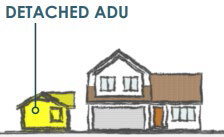
(b)
Amusement parks.
(1)
Minimum lot size. At least five (5) acres in size.
(2)
Off-street parking. Parking areas shall not be separated from principal structure by any public road.
(3)
Required spaces. Must be in accordance with article VII, division 1, as amended.
(4)
Setbacks.
a.
Front. Not less than twenty-five (25) feet from front property line.
b.
Rear. Not less than twenty-five (25) feet from rear property line.
c.
Side. Not less than twenty (20) feet from side property lines, unless a corner lot, then setback shall be the same as the front setback.
d.
Corner lot. No structure erected on a corner lot shall be closer than thirty (30) feet to the public right-of-way.
(c)
Automated car washes.
(1)
The automated car wash shall be limited to no more than three (3) vacuum machines each capable of vacuuming no more than two (2) vehicles at any one time.
(2)
The automated car wash shall be contiguous to a street classified as minor arterial or higher classification.
(3)
The entrance and exit openings to the car wash shall be oriented away from any adjacent conforming residential uses.
(4)
A 15-foot wide buffer shall be provided between the property and any institutional use, office use, or any conforming residential use.
(5)
The hours of operation shall be limited to 7:00 a.m. to 10:00 p.m.
(6)
Lighting shall be so designed and installed so as to prevent glare or excessive light on adjacent property. No sources of illumination shall be allowed if such source of illumination would be visible from a residentially-zoned district to the extent that it interferes with the residential use of that area.
(7)
All primary structures, accessory structures, and roofs shall use consistent architectural themes and colors and shall be consistent with any adopted design guidelines.
(8)
Any signage provided on an accessory car wash shall be deducted from the allowable wall signage of the primary structure.
(9)
Car washes and vacuums shall not be located within one hundred (100) feet of any conforming residential use.
(d)
Camps and RV parks.
(1)
An RV park or campground shall be located so that no entrance or exit from park shall discharge traffic into a residential district. An RV park or campground fronting on a public street shall have a minimum frontage of one hundred (100) feet.
(2)
Spaces in RV parks and campgrounds may be used by RVs, pickup campers, converted buses, tent trailers, tents or similar devices used for temporary portable housing. Permanent occupancy (occupancy for more than one hundred twenty (120) days) for dwelling purposes in this equipment is prohibited. Spaces shall be rented by the day, week or month.
(3)
Management headquarters, recreational facilities, toilets, showers, coin-operated laundry facilities and other uses and structures customarily incidental to the operation of an RV park or campground are permitted as accessory uses to the park in a district in which RV parks or campgrounds are permitted. In addition, stores, restaurants, laundry and dry cleaning agencies, beauty parlors, barbershops and other convenience establishments shall be permitted as accessory uses in camps and RV parks where these uses are not allowed as principal uses, subject to the following restrictions:
a.
These establishments and the parking areas primarily related to their operation shall not occupy more than ten (10) percent of the area of the park.
b.
These establishments shall present no visible evidence of their commercial character which would attract customers other than occupants of the park.
c.
The structures housing these facilities shall not be located closer than one hundred (100) feet to a public street.
(4)
No space intended for occupancy under this section shall be located so that a part intended for occupancy for sleeping purposes shall be within fifty (50) feet of the right-of-way line of an arterial street or within twenty-five (25) feet of the right-of-way line of another street.
(5)
Twenty-five-foot front, rear and side yards shall be provided for the campgrounds and RV parks.
(6)
Entrances and exits to RV parks and campgrounds shall be designed for safe and convenient movement of traffic into and out of the park and to minimize marginal friction with free movement of traffic on adjacent streets. Traffic into or out of the park shall be through the entrances and exits.
(7)
Each RV park or campground shall provide adequate off-street parking, loading and maneuvering space.
(e)
Child day care services.
(1)
Child day care services, including day nurseries, kindergartens and child care centers, shall be subject to the following conditions:
a.
Lot area. The minimum lot area shall be not less than seven thousand five hundred (7,500) square feet except for lots of record platted prior to the adoption of the LDC.
b.
Outdoor play area. A fenced outdoor play area, which complies with all applicable state requirements, shall be provided in the rear yard.
c.
Compliance with state standards. All facilities, operation and maintenance shall meet all applicable city and state regulations for such use.
d.
Capacity. An application for a conditional use shall state the maximum number of children to be accommodated, and in no case shall the number of children approved for the conditional use be exceeded.
e.
Parking. An adequate number of parking spaces shall be provided for employees and business owners, as well as a sufficient drop off area for children.
(f)
Commercial use in residential zoning district.
(1)
There are limited commercial uses permitted within the RM-1 and RM-2 residential zoning districts as conditional uses. Unless listed otherwise, uses which are not residential in nature shall follow the following standards to ensure compatibility within the surrounding area. The conditional use approval may be transferrable between owners.
(2)
Access. The subject parcel shall be accessed from a collector roadway or higher.
(3)
Compatibility buffers. If the parcel is adjacent to an existing residential parcel, shall adhere to section 34-745(b)(2).
(4)
Lighting. Illumination levels at all property lines shall not exceed one-half (0.5) footcandles ("f.c.") when the building or parking areas are located adjacent to residential areas and shall not exceed one (1.0) f.c. when abutting other non-residential properties.
(5)
Compatibility. The commercial use shall not emit noise, smoke, fumes, dust, odor or otherwise be incompatible if located in a predominantly residential area.
(6)
Height. The height shall not exceed the prevailing height of the block.
(g)
Funeral homes.
(1)
The structures housing these facilities shall not be located closer than one hundred (100) feet to a public street.
(2)
The structures housing these facilities shall not be located within one hundred (100) feet of any conforming residential use.
(h)
Halfway houses.
(1)
Notwithstanding anything to the contrary in the LDC, the occupancy of a rooming house shall not exceed any applicable occupancy limitation otherwise required by any federal, state or local law, rule or regulation.
a.
Shall contain a ten (10) foot wide, one hundred (100) percent opaque buffer surrounding the property.
b.
Chain link fences shall not be allowed in any yards along public streets (not including alleys), and must be located at least six (6) feet behind the closest vertical plane of the primary structure.
c.
The use shall comply with all applicable city property maintenance and unsafe building codes.
d.
Twenty-four-hour, on-site management shall be required.
(i)
Hospitals and freestanding emergency centers.
(1)
The structures housing these facilities shall not be located closer than one hundred (100) feet to a public street.
(2)
The structures housing these facilities shall not be located within one hundred (100) feet of any conforming residential use.
(j)
Hotels and motels.
(1)
For hotels and motels within the CBD, the following site design standards shall apply.
a.
Minimum site size. An area of not less than one-half (½) acre having a minimum width of not less than one hundred (100) feet (fifty (50) of which must be roadway frontage) and a depth of not less than two hundred (200) feet.
b.
Off-street parking. Parking areas should not be separated from principal structure by any public road unless proper pedestrian safety standards are met. Off-site parking areas must be zoned consistent with the principal use.
c.
Required spaces. Motels/hotels shall have one (1) space per unit plus one (1) space for each two (2) employees.
d.
Visual barrier. Trash receptacles must be enclosed by a visual barrier as required to public works standards.
(k)
Junk and salvage yards.
(1)
Junk and salvage yards shall be screened from any public road and from any residential zoning district pursuant to section 34-720.
a.
Any storage or dismantling of vehicles or machinery shall be conducted in a manner that does not pollute surface or ground water resources.
b.
This use shall be at least 1,000 feet from any unassociated water bodies, marsh, environmentally sensitive lands, wellhead protection areas, conservation-protected estuarine wetlands, and any beach and dune systems.
(l)
Rooming and boarding houses.
(1)
Notwithstanding anything to the contrary in the LDC, the occupancy of a rooming house shall not exceed any applicable occupancy limitation otherwise required by any federal, state or local law, rule or regulation.
a.
Shall contain a compatibility buffer as described in section 34-745(b)(2).
b.
Chain link fences shall not be allowed in any yards along public streets (not including alleys), and must be located at least six (6) feet behind the closest vertical plane of the primary structure.
c.
The use shall comply with all applicable city property maintenance and unsafe building codes.
d.
Twenty-four-hour, on-site management shall be required.
(m)
RV and boat storage.
(1)
At least twenty (20) percent of the site shall be in open space. Landscape buffers, setbacks, wetlands and other existing and planted vegetated areas may be used to achieve these twenty (20) percent requirement.
(2)
Drive aisles shall be paved with concrete, asphalt, asphalt millings or other material approved by the planning and development director or designee. Storage areas may utilize alternative materials. All other areas shall be landscaped and/or grassed.
(3)
All drive aisles shall be designed with one (1) ten (10) foot wide loading/unloading lane and one (1) fifteen (15) foot travel lane.
(4)
The site shall be secured with a wall or fence that is at least six (6) feet in height. Walls must be finished or painted on the exterior side. Razor wire and electric fences are not permitted. No opacity shall be required along a boundary of the site adjacent to wetlands, platted open space or areas subject to a conservation easement that preserves vegetation sufficient to screen the site from view across such areas. A wrought-iron fence (or fence resembling wrought iron) may be utilized in conjunction with a hedge or natural vegetation that provides for one hundred (100) percent opacity within two (2) years of the time of planting.
(n)
Service stations and gasoline sales.
(1)
The following regulations shall apply to the location, design, construction, operation and maintenance of a new construction automotive service stations and other gas dispensing and sales facilities. The conditional use approval may be transferrable between owners.
a.
Development plan. A development plan which meets the requirements of section 34-586 et seq., shall be required to be submitted prior to the approval of any service station or gasoline dispensing use.
b.
Lot frontage. A service station or gas dispensing facility site shall be of adequate width and depth to meet any setback requirements, and in no case shall minimum frontage on a street be less than one hundred twenty-five (125) feet.
c.
Lighting. All lights and lighting shall be designed and arranged to prevent any source of light from causing glare or being uncomfortably harsh when viewed from any residential window in a residential zoning district.
d.
Structure, pump, and storage tank setbacks. No main or accessory building, gasoline pump or storage tank shall be located closer than twenty-five (25) feet from any land that is in a residential zoning district. The main service station building shall conform to all street frontage setbacks applicable to the zoning district. Gasoline pumps, tanks and pump islands shall be located no closer than fifteen (15) feet to any street side property line. Pumps, tanks, vents, pump islands and pump island canopies shall conform to side and rear setback requirements for other structures in the zoning district in which the station is located, provided no such pumps, tanks, vents, pump islands or pump island canopies shall be located closer than twenty-five (25) feet to any side or rear property line.
e.
Storage tanks. Storage tanks shall be located below grade.
f.
Access driveways and curb cuts. No more than two (2) curb cuts per one hundred twenty-five (125) feet of street frontage shall be permitted for service station and gas dispensing facilities. Curb cuts shall not exceed thirty (30) feet in width, exclusive of curb returns and shall be located no closer than thirty (30) feet from the right-of-way lines of any intersection. Curb cuts shall not be closer than fifteen (15) feet from any other property line. Any two (2) driveways providing access to a single street shall be separated by an island with a minimum width of twenty (20) feet.
g.
Limitations. The permissible uses at a service station shall not include major mechanical and body work, straightening of body parts, painting, welding, storage of inoperable vehicles or other work involving noise, glare, fumes, smoke or other characteristics to an extent greater than normally found in service stations. A service station is not a repair garage or a body shop.
h.
Buffers. Where lots which are to be used for service stations or gas dispensing facilities abut any property which is in a residential zoning district or used for residential purposes, a solid, concrete block wall with a cap shall be installed on all property lines other than street lines. The wall shall have a minimum height of six (6) feet in height and shall be continuous and unpierced, except that no wall or other obstruction shall be permitted to exceed four (4) feet in height within fifteen (15) feet of a street line.
(o)
Shooting galleries.
(1)
Only indoor shooting galleries are permitted.
(2)
Minimum room length. The room length in which the actual firing range is to be built shall be at least seventy-five (75) feet long for a fifty (50) foot range, to allow eight (8) feet (minimum) each for the bullet stop and firing line, plus a nine (9) foot assembly and supervisory area.
(3)
Minimum firing point width. The minimum firing point width shall be three and one-half (3.5) feet. The firing point is that part of the range immediately in the rear of the firing line from which firing takes place.
(4)
Off-street parking. Parking areas should not be separated from principal structure by any public road.
(5)
Required spaces. Must be in accordance with article VII, division 1, as amended.
(6)
Setbacks.
a.
Front. Not less than twenty-five (25) feet from front property line.
b.
Rear. Not less than twenty-five (25) feet from rear property line.
c.
Side. Not less than twenty (20) feet from side property lines, unless a corner lot, then setback shall be the same as the front setback.
d.
Corner lot. No structure erected on a corner lot shall be closer than thirty (30) feet to the public right-of-way.
(7)
The following additional conditions shall be satisfied:
a.
The range is physically secure so as to prevent unauthorized use or accidental trespassing. Warning signs identifying the use shall be displayed.
b.
The floor or framework can support the weight of the backstop or bullet trap. Unless fire code requires emergency exit doors and windows, downrange must be permanently shut and either covered or baffled or a combination of the two with bullet-resistant material. The walls, floors, and ceiling must be modified accordingly.
c.
A mechanical exhaust ventilation system and diffused air supply must be installed.
d.
No metal should be placed at right angles to the line of fire.
e.
Adequate lighting must be provided.
f.
The walls, ceiling, and floor must be treated with effective sound-absorbent materials.
g.
Techniques of sound reduction (sound absorbing material coat, acoustic material, carpeting, or baffling) shall be implemented.
Sec. 34-566. - Purpose.
Variances are deviations from the terms of the LDC which would not be contrary to the public interest when owing to special circumstances or conditions, the literal enforcement of the provisions of the LDC would result in undue and unnecessary hardship. Variances shall not be inconsistent with the comprehensive plan. It is understood that the granting of a variance shall not create a precedence for future requests.
Sec. 34-567. - Authority.
The board of adjustment, in accordance with the procedures, standards and limitations of this section shall approve, approve with conditions, or deny an application for development permit for a variance after recommendation by the planning and development department.
Sec. 34-568. - Authorized variances.
Variances shall only be granted from the dimensional standards of article VI, the off-street parking or landscape standards of article VII, and the subdivision standards of article VIII within the LDC, except that a height variance shall not be permitted in any zoning district. Variances shall not be granted to permit a use not generally allowed in the zoning district in which it is located.
Variances may not be requested for relief from:
(a)
Maximum building height
(b)
Residential density
(c)
Minimum lot area requirements
(d)
Maximum sign dimensional standards
Sec. 34-569. - Submission of application.
Prior to submitting an application for a variance, an applicant shall request in writing a preapplication conference with the planning and development director or designee. An application for a development permit for a variance shall be submitted by the owner or other person having a written contractual interest in the land for which the variance is proposed. If the applicant is not the owner of the property, an owner authorization form, provided by the planning and development department, must be provided.
An application for a development permit for a variance shall be submitted to the planning and development department along with a nonrefundable application fee which is established from time to time by the city council to defray the actual cost of processing the application.
Sec. 34-570. - Contents of application and sufficiency.
The application shall be submitted in a form established by the planning and development department and made available to the public, and may include a traffic impact study as may be required by the director. The planning and development department will inform the applicant when the application is sufficient.
Sec. 34-571. - Review, report and recommendation.
If the application is determined to be sufficient the director or their designee shall review the application, prepare a staff report and a recommendation of approval, approval with conditions, or disapproval based on the standards in the section below. The director or their designee shall send a copy of the staff report to the applicant approximately one week before the board of adjustment hearing along with notification of the time and place the application will be considered.
Sec. 34-572. - Standards applicable to all variances.
In order to authorize any variance from the terms of this Code, the board of adjustment must find that:
(a)
There are conditions or circumstances that exist which prevent compliance with site design and development standards, or which are unique to the parcel of land, building or structure;
(b)
The conditions or circumstances do not result from actions of the application and would not be considered a self-imposed hardship;
(c)
There would be no special privileges afforded to the applicant by granting a variance that is not available to other parcels of land, building or structures with similar conditions or circumstances;
(d)
Strict interpretation and enforcement of the code would deprive the applicant of rights commonly enjoyed by other parcels of land and would provide an unnecessary and undue hardship;
(e)
The variance(s) requested, if granted, will make possible a reasonable use of the parcel of land, building, or structure; and
(f)
The variance(s) request, if granted, will not result in the creation of a public nuisance.
Sec. 34-573. - Conditions.
The planning and development department may recommend, and the board of adjustment may impose, such conditions on variances as are necessary to accomplish the visions, intents and strategies of the comprehensive plan and this Code including, but not limited to, limitations on size, bulk, location, requirements for landscaping, buffering, lighting, provisions of adequate ingress and egress, on and off-site project-related improvements, and reasonable time limits within which the variance shall be initiated and completed.
Sec. 34-574. - Administrative variance.
Notwithstanding the other provisions of division V, the planning and development director or designee may issue an administrative variance from the dimensional standards of article VI and the off-street parking and loading or landscape standards of article VII of the LDC (except that a height variance shall not be permitted in any zoning district) if the proposed application for an administrative variance complies with the standards of section 34-592. For the purposes of this section, an administrative variance is a variance that does not vary from the relevant dimensional, off-street parking and loading, or landscape standards by more than ten (10) percent.
Sec. 34-586. - Purpose.
Development plans shall be required in accordance with the provisions of this section in order to ensure that the proposed development complies with the site development standards in article VII and other requirements of the LDC, and to otherwise protect the public health, safety and general welfare of the citizens of the City of Jacksonville Beach.
Sec. 34-587. - Applicability.
A development order for a development plan is required prior to receipt of a building permit for any nonresidential development or any residential development of three (3) dwelling units or more.
Sec. 34-588. - General description of development plan review.
An application for a development permit requesting approval of a development plan shall be reviewed and approved, approved with conditions, or denied by the planning and development director or designee.
Sec. 34-589. - Initiation.
Prior to submittal of an application, a pre-application meeting shall be completed with the planning and development department and all relevant city departments. An application for a development permit for a development plan shall only be submitted by the owner, or any other person having a contractual interest in the land, or their authorized agent.
Sec. 34-590. - Submission of application.
An application for a development permit for a development plan shall be submitted to the planning and development department along with a nonrefundable application fee which is established from time to time by the city council to defray the actual cost of processing the application.
Sec. 34-591. - Contents of application and sufficiency.
The application shall be submitted in a form established by the planning and development department and made available to the public, and may include a traffic impact study as may be required by the director. The planning and development department will inform the applicant when the application is sufficient.
Sec. 34-592. - Review, report and recommendation.
If the application is determined to be sufficient, the planning and development department shall prepare the application for review by the appropriate city departments. Upon completion of the review, the planning and development department will prepare a staff report and a statement of approval, approval with conditions, or disapproval based on the standards in the section below. The planning and development department shall send a copy of the staff report to the applicant at the time that the report is completed.
Sec. 34-593. - Standards.
A development plan shall comply with the following standards:
(a)
Consistency with comprehensive plan. It shall be compatible with the visions, intents and strategies of the comprehensive plan.
(b)
Compatible with surrounding land uses. It shall be compatible with surrounding land uses.
(c)
Not deter surrounding undeveloped properties. It shall not hinder, deter, or impede development of surrounding undeveloped land in accordance with the comprehensive plan.
(d)
Adequate public facilities. It complies with article IX, adequate public facility standards. The provision of adequate public facilities for the proposed development shall be consistent with the CIE of the comprehensive plan.
(e)
Design and layout of development. It shall be adequately designed so that the general layout of the proposed development will be compatible with surrounding permissible land uses and existing properties.
(f)
Ingress and egress, and internal traffic circulation. It shall provide adequate ingress and egress to the land proposed for development, provide adequate separation of automotive and pedestrian traffic, and provide adequate internal traffic circulation. If the property is located along an approved urban trail, every effort shall be made to incorporate the trail into the design.
(g)
Screens and buffers. It shall provide adequate screens and buffering to ensure compatibility with land uses internal and external to the proposed development.
(h)
Open space. It shall provide adequate open space and on-site recreational facilities, consistent with the citywide visions, intents, and strategies established in the comprehensive plan or be required to contribute to the park fund.
(i)
Site development standards. It shall comply with the site development standards of article VII of the LDC.
Sec. 34-594. - Conditions.
The planning and development director or designee and city departments such as public works, fire, and beaches energy services shall have the authority to impose such conditions on a development plan that are necessary to accomplish the purposes of this section, the LDC, and the comprehensive plan.
Sec. 34-595. - Effect of development order for a development plan.
Issuance of a development order for a development plan shall be deemed to authorize the applicant to submit to the city council a final plat pursuant to the procedures and standards of article VIII, subdivision standards, and then an application for a building permit. A final plat, however, cannot be submitted until the improvements for the proposed development are in place or bonded, as determined by the public works department.
Sec. 34-596. - Time limitations.
Receipt of a development order for a development plan shall expire at the end of two (2) years after the date of its initial approval if an application for a final plat and/or a building permit is not submitted. Only one (1) extension, up to one (1) year in length shall be granted for the development plan by the planning and development department, upon written application to the planning and development department and a showing of good cause. No request for an extension shall be considered unless a written application requesting the extension is submitted to the planning and development department no later than thirty (30) working days prior to the date the development order is to expire. Failure to submit an application for a building permit within the time limits established by this section shall render null and void the development order for the development plan.
Sec. 34-597. - Amendments to development plan.
A development plan may be amended only pursuant to the procedures established for its original approval, or as are otherwise set forth in this section.

