
Jefferson Parish City Zoning Code
ARTICLE XLII
BOARD OF ZONING ADJUSTMENTS17
Editor's note— Ord. No. 21734, § 19, adopted Dec. 11, 2002, amended the title of Art. XLII to read as herein set out. Prior to inclusion of said ordinance, Art. XLII was entitled, "Zoning Appeals Board." See the Code Comparative Table.
Sec. 40-791.- Created.
Pursuant to Sec. 4.06 of the Jefferson Parish Charter, the board of zoning adjustments is hereby created. The word "board" when used in this section shall be construed to mean the board of zoning adjustments. The board shall consist of seven (7) members, who shall be appointed by the Jefferson Parish Council: one (1) member appointed by each council member. Each board member shall possess the qualifications as follows: He/she shall be a resident, a property owner and a qualified voter of the Parish of Jefferson. Members of the board shall be appointed by and serve at the pleasure of the Jefferson Parish Council. The board shall elect its own chairperson, who shall serve one (1) year or until he/she is re-elected or his/her successor is elected. The parish attorney shall be the legal advisor for the board. The board shall not hold more than fifty-two (52) meetings in any calendar year.
(Ord. No. 20783, § 3(XXII(1)), 9-22-99; Ord. No. 21734, § 20, 12-11-02; Ord. No. 23292, § 37, 5-7-08)
Sec. 40-792. - Powers of the board.
The board of zoning adjustments shall have all the powers and duties prescribed by this ordinance, which are more particularly specified as follows:
(1)
Appeals.
a.
Except as otherwise provided, to hear and decide appeals where it is alleged there is error in any order, requirement, decision or determination made by the building permits director, parkways director, or the planning director.
b.
To hear and decide appeals to the Metairie Ridge Tree Preservation District (MRTPD) or tree preservation requirements, as specified in section 33-3.66.7.3 and section 33-6.27.12.
(2)
Exceptions. To grant an exception from the provisions of the Comprehensive Zoning Ordinance in the following instances:
a.
General.
1.
Where the boundary line of a district divides a lot held in single ownership at the time of passage of this ordinance and no dimensions are indicated on the zoning maps and the exception appealed for is not more than twenty-five (25) feet in any direction, and not to exceed five thousand (5,000) square feet, permit the extension of the district to include the entire lot.
2.
Interpret the provisions of the Comprehensive Zoning Ordinance in such a way as to carry out the intent and purposes of the zoning plan, as shown upon the map fixing the several districts, where the street layout actually on the ground varies from the street layout as shown on the maps accompanying and made a part of this ordinance.
b.
Use exceptions. To permit the following specific use exceptions:
1.
To permit the use of land for public utility and railroad purposes; provided that the board shall find some compelling necessity for the use, and that any office, repair, storage, or garage uses are necessary to the main use, provided further that no such railroad use shall be permitted in R-3 or more restrictive districts.
2.
To permit manufactured homes or mobile homes on any premises in accordance with the provisions of Article XXXVIII, Manufactured Homes and Mobile Homes.
(3)
Variances. In accordance with standards, hereafter prescribed, to grant variances from the provisions of chapter 40, zoning and chapter 33, unified development code, in the following instances or as specifically authorized elsewhere in this Code:
a.
Permit a variance in yard requirements, height restrictions of structures, or lot-area-per-family requirements of any district.
b.
Waive or reduce the parking and loading requirements in the R-3 multiple-family residential, and all other less restrictive districts, however, appeals for parking requirement reductions where the required parking exceeds ten (10) spaces shall be limited to a maximum of ten (10) spaces or ten (10) percent of the required parking, whichever is greater, and shall be considered only if all parking spaces are standard size. The provisions of this paragraph are subject to section 40-481.
c.
Permit a variance to the clear vision area regulations located in article XXXV, off-street parking, loading, and clear vision are regulations in accordance with section 40-665 clear vision area regulations.
d.
Permit a variance to the regulation of the following walls and surfaces:
1.
Exterior walls. A set of scaled drawings, including a dimensioned site plan and elevations of all exterior views noting the exterior wall materials proposed to be used and their dimensions, shall be submitted with the application for variance for the following:
i.
Exterior walls of one-, two-, three-, and four-family dwellings in accordance with section 40-46 of this Code.
ii.
Exterior walls of nonresidential buildings within the one-, two-, three-, and four-family residential districts in accordance with the applicable articles of this Code. For the purposes of this section, one-, two-, three-, and four-family residential zoning districts shall comprise the Suburban District (S-1), Single-Family Residential District (R-1A), Suburban Residential District (R-1B), the Rural Residential Districts (R-1C and R-1D), Two-Family Residential District (R-2), Three- and Four-Family Residential District (RR-3), and Townhouses (R-1TH).
2.
Vertical surfaces for structures housing recreational vehicles and recreational watercraft in accordance with section 40-661 of this Code.
e.
Permit a variance to the building line requirements located in article XXXV, off street parking, loading, and clear visions area regulation, section 40-661, general requirements (g)(2).
f.
Permit a variance to the electronic variable message (EVM) sign regulations to allow one (1) attached EVM sign in place of a detached EVM sign.
g.
Permit a variance to the five (5) percent maximum driveway slope for applications involving the elevation of existing one- and two-family dwellings, including townhouses.
(4)
Additional conditions and restrictions. May impose such conditions and restrictions upon the premises benefited by a variance or exception as may be necessary to comply with the standards set forth in this section to reduce or minimize any injurious or adverse effects of such variance or exception upon other property in the neighborhood, and to better carry out the general intent of this ordinance, including the following conditions and restrictions:
a.
Private garages. If the board of zoning adjustments grants a variance to the height of a private garage, the following criteria shall be met:
1.
The entire structure shall be set back from the side and rear lot lines an additional one (1) foot for every additional one (1) foot or fraction thereof in height over thirteen (13) feet but shall not exceed the minimum side or rear yard setback requirement of the principal structure, and in no case shall exceed nineteen (19) feet in height in a required yard; and
2.
The garage shall not contain a second or higher floor used as a place of habitation or a living room, kitchen, dining room, parlor, bedroom or library.
b.
Exterior wall materials.
1.
If the board of zoning adjustments grants a variance to the exterior wall materials of a one-, two-, three-, or four-family dwelling, prohibited materials shall occupy less than fifty (50) percent of the total surface area (excluding openings) of any single wall, as documented by the required drawings.
2.
If the board of zoning adjustments grants a variance to the exterior wall materials of a nonresidential building in a one-, two-, three-, or four-family residential district, all the following criteria shall be met:
i.
The exterior wall material shall have a durable finish lasting a minimum of twenty-five (25) years, as documented in the manufacturer's specifications and warranty;
ii.
The owner, tenant or their agent shall be responsible for maintaining the required landscaped areas in an attractive, healthy condition and kept free from debris;
iii.
For buildings within ten (10) feet of a rear or side lot line abutting a dwelling in a one-, two-, three-, or four-family residential district:
A.
The building shall not exceed nineteen (19) feet in height; and
B.
A continuous barrier a minimum height of seven (7) feet consisting of residentially compatible materials and/or vegetation shall be required at the property line. Vegetative screening shall be at least two (2) feet in height when planted and must be at least six (6) feet in height within two (2) years of planting and create a continuous opaque buffer.
iv.
An exterior all which fronts on and is within sixty (60) feet of a street right-of-way shall not have an uninterrupted expanse of more than twenty-five (25) feet where it fronts on the right-of-way. At least two (2) of the following features shall be employed to visually break up the wall:
A.
Horizontal changes in materials with at least one (1) residentially compatible material comprising twenty (20) percent of the total surface area of the wall.
B.
One (1) vertical feature such as a column, pilaster, or similar architectural element for every twenty (20) linear feet of wall or fraction thereof. Such features shall be of residentially compatible materials.
C.
Openings such as windows and doors that comprise at least twenty (20) percent of the total surface area of the wall.
D.
Landscaping that helps to visually break up the mass of large buildings and long walls. At least one (1) of the following options shall be employed:
1.
For every twenty (20) feet of wall length or fraction thereof, one (1) tree is provided. Each tree shall be planted in at least a twenty-five (25) square foot planting area adjacent to the wall and shall be landscaped with grass, ground cover, or other landscaping. Trees shall be a minimum of ten (10) feet in height with a two (2) inch caliper trunk measured at breast height when planted and must be at least sixteen (16) feet in height within two (2) years of planting.
2.
A continuous barrier with a minimum height of seven (7) feet consisting of residentially compatible materials and/or vegetation shall be required at the property line. Vegetative screening shall be at least two (2) feet in height when planted and must be at least six (6) feet in height within two (2) years of planting and create a continuous opaque buffer.
v.
For nonresidential buildings which are not within ten (10) feet of a rear or side lot line and are not within sixty (60) feet of a street right-of-way, the board of zoning adjustments may impose the above standards.
c.
Electronic variable message signs. If the board of zoning adjustments grants a variance to the electronic variable message (EVM) sign regulations all the following criteria shall be met:
1.
Sign area.
i.
For signs in the General Offices GO-1, Medical Service H-2, Business Core BC-1, and Neighborhood Commercial C-1 districts, the EVM portion of the sign shall comprise no more than twenty-five (25) square feet.
ii.
For signs in the Business Core BC-2 and less restrictive districts, including the Mixed-Use Corridor District, the EVM portion of the sign shall comprise no more than fifty (50) percent of the allowable attached sign area or one hundred (100) square feet, whichever is less.
2.
No detached signs shall be permitted for the site;
3.
The attached EVM sign shall meet all criteria listed in section 40-682(3) of this Code; and
4.
The attached EVM sign shall meet the criteria for residential proximity and dwell time for the district in which the sign is located.
d.
Driveways sloped greater than five (5) percent. If the board of zoning adjustments grants a variance to the five (5) percent maximum driveway slope, the following criteria shall be met:
1.
Parking prohibited. Required parking shall not be located on driveways constructed with a slope greater than five (5) percent.
2.
Maximum driveway slope on private property.
i.
Within the first eleven (11) feet of all property lines in common with the public right-of-way, the maximum driveway slope shall be sixteen (16) percent.
ii.
Beyond eleven (11) feet of all property lines in common with the public right-of-way, the maximum driveway slope shall be twenty (20) percent.
3.
Determination of slope. The parish department of public works shall determine, in the form of a letter, whether the proposed plan complies with the following requirements:
i.
The maximum driveway slope allowed on private property and the maximum slope allowed on public right-of-way, including the driveway and sidewalk area; and
ii.
Applicable standards of the Americans with Disabilities Act [ADA].
4.
Submittal requirements.
i.
The applicant shall request the determination from the department of public works and shall submit the written determination as part of the application to the board of zoning adjustments.
ii.
Upon request, applicants shall submit to the department of public works any materials or plans necessary to facilitate the determination, which may include a drainage plan.
iii.
To ensure structural integrity, all plans shall be signed and affixed with the seal of a state licensed engineer or architect.
(Ord. No. 20783, § 3(XXII(2)), 9-22-99; Ord. No. 21734, § 21, 12-11-02; Ord. No. 22670, § 14, 1-11-06; Ord. No. 23201, § 3, 12-12-07; Ord. No. 23330, § XL, 6-11-08; Ord. No. 23776, § 2, 3-24-10; Ord. No. 23816, § 3, 5-26-10; Ord. No. 23881, § 14, 9-22-10; Ord. No. 23898, § 7, 10-13-10; Ord. No. 24169, § VII, 12-7-11; Ord. No. 24240, § X, 3-28-12; Ord. No. 24364, § LIII, 11-7-12; Ord. No. 24823, § XXIX, 9-17-14; ; Ord. No. 24860, § 8, 11-5-14; Ord. No. 24989, § XV, 8-12-15; Ord. No. 25405, § 92, 8-9-17; Ord. No. 26369, § 31, 2-16-22; Ord. No. 26480, § 25, 9-14-22; Ord. No. 26625, § 80, 6-14-23)
Sec. 40-793. - Limitation of powers and standards for board action.
The actions and decisions of the board of zoning adjustments shall be governed by the following standards and restrictions:
(1)
Limitations.
a.
In exercising the above-mentioned powers, the board may affirm or reverse wholly or partly or may modify the decision or determination appealed from and may make such other order, requirement, decision or determination as said board may deem proper and within its authority. However, the board shall not render any judgment or make any decision or determination which would constitute a zoning change.
b.
Whenever an appeal or application has been finally acted upon by the board, then the board shall not consider any further appeal or application requesting the same or similar relief involving the same property within two (2) calendar years from the date of the board's final decision on said appeal or application.
c.
If after the judgment granting a variance, exception or other relief prayed for, the operation authorized thereunder is not commenced within two (2) years of the effective date of the board's decision, or if the operation is commenced by the issuance of a permit and the work is discontinued for a sufficient period that the permit expires or is allowed to lapse and is not resubmitted for approval within two (2) years of the effective date of the board's decision, said judgment or decision shall expire, prescribe, lapse and/or be deemed to be abandoned by appellant or applicant; and, no permit shall be issued in reliance of such judgment or decision unless the matter is resubmitted to the board for consideration in the same manner as an original appeal or application. The filing of the decision in the office of the board shall be the effective date of the judgment.
d.
In considering a variance, exception or other relief requested in connection with any property, the board shall only consider such requests based upon the zoning classification of said property at the time the application is filed.
e.
In considering a variance for a property located in the Old Metairie Neighborhood Conservation District (OMNCD), the following limitations and standards for board action shall apply:
1.
Petitions for variances within the boundaries of the OMNCD require the review and recommendation of the OMC prior to action by the BZA except tree removal only appeals.
2.
Limitations on final action by the BZA.
i.
In its final action, the BZA may grant a modified variance without additional review and recommendation of the OMC, only if:
A.
The variance is the same type of variance; and
B.
Is more restrictive than the variance proposed in the notice.
ii.
If the BZA grants such variance then the applicant must submit revised site plans and, or building elevations that are dimensioned and drawn to scale to the planning department.
iii.
The BZA shall not grant a substitute, alternative, or modified variance that is less restrictive or a different type of variance without review and recommendation of such variance by the OMC.
3.
Where the final decision of the BZA does not follow the recommendation of the OMC for a particular case, the final decision of the BZA shall govern the site plan submitted to the parish council and any appeal must follow the guidelines for appeal in section 40-796 Judicial review.
(2)
Standards. The purpose of the "variance" provisions of this section generally permit an applicant to apply for relief from the requirements of the letter of the ordinance when unnecessary hardship or practical difficulty exists, or when there is an exceptional or unusual physical condition of a lot, which condition is not generally prevalent in the neighborhood and which condition would prevent a reasonable or sensible arrangement of building on the lot.
The purpose of the "exception" provisions of this section, whenever an exception requires the approval of the board, generally permit the applicant to apply for use of land for purposes which may be essentially desirable, necessary or convenient to the community, its citizenry or a substantial segment thereof but which require special consideration of location and site plan because of an inherent tendency to create traffic congestion, noise, density of persons assembling, or which may cause an excessive strain on water resources or sewerage disposal facilities, or drainage, or which may cause a depreciation or diminution of value of the immediate surrounding property, or may otherwise adversely affect safety or welfare of the immediate surrounding area.
a.
In the consideration of all appeals and all proposed variances and/or exceptions requiring board approval, under the terms of this ordinance, the board shall not grant approval if it makes a finding, based upon the evidence presented to it, as indicated in the record and the transcript of the hearing, that any of the following criteria exist:
1.
The approval, if granted, would cause diminution or depreciation of property values of any surrounding property or would alter the essential character of the locality.
2.
The approval, if granted, would tend to degrade or retard the prosperity and general welfare of the neighborhood and community.
3.
The approval, if granted, would be detrimental to the public welfare or seriously affect or be injurious to other property or improvements in the neighborhood in which the property is located, in that it will not: impair an adequate supply of light and air; or increase substantially the congestions in the public streets, create a traffic hazard, or permit inadequate parking; or increase the danger of fire; or substantially affect or overburden existing drainage or sewerage systems; or otherwise endanger the public safety; or cause serious annoyance or injury to occupants or adjoining premises by reason of emission of odors, fumes, gases, dust, smoke, noise or vibration, light or glare, or other nuisances.
b.
Additionally, the board shall not grant approval of any variance unless it makes a further finding, as indicated in the record or the transcript of the hearing, that each case shall indicate the following:
1.
Special conditions and circumstances exist which are peculiar to the land, structure, or building involved and which are not applicable to other lands, structures, or buildings in the same zoning district; and the special conditions and circumstances do not result from the intentional actions of the applicant or any other person who may have or had interest in the property; and the strict adherence to the regulation for the property would result in a demonstrable hardship upon the owner as distinguished from mere inconvenience; or
2.
Literal interpretation of the provisions of this ordinance would deprive the applicant of rights commonly enjoyed by other properties in the same district under the terms of this ordinance; and granting the variance requested will generally not confer on the applicant any special privilege which is denied by this ordinance to other lands, structures, or buildings in the same district or similarly situated; and the purpose of the variance is not based exclusively upon a desire to serve the convenience or profit of the property owner or other interested party.
c.
[Reserved.]
(Ord. No. 20783, § 3(XXII(3)), 9-22-99; Ord. No. 21734, § 22, 12-11-02; Ord. No. 22670, § 15, 1-11-06; Ord. No. 23201, § 3, 12-12-07; Ord. No. 23776, § 3, 3-24-10; Ord. No. 24240, § XI, 3-28-12; Ord. No. 26369, § 32, 2-16-22)
Sec. 40-794. - Appeals to the board.
(a)
(1)
Appellants. Appeals to the board may be taken by any party aggrieved, or by any officer, department, board, commission, bureau or any other agency, affected by a decision of the building permits director or concerning application or interpretation of the provisions of the comprehensive zoning ordinance by the director. Applications for the herein permitted exceptions or variances may be filed by any aggrieved party.
(2)
Appellee. If the appeal is by an applicant who has been denied a permit or is seeking a variance, or is otherwise appealing a decision, interpretation or action of denial by the director, the named appellee shall be the director.
If the appeal is by an opponent challenging the granting of a permit or otherwise appealing a decision, interpretation or action of approval by the director, the party receiving the permit shall be named appellee and the director may be named as an additional appellee. Whether or not the director is named as an additional appellee, the director shall provide an explanation for the granting of the permit or approval granted.
(b)
Time. Such appeals or applications shall be made within thirty (30) days following the decision of the director by filing with the board of zoning adjustments the necessary appeal or application.
(c)
Form. All such appeals or applications made to the board shall be in writing, on forms prescribed by the board. Every appeal or application shall refer to the specific provision of the ordinance involved, and shall exactly set forth the interpretation that is claimed and the details of the permitted exception sought, and/or the details of the permitted variance applied for. Every appeal or application shall also specify the grounds on which it is claimed that relief should be granted.
(d)
Jurisdictional determination. The parish attorney, or his representative, may review any appeal or application and will advise whether any such appeal or application is within the jurisdiction of the board.
(e)
Hearing. Each application or appeal shall be assigned a case or docket number and, within sixty (60) days of the time of receipt of such application or appeal, the board shall conduct a hearing which shall be open to the public and at which all parties in interest and citizens shall have an opportunity to be heard.
(f)
Notice. Except as otherwise provided, the following notices shall be provided:
(1)
Published notice. Notice setting forth the date, time, place and purpose of the public hearing, a general description of the proposal, and location of the subject property shall be published at least two (2) times in the Official Journal of Jefferson Parish. Notice shall be published not more than twenty (20) business days before the public hearing and at least ten (10) business days shall lapse between the first publication and the public hearing.
(2)
Administrative. Notice of the hearing and a copy of the application or appeal shall be served upon the building permits director and any other appellee. Such notice shall be served at least ten (10) days prior to the hearing and shall be accompanied by any applicable requests for reports, recommendations or advisory opinions.
(3)
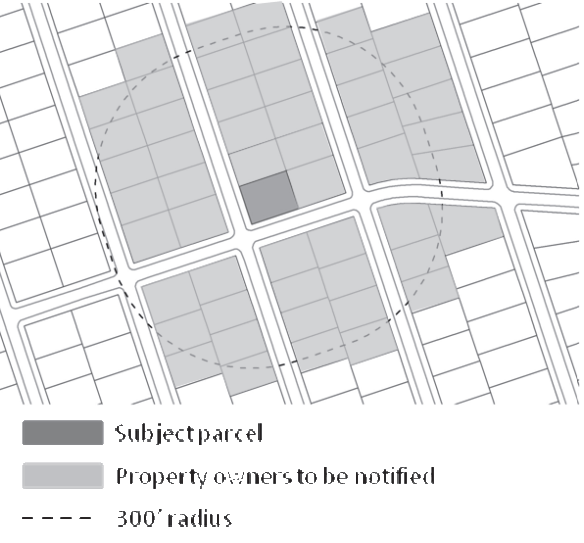
Mailed notice. Notice setting forth the date, time, place and purpose of the public hearing, a general description of the proposal, and location of the subject property shall be mailed to the applicant and all property owners within one hundred (100) feet measured radially from the lot lines of a subject property that contains a single- or two-family dwelling (see figure 40.794.1), or within three hundred (300) feet measured radially from the lot lines of a subject property that contains a use other than a single- or two-family dwelling (see figure 40.794.2); at least ten (10) business days before the public hearing. Mailed notice of a public hearing shall be sent at the applicant's cost and the applicant shall provide the board of zoning adjustments with a notarized list of names and addresses of the property owners to be notified, as listed in the official records of the parish assessor.
Table 40.794.1
Mailed Notice Radius: 100 ft
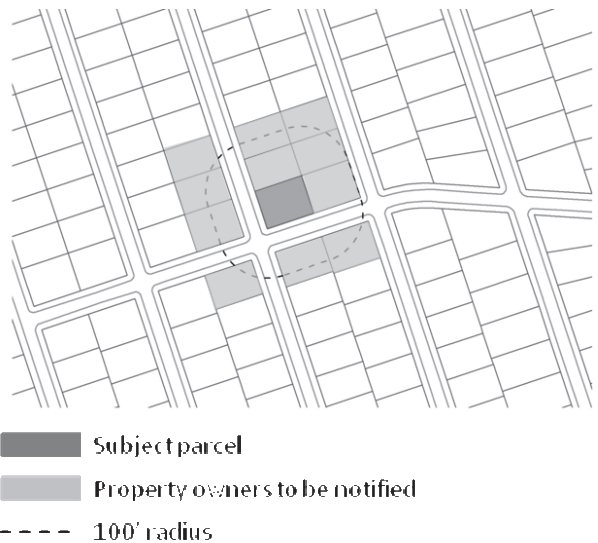
Table 40-749.2
Mailed Notice Radius: 300 ft
(4)
Posted notice. At least one (1) sign shall be posted on the subject property, visible from the nearest public street right-of-way, at least ten (10) business days before the public hearing. The sign(s) shall remain posted on the property. The board shall determine sign content.
(5)
No other mandatory types of notice shall be required; however, the board of zoning adjustments, by rule, may provide for additional discretionary forms of notice.
(6)
Defective notice—Validity. No denial by the board of any application, petition or other matter before the board that requires notice, or judgment granting an appeal that requires notice shall be declared invalid by reason of any defect in:
a.
The publication of the notice of the purpose or subject matter and the time and place of the hearing if the published notice gives reasonable notice of its purpose, subject matter, substance or intent.
b.
The mailing or receipt of the notice if sent within the established time period.
c.
The posting or display of the notification sign if proof of the receipt of the sign by the applicant is presented.
Failure to strictly adhere to the discretionary forms of notification shall not form a basis for declaring invalid any board action on any matter.
(g)
Stay of proceedings. An appeal shall stay all administrative proceedings in furtherance of the action appealed from, unless the building permits director certifies to the board of zoning adjustments, after the notice of appeal shall have been filed with him, by reason of facts stated in the certificate, that a stay would, in his opinion, cause imminent peril of life or property. In such cases, proceedings shall not be stayed other than by a restraining order which may be granted by the board or by the 24th Judicial District Court for the Parish of Jefferson on application to the board or to the district court, and notice to the building permits director and on due cause shown thereon.
(Ord. No. 20783, § 3(XXII(4)), 9-22-99; Ord. No. 21242, § 1, 3-21-01; Ord. No. 21734, § 23, 12-11-02; Ord. No. 22670, § 16, 1-11-06; Ord. No. 24576, § VIII, 9-18-13; Ord. No. 26369, § 33, 2-16-22; Ord. No. 26625, § 81, 6-14-23)
Sec. 40-795. - Procedure; meetings.
(a)
Rules of procedure. The board shall adopt rules of procedure not in conflict with any state act or parish ordinance.
(b)
Evidence. The chairman or the acting chairman may administer oaths whenever applicable. Any party may appear in person or by agent or by attorney. The board, however, shall not be bound by legal rules of evidence.
(c)
Meetings. Meetings of the board shall be held on call of the chairman of the board or on call of a majority of the members of the board. All meetings of the board shall be open to the public. The building permits director or his representative shall be present at any meetings or hearings when requested by the board.
(d)
Minutes/record. The board shall keep minutes of its proceedings, showing the vote of each member upon each question, or, if absent or failing to vote, indicating that fact and shall keep records of its examinations and other official action all of which shall be filed immediately in the office of the board and shall be public record. All testimony, objections thereto, and rulings thereon shall be taken down by a recorder for that purpose. The board shall have the power and authority to appoint a secretary, who shall not necessarily be a member of the board, in which event the salary of such secretary shall be fixed by the board. It shall be the duty of the secretary to keep the said minutes and a true and correct record of all proceedings had at such meetings, both general and special of said board, in a book or books to be kept specially for that purpose. Certified copies of the minutes of all such proceedings shall be furnished to the building permits director.
(e)
Decision. The concurring vote of four (4) members of the board shall be necessary to reverse any order, requirement, decision, or determination of the building permits director, parkways director, or planning director, or to decide in favor of the applicant on any matter upon which it is required to pass under any such ordinance, or to effect any variance of such ordinance.
(f)
Reasons for judgment. Every appeal, exception or variance granted or denied by the board shall be accompanied by a written finding of fact, based upon testimony, evidence, or inspections by the board, specifying the reason(s) for granting or denying the said appeal, exception or variance or the board shall otherwise record in its minutes or tape recording of the hearing(s) the pertinent and material facts and the reason(s) upon which its decisions are based.
(g)
Cancellation and rescheduling of meetings.
(1)
A meeting of the board shall be canceled if a quorum is not present.
(2)
During times of great public crises, disaster, rioting, catastrophe, severe weather conditions or similar public emergency, the chairman of the board may cancel a meeting of the board at which a public hearing is scheduled.
(3)
The public hearing for all cases on the docket of board so canceled shall be held at the next regular scheduled public hearing meeting of the board.
(4)
Notice of the original hearing shall constitute notice of the rescheduled hearing. The chairman may also disseminate notice of the cancellation and rescheduling through any available public information service during the emergency situation.
(Ord. No. 20783, § 3(XXII(5)), 9-22-99; Ord. No. 22670, § 17, 1-11-06; Ord. No. 26625, § 82, 6-14-23)
Sec. 40-796. - Judicial review.
(a)
Any person or persons jointly or severally aggrieved by a decision of the board of zoning adjustments, or any officer, department, commission, board, bureau, district, or any other agency of the parish, may file a petition for a writ of certiorari or other appropriate legal proceedings to review said decision with the Twenty-fourth Judicial District Court in and for the Parish of Jefferson, setting forth that the decision is illegal, in whole or in part, and specifying the grounds of the illegality. The petition, duly verified by the relator, shall be presented to the court within a maximum time period of thirty (30) days after the filing of the decision in the office of the board. Upon service of the petition for writ of certiorari, the board shall notify the court and the relator of all costs associated with the preparation of the record, including the written transcript of the hearing. Upon receipt of these costs from the relator, the board shall file with the court a certified copy of the proceedings before the board. The return shall concisely set forth all papers, documents, photographs considered by the board, the judgment of the board and reasons therefore, and such other facts as may be pertinent and material to show the grounds of the board's decision.
(b)
Respondent. If the writ of certiorari or review is by an applicant who has been denied a permit or denied a variance, or is otherwise appealing a decision, interpretation or action of denial by the director or the board, the director may be the respondent in the proceedings before the Twenty-fourth Judicial District Court.
If the writ of certiorari or review is by an opponent challenging the granting of a permit, the approval of a variance by the board, or otherwise appealing a decision, interpretation or action of approval by the director or the board, the party receiving the permit or variance may be the respondent in the proceedings before the Twenty-fourth Judicial District Court and the director may be an additional respondent if he is not otherwise joined seeking writ of certiorari or review.
If the writ of certiorari or review is by an applicant who was granted a permit or approval by the director but the actions of the director were reversed, wholly or partly, or the decision or determination of the director was otherwise modified by the board, the opponent, successfully challenging the action before the board, may be a respondent.
Any person or persons or, except as otherwise provided herein, any officer, department, commission, board, bureau, district, or any other agency of the parish who may be jointly or severally affected by judicial review of a decision of the board of zoning adjustments, may be a respondent or may intervene in the proceedings.
The board shall not be named as a respondent or otherwise appear as a party to the litigation or judicial review of any judgment rendered by the board.
(c)
The court shall render a decision from the record of the board unless, following review of the board's record, it shall appear to the court that testimony is necessary for the proper disposition of the matter. The court may take evidence or appoint a referee to take such evidence as it may direct and report the same to the court with his findings of fact and conclusions of law, which shall constitute a part of the proceedings upon which the determination of the court shall be made. The court may reverse or affirm, wholly or partly, or may modify the decision brought up for review. Costs shall not be assessed against the parish unless it shall appear to the court that the actions of the board constitute criminal, fraudulent, malicious, intentional, willful, outrageous, reckless, or flagrant misconduct, pursuant to La. R.S. 9:2798.1.
(Ord. No. 20783, § 3(XXII(6)), 9-22-99; Ord. No. 21734, § 24, 12-11-02; Ord. No. 22670, § 18, 1-11-06)
Sec. 40-797. - Filing fee for hearing before the board.
At the time the notice of appeal to the board is filed, a fee shall be paid to the board in accordance with the following schedule:
(1)
One hundred dollars ($100.00) per variance per lot for residential uses, not to exceed two thousand dollars ($2,000.00);
(2)
One hundred fifty dollars ($150.00) per variance per lot for nonresidential uses, not to exceed five thousand dollars ($5,000.00);
(3)
All fees collected shall be credited to the general fund.
(Ord. No. 20783, § 3(XXII(7)), 9-22-99; Ord. No. 21318, § 1, 7-18-01; Ord. No. 22670, § 19, 1-11-06; Ord. No. 26625, § 83, 6-14-23)
Sec. 40-798. - Salaries.
Members of the board shall receive a fee of one hundred fifty dollars ($150.00) per day for each day on which they may meet for serving as members of the board. The board shall not hold more than fifty-two (52) meetings in any calendar year.
(Ord. No. 20783, § 3(XXII(8)), 9-22-99; Ord. No. 21479, § 2, 1-9-02; Ord. No. 21525, § 3, 2-27-02; Ord. No. 23200, § 2, 12-12-07)

