
Jennings County Unincorporated
City Zoning Code
City Zoning Code
ADMINISTRATION, ENFORCEMENT
AND GENERAL REQUIREMENTS
§ 154.020 ORGANIZATION.
(A) The administration of this chapter is hereby vested in three offices of the county government as follows:
(1) The Zoning Enforcement Officer;
(2) The Area Board of Zoning Appeals; and
(3) The Area Plan Commission.
(B) The Essential Services Committee is established as an advisory committee to the Area Plan Commission.
(Ord. passed 9-1-2006)
§ 154.021 OFFICE OF THE ZONING ENFORCEMENT OFFICER.
The Zoning Enforcement Officer and such deputies or assistants that have been, or shall be, duly appointed shall enforce this chapter, and in addition thereto, and in furtherance of such authority shall:
(A) Issue all building permits and make and maintain records thereof. Verify possession of septic and sewer tap permit within the county and the City of North Vernon, before issuing a building permit;
(B) Issue all certificates of occupancy, and make and maintain records thereof;
(C) Conduct inspections of buildings, structures, use of land to determine compliance with the terms of this chapter;
(D) Maintain permanent and current records of this chapter including, but not limited to, maps, amendments, special uses, applications therefor; and designate on the zoning district map each amendment and special use, as granted subsequent to the adoption of this chapter;
(E) Provide and maintain a public information bureau relative to all matters arising out of this chapter;
(F) Receive, file and forward to the Board of Zoning Appeals applications for appeals, variances, special uses or other matters on which the Board is required to pass under this chapter;
(G) Upon the approval of the appropriate local public agency being first obtained, issue permits regulating the erection and use of tents for specific periods of time for purposes such as: temporary carnivals, churches, voluntary organizations such as Boy Scouts and Girl Scouts, eleemosynary uses, tourists camps or revival meetings, when the use of tents is not detrimental to the public health, safety, morals, comfort, convenience or general welfare of the people of the county provided, however, that said tents of operation are in conformance with all other ordinances and codes of the local public agency; and
(H) Determine use, lot and bulk requirements in specific instances, as stipulated herein.
(Ord. passed 9-1-2006)
§ 154.022 AREA BOARD OF ZONING APPEALS.
(A) Creation. Under the provisions of state law, an Area Board of Zoning Appeals is hereby created. The Board of Zoning Appeals as heretofore established is hereby continued and shall be maintained as to membership in accordance with such statute.
(B) Jurisdiction and authority. The Board of Zoning Appeals is hereby vested with the following jurisdiction and authority:
(1) To hear and decide appeals from and review any provision of this chapter or amendments thereto invalid, such judgments shall not affect any other provisions of this chapter or amendment thereto, not specifically included in said judgment;
(2) To hear and decide all applications for variances from the terms provided in this chapter in the manner prescribed by and subject to the standards established herein;
(3) To hear and decide all applications for special uses in the manner described by and subject to the standards established herein; and
(4) To hear and decide all matters referred to it or upon which is required to pass under this chapter, as predescribed by state law, as amended.
(C) Meeting and rules. All meetings of the Board of Zoning Appeals shall be held at the call of the Chairperson, and at such times as the Board may determine. All hearings conducted by said Board shall be open to the public. Any person may appear and testify at a hearing either in person or by authorized agent or attorney. The Board shall keep minutes of its proceedings, showing the vote of each member upon each question, or if absent or failing to vote, indication such facts, prepare findings and keep records of its hearing and official actions. A copy of every rule or regulation, order, requirement, decision or determination of the Board shall be filed in the office of the Zoning Enforcement Officer, and shall be a public record. The Board shall adopt its own rules and procedures, not in conflict with this chapter or with applicable state statutes, and select or appoint such officers as it deems necessary.
(D) Finality of decision of the Board of Zoning Appeals. All decisions and findings of the Board of Zoning Appeals after a hearing, shall, in all instances, be final administrative decisions and shall be subject to judicial review.
(Ord. passed 9-1-2006)
§ 154.023 AREA PLAN COMMISSION.
(A) Creation. The Area Plan Commission is the Area Plan Commission of the county.
(B) Jurisdiction. The Area Plan Commission shall have such powers and duties as prescribed by state law, as amended, and these powers shall include, but are not limited to, the following:
(1) To receive from the Zoning Enforcement Officer copies of applications for special uses and submit reports to the Board of Zoning Appeals setting forth its findings and recommendations in the manner predescribed in this title for special uses;
(2) To hear all applications for amendments to this chapter in the manner prescribed by state law and report findings and recommendations to the appropriate local public agency;
(3) To initiate, direct and review, from time to time, studies of the provisions of this chapter and to make reports of its recommendations to such local public agencies; and
(4) To hear and decide all matters upon which it is required to pass under this chapter and the state statutes.
(Ord. passed 9-1-2006)
§ 154.024 ESSENTIAL SERVICES COMMITTEE.
(A) Because of the technical nature of many of the proposals which come before the Area Plan Commission for approval, it is recommended that an Essential Services Committee be established to act as a technical review advisory committee to the Area Plan Commission.
(B) The membership and scope of responsibility of the Essential Services Committee are at the discretion of the Plan Commission.
(C) This section suggests minimum requirements to meet the needs of the Area Plan Commission.
(1) Responsibility. The Essential Services Committee shall review all improvement location permits and shall act as the sketch plat review committee of the Area Plan Commission for approval of all rezoning. No improvement location permits shall be issued or preliminary plats forwarded to the Area Plan Commission without review by the Essential Services Committee. The Essential Services Committee shall have advisory authority only, and under this chapter shall make recommendations to the Area Plan Commission and Administrator. Such recommendations shall be on the adopted standardized form for such recommendations.
(2) Membership. The Essential Services Committee shall consist of the Administrator of the Area Plan Commission, the Zoning Enforcement Officer, one appointee of the Area Plan Commission representing the unincorporated areas, one appointee of the Area Plan Commission representing the incorporated areas and the following technical representatives as required: law enforcement, street or highway commissioner, water and sewer or septic commissioner, fire and safety personnel, a member of the local Building Trades Association and the local government engineer. Other persons may be asked to participate in the review process at the invitation of the Administrator. In cases where the land in question is located within two miles of an incorporated area, representatives of both the incorporated and unincorporated areas should be in attendance.
(Ord. passed 9-1-2006)
§ 154.025 REZONING PROCESS.
(A) Applying for a rezoning. The applicant must fill out the rezoning application and all other supplemental forms that may be required. (Applications located in § 154.211.)
(B) Notify adjacent property owners. It is the applicant’s responsibility that all costs are paid for and all adjacent property owners must be notified of the public hearing by certified mail and the affidavit of notice to interested parties form must be filled out stating that such has been completed. The card must be returned prior to the hearing.
(C) Rezoning exhibit.
(1) A rezoning exhibit shall be required for all rezoning requests.
(2) A rezoning exhibit shall contain a drawing showing the location of the land being rezoned which shows adjoining property and existing buildings. All setbacks lines and building lines required shall be shown and a general layout of the proposed construction should be provided if available. If variances are required then it will be required to be noted on the exhibit.
(D) Essential Services meeting. The rezoning request is first taken to the Essential Services Committee where it will be reviewed and recommendation made to the Area Plan Commission.
(E) Area Plan Commission meeting. There will be a public hearing held at the Area Plan Commission meeting, which will be publicly advertised.
(F) Area Plan Commission recommendation. After the Area Plan Commission makes their recommendation, it is then forwarded to the appropriate legislative body (i.e., town, city or county) for their consideration. The city’s standard policy is to review the rezoning at the first meeting and then table it until the next meeting.
(G) Use commitment. The Area Plan Commission may ask for a written commitment concerning the use or development of the parcel in accordance with I.C. 36-7-4-613.
(H) Fees. (See fee schedule on file with the Area Plan Commission for fees.)
(Ord. passed 9-1-2006) Penalty, see § 154.999
§ 154.026 DEVELOPMENT (SITE) PLAN REVIEW.
(A) Documentation. The following documentation must be presented with the application for improvement location or sketch plat review (where a sketch plat review requires more documentation as set forth in the Subdivision Control Ordinance set forth in Chapter 153 herein, those requirements shall apply):
(1) Name and address of the owner, developer, engineer, landscape architect and architect;
(2) Location of the property by public way, township and section and including a legal description;
(3) A map (may be hand drawn) with the date, scale and north arrow, showing the location, size and use of all existing and proposed structures and buildings to be placed on the site. Such map or additional map shall show the location of the site in relationship to contiguous land parcels and public rights-of-way;
(4) The site layout of the project showing setbacks, public way access and any parking and loading facilities; and
(5) Existing and proposed sewer, water, gas, electric and storm drainage utilities, including any easements.
(B) Plat approval.
(1) Any rezoning action by the Area Plan Commission shall include the approval of a final, detailed plat depicting the use of the site to be approved by the Area Plan Commission. Any variation in use from the final approved plat shall constitute a violation and the approval shall be revoked.
(2) Spite strips of a non-build area to prevent adjacent property owners from connecting to rights-of-way, roads, utilities or easements shall not be allowed in any existing or new development.
(3) The use of an easement to get to any tract of land divided off of another shall be discouraged. Any tracts created off of an easement shall be reviewed by the Area Plan Commission and not solely by the Executive Director. All easements shall be a minimum of 50 feet wide and the Area Plan Commission may require that no other tracts may be created off of an existing easement
(Ord. passed 9-1-2006) Penalty, see § 154.999
§ 154.027 ZONING CERTIFICATIONS.
(A) Except as hereinafter provided, no permit pertaining to the use of land or buildings shall be issued by any officer, department or employee of a local public agency unless the application for such permit has been examined by the Zoning Enforcement Officer and has affixed to it a certificate of Zoning Enforcement Officer, indicating that the proposed building or structure complies with all the provisions of this chapter. Any permit or certificate of occupancy issued in conflict with the provisions of this chapter shall be null and void.
(B) All applications for a use in an industrial district shall have affixed to it the certification of an architect, structural engineer or recognized testing laboratory, licensed by the state, certifying that the building or structure, and the proposed use thereof, complies with all of the provisions of this chapter respecting performance standards for manufacturing and similar uses. The Zoning Enforcement Officer shall, upon receipt of such certification, provided all other relevant provisions of this chapter are complied with, issue the certificate of Zoning Enforcement Officer. Such certification shall be valid for all purposes. The Zoning Enforcement Officer shall examine said application and shall advise the architect, structural engineer or testing laboratory in writing if the building structure or use thereof, does not in fact comply with the performance standards. Failure of the architect, structural engineer or testing laboratory to show compliance within 30 days of such notification shall be cause for revocation of the Zoning Certificate.
(Ord. passed 9-1-2006) Penalty, see § 154.999
§ 154.028 OCCUPANCY CERTIFICATES.
(A) Certificate of occupancy required. No building or addition thereto, constructed after the effective date of this chapter, and no addition to a previously existing building shall be occupied, and no land vacant on the effective date of this chapter shall be used for any purpose until a certificate of occupancy has been issued by the Zoning Enforcement Officer. Every certificate of occupancy shall state that the use or occupancy complies with provisions of this chapter.
(B) Application for occupancy certificates. Every application for a zoning certificate shall be deemed to be an application for an occupancy certificate. Every application for an occupancy certificate for a new use of land where no building permit is required shall be made directly to the Zoning Enforcement Officer.
(C) Issuance of occupancy certificates. No occupancy certificates for a building or portion thereof constructed after the effective date of this chapter shall be issued until construction has been completed and the premises inspected and certified by the Zoning Enforcement Officer to be in conformity with the plans and specifications upon which the zoning certificate was based. No occupancy certification for a building or major alteration, or addition to an existing building, constructed after the effective date of this chapter, shall be issued until the premises have been inspected and certified by the Zoning Enforcement Officer to be in compliance with all the applicable regulations of the zoning district in which it is located. Pending the issuance of a certificate of occupancy, a temporary certificate may be issued to be valid for a period not to exceed six months from its date during the completion of any major alteration or addition to an existing building or for the partial occupancy of a new building. The occupancy certificate shall be issued, or written notice shall be given to the applicant stating the reasons why a certificate of occupancy cannot be issued, not later than 14 days after the Zoning Enforcement Officer is notified in writing that the building or premises are ready for occupancy. (See the permit fee schedule on file with the Area Plan Commission for the occupancy certificate fee.)
(Ord. passed 9-1-2006) Penalty, see § 154.999
§ 154.029 IMPROVEMENT LOCATION PERMIT.
(A) Improvement location permit required. An improvement location permit is required to assure that conditions have been met prior to construction in any zoning district. The issuance of such permits is absolutely critical for the implementation of a zoning ordinance with respect to both temporary and permanent improvements to structures, buildings and land. This permit is to be obtained prior to other permits. Construction activities that result in the disturbance of one or more acres of land will be required to obtain a rule 5 permit from IDEM. (See § 154.212 for the improvement location permit application)
(B) Projects and changes requiring improvement location permits.
(1) Construction of a new primary use building, accessory building, other structure or any digging of earth;
(2) Demolition of a primary use building, accessory building, sign or other structure;
(3) Any structural alteration involved in the expansion, enlargement, conversion or repair of an existing primary use building, accessory building or other structure;
(5) Moving an existing primary use building, accessory building, sign or structure from one location to another (either on the same lot or to another);
(6) Construction of decks and above-ground or in-ground swimming pools;
(7) Change in the use or condition of the land (except in agricultural use);
(8) Change the use of the land under special uses under § 154.037; and
(9) Change the Floodplain District under § 154.057.
(C) Exemptions.
(1) A fence;
(2) Interior or exterior maintenance that does not require structural alterations;
(3) Re-roofing that does not require structural alteration;
(4) Landscaping, except as required by this or any other ordinance;
(5) A portable or mobile storage shed up to 120 square feet in area; and
(6) Agricultural land management practices.
(D) Fees. See fee schedule on file with the Area Plan Commission for improvement location permit fee.)
(Ord. passed 9-1-2006) Penalty, see § 154.999
§ 154.030 STEPS TO OBTAIN A BUILDING PERMIT.
Under this chapter and the Building Code, the Area Plan Commission is required to have the below listed forms in every building permit file:
(A) Property card, contract or property deed;
(B) (1) Septic permit obtained from Health Department (352-3091); or
(2) Sewer tap permit obtained from North Vernon Wastewater Department (346-1496), Jennings Northwest Regional Utilities (346-5500), the Town of Vernon Clerk Treasurer (346-7438), or Campbell Township Rural Sewer District (applicant should be aware of the sewer district in which they are located, because they may need to obtain a waiver, permit or release from that district.) (See Figure 2-1 for detailed steps);
(3) For new, expansion, change in zoning or change of use of any commercial or industrial lot, a septic permit must be obtained from the State Board of Health.
(C) Water permit, letter or tap form;
(D) Residential:
(1) Building design and/or blueprints for stick-built homes; or
(2) Floor plan, pier and tie down layout and purchase agreement for manufactured homes.
(E) Commercial or industrial: state design release;
(F) (1) Driveway permit obtained from county garage if drive comes off county road and there is no existing culvert (346-2967);
(2) Obtained from State Department of Transportation (Madison Sub-District Office) if drive comes off state highway (812-574-4368); or
(3) City permit if drive comes off a city street obtained from the City Street Department (346-1616) or from the City Clerk Treasurer (346-5907);
(G) Floodplain: If the building site is in the Special Flood Hazard Area (zone A), no permit can be given until proper approval from the state is received;
(H) (10 Construction activities that result in the disturbance of one or more acres of land will be required to obtain a rule 5 permit from IDEM prior to the issuance of a building permit.
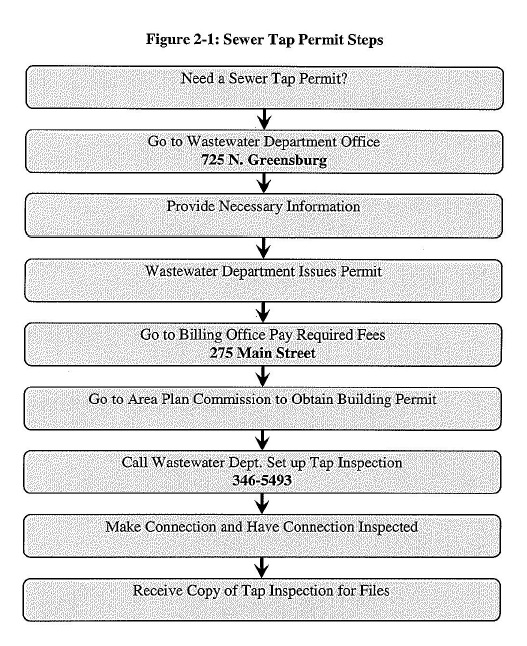
(2) Sewer tap permit obtained from North Vernon Wastewater Department (346-1496), Jennings Northwest Regional Utilities (346-5500), the Town of Vernon Clerk Treasurer (346-7438), or Campbell Township Rural Sewer District (Applicant should be aware of the sewer district in which they are located, because they may need to obtain a waiver, permit or release from that district.)
(Ord. passed 9-1-2006) Penalty, see § 154.999
§ 154.031 REQUIRED IMPROVEMENTS.
These required improvements pertain to all zoning sections in this chapter except for residential and agricultural zoning.
(B) Storm and surface water drainage.
(1) General requirements. The Commission shall not recommend for approval any subdivision plat, rezoning or site development permit which does not make adequate provision for storm or flood water runoff channels or basins. The storm water drainage system shall be separate and independent of any sanitary sewer system. Storm sewers, where required, shall be designed by methods approved by the Commission, and a copy of the design computations shall be submitted along with the plans. Inlets shall be provided so that surface water is not carried across or around any intersection, nor for a distance of more than 600 feet in the gutter or when the encroachment of storm water into the street disrupts traffic. When calculations indicate that curb capacities are exceeded at a point, no further allowance shall be made for flow beyond that point and catch basins or inlets shall be used to intercept flow at that point. Surface water drainage patterns shall be shown for each and every lot and block. Construction activities that result in the disturbance of one or more acres of land will be required to obtain a rule 5 permit from IDEM.
(2) Nature of storm water facilities.
(a) Location. The applicant may be required by the Commission to carry away by pipe or open ditch any spring or surface water that may exist, either previously to, or as a result of the subdivision. Such drainage facilities shall be located in the street right-of-way where feasible, or in perpetual, unobstructed easements of appropriate width, and shall be constructed in accordance with the county’s construction standards and specifications.
(b) Accessibility to public storm sewers.
1. Where a public storm sewer is accessible, the applicant shall install storm sewer facilities, or if no outlets are within a reasonable distance adequate provision shall be made for the disposal of storm water, subject to the specifications of the Commission. However, in subdivisions containing lots of less than 15,000 square feet in area and in business and industrial districts, underground storm sewer systems shall be constructed throughout the subdivision and be conducted to an approved outfall. Inspection of the facilities shall be conducted upon completion.
2. If a connection to a public storm sewer will be provided eventually, as determined by the Commission, the developer shall make arrangements for future storm water disposal by the public utility system at the time the plat receives final approval. Cost provisions for such connections shall be incorporated by inclusion in the amount of the performance bond or equivalent required for the subdivision plat.
(c) Accommodation of upstream drainage areas. A culvert or other drainage facility shall in each case be large enough to accommodate potential runoff from its entire upstream drainage area, whether inside or outside the subdivision. The Commission shall determine the necessary size of the facility, based on the provisions of the required construction standards and specifications assuming conditions of maximum potential watershed development permitted by this chapter.
(d) Effect on downstream drainage areas. The Commission shall determine the effect of each proposed subdivision on existing drainage facilities outside the area of the subdivision. County drainage studies together with such other studies as may be available and appropriate, shall serve as a guide to needed improvements. All costs that may be needed for any studies required by the Commission shall be provided by the developer. Where it is anticipated that the additional runoff incident to the development of the subdivision will overload an existing downstream drainage facility, the Commission may withhold secondary approval of the subdivision until provisions (such as a storage facility) have been made for the improvement of said potential condition in such sum as the Commission shall determine. No subdivision shall be approved unless adequate drainage from it will be provided to an adequate drainage water course or facility.
(e) Areas of poor drainage. Areas which are not in the floodplain but contain soils which are subject to flooding may be approved for subdivision by the Commission, provided that the subdivider fills the affected areas of said subdivision to an elevation sufficient to place building sites and streets two feet above ponding levels.
(f) Areas of high seasonal water tables. In areas characterized by soils having a high seasonal water table as determined by the County Soil and Water Conservation District, lots shall be limited to slab type construction unless the Commission determines that appropriate engineering techniques will be applied to alleviate the subsurface problem.
(g) Drainage design criteria. The subdivider shall size all storm sewers, culverts, ditches and other drainage structures based on runoff from a ten-year storm event using the appropriate intensity/duration curve for the area and a minimum time of concentration of five minutes. The drainage calculations shall also include the effect of the subdivision on the existing downstream drainage facilities outside the subdivided area. The Area Plan Commission shall also require detention facilities adequate to reduce runoff from proposed development to the extent that the 50-year post development flow is stored and the ten-year pre-development flow may be released.
(h) Floodway areas. If a subdivision of land is proposed within the floodplain, floodways shall be preserved and not diminished in capacity by filling or obstruction, except as approved by the Commission. No residential building site may be located within the floodway.
(i) Floodway fringe areas. Where a subdivision is proposed within an area of the floodplain designated as floodway fringe, the Commission may approve such subdivision provided that: all streets are elevated sufficiently to be above the regulatory flood elevation; all lots for residential usage have a flood protection grade two feet above the regulatory flood elevation; where provided, water and sanitary sewer facilities are constructed to eliminate contamination of or by, flood water; and, approval to fill the area from the Commission. Lands below the regulatory flood elevation shall not be used for computing the area requirement for any lot.
(j) Floodplain areas. Where a subdivision is proposed within an area of the floodplain for which floodway and floodway fringe designations have not been made, the Commission shall not approve such a subdivision unless all streets are raised sufficiently to be above the regulatory flood elevation; all lots for residential usage have a flood protection grade of two feet above the regulatory flood elevation; where provided, public water and sanitary sewer facilities are constructed to eliminate contamination of or by floodwater; and, filling to achieve the above will not raise the level of the regulatory flood elevation more than one-tenth of one foot for that reach of the stream. All filling in the floodplain must be approved in writing by the State Natural Resources Commission. Lands below the regulatory flood elevation shall not be used for computing the area requirement for any lot.
(k) Recording of plats in the floodplain and floodway fringe. All final plats having within their boundaries areas whose elevation is below that of the regulatory flood elevation shall show and label the regulatory flood boundary and elevation, as of the date the final plat is drawn, on the final plat for recording.
(3) Dedication of drainage easements.
(a) General requirements. Where a subdivision is traversed by a drainage course, drainage way, channel or stream, a storm water easement or drainage right-of-way shall be provided, granted or dedicated to the county conforming substantially to the lines of such watercourse, and of such width an construction or both as will be adequate for the purpose of both drainage and maintenance of the right-of-way. Wherever possible, it is desirable that the drainage be maintained by an open channel with landscaped banks and adequate width for maximum potential volume of flow.
(b) Drainage easements.
1. Where topography or other conditions are such as to make impractical the inclusion of drainage facilities within street rights-of-way, perpetual unobstructed easements at least 15 feet in width for such drainage facilities shall be provided across property outside the right-of-way lines and with satisfactory access to the street. Easements shall be indicated on the plat. Drainage easements shall be carried from the street to a natural watercourse or to other drainage facilities.
2. The applicant shall dedicate, either in fee or by drainage or conservation, easement land on both sides of existing watercourse of a width to be determined by the Commission.
3. When a proposed drainage system will carry water across private land outside the subdivision, appropriate drainage rights must be secured and indicated on the plat.
4. Low-lying lands along watercourses subject to flooding or overflowing during storm periods, whether or not included in areas for dedication, shall be preserved and retained in their natural state as drainage ways. Such land or lands subject to periodic flooding shall not be included in the computations for determining the number of lots allowable under average density procedures nor for computing the area requirement for any individual lot.
(C) Sidewalks. All development in said zones shall be required to have a paved sidewalk installed along the street or streets at the discretion of the Commission.
(1) Required improvements.
(a) Sidewalks shall be included within the dedicated, unpaved portions of the right-of-way of all streets within the development.
(b) Concrete curbs shall be installed as required.
(c) Any sidewalk that requires a setback from the road shall have a grassed or landscaped median strip between them.
(d) All sidewalks installed shall have ramps that are handicap accessible.
(e) Concrete shall be four inches by four feet minimum on four inches of stone or asphalt shall be three inches by six feet minimum on six inches of stone.
(2) Pedestrian access. In order to facilitate pedestrian access from the street to schools, parks, playgrounds or other nearby streets, the Commission may require perpetual unobstructed easements. Such easements shall be indicated on the exhibit.
(Ord. passed 9-1-2006) Penalty, see § 154.999
§ 154.032 ENVIRONMENTAL.
(A) Water pollution. No authorization of a use under this chapter includes the authority to discharge liquid or solid wastes into public waters except as permitted under the National Pollutant Discharge Elimination System (NPDES) permit program. The administration of the NPDES program in the state is the responsibility of the Office of Waste Management within the Department of Environmental Management under memorandum of agreement with the United States Environmental Protection Agency. Plans and specifications for proposed sewage and other waste treatment and disposal facilities must be approved by the State Department of Environmental Management and/or the State Department of Health, and any other state department or agency authorized to review and approve such facilities.
(B) Air pollution.
(1) Any use that emits any air contaminant as defined in I.C. 13-17 shall comply with applicable state standards concerning air pollution, as set forth in I.A.C. Title 326.
(2) No improvement location permit shall be issued with respect to any improvement covered by division (B)(1) above until the State Air Pollution Control Board has certified to the Administrator that the appropriate state permits have been received by the petitioner, or that the petitioner will be eligible to receive these permits and that the improvement is otherwise in compliance with applicable air pollution laws.
(Ord. passed 9-1-2006) Penalty, see § 154.999
§ 154.033 VARIANCES.
(A) Purpose. The Board, after public hearings, may vary the regulations of this chapter in harmony with their general purpose and intent, where the Board makes findings of fact in accordance with the standards hereinafter pre-described and further, findings that there are practical difficulties or particular hardships in the way of carrying out the strict letter of the regulations of this chapter. However, the Board shall not grant a variance for a use not permitted in the district.
(B) Applications for variances and notice of hearing. An application for a variance shall be filed in writing with the Zoning Enforcement Officer. The application shall contain such information as the Board may require. Notice of the time and place of public hearing shall be published as required by state law, as amended.
(C) Standards for variances. The Board shall not vary the regulations of this chapter except upon a determination and finding, based only on the evidence and testimony presented in public hearing before the Board, that:
(1) The grant will not be injurious to the public health, safety and general welfare;
(2) The use or value of the area adjacent to the property included in the variance will not be adversely affected;
(3) The need for the variance arises from some condition peculiar to the property involved and does not exist in similar property in the same zone; and
(4) The strict application of the terms of this chapter will constitute an unusual and unnecessary hardship as applied to the property for which a variance is sought.
(D) Conditions. The Board may impose such conditions and restrictions upon the premises as may be necessary or desirable to comply with the above standards.
(Ord. passed 9-1-2006) Penalty, see § 154.999
§ 154.034 SHOW CAUSE.
(A) Upon a summons to appear before the Area Plan Commission, a landowner or land-occupier may be compelled to show cause, if any he or she has why he or she should not be held in violation of the promulgated ordinances.
(B) The hearing shall be conducted as follows:
(1) The Executive Director shall briefly set forth the nature of the complaint;
(2) The landowner, land-occupier or his or her representative shall briefly set forth his or her position, to-wit: admitting or denying the allegations and a summary of evidence, if any, to be presented;
(3) The Chair shall, at his or her discretion, permit comments from the floor by interested parties, subject to the Chair’s discretion as to the number and length of comments in the interest of succinctness;
(4) Members shall be recognized by the Chair for the purpose of comments and to pose questions of any assembled for the purpose of fact-finding;
(5) The landowner, land-occupier or his or her representative shall be given the opportunity, at the chair’s discretion, to question or cross-examine the persons giving testimony;
(6) The Executive Director shall have the opportunity to briefly summarize his or her position;
(7) The landowner, land-occupier or his or her representative shall have an opportunity to briefly summarize his or her position;
(8) The Chair shall entertain final comments from members, as recognized, and ask for a motion from a member; and
(9) The Chair shall, upon a vote on said motion, shall issue a ruling and, if requested by a party, include a finding of facts in the record of proceedings along with the vote on the motion itself.
(Ord. passed 9-1-2006) Penalty, see § 154.999
§ 154.035 APPEALS.
(A) Scope of appeals. An appeal may be taken to the Board of Zoning Appeals by any person, firm or corporation, or by any office, department, board or bureau aggrieved by a decision of the Zoning Enforcement Officer. Such an appeal shall be taken within such time as shall be predescribed by the Board by filing with the Zoning Enforcement Officer a notice of appeal specifying the grounds thereof. The Zoning Enforcement Officer shall forthwith transmit to the Board all the papers constituting a record from which the action appealed was taken.
(B) Hearing on appeals. Hearing on appeals shall be pursuant to state law, as amended and by rules adopted by the Board.
(Ord. passed 9-1-2006) Penalty, see § 154.999
§ 154.036 AMENDMENTS.
The Board of Commissioners, the Common Council of North Vernon or the Town Board of Vernon may, from time to time, upon its own motion or upon the petition of the Area Plan Commission or of interested property owners as provided by statute, amend the regulations and districts established by this chapter. Proposals for such amendments may originate upon the petition of the Area Plan Commission or upon petition of 50% of the property owners in the area involved in such amendments. In either case, the Board of Commissioners, or the Common Council, may act upon such amendment only after a report has been submitted by the Area Plan Commission after public notice and hearing in accordance with provisions of the state law, as amended.
(Ord. passed 9-1-2006) Penalty, see § 154.999
§ 154.037 SPECIAL USES.
(A) Purpose. The development and execution of this chapter is based on the division of the county into districts, within which districts the use of land and buildings and the bulk and location of buildings and structures in relation to the land, are substantially uniform.
(1) It is recognized, however, that there are certain uses which, because of their unique characteristics, cannot be properly classified in any particular district or districts without consideration, in each case, of the impact of those uses upon neighboring land and of the public need for the particular use of the particular location.
(2) Such special uses fall into two categories:
(a) Uses publicly operated or traditionally affected with a public interest;
(b) Uses entirely private in character, but of such an unusual nature that their operation may give rise to unique problems with respect to their impact upon neighboring property or public facilities.
(B) Initiation of special use. Any person having a freehold interest in land, or a possessory interest entitled to exclusive possession, or a contractual interest which may become a freehold interest or an exclusive possessory interest, and which is specifically enforceable, may file an application to use such land for one or more of the special uses provided for in this chapter in the zoning district in which the land is located.
(C) Application for special use. An application and two copies for a special use shall be filed with the Zoning Enforcement Officer. The application shall be accompanied by such plans and/or data predescribed by the Board of Zoning Appeals and shall include a statement in writing by the applicant and adequate evidence showing that the proposed special use will conform to the standards set forth herein. Such application may be forwarded from the Zoning Enforcement Officer to the Area Plan Commission with a request for a report relative thereto; a copy shall also be forwarded to the Board of Zoning Appeals who shall hold a public hearing and shall consider the report of the Area Plan Commission, if any.
(D) Hearing on application for special use. Hearing on application for special use shall be pursuant to state law, as amended, and by rules adopted by said Board of Zoning Appeals.
(E) Decisions. No order of the Board of Zoning Appeals granting a special use permit shall be valid for a period longer than six months from the date of such order unless the Board specifically grants a longer period of time or an improvement location permit is obtained within the six-month period and construction is diligently being prosecuted to completion.
(F) Standards. No special use shall be granted by the Board of Zoning Appeals unless such Board shall find:
(1) That the establishments, maintenance or operation of the special use will not be detrimental to or endanger the public health, safety, comfort or general welfare;
(2) That the special use will not be injurious to the use and enjoyment of other property in the immediate vicinity for the purposes already permitted, nor substantially diminish and impair property values within the general area;
(3) That the establishment of the special use will not impede the normal and orderly development and improvement of the surrounding property for uses permitted in the district;
(4) That adequate utilities, access roads, drainage and necessary facilities have been or are being provided; and
(5) That adequate measures have been or will be taken to provide ingress and egress so designed as to minimize traffic congestion in the public streets.
(G) Conditions and guarantees. Prior to the granting of any special use, the Area Plan Commission may recommend and the Board of Zoning Appeals shall stipulate such conditions and restrictions upon the establishment, location, construction, maintenance and operation of the special use as deemed necessary for the protection of the public interest and to secure compliance with the standards and requirements specified in this section. In all planned developments, the findings and recommendations of the Area Plan Commission shall be required. In all cases in which special uses are granted, the Board of Zoning Appeals shall require such evidence and guarantees as it may deem necessary as proof that the conditions stipulated in connection therewith are being and will be complied with.
(Ord. passed 9-1-2006) Penalty, see § 154.999
§ 154.038 FEES.
(A) The fees established pursuant to schedule herein shall be received by the Zoning Enforcement Officer who shall pay into the Non-Reverting Fund of the county. The fee schedule is on file with the Area Plan Commission. No governmental entity shall be exempt from paying any fees required by this chapter.
(B) Any person or contractor who starts construction of any building, structure, dwelling, extension of an existing building or improvement before obtaining a permit or location improvement permit required by this chapter shall thereafter, when obtaining the applicable permit, be required to pay a permit fee equal to two times the required permit fee.
(Ord. passed 9-1-2006) Penalty, see § 154.999
§ 154.039 BUILDING CODE.
The current County Building Code can be obtained separately from the County Area Plan Commission.
(Ord. 07, 2008, passed 6-23-2008)

