
Jennings County Unincorporated
City Zoning Code
City Zoning Code
OFF-STREET PARKING
AND LOADING FACILITIES
§ 154.120 SCOPE OF REGULATIONS.
The off-street parking and loading provisions of this chapter shall apply as follows.
(A) For all buildings and structures erected and all uses of land established after the effective date of this chapter, accessory parking and loading facilities shall be provided as required by this chapter. However, where a building permit has been issued prior to the effective date of this chapter and provided that construction is begun within six months of such effective date and diligently prosecuted to completion, parking and loading facilities in the amounts required for the issuance of said building permit may be provided in lieu of any different amounts required by this chapter.
(B) When the intensity of use of any building, structure or premise shall be increased through the addition of dwelling units of measurement specified herein for required parking or loading facilities, parking and loading facilities as required herein shall be provided for such increase in intensity of use. However, no building or structure lawfully erected or use lawfully established prior to the effective date of this chapter shall be required to provide such additional parking or loading facilities unless the aggregate increase in units of measurements exceeds an amount equal to 15% of the number of units of measurement existing upon the effective date of this chapter.
(C) Wherever the existing use of a building or structure shall hereafter be changed to a new use, parking or loading facilities shall be provided as required for such new use. However, if the said building or structure was erected prior to the effective date of this chapter, additional parking or loading facilities are mandatory only in the amount by which the requirements for the new use would exceed those for the existing use had the latter been subject to the parking and loading provisions of this chapter.
(D) In order to prevent undue traffic congestion in areas of extensive business concentration and so promote an orderly and efficient circulation of pedestrians and vehicles, it is necessary and reasonable that off-street parking facilities be provided in such areas only in conformity with an overall, coordinated parking plan. To secure these objectives no accessory off-street parking facilities shall be required for any use in the central business district code area defined as follows:
The land bounded by Jennings, Main and Chestnut Streets and the Penn-Central right-of-way.
(Ord. passed 9-1-2006) Penalty, see § 154.999
§ 154.121 EXISTING PARKING FACILITIES.
Accessory off-street parking facilities in existence on the effective date of this chapter and located on the same lots as the building or use served shall not hereafter be reduced or further reduced below the requirements for a similar new building or use under the provisions of this chapter.
(Ord. passed 9-1-2006) Penalty, see § 154.999
§ 154.122 PERMISSIVE PARKING AND LOADING FACILITIES.
Nothing in this chapter shall be deemed to prevent the voluntary establishment of off-street parking or loading facilities to serve any existing use of land or buildings, provided that all regulations herein governing the location, design and operation of such facilities are adhered to.
(Ord. passed 9-1-2006) Penalty, see § 154.999
§ 154.123 DAMAGE OR DESTRUCTION.
For any conforming or legal non-conforming building or use which is in existence on the effective date of this chapter, which subsequently thereto is damaged or destroyed by fire, collapse, explosion or other cause, and which is reconstructed, re-established or repaired off-street parking or loading facilities need not be provided, except that parking or loading facilities equivalent to any maintained at the time of such damage or destruction shall be restored or continued in operation.
(Ord. passed 9-1-2006) Penalty, see § 154.999
§ 154.124 CONTROL OF OFF-STREET PARKING FACILITIES.
In cases where parking facilities are permitted on land other than the lot on which the building or use served is located, such facilities shall be in the same control as the lot occupied by the building or use to which the parking facilities are accessory. Such control may be either by deed or long-term lease, the term of such lease to be determined by the Board of Zoning Appeals. The parking facilities must also be located on land which is zoned the same as the building or use for which it serves. The owner of the land on which the parking facilities are located shall be bound by covenants filed on record in the Office of the Recorder of Deeds or the Registrant of Titles of the county, requiring such owner, his or her heirs and assigns, to maintain the required number of parking facilities for the duration of the use served or of the said lease, whichever shall terminate sooner.
(Ord. passed 9-1-2006) Penalty, see § 154.999
§ 154.125 OFF-STREET PARKING.
Off-street parking facilities shall be provided in accordance with additional regulations set forth herein.
(A) Use. Off-street parking facilities required for uses listed herein, shall be solely for the parking of passenger automobiles of patrons, occupants or employees.
(B) Exemption. When the application of the off-street parking regulations specified herein results in a requirement of not more than three spaces on a single lot in any business or commercial district, such parking spaces need not be provided. However, where two or more uses are located on a single lot, the foregoing exemption shall apply only if the total requirement for all uses is three spaces or less.
(C) Computation. When determination of the number of off-street parking spaces required by this chapter results in a requirement of a fractional space, any fraction of one-third or less may be disregarded while a fraction in excess of one-third shall be counted as one parking space.
(D) Collective provision. Off-street parking facilities for separate uses may be provided collectively if the total number of spaces so provided is not less than the sum of the separate requirements for each such use and provided that all regulations governing location of accessory parking spaces, in relation to the use served, are adhered to. Further, no parking spaces or portion thereof shall serve as a required space for more than one use unless otherwise authorized by the Board of Zoning Appeals.
(E) Area.
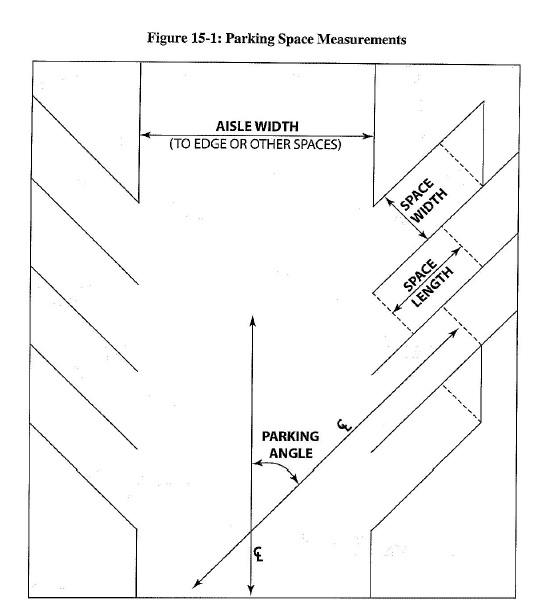
(1) All parking spaces and maneuvering aisles shall have the minimum dimensions set forth in the following table:
TABLE 15-1: PARKING DIMENSIONS
Minimum Parking Space and Aisle Dimensions for Parking Areas (In Feet)
| ||||
Angle of Parking (in degrees) | Width of Parking Space | Length of Parking Space | Maneuvering Aisle (one-way) | Maneuvering Aisle (two-way) |
76 - 90 | 9 | 18 | 22 | 22 |
61 - 75 | 9 | 18 | 18 | 22 |
46 - 60 | 9 | 18 | 17 | 22 |
0 - 45 | 8 | 22 | 12 | 22 |
(2) Measurement of parking space width and length, aisle width and parking angle shall be made as per the following diagram:
(F) Access.
(1) Each required off-street parking space shall open directly upon an aisle or driveway of such width and design as to provide a safe and efficient means of vehicular access to such parking space. All off-street parking facilities shall be designed with appropriate means of vehicular access to a street or alley in a manner which will least interfere with traffic movement. No driveway across public property at the right-of-way line shall exceed a width of 25 feet.
(2) A driveway permit shall be obtained:
(a) From the county garage if the drive comes off a county road and there is no existing culvert (346-2967);
(b) From the State Department of Transportation (Madison Sub-District Office) if drive comes off a state highway (812-574-4368); and
(c) From the city if the drive comes off a city street, at the City Street Department (346-1616) or the City Clerk Treasurer (346-5907).
(G) Design and maintenance.
(1) Open and enclosed parking spaces. Accessory parking spaces may be open to the sky or enclosed in a building.
(2) Surfacing. All open off-street parking areas containing more than four parking spaces shall be improved with a stabilized base, not less than six inches thick, surfaced with asphalt or treated with some comparable all-weather dustless material.
(3) Screening and landscaping. All open automobile parking areas, containing more than four parking spaces, located less than 40 feet away from a property line shall be effectively screened on each side adjoining or fronting on any property situated in a residential district or any institutional premises by a wall, fence or densely planted compact hedge, not less than five feet nor more than eight feet in height.
(a) For an outdoor parking area containing 20 or more parking spaces, at least one tree shall be planted for every ten parking spaces on any side of the perimeter of such parking area that abuts the side line of a private or public way, or abuts the lot line of land in residential districts or land used for residential purposes.
(b) In any outdoor parking area, a landscaped open space having an area of not less than 10% of the outdoor parking area on the lot shall be provided. A minimum of one-half of the required landscaped open space shall be located in the interior of the parking area and contain ornamental or shade trees and/or shrubs and/or other appropriate plant materials to provide shade and color easily visible when the lot is full of cars.
(c) Trees required by the provisions of this division (G)(3) shall be at least two inches in diameter at a height of five feet at the time of planting and shall be of a species characterized by rapid growth and by suitability and hardiness for location in a parking lot. To the extent practicable, existing trees shall be retained and used to satisfy the provisions of this division (G)(3).
(4) Lighting. Any lighting used to illuminate an off-street parking area, maneuvering space, or driveway shall be directed and shielded away from residential properties in such a way as to not create a nuisance. All parking areas, maneuvering spaces and driveways shall be designed or shielded so that direct lighting from automobile headlights are not directed on to residential property.
(5) On any parking area in any district, all paved portions of all parking spaces and maneuvering aisles shall be set back five feet from any wall of a building, and five feet from any private or public way, or any lot line of any land in residential districts or used for residential purposes.
(H) Location. All parking spaces required to serve buildings or uses erected or established after the effective date of this chapter shall be located on the same lot as the building or use served. Buildings or uses existing on the effective date of this chapter which are subsequently altered or enlarged so as to require the provision of parking spaces under this chapter may be served by parking facilities located on land other than the lot on which the building or use served is located, provided such facilities are within 500 feet walking distance of a main entrance to the use served.
(I) Employee parking. Parking spaces required on an employee basis shall be based on the maximum number of employees on duty or residing, or both, on the premises at any one time.
(J) Maximum number of spaces. The total number of accessory parking spaces provided for a single-family, two-family or multiple-family dwelling shall not exceed that required by this chapter for such use or for an equivalent new use by more than 50% or four spaces, whichever is greater.
(K) Required spaces. Off-street parking spaces accessory to designated uses shall be provided as follows:
Use | Parking Spaces |
Use | Parking Spaces |
Hospitals | 1 per 4 beds, plus 1 per 2 employees, plus 1 per staff doctor |
Hotels | 1 per guest room |
Laundromats | 1 per 2 washing machines, plus 1 per 2 employees |
Libraries, museums and art galleries | 10 plus 1 per 300 square feet of floor area over 2,000 square feet |
Manufacturing, industrial or wholesale establishment, laboratory, company, bottling plant, warehouse or similar establishments | 1 per 2 employees on maximum working shift, plus adequate space to accommodate company vehicles |
Medical and dental clinics | 5 per each doctor |
Motel, tourist homes | 1 per guest room plus 2 at office and tourist courts |
Motor vehicle sales | 1 per 300 square feet of sales floor area in excess of 1,000 square plus 1 per 2,000 square feet of open area |
Multi-family dwellings | 1½ per dwelling unit |
Nursery, elementary, junior high and high schools | 1 per classroom and office, or 1 per 10 seats in the auditorium, whichever is greater |
Nursing, convalescent rest homes and other health homes and institutions | 1 per 4 beds, plus 1 per 2 employees, plus 1 per staff doctor |
Offices and office buildings | 1 per 400 square feet of floor area |
Residential - one- and two-family dwellings | 2 per dwelling unit |
Restaurants (except drive-ins, night clubs, taverns and lounges) | 1 per 3 persons based upon the maximum number of persons that can be accommodated at the same time in accordance with design capacity |
Retail stores or personal service Establishments | 1 per 200 square feet of floor area plus 1 per 2 employees |
Rooming, boarding or lodging houses | 1 per 2 rooms, plus 1 for owner or manager |
Theaters, auditoriums, gymnasiums, stadium areas, convention halls and places of assembly with fixed seats | 1 per 5 seats, plus 1 per 2 employees |
(Ord. passed 9-1-2006) Penalty, see § 154.999
§ 154.126 OFF-STREET LOADING.
Off-street loading berths accessory to designated uses shall be provided as follows.
(A) Location. All required loading berths shall be located on the same lot as the use served. All loading berths which abut a residential district or intervening alley separating a residential district from a business, commercial or manufacturing district shall be completely screened therefrom by building walls, or a uniformly painted solid fence, wall or solid non-deciduous, screen planting or any combination thereof, not less than six feet in height. No loading berth shall be located within 40 feet of the nearest point of intersection of any two streets. No loading berth shall be located in a required, front or side yard, and any loading berth located in a required rear yard shall be open to the sky.
(B) Area. Unless otherwise specified, a required off-street loading berth shall be at least 12 feet in width by at least 60 feet in length, exclusive of aisle and maneuvering space, and shall have a vertical clearance of at least 14 feet.
(C) Access. Each required off-street loading berth shall be designed with appropriate means of vehicular access to a street or alley in a manner which will least interfere with traffic movement.
(D) Surfacing. All open off-street loading berths shall be improved with a cement concrete pavement, not less than seven inches thick, or a comparable hard surface pavement.
(E) Repair and service. No motor vehicle repair work or service of any kind shall be permitted in conjunction with loading facilities.
(F) Utilization. Space allocated for vehicle repair work or service of any kind shall be permitted in conjunction with loading facilities.
(G) Minimum facilities. Uses for which off-street loading facilities are required herein, but which are located in buildings of less floor area than the minimum prescribed for such required facilities, shall be provided with adequate receiving facilities, accessible by motor vehicle, off any adjacent alley, service drive or open shape of the same lot.
(H) Off-street berth requirements.
(1) Off-street loading facilities accessory to uses requiring the receipt of shipping of material or merchandise by trucks or similar vehicles shall be provided in accordance with the following minimum requirements:
Use | Floor Area (Square Feet) | Number of Spaces |
Funeral home or mortuary | 20,000 to 100,000 Each additional 100,000 | 1 1 |
Hotel, offices, hospitals or similar institutions; private clubs and lodges; educational and cultural institutions; places of public assembly | 20,000 to 200,000 | 1 |
Retail, service repair establishments, restaurants | 10,000 to 20,000 20,000 to 40,000 40,000 to 100,000 100,000 to 250,000 Each additional 100,000 | 1 2 3 4 1 |
Warehouse and storage, wholesale and industrial establishments | 5,000 to 20,000 20,000 to 100,000 Each additional 100,000 | 1 2 1 |
(2) For all other business or commercial uses, loading facilities shall be provided in accordance with the following schedule:
Gross Floor Area of Establishment | Required Number and Size of Berths
|
5 to 10 | 1 - (12 ft. x 35 ft.) |
10 to 25 | 2 - (12 ft. x 35 ft. each) |
25 to 40 | 2 - (12 ft. x 60 ft. each) |
40 to 100 | 3 - (12 ft. x 60 ft. each) |
For each additional 200,000 square feet of gross floor area or fraction thereof over 100,000 square feet of gross floor area; one additional loading berth shall be provided; such additional berth to be at least 12 feet in width by 60 feet in length. | |
(3) For all uses that are not business, commercial or manufacturing establishments, loading facilities shall be provided in accordance with requirements designated by the Board of Zoning Appeals.
(Ord. passed 9-1-2006) Penalty, see § 154.999

