
Jennings County Unincorporated
City Zoning Code
City Zoning Code
ZONING DISTRICTS
§ 154.050 AGRICULTURAL ZONING.
(A) Introduction.
(1) For documentation of issues addressed in this chapter, see Jennings County Comprehensive Plan, Chapter VI: “Land Use,” November 1, 1994.
(2) Changes in zoning in an agricultural district shall require a record of covenant between the original owner and the new owner stating that the property is in a predominantly agricultural area, and all farming operations (including but not limited to livestock and field crop operations), as described in this chapter, may continue to be practiced in the district. The new owner (on behalf of himself or herself and all future owners and occupants of the property) shall waive the right to bring claim against any farmer or agricultural producer for the practice of any reasonable or necessary farming or livestock activity, including existing uses or new practices. All such agreements, covenants and restrictions shall be transferred to future owners and occupants of the property, and shall be binding upon the applicant and the applicant’s successors in interest.
(B) Establishment of Agricultural Zoning District. The following agricultural zoning district is established in the county, and is abbreviated as indicated. Land within the county is classified, divided and zoned into said district as designated on the zoning maps, which maps are attached hereto, incorporated herein by reference and made a part of this chapter.
Agricultural District | Abbreviation |
Agricultural | AG |
(C) Agricultural regulations.
(1) Agricultural operations. It is the intent and policy of the County Area Plan Commission that individual farmers be allowed to perform any and all activities necessary to support the operation of their farms without unnecessary and burdensome regulations. Therefore, any development which is proposed within or adjacent to an Agricultural District is expected to acknowledge and accept the character of the nearby agricultural operation and its accompanying activities without claim of nuisance.
(a) The individual farmer shall be allowed all activities necessary to support the production of crops and/or livestock within the Agricultural District.
(b) With regard to the storage of agrichemicals, the farmer shall be allowed to store any chemicals necessary to support agricultural activities within the Agricultural District, so long as the farmer does not engage in the retail sale of said chemicals.
(c) An agricultural parcel can be subdivided to accommodate a residence for a family member without submitting a plat.
(d) A division of land for agricultural purposes into lots or parcels of ten acres or more and not involving a new street shall not be deemed a subdivision, however, these lots or parcels shall meet the residential standards for lot width to depth ratios. (See § 154.051 “Residential Zoning.”)
(e) Roadside stands for retail sale of agricultural produce shall be permitted so long as the goods sold are locally produced.
(f) Agricultural buildings are exempt from a building permit, if they are being used for agricultural purposes only. Buildings located on less than ten acres are required to obtain a building permit, regardless of use. (Reference I.C. 22-12-1-2 for definition of “Agricultural Purpose.”)
(2) Confined feeding operations.
(a) A confined feeding operation is the confinement for any period of time of livestock or fowl, whether open or enclosed, to any area less than required in the following schedule:
Class of Livestock | Lot Area (Sq. Ft. per Animal) (1) |
Shed (Sq. Ft. per Animal)
|
Class of Livestock | Lot Area (Sq. Ft. per Animal) (1) |
Shed (Sq. Ft. per Animal)
|
Beef breeding cows | 100 | 80 |
Commercial flock per hen | 8 | 4 |
Dairy cows | 250 (2) | 150 |
Ewes | 60 | 30 |
Farm laying flock per hen | 12 | 6 |
Feeder calves (less than 600 lbs) | 60 | 60 |
Feeder calves (600 lbs or greater) | 80 | 50 |
Feeder lambs | 30 | 14 |
Hogs growing (40 - 120 lbs) | 10 | 6 |
Hogs finishing (100 - 255 lbs) | 24 | 12 |
Sows | 60 | 30 |
(1) For unpaved lots double the space requirements. (2) Double lot size for complete confinement (no exercise lot). | ||
(b) Confined feeding operations as defined herein shall be operated in compliance with I.C. 13-18-10 and all applicable laws and regulations of the state.
(c) Confined feeding operations shall be located no less than 1,000 feet from any residential zoning district, nor less than 1,000 feet from any existing residence in an agricultural zoning district.
(3) Junk automobiles (vehicles). Vehicles not in operating condition and parked at a residence more than 30 days may be removed from the property with the notification by certified mail to the vehicle owner. These vehicles will be towed at the owner’s expense to a holding area for 30 days and then disposed of to a legal salvage yard. Notification and removal will be under court and police supervision. A show cause hearing will not be held for these violations.
(4) Mobile home. (See the Jennings County Comprehensive Plan Chapter III “Housing” and Chapter VI “Land Use Patterns” for documentation of issues addressed.)
(a) A mobile home or manufactured home which is less than 15 years and exceeding 600 square feet of occupied space may only be placed on real estate owned or being purchased by the applicant, or owned by an immediate family member and must contain no less than one acre in area, with 150 feet frontage onto a county road, with a minimum set back line of 50 feet from property line (75 feet from center of county road) and with a side line set back of 25 feet. Only mobile homes having sleeping accommodations, a flush toilet and tub or shower bath shall be occupied by applicant as living quarters. Mobile homes must be placed in accordance with Council of American Building Officials (CABO) One- and Two-Family Dwelling Code, Appendix A. A skirt must be erected around the bottom of the mobile home. The sewage (septic) disposal system for the mobile home must be approved by the County Department of Health. Upon satisfaction of these requirements a certificate of occupancy must be obtained from the Director of the Area Plan Commission.
(b) A mobile home or manufactured home constructed after January 1, 1981 and more than 15 years old shall receive a certificate of occupancy from the Director of the Area Plan Commission if it is inspected by the County Building Inspector or an inspector certified by the Department of Housing and Urban Development and the inspector certifies, in writing, that it is suitable and safe for living and meets all of the other requirements above, except the age requirement. In the event that the permit is denied under this division (C)(4)(b) the applicant may apply for a variance under this chapter.
(5) Unnecessary clutter. No one shall be permitted to heap, litter or strew in a confused and disorderly manner, any materials or objects on property owned, leased or rented for agricultural purposes.
(6) Yard sales. Each residential household is permitted three yard (garage) sales per calendar year, not to exceed three days each. Time established will be sunrise to sunset, and items not sold must be cleared from the premises within a 24-hour period.
(Ord. passed 9-1-2006; Ord. 04, 2008, passed 6-23-2008; Ord. 2021-03A, passed 3-18-2021) Penalty, see § 154.999
§ 154.051 RESIDENTIAL ZONING.
(A) Introduction. For documentation of issues addressed in this chapter, See Jennings County Comprehensive Plan, Chapter III: “Housing” and Chapter VI: “Land Use,” November 1, 1994.
(B) Establishment of residential zoning districts. The following residential zoning districts are established in the county and are abbreviated as indicated. Land within the county is classified, divided and zoned into said districts as designated on the zoning maps, which maps are incorporated herein by reference and made a part of this chapter.
Residential | Abbreviations |
Residential Multiple-Family | R-MF |
Residential Resorts | R-R |
Residential Single-Family | R-1F |
Residential Two-Family | R-2F |
(1) Residential Single-Family (R-1F) Districts are designed for detached single-family dwellings.
(2) Residential Two-Family (R-2F) Districts are designed for two-family dwellings commonly known as “duplexes or doubles.”
(3) Residential Multiple-Family (R-MF) Districts are designed for multi-family residences, such as apartments, or any type of residential building designed to accommodate more than two families.
(4) Residential Resort (R-R) Districts are designed for resort living.
(C) Residential regulations. The following regulations shall apply to all land within the residential districts.
(1) Regulation conformation after the effective date of this chapter.
(a) With the exception of legally established non-conforming uses, no land, building, structure, premises or part thereof shall be used or occupied except in conformity with these regulations and for uses permitted by this chapter.
(b) No building, structure, premises or part thereof shall be constructed, erected, converted, enlarged, extended, reconstructed or relocated except in conformity with these regulations and for uses permitted by this chapter. (For steps on how to obtain a building permit, refer to § 154.030.)
(c) Provided, however, legally established non-conforming uses may be reconstructed if damaged or partially destroyed by fire or other disaster when such damage destruction does not exceed two-thirds of the gross floor area of the structure or facilities affected.
(d) Provided, however, any previously officially recorded, platted lot having less than the minimum lot area and/or minimum lot width required by the applicable residential district regulations of this chapter of a one-family dwelling, shall be deemed an exception to such minimum lot area requirement, and a one-family dwelling may be constructed thereon provided all other requirements of this chapter, including minimum yard and setback requirements, shall be met.
(e) Provided further, however, any legally established non-conforming use, public elementary, junior high or high school (including any structures, facilities and parking areas accessory thereto) may be constructed, erected, converted, enlarged, reconstructed or relocated for such public elementary, junior high or high school use on the same lot or parcel.
(2) Performance standards. All uses established or placed into operation after the effective date of this chapter shall comply with the following performance standards. No use in existence on the effective date of this chapter shall be so altered or modified as to conflict with these standards.
(a) Vibration. No use shall cause earth vibrations or concussions detectable beyond the lot lines without the aid of instruments.
(b) Smoke, particulate matter, noxious matter. No use shall emit smoke of a density exceeding that of a normal residence, nor burn any materials or chemicals other than standard heating fuels such as fuel oil, propane or natural gas, with the exception of burning wood in approved residential places.
(c) Odor. No use shall emit across the lot lines odor in such quantity as to be readily detectable at any point along the lot lines and as to be detrimental to or endanger the public health, safety or welfare or cause injury to property.
(d) Sound. No use shall produce sound in such a manner as to endanger the public health, safety or welfare or cause injury to property. Sound shall be muffled so as not to become detrimental due to intermittence, beat frequency, shrillness or vibration.
(e) Heat and glare. No use shall produce heat or glare creating a hazard perceptible from any point beyond lot lines.
(f) Junk automobiles (vehicles). Vehicles not properly licensed nor in running condition and parked at a residence more than 30 days may be removed from the property with the notification by certified mail to the vehicle owner. These vehicles will be towed at owner’s expense to a holding area for 30 days and then disposed of to a legal salvage yard. Notification and removal will be under court and police supervision. A show cause hearing will not be held for these violations.
(g) Unnecessary clutter. No one shall be permitted to heap, litter or strew in a confused and disorderly manner, any material or objects on property owned, leased or rented for residential purposes.
(h) Waste burning. No use shall accumulate within the lot or discharge beyond the lot lines any waste matter, whether liquid or solid, in violation of the applicable standards and regulations of the Department of Environmental Management or in such a manner as to endanger the public health, safety or welfare or cause injury to property.
(i) Leaf burning. Burning of leaves shall be regulated by the incorporated community. In unincorporated areas, however, burning of leaves shall be permitted in residential zones after dawn and before dusk.
(j) Yard sales. Each residential household is permitted three yard (garage) sales per calendar year, not to exceed three days each. Time established will be sunrise to sunset, and items not sold must be cleared from the residence within a 24-hour period.
(3) Blight. Land that is in a dilapidated, unsafe and unsightly condition. No one shall be allowed to keep their property in the following conditions:
(a) Unnecessary clutter.
(1) Heap, litter, or strew, in a confused and disorderly manner, any material or objects on property owned, leased, or rented for residential purposes;
(2) Discarded household appliances, furniture, tires, motor and electric vehicle parts, tools, lawn equipment, construction material, scrap metal, trailers, hauling equipment, machinery, barrels, grills, plastic, and/or Styrofoam.
(b) Missing or boarded up windows and/or doors;
(c) Extreme uncontrolled vegetation in, on, or around the base of the home such as weeds, vines, trees, grass, etc.;
(d) Exterior deterioration or decay such that it leads the property to be unsafe, unhealthy, or impairs the property values. Specifically gutters that have fallen or are falling off the structure, eaves, soffits, decks, porches, wall or roof coverings that do not provide adequate weather protection or are completely missing;
(e) Unhealthy living conditions including, but not limited to, mold, vermin, pigeons, feces and other harmful conditions
(4) Residential development standards.
(a) Development standards in residential districts fall into two categories, dictated by the type of sanitation provided for the residences, either by the provision of sanitary sewers or provision of septic tank disposal.
(b) Multiple-family residences must have sewer service and are not permitted to use septic tanks. R-MF special development standards. R-MF Districts shall meet the following development standards in addition to those shown above.
1. The lot area shall be a minimum of 3,000 square feet for every living unit.
2. Buildings shall occupy not more than 30% of the lot area.
TABLE 6-1 RESIDENTIAL LOT LAYOUTS
R-1F Septic | R-1F Sewer | R-2F Septic | R-2F Sewer | R-MF Sewer |
R-1F Septic | R-1F Sewer | R-2F Septic | R-2F Sewer | R-MF Sewer | |
Lot Size | |||||
Minimum lot (5) | 1 acre | 10,000 sq. ft. | 2 acres | 15,000 sq. ft. | 12,000 sq. ft. |
Minimum lot width (1)(5) | 150 ft. | 80 ft. | 250 ft. | 100 ft. | 150 ft. |
Flag lot width (at road) | 50 ft. | 50 ft. | 50 ft. | 50 ft. | 50 ft. |
Off-Street Parking (3) | |||||
Minimum spaces | 2 | 2 | 4 | 4 | 1.5 per unit |
Setback & Yards | |||||
Minimum front yard setback (2)(6) | 75 ft. | 50 ft. | 75 ft. | 50 ft. | 60 ft. |
Flag lot (8) | 50 ft. | 50 ft. | 50 ft. | 50 ft. | 50 ft. |
Minimum rear yard setback (6) | 25 ft. | 25 ft. | 25 ft. | 25 ft. | 20 ft. |
Outbuilding (7) | 10 ft. | ||||
Minimum side yard setback (6) | 25 ft. | 10 ft. | 50 ft. | 15 ft. | 10 ft. |
Outbuilding (excluding swimming pool) | 10 ft. | ||||
Structure Size (4) | |||||
Maximum height | 32 ft. | 32 ft. | 32 ft. | 32 ft. | 40 ft. |
Minimum floor area | 950 sq. ft. | 950 sq. ft. | 1,700 sq. ft. | 1,700 sq. ft. | 600 sq. ft./unit |
(1) Lot width is measured at the building line. (2) Any side of a lot that faces a public street or public right-of-way shall be considered a front and shall have appropriate setback, measured from the centerline of the road or street. Under no circumstances shall the front yard setback be less than 25 feet from the right-of-way line. (3) Off-street parking spaces as defined in Chapter 2, Section C. (4) No singlewide mobile homes are permitted inside the Town of Vernon or City of North Vernon. (5) Corner lots shall be 15 feet wider than the minimum required or 20% larger in total area. (See Figure 6-4 for visual of a corner lot.) (6) Any lot that is adjacent to a state highway shall be 1.5 times the standard setback for any front that faces the highway. (7) Outbuilding setbacks are for all lots including flag lots. (8) The front yard setback shall begin at the point where the property becomes at least 150 ft. wide. | |||||
(Refer to figure 6-1 through 6-4 for graphical representations.) Fences in any residential district shall not exceed six feet in height as long as it does not obstruct view of public ways and in a way that promotes and maintains essential values: public safety, protection of individual property rights, and quality life for residents. The depth to width ratio of any residential lot may not exceed a maximum of 6 to 1 or a minimum of 2/3 to 1. (Where 1 is the lot width in both cases) (See Figure 4-1: Depth to Width Ratio for an example.) | |||||
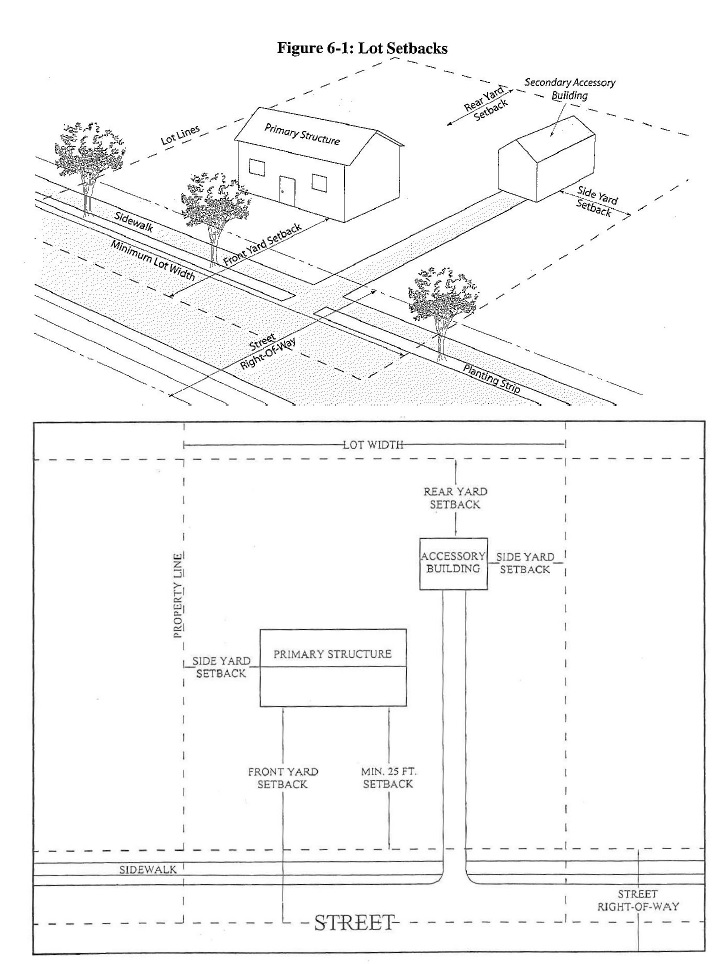
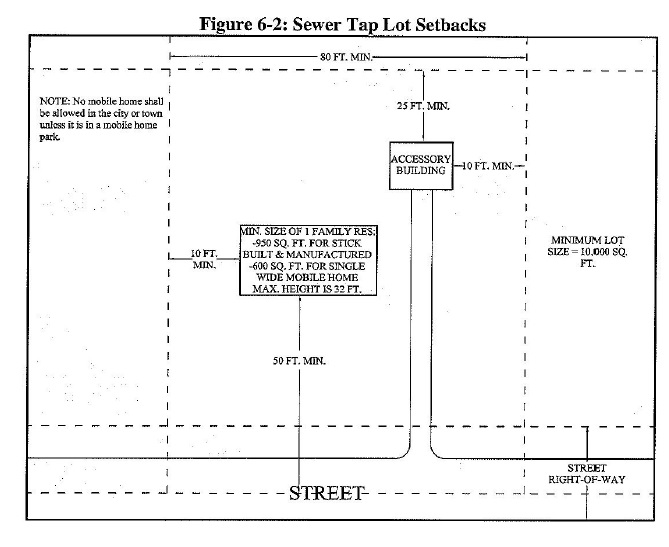
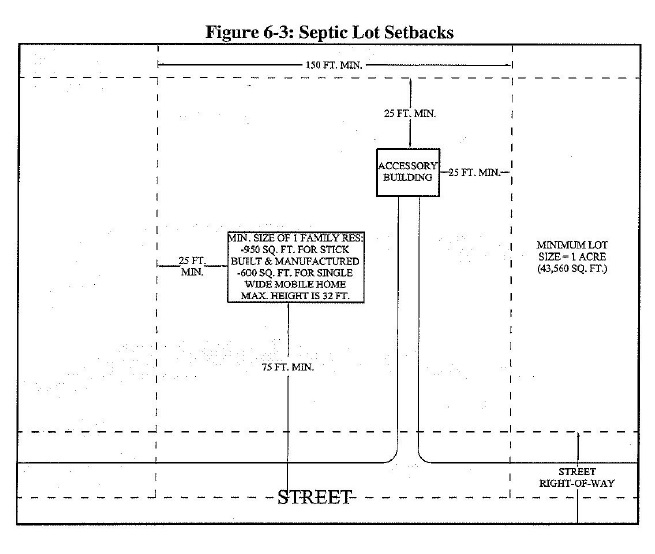
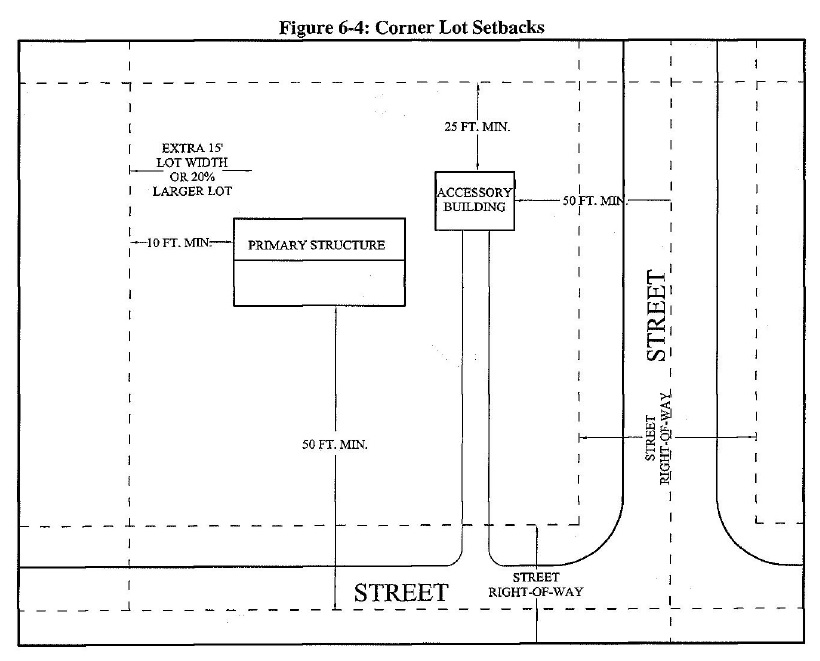
(D) Special regulations for mobile homes, recreational vehicles, travel trailer and tents.
(1) Mobile homes, as defined in the definitions section, shall comply with all regulations for residential districts and shall comply with all following special regulations for mobile homes.
(2) Every mobile home must retain a HUD certification tag, verifying that the home was constructed in accordance with the regulations of the U.S. Department of Housing and Urban Development.
(3) Every mobile home shall meet state requirements for tie-downs and underpinnings.
(4) Single-wide mobile homes that are not in mobile home parks must have the area under each unit, surrounded by a permanent skirt of sufficient construction so as to cover the area between the bottom of the unit and the top of the base or ground. Any double-wide mobile home over 16 feet by 80 feet shall be on a permanent foundation.
(5) Trailers and mobile homes shall not be permitted in any district as accessory buildings.
(6) Mobile homes shall not be parked or stored in any district, except at a permitted trailer sales establishment. Mobile homes, trailers or recreational vehicles shall not be occupied for dwelling or lodging purposes except in an approved mobile home park. Travel trailers are not suitable for use as residences. A mobile home, recreational vehicle or travel trailer, belonging to a guest of the occupant of a dwelling in an agricultural district or residential district, may be parked and occupied for lodging purposes on the same lot as the dwelling for not more than 72 hours in any 30-day period.
(7) Trailers, recreational vehicles or mobile homes may be used as temporary offices or storage space incidental to construction of a building development for a period of time as such construction is actively undertaken provided the trailer or mobile home is located on the same lot as the building development.
(8) Tents shall not be erected, used or maintained for dwelling, lodging or other purposes, except as regulated herein.
(E) Special uses - residential districts.
(1) Mobile home park.
(a) Mobile home park shall be a special use permitted only in R-MF districts.
(b) A mobile home park must be on a lot no less than five acres in area, with a minimum road frontage of 300 feet. No mobile home shall be nearer than 50 feet to a county road. There shall be a minimum of two entrances to a mobile home park, unless a different number is approved by the Area Plan Commission.
(c) Each mobile home site shall be no less than 5,000 square feet in area and no less than 50 feet in width, with an average of all sites to be no less than 5,000 square feet in area. Each mobile home lot shall have a minimum 24 feet setback from mobile home park streets and minimum ten feet side and rear yards.
(d) A mobile home park may include accessory uses, buildings or structures such as a community center, laundry facilities, offices and the like, provided that they are located, designed and intended to serve only persons living in the park, and provided that such buildings shall not occupy more than 10% of the total area of the park, and provided that such uses shall present no visible evidence of the commercial nature of their uses to areas outside the park.
(e) There shall be a park or playground area equal to at least 8% of the park area.
(f) Sanitary sewage, storm sewer and water systems, service drives, off-street parking equal to at least two parking spaces for each mobile home, grading and landscaping, buildings and other improvements shall be constructed in accordance with development plans and specifications approved by the Board of Zoning Appeals. No on-street parking is permitted.
(g) Street construction shall meet the standards of the Subdivision Control Ordinance of the county and/or other governmental unit in which the mobile home park is located. Mobile home park streets shall be paved with portland cement concrete or bituminous concrete. Such streets shall be a minimum of 24 feet wide.
(h) A paved sidewalk shall be installed on at least one side of each mobile home park street. The minimum width of such sidewalks is four feet.
(i) Surface drainage as approved by the Area Plan Commission shall be installed and maintained by the applicant or his or her successor in title. The Area Plan Commission may require curbs and/or gutters in mobile home parks where, in the opinion of said Commission, drainage of surface water is insufficient to properly carry such surface water.
(j) Outside storage is prohibited. Applicant/developer shall provide minimum storage space and requirements for storage buildings in the covenants.
(k) Each mobile home shall be installed in accordance with Cabo One and Two Family.
(1) All exterior lights shall be located and shielded to prevent direct illumination outside the park. All refuse containers shall be screened from view. A dense greenbelt of evergreen trees or shrubs, not less than six feet in height, shall be located and maintained along all park boundaries.
(m) Prior to issuance of an improvement location permit, an applicant must file with the Director a letter from the State Board of Health evidencing approval by such Board and compliance with the requirements of such Board.
(2) Bed and breakfast. Operation of a bed and breakfast, as defined in § 154.008, within a residential district shall be subject to all following regulations for a bed and breakfast.
(a) There shall be on the premises a minimum of one parking space per rental unit.
(b) The bed and breakfast must meet state approved standards for lodging, food preparation, food service and any other state-regulated activities conducted in the operation of the bed and breakfast.
(c) A single unlighted business sign, not larger than one square foot, may be posted on the premises.
(d) This is a special use within residential districts and will be revoked if the requirements are violated.
(3) Home occupation or home business. Operation of a home occupation, as defined in § 154.008 within a residential district shall be subject to all regulations of residential districts and shall be subject to the following regulations for a home occupation.
(a) A single unlighted business sign, not larger than five square feet, may be posted on the premises.
(b) The business must provide off-street parking for clients/customers, as well as for every employee. At such time as the parking needs of the business exceed the parking available on the residential premises, the business shall no longer be considered a home occupation and must operate in a commercial district.
(c) A home occupation shall not employ more than two non-family employees. Businesses with more than two non-family employees must operate in a commercial district. Off-street parking shall be provided at one space for every employee plus two additional spaces for customers, clients and suppliers.
(d) A home occupation/business that is located in a building not attached to the residence shall be located within 100 feet and on the same property as the residence.
(e) A home occupations/business permit shall be revoked if any of the said requirements are violated. If a property changes ownership or the business type changes, the owner must re-apply for a home occupations/business permit.
(4) Residential facility for the mentally ill. Any residential facility for the mentally ill, including group homes, shall be required to submit documentation showing their geographic location by map or address. This information will be used to determine if the property is at least 3,000 feet from any other facility for the mentally ill.
(F) Violation enforcement and penalties.
(1) Enforcement.
(a) Any person, firm, or corporation who violates the ordinances of the Jennings County Code shall be liable and subject to the enforcement and penalties of the Jennings County Area Plan Commission (APC).
(b) The enforcement and penalties for violations to the Jennings County Zoning Ordinance shall adhere to the following structure:
1. Violation classification.
a. A-Level infraction (low);
b. B-Level (medium);
c. C-Level (high).
2. A-Level. Violations that can be remediated quickly and by nature are not extremely detrimental to the safety and well-being of the owners, tenants or general public. Ordinances include:
a. Grass Ordinance violations;
b. Extreme overgrowth of vegetation;
c. Trash, litter, or debris;
d. Unoperable/unlicensed vehicles.
3. B-Level. Violations that are more serious in nature and place the homeowner, tenant or general public in a safety or health hazard. These violations can be remedied in a 30- to 60-day period so long as the violator is actively working with the APC to resolve the problem. Ordinances include:
a. Blight.
4. C-Level. Violations that are extremely severe to the point that the property is condemnable and/or uninhabitable. These properties are typically, but not always, vacant or abandoned. Ordinances include:
a. Extreme deterioration such as holes in roof, structurally unsafe, extreme health hazard due to rodents, mold, and or sewage;
b. Violations to the Animal Control Ordinance;
c. Fire damage of longer than 60 days.
(2) Violation enforcement process per classification.
(a) A-Level.
1. Letter with 15 days to resolve violation or to contact APC Office to address the issue;
2. Director has discretion to allow more time or connect them with resources if they qualify;
3. Attorney files legal action after 15 days if issue is not resolved or more time has not been granted by the APC Director;
4. If case is not dismissed prior to the court hearing, a fine of no less than $100 and no more than $1,500 will be assessed at the court hearing;
5. If fine is not paid, then it will be assessed to the property taxes.
(b) B-Level.
1. Letter with 30 days to resolve violation or to contact APC Office to address the issue;
2. Director has discretion to allow more time or connect them with resources if they qualify;
3. If they do not comply within 30 days or the APC director has not allotted them more time, then they will be brought to the next APC "Show Cause" hearing;
4. If case is not dismissed prior to the court hearing, a fine of no less than $100 and no more than $1,500 will be assessed at the court hearing;
5. If fine is not paid, then it will be assessed to the property taxes.
(c) C-Level.
1. Letter with 30 days to resolve violation or to contact APC Office to address the issue;
2. Director has discretion to allow more time or connect them with resources if they qualify;
3. Attorney files legal action after 30 days if issue is not resolved or more time has not been granted by the APC Director;
4. If case is not dismissed prior to the court hearing, a fine of no less than $100 and no more than $1,500 will be assessed at the court hearing;
5. If fine is not paid, then it will be assessed to the property taxes.
(d) Repeat violators.
1. Same process as above but starting fines will be increased at a price determined by the APC Director;
2. Level-B violations will not go to "Show Cause", but rather legal action will be filed with the court if they don't comply within the 30 days;
3. On any violation the Director has the discretion to bring any case to the APC Board at their "Show Cause" meetings.
(Ord. passed 9-1-2006; Ord. passed 7-9-2007; Ord. 04, 2008, passed 6-23-2008; Ord. 2021-03A, passed 3-18-2021) Penalty, see § 154.999
§ 154.052 COMMERCIAL ZONING.
(A) Introduction. For documentation of issues addressed in this chapter, see Jennings County Comprehensive Plan, Chapter VI: “Land Use,” November 1, 1994.
(B) Establishment of commercial zoning districts. The following commercial zoning districts are established in the county and are abbreviated as indicated. Land within the county is classified, divided and zoned into said districts as designated on the zoning maps, which maps are incorporated herein by reference and made a part of this chapter.
Commercial Districts | Abbreviations |
Commercial Historic Downtown | C-HD |
Commercial Office | CO |
Commercial Planned Business | C-PB |
Commercial Single Site | C-SS |
(1) Commercial Planned Business (C-PB) Districts are designed for those high intensity, high traffic commercial uses which are least suited to mixing with residential uses because of the traffic they generate, parking needs or other possible negative impacts on residences. These districts may contain several adjacent businesses.
(2) Commercial Single Site (C-SS) Districts are for medium intensity commercial uses with a single commercial lot adjacent to residential or commercial districts, or entirely within predominantly residential areas. These districts should include only those commercial uses which are conducted entirely indoors in a permanent structure, which require no outside storage, and which fully provide for off-street parking of employees and customers.
(3) Commercial Historic Downtown (C-HD) Districts are for those buildings and sites within a downtown area which were approved and developed prior to the date of enactment of this chapter and which do not meet the development standards of C-PB and C-SS Districts. This classification is for existing development only, and no new development shall be eligible for C-HD zoning. The storefront ground level of any mixed-use building in this district may only contain a commercial use.
(4) Commercial Office (C-O) Districts are designed for low intensity businesses adjacent to residential or commercial zones which have office operations only, and no “over-the-counter” retail trade. This classification may include professional offices.
(C) Commercial regulations. The following regulations shall apply to all land within the commercial districts.
(1) Regulation conformation after the effective date of this chapter.:
(a) With the exception of legally established non-conforming uses, no land, building, structure, premises or part thereof shall be used or occupied except in conformity with these regulations and for uses permitted by this chapter.
(b) No building, structure, premises or part thereof shall be constructed, erected, converted, enlarged, extended, reconstructed or relocated except in conformity with these regulations and for uses permitted by this chapter. (For steps on how to obtain a building permit, refer to § 154.030.)
(c) Provided, however, legally established non-conforming uses may be reconstructed if damaged or partially destroyed by fire or other disaster;
(d) Provided, however, any previously officially recorded, platted lot having less than the minimum development standards required by the applicable commercial district regulations of this chapter shall be approved as a non-conforming use.
(e) Provided further, however, any legally established non-conforming use, public elementary, junior high or high school (including any structures, facilities and parking areas accessory thereto) may be constructed, erected, converted, enlarged, reconstructed or relocated for such public elementary, junior high or high school use on the same lot or parcel.
(2) Performance standards. All uses established or placed into operation after the effective date of this chapter shall comply with the following performance standards. No use in existence on the effective date of this chapter shall be so altered or modified as to conflict with these standards.
(a) Vibration. No use shall cause earth vibrations or concussions detectable beyond the lot lines without the aid of instruments.
(b) Smoke, particulate matter, noxious matter. No use shall emit smoke of a density exceeding that of a normal commercial establishment. No use shall be permitted to burn any materials or chemicals other than standard heating fuels such as fuel oil, propane or natural gas, with the exception of food preparation facilities. Commercial operations which require the burning of other materials must be approved by the Area Plan Commission.
(c) Odor. No use shall emit across the lot lines odor in such quantity as to be readily detectable at any point along the lot lines and as to be detrimental to or endanger the public health, safety or welfare or cause injury to property.
(d) Sound. No use shall produce sound in such a manner as to endanger the public health, safety or welfare or cause injury to property. Sound shall be muffled so as not to become detrimental due to intermittence, beat frequency, shrillness or vibration.
(e) Heat and glare. No use shall produce heat or glare creating a hazard perceptible from any point beyond lot lines.
(f) Waste matter. No use shall accumulate within the lot or discharge beyond the lot lines any waste matter, whether liquid or solid, in violation of the applicable standards and regulations of the Department of Environment Management or in such a manner as to endanger the public health, safety or welfare or cause injury to property.
(g) Junk automobiles (vehicles). Vehicles not in operating condition and parked at a commercial location more than 30 days may be removed from the property with the notification by certified mail to the vehicle owner. These vehicles will be towed at owner’s expense to a holding area for 30 days and then disposed of to a legal salvage yard. Notification and removal will be under court and police supervision. A show cause hearing will not be held for these violations.
(h) Unnecessary clutter. No one shall be permitted to heap, litter or strew in a confused and disorderly manner, any materials or objects on property owned, leased or rented for commercial purposes.
(i) Burning of materials. No use shall permit burning of any materials or chemicals except as fuels in approved heating or manufacturing process facilities.
(3) Commercial development standards.
(a) Transitional yards. Where a commercial lot abuts a residential lot, the commercial lot shall have a transitional yard adjacent to the residential lot at least equal in width to the required yard for that type of residential district. Where an alley separates a commercial lot from a residential lot, the commercial lot shall have a yard adjacent to the alley of not less than five feet in width.
(b) Parking. All commercial districts except C-HD shall provide parking as required in the “off-street parking and loading facilities” §§ 154.120 through 154.126, oriented such that parking and maneuvering are conducted entirely off public thoroughfares. In C-HD Districts no use, new or existing, or the parking area currently provided.
TABLE 7-1: COMMERCIAL LOT LAYOUTS
C-PB | C-SS | C-HD(4) | C-O |
C-PB | C-SS | C-HD(4) | C-O | |
Lot Size | ||||
Minimum lot area | (Sewer) 20,000 sq. ft. (Septic) 2 acres | (Sewer) 20,000 sq. ft. (Septic) 2 acres | 7,200 sq. ft. | (Sewer) 10,000 sq. ft. (Septic) 2 acres |
Minimum lot width (1) | 125 ft. | 100 ft. | 60 ft. | 80 ft. |
Setback and Yards | ||||
Minimum open space (3) | 10% | 15% | 0 | 20% |
Minimum rear yard (3) (5) | 25 ft. | 25 ft. | 0 | 25 ft. |
Minimum setback (2) (3) (5) | 50 ft. | 50 ft. | 0 | 25 ft. |
Minimum side yard (3) (5) | 50 ft. | 25 ft. | 0 | 25 ft. |
Structure Size | ||||
Maximum height | 35 ft. | 35 ft. | 35 ft. | 35 ft. |
Minimum area per floor (3) | 1,000 sq. ft. | 1,000 sq. ft. | 0 | 1,000 sq. ft. |
Minimum floor area (3) | 1,200 sq. ft. | 1,000 sq. ft. | 0 | 1,200 sq. ft. |
(1) Lot width is measured at the building line. (2) Any side of a lot that faces a public street or public right-of-way shall be considered a front and shall have appropriate setback, measured from the centerline of the road or street. Under no circumstances shall the front yard setback be less than 25 feet from the right-of-way line. (3) C-HD has no requirements for existing structures. Building modifications require approval by the Area Plan Commission. (4) Only a commercial use shall be permitted on the storefront ground level of any mixed use structure within the C- HD zone. (5) Any lot that is adjacent to a state highway shall be 1.5 times the standard setback for any front that faces the highway. | ||||
All new construction shall include the required improvements as listed in § 154.031. The depth to width ratio of any commercial lot may not exceed a maximum of 4 to 1 or a minimum of 3/4 to 1. (Where 1 is the lot width in both cases) (See Figure 4-1: Depth to Width Ratio for an example.) | ||||
(Ord. passed 9-1-2006; Ord. 04, 2008, passed 6-23-2008) Penalty, see § 154.999
§ 154.053 INDUSTRIAL ZONING.
(A) Introduction.
(1) For documentation of issues addressed in this chapter, see Jennings County Comprehensive Plan, Chapter VI: “Land Use,” November 1, 1994.
(2) Generally, it is the intent and policy of the Area Plan Commission that heavy industries are those that meet either of two criteria: the manufacture of products from raw materials and the requirements of outside storage of process materials and/or products. Light industries are generally those which manufacture products by assembling components or processing semifinished products and do not require outside storage. Other criteria, such as emissions, water consumption, noise, vibrations and other factors established as “nuisances” will also guide the Commission in distinguishing heavy and light industrial uses.
(B) Establishment of industrial zoning districts. The following industrial zoning districts are established in the county, and are abbreviated as indicated. Land within the county is classified, divided and zoned into said districts as designated on the zoning maps, which are incorporated herein by reference and made a part of this chapter.
Industrial Districts | Abbreviations |
Heavy Industrial | I-H |
Light Industrial | I-L |
(1) The I-L District is designed for those industries which carry on their entire operation within a completely enclosed building in such a manner that no nuisance factor is created or emitted outside an enclosed building. No storage of raw materials, manufactured products or any other materials is permitted in the open space around the buildings. Loading and unloading berths are enclosed or shielded by a solid screening. This district has strict controls on the intensity of land use, providing protection of each industry from the encroachment of other industries. All uses in the I-L District shall conform to the I-L development standards and performance standards.
(2) The I-H District is for those industries that meet either of two criteria: the manufacture of products from raw materials or the necessity of outside storage of material and/or products. Manufacturing, mining or other industrial processes which produce emissions, water consumption, noise, vibrations, the storage of potentially hazardous materials and other factors established as “nuisances,” may be designated by the Commission as heavy industry.
(C) Industrial regulation. The following regulations shall apply to all land within the industrial districts.
(1) Regulation conformation after the effective date of this chapter.
(a) With the exception of legally established non-conforming uses, no land, building, structure, premises or part thereof shall be used or occupied except in conformity with these regulations and for uses permitted by this chapter.
(b) No building, structure, premises or part thereof shall be constructed, erected, converted, enlarged, extended, reconstructed or relocated except in conformity with these regulations and for uses permitted by this chapter. (For steps on how to obtain a building permit, refer to § 154.030.)
(c) Legally established non-conforming uses may be reconstructed if damaged or partially destroyed by fire or other disaster when such damage or destruction does not exceed two-thirds of the gross floor area of the structure or facilities affected.
(d) Any previously officially recorded, platted lot having less than the minimum lot area and/or minimum lot width required by the applicable industrial district regulations of this chapter shall be deemed an exception to such minimum lot area requirement; and an industry may be constructed thereon provided all other requirements of this chapter, including minimum yard and setback requirements, shall be met.
(e) Any legally established non-conforming use, public elementary, junior high or high school (including any structures, facilities and parking area accessory thereto) may be constructed, erected, converted, enlarged, reconstructed or relocated for such public elementary, junior high or high school use on the same lot or parcel.
(2) Performance standards. All uses established or placed into operation after the effective date of this chapter shall comply with the following performance standards. No use in existence on the effective date of this chapter shall be so altered or modified as to conflict with these standards.
(a) Vibration. No use shall cause earth vibrations or concussions detectable beyond the lot lines without the aid of instruments.
(b) Smoke, particulate matter, noxious matter. No use shall emit smoke of a density equal to or greater than No. 1 according to the Ringlemann Scale, as now published and used by the U.S. Bureau of Mines, and subject to the regulatory limitations of the State Department of Environmental Management (IDEM). The emission of smoke, particulate matter or noxious or toxic gases shall conform to the standards and regulations of IDEM and the State Air Pollution Control Board.
(c) Odor. No use shall emit across the lot lines odor in such quantity as to be readily detectable at any point along the lot lines and as to be detrimental to or endanger the public health, safety or welfare or cause injury to property.
(d) Sound. No use shall produce sound in such a manner as to endanger the public health, safety or welfare or cause injury to property. Sound shall be muffled so as not to become detrimental due to intermittence, beat frequency, shrillness or vibration.
(e) Heat and glare. No use shall produce heat or glare creating a hazard perceptible from any point beyond lot lines.
(f) Waste matter. No use shall accumulate within the lot or discharge beyond the lot lines any waste matter, whether liquid or solid, in violation of the applicable standards and regulations of the Department of Environmental Management or in such a manner as to endanger the public health, safety or welfare or cause injury to property.
(g) Junk automobiles (vehicles). Vehicles not in operating condition and parked at a commercial location more than 30 days may be removed from the property with the notification by certified mail to the vehicle owner.
1. These vehicles will be towed at the owner’s expense to a holding area for 30 days and then disposed of to a legal salvage yard.
2. Notification and removal will be under court and police supervision. A show cause hearing will not be held for these violations.
(h) Unnecessary clutter. No one shall be permitted to heap, litter or strew in a confused and disorderly manner, any materials or objects on property owned, leased or rented for commercial purposes.
(i) Burning of materials. No use shall permit burning of any materials or chemicals except as fuels in approved heating or manufacturing process facilities.
(3) Development standards.
(c) Transitional yards. Where an industrial lot abuts a residential lot or commercial lot, the industrial lot shall have a transitional yard adjacent to the residential or commercial lot at least equal in width to the required yard for that type of residential or commercial district.
Table 8-1: Industrial Lot Layouts
I-L | I-H |
I-L | I-H | |
Lot Size | ||
Minimum lot area | Sewer .5 acres Septic 5 acres | Sewer 1 acre Septic 10 acres |
Minimum lot width (1) | 100 feet | 200 feet |
Setback and Yards | ||
Maximum building coverage of lot | 40% | 30% |
Minimum open space | 25% | 25% |
Minimum rear yard | 25 feet | 50 feet |
Minimum setback(2) | 50 feet | 100 feet |
Minimum setback abutting arterial (2) | 100 feet | 150 feet |
Minimum side yard | 25 feet | 50 feet |
Structure Size | ||
Maximum height | 40 feet | 40 feet |
Minimum area per floor | 1,000 sq. ft. | 1,000 sq. ft. |
Minimum floor area | 1,200 sq. ft. | 1,200 sq. ft. |
(1) Lot width is measured at the building line. (2) Any side of a lot that faces a public street or public right-of-way shall be considered a front and shall have appropriate setback, measured from the centerline of the road or street. Under no circumstances shall the front yard setback be less than 25 feet from the right-of-way line. (3) Minimum setback to any residential lot shall be 100 feet. | ||
All new construction shall include the required improvements as listed in § 154.031. The depth to width ratio of any industrial lot may not exceed a maximum of 4 to 1 or a minimum of 1 to 1. (Where 1 is the lot width in both cases) (See Figure 4-1: Depth to Width Ratio for an example.) | ||
(D) Special uses-Industrial Districts.
(1) Landfills.
(a) Landfills shall be permitted only as a special use in Heavy Industrial (I-H) Districts and shall comply with all regulations of industrial districts.
(b) Before zoning for a landfill can be received, the applicant must have approval from the State Department of Environmental Management.
(c) Landfills must have 1,500 feet setback from all public roads.
(d) Landfills must be visually screened throughout the year from all roads or thoroughfares and commercial or residential districts.
(e) This chapter shall comply with all IDEM setbacks from public roads.
(2) Salvage yards and impoundment yards.
(a) A salvage yard is any place at which personal property is or may be salvaged for reuse, resale or reduction or similar disposition and is owned, possessed, collected, accumulated, dismantled or sorted; including, but not limited to, used or salvaged rope, bags, paper, rags, glass, rubber, lumber, millwork, brick and similar property except animal matter; and used motor vehicles, machinery or equipment which is used, owned or possessed for the purposes of wrecking or salvaging parts therefrom.
(b) An impoundment yard is any place where automobiles or other vehicles not being operated are held by the police, auto towing company or other authority or individual for confiscation, evidence, bond, disposition or storage.
(c) Salvage yards and impoundment yards shall be permitted only in Heavy Industrial (I-H) Districts and shall comply with all regulations of industrial districts.
(d) Salvage yards and impoundment yards must be visually screened throughout the year from all roads or thoroughfares and commercial or residential districts.
(3) Airports.
(a) Any location, including necessary buildings, either on land, water or structure, which is designed or used for landing and taking-off of aircraft, shall be located in a Heavy Industrial (I-H) District. Airports are a special use within I-H Districts, and approval of the Area Plan Commission is required prior to development or use of property as an airport.
(b) All airports must comply with the regulations and policies of the Federal Aviation Administration and various other federal and state agencies with applicable jurisdiction. Documentation of such compliance may be required by the Area Plan Commission prior to the approval of the special use. The local airport ordinance is located in § 154.056.
(Ord. passed 9-1-2006; Ord. 04, 2008, passed 6-23-2008) Penalty, see § 154.999
§ 154.054 INSTITUTIONAL ZONING.
(A) Introduction. The Institutional Zoning District is intended to provide a district for facilities devoted to serving the public. It is unique in that the primary objective of uses within this district is the provision of services, frequently on a non-profit basis, rather than the sale of goods or services. It is intended that uses within such a district will be compatible with adjoining development, and they normally will be located on an arterial street or thoroughfare.
(B) Establishment of institutional districts. To identify the nature of institutional districts on zoning maps, they shall be classified as the following zones:
Institutional Districts | Abbreviations |
Institutional | INS |
Institutional Utilities | INS-UTIL |
(1) Institutional Districts (INS) are designed for buildings and land that are developed for an institutional use. These permitted institutional uses include:
(a) Public or private schools;
(b) Place of worship;
(c) Libraries, community centers, museums and public art galleries;
(d) Public parks and recreational areas;
(e) Public administrative offices and public service buildings, including fire and police stations;
(f) Cemetery;
(g) Funeral homes;
(h) Hospitals, sanitariums, nursing homes and clinics; and
(i) Utility plants greater than 20,000 square feet.
(2) Institutional Utility Districts (INS-UTIL) are designed for the above ground or underground construction of supplementary utility uses of a size less than 20,000 square feet and greater than 1,000 square feet. These permitted institutional utility uses include:
(a) Cell or radio towers or antennas;
(b) Water towers;
(c) Pumping stations;
(d) Stand pipes;
(e) Substations; and
(f) Telephone exchanges.
(3) Exempt utilities. The following utilities are exempt from the Institutional Zoning District:
(a) Strip utilities, lines or pipes; and
(b) Utilities under 1,000 square feet.
(C) Institutional regulations. The following regulations shall apply to all land within the institutional districts.
(1) Regulation conformation after the effective date of this chapter.
(a) With the exception of legally established non-conforming uses, no land, building, structure, premises or part thereof shall be used or occupied except in conformity with these regulations and for uses permitted by this chapter.
(b) No building, structure, premises or part thereof shall be constructed, erected, converted, enlarged, extended, reconstructed or relocated except in conformity with these regulations and for uses permitted by this chapter. (For steps on how to obtain a building permit, refer to § 154.030.)
(c) Legally established non-conforming uses may be reconstructed if damaged or partially destroyed by fire or other disaster.
(d) Any previously officially recorded, platted lot having less than the minimum development standards required by the applicable institutional district regulations of this chapter shall be approved as a non-conforming use.
(2) Performance standards. All uses established or placed into operation after the effective date of this chapter shall comply with the following performance standards. No use in existence on the effective date of this chapter shall be so altered or modified as to conflict with these standards.
(a) Vibration. No use shall cause earth vibrations or concussions detectable beyond the lot lines without the aid of instruments.
(b) Smoke, particulate matter, noxious matter. No use shall emit smoke of a density exceeding that of a normal institutional establishment. No use shall be permitted to burn any materials or chemicals other than standard heating fuels such as fuel oil, propane or natural gas, with the exception of food preparation facilities. Institutional operations which require the burning of other materials must be approved by the Area Plan Commission.
(c) Odor. No use shall emit across the lot lines odor in such quantity as to be readily detectable at any point along the lot lines and as to be detrimental to or endanger the public health, safety or welfare or cause injury to property.
(d) Sound. No use shall produce sound in such a manner as to endanger the public health, safety or welfare or cause injury to property. Sound shall be muffled so as not to become detrimental due to intermittence, beat frequency, shrillness or vibration.
(e) Heat and glare. No use shall produce heat or glare creating a hazard perceptible from any point beyond lot lines.
(f) Waste matter. No use shall accumulate within the lot or discharge beyond the lot lines any waste matter, whether liquid or solid, in violation of the applicable standards and regulations of the Department of Environment Management or in such a manner as to endanger the public health, safety or welfare or cause injury to property.
(g) Junk automobiles (vehicles). Vehicles not in operating condition and parked at a commercial location more than 30 days may be removed from the property with the notification by certified mail to vehicle owner. These vehicles will be towed at the owner’s expense to a holding area for 30 days and then disposed of to a legal salvage yard. Notification and removal will be under court and police supervision. A show cause hearing will not be held for these violations.
(h) Unnecessary clutter. No one shall be permitted to heap, litter or strew in a confused and disorderly manner, any materials or objects on property owned leased or rented for commercial purposes.
(i) Burning of materials. No use shall permit burning of any materials or chemicals except as fuels in approved heating or manufacturing process facilities.
(3) Institutional development standards.
(a) Transitional yards. Where an institutional lot abuts a residential lot, the institutional lot shall have a transitional yard adjacent to the residential lot at least equal in width to the required yard for that type of residential district. Where an alley separates an institutional lot from a residential lot, the institutional lot shall have a yard adjacent to the alley of not less than five feet in width.
Table 9-1: Industrial Lot Layouts
INS | INS-UTIL |
INS | INS-UTIL | |
Lot Size | ||
Minimum corner lot width (1) | 125 ft. | 35 ft. |
Minimum lot area | Sewer .5 acres Septic 5 acres | Sewer 1 acre Septic 10 acres |
Minimum lot width (1) | 100 feet | 200 feet |
Setback and Yards | ||
Minimum open space | 20% | 30% |
Minimum rear yard(2) | 25 feet | 5 feet |
Minimum setback(2) (3) | 50 feet | 20 feet |
Minimum side yard (2) | 25 feet | 5 feet |
Structure Size | ||
Maximum height | 35 feet (4) 150 feet (5) | 20 feet (4) 150 feet (5) |
Minimum area per floor | 2,000 sq. ft. (6) | 150 sq. ft. (6) |
Minimum floor area | 2,000 sq. ft. (6) | 150 sq. ft. (6) |
(1) Lot width is measured at the building line. (2) Any side of a lot that faces a public street or public right-of-way shall be considered a front and shall have appropriate setback, measured from the centerline of the road or street. Under no circumstances shall the front yard setback be less than 25 feet from the right-of-way line. (3) Any lot that is adjacent to a state highway shall be 1.5 times the standard setback for any front that faces the highway. (4) For building if part of installation. (5) For towers. (6) If a building is part of the installation. | ||
All new construction shall include the required improvements as listed in § 154.031. | ||
(Ord. passed 9-1-2006; Ord. 04, 2008, passed 6-23-2008) Penalty, see § 154.999
§ 154.055 PLANNED UNIT DEVELOPMENT DISTRICT (PUD).
(A) Introduction. The I.C. 36-7-4-1500 series allows a zoning ordinance to provide for Planned Unit Developments (PUDs). This district is intended to provide more development flexibility than is possible through the application of traditional zoning regulations. In recognition of the fast changing design and technology in the housing market, it is deemed necessary to meet those changes in a manner that will be consistent with the best interests of the county.
(B) Purpose.
(1) The goal of this section is to provide a variety of environmentally appropriate residential, nonresidential, and mixed-use developments to meet the needs of the community.
(2) Statement of purpose:
(a) To encourage a more creative approach in land and building site planning;
(b) To encourage an efficient, aesthetic and desirable use of open space;
(c) To promote variety in the physical development pattern of the community;
(d) To achieve flexibility and incentives for residential development, which will produce a wider range of choice;
(e) To encourage renewal of older areas where new development and restoration are needed to revitalize the areas;
(f) To permit special consideration of property with unique features such as historical significance, unusual topography, landscape amenities, and size and shape;
(g) To recapture by-passed land so poorly planned and developed as to be a public liability; and
(h) To simplify processing of development proposals for developers and the Commission by providing for concurrent review of land use, subdivision, public improvements and site considerations.
(C) Establishment of PUD Districts. To identify the nature of planned unit developments on zoning maps, they shall be classified as one of the following three zones:
PUD Districts | Abbreviations |
Mixed use | PDMX |
Non-residential | PDNR |
Residential | PDRS |
(1) PUD Residential (PDRS) Districts are designed for all buildings and land that are developed for residential use and those activities customarily accessory to residential use.
(2) PUD Non-residential (PDNR) Districts are designed for all buildings and land that are not developed for residential use, but rather for commercial and/or industrial and/or recreational and/or some other nonresidential use.
(3) PUD Mixed Use (PDMX) Districts are designed for all buildings and land that are developed as a mix of both residential and nonresidential uses.
(D) Planned Unit Development regulations.
(1) The Planned Unit Development District may be applied to any underlying zoning district already established by this chapter, provided that the proposed Planned Unit Development complies with the requirements of this section and supplementary regulations in this chapter.
(a) The property proposed for the PUD shall be large enough to accommodate the use and any accessory or ancillary activities, including parking, loading and unloading, landscaping, offices, storage building and utilities.
(b) All PUDs shall have adequate access and street frontage. There may be required on-site and/or off-site improvements to infrastructure in order to ensure safe and proper access to the facility. In making this determination, the types, sizes and numbers of vehicles that are expected to use the facility, shall be considered.
(c) All PUDs shall be adequately landscaped and buffered from neighboring land uses. Minimum separation distances between the facility and adjacent land uses may be required.
(d) Financial guarantees of performance may be required, in order to provide assurance that the PUD will be completed in conformance with the approved plan.
(e) Other development regulations shall be as prescribed by the PUD or specific plan and deemed necessary for consistency with the intent of this chapter.
(2) Performance standards. All uses established or placed into operation after the effective date of this chapter shall comply with the following performance standards. No use in existence on the effective date of this chapter shall be so altered or modified as to conflict with these standards.
(a) Vibration. No use shall cause earth vibrations or concussions detectable beyond the lot lines without the aid of instruments.
(b) Smoke, particulate matter, noxious matter. No use shall emit smoke of a density exceeding that of a normal establishment. No use shall be permitted to burn any materials or chemicals other than standard heating fuels such as fuel oil, propane or natural gas, with the exception of food preparation facilities. Operations which require the burning of other materials must be approved by the Area Plan Commission.
(c) Odor. No use shall emit across the lot lines odor in such quantity as to be readily detectable at any point along the lot lines and as to be detrimental to or endanger the public health, safety or welfare or cause injury to property.
(d) Sound. No use shall produce sound in such a manner as to endanger the public health, safety or welfare or cause injury to property. Sound shall be muffled so as not to become detrimental due to intermittence, beat frequency, shrillness or vibration.
(e) Heat and glare. No use shall produce heat or glare creating a hazard perceptible from any point beyond lot lines.
(f) Waste matter. No use shall accumulate within the lot or discharge beyond the lot lines any waste matter, whether liquid or solid, in violation of the applicable standards and regulations of the Department of Environment Management or in such a manner as to endanger the public health, safety or welfare or cause injury to property.
(g) Junk automobiles (vehicles). Vehicles not in operating condition and parked at a commercial location more than 30 days may be removed from the property with the notification by certified mail to vehicle owner. These vehicles will be towed at owner’s expense to a holding area for 30 days and then disposed of to a legal salvage yard. Notification and removal will be under court and police supervision. A show cause hearing will not be held for these violations.
(h) Unnecessary clutter. No one shall be permitted to heap, litter or strew in a confused and disorderly manner, any materials or objects on property owned leased or rented for commercial purposes.
(i) Burning of materials. No use shall permit burning of any materials or chemicals except as fuels in approved heating or manufacturing process facilities.
(E) Planned Unit Development process. PD zones are not identified on the zoning maps in advance. PD zones are the result of a public hearing to rezone a specific parcel(s) to a new PD zone based on the negotiated development plan between the petitioner(s), Area Plan Commission and representatives of the checkpoint agencies.
(1) Application for designation of a Planned Unit Development District shall be made to the County Area Plan Commission. The application shall include the following materials:
(a) Legal description of the property included in the request;
(b) Drawing indicating the existing features of the site and property within one-half mile of the site, including significant vegetation, water features, topography, soil characteristics, flood hazard areas, drainage, structures, land uses, zoning and any other pertinent features; and
(c) Site plan showing the details of the proposed development, including proposed structures, fill areas and maximum heights of fill, borrow areas, access drives, parking areas, screening and/or buffering, and any other similar information the city or county deems pertinent to the request.
(2) The Area Plan Commission shall hold a public hearing on the request and make a favorable recommendation, unfavorable recommendation, or no recommendation. Such hearing shall be conducted in accordance with I.C. 36-7-4 and with the Commission’s rules of procedure.
(3) In making a favorable recommendation, the Area Plan Commission may recommend such conditions of approval as it deems appropriate to ensure consistency with the spirit and intent of this chapter.
(4) The legislative body shall approve or deny the request in the same manner as an amendment to the zoning map. The legislative body shall hold a public hearing at the meeting at which the ordinance will be decided. In approving the request, the legislative body may impose such conditions as it deems appropriate to ensure consistency with the intent of this chapter. These conditions may be, but are not required to be, those recommended by the Area Plan Commission.
(5) If a Planned Unit Development District is approved, the property may be developed for said uses only in accordance with the approved plan for the district. Any material changes to said plan must be approved, which may refer proposed changes to the Area Plan Commission for review and recommendation.
(6) No construction may be commenced until all required permits are obtained. Construction includes any grading, filling, excavation, structural alterations or other similar activity. Any such activity which is required in order to obtain needed permits, such soil borings, is excluded from this provision.
(7) A planned unit development has been abandoned if two years have passed since the date on which rezoning to PDRS, PDNR or PDMX was granted, and no final been approved and recorded for the project.
(Ord. passed 9-1-2006)
§ 154.056 AIRPORT ZONING.
(A) Preamble. The purpose of this section is to provide for regulations restricting the height of structures and objects of natural growth in the vicinity of North Vernon Municipal Airport by creating appropriate zones and establishing the boundaries of such zones; to control the use of land and property within the zones for the prevention of hazards to air navigation; to protect the health, safety and general welfare of property owners around the airport by promoting land development and uses which are compatible with airport development; and to define certain terms used herein. Any state or federal laws not covered by this section will be still in force.
(B) General provisions.
(1) Short title. This section shall be known and may be cited as the North Vernon Municipal Airport Zoning Ordinance of the county.
(2) Authority. This section is adopted pursuant to the authority conferred by state law as subsequently amended.
(3) Policy.
(a) It is hereby found that an airport hazard endangers the lives and property of users of the North Vernon Municipal Airport, and property or occupants of land in its vicinity. Accordingly, it is declared:
1. That the creation or establishment of an airport hazard is a public nuisance and an injury to the region served by The North Vernon Municipal Airport;
2. That it is necessary in the interest of the public health, safety and general welfare that the creation or establishment of airport hazards be prevented; and
3. That the prevention of these hazards should be accomplished, to the extent legally possible, by the exercise of the police power without compensation.
(b) It is further declared that both the prevention of the creation or establishment of airport hazards and the elimination, removal, alteration, mitigation or marking and lighting of existing airport hazards are public purposes for which the City of North Vernon may raise and expend public funds and acquire land or interests in land.
(4) Airport Zoning (AZ) District established. The Airport Zoning (AZ) District shall include all zones as indicated on the North Vernon Municipal Airport Zoning Map, dated August 4, 1981 and Exhibit “A,” Airport Layout Plan, dated May 12, 1975 which are a part hereof and incorporated herein by reference. All land so indicated is hereby zoned and classified as the Airport Zoning District.
(5) Conflicting regulations. Where there exists a conflict between any of the regulations or limitations prescribed in this chapter and any other regulations applicable to the same area, whether the conflicts are with respect to the height of structures or trees, the use of land or any other matter, the more stringent limitation or requirement shall govern and prevail.
(6) Severability. If any of the provisions of this chapter or the application thereof to any person or circumstances is held invalid, such invalidity shall not affect other provisions or applications of this chapter which can be given effect without the invalid provision or application, and to this end the provisions of this chapter are declared to be severable.
(C) Airport zones and zone height limitations.
(1) Airport zones. In order to carry out the provisions of this section there are hereby created and established certain zones which include all of the land lying within the approach zones, conical zone, horizontal zone, noise sensitive zones and transitional zones as they apply to the airport. Such zones are shown on the North Vernon Municipal Airport Zoning Map, dated August 4, 1981, which is made a part of this section by reference. The various zones are hereby defined as follows.
(a) Utility Runway 15-33, Visual Approach Zones. The inner edge of this approach zone coincides with the width of the primary surface and is 250 feet wide. The approach zone expands outward uniformly to a width of 1,250 feet at a horizontal distance of 5,000 feet from the primary surface. Its centerline is the continuation of the centerline of the runway.
(b) Runway 5-23, Larger Than Utility With A Visibility Minimum Greater Than % Mile, Non-Precision Instrument Approach Zone. The inner edge of this approach zone coincides with the width of the primary surface and is 500 feet wide. The approach zone expands outward uniformly to a width of 3,500 feet at a horizontal distance of 10,000 feet from the primary surface. Its centerline is the continuation of the centerline of the runway.
(c) Conical Zone. The Conical Zone is hereby established as the area that commences at the periphery of the horizontal zone and extends outward there from a horizontal distance of 4,000 feet. The conical zone does not include the Precision Instrument Approach Zone and the transitional zones.
(d) Horizontal Zone. The Horizontal Zone is hereby established by swinging arcs of 10,000 feet radii from the center of each end of the primary surface of each runway, and connecting the adjacent arcs by drawing lines tangent to those arcs. The Horizontal Zone does not include the Approach and Transitional Zones.
(e) Noise Sensitive Zone. These zones are established as the areas lying 1,500 feet on either side of the centerline and extended centerline of runways for a distance of one nautical mile from the point which the extended runway centerline crosses the airport boundary of the airport. There are no slope or height limitations.
(f) Transitional Zones. These zones are hereby established as the area beneath the transitional surfaces. These surfaces extend outward and upward at 90-degree angles to the runway centerline and the runway extended centerline. Transitional Zones, for those portions of the precision approach zones which project through and beyond the limits of the conical surface, extend a distance of 5,000 feet measured horizontally from the edge of the approach zones and at 90-degree angles to the extended runway centerline.
(2) Zone height limitations.
(a) Except as otherwise provided in this section, no structure or tree erected, altered, allowed to grow or be maintained in any zone created by this section to a height in excess of the applicable height limits herein established for such zone.
(b) The applicable zone height limitations are hereby described as follows.
1. Utility Runway 15-33, Visual Approach Zone. Slope upward 20 feet horizontally for each foot vertically, beginning at the end of and at the same elevation as the primary surface and extending to a horizontal distance of 5,000 feet along the extended runway centerline.
2. Runway 5-23, Larger Than Utility With A Visibility Minimum Greater Than % Mile, Non-Precision Instrument Approach Zone. Slopes upward 34 feet horizontally for each foot vertically beginning at the end of and at the same elevation as the primary surface and extending to a horizontal distance of 10,000 feet along the extended runway centerline.
3. Conical Zone. Slopes upward and outward 20 feet horizontally for each foot vertically beginning at the periphery of the horizontal zone and at 150 feet above the airport elevation and extending to a height of 350 feet above the airport elevation.
4. Horizontal Zone. One hundred and fifty feet above the airport elevation and a height of 908 feet mean sea level.
5. Transitional Zones. Slopes upward and outward seven feet horizontally for each foot vertically beginning at the sides of and at the same elevation as the primary surface and the approach zones, and extending to a height of 150 feet above the airport elevation and 908 feet mean sea level. In addition to the foregoing, there are established height limits sloping upward and outward seven feet horizontally for each foot vertically beginning at the sides of and at the same elevation as the approach zones, and extending to where they intersect the conical surface. Where the precision instrument runway approach zone projects beyond the conical zone, height limits sloping upward and outward seven feet horizontally for each foot vertically shall be maintained beginning at the sides of and at the same elevation as precision instrument runway approach surface, and extending to a horizontal distance of 5,000 feet measured at 90 degree angles to the extended runway centerline.
6. Excepted height limitations. Nothing in this section shall be construed as prohibiting the planting, growth, construction or maintenance of any tree or structure to a maximum height of 150 feet above the ground for which the structure is erected on or 908 feet above mean sea level, which ever is less; provided however, that such maximum height does not conflict with any of the approach and transitional zones of this section.
(D) Uses prohibited and permitted in AZ District.
(1) Uses prohibited.
(a) Communication and visibility. No use may be made of land within the established Airport Zoning (AZ) District in such a manner as to create electrical interference with navigational signals or radio communication between the airport and aircraft, make it difficult for pilots to distinguish between lights and others, result in glare in the eyes of pilots using the airport, impair visibility in the vicinity of the airport of otherwise in any way create a hazard or endanger the landing, takeoff or maneuvering of aircraft.
(b) Places of public assembly. No structures, buildings or premises used for public assembly, including schools, libraries, churches, hospitals, child care institutions, stadiums, theaters, public assembly halls and auditoriums, carnivals and amusement parks, sports arenas, museums or similar facilities shall be erected, relocated or converted for use within the Approach Zones, Noise Sensitive Zones and Transitional Zones.
(c) Residential uses. No single-family, two-family or multi-family residential uses, including mobile home parks, shall be allowed within the approach, transitional and noise sensitive zones established by this section, except when such use is accessory to agricultural or other principal use of land. Also, excepting those single-family residential uses that agreed to the covenant, as worded in Appendix A
following this chapter and recorded with the deed.
(2) Uses permitted. The following uses are permitted, provided however, that they meet other requirements of this section:
(a) Agricultural uses, utility and service system buildings and lands, cemetery or crematory, low density park, picnic and recreational facilities, improvement and/or expansion of the airport, automobile and farm equipment sales, repair and services, parking lots; and
(b) Accessory buildings and uses.
(3) Special exceptions. The following uses are permitted as special exceptions when authorized by the Board of Zoning Appeals. Such special exceptions shall be subject to the requirements the Board of Zoning Appeals feels necessary to further the purpose of the Airport Zoning District as stated in the preamble in division (A) above.
(a) Quarrying and mining of natural resources, sanitary landfill and other types of landfill, public or private golf courses and driving ranges, industrial parks and light industrial uses, commercial greenhouses, plant nurseries, hotel, motel, sale barns for livestock resale, business and retail uses, restaurants and other service facilities, police or fire stations;
(b) Advertising structures and signs, elevated water storage tanks, elevated transmission and communication lines; and
(c) Present church and school properties under existing ownerships as of and prior to the date of the adoption of the Airport Zoning District are exempted when used in conjunction with the intended school and church activity.
(4) Non-conforming uses.
(a) Regulations not retroactive. The regulations prescribed by this section shall not be construed to require the removal, lowering or other changes or alteration of any structure or tree not conforming to the regulations as of the effective date of this section, or otherwise interfere with the continuance of a non-conforming use. Nothing contained herein shall require any change in the construction, alteration or intended use of any structure, the construction or alteration of which was begun prior to the effective date of this section, and is diligently prosecuted.
(b) Marking and lighting. Notwithstanding the preceding provision of this section, the owner of any existing non-conforming structure or tree is hereby required to permit the installation, operation and maintenance thereon of such markers and lights as shall be deemed necessary by the North Vernon Board of Aviation Commissioners to indicate to the operators or aircraft in the vicinity of the airport, the presence of such airport hazards. Such markers and lights shall be installed, operated and maintained at the expense of the City of North Vernon.
(E) Permits.
(1) Future uses. No material change shall be made in the use of land and no structure shall be erected, altered or otherwise established in any zone hereby created unless a permit therefore shall have been applied for and granted.
(a) A permit for a structure of less than 150 feet of vertical height above the ground and 908 feet above mean sea level shall not be required in the horizontal and conical zones.
(b) Each application for a permit shall indicate the purpose for which the permit is desired with sufficient particulars to determine whether the resulting use or structure would conform to the regulations herein described. If such determination is in the affirmative the permit shall be granted.
(c) An application is required for a tree anticipated to encroach upon the approach or transitional zones.
(d) Each application will require proof of the Department of Transportation, Federal Aviation Administration (FAA) Aeronautical Study Review and Determination of No Hazard. Notice of Proposed Construction or Alteration, FAA Form 7460-1, or as amended may be requested by writing to the:
Department of Transportation
Federal Aviation Administration
Airspace and Procedures Branch
Great Lakes Region
2300 East Devon Avenue
Des Plaines, Illinois 60018
(e) In the event the Board of Aviation Commissioners of the city should determine at some point in the future to extend the runway at the City of North Vernon’s Airport from its present length of 4,500 feet to its planned length of 5,000, the Board of Aviation Commissioners shall give notice to contiguous property owners of its intention to construct said extension at least six months prior to the commencement of construction or whatever period may be required by federal regulation. In the event such extension is carried out, any tree cutting or topping made necessary by the extension of said runway shall be done at the cost of the Board of Aviation Commissioners. In the event it shall become necessary to remove timber due to said extension, the Board of Aviation Commissioners shall obtain at least two appraisals of the fair market value of the timber to be removed and shall pay the owner thereof fair compensation for the removal of said timber. In the event the Board of Aviation Commissioners removes said timber, the Board of Aviation Commissioners shall be entitled to dispose of it in the manner in which it sees fit. This division (E)(1)(e) shall be deemed to apply only to those trees or other natural growth which are in existence on the original date of the enactment of this amendment by the Common Council of the City of North Vernon, which date was March 30, 1987.
(2) Existing uses. No permit shall be granted that would allow the establishment or creation of an airport hazard or permit a non-conforming use, structure or tree to become a greater hazard to air navigation than it was on the effective date of this section or any amendments thereto or than it is when the application for a permit is made. Except as indicated, all applications for such a permit shall be granted.
(3) Non-conforming uses abandoned or destroyed. Whenever the Building Commissioner determines that a non-conforming tree or structure has been abandoned or more than 80% torn down, physically deteriorated or decayed, no permit shall be granted that would allow such structure or tree to exceed the applicable height limit or otherwise deviate from the zoning regulations.
(4) Variances. Any person desiring to erect or increase the height of any structure, or permit the growth of any tree, or use his or her property not in accordance with the regulations prescribed in this section, may apply to the Board of Zoning Appeals for a variance from such regulations. Such variances shall be allowed where it is duly found that a literal application or enforcement of the regulations would result in practical difficulty or unnecessary hardship and relief granted would be contrary to the public interest but will do substantial justice and be in accordance with the spirit of this section. The State Department of Transportation, Division of Aeronautics will be notified of all intended variance approvals and allowed 30 days for review and comment.
(5) Hazard marketing and lighting. Any permit or variance granted may, if such action is deemed advisable to effectuate the purpose of this section and be reasonable in the circumstances, be so conditioned as to require the owner of the structure or tree in question to permit the North Vernon Board of Aviation Commissioners, at the Board’s expense, to install, operate and maintain thereon such markers and lights as may be necessary to indicate to pilots the presence of an airport hazard.
(F) Enforcement and penalties. It shall be the duty of the County Area Plan Commission to administer and enforce the regulations prescribed herein. Applications for permits and variances shall be made to the County Area Plan Commission upon a form furnished by them. Applications required by this chapter to be submitted to the County Area Plan Commission shall be promptly considered and granted or denied by them. Application for action by the Board of Zoning Appeals shall be forthwith transmitted by the County Area Plan Commission.
(Ord. passed 9-1-2006)
Cross-reference:
§ 154.057 FLOODPLAIN ZONING.
(A) Introduction.
(1) The district is created to guide development in those areas adjoining any waterway which has or which may be expected hereafter to be covered by flood water, as determined by the State Department of Natural Resources (IDNR), various other state or federal agencies with applicable jurisdiction or other reliable sources, or as determined by local authorities on the basis of historical or technical data.
(2) This district is created to protect the public health and safety and to reduce the financial burdens which may be imposed on the community as a result of improper use of land having excessively high water tables or which are subject to periodic flooding.
(B) Establishment of floodplain districts.
(1) The following floodplain zoning district is established in the county, and is abbreviated as indicated.
(2) Land within the county is classified, divided and zoned into said districts as designated on the zoning maps, which maps are incorporated herein by reference and made a part of this chapter.
(3) Refer to Figure 12-1 for graphical representation.
Floodplain District | Abbreviations |
Floodplain | FP |
(C) Floodplain regulations.
(1) No residential development shall be permitted in FP Districts.
(2) Permitted uses in FP Districts shall include open space, mineral extraction, agriculture and recreation.
(3) Alterations to land or structures, construction and other uses in FP Districts shall be conducted in accordance with the rules and policies of the State Department of Natural Resources (IDNR) and other state and federal agencies with statutory jurisdiction over floodways, aquifers and waterways.
(4) (a) The Area Plan Commission may approve development in FP Districts where the area has been suitably filled and graded such that permanent structures constructed shall have ground floor elevation minimum three feet above flood height, which elevation shall be determined by IDNR.
(b) Copy of said determinations shall be presented along with the plat of proposed development to the Area Plan Commission for approval.

(Ord. passed 9-1-2006) Penalty, see § 154.999

