
Jersey City City Zoning Code
ARTICLE I
General Provisions
§ 345-1.- Title.
The short form by which this Chapter may be known shall be the "Land Development Ordinance of the Jersey City, Hudson County, New Jersey."
§ 345-2. - Statutory authority; purpose.
This Chapter is adopted pursuant to the Municipal Land Use Law (MLUL), (N.J.S.A. 40:55D-1 et seq.), in order to promote and protect the public health, safety, morals and general welfare. The purposes of this Chapter are as follows:
A.
To plan and guide the appropriate use or development of all land in a manner which will promote the public health, safety, morals and general welfare by means including the following:
1.
By regulating the location of buildings and establishing standards of development; establishing setback lines of buildings designed for residential, commercial, industrial, office or other uses; and by fixing reasonable standards to which buildings or structures shall conform.
2.
By prohibiting incompatible uses and prohibiting uses, buildings or structures which are incompatible with the character of development of the permitted uses within specified zoning districts and surrounding areas.
3.
By regulating alterations of existing buildings and preventing such additions to and alterations or remodeling of existing buildings or structures that would not comply with the restrictions and limitations imposed hereunder.
4.
By conserving the value of land and buildings throughout the City.
B.
To secure safety from fire, flood, panic and other natural and man-made disasters.
C.
To provide adequate light, air and open space.
D.
To ensure that land development does not conflict with the development and general welfare of neighboring municipalities, the county and the state as a whole.
E.
To promote the establishment of appropriate population densities and concentrations that will contribute to the well-being of persons, maintenance of the character of the neighborhoods, preservation of the environment and quality of life.
F.
To encourage the appropriate and efficient expenditure of public funds by the coordination of public development with land use policies.
G.
To provide sufficient space in appropriate locations for a variety of residential, recreational, commercial and industrial uses and open space, both public and private, according to their respective environmental requirements.
H.
To encourage the location and design of transportation routes which will promote the free flow of traffic while discouraging the location of such facilities and routes which will result in congestion or blight.
I.
To promote a desirable visual environment through creative development techniques and good civic design and arrangements.
J.
To promote the conservation of open space and valuable natural resources and to prevent urban sprawl and degradation of the environment through improper land use.
K.
To encourage coordination of various public and private procedures and activities shaping land development with a view of lessening the cost of such development and to the more efficient use of land.
L.
To provide, within the community's resources, for the future housing needs of the citizens of the City of Jersey City.
M.
To encourage senior citizen community housing construction.
N.
To promote utilization of renewable energy sources.
O.
To promote the maximum practicable recovery and recycling of recyclable materials from municipal solid waste through the use of planning practices designed to incorporate the state recycling plan goals and to compliment municipal recycling programs.
P.
To promote sustainable development which will protect within the carrying capacity of the natural environment and satisfy basic human needs.
§ 345-3. - Interpretation of provisions.
A.
Where the provisions of this Chapter impose greater restrictions than those imposed by any other law, ordinance, regulation or resolution, the provisions of this Chapter shall control. Where the provisions of any other law, ordinance, regulation or resolution impose a greater restriction than this Chapter, the provisions of such other law, ordinance, regulation or resolution shall control.
B.
Matters not regulated herein shall be governed by applicable provisions of the MLUL. In the event of any conflict between the provisions of this ordinance and the MLUL, the MLUL shall control.
C.
The requirements of this Chapter shall be held paramount to any less restrictive provisions or requirements established by deed restriction, private covenant or agreement. Without limiting the foregoing, where this Chapter imposes a greater restriction or limitation upon the use of buildings or premises or upon the height of buildings or lot coverage, or requires greater lot areas or larger yards, courts or other open spaces than are required by covenants or restrictions imposed by deed or private agreement, the provisions of this Chapter shall control.
§ 345-4. - Prohibited uses.
The establishment of any use not expressly permitted by this Chapter shall be prohibited. All uses not expressly permitted in any given use district are expressly prohibited in such district. No structure or addition thereto shall be built, moved or remodeled, and no land shall be used, occupied, reoccupied, designed or improved for use or occupancy except for a use that is permitted within the zone in which the structure or land is located.
§ 345-5. - Word usage.
For the purposes of this Chapter:
A.
The present tense shall include the future.
B.
The singular number shall include the plural and the plural the singular.
C.
The word "shall" is always mandatory; the word "may" is discretionary.
D.
The words "zone" and "district" are synonymous, and whenever the term "structure" is used, it shall be construed to mean and include the term "building."
§ 345-6. - Definitions.
[Amended 11-10-2010 by Ord. No. 10-135; 4-27-2011 by Ord. No. 11-045; 2-13-2013 by Ord. No. 13-008]
Definitions and Usages. Unless otherwise expressly stated, the following terms shall, for the purpose of this Chapter, have the meanings herein defined. Whenever a term is used in this Chapter which is defined in the MLUL, such term shall have the same meaning as the MLUL. Any word or term not defined below or in the MLUL, shall be used with a meaning as defined in Webster's Third New International Dictionary of the English Language, unabridged (or the latest edition).
ACCESS — A physical entrance to property.
ACCESSORY BUILDING. STRUCTURE OR USE — A building, structure or use which is customarily associated with and is subordinate and incidental to the principal building, structure or use and which is located on the same lot therewith.
ACCESSORY DWELLING UNIT - A single-unit dwelling in an accessory structure that is detached from the principal building or structure and is in addition to the principal permitted use which is located on the same lot therewith.
[Added 10-13-2022 by Ord. No. 22-084]
ADAPTIVE REUSE — The development of a new use for an older building or for a building originally designed for a different purpose. This action may involve changes to the façade, and the interior floor plan may be changed to accommodate the new use.
ADMINISTRATIVE OFFICER — The Zoning Officer, Construction Code Official, Historic Preservation Specialist or other municipal official designated by ordinance by the City of Jersey City.
AGRICULTURE, COMMERCIAL — Land that is used for cultivation and harvesting of herbs, fruit, flowers, vegetables, and soil in which plants are raised outdoors in planters, in greenhouses, in buildings or on rooftops. Plants may be grown hydroponically or in soil, for sale either as food, use in landscaping, or ornamental purposes.
[Added 10-13-2022 by Ord. No. 22-084]
AGRICULTURE, COMMUNITY GARDENING — Land that is held publicly or privately and is used collectively for the cultivation and harvesting of herbs, fruit, flowers, and vegetables, including the cultivation and tillage of soil. Cultivation can be done in outdoor raised planters or greenhouses, hydroponically or in soil.
[Added 10-13-2022 by Ord. No. 22-084]
AIR RIGHTS — The interest in the use of the space above the land or above structures or improvements affixed to the land.
AISLE — The traveled way by which cars enter and depart parking spaces.
ALLEY — A minor way which is used primarily for vehicular access to the back or the side of properties otherwise abutting a street.
ALLEY, WALKING — A minor way which is used primarily for pedestrian access to properties that may or may not otherwise be abutting a street.
[Added 10-13-2022 by Ord. No. 22-084]
ALTERATION OR ADDITIONS, STRUCTURAL — Any additions, change or rearrangement in the supporting members of a building such as walls, foundations, columns, beams, girders, posts or piers; or additions to or enlargements of an existing structure requiring walls, foundations, columns, beams, girders, posts or piers; or the moving from one location or position to another. Within historic districts, any addition, change or modification, for a building, structure, object, site or landscape feature or the service equipment thereof, that affects safety, health or structure and the addition, change or modification of which is not classified as a minor alteration or ordinary repair.
ALTERATION, MINOR — Replacement or renewal of existing work, requiring a permit, of a building, structure, object, site or landscape feature or part of the service equipment therein, within the same or equivalent materials or equipment parts, that are made in the ordinary course of maintenance and that do not in any way affect health, fire or structural safety of the building, structure, object, site or landscape feature or affect the design or integrity of the historic fabric of the building, structure, object, site or landscape feature.
AMBULATORY CARE FACILITY — A health care facility or a distinct part of a health care facility which provides preventive, diagnostic and treatment services to persons who come to the facility to receive services and depart from the facility on the same day. The facility shall not be open before 5:00 AM nor after midnight.
ANTENNA — A metallic device such as a rod or wire for radiating or receiving radio waves. See also Wireless Communication Antennas.
APARTMENT — One or more rooms comprising a dwelling unit in a multifamily dwelling or serving as the home or residence of an individual or a family or a household. "Apartments" may include buildings in cooperative, rental, or condominium ownership.
APPLICANT — A person or entity submitting an application for development.
APPLICATION FOR DEVELOPMENT — The filled-out current edition of the application form ("General Development Application") and all accompanying documents including signed and sealed site plans, or subdivision plats, and all items on the corresponding Checklist required by ordinance for approval of a subdivision plan, site plan, planned development, conditional use, zoning variance, or direction of the issuance of a permit pursuant to N.J.S.A. 40:55D-34 and/or N.J.S.A. 40:55D-36.
APPURTENANCE — Any accessory or subordinate building, object or structure or landscape feature.
ARCHITECTURAL — Relating or conforming to the rules of architecture; having or conceived of as having a single unified overall design, form or structure.
ARCHITECTURAL MAST — A vertical finial used for aesthetic, decorative or functional purposes which is integral to the design of a building and does not incorporate or include a logo, mascot, symbol, or signage.
ARCADE —A covered passage or alleyway, which may have an arched roof, located in front of or through a building, and which is used exclusively for pedestrian use.
AREA — A specific geographic division of the City of Jersey City.
ART GALLERY — Space for the display, appreciation, and sale of objects of art.
[Added 10-14-2015 by Ord. No. 15-132]
ARTIST — A person regularly engaged in the fine arts as a career and not as a hobby. This does not mean that the art the artist creates generates the artist's main source of income, nor does it require that the creation of art occupies the greatest portion of the artist's day. An artist is committed to his or her work, has a body of work that demonstrates the development of that art and intends to pursue that work for the foreseeable future. As used herein, the "fine arts" shall include, but not be limited to, painting, sculpture, choreography and the composition of music.
ARTIST, CERTIFIED — A person who has been certified by the Planning Board as an artist pursuant to the Jersey City Land Development Ordinance.
ARTIST STUDIO WORKSPACE — A room or rooms for which the principal use is the making of art by an artist, and from which the artist may sell art as an accessory use to the studio, but which shall not be considered a principal retail use.
ARTIST WORK-ONLY STUDIO — See ARTIST STUDIO WORKSPACE.
ASSISTED LIVING RESIDENCE — A facility which is licensed by the State Department of Health to provide housing and congregate dining and to assure that assisted living services are available when needed for four or more adult persons unrelated to the proprietor.
ATRIUM — A courtyard located in an interior area of a building or between buildings which is covered with a curved glass roof and completely enclosed in glass except where it is bordered by the walls of the adjacent buildings.
ATTACHED HOME — See TOWNHOUSE.
[Added 10-13-2022 by Ord. No. 22-084]
ATTIC — The open non-habitable space between the ceiling beams of the top habitable story and the roof rafters in any building.
AUTO/AUTOMOTIVE SERVICES — See AUTO REPAIR GARAGE.
AUTO BODY SHOP — An establishment primarily engaged in repairing or customizing automotive vehicles including the painting of automotive vehicles and may include the replacement, repair and/or tinting of automotive vehicle glass.
AUTO REPAIR GARAGE — Any building, premises, and land in which or upon which a business, service, or industry involving the maintenance, servicing, repair of vehicles, but no painting or body repair, no motor fuels are sold, and no junked or unregistered vehicles are kept or stored.
AUTO SALES — The use of any building, land area, or other premise for the display and sale of new or used automobiles generally but may include light trucks or vans, trailers, or recreation vehicles and including any vehicle preparation or repair work conducted as an accessory use.
AWNING — A cantilevered angled, flexible cover, of fabric, used for the purpose of shielding a doorway or window from the elements and may be stationary or periodically retracted into the face of the building.
[Added 10-13-2022 by Ord. No. 22-084]
BALCONY — A roofless platform that projects beyond the wall of a building, is surrounded by a railing, balustrade, or parapet, and is suspended from and supported solely by the principal structure, with no additional independent supports.
BANQUET FACILITY — A large room or space in a restaurant or hotel suitable for banquets
BAR — A place of business, or a defined area accessory to a principal restaurant or nightclub use, primarily devoted to for the sale and on-premises consumption of alcoholic beverages.
BASEMENT — A portion of the building having more than one-half of its clear height above finished grade. A basement shall be counted as a story in determining the height of a building.
[Amended 7-18-2018 by Ord. No. 18-074]
BED AND BREAKFAST — Overnight accommodations and a morning meal in a dwelling unit provided to transients for compensation. The owner of a dwelling resides on the premises and guest stays are limited to fourteen (14) consecutive days.
BEDROCK — Continuous solid rock that underlies regolith.
BELT COURSING — A change or variation in the placement or orientation of the building material (i.e., brick, stone, etc.) used to emphasize a particular height or portion of a building.
BICYCLE LANE — A reserved lane within a roadway marked for the exclusive use of bicycles.
BICYCLE PATH — A pathway, often paved and separated from streets and sidewalks, designed to be used by bicycles.
BILLBOARD — An off-site sign advertising an occupant, product or service pertaining to a lot other than the lot upon which the billboard is located.
BIORETENTION FACILITIES — Practices that capture and store stormwater runoff and pass it through a filter bed of engineered soil media composed of sand, soil, and organic matter filtered runoff may be collected and returned to a storm sewer or allowed to infiltrate into the soil,
[Added 6-24-2020 by Ord. No. 20-044]
BLOCK - (1) Used to show the extent of property and in some cases ownership of land for tax purposes. (2) A group of buildings or properties on both sides of a street from one intersection to the next.
[Added 10-13-2022 by Ord. No. 22-084]
BLOCKFRONT - A group of buildings or properties on one side of a street from one intersection to the next.
[Added 10-13-2022 by Ord. No. 22-084]
BOARD — The City of Jersey City Planning Board or Zoning Board of Adjustment when acting within its scope of its jurisdiction under this Chapter and/or the Act.
BOARD OF ADJUSTMENT — The board established pursuant to N.J.S.A. 40:55D-69.
BOARDER — A person other than a member of a family occupying a part of any dwelling unit who, for a consideration, is furnished sleeping accommodations in such dwelling unit and may be furnished meals as part of this consideration.
BOARDING HOUSE — A building, other than a hotel, motel or group home, occupied by more than one person not living together as a family unit where meals may be served to occupants, including a rooming house and single room occupancy unit and that is governed by the "Rooming and Boarding House Act of 1979," N.J.S.A. 55:13B-1 et seq.
BOLLARD — A vertical, freestanding short post used as a barrier to vehicles.
BUFFER — A strip of land containing planted screening materials and/or fencing used to physically separate and screen one use or property from another so as to minimize adverse impacts. No building, structure, parking area, driveway (except to provide access to the property and which is perpendicular to the buffer area) street, sign (except directional sign) or storage of materials shall be permitted in such buffer.
BUILD-TO LINE — a line along which the lower floors of the primary façade of a building must be located.
BUILDING — Any structure, part of a structure, extension thereof, or addition thereto having a roof supported by columns, posts, piers, or walls and intended for the shelter, business, housing or enclosing of persons, or property.
BUILDING COVERAGE — The ratio of the horizontal area of all principal and accessory buildings, measured from the exterior surface of the exterior walls of the ground floor on a lot, to the total lot area. "Building coverage" is expressed as a percentage and shall mean the percentage of a lot or assemblage of lots occupied by one or more buildings.
BUILDING ENVELOPE — The three-dimensional space within which any building (principal or accessory) is permitted and/or proposed to be built on a lot as defined by yard setbacks, stepbacks, and height.
[Added 10-13-2022 by Ord. No. 22-084]
BUILDING FOOTPRINT — The three-dimensional space within which any building (principal or accessory) is permitted and/or proposed to be built on a lot and which is defined by yard setbacks.
[Added 10-13-2022 by Ord. No. 22-084]
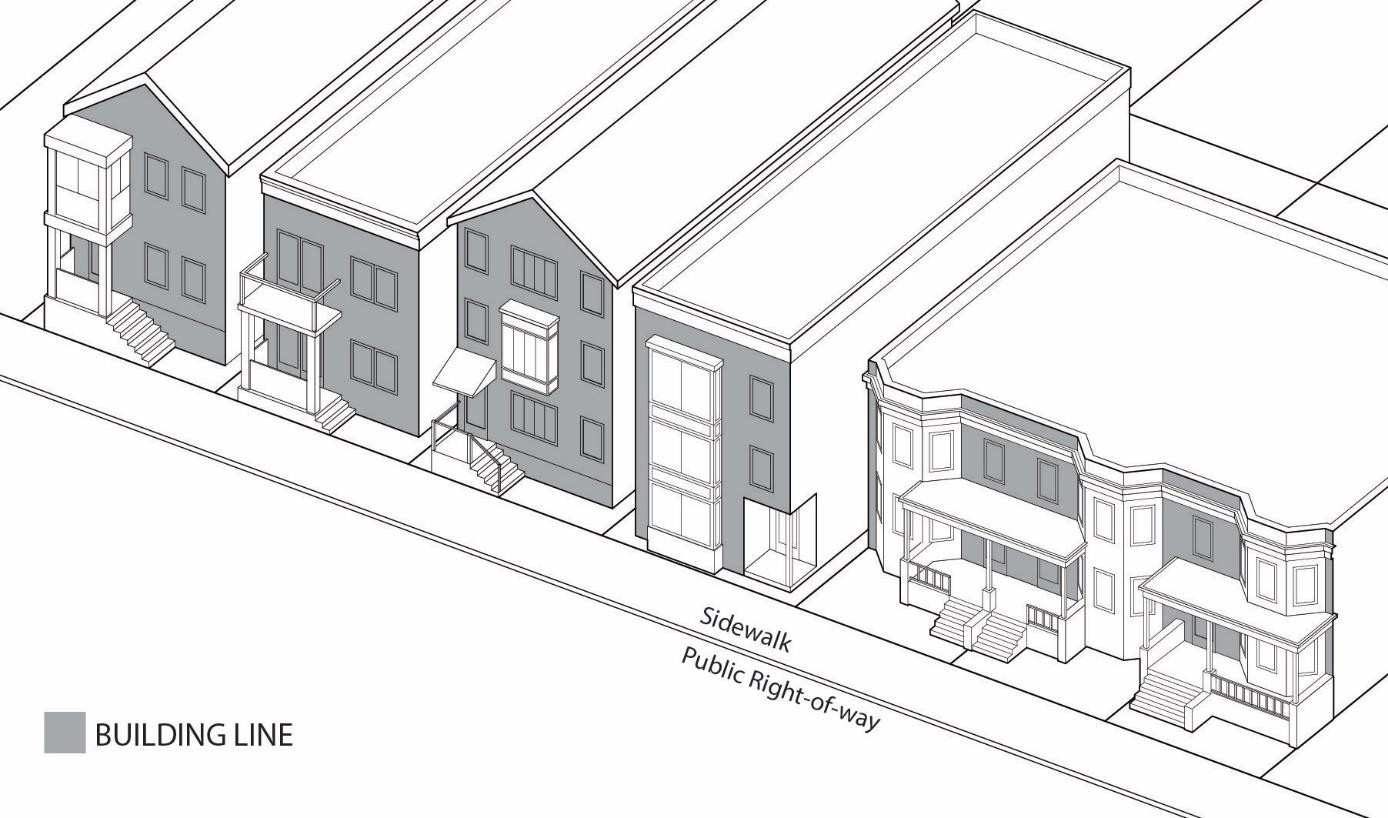
BUILDING LINE — The line parallel to the street line or other lot line which touches that part of a building's principal façade closest to the other lot line. Permitted encroachments and projections are not counted toward the building line. For the purposes of calculating yard calculations permitted and/or conforming encroachments and projections are excluded.
[Added 10-13-2022 by Ord. No. 22-084]
BULKHEAD — (1) A boxlike structure on the roof of a building covering a stairwell, elevator, or mechanical equipment; (2) A low wall, sometimes paneled, beneath a storefront display window; (3) A retaining wall, often located at the high-tide line, that protects waterfront property.
BUSINESS, TECHNICAL AND ARTS SCHOOLS — An institution offering training without academic programs.
BUSINESS INCUBATOR - A place where services, space, education, and assistance are provided to new businesses. Incubators include, but are not limited to, office type environments, scientific and research laboratories, kitchens, computer laboratories, and workshops. Incubators are often affiliated with an institution or organization able to provide access to instruction, advice, research facilities, or funding. Sharing of services, spaces, and equipment provides greater economies of scale for the incubator, and creates an entrepreneurial community among its users.
[Amended 3-11-2015 by Ord. No. 15-025]
CALIPER — The diameter of a tree trunk measured in inches six (6) inches above ground level for trees up to four (4) inches in diameter and measured twelve (12) inches above ground level for trees over four (4) inches in diameter.
CANNABIS CONSUMPTION AREA — means, as further described in section 28 of P.L.2019, c.153 (C.24:6I-21), a designated location operated by a licensed cannabis retailer or permit holder for dispensing medical cannabis, for which both a State and local endorsement has been obtained, that is either: (1) an indoor, structurally enclosed area of the cannabis retailer or permit holder that is separate from the area in which retail sales of cannabis items or the dispensing of medical cannabis occurs; or (2) an exterior structure on the same premises as the cannabis retailer or permit holder, either separate from or connected to the cannabis retailer or permit holder, at which cannabis items or medical cannabis either obtained from the retailer or permit holder, or brought by a person to the consumption area, may be consumed.
[Added 4-23-2025 by Ord. No. 23-078]
CANNABIS CULTIVATOR — means any licensed person or entity that grows, cultivates, or produces cannabis in this State, and sells, and may transport, this cannabis to other cannabis cultivators, or usable cannabis to cannabis manufacturers, cannabis wholesalers, or cannabis retailers, but not to consumers. This person or entity shall hold a Class 1 Cannabis Cultivator license pursuant to Chapter 84, Article IV of the Municipal Code.
[Added 4-23-2025 by Ord. No. 23-078]
CANNABIS DISTRIBUTOR — means any licensed person or entity that transports cannabis in bulk intrastate from one licensed cannabis cultivator to another licensed cannabis cultivator, or transports cannabis items in bulk intrastate from any one class of licensed cannabis establishment to another class of licensed cannabis establishment, and may engage in the temporary storage of cannabis or cannabis items as necessary to carry out transportation activities. This person or entity shall hold a Class 4 Cannabis Distributor license to operate.
[Added 4-23-2025 by Ord. No. 23-078]
CANNABIS ESTABLISHMENT — means a cannabis cultivator, a cannabis manufacturer, a cannabis wholesaler, or a cannabis retailer in good standing and approved by the Cannabis Control Board pursuant to Chapter 84, Article IV of the Municipal Code.
[Added 4-23-2025 by Ord. No. 23-078]
CANNABIS MANUFACTURER — means any licensed person or entity that processes cannabis items in this State by purchasing or otherwise obtaining usable cannabis, manufacturing, preparing, and packaging cannabis items, and selling, and optionally transporting, these items to other cannabis manufacturers, cannabis wholesalers, or cannabis retailers, but not to consumers. This person or entity shall hold a Class 2 Cannabis Manufacturer license to operate.
[Added 4-23-2025 by Ord. No. 23-078]
CANNABIS RETAILER — means any licensed person or entity that purchases or otherwise obtains usable cannabis from cannabis cultivators and cannabis items from cannabis manufacturers or cannabis wholesalers, and sells these to consumers from a retail store, and may use a cannabis delivery service or a certified cannabis handler for the off-premises delivery of cannabis items and related supplies to consumers. A cannabis retailer shall also accept consumer purchases to be fulfilled from its retail store that are presented by a cannabis delivery service which will be delivered by the cannabis delivery service to that consumer. This person or entity shall hold a Class 5 Cannabis Retailer license to operate.
[Added 4-23-2025 by Ord. No. 23-078]
CANNABIS WHOLESALER — means any licensed person or entity that purchases or otherwise obtains, stores, sells or otherwise transfers, and may transport, cannabis items for the purpose of resale or other transfer to either another cannabis wholesaler or to a cannabis retailer, but not to consumers. This person or entity shall hold a Class 3 Cannabis Wholesaler license in good standing and approved by the Cannabis Control Board in good standing and approved by the Cannabis Control Board pursuant to Chapter 84, Article IV of the Municipal Code.
[Added 4-23-2025 by Ord. No. 23-078]
CANOPY — A permanent, non-retractable roof-like projection with or without support poles permanently affixed and perpendicular to the wall of an entrance of a building or other punched openings used for providing overhead protection from the weather and shall be construed to be a part of the building to which it is affixed.
[Added 10-13-2022 by Ord. No. 22-084]
CAR SALES — See AUTO SALES.
CAR WASH, AUTOMATIC — A building or place of business where the washing of motor vehicles is carried on with the use of a chain or conveyor, blower and water and/or steam cleaning device.
CAR WASH, HANDWASH — A vehicle washing that does not include mechanized automatic washing.
CAR WASH, ROLL OVER — A car wash in which the vehicle remains stationary while automatic washing occurs.
CARPORT — A roofed structure providing space for the parking or storage of motor vehicles and enclosed on not more than three sides.
CARRIAGE WAY — see CARTWAY.
CARTWAY — The hard or paved area of a street between the curbs, including travel lanes and parking areas but not including curbs, sidewalks or swales.
CATERING SERVICES — a place where the preparation and delivery of food and beverages occurs for offsite consumption, without the provision for on-site pick-up or consumption.
CELLAR — A portion of the building having one-half or more than one-half of its clear height below finished grade. A cellar shall not be counted as a story in determining the height of a building.
[Amended 7-18-2018 by Ord. No. 18-074]
CEMETERY — Any site which contains at least one burial, marked or previously marked, dedicated to and used or intended to be used for the permanent internment of the human dead, to include perpetual-care and non-perpetual-care cemeteries, even though suffering neglect or abuse.
CERTIFICATE OF APPROPRIATENESS — A document attesting that proposed work within a historic district or affecting a landmark building, structure, object, site or landscape feature has been reviewed and deemed appropriate and consistent with the purpose of this Chapter by the Jersey City Historic Preservation Commission.
CERTIFICATE OF NO EFFECT — A document attesting that proposed work within a historic district or affecting a landmark building, structure, object, site or landscape feature has been reviewed by the Historic Preservation Officer and the Division of City Planning and is not detrimental to the historic district or landmark on which the work is to be done or neighboring buildings, structures, objects, sites or landscape features.
CERTIFICATE OF OCCUPANCY (CO) — A document issued by the Construction Official allowing the occupancy or use of a building or structure and certifying that the building or structure or use has been constructed and/or renovated according to, and in compliance with all the applicable state codes and municipal ordinances and resolutions.
CHANGE OF USE — Any change from a permitted principal use to another permitted principal use or to a non permitted principal use, or any change from a non permitted use to a non permitted principal use, or to a permitted principal use, or any change from a permitted principal use to a permitted conditional use.
[Added 10-13-2022 by Ord. No. 22-084]
CHILD CARE CENTER — An establishment providing for the care, supervision, and protection of children that is licensed by the State of New Jersey pursuant to P.L. 1983, c. 492 (C. 30:5B-1 et seq.).
CITY — City of Jersey City, Hudson County, New Jersey.
CITY COUNCIL — The legislative body of the City of Jersey City.
CIVIC — Premises available for operation by organizations dedicated to serving socially based public purposes such as: religion, arts and culture, education, government, performance, social service and the like. Including: house of worship, meeting hall, school, community center, and recreation facilities.
CIVIC SPACE — An area that is occupied and active on most days of the year and is dedicated to serving socially based public purposes and civic uses. Plazas, parks, and paseos may be considered civic spaces.
CLIFF FACE — A sheer, nearly vertical slope of exposed bedrock.
CLUSTER — A group of cultural resources with compatible buildings, objects or structures geographically or thematically relating to and reinforcing one another through design, setting, materials, workmanship, congruency and association.
COLONNADE — a linear series of columns which support a continuous lintel.
COLOCATION — Use of a common wireless telecommunication tower or a common site by two or more wireless license holders or by one wireless license holder for more than one type of communications technology and/or placement or a wireless telecommunication tower on a structure owned or operated by a utility or other public entity.
COMMON PROPERTY or OWNERSHIP — A parcel or parcels of land, together with the improvements thereon, in which the ownership, use and enjoyment of the same are shared by the owners and tenants of the individual dwelling units in the development.
COMMUNITY FACILITY/CENTER — Municipal, county, state, or not-for-profit enterprises that serve the public interest. Community Facility shall include, but not be limited to, the following services: adult day care, art education, child care, fire, health care, job training, library, police, recreation, school, or teen center. Community Facility shall not include prisons, or drug and narcotic rehabilitation centers.
COMMUNITY RESIDENCE FOR THE DEVELOPMENTALLY DISABLED — Any community residential facility licensed pursuant to P.L. 1977, c. 448 (C. 30:1lB-1 et seq.) providing food, shelter, and personal guidance, under such supervision as required, to not more than fifteen (15) developmentally disabled or mentally ill persons, who require assistance, temporarily or permanently, in order to live in the community, and shall include, but not be limited to: group homes, half-way houses, intermediate care facilities, supervised apartment living arrangements, and hostels. Such a residence shall not be considered a health care facility within the meaning of the "Health Care Facilities Planning Act" (P.L. 1971, c. 136; c. 26:2H-1 et seq.). In the case of such community residence housing mentally ill persons, such residence shall have been approved for a purchase of service contract or an affiliation agreement pursuant to such procedures as shall be established by regulation of the Division of Mental Health and Hospitals of the Department of Human Services.
COMMUNITY RESIDENCE FOR PERSONS WITH HEAD INJURIES — A community residential facility licensed pursuant to P.L 1977, c. 448 providing food, shelter and personal guidance, under such supervision as required, to not more than fifteen (15) persons with head injuries, who require assistance, temporarily or permanently, in order to live in the community, and shall include, but not be limited to, group homes, halfway houses, supervised apartment living arrangements and hostels. Such a residence shall not be considered a health care facility within the meaning of the "Health Care Facilities Planning Act," 1971, c. 136.
COMMUNITY RESIDENCE FOR THE TERMINALLY ILL — Any community residential facility operated as a hospice program providing food, shelter, personal guidance and health care services, under such supervision as required, for not more than fifteen (15) terminally ill persons.
COMMUNITY SHELTER FOR VICTIMS OF DOMESTIC VIOLENCE — Any shelter approved for a purchase of service contract and certified pursuant to standards and procedures established by regulation of the Department of Human Services pursuant to P.L. 1979, C. 337 (C. 30:14-1 et seq.) providing food, shelter, medical care, legal assistance, personal guidance, and other services to not more than fifteen (15) persons who have been victims of domestic violence, including any children of such victims, who temporarily require shelter and assistance in order to protect their physical or psychological welfare.
COMPATIBLE PROPERTY — A resource in a historic district or cluster distinguished by its scale, material, compositional treatment and other features that provide the setting for more important resources and add to the character of the scene.
COMPLETE APPLICATION — Any and all materials required by this Chapter to review any application for development (application form, affidavit of ownership, boundary descriptions, plat maps in accordance with ordinance specifications, etc.)
CONDITIONAL USE — A use permitted in a particular zoning district only upon showing that such use in a specified location will comply with the conditions and standards for the location and operation of such use as contained in the zoning ordinance and upon the issuance of an authorization therefore by the Planning Board or the Zoning Board.
[Added 10-13-2022 by Ord. No. 22-084]
CONDOMINIUM — The form of ownership of real property under a master deed pursuant to N.J.S.A. 46:8B-1 et seq.
CONDOMINIUM ASSOCIATION — The entity responsible for the administration of a condominium, which entity may be incorporated or unincorporated. Also known as Condo Association.
CONFERENCE CENTER — A facility used for conferences and seminars, which may include accommodations for sleeping, food preparation and eating, recreation, resource facilities and meeting rooms. Conference centers may be commercial ventures providing space for corporate, government, social or other types of meetings, or they may be maintained by large institutions, such as universities or corporations.
CONSTRUCTION — The erection of a new principal or accessory building or structure on a lot or property; alterations and the act of creating an addition to an existing building or structure.
CONSTRUCTION OFFICIAL — The Construction Official of the City of Jersey City.
CONTINUING CARE RETIREMENT COMMUNITY — The provisions of lodging and nursing, medical or other health related services at the same or another location to an individual pursuant to an agreement effective for the life of the individual or for a period greater than one year, including mutually terminable contracts, and in consideration of the payment of an entrance fee with or without other periodic charges. A fee which is less than the sum of the regular periodic charges for one year of residency is not considered an entrance fee.
CONTRACTOR'S WORKSHOP — A place where a licensed contractor may store and utilize tools, equipment and materials that are used in the trade for which the contractor is licensed. Storage of hazardous materials, junk, inoperable vehicles, or equipment or materials that are not used in the trade shall not be permitted. Outdoor storage and use of tools or equipment shall not be permitted.
CONTRIBUTING PROPERTY — A resource in a historic district or cluster that contributes to the district's or clusters historical significance through location, design, setting, materials, workmanship, feeling and association and which shall be afforded the same considerations as landmarks.
CONVENTIONAL — Development other than planned development.
CORNICE — Projecting ornamental molding along the top of a building, wall or storefront.
COUNTY MASTER PLAN — A composite of the plan elements for the physical development of Hudson County, with the accompanying maps, plats, charts and descriptive and explanatory matter adopted by the County Planning Board.
COUNTY PLANNING BOARD — The Hudson County Planning Board.
COURTYARD — An open space which is designed and used for passive recreational purposes.
CRAFTSPERSON —A person who practices a trade or handicraft as an artisan, and who engages in the production of their work, design or objects as a career.
CULTURAL — Activities or acts related to the past or present social and material traits of a group or groups of people.
CURB CUT — The opening along the curb line at which point vehicles may enter or leave the roadway. May also be spelled curbcut.
[Added 10-13-2022 by Ord. No. 22-084]
CUT AND FILL — The excavating of rock fragments and mineral grains, including soil, in one place and depositing of it as fill in adjacent place.
CREDITABLE SQUARE FOOT — A term used in providing a basis for bonuses for buildings and those areas improved by the owners beyond those required by any city ordinance and are accessible, unobstructed, improved, usable areas for their intended purpose.
CYBERHOTELS/TECHOTELS/SERVERFARMS/TELECOMMUNICATION CENTERS — See Data Centers.
DATA CENTERS — A facility used to house computer systems and associated components, such as telecommunications and storage systems.
DAYCARE CENTER — A facility providing for the care, supervision, and protection of preschool children.
DAYCARE CENTER, ADULT — a facility for the supervised care of adults with physical or mental limitations, providing activities such as meals and socialization one or more days a week during specified daytime hours, and which may also include care by ancillary medical staff.
DAYS — Calendar days.
DEAD-END STREET — A street or portion of a street which is accessible by a single means of ingress and egress.
DECK — A raised accessory structure more than one and one-half feet above finished grade, supported by either pillars or posts or walls, and which allows water to pass through slats or openings.
[Amended 6-24-2020 by Ord. No. 20-044]
DEMOLITION — The dismantling or razing of all or part of a building, structure, object, site or landscape feature including interior spaces and all operations incidental thereto.
DENSITY — The permitted number of dwelling units per gross area of land to be developed.
DESIGNATED REPRESENTATIVE — That person or office so named by the reviewing board to dispense, receive and classify any development applications.
DETACHED SINGLE-FAMILY — A dwelling for one family or household that is not attached to any other dwelling by any means and which is occupied or is intended to be occupied for residence purposes by one housekeeping unit.
[Added 10-13-2022 by Ord. No. 22-084]
DEVELOPABLE AREAS — Upland areas or pier areas not dedicated to public rights-of-way.
[Added 10-13-2022 by Ord. No. 22-084]
DEVELOPER — The legal or beneficial owner or owners of a lot or of any land included in a proposed development, including the holder of an option or contract to purchase, or other person having an enforceable proprietary interest in such land.
DEVELOPMENT — The division of a parcel of land into two or more parcels; the construction, reconstruction, conversion, structural alteration, relocation or enlargement of any building or other structure; any mining, excavation, landfill or land disturbances and any use, change in use or extension of use of land for which permission may be required pursuant to N.J.S.A. 40:55D-1 et seq.
DEVIATION — Used in Redevelopment Plans; identical to a variance pursuant to N.J.S.A. 40:55D-70.c.
DIRECTOR, DIVISION OF CITY PLANNING — The person holding the above title, or the acting director during an interim period of filling the position, or such other licensed professional planner on the staff of the Division of City Planning who has received written authority from the Director to carry out specified duties on behalf of the Director.
DISTRICT — A geographically definable area, possessing a significant concentration, linkage or continuity of buildings, objects, sites, structures or landscape features united by past events or aesthetically by plan or physical development which may also comprise individual elements separated geographically but thematically linked by association or history.
DORMITORY — A building to provide sleeping and living accommodations with sanitary and general living facilities designed and used to accommodate students of a university or college.
DRAINAGE — The removal of surface water or groundwater from land by drains, grading or other means and includes control of runoff during and after construction, or development to minimize erosion and sedimentation, to assure the adequacy of existing and proposed culverts and bridges, to induce water recharge into the ground where practical, to lessen non-point pollution, to maintain the integrity of stream channels for their biological functions as well as for drainage, and the means necessary for water supply preservation or prevention or alleviation of flooding.
DRAINAGE RIGHT-OF-WAY — The lands required for the installation of stormwater sewers or drainage ditches or required along a natural stream or watercourse for preserving the channel and providing for the flow of water therein to safeguard the public against flood damage.
DRIVEWAY — A paved or unpaved area used for ingress or egress of vehicles and allowing access from a street to a lot, building or other structure or facility.
DWELLING — A building that is designed or used exclusively as the living quarters for one or more housekeeping units.
DWELLING UNIT — A room or series of connected rooms containing living, cooking, sleeping and sanitary facilities for one housekeeping unit. The "dwelling unit" shall be self-contained and shall not require passing through another dwelling unit or other indirect route to get to any portion of the dwelling unit, nor shall one dwelling unit require shared facilities with another dwelling unit. Hotel facilities or other facilities providing temporary accommodations shall not be considered dwelling units.
EASEMENT — A grant of one or more of the property rights by the property owner to and/or of rote use by the public or another person, entity, or property.
EFFECT — A change in the quality of the historical, architectural, archaeological or cultural significance of a resource or in the characteristics that qualify the resource as historically important.
EFFECT, ADVERSE — A negative change in the quality of the historical, architectural, archaeological or cultural significance of a landmark or historic district or in the characteristics of a landmark or historic district that are historically important.
ELECTRONIC COMMUNICATIONS EQUIPMENT — Any electronic device used to send or receive information.
EMBANKMENT — A man-made or natural deposit of soil, rock or other materials.
ENCROACHMENT — (1) An area beyond the building line or build to line into which certain building features protrude. Typical encroachments may include overhangs, bays, oriels, fire escapes, or other elements that commonly protrude beyond the façade of the building. See additional ENCROACHMENT definitions below. (2) Certain building features that extend beyond a street line of a lot into a street or right-of-way.
[Added 10-13-2022 by Ord. No. 22-084]
ENCROACHMENT, CANTILEVERED - These are building features like awnings, canopies, oriels (bay windows which are not grounded), and balconies.
[Added 10-13-2022 by Ord. No. 22-084]
ENCROACHMENT, ENCLOSED - These are building features that expand the interior square footage of a dwelling or habitable space like enclosed porches, oriels, overhangs, and bay windows.
[Added 10-13-2022 by Ord. No. 22-084]
ENCROACHMENT, GROUNDED - These are building features like stoops, access ramps, decks, patios, and porches, enclosed porches, and bay windows, but may also include landscape features, fences, walls, or planters.
[Added 10-13-2022 by Ord. No. 22-084]
ENCROACHMENT, OPEN - These are building features that are exposed to the elements and that do not add habitable square footage like balconies, awnings, canopies, decks, stoops, access ramps, patios, porches (non-enclosed).
[Added 10-13-2022 by Ord. No. 22-084]
ENGINEERED GREEN WALLS — See LIVING GREEN WALLS.
[Added 6-24-2020 by Ord. No. 20-044]
ENHANCED TREE GROWTH SYSTEMS — Soil techniques designed to transfer the load from pavement directly to the subsoil rather than the topsoil media. These systems promote additional soil volume for trees than is otherwise available under conventional pavement systems. The three most common systems are suspended pavements, sand-based structural soil systems, and aggregate structured soils.
[Added 6-24-2020 by Ord. No. 20-044]
ENHANCED TREE GROWTH SYSTEMS, AGGREGATE STRUCTURAL SOILS — Angular gravels that directly support pavement but through which roots may grow. These systems are constructed from load-bearing materials such as aggregate and clay-loam mix or expanded slate with clay-loam mix. Aggregate Structural Soils shall be used as a pathway for roots to reach additional soil volumes across pavement subsurface and not as the only available tree soil volume.
[Added 6-24-2020 by Ord. No. 20-044]
ENHANCED TREE GROWTH SYSTEMS, SAND-BASED STRUCTURAL SOILS — Pavement over open-graded crushed stone and Sand-Based Structural Soil. Due to the poor water retention capacity of sand, an additional water source is necessary, provided by drainage channels or permeable pavers. Such systems should be designed with passive irrigation only.
[Added 6-24-2020 by Ord. No. 20-044]
ENHANCED TREE GROWTH SYSTEMS, SUSPENDED PAVEMENTS — Pavement supported through columns or walls, allowing soil placed within the suspended pavements to remain at a compaction level suitable to root growth.
[Added 6-24-2020 by Ord. No. 20-044]
ENVIRONMENTAL COMMISSION — A municipal advisory body created pursuant to P.L. 1968, c. 245 (C. 40:56A-1 et seq.).
ESSENTIAL SERVICES — Services and utilities needed for the health, safety, and general welfare of the community, such as underground, surface, or overhead electrical, gas, telephone, steam, water, sewerage, and other utilities and the equipment and appurtenances necessary for such system to furnish an adequate level of service for the area in which it is located.
EXISTING ARCHITECTURAL FEATURES — The architectural features existing at the time of designation or architectural features which have been changed subsequent to designation pursuant to a Certificate of Appropriateness/No Effect issued by the Historic Preservation Commission.
FAÇADE — (1) A building's front or any of its exterior walls; (2) A prominent side of a building or structure that has been given special architectural or design treatment to make it more attractive.
[Added 10-13-2022 by Ord. No. 22-084]
FAÇADE, FRONT PRIMARY — The streetfront building façade which runs roughly parallel to the front lot line(s). For the purposes of yard calculations, projecting accessory structures or encroachments including decks, porches, balconies, fencing, stoops, stairs, and/or other encroachments as defined in this chapter are excluded.
[Added 10-13-2022 by Ord. No. 22-084]
FAÇADE, FRONT SECONDARY — In the case of a corner lot in a historic district or historic overlay, the streetfront building façade which runs roughly parallel to the side lot line.
[Added 10-13-2022 by Ord. No. 22-084]
FAÇADE, REAR — The building façade which is opposite the front primary façade and roughly faces the rear lot line or an alley. In the case of two or more front primary façades, there will be no rear façade but rather two side façades. See Façade, Secondary.
[Added 10-13-2022 by Ord. No. 22-084]
FAÇADE, SECONDARY — A façade that does not face a street or a public thoroughfare and that does not possess significant architectural features.
FAÇADE, SIDE — The building façade(s) which run roughly parallel to the side lot lines but does not face a street. In the case of two Front Primary Façades, there will be two side façades and no rear façade. See Façade, Secondary.
FAMILY — See HOUSEKEEPING UNIT.
[Added 10-13-2022 by Ord. No. 22-084]
FAMILY DAY CARE HOME — Any private residence approved by the Division of Youth and Family Services or an organization with which the division contracts for family day care in which child care services are regularly provided to no less than three and no more than five children for no less than fifteen (15) hours per week. A child being cared for under the following circumstances is not included in the total number of children receiving childcare services:
A.
The child being cared for is legally related to the provider, or
B.
The child is being cared for as part of a cooperative agreement between parents for the care of their children by one or more of the parents, where no payment for the care is being provided.
FENCE — A barrier intended to prevent escape or intrusion; or to mark a boundary, enclose, screen, or separate areas.
FENCE LINE — The established line of existing fences on a street, more or less parallel to the curb line. The fence line may be within the public rights-of-way.
[Added 10-13-2022 by Ord. No. 22-084]
FENESTRATION — The arrangement and design of windows, doors, or other openings in a building or building façade.
FERRY — A boat or ship that carries passengers across water often along fixed routes on a schedule.
[Added 10-13-2022 by Ord. No. 22-084]
FINAL PLAT — The final map of all or a portion of the subdivision which is presented to the Planning Board for approval in accordance with these regulations and which, if approved, shall be filed with the county recording officer.
FINANCIAL SERVICES FACILITY — A retail service facility that provides diversified financial and brokerage services to the general public in person and on a walk in basis; offers amenities to encourage pedestrian traffic, such as retail banking services, computer access to brokerage accounts, ATM access to cash accounts, and visible screens with financial information and stock reports. The facility shall be utilized for financial consultation meetings with clients.
FINISH — The visual characteristics, including color, texture and reflectivity of all exterior materials.
FLOOR - A surface or assembly of materials capable of supporting loads imposed upon it by occupants or users, exclusive of roofs. It is sometimes referred to as a "story".
[Added 10-13-2022 by Ord. No. 22-084]
FLOOR AREA RATIO — The gross floor area or sum of the gross area of all floors of buildings or structures compared to the total area of the site.
[Added 10-13-2022 by Ord. No. 22-084]
FOOTCANDLE — A unit for measuring illumination equaling the amount of direct light on a surface.
Editor's note— The definition of "Formula business" was removed at the discretion of the editor. The ordinance from which the definition derived, Ord. No. 15-052, was repealed by 19-038, adopted May 8, 2019.
FRONTAGE — See LOT FRONTAGE
GARAGE, PARKING — Buildings or building areas used exclusively for the parking or storing of motor vehicles and which may include manual car washing.
GARAGE, PRIVATE — An accessory building, structure, or use, for the parking of passenger motor vehicles, in which no occupation, business or services for profit is conducted.
GOVERNING BODY — The City Council of the City of Jersey City.
GOVERNMENT AGENCY — Any department, commission, independent agency or instrumentality of the United States, the State of New Jersey, and/or any county, municipal or other governmental unit.
GOVERNMENTAL USES — Public institutions and uses, such as schools, community centers and government-owned or operated buildings, structures or land used for public purposes,.
GRADE, EXISTING — The vertical location of the ground surface at any given point prior to excavating or filling, or the percent of rise or descent of a slope.
[Amended 7-18-2018 by Ord. No. 18-074]
GRADE, FINISHED — For buildings adjoining one street only, elevation of the established curb at the center of the wall adjoining the street. For buildings adjoining more than one street, the average of the elevations of the established curbs at the center of all walls adjoining the streets. For buildings having no wall adjoining the street, the average level of the ground adjacent to the exterior walls of the buildings. All walls approximately parallel to and not more than 15 feet from the street line are to be considered as adjoining a street.
[Amended 7-18-2018 by Ord. No. 18-074]
GREEN AREA RATIO (GAR) — A zoning regulation that integrates sustainable landscape elements into site design to address these environmental concerns. The GAR assigns a weighted score to a building based on the types of landscape and site design features that are implemented and the amount of area they cover.
[Added 6-24-2020 by Ord. No. 20-044]
GREEN INFRASTRUCTURE — The implementation of various tools, primarily vegetation and soil, to manage stormwater and reduce stormwater runoff.
[Added 6-24-2020 by Ord. No. 20-044]
GREEN ROOF — A vegetated roof system used in place of a conventional roof which typically involves a water proof membrane and root repellant system, a drainage system, filter cloth, a lightweight growing medium and species appropriate plants.
GROSS FLOOR AREA — The floor area within the inside perimeter of the exterior walls of the building(s) or structure(s) under consideration, inclusive of corridors, stairways, basements, elevators, roofed parking areas, utility spaces, back of house areas, closets, half stories, the thickness of interior walls, columns or other features. Vent shafts, balconies (that project beyond exterior walls), cellars, and courts are not counted toward gross floor area.
[Added 10-13-2022 by Ord. No. 22-084]
GROUND FLOOR — The floor closest to, but not below, grade.
GROUND FLOOR STREET FRONTAGE (GFSF) — The sum of the horizontal lengths of all exterior walls of a building at ground floor level, inclusive of all windows and doors, and excepting where there is another property between the wall and the street.
GYM — See HEALTH CLUB.
HARVESTED STORMWATER IRRIGATION SYSTEM — Stormwater collected from rooftops or other contributing drainage areas that is directed to storage devices, such as cisterns or rain barrels, and used for landscape irrigation.
[Added 6-24-2020 by Ord. No. 20-044]
HEALTH CLUB — A meeting place for groups of people for the purpose of engaging in exercise and conditioning of the body for the benefit of physical fitness. All health clubs that are 4,000 square feet or less shall be permitted as Retail Services.
[Amended 1-24-2018 by Ord. No. 18-001]
HEIGHT, BUILDING — The vertical distance measured to the highest point of a building from the finished grade. A building's highest point shall be determined in accordance with height exceptions, Section 345-60.
[Amended 7-18-2018 by Ord. No. 18-074]
HELISTOP — Area for landings and takeoffs of helicopters, but shall not include any servicing or parking functions for such crafts. Also known as Heliport.
HIGH-CUBE WAREHOUSING — Facilities used for the receipt, storage and handling of goods, bulk products and materials prior to their distribution to other recipients. These facilities consist of buildings with large floor plates, often subdivided for individual tenants, with a typical ceiling height of thirty (30) feet or more; they are also characterized by a low employee parking requirement due to a high level of mechanization, truck activities frequently outside of the peak hour of the adjacent street system, and good highway access.
HIGH-RISE APARTMENT BUILDING — A multi-family residential building with nine (9) stories or more.
HISTORIC — A building, structure, object, site or landscape feature having a degree of significance or importance over or at a period of time.
HISTORIC ARCHITECTURAL FEATURES — Architectural features installed or built at the time of construction of the building; architectural features of a type installed or built at the time of construction of similar buildings in similar periods and styles; or architectural features installed or built at the time of a major façade alteration thirty (30) or more years ago.
HISTORIC/CULTURAL RESOURCE — Those buildings, objects, sites, structures or landscape features of historical, cultural, architectural or archaeological importance and the demolition, destruction or alteration of which would constitute an irreplaceable loss to the quality and character of Jersey City; inventoried interior spaces designed or intended to be occupied as part of the structure or which are accessible to the public; such buildings, objects, sites, structures or landscape features, their appurtenances and the property on which they are located are considered historic as defined in this Chapter.
HISTORIC DISTRICT — An area defined as a historic district by City Council, state or federal authority and which may contain within definable geographic boundaries one or more landmarks or clusters, including their accessory buildings, fences and other appurtenances, and natural resources having historical, cultural and archaeological significance and which district may have within its boundaries other buildings or structures, that while not of such historical, cultural, architectural or archaeological significance as to be designated landmarks, nevertheless contribute to the overall visual characteristics of the landmark or landmarks located within the district.
HISTORIC PRESERVATION COMMISSION — The Jersey City Historic Preservation Commission. Also referred to as the "Commission."
HISTORIC SITE — Any real property, man-made structure, natural object or configuration or any portion or group of the foregoing of historical, archaeological, cultural, scenic or architectural significance.
HOME OCCUPATION — An occupation or activity carried out for gain by a resident and conducted as a customary, incidental and accessory use in the resident's dwelling unit or accessory structure located on the lot and is in accordance with Supplementary Zoning Regulations § 345-60(1.2(a)).
HOSPITAL — An institution providing primary health services and medical or surgical care to persons, primarily inpatients, suffering from illness, disease, injury, deformity, and other abnormal physical or mental conditions and including, as an integral part of the institution, related facilities, such as laboratories, outpatient facilities, training facilities, medical offices, and staff residences.
HOTEL — A building designed for occupancy as the more or less temporary place of abode for individuals who are lodged with or without meals, in which there are ten (10) or more guest rooms or suites and in which there may be kitchens in any individual room or suite.
HOUSEKEEPING UNIT — One or more persons living together in one dwelling unit on a nonseasonal basis and sharing living, sleeping, cooking and sanitary facilities on a nonprofit basis.
HOUSE OF WORSHIP — A building used for the assembly of members of a designated faith for religious instruction and worship of a deity such as a church, synagogue, mosque or temple.
IMPROVEMENT PARCEL — A unit of real property that includes a landmark designated under this Chapter and is treated as a single entity for the purpose of levying real estate taxes within the historic district.
INCUBATOR — See BUSINESS INCUBATOR.
INDEPENDENT LIVING — A residential facility where individualized support is provided to residents in forms such as a community director, a social director, and daily on-site assistance.
INDUSTRIAL PARK — An area wherein one or more buildings are erected for industrial purposes in relation to one another as part of an integrated and comprehensively planned total unit, whether or not the buildings are erected simultaneously or over a period of time.
INFILL HOUSING — (1) The construction of a building for residential uses in an area already built up. (2) The construction of a housing unit that resembles in proportion, scale, height, style or bulk the adjacent dwelling units.
[Added 10-13-2022 by Ord. No. 22-084]
INTERIM USE — A use approved by the Planning Board applied on a temporary basis as prescribed while permanent plans for the area are formulated or implemented.
INTRUSION — A building, object, site, structure or landscape feature which detracts from a landmark, historic district or cluster of historical significance because of its incompatibility with the historic district's or cluster's sense of time and place and historical development; or its incompatibility of scale, height, materials, texture or color, or whose integrity has been irretrievably lost.
INVENTORY, HISTORIC — A systematic listing of cultural, historical, architectural or archaeological resources prepared by the city, state or federal government or a recognized local historic authority, following standards set forth by federal, state and city regulations for evaluation of cultural properties.
JUNKYARD — Any area, lot, land or parcel with or without structures used for the storage, collection, processing, purchase, sale, salvage or disposal of scrap, waste, reclaimable material or debris. Any site with 3 or more unregistered vehicles shall constitute a junkyard.
KIOSK — A small, freestanding structure with one or more open sides such as a newsstand, information booth or telephone booth.
LAND — Including improvements and fixtures on, above or below the surface.
LAND AREA — The area contained within the lot lines of a lot, not including any portion of a street right- of-way.
LANDMARK — Any building, object, site, structure or landscape feature, any part of which is fifty (50) years old or older, which has a special character or special historic or aesthetic interest or value as part of the development, heritage or cultural characteristics of the city, state or nation and which has been designated as a "landmark" pursuant to the provisions of this Chapter.
LANDSCAPE FEATURE — Any grade, body of water, stream, rock, plant, shrub, tree, path, walkway, road, plaza, fountain, wall, sculpture or other form of natural or artificial landscaping.
LAUNDROMAT — An establishment providing washing and drying machines on the premises for rental use to the general public and may include wash and fold or drop off dry cleaning as an accessory use, but shall not include on-site dry cleaning processing.
LIGHT ASSEMBLY — Flexible space suitable for final assembly of finished products for distribution. No manufacturing shall be associated with this use.
LIGHT INDUSTRIAL — Warehousing, wholesaling, shipping and receiving, manufacturing, assembly, processing, research, laboratory testing service, professional and governmental offices, public and quasi-public uses and other operations which do not include the production of petroleum into fuel, oil or other products or chemical processing and storage. Light Industrial uses shall not produce any corrosive, toxic, noxious fumes, glare, electromagnetic disturbances, radiation, smoke, cinders, odors, dust or waste, undue noise or vibration, or other objectionable features so as to be detrimental to the public health, safety, or general welfare, provided however that existing activities not in violation of City, State or Federal law are exempt.
LIGHT RAIL TRANSIT (LRT) — Rail service employing energy efficient light rail vehicles (LRVs) at least partly on shared or semi-exclusive rights-of-way, designed so that other traffic can mingle safely with the LRT operation where desired.
LIVE/WORK UNIT — See WORK/LIVE UNIT.
LIVING GREEN WALLS — Dense pre-engineered vertical vegetative systems consisting of pre-planted panels or modules affixed to a structural wall or frame, and irrigated by harvested stormwater systems that use stored rainwater.
[Added 6-24-2020 by Ord. No. 20-044]
LOADING SPACE — An off-street space or berth on the same lot with a building or group of buildings for the temporary parking of a commercial vehicle while loading or unloading.
LOGGIA — A gallery or breaking in the façade that can be open to the air on at least one side. Loggias create breaks in the vertical scale of a building and are surrounded by columns or created by a setback or overhang within the façade. The interior of these spaces can be used as common space for these vertical neighborhoods, live work offices, mechanical equipment space, or any number of other uses.
LONG TERM CARE FACILITY/NURSING FACILITY/NURSING HOME — A facility that is licensed by the Department of Health to provide health care under medical supervision and continuous nursing care for twenty-four (24) or more consecutive hours to two or more patients who do not require the degree of care and treatment which a hospital provides and who, because of their physical or mental condition, require continuous nursing care and services above the level of room and board.
LOT — A tract or parcel of land established by a plat, deed, or otherwise, but not including any portion of a street, which tract or parcel of land is legally separate from any other tract or parcel of land.
[Added 10-13-2022 by Ord. No. 22-084]
LOT, CAP — A lot that has contiguous frontage upon three streets, two of which are parallel or roughly parallel. A regular cap lot has three front lot lines, one side lot line, and one rear lot point (located at the midpoint of the side lot line). When no standard is specified for cap lots in the zone or district, any standard for corner lots in that zone or district shall apply. See LOT TYPE DIAGRAM, LOT LINE DIAGRAM, LOT WIDTH AND DEPTH DIAGRAM, and REAR YARD DIAGRAM.
[Added 10-13-2022 by Ord. No. 22-084]
LOT, CORNER — (1) A lot on the junction of and abutting two or more intersecting streets where the interior angle of intersection is less than one hundred thirty-five (135) degrees. A regular corner lot has two front lot lines, two side lot lines, and one rear lot point. See LOT TYPE DIAGRAM, LOT LINE DIAGRAM, LOT WIDTH AND DEPTH DIAGRAM, and REAR YARD DIAGRAM. (2) A lot, in a historic district or historic overlay, on the junction of and abutting two or more intersecting streets where the interior angle of intersection is less than one hundred thirty-five (135) degrees. In this instance: (a) the front lot line and lot width shall be the street line with lesser frontage; (b) the lot depth shall be the greater lot dimension; (c) there shall be no rear lot point; (d) the rear lot line shall be the opposite the front lot line; and (e) the secondary front façade shall be treated as a side lot line.
[Added 10-13-2022 by Ord. No. 22-084]
LOT, FLAG — A lot that is categorically an interior lot but with two distinct parts, the flag and the pole. The pole is narrower than the flag and connects to the street. The flag is often irregularly shaped and shares boundaries with numerous other lots. A typical flag lot has one front lot line, four side lot lines, and one rear lot lines. See LOT TYPE DIAGRAM and LOT LINE DIAGRAM.
[Added 10-13-2022 by Ord. No. 22-084]
LOT, INTERIOR — A lot other than a cap lot, corner lot, or through lot. A regular interior lot has one front lot line, two side lot lines, and one rear lot line. See LOT TYPE DIAGRAM and LOT LINE DIAGRAM.
[Added 10-13-2022 by Ord. No. 22-084]
LOT, THROUGH — (1) A lot that fronts upon two parallel (non-intersecting) streets. In this instance, a through lot has two front lot lines and two side lot lines. (2) A lot that fronts on two intersecting streets but is not a corner lot. In this instance, a through lot has two front lot lines, four side lot lines, and one rear lot point. See LOT TYPE DIAGRAM, LOT LINE DIAGRAM, and REAR YARD DIAGRAM.
[Added 10-13-2022 by Ord. No. 22-084]
LOT, WHOLE BLOCK - A lot that has contiguous frontage upon rights-of-way along all lot line boundaries. A whole block lot only has front lot lines. When no standard is specified for whole block lots in the zone or district, any standard for corner lots in that zone or district shall apply. See LOT TYPE DIAGRAM and LOT LINE DIAGRAM.
[Added 10-13-2022 by Ord. No. 22-084]
LOT AREA — The total area within the lot lines of a lot but not including any street rights-of-way.
LOT CONSOLIDATION — An action eliminating lot lines from contiguous lots.
LOT COVERAGE — The square footage or other area measurements by which all buildings and impervious surfaces occupy a lot as measured on a horizontal plane around the periphery of the foundations and paved areas, and including the areas under the roof of any structure.
LOT DEPTH — (1) For interior lots and flag lots, the shortest horizontal distance between the street line and a line drawn parallel to the street line through the midpoint of the rear lot line. (2) For corner lots and through lots, the dimension between a street line and a parallel lot line. Corner lots and through lots on intersecting streets have two lot depths. See LOT, CORNER regarding historic districts and historic overlays. (3) For cap lots, the distance between midpoint of the side lot line and the parallel street line. (4) For whole block lots, there is no lot depth. See LOT TYPE DIAGRAM, LOT LINE DIAGRAM, LOT WIDTH AND DEPTH DIAGRAM, and REAR YARD DIAGRAM.
[Added 10-13-2022 by Ord. No. 22-084]
LOT FRONTAGE — That portion of a lot extending along a street line.
LOT LINE — Any line forming a portion of the exterior boundary of a lot and the same line as the street line for that portion of lot abutting a street. "Lot lines" extend vertically in both directions from ground level.
LOT LINE DIAGRAM — See image below. See LOT, CORNER, regarding historic districts and historic overlays.
[Added 10-13-2022 by Ord. No. 22-084]
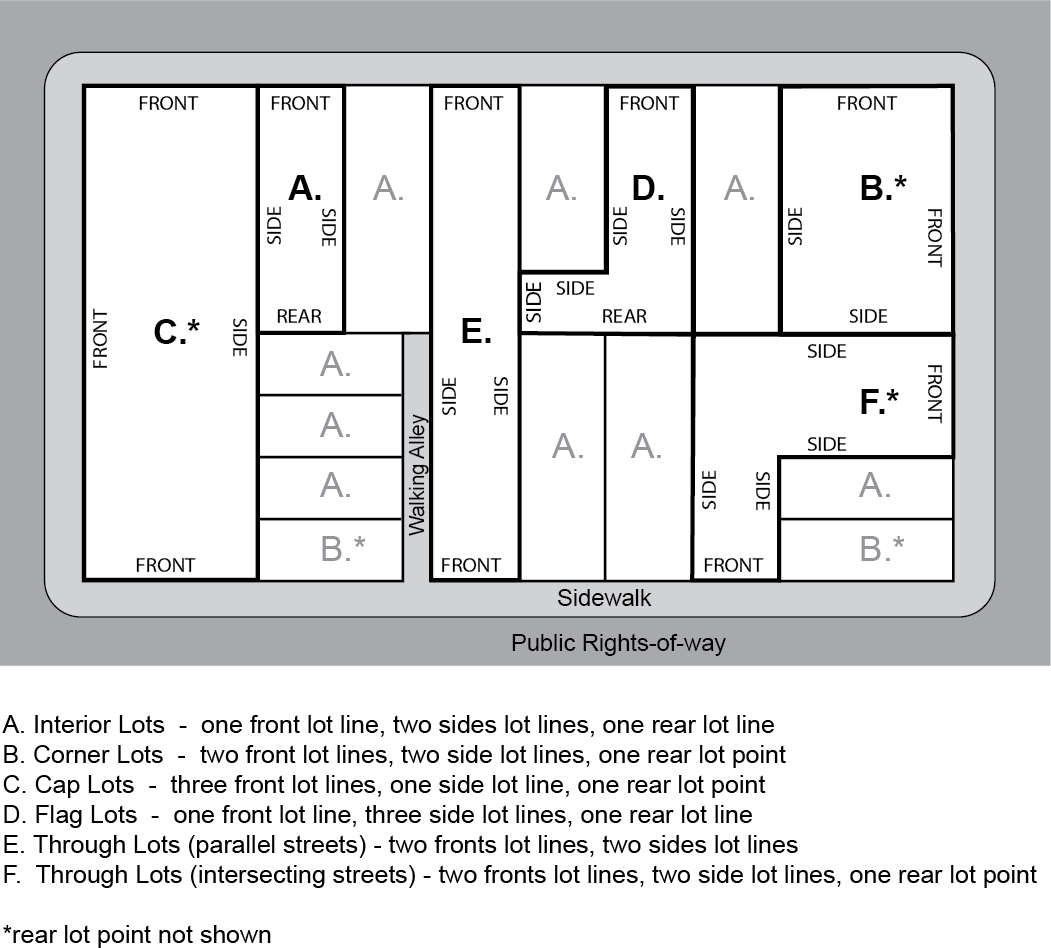
LOT LINE, FRONT — The lot line separating a lot from a street right-of-way, also referred to as a "street line." See LOT TYPE DIAGRAM and LOT LINE DIAGRAM.
[Added 10-13-2022 by Ord. No. 22-084]
LOT LINE, REAR — The lot line opposite and most distant from the front lot line, or the most distant point at which the side lot lines meet as measured from the point at which the front lot lines meet. See LOT TYPE DIAGRAM, LOT LINE DIAGRAM, and REAR YARD DIAGRAM.
[Added 10-13-2022 by Ord. No. 22-084]
LOT LINE, SIDE — Any lot line other than a front or rear lot line. See LOT TYPE DIAGRAM and LOT LINE DIAGRAM.
[Added 10-13-2022 by Ord. No. 22-084]
LOT TYPE DIAGRAM — see image below.
[Added 10-13-2022 by Ord. No. 22-084]
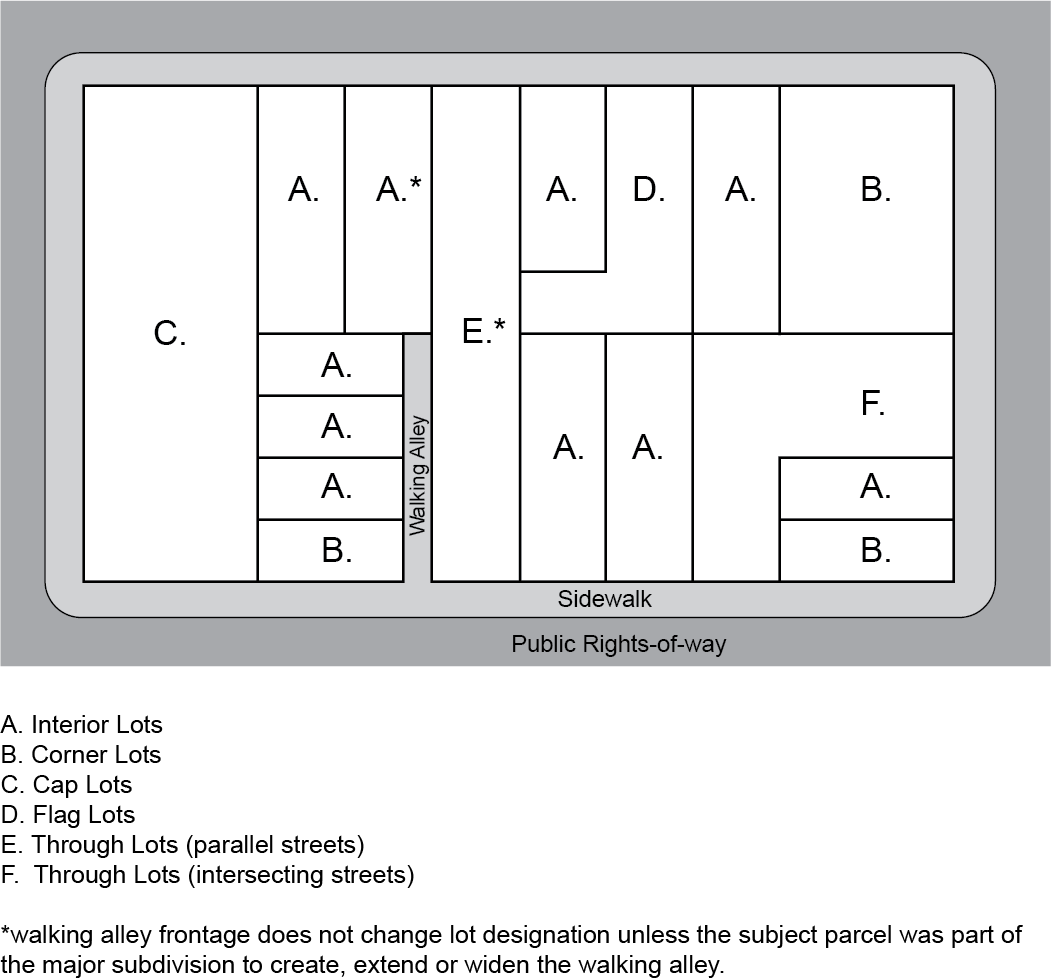
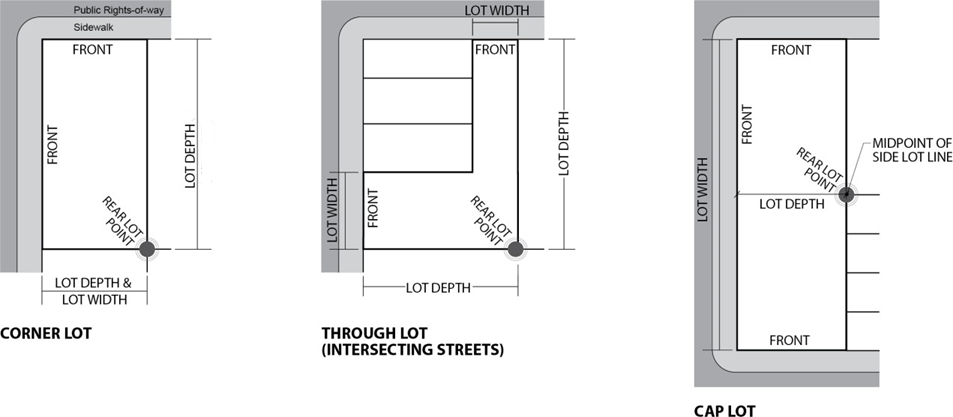
LOT WIDTH — (1) For interior lots and flag lots, the straight and horizontal distance between side lot lines at the street line. (2) For corner lots, the shortest distance between any two lot lines at the street line. See LOT, CORNER regarding historic districts and historic overlays. (3) For whole block lots, the shortest distance between any two lot lines at the street line. (4) For through lots, the distances between side lot lines at the street lines. Through lots have two lot widths. (5) For cap lots, the greatest dimension of a street line. See LOT TYPE DIAGRAM, LOT LINE DIAGRAM, and LOT WIDTH AND DEPTH DIAGRAM.
[Amended 10-13-2022 by Ord. No. 22-084; 10-25-2023 by Ord. No. 23-103]
LOT WIDTH AND DEPTH DIAGRAM — see image below. See LOT, CORNER regarding historic districts and historic overlays.
MAINTENANCE GUARANTEE — Any security which may be accepted by a municipality for the maintenance of any improvements required by the Municipal Land Use Law, including but not limited to surety bonds and letters of credit under the circumstances specified in Section 16 of P.L. 1991, c. 256 (C. 40:55D-53.5), and cash.
MARINA — A shorefront development that provides private and commercial pleasure craft mooring, launching and fueling.
MARINA, FULL SERVICE — A shorefront development that provides private and commercial pleasure craft mooring, launching, fueling, repair, storage and on-shore service facilities.
MARINA SERVICES — Commercial uses associated with the operation of a marina. These shall include, but not be limited to, bait and tackle shops, yacht clubs, up-land security posts but shall not include boat repair or storage or other similar uses.
MARQUEE — A metal rooflike, permanent structure often containing a signboard that projects from the wall of a building, over an entrance to a theatre or other building.
MASS TRANSIT FACILITY — A fixed route and/or station used to facilitate the transportation of people (as opposed to goods) on a fixed route and fixed schedule basis generally on conveyances such as buses, rapid-transit vehicles and commuter rail facilities.
MATCH — Either an exact or an approximate replication. If not an exact replication, the approximate replication shall be so designed as to achieve a harmonious result which exhibits the color, texture and dimensions of the original feature(s).
MAY — Permissive action
MAYOR — The chief executive of the City.
MECHANICAL EQUIPMENT — Any device below, above, or within a structure or on a lot which provides necessary support service for that structure. Mechanical equipment shall include but not be limited to heating and cooling units, and elevator bulkheads.
MEZZANINE — An intermediate floor placed in any story or room. For the purposes of zoning, a mezzanine, no matter the size, shall be counted as a story in determining the height of a building.
[Amended 7-18-2018 by Ord. No. 18-074]
MID-RISE APARTMENT BUILDING — A multi-family residential building with three (3) to eight (8) stories and more than four dwelling units.
MIXED USE — A lot or structure containing more than one principal zoning use.
MOBILE FOOD VENDOR — A business that sells food or beverages from a vehicle such as a truck, van or pushcart, whether such food or beverages are prepared on site or prepared elsewhere and transported to the site of the sale.
[Added 4-22-2015 by Ord. No. 15-048]
MOBILE HOME — A dwelling unit manufactured in one or more sections, designed for long-term occupancy; containing living and sleeping accommodations, a flush toilet, a tub or shower, bath and kitchen facilities with plumbing and electrical connections provided for attachment to outside systems; and designed to be transported after fabrication on its own wheels, or on flatbed or other trailers, arriving at the site where it is to be occupied as a dwelling complete, usually including major appliances and furniture, and ready for occupancy except for minor and incidental unpacking and assembly operations. Travel trailers and campers are not considered "mobile homes."
MORTUARY — An establishment with facilities for the preparation of the dead for burial or cremation, for the view of the body, and for funerals.
MULTI-FAMILY BUILDING — A building containing three or more dwelling units that share common horizontal and vertical separations. May also be referred to as Multi-unit Building or Multi-unit Residential.
[Added 10-13-2022 by Ord. No. 22-084]
MUNICIPALITY — City of Jersey City.
MLUL — The Municipal Land Use Law, N.J.S.A. 40:55D-1 et seq.
MUNICIPAL AGENCY — The Planning Board, Board of Adjustment, or the City Council when acting pursuant to the Municipal Land Use Law.
MUNICIPAL RESIDENT — A person who is domiciled in Jersey City.
MUNTINS — In windows, doors and storefronts, framing members that subdivide a glazed area into individual panes, lights or panels.
MURAL — An art installation, visible to the public right-of-way, consisting of paint, and adhered directly to the wall of a building or structure.
NARCOTIC AND DRUG ABUSE TREATMENT CENTER — Any licensed institution, facility, place, building or agency which supplies care, treatment, services, maintenance, accommodation or board, or any of these services in a group setting primarily or exclusively for individuals having any type of habitation, dependency or addiction to the use of any kind of controlled substance, alcohol, narcotic drug or other type of drug; and which provides guidance, supervision and personal services which enable the drug user, dependent or addict to move into independent living in normal surroundings, but does not provide those services that can be rendered only by a physician or within the confines of a hospital, and does not provide a permanent residence but only a temporary one.
NAMEPLATE — Identification located on the premises, giving the name or addresses or both of the owner or occupant of a building or premises.
NET LEASABLE AREA — The square footage of the area as measured from within the inside surface of the outer glass or finished walls of the building to the opposite walls, or, in the case of partial floor leases, to the midpoint of internal dividing walls, excluding only the areas (service areas) within the outside walls used for elevator mechanical rooms, building stairs, elevator shafts, flues, vents, stacks, and vertical ducts, but including all columns within the leased area and any such areas which are for the specific use of the particular tenant such as special stairs or elevators, plus a proportionate allocation of the square footage of the building's elevator mechanical rooms, common areas on the same floor of the leased premises, and the ground floor lobby.
NEW URBANISM — Interrelated patterns of land use, transportation, and urban forms used to create communities that promote: neighborliness, environmental sustainability, economic efficiency and prosperity, historic preservation, participation in civic processes, and human health. New Urbanism practices apply to all scales of community, from the region to the neighborhood. Communities developed utilizing New Urbanism principals usually take the form of an urban street grid, or modified street grid system, in order to provide a more even distribution of vehicular traffic and a more varied and convenient pedestrian network.
NIGHTCLUB — An establishment in which music, dancing, and/or live entertainment is conducted and which may also dispense liquor and/or food.
NONCONFORMING BUILDING OR STRUCTURE — A building or structure which, in its location upon a lot or in its size, does not conform to the regulations of this Chapter for the district in which it is located.
NONCONFORMING LOT — A lot of record which does not have the minimum width, frontage or depth or contain the minimum area or shape factor requirements for the district in which it is located.
NONCONFORMING USE — A use or activity which was lawful prior to the adoption, revision or amendment of a zoning ordinance or redevelopment plan, but which fails to conform to the requirements of the zoning district or redevelopment plan in which it is located by reasons of such adoption, revision or amendment.
NONCONTRIBUTING — A building, object, site or structure which neither adds to nor detracts from a historic district's or cluster's sense of time and place and historical development.
NOTICE TO PROCEED — A document attesting that an emergency situation exists, as certified by the Building or Zoning/Administrative Officer, requiring an immediate issuance of a building permit or other permit to commence to stabilize, secure, repair or protect a landmark building, structure, object, site or landscape feature.
NURSING FACILITY/NURSING HOME — See LONG TERM CARE FACILITY.
OCCUPATION — Gainful employment in which an individual engages to earn compensation.
OFFSITE -Located outside the lot lines of the lot in question but within the property of which the lot is a part, which is the subject of a development application or the closest half of the street or right-of- way abutting the property of which the lot is a part.
OFF-TRACT — Not located on the property which is the subject of a development application nor on the closest half of the abutting street or right-of-way.
OFFICE — A place for the transaction of business where reports are prepared, records are kept and services rendered, but where no retail sales are offered and where no manufacturing, assembly or fabricating takes place.
[Amended 5-25-2022 by Ord. No. 22-043]
OFFICE, MEDICAL — A professional office where the services of one or more practitioner can be obtained and where patients are studied or treated on an outpatient basis and where no overnight accommodations are provided. Medical office is permitted wherever Office is a permitted use. Veterinarian offices are considered medical offices. Medical offices are subject to all licensing and code requirements from all relevant government regulations, including but not limited to those from the Department of Health and the State Uniform Construction Code.
[Amended 5-25-2022 by Ord. No. 22-043]
OFFICIAL MAP — A map adopted by ordinance which shall be deemed to be conclusive with respect to the location and width of streets, public parks and playgrounds, and drainage rights-of-way shown thereon (N.J.S.A. 40:50D-32).
ON-SITE — Located on the lot in question and excluding any abutting street or right-of-way.
ON-TRACT — Located on the property that is the subject of a development application or on a contiguous portion of a street or right-of-way.
OPAQUE SCREENING — Any type of screening that completely obscures that which is to be hidden from view; this may include, but shall not be limited to, solid masonry walls, reflective glass, etc.
OPEN SPACE — Any parcel or area of land or water set aside, dedicated, designated or reserved for public or private use or enjoyment, or for the use and enjoyment of owners and occupants of land adjoining or neighboring such open space; such areas may be improved with only those buildings, structures, streets and off-street parking and other improvements that are customary and incidental to the openness of the land and may be designed for either passive or active recreational use.
ORDINARY REPAIRS — Replacement or renewal of existing fabric of a building or a structure, site, object or landscape feature or of parts of the service equipment therein, with the same material or equipment parts, that are made in the ordinary course of maintenance and that do not in any way affect health, fire or structure safety of the landmark building, structure, site, object or landscape feature; or do not affect the design or integrity of the historic fabric of the landmark building, structure, object, site or landscape feature.
OUTDOOR STORAGE — The storage of goods and materials outside of any building or structure.
OWNER — An individual, firm, association, syndicate, co-partnership or corporation having sufficient proprietary interest in the land involved in an Application for Development to commence and maintain proceedings to develop the same under this Chapter.
PARCEL — A lot or contiguous group of lots in a single ownership or under single control.
PARK — A form of public open space either publicly or privately owned and available for recreational, educational, cultural or aesthetic use, which may include, but not be limited to, amenities such as landscaping, lighting, benches, fountains, recreational equipment, etc.
PARKING, COMMERCIAL — Any parking facility open to the public where a fee is charged and where the persons parking therein do not necessarily live or work in a building or development which the parking lot, area, or structure is intended to serve.
PARKING, COMMUTER — a commercial lot for the parking of personal passenger vehicles or buses, while occupants of the vehicles travel by trolley, train, boat, bus, van, foot, or other means to another destination for purposes of work or pleasure.
PARKING, PUBLIC — see PARKING, COMMERCIAL.
PARKING, SHARED — Parking facilities which utilize the same parking spaces to accommodate the parking needs for two or more separate and distinct users.
PARKING, VALET (ATTENDANT) — Parking facilities in which an attendant parks and retrieves vehicles; aisles between spaces usually do not exist.
PARKING SPACE — An accommodation for the parking of one licensed motor vehicle. A standard parking space measures 8.5' × 18', exclusive of driveways, access drives, fire lanes, and public rights-of- way.
PARKING SPACE, COMPACT — An accommodation for the parking of one licensed motor vehicle. A compact parking space measures 8' × 16', exclusive of driveways, access drives, fire lanes, and public rights-of-way.
PARLOR FLOOR — The first floor above grade in a dwelling with a basement.
PASEO — An uncovered public walkway or passageway.
PATIO — A level, surfaced area at or within one and one-half feet of the finished grade, not covered by a permanent roof. It may be of wood or masonry construction.
PENTHOUSE — The uppermost story of a building.
[Amended 7-18-2018 by Ord. No. 18-074]
PERFORMANCE GUARANTEE — Any security that may be accepted by a municipality to assure that improvements required as part of an application for development will be satisfactorily completed.
PERMEABLE PAVEMENT — A pavement system that forces water to filter through the grout between pavers to infiltrate the soil.
[Added 6-24-2020 by Ord. No. 20-044]
PERMITTED USE — Any use of land or buildings as permitted by this Chapter in the zone in which it is situated.
PERVIOUS PAVEMENT — A pavement system that allows water to infiltrate through the pavement into an underground stone reservoir to provide temporary storage before infiltrating the soil. Pervious pavement includes pervious asphalt, pervious concrete, and interlocking pavers.
[Added 6-24-2020 by Ord. No. 20-044]
PLANNING BOARD — The Jersey City Planning Board established pursuant to the N.J.S.A. (C. 40:55 D- 23).
PLAT — A map or maps of a subdivision.
PLAT, PRELIMINARY — The preliminary map indicating the proposed layout of the subdivision which is submitted to the Reviewing Board for approval.
PLAZA — An open area for the general public's use that may serve as a point of assembly and/or a physical link between two buildings, and which is designed for pedestrian access from the street level(s) which it abuts and which has improved surfacing, sitting areas, landscaping, and public art.
PORCH — A roofed open area, which may be screened or enclosed and is attached to or part of a principal structure. See ENCROACHMENT.
[Added 10-13-2022 by Ord. No. 22-084]
POROUS PAVEMENT — A grid paver system filled with dirt, sand, or gravel that provides grass reinforcement, ground stabilization and gravel retention.
[Added 6-24-2020 by Ord. No. 20-044]
PREDOMINANT FRONT YARD SETBACK — The most frequently occurring setback on the block frontage.
PRELIMINARY APPROVAL — Conferral on the applicant the following rights for a three-year period from the date of preliminary approval (N.J.S.A. 40:55D-46)
A.
That the general terms and conditions on which the preliminary approval was granted shall not be changed.
B.
That the applicant may submit for final approval on or before the expiration of this three- year period.
PRINCIPAL BUILDING — A building in which the principal use of the lot is conducted.
PRINCIPAL USE — The primary use of land or structures as distinguished from an accessory use.
PROFESSIONAL REVIEW — Technical review of applications for development by staff or retained consultants, who are considered competent and prepared by virtue of their expertise, training, education and/or licensure to undertake such review for the land use boards of the City of Jersey City. All professional review shall take place under the supervision of New Jersey licensed professional planners, engineers, architects, landscape architects or surveyors.
PROJECTIONS - An area beyond the building line or build to line into which certain building features protrude. Typical projections may include cornices, eaves, leaders, sills, headers, or other elements that commonly protrude beyond the façade of the building.
[Added 10-13-2022 by Ord. No. 22-084]
PUBLIC AREAS — Public parks, playgrounds, trails, paths and other recreational areas; other public open spaces; scenic and historic sites; and sites for schools and other public buildings and structures.
PUBLIC IMPROVEMENTS — Public parks and open space, streets, sidewalks, water and sewer lines and other similar spaces and infrastructure.
PUBLIC/QUASI-PUBLIC USE — Any use that enables a public or private institution to carry out its functions to preserve or promote public health, safety and welfare and shall include, but not be limited to, religious organizations, public and private schools, civic and fraternal organizations, nursing homes, hospitals, public works and government buildings, daycare facilities and non-profit organizations.
PUBLIC UTILITY — Any public utility regulated by the Board of Regulatory Commissioners and defined pursuant to C. 48:2-13.
QUORUM — A majority of the full authorized membership of a municipal agency.
RAIN GARDEN — A shallow planted depression designed to retain or detain stormwater before it is infiltrated or discharged downstream.
[Added 6-24-2020 by Ord. No. 20-044]
REAR LOT POINT - See LOT LINE, REAR. See YARD, REAR. See REAR YARD DIAGRAM. See LOT WIDTH AND DEPTH DIAGRAM.
[Added 10-13-2022 by Ord. No. 22-084]
REAR YARD DIAGRAM — See image below. See LOT, CORNER regarding historic districts and historic overlays.
[Added 10-13-2022 by Ord. No. 22-084]
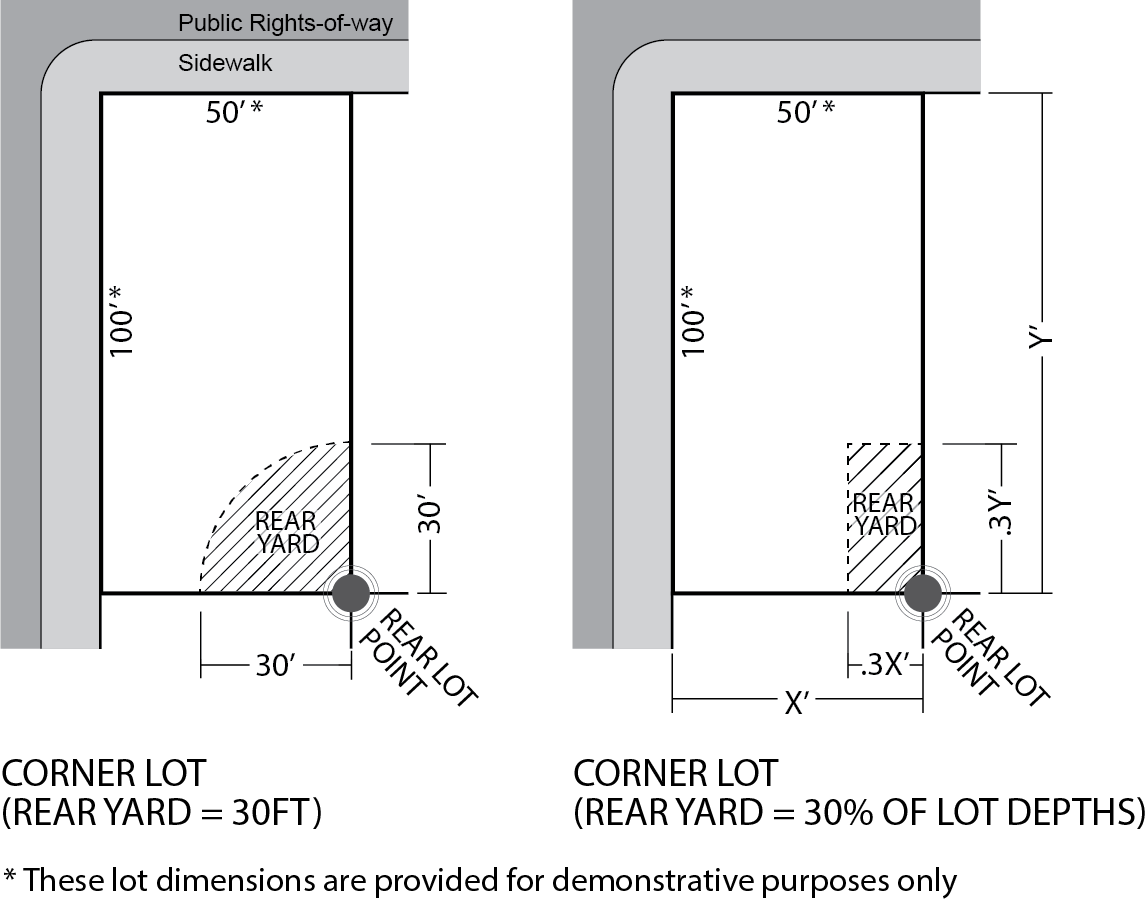
RECONSTRUCTION — The act or process of reassembling, reproducing or replacing by new construction the form, detail and appearance of a property and its setting as it appeared at a particular period of time by means of the removal of later work, or by the replacement of missing earlier work or by reuse of original materials for historical preservation purposes.
REDEDICATED (Street or Right-of-Way) — A public right-of-way once having been vacated for private use and returned by ordinance to its previous status as a public right-of-way.
REHABILITATION — The act or process of returning a building, object, site, structure or landscape feature to a state of utility through repair, remodeling or alteration that makes possible an efficient contemporary use while preserving those portions or features of the building, object, site or structure that are significant to its historical, architectural and cultural values for historical preservation purposes.
RESTAURANT — Any establishment, however designated, at which food is sold for consumption on premises, normally to patrons seated within an enclosed building. However, a snack bar at a public or community playground, playfield, park, or swimming pool operated solely by the agency or group operating the recreation facilities, and for the convenience of patrons of the facility, shall not be deemed to be a restaurant.
RESTAURANT, CATEGORY ONE — A restaurant which is designed for and whose primary function and operation is the preparation and service by employees of meals to a customer or customers seated at the table or bar at which the meal is consumed. A category one restaurant operates without substantial carry-out or delivery service; with no drive-thru, drive-in, or service in vehicles.
[Amended 9-9-2015 by Ord. No. 15-115]
RESTAURANT, CATEGORY TWO — A restaurant or mobile food vendor whose primary function is the preparation and service by employees of food to customers as part of an operation designed to include substantial carry-out service; delivery service; self-service, and which may, but is not required to, include on-premises consumption, except that no drive-in, drive-thru, or service in vehicles is permitted.
[Amended 4-22-2015 by Ord. No. 15-048]
CAFÉ - RESTAURANT, CATEGORY TWO — A small-scale restaurant, with limited seating, engaged in the selling of light meals and drinks. A café is designed to operate for substantial carry-out service; delivery service; self-service; counter service, and which may, but is not required to, include on-premise consumption. No commercial kitchen or ventilation systems are permitted.
[Added 9-9-2015 by Ord. No. 15-115]
RESTAURANT, CATEGORY THREE — A restaurant whose primary function is the preparation and service by employees of food to customers as part of an operation which may be designed with carry-out service; delivery service; self-service; on-premise consumption; or customer pick-up service utilizing a vehicular drive-thru.
RESTAURANT, DRIVE-IN — An establishment where the majority of the patrons purchase food, soft drinks, ice cream, and similar confections for takeout or consumption on the premises but outside the confines of the principal building, or in automobiles parked upon the premises, regardless of whether or not, in addition thereto, seats or other accommodations are provided for the patrons.
RESTORATION — The act or process of accurately recovering the form and details of a building, object, site or structure and its setting as it appeared at a particular period of time by means of the removal of later work or by the replacement of missing earlier work.
RETAIL BROKERAGE — See FINANCIAL SERVICES FACILITY.
RETAIL SALES — An establishment engaged in selling goods or merchandise to the general public for personal or household consumption and rendering services incidental to the sale of such goods. In no instance shall bars or service stations be considered as retail sales.
RETAIL SERVICES — An establishment providing services, as opposed to products, to the general public for personal or household use. In no instance shall drug rehabilitation centers be considered as retail services.
RIGHT-OF-WAY — A strip of land used or intended to be used as a street, lane, alley, pedestrian way, bikeway, railway, or some combination thereof; for the purpose of conveying people and/or goods, whether publicly or privately owned, and as indicated on the municipal tax map or created by subdivision or an easement granted to the City of Jersey City for public access and duly filed and recorded in the office of the Hudson County Registrar.
[Added 7-16-2014 by Ord. No. 14-077]
ROOF DECK — An amenitized roof space atop the uppermost floor of a building. In a high-rise configuration with a tower and a base/podium component, the area atop the base/podium shall be considered a roof deck. Roof decks may be used for common recreation space or private recreation space. See TERRACE.
[Added 10-13-2022 by Ord. No. 22-084]
ROOMING HOUSE — See BOARDING HOUSE.
ROW HOUSE — see TOWNHOUSE.
SANITARY LANDFILL — The means by which refuse is deposited, compacted and covered with clean fill and meeting all the standards of the State of New Jersey and the City of Jersey City and the New Jersey Meadowlands Commission in the areas of their jurisdiction.
SATELLITE DISH ANTENNA — A device or instrument, designed or used for the reception of television or other electronic communications signal broadcast or relayed from an earth satellite. It may be solid, open mesh, or bar-configured structure in the shape of a shallow dish or parabola.
SATELLITE EARTH STATION — A Satellite Dish Antenna larger than 3 feet in diameter.
SCHOOL — An institution of academic education which is designed, constructed or used for education of students up to and through the secondary level.
SCREENING — The decorative fencing, evergreen, or other vegetation maintained for the purpose of concealing from view the area behind such structures, evergreen, or other vegetations.
SELF STORAGE FACILITY - A facility consisting of individual, self-contained units leased to individuals, organizations, or small businesses for self-service storage of personal property. No commercial warehousing is permitted. Self storage shall not be considered retail sales or service. [Added 3-11-2015 by Ord. No. 15-025]
SENIOR HOUSING — Housing that is located and designed to meet the special needs and accommodate the changing living arrangements of an elderly population, aged 62 and older.
SERVICE STATION — A place where motor fuel, lubricants and miscellaneous accessories for motor vehicles are sold and dispensed and where services may be rendered for engine and mechanical repairs, but where no automobile painting and bodywork are done and where no junked or unregistered motor vehicles are kept or stored. Service stations may also include retail sales of food and sundry items of convenience to the general public and roll over car washes.
SETBACK, REQUIRED — a line that is established to set a minimum horizontal distance from the street line or the lot line and beyond which a building or part of a building is not permitted to extend toward the street line, or lot line, or rear lot point.
[Added 10-13-2022 by Ord. No. 22-084]
SETBACK LINE — A line drawn parallel to a street line or lot line and drawn through the point of a building nearest to the street line or lot line. Regarding a rear lot point see SETBACK DIAGRAM, REAR YARD.
[Added 10-13-2022 by Ord. No. 22-084]
SHALL — Mandatory requirement
SHAPE FACTOR — The perimeter of the lot squared, divided by the lot area.
SHORT-TERM RENTAL — The accessory use of a dwelling unit for occupancy by someone other than the unit's owner or permanent resident for a period twenty-eight (28) or fewer consecutive days.
[Added 10-28-2015 by Ord. No. 15-137; amended 6-25-2019 by Ord. No. 19-077]
SIDE SLOPE — The section of a hill that is below the Talus Slope and generally of moderate or lesser gradient than the Talus Slope or cliff face.
SIGHT TRIANGLE — The area outside the right-of way which is bounded by intersecting street lines and the straight line connecting sight points, one each located on the two intersecting street center lines, the following distance away from the intersecting center lines: primary and secondary arterial streets at one hundred (100) feet; major and minor collector streets at sixty (60) feet; and local streets at forty (40) feet. Where the intersecting streets are both arterial, both collectors or one arterial and one collector, two overlapping sight triangles shall be required, formed by connecting the sight points noted above with a sight point forty (40) feet on the intersecting street. The classification of streets shall be those in the Master Plan of the Jersey City.
SIGN — Any device, fixture, placard or structure that uses color, form, picture, display, graphic, illumination, symbol or writing to advertise, attract attention to, announce the purpose of, or identify a person, entity or thing, or to communicate any information to the public.
SIGN, BANNER — Any sign intended to be hung flush with any building wall either with or without frames, possessing characters, letters, illustrations or ornamentations applied to paper, plastic or fabric of any kind. National flags, flags of political subdivision and symbolic flags of political subdivisions and symbolic flags of any institutions or business shall not be considered banners.
SIGN, BUILDING — Any sign attached below the roofline to any part of a building, as contrasted to a freestanding sign. Building signs include wall signs, window signs, and canopy signs.
SIGN, CANOPY — Any sign on, or attached to, an awning, marquee, or canopy.
SIGN, FREESTANDING — Any sign supported by structures or supports that are placed on, or anchored in, the ground, and that are independent from any building or other structure.
SIGN, HANGING/BLADE — A sign that is wholly or partly dependent upon a building for support and that projects perpendicular more than twelve (12) inches from such building.
SIGN, INTERNALLY ILLUMINATED — Any sign which has characters, letters, figures, designs or outline illuminated, and where the light source is contained within or directly behind the sign band.
SIGN, MONUMENT — A sign which the entire bottom is in contract with or is close to the ground and is independent of any other structure.
SIGN, PYLON/POLE — A sign that is mounted on a freestanding pole or other support so that the bottom edge of the sign face is six feet or more above grade.
SIGN, WALL — Any sign attached parallel to, but within six inches of a wall, painted on the wall surface, or erected and confined within the limits of an outside wall of any building or structure, which is supported by such wall or building, and which displays only one sign surface and may be made of a fabric material.
SIGN, WINDOW — Any sign that is placed within a window or upon the window panes or glass and is visible from the exterior of the window.
SINGLE ROOM OCCUPANCY (SRO) — A housing type consisting of one room with private or shared bathroom facilities, and no cooking facilities are provided.
SITE — Any plot or parcel of land or combination of contiguous lots or parcels of land. Within historic districts, a site is the location of a significant event, a prehistoric or historic occupation or activity, or a building, structure, object or landscape feature, whether standing, ruined or vanished, where the location itself maintains historical, cultural, architectural or archaeological value regardless of the value of any existing structure.
SITE PLAN — A development plan of one or more lots on which is shown the proposed conditions of the lot, showing the location of proposed buildings, drives, parking spaces, walkways, means of ingress and egress, and any other information that may be reasonably required in order to make an informed determination pursuant to an ordinance requiring review and approval.
SITE PLAN, MINOR — A development plan of one or more lots which (1) proposes new development within the scope of development specifically permitted by ordinance as a minor site plan; (2) does not involve planned development, any new street or extension of any off-tract improvement which is to be prorated pursuant to section 30 of P.L. 1975, c.291 (C.40:55D-42); and (3) contains the information reasonably required in order to make an informed determination pursuant to an ordinance requiring review and approval of site plans.
SITE PLAN REVIEW — The examination of the specific development plans for a lot as per N.J.S.A. 40:55D-37 et seq.
SOIL CONSERVATION DISTRICT — The Hudson-Essex-Passaic Soil Conservation District.
SOIL EROSION AND SEDIMENT CONTROL PLAN — A plan which indicates necessary land treatment measures, including a schedule for installations, which will effectively minimize soil erosion and sedimentation. Such measures shall be at least equivalent to the standards and specifications as adopted by the Hudson-Essex-Passaic Soil Conservation District.
STABILIZATION — The act or process of applying measures designed to reestablish a weather-resistant enclosure and the structural stability of an unsafe or deteriorated building, object, site, structure or landscape feature while maintaining the essential form as it exists at present.
STEEP SLOPE — Shall be defined as an area in which the change in elevation is in excess of thirty percent (30%).
STEPBACK — The distance the upper floors or portions of a building or structure are setback from the outermost edge of that building or structure as measured from its intersection with grade. (Upper floors may be any floor above the ground level floor.)
STILTED BUILDING — A structure built above the surface of the grade with the first floor resting on or supported by posts and the grade level exposed.
STORMWATER BUMP-OUT — A vegetated curb extension that protrudes into the street. The bump-out is composed of a layer of stone that is topped with soil and plants, with an inlet or curb-cut directing runoff into the bump-out structure where it can be stored, infiltrated, and taken up by the plants.
[Added 6-24-2020 by Ord. No. 20-044]
STORMWATER PLANTER — A specialized planter installed in the sidewalk area that is designed to manage street and sidewalk runoff. The planters are lined with a permeable fabric, filled with gravel or stone, and topped off with soil, plants, and sometimes trees. The top of the soil in the planter is lower in elevation than the sidewalk, allowing for runoff to flow into the planter through an inlet at street level. Excess runoff is directed into an overflow pipe connected to the existing combined sewer pipe.
[Added 6-24-2020 by Ord. No. 20-044]
STORMWATER TREE TRENCH — A system of trees that are connected by an underground infiltration structure to manage the incoming runoff. This system is composed of a trench dug along the sidewalk, lined with a permeable geotextile fabric, filled with stone or gravel, and topped off with soil and trees. Stormwater runoff flows through a special inlet (storm drain) leading to the trench where runoff is stored, watering the trees and slowly infiltrating through the bottom.
[Added 6-24-2020 by Ord. No. 20-044]
STORY — That portion of a building included between the surface of any floor and the surface of the floor next above it, or if there is no floor above it, then the space between the floor and the ceiling next above it. See definitions for "basement," "cellar," "mezzanine," and "penthouse."
[Amended 4-22-2015 by Ord. No. 15-048; 7-18-2018 by Ord. No. 18-074]
STORY, HALF — A space under a sloping roof that has the line of intersection of the roof decking and wall face not more than three feet above the top floor level and in which space the possible floor area with a headroom of five feet or less occupies at least 40 percent of the total floor area of the story directly beneath. Also known as an attic.
[Amended 7-18-2018 by Ord. No. 18-074]
STREET — A street, avenue, boulevard, road, parkway, viaduct, walking alley, or drive but not including alleys or rail rights-of- way: (1) which is an existing state, county or municipal roadway; or (2) which is shown upon a plat heretofore approved pursuant to law; or (3) which is approved by official action as provided by this Chapter; or (4) which is shown on a plat duly filed and recorded in the office of the county recording officer prior to the appointment of a planning board and the grant to such board of the power to review plats; and includes the land between the street lines, whether improved or unimproved, and may comprise pavement, shoulders, gutters, curbs, sidewalks, parking areas and other areas within the street lines.
[Amended 4-22-2015 by Ord. No. 15-048; 10-13-2022 by Ord. No. 22-084]
STREET FURNITURE — Above-ground items that are usually found in street rights-of-way including benches, kiosks, plants, canopies, shelters, bicycle racks, lamp posts, and trash cans.
STREET LINE — The edge of the street right-of-way forming the dividing line between the street and a lot.
STRUCTURE — A combination of materials to form a construction for occupancy, use or ornamentation, whether installed on, above or below the surface of a parcel of land.
STUDIO, FILM PRODUCTION AND PERFORMING ARTS — An area utilized for the production and editing of films and/or rehearsal space for actors, musicians, dancers and other similar performers. Where this use is permitted within any residential district, no equipment or process shall be used that creates noise, glare, fumes, odors, electrical interference or other nuisance factors detectable to the human senses outside the structure in which the studio is located. In addition, where this use is permitted within a residential district, all studio activities shall be permitted to occur only within an enclosed structure.
SUBDIVIDER — Any individual, firm, association, syndicate, company, partnership, corporation, trust or other legal entity commencing proceedings under this Chapter to effect a subdivision of land for himself or herself or for another.
SUBDIVISION — The division of a lot, tract or parcel of land into two or more lots, tracts, parcels or other divisions of land for sale or development The following shall not be considered subdivisions within the meaning of this Chapter, if no new streets are created:
A.
Divisions of property by testamentary or intestate provisions.
B.
Divisions of property upon court order, including but not limited to judgments of foreclosure.
C.
Consolidation of existing lots by deed or other recorded instrument.
D.
The conveyance of one or more adjoining lots, tracts or parcels of land, owned by the same person or persons, and all of which are found and certified by the administrative officer to conform to the requirements of the Municipal Development regulations and are shown and designated as separate lots, tracts or parcels on the Tax Map or Atlas of the City.
SUBDIVISION, MAJOR — Any subdivision not classified as a minor subdivision.
SUBDIVISION, MINOR — Any subdivision containing four lots or less and which does not involve: a planned development; any new street; or the extension of any off-tract improvement, the cost of which is to be prorated pursuant to N.J.S.A. 40:55D-42. Any lot or remaining land approved as a minor subdivision shall not be submitted as a minor subdivision within five years from the date of approval as a minor subdivision. Such lot or tract may be submitted as a major subdivision.
SUBSTANTIAL IMPROVEMENT — Any repair, reconstruction or improvement of a structure, the cost of which equals or exceeds fifty percent (50%) of the market value of the structure either before the improvement or repair is started or, if the structure has been damaged and is being restored, before the damage occurred. For the purposes of this definition, "substantial improvement" is considered to occur when the first alteration of any wall, ceiling, floor or other structural part of the building commences, whether or not that alteration affects the external dimensions of the structure. The term does not, however, include either any project for improvement of a structure to comply with existing state or local health, sanitary or safety code specifications which are solely necessary to assure safe living conditions or any alteration of a structure listed on the National Register of Historic Places or a State Inventory of Historic Places.
SUBSTANTIAL REHABILITATION OR ALTERATION OF A HISTORIC FACADE — Alteration or rehabilitation of fifty percent (50%) or more of any facade along a public right-of-way within a designated historic district.
TALUS SLOPE — A slope formed by accumulation of debris at the bottom of a cliff.
TERRACE — A deck, patio, or amenitized roof space located atop habitable space or above the ground floor but not atop the uppermost story of a building. Terraces may be used for common or private recreation space.
[Added 10-13-2022 by Ord. No. 22-084]
THEATER — Space for live or screen performances including movies, plays, and concerts.
THEMATIC GROUP — A finite group of resources related to one another in a clearly distinguishable way by association with a single historic person, event or development force, as one building type or use, as designed by a single architect, as a single archaeological site form or as a particular set of archaeological research.
TOP OF CLIFF — The portion of a hill located above the cliff face, overlain with regolith, generally the plateau or hill crest.
TOWNHOUSE — A residential building in which each building has its own front and rear access to the outside and is separated from adjacent buildings only by vertical fire-resistant building walls. A townhouse building may contain one to four dwelling units in accordance with the density standard of the particular zoning district in which such property is located.
TOWNHOUSE, BACK-TO-BACK — A townhouse building with individual units that are attached back to back, but in no case shall individual units be located above or below another unit. Each individual unit shall have its own entrance from the exterior. Each building cluster shall have two building front facades and two side facades.
TOWNHOUSE, STACKED — A townhouse building with units that are stacked one on top of the other. Each individual unit shall have its own entrance from the exterior. Stacked Townhouses may also qualify as Back-to-Back Townhouses.
TRANSCRIPT — A typed or printed verbatim record of the proceedings or reproduction thereof.
TRANSIT-WAY — That roadway, easement, rail, trench route, etc. on which a mass transit vehicle travels.
TRANSIT VILLAGE — An urban community well served by mass transit system(s). Transit Villages make it easy for residents to live without a car by allowing for the convenient ability to ride transit and walking within pleasant urban environments. Typically, they have active, vibrant, and strong neighborhood centers providing convenient access to commercial services focused around transit.
TRANSOM — A small window above a door or other window.
TWO-FAMILY — A building on a single lot containing two dwelling units, each of which is separated from the other by an unpierced wall extending from ground to roof or an unpierced vertical and horizontal ceiling and floor extending from exterior wall to exterior wall, except for a common stairwell exterior to both dwelling units.
UNUSUAL AND COMPELLING CIRCUMSTANCES — Those uncommon and extremely rare instances, factually detailed, which would warrant the Historic Preservation Commission action due to the evidence presented.
UPLAND AREA — Land area located above the surface of any body of water.
UTILITY — Water, sewerage, telephone, gas or electric service from a private or public utility company under the regulations of the New Jersey Board of Public Utilities.
VARIANCE — Permission to depart from the literal requirements of the zoning ordinance as per N.J.S.A. 40:55D-70(d).
VEHICULAR SALES AREA — See AUTO SALES.
VIEW CORRIDOR — Three dimensional space through which views of historic, cultural or aesthetic significance may be observed.
VISTA — A view through or along an avenue, street or opening which as a view corridor frames, highlights or accentuates a prominent building, object, site, structure, scene or panorama, or patterns or rhythms of buildings, structures, objects, sites or landscape features; to include views of areas at a distance.
WAIVER — Permission to depart from the requirements of an ordinance with respect to the submission of required documents, and/or compliance with particular design standards.
WALKWAY — Any pathway set aside for and traveled by pedestrians and improved in such way to assist in the designated use.
WALL — A solid, vertical structure of wood, masonry or other material serving to enclose, divide or protect an area.
WAREHOUSE — A building used primarily for the storage of goods and materials.
WATER TRANSPORTATION FACILITIES — See MASS TRANSIT FACILITY.
WHARF — A structure built parallel to the shore, used to load passengers and may also serve as a walkway or access-way. A quay wall is a simple form of wharf that serves as both a retaining wall for shorefront protection and a docking facility.
WHOLESALE SALES AND SERVICES — Establishments or places of business primarily engaged in selling merchandise to retailers; industrial, commercial, institutional or professional business users; other wholesalers; or acting as agents or brokers and buying merchandise for, or selling merchandise to, such individuals or companies.
WIRELESS COMMUNICATION ANTENNAS — Devices which are used for the transmission and reception of wave frequencies for the purposes of any wireless telecommunication (e.g., telephone, radio, paging, and/or television communication) and which are permitted as either second principal uses on existing structures or as "conditional uses" on a tower except in historic districts, in accordance with the specified zoning conditions and standards for their location and operation set forth in this Chapter. Wireless Communication Antennas shall not be considered to be a "public utility."
WIRELESS TELECOMMUNICATION TOWER — A freestanding vertical structure designed to support one or more wireless telecommunication antennas, including monopoles, guyed towers, lathe towers and similar structures.
WORK/LIVE ARTIST STUDIO — A single, enclosed, private space of nine hundred (900) square feet or more, where at least one-half of the volume of the total space is devoted to work space for the creation, display and sale of art, and the remainder is used for living purposes. Nothing in this definition shall prohibit the use and occupancy of a "work/live artist studio" in a setting where shared kitchen and/or bath facilities are available, provided that applicable health and safety codes are met and maintained.
WORK/LIVE UNIT — A unit that adheres to all of the standards of a Home Occupation except that a minimum of 900 (nine hundred) square feet must be provided, a maximum 50% of which may be used as work space and the remaining space is used for residential purposes. There is no maximum square footage to the workspace so long as it does not exceed 50% of the total unit area.
YARD — An open space that lies between the principal building or buildings and the nearest lot line. The minimum required yard as set forth in the ordinance shall be unoccupied and unobstructed from the ground upward except as may be specifically provided in the zoning ordinance.
YARD, FRONT — An open space extending across the full width(s) of the lot and lying between the street line and the building line. The depth of the front yard shall be measured to the building and shall not be measured to the closest point of an encroachment, unless that encroachment does not conform to the requirements provided in the land development ordinance. The depth of the "front yard" shall be measured horizontally and at right angles to either a straight street line or the point of tangent of curved street lines. The minimum required "front yard" shall be the same as the required setback. See LOT WIDTH AND DEPTH DIAGRAM.
[Added 10-13-2022 by Ord. No. 22-084]
YARD, REAR — An open space extending across the full width of the lot and lying between the rear lot line or rear lot point and the closest point of the principal building on the lot. The depth of the "rear yard" shall be measured horizontally and at right angles to either a straight rear lot line or the point of tangent of curved rear lot lines. The minimum required "rear yard" shall be the same as the required setback. See LOT, CORNER regarding historic districts and historic overlays. See REAR YARD DIAGRAM, and LOT WIDTH AND DEPTH DIAGRAM.
[Added 10-13-2022 by Ord. No. 22-084]
YARD, SIDE — An open space extending from the front yard to the rear yard and lying between each side lot line and the closest point of the principal building on the lot. The width of the required "side yard" shall be measured horizontally and at right angles to either a straight side lot line or the point of tangent of curved side lot lines. The minimum required "side yard" shall be the same as the required setback. See LOT WIDTH AND DEPTH DIAGRAM.
[Added 10-13-2022 by Ord. No. 22-084]
ZONE — see District
ZONING PERMIT — A document signed by the Zoning Officer.
A.
Which is required by ordinance as a condition precedent to the commencement of a use or the erection, construction, reconstruction, alteration, conversion or installation of a structure or buildings.
B.
Which acknowledges that such use, structures or buildings comply with the provisions of the City Zoning Ordinance or variance therefore duly authorized by the appropriate agency of the City pursuant to N.J.S.A. 40:55D-60 and 40:55D-70.

