
Jersey City City Zoning Code
ARTICLE VI
Stormwater Control
[Added 4-11-2007 by Ord. No. 07-056]
§ 345-74.- Stormwater control.
[Amended 8-8-2007 by Ord. No. 07-133; 5-20-2009 by Ord. No. 09-052; 2-10-2021 by Ord. No. 21-005]
§ 1. Scope and purpose:
A.
Policy statement. As Jersey City is developed, additional Impervious Surfaces are added throughout the Municipality. These Impervious Surfaces disrupt the natural flow of the watershed, resulting in increased amounts of Stormwater Runoff during precipitation events. Stormwater Runoff collects Pollutants as it flows over parking lots, roadways, rooftops, and other paved or hardened surfaces, through Stormwater conveyances, and into our rivers. In addition to conveying Pollutants into our waterbodies, increased Stormwater Runoff also leads to Erosion and flooding downstream.
Further, Jersey City's Stormwater infrastructure is mainly comprised of Combined Sewer Systems ("CSS"). CSS carry Stormwater and wastewater in the same pipes to treatment facilities. The volume of runoff produced during storm events routinely overwhelms the capacity of these systems, resulting in combined sewer overflow ("CSO") events, which discharge untreated sewage and polluted Stormwater directly to nearby waterbodies.
Low Impact Development or "LID" (also referred to as "Green Infrastructure") practices restore or mimic natural conditions, allowing rainwater to infiltrate the Soil, evapotranspirate into the air, or be captured for re-use. These practices deal with the Stormwater at its source rather than after it has been channeled downstream. LID techniques can be implemented at Site, neighborhood, or regional scales and include both nonstructural practices such as Site planning and design, and structural Best Management Practices ("BMPs"). Nonstructural BMPs include the implementation of Green Infrastructure such as Porous Pavement, green roofs, parks, roadside plantings, and rain barrels (GI BMPs).
GI BMPs and Low Impact Development (LID) should be utilized to meet the goal of maintaining natural hydrology to reduce Stormwater Runoff volume, reduce Erosion, encourage Infiltration and groundwater Recharge where feasible, and reduce pollution. GI BMPs and LID should be developed based upon physical Site conditions and the origin, nature and the anticipated quantity, or amount, of potential Pollutants. Multiple Stormwater management BMPs may be necessary to achieve the established performance standards for water quality, quantity, and groundwater Recharge. By capturing rainwater and runoff, GI BMPs can lessen the impact on Jersey City's CSS, and reduce or eliminate the number of CSO events. LID practices also result in additional benefits for Jersey City, including providing open space and beautifying neighborhoods, cooling and cleansing the air, reducing asthma and heat-related illnesses, raising property values, and saving on heating and cooling energy costs.
B.
Purpose. It is the purpose of this section to establish minimum Stormwater management requirements and controls for "Major Development" and "Minor Development" as defined in Section 2 of this section. The environmental objectives of these requirements are to reduce pollution from municipal Separate Sewer Systems, direct discharges to surface waters, and CSO events; to reduce flooding and streambank Erosion; and promote rainwater harvesting for re-use on-site. Under this framework, structural BMPs will be integrated with nonstructural Stormwater management strategies and proper inspection and maintenance plans. Low Impact Development-based strategies will include consideration of both environmentally sensitive Site design and source controls that prevent Pollutants from being placed on-site or from being exposed to Stormwater. Source control plans will be developed based upon physical Site conditions and the origin, nature, and the anticipated quantity of potential Pollutants. It is the intent of the City of Jersey City to fully integrate these Stormwater management objectives into its zoning codes and land use plans.
C.
Applicability.
1.
This section shall apply to all Major and Minor Developments as defined in Section 2.
a.
Where Development that adds, replaces, or disturbs, alone or in combination, 1,000 or more square feet of Impervious Surface results in an alteration to more than 50 percent of regulated Impervious Surface and/or Regulated Motor Vehicle Surface of a previously existing Development, the entire existing Development shall meet the requirements of this article.
2.
No Major or Minor Development shall be deemed in compliance with this section unless a legally authorized body or official of the City of Jersey City has issued written findings, based on a technical review by a legally authorized and qualified employee, agent, or official of the City of Jersey City, that such Development complies with the requirements of this section. Such technical review shall include written findings regarding each requirement of this section and shall not rely upon the findings of any other government entity as to the Development's compliance with any other legal requirements.
3.
This section shall also be applicable to all Major or Minor Developments undertaken by the City of Jersey City or any other governmental body.
D.
Compatibility with other permit and ordinance requirements. Development approvals issued pursuant to this section are to be considered an integral part of Development approvals and do not relieve the applicant of the responsibility to secure required permits or approvals for activities regulated by any other applicable code, rule, act, or ordinance. In their interpretation and application, the provisions of this section shall be held to be the minimum requirements for the promotion of the public health, safety, and general welfare.
This section is not intended to interfere with, abrogate, or annul any other ordinances, rule or regulation, statute, or other provision of law except that, where any provision of this section imposes restrictions different from those imposed by any other ordinance, rule or regulation, or other provision of law, the more restrictive provisions or higher standards shall control.
§ 2. Definitions:
For the purpose of this section, the following terms, phrases, words and their derivations shall have the meanings stated herein unless their use in the text of this chapter clearly demonstrates a different meaning. When not inconsistent with the context, words used in the present tense include the future, words used in the plural number include the singular number, and words used in the singular number include the plural number. The word "shall" is always mandatory and not merely directory. The definitions below are the same as or based on the corresponding definitions in the Stormwater Management Rules at N.J.A.C. 7:8-1.2.
BEST MANAGEMENT PRACTICE or BMP means structural or nonstructural Stormwater management strategies prescribed by the New Jersey Department of Environmental Protection in the New Jersey Stormwater Best Management Practices Manual.
BIORETENTION means a BMP that consists of a bed filled with Soil, gravel, or other material and planted with suitable non-invasive (preferably native) vegetation. Stormwater Runoff entering a Bioretention system is filtered through the planting bed before being either conveyed downstream by an underdrain system or infiltrated into the existing subsoil below the planting bed.
CAFRA means the Coastal Area Facility Review Act, N.J.S.A. 13:19-1 et seq.
CAFRA CENTERS, CORES OR NODES means those areas within boundaries accepted by the New Jersey Department of Environmental Protection pursuant to N.J.A.C. 7:8E-5B.
CAFRA PLANNING MAP means the geographic depiction of the boundaries for Coastal Planning Areas, CAFRA Centers, CAFRA Cores and CAFRA Nodes pursuant to N.J.A.C. 7:7E-5B.3. The CAFRA Planning Map is available on the Department's Geographic Information System (GIS).
COMBINED SEWER SYSTEM means a system that consists of a single conduit that collects and transports domestic sewage and industrial wastewater, along with Stormwater Runoff.
COMMUNITY BASIN means an Infiltration basin, sand filter designed to infiltrate, standard constructed Wetland, or wet pond, established in accordance with N.J.A.C. 7:8-4.2(c)14, that is designed and constructed in accordance with the New Jersey Stormwater Best Management Practices Manual, or an alternate design, approved in accordance with N.J.A.C. 7:8-5.2(g), for an Infiltration basin, sand filter designed to infiltrate, standard constructed Wetland, or wet pond and that complies with the requirements of this chapter.
COMPACTION means the increase in Soil bulk density due to construction, Development, or other causes.
CONTRIBUTORY DRAINAGE AREA means the area from which Stormwater Runoff drains to a Stormwater Management Measure, not including the area of the Stormwater Management Measure itself.
CORE means a pedestrian-oriented area of commercial and civic uses serving the surrounding Municipality, generally including housing and access to public transportation.
COUNTY REVIEW AGENCY means an agency designated by the County Board of Chosen Freeholders to review municipal Stormwater management plans and implementing ordinance(s). The county Review Agency may either be:
1.
A county planning agency; or
2.
A county water resource association created under N.J.S.A. 58:16A-55.5, if the ordinance or resolution delegates authority to approve, conditionally approve, or disapprove municipal Stormwater management plans and implementing ordinances.
DEPARTMENT means the New Jersey Department of Environmental Protection.
DESIGNATED CENTER means a State Development and Redevelopment Plan Center as designated by the State Planning Commission such as urban, regional, town, village, or hamlet.
DESIGN ENGINEER means a Person professionally qualified and duly licensed in New Jersey to perform engineering services that may include, but not necessarily be limited to, Development of project requirements, creation and Development of project design and preparation of drawings and specifications.
DEVELOPMENT means the division of a parcel of land into two or more parcels, the construction, reconstruction, conversion, structural alteration, relocation or enlargement of any building or structure, any mining excavation or landfill, any clearing, grading, or excavation or any other activity that results in land Disturbance, and/or any use or change in the use of any building or other structure, or land or extension of use of land, by any Person, for which permission is required under the Municipal Land Use Law, N.J.S.A. 40:55D-1 et seq.
DISTURBANCE means the placement or replacement of Impervious Surfaces or Motor Vehicle surface, or exposure and/or movement of Soil or bedrock or clearing, cutting, or removing of vegetation. Milling and repaving is not considered Disturbance for the purposes of this definition.
DRAINAGE AREA means a geographic area within which Stormwater, Sediments, or dissolved materials drain to a particular receiving waterbody or to a particular point along a receiving waterbody.
ENVIRONMENTALLY CONSTRAINED AREAS means the following areas where the physical alteration of the land is in some way restricted, either through regulation, easement, deed restriction or ownership such as: Wetlands, floodplains, threatened and endangered species Sites or designated habitats, and parks and preserves. Habitats of endangered or threatened species are identified using the Department's Landscape Project as approved by the Department's Endangered and Nongame Species Program.
ENVIRONMENTALLY CRITICAL AREA means an area or feature which is of significant environmental value, including but not limited to: stream corridors; natural heritage priority Sites; habitat of endangered or threatened species; large areas of contiguous open space or upland forest; steep slopes; and well head protection and groundwater Recharge areas. Habitats of endangered or threatened species are identified using the Department's Landscape Project as approved by the Department's Endangered and Nongame Species Program.
EMPOWERMENT NEIGHBORHOOD means a neighborhood designated by the Urban Coordinating Council "in consultation and conjunction with" the New Jersey Redevelopment Authority pursuant to N.J.S.A. 55:19-69.
EROSION means the detachment and movement of Soil or rock fragments by water, wind, ice or gravity.
GREEN INFRASTRUCTURE means a Stormwater management method that manages Stormwater close to its source by: (1) treating Stormwater Runoff through Infiltration into subsoil; (2) treating Stormwater Runoff through filtration by vegetation or Soil; or (3) storing Stormwater Runoff for reuse.
GREEN STREET means a street or right-of-way that includes a variety of elements such as street trees, Permeable Pavements, Bioretention, and swales designed to reduce the amount of Stormwater Runoff and Pollutants transported to a separate storm sewer system or a Combined Sewer System.
HUC 14 or HYDROLOGIC UNIT CODE 14 means an area within which water drains to a particular receiving surface water body, also known as a subwatershed, which is identified by a 14-digit hydrologic boundary designation, delineated within New Jersey by the United States Geological Survey.
IMPERVIOUS SURFACE means a surface that has been covered with a layer of material so that it is highly resistant to Infiltration by water.
INFILTRATION is the process by which water seeps into the Soil from precipitation.
LOW IMPACT DEVELOPMENT (LID) means the implementation of Stormwater management and Site design methods primarily vegetation and Soil to manage Stormwater and reduce Stormwater Runoff.
MAJOR DEVELOPMENT means an individual "Development" as well as multiple Developments that individually or collectively result in:
1.
The Disturbance of 10,000 or more square feet of land;
2.
The creation or replacement of 5,000 or more square feet of "regulated Impervious Surface;"
3.
The creation or replacement of 5,000 or more square feet of "Regulated Motor Vehicle Surface; or
4.
A combination of 2 and 3 above that totals an area of 5,000 or more square feet. The same surface shall not be counted twice when determining if the combination area equals 5,000 or more square feet.
MINOR DEVELOPMENT means an individual "Development" as well as multiple Developments that individually or collectively result in:
1.
The Disturbance of 5,000 or more square feet, but less than 10,000 square feet of land;
2.
The creation of 1,000 or more square feet, but less than 5,000 square feet of "regulated Impervious Surface;"
3.
The creation of 1,000 or more square feet, but less than 5,000 square feet of "Regulated Motor Vehicle Surface;" or
4.
A combination of 2 and 3 above that totals an area of at least 1,000 square feet, but less than 5,000 square feet or more square feet. The same surface shall not be counted twice when determining if the combination area equals 5,000 or more square feet.
"Minor Development" includes all Developments that are part of a common plan of Development or sale (for example, phased residential Development) that collectively or individually meet any one or more of paragraphs 1, 2, 3, or 4 above. Projects undertaken by any government agency that otherwise meet the definition of "Major Development" but which do not require approval under the Municipal Land Use Law, N.J.S.A. 40:55D-l et seq., are also considered "Major Development." Projects that do not require Land Use Board approval are exempt from Minor Development requirements.
MOTOR VEHICLE means land vehicles propelled other than by muscular power, such as automobiles, motorcycles, autocycles, and low speed vehicles. For the purposes of this definition, Motor Vehicles do not include farm equipment, snowmobiles, all-terrain vehicles, motorized wheelchairs, go-carts, gas buggies, golf carts, ski-slope grooming machines, or vehicles that run only on rails or tracks.
MOTOR VEHICLE SURFACE means any pervious or Impervious Surface that is intended to be used by Motor Vehicles and/or aircraft, and is directly exposed to precipitation including, but not limited to, driveways, parking areas, parking garages, roads, racetracks, and runways.
MUNICIPALITY means the City of Jersey City.
NEW JERSEY STORMWATER BEST MANAGEMENT PRACTICES (BMP) MANUAL or BMP MANUAL means the manual maintained by the Department providing, in part, design specifications, removal rates, calculation methods, and Soil testing procedures approved by the Department as being capable of contributing to the achievement of the Stormwater management standards specified in this chapter. The BMP Manual is periodically amended by the Department as necessary to provide design specifications on additional Best Management Practices and new information on already included practices reflecting the best available current information regarding the particular practice and the Department's determination as to the ability of that Best Management Practice to contribute to compliance with the standards contained in this chapter. Alternative Stormwater Management Measures, removal rates, or calculation methods may be utilized, subject to any limitations specified in this chapter, provided the Design Engineer demonstrates to the Municipality, in accordance with Section 4.E of this section and N.J.A.C. 7:8-5.2(g), that the proposed measure and its design will contribute to achievement of the design and performance standards established by this chapter.
NODE means an area designated by the State Planning Commission concentrating facilities and activities which are not organized in a compact form.
NUTRIENT means a chemical element or compound, such as nitrogen or phosphorus, which is essential to and promotes the development of organisms.
PERVIOUS PAVEMENT mean a pavement system that allows water to infiltrate through the pavement into an underground stone reservoir to provide temporary storage before infiltrating the Soil. "Pervious Pavement" includes pervious asphalt, pervious concrete, and interlocking pavers.
PERMEABLE PAVEMENT means a pavement system with surface voids constructed over a bed of crush stone or sand that allows water to infiltrate the Soil.
POROUS PAVEMENT means porous asphalt or concrete surface placed over a runoff storage bed of broken stone and un-compacted subgrade Soils.
PERSON means any individual, corporation, company, partnership, firm, association, or political subdivision of this state subject to municipal jurisdiction pursuant to the Municipal Land Use Law, N.J.S.A. 40:55D-l et seq. "Person" shall also include the City of Jersey City.
POLLUTANT means any dredged spoil, solid waste, incinerator residue, filter backwash, sewage, garbage, refuse, oil, grease, sewage sludge, munitions, chemical wastes, biological materials, medical wastes, radioactive substance (except those regulated under the Atomic Energy Act of 1954, as amended (42 U.S.C. 2011 et seq.), thermal waste, wrecked or discarded equipment, rock, sand, cellar dirt, industrial, municipal, agricultural, and construction waste or runoff, or other residue discharged directly or indirectly to the land, ground waters or surface Waters of the State, or to a domestic treatment works. "Pollutant" includes both hazardous and nonhazardous Pollutants.
RECHARGE means the amount of water from precipitation that infiltrates into the ground and is not evapotranspired.
REGULATED IMPERVIOUS SURFACE means any of the following, alone or in combination: (1) a net increase of Impervious Surface; (2) the total area of Impervious Surface collected by a new Stormwater conveyance system/Combined Sewer System (for the purpose of this definition, a "new Stormwater conveyance system" is a Stormwater conveyance system that is constructed where one did not exist immediately prior to its construction or an existing system for which a new discharge location is created); (3) the total area of Impervious Surface proposed to be newly collected by an existing Stormwater conveyance system/Combined Sewer System; and/or (4) the total area of Impervious Surface collected by an existing Stormwater conveyance system/Combined Sewer System where the capacity of that system is increased.
REGULATED MOTOR VEHICLE SURFACE means any of the following, alone or in combination: (1) the total area of Motor Vehicle surface that is currently receiving water; (2) a net increase in Motor Vehicle surface; and/or the total area of Motor Vehicle surface that is currently receiving water quality treatment either by vegetation or Soil, by an existing Stormwater Management Measure, or by treatment at a wastewater treatment plant, where the water quality treatment will be modified or removed.
REVIEW AGENCY means the Jersey City Municipal Utilities Authority (JCMUA).
SEDIMENT means solid material, mineral or organic, that is in suspension, is being transported, or has been moved from its Site of origin by air, water or gravity as a product of Erosion.
SEPARATE SEWER SYSTEM means a system in which the sanitary and storm sewer systems are not interconnected. In this system, the sanitary sewer system is tributary to a wastewater treatment facility, and the storm sewer system discharges directly to the receiving waters.
SITE means the lot or lots upon which a Major Development is to occur or has occurred.
SOIL means all unconsolidated mineral and organic material of any origin.
SOURCE CONTROL MEASURE means any Stormwater management practice designed to reduce and/or slow the flow of Stormwater into a Combined Sewer System or Separate Sewer System, including, and not limited to, LID or BMP.
SOURCE MATERIAL means any material(s) or machinery, located at an industrial facility, that is directly or indirectly related to process, manufacturing or other industrial activities, which could be a source of Pollutants in any industrial Stormwater discharge to groundwater. Source Materials include, but are not limited to, raw materials; intermediate products; final products; waste materials; by-products; industrial machinery and fuels, and lubricants, solvents, and detergents that are related to process, manufacturing, or other industrial activities that are exposed to Stormwater.
STATE DEVELOPMENT AND REDEVELOPMENT PLAN METROPOLITAN PLANNING AREA (PAI) means an area delineated on the State Plan Policy Map and adopted by the State Planning Commission that is intended to be the focus for much of the state's future redevelopment and revitalization efforts.
STATE PLAN POLICY MAP is defined as the geographic application of the State Development and Redevelopment Plan's goals and statewide policies, and the official map of these goals and policies.
STORMWATER means water resulting from precipitation (including rain and snow) that runs off the land's surface, is transmitted to the subsurface, or is captured by separate storm sewers or other sewage or drainage facilities, or conveyed by snow removal equipment.
STORMWATER MANAGEMENT BASIN means an excavation or embankment and related areas designed to retain Stormwater Runoff. A Stormwater Management Basin may either be normally dry (that is, a detention basin or Infiltration basin), retain water in a permanent pool (a retention basin), or be planted mainly with Wetland vegetation (most constructed Stormwater Wetlands).
STORMWATER MANAGEMENT BMP means an excavation or embankment and related areas designed to retain Stormwater Runoff. A Stormwater management BMP may either be normally dry (that is, a detention basin or Infiltration system), retain water in a permanent pool (a retention basin), or be planted mainly with Wetland vegetation (most constructed Stormwater Wetlands).
STORMWATER MANAGEMENT MEASURE means any practice, technology, process, program, or other method intended to control or reduce Stormwater Runoff and associated Pollutants, or to induce or control the Infiltration or groundwater Recharge of Stormwater or to eliminate illicit or illegal non-Stormwater discharges into Stormwater conveyances.
STORMWATER MANAGEMENT PLANNING AGENCY means a public body authorized by legislation to prepare Stormwater management plans.
STORMWATER MANAGEMENT PLANNING AREA means the geographic area for which a Stormwater Management Planning Agency is authorized to prepare Stormwater management plans, or a specific portion of that area identified in a Stormwater management plan prepared by that agency.
STORMWATER RUNOFF means water flow on the surface of the ground or in storm sewers, resulting from precipitation.
TIDAL FLOOD HAZARD AREA means a flood hazard area in which the flood elevation resulting from the two-, ten-, or 100-year storm, as applicable, is governed by tidal flooding from the Atlantic Ocean. Flooding in a tidal Flood Hazard Area may be contributed to, or influenced by, Stormwater Runoff from inland areas, but the depth of flooding generated by the tidal rise and fall of the Atlantic Ocean is greater than flooding from any fluvial sources. In some situations, depending upon the extent of the storm surge from a particular storm event, a flood hazard area may be tidal in the 100-year storm, but fluvial in more frequent storm events.
URBAN COORDINATING COUNCIL EMPOWERMENT NEIGHBORHOOD means a neighborhood given priority access to state resources through the New Jersey Redevelopment Authority.
URBAN ENTERPRISE ZONE means a zone designated by the New Jersey Enterprise Zone Authority pursuant to the New Jersey Urban Enterprise Zones Act, N.J.S.A. 52:27H-60 et seq.
URBAN REDEVELOPMENT AREA is defined as previously developed portions of areas:
1.
Delineated on the State Plan Policy Map (SPPM) as the Metropolitan Planning Area (PAI), Designated Centers, Cores or Nodes;
2.
Designated as CAFRA Centers, Cores or Nodes;
3.
Designated as Urban Enterprise Zones; and
4.
Designated as Urban Coordinating Council Empowerment Neighborhoods.
VEGETATIVE SOURCE CONTROL MEASURE means a Source Control Measure that relies on living vegetative systems to reduce and/or slow the flow of Stormwater into a Combined Sewer System or Separate Sewer System.
WATER CONTROL STRUCTURE means a structure within, or adjacent to, a water, which intentionally or coincidentally alters the hydraulic capacity, the flood elevation resulting from the two-, ten-, or 100-year storm, flood hazard area limit, and/or floodway limit of the water. Examples of a Water Control Structure may include a bridge, culvert, dam, embankment, ford (if above grade), retaining wall, and weir.
WATERS OF THE STATE means the ocean and its estuaries, all springs, streams, Wetlands, and bodies of surface or ground water, whether natural or artificial, within the boundaries of the State of New Jersey or subject to its jurisdiction.
WETLANDS or WETLAND means an area that is inundated or saturated by surface water or ground water at a frequency and duration sufficient to support, and that under normal circumstances does support, a prevalence of vegetation typically adapted for life in saturated Soil conditions, commonly known as hydrophytic vegetation.
§ 3. Design and performance standards for Stormwater Management Measures:
A.
Stormwater Management Measures for Major and Minor Development shall be designed to provide Erosion control, groundwater Recharge, Stormwater Runoff quantity control, and Stormwater Runoff quality treatment as follows:
1.
The minimum standards for Erosion control are those established under the Soil and Sediment Control Act, N.J.S.A. 4:24-39 et seq., and implementing rules at N.J.A.C. 2:90.
2.
The minimum standards for groundwater Recharge, Stormwater quality, and Stormwater Runoff quantity shall be met by incorporating Green Infrastructure.
B.
Unless otherwise indicated, the standards in this section apply only to new Major and Minor Development as defined herein and are intended to minimize the impact of Stormwater Runoff on water quality and water quantity in receiving water bodies and achieve additional environmental benefits, including maintaining groundwater Recharge. The standards do not apply to new Major Development to the extent that alternative design and performance standards are applicable under a regional Stormwater management plan or Water Quality Management Plan adopted in accordance with Department rules.
§ 4. Stormwater management requirements for Major Development:
A.
As stated above, Stormwater Management Measures for Major Development shall be designed to provide Erosion control, groundwater Recharge, Stormwater Runoff quantity control, and Stormwater Runoff quality treatment as follows:
1.
The minimum design and performance standards for Erosion control are those established under the Soil Erosion and Sediment Control Act, N.J.S.A. 4:24-39 et seq., and implementing rules at N.J.A.C. 2:90 and 16:25A.
2.
The minimum design and performance standards for groundwater Recharge, Stormwater Runoff quality, and Stormwater Runoff quantity at N.J.A.C. 7:8-5.4, 5.5, and 5.6 shall be met by incorporating Green Infrastructure in accordance with N.J.A.C. 7:8-5.3.
B.
Each Development to this section shall incorporate a maintenance plan for the Stormwater Management Measures incorporated into the design of a Major Development in accordance with Section 15 of this section.
C.
Stormwater Management Measures shall avoid adverse impacts of concentrated flow on habitat for threatened and endangered species as documented in the Department's Landscape Project or Natural Heritage Database established under N.J.S.A. 13:16-15.147 through 15.150, particularly Helonias bullata (swamp pink) and/or Clemmys muhlnebergi (bog turtle).
D.
The following linear Development projects are exempt from the Stormwater retention, groundwater Recharge, Stormwater Runoff quantity, and Stormwater Runoff quality requirements of Sections 7, 8, 9, and 10 of this article:
1.
The construction of an underground utility line provided that the disturbed areas are revegetated upon completion with priority given for use of native plant species;
2.
The construction of an aboveground utility line provided that the existing conditions are improved or are maintained to the maximum extent practicable; and
3.
The construction of a public pedestrian access, such as a sidewalk or trail with a maximum width of 14 feet, provided that the access is made of permeable, porous, or perviable material.
E.
A waiver from strict compliance from the groundwater Recharge, Stormwater Runoff quantity, and Stormwater Runoff quality requirements of Sections 7, 8, and 9 herein may be granted for the enlargement of an existing public roadway or railroad; or the construction or enlargement of a public pedestrian access, provided that the following conditions are met:
1.
The applicant demonstrates that there is a public need for the project that cannot be accomplished by any other means;
2.
The applicant demonstrates through an alternatives analysis, in writing, that through the use of Stormwater Management Measures, the option selected complies with the requirements of Sections 7, 8, and 9 of this article to the maximum extent practicable. For road or highway projects, the applicant shall, at minimum, follow USEPA guidance regarding managing Wet Weather with Green Infrastructure; Green Streets (December 2008 EPA-833-F-08-009);
3.
The applicant demonstrates that, in order to meet the requirements of Sections 7, 8, and 9, existing structures currently in use, such as homes and buildings, would need to be condemned; and
4.
The applicant demonstrates that it does not own or have other rights to areas, including the potential to obtain through condemnation lands not falling under Section 3.D.3 above within the upstream Drainage Area of the receiving stream, that would provide additional opportunities to mitigate the requirements of Sections 7, 8, and 9 herein that were not achievable on-site.
F.
The tables below summarize the ability of Stormwater Best Management Practices identified and described in the New Jersey Stormwater Best Management Practices Manual to satisfy the Green Infrastructure, groundwater Recharge, Stormwater Runoff quality, and Stormwater Runoff quantity standards specified in this article. When designed in accordance with the New Jersey Stormwater Best Management Practices Manual and this chapter, the Stormwater Management Measures listed in Tables 4-1,4-2, and 4-3 shall be presumed to be capable of providing Stormwater controls for the design and performance standards as outlined in the tables below. Upon amendment of the New Jersey Stormwater Best Management Practices Manual to reflect additions or deletions of BMPs meeting these standards, or changes in the presumed performance of BMPs designed in accordance with the New Jersey Stormwater BMP Manual, the Department shall publish in the New Jersey Register a notice of administrative change revising the applicable table.
G.
The most current version of the BMP Manual can be found on the Department's website at: https://njStormwater.org/bmp___manual2.htm.
H.
Where the BMP tables in the NJ Stormwater Management Rule are different due to updates or amendments with the tables in this section the BMP Tables in the Stormwater Management rule at N.J.A.C. 7:8-5.2(f) shall take precedence.
Table 4-1
Green Infrastructure BMPs for Groundwater Recharge, Stormwater Runoff Quality, and/or
Stormwater Runoff Quantity
Table 4-2
Green Infrastructure BMPs for Stormwater Runoff Quantity (or for Groundwater Recharge
and/or Stormwater Runoff Quality with a Waiver of Variance from N.J.A.C. 7:8-5.3
Table 4-3
BMPs for Groundwater Recharge, Stormwater Runoff Quality, and/or Stormwater Runoff
Quantity only with a Waiver or Variance from N.J.A.C 7:8-5.3
;adv=6;Notes to Tables 4-1, 4-2, and 4-3:
(a) Subject to the applicable Contributory Drainage Area limitation specified at Subsection 5.B;
(b) Designed to infiltrate into the subsoil;
(c) Designed with underdrains;
(d) Designed to maintain at least a ten-foot wide area of native vegetation along at least 50 percent of the shoreline and to include a Stormwater Runoff retention component designed to capture Stormwater Runoff for beneficial reuse, such as irrigation;
(e) Designed with a slope of less than two percent;
(f) Designed with a slope of equal to or greater than two percent;
(g) Manufactured treatment devices that meet the definition of Green Infrastructure as defined in Section 2 herein;
(h) Manufactured treatment devices that do not meet the definition of Green Infrastructure as defined in Section 2 herein.
I.
An alternative Stormwater Management Measure, alternative removal rate, and/or alternative method to calculate the removal rate may be used if the Design Engineer demonstrates the capability of the proposed alternative Stormwater Management Measure and/or the validity of the alternative rate or method to the Review Agency. A copy of any approved alternative Stormwater Management Measure, alternative removal rate, and/or alternative method to calculate the removal rate shall be provided to the Department at: Division of Water Quality, New Jersey Department of Environmental Protection, Mail Code 401-02B, PO Box 420, Trenton, New Jersey 08625-0420. Alternative Stormwater Management Measures may be used to satisfy the requirements at Section 5 of this article only if the measures meet the definition of Green Infrastructure as defined in Section 2 herein. Alternative Stormwater Management Measures that function in a similar manner to a BMP listed at Section 5.B are subject to the Contributory Drainage Area limitation specified at Section 5.B for that similarly functioning BMP. Alternative Stormwater Management Measures approved in accordance with this subsection that do not function in a similar manner to any BMP listed at Section 5.B shall have a Contributory Drainage Area less than or equal to 2.5 acres, except for alternative Stormwater Management Measures that function similarly to cisterns, grass swales, green roofs, standard constructed Wetlands, vegetative filter strips, and wet ponds, which are not subject to a Contributory Drainage Area limitation. Alternative measures that function similarly to standard constructed Wetlands or wet ponds shall not be used for compliance with the Stormwater Runoff quality standard unless a variance in accordance with N.J.A.C. 7:8 or a waiver from strict compliance in accordance with Section 4.D above is granted.
J.
Whenever the Stormwater management design includes one or more BMPs that will infiltrate Stormwater into subsoil, the Design Engineer shall assess the hydraulic impact on the groundwater table and design the Site, so as to avoid adverse hydraulic impacts. Potential adverse hydraulic impacts include, but are not limited to, exacerbating a naturally or seasonally high water table, so as to cause surficial ponding, flooding of basements, or interference with the proper operation of subsurface sewage disposal systems or other subsurface structures within the zone of influence of the groundwater mound, or interference with the proper functioning of the Stormwater Management Measure itself.
K.
Design standards for Stormwater Management Measures are as follows:
1.
Stormwater Management Measures shall be designed to take into account the existing Site conditions, including, but not limited to, Environmentally Critical Areas; Wetlands; flood-prone areas; slopes; depth to seasonal high water table; Soil type, permeability, and texture; Drainage Area and drainage patterns; and the presence of solution-prone carbonate rocks (limestone);
2.
Stormwater Management Measures shall be designed to minimize maintenance, facilitate maintenance and repairs, and ensure proper functioning. Trash racks shall be installed at the intake to the outlet structure, as appropriate, and shall have parallel bars with one-inch spacing between the bars to the elevation of the water quality design storm. For elevations higher than the water quality design storm, the parallel bars at the outlet structure shall be spaced no greater than one-third the width of the diameter of the orifice or one-third the width of the weir, with a minimum spacing between bars of one inch and a maximum spacing between bars of six inches. In addition, the design of trash racks must comply with the requirements of Subsection 13.B;
3.
Stormwater Management Measures shall be designed, constructed, and installed to be strong, durable, and corrosion resistant. Measures that are consistent with the relevant portions of the Residential Site Improvement Standards at N.J.A.C. 5:21-7.3, 7.4, and 7.5 shall be deemed to meet this requirement;
4.
Stormwater Management Basins shall be designed to meet the minimum safety standards for Stormwater Management Basins at Section 13; and
5.
The size of the orifice at the intake to the outlet from the Stormwater Management Basin shall be a minimum of 2½ inches in diameter.
L.
Manufactured treatment devices may be used to meet the requirements of this subchapter under the circumstances described in Section 5.D, provided the Pollutant removal rates are verified by the New Jersey Corporation for Advanced Technology and certified by the Department.
M.
Any application for a new agricultural Development that meets the definition of Major Development as defined in Section 2 herein shall be submitted to the Soil Conservation District for review and approval in accordance with the requirements at Sections 7 and 9 and any applicable Soil Conservation District guidelines for Stormwater Runoff quantity and Erosion control. For purposes of this section, "agricultural Development" means land uses normally associated with the production of food, fiber, and livestock for sale. Such uses do not include the Development of land for the processing or sale of food and the manufacture of agriculturally related products.
N.
If there is more than one Drainage Area, the groundwater Recharge, Stormwater Runoff quality, and Stormwater Runoff quantity standards at Sections 7, 8, and 9 shall be met in each Drainage Area, unless the runoff from the Drainage Areas converge on-site and no adverse environmental impact would occur as a result of compliance with any one or more of the individual standards being determined utilizing a weighted average of the results achieved for that individual standard across the affected Drainage Areas.
O.
Any Stormwater Management Measure authorized pursuant to this article shall be reflected in a deed notice recorded in the Office of the County Clerk or the registrar of deeds and mortgages of the county in which the Development, project, project Site, or mitigation area containing the Stormwater Management Measure is located. A form of deed notice shall be submitted to the reviewing agency for approval prior to filing. The deed notice shall contain a description of the Stormwater Management Measure(s) used to meet the Green Infrastructure, Stormwater retention, groundwater Recharge, Stormwater Runoff quality, and Stormwater Runoff quantity standards at Sections 5, 6, 7, 8, 9, and 10 and shall identify the location of the Stormwater Management Measure(s) in NAD 1983 State Plane New Jersey FIPS 2900 US Feet or Latitude and Longitude in decimal degrees. The deed notice shall also reference the maintenance plan required to be recorded upon the deed pursuant to Section 15.B.5 Prior to the commencement of construction, proof that the above required deed notice has been filed shall be submitted to the Review Agency. Proof that the required information has been recorded on the deed shall be in the form of either a copy of the complete recorded document or a receipt from the clerk or other proof of recordation provided by the recording office. However, if the initial proof provided to the Review Agency is not a copy of the complete recorded document, a copy of the complete recorded document shall be provided to the Review Agency within 180 calendar days of the authorization granted by the Review Agency.
P.
A Stormwater Management Measure approved under article may be altered or replaced with the approval of the applicable Review Agency, if the Review Agency determines that the proposed alteration or replacement meets the design and performance standards pursuant to this article and provides the same level of Stormwater management as the previously approved Stormwater Management Measure that is being altered or replaced. If an alteration or replacement is approved, a revised deed notice shall be submitted to the reviewing agency for approval and subsequently recorded with the appropriate Office of the County Clerk or the registrar of deeds and mortgages and shall contain a description and location of the Stormwater Management Measure, as well as reference to the maintenance plan, in accordance with 4.M above. Prior to the commencement of construction, proof that the above required deed notice has been filed shall be submitted to the Review Agency in accordance with 4.M above.
§ 5. Green Infrastructure:
A.
This section specifies the types of Green Infrastructure BMPs that may be used to satisfy the groundwater Recharge, Stormwater Runoff quality, and Stormwater Runoff quantity standards.
B.
To satisfy the groundwater Recharge and Stormwater Runoff quality standards at Sections 7 and 8, the Design Engineer shall utilize Green Infrastructure BMPs identified in Table 4-1 and/or an alternative Stormwater Management Measure approved in accordance with Subsection 4.H. The following Green Infrastructure BMPs are subject to the following maximum Contributory Drainage Area limitations:
C.
To satisfy the Stormwater Runoff quantity standards at Section 9, the Design Engineer shall utilize BMPs from Table 4-1 or from Table 4-2 and/or an alternative Stormwater Management Measure approved in accordance with Subsection 4.H.
D.
If a variance in accordance with N.J.A.C. 7:8-4.6 or a waiver from strict compliance in accordance with Subsection 4.D is granted from the requirements of this section, then BMPs from Table 4-1, 4-2, or 4-3, and/or an alternative Stormwater Management Measure approved in accordance with Subsection 4.H may be used to meet the groundwater Recharge, Stormwater Runoff quality, and Stormwater Runoff quantity standards at Sections 7, 8, and 9.
E.
For separate or combined storm sewer improvement projects, such as sewer separation, undertaken by a government agency or sewerage authority, the requirements of this section shall only apply to areas owned in fee simple by the government agency or sewerage authority, and areas within a right-of-way or easement held or controlled by the government agency or sewerage authority; the entity shall not be required to obtain additional property or property rights to fully satisfy the requirements of this section. Regardless of the amount of area of a separate or combined storm sewer improvement project subject to the Green Infrastructure requirements of this section, each project shall fully comply with the applicable groundwater Recharge, Stormwater Runoff quality control, and Stormwater Runoff quantity standards at Sections 7, 8, and 9 unless the project is granted a waiver from strict compliance in accordance with Subsection 4.D.
§ 6. Stormwater retention standard for Minor Development:
A.
This section contains minimum design and performance standards for Stormwater retention for Minor Development:
For each square foot of Impervious Surface, 0.6 gallons of Stormwater shall be retained on-site using Green Infrastructure practices listed in Section 5 or other methods as identified by references included in Section 11 of this section.
§ 7. Groundwater Recharge standards for Major Development:
A.
This subsection contains minimum design and performance standards for groundwater Recharge for Major Development.
B.
The minimum design and performance standards for groundwater Recharge are as follows:
1.
The Design Engineer shall, using the assumptions and factors for Stormwater Runoff and groundwater Recharge calculations at Section 10 of this article, use whichever of the following demonstration approaches that yields a larger Infiltration volume:
a.
Demonstrate through hydrologic and hydraulic analysis that the Site and its Stormwater Management Measures maintain 100 percent of the average annual pre-construction groundwater Recharge volume for the Site; or
b.
Demonstrate through hydrologic and hydraulic analysis that the increase of Stormwater Runoff volume from pre-construction to post-construction for the two-year storm is infiltrated.
C.
This groundwater Recharge requirement does not apply to projects within the "Urban Redevelopment Area," or to projects subject to (D) below.
D.
The following types of Stormwater shall not be Recharged:
1.
Stormwater from areas of high Pollutant loading. High Pollutant loading areas are areas in industrial and commercial Developments where solvents and/or petroleum products are loaded/unloaded, stored, or applied, areas where pesticides are loaded/unloaded or stored; areas where hazardous materials are expected to be present in greater than "reportable quantities" as defined by the United States Environmental Protection Agency (EPA) at 40 CFR 302.4; areas where Recharge would be inconsistent with Department approved remedial action work plan or landfill closure plan and areas with high risks for spills of toxic materials, such as gas stations and vehicle maintenance facilities; and
2.
Industrial Stormwater exposed to Source Material. "Source Material" means any material(s) or machinery, located at an industrial facility, that is directly or indirectly related to process, manufacturing or other industrial activities, which could be a source of Pollutants in any industrial Stormwater discharge to groundwater. Source Materials include, but are not limited to, raw materials; intermediate products; final products; waste materials; by-products; industrial machinery and fuels, and lubricants, solvents, and detergents that are related to process, manufacturing, or other industrial activities that are exposed to Stormwater.
§ 8. Stormwater Runoff quality standards for Major Development:
A.
This subsection contains minimum design and performance standards for Stormwater Runoff quality for Major Development. Stormwater Runoff quality standards are applicable when the Major Development results in the Disturbance of one acre or more of land.
B.
Stormwater quality management measures shall be designed to reduce the post-construction load of total suspended solids (TSS) in Stormwater Runoff by generated from the water quality design storm as follows:
1.
Eighty percent TSS removal of the anticipated load, expressed as an annual average shall be achieved for the Stormwater Runoff from the net increase of Motor Vehicle surface.
2.
If the surface is considered Regulated Motor Vehicle Surface because the water quality treatment for an area of Motor Vehicle surface that is currently receiving water quality treatment either by vegetation or Soil, by an existing Stormwater Management Measure, or by treatment at a wastewater treatment plant is to be modified or removed, the project shall maintain or increase the existing TSS removal of the anticipated load expressed as an annual average.
C.
The requirement to reduce TSS does not apply to any Stormwater Runoff in a discharge regulated under a numeric effluent limitation for TSS imposed under the New Jersey Pollution Discharge Elimination System (NJPDES) rules, N.J.A.C. 7:14A, or in a discharge specifically exempt under a NJPDES permit from this requirement. Every Major Development, including that discharged into a Combined Sewer System, shall comply with (b) above, unless the Major Development is itself subject to a NJDPES permit with a numeric effluent limitation for TSS or the NJDPES permit to which the Major Development is subject exempts the development from a numeric effluent limitation for TSS.
D.
The water quality design storm is 1.25 inches of rainfall in two hours. Water quality calculations shall take into account the distribution of rain from the water quality design storm, as reflected in Table 8-1. The calculation of the volume of runoff may take into account the implementation of Stormwater Management Measures.
Table 8-1
Water Quality Design Storm Distribution
E.
If more than one BMP in series is necessary to achieve the required 80 percent TSS reduction for a Site, the applicant shall utilize the following formula to calculate TSS reduction:
R = A + B − (A × B)/100
Where
R = total TSS percent load removal from application of both BMPs, and
A = the TSS percent removal rate applicable to the first BMP
B = the TSS percent removal rate applicable to the second BMP
F.
Stormwater Management Measures shall also be designed to reduce, to the maximum extent feasible, the post-construction Nutrient load (nitrogen and phosphorous) of the anticipated load from the developed Site in Stormwater Runoff generated from the water quality design storm. In achieving reduction of Nutrients to the maximum extent feasible, the design of the Site shall include Green Infrastructure BMPs that optimize Nutrient removal while still achieving the performance standards in Section 4.
G.
In accordance with the definition of FWI at N.J.A.C. 7:9B-1.4, Stormwater Management Measures shall be designed to prevent any increase in Stormwater Runoff to waters classified as FWI.
H.
The Flood Hazard Area Control Act Rules at N.J.A.C. 7:13-4.1(c)1 establish 300-foot riparian zones along Category One waters, as designated in the Surface Water Quality Standards at N.J.A.C. 7:9B, and certain upstream tributaries to Category One waters. A Person shall not undertake a Major Development that is located within or discharges into a 300-foot riparian zone without prior authorization from the Department under N.J.A.C. 7:13.
I.
Pursuant to the Flood Hazard Area Control Act Rules at N.J.A.C. 7:13-11.2(j)4, runoff from the water quality design storm that is discharged within a 300-foot riparian zone shall be treated in accordance with this section to reduce the post-construction load of total suspended solids by 95 percent of the anticipated load from the developed Site, expressed as an annual average.
J.
This section does not apply to the construction of one individual single-family dwelling, provided that is not part of a larger Development or subdivision that has received preliminary or final Site plan approval prior to December 3, 2018, and that the Motor Vehicle surfaces are made of permeable material(s) such as gravel, dirt, and/or shells.
§ 9. Stormwater Runoff quantity standards for Major Development:
A.
This section contains the minimum design and performance standards to control Stormwater Runoff quantity impacts of Major Development.
B.
In order to control Stormwater Runoff quantity impacts, the Design Engineer shall, using the assumptions and factors for Stormwater Runoff calculations at Section 10, complete one of the following:
1.
Demonstrate through hydrologic and hydraulic analysis that for Stormwater leaving the Site, post-construction runoff hydrographs for the two-, ten-, and 100-year storm events do not exceed, at any point in time, the pre-construction runoff hydrographs for the same storm events;
2.
Demonstrate through hydrologic and hydraulic analysis that there is no increase, as compared to the pre-construction condition, in the peak runoff rates of Stormwater leaving the Site for the two-, ten-, and 100-year storm events and that the increased volume or change in timing of Stormwater Runoff will not increase flood damage at or downstream of the Site. This analysis shall include the analysis of impacts of existing land uses and projected land uses assuming full Development under existing zoning and land use ordinances in the Drainage Area;
3.
Design Stormwater Management Measures so that the post-construction peak runoff rates for the two-, ten-, and 100-year storm events are 50, 75, and 80 percent, respectively, of the pre-construction peak runoff rates. The percentages apply only to the post-construction Stormwater Runoff that is attributable to the portion of the Site on which the proposed Development or project is to be constructed; or
4.
In tidal Flood Hazard Areas, Stormwater Runoff quantity analysis, in accordance with (b)1, 2, and 3 above, is required unless the Design Engineer demonstrates through hydrologic and hydraulic analysis that the increased volume, change in timing, or increased rate of the Stormwater Runoff, or any combination of the three will not result in additional flood damage below the point of discharge of the Major Development. No analysis is required if the Stormwater is discharged directly into any ocean, bay, inlet, or the reach of any watercourse between its confluence with an ocean, bay, or inlet and downstream of the first Water Control Structure.
C.
The Stormwater Runoff quantity standards shall be applies at the Site's boundary to each abutting lot, roadway, watercourse, or receiving storm sewer system.
§ 10. Calculation of Stormwater Runoff, Stormwater retention, and groundwater Recharge for Major Development:
A.
Stormwater Runoff shall be calculated in accordance with the following:
1.
The Design Engineer shall calculate runoff using one of the following methods:
a.
The USDA Natural Resources Conservation Service (NRCS) methodology, including the NRCS Runoff Equation and Dimensionless Unit Hydrograph, as described Chapters 7, 9, 10, 15, and 16, Part 630, of the Hydrology National Engineering Handbook, incorporated herein by reference, as amended and supplemented. This methodology is additionally described in Technical Release 55 — Urban Hydrology for Small Watersheds (TR-55), dated June 1986, incorporated herein by reference, as amended and supplemented. Information regarding the methodology is available from the Natural Resources Conservation Service website at: https://www.nrcs.usda.gov/lnternet/FSE___DOCUMENTS/stelprdbl044171.pdf or at United States Department of Agriculture Natural Resources Conservation Service, 220 Davison Avenue, Somerset, New Jersey 08873; or
b.
The Rational Method for peak flow and the Modified Rational Method for hydrograph computations. The rational and modified rational methods are described in "Appendix A-9 Modified Rational Method" in the Standards for Soil Erosion and Sediment Control in New Jersey, July 1999, as amended and supplemented. This document is available from the State Soil Conservation Committee or any of the Soil Conservation Districts listed at N.J.A.C. 2:90-1.3(a)4. The location, address, and telephone number for each Soil Conservation District is available from the State Soil Conservation Committee, PO Box 330, Trenton, NJ 08625. The document is also available at http://www.nj.gov/agriculture/divisions/anr/pdf/2014NJSoilErosionControlStan dardsComplete.pdf.
2.
For the purpose of calculating runoff coefficients and groundwater Recharge, there is a presumption that the pre-construction condition of a Site or portion thereof is a wooded land use with good hydrologic condition. The term "runoff coefficient" applies to both the NRCS methodology at Subsection 10.A.1.a and the Rational and Modified Rational Methods at Section 10.A.1.b. A runoff coefficient or a groundwater Recharge land cover for an existing undeveloped land condition may be used on all or a portion of the Site if the Design Engineer verifies that the hydrologic condition has existed on the Site or portion of the Site for at least five years without interruption prior to the time of application. If more than one undeveloped land cover type has existed on the Site during the five years immediately prior to the time of application, the land cover with the lowest runoff potential shall be used for the computations. In addition, there is the presumption that the Site is in good hydrologic condition (if the land use type is pasture, lawn, or park), with good cover (if the land use type is woods), or with good hydrologic condition and conservation treatment (if the land use type is cultivation).
3.
In computing pre-construction Stormwater Runoff, the Design Engineer shall account for all significant land features and structures, such as ponds, Wetlands, depressions, hedgerows, or culverts, that may reduce pre-construction Stormwater Runoff rates and volumes.
4.
In computing Stormwater Runoff from all design storms, the Design Engineer shall consider the relative Stormwater Runoff rates and/or volumes of pervious and Impervious Surfaces separately to accurately compute the rates and volume of Stormwater Runoff from the Site. To calculate runoff from unconnected impervious cover, urban impervious area modifications as described in the NRCS Technical Release 55—Urban Hydrology for Small Watersheds and other methods may be employed.
5.
If the invert of the outlet structure of a Stormwater Management Measure is below the flood hazard design flood elevation as defined at N.J.A.C. 7:13, the Design Engineer shall take into account the effects of tailwater in the design of structural Stormwater Management Measures.
B.
Groundwater Recharge may be calculated in accordance with the following:
1.
The New Jersey Geological Survey Report GSR-32 A Method for Evaluating Groundwater-Recharge Areas in New Jersey, incorporated herein by reference as amended and supplemented. Information regarding the methodology is available from the New Jersey Stormwater Best Management Practices Manual; at the New Jersey Geological and Water Survey website at http://www.nj.gov/dep/njgs; or at New Jersey Geological and Water Survey, 29 Arctic Parkway, PO Box 420 Mail Code 29-01, Trenton, NJ 08625-0420
§ 11. Sources for technical guidance:
A.
Technical guidance for Stormwater Management Measures can be found in the documents listed below, which are available to download from the Department's website at: http://www.nj.gov/dep/Stormwater/bmp manual2.htm.
B.
Guidelines for Stormwater Management Measures are contained in the New Jersey Stormwater Best Management Practices Manual, as amended and supplemented. Information is provided on Stormwater Management Measures such as, but not limited to, those listed in Table 4-1, Table 4-2, and Table 4-3.
C.
Additional technical guidance for Stormwater Management Measures can be obtained from the Department's website at http://www.nj.gov/dep/Stormwater/maintenance_guidance.htm and the U.S. Environmental protection Agency's Green Infrastructure resource page at http://water.epa.gov/infrastructure/greeninfrastructure/index.cfm.
D.
Submissions required for review by the Department should be mailed to: The Division of Water Quality, New Jersey Department of Environmental Protection, Mail Code 401-02B, PO Box 420, Trenton, New Jersey 08625-0420.
§ 12. Solids and floatable materials controls standards:
A.
Site design features identified under Subsection 4.F above, or alternative designs in accordance with Section 4 above, to prevent discharge of trash and debris from drainage systems shall comply with the following standard to control passage of solid and floatable materials through storm drain inlets. For purposes of this paragraph, "solid and floatable materials" means Sediment, debris, trash, and other floating, suspended, or settleable solids. For exemptions to this standard see Subsection 12.A.2 below.
1.
Design engineers shall use one of the following grates whenever they use a grate in pavement or another ground surface to collect Stormwater from that surface into a storm drain or surface water body under that grate:
a.
The New Jersey Department of Transportation (NJDOT) bicycle safe grate, which is described in Chapter 2.4 of the NJDOT Bicycle Compatible Roadways and Bikeways Planning and Design Guidelines; or
b.
A different grate, if each individual clear space in that grate has an area of no more than seven square inches, or is no greater than 0.5 inches across the smallest dimension.
Examples of grates subject to this standard include grates in grate inlets, the grate portion (non-curb-opening portion) of combination inlets, grates on storm sewer manholes, ditch grates, trench grates, and grates of spacer bars in slotted drains. Examples of ground surfaces include surfaces of roads (including bridges), driveways, parking areas, bikeways, plazas, sidewalks, lawns, fields, open channels, and Stormwater system floors used to collect Stormwater from the surface into a storm drain or surface water body.
c.
For curb-opening inlets, including curb-opening inlets in combination inlets, the clear space in that curb opening, or each individual clear space if the curb opening has two or more clear spaces, shall have an area of no more than seven square inches, or be no greater than two inches across the smallest dimension.
2.
The standard in A.1 above does not apply:
a.
Where each individual clear space in the curb opening in existing curb-opening inlet does not have an area of more than nine square inches;
b.
Where the Municipality agrees that the standards would cause inadequate hydraulic performance that could not practicably be overcome by using additional or larger storm drain inlets;
c.
Where flows from the water quality design storm as specified in N.J.A.C. 7:8 are conveyed through any device (e.g., end of pipe netting facility, manufactured treatment device, or a catch basin hood) that is designed, at a minimum, to prevent delivery of all solid and floatable materials that could not pass through one of the following:
i.
A rectangular space 4.625 inches long and 1.5 inches wide (this option does not apply for outfall netting facilities); or
ii.
A bar screen having a bar spacing of 0.5 inches.
3.
Note that these exemptions do not authorize any infringement of requirements in the Residential Site Improvement Standards for bicycle safe grates in new residential Development (N.J.A.C. 5:21-4.18(b)2 and 7.4(b)l).
4.
Where flows are conveyed through a trash rack that has parallel bars with one-inch spacing between the bars, to the elevation of the Water Quality Design Storm as specified in N.J.A.C. 7:8; or
5.
Where the New Jersey Department of Environmental Protection determines, pursuant to the New Jersey Register of Historic Places Rules at N.J.A.C. 7:4-7.2(c), that action to meet this standard is an undertaking that constitutes an encroachment or will damage or destroy the New Jersey Register listed historic property.
§ 13. Safety standards for Stormwater Management Basins:
A.
This section sets forth requirements to protect public safety through the proper design and operation of Stormwater Management Basins. This section applies to any new Stormwater Management Basin. In the event of any conflict between this section and the Jersey City Stormwater Management Plan, the stricter provision shall apply.
B.
Requirements for Trash Racks, Overflow Grates and Escape Provisions. A trash rack is a device designed to catch trash and debris and prevent the clogging of outlet structures. Trash racks shall be installed at the intake to the outlet from the Stormwater Management Basin to ensure proper functioning of the basin outlets in accordance with the following:
1.
The trash rack shall have parallel bars, with no greater than six inch spacing between the bars.
2.
The trash rack shall be designed so as not to adversely affect the hydraulic performance of the outlet pipe or structure.
3.
The average velocity of flow through a clean trash rack is not to exceed 2.5 feet per second under the full range of stage and discharge. Velocity is to be computed on the basis of the net area of opening through the rack.
4.
The trash rack shall be constructed and installed to be rigid, durable, and corrosion resistant, and shall be designed to withstand a perpendicular live loading of 300 pounds per square foot.
C.
An overflow grate is designed to prevent obstruction of the overflow structure. If an outlet structure has an overflow grate, such grate shall meet the following requirements:
1.
The overflow grate shall be secured to the outlet structure but removable for emergencies and maintenance.
2.
The overflow grate spacing shall be no less than two inches across the smallest dimension.
3.
The overflow grate shall be constructed and installed to be rigid, durable, and corrosion resistant, and shall be designed to withstand a perpendicular live loading of 300 pounds per square foot.
D.
Stormwater Management Basins shall include escape provisions as follows:
1.
If a Stormwater Management Basin has an outlet structure, escape provisions shall be incorporated in or on the structure. With the prior approval of the reviewing agency identified in Subsection 13.C below, a free-standing outlet structure may be exempted from this requirement.
2.
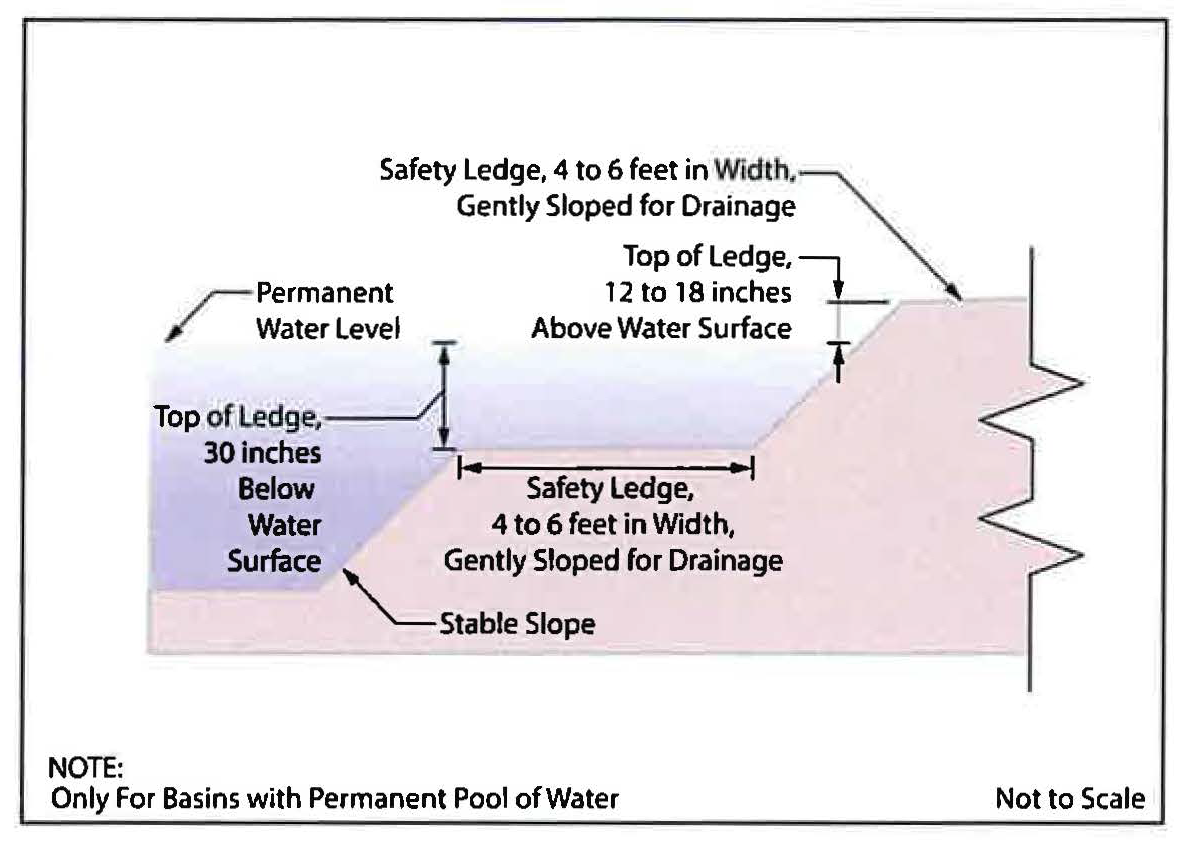
Safety ledges shall be constructed on the slopes of all new Stormwater Management Basins having a permanent pool of water deeper than 2.5 feet. Such safety ledges shall be comprised of two steps. Each step shall be four to six feet in width. One step shall be located approximately 2.5 feet below the permanent water surface, and the second step shall be located one to 1.5 feet above the permanent water surface. See Subsection 13.D for an illustration of safety ledges in a Stormwater Management Basin.
3.
In new Stormwater Management Basins, the maximum interior slope for an earthen dam, embankment, or berm shall not be steeper than three horizontal to one vertical.
E.
Variance or exemption from safety standards.
1.
A variance or exemption from the safety standards for Stormwater Management Basins may be granted only upon a written finding by the appropriate reviewing agency that the variance or exemption will not constitute a threat to public safety.
F.
Illustration of safety ledges in a new Stormwater Management Basin.
§ 14. Requirements for a Site Development Stormwater plan:
A.
Submission of Site Development Stormwater plan.
1.
Whenever an applicant seeks municipal approval of a Development subject to this section, the applicant shall submit all of the required components of the submittal for the Site Development Stormwater plan at Subsection 14.C below and any additional components as specified in the City's Stormwater management plan latest revisions as part of the submission of the applicant's application for subdivision or Site plan approval.
2.
The applicant shall demonstrate that the project meets the standards set forth in this section.
3.
The applicant shall submit five copies of the materials listed in the submittal for Site Development Stormwater plans in accordance with Section 14.C of this article.
B.
Site Development Stormwater plan approval. The applicant's Site Development plan shall be reviewed as a part of the subdivision or Site plan review process by the municipal board or official from which municipal approval is sought. That municipal board or official shall consult with the engineers of the JCMUA and be guided by them to determine if all the submittal requirements have been satisfied and to determine if the project meets the standards set forth in this section. Municipal approval may not be issued unless the requirements of this section are met. Approval of other local, state, and/or other permits (also known as "prior approvals") is not a substitute for local approval of a project's Site Development Stormwater plan.
C.
Submittal requirements for Major Development. The following information shall be required:
1.
Topographic base map. The reviewing engineer may require upstream tributary drainage system information as necessary. It is recommended that the topographic base map of the Site be submitted which extends a minimum of 200 feet beyond the limits of the proposed Development, at a scale of one inch equals 200 feet or greater, showing two foot contour intervals. The map as appropriate may indicate the following: existing surface water drainage, shorelines, steep slopes, Soils, erodible Soils, perennial or intermittent streams that drain into or upstream of the Category One waters, Wetlands and flood plains along with their appropriate buffer strips, marshlands and other Wetlands, pervious or vegetative surfaces, existing man-made structures, roads, bearing and distances of property lines, and significant natural and manmade features not otherwise shown.
2.
Environmental Site analysis. A written and graphic description of the natural and manmade features of the Site and its environs. This description should include a discussion of Soil conditions, slopes, Wetlands, waterways and vegetation on the Site. Particular attention should be given to unique, unusual, or environmentally sensitive features and to those that provide particular opportunities or constraints for Development.
3.
Project description and Site plan(s). A map (or maps) at the scale of the topographical base map indicating the location of existing and proposed buildings, roads, parking areas, utilities, structural facilities for Stormwater management and Sediment control, and other permanent structures. The map(s) shall also clearly show areas where alterations occur in the natural terrain and cover, including lawns and other landscaping, and seasonal high ground water elevations. A written description of the Site plan and justification of proposed changes in natural conditions may also be provided.
4.
Land use planning and Source Control Plan. This plan shall provide a demonstration of how the goals and standards of Sections 4 through 10 are being met. The focus of this plan shall be to describe how the Site is being developed to meet the objective of controlling groundwater Recharge, Stormwater quality and Stormwater quantity problems at the source by land management and source controls whenever possible.
5.
Stormwater management facilities map. The following information, illustrated on a map of the same scale as the topographic base map, shall be included:
a.
Total area to be paved or built upon, proposed surface contours, land area to be occupied by the Stormwater management facilities and the type of vegetation thereon, and details of the proposed plan to control and dispose of Stormwater.
b.
Details of all Stormwater management facility designs, during and after construction, including discharge provisions, discharge capacity for each outlet at different levels of detention and emergency spillway provisions with maximum discharge capacity of each spillway.
6.
Calculations.
a.
Comprehensive hydrologic and hydraulic design calculations for the predevelopment and post-development conditions for the design storms specified in Section 4 of this section.
b.
When the proposed Stormwater management control measures (e.g., Infiltration basins) depends on the hydrologic properties of Soils, then a Soils report shall be submitted. The Soils report shall be based on on-site boring logs or Soil pit profiles. The number and location of required Soil borings or Soil pits shall be determined based on what is needed to determine the suitability and distribution of Soils present at the location of the control measure.
7.
Maintenance and repair plan. The design and planning of the Stormwater management facility shall meet the maintenance requirements of Section 15.
8.
Waiver from submission requirements. The conditions for a waiver from submission requirements are defined in the Municipal Land Use Law, N.J.S.A. 40:55D-10.3. The municipal official or board reviewing an application under this section may, in consultation with the Municipality's review engineer, waive submission of any of the requirements in Subsection 14.C.1 through 14.C.6 of this section when it can be demonstrated that the information requested is impossible to obtain or it would create a hardship on the applicant to obtain and its absence will not materially affect the review process.
D.
Submittal requirements for Minor Development.
1.
Applicants seeking municipal approval of Minor Developments shall submit the information described in Subsections 14.C.3, 14.C.4, 14.C.5, and 14.C.7. Applicants shall also submit calculations demonstrating compliance with the retention standard in Section 6.
2.
The conditions for a waiver from submission requirements are defined in the municipal Land Use Law, N.J.S.A. 40:55D-10.3.
§ 15. Maintenance and repair:
A.
Applicability.
1.
Projects subject to review as in Sections 3 and 4 of this section shall also comply with the requirements of this section.
B.
General maintenance.
1.
The Design Engineer shall prepare a maintenance plan for the Stormwater Management Measures incorporated into the design of a Major Development.
2.
The maintenance plan shall contain specific preventative maintenance tasks and schedules; cost estimates, including estimated cost of Sediment, debris, or trash removal; and the name, address, and telephone number of the Person or Persons responsible for preventative and corrective maintenance (including replacement). Maintenance guidelines for Stormwater Management Measures are available in the New Jersey Stormwater Best Management Practices Manual. If the maintenance plan identifies a Person other than the developer (for example, a public agency or homeowners' association) as having the responsibility for maintenance, the plan shall include documentation of such Person's agreement to assume this responsibility, or of the developer's obligation to dedicate a Stormwater management facility to such Person under an applicable ordinance or regulation.
3.
The maintenance plan shall specifically provide a municipal right of access, which may include Stormwater easements or covenants. The maintenance access shall be provided by the property owner(s) for access regarding facility inspections and maintenance, as required. Easements and covenants shall be recorded prior to issuance of any permit or approval.
4.
Responsibility for maintenance shall not be assigned or transferred to the owner or tenant of an individual property in a residential Development or project, unless such owner or tenant owns or leases the entire residential Development or project.
5.
If the Person responsible for maintenance identified under Subsection 15.B.2 above is not a public agency, the maintenance plan and any future revisions shall be recorded upon the deed of record for each property on which the maintenance described in the maintenance plan must be undertaken.
6.
Preventative and corrective maintenance shall be performed to maintain the function of the Stormwater Management Measure, including repairs to or replacement of the structure; removal of Sediment, debris, or trash; restoration of eroded areas; snow and ice removal; fence repair or replacement; restoration of vegetation; and repair or replacement of non-vegetated linings.
C.
The Person responsible for maintenance identified under Subsection 15.B.2 above shall perform all the following requirements:
1.
Maintain a detailed log of all preventative and corrective maintenance for the structural Stormwater Management Measures incorporated into the design of the Development, including a record of all inspections and copies of all maintenance-related work orders;
2.
Evaluate the effectiveness of the maintenance plan at least once per year and adjust the plan and the deed as needed; and
3.
Retain and make available, upon request by any public entity with administrative, health, environmental, or safety authority over the Site, the maintenance plan and the required documentation.
D.
On or before February 1 of each year, the Person responsible for maintenance identified under Subsection 15.B above shall submit to the City of Jersey City and the Review Agency a certification of compliance during the prior year with the requirements of Subsection 15.B, which shall include a summary of inspection and maintenance activities and any proposed changes to the maintenance plan.
E.
The requirements of Subsections 15.B.4 and 15.B.5 do not apply to Stormwater management facilities that are dedicated to and accepted by the Municipality or another governmental agency subject to all applicable municipal Stormwater general permit conditions, as issued by the Department.
F.
In the event that the Stormwater management facility becomes a danger to public safety or public health, or if it is in need of maintenance or repair, the Municipality shall so notify the responsible Person in writing. Upon receipt of that notice, the responsible Person shall have 14 days to effect maintenance and repair of the facility in a manner that is approved by the Chief Engineer of the JCMUA or his designee. The Municipality, in its discretion, may extend the time allowed for effecting maintenance and repair for good cause. If the responsible Person falls or refuses to perform such maintenance and repair, the Municipality or County may immediately proceed to do so and shall bill the cost thereof to the responsible Person. Nonpayment of such bill may result in a lien on the property.
G.
The Review Agency (JCMUA) has the authority to institute a permit system to enforce the maintenance and repair requirements in this section.
H.
Nothing in this section shall preclude the Municipality in which the Major Development is located from requiring the posting of a performance or maintenance guarantee in accordance with N.J.S.A. 40:55D-53.
§ 16. Penalties:
A.
Any Person who erects, constructs, alters, repairs, converts, maintains, or uses any building, structure or land in violation of this section shall be subject to the following penalties:
B.
Any Person, firm or corporation who violates, disobeys, omits, neglects, or refuses to comply with or who resists the enforcement of any of the provisions of this chapter or any order, decision or determination by the Jersey City Municipal Utilities Authority or the City of Jersey City and who refuses to abate said violation within 14 days after written notice has been served upon them shall, for each and every violation, be punishable as provided in Chapter 1, General Provisions. Each day that such violation continues after such notice shall be considered a separate and specific violation of this chapter without the service of an additional notice. The Jersey City Municipal Utilities Authority may also withhold water meters to ensure compliance with this section.
§ 17. Severability:
If the provisions of any section, subsection, paragraph, subdivision, or clause of this section shall be judged invalid by a court of competent jurisdiction, such order of judgment shall not affect or invalidate the remainder of any section, subsection, paragraph, subdivision, or clause of this section.
§ 18. Effective date:
This section shall take effect immediately upon the approval by the County Review Agency, or 60 days from the receipt of the ordinance by the County Review Agency if the County Review Agency should fail to act.

