
Jersey City City Zoning Code
ARTICLE V
Zoning and Design Standards2
Editor's note— Ord. No. 22-084, adopted October 13, 2022, in effect repealed former Art. V, §§ 345-34—345-40.2, 345-40.6, 345-41, 345-41A, 345-42—345-50a, 345-51—345-60.5, 345-61—345-66.1, 345-67—345-73, and added a new Art. V. Former Art. V pertained to similar subject matter, and derived from:
§ 345-34.- Zoning districts.
[Added 10-13-2022 by Ord. No. 22-084]
For the purposes of this Chapter, the City of Jersey City is hereby divided into redevelopment plans and the following zoning districts, herein, and shown on the Zoning Map.
§ 345-35. - Zoning map.
[Added 10-13-2022 by Ord. No. 22-084]
The boundaries of the redevelopment plans and the zoning districts are established on the map entitled "City of Jersey City Zoning Map" adopted by Council by Ordinance number 22-084. This map is amended periodically. The current map is on file and available for public inspection and/or purchase at the Division of City Planning, 1 Jackson Square, 2nd Floor, Jersey City, New Jersey.
§ 345-36. - Interpretation of boundaries.
[Added 10-13-2022 by Ord. No. 22-084]
A.
Zoning district boundary lines are intended to follow street center lines, railroad rights-of-way and lot lines as they exist on lots of record at the time of enactment of this chapter unless otherwise indicated by dimensions on the Zoning Map. Any dimensions shown shall be in feet and measured horizontally and, when measured from a street, shall be measured from the street right-of-way line even if that same street is the location of a zoning district line along its center line. The exact location of any disputed zoning district boundary line shall be determined by the Board of Adjustment. The zoning standards, controls and designations apply to every structure, lot and use within each district, and the district lines extend vertically in both directions from ground level. The district boundary lines shown to terminate at the pierhead line should be continued in a straight line out to the City limits, should these water areas require a district interpretation.
B.
For sites that overlap with multiple zone districts, the zone that covers the largest portion of the site shall govern the entire development site. In the case of overlay zones, however, those standards shall still apply.
C.
Boundaries indicated as following or approximately following shorelines shall be construed as following such shorelines but, in the event of change in the shoreline, shall be construed as moving with the actual shoreline. Boundaries indicated as following or approximately following City lines shall be construed as following such City lines.
D.
If there is question regarding any zone boundary, the zoning map as referenced and available at the offices of the Division of City Planning shall be used to determine the exact boundary line.
§ 345-37. - Vacating a street or other public right-of-way.
[Added 10-13-2022 by Ord. No. 22-084]
Where a vacated street or other public right-of-way is bounded on both sides by different zoning districts, the former center line of the vacated right-of-way shall be considered the zoning district boundary line.
§ 345-38. - Redevelopment areas.
[Added 10-13-2022 by Ord. No. 22-084]
A.
In any area officially declared and delineated as a redevelopment area by duly adopted ordinances, the standards and designations contained in the Redevelopment Plans for such legally adopted plans shall take precedence over any standards contained within this Chapter. However, the Definitions found in Section 345-6 and the provisions for Site Plan approval shall apply to all zones and Redevelopment Plan areas citywide.
B.
Where the standards and controls of the Plans do not provide alterations to the provisions of this Chapter, those provisions of this Chapter that remain unchanged shall prevail.
§ 345-39. - Variances and waivers.
[Added 10-13-2022 by Ord. No. 22-084]
Any deviation from a provision of this Chapter which is identified as a Design Standard shall require a waiver by the reviewing board from the specific design standard. Any other deviation from a standard contained in this Chapter shall require a variance from the specific standard in accordance with the Municipal Land Use Law. Waivers will be subject to the same notification requirements found in Section 345-19.
§ 345-40. - RH-1 Residential Housing District (large lots).
[Added 10-25-2023 by Ord. No. 23-103]
A.
Purpose. The purpose of this district is to preserve the pattern, quality, and architectural individuality of the existing detached one- and two-unit structures and to discourage subdivision and demolition. This district is similar to the RH-2 and R-1 zones except that it is intended to protect clusters of lot sizes that are larger than the standard 25×100 lot size for Jersey City.
B.
Permitted principal uses are as follows:
1.
Principal structures with one or two dwelling units.
C.
Uses incidental and accessory to the principal use, such as:
1.
Private garages.
2.
Off-street parking.
3.
Fences and walls.
4.
Home occupations.
5.
Swimming pools.
6.
Decks, patios, pergolas, and storage sheds.
7.
Accessory Dwelling Units, one dwelling unit permitted in an accessory structure per lot regardless of lot size and in addition to unit(s) in the principal structure.
D.
Conditional Uses.
1.
Principal structures with three units.
2.
Developments utilizing the Affordable Housing Overlay.
E.
Bulk Standards.
1.
Existing lots are considered conforming in lot area, width and/or depth.
2.
Minimum Lot Size: 4,000 square feet.
3.
Minimum Lot Width: 40 feet.
4.
Minimum Lot Depth: 100 feet.
5.
Front Yard Setback: Predominant setback shall apply.
6.
Side Yards: Minimum of five feet on both sides.
7.
Minimum Rear Yard:
a.
For lots with a lot depth less than 120 feet, 30% of lot depth.
b.
For lots with a lot depth of 120 feet or more, 40% of the lot depth.
8.
Maximum Building Height: three stories and 35 feet.
9.
Maximum Building Coverage: 55%.
10.
Maximum Lot Coverage: 75%.
11.
Maximum Accessory Building Height:
a.
18 feet if an Accessory Dwelling Unit.
b.
15 feet for all other accessory structures.
12.
Minimum Accessory Building Setbacks:
a.
Rear Yard: Zero feet.
b.
Side Yard: Two feet.
F.
Parking Standards.
1.
Off-street parking is prohibited on interior lots with a width less than 26 feet.
2.
Off-street parking is prohibited on corner lots and through lots when the lot width is less than 20 feet.
3.
Minimum required parking: A minimum of 0.3 spaces per bedroom is required. For the purpose of calculating this standard, studio units shall be counted as one bedroom. For example, in a five-unit structure with 12 bedrooms a minimum of four spaces are required (12 × 0.3 = 3.6 which rounds to 4 spaces).
4.
No parking shall be permitted between the building line and the street line. Garage entrances must be on the rear wall of the building or as part of a detached or attached fully enclosed garage.
5.
Curb cut standards:
a.
Maximum number: One curb cut is permitted per lot when off-street parking is a permitted use.
b.
Maximum width: Ten feet.
6.
Accessory Dwelling Units are exempt from any minimum parking requirement in this Zone.
G.
Design Standards
1.
Principal structures must be designed to appear as single unit dwellings. Multi-unit buildings must have only one front entry. If historic documentation (such as the 1938 Tax Card) shows multiple front entries, they may be maintained.
2.
Homes shall maintain and retain existing architectural elements such as gables, front porches, transoms, cornices, divided light windows, dormers, bay windows, oriels, turrets, and other elements found within the existing streetscape.
3.
Roof pitches must be designed to be compatible with adjacent houses by using prevalent slopes and angles.
4.
All exterior walls are to be treated with the same materials and architectural detail; although, the treatment of side and rear walls may be simplified.
5.
Design elements shall have compatible rhythm and repetition with an emphasis on materials and colors prevalent in the neighborhood.
6.
Building height shall be visually compatible with adjacent buildings. The size, scale, and height of new construction shall relate to the prevailing pattern of the streetscape.
7.
Buildings are to be sited on their lot so that their placement and relationship to surrounding property is equivalent to the existing pattern of development on the street.
8.
Materials must reflect the predominant traditional building materials in use on existing, adjacent structures. Where appropriate, the use of multiple materials maybe encouraged. However, use of EIFS, vinyl siding, light colored brick, stucco, brick-face, stone-face, and other inappropriate cladding materials is strictly prohibited.
9.
Any restoration or renovation in strongly encouraged to be completed under the guidance of the Secretary of the Interior's Guidelines for the Treatment of Historic Properties when undertaking any exterior work.
10.
Any new construction shall be designed in context of any surrounding historic resources, following the predominant setbacks, height, and lot siting.
H.
Conditional Use Standards for Three-unit principal structures or developments utilizing the Affordable Housing Overlay.
1.
Structures shall be designed to comply with the design standards of this Zone.
2.
Any restoration or renovation in strongly encouraged to be completed under the guidance of the Secretary of the Interior's Guidelines for the Treatment of Historic Properties when undertaking any exterior work.
3.
Any new construction shall be designed in context of any surrounding historic resources, following the predominant setbacks, height, and lot siting.
Editor's note— Ord. No. 23-103, adopted October 25, 2023, amended the Code by repealing former § 345-40, and adding a new § 345-40. Former § 345-40 pertained to the R-1A One- and Two-Family Housing District (large lots), and was added by Ord. No. 22-084, adopted October 13, 2022.
§ 345-40.1. - RH-2 Residential Housing District (typical lots).
A.
Purpose. The purpose of this district is to preserve the pattern, quality, and architectural individuality of the existing structures and to discourage subdivision and demolition. This district is similar to the RH-1 and R-1 zones except that it is intended to protect clusters of the standard 25×100 lot size for Jersey City.
B.
Permitted principal uses are as follows:
1.
Residential.
C.
Uses incidental and accessory to the principal use, such as:
1.
Private garages, except when it is prohibited per the RH-2 Parking Standards.
2.
Off-street parking, except when it is prohibited per the RH-2 Parking Standards.
3.
Fences and walls.
4.
Home occupations.
5.
Swimming pools.
6.
Decks, patios, pergolas, and storage sheds.
7.
Accessory Dwelling Units, one dwelling unit permitted in an accessory structure per lot regardless of lot size and in addition to unit(s) in the principal structure.
D.
Conditional Uses.
1.
Developments utilizing the Affordable Housing Overlay.
E.
Density and Bulk Standards.
1.
Maximum permitted density for Residential: a maximum of 42 units per acre, or one- or two-dwelling units per lot regardless of lot size.
2.
All existing lots are considered conforming.
3.
Minimum Lot Size: 2,500 square feet or the predominant lot area of the Blockfront, whichever is greater. Calculation of predominant lot area shall exclude any lots on the Blockfront in a different zone. Predominant is determined by which lot area is most frequently occurring along the Blockfront.
4.
Minimum Lot Width: 25 feet.
5.
Minimum Lot Depth: No standard.
6.
Maximum Building Height: three stories and 35 feet. The required finished floor height of the building entry on the Primary Front Façade shall match the finished floor height of the building entry for either lot adjacent to the subject parcel.
7.
Front Yard Setback: the required front yard setback shall match the Building Line of the Front Primary Façade of either lot adjacent to the subject parcel. The adjacent lot to be matched may be decided by the applicant or property owner. If both adjacent lots are vacant, the subject parcel shall match the nearest building on the same Blockfront.
8.
Minimum Rear Yard Setback:
a.
For lots with a lot depth less than 120 feet, 30% of lot depth.
b.
For lots with a lot depth of 120 feet or more, 40% of the lot depth.
9.
Side Yard Setbacks for principal structures shall be in accordance with standards in the table:
Table Footnotes:
A In the instance that the adjacent building has a side yard setback four feet or greater (as measured to the principal structure), the new building may build to the zero side setback along that lot line. However, for corner and cap lots, one side yard shall be a minimum of five feet.
B In the instance that adjacent lot is vacant, the new building may build according to the side yard standards for detached, semi-detached, attached, or zero lot line buildings.
C In the instance the adjacent building has a zero side yard setback but also has an existing window that is either directly on the side lot line or setback less than three feet, the new building may still build to the zero side lot line, starting at the front building line, but shall be required to setback the new building three feet from said window, starting from one foot in front of the existing window and terminating at least one foot beyond the existing window.
10.
Maximum lot coverage: 75%.
11.
Front yard lot coverage standards:
a.
Maximum front yard lot coverage:
i.
For lots with a front yard setback greater than two feet in depth: 50% maximum.
ii.
For lots with a front yard setback two feet or less in depth: No standard.
b.
For the purpose of calculating front yard depth and front yard area, measurements shall be from the property line to nearest grounded encroachments (See 345-6 and 345-60.D) or building line if there are no ground encroachments. The front yard area should also not include the area or square feet of grounded encroachments. For example, a front yard setback of five feet is measured to the building line, but the structure includes a bay window (a grounded encroachment) that extends three feet into the front yard, then the resulting front yard is only two feet deep and therefore no front yard lot coverage standard applies.
12.
Roof deck setbacks: Roof decks shall be setback a minimum of ten feet from Primary and Secondary Front Façades.
13.
Standards for accessory buildings or structures:
a.
Maximum accessory building height:
i.
For Accessory Dwelling Units: 18 feet and two stories.
ii.
For all other accessory structures: 12 feet.
b.
Minimum accessory building setbacks:
i.
Rear yard setback: No standard.
ii.
Side Yard: Two feet.
c.
Standards for corner lots, cap lots, and through lots: Two feet front lot lines.
F.
Off-street parking requirements.
1.
Off-street parking is prohibited on interior lots with a width less than 26 feet.
2.
Off-street parking is prohibited on corner lots and through lots when the lot width is less than 20 feet.
3.
For lots with a lot width of 50 feet or less off-street parking is not required.
4.
For lots with a lot width over 50 feet: A minimum of 0.3 spaces per bedroom is required. For the purpose of calculating this standard, studio units shall be counted as one bedroom. For example, in a five-unit structure with 12 bedrooms a minimum of four spaces are required (12 × 0.3 = 3.6 which rounds to 4 spaces).
5.
Accessory Dwelling Units are exempt from any minimum parking requirement in this Zone.
6.
Shared driveway requirement: When off-street parking is permitted, construction of two or more residential buildings with parking on adjacent lots shall include a shared driveway located to maximize on-street parking spaces; no existing street tree shall be removed to create a driveway without prior approval by the Jersey City Division of Parks & Forestry.
7.
Curb cut standards:
a.
Maximum number: One curb cut is permitted per lot when off-street parking is a permitted use.
b.
Maximum width: Ten feet.
G.
Design Standards.
1.
Buildings proportions shall be compatible with the predominant proportional relationship along a street. Building entries, windows and other openings shall be compatible in location, size and pattern to other structures on the block. To the greatest extent possible, characteristics of surrounding development such as roof style and pitch, material, window and door detailing, and the presence of porches shall be consistent with other structures on the block.
H.
Conditional Use Standards for developments utilizing the Affordable Housing Overlay.
1.
Any restoration or renovation in strongly encouraged to be completed under the guidance of the Secretary of the Interior's Guidelines for the Treatment of Historic Properties when undertaking any exterior work.
2.
Any new construction shall be designed in context of any surrounding historic resources, following the predominant setbacks, height, and lot siting.
Editor's note— Ord. No. 23-103, adopted October 25, 2023, amended the Code by repealing former § 345-40.1, and adding a new § 345-40.1. Former § 345-40.1 pertained to the R-1F One- and Two-Family Housing District (large lots), and was added by Ord. No. 22-084, adopted October 13, 2022.
§ 345-40.2. - Reserved.
Editor's note— Ord. No. 23-103, adopted October 25, 2023, amended the Code by repealing former § 345-40.2 in its entirety. Former § 345-40.2 pertained to the R-1W Webster Avenue Residential District, and was added by Ord. No. 22-084, adopted October 13, 2022.
§ 345-41. - R-1 Neighborhood Housing District.
[Added 10-13-2022 by Ord. No. 22-084; 10-25-2023 by Ord. No. 23-103]
A.
Purpose.
1.
The purpose of this district is to accommodate existing housing, encourage compatible in-fill, preserve the streetscape, and utilize and preserve on-street parking where lot frontage is narrow.
2.
The R-1 zone impacts every ward in Jersey City. Therefore, it is important that this zone acknowledge and celebrate the culture and physical assets of existing communities as well create high quality, diverse housing types in all neighborhoods that will accommodate the needs of all types of residents.
B.
Permitted principal uses are as follows:
1.
Residential.
2.
Houses of worship
3.
Civic.
4.
Parks and playgrounds.
5.
Essential services.
6.
Schools.
7.
Governmental uses.
8.
First floor commercial provided that the commercial unit(s) existed in the 1930's Tax Assessor's photo and that the original storefront character including window configuration be restored or maintained.
9.
Adult day cares.
10.
Assisted living residences.
11.
Nursing homes.
12.
Senior housing.
13.
Public utilities, except that natural gas transmission lines shall be prohibited.
C.
Permitted accessory uses are as follows:
[Amended 3-6-2024 by Ord. No. 24-011]
1.
Off-street parking, except when it is prohibited per the R-1 Parking Standards.
2.
Fences and walls.
3.
Meeting rooms, recreation areas and similar uses normally associated with the principal use.
4.
Home occupations.
5.
Swimming pools.
6.
Signs.
7.
Decks, patios, pergolas, and storage sheds.
8.
Electric vehicle charging, except when off-street parking is prohibited per the R-1 Parking Standards.
9.
Accessory Dwelling Units, one dwelling unit is permitted in an accessory structure per lot regardless of lot size and in addition to unit(s) in the principal structure.
D.
Prohibited uses are as follows:
1.
Class 5 Cannabis Retailers.
E.
Density and Bulk Standards:
1.
Maximum permitted density by use:
a.
Residential: a maximum of 42 units per acre, or one- or two-dwelling units per lot regardless of lot size.
b.
Assisted Living Residences, Senior Housing, Nursing Homes: No standard.
2.
All existing lots are considered conforming.
3.
Minimum Lot Size: 2,500 square feet or the predominant lot area of the Blockfront, whichever is less. Calculation of predominant lot area shall exclude any lots on the Blockfront in a different zone. Predominant is determined by which lot area is most frequently occurring along the Blockfront.
4.
Minimum Lot Width: 25 feet.
5.
Minimum Lot Depth: No standard.
6.
Townhouse Lot Subdivision: Lots that are 5,000 square feet or greater and at least 50 feet wide are permitted to be subdivided according to the following standards:
a.
Minimum Lot Width: 18 feet for lots subdivided according to this clause.
b.
Minimum Lot Area: 1,000 square feet for lots subdivided according to this clause.
c.
Lots subdivided according to this clause shall have alternate bulk requirements as follows. All other bulk standards of this Zone shall apply.
i)
Minimum front yard setback of zero feet.
ii)
Minimum side yard setback of zero feet.
d.
Interior Lot(s): If any of the new lots created according to this clause do not front on a preexisting public right-of-way, then the new lots created shall be subdivided by major subdivision and shall front on a public right-of-way of at least seven feet wide (aka Walking Alley) that runs the full depth of the original lot or group of lots pre-subdivision. If adjacent subdivisions occur according to this clause, those major subdivisions shall extend or expand the public right-of-way (aka Walking Alley) by connecting parallel streets or widening the right-of-way to a minimum of 14 feet. See Walking Alley reference in the Lot Line Diagram definition (345-6 Definitions).
7.
Rear Yard Setback, Building Height and Coverage shall be in accordance with standards in the table:
Table Footnotes:
A The required finished floor height of the building entry on the Primary Front Façade shall match the finished floor height of the building entry for either lot adjacent to the subject parcel.
B Maximum parapet height: 42 inches above any flat roof or eave.
C Buildings proportions shall be compatible with the predominant proportional relationship along a street. Building entries, windows and other openings shall be compatible in location, size and pattern to other similar structures on the block or area. To the greatest extent possible, characteristics of surrounding development such as roof style and pitch, material, window and door detailing, and the presence of porches shall be consistent with other structures on the block.
D For example, a lot with a depth of 75 feet, the minimum rear yard required is 19 feet (calculated 75 × 0.25 = 18.75, rounded to 19-foot setback).
E No required minimum rear yard setback for principal structures shall be greater than 45 feet.
8.
Front Yard Setback Standards for principal structures shall be in accordance with standards in the table:
Table Footnotes:
A The required front yard setback shall match the Building Line of the Front Primary Façade of either lot adjacent to the subject parcel. The adjacent lot to be matched may be decided by the applicant or property owner. If both adjacent lots are vacant, the subject parcel shall match the nearest building on the same Blockfront.
9.
Side Yard Setbacks for principal structures shall be in accordance with standards in the table:
Table Footnotes:
A In the instance that the adjacent building has a side yard setback four feet or greater (as measured to the principal structure), the new building may build to the zero side setback along that lot line. However, for corner and cap lots, one side yard shall be a minimum of five feet.
B In the instance that adjacent lot is vacant, the new building may build according to the side yard standards for detached, semi-detached, attached, or zero lot line buildings.
C In the instance the adjacent building has a zero side yard setback but also has an existing window that is either directly on the side lot line or setback less than three feet, the new building may still build to the zero side lot line, starting at the front building line, but shall be required to setback the new building three feet from said window, starting from one foot in front of the existing window and terminating at least one foot beyond the existing window.
10.
Additional Coverage Standards:
a.
Required performative roof ratio: When building coverage exceeds 65%, a green roof system, solar panel system, or combination thereof is required onsite equal to at least 10% of the lot area. Green roof trays and other similar green roof systems are acceptable.
b.
Front yard lot coverage standards:
i)
Maximum front yard lot coverage:
(a)
For lots with a front yard setback greater than two feet in depth: 50%.
(b)
For lots with a front yard setback two feet or less in depth: No standard.
ii)
For the purpose of calculating front yard depth and front yard area, measurements shall be from the property line to nearest grounded encroachments (see 345-6 and 345-60.D) or building line if there are no ground encroachments. The front yard area should also not include the area or square feet of grounded encroachments. For example, a front yard setback of five (5) feet is measured to the building line, but the structure includes a bay window (a grounded encroachment) that extends three feet into the front yard, then the resulting front yard is only two feet deep and therefore no front yard lot coverage standard applies.
11.
Roof deck setbacks: Roof decks shall be setback a minimum of ten feet from Primary and Secondary Front Façades.
12.
Standards for accessory buildings or structures:
a.
Maximum accessory building height:
i)
For Accessory Dwelling Units: 18 feet and two stories.
ii)
For all other accessory structures: 12 feet.
b.
Minimum accessory building setbacks:
i)
Rear yard setback: No standard.
ii)
Side Yard: Two feet.
iii)
Standards for corner lots, cap lots, and through lots: Two feet front lot lines.
c.
Maximum lot coverage for lots with Accessory Dwelling Units:
i)
The maximum lot coverage permitted shall increase by an additional 5% when an accessory dwelling unit is proposed or present. Reference Rear Yard Setback, Building Height and Coverage table above.
F.
Parking Standards:
1.
No parking shall be permitted between the building line and the street line. In no instance shall a parked vehicle project or encroach over a property line, or into rights-of-way, or block sidewalks.
2.
Off-street parking requirements:
a.
For interior lots in Ward C or Ward D:
i)
Off-street parking is prohibited on interior lots with a width less than 26 feet unless off-street parking is predominant on the Blockfront. For the purpose of calculating off-street parking, only lots with garages within the principal structure or lots where the driveway extends at least 18 feet beyond the building line are to be counted. Lots with grandfathered front yard parking are not counted; and,
ii)
The 2022 boundaries of Ward C and D as adopted shall apply.
b.
For interior lots is all other Wards:
i)
Off-street parking is prohibited on interior lots with a width less than 25 feet unless off-street parking is predominant on the Blockfront. For the purpose of calculating off-street parking, only lots with garages within the principal structure or lots where the driveway extends at least 18 feet beyond the building line are to be counted. Lots with grandfathered front yard parking are not counted.
c.
For corner lots, cap lots, and through lots:
i)
Off-street parking is prohibited on corner lots and through lots when the lot width is less than 20 feet.
d.
For lots with a lot width of 50 feet or less off-street parking is not required.
e.
For lots with a lot width over 50 feet:
i)
Minimum parking standards for Residential: A minimum of 0.3 spaces per bedroom is required. For the purpose of calculating this standard, studio units shall be counted as one bedroom. For example, in a five-unit structure with 12 bedrooms a minimum of four spaces are required (12 × 0.3 = 3.6 which rounds to 4 spaces).
ii)
Minimum parking standard for Assisted Living Residences, Senior Housing, Nursing Homes, and Adult Day Care: None.
iii)
Minimum parking standard for all other uses: one space per 1,000 square feet of gross floor area for such use, excluding the first 5,000 square feet.
3.
Accessory Dwelling Units are exempt from any minimum parking requirement in this Zone.
4.
Shared driveway requirement: When off-street parking is permitted, construction of two or more residential buildings with parking on adjacent lots shall include a shared driveway located to maximize on-street parking spaces; no existing street tree shall be removed to create a driveway without prior approval by the Jersey City Division of Parks & Forestry.
5.
Curb cut standards:
a.
Maximum number: One curb cut is permitted per lot when off-street parking is a permitted use.
b.
Maximum width: Ten feet.
G.
Permitted conditional uses are as follows:
1.
Adaptive reuse of a garage as a dwelling unit, subject to following conditions:
a.
Maximum of one additional dwelling unit is permitted for a maximum of three dwelling units in the principal structure regardless of lot size.
b.
Adaptive reuse of garage as a dwelling unit.
c.
Removal of driveway and curb cut and prohibition of any off-street parking.
d.
Install new curb and compliance with forestry standards.
e.
If front yard is three feet deep or more, install knee wall planter(s) in front yard and landscape with groundcover, plantings, mulch, shrubs, and/or trees. Planter(s) must be designed and sized to inhibit any front yard parking.
f.
A portion of the garage not used as dwelling unit may be used for storage, mechanical, refuse, or other ancillary uses. Off-street parking is prohibited.
2.
Corner Commercial, subject to the following conditions:
a.
Shall be one of the following defined uses:
i)
Cafes;
ii)
Laundromats;
iii)
Retail Sales of goods and services;
iv)
Offices and Medical Offices.
b.
There must be an existing commercial use on at least one of the other corner properties at the same intersection where the subject site is located.
c.
Commercial uses limited to ground floor and cellar or basement levels.
d.
The corner commercial frontage shall maximize storefront glazing on all street facing facades to the greatest extent possible.
e.
Maximum permitted lot coverage shall be increased to 90%.
f.
For existing buildings, if a garage is being adaptively reused, improvements shall include removal of the curb cut and replacement with sidewalk and curb.
g.
A minimum front yard setback of two feet is permitted; however, if an existing building has a front yard setback less than two feet, the setback is considered conforming.
h.
Class 5 cannabis retailers are prohibited.
3.
Multi-unit Residential in Historically Significant Structures, subject to the following conditions:
a.
The existing structure is determined to be historically significant by the Historic Preservation Office.
b.
Rehabilitation is conducted in compliance with the Secretary of Interior's Standards and Guidelines for the Treatment of Historic Properties. A report shall be provided from a historic preservation specialist certifying the rehabilitation meets the Secretary of Interior Standards for Rehabilitation.
c.
Permitted Residential Density: A maximum of 75 units per acre or four dwelling units in a principal structure, whichever is greater.
d.
Compliance with the minimum parking ratio for residential uses in this zone.
e.
Front yard additions are not permitted, unless supported by photographic evidence. The existing front yard setback shall be considered compliant.
4.
Surface Parking Lot as a principal use, subject to the following conditions:
a.
Minimum of two parking spaces or 20% of all parking spaces, whichever is greater, shall be reserved and equipped with electric vehicle charging for the general public.
b.
Maximum lot coverage: 90%.
c.
Minimum landscaped area: A minimum of 10% of the lot shall be planted or mulched with grasses, plants, shrubs, or trees and may not be reduced by any of the porous materials listed above.
d.
Maximum curb cut and driveway width: Ten feet.
e.
Parking spaces shall be offered use to general public for a fee on an hourly, daily, weekly, monthly, or annual basis. A Parking Lot License per Chapter 236 of the municipal code shall be obtained and maintained.
f.
Maximum lot size: 7,500 square feet.
5.
Mortuaries, subject to the following conditions:
a.
Minimum lot width or frontage: 100 feet.
b.
Minimum parking: One space per employee and one space per every five square feet of floor area exclusive of administrative and preparation areas.
§ 345-42. - R-2 Multi-Unit Attached Housing District (four stories or less).
[Added 10-13-2022 by Ord. No. 22-084; 10-25-2023 by Ord. No. 23-103]
A.
Purpose. The purpose of the multi-unit attached housing (four stories or less) district is to recognize the existing pattern of housing development and to promote compatible infill development.
B.
Permitted principal uses are as follows:
1.
Residential.
2.
Townhouses.
3.
Places of assembly and houses of worship.
4.
Civic uses.
5.
Parks and playgrounds.
6.
Essential services.
7.
Schools.
8.
Governmental uses.
9.
Assisted living facilities.
10.
Nursing homes.
11.
Senior housing.
12.
Public utilities, except that natural gas transmission lines shall be prohibited.
13.
First floor commercial provided, that the commercial unit(s) existed in the 1930's Tax Assessor's photo and that the original storefront character including window configuration be restored or maintained. Cannabis Class 5 Retailers are prohibited in this zone.
C.
Uses incidental and accessory to the principal use, such as:
1.
Off-street parking within the building envelope, except when parking it is prohibited.
2.
Fences and walls.
3.
Meeting rooms, cafeterias, recreation areas and similar uses normally associated with schools, houses of worship and other public buildings.
4.
Home occupations.
5.
Swimming pools.
6.
Decks, patios, pergolas, and storage sheds.
7.
Electric vehicle charging, except when off-street parking is prohibited.
8.
Signs.
9.
Accessory dwelling units, one dwelling unit permitted in an accessory structure per lot regardless of lot size and in addition to unit(s) in the principal structure.
D.
Conditional Uses.
1.
Mortuaries.
E.
Density and Bulk Standards.
1.
Maximum permitted density by use:
a.
Residential: A maximum of 55 units per acre.
b.
Assisted living residences: No standard.
c.
Senior housing: No standard.
d.
Nursing homes: No standard.
2.
All existing lots are considered conforming.
3.
Minimum lot size: 1,800 square feet.
4.
Minimum lot width: 18 feet.
5.
Minimum lot depth: No standard.
6.
Maximum lot area: 12,500 square feet.
7.
Front yard setback: The required front yard setback shall match the building line of the front primary façade of either lot adjacent to the subject parcel. The adjacent property to be matched may be decided by the applicant.
8.
Maximum side yard: Zero feet; except when an adjacent building has an existing window or windows three feet or less from a property line, the subject building shall be required to setback the new building at least three feet from any said window, starting at least one foot in front of the existing window and terminating at least one foot beyond the existing window.
9.
Minimum rear yard: 30 percent of the lot depth, rounded to nearest whole number. For example, a lot with a depth of 75 feet, the minimum rear yard required is 23 feet (calculated 75*0.3 = 22.5, rounded to 23-foot setback).
10.
Building height standards:
a.
Maximum building height: Four stories and 40 feet.
b.
Maximum parapet height: 42 inches above any roof or roof deck.
11.
Maximum lot coverage: 80 percent.
12.
Lot coverage may be decreased by using any combination of the following porous materials:
a.
Interlocking concrete blocks;
b.
Permeable pavers;
c.
Open-celled pavers;
d.
Porous pavement;
e.
Gravel;
f.
Reinforced lawn;
g.
Or other material deemed appropriate by Planning or Zoning Board.
13.
Landscaped area requirement: A minimum of ten percent of the lot shall be planted or mulched with grasses, plants, shrubs, or trees and may not be reduced by any of the porous materials listed above.
14.
Required green roof ratio: When building coverage exceeds 60 percent, a green roof system is required of at least 100 square feet or ten percent of the lot area, whichever is greater. Green roof trays are acceptable.
15.
Roof deck setback: Roof decks shall be setback a minimum of ten feet from primary and secondary front façades.
16.
Standards for accessory buildings or structures:
a.
Maximum accessory building height:
i)
For accessory dwelling units: 18 feet and two stories.
ii)
For all other accessory structures: 12 feet.
b.
Minimum accessory building setbacks:
i)
Rear yard: Three feet.
ii)
Side yard: Three feet.
F.
Parking Standards.
1.
No parking shall be permitted between the building line and the street line. In no instance shall a parked vehicle project or encroach over a property line, or into rights-of-way, or block sidewalks.
2.
Off-street parking is prohibited on lots with a width of 50 feet or less.
3.
Off-street parking requirements for residential, townhouses, senior housing, nursing homes, and assisted living facilities:
a.
For lots with a lot width over 50 feet: A minimum of 0.3 spaces per bedroom. For the purpose of calculating this standard, studio units shall be counted as one bedroom. For example, in a five-unit structure with 15 bedrooms a minimum of five spaces are required (15 × 0.3 = 4.5 which rounds to five spaces).
4.
Curb cut standards:
a.
Maximum number: One curb cut is permitted per lot when off-street parking is a permitted use.
b.
Maximum width: Ten feet.
G.
Design Standards:
1.
All principal structures are to be designed with flat roofs.
2.
If a ground floor setback is required by the Construction Code Official for egress to rights-of-way, any cantilevered setback area must be designed with a minimum six-inch wide column at the primary building façade to simulate or carry the weight of the building bulk above.
H.
Mortuaries, subject to the following conditions:
1.
Minimum lot width or frontage: 100 feet.
2.
Minimum parking: One space per employee and one space per every five square feet of floor area exclusive of administrative and preparation areas.
§ 345-43. - R-3 Multi-Unit Mid-Rise District.
[Added 10-13-2022 by Ord. No. 22-084; 10-25-2023 by Ord. No. 23-103]
A.
Purpose.
1.
The purpose of the multi-unit mid-rise district is to provide for a broad range of multi-unit housing in areas served by arterial streets, mass transit, neighborhood commercial uses and community facilities.
2.
The purpose of this zone is to relate the building to the street and not create the type of development that centers the tower in a sea of parking, disconnecting the building from the street.
3.
The multi-unit mid-rise district contains mid-rise buildings of three to eight stories and regulates height and density by lot size.
B.
Permitted Principal Uses:
1.
Uses for all floors:
a.
Residential.
b.
Townhouses.
c.
One- to four-unit detached dwellings.
d.
Houses of worship.
e.
Parks and playgrounds.
f.
Essential services.
g.
Schools.
h.
Government uses.
i.
Assisted living residences.
j.
Nursing homes and adult day care facilities.
k.
Senior housing.
l.
Live/work.
2.
Uses for ground floor only:
a.
Offices.
b.
Medical offices.
c.
Retails sales and services.
d.
Cafés.
e.
Restaurants, Categories one and two.
f.
Mortuaries.
3.
Mix of uses are permitted.
C.
Uses incidental and accessory to the principal use, such as:
1.
Private garages.
2.
Off-street parking.
3.
Fences and walls.
4.
Meeting rooms, cafeterias, recreation areas and similar uses normally associated with schools, houses of worship and other public buildings.
5.
Home occupations.
6.
Swimming pools.
7.
Recreation areas as part of residential developments.
8.
Signs.
9.
Decks, patios, pergolas, and storage sheds.
D.
Density and Bulk Standards by Lot Size.
1.
All existing lots are considered conforming.
2.
Minimum lot width: 20 feet.
3.
Minimum lot depth: No standard.
4.
Minimum lot area: 2,000 square feet.
5.
Maximum lot size: 22,000 square feet.
6.
Maximum density regulated by lot size shall apply in accordance with the following table.
*Applicable density for any interim lot size shall apply and may be calculated as needed, rounding down for fractions less than 0.5 and up for fractions of 0.5 or greater.
7.
Building height standards:
a.
Maximum height for principal structures on lots less than 6,000 square feet: four stories, 42 feet.
b.
Maximum height for principal structures on lots 6,000 square feet or more: eight stories, 85 feet.
8.
Front yard setback standards:
a.
Standard on lots less than 6,000 square feet: The required front yard setback shall match the building line of the front primary façade of either lot adjacent to the subject parcel. The adjacent lot to be matched may be decided by the applicant or property owner.
b.
Standard on lots 6,000 square feet or more: a minimum of five feet and a maximum of ten feet.
9.
Side yard setback standards:
a.
Standard on lots less than 37 feet wide: No standard. However, when an adjacent building has an existing window or windows three feet or less from a property line, the subject building shall be required to setback the new building at least three feet from any said window, starting at least one foot in front of the existing window and terminating at least one foot beyond the existing window.
b.
Standard on lots 37 feet wide to 59 feet wide: minimum five feet on each side.
c.
Standard on lots 60 feet wide or more: parking garage level(s) may be built to the side lot line, and residential or upper floors shall provide a minimum of five feet on each side.
10.
Rear yard setback standards:
a.
Standard on lots less than 6,000 square feet: minimum equal to 25 percent of lot depth.
b.
Standard on lots 6,000 square feet or more: parking garages on the ground floor may have a zero foot setback, all other floors shall have a minimum rear yard equal to 25 percent of the lot depth.
11.
Coverage standards:
a.
Standard on lots less than 6,000 square feet: a maximum of 80 percent lot coverage.
b.
Standard on lots 6,000 square feet or more: a maximum of 100 percent lot coverage if a parking garage is provided, and a maximum of 80 percent lot coverage is no parking is provided.
12.
Maximum accessory building height: 15 feet.
13.
Minimum accessory building setbacks:
a.
Rear yard: Three feet.
b.
Side yard: Two feet.
E.
Parking Standards:
1.
No parking shall be permitted between the building line and the street line. In no instance shall a parked vehicle project or encroach over a property line, or into rights-of-way, or block sidewalks.
2.
Standards for residential uses on lots less than 37 feet in width:
a.
Off-street parking is not required.
b.
All parking shall be contained within the building envelope and spaces may be located one behind the other.
3.
Standards for residential uses on lots 37 feet in width or greater:
a.
Minimum parking requirements: A minimum of 0.3 spaces per bedroom. For the purpose of calculating this standard, studio units shall be counted as one bedroom. For example, in a five-unit structure with 15 bedrooms a minimum of five spaces are required (15 × 0.3 = 4.5 which rounds to five spaces).
4.
Standards for houses of worship, schools, mortuaries, and government uses. See R-1 parking standards.
5.
Standards for assisted living residences, nursing homes and senior housing. See R-1 parking standards.
6.
Curb cut standards:
a.
Maximum width of curb cut: Ten feet.
b.
Maximum number: One curb cut is permitted per lot when off-street parking is required and provided, except where there is construction of two or more buildings with permitted driveways on adjacent lots, driveways shall be shared and located so as to maximize on-street parking space.
F.
Compliance Provision: Lots that were Zoned R-1 and were 8,422 square feet in area or more when Ordinance 21-077 (aka Inclusionary Zoning Ordinance) was adopted on December 15, 2021 are subject to a mandatory affordable housing set aside per Chapter 187 if the developer of such lot builds 15 or more residential units onsite or subdivides the lot and builds 15 or more residential units in aggregate.
§ 345-44. - R-4 Multi-Unit High-Rise District.
[Added 10-13-2022 by Ord. No. 22-084; 10-25-2023 by Ord. No. 23-103]
A.
Purpose.
1.
The purpose of the multi-unit high-rise district is to accommodate low, medium and high-rise multi-unit housing in appropriate locations that are served by mass transit, off-street parking and adequate public infrastructure. The location of these districts in close proximity to shopping, employment and recreational amenities is intended to promote an increased mix of uses, 24-hour activity and pedestrian traffic characteristic of dense urban centers.
2.
This district should not create a "tower in the park," type of development. This type of development centers the tower in a sea of parking disconnecting the building from the street.
B.
Permitted principal uses are as follows:
1.
Townhouses.
2.
Mid-rise apartments.
3.
High-rise apartments.
4.
Schools.
5.
Parks and playgrounds.
6.
Essential services.
7.
Governmental uses.
8.
Houses of worship.
9.
Retail sales of goods and services.
10.
Assisted living residences.
11.
Nursing homes.
12.
Senior housing.
13.
Offices.
C.
Uses incidental and accessory to the principal use, such as:
1.
Private garages.
2.
Off-street parking.
3.
Fences and walls.
4.
Meeting rooms, cafeterias, recreation areas and similar uses normally associated with schools, houses of worship and other public buildings.
5.
Home occupations.
6.
Swimming pools.
7.
Recreation areas as part of residential developments.
8.
Signs.
9.
Decks, patios, pergolas, and storage sheds.
D.
Conditional Uses.
1.
Mortuaries.
E.
Bulk Standards for High-Rise Apartments.
1.
Minimum lot size: 60,000 square feet.
2.
Maximum density: 150 units per acre.
3.
Minimum lot width: 300 feet.
4.
Minimum lot depth: 200 feet.
5.
Minimum front yard: Ten feet.
6.
Minimum rear yard: 25 feet.
7.
Minimum side yard: Ten feet.
8.
Minimum building height: Eight stories and 80 feet.
9.
Maximum building height: 110 feet.
10.
Maximum building coverage: 60 percent.
11.
Maximum lot coverage: 85 percent.
F.
Parking Standards for High-Rise Apartments.
1.
Minimum 0.5 parking spaces per dwelling unit.
2.
Office and retail use where permitted: None.
3.
A minimum buffer of ten feet is required between on-site parking areas and adjacent R-1 and R-2 zones.
G.
Bulk and Parking Standards for Townhouses. See R-2 Bulk and Parking Standards.
H.
Bulk and Parking Standards for Mid-Rise Apartments.
1.
Minimum lot size: 60,000 square feet, provided all bulk and parking standards are met. All lots legally existing at the time this ordinance is adopted are considered conforming.
2.
Maximum density:
*Lots with greater than 22,000 sf shall be capped at 145 units per acre.
3.
Minimum lot width: 60 feet.
4.
Minimum lot depth: 100 feet.
5.
Required front yard: Shall match the front yard setback of the primary building façade of adjacent building(s), if any, or a minimum of five feet and a maximum of ten feet shall apply if no adjacent building.
6.
Minimum rear yard: Ground floor or single floor partially above grade parking garages may be built to the rear lot line in accordance with height restrictions, and all floors above the garage shall provide a minimum of 30 feet.
7.
Required side yard: Parking garage level(s) may be built to the side lot line, and residential floors shall provide a minimum of five feet on each side.
8.
Minimum and maximum building height: Three stories minimum and eight stories and 85 feet maximum including above-grade parking levels, and a minimum floor to ceiling height of nine feet for all residential floors, and a maximum floor to ceiling height of eight feet for a parking level and any residential unit located on the same level as parking. No wall/elevation of any parking structure connected to a mid-rise apartment building shall rise more than ten feet above the existing grade.
9.
Maximum building coverage: Up to 100 percent building coverage shall be permitted only for a parking garage level at grade or partially below grade and where the front yard standard requires between zero and 4.99 feet (see front yard standard); 65 percent for all residential floors above the garage on lots of 10,000 square feet or less; and 75 percent for all residential floors on lots over 10,000 square feet.
10.
Maximum lot coverage: Up to 100 percent lot coverage shall be permitted only for a parking area or parking garage at grade or partially below grade and where the front yard setback standard requires between zero and 4.99 feet (see front yard standard) and where buffer requirements allow; 85 percent if parking is entirely below grade.
11.
Maximum accessory building height: 15 feet.
12.
Minimum accessory building setbacks:
a.
Rear yard: Three feet.
b.
Side yard: Two feet.
13.
Parking:
a.
Minimum one-half parking spaces per dwelling unit.
b.
Office uses where permitted: None.
c.
A minimum ten feet wide vegetative landscape buffer is required between on-site surface parking areas for mid-rise apartment buildings and any adjacent residential zones of lower density than R-3 (includes R-2, R-1, RH-1, RH-2, and any other zones of similar low density yet to be adopted).
I.
Bulk and Parking Standards for Houses of Worship, Schools, and Governmental Uses. See R-1 Bulk and Parking Standards.
J.
Bulk and Parking Standards for Assisted Living Residences, Nursing Homes and Senior Housing. See R-1 Bulk and Parking Standards except for height; height shall be in accordance with the height standard for high-rise apartments.
K.
Conditional Use Standards for Mortuaries. See R-1 Conditional Use Standards.
§ 345-45. - RC-1 Residential Commercial District 1 (three and four stories).
[Added 10-13-2022 by Ord. No. 22-084]
A.
Purpose.
1.
The purpose of this district is to recognize the existence and importance of the historic mixed use, neighborhood business districts through the City. The purpose of this zoning is to promote the historical pattern along these corridors and continue to permit a mix of uses consistent with neighborhood centers.
B.
Permitted principal uses are as follows:
1.
Ground floor and upper floors:
a.
Residential and/or live/work.
i.
For lots that are less than 50 feet in width:
1.
Permitted on all floors.
ii.
For lots that are 50 feet or greater in width:
1.
Permitted above ground floor.
2.
Residential uses are permitted on the ground floor, provided that ground floor residential uses are located 25 linear feet from any lot line fronting on a right-of-way. Ground floor residential uses must be situated behind an active storefront use that includes, but is not limited to, retail, building lobbies, art galleries, and offices. For corner lots, residential uses may be within 25 linear feet from a front lot line considered a "side street" so long as active storefront use is proposed along the "main street".
3.
Live/work uses permitted on the ground floor, provided that they have a dedicated entrance from the right-of-way.
b.
Art galleries;
c.
Health clubs;
d.
Offices;
e.
Theaters and museums;
f.
Education facilities, public and private;
g.
Child day care centers;
h.
Adult day care centers;
i.
Medical offices.
2.
Ground floor only:
a.
Retail sales of goods and services.
b.
Financial institutions without drive-thru facilities.
c.
Restaurants, category one and two.
3.
Government uses.
4.
Parks and playgrounds.
C.
Uses incidental and accessory to the principal use, such as:
1.
Off-street parking and parking garages permitted on lots with a width of 25 feet or more.
2.
Fences and walls.
3.
Signs.
4.
Sidewalk cafes associated with category one and two restaurants.
5.
TV, radio, and/or stereo systems accessory to bars and restaurants.
6.
Live entertainment accessory to Category One restaurants only, subject to issuance of a "restaurant entertainment license" by the Division of Commerce and the restrictions as to decibel level, hours of operation, and location of entertainment providers attached to that license (see Ordinance No. 12-001).
D.
Bulk Standards:
1.
All existing lots of record at the time of adoption of the ordinance from which this section derived are considered conforming.
2.
Minimum lot size: 2,000 square feet.
a.
Minimum lot width: 25 feet.
b.
Minimum lot depth: No standard.
3.
Maximum density: 65 units an acre.
4.
Setback standards:
a.
Front yard setback: None.
b.
Minimum side yard: None; except where existing adjacent building has windows less than three feet from the side lot line then three feet required starting from one foot in front of the first window to the rear building line.
c.
Minimum rear yard: 15 percent of the lot depth at the ground floor and 30 percent of lot depth for all floors above.
5.
Coverage standard:
a.
Maximum lot coverage: 90 percent.
b.
Maximum building coverage: 85 percent.
c.
All exposed rooftop shall provide an inaccessible true green roof.
d.
All pervious areas shall be covered using one of the following materials:
i.
Reinforced lawn;
ii.
Ground cover;
iii.
Rain garden;
iv.
Bioswales;
v.
Plants that are native, non-invasive and proven drought resistant in an urban environment.
6.
Height:
a.
Maximum building height:
i.
Corner lots: Four stories, 45 feet
ii.
All other lots: Three stories, 35 feet
b.
Rooftop decks must be setback a minimum of five feet from the side property line and a minimum ten feet setback from the front and rear of the roof. Rooftop deck shall not cover more than 30 percent of the roof inclusive of the setback requirements herein. Where an inaccessible green roof is installed for stormwater detention, a rooftop deck is permitted an increase in coverage but shall not cover more that 80 percent of the roof, inclusive of the setback requirements herein, and provided that the remaining areas of the roof is a green roof.
E.
Parking Standards:
1.
In no instance shall parking be permitted between the front building line and street line. In no instance shall a parked vehicle project or encroach over a property line, or into rights-of-way, or block sidewalks.
2.
No on-site parking is required for additions on structures greater or for adaptive reuse or for change of use of existing buildings.
3.
No parking is permitted or required on lots with a width less than 25 feet.
4.
Off-street parking is not required for lots with a lot width less than 75 feet. For corner lots, the shorter lot width shall control whether parking is required.
5.
Parking is permitted on lots that are 25 feet wide or greater, and parking is required for new construction on lots 75 feet wide and greater subject to the following requirements: A minimum of 0.3 spaces per bedroom. For the purpose of calculating this standard, studio units shall be counted as one bedroom. For example, in a five-unit structure with 15 bedrooms a minimum of five spaces are required (15 * 0.3 = 4.5 which rounds to five spaces).
6.
Garage placement shall be setback a minimum of four feet from any lot line fronting a right-of-way.
7.
Maximum width of curb cut: Ten feet; and in no instance shall the siting of a curb cut preclude the retention or creation of at least three on-street parking spaces
8.
Curb cuts are prohibited along Summit Avenue, Franklin Avenue, and Mallory Avenue (for lots between Clendenny Avenue and Roosevelt Avenue). This shall result in zero parking required or permitted on lots with no other access to alternative rights-of-way.
9.
Curb cuts are discouraged along Mallory Avenue, Sterling Avenue, Danforth Avenue, Rose Avenue, and Old Bergen Road. If the property is on a corner lot, the location for the curb cut shall be on the side street.
10.
Parking stalls shall be at least 25 feet from any lot line fronting Summit Avenue, Mallory Avenue, Sterling Avenue, Franklin Avenue, Danforth Avenue, Rose Avenue, or Old Bergen Avenue.
11.
Surface parking spaces, driveways, and any type of patio shall be constructed using pervious paving materials. The following are acceptable materials:
a.
Interlocking concrete blocks;
b.
Permeable pavers;
c.
Open-celled pavers;
d.
Porous pavement, concrete or asphalt;
e.
Gravel;
f.
Reinforced lawn; or
g.
Other material deemed appropriate by Planning/Zoning Board.
F.
Design Standards.
1.
Chain link fences are prohibited.
2.
Buildings shall be designed contextually to present a harmonious appearance in terms of architectural style and materials and shall be encouraged to incorporate historic elements found throughout the surrounding area.
3.
The width and height of windows, doors and entries, including porches and stoops, must harmonize in scale and proportion with the width and height of windows, doors and entries of adjacent and surrounding buildings.
4.
The roof form and slope of a building or structure shall be consistent with the prevailing block or corridor pattern.
G.
Compliance Provision.
1.
Lots that were zoned R-1 and were 9,717 square feet in area or more when Ordinance 21-077 (aka Inclusionary Zoning Ordinance) was adopted on December 15, 2021 are subject to a mandatory affordable housing set aside per Chapter 187 if the developer of such lot builds 15 or more residential units onsite or subdivides the lot and builds 15 or more residential units in aggregate.
§ 345-45.1. - RC-2 Residential Commercial District 2 (four and five stories).
[Added 10-13-2022 by Ord. No. 22-084]
A.
Purpose.
1.
Jersey City is a consolidation of a number of smaller communities, connected by main arteries of travel, creating several distinct neighborhood centers. The purpose of this district is to recognize and promote the existence and importance of historic mixed use, neighborhood business districts throughout the City.
B.
Permitted principal uses are as follows:
1.
Ground floor and upper floors:
a.
Residential and/or live/work. For corner lots, the shorter lot width shall control.
i.
For lots that are 25 feet and less in width:
1.
Permitted on all floors, provided that in no instance shall there be a garage on the ground floor or on-site parking.
ii.
For lots that are greater than 25 feet in width:
1.
Permitted above ground floor.
2.
Residential uses are permitted on the ground floor, provided that ground floor residential uses are located 25 linear feet from any lot line fronting on a right-of-way. Residential uses must be situated behind an active storefront use that includes, but is not limited to, retail, building lobbies, art galleries, and offices. For corner lots, residential uses may be within 25 linear feet from a front lot line considered a "side street" so long as active storefront use is proposed along the "main street".
3.
Live/work uses permitted on the ground floor, provided that they have a dedicated entrance from the right-of-way.
b.
Art galleries;
c.
Health clubs;
d.
Offices;
e.
Theaters and museums;
f.
Education facilities, public and private;
g.
Child day care centers;
h.
Adult day care centers;
i.
Medical offices.
2.
Ground floor only:
a.
Retail sales of goods and services.
b.
Financial institutions without drive-thru facilities.
c.
Restaurants, category one and two.
3.
Government uses.
4.
Parks and playgrounds.
C.
Uses incidental and accessory to the principal use, such as:
1.
Parking garages permitted on lots with a width of 50 feet or more.
2.
Fences and walls.
3.
Signs.
4.
Sidewalk cafes associated with category one and two restaurants.
5.
TV, radio, and/or stereo systems accessory to bars and restaurants.
6.
Live entertainment accessory to Category One restaurants only, subject to issuance of a "restaurant entertainment license" by the Division of Commerce and the restrictions as to decibel level, hours of operation, and location of entertainment providers attached to that license (see Ordinance No. 12-001).
D.
Bulk standards:
1.
All existing lots of record at the time of adoption of the ordinance from which this section derived are considered conforming.
2.
Minimum lot size: 2,500 square feet.
a.
Minimum lot width: 25 feet.
b.
Minimum lot depth: No standard.
3.
Maximum density: 75 units an acre.
4.
Setback standards:
a.
Front yard setback: None.
b.
Minimum side yard: None; except where existing adjacent building has windows less than three feet from the side lot line then three feet required starting from one foot in front of the first window to the rear building line.
c.
Minimum rear yard: 15% of the lot depth at the ground floor level, 30 percent of the lot depth for all levels above the ground floor.
5.
Coverage standard:
a.
Maximum lot coverage: 90 percent
b.
Maximum building coverage: 85 percent.
c.
All exposed rooftop shall provide an inaccessible true green roof.
d.
All pervious areas shall be covered using one of the following materials:
i.
Reinforced lawn;
ii.
Ground cover;
iii.
Rain garden;
iv.
Bioswales;
v.
Plants that are native, non-invasive and proven drought resistant in an urban environment.
6.
Height:
a.
Maximum building height:
i.
Four stories, 45 feet on lots 50 feet wide or less.
ii.
Five stories, 55 feet on lots greater than 50 feet wide, provided that the fifth story is setback ten feet from the front of the primary street frontage.
iii.
For corner lots, the shorter lot width shall control the maximum permitted height. For example, a 50 by 100 foot lot is only permitted to be four stories, 45 feet in height because the shorter lot width is 50 feet.
b.
Rooftop decks must be setback a minimum of five feet from the side property line and a minimum ten feet setback from the front and rear of the roof. Rooftop deck shall not cover more than 30 percent of the roof inclusive of the setback requirements herein. Where an inaccessible green roof is installed for stormwater detention, a rooftop deck is permitted an increase in coverage but shall not cover more that 50 percent of the roof, inclusive of the setback requirements herein, and provided that the remaining areas of the roof is a green roof.
c.
Rooftop appurtenances shall be no larger than 20 percent of the roof surface area.
E.
Parking Standards.
1.
No on-site parking is required for additions on structures or for adaptive reuse or for change of use of existing buildings.
2.
No parking is required or permitted for lots 50 feet wide or less.
3.
Parking is permitted on lots that are greater than 50 feet wide, and parking is required for new construction on lots 75 feet wide and greater subject to the following requirements:
a.
In no instance shall parking be permitted between the front building line and street line.
b.
Garage placement shall be setback a minimum of four feet from any lot line fronting a right-of-way.
c.
Maximum width of curb cut: 10 feet; and in no instance shall the siting of a curb cut preclude the retention or creation of at least three on-street parking spaces along width of the lot for that portion of Palisade Avenue.
d.
For corner lots, the shorter lot width shall control whether parking is required.
e.
Minimum parking requirements for residential uses: A minimum of 0.3 spaces per bedroom. For the purpose of calculating this standard, studio units shall be counted as one bedroom. For example, in a five-unit structure with 15 bedrooms a minimum of five spaces are required (15 * 0.3 = 4.5 which rounds to five spaces).
4.
Curb cuts are discouraged along Palisade Avenue, Kennedy Boulevard, Ocean Avenue, and West Side Avenue. If the property is on a corner lot, the location for the curb cut shall be on the side street.
5.
Curb cuts are prohibited along Congress Street. This shall result in zero parking required or permitted on lots with no other access to alternative rights-of-way.
6.
Parking stalls shall be at least 25 feet from any lot line fronting on Palisade Avenue, Kennedy Boulevard, Ocean Avenue, Congress Street, or West Side Avenue.
7.
Surface parking spaces, driveways, and any type of patio shall be constructed using pervious paving materials. The following are acceptable materials:
a.
Interlocking concrete blocks;
b.
Permeable pavers;
c.
Open-celled pavers;
d.
Porous pavement, concrete or asphalt;
e.
Gravel;
f.
Reinforced lawn; or
g.
Other material deemed appropriate by Planning/Zoning Board.
F.
Design Standards.
1.
Chain link fences are prohibited.
2.
Buildings shall be designed contextually to present a harmonious appearance in terms of architectural style and materials and shall be encouraged to incorporate historic elements found throughout the surrounding area.
3.
The width and height of windows, doors and entries, including porches and stoops, must harmonize in scale and proportion with the width and height of windows, doors and entries of adjacent and surrounding buildings.
4.
The roof form and slope of a building or structure shall be consistent with the prevailing block or corridor pattern.
G.
Compliance Provisions.
1.
Lots that were zoned R-1 and were 8,424 square feet in area or more when Ordinance 21-077 (aka Inclusionary Zoning Ordinance) was adopted on December 15, 2021 are subject to a mandatory affordable housing set aside per Chapter 187 if the developer of such lot builds 15 or more residential units onsite or subdivides the lot and builds 15 or more residential units in aggregate.
2.
Lots that were zoned C - Cemetery when Ordinance 21-077 (aka Inclusionary Zoning Ordinance) was adopted on December 15, 2021 are subject to a mandatory affordable housing set aside per Chapter 187 if the developer of such lot buildings any residential dwelling units onsite or subdivides the lot and builds any residential dwelling units onsite.
§ 345-45.2. - RC-3 Residential Commercial District 3 (narrow lots, three and four stories).
[Added 10-13-2022 by Ord. No. 22-084]
A.
Purpose: The purpose of this district is to provide development regulations contextual to the existing predominantly two- to four-story multifamily neighborhood with occasional retail venues. Moreover, the intent of the zoning regulations are to protect the historically low-rise nature of the neighborhood from inappropriate infill such as: buildings greater than four stories, detached buildings, front yard parking, and ground floor garages on lots smaller than 4,000 square feet. Additionally, the purpose of the zoning in this district is to address and mitigate the impact the flooding in low laying vulnerable areas, and create a more resilient neighborhood for future generations.
B.
Permitted Principal Uses:
[Amended 10-25-2023 by Ord. No. 23-103]
1.
Residential.
2.
Retail sales of goods and services on the ground floor along Brunswick Street, Monmouth Street, Baldwin Avenue, or Coles Street, or other locations where there are existing, legal storefronts.
3.
Professional offices and medical offices on the ground floor along Brunswick Street, Monmouth Street, Baldwin Avenue, or Coles Street, or other locations where there are existing, legal storefronts.
4.
Cafes on the ground floor along Brunswick Street, Monmouth Street, Baldwin Avenue, or Coles Street, or other locations where there are existing, legal storefronts.
5.
Schools.
6.
Governmental uses.
7.
Houses of worship.
8.
Parks and playgrounds.
9.
Home occupations.
10.
Live work.
11.
Any combination of the above (with the exception that retail and office are limited to the criteria above in B.2 and B.3)
C.
Uses incidental and accessory to the principal use, such as:
1.
Parking garages and off-street parking.
2.
Fences and walls.
3.
Signs.
4.
Sidewalk cafes associated with category two restaurants.
5.
TV, radio, and/or stereo systems accessory to restaurants.
D.
Bulk Standards:
1.
All lots legally existing at the time of adoption of this section are conforming.
2.
Lot standards:
a.
Minimum lot size: 1,800 square feet.
b.
Minimum lot width: 18 feet.
c.
Minimum lot depth: 100 feet.
3.
Setback standards.
a.
Minimum front yard setback: Must meet adjacent structure setback closest to the predominant blockfront setback.
b.
Minimum rear yard setback: 30 percent of lot depth.
c.
Side yard setbacks: Zero, except where there a window exists on an adjacent structure. In that instance, the building must be setback a minimum three feet one inch, starting at least one foot before the window.
4.
Height:
a.
Maximum building height:
i.
Streets with 60-foot right-of-way or larger: Four stories, 42 feet.
ii.
Streets with less than 60-foot right-of-way: Three stories with a fourth floor setback a minimum of 15 feet from the front of the building. The total height permitted is 42 feet. In the instance the 15-foot setback cannot be met, a height variance and setback variance shall be required.
iii.
Corner lots: The height of the lot shall be controlled by the size of the street line with the lesser frontage.
b.
Minimum floor to ceiling height: Nine feet.
c.
Mezzanines are not permitted.
d.
Any rooftop deck and its surrounding barrier, required by code, must be setback a minimum of five feet from the front of the building. Rooftop deck shall not cover more than 30 percent of the roof's available surface, area except where a green roof is installed. Where a green roof is installed, the remaining roof area, inclusive of the setback requirements, can be covered up to 50 percent; the rest must be a green roof installation.
5.
Density:
a.
Maximum density: 80 units an acre.
6.
Coverage standard:
a.
Maximum building coverage: 70 percent.
b.
Maximum lot coverage: 80 percent.
E.
Parking Standards:
1.
Parking is prohibited on any lots that have sole frontage on Brunswick Street, Monmouth Street, or Coles Street.
2.
Parking is prohibited on lots less than 40 feet wide, unless the rear lot line is adjacent to an alley, in which case parking is permitted in the rear yard with access from the alley.
3.
Where parking is permitted, parking is required on lots 40 feet wide or greater, according to the following:
a.
Parking requirements: A minimum of 0.3 spaces per bedroom. For the purpose of calculating this standard, studio units shall be counted as one bedroom. For example, in a five-unit structure with 15 bedrooms a minimum of five spaces are required (15 * 0.3 = 4.5 which rounds to five spaces).
b.
In no instance shall parking be permitted between the front building line and street line.
c.
Maximum width of curb cut: Ten feet.
d.
Maximum width of driveway: Ten feet.
e.
Only a single curb cut, per property, is permitted; however in no instance shall a curb cut be permitted on Brunswick Street, Monmouth Street, or Coles Street.
4.
Surface parking spaces, driveways, and any type of patio shall be constructed using pervious paving materials. The following are acceptable materials:
a.
Interlocking concrete blocks.
b.
Permeable pavers.
c.
Open-celled pavers.
d.
Porous pavement, concrete or asphalt.
e.
Gravel.
f.
Reinforced lawn.
g.
Or other material deemed appropriate by Planning/Zoning Board.
F.
Landscaping Standards:
1.
All properties are required to provide street trees, except where it can be demonstrated to Planning Staff that it is not possible to plant trees due to underground constraints such as water or utility lines.
2.
All street trees shall be in accordance with the design standards in Section 345-66.B.
3.
In the event a street, tree is removed for construction, required repair/replacement, or for any other purpose, restoration of a street tree is required in accordance with the design standards in Section 345-66.B
4.
At least 20 percent of every lot shall be landscaped with one of the following materials:
a.
Reinforced lawn.
b.
Ground cover.
c.
Rain garden.
d.
Bioswales.
e.
Plants that are native, non-invasive and proven drought resistant in an urban environment.
G.
Design Standards:
1.
Buildings shall be designed to present a harmonious appearance in terms of architectural style and materials and shall be encouraged to incorporate historic elements found throughout the surrounding area.
2.
Blank walls without fenestration, specifically the non-habitable portion of the building within the flood elevations, shall incorporate façade articulation, recess portions of the street wall, a planter/landscaping buffer, stairs, porches, or any other architectural techniques to ensure visual connectivity between the elevated first floor and the sidewalk.
3.
Buildings where ground floor retail is permitted shall incorporate a cornice element or horizontal projection above the storefront glazing separating ground floor uses from the building above.
H.
Compliance Provision:
1.
Lots that were zoned R-1 and were 7,895 square feet in area or more when Ordinance 21-077 (aka Inclusionary Zoning Ordinance) was adopted on December 15, 2021 are subject to a mandatory affordable housing set aside per Chapter 187 if the developer of such lot builds 15 or more residential units onsite or subdivides the lot and builds 15 or more residential units in aggregate.
§ 345-46. - NC-1 Neighborhood Commercial District 1 (five stories or less).
[Added 10-13-2022 by Ord. No. 22-084; 10-25-2023 by Ord. No. 23-103]
A.
Purpose. The purpose of this district is to recognize the existence and importance of neighborhood business districts and provide ground floor commercial in mixed-use buildings to promote walkability.
B.
Permitted principal uses are as follows:
1.
Retail sales of goods and services.
2.
Offices.
3.
Financial institutions without drive-thru facilities.
4.
Restaurants, category one and two.
5.
Theaters and museums.
6.
Governmental uses.
7.
Parks and playgrounds.
8.
Residential apartments above ground floor.
9.
Educational facilities, public and private, above ground floor.
10.
Bars.
11.
Child day care centers.
12.
Medical offices.
13.
Health clubs.
14.
Cafes.
15.
Any combination of the above.
C.
Uses incidental and accessory to the principal use, such as:
1.
Off-street parking.
2.
Fences and walls.
3.
Signs.
4.
Sidewalk cafes associated with category one and two restaurants.
5.
T.V., radio, and/or stereo systems accessory to bars and restaurants.
6.
Live entertainment accessory to Category One restaurants only, subject to issuance of a "restaurant entertainment license" by the Division of Commerce and the restrictions as to decibel level, hours of operation, and location of entertainment providers attached to that license (see Ordinance #12-001), with the exception of properties on Lower John F. Kennedy Boulevard where no live entertainment shall be permitted.
D.
Conditional uses:
1.
Residential on the ground floor:
a.
Following conditions apply when no commercial uses are proposed:
i.
Subject lot is not a corner lot.
ii.
Subject lot is directly adjacent to other properties with ground floor residential.
b.
Following conditions apply when ground floor commercial is proposed:
i.
Residential uses are limited to a maximum of 40 percent of the ground floor.
ii.
Commercial uses shall be at least 40 percent of the ground floor.
E.
Bulk Standards for Neighborhood Commercial Uses:
1.
All existing lots of record at time of the adoption of this section are considered conforming.
2.
Minimum lot size: 2,500 square feet.
3.
Minimum lot width: 25 feet.
4.
Minimum lot depth: 100 feet.
5.
Front yard setback: None.
6.
Minimum side yard: None.
7.
Minimum rear yard: 15 percent of the lot depth.
8.
Reserved.
9.
Maximum building height:
a.
Five stories and 64 feet for buildings without residential apartments above the ground floor.
b.
Five stories and 55 feet for buildings with residential apartments above the ground floor.
10.
Minimum floor to ceiling heights:
a.
Ground floor: minimum floor to ceiling height is 11 feet.
b.
Upper floors: minimum floor to ceiling height is nine feet; however, the top floor may have a minimum floor to ceiling height of eight feet.
c.
Drop ceilings for bathrooms, kitchens, corridors and other similar spaces are exempt from floor to ceiling minimums.
F.
Parking Standards and Requirements:
1.
Curb cuts are prohibited along Bergen Avenue, Brunswick Street, Coles Street, Central Avenue, Grand Street, Grove Street, Monmouth Street, Newark Avenue, and West Side Avenue. This shall result in zero parking permitted on lots with no other access to alternative rights-of-way.
2.
Curb cuts are only permitted to gain access to off-street parking areas with five parking spaces or more. This shall result in zero parking required where the minimum parking required is less than five spaces as per the parking standards and requirements of this zone.
3.
No on-site parking is required for additions on structures for adaptive reuse of existing buildings.
4.
Minimum parking requirements:
a.
For lots 5,000 square feet or greater that are not located on Kennedy Blvd:
i.
Residential uses shall provide a minimum of 0.2 space per bedroom. For the purpose of calculating this requirement studio apartments shall be counted as one-bedroom apartments.
ii.
For non-residential uses when the gross floor area of non-residential uses is greater than 5,000 square feet: one space per 1,000 square feet.
5.
For all lots located on Kennedy Blvd:
i.
Residential uses shall provide a minimum of 0.3 space per bedroom. For the purpose of calculating this requirement studio apartments shall be counted as one-bedroom apartments.
ii.
For non-residential uses when the gross floor area of non-residential uses is greater than 5,000 square feet: One space per 1,000 square feet.
6.
For lots less than 5,000 square feet which are not located on Kennedy Blvd, off-street parking is not required.
7.
No on-site parking is required for additions on structures or for adaptive reuse or for change of use of existing buildings.
§ 345-46.1 - NC-2 Neighborhood Commercial District 2 (Six stories or less).
[Added 10-25-2023 by Ord. No. 23-103]
A.
Purpose: The purpose of this district is to recognize the importance of neighborhood business districts and provide ground floor commercial in mixed-use buildings to promote walkability. To increase pedestrian safety, pedestrian scale aesthetics and environmental performance.
B.
Permitted principal uses are as follows:
1.
Retail sales of goods and services.
2.
Offices.
3.
Hotels.
4.
Financial institutions without drive-thru facilities.
5.
Restaurants, category one, two and three.
6.
Theaters and museums.
7.
Governmental uses.
8.
Parks and playgrounds.
9.
Residential apartments above ground floor.
a.
Compliance provision: lots that were formerly zoned C/A are subject to mandatory affordable housing set aside per Chapter 187 if the developer of such lot builds 15 or more residential units onsite or subdivides the lot and buildings 15 or more residential units in aggregate.
10.
Educational facilities, public and private, above ground floor.
11.
Civic uses.
12.
Bars.
13.
Child day care centers.
14.
Medical offices.
15.
Health clubs.
16.
Cafes.
17.
Business Incubators.
18.
Any combination of the above.
C.
Uses incidental and accessory to the principal use, such as:
1.
Off-street parking.
2.
Fences and walls.
3.
Signs.
4.
Sidewalk cafes associated with category one and two restaurants.
5.
T.V., radio, and/or stereo systems accessory to bars and restaurants.
6.
Meeting rooms and facilities
7.
Home occupations
8.
Live entertainment accessory to Category One restaurants only, subject to issuance of a "restaurant entertainment license" by the Division of Commerce and the restrictions as to decibel level, hours of operation, and location of entertainment providers attached to that license (see Ordinance #12-001).
D.
Conditional uses:
1.
Residential on the ground floor:
a.
Following conditions apply when no commercial uses are proposed:
i.
Subject lot is not a corner lot.
ii.
Subject lot is directly adjacent to other properties with ground floor residential.
b.
Following conditions apply when ground floor commercial is proposed:
i.
Residential uses are limited to a maximum of 40% of the ground floor.
ii.
Commercial uses shall be at least 40% of the ground floor.
E.
Bulk standards for Neighborhood Commercial District 2 Uses:
1.
All existing lots of record at time of the adoption of this section are considered conforming.
2.
Minimum lot size: 2,500 square feet.
3.
Minimum lot width: 25 feet.
4.
Minimum lot depth: 100 feet.
5.
Front yard setback:
a.
Setback shall be sufficient to provide a minimum sidewalk width of 15 feet.
b.
A green buffer/planting area with a minimum width of three feet shall be provided between the building facade and the 15 feet wide sidewalk. This green buffer shall incorporate a knee wall to protect the planting area. An integrated irrigation system is required. Runoff water is required to permeate into the ground below. Pedestrian scale lighting shall be incorporated into the green buffer. See Design Standards below for recommended landscape materials/treatments.
c.
No awning or canopy should extend more than five feet off the building façade
6.
Minimum side yard:
a.
On lots less than 50 feet wide: None, except where there exists a window on the adjacent structure. In that instance, the building must be setback a minimum of three feet.
b.
On lots 50 feet wide or more: parking garage levels may be built to the side lot line, and residential or upper floors shall provide a minimum of five on each side.
7.
Minimum rear yard: Parking garages on the ground floor may have a zero-foot setback, all other floors shall have a minimum rear yard equal to 25% of the lot depth.
8.
Coverage Standards:
a.
Standard on lots less than 5,000 square feet: a maximum of 80% lot coverage.
b.
Standard on lots 5,000 square feet or more: a maximum of 100% lot coverage if a parking garage is provided, and a maximum of 80% lot coverage if no parking is provided.
9.
Maximum building height: Six stories and 64 feet.
10.
Minimum floor to ceiling heights:
a.
Ground floor: minimum floor to ceiling height is 11 feet.
b.
Upper floors: minimum floor to ceiling height is nine feet; however, the top floor may have a minimum floor to ceiling height of eight feet.
c.
Drop ceilings for bathrooms, kitchens, corridors and other similar spaces are exempt from floor to ceiling minimums.
G.
Parking standards and requirements:
1.
Curb cuts on Communipaw Avenue shall be kept to a minimum. Where possible, curb cuts shall be located on side streets.
2.
Curb cuts are only permitted to gain access to off-street parking areas with five parking spaces or more. This shall result in zero parking required where the minimum parking required is less than five spaces as per the parking standards and requirements of this zone.
3.
No on-site parking is required for additions on structures for adaptive reuse of existing buildings.
4.
Maximum width of curb cut: ten feet
5.
No parking is permitted for lots 50 feet wide or less.
6.
Parking is permitted on lots that are greater than 50 feet wide, and parking is required for new construction on lots 75 feet wide and greater.
7.
A minimum of ten percent of total parking spaces shall be dedicated charging locations for electric vehicles.
8.
Minimum parking requirements and queuing standards for Category 3 restaurants:
a.
One space per 300 square feet.
b.
The queuing lane shall not conflict with ingress/egress and/or parking aisles required for circulation pertaining to any use on the site.
c.
The queuing lane shall be contained on-site.
9.
Minimum parking requirements for all other uses:
a.
Residential uses shall provide a minimum of 0.2 space per bedroom. For the purpose of calculating this requirement studio apartments shall be counted as one-bedroom apartments.
b.
Hotels: one space: eight rooms.
c.
For all non-residential or non-hotel room uses: when the gross floor area is greater than 5,000 square feet: one space per 1,000 square feet.
d.
In no instance shall parking be permitted between the front building line and street line.
H.
Design Standards:
a.
Given the historic and ongoing (in-part) industrial use of the area, industrial characteristics shall be incorporated in façade design of new structures. When appropriate, adaptive reuse is encouraged to maintain portions of the existing industrial fabric within the area. Materials evoking historic industrial building characteristics such as brick, stone, cast stone, metal, concrete, and wood shall be used.
b.
All façade vents for air conditioning or heating units shall be integrated into the window design such that vent grills and windows appear as a single unit.
c.
Required green roof ratio: When building coverage exceeds 60 percent, a green roof system is required of at least 200 square feet or 10% of the lot area, whichever is greater. Green roof trays are acceptable.
d.
At least 20% of every lot shall be landscaped with one of the following materials:
i.
Reinforced lawn.
ii.
Ground cover.
iii.
Rain garden.
iv.
Bioswales.
v.
Plants that are native, non-invasive and proven drought resistant in an urban environment.
Editor's note— Ord. No. 23-103, adopted October 25, 2023, amended the Code by repealing former § 345-46.1, and adding a new § 345-46.1. Former § 345-46.1 pertained to the O/R Office/Residential District, and derived from 22-084, adopted October 13, 2022.
§ 345-46.2. - NC-3 Neighborhood Commercial District 3 (110 feet or less).
[Added 10-13-2022 by Ord. No. 22-084; 10-25-2023 by Ord. No. 23-103]
A.
Purpose.
1.
The purpose of this district is to foster the development of a vibrant and accessible citywide activity district that is a center of commerce and civic activity. It functions as a local and regional destination for business, retail, education, government services, entertainment and transportation.
2.
The Neighborhood Commercial District 3 contains numerous commercial, residential, institutional and government/public uses in a high intensity urban context.
B.
Permitted principal uses are as follows:
1.
Government uses.
2.
Public and private colleges, universities and technical/vocational schools.
3.
Parking garages.
4.
Retail sales of goods and services.
5.
Offices.
6.
Hotels.
7.
Conference centers.
8.
Restaurants, category one and two.
9.
Financial institutions without drive-thru facilities.
10.
Theaters.
11.
Billboards on buildings (except that in Historic Districts billboards are prohibited).
12.
Residential.
13.
Civic.
14.
Medical offices.
15.
Child day care centers.
16.
Any combination of the above.
C.
Uses incidental and accessory to the principal uses, such as:
1.
Parking garages.
2.
Meeting rooms, conference facilities, gymnasiums and exercise rooms and pools.
3.
Signs.
4.
T.V., radio, and/or stereo systems accessory to bars and restaurants.
5.
Live entertainment accessory to category one restaurants only, subject to issuance of a "restaurant entertainment license" by the Division of Commerce and the restrictions as to decibel level, hours of operation, and location of entertainment providers attached to that license (see Ordinance #12-001).
D.
Bulk Standards.
1.
Minimum lot size: 10,000 square feet.
2.
Minimum lot width: 100 feet.
3.
Minimum lot depth: 100 feet.
4.
Front yard setback: None if under eight stories; a minimum of 15 feet if over eight stories as measured from the curb to the Building Line.
5.
Rear yard: A minimum of 15% of lot depth.
6.
Side yard: None.
7.
Maximum building height: 110 feet.
8.
Maximum building coverage: One hundred percent (100%).
E.
Standards for Billboards.
1.
Maximum height: 60 feet above grade at their highest point when erected on the roof of a building.
2.
Setback from roof edge: Five feet.
3.
Maximum area: 600 square feet with maximum vertical dimension of 12 feet for each sign. When billboard has more than one face, the maximum area shall be 750 square feet.
F.
Parking Standards.
1.
No on-site parking is required for additions on structures for adaptive reuse of existing buildings.
2.
No on-site parking is required, nor to the following minimums apply, on lots less than 10,000 square feet.
3.
Offices (except medical offices), financial institutions, brokerage houses, governmental uses and colleges and universities: 0.7 space per 1,000 square feet of floor area.
4.
Medical offices: One space per 500 square feet, excluding the first 2,000 square feet of ground floor area.
5.
Hotels: One space per 1,000 square feet of gross floor area including all-purpose rooms such as banquet, meeting and conference rooms.
6.
Residential uses shall provide a minimum of 0.2 space per bedroom. For the purpose of calculating this requirement studio apartments shall be counted as one-bedroom apartments.
7.
Retail sales of goods and services, restaurants, bars, theaters and night dubs: One space per 600 square feet of gross floor area, excluding the first 5,000 square feet of gross floor area.
G.
Compliance Provision: Lots that were Zoned O/R Office Residential when Ordinance 21-077 (aka Inclusionary Zoning Ordinance) was adopted on December 15, 2021 will be subject to a mandatory affordable housing set aside per Chapter 187 if the developer of such lot builds more than 150 dwelling units per acre.
§ 345-47. - HC Highway Commercial District.
[Added 10-13-2022 by Ord. No. 22-084; 10-25-2023 by Ord. No. 23-103]
A.
Purpose. The purpose of this district is to promote the development of desirable highway commercial uses, improve the appearance of the streetscape, buffer adjacent neighborhoods and reinforce the area's function as a gateway to Jersey City.
B.
Permitted principal uses are as follows:
1.
Retail sales of goods and services.
2.
Offices.
3.
Financial institutions and brokerage houses.
4.
Hotels.
5.
Restaurants, all categories.
6.
Nightclubs and bars.
7.
Service stations.
8.
Governmental uses.
9.
Auto and truck sales.
10.
Theaters.
11.
Child day care centers.
12.
Self storage facilities.
13.
Auto repair and services.
14.
Auto body shops.
C.
Uses incidental and accessory to the principal uses, such as:
1.
Off-street parking, garages and off-street loading.
2.
Fences and walls.
3.
Signs.
4.
Auto service ancillary to retail car dealership.
5.
Outdoor garden centers.
6.
T.V., radio, and/or stereo systems accessory to bars and restaurants.
7.
Live entertainment accessory to category one restaurants only, subject to issuance of a "restaurant entertainment license" by the Division of Commerce and the restrictions as to decibel level, hours of operation, and location of entertainment providers attached to that license (see Ordinance #12-001).
D.
Conditional Uses.
1.
Car washes, all categories, subject to the following conditions:
a.
A minimum of 12 on-site holding or queuing spaces with minimum space dimensions 18 feet by nine feet must be provided as an approach lane or lanes to the car wash.
b.
A minimum of four holding or queuing spaces (min. 25 feet by ten feet) after the car passes through the complete wash cycle.
c.
Holding and/or queuing spaces on multiple use sites shall be designed so as not to conflict with the ingress or egress of any pumping island that may be located on the same site, or with ingress/egress and/or parking aisles required for circulation pertaining to any use on the site.
E.
Bulk Standards Highway Commercial District.
1.
Minimum lot size: 10,000 square feet.
2.
Minimum perimeter setback: 15 feet for lots 10,000 square feet or more. Otherwise, none.
3.
Maximum building height: Six stories.
4.
Maximum building coverage: 50 percent.
5.
Maximum lot coverage: 90 percent.
F.
Parking Standards for Highway Commercial District.
1.
Surface parking areas or aisles should be distributed around the building, and at least 10% of surface parking areas shall be landscaped along the front property line or between parking aisles.
2.
Lots with 30 or more parking spaces shall be designed with a reasonable amount of pedestrian refuge areas and paths between parking stalls or aisles to better facilitate pedestrian movement and safety.
3.
Auto sales: One space per 100 square feet of showroom floor area plus one space for each 1,000 square feet of gross floor area other than showroom area.
4.
Service stations: Three spaces per lift, wheel alignment pit, bay, or similar work area; spaces shall be separate from the driveway and apron areas which give access to pumps, service areas and areas for display of merchandise. Where no repair services are provided a minimum of three spaces shall be required. Where retail sales are provided a minimum of one space per 150 square feet of retail space shall be provided.
5.
Car washes: 15 on site holding or queuing spaces as an approach lane to the car wash, and a minimum of three queuing spaces after the car passes through the wash cycle. All spaces shall be on site. Where a carwash is associated with a service station, the holding or queuing lane shall not conflict with the ingress or egress of any pump island.
6.
Financial institutions: One space per 500 square feet of gross floor area.
7.
Restaurants: One space per 500 square feet of gross floor area.
8.
Offices: One space per 500 square feet of gross floor area.
9.
Retail sales of goods and services: One space per 500 square feet of gross floor area.
G.
Cross Easements and Access. In order to allow improved access to parking and loading functions, appropriate legal instruments as well as site plans shall be presented to the Planning Board to show that cross easements are in place and are safe and secure. Any alteration of a site plan which has received approval from the Jersey City Planning Board by the New Jersey Department of Transportation will require the developer to apply for amended site plan approval.
§ 345-48. - C/A Commercial/Automotive District.
[Added 10-13-2022 by Ord. No. 22-084]
A.
Purpose.
1.
The purpose of this district is to upgrade the appearance and function of Communipaw Avenue through screening and buffering, sensitive site planning, selective acquisition of properties and the relocation of parking.
2.
The Commercial Automotive district is along both sides of Communipaw Avenue, extending easterly from Route 440 to Bergen Avenue.
B.
Permitted principal uses are as follows:
1.
Retail sales of goods and services.
2.
Auto sales.
3.
Auto repair and services.
4.
Service stations.
5.
Auto body shops.
6.
Financial institutions.
7.
Restaurants, all categories.
8.
Offices.
C.
Uses incidental and accessory to the principal use, such as:
1.
Offices.
2.
Fences and walls.
3.
Signs.
4.
Parking.
5.
Car washes, all categories.
D.
Bulk Standards for Commercial/Automotive District.
1.
Minimum lot size: 10,000 square feet.
2.
Minimum lot width: 100 feet.
3.
Minimum lot depth: 100 feet.
4.
Maximum front yard setback: Five feet; setback may exceed five feet if the entire yard adjacent to the right-of-way is fully landscaped and provides a pedestrian pathway to the building entrance. Additionally, garage bays with overhead doors must be set back 20 feet to allow for queuing. Garage bays shall be limited to 50 percent of the front building façade width.
5.
Side yard: Zero feet. On corner lots, setback may exceed zero feet if the entire yard adjacent to the right-of-way is fully landscaped and provides a pedestrian pathway to the building entrance.
6.
Minimum rear yard: Five feet.
7.
Maximum building height: 30 feet.
8.
Maximum building and lot coverage: 90 percent.
9.
A six-foot high decorative brick wall is required along the rear lot line if the parcel abuts residential uses or zones.
E.
Minimum Parking Standards for Commercial/Automotive District.
1.
No on-site parking is required for additions on structures for adaptive reuse of existing buildings.
2.
Auto sales: One space per 100 square feet of showroom floor area plus one space for each 1,000 square feet of gross floor area other than showroom area.
3.
Service stations: Three spaces per lift, wheel alignment pit, bay, or similar work area; spaces shall be separate from the driveway and apron areas which give access to pumps, service areas and areas for display of merchandise. Where no repair services are provided a minimum of three spaces shall be required. Where retail sales are provided a minimum of one space per 150 square feet of retail space shall be provided.
4.
Car washes: 15 on site holding or queuing spaces as an approach lane to the car wash, and a minimum of three queuing spaces after the car passes through the wash cycle. All spaces shall be on site. Where a carwash is associated with a service station, the holding or queuing lane shall not conflict with the ingress or egress of any pump island.
5.
Financial institutions: One space per 500 square feet of gross floor area.
6.
Restaurants: One space per 500 square feet of gross floor area.
7.
Offices: One space per 500 square feet of gross floor area.
8.
Retail sales of goods and services: One space per 500 square feet of gross floor area, exempting the first 5,000 square feet.
§ 345-49. - I Industrial District.
[Added 10-13-2022 by Ord. No. 22-084]
A.
Purpose. The purpose of this district is to acknowledge areas where there is an existing concentration of industrial activity or where future industrial activity is planned. This district accommodates a broad range of industrial uses in appropriate locations with enhanced provisions for screening and buffering to protect nearby development.
B.
Permitted principal uses are as follows:
1.
Assembly and packaging.
2.
Manufacturing.
3.
Warehousing, wholesaling and distribution.
4.
Printing.
5.
Cyber hotels.
6.
Offices.
7.
Service stations.
8.
Car washes, all categories.
9.
Industrial parks.
10.
Self storage facilities.
11.
Auto repair and services.
12.
Auto body shops.
C.
Uses incidental and accessory to the principal use, such as:
1.
Off-street parking and loading.
2.
Fences and walls.
3.
Signs.
4.
Guardhouses and employee cafeterias.
5.
On site service and maintenance operations for equipment and operations conducted on site.
6.
Garages for parking and storage of vehicles.
D.
Bulk Standards for Industrial District.
1.
Minimum lot size: 10,000 square feet.
2.
Minimum lot width: 100 feet.
3.
Minimum lot depth: 100 feet.
4.
Minimum front yard setback: 15 feet.
5.
Minimum side yard: Ten feet.
6.
Minimum rear yard: 15 feet.
7.
Maximum building height: 50 feet.
8.
Maximum building coverage: 60 percent.
9.
Maximum lot coverage: 90 percent.
10.
Minimum buffer to a residential zone or use: 20 feet.
11.
A six-foot high decorative brick wall is required along the rear lot line if the parcel abuts residential uses or zones.
E.
Parking Standards for Industrial District.
1.
Manufacturing, assembly, printing, packaging: One space per 3,000 square feet of gross floor area.
2.
Warehousing, wholesaling and distribution: One space per 5,000 square feet of gross floor area.
3.
Offices: One space per 600 square feet of gross floor area.
4.
Car washes: See CA parking standards.
5.
Service stations: See CA parking standards.
6.
Cyber hotels: One space per 10,000 of gross floor area.
7.
Self storage facilities: One space per 5,000 square feet of gross floor area.
8.
Auto repair and services/Auto body shops: See C/A district parking standards
§ 345-50. - PI Port Industrial District.
[Added 10-13-2022 by Ord. No. 22-084]
A.
Purpose.
1.
The purpose of the district is to enhance and accommodate the City's working waterfront and to provide an area for current port activity and future port development in an appropriate location served by extensive transportation facilities with adequate buffering to protect nearby residential neighborhoods.
2.
Jersey City's port industrial district is located in Greenville in the southeastern section of the City.
B.
Permitted principal uses are as follows:
1.
Offices.
2.
Warehousing and distribution.
3.
Manufacturing, processing, research and assembly operations.
4.
Terminal facilities for rail, truck and waterborne transportation, including storage and containerization facilities.
5.
Marinas and the construction and repair of boats.
6.
Service stations.
7.
Surface parking.
C.
Uses incidental and accessory to the principal use, such as:
1.
Fences and walls.
2.
Signs.
3.
Garages for the parking and storage of vehicles.
4.
Boat sales and rentals, repair facilities and sales of marine supplies associated with marinas.
D.
Bulk Standards for Port Industrial District.
1.
Minimum lot area: 80,000 square feet.
2.
Minimum lot width: 200 feet.
3.
Minimum landscaped buffer adjacent to residential uses and zones: 50 feet.
4.
Maximum lot coverage: 90 percent.
5.
Minimum perimeter setback: 60 feet.
6.
Maximum height of principal and accessory buildings: 50 feet.
E.
Parking Standards for Port Industrial District.
1.
Terminal facilities: One space per 5,000 square feet of gross floor area.
2.
Marinas and construction and repair of boats: 0.33 space per berth plus 600 square feet of gross floor area for other service uses.
3.
Other uses. See Industrial zone parking standards.
§ 345-51. - U University District.
[Added 10-13-2022 by Ord. No. 22-084]
A.
Purpose. The purpose of this district is to accommodate existing colleges and universities while preserving neighborhood stability and residential quality of life, especially in areas bordering institutions of higher education.
B.
Permitted principal uses are as follows:
1.
Colleges and universities.
2.
Parks and playgrounds.
3.
Dormitories, fraternity and sorority houses.
4.
Meeting halls.
C.
Uses incidental and accessory to the principal use, such as:
1.
Parking structures and lots.
2.
Fences and walls.
3.
Signs.
D.
Bulk and Parking Standards for University District.
1.
Maximum height: Four stories and 40 feet; provided, however, that where necessary because of topographical conditions the height may be increased establish a uniform height with existing buildings on the same street.
2.
Maximum building coverage: 60 percent.
3.
Maximum lot coverage: 80 percent.
4.
Maximum height of parking garage: Four stories.
5.
Minimum buffer adjacent to residential uses and zones: Ten feet.
6.
Parking: Ten spaces for each classroom, plus one space per ten seats for each auditorium, gymnasium and lecture hall.
§ 345-52. - M Medical District.
[Added 10-13-2022 by Ord. No. 22-084]
A.
Purpose.
1.
The purpose of this district is to recognize the existing medical facilities in the city and other medical related uses traditionally associated with these facilities.
2.
The medical district encompasses Christ Hospital in the Heights and Greenville Hospital in Greenville.
B.
Permitted principal uses are as follows:
1.
Hospitals.
2.
Medical offices.
3.
Ambulatory care facilities.
4.
Offices.
5.
Diagnostic centers.
6.
Rehabilitation centers.
7.
Assisted living residences.
8.
Nursing homes.
9.
Senior housing.
10.
Public utilities, except that natural gas transmission lines shall be prohibited.
11.
Schools, limited to the Medical District in Greenville.
C.
Uses incidental and accessory to the principal use, such as:
1.
Parking garages and off-street parking.
2.
Meeting rooms, conference facilities, gymnasiums and exercise rooms and pools.
3.
Staff housing.
4.
Medical training including nursing and therapists.
5.
Fences and walls.
D.
Bulk and Parking Standards for Medical District.
1.
Maximum Height: Ten stories and 100 feet, provided, however, that in the Medical District in Greenville, the maximum height shall be limited to five stories.
2.
Maximum building and lot coverage: 80 percent.
3.
Maximum height of parking garage: Four stories.
4.
Minimum buffer adjacent to residential uses and zones: Ten feet.
5.
Parking standards: One space for 5,000 square feet of gross floor area.
§ 345-53. - G Government District.
[Added 10-13-2022 by Ord. No. 22-084]
A.
Purpose. The purpose of this district is to recognize the presence of government uses in neighborhoods throughout the City and identify existing and planned government facilities of City-wide significance.
B.
Permitted principal uses are as follows:
1.
Offices.
2.
Governmental uses.
C.
Uses incidental and accessory to the principal use, such as:
1.
Fences and walls.
2.
Parking.
3.
Signs.
D.
Bulk and Parking Standards for Government Uses. See R-1 Bulk and Parking Standards.
§ 345-54. - P/OS Parks/Open Space District.
[Added 10-13-2022 by Ord. No. 22-084]
A.
Purpose. The purpose of the parks and open space district is to acknowledge the City's existing inventory of parks and open space.
B.
Permitted principal uses are as follows:
1.
Parks and playgrounds.
2.
Public utilities, except that natural gas transmission lines shall be prohibited.
3.
Kiosks.
4.
Bathrooms.
C.
Uses incidental and accessory to the principal use, such as:
1.
Off-street parking.
2.
Recreation, entertainment and educational programs.
3.
Signs.
4.
Dog runs.
D.
Bulk and Parking Standards for Parks/Open Space District. None.
§ 345-55. - WPD Waterfront Planned Development.
[Added 10-13-2022 by Ord. No. 22-084]
A.
Purpose. The purpose of the Waterfront Planned Development District is to identify areas where the redevelopment of water oriented commercial, residential and recreational uses has occurred or has the potential to occur including high cube warehousing uses in designated areas. The intent of the District is to accurately reflect existing conditions, endorse ongoing redevelopment activity, accommodate a broad range of new uses, promote the creative reuse of large tracts of land and to continue to provide public access to an enhanced waterfront.
B.
Permitted principal uses are as follows:
1.
Marinas.
2.
Offices.
3.
Townhouses.
4.
Multi-family dwellings.
5.
Retail sales of goods and services.
6.
Theaters.
7.
Restaurants, all categories.
8.
High-cube warehousing and distribution subject to the following requirements:
a.
Location. High cube warehousing shall only be permitted north of Duncan Avenue with frontage on State Highway Route 1&9 truck route.
b.
Minimum development area: 30 acres.
c.
Site/building design requirements: In addition to the zoning and non-residential design standards contained herein, the following additional design standards shall apply:
(1)
Minimum building size: 300,000 square feet gross floor area.
(2)
Minimum internal building height: 30 feet clear height.
(3)
Minimum building column spacing/loading dock design: 50 feet wide on-center column bay spacing module to accommodate four truck loading berths per column bay module.
(4)
Minimum staging bay design: 60 feet measured from dock door to first interior column line.
(5)
Fire suppression system: An "Early Safety Fast Response" (ESFR) internal fire sprinkler system or a comparable system where required by the large size of a building's design shall be provided.
(6)
Maximum automobile parking: One-half space per 1,000 square feet of gross floor area.
(7)
Maximum trailer storage parking: Two spaces per one loading dock doors.
(8)
Loading dock location: No areas specifically intended for loading or trailer storage shall be located between the front building line and a public street line.
(9)
Building design: Architectural design features shall reduce the visual impact of large warehouse buildings when viewed from a public street.
C.
Uses incidental and accessory to the principal use, such as:
1.
Fences and walls.
2.
Signs.
3.
Off-street parking and loading.
4.
T.V., radio, and/or stereo systems accessory to bars and restaurants.
5.
Live entertainment accessory to category one restaurants only, subject to issuance of a "restaurant entertainment license" by the Division of Commerce and the restrictions as to decibel level, hours of operation, and location of entertainment providers attached to that license (see Ordinance #12-001).
D.
Bulk and Parking Standards for Waterfront Planned Development District.
1.
Marinas: See PI Bulk and Parking Standards.
2.
Offices: See HC Bulk and Parking Standards.
3.
Townhouses: See R-2 Bulk and Parking Standards.
4.
Multi-family dwellings: See R-3 Bulk and Parking Standards.
5.
Retail sales of goods and services: See HC Bulk and Parking Standards.
6.
Theaters: See HC Bulk and Parking Standards.
7.
Restaurants, All Categories: See HC Bulk and Parking Standards.
8.
High-cube warehousing: See I-Industrial District Bulk and Parking Standards.
E.
Conditional Uses.
1.
Animal shelter, subject to the following standards and conditions:
a.
Maximum two stories in height.
b.
Minimum lot size shall be one acre.
c.
No outdoor kennels to be located within 20 feet of the property lines, and only if screened by a double, staggered planting of evergreen material which shall reach a minimum of five feet height after two growing seasons.
d.
A minimum of five percent of the surface area of each wall shall be comprised of brick, tile or other decorative masonry element or treatment.
e.
Any accessory building shall be of the same material and style as the principal building.
f.
Signs shall be as regulated for retail uses in this district.
g.
All areas to which animals have access shall be securely fenced.
h.
A dog run shall be provided, which shall be fenced and screened.
i.
Hose bibs shall be provided on at least two exterior walls.
§ 345-56. - C Cemetery District.
[Added 10-13-2022 by Ord. No. 22-084]
A.
Purpose. The City has established the cemetery district to recognize the presence of large and smaller historic cemeteries and the influence they have upon land use in the areas where they are located.
B.
Permitted principal uses are as follows:
1.
Cemeteries.
C.
Uses incidental and accessory to the principal use, such as:
1.
Mausoleums.
2.
Signs.
3.
Fences and walls.
D.
Bulk Standards for Cemetery Uses.
1.
Maximum height for mausoleums: 30 feet.
2.
Minimum setback of mausoleums from property line: 30 feet.
§ 345-57. - DT Destination Tourism District.
[Added 10-13-2022 by Ord. No. 22-084]
A.
Purpose. The purpose of this district is to further develop this area as a national tourist attraction.
B.
Permitted principal uses are as follows:
1.
Convention centers.
2.
Conference centers.
3.
Hotels.
4.
Parks and playgrounds.
5.
Retail sales of goods and services.
6.
Restaurants, all categories.
§ 345-58. - H Historic District.
[Added 10-13-2022 by Ord. No. 22-084; 10-25-2023 by Ord. No. 23-103]
A.
Purpose. The purpose of this district is to recognize the special significance of these neighborhoods because of their varied and well-preserved historic character. They reflect Jersey City's past and its unique geographic location. Historic districts include: Hamilton Park, Harsimus Cove, Paulus Hook and Van Vorst Park.
B.
Permitted principal uses in all historic districts are as follows (Paulus Hook Historic District, north of York Street only, shall refer to the NC-3 district for principal permitted uses and bulk standards):
1.
Townhouses.
2.
Schools.
3.
Governmental uses.
4.
Houses of worship.
5.
Mortuaries.
6.
Parks and playgrounds.
7.
Home occupations.
C.
Accessory uses permitted in all historic districts.
1.
Private garages, for projects of ten dwelling units or more.
2.
Screened off-street parking, for projects of ten dwelling units or more.
3.
Live entertainment accessory to Category One restaurants only, where permitted as conditional uses or where NC-3 use standards apply, subject to issuance of a "Restaurant Entertainment License" by the Division of Commerce and the restrictions as to decibel level, hours of operation, and location of entertainment providers attached to that license (see Ordinance #12-001).
[Added 10-13-2022 by Ord. No. 22-084; 10-25-2023 by Ord. No. 23-103]
A.
Purpose. The purpose of this district is to recognize the special significance of these neighborhoods because of their varied and well-preserved historic character. They reflect Jersey City's past and its unique geographic location. Historic districts include: Hamilton Park, Harsimus Cove, Paulus Hook and Van Vorst Park.
B.
Permitted principal uses in all historic districts are as follows (Paulus Hook Historic District, north of York Street only, shall refer to the NC-3 district for principal permitted uses and bulk standards):
1.
Townhouses.
2.
Schools.
3.
Governmental uses.
4.
Houses of worship.
5.
Mortuaries.
6.
Parks and playgrounds.
7.
Home occupations.
C.
Accessory uses permitted in all historic districts.
1.
Private garages, for projects of ten dwelling units or more.
2.
Screened off-street parking, for projects of ten dwelling units or more.
3.
Live entertainment accessory to Category One restaurants only, where permitted as conditional uses or where NC-3 use standards apply, subject to issuance of a "Restaurant Entertainment License" by the Division of Commerce and the restrictions as to decibel level, hours of operation, and location of entertainment providers attached to that license (see Ordinance #12-001).
D.
Conditional Uses Permitted in Harsimus Cove Historic District.
1.
Retail sales, retail services and offices, limited to the ground floors and parlor floors of attached dwelling units having direct pedestrian access from one of the following streets or parts thereof: Erie Street between Bay and Fifth Streets, limited to those properties where a commercial use is already in place.
2.
Bed and breakfasts.
E.
Conditional Uses Permitted in Paulus Hook Historic District.
1.
Retail sales, retail services and offices, including medical offices, limited to the ground floors and parlor floors of attached dwelling units having direct pedestrian access from one of the following streets or parts thereof: west side of Washington Street between Morris and York Streets; east side of Washington Street between Sussex and Morris Street; subject to the following conditions:
a.
No business dealing in the sale of fresh food products (including produce, meats, processed or prepared foods) of any kind shall be permitted to occupy new retail spaces.
b.
New or expanded uses shall meet the bulk and yard requirements for townhouses. (Conditional use application to the Planning Board shall be required for any new retail or office use or the expansion of an existing use).
2.
Restaurants, category one and two, limited to the ground floor of buildings located on corner lots where a ground floor commercial use is already in place at the time of adoption of this ordinance and having direct pedestrian access from Washington Street between Sussex and Morris Streets. New or expanded restaurants shall meet the bulk and yard requirements for townhouses. (Conditional use application to the Planning Board shall be required for a new restaurant or for the expansion of an existing restaurant).
3.
Sidewalk cafes and front yard seating areas accessory only to those restaurants and delicatessens permitted under subsections (B), (E)(1) and (E)(2) of this section, subject to the following conditions:
a.
A Certificate of Appropriateness shall be obtained from the Historic Preservation Commission for the design (including style of furniture, partitions and overhead covering) of any sidewalk café and/or front yard seating area. This approval shall be subject to enforcement by the Division of Zoning and/or the Division of Commerce.
b.
Any front yard seating area (i.e., within the property line) shall meet the following standards:
i.
The front yard seating area shall be partitioned by a three-sided, movable structure separating the seating area from the public right-of-way, and which is no less than 30 inches in height and no more than 36 inches in height, providing one opening for entrance and exit which is no less than 42 inches in width and no more than 60 inches in width, and whose boundaries allow patrons and pedestrians to clearly ascertain the entrance and exit to the front yard seating area.
ii.
The front yard seating area shall have an overhead covering, consisting of either an individual umbrella over each table or a retractable awning covering all tables and chairs.
iii.
The front yard seating area partition and overhead covering shall not contain advertising.
iv.
The front yard seating area partition, overhead covering, and all tables, chairs, and other café furniture shall be removed from the front yard at the close of business each day.
v.
Food service shall be available during all times in which the front yard seating area is open for business.
vi.
Alcoholic beverages, when permitted under any other ordinance, shall not be served or consumed in any public area which is outside the partitioned seating area of the front yard.
vii.
All areas comprising the front yard seating area, including tables and chairs, shall remain clean and orderly at all times.
viii.
No persons other than those consuming food prepared on the premises or personnel pertaining to the establishment preparing the food shall be within the front yard seating area except for those persons passing through the seating area to enter or exit the establishment.
ix.
Front yard seating shall be permitted to operate from April 1 through October 31, inclusive, and between the hours of 8:00 a.m. and 10:00 p.m. Sunday through Wednesday; between the hours of 8:00 a.m. and 11:00 p.m. Thursday; and 8:00 a.m. and midnight Friday and Saturday; except that no alcoholic beverages, when permitted under any other ordinance, shall be served or consumed in a front yard seating area before noon on any day.
c.
A sidewalk café license shall be obtained from the Division of Commerce for any seating area which extends beyond the property line, and all standards of Article XII (Sidewalk Cafes), Sections 296-80(B), 296-81(B), 296-82, 296-83, 296-85 of the Jersey City Municipal Code, shall be met. These standards shall be enforced by the Division of Commerce.
d.
Sidewalk cafes located at corner properties shall be permitted to occupy the entire primary lot frontage to the extent feasible, but shall only be permitted to occupy the first 50 percent of the length of the secondary lot frontage, as measured from the corner of the property line along the primary frontage.
e.
No sidewalk cafes shall be permitted within the public right-of-way fronting any property which is located within 100 feet of a school or house of worship as measured from lot line to lot line.
4.
Bed and breakfasts.
F.
Conditional Uses Permitted in Van Vorst Park Historic District:
1.
Retail sales, retail services, and offices, limited to the ground floors and parlor floors of attached dwelling units having direct pedestrian access from one of the following streets or parts thereof: Grove Street between York Street and the northern boundary of the historic district; number 24 through number 28 Mercer Street, number 239 Luis Munoz Marin Boulevard to the south side of Montgomery Street; Jersey Avenue south of York Street to the southern boundary of the historic district; Jersey Avenue north of Mercer Street to the northern boundary of the historic district. New commercial uses cannot be introduced into existing exclusively residential buildings.
2.
Restaurants, Category One and Two, limited to the ground floor of properties from 297 to 311 Grove Street along the west side of Grove Street (in addition to those restaurants permitted from 273 to 295 Grove Street under either the Majestic Theater Redevelopment Plan or the Grove Mercer Redevelopment Plan), from 290 to 304 Grove Street along the east side of Grove Street, and number 24 through number 28 Mercer Street, where a commercial use is already in place at the time of adoption of this ordinance and having direct pedestrian access from Grove Street or Mercer Street.
3.
Bed and breakfasts.
4.
Sidewalk cafes accessory to restaurants permitted under subsection (F)(2) of this section, subject to the following conditions:
a.
A certificate of appropriateness shall be obtained from the Historic Preservation Commission for the design (including style of furniture, partitions and overhead covering) of any sidewalk café. This approval shall be subject to enforcement by the Division of Zoning.
b.
A sidewalk café license shall be obtained from the Division of Commerce for any seating area which extends beyond the property line, and all standards of Article XII (Sidewalk Cafes), shall be met. These standards shall be enforced by the Division of Commerce.
G.
Bulk and Parking Standards for Townhouses.
1.
Minimum lot size: 1,800 square feet.
2.
Minimum lot width: 18 feet.
3.
Minimum lot depth: 100 feet.
4.
Minimum front yard setback: Must meet adjacent setback on either side.
5.
Maximum front yard setback: Ten feet.
6.
Minimum rear yard setback: 30 feet.
7.
Side yard setbacks: None.
8.
Maximum building height: Residential/mixed use: Four stories and 40 feet.
9.
Maximum building coverage: 60 percent.
10.
Maximum lot coverage: 80 percent.
11.
Maximum dwelling units per acre: 75.
12.
Rehabilitation, infill or new residential construction (including mixed-use buildings), projects of ten dwelling units or more shall provide, on-site, a minimum of one-half and a maximum of one parking space per dwelling unit.
13.
On-site parking for projects of less than ten dwelling units is prohibited.
H.
Bulk and Parking Standards for Schools.
1.
Minimum lot size: 10,000 square feet.
2.
Minimum lot width: 100 feet.
3.
Minimum lot depth: 100 feet.
4.
Minimum front yard setback: Must meet adjacent setback on either side.
5.
Maximum front yard setback: 20 feet.
6.
Minimum rear yard setback: 42 feet.
7.
Minimum side yard setbacks: Ten feet.
8.
Maximum building height: Four stories and 40 feet.
9.
Maximum building coverage: 75 percent.
10.
Maximum lot coverage: 80 percent.
11.
Parking: One space per four teachers and/or teacher's aides.
I.
Bulk and Parking Standards for Governmental Uses.
1.
Minimum lot size: 10,000 square feet.
2.
Minimum lot width: 100 feet.
3.
Minimum lot depth: 100 feet.
4.
Minimum front yard setback: Must meet adjacent setback on either side.
5.
Maximum front yard setback: 20 feet.
6.
Minimum rear yard setback: 36 feet.
7.
Minimum side yard setbacks: Ten feet.
8.
Maximum building height: Five stories and 50 feet.
9.
Maximum building coverage: 75 percent.
10.
Maximum lot coverage: 80 percent.
11.
Parking: One-half spaces per 1,000 square feet.
J.
Bulk and Parking Standards for Houses of Worship Districts.
1.
Minimum lot size: 5,000 square feet.
2.
Minimum lot width: 50 feet.
3.
Minimum lot depth: Ten feet.
4.
Minimum front yard setback: Must meet adjacent setback on either side.
5.
Maximum front yard setback: 20 feet.
6.
Minimum rear yard setback: 18 feet.
7.
Side yard setbacks: Ten feet.
8.
Maximum building height: Four stories/40 feet.
9.
Maximum building coverage: 50 percent.
10.
Maximum lot coverage: 80 percent.
11.
Parking: One space per each ten seats, excluding the first 100 seats. One seats hall be considered 24 inches in calculating the capacity of pews or benches. Houses of worship without seats or pews shall provide parking at a rate of one stall for each 60 square feet of prayer space excluding the first 6,000 square feet.
K.
Bulk and Parking Standards for Mortuaries.
1.
Minimum lot size: 10,000 square feet.
2.
Minimum lot width: 100 feet.
3.
Minimum lot depth: 100 feet.
4.
Minimum front yard setbacks: Must meet adjacent setback on either side.
5.
Maximum front yard setback: 20 feet.
6.
Minimum rear yard setback: 18 feet.
7.
Minimum side yard setbacks: Ten feet.
8.
Maximum building height: Four stories and 40 feet.
9.
Maximum building coverage: 50 percent.
10.
Maximum lot coverage: 80 percent.
11.
Parking: One space per employee and one space per every five square feet of floor area exclusive of administrative and preparation areas.
§ 345-59. - Overlay Districts.
[Added 10-13-2022 by Ord. No. 22-084]
§ 345-59.1. - PPOD Palisades Preservation Overlay District.
[Added 10-13-2022 by Ord. No. 22-084]
A.
Establishment of District.
1.
There is hereby established within the City of Jersey City an area which shall be known as the Palisades Preservation Overlay District (PPOD), in which land development and construction shall be subject to the special regulations contained in this Section.
2.
The PPOD shall be designated on the Zoning Map of the City of Jersey City, and shall run along the Palisades from Montgomery Street north to the Union City boundary line.
3.
The PPOD shall prevail upon all land regulated under this Chapter, as well as those properties within a duly adopted redevelopment area. Redevelopment plans shall be amended, or initially written, as the case may be, to refer to or include the requirements of this Subsection.
4.
All uses permitted in the zone or redevelopment plan in which the property is located shall be permitted in the PPOD, provided, however, that the setback and procedural regulations and performance standards of this Article shall apply to any such uses, whether permitted as of right, by conditional use or by use variance.
B.
Procedural Regulations. The following information shall be submitted in addition to any information required to be submitted in the site plan checklist:
1.
A topographic map of the site at two-foot contour intervals (drawn in a lighter line weight) where the slope is less than ten percent, and ten-foot contour intervals (drawn in a heavier line weight) where the slope exceeds ten percent.
2.
A land form analysis which shows the location and extent of the site's major landforms including the top of the cliff, the cliff face, the side slope and the base of the slope. Any exposed cliff face shall be shown. The area in each land form category shall be calculated and shown on the land form analysis.
3.
A physical description of the site which shall include a technical summary of site characteristics such as soils, load bearing capacity, erosion potential, depth to bedrock, etc.
4.
Site grading and development data which shall include the type and location of development activity, procedures for grading, excavation, construction access and stockpiling, extent and phasing of construction and cut and fill operations.
C.
Performance Standards.
1.
The minimum building setback line from the edge of the cliff face at the top of the cliff shall be 30 feet. The minimum building setback line from the edge of the cliff face at the base of the cliff shall be 65 feet.
2.
For purposes of preservation of the Palisades cliff face, no portion of any building or structure shall be constructed on that portion of a lot which has a grade, prior to such construction, in excess of 30 percent, or on any portion of the lot, which lies within ten feet of the portion having such grade.
3.
No portion of a building built below the Palisades within the PPOD and within 450 feet of the cliff face, including all bulkheads, parapets and penthouses, shall extend into the area occupied by the top 25 percent of the distance between the top of cliff and the lowest portion of existing grade of a development site.
§ 345-59.2. - A - Arts Overlay District.
[Added 10-13-2022 by Ord. No. 22-084]
A.
Purpose. The purpose of the overlay zone is:
1.
To recognize the extensive location and relocation of artists' homes and/or studios into a portion of the "Heights" section formerly designated by the Municipal Council as the Riverview Arts District in 1984 and subsequent land use approvals pertaining to arts-related uses; and
2.
To encourage the further development of this section of the city as an additional viable arts enclave.
B.
Arts District Overlay Zoning Regulations:
1.
Permitted principal uses:
a.
Work/live artist studio;
b.
Work/live unit;
c.
Artist studio workspace.
2.
Existing bulk and parking regulations as regulated in underlying zoning districts shall remain unchanged and shall apply to any of the above new uses within the overlay zone.
3.
See definition for each of the above uses for additional standards.
§ 345-59.3. - F Overlay - Flood Prone District.
[Added 10-13-2022 by Ord. No. 22-084]
A.
Purpose.
1.
The purpose of this subsection is to help protect development in flood prone zones, as defined as VE and AE FEMA zones, from future flood damage and to encourage resilient design in vulnerable zones.
2.
The Flood Overlay zone (F Overlay) applies to all properties citywide which are located wholly or partially within a Federal Emergency Management Agency (FEMA) designated VE or AE zone, as depicted on official FEMA flood insurance rate maps (FIRMs) or preliminary flood insurance rate maps (PFIRMs). The F Overlay boundary is established by whichever FEMA map incorporates the latest flood zone information. A copy of the F Overlay map is available upon request from Division of City Planning staff or a digital version is accessible through the City's official website.
3.
The F Overlay provides additional green infrastructure and resilient design requirements for properties in flood prone zones. These requirements are calculated as a green area ratio (GAR) as explained in Section 345-66.1.
4.
The F Overlay zone shall prevail upon all land regulated under this Chapter, as well as those properties within a duly adopted redevelopment area. Redevelopment plans shall be amended, or initially written, as the case may be, to refer to or include the requirements of this subsection.
B.
Permitted uses are as follows:
1.
The F zone is an overlay zone only. Any permitted, accessory, and conditional uses are as detailed in the applicable underlying zone.
C.
Bulk Standards.
1.
The Flood Overlay zone is an overlay zone only. Any bulk requirements shall be as detailed in the applicable underlying zone.
2.
GAR requirements per Section 345-66.1 apply to major and minor site plan applications.
3.
Relief from these requirements shall require a "C" variance or deviation.
D.
Parking Standards for One- and Two-Family Dwellings.
1.
The F zone is an overlay zone only. Any parking requirements as detailed in the applicable underlying zone.
§ 345-59.4. - MWORKS Marion Works Office/Residential Overlay District.
[Added 10-13-2022 by Ord. No. 22-084]
A.
Purpose.
1.
The Marion Works Office/Residential District (MWORD) shall apply to the area depicted on the revised Zoning Map of the City of Jersey City. The area encompassed by the MWORD is an older Industrial District located at the periphery of the Journal Square community. The purpose of this district is to encourage the redevelopment, rehabilitation and conversion of older industrial structures in the area to higher intensity residential and mixed-use buildings, and the construction of new residential and mixed-use buildings on vacant and underutilized land, while incorporating much needed public open space for district residents and the surrounding community. Ancillary commercial facilities are also encouraged to serve the surrounding community.
2.
The MWORD shall apply as an overlay district, which means that it applies as alternative zoning regulations, when and if chosen by the property owner. Property owners within the MWORD may also continue to maintain uses of the property that were permitted at the time of the adoption of this amendment. However, it is recognized that the size and configuration of the existing blocks and lots are the result of the industrial and railroad use and development of this area. Therefore, if a property owner/developer chooses to utilize the Office/Residential Overlay Zoning, then the property owner/developer shall be required to provide new and/or re-opened streets rights of way. These may include the re-opening of previously vacated streets, such as Dey Street and/or the creation of new public streets and rights-of-way to accommodate the new residential and commercial re-use of property within the MWORD. It is specifically anticipated that new street connections will be necessary from the western end of Dey Street to both Saint Paul's Avenue and Newark Avenue. The location of new streets and rights-of-way should be located so as not to destroy existing or modified structures within the district. The intent of requiring these new and/or re-opened streets is to extend the street pattern into the district in order to better integrate the district into the surrounding street grid and urban fabric of the community, and to better disperse traffic from new developments.
3.
Because of the nature and scale of the existing industrial buildings within the MWORD, the conversion from industrial to residential and mixed-use land uses may occur in a phased fashion, wherein a portion of a building and/or property may continue to be used for uses permitted at the time of adoption of this amendment, as other portions of the building and/or property are rehabilitated and used for residential and/or mixed-use purposes; provided that all building, health, safety, fire and other applicable codes are complied with.
B.
Permitted principal uses are as follows:
1.
Residential dwelling units within existing structures.
2.
Work/live units.
3.
High-rise apartments.
4.
Mid-rise apartments.
5.
Townhouses.
6.
Offices, provided that not more than ten percent of the floor area of any development project may be dedicated to office uses.
7.
Financial institutions and brokerage houses.
8.
Retail sales of goods and services, including health clubs.
9.
Restaurants, category one and two.
10.
Theaters.
11.
Hotels.
12.
Colleges and universities.
13.
Governmental uses, including public parks.
14.
Child care centers.
15.
Any combination of the above.
C.
Uses incidental and accessory to the principal use, such as:
1.
Off-street parking garages and lots and off-street loading.
2.
Recreation facilities and areas, including pools, active recreation uses, gymnasiums, exercise rooms, etc.
3.
Meeting rooms, banquet facilities, conference centers.
4.
Fences and walls.
5.
Home occupations.
6.
Signs.
D.
Bulk Standards: (Note: Townhouses shall follow R-2 Standards.)
1.
Minimum lot size: 10,000 square feet.
2.
Minimum lot width: 100 feet.
3.
Minimum lot depth: 100 feet.
4.
Minimum front yard: None.
5.
Maximum front yard: Ten feet.
6.
Minimum rear yard:
a.
Buildings up to 25 feet tall: 10 feet.
b.
Buildings up to 50 feet tall: 20 feet.
c.
Buildings over 50 feet tall: 30 feet.
7.
Minimum side yard: None.
8.
Minimum building height: Two stories or 20 feet.
9.
Maximum building coverage:
a.
Not including enclosed parking: 65 percent.
b.
Inclusive of enclosed parking: 85 percent.
10.
Maximum lot coverage: 90 percent.
11.
Maximum building height: It is recognized that the MWORD district is located on a slope wherein the highest elevation of the district is located on the eastern side of the district and the lowest elevation is located to the western side of the district. It is also recognized that taller buildings and the Pulaski Skyway are located on the north of the district and that there is an existing low-rise residential community located just to the east of the district between Dey Street and Van Winkle Avenue. Therefore, in order to accommodate the higher intensity residential and mixed-use development envisioned for the MWORD district, while at the same time respecting the existing community to the east and the opportunities afforded by the existing topography of the district, the following height regulations shall apply.
a.
Sub-district A: Four stories. The first residential floor shall be at least one foot taller than the floors above, and no floor shall be less than eight feet tall as measured from floor to ceiling.
b.
Sub-district B: Existing building height at the time of adoption of the MWORD overlay zoning shall be considered conforming. In addition, the height of the eastern most building within the former American Can Company complex and the existing industrial buildings located on Newark Avenue, may be increased by one story, but not more than 15 feet, provided that the additional story is setback a minimum of 15 feet from the exterior walls of the building and are designed in conformance with paragraph G of this section "Building Design Standards for Rehabilitation of Existing Industrial Structures". New buildings shall not exceed 110 feet.
12.
Maximum density and floor area ratio: Similar to height, maximum density and floor area ratio shall be regulated within each sub-district as follows:
a.
Sub-district A: Max. density - 80 units per acre
b.
Sub-district B:
Max. density - The number of units permitted within any existing building shall be determined by dividing the gross floor area of that building, which shall include any permitted additional floor area or mezzanines, by 1,200 square feet. The maximum permitted density within newly constructed buildings shall be 125 units per acre.
Max. floor area ratio - N/A for existing buildings, rather, the permitted floor area shall be the existing floor area within any existing building and any additional floor area permitted pursuant to the regulations found in the MWORD. The maximum permitted floor area ratio for newly constructed buildings shall be 4.5. Areas dedicated to parking, loading areas and mechanical rooms shall be excluded from the calculation of gross floor area.
c.
Density bonus for additional open space: A residential density bonus is available for new residential construction projects only, not renovation projects. A project shall qualify for the density bonus when open space is provided in excess of the minimum ten percent requirement and when these new open spaces are improved as a public park and deed restricted as publicly accessible open space. The available bonus and conditions that must exist to receive the bonus are further described in subsection D.14 of this plan.
13.
Required publicly accessible open space: At least ten percent of the net land area of any development (less any area provided for public streets, rights-of-way or easements) shall be dedicated as publicly accessible open space/vest pocket parks. All such open spaces shall be at least 5,000 square feet in area.
Development projects consisting of multiple phases or parcels may provide such publicly accessible open space at a later date and on another parcel or parcels within the MWORD district other than the parcel that is the subject of the development application. Projects consisting of the rehabilitation of existing buildings shall provide five percent of the net land area of any development (less any area provided for public streets, rights-of-way or easements) as publicly accessible open space. Phased and/or larger development projects shall group the proposed open spaces so as to create larger more effective and usable areas.
14.
Specific bonus requirements:
a.
Sub-district A:
i.
A density bonus of an additional 70 units per acre shall be permitted (for a total of 150 units per acre) when a new construction project provides an additional five percent improved open space park (to total at least 15 percent of the net land area of new construction. Net land area shall be the lot area, less any area provided for public streets or rights-of-way.
ii.
Number of stories shall be permitted to increase to six levels of residential over one level of parking, but only for the portion of the building having frontage along Senate Place. This higher portion of the building shall not be greater than 75 feet in depth as measured from the Senate Place frontage building façade.
iii.
Direct pedestrian ingress and egress to individual ground floor units shall be provided along Senate Place.
iv.
Required conditions to qualify for Sub-district A bonus:
•
The land shall be deed restricted as public open space and dedicated to the city as a public municipal park.
•
This open space shall be located at the corner of Dey Street and Senate Place so as to provide a centrally located recreational focal point within the district.
•
Site plan approval by the Planning Board for the park design, configuration, amenities and materials shall be pursued and received in order to receive the bonus.
•
The open space improvements shall be constructed prior to the issuance of any Certificate of Occupancy for the project.
b.
Sub-district B:
i.
A density bonus of an additional 55 units per acre shall be permitted (for a total of 180 units per acre) where a development project provides an additional five percent improved open space and park (to total at least 15 percent) of the net land area of any development net land area shall be the lot area, less any area provided for public streets or rights-of-way.
ii.
Because the street elevations are so varied within and adjacent to Block 613.1 Lot 2, a portion of open space associated with this new construction at this location, if it is proposed, may be located on a roof top provided that the roof-top open space has at least one 20-foot wide connection to an adjacent street at the elevation of the public sidewalk and the roof-top open space is publicly accessible and identified as such within the project deed and through signage at the street level.
iii.
Direct pedestrian ingress and egress to individual units shall be provided along Senate Place, Dey Street and Newark Avenue.
iv.
Required conditions to qualify for Sub-district B bonus:
•
The land shall be deed restricted as open space and dedicated to the City or remain in private ownership and protected for perpetual public access through an easement attached to the deed.
•
This open space shall be located at the corner of Dey Street and Senate Place so as to provide a centrally located recreational focal point within the district.
•
Site plan approval by the Planning Board for the park design, configuration, amenities and materials shall be pursued and received in order to receive the bonus.
•
The open space improvements shall be constructed prior to the issuance of any certificate of occupancy for the project.
E.
Exceptions to Bulk Standards:
1.
Existing buildings and structures shall be exempt from all bulk standards. However, any expansion of an existing building or structure must be in conformance with the bulk standards listed above.
2.
On development sites containing multiple parcels or lots; individual parcels or lots may exceed the above bulk standards provided that the development site taken as a whole is in compliance with the above bulk standards. For lots with frontage on multiple streets, all frontages shall be treated as a front lot line/yard.
3.
Any open space or open area on a development site that is dedicated or set aside as public open space, such as a park, and which is accessible to the public at grade shall be utilized in calculating the maximum density, F.A.R., maximum building coverage and maximum lot coverage of said development site.
4.
Any area on a development site that is dedicated or set aside as a street or public right-of-way, shall be utilized in calculating the permitted maximum density, F.A.R., maximum building coverage and maximum lot coverage of said development site.
5.
Within any existing building, interior spaces may be modified to include new interior floors and/or mezzanine levels where ceiling heights permit. Interior spaces may also be modified to provide interior courtyards to provide air and light in compliance with applicable building codes.
F.
Minimum Parking Standards:
1.
Residential and work/live units:
a.
In rehab buildings 0.5 space per unit.
b.
New construction in Sub-district A - Minimum of 120 new off-street parking spaces constructed for the new building in Sub-district A.
c.
New construction in Sub-district B - One bedroom - 0.5 space per unit; two bedrooms and above - one space per unit.
2.
Offices: One space per 1,000 square feet.
3.
Retail sales of goods and services: One space per 1,000 square feet.
4.
Restaurants and theaters: One space per 1,000 square feet.
5.
Hotels: One-half (0.5) space per hotel room.
6.
Colleges and universities: Two spaces per classroom.
7.
Shared parking and valet parking arrangements are permitted upon submission of a parking plan by the developer demonstrating that such alternative parking arrangements are appropriate and approval by the Planning Board of such parking plan.
G.
Building Design Standards for Rehabilitation of Existing Industrial Structures:
1.
General: Rehabilitation and renovation of existing industrial structures shall be done in a manner that respects the individual architectural style and character of the particular building being renovated. The dominant features or characteristics of these buildings shall be maintained. For example, many larger industrial structures were designed as a series of bays consisting of a repetition of building units along the streetscape, broken up by recessed areas or voids intended to bring air and light to inner portions of the building. These voids shall not be filled in.
2.
Materials: It is preferable to repair, rather than replace, materials on the façades of the buildings. However, if materials must be replaced, they must be carefully selected to match the appearance of existing materials to the greatest extent practical.
3.
Windows: Windows are a major component of a building's appearance, therefore all windows that are visible along street façades must be treated in a manner that are consistent with the architectural character of the building. Such window openings must not be reduced or modified. Although it is recognized that replacement windows must conform to contemporary standards for energy efficiency; replacement windows must be selected to be compatible with the character of the existing windows (including muntins and mullions) and the architectural style and character of the building being renovated.
4.
Entrances: Care must be taken in locating new entrances into the buildings to accommodate the re-use of these structures. All buildings must relate to the streetscape and orient their primary entrance to the public right-of-way. Pedestrian access points shall be located on less trafficked streets and designed in manner that relates to the adjoining street and encourages pedestrian activity along the street. Conversely, vehicular access points shall be located and designed to limit their impact on the pedestrian environment and to the appearance of the building.
5.
Roofscape: Many older industrial buildings contained skylights, water towers and other rooftop appurtenances that add to the architectural style and character of the structure. These features shall be retained and incorporated into the design and reuse of the structure. New necessary mechanical equipment and rooftop appurtenances may be located on the roof, but shall be screened and/or incorporated into the roofscape design.
6.
Other design features: Many older industrial structures contained unique features such as tall smoke stacks, which became familiar features in the landscape. These features shall be retained and incorporated into the design of the building. However, other smaller or minor buildings, or minor portions of buildings, which may have been accessory to the previous use, but are no longer appropriate to the new reuse; may be removed.
7.
Additions/expansions: New additions/expansions of existing structures must be done in a manner that is complimentary to the existing building's design and architecture in term of size, scale, materials, etc. However, new additions should not seek to copy the existing building, as each building is a product of its own time. Additional floors may be added to the top of existing buildings provided that such construction is not contrary to the intent of paragraph G.5 above and is in compliance with the height requirements of paragraph D.11 of this section.
8.
New construction: New buildings constructed as part of the reuse and/or redevelopment of industrial sites, either as accessory to the new reuse or as infill buildings, must be designed to compliment the architecture of the existing major buildings on the site. It is recognized that each building is a product of its own time. Therefore, the new buildings should not be copies of the architectural style of the existing buildings.
H.
Parking Structure Design Standards.
1.
Along all street rights-of-way within Sub-district B, any all parking levels shall be screened by an intervening use (i.e. residential, office, retail, lobby, etc.) between the parking and the building façade. Parking levels below grade shall be exempt from this requirement. In addition, parking levels fronting onto Saint Paul's Avenue west of Van Wagenen Avenue shall also be exempt from this requirement. The design of parking levels within Sub-district A shall adhere to the requirements of paragraph 2. below.
2.
The façades of all parking structures or levels within buildings that are not screened by an intervening use shall be architecturally screened so as to not give the apparent perception of garage space from the exterior. The façade of the parking structure shall be designed to disguise the parking use to the greatest degree possible. The exterior wall of the parking structure shall be architecturally designed to mimic and reflect the occupied portions of the building in terms of style and materials. All openings in the parking structure façade shall be of the punched style. These openings shall be consistent with the rhythm of the window openings serving the principal uses within the building. They shall be covered by glass or metal in such a way that the exterior design is compatible with the design of the building and the actual windows of the building. The glass tint and/or reflectivity may be different so as to decrease the visibility of the garage use within. In lieu of glass, the openings may be covered by a hinged solid metal plate/shutter, or recessed decorative grill over a louvered opening as described below. Blind windows, where appropriate shall also be permitted. Where louvers are needed or proposed, decorative grills shall be installed over functional louvers, or other comparable decorative material shall be used in openings or portions of the openings resembling the windows provided above and/or below parking levels. The intent of the above regulations is that no exposed garage exterior wall shall be detectable as a garage.
3.
The design of parking structures and levels shall be consistent with paragraph G of this section "Building Design Standards for Rehabilitation of Existing Industrial Structures".
4.
Garage doors shall be provided at the ingress and egress to the parking garage and shall be designed to reflect the architecture of the building. Open metal grates and similar type doors are prohibited. Garage doors shall be kept to the minimum height and width possible so as to limit their visual impact on the streetscape and the façade of the building.
I.
Signage: The signage regulations as found in Section 345-68 of this ordinance, and as applied to the NC-3 District shall apply to the MWORD district. In addition, the following signage may be permitted by the Planning Board after site plan review and approval.
[Amended 10-25-2023 by Ord. No. 23-103]
1.
A roof sign or wall sign on an existing building that has been or is being renovated for a mixed use development, indicating the name of the mixed-use development; provided that it can be evidenced by photographs or other historical documentation that a similar sign previously existed on the building. Such signage must conform to the size, shape, lettering style and design of the historically documented sign.
2.
Signs that were historically used on certain mechanical elements or architectural features of a building or complex, such as watertowers, smokestacks and chimneys, provided that said signage is not used to advertise businesses or services outside the building or complex (i.e. no outdoor advertising signs).
§ 345-59.5. - ROZ Restaurant Overlay Zones.
[Added 10-13-2022 by Ord. No. 22-084]
A.
Restaurant Overlay Zones (ROZ) shall apply to the areas depicted on the Jersey City Zoning Map. The ROZ is intended to apply as an overlay, which means that it applies an alternative zoning pattern when and if chosen by the property owner. Within a ROZ, existing zoning regulations continue unchanged. The application of ROZ zoning provides for a new, additional permitted principal use restaurants.
B.
Restaurant Overlay Zoning Regulations.
1.
Permitted principal uses.
a.
Restaurants, category one and two.
2.
Permitted accessory uses.
a.
Sidewalk Cafés (subject to the provisions of Chapter 296, Article XII, Sidewalk Cafés).
b.
Live entertainment subject to issuance of a "Restaurant Entertainment License" by the Division of Commerce and the restrictions as to decibel level, hours of operation, and location of entertainment providers attached to that license (see Ordinance #12-001).
3.
Minimum building separation.
a.
No setback from any lot line shall be required for existing structures that are not to be enlarged. However, in the event that a separation of structures exists, or is proposed in the event of new construction, the minimum distance between any rear wall of a building proposed for a ROZ restaurant use and any rear wall of an adjacent building containing any residential uses shall be 15 feet, as measured from building face to building face, except in the case of corner lots, where no minimum or maximum separation shall apply.
§ 345-59.6. - Historic Districts Overlay.
[Added 10-13-2022 by Ord. No. 22-084]
A.
Historic District Overlays, as delineated on the zoning map, shall retain the underlying zoning for use, bulk, and density standards. Design standards, dictated through individual design guidelines tailored for each historic district, shall be utilized for all proposals in historic district overlays in addition to the standards found in Section 345-71. These historic district design guidelines assist HPC Staff, homeowners, and design professionals in retaining the historic integrity of individual properties, landscapes, design features, and the historic districts as a whole.
1.
West Bergen-East Lincoln Park Historic District Design Guidelines; adopted by the HPC 12-16-2016 (available on the City website and via HPC Staff).
§ 345-59.7. - Affordable Housing Overlay.
[Added 10-13-2022 by Ord. No. 22-084]
A.
The purpose of the Affordable Housing Overlay ("Overlay") is to provide ample opportunities for mixed income housing and the creation of affordable housing.
B.
Developers that request and/or obtain additional dwelling units above the maximum permitted units per acre pursuant to this Overlay are required to fulfill certain community benefits and performance standards for the successful implementation of this Overlay and the objectives of the Master Plan.
C.
This Overlay shall be applicable in all zones, districts, or redevelopment plans where residential, single-unit residential, single-family dwelling unit, townhouse, mid-rise or high-rise residential, apartment, or multi-family residential is a permitted principal use.
D.
Developments pursuant to this Overlay shall have jurisdiction before the Planning Board unless:
1.
Site plan review is not required pursuant to Section 345-16 of the Land Development Ordinance.
2.
Variances are requested pursuant to N.J.S.A. 40:55D-70(d), other than a (d)(5) variance.
E.
If the affordable housing set-aside and other provisions of this Overlay are satisfied, a developer shall qualify for the following:
1.
Multi-unit residential is considered a permitted use in districts where it is not listed as a permitted principal use.
2.
Maximum unit per acre or maximum units per block is replaced with an alternate density standard. Instead of a maximum unit per acre standard, density for developments pursuant to this Overlay shall be defined by the "building envelope" as regulated by applicable maximum floor area ratio, height, coverage, stepback and setback standards. Minimum room and unit sizes are regulated by building code.
F.
Zone Standards and Requirements.
1.
Any minimum and maximum lot width, depth, area, and bulk requirements per the zone or district of the subject parcel shall still apply.
2.
Maximum lot size requirements will be strictly enforced and any oversized lot will be required to subdivide prior to utilizing this Overlay.
G.
Unit Mix Requirements.
1.
The following standards shall apply to any development built pursuant to this Overlay unless there are existing unit mix requirements per the zone or district which would yield a higher amount of three-bedroom units.
2.
In developments with 15 dwelling units or more: one dwelling unit or a minimum of two percent of all residential units, whichever is greater, shall be designed with three bedrooms or more.
3.
In developments with 50 dwellings units or more: Minimum of 70 percent of all residential units shall be designed with one bedroom or more.
4.
Any and all income mix requirements and unit mix requirements of Chapter 188 (Housing Accommodations and Affordable Housing Compliance) shall apply and supersede where there is any inconsistency.
H.
Affordable Housing Set-Aside.
[Amended 10-25-2023 by Ord. No. 23-103]
1.
In no instance shall this Overlay lower an affordable housing set-aside required as part of a mandatory affordable housing requirement or part of a bonus of a redevelopment plan.
2.
Each development subject to this Overlay shall contain an affordable housing set-aside subject to the following:
a.
Tier 1 - Developments in low, moderate, or middle income census tracts. The minimum on-site affordable housing set-aside for developments in this tier shall be ten percent of the total number of dwelling units in the development. Low income census tracts are defined as tracts below 50 percent of area median income. Moderate income census tracts are defined as tracts between 50 percent and below 80 percent of area median income. Middle income census tracts are defined as tracts between 80 percent and below 120 percent of area median income. Developments that obtain a tax abatement/payment in lieu of taxes from the City shall provide a 15 percent minimum on-site affordable housing set-aside of the total number of dwelling units.
b.
Tier 2 - Developments in upper income census tracts. The minimum on-site affordable housing set-aside for developments in this tier shall be 15 percent of the total number of dwelling units in the development. Upper income census tracts are defined as tracts at or above 120 percent of area median income.
c.
Irrespective of census tract or tier, all developments that obtain low income housing tax credits and/or tax-exempt bond financing from the New Jersey Housing Mortgage Finance Agency, funding from the Economic Development Authority Aspire program or similar program, and/or any other State support pursuant to N.J.S.A. 52:27D-329.9(b) shall contain a minimum on-site affordable housing set-aside of at least 20 percent of the total number of dwelling units in the development. Any development that uses any of these funding sources shall disclose this information as a part of their Affordable Housing Agreement (AHA) as required in Chapter 188 of the Jersey City Municipal Code.
d.
Irrespective of census tract or tier, all developments subject to this Overlay in the Canal Crossing Redevelopment Plan area shall include a minimum on-site affordable housing set-aside of 15 percent of the total number of dwelling units in the development.
3.
When the calculation of the affordable housing set-aside results in a fractional affordable unit, the fraction shall be rounded up if the fraction is one-half or higher. This shall mean that the affordable housing unit shall be provided. When the fraction is less than one half, the developer shall provide a payment in lieu of the fractional unit. The payment shall be calculated based on a pro rata basis of $180,000.00 per unit.
a.
Example calculations:
1)
14 total units × ten percent set-aside = 1.4. A calculation of 1.4 results in:
•
0.4 × $180,000 = $72,000 contribution required; and
•
1.0 = 1 on-site affordable unit required.
2)
7 total units × 15% set-aside = 1.05. A calculation of 1.05 results in:
•
1.05 rounds to 1.1
•
0.1 × $180,000 = $18,000 contribution required; and
•
1.0 = 1 on-site affordable unit required.
3)
23 total units × 15% set-aside = 3.45. A calculation of 3.45 rounds to 3.5 and results in:
•
3.5 rounds to 4.
•
4 on-site affordable units required, no contribution required.
4.
Any payment in lieu of a fractional affordable unit shall be fulfilled by the developer payable upon a non-appealable board approval (or granting of permits if no Board action is required). All payments shall be deposited into the City of Jersey City Affordable Housing Trust Fund.
5.
The City may waive the fractional unit payment for owner-occupants when the following applies:
a.
Property must be in a Tier 1 area at the time of application.
b.
Applicant(s) must be an owner-occupant of the property for at least three (3) years prior to utilizing the AHO.
c.
Only applies to projects that create a three-unit or four-unit principal structure.
d.
Following completion of the new unit(s), the owner-occupant must maintain residency at the property for at least five (5) years for three-unit buildings or seven (7) years (for four-unit buildings).
e.
In order to ensure residency, the City shall require a deed restriction or other legal instrument as a prerequisite to granting permits.
I.
Other Provisions. The following sections of Chapter 187, Inclusionary Zoning, shall apply to each development subject to this Overlay:
1.
Definitions, Section 187-2.
2.
Additional Standards for Affordable Housing, Section 187-5.
3.
Tier Map, Section 187-6.
4.
Compliance, Section 187-7, except that following provisions which shall supersede Section 187-7.B.2:
a.
In developments that produce ten or fewer on-site affordable units, the bedroom distribution of the affordable units may match the bedroom distribution of the market-rate units so long as at least 50 percent of the units are low income units.
5.
Administrative Fee, Section 187-8.
6.
Violations, Section 187-9.
7.
Severability, Section 187-10.
8.
Inconsistencies, Section 187-11.
9.
If a development subject to this Overlay does not result in an on-site affordable housing unit, then the Approving Authority may exempt a developer from those provisions which regulate or apply to on-site affordable housing compliance and administration.
§ 345-59.8. - Required setbacks for zones and redevelopment plans that abut or are in close proximity to Route 440, Route 1&9T, and a portion of Communipaw Avenue.
[Added 10-13-2022 by Ord. No. 22-084; amended 3-6-2024 by Ord. No. 24-011]
A.
The purpose of this subsection is to reserve land for a future boulevard and complete street along Route 440 and Route 1&9T that is necessitated by the multi-modal mobility, safety, access, and circulation needs of anticipated future development along the roadway.
B.
There is hereby established within the City of Jersey City required setbacks for all zones and redevelopment plans that abut or are in close proximity to New Jersey State Route 440, New Jersey State Route 1&9T, and a portion of Communipaw Avenue, which shall be known as the "Route 440/Route 1&9T and Communipaw Avenue Required Setbacks."
C.
The Route 440/Route 1&9T and Communipaw Avenue Required Setbacks are established on the map entitled, "Route 440/Route 1&9T/Communipaw Avenue Required Setbacks," (Ordinance 12-039) prepared by Jacobs Engineering, and dated July 12, 2011, which includes required setbacks, lot lines, measurements and coordinates, and which is attached hereto and made a part hereof, and which a 1" = 200' scale paper copy of the map shall be kept on file and available for public inspection at the office of the Jersey City Division of City Planning.
D.
The Route 440/Route 1&9T and Communipaw Avenue Required Setbacks shall prevail upon all land regulated under this Chapter, as well as those properties within a duly adopted redevelopment area. Redevelopment Plans shall be amended, or initially written, as the case may be, to refer to or include the requirements of this Subsection.
E.
The zoning map of the City of Jersey City shall be annotated as follows: "Pursuant to Section 345-60.2, the Route 440/Route 1&9T and Communipaw Avenue Required Setbacks shall prevail upon all land regulated under this Chapter, as well as those properties within a duly adopted redevelopment area.
F.
The Route 440/Route 1&9T and Communipaw Avenue Required Setbacks shall be delineated on the survey and site plan for all proposed development on all property with frontage on Route 440 or Routes 1&9T, or on Communipaw Avenue where it is within 800 feet of Route 440, or within 100 feet of Route 440 or Routes 1&9T, or within 100 feet of Communipaw Avenue where it is within 800 feet of Route 440.
§ 345-60. - Supplementary zoning.
[Added 10-13-2022 by Ord. No. 22-084; 10-25-2023 by Ord. No. 23-103]
A.
General.
1.
No building or structure shall be erected and no existing building or structure shall be moved, altered, reconstructed, added to or enlarged, nor shall any land, building or structure be designed or used for any purpose or in any manner other than as specified among the uses listed as permitted, accessory or conditional in the zone in which such building, structure or land is located, and subject to all area, yard and building requirements of this Chapter.
2.
No yard or open space surrounding any building or structure shall be encroached upon or reduced in any manner, except in conformity with the yard, area or building regulations designated for zone(s) in which such building or structure and yard or open space is located.
3.
The area and dimensions of any lot, yard, parking area or other space shall not be reduced to less than the minimum required by this Chapter; and, if already less than the minimum required by this Chapter, such area and/or dimension shall not be further reduced.
4.
The provisions and restrictions contained in this Chapter shall not apply to or be binding upon the City.
B.
Principal Structures. Only one principal structure may be located on a single lot in the R-1, RH-1, RH-2, R-2, R-3, R-4, RC-1, RC-2, RC-3, NC-1, NC-2, NC-3 zones, and residential and mixed-use residential zones in redevelopment plans. In all other zones, related compatible principal structures under one management may be erected, used or occupied provided that all yard, setback, and coverage requirements of this Chapter are met.
C.
Lot Regulations.
1.
Every lot shall have the areas and dimensions required within the particular zone in which such lot is located.
2.
No yard or other open space provided for any building or structure for the purpose of complying with the provisions of this Chapter shall be considered as providing a yard or other open space for any other building or structure.
3.
No land in a residential zone shall be used to fulfill open space, minimum area, minimum yard and/or setback requirements, parking or other similar requirements for any nonresidential use in a nonresidential zone.
4.
Whenever title to two or more contiguous lots is held by the same owner, regardless of whether or not each of said lots may have been approved as portions of a subdivision or acquired by separate conveyance or other operation of law, and one or more of the said individual lots shall not conform with the minimum lot area and/or dimension requirements for the zone in which it is located, the contiguous lots of said owner shall be considered as a single lot and the provisions of this Chapter shall apply.
5.
Whenever land has been dedicated or conveyed to the City by the owner of a lot existing at the time of adoption of this Chapter in order to meet the minimum street width requirements of the City, the zoning officer shall not withhold a building and/or occupancy permit for the building or use on the lot whose depth and/or areas are rendered substandard in area only because of such dedications and where owner has no other adjacent land to provide the minimum requirements.
D.
Yard Regulations.
1.
Any addition(s), vertical or horizontal, to a structure which is already nonconforming with respect to yard requirements at the time of adoption of this ordinance shall adhere to the yard requirements for the district in which said structure is located.
2.
Projections and encroachments that extend beyond the building line, especially along front primary façades can add interest and diversity to the building environment. Projections are defined in this chapter as cornices, eaves, leaders, sills, or headers. Encroachments are defined in this chapter as combinations of enclosed, open, grounded, and/or cantilevered.
3.
Projections and encroachments: Minimum required yards shall be entirely free of buildings or structures or parts thereof, and no building or structure shall project into a minimum required front, side or rear yards, except as follows:
a.
Cornices and eaves may project not more than two feet into any required yard or beyond front lot lines.
b.
Sills, leaders, and similar ornamental or structural features may project six inches into any required yard or beyond front lot lines.
c.
Window wells affording light and air to basement and cellar areas are permitted in all required yards.
d.
Television and radio aerials masts, outdoor fireplaces, and children's playground equipment are permitted in any required rear yard.
e.
An open fire escape, where required by fire code, may encroach into a required rear yard not more than five feet and shall be the minimum width necessary to meet fire code.
f.
Balconies, as defined in this chapter, may encroach into a required rear yard not more than five feet, may project into a required side or front yard not more than 18 inches, provided that no single balcony shall extend along more than 60 percent of the width of the façade to which its attached.
g.
Permitted front yard encroachments:
i.
Permitted enclosed encroachment ratio: For every one linear of lot frontage, three square feet of habitable floor area is permitted to encroach into a required front yard. For example, on a lot that is 25-foot wide, a total of 75 square feet or habitable floor area is permitted within the required front yard setback area.
1.
Each primary front façade shall be calculated and permitted individually.
2.
Permitted habitable floor area may be distributed on different floors along the same façade but the maximum floor area shall not be exceeded.
3.
Minimum offset: Oriels and bay windows must be offset at least 16 inches from all building corners. Other encroachments, like enclosed porches, do not have a minimum offset requirement.
4.
Enclosed encroachment is defined in Section 345-6 and include but are not limited to enclosed porches, oriels, overhangs, and bay windows.
5.
Where development is regulated by floor area ratio, this regulation shall not apply.
6.
For buildings in historic districts or locally landmarked, this regulation shall not apply. All front yard encroachments on buildings in historic districts or locally landmarked are required to seek and/or obtain a certificate of no effect or a certificate of appropriateness.
ii.
Open encroachments may project into required front yards up to six feet. Stairs may project an additional four feet into any required front yard. Access ramps for ADA compliance may project into required front yards as necessary to create safe and efficient access. See definition of "open encroachment" in Section 345-6.
h.
Permitted rear yard encroachments:
i.
Stairs may project up to four feet into any required yard.
ii.
Decks and patios more than three feet above finished grade shall meet the setbacks of principal structures. A six-foot high screen or a minimum of a three setback from any lot line shall be required if the deck projects beyond the rear building line of the adjacent lot.
4.
Projection and encroachment considerations:
a.
Lot lines: encroachments are not permitted to extend beyond lot lines. Projections are not permitted to extend beyond side or rear lot lines.
b.
Enclosed encroachments are calculated toward building coverage and lot coverage.
c.
Grounded or open encroachments are calculated toward lot coverage if the method of construction renders the encroachment impervious. For example, some porches may be pervious if constructed of wood above dirt and decks are built to allow water to pass through slats.
d.
Cantilevered encroachments are not counted toward building coverage or lot coverage.
e.
Screened-in porches are not considered enclosed porches. When a porch has windows, even if removable, it is considered enclosed.
f.
Stairs that project more than four feet into a required front yard should be designed with a landing and turn 90 degrees before continuing to grade.
E.
Zoning Standard Calculations.
1.
When a numerical calculation of zoning standards for a particular lot results in a fractional number, such numbers shall be rounded down to the next whole number for fractions less than 0.5 and rounded up for fractions 0.5 and above.
2.
Irrespective of the numerical calculation of density standards for a particular lot, a minimum of two units shall always be permitted.
F.
Frontage Upon a Street. Every principal building shall be built upon a lot having minimum street frontage equal to the required minimum lot width upon an approved street which shall be improved in accordance with street standards established by the City of Jersey City.
G.
Height Exceptions.
1.
Roof structures and appurtenances for the housing of stairways, tanks, ventilating fans, air-conditioning equipment, dust collectors or similar equipment required to operate and maintain the building as well as skylights, spires, cupolas, flagpoles, chimneys, water tanks or similar structures may be erected above the height limits prescribed by this Chapter but in no case more than the following distances above the maximum height permitted in the district, except spires for houses of worship shall have no height restrictions.
2.
Any rooftop structure or appurtenance covered by this section must be set back from any front façade (primary or secondary) by a distance of one foot one inch for every foot of rooftop structure or appurtenance height.
3.
Fire or parapet walls may be erected above the height limits prescribed by this Chapter up to a maximum height of six feet from the roof of the top story and with a minimum of 42 inches from the floor of the rooftop deck, if provided.
4.
Mechanical and other roof appurtenances and structures shall not exceed 20 percent of the roof area and shall be properly shielded.
5.
Where a property is located within the "One Percent (1%) Annual Chance Flood Hazard Area," the number of feet required to reach the base flood elevation plus one foot shall be added to the maximum permitted height of the building. This provision shall apply to all property within any regular zone district or within any duly adopted redevelopment plan area. Where property is located within an historic district, or where an historic district and redevelopment plan overlap, this exception shall not apply.
6.
Requirements for roof decks and terraces:
a.
Terraces shall provide privacy screening that measures six feet high. This standard shall not apply to any terrace encroaching into a front yard. In addition, any un-amenitized or non-mechanical appurtenance areas on the roof area shall provide green roof, solar panels, or another form of green infrastructure.
b.
In historic districts and historic overlay, roof decks and terraces shall not be visible from the street and shall be setback a minimum of ten feet from any front façade (primary or secondary).
c.
Roof decks on the uppermost roof area are permitted a maximum of 80 percent coverage of said roof area. Any un-amenitized or non-mechanical appurtenance roof areas shall provide green roof, solar panels, or another form of green infrastructure.
d.
Roof decks atop the base/podium of a tower or high-rise development do not have a roof deck coverage limit.
e.
Roof mounted mechanical equipment shall have a level 3 sound enclosure or highest available manufacturer's standard.
f.
Coverage and setback standards for roof decks or terraces in Zone Districts or redevelopment plans shall supplement or supersede these requirements.
7.
Requirements for roof structures used as enclosed amenity spaces:
a.
In historic districts, enclosed amenity spaces are limited to a floor area maximum of 100 square feet.
b.
For buildings without elevator service to the roof, enclosed amenity spaces are limited to a floor area maximum of 100 square feet.
c.
For buildings with elevator service to the roof, enclosed amenity spaces are limited to a maximum of 100 square feet or ten percent of the floor area of the roof, whichever is greater.
d.
Enclosed amenity spaces include, but are not limited to, the following: storage closets, trash rooms, bathrooms, common spaces, recreational spaces, lounges, communal spaces, lobbies, and vestibules.
e.
Should roof structures used as enclosed amenity spaces exceed the floor area maximums of this section then the top of any such roof structure shall be considered the highest point of the building and shall be considered a story in determining the height of the building.
H.
Solar Panels.
1.
Solar panels are exempt from the rooftop area limits of 20 percent, as outlined in height exceptions, G.4 above.
2.
Ancillary solar equipment located on the roof is subject to height and rooftop area limits of 20 percent of rooftop area as outlined in G.1 and G.4 above.
I.
Accessory Structures and Uses Unless Regulated Elsewhere in this Chapter.
1.
General requirements.
a.
No accessory structure shall be built upon any lot on which there is no principal building or structure.
b.
Unless specified elsewhere, no accessory structure shall exceed 15 feet in height.
c.
The distance between the accessory structure and a principal building on the same lot shall meet the minimum requirements for fire, health and safety regulations of any City and/or State regulations.
d.
No accessory structure(s) shall be located in a required front yard or in any area, such as the "side" front yard of a corner lot, where front yard setbacks apply. On through lots, no accessory structure erected shall be nearer to the "rear" street line than the minimum front yard setback for the zone in which such lot is located.
e.
Any accessory structure attached to the principal building shall be considered a part of the principal building regardless of the technique of connecting the principal and accessory building and shall adhere to the yard requirements of the principal building.
f.
Unless specified elsewhere, minimum setbacks from side and rear lot lines for accessory structures shall be set back the minimum side yard of the principal building.
2.
Standards for specific accessory uses.
a.
Home occupations.
i.
The practitioner must be the owner or lessee of the residence in which the home occupation is contained.
ii.
The practitioner must reside in the home as his or her principal residence.
iii.
There shall be no external evidence of the home occupation.
iv.
The practitioner shall not utilize the services of more than one non-resident employee.
v.
There shall be no retail sales, manufacturing or industrial operations conducted on the site.
vi.
No more than one business visitor shall be permitted at any one time.
vii.
There shall be no sign identifying the home occupation and there shall be no identification of such home occupation upon any mailbox.
viii.
The residential character of the neighborhood and the premises shall not be subordinated to the home occupation use.
ix.
The home occupation shall be clearly incidental and subordinate to the principal use of the dwelling for residential purposes. The maximum area devoted to the home occupation shall be limited to not more than 40 percent of the total area of the floor where the home occupation use is located, excluding space used for a private garage, or 900 square feet, whichever is smaller.
x.
No equipment or process shall be used in such home occupation which creates glare, fumes, odors, electrical interference, medical waste, or other nuisance factors detectable to the human senses outside the lot on which the home occupation is conducted.
b.
Swimming pools.
i.
Pools for private use shall be located on a lot containing a residential building. Pools shall be located in the rear yard only. Setbacks shall be measured from the water's edge and no pool shall occupy more than 75 percent of the rear yard. A deck around the pool shall be a separate structure and such decks shall also meet the setback standards for the pool. All pools shall adhere to the setbacks as set forth in this Chapter for accessory structures.
ii.
Pools in multi-family developments and in hotels shall not be located within the front yard. All pools shall be landscaped to be below grade with setbacks measured from the water's edge adhering to the requirements for a principal structure. No pool shall occupy more than 50 percent of the area part of the yard in which it is located.
iii.
All lighting shall be screened from dwelling units in the area to prevent direct or reflected light from being a nuisance. No public address system shall be erected with any pool. All health and safety codes shall be met in the erection and maintenance of a pool.
iv.
Enclosure of swimming pools shall be required as set forth in the Uniform Construction Code.
d.
Restaurants, category two.
i.
Zones citywide that permit restaurant, category two shall permit restaurant, category two mobile food vendors on surface parking lots and private rights-of-way with minimum lot frontage of 50 feet.
J.
Reserved.
K.
Murals.
1.
Murals that advance or promote a business product and/or activity contained within the building to which it is adhered, or the primary purpose of which is to advertise any product and/or business activity, shall be subject to municipal commercial signage regulation under Section 345-68.
2.
Murals proposed to be adhered to buildings or structures located within a designated historic district, or designated as a municipal, state and/or national landmark shall be referred to the Jersey City Historic Preservation Commission for review and recommendation prior to installation. Such review recommendations shall be limited to the size of the installation and/or the appropriateness of the structure for the placement of art, and shall not be content-based.
3.
Murals that are not painted directly on the host structure and thus require the installation of panels, canvases, or other means of display may require review and approval by the Division of Zoning and/or the Office of Construction Code prior to installation.
L.
Child Care Centers. Child care centers are permitted uses in all nonresidential zones in accordance with the following requirements:
1.
Such use shall meet the area requirements of the zone where located.
2.
The floor area occupied in any building or structure as a child care center shall be excluded in calculating the following:
a.
Any parking requirements otherwise applicable to that number of units or amount of floor space, as appropriate, as required under this Article.
b.
The permitted density allowable for that building or structure under the applicable zone requirements.
M.
Family Daycare Homes. Family daycare homes are permitted as accessory uses in all residential zones.
N.
Senior Housing. Senior housing shall be permitted in all residential zones in accordance with the Federal Fair Housing Act.
O.
Essential Services. Public utility lines for the transportation, distribution and/or control of water, electricity, gas, oil, steam and telegraph and telephone communications, and their supporting members, other than buildings and structures, including pipes, shall not be required to be located on a lot, nor shall this Chapter be interpreted to prohibit the use of a property in any zone for the above uses. Essential services shall not include wireless communications facilities. All new construction shall require lines for essential services to be underground, and transformers to be underground or housed within the building.
P.
Community Residences. Community residences for the developmentally disabled, community shelters for victims of domestic violence, community residences for the terminally ill and community residences for persons with head injuries shall be a permitted use in all residential districts, and the requirements shall be the same as for single family dwelling units located within such districts.
Q.
Reserved.
R.
Wireless Communications. Wireless communication antennas are permitted second principal uses on existing structures and new wireless telecommunication towers are conditional uses.
1.
Purpose. The overall purpose of these provisions is to provide specific zoning conditions and standards for the location and operation of antennas used for the transmission and reception of wave frequencies for the purposes of any wireless telecommunication (e.g., telephone, radio, paging and/or television communication) within the City of Jersey City, which recognize the need to safeguard the public good and preserve the intent and purposes of the Jersey City Master Plan and Zone Plan.
2.
Overall objective. The overall objective of these ordinance provisions is to enable the location within the City of Jersey City of those antennas which are necessary to provide adequate wireless communication services while, at the same time, limiting the number of supporting towers to the fewest possible and minimizing the impact of the antennas, accessory equipment, and supporting structures on residences, streetscapes, and view corridors throughout the municipality.
3.
Specific goals.
a.
To encourage the location of antennas upon, or within, existing structures, including existing buildings, existing wireless communication towers, existing water towers, and existing telephone and electric towers, especially those existing structures situated in non-residential districts;
b.
To encourage the configuration of telecommunication facilities in a manner that minimizes and mitigates any adverse impacts upon affected properties, streetscapes, and vistas through careful design, siting, screening, landscaping, and innovative camouflaging techniques;
c.
To encourage the colocation of as many antennas as possible, of as many wireless telecommunication carriers as possible, on existing towers and other structures in industrial districts;
d.
To discourage the construction of new towers which do not have the likelihood of being used by a number of wireless telecommunication carriers;
e.
To minimize the total number of wireless telecommunications towers within the City of Jersey City;
f.
To discourage adverse impacts on scenic corridors and historic sites and districts;
g.
To enhance the ability of the carriers of wireless communications services who adhere to the specific requirements and intent of these ordinance provisions to provide such services quickly, effectively, and efficiently; and
h.
To comply with the mandate of the Federal Telecommunications Act of 1996, 47 U.S.C. Section 332 (c)(7), which preserves local government authority to enforce zoning requirements which protect public safety, public and private property, and community aesthetics.
4.
Exemptions of applicability. Wireless communications antennas provisions shall not apply to the following:
a.
These provisions shall not govern any tower, or the installation of any antenna, that is under 70 feet in height and is owned and operated only by a federally licensed amateur radio station operator or is used exclusively to receive transmissions;
b.
Preexisting towers or antennas shall not be required to meet the requirements of this section, except that in the case of enlargement, structural modification, or addition to any existing tower or antenna facility which shall result in an increase of ten percent or more in tower height or facility floor area, the provisions of this section shall apply; and
c.
These provisions shall not govern any parabolic satellite antennas.
5.
"Wireless communication antennas" shall be permitted as second principal uses on existing structures with the following exemptions:
a.
No wireless communication antennas shall be permitted in any historic district.
b.
No wireless communication antennas shall be permitted on any new or existing billboards.
6.
New "wireless telecommunication towers" along with the antennas and equipment facilities associated with such new towers shall be permitted as conditional uses in the industrial districts, provided that:
a.
The location of a new tower within an industrial district shall be considered as a last resort to locating an antenna on an existing structure.
b.
Colocation shall be required for no less than three carriers and a letter of intent by the applicant to meet the colocation requirement shall be provided to the Planning Board; and
c.
All of the separation distance, area, setback, height, and design criteria requirements listed herein shall be met.
7.
"Wireless communication antennas" shall be permitted on existing or proposed structures in any redevelopment area district.
8.
Area and setback requirements.
a.
If the proposed antenna(s) will be supported by a new wireless telecommunication tower:
i.
The proposed antenna(s) and proposed supporting tower and ancillary related electronic equipment shall be located on a land area equal to or larger than one-third the "minimum lot area" specified for the I District;
ii.
The minimum required land area shall either be a separate undeveloped lot or a leased portion of an already developed lot;
iii.
The proposed antenna(s) and proposed supporting tower and ancillary related electronic equipment and any approved building housing the electronic equipment and any approved camouflaging of the tower shall be the only land uses located on the proposed tower site, whether a separate lot or a leased portion of a lot; and
iv.
Excepting for any access driveway into the property, any required landscaping, and any underground utility lines reviewed and approved by the Planning Board as part of the site plan submission, no building structure and/or disturbance of land shall be permitted within 100 feet from any street line, from any other existing or proposed property line, or from any "lease line," provided that if a tower will exceed 100 feet in height, the tower shall be set back from any street line and from any other existing or proposed property line a distance equal to or greater than the height of the tower, except that, in any case the tower shall be required to be setback a minimum distance of only 100 feet from any line demarcating the leased premises.
9.
Maximum height.
a.
The maximum height of any proposed antenna extending above any existing building or existing structure shall be the minimum height necessary for the proposed installation to satisfactory operate; and
b.
The height of any proposed new supporting tower shall not exceed 150 feet unless it can be demonstrated by the applicant, to the satisfaction of the Planning Board, that a higher height is necessary for the proposed installation of the antenna(s) to satisfactorily operate and is necessary for the colocation of at least three other carriers on the tower.
10.
Design criteria. All applications for wireless communication antennas shall adhere to the following design criteria:
a.
For location on an existing building or structure:
i.
Minor site plan application to the Planning Board shall be required.
ii.
To the greatest extent possible, any antenna(s) located on an existing building shall be surface-mounted on the building façade at the roofline or along the exterior parapet wall so as to reasonably blend in with the architectural features of the building and painted to match the color of the material on which it is mounted, or pole mounted to the back of the parapet wall without horizontal supports.
iii.
Antenna(s) and supporting electrical and mechanical equipment shall be of a color that matches, as closely as possible, the background color of the façade on which it is mounted so as to make the antenna(s) and related equipment as visually unobtrusive as possible.
iv.
All ancillary electronic and mechanical equipment shall be housed either within an enclosed area inside the existing building or on the roof top of the building, provided:
(A)
The height of roof top equipment facilities shall not exceed the height of the tallest accessory rooftop structure such as a stair or elevator housing by more than ten feet, and shall be fully enclosed in a cabinet which shall be constructed of a material and color which will match those of the existing roof top accessory structures, or enclosed in a radio frequency transparent material designed to blend architecturally with the building's design; and
(B)
Documentation by a qualified expert that any existing structure will have sufficient structural integrity to support the proposed antennas and ancillary equipment shall be provided to the Planning Board.
(C)
The roof is at least 35 feet above grade and documentation by a qualified expert that ancillary equipment cannot be physically located inside the building.
v.
Antenna(s), supporting structures, and ancillary equipment and housing shall not be visible from any property or public right-of-way within a historic district, to the greatest extent possible.
vi.
Any additional public utility lines and/or cables deemed necessary for the operation of the proposed antenna facility shall be located underground. The applicant shall provide documentation to the Planning Board as to the necessity of the additional lines.
vii.
No signage shall be permitted that is visible from adjacent properties or from the public right-of-way.
b.
For a new tower:
i.
Preliminary and final site plan application shall be required for any proposed new wireless telecommunication tower.
ii.
Any proposed new tower shall be a "mono-pole" unless the applicant can demonstrate, and the Planning Board agrees, that a different type of pole is necessary for the colocation of additional antennas on the tower.
iii.
Unless otherwise required by the Federal Aviation Administration (FAA) or the Federal Communications Commission (FCC), all towers shall be either constructed of a neutrally colored material or painted a neutral color so as to reduce the visual obtrusiveness. All applicable FAA or FCC standards regarding color or materials that may apply to the proposed tower shall be provided to the Planning Board.
iv.
No lighting is permitted on a tower except lighting that is specifically required by the FAA and any such required lighting shall be focused and shielded, to the greatest extent possible, so as not to project towards adjacent and nearby properties. All applicable FAA standards regarding lighting that may apply to the proposed tower shall be provided to the Planning Board.
v.
All ancillary electronic and other equipment shall be located within a building or enclosed structure which structure shall meet the following design criteria:
(A)
Each provider of wireless communication services located on the site may have a maximum of one cabinet enclosing required electronic equipment, which cabinet shall not exceed 15 feet in height nor more than 250 square feet in area. All such cabinets shall be located within a building which shall not exceed one and one-half stories and 20 feet in height nor 1,000 gross square feet in area.
(B)
The building shall use materials, textures, and colors that together with required screening and landscaping will cause it to blend into the natural setting and surroundings, to the greatest extent possible.
(C)
Provision for colocation of equipment shall be incorporated into the design of the building/structure.
(D)
No electronic equipment shall be designed in such a way as to interfere with any public safety communication.
(E)
All equipment shall be automated so that, to the greatest extent possible, the need for on-site maintenance and associated vehicular trips to and from the site will be minimized.
(F)
Lighting shall be limited to a single light at the entrance to the building which shall be focused downward.
vi.
Landscaping shall be provided between the tower and also between any building or structure used to house ancillary equipment and any public street or residential dwelling unit or residential zoning district in accordance with the following:
(A)
Required landscaping shall consist of sufficient density of evergreen planting to effectively screen the view of the tower base and, in addition, sufficient other plantings which may consist of a combination of shrubs and deciduous trees to screen the tower and enhance the appearance of, to the maximum extent reasonably possible, from any surrounding residential properties and from any public street.
(B)
Any newly planted evergreen trees shall be at least eight feet high at the time of planting and any newly planted deciduous trees shall be a minimum caliper of three and one-half inches at the time of planting.
(C)
No signage shall be permitted except "warning" and/or equipment information signs as deemed necessary or as required by state and/or federal regulatory agencies for safety purposes and are specifically approved by the Planning Board.
vii.
Minimal off-street parking shall be permitted as needed to provide maintenance at the site and as specifically approved by the Planning Board.
viii.
No antenna shall be located on any tower in order to provide non-cellular telephone service; such service shall be provided via existing telephone lines if available to the site or by the underground extension of telephone lines to the site if necessary.
ix.
Any new tower shall be located behind existing buildings and/or natural topographic elevations in order to screen the tower's base from being visible from adjacent properties and from any street right-of-way; to the greatest extent possible, no new tower shall be visible from a public street in any residential district.
x.
Towers shall be enclosed by security fencing consisting of eight-foot high one-inch chain link "non-climbable" mesh which shall be fully screened by the required landscaping.
xi.
Documentation by a qualified expert that any existing structure will have sufficient structural integrity to support the proposed antennas and ancillary equipment shall be provided to the Planning Board.
11.
Radio frequency emissions. Applicants shall provide current FCC information concerning wireless telecommunication towers and Radio Frequency (RF) emission standards to the Planning Board, whenever applicable. Upon documentation by a qualified expert, proposed wireless communication antenna projects which meet the current FCC standards shall not be conditioned or denied on the basis of RF impact.
12.
Removal of abandoned/obsolete antennas and towers.
a.
Any "wireless communication antenna" facility not used for its intended and approved purpose for a period of one year shall be considered "no longer operative" and shall be removed by the responsible party within 60 days thereof.
S.
Group Homes. Group homes, containing 12 children or less shall be permitted in all zones where residential uses are permitted subject to the residential standards of the specific zone.
T.
Reserved.
U.
Satellite Earth Stations.
1.
A satellite earth station shall be permitted as an accessory use in all zone districts. Satellite earth stations shall require site plan approval from the Planning Board, except where accessory to a one- or two-family residential use.
2.
Performance standards.
a.
No satellite earth station may be placed in the front yard of any lot in the City. A corner lot shall be deemed to have a front yard facing each street.
b.
Receive-only satellite earth stations 36 inches in diameter or less shall be located on the roof. Receive-only satellite earth stations greater than 36 inches in diameter shall be placed on a lot only in the rear yard; provided, however, that on a clear and convincing showing by an applicant that a reasonably satisfactory signal cannot be obtained from a rear yard location, the Board may permit the antenna to be located in the side yard, and if such signal cannot be obtained in either rear or side yard, the Board may permit the antenna to be located on the roof of any principal or accessory building on the lot.
c.
A transmit/receive satellite earth station shall be placed on the roof of the principal building of the lot; provided, however, that on a clear and convincing showing by an applicant that this requirement is impracticable or would cause undue hardship, the Planning Board may permit the antenna to be located in the rear yard of the lot. If a ground-mounted transmit/receive-type antenna is proposed, the site plan shall include the proposed location of a protective fence, a minimum of four feet in height, surrounding the antenna on all sides. The proposed fence shall be constructed in accordance with the fence provisions of this Chapter.
d.
All satellite earth stations shall not be closer to the side property line than a distance equal to the diameter of said antenna or side yard setback requirement for the principal structure on the lot, whichever results in the greatest setback.
e.
All satellite earth stations shall not be closer to the rear property line than a distance equal to the diameter of said antenna or rear yard setback requirement for the principal structure on the lot, whichever results in the greatest setback.
f.
When mounted on the ground, the overall height from the surrounding ground level to the lowest point of the antenna shall not exceed two feet, except in instances where additional clearance is needed to satisfactorily receive and/or transmit signals. No ground-mounted satellite earth station shall exceed 12 feet in height, as measured from the average grade of the base of the antenna to the highest point of the antenna.
g.
Roof-mounted antennas.
i.
Flat roofs and mansard-style roofs. No roof-mounted satellite earth station may extend above the roofline more than nine feet six inches when mounted on a flat roof or mansard-style roof. However, upon a showing that such a roof-mounted antenna will not receive adequate reception under the restrictions of this subsection, the minimum height necessary for reasonable satisfactory reception my be allowed. Roof-mounted antennas on a flat roof shall be located in the center of the roof structure to reduce visibility.
ii.
All other style roofs. No roof-mounted satellite earth stations may extend above the highest point of the roof more than three feet when mounted on all other style roofs, and the roof-mounted satellite earth station must be located on the portion of the roof facing the rear yard or, if this would unreasonable limit signal reception, the side yard. However, upon a showing that such a roof-mounted antenna will not receive adequate reception under the restrictions of this subsection, the minimum height necessary for reasonably satisfactory reception may be allowed.
h.
All satellite earth stations shall be of the mesh type only, with not more than 85 percent of the surface being solid.
i.
All satellite earth stations shall be painted a solid, dark, nonmetallic, non-glossy color if ground mounted. Roof-mounted antennas mounted on a flat roof or mansard-style roof shall be painted a solid, dark, nonmetallic, nonglossy light to medium gray. When mounted on all other style roofs, the satellite antenna shall be painted the color of the surface to which it is attached.
j.
The ability of the applicant to install a satellite earth station in an unobtrusive location and to minimize the visual and health impacts on neighboring properties shall be a major factor in determining whether or not a permit is issued.
k.
The number of allowable satellite earth stations is as follows:
i.
For single-family and two-family dwellings, one per building.
ii.
For attached dwellings, patio homes and duplex, townhouse and multifamily dwellings, one per building.
iii.
For all other uses permitted in residential zones not specifically provided for otherwise (e.g., schools, churches, nursing, homes, etc.), one per building.
l.
The satellite earth station may only be used for occupants of the building located on the property.
m.
When the use of a satellite earth station is abandoned it shall be removed.
n.
Satellite earth stations may not be mounted on a portable or movable structure, such as a trailer.
o.
To the extent permitted by law, no satellite earth station shall be located on or abutting any property which is located in the National or State Register of Historic Places.
p.
No satellite earth station shall be erected on a public utility easement without the consent of the easement holder.
q.
The proposed earth satellite station shall be the smallest commercially available equipment based on the current technology so as to minimize the visual impact on the surrounding areas.
r.
The satellite earth station may not be used as a sign.
s.
All wiring or connecting cables between the satellite earth station and the principal building on the site shall be buried underground.
t.
Screening. Ground-mounted antennas shall be screened as to minimize visibility from public streets and adjoining properties. Screening shall be accompanied by the installation of landscaping and/or fencing or in the form of a wall or structure enclosing the antenna. The species, quantity, size and spacing of plant materials shall be specified on the site plan. In order to reduce the height of plant materials, soil berms may be used in conjunction with the proposed landscaping. Any walls or structure shall be constructed of plastic, fiberglass, or other approved materials which will not impede the function and operation of the antenna. Any walls or structures shall be constructed to be consistent with the surrounding site characteristics. The requirements of this subsection shall not impose unreasonable limitations on, or prevent, reception of satellite-delivered signals by satellite and receiving/transmitting antennas or impose costs on the users of such antennas that are excessive in light of the purchase and installation cost of the equipment.
3.
Such satellite earth stations, appurtenances, landscaping and fencing shall be kept and maintained in good condition.
V.
Nonconforming Uses, Structures and Lots.
1.
Continuance of existing nonconforming uses and structures. Any nonconforming use or structure which lawfully existed at the time of the passage of this Chapter may be continued, and any legally existing nonconforming building or structure may be reconstructed or structurally altered, but only in accordance with the requirements of this Chapter. Land on which a nonconforming use or structure is located shall not be reduced in size.
2.
Abandonment. A nonconforming use of a building or land, which has been abandoned, shall not thereafter be revived. A rebuttable presumption of intention to abandon a nonconforming use shall arise whenever any of the following circumstances are found to exist:
a.
The owner has made representations in any public forum that the (non-conforming) use of the property has been abandoned; or
b.
The intent to abandon is manifested by the conduct and/or statements of the owner and is evidenced by an external act or omissions to act, which is consistent with such intent and contrary to any interest in preserving or continuing the non-conformance; or
c.
The property is vacant and is not the subject of any current development approvals and has been vacant and substantially unused and inactive for a period of 12 consecutive calendar months.
d.
The characteristic equipment and furnishings of the non-conforming use have been removed from the premises and have not been replaced by similar equipment within 12 months, unless other facts show intention to resume the non-conforming use; or
e.
Such non-conforming use has been replaced by a conforming use.
3.
Alteration, extension or enlargement of non-conforming use or structure.
a.
A non-conforming use of any building, structure or land shall not be increased, enlarged, extended or changed in any manner whatsoever.
b.
No building or structure in which a nonconforming use exists shall be enlarged, extended or structurally altered in any manner, provided, however, that:
i.
Nothing herein shall prevent the repair and maintenance of any building wherein there exists a non-conforming use, provided that such maintenance and repair does not in any way constitute or result in a further extension of a non-conforming use.
ii.
Alterations and improvements which do not constitute or require structural changes may be in or to a building wherein a non-conforming use exists, provided that such non-conforming use will not be increased, extended or enlarged thereby.
iii.
Nothing herein shall prevent the strengthening or restoration to a safe and lawful condition on any part of any building which is non-conforming.
c.
A non-conforming use changed or altered to a conforming use may not thereafter be changed back to a non-conforming use.
4.
Restoration.
a.
In the event that the owner and Zoning Officer are unable to agree with respect to any non-conforming structure or use which has been damaged by fire, explosion, flood, windstorm or act of God, or condemned, said structure shall be examined by the following three people: the Zoning Officer; the owner or architect or engineer selected by the owner; and a third person agreed to by the Zoning Officer and the owner whose fee shall be agreed to and shall be paid in equal portions by the City and the owner. If in the opinion of a majority of the above three people the damage or condition warranting condemnation is greater than 50 percent of the value of replacing the entire structure, the structure or use shall be considered completely destroyed and may be rebuilt to the original non-conforming structure or use specifications only upon approval of a use variance as provided by state statute.
b.
In the event of a condemned structure, or where the damage is less than 50 percent of the value of replacing the entire structure in the opinion of the majority of the above three people, the non-conforming structure or use rebuilt and the property used for the same nonconforming structure or use, provided that it does not exceed any height, area and volume of the original structure, the site plan application shall be filed within 90 days of the receipt of written notice of the determination of damage by the above three people and the reconstruction shall commence within one year and 90 days from the date the building was damaged or condemned and the reconstruction shall be carried on without interruption.
c.
In the event of a condemned structure, or where the damage is less than 50 percent of the value of replacing the entire structure in the opinion of the majority of the above three people, the non-conforming structure or use may be rebuilt and the property used for the same non-conforming structure or use, provided that it does not exceed any height, area and volume of the original structure, the site plan application shall be filed within 90 days of the receipt of written notice of the determination of damage by the above three people, and the reconstruction shall commence within one year and 90 days from the date the building was damaged or condemned and the reconstruction shall be carried on without interruption.
d.
The total value of the structure shall be based on the current cost of replacing those portions damaged or condemned to their original status plus the current cost of replacing the remaining usable elements of the structure. The percent damaged shall then be current replacement costs of the portion damaged or condemned computed as a percentage of the current total replacement cost of the entire structure.
5.
Nonconforming lots.
a.
Any existing lot which does not meet the minimum lot size, or a structure which violates any yard requirements, may have additions to the principal building and/or construct an accessory building without an appeal to the Board of Adjustment, provided that: the total permitted lot and building coverage is not exceeded; the accessory building and/or any addition to the principal building do not violate any other requirements of this Chapter such as, but not limited to, height, setback and parking.
b.
Any vacant lot existing at the effective date of adoption or amendment of this Chapter whose area or dimensions do not meet the requirements of the district in which the lot is located may have a building permit issued for a use permitted for that zoning district without an appeal to the Board of Adjustment, provided that the building and lot coverage limit is not exceeded, parking requirements are met and the yard and height provisions are met and provided no adjacent lot is in common ownership.
V.1.
Agriculture.
1.
Community gardening: Shall be permitted in all zones and redevelopment plan areas, and it is exempt from site plan approval. When community gardening is done on city owned land, it is subject to the Jersey City "Adopt-A-Lot" Program standards and requirements.
2.
Commercial agriculture: Shall be permitted in all commercial, industrial and mixed use redevelopment plan area zones. Commercial greenhouses shall be subject to the maximum, but not the minimum, height regulations of the zone they are located within. Greenhouses shall be required to meet minimum setback requirements of two feet for each side yard, five feet for the rear yard and five feet for the front yard.
3.
Rooftop gardens and raised planters: Shall be permitted in all zones and redevelopment plan areas, and shall be exempt from setback requirements and site plan approval.
W.
Green Roofs.
1.
Green roofs shall be exempt from the rooftop area limit of 20 percent for rooftop appurtenances, as per Section 345-60.G.2.
2.
Green roofs shall be exempt from site plan approval, unless their installation is part of a project that exceeds the threshold for Site Plan review as per Section 345-16.
3.
Ancillary green roof equipment and structures, including but not limited to the installation of a greenhouse, shall be subject to the maximum height for exceptions for roof appurtenances, as is outlined in Section 345-60.G.1. of the Land Development Ordinance.
X.
Café - Category Two, Restaurant.
1.
Conditional use permitted in all districts, except on the east side of Washington between Sussex and Morris, but to include the corner properties on that block.
a.
Shall only be located where there is an existing legal storefront.
b.
In no instance shall alcohol be served or consumed on premises.
c.
In no instance shall a hooded ventilation system, exhausting outside the building, be permitted.
d.
Seating shall be limited to no more than 20 seats total, both inside and outside.
e.
In no instance shall rear yard seating be permitted.
f.
In no instance shall food preparation create grease-laden vapors.
g.
Garbage receptacles shall be kept within the building for storage, so that it is not stored on any street, sidewalk, areaway, front yard or within any public right-of-way. The owner shall provide for the daily collection, haulage and disposal of their own refuse with a private contractor, pursuant to Sections 287-6, 287-7, 287-8, and 287-9.
h.
Café shall not stay open any later than 10:00 p.m., and not open to the public before 5:00 a.m.
Y.
Art Gallery.
1.
Permitted in all existing non-residential spaces or zoned non-residential spaces. In no instance shall an art gallery be considered a theater.
2.
Studio workspace is prohibited where not already permitted.
3.
All noise and entertainment shall be regulated by Chapters 157 (Entertainment License) and 222 (Noise) of the Jersey City Code.
4.
Signage shall be regulated by Section 345-68. The type and size of the signage shall be limited to the retail use signage standards for the zone where the space exists. If there are no applicable retail standards, signage shall be limited to a maximum six square feet.
5.
Any work on a building which is an individual landmark or is within a historic district shall first be subject to approval from the Historic Preservation Commission under the provisions of Section 345-30, Historic preservation review procedures.
Z.
Short-Term Rental. Short term rentals are permitted as art accessory use to a permitted principal residential use in all zoning districts and redevelopment plan areas where residential uses are permitted.
§ 345-60.5. - Cannabis establishment and distributor regulations.
[Added 10-13-2022 by Ord. No. 22-084; amended 1-25-2023 by Ord. No. 23-003; 10-25-2023 by Ord. No. 23-103; 4-23-2025 by Ord. No. 23-078]
1.
Purpose. Pursuant to N.J.S.A. 24:6I-45(a) ("State Law"), Jersey City may enact ordinances governing the number of cannabis establishments as well as the location, manner, and times of operation of these establishments. The purpose of this chapter is to regulate those zones and redevelopment plan districts which shall permit cannabis establishments and distributors as principal uses to promote the public health, safety, morals, and general welfare.
2.
Cannabis Establishments and Distributors subject to a Class 1, 2, 3, 4 licenses shall be permitted principal uses in all industrial zones, light industrial zones or industrial overlays, Commercial/Automotive (C/A) zone, Highway Commercial Zones (HC), as well as any structure in all zone districts and redevelopments plans which industrial, light industrial, warehouse, auto repair garage, or auto body shop is deemed as a pre-existing use.
3.
Cannabis Establishments subject to a Class 5 (Cannabis Retailer) license shall be permitted principal uses in Neighborhood Commercial (NC), Residential Commercial District 2 (RC-2), Commercial/Automotive (C/A), Highway Commercial (HC), Waterfront Planned Development (WPD), Neighborhood Commercial 2 (NC-2), Neighborhood Commercial 3 (NC-3), Port Industrial (PI), or Industrial (I).
4.
Cannabis Establishments subject to a Class 5 (Cannabis Retailer) license shall be permitted principal uses in any district, zone, overlay, or subdistrict of a Redevelopment Plan where retail sales of goods and services is a permitted principal use.
5.
Cannabis Consumption Areas shall be permitted accessory uses wherever Cannabis Retailers are permitted principal uses.
§ 345-61. - Performance standards.
[Added 10-13-2022 by Ord. No. 22-084]
A.
Air Pollution.
1.
General. No substance shall be emitted into the atmosphere in quantities which are injurious to human, plant or animal life or to property or which interfere unreasonably with the comfortable enjoyment of life and property anywhere in the City. All provisions of Title 7, Chapter 27 of the New Jersey Administrative Code, (N.J.A.C.), or the regulations contained in this section, whichever shall be more stringent, shall apply.
2.
Smoke. In any non-residential zone, no smoke, the shade or appearance of which is darker than No. 1 on the Ringelmann Smoke Chart, shall be emitted into the open air from any fuel-burning equipment; provided, however, that smoke emitted during the cleaning of a firebox or the building of a new fire, the shade or appearance of which is not darker than No. 2 on the Ringelmann Smoke Chart, may be permitted for a period or periods aggregating no more than three minutes in any 15 consecutive minutes. Smoke emissions from the combustion of fuel and mobile sources and from stationary internal combustion engines shall not exceed the limits set forth in N.J.A.C. 7:27.
3.
No open burning shall be permitted in any district.
4.
Odors. In any zone, no odorous material may be emitted into the atmosphere in quantities sufficient to be detected.
B.
Wastes.
1.
Liquid wastes. No liquid waste shall be discharged into the watercourse in the City without all necessary permits from the New Jersey Department of Environmental Protection (NJDEP). No liquid waste shall be discharged into the public sewage collection and disposal system unless the appropriate City official shall have first investigated the character and volume of such wastes and shall have certified that the City will accept the discharge of such waste material into the system. The applicant shall comply with any requirements of said officials, including the pretreating of such wastes, the installation of processing methods, separation or screening of wastes, control of pH and other methods of improving such wastes prior to discharge, as a condition of approval of such facilities.
2.
Solid waste. Each property owner shall be responsible for:
a.
Adequate and regular collection and removal of all refuse, except where the City assumes such responsibility. No materials or wastes shall be deposited upon a lot in such a manner that they can be transferred off the lot, directly or indirectly, by natural forces such as precipitation, evaporation or wind.
b.
Compliance with all applicable provisions of the NJDEP.
c.
Compliance with all provisions of Title 7, Chapter 26, of the N.J.A.C., where applicable.
d.
No accumulation on the property of any junk or other objectionable materials except in designated trash receptacles.
e.
All materials or waste which might create a pollutant, a hazard, or be attractive to rodents or insects shall be stored indoors and/or be enclosed in appropriate containers to eliminate such pollutant potential, hazard or attraction.
C.
Noise. All applications shall comply with the provisions of N.J.A.C. 7:29.
D.
Vibration. In any zone, vibrations discernible without instruments at the measuring location shall not be permitted.
E.
Glare. No single standard for glare is promulgated in this Chapter due to the impracticality of establishing such standards. It is the intent of these performance standards to ensure that both direct and indirect glare, to the extent possible, are eliminated or that activities producing such glare are carried on within a structure. Necessary glare-producing devices such as roadway and walkway lighting shall be designed, constructed and maintained in such a manner as not to be a nuisance to surrounding uses.
F.
Temperature Change. Any use or process shall not produce a temperature change greater than three degrees Celsius at the measuring location.
G.
Fire and Explosive Hazards. If it appears that any proposed use, structure, process or resulting product or material may constitute a fire or explosion hazard, the Board shall require the applicant to supply proof of:
1.
Approval of the use, structure, process or resulting product or material from the State Department of Labor indicating that adequate safeguards against fire and explosion have been taken or installed.
H.
Electricity. Electricity and electronic equipment shall be shielded so there is no interference with any radio or television reception at the lot line or beyond or in the case of multi-family dwellings, beyond the operator's dwelling unit, as a result of the operation of such equipment.
§ 345-62. - Residential design standards.
[Added 10-13-2022 by Ord. No. 22-084]
A.
The design and layout of buildings and parking areas shall provide an aesthetically pleasing appearance and efficient arrangement compatible with the character of surrounding development. To the greatest extent possible, new residential development in existing neighborhoods shall be integrated with the housing units in the adjacent area. New development in existing neighborhoods shall incorporate distinctive architectural characteristics of surrounding development, such as window and door detailing, decoration, material, roof style and pitch, height and porches.
B.
All additions, alterations and accessory buildings shall be compatible with the principal structure, and shall share a common architectural theme.
C.
Building proportions shall be compatible with the predominant proportional relationship along a street. Mass, scale, height, orientation, porches, entries and parking shall be consistent with the neighborhood.
D.
Roof line design shall be consistent with the existing block or neighborhood patterns where appropriate. Roof design shall be an integral part of the overall building design.
E.
Rooftop, outdoor living spaces such as decks and gardens shall be integrated into the building architecture. Stepbacks, parapets or other features shall be used to provide privacy and screening.
F.
Monotonous uninterrupted expanses of walls shall be avoided. Façade articulations such as recesses, projections, columns, openings, ornamentation, decorative materials and colors shall be used to add texture and detail.
G.
Materials and colors shall be compatible with the neighborhood character, streetscape and adjacent structures.
H.
Building entries, windows and other openings shall be compatible in location, scale and pattern to other structures on the street.
I.
Stilted buildings are prohibited.
J.
Where garages must be located facing streets, they shall whenever feasible be minimized by placement at a lower elevation than the street or recessed within the building façade and framed by balconies, porches, trellises or other architectural elements. Garage doors shall not dominate the front façade.
K.
Mechanical equipment, whether mounted on the roof, within the building, or on the ground shall be screened from view. All screening devices shall be compatible with the material, architecture and color of the adjacent structures. Electrical transformers shall be underground or housed within the building.
L.
Window and door security grates shall be as inconspicuous and as complementary to the front façade facing a street as possible and shall not be permitted above the first floor or parlor floor of any façades facing the street. No security or decorative grates shall be permitted to enclose porches.
M.
Fire escapes shall be constructed only against the side or rear wall of a building and shall be located and/or screened so as not to detract from the appearance of such buildings.
N.
Cellar apartments are not permitted.
O.
Trash containers and outdoor storage areas shall be screened from public streets, pedestrian areas and neighboring properties. The screen shall be designed to be compatible with the architectural character of the development and shall be constructed of durable materials.
P.
Recycling Facilities for New Multi-Family Housing Developments. There shall be included in any new multi-family housing development that requires site plan approval an indoor or outdoor recycling area for the collection and storage of residentially generated recyclable materials. The dimensions of the recycling area shall be sufficient to accommodate recycling bins or containers which are of adequate size and number and which are consistent with anticipated usage and with current methods of collection in the area in which the project is located. The recycling area shall be conveniently located for the disposition of source-separated recyclable materials by residents of the multi-family housing development, preferably near, but clearly separated from, a refuse dumpster. The recycling area shall be well lit and shall be safely and easily accessible by recycling personnel and vehicles. Collection vehicles shall be able to access the recycling area without interference from parked cars or other obstacles. Reasonable measures shall be taken to protect the recycling area, and the bins or containers placed therein, against theft of recyclable materials, bins or containers. Any bins or containers which are used for the collection of recyclable paper or cardboard and which are located in an outdoor recycling area shall be equipped with a lid, or otherwise covered, so as to keep the paper or cardboard dry. Signs clearly identifying the recycling area and the materials accepted therein shall be posted adjacent to all points of access to the recycling area. Individual bins or containers shall be equipped with signs indicating the materials to be placed therein. Landscaping and/or fencing shall be provided around any outdoor recycling area and shall be developed in an aesthetically pleasing manner.
Q.
Conversions of first floor commercial uses to a dwelling unit:
1.
The design features of the storefront architecture shall be preserved to the maximum degree possible.
2.
Storefront display windows shall be maintained. Residential privacy may be achieved by shades and curtains, blinds and the use of translucent glass such as sandblasted or etched glass, patterned glass and privacy glass.
3.
If the existing storefront incorporates a second tier of windows behind the storefront glass this second layer of glass may be clear or obscured.
4.
Solid bulkheads shall not exceed two-fifths of the first floor height.
5.
Original bulkhead designs should be preserved to maintain the historic character of the street. Original materials to be maintained included wood, cast iron, cast aluminum, pigmented structural glass, terra cotta, porcelain enamel, ceramic tile, decorative brick, marble and granite.
6.
For security, the use of retractable security grilles and solid wooden doors is preferred to external grilles.
7.
If shielding of sunlight is a concern, awnings may be mounted above or below the transom.
8.
Recommended replacement windows for the transom area include hopper, sliding and awning windows.
9.
Recommended replacement windows for the display area include fixed glass and casement windows.
10.
Recessed entries shall be maintained and "outer" doors shall not be added.
R.
All sidewalks shall be tinted Scofield charcoal grey or equivalent.
S.
Both primary and secondary front façades shall be designed with quality materials and details, such as masonry.
T.
Front yard regulations for landscaping and fencing shall apply to both primary and secondary front façades.
§ 345-63. - Non-residential design standards.
[Added 10-13-2022 by Ord. No. 22-084]
A.
The height and scale of new development shall be compatible with the surrounding development.
B.
In retail structures, storefront windows shall cover a minimum of 60 percent of the ground floor façade area. On corner lots, the secondary storefront façade shall be consistent with the alignment, location and amount of glazing of the primary storefront window façade.
C.
Blank walls shall be avoided at the ground floor level. Façade articulations such as windows, trellises, recesses, projections, ornamentations, color, arcades, changes of material, landscaping and other features shall be used to lessen the impact of blank walls.
D.
Stilted buildings are prohibited.
E.
Trash containers and outdoor storage areas shall be screened from public streets, pedestrian areas and neighboring properties. The screen shall be designed to be compatible with the architectural character of the development and shall be constructed of durable materials.
F.
The primary access to the building shall be from the front. If necessary, the rear of the building shall be enhanced where appropriate to improve public access from parking lots and service alleys.
G.
In developments requiring loading areas, service and loading areas shall be separated from main circulation and parking areas and away from public streets.
H.
Clearly defined, highly visible entrances shall be provided through the use of features such as canopies, awnings, arches, decorative doors and integral planters.
I.
Store window security grates shall be of open mesh design except the lowest one foot may be of solid construction.
J.
Fire escapes shall be constructed only against side or rear walls of the building.
K.
Rooftop/mechanical equipment shall be screened with visual barriers from adjacent properties, public roadways, parks and other public areas. The architectural design of buildings shall incorporate design features that screen, contain and conceal all heating, ventilation and air conditioning units. All screening devices shall be compatible with the architecture and color of the principal structures.
L.
Electrical transformers shall be underground or housed within the building.
M.
Recycling and solid waste disposal areas shall be enclosed. These enclosures shall be screened with landscaping where feasible. Locations shall be conveniently accessible for trash collection and maintenance and shall not block access drives during loading operations.
N.
Sight Triangles. On a corner lot in any district, sight triangles shall be required in which no grading. planting or structure shall be erected or maintained more than three feet above the street centerline or lower than 12 feet above the street centerline except that intersections controlled by a traffic signal and intersections having either a stop sign or flashing light or where the structure is set back at least 12 feet from the curbline shall not require a sight triangle. Traffic control devices, street name poles and utility poles shall be exempt.
O.
All sidewalks shall be tinted Scofield charcoal grey or equivalent.
P.
Both primary and secondary front façades shall be designed with quality materials and details, such as masonry.
Q.
Front yard regulations for landscaping and fencing shall apply to both primary and secondary front façades.
§ 345-64. - Public or private common open spaces design standards.
[Added 10-13-2022 by Ord. No. 22-084]
A.
All open space shall incorporate several elements such as lawn, landscaping including shrubbery and trees, attractive paving materials, street furniture, decorative lighting, low walls, fountains and other architectural and artistic amenities so as to produce and provide a pleasant environment at all levels and to complement the surrounding buildings.
B.
Adequate lighting shall be provided to promote a sense of security in the open space.
C.
Open spaces shall be so located as to provide for maximum usability and to create a harmonious relationship between buildings.
§ 345-65. - Buffers.
[Added 10-13-2022 by Ord. No. 22-084]
A.
Zoning Standards. Any parking, loading, outside equipment and storage area that adjoins a street open space or residential use shall have a landscaped buffer area along all applicable property lines, except in those instances where a building intervenes and where it impedes safe vehicular and pedestrian traffic.
B.
Design Standards.
1.
No activity, storage of materials or parking of vehicles shall be permitted in the buffer area except access driveways, directional signs, and permitted signs.
2.
Any buffer area shall be at least three feet in depth and planted and maintained with massed evergreens, deciduous trees and shrubs of such species and sizes which will produce within two growing seasons a living screen at least four feet in height and of such density so as to obscure throughout the full course of the year the glare of automobile headlights emanating from the premises. All plantings shall be in accordance with 345-66.B. The screen plantings shall be placed so that at maturity they will not protrude across any street or property line and so that a clear sight triangle shall be maintained at off street intersections and at all points where private accessways intersect public streets.
3.
Where spatial restrictions or traffic safety concerns do not provide sufficient width for screen planting, a four-foot high decorative fence or brick wall or any combination of plantings and walls or decorative fences may be provided.
§ 345-66. - Landscaping.
[Added 10-13-2022 by Ord. No. 22-084]
A.
General Standards.
1.
All areas not occupied by buildings or structures shall be appropriately landscaped in addition to required City trees as defined in Chapter 321 and buffer areas (see maximum lot coverage requirement in each zone).
a.
Street trees shall be required for all development in accordance with the standards found under Section 345-66.C except where it can be demonstrated to the Municipal Forester that it is not possible to plant trees for one of the following reasons: (1) constraints such as utility lines; (2) danger to public health safety or property; (3) the project location will not allow for the healthy growth of a street tree.
b.
If replacement of removed City trees as defined in Chapter 321 or planting of new City trees is determined not to be practical at a given location by the Municipal Forester, the applicant will be required to make a monetary contribution to the City for each tree equivalent to the replacement cost per tree, as determined annually by the Division of Parks and Forestry.
2.
Front yard landscaping.
a.
At least 60 percent of the area between the building line and street line on residential lots shall be landscaped, provided, however, that for new construction in the R-1 District, or for construction of three-family detached housing in the R-3 District, which includes either a front garage and driveway, or driveway access through the front yard to a side or rear yard parking area, or rear yard garage in lieu of a front yard garage access, a minimum of 30 percent of the area shall be landscaped.
b.
In the event of removal of front yard landscaping existing at the time of the adoption of this ordinance for rehabilitation, or required repair/replacement, or for any other purpose, restoration of the originally landscaped area is required in accordance with percentage requirements of subsection A.2.a of this section.
3.
Surface parking lots, principal or accessory. All surface parking lots must adhere to the requirements of Chapter 345-65. In outdoor parking lots with ten or more spaces not less than five percent of the parking area shall be suitably landscaped and maintained with trees. At least one shade tree is required to be planted for every ten parking spaces. Planting methods and materials for shade trees shall be according to current Jersey City Forestry Standards, published by the Division of Parks & Forestry. The landscaping shall be disbursed throughout the parking area bounded by the limits of curbing or from the outside perimeter of the paved parking area.
B.
Design Standards for On-Site Landscaping.
1.
Landscaping for all uses shall define entrances to buildings and parking lots, define the edges of various land uses, provide transition between neighboring properties and provide screening for loading and equipment areas to the maximum extent feasible.
2.
All plant materials shall be suitable for the site, free of disease and insects, and shall conform to the American Standard for Nursery Stock (ASNS) of the American Nursery and Landscape Association for the quality and installation of that plant.
3.
Plants listed on any Jersey City or state government list of invasive or prohibited species shall not be installed and shall not be counted towards meeting any landscaping requirement.
4.
In all areas where landscaping is required, a minimum of 75 percent of the surface area shall be covered by living plants, rather than mulch, bark, gravel, or other non-living material.
5.
The use of synthetic vegetation (plastic plants, etc.) shall not be used to meet any of the required landscaping or buffering standards.
6.
In the Highway Commercial and Community Automotive zones, at least one-half of the required landscaping shall be located along the street right-of-way.
7.
Landscaping shall be in scale with adjacent structures and be of appropriate size at maturity to accomplish its intended purpose.
8.
Foundation plantings are recommended to soften the edge between the parking lot and the structure.
9.
The use of non-invasive vines and climbing plants on buildings and the perimeter of garden walls is encouraged.
10.
Plants in containers shall be used for enhancement of sidewalk shops, plazas and courtyards.
11.
Landscaping shall not obstruct visibility for vehicular and pedestrian traffic at all 90-degree angle intersections of public rights-of-way and private driveways.
12.
All plantings shall be with species with proven resistance in an urban environment.
13.
Use of shade trees is encouraged to minimize the temperature and purify the City's air and water.
14.
Rain gardens and/or other practices that mimic natural hydrology and increase effective perviousness are encouraged.
15.
Green roofs and green walls are encouraged citywide. Such features shall be exempt from roof coverage and lot line setback requirements of subsections 345-60.D and H.
C.
Design Standards for Street Trees.
1.
Street trees shall be required for all development projects (including all new construction and all rehabilitation projects subject to site plan review. Project developers shall provide one street tree, either new or existing, for every 25 feet of street frontage.
2.
Tree removals and plantings for development projects shall follow the requirements of Chapter 321.
3.
All new City trees shall be selected from the most current Recommended Street Tree List of the Jersey City Forestry Standards, as published and undated by the Division of Parks and Forestry and shall receive site and species approval from the Division of Parks & Forestry.
4.
Planting methods and materials and tree-pit specifications shall be according to current Jersey City Forestry Standards, as published by the Division of Parks & Forestry.
5.
With regard to maintenance, the provisions of Section 345-75 shall apply.
§ 345-66. - Green area ratio (GAR) standards.
[Added 10-13-2022 by Ord. No. 22-084]
A.
Purpose.
1.
Green area ratio (GAR) requirements are green infrastructure and resilient design requirements. These requirements are calculated as a green area ratio (GAR) as explained below.
2.
The purpose of GAR is to integrate sustainable landscape elements into site design to address environmental concerns citywide.
3.
Any zone or Redevelopment Plan which includes a GAR requirement in the bulk standards of the district is subject to the requirements below. Any non-compliance with the standards below necessitates a "c" variance or deviation.
B.
Applicability.
1.
GAR requirements apply to major and minor site plan applications in addition to projects requiring a variance.
2.
Any lot which falls only partially within a zone/redevelopment area subject to GAR requirements shall fully comply with the GAR standards.
3.
Any lot which falls within multiple zones, redevelopment areas, or subzones, such as a consequence of a split zoned site or an overlay, shall comply with the GAR standards set forth for the more restrictive zone/redevelopment area (that is, the zone or area with the higher required ratio), unless less than ten percent of the lot area is within the more restrictive zone/redevelopment area, in which case the secondary zone/redevelopment area requirements shall apply.
4.
GAR elements proposed within municipally designated historic districts and landmarks shall be reviewed by the Historic Preservation Commission for appropriateness and compliance with the Secretary of Interior Standards for Historic Properties.
5.
Zones: A required level of GAR compliance is established by zone. Zones in the following table require GAR as follows:
C.
Exemptions.
1.
Applications for signage, wireless communication antennas, or wireless telecommunication towers are exempt from requirements in this subsection.
2.
Non-compliance with the required GAR ratio shall result in a "c" variance.
D.
Ratio Reductions.
1.
Jersey City locally-designated historic districts and landmarks and historic buildings included in State and National Registers of Historic Places, shall be eligible for reduced GAR ratio requirements. Upon submission of a certified letter from a licensed architect or engineer attesting to the fact that the building cannot structurally maintain the weight of either an intensive or extensive green roof, the required GAR shall be reduced by one-half of that which is otherwise required in the zone/redevelopment area in which the property is located.
E.
Landscaping Multipliers. Each of the following landscaping and stormwater management elements contribute to a development's overall GAR score. Increased square footage of any element results in a higher calculated score.
To maximize a GAR score, landscape elements may be "layered" in order to qualify for multiple elements in a single feature. For example, a landscaping bed may have 24-inch soils (0.6 multiplier), native ground covers (0.2 multiplier plus 0.1 multiplier bonus), plants two feet at maturity (0.3 multiplier), and new tree canopy 2.6-inch diameter (0.5 multiplier). Each of these elements are eligible for GAR points, to work cumulatively for higher points totals.
1.
Multipliers table.
a.
Native plants are determined as listed by The Native Plant Society of New Jersey, specific to Hudson County (see http://www.npsnj.org/pages/nativeplants___Plant_Lists.html). Additional plants not listed but determined to be native shall be considered subject to the written certification of a Licensed Landscape Architect.
b.
Additional guidance for appropriate plants (plants for wet locations, shady locations, etc.) can be found in the Rain Garden Manual of New Jersey (see https://issuu.com/rutgerswater).
c.
Landscaping in food cultivation shall be subject to Section 345-60.V.1, Agriculture.
d.
Street trees within the public right-of-way adjacent to the subject site may be included in the calculations.
e.
For trees, caliper measurement of the trunk shall be taken six inches above the ground up to and including four-inch caliper size. If the caliper at six inches above the ground exceeds four inches, the caliper should be measured at 12 inches above the ground.
f.
Clump-form and multi-stem trees, above a specified height, may be measured by caliper according to the most recent American Standard for Nursery Stock. The appropriate standard for measurement is one-half the total calipers for the three largest trunks. Shrub-form trees are measured by height only.
g.
Height measurement shall be taken from ground level for field grown stock and from the soil line for container grown stock, which should be at or near the top of the root flare.
2.
Equivalency table. Certain elements such as trees and individual plantings cannot be calculated by area. As such, the following table provides an area equivalency for these elements.
F.
Compliance.
1.
If the proposed project contains ten or more residential units, 20 or more new parking spaces, or 12,000 or more gross square feet of commercial or industrial space, whichever comes first, landscape areas must be designed by a licensed Landscape Architect or engineer. Smaller projects not meeting any of the thresholds above must be designed by a qualified landscape professional (such as licensed landscape architects, certified professional horticulturalists, and certified landscape designers).
2.
A certificate of occupancy shall not be issued until a calculated compliance chart, signed by a landscape architect (or qualified landscape professional as permitted in F.1 above) licensed in the State of New Jersey, is provided, or affirming conformance to the GAR regulations and approved plans.
3.
Additionally, a maintenance plan shall be provided by plan preparers to both the City and the property owner. This maintenance plan serves as guidance for the property owner to ensure all GAR-related features are maintained by the owner, and informs all property owners in perpetuity that they are obliged to maintain the GAR score at or above the minimum level set in the regulations and/or approval.
4.
Should the GAR score fall below the minimum required, a violation may be issued by the Zoning Officer.
5.
Compliance formula (calculations worksheet is available).
a.
Determine the total lot area.
b.
Calculate the area of each proposed landscape element (may need to refer to the equivalency table.)
c.
Multiply the area of each landscape element by its assigned multiplier to provide a weighted square footage.
d.
Add the weighted square footages of all landscape elements.
e.
Divide the sum by the total lot area of the site to provide the project's GAR score.
§ 345-67. - Fences and walls.
[Added 10-13-2022 by Ord. No. 22-084]
A.
Zoning Standards.
1.
Location and height standards.
a.
Residential districts maximum height.
i.
Front yard. Four feet except for parking areas of six spaces or more developed in accordance with the ordinance, then the maximum height shall be six feet;
ii.
Side yard. Six feet maximum height;
iii.
Rear yard. Eight feet maximum height.
b.
Commercial districts maximum height.
i.
Front yard. Four feet except for parking areas of six spaces or more developed in accordance with the ordinance, then the maximum height shall be six feet;
ii.
Side yard. Six feet maximum height;
iii.
Rear yard. Eight feet maximum height.
c.
Industrial districts maximum height.
i.
All yards. 12 feet.
d.
Corner lots. Fences on corners shall maintain clear lines of sight for vehicular traffic and shall be subject to the requirements of sight triangles. On corner lots, the fencing shall have matching fence heights on both frontages.
2.
Chain link fences shall not be permitted in the front yard.
3.
Vacant lots shall be exempt from the standards listed above. Vacant lots shall be permitted to have six-foot high chain link fence along the front and side yard and eight feet along the rear yard. All chain link fencing is to be removed upon development of the property.
4.
Barbed wire/razor wire fencing is prohibited.
B.
Design Standards.
1.
Fences and walls shall complement the architectural character of the principal building.
2.
A finished side of all fences shall face "out" from the property. All structural supporting members of the fence must face the interior portion of the lot and no portion of any at-grade fence may extend beyond or across the property line.
3.
For fences on roof deck, a finished side of all fences shall face "out" from the area which it is enclosing.
4.
Fence height shall be measured from finished grade. Up to an additional ten percent of height may be added to the maximum permitted fence height in order to accommodate lots with irregular grade.
5.
All fences shall be consistent in appearance. Posts are to be separated by equal distances and constructed of fencing material conforming to a definite pattern in size.
6.
All gates within any given type of fence shall be of the same material, design, type, height and color as the fence (e.g., a chain link gate may not be attached to a tubular metal fence).
7.
No fence shall permanently preclude access to abutting properties for maintenance of the abutting properties. Gates or openings shall be required to be placed in locations where adjoining property owners may require access to the rear of their properties.
8.
Gates shall not swing outward into the public right-of-way.
9.
Where chain link is permitted in industrial zones, one-inch non climbable vinyl clad fencing shall be used.
10.
Wooden board-on-board fencing is recommended for screening and privacy in the rear and side yards, but may not be located between the building line and street line.
11.
Solid or perforated, corrugated, or flat sheet metal is prohibited for use as fencing material.
12.
Single ply, vinyl slats which are inserted diagonally are prohibited as screening material for fences.
13.
Mechanical gates with overhead bars are prohibited.
14.
Decorative front yard fences defining a front yard private space shall be provided if the predominant character of the block contains such fencing. The front yard fence must line up with the predominant fence line on the street. No encroachment beyond the predominant fence line shall be permitted.
15.
Fences shall only be permitted within the public right-of-way provided such fences are consistent with the established fence line on the street. No fencing shall be permitted in the right-of-way solely for purposes of providing for off-street parking. Such fences must comply with the design standards outlined below.
16.
If the fence application is part of any application in front of either Board, the reviewing Board shall review and approve or deny. If the threshold for Board review is not met, the City Planning staff shall review the application and report its findings to the Office of the Construction Code Official, whereupon a construction permit may be issued.
a.
All proposed fences in the public right-of-way must be either wrought iron, mild steel, tubular steel or aluminum, or a combination of brick columns and steel/iron fences. Fences shall be painted and maintained with a dark color to reduce visibility of rust.
b.
Height Restrictions. The height of bars and columns of fences constructed in the public right-of-way shall not exceed 48 inches, as measured from finished grade to the top of the bars or columns.
c.
Size and spacing material.
i.
Minimum width of vertical bars—one-half (½) inch.
ii.
Maximum spacing of bars—four inches.
d.
Freestanding gates. All freestanding gates must swing into the fenced area, not into the public right-of-way.
e.
No fence in a right-of-way shall disturb any existing sidewalk.
f.
The right-of-way inside the fence shall be landscaped.
§ 345-68. - Signs.
[Added 10-13-2022 by Ord. No. 22-084; 10-25-2023 by Ord. No. 23-103]
A.
Exempt Signs.
1.
Any public notice or warning required by a valid and applicable federal, state, county or local law, regulation or ordinance.
2.
Any sign which is inside a building, not attached to a window or door, and is not readable from a distance of more than three feet beyond the lot line of the lot or parcel nearest to where such sign is located.
3.
Holiday lights and decorations with no commercial message.
4.
Any sign describing the history of the building with tablets, cornerstones or similar, plaques embedded on the façade below four feet.
5.
Traffic control signs on private property, which meet Department of Transportation standards, and which contain no commercial message of any sort.
6.
Flags of the United States, New Jersey, the City of Jersey City and flags of foreign nations.
7.
Signs or banners advertising public or quasi-public events that are posted with the permission of the City Council or of any person to whom the City Council has delegated this authority according to guidelines set by City Council.
8.
Pump mounted fuel price information signs subject to the following:
a.
Only one fuel price informational sign shall be permitted per fuel pump.
b.
Fuel price informational signs shall be limited in size to an area of 216 square inches in accordance with State and Federal regulations.
c.
Each fuel price informational sign shall be affixed directly and firmly to a fuel pump and shall be stationary.
d.
Nothing herein shall be construed to prohibit the advertisement of fuel prices on any other sign meeting the requirements of this section.
9.
U.S. Postal Regulation mailboxes.
10.
Political signs. Such signs may be displayed for a period of not more than 30 days before the election and not more than three days after the election.
B.
Zoning Standards.
1.
Individual sign area measurement.
a.
The area of a sign face (which is also the sign area of a wall sign or other sign with only one face) shall be computed by means of the smallest square, circle, rectangle, triangle, or combination thereof that will encompass the extreme limits of the writing, graphic, illustration, picture, symbol or other display, together with any material or color forming an integral part of the background of the sign. For purposes of calculating sign area, any illuminated border including those which may frame a window shall be included in the sign area calculation and used to differentiate the sign from the backdrop or structure against which it is placed. This does not include any supporting framework, bracing or decorative fence or wall when such fence or wall otherwise meets zoning regulations and is clearly incidental to the sign itself.
b.
No sign shall have more than two display faces. The sign area for a sign with two display faces shall be computed by adding together the area of all the sign's faces which are visible from any one point. When a sign has two display faces such that both faces cannot be viewed from any one point at the same time, the sign's area shall be computed by the measurement of the larger of the two faces.
2.
In cases where sign standards are not established, standards from the most similar zone and use shall apply.
3.
Glazed area. Any glazing in doorways shall be considered part of the glazed area. For purposes of calculating window signs, a window shall be considered the glazed area. Signs which are required by county, state, or federal agencies are exempt from calculation of permanent signage.
4.
Measurement of height. The height of a freestanding sign shall be computed as the distance from the base of the sign at normal grade to the top of the highest attached component of the sign. Normal grade shall be considered to be the lower of existing grade prior to construction or the newly established grade after construction, exclusive or any filing, berming, mounding or excavation solely.
5.
The following signs are prohibited:
a.
No billboards or other off-site advertising signs shall be erected, used or maintained within the City of Jersey City except in the NC-3 Neighborhood Commercial District 3.
b.
No signs shall be placed on fences, walls, utility poles, trees, railway or road bridges, bridge supports or abutments, retaining walls, parking meters or water towers unless approved by the City Council.
c.
No roof signs, also known as "sky signs" shall be allowed except in the NC-3.
d.
No signs above the second floor of any building other than hotels.
e.
No sign shall be placed on an accessory building.
f.
No sign shall be lighted by means of a varied illuminated light, nor shall any sign be in whole or in any part moving, mobile, revolving and/or electrically or mechanically activated except in the NC-3 Neighborhood Commercial District 3. Signs displaying the time and/or temperature shall be permitted in non residential districts.
g.
No sign shall be allowed with the optical illusion of movement by means of a design which presents a pattern capable of reverse perspective, giving the illusion of motion or changing copy except in the NC-3.
h.
No signs shall be allowed that are placed on or affixed to vehicles and/or trailers which are parked on a public right-of-way, public property or private property so as to be visible from a public right-of-way where the apparent purpose is to advertise a product, service or activity or direct people to a business or activity. This is not intended, however, to prohibit signs placed on or affixed to vehicles, buses or trailers where the sign is incidental to the primary use of the vehicle or trailer.
i.
No sign shall be allowed to obstruct any window or door opening used as a means of egress, interferes with an opening required for legal ventilation, or is attached to or obstructs any standpipe, fire escape or fire hydrant.
j.
No sign shall be allowed which obstructs the view of vehicle operators or pedestrians entering a public roadway from any parking area, service drive, public driveway, alley or other thoroughfare.
k.
No building sign shall be greater than four feet from the building face.
6.
The following signs and the standards and conditions that govern such signs are set forth in the sign matrix. All other signs are expressly prohibited.
C.
Design Standards.
1.
Signs shall be in harmony and consistent with the architecture of the building and relate to the features of the building in terms of location, scale, color, lettering, materials, texture and depth. Signs shall not be dominant but shall be proportionate and shall complement the building, existing signs and surroundings.
2.
There shall be consistent sign design throughout a particular project. The design elements include style of lettering, construction materials, size and illumination.
3.
Building signs shall not obscure, conflict with or cover any architectural element and must be aligned with major building elements such as windows, trim and structure lines.
4.
No sign shall extend or project above the highest elevation of the wall to which it is attached or above the lowest part of the roofline of the building, whichever is less.
5.
Illuminated signs.
a.
Internally illuminated signs shall only be permitted in the HC, and C/A zones.
b.
Signs lit by external sources (i.e. gooseneck lights) shall be allowed but shall be located in such a manner so as to avoid any glare on adjacent property. Sources of sign illumination shall be completely shielded from the view of vehicular traffic using the road or roads abutting the lot on which the sign is located.
c.
External lights used for the illumination of any sign on a mounted building, whether or not such light fixtures are attached to or separate from the building, shall not extend above the highest elevation of the front wall of the building or more than 18 feet above the street level of the premises, whichever is less.
6.
Signs and sign structures of all types shall be located to allow a clear, unobstructed line of sight for 300 feet from the stop line of any intersection of streets and/or driveways. No sign shall project into a sight triangle below the second story floor level or the height of a traffic signal or traffic directional sign in the intersection, whichever is higher.
D.
Nonconforming Signs.
1.
No nonconforming sign may be enlarged or altered in a way which would increase its nonconformity. Existing nonconforming permanent signs may continue to exist; however, when the sign is modified either in shape, size, illumination or structure, the sign shall be altered to conform to the provisions of this section.
2.
Should any nonconforming sign be damaged by any means to an extent of more than 50 percent of its replacement cost at time of damage, it shall not be reconstructed except in conformity with the provisions of this section.
E.
Sign Matrix, Sign Standards by Zone and/or Use.
§ 345-69. - Lighting.
[Added 10-13-2022 by Ord. No. 22-084]
A.
Zoning Standards. The maximum height of freestanding lights shall not exceed the height of the principal building or 25 feet whichever is less.
B.
Design Standards.
1.
The style of the light and the light standard shall be consistent with the architectural style of the principal building.
2.
Lighting shall be adequate but not overly bright. All building entrances shall be well-illuminated.
3.
All lighting shall be shielded to confine the illumination spread within the site boundaries.
4.
Freestanding lights shall be so located and protected to avoid being damaged by vehicles.
5.
All lights shall be shielded to restrict the maximum apex angle of the cone of illumination to 75 degrees from vertical.
6.
The following intensity and foot candies shall be maintained:
a.
A minimum average of one foot candle and shall not exceed a maximum average of two foot candles throughout a parking lot.
b.
Maximum at property lines: One-half foot candles.
c.
Sidewalks: A minimum of one foot candle entire length.
7.
All wiring shall be laid underground and the lighting fixtures shall be so arranged that the direct source of light is not visible from any adjacent residential area. Glare from light bulbs shall be eliminated through use of diffusers or the equivalent.
§ 345-70. - Off-street parking and loading and bicycle parking.
[Added 10-13-2022 by Ord. No. 22-084]
A.
Automobile Zoning Standards.
[Amended 10-25-2023 by Ord. No. 23-103]
1.
Off-street parking shall not be located between the building and the street.
2.
Parking lots are subject to landscaping regulations in § 345-66.
3.
Where parking structures front on a public right-of-way, the structure shall be "faced" with commercial or mixed uses on the ground floor.
4.
Stilted buildings are prohibited.
5.
All off-street parking lots, except those of one- and two-family residences, shall be provided with curbing of poured-in-place concrete, so that vehicles cannot be driven onto required landscaped areas, buffer zones, interior roadways, internal walkways and street rights-of-way so that each parking lot has controlled entrances and exits and proper drainage control. Curbing of poured-in-place concrete shall be located to prevent any part of the vehicle from overhanging the street right-of-way, property line, interior roadways or internal walkways. Vehicular access to street from the parking lot shall be limited to driveways.
6.
All parking spaces except those permitted for one- and two-family housing shall be located with access to each space from an aisle.
7.
Parking for houses of worship shall meet the standards of their zone. For all houses of worship, one seat shall equal 24 inches of pew/bench space. Houses of worship that do not have seats shall be calculated at a rate of ten square feet of prayer space equaling one seat.
8.
Off-street loading facilities shall be located so that no vehicle being loaded or unloaded, maneuvering into a loading space or waiting to be parked into a loading space shall interfere with any traffic flow on a street, sidewalk, parking space, aisle, fire lane, driveway, railroad track or turning area nor shall they occupy any part of required lawn or buffer areas.
9.
No parking space shall be less than 18 feet long and eight and one-half feet wide, with the following exceptions:
a.
Valet parking lots, where approved by the Planning Board or the Zoning Board of Adjustment, may have reduced stall and aisle sizes. The project applicant is responsible for demonstrating to the Board that the lot can function and accommodate vehicles as proposed.
b.
Compact car spaces, where approved by the Planning Board or the Zoning Board of Adjustment, shall not be less than 16 feet long and eight feet wide. Aisles providing access to parking spaces shall have the following minimum distances. Where the angle of parking is different on both sides of the aisle, the larger aisle width shall prevail.
10.
The number and design of off-street parking and loading spaces shall adhere to the following:
a.
Where more than one use is on a lot, the total number of spaces shall be the sum of the component requirements.
b.
All loading spaces shall have 15 feet of vertical clearance.
11.
Minimum standards for number of off-street loading spaces.
12.
Minimum dimensional standards for off-street loading.
B.
Automobile Parking Design Standards.
1.
Curb cuts shall be limited to the minimum number necessary.
2.
Parking shall not be the dominant visual element of the site.
3.
Parking which is visible from the street or other areas exposed to public view shall be screened and softened by landscaping, low screen walls or a combination of elements.
4.
Broad expanses of paving shall be broken up with landscaping.
5.
The use of common or shared driveways which provide access to more than one site is encouraged.
6.
Parking structures shall be designed to be compatible with the architectural style, building scale, mass, building materials and colors of the principal building and adjacent area. The scale and mass of the parking structure shall be mitigated through wall offsets, arched openings and other distinctive design elements.
7.
Cars parked within parking structures and on open top levels shall be screened as much as possible with architectural elements and landscaping.
8.
Surface and curbing. All parking and loading areas and access drives shall be paved as outlined below, or the equivalent, and approved as part of the site plan approval. All parking areas regardless of size and location shall be suitably drained and maintained.
9.
The provisions of non-residential parking and loading spaces shall include adequate driveway and necessary turning areas for handling the vehicle for which provision is made. Parking and loading spaces shall be designed to permit each motor vehicle to proceed to and from the parking and loading space provided for it without requiring the moving of any other motor vehicle.
C.
Bicycle Parking Zoning Standards.
1.
The standards below shall apply to all zones, including all redevelopment plans, citywide, and standards shall supersede any standards listed in redevelopment plans.
2.
Bicycle parking facilities shall be required, in accordance with the use schedule below, for any new principal structure, addition or enlargement of an existing principal structure in excess of ten percent of the gross floor area (gfa), or for any change in use of an existing structure.
3.
Bicycle parking spaces are required as follows:
4.
Location and design of facilities.
a.
Non-residential bike parking for certain uses must be provided both indoors and outdoors, as indicated in the use schedule above. Indoor parking may include bike lockers or sheds.
b.
Requirements for indoor bicycle parking.
1.)
Any required indoor bicycle parking/storage room must be located in a convenient and accessible location to a public sidewalk with no more than four vertical steps between the bicycle room and the sidewalk. Ramps and elevators may be utilized to provide access to bike storage not located at the first floor level.
c.
Requirements for outdoor bicycle parking
1.)
All required outdoor bicycle parking must be convenient and accessible to a main building entrance and street access without climbing stairs.
2.)
Bicycle parking shall be sited in a highly visible location, such as within view of passers-by, retail activity, office windows, an attendant or other personnel to discourage theft and vandalism.
3.)
Bicycle parking shall be located so as not to block the pedestrian path on a sidewalk or within a site. A minimum of six feet of unobstructed passage is required on public sidewalks.
4.)
Parked bicycles are to be oriented parallel to the street and on the curb-side of the sidewalk. In plaza areas, bike parking location(s) and orientation shall be determined by the planning board.
5.)
Where a minimum of six feet of unobstructed passage cannot be provided on the sidewalk, then the property shall be exempt from outdoor bicycle parking requirements.
6.)
Bicycle parking facilities within an automobile parking area shall be separated by a physical barrier (i.e., bollards, reflective wands, curbs, wheel stops, poles, etc.) to protect bicycles from damage by cars.
7.)
Bike racks must be securely attached to concrete footings and made to withstand severe weather and permanent exposure to the elements. Bike racks must permit the bicycle frame and one wheel to be locked to the rack with a high security, U-shaped lock.
8.)
All bike racks shall be located at least 24 inches in all directions from a wall, door, landscaping, or other obstruction that would render use of the racks difficult or impractical.
d.
Requirements for all bicycle parking.
1.)
An aisle or space that is at least five feet wide shall be provided for bicycles and riders to enter and leave the facility.
2.)
Site plans shall show the proposed location of bike parking/storage facilities on the site and on the building floor plan design. A construction detail of the bike rack or facilities shall be provided.
§ 345-71. - Historic design standards.
[Added 10-13-2022 by Ord. No. 22-084]
A.
General standards below are considered inclusive and shall be considered in conjunction with the applicable provisions of any subsection of this section.
1.
Every reasonable effort shall be made to provide a compatible use for a property that requires minimal alteration of the building structure or site and its environment or to use a property for its originally intended purpose.
2.
The distinguishing original qualities or character of a building, structure or site and its environment shall not be destroyed. The removal or alteration of any historic material or distinctive architectural features should be avoided when possible.
3.
All buildings, structures and sites shall be recognized as products of their own time. Alterations which have no historical basis and which seek to create an earlier appearance shall be discouraged.
4.
Changes, which may have taken place in the course of time, are evidence of the history and development of a building, structure or site and its environment. These changes may have acquired significance in their own right, and this significance shall be recognized and respected.
5.
Distinctive stylistic features or examples of skilled craftsmanship which characterize a building, structure or site shall be treated with sensitivity.
6.
Deteriorated architectural features shall be repaired rather than replaced wherever possible. In the event that replacement is necessary, the new material shall match the material being replaced in composition, design, color, texture and other visual qualities. Repair or replacement of missing architectural features shall be based on accurate duplications of features substantiated by historical, physical or pictorial evidence rather than on conjectural design or the availability of different architectural elements from other buildings or structures.
7.
The surface cleaning shall be undertaken with the gentlest means possible. Sandblasting and other cleaning methods that will damage the historic building materials shall not be undertaken.
8.
Every reasonable effort shall be made to protect and preserve archaeological resources affected by or adjacent to any acquisition, protection, stabilization, preservation, rehabilitation, restoration or reconstruction project.
9.
When the replacements are made, exterior architectural elements, such as but not limited to windows, doors, and siding, shall be replaced with a style and finish of the period of significance of the building. Use of original materials is preferred.
B.
Standards for Protection.
1.
Before applying protective measures, which are generally of a temporary nature and imply future historic preservation work, an analysis of the actual or anticipated threats to the property shall be made.
2.
Protection shall safeguard the physical condition or environment of a property or archaeological site from further deterioration or damage caused by weather or other natural, animal or human intrusions.
3.
If any historic material or architectural features are removed, they shall be properly recorded and, if possible, stored for future study or reuse.
C.
Standards for Stabilization.
1.
Stabilization shall reestablish the structural stability of a property through the reinforcement of load-bearing members or by arresting material deterioration leading to structural failure. Stabilization shall also reestablish weather resistant conditions for a property.
2.
Stabilization shall be accomplished in such a manner that it detracts as little as possible from the property's appearance. When reinforcement is required to reestablish structural stability, such work shall be concealed wherever possible so as not to intrude upon or detract from the aesthetic and historical quality of the property, except where concealment would result in the alteration or destruction of historically significant material or spaces.
D.
Standards for Preservation.
1.
Preservation shall maintain the existing form, integrity and materials of a building, structure or site. Substantial reconstruction or restoration of lost features generally are not included in a preservation undertaking.
2.
Preservation shall include techniques of arresting or retarding the deterioration of a property through a program of ongoing maintenance.
E.
Standards for Rehabilitation.
1.
Contemporary design for alterations and additions to existing properties shall not be discouraged when such alterations and additions do not destroy significant historic, architectural or cultural material and such design is compatible with the size, scale, color, material and character of the property, neighborhood or environment.
2.
Wherever possible, new additions or alterations to structures shall be done in such a manner that if such additions or alterations were to be removed in the future, the essential form and integrity of the structure would be unimpaired.
F.
Standards for Restoration.
1.
Every reasonable effort shall be made to use a property for its originally intended purpose or to provide a compatible use that will require minimum alteration to the property and its environment.
2.
Reinforcement required for structural stability or the installation of protective or code-required mechanical systems shall be concealed whenever possible so as not to intrude or detract from the property's aesthetic and historical qualities, except where concealment would result in the alteration or destruction of historically significant materials or spaces.
3.
When archeological resources must be disturbed by restoration work, recovery of archeological material shall be undertaken in conformance with current professional practices.
G.
Standards for Reconstruction.
1.
Reconstruction of a part or all of a property shall be undertaken only when such work is essential to reproduce a significant missing feature in a historic district or site, and when a contemporary design solution is not acceptable.
2.
Reconstruction of all or part of a historic property shall be appropriate when the reconstruction is essential for understanding and interpreting the value of a historic district or when no other building, structure, object or landscape feature with the same associative value has survived and sufficient historical documentation exists to ensure an accurate reproduction of the original.
3.
The reproduction of missing elements accomplished with new materials shall duplicate the composition, design, color, texture and other visual qualities of the missing element. Reconstruction of missing architectural features shall be based upon accurate duplication of original features, substantiated by historical, physical or pictorial evidence rather than upon conjectural designs or the availability of different architectural features from other buildings.
4.
Reconstruction of a building or structure on an original site shall be preceded by a thorough archaeological investigation to locate and identify all subsurface features and artifacts.
5.
Reconstruction shall include measures to preserve any remaining original fabric, including foundations, subsurface and ancillary elements. The reconstruction of missing elements and features shall be done in such a manner that the essential form and integrity of the original surviving features are unimpaired.
H.
Standards for New Construction.
1.
In considering whether to approve or disapprove an application for a permit for new construction in an historic district, the Commission shall be guided by standards of the Secretary of the Interior and the following compatibility standards.
2.
New construction need not replicate historic older buildings or structures, but may reflect contemporary design standards so long as the design and construction is compatible with surrounding historic structures. Building height, width, mass and proportion affect the degree of compatibility between the old and the new.
a.
Site and setting. A developer intending to utilize a historic resource as a part of a development must consider the context of the resource's original site by honoring the original historic intention of said resource and integrating it respectfully into the new development. Design elements shall have compatible rhythm and repetition with an emphasis on historically compatible materials and colors.
b.
Building height. Height shall be visually compatible with adjacent buildings. The apparent physical size, scale and height shall relate to existing resources.
c.
Openings on frontal façades. The width and height of windows, doors and entries must harmonize in scale and proportion with the width and height of windows, doors and entries of buildings and structures of historic significance in the surrounding environment.
d.
Relationship of unbroken planes to voids (i.e., punctured planes) in front façades. The relationship of unbroken planes (i.e., walls) to voids (i.e., windows and doors) on the façade of a building or structure shall be aesthetically harmonious with that of buildings and structures of historic significance in the surrounding environment.
e.
Relationship of vacant land to buildings/structures. The relationship of a building or structure to the vacant land between an adjacent building or structure shall not violate the existing paradigmatic spatial relationship of historically significant structures to the vacant land between said structures and adjoining buildings. The building mass in large architectural projects can be varied in form by using setbacks to create open spaces and landscaping when desirable to provide harmonious visual transitions between new construction and the adjacent historic properties.
f.
Relationship of exterior projections to the street. The relationship of exterior projections to the street in new construction shall be aesthetically harmonious with the relationship of exterior projections to the street in the surrounding existing buildings of historic significance.
g.
Relationship of major exterior building materials. The major exterior building materials on the façade of a building or on a structure shall reflect the predominant major building materials existent on the façades of historically significant buildings and on structures in the surrounding environment.
h.
Roof forms. The roof form and slope of a building or structure is a major element in the visual image of the building. Therefore, designers must take care to honor paradigmatically in new construction the existing historic roof forms and slopes so as not to violate the aesthetic harmony of the whole.
i.
Continuity in visual imagery of appurtenances. Appurtenances of a building or structure such as walls, fences and landscaping shall honor the relationship of appurtenances to buildings of historic significance in the surrounding environment.
j.
Scale of buildings. The scale of buildings and structures shall be in scale with the buildings and structures of historic significance.
k.
Signage. Signs which are out of keeping with the character of the environment in question shall not be used. Excessive size and inappropriate placement on buildings results in visual clutter and shall be designed to relate harmoniously to exterior building materials and colors. A good sign shall express a simple clear message with wording kept to a minimum.
l.
Site planning. The site planning of landscaping, parking facilities, utility and service areas, walkways and appurtenances must reflect the site planning of landscaping, parking facilities, utility and service areas, walkways and landscape features reticulate to buildings or structures of historic significance.
m.
Accessory garage design. All garage façades shall be in character with the immediate surrounding historic properties and must be compatible with the significant historic features and characteristics of the façades and streetscape of the immediate block front on which the proposed structure is located as well as the block front directly across the street.
n.
Off-street parking. All required off-street parking shall be enclosed, and the enclosure shall be in character with the design of the immediate surrounding historic structures as outlined in this chapter. Such parking shall be designed so as to be at least 50 percent below grade and covered and shall be located entirely under the building where feasible, but, if located within the rear yard area, at least 50 percent of the entire yard area, including the garage rooftop area, shall consist of landscaping which may be a combination of grass, groundcover and shrubs, and the remaining area shall be covered with decorative brick or concrete payers, or comparable, durable materials.
I.
Relocation of a Landmark or Building, Object or Structure Located in a Historic District. In considering whether to recommend, approve or disapprove an application for a permit to relocate a building, object or structure designated a historic landmark or located in a historic district, the Commission shall be guided by the following considerations:
1.
The historic character and aesthetic interest the building, structure or object contributes to its present setting.
2.
Whether there are definite plans for the area to be vacated and what the effect of those plans on the character of the surrounding area will be.
3.
Whether the building, structure or object can be moved without significant damage to its physical integrity.
4.
Whether the proposed relocation area is compatible with the historical and architectural character of the building, object or structure.
J.
Demolition.
1.
The following shall be considered in regard to an application to demolish an individual landmark building, structure, site or object or any building, structure, site or object contained within a historic district:
a.
Its historic, architectural and aesthetic significance.
b.
Its use.
c.
Its importance to the city and the extent to which its historic or architectural value is such that its removal would be detrimental to the public interest.
d.
The extent to which it is of such old, unusual or uncommon design, craftsmanship, texture or material that it could not be reproduced or could be reproduced only with great difficulty.
e.
The probable impact of its removal upon the ambience of the historic district.
f.
The structural soundness and integrity of the building so as to comply with the requirements of the state uniform code.
g.
The effect on the remaining portion of the building, structure, site, object or landscape feature in cases of partial demolition.
2.
In the event that the structure is unsafe or unsound so as to impose a danger to health or safety, the power and authority of the City of Jersey City to demolish the structure, as otherwise provided by law, shall not be impaired or altered in any way by the provisions of this chapter. The city shall be exempt from making an application to the Commission but shall notify the Commission prior to the demolition.
3.
If an application to demolish is denied, the applicant shall follow the appeal process detailed herein for denial of certificates of appropriateness.
K.
Other Guidelines. The commission shall utilize locally generated guidelines or historic preservation aids in addition to the Secretary of Interior's Standards.
L.
Additional Regulations for Alterations and Additions to Buildings and New Construction.
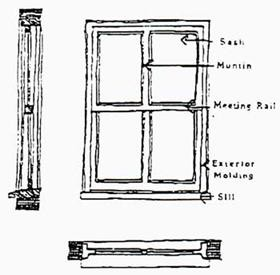
1.
Windows.
a.
Repair. Deteriorated windows can often be repaired and made sound and fully operational. A certificate of no effect is required to undertake ordinary repairs including:
i.
Replacing or rebuilding any parts of a window such as the sill and portions of the sash and frames using the same material and with the same configuration, shape and dimension.
ii.
Scraping, priming and repainting of window sash and/or frame.
iii.
Consolidating wood members with cellulose wood fillers or chemical materials. Change in shape, size or configuration require a certificate of appropriateness.
b.
Replacement.
i.
If historic windows have deteriorated to a point precluding repair, rehabilitation or restoration, based on documentation submitted by the applicant, or a field inspection by the Historic Preservation Officer, replacement windows may be approved under a certificate of no effect if they match the historic windows in terms of configuration, operation, details, material and finish. Variations in details will be permitted if such variations do not significantly affect the visual characteristics of the historic window, including the shadow effect of muntins and sash on the glazing. In evaluating "significant" effect, other factors to be considered shall be the age of the building and its architectural quality, as well as the extent of reduction in the total glazed area of the proposed sash compared to the existing sash. For narrow wood windows (less than 15 inches wide), the reduction shall be limited to ten percent; for wood windows, 15 inches or wider, the reduction shall be limited to six percent; for metal double-hung windows (of any size), the reduction shall be limited to ten percent.
ii.
In buildings less than 30 years old, the replacement windows need not match the historic window in terms of materials. The finish, however, must match the finish of the original windows. On secondary façades, windows which are visible from a public thoroughfare need only match the historic windows in terms of configuration and finish.
iii.
Proposals for replacement windows which do not meet these conditions will require a certificate of appropriateness.
c.
Storm windows. The installation of exterior storm windows will be granted a certificate of no effect providing they meet the following conditions:
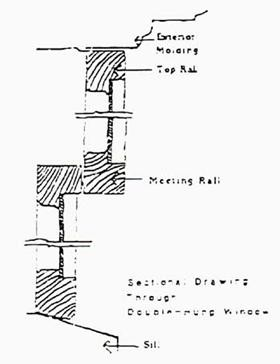
i.
Exterior storm windows shall fit tightly within window openings without the need for a subframe or panning around the perimeter.
ii.
The color of the frames of the storm windows shall match the color of the primary window frame.
iii.
Glazing shall be clear.
iv.
The storm sash shall be set as far back from the plane of the exterior wall surface as is practicable.
v.
Muntins shall not be permitted.
vi.
Meeting rails may be used only in conjunction with double-hung windows and shall be placed in the same relative location as in the primary sash.
d.
Supporting documentation. Applications for replacement windows must include photographs and dimensioned drawings of the existing condition of the windows. In addition, manufacturer's catalogue cuts or full or half-scale drawings of the proposed windows with comparative dimensions, details of construction and configuration and color and finish samples are required. Proposals for a change in material shall include a material sample.
2.
Storefronts.
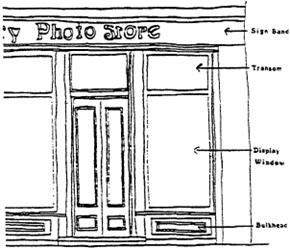
a.
Repair.
i.
Every effort should be made to retain and repair historic storefronts as well as significant surviving fragments of historic storefronts. While a non-original historic storefront may differ in style from the original building, it reflects the shifts in popular taste and documents the changes over time within an historic district and should be treated with sensitivity.
ii.
A certificate of no effect is required for ordinary repairs to existing storefronts, both historic and non-historic. This would include replacing deteriorated, damaged or missing features with matching components and painting or refinishing.
iii.
Changes in design or configuration of an historic storefront requires a certificate of appropriateness.
b.
Replacement.
i.
If replacement of a storefront is necessary, the design of the new storefront should reproduce the historic storefront in terms of its configuration, materials, placement, proportions and extent of glazed area. The design of the replacement store front may be based on surviving historic storefronts elsewhere on the building or another identical building, or on documentary evidence such as original architectural drawings or old photographs.
ii.
In cases where the historic storefront has been replaced and there is no extant historic storefront elsewhere on the building, nor on another identical building, and no documentary evidence can be found, a contemporary design is permissible and should meet the following criteria:
(A)
It fits entirely within the existing storefront opening(s);
(B)
It incorporates any architecturally and/or historically significant surviving fragments of an historic storefront;
(C)
It is compatible with the original materials and colors of the upper floors; and
(D)
It includes traditional storefront elements (i.e. transoms, glass display windows, low bulkheads, recessed entrance, signband) which are appropriate to the age and style of the building.
iii.
All applications for new storefronts require a certificate of appropriateness.
c.
Signage. In accordance with other provisions in this chapter (See 345-68 and 345-71.M).
d.
Awnings. Awnings are permitted on storefronts and should meet the following conditions: The awning is a retractable type with a sloped profile (exception may be made for buildings less than 30 years old and non-historic storefronts);
i.
The metal frame is covered with canvas fabric in an historically appropriate color and pattern to the building and the historic district;
ii.
Lettering on the awning is limited to the skirt; however, logos may be printed on the sloped portion of the awning;
iii.
The awning frame is attached to the building in such a way that it does not destroy or cause irreversible damage to significant architectural features;
iv.
The awning fits within the storefront opening and has the same shape as the opening.
e.
Security gates.
i.
Security gates should be installed in the interior of all storefronts and should be of the open-link variety. If new storefronts are to be installed, or in cases where the historic storefront had external security gates, the gate tracks should be recessed into the glazing reveal and the gate housing should be flush with the plane of the storefront, and should be contained within a plenum space above the storefront or behind a transom panel or signage panel. The gate housing, tracks or mechanical boxes should not protrude from the plane of the storefront or be apparent. Exterior scissor-type gates are also acceptable.
ii.
Applications for open link interior security gates require a certificate of no effect. Applications for all other security gates require a certificate of appropriateness.
f.
Supporting documentation. Applications for replacement storefronts must include photographs of the existing storefront, to scale drawings of the proposed storefront, signage, awning and/or security gates (elevation, sections and full or half-scale details), and materials and color samples.
3.
Additions.
a.
Rear yard additions.
i.
A certificate of no effect will be granted for applications for rear yard additions which meet the following criteria:
(A)
The proposed addition is not visible from a public thoroughfare or right-of-way.
(B)
The addition will not extend to the rear lot line, nor substantially eliminate the presence of a rear yard.
(C)
Other rear yard incursions exist within the block.
(D)
The proposed work complies with the Historic Zoning District regulations and will not require a variance.
(E)
The rear addition does not rise to the full height of the building.
(F)
The existing rear façade will not be removed from the entire width of the building. Instead, existing openings will be modified to provide access into the addition. (This approach retains original building fabric and reduces structural intervention.)
ii.
Applications for rear yard additions which do not meet the criteria will most likely require a certificate of appropriateness. For proposed additions which will be visible from a public thoroughfare or right-of-way, the Commission will consider the effect of the addition on any significant architectural features on the building's rear façade, and the scale and architectural character of the addition's façade in relation to the building's front façade.
b.
Rooftop additions. A certificate of no effect will be granted for applications for rooftop additions which meet the following criteria:
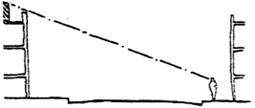
i.
The addition consists of mechanical equipment, egress or mechanical bulkheads or utilitarian skylights only; or the addition consists of living space and complies with the Historic Zoning regulations.
ii.
The roof of the subject building is not a significant feature of its design.
iii.
The addition is not visible from a public thoroughfare or right-of-way.
iv.
If the building possesses a significant roof silhouette, the addition does not interrupt the roof or skyline.
v.
The materials of the addition are in the nature of utilitarian rooftop accretions and are in keeping with the existing roofscape.
vi.
The addition does not adversely affect the significant ensemble of buildings by creating a distracting element in an otherwise uniform roofscape.
vi.
The addition does not adversely affect the significant ensemble of buildings by creating a distracting element in an otherwise uniform roofscape.
vii.
Applications for rooftop additions which do not meet the above criteria will most likely require a certificate of appropriateness.
c.
Supporting documentation. Applications for rear yard or rooftop additions must include photographs of the existing buildings (including rear façade for rear additions), individually and in the context of the neighborhood, to-scale floor plans, elevations and sections of the building and addition, to-scale sight line drawings for rooftop additions, a site plan of the entire block for rear yard additions, full or half scale details of windows, doors and decorative trim, materials and color samples.
4.
Restoration.
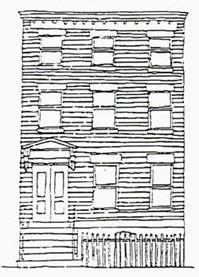
a.
A certificate of no effect will be granted for applications for the restoration of a building or building façade features (such as stoops, cornices, window and door openings and enframements) to their historic appearance when the following criteria are met:
i.
The restoration would not cause the removal of non-original historic building fabric (i.e., Victorian Period features on an early 19th Century structure).
ii.
The restoration is based on documentation such as:
(A)
Physical evidence on the building;
(B)
Original drawings;
(C)
Old photographs;
(D)
An identical building.
iii.
The restored features match the texture, color, profiles, details and dimensions of the original feature.
iv.
Restoration work which does not conform to the above criteria will require a certificate of appropriateness.
v.
Supporting documentation for restoration work shall include photographs of the existing conditions, documentation upon which the restoration is based, and the materials and methods proposed by the contractor in the form of specifications, a contract, or a letter.
5.
Exterior doors (primary façades).
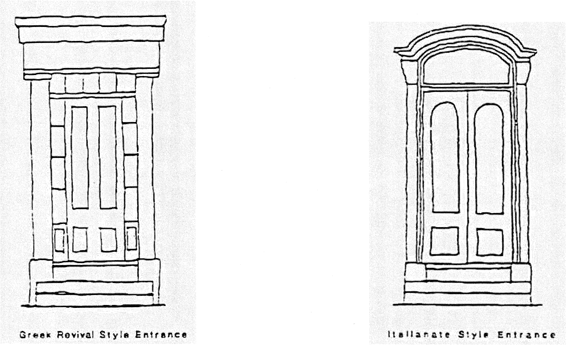
a.
Repair. Repair of historic doors including stripping, refinishing, replacing deteriorated parts-in-kind, replacing hardware matching the original, and replacing glazing in-kind, requires a certificate of no effect.
b.
Replacement. Historic doors may not be removed, unless beyond repair. A certificate of no effect will be granted for replacing deteriorated historic doors or non-historic doors with new doors which match the historic doors. A certificate of appropriateness will be required for the following:
i.
New doors which do not match the historic doors;
ii.
Enlarging or reducing the existing door opening;
iii.
Replacement doors of a different configuration than the historic doors;
iv.
Alterations to historic doors which significantly affect their appearance.
c.
Supporting documentation. Applications for replacement doors must include photographs of the building and the existing door showing deterioration, documentation of the historic doors if available, to scale drawings of the proposed doors within the opening (elevations and sections), and a finish sample.
6.
Ironwork.
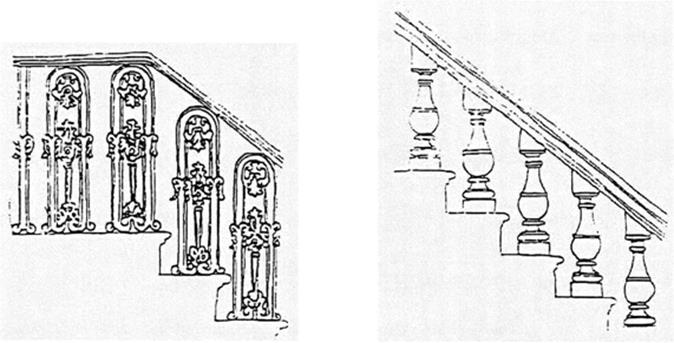
a.
Fences and railings. A certificate of no effect will be granted for the following:
i.
Ordinary repairs to existing fence and railings.
ii.
Replacement of missing, non-historic or severely deteriorated historic fences and railings providing that the new ironwork matches the historic ironwork based on documentation such as historic photographs, extant examples on identical buildings, or remnants of the historic ironwork.
iii.
A certificate of appropriateness is required for the following:
(A)
Replacement ironwork which does not match the historic fence and/or railing.
(B)
The installation of a fence or railing in a location which historically had no ironwork.
(C)
Alterations to or removal of historic fences and railings.
(D)
In instances where historic fences and/or railings have been removed or replaced and no documentation of the historic ironwork is available, the Commission recommends either a design which is stylistically compatible with the building or a simple contemporary design which is not intrusive to the special architectural and historic character of the building and the streetscape. Both alternatives require a certificate of appropriateness.
b.
Window and door security gates.
i.
A certificate of no effect will be granted for the installation of exterior window and/or door security gates providing they are existing features of the building and the proposed gates do not detract from the historic and architectural character of the building.
ii.
A certificate of appropriateness will be required for the installation of window and/or door security gates if none exist. The proposed gates should meet the following criteria:
(A)
A simple design.
(B)
Conform to the shape of the opening.
(C)
Be mounted within the opening.
(D)
Have no frame (window gate).
iii.
Exterior window gates are not permitted above the first floor on the front façade, which shall not be construed to mean the parlor floor (see definition of parlor floor). Window gates which accommodate air conditioner units should have simple boxes or holes rather than more elaborate curved protrusions, unless the latter is appropriate to the building's architectural character.
c.
Supporting documentation. Applications for new ironwork must include photographs of the building, both present and historic, dimensioned drawings of the proposed ironwork (elevation and full or half-scale section), a site plan showing extent of ironwork (only for installations proposed in locations where no ironwork presently exists).
7.
Residential awnings.
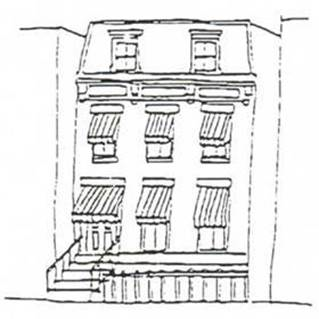
a.
Awning installation on residential buildings require a certificate of appropriateness and should meet the following criteria:
i.
The awnings are retractable;
ii.
The metal frame is covered with canvas fabric in an historically appropriate color and pattern for the building and the historic district;
iii.
The awnings fit within the window and/or door openings and have the same shape as the openings;
iv.
The awning frames are attached to the building in such a way that they do not destroy or cause irreversible damage to significant architectural features.
b.
Supporting documentation for applications for residential awnings must include present and historic photographs of the building, to scale drawings (elevation and section) of the installation, and a material and color sample.
8.
Commercial awnings.
a.
The installation of a commercial awning requires a certificate of appropriateness and should meet the following criteria:
i.
The metal frame is covered with canvas fabric in an historically appropriate color and pattern for the building and the historic district.
ii.
The awning frames are attached to the building in such a way that they do not destroy, conceal from view, or cause irreversible damage to significant architectural features.
iii.
The awning is an appropriate size for storefront.
iv.
The awning lettering should be limited to the name of the business and address. A brief description of the business may be acceptable.
b.
Supporting documentation for applications for commercial awnings must include present and historic photographs of the building, to scale drawings of the installation including lettering and a material and color sample.
9.
Imitation cladding.
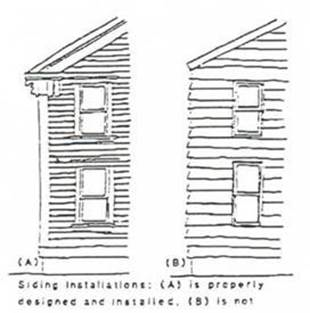
a.
Vinyl and aluminum siding. The Commission discourages the use of vinyl or aluminum siding on historic buildings. These materials are not permitted on masonry buildings. On buildings which have existing vinyl or aluminum siding, individual units may be replaced with matching materials if necessary following the issuance of a certificate of no effect. On buildings with wood clapboard siding and/or shingles, the Commission encourages retention of the historic material or replacement with matching materials.
b.
If an applicant chooses to apply for aluminum or vinyl siding, a certificate of appropriateness is required.
c.
Imitation facing. The Commission discourages the application of imitation stone or brick facings. On buildings which have existing imitation stone and brick facings, ordinary repairs and repainting may be performed following the issuance of a certificate of no effect. One exception is a refacing of a severely deteriorated brownstone façade with a cementitious mix tinted to match the color of brownstone. Such work will be granted a certificate of no effect providing it meets the following criteria:
i.
The existing brownstone surface is exfoliating, damaged or otherwise unsound (as documented in photographs).
ii.
The proposal calls for the replication of the original texture, color profiles and details.
iii.
The proposed calls for damaged stone to be cut back to sound stone and the new surface to be keyed into the sound stone and built up in successive layers using a cementitious mix with the top layer tinted and finished to match the original brownstone texture and color. In some cases, a sample patch may be requested for inspection and approval by the Historic Preservation Officer.
iv.
The use of wire lath is prohibited.
10.
New window openings.
a.
A certificate of no effect will be granted for new window openings when the following criteria are met.
i.
The proposed window openings are located on a secondary façade.
ii.
The new window openings and sash retain the same shape, dimensions and configuration as the building's existing windows.
iii.
The new lintels and sills match the design, color, and texture of other window openings on the façade.
iv.
The location of the new openings are consistent with the existing pattern of bays.
v.
The new openings do not detract from any significant historic architectural features on the building.
vi.
Proposed new window openings which do not meet all of the above criteria will require a certificate of appropriateness.
b.
Supporting documentation for applications for new window openings must include photographs of primary and secondary façades and a to scale elevation of the façade(s) indicating the proposed new openings.
11.
Sidewalk repair and replacement.
a.
Repairs of less than 50 percent of existing sidewalk.
i.
For repairs, the replacement units should be of like material and color to match the existing sidewalk. Intact blue stone paving must not be removed and discarded. Intact blue stone which has moved due to the thrust of tree roots or the freeze and thaw cycle and that presents a safety hazard to pedestrians, should be carefully removed and reset in sand, quarry, dust or dirt.
b.
Replacement of more than 50 percent. In the case of stone paving such as blue stone, the replacement units should be of the same material, shape, and size as the existing stone paving.
i.
When the previous material is concrete, then blue stone or colored concrete must be used. Colored concrete after curing should be Scofield charcoal gray or equivalent. The texture of the concrete should be made smooth with a wood float in order to create a texture more like blue stone. The sidewalk should cure without fine finishing and lines should be scored without edging. Corners (intersections) need to meet ADA standards and sloped areas (re: driveways or ramps) should have a light broom finish for traction.
c.
Not acceptable. New sidewalks of white or natural concrete of more than 50 percent, irregular "patio" styles and varying colors with great contrast are not acceptable. Patio styles that are historically appropriate or create the appearance of blue stone are acceptable, but subject to approval by the historic preservation officer.
d.
Curbs. Existing stone curbing should not be removed in sidewalk repair, with the exception of new handicapped curb cuts at street corners. If new curbing is required, replacing concrete curbs or at handicapped cuts, they should be poured concrete and meeting city standards for dimensions. The color should be French gray. Matching the color mixture of the sidewalks.
e.
Supporting documentation for applications for sidewalk repair and/or replacement must include photographic documentation of existing conditions and a dimensioned sketch of the proposed paving pattern.
M.
Signs.
1.
All signs shall reflect the historic character of the area of the proposed sign placement and will respect the size, scale and mass of the façade, building height and rhythms and sizes of windows and door openings.
2.
No signs shall be back-lighted.
3.
Projecting signs shall be permitted in accordance with Section 345-68.
4.
All signs within the historic district require a certificate of appropriateness, except that applications for unlit interior window signage only shall require a certificate of no effect.
§ 345-72. - Design standards: Recommended and not recommended.
[Added 10-13-2022 by Ord. No. 22-084]
A.
One- and two-family/Multi-Family Attached.
1.
Residential recommended.
a.
Attractive mature streetscape;
b.
Scale, orientation, and style consistent with adjacent development;
c.
On-street parking;
d.
Street trees small but detailed front yard.
2.
Residential not recommended.
a.
Fenced front yard resembles an "auto compound" and creates a commercial atmosphere;
b.
Excessive curb cut width and expansive concrete areas;
c.
No clear sense of unit entries;
d.
No street trees or landscaping.
3.
Residential not recommended.
a.
Building mass dominates because of lack of offsets and poor relationship between window size and façade area;
b.
Continuous drop curb limits on street parking;
c.
Proximity of overhead doors to road limits visibility and requires maneuvering in the right-of-way;
d.
Lack of street trees and landscaping;
e.
Garage doors dominate façade.
4.
Residential not recommended.
a.
Lack of architectural detail;
b.
Lack of interest at street level;
c.
Incompatible siding materials;
d.
Poor integration between architecture and streetscape;
e.
No landscaping or street trees.
B.
Multi-Family Residential—Mid-Rise/High-Rise.
1.
Residential recommended.
a.
Maintain consistent heights/setbacks;
b.
Consistent architectural theme;
c.
Subtle variation of color and detail;
d.
Pattern of windows/doors is consistent;
e.
No visible off street parking;
f.
Street trees and foundation plantings.
2.
High-rise residential recommended.
a.
Building oriented to streetscape;
b.
No excessive setbacks;
c.
Parking is not a dominant visual element;
d.
Architecturally interesting structure with "human" scale lower level;
e.
Enhanced streetscape with materials compatible with structure;
f.
Appropriate landscape treatment;
g.
Good transition between public and private uses.
3.
Residential not recommended.
a.
"Tower in the park" is discouraged;
b.
Massive structures in a sea of surface parking;
c.
No mans land creates excessive distances between buildings;
d.
Slab buildings devoid of architectural interest;
e.
Lack of landscaping further compounds bleak character.
C.
Fencing.
1.
Fencing lot recommended.
a.
High quality materials;
b.
Architectural details;
c.
Color, materials and landscaping softens impact;
d.
Area inside fencing is partially screened by plantings, green buffer in front of fence.
2.
Fencing not recommended.
a.
No landscaping or buffer;
b.
Harsh, unsoftened elements, stark white wall, high chainlink fencing topped with knife wire.
D.
Streetscape.
1.
Streetscape recommended.
a.
Unified design theme;
b.
Attention to details;
c.
Consistent setbacks of retail display windows and recessed entries;
d.
Cornice signage;
e.
Fabric awnings of consistent design.
2.
Streetscape not recommended.
a.
Lack of pedestrian amenities such as landscaping and street furniture;
b.
Solid metal security gates over retail windows;
c.
Disjointed signage-various styles, sizes, and sign heights oriented to vehicles;
d.
Nondescript street lighting.
E.
Public Space.
1.
Public spaces recommended.
a.
Comprehensive amenity plan;
b.
Ample seating;
c.
Seasonal shading with full canopy provides weather protection for seating area;
d.
Intimate, socially intensive space.
2.
Public spaces not recommended.
a.
Expansive, paved unusable area;
b.
Lack of visual interest (public art, fountain, or planting beds, etc.);
c.
No seating;
d.
Little or no landscaping;
e.
Discourages use of space for social interaction.
F.
Commercial.
1.
Corner commercial recommended.
a.
Building wraps corner and reflects building design;
b.
Storefront visible from two façades;
c.
Scale is pedestrian;
d.
Signage is pedestrian oriented;
e.
Architectural details provide interest.
2.
Corner commercial recommended.
a.
Architectural features are enhanced by design treatment;
b.
Windows on two façades wrapping corner;
c.
Fabric awnings;
d.
Pedestrian scale and signage.
3.
Corner commercial not recommended.
a.
Visual clutter;
b.
Excessive window coverage;
c.
Nonconforming advertising banner;
d.
Obscures original architectural details of building.
4.
Commercial recommended.
a.
First floor use integrated with streetscape;
b.
Room for first floor retail to provide vitality to pedestrian realm.
5.
Commercial not recommended.
a.
Setback from street destroys pedestrian realm — parking should be in back of building or on street;
b.
Lack of roof treatment makes building "float";
c.
Lack of connection to surrounding buildings;
d.
Parking area not landscaped;
e.
Exposed trash area.
G.
Drive Thru Commercial.
1.
Drive thru recommended.
a.
Drive thru area screened from street;
b.
Foundation plantings part of comprehensive landscape and screening plan.
2.
Drive thru recommended.
a.
Service area extension of building architecture;
b.
Fencing and landscaping coordinated to provide transition from parking area to pedestrian area;
c.
Signage integrated into architecture.
3.
Drive thru not recommended.
a.
Drive thru area not integrated into architectural design;
b.
No landscaping of parking area; no screening or decorative fencing;
c.
Building "floats" in a sea of parking;
d.
Pedestrian access not integrated into streetscape.
4.
Drive thru not recommended.
a.
No landscaping to complement architecture;
b.
Lack of architectural detail, large blank walls;
c.
No street trees or parking lot screening;
d.
No provisions for internal pedestrian circulation.
H.
Parking.
1.
Parking recommended.
a.
Seamless integration of parking use and streetscape;
b.
Street trees soften impact of lighting on surrounding buildings.
2.
Parking recommended.
a.
Street trees provide second buffer so pedestrian environment is greened on both sides.
3.
Parking not recommended.
a.
Parking in front of building creates a pedestrian hostile environment with no visible pedestrian access;
b.
Lack of landscaping creates harsh, barren appearance and no buffer between parking area and pedestrian environment;
c.
Signage on fence and freestanding area geared to vehicular traffic and not oriented to pedestrian neighborhood/commercial district where it is located.
4.
Parking garages recommended.
a.
Design masks use — garages outwardly resemble an office building;
b.
Minimal curb cuts encourage pedestrian flow;
c.
Garages should make provisions for first floor retail shops when built to sidewalk;
d.
Landscaping and trees buffer use from pedestrian and residential environment.
5.
Parking garages not recommended.
a.
Large blank wall destroys vitality of pedestrian realm;
b.
First floor retail or office uses above should surround and mask garage when built to front lot line on commercially zoned streets.
I.
Industrial.
1.
Industrial recommended.
a.
Internal use screened through high end materials like decorative fencing and landscaping;
b.
High decorative, spiked fence provides security without being visually detracting;
c.
Use of uniform, decorative lighting fixtures create attractive streetscape along narrow sidewalk.
2.
Industrial recommended.
a.
Comprehensive design of parking, signage, security and landscaping creates an inviting entrance;
b.
Use of landscape island at vehicular entrance to separate traffic flow provides attractive traffic calming element;
c.
Deciduous landscaping partially screens industrial building from building view.
J.
Neighborhood Commercial.
1.
Neighborhood commercial recommended.
a.
On street parking, no curb cuts to interrupt pedestrian flow;
b.
Mixed-use;
c.
Large display windows on first floor;
d.
Limited window signage, uniform signband in scale with storefront;
e.
Uniform standardized signage coordinated with architecture;
f.
Vestibule provides transition from public to private space.
2.
Neighborhood commercial recommended.
a.
No curb cuts, on street parking provides a wall to shield pedestrians from traffic;
b.
Awnings unify separate buildings to create a smooth transition between buildings;
c.
Uniform colors and signband also create unity of appearance;
d.
Limited window signage allows pedestrian to see in;
e.
Scale of signage conforms to scale of storefront architecture.
3.
Neighborhood commercial recommended.
a.
Coordination of streetscape elements furniture, bike racks, paper boxes;
b.
On street parking, no curb cuts interrupting pedestrian flow.
4.
Neighborhood commercial recommended.
a.
"Open door" achieved through big window allows interior activity to mix with sidewalk to create a vibrant streetscape;
b.
Outdoor dining provision adds to dynamic sidewalk.
5.
Neighborhood commercial not recommended.
a.
Excessive signage gives "low-rent" appearance;
b.
Lack of connection to streetscape through use of opaque materials;
c.
Uninviting for pedestrians—cannot see activity in window openings;
d.
Colors and materials incompatible with above architecture.
K.
Utilities.
1.
Utilities recommended.
a.
Machinery set back from public view;
b.
Architectural fencing provides screening and works in conjunction with landscaping to form buffer;
c.
Use of brick enclosure creates uniform and harmonious architectural/color/material scheme.
2.
Utilities not recommended.
a.
Interior workings on public display;
b.
Machinery too close to public space;
c.
No space for landscape buffering and screening;
d.
Chain link fence does not provide screening and adds to industrial appearance;
e.
No street trees.
L.
Highway Commercial.
1.
Highway commercial not recommended.
a.
Commercial appearance needs to be softened through architectural details like fencing, walls and landscaping.
2.
Highway commercial not recommended.
a.
Multiple signs and banners create visual confusion and degrade the area;
b.
Lack of landscaping to soften lights and noise.
3.
Highway commercial not recommended.
a.
Overuse of site allows business to borrow public realm for display and storage;
b.
No definition between end of business and sidewalk through low walls or landscaping.
4.
Highway commercial not recommended.
a.
Large open parking areas destroy neighborhood vitality;
b.
Frequent curb cuts make for a dangerous pedestrian experience.
M.
Conversions.
1.
Conversion recommended.
a.
Respect for architectural context;
b.
Mixed use with first floor retail and office/housing on upper floors.
2.
Conversion not recommended.
a.
Blank walls;
b.
No architectural detail;
c.
No screening of mechanical equipment and meters;
d.
No fenestration.
3.
Conversion not recommended.
a.
Removal of original windows destroys first floor vitality and historic features;
b.
Material mismatch removes architectural context.
4.
Conversion not recommended.
a.
Functional mismatch of building materials;
b.
Breaks continuous building wall by not respecting established window and door pattern.
§ 345-73. - Alcoholic beverages and tobacco product advertisements.
[Added 10-13-2022 by Ord. No. 22-084]
No person may place any form of advertising that advertises alcoholic beverages or tobacco products on any billboard, on any front, rear, side or rooftop of any building, or on any free standing billboard or signboard within 1,000 feet of an elementary or secondary school, or where otherwise prohibited by law.

