
Kennett Township City Zoning Code
ARTICLE II
TERMINOLOGY
Sec. 240-200.- Word usage.
Unless otherwise expressly stated, the following words and phrases shall be construed throughout this chapter to have the meaning and usage indicated as follows:
A.
The present tense includes the future. The singular includes the plural and plural the singular.
B.
The words "person," "party," and "entity" are interchangeable and include any individual, partnership, association, organization, limited liability company, corporation, firm, trust, estate, municipality, governmental unit, public utility, or any other legal entity.
C.
The words "shall" or "must" indicate a mandatory requirement. The word "may" is optional.
D.
The word "used" includes the words "designed," "arranged," and "intended to be used."
E.
The word "built" includes the words "erected," "constructed," or "altered."
F.
The word "including" is not limited to the specified example, but is intended to extend its meaning to all other instances of similar kind and character.
G.
The word "Township" means Kennett Township, Chester County, Pennsylvania.
H.
The term "Board of Supervisors" or "Supervisors" means Kennett Township Board of Supervisors.
I.
The term "Zoning Hearing Board" means Kennett Township Zoning Hearing Board.
J.
The word "herein" shall refer to the regulations of the full Zoning Ordinance.
K.
The word "chapter" shall refer to Kennett Township Zoning Ordinance, as amended, unless otherwise specified.
L.
When terms, phrases, or words are not defined, they shall have their ordinarily accepted meaning or such as the context may imply.
M.
Sections and articles within this chapter, including TND and sign standards may include definitions of terms that are specific to the article; such definitions shall be applicable in addition to definitions herein.
(Ord. No. 300, § I, 2-1-2023)
Sec. 240-201. - Definitions of terms.
The following words, terms, and phrases, when used in this chapter, shall have the meanings ascribed to them in this article, except where the context clearly indicates a different meaning:
Abandonment means the voluntary or involuntary discontinuance of a use of land, premises, property, building, or structure, or any part thereof, for a continuous period of one year or more.
Accessory dwelling unit means a self-contained dwelling unit that results from the conversion of an existing accessory structure into a dwelling unit, the creation of a separate dwelling unit within part of an existing single-family detached dwelling unit, or the construction of a new dwelling unit in a new accessory structure. An accessory dwelling unit shall be complete with food preparation and bathroom facilities, have direct access to the outdoors, be accessory to the existing primary use on the property, and have a permanent foundation. This term shall not include a mobile home as defined in this article.
Accessory use, building, or structure means a use, building, or structure on the same lot with, and of a nature customarily incidental and subordinate to, the principal use, building, or structure.
Acre or acre, gross means a unit of land equaling 43,560 square feet.
Acre or area, net means net area as defined under Articles XVII and XXII.
Act 167 of 1961 means the Pennsylvania "Historic District Act" of 1961, as amended.
Act 167 of 1978 means the Pennsylvania "Storm Water Management Act" of 1978, as amended.
Act 247 or Act or MPC means the Pennsylvania "Municipalities Planning Code" of 1968 (53 P.S. § 10101 et seq.), as amended.
Adaptive reuse means a historic resource which undergoes a process of rehabilitation, thus making possible a compatible new use for the property, (through repair, alteration, and additions) and retaining the historic character of the property by retention of distinctive material, features, spaces and spatial relationships of the structure that convey its historical, cultural, or architectural value.
Addition means an extension or increase in the floor area of a building or structure, whether habitable or not.
Adult use means any use of a property that is distinguished or characterized by its emphasis on matters or activities depicting, describing or relating to sexual activities or sexual anatomical areas and, in conjunction therewith, may have facilities for the presentation of sexual entertainment for observation by patrons. Such enterprise may include:
A.
A store or shop where the principal use is devoted to the display and selling of pornographic materials, which are pictures, drawings, photographs, films, or other depictions or printed matter and paraphernalia which, if sold knowingly to an individual under the age of 18 years of age, would violate the criminal laws of the Commonwealth of Pennsylvania in effect at the time thereof.
B.
Any other business, or establishment, either live or media, which offers its patrons services, entertainment, or retail goods or commercial services characterized by an emphasis on activities or matter depicting, describing, relating to, or displaying sexual or erotic activities.
Adult day-care center. See "day-care center, adult."
Adverse impacts means impacts which result from development, construction activity, or actions which result in degraded settings or other physical changes in appearance that diminish or destroy the physical nature or scenic quality of an area or view, or materially increase levels or alter the character of traffic, noise, glare, fumes, or odor on or emanating from a property or use.
Affordable-by-design means a type of housing unit that is demonstrated to be affordable for individuals or households that earn up to 120 percent of the area median income, calculated using generally accepted measures of affordability as determined by relevant agencies at the federal, state and county level. Unit types that may qualify include, but are not limited to: units that are deed-restricted below the 120 percent threshold as determined by an outside public agency or utilizing other public affordable housing subsidies, accessory dwelling units or accessory apartments that demonstrate affordability or smaller than average units that promote affordability.
Age restricted housing means a housing facility for independent living intended for occupancy by at least one person aged 55 years or older, with no resident dependent children, in compliance with the provisions of the Fair Housing Act.
Agricultural warehousing means the storage of agricultural products, byproducts, and materials.
Agricultural building means an accessory building for an agricultural use, including storing agricultural equipment, farm produce or products, housing livestock or poultry, or processing dairy and other agricultural products.
Agriculture, intensive or agricultural operation or use, intensive means a specialized form of agriculture which may be subject to additional criteria subject to their use and operation to protect the public health, safety, and general welfare such as, but not limited to, mushroom production and associated accessory uses, butchery or slaughterhouses, forestry, timber harvesting operations and associated uses, and structures housing more than 50 animal units.
A.
Mushroom production means a specialized form of agriculture involving the raising and harvesting of mushrooms, conducted primarily inside buildings, including composting, pasteurization, packaging and shipping. This use may involve the following:
1.
Mushroom substrate, fresh (also may be known as fresh mushroom-growing substrate) means inputs and raw materials used as a part of the process for creating a substance and/or medium in which to grow mushrooms. Composting materials generally consist of organic substances such as straw, hay, horse and poultry manure, corn cobs, cotton seed hulls, and gypsum used in the facility for the growing of mushrooms.
2.
Mushroom compost, spent (also may be known as spent mushroom-growing substrate) means post-mushroom growing compost material or substance that remains or is no longer required in the mushroom-growing process, which means that no fresh mushrooms remain ready for harvest. Such material also includes aged spent mushroom compost, which is the material remaining after the spent mushroom compost is conditioned by weather, elements, aeration, or equipment, and broken down into a primarily humus-type substance.
3.
Mushroom composting means any mixing, combining, processing, aerating, or similar use of any composting inputs and raw materials used in mushroom production. The term shall include spent mushroom compost as well as materials being processed to be used as fresh mushroom substrate. Such use shall only be permitted as an accessory use to mushroom production.
4.
Mushroom Farm Environmental Management Plan means a plan using Pennsylvania Department of Environmental Protection (PADEP) best practices for environmental protection in mushroom production and outlining how the mushroom grower, producer of mushroom substrate, or handler of fresh or spent mushroom compost will manage the mushroom production operation and the processing, depositing, removal, handling, and/or storage of mushroom compost in order to prevent pollution of the environment and to maintain and/or improve the existing conditions of the soil, water, air, and other natural features of the area surrounding the site on which the mushroom growing and composting takes place.
B.
Composting (processing) means a form of agriculture that may involve the following types of operations:
1.
Commercial composting means any mixing, combining, processing, aerating, packaging, storing, shipping, or similar use of any composting materials or storing processed compost for the purpose of sale or distribution.
2.
Agricultural composting means any mixture, combining, processing, aerating, packaging, storing, spreading, shipping, or similar use of any composting materials or storing processed compost by and for an agricultural use. All product generated as a result of this use shall be used in the primary agricultural use on the property where such composting occurs. The term shall not include manure resulting from an agricultural use, nor manure product being spread on fields as fertilizer for agriculture.
C.
Forestry means the management of forests and timberlands when practiced in accordance with accepted silvicultural principles, through developing, cultivating, harvesting, transporting, and selling trees for commercial purposes, which does not involve any land development. (See also "timber harvesting operation") (MPC).
D.
Timber harvesting operation means the disturbance for commercial purposes, and in compliance with an approved timber harvesting plan, of 30 or more trees with a DBH of three inches or more on a lot of one acre or more, whether during a single timber harvesting operation or cumulatively in successive operations within a three-year period. The removal of dead or diseased trees or invasive species, the cutting of trees for personal firewood use or as a part of a Christmas tree farming operation, orchard or vineyard revitalization, or the clearing of an area in accordance with an approved subdivision or land development plan or building permit shall not be considered a timber harvesting operation. Forestry, as defined by Act 247, shall be considered a timber harvesting operation and shall require the submittal and approval of a timber harvesting plan. (See also "forestry.")
E.
Timber harvesting plan means a description, by means of text and maps, of proposed actions involving the removal of trees from a tract of land. Such plan shall have been prepared by a forester with demonstrable expertise in forest management and shall be in accordance with the timber harvesting requirements of this chapter.
F.
Slaughterhouse/butchery means a facility where animals are slaughtered and processed to provide food for consumption.
Agriculture, non-intensive or agricultural operation or use, non-intensive means an enterprise that is actively engaged in the production and preparation for market or use of crops, livestock, and livestock products, and/or in the production, harvesting, and preparation for market or use of agricultural, agronomic, horticultural, silvicultural, and aquacultural crops and commodities. The use includes an enterprise that implements changes in production practices and procedures or types of crops, livestock, livestock products, or commodities produced consistent with practices and procedures that are normally engaged by farmers or are consistent with technological development within the agricultural industry, which may include the following:
A.
Crop and animal production means the growing of crops for domestic and commercial purposes which includes nursery and tree production, including Christmas tree production, and turf production and floriculture, and greenhouse/nursery production. Also included are all support activities for agriculture, based on NAICS code classifications. The techniques applied to the keeping of animals or bees for private or commercial purposes which includes support services for the equine industry.
B.
Food and beverage processing and manufacturing means industries related to the processing of raw agricultural materials for consumption including, dairy product manufacturing, fruit and vegetable preserving, and food manufacturing, such as bread, nut butter, syrup, honey, and other snack food manufacturing in addition to coffee, tea, beer, meadery, cidery, distillation, and wine manufacturing.
C.
Equine activities means a premises where animal husbandry (including breeding, rehabilitation, layups, and veterinary care and shoeing), boarding, riding, training, livery, competitions, or recreational activities, related to horses, donkeys, mules, and like animals, takes place for compensation and that may or may not involve clients on a regular basis.
D.
Indoor agriculture means a form of commercial agriculture occurring indoors in a building including hydroponic and non-hydroponic growing and vertical vegetable farming excluding mushroom production.
E.
Greenhouse/nursery production means a form of commercial agriculture involving the propagation and cultivation of plants that is often indoors but may also be outdoors. This includes high tunnels.
Agriculture worker means a person employed to work in an agricultural use.
Agriculture worker housing means living quarters provided for agriculture workers.
Agritourism or agrotourism means any agriculturally-based operation or activity that promotes and brings visitors to an agricultural use for compensation as a secondary agricultural business use. This use includes corn mazes, pumpkin patches, fruit picking, feeding animals, wine or cheese tasting, staying at a bed and breakfast (B&B) on a farm, farm and farming festivals, virtual tours, or similar activities which enhance sustainable and viable agriculture through value added products.
Air bed-and-breakfast (AirB&B). See "residential use temporary."
All-weather surface means a pavement constructed of materials such as graded stone, macadam, bituminous concrete, Portland cement concrete, grass-crete pavers, unistone pavers, or other surfaces approved by the Township Engineer.
Alley means a minor right-of-way, whether private or public, providing secondary vehicular access to the side or rear of two or more properties that otherwise adjoin a street.
Alluvial soils means soils transported and deposited by flowing water that consist of or are formed by material such as gravel, sand, silt, or clay, show little or no modification of the original material by soil-forming processes, and are identified by U.S. Natural Resources Conservation Service (NRCS).
Alteration means the act of changing the exterior of an historic resource for other than periodic replacement in-kind maintenance and repair.
Alteration, structural means any change in the supporting members of a building or structure, such as bearing walls, columns, beams or girders, joists or rafters, or enclosure walls.
Alterations or additions sympathetic to a historic resource means changes to historic resources that complement the architectural style, mass, texture, or scale of the historic resource and follow the standards for rehabilitation.
Anaerobic digestion means the process by which microorganisms in the absence of oxygen convert the energy stored in volatile acids in livestock and poultry manure or other organic materials into biogas which is then burned on-site to produce heat, electricity and water, and has the ancillary benefit of managing livestock manure.
Antenna means any system of wires, rods, discs, panels, flat panels, dishes, whips, or other similar devices used for the transmission and/or reception of wireless signals, which may include an omnidirectional antenna (rod), directional antenna (panel), parabolic antenna (disc), or other wireless antenna. (See also "antenna, non-commercial or personal," "wireless communications," "wireless communications facility," and related terms)
Antenna, microwave dish means a parabolic, earth-based reflector, commonly referred to as a "dish antenna," used or intended to receive or broadcast microwaves, radio waves, or electromagnetic waves from an overhead satellite.
Antenna, non-commercial or personal means a privately owned antenna solely serving the property where it is located for personal, amateur, non-commercial use, including television and radio, and which is not used for commercial broadcasting or communication purposes. Such devices shall include ham, citizen band radio antennas, or direct broadcast satellite dishes. The following are related terms:
A.
Antenna height, non-commercial or personal means the vertical distance measured from the bottom of the antenna support structure to the highest point of the antenna. If the support structure is on sloped grade, the average between the highest and lowest grade shall be used to calculate antenna height. This term is not a wireless communications facility.
B.
Antenna support structure, non-commercial or personal means a freestanding, attached, or any other structure that could support placement or instillation of an antenna, but not a wireless communications facility.
Antique shop means a retail use selling articles of household furnishings, artifacts and artwork as distinguishable from other such articles sold at retail in having at least 75 percent of such articles be at least 25 years old.
Apartment. See "dwelling, multifamily."
Applicant means a landowner, developer, or authorized agent, including his/her heirs, successors, executors, administrators, and assigns who has filed an application under this chapter.
Application means any application, whether preliminary, tentative, or final, required to be filed and approved before the start of an activity, including but not limited an application for a building permit, demolition permit, use and occupancy permit, sign permit, plot or site plan, subdivision, or land development. The term includes the application form and such plans, documents, and information as required by and in association with such form, as well as related fees and financial securities. All applications shall be endorsed by the legal owner and equitable owner of the site, property, or activity in question.
Appurtenances means visible, functional, or ornamental objects accessory to and part of buildings or structures.
Aquaculture means hatching, raising, and breeding of harvestable fish or other aquatic animals or plants in a natural or artificial aquatic situation.
Aquifer means a geological formation, part thereof, or group of formations that contains sufficient saturated, permeable material to yield useful quantities of groundwater to wells and springs.
Area and bulk regulations means standards pertaining to the height, density, intensity, and location of structures, including, but not limited to lot area, yard setback, and building coverage.
Authority means a body politic and corporate created pursuant to the Act of May 2, 1945 (P.L. 382, No. 164), known as the "Municipality Authorities Act of 1945" or its successor.
Automotive and vehicular uses:
A.
Automotive and vehicular sales means any property used for the display, sale, lease, or rental of new and used automobiles, panel trucks, or vans, trailers, or recreational vehicles or equipment, or automotive accessories, and warranty repair work or other repair service. At the time of application for this use, the applicant shall specify whether service or repair is the will be undertaken as secondary to the principal use of the sales operation.
B.
Automotive and vehicular repair means any property used for motor vehicle repair services, which may include assembly, painting, body and fender work, customizing, and detailing, but which shall not include sale of junked vehicles or equipment, or parts thereof, or the storage or sale of new or used motor vehicles.
C.
Automotive fuel station means any property used for the principal sale of motor vehicle fuel and electric vehicle charging, which may also include a convenience store. Any business or industry dispensing fuel for its own use and vehicles is not considered to be an automotive fuel station.
D.
Automotive service station means any property used for the principal sale of motor vehicle fuel and electric vehicle charging, which may also include a convenience store and minor repair of motor vehicles, but not auto body and fender repair, auto-painting, or sale of new or used vehicles. Any business or industry dispensing fuel for its own use and vehicles is not considered to be an automotive fuel station.
E.
Electric vehicle charging means a device or station that supplies electric energy for the recharging the power source such as batteries of electric vehicles.
F.
Car wash means a facility exclusively designed for the cleaning of vehicles by automated washers, self-wash bays, and/or service employees.
Awning means a permanent roof-like structure, supported by a wall of a building generally above an entrance or window, but having no relationship to the building's roof, generally designed and constructed for protection against the weather.
Bank or financial institution means a building wherein the primary occupation and use is concerned with such regulated businesses as financial planning, savings, lending, and investing.
Baseflow means the portion of stream flow derived from groundwater charge. The sustained stream flow that does not result from direct water runoff, water diversions, reservoir releases, piped discharges, or other human activities.
Basement means any area of the building having its floor, completely or partly, below grade. A basement is considered a building floor if the height of at least two of its perimeter walls is five feet or more above grade.
Bed-and-breakfast means an accessory use to a single-family detached residence and existing accessory buildings in a historic resource(s) whereby there are rooms for temporary overnight lodging of guests for compensation, and optional breakfast and afternoon tea/snacks. Bed-and-breakfasts are classified as the following types:
A.
Bed-and-breakfast home means an owner/operator/lessee-operated single-family detached dwelling and existing accessory buildings in a historic resource(s) providing up to three guest rooms in existing rooms of the historic resource for temporary overnight lodging of guests for compensation, and optional breakfast and afternoon tea/snacks.
B.
Bed-and-breakfast inn means an owner/operator/lessee-operated single-family detached dwelling and existing accessory buildings in a historic resource providing four to six guest rooms in existing rooms of the historic resource for temporary overnight lodging of guests for compensation, and optional breakfast and afternoon tea/snacks. Such uses having more than six guest rooms are deemed hotels or motels.
Best management practices (BMPS) means methods, measures, facilities, or practices to manage surface water runoff, wetlands, water pollution, and groundwater recharge, including but not limited to, structural and nonstructural controls and operation and maintenance procedures.
Best management practices, green technology means practices that combine biological and ecological concepts for the management of stormwater, and that are landscape-based and integrated into the natural environment and/or that incorporate natural site features. Such practices include, but are not limited to, filter strips or stormwater filtering systems (e.g., bioretention facilities, sand filters), open vegetated channels (dry or wet swales), riparian forested buffers, natural retention ponds, and rain gardens.
Billboards. See "signs."
Biogas means a fuel consisting of methane, carbon dioxide, and small amounts of water and other compounds produced as part of the anaerobic digestion processes.
Bioretention means a practice whereby planted land is utilized as a stormwater management technique for holding, infiltrating, evaporating, and transpiring water.
Botanical garden means an establishment primarily used for horticultural and arboreal display, education, research, and/or conservation, potentially including features such as fountains, trellises, patios, trails, nurseries and related items, sculptures, libraries, offices, and employee and researcher lodging, as well as related front-of-house facilities, such as visitors centers, ticketing facilities, eating establishments, and conservatories.
Botanical garden operation means operational back-of-house aspects related to the functioning of a botanical garden, potentially including features and facilities such as nurseries and related items, libraries, offices, and employee and researcher lodging,
Brandywine Battlefield means land areas designated as Brandywine Battlefield National Historic Landmark of 1961 and land areas designated via battlefield and battlefield strategic landscapes planning under funding of the National Park Service's American Battlefield Protection Program.
Brewery means an establishment where beer is brewed, produced, processed, and/or bottled, and that may include crushing, fermenting, blending, aging, storage, bottling, and administrative office functions for the use, its warehousing, and its wholesale sales. Brewery types include the following:
A.
Brewery, craft means a small, independent, and traditional brewery with an annual production of less than six million U.S. beer barrels as defined by the American Brewers Association.
B.
Brewery, micro means a brewery that produces more than 250 barrels and less than 15,000 barrels of malt, beer, or brewed beverages per year and then sold or distributed for off-premises consumption, which is not a restaurant use. A microbrewery must be licensed by the Pennsylvania Liquor Control Board or any successor agency of the Commonwealth.
C.
Brewery, nano means a very small brewery, defined by having a less than four U.S. beer barrels (470 L) brew system.
Brewpub means a combined brewery and restaurant that sells 25 percent or more of its brewed beer onsite. The beer is brewed primarily for sale in the restaurant. The beer is often dispensed directly from the brewers' storage tanks. Beer may be sold to-go.
Buffer means an area of land, which may include a visual barrier via a berm, fence, wall, or landscaping, which is provided to separate or limit views of incompatible uses. This may also be known as "buffer area," "landscape buffer" or "landscape buffer area."
Buffer, riparian. See "riparian buffer."
Build-to line means the line that defines the placement of a building from the street line on which the building fronts. The build-to line forms the street wall line. On a corner lot, the build-to line is located on each side of a lot abutting a street. A build-to line may have a recess or projection up to two feet in order to promote variation of building placement on a block, and/or may have a recess of up to 12 feet in order to promote outdoor dining for an eating or drinking establishment.
Buildable area means an area identified on a lot to ensure that sufficient area is provided for the general location of a building, driveway, patio, on-lot sewage facilities as applicable, and other necessary improvements and site alterations.
Building means a combination of materials to form a permanent structure having walls and a roof, and intended for housing, sheltering, or enclosure of persons, animals, or property. Included shall be all manufactured or mobile homes and trailers to be used for human habitation.
Building area means the aggregate of the maximum horizontal cross-section areas of the buildings on a lot, excluding cornices, eaves, and gutters projecting not more than 18 inches.
Building Code means the Building Code of Kennett Township, Chester County, Pennsylvania, as adopted and amended from time to time.
Building coverage means the ratio of the total ground floor building areas or building "footprints" on a lot to the total lot area.
Building elevation means any exterior wall of a building.
Building façade means the front exterior wall of a building where the main entrance is located.
Building height means the vertical distance measured from the mean level of the grade plane to the highest flat surface of a flat roof or the mean level of a sloped roof. Chimneys, spires, elevators, stairs, and equipment shall not be included in measuring building height.
Building (code) official or officer means an agent of the Board of Supervisors charged with the administration and enforcement of the Township Building Code. (See also "Code Enforcement Officer.")
Building setback line or building line means the line established within a lot by the required front yard, defining the minimum required distance between any building or structure or portion thereof and a street adjacent right-of-way line. Such line shall be measured at right angles from the street right-of-way line and shall be parallel to said street right-of-way line. This term may also be referred to as "front building setback," "front setback," "front yard setback," or "front yard." (See illustrations under "yard" definitions.)
Bulk means a term used to describe relationship of buildings or structures on a lot or yard or to other structures within the lot or yard and includes:
A.
The height and floor area of buildings and other structures.
B.
The relation of the number of dwelling units in a residential building to the size of the lot.
C.
All open areas in yard space relating to buildings or other structures.
Business or professional office means a place where business services are provided by authorized or licensed persons that involve predominantly administrative, professional, or clerical operations, or for the practice of medical and dental arts or similar examination and outpatient treatment of persons by physicians or medical specialists during normal office hours. This use excludes the retail or wholesale exchange of goods, 24-hour emergency medical service, and overnight patient stays. Such office may also be located within a medical or dental arts building, health care use, business park, or an accessory use to another primary use.
Business park (includes industrial and office park uses) means a grouping of two or more industrial, business, and/or office uses, including flex space, developed according to a unified plan on a tract and sharing common utilities and streets.
Caliper means the diameter of a tree trunk measured at a point six inches above grade.
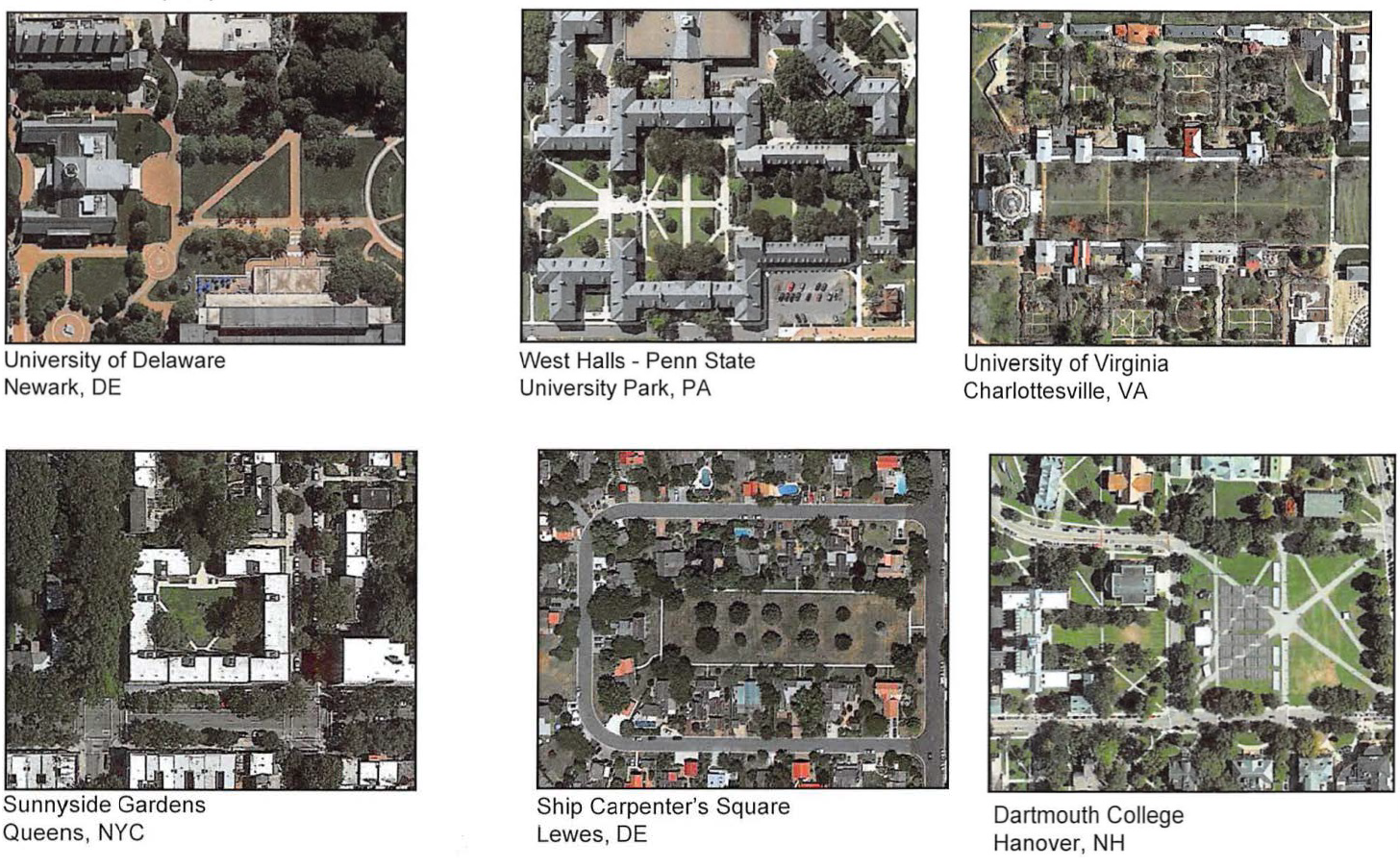
Campus-style community means a form of design whereby buildings are arranged around a central green space used for pedestrian gathering and walkability, similar to the arrangement of buildings on a college campus or a traditional neighborhood. (Refer to the images below for examples.)
Car wash. See "automotive" and "vehicular uses."
Caregivers means unrelated individuals whose employment is required to assist people in performing many of the normal daily living activities, such as hygienics, dressing, eating, and walking, and who are professionally licensed in the Commonwealth of Pennsylvania or employed by or operating under the supervision of a professionally licensed individual or organization.
Cartway. See "street" and related terms.
Catering establishment means a property in which the principal use is the preparation of food and meals on-premises, where such food is delivered to another location for consumption.
Cemetery means a place used or intended to be used for the interment of the dead, including a burial park for earth interments, a mausoleum for vault or crypt interments, a columbarium for cinerary interments, or a combination thereof. A cemetery may be provided as a principal use or an accessory use to a religious use, such as a place of worship. A cemetery shall not include the burial of remains on privately owned land where the primary use of the land is not as a place of interment for use by the general public or as an accessory use to a religious use.
Child day care. See "day care, child."
Cidery means an establishment where cider is brewed, produced, processed, and/or bottled, and that may include crushing, fermenting, blending, aging, storage, bottling, and administrative office functions for the use, its warehousing, and its wholesale sales.
Clear-cutting means the removal of all trees greater than 12 inches DBH on a site, or any portion thereof, greater than one-half acre in contiguous area, during a single timber harvesting operation or within a three-year period.
Clear sight triangle means an area of unobstructed vision at street intersection defined by lines of sight between points at a given distance from the intersection of street center lines, as specified in the Subdivision and Land Development Ordinance (Chapter 206). (See illustration in Article XX.)
Club or lodge means a property, buildings, or facilities used for or any organization established for some common social, fraternal, professional, or recreational purpose and characterized by regular meetings, a charter and/or bylaws, and with or without payment of dues.
Co-location. See "wireless communications facility" related terms.
Code Enforcement Officer means an agent of the Board of Supervisors charged with the administration and enforcement of one or more Township Codes and ordinances, including the Zoning Ordinance and Building Code. (See also "Building Officer" and "Zoning Officer.")
Commercial service/retail center means the multiple use of a single property for merchandise retail sales, personal service establishments, business and professional offices, recreation purposes such as theaters, bowling alleys, and fitness centers, as well as other commercial-oriented uses.
Commercial use means any use or activity conducted with the intent of realizing a profit from the sale of goods or services to others.
Commercial use non-structural means a use of vehicles, tents, and/or nonstructural facility for the purpose of engaging in retail or wholesale activities or services.
Commercial vehicle means a vehicle for the transportation of commodities, merchandise, produce, freight, and/or passengers and operated in conjunction with a business located on or off the premises where the vehicle is located.
Common open space. See "open space, common."
Communications equipment building. See "wireless communications facility" related terms.
Community center means a building and related outdoor areas used for noncommercial social, recreation, and meeting activities, open to the public or a designated part of the public. However, when this use is an accessory use permitted as part of a congregate-care community, retirement community, or similar residential community, its use is limited to residents and their occasional invited guests.
Compost means a mixture of decayed or decaying organic matter used to fertilize soil for crop, herb, vegetable, or other plant growing purposes, and made by gathering plant and other organic matter, including leaves, grass clippings, and vegetable peels, into a pile or bin and letting it decompose as a result of the action of aerobic bacteria, fungi, and other organisms.
Composting residential means the collection and/or containment of normal waste materials generated on a residential property for use by the resident(s). Such use shall not be considered composting processing.
Comprehensive plan means the Comprehensive Plan of Kennett Township, as amended.
Conditional use means a use that may not be appropriate to a particular zoning district as a whole, but that may be suitable in certain locations within the district only when specific conditions and criteria prescribed for such cases within this chapter are established by the applicant, who shall have the burden of proving the criteria and conditions can be satisfied.
Condominium means a type of ownership of real estate, where portions thereof are designated for separate ownership and the remainder is designated for common ownership solely by the owners of those portions, in accordance with the Pennsylvania Uniform Condominium Act of 1980, P.L. 286, No. 82, as amended.
Congregate-care community means a property used for the primary care of persons who are often largely seniors, which is licensed by the Commonwealth of Pennsylvania and in which around-the-clock food, shelter, personal, and medical care are available by staff caregivers for residents who require assistance for the basic activities of daily living, administration of medications, medical treatment, personal care, and/or skilled nursing care. Such use is developed according to a unified plan on a tract or contiguous tracts of land held in single and separate ownership, sharing common utilities and streets, and consisting of two or more of the following uses, however this shall not be construed as implying that the following uses cannot be built as separate primary uses that meet requirements of the chapter for said use:
A.
Community center. See "community center."
B.
Retirement community. See "retirement community."
C.
Personal care facility means the use of property for lodging and boarding for compensation for persons requiring limited assistance with activities of daily living, but not requiring full-time skilled nursing care nor drug or alcohol rehabilitation. Such use may also include memory care. Such use may also be referred to as "assisted-living."
D.
Nursing home means a property used for providing lodging, boarding, and nursing care, including possible memory care or hospice care, to unwell, invalid, infirm, disabled, or convalescent persons for compensation. Such use may also be referred to as "long term care," "continuing care," or "convalescent care or home," however shall not be construed to include drug or alcohol rehabilitation.
Conservation use means preservation, protection, and planned management of a natural resource and/or natural or historic landscape to prevent its exploitation, destruction, or neglect. Accessory uses such as, but not limited to, an office (not to exceed 1,000 square feet), an equipment storage facility, informational signage, parking, and a nature or heritage center for environmental education, land stewardship and other historic education or eco-friendly activities may be included.
Continuous visual buffer means a visually impenetrable screen, when planted or constructed, created through the effective use of perennial plant materials, fencing, walls, and/or earth sculpting or berms.
Contributing resource(s) means a resource in a historic district or historic property or complex which supports or adds to the historic significance through location, design, setting, materials, workmanship, feeling, and association.
Convenience store means a retail establishment offering for sale prepackaged food products, household items, newspapers and magazines, and sandwiches and other freshly prepared foods, such as salads, for off-site consumption. These uses may also be accompanied by an automotive fuel station.
Conventional residential development means an arrangement of residential lots encompassing the entire development tract without retaining open space.
Cottage brewing, distilling, or winemaking industry means any property used for growing, creating, processing, and/or producing materials for developing alcoholic beverages. This use shall be considered an industrial agricultural use. Applicable definitions and regulations for each type of use under this use, including brewing, distilling, and winemaking, shall apply.
County means the County of Chester, Commonwealth of Pennsylvania.
Crematory or cremation service means a place that may be an independent use or accessory to a funeral home or cemetery and which has been certified by the Commonwealth of Pennsylvania for the cremation of deceased persons or animals.
Cultural landscape means a geographic area, including historic, scenic, and/or natural resources, that possesses authenticity associated with a historic event(s), activity(ies), or person(s); a social, economic, or physical force(s); other heritage quality(ies), providing a sense of place and identity and illustrating human society, settlement, and the natural environment over time.
Cutoff angle means a lighting term for the angle between a horizontal line through a lamp center and the line of sight at which the lamp first becomes visible as viewed from normal viewing angles.
Day-care. The following are types of day care uses:
A.
Adult day-care center means a commercial premises in which adult daily living services are simultaneously provided for four or more nonresident clients for part of a 24-hour day. Services provided to clients may include nursing, personal care, nutrition, social services, activities, and emergency care. Such use is regulated by the Pennsylvania Department of Aging, and other applicable Commonwealth standards.
B.
Child day-care center means a commercial premises used in whole or in part for compensation for the care of seven or more children under the age of 16 years during any part of a day, with or without stated educational purposes, and where the child-care areas are not being used as a family residence, where the center is licensed or approved to provide child care by the Commonwealth of Pennsylvania, and where the center is not a "day care home" nor a "school" or "educational use." If on-site water supply is provided, written annual confirmation of potable water that meets acceptable levels of lead by Chester County Health Department standards shall be provided to the Township. Such use shall meet applicable Commonwealth of Pennsylvania standards.
C.
Family day-care home means a dwelling in which child or adult day care is provided for compensation at any time to not more than six children or adults who are not relatives of the caregiver and where child or adult care areas are also used as a family residence. Such use shall meet applicable Commonwealth of Pennsylvania standards.
DBH. See "diameter at breast height."
Demolition means the dismantling or tearing down of all or part of the exterior portion of a building or structure whether deliberately or by neglect.
Demolition of historic resources means the deterioration, razing, destruction, alteration, or removal, whether in whole or in part, deliberately or by neglect, of any historical resource identified in the Township Historic Resources Inventory or Map, and specifically significant exterior architectural or engineering features.
Density or density, gross means the total land area of a tract or lot as a numerical value obtained by dividing the total number of dwelling or nonresidential units on a tract or lot by the gross tract or lot area, expressed in units per acre.
Density, net means the numerical value obtained by dividing the total number of dwelling or nonresidential units on a tract or lot by the lot area or as defined under Articles XVII, XIV, and XXII.
Detention basin means an impoundment designed to collect and retard stormwater runoff by temporarily storing the runoff and releasing it at a predetermined rate. Such use is designed to drain completely shortly after any given rainfall event.
Determination means any final action of the Building, Zoning, or Code Enforcement Officer, Township Engineer, Planning Commission, or other authorized Township officer relative to the provisions of this chapter, as specified within.
Determination of eligibility (DOE) means a historic resource determined by Pennsylvania Historical and Museum Commission or Secretary of the Interior as having the potential to meet National Register criteria, but not yet listed in the National Register of Historic Places.
Developer means any landowner, agent of such landowner, or lessee or tenant with the permission of such landowner, who makes or causes to be made a subdivision of land or land development, as defined by this chapter.
Development means any man-made change to improved or unimproved real estate, including, but not limited to, the construction, reconstruction, renovation, repair, expansion or alteration of buildings or other structures; the placement of mobile/manufactured homes; streets and other paving; utilities; filling, grading and excavation; mining; dredging; drilling operations, storage of equipment or materials; and the subdivision of land.
Development plan means the provisions for development, including a planned residential development, a plat of subdivision, all covenants relating to use, location and bulk of buildings and other structures, intensity of use or density of development, streets, ways and parking facilities, common open space and public facilities. The phrase "provisions of the development plan" when used in this act shall mean the written and graphic materials referred to in this term.
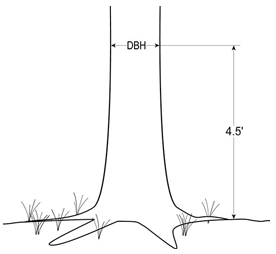
Diameter at breast height (DBH) means the diameter of a tree at breast height, measured four and one-half feet from the ground surface at the point of highest elevation in contact with the trunk of such tree.
Discontinuance. See "abandonment."
Distillery means a place where liquor is produced, processed, and/or bottled, and which may include crushing, fermenting, blending, aging, storage, bottling, and administrative office functions for the use, its warehousing, and its wholesale sales.
Distributed antenna systems (DAS). See "wireless communications facility" related terms.
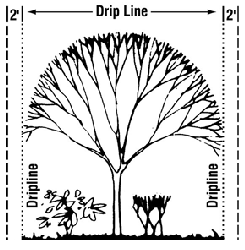
Dripline means a generally circular line, the circumference of which is determined by the outer reaches of a tree's widest branching points.
Drive-through service means a property that dispenses products or services through a building opening, including windows, doors, or mechanical devices, to patrons who remain in motor vehicles.
Driveway means a cartway located on a property providing vehicular access to a public or private street, and which may be shared by up to three lots above which it shall be deemed a private street.
Dump means a lot or portion of a lot containing refuse, discarded or stored materials including, but not limited to, garbage, ashes, and rubbish. The definition of dump does not include a junkyard or landfill and when operated in accordance with standards established by the Pennsylvania Department of Health.
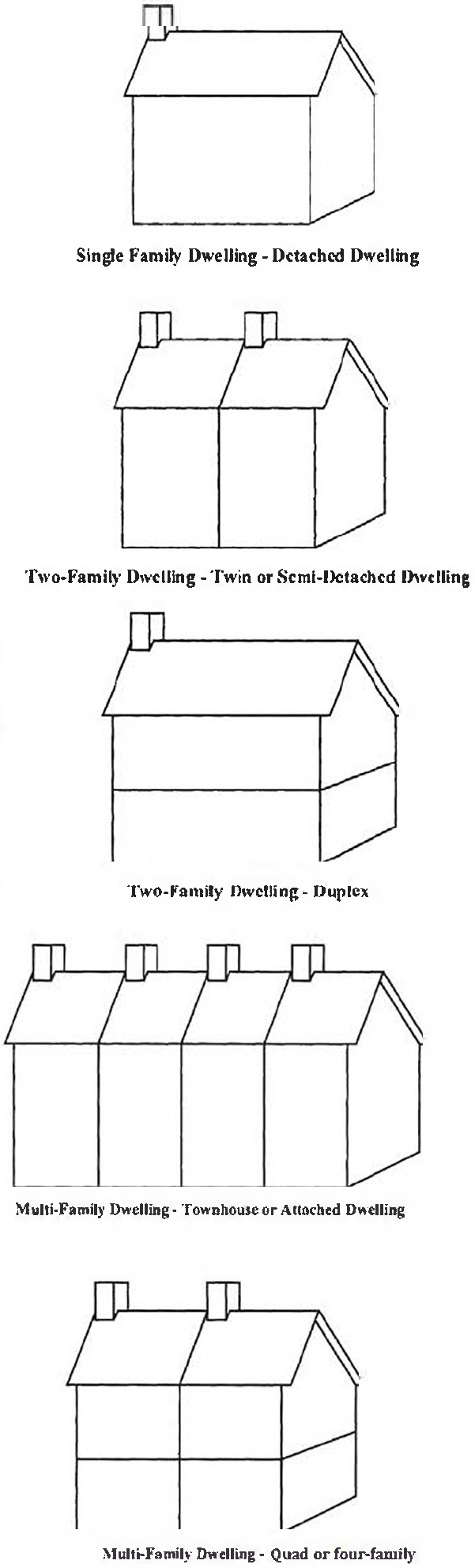
Dwelling or dwelling unit means a building, or portion thereof, providing one or more rooms arranged for residential occupancy and use of one or more individuals living together as a single housekeeping or household unit and having independent kitchen, living, bathroom, and bedroom facilities. Dwellings are further classified by the building types in which they occur as follows:
A.
Single-family detached dwelling means a building containing no more than one dwelling unit from grade to roof, yard area on all sides, and having no common or party wall with an adjacent dwelling.
B.
Two-family dwelling means a building containing two dwelling units with independent access to the exterior for each dwelling unit and which is not connected to another building. Two-family dwellings may be arranged side-by-side (a twin or semi-detached house) with each unit separated by a vertical parallel party wall and having yards on three sides, or one above the other (a duplex or two-family detached house) with each unit separated by a horizontal floor and having yards on sides.
C.
Multifamily dwelling means a building containing three or more dwelling units. Such dwellings may be arranged in building configurations as follows:
1.
Townhouse or single-family, attached means a dwelling within a multifamily residential building that contains not more than eight dwelling units, each with independent access to the exterior, a dwelling unit from grade to roof, yards to the front and rear (internal units) or front, rear, and one side (end units), and sharing not more than two vertical parallel party walls in common with adjoining dwelling units in the building.
2.
Quadruplex or four-family means four attached dwellings within a multifamily residential building in which each dwelling unit has independent exterior access, two non-parallel party walls in common with adjacent dwelling units, and yards on two non-parallel sides.
3.
Apartment means a dwelling unit contained within a multifamily residential building that includes other such dwelling units or another type of occupancy, separated by party walls, and having either independent or shared access to the exterior of the building.
Easement means an interest in land, which is owned by another party, that entitles the holder of the easement to a dominant right to a certain described area on a property. An easement often comes in the form of a right-of-way granted for limited use of private land, such as for a utility line or stormwater facilities, within which the property owner, occupant, lessee or shall not erect any permanent structure but shall have the right to make any other use of the land that is not inconsistent with the rights of the grantee under the easement terms.
Eating or drinking establishment means any form of restaurant and/or tavern open to the public and dispensing food and drink. Such use shall not be considered to include drive-through service and outdoor dining.
Eating or drinking establishment mobile or temporary means a movable or non-structural accessory commercial use, including but not limited to eating establishment that provides for the sale and consumption of food and beverages and that shall be considered a temporary use.
Educational use means land, including buildings specifically designed, arranged and intended for the primary purpose of instruction and learning, including preschools, elementary and secondary schools, colleges, universities, vocational schools, and including schools related to religious uses, whether private or public. Such use requires certification, licensing, or review by Pennsylvania Department of Education.
Enlargement or expansion means an addition to the floor area of an existing building, an increase in the size of a structure, or an increase in that portion of a lot occupied by an existing use.
Event space means a facility used on a temporary and periodic scheduled basis by members of the public or organizations for meetings, events, and other group activities, such as parties, weddings, receptions, business conferences, classes, and seminars, and that may or may not provide for meals prepared on or off the premises for attendees.
FCC means Federal Communications Commission.
Family means occupant(s) of an individual dwelling unit under one of the following categories:
A.
A single person; or
B.
Two or more persons related by blood, marriage, or adoption, including foster children, including not more than two other persons, such as boarders, lodgers, au pairs, or housekeepers; or
C.
Not more than four unrelated persons living together as a single household unit; or
D.
Any number of individuals with disabilities and their attendant adult supervisors living together as the functional equivalent of a family and entitled to a reasonable accommodation to allow them adequate housing choices pursuant to the Federal Fair Housing Amendments Act of 1988 (42 U.S.C. § 601 et. seq.) and the Pennsylvania Human Relations Act (43 P.S. §§ 951-963). A "family" shall not include alcoholism or drug treatment centers, work release facilities for convicts or ex-convicts, transitional housing, or other housing facilities serving as an alternative to incarceration.
Family day care. See "day care, family."
Feedlot means a fenced enclosure used to retain and feed livestock or poultry.
Feedstock means input to a manure digester that typically consists of livestock and/or poultry manure (primary catalyst) and possibly other organic materials such as food wastes (secondary catalyst).
FEMA means Federal Emergency Management Agency.
Fence or fencing means any freestanding structure consisting of wood, glass, metal, plastic, wire, wire mesh, or masonry, singly or in combination with other materials, standing two and one-half feet high or higher, erected to secure or divide one property from another or part of a property from a remaining part; a freestanding masonry wall is considered a fence.
Flag lot. See "lot, flag."
Flood means a temporary inundation of normally dry land areas.
Flood, 100-year means a flood that, on the average, is likely to occur once every 100 years or that has a one percent chance of being equaled or exceeded in any given year.
Floodplain means an umbrella term that includes the area identified as the Special Flood Hazard Area on the Flood Insurance Rate Maps (FIRM) and Flood Insurance Study (FIS), and other areas identified by the Township. Generally, a relatively flat or low land area which is subject to partial or complete inundation from an adjoining or nearby pond or watercourse; and/or any area subject to the unusual and rapid accumulation of surface waters from any source.
Floor area means the sum of the gross horizontal cross-section areas of every building floor measured from the a) face of exterior wall to exterior wall or b) center lines of party walls, and including basements and attics with a floor to ceiling height of seven feet or more.
Floor area, habitable means total area of all floors within a dwelling which are contained within interior walls and used for habitation, excluding open porches, garages, attics, basements with a floor to ceiling height of less than seven feet, elevator shafts, and nonresidential accessory buildings and structures.
Floor area, gross leasable (GLFA) means total area of all floors within a building which are contained within interior walls and available for the business or use conducted at the premises, including all lavatory areas, corridors, storage areas, and other areas used to keep stock and inventory. This term shall exclude the floor area included in party and outside walls, stairwells, loading docks, elevator shafts, common hallways, basements with a floor to ceiling height of less than seven feet, and any room or area dedicated to heating and air-conditioning equipment or other utility areas necessary for building operation.
Floor, building means that portion of a building that is included between the upper surface of any floor and the upper surface of the next floor or roof directly above it.
Footcandle means a unit of light intensity stated in lumens per square foot and measurable with a light meter.
Forest canopy means the aerial cover formed by the crowns of adjacent trees that are greater than 50 feet in height. The percentage of forest canopy to be retained after any timber harvesting operation shall be measured as the percentage of individual adjacent trees greater than 50 feet in height to remain on-site.
Forest interior or interior woodland means a forested or woodland area that is surrounded by at least 300 feet from the outermost dripline of all trees along the edge of the subject area. These areas tend to support a wide range of plants and animals that do not thrive in forest edges or smaller patches of woods impacted by human activities. Such interior areas are found in the Kennett Township Woodland Classification Map and related chart.
Forestry. See "agriculture" or "agricultural operation or use."
Full-cutoff means attribute of a lighting fixture from which no light is emitted at or above a horizontal plane drawn through the bottom of the fixture and no more than ten percent of the lamp's intensity is emitted at or above an angle of ten degrees below that horizontal plane, at all lateral angles around the fixture.
Funeral home means a building, or part thereof, used exclusively for human burial services. Such building may contain space and facilities for embalming and the performance of other services used in the preparation of the dead for burial; the performances of autopsies and other surgical procedures; the storage of caskets, funeral urns, and other related funeral supplies; and the storage of funeral vehicles, but shall not include facilities for cremation.
Garage, private means an accessory building or part of a principal building used for the storage of motor vehicles owned and used by the owner, occupant, or lessee of the premises.
Garage/yard sale means an accessory use for the temporary display and sale of goods and craft items on a residentially used property.
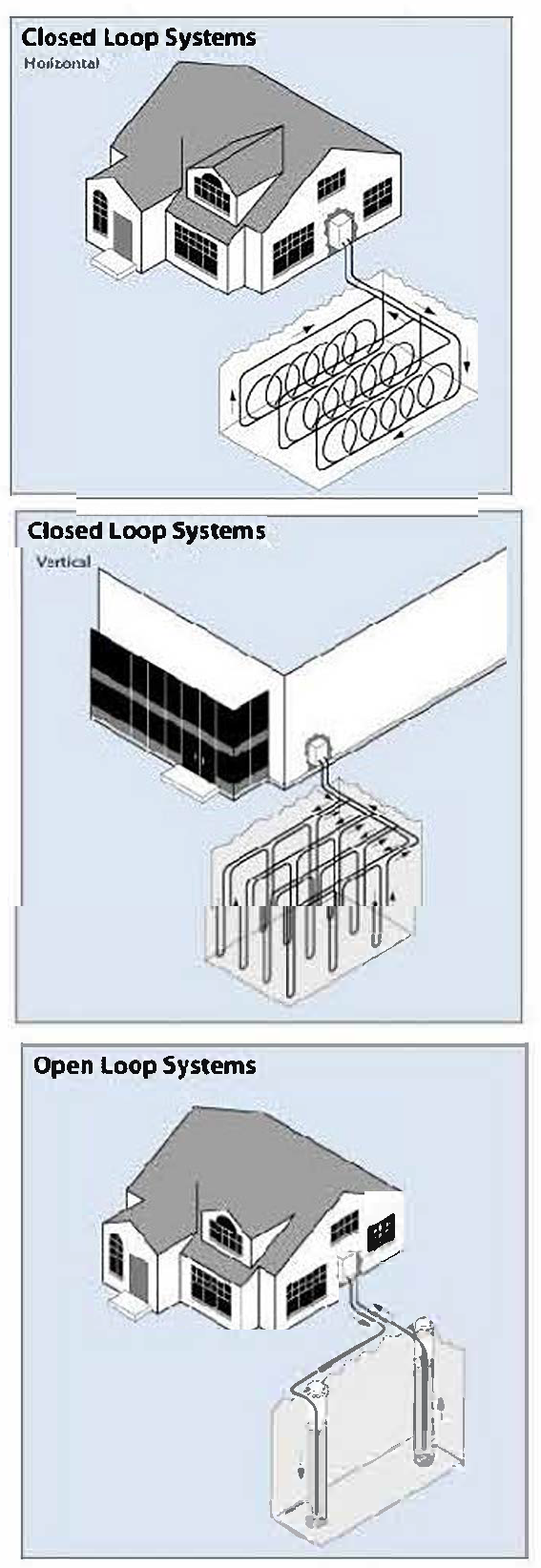
Geothermal energy system means an energy generating system that uses the earth's thermal properties in conjunction with electricity to provide greater efficiency in the heating and cooling of buildings. Such system may including the following:
A.
Bentonite means a highly plastic, colloidal clay composed largely of the mineral montmorillonite that is used in grout to seal geothermal or other wells or boreholes after they have been drilled, bored, or otherwise excavated.
B.
Borehole means a penetration of soil and/or rock that is augured, drilled, cored, bored, washed, driven, dug, jetted, or otherwise constructed which is generally cylindrical in shape and whose diameter is generally smaller than its depth of penetration that is used in closed vertical loop geothermal systems.
C.
Closed loop geothermal system means a type of geothermal heating and/or cooling system that utilizes a pressurized heat exchanger consisting of pipe, a circulating pump, and a water source heat pump in which the heat transfer fluid is not exposed to the atmosphere. The heat transfer fluid is potable or beneficial reuse water and may have approved nontoxic antifreeze, such as propylene glycol, added. The fluid is circulated through the piping from the opening into the heat exchanger and back. The system may be looped horizontally or vertically within the ground, and functions in the same manner as the open-loop system except there is no pumping of groundwater.
D.
Closed horizontal loop geothermal system means a type of closed loop geothermal heating and/or cooling system that involves two pipes buried in a trench that is at least four feet deep and as narrow as two feet wide. The pipe can be looped (see figure) to save space, or may be placed linearly in a longer, straight trench.
E.
Closed vertical loop geothermal system means a type of closed loop geothermal heating and/or cooling system that involves drilling multiple holes about 20 feet apart and 100 to 400 feet deep. Looped pipes are placed in the holes to circulate the water through wells. This option is commonly used where land area is limited, or the soil is too shallow.
F.
Ground source heat pump means a geothermal heat pump that uses the earth as a heat source and heat sink. It is coupled to the ground by means of a closed-loop heat exchanger installed horizontally or vertically underground.
G.
Grout means neat cement, cement plus bentonite, bentonite, bentonite plus silica sand, or other low-permeability sealing material. Grout is to be mixed and applied according to manufacturer's specifications (e.g., water content and viscosity) for use in grouting (e.g., sealing) wells and/or geothermal boreholes.
H.
Open horizontal loop geothermal system means a type of geothermal heating and/or cooling system that utilizes a water-supply well, or other source, and a pump to deliver groundwater to a heat exchanger. Discharge water from the heat exchanger may be returned to the subsurface through a recharge well or infiltration bed, or may be discharged into a pond, lake, or stream. (see figure)
Glare means the sensation of brightness within the visual field of sight produced by lighting that causes an annoyance, discomfort, or loss in visual performance, ability to focus, and visibility by the eye.
Golf course means a tract of ground laid out and designed in compliance with minimum USGA (United States Golf Association) regulations as an outdoor course to accommodate either nine or 18 holes of golf. Included are the customary buildings and services accessory to the primary golf course use. A commercial driving range, miniature golf course, or chip-and-putt golf facility shall not be considered a golf course by this definition.
Grade or grade plane means a reference plane representing the average of all finished ground levels adjoining a building at all exterior walls. Where the finished grade slopes away from the exterior building walls or base of a structure, the reference plane shall be established by the lowest points between the building and lot line or, where the lot line is more than six feet from the building, between the building and a point six feet from the building.
Green means a plaza, courtyard, green court, pocket park, tot lot, playground, walkway, promenade, or other type of public space facility in which features such as pavers, benches, gazebos, pergolas, arbors, planters, plantings, lighting, shade trees and sculpture are installed and maintained, and in which activities such as public seating and outdoor dining may take place.
Green building design means sustainable building construction methods, such as green roofs, LEED's Neighborhood Development Guide, or Energy Star, and meeting goals of sustainable PA initiative.
Green design means design elements utilizing and promoting naturalized systems of living ecosystems that incorporate natural biological processes designed to improve ecosystem health, e.g., bio-swales, created wetlands, rain gardens, rainwater harvesting, existing or enhanced nature resources used in naturalized stormwater management or sewer systems.
Green space or area means that portion of a tract or lot designed and maintained for use and enjoyment of occupants of a development, the Township, or the public, and landscaped with shrubs, trees, ground cover, soil, mulch, grass, vegetable gardens, pervious paving, and/or flower beds and not occupied by any principal buildings, parking areas, paved or unpaved streets, manmade structured stormwater management, and utilities, private yards, and like areas, or other pavement or impervious surfaces. Green space may include areas maintained as such within any required buffer or setback area. However, at the discretion of the Board of Supervisors, areas devoted to stormwater management facilities may be included within the minimum required green space where the applicant can demonstrate to the satisfaction of the Board of Supervisors that such facilities are designed to promote recharge of the groundwater system, or be available and appropriate for active or passive recreational use or scenic enjoyment.
Groundwater means the supply of water contained in interconnected pores located below the water table in an aquifer or geologic formation that forms the natural reservoir for potable water. Groundwater sources include infiltration of precipitation, streams, lakes, or other water sources.
Health care uses means health care facilities, including medical or dental arts and the following:
A.
Hospital means an accredited and licensed medical institution providing primary health services and medical or surgical care to persons, primarily inpatients, having physical or mental illness, by physicians, and diagnostic, therapeutic, treatment, or rehabilitation practitioners, and including, as an integral part of the institution, related facilities such as laboratories, outpatient facilities, emergency services, or training facilities. A hospital may be an individual use or located within a complex that includes other buildings used for medical services and related facilities.
B.
Ambulatory surgery center or surgicenter means a licensed outpatient medical facility providing same-day surgical procedures that does not include any emergency or urgent care.
C.
Medical clinic means a licensed medical care facility for diagnosis and treatment of specialized medical fields that may, due to their inherent nature, also require overnight patient stay, such as a sleep study center or methadone center. Such shall not house the criminally insane nor provide treatment to persons serving a criminal sentence.
D.
Urgent care facility means professional office space designed and used for the immediate diagnosis, treatment, and out-patient care of human patients, excluding operating rooms for surgery, overnight beds, or other services which a hospital customarily provides for overnight stays. Such uses may be open 24-per day and seven days per week for urgent outpatient medical care purposes.
E.
Hospice means a facility that provides care to patients for illnesses not responding to cure-oriented medical treatments.
Hedgerow means a linear plant community dominated by trees and/or shrubs. Hedgerows often occur along streets, fence lines, property lines, or between fields, and may occur naturally or be specially planted (e.g., as a windbreak). For purposes of this chapter and the Kennett Township Subdivision and Land Development Ordinance, hedgerows are considered woodlands and regulated as such.
Heritage tree means any tree greater than 48 inches DBH, regardless of species. However, certain tree species may be considered heritage trees at smaller DBHs per Appendix B of this chapter. In the context of a subdivision or land development review or in consideration of any application for approval of special exception variance or conditional use, and upon the recommendation of a qualified forester or equivalent professional, the Township may designate as additional heritage trees any tree or other plant selected as uniquely representative of a class or group in terms of size, shape, form, age, historical importance, scenic qualities, visual prominence, or other characteristics. Trees or other plants determined to be dead or diseased or in any manner constituting a safety hazard shall not be considered heritage trees.
Higher value species means tree species of commercial grade 12 inches or more in DBH, including white oak, red oak, chestnut oak, pin oak, and black oak species.
Historic district means a geographically definable area which possesses a significant concentration, linkage, or continuity of sites, buildings, structures, or objects united by past events or aesthetically by plan or physical development and may be National Register listed or eligible.
Historic resource means any building, structure, site, or object that is:
A.
Listed individually in the National Register of Historic Places (a listing maintained by the Department of Interior), as a National Historic Landmark (NHL), or received a Determination of Eligibility (DOE) by the Secretary of the Interior or Pennsylvania Historic and Museum Commission as meeting the requirements for individual listing on the National Register.
B.
Certified or determined by the Secretary of the Interior or Pennsylvania Historic and Museum Commission as contributing to the historical significance of a National Register of Historic Places historic district, National Historic Landmark (NHL), or a historic district that has received a Determination of Eligibility (DOE).
C.
Included in the Township Historic Resource Identification List and that retain local, state or national significance per National Register criteria or for their local historic or architectural significance and meeting two or more of the following criteria:
1.
Have interest or value as an example of development, heritage, or character that has contributed to local, state, and/or national history; and
2.
Are the site of and/or associated with a significant historic event, or
3.
Exemplify cultural, political, economic, social, or historical heritage, or
4.
Are associated with the lives of persons significant in the formation of the community, state, and/or nation; or
5.
Reflect the environment in an era of history characterized by a distinctive architectural style or engineering method, or
6.
Embody distinguishing characteristics of an architectural style or engineering method, or
7.
Represent the work of a master, designer, architect, landscape architect or designer, or engineer whose work has significantly influenced the development of the community, state, and/or nation; or
8.
Contain elements of design, detail, materials, or craftsmanship that represent a significant innovation, or
9.
Are one of the few known examples of a design or use of a material or style of architecture in the community, Township, State, and/or nation; or
10.
Are part of, or related to, a distinctive place which merits cultural landscape preservation based upon its history, cultural affiliation, or architecture, or
11.
Are considered local "landmarks;" which are established and familiar visual features that assist in defining the community character due to unique location or physical characteristics, or
12.
Contribute to and/or are part of a view of or from a historic resource and/or historic district and provide and/or contribute to the integrity, understanding, and appreciation of the cultural landscape of such, or
13.
Have yielded, or are likely to yield, information of importance to pre-history or history through, but not limited to, such research mechanisms as analysis of construction, methods, patterns of use, methods of maintenance, foodstuff distribution, and use patterns (the archaeological record), builders' trenches (archaeological), placement of buildings on-site, etc.
D.
Historic resources are further defined as follows:
1.
Historic building means a building historically used for human or animal occupancy that represents and contributes to an understanding of the broad patterns of local, state or national history and identified as a Historic Resource.
2.
Historic object means an object or monument distinguished from a historic building or structure in that it historically is smaller in scale, associated with a specific settings, and not used for human or animal occupancy and that represents and contributes to an understanding of the broad patterns of local, state or national history and identified as a Historic Resource.
3.
Historic site means a land area or location of an event or activity, a historic building or structure, or a ruin that made a significant contribution to the broad patterns of local, state, or national history (such as the location of an encampment or skirmish during the Battle of Brandywine) and identified as a Historic Resource.
4.
Historic structure means a structure distinguished from a historic building in that it historically is not used for human or animal occupancy and that represents and contributes to an understanding of the broad patterns of local, state or national history and identified as a Historic Resource.
Historic resources identification list means a list indicating property address and other applicable information about resources.
Historic resources survey means the survey of identified historic resources in the Township, which may also be termed "Historic Resource Atlas." For the purposes of this chapter, this survey is informational and is not regulated under this chapter.
Historic Resources Map means the map showing historic properties identified in the Township.
Home occupation means an accessory use constituting a business or commercial activity conducted for profit by persons residing on the premises, which is clearly secondary to the existing primary residential use of the property. Home occupations are further classified as follows:
A.
(Accessory) no-impact home-based business/home occupation means a type of accessory home occupation that does not involve customer, client or patient traffic, whether vehicular or pedestrian, pickup, delivery or removal functions to or from the premises in excess of those normally associated with a residential use. Uses shall meet Article 19 provisions for said use in order to qualify as a no-impact home-based business/home occupation.
B.
(Accessory) home-based business/home occupation means a type of accessory home occupation that requires additional review and regulation beyond that of an accessory no-impact home-based business/home occupation because of its potential impact on the area in which it is located, and which is further defined in Article 19 provisions for said use.
Hospital. See "health care uses."
Hotel or motel means a facility offering temporary lodging accommodations on a daily rate to the general public as transient guests, and that may also provide additional services, such as conference and meeting rooms and recreational facilities. A hotel shall be distinguished as having access to guest rooms from an interior lobby, corridor or hallway accessed from a common entrance. A motel shall be distinguished as individual rooms or apartment accommodations, each having a separate entrance and parking space, and offered principally for sleeping accommodations on a rental basis for motor vehicle travelers.
Household pets means domesticated animals considered to be kept in or in conjunction with a dwelling unit for the pleasure of the resident family, such as dogs, cats, small birds, gerbils and other similar pets.
Hydric soils means any soil inventoried or described as hydric or having hydric inclusions according to the Soil Survey of Chester and Delaware Counties, Pennsylvania, or other information provided by the U.S. Natural Resources Conservation Service (NRCS). However, where site conditions may indicate that the location of hydric soils or soils with hydric inclusions differ from locations indicated by NRCS, the burden shall be upon the applicant to verify such location(s) to the satisfaction of the Board of Supervisors, otherwise NRCS information shall be presumed to be accurate. Where the applicant seeks reclassification of hydric soils and their location, such reclassification shall be undertaken by a certified soil scientist or other similarly qualified professional.
Illuminance means the density or quantity of light measured in footcandles (one lumen per square feet) or lux (one lumen per square meter).
Illumination means the density or quantity of luminous flux on a surface.
Impaired stream means watercourses and other waterbodies determined to not be attaining designated and existing uses by Pennsylvania Department of Environmental Protection (PADEP) through an ongoing program to assess the quality of surface waters. Water quality standards are comprised of the uses that waters can support and goals established to protect those uses. Uses include aquatic life, fish consumption, recreation, and potable water supply, while the goals are numerical or narrative water quality criteria that express the in-stream levels of substances that must be achieved to support the uses. § 303(d) of the U.S. Clean Water Act (CWA) requires states to list all impaired surface waters not supporting uses even after appropriate and required water pollution control technologies have been applied. The 303(d) list includes the reason for impairment, which may be one or more point sources, such as industrial or sewage discharges, or non-point sources, such as abandoned mine lands or agricultural runoff, as well as the pollutant causing the impairment such as metals, pH, mercury or siltation.
Impervious cover means material or surface that precludes or prohibits surface water passage, penetration, absorption, or infiltration into the ground or lower soil levels. This includes all buildings, including roof overhangs, and areas in concrete or asphalt, as well as other areas determined by the Township Engineer to be impervious. (Also see "lot coverage.")
Improvements means changes to a site usually associated with the site's development or use, which include grading, paving, curbing, streetlights, signs, fire hydrants, water mains, sanitary sewer mains, including laterals to the street right-of-way line, storm drains, including all necessary structures, sidewalks, crosswalks, street trees, and monuments.
In-line commercial uses means commercial uses that are part of a series of storefront or other commercial spaces in a building or mixed-use development.
Institutional use means a property involving buildings and grounds, but not limited to, schools, service clubs, museums, and places of worship, hospitals, treatment facilities for the mental and behavioral health, [and] prisons.
Interior lot. See "lot, interior."
Invasive (noxious) plant species or vegetation means a species that has become a weed pest via uncontrollable growth and/or a threat to public health, grows aggressively, spreads, and displaces other plants.
Junkyard or salvage yard means an area of land, with or without buildings, used for the storage, outside a completely enclosed building, of used and discarded materials, including but not limited to wastepaper, rags, metal, building materials, house furnishings, machinery, vehicles or parts thereof, with or without the dismantling, processing, salvage, sale, or other use or disposition of the same. The deposit or storage on a lot of not more than one unlicensed, wrecked, or disabled vehicles, or the major part thereof, which are visible from the property lines or in plain sight shall constitute a junkyard, except as otherwise provided in this chapter.
Keeping of animals means any accessory use activity involving breeding, raising, caring for, housing, or personal use of non-domestic animals, e.g., chickens or goats, and/or products derived from those animals, e.g., eggs or milk, by the occupant, owner, or lessee of the lot where such use is located.
Kennel means the use of land, buildings, and/or structures for the purpose of trading, breeding, selling, boarding, training, or grooming customary household pets for compensation, and/or the maintenance of customary household pets that meets criteria in Article XIX.
Land development means any of the following activities:
A.
The improvement of one lot or two or more contiguous lots, tracts, or parcels of land for any purpose involving:
1.
A group of two or more residential or nonresidential buildings, whether proposed initially or cumulatively, or a single nonresidential building on a lot or lots regardless of the number of occupants or tenure; or
2.
The division or allocation of land or space, whether initially or cumulatively, between or among two or more existing or prospective occupants by means of or for the purpose of streets, common areas, leaseholds, condominiums, building groups, or other features.
B.
A subdivision of land.
Land disturbance means any activity which exposes soils, alters topography, and/or alters vegetation, except for the removal of hazardous or invasive vegetation. Customary agricultural practices such as tilling, plowing, mowing, and harvesting are excluded from this definition except where such practices are located or proposed within a protected natural resource.
Landfill, sanitary means an approved site licensed by the Commonwealth of Pennsylvania for solid waste disposal where the solid waste is spread in thin layers, compacted to the smallest practical volume, and covered with soil at the end of each working day.
Landowner means the legal or beneficial owner(s) of land, including the holder of an option or contract to purchase (whether or not such option or contract is subject to any condition), a lessee if he/she is authorized under the lease to exercise the rights of the landowner, or other person having a proprietary interest in land.
Laundromat means an establishment with pay-for-use washing machines and dryers for public use.
Limited or light industrial means the manufacture, service, repair or testing of products taking place in a totally enclosed building and predominantly using previously prepared materials in the manufacturing process and where noise, odor, glare or emissions from the industrial activity are not detectable off of the property and there is limited storage of materials.
Live-work or live-work unit means a mixed-use arrangement involving a commercial use, such as a shop, studio, office, café, deli, personal service establishment, or other place of business, in combination with a dwelling unit(s) located above or below such commercial use. A person(s) other than the proprietor of the commercial use may occupy a live-work unit.
Livestock means animals of any size kept or raised for agricultural purposes, including but not limited to cattle, horses, sheep, hogs, goats, poultry, furbearers, and fish.
Lodging of overnight guests means a temporary accessory residential use associated with an event space use.
Lot or gross lot means a designated parcel, property, tract of land, or area of land contained within the legal limits of property line bounds, established by a plat or otherwise as permitted by law and to be undeveloped, used, developed, or built upon as a unit of land.
Lot area or size means a lot, excluding any existing or proposed public or private street right-of-way, utility, stormwater management facility, access strip for a flag lot, and aboveground portion of a water supply or sewage system, or easements thereof, other than for on-lot use or service.
Lot averaging means a development design option which allows some lots within an open space design development to be larger or smaller than is otherwise required by a zoning district, provided the average lot size of all lots within a development are equal to or greater than the lot size requirements for the district in which the subdivision is located.
Lot, corner means a lot bounded on at least two sides by streets whenever the lines of such streets extend to form an interior angle of 135 degrees or less. In the case of a corner lot, the yards extending along all streets shall be considered front yards. All other yards on the lot shall be considered side yards.
Lot coverage means the ratio of the total ground floor area of all impervious surfaces to the area of the lot or tract on which they are located.
Lot, flag means a lot that does not meet minimum lot width at the street line requirements, but is connected thereto by an access strip that is less than the required minimum lot width.
Lot, interior means a lot which has no direct frontage on a public or private street, but which obtains access to such streets by way of a private driveway or access agreement across land owned by another party.
Lot line means a property boundary line of any lot held in single and separate ownership.
Lot line, front means the line separating the lot from the right-of-way of a street line.
Lot line, rear means any line, except the front lot line, which is parallel to or does not intersect any street line.
Lot, reverse frontage means a lot extending between and having frontage on two generally parallel streets with vehicular access limited to the lower classified street, as defined in the Comprehensive Plan.
Lot line, side means any lot line which is not a front line or rear lot line.
Lot width means the horizontal distance, in feet, between the two opposite side lots, or between the side lot line and the front lot line in the case of a corner lot, measured at either the building line or the street line and parallel to the street line.
Lowest floor means the lowest floor of the lowest fully enclosed area (including basement where a basement is a building floor).
Lumberyard means the principal use of land and structures involving the loading and unloading, storage, and sales of lumber and millwork materials.
Lumen means a unit used to express the light output of a lamp or fixture. The number of lumens striking a square foot of task area determines the footcandle level (lumens per square foot).
Luminaire means a complete lighting unit, lighting unit assembly, (including reflectors, bulb, glassware, socket, etc.) and accessories for mounting. This term is used synonymously with "fixture."
Lux means a unit of light intensity stated in lumens per square meter. There are approximately 10.7 lux per footcandle.
Malt means germinated grain including, but not limited to, barley, wheat, and rye.
Malt production means an agricultural use that produces malt and malt products such as food and beverages that contain malt.
Manufactured home. See "mobile or manufactured home."
Manufactured home park. See "mobile or manufactured home park."
Manufacturing means an industrial use of a property that is engaged in mechanical, physical, or chemical transformation of materials or substances into new products, including assembling component parts, creating or fabricating products, and blending materials, such as lubricating oils, plastics, resins, or liquid.
Manure digester means a facility designed to use anaerobic digestion processes to convert livestock and poultry manure (primary catalyst) into biogas, which is generally burned on-site to produce electricity, heat, and water, as well as to manage livestock and poultry manure. Manure digesters may include co-digestion in which the livestock and poultry manure (primary catalyst) may be mixed with other organic materials (secondary catalysts). Types of manure digesters include covered anaerobic lagoons, plug-flow, and/or complete mix (or continually stirred tank reactor), along with other appurtenant sites, structures and buildings, electrical infrastructure, transmission lines and other appurtenant structures and facilities.
Mechanical or equipment repair or fabrication means a property used principally for mechanical or equipment repairs or fabrication, and that may be used for the sale of related parts and accessories.
Medical or dental arts or use means a building and lot or individual office within a building used for the practice of medical and dental arts or similar examination and treatment of persons as outpatients by physicians or licensed medical specialists practicing medicine individually or as a group during normal office hours. This term shall not include facilities that provide 24-hour emergency service or overnight lodging of patients, such as other health care uses. (See also "health care uses" and "business or professional office.")
Medical marijuana means marijuana for certified medical use as set forth in the Medical Marijuana Act, Act 16 of 2016.
Medical marijuana dispensary means a person, including a natural person, corporation, partnership, association, trust, or other entity, or any combination thereof, which holds a permit issued by the Pennsylvania Department of Health to dispense medical marijuana. The term does not include a health care medical marijuana organization under Chapter 19 of the Medical Marijuana Act.
Medical marijuana grower/processor means a person and/or other entity that holds a permit from the Pennsylvania Department of Health to grow and/or process medical marijuana. The term does not include a health care medical marijuana organization under Chapter 19 of the Medical Marijuana Act.
Minerals means any aggregate or mass of mineral matter, whether or not coherent. The term includes, but is not limited to, limestone and dolomite, sand and gravel, rock and stone, earth, fill, slag, iron ore, zinc ore, vermiculite and clay, anthracite and bituminous coal, coal refuse, peat, crude oil and natural gas, spring water, mineral water, and the like.
Mineral extraction or mining operation means the excavation, harvesting, or removal by any means of any type of minerals for commercial purposes, which does not involve any land development.
Minimize means to reduce to the smallest amount or extent possible, including the requirement that the placement of dwellings and other structures and the locations of streets, stormwater management facilities, and other land disturbance shall be planned and designed to reduce the adverse effect(s) of the activity in question to the smallest amount possible under the circumstances, consistent with otherwise permitted development. This term shall not mean complete elimination.
Mini warehouse/self-storage means storage units provided for lease to the public for the purpose of storage of personal property generally from residential structures and in which each storage unit has direct access from the outside or from an interior building corridor.
Mitigation means (per Chapter 105, PADEP Regulations):
A.
An action undertaken to accomplish one or more of the following:
1.
Avoid and minimize impacts by limiting the degree or magnitude of the action and its implementation.
2.
Rectify the impact by repairing, rehabilitating, or restoring the impacted environment.
3.
Reduce or eliminate the impact over time by preservation and maintenance operations during the life of the action.
B.
If the impact cannot be eliminated by following Subsections A.1 through 3 above, mitigation shall require the compensation for the impact by replacing the environment impacted by the project or by providing substitute resources or environments.
Mixed-use means a combination of two or more residential and nonresidential uses in a single building (mixed-use building), with a commercial use on one floor(s) and a residential use on another floor(s) or a combination or grouping of nonresidential and residential uses on a lot (mixed-use development) and with shared common utilities, facilities, and streets among uses. To qualify as a mixed-use, both residential and non-residential uses must be present in the mixed-use building and/or mixed-use development.
Mobile or manufactured home means a transportable, single-family dwelling intended for permanent occupancy, contained in one unit, or in two or more units designed to be joined into one integral unit capable of again being separated for repeated towing, which arrives at a site complete and ready for occupancy except for minor and incidental unpacking and assembly operations, and constructed so that it may be used without a permanent foundation.
Mobile or manufactured home lot or site means a parcel of land in a mobile or manufactured home park improved with the necessary utility connections and other appurtenances necessary for the location thereon of a single mobile home, which is leased by the park owner to the owner, lessee, or occupant of the mobile home located on the lot.
Mobile or manufactured home park means a parcel (or contiguous parcels) of land under single and separate ownership which has been planned and improved for the placement of mobile or manufactured homes for nontransient use, consisting of two or more mobile home lots.
Modular home means a factory-built dwelling, other than a mobile, manufactured, or tiny home, constructed on-site in accordance with the Township Building Code and composed of components substantially assembled in a manufacturing plant and transported to a building site for final assembly on a permanent foundation.
Monopole. See "wireless communications facility" related terms.
MPC. See or "Act 247" or "Act."
Municipal authority means a body politic and corporate created pursuant to the act of May 2, 1945 (P.L. 382, No. 164), the "Municipality Authorities Act of 1945," or its successor, such as Chester Water Authority.
Municipality means the Township of Kennett, Chester County, Pennsylvania.
Municipalities Planning Code (MPC). See "Act 247."
Municipal use means any building, structure, facility, complex, area, land, or use owned, provided, constructed, or maintained by the municipal government of Kennett Township and utilized by the municipality including the general public.
Museum/art gallery means an institution devoted to procurement, care, study, display, and exhibition of objects of interest or value.
National register of historic places means a list maintained by the Secretary of the Interior composed of buildings, sites, structures, objects, and districts of national, state, or local significance in American history, architecture, archaeology, engineering, and culture.
Natural resources, for the purposes of this chapter, include floodplains, moderately and prohibitively steep slopes, woodlands, hedgerows, specimen vegetation, watercourses, riparian buffers, wetlands, wetland margins, and carbonate geologic formations.
Native plant species means a species of plant that currently or previously inhabited or grew in a specified location, and which was not introduced to that location as a result of human activity, either intentional or accidental.
Neighborhood commercial use means commercial uses intended primarily for the use of local residential neighborhoods within the Township and its immediate vicinity, including retail businesses for the sale of food, flowers, household goods and supplies, newspapers, stationery, art supplies, fine art sales, and tobacco; and personal service uses or establishments, including barber or beauty shops, tailor shops, photographic studios, shoe repair, and similar types of businesses, but shall not include convenience stores.
No-impact home-based business/home occupation. See "home occupation."
Nonconforming means a building, use, sign, or lot which by reason of design, size, or use does not comply with the applicable requirement of the district(s) where it is located on the effective date of this chapter, and as amended. Nonconformities are further classified as follows:
A.
Nonconforming lot means a lot which does not conform to the area and bulk regulations of the applicable zoning district at the time of enactment of this chapter or as a result of subsequent amendments thereto where such lot was lawfully in existence prior to such enactment or amendment, or as a result of action by the Zoning Hearing Board.
B.
Nonconforming structure means a structure or building, or part thereof, which does not conform to the area and bulk regulations of the applicable zoning district, including those relating to density, impervious surfaces, building coverage, building height, and setbacks, at the time of enactment of this chapter or as a result of subsequent amendments thereto where such structure or building was lawfully in existence prior to such enactment or amendment, or as a result of action by the Zoning Hearing Board.
C.
Nonconforming sign means a sign which does not conform to the zoning requirements at the time of enactment of this chapter or as a result of subsequent amendments thereto where such sign was lawfully in existence prior to such enactment or amendment, or as a result of action by the Zoning Hearing Board.
D.
Nonconforming use means a use, whether of land or of a structure, which does not comply with the applicable use regulations of the zoning district in which the activity occurs at the time of enactment of this chapter or as a result of subsequent amendments thereto, where such use was lawfully in existence prior to such enactment or amendment, or as a result of action by the Zoning Hearing Board.
Nursing home. See "congregate-care community."
Office, professional. See "business" or "professional office."
Old field means an area undergoing natural succession, characterized by the presence of herbs, shrubs, and small trees (seedlings) whose branches do not form a complete or nearly complete aerial canopy.
On-street parking. See "parking, on-street."
Open space means a parcel(s) of land or an area of water, or a combination of land and water, including common, restricted, and public and private open space, intended for an open space, conservation, or resource conservation use.
Open space, common means a parcel(s) of land or an area of water, or a combination of land and water, within a development site and designed and intended for the use or enjoyment of residents of a development, not including streets, off-street parking areas, areas set aside for public facilities, and required setbacks and buffers, and that is restricted open space.
Open space management plan means a plan which provides for the long-term management over time of private, public, or common open space, per Article XVII.
Open space, restricted means a parcel(s) of land permanently restricted from further subdivision or development other than for an open space, conservation, or resource conservation use.
Ordinance. Under this chapter, the term ordinance may also mean code and statute.
Outdoor dining means an area, often with seats and/or tables, located outdoors of an associated eating or drinking establishment and used for the express purpose of furnishing food and beverages to be consumed on premises and that is licensed by Pennsylvania Liquor Control Board and Chester County Health Department, as applicable.
Outdoor hydronic heater. See "outdoor wood-fired boiler."
Outdoor storage means the keeping of goods or raw materials for present or future use in an area unprotected from the elements.
Outdoor wood-fired boiler (OWB) means a fuel-burning device in which all of the following applies:
A.
It is designed to burn, or is capable of burning clean wood and/or wood pellets made from clean wood or other fuel approved, in writing, by PADEP, with home heating oil, natural gas, or propane allowed only as a starter or backup fuel source for dual-fired outdoor wood-fired boilers when such complies with all applicable sulfur limits.
B.
Has a rated thermal output of less than 350,000 Btu per hour.
C.
The manufacturer designs or specifies the device for outdoor installation or installation in structures not normally intended for habitation by humans or domestic animals, including structures like garages and sheds.
D.
Heats building space or a fluid, or both, through the distribution, typically via pipes, of a fluid heated in the device, typically water or a mixture of water and approved nontoxic antifreeze.
PA means the Commonwealth of Pennsylvania.
PADEP means Pennsylvania Department of Environmental Protection.
Parcel. See "lot."
Parking means land used for the parking of vehicles that is found in one of the following forms, and where there may be more than one parking area as a subset of a single parking use.
A.
Parking lot means an off-street area for parking motor vehicles, usually uncovered, to which there is access by vehicles from a street or driveway. This may range from parking spaces or pads for individual residential uses to surface parking lots open to the public.
B.
Parking, on-street means parking that is within the street right-of-way adjoining the curb line of a street, and that is either parallel to or at an angle from the curb line.
C.
Parking, off-street means an off-street area for parking motor vehicles, which may be covered or uncovered, to which there is access by vehicles from a street or driveway.
D.
Parking garage means a multi-floor covered, except for the top-most floor, primary or accessory structure used for the parking of motor vehicles.
E.
Shared parking means off-street parking that two or more owners, operators, or lessees share.
Parking space or pad means an area designated for parking a single motor vehicle and which may be enclosed, covered, or uncovered.
Party wall means a common wall situated on the line between and shared by two adjoining lots, buildings, structures, or dwellings.
Patio means an open paved area usually adjacent to and directly accessible to or from a building.
Pedestrian-oriented or orientation means an attribute of land uses or development with an interconnected network of sidewalks, crosswalks, and walkways both internal to the tract and external to existing pedestrian thoroughfares and/or parks and other uses and amenities.
Pedestrian-oriented setting means a characteristic of a land development that demonstrates that facilities have been built and maintained to enhance pedestrian linkages on tracts, through the use of sidewalks, walkways, pathways, trails, and crosswalks.
Permit includes building permit, occupancy permit, sign permit, demolition permit, zoning permit, use permit, or other similar permit. A statement issued and signed by the Township under this chapter authorizing proposed construction, alteration, enlargement, or occupancy of a structure, including but not limited to a sign (sign permit), demolition of a structure or portion thereof (demolition permit), any change in use of property or structure (zoning permit), occupancy of any structure including where a use has changed (use/occupancy permit), work in a right-of-way of any Township road (road occupancy permit), or construction of any driveway or accessway accessing any Township road (driveway/accessway permit).
Penal institution means a property, such as a jail, prison, penitentiary, correctional institution, or work release center, for adult or juvenile offenders whose freedom is restricted by incarceration, confinement, detention of individuals arrested or convicted of a crime.
Performing arts facility means a structure designed or intended for use for the gathering of people as an audience to hear music, lectures, plays, and other presentations.
Personal service establishment or use means a property where provision of services and administering to individual and personal needs by a person permitted to practice such is offered. Examples of such uses include insurance agents, barbers, beauticians, dry cleaners, shoe repair, photographers, or tailors. Sale of merchandise shall be permitted only as an accessory use to the personal service provided.
Pervious surface means material or surface that permits surface water passage, penetration, absorption, or infiltration into the ground or lower soil levels.
Phase means a section of a tract that is part of a larger proposal which is to be developed in accordance with a Township approved timetable over a period of years.
Pipeline, transmission means an underground or aboveground conduit to transport water, energy source, such as natural gas or oil, or other substance over long distances for regional use or to major markets as demonstrated for public necessity by the controlling agency, but not including local short distance pipelines that service a neighborhood or property.
Place of worship. See "religious use."
Planning commission means Planning Commission of Kennett Township, Chester County, Pennsylvania.
PNDI means Pennsylvania Natural Diversity Inventory.
Pond means a type of natural or artificial bodies of water which retain water year round. Artificial bodies of water may be created by dams or result from excavation.
Porch means a roofed open area, which may be screened, usually attached to, or part of, and directly accessible to or from a building.
Principal or primary use means the dominant use(s) on a lot.
Prime agricultural soil or land means those soils possessing the greatest production capability for agricultural production having a Class I, Class II, and Class III soil designation, as defined by the U.S. Department of Agriculture, Natural Resource Conservation Service Chester County Soils Survey.
Protection or preservation means to conserve and safeguard natural, historic, scenic, cultural, and other resources from destructive use.
Public hearing or hearing means a formal meeting held pursuant to public notice by the Board of Supervisors or Zoning Hearing Board, intended to inform and obtain public comment prior to taking action in accordance with Act 247.
Public meeting means a forum held pursuant to notice under Act 247 or 65 PA. C.S.A. Ch. 7 (pertaining to open meetings), whichever is applicable.
Public notice means a notice published once each week for two successive weeks in a newspaper of general circulation in the Township. Such notice shall state the time and place of the hearing and the particular nature of the matter to be considered at the hearing. The first publication shall not be more than 30 days and the second publication shall not be less than seven days from the date of the hearing.
Public park use means a tract of land established and owned by a public/governmental/municipal entity primarily for passive recreation and enjoyment of the general public without charge and providing such ancillary public facilities as are authorized by the public/governmental/municipal entity, including limited active recreation.
Public space means common open land used as a green and/or for recreation that may include greens, squares, plazas, courtyards, green courts, playgrounds, tot lots, playfields, parks, and other recreational areas or hardscaped civic spaces that may include vegetation and landscaping, but exclusive of buildings, streets, alleys, service lanes, parking lots, and paved surfaces such as those used for dumpsters or outdoor storage.
Public stable means a facility horses, ponies, or mules are kept for hire or sale which offers to the public or members any equine-related services of livery, training, boarding, and/or instruction.
Public utility means an entity registered and operating under the regulation of the Pennsylvania Public Utility Commission and defined in the Pennsylvania Public Utility Code, 66 Pa.C.S.A. § 101 et seq.
Public utility facility means a facility designed to provide utility services to the local community that is owned and operated by a municipality, municipal authority, or public utility. This term does not include wireless communications facilities and related apparatus.
Quarrying means the process of removing or extracting minerals, stone rock, or similar materials from an open excavation.
Rare, threatened, endangered (RTE) species sites means sites which have been identified on the Pennsylvania Natural Diversity Inventory (PNDI) or the Chester County Natural Areas Inventory as possessing floral or faunal species of concern; or sites in which federally and/or state recognized RTE species of flora and/or fauna are present.
Recharge means the replenishment of groundwater through the infiltration of rainfall, other surface waters, or land application of water or treated wastewater.
Reconstruction of historic resources means the act of rebuilding a historic resource by recreating vanished or non-surviving elements of such.
Recreation means recreational uses can occur indoors or outdoors and are defined based on their level of site intensity and or impact as follows.
A.
Recreation, active means a recreation activity, and associated facilities, which is usually rigorously athletic, not quiet, requires notable physical alteration to the area where they are performed, and has a noticeable impact on the surrounding neighborhood and environment.
B.
Recreation, passive means a recreation activity, and associated facilities, which are usually quiet and not rigorously athletic, can be carried out with little alteration or disruption of the area where they are performed, and have a low impact on the surrounding environment.
Recreational equipment, major means for purposes of this chapter, this use includes boats and boat trailers, travel trailers, pickup campers or coaches (designed to be mounted on automotive vehicles), tent trailers, snowmobiles and the like, recreation vehicles, and apparatus used for transporting recreational equipment, whether or not currently being used for the purpose.
Recreational vehicle means a vehicle designed as temporary living quarters for recreational, camping, travel, or seasonal use, which is built on a single chassis that is not more than 400 square feet measured at the largest horizontal projections and that is designed to be self-propelled or permanently able to be towed by a light-duty truck, but that is not designed for use as a permanent dwelling.
Recycling collection center means a facility for the drop-off and temporary holding of materials that will be reused in the manufacture of new products, such as paper, cardboard, glass, metal, and plastics, which are then transported off-premises for processing or to be manufactured into a new product. Processing of materials on-site for this use is limited to separating materials by type of materials into storage containers in preparation for their transport.
Recycling processing center means a facility where recyclable materials, such as paper, cardboard, glass, metal, and plastics, are processed, treated, or remanufactured in order to return such products to a usable condition. Processing of materials may also include baling, compacting, flattening, grinding, crushing, mechanical sorting, shredding, and cleaning in order to prepare the materials for remanufacturing on-site or for shipment to meet an end user's specifications. Such use may include a recycling collection center as a part of its primary use.
Redevelopment means any activity that involves demolition, removal, reconstruction, or replacement of existing surfaces, buildings, and structures.
Reforestation means the restocking of an area with forest trees, including natural regeneration as well as tree planting.
Rehabilitation of historic resources means the process of returning a historic resource to a state of utility through repair or alteration, which makes possible an efficient contemporary use while preserving those portions and features of the resource which are significant to its historical, architectural and cultural values.
Related equipment. See "wireless communications facility" related terms.
Religious use means a use of land or a building(s) where religious services are conducted as the principal purpose, such as a place of worship, and may include ancillary related uses such as religious education, reading rooms, and residences for pastoral staff.
Renewable energy means any method, process, or substance whose supply is rejuvenated through natural processes and, subject to those natural processes, remains relatively constant, including, but not limited to, biomass conversion, geothermal energy, solar energy, wind energy, and hydroelectric energy and excluding those sources of energy used in the fission and fusion processes.
Renewable energy system means an energy system that is not depleted when used such as solar power, wind power, or a system capable of converting the earth's geothermal properties into a viable energy source.
Residential district means a zoning district in which the permitted uses are primarily residential in nature. For the purposes of this chapter, residential districts include and are limited to the RA, RR, RS and RMHD Residential Districts, and PRD Planned Residential District.
Residential use means a non-transient use where an individual(s) resides at a specific point in time for 30 consecutive days or more.
Residential use, temporary means a transient accessory use of a dwelling unit, or portion thereof, such as an air bed-and-breakfast or short-term rental or occupancy, where use, occupancy, and/or possession is for a period of 30 consecutive calendar days or less; however the duration and/or frequency of use may be further limited under this chapter.
Research and testing laboratory means a building or group of buildings containing facilities for scientific research, investigation, testing, or experimentation, but not facilities for the manufacture of or sale of products except as incidental to the main purpose of the laboratory.
Resource conservation guidance map(s) means a map or plan produced, adopted, or accepted and, from time to time, amended by the Township, which identifies and describes specific Township resources. The following maps are examples of such: Visually Significant Resources Map; Woodland and Riparian Corridors Map; and Woodland Classification Map.
Retail use means an establishment engaged in selling goods or merchandise to the general public and rendering services incidental to the sale of such goods. Examples of a retail use include, but are not limited to, a grocery store, hardware store, pharmacy, magazine or bookstore, florist, clothing store, bakery, and other uses of a similar nature, but not including a convenience store. (See also Convenience Store.)
Retail use, temporary means a transient accessory retail use conducted by vehicle, outdoors, or temporary structure, such as a tent or table.
Retention basin means an impoundment that is designed to temporarily detain a certain amount of stormwater from a catchment areas which may be designed to permanently retain stormwater runoff from the catchment area; retention basins always contain water.
Retirement community means a residential development which may include ancillary uses intended to serve the residents and is designed for adult individuals and/or couples, one of whom is at least 55 years old or older, who do not have resident dependent children for longer than six months.
Right-of-way means the total land area reserved or dedicated as a street, alley, crosswalk, or for other purposes.
Riparian buffer means an area of trees and other vegetation adjacent to a watercourse that forms a transition area between the aquatic and terrestrial environment, designed and managed to maintain vegetation to intercept and reduce the impact of water runoff from upland sources prior to entry into surface waters via trapping, filtering, and converting sediments, nutrients, pesticides, and matter, and to supply food, cover, and thermal protection to fish and other aquatic species and wildlife. The riparian buffer shall be divided into two zones: Zone One: Inner Riparian Buffer immediately adjacent to the watercourse and Zone Two: Outer Riparian Buffer adjacent to the outer edge of the Zone One buffer. Article XVIII shall determine the regulations of the riparian buffer zones.
Riparian corridor means a linear open space network along the watercourses in Kennett Township intended to provide protective buffers to the watercourses to provide water quality, flood management, and wildlife habitat, and so designated on the Woodland and Riparian Corridors Plan Map. "Riparian buffer" is separately defined and regulated under the ordinances of Kennett Township and may or may not coincide with mapped riparian corridors. (See also "woodland" and "riparian corridors plan.")
Road or roadway. See "street."
Rooftop array for renewable energy means an arrangement of solar panels or solar energy system including frames mounted on a roof, whether pitched or flat.
Rotor diameter for renewable energy means the cross sectional dimension of the circle swept by the rotating blades of a windmill.
Scenic viewshed or viewshed means a physiographic area composed of land, water, biotic, and cultural elements which may be viewed and mapped from one or more viewpoints and which has inherent scenic qualities and/or aesthetic values as determined by those who view it.
Screening means the creation of a visual barrier or impediment through use of plant materials, fencing, and/or earthen berms and maintenance practices to aid in the concealment of non-scenic features such as parking areas and vehicles within them and to provide privacy between two or more different abutting land uses.
Sediment means soil or other materials transported by, suspended in, or deposited by surface water as a product of erosion.
Selective cutting means the felling of certain, but not all, trees in an area for the purpose of removing dead, diseased, damaged, mature, or marketable timber or for improving the quality of a woodland, forest, or tree stand.
Self-storage. See "mini warehouse."
Service lane means a thoroughfare type that provides vehicular access to nonresidential or mixed-use development, typically for deliveries, loading and unloading, and parking.
Setback. See "building setback line" or "yard."
Sewage system or facility (sewer) means a sanitary sewage collection and treatment system in which sewage is carried from individual discharge(s) by a system of pipes to one or more common treatment and disposal facilities approved by applicable agencies including Chester County Health Department and Pennsylvania Department of Environmental Protection as applicable and the Township Act 537 Plan. Such system may be located on-site and/or off-site and may be public, community, or individual on-lot and publicly or privately owned and are further classified as follows:
A.
Sewage system or facility (sewer), aboveground means sewage facilities located in whole or in part on or above the surface of the ground, including pump stations, buildings or structures housing electrical or sewage treatment equipment, clarifiers, trickling filters, aeration tanks, digesters, setting ponds, permanent aboveground nozzles and equipment, parking areas for any such facilities, or any similar equipment or facilities. For purposes of calculation of area used for these facilities, any area within ten feet (or some other specific distance, as may be determined by the Township) of the actual aboveground portion of the facility will be considered part of the area of the facility. For example, a nozzle permanently fixed above ground level would occupy a certain amount of square feet vs a pop-up nozzle or underground line that would occupy no square feet.
B.
Sewage system or facility (sewer), subsurface means underground sewage facilities, no portion of which is located or operated on or above the surface of the ground, including drain fields, tile fields, dosing beds, and similar facilities.
C.
Sewage system or facility (sewer), community means a shared system for the collection, treatment, and disposal of sewage conveyed from more than one lot, owned in common and operated by the lot owners served, and which is subject to the approval of the Chester County Health Department and the Pennsylvania Department of Environmental Protection.
D.
Sewage system or facility (sewer), individual on-lot or on-site means a system for the disposal of sewage on a lot or nearby a lot where the sewage originated through the use of cesspools, septic tanks, and/or other means as approved by Chester County Health Department.
E.
Sewage system or facility (sewer), public means a shared system for the collection and disposal of sewage that is owned and operated by a municipality, public utility, or municipal authority in which sewage is conveyed by interceptor to a publicly operated treatment plant and disposed of through means approved by the Chester County Health Department and the Pennsylvania Department of Environmental Protection.
Shade tree means a tree in a public place, street, special easement, or right-of-way adjoining a street.
Sidewalk means the area, whether paved or not, adjacent to the cartway of a street, which is or has been set aside, by dedication or usage, for pedestrian passage.
Shared-use path means as defined in the Township Subdivision and Land Development Ordinance.
Sight distance means the unobstructed area (in a vertical or horizontal plane) of roadway visible to the driver of a vehicle at any given point on the roadway.
Sign means any permanent or temporary structure or part thereof or any device attached, painted, or represented, directly or indirectly, on a structure or other surface including windows that displays or includes any letter, word, insignia, flag, or representation used as or which is in the nature of an advertisement, announcement, visual communication, direction, or which is designed to attract the eye or bring the subject to the attention of the public. See Article XXI for terms.
Single and separate ownership means possession of estate property, lot, or tract by one or more persons where vested interest is separate and distinct from that of any adjoining property.
Site disturbance means an activity which causes land on a given site to be exposed to the danger of erosion, including removal of vegetation, clearing, grading, filling, and other types of earthmoving, excluding customary agricultural practices.
Slope means the ratio of the change in elevation over the horizontal distance as measured between at least three consecutive contour lines of no more than two foot intervals except for purposes of sketch plan submission, expressed as a percent.
Slope, steep means those areas of land where the grade is 15 percent or greater. For the purpose of this chapter, steep slopes are divided into two categories:
A.
Moderately steep slopes: Areas of land where the grade is 15 percent to and including 25 percent.
B.
Very steep slopes: Areas of land where the grade is greater than 25 percent.
Small wireless facilities (SWF). See "wireless communications facility" related terms.
Solar energy means energy derived from sunlight which has been converted, through the use of a solar energy system, into usable electricity or to heat air, water, or other fluids for use in hot water or space heating, or other applications.
Solar energy system means an energy collection and conversion system, including appurtenances, which accepts and converts solar energy to a usable thermal, mechanical, chemical, or electrical energy. Particular types of solar energy systems include, but are not limited to:
A.
Photovoltaic (PV) system, which produces electricity by the use of semiconductor devices, called photovoltaic cells, which generate electricity when exposed to sunlight. A PV system may be roof-mounted or ground-mounted; and
B.
Solar thermal system, which uses solar energy to heat air, water, or other fluids for use in hot water or space heating, or other applications.
Solar energy system, ground-mounted system means a solar energy system that is directly installed on specialized solar racking systems, which are attached to an anchor in the ground and wired to connect to an adjacent home or building. Ground-mounted systems may be applicable when insufficient space, structural and shading issues, or other restrictions prohibit rooftop solar.
Solar energy system, roof-mounted system means a solar energy system consisting of solar panels installed directly on the roof of a home, commercial building, and/or an accessory structure, such as a garage, pergola, or shed. Solar panels are mounted and secured using racking systems specifically designed to minimize the impact on the roof and prevent any leaks or structural damage. Roof-mounted systems can be mounted flush with the roof or tilted toward the sun at an angle.
Solar farm or field means a solar energy system that is a collection of interconnected solar panels and equipment that work together to capture sunlight and turn it into electricity on a grand scale. Such use can be publicly or privately owned.
Solar mechanical equipment means any device associated with a solar energy system, such as an outdoor electrical unit/control box, that transfers the energy from the solar energy system to the intended on-site structure.
Solar panel means that part of portion of a solar energy system containing one or more receptive cells or modules, the purpose of which is to convert solar energy for use in space heating or cooling, for water heating and/or for electricity.
Special exception means a use permitted in a particular zoning district pursuant to the provisions of Article XXIII.
Specimen tree means any tree meeting the definition of "specimen vegetation."
Specimen vegetation means:
A.
Any individual plant or group of plants identified on the Visually Significant Resources Map or which are located in a rare, threatened, endangered (RTE) species site;
B.
A heritage tree as defined in this chapter; or
C.
Any tree or other vegetation determined to be of specimen quality as determined by a registered landscape architect, or which generally falls within the parameters of Penn State Extension or those trees listed in Appendix B.
Stack means any vertical structure enclosing a flue(s) that carry off smoke or exhaust from a furnace or other fuel-burning device, especially that part of a structure extending above a roof.
Standards for rehabilitation means standards and guidelines promulgated by the Secretary of the U.S. Department of the Interior to guide the rehabilitation and preservation of historic resources.
Stealth technology means camouflaging methods applied to wireless communications towers, antenna, support structures, and other facilities to blend with a structure or visual backdrop as to render it less visible to the casual observer. Such methods include architecturally screened roof-mounted antennae, building-mounted antennae designed or painted to match the existing structure, and antennae and support structures constructed to resemble features such as trees, shrubs, and light poles or to be concealed in structures such as silos, steeples, and cupolas.
Storage means the keeping of used or new products, merchandise, materials, equipment, or vehicles for a continuous period greater than 24 consecutive hours, with the exception of equipment, vehicles, and materials that are used in connection with a construction project during the period of construction.
Storage, outdoor means storage for present or future use in an area unprotected from the elements.
Stormwater means water drainage runoff from the surface of the land resulting from precipitation or snow or ice melt including any manual deviation of its natural course.
Stormwater management facility means a permanent structure or earthwork designed to control stormwater quality, rate, or quantity runoff from causing erosion or flooding conditions, including retention and detention basins. For the purposes of this chapter, such facility shall include all manmade materials and earthworks and the land area within the limits of grading associated with a permanent facility.
Story, building. See "floor, building."
Stream means any watercourse or waterway.
Stream bank means the boundary of a stream channel within which is contained the volume of surface water of the stream under normal flow conditions.
Stream, headwaters means a stream that has no tributaries. Headwaters make up the majority of waterways miles in the United States. Headwaters that are unaltered by human activity are important in protecting the quality of water further down the waterway system.
Street or accessway means a strip of land, including the entire right-of-way, and not limited to the cartway, to provide access for vehicles and pedestrians to more than one lot. The term may also be referred to and include public or private avenue, boulevard, road, highway, freeway, parkway, lane, drive, court, and other ways used or intended to be used by vehicular traffic or pedestrians, however does not include driveway, thoroughfare, service lane, or alley. Streets may be classified according to the function they perform per the Township Comprehensive Plan. Streets are of the following types:
A.
Cartway means the portion of a street right-of-way, paved or unpaved, intended for vehicular use.
B.
Cul-de-sac street means a local street per the Comprehensive Plan that intersects another street at one end and terminates at the other end by a permanent vehicular turnaround.
C.
Street, private means a means of access to more than three lots or the potential for more than three lots that has not been approved and dedicated for public use and maintenance.
D.
Street, public means an approved and dedicated right-of-way, including cartway and all public improvements owned and maintained by Kennett Township, Commonwealth of Pennsylvania, or other government entity.
E.
Street, major means expressways, major (or principal) arterials, or minor arterials in the Township Comprehensive Plan.
F.
Street, minor means streets in the Township other than major streets.
Street center line means a line of measurement established in the middle of a street, which is an equal distance from and parallel to each street line.
Street line means the edge, limit, or boundary of the legal street right-of-way of a street that is also usually the lot line or the dividing line between the edge of a lot and the street right-of-way.
Street tree means a shade tree within a street right-of-way.
Street wall means the wall of a building or adjoining a porch, portico, stoop, or front yard landscaped area adjacent to a sidewalk at the edge of the street right-of-way; or approved architectural or landscaping elements such as walls, fences, pillars, columns, piers, benches, and hedges, in lieu of a building wall. A street wall shall extend the entire length of the edge of the street right-of-way, except where curb cuts, driveways, and pedestrian access are provided.
Streetscape means the space formed between the facades of adjacent buildings adjoining and on either side of a street, which is embellished with such features as sidewalks, street trees, street lights, curbs, on-street parking, and cartways. The streetscape is framed by buildings, which create the "outdoor room" character of the street, as shown in the General Manual of Design Guidelines in § 206-521 of the Subdivision and Land Development Ordinance.
Structure means any object constructed on or attached to the ground, including but not limited to buildings, sheds, mobile homes, fuel tanks, flag poles, and other similar items. This term includes any man-made object having an ascertainable stationary location on or in land or water whether or not affixed to land.
Studio means an artisan space primarily used as a work and/or display area for at least one artist that may be open to the public for demonstrations, classes, and retail sales, or used for painting, pottery (ceramics), sculpture, photography, cinematography, animation, the making of music, woodworking, glass-blowing, decorative metal work, crafting, and similar activities.
Subdivision means the division or redivision of a lot, tract, or parcel of land by any means into two or more lots, tracts, parcels, or other divisions of land, including changes in existing lot lines for the purpose, whether immediate or future, of lease, partition by the court for distribution to heirs or devisees, transfer of ownership for building or lot development; provided, however, that the subdivision by lease of land for agricultural purposes into parcels of more than ten acres, not involving any new street or easement of access or any residential dwelling, shall be exempted.
Subdivision and Land Development Ordinance means the Subdivision and Land Development Ordinance of Kennett Township, Chester County, Pennsylvania, as adopted and amended.
Swale means an artificial or natural waterway or low-lying stretch of land that gathers and conveys stormwater or runoff, and is generally vegetated for soil stabilization, stormwater pollutant removal, and infiltration.
Swimming pool means a temporary or permanent pool or open tank, whether in-ground or aboveground, indoor or outdoor, capable of containing water for swimming or wading, and at least two feet deep. Farm ponds, stormwater retention basins, and the like are not included in this term.
Tasting room/area means a designated area on a property for the retail sale and consumption of malt, wine, and distilled, and related products.
TDR means a transferable development right. (See "transferable development right.")
TDR receiving area means any lot(s) in districts designated by this chapter to permit development beyond that permitted under the applicable base zoning standards where transferable development rights (TDRs) are acquired and assigned to the applicable development.
TDR sending area means any area designated per this chapter from which one or more transferable development rights may be severed and conveyed in accordance with the provisions of this chapter, including any lot or lots meeting the sending area qualifications set forth herein.
Temporary structure means a structure, which is accessory to the principal use and building(s), without foundation or footings which is removed when the designated time period, activity, or use for which the temporary structure was erected has ceased.
Temporary use means an accessory activity or use, permitted per this chapter that is intended to exist or operate for a limited duration of time. Types of temporary uses are further classified as follows:
A.
Temporary event means a cultural, entertainment, or charitable affair that takes place for a nonpermanent period of time, which may be located on property with a principal use or on vacant property.
B.
Temporary office means a nonpermanent use for business activity, including the short-term expansion of an existing permanent primary use in a portable building.
C.
Temporary sales means outdoor sales of retail and seasonal products on a nonpermanent basis including temporary food and beverage vendors.
D.
Also see: "eating" or "drinking establishment mobile" or "temporary, retail use, temporary," and "residential use, temporary."
Tenant housing means an accessory building on a residential lot used in whole or in part as a residence or sleeping place for one or more persons employed on the premises.
Timber harvesting operation. See "agriculture and agricultural operation." (See also "forestry.")
Timber harvesting plan. See "agriculture and agricultural operation."
Tiny home means a type of accessory dwelling unit on a foundation that is 400 square feet or less in floor area excluding lofts. For purposes of this definition, a loft is a floor level that is located more than 30 inches above the main floor and open to the main floor on one or more sides with a ceiling height of less than six feet eight inches used as living or sleeping space. A tiny home on wheels or on a trailer is titled as a vehicle and considered as a recreational vehicle.
Topsoil means natural and friable loam containing sufficient nutrients to support plant growth and extending in depth to the extent of penetration of feeder roots of the prevailing native grasses.
Townhouse. See "dwelling, multifamily."
Township means Kennett Township, Chester County, Pennsylvania.
Tract or gross tract means an area of land or property under single and separate ownership that may consist of one or more lots assembled and presented as a single property.
Tract area or size means a tract, excluding any existing or proposed public or private street right-of-way, utility, stormwater management facility, access strip for a flag lot, and aboveground portion of a water supply or sewage system, or easements thereof, other than for on-site use or service.
Traditional neighborhood development (TND) means an area of land typically developed for a compatible mixture of residential and nonresidential uses for various income levels and nonresidential commercial and workplace uses, including buildings that provide for a mix of uses. Residences, shops, offices, workplaces, public buildings, and parks are interwoven within the neighborhood so that all are within relatively close proximity to each other. Traditional neighborhood development is relatively compact and oriented toward pedestrian activity. It has an identifiable center and discernible edge. The center of the neighborhood is in the form of a public park, commons, plaza, square, or prominent intersection of two or more major streets. There is a hierarchy of streets laid out in a rectilinear pattern of interconnecting streets and blocks that provide multiple routes from origins to destinations, designed to serve the needs of pedestrians and vehicles. See Article X for other TND terms.
Trail, as defined in the Township Subdivision and Land Development Ordinance.
Transferable development right (TDR) means the attaching of development rights to specified lands which are desired by a municipality to be kept undeveloped, but permitting those rights to be transferred from those lands so that the development potential which they represent may occur on other lands where more intensive development is deemed to be appropriate. (MPC)
Transitional housing means a property used for the purposes of rehabilitating persons from correctional facilities, mental institutions, and alcoholic and drug treatment centers and operated by a public or private agency duly authorized and licensed in PA, which agency houses individuals being cared for by the agency and deemed by the agency to be capable of living and functioning in a community and which provides continuous professional guidance.
Trash transfer station means a facility where solid waste is delivered for the purpose of consolidating the material into larger vehicles for transport to a final disposal site or processing facility.
Tree means a perennial plant usually having one main stem or trunk and a crown, growing to a height of ten feet or more at maturity.
Uniform construction code (UCC) means the statewide building code adopted by the Pennsylvania General Assembly in 1999 as amended, applicable to new construction and reconstruction in municipalities whether administered by the municipality, a third party, or the Pennsylvania Department of Labor and Industry. Applicable to residential and commercial buildings, the UCC adopted the International Residential Code (IRC), Existing Building Code (EBC), and International Building Code (IBC) by reference.
Use means the specific activity or purpose for which land or a building or structure is designed, arranged, intended or for which it is or may be occupied or maintained.
Utility means a service supplying the community with electric, natural gas, water, sewer, and like services, but does not include commercial communication antennas.
Variance means relief granted by the Zoning Hearing Board, constituting a modification or deviation from the exact provisions of this chapter, as applied to a specific property, in accordance with the provisions of Article XXIII.
Vertical axis turbine. See "wind energy system."
Veterinary hospital or clinic means a facility maintained by or for the use of a licensed veterinarian in the diagnosis, treatment, or prevention of animal diseases, wherein the animals may be household or domestic pets or large nondomestic animals and wherein the overnight care of said animals is limited to that necessary for the medical treatment of the animals.
Visually significant resources means areas within the Township identified as "visually significant landscapes" in the Visually Significant Resources Map.
Walkway means a passage for walking that may be of pervious or impervious surface and may be meandering design and without curbs.
Waterbody means an area of water forming a distinct physical feature, whether natural or manmade, still, navigable, or flowing, or large or small in size, including surface water such as a lake, pond, reservoir, stream, river, or part thereof.
Watercourse or waterway means a type of waterbody that is a channel or conveyance of surface water having defined bed and banks, whether natural or artificial, with perennial or intermittent water flow in a definite direction.
Waters of the commonwealth means regulated waters of the Commonwealth of Pennsylvania, including watercourses, streams, or bodies of water and their floodways, wholly or partly within or forming part of the boundary of the Commonwealth of Pennsylvania per PADEP Regulations.
Water energy system means a type of geothermal energy system in which water is pumped from a water well or other ground water source into a heat exchanger. A water energy system can be either closed loop (where the pipes are connected to the heat exchanger and heat transfer fluid is circulated through the pipes) or open loop system (where the water drawn from the earth is pumped into the ground through a different well as "re-injunction").
Water system (distribution and/or supply) means a system for supplying water from a common source or sources to a dwelling(s) and other building(s). Such water source may be located on-site and/or off-site and may be public, community, or individual on-lot and publicly or privately owned. Such term is further classified as follows:
A.
Water system (distribution and/or supply), community means a shared system for supplying and distributing water from a common source(s) to more than one lot within a neighborhood or development that is owned in common and operated by the owners served.
B.
Water system (distribution and/or supply), individual on-lot or on-site means a system for supplying and distributing water to a single dwelling or other building from a source located on the same lot or a nearby lot.
C.
Water system (distribution and/or supply), public means a shared system for supplying and distributing water from a common source to dwellings and other buildings that is owned and operated by a municipality, public utility, or municipal authority.
Water table means the uppermost level of saturation of pore space or fractures by groundwater, except where that surface is formed by an impermeable body. Seasonal high-water table refers to a water table that rises and falls with the seasons due either to natural or man-made causes.
Watershed means region or area drained by a river, watercourse, or other body of water, whether natural or artificial.
Wetland means an area inundated or saturated by surface water or groundwater at a frequency and duration sufficient to support, and that under normal circumstances do support, a prevalence of vegetation typically adapted for life in saturated soil conditions, including swamps, marshes, bogs, ponds, lakes, alluvial soils, certain hydric soils, and similar areas. Wetlands include all lands regulated as wetlands by the Pennsylvania Department of Environmental Protection or the U.S. Army Corps of Engineers. In the event there is a conflict between the definitions of these agencies and/or the Township definition, the more restrictive definition shall apply.
Wetland delineation means the on-site method or process for identifying wetlands which is currently adopted by the Pennsylvania Department of Environmental Protection.
Wetland delineation report means a document that describes the investigation procedures and findings of a wetlands delineation.
Wetland margins means the transitional area extending a specified distance from the outer limit of a wetland that serves as a buffer between and to protect a wetland from more intensive land uses.
Wildlife corridor means areas of linear, non-recreational open space that is set aside for wildlife to move from habitat to habitat without possible interaction with human beings or motor vehicles.
Wind energy system means an energy conversion system, typically consisting of a wind turbine, a tower, blades, and other associated controls and appurtenances (including electrical infrastructure and transmission lines), that converts and then stores and/or transfers wind energy into a usable form of energy to meet all or part of the energy requirements of the on-site user, and/or to be sold to a utility company to be used by others, and/or to be sold directly to other users. Particular types of wind energy systems include, but are not limited to:
A.
Small-scale turbines, with rotor diameters of approximately nine to 15 feet, on poles;
B.
Rooftop turbines, meant for installation on flat-roofed buildings such as commercial, institutional and industrial buildings, with rotor diameters of approximately ten to 20 feet;
C.
Utility pole turbines, with rotor diameters of three to six feet, and which can be mounted atop utility or light poles;
D.
Micro-turbine panels, with rotors with diameter one foot or less, meant for areas with low-to-moderate wind speeds;
E.
Vertical axis turbine, with a vertically oriented axis and blades typically, though not always, resembling an egg beater. not as efficient or cost-effective as more-standard, horizontally oriented turbines.
Wind energy system, shadow flicker means alternating changes in light intensity caused by the moving blade of a wind energy system casting shadows on the ground and stationary objects, such as but not limited to a window at a dwelling.
Wind energy system associated structures. Such structure and terms may include:
A.
Wind charger means a wind energy system direct-current generator used for charging storage batteries.
B.
Windmill means a device that runs on the energy generated by a wheel of adjustable blades or slats rotated by the wind.
C.
Wind turbine means a device that converts wind energy into electricity through the use of a wind turbine generator, and includes the nacelle, rotor, tail, tower and pad transformer.
D.
Wind turbine tower means the vertical component of a wind energy system that elevates the wind turbine and attached blades above the ground.
Wind energy system height means the vertical distance measured from grade at the wind energy system tower base to the highest point of the extended blade tip or the highest point of the wind energy system.
Winery means a place where wine is produced, via processing grapes and other food products, and bottled. Processing includes crushing, fermenting, blending, aging, storage, bottling, and administrative and office functions for the operation.
Wireless communications means transmissions through the airwaves including but not limited to, infrared line of sight, cellular, PCS, microwave, satellite, or radio signals.
Wireless communications facility (WCF) means any structure or equipment at a fixed location that enables FCC-licensed or authorized wireless communications services between user equipment and a communications network as part of a tower-based or non-tower WCF, including antennae, transceivers, towers, poles, or other associated equipment; however, not including non-commercial or personal antenna. The following terms relate to a WCF:
A.
Base station means any structure or equipment at a fixed location that enables FCC-licensed or authorized communications between user equipment and a communications network. Includes structures other than towers that support or house an antenna, transceiver, or other associated equipment that constitutes part of a "base station" at the time the relevant application is filed with the State or municipal authorities, even if the structure was not built for the sole or primary purpose of providing such support, but does not include structures that do not at the time support or house base station components. The term includes buildings, light poles, utility poles, water towers, etc., as well as DAS systems and small cells.
B.
Co-location means the mounting of one or more WCFs on an existing tower-based WCF or on any structure that already supports at least one non-tower WCF.
C.
Communications equipment building means the building or cabinet in which electronic receiving, relay, or transmitting equipment for a WCF is housed.
D.
Distributed antenna systems (DAS) means network of spatially separated antenna sites connected to a common source that provides wireless service in an area or structure.
E.
Monopole means a WCF that consists of a single pole wireless support structure, designed and erected on the ground or on top of a structure, to support antenna and connecting appurtenances.
F.
Related equipment means any piece of equipment related or incidental to, or necessary for, the operation tower-based or non-tower WCFs, such as generators.
G.
Small wireless facilities (SWF) means a type of non-tower WCF as defined by the Federal Communications Commission in Part 1 of Title 47 of the Code of Federal Regulations.
H.
Wireless communications facility height means the vertical distance measured from the base of a WCF support structure at grade to the highest point of the WCF. If the WCF support structure is on a sloped grade, the average between the highest and lowest grades shall be used in calculating the height.
I.
Wireless communications facility, non-tower (non-tower WCF) means WCFs that entail newer wireless technologies, including DAS, SWF, data collection units, cable wi-fi, and other similar facilities, and antennae and related equipment, which are smaller in individual scale and in closer proximity to one another typically with a range of ten to several hundred meters that provides a local distributed communication system, often using utility poles, light poles, and like structures.
J.
Wireless communications facilities, tower-based (tower-based WCF or tower) means any structure that is used for the purpose of supporting one or more antennas, with a preference for monopoles, including self-supporting lattice towers and monopoles.
K.
Wireless communications support structure means a freestanding, or any other, structure that could support placement or instillation of a WCF.
L.
Substantial change means a modification to the physical dimensions of a tower or related structure as measured using the dimensions of the existing tower or related structure, inclusive of any modifications approved prior to the passage of the Spectrum Act, if it meets any of the following criteria:
1.
Any increase in the height of a wireless support structure by more than ten percent, or by the height of one additional antenna array with separation from the nearest existing antenna not to exceed 20 feet, whichever is greater, except that the mounting of the proposed WCF may exceed the size limits set forth herein if necessary to avoid interference with existing antenna; or
2.
Any further increase in the height of a wireless support structure that has already been extended by more than ten percent of its originally approved height or by the height of one additional antenna array.
Wireless communication service means any personal wireless service as defined by the Telecommunications Act of 1996, which includes FCC licensed commercial wireless telecommunication services including cellular, personal communications services (PCS), specialized mobile radio (SMR), enhanced specialized mobile radio (ESMR), paging, and similar services that currently exist or that may in the future be developed.
Woodland means a tree mass, grove, or stand or plant community of mature or largely mature trees that are six or greater caliper covering an area of one-quarter acre or more, in which tree species are dominant or codominant and the branches of the trees form a complete or nearly complete aerial canopy. The extent of any woodland plant community or any part thereof shall be measured from the outermost dripline of all the trees in such plant community. A woodland includes any area where timber has been harvested within the previous three years and/or woodland disturbance has occurred within any of the previous three years which area would have met the definition of woodland prior to timbering or disturbance; however, does not include orchards or old fields.
Woodland and riparian corridors map means a map that indicates locations of woodland and riparian corridors intended for conservation and/or reforestation.
Woodland classification map means a map indicating the locations of all woodlands classified as Class I, Class II, Class III, and other woodlands, and also indicating the locations of areas identified as interior woodland.
Woodland corridor means a linear open space network characterized by continuous woodland cover intended to provide habitat and unimpeded passage for forest wildlife across Kennett Township. (See "woodland" and "riparian corridors map.")
Woodland disturbance means:
A.
Any activity that alters the existing structure of a woodland or hedgerow, including the cutting or removal of canopy trees, sub-canopy trees, understory shrubs and vines, woody and herbaceous woodland floor species, as well as the removal of humus or duff from the ground.
B.
Any activity that constitutes a land disturbance (exposes soils, alters topography) within a woodland or hedgerow.
C.
Woodland disturbance does not include the following:
1.
Removal of vegetation which constitutes hazardous condition(s); nor
2.
Selective cutting or removal of invasive alien trees, shrubs, vines or herbaceous species, including but not limited to Rosa multiflora (Multiflora rose), Eleagnus umbellata (Autumn olive), Lonicera japonica (Japanese honeysuckle), Celastrus orbiculatus (Oriental bittersweet), Acer platanoides (Norway maple), Pueriria lobata (Kudzu) and Polygonum perfoliatum (Mile-a-minute weed), and other species on Penn State Extension's invasive species inventory.
D.
Where woodland disturbance is regulated as a timber harvesting operation, such operation shall not be separately regulated as woodland disturbance.
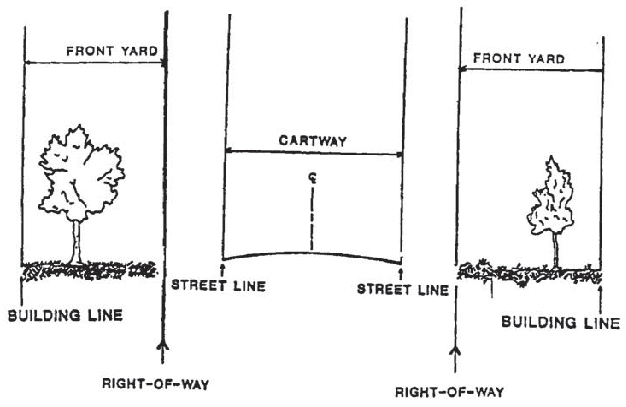
Yard and/or setback means the open area within a lot that extends from a lot line to any principal building on the lot. A minimum yard required in the chapter is defined as being unoccupied except for vegetation and/or permitted accessory structures and uses. (Also see SLDO Building Setback, Yard, and Lot Line Illustration.)
Yard and/or setback, area or size means a yard as measured as the shortest distance between the principal building on the lot and lot line.
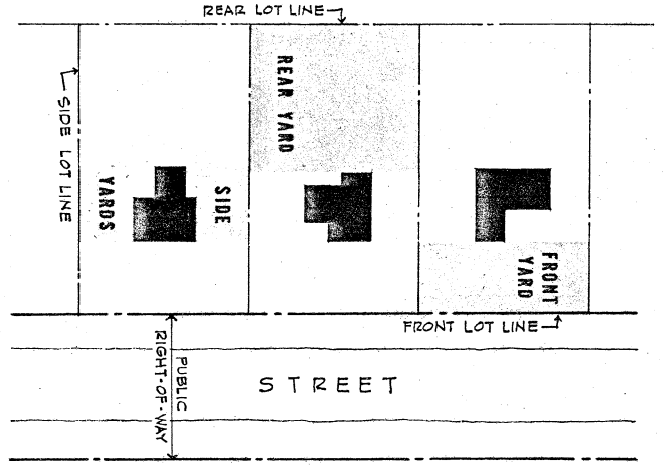
Yard and/or setback, front means a yard extending the full width of the front lot line and extending in depth from such lot line to the nearest portion of any principal building on the lot. (See lot, corner)
Yard and/or setback, rear means a yard extending the full width of the lot along the rear lot line and extending in depth from the rear lot line to the nearest portion of any principal building on the lot.
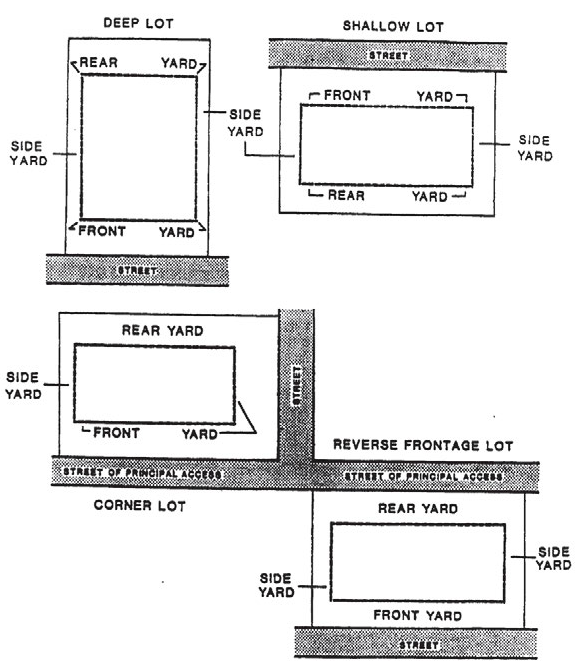
Yard and/or setback, side means a yard extending the full depth of the lot along a side lot line and extending in width from such side lot line to the nearest portion of any principal building on the lot.
Zoning map means the Zoning Map of Kennett Township, Chester County, Pennsylvania, as adopted and amended.
Zoning officer means an agent of the Board of Supervisors charged with the administration and enforcement of the Township Zoning Ordinance. (See also "Code Enforcement Officer.")
Zoning Ordinance means the Zoning Ordinance of Kennett Township, Chester County, Pennsylvania, as adopted and amended.
(Ord. No. 300, § I, 2-1-2023; Ord. No. 303, §§ I—V, 10-18-2023; Ord. No. 310, § 1, 4-16-2025)

