


Kennett Township City Zoning Code
ARTICLE XX
GENERAL STANDARDS
Sec. 240-2000.- Applicability.
A.
The provisions of this article represent regulations and standards that are common to all zoning districts. Unless exempted by other applicable provisions or specified limitations, the following standards shall apply to all by-right uses and all uses permitted by special exception or conditional use.
B.
Standards regulated in this article include the following:
Section 2001. Lot, Yard, and Height Standards
Section 2002. Residential Off-Street Parking Standards
Section 2003. Nonresidential Off-Street Parking Standards
Section 2004. Off-Street Surface Parking Lots and Parking Garages
Section 2005. Other Off-Street Parking Standards
Section 2006. Shared or Off-Lot Parking Standards
Section 2007. On-Street Parking Standards
Section 2008. Parking Areas to be Held in Reserve for Future Use
Section 2009. Loading and Unloading Standards
Section 2010. Landscaping Standards
Section 2011. Screening Standards
Section 2012. Outdoor Storage and Display
Section 2013. Outdoor Lighting Standards
Section 2014. Physical Performance Standards
Section 2015. Interior Circulation and Emergency Access
Section 2016. Vehicular Access and Traffic Control
Section 2017. Design of Formal Open Space, Green Space and Common Facilities
Section 2018. Fences, Walls, Hedges, and Vegetation
Section 2019. Stripping and Removal of Topsoil; Excavation of Clay, Sand, Gravel, or Rock
Section 2020. Keeping of Animals
Section 2021. Sewage Facilities, Water Supply, and Stormwater Management and Erosion Control
Section 2022. Utilities and Non-tower Communication Facilities
(Ord. No. 300, § I, 2-1-2023)
Sec. 240-2001. - Lot, yard, and height requirements.
A.
Reduction of lot area. No lot shall be reduced through subdivision so that the area of the lot or the dimensions of the required yards and open space shall be less than required herein.
B.
Yard and/or setback areas. No yard or other space provided on a lot for the purpose of complying with this Chapter shall be considered as a yard or other space for another lot, building, use, or structure.
C.
Front yard setback exceptions for infill lots.
1.
Where an unimproved lot of record is situated between two improved lots, the front yard setback requirements for the district may be modified to the average of the two adjacent improved lot's front yard setbacks.
2.
Where an unimproved lot of record is adjacent to one improved lot, the front yard setback requirements for the district may be modified to the average of the adjacent improved lot front yard setback and the required front yard setback for the district.
D.
Exception for more than one principal structure. In any district, more than one structure housing a permitted principal use may be erected on a single lot, provided that the applicable area and bulk requirements of the district are met for each structure as though situated on separate lots.
E.
Projections from principal structures into required yard setbacks.
1.
Any attachments to the principal building, garages, or immediately adjacent structures whether or not they are physically attached to the principal building, and decks over 30 inches from grade, must comply with minimum yard setback distances for the principal building, unless otherwise specified in this chapter.
2.
Principal building's required yard setback areas shall not contain structures except for unroofed accessory ground-level structures (e.g., patios, terraces, walkways, driveways, pergolas, landscaping trellises), fences, utility or garden sheds, and decks no more than 30 inches from grade.
F.
Corner and reverse frontage lots.
1.
Corner lots. A front yard setback as provided for in the various districts shall be required on each street on which a corner lot abuts. The minimum front yard setback shall be met along the street for which the United States Postal district mailing address is assigned. For the other abutting street, the front yard setback shall be the average of the required front yard and side yard for the district where the lot is located.
2.
Reverse frontage lots. For reverse (double) frontage lots, the minimum front yard setback shall be met along the street for which the United States Postal district mailing address is assigned. For the other abutting street, the front yard setback shall be the average of the required front yard and rear yard for the district where the lot is located.
G.
Height limitation exceptions. No building or structure shall exceed the height limitations of this chapter, except for church spires, belfries, cupolas, monuments, silos, observation towers, electric transmission towers, water towers, chimneys, smokestacks, windmills, solar panels, and other similar structures not devoted to human occupancy, provided the minimum setback for each structure from any lot line is a distance equal to or greater than the proposed height, unless otherwise provided for in this chapter. Exceptions to the height limitations that are not freestanding should be designed as part of the principal structure to the extent possible.
H.
Flag lot standards.
1.
Flag lots shall only be permitted for single-family detached dwellings in residential districts and for tracts with limited street frontage but with sufficient area for additional lots by subdivision. Flag lots shall not be permitted in a subdivision where a street could reasonably be developed to serve the lots with each meeting minimum lot width and street access requirements.
2.
Each flag lot shall contain its own access strip owned in fee as part of the lot and not by way of a grant or right-of-way, easement, license' or similar grant. Each access strip shall have a minimum width of 50 feet measured from the existing street line for the full length of the access strip to the point where the lot first obtains the minimum standard lot width. A driveway constructed in the access strip connecting the main portion of a flag lot with a street shall be provided with drainage facilities, which shall be approved by the Township Engineer. Driveways within the access strips shall meet driveway standards of the Subdivision and Land Development Ordinance.
3.
Flag lots shall contain a lot area at least equal to the minimum required lot area of the district in which the lot is located. The area of the access strip shall not be included in the calculations of the required minimum lot area.
4.
The front yard for a flag lot shall be measured from the point where the lot first obtains the minimum required lot width for the district in which the lot is located.
5.
Only one tier of flag lots shall be permitted on the tract being subdivided. A tier shall be considered any flag lot(s) located behind lots that meet the minimum lot width requirement at the street line.
6.
No more than two contiguous flag lot access strips shall be formed.
7.
For any subdivision of 20 lots or fewer, there shall be a maximum of four flag lots. In subdivisions with more than 20 lots, a maximum of 20 percent of the total lots may consist of flag lots.
8.
A flag lot shall not be further subdivided without the provision of direct street access.
I.
Interior lot standards.
1.
Interior lots shall only be permitted for single-family detached dwellings in residential districts.
2.
There shall be no more than three interior lots sharing a common private driveway. If more than three existing or proposed lots use a common driveway, a public or private street shall be created that meets all of the requirements for such a street in the Subdivision and Land Development Ordinance.
3.
Interior lots shall contain a lot area at least equal to the minimum required lot area of the district in which the lot is located. The area of the common driveway shall not be included in the calculations of the required minimum lot area of the interior lots.
4.
The front lot line of an interior lot shall be considered that lot line where the driveway or access point enters the property. The front lot line shall be the line from which the building line and required front yard is established.
5.
The common driveway constructed for use by the interior lots shall be provided with full and adequate drainage facilities, which shall be approved by the Township Engineer. Common driveways shall meet driveway standards of the Subdivision and Land Development Ordinance.
6.
Cross-easements and maintenance agreements for use and maintenance of the common driveway shall be submitted to the Township for review and approval. Such cross-easements and maintenance agreements shall be recorded with the approved final subdivision plan and each interior lot deed.
J.
Lot ownership for development. The tract of land and its development shall be held in single and separate ownership, or in the case of multiple ownership, the tract shall be developed according to a single plan with common authority and common responsibility as documented in a manner acceptable to the Township. Tract standards as applicable, including those for area and bulk, shall apply except for lots that make up or are contained within said tract lot standards may apply.
(Ord. No. 300, § I, 2-1-2023)
Sec. 240-2002. - Residential off-street parking spaces.
Except as otherwise provided in this chapter, the following shall apply to all residential uses:
A.
A minimum of two and one-half parking spaces shall be provided on-site for each single-family detached dwelling unit, two-family dwelling unit, and multifamily dwelling unit other than apartment units. Apartment units shall provide a minimum of one and three-quarters parking spaces on-site for each apartment unit. Accessory dwelling units shall have a minimum of one parking space per unit.
B.
For a planned residential development or multifamily development, there shall be one additional off-street parking space provided for every two dwelling units, to be designated as "guest parking." Guest parking shall be located in small groups convenient to each group of dwelling units.
C.
Dwelling units may utilize private garages, parking garages, parking lots, driveways, and parking pads for the calculation of required parking spaces, provided that sufficient spaces are available in such to meet the requirements of this article.
D.
Parking spaces for dwelling units shall not block, and where possible shall be separated and set back a minimum of ten feet from, the sidewalk or public street line, including parking in front of the dwelling unit and in any other location.
E.
Parking spaces shall have an all-weather surface and shall have a safe and convenient street access in all seasons.
F.
A residential parking garage or parking lot shall meet dimensional standards as applicable in § 240-2003.B.
G.
For residential developments of five dwelling units or greater, there shall be electric vehicle charging stations at a rate of one charging station per every five dwelling units.
(Ord. No. 300, § I, 2-1-2023)
Sec. 240-2003. - Nonresidential off-street parking spaces.
Except as otherwise provided in this chapter, the following standards shall apply to all nonresidential uses:
A.
Off-street parking spaces shall be provided on the same lot for which they are intended, shall have a safe and convenient street access in all seasons, and consist of an all-weather surface per § 240-2004.
B.
Each parking space shall be a minimum of nine and one-half feet in width by 17 and one-half feet in length. Dimensional requirements for parking space stalls and parking lot and garage aisles shall be as shown in the diagrams below. (Parking layout in diagrams are for illustrative purposes only.)
Parking Lot Measurements: 45 and 60 Degree Parking Space Requirements with One- and
Two-Way Aisles displayed in Example Parking Lot Design (not to scale)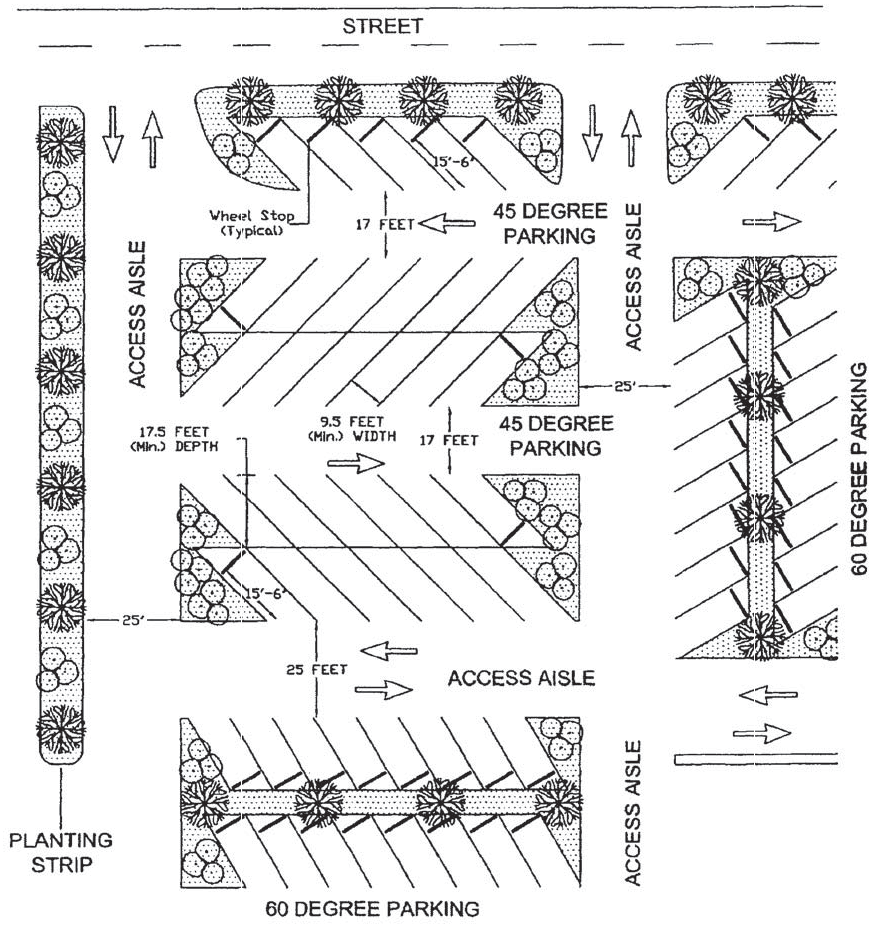
Parking Lot Measurements: 90 Degree Parking Space Requirements with Two-Way Aisles
displayed in Example Parking Lot Design (not to scale)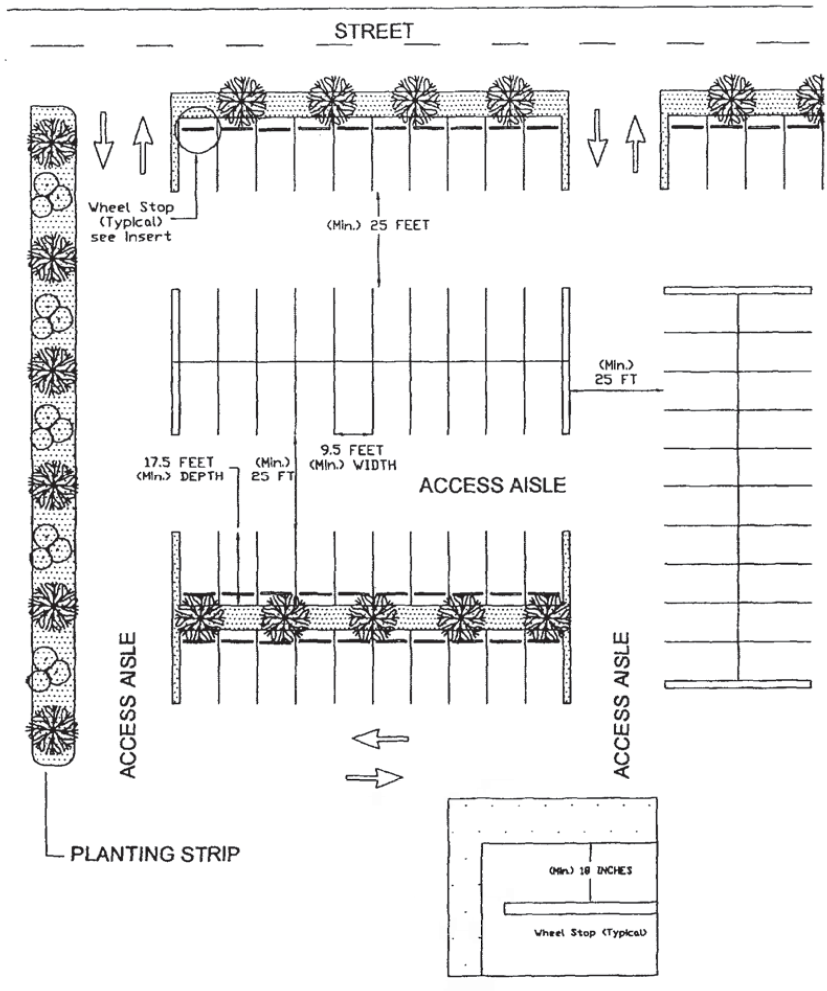
C.
Parking spaces shall be provided as required for the use to be served, and shall have proper and safe public street access.
D.
There shall be sufficient spaces provided for each use so that there is a minimum of one parking space per one and one-half employees, based upon maximum projected employees at any one time. In addition, minimum parking spaces shall be provided as follows, except when in conflict with Institute of Transportation Engineers (ITE) Trip Generation Manual (recent edition) or another standard so deemed by the Township Zoning Officer, in which case ITE or other Township deemed standard shall apply.
E.
For uses not specifically listed in the table above, the Board of Supervisors will determine the minimum parking requirement based on the most similar listed use or other deemed acceptable standard as specified in Subsection B.
F.
Documentation of required minimum parking space calculations shall be provided by the applicant to the Township for review. If a range of parking spaces is identified, the Zoning Officer shall make the determination for the required number of spaces.
G.
A development, lot, building, or group of buildings containing two or more uses, normally operating during the same hours, shall provide parking spaces for not less than the sum of the spaces required for each individual use, except as otherwise provided in this Chapter including § 240-2006. If an accessory use is open to the public, the off-street parking requirement for the accessory use shall be in addition to that of the principal use.
H.
There shall be a minimum of two electric charging stations.
(Ord. No. 300, § I, 2-1-2023)
Sec. 240-2004. - Off-street surface parking lots and parking garages in excess of ten spaces.
A.
Parking lots and garages shall be divided and defined by curbs and planting strips per applicable provisions of the Subdivision and Land Development Ordinance, except insofar as it such conflicts with provisions herein, so that access lanes are clearly defined and moving traffic is confined to designated access lanes. Vehicular circulation shall be arranged so that pedestrians moving between buildings and parking lots and garages are not unnecessarily exposed to vehicular traffic.
B.
An area equivalent to at least 15 percent of the paved area within a parking lot shall be landscaped with trees and shrubs. Plantings within a 20-foot distance of the perimeter of a parking lot may be considered as part of the required landscaping; however, in no case shall plantings and landscaping obstruct the vision of motorists. Planted islands shall be wide enough to accommodate the type of plantings provided, and shall include shade trees at least two and one-half inches in caliper and eight feet in height and shrubs at least 18 inches spread at the time of planting.
C.
Parking lots or garages that abut a residential lot or district shall be screened from such lot or district by a buffer planting strip per § 240-2011.
D.
Aisles within parking lots or garages, separating rows of parking spaces, shall be a minimum of 25 feet in width for two-way traffic, and 15 to 17 feet in width for one-way traffic and clearly defined by means of painted lines, curbing, planting islands, and/or landscaping.
E.
Parking lots or garages with 50 or more spaces may have two separate entrances and shall meet § 240-2016.
F.
All paved parking spaces shall be line-striped so as to provide for orderly and safe parking. All parking spaces shall be marked by durable painted lines at least four inches wide and extending the length of the space or by curbs or other means to indicate individual spaces. Signs or markers located on the surface within a parking lot shall be used as necessary to ensure efficient and safe traffic operation of a lot.
G.
Maintenance of parking areas including driveways. Any area not landscaped and so maintained shall be graded, surfaced with all-weather surfaces, and drained to Township standards. All parking areas, including their signage and line striping, shall be maintained and replaced as may be necessary from time to time to provide for safe and convenient use, as determined by the Township Engineer.
(Ord. No. 300, § I, 2-1-2023)
Sec. 240-2005. - Other off-street parking regulations.
The following additional regulations shall apply to any off-street parking:
A.
Parking areas shall be provided with adequate stormwater drainage facilities to prevent damage or inconvenience to abutting property and/or public streets and alleys. Surfaces within parking areas should be graded to direct run-off to drainage ways or catchment areas within the site. Parking areas are encouraged to use pervious paving materials and provide for drainage to infiltration beds in order to maximize potential for groundwater infiltration.
B.
Changes in use. Whenever a structure is altered or a use is changed or extended that increases parking requirements under this chapter, the total additional parking required shall meet terms of this article.
C.
Conflict with other uses. No parking area shall be used for any use that interferes with its availability for the parking need it is required to serve.
D.
All required parking facilities shall be provided and maintained so long as the use exists that the parking facilities were designed to serve. Off-street parking facilities shall not be reduced in total extent except when such reduction is in conformity with this article.
E.
Fractional spaces. Where the computation of required parking spaces results in a fractional number, the fraction of one-half or more shall be counted as one.
F.
Handicapped parking.
1.
In any parking area with ten or more spaces, handicapped parking space shall be designed and maintained in accordance with current Americans with Disabilities Act (ADA) requirements.
2.
Handicapped parking spaces shall be located to minimize the distance between the vehicles and a wheelchair-accessible entrance to the use served.
3.
Handicapped parking shall be identified with clearly a visible marking displaying the international symbol of access and be in accordance with the ADA, design requirements of the Subdivision and Land Development Ordinance, and applicable State regulations.
G.
Required parking spaces shall not be used for permanent or temporary storage of work trucks, trailers, buses, or other such equipment.
(Ord. No. 300, § I, 2-1-2023)
Sec. 240-2006. - Shared and/or off-lot parking.
These provisions apply for multiple-family dwellings and nonresidential uses subject to all of the following:
A.
The Township may permit the alternating or shared use of parking facilities in cases where uses cooperatively establish and operate such parking facilities and where such uses generate parking demands at differing times of day. In this case, the use that has the maximum number of required parking spaces shall determine the number of spaces needed; however, the burden of proof for this reduction in the total number of required parking space shall be on the applicant and documentation shall be submitted to the Township to prove such;
B.
Owners of two or more establishments shall submit a site plan showing joint use and location of a shared off-street parking area, along with a signed agreement of joint use including hours of operation and maintenance responsibilities;
C.
Some portion of the shared off-street parking area shall lie within 400 feet of an entrance, regularly used by patrons or residents, into the building served thereby for at least one of the uses in question.
(Ord. No. 300, § I, 2-1-2023)
Sec. 240-2007. - On-street parking regulations.
A.
On-street parking may be provided along streets in the RMHD, VH, VM, C, LI, and PRD Districts only when approved as part of the land development approval process.
B.
On-street parking may be counted toward required parking in § 240-2002 and § 240-2003.
C.
On-street parking areas may only be counted along the frontage owned by the applicant or landowner, exclusive of any driveway or other curb cut, and exclusive of any existing cartway and perpendicular street. However, in TND development, on-street parking within 250 feet of the building to which such parking relates may be allowed.
D.
A bona fide on-street parking area shall measure eight feet in width and 22 feet in length, exclusive of any street cartway, and shall be parallel to the curbline or other edge of pavement.
E.
All eligible on-street parking areas shall be clearly depicted on a plan. Such parking areas shall not conflict with any turning movements off the cartway or obstruct access to any street, driveway, sidewalk, crosswalk, other accessway, or fire hydrant.
(Ord. No. 300, § I, 2-1-2023)
Sec. 240-2008. - Parking for overflow or held in reserve for future use.
In order to reduce total impervious cover, the Township may allow areas for peak parking needs (overflow parking) and also a delay in paving of some parking areas until actual need has been demonstrated (reserve parking).
A portion of required parking may be constructed as overflow as well a portion may be held in reserve for future use. From the total number of required parking spaces, up to 20 percent may be constructed using pervious surface for the purpose as overflow parking use. Further, another 20 percent of required spaces may be set aside in reserve for future parking use.
All grading and drain construction shall be completed for all required parking spaces so as to reduce future construction costs and site disruptions if full required parking is later needed. Overflow parking areas shall be surfaced in pervious materials and reserve parking areas be seeded in grass for stabilization. Once actual need has been demonstrated for reserved parking areas, they shall be installed in accordance with this Chapter upon Township review and approval.
Overflow and reserve parking shall meet the following and applicable Subdivision and Land Development Ordinance requirements:
A.
The location of the area set aside for overflow and reserved parking shall be clearly indicated on the zoning application documentation. The reserved parking area shall be restricted from other building use and noted for possible future use.
B.
Parking shall not include areas for setbacks, green space, open space, or areas that would otherwise be unsuitable for parking spaces due to the physical characteristics of the land or other requirements of this chapter.
C.
Any landscaping shall be placed on the perimeter of the parking area. The applicant shall provide an applicable landscaping plan that demonstrates such.
D.
The applicant shall demonstrate through the use of empirical data from other built projects that placing parking spaces in reserve at the time of zoning application can meet current parking needs.
E.
For reserved parking, the applicant shall enter into a written agreement with the Board of Supervisors that if after two years following the issuance of the last occupancy permit for the related use, should it be determined that the full parking space requirement or portion thereof is necessary to satisfy the need of the use(s), the parking spaces reserved for future use shall be provided at the landowner's expense.
The Township shall hold in escrow the monetary value of the reserve parking spaces not built for a period of two years following the issuance of the last occupancy permit, and the land development plan shall include calculations on the potential impervious surface area addition. If after two years the use is adequately serviced by the parking provided, escrow funds shall be released. If the provided parking is not adequate, then the escrow funds shall be used to construct the needed parking.
(Ord. No. 300, § I, 2-1-2023)
Sec. 240-2009. - Loading and unloading standards.
The following standards shall apply to any use, building, or structure that requires delivery and/or distribution of materials by truck or similar vehicle and to the expansion or alteration of such existing uses, buildings, or structures:
A.
General provisions.
1.
General location. Loading and unloading areas for all uses shall be entirely located on the same lot as the use to be served, and no portion of the vehicle shall occupy any street right-of-way or traffic lane. Loading and unloading spaces and access lanes shall be designed to prevent delivery vehicles from extending onto a public street. Also refer to Subsection E. for location and setback standards.
2.
Access. Loading and unloading areas shall be designed so as not to interfere with vehicular and pedestrian circulation or occupy parking spaces, traffic lanes within parking areas, or driveways, or any pedestrian facilities. Required off-street parking spaces shall not be used for loading and unloading related purposes except during hours when non-operating business hours.
3.
Calculation. Required loading and unloading spaces shall not be used in the calculation of off-street parking space requirements. Required off-street parking spaces shall not be substituted for loading and unloading spaces.
4.
Use. No storage of any kind, other than parking of trucks or similar vehicles, nor any motor vehicle repair work of any kind, except emergency work, shall be permitted within any required loading and unloading area.
B.
Number of spaces. Required off-street spaces shall be provided on any lot as specified below where delivery of materials by trucks or similar vehicles will be required:
1.
Commercial and industrial uses.
2.
Office, professional, and institutional uses.
3.
All other uses with a total of 5,000 square feet or more of aggregate gross floor area shall provide loading spaces adequate to accommodate normal demands of loading and unloading incidental to that type of use, to the satisfaction of the Zoning Officer.
4.
The number of loading or unloading spaces may be less than the number of spaces required above in the event that both of the following two conditions are met:
a.
Evidence shall be submitted documenting that the use of the building requires fewer loading spaces than required by Subsection B.1., 2., or 3.
b.
The site development plan shall indicate where such loading or unloading spaces could be located if, at a future date, they are determined to be needed. Such area shall be designated as "proposed future loading or unloading area" on the plan, and no permanent structures shall be permitted within this area.
C.
Size of spaces.
1.
Large loading and unloading spaces:
a.
Required spaces a minimum of 14 feet in width by 50 feet in length, exclusive of aisle and maneuvering space, shall be required for uses where deliveries are made by large trucks (two tons or greater) or tractor-trailers. Such spaces shall have a minimum vertical clearance of 16 feet.
b.
Such spaces shall be required for factories, warehouses, distribution centers, shopping centers, supermarkets, retail stores offering large goods (i.e., furniture, major appliances), retail stores above 15,000 gross square feet, automobile and farm equipment dealers, office or institutional uses above 40,000 gross square feet, and other similar uses.
2.
Small loading and unloading spaces:
a.
Required spaces a minimum of 12 feet in width by 30 feet in length, exclusive of aisle and maneuvering space, shall be required for uses where no deliveries will be made by large trucks (two tons or greater) or tractor-trailers. Such space shall have a minimum vertical clearance of 14 feet.
b.
Such space shall be permitted for uses not specified in Subsection C.1.b. unless such uses require delivery by large trucks or tractor trailers.
D.
Surfacing of spaces. Loading and unloading spaces shall have a dust-free surface over the entire area customarily used by delivery vehicles for parking and maneuvering. The surface may be concrete, asphalt, nonpolluting oil-sealed gravel, compacted gravel, or other all-weather, dust-free surfacing material that meets the approval of the Township Engineer.
E.
Location and setbacks.
1.
Loading and unloading areas shall be located to the rear or side of the use, building, or structure.
2.
Loading and unloading areas shall be set back a minimum of 50 feet from a street right-of-way or any lot line abutting a residential use or district or the required minimum setback for the district, whichever is greater. Loading and unloading areas shall be set back at least 25 feet from any other lot line or the minimum required setback for the district, whichever is greater.
3.
Loading and unloading areas shall be screened per § 240-2011.
(Ord. No. 300, § I, 2-1-2023)
Sec. 240-2010. - Landscaping standards.
Any portion of a lot or tract that is not used for buildings or structures, loading or parking spaces and aisles, or other paved surface shall be protected by landscaping or other means to prevent soil erosion and subsequent sedimentation from occurring downstream and to provide shade and conversation features; and shall be enhanced by landscaping meeting applicable provisions of the Subdivision and Land Development Ordinance.
It is encouraged that any lands not used to provide for permitted impervious cover shall be left in their natural state or landscaped with appropriate vegetation or other suitable landscape material. Streetscape landscaping and pedestrian amenities are encouraged to meet overall zoning district purposes and as reasonably related to the intensity of proposed development. Landscape and streetscape design are also encouraged to be coordinated with adjacent properties. The following amenities may be recommended including provision for their regular upkeep and maintenance: public trash receptacles; public benches of compatible design alongside walkways and at appropriate intervals and locations within green spaces; bike racks located in areas where walkways have been designed to accommodate such features; shade trees; and walkways.
(Ord. No. 300, § I, 2-1-2023)
Sec. 240-2011. - Screening standards.
The following standards shall apply where vegetative screens and buffers are required by this chapter as part of use proposal or where a proposed use is adjacent to a use or district:
A.
Vegetative screening shall include a variety of deciduous and evergreen species that are designed to provide a continuous, year-round visual screen between the activity to be screened and abutting properties. A vegetative screen shall include a minimum of 65 percent evergreen species and ten percent flowering and/or deciduous species. The screen may incorporate existing hedgerows to achieve this design control and may incorporate earthen berms and fencing or walls. Penn State Extension planting list shall be referenced and a minimum of 70 percent of plantings shall be native species.
B.
No plantings shall be placed with their center closer to any lot line than their known radius at full growth.
C.
Number, density, and types of plantings shall be based upon physiographic features, existing plant species, proximity of adjacent land uses, and the level of incompatibility between proposed and existing uses. Trees to be planted shall have a minimum caliper of two and one-half inches and a minimum height of eight feet at the time of planting. Shrubs to be planted shall have a minimum spread of 18 inches at the time of planting.
D.
Plantings shall be permanently maintained, which shall be the landowner's responsibility.
E.
In addition to screening, a buffer may be required by the Board of Supervisors where light and/or noise pollution will be generated by the proposed use.
F.
Proposed buildings shall be set back 75 feet from agriculture lot lines, which may be reduced where effective visual screening per this section is demonstrated by the applicant.
(Ord. No. 300, § I, 2-1-2023)
Sec. 240-2012. - Outdoor storage and display.
The following standards shall apply to the storage of man-made materials and other materials:
A.
General requirements applicable to all outdoor storage:
1.
Except where otherwise permitted in Subsection C., outdoor storage for periods in excess of 30 days shall be screened from view per § 240-2011.
2.
Any organic refuse and garbage shall be stored in tight, vermin proof containers. In multi-family dwelling, mobile home parks, assisted living, nursing home, institutional commercial, and industrial uses and developments, garbage storage shall be centralized to expedite collection. Storage containers shall be enclosed on three sides by an architectural screen.
3.
Flammable and combustible liquids, solids or gases shall be stored in accordance with the Township Fire Code and applicable state, county or federal laws.
4.
Materials or wastes that can contaminate a waterbody or otherwise render such waterbody undesirable or unusable as a source of water supply, recreation, or aquatic habitat shall not be stored in such form or manner that they may be transported to the waterbody, whether on or off the lot by natural causes or forces. All material shall be stored in such a manner as to prevent emission onto other areas, whether through the air (e.g., dust), on the surface (e.g., water runoff) or into the subsurface (e.g., liquid seepage infiltration).
B.
Residential outdoor storage. In addition to the standards in § 240-2012.A, the following standards shall apply to residential uses:
1.
Except where otherwise permitted by this chapter, no more than one vehicle without registration or proof of inspection may be stored outdoors per lot without screening for more than six months.
2.
Major recreational equipment in residential districts or lots.
a.
Major recreational equipment shall not be parked or stored on any residential lot or district, including the RA, RR, RS, RMHD, PRD, and VH Districts, except in a carport or enclosed building or in the rear yard to the rear of the rearmost wall of the principal dwelling, and if parked outdoors needs to meet screening in § 240-2011.
b.
No such equipment shall be used for dwelling purposes except for a limited time period in the case of an emergency situation or in designated permitted campground uses, as determined by the Zoning Officer.
3.
Parking of commercial vehicles.
a.
The outdoor parking of commercial vehicles shall be limited to one vehicle, not to exceed 11,000 pounds gross vehicle weight rating.
b.
One additional commercial vehicle shall be permitted if parked within an enclosed structure or a parking space screened from view at the street line and lot lines through fencing or vegetative screening per Article XX.
c.
Such vehicles must be operable with current vehicle inspection, registration, and insurance, and shall not be parked for use as portable or vehicular sign for business or commercial advertising.
d.
All engines, secondary motors, and like processes shall be turned off or shut down immediately after parking.
C.
Industrial and commercial outdoor storage. In addition to the standards in § 240-2012.A, the following standards shall apply to industrial and commercial uses:
1.
Except as permitted in Subsections C.3. and 4., outdoor storage of raw materials and/or finished products associated with commercial or industrial uses shall be permitted only within the buildable area of the lot behind the front building line of the principal buildings and shall not exceed eight feet in height.
2.
Any establishment that furnishes shopping carts as an adjunct to shopping shall provide defined areas within the building and parking area for storage of said carts. In no case shall any such cart be allowed to be removed more than 300 feet from said establishments. Each designated storage area shall be enclosed by a barrier at least six inches higher than the parking area surface and shall be clearly marked for storage of shopping carts. All shopping carts shall be stored indoors or otherwise secured during the establishment's non-operating hours.
3.
Outdoor storage and display for retail uses. Merchandise for sale in permitted retail uses may display merchandise outdoor of such retail use, provided:
a.
Merchandise shall not be placed so as to interfere with pedestrian or vehicular circulation. Merchandise shall not be placed within required parking spaces, unless a temporary use permit for a flea market, sidewalk or yard sale, auction, or other similar use is obtained.
b.
Merchandise shall not be placed within six feet of the right-of-way and, where applicable, a minimum four-foot-wide unobstructed sidewalk path shall be maintained at all points.
c.
Outdoor display of merchandise shall not interfere with the sight lines of traffic and shall not impair the visibility of any sign.
d.
Merchandise shall not be displayed outdoors in a manner that is likely to result in the merchandise falling into the street or sidewalk, blowing, spilling, or otherwise becoming a hazard or nuisance.
e.
Merchandise displayed outdoors shall be removed and placed indoors at the close of business each day. Longer-term outdoor display for a permitted use that traditionally has such need shall meet Subsection C.4.
f.
Merchandise that is displayed outdoors in violation of this chapter or that otherwise constitutes a hazard to the public may be removed by the Township at cost to the owner or lessee of the business.
4.
Large-scale outdoor storage or display for commercial and industrial uses. For those commercial or industrial uses requiring substantial amounts of land area for outdoor storage or display, the following conditions shall be met:
a.
The industrial or commercial use involved traditionally employs long-term outdoor storage, including uses such as automobile and vehicular sales, lumberyard and building supply, nursery/greenhouse, and junkyard.
b.
Such storage is needed for normal operation of the use and the lot and proposed site is suitable for outdoor storage. The applicant can demonstrate that indoor storage is not practical, nor sufficient.
c.
The storage complies with applicable setback and lot coverage requirements and shall cover only that percentage of the lot area necessary. Wherever feasible, storage shall generally occur within a building and any needed outdoor storage shall be located on the side and rear of the property.
d.
The applicable screening and buffering of § 240-2011 and landscaping requirements in the Subdivision and Land Development Ordinance shall be met.
(Ord. No. 300, § I, 2-1-2023)
Sec. 240-2013. - Outdoor lighting requirements.
A.
Applicability.
1.
Standards and requirements herein contained apply to outdoor lighting of commercial, industrial, recreational, and institutional uses, as well as sign, architectural, landscaping, and residential outdoor lighting. Such lighting shall protect from glare, nuisance, and stray light from poorly aimed, placed, applied, maintained, or shielded light sources.
2.
In addition, outdoor lighting shall be required for safety and personal security in areas of public assembly and traverse. The Board of Supervisors may require lighting to be incorporated for other uses or locations, as it deems necessary, to further public health, safety, and welfare.
3.
In addition to new lighting installations, requirements shall apply to existing lighting fixtures or installations: that are to be replaced, modified, or relocated; that have been abandoned; or when there is a change or expansion of use, except as otherwise provided in § 240-2013.J.
4.
Proposed lighting regulated by this chapter shall be reviewed and approved per the standards of this Section, prior to its installation.
B.
Criteria.
1.
Illumination levels. Lighting, where required by this chapter, shall have intensities and uniformity ratios in accordance with the recommended practices of the Illuminating Engineering Society of North America (IESNA) Lighting Handbook, most current edition, of which sample intensities of typical outdoor lighting applications are included below.
2.
Lighting fixture design. The following factors shall be considered when choosing the appropriate lighting fixture design:
a.
Fixtures shall be of a type and design appropriate to the lighting application and character of the area. However, fixtures should be dark-sky design, casting light downward (IESNA Cutoff and Semi-cutoff), arranged to minimize glare, and shield lamp sources (e.g., through glare shields) from direct view to eliminate excessive light levels, reduce light pollution, and increase visibility for pedestrians and cars.
b.
For lighting horizontal tasks such as roadways, pathways, sidewalks, and parking areas, fixtures shall meet IESNA "full-cutoff" criteria.
c.
The use of floodlighting, spotlighting, wall-mounted fixtures, decorative globes, and other fixtures not meeting IESNA "full-cutoff" criteria shall be permitted only with the approval of the Board of Supervisors, based upon acceptable glare control and their consistency with the character of the surrounding area.
d.
Fixtures shall be equipped with or be capable of being modified to incorporate light-directing, shielding devices, or both, such as shields, visors, or hoods, when necessary to redirect offending light distribution or reduce direct or reflected glare.
e.
For residential applications, omnidirectional fixtures (e.g., post top, wall bracket, wallpack, globe, and sphere) shall meet IESNA "full-cutoff" criteria.
f.
NEMA-head fixtures (also known as, "barn lights" or "dusk-to-dawn lights") shall not be permitted where they are visible from other uses, unless fitted with a reflector to render them "full-cutoff."
g.
Number of fixtures should be only the number necessary for effective lighting and to avoid lighting clutter.
h.
Projecting light fixtures should be unobtrusive and not obscure features such as sign graphics or building architectural elements.
3.
Control of glare. The following shall apply to outdoor lighting, except public street lights and traffic devices/signals in a public right-of-way provided by a public utility or government entity.
a.
All outdoor lighting, whether or not required by this chapter, on any property, shall be aimed, located, designed, fitted, and maintained so as not to present a hazard to drivers or pedestrians by impairing their ability to safely navigate (e.g., disabling glare) and so as not to create a nuisance by projecting or reflecting objectionable light onto a nearby use or property or directly skyward, (e.g., nuisance glare).
b.
Floodlights and spotlights shall be so installed and aimed so that they do not project their output into the windows of neighboring residences, adjacent uses, directly skyward, or onto a roadway.
c.
Unless otherwise permitted by the Township (e.g., for safety, security or all-night operations), lighting shall be controlled by automatic switching devices, such as time clocks or combination motion detectors and photocells between 11:00 p.m. and dawn to mitigate nuisance glare, unnecessary lighting and energy use, and night sky-lighting.
d.
All nonessential lighting, including display, aesthetic, parking, and sign lighting, shall be required to be turned off or reduced by 75 percent after business hours or 11:00 p.m., whichever is earlier, leaving only the necessary lighting for site security. Lighting proposed to remain on after 11:00 p.m. for a specific safety purpose shall be approved by the Township.
e.
Where all-night safety or security lighting is to be provided, illumination levels shall not exceed 25 percent of the level normally allowed by this chapter for the associated use.
f.
Screening shall not be employed to serve as the primary means for controlling glare; rather, glare control shall be achieved primarily through the use of such means as cutoff fixtures, shields and baffles, and appropriate application of fixture mounting height, wattage, aiming angle, and fixture placement.
g.
The intensity of illumination projected onto a residential use from another property shall not exceed a 0.1 vertical foot-candle beyond the lot where the lighting originates, measured at 30 inches above grade at the lot line.
h.
Directional fixtures used for architectural lighting (e.g., facade, fountain, feature, and landscape lighting), shall be aimed so as not to project light beyond the objects intended to be illuminated and shall be extinguished between the hours of 11:00 p.m. and dawn.
i.
Light output for flagpole lighting shall not cumulatively exceed 10,000 footcandles.
j.
Service station canopy lighting shall be accomplished using flat-lens "full-cutoff" down lighting fixtures, shielded in such a manner that the edge of the fixture shield shall be level with or below the light source envelope.
k.
Externally illuminated signs and billboards shall be lighted by fixtures mounted at the top of the sign and aimed downward. Such fixtures shall be automatically extinguished between the hours of 11:00 p.m. and dawn, except as specifically approved by the Township to illuminate necessary directional information.
l.
The use of white strobe lighting for tall structures such as smokestacks, chimneys and communications towers is prohibited, except as otherwise required under Federal Aviation Administration regulations.
m.
Unshielded lamps, bulbs, and tubes shall not be permitted, except for temporary holiday lighting and residential house-mounted lamps and driveway lampposts using 60-watt or less bulbs (not including spotlights or floodlights).
4.
Installation.
a.
For new installations, electrical feeds for lighting shall be run underground.
b.
Except as otherwise permitted herein, the following height requirements shall apply to proposed lighting fixtures:
1)
Fixtures must meet IESNA "full-cutoff" criteria and shall be mounted no higher than 16 feet above grade, unless otherwise permitted in this Chapter or there is an identified safety concern. On-site lighting such as in between buildings and along walkways, driveways and like thoroughfares, parking lots, and pedestrian vehicle loading areas should be pedestrian-scale lampposts and spaced as needed for adequate illumination levels and context.
2)
Artificial elevation of the grade at the base of the fixture shall be prohibited.
3)
Security or floodlighting may exceed these requirements when attached to a building provided that such lighting shall be arranged and installed to deflect and focus lights away from adjacent properties.
c.
Fixture and lighting post or pole installation shall meet applicable Building Code requirements. Lighting and accessory equipment shall meet industry standards as approved by the Township.
d.
Except for traffic devices and signals, no fixture shall have blinking, flashing, beaconing, or fluttering lights that change intensity, brightness, or color in a manner that is a detriment to public safety.
e.
Use of LEDs is encouraged, while use of low-pressure sodium and fluorescent tube lighting is discouraged.
f.
Exterior lights should be on photocells or timers to shut off after hours.
5.
Maintenance. Lighting fixtures and ancillary equipment shall be maintained so as to continuously meet the requirements of this chapter.
C.
Parking area lighting shall also meet the following:
1.
Parking areas shall be lit by poles or posts supporting fixtures, and/or by fixtures attached to buildings. When not attached to building, fixtures shall be located within or adjacent to parking areas, in raised traffic islands, parking bay separators, or adjacent landscape areas.
2.
Fixtures shall be spaced to minimize their damage by vehicles being parked. They shall be placed a minimum of five feet outside the paved area or on concrete pedestals at least 30 inches in height above the pavement, or suitably protected by other Township approved means.
D.
Outdoor active recreation lighting shall also meet the following:
1.
When outdoor active recreational activities are proposed for operation during hours of darkness, they shall be subject to approval as a special exception. In addition, such lighting shall be subject to the following requirements:
a.
Such events shall be timed so that all area lighting related to the event is extinguished by 11:00 p.m.
b.
Golf driving ranges and golf courses shall not be artificially lit and shall not be permitted to operate in the Township during hours of darkness.
2.
Outdoor active recreation activities shall not be lighted if they are located within 1,000 feet of an existing abutting residential use.
3.
Mounting heights. Maximum mounting heights for outdoor active recreation lighting shall meet the following:
E.
Outdoor sign lighting shall also meet the following.
1.
Externally illuminated signs shall be lit by fixtures mounted at the top of the sign and aimed downward per this section.
2.
Internally lit and digital or electronic signs shall meet Article XXI.
3.
Fixtures associated with signs shall be extinguished per Subsection B.3.
F.
Street, sidewalk, and similar common outdoor lighting shall also meet the following.
1.
The applicant of a proposed use shall install and maintain lighting for streets, sidewalks, and other communal or public areas that is serviced by underground conduit in accord with a zoning and/or building permit, which includes a lighting plan. The applicant shall be responsible for all costs involved in such lighting from the date of first occupancy of the use until such time that the responsibility for lighting is accepted by another party per this article.
2.
An applicant shall submit a complete permit application and associated lighting plan to the Zoning Officer on a form(s) supplied by the Township, which includes information stated on the form(s) and the required fee per the Township fee schedule.
3.
Lighting type, spacing, intensity, and degree of cutoff for proposed uses and development must be specified in the permit and plan that is approved by the Township. Full cutoff lighting is required in certain instances per this section, and strongly encouraged in all situations to reduce glare and light pollution and to maximize the focus of lighting on its intended target.
4.
Street lighting at crosswalks shall be provided to increase pedestrian visibility for motorists.
5.
At a minimum, the lighting plan for a proposed use shall reflect lighting fixture placement as follows:
a.
Street intersections.
b.
Curve apexes of streets with less than 300 foot centerline radii.
d.
Cul-de-sac bulb radii.
e.
Terminal ends of median islands having concrete curbing, trees, or other fixed objects and not having breakaway design for vehicle speeds of 25 m.p.h. or greater.
f.
Trail heads or crosswalks associated with sidewalks or paths.
6.
Dedication of street or other common lighting to the Township.
a.
Subsection F.1 shall apply.
b.
Prior to dedication and in the event of the formation of a homeowners' association, property management declaration, or other like entity, the Township shall require said entity to enter into an agreement guaranteeing payment of all costs associated with dedicated street or common lighting.
c.
Upon dedication of street or other common lighting, the Township shall assess the entity(s) in Subsection b. as well as individual property owners or other entities, as may be necessary to collect payment for such lighting costs including administration, collection, proration of non-payables, electric utility charges, and maintenance for fixtures and associated equipment.
G.
Lighting plan submission.
1.
Lighting plans shall be submitted to the Township for review and approval with applications for change in use, land development plans, and other applicable applications including for zoning or building permits. Lighting plans shall include:
a.
A site plan showing existing and proposed outdoor fixture location(s) and type(s), and also include, as applicable, structures, parking spaces, building entrances, traffic areas (both vehicular and pedestrian), vegetation that might interfere with lighting, and adjacent uses that might be adversely impacted by the lighting,
b.
Iso-foot-candle plots for individual fixture installations and ten-by-ten (10 x 10) foot illuminance-grid plots for multi-fixture installations, which demonstrate compliance with the intensity and uniformity requirements in this chapter.
c.
Description of the proposed equipment, including fixture catalog cuts, photometrics, glare-reduction devices, lamps, control devices, mounting heights, pole and post foundation details, and mounting methods proposed.
d.
Expected hours of lighting operation.
2.
When requested by the Township, the applicant shall submit a visual impact plan that demonstrates appropriate steps have been taken to mitigate on-site and off-site glare.
3.
Post-approval alterations to lighting plans or intended substitutions for approved lighting equipment shall be submitted to the Township for review and approval.
4.
When necessary, the Township may retain the services of a qualified lighting engineer to review proposed lighting plans.
5.
Preliminary and final landscape plan. The location and type of all proposed exterior lighting fixtures shall be indicated on the preliminary and final landscape plans to insure that there is no conflict between the location of light standards and the location of trees at maturity, and that trees will not adversely affect light patterns. Lighting fixture locations shall be indicated on the plans by symbol.
H.
Post-installation inspection. The Township reserves the right to conduct a post-installation nighttime inspection to verify compliance with the requirements of this chapter and, if appropriate, to require remedial action at no expense to the Township.
I.
Compliance monitoring. Lighting fixtures and ancillary equipment shall be maintained to meet the requirements of this chapter.
1.
Safety hazards.
a.
If the Township determines a lighting installation creates a safety or personal-security hazard, the entity(s) or person(s) responsible for the lighting shall be notified and required to take remedial action.
b.
If appropriate corrective action is not taken, the Zoning Officer shall follow the enforcement provisions of Article XXV.
2.
Nuisance glare and inadequate illumination levels.
a.
When the Zoning Officer or qualified lighting specialist retained by the Township determines an installation to produce unacceptable levels of nuisance glare, skyward light, or excessive or insufficient illumination levels, or lighting that otherwise varies from the requirements of this Chapter, the Township may cause notification of the entity(s) or person(s) responsible for the lighting and require appropriate remedial action.
b.
If the infraction so warrants, the Zoning Officer shall follow the enforcement provisions of Article XXV.
J.
Nonconforming lighting. Any lighting fixture or lighting installation existing on the effective date of this chapter that does not conform with the requirements of this chapter shall be considered as a lawful nonconformance. Unless a minor corrective action is deemed by the Township to be an acceptable alternative, a nonconforming lighting fixture or lighting installation shall be made to conform with the requirements of this chapter when:
1.
The nonconformance is deemed to create a safety hazard;
2.
It is replaced, modified, abandoned, or relocated; or
3.
There is a change or expansion in use.
(Ord. No. 300, § I, 2-1-2023)
Sec. 240-2014. - Physical performance standards.
The standards established in this section are designed to prevent dangerous or objectionable hazards or conditions which would be adverse to the health, safety, and welfare of persons in Kennett Township. The standards apply to all uses in all zoning districts in the Township.
A.
Noise control. All uses shall be conducted in compliance with the provisions of Chapter 148, "Noise," of the Code of Kennett Township.
B.
Air quality.
1.
There shall be no emission of smoke, ash, dust, fumes, vapors, gases, or other matter toxic or noxious to air which violates the Pennsylvania Air Pollution Control Act, including the standards set forth in Chapter 123 (Standards for Contaminants) and Chapter 131 (Ambient Air Quality Standards), and Pennsylvania Department of Environmental Protection rules and regulations. In addition, no use shall be permitted to emit or produce the following:
a.
Obnoxious, toxic or corrosive fumes or gases.
b.
Odors perceptible at the property lines or downwind from the source of any odor, other than produced by agricultural operations.
c.
Dust or other particulate, other than associated during agricultural operations, construction or demolition activities.
d.
Unfiltered exhaust emissions.
2.
Visible air contaminants shall not be emitted in such a manner that the opacity of the emissions is equal or greater than 20 percent for a period(s) aggregating more than three minutes in any one hour, or equal to or greater than 60 percent in any one time, and shall comply with the Pennsylvania Department of Environmental Protection rules and regulations.
3.
No user shall operate or maintain or permit to be operated or maintained any equipment, installation, or device which, by reason of its operation or maintenance, will discharge contaminants to the air in excess of the limits prescribed herein unless said user shall install and maintain in conjunction therewith such control as will prevent the emission into the open air of any air contaminant in a quantity that will violate any provision of this chapter.
4.
Open burning shall meet Chapter 84.
C.
Vibration. No vibration shall be produced which is transmitted through the ground and is discernible without the aid of instrumentation at or beyond any lot line, nor shall any vibration produced exceed 0.002g peak measured at or beyond the lot line using either seismic or electronic vibration measuring equipment.
D.
Heat and glare. No direct or sky-reflected glare shall be visible beyond any lot line, and lighting shall be in compliance with § 240-2013. There shall be no emission of heat capable of being detected 50 feet from any source or at the lot line, whichever is less.
E.
Radiation.
1.
There shall be no activities that emit dangerous levels of radioactivity injurious to humans, animals, or vegetation at any point.
2.
No operation involving radiation hazards shall be conducted that violates the regulations and standards established in the Code of Federal Regulations, "Standards for Protection Against Radiation," or other applicable federal or state laws. In addition, any proposed use that incorporates the use of radioactive material, equipment, or supplies shall be in strict conformity with Pennsylvania Department of Environmental Protection rules and regulations and rules, regulations, and standards of the U.S. Nuclear Regulatory Commission.
F.
Electrical, radio and electromagnetic interference.
1.
There shall be no radio or electrical or similar disturbance adversely affecting the operation of equipment other than the equipment belonging to the creator of such disturbance.
2.
No use, activity or process shall be conducted that produces electromagnetic or other interference with normal radio, telephone, or television reception from off the premises where the activity is conducted.
G.
Liquid, solid, and hazardous waste and groundwater and surface water contamination.
1.
There shall be no discharge at any point into any sewage facility, or watercourse, or into the ground, of any liquid and solid waste materials in such a way or of such a nature as will contaminate or otherwise cause the emission of hazardous materials in violation of the laws of Kennett Township and Pennsylvania Department of Environmental Protection rules and regulations, as amended. Further, no materials or wastes shall be deposited upon a lot in such form or manner that they may be transferred off the lot by natural or other causes, nor shall any substance that can contaminate a watercourse or otherwise render it undesirable for water supply or recreation or destroy aquatic life be allowed to enter any watercourse.
2.
No use shall engage in the production, treatment, or storage of hazardous waste, as defined by Pennsylvania Act 97; any use or disposal of hazardous waste shall conform to Act 97 regulations.
H.
Fire and explosive hazards.
1.
No highly flammable or explosive liquids, solids, or gases shall be stored in bulk as defined by the National Fire Code, with the exception of propane and heating oil connected directly with and located and operated on the same lot as the energy devices or heating appliances they serve. All activities and storage of flammable and explosive material at any point shall be provided with adequate safety devices against the hazard of fire and explosion and adequate fire-fighting and fire-suppression equipment and devices, as detailed and specified by the laws of the Commonwealth of Pennsylvania.
2.
All buildings and structures, and activities within such, shall conform to the Building Code and other applicable Township codes and ordinances. Any explosive material shall conform to the requirements of Pennsylvania Department of Environmental Protection rules and regulations, for storing, handling and use of explosives.
I.
Odor. Except for agricultural operations, uses shall not emit odorous gases or other odorous matter in such quantities to be offensive at any point on or beyond its lot lines. Any process which may involve the creation or emission of any odors shall be provided with a secondary safeguard system or shall make corrective arrangements in order that control will be maintained if the primary safeguard system should fail. Immediate corrective action shall be taken should either system fail.
J.
Public health and safety. No use shall create any other objectionable condition to adjacent properties which will endanger public health and safety or be detrimental to the proper use of the surrounding area.
K.
Electrical, Diesel, gas, or other power. All uses requiring power shall be operated so that the service lines, substation, or other structures and equipment shall conform to the most acceptable safety requirements recognized by the Pennsylvania Bureau of Labor and Industry, and shall be constructed to be an integral part of the buildings with which it is associated. If visible from adjacent residential lots, it shall be screened in accordance with § 240-2011.
(Ord. No. 300, § I, 2-1-2023)
Sec. 240-2015. - Interior circulation and emergency access.
A.
Interior circulation. Interior accessways, as well as driveways, thoroughfares, service lanes, or alleys, shall meet the Subdivision and Land Development Ordinance. Parking areas and aisles shall meet standards in this Article in additional to any applicable standards in Subdivision and Land Development Ordinance.
B.
Emergency access. Every use, building or structure located on a lot shall be designed to provide safe and convenient access for emergency service vehicles and shall be consistent with the Subdivision and Land Development Ordinance.
(Ord. No. 300, § I, 2-1-2023)
Sec. 240-2016. - Vehicular access and traffic control.
A.
Lots abutting more than one street. Unless clearly impractical or inappropriate from a safety or traffic planning perspective, such lots shall take their primary access to the street of lesser functional classification, as defined by the Kennett Township Comprehensive Plan. Where mobility of the higher functional classification street will not be compromised, as determined by the Township Engineer, a secondary access point on that street may be considered by the Township to help facilitate on-lot traffic flow.
B.
Ingress and egress for uses.
1.
For access management purposes, no more than one access point shall be permitted per lot to a street, except as needed for identified safety purposes whereby additional access points may be warranted. Access points shall comply with the Subdivision and Land Development Ordinance.
2.
Points of access to streets shall be spaced at safe intervals per this chapter and the Subdivision and Land Development Ordinance. Nonresidential and residential entrance and exit drives shall meet this chapter and the Subdivision and Land Development Ordinance. Minimum access spacing shall take into account site constraints, whereby in such cases, directional limitations such as only right in/right out may be needed.
For uses with drive through service, access set back from intersections shall meet Subsection C.
3.
For all nonresidential uses and residential uses when deemed appropriate by the Township Engineer, a buffer planting strip shall be provided adjacent to and parallel to the street line. It shall serve to define the points of access to the lot. The buffer planting strip shall have a minimum depth of ten feet, measured from the street line, and shall be planted in lawn grass and/or low-growing plant species which at maturity will not obstruct pedestrian and motorists' views. The buffer planting strip shall meet applicable sections of this article and the design standards of the Subdivision and Land Development Ordinance.
4.
To reduce the potential for conflicting traffic patterns, service drives, common access, and/or combined parking and loading areas for two or more adjacent nonresidential uses or lots, mixed uses or lots, and common utilities/facilities for residential uses or lots shall be provided taking into account existing adjacent development and site factors. No access shall be situated within five feet of a side or rear property line, except where common accessways are utilized.
5.
Curbing and sidewalks shall meet the Subdivision and Land Development Ordinance.
C.
Obstructions to vision.
1.
On any lot, along any street, or at a point of entry onto a street such as a driveway, no wall, fence, or vegetation per § 240-2018, or other obstruction shall be erected, placed, or allowed to grow in a manner which may obscure the view of traffic along the street or at intersections.
2.
On a corner lot, nothing shall be erected, placed, or allowed to grow which dangerously obscures the view within a clear sight triangle as defined by the following:
a.
Above the height of two and one-half feet and below the height of 12 feet, measured from the center line grades of the intersecting streets.
b.
Within the area bounded by the center lines of intersecting streets and a line joining points on these center lines 75 feet from the intersection of the center lines of such streets.
Clear Sight Triangle — Visibility at Intersections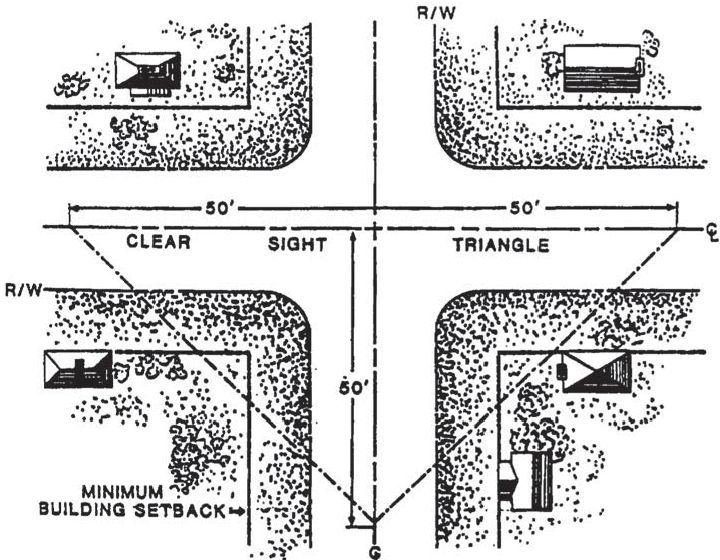
3.
Vehicular egress in a reverse direction ('backing up') onto major streets shall not be permitted unless there is sufficient shoulder width on said street to provide such egress.
D.
Driveway and street entrances onto public streets shall be designed and maintained in accordance with the Subdivision and Land Development Ordinance.
(Ord. No. 300, § I, 2-1-2023)
Sec. 240-2017. - Homeowners and like associations and design of formal open space, green space, and common facilities.
A.
General standards.
1.
Common facility construction, ownership, and maintenance shall be subject to review and approval by the Township. In addition to green space and open space, common facilities may include detention/retention basins and related surface water drainage facilities, water supply, and sewer disposal including treated effluent disposal, septic beds, pump stations, or holding lagoons.
2.
Ownership. For any common area or facility not to be retained by the owner or developer, the developer or owner must submit to the Township a statement including covenants, agreements, or other specific documents showing the ownership and method of maintenance, financial responsibility, and utilization of the common areas. Applicable elements of Sections 240-1706 and 240-1707 shall be met.
a.
The Township shall review such documents to determine whether they adequately provide for the creation and maintenance of common facilities and areas.
b.
Documents shall specify that no change to such shall thereafter occur without express review and consent by the Township.
3.
Common facilities shall be designed and sited in a manner that does not result in structural foundation degradation or any other harm to buildings and structures on-site and off-site. This includes the siting of stormwater basins and other facilities.
B.
Formal open and green space may consist of greens, commons, squares, and parks defined by streets, trees, or building walls and for the primary purposes of recreation and enjoyment of nature, and natural, scenic, and historic resources and landscapes protection. Where formal open or green space is proposed, it shall be designed according to the following:
1.
Green space may serve a variety of outdoor leisure and assembly needs of residents and enhance the form and appearance of a development. Where practicable, such areas shall be distributed throughout the development.
2.
Green space shall be interconnected to the greatest extent the site permits and shall be designed to maximize its uses as community space. It shall be a minimum of 50 feet wide at any point, except where separated by streets.
3.
Green space shall be located to serve development occupants, taking into consideration site characteristics and preserving natural, scenic, and historic resources and landscapes. Lots in the development shall be accessible to green space directly or indirectly via pedestrian paths.
4.
Shall be planted with shade trees along their edges at intervals not greater than 40 feet.
5.
Views of open space and green space shall be maximized by locating them in "terminal vista" locations as often as possible, such as the ends of streets, at three-way intersections, and/or along the outer edges of curving streets.
6.
Public access and level of recreation on green space shall be specified and green space shall be restricted from further subdivision or development by deed restriction, conservation easement, restrictive covenant, or other agreement in a form acceptable to the Township and duly recorded in the office of the Recorder of Deeds of Chester County. Green space shall be considered a form of common facility. Green space shall take into consideration how it can be incorporated into a Township trail or pedestrian path network.
7.
No more than 50 percent of the minimum required green space shall be comprised of floodways, wetlands, and very steep slopes.
8.
Private accessory structures and uses, such as those owned by occupants of lots in the development, shall not be located in any green space.
C.
When a use or development involves a homeowners association, condominium, or other management group, an applicant shall demonstrate the following to the Township:
1.
That a managing organization and process exists to govern and enforce requirements that may be used as business criteria for residential and non-residential uses.
2.
That as part of zoning approval the Township shall not be made a party to any managing organization enforcement process that involves business criteria or management association rules, and shall be held harmless for any alleged violation claimed in a such enforcement process or otherwise.
(Ord. No. 300, § I, 2-1-2023)
Sec. 240-2018. - Fences, hedges, walls, and vegetation.
A.
No fence or wall shall be erected and no vegetation (such as any hedge, tree, shrub, or other vegetative growth) shall obstruct required sight distance at street intersections, streets, or driveways per this chapter and the Subdivision and Land Development Ordinance.
B.
Fences or walls shall not be located in drainage easements or drainage swales unless they are part of an approved stormwater management plan per stormwater management regulations.
C.
Unless otherwise permitted per this chapter, fences and walls, not including retaining walls and walls of buildings and structures, shall be a maximum of six feet in height when located inside and rear yards and a maximum of four feet in height when located in front yards; however higher fences may be allowed by permit. Swimming pools shall be fenced per the Township Building Code.
D.
Fence, walls, and hedges shall be maintained in safe condition, and shall be installed so that any visible structural elements face to the interior of the lot installing such.
(Ord. No. 300, § I, 2-1-2023)
Sec. 240-2019. - Stripping and removal of topsoil; excavation of clay, sand, gravel, or rock.
A.
Stripping and removal of topsoil or sod.
1.
Topsoil or sod may be stripped or removed under the following situations:
a.
In connection with the construction, alteration or grading of a street, building or parking lot, provided the least amount of disturbance occurs.
b.
In connection with an agricultural operation.
c.
As part of the installation of utilities or the maintenance thereof.
2.
No lot shall be regraded, contours changed, or fill applied without the approval of the Township Engineer and adherence to the Township's stormwater management requirements and other applicable ordinances and statutes.
3.
No topsoil shall be removed for purposes of resale. Any sale of topsoil shall constitute a change in land use of the property from which the material was excavated.
4.
Stripping operations shall be set back from any property line a minimum of 25 feet and from any street right-of-way a minimum of 50 feet.
5.
Stripped areas shall be stabilized within three days.
B.
Excavation of clay, sand, gravel or rock in connection with construction. The excavation of clay, sand, gravel, rock, and other minerals that occur in the normal course of construction, shall be permitted under the following situations:
1.
As part of the construction of a building or the construction or alteration of a street or parking lot, and all appurtenant improvements.
2.
Excavation shall not be conducted in a way which will leave loose boulders exposed.
C.
Stormwater management shall meet the Stormwater Management Ordinance and soil erosion and sedimentation control shall comply with the requirements of the Kennett Township Subdivision and Land Development Ordinance. The areas from which topsoil is removed shall be reseeded and stabilized with an appropriate native ground cover within six months of initial ground disturbance.
D.
A maximum of 20,000 square feet may be stripped at a single time. Establishment of a suitable ground cover on the stripped areas shall be required prior to beginning additional stripping operations.
(Ord. No. 300, § I, 2-1-2023)
Sec. 240-2020. - Keeping of animals.
The following standards establish regulations for the keeping of animals, other than customary domestic pets (including but not limited to dogs, cats, rabbits, or animals of a similar character typically kept in a dwelling as household pets), as accessory to a primary use to protect human and animal health, prevent unsightly and erosion-prone land use conditions, prevent the contamination of ground and surface waters, and reduce the safety hazards of straying animals.
However, all animals shall have appropriate and adequate facilities for shelter, food, and water and shall be kept in a manner that provides for healthy, safe, and sanitary conditions for humans and the animals and does not create a nuisance or is in violation of this chapter or other ordinances.
A.
All hoofed animals (including but not limited to horses, cows, sheep, goats, llamas, alpacas, or any other animal of similar character) may be kept as an accessory use only when meeting the following standards.
1.
A minimum lot area of four acres shall be required the keeping of larger animals such as a horse, cow, alpaca, llama, or any other animal of similar character, and two is required for keeping of smaller animals such as sheep, goat, or any other animal of similar character.
2.
Animals shall have appropriate and adequate facilities for shelter, exercise, water, and food. No animals of any kind shall be kept in any structure or enclosure or elsewhere on a property that will result in an unhealthy or unsanitary condition for humans or animals or pollution of groundwater or stormwater runoff to neighboring properties. This includes overcrowding of animals, lack of protection from weather conditions, and difficult conditions for manure removal and handling.
3.
Any building used for the keeping of animals shall be constructed and located a minimum of 50 feet from any side or rear lot line.
4.
A fenced or otherwise enclosed outside area shall be provided that is capable of containing the animals and is of sufficient size and properly located for good sanitary practices. Materials used for fencing shall be of sufficient sturdiness and height as well as properly designed, installed, and maintained so as to prevent animals from straying off the property.
5.
No manure storage shall be permitted less than a 50 feet distance from any lot line or Flood Hazard District boundary and no less than 100 feet from any stream, wetland, or other waterbody. No manure may be stored within a drainageway nor located so as to drain onto adjacent land.
B.
Nonconformities.
1.
Any nonconformity with the terms of this section that results in pollution of groundwater or surface water shall be eliminated.
2.
Any existing building that is used for the keeping of animals and that does not conform to setbacks or other standards may continue to be used but may not be expanded to increase the nonconformity.
3.
Owners of animals not meeting the standards set forth in this chapter at the time of its adoption may continue to operate an existing site.
C.
Operation of kennels is permitted only in those zoning districts where such use is specifically authorized and when in accordance with § 240-1918.
(Ord. No. 300, § I, 2-1-2023)
Sec. 240-2021. - Sewage facilities, water supply, and stormwater management and erosion control.
A.
Sewage facilities. Sewage facilities shall meet Township Act 537 Plan and Subdivision and Land Development Ordinance requirements, and any applicable State and County requirements.
B.
Water supply. The Township relies on well water as primary water supply, which shall be taken into consideration for any permits.
C.
Stormwater management and erosion control. All uses shall meet stormwater management requirements, the Subdivision and Land Development Ordinance, and applicable provisions of this chapter, as well as Federal, State, and County requirements, to control stormwater runoff and mitigate sedimentation and erosion issues.
(Ord. No. 300, § I, 2-1-2023)
Sec. 240-2022. - Utilities and nontower communication facilities.
A.
Utilities.
1.
Electric, gas, street and traffic light supply, cable, fiber optic, communication lines, and like utilities associated with new development, redevelopment, new uses, and major renovations and reuses and intended primarily for uses and lands in the Township shall be installed underground.
2.
Electric, cable, and like switching enclosures, pad mounted and other transformers, service pedestals, and like facilities may be installed aboveground where site or other constraints exist as approved by the Township.
3.
Main utility feeds shall be located in the public right-of-way or a designated easement.
4.
Applicable area and bulk regulations of this Chapter shall apply to any proposed structure, or extension or expansion of such, unless upon petition of a public utility the PA Public Utility Commission (PUC) determines that a nonconforming siting of said structure is necessary for public health and welfare.
B.
Non-tower wireless communications facilities (WCF).
1.
Purposes and findings of fact.
a.
This section is to regulate placement, construction, modification, and removal of non-tower wireless communication facilities and systems, and to establish uniform standards for their siting, design, permitting, maintenance, and use. While the Township recognizes the importance of WCFs in providing communications service, the Township also recognizes an obligation to address public safety and minimize possible adverse effects of such facilities through the standards herein.
b.
Through this Subsection, the Township intends to address non-tower WCFs by regulating their location and design; and to:
1)
Establish procedures for the design, siting, construction, installation, inspection, maintenance and removal of non-tower-based wireless communications facilities in the Township, including facilities both inside and outside the public rights-of-way;
2)
Provide for the managed development of non-tower based wireless communications facilities in a manner that enhances the benefits thereof and works to accommodate the needs of the Township and wireless carriers under federal and state laws and regulations;
3)
Address new wireless technologies, such as distributed antenna systems (DAS), small wireless facilities (SWF), data collection units, cable wi-fi, and other similar facilities;
4)
Minimize the adverse visual effects and the number of such facilities via appropriate design, siting, screening, material, color and finish, and by requiring that competing providers of wireless communications services co-locate their antennas and related facilities on existing towers;
5)
Address the structural integrity of support structures through compliance with applicable industry standards and regulations; and
6)
Promote the health, safety, and welfare of Township residents and other entities with respect to wireless communications facilities.
2.
General requirements.
a.
Non-tower wireless communications facilities shall meet the following:
1)
Permitted in all zones subject to regulations. Non-tower WCFs are permitted in all zoning districts subject to conditions prescribed below and prior written approval of the Township.
2)
Nonconforming wireless support structures. Non-tower WCFs shall be permitted to co-locate upon legally, nonconforming wireless support structures and other nonconforming structures. Co-location of a WCF upon an existing wireless support structure is encouraged even if the wireless support structure is nonconforming as to use within a zoning district.
3)
Standard of care. Any non-tower WCF shall be designed, constructed, operated, maintained, inspected, repaired, modified and removed in strict compliance with all current applicable technical, safety and safety-related codes, including but not limited to the most recent editions of the American National Standards Institute (ANSI) Code, National Electrical Safety Code, and National Electrical Code. Any WCF shall at all times be kept and maintained in good condition, order and repair by qualified maintenance and construction personnel, so that the same shall not endanger the safety of any person or any property in the Township.
4)
Wind. Any non-tower WCF structures shall be designed to withstand the effects of wind according to the standard designed by the American National Standards Institute as prepared by the engineering departments of the Electronics Industry Association, and Telecommunications Industry Association (ANSI/EIA/TIA-222-E Code, as amended).
5)
Aviation safety. Non-tower WCFs shall comply with all federal and state laws and regulations concerning aviation safety.
6)
Public safety communications. Non-tower WCFs shall not interfere in any way with public safety communications or the reception of broadband, television, radio, or other communication services for occupants of nearby properties.
7)
Radio frequency emissions. Non-tower WCF may not, by itself or in conjunction with other WCFs, generate radio frequency emissions in excess of the standards and regulations of the FCC, including the FCC.
8)
Removal. In the event use of a non-tower WCF is discontinued, the owner shall provide written notice to the Township of its intent to discontinue use and the date when the use is intended to be discontinued. Unused or abandoned WCFs or portions of WCFs shall be removed as follows:
a)
All abandoned or unused WCFs and accessory facilities shall be removed within two months of the cessation of operations at the site unless a time extension is approved in writing by the Township.
b)
If the WCF or accessory facility is not removed within two months of the cessation of operations at a site, or within any longer period approved in writing by the Township, the WCF and/or associated facilities and equipment may be removed by the Township and the cost of removal assessed against the owner of the WCF.
9)
Permits. Applicants proposing any non-tower shall meet permit application and approval in Article XXV.
10)
Maintenance. To the extent permitted by law, the following maintenance requirements shall apply:
a)
The non-tower WCF shall be fully automated and unattended on a daily basis and shall be visited only for maintenance or emergency repair.
b)
Such maintenance shall be performed to ensure the upkeep of the facility in order to promote the safety and security of the Township's residents.
c)
All maintenance activities shall utilize nothing less than the best available technology for preventing failures and accidents in accordance with the requirements of the Electronics Industry Association and the Telecommunications Industry Association (ANSI/EIA/TIA-222-E, as amended.)
11)
Related equipment. Ground-mounted related equipment greater than three cubic feet shall be located at least 50 feet from a residential lot or district.
12)
Each entity that owns or operates a non-tower WCF shall provide the Township with a certificate of insurance evidencing general liability coverage in the minimum amount of $1,000,000.00 per occurrence and property damage coverage in the minimum amount of $1,000,000.00 per occurrence covering each non-tower WCF. The Township shall be named as an additional insured on such policy.
13)
Indemnification. Each entity that owns or operates a non-tower WCF shall, at its sole cost and expense, indemnify, defend and hold harmless the Township, its elected and appointed officials, employees and agents, at all times against any and all claims for personal injury, including death, and property damage arising in whole or in part from, caused by or connected with any act or omission of the person, its officers, agents, employees or contractors arising out of, but not limited to, the construction, installation, operation, maintenance or removal of the non-tower WCF. Each entity that owns or operates a non-tower WCF shall defend any actions or proceedings against the Township in which it is claimed that personal injury, including death, or property damage was caused by the construction, installation, operation, maintenance or removal of non-tower WCFs. The obligation to indemnify, hold harmless and defend shall include, but not be limited to, the obligation to pay judgments, injuries, liabilities, damages, reasonable attorneys' fees, reasonable expert fees, court costs and all other costs of indemnification.
b.
Non-tower wireless communications facilities locational and design standards.
1)
Development regulations. Non-tower WCFs shall be co-located on existing wireless support structures as a first option, subject to the following:
a)
Total height of any wireless support structure and mounted WCF shall not exceed the maximum height permitted in the underlying district.
b)
For related equipment proposed to be in a separate building, the building shall meet minimum requirements in the underlying district.
c)
A security fence of at least six feet and no taller than eight feet in height shall surround any separate communications equipment building. Vehicular access to such building shall not interfere with parking or vehicular circulations on the site for the principal use.
2)
Design regulations.
a)
Non-tower WCFs shall employ stealth technology and be treated to match wireless support structures in order to minimize visual impact. The Township shall approve the type of stealth technology. Supporting equipment shall be treated to match its support structure (e.g., be painted or otherwise coated to be visually compatible with the support structure).
b)
WCF installations located above surface grade in the public right-of-way (e.g., those on streetlights and joint utility poles) shall consist of equipment components that are no more than six feet in height and that are compatible in scale and proportion to structures upon which they are mounted. All equipment shall be the smallest and least visibly intrusive feasible. Such equipment and installations shall be located so as not to cause physical or visual obstruction to pedestrians or motorists.
c)
Ground-mounted equipment shall be located underground as possible; however, where it cannot be, it shall be screened to the fullest extent possible, through the use of stealth technology and landscaping or other decorative features. As well, electrical meter cabinets and like structures shall be screened to blend in with the surrounding area.
d)
Antennae, and their respective support structure, shall be no greater in diameter than any cross-section dimension that is reasonably necessary for their proper functioning.
e)
Modification, upgrade, or repair of non-tower WCFs and/or accessory equipment that increases its overall size, number of antennas, or like changes shall require a Township permit.
3)
Inspection. The Township reserves the right to inspect any WCF to ensure compliance with the provisions of the Zoning Ordinance and any other provisions of the Township Code or other law. The Township and/or its agents shall have the authority to enter the property upon which a WCF is located at any time, upon reasonable notice to the operator, to ensure such compliance.
4)
For WCFs as part of municipal use, the Township may enter into separate agreements and fee arrangements with WCF applicants beyond those permit fees and reimbursement costs set forth by resolution and this chapter.
5)
Reimbursement for ROW use. In addition to permit fees, every non-tower WCF in the ROW is subject to the Township's right to fix annually a fair and reasonable compensation to be paid for use and occupancy of the ROW. Such compensation for ROW use shall be directly related to the Township's actual ROW management costs including the costs of the administration and performance of all reviews, inspections, permitting, supervision, and other ROW management activities by the Township.
(Ord. No. 300, § I, 2-1-2023)