


Kennett Township City Zoning Code
ARTICLE XXI
SIGNS
Sec. 240-2100.- Applicability.
Any sign hereafter erected, altered, or maintained shall conform with the provisions of this article and any other applicable articles, ordinances, or regulations of Kennett Township.
(Ord. No. 300, § I, 2-1-2023)
Sec. 240-2101. - Purpose.
The purpose of this article is to provide for the regulation of lawful signs in Kennett Township to protect the public health, safety, and welfare in accordance with the following objectives:
A.
Control the size, location, number, and illumination of signs in order to reduce hazards to pedestrian and vehicular traffic.
B.
Encourage signs that provide latitude for variety in order to enhance the economic value and character of properties in the Township.
C.
Avoid sign conflicts so that permitted signs provide adequate identification and direction while minimizing clutter, unsightliness, and confusion.
D.
Establish standards designed to encourage signs that are compatible with their surroundings, appropriate to the type of activity to which they pertain, expressive of the individual proprietors, and legible in the circumstances in which they are seen, and to prohibit the erection of signs that do not meet these criteria.
E.
To prohibit the construction of and require the removal of signs which constitute a hazard or a blighting influence.
F.
To establish a process for the review and approval of sign permit applications.
(Ord. No. 300, § I, 2-1-2023)
Sec. 240-2102. - Permits and inspections.
A.
Any sign to be erected in the Township shall require a permit unless specifically exempted in this article. No such sign shall hereafter be erected, altered, relocated, or the content changed, except a multi-tenant directory panel, until a permit is issued by the Zoning Officer per Article XXV.
B.
Application for a sign permit shall be made in writing to the Township and shall contain all the information necessary for the Zoning Officer to determine whether the proposed sign conforms to all the requirements of this chapter. Applications shall be made on a form(s) furnished by the Township and shall also include the following minimum information:
1.
Exact dimensions of the lot, including any right-of-way lines, easements, or buildings where the sign is to be erected.
2.
Exact size, dimensions, and location of the proposed sign, and any existing signs, on the lot or building, including building elevations, together with its type, construction, design, materials to be used, proposed illumination, and the manner of installation. The district where the sign is located and the regulations in this article that the sign meets.
3.
The application shall be accompanied by written consent of the owner or lessee of the premises upon which the sign is to be erected for Township officials to enter said premises to inspect the sign.
4.
All signs and their supporting structures shall be designed and constructed to meet the standards of the Township Building Code.
C.
No permit to erect a sign shall be issued until the required fee has been paid to the Township based on the Fee Schedule in Article XXV.
D.
No permit shall be issued for an off-premises sign until the property owner's consent and signature have been filed.
E.
Permits shall be granted or denied within 15 days from the date of a complete application.
F.
No sign permit shall be issued unless there is conformance with the regulations of this chapter, except upon order of the Zoning Hearing Board granted pursuant to the procedures established for the issuance of a variance.
G.
After installation, the Zoning Officer shall inspect the sign to ensure that the installation conforms to the regulations set forth in this Article. All signs which are erected by permit may be subject to annual or periodic inspection.
H.
Regular maintenance or repair of a permitted sign, including electrical, repainting, or cleaning of the sign, shall not require a permit.
I.
Exemptions from the necessity of securing a permit shall not be construed to relieve the owner of the exempted sign from the responsibility of its construction, installation, and maintenance in a safe manner and in accordance with the provisions of this Chapter.
(Ord. No. 300, § I, 2-1-2023)
Sec. 240-2103. - Sign types and classifications.
A sign may be defined under multiple terms. As used in this chapter and in addition to terminology in Article II, the following words, terms, and phrases shall have the meanings indicated:
Abandoned sign means any sign erected on, or related to, the use of a property that becomes vacant and unoccupied for a period six months or more, or any sign that relates to a time, event, or purpose that is past.
Address sign means a sign that designates the street name and/or number for identification purposes, as designated by the United States Postal Service.
Awning, canopy, or marquee sign means a sign that is part of or attached to an awning, canopy, marquee, or other fabric, plastic, metal, or structural protective cover over a door, entrance, or window, or outdoor area.
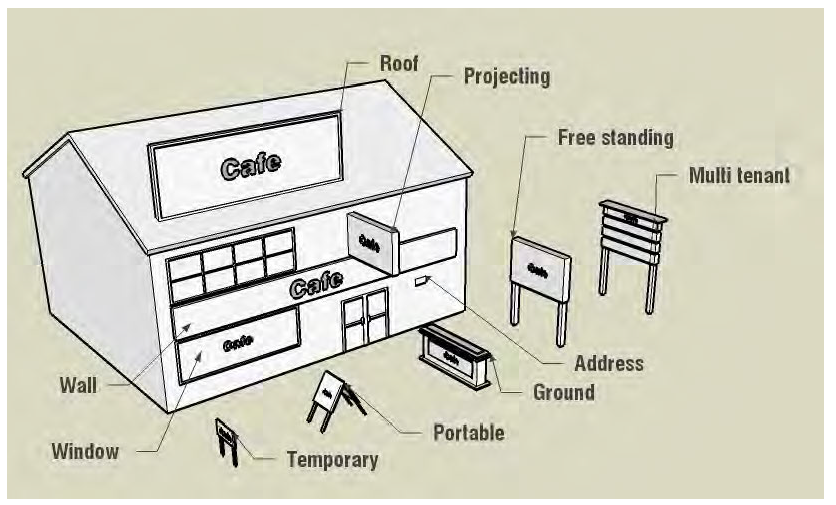
Figure 21-a: Sign Types
•
Awning means a cloth, plastic, or other nonstructural covering that projects from a wall for the purpose of shielding a doorway or window. An awning is permanently attached to a building and can be raised or retracted to a position against the building when not in use.
•
Canopy means a structure other than an awning made of fabric, metal, or other material that is supported by columns or posts affixed to the ground and may also be connected to a building.
•
Marquee means a permanent, roof-like structure, attached to, supported by a wall of a building, and projecting from a building, but having no relationship to the roof structure, generally designed and constructed for protection against weather.
Banner means a type of temporary sign, not including flags, made of flexible material and attached to a structure, building, pole, rope, wire, or framing anchored on two or more edges or sides.
Banner street pole means a banner suspended above a sidewalk and attached to a single street pole. These signs shall not contain any commercial advertising.
Billboard means a type of off-premises outdoor advertising sign which is visible from a street and is used to advertise, identify, or display information through words, letters, figures, designs, symbols, pictures, images, colors, or illuminations. Each different face of a billboard structure shall constitute a separate billboard.
Building frontage means the maximum linear width of a building measured in a single straight line parallel, or essentially parallel, with the abutting public street or parking lot.
Business sign means a sign directing attention to a business, commodity, or service conducted, sold, or offered upon the same premises as those upon which the sign is maintained. This includes signs which identify or advertise home occupations or signs affixed to vehicles denoting a business-related activity.
Changeable copy means a sign containing or displaying letters, numbers, or graphics, which is designed to be readily changeable through manual, electronic, or mechanical means, including illumination types such as LED, HID, LCD, fluorescent, incandescent, neon, plasma, and digital.
Clearance means the distance from grade at the sign location to the bottom edge of a sign. This term may also refer to a horizontal distance between two objects.
Construction/development sign means a type of temporary on-premises sign on tracts approved for or undergoing development intended to display the site is being subdivided and/or developed, its future use, and the name of the project and/or the contractor, architect, engineer, financier, or similar information pertaining to the project.
Directional sign means an informational sign indicating direction, entry, exit, loading, or service areas, fire lanes, parking, and other information incidental to the use and not itself advertising that use.
Double-faced sign means a sign that displays a message, information, or advertising on both faces (sides) of the sign.
Dwell time means the time a message on a changeable copy sign spends in the same position.
Festoon lighting means a type of illumination comprised of a chain or garland of, often large, light bulbs hung or strung overhead or on a building or other structure, which are often not shaded, hooded, or otherwise screened to prevent direct rays of light from shining elsewhere.
Flag means any sign printed or painted on cloth, plastic, canvas, or other like material with distinctive colors, patterns, or symbols attached to a pole or staff and anchored along only one edge or supported or anchored at only two corners.
Flashing, animated, beacon, or moving sign means an illuminated sign where such illumination is not constant in intensity at all times when in use, including, but not limited to, motion, rotating, flashing, oscillating, twinkling, shuttering, changes in light, color, direction, or animation, or other similar action. This includes interactive signs that react to the behavior of passersby.
Freestanding sign means a sign supported by structures, supports, or pylons that are placed on or anchored in the ground and that is independent from any building or other structure.
Ground sign means a sign, other than a freestanding sign, on a low landscaping wall that is placed directly on the ground without supports or pylons, independent from any building.
Historic marker means a sign denoting a Historic Resource that may include a name, date, address, and description of such resource and not used for a commercial message. Such signs include memorial plaques, interpretive panels, and tablets.
Identification sign means a sign providing the name of a use or development, including a school, governmental building, hospital, residential development, club, estate, farm, or similar uses. The street address may also be included on such sign.
Illuminated sign means a sign with characters, letters, figures, designs, or outlines, which are illuminated externally by direct or indirect electric lighting or internally, including halo, neon, and argon lighting by lighting contained within the sign.
Incidental sign means an informational sign for non-commercial/non-advertising purposes only, indicating general site information, instructions, directives, restrictions, hours of operation, accepted forms of payment, civic affiliations, and other supplemental information to the use on-site and not itself advertising the use.
Multi-tenant directory sign means a wall, freestanding, or ground sign to advertise businesses that occupy a shopping center, office or industrial park, or other complex with multiple tenants.
A.
Multi-tenant directory wall sign: such sign is attached parallel to the facade adjacent to a main entrance, and provides a listing of establishments within a building or series of buildings.
B.
Multi-tenant directory freestanding or ground sign: Such sign is a freestanding or ground sign adjacent to a main entrance of the lot, which provides a listing of establishments within a building or series of buildings.
Municipal sign means a sign erected and permitted by Kennett Township which identifies the Kennett Township Building, Kennett Township Public Works facility, Kennett Township Parks, and other Kennett Township municipal facilities.
Official traffic or street sign means a sign erected and permitted by the Commonwealth of Pennsylvania Department of Transportation or Kennett Township that is designed to regulate traffic, describe road conditions, supply directions, display street names or route numbers, railroad crossings, or provide information.
Off-premises sign means a sign that advertises a person, business, profession, product, or activity not conducted on the same premises as the sign.
On-premises sign means a sign, whose message and design relate to a business, profession, product, service, event, point of view, or other commercial or non-commercial activity sold, offered, or conducted on the same property where the sign is located.
Pennant means a triangular or other shaped piece of fabric or other material, commonly attached in strings or strands, or supported on small poles intended to flap in the wind and that may or may not include graphics or alpha-numeric characters.
Permanent sign means a sign attached or affixed to a building, window, or structure, or to the ground in a manner that enables the sign to resist environmental loads, such as wind, and that precludes ready removal or movement of the sign and whose intended use appears to be indefinite.
Political campaign sign means any temporary sign pertaining to political views, an individual seeking election or appointment to a public office, or a forthcoming public election or referendum.
Portable sign means a type of temporary sign, with or without display or legend, which is not permanently embedded in the ground or attached to a building, and is designed to be transportable or moved whether affixed on a movable stand, mounted on wheels or movable vehicles, or made easily movable in some other manner. Such sign provides secondary signage for the business or tenant and is pedestrian-oriented. Portable signs shall also include searchlight stands, beacon lights, sandwich board signs, pennants, and hot-air or gas-filled balloons tethered to the ground and used for advertising purposes.
Projecting sign means a sign affixed to a wall or other vertical building surface in such a manner that its leading edge extends generally perpendicular to and beyond the surface of such wall or building surface and pedestrian scaled and easily read from both sides..
Public sign means a sign erected or required by government agencies or utilities, including for street construction, utility work, pedestrian, warning, and safety.
Real estate sign means a sign pertaining to the sale, lease, or rental of the property where it is located.
Reflective sign means a sign containing any material or device which has the effect of intensifying reflected light.
Roof sign means a building-mounted sign erected upon, against, or over the roof of a building.
Scenic Byway means Route 52 in Kennett Township, designated as a Pennsylvania Scenic Byway, as part of the Brandywine Valley Scenic Byway, due to its scenic and historical attributes.
Security sign means an on-premises sign regulating the use of the premises, such as a "no trespassing," "no hunting," or "no soliciting" sign.
Sign means any permanent or temporary structure or part thereof or any device attached, painted, or represented, directly or indirectly, on a structure or other surface including windows that displays or includes any letter, word, insignia, flag, or representation used as or which is in the nature of an advertisement, announcement, visual communication, direction, or which is designed to attract the eye or bring the subject to the attention of the public.
Sign area means the dimensions of a sign surface used to display information, messages, advertising, logos, or symbols, as measured per § 240-2104.
Sign face means a single side of a sign that may or may not include graphics and/or alpha-numeric characters. Such may be larger, the same, or smaller than sign area.
Sign height means the distance measured from grade to the highest point of the sign structure, as measured per § 240-2104.
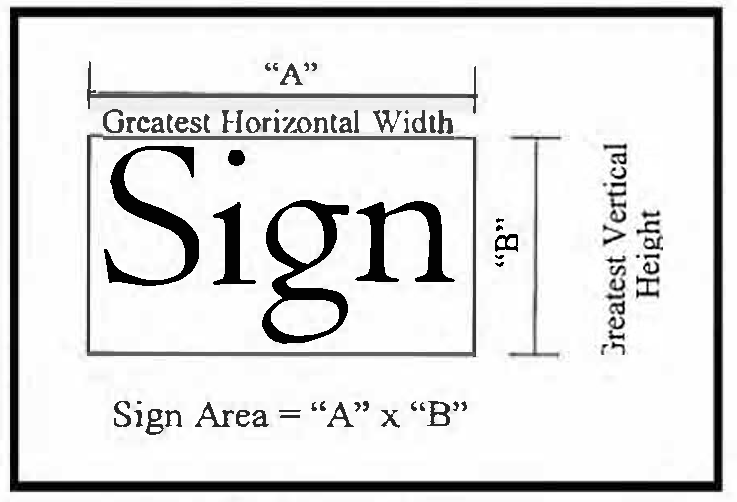
Figure 21-b: Sign Area
Sign support structure means poles, posts, walls, frames, brackets, or other underpinnings holding a sign in place.
Snipe or bandit sign means a sign tacked, nailed, posted, pasted, glued, or otherwise attached to trees, poles, stakes, fences, benches, street signs, streetlights, or other objects; painted or drawn on a rock or other natural feature; or placed on any property or in the street right-of-way without the permission of the property owner.
Temporary sign means a sign that is not permanent, intended for short-term notifying, advertising, or informing use, including signs pertaining to business events, community events, or political campaigns or issues.
Vehicular sign means a sign affixed on a truck, trailer, or other vehicle identifying or advertising a business including business logos, identification or advertising on vehicles primarily and actively used for business purposes and/or personal transportation.
Wall sign means a sign affixed (including painted on and murals) parallel to a wall or other vertical building surface, except a window, with a single visible face.
Window sign means a temporary or permanent sign which is oriented to any public right-of-way and is located on the inside or outside of a window.
(Ord. No. 300, § I, 2-1-2023)
Sec. 240-2104. - General standards for signs.
A.
Sign area.
1.
The sign area shall mean the entire area within a single continuous perimeter enclosing the outer limits of such sign, including any three-dimensional shapes on the sign. The sign area shall not include any sign support structural elements lying outside the limits of such sign and not forming an integral part of the display.
2.
In the case of an open sign made up of individual letters attached to or painted on a building, wall, window, canopy, marquee, post, pole, or awning, the sign area shall mean that of the smallest rectangle or other geometric shape which encompasses all of the letters and symbols.
3.
In computing the area of a double-faced sign, only one side shall be considered, provided that the faces are identical. Where the faces are not constructed back-to-back or in V-type signs where the interior angle exceeds 45 degrees, both sides shall be considered in measuring the sign area.
B.
Sign height and spacing.
1.
The height of a sign shall be measured from the existing average grade at the base of the sign, as supplied by the applicant, and confirmed by the Zoning Officer, to the highest point of the sign or sign support structure, whichever is highest. Berming or mounding around the location of the sign to increase the sign height is prohibited.
2.
Clearance for freestanding and projecting signs shall be measured as the smallest vertical distance between the existing average grade and the lowest point of the sign, including any sign support structure.
3.
The spacing between signs shall be measured as a straight-line distance between the closest edges of each sign.
C.
Sign location.
1.
Unless a portable or temporary sign or authorized for a specific sign type, signs shall not be erected within the legal right-of-way of any street.
a.
Portable signs shall only be displayed in front of the business during the business's hours of operation.
b.
Portable or temporary signs shall not interfere with pedestrian travel or encroach upon the required accessible walking area or path.
c.
There shall be a maximum of one portable sign per tenant building frontage.
2.
No sign shall be placed in such a position as to endanger pedestrians or vehicular traffic by obscuring the view, by interfering with official street signs or signals by virtue of position or color, or by placement in a clear visual sight triangle.
3.
Signs and their supporting structures shall maintain clearance and noninterference with all surface and underground utility and communications lines or equipment.
4.
No sign shall be erected or maintained so as to prevent free ingress or egress from any door, window, or fire escape.
5.
In pedestrian-oriented areas, signs should be designed to relate to the sidewalk and pedestrian traffic instead of motorists.
6.
Signs should be placed at or near the primary public entrance to a building or main parking area to indicate the most direct access to the building.
7.
If more than one use is in a building, such as an in-line commercial use or mixed-use building, a maximum of one sign is encouraged per tenant frontage.
D.
Sign illumination.
1.
All illuminated signs shall be constructed to the Standards of the Underwriters Laboratories (UL) and shall meet Township Electrical and Building Codes.
2.
Lighting shall not shine directly upon abutting properties nor within the line of vision of pedestrians and vehicles using streets or sidewalks.
3.
There shall be no sign illumination of an intermittent type including changeable copy in the RA and RR districts.
4.
Floodlighting shall be so shielded and aimed that the source of light only illuminate the sign and shall not be visible from any point off the lot on which the sign, building, or structure being illuminated is erected. All proposed lighting shall comply with Article XX.
5.
Permitted changeable copy shall have a dwell time of no less than one hour per message.
E.
Sign construction and maintenance. Every sign shall be:
1.
Professionally constructed of durable materials and with noncorrosive fastenings.
2.
Structurally safe.
3.
Erected or installed per the Township Building Code.
4.
Maintained in a safe condition and good repair at all time.
5.
Compliant with the Signage Design Standards of § 240-2112.
6.
Legible.
7.
The Zoning Officer shall be permitted to periodically inspect signs as warranted.
(Ord. No. 300, § I, 2-1-2023)
Sec. 240-2105. - Standards for specific sign types.
The following standards shall apply to individual sign types as defined in this chapter. See § 240-2108 for additional standards that apply within each zoning district.
A.
Awning or canopy signs.
1.
Use of an awning or canopy sign shall be limited to one per street frontage of the establishment.
2.
If the sign is mounted on a building with more than one use, such as a multi-tenant, in-line commercial, or mixed-use building, all such signs shall be similar in terms of height, projection, and style across all tenants and uses in the building.
3.
An awning or canopy without lettering or other advertising shall not be regulated as a sign.
4.
The lowest edge of an awning or canopy sign shall have a minimum vertical clearance eight feet above grade.
5.
The outermost portion of an awning or canopy sign shall extend a maximum of four feet from the building wall to which it is attached.
6.
No portion of this sign shall extend above the top of the wall on which it is mounted.
B.
Marquee signs.
1.
Use of a marquee sign shall be limited to one per street frontage of the establishment.
2.
A marquee without lettering or other advertising shall not be regulated as a sign.
3.
The lowest edge of a marquee sign shall have a minimum vertical clearance of ten feet above grade.
4.
No portion of this sign shall extend above the top of the wall on which it is mounted.
C.
Freestanding signs.
1.
The outermost portion of a freestanding sign shall not project to a point nearer than five feet from the street line; however, where compliance with this standard would create an obstruction of view, further setback may be necessary.
2.
The lowest edge of a freestanding sign shall not be less than four feet or greater than eight feet vertical clearance above grade.
3.
Such signs shall be limited to one such sign per street frontage of a lot or development.
4.
If more than one use is carried on in a building or lot, the permitted sign may be a multi-tenant directory sign indicting the presence of all uses in the building or lot. Individual freestanding signs for each use shall not be permitted.
5.
Where both freestanding signs and ground signs are permitted in this article, only one of these sign types shall be permitted per the terms of Subsection C.3.
D.
Ground signs.
1.
Such signs shall be limited to one such sign per street frontage of a lot or development.
2.
If more than one use is carried on in a building or lot, the permitted sign may be a multi-tenant directory sign indicting the presence of all uses in the building or lot. Individual ground signs for each use shall not be permitted.
3.
Where both freestanding signs and ground signs are permitted in this article, only one of these sign types shall be permitted per the terms of Subsection C.3.
E.
Projecting signs.
1.
The lowest edge of a projecting sign shall have a minimum vertical clearance of eight feet above grade, and the sign shall extend at least six inches from the plane of the building wall.
2.
The outermost portion of a projecting sign shall extend a maximum of four feet from the building wall to which it is attached.
3.
No portion of this sign shall extend above the top of the wall on which it is mounted.
4.
No projecting sign shall be attached to a building above a canopy, marquee, or awning or canopy, marquee, or awning sign.
F.
Wall signs.
1.
A wall sign shall not extend more than eight inches from the plane of the building wall and shall be located so that the lowest edge has a minimum vertical clearance of eight feet above grade in any case where extension from the wall is greater than three inches.
2.
If more than one use is carried on in a building or lot, there may also be a multi-tenant directory wall sign indicting the presence of all uses in the building or lot. A multi-tenant directory sign shall be limited to one such sign per building entrance.
3.
More than one wall sign may be permitted per building wall, except that the total area of all signs on one wall shall not exceed the maximum percentages specified in § 240-2108 for the applicable zoning district.
4.
Permanent window signs shall be considered wall signs when computing the maximum permitted building wall coverage of wall signs.
5.
Wall signs that are an inherent a part of the architectural design of a historic resource or other building, such as those located on the lintel above a storefront, shall be exempt from the size requirements if they are limited to the area of the building specifically designed for sign placement.
6.
No portion of this sign shall extend above the top of the wall on which it is mounted nor shall it extend beyond the edges of the wall.
7.
Letters painted on or affixed to a building shall be considered a wall sign and shall be included in the computation of total permitted sign area.
8.
Murals that include commercial messages shall be considered a wall sign.
G.
Window signs. A permanent window sign is one which is etched, painted, or otherwise permanently affixed to the window. Permanent window signs shall be considered wall signs when computing the maximum permitted building coverage of wall signs.
H.
Off-premises signs. Off-premises signs shall comply with § 240-2108.C.2.f.
(Ord. No. 300, § I, 2-1-2023)
Sec. 240-2106. - Exempt signs.
The following signs shall be exempt from the permit requirements of this Chapter; however such signs shall comply with all applicable standards of this Chapter, including the responsibility for maintenance of signs in good and safe repair.
A.
Official traffic and public and private street signs, directional signs, public signs, and other similar official federal, state, county, or Township signs within the legal street right-of-way, when in accordance with the Pennsylvania Department of Transportation specifications under the Pennsylvania Code and/or Township Code.
B.
Security signs provided the area of such sign does not exceed two square feet. More than one such sign may be posted on a property when consistent with state regulations.
C.
Address signs with an area not to exceed two square feet, bearing only property number, street address, or the names of the occupants in a residence.
D.
Legal notices.
E.
Incidental signs not to exceed two square feet in area each sign. One or more incidental window signs giving store hours or the name(s) of payment institutions, when the total area of all such sign(s) together does not exceed two square feet per establishment.
F.
Temporary signs for religious, civic, philanthropic, community, historical, educational, or sales events not to exceed 16 square feet, provided they are erected no more than two weeks prior to the event and removed within five days after the event. Permission shall be obtained from the property owner where the sign is located prior to posting such signs. Only one such sign shall be allowed per street frontage.
G.
Sign that are permanent architectural features of a building or structure, such as a cornerstone or identifying letters carved into or embossed on a building, provided the letters are not made of a reflective material.
H.
Temporary yard sale or garage sale signs provided the area of such sign does not exceed two square feet and shall be erected no more than two days before the first day of the sale and removed within 24 hours of the conclusion of such sale. No more than three temporary off-premises yard sale signs shall be permitted. Permission shall be obtained from the property owner where the sign is located prior to posting such signs.
I.
Flags or insignias not exceeding 80 square feet total.
J.
Historic markers, provided that such does not exceed six square feet.
K.
Temporary signs advertising information about the variety of crops growing in a field, so long as such signs are not for advertising or commercial purposes including for farm stands and are removed after the growing season.
L.
Temporary signs of a contractor, architect, mechanic, or artisan not including construction/development signs, placed on the property where the contracted work is occurring, provided that:
1.
Such signs shall have a maximum area of six square feet and a maximum height of five feet.
2.
Any such sign shall be removed within five days of completion of the work.
M.
Temporary real estate sign placed on the property to be sold, leased, rented, or developed, provided that:
1.
Such signs shall have a maximum area of six square feet and a maximum height of five feet.
2.
Such signs shall be removed within five days following the completion of final sale, rental, leasing, or development transactions.
3.
Only one such sign per street frontage per realtor or developer shall be permitted on any property held in single and separate ownership.
4.
Temporary signs advertising an open house for real estate sales shall be permitted on the site of the property for sale, rent, lease, or development, provided such signs are erected no more than one day prior to the date of the open house and are removed at the end of the day of the open house. No more than one open house sign per property per street frontage shall be permitted.
N.
Temporary political campaign signs, provided that they are posted with the permission of the property owner where such signs are located, shall not be closer to a street line than five feet, and are removed within five days of the relevant election.
O.
Municipal signs.
P.
Vending machine signs.
Q.
Art and murals, provide such signs have no commercial messaging or other advertising.
R.
Signs inside a building, or other enclosed facility, which are not meant to be viewed from the outside, and are located greater than three feet from the window.
S.
Holiday and seasonal decorations.
(Ord. No. 300, § I, 2-1-2023)
Sec. 240-2107. - Prohibited signs.
The following signs are unlawful and shall be prohibited in Kennett Township:
A.
Signs containing information which implies that a property may be used for any purpose not permitted under the provisions of this chapter.
B.
Any sign that obscures or interferes with the line of sight at any street intersection or traffic signal or at any other point of vehicular or pedestrian access to a street. Within 75 feet of a public street line or 200 feet of a traffic control signal, whichever is greater:
1.
Signs that use the words "Stop," "Look," "Danger" or any other word, place, symbol, or character that attempts to direct the movement of traffic and pedestrians.
2.
Signs that imitate, resemble, interfere with, or obstruct any traffic device, light, sign, or signal.
3.
Signs that interfere with, imitate, resemble, or obstruct any line of sight on a street or intersection, public sign or traffic signal/sign/device within 75 feet of a public right-of-way or within 200 feet of a traffic signal/sign/device, whichever is greater.
C.
Any banner sign or sign of any other type across a public street.
D.
Snipe signs.
E.
Animated, flashing, or beacon signs.
F.
A sign suspended between poles with festoon lighting and/or pennants, streamers, or spinners.
G.
Any sign erected or maintained so as to prevent free ingress or egress from any door, window or fire escape. No sign of any kind shall be attached to a standpipe or fire escape.
H.
Roof signs.
I.
Vehicular signs on a truck, trailer, or other vehicle not used for normal day-to-day operations of a business or not regularly moved for business-related purposes. This does not include a vehicle with signage that is used regularly for work trips, daily use, or commuting.
J.
Any sign having content that is not subject to the protections of the First Amendment to the United States Constitution or Article I, Section 7 of the PA Constitution.
K.
Abandoned signs.
L.
Signs that emit smoke, visible vapors, particulate matter, sound, odor, or contain open flames.
M.
Reflective signs or signs containing mirrors.
N.
Interactive signs, unless for public educational, informational, or directional purposes.
O.
Signs that promote any illegal activity.
(Ord. No. 300, § I, 2-1-2023)
Sec. 240-2108. - Permitted signs by zoning district.
Signs permitted in specific districts shall be as provided in this Section. Unless otherwise stated, signs shall be on-premises.
A.
Signs in Residential Districts. The following regulations shall apply to signs in the RA, RR, RS, RMHD, and PRD Districts:
1.
The following signs shall be permitted, provided they conform to all other provisions of this Article, including the requirements for a sign permit in § 240-2102.
a.
Home occupation business or bed-and-breakfast signs, indicating the name, profession, or activity of the occupant of the dwelling.
1)
One wall, ground, or freestanding sign per premises.
2)
Maximum sign area: Four square feet.
3)
Signs shall not be illuminated.
4)
Maximum height: Five feet.
b.
Identification signs.
1)
One wall, ground, or freestanding sign per street frontage identifying the use and containing no advertisement.
2)
Maximum sign area.
a)
Freestanding sign: 12 square feet.
b)
Ground sign: 16 square feet.
c)
Wall sign: 12 square feet.
3)
Maximum sign height.
a)
Freestanding sign: Six feet.
b)
Ground sign: Four feet.
c)
Wall sign: 12 feet.
c.
Construction/development signs.
1)
One freestanding sign per entrance.
2)
Maximum height: 12 feet
3)
Maximum sign area: 16 square feet.
4)
Removal within five days of the completion of development.
d.
Temporary signs for seasonal uses (e.g., sale of Christmas trees, flea market, etc.).
1)
Maximum sign area: 12 square feet.
2)
Such sign shall be removed within five days of completion of the event or seasonal use.
e.
Sale of farm products.
1)
One wall, freestanding, or projecting sign.
2)
Maximum sign area: Six square feet.
2.
Signs for commercial or business uses shall meet the standards of § 240-2108.C.
B.
Signs in Village Districts. The following regulations shall apply to signs in VH and VM districts:
1.
Signs for residential uses shall meet § 240-2108.A.
2.
Any other sign including business signs and signs for nonresidential uses shall meet the following standards. In addition, a sign area bonus that meets § 240-2113 may be permitted.
a.
One of the following sign types per street frontage:
1)
Ground sign.
a)
Maximum sign area: 20 square feet.
b)
Maximum sign height: Six feet.
2)
Freestanding sign.
a)
Maximum sign area: 20 square feet.
b)
Maximum sign height: Six feet.
3)
Wall sign.
a)
Maximum sign area: 12 square feet or ten percent of the area of the building facade on which such sign is located, whichever is less.
4)
Permanent window sign.
a)
Maximum sign area: 12 square feet or 25 percent of the glass area of the window, whichever is less.
5)
Awning or canopy sign.
a)
Maximum sign area: 18 square feet.
6)
Marquee sign.
a)
Maximum sign area: 15 percent of the area of the building face on which such sign is located.
b.
Temporary signs for seasonal uses shall meet Subsection A.1.d.
C.
Signs in Commercial, Business, Industrial, Institutional, and Specialized Agricultural districts. The following regulations shall apply to signs in the C, LI, CC1, CC2, and SA Districts:
1.
Signs for residential uses shall meet § 240-2108.A.
2.
Any other sign including business signs and signs for nonresidential uses shall meet the following standards. In addition, a sign area bonus that meets § 240-2113 may be permitted.
a.
Signs for individual principal business and non-residential uses.
1)
Two signs per public street frontage plus window signs per § 240-2108.C.2.e.2).
2)
Maximum total sign area shall meet § 240-2108.C.2.d.
b.
Temporary signs for seasonal uses shall meet Subsection A.1.d.
c.
Construction/development shall meet Subsection A.1.c.
d.
Maximum total area of all permitted signs shall not exceed an area equal to two square feet for every one lineal foot of building frontage. Sign area for each street frontage shall be computed separately and any allowable sign area not used on one street frontage may not be used on another street frontage.
e.
The following standards shall apply to permitted sign types.
1)
Freestanding signs.
a)
Individual principal business signs and signs for nonresidential uses.
i.
Maximum sign area: 50 square feet.
ii.
Maximum sign height: 12 feet.
2)
Wall signs. Wall signs, including the area of permitted permanent window signs, shall have a maximum sign area of 15 percent of the area of the building façade on which the sign is located or 40 square feet, whichever is less.
a)
The calculation of wall area sign shall include any permanent window signs. In addition, the permanent window sign shall be a maximum of 12 square feet or 25 percent of the glass area of the window, whichever is less.
b)
The area encompassing the lettering on a canopy (e.g., a canopy covering an outdoor service area of an automotive service station or similar use) shall be counted towards the maximum allowable area for a wall sign.
3)
Projecting signs. Maximum sign area: Six square feet.
4)
Awning or canopy signs. Maximum sign area: 24 square feet.
5)
Marquee signs. Maximum sign area: 20 percent of the area of the building facade on which such sign is located.
6)
Ground signs.
a)
Maximum sign area: 50 square feet.
b)
Maximum sign height: Six feet.
7)
Multi-tenant directory signs for a group of business establishments on a single lot and/in a single building.
a)
Multi-tenant directory freestanding sign.
i.
Maximum sign area: 50 square feet.
ii.
Maximum sign height: 15 feet.
iii.
Separate freestanding signs shall not be permitted for the individual businesses located on lot or in a building.
b)
Multi-tenant directory ground sign.
i.
Maximum sign area: 50 square feet.
ii.
Maximum sign height: Six feet.
iii.
Separate ground signs shall not be permitted for the individual businesses located on lot or in a building.
c)
Multi-tenant directory wall sign.
i.
Maximum sign area: 12 square feet.
ii.
Maximum sign height: Eight feet.
iii.
Separate wall signs may be permitted for the individual businesses located on lot or in a building.
f.
Billboards.
1)
Billboards shall only be permitted by conditional use in the C District, along an expressway or major arterial as shown in the Kennett Township Comprehensive Plan, and shall be setback no less than 25 feet from the street line.
2)
Maximum sign area: 300 square feet per side.
3)
Only one billboard shall be permitted on each billboard structure.
4)
Only one billboard shall be permitted per individual lot.
5)
The face of any billboard on which any message or advertisement appears shall be oriented and maintained at an angle of not less than 45 degrees to the street line, and shall face oncoming traffic on the side of the roadway on which the billboard is located.
6)
Maximum height: 25 feet above grade of the closest street line, measured from the billboard top.
7)
Minimum ground clearance: Ten feet, measured from grade.
8)
No billboard shall be erected or located within 1,500 feet of an existing billboard structure on either side of the street.
9)
No billboard shall be located within 1,000 feet of a residential zoning district.
10)
If a billboard contains changeable copy, the dwell time for a message shall be no less than one hour.
11)
Lighting:
a)
Billboards shall only be externally illuminated, unless approved with changeable copy.
b)
Lighting shall comply with the recommended practices and criteria contained in the Illuminating Engineering Society of North America (IESNA)'s most up-to-date Lighting Handbook, including but not limited to, criteria for full-cutoff fixtures. Fixtures shall be equipped with or be capable of being back fitted with light directing devices such as shields, visors or hoods when necessary to redirect offending light distribution. All lighting shall be aimed, located, designed, fitted, and maintained so as not to project or reflect onto a neighboring use, property, street, or nearby intersecting street.
c)
Billboards or component parts thereof that flash, blink, move, rotate, oscillate, or turn on and off intermittently, or which outline the billboard by illuminated tubing, strings of light, or other means, are prohibited, except for permitted changeable copy with a dwell time no less than one hour per message.
(Ord. No. 300, § I, 2-1-2023)
Sec. 240-2109. - Removal of signs.
A.
Unsafe signs.
1.
Whenever a sign becomes structurally unsafe and/or poses a potential threat to the safety of a building or premises or endangers the public safety, or becomes so deteriorated that it no longer serves a useful purpose of communication, and such condition is known to the Zoning Officer, a written notice will be given to the owner of the premises that such sign must be made safe or removed within five days, unless the Zoning Officer shall deem appropriate a more extended period for compliance.
2.
Where, in the opinion of the Zoning Officer upon careful inspection, any sign described herein constitutes a hazard to public safety per Subsection A.1 or is in violation of this Chapter, the Zoning Officer shall be empowered to take the measures he/she deems appropriate to correct, stabilize, or remove such sign with or without written notice to the owner of the premises or to the agent placing the sign. In such cases, a lien may be placed against the property on which such sign was situated in the amount of the costs incurred by the Township in removing the sign.
3.
Failure of the Zoning Officer to remove or require the removal of any sign as described in this Section shall create no liability upon, nor any cause of action against, the Zoning Officer or any other Township official or employee for damage or injury that may occur as a result of such sign.
B.
Abandoned signs. Any sign that was erected for any occupant or business unrelated to the present occupant, or any sign which relates to a time, event, or purpose that is no longer in place or inconsistent with the time limits established by this article, shall be deemed abandoned. An abandoned sign shall be removed by the owner of the property within 30 days of written notice by the Zoning Officer. If such sign is not removed within this timeframe, the Township may remove the sign and a property lien as stipulated in § 240-2109.A.2 may be incurred to cover the costs of sign removal.
C.
Unlawful signs. Any sign which has been unlawfully erected in violation of the provisions of this Chapter shall be removed upon written notice by the Zoning Officer to the owner, lessee, person, or firm maintaining the sign. The Township may remove or cause to be removed such sign at the expense of the owner, lessee, or firm maintaining the sign in the event that the terms of said notice have not been complied with within 14 days of the date of said notice. A lien as stipulated in § 240-2109.A.2 may be incurred to cover the costs of sign removal by the Township.
D.
Removal of a sign shall include the removal of the entire sign including the sign face, supporting structure, and structural trim.
E.
Any lot or building where a sign was erected shall be restored to its original, or better, condition upon removal of the sign by the owner of the property.
(Ord. No. 300, § I, 2-1-2023)
Sec. 240-2110. - Nonconforming signs.
Nonconforming signs shall be subject to the requirements of Article XXIV of this chapter.
(Ord. No. 300, § I, 2-1-2023)
Sec. 240-2111. - Standards for signs on scenic byways.
On any road designated as a scenic byway, the following standards shall apply:
A.
Sign dimensions and siting.
1.
The area of a wall sign shall be no greater than eight square feet.
2.
The area of a freestanding sign shall be no greater than 28 square feet for each sign face and no greater than an aggregate of 34 square feet for each business. Freestanding signs shall not exceed eight feet in height, although the upright support can extend an additional two feet in height.
3.
The area of an awning or canopy sign shall not exceed 20 percent of the area of the awning or canopy.
4.
Signs placed on a window surface or viewable through a window from the exterior shall not occupy more than 20 percent of the area of the displaying window.
5.
Illuminated window signs are not permitted.
6.
Wall signs shall not project beyond the wall to which they are mounted.
7.
Roof signs are not permitted.
B.
Sign colors.
1.
Colors used for a sign shall generally match or complement either the background or the trim color of the structure on which it is mounted or for which it is erected. The final determination of whether a color generally matches or complements the background or trim color shall be made by the Zoning Officer.
2.
No more than three colors shall be used for any single sign.
3.
If more than one sign is erected, the colors on all signs shall be coordinated with each other to present a unified image.
C.
Lighting.
1.
Back-lighted or internally lighted signs are permitted, provided that any such sign except address signs shall be turned off whenever the businesses are closed.
2.
Up-lighting is not permitted for the illumination of signs.
3.
All sign lights shall be full-cutoff, downward-facing lights.
4.
Fixtures shall shield the light source from view of any roadway or walkway.
D.
Materials.
1.
All signs shall be constructed of durable materials. Painted wooden signs are generally more appropriate.
2.
Other materials may be used if their design is compatible with the architecture of the building and character of the site.
3.
Plastic signs are not permitted.
4.
Temporary banner signs are not permitted.
E.
Existing signs.
1.
Non-compliant signs existing at the effective date of this Article are nonconforming per Article XXIV until such time that the existing sign is abandoned or replaced.
2.
Any lighting of existing signs shall be made to comply with these standards when such lighting fixture is replaced.
F.
Prohibited signs.
1.
Off-premises sign.
2.
Changeable copy sign.
3.
Billboards.
(Ord. No. 300, § I, 2-1-2023)
Sec. 240-2112. - Signage design standards.
A.
Ground signs shall be supported and permanently placed by embedding, anchoring, or connecting the sign in such a manner as to incorporate it into the landscape or architectural design scheme.
B.
Whenever possible, freestanding signs shall be designed with two support posts or columns to help frame the message board, versus a single pole or pylon, to better integrate the signage architecture with the landscape.
C.
Whenever possible, ground signs shall be installed and maintained, versus freestanding signs, to better integrate the signage architecture with the landscape.
D.
Multi-tenant directory signs shall be designed with consideration of legibility and tenant replacement. Individual tenant sign directory panels should be complementary in size, recognizing that the major tenant or name of the development in the case of a multi-tenant directory freestanding or ground sign may require a larger sign directory panel than other individual tenant sign directory panels. Panels should be designed in such a manner that replacement of individual tenant panels can be accomplished without negatively affecting the overall appearance of the sign.
E.
Signs on or associated with Historic Resources shall meet Article XVI.
F.
The total number of colors used on a sign should be limited to increase readability. A contrast should be provided between the color of the background and the letters or symbols to make the sign more legible.
G.
When more than one sign is permitted for a development, colors on the signs shall be coordinated with each other to present a unified image.
H.
Sign design, including proportion, scale, materials, and finishes, should related to and be compatible with the architecture and façade of the building the sign serves and features of the site where it is located, and should contribute to the legibility of the sign.
I.
Signs should be designed and placed where architectural features of a building's façade suggest the placement, proportion, scale, and shape of the sign. Signs should not obscure architectural details.
J.
Wall or projecting signs are preferred where there is a small front yard setback.
(Ord. No. 300, § I, 2-1-2023)
Sec. 240-2113. - Sign area bonus.
A.
The square footage of a freestanding sign or a ground sign may be increased up to ten percent above the area listed for each respective sign type, if the applicant can adequately demonstrate and the Zoning Officer determines that enhanced landscaping will be installed and maintained in accordance with the value-added attributes set forth in this section.
B.
Value added attributes of well-designed signage and landscaping.
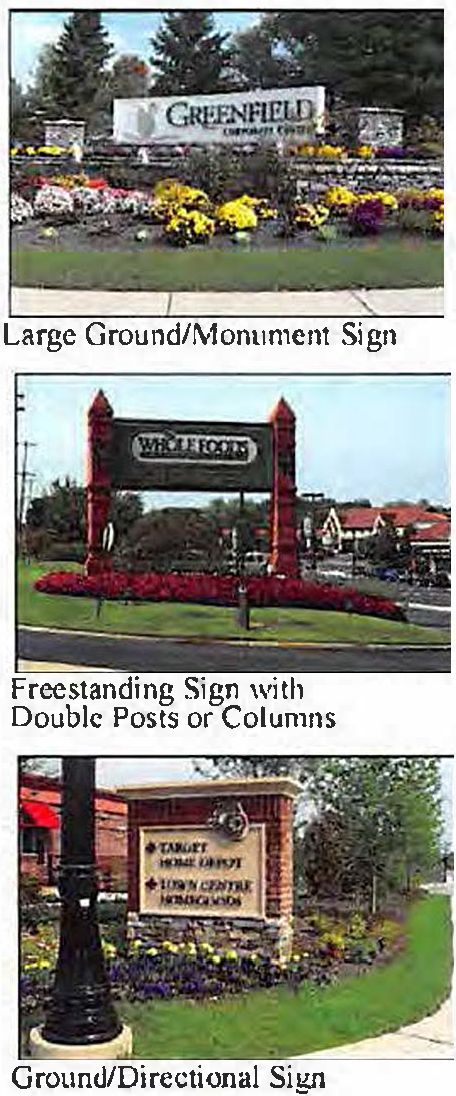
1.
In order to achieve a sign area bonus of up to ten percent, the applicant shall demonstrate, through the submission of plans and images, that the proposed signage will provide the features described below and in § 240-2112 as applicable, and will be constructed and maintained with quality materials similar to those depicted herein.
2.
Low walls of masonry material and generous landscaping.
a.
Stone walls.
b.
Stone piers.
c.
Seasonal flowers and evergreen shrubs in a continuously mulched planting bed.
3.
Masonry materials, and generous landscaping at base of freestanding/pylon sign.
a.
Brick posts or columns with detailing.
b.
Finial cap on columns.
c.
Seasonal flowers in a continuously mulched planting bed.
4.
Varied masonry materials and complimentary landscaping.
a.
Stone base.
b.
Brick body.
c.
Sandstone cap.
d.
Seasonal flowers, perennial flowers, and evergreen groundcovers in a continuously mulched planting bed.
ILLUSTRATIONS OF SIGN TYPES
Multi-Tenant Directory Wall Sign: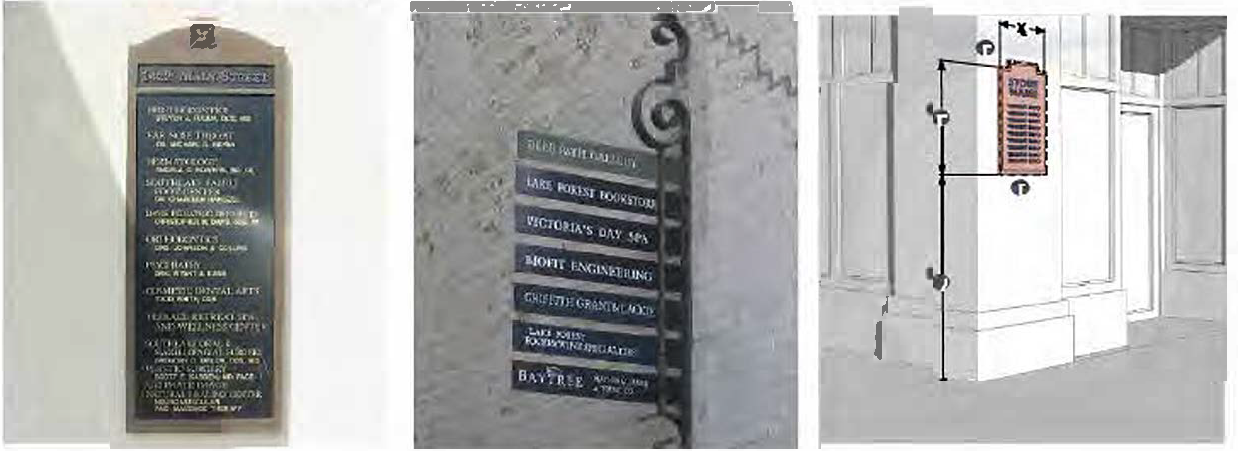
Portable sign-Sandwich Board: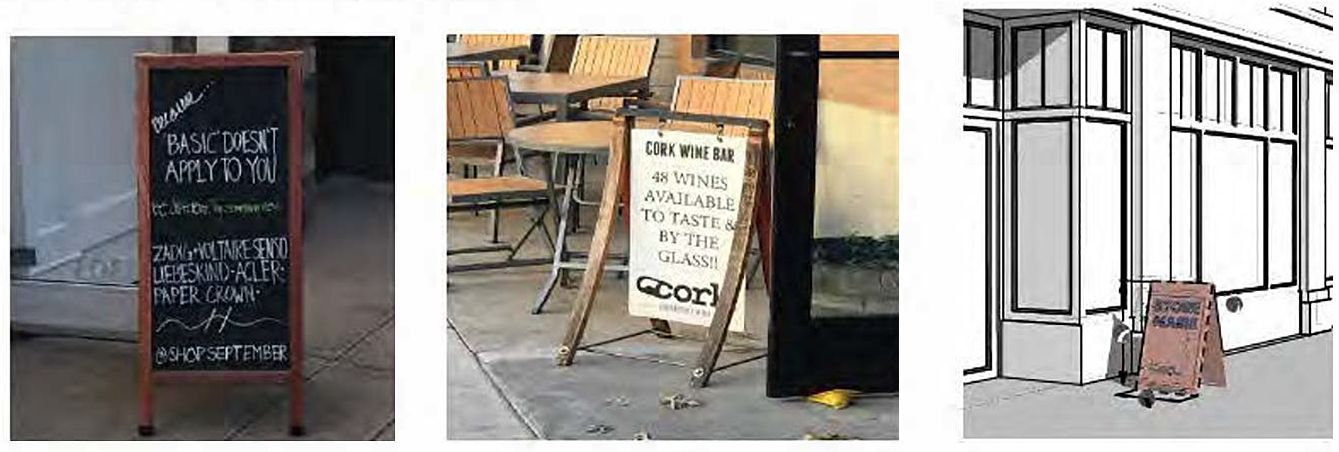
Awning sign: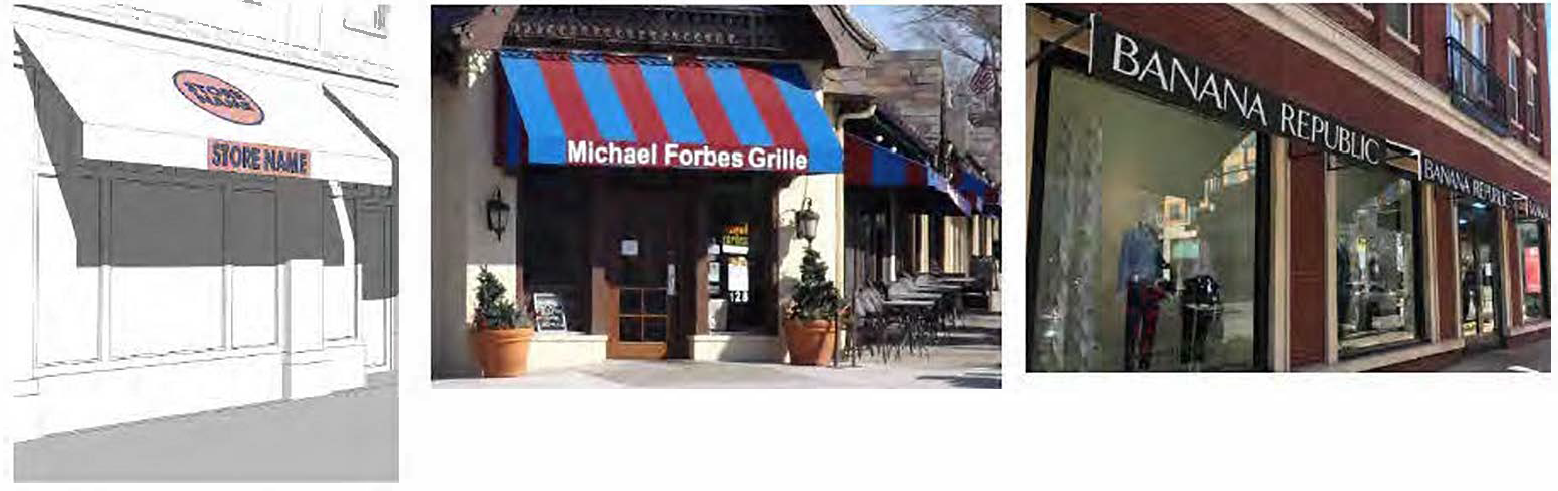
Ground Signs: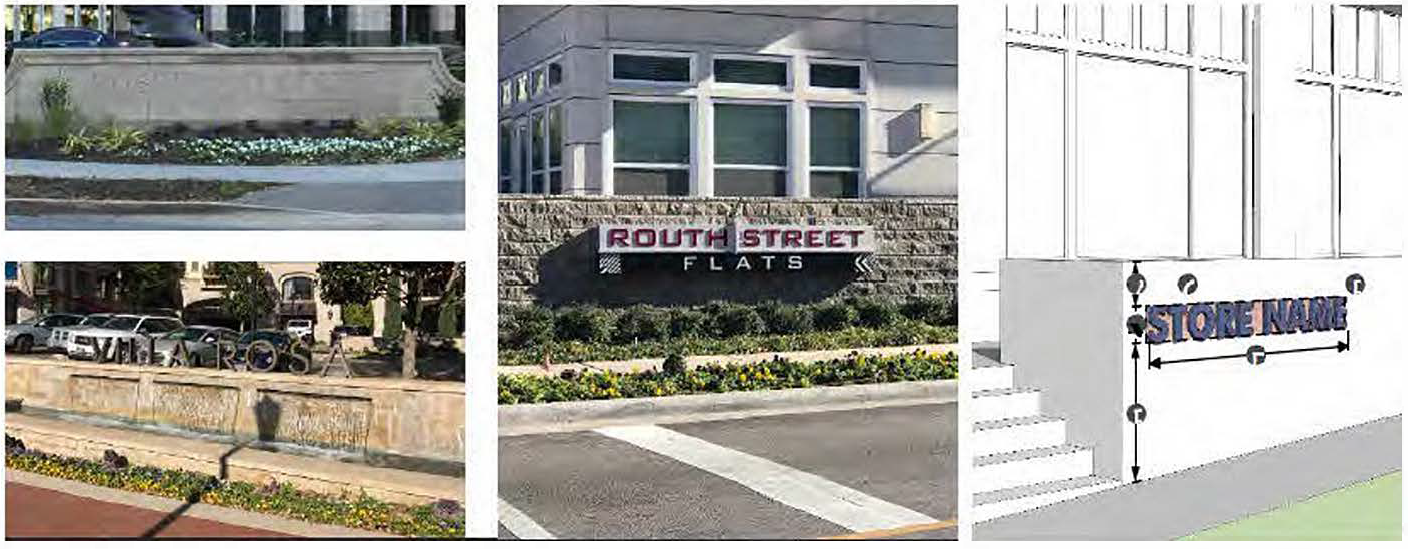
Windows Signs: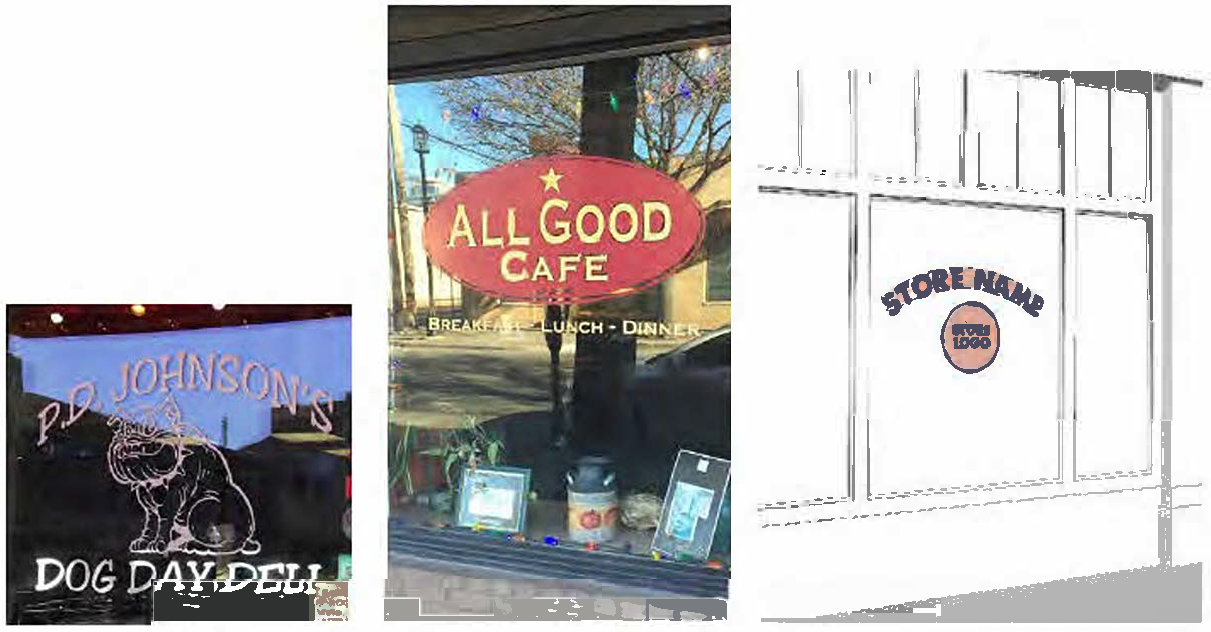
Wall Signs: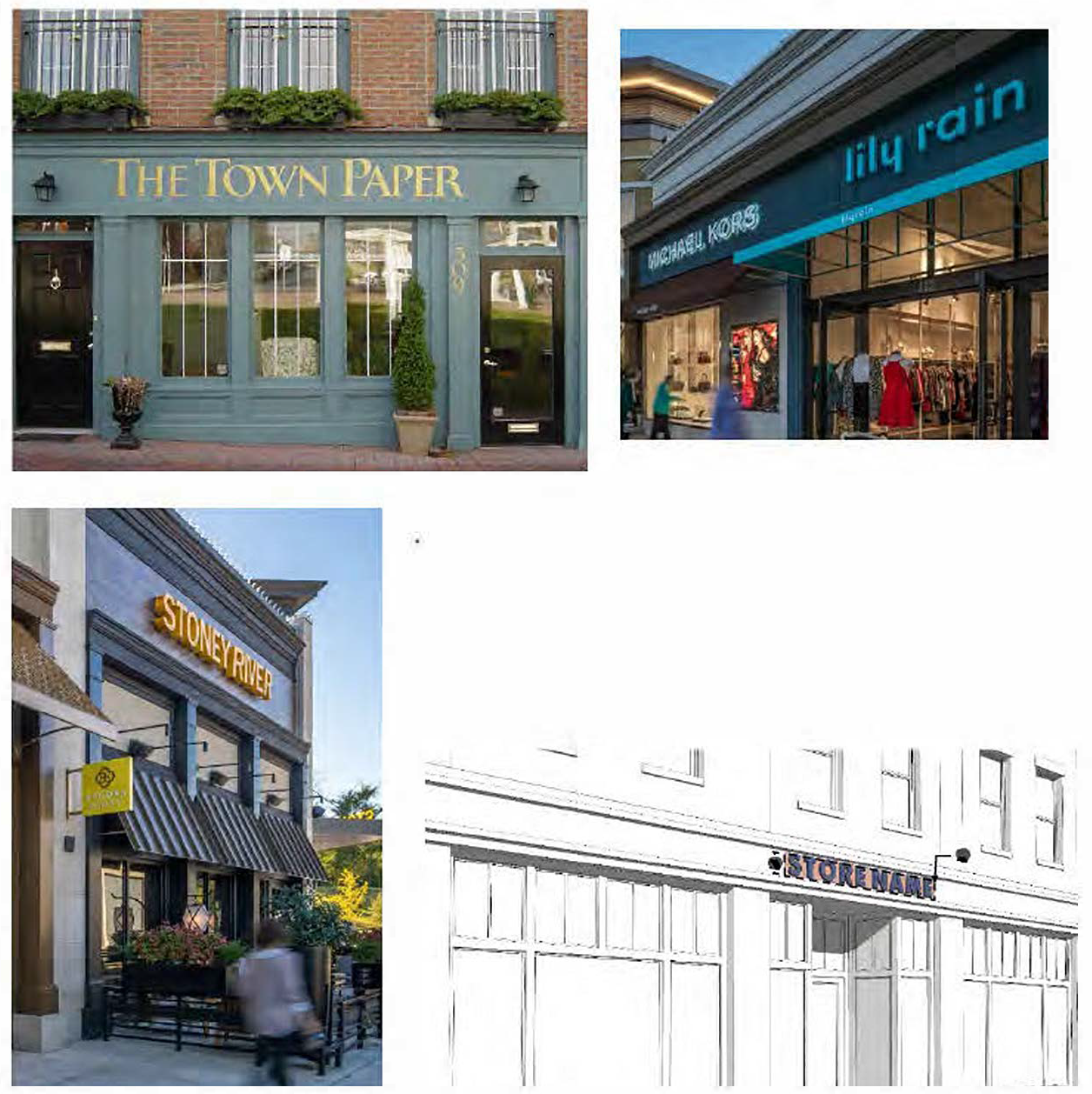
Projecting Signs: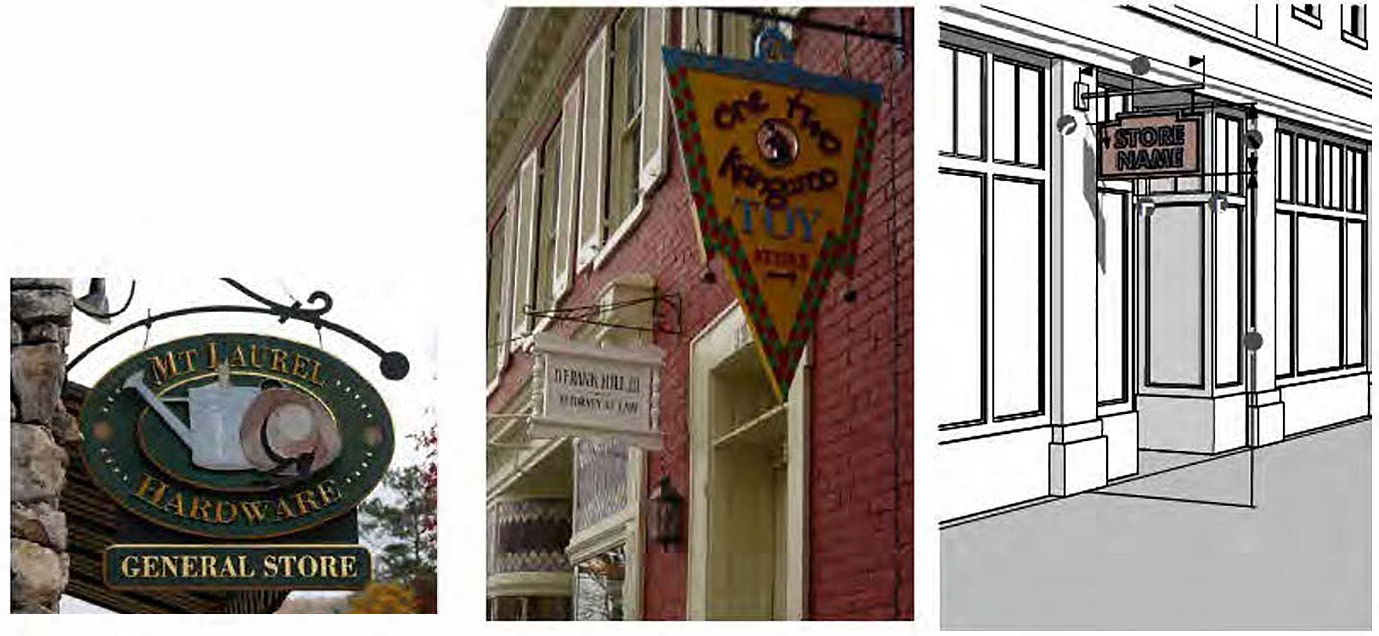
(Ord. No. 300, § I, 2-1-2023)