
Kennewick City Zoning Code
CHAPTER 18
12 - ZONE DISTRICTS AND STANDARDS
18.12.010 A.1: - Residential Use Table.
The following table lists uses allowed by zone and the applicable City review process as follows: Review Process I = Staff review, Review Process II = Conditional Use Permit, Review Process III = Temporary Homeless Encampment Permit. If a use is listed with a blank, it shall be prohibited in that zone. For certain categories of uses, additional requirements are also noted:
FOOTNOTES for Table 18.12.010 A-1 Residential Use Table:
(1)
No permit required for a family day care home (up to six charges). Per 18.12.070, if alterations are made a building permit will be required. A state license and city business license is required.
(2)
Residential development is permitted in the PF zone when the land will be owned and/or operated by the Kennewick Housing Authority or other public or governmental agency. Residential developments in the PF zone shall meet all requirements of this title as though it were developed in the RH zone.
(3)
Not used.
(4)
Not used.
(5)
Residential Care Homes, state or federally approved, with six or fewer residents and any required on-site residential staff permitted by right; all larger group living uses prohibited.
(6)
Residential Care Centers are permitted outright, subject to all of the applicable provisions of this title.
(7)
Recreational vehicle storage in R districts shall refer to Title 18.12.180 and shall be subject to special provisions applicable to Master Planned subdivisions.
(8)
Subject to KMC 18.42.140 and KMC 18.78.
(9)
In "RS" zones, agriculture and animal husbandry are permitted including keeping of farm animals such as horses, cows, and sheep, but maintained only on lots of at least 30,000 square feet. The keeping of farm animals must not exceed one animal per half acre.
(10)
Swimming pools considered an accessory use.
(Ord. 25-6162, Sec. 1, 2025; Ord. 25-6110 Sec. 1, 2025; Ord. 25-6102 Sec. 1, 2025; Ord. 6007, Sec. 1, 2023; Ord. 5748 Sec. 1, 2018;Ord. 5729 Sec. 1, 2017; Ord. 5712 Sec. 1, 2017; Ord. 5558 Sec. 2, 2014; Ord. 5528 Sec. 2, 2013; Ord. 5462 Sec. 3, 2012; Ord. 5434 Sec. 4, 2012; Ord. 5309 Sec. 8, 2010; Ord. 5262 Sec. 2, 2009; Ord. 5204 Sec. 5, 2007; Ord. 5180 Sec. 1, 2007)
18.12.010 A.2: - Table of Residential Site Development Standards.
Minimum and maximum residential standards are identified in the following table.
FOOTNOTES for Table 18.12.010 A.2 Residential Standards Table:
(1)
Maximum Density - The maximum permitted number of lots/units in the RM and RH zone is determined by dividing the gross area of the parcel in square feet by 43,560 square feet, multiplied by the allowed maximum density under table 18.12.010. The closest whole number is the permitted maximum number of lots/units. If the unit density is greater than the maximum density as calculated, then unit density will be used to determine the maximum number of middle housing units permitted on the lot.
(a)
Unit density for RS, RL, RMH, RM, and RH zones is four middle housing units unless the lot is less than 1,000 square feet in size.
(i)
Accessory Dwelling Units, as permitted in KMC 18.12.020, apply towards the total number of units permitted.
(ii)
Six middle housing units per lot may be approved if at least two of those units are affordable housing meeting the following requirements, unless zoning permitting higher densities or intensities applies:
(A)
Dwelling units that qualify as affordable housing shall have costs, including utilities other than telephone, that do not exceed 30 percent of the monthly income of a household whose income does not exceed the following percentages of median household income adjusted for household size, for the county where the household is located, as reported by the United States Department of Housing and Urban Development:
(I)
Rental housing: 60 percent.
(II)
Owner-occupied housing: 80 percent.
(B)
The units shall be maintained as affordable for a term of at least 50 years, and the property shall satisfy that commitment and all required affordability and income eligibility conditions.
(C)
The applicant shall record a covenant or deed restriction that ensures the continuing rental or ownership of units subject to these affordability requirements consistent with the conditions in chapter 84.14 RCW for a period of no less than 50 years.
(D)
The covenant or deed restriction shall address criteria and policies to maintain public benefit if the property is converted to a use other than that which continues to provide for permanently affordable housing.
(E)
The units dedicated as affordable housing shall:
(I)
Be provided in a range of sizes comparable to other units in the development.
(II)
The number of bedrooms in affordable units shall be in the same proportion as the number of bedrooms in units within the entire development.
(III)
Generally, be distributed throughout the development and have substantially the same functionality as the other units in the development.
(b)
Where maximum density exceeds unit density, maximum density will [be] used to determine the number of units permitted on a lot.
(2)
Yards:
(a)
Street: Building setback lines will be measured from the back of the sidewalk. Where no sidewalk exists and in the UMU district, building setback lines will be measured from the right-of-way line. (See fig. 1a-b)
(i)
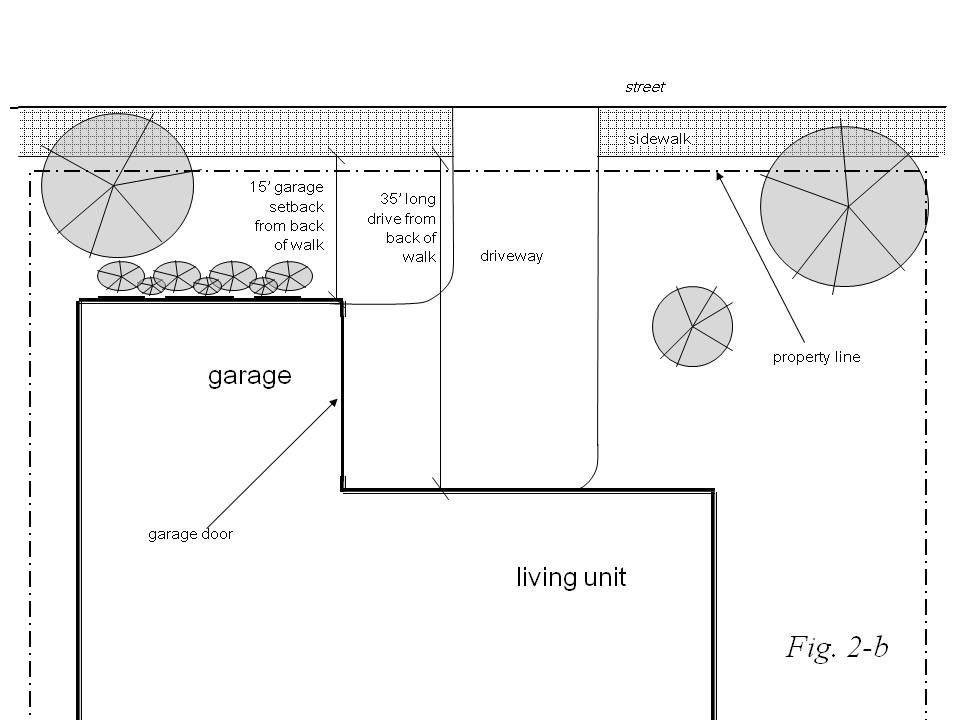
For garages that face a no-street abutting property line (side-entry garages,) the garage setback may be reduced to 15 feet from the back of the sidewalk. The street facing façade of the garage shall be treated with windows, modulations and/or architectural design elements and features that mimic the remainder of the house. Landscaping shall also be required along the street-facing façade. (See fig. 2a-b)
(ii)
In no instance shall a vehicle or any other object be allowed to obstruct a pedestrian walkway/sidewalk.
(b)
Rear: As measured from an existing lot line or alleyway.
(c)
Side: Shall be five feet from the nearest side yard property line.
(i)
Single-family attached and zero-lot line housing shall have no setback on the side where the property line follows a common or zero-lot line wall.
(ii)
End units shall have a five-foot setback from the nearest side yard property line and no setback on the common wall side.
(d)
Lot Frontage: Lot frontage lines will be measured from the right-of-way line.
(e)
Where no street frontage exists, building setback and lot frontage lines will be addressed during the site plan or plat review process and must be approved by the Planning Director.
Fig. 1.a.
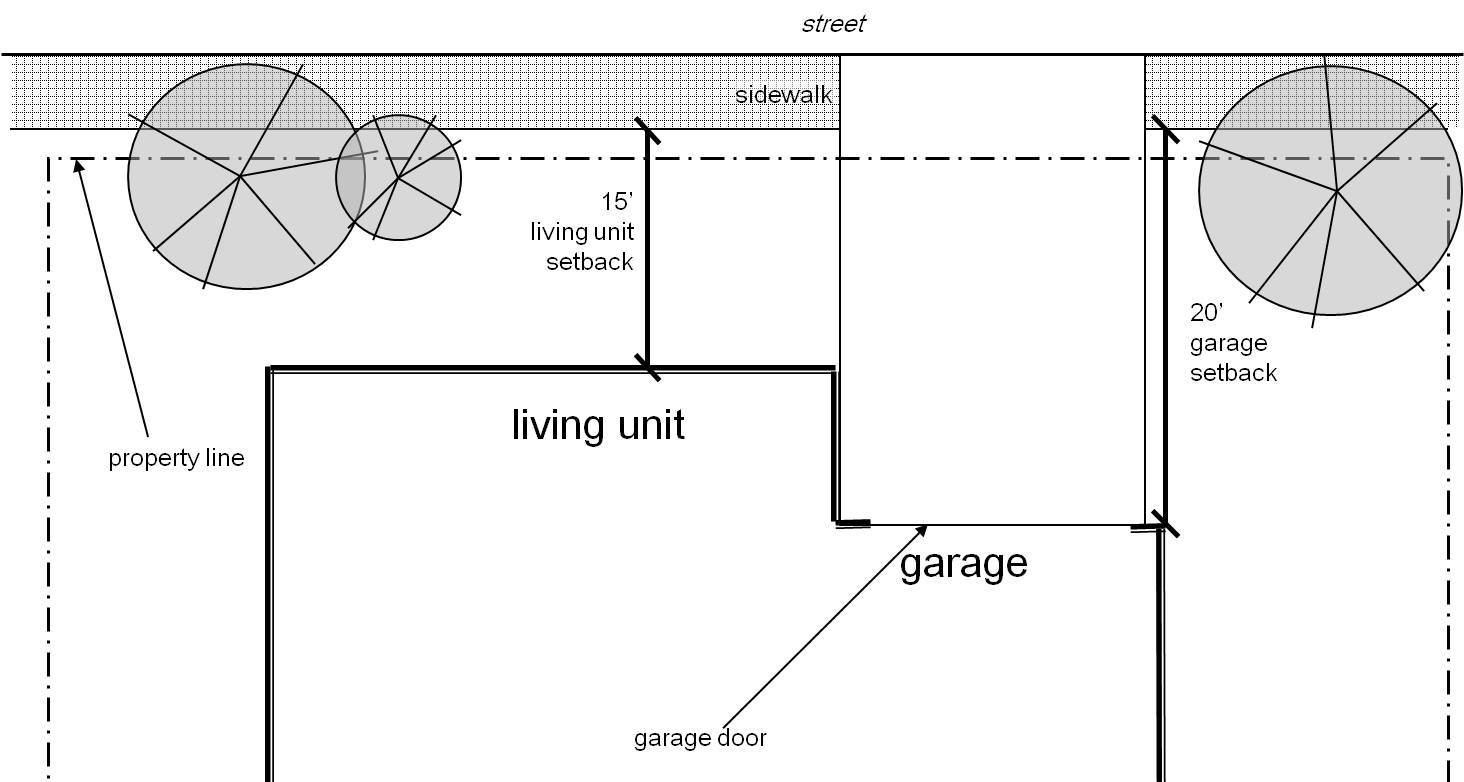
Fig. 2.a.
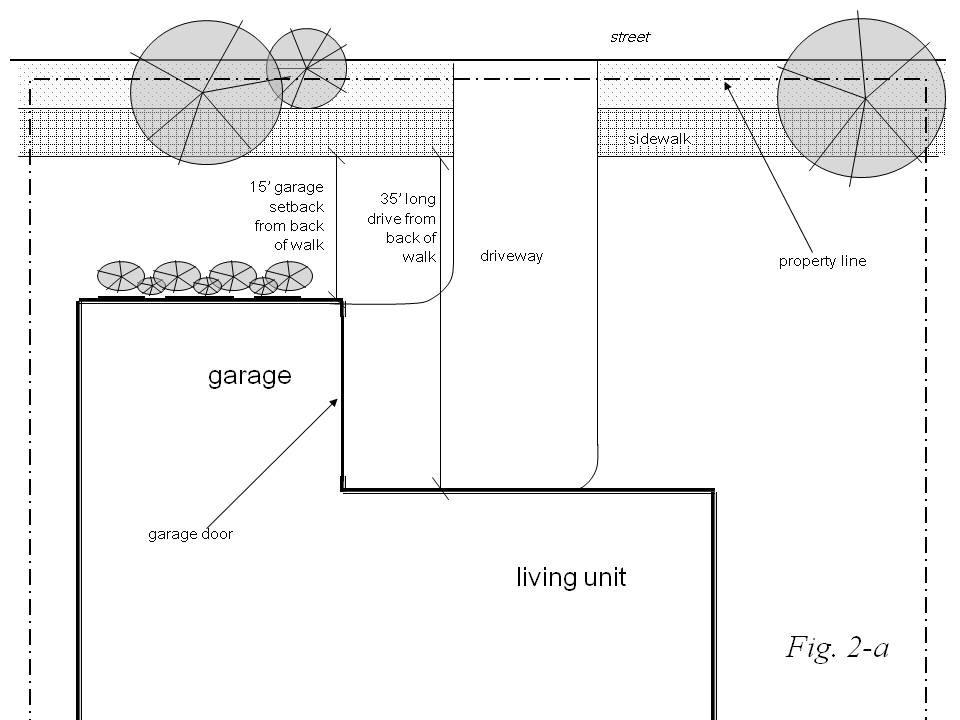
Fig. 2.b.
(3)
Open space calculations.
(a)
In multi-family developments, where the density exceeds seven units per acre and more than six units are proposed, the amount of required common open space shall equal or be greater than the minimum aggregate area of provided bedrooms based on the following formula: 300 square feet for the first bedroom and 200 square feet for each additional bedroom; exclusive of required street frontage setbacks and required parking areas. "Open area" is an area with average dimensions of not less than 15 feet by not less than 500 square feet. More than one open area may be provided in a given development. Any interpretation of this Section will be made by the Director.
(b)
Within the UMU district, new developments with a lot area of more than 20,000 square feet shall provide a pedestrian-oriented space (plaza, courtyard or similar space) of at least one percent of the site area as described below. Buildings that front on a public sidewalk and have a pedestrian-oriented commercial use facing that sidewalk are exempt from this open space requirement.
(i)
Pedestrian-oriented space must include:
(A)
Visual and pedestrian access including barrier-free access) to the abutting structures from the public right-of-way or a non-vehicular courtyard.
(B)
Paved walking surfaces of either concrete or approved unit paving in areas intended for foot traffic.
(C)
On-site or building mounted lighting providing at least 0.6 foot-candles (average) on the ground.
(D)
At least three feet of seating area (bench, ledge, etc.) or one individual seat per 60 square feet of plaza area or open space.
(E)
Landscaping to enhance the area.
(F)
At least 25 percent of the plaza or courtyard must be shaded by structure or tree canopy (at least ten years after planting).
(ii)
Outdoor pedestrian-oriented space shall not include:
(A)
Asphalt or gravel pavement (Exception: decomposed granite and other architectural surface treatments).
(B)
Adjacent unscreened parking lots.
(C)
Adjacent chain link fences.
(D)
Adjacent "blank walls".
(E)
Adjacent dumpsters or service areas.
(F)
Outdoor storage or retail sales (shopping carts, potting soil bags, firewood, etc.) that do not contribute to the pedestrian environment.
(iii)
In-Lieu Provisions—Pedestrian-Oriented Space Requirement in Urban Mixed Use (UMU) District: Provided all of the following requirements are met, required publicly accessible open space in the Urban Mixed Use (UMU) District will be provided on the site containing the permitted land use.
(A)
The proposing owner or developer shall improve and may, at their and the city's discretion, dedicate land to provide the pedestrian-oriented space requirement in accordance with the approval of the planning official, or shall pay a fee in lieu of such improvement and dedication if the planning official determines that the dedication and improvement of land is not feasible or desirable due to the physical characteristics of the site.
(B)
The property owner or developer shall either:
(I)
Provide and construct (and optionally dedicate) the on-site pedestrian-oriented space requirement to city design and construction standards subject to city approval or:
(II)
Enter a voluntary agreement with the city to pay an amount equal to the city's cost of acquiring and constructing the pedestrian-oriented space requirement in another location within the same UMU District as identified and approved by the planning official.
(4)
Mobile Home Park Requirements:
(a)
New Mobile Home Parks: For Residential Trailer Parks developed after January 1, 1998, the following spacing standards may be utilized:
(i)
When each primary structure has a 20-foot front and rear yard (18.09.1950) or open space, the following spacing standards apply: side-by-side, end-to-end and parallel - ten feet between each primary structure; accessory structures that meet provisions of the International Building Code must have a minimum four-foot setback between the primary structure unless attached to the primary structure, and must have a minimum six-foot setback between adjacent primary and accessory structures.
(b)
Ten feet setback from all property lines; 20 feet from an existing right-of-way line or proposed right-of-way line whichever is greater.
(c)
Spacing: 20 feet between mobile homes located side-by-side, end-to-end and parallel. End-to-end, ten feet if the extended outside edge does not project beyond the extended centerline of the adjacent unit. There must be 20 feet between any mobile home and any permanent structure; ten feet between any mobile home and any accessory structure unless attached to the mobile home in accord with the State of Washington and the International Building Code; ten feet between any occupied travel trailer and any mobile home, accessory structure or permanent building. The average distance between adjacent, angular mobile homes must not be less than 20 feet with the closest point no less than ten feet.
(d)
Mobile Home Roadways: Each manufactured home must be served by at least one 30-foot-wide roadway for two moving lanes of traffic and a three-foot delineated, pedestrian walkway. If on-roadway parking is allowed, the roadway width must be increased accordingly. All roadways must be improved with asphalt, bituminous surface treatment or an equivalent.
(5)
Single-Family Homes (attached and detached); Manufactured Homes; Middle Housing:
(a)
Intent: It is the intent of the section to set forth the terms and conditions under which single-family homes (which includes manufactured homes) and middle housing may be sited.
(b)
Minimum siting standards: The following standards apply to the siting of all single-family homes and middle housing, whether site-built homes or manufactured homes. Where any conflict arises between these regulations and the adopted building code, the stricter standard shall apply.
(i)
Foundation: All dwellings shall be placed on permanent foundations;
(ii)
Minimum width: A dwelling shall not be less than 14 feet in width at the narrowest point of its first story;
(iii)
Age of dwelling (for manufactured homes only): no manufactured home more than three years old on the date of installation or previously lived in shall be permitted on any lot.
(6)
Townhouse Development:
(a)
There must be at least ten feet on end between groups. This space may either be end unit lots or common open space, and, if so, there may be openings in the end units;
(b)
The number of connected units may not exceed eight;
(c)
All units with a common wall must be constructed concurrently and be under the same ownership at the time of initial construction;
(d)
Common walls must follow property lines and have no openings.
(7)
Urban Mixed Use District:
(a)
Legal lots of record existing as of June 1, 2017, shall be deemed to be in compliance with the lot size restrictions, however after June 1, 2017, no lot intended for single-family use shall be created in excess of 5,000 square feet.
(b)
Setbacks for all residential uses shall be measured from property lines.
(c)
Building setback from front and side property lines are not required, except as mandated by the applicable local, state and federal codes.
(8)
Cottage Housing:
(a)
Open Space. Open space shall be provide equal to a minimum 20 percent of the lot size. This may include common open space, private open space, setbacks, critical areas, and other open space.
(b)
Common Open Space.
(i)
At least one outdoor common open space is required.
(ii)
Common open space shall be provided equal to a minimum of 300 square feet per cottage. Each common open space shall have a minimum dimension of 15 feet on any side.
(iii)
Orientation. Common open space shall be bordered by cottages on at least two sides. At least half of cottage units in the development shall abut a common open space and have the primary entrance facing the common open space.
(iv)
Parking areas and vehicular areas shall not qualify as common open space.
(v)
Critical areas and their buffers, including steep slopes, shall not qualify as common open space.
(c)
Entries. All cottages shall feature a roofed porch at least 60 square feet in size with a minimum dimension of five feet on any side facing the street and/or common open space.
(d)
Community Building.
(i)
A cottage housing development shall contain no more than one community building.
(ii)
A community building shall have no more than 2,400 square feet of net floor area, excluding attached garages.
(iii)
A community building shall have no minimum off-street parking requirement.
(9)
Courtyard Apartments.
(a)
Yard or Court.
(i)
At least one yard or court is required.
(ii)
The yard or court shall be bordered by attached dwelling units on two or three sides.
(iii)
The yard or court shall be a minimum dimension of 15 feet on any side.
(iv)
Parking areas and vehicular areas do not qualify as a yard or court.
(b)
Entries. Ground-related courtyard apartments shall feature a covered pedestrian entry, such as a covered porch or recessed entry, with minimum weather protection of three feet by three feet, facing the street or yard or court.
(Ord. 25-6163, Sec. 1, 2025; Ord. 25-6102 Sec. 2, 2025; Ord. 24-6074 Sec. 1, 2024; Ord. 5764 Sec. 1, 2018; Ord. 5743 Sec. 2, 2018; Ord. 5712 Sec. 2, 2017; Ord. 5647 Sec. 1, 2016; Ord. 5542 Sec. 1, 2014; Ord. 5504 Sec. 1, 2013; Ord. 5407 Sec. 4, 2012; Ord. 5365 Sec. 3, 2011; Ord. 5309 Sec. 9, 2010; Ord. 5204 Sec. 6, 2007; Ord. 5180 Sec. 1, 2007)
18.12.010 B.1: - Table of Non-Residential Uses.
The following table list uses allowed by zone and the applicable City review process as follows: Review Process I = Staff review, Review Process II = Conditional Use Permit. If a use is listed with a blank, it shall be prohibited in that zone. For certain categories of uses, additional requirements are also noted.
FOOTNOTE for Table 18.12.010 B.1 Non-Residential Use Table:
(1)
For HMU see limitations at Title 18.12.335.
(2)
For the Clearwater Master Plan Area and BP zoning districts see Title 18.12.340.
(3)
For Rental Equipment, all items must be contained within a completely enclosed building or screened from view by a sight-obscuring fence or wall.
(4)
Allowed in RS, RL, RM, RMH, and RTP only as part of a planned development or subdivision and only for the use by residents of the development consistent with Recreational Vehicle Storage provisions and limitations of the Kennewick Residential Design Standards KMC 18.75.
(5)
Winery Type B under 50,000 case annual production and located within a structure less than 20,000 square feet in size are allowed outright. The Conditional Use Process identified in Title 18.42.100 is applicable to Winery Type B uses exceeding either the 50,000 case annual production or 20,000-square-foot structure size threshold.
(6)
Not allowed in the Vista Field area.
(Ord. 6043 Sec. 1, 2023; Ord. 5852 Sec. 1, 2020; Ord. 5748 Sec. 2, 2018; Ord. 5712 Sec. 3, 2017; Ord. 5670 Sec. 1, 2016; Ord. 5572 Sec. 1, 2014; Ord. 5542 Sec. 2, 2014; Ord. 5462 Sec. 4, 2012; Ord. 5434 Sec. 5, 2011; Ord. 5309 Sec. 10, 2010; Ord. 5262 Sec. 3, 2009; Ord. 5244 Sec. 3, 2008; Ord. 5204 Sec. 7, 2007; Ord. 5180 Sec. 1, 2007)
18.12.010 B.2: - Table of Non-Residential Site Development Standards.
Minimum and maximum non-residential use standards are identified in the following table. Additional site design standards are included under 18.12.340, below and in the Site Design Guidelines for Commercial, Office and Industrial Uses:
FOOTNOTES for Table 18.12.010 B-2 Non-Residential Standards Table:
(1)
Street frontage: 20 feet, except for fuel island canopies, which may encroach up to five feet from the street property line with the outer edge of the canopies, provided that the canopy support pillars are at least 15 feet from the nearest street property line.
(a)
Non-street frontage: None; unless the use abuts an R or HMU district, in which case 20 feet.
(2)
All activity, other than off-street parking, loading, or gasoline sales must be kept within a completely enclosed building. However, live plant material may be stored outside if parking is not affected.
(3)
Street Frontage: Only that necessary to comply with Chapters 13.12, 18.21, and 18.27. The right-of-way is determined in accord with Section 5.56.51.
(a)
View obstruction setbacks must be improved with asphalt, concrete, or some other comparable dust-free and weed free material, or landscaped to prevent dust and weeds with adequate irrigation or otherwise maintained to prevent weeds, dust and rubbish.
(b)
Side and Rear: None; but 20 feet on sides abutting R or HMU districts.
(4)
All service, processing and storage areas abutting any R district at ground floor level or within 20 feet or visible from a street, must be within a completely enclosed building or screened from view by a permanently maintained, sight-obscuring fence at least six feet high. Except for vehicles, no storage shall extend above the fence.
(5)
HMU-Historic, Mixed Use District Development Standards:
(a)
Floor area ratio (the amount of building surface expressed as a ratio to lot surface) is a maximum of .45;
(b)
New construction of dwellings, business buildings, and exterior remodeling of existing structures (including re-roofing, re-siding, additions and similar exterior changes) require conformance with the following criteria:
(i)
Maximum building height - 30 feet;
(ii)
Roof pitch - not less than 4:12;
(iii)
Orientation - main entranceways oriented directly or as near directly to the street as possible;
(iv)
Openings - blank walls must be avoided. A combination of windows, doors, balconies, alcoves, bay windows, porches or similar architectural features must comprise a minimum of 25 percent of the total street wall area and a minimum of 20 percent of the total area of each of the remaining walls, with the exception of the rear wall;
(v)
Windows - mirror or mirror-like composition or exterior finishes are prohibited;
(vi)
Siding and roofing - metal, vinyl or plastic siding or roofing is allowed, provided the finish is not reflective, and in the case of metal, is anodized;
(c)
The structure shall be similar in character to the surrounding residential structures.
(d)
Yards:
(i)
Front and side yards in the HMU District shall be as follows:
(ii)
Rear yards - None, provided that the Floor Area Ratio ("F.A.R.") and other setbacks are observed;
(e)
Accessory structures must conform to 18.27.030;
(f)
Signage shall conform with Section 18.24 with the following changes:
(i)
A maximum height limit of 15 feet for freestanding signs;
(ii)
The maximum sign area for all signs is 24 square feet. Included in this total is an eight square foot maximum for signage that is attached, drawn, or installed on the structure or any portion of the structure;
(iii)
Internally lit signage and signage utilizing flashing lights is prohibited. Lighting shall be by indirect methods;
(iv)
Nonconforming signs having a replacement value of less than $2,500.00 shall be made conforming by June 30, 2000;
(v)
Multi-tenant businesses are permitted 24 square feet of signage for the initial business and eight square feet per additional business to a maximum of 48 square feet;
(g)
Parking requirements in this district shall conform with Section 18.36, with the following exceptions:
(i)
Parking requirements for unlisted uses is one space per 250 square feet of building space devoted to business activities. This formula takes into account space used for retail activity, record storage, office and clerical space, or other areas normally and primarily used for business purposes;
(ii)
Total number of off-street parking stalls required may be reduced one space for each 20 feet of linear frontage along a public street that is legal for parking purposes;
(h)
Landscaping requirements in this district shall conform with Section 18.21, with the following exceptions:
(i)
Landscaping must incorporate street frontage setback landscaping per the design requirements of Section 18.21.060(1)(a); this requirement does not use side and rear yard ratios in its calculation;
(i)
Public hours of operation for commercial uses must begin at or after 7:00 a.m. and end at or before 8:30 p.m., with the exception of Bed and Breakfasts, which by nature require 24-hour service.
(j)
Retail sales incident to the uses listed in 18.12.010 B-1: Table of Non-Residential Uses are permitted, provided that such incidental sales do not occupy more than 25 percent of the gross street floor area of the primary structure. For purposes of this calculation, retail activity is that portion of the gross street floor located in one designated area of such street floor used for goods transactions. It does not include storage or record keeping space.
(6)
Yard requirements: (see Section 18.12.330 for City location-related standards).
(a)
Front: 15 feet;
(b)
Corner/flanking street: Ten feet;
(c)
Side: Zero feet for the interior non-perimeter lot lines of a parent parcel. Once a parent parcel is platted or subdivided, only the internal lot lines shall be allowed to have zero foot side yards. All perimeter lot lines of the parent parcel have a ten-foot side yard setback requirement. Buildings constructed with side yards less than ten feet shall not be longer than 300 feet. A property owner's association must be formed and a maintenance agreement executed, as approved by the Planning Director, providing for perpetual maintenance common of landscaped areas for developments with buildings with side yards of less than ten feet. The maintenance agreement shall be recorded and run with land and shall provide for the City of Kennewick to arrange for maintenance of landscaped or common areas in the event the property owners fail to maintain these areas or their association dissolves. The agreement must be recorded prior to the land division;
(d)
Side yards abutting R or HMU zones must be a minimum of 20 feet;
(e)
Rear: Ten feet, unless abutting an R zone, in which case the minimum setback is 25 feet;
(f)
Minimum street frontage: 30 feet.
(7)
Yards: (see Section 18.12.330 for City location-related standards).
(a)
Street frontage yards: 15 feet. View obstruction setbacks must be improved with asphalt, concrete, or some other comparable dust-free and weed-free material, or landscaped to prevent dust and weeds with adequate irrigation or otherwise maintained to prevent weeds, dust and rubbish.
(b)
Side and rear yards: 25 feet.
(8)
All service, processing and storage areas abutting any R district at ground floor level or within 20 feet and visible from a street, must be within a completely enclosed building or screened from view by a permanently maintained, sight-obscuring fence at least six feet high. Except for vehicles, no storage shall extend above the fence.
(9)
Street Frontage: Only that necessary to comply with Chapter 13.12 and Section 18.12.010 A-2 and B-1. The right-of-way is determined in accord with Section 5.56.51.
(a)
View obstruction setbacks must be improved with asphalt, concrete, or some other comparable dust-free and weed-free material, or landscaped to prevent dust and weeds with adequate irrigation or otherwise maintained to prevent weeds, dust, and rubbish.
(b)
Side and Rear: None; but 25 feet on sides abutting R or HMU districts.
(10)
All service, processing, and storage areas abutting any R or HMU districts at ground floor level must be within a completely enclosed building or screened by a permanently maintained sight-obscuring fence at least six feet high.
(11)
All yards must be a minimum of 20 feet, unobstructed by structures or accessory uses.
(12)
Street frontage: 20 feet if adjacent to an R District; Non-street frontage: none unless the use abuts an R or HMU district or use, in which case, 20 feet.
(13)
All storage areas visible from any street abutting a site or from any abutting R district at ground floor level, must be within a completely enclosed building or screened from view by a permanently maintained sight-obscuring fence at least six feet high. Except for vehicles and rolling equipment, no storage shall extend above the fence.
(14)
Building heights in the CM district shall be 35 feet except for the height limits provided in Chapter 18.68, Appendix A-6-3, Clover Island - Height Limitation Exhibit.
(15)
Aviation uses shall be no closer than 75 feet from the curbline of West Rio Grande Avenue or West Grandridge Boulevard.
(16)
Development in the Central Business District (CBD) zoning district is subject to the following development standards:
(a)
A single architectural style is not required for new or remodeled buildings, but a building's style shall be consistent throughout; details from different eras shall not be mixed on a single building. Traditional detailing is required.
(b)
A building's elevation and mass must be modulated to match or replicate the narrow commercial façades typical of original development, and give a sense of human scale. Reuse original façades where possible and economically feasible.
(c)
New construction shall be consistent with the height, scale, setbacks or massing of nearby historic buildings.
(d)
Appropriate building facing materials include: brick, wood, stucco, stone, and cast iron storefronts. Building materials for new buildings shall support the existing character of older buildings, by having a projected physical life cycle of 100+ years.
(e)
The following street front siding materials are prohibited:
(i)
Plain concrete masonry unit;
(ii)
Unfinished tilt-up concrete slab;
(iii)
Corrugated metal; or
(iv)
Vinyl or plastic siding.
(f)
Unpainted brick may not be painted, except for clear graffiti preventing finishes.
(g)
Building entries shall be located on the street side of the building. If the building does not front on a public street then the entry must be visible from a public street.
(h)
Buildings located on street corners shall have additional architectural detailing to emphasize the street corner, which may include, for example: corner entry, balcony, integrated signage, public art, and pedestrian amenities. Buildings or public amenities located on corners shall abut the property line on each side of the corner.
(i)
Blank façades shall not be visible to public spaces or rights-of-way. Treatments to alleviate blank façades may include windows, architectural detail, or materials with texture (e.g. brick, siding, etc.) or artwork such as sculpture.
(j)
Vestibules, entries, windows, and other architectural features shall provide further visual definition and reduce the visual mass of larger buildings. Façades shall reflect the scale and massing of historic structures and achieve proportions that give a sense of human scale.
(k)
First floor ceiling heights shall be taller than upper stories to reflect the historical pattern of construction. (First floor ceiling heights are a minimum of ten feet to accommodate transom windows.)
(l)
Awnings create visual interest and protect pedestrians from sun and rain and are encouraged in the CBD district subject to the following:
(i)
Awnings may be provided along the entire frontage of commercial buildings. They shall be of a size, scale and shape appropriate to the specific building, window and door trim. The underside of all awnings shall be enclosed to prevent birds from roosting or nesting.
(ii)
Awnings or canopies shall be supported solely by the building and be hung above the display window space at least eight feet above the public walkway.
(iii)
Awnings may extend four feet over the walkway from the building's face provided there is no obstruction of street trees and/or street lights as approved by the City.
(m)
Windows provide a visual entry into a business and the goods and services offered while providing security. Windows shall meet the following standards:
(i)
Display windows on the ground floor of retail and commercial buildings shall be the predominant surface on the first story, typical of original downtown Kennewick commercial buildings.
(ii)
New commercial construction shall provide a minimum of 50 percent of the first floor wall surface in windows that face the street based upon a minimum of ten feet of first floor height.
(iii)
No more than 25 percent of the gross square footage of display windows may be used for temporary or permanent signage for advertising, promotion or community service announcements.
(iv)
Windows shall not be permanently darkened by use of applied films at street level. First story windows shall not be covered but shall provide visual access from street and sidewalks. Windows located above the street level may be covered by curtains, shades, or other temporary coverings that do not distract from the historic relevance of the area.
(17)
Commercial, Auto Row District:
(a)
Yards:
(i)
Front: 25 feet;
(ii)
Side: None, unless abutting an R district, then ten feet;
(iii)
Rear: None, unless abutting an R district, then ten feet.
(b)
All service, processing and storage areas abutting any R district at ground floor level or within 20 feet or visible from a street, must be within a completely enclosed building or screened from view by a permanently maintained, sight-obscuring fence at least six feet high. Except for vehicles, no storage shall extend above the fence.
(Ord. 5852 Sec. 1, 2020; Ord. 5764 Sec. 2, 2018; Ord. 5743 Sec. 2, 2018; Ord. 5712 Sec. 4, 2017; Ord. 5542 Sec. 3, 2014; Ord. 5434 Sec. 6, 2012; Ord. 5366 Sec. 2, 2011; Ord. 5309 Sec. 11, 2010; Ord. 5212 Sec. 3, 2008; Ord. 5180 Sec. 1, 2007)
18.12.020: - Accessory Dwelling Units (ADUs).
Accessory dwelling units shall be permitted in all residential zoning districts, shall adhere the appearance of single-family residences and be subject to the following development standards:
(1)
Number of Accessory Dwelling Units Permitted: Two accessory dwelling units shall be permitted in all residential zoning districts in the following configurations:
(a)
One attached accessory dwelling unit and one detached accessory dwelling unit;
(b)
Two attached accessory dwelling units; or
(c)
Two detached accessory dwelling units, which may be comprised of either one or two detached structures.
(2)
Minimum lot size: Accessory dwelling units are permitted on all lots meeting the minimum lot size for the zone in which they are proposed;
(3)
Setbacks: Detached accessory structures are subject to the provisions of Section 18.27.030 with the exception of the maximum height;
(4)
Height: The maximum height for an ADU that is detached from the primary unit shall be 24 feet. The maximum height for an ADU that is attached to the primary unit shall be the maximum height permitted in that zone for the primary unit;
(5)
Total floor area: The total gross floor area of an ADU shall not exceed 1,100 square feet. In calculating living area, uninhabited floor areas such as garages and unheated storage areas are excluded;
(6)
Parking: A minimum of one off-street parking space per ADU is required, in addition to the spaces required for the primary dwelling unit;
(a)
If an attached garage is converted to an accessory dwelling unit, additional parking spaces must be improved elsewhere on the site to replace those lost.
(7)
Connection Charges: Shall be as specified by the applicable ordinances and resolutions;
(8)
Impact Fees: Accessory dwelling units shall be assessed 50 percent of the same impact fees applicable to the primary dwelling;
(9)
Conversion of Existing Structures: Existing structures, including those which are nonconforming in setbacks or lot coverage, may be converted to ADUs provided they meet applicable building code requirements;
(10)
Conversion of Accessory Dwelling Unit to Condominiums: An accessory dwelling unit may be converted into a condominium and sold, subject to city and state regulations governing condominiums.
(Ord. 6037, Sec. 1, 2023; Ord. 5528 Sec. 1, 2013; Ord. 5204 Sec. 8, 2007; Ord. 5180 Sec. 1, 2007)
18.12.030: - Adult Concessions (Entertainment and Retail).
(1)
Adult Entertainment and Retail taken together as "Concession," and defined by Section 18.09.070, are recognized as being uses that may prove detrimental in certain circumstances to its surrounding neighborhoods and thereby the following regulations are imposed:
(2)
No adult concessions, shall be located:
(a)
Within 500 feet of any Residential or Urban Mixed Use zone;
(b)
Within 500 feet of any public or private school, or any trade or vocational school that on a regular basis has at least one student under the age of 18 years;
(c)
Within 500 feet of any church or other religious facility or institution;
(d)
Within 500 feet of any park or any public facility or open space zone;
(e)
Within 1,500 feet of another adult concession.
(3)
No person owning, operating or managing an adult concession or their employee or agent shall invite, allow, or permit any person under the age of 18 years to enter or remain on the premises of any adult concession.
(4)
There shall be no window, marquee, or other display of any matter depicting or portraying specified anatomical areas, or specified sexual activities.
(5)
Violation of the use provisions of this section is declared to be a public nuisance per se, which shall be abated by a civil action only and not by criminal prosecution.
(6)
Adult Retail establishments shall be identified on the exterior of the establishment with a sign baring text only and using such terms as would be expected among the general public. No advertising, text, pictures or depictions shall be permitted anywhere in the windows, on the street (tent signs), store-front, marquee, or anywhere else other than on the approved signage. Terms such as "sale" etc. and other such advertising, as associated with mainstream advertising, will be accepted, subject to the interpretation of the Planning Director or an appointed official.
(7)
Nothing in this section is intended to authorize, legalize, or permit the establishment, operation, or maintenance of any business, building or use which violates any ordinance or statute of the City of Kennewick, County of Benton, State of Washington or the United States.
(Ord. 5712 Sec. 5, 2017; Ord. 5180 Sec. 1, 2007)
18.12.040: - Animal Keeping.
In R, HMU and UMU districts, dogs and cats of the age of ten weeks or older, rabbits, guinea pigs, fowl, pigeons, chickens (excluding roosters) and similar small animals may be kept so long as no more than three of each kind or a combined total of six are kept. All cages, pens, and runs must be maintained in a clean and sanitary condition and meet setbacks. Animals and birds must not roam or fly to adjacent properties. Animals and birds and their surroundings must be maintained to prevent a nuisance due to noise or smell. An increase in the allowable number will be permitted upon issuance of a Land Use Permit in accord with Section 18.42.
(Ord. 5712 Sec. 6, 2017; Ord. 5542 Sec. 4, 2014; Ord. 5180 Sec. 1, 2007)
18.12.050: - Automobile-Oriented Uses.
No vehicle service apparatus may be within 15 feet of a public way. Except for necessary access, automatic washing equipment, hydraulic hoists, pits, lubricating equipment, food preparation and washing equipment and the like must be kept within a completely enclosed building. All washing residue must be biodegradable and drained in accord with applicable public works standards.
(Ord. 5180 Sec. 1, 2007)
18.12.055: - Car Washes, Vehicular Access/Circulation/Fencing/Operation.
In CN zones, car washes shall be subject to the following:
(1)
The total number of bays shall be limited to three.
(2)
Noise:
(a)
Manufacturer's specifications clearly indicating level of noise submitted to City for review.
(b)
Noise shall be measured at receiving property in dBA to be conducted and approved by qualified professional acceptable to City.
(c)
Abutting residential property shall receive noise level not to exceed 57 dBA (KMC 9.52).
(d)
Noise generated by all associated equipment on site including vacuums must be designed, oriented and soundproofed to the extent that noise does not exceed that allowed in KMC 9.52.
(3)
Vehicular Access and Circulation:
(a)
The business must front an arterial or collector street. The same access shall be used for the convenience store and the car wash.
(b)
Stacking length shall provide at least two vehicle spaces per wash line. All maneuvering area, stacking lanes, and exit aprons shall be located within the car wash parcel itself. Public streets and alleys shall not be used for maneuvering or parking by vehicles to be serviced by the car wash.
(4)
Fencing (when abutting residential property):
(a)
Minimum six-foot tall sight obscuring fence is required in conjunction with solid (visual) screen landscaping.
(b)
The "Solid Screen" must be on the car wash side of the fence.
(c)
The fence shall be constructed of masonry, wood, or tight-boards with the support on the car wash (site) side of the fence.
(d)
The fence, solid landscape screen and other landscaping shall be permanently maintained and shall be kept structurally sound and safe.
(5)
Operation: Business hours shall be limited to between 6:00 a.m. through 8:00 p.m., except if automated and unmanned, a car wash would be available at all times.
(6)
All other applicable site planning standards and as required by the Kennewick Municipal Code shall apply.
(Ord. 5657 Sec. 1, 2016; Ord. 5309 Sec. 12, 2010; Ord. 5180 Sec. 1, 2007)
18.12.060: - Day Care Centers and Mini-Day Care Centers.
Day Care Centers and Mini-Day Care Centers are allowed upon approval of a Land Use Permit for Site Approval and the following additional conditions:
(1)
A Washington State day care or mini-day care license is required.
(2)
Comply with all building, fire safety, health code, and business licensing requirements.
(3)
Setbacks, screening, landscaping, lot size, building site, and lot coverage must conform with the regulations of the applicable Zoning District.
(4)
Parking requirements must conform to Chapter 18.36.
(5)
Mini-Day Care Centers located in the family abode are only allowed in RMH, RS, RL, and RTP zoning districts upon approval of a Conditional Use Permit in accord with Chapter 18.42.
(6)
A six-foot high solid board fence, masonry wall, or screened chain link fence must surround the outdoor play area. Note: a see-through fence of stout construction may be approved by the Planning Director (Review II) if special conditions such as good security, quiet setting and visual/aesthetic conditions merit. The site must be landscaped in a manner compatible with adjacent residences.
(7)
Any license required by the State or County must be obtained before issuance of a Business License.
(8)
No structural or decorative alteration is allowed which will alter the residential character of an existing residential structure used for a mini-day care center. Any new or remodeled structure must be designed to be compatible with the residential character of the surrounding neighborhood.
(9)
Limitations in Use of Family Residence. No mini-day care center shall be located in a private family residence unless the portion of the residence where the children have access is used exclusively for the children during the hours the center is in operation, or is separate from the usual living quarters of the family.
(10)
Land use permits are not required for day care centers and mini-day care centers when established in conjunction with a church, school or similar public or quasi-public residential use. A six-foot high solid board fence, masonry wall, or screened chain link fence must surround the outdoor play area. Any license required by the State or County must be obtained before issuance of a business license.
(11)
Accessory Use. A day care center or mini-day care center, if sited on the premises of a public or quasi-public use (18.09.370) shall be considered accessory to the principal use of the property concerned.
(Ord. 5462 Sec. 1, 2012; Ord. 5180 Sec. 1, 2007)
18.12.070: - Family Day Care Home.
A family day care home shall be permitted by right in all zoning districts permitting residences and shall be subject to the following requirements:
(1)
A Washington State family day care home license is required.
(2)
Comply with all building, fire safety, health code, and business licensing requirements.
(3)
Lot size, building size, setbacks, and lot coverage conform to the standards of the zoning district except if the structure is a legal nonconforming structure.
(4)
A safe passenger loading area must be provided.
(5)
No structural or decorative alternative, which will alter the single-family character of an existing or proposed residential structure or be incompatible with surrounding residences is permitted.
(6)
A residential use sign is permitted.
(Ord. 5462 Sec. 2, 2012; Ord. 5180 Sec. 1, 2007)
18.12.080: - Health Facilities.
Rest homes, nursing homes, congregate care, and convalescent homes, hospitals, and similar health facilities must have any required State or County license before occupancy.
(Ord. 5180 Sec. 1, 2007)
18.12.100: - Junk.
The storage or collection of junk, scrap, licensed or unlicensed, wrecked or inoperative vehicles, and equipment or parts thereof, or abandoned sheds, buildings or the like, are not permitted in any district.
(Ord. 5204 Sec. 9, 2007; Ord. 5180 Sec. 1, 2007)
18.12.110: - Kennels.
Commercial kennels and animal shelters must be located on a parcel so that all runs, pens, and cages are at least 150 feet from a residential zoning district. The kennel must be developed and maintained in accord with the provisions of Section 18.42.080 with the following additional requirements:
(1)
Kennels and animal shelters must be fully enclosed without open runs, and have interior walls, ceilings, and floors which are resistant to absorption of moisture and odors. Kennels in IH zoned areas may have open runs.
(2)
Kennels and animal shelters must provide for a minimum of three air changes per hour and must be constructed so that noise from the kennels meet standards contained in Section 9.52.060.
(Ord. 5180 Sec. 1, 2007)
18.12.120: - Manufactured Housing Display Areas.
(1)
Manufactured housing display areas are sales areas for living units that are constructed in a factory and transported to the residential setup location. Units in the display area must be used for display purposes only and must not be moved from the site except for replacement. Areas not used for parking, and a five-foot landscaped strip along all street frontages, must be improved with any combination of lawn, shrubs, decorative rock, etc. No portion of the display area, except pedestrian walkways, may be graveled. Storage areas for trade-ins must be graveled and kept weed free. Storage areas must be surrounded by a six-foot high sight-obscuring fence. A site plan is required as is a building permit for all permanent structures and sales offices. The display units need not be installed in accord with Chapter 15.60. All units must be skirted. Site improvements must conform with Chapters 13.12 and 18.27.
(2)
HUD-approved manufactured housing or Washington State Department of Labor and Industries-approved commercial coaches may be used as an office for a period not to exceed 36 months. The office must be skirted and blocked to the manufacturer's specifications and a building permit will be required. The office must be integrated into the site's overall design, including landscaping. After three years, the office must be relocated to another HUD-approved current year model or replaced by a permanent structure in conformance with the International Building Code.
(3)
A statewide association representing manufactured housing dealers may use a manufactured home as an office so long as it complies with other applicable building codes, zoning, and other land use regulations.
(Ord. 5180 Sec. 1, 2007)
18.12.130: - Mini-Storage and Recreation Vehicle Storage Development Standards.
The following requirements are applicable to all new mini-storage and recreational vehicle storage complexes and to expansions of existing facilities:
(1)
New single-level mini-storage complexes, fully enclosed recreational vehicle storage and expansions of the same, shall be subject to the following:
(a)
Access driveways to all storage units shall be paved and shall include a storm water drainage system designed by a professional engineer or architect licensed in the State of Washington and be in conformance with the adopted City of Kennewick standards.
(b)
Each doorway shall be lighted with a minimum of one-foot candle of luminance. Automatic photocell or motion-activated lights can fulfill this requirement.
(c)
Mini-storage complexes shall be screened from view from adjacent Commercial and Residential zones. Screening shall be accomplished in one or a combination of the following manners:
(i)
A six-foot masonry wall with one tree planted every 50 feet along the side and rear yards, with trees to reach a height of at least 30 feet at maturity; or
(ii)
A six-foot fence with a solid landscape screen as defined in KMC 18.21.030(2) and one tree planted every 50 feet along the side and rear yards with trees to reach a height of at least 30 feet at maturity.
(iii)
Open style wrought iron fencing with masonry columns or similar may be used along street abutting property lines when complimentary landscaping and building design comparable to the commercial design standards is used along the street.
(d)
All buildings shall have an eave of at least one foot.
(e)
In Commercial and Residential zones all buildings shall have a minimum of four feet of masonry wainscoting on the building exterior if visible from a public street.
(f)
Mini-storage complexes shall meet the requirements of KMC 18.21 for the office and parking lot areas as well as street frontage landscaping requirements.
(g)
Roofing materials shall be non-reflective to minimize glare on adjacent properties and public ways.
(h)
Barbed wire, razor wire and electric fences not be allowed unless in specific conditions when they are required for business safety.
(i)
Setbacks:
(i)
Front: 15 feet;
(ii)
Side: Five feet;
(iii)
Rear: Five feet, except when abutting single family residential zoning, then 15 feet;
(iv)
Primary entry gate: 50 feet from the back of the sidewalk.
(v)
When located in commercial zoning districts, mini-storage complexes shall be located a minimum of 150 feet from a street frontage property line.
(vi)
When located in the CC and CG zoning districts:
(A)
Properties containing street frontage on a principal arterial, minor arterial or collector street as classified under the Roadway Functional Classification Map of the Kennewick Citywide Transportation Plan or on Plaza Way or S Zintel Way shall maintain a minimum setback of 150 feet from the street frontage property line;
(B)
Properties containing street frontage on all other types of streets may be built adjacent to the street frontage property line, provided that the streetscape requirements of the Commercial Design Standards are met.
(2)
New multi-story mini-storage facilities and expansions of the same shall be subject to the following:
(a)
Not permitted in residential zones.
(b)
Commercial Zones, all new buildings and expansions shall be subject the Commercial Design Standards:
(c)
On the ground floor, 100% of the street facing frontage of the building shall consist of retail or professional service uses.
(i)
Display windows and storage alone do no constitute retail or professional uses.
(d)
Parking subject to KMC 18.36 - Off Street Parking.
(e)
Setbacks:
(i)
Subject to the requirements of KMC 18.12.010 B.2.
(ii)
Primary vehicular entry gate: 50 feet from the back of the sidewalk.
(f)
Landscaping: Applicable requirements of KMC 18.21.
(3)
Open air recreational vehicle storage facilities and expansion of the same, shall be subject to the following:
(a)
Access driveways shall be paved; and storage areas shall be paved or prepared with three inches of five-eighths minus gravel topped by one- inch of one-inch rolled rock and shall include a storm water drainage system designed by a professional engineer or architect licensed in the State of Washington; maintained in a weed free condition; be graveled as necessary to eliminate dust; and must be subject to a designated and approved customer parking plan that includes physical markers for storage areas and barriers for access drives.
(b)
Exterior lighting shall be shielded or hooded so that direct light does not spill to adjacent properties.
(c)
In addition to the requirements of KMC 18.21, Landscaping, all storage complexes shall have a minimum five-foot landscaped area meeting KMC 18.21.060(1)(a) when adjacent to a residential zoning district.
(d)
Roofing materials shall be non-reflective to minimize glare on adjacent properties and public ways.
(e)
Barbed wire, razor wire, and electric fences shall not be allowed unless in specific conditions when they are required for business safety.
(f)
A maximum eight-foot masonry wall with one tree planted every 50 feet along the side and rear yards, with trees to reach a height of at least 30 feet at maturity; or
(g)
A maximum eight-foot fence with a solid landscape screen as defined in KMC 18.21.030(2) and one tree planted every 50 feet along the side and rear yards with trees to reach a height of at least 30 feet at maturity.
(h)
Setbacks:
(i)
Subject to the requirements of KMC 18.12.010 B.2.
(ii)
Primary vehicular entry gate: 50 feet from the back of the sidewalk.
(iii)
When located in CC and CG zoning districts, recreational vehicle complexes are permitted as follows:
(A)
Properties containing street frontage on a principal arterial, minor arterial or collector street as classified under the Roadway Functional Classification Map of the Kennewick Citywide Transportation Plan or on Plaza Way or S Zintel Way shall maintain a minimum setback of 150 feet from the street frontage property line;
(B)
Properties containing street frontage on all other types of streets may be built adjacent to the street frontage property line, provided that the streetscape requirements of the Commercial Design Standards are met.
(Ord. 24-6073 Sec. 1, 2024; Ord. 5746 Sec. 1, 2018; Ord. 5647 Sec. 2, 2016; Ord. 5407 Sec. 7, 2012; Ord. 5180 Sec. 1, 2007)
18.12.140: - Motels.
If the motel is in an RH district, the motel must maintain a street frontage yard that is not used for parking and must be landscaped with at least a ten-foot wide strip across the entire front yard. The landscaping must be any combination of lawn, shrubs, decorative rock, trees, etc. Except for such yard, a six-foot high board fence or masonry wall must separate the property from any adjoining use.
(Ord. 5180 Sec. 1, 2007)
18.12.150: - Outdoor Theaters.
Outdoor theaters must have ingress and egress which minimizes traffic congestion. The screen must be at least 400 feet from any R district and so situated that light and noise in no way disturbs residential property.
(Ord. 5180 Sec. 1, 2007)
18.12.160: - Public Parks and Playgrounds.
Ball courts and similar play areas adjoining developed residential property must be fenced or screened with an appropriate barrier to prevent interference with the residential uses.
(Ord. 5180 Sec. 1, 2007)
18.12.165: - Prohibited Marijuana Uses.
The production, processing and retail sales of marijuana and marijuana-infused products, all as defined in Initiative Measure No. 502, as codified in Revised Code of Washington Chapter 69, and implementing regulations in Chapter 314-55 of the Washington Administrative Code, are each prohibited and not allowed in any zone in the City of Kennewick.
(Ord. 5566 Sec. 3, 2014)
18.12.170: - Recreational Vehicle Park.
Where allowed, such use shall meet the following requirements:
(1)
The minimum size of the recreational vehicle park shall be ten acres.
(2)
The maximum gross density allowed shall be one recreational vehicle space per each 2,000 square feet of land area.
(3)
No less than ten percent of the total site area shall be provided as defined recreation space. The recreation space shall be easily accessible and shall be improved and maintained in such a manner so as to provide adequate recreational facilities for the residents of the recreational vehicle park. Any three of the following list of recreational amenities must be included in the development of a recreational vehicle park:
(a)
Basketball court;
(b)
Tot lot/playground;
(c)
Barbecue pit;
(d)
Horseshoe pits;
(e)
Shuffleboard court; or
(f)
Pool.
(4)
When more than three of these amenities are provided and approved by the Planning Director, the recreation space requirement may be reduced by a total of ten percent.
(5)
Each recreational vehicle space shall have a minimum width of 25 feet.
(6)
Interior private streets shall observe the following minimums:
(a)
Twenty feet of width per each travel lane and eight feet of width per each parking lane;
(b)
Improvement with paved surface treatment in accordance with the specifications of the city engineer. In addition, all streets shall be well drained, well lighted, and continuously maintained in operable condition.
(c)
A minimum turning radius of 35 feet.
(7)
Spacing Between Units. There shall be a minimum side-to-side dimension of 12 feet between units and a minimum end-to-end dimension of ten feet between units.
(8)
Minimum Setbacks Required. The following setback requirements shall apply:
(a)
Twenty-five feet from a public street;
(b)
Fifteen feet from the park boundary.
(9)
Off-street Parking. A minimum of one off-street parking space shall be required for each recreational vehicle space. It shall be located within the recreational vehicle space. In addition, one off-street parking space per each eight recreational vehicle spaces shall be required for guest parking. The guest parking spaces shall be grouped and distributed evenly throughout the park.
(10)
Pedestrian Walkways. Pedestrian walkways having a width of not less than three feet shall be provided from the recreational vehicle spaces to all service buildings and facilities, including guest parking areas, refuse collection areas, and along all interior streets and recreation areas. The walkways shall be hard-surfaced, designed to drain storm water from the walkway and prevent pooling of water, and be well lighted.
(11)
Landscaping. On-site landscaping to enhance and beautify the recreational vehicle park as well as minimize noise and visual impact of the park shall be provided in accordance with KMC 18.21. Additionally, one two-inch caliper shade tree is required per space. Shade tree planting must include at least three species.
(12)
Limit of Stay. No recreational vehicle shall remain in place in a recreational vehicle park for more than 120 days in any calendar year period.
(13)
Solid Waste Disposal. The storage, collection, and disposal of solid waste in recreational vehicle parks shall be so conducted as to create no health hazards, rodent harborage, insect breeding areas, or accident, or fire hazards. Individual or grouped refuse containers must be screened from view except on collection day. All solid waste receptacles shall be enclosed with a fence of masonry wall of at least six feet in height.
(14)
Utilities. The following requirements for utilities shall apply:
(a)
A water supply system shall be provided in the recreational vehicle park for each recreational vehicle space designed to accommodate the park user occupying a self-contained recreational vehicle or a dependent recreational vehicle and shall be connected to a public water supply system.
(b)
The water system shall be constructed and maintained in accordance with all applicable state and local codes and regulations.
(c)
Watering Stations. Each recreational vehicle park shall be provided with one or more easily accessible water supply outlets for filling recreational vehicle water storage tanks.
(d)
Sewage Disposal System. An adequate and safe sewage disposal system shall be provided in a recreational vehicle park for each recreational vehicle space designed to accommodate the park user occupying a self-contained vehicle and shall be connected to public sewerage system. The sewage disposal system in a recreational vehicle park shall be constructed and maintained in accordance with all applicable state and local codes and regulations.
(e)
Sanitary Stations. Each recreational vehicle park shall be provided with sanitary dumping stations in the ratio of one for every 100 recreational vehicle spaces or fractional part thereof. Sanitary stations shall consist of at least a trapped four-inch sewer riser pipe with a two-inch screened grate connected to the sewage disposal system and surrounded at the inlet end by a concrete apron sloped to the drain and provided with a suitable lockable cover; and, a water outlet, with the necessary appurtenances connected to the water supply system to permit periodic wash-down of the immediate adjacent areas. A sign shall be posted near the water outlet indicating that this water is for flushing and cleaning purposes only. Sanitary stations shall be screened from other activities by a visual barrier such as fences, walls, or natural growth and shall be separated from any recreational vehicle space by a distance of not less than 50 feet.
(f)
Electrical Supply System. Each recreational vehicle space shall be provided with an underground electrical system providing a minimum of 50 amperes and shall be installed and maintained in accordance with all applicable state and local codes and regulations.
(g)
Other Utility Systems. If other utility systems such as natural gas, television cable, or telephone are installed in a recreational vehicle park, such installation shall be in accordance with state and local codes and regulations.
(15)
All recreational vehicle parks shall comply with rules and regulations of the Washington State Board of Health.
(16)
All recreational vehicle spaces shall be marked and numbered in conformance with KMC Title 15.
(17)
Direct light from the interior of the park cannot be visible from outside the park. Interior lighting shall be shielded or hooded to prevent light spillage outside the park. Interior streetlights shall be no higher than eight feet above ground. One interior streetlight is required for every two spaces.
(18)
An eight-foot high vegetative landscape buffer in accordance with KMC 18.21.030 (2) is required on all sides of the park that abut property with a less intense zoning district.
(19)
All spaces must be within 300 feet of an ash disposal receptacle.
(20)
Storage sheds are not permitted.
(21)
There may be a dwelling for the park manager on site.
(22)
Campfires are not allowed, except in established barbecue pits.
(23)
Enclosed bathroom/laundry/shower facilities are required.
(24)
All non-impervious (non-concrete/asphalt) areas in a space shall be planted with irrigated lawn or landscape stone and native plantings.
(25)
Cable and telephone service are required on at least 50 percent of sites in a park.
(26)
Campers detached from pickup trucks must be lowered and blocked, and may only be detached for periods not exceeding five days.
(27)
Tents are permitted only if an area has been set aside for their use and is supported by dedicated parking and permanent shower and restroom facilities. The total area for such secondary use may not be more than ten percent of the total gross site.
(28)
Recreational Vehicle Park Site Plan Requirements:
(a)
Application Fee. The application for approval of a recreational vehicle park shall be accompanied by a site plan review application fee in accordance with the City's fee schedule;
(b)
Site Plan. The application shall be accompanied by the number of copies dictated at the permit counter of a site plan, which shall contain, but not necessarily be limited to the following:
(i)
Name of the owner and operator, with address and phone numbers; and the name of the proposed recreational vehicle park;
(ii)
Legal description of the subject tract of land;
(iii)
Name, address, and phone number of the person or firm preparing the site plan;
(iv)
Scale of the drawing and north arrow;
(v)
The area and dimensions of the tract of land;
(vi)
The number, size, and location of all recreational vehicle spaces;
(vii)
The number, location, and size of all off-street automobile parking spaces;
(viii)
The location and width of all streets and walkways;
(ix)
The location of service buildings, sanitary stations, recreation area, and any other proposed facilities or structures;
(x)
Location of all utility lines and easements;
(xi)
Specifications of the water supply, sewage disposal, electrical supply, and refuse collection systems;
(xii)
Specifications of all buildings, recreation uses, and other facilities to be constructed;
(xiii)
Landscaping specifications of sufficient detail to assure effectiveness of purpose;
(xiv)
Topography at five 15-foot contour intervals;
(xv)
A vicinity map indicating the names and location of all streets within at least a quarter-mile radius of the subject site;
(xvi)
Location and specifications of the manager's office and dwelling unit; and
(xvii)
The site plan map shall be drawn at a scale of not larger than 30 feet to the inch, nor smaller than 100 feet to the inch, and shall be clear and precise. If necessary the site plan can consist of more than one drawing.
(Ord. 5180 Sec. 1, 2007)
18.12.180: - Reserved.
Editor's note— Sec. 2 of Ord. 24-6073, adopted Dec. 3, 2024, repealed Section 18.13.180, which pertained to recreational vehicle storage, and derived from Ord. 5180 Sec. 1, 2007; and Ord. 5946 Sec. 1, 2021.
18.12.190: - Reserved.
Editor's note— Sec. 1 of Ord. No. 25-6164, adopted December 2, 2025, repealed § 18.12.190, which pertained to Rooming Houses and Boarding Houses, and derived from Ord. 5180, adopted 2007.
18.12.200: - Satellite Dishes.
Satellite dishes must observe all setbacks. The setback will be measured to the nearest point on the satellite structure.
(Ord. 5180 Sec. 1, 2007)
18.12.210: - Stables, Corrals, and Riding Academies.
Public and private stables, corrals, and riding academies must be located on a parcel of at least five acres in a Residential, Suburban (RS) zone. Stables and barns may be no closer than 75 feet to the property line or to a dwelling unit on abutting property. Corrals, exercise yards and riding rings, and open-air storage of hay, straw, shavings, and other such material must be at least 35 feet from the property line or 45 feet from a dwelling unit on abutting property.
(Ord. 5180 Sec. 1, 2007)
18.12.220: - Storing of Commercial Vehicles.
No commercial vehicles may be parked overnight or routinely, in any R district except as allowed in a home occupation permit issued in accord with Section 18.42.090 and if the commercial vehicle does not exceed 10,000 pounds gross weight.
(Ord. 5558 Sec. 1, 2014; Ord. 5407 Sec. 8, 2012; Ord. 5180 Sec. 1, 2007)
18.12.230: - Subdivision Sales Areas, Equipment, and Material Yards.
Neat and orderly subdivision sales areas, equipment and material yards and other appurtenant uses are permitted for not more than one year. The Planning Director may grant extensions or limit this time for good cause shown.
(Ord. 5180 Sec. 1, 2007)
18.12.240: - Swimming Pools.
Swimming pools may not be within five feet of a property line nor have less than three feet of continuous unobstructed access. Water from a swimming pool may not drain onto adjacent property. The swimming pool, or the property on which it is located, must be enclosed by a four-foot fence or wall to prevent uncontrolled access from the street or adjacent properties.
(Ord. 5180 Sec. 1, 2007)
18.12.250: - Temporary and Parking Lot Businesses.
(1)
General requirements:
(a)
A City of Kennewick business license is required;
(b)
The use of City property requires approval of a lease, background check, a hold harmless agreement and an insurance policy naming the City of Kennewick as an additional insured in the amount of $1,000,000.00; or
(c)
The use of City property requires approval of a lease, background check, a hold harmless agreement, and an insurance policy naming the City of Kennewick as an additional insured in an amount approved by the City Attorney;
(d)
Operation in a city park also requires approval of a concessionaires permit;
(e)
Any business-related discharge into the sanitary or storm sewer systems requires the written approval of the Public Works Director;
(f)
Written approval from the Benton-Franklin County Health District is required if food is served or if restrooms are required;
(g)
Buildings must be on a permanent perimeter foundation or otherwise fastened and designed to secure the structure for a minimum of a 70-mile per hour wind load;
(h)
The Fire Marshall must review and approve the use of a tent for applicable requirements of the Uniform Fire Code;
(i)
No structure or temporary use may be within five feet of any right-of-way. Sight distance triangles must be observed;
(j)
There must be adequate off-street parking provided in accord with KMC 18.36. The site must be paved or graveled;
(k)
If on the same parcel as an existing business the minimum off-street parking for the primary business must be maintained;
(l)
The temporary business must submit an accurate site plan drawn to scale depicting the following:
(i)
The parcel lines and right-of-way lines;
(ii)
The boundaries of the portion of the property to be used by the temporary business;
(iii)
The parking area, which is to be used by the temporary business and the driveways to be used for access;
(iv)
Drive areas must remain open and all pedestrian walkways must remain passable;
(v)
The location and dimension of existing structures as well as the location and dimension of all structures, vehicles, and signs to be used by the temporary business;
(vi)
How any temporary on-site residency and sanitation is to be accommodated;
(vii)
Proposed operating hours.
(m)
The business license must list the Washington state tax number including the City's location code number;
(n)
All signs, circulars, and other advertising material must be removed within three days of the termination of the business;
(o)
There must be adequate provisions made for dust and litter control;
(p)
The applicant must submit the property owner's written consent for the use of premises;
(q)
All electrical facilities must be inspected and approved by the Washington State Department of Labor and Industries;
(r)
Temporary businesses must conform to the noise standards set forth in KMC 9.52;
(s)
The applicant must show evidence of any required State licenses with the application for a business license;
(t)
No business shall be located in the parking area immediately adjacent to the entrance to another business without the written permission of the affected business owner;
(u)
All temporary and parking lot businesses that cannot demonstrate legal non-conforming status must be in compliance with the requirements of the section within one year from the date of adoption;
(v)
No vision obstructions within the vision clearance triangle are permitted;
(w)
A building permit may be required.
(2)
Permanent small building businesses:
(a)
Must meet all applicable regulations including, but not limited to: parking, landscaping, and signage;
(b)
Businesses with drive through windows must have a minimum of six stacking stalls per KMC 18.36.060;
(c)
Businesses with outdoor (or under-tent) seating must meet the applicable requirements of the International Building Code for employee and customer restrooms;
(d)
The business must be connected to public water and sewerage systems.
(3)
Long-term temporary stands:
(a)
Shall locate in Kennewick for a maximum of 180 consecutive days annually;
(b)
The structure used must be removed within ten days of the business closing for the year;
(c)
The business must operate from a structure;
(d)
Shall locate only in the CC, CAR, CG, CR, UMU and IL zoning districts.
(4)
Short-term temporary stands:
(a)
The business must operate from a structure;
(b)
The structure used must be removed within three days of the business closing for the year;
(c)
The business shall locate for no more than two non-consecutive 30-day periods within one calendar year at any one location;
(d)
All short-term temporary businesses must be on the same parcel and secondary to a principle permitted use, locate within a zone that allows public and quasi-public uses and must comply with all regulations, including permitted use, appertaining to that district except as modified by this section.
(5)
Vehicle based food businesses:
(a)
Allowed in CO, CBD, CC, CAR, CG, CM, CR, UMU, BP, IL, IH, OS, and PF zoning districts;
(b)
Standing. No vehicle based business operator shall stand or allow their vehicle to stand upon any public way for more than one hour in any one place, except as otherwise permitted;
(c)
The business shall not function as a drive-through.
(d)
Vehicle based food businesses may operate without a maximum time limit and have outdoor seating;
(e)
In determining whether or not the proposed location would be permitted, the following criteria shall be considered:
(i)
The type and intensity of the proposed use and the type and intensity of existing uses;
(ii)
The width of the sidewalk, pedestrian plaza or parking lot in which it is to be located;
(iii)
The proximity and location of existing street furniture, including, but not limited to, signposts, lampposts, bus shelters, benches, phone booths, trees, newsstands, as well as the presence of bus stops and truck loading areas;
(iv)
Established or proposed pedestrian and vehicular traffic patterns;
(v)
The number of vehicle based food businesses in a given area;
(vi)
Other factors deemed relevant by the approving authority, consistent with the purpose of this chapter and intent of the subarea zone proposed for the use.
(vii)
The vehicle based food business shall be placed in a parking area that must be surfaced with asphalt or Portland cement binder pavement to provide a durable and dustless surface.
(f)
In addition to the requirements to establish compliance with KMC "Temporary and Parking Lot Business" General Requirement 18.12.250(1) and other codes as applicable, the following items specific to Vehicle Based Food Businesses are required:
(i)
Site plan including outdoor seating layout.
(ii)
Restroom agreement.
(iii)
Discharge plan for used oils and graywater.
(g)
Vehicles must be currently licensed, operable, and able to leave a site at any time, towables are permitted.
(h)
No vehicle based food vendor shall locate his or her vehicle or other conveyance in such a manner as to cause a traffic hazard.
(i)
No vehicle based food vendor shall obstruct or cause to be obstructed the passage of a sidewalk, street, avenue, alley or any other public place by causing people to congregate at or near the place where food is being sold or offered for sale.
(j)
The vending site shall be kept clean and orderly at all times, and the vendor must provide a refuse container and is encouraged to provide containers for recycling. Refuse, debris, and liquid spills by any person using the business location shall be cleaned up daily, and refuse containers emptied on a regular basis.
(k)
Support equipment and accessories shall generally be self-contained within the vendor unit and site. Support equipment and accessories, including accessory seating and tables, must not be placed so as to impede pedestrian or vehicular traffic or distract from the pedestrian experience.
(l)
Outdoor equipment shall be low maintenance and cleanable, durable, and preferably painted or of noncorrosive metal.
(m)
No portion of a vendor's inventory, sales equipment, or any other structure or equipment used in the sales or solicitation process shall be left overnight upon any unenclosed portion of any lot or site within the City, nor upon any public street or right-of-way.
(n)
The City reserves the right to limit the number of vehicle based food vendors in any given area of the Bridge to Bridge River to Rail Subarea. City review may consider the needs of the public, diversity of products offered for sale, the smooth flow of pedestrian and vehicular traffic, number of complaints, and locations where vendors are located.
(o)
At the conclusion of business activities at a given location, the vehicle, ancillary equipment, and debris generated by the vendor's business activities shall be removed and the site and public area surrounding it cleaned.
(p)
Any violations of the conditions contained herein, would result in the revocation of the business license.
(6)
Cart businesses:
(a)
The cart must be stored indoors or off-site when not open for business;
(b)
Allowed in CN, CO, CBD, CC, CAR, CG, CM, CR, UMU, BP, IL, IH, OS, and PF zoning districts;
(c)
Operation in a city park also requires approval of a concessionaires permit;
(d)
Standing. No cart-based business operator shall stand or allow their vehicle to stand upon any public way for more than eight hours in any one place;
(e)
The business shall not function as a drive through.
(7)
Trade shows, circuses, carnivals, outdoor concerts, bazaars, festivals, or similar temporary uses including religious meetings, rallies, and revival tents must obtain a permit in accord with Chapter 6.47. The use must comply with the following:
(a)
The use will be allowed for no more than two non-consecutive ten-day periods annually;
(b)
No structure or activity shall be within 300 feet of a residential district. The activity must not seriously interfere with traffic, emergency services, or other normal City operations. Adequate off-street parking as well as access must be provided;
(c)
Residential districts must be shielded from disruptive sounds and noises;
(d)
Provisions must be made for the control of dust and litter;
(e)
Parking Facilities. The applicant shall submit a plan showing adequate parking facilities on or adjacent to the location where the event is to be held. At least one parking space for every four persons expected to attend shall be provided. All parking facilities shall be off the public rights-of-way and adequate ingress and egress shall be provided to and from the area to facilitate the movement of vehicles. If non-adjacent parking facilities are approved, the permittee shall provide shuttle bus service on a no-charge basis;
(f)
Traffic Control. The License Officer shall ensure that adequate traffic and crowd control has been provided;
(g)
Traffic and crowd control personnel shall be approved by the License Officer. One traffic control officer and one crowd control officer may be required if more than 200 people can reasonably be expected to attend the event, and more may be required if conditions warrant. The cost of crowd and traffic control must be borne by the permittee. If at any time the size of the crowd exceeds by 20 percent the number of people represented by the permittee to be in attendance, the License Officer may require the permittee to limit further attendance;
(h)
Temporary Accommodations. If temporary campsites, trailer parks, or other accommodations are provided, adequate sanitary facilities must be provided and minimum fire safety standards must be met. Adequate access and parking must be established, and provisions made for the maintenance of order and security at all times; and
(i)
No outdoor musical assembly or similar activity shall be conducted between the hours of 12:00 a.m. and 9:00 a.m., nor circus or carnival between 2:00 a.m. and 9:00 a.m., and permittee shall clear the licensed area no later than 1:00 a.m. or 3:00 a.m. respectively.
(8)
Seasonal and non-seasonal merchandise in conjunction with an existing business:
(a)
Outdoor display and sales of general merchandise are allowed for no more than three non-consecutive ten-day periods annually when conducted in the parking area;
(b)
Outdoor display and sales of automobiles, recreational vehicles, boats, and similar vehicles are allowed for no more than 12 non-consecutive five-day periods annually when conducted in the parking area;
(c)
Where vehicles are displayed for sale the transaction must occur within the City of Kennewick;
(d)
Outdoor display and sales of seasonal merchandise is allowed for a maximum of 90 consecutive days annually; and
(e)
Merchandise display areas must meet minimum required setbacks in conformance with the Uniform Fire Code.
(Ord. 25-6095 Sec. 1, 2025; Ord. 5755, § 1, 2018; Ord. 5712 Sec. 7, 2017; Ord. 5671 Sec. 1, 2016; Ord. 5663 Sec. 1, 2016; Ord. 5434 Sec. 7, 2012; Ord. 5431 Sec. 1, 2012; Ord. 5180 Sec. 1, 2007)
18.12.255: - Temporary Homeless Encampments.
(1)
An application for a temporary homeless encampment permit will be reviewed and decided upon by the Planning Director (hereafter "Director") in accordance with Kennewick Municipal Code Section 18.42.105. The temporary homeless encampment applied for must meet the following standards:
(a)
An application for a temporary homeless encampment permit must include a religious organization as a sponsor or managing agency.
(b)
The proposed site of the temporary homeless encampment must be on property owned or controlled by the religious organization.
(c)
The applicant shall submit an irrevocable, signed, and notarized statement granting the City permission to summarily abate the temporary use and all physical evidence of that use if it is not removed by the applicant within the period specified as part of the permit, and agreeing to reimburse the City for any expenses incurred by the City in abating the temporary use.
(d)
The encampment shall meet all setbacks for the zoning districts described in Section 18.12.010 of the Kennewick Municipal Code. The encampment shall be located a minimum of 20 feet from the property line of abutting properties containing residential uses.
(e)
The Director may require a sight-obscuring fence around the perimeter of the encampment unless it is determined that there is sufficient vegetation, topographic variation, or other site conditions such that fencing would not be needed.
(f)
Exterior lighting for the homeless encampment must meet the requirements of Kennewick Municipal Code Section 18.39.030.
(g)
The maximum number of residents at a temporary homeless encampment site shall be determined by the Director taking into consideration site conditions, but in no case shall the number be greater than 100 people.
(h)
Parking requirements shall be determined by the Director taking into consideration site conditions and information about the proposed encampment contained in the application.
(i)
The applicants shall submit a transportation plan which shall include provision of transit services. The homeless encampment shall be located within one-half mile of transit.
(j)
No children under the age of 18 are allowed in the homeless encampment. If a child under the age of 18 attempts to stay at the homeless encampment, the managing agency shall immediately contact Child Protective Services.
(k)
No animals shall be permitted in the encampments except for service animals.
(l)
The applicant shall submit a code of conduct for the encampment and describe how it is to be enforced by the managing agency. The code shall contain the following at a minimum:
(i)
No drugs or alcohol;
(ii)
No weapons;
(iii)
No violence;
(iv)
No open flames;
(v)
No loitering in the surrounding neighborhood; and
(vi)
Quiet hours.
(m)
The managing agency shall ensure compliance with Washington State and City codes concerning, but not limited to, drinking water connections, human waste, solid waste disposal, electrical systems, and fire-resistant materials. The City shall coordinate review of the temporary homeless encampment permit with the Benton County Health District and Kennewick Fire Department to check compliance with the standards for homeless encampments.
(n)
The managing agency shall take all reasonable and legal steps to obtain verifiable identification from prospective encampment residents and use the identification to obtain sex offender and warrant checks from the appropriate agency. All requirements by the City of Kennewick Police Department related to identified sex offenders or prospective residents with warrants shall be met.
(o)
The sponsor and the managing agency shall immediately contact the Kennewick Police Department if someone is rejected or ejected from the encampment when the reason for rejection or ejection is an active warrant or a match on a sex offender check, or if, in the opinion of the sponsor or managing agency the rejected/ejected person is a potential threat to the community.
(p)
The managing agency shall permit daily inspections by the City and/or Health Department to check compliance with the standards for homeless encampments.
(q)
Homeless encampments may be approved for a time period not to exceed six months.
(r)
A three-month separation will be required between temporary homeless encampments at the same location.
(s)
Simultaneous temporary homeless encampments may not be located within 1,000 feet of each other.
(Ord 5729 Sec. 2, 2017)
18.12.260: - Trailers, Boats, Camper Tops, Travel Trailers, and Recreational Vehicles.
(1)
Trailers, boats, camper tops, travel trailers, recreational vehicles and the like owned by a person residing on the premises may be stored in an R (all), and HMU district but not within a public way. All such storage must comply with street frontage setbacks.
(2)
Construction offices may be located on any premises for which a building permit is issued and may remain in place up to the time the applicable building permit expires.
(3)
Temporary quarters for laborers on construction sites for the duration of construction may be permitted in any zoning district except for residential construction and except in "CN", "CO", "CM", "IP", "PF", and "OS" zones, through approval of a Land Use Permit (18.42.110).
(4)
Any structures placed under this Title must comply with Single Family design standards.
(Ord. 5180 Sec. 1, 2007)
18.12.270: - Transportable Units.
(1)
Transportable units that are uniformly painted and in good repair may be used for temporary storage in subdivision sales areas and equipment yards (Section 18.12.270) and in C, I, PF, and OS zones for storage during construction and/or remodeling after a building permit has been issued. The units shall be removed from the site once the permit expires or at the end of 12 months, whichever occurs first. Screening is not required in these instances.
(2)
Transportable units may be used for temporary storage in "R" and "HMU" zones for new residential construction or remodeling after a building permit has been issued. The units shall be removed from the site at the expiration of the building permit. In no case shall the units remain on the site for more than 12 months.
(3)
Transportable units, railroad boxcars and freight cars in "R" districts that are visible and less than 125 feet from a public street must be completely surrounded by a sight-proof fence and/or landscaping (Section 18.21.060(2)) or removed before October 31, 2004.
(4)
Transportable units that are in good repair may be utilized for business activities, other than storage, in the UMU and IH zones.
(5)
Transportable units that are in good repair may be utilized for storage activity in the PF zone after construction provided they are placed a minimum distance of 125 feet from the nearest street.
(6)
Transportable units that are uniformly painted, in good repair and equal to or less than 16 feet long by eight feet high by eight feet wide and 2,700 pounds empty capacity and 10,000 pounds maximum loaded weight capacity, may be used for temporary storage for a period not to exceed ten consecutive days, more than two separate times in a calendar year, in all zones within the City. A unit shall not be placed in the public way for more than 72 consecutive hours.
(Ord. 5823 Sec. 1, 2019; Ord. 5814 Sec. 1, 2019; Ord. 5763 Sec. 1, 2018; Ord. 5712 Sec. 8, 2017; Ord. 5180 Sec. 1, 2007)
18.12.280: - Trash Containers.
All garbage cans, bins, dumpsters, containers and other garbage receptacles within UMU, C, I, BP, PF, and OS Districts or serving multi-family dwellings must be within a completely enclosed building or screened from view by a sight-obscuring wall or fence at least six feet high and with a gate or door or similar sight-obscuring material to provide access. All enclosures must be at least 20 feet from any residential use. No garbage, trash, waste or other refuse may be allowed to accumulate around or within the enclosure.
(Ord. 5712 Sec. 9, 2017; Ord. 5309 Sec. 14, 2010; Ord. 5180 Sec. 1, 2007)
18.12.290: - Veterinary Clinic or Hospital.
All animals must be confined inside the veterinary clinic or hospital; except animals may be kept in exterior pens and runs upon approval of a Land Use Permit for a conditional use issued in accord with Section 18.42. Dead animals must be disposed of in accord with all applicable regulations.
(Ord. 5180 Sec. 1, 2007)
18.12.300: - Volatile Toxic and Volatile Flammable Material Storage.
The bulk storage, as defined by the Uniform Fire Code, of such material will only be permitted in the IH district upon approval of a conditional use in accord with Section 18.42.100. Such storage must be provided with adequate safety devices to guard against the hazard of over-pressurization or heating caused by sunlight, fire or heating equipment. Adequate fire suppression and firefighting equipment and devices are to the approval of the City Fire Chief. Review of the conditional use will include a review of all routes for transport of the material.
(Ord. 5180 Sec. 1, 2007)
18.12.305: - Wineries.
In addition to the general review criteria in 18.42.100 for Conditional Uses and 18.42.110 for Site Plans, the following standards shall apply:
(1)
Wineries with primary processing and on-site fermentation (Type B) are permitted in the CC, CR and CG zones only when it can be shown that they significantly contribute to the continuing pedestrian-oriented commercial development of the area.
(2)
Traffic and material handling activities are of a scale typical of commercial deliveries in the area and zone within which the use is proposed.
(3)
Traffic and material handling activities do not disrupt vehicle and pedestrian traffic operations normally conducted in the area and zone within which the use is proposed.
(4)
Crushing and fermentation operations shall be managed such that by-products are contained and disposed of in a manner that does not generate spillover effects onto adjacent property, public spaces, or public right-of-way. A waste management plan needs to be submitted for approval that specifies the storage, collection and disposal of wine by-products. Approval of connection to the City sanitary sewer system including any required pre-treatment system shall be submitted as part of the Conditional Use or Site Plan applications.
(5)
Mitigation of environmental effects including, but not limited to, noise, odors, insects, and reuse of water resources shall be addressed.
(6)
If events are planned within the winery, they shall be specified during the permit approval process with regards to proposed hours, days and frequency of events. Maximum number of participants shall be restricted according to the capacity of the building, available parking and street improvements.
(Ord. 5244 Sec. 2, 2008)
18.12.310: - Wireless Communication Facilities.
The purpose of this section is to provide predictability to service providers in the permitting process and to allow for site development issues to be addressed through clear and objective siting criteria and development standards. Collocation on existing structures is strongly encouraged to allow for the increased need for wireless communication facilities while minimizing the adverse visual impacts of such facilities. The following facilities are exempt from the coverage of this section; Small cell facilities when located on new, existing utility or replacement structures. Colocations and Eligible Facilities Requests outside of the public right-of-way are outright permitted uses, provided they comply with the requirements below. See KMC 4.16.020 for definitions applicable to this section and Chapter 4.16 for time limitations on such requests.
(1)
Collocation of wireless antennas on existing structures is allowed in all zoning districts. The parent structure can be a cellular tower, building, public power line, light pole, other public utility structure, or any multiple-family structure of four units or more. Approval is subject to the following:
(a)
The addition of a wireless facility with antenna cannot extend more than 20 feet above the highest point of the parent structure.
(b)
The property owner must provide written permission and the total height of the parent structure must be provided to and approved by the city.
(c)
Location on a single-family, duplex and triplex dwelling is not permitted.
(d)
License agreements must be obtained if in a public right-of-way.
(e)
All antennas must be painted a neutral non-reflective color that will blend with the surrounding landscaping and parent facility. Recommended shades are gray, beige, sand, taupe, or light brown. A color chip or other sample of the proposed color must be approved by the Planning Director.
(f)
All collocations of wireless antenna must comply with the noise standards contained in KMC 9.52.
(g)
The parent structure shall have been occupied or completed at least six months prior to installation of the subject wireless facility and/or antenna.
(2)
Applications for collocations must include:
(a)
The type and dimensions of proposed antenna.
(b)
Written confirmation that upon abandonment of the site, the City of Kennewick will receive a copy of the notice supplied to FCC. The owner of the wireless facility will be responsible for removing the facility and accessory structures within 60 days of the receipt of that notice by the City. Written confirmation for each operational site is required by February 1 of every calendar year.
(3)
New wireless communication facilities, as defined in KMC 18.09.2220 up to 55 feet in height, are permitted uses in all Commercial, Industrial and Public Facility Districts except "CN" (Commercial, Neighborhood) Districts. The only type of tower allowed for wireless communication facilities are monopoles. New guyed towers or latticed towers ae prohibited. New wireless communication facilities, other than collocated facilities, are prohibited in all other zoning districts. A site plan must be approved in accord with KMC 18.42.
(4)
An application for site plan approval of a new wireless telecommunication facility must include the following information in addition to that required as per KMC 18.42.110:
(a)
The type and dimensions of proposed antenna.
(b)
Witten confirmation that upon abandonment of the site, the City of Kennewick will receive a copy of the notice supplied to FCC. The owner of the wireless facility will be responsible for removing the facility and accessory structures within 60 days of the receipt of that notice by the city. Written confirmation for each operational site is required by February 1 of every calendar year.
(c)
A hold harmless agreement indemnifying the City of Kennewick from damage caused by structure failure of a wireless communication facility must be filed with the City for each new wireless communication facility site by the telecommunication provider.
(5)
The following development standards are required for site plan approval for new monopoles. These development standards do not apply to collocated facilities;
(a)
No wireless communication facility may be located within 100 feet of any residential zoning district as measured from the base of the monopoles. Monopoles in Commercial, Industrial and Public Facility zones need only to comply with the setbacks required in the specific zone.
(b)
All mechanical and technical appurtenances visible from a public street must be screened with a sight-obscuring fence at least six feet in height. Fencing must be provided around the base of the facility and any accessory buildings. The fencing material must be wood or masonry. Chain link fencing with inserted slats does not fulfill the sight-obscuring requirement. Electric fences and barbed wire are not permitted. A locking gate is required.
(c)
When wireless communication facilities are located on parcels of land that abut residentially-zoned parcels, a five-foot landscaped area is required outside of the fenced area of the site when there is an above-ground accessor building provided. Trees are to be provided at the ratio of one for each ten feet of fencing distance. Climbing evergreen shrubs or vies can be substituted for the required trees and must be planted at the ratio of one for each three feet of fencing distance. The ground cover must be live vegetative planting. All landscaping must be maintained as per KMC 18.21.
(d)
All wireless facilities must comply with the noise standards contained in KMC 9.52.
(6)
Modification or Waiver. The provisions of this Section may be modified or waived if strict application of a provision would effectively prohibit the provision of wireless service by an applicant.
(Ord. 5795 Sec. 1, 2018; Ord. 5735 Sec. 1, 2017; Ord. 5180 Sec. 1, 2007)
18.12.315: - Wireless Communication Design Standards.
In order to implement the purposes and policy set forth in the City's Comprehensive Plan, this Section provides design and review procedures for the wireless communications facilities qualifying as small cells. These provisions are intended to establish objective aesthetic design criteria to assist in minimizing the visually obtrusive impacts which can be associated with wireless communications facilities and to encourage creative approaches in the location and construction of wireless communications facilities. See KMC 4.16.020 for definitions applicable to this section.
(1)
Exclusions. The following antennas and related facilities are expressly excluded from the provisions of this chapter.
(a)
Amateur radio antennas and related facilities. See KMC 18.09.120.
(b)
Dispatch Communication Facilities of a Public Safety Entity.
(2)
Small Cell Deployment. Small cell deployment is the deployment of facilities defined as small wireless facilities by 47 CFR § 1.6002(1). Small cell facilities, whether within or outside of the public right-of-way, shall conform to the provisions of 4.14.050 KMC. Any small cell, microcell, or small cell network component which is not exempt from SEPA review shall comply with chapter 4.08 KMC.
(3)
Designated Design Zones.
(a)
Design Zones. The following zones are designated as Design Zones for the purpose of the application of the provisions of Chapter 4.14 KMC and this section.
(i)
Central Business District (CBD); and
(ii)
Urban Mixed Use (UMU).
(4)
Additional Small Cell Requirements.
(a)
Federal Regulatory Requirements.
(i)
These provisions shall be interpreted and applied in order to comply with the provisions of federal law. By way of illustration and not limitation, any small cell facility which has been certified as compliant with all FCC and other government regulations regarding the human exposure to radio frequency emissions will not be denied on the basis of RF radiation concerns. See 4.14.020(2)(e).
(ii)
Wireless communication facilities shall be subject to the provisions of this section to the full extent that such requirements (i) do not unreasonably discriminate among providers of functionally equivalent services, and (ii) do not have the effect of effectively prohibiting personal wireless services within the City.
(Ord. 5795 Sec. 2, 2018; Ord. 5735 Sec. 2, 2017)
18.12.320: - Planning Director Interpretation of Unlisted Uses.
If a proposed use is not specifically listed in table 18.12.010 in a specific zone, the Planning Director may promulgate an interpretation as to whether or not such use is to be a permitted use. The Planning Director shall determine whether it closely resembles another listed use. Any use which is determined not to fit in the zone shall not be permitted. In determining whether a proposed use closely resembles a use expressly authorized in the applicable zoning district(s), the Planning Director shall determine whether the proposed use meets the following criteria:
(1)
The use resembles or is of the same basic nature as a use or uses expressly authorized in the applicable zoning district or districts in terms of the following:
(a)
The activities involved in or equipment or materials employed in the use;
(b)
The effects of the use on the surrounding area, such as traffic impacts, noise, dust, odors, vibrations, lighting and glare, and aesthetic appearance;
(c)
The use is consistent with the stated purpose of the applicable district or districts; and;
(d)
The use is compatible with the goals and policies of the Kennewick Comprehensive Plan.
(2)
The Planning Director's determination may be appealed as provided for in this title.
(Ord. 5180 Sec. 1, 2007)
18.12.350: - Additional Conditions.
Additional conditions to mitigate adverse environmental impacts and to provide consistency with the City of Kennewick Comprehensive Plan Goals and Policies may be imposed in addition to or in place of those set out in this title, as determined by the Planning Director where conflicts arise.
(Ord. 5180 Sec. 1, 2007)

