
Keystone Heights City Zoning Code
ARTICLE XIX
SIGNS
Sec. 17-206.- Purpose, intent and applicability.
(a)
The purpose and intent of this article is to establish requirements for the placement, installation and maintenance of signs, in order to preserve and protect the health, safety, welfare and general well-being of the community's citizens. As the regulation of the placement, construction and maintenance of buildings and structures through zoning is a valid use of the police power, so too is the regulation of the placement, installation and maintenance of signs, since such graphics in the literal sense must ordinarily be considered structures, and in a practical sense are capable of producing many of the same nuisances as buildings produce.
(b)
The regulation of the placement, installation and maintenance of signs is further justified by their innate scheme and primary purpose to draw mental attention to them, potentially to the detriment of sound driving practices and the safety of the motoring public to which a majority of signs are oriented. Therefore, it is the intent of this Article to regulate the size and location of signs so that their purpose can be served without unduly interfering with motorists and causing unsafe conditions.
(c)
It is the objective of this article to protect and preserve the aesthetic and historic qualities of the City of Keystone Heights by regulating the placement, installation and maintenance of signs. The fact that such graphics are intended to command visual contact grants to graphics a proportionately greater role than other structures in determining the overall aesthetic quality of the city.
(d)
The aesthetic impact of signs is an economic fact which may bear heavily upon the enjoyment and value of property: therefore the regulation of signs is validly justified on the basis of conserving the value of property and encouraging the most appropriate use of land throughout the municipality. It is contended that it is not irrational for a community's citizens to plan their physical surroundings in such a way that unsightliness is minimized.
Interrelationships between individual commercial buildings contribute to community identity, levels of pedestrian activity, and economic vitality. When architectural features (e.g., entry spacing, window lines, and signs) of commercial buildings are complementary, the larger district image becomes more positive and unified. Building facades, in particular, influence cohesiveness, legibility and aesthetic pride; likewise, storefront design can encourage shopping, increase a sense of security, and generate pedestrian activity.
These sign regulations contribute to the maintenance and character of the downtown core; sign designs shall be complimentary to the exterior design of the building with respect to color, size, location, arrangement and materials. Graphical sign elements, including color, fonts, symbols, shapes, etc. should be developed to be compatible with and suggestive of the third and fourth decade of the 20 th century design.
(e)
This article is approved to enhance the visual environment of the city and promote its continued well-being, and is intended to:
(1)
Encourage the effective use of signs as a means of communication;
(2)
Maintain and enhance the aesthetic environment and the city's ability to attract sources of economic development and growth;
(3)
Minimize the possible adverse effect of signs on nearby public and private property;
(4)
Foster the integration of signage with architectural and landscape designs;
(5)
Lessen the visual clutter that may be otherwise caused by the proliferation, improper placement, illumination, animation, excessive height, and excessive size (area) of signs which compete for the attention of pedestrian and vehicular traffic;
(6)
Encourage and allow signs that are appropriate to the zoning district in which they are located and consistent with the category of use and function to which they pertain;
(7)
Curtail the size and number of signs and sign messages to the minimum reasonably necessary to identify a residential or business location and nature of any such business;
(8)
Establish the sign size in relationship to the attributes of the adjacent street and pedestrian environment, including the speed limit for vehicular traffic;
(9)
Regulate signs to avoid the obstruction of vision or distract motorists, pedestrians or bicyclists;
(10)
Ensure signs are constructed, installed and maintained in a safe and satisfactory manner, and protect the public from unsafe signs;
(11)
Preserve, conserve, protect and enhance the aesthetic quality of the City;
(12)
Allow for traffic control devices consistent with national standards;
(13)
Protect property values by precluding signs that create a nuisance to the occupancy or use of other properties;
(14)
Protect property values by ensuring signs are in harmony with buildings, neighborhoods, and conforming signs in the area;
(15)
Regulate the appearance and design of signs in a manner to promote and enhance the beautification and character of the city;
(16)
Enable the fair and consistent enforcement of this article;
(17)
Provide flexibility and encourage variety in signage, and create an incentive to relate signage to the basic principles of good design; and
(18)
Assure that the benefits derived from public funds for the improvement and beautification of streets, sidewalks, parking, public parks, public rights-of-way and other public places and spaces are protected by exercising reasonable controls over the physical characteristics and structural design of signs.
(f)
The policies, rules and regulations stated in this article shall apply to all signs within the regulatory scope of the city.
(g)
This article states the policy decisions regarding the display of signs made by the city council after carefully balancing many competing factors and interests. This article consolidates all general provisions related to the installation and regulation of signs on public and private property throughout the City of Keystone Heights.
(h)
The city's policy is to regulate signs in a constitutional manner, which is content neutral as to noncommercial signs and viewpoint neutral as to commercial signs. Where a particular type of sign is proposed in a permit application, and the type is neither expressly allowed nor prohibited by this article, or whenever a sign does not qualify as a 'structure' as defined in the Florida Building Code or this Code, then the city shall approve, conditionally approve or disapprove the application based on the most similar sign type that is expressly regulated by the article. All rules and regulations concerning the noncommunicative aspects of signs, such as location, size, height, illumination, spacing, and orientation, stand enforceable independently of any permit or approval process.
(Am. Ord. 2000-303, passed 7-18-00; Ord. No. 2015-545, § 1, 3-5-15)
Sec. 17-207. - Definitions.
In general, the word "shall" is mandatory, the word "may" is permissive.
Abandoned sign means
(1)
Any sign face which advertises a business no longer conducted or a product no longer sold. In making the determination that a sign advertises a business no longer being conducted, the code enforcement official shall consider the existence or absence of a current occupational license, utility service deposit or account, use of the premises and relocation of the business.
(2)
Any sign structure which has not been used for business purposes for over six months and is nonconforming as to existing codes regarding height, setback or maintenance.
(3)
Any previously permitted portable or temporary sign of which its permitted time has expired.
Animated sign means a sign which has any visible moving part, color change whether flashing or oscillating, including illumination by flashing, running, intermittent or color-changing light or lighting; visible mechanical movement of any description; or other apparent visible movement achieved by any means, to move, change, flash, oscillate or visibly alter any portion of a sign's appearance. The term includes electronic changeable signs with optical illusion of movement, color change, or change of lighting to depict action or create a special effect or scene; signs using electronic ink; signs set in motion by movement of the atmosphere, a fan or motor (balloons); and any type of screen using animated or scrolling displays, such as an LED screen or any other type of video. Term does not include non-electronic barbershop poles or handheld signs.
Athletic field sign means sign(s) at athletic fields at schools and amateur athletic association fields to recognize sponsors providing contributions of money, goods or services to the school or amateur athletic association.
Awning sign means a sign that identifies the name of the business and is painted on, printed on, or attached flat against the surface of an awning or permanent canopy or marquee.
Awning fascia means that portion of an awning or permanent canopy that faces 90 degrees in relationship to the ground.
Bandit/snipe signs means a sign made of any material when such sign is tacked, nailed, posted, pasted, glued or otherwise attached to trees, poles, fences or other objects, or stuck in the ground.
Banner means any sign outside of a building either with or without frames, possessing characters, letters, illustrations or ornamentation applied to paper, plastic or fabric of any kind that is not permanently attached to a solid backing of wood, plastic, metal, masonry or similar rigid material, including rope lighting not securely attached to a solid backing of wood, plastic, metal, masonry or similar rigid material along its full length.
Beacon sign means a stationary or revolving light that flashes or projects illumination, single color or multi-colored, in any manner which has the effect of attracting or diverting attention, excluding any type of lighting device required under the safety regulations of the FAA or other similar governmental agency.
Business unit means self contained section of a building intended for use as a business premises,
Changeable copy area means that section of a sign, excluding chalkboard, whiteboard or marquee lettering areas of sandwich signs, that is designed so that characters, letters, or illustrations can be easily changed or rearranged without expanding or otherwise altering the physical attributes of the sign as permitted. Includes electronic copy area.
Commercial speech/copy means speech which identifies a business, goods, products, services or facilities.
Construction sign means a sign announcing and identifying the construction project scheduled or underway on the site where the sign is located.
Directional sign means any sign used to indicate the direction to entrances, exits, parking areas, restrooms or other non-business related facilities on the site.
Double-faced sign means a sign with two faces which are parallel and no more than 12 inches apart.
Eaves means lowest horizontal line of a sloping roof.
Electronic sign/electronic copy area means a sign or any portion of a sign that uses changing lights or an electronic medium to form an image, picture or message of any kind.
Fascia sign means a sign located on the fascia of a roof or affixed to the front plane of a mansard roof that is a maximum of 30 degrees from vertical, including signs that extend the plane of the structural fascia.
Flag means a piece of cloth, usually rectangular, of distinctive color and design, used as a symbol, standard signal or emblem. Flags containing commercial speech are banners.
Freestanding sign means a permanent sign supported by uprights or braces placed upon, in or supported by the ground, including signs attached to buildings, but supported in whole or in part by said uprights or braces.
(1)
Monument sign. A freestanding sign generally having a low profile where the base of the sign is on the ground or up to one foot above the lowest point of the ground adjacent to the sign.
(2)
Pylon/pole sign. Sign supported by uprights or braces placed upon, in or supported by the ground.
Front foot, property means each foot measured along the public right-of-way where the subject property abuts said right-of-way.
Front-foot-building means each foot measured along the main entry side of a building facing a public alley or street right-of-way. Where buildings form an "L" or "U", all main entry sides are measured.
Gasoline service station canopy sign means sign face affixed or integral to a gas station canopy.
Governmental flags means official flags of the United States of America and any division or agency of government.
Handbill/flyer/poster means small printed notice or advertisement, no larger than two square feet in area, attached to the inside or outside of a window.
Handheld sign means a sign supported at all times only by a human being.
Height of sign means the distance between the top of a sign as measured to the highest point on any frame, support or embellishment associated with the sign and the average grade elevation below it.
Illuminated sign means a sign that uses artificial light ,excluding neon, in which internal or indirect continuous lighting is maintained by one or more stationary lights which remain constant in intensity and color at all times when illuminated, to draw attention to the sign or otherwise increase its visibility.
(1)
Externally illuminated sign. Sign lit by reflection from a light source which is not a component part of the sign, but which is aimed at the sign.
(2)
Internally illuminated sign. Sign lit through transparent or translucent material from a source within the sign including rope lights located in a window when any sign is located within the window or attached to any sign face.
Instructional sign means a sign conveying information related to the use of the premises, defined as signs conveying information such as: "open", "hours of operation", "no parking", "no trespassing" and warning signs.
Light fixture means a fixture or lamp intended solely for the purpose of illuminating an area, doorway, pedestrian path or public area that does not otherwise draw attention to a sign or sign face or increase visibility of a sign.
Light pole banners means a non-illuminated sign hung from a light pole located on private property and secured at the top and bottom from brackets or other extended armatures possessing characters, letters, illustrations or ornamentation applied to paper, plastic or fabric of any kind that is not permanently attached to a solid backing of wood, plastic, metal, masonry or similar rigid material.
Marquee lettering means style of lettering used to create changeable copy with lettering, characters, or illustrations inserted on tracks or held to the sign face by other means to create text or messages.
Memorial sign means a permanent sign, plaque, inscription or similar group of symbols recording historical data relating to the construction or history of the building to which it is affixed.
Message center means a portion of a sign that may be changed physically or electronically, the total area of which is included in the maximum area permitted for a freestanding or wall sign. The area of a message center shall be the area of the polygon that encloses the surface designed to support the changing copy area.
Multiple frontage property means a lot or parcel that is contiguous to more than one public right-of-way, being either a corner lot or a through lot.
Neon sign means a sign or any portion of a sign employing electrified, luminous tube lights that contain rarefied neon or other gases.
Noncommercial speech/copy means a speech which presents a personal, political or religious point of view, including copy which relates only to the nonprofit activities of any place of religious assembly, school, governmental agency or the nonprofit corporation of a religious, educational or charitable nature.
Nonconforming sign means a sign which was lawfully erected and maintained prior to such time as it became illegal by adoption or amendment to this article. A sign not legally permitted prior to the adoption of this sign code shall not be considered a nonconforming sign.
Off-premises sign means any sign which advertises a business, goods, products, services, or facilities which are not manufactured, produced, sold, provided, or located on the premises on which the sign is erected or maintained, or a sign which directs persons to a location other than the location on which the sign is erected or maintained. Shall not include the following otherwise legal signs: directional signs for off-site parking, vehicle signs, public service signs, subdivision signs, special event signs and real estate signs.
On-premises/on-site sign means a sign that identifies or advertises only goods, services, facilities, events or attractions available on the premises where the sign is located.
Out of store marketing device means any facility or equipment which is located outside of a primary building on a site zoned for nonresidential uses, which is used for the primary purpose of providing a product or service without the owner's or agent's immediate presence, and which includes a color, form, graphic, illumination, symbol, and/or writing to communicate information regarding the product or service provided thereby to the public. Examples of out-of-store marketing devices include: fuel pumps, bank ATM units, vending machines, newspaper racks, drink machines and ice boxes.
Parasite sign means any sign not exempted by the sign code, for which no permit has been issued, and which is attached to another sign.
Pennant means any flag-like piece of cloth, plastic or paper attached to any staff, cord, building, or other structure at only one or two edges, the remainder hanging loosely.
Permitted sign means sign that is exempt from this article and sign for which this article requires a permit.
Political sign means any sign which is designed to influence political action. Political signs may not contain commercial advertising.
Portable sign means a sign that has no permanent attachment to a building or to the ground by means of a footing, including but not limited to a sign with wheels, pull behind attachments, hot air, fan driven, air filled or gas filled balloons.
Portable sign, temporary means a temporary portable sign permitted pursuant to Section 17-212.
Premises means the lot or lots, plots, portions or parcels of land associated with a business unit as follows: for parcels with a single business unit, the parcel; for parcels with multiple business units, the portion of the building facade that spans the business unit and that land area defined by the projection of the limits of the business facade that spans the business unit to the right-of-way or property line such that the intersection with said right-of-way or property line is 90 degrees. Within the commercial sign district, premises shall be the development parcel in total, regardless of the number of business units or activity.
Primary frontage means the facade of the building from which entry to the business unit is provided and which faces a public street or alley, whether or not the same as the business address. Each business unit shall have only one primary frontage.
Projecting sign means a sign supported by a wall of a building projecting from that wall 12 inches or more, and designed with a face or faces reading at a right angle to that wall.
Real estate sign means a sign erected by the owner or his agent, advertising the sale, lease or rental of real property.
Real estate directional sign means a sign not located on the premises of that being advertised to inform the public of the address and directions to real estate for sale, rent or lease.
Roof sign means a nonilluminated sign affixed to the roof of a building and primarily supported by that roof structure, except fascia signs as defined in this Code.
Roof sign, painted means a sign painted on the roofing materials or on other materials and affixed parallel to the roofing materials whether with or without separation form same.
Rope light means string of lights which are enclosed in a flexible plastic casing.
Sandwich sign means portable, nonilluminated double faced, "A" framed sign with a fixed or changeable message area not to exceed 24 inches in width and 36 inches in height that when open does not exceed 24 inches in width and 42 inches in height. Sign face may include chalkboard, whiteboard surface or marquee lettering for message modifications.
Secondary frontage means for lots that abut two public rights-of-way, the facade of the building that does not provide access to the business unit. If more than one access to the business unit is provided, the secondary frontage shall be that frontage that is not the same as the business address. A business unit may have up to one secondary frontage.
Setback, measurement means sign setbacks specified in this article shall be measured horizontally from the vertical plane of the property line or right-of-way line to the closest point of the sign.
Sign means any letter, figure, character, mark, plane, point, light, marquee, design, poster, pictorial, costume, picture, stroke, stripe, line, trademark, reading matter, inflatable device, or illuminated surface which shall be so constructed, placed, attached, painted, erected, fastened, or manufactured in any manner whatsoever so that the same shall be used for the attraction of the public to any place, subject, person, firm, corporation, public or private performance, event, article, machine, or merchandise, whatsoever, which is displayed in any manner whatsoever. Sign also includes any structure previously used as a sign, where the sign face or informational copy has been removed or become unreadable but the sign structure or any portion thereof remains. Does not include light fixtures.
Sign area means the total surface of a sign including the background and frame, but not structural supporting elements outside of its frame. The area of each surface of a sign computed as follows:
(1)
For signs with fixed boundaries, frames or edges, by calculating the area within and including the exterior boundaries, frames or edges enclosing the letters or graphic material which composes each sign surface;
(2)
For signs with no fixed boundaries, frames or edges, such as a sign composed of separate letters which are placed or painted upon or against a building or upon or through a window or other similar surface not designed, framed or edged specifically for sign presentation, the sign area shall be computed on the basis of the smallest triangle, rectangle, square or circle encompassing the outer most exteriors of the outer most individual letters, words or numbers which yields the least total square footage of area. Computation of sign area shall include border trim. Where a sign is built with two faces back to back, the area of the sign shall be the larger of the areas of the two faces computed as herein before specified. In case of three faced signs forming an equilateral triangle, sign area shall be calculated as one-and one-half times the largest face. In the case of four faced signs forming a square or cube, sign area shall be calculated as two times the largest face. The area of each type of sign on a premises shall be the sum of all such types of signs on the premises.
Sign code means Article XIX of Chapter 17 of the Code of Ordinances of the City of Keystone Heights.
Sign face means the plane area which is defined as sign area.
Sign structure means the uprights, supports, braces and framework supporting a sign.
Special event means a one-time or infrequently occurring event of a governmental body, public institution, religious institution, or federal income tax-exempt charitable or civic organization and of a non-commercial nature; which promotes the general well-being and interests of the public and which warrants recognition and promotion.
Subdivision sign means a permanent sign limited to the name of an office, business or industrial subdivision or development area. Sign may not include the name of individual businesses within the subdivision or development area.
Swing sign means sign projecting from a wall of any building, or from an awning, which has a horizontal dimension equal to or exceeding its vertical dimension, and which is suspended in such a manner that the sign itself, or any part thereof, is not attached to the building or wall.
Tenant means a business entity which occupies a leased or owned business unit.
Vehicle sign means asign on or affixed to a motorized vehicle, other than a registered logo, trademark or service mark, including vehicle wrap signs.
Vehicle wrap sign means signs affixed to vehicles that are completely flat and painted upon or applied directly to the original body of the vehicle or if attached magnetically.
Video sign means a sign using the recording, reproducing, or broadcasting of moving visual images to convey a message or advertise wherein the movement occurs at an interval of less than three minutes, including scrolling text. A form of animated sign.
Wall sign means a sign which displays only one advertising surface that is painted on or affixed to the structural wall of a building or a door with a sign face approximately parallel to the wall or door, perpendicular to the ground, confined within the limits of said wall, projecting no more than 12 inches from the plane of the wall and solely supported by said wall.
Window sign means a sign affixed to, suspended behind, or painted on either face of a window or glass door that reads to the exterior of the building, including handbills/flyers/posters.
Yard sale sign means a sign meant to advertise any general sale open to the public. The sale shall be limited to disposal of personal property, including, but not limited to, all sales entitled "garage", "carport", "yard", "attic", "porch", "room", "backyard", "patio", "estate", "rummage" sale or any other terms to that effect. No yard sale sign shall be larger than six square feet. Signs shall be limited to the title of the sale, dates, time and location of operation and directional arrow(s).
(Am. Ord. 2000-303, passed 7-18-00; Am. Ord. 2001-325, passed 6-19-01; Am. Ord. 2002-342, passed 9-17-02; Am. Ord. 2004-361, passed 1-27-04; Am. Ord. 2005-413, passed 2-14-05; Am. Ord. 2015-545, § 1, passed 3-5-15; ; Am. Ord. 2015-551, § 1, passed 9-21-15)
Sec. 17-208. - General restrictions/provisions.
(a)
Generally. It shall be unlawful to erect, cause to be erected, maintain or cause to be maintained anywhere in the City of Keystone Heights a sign or sign which violates the following general restrictions:
(b)
Ingress and egress to buildings. No sign shall be attached to or placed against a building in such a manner as to prevent ingress and egress through any door or window required or designed for access to any building, nor shall any sign obstruct or be attached to a fire escape.
(c)
Banner sign. Commercial temporary banner signs are not permitted, except in conjunction with a business grand opening. Special event banners are allowed, by permit, as provided for separately in this article.
(d)
Signs on public property, rights-of-way or schools. No sign other than a city, county or state sign of a public nature will be allowed to be erected, placed, replaced, installed or maintained in or on any city property or public right-of-way; nor shall any sign be permitted on the grounds of any school or on property owned by any public agency, except as specifically authorized herein.
(e)
Handbills/flyers/posters. Handbills/flyers/posters may only be located within a window and shall be included in the calculation of the area of any permitted window sign.
(f)
When an out of store marketing device is otherwise approved for construction/placement within a nonresidential zoning district, the exterior of such device shall be subject to the following criteria:
(1)
Text or graphics shall be too small to be legible to the traveling public on the adjacent right-of-way;
(2)
Text or graphics shall be limited to the goods or services provided by the out of store marketing device.
(g)
Handheld signs may not exceed four square feet in area. A staff or pole attached or otherwise associated with a sign must be blunt at both ends. Signs may not be left unattended. Persons displaying handheld signs may not display the sign within the right-of-way or on private property without the property owner's written consent. A person must be able to produce the written consent of the property owner if requested during the time of the display of the handheld sign. Persons with handheld signs shall not disrupt, block, obstruct or interfere with pedestrian or vehicular traffic or the free passage of pedestrian or vehicular traffic into any driveway, pedestrian entrance or other access to buildings, which abut the public sidewalk.
(h)
Roof signs are limited to an area of 16 square feet and two feet of projection above the roof surface. No portion of a roof sign may project above the highest point of the roof to which it is affixed.
(i)
Electronic signs/copy area. Electronic copy area shall be limited in location to a freestanding sign, window sign, or instructional sign within a window. Each premises may display no more than one double sided electronic copy area on a free standing sign. Electronic copy within a freestanding sign shall constitute a changeable copy area, subject to the regulations established for changeable copy areas.
Instructional signs comprised in whole or in part of electronic copy must be located in a window and each premises shall be limited to one such sign up to four square feet in area. Said instructional signs may be electronic signs or neon signs in whole or in part but may not include changeable copy area.
Electronic changeable copy within a window shall limited to three square feet and shall change copy no more than once per 30 seconds.
(j)
Illumination of freestanding signs. Within the CB and MU zoning districts, illumination is limited to exterior ground lighting unless the design regulations adopted in Section 17-218(c) are met. Evergreen landscaping shall be provided and maintained to shield the sides and rear of any light fixture; lamps shall be directed at the sign face and illumination shall be contained within the area of the sign face.
(k)
Wall signs not painted on the structural wall must be constructed of rigid materials permanently attached to the structural wall and may not be constructed of paper, plastic or fabric of any kind that is not permanently attached to a solid backing of wood, plastic, metal, masonry or similar rigid material and framed as required to cover any visible form of attachment. Signs with any support provided by the ground are freestanding signs. Wall sign shall also include window signs and fascia signs when not otherwise specified separately in these regulations.
(l)
Sandwich signs in the CB and MU zoning districts are permitted to be displayed on the public sidewalk. All sandwich signs may be displayed between the hours of 7 a.m. and 9 p.m. Sandwich signs shall be stored on private property when not displayed.
(m)
Changeable copy area, when otherwise permitted, shall not exceed 32 square feet in area.
(n)
Double-faced signs are permitted in all zoning districts, provided the signs are designed and constructed such that the two sign faces are parallel and no more than 12 inches apart. The maximum area allowed shall be permitted on each sign face.
(o)
One gas station canopy sign shall be permitted on the primary frontage and one on the secondary frontage, for a maximum of two per premises. No sign affixed or integral to a gas station canopy shall extend beyond the vertical extent of the canopy, up to a maximum of 16 inches in height; said sign shall not exceed ten percent of the canopy fascia area or ten square feet, whichever is less. Square footage in a gas station canopy sign shall be included in the calculation of the freestanding sign area.
(p)
Message centers may not exceed six feet in height when located outside the commercial sign district; message centers within the commercial sign district may not exceed 15 feet in height.
(q)
Substitution clause. Any sign authorized by this article shall be permitted to contain noncommercial copy in lieu of any other copy.
(Ord. 2000-303, passed 7-18-00; Am. Ord. 2015-545, § 1, passed 3-5-15; Am. Ord. 2015-551, § 1, passed 9-21-15)
Editor's note— Ord. No. 2015-545, § 1, adopted March 5, 2015, amended § 17-208 and in so doing changed the title of said section from "General restrictions" to "General restrictions; provisions," as set out herein.
Sec. 17-209. - Sign permits.
(a)
Permit required. It shall be unlawful for any person to erect, construct, alter or relocate within the City of Keystone Heights, any sign without having first obtained a permit therefore, except as provided for in this section. The following actions shall not be considered a sign alteration:
(1)
Replacement of copy. The changing of the advertising or message on an approved sign which is specifically designed for the display of changeable copy.
(2)
Maintenance. Painting, cleaning and other normal maintenance and repair of a sign or a sign structure, unless a structural change is made or there is a change in the message/copy not specifically designed for the display of changeable copy.
(3)
Sign alteration shall not include the substitution of noncommercial speech/copy for commercial speech/copy provided no other attribute of the sign, including electrical components subject to permit, is modified.
(b)
Work to be performed by owner, lessee or licensed contractor. The erection or painting of all signs requiring permits under this sign code shall be done by and permitted to the property owner or tenant/lessee, or as required by the Florida Building Code or this article, by a licensed sign contractor, general contractor or building contractor.
(c)
Application for permit, not temporary. All applications for permits under this section shall be filed by either a contractor licensed to erect signs, the owner of the property where the sign is to be located or his authorized agent. Such application shall include the following:
(1)
Name, address and telephone number of owner(s) of property;
(2)
Name, address and telephone number of licensed sign company erecting the sign, as applicable;
(3)
The street address or legal description of the property upon which proposed sign is to be located;
(4)
The height, size, shape and location of the proposed sign;
(5)
Written permission of the owner or authorized agent to erect the proposed sign;
(6)
A plan, sketch, blueprint, or similar presentation drawn to scale, showing all pertinent structural details, wind pressure requirements, and materials in accordance with the requirements of the standard building code;
(7)
Details of the sign design such that compliance with all applicable design criteria in Section 17-218 may be determined;
(8)
A statement identifying the number of business units within each building on the property; applications for properties with greater than one business unit shall include a sketch generally depicting the location of each business unit/tenant space within the building(s); and
(9)
A statement verifying the number, the height, size, shape and location of existing signage on the premises. A sketch and/or photos may be submitted to supplement the written description illustrating the required information.
(d)
Application for special event banner permit. Before issuing a special event banner permit, the city shall determine that the applicant's banner will promote a non-commercial "special event", as defined in this article. The city may require the production of a 501(c)(3) exemption letter, or other documentation, in order to confirm that a special event is sponsored by a tax-exempt charitable or civic organization. The city shall determine the duration of the special event, and shall restrict the dates and time of display to coincide with the event. A special event permit may not exceed 48 hours in duration, for any one event. No applicant may receive permits for more than ten special events in any calendar year. A banner must be of professional quality. "Banner", for the purpose of this section, is not a "temporary sign" regulated elsewhere in this article.
(e)
Application for temporary permit. The city shall establish the information required to determine compliance with this article for all temporary sign permits. The required information shall be identified on each sign permit application.
(f)
Issuance of permit. Upon receipt of an application for a sign permit, the administrator or his designee shall review the plans, specifications and other data relating to such sign, and, if considered necessary, inspect the premises upon which the sign is proposed to be erected. If the proposed sign is in compliance with this sign code and all other applicable laws and codes of the city, a sign permit shall be issued upon receipt of the permit fee. Sign permits shall be subject to the following maintenance conditions:
(1)
Bulbs and sign faces/panels shall be maintained and replaced if damaged or burnt out;
(2)
Sign copy shall remain securely attached to the sign face and missing copy shall be replaced;
(3)
Sign shall be maintained in safe structural condition; and
(4)
Sign shall present a neat and orderly appearance, without rust or holes on or in the sign or sign structure, or broken, missing, loose or bent parts, faded or flaking paint or missing letters in sign copy.
(g)
Permit fees. Permit fees under this article shall be set by resolution of the city council.
(h)
Permit label required. With each permit issued, the administrator shall provide a label or decal for each permitted sign bearing the permit number. This label shall be attached to the sign or structure so as to be clearly visible from the public right-of-way or public areas of the business site.
(i)
Penalty. In addition to other penalties provided by this article or code of ordinances generally, a permit fee of double the amount specified shall be required if work commenced without a permit.
(j)
Expiration of permit. Any permit issued under this sign code shall expire six months after date of issuance, unless installation of the permitted sign is completed or substantially underway.
(Am. Ord. 2000-303, passed 7-18-00; Am. Ord. 2015-545, § 1, passed 3-5-15; Am. Ord. 2015-551, § 1, passed 9-21-15)
Editor's note— Ord. No. 2015-545, § 1, adopted March 5, 2015, amended § 17-208A and in so doing renumbered §§ 17-208A—17-216 as §§ 17-209—17-217, as set out herein.
Sec. 17-210. - General provisions.
(a)
Exempt from permitting. The following signs that are not otherwise prohibited are exempt from the permitting requirements of this article, but must still meet applicable construction standards, maintenance standards, locational standards, setbacks and visibility as set forth in this article. All exempt signs shall obtain electrical permits if required by the city electrical code or other applicable law. All exempt signs must be located on private property unless specified below.
(1)
"No Trespassing" or "No Dumping" signs of two square feet or less;
(2)
Directional or instructional signs of four square feet or less and less than three feet in height, containing a direction or instructional message only, where vehicle or pedestrian movements are involved, or located within a window;
(3)
Governmental signs for traffic control, street designation, direction to public facilities, and any public sign deemed necessary by a public official in the performance of his public duty, or as approved by the city council;
(4)
Memorial signs or tablets when cut into any masonry surface or constructed of a noncombustible material;
(5)
Governmental flags or insignia except when displayed in connection with commercial promotion;
(6)
Holiday decorations incidental to the business and customarily associated with any national, religious or local holidays for no longer than six weeks;
(7)
A maximum of two menu boards or price lists for drive-thru facilities of no more than 24 square feet each. Such signs shall be located adjacent to and oriented toward the drive-thru area;
(8)
Standard-sized menus mounted at the entrances to restaurants;
(9)
Signs required or authorized by federal, state or county law;
(10)
Yard sale signs subject to the number, area and duration of display criteria identified in Table 1-J. All yard sale signs shall include the address of the resident, church or other non-profit organization conducting the sale as well as the date of the yard sale. One yard sale sign shall be allowed to be displayed on the property where the yard sale is being conducted. Three yard sale signs may be displayed off premises, provided the signs are free-standing and shall not be attached to trees, poles and/or anything else whatsoever. These off-premises yard sale signs may be placed on private property with consent of the property owner and/or in the public right-of-way (limited to the swale areas adjacent to public roadways), if such public right-of-way is adjacent to a municipal road. Yard sale signs may not be placed on county or state road rights-of-way. The resident, church, or other non-profit organization conducting the yard sale is responsible for compliance with this subsection. Violations of these regulations on yard sale signs shall be a category 1 civil infraction and shall be punished pursuant to Section 1-19 of the Code of Ordinances of the City of Keystone Heights.
(11)
A maximum of one real estate sign and two real estate directional signs may be displayed. Real estate directional signs shall be free-standing and shall not be attached to trees, poles and/or anything else whatsoever. Directional real estate signs may be placed on private property with consent of the property owner and/or within the public right-of-way (swale areas adjacent to public roadways), if such public right-of-way is adjacent to a municipal road. Real estate signs and real estate directional signs may not be placed on county or state road right-of-ways. The owner of the real property being sold, leased or rented is responsible for compliance with this subsection. Violations of these regulations on real estate signs and real estate directional signs shall be a category 1 civil infraction and shall be punished pursuant to Section 1-19 of the Code of Ordinances of the City of Keystone Heights.
(12)
Handbill/Flyer/Poster. Within any zoning district, up to 3 flyer, handbill, or poster notices per business unit may place within a window not to exceed a total aggregate area of 6 square feet. No individual flyer, handbill or poster notice may be larger than 2 square feet. Area is included in the maximum square footage of window sign permitted.
Within the CG and PLI zoning districts, posters less than 24 square feet in area each and displayed in the windows facing the primary frontage and be less than 50 percent of the total window area on the primary frontage covered or a maximum of four posters, whichever is less. Posters less than 24 square feet in area and displayed in the windows facing any non-primary frontage and be less than 25 percent of the total window area on the applicable non-primary frontage is covered or a maximum of two posters per non-primary frontage, whichever is less. Posters may be replaced/changed without permit once the initial sign area is permitted, however changeable copy is not permitted. Area is included in the maximum square footage of window sign permitted at the rate of one half the area.
(13)
Public benches and planters. Sponsor identification labels applied by the city to street furniture within the community redevelopment agency boundary that identifies the name of the sponsor may not exceed six square inches in area and must be affixed to sponsored furniture.
(14)
The portion of an out of store marketing device as defined in Section 17-208.
(15)
One double sided, non-illuminated, sign located on top of a gas pump advertising merchandise sold on the property, limited to 12 inches by 18 inches in size, per pump provided the text or graphics displayed shall be too small to be legible to the traveling public on the adjacent roadway.
(16)
Hand held signs as defined in Section 17-208.
(17)
Signs erected at school athletic fields and amateur athletic association fields to recognize sponsors providing contributions of money, goods or services to the school or amateur athletic association; provided the signs shall be erected to face and be oriented toward the interior of the athletic field, attached to the perimeter fencing of the field's boundaries, and shall not extend above the fence top. Regardless of the height of the fence, the top of any athletic field sign shall be no greater than four feet above the ground. If the fence to which the sign is attached is not opaque the back portion of the sign shall coordinate with one of the following solid colors: black, white or the official school colors.
Athletic field signs may be attached to a scoreboard provided all copy faces and is oriented toward the interior of the athletic field.
Athletic field signs may be constructed of flexible material or inflexible material and shall be securely attached to the support structure. No sign under this section shall exceed twenty-five square feet in area for each sign and the number of signs is limited to the length of the boundary fence around the field; and shall not in any manner, include copy, text, images or depictions used to advertise, sponsor, encourage or promote alcohol, tobacco or drugs.
No sign under this section shall be internally illuminated and no external illumination shall be permitted other than as provided by lights installed for the purpose of illuminating the athletic field and only during such time as the athletic field is under use.
(18)
Athletic field scoreboards, whether electronic or otherwise changeable, provided the only changeable copy area depicting the names of competitors, scores and other statistics of the athletic game underway are exempt from the copy change restrictions of once per 24 hour period. Scoreboards may not display any electronic message unless the field is under use for a competitive event.
(19)
Political campaign signs as regulated within Section 17-213. All other political signs are prohibited.
(b)
Prohibited signs. It shall be unlawful to erect or maintain any sign described in this subsection and any sign not defined as permitted in the applicable zoning district.
(1)
Commercial sign adjacent to residentially zoned land: No sign shall be located within 50 feet of any residentially zoned property, except signs advertising uses allowed or by special exception in residential zone that conforms with the section of this sign code relating to the applicable residential zoning district.
(2)
Traffic or pedestrian hazards. Any sign which constitutes a traffic hazard or detriment to traffic safety by reason of its size, location, movement, content, coloring or method of illumination. Any sign which obstructs the vision between pedestrians and vehicles using the public right-of-way, including, but not limited to, those not meeting visibility standards. Includes signs that obstruct, conceal, hide or otherwise obscure from view any official traffic or governmental sign, signal or device. Specifically prohibited are signs using:
a.
Bare bulbs in excess of 11 watts; and
b.
Words and traffic control symbols so as to interfere with, mislead or confuse traffic, such as "stop'', "look", "caution'', "danger", or "slow".
c.
Red, green and blue lights, shapes or letters that may be interpreted as traffic control devices or emergency vehicle lighting.
(3)
Signs attached to trees or, hedges, utility poles, poles of a freestanding sign not permitted separately or to fences not located on the primary frontage, provided such sign is attached to primary frontage fences and shall be limited to four square feet per premise.
(4)
Signs attached to or painted on vehicles which are not regularly used as part of the advertised business and are obviously parked or situated in such a way as to advertise to the passing motorist or pedestrian;
(5)
Privately constructed signs in public rights-of-way not specifically permitted by this sign code;
(6)
Signs made of combustible materials that are attached to or in close proximity to fire escapes or firefighting equipment;
(7)
Off-premises or off-site signs;
(8)
Painted roof signs;
(9)
Abandoned signs;
(10)
Banner except pursuant to a valid special event permit;
(11)
Changeable copy area on signs other than a freestanding, sandwich sign or window signs that exceeds more than three square feet;
(12)
Electronic signs/copy area that:
a.
Display more than two colors at any time;
b.
Changes any portion of the copy area more frequently that once per 30 seconds.
(13)
A sign otherwise permitted in the CB, MU, IND and CG zoning districts on which the area of changeable copy exceeds 50 percent of the constructed sign area. Changeable copy area must be combined with non-changeable copy.
(14)
A sign otherwise permitted in the PLI zoning districts on which the area of changeable copy otherwise permitted exceeds 75 percent of the constructed sign area. Said changeable copy area must be combined with non-changeable copy.
(15)
Any other signs that are not specifically permitted or exempted by this sign code.
(16)
Obscene signs. Obscene nature: Signs displaying any statement, word, character, or illustration of an obscene nature. The word "obscene" shall be construed consistent with the mandate of Miller v. California, 412 U.S. 15 (1973).
(17)
Vehicle signs. Vehicle signs with a total sign area on any vehicle in excess of ten square feet, when parked in front of the principal building plane or off of the business premises, advertising for more than one consecutive hour and located within 50 feet from the entrance of any business or business location advertised or named on the vehicle sign. Nothing in this provision shall prohibit the parking of a vehicle with a sign on a residentially-zoned property if the vehicle is owned or assigned to the occupant.
(18)
Yard sale signs or real estate signs and real estate directional signs that are not in compliance with Section 17-210(a)(10) and (11) of this article.
(19)
Flashing, revolving, moving or stroboscopic lights whether or not illuminating a sign face.
(20)
Any sign attached to a fence, other than an athletic field sign, greater than four square feet in area.
(21)
Beacon signs.
(22)
Bandit signs.
(23)
Portable signs other than temporary.
(24)
Decorative flags.
(25)
Fascia signs.
(26)
Animated signs.
(27)
Rope lights other than holiday lights.
(28)
Prohibited signs in central business (CB) and mixed use (MU) zoning districts. In addition to the signs prohibited above, it is unlawful to erect or maintain the following types of signs in the CB and MU (MU) zoning districts within the city:
a.
Internally illuminated signs other than an internally illuminated freestanding sign that meets the design standards and design guidelines established for said zoning districts.
b.
Monument signs.
c.
Roof signs.
(c)
Multiple frontage properties.
(1)
All setbacks and spacing requirements shall be measured around corners at the right-of-way line. Sign area may not be transferred between frontages.
(2)
One free-standing sign shall be allowed per premises, regardless of the number of frontages on premises less than five acres in area; said sign shall be limited to the maximum size of the frontage on which the sign is located. Premises greater than five acres in area shall be permitted up to one additional monument sign that may not contain changeable or electronic copy. The additional monument sign shall have a copy area no greater than 25 square feet in area and a maximum height of five feet.
(d)
Construction and maintenance standards. All permitted signs shall be constructed and maintained in accordance with the following standards, and no certificate of occupancy will be issued for a building unless signs have conformed to these standards.
(1)
Code compliance. All signs shall be constructed and maintained in accordance with the provisions and requirements of the City of Keystone Heights Building Code, Electrical Code, all other applicable codes, ordinances and requirements.
(2)
Copy. All copy shall be maintained so as to be legible and complete. At least one permitted sign shall include the street address(es) of the subject building(s) unless the address is visible on building.
(3)
Structure. Signs shall be maintained in a vertical position unless originally permitted otherwise, and in good and safe condition at all times. Sign structures shall be maintained in their entirety; if a portion of a sign structure is removed, eliminated or damaged the sign structure shall be removed in its entirety or, if conforming to this article, restored pursuant to a permit under this article. Sign structures not restored or replaced within 30 days after receipt of notice by the city shall be considered abandoned signs.
(4)
Damage. Damaged faces or structural members shall be replaced in a timely manner. Repair or replacement shall be limited by the requirements for non-conforming signs as applicable.
(5)
Safety. Electrical systems, fasteners, and the sign and structure as a whole shall be maintained at all times in a safe condition.
(e)
Locational standards.
(1)
Freestanding signs shall be located no less than five feet from the public or private right-of-way associated with any street unless the premises abuts South Lawrence Boulevard between SR 100 and Sylvan Way. Freestanding signs on said premises may be located on the right-of-way line provided no portion of the sign extends over the public right-of-way.
(2)
No sign shall obstruct the sight visibility triangle, defined as that area between three feet and six feet above the ground level measured at the location of the sign and defined by that line connecting points 25 feet along the right-of-way line from the intersection of two rights of way lines, including alley rights of way.
(3)
No part or portion of a sign other than a real estate directional sign or sandwich sign as provided in subsection (5) below may be located within the public right-of-way.
(4)
No part or portion of any sign other than a sandwich sign may be erected within five feet of a vehicular driveway/access way. No sign shall be located in the sight visibility triangle defined by the area formed by the lot lines, measured 20 feet from the point of their intersection. The placement of any sandwich sign shall be such that a minimum five foot pedestrian path remains unobstructed within the public sidewalk.
(5)
A message center shall be permitted on a primary frontage only.
(f)
Legal nature of signage rights and duties. As to all signs attached to property, real or personal, the signage rights, duties and obligations arising from this article attach to and travel with the land or other property on which a sign is mounted or displayed. This provision does not modify or affect the law of fixtures, sign related provisions in private leases regarding signs so long as they are not in conflict with this article or the ownership of sign structures.
(Am. Ord. 2000-303, passed 7-18-00; Am. Ord. 2004-361, passed 1-27-04; Am. Ord. 2005-404, passed 8-9-05; Am. Ord. 2005-413, passed 2-14-05; Am. Ord. 2006-455, passed 1-9-07; Am. Ord. 2015-545, § 1, passed 3-5-15; Am. Ord. 2015-551, § 1, passed 9-21-15)
Editor's note— See editor's note to § 17-209.
Sec. 17-211. - Permitted signs.
Signs are regulated by sign district. The standards address the character of the street corridor, reflecting the speed of traffic on the adjacent street, the level of pedestrian activity and the stated goals of the city with regard to maintenance of the historic character in the nonresidential areas of the city. Four sign districts are as follows for the regulation of signs:
(1)
Downtown core sign district is comprised primarily of CB and MU zoned properties in the older downtown corridor, excluding properties zoned PLI.
(2)
Industrial and PLI sign district, compromised of IND zoned properties and all properties zoned PLI within the city, regardless of location.
(3)
Commercial sign district, comprised generally of CG zoned properties.
(4)
Residential sign district, comprised of all residentially zoned properties in the city, not including properties zoned PLI.
The sign district boundaries are defined in Map 1 and adopted as exhibit A to the implementing ordinance. The mapped boundaries govern the application of the sign regulations; the zoning districts listed above shall not alter the mapped boundary.
Properties zoned planned unit development shall comply with the nonresidential use sign regulations of this article based on the location of the property so zoned within a sign district. The residential component of a PUD shall be subject to the regulations applicable to the residential sign district regardless of the location of the PUD zoned property.
(5)
Downtown core sign district.
a.
Permitted signs.
1.
Permanent signs on the primary frontage, other than alley frontage.
(i)
Freestanding sign
(ii)
Banner, otherwise permitted for a special event
(iii)
Swing sign
(iv)
Sandwich sign
(v)
Awning sign
(vi)
Wall
(vii)
Window Sign
2.
Permanent signs on the secondary frontage, other than alley frontage.
(i)
Freestanding sign
(ii)
Swing sign
(iii)
Awning sign
(iv)
Wall
(v)
Window sign
3.
Permanent signs on primary frontage, alley frontage.
(i)
Banner, otherwise permitted for a special event
(ii)
Swing sign
(iii)
Awning sign
(iv)
Wall
(v)
Window sign
4.
Permanent signs on secondary frontage, alley frontage.
(i)
Awning sign
(ii)
Swing sign
5.
Temporary signs permitted on primary or secondary frontage, other than alley frontage.
(i)
Special event
(ii)
Special event, regular
(iii)
Real estate
(iv)
Real estate directional
(v)
Yard sale
(vi)
Political
(vii)
Banner, primary frontage only
6.
Temporary signs permitted on primary or secondary frontage, alley frontage.
(i)
Special event, primary frontage only
(ii)
Special event, regular, primary frontage only
(iii)
Real estate
(iv)
Political
(v)
Banner, primary frontage only
b.
The number, height and maximum area of permanent signs permitted in the downtown core sign district shall be governed by the criteria in the tables below. The term one per premises shall mean either one on the primary frontage or one on the secondary frontage when a sign type is permitted on both and the applicable table identifies the maximum number as one per premises.
Table 1-A.
Downtown Core Sign District
Primary Frontage, Not Alley
Table 1-B
Downtown Core Sign District
Secondary Frontage, Not Alley
Table 1-C
Downtown Core Sign District
Primary Frontage, Alley
Table 1-D
Downtown Core Sign District
Secondary Frontage, Alley
(6)
Industrial and PLI sign district.
a.
Permitted signs.
1.
Permanent signs on the primary frontage.
(i)
Freestanding sign
(ii)
Light pole banner
(iii)
Swing sign
(iv)
Sandwich sign
(v)
Awning sign
(vi)
Wall
(vii)
Window sign, including posters in excess of two square feet in area
2.
Permanent signs on the secondary frontage.
(i)
Light pole banner
(ii)
Swing sign
(iii)
Awning sign
(iv)
Wall
(v)
Window sign including posters in excess of two square feet in area
3.
Temporary signs permitted on primary or secondary frontage.
(i)
Special event
(ii)
Special event, regular
(iii)
Real estate
(iv)
Real estate directional
(v)
Yard sale
(vi)
Political
(vii)
Banner, primary frontage only
b.
The number, height and maximum area of permanent signs permitted in the Industrial and PLI sign district shall be governed by the criteria in the tables below.
In addition, light pole banners may be displayed within a private parking lot on light poles otherwise erected to illuminate the parking lot at a rate of two per pole on up to one pole per 2,500 square feet of VUA, said poles to be separated by a minimum of 100 feet. No additional illumination of light pole banners erected pursuant to this paragraph shall be permitted.
Table 1-E.
Industrial and PLI Sign District
Primary Frontage
Table 1-F
Industrial and PLI Sign District
Secondary Frontage
(7)
Commercial sign district.
a.
Permitted signs.
1.
Permanent signs on the primary frontage.
(i)
Freestanding sign
(ii)
Light pole banner
(iii)
Swing sign
(iv)
Sandwich sign
(v)
Awning sign
(vi)
Wall
(vii)
Window sign, including posters in excess of two square feet in area
(viii)
Roof signs
2.
Permanent signs on the secondary frontage
(i)
Freestanding sign
(ii)
Light pole banner
(iii)
Swing sign
(iv)
Awning sign
(v)
Wall
(vi)
Window sign including posters in excess of two square feet in area
3.
Temporary signs permitted on primary or secondary frontage.
(i)
Special event
(ii)
Special event, regular
(iii)
Real estate
(iv)
Real estate directional
(v)
Yard sale
(vi)
Political
(vii)
Banner, primary frontage only
b.
The number, height and maximum area of permanent signs permitted in the commercial sign district shall be governed by the criteria in the tables below.
In addition, light pole banners may be displayed within a private parking lot on light poles otherwise erected to illuminate the parking lot at a rate of two per pole on up to one pole per 2,500 square feet of VUA, said poles to be separated by a minimum of 100 feet. No additional illumination of light pole banners erected pursuant to this paragraph shall be permitted.
Table 1-G.
Commercial Sign District
Primary Frontage North of SR 100
Table 1-H
Commercial Sign District
Primary Frontage South of SR 100
Table 1-I
Commercial Sign District
Secondary Frontage
(8)
Residential sign district.
a.
Freestanding signs. One freestanding sign shall be permitted as follows:
1.
Multi-family uses in residential general (RG) zone with 12 units or greater within the project shall be permitted one sign displaying the name of the complex, limited to an area of 16 square feet.
2.
Height and setback. Setback and height for freestanding signs in the residential sign district shall be as follows:
(i)
Minimum two-foot front setback and maximum height of three feet.
(ii)
Minimum five-foot front setback and maximum height of six feet.
(iii)
Minimum setback from side lot lines shall be ten feet.
b.
Special exception uses. The following total sign area shall be permitted for special exception uses in residential sign district. Height and setbacks shall be governed by subsection a. above and a maximum of one freestanding sign shall be permitted per parcel.
1.
Child care, nursery school - eight square feet.
2.
Home occupation - one square foot, affixed on the wall adjacent to the front entrance of the building.
3.
All other special exception uses - eight square feet.
c.
Subdivision signs. Permanent subdivision signs may be permitted as part of the subdivision review process or upon request of property owners after development has occurred, subject to the following requirements and standards:
1.
The applicant for a sign permit may be the property owner, developer or the homeowner's association.
2.
Entrance signs. Permanent wall or monument sign(s) for identification purposes only, giving only the names of the residential development shall be permitted at up to two main entrance locations. Each of up to two main entrances to each subdivision may have either:
(i)
Two single-faced signs equal in size and located on each side of the entranceway. Size shall not exceed 32 square feet and height shall not exceed six feet, or
(ii)
One double-faced sign facing perpendicular to the road. Size shall not exceed 32 square feet and height shall not exceed six feet.
3.
The subdivision shall have a homeowners' association or similar entity which will be responsible for maintenance of the sign(s). Evidence of the existence of a homeowner's association shall be required prior to the issuance of a permit for the sign construction.
4.
The sign(s) shall be located on private or commonly owned property.
5.
The sign may incorporate or be incorporated into accessory entrance structure features such as a project wall or landscaping.
6.
Subdivision entrance signs may be indirectly illuminated with a shielded, steady light that does not interfere with vehicular traffic.
(Am. Ord. 99-289, passed 5-18-99; Am. Ord. 2000-303, passed 7-18-00; Am. Ord. 2001-325, passed 6-19-01; Am. Ord. 2002-342, passed 9-17-02; Am. Ord. 2004-361, passed 1-27-04; Am. Ord. 2007-465, passed 10-1-07; Am. Ord. 2015-545, § 1, passed 3-5-15; Am. Ord. 2015-547, § 1, passed 6-1-15; Am. Ord. 2019-581, § 1, passed 5-6-19)
Editor's note— See editor's note to § 17-209.
Sec. 17-212. - Temporary portable signs.
(a)
Portable signs, excluding hot air, fan driven or air filled signs or gas filled balloons, shall be permitted temporarily in the CG, IND and PLI zoning districts, subject to permit, for the following circumstances:
(1)
A new business, or a business in a new location, for which a permit for a freestanding sign is submitted to the city for review and whose allowable freestanding sign has not yet been erected may utilize a temporary sign for a period of up to 30 days or until installation of the permanent freestanding sign, whichever shall occur first. A condition of final permit inspection for the permanent freestanding sign is the removal of any temporary portable sign. Temporary portable signs exclude changeable copy area and shall not be internally illuminated. Directional signs may also be installed as temporary signs during this period.
(b)
Signs permitted under this section shall comply with all city codes and criteria including:
(1)
Installing structure tie-down(s) pursuant to wind loads in the Clay County Building Code.
(2)
Electrical system (if any) pursuant to the provisions and requirements of the Clay County Electrical Code.
(3)
Maximum size of sign face area (one-side) shall be 16 square feet.
(4)
No more than one such sign shall be permitted for each premises.
(5)
Copy on signs shall be maintained in an intelligible condition.
(6)
Portable signs shall be used on-site only.
(c)
A new permit must be obtained for each temporary portable sign. Application for a permit for a temporary portable sign shall include:
(1)
A diagram indicating the manner in which the sign will be anchored to meet the specifications outlined above.
(2)
A plot showing that the proposed location is:
a.
In accordance with intersection visibility standards of FDOT.
b.
Externally illuminated signs shall be connected to a ground fault interrupter circuit receptacle. Any connection code must conform to the Clay County Electrical Code and shall not cross any driveway, walkway, parking lot, traffic area or drainage area. Use of multiple cord connections is prohibited.
c.
Not in required parking space.
(Am. Ord. 2000-303, passed 7-18-00; Ord. No. 2015-545, § 1, 3-5-15)
Editor's note— See editor's note to § 17-209.
Sec. 17-213. - Other temporary signs.
(a)
Construction signs. Construction signs, as defined in this sign code, shall be permitted under the following conditions:
(1)
One non-illuminated sign of each type shall be allowed on each street frontage of the subject property only.
(2)
Freestanding signs shall be:
a.
Set back ten feet from public rights-of-way.
b.
Set back 25 feet from side property lines, or equidistant between side property lines.
c.
A maximum height of four feet in residential zones and six feet in commercial and industrial zones.
(3)
Maximum sign area for construction signs shall be 16 square feet.
(4)
Construction signs shall not be erected more than 60 days prior to the beginning of construction, and shall be removed within 30 days after construction is completed. Such signs shall be removed immediately if construction has not begun after 60 days, or if construction is halted thereafter for a period of more than 30 days.
(5)
Subcontractor and other additional signs of two square feet or less shall be permitted in addition to total sign area and shall be affixed to or immediately adjacent to the main sign structure. Additional signs exceeding two square feet shall be counted toward total sign area.
(6)
Permits shall expire after one year unless a time extension is approved by zoning and planning board.
(b)
Political campaign signs.
(1)
Temporary political campaign signs or posters shall be allowed in all zoning districts subject to the following restrictions, limitations and requirements and any other applicable requirements set forth in this sign code.
(2)
Signs must be on private property.
(3)
The maximum height shall be four feet in residential zones and eight feet in commercial and industrial zones.
(4)
The maximum size shall be:
(5)
Political campaign signs shall be erected not more than 60 days prior to an election and shall be removed within ten days after the election or after the campaign issue has been decided.
(6)
The erection and removal of all political signs shall be the joint responsibility of the owner of the property upon which the sign is placed, or the owner of such sign, and the candidate for whom such sign was placed. Each such person shall be jointly and severally liable for a violation of the terms and conditions of the sign code.
(c)
Banners. Subject to city permit, outside banners are permitted as temporary signs in conjunction with a grand opening. Banners may only be displayed ten days prior to the grand opening date and may be displayed a maximum of ten days.
(d)
Miscellaneous temporary signs. Temporary signs may not be illuminated unless specifically permitted herein. The number, height and maximum area of temporary signs permitted shall be governed by the following criteria.
Table 1-J
Temporary Signs
(Am. Ord. 2000-303, passed 7-18-00; Am. Ord. 2005-413, passed 2-14-05; Ord. No. 2015-545, § 1, 3-5-15)
Editor's note— See editor's note to § 17-209.
Sec. 17-214. - Nonconforming signs—All zoning districts.
(a)
Intent. It is the intent of this Article to allow legally nonconforming signs to continue until they are no longer used or become hazardous, but not to encourage their survival. Such signs are declared to be incompatible with the overall intent of this Article.
(b)
Removal of nonconforming signs. All nonconforming and nonpermitted signs, except as provided herein, shall be removed immediately or as otherwise provided under Section 17-216 of this article.
(c)
Continuance of nonconformities. A nonconforming sign use may be continued, subject to the following provisions:
(1)
A nonconforming sign shall not be enlarged or increased in any way from its lawful size at the time of the adoption of this sign code.
(2)
Nonconforming signs or sign structures that are defined as abandoned signs under this sign code shall not be permitted for reuse.
(3)
There may be a change of tenancy or ownership of a nonconforming sign without the loss of nonconforming status, if the property is not abandoned as defined in this sign code.
(d)
Repairs and maintenance. Normal repairs and maintenance may be made, however the combined cost of such repairs and maintenance during any one year period shall not exceed 20 percent of the replacement cost to replace the sign with the same design and materials.
(e)
Reconstruction. If any nonconforming sign is damaged by a single event such as fire or, wind to such an extent that the cost of repair and reconstruction will exceed 50 percent of the replacement cost at the time of damage, it shall not be used or reconstructed except in full conformity with the provisions of this sign code.
(f)
Casual, temporary or illegal use. The casual, temporary or illegal use of any sign shall not be sufficient to establish the existence of a nonconforming use or to create any rights in the continuance of such use.
(Am. Ord. 2000-303, passed 7-18-00; Ord. No. 2015-545, § 1, 3-5-15)
Editor's note— See editor's note to § 17-209.
Sec. 17-215. - Miscellaneous advertising—All zoning districts.
(a)
Posting bills on buildings, and the like. It shall be unlawful for any person to post any bills or other advertising matter upon any permanent or temporary structure or building, pole or tree located in any street, park or other public way or place within the city other than in a window of an occupied structure as a legal handbill/flyer/poster pursuant to this article.
(b)
Scattering handbills. It shall be unlawful for any person to distribute or place or cause to be distributed or placed on any public or private property in the city any handbills, circulars, dodgers or other advertising matter in such a manner, that the same may be blown, carried by water or otherwise scattered by the elements, or so as to constitute litter.
(c)
Placing or throwing handbills on or into vehicles. It shall be unlawful for any person to distribute or cause to be distributed in the city any handbill or other similar form of advertising by throwing or placing the same on or into any vehicles within the city.
(d)
Placing banners across streets. It shall be unlawful for any person to extend any banner or sign across any public street.
(e)
Placing banners across public lands. It shall be unlawful for any person to extend any banner or sign across any park or other public way or property of the city without first having obtained permission from the administrator.
(f)
Sound trucks and sound amplifying devices. It shall be unlawful for any person to operate or permit to be operated in the city any sound amplifying device or equipment for the purpose of conveying a commercial message from public streets or property or from private property to adjoining land without having first obtained permission from the administrator.
(g)
Bus benches and shelters. It shall be unlawful to place any form of advertisement on a bus bench or shelter.
(Am. Ord. 2000-303, passed 7-18-00; Ord. No. 2015-545, § 1, 3-5-15)
Editor's note— See editor's note to § 17-209.
Sec. 17-216. - Enforcement.
The code enforcement officer shall be empowered to enforce this Sign Code.
(1)
Removal of prohibited signs and signs not maintained.
a.
Prohibited signs on public property or rights-of-way shall be removed immediately and may be removed by the city or its agent without notice.
b.
Temporary signs and parasite signs shall be removed within 48 hours after receipt of written notification by the code enforcement officer or administrator.
c.
Abandoned signs shall be removed by the owner, agent or person in charge of the premises within 30 days after receipt of written notification by the code enforcement officer or administrator. If the sign is not timely removed, the code enforcement officer may refer the violation to the code enforcement board.
d.
Legal signs that fail to meet the maintenance conditions of this article shall be noticed for repair and removed or repaired as directed in the notice by the owner, agent or person in charge of the premises within 30 days after receipt of written notification by the code enforcement officer or administrator. If the sign is not removed or repaired, the code enforcement officer shall refer the violation to the code enforcement board.
(2)
Removal of unsafe signs. Should any sign become insecure or in danger of falling, in disrepair or deteriorated, or otherwise unsafe in the opinion of the code enforcement officer or the city administrator, the owner thereof, or person or firm maintaining it, shall, upon receipt of written notification from the administrator or code enforcement officer, immediately, in the case of imminent danger, or within ten days in other instances, secure the sign or cause it to be placed in good repair in a manner approved by the city administrator, (refer to Section 17-214 (d) and (e) repairs, maintenance and reconstruction) or said sign shall be removed by the owner thereof. If such order is not complied with, the city may remove the sign at the expense of its owner and may place a lien for the cost thereof upon the property on which the sign was located together with any other cost incurred by the city by filing such lien. The lien may be foreclosed in the same manner provided by law for the foreclosure of mortgages and the city shall have the right to receive all costs of court including reasonable attorney fees.
(3)
Removal of illegally erected signs. Where this sign code requires sign painting or erection by a licensed contractor and such work is not performed by a licensed contractor, the owner or lessee of the property where such illegally erected sign is located shall either:
a.
Have the sign immediately removed; or
b.
Have a licensed contractor secure a permit for such sign. City inspections of the sign shall be performed.
c.
If neither of the above actions is completed within ten days after notification by the administrator or code enforcement officer the violation may be referred to the code enforcement board.
(4)
Termination of unlawful illumination. Upon receipt of written notification by the code enforcement officer or administrator that a sign is unlawfully illuminated or animated in violation of this sign code, the owner, his agent, or person in control of the premises shall immediately terminate the prohibited illumination or animation of such sign.
(5)
Violation. Penalties: continuing violations and penalty therefor.
a.
A person violating any of the terms, conditions, regulations, limitations or provisions of this sign code shall be punished in accordance with the Code of Ordinances, City of Keystone Heights, Florida. Each day that any violation of the terms, conditions, regulations limitations or provisions of this sign code shall continue to exist, shall constitute a separate and distinct offense, punishable as herein provided. Any continuing violations of the terms, conditions, regulations, limitations or provisions of this chapter may be enjoined and restrained by an injunctive order of the circuit court in appropriate proceedings instituted for such purposes.
b.
Violations of this sign code, including those sections authorizing city removal of signs or other penalties, may be referred to the code enforcement board as prescribed by the Code of Ordinances, City of Keystone Heights, Florida.
c.
In addition to any other remedies, whether civil or criminal, the city shall, at its discretion, have the right to seek the aid of the courts of the State of Florida with respect to the enforcement hereof and the violation of this sign code or any lawful order of the city council, code enforcement officer or administrator, which rights shall include the right to seek injunctive relief against such persons as may be determined by the administrator to be in violation of the terms and provisions hereof.
(Am. Ord. 2000-303, passed 7-18-00; Ord. No. 2015-545, § 1, 3-5-15)
Editor's note— See editor's note to § 17-209.
Sec. 17-217. - Variances and appeals.
Variances shall be limited to the following:
(1)
Nonconforming lots. On existing lots of substandard width, where existing conditions or city site plan requirements conflict with the ability to meet setback requirements of this sign code, the L.P.A. may allow the setback to be reduced to the largest dimension available provided no portion of the sign is located on or extends onto public property.
(2)
Sign code board of adjustment. The L.P.A. is hereby designated as the sign code board of adjustment, and is authorized to:
a.
Hear and decide appeals where it is alleged there is error in any order, requirements, decision or determination made by any city official in the enforcement of this sign code as regards permitting.
b.
Consider variances to the setback requirements of this sign code in specific cases where such variances will not be contrary to the public interest and where, owing to special conditions, a literal enforcement of the setback provisions of this sign code would result in unnecessary hardship.
(Am. Ord. 2000-303, passed 7-18-00; Ord. No. 2015-545, § 1, 3-5-15)
Editor's note— See editor's note to § 17-209.
Sec. 17-218. - Design criteria.
(a)
Signs within the downtown core and commercial sign districts shall be subject to the design regulations identified in subsection (c) of this section.
ll permit applications for signs within the downtown core sign district shall provide the following information and shall be subject to the sign design review fee:
(1)
A photograph of the facade on which the sign(s) will be located;
(2)
A scaled drawing at no less than one foot equals one-half inch of the proposed sign(s) that depicts accurately the font, color(s), shape, and location of the sign. Photographs of the sign or similar signs may also be provided to convey the style, character and scale of the proposed sign.
(3)
A written description [can be included on the drawing required in (b) ] that identifies the materials from which the proposed sign will be constructed
(4)
A scaled drawing at no less than one foot equals one quarter inch of the facade on which the sign will be located that depicts the location of the proposed sign(s). Window and wall signs will be drawn to scale and the 'frame' of the sign created by the window frame included.
(b)
Signs within the downtown core sign district are strongly encouraged to incorporate the design guidelines provided in subsection (d) of this section. The character standards provided in subsection (e) of this section are intended to guide the development of signage for properties within the downtown core.
(c)
Signs are encouraged to incorporate graphic symbols, logos, and other elements to provide visual interest and theme continuity. To preserve the 1920—30s era visual landscape of the downtown core sign district, corporate marketing themes, logos, corporate colors and prototypes developed after 1930 shall not become a dominant visual feature of the site or building. Interpretation of modern logos to meet the character of the South Lawrence Boulevard streetscape is encouraged. The following regulations shall apply to all signs within the downtown core and commercial sign districts:
(1)
Design regulations—All signs.
a.
Sign size shall be proportional to the building, the building facade and the business unit frontage. Where more than one business unit is located in a building, no sign shall be permitted to exceed the width of the business unit frontage.
b.
Wooden surfaces shall be finished with stain or paint.
c.
Lettering shall comprise no more than 60 percent of the total sign area.
d.
The use of neon based on historic designs and locations are appropriate. Neon signs shall only be permitted as projecting signs mounted on a building wall.
(2)
Design regulations—Freestanding signs. Freestanding signs contribute to the character of the downtown core shopping district. Without strict conformity to a single standard, similarity in scale, design, color and location create a rhythm to the streetscape while permitting creative expression. Limited right-of-way and parallel parking limit the visibility of freestanding signs from passing vehicles; the message displayed on freestanding signs should be simple and pedestrian in scale.
a.
Freestanding signs shall be mounted on two supports. The size of the supports shall be proportional to the area of the face of the sign such that the sign appears grounded. No support shall be less than three and one-half inches by three and one-half inches.
b.
The face of the sign shall be one of the three following designs:
1.
The face shall be recessed from the frame a minimum of one inch where the face of the sign connects to the frame.
2.
The face may be separated from the frame by a minimum of three inches so as to suspend the face between the upright supports; decorative brackets or supports are encouraged.
3.
Provided the shape of the sign face incorporates a decorative pediment, the face may be mounted to the posts such that the side edges of the sign face extend no more than three inches beyond the vertical support.
c.
Signs with two sides shall be finished on both sides; any side with no message shall be painted and finished in the same manner as the message side.
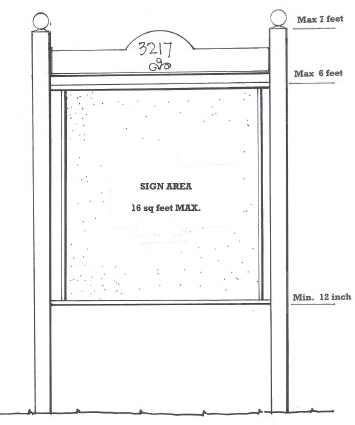
(3)
Design regulations—Swing signs/projecting signs. Swing signs and projecting signs are encouraged to be located in the downtown core. Swing signs may be attached to the underside of the awning; projecting signs are attached to the building facade above the awning or on any wall.
Design regulations—Projecting and swing signs
a.
Projecting signs are encouraged to be rectilinear in shape, with vertical to horizontal proportions a minimum of 2:1.
b.
Swing sings are encouraged to be rectilinear in shape, with horizontal to vertical proportions a minimum of 2:1.
c.
Projecting signs are encouraged to have a decorative pediment that produces a silhouette that is irregular (not straight).
(4)
Design regulations—Awnings. Awnings are a functional component of the downtown core streetscape, providing shade for pedestrians and shoppers, opportunity for advertising a business name and shielding windows from the sun. Prominent to the facade where located, awnings contribute and detract from the character of the streetscape and individual buildings. Awnings can successfully organize the larger streetscape; creating a rhythm and organizing otherwise disconnected architectural elements such as windows on individual buildings.
a.
Awnings, when used to display any message, shall be classified as signs subject to this article.
b.
Awnings may be fixed frame or operable. Awning installation shall respect the architectural features of the building:
1.
awnings shall be installed within the bays of architectural features or storefronts
2.
awnings shall serve to highlight the architecture of the building and delineate individual business units.
c.
All awnings shall be constructed of flexible, non-shiny fabric such as canvas or canvas like material, including matte finish painted army duck; the use of any vinyl or acrylic coating shall be textured to resemble fabric and shall have a matte finish.
d.
Each awning shall have a fascia; the fascia of the awning shall be free from attachment on three sides, allowing the fascia material to move.
e.
Awnings shall be proportional and in scale with the building facade. The vertical extent of the awning, measured perpendicular to the ground, from the bottom of the awning fascia to the highest extent of the awning shall not exceed 25 percent of the vertical height of the facade.
f.
Primary color, florescent color and white awnings are not permitted.
g.
Messaging on awnings and logos may be placed on the awning fascia only, and shall not exceed 12 inches in height. Lettering and logos may be silkscreen, painted, cutout lettering heat color transfer, pressure sensitive vinyl films or sewn appliqué signs.
h.
Awnings shall be taut, not relaxed.
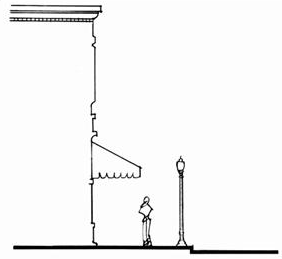
Awnings Add Pedestrian Scale and Comfort
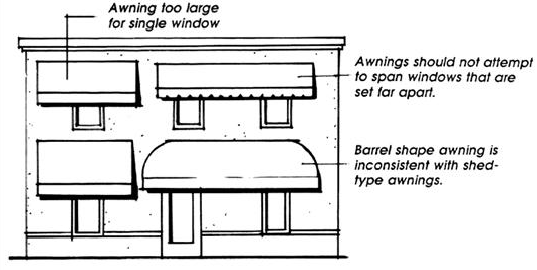
Inappropriate Awning Design
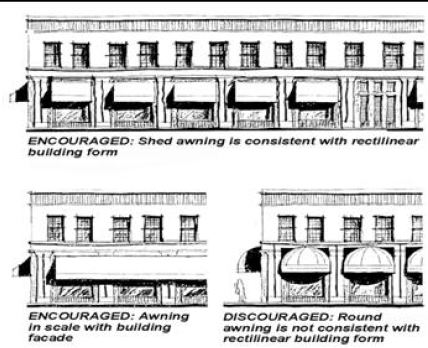
Appropriate Awning Design/Scale
(5)
Design regulations—Materials and illumination, all signs
a.
Substrate or unfinished wood signs are not permitted. Unpainted surfaces of a wooden sign shall be sealed on all surfaces not otherwise protected with paint.
b.
Signs that are externally illuminated shall utilize ground mounted fixtures unless the design character standards established in sub-section (e) below are adhered to.
c.
Internally illuminated signs are not permitted unless consistent with Section 17-208(j) of this article.
d.
Fixtures projecting light upon a sign face shall be directed to the sign face and shall not create a distraction for motorists or pedestrians.
e.
All lighting fixtures shall project white light in a warm spectrum (2700 - 4000K range).
(d)
Design guidelines for the downtown core sign district preserve the City's aesthetics and supports a pedestrian scale shopping area.
(1)
Painted or stained wood supports for freestanding signs are recommended; unfinished wood or metal supports are not permitted.
(2)
Finials on the upright supports of a freestanding sign are recommended.
(3)
Swing and projecting signs are encouraged to be mounted with decorative brackets that are black or bronze in color.
(4)
The use of chains to secure swing signs is encouraged to promote 1920—30's period character.
(5)
Awnings should be solid in color or if striped, limited to two colors. Lettering is limited to two additional colors, not including florescent colors.
(6)
Awning shape should relate to the window or door opening. Barrel-shaped awnings should be used to complement arched windows while square awnings should be used on rectangular windows.
(7)
Where the facade of a commercial building is divided into distinct structural bays and sections defined by vertical architectural elements, such as masonry piers, awnings should be placed within the vertical elements rather than overlapping them. The awning design should respond to the scale, proportion and rhythm created by these structural bay elements and nestle into the space created by the structural bay.
(e)
Character standards.
(1)
Illumination utilizing gooseneck fixtures attached to the top or bottom of a freestanding sign 's' sign face is encouraged.
(2)
Illumination of a wall sign, awning sign, projecting sign and or window sign utilizing gooseneck fixtures is encouraged.
(3)
Awnings that are parallel to the building facade should not be enclosed on the end bays (shed awnings only). Barrel awnings or barrel ends on box awnings are permitted.
(Ord. No. 2015-545, § 1, 3-5-15)

