- SIGNS
Editor's note— An Amendment of July 13, 2009, deleted the former Art. 16, §§ 3-360—3-365, and enacted a new Art. 16 as set out herein. The former Art. 16 pertained to signs and derived from Ord. of 10-15-2001; Ord. of 11-8-2001; Ord. of 2-9-2004; Ord. of 1-9-2006(2); Ord. of 4-9-2007(1); Ord. of 5-14-2007(2).
A.
Every use or structure instituted, constructed, erected, enlarged, or structurally altered after the effective date of this ordinance shall provide off-street parking and loading facilities in accordance with the provisions of this article, except as otherwise provided for in this article. No person, firm, or corporation shall utilize such structure or use without providing the off-street parking and loading facilities to meet the requirements of and be in compliance with this article.
B.
Such off-street parking and loading facilities shall be maintained and continued as long as the main use is continued. No owner or operator of any structure affected by this article shall discontinue, change, or dispense with the required parking and loading facilities without establishing alternative vehicular parking and loading facilities which meet the requirements of this article.
C.
When a permitted use is nonconforming as to required parking, and said use is enlarged with respect to the unit of measurement specified in this section as the basis for determining the amount of parking spaces, additional parking shall be required only on the basis of the enlargement of the permitted use.
D.
Required off-street parking spaces shall be located on the same lot as the structure or use to which they are necessary or on a lot adjacent thereto, not separated by any street, which has the same zoning classification and is in common ownership.
E.
The off-street parking requirements for two or more neighboring uses of the same or different types may be satisfied by the allocation of the required number of parking spaces for each in a common parking facility provided that the number of off-street parking spaces is not less than the sum of the individual requirements and provided further that there be [is] compliance with all other provisions of this division [article].
F.
Off-street parking spaces shall be used solely for the parking of vehicles in operating condition for patrons, occupants or employees of the use to which such parking is accessory. Permanent storage of vehicles shall not be allowed. Storage of vehicles for sale shall not be allowed.
G.
Parking areas required by this section are intended to accommodate the off-street parking needs of the customers and employees of commercial, institutional, industrial and residential uses. They are specifically intended to eliminate the need for parking along adjoining streets and roads by customers and employees they are designed to serve.
(Amend. of 4-8-2013(8))
In addition to any other requirements of this section, off-street parking areas shall be designed and operated in accordance with the following regulations:
A.
Access. All access openings shall be in accordance with and approved by the Virginia Department of Transportation.
B.
Driveways.
(1)
Sight clearance areas shall be maintained at the intersection of rights-of-way and driveways and the intersection of driveways with themselves. No grading, planting, fences or signs in excess of three feet in height shall be erected or maintained in this clearance area except street signs, fire hydrants and light standards.
(2)
Driveways shall not have a grade of more than five percent for the first 25 feet from the street. Additionally, driveways shall not be located where visibility is limited because of road alignment or topography.
(3)
Fire lanes shall be provided as required by the fire marshal.
C.
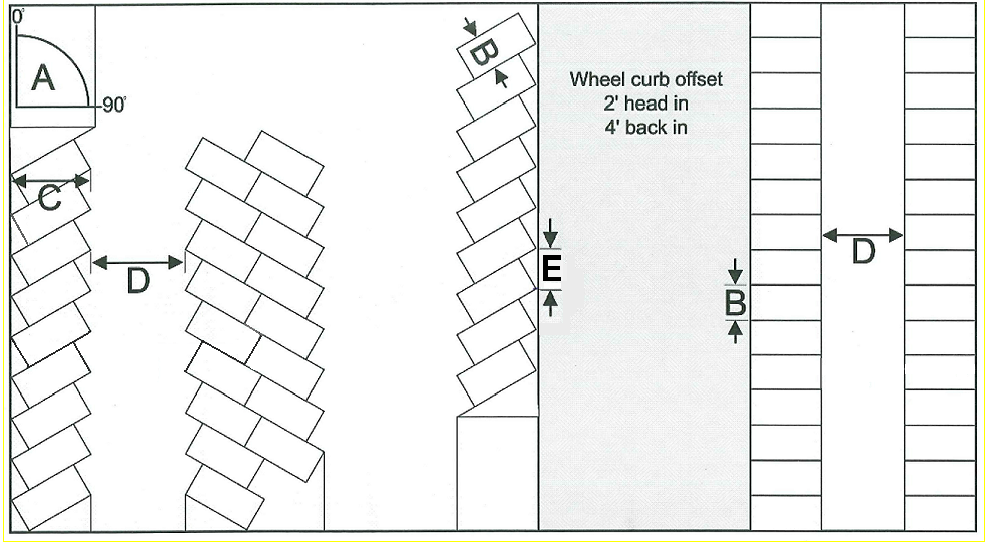
Parking area dimensions. All off-street parking shall conform to the following dimensions at a minimum:
See Diagram 15.1
Diagram 15.1
D.
Sidewalk required. A private walk shall be provided adjacent to a business or industrial building and shall be not less than four feet in width. Walks of less than 6½ feet wide shall be separated from off-street parking, loading and service areas by curbing or other protective devices so that there is an unobstructed walk space of not less than four feet.
E.
Surfacing requirement. Parking lots for use by customers in excess of 25 spaces (except for uses within the agricultural zoning district) shall be surfaced with asphalt, concrete, or tar and gravel. Parking lots with less than 25 spaces shall be stabilized in accordance with the erosion and sediment control requirements and be dust-free. Adequate drainage shall be provided for the removal of storm water and a drainage plan shall be submitted and approved.
F.
Handicapped parking.
(1)
Where parking lots are provided, designated parking spaces for [the] handicapped shall be required as follows:
(2)
Parking spaces for the physically handicapped shall be located as close as possible to elevators, ramps, walkways and entrances. Parking spaces shall be located so that the physically handicapped persons are not compelled to wheel or walk behind parked cars to reach entrances, ramps, walkways or elevators. Where the designated spaces cannot be within 200 feet of the accessible principal entrance or entrances, a dropoff area is to be provided within 100 feet of such entrance or entrances.
(3)
Parking spaces for individuals with physical handicaps shall be 12 feet wide and 18 feet long with an unobstructed near level surface which is suitable for wheeling and walking. Such parking space shall allow room for individuals in wheelchairs or individuals with braces, canes, and crutches to have ingress and egress to either side of a vehicle.
(4)
Curb ramps shall be provided to permit handicapped people access from parking areas to sidewalks. The curb ramp shall be inclined with a gradient of not more than one foot in 12 feet and have a width of not less than four feet.
(5)
Designated parking spaces for handicapped drivers shall be identified with clearly visible signs mounted at line of sight and displaying the international symbol of access.
G.
Landscaping. Parking areas shall be arranged for functional efficiency and convenience and shall be designed to be amenable to the surrounding property. Parking areas containing more than ten parking spaces shall comply with the following:
(1)
Parking areas shall be separated from the street right-of-way, side property lines and rear property line by a landscaped strip at least ten feet in width. The required strip along side lot lines may be reduced by five feet if an equal amount is added to the width of the landscaping along the street right-of-way. Ingress and egress shall be provided through driveway openings only. In the event a joint parking lot is proposed, the required landscaped strip along the common property line may be waived.
(2)
The parking area shall be constructed so that spaces are grouped into bays. At the end of each bay, a landscaped island of at least ten feet in width and 15 feet in length shall be built to separate the bays from each other or from traffic lanes. When the parking bays contain double rows of parking spaces, the length of the landscaped island shall be increased to 30 feet.
(3)
"Landscaped area," "landscaped setback," "landscaped strip," "landscaped island," or "perimeter open space" as herein used, are [is] defined as areas containing shrubs, trees, flowers, and/or grass. Such areas shall be shown on the site plan or a separate landscaping plan for the site. All landscaped areas contiguous to the parking bays shall be protected from intrusion by vehicles by curbs or bumpers.
(Amend. of 4-8-2013(8); Amend. of 4-11-16)
There shall be provided, at the time of erection of any main building or at the time any main building is enlarged, minimum off-street parking with adequate provisions for entrance and exit by vehicles normally serving the premises as follows:
(Amend. of 4-8-2013(8); Amend. of 4-11-2016)
No off-street parking area shall be reduced in size or encroached upon by buildings, vehicular storage, loading or unloading or any other use if such reduction or encroachment will reduce the off-street parking and/or loading spaces below that which are required by this division [article].
The following off-street loading requirements shall be applied to the corresponding uses:
OFF-STREET LOADING AREAS
Each loading space shall be no less than 12 feet in width, 50 feet in length and 14 feet in height and may not be located in the front yard setback. Such space shall be screened from view.

The purpose of this article is to promote and protect the public health, safety, and welfare by regulating outdoor signs of all types. It is intended to protect property values, create a more attractive economic and business climate, enhance the physical appearance of the county, and preserve the scenic and natural beauty of certain areas. It is further intended to reduce sign or advertising distraction and obstructions that may contribute to traffic accidents, reduce hazards that may be caused by signs overhanging or projecting over public rights-of-way, provide more open space, and curb the deterioration of the natural environment and enhance community development.
(Amend. of 7-13-2009; Ord. of 12-12-2016(1))
All signs shall be installed in conformance with the provisions of this Article, and applicable provisions of the zoning ordinance. Where there is conflict between the provisions of this Article and applicable provisions of the zoning ordinance, the most restrictive shall govern.
(Amend. of 7-13-2009; Ord. of 12-12-2016(1))
1.
Animated: A sign or part of a sign that moves or appears to move.
2.
Accessory structure: A sign relating only to uses of the premises on which the sign is located, or products sold on the premises on which the sign is located, or indicating the name or address of a building or occupants or management of a building on the premises where the sign is located.
3.
Artistic mural: A large picture or photograph painted or affixed directly on a wall or sign.
4.
Banner/flag: A sign applied to cloth, paper, balloons or fabric of any kind. (Governmental flags or symbolic flags of religious, charitable, public or not-profit organizations shall not be considered banners or flags.)
5.
Billboard sign: See "off-premise sign".
6.
Construction sign: A freestanding sign erected during the construction of a project, with information including, but not limited to, the name of the project, architect, developer, engineer, builder, and/or leasing agent, the development schedule, and the address and/or telephone number for information. Such signs shall be removed at the time issuance of a permanent sign permit or the first occupancy permit, whichever is applicable.
7.
Detached sign: A sign not attached to or painted on a building, but which is affixed to the ground. A sign attached to a fence or a wall that is not part of building (such as a decorative or retaining wall) shall be considered a detached sign.
8.
Directional sign: An on premise sign designed to guide vehicular and/or pedestrian traffic by using such words as "entrance", "exit", "parking", "one-way", or similar directional instruction, but not including any advertising message.
9.
Flashing sign: A sign or part thereof, operated so as to create flashing, pulsing, blinking, moving, dissolving, fading or scrolling; change in light intensity, color or copy or intermittent light impulses more frequent than once every ten seconds. Electronic controlled message signs, as defined herein, shall not constitute as a flashing sign when operating within the limits of this article.
10.
Electronic controlled message sign: Any detached sign or detached sign structure that utilizes an electronic means to display a series of messages or images that change. The electronic display shall not have the appearance of flashing, pulsing, blinking, moving, dissolving, fading, or scrolling. The frequency of display change shall not exceed once every ten seconds, must appear and be completed within one second, and occur simultaneously over the entire face of the electronic message sign. An electronic controlled message sign shall be required to be shut off between the hours of 10:00 p.m. or the closing time of normal business hours, whichever is later, and 6:00 a.m. or the opening of the business hours, whichever is earlier. An electronic controlled message sign located within the economic development corridor and located in the business or industrial zoning districts, may be lit 24 hours. The illumination intensity, contrast or coloration of the message text or image shall remain constant for each ten second display period. The intensity/brightness of such sign, as measured by the difference between the off and solid-message measurements, shall not exceed the industry standard recommended 0.3 foot candles (see table 16.1). Such signs shall be equipped with technology that automatically dims the electronic message illumination intensity commensurate with ambient light conditions (i.e. illumination intensity lower in low-light and nighttime conditions than in daylight).
11.
Flat sign or wall sign: Any sign attached to, and erected parallel to the face of, erected or painted on the outside wall of a building or structure and supported throughout its length by such wall or structure and not extending more than eighteen (18) inches from the wall. For the purpose of this section, "wall area" shall include flat structural surfaces such as canopy faces, but shall not include fences, retaining walls, decorative walls, light or telephone poles, or other surfaces, which are parts of the principal use.
12.
Ground-mounted sign: A sign that is supported by structures or supports in or upon the ground and independent of any support from any building.
13.
Illuminated sign: Any sign designed to give forth artificial light or designed to reflect light from one or more sources of artificial light erected for the purpose of providing light for the sign.
14.
Indirectly illuminated sign: A sign which does not produce artificial light from within itself but which is opaque and back lighted or illuminated by spotlights or floodlights not a part of or attached to the sign itself, or a sign of translucent nontransparent material illuminated from within but with no exposed or exterior bulbs, tubes or other light source.
15.
Marquee sign: Any sign attached to or hung from a marquee. For the purpose of this article, a marquee is a covered structure projecting from and supported by the building with independent roof and drainage provisions and which is erected over a doorway or doorways as protection against weather.
16.
Menu board or price board: A permanently mounted sign displaying the menu of a drive-through restaurant.
17.
Monument sign: A ground mounted sign and its supporting structure including its base, sides or other ancillary or decorative features not attached to any building. For the purposes of this article, a monument sign listing two or more businesses located on a property or in a shopping center and which is designed as one sign shall be considered one monument sign.
18.
Off-premise sign: A sign which directs attention to a business, commodity, service or establishment conducted, sold or offered at a location other than the premises on which the sign is erected.
19.
Off-premise directional sign: An accessory sign designated and located to mark a site feature or assist in traffic operations or in locating a thing or place not on the same lot or development. A directional sign may contain an identifying mark, symbol or logo occupying not more than 25 percent of the area of the sign.
20.
Portable sign: A sign that is not permanently affixed to the ground or another structure and is capable of being moved by mechanical or non-mechanical means.
21.
Projecting sign: Any sign, other than a wall, awning or marquee sign, which is affixed to a building perpendicularly and is supported by bracketing to the surface on which it is mounted.
22.
Roof sign: A sign erected or constructed, in whole or in part, upon or above the highest point of a building with a flat roof, or the lowest portion of a roof for any building with a pitched roof.
23.
Sandwich board sign: A sandwich board is a type of advertisement composed of two boards (holding a message or graphic) in a triangle shape, hinged along the top.
24.
Sign: An identification, description, illustration, or device which is affixed to or represented directly or indirectly upon a building, structure, or land and which directs attention to a product, place, activity, person, institution, or business.
25.
Sign area: The surface area encompassed within any regular geometric figure (square, rectangle, circle, triangle, etc.), which would enclose all parts of the sign including the structural supports if it forms an integral part of the display.
26.
Temporary sign: Signs limited to 90 days per calendar year and shall be located on vacant lots announcing an upcoming event (such as "coming soon").
(Amend. of 7-13-2009; Ord. of 12-12-2016(1); Ord. of 9-11-2017(1))
The following regulations apply generally to all signs and are in addition to the regulations contained elsewhere in this Ordinance.
1.
Sign permit required. No sign, unless herein exempted, shall be erected, constructed, posted, painted, altered, or relocated except as provided in this article and in these regulations, until a permit has been issued. Before any permit is issued, an application for zoning and an application for building permit are approved. All signs, which are electrically illuminated, shall require a separate electrical permit. Prior to being issued a permit for an electronic controlled message sign, the property owner shall execute an "Electronic Sign Agreement," stating that such sign display will not exceed 0.3 foot-candles and will comply with the requirements herein with this article.
Electronic Controlled Message Sign Illumination Measurement Table 16.1
2.
Inspection required. Structural, safety, and electrical systems shall be in accordance with the requirements of the Virginia Uniform Statewide Building Code.
No sign shall be approved for use unless it has been inspected by the department issuing the permit and is found to be in compliance with all the requirements of this article and applicable technical codes.
3.
Prohibited signs. The following signs are expressly prohibited.
(a)
Billboards and off-premise signs.
(b)
Portable signs other than a sandwich board sign in business and industrial districts, including signs displayed on a stationary vehicle that is larger than three feet by three feet in size.
(c)
Flashing signs. No flashing signs of any kind shall be permitted in any district.
(d)
Roof signs.
(e)
Simulated traffic signs, or any sign that may be confused with or obstruct the view of any authorized traffic sign or signal.
(f)
Signs so located and so illuminated as to provide a background of colored lights blending with traffic signal lights to the extent of confusing a motorist.
(g)
Signs affixed to trees, public utility poles, support structures or any other unapproved supporting structure.
(h)
Pennants, banners, flags, streamers and all other fluttering, spinning or similar type signs and advertising devices are prohibited except for national flags and flags of political subdivisions of the United States, and except for flags of bona fide civic, charitable, fraternal and welfare organizations and seasonal/decorative flags as indicated by specific zoning districts.
(i)
Artistic murals.
4.
Exempt signs. The following signs are exempted from the provisions of these regulations and may be erected or constructed without a permit.
(a)
Official traffic signs, warning signs, re-zoning, conditional use, and the like, when required to be erected by a governmental agency, and temporary signs indicating danger.
(b)
Commemorative plaques and historical markers erected by a recognized historical agency or governmental body.
(c)
Address or identification sign, indicating the address and/or names of occupants of the premises, not exceeding five square feet in area.
(d)
Flags, emblems and insignia of any governmental agency or religious, charitable, public or non-profit organization; provided, however, that no single flag shall exceed 50 square feet in area and no single zoning lot shall display more than three such flags.
(e)
Handicapped parking space signs.
(f)
Non-illuminated signs warning trespassers or announcing property as posted not exceeding 1.5 square feet in area.
(g)
Political campaign signs on private property up to a maximum of 32 square feet in area.
(h)
Real estate signs not exceeding 24 square feet in area for residential or agricultural districts and not exceeding 32 square feet in area in any commercial and industrial districts. No real estate sign shall exceed a height of six feet. One such sign is permitted per parcel.
(i)
Construction signs not to exceed one per road frontage. The total area of all such signs shall not exceed 32 square feet and are limited to a maximum height of six feet. Such signs shall be removed within 14 days following completion of the project.
(j)
Temporary signs on vacant lots announcing an upcoming event (such as "coming soon"). Such signs shall not exceed 32 square feet in area and shall not exceed six feet in height. Temporary sign usage is limited to no more than 90 days per calendar year.
(k)
Up to three off-premise directional signs per organization for a total of up to four square feet between the three signs, with approval by the Virginia Department of Transportation (VDOT). Such sign exemption is for events occurring within King and Queen County only. The sign(s) may be placed 24 hours prior to the event date and shall be removed within 24 hours after the event date. Failure to do so may cause for removal/disposal of the sign(s) by King and Queen County.
(l)
Signs on a truck, bus or other vehicle, while in use in the normal course of business. Signs displayed on a stationary vehicle that are smaller than three feet by three feet in size.
(Amend. of 7-13-2009; Ord. of 12-12-2016(1); Ord. of 9-11-2017(1))
1.
Agricultural district.
(a)
General regulations.
1.
Minimum setbacks:
(a)
Ten feet from front yard property line.
(b)
Forty feet from side yard property line.
(c)
Ten feet from all public rights-of-way.
2.
The following signs are permitted:
(a)
One home occupation or home business sign limited to six square feet and a maximum height of four feet.
(b)
One nameplate limited to five square feet and a maximum height of eight feet, to identify the owner or occupant of a dwelling or building.
(c)
A sign, limited to ten square feet and a maximum height of six feet, for identification of a residence, farm, and/or permitted agricultural or commercial use.
(d)
"No trespassing" or "no hunting/fishing" signs, without limitations on number or placement, limited in area to 1.5 square feet (also see other exempt signs). In addition one "No-trespassing" or "no hunting" sign of six square feet and a maximum height of six feet may be erected.
(e)
Churches/religious assembly, schools, libraries, museums, public parks, civic organizations, fire departments and rescue squads. One detached sign with a maximum sign of 30 square feet and a maximum height of six feet. Sign area may be increased to 40 square feet for a ground or monument type detached sign with a maximum height of four feet. Those noted herein with (section 3-364 1.(a)2.(e)) may have an electronic controlled message sign, provided that the requirements of section 3-362 and table 16-1 are met.
(f)
One residential community sign which displays the name of the development shall be permitted at the main entrance. The sign may not exceed 60 total square feet in area and eight feet in height. The sign may be located 15 feet or more from any street other than the development entry street, and shall be neatly maintained. A residential community in this context shall mean any single family, townhouse, apartment, condominium, or mixed residential development.
(g)
National flags and flags of political subdivisions of the United States, flags of bona fide civic, charitable, fraternal and welfare organizations and seasonal/decorative flags shall be allowed with no limit on size and number.
2.
Residential districts.
(a)
General regulations.
1.
Minimum setbacks:
(a)
Twenty feet from front yard property line.
(b)
Twenty-five feet from side yard property line.
(c)
Ten feet from all public rights-of-way.
2.
The following signs are permitted:
(a)
One residential community sign which displays the name of the development shall be permitted at the main entrance. The sign may not exceed 60 total square feet in area and eight feet in height. The sign may be located 15 feet or more from any street other than the development entry street, and shall be neatly maintained. A residential community in this context shall mean any single family, townhouse, apartment, condominium, or mixed residential development.
(b)
Any public/institutional/recreational/other use. One sign with a maximum sign area of 30 square feet and a maximum height of six feet. Sign area may be increased to 40 square feet for a ground or monument type with a maximum height of four feet.
(c)
Management office sign limited to ten square feet, for multiple dwelling or group of multiple-family dwellings.
(d)
A name plate or directional sign, limited in area to two square feet and a maximum height of six feet, to identify the owner or occupant of a dwelling or building.
(e)
National flags and flags of political subdivisions of the United States, flags of bona fide civic, charitable, fraternal and welfare organizations and seasonal/decorative flags shall be allowed with no limit on size and number.
3.
Business districts.
(a)
General Regulations.
1.
Minimum Setbacks:
(a)
Twenty feet from front yard property line.
(b)
Fifteen feet from side yard property line, except adjacent to properties in any zoning district which permits residential uses, shall not be less than 50 feet.
(c)
Ten feet from all public rights-of-way.
2.
The following signs are permitted:
(a)
Flat wall signs. The total flat wall signage areas shall be a maximum of 40 square feet, or shall be computed at 1.5 square feet of signage per front linear foot of building frontage for each business, whichever is greater. There is no maximum number of flat wall signs permitted per business, however the total combined shall not exceed the computed size as noted above.
(b)
Projecting signs: One projecting sign shall be allowed per business, not exceeding 12 square feet in size.
(c)
One detached sign per single parcel, maximum sign area of 150 square feet and a maximum height of 20 feet. For properties that have more than two business/leased space, such as a shopping center, the sign area may be increased to 200 square feet. Detached electronic controlled message signs are permitted, provided that the requirements of section 3-362 and table 16-1 are met.
(d)
Accessory signs, placed on fuel pumps and specifying the price of the fuel dispensed from the pump, other products for sale on the premises, or other services available on site (no larger than two square feet of area per sign face), are permitted in addition to the signs permitted.
(e)
Directional signs limited to two square feet each, no limit on number.
(f)
National flags and flags of political subdivisions of the United States, flags of bona fide civic, charitable, fraternal and welfare organization and seasonal/decorative flags no larger than three feet by five feet in size shall be limited to five total per parcel.
(g)
One menu board per service drive thru window.
(h)
One sandwich board sign per business space may be permitted within ten feet of the front door of said business. The maximum size per sign shall be no larger than eight square feet.
4.
Industrial districts.
(a)
General regulations.
1.
Minimum setbacks:
(a)
Thirty feet from front yard property line.
(b)
Thirty feet from side yard property line, except for lots, which abut property in non-industrial districts, then 100 feet.
(c)
Twenty-five feet from any public rights-of way.
2.
The following signs are permitted:
(a)
Flat wall signs: The total flat wall signage areas shall be a maximum of 40 square feet, or shall be computed at 1.5 square feet of signage per front linear foot of building frontage for each business, whichever is greater. There is no maximum number of flat wall signs permitted per business, however the total combined shall not exceed the computed size as noted above.
(b)
Projecting signs: One projecting sign shall be allowed per business, not exceeding 12 square feet in size.
(c)
Detached signs: 150 square feet and a maximum height of 20 feet per business. Detached electronic controlled message signs are permitted, provided that the requirements of section 3-362 and table 16-1 are met.
(d)
Industrial park: One ground or monument type sign containing solely the name of the industrial park and not containing the name of any business located therein shall be allowed per industrial park and shall not exceed the size of 100 square feet and 15 feet in height and shall be located near a common shared entrance.
(e)
Directional signs, limited to six square feet of sign area, no limit on number. No limit on size or number.
(f)
In addition to the sign regulations of this article, sign messages for adult establishments shall be limited to the name of the business and hours of operation and shall not provide any graphic or pictorial depiction of the material or services available on the premises. Signage and messages which are visible or intended to be visible from outside the property (such as those appearing on or within the doors or windows) shall not display materials, items, publications, pictures, films or printed material available on the premises; or picture films or live presentation of persons performing or services offered on the premises.
(g)
One sandwich board sign per business space may be permitted within 10 feet of the front door of said business. The maximum size per sign shall be no larger than eight square feet.
(Amend. of 7-13-2009; Amend. of 4-8-2013(9); Ord. of 12-12-2016(1); Ord. of 9-11-2017(1))
1.
Non-conforming sign, generally. Any sign which was lawfully in existence at the time of the effective date of this article which does not conform to the provisions herein, and any sign which is accessory to a non-conforming use, shall be deemed a non-conforming sign. No non-conforming sign shall be enlarged, extended, or structurally reconstructed.
2.
Removal of non-conforming signs. Non-conforming signs may remain, provided they are kept in good repair.
(a)
No nonconforming sign shall be moved on the same lot or building or to another lot or building unless the sign is relocated and/or is modified to comply with all requirements of this article.
(b)
If a nonconforming sign is damaged or in need of repair, the zoning administrator shall notify the property owner in writing stating that the owner is to repair or remove the sign within 90 days. Failure to meet the 90 day period will result in the loss of the legal non-conforming status of the sign, and the sign shall be removed. Failure to comply shall be considered a violation of this article.
(Amend. of 7-13-2009; Ord. of 12-12-2016(1))
All signs shall be maintained in good condition so as to present a neat and orderly appearance. The zoning administrator may give written notice to remove or repair, within 90 days, any sign which shows gross neglect or which becomes dilapidated. Failure to comply shall be considered a violation of this article.
(Amend. of 7-13-2009; Ord. of 12-12-2016(1))
A sign, including its supporting structure or brackets, shall be removed by the owner or lessee of the premises upon which the sign is located when the business which it advertises is no longer on the premises. Such sign, if not removed within 90 days from the termination of occupancy by such business shall be considered to be in violation of this chapter, and shall be removed at the owner's expense.
(Amend. of 7-13-2009; Ord. of 12-12-2016(1))
- SIGNS
Editor's note— An Amendment of July 13, 2009, deleted the former Art. 16, §§ 3-360—3-365, and enacted a new Art. 16 as set out herein. The former Art. 16 pertained to signs and derived from Ord. of 10-15-2001; Ord. of 11-8-2001; Ord. of 2-9-2004; Ord. of 1-9-2006(2); Ord. of 4-9-2007(1); Ord. of 5-14-2007(2).
A.
Every use or structure instituted, constructed, erected, enlarged, or structurally altered after the effective date of this ordinance shall provide off-street parking and loading facilities in accordance with the provisions of this article, except as otherwise provided for in this article. No person, firm, or corporation shall utilize such structure or use without providing the off-street parking and loading facilities to meet the requirements of and be in compliance with this article.
B.
Such off-street parking and loading facilities shall be maintained and continued as long as the main use is continued. No owner or operator of any structure affected by this article shall discontinue, change, or dispense with the required parking and loading facilities without establishing alternative vehicular parking and loading facilities which meet the requirements of this article.
C.
When a permitted use is nonconforming as to required parking, and said use is enlarged with respect to the unit of measurement specified in this section as the basis for determining the amount of parking spaces, additional parking shall be required only on the basis of the enlargement of the permitted use.
D.
Required off-street parking spaces shall be located on the same lot as the structure or use to which they are necessary or on a lot adjacent thereto, not separated by any street, which has the same zoning classification and is in common ownership.
E.
The off-street parking requirements for two or more neighboring uses of the same or different types may be satisfied by the allocation of the required number of parking spaces for each in a common parking facility provided that the number of off-street parking spaces is not less than the sum of the individual requirements and provided further that there be [is] compliance with all other provisions of this division [article].
F.
Off-street parking spaces shall be used solely for the parking of vehicles in operating condition for patrons, occupants or employees of the use to which such parking is accessory. Permanent storage of vehicles shall not be allowed. Storage of vehicles for sale shall not be allowed.
G.
Parking areas required by this section are intended to accommodate the off-street parking needs of the customers and employees of commercial, institutional, industrial and residential uses. They are specifically intended to eliminate the need for parking along adjoining streets and roads by customers and employees they are designed to serve.
(Amend. of 4-8-2013(8))
In addition to any other requirements of this section, off-street parking areas shall be designed and operated in accordance with the following regulations:
A.
Access. All access openings shall be in accordance with and approved by the Virginia Department of Transportation.
B.
Driveways.
(1)
Sight clearance areas shall be maintained at the intersection of rights-of-way and driveways and the intersection of driveways with themselves. No grading, planting, fences or signs in excess of three feet in height shall be erected or maintained in this clearance area except street signs, fire hydrants and light standards.
(2)
Driveways shall not have a grade of more than five percent for the first 25 feet from the street. Additionally, driveways shall not be located where visibility is limited because of road alignment or topography.
(3)
Fire lanes shall be provided as required by the fire marshal.
C.
Parking area dimensions. All off-street parking shall conform to the following dimensions at a minimum:
See Diagram 15.1
Diagram 15.1
D.
Sidewalk required. A private walk shall be provided adjacent to a business or industrial building and shall be not less than four feet in width. Walks of less than 6½ feet wide shall be separated from off-street parking, loading and service areas by curbing or other protective devices so that there is an unobstructed walk space of not less than four feet.
E.
Surfacing requirement. Parking lots for use by customers in excess of 25 spaces (except for uses within the agricultural zoning district) shall be surfaced with asphalt, concrete, or tar and gravel. Parking lots with less than 25 spaces shall be stabilized in accordance with the erosion and sediment control requirements and be dust-free. Adequate drainage shall be provided for the removal of storm water and a drainage plan shall be submitted and approved.
F.
Handicapped parking.
(1)
Where parking lots are provided, designated parking spaces for [the] handicapped shall be required as follows:
(2)
Parking spaces for the physically handicapped shall be located as close as possible to elevators, ramps, walkways and entrances. Parking spaces shall be located so that the physically handicapped persons are not compelled to wheel or walk behind parked cars to reach entrances, ramps, walkways or elevators. Where the designated spaces cannot be within 200 feet of the accessible principal entrance or entrances, a dropoff area is to be provided within 100 feet of such entrance or entrances.
(3)
Parking spaces for individuals with physical handicaps shall be 12 feet wide and 18 feet long with an unobstructed near level surface which is suitable for wheeling and walking. Such parking space shall allow room for individuals in wheelchairs or individuals with braces, canes, and crutches to have ingress and egress to either side of a vehicle.
(4)
Curb ramps shall be provided to permit handicapped people access from parking areas to sidewalks. The curb ramp shall be inclined with a gradient of not more than one foot in 12 feet and have a width of not less than four feet.
(5)
Designated parking spaces for handicapped drivers shall be identified with clearly visible signs mounted at line of sight and displaying the international symbol of access.
G.
Landscaping. Parking areas shall be arranged for functional efficiency and convenience and shall be designed to be amenable to the surrounding property. Parking areas containing more than ten parking spaces shall comply with the following:
(1)
Parking areas shall be separated from the street right-of-way, side property lines and rear property line by a landscaped strip at least ten feet in width. The required strip along side lot lines may be reduced by five feet if an equal amount is added to the width of the landscaping along the street right-of-way. Ingress and egress shall be provided through driveway openings only. In the event a joint parking lot is proposed, the required landscaped strip along the common property line may be waived.
(2)
The parking area shall be constructed so that spaces are grouped into bays. At the end of each bay, a landscaped island of at least ten feet in width and 15 feet in length shall be built to separate the bays from each other or from traffic lanes. When the parking bays contain double rows of parking spaces, the length of the landscaped island shall be increased to 30 feet.
(3)
"Landscaped area," "landscaped setback," "landscaped strip," "landscaped island," or "perimeter open space" as herein used, are [is] defined as areas containing shrubs, trees, flowers, and/or grass. Such areas shall be shown on the site plan or a separate landscaping plan for the site. All landscaped areas contiguous to the parking bays shall be protected from intrusion by vehicles by curbs or bumpers.
(Amend. of 4-8-2013(8); Amend. of 4-11-16)
There shall be provided, at the time of erection of any main building or at the time any main building is enlarged, minimum off-street parking with adequate provisions for entrance and exit by vehicles normally serving the premises as follows:
(Amend. of 4-8-2013(8); Amend. of 4-11-2016)
No off-street parking area shall be reduced in size or encroached upon by buildings, vehicular storage, loading or unloading or any other use if such reduction or encroachment will reduce the off-street parking and/or loading spaces below that which are required by this division [article].
The following off-street loading requirements shall be applied to the corresponding uses:
OFF-STREET LOADING AREAS
Each loading space shall be no less than 12 feet in width, 50 feet in length and 14 feet in height and may not be located in the front yard setback. Such space shall be screened from view.

The purpose of this article is to promote and protect the public health, safety, and welfare by regulating outdoor signs of all types. It is intended to protect property values, create a more attractive economic and business climate, enhance the physical appearance of the county, and preserve the scenic and natural beauty of certain areas. It is further intended to reduce sign or advertising distraction and obstructions that may contribute to traffic accidents, reduce hazards that may be caused by signs overhanging or projecting over public rights-of-way, provide more open space, and curb the deterioration of the natural environment and enhance community development.
(Amend. of 7-13-2009; Ord. of 12-12-2016(1))
All signs shall be installed in conformance with the provisions of this Article, and applicable provisions of the zoning ordinance. Where there is conflict between the provisions of this Article and applicable provisions of the zoning ordinance, the most restrictive shall govern.
(Amend. of 7-13-2009; Ord. of 12-12-2016(1))
1.
Animated: A sign or part of a sign that moves or appears to move.
2.
Accessory structure: A sign relating only to uses of the premises on which the sign is located, or products sold on the premises on which the sign is located, or indicating the name or address of a building or occupants or management of a building on the premises where the sign is located.
3.
Artistic mural: A large picture or photograph painted or affixed directly on a wall or sign.
4.
Banner/flag: A sign applied to cloth, paper, balloons or fabric of any kind. (Governmental flags or symbolic flags of religious, charitable, public or not-profit organizations shall not be considered banners or flags.)
5.
Billboard sign: See "off-premise sign".
6.
Construction sign: A freestanding sign erected during the construction of a project, with information including, but not limited to, the name of the project, architect, developer, engineer, builder, and/or leasing agent, the development schedule, and the address and/or telephone number for information. Such signs shall be removed at the time issuance of a permanent sign permit or the first occupancy permit, whichever is applicable.
7.
Detached sign: A sign not attached to or painted on a building, but which is affixed to the ground. A sign attached to a fence or a wall that is not part of building (such as a decorative or retaining wall) shall be considered a detached sign.
8.
Directional sign: An on premise sign designed to guide vehicular and/or pedestrian traffic by using such words as "entrance", "exit", "parking", "one-way", or similar directional instruction, but not including any advertising message.
9.
Flashing sign: A sign or part thereof, operated so as to create flashing, pulsing, blinking, moving, dissolving, fading or scrolling; change in light intensity, color or copy or intermittent light impulses more frequent than once every ten seconds. Electronic controlled message signs, as defined herein, shall not constitute as a flashing sign when operating within the limits of this article.
10.
Electronic controlled message sign: Any detached sign or detached sign structure that utilizes an electronic means to display a series of messages or images that change. The electronic display shall not have the appearance of flashing, pulsing, blinking, moving, dissolving, fading, or scrolling. The frequency of display change shall not exceed once every ten seconds, must appear and be completed within one second, and occur simultaneously over the entire face of the electronic message sign. An electronic controlled message sign shall be required to be shut off between the hours of 10:00 p.m. or the closing time of normal business hours, whichever is later, and 6:00 a.m. or the opening of the business hours, whichever is earlier. An electronic controlled message sign located within the economic development corridor and located in the business or industrial zoning districts, may be lit 24 hours. The illumination intensity, contrast or coloration of the message text or image shall remain constant for each ten second display period. The intensity/brightness of such sign, as measured by the difference between the off and solid-message measurements, shall not exceed the industry standard recommended 0.3 foot candles (see table 16.1). Such signs shall be equipped with technology that automatically dims the electronic message illumination intensity commensurate with ambient light conditions (i.e. illumination intensity lower in low-light and nighttime conditions than in daylight).
11.
Flat sign or wall sign: Any sign attached to, and erected parallel to the face of, erected or painted on the outside wall of a building or structure and supported throughout its length by such wall or structure and not extending more than eighteen (18) inches from the wall. For the purpose of this section, "wall area" shall include flat structural surfaces such as canopy faces, but shall not include fences, retaining walls, decorative walls, light or telephone poles, or other surfaces, which are parts of the principal use.
12.
Ground-mounted sign: A sign that is supported by structures or supports in or upon the ground and independent of any support from any building.
13.
Illuminated sign: Any sign designed to give forth artificial light or designed to reflect light from one or more sources of artificial light erected for the purpose of providing light for the sign.
14.
Indirectly illuminated sign: A sign which does not produce artificial light from within itself but which is opaque and back lighted or illuminated by spotlights or floodlights not a part of or attached to the sign itself, or a sign of translucent nontransparent material illuminated from within but with no exposed or exterior bulbs, tubes or other light source.
15.
Marquee sign: Any sign attached to or hung from a marquee. For the purpose of this article, a marquee is a covered structure projecting from and supported by the building with independent roof and drainage provisions and which is erected over a doorway or doorways as protection against weather.
16.
Menu board or price board: A permanently mounted sign displaying the menu of a drive-through restaurant.
17.
Monument sign: A ground mounted sign and its supporting structure including its base, sides or other ancillary or decorative features not attached to any building. For the purposes of this article, a monument sign listing two or more businesses located on a property or in a shopping center and which is designed as one sign shall be considered one monument sign.
18.
Off-premise sign: A sign which directs attention to a business, commodity, service or establishment conducted, sold or offered at a location other than the premises on which the sign is erected.
19.
Off-premise directional sign: An accessory sign designated and located to mark a site feature or assist in traffic operations or in locating a thing or place not on the same lot or development. A directional sign may contain an identifying mark, symbol or logo occupying not more than 25 percent of the area of the sign.
20.
Portable sign: A sign that is not permanently affixed to the ground or another structure and is capable of being moved by mechanical or non-mechanical means.
21.
Projecting sign: Any sign, other than a wall, awning or marquee sign, which is affixed to a building perpendicularly and is supported by bracketing to the surface on which it is mounted.
22.
Roof sign: A sign erected or constructed, in whole or in part, upon or above the highest point of a building with a flat roof, or the lowest portion of a roof for any building with a pitched roof.
23.
Sandwich board sign: A sandwich board is a type of advertisement composed of two boards (holding a message or graphic) in a triangle shape, hinged along the top.
24.
Sign: An identification, description, illustration, or device which is affixed to or represented directly or indirectly upon a building, structure, or land and which directs attention to a product, place, activity, person, institution, or business.
25.
Sign area: The surface area encompassed within any regular geometric figure (square, rectangle, circle, triangle, etc.), which would enclose all parts of the sign including the structural supports if it forms an integral part of the display.
26.
Temporary sign: Signs limited to 90 days per calendar year and shall be located on vacant lots announcing an upcoming event (such as "coming soon").
(Amend. of 7-13-2009; Ord. of 12-12-2016(1); Ord. of 9-11-2017(1))
The following regulations apply generally to all signs and are in addition to the regulations contained elsewhere in this Ordinance.
1.
Sign permit required. No sign, unless herein exempted, shall be erected, constructed, posted, painted, altered, or relocated except as provided in this article and in these regulations, until a permit has been issued. Before any permit is issued, an application for zoning and an application for building permit are approved. All signs, which are electrically illuminated, shall require a separate electrical permit. Prior to being issued a permit for an electronic controlled message sign, the property owner shall execute an "Electronic Sign Agreement," stating that such sign display will not exceed 0.3 foot-candles and will comply with the requirements herein with this article.
Electronic Controlled Message Sign Illumination Measurement Table 16.1
2.
Inspection required. Structural, safety, and electrical systems shall be in accordance with the requirements of the Virginia Uniform Statewide Building Code.
No sign shall be approved for use unless it has been inspected by the department issuing the permit and is found to be in compliance with all the requirements of this article and applicable technical codes.
3.
Prohibited signs. The following signs are expressly prohibited.
(a)
Billboards and off-premise signs.
(b)
Portable signs other than a sandwich board sign in business and industrial districts, including signs displayed on a stationary vehicle that is larger than three feet by three feet in size.
(c)
Flashing signs. No flashing signs of any kind shall be permitted in any district.
(d)
Roof signs.
(e)
Simulated traffic signs, or any sign that may be confused with or obstruct the view of any authorized traffic sign or signal.
(f)
Signs so located and so illuminated as to provide a background of colored lights blending with traffic signal lights to the extent of confusing a motorist.
(g)
Signs affixed to trees, public utility poles, support structures or any other unapproved supporting structure.
(h)
Pennants, banners, flags, streamers and all other fluttering, spinning or similar type signs and advertising devices are prohibited except for national flags and flags of political subdivisions of the United States, and except for flags of bona fide civic, charitable, fraternal and welfare organizations and seasonal/decorative flags as indicated by specific zoning districts.
(i)
Artistic murals.
4.
Exempt signs. The following signs are exempted from the provisions of these regulations and may be erected or constructed without a permit.
(a)
Official traffic signs, warning signs, re-zoning, conditional use, and the like, when required to be erected by a governmental agency, and temporary signs indicating danger.
(b)
Commemorative plaques and historical markers erected by a recognized historical agency or governmental body.
(c)
Address or identification sign, indicating the address and/or names of occupants of the premises, not exceeding five square feet in area.
(d)
Flags, emblems and insignia of any governmental agency or religious, charitable, public or non-profit organization; provided, however, that no single flag shall exceed 50 square feet in area and no single zoning lot shall display more than three such flags.
(e)
Handicapped parking space signs.
(f)
Non-illuminated signs warning trespassers or announcing property as posted not exceeding 1.5 square feet in area.
(g)
Political campaign signs on private property up to a maximum of 32 square feet in area.
(h)
Real estate signs not exceeding 24 square feet in area for residential or agricultural districts and not exceeding 32 square feet in area in any commercial and industrial districts. No real estate sign shall exceed a height of six feet. One such sign is permitted per parcel.
(i)
Construction signs not to exceed one per road frontage. The total area of all such signs shall not exceed 32 square feet and are limited to a maximum height of six feet. Such signs shall be removed within 14 days following completion of the project.
(j)
Temporary signs on vacant lots announcing an upcoming event (such as "coming soon"). Such signs shall not exceed 32 square feet in area and shall not exceed six feet in height. Temporary sign usage is limited to no more than 90 days per calendar year.
(k)
Up to three off-premise directional signs per organization for a total of up to four square feet between the three signs, with approval by the Virginia Department of Transportation (VDOT). Such sign exemption is for events occurring within King and Queen County only. The sign(s) may be placed 24 hours prior to the event date and shall be removed within 24 hours after the event date. Failure to do so may cause for removal/disposal of the sign(s) by King and Queen County.
(l)
Signs on a truck, bus or other vehicle, while in use in the normal course of business. Signs displayed on a stationary vehicle that are smaller than three feet by three feet in size.
(Amend. of 7-13-2009; Ord. of 12-12-2016(1); Ord. of 9-11-2017(1))
1.
Agricultural district.
(a)
General regulations.
1.
Minimum setbacks:
(a)
Ten feet from front yard property line.
(b)
Forty feet from side yard property line.
(c)
Ten feet from all public rights-of-way.
2.
The following signs are permitted:
(a)
One home occupation or home business sign limited to six square feet and a maximum height of four feet.
(b)
One nameplate limited to five square feet and a maximum height of eight feet, to identify the owner or occupant of a dwelling or building.
(c)
A sign, limited to ten square feet and a maximum height of six feet, for identification of a residence, farm, and/or permitted agricultural or commercial use.
(d)
"No trespassing" or "no hunting/fishing" signs, without limitations on number or placement, limited in area to 1.5 square feet (also see other exempt signs). In addition one "No-trespassing" or "no hunting" sign of six square feet and a maximum height of six feet may be erected.
(e)
Churches/religious assembly, schools, libraries, museums, public parks, civic organizations, fire departments and rescue squads. One detached sign with a maximum sign of 30 square feet and a maximum height of six feet. Sign area may be increased to 40 square feet for a ground or monument type detached sign with a maximum height of four feet. Those noted herein with (section 3-364 1.(a)2.(e)) may have an electronic controlled message sign, provided that the requirements of section 3-362 and table 16-1 are met.
(f)
One residential community sign which displays the name of the development shall be permitted at the main entrance. The sign may not exceed 60 total square feet in area and eight feet in height. The sign may be located 15 feet or more from any street other than the development entry street, and shall be neatly maintained. A residential community in this context shall mean any single family, townhouse, apartment, condominium, or mixed residential development.
(g)
National flags and flags of political subdivisions of the United States, flags of bona fide civic, charitable, fraternal and welfare organizations and seasonal/decorative flags shall be allowed with no limit on size and number.
2.
Residential districts.
(a)
General regulations.
1.
Minimum setbacks:
(a)
Twenty feet from front yard property line.
(b)
Twenty-five feet from side yard property line.
(c)
Ten feet from all public rights-of-way.
2.
The following signs are permitted:
(a)
One residential community sign which displays the name of the development shall be permitted at the main entrance. The sign may not exceed 60 total square feet in area and eight feet in height. The sign may be located 15 feet or more from any street other than the development entry street, and shall be neatly maintained. A residential community in this context shall mean any single family, townhouse, apartment, condominium, or mixed residential development.
(b)
Any public/institutional/recreational/other use. One sign with a maximum sign area of 30 square feet and a maximum height of six feet. Sign area may be increased to 40 square feet for a ground or monument type with a maximum height of four feet.
(c)
Management office sign limited to ten square feet, for multiple dwelling or group of multiple-family dwellings.
(d)
A name plate or directional sign, limited in area to two square feet and a maximum height of six feet, to identify the owner or occupant of a dwelling or building.
(e)
National flags and flags of political subdivisions of the United States, flags of bona fide civic, charitable, fraternal and welfare organizations and seasonal/decorative flags shall be allowed with no limit on size and number.
3.
Business districts.
(a)
General Regulations.
1.
Minimum Setbacks:
(a)
Twenty feet from front yard property line.
(b)
Fifteen feet from side yard property line, except adjacent to properties in any zoning district which permits residential uses, shall not be less than 50 feet.
(c)
Ten feet from all public rights-of-way.
2.
The following signs are permitted:
(a)
Flat wall signs. The total flat wall signage areas shall be a maximum of 40 square feet, or shall be computed at 1.5 square feet of signage per front linear foot of building frontage for each business, whichever is greater. There is no maximum number of flat wall signs permitted per business, however the total combined shall not exceed the computed size as noted above.
(b)
Projecting signs: One projecting sign shall be allowed per business, not exceeding 12 square feet in size.
(c)
One detached sign per single parcel, maximum sign area of 150 square feet and a maximum height of 20 feet. For properties that have more than two business/leased space, such as a shopping center, the sign area may be increased to 200 square feet. Detached electronic controlled message signs are permitted, provided that the requirements of section 3-362 and table 16-1 are met.
(d)
Accessory signs, placed on fuel pumps and specifying the price of the fuel dispensed from the pump, other products for sale on the premises, or other services available on site (no larger than two square feet of area per sign face), are permitted in addition to the signs permitted.
(e)
Directional signs limited to two square feet each, no limit on number.
(f)
National flags and flags of political subdivisions of the United States, flags of bona fide civic, charitable, fraternal and welfare organization and seasonal/decorative flags no larger than three feet by five feet in size shall be limited to five total per parcel.
(g)
One menu board per service drive thru window.
(h)
One sandwich board sign per business space may be permitted within ten feet of the front door of said business. The maximum size per sign shall be no larger than eight square feet.
4.
Industrial districts.
(a)
General regulations.
1.
Minimum setbacks:
(a)
Thirty feet from front yard property line.
(b)
Thirty feet from side yard property line, except for lots, which abut property in non-industrial districts, then 100 feet.
(c)
Twenty-five feet from any public rights-of way.
2.
The following signs are permitted:
(a)
Flat wall signs: The total flat wall signage areas shall be a maximum of 40 square feet, or shall be computed at 1.5 square feet of signage per front linear foot of building frontage for each business, whichever is greater. There is no maximum number of flat wall signs permitted per business, however the total combined shall not exceed the computed size as noted above.
(b)
Projecting signs: One projecting sign shall be allowed per business, not exceeding 12 square feet in size.
(c)
Detached signs: 150 square feet and a maximum height of 20 feet per business. Detached electronic controlled message signs are permitted, provided that the requirements of section 3-362 and table 16-1 are met.
(d)
Industrial park: One ground or monument type sign containing solely the name of the industrial park and not containing the name of any business located therein shall be allowed per industrial park and shall not exceed the size of 100 square feet and 15 feet in height and shall be located near a common shared entrance.
(e)
Directional signs, limited to six square feet of sign area, no limit on number. No limit on size or number.
(f)
In addition to the sign regulations of this article, sign messages for adult establishments shall be limited to the name of the business and hours of operation and shall not provide any graphic or pictorial depiction of the material or services available on the premises. Signage and messages which are visible or intended to be visible from outside the property (such as those appearing on or within the doors or windows) shall not display materials, items, publications, pictures, films or printed material available on the premises; or picture films or live presentation of persons performing or services offered on the premises.
(g)
One sandwich board sign per business space may be permitted within 10 feet of the front door of said business. The maximum size per sign shall be no larger than eight square feet.
(Amend. of 7-13-2009; Amend. of 4-8-2013(9); Ord. of 12-12-2016(1); Ord. of 9-11-2017(1))
1.
Non-conforming sign, generally. Any sign which was lawfully in existence at the time of the effective date of this article which does not conform to the provisions herein, and any sign which is accessory to a non-conforming use, shall be deemed a non-conforming sign. No non-conforming sign shall be enlarged, extended, or structurally reconstructed.
2.
Removal of non-conforming signs. Non-conforming signs may remain, provided they are kept in good repair.
(a)
No nonconforming sign shall be moved on the same lot or building or to another lot or building unless the sign is relocated and/or is modified to comply with all requirements of this article.
(b)
If a nonconforming sign is damaged or in need of repair, the zoning administrator shall notify the property owner in writing stating that the owner is to repair or remove the sign within 90 days. Failure to meet the 90 day period will result in the loss of the legal non-conforming status of the sign, and the sign shall be removed. Failure to comply shall be considered a violation of this article.
(Amend. of 7-13-2009; Ord. of 12-12-2016(1))
All signs shall be maintained in good condition so as to present a neat and orderly appearance. The zoning administrator may give written notice to remove or repair, within 90 days, any sign which shows gross neglect or which becomes dilapidated. Failure to comply shall be considered a violation of this article.
(Amend. of 7-13-2009; Ord. of 12-12-2016(1))
A sign, including its supporting structure or brackets, shall be removed by the owner or lessee of the premises upon which the sign is located when the business which it advertises is no longer on the premises. Such sign, if not removed within 90 days from the termination of occupancy by such business shall be considered to be in violation of this chapter, and shall be removed at the owner's expense.
(Amend. of 7-13-2009; Ord. of 12-12-2016(1))