
King And Queen County Unincorporated
City Zoning Code
City Zoning Code
ARTICLE 22
- OUTDOOR LIGHTING
Sec. 3-500.- Purpose and intent
The purpose of this article is to regulate the placement, orientation, distribution and fixture type and size of outdoor lighting. The intent of this article is to encourage lighting that provides safety, utility and security, as well as preventing glare on public roadways, and to protect the privacy of adjoining properties. It is further intended to create a more attractive economic and business climate, enhance the physical appearance of the county, and preserve the scenic and natural beauty of certain areas.
(Ord. of 6-9-2003)
Sec. 3-501. - Conformance with applicable codes and ordinances
All outdoor artificial illuminating devices shall be installed in conformance with the provisions of this article, the applicable provisions of the zoning ordinance, and the Virginia Uniform Statewide Building Code. Where there is conflict between the provisions of this article, the applicable provisions of the zoning ordinance, and/or the Virginia Uniform Statewide Building Code, the most restrictive shall govern.
Sec. 3-502. - Approved materials and methods.
The provisions of this article are not intended to prevent the use of any equipment; material or method of installation not specifically prescribed by this article provided the alternative has been approved by the zoning administrator. The zoning administrator may approve any such alternative provided that the proposed design provides the approximate equivalence to the specific requirements of this article.
Sec. 3-503. - Definitions.
1.
Foot-candle: A quantitative unit of measure of referring to the measurement of illumination incident at a single point. One-foot-candle is equal to one lumen uniformly distributed over an area of one square foot.
2.
Full cutoff angle: The angle formed by a line drawn from the light source and a line perpendicular to the ground from the light source, beyond which no light is emitted. Refer to example graphics, Figure 2.
3.
Initial lumens: The lumens emitted from a lamp, as specified by the manufacturer of the lamp.
4.
Installed: Installed shall mean the initial installation of outdoor light fixtures defined herein, following the effective date of this article but shall not apply to those outdoor light fixtures installed prior to such date.
5.
Lamp: The component of a luminaire that produces light. A lamp is also commonly referred to as a bulb.
6.
Lumen: A standard unit of measurement referring to the amount of light energy emitted by a light source, without regard to the effectiveness of its distribution.
7.
Luminaire: A complete lighting unit consisting of a lamp or lamps together with the components designed to distribute the light, to position and protect the lamps, and to connect the lamps to the power supply. A luminaire is also commonly referred to as a fixture.
8.
Outdoor light fixture: Outdoor light fixture shall mean outdoor artificial illuminating devices, outdoor fixtures, lamps or other devices, permanent or portable, used for illumination, direction or advertisement. Such devices shall include, but are not limited to search, spot, or flood lights for:
a.
buildings and structures
b.
recreational areas
c.
parking lot lighting
d.
landscape lighting
e.
signs
f.
displays and service areas
9.
Outdoor luminaire: A luminaire, which is permanently, installed outdoors including, but not limited to, devices used to illuminate any site, structure, or sign.
10.
Photometric plan: A point-by-point plan depicting the intensity and location of lighting on the property.
11.
Shielded, fully: Shall mean fixtures that are shielded in such a manner that light emitted by the fixture, either directly from the lamp or indirectly from the fixture, is projected below a horizontal plane running through the lowest point on the fixture where light is emitted. This means that a fully shielded fixture is one used in such a way that it allows no direct or internally reflected light to shine above the light fixture.
Sec. 3-504. - Shielding.
All outdoor light fixtures except those exempted, shall be fully shielded. A fully shielded fixture must be a full cutoff luminaire or a decorative luminaire with full cutoff optics, and is defined as an outdoor lighting that is shielded or constructed so that all light emitted is projected below a horizontal plane running through the lowest part of the fixtures. The light source visibility shall be shielded from the adjoining property.
(Ord. of 6-9-2003)
Sec. 3-505. - General requirements.
The following regulations apply to all outdoor lighting and are in addition to the regulations contained elsewhere in this ordinance.
1.
All zoning districts:
a.
Public or private recreational facilities: Primary playing areas; Where playing fields or other recreational areas are to be illuminated, lighting fixtures shall be specified in the lighting plan, mounted and aimed so that the illumination falls within the primary playing area and immediate surroundings so that no direct light illumination is directed off-site.
b.
Outdoor illumination of buildings, landscaping and signs: The unshielded outdoor illumination of any building or landscaping is prohibited. Lighting fixtures used to illuminate an outdoor advertising sign either shall be by a direct ground lighting sign or mounted on the top of a sign, and shall comply with shielding requirements.
c.
Display and advertisement: All outdoor lighting fixtures used for display or advertisement, shall be turned off after the close of business, unless needed for safety or security, in which case the lighting shall be reduced to the minimum level necessary.
d.
Canopies, store aprons and walkways:
1.
The lighting fixture lamps shall be recessed into a canopy ceiling so that the bottom of the fixture is flush with the ceiling so that light is restrained to no more than 85 degrees from vertical as shown in Figure 1.
2.
As an alternative to recessed ceiling lights, indirect lighting may be used where the light is directed upward and then reflected down from the underside of the canopy. In this case, light fixtures shall be shielded so that direct illumination is focused exclusively on the underside of the canopy.
3.
Lights shall not be mounted on the top or sides (fascia) of the canopy, and sides of the canopy shall not be illuminated.
4.
The lighting for new facilities (pump islands, under canopies, and the like) having a minimum of 1.0 footcandle at grade, the average horizontal illumination cannot exceed ten footcandles at grade level, subject to a uniformity ratio (ratio of average to minimum illuminance) no greater than 4:1. The standards herein are based on Illuminating Engineering Society of North America (IESNA) RP-33, Lighting for Exterior Environments.
e.
Parking lots, loading and display areas: This lighting requirement applies to townhouse, multifamily, educational, institutional, recreational, business, and industrial uses;
1.
Lighting for all parking, display and loading areas shall not exceed an average horizontal illumination level of 2.5 foot-candles. All lighting fixtures serving these areas shall be cut-off fixtures (as defined by the Illuminating Engineering Society of North America) see Figure 2.
2.
Maximum mounting height:
Height is measured from the ground surface to the bottom of the lighting fixture.
Residential (multifamily) 20 feet
Non-residential 25 feet
3.
Spillover light, vertical or horizontal, from parking area luminaries onto property that permits single-family use shall not exceed one-half-foot-candle at the property line.
2.
Exceptions.
a.
Single-family residence.
b.
Agriculture uses. Lighting associated with agricultural use structures, such as barns, paddock areas.
c.
Construction and emergency lighting. Lighting necessary for construction or emergencies is exempt from the provisions of this article provided said lighting is temporary and is discontinued immediately upon completion of the construction work or abatement of the emergency necessitating said lighting.
d.
State, federal roadways, and airport lighting.
e.
Lighting of the United States of America or Commonwealth of Virginia flags and other non-commercial flags expressing constitutionally protected speech.
f.
Temporary circus, fair, carnival, or civic uses.
g.
Lighting which is not subject to this ordinance by state or federal law.
(Ord. of 6-9-2003)
Sec. 3-506. - Nonconforming fixtures.
Outdoor light fixtures installed prior to the effective date of this article are exempt from the provisions of this article, provided, however, that no change in use, replacement, and structural alteration of outdoor light fixtures shall be made unless it thereafter conforms to the provisions of this article.
(Ord. of 6-9-2003)
Sec. 3-507. - Applications.
1.
Any application submitting a site plan or applying for a building, electrical, or sign permit to install outdoor lighting fixtures shall as a part of said application submit evidence that the proposed work will comply with this article.
2.
The lighting plan shall include at least the following:
(a)
A site plan drawn to scale showing buildings, structures, parking area, and proposed exterior lighting fixtures.
(b)
Location of all post, canopy, supports and light fixtures, including the height of each fixture, for any building, structure, parking, display and/or loading areas.
(c)
Specifications of the illuminating devices, lamps, supports and other devices, including designation as "cut-off" fixtures. This description may include but is not limited to manufacturers catalog cuts, and drawings including sections where required.
3.
The plans and descriptions shall be sufficiently completed to enable the zoning administrator to readily determine whether compliance with the requirements of this article will be secured. If such plans and descriptions cannot enable this ready determination, by reason of the nature or configuration of the devices, fixtures or lamps proposed, the applicant shall submit evidence of compliance by certified test reports as performed by a recognized testing lab.
(Ord. of 6-9-2003)
FIGURE 1.
GASOLINE STATION/CONVENIENCE STORE APRONS AND CANOPIES
Source: Outdoor Lighting Manual for Vermont Municipalities, Chittenden County Regional Planning
Commission, May 1996, PTI Publications Center (Publication Order Number (DG/95-308).
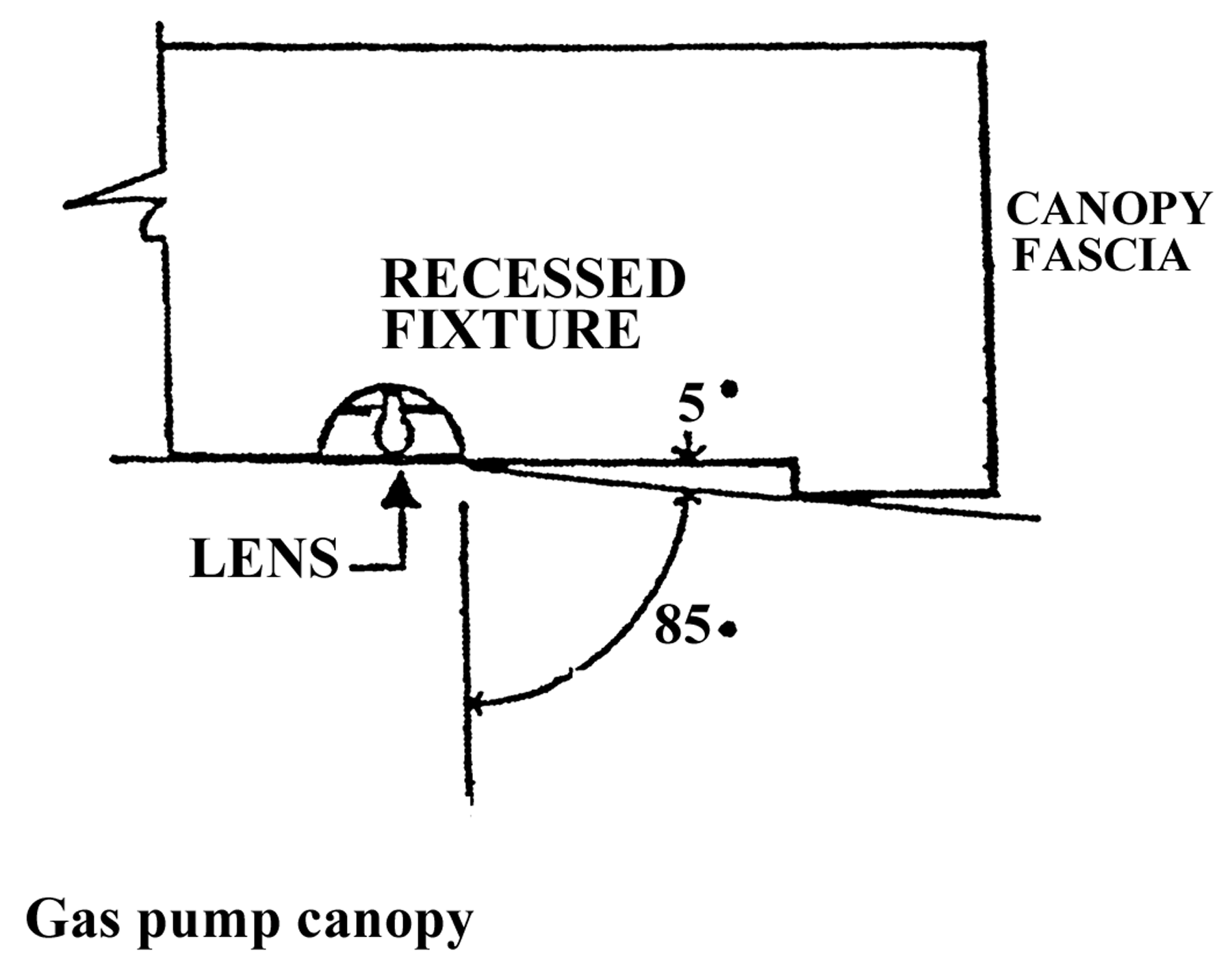
Gas Pump Canopy
FIGURE 2.
CUTOFF FIXTURES
Source: The Outdoor Lighting Pattern Book, Lighting Research Center, Rensselaer Polytechnic
Institute, 1996, ISBN 0 07 037188-1, Library of Congress Card Catalog Number 96-41377.
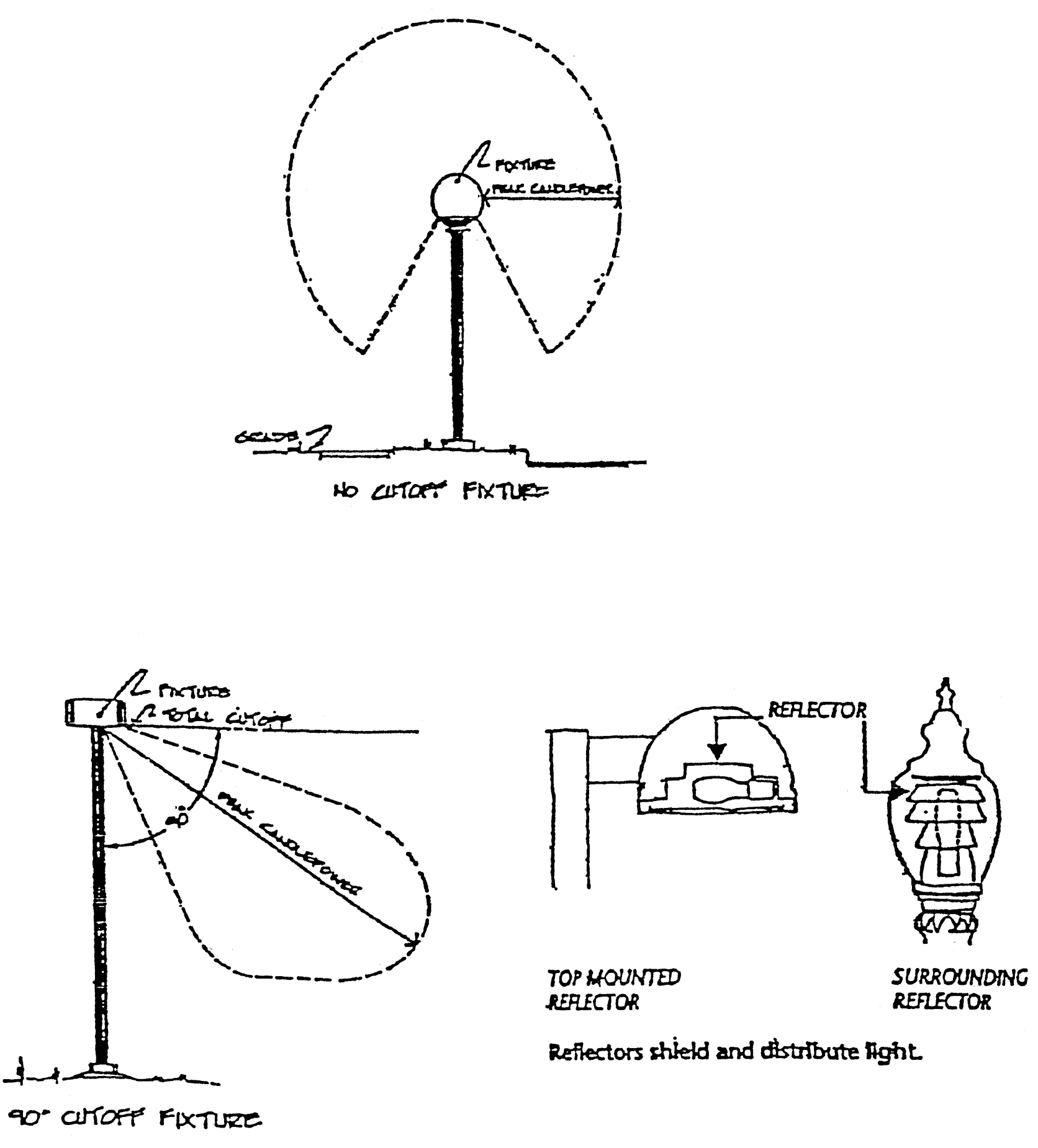
Outdoor Lighting
FIGURE 3.
COMPUTER GENERATED LIGHT LEVEL GRID EXAMPLE FOR PARKING LOT
LIGHTING PLANS
Computer generated light level grid, with readings in tenths of footcandles.
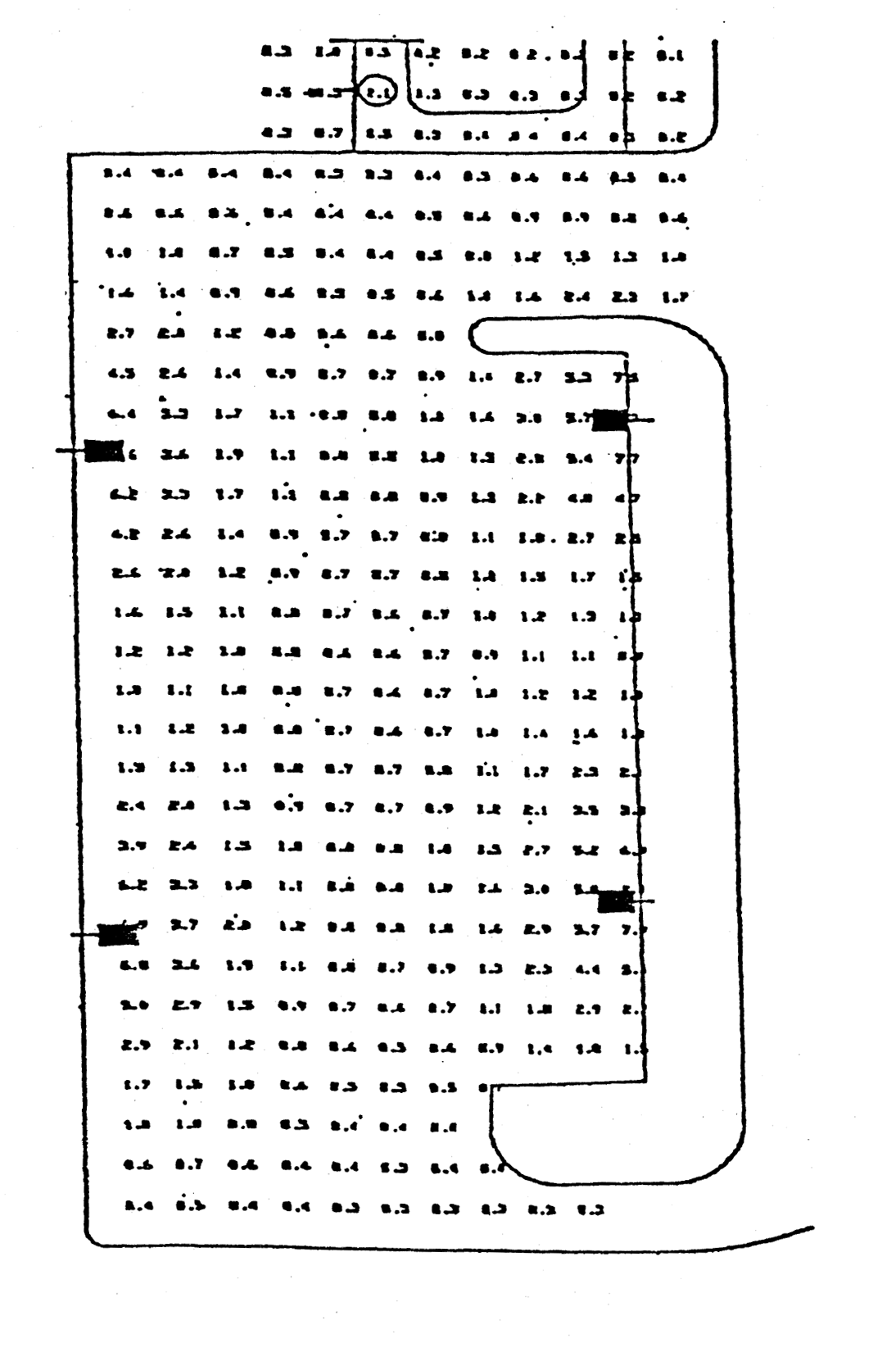
Computer Generated Lighting

