
King George County Unincorporated
City Zoning Code
City Zoning Code
ARTICLE VII
USE PERFORMANCE STANDARDS
Section 7-1-1. - Purpose and Intent.
(A)
The following additional regulations apply to specific uses as set forth below. These regulations are intended to serve as the minimum standards for these uses and are not intended to exclude other provisions of this Ordinance that may apply. The standards set forth in this Article for a specific use apply to the particular individual use, regardless of the review procedure by which it is approved, unless otherwise specified in this Ordinance.
Section 7-1-2. - Must Meet Other Regulations.
(A)
Each use provided in this Article may also require permits and approvals, including:
(1)
Zoning Permit;
(2)
Special Exception Permit;
(3)
Site Plan Approval; and/or
(4)
Other King George County required permits, such as a business license or Erosion and Sediment Control Permit.
(B)
Applicants should consult with King George County staff during the application process to ensure all permits and requirements are met.
Section 7-2-1. - Agriculture/Silviculture.
(A)
Lot Area. Minimum lot area of 5 acres for the keeping of livestock other than horses.
(B)
Livestock in Subdivisions. The keeping of livestock (except horses, chickens, goats, and rabbits/hares) shall be permitted only in Major Subdivisions (6 or more lots), where the lot is a minimum of 10 acres in size.
(1)
Private Stables are permitted for the keeping of horses in a Major Subdivision, subject to the requirements of Section 7-2-8.
Section 7-2-2. - Agriculture, Intensive.
(A)
Setbacks.
(1)
Located a minimum of 200 ft. from any primary highway and 100 ft. from any secondary highway or other right-of-way;
(2)
Located a minimum of 500 ft. from any residential district and from any existing residence not located on the same parcel;
(3)
Located a minimum of 200 ft. from any adjacent landowner property line;
(4)
Located a minimum of 500 ft. from any religious assemblies, public or private schools, and other public-owned facilities; and,
(5)
Located a minimum of 100 ft. from any river, creek, spring, reservoir, or any public or private water supply system, including but not limited to wells or cisterns unless a greater distance is required by State or Federal requirements, including but not limited to, the Chesapeake Bay Act and the Virginia Department of Conservation and Recreation.
(B)
Permits. Intensive agriculture uses shall submit an approved Nutrient Management Plan and any Federal and State permits prior to the issuance of any building or zoning permits for the use.
Section 7-2-3. - Agriculture, Residential.
(A)
Chickens.
(1)
Lot Area. Minimum lot area of 25,000 sq. ft.
(2)
Maximum Units. Maximum of 6 chickens.
(3)
Setbacks.
(i)
All enclosures, runs, and coops shall be located at least 10 ft. from any property line and at least 35 ft. from any dwelling not owned by the applicant.
(4)
General Standards.
(i)
The keeping of chickens shall comply with all relevant state and federal laws.
(ii)
The keeping of roosters shall be prohibited.
(iii)
Chickens shall be used only for non-commercial domestic purposes. The selling of eggs and the harvesting of chickens for commercial purposes is prohibited.
(iv)
No enclosures, runs, or coops shall be located in a front setback or within the front "yard" of a lot.
(a)
The zoning administrator may grant an exception to this requirement in cases where due to unusual lot configuration, topography, or proximity of neighbors, another area of the yard is more suitable for such an activity.
(v)
Chickens shall always be in a covered enclosure or within a fenced area.
(vi)
All enclosures, runs, and coops shall be located outside of any Resource Protection Areas (RPA).
(vii)
All coops shall provide at least 3 sq. ft. of area per chicken and all runs shall provide at least 10 sq. ft. per chicken.
(B)
Bees.
(1)
Lot Area.
(i)
2 hives permitted with a minimum 15,000 sq. ft. of lot area.
(ii)
3 hives permitted with a minimum 20,000 sq. ft. of lot area.
(iii)
4 hives permitted with a minimum 25,000 sq. ft. of lot area.
(2)
Hive Maximum. Maximum of 4 hives.
(3)
Setbacks.
(i)
Located a minimum of 10 ft. to any property line and at least 35 ft. from any dwelling not owned by the applicant.
(4)
General Standards.
(i)
Bees shall only include European Honeybees, otherwise known by the species name Apis Mellifera.
(ii)
No hives shall be located in a front setback or within the front "yard" of a lot.
(iii)
A constant supply of fresh water shall be provided on the lot within 20 ft. of all hives.
(iv)
A fly away barrier of at least 6 ft. in height shall shield any part of a property line that is within 25 ft. of a hive.
i.
Fly away barriers shall consist of dense vegetation, a wall, or solid fence. Any wall or fence shall comply with Article VIII, Community Design Standards, of this Ordinance.
(v)
Any sale of bees on combs or hives, used beekeeping equipment or appliances shall have a certificate of health as required by the Code of Virginia § 3.2-4407, as amended.
(vi)
A minor sign, in accordance with Article VIII, Community Design Standards, shall be provided for reasonable warning of the presence of beehives.
(vii)
Beekeepers shall abide by the Beekeeping Best Management Practices provided by Virginia Department of Agriculture.
Section 7-2-4. - Agritourism and Farm or Ranch-Based Events.
(A)
Purpose. The intent of this section is to identify and encourage agritourism as an economic development activity in agricultural districts of the county based on the county's own historical, recreational, and agricultural resources. Agritourism activities as permitted "by right" in agricultural districts as accessory uses to bona fide agriculture or silviculture production may have certain reasonable restrictions and exclude certain uses that have a substantial impact on health, safety, or general welfare of the public as determined by restrictions set out further herein. Agritourism activities must be conducted in accordance with Section 7-2-4.
(B)
Definitions. The following words, terms, and phrases, when used in this Section, shall be as defined:
(1)
Agricultural produce. Fruits and vegetables.
(2)
Agriculture or silviculture production. Bona fide production or harvesting of agricultural or silviculture products as defined by the Code of Virginia § 3.2-6400 on a farm or ranch.
(3)
Agritourism activity. Any activity carried out on a farm or ranch that allows members of the general public, for recreational, entertainment, or educational purposes, to view or enjoy rural activities, including farming, ranching, horseback riding, historical, cultural, harvest-your-own activities, or natural activities and attractions. This definition also includes wineries, breweries, and distilleries licensed by the Virginia Alcoholic Beverage Control Authority. An activity is an agritourism activity whether or not the participant paid to participate in the activity.
(4)
Agritourism professional. Any person(s) who is engaged in the business of providing one or more agritourism activities, whether or not for compensation.
(5)
Events or special events. For purposes of this Section, when a farm or ranch generates trip generating activity arriving or departing the site measured by vehicles or attendance thresholds stated in Section 7-2-4(K) during a two-hour period in a given day.
(6)
Farm or ranch. Property in an agricultural district in which one or more areas of land is actively used for agriculture or silviculture production, such as cultivation, growing, or harvesting but not solely or predominantly processing.
(C)
General Applicable Standards. This section applies to all agritourism activity.
(1)
All agritourism activity must be an accessory to a bona fide agriculture or silviculture production operation that has a minimum of five (5) acres dedicated to active agriculture or silviculture production during the appropriate season.
(2)
Active usage shall require that agriculture or silviculture production be the principal use of the property during at least one growing, breeding, and/or grazing season each calendar year as applicable.
(3)
At the entrance and site of the agritourism activity, every agritourism professional must post and maintain signs that notify visitors of the agritourism professional's limited liability for injury or death in accordance with Code of Virginia § 3.2-6402, as amended.
(D)
Noise. All noise shall comply with the Noise Ordinance, Section 10.8 of the King George County Code of Ordinances. There shall further be no amplified music between 10:00 p.m. and 8:00 a.m., seven days per week.
(E)
Structures. Any structure intended for occupancy by visitors to an agritourism activity shall provide emergency vehicle access and fire safety measures to the extent permissible under Code of Virginia § 36-99(B) and Va. Administrative Code § 13 VAC 5-63-20 and § 13 VAC 5-63-200.
(F)
Sanitary facilities. Sanitary facilities used in conjunction with an agritourism activity shall be provided in accordance with the Virginia Department of Health standards set forth in Va. Administrative Code § 12 VAC 5-610-980.
(G)
Food items. The preparation, manufacture, packing, storage, distribution, or sale of all food items shall be done in accordance with applicable federal, state, and local laws and regulations including Code of Virginia § 3.2-5105 through § 3.2-5119.
(H)
Sale of Agricultural Produce. Any agritourism professional engaged in the sale of agricultural produce shall obtain a license to operate and conduct business from the Commissioner of Agriculture and Consumer Services in accordance with Code of Virginia § 3.2-4739 unless the agritourism professional:
(1)
Is operating solely on a commission basis as a licensed commission merchant,
(2)
Is selling produce grown by them,
(3)
Operates strictly as a cash buyer,
(4)
Operates a plant that changes the physical form or characteristics of the produce, or
(5)
Buys produce for wholesale or retail.
(I)
Access. All agritourism activities shall have a minimum of one direct access point to a state-maintained road or a minimum of one direct access point to a private road with direct access to a state-maintained road, with buffers in accordance with Article VIII, Community Design Standards, of this Ordinance. Access via easement is permissible to satisfy direct access requirements.
(J)
Parking. Parking must be located on the same lots as the agriculture or silviculture production or on abutting lots owned by the agritourism professional. Parking is not permitted in public rights-of-way. Parking is not required to be on a paved surface provided that any land disturbing and unauthorized discharge is consistent with other applicable law.
(K)
Trip Generating Special Events. Special events may be authorized on those parcels in the agricultural zoning district on which there is a bona fide agricultural or silviculture production operation.
(1)
Lot Size Minimum of 20 Acres. If principal use of a parcel is agriculture or silviculture production, events shall be authorized without application for a special exception permit up to twelve (12) days per calendar year provided that the lot size (or size of abutting lots in common ownership and primarily used for production agricultural or silviculture) is a minimum of twenty (20) acres, has fewer than 100 visitor vehicle trips generated per day, and fewer than 200 visitors are present at any single time.
(2)
Lot Size Minimum of 10 Acres. If principal use of a parcel is agriculture or silviculture production, events shall be authorized without application for a special exception permit up to nine (9) days per calendar year provided that the lot size (or size of abutting lots in common ownership and primarily used for production agriculture or silviculture) is a minimum of ten (10) acres but less than twenty (20) acres, has fewer than 75 vehicle trips generated per day, and fewer than 150 visitors are present at any single time.
(3)
Lot Size Minimum of 5 Acres. If principal use of a parcel is agriculture or silviculture production, events shall be authorized without application for a special exception permit up to six (6) days per calendar year provided that the lot (or size of abutting lots in common ownership and primarily used for production agriculture or silviculture) is a minimum of five (5) acres but less than ten (10) acres, fewer than 50 visitor vehicle trips per day are generated, and fewer than 100 visitors are present at any single time.
(4)
Types of Special Events. Special events include, but are not limited to, meetings, conferences, banquets, dinners, wedding receptions, private parties, festivals, and similar activities or gatherings that exceed the attendance or trip generation thresholds stated herein. If two or more events are conducted onsite simultaneously for any duration, the vehicle trips and attendance of both events shall be aggregated and must meet the limits set forth herein.
(i)
Activities that occur on lots of fewer than five (5) acres, generate fewer than 25 vehicle trips per day, and have fewer than 50 visitors present at any single time are not considered Special Events under this Section.
(L)
Nonconforming Activity. A nonconforming agritourism activity may remain nonconforming in accordance with Article IX of this ordinance. A nonconforming special event or established series of special events may only remain nonconforming in accordance with Article IX of this ordinance if the nonconforming special event(s) has occurred of the same duration and intensity on the same lots as the principal agriculture or silviculture production in any of the five calendar years preceding January 1, 2024.
(M)
Notification. The owner or operator of the use shall notify the Zoning Administrator 90 days prior to any applicable agritourism event or series of seasonal events and shall confirm compliance with the provisions of this Section.
(N)
Violations and Enforcement. Any person who fails to comply with the requirements or provisions of this Section shall be notified and subject to penalties in accordance with Article II, Division 4 of this Ordinance.
Section 7-2-5. - Biosolid Application.
(A)
Purpose.
(1)
The standards provided below are to:
(i)
Ensure laws and regulations governing the land application of biosolids are properly implemented and enforced;
(ii)
Secure and promote the health, safety, and welfare of the County's citizens; and
(iii)
Deter the creation of a public nuisance and to prevent pollution of the waters and soils of the County related to land application of biosolids.
(2)
The County will test and monitor the application of biosolids to agricultural land within its boundaries as authorized by the Code of Virginia and applicable regulations.
(3)
These regulations are not intended to regulate the land application of animal wastes or manures or exceptional quality biosolids.
(B)
Authority. This Section is adopted pursuant to the authority granted by the Code of Virginia, as amended, including but not limited to § 15.2-1200 et seq., § 15.2-2200 et seq., § 15.2-2283 et seq., § 62.1-44.19:3 through § 62.1-44.19:3.4.
(C)
Definitions. The following words, terms, and phrases, when used in this Section, shall be as defined:
(1)
Applicator. Any person who applies biosolids pursuant to appropriate permits.
(2)
Biosolids. Sewage sludge that has received an established treatment for required pathogen control and is treated or managed to reduce vector attraction to a satisfactory level and contains acceptable levels of pollutants, such that it is acceptable for use for land application, marketing, or distribution in accordance with state law and regulations.
(3)
Biosolids Monitor. An employee or agent of the County, either full-time or part-time, charged with the responsibility of ensuring that the land application of Biosolids is conducted in accordance with this ordinance and applicable laws and regulations.
(4)
Exceptional Quality Biosolids. Biosolids that have received an established level of treatment for pathogen control and vector attraction reduction and contain known levels of pollutants, such that they may be marketed or distributed for public use in accordance with state regulations.
(5)
Land Application. The spreading, placement, or distribution of Biosolids upon, or insertion into, the land.
(6)
Nutrient Management Plan. A plan prepared by a person certified by the Commonwealth as a nutrient management planner and otherwise meeting the requirements set forth by state law and regulation.
(7)
Owner. A person who holds legal title, equitable title, a leasehold interest or the right of possession or control over land.
(8)
Permit. An authorization granted by the authority of the Commonwealth of Virginia to land apply Biosolids.
(9)
Permittee. Any person who holds a permit authorizing the land application of Biosolids.
(10)
Sewage Sludge. Any solid, semi-solid, or liquid residues, which contain materials, removed from municipal or domestic wastewater during treatment including primary and secondary residuals.
(11)
Storage Facility. Any facility designed to store biosolids for a period of time. Such facilities are limited to temporary storage at the application site and shall only be utilized in the event that land application is precluded by unforeseen weather conditions or other circumstances beyond the control of the Permittee.
(D)
Prohibited Practices.
(1)
No person shall dispose of sewage sludge, including biosolids, on land located in the County except in accordance with federal and state law and regulations and this Section.
(2)
No person or owner shall land apply biosolids on lands in the County until all of the procedural requirements set forth in this Section, as well as those set forth in applicable Federal and State laws and regulations, have been satisfied.
(3)
No person or owner shall apply, and no owner shall permit the land application of sewage sludge other than biosolids that have been approved in accordance with the regulations of the Department of Environmental Quality to land in this County.
(4)
No person shall apply biosolids to land in the County except pursuant to a valid permit issued by the Department of Environmental Quality, in compliance with all applicable Federal and State statutes and regulations, and in accordance with the provisions of this Section.
(E)
Lot Area.
(1)
Minimum lot area of 20 contiguous acres.
(F)
Notification.
(1)
Any person proposing or intending to land apply biosolids to lands in this County shall notify the Biosolids Monitor in writing at least 14 days prior to any intended land application of biosolids, or as otherwise required by state law or regulation.
(2)
The notice provided to the Biosolids Monitor shall include the following information (if not already submitted to the locality):
(i)
The name, address, and telephone number of the Permitee or Applicator;
(ii)
The tax map numbers of the parcels where land application will occur;
(iii)
The name, address, and telephone number of the owner of the property where the land application will occur;
(iv)
The name, telephone number and address of the hauler of the biosolids;
(v)
The estimated date range on which land application will occur and the duration of the planned application;
(vi)
A copy of the current state permit and any other state or federal permits authorizing the land application;
(vii)
A copy of a Nutrient Management Plan (NMP) as required by state law and regulation; and
(viii)
Information on proposed haul routes and alternative haul routes on a County map.
(3)
The County shall review the documentation provided with the notice and shall notify the applicant in writing of any deficiencies in the submittal within 10 business days of receipt. The applicant will have 10 business days to correct and amend the deficiencies unless otherwise permitted by the county in writing to proceed in accordance with the State Permit.
(G)
Monitoring and Sampling.
(1)
By agreeing to accept biosolids for land application, the owner of the property on which land application takes place agrees to allow the Biosolids Monitor access to the land application site for the purpose of monitoring land application activities. It is the responsibility of the Permittee to ensure that the property owner is advised of this requirement. The Biosolids Monitor shall make diligent efforts to make contact with the owner prior to entering the property.
(2)
The Permitee and owner shall allow the County to take samples at the application site before, during, and after the application. Any test samples shall be analyzed at a lab qualified to conduct such analysis and the State and County Health Departments may review these test results to determine compliance with applicable laws and regulations. At the request of the Permittee or owner, the Biosolids Monitor will provide either with a split sample.
(3)
At the request of the Biosolids Monitor, the Permitee shall provide the most recent quality analysis results for biosolids that are land applied at any site in the County.
(H)
Complaint Response.
(1)
The Biosolids Monitor shall notify the Virginia Department of Environmental Quality, the Permitee, and the owner of all complaints concerning the land application of biosolids.
(2)
The Biosolids Monitor shall notify the Permittee of any failure to follow the requirements of the Permit resulting in the improper application of Biosolids or in the spillage of Biosolids onto public streets or rights-of-way or on property outside the area authorized by the Permit. In accordance with Section 7-2-5 (M), below, the Biosolids Monitor may require that land application operations be halted until the Virginia Department of Environmental Quality determines that the operations may proceed in accordance with the State Permit.
(3)
The Permittee shall respond to undertake appropriate corrective action for improperly applied biosolids, or to clean up Biosolids spilled onto public streets, roadways, or other un-permitted areas, immediately upon receiving such notification.
(4)
In the event that the Permittee does not respond to notification of spillage or improper application and the County conducts the cleanup of spilled biosolids, the Permittee shall compensate the County for the actual costs of such cleanup.
(5)
The Permittee is responsible for ensuring that the tracking of biosolids from land application sites onto public roads is minimized and that biosolids that are dragged or tracked out from land application sites are promptly removed from public roads and highways.
(I)
Scheduling. The Permittee will, at the request of the Biosolids Monitor, make all reasonable efforts to schedule land application activities to avoid conflicts with community or social events in the vicinity of the land application site.
(J)
Storage. Biosolids shall be land applied as they are received at the site unless land application is precluded by unforeseen weather conditions or other circumstances beyond the control of the Permittee. Biosolids shall not be stored at any site in the County other than storage that is approved in accordance with the law and regulations of the Virginia Department of Environmental Quality and any local, State, or Federal regulations.
(K)
Financial Responsibility. Land application of biosolids is not allowed unless the Permittee has in effect liability insurance or other evidence of financial responsibility in the amount that is required by state law or regulation, covering losses and claims arising from the land application or transportation of biosolids and related activities in the County. Such insurance or other form of financial responsibility shall be maintained in full force and effect throughout the time that the applicator is engaged in land application of biosolids in the County. The Permittee shall provide the Biosolids Monitor with certificates of insurance and shall promptly notify the Biosolids Monitor of any proposed cancellation or modification of insurance coverage.
(L)
Reimbursement. The County shall submit requests for reimbursement for the costs and expenses of testing and monitoring of land application and related activities as are allowed by applicable state law, regulations, manuals, guides, and procedures.
(M)
Enforcement.
(1)
Any person who violates any of the provisions of this Section may be charged with a Class 1 Misdemeanor, as defined by the Code of Virginia, as amended. Each day during which any violation is committed or exists shall constitute a separate offense.
(2)
The Biosolids Monitor shall have the authority to order the abatement of any violation of this Section, state law, or regulation.
(i)
The abatement order shall identify the activity constituting the violation; specify the provision or regulation violated by the activity; and order cessation and correction of the violation.
(3)
The County may bring suite to enjoin, restrain, correct, or prevent any violation of this Section.
Section 7-2-6. - Meat Processing Facility.
(A)
Exempt. In accordance with the Code of Virginia, the slaughtering and processing of animals raised and/or kept on the associated parcel, and used for personal use by the owner, is exempt from these provisions.
(B)
Minimum Lot Area.
(1)
Minimum lot area of 10 acres.
(C)
Location. No portion of the use, excluding required screening and landscape buffers, shall be located within:
(1)
200 ft. from any property lines; and
(2)
500 ft. from any dwelling not on the associated parcel.
(3)
500 ft. from a religious assembly if the use allows customers on Sunday.
(D)
Customers.
(1)
No more than 5 customers daily.
(E)
Hours of Operation.
(1)
Hours of operation shall be limited to Sunday through Saturday, 7:00 a.m. to 8:00 p.m.
(F)
Noise. All noise shall comply with the Noise Ordinance, Section 10.8 of the King George County Code of Ordinances.
(G)
Compliance. All operations of the meat processing facility, including the handling and disposal of waste, shall operate in compliance with all applicable state, federal, and local regulation, including the King George County Code, Virginia Department of Health regulations, US Department of Agriculture regulations, and Virginia Department of Agriculture and Consumer Services regulations, as applicable.
(H)
General Standards.
(1)
All activity associated with the meat processing facility shall be performed within a completely enclosed building.
(2)
Entrances shall be approved and in accordance with Virginia Department of Transportation (VDOT) standards for commercial entrances.
(3)
Exterior storage of meat processing related equipment, trailers, materials, or otherwise shall be screened from view using plantings, fences, walls, or other appropriate means so as not to be visible from any right-of-way. If a fence or masonry wall is used, it shall be painted or stained and kept in a good state of repair.
(4)
Sufficient parking shall be provided for the allowed customers.
(i)
Parking area(s) shall be provided on the lot that the meat processing facility is associated with and cannot be on any streets or right-of-way.
(5)
One sign shall be permitted, in accordance with Article VIII, Community Design Standards, of this Ordinance.
Section 7-2-7. - Stable, Commercial.
(A)
Minimum Lot Area.
(1)
Minimum of 2 acres for one horse, plus 1 additional acre for each additional horse.
(B)
Location.
(1)
Any buildings, barns, pens, and areas for the keeping of animals or animal waste storage shall be located at least 75 ft. from any lot line.
(2)
Any buildings for the keeping of animals shall be located at least 100 ft. from any highway or other right-of-way for passage.
(C)
General Standards.
(1)
Riding surfaces shall be covered and maintained with a substance to minimize dust and erosion.
(2)
Fencing and other means of animal confinement shall be maintained at all times.
(3)
Pens, stalls, and grazing areas shall be maintained in a sanitary manner.
(4)
Manure or animal wastes shall not be stored, stockpiled, or permitted to accumulate within a designated Chesapeake Bay Resource Protection Area.
Section 7-2-8. - Stable, Private.
(A)
Minimum Lot Area.
(1)
Minimum of 2 acres for one horse, plus 1 additional acre for each additional horse.
(i)
Except for private stables in Major Subdivisions, as provided below in 7-2-7 (D).
(B)
Location.
(1)
Any buildings, barns, pens, and areas for the keeping of animals or animal waste storage shall be located at least 75 ft. from any lot line.
(2)
Any buildings for the keeping of animals shall be located at least 100 ft. from any highway or other right-of-way for passage.
(C)
General Standards.
(1)
Riding surfaces shall be covered and maintained with a substance to minimize dust and erosion.
(2)
Fencing and other means of animal confinement shall be maintained at all times.
(3)
Pens, stalls, and grazing areas shall be maintained in a sanitary manner.
(4)
Manure or animal wastes shall not be stored, stockpiled, or permitted to accumulate within a designated Chesapeake Bay Resource Protection Area.
(D)
Private Stables in Major Subdivisions.
(1)
In addition to the standards of 7-2-8 (B) and (C), listed above, the following shall apply for any private stables within an established subdivision:
(i)
The private stable shall be accessory to a single-family residential dwelling and solely for the recreational purposes of the resident(s) living on the premises.
(ii)
The minimum parcel size shall be 10 acres with a minimum of 2 acres useable pasture area on which 1 horse may be kept.
(a)
Useable pasture area excludes Chesapeake Bay Resource Protection Areas.
(b)
Additional horses may be kept at a ratio of 1 horse for each additional 2 acres of useable pasture area.
(c)
Maximum of 10 horses.
Section 7-3-1. - Bed and Breakfast.
(A)
Owner/Operator Occupied. Bed and breakfasts are allowed as a Special Exception as accessory to a single-family detached dwelling and shall be occupied by the owner/operator during operation.
(B)
Licensure. The operator shall hold a valid business license from the County and, where applicable, a permit from the Department of Health.
(C)
Registration.
(1)
The owner of a bed and breakfast shall maintain a log of all patrons, including their name, address, license plate number and state, and their length of stay. The log shall be available to County staff upon request.
(2)
Guest may stay no longer than 30 consecutive days.
(D)
General Standards.
(1)
Signage and parking shall comply with the regulations of Article VIII, Community Design Standards, of this Ordinance.
(2)
Every room occupied for sleeping purposes shall comply with Uniform Statewide Building Code.
(3)
Guest rooms shall not have cooking facilities.
(4)
Food services in connection with the use shall be limited to meals provided to guests taking lodging at the facility. Restaurant service open to the general public is a separate use, permitted according to the district regulations.
(5)
Additional activities, including receptions, parties, and other events, are not permitted unless specifically authorized by the Special Exception Permit.
Section 7-3-2. - Dwelling, Accessory.
(A)
Special Exception Required.
(1)
For districts that permit accessory dwellings as a by-right use, a Special Exception will be required if the provided standards in this Section cannot be met.
(B)
General Limitations.
(1)
An accessory dwelling is allowed only as accessory to a single-family detached dwelling.
(2)
An accessory dwelling may be within (e.g., a downstairs or upstairs apartment), or attached to the principal dwelling or exist as a detached building (e.g., an apartment above a detached garage or in a guesthouse).
(i)
Attached accessory dwellings may be connected by a common wall or connected by a breezeway that does not exceed 15 ft. in length.
(ii)
If detached from the principal structure, the accessory dwelling shall be separated from the principal structure by a distance of at least 10 ft.
(iii)
Detached accessory dwellings shall only be permitted in agricultural districts.
(3)
The accessory dwelling shall not be subdivided or otherwise segregated in ownership from the principal dwelling.
(C)
General Standards.
(1)
An accessory dwelling shall not be offered, leased, or rented for tenancies of less than 30 days.
(2)
An accessory dwelling shall obtain all proper permits and comply with all applicable requirements of the Virginia Department of Health and the Virginia Uniform Statewide Building Code.
(3)
A recreational vehicle, travel trailer, camper, or similar vehicle shall not be used as an accessory dwelling.
(4)
Maximum of one kitchen per accessory dwelling.
(D)
Development Standards.
(1)
Minimum lot size.
(i)
Agricultural districts (A-1, A-2, and A-3):
(a)
All lots: 5 acres.
(ii)
Residential and Planned Development districts (R-1, R-2, R-C, and M-U):
(a)
With community/public water and sewer: 15,000 sq. ft.
(b)
With community/public water or sewer: 1 acre.
(c)
No community/public water or sewer: 2 acres.
(2)
Limit. Maximum of 1 accessory dwelling per lot.
(3)
Maximum Size.
(i)
The floor area of a detached or attached accessory dwelling shall not exceed 800 sq. ft. or 35% of the finished floor area of the principal dwelling (excluding carports, garages, and unfinished basements), whichever is greater.
(ii)
An accessory dwelling that is contained within a single-family dwelling, such as a basement or attic, shall not exceed the existing finished square footage of the primary dwelling's first floor footprint.
(4)
All accessory dwellings shall comply with the district's principal structure setbacks, and must comply with all other district standards, including height.
(E)
Design Standards.
(1)
Minimum of 1 off-street parking space shall be provided in addition to those required for the principal dwelling.
(2)
No additional driveways shall be created.
(i)
The Administrator may waive this requirement and allow an additional driveway, if the applicant can demonstrate the need for an additional driveway.
(3)
Accessory dwellings should be architecturally compatible to the principal dwelling.
Section 7-3-3. - Dwelling, Manufactured.
(A)
The manufactured home shall comply with the Virginia Manufactured Housing Construction and Safety Standards Law.
(B)
The manufactured home dwelling shall be placed on a permanent foundation and shall comply with the requirements of the Virginia Uniform Statewide Building code, including skirting requirements.
(C)
Manufactured home dwellings shall not be joined or connected together as one dwelling, nor shall any accessory building, excluding decks or similar structures, be attached to a manufactured home dwelling. This does not prohibit manufactured home dwellings designed and manufactured as multi-section homes.
Section 7-3-4. - Dwelling, Manufactured, Temporary/Accessory.
(A)
Temporary/accessory manufactured dwellings are to be used only while a permanent single-family dwelling unit is being constructed.
(1)
Construction can include new construction or reconstruction after a catastrophe and/or natural disaster.
(B)
Development Standards.
(1)
All temporary/accessory manufactured dwellings shall comply with all setback requirements that apply to the primary structure.
(2)
Only 1 temporary/accessory manufactured dwelling shall be allowed on a lot or parcel of land.
(3)
The structure shall comply with all applicable provisions of the Industrialized Building Safety Law (§ 36-70 et seq.) and the Uniform Statewide Building Code (§ 36-97 et seq.).
(C)
General Standards.
(1)
Any temporary/accessory manufactured dwelling shall comply with all applicable requirements of the Virginia Department of Health.
(2)
All temporary/accessory manufactured dwellings shall only be permitted for a maximum of 2 years. The Administrator may grant a 1-year extension of time in extenuating circumstances upon application by the permit holder.
(3)
Any temporary/accessory manufactured dwelling shall be removed within 60 days of the date on which the permanent dwelling's construction is complete and a Certificate of Occupancy is issued.
Section 7-3-5. - Dwelling, Multi-family.
(A)
Spacing Between Buildings. Minimum distance between buildings shall be in accordance with the minimum standards for the district in which the multi-family dwelling is located, as provided in Article IV, Primary Zoning Districts, of this Ordinance.
(B)
Pedestrian Access. Pedestrian access shall be provided with a dustless surface to all common area elements, including mail kiosks, parking lots, refuse collection areas, recreational amenities, and to adjoining properties and along public roadways.
(C)
Roads and Private Pavement. All roads and private pavement shall have concrete curb and gutter.
(D)
Screening of Mechanical Equipment and Refuse Collection. Whether ground-level or rooftop, any refuse collection or mechanical equipment visible from adjacent property or roads shall either be integrated into the architectural treatment of the building or screened from view in accordance with Article VIII, Community Design Standards, of this Ordinance.
(E)
General Design and Building Layout. The development shall be designed with special attention to compatibility of adjacent land uses, topography, existing vegetation, and orientation. The development shall incorporate an attractive building layout that relates to and enhances natural vegetation and terrain or incorporates natural design features, such as preservation of scenic vistas or other unique elements of the site.
(F)
Architecture Standards.
(1)
Buildings shall be designed to impart harmonious proportions and avoid monotonous facades and large masses.
(2)
Buildings shall maintain architectural variety, while at the same time maintain an overall cohesive residential character.
(i)
Residential character shall be achieved through the creative use of design elements such as, but not limited to, balconies, terraces, articulation of doors and windows, sculptural or textural relief of facades, architectural ornamentation, or varied roof lines.
(G)
Guest Parking. Guest parking spaces/areas shall be provided, at the minimum number of spaces provided in Article VIII, Community Design Standards, of this Ordinance. Guest parking areas shall be provided on the same lot as the multi-family dwelling, and to the extent possible, should be located in such a way to be centrally accessible by all buildings/units.
Section 7-3-6. - Dwelling, Townhouse.
(A)
Placement. No more than 8 adjoined townhouse units shall be constructed in a single row.
(B)
Architectural Treatment of Townhouses. The facades of each unit of a townhouse structure shall be varied by changing front setback depth and utilizing variations in materials or design.
(1)
A maximum of 2 attached units may be on a single plane before a setback offset of no less than 18 inches is required.
(C)
Vehicular access. Each townhouse unit shall have unencumbered access from a dedicated public street that is built to Virginia Department of Transportation standards.
(D)
Pedestrian Access. Pedestrian access shall be provided with a dustless surface to all common area elements, including mail kiosks, parking lots, refuse collection areas, recreational amenities and to adjoining properties and along public roadways.
(E)
Guest Parking. Parking for each townhouse's guests shall be provided on the same lot, or within 15 ft. of the townhouse.
(F)
Roads and Private Pavement. All roads shall have concrete curb and gutter.
(G)
Landscaping and Buffers. Landscaping shall be installed as required in Article VIII, Community Design Standards, of this Ordinance.
(H)
Screening of Mechanical Equipment and Refuse Collection. Whether ground-level or rooftop, any refuse collection or mechanical equipment visible from adjacent property or roads shall either be integrated into the architectural treatment of the building or screened from view in accordance with Article VIII, Community Design Standards, of this Ordinance.
(I)
Stormwater. Any permanent wet pond stormwater best management practice (BMP) shall be designed and developed as a water feature amenity or designed and landscaped in a manner consistent with the surrounding development. Wet ponds shall include adequate aeration features for movement of water.
(J)
Open Space and Amenities. In any townhouse project resulting in the creation of any open space and amenities thereon, broadly defined, the maintenance and upkeep of such areas and elements shall be provided for by an arrangement acceptable to the County and in compliance with this Article or applicable state statutes.
(1)
In any townhouse project consisting of open space and amenities related to the project in such manner that the Condominium Act, Code of Virginia §§ 55.1-1900 through 55.1-1907 is applicable, the project shall conform to the requirements of that act.
(2)
In any townhouse project consisting of open space and amenities related to the project in such manner that the Condominium Act, Code of Virginia §§ 55.1-1900 through 55.1-1907 is not applicable, the developer shall meet the following requirements:
(i)
Establish a nonprofit entity according to the provisions of the Virginia Nonstock Corporation Act, Code of Virginia, §§ 13.1-801 through 13.1-946, as amended, whose membership shall be all the individuals or corporations owning residential property within the townhouse project and whose purpose shall be to hold title in fee simple to, and be responsible for maintenance and upkeep of such open space; and
(ii)
Hold title to and be responsible for such open space until such time as conveyance to such a nonprofit entity occurs. Such conveyance shall occur when at least 75 percent of the townhouse units have been sold; and
(iii)
Provide proper agreements and covenants running with the land and in favor of the citizens of King George County, requiring membership in such a nonprofit entity. Such agreements and covenants shall include, among other things, that any assessments, charges, and cost of maintenance of the open space shall constitute a pro rata lien upon the individual townhouse lots, inferior in lien and dignity only to taxes and bona fide duly recorded first and second mortgages or deeds of trust on the townhouse lot. Covenants shall also prohibit the denuding, disturbing or defacing of said open space without prior approval of the Town Council after recommendation of the Planning Commission.
(3)
All open space shown on the approved Site Plan is binding as to location and use proposed unless a change in use is approved at the discretion of the Administrator.
Section 7-3-7. - Family Healthcare Structure, Temporary.
(A)
Development Standards.
(1)
All temporary family healthcare structures shall comply with all setback requirements that apply to the primary structure.
(2)
Only 1 family health care structure shall be allowed on a lot or parcel of land.
(3)
The structure shall be no more than 300 gross sq. ft. and shall comply with all applicable provisions of the Industrialized Building Safety Law (§ 36-70 et seq.) and the Uniform Statewide Building Code (§ 36-97 et seq.).
(B)
Permits.
(1)
Prior to installing a temporary family healthcare structure, a permit shall be obtained from the County and associated fees paid.
(2)
The County may revoke the permit if the permit holder violates any provision of this section.
(C)
General Standards.
(1)
Any family healthcare structure shall comply with all applicable requirements of the Virginia Department of Health.
(2)
No signage shall be permitted on the exterior of the structure or anywhere on the property.
(3)
Any temporary family healthcare structure shall be removed within 60 days of the date on which the temporary family healthcare structure was last occupied by a mentally or physically impaired family member receiving services or assistance.
Section 7-3-8. - Home Occupation, Class A.
(A)
Size of Use. The maximum area permitted in conjunction with a home occupation shall be as follows:
(1)
No more than 500 sq. ft. or 30% of the floor area of the dwelling, whichever is greater, or
(2)
Up to 100% of the floor area of an accessory structure.
(B)
Employees and Customers.
(1)
No more than 1 full- or part-time employee, other than family members residing in the dwelling unit, shall be permitted at the dwelling unit for business purposes.
(2)
Customers may come to the site by appointment only.
(i)
No more than 5 customers daily and 2 at a time.
(C)
Hours of Operation.
(1)
Hours of operation shall be limited to six days per week, 8:00 a.m. to 8:00 p.m.
(D)
General Standards.
(1)
There shall be no change in the exterior of the structure and/or property to indicate the home occupation use.
(2)
One minor sign shall be permitted, in accordance with Article VIII, Community Design Standards, of this Ordinance.
(3)
Sufficient parking shall be provided for the allowed number of employees and customers, and in accordance with Article VIII, Community Design Standards, of this Ordinance.
(i)
Parking area(s) shall be provided on the lot that the home occupation is associated with and cannot be on any streets or right-of-way.
(4)
Materials and supplies associated with the home occupation shall be limited to just-in-time delivery and storage practices. No bulk storage on-site is permitted.
(5)
Exterior storage of business-related equipment, trailers, materials, or merchandise is prohibited.
(6)
The type of traffic generated by the home occupation shall be consistent with the type of traffic of other dwellings in the area.
Section 7-3-9. - Home Occupation, Class B.
(A)
Size of Use. The maximum area permitted in conjunction with a home occupation shall be as follows:
(1)
No more than 500 sq. ft. or 40% of the floor area of the dwelling, whichever is greater, or
(2)
Up to 100% of the floor area of an accessory structure.
(B)
Employees and Customers.
(1)
No more than 2 full- or part-time employees, other than family members residing in the dwelling unit, shall be permitted at the dwelling unit for business purposes.
(2)
No more than 10 customers may be on the property at any one time.
(C)
Hours of Operation.
(1)
Hours of operation shall be limited to six days per week, 8:00 a.m. to 8:00 p.m.
(D)
General Standards.
(1)
There shall be no change in the exterior of the structure and/or property to indicate the home occupation use.
(2)
One minor sign shall be permitted, in accordance with Article VIII, Community Design Standards, of this Ordinance.
(3)
Sufficient parking shall be provided for the allowed number of employees and customers, and in accordance with Article VIII, Community Design Standards, of this Ordinance.
(i)
Parking area(s) shall be provided on the lot that the home occupation is associated with and cannot be on any streets or right-of-way.
(4)
Materials and supplies associated with the home occupation shall be limited to just-in-time delivery and storage practices. No bulk storage on-site is permitted.
(5)
Exterior storage of business-related equipment, trailers, materials, or merchandise is prohibited.
(6)
The type of traffic generated by a home occupation shall be consistent with the type of traffic of other dwellings in the area.
Section 7-3-10. - Home Occupation, Class C.
(A)
Intent. The intent of this Section is to allow local, small-scale businesses to locate and operate at the owner's principal place of residence. This use is intended to serve home occupations that:
(1)
Do not meet the criteria of a Home Occupation, Class A or Class B;
(2)
Have the need to store equipment, supplies, or heavy machinery; or
(3)
May have additional employees or customers but is located with greater minimum lot sizes and setbacks, minimizing potential impact on adjacent properties.
(B)
Minimum Lot Size.
(1)
Minimum of 5 acres.
(2)
Land area from an adjacent parcel may count toward the minimum lot size, provided that:
(i)
It will be used for the operation of the business;
(ii)
It is under the same ownership and zoning district as the principal place of residence.
(C)
Setbacks.
(1)
Structures, storage, parking areas, and other facilities used for the home occupation shall be at least 50 ft. from all side and rear property lines.
(D)
Hours of Operation.
(1)
Hours of operation shall be limited to six days per week, 7:00 a.m. to 8:00 p.m.
(E)
Noise. All noise shall comply with the Noise Ordinance, Section 10.8 of the King George County Code of Ordinances.
(F)
General Standards.
(1)
Exterior storage of business-related equipment, trailers, materials, or merchandise shall be screened from view using plantings, fences, walls, or other appropriate means so as not to be visible from any right-of-way. If a fence or masonry wall is used, it shall be painted or stained and kept in a good state of repair.
(2)
Sufficient parking shall be provided for the allowed number of employees and customers.
(i)
Parking area(s) shall be provided on the lot that the home occupation is associated with and cannot be on any streets or right-of-way.
(3)
One sign shall be permitted, in accordance with Article VIII, Community Design Standards, of this Ordinance.
(G)
Standards Based on Lot Size.
Section 7-3-11. - Park, Manufactured Home.
(A)
Intent. These provisions are designed to accommodate manufactured homes in a manufactured home park with open space and recreation requirements to encourage a suitable living environment where rental lots are provided for manufactured homes.
(B)
Minimum Lot Area.
(1)
Minimum of 5 contiguous acres for a manufactured home park.
(i)
Areas within a 100-year floodplain, areas exceeding 15% slope, and areas within a public right-of-way shall not count towards the minimum acreage for the manufactured home park.
(2)
Minimum of 7,500 sq. ft. for each lot within the manufactured home park.
(C)
Density.
(1)
The maximum number of manufactured home units in a manufactured home park shall be 5 units per acre.
(2)
Maximum of 50 manufactured homes per manufactured home park.
(3)
Maximum of 1 manufactured home per lot.
(D)
Frontage.
(1)
Manufactured home parks shall have minimum frontage of 200 ft. on a public road.
(2)
Each lot in a manufactured home park shall have a minimum frontage of 75 ft. on an internal street which is connected to a public road.
(E)
Screening. Every manufactured home park shall be enclosed with an approved fence or landscaped buffer not less than 7 ft. in height and with no openings to adjoining property other than the required entrances and exits to streets or public spaces.
(F)
Setbacks.
(1)
General.
(i)
No manufactured home shall be located closer than 100 ft. to any property line in a zoning district where manufactured home parks are not permitted.
(ii)
Setbacks of manufactured homes from adjacent property lines in the same zoning district or in zoning districts which permit manufactured home parks shall be a minimum of 50 ft.
(2)
Lots.
(i)
All manufactured homes shall be set back a minimum of 20 ft. from all internal streets.
(ii)
All manufactured homes shall have side and rear setbacks of 30 ft.
(G)
Open Space and Recreation.
(1)
Each manufactured home park shall provide not less than 1 recreation area or playground, and no such area shall be less than 4000 sq. ft. in area. Such area shall be used exclusively for recreational purposes.
(i)
An additional 200 sq. ft. of open space shall be provided for each unit over 20 units.
(H)
Lot Standards.
(1)
Grading. Each manufactured home site shall be graded to provide positive drainage away from the manufactured home site at a minimum gradient of one-half of one percent.
(2)
Markers. Every manufactured home site shall be clearly defined. There shall be posted and maintained in a conspicuous place on each lot a number corresponding to the number of each site.
(I)
Streets.
(1)
The design and construction of the interior street system shall be sufficient to adequately serve the size and density of the development.
(i)
All interior streets shall conform and be constructed to the specification of the Virginia Department of Transportation.
(ii)
The internal street improvements shall extend continuously from the existing improved street system to provide suitable access to manufactured homes, to provide adequate connections to the existing or future streets at the boundaries of the property, and to provide convenient circulation of vehicles with origins or destinations on the property.
(J)
Utilities.
(1)
Water and Sewer. All manufactured parks shall require connection to the King George County Service Authority; all manufactured homes within a manufactured home park shall be required to hook up to such system.
(2)
Refuse. An acceptable garbage and refuse collection program and temporary storage system shall be provided, with such program and physical system subject to final plan approval.
(i)
The accepted garbage and refuse collection program shall be the responsibility of the Manufactured Home Park owner/operator.
(ii)
Each manufactured home lot shall be provided with at least 1 garbage or trash container.
(K)
Maintenance.
(1)
Internal streets shall be maintained by the owner of each manufactured home park in order that such streets remain unobstructed and in suitable condition for passage of tenants, visitors, and public safety vehicles.
(2)
Recreation and open areas designed for common use shall be maintained by the owner of each park in order that such areas present a tidy appearance and do not offer refuge for rodents and other pests.
Section 7-3-12. - Short-Term Rental.
(A)
Definitions. The following shall apply as used in this section:
(1)
Booking transaction. Any transaction in which there is a charge to a transient by a host for the occupancy of any dwelling, sleeping, or lodging accommodations.
(2)
Guest or transient. A person who occupies a short-term rental unit.
(3)
Host. The owner, lessee, sublessee, mortgagee in possession, licensee, or person(s) in any other possessory capacity of the short-term rental unit. In determining compliance with these regulations, the host has the burden of demonstrating that they have ownership of or the legal rights to sublease the dwelling unit.
(4)
Short-term rental. A residential dwelling unit that is used or advertised for rent for transient occupancy in increments of fewer than 30 consecutive days. This use type does not include bed-and-breakfast establishments and does not apply to month-to-month extensions following completion of a year's lease.
(5)
Residential dwelling unit. A residence where one or more persons maintain a household.
(B)
Registration and other requirements.
(1)
No host shall operate a short-term rental business without having registered with the Administrator. A host shall not be required to register their short-term rental if the host is (i) licensed by the Real Estate Board or is a property owner who is represented by a real estate licensee; (ii) registered pursuant to the Virginia Real Estate Time-Share Act (Va. Code § 55.1-2200 et seq.); (iii) licensed or registered with the Department of Health, related to the provision of room or space for lodging; or (iv) licensed or registered with the locality, related to the rental or management of real property, including licensed real estate professionals, hotels, motels, campgrounds, and bed and breakfast establishments.
(2)
The Administrator will report all registrations to the King George County Commissioner of the Revenue for the collection of all appropriate tax, including transient lodging tax, and any required business licensure fees.
(3)
The registration form shall include the following information:
(i)
The name, telephone number, physical and mailing address, and email address of the host.
(ii)
The physical and mailing address of the short-term rental.
(iii)
The number of bedrooms and bathrooms in the short-term rental.
(iv)
A reminder about the importance of having appropriate levels of insurance that covers the short-term rental, the host, and the guests.
(v)
If utilizing private septic, a copy of the approved septic permit shall be provided by the applicant.
(4)
The registration shall be valid January 1st (or from whatever date the registration first occurs) through December 31st of the calendar year and shall be renewed annually.
(C)
Use regulations.
(1)
The unit shall meet all applicable building codes.
(2)
All exterior signage shall be in accordance with Article VIII, Division 6 of this Ordinance.
(3)
Occupancy of the short-term rental is limited to 2 people per bedroom.
(4)
No recreational vehicles, buses, or trailers shall be used in conjunction with the short-term rental use to increase the occupancy of the rental unit.
(5)
The host shall not permit occupancy of a short-term rental unit for a period of less than overnight, or more than 30 consecutive days, excluding all extensions and renewals to the same person or a person affiliated with the lessee, in accordance with Code of Virginia § 15.2-983, as amended.
(6)
The host shall provide guests with applicable county regulations, including but not limited to, noise ordinance, solid waste regulations, and event regulations.
(7)
The physical and aesthetic impact of required off-street parking shall not be detrimental to the existing character of the house and lot or to the surrounding neighborhood.
(D)
Registration Revocation.
(1)
A registration may be revoked for the following reasons:
(i)
Upon multiple violations of state law, County ordinances, or other applicable laws and regulations on three (3) or more occasions within a rolling 12-month period.
(2)
A formal complaint shall be filed with the Administrator to be considered received.
(i)
If violations occur, as supplied in (D)(1), above, the Administrator make revoke the registration.
(3)
Before any revocation can be effective, the Administrator shall give written notice to the short-term rental host.
(i)
The notice of revocation issued under the provisions of this Ordinance shall contain:
1.
A description of the violation(s) constituting the basis of the revocation; and
2.
If applicable, a statement of acts necessary to correct the violation. The host shall have thirty (30) days to correct the violation.
(4)
In accordance with Article III, Permits and Applications, of this Ordinance, an applicant may appeal the Administrator's decision for revocation of the registration.
(5)
Should a registration be revoked, the Host must apply for a new registration in accordance with section 7-3-12(B) and demonstrate how the use shall comply with the provisions of section 7-3-12(C).
(E)
Penalty.
(1)
Any short-term rental business in violation of zoning regulations is subject to all relevant penalties as set forth by King George County.
(2)
It shall be unlawful to operate a short-term rental:
(i)
Without obtaining a business license and a registration as required by this Article;
(ii)
After a registration has been revoked; or,
(iii)
In violation of any other requirement of this Article.
(3)
A person subject to the short-term rental registration requirement that offers a short-term rental not registered in accordance with Section 7-3-12(B) of this Ordinance may be subject to a penalty not to exceed $500.
Section 7-4-1. - Campground.
(A)
Minimum Lot Area. Minimum area of 10 acres.
(B)
Applications.
(1)
For any RV park that proposes to permit or accommodate off-road vehicles—including motorbike, dirt bikes, ATVs, golf carts, and similar—the application shall provide a description of where these off-road vehicles are permitted to travel.
(2)
The application shall include a description of how many tents will be accommodated and allowed per camping site.
(C)
Permanent Residences. No more than 1 permanent residence shall be allowed in a campground, which shall only be occupied by the owner or manager.
(D)
Registration.
(1)
The campground operator shall maintain a log of all patrons, including their name, address, license plate number and state, and their length of stay. The log shall be available to County staff upon request.
(2)
Patrons in campgrounds may stay no longer than 14 nights in any 30-day period or 45 nights in any one calendar year.
(E)
Service Buildings.
(1)
The campground's service buildings, including restrooms and other facilities shall be provided in accordance with Virginia Department of Health requirements.
(F)
General Standards.
(1)
Main campground roads shall be paved or treated to prevent dust.
(2)
Each site shall be marked to be readily identifiable and easily readable from the park or camp road.
(3)
The overall design shall evidence a reasonable effort to preserve the natural amenities of the site.
(4)
Each camping site shall also have 1 parking space, with minimum dimensions of 10 ft. by 20 ft.
(5)
Retail sales for the convenience of campground tenants are permitted. Items are limited to food, concessions, recreational supplies, personal care items, and other items clearly supportive of campground tenants' needs.
(i)
Structures for ancillary retail sales shall be no more than 10% of the total campground, or 1 acre, whichever is the lesser.
(6)
Accessory structures or recreation facilities, washrooms, swimming pools, game courts, and the like shall not be located closer than 100 ft. to any campground boundary or closer than 200 ft. to any lot in a residential district.
(7)
The parking, sale, and/or storage of recreational vehicles is strictly prohibited; nothing herein prohibits an applicant from seeking the permits for a Camp Recreational Vehicle (RV) Park, as provided in Article 6, Use Matrix, and Section 7-4-2 of this Article.
(G)
Open Space and Recreation.
(1)
Each Campground shall provide not less than 1 recreation area or playground, and no such area shall be less than 4000 sq. ft. in area. Such area shall be used exclusively for recreational purposes.
(H)
Refuse.
(1)
General. All bulk solid waste receptacles shall be maintained in a clean condition. Such receptacles shall be enclosed on all four sides to shield it from public view or from unauthorized access.
(2)
Health and safety. The storage, collection, and disposal of garbage in the campground shall not create health hazards, rodent harborage, insect breeding areas, accident or fire hazards, or air pollution.
(3)
Collection. All garbage shall be collected at least twice weekly and transported from the campground. The owner of the campground shall be responsible for providing this service.
(I)
Vegetation control.
(1)
The growth of brush, weeds, and grass shall be controlled to reduce the harborage of ticks, chiggers, and other noxious insects.
(2)
Campgrounds shall be so maintained as to prevent the growth of ragweed, poison ivy, poison oak, poison sumac, and other noxious weeds considered detrimental to health.
(3)
Open areas shall be maintained free of heavy undergrowth of any description.
(J)
Fire Protection.
(1)
Barbecue Pits, Fireplaces, Stoves, and Incinerators. Cooking shelters, barbecue pits, fireplaces and wood burning stoves, and incinerators shall be located, constructed, maintained, and used as to minimize fire hazard and smoke nuisance both on the property on which used and on neighboring property.
(i)
No burning of garbage, animal wastes or other materials that might produce dense smoke or emit objectionable odors will be allowed within the park.
(ii)
All cooking shelters, barbecue pits, fireplaces and wood burning stoves, and incinerators shall be maintained in proper working order.
(iii)
Locations of all cooking shelters, barbecue pits, fireplaces and wood burning stoves, and incinerators shall be included on the Site Plan.
Section 7-4-2. - Camp, Recreational Vehicle (RV) Park.
(A)
Terms. For purposes of this Section, the term "unit" shall refer to recreational vehicles.
(B)
Use of Off-Road Vehicles. For any RV park that proposes to permit or accommodate off-road vehicles—including motorbike, dirt bikes, ATVs, golf carts, and similar—the application shall provide a description of where these off-road vehicles are permitted to travel.
(C)
Permanent Residences. No more than 1 permanent residence shall be allowed in an RV park, which shall only be occupied by the owner or manager.
(D)
Lot Area.
(1)
Minimum of 10 acres.
(E)
Density.
(1)
Minimum of 10 units.
(2)
Maximum of 100 units.
(3)
The density shall in no case exceed 15 spaces per gross park acreage.
(F)
Unit Area. The minimum unit area shall be 1800 sq. ft.
(G)
Space Between Units. Units shall be separated from each other and from other structures by at least 20 ft. Any accessory structure such as attached awnings, carports or individual storage facilities shall be considered, for purposes of this separation requirement, a part of the unit.
(H)
Open Space and Recreation.
(1)
Each Campground shall provide not less than 1 recreation area or playground, and no such area shall be less than 4000 sq. ft. in area. Such area shall be used exclusively for recreational purposes.
(I)
Design Standards.
(1)
Each unit space shall be marked to be readily identifiable and easily readable from the RV park road.
(2)
The overall design shall evidence a reasonable effort to preserve the natural amenities of the site.
(3)
At least 75% of the developed unit spaces shall be within areas sufficiently wooded to provide adequate shade, camouflage, and buffering from public view.
(4)
The RV park shall maintain a minimum 100 ft. buffer area of undeveloped land.
(5)
Exposed ground surfaces in all parts of every RV park shall be paved or covered with stone, other solid material, or protected with a vegetative growth that is capable of preventing soil erosion and preventing dust.
(6)
Accessory structures or recreation facilities, washrooms, swimming pools, game courts, and the like shall not be located closer than 100 ft. to any RV park boundary or closer than 200 ft. to any lot in a residential district.
(7)
Retail sales for the convenience of campground tenants are permitted. Items are limited to food, concessions, recreational supplies, personal care items, and other items clearly supportive of campground tenants' needs.
(i)
Structures for ancillary retail sales shall be no more than 10% of the total RV park or 1 acre, whichever is the lesser.
(J)
Registration.
(1)
The owner of an RV park shall maintain a log of all patrons, including their name; address; make, model and license number of the recreational vehicle unit and tow vehicle; and their length of stay. The log shall be available to County staff upon request.
(K)
Roads, Access, and Parking.
(1)
All RV parks shall be provided with safe and convenient vehicular access from an abutting public road to each unit space.
(2)
Alignment and grading shall be properly adapted to topography.
(3)
Surfacing and maintenance of all roads and parking areas shall be paved or treated to prevent dust.
(4)
All weather roads, preferably one-way with adequate width to accommodate anticipated traffic, shall meet the following minimum road width requirements:
(i)
One-way travel lane with no parking shall be at least 11 ft. wide.
(ii)
Two-way travel lanes with no parking shall be at least 24 ft. wide.
(5)
All RV parks shall provide sufficient parking and maneuvering space so that parking, locating, or maneuvering of units incidental to parking shall not necessitate the use of any public road, sidewalk, right-of-way, or any private grounds not part of the RV park.
(6)
Ingress and egress of a unit shall be at a single point which provides circulation to all unit spaces in the RV park.
(i)
The point of ingress and egress shall be reviewed and deemed acceptable by VDOT.
(ii)
The point of ingress and egress shall be designed to minimize congestion and hazards and to allow free movement of traffic on adjacent roads.
(iii)
For control of ingress and egress, a registration office shall be located between the entrance to the RV park and any structure (excluding signs) or access to unit space in the RV park.
(L)
Service Buildings.
(1)
The RV park's service buildings, including restrooms and other facilities, shall be provided in accordance with all Virginia Department of Health requirements.
(2)
All service buildings shall be screened from other activities by visual barriers such as fences, walls or natural growth and shall be separated from any unit space by a distance of at least 50 ft.
(3)
Pedestrian paths or walkways shall be provided to service buildings when internal roads do not provide a direct route.
(4)
All rooms containing sanitary facilities shall:
(i)
Have plumbing fixtures that are constructed of waterproof material or covered with moisture-resistant material.
(ii)
Have at least one window or skylight facing directly to the outdoors. The minimum total gross area of the windows for each required room shall be not less than 10% of floor area.
(iii)
Have at least one window, which can be easily opened or a mechanical device, which will adequately ventilate the room.
(M)
Refuse.
(1)
Health and safety. The storage, collection, and disposal of garbage in the RV park shall not create health hazards, rodent harborage, insect breeding areas, accident or fire hazards, or air pollution.
(2)
Collection. All garbage shall be collected at least twice weekly and transported from the park. The owner of the park shall be responsible for providing this service.
(N)
Vegetation control.
(1)
The growth of brush, weeds, and grass shall be controlled to reduce the harborage of ticks, chiggers, and other noxious insects.
(2)
RV parks shall be so maintained as to prevent the growth of ragweed, poison ivy, poison oak, poison sumac, and other noxious weeds considered detrimental to health.
(3)
Open areas shall be maintained free of heavy undergrowth of any description.
(O)
Fire Protection.
(1)
Barbecue Pits, Fireplaces, Stoves, and Incinerators. Cooking shelters, barbecue pits, fireplaces and wood burning stoves, and incinerators shall be located, constructed, maintained, and used as to minimize fire hazard and smoke nuisance both on the property on which used and on neighboring property.
(i)
No burning of garbage, animal wastes or other materials that might produce dense smoke or emit objectionable odors will be allowed within the park.
(ii)
All cooking shelters, barbecue pits, fireplaces and wood burning stoves, and incinerators shall be maintained in proper working order.
(iii)
Locations of all cooking shelters, barbecue pits, fireplaces and wood burning stoves, and incinerators shall be included on the Site Plan.
Section 7-4-3. - Emergency Management Services Facility.
(A)
General Standards.
(1)
All inoperable vehicles shall be kept in an enclosed building, or screened in accordance with Article VIII, Community Design Standards, of this Ordinance.
(2)
Emergency Management Services Facility vehicles, such as fire trucks, ambulances, etc. shall remain parked within the facility when not in use.
(3)
Outdoor parking areas shall be screened, in accordance with Article VIII, Community Design Standards, of this Ordinance.
(4)
Outdoor storage, including refuse, equipment, etc. shall conform with the standards of Outdoor Storage, as provided in Section 7-7-7 of this Article.
(B)
Screening. Screening shall be provided on each side of the lot which:
(1)
Abuts upon any residential district or use; or
(2)
Faces across a street, alley, or place from any lot in a residential district or use.
(3)
Screening shall be in conformance with the regulations of Article VIII, Community Design Standards, of this Ordinance.
Section 7-4-4. - Shelter, Animal.
(A)
Lot Area.
(1)
Minimum lot area of 5 acres.
(B)
Location. Except where animals are confined in soundproofed buildings, no portion of the use, excluding required screening and landscape buffers, shall be located within:
(1)
100 ft. from the property lines of adjoining agricultural zoned property;
(2)
200 ft. from the property lines of adjoining residential zoned property; and
(3)
200 ft. from any dwelling not on the associated parcel.
(C)
General Standards.
(1)
All exterior runs, play areas, or arenas shall be designed with a minimum 6-foot-high opaque screen from adjacent lot lines and street rights-of-way.
(2)
Animal shelters shall be kept free of waste on a regular basis to minimize impacts of odor and reduce propagation of pests.
(i)
Waste disposal shall be in accordance with Virginia Department of Health standards.
Section 7-4-5. - Telecommunications Facility.
(A)
Uses.
(1)
Principal or accessory use. For the purposes of determining compliance with the standards of this Ordinance, telecommunication facilities may be considered either principal or accessory uses.
(i)
An existing use or an existing structure on the same lot shall not preclude the installation of a telecommunication facility on such lot.
(ii)
For purposes of determining whether the installation of a telecommunication facility complies with district regulations, the dimensions of the entire lot shall control, even though the facility may be located on leased area within such lots.
(2)
Nonconforming Uses. Telecommunication facilities that are constructed, and antennas that are installed, in accordance with the provisions of this Section shall not be deemed to constitute the expansion of a nonconforming use or structure.
(3)
Excluded uses. The following uses are not subject to the requirements of this Section for telecommunications facilities:
(i)
Television reception antennas that are less than 35 ft. above ground level (AGL) and used exclusively for non-commercial purposes.
(ii)
Ground-mounted satellite earth station antennas that are less than or equal to 10 ft. AGL, less than or equal to 6 ft. in diameter and used exclusively for non-commercial purposes.
(iii)
Micro-wireless facilities, provided that they are less than or equal to eighty 80 ft. AGL. Co-location of additional antennae should be sought. The County reserves the right to require "stealth technology" to hide or camouflage wireless facilities for micro-wireless facilities.
(iv)
Satellite earth station antennas. Ground-mounted satellite earth station antennas that are less than or equal to 10 ft. AGL, less than or equal to 6 ft. in diameter and used exclusively for non-commercial purposes.
(v)
County owned or operated wireless telecommunication facilities are exempt from the requirements of this article but are expected to adhere, to the extent reasonably possible, to the goals described herein.
(B)
Local Government Access. Although it shall not be the sole basis for a denial, owners of all new telecommunication facilities should provide, at no cost to the County, colocation opportunities as a community benefit to improve radio communication for County departments and emergency services (including both tower space and sheltered equipment space on the ground). All proposals for a telecommunication facility shall acknowledge the critical role of the County's radio system for emergency services including fire, rescue, and law enforcement personnel and shall warrant that no interference with the County's radio system shall result from such installation.
(C)
Location Preference. Except as otherwise provided by Code of Virginia § 15.2-2316.4:2, as amended, the following sites shall be considered by applicants as the preferred order of location of proposed telecommunications facilities, (1) being the most preferred, and (5) being the least preferred:
(1)
Existing telecommunication facilities (towers).
(2)
Public structures, such as water towers, utility structures, fire stations, bridges, steeples, and other public buildings not utilized primarily for residential uses.
(3)
Property zoned agricultural.
(4)
Property zoned commercial or industrial.
(5)
Property zoned residential.
(D)
Co-Location Requirements.
(1)
Existing towers may be extended to allow for additional users provided that the overall height of the tower is not increased by more than 15 ft. for each new user and that the overall height of the structure does not exceed 199 ft.
(2)
No new tower shall be permitted unless the applicant demonstrates to the reasonable satisfaction of King George County that no existing tower or structure can accommodate the applicant's proposed antenna. Evidence submitted to demonstrate that no existing tower or structure can accommodate the applicant's proposed antenna shall consist of the following minimum information:
(i)
No existing towers or structures are located within the geographic area required to meet applicant's engineering requirements;
(ii)
Existing towers or structures are not of sufficient height to meet applicant's engineering requirements;
(iii)
Existing towers or structures do not have sufficient structural strength to support applicant's proposed antenna and related equipment;
(iv)
The applicant's proposed antenna would cause electromagnetic interference with the antenna on the existing towers or structures, or the antenna on the existing towers or structures would cause interference with the applicant's proposed antenna;
(v)
The fees, costs, or contractual provisions required by the owner in order to share an existing tower or structure or to adapt an existing tower or structure for sharing are unreasonable; and;
(vi)
The applicant demonstrates that there are other limiting factors that render the existing towers and structures unsuitable.
(E)
Design Standards.
(1)
Broadcasting or communication towers shall be of a monopole design unless the Board of Supervisors determines that an alternative design would better blend into the surrounding environment.
(2)
Towers shall be designed to collapse fully within the lot lines of the subject property in case of structural failure.
(3)
Unless utilizing camouflaging designs, towers shall either maintain a galvanized steel finish or, subject to any applicable standards of the Federal Aviation Administration (FAA), be painted a neutral color, to reduce visual obtrusiveness.
(4)
Dish antennas will be of a neutral, non-reflective color with no logos. Towers that are painted shall be repainted if the original color has significantly degraded as the result of the fading, pealing, flaking, or rust.
(5)
At a facility site, the design of the buildings and related structures shall, to the extent possible, use materials, colors, textures, screening, and landscaping that will blend the tower facilities to the natural setting and surrounding structures.
(6)
If an antenna is installed on a structure other than a tower, the antenna and supporting electrical and mechanical equipment shall be of a neutral color that is identical to, or closely compatible with, the color of the supporting structure to make the antenna and related equipment as visually unobtrusive as possible.
(7)
Towers shall be illuminated as required by the Federal Communications Commission, (FCC) but no lighting shall be incorporated if not required by the FCC, other than essential security lighting. Site lighting shall be full cut-off and directed downward. When incorporated into the approved design of the tower, light fixtures used to illuminate ball fields, parking lots, or similar areas may be attached to the tower.
(8)
No advertising of any type shall be placed on the tower or accompanying facility.
(9)
All towers shall meet or exceed current standards and regulations of the FAA and the Federal Communications Commission (FCC), and any other agency of the federal government with the authority to regulate towers and antennas. Towers that are painted, as required by the FAA, shall be repainted as necessary to maintain minimum visibility requirements as set forth by the FAA.
(10)
To ensure structural integrity of towers, the owner of a tower shall ensure that it is maintained in compliance with standards contained in applicable federal, state, and local building codes and regulations.
(11)
The area immediately surrounding the tower and access road shall be kept free of trash and debris.
(12)
All electrical devices, fixtures, and wires, to include electric generators and fuel tanks, shall be maintained in compliance with the requirements of the National Electrical Safety Code.
(13)
Tower owners shall maintain towers, telecommunication facilities and antenna support structures in safe condition so that the same shall not menace or endanger the life or property of any person.
(F)
Setbacks. The following setback distances for towers shall be required and shall replace the setbacks otherwise required in the zoning district in which the facility is located.
(1)
The tower shall be set back from any off-site residential structure at least 400 ft.
(2)
Towers, guys, and accessory facilities shall be set back:
(i)
100 ft. from any property line which abuts a residential or agricultural district; and
(ii)
50 ft. from any property line which abuts a commercial or industrial district.
(3)
No habitable structures or places where people gather shall be located within any "fall zone" as certified by a registered professional engineer licensed in Virginia.
(4)
A tower's setback may be reduced or its location in relation to a public street varied, at the sole discretion of the Board of Supervisors, to allow the integration of a tower into an existing or proposed structure such as a church steeple, light pole, utility pole, water tower, public facility, or similar structure.
(G)
Height Restrictions. Telecommunication facilities shall be designed not to exceed an overall height of 199 ft. except as otherwise approved in the conditions of the Special Exception Permit.
(H)
Security fencing. Ground-mounted towers and equipment shall be enclosed by security fencing to protect against unauthorized access. Unless otherwise specified, a minimum 6 ft. high chain link fence, incorporating an anti-climb device and locked access gate, shall be provided.
(I)
Landscaping. Tower facilities shall be landscaped with a buffer of plant materials that effectively screen the view of the support buildings from adjacent property. The standard buffer shall consist of a landscaped strip at least 4 ft. wide outside the perimeter of the facilities.
(1)
Natural vegetation sufficient to serve as buffer may be used in lieu of planting a landscaped buffer.
(2)
Existing mature tree growth and natural landforms on the site shall be preserved to the maximum extent possible.
(3)
All plant material, used as landscaping and/or buffering, shall be tended and maintained in a healthy growing condition. Dead plant material shall be replaced in-kind.
(J)
Signage. Signage on site shall be limited to no trespassing, safety, or FCC required signs to be positioned on the fence surrounding the facility. The use of any portion of a tower for signs other than warning or equipment information signs is prohibited.
(1)
The appropriate signage as required by FCC guidelines governing Electromagnetic Energy Fields (EMEF) shall be clearly posted.
(2)
A 24-hour emergency contact information shall be posted at the site by the owner and each co-locator.
(3)
FCC tower registration shall be clearly posted.
(K)
Required Application Information.
(1)
Actual photographs of the site that include a simulated photographic image of the proposed tower. The photograph with the simulated image shall include foreground, the midground, and the background of the site.
(i)
The County staff reserves the right to select the locations for the photographic images and require additional images. As photo simulations may be dependent upon a balloon test first being conducted, the applicant is not required to submit photo simulations with their initial application but shall provide them prior to the public hearing with the Planning Commission.
(2)
An engineering report, certifying that the proposed tower is structurally suitable and of adequate height for co-location with a minimum of 3 users including the primary user.
(3)
Copies of the co-location policy. The applicant shall provide copies of propagation maps demonstrating that antennas and sites for possible co-locator antennas are no higher in elevation than necessary.
(4)
A copy of the FAA airspace study shall be provided prior to the issuance of a building permit for the construction tower. The FAA airspace study shall provide confirmation that the tower will not pose any hazard to air navigation.
(5)
A commitment from a service provider to locate on the proposed tower.
(6)
A proposed construction schedule.
(7)
Site Plans for telecommunications facilities shall include:
(i)
Radio frequency coverage and tower height requirements.
(ii)
All designated "fall zones" as certified by a registered professional engineer licensed in Virginia.
(8)
Any other information to assess compliance, deemed necessary by the Administrator.
(L)
Application Process.
(1)
Balloon Test. If determined to be necessary by the Planning Commission, a balloon test may be required for new towers prior to the public hearing. If required, the balloon test shall comply with the following:
(i)
The applicant shall arrange to raise a colored balloon (no less than 3 ft. in diameter) at the maximum height of the proposed tower and within 50 horizontal ft. of the center of the proposed tower.
(ii)
The applicant shall inform the Administrator and adjacent property owners in writing of the date and times of the test at least 7, but no more than 14 days in advance. The notice will direct readers to a new date if the test is postponed due to inclement weather. The applicant shall request in writing permission from the adjacent property owners to access their property during the balloon test to take pictures of the balloon and to evaluate the visual impact of the proposed tower on their property.
(iii)
The date, time, and location of the balloon test shall be advertised in the County's newspaper of record by the applicant at least 7 but no more than 14 days in advance of the test date. The advertisement will direct readers to a new date if the test is postponed due to inclement weather.
(iv)
The balloon shall be flown for at least 4 consecutive hours during daylight hours on the date chosen.
(v)
Signage shall be posted on the property to identify the property where the balloon is to be launched. The signage will direct readers to a new date if the test is postponed due to inclement weather. This signage shall be posted a minimum of 72 hours prior to the balloon test. If inclement weather postpones the test, then cancellation of the test for that day shall be clearly noted on the signage.
(vi)
If the wind during the balloon test does not allow the balloon to sustain its maximum height or there is significant fog or precipitation which obscures the balloon's visibility, then the test shall be postponed and moved to the alternate inclement weather date provided in the advertisement. County staff reserves the right to declare weather inclement for purposes of the balloon test.
(2)
Community Meeting. A community meeting shall be held by the applicant prior to the public hearing with the Planning Commission.
(i)
The applicant shall inform the Administrator and adjacent property owners in writing of the date, time, and location of the meeting at least 7 but no more than 14 days in advance.
(ii)
The date, time, and location of the meeting shall be advertised in the County's newspaper of record by the applicant at least 7 but no more than 14 days in advance of the meeting date.
(iii)
The meeting shall be held within the County, at a location open to the public with adequate parking and seating facilities which shall accommodate persons with disabilities.
(iv)
The meeting shall give members of the public the opportunity to review application materials, ask questions of the applicant and provide feedback.
(v)
The applicant shall provide to the Administrator a summary of any input received from members of the public at the meeting.
(3)
Approval Process and Time Restrictions.
(i)
The approving bodies, in accordance with Code of Virginia § 15.2-2316.4:2, as amended, in exercise of the County's zoning regulatory authority, may impose reasonable requirements on aesthetic effects regarding the appearance and arrangement of the facility. Requirements may differ for functionally equivalent facilities that have different physical infrastructure.
(ii)
In accordance with Code of Virginia § 15.2-2316.4:2, as amended, reasonable factors relevant to aesthetic effects are: the protection of the view in sensitive or particularly scenic areas, and areas containing unique natural features, scenic roadways or historic areas; the concentration of towers in the proposed area; and, whether the height, design, placement or other characteristics of the proposed tower could be modified to better reflect industry standards or the aesthetic effects of other similarly situated facilities.
(iii)
The approving bodies, in accordance with Code of Virginia § 15.2-2316.4:2, as amended, may disapprove an application based on the availability of existing wireless support structures within a reasonable distance that could be used for co-location at reasonable terms and conditions without imposing technical limitations on the applicant.
(iv)
Unless some other timeframe is mutually agreed upon, an application for a tower shall be approved or disapproved by the County and a written decision shall be issued within the lessor of 150 days of a completed submission or the period required by federal law for such approval or disapproval.
(v)
Unless some other timeframe is mutually agreed upon, an application for co-location shall be approved or disapproved by the County and a written decision shall be issued within the lesser of 90 days of a completed submission or the period required by federal law for such approval or disapproval, unless the application constitutes an eligible facilities request as defined in 47 U.S.C. § 1455(a).
(vi)
A complete application for a project shall be deemed approved if the locality fails to approve or disapprove the application within the applicable period specified or mutually agreed upon.
(vii)
If the County disapproves an application, it shall provide the applicant with a written statement of the reasons for disapproval. If the locality is aware of any modifications to the project as described in the application that if made would permit the locality to approve the proposed project, the locality shall identify them in the written statement provided. The written statement shall contain substantial record evidence and be publicly released within 30 days of the decision.
(4)
Appeals. An applicant adversely affected by the disapproval of an application submitted for any zoning approval required for a standard process project may file an appeal pursuant to the Code of Virginia § 15.2-2285.F, or to § 15.2-2314 if the requested zoning approval involves a variance, within 30 days following delivery to the applicant or notice to the applicant.
(M)
Structural Certification and Inspections. All proposed towers shall be certified by a licensed professional engineer to be structurally sound and in conformance with the requirements Structural Standards for Steel Antenna Towers and Antenna Supporting Structures (ANSI/TIA/EIA-222-F), International Statewide Building Code and all applicable, county, state, and federal laws.
(1)
For new structures, or the extension of existing structures, such certification shall be submitted prior to issuance of the building permit. For existing towers being utilized for co-location, certification shall be provided to verify its capability to support additional loading.
(2)
Over the life of the tower, the County may require the tower owner to inspect and certify the structural integrity of the tower should there be a reason to believe that the tower has degraded to the point where it is believed to pose a legitimate threat to life and/or property. Structural analysis shall be performed within 30 days, upon formal written request of the County.
(3)
The County reserves the right to perform inspections, upon reasonable notice to the tower owner. The County and its agent retain authority to enter onto the property for the purpose of assessing compliance with the statewide building code and all other construction standards provide by the County code and federal and state law. If defects had been identified on previous inspections, the County may, at its discretion require the tower owner to bear the cost of the inspection.
(4)
The tower or telecommunication facilities owner shall certify to the County on an annual basis that it is in compliance with all of the requirements set forth above.
(N)
Review Fee. Any out-of-pocket costs incurred by the County for the review of any of the above required information shall be by the applicant.
(O)
Bond. To secure the removal of abandoned structures, the County shall require the tower owner to post a bond, or provide some other reasonable assurance, in an amount to be determined by the County not to exceed a reasonable estimate of the direct cost of the removal of the wireless facilities.
(P)
Abandoned Towers. Any antenna or tower that is not operational for a continuous period of 24 months shall be considered abandoned, and the owner of each such antenna or tower shall remove the tower.
(1)
Removal includes the removal of the tower, all tower and fence footers, underground cables, and support buildings. The buildings may remain with the owner's approval.
(2)
If there are 2 or more users of single tower, then this provision shall not become effective until all users cease using the tower.
(3)
The County may dismantle and remove the tower and recover the cost of the same from the owner.
(4)
In the event that the Bond amount is insufficient to cover the cost of removal, the County reserves the right to seek the remaining balance from the owner.
Section 7-4-6. - Telecommunications Facility, Small Cell.
(A)
In accordance with Code of Virginia § 15.2-2316.4, as amended, small cell telecommunications facilities shall be permitted by-right in all zoning districts subject to the following general performance standards. Small cell facilities may be permitted by special exception permit if the facility does not meet the installation requirements of section 7-4-6(B)(1) and section 7-4-6(B)(2).
(B)
Installation.
(1)
The small cell telecommunications facility shall be installed by a wireless services provider or wireless infrastructure provider on an existing structure.
(2)
The wireless services provider or wireless infrastructure provider has obtained permission from the owner of the existing structure to co-locate the small cell telecommunications facility on the existing structure and to co-locate the associated transmission equipment on or proximate to the existing structure.
(3)
Each antenna is located inside an enclosure of, or the antenna and all its exposed elements could fit within an imaginary enclosure of, no more than 6 cubic ft.; and
(4)
Excluding electric meter, concealment, telecommunications demarcation boxes, backup power systems, grounding equipment, power transfer switches, cut-off switches, and vertical cable runs for the connection of power and other services, all other equipment associated with the facility does not exceed 28 cubic ft., or such higher limit as may be established by the Federal Communications Commission.
(C)
Application and Review.
(1)
A wireless services provider or wireless infrastructure provider may submit up to 35 permit requests for small cell telecommunications facilities on a single application. Permit application fees shall be in accordance with Code of Virginia § 15.2-2316.4, Paragraph B (2) of the Code of Virginia, as amended.
(2)
Permit applications for small cell telecommunications facilities shall be reviewed and approved as follows:
(i)
Permit applications for the installation of small cell telecommunications facilities shall be approved or disapproved within 60 days of receipt of the complete application. The 60-day period may be extended by staff upon written notification to the applicant, for a period not to exceed an additional 30 days. The application shall be deemed approved if the locality fails to act within the initial 60 days or an extended 30-day period.
(ii)
Within 10 days of receipt of an application submission and a valid electronic mail address for the applicant, the applicant shall receive an electronic mail notification if the application is incomplete. If the application is determined to be incomplete, the notification shall specify the missing information which needs to be included in a resubmission in order to be determined complete.
(iii)
Any disapproval of the application shall be in writing and accompanied by an explanation for the disapproval. The disapproval may be based only on any of the following reasons:
(a)
Material potential interference with other pre-existing communications facilities or with future communications facilities that have already been designed and planned for a specific location or that have been reserved for future public safety communications facilities;
(b)
Public safety or other critical public service needs; and/or
(c)
In instances where the installation is to be located on or in publicly owned or publicly controlled property (excluding privately owned structures where the applicant has an agreement for attachment to the structure), aesthetic impact or the absence of all required approvals from all departments, authorities, and agencies with jurisdiction over such property.
(d)
Conflict with an applicable local ordinance adopted pursuant to § 15.2-2306, or pursuant to local charter on a historic property that is not eligible for the review process established under 54 U.S.C. § 306108.
(iv)
A permit application approval shall not be unreasonably conditioned, withheld, or delayed.
(v)
An applicant may voluntarily submit, and staff may accept, any conditions that address potential visual or aesthetic effects resulting from the placement of small cell facilities.
(vi)
The submission of a permit application shall represent a wireless services provider's or wireless infrastructure provider's notification of the County as required by Code of Virginia § 15.2-2316.4(A), as amended.
Section 7-4-7. - Utility Service, Minor.
(A)
For utility uses requiring a structure—not including public water and sewer lines and appurtenances—service lines to consumers, water towers, and above and below ground cables, wires, or pipes where such uses are located in easements:
(1)
If visible from adjacent Residential or Planned Development districts and/or properties that are occupied by a residential dwelling, the use shall be located within an enclosed structure having a style and character compatible with the surrounding residential structures or shall be screened from view in accordance with Article VIII, Community Design Standards, of this Ordinance.
(2)
A minor utility shall not include facilities for construction, repair, service, or storage of vehicles or off-site utility equipment.
(3)
An access easement at least 20 feet wide shall be provided to the site of any pumping station, water storage tank, or well house.
Section 7-4-8. - Water System, Community/Public.
(A)
Limitations. A community/public water system is used for 15 or more service connections or regularly serves at least 25 individuals daily at least 60 days out of the year.
(B)
Access. An access easement at least 20 ft. wide shall be provided to the site of any pumping station, water storage tank, well house, or other community/public water system building and/or structure.
(C)
Setbacks.
(1)
All systems shall be located at least 100 ft. from known sources of pollution.
(D)
Screening. All systems shall be located within an enclosed structure having a style and character compatible with the surrounding residential structures or shall be screened from view in accordance with Article VIII, Community Design Standards, of this Ordinance.
(E)
General Standards.
(1)
The system shall also be approved and permitted by all state and federal agencies, including the Virginia Department of Health (VDH).
(2)
The system cannot be connected to another, unapproved system or source.
(3)
No water supply for human consumption shall be located within any building except a separate structure housing pumping equipment.
(4)
Water shall be protected from surface wash or flooding by suitable sloping or ditching of ground surfaces, or by suitable dikes or curbs or by construction of a waterproof structure.
(5)
No system shall be located in ground swale areas or floodplains which are subject to increased surface runoff or flooding.
(i)
However, a system may be located in a floodplain upon affirmative finding by the Board of Supervisors that placement of the well within the floodplain is the only available alternative to rectify an existing problem of water quality or quantity.
Section 7-4-9. - Water System, Shared.
(A)
Limitations. A shared water system is used for 2 connections and less than 25 individuals daily at least 60 days out of the year.
(B)
Prohibited. Shared Water Systems are prohibited in major subdivisions, as defined in Article XI, of this Ordinance.
(C)
Access. An access easement at least 10 ft. wide shall be provided to the site of any pumping station, water storage tank, well house, or other shared water system building and/or structure.
(D)
Setbacks.
(1)
All systems shall be located at least 100 ft. from known sources of pollution.
(E)
Screening. All systems shall be located within an enclosed structure having a style and character compatible with the surrounding residential structures or shall be screened from view in accordance with Article VIII, Community Design Standards, of this Ordinance.
(F)
General Standards.
(1)
The system shall also be approved and permitted by all state and federal agencies, including the Virginia Department of Health (VDH).
(2)
The system cannot be connected to another unapproved system or source.
(3)
No water supply for human consumption shall be located within any building except a separate structure housing pumping equipment.
(4)
Water shall be protected from surface wash or flooding by suitable sloping or ditching of ground surfaces, or by suitable dikes or curbs or by construction of a waterproof structure.
(5)
No system shall be located in ground swale areas or floodplains which are subject to increased surface runoff or flooding.
(i)
However, a system may be located in a floodplain upon affirmative finding by the Board of Supervisors that placement of the well within the floodplain is the only available alternative to rectify an existing problem of water quality or quantity.
Section 7-5-1. - Adult Use.
(A)
Purpose. It is a purpose of this ordinance to regulate adult uses in order to promote the health, safety, and general welfare of the citizens of the County and to establish reasonable and uniform regulations to prevent the deleterious secondary effects of adult uses within the County. The requirements of this ordinance have neither the purpose nor effect of imposing a limitation or restriction on the content or reasonable access to any communicative materials, including sexually oriented materials. Similarly, it is neither the intent nor effect of this ordinance to restrict or deny access by adults to sexually oriented materials protected by the First Amendment, or to deny access by the distributors and exhibitors of sexually oriented entertainment to their intended market. Neither is it the intent nor effect of this ordinance to condone or legitimize the distribution of obscene material.
(B)
Findings. Based on evidence of the adverse secondary effects of adult uses, and on findings, interpretations, and narrowing constructions incorporated in numerous legal cases, it is recognized that:
(1)
Adult uses, as a category of commercial uses, are associated with a wide variety of adverse secondary effects including, but not limited to, personal and property crimes, prostitution, potential spread of disease, lewdness, public indecency, obscenity, illicit drug use and drug trafficking, negative impacts on surrounding properties, declining property value, urban blight, litter, and sexual assault and exploitation.
(2)
Adult uses should be separated from sensitive land uses, including schools, churches, parks, libraries, public recreation areas, and residential areas, to minimize the impact of their secondary effects upon such uses and should be separated from other sexually oriented businesses to minimize the secondary effects associated with such uses and to prevent an unnecessary concentration of sexually oriented businesses in one area.
(3)
Each of the foregoing negative secondary effects constitutes a harm, which the County has a substantial government interest in preventing and/or abating. This substantial government interest in preventing secondary effects exists independent of any comparative analysis between adult uses and non-adult uses. Additionally, the interest in regulating adult uses to preventing future secondary effects of either current or future adult uses that may locate in the County. The County finds that the cases and documentation relied on in this ordinance are reasonably believed to be relevant to said secondary effects.
(C)
Establishment. The establishment of an adult use as referred to herein shall include the opening of such use as a new use, the relocation of such use, the enlargement of such use in either scope or area, or the conversion, in whole or part, of an existing business into an adult use.
(D)
Measurements of distance. All distances specified in this section shall be measured from the property line of one use to another. The distance between an adult use and a residentially zoned district shall be measured from the property line of the use to the nearest point of the boundary line of the residentially zoned district.
(1)
No adult use shall be established within 1,000 ft. of any other adult use in any zoning district.
(2)
No adult use shall be established within 2,000 ft. of a residential zoned district, educational facility, religious assembly, public park and recreation area, public use, hotel, nursing home, or day care center as defined in this Ordinance.
(E)
Hours of Operation.
(1)
No adult use shall be open:
(i)
More than 72 hours in any week (a week being consecutive days from Sunday to Saturday);
(ii)
More than 12 hours within any 24-hour period; or
(iii)
Prior to 9 a.m. or later than 11 p.m.
(F)
Any signs shall be in accordance with the regulations of Article VIII, Community Design Standards, of this Ordinance.
(1)
No adult use shall display adult media, depictions of specified sexual activities or specified anatomical areas in its window, or in a manner visible from the street, highway, or public sidewalk, or the property of others. Window areas shall remain transparent.
(2)
Signs shall not include graphic or pictorial depiction of material available on the premises.
Section 7-5-2. - Car Wash.
(A)
Location.
(1)
Car washes shall be located and designed so that vehicular circulation does not conflict with traffic movements in adjacent streets, service drives, and/or parking areas.
(2)
Buildings, structures, and vacuuming facilities shall be a minimum of 100 ft. from any residential district or use.
(B)
Prohibited. No sales, repair, or outside storage of motor vehicles shall be conducted on the site.
(C)
Design Standards.
(1)
Any light used to illuminate the area shall be in accordance with the regulations of Article VIII, Community Design Standards, of this Ordinance.
(2)
The site shall be screened in conformance with the regulations of Article VIII, Community Design Standards, of this Ordinance.
(3)
An appropriately sized and designed in-ground grease and oil separator device shall be installed on-site and properly maintained to prevent grease and oil entry into the wastewater system.
(4)
An automatic water reclamation system shall be used to recover a minimum of 70% of the car wash rinse water for reuse.
(D)
Hazardous Materials Standards.
(1)
The discharge of fuel, oil, solvents, anti-freeze, and/or other pollutants, hazardous materials, or flammable substances into any public sewer, storm drainage, or other surface waters is prohibited.
(2)
The owner/operator shall prepare an emergency spill notification Contingency Plan to be approved by the County and posted on the premises before the issuance of any occupancy permits. The owner/operator/tenant shall be responsible for notifying all County departments identified in the Contingency Plan immediately in the event of a spill or any petroleum product, chemical waste, or other hazardous substance on the property. The owner/operator shall assume full responsibility for all public and private expenses incurred in the clean-up of such spills.
Section 7-5-3. - Construction Material Sales.
(A)
Outdoor storage as an accessory use to a Construction Materials Sales operation shall conform with the standards of Outdoor Storage, as provided in Section 7-7-7 of this Article.
Section 7-5-4. - Electric Vehicle (EV) Charging Station.
(A)
General. All EV charging stations shall comply with the following unless exempted by Section 7-5-4(D)(1):
(1)
Compliance. All EV charging stations shall be built and operated in compliance with all applicable state, federal, and local codes, including the King George County Code, the National Electrical Code (NEC), International Building Code (IBCC), and the National Fire Code.
(2)
Charging Equipment Permitted. EV charging stations may include any combination of Level 1, 2, or 3 charging stations, as defined by the US Department of Energy.
(i)
Level 1. Alternating Current (AC) Level 1 equipment (often referred to simply as Level 1) provides charging through a 120-volt (V) AC plug.
(ii)
Level 2. AC Level 2 equipment (often referred to simply as Level 2) offers charging through 240 V or 208 V electrical service.
(iii)
Level 3. Direct current fast charging (DCFC) equipment. DCFCs are sometimes called DC Level 3, are typically 208/480V AC three-phase input, and enable rapid charging of an electric vehicle.
(3)
Siting.
(i)
EV charging station equipment shall be protected by wheel stops, concrete filled bollards, or curbing.
(ii)
EV charging stations equipment shall be a minimum of 24 inches clear from the face of the curb, bollard, or other form of wheel stop.
(iii)
No EV charging station or equipment shall be located within any right-of-way.
(iv)
No EV charging station or equipment, whether standalone or mounted on other structures, shall be located in such a way that interferes with any vehicular, bicycle, or pedestrian circulation, creates trip hazards, or blocks any fire lanes or access into the site.
(4)
Charging Space Dimensions. EV charging spaces shall be a minimum width of 9 ft. and a minimum length of 18 ft., with a minimum 36" clearance between the charging space and the curb.
(5)
Signage. In addition to the standards for signs found in Article VIII, Community Design Standards, all signage must adhere to the following:
(i)
EV charging station spaces may only be identified by non-illuminated signs measuring a maximum of two (2) sq. ft., posted directly in front of each space at heights between 42 inches and no more than 72 inches.
(ii)
Commercial signage shall be limited to wrapping the charging station "pumps," or components, with cling-type appliques, paint, or one non-illuminated, ground mounted sign measuring no more than two (2) sq. ft.
(iii)
Electric signs (digital displays/screens) shall not be permitted.
(iv)
Each EV charging station shall provide signage indicating:
(a)
Voltage and amperage levels;
Figure VII-1. EV Charging Space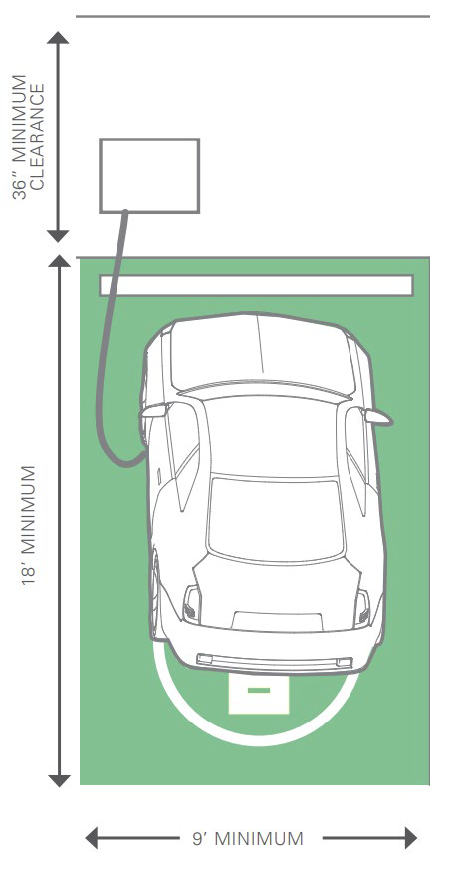
(b)
Hour of operations, if time limits or towaway provisions are to be enforced by the property owner;
(c)
Usage fees;
(d)
Safety information; and
(e)
Contact information for reporting when the equipment is not operating or other problems occur.
(v)
Each EV charging station shall have signage stating ""No Parking Except for Electric Vehicle Charging."
(6)
Maintenance. EV charging station equipment, components, and "pumps" shall be maintained in all respects, including the functioning and aesthetic upkeep of the charging equipment.
(7)
Screening. Related equipment, including transformers, switchgear, and other similar items necessary for the operations of the EV charging station shall be fully screened, in accordance with Article VIII, Community Design Standards, of this Ordinance.
(8)
Prohibited. No EV charging station shall be used, or permit, overnight parking of any vehicles.
(B)
Principal Use. In addition to (A), above, EV charging stations as a principal use shall comply with the following:
(1)
Screening, lighting, and landscaping shall be in accordance with Article VIII, Community Design Standards.
(2)
The maximum number of EV charging spaces permitted shall be appropriate to the size of the lot, in order to accommodate proper aisle and required charging space dimensions.
(C)
Accessory Use. In addition to (A), above, EV charging stations as an accessory use shall comply with the following:
(1)
A maximum of 10 EV charging spaces shall be permitted.
(2)
EV charging station spaces shall not interfere or reduce parking requirements for the principal use.
(3)
The location should be appropriate to the site of the principal use and integrated into the landscape/architecture of the principal use, while also ensuring that EV charging stations spaces/areas are readily identifiable by electric cars users.
(D)
Accessory Use to Dwellings. This subsection only applies to EV charging stations as an accessory use to single family dwellings or two-family dwellings located in residential or agricultural districts.
(1)
EV charging stations that are an accessory use to dwellings are exempt from the following specified general regulations of (A), above:
(i)
Siting, Sections 7-5-4(A)(3)(i)—(ii).
(ii)
Charging Space Dimensions, Section 7-5-4(A)(4).
(iii)
Signage, Sections 7-5-4(A)(5)(iv)—(v).
(iv)
Prohibited, Section 7-5-4(A)(8).
(2)
EV charging stations that are an accessory use to dwellings shall not be used for commercial purposes.
Section 7-5-5. - Equipment Sales, Rental, and Repair (Heavy).
(A)
Screening and Landscaping. Screening and landscape buffers are required and shall be in accordance with Article VIII, Community Design Standards, of this Ordinance.
(B)
Location.
(1)
No storage of equipment shall be located within 50 ft. of any public right-of-way.
(C)
General Standards.
(1)
All repairs shall be performed within a completely enclosed building.
(2)
No equipment displays shall be located within a required setback.
(3)
Elevated equipment displays shall be prohibited.
(4)
Outdoor displays shall be limited to the equipment being sold, rented, or leased on the property. No other display of any other goods, parts, or merchandise shall be permitted.
(5)
Outdoor storage of inoperable vehicles or equipment shall be prohibited.
(6)
Outdoor storage as an accessory use, where permitted, shall not exceed 30% of the total site area and shall be subject to the use standards of Section 7-7-7 of this Article.
(7)
An appropriately sized and designed in-ground grease and oil separator devise shall be installed on-site and properly maintained to prevent grease and oil entry into the wastewater system.
(D)
Hazardous Materials Standards.
(1)
The discharge of fuel, oil, solvents, anti-freeze, and/or other pollutants, hazardous materials, or flammable substances into the public sewer, storm drainage, or other surface waters is prohibited.
(2)
The owner/operator shall prepare an emergency spill notification Contingency Plan to be approved by the County and posted on the premises before the issuance of any occupancy permits. The owner/operator/tenant shall be responsible for notifying all County departments identified in the Contingency Plan immediately in the event of a spill or any petroleum product, chemical waste, or other hazardous substance on the property. The owner/operator shall assume full responsibility for all public and private expenses incurred in the clean-up of such spills.
Section 7-5-6. - Event Venue.
(A)
Temporary Elements. Temporary tents, fencing, seating, catering arrangements, or other elements of an event may be used during the event only and shall be removed within 24 hours after the event concludes, and the building or premises shall be returned to its normal condition.
(1)
Building Permits must be obtained for tents, amusement devices, and other similar temporary structures, as required by the Building Code of King George County.
(B)
Minimum Lot Area.
(1)
Agricultural districts: minimum lot area of 10 acres.
(2)
Commercial and planned development districts: minimum lot area of 2 acres.
(C)
Access and Parking.
(1)
Off-street parking requirements shall be in accordance with Article VIII, Community Design Standards, of this Ordinance, as well as the following:
(i)
Parking shall be setback a minimum of 50 ft. from any public road.
(ii)
Grass parking areas shall be allowed where no more than 24 events are permitted in a calendar year. A calendar year runs from January through December.
(iii)
Grass parking area shall be maintained to grass height of no more than 6 in. from grade.
(iv)
Grass parking areas shall be maintained in good condition with uniform grass coverage and free from rill or gully erosion.
(2)
Travel lanes shall be sufficient width to accommodate emergency services vehicles.
(3)
Entrance into the property shall be designed, approved, and constructed to meet Virginia Department of Transportation entrance standards.
(4)
If deemed necessary by the Administrator, a Traffic Impact Analysis may be required as part of the Site Plan process.
(D)
Noise. All noise shall comply with the Noise Ordinance, Section 10.8 of the King George County Code of Ordinances.
(1)
There shall be no amplified noise between 10:00 p.m. and 8:00 a.m., seven days per week.
(E)
Sanitary facilities. Sanitary facilities shall be provided in accordance with Virginia Department of Health standards set forth in the Virginia Administrative Code 12VAC5-610-980, as amended.
(F)
Occupancy Limitations. For all indoor and outdoor areas, occupancy limits shall comply with all local and state laws.
(1)
Any structure or building utilized for an event, or as an event venue, shall meet the International Building Code requirements for public occupancy.
Section 7-5-7. - Gas Station.
(A)
Location and Dimensional Requirements.
(1)
Entrances to the gas station shall be minimized and located in a manner promoting safe and efficient traffic circulating while minimizing the impact on the surrounding neighborhood.
(2)
All gas station driveways and access points shall be a minimum of 200 ft. from any residentially zoned district or residence.
(3)
All fuel pump islands, compressed air connections, and similar equipment shall be 20 ft. from any property line.
(B)
Screening.
(1)
A 6 ft. solid fence, wall, or landscaping shall be provided along all property lines separating the site from any residentially zoned district or lot containing a dwelling unit.
(2)
Dumpsters or other refuse shall be screened in accordance with Article VIII, Community Design Standards, of this Ordinance.
(C)
Design Standards.
(1)
Applicants shall demonstrate that the gas station will be compatible with the neighborhood with regards to traffic circulation, parking, and appearance and size of structures.
(2)
Gas canopy shall be designed and built to be compatible with the principal use.
(3)
Outdoor speakers shall not be audible beyond the property lines.
(4)
Under-canopy lighting shall consist of recessed, flat lens fixtures.
(5)
All stormwater runoff from refueling areas shall pass through an in-ground grease and oil separator.
(6)
An appropriately sized and designed in-ground grease and oil separator device shall be installed on-site and properly maintained to prevent grease and oil entry into the wastewater system.
(D)
General Standards.
(1)
There shall be no storage of automobiles, trailers, recreational vehicles, boats, or similar equipment.
(2)
Sales of limited fuel oil or bottled gas is permitted as an accessory use.
(3)
Fuel dispensers, pump islands, overhead canopy, and air and water dispensers shall be removed upon cessation of the use for a period of more than 1 year.
(4)
The Administrator may require a traffic analysis to be provided by the applicant. Such analysis may include, but not be limited to, the proposed traffic flows, sight visibility for emerging vehicles, and other public safety factors.
(E)
Hazardous Materials Standards.
(1)
All hazardous materials shall be handled, recycled, or disposed of according to federal, state, and local laws.
(2)
The owner/operator shall prepare an emergency spill notification Contingency Plan to be approved by the County and posted on the premises before the issuance of any occupancy permits. The owner/operator/tenant shall be responsible for notifying all County departments identified in the Contingency Plan immediately in the event of a spill or any petroleum product, chemical waste, or other hazardous substance on the property. The owner/operator shall assume full responsibility for all public and private expenses incurred in the clean-up of such spills.
Section 7-5-8. - Kennel, Commercial.
(A)
Minimum Lot Area.
(1)
Minimum lot area of 5 acres.
(B)
Location. Except where animals are confined in soundproofed buildings, no portion of the use, excluding required screening and landscape buffers, shall be located within:
(1)
100 ft. from the property lines of adjoining agricultural zoned property;
(2)
200 ft. from the property lines of adjoining residential zoned property; and
(3)
200 ft. from any dwelling not on the associated parcel.
(C)
General Standards.
(1)
All exterior runs, play areas, or arenas shall be designed with a minimum 6-foot-high opaque screen from adjacent lot lines and street rights-of-way.
(2)
Kennels shall be kept free of waste on a regular basis to minimize impacts of odor and reduce propagation of pests.
(3)
All boarded animals shall be kept within a totally enclosed part of the structures between the hours of 10:00 p.m. and 8:00 a.m.
Section 7-5-9. - Marina, Commercial.
(A)
Compliance. All Commercial Marinas shall comply with the Chesapeake Bay Preservation Area Overlay regulations provided in Article V, Overlay Zoning Districts, of this Ordinance, in addition to all relevant State laws and regulations, including but not limited to those protecting soil and water quality.
(B)
Water Frontage.
(1)
Minimum of 300 ft. of water frontage.
(C)
Outdoor Storage. Outdoor storage shall conform with the standards of Outdoor Storage, as provided in Section 7-7-7 of this Article.
(D)
Watercraft and Recreational Vehicle Storage. Watercraft and recreational vehicle storage as an accessory use to a Commercial Marina operation shall conform with the standards of Recreational Vehicle Storage Parking Lot, as provided in Section 7-5-12 of this Article.
Section 7-5-10. - Outdoor Sales, Seasonal.
(A)
Permits.
(1)
No more than 4 permits shall be issued for the same lot during a calendar year.
(2)
No permit shall be issued to an applicant, unless or until:
(i)
A minimum of 30 consecutive days after a permit issued to that applicant for the same or an adjacent lot or parcel has expired.
(B)
Time Limits. Each use shall be permitted for a period not to exceed 60 consecutive days.
(C)
Setbacks. The outdoor sales use or display shall be setback at least 15 ft. from any public right-of-way and outside any required landscape buffer.
(D)
Parking. Parking shall be supplied on the site of the primary use and not along the public right-of-way.
(E)
Hours of Operation. Hours of operation shall be limited to 7:00 a.m. to 8:00 p.m.
Section 7-5-11. - Parking Lot, Commercial.
(A)
Activity.
(1)
Parking shall be the principal use of all parking facilities. Spaces may be rented for parking, but no other business of any kind shall be conducted in the structure or lot except for County-sanctioned outdoor markets or permitted mobile restaurants.
(2)
No motor vehicle work shall be permitted in association with a parking facility except under emergency service work.
(3)
No outdoor storage of inoperable vehicles or equipment.
(B)
Design. To retain all cars completely within the parking lot, a rail, fence, wall, landscape hedge, or other continuous barricade of no less than 3 ft. tall shall be provided except at exit or access driveways.
(C)
Screening. Screening shall be provided on each side of the parking lot which:
(1)
Abuts upon any agricultural or residential district or use; or
(2)
Faces across a street, alley, or place from any lot in a residential district or use.
(3)
Screening shall be in conformance with the regulations of Article VIII, Community Design Standards, of this Ordinance.
Section 7-5-12. - Parking Lot, Recreational Vehicle Storage.
(A)
Activity.
(1)
Recreational Vehicle Storage Parking Lots are intended for recreational vehicles and watercraft only. Parking lots for motor vehicles require a Parking Lot, Commercial permit and shall be in accordance with Section 7-5-11 of this Article.
(2)
Spaces may be rented for parking and/or storing recreational vehicles but no other business of any kind shall be conducted in the structure.
(3)
No service or repair work shall be permitted in association with the parking facility except under emergency service work.
(4)
No outdoor storage of inoperable recreational vehicles or equipment.
(B)
Design. To retain all recreational vehicles completely within the parking lot, a rail, fence, wall, or other continuous barricade of no less than 6 ft. tall shall be provided except at exit or access driveways.
(C)
Screening. Screening shall be provided on each side of the parking lot which:
(1)
Abuts upon any residential district or use; or
(2)
Faces across a street, alley, or place from any lot in a residential district or use.
(3)
Screening shall be in conformance with the regulations of Article VIII, Community Design Standards, of this Ordinance.
Section 7-5-13. - Recreation/Entertainment, Commercial Outdoor.
(A)
Lot Area.
(1)
Minimum lot area of 5 acres.
(B)
Setbacks.
(1)
For recreation/entertainment, commercial outdoor establishments adjacent to agriculture or residential districts:
(i)
All buildings, structures, outdoor areas for the commercial recreation/entertainment use, and parking areas shall be set back at least 200 ft. from any property line.
(2)
For recreation/entertainment, commercial outdoor establishments adjacent to commercial, industrial, or planned development districts:
(i)
All buildings, structures, and parking areas shall be set back at least 75 ft. from any property line.
(C)
Access and Parking. In addition to the parking standards provided in Article VIII, Community Design Standards, of this Ordinance, the following shall apply:
(1)
All recreation/entertainment, commercial outdoor establishments shall have direct access to a public road or right-of-way without passing through a residential neighborhood.
(2)
If deemed necessary by the Administrator, a Traffic Impact Analysis may be required as part of the Site Plan process.
(3)
All parking areas shall be to the side or rear of the primary use or structure, and comply with Article VIII, Community Design Standards.
(4)
If roads and parking areas are not paved, they shall be treated to prevent dust.
(5)
Grass parking area shall be maintained to grass height of no more than 6 inches from grade.
(6)
Grass parking areas shall be maintained in good condition with uniform grass coverage and free from rill or gully erosion.
(D)
General Standards.
(1)
Any retail sales conducted on the property shall be accessory and incidental to the permitted recreation/entertainment, commercial outdoor establishment and conducted for the participants of the site.
(2)
For uses such as paintball facilities, ball fields, driving ranges, outdoor batting cages, and other facilities that have objects that travel through the air in unpredictable directions:
(i)
A minimum 20' high nylon mesh screen, backstop, or similar barricade, shall be installed to contain projectiles within the boundaries of the use.
(a)
Where a Special Exception permit is required, the height of the screen may be lowered by the Board of Supervisors upon a determination that the lower screen, in combination with other elements of the site design, provides adequate protection from projectiles.
(ii)
Supplemental barriers shall be provided as needed to contain all projectiles within the boundaries of the range.
(3)
All mechanical or motorized rides shall be located a minimum of 200 ft. from any adjoining residential district or use unless the applicant demonstrates to the Board's satisfaction that the existing topography of the site or the provision of noise attenuation measures will adequately mitigate any sound and visual impacts created.
(E)
Liability Insurance. The owner shall provide proof of adequate liability insurance for all recreation facilities prior to beginning construction and before the issuance of any permits.
Section 7-5-14. - Restaurant, Mobile.
(A)
Exceptions. The Administrator may waive any of the following standards if the mobile restaurant is in conjunction with a temporary event.
(B)
Licensure and Permits.
(1)
Mobile restaurants shall obtain a business license from the King George County Commissioner of the Revenue.
(2)
Mobile restaurants shall maintain a valid health permit issued by the Virginia Department of Health.
(3)
Mobile restaurants shall comply with all applicable requirements of the King George County Fire, Rescue, and Emergency Services Department.
(4)
Mobile restaurants shall be within a movable licensed vehicle or an enclosed trailer. Any vehicles or trailers shall be properly registered with the Virginia Department of Motor Vehicles.
(5)
Mobile restaurants cannot be on a detached flat bed, truck bed, or similar structure.
(C)
Noise.
(1)
All noise associated with the mobile restaurant—including the operation of the mobile restaurant, music, or use of a generator—shall be no louder than 50 dBA at 100 ft. away.
(i)
Excessive complaints about vehicle or generator noise will be grounds for the Administrator to require that the mobile restaurant change location on the site or move to another property.
(D)
Operation Hours. Mobile restaurants may operate between 6 a.m. and 9 p.m. Sunday to Thursday and between 6 a.m. to 11 p.m. Friday and Saturday (including set-up and break-down) on any one day at any single location. The vehicle and all accessory structures shall be removed each day.
(E)
Signs. No signs shall be displayed except:
(1)
Those permanently affixed to the vehicle;
(2)
1 A-framed sign not to exceed 4 ft. in height and 6 sq. ft. of display for each of the two sides; and
(3)
The sign cannot block any passageways.
(F)
Trash and Waste.
(1)
Trash receptacles shall be provided, and all trash, refuse, or recyclables generated by the use shall be removed from the site by the operator at the end of the business day.
(2)
No liquid wastes shall be discharged from a mobile restaurant.
(G)
Location.
(1)
Mobile restaurants shall only locate on private property in conjunction with a non-residential primary use. Examples include commercial businesses, religious assemblies, (churches), schools, etc.).
(2)
No mobile restaurant shall locate within 100 ft. of an entrance to any brick-and-mortar restaurant (determined by measuring from the edge of the mobile restaurant to the main public entrance of the brick-and-mortar establishment) unless permission by the owner of the brick-and-mortar restaurant is provided.
(3)
No mobile restaurant shall locate within 50 ft. of a single family or two-family residential use.
(4)
Mobile restaurants shall also be positioned at least 15 ft. away from fire hydrants, any fire department connection (FDC), driveway entrances, alleys, and disabled parking spaces.
(5)
Mobile restaurants shall not block:
(i)
The main entry drive isles or impact pedestrian or vehicular circulation overall;
(ii)
Other access to loading areas; or
(iii)
Emergency access and fire lanes.
(H)
Parking.
(1)
No mobile restaurant shall park on any fire lane, road, or right-of-way, whether public or private.
(2)
Parking of mobile restaurants shall not impact required parking for other uses.
(3)
Mobile restaurants must be parked on a dustless, paved, or hard surface.
(i)
Parking on grass in prohibited.
Section 7-5-15. - Vehicle Sales/Service.
(A)
Development Standards.
(1)
All principal and accessory structures shall comply with the district standards for which they are located.
(2)
No portion of the use, excluding required screening and landscape buffers, shall be located within 200 ft. of a residential district or structure containing a dwelling unit.
(3)
There shall be no storage or display of vehicles within 10 ft. of a property line.
(B)
Parking Standards.
(1)
All parking shall comply with Article VIII, Community Design Standards of this Ordinance.
(2)
All parking not related to vehicle sales display shall be located to the side or rear of the establishment.
(C)
General Standards.
(1)
All repairs and maintenance of vehicles, including parts installation, shall be performed within a completely enclosed building.
(2)
No vehicle or equipment displays shall be located within a required setback, fire lane, travel way, sidewalk, or landscaped area.
(3)
The temporary on-site storage of vehicles awaiting repair, service, or removal shall be on the side or rear of the principal structure and screened from view from any adjacent right-of-way by a building, or by an opaque fence or wall, in accordance with Article VIII, Community Design Standards, of this Ordinance.
(i)
Temporary on-site storage of vehicles is 30 days or less.
(4)
All vehicles for sale shall be parked in a parking space or a vehicle display pad, as shown on an approved Site Plan. A vehicle display pad's location shall not deviate from the approved Site Plan without amended approval, in accordance with Article III, Permits and Applications, of this Ordinance.
(5)
One vehicle display pad may be elevated up to 2 ft. above grade level.
(6)
Nothing, including vehicles and vehicle equipment, shall be displayed on the top of a building.
(7)
An appropriately sized and designed in-ground grease and oil separator device shall be installed on-site and properly maintained to prevent grease and oil entry into the wastewater system.
(8)
No outdoor storage of inoperable vehicles or equipment.
(D)
Hazardous Materials Standards.
(1)
The discharge of fuel, oil, solvents, anti-freeze, and/or other pollutants, hazardous materials, or flammable substances into any public sewer, storm drainage, or other surface waters is prohibited.
(2)
The owner/operator shall prepare an emergency spill notification Contingency Plan to be approved by the County and posted on the premises before the issuance of any occupancy permits. The owner/operator/tenant shall be responsible for notifying all County departments identified in the Contingency Plan immediately in the event of a spill or any petroleum product, chemical waste, or other hazardous substance on the property. The owner/operator shall assume full responsibility for all public and private expenses incurred in the clean-up of such spills.
(E)
Tire and Outdoor Storage Standards.
(1)
Location.
(i)
No tire and/or outdoor storage shall be located within 50 ft. of a residential district.
(2)
General Standards.
(i)
Tire and outdoor storage as an accessory use shall not exceed 30% of the total site area and shall be subject to the use standards of Section 7-7-7 of this Article.
(ii)
Outdoor display of tires is prohibited.
(iii)
All tire and/or outdoor storage shall meet the requirements of the King George County Fire Rescue, and Emergency Services Department.
(iv)
The use of portable shipping/storage containers, such as Conex boxes, for tire and/or outdoor storage is prohibited.
(3)
Screening, Buffering, and Landscaping.
(i)
All tire and/or outdoor storage shall be screened by a solid wall or fence not less than 6 ft. in height. All screening shall be in accordance with Article VIII, Community Design Standards, of this Ordinance.
(ii)
Tire and/or outdoor storage shall be located on the side or rear of the main structure and screened from view from any adjacent roadway.
(iii)
Tires, parts, materials, and any other equipment stored outdoors shall not be stacked higher than 4 ft.
Section 7-5-16. - Veterinary Hospital/Clinic.
(A)
Location. Except where animals are confined in soundproofed buildings, no portion of the use, excluding required screening and landscape buffers, shall be located within:
(1)
100 ft. from the property lines of adjoining agricultural or residentially zoned property; or
(2)
200 ft. from any dwelling not on the associated parcel.
(B)
General Standards.
(1)
All boarded animals shall be kept within a totally enclosed part of the structures between the hours of 10:00 p.m. and 8:00 a.m.
(2)
All exterior runs, play areas, or arenas shall be designed with a minimum 6-foot-high opaque screen from adjacent lot lines and street rights-of-way, and shall be in accordance with Article VIII, Community Design Standards, of this Ordinance.
(3)
Veterinary hospitals/clinics shall be kept free of waste on a regular basis to minimize impacts of odor and reduce propagation of pests.
Section 7-6-1. - Battery Energy Storage Facility.
(A)
Intent. This Section is not intended to abridge safety, health, environmental, or land use requirements contained in other applicable laws, codes, regulations, standards, or ordinances. This Section does not supersede or nullify any provision of local, State, or Federal law that applies to battery energy storage facilities.
(B)
Definitions.
(1)
Battery Energy Storage Facilities. One or more battery cells for storing electrical energy in a Battery Energy Storage System with a Battery Management System.
(2)
Battery Energy Storage System. A physical container providing secondary containment to battery cells that is equipped with cooling, ventilation, fire suppression, and a Battery Management System.
(3)
Battery Management System. An electronic regulator that manages a Battery Energy Storage System by monitoring individual battery module voltages and temperatures, container temperature and humidity, off-gassing of combustible gas, fire, ground fault and DC surge, and door access and capable of shutting down the system before operating outside safe parameters.
(C)
Configuration. All Battery Energy Storage Facilities shall be configured so that battery cells shall be placed in a Battery Energy Storage System ("BESS") with a Battery Management System ("BMS"). The BESS shall provide a secondary layer of physical containment to the batteries and be equipped with cooling, ventilation, and fire suppression systems.
(D)
Operation. Battery Energy Storage Facilities shall be constructed, maintained, and operated in accordance with applicable codes and standards, including but not limited to applicable fire, electrical, and building codes adopted by the County; National Fire Protection Association (NFPA) 855, Standard for the Installation of Stationary Energy Storage Systems, 2020 Edition and subsequent additions; Underwriters Laboratories (UL) 9540A Ed. 4-2019, Standard for Test Method for Evaluating Thermal Runway Fire Propagation in Battery Energy Storage Systems and subsequent editions.
(E)
Utilities. Public water, or an existing commercial well, and fire hydrants shall be available to the property.
(1)
Utility Lines and Electrical Circuitry. All on-site utility lines shall be placed underground to the extent feasible and as permitted by the serving utility, with the exception of the main service connection at the utility company right-of-way and any new interconnection equipment, including without limitation any poles, with new easements and rights-of-way.
(F)
Screening and/or landscaping shall be necessary to ensure that facilities are not visible. Facilities shall be fully screened on all sides from view, except from an adjacent parcel on the same side of the road with an electric substation or a parcel that is zoned industrial.
(1)
All screening and landscaping shall be in accordance with Article VIII, Community Design Standards, of this Ordinance.
(2)
Resource Protection Areas shall not be counted toward buffer requirements.
(3)
Vegetation and Tree-cutting. Areas within 20 feet on each side of battery energy storage system shall be cleared of combustible vegetation and other combustible growth. Single specimens of trees, shrubbery, or cultivated ground cover such as green grass, ivy, succulents, or similar plants used as ground covers shall be permitted to be exempt provided that they do not form a means of readily transmitting fire. Removal of trees should be minimized to the extent possible.
(G)
Location and Setbacks. Due to their potentially combustible nature, the siting of Battery Energy Storage Facilities and related equipment shall:
(1)
Be located at least 200 feet from any residential district, planned development district, or dwelling;
(2)
Be located at least 100 feet from agricultural, commercial, or industrial districts, except for an adjacent parcel with an electric substation to which the Battery Energy Storage Facility will connect;
(3)
Buffer the facility from the surrounding areas by siting toward the interior of the lot, at least 20 feet away from vegetation;
(4)
Take advantage of existing topography, structures, and vegetation to provide extra screening; and
(5)
Prevent encroachment and runoff into wetlands, floodplains, and any other environmental concerns.
(H)
Emergency Access. Access to the property for King George Fire Rescue and Emergency Services (KGFRES) shall be provided in a manner acceptable to KGFRES.
(I)
Safety Operation Standards.
(1)
Each Battery Energy Storage Facility shall install and maintain an automatic fire alarm/detection system, fire suppression system, and other extinguishing technology built in based on specific hazards, as approved by the County Fire Official/Fire Chief, under the direction of NFPA 855 standards, as amnded, and the Virginia Statewide Fire Prevention Code.
(2)
The Battery Management System shall include 24/7 monitoring for individual battery module voltages and temperatures, container temperature and humidity, off-gassing of combustible gas, fire, ground fault and DC surge, and door access.
(3)
The Battery Management System shall be capable of shutting down the system before thermal runaway takes place.
(J)
Warning Signage. NFPA 704 placards shall be placed on building entrances along with emergency contact information.
(K)
Security fencing. The facilities shall be enclosed by security fencing.
(1)
All security fencing shall be a minimum of 8 ft. in height and topped with razor/barbed wire, as appropriate.
(2)
All security fencing shall be constructed so as to substantially lessen the likelihood of entry by unauthorized individuals.
(3)
A performance bond reflecting the costs of anticipated security fence maintenance shall be posted and maintained.
(4)
Failure to maintain the security fencing shall result in revocation of the Zoning Permit following notice of violation and enforcement as provided in Article II, Division 4 of this Ordinance.
(5)
All security fencing shall be placed behind the buffer and screened from view.
(L)
Decommissioning Plan. Applications for Battery Energy Storage Facilities shall include a Decommissioning Plan to be implemented upon abandonment and/or in conjunction with removal of the facility. All Decommissioning Plans shall be certified by an engineer or contractor with demonstrated expertise in solar facility removal, and shall include the following:
(1)
The anticipated life of the project;
(2)
A narrative description of the activities to be accomplished, including who will perform that activity and at what point in time, for complete physical removal of all components of the battery energy storage facility;
(3)
An estimated deconstruction schedule;
(4)
A description of mediation procedures for the release of hazardous materials or other emergency events during the decommissioning process.
(5)
The estimated decommissioning cost in current dollars; and
(6)
The estimated cost of decommissioning shall be guaranteed by bond, letter of credit, or other security approved by the County.
(i)
The owner shall deposit the required amount into the approved escrow account before any building permit is issued to allow construction of the battery energy storage facility.
(ii)
The escrow account agreement shall prohibit the release of the bond without the written consent of the County. The County shall consent to the release of the bond upon on the owner's compliance with the approved Decommission Plan. The County may approve the partial release of the bond as portions of the approved Decommission Plan are performed.
(iii)
The dollar amount of the bond shall be the full amount of the estimated decommissioning cost without regard to the possibility of salvage value.
(iv)
The owner or occupant shall recalculate the estimated cost of decommissioning every 5 years. If the recalculated estimated cost of decommissioning exceeds the original estimated cost of decommissioning by 10%, then the owner or occupant shall deposit additional funds into the bond to meet the new cost estimate. If the recalculated estimated cost of decommissioning is less than 90% of the original estimated cost of decommissioning, then the County may approve reducing the amount of the bond to the recalculated estimate of decommissioning cost.
(7)
Decommission shall include removal of all battery energy storage system components, structures, equipment, security barriers, and transmission lines from the site so that any agricultural ground upon which the facility and/or system was located is again tillable and suitable for agricultural uses.
(M)
Emergency Plan. Applications for battery energy storage facilities shall include an Emergency Plan that, at minimum, contains the following:
(1)
Procedures for safe shutdown, de-energizing, or isolation of equipment and systems under emergency conditions to reduce the risk of fire, electric shock, release of hazardous materials, and personal injuries, and for safe start-up following cessation of emergency conditions.
(2)
Procedures for inspection and testing of associated alarms, interlocks, and controls.
(3)
Procedures to be followed in response to notifications from the Battery Energy Storage Management System, when provided, that could signify potentially dangerous conditions, including shutting down equipment, summoning service, and repair personnel, and providing agreed upon notification to fire department personnel for potentially hazardous condition in the event of a system failure.
(4)
Emergency procedures to be followed in case of fire, explosion, release of liquids or vapors, damage to critical moving parts, or other potentially dangerous conditions. Procedures can include sounding the alarm, notifying the fire department, evacuating personnel, de-energizing equipment, and controlling and extinguishing the fire.
(5)
Procedures and schedules for conducting drills of these procedures and for training local first responders on the contents of the plan and appropriate response procedures.
Section 7-6-2. - Electricity Generating Facility.
(A)
Intent.
(1)
The intent of his Section is to allow electricity generating facilities in a manner that promotes the development of renewable energy sources, while limiting and mitigating impacts on natural resources and existing agricultural, forestry, residential, commercial, industrial, historical, cultural, and recreational uses of property, or the future development of such uses of property within the County.
(2)
The purpose of this Section is to outline the process and requirements for the construction, installation, operation, and decommissioning of electricity generating facilities that ensures the protection of health, safety, and welfare, while also avoiding adverse impacts on County resources.
(3)
This Section is not intended to abridge safety, health, environmental, or land use requirements contained in other applicable laws, codes, regulations, standards, or ordinances. This Section does not supersede or nullify any provision of local, State, or Federal law that applies to electricity generating facilities.
(B)
Compliance.
(1)
All electricity generating facilities shall fully comply with all applicable local regulations, as well as all applicable state and federal regulations, including but not limited to, the U.S. Environmental Protection Agency (EPA), State Corporation Commission ("SCC") or equivalent, any state departments related to environmental quality, parks, and wildlife protection, as well as all the applicable regulations of any other agencies that were in force at the time of the permit approval.
(2)
The design and installation of all electricity generating facilities shall conform to applicable industry standards, including those of the American National Standards Institute (ANSI), Underwriters Laboratories (UL), the American Society for Testing and Materials (ASTM), or other similar certifying organizations and shall comply with all fire and safety requirements.
(C)
Height Limits. Maximum height of the principal structure and accessory structures such as towers or smokestacks may exceed the height requirements of the underlying zoning district as conditioned in the Special Exception permit.
(D)
Setbacks. Minimum setback of the principal structure and all related accessory structures shall be at least 100 ft. from all property lines or greater as determined in the Special Exception permit.
(E)
Buffer. Transitional buffers allowed include Type C and Alternative Buffer Berms as supplied in Article VIII, Community Design Standards.
(1)
The buffer shall be maintained for the life of the facility.
(2)
Existing vegetation that meets or exceeds buffer requirements shall be preserved by maintaining natural buffers to the greatest extent possible.
(F)
Coordination of Local Emergency Services. The owner or operator shall coordinate with the King George County Fire, Rescue and Emergency Services (KGFRES), King George Sheriff's Office, and state law enforcement offices to provide at the owner/operator's expense the materials, education, and/or training on how to safely respond to on-site emergencies.
(G)
Groundwater Monitoring. Ground water monitoring to assess the level of groundwater contamination shall take place prior to, and upon completion of construction of the project, throughout the entire area of the electricity generating facility. All groundwater monitoring shall be conducted by a third-party selected by King George County and at the expense of the owner/operator.
(1)
Groundwater monitoring shall take place annually after commencement of operations and upon completion of decommissioning.
(2)
Results from said monitoring shall be delivered to the King George County Community Planning Department on or before July 1 each year.
(3)
Additional groundwater inspections and monitoring shall be conducted as needed at the request of King George County.
(H)
Security Fencing. The facilities shall be enclosed by security fencing.
(1)
All security fencing shall be a minimum of 8 ft. in height and topped with razor/barbed wire, as appropriate.
(2)
All security fencing shall be placed behind the buffer and must be screened from view.
(3)
All security fencing shall be constructed so as to substantially lessen the likelihood of entry by unauthorized individuals.
(4)
A performance bond reflecting the costs of anticipated security fence maintenance shall be posted and maintained.
(5)
Failure to maintain the security fencing shall result in revocation of the Zoning Permit and/or Special Exception Permit, and the facility's decommissioning.
(I)
Warning Signage. Warning signage in conformance with National Fire Protection Association (NFPA), National Electrical Safety Code (NESC), American National Standards Institute (ANSI), and all related state and federal regulations shall be prominently displayed on all applicable structures and site entrances.
(J)
Application Requirements. In addition to any requirements of Article III, Permits and Applications, of this Ordinance, including preapplication requirements, applications for electricity generating facilities shall include the following:
(1)
Neighborhood Meeting. A public meeting shall be held to give the community an opportunity to hear from the applicant and ask questions regarding the proposed project. The meeting shall adhere to the following:
(i)
The applicant shall inform the Administrator and adjacent property owners in writing of the date, time, and location of the meeting, at least 14 but no more than 21 days, in advance of the meeting date.
(ii)
The date, time and location of the meeting shall be advertised in a newspaper of record in the County, provided to King George County for sharing on social media and on legible signage visibly posted at site entrances or similar locations and along adjacent streets, visible to the public, by the applicant and at the applicant's expense, at least 14 but no more than 21 days, in advance of the meeting date.
(iii)
The meeting shall be held within the County, at a location open to the public with adequate parking and seating facilities that will accommodate persons with disabilities.
(iv)
The meeting shall give members of the public the opportunity to review application materials, ask questions of the applicant, and provide feedback.
(v)
The applicant shall provide the Administrator a summary of any input received from members of the public at the meeting and copies of any written submissions from the public.
(2)
Project Narrative. A detailed narrative that:
(i)
Identifies the applicant, facility owner, site owner, and operator;
(ii)
Describes the proposed facility, including:
(a)
An overview of the project and its location;
(b)
The size of the site and the project area;
(c)
Height of all principal and accessory structures and appurtenances;
(d)
The current use of the site;
(e)
The estimated time for construction and proposed date for commencement of operations;
(f)
The planned maximum rated capacity of the facility;
(g)
Anticipated noise levels generated by the proposal;
(h)
If applicable, how and where electricity will be transmitted, including the location of proposed electrical grid interconnection.
(iii)
Site Plan. In addition to the Site Plan requirements of the Article III, Permits and Applications, of this Ordinance, all Site Plans for electricity generating facilities may also require additional information as determined by the Administrator—such as a scaled elevation view of the property and other supporting drawings, photographs of the proposed site, photo or other realistic simulations or modeling of the proposed project from potentially sensitive locations as deemed necessary by the Administrator to assess the visual impact of the project, landscaping and screening plan, coverage map, and additional information that may be necessary for a technical review of the proposal.
(iv)
Construction Schedule. An estimated construction schedule.
(v)
Visual Impact Analysis. The analysis demonstrates project siting and proposed mitigation, if necessary, so that the facility minimizes impact on the visual character of the municipality.
(a)
The applicant shall provide accurate, to scale, photographic simulations showing the relationship of the facility and its associated amenities and development to its surroundings. The photographic simulations shall show such views of all structures from locations such as property lines and roadways, as deemed necessary by the municipality to assess the visual impact of the facility.
(b)
The total number of simulations and the perspectives from which they are prepared shall be established by the Administrator after the pre-application meeting.
(vi)
Community Impact Assessment. An assessment of the impact on the immediate vicinity of the proposed use as well as the greater King George County community.
(a)
The report shall be prepared by a professional acting within his or her competency, shall be presented in written form and shall analyze in specific terms the probable impact of the project on the vicinity and community over time.
(b)
Specific attention, as may be appropriate to the individual proposal, should be given but not be limited to the following elements:
1.
Anticipated direct revenues to the County from real estate and personal property taxes;
2.
An assessment of employment opportunities to be created by the proposed development;
3.
An assessment of the short- and long-term economic impact of the proposed development;
4.
If the development is replacing an existing enterprise, including agriculture and forestry, an assessment of the impact the current enterprise has on the local economy and how the local economy will be impacted by the loss of the existing enterprise;
5.
Fire, rescue, and law enforcement requirements as compared to existing capacities and facilities;
(c)
The Administrator may waive certain elements of the Community Impact Assessment, where the nature of the proposed facility makes such elements inapplicable.
(vii)
Environmental Impact Assessment. A statement regarding any site and viewshed impacts, including direct and indirect impacts to national or state forests and grasslands, national or state parks, County parks, wildlife management areas, conservation easements, recreational areas, or any known historic or cultural resources within 5 miles of the proposed facility.
(a)
Wetlands, rivers and streams, and floodplains shall be inventoried, delineated, and mapped to provide baseline data for the evaluation of the current proposal and to determine satisfactory decommissioning as required in this Section.
1.
The inventory and mapping of floodplain shall not be construed to allow development within regulatory flood plain areas.
(viii)
Traffic Study.
(a)
Information about the proposed facility's traffic impacts, modeling both the construction and decommissioning processes, to include:
1.
The time of day that transport will occur;
2.
Characteristics of the loaded vehicles, including:
a.
Length, height, width, curb weight;
b.
Maximum load capacity;
c.
Number of axles, including trailers; and
d.
Distance between axles.
3.
The number of vehicles transporting materials;
4.
The frequency of vehicle arrival at the site; and
5.
The number of drivers that project will employ.
(b)
The haul route(s) shall be provided and approved for construction impacts.
(c)
After review of the application's first traffic impact information, the County may require a full traffic study to be accepted by an engineer approved by the County.
(ix)
Emergency Plan. Applications for electricity generating facilities that relate to the generation of electricity shall include an emergency plan that, at a minimum, contains the following:
(a)
Procedures for safe shutdown, de-energizing, or isolation of equipment and systems under emergency conditions to reduce the risk of fire, electric shock, release of hazardous materials, and personal injuries, and for safe start-up following cessation of emergency conditions.
(b)
Procedures for inspection and testing of associated alarms, interlocks, and controls.
(c)
Procedures to be followed in the event of potentially dangerous conditions, including shutting down equipment, summoning service, and repair personnel, and providing agreed upon notification to fire department personnel for potentially hazardous condition in the event of a system failure.
(d)
Emergency procedures to be followed in case of fire, explosion, release of liquids or vapors, damage to critical moving parts, or other potentially dangerous conditions. Procedures can include sounding the alarm, notifying the fire department, evacuating personnel, de-energizing equipment, and controlling and extinguishing the fire.
(e)
Procedures and schedules for conducting drills of these procedures and for training local first responders on the contents of the plan and appropriate response procedures.
(x)
Decommissioning.
(a)
All applications for electricity generating facilities shall require a Decommissioning Plan.
(b)
Electricity generating facilities which have reached the end of their useful life, have been abandoned, or have not been in active and continuous service for a period of 12 months shall be decommissioned at the owner's or operator's expense, except if the project is being repowered or a force majeure event has or is occurring requiring longer repairs; however, the County may require evidentiary support that a longer repair period is necessary.
(c)
The owner or operator shall notify the Administrator by certified mail of the proposed date of discontinued operations and plans for decommissioning.
(d)
If a facility is abandoned and the owner receives a notice of abandonment from the Administrator, the owner shall complete all decommissioning activities in accordance with the Decommissioning Plan and all applicable state and federal regulations.
(e)
All Decommissioning Plans shall be certified by an engineer or contractor with demonstrated expertise in energy generating facilities, and shall include the following:
1.
The anticipated life of the project.
2.
An estimated deconstruction schedule.
3.
The estimated cost of decommissioning shall be guaranteed by bond, letter of credit, or other security approved by the County.
a.
The owner shall deposit the required amount into the approved escrow account before any building permit is issued to allow construction of or improvements to an electricity generating facility.
b.
The escrow account agreement shall prohibit the release of the bond without the written consent of the County. The County shall consent to the release of the bond upon the owner's compliance with the approved Decommission Plan. The County may approve the partial release of the bond as portions of the approved Decommission Plan are performed.
c.
The dollar amount of the bond shall be the full amount of estimated decommissioning cost without regard to the possibility of salvage value.
d.
The owner or occupant shall recalculate the estimated cost of decommissioning at least every 5 years. If the recalculated estimated cost of decommissioning exceeds the original estimated cost of decommissioning by 10%, then the owner or occupant shall deposit additional funds into the bond to meet the new cost estimate. If the recalculated estimated cost of decommissioning is less than 90% of the original estimated cost of decommissioning, then the County may approve reducing the amount of the bond to the recalculated estimate of decommissioning cost.
(f)
Hazardous material from the property shall be disposed of in accordance with federal and state law.
Section 7-6-3. - Junkyard (Salvage Yard).
(A)
General Standards. In accordance with Code of Virginia § 33.2-804, as amended, junkyards are permitted as a Special Exception, with the following standards.
(1)
Shall be:
(i)
Setback at least 500 ft. from any street, road, or other right-of-way.
(ii)
Completely screened by a solid wall or fence, including solid entrance and exit gates, not less than 6 ft. in height, so as not to be visible from any right-of-way.
(a)
All walls and fences shall have a uniform and durable character and shall be properly maintained. All screening shall be in accordance with Article VIII, Community Design Standards, of this Ordinance.
(b)
No wall or fence screening shall encroach into a sight distance triangle.
(c)
Vehicles, parts, materials, and equipment stored shall not be stacked higher than the screening wall or fence.
(d)
When walls and fences are adjacent to commercial or residential districts, a landscaped buffer shall be provided to break visibility of the fence in accordance with Article VIII, Community Design Standards, of this Ordinance.
(iii)
Operated and maintained in such a manner as not to allow the breeding of rats, flies, mosquitoes or other disease-carrying animals and insects.
(iv)
Operated in compliance with all federal and state record keeping and reporting requirements, to include, but not limited to:
(a)
Reporting to Department of Motor Vehicles to confirm proper ownership;
(b)
Research through National Motor Vehicle Title Information Systems to confirm clean title history;
(c)
Reporting to leadsonline.com for the King George Sheriff's Office to access the vehicle history; and
(d)
Reporting of every purchase, exchange or acquisition of any salvage or scrap vehicle on a daily basis or such other frequency as requested by the sheriff, in accordance with the Code of Virginia § 46.2-1608.1.
(2)
Shall not:
(i)
Involve collection or storage of any material containing, or contaminated with, dangerous explosives, chemicals, gases, or radioactive substances.
Section 7-6-4. - Resource Extraction.
(A)
Proof of Ownership. Each application shall be accompanied by a statement of proof of ownership of the oil and/or natural gas or mineral rights for the entire site. This proof may take the form of signed contracts, leases, affidavits, or other documents.
(B)
General Standards.
(1)
All resource extraction shall comply with all local, state, and federal laws and regulations, including those set by the Virginia Department of Energy's Mineral Mining and Oil and Gas divisions.
(2)
As part of the application, operators shall submit a copy of any assessments, operations plan(s), and reclamation plans, as required by state or federal agencies.
(3)
The Administrator may require additional information that may be necessary for a complete technical review of the application.
(C)
Setbacks.
(1)
No building or structure used in connection with an extraction operation shall be located within 200 ft. of any public road or any adjoining property.
(i)
Buildings devoted solely to office and administrative uses shall be located no less than 100 ft. from a public road or adjoining property.
(2)
With the exception of the determined extraction area and related grading activity, the grading, mining, excavating, removal of trees, or any other disturbance of natural vegetation is not permitted:
(i)
Within 500 ft. of any property zoned residential or planned development; or dwelling.
(ii)
Within 100 ft. of any commercially zoned property.
(D)
Sand and Gravel Extraction. In addition to the requirements of 7-6-4 (A), (B), and (C), above, the following standards apply to all sand and gravel extraction operations.
(1)
Site Plans. In addition to the requirements for Site Plans, as provided in Article III, Permits and Applications, the following shall be provided with the Site Plan:
(i)
The proposed locations of all excavations, structures, equipment, roads, stockpiles, settling basins, and anything else related to the resource extraction operation.
(ii)
The area to be permitted and bonded, as required by the Virginia Department of Energy.
(a)
The estimated cost of decommissioning shall be guaranteed by bond, letter of credit, or other security approved by the County.
(b)
The owner shall deposit the required amount into the approved escrow account before any permit is issued to allow construction of the resource extraction operation.
(c)
The escrow account agreement shall prohibit the release of the bond without the written consent of the County.
(d)
The dollar amount of the bond shall be the full amount of the estimated decommissioning and reclamation cost without regard to the possibility of salvage value.
(e)
The owner or occupant shall annually recalculate the required bond.
(iii)
The Reclamation Plan, as regulated by the Virginia Department of Energy.
(2)
Decommission and Reclamation.
(i)
The owner and/or operator of a sand/gravel extraction operation that is scheduled to be terminated or ceased shall notify the Administrator of the proposed date of termination of operations.
(ii)
The owner and/or operator of a sand/gravel extraction operation shall comply with all applicable federal, state, and local laws and regulations.
(iii)
To prevent or control erosion, the site shall be graded and re-seeded or replanted within 12 months of removal and/or ceasing of sand/gravel extraction operations on all abandoned slopes, and/or extraction areas to restore it to as natural a pre-development condition as possible.
(a)
Any exception to site restoration, such as leaving driveways, entrances, or landscaping in place, or substituting plantings, shall be requested by the landowner in writing, and this request shall be approved by the Board of Supervisors.
(iv)
Hazardous material from the property shall be disposed of in accordance with federal and state law.
(E)
Drilling for Oil and/or Natural Gas. In addition to the requirements of 7-6-4 (A), (B), and (C), above, the following standards apply to all oil and/or natural gas drilling operations.
(1)
Lot Area.
(i)
Maximum drill site of 4 acres.
(a)
The drill site may contain any number of boreholes.
(2)
Site Plans. In addition to the requirements for Site Plans, as provided in Article III, Permits and Applications, the following shall be provided with the Site Plan:
(i)
The proposed locations for all buildings, structures, and equipment, including rig placement(s), location and size of drill pad, derricks, structures, equipment, storage tanks, gathering lines and all permanent improvements to the site.
(ii)
The area to be permitted and bonded, as required by the Virginia Department of Energy.
(a)
The estimated cost of decommissioning shall be guaranteed by bond, letter of credit, or other security approved by the County.
(b)
The owner shall deposit the required amount into the approved escrow account before any permit is issued to allow construction of the oil and/or natural gas drilling operation.
(c)
The escrow account agreement shall prohibit the release of the bond without the written consent of the County.
(d)
The dollar amount of the bond shall be the full amount of the estimated decommissioning and reclamation cost without regard to the possibility of salvage value.
(e)
The owner or occupant shall annually recalculate the required bond.
(3)
Narrative. As part of the application process, a narrative shall be provided that details the following:
(i)
Proposed sources and quantities of water to be used in any drilling operation.
(ii)
Means of recycling and reusing wastewater to:
(a)
Protect and manage the quality and quantity of local aquifers;
(b)
Adhere to local and regional water supply and protection plans;
(c)
Avoid excessive use of public water supplies or groundwater resources; and
(d)
Reduce wastewater ultimately requiring disposal.
(iii)
Means of storage, transportation, and disposal of all wastewater generated by or during any drilling operations, in accordance with all local, state, federal regulations.
(iv)
Means of reporting and tracking any wastewater or wastes generated by or during drilling operations that are transported off-site for storage or disposal.
(v)
Hours of operation and noise attenuation to ensure minimal impact on neighboring properties.
(vi)
For any proposed storage or disposal of wastewater generated by or during any drilling operations through a wastewater treatment facility:
(a)
Written certification from the facility shall be provided, that it will accept and properly treat such wastewater, and the maximum amount or volume of wastewater it will accept and properly treat.
(vii)
For any proposed storage or disposal of waste, including; but, not limited to, drilling muds and cuttings generated by or during any drilling operations through a landfill or other facility:
(a)
Written certification shall be provided that the landfill and/or facility will accept and properly treat such waste or wastewater and the maximum amount or volume of wastewater or waste that the landfill and/or facility will accept and properly treat.
(4)
Setbacks.
(i)
No exploratory or production oil or gas well bore shall be permitted within 750 ft. of any RPA boundary, occupied building or dwelling, or a public road.
(ii)
No exploratory or production oil or gas well bore shall be permitted within 1,000 ft. of a public groundwater supply well.
(iii)
Boreholes shall not be located within 100 ft. of any property line.
(5)
General Standards.
(i)
Grading and alteration of natural drainage shall be minimized.
(ii)
If the exploratory drilling program is unsuccessful the well site shall be abandoned/closed, in accordance with Section 7-6-4 (E) (10) and all local, state, and federal regulations.
(6)
Emergency Preparedness. The applicant shall develop and provide the drilling operations' emergency plan and contact information to the King George County Fire, Rescue, and Emergency Services prior to commencement of any drilling operation.
(i)
An appropriate site visit for orientation of emergency services personal, as determined by King George County, shall be provided prior to commencement of any drilling operation.
(ii)
In the event of a governmental declaration of emergency due to drought, the King George County Board of Supervisors may require water withdrawals from ground or surface water to cease for drilling operations.
(7)
Baseline Environmental Consultant's Services.
(i)
Within no more than 12 months prior to drilling, the applicant shall provide a baseline environmental data report. The report shall document existing environmental conditions within a 750-ft. radius of the proposed drilling site.
(ii)
The report shall include water quality samples taken from springs; public water supply intakes; and private wells.
(iii)
The report shall provide a narrative description of the sampling plan and justification for how the plan provides adequate information to give a complete description of the existing surface water quality and the quality and current yield/quantity of groundwater wells within the 750-ft. radius from the proposed drilling site.
(iv)
All water sampling shall be conducted by a laboratory certified by the Virginia Department of General Services, Division of Consolidated Laboratory Services (DCLS). Well yield shall be determined by draw down per guidelines established by the Virginia Department of Health.
(v)
All water testing shall comply with the Virginia Administrative Code, 12VAC5-590-440.
(vi)
The County may require water analysis for additional chemicals that are not currently included in state or federal regulations listed above.
(vii)
The applicant shall coordinate a reasonable time and manner to obtain water samples on private property. Should a property owner refuse the applicant access to obtain a water sample, the applicant shall notify the Administrator in writing of such refusal or prevention.
(viii)
The County shall submit the baseline environmental report to an independent environmental consultant for review and recommendations regarding the sufficiency of the baseline environmental data provided in the report.
(a)
The cost of all services shall be charged to the applicant.
(b)
The independent consultant shall have 90 days to review the report and provide a notice of either insufficiency or sufficiency to the County.
(c)
An environmental data report deemed sufficient by the independent environmental consultant shall be accepted by the County before drilling may commence.
(8)
Drilling Environmental Consultant's Services. Once every 12 months after drilling has commenced, the applicant shall provide a drilling environmental data report.
(i)
The report shall document existing environmental conditions within a 750-ft. radius of the drilling site.
(ii)
The report shall include all information and follow same procedure as provided in Section 7-6-4 (E) (7), above.
(9)
Post Drilling Environmental Consultant's Services. No more than 6 months after drilling is complete, the applicant shall provide a post-drilling environmental data report.
(i)
The report shall document existing environmental conditions within a 750-ft. radius of the drilling site.
(ii)
The report shall include all information and follow same procedure as provided in Section 7-6-4 (E) (7), above.
(10)
Termination of Drilling Operation.
(i)
The owner and/or operator of a drilling operation scheduled to be terminated shall notify the Administrator of the proposed date of termination of operations.
(ii)
The owner and/or operator of a drilling operation shall comply with all applicable federal, state, and local laws and regulations for the plugging and closing of wells.
(iii)
If the drilling operation, or any part thereof, is inoperable or does not operate for more than 180 days and the owner and/or operator of the operation does not give such notice to the Administrator, the operation shall be considered terminated.
(iv)
Within 12 months of the date of termination, the owner and/or operator shall physically remove the operation. The County may extend this period at the request of the owner and/or operator. Physical removal shall include but is not limited to:
(a)
Removal of the drilling rigs, all machinery, equipment, equipment shelters, security barriers, and all appurtenant structures from the lot.
(b)
Proper disposal of all wastewater or waste, including but not limited to solid or hazardous materials, generated by or during a drilling operation, in accordance with all applicable federal, state, and local laws and regulations.
(c)
Restoration of the location of the drilling operation to its natural, pre-existing condition, as agreed to by the property owner.
(d)
Removal of foundations to a depth of 4 ft. below ground level. The County has discretion to waive or alter this requirement for any other legally authorized use. Restoration shall be verified by the Administrator.
Section 7-6-5. - Data Centers.
(A)
Due to the high-water demand, data centers shall be connected to public or community water system if a water-based cooling system is utilized.
(1)
Data centers shall not establish commercial wells for any operations.
(B)
Power generators, water cooling systems, storage facilities and any other mechanical infrastructure necessary for the operations of the data center shall be within an enclosed structure screened as not to be visible from any adjacent street, use, or building. All screening shall comply Article VIII, Community Design Standards, of this Ordinance.
(1)
Ground mounted mechanical equipment is prohibited in front yards.
(2)
Solid screening walls must be constructed with engineered sound barriers and design, materials, and treatment compatible with those used on the nearest Principal façade of a building but may include perforated surfaces as needed for ventilation of mechanical equipment.
(C)
Generator testing shall be limited to weekdays between 8:00 a.m. and 5:00 p.m.
(D)
No data center shall be built until evidence has been given as part of the application that the owner has been approved by the utility company.
(E)
Principal façade requirements apply to all building facades that face adjacent existing or planned public roads or that face an adjacent property with existing residential development, an approved plat showing residential development, or zoning district permitting residential dwellings. Principal facades must have differentiated surfaces, consistent design and fenestration to create visual interest and consistency with community character.
(F)
Maximum height shall be determined by the zoning district. Due to firefighting equipment limitations, the maximum height allowance shall not be increased.
(G)
The allowed Floor Area Ratio maximum is 0.6.
(H)
Transitional buffers allowed include Type C and Alternative Buffer Berms as supplied in Article VIII, Community Design Standards.
Section 7-7-1. - Accessory Structure.
(A)
Exemptions. Residential accessory structures including, but not limited to, flag poles, basketball hoops, clotheslines, arbors, swings, structures less than 6 square feet, or residential yard ornaments shall be exempt from the minimum setback, lot area, and certification requirements as specified in this Section.
(B)
Development Standards.
(1)
Accessory structures shall meet the standards of the underlying zoning district, including setbacks and height regulations.
(2)
Accessory structures are not permitted in front setbacks, except in agricultural districts.
(3)
Accessory structures shall not exceed 40% of the gross floor area of the main structure.
(i)
Accessory structures in agricultural districts are exempt from this provision.
(C)
Permanent Portable Storage Containers.
(1)
Where Permitted. Permitted in agricultural districts only. Prohibited in residential, commercial, industrial, and planned development districts.
(2)
Standards.
(i)
Portable storage containers used as permanent storage located outside of a fully enclosed building or structure in an agricultural district, and visible from adjacent properties or highways shall be screened and/or buffered in compliance with Article VIII, Community Design Standards, of this Ordinance, and kept in good condition.
(ii)
A Zoning Permit is required for any portable storage container located on a lot for more than 15 calendar days.
(iii)
The portable storage container shall meet all setback requirements for the district in which it is located.
(iv)
Other than the required Zoning Permit, no sign shall be attached to a portable storage container except to provide the contact information of the container provider.
(v)
Portable storage containers shall not be used in conjunction with a Class A, Class B, or Class C Home Occupation, or used as a principal use or main building or structure.
(vi)
The vertical stacking of portable storage containers and the stacking of any other materials or merchandise on top of any storage container shall be prohibited.
(D)
Temporary Portable Storage Containers.
(1)
Where Permitted. Permitted in all zoning districts.
(2)
Standards.
(i)
A Zoning Permit is required for any portable storage container used temporarily and located on a lot for more than 15 calendar days.
(a)
No permit shall be granted for more than 60 calendar days.
(ii)
The portable storage container shall be placed a minimum of 5ft.from the property line, or on the driveway of the lot.
(a)
When it can be demonstrated that space is not available on the lot, one portable storage container may be placed in a legal parking space on the street for a period no longer than 15 days, with the approval of the Engineering and Public Works Department and the King George County Fire, Rescue, and Emergency Services Department.
(iii)
Other than the required Zoning Permit, no sign shall be attached to a portable storage container except to provide the contact information of the container provider.
(iv)
The vertical stacking of portable storage containers and the stacking of any other materials or merchandise on top of any storage container shall be prohibited.
(E)
The provisions of this Section shall not apply to properties where construction is actively occurring under a valid building permit. For those uses, see Section 7-7-2, Construction Temporary Uses.
Section 7-7-2. - Construction Temporary Uses.
(A)
Intent. Construction temporary uses are intended for administration offices, storage facilities, and/or portable toilet facilities used during construction on a site.
(B)
General Standards.
(1)
Construction temporary uses shall have the name of the construction company printed on a maximum of 4 ft. by 8 ft. sign permanently affixed on the outside of the building.
(2)
Construction temporary uses shall meet all requirements of the Building Code, including tie down requirements for mobile structures.
(3)
Structures containing toilet facilities shall:
(i)
Have a contract for sewage pump-out or exchange;
(ii)
Shall be strapped down; and
(iii)
Shall have means of pollution prevention, in accordance with County stormwater regulations.
(4)
Any construction temporary use shall be removed within 30 days of the date on which the permanent structure's construction is complete and a final approval or Certificate of Occupancy is issued, or an associated bond is released.
(C)
Setbacks.
(1)
Construction temporary uses, excluding portable toilet facilities, may be located within required setbacks, provided that the location does not constitute a safety hazard to the public or a nuisance to surrounding properties.
Section 7-7-3. - Drive-Through Window.
(A)
Access.
(1)
Access points shall be kept clear at all times. The Administrator may determine the number of required accesses.
(2)
All entrances to the window shall be at least 50 ft. from any intersection. The distance is measured along the property line from the junction of the two street lot lines to the nearest edge of the entrance.
(3)
All drive-through window facilities shall be located and designed so that vehicular circulation does not conflict with traffic movements in adjacent streets, service drives, and/or parking areas.
(B)
General Standards. Drive-through window openings shall be located at least 20 ft. from any property line.
(C)
Lighting. The parking area of any drive-through facility shall be adequately illuminated. Such illumination shall be in conformance with the regulations of Article VIII, Community Design Standards, of this Ordinance.
(D)
Stacking Spaces.
(1)
General.
(i)
Stacking spaces shall be located to the side or rear of the principal structure and shall not be adjacent to any street right-of-way. See Figure VII-2.
(a)
The Administrator may exempt stacking spaces from the above requirements, if it can be demonstrated that there is no reasonable alternative.
Figure VII-2. Drive-Through Window Stacking Spaces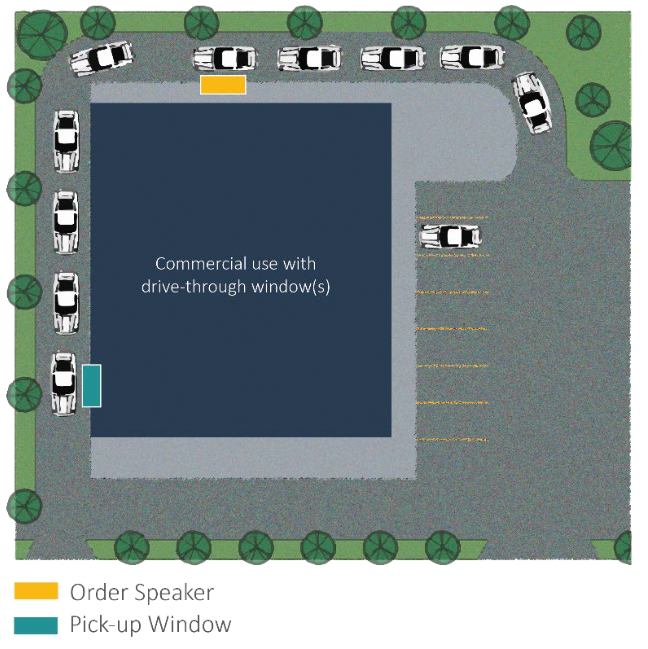
(ii)
Stacking spaces shall not interfere with the travel way traffic or designated parking spaces.
(2)
Pickup Window Only Requirements.
(i)
A minimum of 8 stacking spaces shall be provided for facilities with only a pickup window.
(3)
Order Speaker and Pickup Window Requirements.
(i)
A minimum of 4 stacking spaces shall be located behind the order speaker and 4 stacking spaces shall be located between the order speaker and the pickup window.
Section 7-7-4. - Kennel, Private.
(A)
Definition. A private kennel means any place which is equipped and/or used to house, keep, or otherwise care for, outside of the primary dwelling, 3 or more dogs that are over six-months of age, and for which no compensation is received.
(B)
Lot Area.
(1)
Minimum lot area of 5 acres.
(C)
Location. Except where animals are confined in soundproofed buildings, no portion of the use, excluding required screening and landscape buffers, shall be located within:
(1)
100 ft. from the property lines of adjoining agricultural zoned property;
(2)
200 ft. from the property lines of adjoining residential zoned property; and
(3)
200 ft. from any dwelling not on the associated parcel.
(D)
General Standards.
(1)
Screening shall be provided to visually block runs, pens, and kennels from the front and closest side property lines.
(2)
Kennels shall be kept free of waste on a regular basis to minimize impacts of odor and reduce propagation of pests.
(3)
Kennels shall be maintained in a sanitary and humane condition in accordance with Code of Virginia, § 3.2-6503, as amended.
Section 7-7-5. - Mixed-Use Structure.
(A)
Dwelling units shall be allowed by-right on the second or higher floor.
(B)
Dwelling units occupying the first floor of any structure shall only be allowed under the following circumstances:
(1)
The first-floor residential units are not visible from a public street;
(2)
If the building fronts on a public street, the residential portion on the first floor shall be shielded by office or retail space or a lobby that maintains a commercial appearance; and
(3)
At least 50% of the first floor area shall be dedicated to non-residential use.
Section 7-7-6. - Outdoor Furnaces.
(A)
Setbacks.
(1)
Outdoor furnaces shall be located at least 50 ft. from any property line.
(2)
Outdoor furnaces shall be located at least 100 ft. from any residence that is not served by the outdoor furnace.
(B)
General Standards.
(1)
Outdoor furnaces shall be located on the property in compliance with manufacturer's recommendations and/or testing and listing requirements for clearance to combustible materials.
(2)
All outdoor wood furnaces shall be laboratory tested and listed to appropriate safety standards such as UL, CAN/CSA, ANSI, or other applicable safety standards.
(3)
Fuel burned in any new or existing outdoor furnace shall be only natural wood, wood pellets, corn products, biomass pellets, or other listed fuels specifically permitted by the manufacturer's instructions such as fuel oil, natural gas, or propane backup.
(C)
Chimney Heights.
(1)
Furnace chimneys shall extend at least 2 ft. above the peak of any residence not served by the outdoor wood furnace located within 300 ft. of such outdoor furnace.
Section 7-7-7. - Outdoor Storage.
(A)
Intent. The following standards are intended to mitigate impacts of outdoor storage as a principal use, or as an accessory use to commercial and industrial businesses. Examples include construction materials, such as stacks of lumber or stone; equipment; surplus goods; among other items.
(B)
Location. No outdoor storage shall be located within 50 ft. of a residential district.
(C)
Screening, Buffering, and Landscaping.
(1)
Outdoor storage areas shall be screened by a solid wall or fence, including solid entrance and exit gates, not less than 6 ft. nor more than 10 ft. in height. All walls and fences shall have a uniform and durable character and shall be properly maintained. All screening shall be in accordance with Article VIII, Community Design Standards, of this Ordinance.
(2)
When walls and fences are adjacent to commercial or residential districts, a landscaped buffer shall be provided to break visibility of the fence in accordance with Article VIII, Community Design Standards, of this Ordinance.
(3)
Outdoor storage shall be located on the side or rear of the main structure and screened from view from any adjacent roadway.
(4)
No wall or fence screening a storage area shall encroach into a sight distance triangle.
(5)
Parts, materials, and equipment stored in a storage area shall not be stacked and/or piled higher than the screening wall or fence.
Section 7-7-8. - Solar Energy, Medium-Scale.
(A)
Intent.
(1)
The intent of this Section is to allow medium-scale solar energy facilities in a manner that promotes the development of renewable energy sources, while limiting and mitigating impacts on natural resources and existing agricultural, forestry, residential, commercial, industrial, historical, cultural, and recreational uses of property, or the future development of such uses of property within the County.
(2)
The purpose of this Section is to outline the process and requirements for the construction, installation, operation, and decommissioning of medium-scale solar energy facilities that ensures the protection of health, safety, and welfare, while also avoiding adverse impacts on County resources.
(3)
This Section is not intended to abridge safety, health, environmental, or land use requirements contained in other applicable laws, codes, regulations, standards, or ordinances. This Section does not supersede or nullify any provision of local, State, or Federal law that applies to solar energy facilities.
(B)
Compliance.
(1)
All medium-scale solar energy facilities shall fully comply with all applicable local regulations, as well as all applicable state and federal regulations, including but not limited to, the U.S. Environmental Protection Agency (EPA), Federal Aviation Administration ("FAA"), State Corporation Commission ("SCC") or equivalent, any state departments related to environmental quality, parks, and wildlife protection, as well as all the applicable regulations of any other agencies that were in force at the time of the permit approval.
(2)
The design and installation of all medium-scale solar energy facilities shall conform to applicable industry standards, including those of the American National Standards Institute (ANSI), Underwriters Laboratories (UL), the American Society for Testing and Materials (ASTM), or other similar certifying organizations and shall comply with all fire and safety requirements.
(C)
Megawattage.
(1)
Minimum generation of more than 500 kilowatts (KW).
(2)
Maximum generation of 5 megawatts (5 MW).
(D)
Consumption. Generated electricity may be used for on-site consumption, provided to electric cooperative member-customers (non-retail, from behind the meter), or distributed for commercial consumption.
(E)
Land Disturbance.
(1)
The clearing, grading, and overall site disturbance is limited to only that which is necessary; superfluous clearing and grading is not permitted, in order to retain existing trees and other groundcover.
(2)
Any medium-scale solar facility that has 2,500 sq. ft. or more of land disturbance for ground mounted panels shall require a Special Exception.
(F)
Grid Tied System. No grid-tied system shall be installed until evidence has been given as part of the application that the owner has been approved by the utility company to install the system.
(G)
Height Limits.
(1)
If the medium-scale solar energy facility is ground-mounted or not flush-mounted on a principal or accessory building, the facility's height shall not exceed 15 ft. at the tallest point.
(2)
If the medium-solar energy facility is roof-mounted or otherwise integrated into a principal or accessory building, the facility's height shall not exceed the maximum height limit of the district in which it is located.
(H)
Setbacks. The solar energy facility shall comply with all setback requirements of the district in which it is located.
(1)
Regardless of whether a medium-scale solar facility is accessory to another use on the lot, all medium-scale solar facilities shall comply with the district's principal structure setbacks.
(I)
Landscaping and Screening. Landscaping and screening shall be provided for ground mounted solar to block visibility of the panel(s) and ancillary equipment from adjacent properties.
(1)
All landscaping and screening shall be in accordance with Article VIII, Community Design Standards, of this Ordinance.
(2)
All ground-mounted facilities greater than 1 acre shall comply with Buffer Type C in Article 8, Community Design Standards, Tables VIII-2 and VIII-3, of this Ordinance.
(3)
Forest resources shall be preserved by maintaining natural buffers where the existing vegetation provides the same or greater buffer. Existing forests which do not meet the standards required may add plantings to achieve the same or greater buffer as required above.
(J)
Design Standards.
(1)
The lowest surface of any panel shall be a maximum of 4 ft. above the finished grade on which the panel is located.
(2)
All wiring not on the solar arrays shall be underground except where necessary to connect to the public utility.
(K)
Liability Insurance. The owner shall provide proof of adequate liability insurance for a medium-solar facility prior to beginning construction and before the issuance of any permits.
(L)
Inspection.
(1)
The owner will allow designated County staff access to the facility for inspection purposes. The County staff will provide the owner with 24-hour notice prior to such inspection when practicable.
(2)
The owner shall reimburse the County its costs in obtaining an independent third-party to conduct inspections required by local and state laws and regulations.
(M)
Decommission and Reclamation.
(1)
All applications for a medium-scale solar energy facility shall require a Decommission and Reclamation plan, as provided in 7-7-8 (N), below.
(2)
Medium-scale solar energy facilities which have reached the end of their useful life, have been abandoned, or have not been in active and continuous service for a period of 12 months shall be removed at the owner's or operator's expense, except if the project is being repowered or a force majeure event has or is occurring requiring longer repairs; however, the County may require evidentiary support that a longer repair period is necessary.
(3)
The owner or operator shall notify the Administrator by certified mail of the proposed date of discontinued operations and plans for removal.
(4)
If a facility is abandoned and the owner receives a notice of abandonment from the Administrator, the owner shall either complete all decommissioning activities and remove the solar energy facility in accordance with the Decommission and Reclamation Plan or resume regular operation within 30 days.
(5)
If the owner of the solar facility fails to remove the installation in accordance with the requirements of the Decommission and Reclamation Plan, or within the proposed date of decommissioning, the County may collect the surety and the County or hired third party may enter the property to physically remove the installation.
(N)
Decommission and Reclamation Plan.
(1)
All Decommissioning and Reclamation Plans shall be certified by an engineer or contractor with demonstrated expertise in solar facility removal, and shall include the following:
(i)
The anticipated life of the project;
(ii)
An estimated deconstruction schedule;
(iii)
The estimated decommissioning cost in current dollars.
(iv)
The estimated cost of decommissioning shall be guaranteed by bond, letter of credit, or other security approved by the County.
(a)
The owner shall deposit the required amount into the approved escrow account before any building permit is issued to allow construction of the medium-scale solar facility.
(b)
The escrow account agreement shall prohibit the release of the bond without the written consent of the County. The County shall consent to the release of the bond upon on the owner's compliance with the approved Decommission and Reclamation Plan. The County may approve the partial release of the bond as portions of the approved Decommission and Reclamation Plan are performed.
(c)
The dollar amount of the bond shall be the full amount of the estimated decommissioning cost without regard to the possibility of salvage value.
(d)
The owner or occupant shall recalculate the estimated cost of decommissioning every five years. If the recalculated estimated cost of decommissioning exceeds the original estimated cost of decommissioning by ten percent (10%), then the owner or occupant shall deposit additional funds into the bond to meet the new cost estimate. If the recalculated estimated cost of decommissioning is less than ninety percent (90%) of the original estimated cost of decommissioning, then the County may approve reducing the amount of the bond to the recalculated estimate of decommissioning cost.
(2)
Decommission shall include removal of all solar electric systems, buildings, cabling, electrical components, security barriers, roads, foundations, pilings, and any other associated facilities, so that any agricultural ground upon which the facility and/or system was located is again tillable and suitable for agricultural uses.
(3)
The site shall be graded and re-seeded or replanted within 12 months of removal of solar facilities to restore it to as natural a pre-development condition as possible.
(i)
Any exception to site restoration, such as leaving driveways, entrances, or landscaping in place, or substituting plantings, shall be requested by the landowner in writing, and this request shall be approved by the Board of Supervisors.
(4)
Hazardous material from the property shall be disposed of in accordance with federal and state law.
Section 7-7-9. - Solar Energy, Small-Scale.
(A)
Intent.
(1)
The intent of this Section is to allow small-scale solar energy facilities in a manner that promotes the development of renewable energy sources, while limiting and mitigating impacts on natural resources and existing agricultural, forestry, residential, commercial, industrial, historical, cultural, and recreational uses of property, or the future development of such uses of property within the County.
(2)
The purpose of this Section is to outline the process and requirements for the construction, installation, operation, and decommissioning of small-scale solar energy facilities that ensures the protection of health, safety, and welfare, while also avoiding adverse impacts on County resources.
(3)
This Section is not intended to abridge safety, health, environmental, or land use requirements contained in other applicable laws, codes, regulations, standards, or ordinances. This Section does not supersede or nullify any provision of local, State, or Federal law that applies to solar energy facilities.
(B)
Compliance.
(1)
All small-scale solar energy facilities shall fully comply with all applicable local regulations, as well as all applicable state and federal regulations, including but not limited to, the U.S. Environmental Protection Agency (EPA), Federal Aviation Administration ("FAA"), State Corporation Commission ("SCC") or equivalent, any state departments related to environmental quality, parks, and wildlife protection, as well as all the applicable regulations of any other agencies that were in force at the time of the permit approval.
(2)
The design and installation of all small-scale solar energy facilities shall conform to applicable industry standards, including those of the American National Standards Institute (ANSI), Underwriters Laboratories (UL), the American Society for Testing and Materials (ASTM), or other similar certifying organizations and shall comply with all fire and safety requirements.
(3)
Site Plans shall be required for all small-scale solar energy facilities, in accordance with Article III, Permits and Applications, of this Ordinance.
(C)
Megawattage.
(1)
Maximum generation of 500 kilowatts (KW).
(D)
Consumption. Generated electricity may be used for on-site consumption or provided to electric cooperative member-customers (non-retail, from behind the meter).
(E)
Land Disturbance.
(1)
The clearing, grading, and overall site disturbance is limited to only that which is necessary; superfluous clearing and grading is not permitted, in order to retain existing trees and other groundcover.
(2)
Any small-scale solar facility that has 2,500 sq. ft. or more of land disturbance for ground mounted panels shall require a Special Exception.
(F)
Height Limits.
(1)
If the small-scale solar energy facility is ground-mounted or not flush-mounted on a principal or accessory building, the facility's height shall not exceed 15 ft. at the tallest point.
(2)
If the small-solar energy facility is roof-mounted or otherwise integrated into a principal or accessory building, the facility's height shall not exceed the maximum height limit of the district in which it is located.
(G)
Setbacks. The solar energy facility shall comply with all setback requirements of the district in which it is located.
(1)
Regardless of whether a medium-scale solar facility is accessory to another use on the lot, all medium-scale solar facilities shall comply with the district's principal structure setbacks.
(H)
Landscaping and Screening. Landscaping and screening shall be provided for ground mounted solar to block visibility of the panel(s) and ancillary equipment from adjacent properties. All landscaping and screening shall be in accordance with Article VIII, Community Design Standards, of this Ordinance.
(I)
Design Standards.
(1)
If the small-scale solar energy facility is ground-mounted or not flush-mounted on a principal or accessory building, then:
(i)
The lowest surface of any panel shall be a maximum of 4 ft. above the finished grade on which the panel is located.
(ii)
All wiring not on the solar arrays shall be underground except where necessary to connect to the public utility.
(J)
Inspection.
(1)
The owner will allow designated County staff access to the facility for inspection purposes. The County staff will provide the owner with 24-hour notice prior to such inspection when practicable.
(2)
The owner shall reimburse the County its costs in obtaining an independent third-party to conduct inspections required by local and state laws and regulations.
(K)
Decommission.
(1)
Small-scale solar energy facilities which have reached the end of their useful life, have been abandoned, or have not been in active and continuous service for a period of 12 months shall be removed at the owner's or operator's expense, except if the facility is being repowered or a force majeure event has or is occurring requiring longer repairs; however, the County may require evidentiary support that a longer repair period is necessary.
(2)
The owner or operator shall notify the Administrator by certified mail of the proposed date of discontinued operations and plans for removal.
(3)
If a facility is abandoned and the owner receives a notice of abandonment from the Administrator, the owner shall either remove the solar energy facility or resume regular operation within 30 days.
(4)
If the owner of the solar facility fails to remove the installation within the proposed date of decommissioning, a hired third party may enter the property to physically remove the installation.
(5)
Decommission shall include removal of all solar electric systems, buildings, cabling, electrical components, security barriers, roads, foundations, pilings, and any other associated facilities, so that any agricultural ground upon which the facility and/or system was located is again tillable and suitable for agricultural uses.
(6)
Hazardous material from the property shall be disposed of in accordance with federal and state law.
Section 7-7-10. - Solar Energy, Utility-Scale.
(A)
Intent.
(1)
The intent of this Section is to allow utility-scale solar energy facilities in a manner that promotes the development of renewable energy sources, while limiting and mitigating impacts on natural resources and existing agricultural, forestry, residential, commercial, industrial, historical, cultural, and recreational uses of property, or the future development of such uses of property within the County.
(2)
The purpose of this Section is to outline the process and requirements for the construction, installation, operation, and decommissioning of utility-scale solar energy facilities that ensures the protection of health, safety, and welfare, while also avoiding adverse impacts on County resources.
(3)
This Section is not intended to abridge safety, health, environmental, or land use requirements contained in other applicable laws, codes, regulations, standards, or ordinances. This Section does not supersede or nullify any provision of local, State, or Federal law that applies to solar energy facilities.
(B)
Compliance.
(1)
All utility-scale solar energy facilities shall fully comply with all applicable local regulations, as well as all applicable state and federal regulations, including but not limited to, the U.S. Environmental Protection Agency (EPA), Federal Aviation Administration ("FAA"), State Corporation Commission ("SCC") or equivalent, any state departments related to environmental quality, parks, and wildlife protection, as well as all the applicable regulations of any other agencies that were in force at the time of the permit approval.
(2)
The design and installation of all utility-scale solar energy facilities shall conform to applicable industry standards, including those of the American National Standards Institute (ANSI), Underwriters Laboratories (UL), the American Society for Testing and Materials (ASTM), or other similar certifying organizations and shall comply with all fire and safety requirements.
(C)
Megawattage.
(1)
Minimum generation of 5 megawatts (5 MW).
(D)
Consumption. Generated electricity may be provided to electric cooperative member-customers (non-retail, from behind the meter) or distributed for commercial consumption.
(E)
Land Disturbance.
(1)
The clearing, grading, and overall site disturbance is limited to only that which is necessary; superfluous clearing and grading is not permitted, in order to retain existing trees and other groundcover.
(2)
Any utility-scale solar facility that has 2,500 sq. ft. or more of land disturbance for ground mounted panels shall require a Special Exception.
(F)
Lot Area. Minimum lot area of 2 acres.
(G)
Height Limits.
(1)
If the utility-scale solar energy facility is ground-mounted, the facility's height shall not exceed 15 ft. at the tallest point, including appurtenances. The Board of Supervisors may approve a greater height based upon the demonstration of a significant need where the impacts of increased height are mitigated.
(2)
If the utility-solar energy facility is roof-mounted or otherwise integrated into a principal or accessory building, the facility's height shall not exceed the maximum height limit of the district in which it is located.
(H)
Base Setbacks.
(1)
Ground mounted utility-scale solar energy facilities that are located on contiguous lots, shall:
(i)
Not have minimum setbacks for interior, or abutting, lot lines;
(ii)
All structures—including fences, panels, and all ancillary equipment/buildings—shall be at least 200 ft. from any residential district, planned development district, or dwelling; and
(iii)
All structures—including fences, panels, and all ancillary equipment/buildings—shall be at least 100 ft. from all agricultural, commercial, or industrial district.
(I)
Additional Setbacks and Location Standards.
(1)
Any tie lines shall be located and buffered to block visibility from public roads or other right-of-way.
(2)
No utility-scale solar facility shall be located within two miles of another existing or permitted utility-scale solar facility unless they are part of a contiguous "solar farm."
(3)
Wetlands, waterways, and floodplains shall be avoided.
(J)
Buffer. A buffer shall be located within the setbacks required under this Section and shall run around the entire perimeter of the property.
(1)
The buffer shall be maintained for the life of the facility.
(2)
Forest resources shall be preserved by maintaining natural buffers where the existing vegetation provides the same or greater buffer. Existing forests which do not meet the standards required may add plantings to achieve the same or greater buffer as required below.
(3)
Utility-scale facilities shall be in accordance with Article VIII, Community Design Standards, and must comply with Buffer Type C in Table VIII-2, except that the minimum buffer width shall be 100 feet wide. The first 50 feet adjacent to the property line shall be planted as described in Type C and the remaining 50 feet shall be planted with staggered rows of evergreen tree plugs, except to the extent that existing vegetation provides the same screening.
(K)
Coordination of Local Emergency Services. The owner or operator shall coordinate with the King George County Fire, Rescue and Emergency Services (KGFRES) to provide materials, education, and/or training on how to safely respond to on-site emergencies. Emergency personnel will be given a key or code to access the property in case of an on-site emergency.
(L)
Noise. During operation, a utility-scale solar facility shall not produce a noise level that exceeds 60 dBA as measured at the property line or 50 dBA as measured at the nearest neighboring dwelling.
(M)
Maintenance. The owner or operator shall maintain the solar facility in good condition. Such maintenance shall include, but not be limited to, painting, structural integrity of the equipment and structures, as applicable, maintenance of the buffer areas, and landscaping. Site access shall be maintained to a level acceptable to the County. The owner or operator shall be responsible for the cost of maintaining the solar facility and access roads, and the cost of repairing damage to private roads occurring as a result of construction and operation.
(N)
Groundwater Monitoring. Ground water monitoring to assess the level of groundwater contamination shall take place prior to, and upon completion of construction of the project, throughout the entire area of the solar facility.
(1)
Ground water monitoring shall take place every 5 years of the operation of the project, and upon completion of decommissioning.
(2)
Results from said monitoring shall be delivered to the King George County Community Planning Department.
(O)
Soil Testing. Soil testing shall occur to establish baseline data for pre-construction soil conditions within the project area and throughout the life of the project.
(1)
Within 90 days of operation, and again every 5 years during operation, soil conditions shall be determined for the same sampling locations.
(2)
Results from said testing shall be delivered to the King George County Community Planning Department and used to conduct soil restoration activities as needed.
(P)
Security fencing. The facilities shall be enclosed by security fencing.
(1)
All security fencing shall be a minimum of 6 ft. in height and topped with razor/barbed wire, as appropriate.
(2)
All security fencing shall be placed behind the buffer and must be screened from view.
(3)
All security fencing shall be placed around sections of the infrastructure (not the entire site) to provide access corridors for wildlife to navigate through the facility.
(4)
All security fencing shall be constructed so as to substantially lessen the likelihood of entry by unauthorized individuals.
(5)
A performance bond reflecting the costs of anticipated security fence maintenance shall be posted and maintained.
(6)
Failure to maintain the security fencing shall result in revocation of the Zoning Permit and/or Special Exception Permit following notice of violation and enforcement as provided in Article II, Division 4 of this Ordinance.
(Q)
Wildlife Corridors. The utility-scale solar facility shall provide access corridors for wildlife to navigate through the facility, at a number and design based on the Department of Wildlife Resources' guidance and acceptable to the County.
(1)
The proposed wildlife corridors shall be shown on the Site Plan submitted.
(2)
Areas between fencing shall be kept open to allow for the movement of migratory animals and other wildlife.
(R)
Signage. No signage of any type may be placed on the facility other than notices, warnings, and identification information required by law.
(1)
Signage shall not exceed 40 sq. ft. displaying the facility name, address, and emergency contact information, unless additional signage is required by National Electric Safety Code.
(2)
Warning signage shall be placed on solar equipment to the extent appropriate or legally required.
(3)
Solar equipment shall not be used for displaying any advertising except for reasonable identification of the manufacturer or operator of the solar energy project.
(4)
All signs, flags, streamers, or similar items, both temporary and permanent, are prohibited on solar equipment except as follows:
(i)
Manufacturer's or installer's identification;
(ii)
Appropriate warning signs and placards;
(iii)
Signs that may be required by a federal agency; and
(iv)
Signs that provide a 24-hour emergency contact phone number and warn of any danger.
(S)
Additional Design Standards.
(1)
The lowest surface of any panel shall be a maximum of 4 ft. above the finished grade on which the panel is located.
(2)
Any new electrical transmission lines may be located either above or below ground in a manner to be least intrusive and mitigate their impact to surrounding properties.
(3)
The design of support buildings and related structures shall use materials, colors, textures, screening, and landscaping that will blend the facilities to the natural setting and surrounding structures.
(T)
Grid Tied System. No grid-tied system shall be installed until evidence has been given as part of the application that the owner has been approved by the utility company to install the system.
(U)
Liability Insurance. The owner shall provide proof of adequate liability insurance for a utility-scale solar facility prior to beginning construction and before the issuance of any permits.
(V)
Inspection.
(1)
The owner will allow designated County staff access to the facility for inspection purposes. The County staff will provide the owner with 24-hour notice prior to such inspection when practicable.
(2)
The owner shall reimburse the County its costs in obtaining an independent third-party to conduct inspections required by local and state laws and regulations.
(W)
Application Requirements. In addition to any requirements of Article III, Permits and Applications, of this Ordinance, applications for utility-scale solar energy facilities shall include the following.
(1)
Pre-application Meeting. A pre-application meeting shall be held with the Administrator to discuss the location, scale, and nature of the proposed use, what will be expected during that process, as well as the potential for a siting agreement.
(2)
Neighborhood Meeting. A public meeting shall be held to give the community an opportunity to hear from the applicant and ask questions regarding the proposed project. The meeting shall adhere to the following:
(i)
The applicant shall inform the Administrator and adjacent property owners in writing of the date, time, and location of the meeting, at least 14 but no more than 21 days, in advance of the meeting date.
(ii)
The date, time and location of the meeting shall be advertised in a newspaper of record in the County by the applicant, at least 14 but no more than 21 days, in advance of the meeting date.
(iii)
The meeting shall be held within the County, at a location open to the public with adequate parking and seating facilities that will accommodate persons with disabilities.
(iv)
The meeting shall give members of the public the opportunity to review application materials, ask questions of the applicant, and provide feedback.
(v)
The applicant shall provide the Administrator a summary of any input received from members of the public at the meeting and copies of any written submissions from the public.
(3)
Siting Agreement. The applicant shall enter into a Siting Agreement with the County unless that requirement is waived by the County.
(4)
Project Narrative. A detailed narrative that:
(i)
Identifies the applicant, facility owner, site owner, and operator;
(ii)
Describes the proposed facility, including:
(a)
An overview of the project and its location;
(b)
The size of the site and the project area;
(c)
The current use of the site;
(d)
The estimated time for construction and proposed date for commencement of operations;
(e)
The planned maximum rated capacity of the facility;
(f)
The approximate number, representative types, and expected footprint of solar equipment to be constructed; including the maximum number of photovoltaic panels and ancillary facilities and the relationship with topography, buffers, and existing vegetation. This shall include a total lot coverage percentage; and
(g)
How and where the electricity will be transmitted, including the location of the proposed electrical grid interconnection and proximity to transmission lines.
(iii)
Site Plan. In addition to the Site Plan requirements of Article III, Permits and Applications, of this Ordinance, all Site Plans for utility-scale solar facilities may also require additional information as determined by the Administrator—such as a scaled elevation view of the property and other supporting drawings, photographs of the proposed site, photo or other realistic simulations or modeling of the proposed project from potentially sensitive locations as deemed necessary by the Administrator to assess the visual impact of the project, landscaping and screening plan, coverage map, and additional information that may be necessary for a technical review of the proposal.
(5)
Construction Schedule. An estimated construction schedule.
(6)
Visual Impact Analysis. The analysis demonstrates project siting and proposed mitigation, if necessary, so that the facility minimizes impact on the visual character of the municipality.
(i)
The applicant shall provide accurate, to scale, photographic simulations showing the relationship of the facility and its associated amenities and development to its surroundings. The photographic simulations shall show such views of solar structures from locations such as property lines and roadways, as deemed necessary by the municipality to assess the visual impact of the facility.
(ii)
The total number of simulations and the perspectives from which they are prepared shall be established by the Administrator after the pre-application meeting.
(7)
Community Impact Assessment. An assessment of the impact on the immediate vicinity of the proposed solar project as well as the greater King George County community.
(i)
The report shall be prepared by a professional acting within his or her competency, shall be presented in written form and shall analyze in specific terms the probable impact of the project on the vicinity and community over time.
(ii)
Specific attention, as may be appropriate to the individual proposal, should be given but not be limited to the following elements:
(a)
Anticipated direct revenues to the County from real estate and personal property taxes;
(b)
An assessment of employment opportunities to be created by the proposed development;
(c)
An assessment of the short- and long-term economic impact of the proposed development;
(d)
If the development is replacing an existing enterprise, including agriculture and forestry, an assessment of the impact the current enterprise has on the local economy and how the local economy will be impacted by the loss of the existing enterprise;
(e)
Fire, rescue, and law enforcement requirements as compared to existing capacities and facilities;
(iii)
The Administrator may waive certain elements of the Community Impact Assessment, where the nature of the proposed facility makes such elements inapplicable.
(X)
Environmental Impact Assessment. A statement regarding any site and viewshed impacts, including direct and indirect impacts to national or state forests and grasslands, national or state parks, County parks, wildlife management areas, conservation easements, recreational areas, or any known historic or cultural resources within 5 miles of the proposed facility.
(1)
Wetlands, rivers and streams, and floodplains shall be inventoried, delineated, and mapped to provide baseline data for the evaluation of the current proposal and to determine satisfactory decommissioning as required in this Section.
(i)
The inventory and mapping of floodplain shall not be construed to allow development within regulatory flood plain areas.
(Y)
Traffic Study.
(1)
Information about the proposed facility's traffic impacts, modeling both the construction and decommissioning processes, to include:
(i)
The time of day that transport will occur;
(ii)
Characteristics of the loaded vehicles, including:
(a)
Length, height, width, curb weight;
(b)
Maximum load capacity;
(c)
Number of axles, including trailers; and
(d)
Distance between axles.
(iii)
The number of vehicles transporting goods;
(iv)
The frequency of vehicle arrival at the site; and
(v)
The number of drivers the project will employ.
(2)
The haul route(s) shall be provided and approved for construction impacts.
(3)
After review of the application's traffic impact information, the County may require a full traffic study to be accepted by an engineer approved by the County.
(Z)
Grading Plan. A Grading Plan that limits grading to the greatest extent practicable by avoiding steep slopes and laying out arrays parallel to landforms. The Grading Plan shall include:
(1)
Existing and proposed contours;
(2)
Locations and amount of topsoil to be stripped and stockpiled onsite (if any);
(3)
Percent of the site to be graded;
(4)
An earthwork balance achieved on-site with no import or export of soil; and
(5)
Indication of natural flow patterns in drainage design and amount of impervious surface.
(AA)
Landscaping Plan.
(1)
The Landscape Plan shall be prepared by a certified landscape architect or other qualified, licensed person.
(2)
The Landscaping Plan shall indicate:
(i)
All ground cover, screening and buffering materials, landscaping, and elevations.
(a)
All landscaping, screening, and buffering shall be in accordance with Article VIII, Community Design Standards of this Ordinance.
(ii)
Ground cover shall be native vegetation where compatible with site conditions.
(iii)
Screening vegetation shall include pollinator plants where compatible with site conditions.
(3)
Locations of wildlife corridors.
(4)
Maintenance requirements.
(BB)
Herbicide Land Application Plan.
(1)
EPA approved herbicides shall be used for vegetative and weed control at the facility by a licensed applicator.
(2)
An Herbicide Land Application Plan shall be submitted prior to approval of a final Site Plan.
(3)
The plan shall specify the type of herbicides to be used, the frequency of land application, the identification of approved groundwater wells, wetlands, streams, and the distances from land application areas to features such as wells, wetlands, streams, and other bodies of water.
(4)
The operator shall notify the County prior to application of pesticides and fertilizers.
(CC)
Decommission and Reclamation.
(1)
All applications for a utility-scale solar energy facility shall require a Decommission and Reclamation plan, as provided in 7-7-10 (CC), below.
(2)
Utility-scale solar energy facilities which have reached the end of their useful life, have been abandoned, or have not been in active and continuous service for a period of 12 months shall be removed at the owner's or operator's expense, except if the project is being repowered or a force majeure event has or is occurring requiring longer repairs; however, the County may require evidentiary support that a longer repair period is necessary.
(3)
The owner or operator shall notify the Administrator by certified mail of the proposed date of discontinued operations and plans for removal.
(4)
If the owner of the facility fails to remove the installation in accordance with the requirements of the Decommission and Reclamation Plan, or within the proposed date of decommissioning, the County may collect the surety and the County or hired third party may enter the property to physically remove the installation.
(5)
If a facility is abandoned and the owner receives a notice of abandonment from the Administrator, the owner shall either complete all decommissioning activities and remove the solar energy facility in accordance with the Decommission and Reclamation Plan or resume regular operation within 30 days.
(DD)
Decommission and Reclamation Plan.
(1)
All Decommissioning and Reclamation Plans shall be certified by an engineer or contractor with demonstrated expertise in solar facility removal, and shall include the following:
(i)
The anticipated life of the project;
(ii)
An estimated deconstruction schedule;
(iii)
The estimated decommissioning cost in current dollars.
(iv)
The estimated cost of decommissioning shall be guaranteed by bond, letter of credit, or other security approved by the County.
(a)
The owner shall deposit the required amount into the approved escrow account before any building permit is issued to allow construction of the utility-scale solar facility.
(b)
The escrow account agreement shall prohibit the release of the bond without the written consent of the County. The County shall consent to the release of the bond upon on the owner's compliance with the approved Decommission and Reclamation Plan. The County may approve the partial release of the bond as portions of the approved Decommission and Reclamation Plan are performed.
(c)
The dollar amount of the bond shall be the full amount of the estimated decommissioning cost without regard to the possibility of salvage value.
(d)
The owner or occupant shall recalculate the estimated cost of decommissioning every 5 years. If the recalculated estimated cost of decommissioning exceeds the original estimated cost of decommissioning by 10%, then the owner or occupant shall deposit additional funds into the bond to meet the new cost estimate. If the recalculated estimated cost of decommissioning is less than 90% of the original estimated cost of decommissioning, then the County may approve reducing the amount of the bond to the recalculated estimate of decommissioning cost.
(2)
Decommission shall include removal of all solar electric systems, buildings, cabling, electrical components, security barriers, roads, foundations, pilings, and any other associated facilities, so that any agricultural ground upon which the facility and/or system was located is again tillable and suitable for agricultural uses.
(3)
The site shall be graded and re-seeded or replanted within 12 months of removal of solar facilities to restore it to as natural a pre-development condition as possible.
(i)
Any exception to site restoration, such as leaving driveways, entrances, or landscaping in place, or substituting plantings, shall be requested by the landowner in writing, and this request shall be approved by the Board of Supervisors.
(4)
Hazardous material from the property shall be disposed of in accordance with federal and state law.

