
Kinston City Zoning Code
APPENDIX A
DEFINITIONS
Section A.1.- Purpose.
For the purposes of this ordinance, certain words, concept, and ideas are defined herein. Except as defined herein, all other words used in this ordinance shall have their customary dictionary definition.
Section A.2. - Interpretation.
A.2.1. As used in this ordinance, words importing the masculine gender include the feminine and neuter.
A.2.2. Words used in the singular in this ordinance include the plural and words used in the plural include the singular.
A.2.3. Words used in the present tense include future tense.
A.2.4. The word "person" includes a firm, association, organization, corporation, company, trust, and partnership as well as an individual.
A.2.5. The words "may" and "should" are permissive.
A.2.6. The words "shall" and "will" are always mandatory and not merely directive.
A.2.7. The word "used for" shall include the meaning "designed for."
A.2.8. The words "used" or "occupied" shall mean "intended, designed, and arranged to be used or occupied."
A.2.9. The word "lot" shall include the words "plot," "parcel," "site," and "premises."
A.2.10. The word "structure" shall include the word "building."
A.2.11. The word "street" includes the word "alley," "road," "cul-de-sac," "highway," or "thoroughfare," whether designated as public or private.
A.2.12. The word "includes" shall not limit the term to specified examples, but is intended to extend its meaning to all other instances or circumstances of like kind or character.
A.2.13. The word "UDO administrator" shall mean the UDO administrator or his/her designee.
A.2.14. The words "planning board" shall mean the "City of Kinston Planning Board."
A.2.15. The word "city" shall mean the "City of Kinston," a municipality of the State of North Carolina.
A.2.16. The words "map," and "zoning map" shall mean the "Official Zoning Map for the City of Kinston, North Carolina."
A.2.17. The words "board of adjustment" shall mean the "City of Kinston Board of Adjustment."
Section A.3. - Definitions.
A
Abandonment. Cessation of use of a wireless support structure for wireless telecommunications activity for at least the minimum period of time specified under this ordinance.
Abutting. Having property or district lines in common. Lots are also considered to be abutting if they are directly opposite each other and separated by a street or alley.
Access. A way of approaching or entering a property. Access also includes ingress, the right to enter, and egress, the right to leave.
Accessory equipment. Any equipment serving or being used in conjunction with a wireless facility or wireless support structure. The term includes utility or transmission equipment, power supplies, generators, batteries, cables, equipment buildings, cabinets and storage sheds, shelters or similar structures.
Accessory structure (appurtenant structure). A structure located on the same parcel of property as the principal structure and the use of which is incidental to the use of the principal structure. Garages, carports and storage sheds are common urban accessory structures. Pole barns, hay sheds and the like qualify as accessory structures on farms, and may or may not be located on the same parcel as the farm dwelling or shop building.
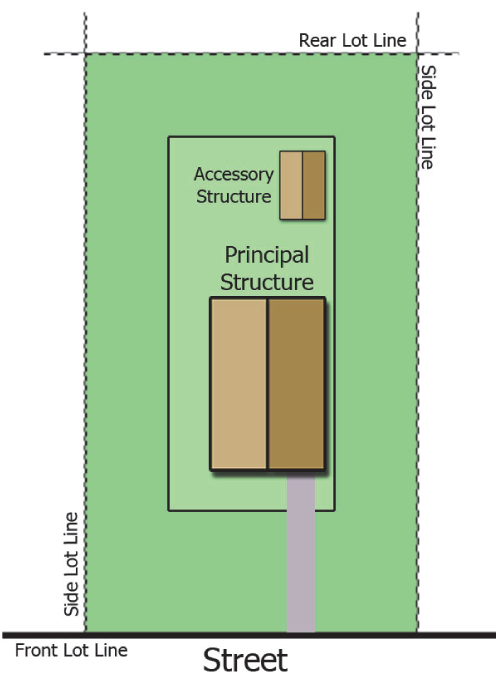
Accessory use. An activity which is conducted in conjunction with another principal use and the former use (i) constitutes only an incidental or insubstantial part of the total activity that takes place on a lot or (ii) is commonly associated with the principal use and integrally related to it.
Addition (to an existing building). An extension or increase in the floor area or height of a building or structure.
Administrative approval. Approval that the UDO administrator or designee is authorized to grant after administrative review.
Administrative review. Non-discretionary evaluation of an application by the UDO administrator or designee. This process is not subject to a public hearing.
Adult arcade. An establishment where, for any form of consideration, one (1) or more motion picture or video projectors, slide projectors or similar machines for viewing by five (5) or fewer persons each are used to show films, motion pictures, video cassettes, slides or other photographic reproductions that are characterized by an emphasis upon the depiction or description of specified sexual activities or specified anatomical areas, as defined hereinafter.
Adult bookstore. An establishment that has a substantial portion (over twenty-five (25) percent of total retail space) of its stock-in-trade and offers for rent, trade or sale, for any consideration, any one (1) or more of the following: 1) books, magazines, periodicals or other printed matter; or photographs, films, motion pictures, video cassettes, slides or other visual representations that are characterized by an emphasis upon the depiction or description of specified sexual activities or specified anatomical areas; or 2) instruments, devices or paraphernalia that are designed for use in connection with specified sexual activities.
Adult business. Any business activity, club or other establishment which permits any person, employee, member, patron or guest on its premises to exhibit any specified anatomical areas before any other person or persons.
Adult care home. An assisted living residence in which the housing management provides twenty-four-hour scheduled and unscheduled personal care services to two or more residents, either directly or for scheduled needs, through formal written agreement with licensed home care or hospice agencies. Some licensed adult care homes provide supervision to persons with cognitive impairments whose decisions, if made independently, may jeopardize the safety or well-being of themselves or others and therefore require supervision. Medication in an adult care home may be administered by designated trained staff. Adult care homes that provide care to two (2) to six (6) unrelated residents are commonly called family care homes.
Adult day care program. The provision of group care and supervision in a place other than their usual place of abode on a less than twenty-four-hour basis to adults who may be physically or mentally disabled.
Adult motion picture theater. An establishment where, for any form of consideration, films, motion pictures, video cassettes, slides or similar photographic reproductions are shown, and in which a substantial portion twenty-five (25) percent of the total presentation time is devoted to the showing of material characterized by an emphasis on the depiction or description of specified sexual activities or specified anatomical areas.
Adult theater. A theater, concert hall, auditorium or similar establishment characterized by (activities featuring) the exposure of specified anatomical areas or by specified sexual activities.
Agricultural operations. Agricultural operations include establishments (e.g., farms, ranches, dairies, orchards, hatcheries, broiler houses) primarily engaged in the production of crops, plants, vines, or trees and the keeping, grazing, or feeding of livestock. "Livestock," as used here includes, cattle, sheep, goats, hogs, and poultry as well as animal specialties such as horses, rabbits, bees, pets, fur-bearing animals in captivity, and fish in captivity. Agricultural operations also include establishments primarily engaged in the operation of timber tracts, tree farms, forest nurseries, and related activities. Commercial greenhouses and nurseries are classified separately for purposes of this ordinance. See commercial greenhouse definition.
Antenna. Communications equipment that transmits, receives, or transmits and receives electromagnetic radio signals used in the provision of all types of wireless communications services.
Appeal. A request for a review of the UDO administrator's interpretation of any provision of this ordinance.
Application, wireless facility. A formal request submitted to the UDO administrator to construct or modify a wireless support structure or a wireless facility.
Area of shallow flooding. A designated Zone AO on a community's flood insurance rate map (FIRM) with base flood depths determined to be from one (1) to three (3) feet. These areas are located where a clearly defined channel does not exist, where the path of flooding is unpredictable and indeterminate, and where velocity flow may be evident.
Area of special flood hazard. See Special flood hazard area (SFHA).
Art, work of. All forms of original creations of visual art including but not limited to: sculpture, in any material or combination of materials, whether in the round, bas-relief, high relief, mobile, fountain, kinetic, or electronic; painting, whether portable or permanently fixed, as in the case of murals; mosaics; photographs; crafts made from clay, fiber and textiles, wood, glass, metal, plastics, or any other material, or any combination thereof; calligraphy; mixed media composed of any combination of forms or media; unique architectural stylings or embellishments, including architectural crafts; environmental landscaping; or restoration and renovation of existing works of art of historical significance. Signs are not considered artwork.
Artisan's workshop. An establishment, not exceeding three thousand (3,000) square feet of floor area, for the preparation, display, and sale of individually crafted artwork, jewelry, furniture, sculpture, pottery, leathercraft, hand-woven articles, and related items. An artisan's workshop includes an establishment that is engaged in the low-impact manufacturing, assembly, repair, or servicing of industrial, business, or consumer machinery, equipment, products, or by-products. Examples include contractors and building maintenance services and similar uses that perform services off-site, low-impact clothing or textile manufacturing, commercial bakery, food service contractor, movie production facility, printing, publishing, lithography, sign-making, welding, woodworking, arts-based (culinary, dance, art, music, photography) classroom, and other similar uses.
Assisted living residence. Any group housing and services program for two (2) or more unrelated adults, by whatever name it is called, that makes available, at a minimum, one (1) meal a day and housekeeping services and provides personal care services directly or through a formal written agreement with one or more licensed home care or hospice agencies. Settings in which services are delivered may include self-contained apartment units or single or shared room units with private or area baths. There are three (3) types of assisted living residences: adult care homes, adult care homes that serve only elderly persons, and multi-unit assisted housing with services.
B
Bar. A commercial enterprise whose primary activity is the sale of alcoholic beverages to be consumed on the premises. Bars include taverns, night clubs, private clubs, bottle clubs, and similar facilities serving alcoholic liquor.
Base flood. The flood having a one (1) percent chance of being equaled or exceeded in any given year. Also known as the one-hundred-year flood.
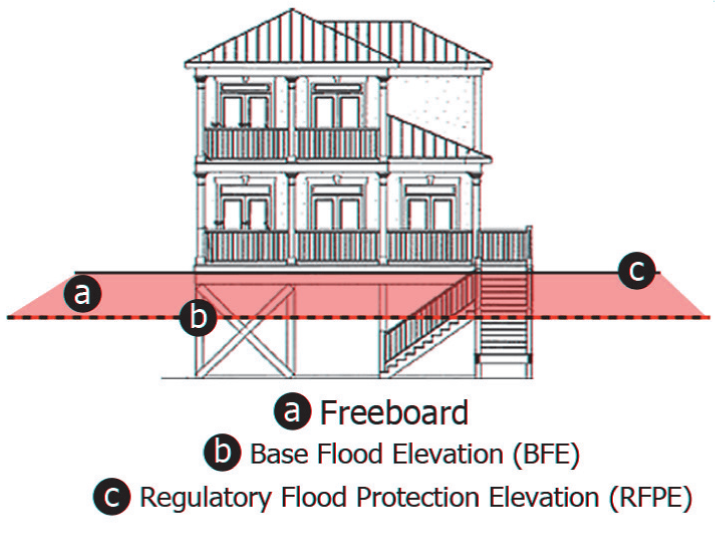
Base flood elevation (BFE). A determination of the water surface elevations of the base flood as published in the flood insurance study. When the BFE has not been provided in a special flood hazard area, it may be obtained from engineering studies available from a federal, state, or other source using FEMA approved engineering methodologies. This elevation, when combined with the freeboard, establishes the regulatory flood protection elevation.
Basement. Any area of the building having its floor subgrade (below ground level) on all sides.
Base station. A station at a specific site authorized to communicate with mobile stations, generally consisting of radio transceivers, antennas, coaxial cables, power supplies and other associated electronics.
Battery charging station. An electrical component assembly or cluster or component assemblies designed specifically to charge batteries within electric vehicles, which meet or exceed federal, state, and/or local requirements.
Battery exchange station. A fully automated facility that will enable an electric vehicle with a swappable battery to enter a drive lane and exchange the depleted battery with a fully charged battery through a fully automated process, which meets or exceeds federal, state, and/or local requirements.
Bed and breakfast. A private home offering bed and breakfast accommodations to eight (8) or fewer persons per night for a period of less than one (1) week.
Board of adjustment. A local body, created by ordinance, whose responsibility is to hear appeals from decisions of the UDO administrator and to consider requests for variances from the terms of the Unified Development Ordinance.
Boardinghouse. A residential use consisting of at least one (1) dwelling unit together with more than two (2) rooms that are rented out or are designed or intended to be rented but which rooms, individually or collectively, do not constitute separate dwelling units. A roominghouse or boardinghouse is distinguished from a tourist home in that the former is designed to be occupied by longer term residents (at least month-to-month tenants) as opposed to overnight or weekly guests.
Bona fide farm. Land being used for farm purposes as defined by N.C.G.S. 160A-360(k). Proof that property functions as a farm includes the following:
(1)
A farm sales tax exemption certificate;
(2)
A copy of the property tax listing showing that the farm qualifies for the present-use-value property taxation that applies to agricultural, horticultural, and forestry uses;
(3)
A copy of the farm operator(s federal income tax form that demonstrates farm activity;
(4)
A forestry management plan; or
(5)
A farm identification number issued by the U.S. Department of Agriculture.
Building. A structure designed to be used as a place of occupancy, storage, or shelter. Also see Structure.
Building, accessory. See Accessory structure (appurtenant structure).
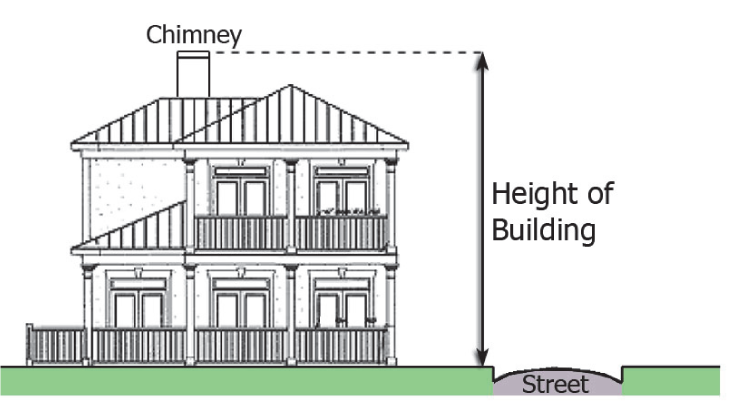
Building, height of. The vertical distance from the lowest point of the building, structure, or wall exposed above the ground surface to the highest point of the roof, parapet wall, or uppermost part. Chimneys, vents, or utility service structures shall not be included in the measurement of vertical dimensions.
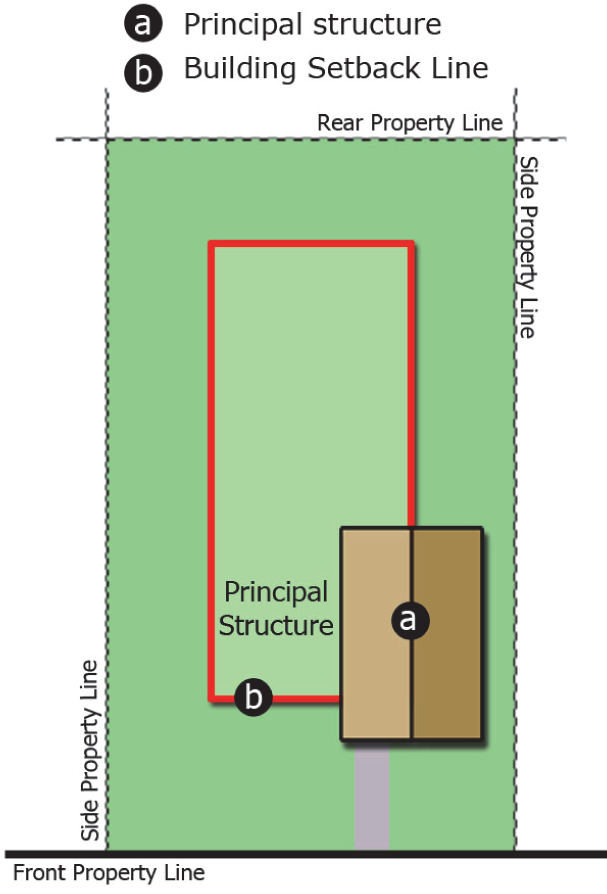
Building, principal. The primary building on a lot or a building that houses a principal use.
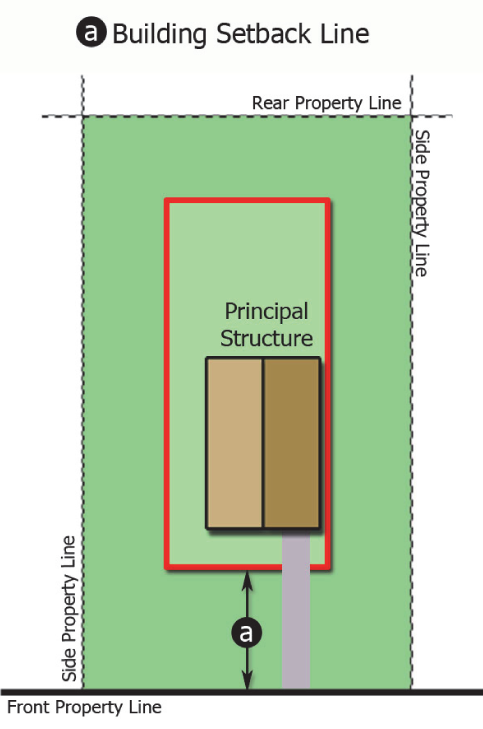
Building setback line. A line measured parallel to the front property line in front of which no structure shall be erected.
C
Carrier on wheels or cell on wheels (COW). A portable self-contained wireless facility that can be moved to a location and set up to provide wireless services on a temporary or emergency basis. A COW is normally vehicle-mounted and contains a telescoping boom as the antenna support structure.
Certificate of occupancy. Official certification that a premises conforms to provisions of the zoning code and building code and may be used or occupied. Such a certificate is granted for new construction or for alterations or additions to existing structures or a change in use. Unless such a certificate is issued, a structure cannot be occupied.
Certify. Whenever this ordinance requires that some agency certify the existence of some fact or circumstance to the city, the city may require that such certification be made in any manner that provides reasonable assurance of the accuracy of the certification. By way of illustration, and without limiting the foregoing, the city may accept certification by telephone from some agency when the circumstances warrant it, or the city may require that the certification be in the form of a letter or other written document or form.
Child care. A program or arrangement where three (3) or more children less than thirteen (13) years old, who do not reside where the care is provided, receive care on a regular basis of at least once per week for more than four (4) hours but less than twenty-four (24) hours per day from persons other than their guardians or full-time custodians, or from persons not related to them by birth, marriage, or adoption.
Child care facility. Includes child care centers, family child care homes, and any other child care arrangement not excluded by N.C.G.S. 110-86(2) that provides child care, regardless of the time of day, wherever operated, and whether or not operated for profit.
(1)
Child care center. An arrangement where, at any one time, there are three (3) or more preschool-age children or nine (9) or more school-age children receiving child care.
(2)
Family child care home. A child care arrangement located in a residence where, at any one (1) time, more than two (2) children, but less than nine (9) children, receive child care.
Chemical storage facility. A building, portion of a building, or exterior area adjacent to a building used for the storage of any chemical or chemically reactive products.
Circulation area. That portion of the vehicle accommodation area used for access to parking or loading areas or other facilities on the lot. Essentially, driveways and other maneuvering areas (other than parking aisles) comprise the circulation area.
City. The City of Kinston.
Coffee house. An informal restaurant primarily offering coffee, tea, and other beverages, and where light refreshments and limited menu meals may also be sold.
Collocation. The placement or installation of wireless facilities on existing structures, including electrical transmission towers, water towers, buildings and other structures capable of structurally supporting the attachment of wireless facilities in compliance with applicable codes.
Commercial greenhouses and nurseries. Establishments primarily engaged in the production of ornamental plants and other nursery products such as bulbs, flowers, shrubbery, flower and vegetable seeds and plants, agricultural plants and sod. Such products may be grown under cover or outdoors.
Community garden. A private or public facility for cultivation of fruits, flowers, vegetables, or ornamental plants by more than one (1) person or family, but not for commercial sale.
Concealed wireless facility. Any wireless facility that is integrated as an architectural feature of an existing structure or any new wireless support structure designed to camouflage or conceal the presence of antennas or towers so that the purpose of the facility or wireless support structure is not readily apparent to a casual observer.
Conditional use permit. A permit issued by the city council that authorizes the recipient to make use of property in accordance with the requirements of this ordinance as well as any additional requirements imposed by the council.
Convenience store. A one-story, retail store containing less than two thousand (2,000) square feet of gross floor area that is designed and stocked to sell primarily food, beverages, and other household supplies to customers who purchase only a relatively few items (in contrast to a "supermarket"). It is designed to attract and depends upon a large volume of "stop and go" traffic. Illustrative examples of convenience stores are those operated by the "Fast Fare," "7-11" and "Pantry" chains.
Council. The City Council of the City of Kinston.
D
Developer. A person who is responsible for any undertaking that requires a zoning permit, special use permit, conditional use permit, or sign permit.
Development. Any manmade change to improved or unimproved real estate, including, but not limited to, buildings or other structures, mining, dredging, filling, grading, paving, excavation or drilling operations, or storage of equipment or materials.
Development activity. Above activity which will necessitate a floodplain development permit.
Dimensional nonconformity. A nonconforming situation that occurs when the height, size, or minimum floor space of a structure or the relationship between an existing building or buildings and other buildings or lot lines does not conform to the regulations applicable to the district in which the property is located.
Disposal. As defined in N.C.G.S. 130A-290(a)(6), the discharge, deposit, injection, dumping, spilling, leaking, or placing of any solid waste into or on any land or water so that the solid waste or any constituent part of the solid waste may enter the environment or be emitted into the air or discharged into any waters, including groundwaters.
Distillery. A distillery as permitted by N.C.G.S. is an enterprise which engages in one or more of the following:
(1)
Manufacture, purchase, import, possess and transport ingredients and equipment used in the distillation of spirituous liquor;
(2)
Sell, deliver and ship spirituous liquor in closed containers at wholesale to exporters and local boards within the state, and, subject to the laws of other jurisdictions, at wholesale or retail to private or public agencies or establishments of other states or nations;
(3)
Transport into or out of the distillery the maximum amount of liquor allowed under federal law, if the transportation is related to the distilling process.
Drawings, construction. Drawings utilized during construction prepared by an architect, landscape architect, engineer, or surveyor licensed to practice in North Carolina.
Drawings, as-built. Engineering plans prepared after the completion of construction, by the engineer by an architect, landscape architect, engineer, or surveyor licensed to practice in North Carolina, in such a manner as to accurately identify and depict the location of all on-site improvements, which includes but is not limited to all structures, parking facilities, detention/retention areas, curbs, gutters, and sidewalks.
Driveway. That portion of the vehicle accommodation area that consists of a travel lane bounded on either side by an area that is not part of the vehicle accommodation area.
Dwelling, multi-family. A residential use consisting of a building containing three (3) or more dwelling units. For purposes of this definition, a building includes all dwelling units that are enclosed within that building or attached to it by a common floor or wall (including without limitation the wall of an attached garage or porch).
Dwelling, primary with accessory apartment. A residential use having the external appearance of a single-family residence but in which there is located a second dwelling unit that comprises not more than twenty-five (25) percent of the gross floor area of the building nor more than a total of seven hundred fifty (750) square feet.
Dwelling, single-family. A residential use consisting of a single detached building containing one (1) dwelling unit located on a lot containing no other dwelling units.
Dwelling, two-family (duplex). A two-family residential use in which the dwelling units share a common wall (including, without limitation, the wall of an attached garage or porch) and in which each dwelling unit has living space on the ground floor and a separate, ground floor entrance.
Dwelling unit. An enclosure containing sleeping, kitchen, and bathroom facilities designed for and used or held ready for use as a permanent residence by one (1) family.
E
Easement. A grant by the property owner of a strip of land for a specified purpose and use by the public, a corporation, or persons.
Effective date of this ordinance. Whenever this ordinance refers to the effective date of this ordinance, the reference shall be deemed to include the effective date of any amendments to this ordinance if the amendment, rather than this ordinance as originally adopted, creates a nonconforming situation.
Electric vehicle. Any vehicle that operates, either partially or exclusively, on electrical energy from the grid, or an off-board source, that is stored on-board for energy purpose. Electric vehicle includes:
(1)
A battery powered electric vehicle; and
(2)
A plug-in hybrid electric vehicle.
Electric vehicle charging station. A public or private parking space located together with a battery charging station which permits the transfer of electric energy (by conductive or inductive means) to a battery or other storage device in an electric vehicle. An electric vehicle charging station is permitted as an accessory use to any principal use.
Electric vehicle parking space. Any marked parking space that identifies the use to be exclusively for an electric vehicle.
Electrical transmission tower. An electrical transmission structure used to support high voltage overhead power lines. The term shall not include any utility pole.
Elevated building. A non-basement building which has its lowest elevated floor raised above ground level by foundation walls, shear walls, posts, piers, pilings, or columns.
Eligible facilities request. A request for modification of an existing wireless tower or base station that involves collocation of new transmission equipment or replacement of transmission equipment but does not include a substantial modification.
Encroachment. The advance or infringement of uses, fill, excavation, buildings, structures or development into a floodplain, which may impede or alter the flow capacity of a floodplain.
Energy generating facility. A facility that uses a variety of sources and/or products for the production of power. Energy facilities may include, but are not limited to: petroleum; methane; ethanol; thermal; wind; solar; hydro-electric; and other energy generation facilities.
Equipment compound. An area surrounding or near the base of a wireless support structure within which a wireless facility is located.
Evidentiary hearing. The formal hearing required to gather evidence prior to making a quasi-judicial zoning decision. All of the essential elements of a fair trial shall be observed, such as having witnesses under oath and subject to cross-examination, no gathering of evidence outside the hearing, written findings of fact, and substantial, competent, and material evidence in the record to support the findings.
Existing manufactured home park or manufactured home subdivision. A manufactured home park or subdivision for which the construction of facilities for servicing the lots on which the manufactured homes are to be affixed (including, at a minimum, the installation of utilities, the construction of streets, and either final site grading or the pouring of concrete pads) was completed before the initial effective date of the floodplain management regulations adopted by the community.
Existing structure. A wireless support structure, erected prior to the application for collocation or substantial modification under this ordinance, that is capable of supporting the attachment of wireless facilities, including, but not limited to, electrical transmission towers, buildings, and water towers. The term shall not include any utility pole.
Expenditure. A sum of money paid out in return for some benefit or to fulfill some obligation. The term also includes binding contractual commitments to make future expenditures, as well as any other substantial changes in financial position.
Extraterritorial planning area. That portion of the city's planning jurisdiction that lies outside the corporate limits of the city.
F
Fall zone. The area in which a wireless support structure may be expected to fall in the event of a structural failure, as measured by engineering standards.
Family. One (1) or more persons living together as a single housekeeping unit.
Family care home. An adult care home having two (2) to six (6) residents. The structure of a family care home may be no more than two (2) stories high, and none of the aged or physically disabled persons being served there may be housed in the upper story without provision for two (2) direct exterior ground-level accesses to the upper story.
Family foster home. The private residence of one (1) or more individuals who permanently reside as members of the household and who provide continuing full-time foster care for a child or children who are placed there by a child placing agency or who provide continuing full-time foster care for two (2) or more children who are unrelated to the adult members of the household by blood, marriage, guardianship, or adoption.
Farm, craft, produce market. An occasional or periodic market held in an open area or in a structure where groups of individual sellers offer for sale to the public such items as fresh produce, seasonal fruits, fresh flowers, arts and crafts items, and food and beverages (but not to include second-hand goods) dispensed from booths located on-site.
Farm stand. A temporary open air stand or place for the seasonal selling of agricultural produce. A produce stand is portable and capable of being dismantled or removed from the sales site.
Flood or flooding. A general and temporary condition of partial or complete inundation of normally dry land areas from:
(1)
The overflow of inland or tidal waters; and/or
(2)
The unusual and rapid accumulation of runoff of surface waters from any source.
Flood boundary and floodway map (FBFM). An official map of a community, issued by the Federal Emergency Management Agency, on which the special flood hazard areas and the floodways are delineated. This official map is a supplement to and shall be used in conjunction with the flood insurance rate map (FIRM).
Flood hazard boundary map (FHBM). An official map of a community, issued by the Federal Emergency Management Agency, where the boundaries of the special flood hazard areas have been defined as Zone A.
Flood insurance. The insurance coverage provided under the National Flood Insurance Program.
Flood insurance rate map (FIRM). An official map of a community, issued by the Federal Emergency Management Agency, on which both the special flood hazard areas and the risk premium zones applicable to the community are delineated.
Flood insurance study (FIS). An examination, evaluation, and determination of flood hazards, corresponding water surface elevations (if appropriate), flood hazard risk zones, and other flood data in a community issued by the Federal Emergency Management Agency. The flood insurance study report includes flood insurance rate maps (FIRMs) and flood boundary and floodway maps (FBFMs), if published.
Flood prone area. See Floodplain.
Flood zone. A geographical area shown on a flood hazard boundary map or flood insurance rate map that reflects the severity or type of flooding in the area.
Floodplain. Any land area susceptible to being inundated by water from any source.
Floodplain administrator. The individual appointed to administer and enforce the floodplain management regulations.
Floodplain development permit. Any type of permit that is required in conformance with the provisions of the flood damage prevention regulations, prior to the commencement of any development activity.
Floodplain management. The operation of an overall program of corrective and preventive measures for reducing flood damage and preserving and enhancing, where possible, natural resources in the floodplain, including, but not limited to, emergency preparedness plans, flood control works, floodplain management regulations, and open space plans.
Floodplain management regulations. Article 9, part IX of this ordinance and other zoning ordinances, subdivision regulations, building codes, health regulations, special purpose ordinances, and other applications of police power. This term describes federal, state or local regulations, in any combination thereof, which provide standards for preventing and reducing flood loss and damage.
Floodproofing. Any combination of structural and nonstructural additions, changes, or adjustments to structures which reduce or eliminate flood damage to real estate or improved real property, water and sanitation facilities, structures, and their contents.
Floodway. The channel of a river or other watercourse and the adjacent land areas that must be reserved in order to discharge the base flood without cumulatively increasing the water surface elevation more than one (1) foot.
Floodway encroachment analysis. An engineering analysis of the impact that a proposed encroachment into a floodway or non-encroachment area is expected to have on the floodway or non-encroachment boundaries and base flood elevations; the evaluation shall be prepared by a qualified North Carolina licensed engineer using standard engineering methods and models.
Floor. The top surface of an enclosed area in a building (including basement); i.e., top of slab in concrete slab construction or top of wood flooring in a frame construction. The term does not include the floor of a garage used solely for parking vehicles.
Freeboard. The height added to the base flood elevation (BFE) to account for the many unknown factors that could contribute to flood heights greater that the height calculated for a selected size flood and floodway conditions, such as wave action, blockage of bridge openings, and the hydrological effect of urbanization of the watershed. The base flood elevation (BFE) plus the freeboard establishes the regulatory flood protection elevation.
Functionally dependent facility. A facility which cannot be used for its intended purpose unless it is located in close proximity to water, limited to a docking or port facility necessary for the loading and unloading of cargo or passengers, shipbuilding, or ship repair. The term does not include long-term storage, manufacture, sales, or service facilities.
G
Gameroom. A use providing video games or other games for playing for amusement and recreation. Any table games such as air hockey, football, pinball, or the like shall be included under this definition. More than three (3) such games shall constitute a primary use and shall be allowed only in those zoning districts permitting gamerooms as a listed permitted use or by a conditional use permit. Three (3) or fewer such games shall constitute an accessory use and may be permitted in any licensed retail business.
Gross floor area. The total area of a building measured by taking the outside dimensions of the building at each floor level intended for occupancy or storage.
H
Halfway house. A home for not more than nine (9) persons who have demonstrated a tendency toward alcoholism, drug abuse, mental illness (as defined in N.C.G.S. 35-17(30)), or antisocial or criminal conduct, together with persons providing supervision and other services to such persons, all of whom live together as a single housekeeping unit.
Hazardous waste management facility. As defined in N.C.G.S. 130A, Article 9, a facility for the collection, storage, processing, treatment, recycling, recovery, or disposal of hazardous waste.
Highest adjacent grade (HAG). The highest natural elevation of the ground surface, prior to construction, immediately next to the proposed walls of the structure.
Historic structure. Any structure that is:
(1)
Listed individually in the National Register of Historic Places (a listing maintained by the U.S. Department of Interior) or preliminarily determined by the Secretary of Interior as meeting the requirements for individual listing on the National Register;
(2)
Certified or preliminarily determined by the Secretary of Interior as contributing to the historical significance of a registered historic district or a district preliminarily determined by the Secretary to qualify as a registered historic district;
(3)
Individually listed on a local inventory of historic landmarks in communities with a certified local government (CLG) program; or
(4)
Certified as contributing to the historical significance of a historic district designated by a community with a certified local government (CLG) program.
Certified local government (CLG) programs are approved by the U.S. Department of the Interior in cooperation with the North Carolina Department of Cultural Resources through the State Historic Preservation Officer as having met the requirements of the National Historic Preservation Act of 1966 as amended in 1980.
Homeless shelter. A facility owned or operated by an agency for persons who are in need of temporary housing due to various unusual circumstances.
Home occupation. A commercial activity that: (i) is conducted by a person within the primary residence on the same lot (in a residential district) where such person resides and (ii) is not so insubstantial or incidental or is not so commonly associated with the residential use as to be regarded as an accessory use, but that can be conducted without any significantly adverse impact on the surrounding neighborhood. Home occupations may include the growing of fruits, vegetables, and flowers for on-premises sales.
Without limiting the generality of the foregoing, a use may be regarded as having a significantly adverse impact on the surrounding neighborhood if: (i) goods, stock in trade, or other commodities are displayed; (ii) any on-premises retail sales occur; (iii) any person not a resident on the premises is employed in connection with the purported home occupation; (iv) it creates objectionable noise, fumes, odor, dust or electrical interference; (v) more than twenty-five (25) percent of the total gross floor area of the principal residence or more than five hundred (500) square feet of gross floor area (whichever is less) is used for home occupation purposes; or (vi) materials and/or equipment are stored outside.
I
Inoperable vehicle. Any vehicle, designed to be self-propelled, which by virtue of broken or missing component parts, is no longer capable of self-propulsion. For the purpose of this ordinance, any vehicle which is registered with the North Carolina Department of Motor Vehicles and has a current North Carolina motor vehicle registration license affixed to it shall not be considered inoperable.
Internet sweepstakes operations. A business enterprise, consisting of more than four (4) machines, where persons utilize electronic machines, including but not limited to computers and gaming terminals, to conduct games of chance including sweepstakes, and where cash, merchandise, or other items of value are redeemed or otherwise distributed, whether or not the value of such distribution is determined by electronic games or predetermined odds. This term includes, but is not limited to internet cafes, electronic gaming operations, business centers, beach sweepstakes, or cybercafes. This term does not include any lottery approved by the State of North Carolina.
J
Junkyard. An establishment or place of business which is maintained, operated or used for storing, keeping, buying or selling junk or for maintenance or operation of a used car junkyard and shall include sanitary landfills. The open storage of one (1) or more wrecked or inoperable vehicles or parts of one (1) or more vehicles for ten (10) days or more shall be deemed a junkyard. An unlicensed vehicle stored for ten (10) days or more shall be deemed an inoperable vehicle.
K
Kennel. A commercial operation that: (i) provides food and shelter and care of animals for purposes not primarily related to medical care (a kennel may or may not be run by or associated with a veterinarian), (ii) engages in the breeding of animals for sale, or (iii) engages in the training or breeding of animals.
L
Loading and unloading area. That portion of the vehicle accommodation area used to satisfy the requirements of article 9, part III.
Lot. A parcel of land whose boundaries have been established by some legal instrument such as a recorded deed or a recorded map and which is recognized as a separate legal entity for purposes of transfer of title.
If a public body or any authority with the power of eminent domain condemns, purchases, or otherwise obtains fee simple title to or a lesser interest in a strip of land cutting across a parcel of land otherwise characterized as a lot by this definition, or a private road is created across a parcel of land otherwise characterized as a lot by this definition, and the interest thus obtained or the road so created is such to effectively prevent the use of this parcel as one (1) lot, then the land on either side of this strip shall constitute a separate lot.
Subject to section 8.4, the permit-issuing authority and the owner of two (2) or more contiguous lots may agree to regard the lots as one (1) lot if necessary or convenient to comply with any of the requirements of this ordinance.
Lot area. The total area circumscribed by the boundaries of a lot, except that: (i) when the legal instrument creating a lot shows the boundary of the lot extending into a public street right-of-way, then the lot boundary for purposes of computing the lot area shall be the street right-of-way line, or if the right-of-way line cannot be determined, a line running parallel to and thirty (30) feet from the center of the traveled portion of the street, and (ii) in a residential district, when a private road that serves more than three (3) dwelling units is located along any lot boundary, then the lot boundary for purposes of computing the lot area shall be the inside boundary of the traveled portion of that road.
Lowest adjacent grade (LAG). The elevation of the ground, sidewalk, or patio slab immediately next to the building, or deck support, after completion of the building.
Lowest floor. The lowest floor of the lowest enclosed area (including basement). An unfinished or flood resistant enclosure, usable solely for parking of vehicles, building access, or limited storage in an area other than a basement area is not considered a building's lowest floor, provided that such an enclosure is not built so as to render the structure in violation of the applicable non-elevation design requirements of this ordinance.
M
Manufactured home. A structure, transportable in one or more sections, which is built on a permanent chassis and designed to be used with or without a permanent foundation when connected to the required utilities. The term manufactured home does not include a recreational vehicle.
Manufactured home, Class A. A dwelling unit constructed with one (1) or more components which are prefabricated and hauled to the site that are capable of producing a dwelling which is indistinguishable from conventionally built homes and which meets the construction requirements of the North Carolina Uniform Residential Building Code, as amended.
Manufactured home, Class B. A dwelling unit that:
(1)
Is not constructed in accordance with the requirements of the North Carolina Uniform Residential Building Code, as amended; and
(2)
Is composed of two (2) or more components, each of which was substantially assembled in a manufacturing plant and designed to be transported to the home site; and
(3)
Meets or exceeds the construction standards of the U.S. Department of Housing and Urban Development; and
(4)
Conforms to the following appearance criteria:
• The manufactured home has a minimum width, as assembled on the site, of twenty (20) feet;
• The pitch of the manufactured home's roof has a minimum vertical rise of three (3) inches for each twelve (12) inches of horizontal run and the roof is finished with asphalt or fiberglass shingles;
• The exterior siding of the manufactured home is of a color, material, and scale comparable with those in the immediate vicinity, and in no case does the degree of reflectivity of the exterior finish exceed that of gloss white paint;
• A continuous, permanent masonry or corrosive-resistant, nonreflective curtain wall, unpierced except for required ventilation and access installed under the manufactured home; and
• The tongue, axles, transporting lights, and removable towing apparatus are removed after placement on the lot and before occupancy.
Manufactured home, Class C. Any manufactured home that does not meet the definitional criteria of a Class A or Class B manufactured home but which, at a minimum, exceeds forty (40) feet in length and eight (8) feet in width.
Manufactured home park. Land used or intended to be used, leased, or rented for occupancy by six (6) or more Class B or Class C manufactured homes, anchored in place by a foundation or other stationary support, to be used for living purposes and accompanied by automobile parking spaces and incidental utility structures and facilities required and provided in connection therewith. This definition shall not include trailer sales lots on which unoccupied trailers are parked for purposes of inspection and sale. Specific requirements for manufactured home parks are outlined in section 7.19.
Manufactured home subdivision. A parcel (or contiguous parcels) of land divided into two (2) or more manufactured home lots for rent or sale.
Manufactured structure, commercial. A prefabricated building constructed and designed for transportation on its own chassis or by truck after fabrication and intended for other than residential use. These structures shall be constructed to meet the standards of the North Carolina Building Code. A converted manufactured home does not meet these criteria. A commercial manufactured structure meeting these standards shall be allowed for permanent placement for commercial and industrial uses.
Market value. The building value, not including the land value and that of any accessory structures or other improvements on the lot. Market value may be established by independent certified appraisal; replacement cost depreciated for age of building and quality of construction (actual cash value); or adjusted tax assessed values.
Massage. Any manipulation of body muscle or tissue by rubbing, stroking, kneading or tapping, by hand or mechanical device.
Massage business. Any establishment or business wherein massage is practiced, including establishments commonly known as health clubs, physical culture studios, massage studios or massage parlors. No provision of this section, however, shall apply to any bona fide therapeutic massage service provided by a licensed or registered medical professional or other person certified by a state or nationally recognized organization; nor shall this section apply to any private or public fitness center or nonprofit community recreational fitness and service organization, either of which provides massage therapy as a service incidental to the operation of a fitness center.
Mean sea level. For purposes of this ordinance, the National Geodetic Vertical Datum (NGVD) as corrected in 1929, the North American Vertical Datum (NAVD) as corrected in 1988, or other vertical control datum used as a reference for establishing varying elevations within the floodplain, to which base flood elevations (BFEs) shown on a FIRM are referenced. Refer to each FIRM panel to determine datum used.
Microbrewery. A facility for the production and packaging of malt beverages of low alcoholic content for distribution, retail, or wholesale, on or off premise.
Monopole. A single, freestanding pole-type structure supporting one (1) or more antennas. For the purposes of this ordinance, a monopole is not a tower or a utility pole.
Multi-unit assisted housing with services. An assisted living residence in which hands-on personal care services and nursing services which are arranged by housing management are provided by a licensed home care or hospice agency through an individualized written care plan. The housing management has a financial interest or financial affiliation or formal written agreement which makes personal care services accessible and available through at least one (1) licensed home care or hospice agency. The resident has a choice of any provider, and the housing management may not combine charges for housing and personal care services. All residents, or other compensatory agents, must be capable, through informed consent, of entering into a contract and must not be in need of twenty-four-hour supervision. Assistance with self-administration of medications may be provided by appropriately trained staff when delegated by a licensed nurse according to the home care agency's established plan of care.
N
New construction. Structures for which the start of construction commenced on or after the effective date of the initial floodplain management regulations and includes any subsequent improvements to such structures.
Noncompatible use. A use or service which is unsuitable for direct association and/or contiguity with certain other uses because it is contradictory, incongruous, or discordant.
Nonconforming lot. A lot existing at the effective date of this ordinance (and not created for the purposes of evading the restrictions of this ordinance) that does not meet the minimum area or dimensional requirement of the district in which the lot is located.
Nonconforming project. Any structure, development, or undertaking that is incomplete on the effective date of this ordinance and would be inconsistent with any regulation applicable to the district in which it is located if completed as proposed or planned.
Nonconforming situation. A situation that occurs when, on the effective date of this ordinance, any existing lot or structure or use of an existing lot or structure does not conform to one (1) or more of the regulations applicable to the district in which the lot or structure is located. Among other possibilities, a nonconforming situation may arise because a lot does not meet minimum acreage requirements, because structures exceed maximum height limitations, because the relationship between existing buildings and the land (in such matters as density and setback requirements) is not in conformity with this ordinance, because signs do not meet the requirements of this ordinance (article 9, part IV), or because land or buildings are used for purposes made unlawful by this ordinance.
Nonconforming use. A situation occurring when property is used for a purpose or in a manner made unlawful by the use regulations applicable to the district in which the property is located. (For example, a commercial office building in a residential district may be a nonconforming use.) The term also refers to the activity that constitutes the use made of the property. (For example, all the activity associated with operating a bakery in a residentially zoned area constitutes a nonconforming use.)
Non-encroachment area. The channel of a river or other watercourse and the adjacent land areas that must be reserved in order to discharge the base flood without cumulatively increasing the water surface elevation more than one (1) foot as designated in the flood insurance study report.
Nursing home. A facility, however named, which is advertised, announced, or maintained for the express or implied purpose of providing nursing or convalescent care for three or more persons unrelated to the licensee. A nursing home is a home for chronic or convalescent patients, who, on admission, are not as a rule, acutely ill and who do not usually require special facilities such as an operating room, X-ray facilities, laboratory facilities, and obstetrical facilities. A nursing home provides care for persons who have remedial ailments or other ailments, for which medical and nursing care are indicated; who, however, are not sick enough to require general hospital care. Nursing care is their primary need, but they will require continuing medical supervision.
O
Official maps or plans. Any maps or plans officially adopted by the city council.
Open space. An area (land and/or water) generally lacking in manmade structures and reserved for enjoyment in its unaltered state.
Ordinary maintenance. Ensuring that wireless facilities and wireless support structures are kept in good operating condition. Ordinary maintenance includes inspections, testing, and modifications that maintain functional capacity and structural integrity; for example, the strengthening of a wireless support structure's foundation or of the wireless support structure itself. Ordinary maintenance includes replacing antennas of a similar size, weight, shape, and color and accessory equipment within an existing equipment compound and relocating the antennas to different height levels on an existing monopole or tower upon which they are currently located. Ordinary maintenance does not include substantial modifications.
P
Parking area aisles. That portion of the vehicle accommodation area consisting of lanes providing access to parking spaces.
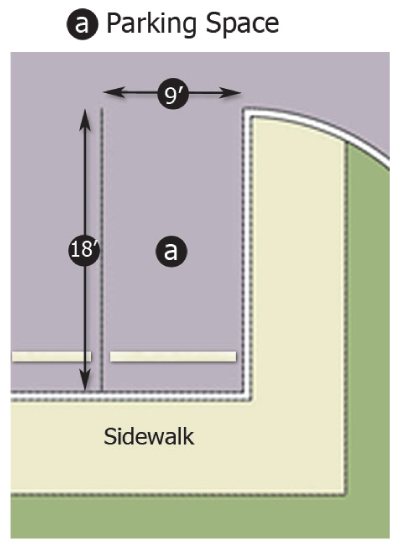
Parking space. A portion of the vehicle accommodation area set aside for the parking of one (1) vehicle.
Person. An individual, trustee, executor, other fiduciary, corporation, firm, partnership, association, organization, or other legal entity acting as a unit.
Photovoltaic power. An active solar energy system that converts solar energy directly into electricity.
Planned residential development. A development constructed on a tract of at least five (5) acres under single ownership, planned and developed as an integral unit, and consisting of single-family detached residences combined with either two-family residences or multi-family residences, or both, all developed in accordance with section 7.20.
Planned unit development. A development constructed on a tract of at least twenty-five (25) acres under single ownership, planned and developed as an integral unit, and consisting of a combination of residential and nonresidential uses on land within a PUD district in accordance with section 7.21.
Planning board. The public agency in a community usually empowered to prepare a comprehensive plan and to evaluate proposed changes in land use, either by public or private developers, for conformance with the plan.
Planning jurisdiction. The area within the city limits and the area beyond the city limits within which the city is authorized to plan for and regulate development, as set forth in section 1.3.
Post-FIRM. Construction or other development for which the start of construction occurred on or after the effective date of the initial flood insurance rate map.
Pre-FIRM. Construction or other development for which the start of construction occurred before the effective date of the initial flood insurance rate map.
Principally above ground. That at least fifty-one (51) percent of the actual cash value of the structure is above ground.
Public safety and/or nuisance. Anything which is injurious to the safety or health of an entire community or neighborhood, or any considerable number of persons, or unlawfully obstructs the free passage or use, in the customary manner, of any navigable lake, or river, bay, stream, canal, or basin.
Public water supply system. Any water supply system furnishing potable water to ten (10) or more dwelling units or businesses or any combination thereof.
Q
Quasi-judicial decisions. Those decisions that require the finding of facts and the application of standards that involve judgment and discretion. Examples include conditional use permits and variances.
R
Recreational vehicle (RV). A vehicle, which is:
(1)
Built on a single chassis;
(2)
Four hundred (400) square feet or less when measured at the largest horizontal projection;
(3)
Designed to be self-propelled or permanently towable by a light duty truck; and
(4)
Designed primarily not for use as a permanent dwelling, but as temporary living quarters for recreational, camping, travel, or seasonal use.
Reference level. The top of the lowest floor for structures within special flood hazard areas designated as Zone AE, A, A99 or AO.
Regulatory flood protection elevation. The base flood elevation plus the freeboard. In special flood hazard areas where base flood elevations (BFEs) have been determined, this elevation shall be the BFE plus two (2) feet of freeboard (residential construction only). In special flood hazard areas where no BFE has been established, this elevation shall be at least four (4) feet above the highest adjacent grade.
Remedy a violation. To bring the structure or other development into compliance with state and community floodplain management regulations, or, if this is not possible, to reduce the impacts of its noncompliance. Ways that impacts may be reduced include protecting the structure or other affected development from flood damages, implementing the enforcement provisions of the ordinance or otherwise deterring future similar violations, or reducing federal financial exposure with regard to the structure or other development.
Replacement pole. Pole of equal proportions and of equal height or such other height that would not constitute a substantial modification to an existing structure in order to support wireless facilities or to accommodate collocation. Requires removal of the wireless support structure it replaces.
Residential child-care facility. A staffed premise with paid or volunteer staff where children receive continuing full-time foster care.
Riverine. Relating to, formed by, or resembling a river (including tributaries), stream, brook, etc.
Road. All private ways used to provide motor vehicle access to (i) two (2) or more lots or (ii) two (2) or more distinct areas or buildings in unsubdivided developments.
Roominghouse. See Boardinghouse.
Rowhouse. More than two (2) dwelling units located on separate lots placed side by side but sharing some structural parts at a common property line.
S
Salvage yard. Any non-residential property used for the storage, collection, and/or recycling of any type of equipment, and including but not limited to vehicles, appliances and related machinery.
Satellite dish antenna or satellite earth station. An antenna and attendant processing equipment for reception of electronic signals from satellites.
Search ring. The area within which a wireless support facility or wireless facility must be located in order to meet service objectives of the wireless service provider using the wireless facility or wireless support structure.
Self-service storage facility. A building or group of buildings in a controlled access and/or fenced compound that contains varying sizes of individual, compartmentalized, and controlled access stalls or lockers for the dead storage of customers' goods or wares.
Setback. The required distance between every structure and the lot lines of the lot on which it is located.
Sexually oriented business. Any business activity, club or other establishment, within which the exhibition, showing, rental, trade or sale of materials distinguished or characterized by an emphasis on material depicting, describing or exhibiting specified anatomical areas or relating to specified sexual activities is permitted. Sexually oriented businesses shall include, but are not limited to: adult arcades, adult bookstores, adult motion picture theaters, adult theaters and massage parlors, as defined by this ordinance.
Shadow flicker. The visible flicker effect when rotating turbine blades cast shadows on the ground and nearby structures causing the repeating pattern of light and shadow.
Shopping center. A group of commercial establishments planned, developed, and managed as a unit with a unified design of buildings and with coordinated parking and service areas all located on a parcel of land containing a minimum of two (2) acres.
Sign. Any device that (i) is sufficiently visible to persons not located on the lot where such device is located to accomplish either of the objectives set forth in subdivision two of this definition; and (ii) is designed to attract the attention of such persons or to communicate information to them.
Sign, canopy or awning. Any sign that is a part of or attached to an awning, canopy, or other structural protective covering above a door, entrance, window, or walkway.
Sign, freestanding. A sign that is attached to, erected on, or supported by some structure (such as a pole, mast, frame, or other structure) that is not itself an integral part of or attached to a building or other structure having a principal function is something other than the support of a sign.
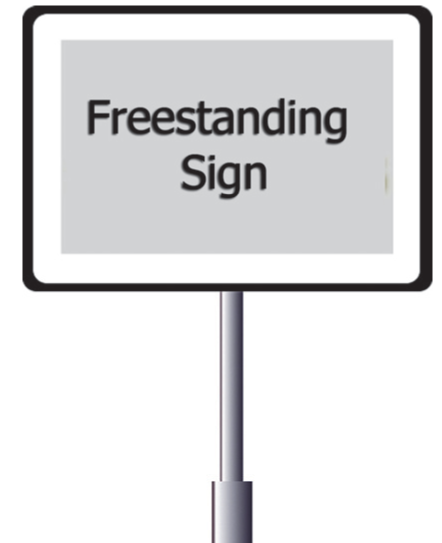
Sign, ground mounted. A sign suspended or supported by one (1) or more uprights or braces anchored in the ground with no more than thirty (30) inches clearance from the bottom of the sign to the ground below.
Sign, ID plaque. A sign giving only the nature, logo, trademark, or other identifying symbol, address, or any combination of the name, symbol, and address of a building, business, development, or establishment.
Sign, internally illuminated. A sign where the source of the illumination is inside the sign and light emanates through the message of the sign rather than being reflected off the surface of the sign from an external source. Without limiting the generality of the foregoing, signs that consist of or contain tubes that (i) are filled with neon or some other gas that glows when an electric current passes through it and (ii) are intended to form or constitute all or part of the message of the sign rather than merely providing illumination to other parts of the sign that contain the message shall also be considered internally illuminated signs.
Sign, monument. A freestanding sign supported primarily by an internal structural framework or integrated into landscaping or other solid structural features other than support poles.
Sign, nonconforming. A sign that, on the effective date of this ordinance, does not conform to one (1) or more of the regulations set forth in this ordinance, particularly article 9, part IV, Signs.
Sign, off-premises. A sign that draws attention to or communicates information about a business, service, commodity, accommodation, attraction, or other activity that is conducted, sold, or offered at a location other than the premises on which the sign is located (includes billboards).

Sign permit. A permit issued by the UDO administrator that authorizes the recipient to erect, move, enlarge, or substantially alter a sign.
Sign, portable. Any sign not permanently attached to the ground or other permanent structure, or a sign designed to be transported. Includes, but is not limited to, signs designed to be transported by means of wheels, runners, castors, trailers, or other mobile devices; signs converted to A-frames or T-frames; sandwich board signs; balloons used as signs; umbrellas used for advertising; and signs attached to or painted on vehicles parked and visible from the public right-of-way, unless said vehicle is regularly and customarily used in the normal day-to-day operations of the business.
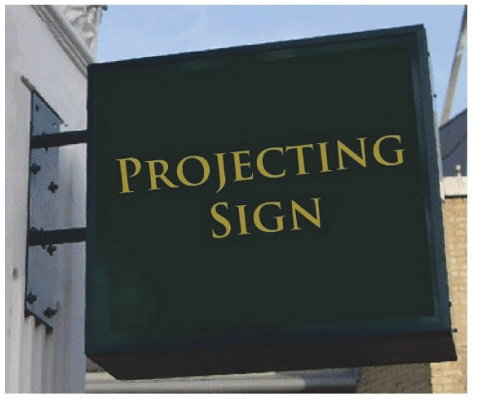
Sign, projecting. A sign which is attached to and projects more than twelve (12) inches from a building face or wall.
Sign, real estate. A temporary sign that relates to the sale, lease, or rental of property or buildings, or to construction activities on a site.
Sign, temporary. A sign that (i) is used in connection with a circumstance, situation, or event that is designed, intended or expected to take place or to be completed within a reasonably short or definite period after the erection of such sign, or (ii) is intended to remain on the location where it is erected or placed for a period of not more than fifteen (15) days. If a sign display area is permanent but the message displayed is subject to periodic changes, that sign shall not be regarded as temporary.
Sign, wall. Any sign attached to, painted on, or erected against any wall of a building or structure so that the exposed face of the sign is on a plane parallel to the plane of said wall and which does not extend more than twelve (12) inches from the wall. Wall sign also includes any sign erected against, installed on or painted on a penthouse above the roof of a building as long as the wall of the penthouse is on a plane parallel to the wall of the building. Wall sign also includes a sign attached to, painted on, or erected against a false wall or false roof that does not vary more than thirty (30) degrees from the plane of the adjoining wall elevation.

Sign, window. Any sign, picture, symbol, or combination thereof, designed to communicate information about an activity, business, commodity, sale, or service that is placed inside a window, or upon the window panes or glass, and is visible from the exterior of the window. For the purposes of this ordinance, a sign that rests against a window, a sign that is separated from the window by a bumper pad, or a sign that is placed within two inches of the window through the use of a hanging device, shall also be considered a window sign.
Site plan. A plan, to scale, showing uses and structures proposed for a parcel of land as required by the regulations involved. It includes lot lines, streets, building sites, reserved open space, buildings, major landscape features both natural and manmade and, depending on requirements, the location of proposed utility lines.
Site plan, major. All site plans not meeting the requirements for a minor site plan.
Site plan, minor. Includes the following:
• Buildings or additions with an aggregate enclosed square footage of less than twenty thousand (20,000) square feet;
• Buildings or additions involving land disturbance of less than one (1) acre;
• Multi-family development involving less than ten (10) dwelling units;
• Parking lot expansions which comply with this ordinance with no increase in enclosed floor area;
• Revision to landscaping, signage, or lighting which comply with the requirements of this ordinance;
• Accessory uses which comply with the requirements of this ordinance; and
• Site plans which do not require a variance or modification of the requirements of this ordinance, and otherwise comply with this ordinance.
Solar collector (accessory). Any solar device that absorbs and accumulates solar radiation for use as a source of energy. The device may be roof-mounted or ground-mounted as an accessory use.
Solar energy. Radiant energy received from the sun that can be collected in the form of heat or light by a solar collector.
Solar energy system. A device or structural design feature, a substantial purpose of which is to provide daylight for interior lighting or provide for the collection, storage and distribution of solar energy for space heating or cooling, electricity generating, or water heating. Solar energy systems may include, but not be limited to, solar farms and any of several devices that absorb and collect solar radiation for use as a source of energy as an accessory use.
Solar farm. An area of land designated use for the sole purpose of deploying photovoltaic power and generating electric energy.
Solid waste disposal facility. Any facility involved in the disposal of solid waste, as defined in N.C.G.S. 130A-290(a)(35).
Solid waste disposal site. As defined in N.C.G.S. 130A-290(a)(36), any place at which solid wastes are disposed of by incineration, sanitary landfill, or any other method.
Special events. Circuses, fairs, carnivals, festivals, or other types of special events that (i) run for longer than two (2) days but not longer than two (2) weeks, (ii) are intended to or likely to attract substantial crowds, and (iii) are unlike the customary or usual activities generally associated with the property where the special event is to be located.
Special flood hazard area (SFHA). The land in the floodplain subject to a one (1) percent or greater chance of being flooded in any given year, as determined in subsection 9.99.2 of this ordinance.
Specified anatomical areas. Less than completely and opaquely covered human genitals, pubic regions, buttocks and female breasts below a point immediately above the top of the areola.
Specified sexual activities.
(1)
Human genitals in a state of sexual stimulation or arousal;
(2)
Acts of human masturbation, sexual intercourse, sodomy; or
(3)
Fondling or other erotic touching of human genitals, pubic regions, buttocks or female breasts.
Start of construction. Includes substantial improvement, and means the date the building permit was issued, provided the actual start of construction, repair, reconstruction, rehabilitation, addition placement, or other improvement was within one hundred eighty (180) days of the permit date. The actual start means either the first placement of permanent construction of a structure on a site, such as the pouring of slab or footings, the installation of piles, the construction of columns, or any work beyond the stage of excavation; or the placement of a manufactured home on a foundation. Permanent construction does not include land preparation, such as clearing, grading, and filling; nor does it include the installation of streets and/or walkways; nor does it include excavation for a basement, footings, piers, or foundations or the erection of temporary forms; nor does it include the installation on the property of accessory buildings, such as garages or sheds not occupied as dwelling units or not part of the main structure. For a substantial improvement, the actual start of construction means the first alteration of any wall, ceiling, floor, or other structural part of the building, whether or not that alteration affects the external dimensions of the building.
Storage yards (including automobile salvage yards). An open space surrounded by a wall or fence of such characteristics as will provide an obscuring screen of not less than seven (7) feet in height. No goods, materials or vehicles shall be stored outside the enclosed storage area.
Street. A public street or a street with respect to which an offer of dedication has been made.
Street, arterial. A major street in the city's street system that serves as an avenue for the circulation of traffic onto, out, or around the city and carries high volumes of traffic.
Street, collector. A street whose principal function is to carry traffic between minor, local, and subcollector streets and arterial streets but that may also provide direct access to abutting properties. It serves or is designed to serve, directly or indirectly, more than one hundred (100) dwelling units and is designed to be used or is used to carry more than eight hundred (800) trips per day.
Street, cul-de-sac. A street that terminates in a vehicular turnaround.
Street, local. A street whose sole function is to provide access to abutting properties. It serves or is designed to serve at least ten (10) but not more than twenty-five (25) dwelling units and is expected to or does handle between seventy-five (75) and two hundred (200) trips per day.
Street, marginal access. A street that is parallel to and adjacent to an arterial street and that is designed to provide access to abutting properties so that these properties are somewhat sheltered from the effects of the through-traffic on the arterial street and so that the flow of traffic on the arterial street is not impeded by direct driveway access from a large number of abutting properties.
Street, minor. A street whose sole function is to provide access to abutting properties. It serves or is designed to serve not more than nine (9) dwelling units and is expected to or does handle up to seventy-five (75) trips per day.
Street, subcollector. A street whose principal function is to provide access to abutting properties but is also designed to be used or is used to connect minor and local streets with collector or arterial streets. Including residences indirectly served through connecting streets, it serves or is designed to serve at least twenty-six (26) but not more than one hundred (100) dwelling units and is expected to or does handle between two hundred (200) and eight hundred (800) trips per day.
Structure. A walled and roofed building, a manufactured home, or a gas, liquid, or liquefied gas storage tank that is principally above ground.
Subdivider. Any person, firm, or corporation who subdivides or develops any land deemed to be a subdivision as herein defined.
Subdivision. The division of a tract of land into two (2) or more lots, building sites, or other divisions for the purpose of sale or building development (whether immediate or future) and including all divisions of land involving the dedication of a new street or a change in existing streets; but the following shall not be included within this definition nor be subject to the regulations of this chapter applicable strictly to subdivisions: (i) the combination or recombination of portions of previously platted lots where the total number of lots is not increased and the resultant lots are equal to or exceed the minimum standards set forth in this chapter; (ii) the division of land into parcels greater than ten (10) acres where no street right-of-way dedication is involved; or (iii) the public acquisition by purchase of strips of land for widening or opening streets; or (iv) the division of a tract in single ownership whose entire area is no greater than two (2) acres into not more than three (3) lots, where no street right-of-way dedication is involved and where the resultant lots are equal to or exceed the minimum standards set forth in this ordinance.
Subdivision, major. Any subdivision other than a minor subdivision.
Subdivision, minor. A subdivision that does not involve any of the following: (i) the creation of more than a total of three (3) lots; (ii) the creation of any new public streets; (iii) the extension of a public water or sewer system; or (iv) the installation of drainage improvements through one (1) or more lots to serve one (1) or more other lots.
Substantial damage. Damage of any origin sustained by a structure during any one-year period whereby the cost of restoring the structure to its before damaged condition would equal or exceed fifty (50) percent of the market value of the structure before the damage occurred. See definition of substantial improvement. Substantial damage also means flood-related damage sustained by a structure on two (2) separate occasions during a ten-year period for which the cost of repairs at the time of each such flood event, on the average, equals or exceeds twenty-five (25) percent of the market value of the structure before the damage occurred.
Substantial improvement. Any combination of repairs, reconstruction, rehabilitation, addition, or other improvement of a structure, taking place during any one-year period for which the cost equals or exceeds fifty (50) percent of the market value of the structure before the start of construction of the improvement. This term includes structures which have incurred substantial damage, regardless of the actual repair work performed. The term does not, however, include either:
(1)
Any correction of existing violations of state or community health, sanitary, or safety code specifications which have been identified by the community code enforcement official and which are the minimum necessary to assure safe living conditions; or
(2)
Any alteration of a historic structure, provided that the alteration will not preclude the structure's continued designation as a historic structure and the alteration is approved by variance issued pursuant to subsection 4.4.2 of this ordinance.
Substantial modification. The mounting of a proposed wireless facility on a wireless support structure that substantially changes the physical dimensions of the support structure. A mounting is presumed to be a substantial modification if it meets any one or more of the criteria listed below. The burden is on the local government to demonstrate that a mounting that does not meet the listed criteria constitutes a substantial change to the physical dimensions of the wireless support structure.
(1)
Increasing the existing vertical height of the structure by the greater of (a) more than ten (10) percent, or (b) the height of one additional antenna array with separation from the nearest existing antenna not to exceed twenty (20) feet.
(2)
Except where necessary to shelter the antenna from inclement weather or to connect the antenna to the tower via cable, adding an appurtenance to the body of a wireless support structure that protrudes horizontally from the edge of the wireless support structure the greater of (a) more than twenty (20) feet, or (b) more than the width of the wireless support structure at the level of the appurtenance.
(3)
Increasing the square footage of the existing equipment compound by more than two thousand five hundred (2,500) square feet.
T
Temporary storage facility. Any container intended for storing or keeping household goods, other personal property or business related goods intended to be filled, refilled, or emptied while located outdoors and later removed from the property for storage or disposal off-site. Temporary storage facilities are sometimes also known as portable storage units or portable storage containers.
Temporary emergency, construction, or repair residences. A residence (which may be a manufactured home) that is: (i) located on the same lot as a residence made uninhabitable by fire, flood, or other natural disaster and occupied by the persons displaced by such disaster, or (ii) located on the same lot as a residence that is under construction or undergoing substantial repairs or reconstruction and occupied by the persons intending to live in such permanent residence when the work is completed; or (iii) located on a nonresidential construction site and occupied by persons having construction or security responsibilities over such construction site. (See section 7.22).
Therapeutic foster home. A family foster home where, in addition to the provision of foster care, foster parents who receive appropriate training provide a child with behavioral health treatment services under the supervision of a county department of social services, an area mental health program, or a licensed private agency.
Tower. A lattice-type structure, guyed or freestanding, that supports one (1) or more antennas.
Tract. A lot (see "Lot" definition). The term tract is used interchangeably with the term "lot," particularly in the context of subdivisions, where one "tract" is subdivided into several "lots."
Travel trailer. A structure that (i) is intended to be transported over the streets and highways (either as a motor vehicle or attached to or hauled by a motor vehicle) and (ii) is designed for temporary use as sleeping quarters but that does not satisfy one (1) or more of the definitional criteria of a mobile home.
Tree diameter at breast height (DBH). The diameter of a tree trunk in inches measured at four and one-half (4½) feet above the ground.
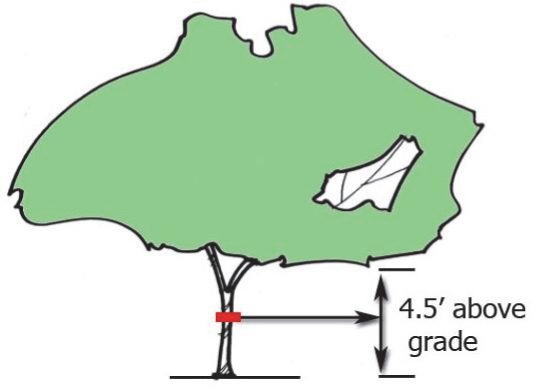
Tree, protected. An existing healthy tree which, when measured at four and one-half (4½) feet above the ground, has a minimum diameter of eight (8) inches.
Tree, specimen. A tree of at least thirty-six (36) inches measured at DBH.
U
UDO administrator. Except as otherwise specifically provided, primary responsibility for administering and enforcing this ordinance may be assigned to one (1) or more individuals by the city manager or planning director. The person or persons to whom these functions are assigned shall be referred to in this ordinance as the "UDO administrator" or "administrator." The term "staff" or "planning staff" is sometimes used interchangeably with the term "administrator."
Use. The activity or function that actually takes place or is intended to take place on a lot.
Use, principal. A use listed in the Table of Uses and Activities, section 6.5.
Utility facilities. Any aboveground structures or facilities (other than buildings, unless such buildings are used as storage incidental to the operation of such structures or facilities) owned by a governmental entity, a nonprofit organization, corporation, or any entity defined as a public utility for any purpose by N.C.G.S. 62-3 and used in connection with the production, generation, transmission, delivery, collection, or storage of water, sewage, electricity, gas, oil, or electronic signals.
Utility facilities, community or regional. All utility facilities other than neighborhood facilities.
Utility facilities, neighborhood. Utility facilities that are designed to serve the immediately surrounding neighborhood and that must, for reasons associated with the purpose of the utility in question, be located in or near the neighborhood where such facilities are proposed to be located.
Utility pole. A structure that is designed for and used to carry lines, cables, or wires for telephone, cable television, or electricity, or to provide lighting.
V
Variance. An authorization to do something contrary to the strict terms of the zoning regulations and intent of this ordinance, such as building a structure inside a required setback area. Variances are quasi-judicial decisions that require an evidentiary hearing. They may only be issued upon a finding of practical difficulty or unnecessary hardships as a result of strict compliance and that the variance would be consistent with the spirit, purpose, and intent of the ordinance. Variance petitions are usually assigned to the board of adjustment for hearing and decision.
Vehicle accommodation area. That portion of a lot that is used by vehicles for access, circulation, parking, and loading and unloading. It comprises the total of circulation areas, loading and unloading areas, and parking areas (spaces and aisles).
Violation. The failure of a structure or other development to be fully compliant with this ordinance.
W
Water surface elevation (WSE). The height, in relation to mean sea level, of floods of various magnitudes and frequencies in the floodplains of riverine areas.
Water tower. A water storage tank, a standpipe, or an elevated tank situated on a support structure, originally constructed for use as a reservoir or facility to store or deliver water.
Watercourse. A lake, river, creek, stream, wash, channel or other topographic feature on or over which waters flow at least periodically. Watercourse includes specifically designated areas in which substantial flood damage may occur.
Wholesale sales. On-premises sales of goods primarily to customers engaged in the business of reselling the goods.
Wind farm. An electricity-generating facility whose main purpose is to supply electricity to the electrical grid, consisting of one or more wind turbines and other accessory structures and buildings including substations, meteorological towers, electrical infrastructure, transmission lines, and other appurtenant structures and facilities, which has a rated capacity of greater than 100 kW.
Wind energy generator (accessory). A single system consisting of a single wind turbine, a tower, and associated control or conversion electronics designed to supplement other electricity sources as an accessory use to existing buildings or facilities, which has a rated capacity of not more than 100 kW.
Wind power. Power that is generated in the form of electricity by converting the rotation of wind turbine blades into electrical current by means of an electrical generator.
Wind turbine. A wind energy conversion system that converts wind energy into electricity through the use of a wind turbine generator, and may include a nacelle, rotor, tower, and pad transformer.
Wind turbine height. The distance measured from grade to the highest point of the turbine rotor or tip of the turbine blade when it reaches its highest elevation.
Wireless facility or wireless facilities. The set of equipment and network components, exclusive of the underlying wireless support structure or tower, including antennas, accessory equipment, transmitters, receivers, base stations, power supplies, cabling and associated equipment necessary to provide wireless data and wireless telecommunications services to a discrete geographic area.
Wireless support structure. A new or existing structure, such as a monopole, lattice tower, or guyed tower that is designed to support or capable of supporting wireless facilities. This definition does not include utility poles.
Wooded area. An area of contiguous wooded vegetation where trees are at a density of at least one (1) six-inch or greater caliper tree per three hundred twenty-five (325) square feet of land and where the branches and leaves form a contiguous canopy.
X
None
Y
Yard. An open space on the same lot with a building, unoccupied and unobstructed from the ground upward, except by trees or shrubbery or as otherwise provided herein.
Yard, front. a A yard across the full width of the lot, extending from the front line of the building to the front line of the lot, including the area of steps, eaves, and uncovered porches, but not including the areas of covered porches.
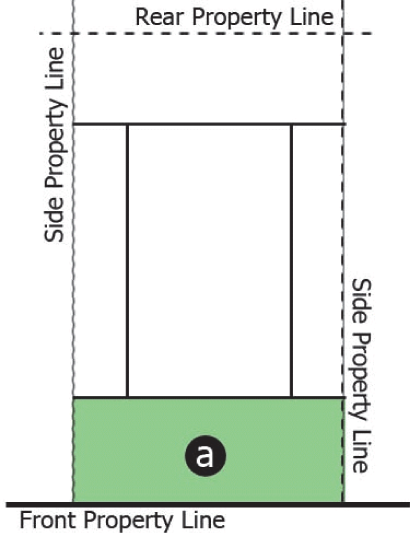
Yard, rear.;sub \ sub; A yard extending across the full width of the lot and measured between the rear line of the lot and the rear line of the main building.
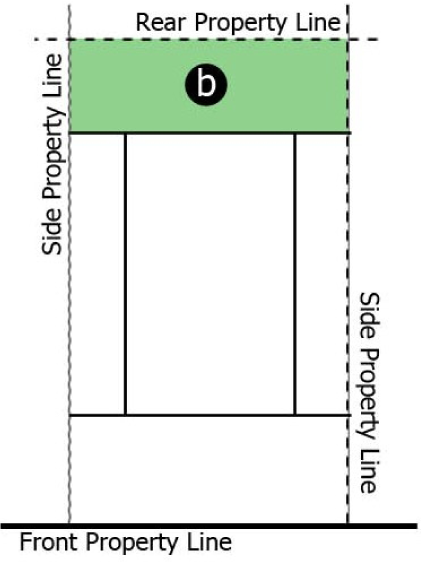
Yard, side. c An open unoccupied space on the same lot with a building between the building and the side line of the lot extending through from the front building line to the rear yard or, where no rear yard is required, to the rear line of the lot.
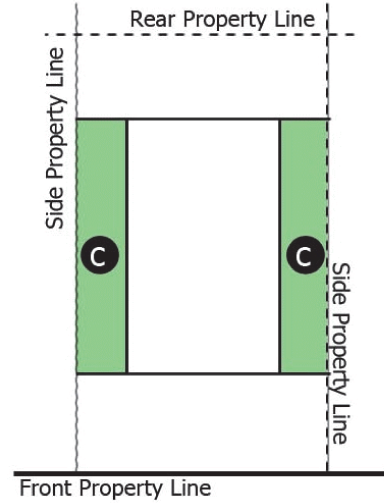
Z
Zoning. A police power measure, enacted primarily by general purpose units of local government, in which the community is divided into districts or zones within which permitted and conditional uses are established as are regulations governing lot size, building bulk, placement, and other development standards. Requirements vary from district to district. but they must be uniform within districts. The zoning code consists of two (2) parts: a text and a map.
Zoning permit. A permit issued by the UDO administrator that authorizes the recipient to make use of property in accordance with the requirements of this ordinance.

