
Kochville Township City Zoning Code
SUPPLEMENTARY USE
REGULATIONS
§ 155.020 GRANTING PERMITS.
The Zoning Administrator, or his or her designee, shall have the power to grant permits authorizing temporary permits for permanent business within the township for the uses listed in § 155.021.
(Ord. 06-14-Z, passed 10-3-2006; Ord. 06-14, passed 10-17-2006)
§ 155.021 TEMPORARY USE PERMITS.
A temporary use permit is required for limited term activities or events, which occur on commercial property within the township that may potentially create off-site impacts to surrounding properties in which it will occur. This includes outdoor sales, tent sales, and sidewalk sales, fireworks sales, seasonal sales for plants, produce, firewood or Christmas trees. Special events for gatherings of people, where under a tent or not or confined within any type of physical barrier, food or beverage is served, is also is considered a temporary use requiring a temporary use permit. Township Board approval is required where a special event has entertainment in addition to food or beverage and applications for such events shall be submitted 30 days in advance of the planned event. A temporary use permit is not required for religious institutions, residential uses, agricultural uses, or special events occurring at township parks, such as sporting events or other approved events sanctioned by the township.
(A) Zoning districts where permitted. Temporary use permits for outdoor sales, tent sales, sidewalk sales or seasonal sales of plants,, produce, firewood or Christmas trees, shall be permitted only in the B-l, B-2, and B-3 zoning districts.
(B) Application; fee; submission of site plan.
(1) Every person, firm or corporation desiring to obtain a temporary permit as required by this chapter shall file a written application with the Zoning Administrator on a form approved by the township, together with an application fee as hereafter provided by resolution of the Township Board.
(2) The application for a temporary use permit shall be accompanied by a site plan, drawn to scale, showing the following:
(a) The shape, location and dimensions of the lot, including the location of buildings on the lot, off-street parking layout, the location of any designated fire lanes and areas for the outdoor sales. An aerial photo may also be used in lieu of a drawn site plan where all details above are included.
(b) Materials to be utilized including structures to be erected, including tents, tables, stands, display racks, stages, barriers, traffic control measures; and
(c) Loss of off-street parking, anticipated number of people for special events.
(C) Time limitations.
(1) A temporary permit for a tent or sidewalk sale shall, by its terms, be effective for no longer than 14 days. No more than three temporary permits for tent sales or sidewalk sales shall be issued for a given location within a single calendar year. Temporary permits for tent sales or sidewalk sales shall not be issued for any given location for consecutive time periods.
(2) A temporary permit for the sale of Christmas trees shall by its terms be effective for no longer than 30 days. No more than one temporary permit for the sale of Christmas trees shall be issued for any given location within a single calendar year.
(3) A temporary permit for outdoor sales, including, but not limited to, the sale of plants, produce or for the sale of firewood, shall, by its terms, be effective for no longer than one six-month period. No more than two temporary permits for sale of plants, produce or for the sale of firewood shall be issued for any given location within a 12-month period. A temporary permit is effective beginning April 1 and ends on September 30. A temporary permit is also effective beginning October 1 and ends on March 31. A temporary permit can be renewed for another consecutive six-month period. Permits sought between April 1 and September 30 shall expire on September 30 of that same year and permits sought after October 1, but before March 31 shall expire on March 31 of that same year.
(D) Regulations.
(1) A temporary permit shall only be granted if the Zoning Administrator or his or her designee determines that the proposed use, including the erection of any temporary building or structure, will:
(a) Provide adequate light and ventilation in the areas of outdoor sales;
(b) Provide adequate automobile and pedestrian traffic flow without congestion;
(c) Provide adequate off-street parking which will not displace required off-street parking for the indoor sales;
(d) Provide adequate lot access for fire protection purposes;
(e) Not adversely affect the stability and integrity of the zoning plan prescribed by this chapter or otherwise interfere with the protection of public health, safety and general welfare;
(f) Not be incompatible with or otherwise adversely affect the physical character of the community and in particular the surrounding area within a distance of 1,000 feet; and
(g) Provides space for sidewalk or tent sales adjacent to the primary structure on the premises.
(2) When the proposed temporary use is to be conducted on an otherwise vacant or unused lot, the use shall comply with all applicable zoning regulations for the district in which the temporary special use is to be located, including all requirements pertaining to lot size, height, setback, open space ratio, maximum percentage of covered lot area and off-street parking.
(3) No temporary use shall be permitted if it reduces the parking by greater than 25%.
(4) All temporary buildings and structures shall be constructed, used, occupied and maintained so as to be in compliance with the provisions of the State Construction Code, the adopted International Fire Code, and all applicable ordinances of the township.
(Ord. 06-14-Z, passed 10-3-2006; Ord. 06-14, passed 10-17-2006; Ord. 17-05, passed 6-19-2017) Penalty, see § 155.999
§ 155.022 PRIOR BUILDING PERMITS.
Any building permit issued prior to the effective date of this chapter shall be valid, even though not conforming to the provisions of this chapter; provided that, construction is commenced within 90 days after the date of permit issuance and that the entire building shall be completed according to the plans filed with the permit application within one year after the issuance of the building permit.
(Ord. 06-14-Z, passed 10-3-2006; Ord. 06-14, passed 10-17-2006) Penalty, see § 155.999
§ 155.023 ACCESS TO A STREET.
Any lot of record, created after the effective date of this chapter, shall have frontage on a street, except as may be approved as a planned unit development in accordance with the provision of this chapter or the Plat Act of 1967, as amended.
(Ord. 06-14-Z, passed 10-3-2006; Ord. 06-14, passed 10-17-2006) Penalty, see § 155.999
§ 155.024 REAR DWELLING PROHIBITED.
No accessory building in the rear of and on the same lot with a principal building shall be used for residential purposes, except for watchpersons, caretakers and domestic employees whose employment functions are related to the function of the principal building; provided that, all other requirements of this chapter are satisfied.
(Ord. 06-14-Z, passed 10-3-2006; Ord. 06-14, passed 10-17-2006) Penalty, see § 155.999
§ 155.025 LOTS ALONG RAILROAD RIGHTS-OF-WAY OR PROPERTY.
Any lot created or recorded that is adjacent to or along a railroad right-of-way shall not be used for any residential purpose unless it has a depth of at least 250 feet. In no case, on a lot created, transferred or recorded after the adoption of this chapter shall any dwelling unit be closer than 125 feet from the railroad right-of-way.
(Ord. 06-14-Z, passed 10-3-2006; Ord. 06-14, passed 10-17-2006) Penalty, see § 155.999
§ 155.026 USE OF STRUCTURE FOR TEMPORARY DWELLING.
No structure shall be used for dwelling purposes that do not meet the minimum standards as defined in this chapter, and the requirements of the Building Code. No temporary structure whether of a fixed or portable construction shall be erected for any length of time unless authorized by the issuance by the Building Inspector of a temporary permit.
(Ord. 06-14-Z, passed 10-3-2006; Ord. 06-14, passed 10-17-2006) Penalty, see § 155.999
§ 155.027 MANUFACTURED HOME DWELLINGS.
No person or entity shall use, occupy or permit the use or occupation of a manufactured home as a dwelling within the township, not designated as a manufactured home park, unless:
(A) A permit for the placement of a manufactured home has been obtained from the township official authorized by the Township Board to issue the same;
(B) The placement of a manufactured home, and the premises upon which it shall be located shall meet all requirements of this chapter relative to uses, size of premises, floor area, set back, side lot and rear lot requirements specified for the particular zoning district in which the manufactured home is located. Further, a manufactured home occupied as a dwelling, shall have a minimum width across any front, side or rear elevation of 14 feet. Where a manufactured home dwelling is required by law to comply with any federal or state standards or regulations for construction and where the standards or regulations for construction are different than those imposed under the Township Building Code, then, and in that event, the federal or state standard or regulation shall apply;
(C) A manufactured home shall be firmly attached to a permanent foundation constructed on the site in accordance with the Township Building Code and shall have a wall of the same perimeter dimensions of the dwelling and constructed of the materials and type as required in the Township Building Code for other single-family dwellings. The manufactured home dwelling shall be installed pursuant to the manufacturer's set-up instructions and shall be secured to the premises by an anchoring system or device complying with the rules and regulations of the State Mobile Home Commission, and shall have a perimeter wall as required above. The manufactured home shall be so placed and situated that the wheels shall be removed and the underside or chassis of the manufactured home shall be completely enclosed and connected to the foundation so that the towing mechanism, undercarriage or chassis are not exposed to view;
(D) A manufactured home shall meet or exceed all requirements imposed by the United States Department of Housing and Urban Development mobile home construction and safety standards;
(E) A manufactured home shall contain no additions or rooms or other areas that are not constructed with similar quality workmanship as the original structure, including permanent attachment to the principal structure and construction of a foundation as required herein;
(F) A manufactured home shall be aesthetically compatible in design and appearance with other residences in the vicinity, with either a roof overhang of not less than six inches on all sides, or alternatively with window sills or roof drainage systems concentrating roof drainage at collection points along the sides of the dwelling; shall have not less than two exterior doors with the second one being in either the rear or side of the mobile home dwelling; shall have steps connected to the exterior door areas or to porches connected to the door areas where a difference in elevation requires the same; and
(G) The compatibility of design and appearance shall be determined in the first instance by the Township Zoning Administrator upon review of the plans submitted for a particular manufactured home, subject to appeal by an aggrieved party to the Zoning Board of Appeals. Any determination of compatibility shall be based upon the standards set forth herein, as well as the character, design and appearance of one or more residential dwellings located outside a manufactured home park within 2,000 feet of the subject manufactured home where the area is developed with dwellings to the extent of not less than 20% of the lots situated within the area; or, where the area is not developed, by the character, design and appearance of one or more residential dwellings located outside of mobile home parks throughout the township. This shall not be construed to prohibit innovative design concepts involving such matters as solar energy, view, unique land contour or relief from the common or standard designed home.
(Ord. 06-14-Z, passed 10-3-2006; Ord. 06-14, passed 10-17-2006) Penalty, see § 155.999
§ 155.028 ATTACHED HOUSING RESIDENTIAL DEVELOPMENT STANDARDS.
The following site development standards shall apply to attached housing developments, including two-family dwellings, townhome development, and multiple-family dwellings, in all zoning districts in which they are uses permitted by right or by special use permit:
(A) Building length.
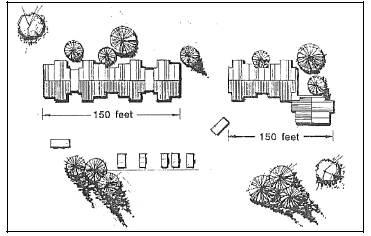
(1) Attached housing buildings shall not exceed 150 feet in overall length, measured along the front line of connecting units, inclusive of any architectural features which are attached to or connect the parts of the building together (see illustration), except that the Planning Commission may approve longer building lengths where the design incorporates attached garages that are off-set from the front facade of a structure and provide a unique style of architectural design.
(2) Horizontal facades longer than 36 feet shall be articulated into smaller units of the residential scale. At least two of the following methods shall be included (see illustration):
(a) Distinctive roof and wall forms or elements.
(b) Changes in materials or patterns.
(c) Windows (shape, pattern, trims and/or details).
(d) Color differentiation.
(e) Recesses, offsets, cantilevers.
(f) Arc hite ctur al feat ures (bay or bow win dow s, chimneys, lower roofs and awnings).
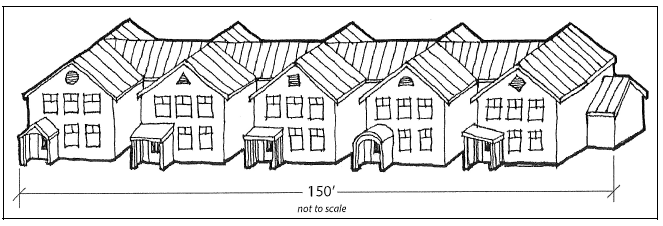
(3) Buildings shall include modulation along the building facades. Special attention shall be given to building faces viewed from the street. Flat blank walls are discouraged.
(B) Building spacing. The minimum distance between any two buildings shall be based on the following tables:
Relationship Between Buildings | Minimum Distance Between Buildings |
Front to Front | 70 ft. |
Front to Rear | 70 ft. |
Rear to Rear | 70 ft. |
Side to Side | 30 ft. |
Front to Side | 50 ft. |
Rear to Side | 50 ft. |
(C) Street address. The address of each dwelling unit must be clearly posted so that the unit can be readily identified from the roadway or adjacent parking area.
(D) Access and circulation. Multiple family developments shall comply with the following requirements for access and circulation (see illustration):
(1) Access to roads. Developments in the R-2, R-3, B-l and B-2 districts shall have direct access to a collector road or major thoroughfare; however, alternate means of access may be permitted by the Planning Commission upon finding that, due to special circumstances, substantial improvements in traffic safety could be achieved by reducing the number of driveways. Furthermore, an alternate means of access shall be permitted only if one or more of the following conditions exists:
(a) The property directly across the street from the development under consideration is zoned for multiple family or non-residential use;
(b) The property directly across the street is developed with permanent uses other than single family residences; or
(c) The proposed development is in an area which, based on study by the Planning Commission, will eventually be used for purposes other than single family use.
(2) Emergency access. All dwelling units, including those under construction, shall be readily accessible by fire and emergency vehicles from a paved public street, paved private access road, or other approved paved area. Private roads or driveways dedicated as fire lanes shall be posted with signs indicating "Fire Lane, No Parking." To facilitate emergency vehicle access, the following guidelines shall be complied with:
(a) All roadways shall be paved and bi-directional, allowing for both ingress and egress. A boulevard may be utilized to provide bi-directional traffic movement, provided that the median strip is a minimum of 25 feet in width, and the width of each paved moving lane in each direction is at least 15 feet.
(b) Streets with no outlet shall be terminated with an approved method as determined by the Fire Department, a cul-de-sac, designed in accordance with standards established and periodically updated by the Township Engineer and kept on file in the Community Development Building Department. Such streets with no outlet shall not exceed 150 feet without Fire Department approval.
(c) Gatehouses and/or barricades at entrances to private roadways shall be designed so as not to impede fire and emergency vehicle access and must comply with the International Fire Code adopted at the time of site plan submittal.
(3) Street dimensions. On-site streets and drives shall comply with the standards in § 155.086, Parking Area and Circulation Design Requirements.
(E) Sidewalks. Sidewalks shall be provided within the development, located no less than five feet from and parallel to access drives. Such sidewalks shall provide convenient access to community buildings and between parking areas and dwelling units. Bicycle paths shall be provided along the collector road or thoroughfare on which the development fronts.
(F) Parking. In addition to the requirements set forth in §§ 155.080 to 155.089, attached housing developments shall comply with the following requirements:
(1) Location. Required parking shall be located in parking lots or individual driveways, and not in streets or access drives. Parking lots and access drives shall not be located closer than 25 feet to a wall of any residential structure which contains windows or doors, nor closer than ten feet to a wall of any residential structure which does not contain openings.
(2) Distance from dwelling units. Parking shall be located within 150 feet of the dwelling units the parking is intended to serve, measured along the sidewalk leading to the parking lot.
(3) Parking for community buildings. Parking shall be provided for community buildings as specified in § 155.082, Off-Street Parking Requirements.
(G) Lighting. All parking areas, building entrances, sidewalks, and ramps shall be illuminated to ensure the security of property and the safety of persons using such areas, in accordance with the requirements set forth in § 155.089, Lighting.
(H) Landscaping. Multiple family developments shall be landscaped in accordance with § 155.087, Landscaping.
(I) Open space. Open space shall be provided in any multiple family development containing eight or more units. The open space shall comply with the following requirements:
(1) Size. Total open space required shall be based on the number and size of units, as indicated in the following chart, provided that each development shall contain a minimum of 10,000 square feet of open space.
Type of Unit | Open Space Required per Unit |
Efficiency unit | 170 sq. ft. per unit |
1 bedroom unit | 250 sq. ft. per unit |
2 bedrooms or more | 350 sq. ft. per unit |
(2) Location. Open space shall be located conveniently in relation to the majority of dwelling units intended to be served. Swamp areas, marshy areas, and similar limited-use areas shall not be included in the required open space.
(3) Use of open space. Uses permitted within the required open space include picnic and sitting areas, playground and park space, play equipment, tennis courts, shuffleboard courts, and similar outdoor recreation facilities.
(4) Phasing. Open space improvements shall be completed in proportion to the number of units constructed in each phase.
(J) Garages. Garages shall be permitted for each unit, in accordance with the provisions for accessory buildings in § 155.003, Accessory Buildings.
(Ord. 06-14-Z, passed 10-3-2006; Ord. 06-14, passed 10-17-2006; Ord. 16-05, passed 5-16-2016) Penalty, see § 155.999
§ 155.029 ONE DWELLING PER LOT.
Only one single-family detached dwelling will be allowed to be erected on a lot, except a residential site condominium.
(Ord. 06-14-Z, passed 10-3-2006; Ord. 06-14, passed 10-17-2006) Penalty, see § 155.999
§ 155.030 FENCES, WALLS AND SCREENS.
(A) No fence, wall or structural screen in a residential area shall have barbed wire, electrified components or otherwise be intended to cause harm in preventing entry to the property. No fence, wall or structural screen other than plant materials shall be erected on any residential property greater than six feet in height. No fence, wall or hedge planting shall exceed a height of three feet within any residential front yard. On a corner lot or parcel, no fence planting shall be allowed, except as may be permitted by the Zoning Administrator. The Zoning Administrator will determine the fence or planting does not interfere with vehicular or pedestrian traffic visibility. The fence shall be constructed in a way that the more attractive side is exposed to neighboring properties.
(B) The Planning Commission, as part of the site plan review, will determine the type and location of fencing for public utility buildings or facilities and industrial or commercial zoned sites.
(C) Barbed wire and fences with electric current may be permitted when used in conjunction with an agricultural operation; provided, the fencing is not used as a property boundary fence.
(Ord. 06-14-Z, passed 10-3-2006; Ord. 06-14, passed 10-17-2006; Ord. 08-01, passed 1-22-2008) Penalty, see § 155.999
§ 155.031 INOPERATIVE OR DISMANTLED CARS, TRUCKS OR BUSES.
The storage of dismantled, wrecked and/or unlicensed vehicles within any district is expressly prohibited unless contained within a licensed junk yard or an enclosed structure or provided storage does not exceed one week.
(Ord. 06-14-Z, passed 10-3-2006; Ord. 06-14, passed 10-17-2006) Penalty, see § 155.999
§ 155.032 AUTOMOBILE SALES, NEW AND USED.
(A) The sale of vehicles is prohibited in off-street parking areas other than the sale of the property owner's own vehicle. This means parking lots may not be used to display vehicles, boats or other items for sale. Emergency service required to start vehicles, however, is permitted. Furthermore, the buying, selling, brokering, leasing, negotiating a lease or dealing in five or more vehicles in a 12-month period requires a dealer's license from the state. State law requires the application for a dealer's license to include written verification from the Zoning Administrator that the business meets all township zoning and municipal requirements. The Secretary of State may deny the application for a dealer's license, refuse to issue or may suspend or revoke a license already issued, if it finds the applicant or licensee is not in compliance with all applicable zoning and municipal requirements in the township. Self-certification is not permitted.
(B) The following dealer's license classes must receive appropriate approvals from the Zoning Administrator:
(1) Class A - New Vehicle Dealer;
(2) Class B - Used Vehicle Dealer;
(3) Class C - Used Vehicle Parts Dealer;
(4) Class D - Broker;
(5) Class E - Distressed Vehicle Transporter;
(6) Class F - Vehicle Scrap Metal Processor;
(7) Class G - Vehicle Salvage Pool Operator;
(8) Class R - Automotive Recycler; and
(9) Class W - Wholesaler.
(Ord. 06-14-Z, passed 10-3-2006; Ord. 06-14, passed 10-17-2006) Penalty, see § 155.999
§ 155.033 SPACE USED ONCE.
Any yard or other open space provided about any building or structure for the purpose of complying with the provisions of this chapter shall not be used as a yard or other required open space for another building or structure existing or intended to exist at the same time as the building or structure.
(Ord. 06-14-Z, passed 10-3-2006; Ord. 06-14, passed 10-17-2006) Penalty, see § 155.999
§ 155.034 USE EXCEPTIONS.
Nothing in this chapter shall be construed to prohibit the following accessory or incidental uses:
(A) Customary refreshment and service uses and buildings in any public park or recreational area incidental to the recreational use of the area;
(B) Garden, garden ornaments and usual landscape features within required yard space;
(C) Fences within required yard space;
(D) Retaining walls and public playground;
(E) Off-street parking for motor vehicles; and/or
(F) Use of a premise as a voting place in connection with local, state or national elections.
(Ord. 06-14-Z, passed 10-3-2006; Ord. 06-14, passed 10-17-2006)
§ 155.035 STORAGE OF RECREATIONAL EQUIPMENT.
(A) Storage of recreational equipment including travel trailers, campers, boats and similar recreational equipment is prohibited within the required front yard area of any A or R district, except as follows: where adequate ingress and egress is not available because of a permanent difficulty to the side or rear yard set-back area, as determined by the Zoning Administrator, then parking or storage would be allowed in the side yard area extending beyond the front building line, however, not within 20 feet of the road right-of-way. The maximum number of recreational vehicles allowed in this area is limited to two.
(B) Recreational vehicles must be parked on an approved surface limited to asphalt, concrete, limestone aggregate or permeable pavers. In required rear and side yard areas, up to one of each type, or in the case of snowmobiles or similar vehicles, up to four on a trailer may be stored or parked; provided that, there is adequate ingress and egress available or potentially available on either a public or private right-of-way.
(Ord. 06-14-Z, passed 10-3-2006; Ord. 06-14, passed 10-17-2006) Penalty, see § 155.999
§ 155.036 HEAVY VEHICLES AND EQUIPMENT.
Storage of excavation, landscaping and other commercial equipment, including trucks in excess of one-ton rated capacity is prohibited within any R, B-1 or B-2 district.
(Ord. 06-14-Z, passed 10-3-2006; Ord. 06-14, passed 10-17-2006; Ord. 08-03, passed 9-16-2008) Penalty, see § 155.999
§ 155.037 DANGEROUS ANIMALS.
The keeping of animals or reptiles considered dangerous in their normal habitat is prohibited. This would include, but is not limited to, tigers, lions, cheetahs, cobras and alligators and also unfenced or untethered "attack" dogs.
(Ord. 06-14-Z, passed 10-3-2006; Ord. 06-14, passed 10-17-2006) Penalty, see § 155.999
§ 155.038 STORM WATER MANAGEMENT.
(A) All structures and uses of land or buildings requiring site plan review by the Township Planning Commission are subject to review under the requirements of the storm water management design guidelines, described herein. The intent of the guidelines is to encourage the use of structural, vegetative or managerial practices, commonly referred to as best management practices (BMPs), designed to treat, prevent or reduce degradation of water quality due to storm water runoff.
(B) (1) Site design in terms of storm water management must comply with the federal, state and local guidelines related to Phase II of the National Pollutant Discharge Elimination System (NPDES) storm water regulations.
(2) In the county, there are 12 communities affected by the NPDES program, including the township.
(3) The NPDES program in the state required these communities to obtain a NPDES permit to discharge storm water into waters of the state and to develop plans and procedures to keep the storm water clean.
(4) They formed the Saginaw Area Storm Water Authority (SASWA) in order to organize their efforts to obtain the storm water discharge permits.
(C) Because storm water discharge from developments must be cleaned to the maximum extent practicable, projects subject to storm water management design review shall be designed, constructed and maintained using BMPs to prevent flooding, protect water quality and contribute to the aesthetic values of the project.
(Ord. 06-14-Z, passed 10-3-2006; Ord. 06-14, passed 10-17-2006) Penalty, see § 155.999
§ 155.039 GARAGE SALES.
Yard, rummage, garage and similar sales providing:
(A) The sale is temporary, shall not continue for a period exceeding two consecutive weekends (being six days total unless written permission has been received by the Zoning Administrator) from the date of commencement and may not commence again for at least 30 days from the last date of a prior sale at that location with no more than three such sales per year.
(B) No items available during sales may be openly displayed when sales are not in progress.
(C) The sale shall not be intended for more than incidental income and shall not be intended to operate as a commercial venture providing regular income.
(Ord. 14-04, passed 4-22-2014)
§ 155.040 STORAGE CONTAINERS AS STORAGE BUILDINGS PROHIBITED.
It is the intent of this section to limit the placement and use of any shipping container as an accessory building, storage building, on any parcels located in any zoning district in Kochville Township except as provided for herein. This limitation is to protect the public health and safety and the aesthetic quality of Kochville Township.
(A) Shipping containers, storage containers, used as storage buildings sited on any parcels located in any zoning district in Kochville Township is prohibited except as specifically approved and under an active permit issued as a temporary use. Requests for a temporary use permits for a temporary storage container or containers will be reviewed by the Zoning Administrator and the Fire Department Inspector to determine compliance with other codes or ordinances; the submitted site plan and to determine that adequate space exists and that placement does not impact vehicular traffic. Storage containers, at the option of the zoning administrator, may require temporary screening and containment.
(B) No permit for a storage container shall be valid longer than 90 days in any calendar year.
(C) The allowable number of storage containers may be limited by the zoning administrator based on demonstrated need, aesthetic impact on the property, and Fire Department access.
(D) Storage containers that are placed on construction sites with an active building permit or placed in advance of a project where a building permit is to be issued are not regulated by this section with the exception of location and impact on vehicular traffic.
(Ord. 19-02, passed 6-17-2019)
§ 155.041 PONDS.
Any soil excavation for the purpose of constructing a pond shall be permitted in any district subject to the following standards upon issuance of a zoning permit:
(A) The term POND as used in this section is defined as any soil excavation, digging, or grading resulting in substantial accumulation or ponding of surface water or pumped water. Ponds of 200 square feet or more will require a zoning permit. Small backyard waterfalls and liner ponds less than 200 square feet are not regulated by this section. Where the pond disturbs a portion of a property that exceeds one acre, a soil erosion permit shall be required from the Saginaw County Dept of Public Works. Where a pond exceeds five acres, a permit from the Michigan Department of Environment, Great Lakes, and Energy (EGLE), will also be required.
(1) A permit from the EGLE is required (under Part 301, Inland Lakes and Streams, and Part 303, Wetlands Protection, of the Natural Resources and Environmental Protection Act, 1994 PA 451, as amended, prior to construction of a pond if the pond will be:
(a) Within 500 feet of a lake or stream, or connected to a lake or stream;
(b) Within a regulated wetland;
(c) Within the 100-year floodplain of a river or stream;
(d) Five surface acres or more in size.
(2) Where any of the above conditions exist, no permit for a pond will be issued without EGLE approval and the submission of a copy of the permit to the Kochville Community Development Department.
(B) Location of ponds.
(1) No pond is to be located any closer than as provided below.
From any property line | 10 feet |
From any septic field | 75 feet |
From a water supply well | 50 feet |
From a road ditch or county drain or underground drainage system | 50 feet |
(2) The zoning administrator shall require a site plan that accurately shows the location (by dimensions) of the pond including the required isolation distances as provided in this section. No pond shall be located in an area reserved for the replacement of a septic field.
(C) The pond shall not have a steeper slope than one to three on all sides for the first six feet from the bank. Ponds shall not exceed 25 feet in total depth and shall not encompass more than 15% of the rear yard surface area.
(D) Construction of a pond shall not cause an increase in runoff or drainage to abutting properties beyond which may have occurred prior to its construction. The zoning administrator shall require that any plan submitted for ponds show an adequate method of preventing overflow or water onto adjacent properties. To accomplish this purpose, the zoning administrator may require a spillway leading to any approved drainage way or grassed berm along one or more sides of the pond or both.
(E) There shall be a distance of not less than 30 feet between the outside edge of the pond and any building.
(F) Construction of a permitted pond shall be completed within six months of the date of the issuance of a permit. Extensions may be granted for just cause. All areas disturbed during construction of the pond shall be seeded and maintained in good condition to prevent erosion.
(G) Dangerous conditions. The property owner shall take every precaution to ensure the safety of the public. Where conditions, during construction, may be deemed to pose a hazard to people and animals, the zoning administrator may require the installation of temporary barriers until the pond water is filled to an acceptable level where a person or animal could exit the pond without being trapped.
(H) Appropriate lifesaving equipment such as ring buoys shall be placed near the pond and be easily seen and accessible for use during an emergency. Appropriate warning signs shall be provided and maintained.
(Ord. 20-01, passed 2-24-2020)

