
Kochville Township City Zoning Code
BAY ROAD
CORRIDOR OVERLAY DISTRICT
§ 155.365 PURPOSE AND INTENT.
(A) The intent of this subchapter is to recognize that the traffic conditions along Bay Road (M-84) from Tittabawassee to Freeland Road are basically the same as along Tittabawassee Road. It is the purpose of this subchapter to minimize potential traffic problems along this corridor.
(B) The provisions of this subchapter are intended to:
(1) Promote safe and efficient travel within the M-84 Overlay District;
(2) Minimize disruptive and potentially hazardous traffic conflicts;
(3) Ensure safe access by emergency vehicles;
(4) Protect the substantial public investment in the road system by preserving capacity and avoiding the need for unnecessary and costly reconstruction which disrupts business and traffic flow;
(5) Separate traffic conflict areas by reducing the number of driveways;
(6) Provide safe spacing standards between driveways and between driveways and intersections;
(7) Provide for shared access between abutting properties;
(8) Implement the M-84 Corridor access management plan and map recommendations;
(9) Ensure reasonable access to properties, though not always by the most direct access; and
(10) Coordinate access decisions with the State Department of Transportation and/or the Bay and County Road Commission, as applicable.
(Ord. 06-14-Z, passed 10-3-2006; Ord. 06-14, passed 10-17-2006)
§ 155.366 APPLICABILITY.
(A) The regulations to be applied with respect to Bay Road access shall be identical to those standard set forth in §§ 155.350 and 155.351.
(B) The provisions of this subchapter apply to an area described as 660 feet east and west of the centerline of M-84 between Weiss Street, in Saginaw Township, Saginaw County and M-13/Euclid Avenue in Monitor Township, Bay County. Single-family residential driveways are exempt from this chapter.
(C) In instances where this subchapter conflicts with §§ 155.350 and 155.351, §§ 155.350 and 155.351 and any subsequent amendments shall take precedence.
(D) Any development within the area described in this section that also requires a site plan review at the municipal level will be required to comply with the provisions of this subchapter. In instances where the site plan review procedure or site plan review standards conflict with the local procedures or standards, this subchapter shall prevail. Aspects of the site plan that are not addressed in this subchapter shall be governed by the municipality's ordinance where applicable.
(Ord. 06-14-Z, passed 10-3-2006; Ord. 06-14, passed 10-17-2006)
§ 155.367 M-84 ACCESS MANAGEMENT PLAN MAP.
(A) The M-84 access management plan map identifies seven types of modifications that will further the intent of this chapter. These modifications are listed both by number and color. Application of the regulations in this chapter are intended to achieve the mapped modifications at a time that a site is developed for the first time, redeveloped to the extent that a site plan is required, the owner chooses to make the modifications indicated, or the township causes the modification to take place to achieve necessary safety improvements. Driveways shown on the map without any modifications planned are permitted to exist as they are constructed and located.
(B) The modifications listed are:
(1) Entrance closed;
(2) New entrance;
(3) Modify;
(4) Move entrance;
(5) Add curb/define entry;
(6) Future non-motorized facility; and
(7) Restrict access according to ordinance.
(Ord. 06-14-Z, passed 10-3-2006; Ord. 06-14, passed 10-17-2006)
§ 155.368 PERMANENT ACCESS FOR UNDERDEVELOPED PARCELS OR EXISTING DEVELOPMENT.
(A) Each parcel or lot having a single property tax number, as of the effective date of this subchapter (hereafter referred to as "the parent parcel"), that shares a lot line for less than 450 feet with right-of-way within the corridor as defined in this plan, shall be entitled to one driveway or road access per parcel onto M-84. Where a parcel is divided by M-84, the portion of the parcel on each side of M-84 shall be entitled to access according to this subchapter.
(1) All subsequent land divisions of a parent parcel shall not increase the number of driveways or road accesses beyond those entitled to the parent parcel on the effective date of this subchapter.
(2) Parcels subsequently divided from the parent parcel, either by metes and bounds descriptions, or as a plat under the applicable provisions of the Land Division Act, Pub. Act 288 of 1967, being M.C.L.A. §§ 560.101 et seq., as amended, or as a condominium project in accord with the Condominium Act, Pub. Act 59 of 1978, being M.C.L.A. §§ 559.101 to 559.272, as amended, shall have access by another public road, an approved private road if the township permits, or by a service drive meeting the requirements of § 155.370.
(3) If the parcel is a corner lot and a second driveway is warranted, the second driveway shall have access from the abutting street.
(B) All driveways or access points located on parcels greater than 450 feet shall be at least 450 feet from the nearest access point on the same or adjacent parcels. Residential and farm access driveways are exempt from this regulation.
(C) (1) A second driveway may be permitted if a registered traffic engineer determines that topographic conditions on the site, curvature on the road or sight distance limitations demonstrate a second driveway within a lesser distance is safer or the nature of the land use to be served requires a second driveway for safety.
(2) The affected agencies, including the local municipality, MDOT and SCRC or the BCRC, as applicable, must unanimously agree to the deviation.
(Ord. 06-14-Z, passed 10-3-2006; Ord. 06-14, passed 10-17-2006)
§ 155.369 APPLICATION REVIEW, APPROVAL AND COORDINATION PROCESS.
(A) All standards of the State Department of Transportation and the County and Bay County Road Commissions, as applicable, shall be met prior to approval of an access application under this subchapter.
(B) Application, review and approval process applications for driveway or access approval shall be made on a form prescribed by and available at Charter Township, Kochville Township, Frankenlust Township and Monitor Township, the County or Bay County Road Commission, and/or the State Department of Transportation - Bay City Transportation Service Center.
(C) Saginaw Charter Township, Kochville Township, Frankenlust Township and Monitor Township, the Saginaw/Bay County Planning Department and the Saginaw/Bay County Road Commission and the State Department of Transportation shall meet at least twice each year, at the initiation of the MDOT, to ensure that there is appropriate coordination of the access management review process and outcomes.
(1) Applications shall be accompanied by clear, scaled drawings (minimum of 1 "=20') in triplicate showing the following items:
(a) Location and size of all structures proposed on the site;
(b) Size and arrangement of parking stalls on aisles;
(c) Proposed plan of routing vehicles entering and leaving the site (if passenger vehicles are to be separated from delivery trucks indicate this on the drawing);
(d) Driveway placement;
(e) Property lines;
(f) Intersecting roads, streets and driveways within 300 feet either side of the property on both sides of the street;
(g) Width of road surface;
(h) Type of surface and dimensions of driveway;
(i) Proposed inside and outside turning radii;
(j) Show all existing and proposed landscaping, signs and other structures or treatments within and adjacent to the right-of-way;
(k) Traffic analysis and trip generation survey results, obtained from a licensed traffic engineer for all developments with over 750 vehicle trips per day or 100 directional peak hour trips;
(l) Design dimensions and justification for any alternative or innovative access design;
(m) Dumpsters or other garbage containers; and
(n) Existing and proposed utility box placement.
(2) Applications are strongly encouraged to include the following sources for access designs, the National Access Management Manual, TRB, 2002 and the AASHTO Green Book. The following techniques are addressed in these guidebooks and are strongly encouraged to be used when designing access that includes:
(a) Not more than one driveway access per abutting road;
(b) Shared driveways;
(c) Service drives: front, rear and perpendicular;
(d) Parking lot connections with adjacent property(ies); and
(e) Other appropriate designs to limit access points on an arterial or collector road.
(3) Applications may be accompanied by an escrow fee for professional site plan and/or traffic analysis review to be determined by the township in which the project is located.
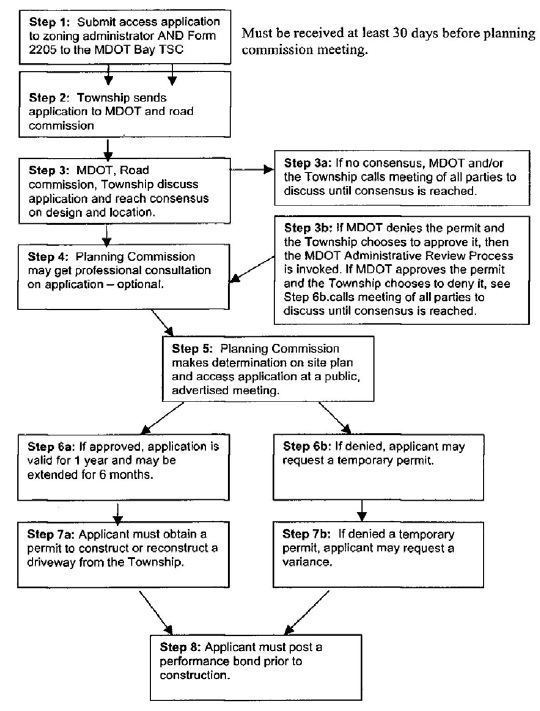
(D) Review and approval process. The following process shall be completed to obtain access approval.
(1) A site plan review access application meeting the requirements of this section shall be submitted to the Zoning Administrator, Clerk or other township designee of the township. MDOT form 2205, Driveway Permit, shall be submitted concurrently to the MDOT- Bay City Transportation Service Center.
(2) The completed application must be received by the Township Zoning Administrator at least 30 days prior to the Planning Commission meeting where the application will be reviewed.
(3) (a) The township in which the application is being made shall forward a copy of the access management application and the site plan to MDOT and the appropriate county road commission. MDOT and the Road Commission shall provide written comment to the township and discuss any outstanding issues with the township with the intent of reaching consensus on a recommendation for the access management application and site plan.
(b) In the event that consensus cannot be reached on access management issues, MDOT or the township shall call a meeting of the appropriate road agencies and municipal Planning Commission representatives prior to the Planning Commission meeting to review the document and reach consensus on the issue. Applications not forwarded to MDOT and the Road Commission shall not have completed the review process and may not be acted on by the Township Planning Commission.
(4) (a) The Planning Commission may obtain professional consultation prior to making a decision on the application.
(b) Costs for the review shall be the responsibility of the applicant provided the applicant is made aware of the costs prior to the application being considered by the Planning Commission.
(5) The Township Planning Commission in which the development is proposed shall review the application and make its determination regarding the driveway.
(6) The Zoning Administrator shall keep a record of each application that has been submitted, including the written disposition of each application. MDOT shall provide the township with a copy of the written permit or any other disposition of the permit for the township's records. This record shall be a public record.
(7) (a) Written approval of an application remains valid for a period of one year from the date it was authorized.
(b) If authorized construction is not initiated by the end of one year, the authorization is automatically null and void, unless the township specifically extends the time period during which the application remains valid by Planning Commission action.
(c) Any additional approvals that have been granted by the Planning Commission or the Zoning Board of Appeals, such as a special use permit or variance, also expire at the end of one year.
(8) (a) An approval may be extended for a period not to exceed six months. The extension must be requested, in writing, by the applicant before the expiration of the initial approval.
(b) The Zoning Administrator may approve extension of an authorization; provided, there are no deviations from the original approval present or planned, there are no violations of applicable ordinances and no development on abutting property has occurred with a driveway location that creates an unsafe condition.
(c) If there is any deviation or cause for question, the Zoning Administrator shall consult a representative of the Saginaw/Bay County Planning Commission staff, the Saginaw and/or Bay County Road Commission, as applicable, and the State Department of Transportation for input.
(9) Reissuance of an authorization that has expired requires a new access application form to be filled out and processed independently of any previous action.
(10) The applicant shall assume all responsibility for all maintenance of the driveway approaches from the right-of-way line to the edge of the traveled roadway.
(11) Where authorization has been granted for entrances to a parking facility, the facility shall not be altered or the plan of operation changed until a revised access application has been submitted and approved as specified in this section.
(12) Application to construct or reconstruct any driveway entrance and approach to a site requires a permit, but shall also address and achieve the reconstruction or closing of all non-conforming or unused entrances and approaches to the same site at the expense of the property owner.
(13) When a building permit is sought for the modification or reconstruction to the extent that a site plan is required in the municipality or by MDOT's requirements, all of the existing, as well as proposed driveway approaches and parking facilities shall comply, or be brought into compliance, with all design standards as set forth in this chapter and the adopted M-84 access management plan and map, prior to the issuance of a zoning or occupancy certificate and pursuant to the procedures of this section.
(14) (a) The State Department of Transportation, as applicable, shall require a performance bond or cash deposit in any sum of a minimum of $10,000 for each new or reconstructed approach or entrance to a commercial use, to ensure compliance with an approved application.
(b) The performance bond shall terminate and the deposit be returned to the applicant when the terms of approval have been met or when the authorization is cancelled or terminated.
(c) No performance bond is required for residential uses.
Review and Approval Process Flow Chart
(Ord. 06-14-Z, passed 10-3-2006; Ord. 06-14, passed 10-17-2006)
§ 155.370 SERVICE DRIVES.
(A) The use of shared access, parking lot connections and service drives in conjunction with driveway spacing is intended to preserve traffic flow along thoroughfares and minimize traffic conflict, while retaining reasonable access to the property. Where noted above, or where the Planning Commission determines that restricting new access points or reducing the number of existing access points may have a beneficial impact on traffic operations and safety while preserving the property owner's right to reasonable access, then access from a side street, a shared driveway, a parking lot connection or service drive connection to the arterial or collector street may be required.
(B) However, where traffic safety would be improved, and the driveway spacing requirements of this chapter can be met, then direct connection to the arterial or collector street may be allowed in addition to a required service drive.
(1) In particular, shared access, service drives or at least a connection between abutting land uses may be required in the following cases:
(a) Where the driveway spacing standards of this section within this chapter cannot be met;
(b) Where recommended in the M-84 access management plan and map;
(c) When the driveway could potentially interfere with traffic operations at an existing or planned traffic signal location;
(d) The site is along a collector or arterial street with high traffic volume or along segments experiencing congestion or a relatively high number of crashes;
(e) The property frontage has limited sight distance; and
(f) The Fire or Emergency Services Department recommends a second means of emergency access.
(2) In areas where frontage roads or rear service drives are recommended, but adjacent properties have not yet developed, the site shall be designed to accommodate a future road/facility designed according to the standards cited in this chapter. The Planning Commission may approve temporary access points where a continuous service drive is not yet available and a performance bond or escrow is accepted to assure elimination of temporary access when the service road is constructed. (See §§ 155.135 through 155.138.)
(Ord. 06-14-Z, passed 10-3-2006; Ord. 06-14, passed 10-17-2006)
§ 155.371 STANDARD FOR CONSTRUCTION.
Notwithstanding the requirements of Ch. 152 of this code of ordinances, the standards for all service drives shall be as follows.
(A) Site plan review. The Planning Commission shall review and approve all service drives to ensure safe and adequate continuity of the service drive between contiguous parcels as part of the site plan review process.
(B) Front and rear service drives. A front or rear service drive may be established on property that abuts only one public road. The design of a service road shall conform with national design guidelines such as those identified in the National Access Management Manual by TRB, the ASSHTO Greenbook, and National Cooperative Highway Research Program (NCHRP), Access Management Guidelines to Activity Centers, Report 348, and Impacts of Access Management Techniques, Report 420.
(C) Location. Service roads shall generally be parallel to the front property line and may be located whether in front of, or behind, principal buildings and may be placed in required yards. In considering the most appropriate alignment for a service road, the Planning Commission shall consider the setbacks of existing and/or proposed buildings and anticipated traffic flow for the site.
(D) Width and construction. A service drive shall be within an access easement permitting traffic circulation between properties. The easement shall be recorded with the County Register of Deeds. This easement shall be at least 32 feet wide. A service drive shall have a minimum pavement width of 24 feet, measured face to face at the curb with an approach width of a minimum of 27 feet at the intersection. The service drive shall be constructed of a paved surface material that is resistant to erosion and shall meet the Saginaw/Bay County Road Commission standards for base and thickness of asphalt or concrete, unless the community has more restrictive standards.
(E) Snow storage and landscaping areas. A minimum of six feet of snow storage/landscaping area shall be reserved along both sides of the service drive.
(F) Stacking. A minimum of 60 feet of storage at the intersection for entering and existing vehicles as measured from the pavement edge must be provided for all frontage roads. At driveways where it can be demonstrated that traffic volumes will exceed 750 vehicles per day or 100 vehicles during the peak hour, a minimum of 80 feet of stacking space shall be required.
(G) Distance from intersection on service drives. Frontage roads and service drive intersections at the collector or arterial street shall be designed according to the same minimum standards as described for driveways.
(H) Driveway entrance. The Planning Commission shall approve the location of all access to the service drive, based on the driveway spacing standards referenced in this chapter. Access to the service drive shall be located so that there is no undue interference with the free movement of service drive and emergency vehicle traffic, where there is safe sight distance, and where there is a safe driveway grade as established by the MDOT and Saginaw/Bay County Road Commission.
(I) Driveway radii. All driveway radii shall be shall be concrete curbs and conform with the requirements of the MDOT Access Management Guidebook.
(J) Acceleration lanes and tapers. The design of the driveway, acceleration, deceleration or taper shall conform with the requirements of the MDOT Access Management Guidebook.
(K) Elevation. The elevation of a service drive shall be uniform or gently sloping between adjacent properties.
(L) Service drive maintenance. No service drive shall be established on an existing right-of-way. The service drive shall be a public street (if dedicated and accepted by the applicable Road Commission) or a private road if permitted, maintained by the adjoining property owners it serves who shall enter into a formal agreement for the joint maintenance of the service drive. The agreement shall also specify who is responsible for enforcing speed limits, parking and related vehicular activity on the service drive. This agreement shall be approved by the municipality's attorney and recorded with the Register of Deeds. If the service drive is a private road, the local government shall reserve the right to make repairs or improvements to the service drive and charge back the costs.
(M) Landscaping. Landscaping along the service drive shall conform to the requirements of the municipality's zoning ordinance. Installation and maintenance of landscaping shall be the responsibility of the developer or a property owners association.
(N) Parking areas. All separate parking areas (those that do not use joint parking cross access) shall have no more than one access point or driveway on the service drive.
(O) Parking. The service road is intended to be used exclusively for circulation, and not as parking, loading or unloading aisle. Parking shall be prohibited along two-way frontage roads and service drives that are constructed at the minimum width. One-way roads or two-way roads designed with additional width for parallel parking may be allowed if it can be demonstrated through traffic studies that on-street parking will not significantly affect the capacity, safety or operation of the frontage road or service drive. Perpendicular or angle parking along either side of a designated frontage road or service drive is prohibited. The Planning Commission may require the posting of "no parking" signs along the service road.
(P) Directional signs and pavement markings. Pavement markings may be required to help promote safety and efficient circulation. The property owner shall be required to maintain all pavement markings. All directional signs and pavement markings along the service drive shall conform with the current Michigan Manual of Uniform Traffic Control Devices.
(Q) Assumed width of pre-existing service drives. Where a service drive in existence prior to the effective date of this provision has no recorded width, the width will be considered to be 26 feet for the purpose of establishing setbacks and will be measured an equal distance from the midpoint of the road surface.
(R) Alternate cross access. In the case of expansion, alteration to redesign of an existing development where it can be demonstrated that preexisting conditions prohibit installation of a frontage road or service drive in accordance with these standards, the Planning Commission shall have the authority to allow and/or require alternate cross access between adjacent parking areas through the interconnection of main circulation aisles. Under these conditions, the aisles serving the parking stalls shall be aligned perpendicularly to the access aisle, with islands, curbing and signage to further delineate the edges of the route to be used by through traffic. (See the MDOT Access Management Guidebook for further detail and sample drawings.)
(Ord. 06-14-Z, passed 10-3-2006; Ord. 06-14, passed 10-17-2006)
§ 155.372 TEMPORARY ACCESS PERMITS.
(A) A temporary access permit may be conditionally issued to a property included in this adopted corridor or access management plan that plans road improvements and installation of service drives and shared driveways that would eliminate the need for the temporary driveway.
(B) A temporary access permit shall be reviewed using the temporary permit form during the site plan review process. Failure to use this form and supply the justification for a temporary permit according to the provisions of the form prohibit a temporary access point on the site. A copy of this completed form shall be kept on file with the approved site plan at the township and recorded with the deed to the property for which it applies.
(C) Conditions may be included in the temporary access permit including, but not limited to, a limitation on development intensity on the site until adjoining parcels develop which can provide a shared driveway, shared access via a service drive, and/or cross parking lot connection consistent with the requirements of § 155.369.
(D) (1) A site plan for property that cannot meet the access requirements of § 155.369 and has no alternative means of reasonable access to a road system may be issued a temporary access permit.
(2) When adjoining parcels develop which can provide a shared driveway, shared access via a service drive or a cross parking lot connection, the temporary access permit shall be rescinded and an application for an access permit consistent with the requirements of § 155.369 and 155.370 shall be required.
(E) (1) The municipality and the State Department of Transportation, as applicable, may require a performance bond or cash deposit in any sum of a minimum of $10,000 for each temporarily permitted driveway to ensure compliance with removal of the driveway at a time as the permit stipulates.
(2) The performance bond shall terminate and deposit be returned to the applicant when the term of approval have been met or when the authorization is cancelled or terminated.
(Ord. 06-14-Z, passed 10-3-2006; Ord. 06-14, passed 10-17-2006)
§ 155.373 NON-CONFORMING DRIVEWAYS.
(A) Driveways that do not conform to the regulations in this chapter, and were constructed before the effective date of this chapter and existing driveways granted a temporary access permit, shall be considered legal non-conforming driveways.
(B) Loss of legal non-conforming status results when a change to the site or use requires a new site plan, according to this chapter. Any reuse of the driveway may only take place after the driveway conforms to all aspects of this chapter.
(C) When the owner of a property with an existing non-conforming driveway or driveways applies for a permit to upgrade the property, the Planning Commission will determine whether it is necessary and appropriate to retrofit the existing driveway or driveways. If the developer is proposing a change in use of the driveway the non-conforming status is no longer valid and a permit for the driveway is required from the State Department of Transportation or the Road Commission as applicable according to the standards of this chapter.
(1) The property owner may be required to establish a retrofit plan. The objectives of the retrofit plan will be to minimize the traffic and safety impacts of development by bringing the number, spacing, location and design of driveways into conformance with the standards and requirements of this chapter to the extent possible without imposing unnecessary hardship on the property owner. The retrofit plan may include:
(a) Elimination of driveways;
(b) Realignment or relocation of driveways;
(c) Provision of shared driveways and/or cross parking lot connection;
(d) Access by means of a service drive;
(e) Restriction of vehicle movements (e.g., elimination of left-turns in and out);
(f) Relocation of parking;
(g) Traffic demand management (e.g., a reduction in peak hour trips);
(h) Signalization based on warrants; and
(i) Other changes as may enhance traffic safety.
(2) The requirements of the retrofit plan shall be incorporated as conditions to the permit for the change or upgrade of use and the property owner shall be responsible for the retrofit.
(D) Driveways that do not conform to the regulations in this chapter and have been constructed after adoption of this chapter, shall be considered illegal non-conforming driveways.
(E) Illegal non-conforming driveways are a violation of this chapter. The property owner shall have 30 days in which to correct the violation. The property owner shall be issued a violation notice which may include closing off the driveway until any non-conforming aspects of the driveway are corrected. Driveways constructed in illegal locations shall be immediately closed upon detection and all evidence of the driveway removed from the right-of-way and site on which it is located. The costs of the removal shall be borne by the property owner.
(F) Nothing in this chapter shall prohibit the repair, improvement or modernization of lawful non-conforming driveways; provided, it is done consistent with the requirements of this chapter.
(Ord. 06-14-Z, passed 10-3-2006; Ord. 06-14, passed 10-17-2006)
§ 155.374 VARIANCES.
The following standards shall apply when the Board of Appeals considers a request for a variance from the standards of this section.
(A) The granting of a variance shall not be considered until a temporary access permit under § 155.369 has been considered and rejected.
(B) Applicants for a variance must provide proof of practical difficulties unique to the parcel (such as wetlands, steep slopes, an odd parcel shape or narrow frontage or location relative to other buildings, driveways or an intersection or interchange) that make strict application of the provisions of this chapter impractical. This shall include proof that:
(1) Indirect or restricted access cannot be obtained;
(2) No reasonable engineering or construction solution can be applied to mitigate the condition;
(3) No reasonable alternative access is available from a road with a lower functional classification than the primary road; and
(4) Without the variance, there is no reasonable access to the site.
(C) The Board of Appeals shall make a finding that the applicant for a variance met his, her or their burden of proof under division (B)(2) above, that a variance is consistent with the intent and purpose of this chapter, and is the minimum necessary to provide reasonable access.
(D) Under no circumstances shall a variance be granted unless not granting the variance would deny reasonable access, endanger public health, welfare or safety, or cause an unnecessary hardship on the applicant. No variance shall be granted where the hardship is self-created.
(Ord. 06-14-Z, passed 10-3-2006; Ord. 06-14, passed 10-17-2006)

