
Kronenwetter City Zoning Code
ARTICLE X
- BUILDING AND SITE DESIGN STANDARDS
§ 520-74.- Purpose.
The purpose of this article is to establish regulations that address the exterior design and appearance of new buildings and their relationship to other structures, hard-surfaced areas, landscaping areas, and other required site design elements on the same building site or adjoining building sites. Sites and buildings within a D Design Overlay Zoning District, as specified in section 520-37, shall also be subject to the unique building and site design standards of that district.
(Ord. No. 16-07, 6-20-2016)
§ 520-75. - Single-family and two-family housing standards.
All new and expanded single-family detached dwellings shall meet the applicable design requirements in subsection 520-20.A. All new and expanded two-family dwellings shall meet the applicable design requirements in subsection 520-20.B. All detached accessory buildings serving one of these principal uses shall meet the applicable design requirements in subsection 520-27.B.
(Ord. No. 16-07, 6-20-2016)
§ 520-76. - Design standards for multifamily and nonresidential buildings.
A.
Applicability. All new multifamily (three-plus units) residential principal buildings and nonresidential principal buildings shall meet the design requirements in this section, with the exception of farm structures such as barns, silos, and grain elevators. Expansion and remodeling of existing multiple-family (three-plus units) residential principal buildings and nonresidential principal buildings shall meet the design requirements in this section to the extent determined practical by the applicable site plan approval authority. All detached accessory structures serving multifamily residential principal buildings shall meet applicable design requirements in subsection 520-27.B. All detached accessory structures serving nonresidential principal buildings shall meet applicable design requirements in subsection 520-27.A.
B.
Building size and mass. The size and mass of buildings and structures shall be designed with consideration of the buildings, public ways, and places to which they are visually related (see figure 520-76(1) for examples). The relative proportion of a building to its neighboring existing buildings, to pedestrians, or to other existing buildings shall be maintained or enhanced when new buildings are built or when existing buildings are altered.
Figure 520-76(1): Examples of Building Size and Mass Continuity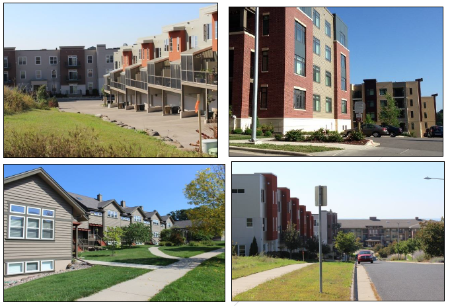
C.
Building facade continuity. Changes in building material, color, and texture shall occur at points related to the massing and overall design concept for the building. Each building shall be visually compatible with the buildings, public ways, and places to which it is visually related in its directional character, whether this is vertical character, horizontal character, or nondirectional character. Building facades and appurtenances such as walls, fences, and landscape masses shall, when it is a characteristic of the area, form cohesive walls of enclosures along a street to ensure a favorable relationship with the buildings, public ways, and places to which such elements are visually related (see figure 520-76(2) for examples in an urban setting).
Figure 520-76(2): Urban Example of Adjacent Building Facade Continuity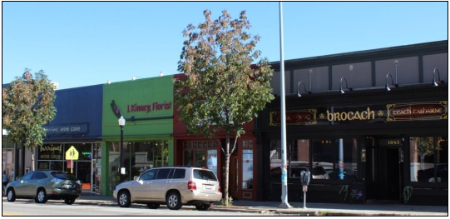
D.
Building design proportions.
(1)
The relationship of the width to the height of the front elevation shall be visually compatible with buildings, public ways, and places to which it is visually related.
(2)
The relationship of the width to height of windows shall be visually compatible with buildings, public ways, and places to which the building is visually related.
(3)
The relationship of the building to the open space between it and adjoining buildings shall be visually compatible with the buildings, public ways, and places to which it is visually related.
(4)
The relationship of entrances and other projections to sidewalks shall be visually compatible with the buildings, public ways, and places to which it is visually related.
E.
Materials: generally. Material selection shall relate to the prevailing material already used on recently constructed buildings in the area, or to a different character if identified in the village's comprehensive plan, the examples in figures 520-76(3) and (4), or unique requirements associated with any D Design Overlay District applicable to the site. Building elevations clad with a singular exterior surface material shall provide some additional architectural design element(s) to break up the plane of the wall, such as windows, gable-end wall treatments, variable siding design or orientation, and accent panels. Where side facades are characterized by materials that differ from the front facade, front facade materials shall be continued for not less than 20 feet on each side from the front facade.
F.
Materials: use of metal and other nondecorative materials. No exposed facade shall be faced with a material that presents an unfinished appearance to the public and surrounding properties. The following exterior construction materials shall not be exposed along front or street side yard facing building facades: nondecorative concrete block, cinder block, or concrete foundation walls (except for the first two feet above grade), nondecorative plywood, asphaltic siding, any material using exposed fastener systems, metal sheets or panels. No facade of any principal building intended for a residential, institutional, or commercial use as listed in figure 520-17 shall be sided with metal sheets or panels. Any accessory nonresidential building sided with metal sheets or panels shall be fully screened from the public rights-of-way.
G.
Colors. Building colors shall be selected in general harmony with the existing area or neighborhood buildings, without creating a monotonous street appearance. See examples of appropriate color combinations in figures 520-76(3) and 520-76(4).
Figure 520-76(3): Examples of Appropriate Multifamily Residential Building Materials
and Colors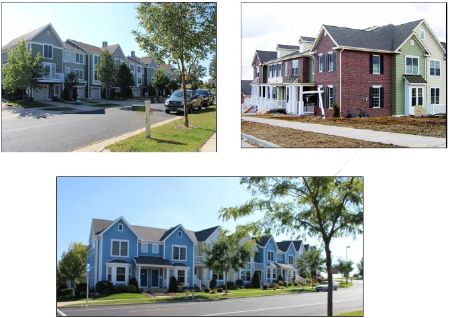
Figure 520-76(4): Examples of Appropriate Commercial Building Materials and Colors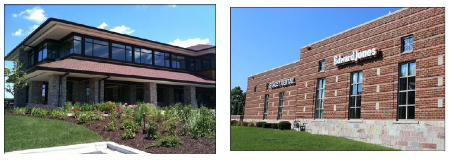
H.
Corner lot buildings. Buildings on corner lots shall continue the major front elevation design elements around the corner elevation.
I.
Vents and mechanical units. All chimney and fireplace vents shall be enclosed in a case constructed of materials similar to those materials used on the building elevations. Metal housings designed by the vent manufacturer to enclose the chimney vents are acceptable. All heating, ventilating, and air-conditioning equipment shall be designed to be integral with the building architecture and site design and screened from view from public rights-of-way.
J.
Building orientation. All buildings shall be sited to present their most desirable facade(s) to adjacent public rights-of-way. Garages and loading docks shall be designed as integral elements to the building and site, and shall not be the dominant visual element from public rights-of-way unless preexisting site or building conditions would not allow this. All new loading docks shall be screened from public view to the extent practical.
K.
Outdoor waste/recycling containers. Solid waste/recycling containers (dumpsters) stored outdoors shall be subject to applicable standards in subsection 520-86.B and chapter 441 of the Municipal Code.
L.
Waiver or modification of standards. The applicable site plan approval authority under section 520-124 may waive or modify any of the standards in this section if at least one of the following circumstances is present:
(1)
Supplemental design elements or improvements that exceed normal standards are incorporated into the project.
(2)
Restricted building materials are used as limited decorative elements on a building facade that contributes to its architectural design.
(3)
Undesirable site or building conditions will not be visible from the public right-of-way and/or adjoining properties.
(Ord. No. 16-07, 6-20-2016)
§ 520-77. - Large retail and commercial service development standards.
A large retail and commercial service development is any development composed of one or more contiguous lots or building sites for a single retail or commercial service enterprise or multiple such enterprises within which the total combined gross floor area of all principal buildings exceeds 25,000 square feet. In addition to applicable zoning district and other standards of this chapter, each large retail and commercial service development shall meet procedural, building design, and site design standards of this section, except as may be waived or modified under subsection D(18).
A.
Large retail and commercial service development questionnaire. The applicant for a conditional use permit shall complete and submit with such application a large retail and commercial service development questionnaire. The zoning administrator shall prepare, maintain, and provide the large retail and commercial service development questionnaire upon request.
B.
Traffic impact analysis. A traffic impact analysis is required for each large retail and commercial service development exceeding 75,000 square feet in total building gross floor area. The traffic impact analysis shall be completed by a consultant approved by the village and holding appropriate experience and in accordance with the most current revision of the Traffic Impact Analysis Guidelines published by the State of Wisconsin DOT, except as otherwise approved by the village engineer. Where the traffic impact analysis indicates that a project may cause off-site public roads, intersections, or interchanges to function below level of service (LOS) C, the village may deny the application, may require a size reduction in the proposed development, and/or may require the developer to construct and/or pay for required off-site improvements to achieve LOS C for a planning horizon of a minimum of ten years, assuming full build-out of the development.
C.
Neighborhood plan. Applicants for large retail and commercial service developments exceeding 75,000 square feet in total building gross floor area shall prepare a neighborhood plan including the subject site and an impact area beyond the boundary of the development site as determined by the zoning administrator. The neighborhood plan must be submitted prior to or with the application for a conditional use permit. The zoning administrator may waive this requirement if a neighborhood plan that anticipated the development has already been adopted or if the impact area is already substantially developed. The neighborhood plan shall be of sufficient detail to establish the mix of land uses and their relationship to the large retail and commercial service development with regard to provision of street, bicycle/pedestrian, and bus transit connectivity, utilities, stormwater management, and community character, and a general layout that support the objectives of the comprehensive plan. The neighborhood plan shall contain the following elements:
(1)
General types of land use types with specific zoning districts and/or land uses.
(2)
Transitional treatments such as berms and/or landscaping between areas with differing land uses or character.
(3)
Complete public road network.
(4)
Pedestrian and bicycle network.
(5)
Transit routes and stops, where applicable.
(6)
Conceptual stormwater management network.
(7)
Public facility sites, including parks, schools, conservation areas, public safety facilities and public utility facilities.
(8)
Recommendations for community character themes, including building materials, landscaping, streetscaping, and signage.
D.
Facilities and associated features. The following requirements are applicable to each large retail and commercial service development, in addition to other applicable standards in this chapter:
(1)
Building location. Where buildings are proposed to be distant from a public street, as determined by the plan commission, the overall development design shall include smaller buildings on pads or secondary lots closer to the street. Placement and orientation must facilitate appropriate land use transitions and appropriate traffic flow to adjoining roads, and neighboring commercial areas and neighborhoods, and must forward any community character objectives in the comprehensive plan.
(2)
Building materials. Exterior building materials shall be of comparable aesthetic quality on all sides. Building materials such as glass, brick, tinted and decorative concrete block, wood, stucco, and exterior insulation and finish systems (EIFS) shall be used, as determined appropriate by the plan commission. Decorative architectural metal with concealed fasteners or decorative tilt-up concrete panels may be approved if incorporated into the overall design of the building.
(3)
Building entrances. Public building entryways shall be clearly defined and highly visible on the building's exterior design, and shall be emphasized by on-site traffic flow patterns. Two or more of the following design features shall be incorporated into all public building entryways: canopies or porticos, overhangs, projections, arcades, peaked roof forms, arches, outdoor patios, display windows, and distinct architectural details.
(4)
Screening.
(a)
All ground-mounted and wall-mounted mechanical equipment, refuse containers and any permitted outdoor storage shall be fully concealed from on-site and off-site ground level views, with materials complementing those used on the building exterior.
(b)
All rooftop mechanical equipment shall be screened by parapets, upper stories, or other areas of exterior walls or roofs so as to not be visible from public streets adjacent to or within 1,000 feet of the subject property. Fences or similar rooftop screening devices may not be used to meet this requirement.
(c)
Loading docks shall be completely screened from surrounding roads and properties. Said screening may be accomplished through loading areas internal to buildings, screen walls which match the building exterior in materials and design, fully opaque landscaping at time of planting, or combinations of the above.
(d)
Gates and fencing may be used for security and access, but not for screening, and they shall be of high aesthetic quality.
(5)
Parking.
(a)
Parking lots shall be paved.
(b)
Parking lots shall have a ten-foot setback from the right-of-way.
(c)
Parking lots in which the number of spaces exceeds the minimum number of parking spaces required for the specific use or uses in article IV by more than 50 percent shall be allowed only with specific justification based on actual parking demand for similar uses in other locations.
(d)
Each landscaped island or peninsula shall contain a minimum of 300 square feet in landscaped area. Landscaped islands or peninsulas shall be spaced at intervals no greater than one island per every 40 spaces in that aisle.
(6)
Vehicular access.
(a)
Vehicle access shall be designed to accommodate peak on-site traffic volumes without disrupting traffic on public streets or impairing pedestrian safety. This shall be accomplished through adequate parking lot design and capacity; access drive entry throat length, width, design, location, and number; traffic control devices; and sidewalks.
(b)
The site design shall provide direct vehicular connections to adjacent land uses if required by the village.
(7)
Bicycle and pedestrian facilities.
(a)
The development shall provide for safe pedestrian and bicycle access to all uses, and connections to existing and planned public pedestrian and bicycle facilities and adjacent properties.
(b)
Pedestrian walkways shall be provided from all building entrances to existing or planned public sidewalks or pedestrian/bike facilities. The minimum width for sidewalks adjacent to buildings shall be eight feet; and the minimum width for sidewalks elsewhere in the development shall be five feet.
(c)
Sidewalks other than street sidewalks or building aprons shall have adjoining landscaping along at least 50 percent of their length.
(d)
Crosswalks shall be distinguished from driving surfaces to enhance pedestrian safety by using different pavement materials, or pavement color, or pavement textures, and signage.
(e)
The development shall provide secure, integrated bicycle parking.
(f)
The development shall provide exterior pedestrian furniture in appropriate locations at a minimum rate of one seat for every 20,000 square feet of gross floor area.
(8)
Central areas and features. Each such development exceeding 75,000 square feet in total building gross floor area shall provide central areas or features such as a patio/seating area, pedestrian plaza with benches, outdoor playground area, water feature, and/or other such deliberately designated areas or focal points that adequately enhance the development or community. All such areas shall be openly accessible to the public, connected to the public and private sidewalk system, designed with materials compatible with the building and remainder of the site, and shall be maintained over the life of the building project.
(9)
Cart returns. A minimum of one 200-square-foot cart return area shall be provided for every 100 parking spaces. Cart corrals shall be of durable, nonrusting, all-season construction, and shall be designed and colored to be compatible with the building and parking lot light standards.
(10)
Outdoor display areas. Exterior display areas shall be permitted only where clearly depicted on the approved site plan. All exterior display areas shall be separated from motor vehicle routes by a physical barrier visible to drivers and pedestrians, and by a minimum of ten feet.
(11)
Outdoor storage uses and areas. Exterior storage structures or uses, including the parking or storage of service vehicles, trailers, equipment, containers, crates, pallets, merchandise, materials, forklifts, trash, recyclables, and all other items shall be permitted only where clearly depicted and labeled on the approved site plan. Such outdoor storage uses and areas shall be appropriately screened.
(12)
Landscaping. On-site landscaping shall be provided at time of building occupancy and maintained per the requirements of article XI.
(13)
Lighting. On-site exterior lighting shall meet all the standards of section 520-90. In addition, the color and design of pole lighting standards shall be compatible with the building and the public lighting in the area, and shall be uniform throughout the entire development site.
(14)
Signage. In addition to meeting the applicable requirements of article XIII, a signage plan for all exterior signage shall be provided for coordinated and complementary exterior sign locations, configurations, and colors throughout the development, including secondary lots within the development. Combined signs for multiple users may be required instead of multiple individual signs.
(15)
Natural resources protection. Natural resources shall be protected in accordance with this chapter and state and federal regulations. In general, existing natural features shall be integrated into the site design as a site and community amenity.
(16)
Relationship to existing sites. Where such a building is proposed as a replacement location for a business already located within the village, the village prohibits any privately imposed limits on the type or reuse of the previously occupied building through conditions of sale or lease.
(17)
Development agreement. The developer may be required to enter into a development agreement with the village, which may address fees, off-site improvements, and other matters to assure compliance with conditional use permit approval conditions.
(18)
Exceptions. In the event the applicant desires a waiver or modification from the requirements of this section, the applicant shall present justification for such deviation or exception, which may be approved or denied by the plan commission.
(Ord. No. 16-07, 6-20-2016)

