
Kronenwetter City Zoning Code
ARTICLE XII
GENERAL PERFORMANCE STANDARDS
§ 520-81.- Purpose; applicability.
A.
Purpose. The purpose of this article is to indicate requirements for drainage structures, earth filling/moving, fences, swimming pools, firewood storage, exterior storage, outdoor recreational vehicle storage, vehicle access and driveways, parking and circulation, off-street loading, exterior lighting, noise, air pollution, odors, glare, heat, fire and explosion, toxic and noxious materials, waste materials, hazardous materials, and electromagnetic emissions.
B.
Nonapplicability to agricultural and single- and two-family residential land uses. Except where a performance standard in this article is specifically made applicable to agricultural uses and single- and two-family residential land uses in this article, such uses and associated structures are exempt from these requirements (but subdivisions intended for future residential use are not exempt).
(Ord. No. 16-07, 6-20-2016)
§ 520-82. - Stormwater management; earthfilling; excavating.
A.
Stormwater management and erosion control. All stormwater management and erosion control improvements shall comply with all applicable village, county, state, and federal standards, including chapter 270 of the Village of Kronenwetter Municipal Code. The village encourages rain gardens, bioswales, and other similar natural forms of stormwater management and infiltration.
B.
Earthfilling and excavating. Earthfilling and excavating activities include any activity in an area over 4,000 square feet, or greater than 500 cubic yards of fill, involving the modification of the earth's surface above that in its undisturbed state. Earthfilling and excavating activities:
(1)
Shall comply with the village's construction site erosion control and stormwater management regulations per chapter 270 of the Municipal Code.
(2)
Shall not increase drainage onto other properties or impede on-site drainage.
(3)
Shall comply with provisions of the village subdivision ordinance.
(Ord. No. 16-07, 6-20-2016)
Cross reference— Subdivision of land, ch. 460.
§ 520-83. - Fences and landscape walls.
A.
Purpose. The purpose of this section is to regulate the materials, location, height, and maintenance of fencing, landscaping walls, and decorative posts in order to prevent the creation of nuisances and to promote the general welfare of the public.
B.
Applicability. The requirements of this section apply to all permanent fencing, landscape walls, and decorative posts equal to or exceeding four feet in height.
C.
Standards.
(1)
Traffic visibility. All fences and walls must comply with the vision clearance requirements of subsection 520-87.K.
(2)
Access. No fence shall be considered a hardship to access a rear yard, for purposes of storage of vehicles or other purposes in this chapter.
(3)
Fences in all residential zoning districts, and in any RR or PR District.
(a)
Street yard fences. The maximum height of each fence or wall shall be four feet within the front yard and six feet within any side or rear yard where the associated lot line abuts a public street. In such instances, fences and walls shall be set back a minimum of two feet from the property line abutting the public street.
(b)
Interior side and rear yard fences. The maximum height of each fence or wall in the interior side and interior rear yard shall be six feet, and any such fence or wall may be installed up to the property line.
(4)
Fences within all nonresidential and mixed-use districts.
(a)
Fences and walls not exceeding ten feet in height are permitted. Such fence or wall shall be set back a minimum of two feet from any front or streetside property line.
(b)
Fences, walls, or landscaping may be required for screening particular land uses per article IV and subsection 520-79.C(4).
(5)
Garden fences and fences in rural and open space districts. Garden fences, and fencing within rural and open space districts, shall be exempt from the requirements of this section, except that all front and streetside yard fences shall adhere to the front yard fence requirements for residential districts. Such fences shall not require a zoning or building permit, except for garden fences that are closer than two feet from any property line.
(6)
Temporary fences. Fences erected for the protection of plantings or to warn of construction hazards or for similar purposes shall be clearly visible or marked with colored streamers or other such warning devices at four-foot intervals. Such fences shall comply with any setback requirements set forth in this section. The issuance of a permit shall not be necessary for temporary fences. Temporary fences may be installed and maintained for a period not exceeding the term of construction, or 180 days if not associated with a construction project.
(7)
Construction and maintenance. All fences, landscape walls, or decorative posts shall be constructed and maintained in a structurally sound and attractive manner per the manufacturer's instructions. Living hedges must be trimmed so that all limbs remain entirely within the property. Each fence shall be built and maintained with a single material and a single color for its full length.
(8)
Prohibited fences.
(a)
The use of a fence that delivers an electric shock is prohibited, except for in rural and open space districts.
(b)
Fences within and adjacent to any residential zoning district may not be composed of stranded wire, exposed/reflective metal, or corrugated metal.
(c)
A snow fence shall be permitted in all districts when not exceeding four feet in height. Snow fences or other fences designed for temporary use shall not be used for a period exceeding 30 days between May 1 and October 1 of each year. No privately owned snow fence shall extend beyond the highway right-of-way line.
(Ord. No. 16-07, 6-20-2016)
§ 520-84. - Swimming pools.
A.
Applicability. This section applies to all swimming pools as defined in section 520-138, excluding structures exempted by that definition.
B.
Permit required. Before work is commenced on the construction or erection of a swimming pool or on any alterations, additions, remodeling, or other improvements, an application for a swimming pool building permit must be submitted in writing to the building inspector. Plans and specifications and pertinent explanatory data shall be submitted to the building inspector at the time of application. No work or any part of the work shall be commenced until a written permit for such work is obtained by the applicant. The required fee shall accompany such application.
C.
Construction requirements.
(1)
Approved materials. All materials and methods of construction in the construction, alteration, addition, remodeling, or other improvements and pool installation shall be in accord with all state regulations and with any and all applicable ordinances of the village.
(2)
Plumbing. All plumbing work shall be in accordance with all applicable local ordinances and all state codes and requirements. Every swimming pool shall be provided with a suitable draining method, meeting the requirements of subsection H below.
(3)
Electrical installations. All electrical installations, including lighting and heating, but not limited thereto, that are provided for, installed, and used in conjunction with a private swimming pool shall be in conformance with state laws and local ordinances regulating electrical installations.
D.
Placement and setbacks.
(1)
Swimming pools shall be erected or constructed in side or year yard, except residential districts shall be in the rear yard only. A principal building is required on a lot in all zoning districts prior to a swimming pool being erected or constructed.
(2)
All swimming pools shall meet the side and rear setback requirements applicable to accessory structures in figures V(2) and V(6).
E.
Enclosure.
(1)
Each swimming pool as defined in section 520-138 shall be completely enclosed by a fence, wall, cover, or other protective device of sufficient strength to prevent access to the pool by a person.
(2)
If a fence or wall is used for the required enclosure, such fence or wall shall not be less than four feet in height. The zoning administrator may require a minimum of six feet in height upon a determination that the selected fence design will facilitate climbing. The pool wall of an aboveground pool may serve as all or part of the required fence height. Fences or walls shall not have voids, holes, or openings larger than four inches in one dimension. Gates or doors shall be equipped with self-closing and self-latching devices located at the top of the gate or door on the pool side of the enclosure, except the door of any building that forms a part of the enclosure.
(3)
If a cover or other protective device is used for the required enclosure, such cover or other protective device shall have a strength, design, and material that meets the requirements of this section and is securely fastened in place when the swimming pool is not in use.
F.
Compliance. All swimming pools existing as of the effective date of this chapter not satisfactorily fenced shall comply with the fencing requirements of this section when water is placed in the pool.
G.
Maximum pool size. No pool, together with its deck area, shall occupy more than 40 percent of the usable area of the rear yard, excluding all garages or accessory structures located in the area.
H.
Draining and approval thereof. No swimming pool shall be constructed so as to allow water to drain into any sanitary sewer nor to overflow upon or cause damage to any adjoining property. Draining a swimming pool into public streets, other public property, or the storm sewer system may occur only with the prior approval of the village director of public works.
I.
Filter system required. All swimming pools must have, in connection therewith, some filtration system to ensure proper circulation of the water therein and maintenance of the proper bacterial quality thereof.
J.
Dirt bottoms prohibited. All swimming pools shall have the sides and bottom of a smooth finish, and no sand or dirt bottom shall be permitted.
(Ord. No. 16-07, 6-20-2016; Ord. No. 22-06, § 1, 7-11-2022)
§ 520-85. - Firewood storage.
A.
Applicability. This section is applicable in all residential zoning districts and for lots that are occupied by residences and located within nonresidential or mixed-use zoning districts, as those terms are defined in section 520-138.
B.
Definitions applicable to this section.
(1)
Outside storage of firewood means any firewood which is not enclosed by four walls and a roof.
(2)
Firewood means any wood or wood product used or intended to be used as heating fuel in a residence or for burning in recreational fires as defined and regulated in chapter 227 of the Kronenwetter Municipal Code. Painted or treated wood shall not be considered firewood.
(3)
Neat, secure stack means a stack of firewood that is piled in regular, orderly arrangement that is stable and reasonably resistant to collapse.
C.
Outside storage of firewood. Except for firewood and construction materials necessary for on-site use or work, no wood or wood product shall be kept or stored outdoors. Firewood shall be neatly stacked and stored no closer than three feet from any lot line and not higher than four feet from grade.
(Ord. No. 16-07, 6-20-2016)
§ 520-86. - Exterior storage standards.
A.
Purpose. The purpose of this section is to regulate the use of property for exterior storage, except as otherwise specifically regulated in this article. This section is designed to promote the safety and general welfare of the public. Additional standards for outdoor storage applicable to specific land uses as specified in article IV shall also apply.
B.
Exterior trash and recyclable storage. Exterior (outside) storage of trash shall be subject to applicable standards in chapter 441 of the Municipal Code. Within each residentially and RR zoned property, there shall be no construction dumpster for a period greater than 30 days in any calendar year, except with the written approval of the zoning administrator. For all land uses other than a single-family detached residence, two-family residence, and any agricultural use, all exterior storage of trash and recyclables, including associated containers, carts, and enclosures, shall further meet all of the following requirements:
(1)
Trash and recyclables shall be subject to accessory structure setback requirements included in figures V(2) and V(6).
(2)
Trash and recyclables shall not be placed in any minimum required front or streetside yard.
(3)
Trash and recyclables shall be placed to the interior side or rear of the principal structure, unless such a location is not possible in the determination of the zoning administrator.
(4)
Trash and recyclables shall be placed on a permanent hard surface.
(5)
All trash and recyclables shall be fully screened from public rights-of-way and adjacent residential properties by any combination of building walls and decorative, opaque fences, walls, and gates not exceeding six feet in height. See example in figure 520-86. Chain-link fences and gates with slats are not permitted for this purpose.
(6)
All enclosures shall be equipped with a solid door or gate, which shall be used to gain access to the storage area.
(7)
Prior to installation, the enclosure design and location shall be approved by the user's contracted solid waste/recycling hauler to ensure reasonable access by the service truck.
(8)
The exterior storage of trash or recyclables, and associated dumpsters, carts, and enclosures, which are not in compliance with this subsection as of the effective date of this chapter shall have one year from such date to comply.
Figure 520-86: Example of Appropriate Dumpster Enclosure Design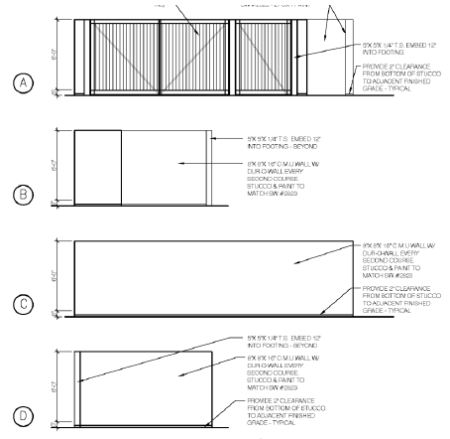
C.
Motor vehicle storage. Except in agricultural zoning districts, storage of operable and licensed motor vehicles shall be allowed in accordance with the hard- or gravel-surface setback requirements of article V and landscaped in accordance with article XI. Storage or parking of semitrailers, buses, and heavy-duty trucks in residential districts is prohibited.
D.
Inoperable vehicles and junk. The outside storage of inoperable or unlicensed vehicles, appliances, and other junk or trash shall be prohibited, except for within junkyard or salvage yard land uses approved in accordance with the requirements of this chapter. Storage of inoperable vehicles is also subject to the regulations set forth in chapter 382 of the Kronenwetter Municipal Code.
(Ord. No. 16-07, 6-20-2016)
§ 520-87. - Access and driveway standards.
A.
Purpose and applicability. The purpose of this section is to alleviate or prevent congestion of public rights-of-way, protect and enhance property values and community aesthetics, and promote the safety and general welfare of the traveling public. This section establishes minimum requirements for the provision of access to public rights-of-way in accordance with the utilization of various sites.
B.
Roadway access control. Access control to public roadways and driveway access design standards shall be per chapter 419 of the Village of Kronenwetter Municipal Code.
C.
Depiction on required site plan. The configuration and location of all proposed access drives on a property shall be depicted on any required site plan.
D.
Distance from property line. The distance from an access drive or parking lot to the property line shall not be less than the minimum associated setback for hard- or gravel-surfaced areas in figures V(2) and V(6), except in the case of approved shared driveways, shared parking lots, and cross-accessways.
E.
Traffic control. Traffic into and out of all off-street parking, loading, and traffic circulation areas serving six or more parking spaces shall be forward-moving, with no backing into streets or pedestrianways.
F.
Surfacing. Driveway surfacing shall be per subsection 520-88.F(1).
G.
All garages to be served by driveways. All garages intended for vehicle parking shall be served by a driveway extending from the garage to the curb or street edge. Where such driveway(s) meets the garage, the width shall be, at minimum, the width of all garage door openings.
H.
Installation timing. Except for apron sections within public rights-of-way, no residential driveway shall be constructed until the owner has been issued a building permit for the residence. Each residential driveway shall be constructed prior to occupancy of the associated dwelling, except in cases when construction of the dwelling is completed between December 1 and March 31. In such cases, driveways must be installed no later than June 1 following occupancy.
I.
Provision for pedestrian facilities. Where the village has planned for or approved pedestrian facilities, driveways shall accommodate a concrete sidewalk or pathway section within the public right-of-way, built to village sidewalk standards, to maintain connection with existing sidewalks or to allow for the connection of future sidewalks on either side of the driveway.
J.
Maintenance. All driveways shall be maintained so as to prevent the transport of gravel, dirt, or other material from the property into the public right-of-way.
K.
Vision clearance triangles. Within vision clearance triangles, no signs, structures, earthwork, vegetation, or other obstructions between 18 inches and ten feet in height shall be permitted, except for tree trunks and sign poles. The vision clearance triangle shall apply where public streets intersect, and where private driveways and alleys intersect with public streets, per the following standards (as also represented in figure 520-87).
(1)
Where public streets intersect with each other. To draw the first two lines of the triangle, measure 20 feet from the point of intersection of the two street rights-of-way along the two right-of-way lines. Next, draw a third straight line between the ends of the first two lines to form the vision clearance triangle.
(2)
Where a private driveway or alley intersects with a public street. To draw the first two lines of the triangle, measure from the point of intersection between the public street right-of-way and the private driveway/alley surface edge a distance of ten feet where the intersecting local street is a local street, 15 feet where a collector street, and 20 feet where an arterial street. Next, draw a third straight line between the ends of the first two lines to form the vision clearance triangle.
Figure 520-87: Representation of Minimum Dimensional Requirements Affecting Vehicular
Access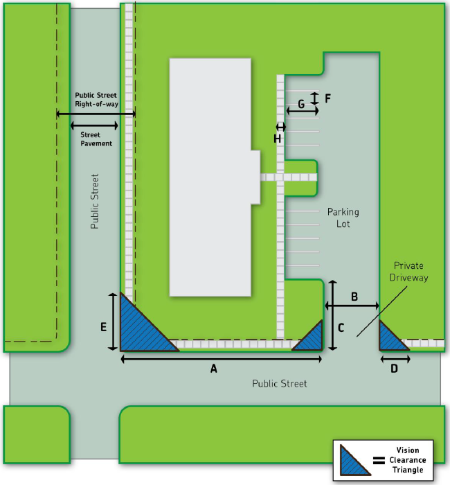
(Ord. No. 16-07, 6-20-2016)
§ 520-88. - Off-street parking and traffic circulation standards.
A.
Purpose and applicability. The purpose of this section is to alleviate or prevent congestion of public rights-of-way so as to promote the safety and general welfare of the public by establishing minimum requirements for the provision of off-street parking and circulation. The requirements of this section shall apply to all uses other than agricultural uses.
B.
Depiction on required site plan. Any and all parking and traffic circulation areas proposed to be located on a property shall be depicted as to their location and configuration on the site plan, if required under subsection 520-16.J. A garage stall shall be considered a parking space.
C.
Use of off-street parking areas; snow storage. Except as otherwise allowed below, the use of all off-street parking areas shall be limited to the parking of licensed and operable vehicles not for lease, rent, or sale. Within residentially zoned property, only licensed and operable cars and trucks with a rated capacity of 26,000 pounds or less shall be parked or kept in parking areas or any other exterior location. The use of parking spaces and their circulation areas for purposes such as seasonal sales and snow storage shall be permitted only if sufficient parking spaces remain available to meet the parking requirements of this chapter and normal traffic and pedestrian movement and safety is not impeded.
D.
Traffic circulation and traffic control. Site circulation shall be designed to provide for the safe and efficient movement of all traffic entering, exiting, and on the site. Circulation shall be provided to meet the individual needs of the site with specific mixing of access and through movements, and where required, shall be depicted on the required site plan. Circulation patterns and traffic control measures shall conform to the general rules of the road and the requirements of the Manual on Uniform Traffic Control Devices.
E.
Installation and maintenance of off-street parking and traffic circulation areas. All off-street parking and traffic circulation areas shall be completed prior to building occupancy and shall be maintained in a dust-free condition at all times. No required off-street parking or traffic circulation area may be used as a storage area for materials or for snow.
F.
Off-street parking and traffic circulation design standards.
(1)
Surfacing.
(a)
All off-street parking, driveway, and traffic circulation areas constructed after the effective date of this chapter, including residential driveways, shall be surfaced and continuously maintained with a hard surface as defined in section 520-138, except that gravel, crushed stone, or a similar material is permitted for:
1.
Agricultural uses.
2.
Driveways in rural and open space zoning districts, where the intersecting road is gravel or the driveway is greater than 50 feet in length.
3.
Emergency access driveways where required or approved by the zoning administrator.
4.
Lightly traveled service drives for nonresidential uses where included as part of an approved site plan under section 520-124, and where at least the first 50 feet connecting to a public street is paved with a hard surface.
(b)
In cases where gravel or crushed stone is permitted under one of the above exceptions, the portion of the driveway within the public street right-of-way shall be hard-surfaced, except where serving agricultural uses or where the intersecting public road is gravel-surfaced.
(2)
Marking. All hard-surfaced areas intended for six or more parking stalls shall be striped in a manner that clearly indicates the boundaries of required parking spaces.
(3)
Lighting. All off-street parking and traffic circulation areas serving six or more cars shall be lit so as to ensure the safe and efficient use of said areas during the hours of use, with said illumination level not exceeding the standards of section 520-90.
(4)
Access. Each required off-street parking space shall open directly upon an aisle or driveway that is wide enough and designed to provide a safe and efficient means of vehicular access to the parking space without directly backing or maneuvering a vehicle into a public right-of-way. All off-street parking and traffic circulation facilities shall be designed with an appropriate means of vehicular access to a street or alley, in a manner that least interferes with traffic movements. Off-street parking spaces for residential uses may be stacked or in front of one another for the same dwelling unit. Parking spaces located behind an enclosed garage and located directly off a through aisle shall be a minimum of 30 feet deep.
(5)
Signage. All signage located within, or related to, required off-street parking or traffic circulation areas shall comply with the requirements of article XIII.
(6)
Handicapped parking spaces. Parking for the handicapped shall be provided at a size, number, location, and with signage as specified by state and federal regulations.
(7)
Parking space design standards. Other than parking required to serve the handicapped, the minimum required length of parking spaces shall be 18 feet, and the minimum required width is ten feet (8½ feet for end spaces). All parking spaces shall have a minimum vertical clearance of seven feet.
(8)
Parking lot design standards. Horizontal widths for driveways serving parking spaces shall be no less than 24 feet for two-way driveways and 12 feet for one-way driveways, except that wider driveways may be required for loading and service routes. Parking lot landscaping shall comply with the requirements of the hard- and gravel-surfaced area landscaping requirements in subsection 520-79.C(2).
G.
Calculation of minimum required parking spaces. The minimum number of required parking spaces is stated for each land use in article IV.
H.
Potential reduction in automobile parking spaces. The site plan approval authority may approve a decrease in the required number of off-street automobile parking spaces for each land use in article IV by up to 25 percent of the normal requirement. Such a reduction must be supported by technical documentation furnished by the applicant that indicates that actual off-street parking demand for that particular use is less than the normally required minimum.
I.
Limit on maximum number of required parking spaces. No site plan may be approved for a multifamily residential or nonresidential use that contains more than 150 percent of the use's minimum number of required parking spaces under article IV, except by conditional use permit.
J.
Joint and off-site parking facilities.
(1)
Parking facilities providing required parking for one or more uses shall provide a total number of parking spaces that shall not be less than the sum total of the separate parking needs for each use during any peak-hour parking period when said joint parking facility is utilized at the same time by said uses, unless reduced by the site plan approval authority per subsection H.
(2)
To obtain a greater reduction in required parking spaces that is enabled under subsection H, the applicant(s) for approval of a joint parking facility shall demonstrate that there is no substantial conflict in the demand for parking during the principal operating hours of the two or more uses the joint parking facility is proposed to serve.
(3)
A legally binding instrument, addressing the particulars of the parking arrangement and potentially limiting future change of uses, shall be executed by any and all parties to be served by said joint parking facility, where there is a reduction in required parking spaces that is greater than that enabled under subsection H. This instrument shall be approved by the village attorney, recorded with the register of deeds office prior to the issuance of any zoning permit or building permit associated with the facility, and filed with the zoning administrator once recorded.
K.
Locational prohibitions for off-street parking areas. Off-street parking shall not be located between the principal structure on a residential lot and a street right-of-way, except within residential driveways and parking lots designated on any approved site plan. No private parking shall occur on street terraces, driveways, or any other areas located within a public right-of-way, except by conditional use permit. See also figures V(2) and V(6).
L.
Minimum permitted throat length. All uses requiring site plan approval shall have a minimum permitted throat length of access drives serving parking lots of 20 feet from the nearest street right-of-way, except as modified by the site plan approval authority based on unique site conditions or suitable assurance that traffic will not back up into public rights-of-way.
M.
Bicycle parking. Off-street bicycle parking spaces shall be provided for all uses requiring 20 or more vehicular parking spaces. All bicycle parking shall be on a hard-surfaced area in a location accessible to building entrances.
(Ord. No. 16-07, 6-20-2016)
§ 520-89. - Off-street loading standards.
A.
Purpose. The purpose of this section is to prevent congestion of public rights-of-way and private lots so as to promote the safety and general welfare of the public by establishing minimum requirements for the provision of loading facilities on various sites.
B.
Applicability. Any new building that has a gross floor area of 10,000 square feet or more and that requires regular deliveries, or makes regular shipments from semi-trucks and trailers, shall provide off-street loading facilities in accordance with the regulations of this section, except for agricultural uses.
C.
Location.
(1)
All loading berths shall be at least 25 feet from the intersection of two street right-of-way lines.
(2)
In commercial and institutional zoning districts, loading berths shall not be located along any front facade or streetside facade of any building. In all other districts, loading berths shall not be located within any minimum required front yard or streetside yard.
(3)
All loading and vehicle maneuvering areas shall be located on the private lot and shall not be located within, or so as to interfere with, any public right-of-way or minimum required hard- and gravel-surface setback in figures V(2) and V(6).
D.
Size of loading area. The first required loading berth shall be designed in accordance with figure 520-89. All remaining required loading berths shall be a minimum of 50 feet in length and ten feet in width. All required loading berths shall have a minimum vertical clearance of 14 feet.
E.
Access to loading area. Each loading area shall be located so as to facilitate access to a public street or alley, shall not interfere with other vehicular or pedestrian traffic, and shall not interfere with the function of parking areas. Loading areas shall not rely on backing movements into public rights-of-way, except where building or site conditions established before the effective date of this chapter require such movements.
F.
Surfacing and marking. All required loading areas shall be hard-surfaced as defined in section 520-138. Said surface shall be marked in a manner that clearly indicates required loading areas.
G.
Use of required loading areas. The use of all required loading areas shall be limited to the loading and unloading of vehicles. Said area shall not be used to provide minimum required parking spaces.
H.
Depiction on required site plan. Any and all proposed or required loading areas and trailer and container storage areas shall be depicted as to their location and configuration on any required site plan.
I.
Calculation of required loading spaces.
(1)
Indoor institutional and recreational land uses. One loading berth shall be required for each building with a gross floor area of 10,000 to 29,999 square feet. For such uses located in buildings having a gross floor area of 30,000 square feet or greater, two loading berths shall be required.
(2)
Commercial (except offices), storage/disposal, transportation, and industrial land uses. One loading berth shall be required for each building having a gross floor area of 10,000 to 29,999 square feet. For such uses located in buildings having a gross floor area of 30,000 square feet or greater, an additional loading berth shall be required for any portion of each 50,000 square feet of gross floor area in addition to the original 29,999 square feet.
(3)
Office land uses. One loading berth shall be required for each building having a gross floor area of 10,000 to 99,999 square feet. For such uses located in buildings having a gross floor area of 100,000 square feet or greater, an additional loading berth shall be required for any portion of each 100,000 square feet of gross floor area in addition to the original 99,999 square feet.
(Ord. No. 16-07, 6-20-2016)
§ 520-90. - Exterior lighting standards.
A.
Purpose. The purpose of this section is to regulate the spillover of light and glare on operators of motor vehicles, pedestrians, and land uses in the vicinity of a light source in order to promote traffic safety and to prevent the creation of nuisances.
B.
Applicability. The requirements of this section apply to all exterior lighting and all interior light visible from the exterior on private property within the jurisdiction of this chapter, except for lighting within public rights-of-way; on communications towers or airports, heliports, helipads, or other similar facilities where required to meet federal and state safety regulations; and as excepted in Subsection J.
C.
Depiction on required site plan. Any and all exterior lighting shall be depicted as to its location, orientation, and configuration on any site plan, if required under subsection 520-16.J.
D.
Orientation of fixture. Exterior lighting fixtures shall be full cutoff lighting fixtures. In no instance shall an exterior lighting fixture be oriented so that the lighting element (or a clear shield) is visible from a residentially zoned property or allowed to direct light skyward. Shielded luminaires and careful fixture placement shall be used to ensure that exterior lighting prevents direct lighting above a horizontal plane, except that architectural lighting that focuses all light below the roofline may exceed the horizontal plane. Search lights are prohibited except for any search light deemed necessary by the FAA.
Figure 520-90: Illustration of Required Pole Lighting Orientation and Height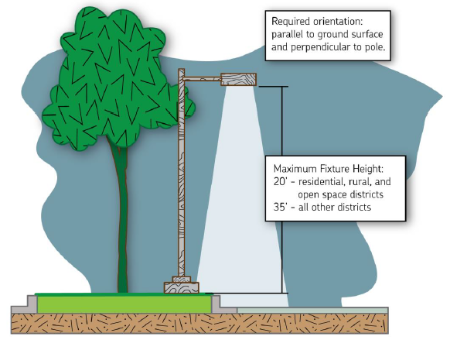
E.
Intensity of illumination. The amount of illumination attributable to exterior lighting, as measured at the property line, shall not exceed 2.0 footcandles above ambient lighting conditions on a cloudless night. The maximum average lighting within any lit area shall not exceed 5.0 footcandles, except where the zoning administrator determines that greater illumination is necessary for public safety.
F.
Fixture heights. The maximum height from the base of the pole or its support to the fixture shall be 20 feet in residential, rural, and open space zoning districts, and 35 feet in all other districts.
G.
Location. Light fixtures shall not be located within any required buffer yard under this chapter, or closer than three feet from a property line.
H.
Flashing, flickering and other distracting lighting. Flashing, flickering, moving (such as search spot or search lights), and/or other lighting that may distract motorists is prohibited.
I.
Qualitative requirements. Design and color of light fixtures and poles shall be compatible with building design and color on the same lot. Street intersections, driveway intersections, and pedestrian access routes shall be illuminated with lights of appropriate scale to the function, without providing an obviously uneven illumination pattern across the site.
J.
Exceptions. The appropriate site plan approval authority may grant exceptions to the requirements of this section in the following circumstances:
(1)
Outdoor recreation use and assembly areas such as athletic fields.
(2)
Gas station pump islands and other uses in which motor vehicles and pedestrians routinely operate in close proximity with one another. Use of recessed canopy lighting to minimize off-site impacts may be required.
(3)
Lighting for special events, per an approved special event permit.
K.
Nonconforming lighting. All lighting fixtures existing prior to the effective date of this chapter shall be considered legal conforming structures and may be continued (see article XIV). However, as part of a site plan approval for a new, expanded, or remodeled project or use on the same site, the site plan approval authority may require that such lighting be reoriented to achieve greater or full compliance with this section.
(Ord. No. 16-07, 6-20-2016)
§ 520-91. - Noise standards.
A.
Applicability. The requirements of this section apply to all uses and activities on real property that create detectable noise, except these standards shall not apply to incidental traffic, parking, loading, maintenance, or agricultural operations or where the activity is otherwise exempt or the standard is modified under state or federal law. The requirements in this section shall be in addition to those in chapter 382 of the Kronenwetter Municipal Code.
B.
Standards. In no event shall the sound-pressure level of noise radiated continuously from a facility exceed at the lot line of a property the values given in figure 520-91(1) as measured by a Type 2 sound meter that is in compliance with ANSI standard S1.4-1983, at both the surface level and five feet above the surface level, and for a duration of four consecutive hours.
C.
Legal nonconforming noises. Noises that were in effect as of the effective date of this chapter shall be considered legal nonconforming noises under this chapter, but may not be exempt from Chapter 382. The burden of proof to demonstrate that said noises were in effect prior to the effective date of this chapter shall be the responsibility of the noise producer.
D.
Compliance and enforcement. The zoning administrator may require the owner or operator of any use, facility, or operation that the zoning administrator reasonably suspects is in violation of this section to verify compliance at the owner's or operator's expense. Enforcement actions may be per section 520-134, and per § 382-2 of the Kronenwetter Municipal Code.
(Ord. No. 16-07, 6-20-2016)
§ 520-92. - Air pollution standards.
A.
The requirements of this section apply to all land uses and activities, except that these standards shall not apply to air pollution created during the construction of the principal use on a property, or by incidental traffic, parking, loading, maintenance, or agricultural operations.
B.
The emission, from all sources within any lot, of particulate matter containing a section diameter larger than 44 microns is prohibited.
C.
Emission of smoke or particulate matter of density equal to or greater than Number 2 on the Ringelmann Chart (U.S. Bureau of Mines) is prohibited at all times.
D.
Dust and other types of air pollution borne by the wind from such sources as storage areas, yards, and roads within the boundaries of any lot shall be kept to a minimum by appropriate landscaping, hard-surfacing, watering, or other acceptable means. This standard shall not apply to allowable agricultural uses within an agricultural zoning district.
E.
All uses shall comply with all applicable state and federal standards.
F.
The zoning administrator may require the owner or operator of any use, facility, or operation suspected of being in violation of this section to verify compliance at his, her, or its own expense.
(Ord. No. 16-07, 6-20-2016)
§ 520-93. - Odor standards.
No land use shall cause any odor that is offensive to a person of reasonable sensibilities detectable at any lot line of any lot in a residential district for periods exceeding a total of 15 minutes of any day.
(Ord. No. 16-07, 6-20-2016)
§ 520-94. - Glare and heat standards.
A.
The requirements of this section apply to all land uses and activities, except that these standards shall not apply to glare created during the construction of a principal use, or by incidental traffic, parking, loading, maintenance, or agricultural operations.
B.
No direct or sky-reflected glare, whether from floodlights or from temperature processes such as combustion or welding or otherwise, so as to be visible at any lot line of a property shall be permitted. Furthermore, there shall be no transmission of heat or heated air so as to be discernible (by a healthy observer such as the zoning administrator or a designee) at the lot line. Solar energy systems regulated by Wis. Stats. § 66.0401, shall be entitled to the protection of its provisions.
(Ord. No. 16-07, 6-20-2016)
§ 520-95. - Fire and explosion standards.
A.
Any use involving materials that could detonate shall locate such materials not less than 400 feet from any residentially zoned property, except that this standard shall not apply to the storage or usage of liquefied petroleum, diesel, or natural gas for normal on-site purposes. All activities and storage of flammable and explosive materials at any point shall be provided with adequate safety and firefighting devices in accordance with all fire prevention codes of the state.
B.
All materials that have capabilities ranging from active to intense burning shall be manufactured, utilized, processed, and stored only in completely enclosed buildings that have incombustible exterior walls and an automatic fire extinguishing system. The aboveground storage capacity of materials that produce flammable or explosive vapors shall not exceed that in figure 520-95.
(Ord. No. 16-07, 6-20-2016)
§ 520-96. - Toxic or noxious material standards.
A.
No use shall discharge across the boundaries of any property, or through percolation into the subsoil, toxic or noxious material in such concentration as to be detrimental to, or endanger, the public health, safety, comfort, or welfare, or cause injury or damage to the property or business.
B.
No use shall discharge at any point into any public or private wastewater treatment system or stream, or into the ground, any liquid or solid materials except in accordance with the regulations of the state department of public health.
(Ord. No. 16-07, 6-20-2016)
§ 520-97. - Waste material standards.
A.
No use shall discharge across the boundaries of any property, or through percolation into the subsoil, toxic or noxious material in such concentration as to be detrimental to, or endanger, the public health, safety, comfort, or welfare, or cause injury or damage to the property or business.
B.
No use shall discharge at any point into any public or private wastewater treatment system or stream, or into the ground, any liquid or solid materials except in accordance with the regulations of the state department of natural resources.
(Ord. No. 16-07, 6-20-2016)
§ 520-98. - Hazardous materials standards.
A.
Compliance with statutes. All hazardous materials shall be regulated in accordance with the relevant state statutes:
(1)
Microorganism cultures, subject to Wis. Stats. § 94.65;
(2)
Pesticides, subject to Wis. Stats. § 94.67(25);
(3)
Biological products, subject to Wis. Stats. § 95.39;
(4)
Hazardous substances, subject to Wis. Stats. § 100.37(1)(c);
(5)
Toxic substances, subject to Wis. Stats. § 101.58(2)(j);
(6)
Infectious agents, subject to Wis. Stats. § 101.58(2)(f);
(7)
Any material for which the state requires notification of a local fire department; or
(8)
Any other uses, activities, or materials which are subject to county, state, or federal hazardous, or related, materials regulations.
B.
Notification of use of hazardous materials. All land uses involving hazardous materials listed in this section, except for agricultural uses, shall submit a written description of such materials and the operations involving such materials conducted on their property as part of any required site plan submittal.
C.
Risk management and emergency response program. As part of any permit review process under this chapter, the village may require such operator to prepare and submit a process safety management, risk management, containment, and emergency response program for approval by the fire chief. In the event of any spill or other accident involving toxic, hazardous, or radioactive materials, the responsible party shall immediately notify the fire department and HazMat team, and shall follow procedures specified in any approved process safety management, risk management, containment, and emergency response program.
(Ord. No. 16-07, 6-20-2016)
§ 520-99. - Electromagnetic emission standards.
No activity shall emit electrical, radioactive or other electromagnetic disturbances outside its premises that are dangerous to plant or animal life as determined by applicable federal or state regulation or which adversely affect the use of neighboring premises such as by interfering with the use or enjoyment of common household and business equipment such as radio, television, telephone, computer or facsimile operations, except where such activity is exempt or the standard is modified under state or federal law.
(Ord. No. 16-07, 6-20-2016)

