
Kronenwetter City Zoning Code
ARTICLE XI
LANDSCAPING AND PRESERVATION STANDARDS
§ 520-78.- Purpose.
The purpose of this article is to establish landscaping requirements to provide and maintain vegetation in a manner that promotes the village's natural resource protection, aesthetic, and public health goals.
(Ord. No. 16-07, 6-20-2016)
§ 520-79. - Landscaping requirements.
A.
Applicability. Any use for which site plan approval is required under subsection 520-16.J shall provide landscaping in accordance with the requirements of this section, including expansion, renovation, and redevelopment of existing buildings and sites. Where the predecessor zoning ordinance, or a village zoning decision under that ordinance, required landscaping, and it has not been satisfactorily installed or maintained, the property owner shall be required to install or restore such landscaping. Where the appropriate site plan approval authority under section 520-124 determines that full compliance with the requirements of this section is impractical, the approval authority may require compliance to the extent it determines practical. Such a determination of impracticality may be based on one or more of the following conditions:
(1)
Preexisting buildings or impervious surfaces, and/or insufficient lot area, do not provide sufficient green space for full compliance.
(2)
Village stormwater management or easement requirements do not provide sufficient area for full compliance.
(3)
A redevelopment project would otherwise be infeasible, based on financial information provided by the applicant.
(4)
Full compliance would result in a plan in which landscaping would, by maturity, interfere with or compete with one another for survival and may therefore require removal at a later date.
(5)
Where a proposed addition does not exceed 50 percent of the original building or hard-surfaced area size. In such cases, the quantitative landscaping standards shall be met in proportion to the size of the addition as compared to the original building or hard-surfaced area.
B.
Required landscape plan and preparer qualifications. All proposed landscape plantings to be located on the subject property shall be depicted on a landscape plan as to their location, type, and size at time of planting and maturity. All landscape plans required under this article shall be prepared by a licensed landscape architect, certified landscape designer, or another professional or individual skilled in landscape design, as determined by the zoning administrator.
C.
Landscape planting requirements. Landscaping shall be provided based on the following requirements for hard- or gravel-surfaced areas, building foundations, buffer yards (where applicable), and general yard areas. These requirements are additive to each other and any other landscaping or screening requirements in this article. By approval of the applicable site plan approval authority, required landscaping points may be shifted between areas (e.g., hard-surfaced areas to building foundations). The landscaping point system is described in greater detail in subsection D below.
(1)
Hard- and gravel-surfaced areas. Within industrial zoning districts, 100 points of landscaping shall be planted for each 2,500 square feet of hard- and gravel-surfaced area, not including rooftops. Within all other zoning districts, 100 points of landscaping shall be planted for each 1,500 square feet of hard- and gravel-surfaced area, not including rooftops. Plants required under this subsection shall be installed within landscaped islands within a hard-surfaced area or within 15 feet of the edges of a hard- or gravel-surfaced area, and shall include large deciduous trees unless otherwise approved by the appropriate site plan approval authority. See example in figure 520-79(1).
Figure 520-79(1): Hard- and Gravel-Surfaced Landscaping Example Assuming Mature Planting
Sizes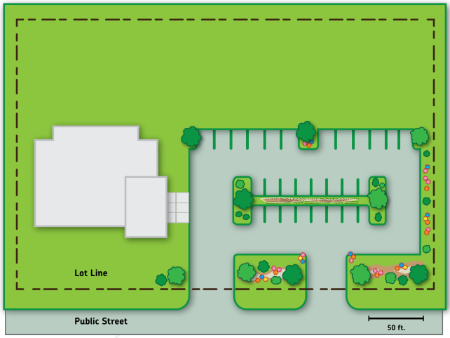
(2)
Building foundations. Within industrial zoning districts, 100 points of landscaping shall be planted for each 200 lineal feet of exterior building wall that is visible from a public right-of-way or residentially zoned property. Within all other zoning districts, 100 points of landscaping shall be planted for each 150 lineal feet of exterior building wall. Plants required under this subsection must be installed within 20 feet of the building foundation and shall not include large deciduous shade trees. See example in figure 520-79(2).
Figure 520-79(2): Building Foundation Landscaping Example Assuming Mature Planting
Sizes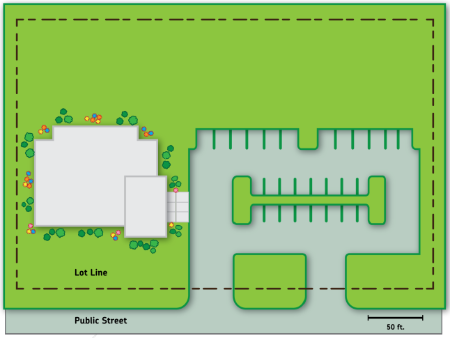
(3)
Buffer yards. A buffer yard, as defined in section 520-138, shall be provided if required for a particular land use listed in article IV and where otherwise required via site plan approval under section 520-124. Where required, buffer yards shall comply with the following.
(a)
The minimum width of a buffer yard shall be 25 feet, unless reduced by the site plan approval authority if it determines that a lesser width is adequate to separate incompatible uses/activities or is necessary owing to site constraints beyond the control of the owner.
(b)
No building, parking lot, loading area, motor vehicle circulation area, trash storage area, or outdoor storage area shall be permitted in a required buffer yard.
(c)
Landscaping within buffer yards shall be selected, positioned, and planted in sufficient quantities to provide an all-season screen within five years of planting and have a minimum height of three feet at time of planting. See example in figure 520-79(3).
(d)
The use of a decorative opaque fence or wall, and/or a berm, in lieu of or in addition to the landscaping may be approved by the site plan approval authority, provided that the slope of any berm is less than 2:1 (two foot horizontal, one foot vertical); the berm, fence or wall does not interfere with access, utilities, or stormwater management.
Figure 520-79(3): Buffer Yard Landscaping Example Assuming Mature Planting Sizes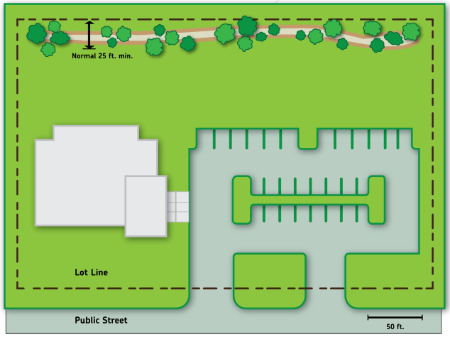
(4)
General yard areas. Within industrial zoning districts, 100 points of landscaping shall be planted for each 5,000 square feet of total lot area, excluding those areas under a rooftop, hard- or gravel-surfaced area, required buffer yard, or being reserved for a future phase of development. Within all other zoning districts, 100 points of landscaping shall be planted for each 4,000 square feet of total lot area, excluding those areas under a rooftop, hard- or gravel-surface area, required buffer yard, or being reserved for a future phase of development. Landscaping required by this standard shall be placed where appropriate on the site to maximize visual impact of landscaping, such as in a front or street side yard or adjacent to other uses.
Figure 520-79(4): General Yard Area Landscaping Example Assuming Mature Planting Sizes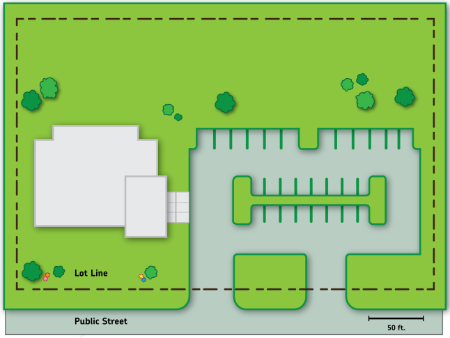
Figure 520-79(5): "Complete Picture" Landscaping Example Assuming Mature Planting
Sizes (buffer yard will not be required in most cases)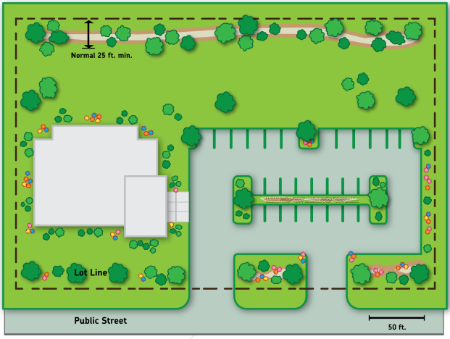
(5)
Other green space areas. Green space areas not used for landscape plantings, other than natural resource protection areas, shall be graded and sodded or seeded with a maintainable seed mix. Organic or natural mulch of plantings or planting beds is acceptable but shall be installed so it does not erode, fall, be plowed, or otherwise transported into walks, drives, streets, or other hard-surfaced portions of the site.
D.
Landscaping points and minimum installation sizes. Most of the above landscaping requirements are expressed in terms of landscape points. Each plant type, below, is worth a certain number of landscape points that can be used to fulfill the landscaping requirements. Minimum permitted installation sizes for each plant category are provided to ensure that landscaping provides its aesthetic and screening functions at the time of installation and to improve survival rates. The schedule of landscaping points and minimum permitted installation sizes is as presented in figure 520-79(6).
E.
Prohibited and discouraged species.
(1)
The following species are prohibited in the public right-of-way, within ten feet of any lot line or parking lot perimeter, and in parking lot islands:
(a)
Ailanthus (tree of heaven).
(b)
American elm, and any other species of elm not resistant to Dutch elm disease.
(c)
Ash (all varieties, until threat of emerald ash borer is eliminated).
(d)
Buckthorn (common or glossy).
(e)
Black locust.
(f)
Box elder.
(g)
Catalpa.
(h)
Cottonwood (except along water edges).
(i)
European white birch.
(j)
Honeysuckle.
(k)
Lombard poplar.
(l)
Mulberry.
(m)
Russian olive.
(n)
Siberian elm.
(o)
Silver maple.
(p)
Walnut.
(q)
Willow (except along water edges).
(r)
Other weak-wooded tree species or species that deposit a significant number of twigs, seed pods, fruits, nuts, and/or other debris, as determined by the zoning administrator.
(2)
Evergreen trees are prohibited within the public right-of-way.
F.
Existing plant materials. A reasonable attempt shall be made to preserve as many existing trees as is practicable and to incorporate them into the landscape plan, including techniques for preservation. In instances where healthy plant materials of acceptable species, as determined by the village, exist on a site prior to its development, the application of the standards in this section may be adjusted by the village to allow credit for such material, provided that such adjustment is consistent with the intent of this article.
G.
Installation. All landscaping required under this section shall be installed consistent with Village standard specifications and industry accepted standards and shall be guaranteed by the applicant or the applicant's contractor for two years. Installation shall occur prior to occupancy or commencement of operations, unless doing so would result in unsatisfactory plant survival. In this case, landscaping shall be installed within six months of occupancy or commencement of operations, and the village may require a performance guarantee, such as a deposit or letter of credit, before a permit or certificate for building occupancy is granted and until such landscaping is installed according to plan.
H.
Maintenance. Landscaping required by this section is intended to be a permanent site improvement. As such, all landscaping shall be continually maintained in a live state. Maintenance shall include periodic and timely watering, irrigation where necessary, replenishment of mulch, weeding, fertilizing, pruning and any other such normally required horticulture activity necessary to keep all landscaping in a healthy, safe and aesthetically pleasing state. Recognizing that over time plants may mature and die or otherwise expire because of natural or unnatural causes; maintenance shall also include the removal and replacement of dead or dying plants. Such replacement shall occur within the same year in which a plant dies or in the spring planting season of the following year. Landscaping shall also be subject to applicable maintenance standards with chapter 409 of the Kronenwetter Municipal Code.
I.
Location in utility easements. Planting in utility easements is at the risk of the property owner. Any plants that must be removed because of utility work within such easements shall be replaced by the property owner at his or her cost.
(Ord. No. 16-07, 6-20-2016; Ord. No. 17-09, 4-11-2017)
§ 520-80. - Lawn care; alternative groundcover; preservation of topography.
A.
Lawn care and alternative groundcover. Care of lawns, gardens, and natural areas shall comply with the requirements of chapter 409 of the Kronenwetter Municipal Code.
B.
Preservation of topography.
(1)
With development of any land, effort shall be maintained to preserve preexisting topography to the extent practical and consistent with safe, efficient, and attractive land development.
(2)
No structure shall be built that would alter the existing drainage or topography in any way as to adversely affect the adjoining property(ies).
(3)
In no case shall any slope exceed the normal angle of slippage of the material involved.
(4)
No change in existing topography shall be made that would result in increasing the slope of any land within a distance of 20 feet from a property line to a ratio greater than four horizontal to one vertical (maximum 4:1 slope).
(Ord. No. 16-07, 6-20-2016)

