
La Palma City Zoning Code
ARTICLE II
ZONING DISTRICTS AND ALLOWABLE LAND USE
Sec. 44-39. - Establishment of zoning districts.
The City shall be divided into zoning districts that implement the general plan. The following zoning districts are established and shall be shown on the official zoning map, which is hereby incorporated by reference into this chapter:
(Ord. No. 2015-01, § 3, 5-5-2015)
Sec. 44-40. - Location of boundaries.
The location and boundaries of the various zoning districts are as shown and delineated on the zoning map of the City.
(Ord. No. 2015-01, § 3, 5-5-2015)
Sec. 44-41. - Changes in boundaries.
Changes in the boundaries of the zoning districts shall follow the process established in Section 44-668.
(Ord. No. 2015-01, § 3, 5-5-2015)
Sec. 44-42. - Uncertainty of boundary location.
Where uncertainty exists as to the boundaries of any zoning district, the following rules shall apply:
(1)
Where zoning district boundaries are indicated as approximately following street and alley centerlines, the boundaries shall be construed to be the centerlines. Where zoning district boundaries are indicated as approximately following lot lines, the boundaries shall be construed to be the lot lines.
(2)
In the case where a zoning district boundary divides a lot, the location of the boundaries shall be indicated by dimensions or description on the zoning map. Where dimensions or description are missing, the boundaries shall be determined by use of the scale shown on the zoning map.
(3)
If uncertainty still exists, the City Council shall determine the boundary.
(4)
Where a public street or alley is officially vacated or abandoned, the area comprising the vacated street or alley shall acquire the classification of the property to which it reverts.
(Ord. No. 2015-01, § 3, 5-5-2015; Ord. No. 2016-06, § 8, 5-3-2016)
Sec. 44-43. - Unclassified property.
(a)
Property that, for any reason, is not designated on the zoning map as being classified in any of the zoning districts established by this chapter shall be deemed to be classified R-1, Single-Family Residential District. Land hereafter annexed to the City shall be zoned and classified in the R-1, Single-Family Residential District, unless a specific classification is established.
(b)
Whenever the City deems that the zoning of annexed land as R-1 is not adequate or desirable, the Community Development Director may recommend, and the City Council may adopt, the zoning district applicable to the annexed lands through the manner prescribed for amending this Development Code.
(c)
Dedicated streets or alleys and railroad rights-of-way, other than those designated on the zoning map, shall be deemed to be unclassified and, in the case of streets, permitted to be used only for purposes lawfully allowed and, in the case of railroad rights-of-way, permitted to be used solely for the purpose of accommodating tracks, signals, other operative devices, and the movement of the rolling stock. For the purpose of constructing residential units, the density shall be based upon the lot area after dedication, if any.
(Ord. No. 2015-01, § 3, 5-5-2015; Ord. No. 2016-06, § 9, 5-3-2016)
Sec. 44-44. - Cannabis related uses, commercial cannabis activities, deliveries, and cultivation prohibited.
(a)
Prohibitions. The following uses are prohibited in all zones in the City as follows:
(1)
Cannabis related uses. All Cannabis related uses, including but not limited to cooperatives, cultivation, deliveries, dispensaries, and other commercial cannabis activities for which a State license is required under the MMRSA, are prohibited throughout the City. The City shall not issue any permit, or process any license or other entitlement for any Cannabis related use or any other activity for which a State license is required under the MMRSA. No person shall establish, operate, conduct, permit or allow any Cannabis related use anywhere within the City as prohibited under this subsection.
(2)
Commercial cannabis activities. All commercial cannabis activities, including but not limited to cooperatives, cultivation, deliveries, and dispensaries, are expressly prohibited throughout the City regardless of whether or not the commercial cannabis activity is for medical cannabis or cannabis used for medicinal purposes. The City shall not issue any permit, or process any license or other entitlement for any commercial cannabis activity. No person shall establish, operate, conduct, permit or allow a commercial cannabis activity anywhere within the City.
(3)
Cannabis deliveries. All deliveries of cannabis and medical cannabis are expressly prohibited in the City. No person shall conduct any deliveries of cannabis or medical cannabis that either originate or terminate at any location within the City.
(4)
Cannabis cultivation. The cultivation of cannabis, regardless of whether for commercial or non-commercial purposes, and including cultivation by a qualified patient or primary caregiver, is expressly prohibited throughout the City. No person, including but not limited to a qualified patient or primary caregiver, shall cultivate any amount of cannabis in the City, regardless of whether or not the cannabis is intended to be used for medical purposes.
(b)
Public nuisance. Any use or condition caused, or permitted to exist, in violation of any provision of this section shall be, and is hereby declared to be, a public nuisance and may be summarily abated by the City pursuant to California Code of Civil Procedure § 731 or any other remedy available at law.
(c)
Civil penalties. In addition to any other enforcement permitted by Code, the city attorney may bring a civil action for injunctive relief and civil penalties against any person who violates any provision of this section. In any civil action that is brought pursuant to this chapter, a court of competent jurisdiction may award civil penalties and costs to the prevailing party.
(Ord. No. 2016-02, § 5, 1-19-2016)
Sec. 44-75. - Purpose.
This division provides regulations applicable to development and land uses in the residential zoning districts established by Section 44-39. The purpose of the individual residential zoning districts and the manner in which they are applied is provided in Section 44-76.
(Ord. No. 2015-01, § 3, 5-5-2015)
Sec. 44-76. - Purpose of residential zoning districts.
(a)
R-1, single-family residential. The R-1 zoning district identifies areas intended for single-family housing types, including conventional single-family detached homes, patio homes, zero lot line homes, mixed-use developments, and attached, lower-density developments such as single family residential duplexes. The allowable density range is from 1.0 to 8.7 dwelling units per net acre. The R-1 zoning district is consistent with the single-family residential land use designation of the general plan.
(b)
R-3, multiple-family residential. The R-3 zoning district identifies areas intended for the development of a range of attached and detached residential uses. Typical housing types include higher density single-family residences, patio homes, zero lot line homes, mixed-use developments, and attached multiple-family dwellings such as multiple family residential duplexes, townhomes, condominiums, and garden apartments. Smaller sites composed of two acres or less are permitted to be developed with a maximum density of ten dwelling units per net acre. Larger sites that are between two and one-tenth to four acres are permitted to be developed with densities up to 15 dwelling units per net acre and sites composed of at least four and one-tenth acres are permitted to be developed with a maximum density of 25 dwelling units per net acre. The R-3 zoning district is consistent with the multiple-family residential land use designation of the general plan.
(c)
VRO, village residential overlay. The VRO designation is intended as an overlay zone for certain areas within the multiple-family residential land use designation that involve special development opportunities and require a tailored approach to planning and design. The designation is intended to provide for a variety of housing types within one project or development, ranging from single-family housing to multiple-family dwellings. The types of developments that are suitable to the village residential overlay include affordable housing projects, senior housing projects, or multiple family residential duplexes that involve tailored development standards and site design. Such tailored development standards and site design shall be permitted only upon approval of the City Council via specific plan. Absent City Council approval of a tailored site design or of tailored development standards for a particular parcel, the development standards applicable to all properties in the R-3 zone as detailed in section 44-79 et seq. apply all parcels to which the VRO designation is applied.
VRO, specific plan required. It is required that the design and development of a parcel within the VRO with tailored development standards shall only be conducted in accordance with the provision of state law and approved by the City Council. Any specific plan for development within the VRO shall specify, among other features, the distribution, densities, location and extent of uses of land, including open space; and the standards and criteria by which development will proceed within the VRO.
VRO, density. The maximum allowable density on a parcel within the multiple-family residential (R-3) to which the VRO designation is applied shall be 30 units to the acre (30 du/ac), regardless of the size of the parcel in the multiple-family residential (R-3) to which the VRO designation is applied. Approval of the specific plan by the City Council shall establish the density for parcels upon which a specific plan is required for tailored development standards. No component of a specific plan in the VRO shall have more than (30 du/ac) unless a request for a density bonus is approved under State Density Bonus Law.
(Ord. No. 2015-01, § 3, 5-5-2015; Ord. No. 2016-06, § 10, 5-3-2016; Ord. No. 2019-01, § 4, 1-15-2019; Ord. No. 2022-01, § 9, 5-3-2022; Ord. No. 2024-04, § 4, 12-10-2024)
Sec. 44-77. - Precise plan required.
A precise plan shall be required for all residential development except for single-family dwellings on previously subdivided lots, and for all nonresidential developments exceeding 2,000 square feet of total floor area.
(Ord. No. 2015-01, § 3, 5-5-2015; Ord. No. 2016-06, § 11, 5-3-2016; Ord. No. 2022-01, § 10, 5-3-2022; Ord. No. 2024-04, § 4, 12-10-2024)
Sec. 44-78. - Allowed uses.
The following table indicates those uses that are permitted (P), allowed subject to the approval of a conditional use permit (C), or prohibited (X) in residential zoning districts:
Notes:
See section 44-139, regarding uses not listed.
See article I for definitions of land uses.
* Requires written approval of landlord/property manager.
(Ord. No. 2015-01, § 3, 5-5-2015; Ord. No. 2016-02, § 6, 1-19-2016; Ord. No. 2018-03, § 5, 5-15-2018; Ord. No. 2022-01, § 11, 5-3-2022; Ord. No. 2022-06, § 7, 8-2-2022; Ord. No. 2023-02, § 5, 2-7-2023; Ord. No. 2024-04, § 4, 12-10-2024)
Sec. 44-79. - Development standards for residential zoning districts.
(a)
New land uses and structures and alterations to existing land uses and structures shall be designed, constructed, and/or established in compliance with the requirements in table II-2 (development standards for residential zoning districts), in addition to all other applicable development standards (e.g. landscaping, parking, loading, etc.) in article III (standards applicable in all zoning districts).
(b)
Permanently sited manufactured homes certified under the National Manufactured Housing Construction and Safety Standards Act of 1974 (42 U.S.C. § 5401 et seq.) may not be excluded from lots zoned for single-family dwellings, and are subject to the same rules a site-built homes, except architectural requirements concerning the manufactured home's roof overhang, roofing materials, and siding materials. Pursuant to California Government Code § 65852.4, and with the exception of architectural requirements, the City shall not subject an application to permanently site a manufactured home on a lot zoned for single-family dwelling to any administrative permit, planning or development process, or requirement which would not be imposed on a conventional site-built single-family residential dwelling on the same lot.
1 For conventional single-family parcels only. For other permissible housing types, minimum lot size shall be determined by density range or section 44-1259.
2 This setback requirement applies in the applicable residential property zone, unless another, more specific setback requirement applies, or unless otherwise preempted by law. Paved areas other than the driveway and paved ancillary parking area shall not encroach into the required front yard area in single-family developments.
3 This setback requirement applies in the applicable residential property zone, unless another, more specific setback requirement applies, or unless otherwise preempted by law. Tailored development standards and site design permitted on housing projects, other than conventional single-family, shall be permitted with approval of the City Council.
4 20-foot setback for front loaded garages and 15 feet for side-loaded garages.
5 This setback requirement applies in the applicable residential property zone, unless another, more specific setback requirement applies, or unless otherwise preempted by law.
6 Ten-foot rear yard setback provided the rear yard backs up to an arterial roadway, railroad right-of-way, Southern California Edison right-of-way, flood control channel, industrial zoned property, or commercial zoned property and maintain a minimum rear yard area of 1,000 square feet.
(Ord. No. 2015-01, § 3, 5-5-2015; Ord. No. 2016-06, § 12, 5-3-2016; Ord. No. 2020-03, § 6, 6-2-2020; Ord. No. 2022-01, § 12, 5-3-2022; Ord. No. 2024-04, § 4, 12-10-2024)
Sec. 44-80. - Lighting in multifamily housing.
(a)
Lighting in multifamily housing type occupancies shall be as follows:
(1)
Aisles, passageways and recesses related to and within the building complex shall be illuminated with an intensity per Section 44-278 at the ground level during the hours of darkness. Lighting devices shall be protected by weather and vandalism-resistant covers.
(2)
Open parking lots and carports shall be provided with a maintained minimum of one foot-candle of light on the parking surface during hours of darkness. Lighting devices shall be protected by vandal-resistant covers. These lighting devices shall be automatically energized during hours of darkness.
(3)
Each residential unit of multifamily housing type occupancies shall have an enclosed parking space with a garage door equipped as in Section 10-336.
(Ord. No. 2015-01, § 3, 5-5-2015)
Sec. 44-102. - Accessory uses and structures.
(a)
Required setbacks.
1 On lots with only one side yard, the minimum required side setback for patio covers shall be three feet.
2 Condominiums and townhouses shall have a minimum side yard setback of three feet for patio covers.
3 For side entry garages, setback to be determined by City Council at the time of precise plan or amendment to precise plan approval.
4 Storage sheds requiring building permit per California Building Code (CBC) Section 105.1 must adhere to zoning setbacks. Storage sheds exempt from building permits per the California Building Code Section 105.2 are exempt from zoning setback requirements.
5 The total number of exempt storage sheds allowed on a single family (R-1) lot shall not exceed 480 square feet of total aggregate area.
(b)
Maximum height for an accessory structure.
(c)
Specific accessory structure development standards.
(1)
Balconies or decks for single-family structures.
a.
Outside stairway. There shall be no outside stairway in the R-1 zoning district.
b.
Screen or guardrail. A minimum 36-inch high screen or guardrail shall be constructed of materials compatible with the design of the structure.
c.
Screen wall. A screen wall, a minimum of six feet in height, shall be constructed on both sides (ends) of the balcony or deck for the full depth of the balcony or deck or as required by the conditions of approval. This requirement may be waived by the Community Development Director where it is clear that the balcony will not negatively impact adjacent residential properties.
d.
Maximum size. The maximum size of a balcony or deck shall be 120 feet square feet.
e.
Doors. There shall be no outside doors above the first story except when allowed with an approved balcony or deck.
f.
Enclosure. Balconies or decks shall not be enclosed except by the adjoining residential unit and any required screen walls.
(2)
Patio covers. Patio covers shall not cover more than 50 percent of the required rear yard area.
(3)
Storage sheds. Storage sheds shall not exceed 120 square feet in area. Permanent electrical service shall not be allowed within storage sheds.
(4)
Workshops.
a.
Minimum/maximum. Workshops shall have a minimum area of 120 square feet and not exceed a maximum area of 400 square feet.
b.
Habitable area. Workshops shall not contain any habitable areas and shall not be used for habitation of humans.
c.
Enclosure. Workshops shall be fully enclosed and shall contain at least one door not less than 32 inches in width and may contain no interior walls. If greater than 200 square feet, workshops shall contain a window with a minimum dimension of 24 inches by 36 inches.
d.
Air conditioning and heating units. Workshops shall not have air conditioning and heating units.
e.
Permit. Building permits are required for workshops.
f.
Separation. Workshops shall be located at least ten feet from any portion of a residential structure.
(5)
Canopies.
a.
Location. Canopies are not to be permitted in the front yard area or visible from the public-right-of-way.
b.
Maintenance. Canopies shall be maintained and remain in good condition at all times.
c.
Temporary permitted use. Canopies may be located in a front yard area or be visible from the public right-of-way for up to 72 hours, with a temporary use permit or block party permit.
(Ord. No. 2015-01, § 3, 5-5-2015; Ord. No. 2016-06, § 13, 5-3-2016)
Sec. 44-103. - Garage/yard sales.
(a)
Number of sales. A resident shall be allowed to hold a maximum of two garage/yard sales at his or her dwelling unit in each calendar year.
(b)
Length of sale. Garage/yard sales shall not extend for more than two consecutive days or three consecutive days on extended national holidays.
(c)
Sales area. Sale areas shall be confined to the garage and driveway area within the front yard. Where no driveway exists, one-half of the property width in the front yard area may be used for the sale of merchandise.
(d)
Hours. Garage/yard sales may only be conducted within the hours of 7:00 a.m. and sunset.
(e)
Permits. A person shall obtain a permit from the community development department prior to having a garage/yard sale.
(Ord. No. 2015-01, § 3, 5-5-2015)
Sec. 44-104. - Animals.
Up to four household pets are permitted in the residential zones. For the purposes of this section, household pets shall include dogs, cats, parrots, canaries and other house birds of a similar nature, hamsters, rabbits, guinea pigs, white rats, white mice, turtles, salamanders, newts, chameleons, kangaroo rats, nonpoisonous reptiles not over six feet long, any nonpoisonous toad, lizard or spider, and other animals of a similar nature. Any unweaned litter from such household pets not over six months old shall be permitted. Fowl (other than house birds), horses, sheep, cattle, pigs, goats, and similar farm animals are prohibited. Fish shall be excluded from the limitations established by this section. Regardless of any permissions granted by this section, all dangerous animals, as defined by this chapter, shall be prohibited.
(Ord. No. 2015-01, § 3, 5-5-2015)
Sec. 44-105. - Block parties.
(a)
Permit required. No block party shall be permitted to operate within the City unless the event holder obtains a block party permit, as well as any other permits or licenses required by law. Procedures for obtaining a block party permit are established in Section 44-947.
(b)
Regulations. Applicants for permits under this article shall comply with each of the following minimum requirements:
(1)
Block party hours are limited to 10:00 a.m. to 10:00 p.m.
(2)
Only neighborhoods with cul-de-sacs may conduct block parties.
(3)
Ninety percent of the residents affected by the closure of the street must consent to the block party by signing the application. For the purposes of this subsection, all residents of an affected property shall be deemed to have given consent if at least one owner or one legal tenant over the age of 18 of said property has signed the application.
(4)
If the block party includes equipment or services from a private vendor to be used on a public right-of-way, the responsible party must submit a copy of the vendor's General Liability Insurance Certificate naming the City as an additional insured in an amount to be determined at the time of application.
(Ord. No. 2015-01, § 3, 5-5-2015)
Sec. 44-106. - Mechanical equipment.
(a)
Location. Mechanical equipment (e.g., HVAC units) may be located in the rear yard, side yard, or on the roof. Such equipment may only be located in an interior side yard if it is not feasible to locate it in the rear yard. All equipment in the side yard shall be located at the furthest possible location away from windows on the adjacent property but in no case shall the equipment be less than ten feet from any window on the adjacent property. Pool equipment is only permitted in the rear yard area.
(b)
Noise. HVAC units shall be exempt from the community noise standards established in Section 44-267, provided that the unit is properly located and is working at or below the manufacturer's decibel rating for the unit. All other mechanical equipment shall be subject to the requirements of Section 44-267.
(c)
Visibility. All reasonable efforts shall be taken to ensure that mechanical equipment is not visible from public streets and is screened from view of adjacent residential properties in a manner approved by the Community Development Director.
(d)
Chimney structures.
(1)
Chimney structures that are incorporated within or affixed to the exterior of a residential structure shall be enclosed within a chassis and finished with brick, rock, stucco, or wood/metal siding. All materials, except for brick and rock, utilized for the chimney are required to be painted with colors that are compatible with the residence and any other chimney structure on the residence.
(2)
Round metal pipes, clay pipes, guy wires, and straps for chimneys shall be fully enclosed within the chassis and shall not be visible from the property line.
(3)
Gas vent pipes and other mechanical ducts that are less than six inches in diameter when leaving the interior of the structure are exempted from these requirements.
(Ord. No. 2015-01, § 3, 5-5-2015)
Sec. 44-107. - Vehicles, motorized recreational vehicles, and recreational objects-maintenance and repair guidelines.
(a)
No person shall perform other than minor or routine maintenance or repair on any vehicle, motorized recreational vehicle, or recreational object while parked on a driveway or paved ancillary parking area. Additionally, no person shall leave a vehicle, motorized recreational vehicle, or recreational object parked upon a driveway or paved ancillary parking area in a visible state of disrepair or semi-repair in excess of six hours.
(b)
The term "visible state of disrepair or semi-disrepair" shall include, without limitation, such a state that it is apparent to a casual observer that the repair or maintenance of the vehicle, motorized recreational vehicle, or recreational object has not yet been completed.
(c)
Upon written request of a residential property owner or residential tenant, the City Manager or his or her designee may grant a waiver of the regulations established by this section, provided that the waiver may be not granted for more than four days in a 30-day period or granted in an effort to facilitate an unauthorized home-based business.
(Ord. No. 2015-01, § 3, 5-5-2015)
Sec. 44-108. - Same—Parking and storage regulations.
(a)
Unless the context indicates otherwise, the definitions set forth in Article I and the California Vehicle Code shall be applicable to this section.
(b)
No vehicle, motorized recreational vehicle, or recreational object shall be parked or stored on any portion of a front yard area of a residential structure. Vehicles, recreational vehicles, and recreational objects parked in driveways shall be parked perpendicular to the garage door of the structure or the public street. For purposes of this section, the term "front yard area of a residential structure" shall include all areas in front of the residential structure with the exception of the driveway of the structure, as the driveway was originally constructed and not more than one paved ancillary parking area.
(c)
No vehicle, motorized recreational vehicle, recreational object, or any accessory, which is parked or stored on private property, shall project into any public sidewalk or public right-of-way or be located in a position that would adversely affect vehicular or pedestrian traffic safety.
(d)
Recreational objects shall not be parked or stored on a driveway or paved ancillary parking area between the hours of 2:00 a.m. and 5:00 a.m. For the purposes of this section, the term "recreational objects" includes camper shells off a truck, boats, personal water craft, off-road vehicles, snowmobiles, airplanes, and any other object made to carry one or more persons, but not including bicycles, tricycles, on-road motorcycles, and scooters.
(e)
Motorized recreational vehicle and recreational object storage is permissible in the side or rear yard area if and only if it is screened in such a way as to be not readily visible from any public right-of-way or separated from any public right-of-way by an opaque fence or wall of approximately six feet in height. Stored vehicles, motorized recreational vehicles, and recreational objects may undergo maintenance of unlimited duration, provided that the portion visible from the public right-of-way or adjacent property from ground elevation is maintained in a clean and orderly appearance.
(f)
Notwithstanding any other provisions of this chapter, vehicles, motorized recreational vehicles, nonmotorized vehicles, and commercial vehicles may be parked or stored on driveways or paved ancillary parking areas only if road operational and kept clean and free of debris. For the purposes of this section, the term "road operational" means a vehicle that possesses the minimum required equipment and certifications to be legally driven on the highways of the State, including a valid current license and registration or temporary registration and all proper safety equipment.
(Ord. No. 2015-01, § 3, 5-5-2015)
Sec. 44-109. - Parking and storage of oversized vehicles in residential areas.
(a)
It shall be unlawful for any person, firm, company, or corporation to park, store, or permit to be parked or stored any oversized vehicle, as defined in section 44-10, on any privately owned property lying within any residential zoning district unless one of the following conditions can be met:
(1)
The vehicle can be parked or stored completely within an enclosed garage.
(2)
The vehicle is parked or stored such that it can be fully screened from view from the public right-of-way and neighboring residential properties. The method of screening shall adhere to the requirements of this chapter in terms of materials used, maximum wall and structure heights, setback requirements, and other applicable standards and permitting requirements for the zoning district in which the subject property is located.
(3)
The vehicle is in the act of making a pickup or delivery or is being used in conjunction with the performance of a bona fide service or construction activity on a residential property in the vicinity.
(b)
This section shall not be applicable to recreational vehicles or objects.
(c)
Nothing contained herein shall prohibit the parking of vehicles of public or private utility companies, including cable television companies, on any public street for a period of time required in the locating, relocating, installation, servicing, testing, or repair of equipment of such companies, nor shall the provisions of this section be construed to prohibit the parking of any vehicles used in the construction, repair, or maintenance of any road, street, or alley in such zoning districts.
(Ord. No. 2015-01, § 3, 5-5-2015)
Sec. 44-111. - Accessory dwelling units (ADUs).
(a)
The purpose of this section is to establish zoning regulations governing accessory dwelling units (ADUs) and junior accessory dwelling units (JADUs), in compliance with Government Code §§ 65852.2 and 65852.22, and to provide standards for the development of ADUs and JADUs. The City may identify an ADU or JADU as an adequate site to satisfy RHNA housing needs as specified in Government Code §§ 65583.1(a) and 65852.2(m).
(b)
A permit application for an ADU or a JADU shall be considered and approved ministerially without discretionary review or a hearing, notwithstanding Government Code §§ 65901 or 65906 or City ordinances regulating the issuance of variances or special use permits. The City shall approve or deny the application to create an ADU or JADU within 60 days from the date the City receives a completed application, if there is an existing single-family or multifamily dwelling unit on the lot. However, if the permit application to create an ADU or JADU is submitted with a permit application to create a new single-family dwelling on the lot, the City may delay acting on the permit application for the ADU or JADU until the City acts on the permit application to create the new single-family dwelling, but the application to create the ADU or JADU shall be considered without discretionary review or hearing. If the applicant requests a delay, the 60-day time period shall be tolled for the period of the delay.
(c)
If the City denies an ADU or JADU application, the City shall provide, in the 60-day time frame set forth above, a full set of written comments to the applicant with a list of items that are defective or deficient and a description of how the application can be remedied by the applicant. The City shall not base any denial of ADU and JADU applications due to the correction of nonconforming zoning conditions, building code violations, or unpermitted structures that do not present a threat to public health and safety and are not affected by the construction of an ADU or JADU. The City shall not deny permits for unpermitted ADUs that were constructed before January 1, 2018, and which do not constitute substandard buildings as defined, due to violations of building standards or non-compliance with Government Code § 65852.2 or this Section, unless the City finds that correcting the violation is necessary to protect the health and safety of the public or the occupants of the structure, or is otherwise permitted to require correction by applicable law.
(d)
Upon application and approval, an owner of a substandard ADU or a JADU shall have five years to correct the violation, if the violation is not a health and safety issue, as determined by the City.
(e)
The maximum number of ADUs allowed in a single-family property zone is two, comprised of one detached ADU and one attached ADU if not attached JADU is permitted. The maximum number of ADUs allowed in any existing, legally-built housing type other than one single-family residence, in any zone that allows residential uses, is one ADU or 25 percent of the existing dwelling units, whichever is greater, converted from non-livable spaces within existing multi-family residential buildings, and two ADUs detached from existing multi-family residential buildings. For example, an eight-unit multi-family residential development would be allowed two ADUs within the existing buildings, and two detached ADUs.
Maximum ADUs and JADUs allowed on a residential property are identified in table II-4.5.
(f)
The conversion of garages, sheds, barns, and other existing accessory structures, either attached or detached from the primary dwelling, into ADUs is permitted. These conversions of accessory structures are not subject to any additional development standard, such as floor area limitations, height limitations, and lot coverage requirements, and shall be from legally permitted existing space. The City shall not set limits on when the structure was created and must meet standards for health and safety. Accessory structures are eligible for a 150 square foot expansion for the purposes of ingress and egress and shall conform to setbacks sufficient for fire and safety. A demolition permit for a detached garage which is proposed to be replaced with an ADU shall be reviewed concurrently with the application for the ADU and issued at the same time. The City shall not require that applicants provide notice or post a placard for the demolition of a detached garage which is to be replaced with an ADU, unless the property is located within an architecturally and historically significant district. Permissible ADUs can be located within or attached to detached garages.
(g)
The City shall not require, as a condition for ministerial approval of a permit application for the creation of an ADU or a JADU, the correction of nonconforming zoning conditions that do not present a threat to public health and safety and are not affected by the construction of an ADU or JADU. No physical improvements shall be required for the construction or conversion of an ADU. Any requirement to carry out public improvements is beyond what is required for the creation of an ADU, as per California Government Code.
(h)
California Government Code removed the owner-occupancy requirement for ADUs effective January 1, 2020. Prior to 2020, the creation of an ADU required the property owner to reside in either the ADU or primary residence. This provision is set to expire on December 31, 2024. However, should a property have both an ADU and JADU, JADU law requires owner-occupancy of either the newly created JADU, or the single-family residence. Under this specific circumstance, a lot with an ADU would be subject to owner-occupancy requirements Government Code § 65852.22(a)(2).
(i)
To the extent that any provision of this section is in conflict with State law, the applicable provision of State law shall control, but all other provisions of this section shall remain in full force and effect.
(j)
All standards imposed by the City on ADUs hereunder, including height, setback, landscape, and architectural review standards, and maximum unit size shall be objective.
(k)
ADU site and design standards within existing space.
(1)
An accessory dwelling unit within an existing space including the primary structure, attached or detached garage or other accessory structure shall be permitted ministerially with a building permit regardless of all other standard within this chapter if complying with:
a.
Building and safety codes;
b.
Independent exterior access from the existing residence; and
c.
Sufficient side and rear setbacks for fire safety.
(l)
ADU site and design standards for attached and detached ADUs.
(1)
General.
a.
An ADU shall not be sold or otherwise conveyed separate from the primary residence, but may be rented. The applicant for an ADU shall be the owner of the primary residence and must occupy either the primary residence or the ADU. The applicant shall record a covenant preventing rental of both units simultaneously, provided that, an accessory dwelling unit that is approved after January 1, 2020, but before January 1, 2025, is not subject to the owner-occupancy requirement.
b.
An ADU is proposed on a lot that is zoned to allow single-family or multifamily dwelling residential use and contains an existing or proposed dwelling.
c.
An ADU is either attached to, or located within, the proposed or existing primary dwelling, including attached garages, storage areas or similar uses, or an accessory structure or detached from the proposed or existing primary dwelling and located on the same lot as the proposed or existing primary dwelling.
d.
City Building Code requirements apply to detached ADUs, as appropriate.
e.
An ADU shall comply with the following total area of floor space requirements.
1.
The increased floor area of an attached ADU shall not exceed 50 percent of the existing living area, with a maximum increase in floor area of 1,200 square feet.
2.
The total floor area for a detached ADU shall not exceed 1,200 square feet.
3.
A minimum 850 square feet ADU providing one bedroom, or a minimum 1,000 square feet ADU providing more than one bedroom, that is at least 16 feet in height with four-foot side and rear yard setbacks, constructed in compliance with all other development standards, is permitted regardless of limits on lot coverage, floor area ratio, open space, and minimum lot size criteria specified in this chapter. Front setbacks, zoning clearance, and separate zoning review may not be used to prohibit an 800 square foot ADU with four-foot side and rear yard setbacks at the minimum height provided in this section from being constructed.
4.
An expansion of up to 150 square feet is permitted when an ADU is created within the space of an existing accessory structure, for the purposes of accommodating ingress and egress. This 150 square feet expansion would be in addition to any prescribed size limitation for an ADU or JADU specified in this chapter.
5.
The conversion of an existing accessory structure to an ADU is not subject to ADU size requirements specified in this chapter.
f.
No passageway shall be required in conjunction with the construction of an accessory dwelling unit.
g.
No setback shall be required for an existing living area or accessory structure of a structure constructed in the same location and to the same dimensions as an existing structure that is converted to an ADU or to a portion of an ADU, and a setback of no more than four feet from the side and rear lot lines shall be required for an ADU that is not converted from an existing structure or a new structure constructed in the same location and to the same dimensions as an existing structure.
h.
An ADU shall conform to the height limits established in this chapter for the zone in which the subject residential property lies, if the second unit is attached to the primary unit.
i.
An ADU is limited to the following minimum heights:
1.
Sixteen feet and no more than one story for a detached ADU on a lot with an existing or proposed single-family or multi-family dwelling unit.
2.
Eighteen feet and no more than two stories for a detached ADU on a lot with an existing or proposed single-family or multi-family dwelling unit which is within one-half mile of a major transit stop or high-quality transit corridor as defined in California law. An additional two feet in height to accommodate a roof pitch on an ADU that is aligned with the roof pitch of the primary dwelling unit.
3.
Eighteen feet and no more than two stories for a detached ADU on a lot with an existing or proposed multi-family, multi-story dwelling.
4.
Thirty feet and no more than two stories for an attached ADU.
j.
An ADU shall conform to all setback and building separation requirements established in this chapter for the zone in which the subject residential property lies unless otherwise specified in this section.
k.
An ADU shall use the same architectural style as the primary unit, which includes, but is not limited to, building proportion, architectural style, roof type, paint color, finish, details, and other design qualities.
l.
Fire sprinklers shall not be required in an ADU if they are not required in the primary residence and the City shall not use the construction of an ADU to trigger a requirement that fire sprinklers be installed in the existing primary dwelling.
m.
An ADU shall conform to all parking requirements in this chapter.
n.
New or separate utility connection or any related connection fee or capacity charge are not required for an ADU contained within an existing residence or accessory structure. Any fee or charge for attached and detached ADUs must be proportional to the burden of the unit on the water or sewer system and not exceed the reasonable cost of providing the service.
o.
No development standards or additional parking can be applied to ADUs within existing space except for Building Code requirements.
p.
No setback can be required from an existing garage that is converted to an ADU.
q.
An ADU cannot be used for short term rentals (terms of 30 days or less).
r.
ADUs do not exceed the allowable density for the lot upon which the accessory dwelling units is located, and that accessory dwelling units are a residential use that is consistent with the existing general plan and zoning designation for the lot.
s.
There shall be no requirements on minimum lot size for an ADU.
(m)
Sale of unit. An accessory dwelling unit may be rented separately from the primary residence, but shall not be sold, transferred, or assigned separately from the primary residence. An ADU shall not be approved by the City prior to the applicant's submittal of evidence that a deed restriction affirming this requirement has been filed with the County Recorder. This deed restriction shall run with the land and be continuous in tenure with the life of the second unit. The deed restriction shall specify the size and location of the ADU(s). The owner of the residence can occupy the primary single-family residence or the ADU, provided that, an ADU that is approved after January 1, 2020, but before January 1, 2025, is not subject to the owner-occupancy requirement.
(n)
Permit requirements. The Community Development Department shall issue a building permit or zoning certificate to establish an ADU in compliance with this chapter if all applicable requirements are met. ADUs shall comply with all local building code requirements applicable to attached dwellings. The construction of an ADU does not constitute a "Group R" occupancy change as that term is defined in section 310.1 of the California Building Code unless the City Building Official or enforcement agency makes a written finding based on substantial evidence that the ADU could have a specific, adverse impact on public health and safety. The City may still change the occupancy codes for spaces that were uninhabitable or previously only permitted for nonresidential use, but converted to residential ADU use.
(o)
Junior accessory dwelling units (JADU).
(1)
Number of units allowed. Only one JADU may be located on any residentially zoned lot that permits a single-family dwelling. A JADU may only be located on a lot with one legal single-family dwelling, built or proposed to be built, on the lot.
(2)
Owner occupancy. The owner of a parcel proposed for a JADU shall occupy as principal residence either the primary dwelling or the accessory dwelling, except when the home is held by an agency such as a land trust or housing organization in an effort to create affordable housing.
(3)
Sale prohibited. A JADU shall not be sold independently of the primary dwelling on the parcel.
(4)
Deed restriction. A deed restriction shall be completed and recorded and shall run with the land, and shall include both of the following:
a.
A prohibition on the sale of the JADU separately from the sale of the single-family residence, including a statement that the deed restriction may be enforced against future purchasers.
b.
A restriction on the size and attributes of the JADU that conforms to this section.
(5)
Location of JADU. A JADU must be created within the walls of the proposed or existing primary dwelling. The JADU may share a bath with the primary residence or have its own bath.
(6)
Separate entry required. A permitted JADU shall include a separate entrance from the main entrance to the proposed or existing single family residence. A JADU without a separate bathroom shall have a separate entrance from the main entrance to the structure, with an interior entry to the main living area.
(7)
Kitchen requirements. The JADU shall include an efficiency kitchen, requiring and limited to the following components:
a.
A sink with a maximum waste line diameter of one and one-half inches.
b.
A cooking facility with appliance(s) which do not require electrical service greater than 120 volts or natural or propane gas.
c.
A food preparation counter and storage cabinets that are reasonable to size of the unit.
(8)
Parking. No additional parking is required beyond that which is required when the existing primary dwelling was constructed.
(9)
Size. A JADU shall be limited to one bedroom with a maximum JADU unit size of 500 square feet and a minimum JADU size of 150 square feet, or as specified in California Health and Safety Code § 17958.1. A JADU in an attached garage satisfies the requirement that the JADU is located within the walls of a proposed or existing single-family residence.
(10)
Setbacks. Setbacks for a JADU shall be the same as required for the primary dwelling unit. The City shall not require any modification of an existing multi-family dwelling has a rear or side setback of less than four feet as a condition of approving an ADU which otherwise satisfies the ADU Law requirements.
(11)
Deed restriction. Prior to obtaining a building permit for a JADU, a deed restriction, approved by the City Attorney, shall be recorded with the County Clerk Recorder's office, which shall include the pertinent restrictions and limitation of a JADU identified in this chapter. Said deed restriction shall run with the land, and shall be binding upon any future owners, heirs, or assigns. A copy of the recorded deed restriction shall be filed with the City stating that:
a.
The JADU shall not be sold separately from the primary dwelling unit.
b.
The JADU is restricted to the maximum size allowed per the development standards in this Chapter.
c.
The JADU shall be considered legal only so long as either the primary residence, or the ADU, is occupied by the owner of record of the property, except when the home is owned by an agency such as a land trust or housing organization in an effort to create affordable housing.
d.
The restrictions shall be binding upon any successor in ownership if the property and lack of compliance with this provision may result in legal action against the property owner, including revocation of any right to maintain a JADU on the property.
(12)
No water connection fees. No agency may require a sewer connection fee for the development of a JADU. An inspection fee to confirm that the dwelling unit complies with development standards may be assessed by the City.
(13)
No fire sprinklers and fire attenuation. No agency may require fire sprinklers or fire attenuation specification for the development of a JADU. An inspection fee to confirm that the dwelling unit complies with development standards may be assessed by the City.
(p)
The City shall not require, as a condition for ministerial approval of a permit application for the creation of an ADU or a JADU, the correction of nonconforming zoning conditions.
(Ord. No. 2020-03, § 7, 6-2-2020; Ord. No. 2023-03, § 5, 3-7-2023)
Editor's note— Ord. No. 2020-03, § 7, adopted June 2, 2020, repealed § 44-111 and enacted a new § 44-111 as set out above and later amended. Former § 44-111 pertained to similar subject matter and derived from Ord. No. 2018-03, adopted May 15, 2018.
Sec. 44-112. - Short-term rentals.
The purpose of this section is to establish zoning regulation governing short-term rentals. The standards below are applicable to issuance of short-term rental special business permit. The establishment and conduct of short-term rentals authorized by this Code shall comply with the following requirements:
(1)
Occupancy standards and parking requirements.
a.
Compliance with other codes and laws. At the time of issuance of a short-term rental special business permit and thereafter, the short-term rental shall be in compliance with the California Fire Code, California Building Code, International Property Maintenance Code, the National Fire Protection Association Standards or regulations, City's Transient Occupancy Tax requirements, and any other applicable laws and codes.
b.
Occupancy limits. The maximum occupancy allowed in a short-term rental shall not exceed two short-term renters per bedroom and shall not exceed ten total short-term renters, including children over the age of three. The owner shall not allow the short-term rental to be used for any gathering that exceeds the maximum number of short-term renters and allowable daytime guests, or if the minimum parking requirements specified in subsection (1)d cannot be met.
c.
Daytime guests. In addition to the maximum number of short-term renters allowed pursuant to subsection (1)b, daytime guests shall be allowed to visit the property at any time between the daytime guest hours of 8:00 a.m. to 9:00 p.m. The maximum number of daytime guests shall be equal to one-half of the maximum number of short-term renters allowed at the short-term rental (e.g. if the maximum number of short-term renters is ten, then five daytime guests are allowed for a total occupancy to not exceed 15 people during daytime guest hours).
d.
Parking requirements. Notwithstanding the maximum occupancies allowed pursuant to subsection (1)b, the maximum occupancy of a short-term rental shall not exceed the occupancy supported by the minimum parking spaces as required below:
1.
Each short-term rental shall provide one off-street parking space per bedroom.
2.
Where legal on-street parking is available, one on-street parking space may count toward the minimum number of parking spaces required.
3.
If a garage or driveway is used to meet the off-street parking requirement, the garage or driveway must be available to the short-term renter for that purpose.
4.
Parking shall not be located in a required front or street side setback except when located on a driveway.
5.
Parking shall not encroach into the public right-of-way.
(2)
Transient occupancy tax. Except as provided in subsection b below, the owner or hosting platform is responsible for collecting and remitting transient occupancy tax [to] the City and shall comply with all provisions of sections 14-117 through 14-130 of article V, transient occupancy tax, of chapter 14, finance and taxation, of this Code concerning transient occupancy taxes.
a.
Beginning October 31, 2022, short-term rental special business permittees that elect to utilize hosting platforms as being responsible for collecting all applicable transient occupancy taxes and remitting the same to the City shall be considered an agent of the host for purposes of transient occupancy tax collections and remittance pursuant sections 14-117 through 14-130 of article V, transient occupancy tax, of chapter 14, finance and taxation, of this Code.
b.
Short-term rental special business permittees shall be responsible for submitting transient occupancy tax forms reporting nightly stays and gross receipts even if a hosting platform is remitting the taxes due on their behalf.
c.
Short-term rental special business permittees making two or more late submittals in a 12-month period shall not have their permit renewed upon expiration.
(3)
Operational standards. Each owner, agent, hosting platform, and short-term renter or guest of a short-term rental shall comply with all operational requirements and standard conditions established by this section.
a.
Noise limits. Short-term renters and daytime guests shall comply with all requirements of the City's noise ordinance section 44-267, noise, of this Code, with the following exception and addition:
1.
Quiet hours shall be enforced from 9:00 p.m. to 8:00 a.m. at a short-term rental.
2.
Outdoor amplified sound shall not be allowed at any time associated with a short-term rental.
b.
Hosting platform responsibilities. Subject to applicable laws, hosting platforms shall, upon written request by the City, promptly disclose to the City each short-term rental property listing located in the City, the host ID, listing ID, and names of the persons responsible for each such listing, the address of each such listing, the length of stay for each such listing, and the price paid for each stay.
1.
A hosting platform shall promptly remove any listing upon receipt of a take-down notice from the city indicating that a listing violates applicable legal requirements.
2.
A hosting platform is responsible for collecting and remitting transient occupancy taxes on behalf of their hosts beginning October 31, 2022, in accordance with subsection (2) above.
3.
A hosting platform shall require all hosts to include a valid short-term rental special business permit number in a designated field dedicated to the short-term rental special business permit number no later than October 31, 2022.
(4)
Life, safety requirements.
a.
Each short-term rental shall be equipped with landline telephone service or VoIP line with battery backup for the handset if a landline isn't available. The landline or VoIP shall be registered to receive Alert OC.
b.
All video surveillance, or any mechanism that can be used to capture or transmit audio, video, or still images on site, shall be disclosed to short-term renters.
c.
Recreational fires, firepits, outdoor fireplaces, barbeques/grills, and other similar items are permitted with the following restrictions:
1.
Portable firepits and outdoor fireplaces shall not be located on combustible vegetation including but not limited to grass, bark, and combustible mulches. Recreational fires, firepits and outdoor fireplaces, whether fixed or portable, shall be fueled by natural gas propane only.
2.
Wood fueled or other combustible solid fuel burning are not permitted.
(5)
Events. Events including but not limited to weddings, receptions, and corporate events are prohibited.
(6)
Advertising and listing requirements. Advertising may only be conducted for short-term rentals operating under a valid short-term rental special business permit. All advertisements, flyers, internet listings, or other methods of offering the short-term rental shall include the following:
a.
Maximum short-term renters.
b.
Maximum daytime guests.
c.
Number of dedicated off-street and on-street parking spaces available for use by short-term renters.
d.
Notification that quiet hours must be observed between 9:00 p.m. and 8:00 a.m.
e.
Notification that no outdoor amplified sound is allowed.
f.
The short-term rental special business permit number for the property.
g.
Any person who advertises a short-term rental property with false occupancy information, or without including a valid permit number for the property in the advertisement shall pay a fine pursuant to section 2-351, and the owner's permit may be revoked.
(7)
Posting and neighbor notification of permit and standards.
a.
A copy of this section and the short-term rental special business permit listing all applicable standards and limits shall be posted within the short-term rental. The owner shall post these standards and limits in a prominent place within six feet of the front door of the short-term rental and shall include them as part of all rental agreements.
b.
Upon short-term rental special business permit approval, the City will provide mailed notice of permit issuance, local contact information for the short-term rental (as identified in the short-term rental special business permit application), and certain short-term rental regulations to property owners located within 300 feet of the short-term rental.
(8)
Accessibility. The short-term rental shall be made available by the owner, agent, or local contact for inspection by code enforcement, building, police, or fire personnel by request at any time.
(9)
Enforcement. This section contains the enforcement process as set forth below. A violation of any of the requirements of this section, or any other chapter of this Code, or any local, State, or federal laws shall subject the short-term rental owner to enforcement action against the short-term rental special business permit, up to and including revocation. Police reports, fire department incident reports, online searches, citations, or neighbor documentation consisting of photos, sound recordings and video may constitute proof of a violation.
a.
Initial complaint procedure. Initial short-term rental complaints shall be directed to the local contact as identified in the short-term rental special business permit application. The local contact shall be available by phone 24 hours per day, seven days per week, during all times when the property is rented. Should a problem arise and be reported to the local contact, the local contact shall be responsible for contacting the short-term renter to correct the problem within 30 minutes, including visiting the site, if necessary, to ensure that the issue has been corrected within 45 minutes. It is not intended that the local contact place themselves in an at-risk situation to comply with this requirement.
b.
Owners and agents must accept all city short-term rental related correspondence, including, but not limited to, notices of violation, administrative citations, registration materials, notices of regulatory changes, and transient occupancy tax notices via USPS and email delivery. It is the responsibility of the owner and agent to ensure that the USPS address and the email address provided on the short-term rental special business permit application is active and monitored regularly.
c.
The failure of an owner or the owner's agent to comply with an order of any City Police Officer shall result in the revocation of the license.
d.
Penalties. Violations of any provisions of this chapter, or any other chapter of this Code, are hereby an infraction and shall result in the assessment of enforcement penalties to the short-term rental owner in the amounts listed in table II-4.8. A short-term rental special business permit that has been revoked for any reason may not be reapplied for within 12 months of the date of revocation.
Each infraction for a violation of any provision of this section may be levied or assessed against one or more of: the owner, the owner's agent, a hosting platform, and the responsible party. Each day that a violation occurs is a separate violation, for which the City may issue a separate administrative citation and fine.
e.
Operating without a permit. In addition to, and not in lieu of, any other remedy allowed by law, all remedies prescribed under this section are cumulative, and the election of one or more remedies does not bar the City from pursuing any other remedy, whether criminal, civil, or administrative, through which the City may enforce this Code or address any violation of this Code or to remedy any other public nuisance.
(10)
Operating without a short-term rental special business permit. The City may issue an administrative citation to any person who operates a short-term rental property without a permit. The administrative fine for the first citation shall be in the amount of $5,000.00. Any person operating an unpermitted short-term rental property, after being notified by the City, shall be permanently ineligible to operate a short-term rental property in the City, and any property that is operated as a vacation property without the required permit shall be ineligible for short-term rental property permit for a period of one year from the most recent citation issued for operating without a permit. If the person continues to operate a short-term rental property without a permit, the City may issue an additional administrative citation, with an administrative fine in the amount of $10,000.00 and then again at $15,000.00. A person operating an unpermitted short-term rental property is liable to the City for the payment of transient occupancy tax in accordance with the provisions of sections 14-117 through 14-130 of article V, transient occupancy tax, of chapter 14, finance and taxation, of this Code, including without limitation penalties and interest.
(Ord. No. 2022-06, § 8, 8-2-2022)
Sec. 44-136. - Purpose.
This division provides regulations applicable to development and land uses in the nonresidential zoning districts established by Section 44-39. The purposes of the individual nonresidential zoning districts and the manner in which they are applied are provided Section 44-137.
(Ord. No. 2015-01, § 3, 5-5-2015)
Sec. 44-137. - Purpose of nonresidential zoning districts.
(a)
OP, Office Professional. The OP zoning district provides for single- or multi-tenant offices and may include limited supporting uses for onsite employees. Office developments may range from low-rise structures situated in a landscaped garden arrangement to mid-rise structures at appropriate locations. Typical uses include professional offices for legal, design, and engineering services, medical offices/health care centers, corporate headquarters, and general offices for insurance, real estate, and financial services. Supporting convenience services may be permitted to serve the needs of onsite employees or visitors/patients.
(b)
NC, Neighborhood Commercial. The NC zoning district provides localized commercial retail and service activities for surrounding neighborhoods. Typical uses include food markets, drug stores, clothing stores, sporting goods, cleaners, banks, offices, private schools and child care centers, hardware stores, other retail and personal service uses, mixed uses (residential/commercial), and community facilities. Neighborhood commercial projects should be compatible in design and scale with adjacent residential areas.
(c)
B-1, Mixed-Use Business. The B-1 zoning district provides for a compatible and complementary mixture of employment, commercial, and residential uses. Typical uses include business and professional offices, high-rise hotels, restaurants, retail and general service commercial uses, limited research and development operations, commercial recreation, and mixed-use residential development. Development in the Mixed-Use Business District should offer attractive and distinctive architectural design, integrated site layouts, substantial landscaping enhancements, and convenient pedestrian access between uses. For mixed-use residential development, the B-1 zoning district shall have a minimum residential density of 15 dwelling units per net acre and a maximum density of 48 dwelling units per net acre, and a minimum nonresidential floor area ratio of zero to one and a maximum nonresidential floor area ratio of one to five.
(d)
GI, General Industrial. The GI zoning district provides for a range of industrial uses including manufacturing, assembly, distribution, research and development facilities, science laboratories, warehousing, distribution, and utility buildings/facilities. Uses may include ancillary office and commercial activities. Commercial developments such as home improvement stores and wholesale and retail commercial activities may be conditionally approved in compliance with Article V, Division 5.
(e)
PI, Public/Institutional. The PI zoning district is intended for a range of public and private uses including schools, government offices, police and fire stations, public utilities, flood control channels, utility easements, libraries, museums, hospitals, congregate care facilities, religious institutions, temporary emergency shelters, transitional shelters, and cultural facilities. Public or institutional uses may be permitted in other land use designations under the procedures of Article V, Division 5.
(f)
OS, Open Space/Recreation. The OS zoning district encompasses parkland and utility easements developed for recreational use. Only accessory buildings or those structures related to parks and recreation facilities are intended for open-space lands. This designation may also accommodate certain commercial outdoor recreation uses as a conditional use in compliance with Article V, Division 5.
(g)
PND, Planned Neighborhood Development. The Planned Neighborhood Development (PND) is intended to encourage commercial infill, redevelopment, and rehabilitation opportunities by allowing innovative land design and diversification in the relationship of various uses, buildings, structures, lot consolidation, parking, and landscaping while ensuring substantial compliance with the general plan and the intent of this chapter. In addition, the PND zoning district provides adequate standards necessary to protect and promote the public health, safety, and general welfare of the City.
(1)
Purpose and intent. The purpose of the PND zoning district is to promote economic viability and sensitivity to design contexts and individual neighborhood character crucial to the success of any commercial infill or redevelopment project. It is recognized that an integrated development provides an opportunity for creative design when flexible yet defined regulations are applied. The PND zoning district regulations are established in order to:
a.
Encourage and accommodate quality restaurant and retail development, in a unified project, through creative and imaginative planning solutions;
b.
Ensure a more efficient use of space, increased project amenities, and compatibility with the surrounding neighborhoods and existing development;
c.
Encourage the use of modern land planning and design techniques to create attractive, vibrant commercial developments integrating a mixture of different types of site uses;
d.
Support revenue generating commercial uses that add needed services with economic, social, and aesthetic benefits to the City and its residents without causing the City to incur costs for municipal services that exceed the tax revenues attributable from such uses;
e.
Achieve the coordinated planning and orderly development and redevelopment of different contiguous parcels to achieve a comprehensive planning and project effort and outcome, such as the consolidation of adjacent parcels or building sites for maximum flexibility in design and use; and
f.
Encourage public art as a community resource and establish incentives, programs and objectives for incorporating public art into private commercial development projects.
(2)
Development objectives. The following objectives serve as a blueprint for all development projects within the PND zoning district and during the approval process. The City Council may require additional studies it determines necessary or appropriate to consider project design and impacts. It may also require additional standards, regulations, limitations and/or restrictions to facilitate and encourage project designs that satisfy the goals in subsection (g)(1). Development objectives are intended to produce the desired uses and the quality of site development that will bring new economic development opportunities into the City that will benefit City residents and not adversely impact the provision of City services. Objectives include, but are not limited to, the following:
a.
To attract retail and restaurant uses that will promote economic and efficient use of land and unified development;
b.
To permit the creation of functional and interesting commercial developments that do not adversely impact the City's ability to maintain its existing level of municipal services;
c.
To promote building site planning that takes into consideration the context of the development, the location of nearby uses and, whenever possible, to cluster buildings with one another and/or with those on an adjacent property; and
d.
To incorporate into the project unique and/or creative solutions specific to each site, project, and use in relation to the following requirements:
1.
Height limitations or any bulk requirements on buildings and structures, lot and yard requirements, distances between buildings;
2.
Percent coverage of land by buildings and structures;
3.
Parking ratios and areas expressed in relation to use of various portions of the property and/or building floor area;
4.
The location, width, and improvement of vehicular and pedestrian access to various portions of the property including portions within abutting streets;
5.
Landscaped buffer areas to include fences, walls, and lighting of an approved design;
6.
Limitations upon the size, design, number, lighting, and location of signs and advertising structures;
7.
Arrangement and spacing of buildings and structures to provide appropriate open spaces around same;
8.
Location and size of off-street loading areas and docks;
9.
Uses of buildings and structures by general classifications, and specific designation when there are unusual requirements for parking; or when use involves noise, dust, odor, fumes, smoke, vibrations, glare, or radiation incompatible with present or potential development of surrounding property;
10.
Quality architectural design of buildings and structures; and
11.
Public art.
(h)
FO, Freeway Overlay District. The FO designation is intended as an overlay zone for certain areas of non-residential land uses adjacent to the SR 91 freeway that provide special information display opportunities and require a tailored approach to planning and design. The designation is intended to allow for information dissemination from freestanding display structures along the SR 91. The types of mediums that are suitable in the Freeway Overlay District include freestanding display structures with static information displays or electronic/digital information displays which are tailored to certain specific development and site design standards.
(i)
(IO), Industrial Overlay. The Industrial Overlay (IO) is intended to provide for areas where industrial uses are appropriate to provide for diverse commerce and employment in the City, while protecting adjacent and nearby commercial and residential uses from the potential impacts associated with industrial operations.
(Ord. No. 2015-01, § 3, 5-5-2015; Ord. No. 2016-06, § 14, 5-3-2016; Ord. No. 2024-04, § 4, 12-10-2024)
Sec. 44-138. - Precise plan required.
(a)
Approval required. A precise plan shall be required for all residential development except for single-family dwellings on previously subdivided lots, and for all nonresidential developments exceeding 2,000 square feet of total floor area.
(b)
Amendment to precise plan. All development on properties previously developed under an adopted precise plan shall require approval of an amendment to the precise plan by the Community Development Director. If the Community Development Director determines that the requested amendment is significant enough to require discretionary review, then the amendment shall be referred to the original decision-making authority.
(Ord. No. 2015-01, § 3, 5-5-2015; Ord. No. 2016-06, § 15, 5-3-2016; Ord. No. 2024-04, § 4, 12-10-2024)
Sec. 44-139. - Allowable uses.
(a)
Table. The following table indicates those uses that are permitted as of right (P), allowed subject to the approval of a conditional use permit (C), allowed as an accessory use (A), allowed with the approval of a temporary use permit (T), special permit (S), or adult oriented business permit (D), or prohibited (X). No uses shall be allowed which are not in compliance with all City, State, and federal laws and regulations.
1 Subject to use satisfying the conditions set forth in sections 44-137(g)(1)d., (g)(2)b. and 44-788(4).
(b)
Uses not listed in table. Land uses that are not listed in table II-5 as allowed or prohibited may be permitted if:
(1)
The Community Development Director determines that the use is consistent with the purpose and intent of the applicable district as set forth in section 44-137; and
(2)
A conditional use permit is approved in compliance with article V, division 5, and the use is in compliance with all City, State, and federal laws and regulations.
(c)
Two or more uses on one site. Two or more uses may be established on one building site if neither are prohibited under this section and all development standards are met as specified in section 44-140. However, the Community Development Director may require the processing of a conditional use permit if two or more principal uses are proposed that may cause, together or separately, adverse impacts on each other or on surrounding land uses. Impacts may include noise, vibration, odor, light, glare, or visual impacts.
(d)
Industrial uses in industrial overlay. The industrial overlay applies only to properties designated on the zoning map and shall only apply as an overlay to the B-1 zoning district. Notwithstanding the use regulations in this section 44-139, the following uses shall be permitted to locate and/or continue as a legal use in the industrial overlay district:
(1)
Bottling plants.
(2)
Indoor manufacture and assembly of components or finished products from materials such as cloth, fiber, fur, glass, leather, stone, paper (except milling), plastics, metal, and wood.
(3)
Sign manufacturing.
(Ord. No. 2015-01, § 3, 5-5-2015; Ord. No. 2016-02, § 7, 1-19-2016; Ord. No. 2018-01, § 4, 2-6-2018; Ord. No. 2018-02, § 5, 5-15-2018; Ord. No. 2022-02, § 1, 6-7-2022; Ord. No. 2022-04, § 1, 7-5-2022; Ord. No. 2022-05, § 5, 8-2-2022; Ord. No. 2023-02, § 6, 2-7-2023; Ord. No. 2024-04, § 4, 12-10-2024)
Sec. 44-140. - Emergency shelters, transitional and supportive housing.
(a)
Prior to the issuance of a certificate of occupancy and business license for an emergency shelter, submittal of a written agreement between the City and the operator of the shelter is required addressing all of the following conditions:
(1)
Emergency shelters shall be permitted solely within the General Industrial District areas shown on the City zoning map.
(2)
A single emergency shelter housing up to a maximum ten beds or persons to be served per night, or a combination of multiple shelters with a combined capacity not to exceed ten beds or persons per night, shall be a permitted use on any parcel within the General Industrial (GI) District. Religious institutions located within the GI District may establish onsite emergency shelters for up to ten beds or persons per night without the need to amend an existing precise plan and/or conditional use permit or apply for a new conditional use permit, regardless of current combined capacity with any existing emergency shelters currently in operation, subject to the minimum development standards contain within this section.
(3)
The emergency shelter shall operate on a first-come, first-served basis with clients only permitted on site and admitted to the shelter between 6:00 p.m. and 8:00 a.m. during Pacific Daylight Time, and 5:00 p.m. and 8:00 a.m. during Pacific Standard Time. Clients must vacate the emergency shelter by 8:00 a.m. and have no guaranteed bed for the next night.
(4)
The maximum stay of a given person at the emergency shelter shall not exceed a total of 180 days (cumulative, even if not consecutive) within a 365-day period.
(5)
In no event shall an emergency shelter be established within 300 feet of an existing emergency shelter, as measured from the property line.
(6)
Exterior lighting shall be provided for the entire outdoor and parking area of the emergency shelter property per subsections 26-101(6) and 44-362(e).
(7)
Size and location of on-site waiting areas and client intake areas. An on-site waiting area shall be provided and clearly identified for all clients. The on-site waiting area shall be no larger than ten square feet for every one bed provided at the emergency shelter. Said waiting area shall be in a location that is not adjacent to the public right-of-way. The client intake area shall be located directly adjacent to the on-site waiting area.
(8)
All emergency shelter improvements shall comply with this chapter, and the most current adopted building and safety code, specific to the establishment of dormitories.
(9)
A security and safety plan shall be provided to the City for review and approval in conjunction with any application for a business license for an emergency shelter. The plan may be required to address additional security and safety needs as identified by the City Manager or his or her designee. The approved security and safety plan shall remain active throughout the life of the emergency shelter. The plan shall contain, at minimum, provisions addressing the following topical areas:
a.
Sleeping areas. The separation of male/female sleeping areas, as well as any family areas within the shelter.
b.
Loitering control. Specific off-site controls to minimize the congregation of clients in the vicinity of the shelter and in adjacent neighborhoods during hours that clients are not allowed on site.
c.
Management of outdoor areas. A system for daily admittance and discharge procedures and monitoring of waiting areas, with the goal of minimizing disruption to nearby land uses.
d.
Alcohol and illegal drugs. How the operator will control and regulate alcohol and illegal drug use by clients on the premises.
e.
Contact information. The emergency shelter operators shall provide the City with the most current daytime office business hour contact information for the operator of the shelter, as well as the nighttime contact information for the "persons on duty" when the emergency shelter is open to clients.
f.
Communication and outreach. A plan for the emergency shelter to maintain good communication and response to operational issues which may arise from whatever source.
g.
The operators shall ensure proper compliance with all applicable federal, State and local laws pertaining to client residency and occupancy.
(10)
At least one manager shall be on site during all hours of operation of the emergency shelter. Such manager must be an individual who does not utilize the shelter's beds or other services and who resides off site. The manager must be accompanied by one supporting staff member for every five beds, or fraction thereof, in the facility. Such staff members must be individuals who do not utilize the shelter's beds or other services and who reside off site.
(11)
The emergency shelter shall provide off-street parking at the ratio of one space per five beds and/or one-half spaces per bedroom designed as a family unit with children, plus one space per employee or volunteer staff member on duty. Alternatively, the emergency shelter may submit a parking study, subject to approval by the City, demonstrating that the parking demand associated with the emergency shelter justifies requiring a reduced amount of off-street parking. Each shelter shall also provide a bike rack in a secured area on the premises.
(12)
Public health and safety requirements.
a.
Health permit. An emergency shelter operating without any food services shall be required to comply with applicable Orange County Health Care Agency standards and regulations and secure any necessary permits prior to issuance of a certificate of occupancy and a business license. Any emergency shelter that contains a kitchen, but that does not provide food services, shall comply with all applicable Orange County Health Department standards and regulations; however, such kitchen shall not be remodeled into a commercial kitchen.
b.
Fire and safety. Sleeping sections or rooms shall be equipped with a smoke detector, a hand-held fire extinguisher, and an evacuation plan, subject to review by the Orange County Fire Authority (OCFA). The City may require the installation of a sprinkler system or other appropriate safety measures if recommended by the OCFA.
c.
Sanitation. The emergency shelter shall provide a minimum of one toilet and one shower per gender for every five beds, and a minimum of one private shower and toilet facility for each area designated for use by individual families.
(Ord. No. 2015-01, § 3, 5-5-2015; Ord. No. 2018-01, § 5, 2-6-2018)
Sec. 44-141. - Nonresidential zoning districts general development standards.
(a)
New land uses and structures, and alterations to existing land uses and structures, shall be designated, constructed, and/or established in compliance with the requirements in Table II-6, in addition to the other applicable development standards (e.g., landscaping, parking and loading, etc.) in article III (Standards Applicable in all Zoning Districts).
1 Minimum building setbacks shall be increased one-foot for every foot in height above 35 feet except for setbacks from interior property lines.
2 FAR means the gross floor area of all buildings on a site (excluding parking levels, elevator shafts, or structures) divided by the building site area. FAR shall be inclusive of both residential and nonresidential uses.
3 Perimeter landscaping shall consist of landscaped area (plus necessary driveways and walkways) located within the building setback. The remaining building setback area may contain parking and other facilities. In addition to the above perimeter landscaping, interior landscaping shall be provided as a percentage of the net project area as follows:
Parking area: min. three percent;
Non-parking areas: min. three percent.
4 When the proposed land use abuts property zoned for residential use (R-1 and R-3), the maximum structure height is limited to 30 feet and maximum number of stories is limited to two stories.
5 Building mounted communications facilities shall not extend more than 15 feet above the roofline of the building.
* As provided in the required precise plan for each project.
5 When the proposed land use abuts property zoned for residential use (R-1 and R-3), the maximum number of stories is limited to two and maximum structure height is limited to the figures in Table II-6.
6 Front setback requirements in PND districts are reduced to zero when identified building standards are met.
7 Building mounted communications facilities shall not extend more than 15 feet above the roofline of the building. Cellular facilities in PND districts must be incorporated into a building structure.
8 Development FAR of three-quarters for all B-1 properties located South of the 91 freeway and a FAR of one and one-half for all B-1 properties located North of the 91 freeway. An increase in the standard FAR for B-1 properties located south of the 91 freeway may be permitted subject to approval of a precise plan, provided that the maximum FAR shall not exceed one and one-half.
(b)
New residential land uses and structures, and alterations to existing residential land uses and structures, shall be designated, constructed, and/or established in compliance with the requirements in Table II-7, in addition to the other applicable development standards (e.g., landscaping, parking and loading, etc.) set forth in Article III (Standards Applicable in all Zoning Districts).
1 Minimum building setbacks shall be increased one-foot for every foot in height above 35 feet, except for setbacks from interior property lines.
2 FAR shall be inclusive of any residential component.
3 Perimeter landscaping shall consist of landscaped area (plus necessary driveways and walkways) located within the building setback. The remaining building setback area may contain parking and other facilities. In addition to the above perimeter landscaping, interior landscaping shall be provided as a percentage of the net project area as follows:
Parking area: min. three percent;
Non-parking areas: min. three percent.
4 For all B-1 properties located south of the 91 freeway, a standard FAR of three-fourths shall be required and maximum FAR of one and one-half may be permitted, subject to approval of a precise plan.
(c)
Whenever a change of use or occupancy occurs on a building constructed prior to 1973 in the GI zoning district, the building must be renovated to meet current seismic safety standards before the new tenant occupies the building or prior to obtaining a certificated of occupancy.
(Ord. No. 2015-01, § 3, 5-5-2015; Ord. No. 2024-04, § 4, 12-10-2024)
Sec. 44-142. - Community benefits requirement for mixed-use development in the B-1 zoning district.
A mixed-use development consisting of housing units in combination with office, commercial retail, public, or entertainment land uses in a single of [or] physically integrated structure or group or structures shall not be permitted in the B-1 zone unless the development fulfills the community benefits requirement, as determined by the Review Authority. The community benefits requirement requires any application for a proposed mixed-use development with residential housing units in the B-1 zone to incorporate at least two community benefits, from a minimum of two different categories, from the (1)—(4) list itemized below. Community benefits project features within categories (2)—(3), and (4) as applicable, shall remain open for use by the public.
(1)
Trip reduction and traffic management.
a.
Bicycle facilities. These facilities can include, but are not limited to: bike storage facilities such as bike lockers, bike racks, or bike stands, or permanent bicycle repair stations. All such facilities shall be provided in proportion to the number of dwelling units in the development and shall be available to residents at no charge.
b.
Car sharing. This shall require the designation of a specific number of parking spaces within the project area for car-share vehicles. The number of car-share spaces shall be determined by the Review Authority based on the size and density of the development, and in compliance with existing City parking requirements.
(2)
Open space improvements.
a.
Quality pedestrian, biking, and green connections. This includes, but is not limited to, lane designations and signage to create and/or improve connections to existing and planned bike lanes and infrastructure within and adjacent to the project site.
b.
Community gathering and green open spaces. This includes, but is not limited to, public or quasi-public plazas, courtyards, community gardens, or open landscaped areas.
c.
Recreational open space. This includes, but is not limited to, parks, playing fields or courts, or outdoor fitness zones.
(3)
Social and cultural facilities.
a.
Arts and cultural facilities. This includes uses such as public art and/or gallery or live performance space within the development, open to members of the general public.
b.
Child care, senior, or youth facilities. This includes childcare facilities, youth centers, senior citizens centers, or similar services located on the premises as part of, or adjacent to, the project.
(4)
Other benefit(s). Other benefits not included in the list shall be considered by and decided upon at the discretion of the Review Authority. To apply this category to meet the community benefits requirement, an applicant shall provide a narrative, with comprehensive site plans as appropriate, explaining the proposed feature and how it will benefit the larger City community. Compliance with this requirement shall be evaluated by the responsible review authority in the review process.
(Ord. No. 2015-01, § 3, 5-5-2015; Ord. No. 2018-01, § 6, 2-6-2018; Ord. No. 2024-04, § 4, 12-10-2024)
Editor's note— Ord. No. 2024-04, § 4, adopted Dec., 10, 2024, amended the title of Sec. 44-142 to read as herein set out. The former Sec. 44-142 title pertained to community benefits requirement for stand alone housing development in the B-1 zoning district.
Sec. 44-143. - Architectural design standards for development in the B-1 zoning district.
(a)
Architectural articulation. Buildings within the B-1 zoning district shall be designed to minimize the appearance of massing and provide for articulation and high-quality design. Buildings shall incorporate the features set forth below in a manner consistent with the style of the building(s).
(1)
Façade plane modulation. Exterior walls that vary in depth and/or direction, exhibiting offsets, recesses, or projections with depth of at least 18 inches, or a repeated pattern of offsets, recesses, or projections of smaller depth.
(2)
Feature projections and recesses. Projecting eaves and overhangs, balconies, porches, canopies, trellis features, arcades, and window recesses that provide human scale and help break up building mass.
(3)
Variety in height and roof forms. Varied building heights that result in a noticeable change in height or changes in pitch, plane, and/or orientation.
(4)
Façade detail. Details such as cornices, window trim, changes in material, and other architectural elements that provide architectural interest.
(b)
Four-sided architecture.
(1)
All façades of a building that front onto or are visible from public or private streets, State Route 91, or from publically accessible open space, shall be designed to maintain an attractive appearance similar to the front of the building.
(2)
Building façades that face onto internal surface parking areas or adjacent properties shall have architectural features that have the same quality and similar treatments as the front façades with regard to roof design, architectural detail, recessed wall lines, and landscaping.
(3)
For new construction, excluding additions to existing buildings, no street frontage wall may run in a continuous plane for more than 20 feet without an opening. Openings fulfilling this requirement shall have transparent glazing and provide views into work areas, display areas, sales areas, lobbies, or similar active spaces, or into window displays that are at least three feet deep. Exceptions are subject to approval by the Responsible Review Authority.
(4)
For new construction, excluding additions to existing buildings, street-facing façades of all buildings shall incorporate windows and openings providing light to adjacent spaces, rooms, and uses. Placement and orientation of doorways, windows, and landscape elements shall create direct relationships with the street.
(c)
Ground level floors shall be developed to create provide visual interest for pedestrians through elements such as, but not limited to:
(1)
Outdoor gathering areas.
(2)
Retail display windows/cases.
(3)
Service-oriented activities visible through window glazing.
(d)
Ground-related pedestrian entrances shall occur at least once every 100 feet, as measured along the front of the property line. Ground-related entrances include entrances to ground-floor uses, lobbies, or private courtyards.
(e)
Buildings that do not feature glazed windows towards the sidewalk shall have the corresponding wall treated with decorative architectural finishes such as murals, plant materials, display cases, or art that increases visual character.
(f)
Materials.
(1)
All building materials shall be selected with quality, durability, and environmental conservation in mind.
(2)
Buildings or structures on separate parcels or part of a multi-building complex shall be designed, sited, and massed in a manner that is sensitive and compatible with existing improvements through the relationship of building style, texture, color, materials, form, scale, proportion, and location.
(3)
Regional materials are encouraged be used where possible and practical in order to minimize transportation costs and benefit the local economy.
(4)
Recycled materials are encouraged to be used where possible and practical.
(g)
Parking.
(1)
Structured parking shall be fronted or wrapped with habitable uses where possible.
(2)
Where a parking structure is visible from a public street, it shall be vertically landscaped or otherwise augmented, such as with vines and/or public art, to soften the façade.
(3)
Parking garages shall be designed so the visual impact of parking structures on the pedestrian experience and streetscape is minimized.
(4)
Expanses of blank wall space are prohibited.
(5)
Façades on parking structures shall be designed to be compatible in character and quality to the adjoining buildings, plazas, and streetscapes.
(Ord. No. 2015-01, § 3, 5-5-2015)
Subdivision II. - Adult Oriented Businesses[2]
State Law reference— Authority of City to regulate the time, place, and manner of operation of sexually oriented businesses, Government Code § 65850.4, Penal Code §§ 318.5, 318.6.
Sec. 44-164. - Amusement arcades, amusement devices, internet cafes, and computer rentals.
(a)
Amusement devices accessory to an allowed use.
(1)
Two amusement devices or computers for rental by the hour shall be allowed as an accessory use to an otherwise allowed use within the City without the issuance of a conditional use permit.
(2)
Up to eight amusement devices or computers for rental by the hour may be allowed as an accessory use to an otherwise permitted use upon the issuance of a conditional use permit subject to the provisions of this section.
(b)
Standards of operation.
(1)
Persons under 18 years of age. No person under 18 years of age shall be permitted to operate any amusement device hereunder between the hours of 8:00 a.m. and 3:00 p.m. Monday through Friday during the regular school year, except during legal school holidays, unless accompanied by a person over 18 years of age.
(2)
Bicycle racks. Establishments that contain three or more amusement devices shall provide bicycle racks for the use of its patrons.
(3)
Hours of operation. Amusement arcades and internet cafes, shall not be open between the hours of 10:00 p.m. and 10:00 a.m.
(4)
Location. Amusement arcades and internet cafes shall not be located closer than 1,000 feet from another amusement arcade.
(5)
Adult attendant. There shall be a minimum of one adult employee on site at all times for every ten amusement devices or computers for rental by the hour.
(6)
No obstruction of doors/windows. There shall be no obstruction of the view into the facility through windows and glass doors, including heavy tinting, blinds, or shades.
(c)
Limitation on conditional use permits. If deemed appropriate, the conditional use permit shall be reviewed after an initial term not to exceed six months. In addition, the approving body for the use permit may, in its discretion, undertake an annual review of the operations to ensure compliance with the use permit. If it is determined that the use permit may have been operated in violation of the conditions of approval or the provisions of this section, or if the use permit is the subject of complaints from adjacent property owners or businesses, the Community Development Director may initiate proceedings to revoke or modify the permit in compliance with Section 44-853.
(Ord. No. 2015-01, § 3, 5-5-2015)
Sec. 44-165. - Automobile service stations.
(a)
Distance. The distance between automobile service stations on the same side of the street shall be not less than 400 feet, except at intersections of major, primary, or secondary highways.
(b)
Site area. The minimum site area shall be 150 feet by 150 feet and shall have a minimum of a 150-foot frontage on a major, primary, or secondary highway.
(c)
Operations outside of structures. Operations outside of permanent structures shall be limited to the dispensing of fuel and the provision of water, air, and supplies for windshield cleaning. No outside display, work, or outdoor sales of merchandise shall be allowed.
(d)
Orientation of service bays. Entries to service bays shall not face the public right-of-way.
(e)
Landscaping. In addition to general landscaping provisions contained in Article III, Division 3, not less than ten percent of the area of the site shall be permanently landscaped, planted, and maintained in a healthy condition.
(f)
Walls abutting residential district. A solid masonry wall not less than eight feet in height shall be constructed where an automobile service station abuts a residential zoning district or use. The wall shall be reduced to three feet in height within any required setback area adjacent to a street.
(g)
Repairs. Only minor repairs to vehicles shall be allowed at service stations. No major repairs shall be permitted.
(Ord. No. 2015-01, § 3, 5-5-2015)
Sec. 44-166. - Community events.
(a)
Permit required. No community event shall be permitted to operate within the City unless the event holder obtains a community event permit, as well as any other permits or license required by law. Procedures for obtaining a community event permit are established in 44-948.
(b)
Regulations. Applicants for permits under this section shall comply with each of the following minimum requirements:
(1)
If any City personnel (e.g., police or community services) is recommended to be used for the community event, the applicant shall pay in advance the estimated costs and reimburse any extra costs for all City personnel necessary. The costs will be based on the City personnel's salary from the current year's budget. The City will reimburse the applicant the amount of the prepaid fees that were not spent through the provision of City services to the community event.
(2)
No dangerous animals may be permitted at any community event.
(3)
There shall be no consumption of alcoholic beverages at any outdoor community event.
(4)
Any facilities for the dispensing of food and beverages shall be inspected by the Orange County Health Department.
(5)
The applicant must obtain a temporary sign permit from the Community Development Department for any banners or balloons displayed at the community event pursuant to Section 44-394.
(6)
The applicant must obtain a temporary structure permit from the Community Development Department before the construction of any temporary structures.
(7)
No applicant shall be issued more than four community event permits in a calendar year.
(8)
The applicant shall, prior to the issuance of the community event permit, submit to the special permit committee a certificate showing that there is in full force and effect liability and property damage insurance, written on an occurrence basis, covering every activity of the proposed community event in a minimum amount to be determined at the time of application.
(9)
Prior to the issuance of a community event permit, the applicant shall provide the City with an executed hold-harmless agreement on a form provided by the special permit committee, which shall substantially state that the applicant agrees to indemnify, defend, and hold harmless the City and its officers, employees and agents and free from any liability, penalty, expense or loss of any nature, including but not limited to liability for damage or injury to any persons or property arising out of the willful or negligent acts, errors, or omissions of the applicant, its employees, agents, representatives, or subcontractors in the performance of any tasks or services conducted for or in connection with the event. The hold-harmless agreement shall in no way limit or affect the valid exercise of constitutionally protected speech and expression by the applicant or members of the event. Good cause shall include, but not be limited to, a determination that the application of this section would violate the constitutional rights of any individual.
(c)
Regulations if on public property. If a community event takes place on public property, including a public park, public sidewalk or public street, the applicant shall submit an agreement on a form provided by the City and signed by the applicant, stating that, within 48 hours of the conclusion of the community event, the applicant will clean and restore the public property upon which the community event is to occur to its original condition. A cash deposit or a surety bond of $1,000.00, payable to the City, shall secure such agreement. The security deposit shall be refundable on compliance with the provisions and requirements of this article, including the removal of trash and debris, temporary signs, temporary circulation improvements, temporary fencing and accessory facilities and structures. In the event the applicant fails to comply with the terms of this section and remove all temporary facilities and structures or clean the site in a manner satisfactory to the special permit committee within 48 hours of the conclusion of the community event, the City may do so. The reasonable costs thereof shall be charged against the applicant's cash deposit or bond.
(Ord. No. 2015-01, § 3, 5-5-2015)
Sec. 44-167. - Dances.
(a)
Permit required.
(1)
Public dances. No public dance establishment shall be permitted to operate, engage in, conduct, or carry on business within the City unless the owner of the business first obtains a conditional use permit and a business license from the City as well as any other permits or licenses required by law.
(2)
Temporary public dances. No temporary public dance shall be permitted to operate, engage in, conduct, or carry on business within the City unless the owner of the business first obtains a special event permit as well as any other permits or licenses required by law.
(3)
Exemptions. Civic dances and dancing clubs shall not be subject to the provisions of this section.
(b)
Hours of operation. No person shall operate or conduct any activity for which a permit is required under this section between the hours of 1:30 a.m. and 10:00 a.m.
(c)
Illumination. All premises for which a permit is required by this section shall, during the activity for which a permit is required, be illuminated sufficiently so that there shall be average illumination of at least 50 footcandles at a height of 30 inches above the floor of such premises. All parking areas serving such premises which are owned or operated by any person for whom a permit is required by this section shall be well lighted and supervised.
(d)
Dance floor space. No premises for which a permit is required under this section may have less than the following prescribed area, exclusive of hallway space, set aside and reserved exclusively for dancing:
(1)
Three hundred square feet of dance floor, where the seating capacity of the establishment is not more than 50 persons.
(2)
Four hundred square feet of dance floor, where the seating capacity of the establishment is not more than 75 persons.
(3)
Five hundred square feet of dance floor, where the seating capacity of the establishment is in excess of 75 persons.
(e)
Age of persons on premises. No person under the age of 21 years shall be permitted in or upon any premises for which a permit is required under this section where alcoholic beverages are sold, offered for sale, or consumed. No person under the age of 18 years shall be permitted in or upon any premises for which a permit is required under this section unless accompanied by a parent or guardian. Any person of whom a permit is required by this section shall be held responsible for determining whether any person is disqualified by age from being permitted in or upon such premises.
(f)
Solicitation of alcoholic beverages. No person of whom a permit is required by this section, nor any agent or employee of such person, shall solicit alcoholic beverages from any other person on any premises to which such permit applies.
(Ord. No. 2015-01, § 3, 5-5-2015)
Sec. 44-168. - Self-storage.
(a)
Uses. Use of self-storage facilities shall be limited to storage only. No other activities other than the replacement or retrieval of personal goods shall be allowed within the units or within the compound. No business activity other than the rental of storage units and sale of related items (i.e., boxes, packing material, package tape, etc.) shall be conducted on the premises.
(b)
Site area and access. The site shall have a minimum area of not less than one and one-half acres or more than five acres, with frontage access to a dedicated street.
(c)
Setbacks. Enclosed structures, fencing, storage, or parking areas shall be set back according to Table II-8.
(d)
Building heights. Enclosed structures shall be a maximum of 35 feet in height and a maximum of three stories.
(e)
Limited storage of certain items.
(1)
Rental units shall not be used to store hazardous or toxic materials as defined by the California Department of Health in quantities or in concentrations greater than those normally found in the living portion of a residential dwelling.
(2)
Rental units shall not be used to store materials that detonate or pose an unreasonable fire hazard upon decomposition, unstable organic compounds, or corrosive acids.
(3)
Recreational vehicles, trucks, automobiles, boats, motorcycles, snowmobiles, lawn mowers, and other equipment with internal combustion engines and combustible fuel contained in the fuel tank shall be stored only in rental units with a one-hour fire rating.
(f)
Within enclosed units. Storage of merchandise, vehicles, trailers, or other materials is permitted only within the units and shall not be allowed outside enclosed units.
(g)
Hours of operation. Self-storage facilities shall limit the hours of operation to between 6:00 a.m. to 11:00 p.m.
(h)
Size of units. Individual rental units shall not exceed 400 square feet in area.
(i)
Access and circulation.
(1)
An access road a minimum of 40 feet in width shall be provided for entry and exiting.
(2)
Each interior drive aisle shall be continuous with no dead ends and shall be a minimum of 40 feet in width, providing temporary loading lanes ten feet in width along the storage units or perimeter block wall or fence, and a reserved fire access lane of 20 feet in width down the center. This is in addition to any landscape requirement.
(3)
Lane striping and pavement signs shall be provided to maintain continuous access for emergency vehicles.
(j)
Off-street parking. Parking shall be provided in compliance with Article III, Division 4.
(k)
Walls. The premises shall be completely enclosed using a combination of structures, fences, and/or walls. The walls shall be masonry construction not less than eight feet in height as measured from the property line at the highest grade. Sites within 300 feet of property zoned for residential use shall provide structures (i.e., masonry block walls or similar) on the outside perimeter of the development a minimum of ten feet in height to protect residences from noise, nighttime glare, and visual activity.
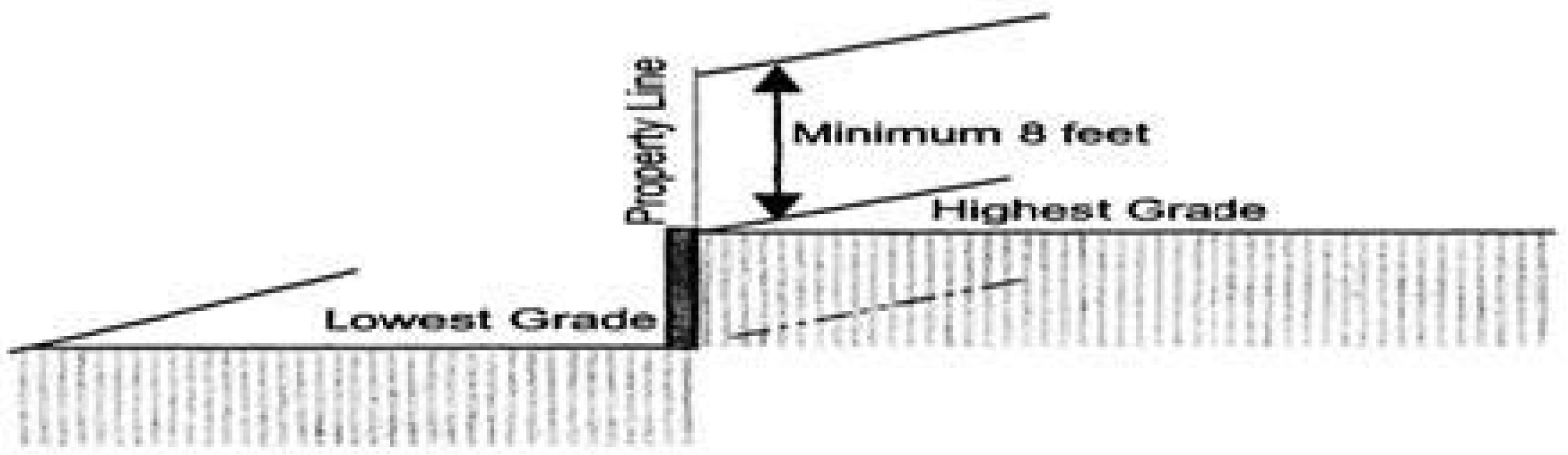
(l)
Landscaping.
(1)
Landscaping shall be provided in compliance with the approved landscape plan and adhere to the landscaping requirements in this chapter.
(2)
Self-storage sites within 300 feet of a residential zoning district or use shall provide one 36-inch box tree and six 25-gallon trees for every 1,000 square feet of setback area.
(m)
Architectural character. Self-storage facilities within 300 feet of a residential zoning district or use shall be designed to resemble a residential housing project in architectural character, landscaping, lighting, signage, color, and materials.
(n)
Lighting. A lighting system of sufficient intensity to discourage vandalism and theft shall be provided during nighttime hours. All lights shall be shielded to direct light away from adjacent properties.
(o)
Security. Self-storage facilities shall be operated under continuous supervision and/or surveillance to help discourage vandalism and theft.
(1)
For the purposes of this section, the term "supervision" shall be defined as a facility with a resident caretaker. Housing accommodations for the resident caretaker shall have a clear view of the entrance and storage buildings. The housing unit shall contain a minimum of two bedrooms, two full bathrooms, and 1,150 square feet of area.
(2)
For the purposes of this section, the term "surveillance" shall be defined as a facility utilizing a 24-hour security camera system to be monitored at all times by onsite personnel. The security camera system shall provide recorded videos of the entire perimeter of the property, around each structure, and within any public areas of structures such as interior hallways, elevators, and stairwells. Security tapes shall be kept onsite for a minimum of one month before being taped over or destroyed.
(p)
Lease approval and right of entry. Self-storage operators shall submit a copy of the proposed lease documents to the City for approval. The lease documents shall clearly disclose the City's conditions of operation and the restrictions of uses. The lease documents shall contain provisions giving the self-storage operator the right to inspect the unit for the presence of hazardous, toxic, unstable, and explosive materials and to otherwise determine whether the lessee is complying with the terms and conditions of the lease. The provisions shall permit the self-storage operator to be accompanied by representatives of the City's Community Development Department, Community Services Department, and/or the Orange County Fire Authority during the inspections.
(Ord. No. 2015-01, § 3, 5-5-2015)
Sec. 44-169. - Tutorial facilities.
(a)
Attendance limitations. The maximum number of hours an individual student may occupy a tutoring facility is three hours per day during weekdays, four hours per day on Saturday or Sunday for elementary students, and six hours per day on Saturday or Sunday for middle school and high school students. The individual student shall not exceed a total of 15 hours per week. These restricted hours are applicable to holidays and school recesses as well as the normal school year. There are no restricted hours for adult students.
(b)
Location. Tutoring facilities shall not be located within 1,000 feet of another tutoring facility. Tutoring facilities with any student in the third grade or below shall not be permitted to operate on the second floor or higher of any building.
(c)
Adult supervision. Students shall be under adult supervision at all times both inside and outside of the facility. There shall be a minimum of one adult supervisor for every 15 students overall. Tutoring class sizes shall be limited to eight students per teacher.
(d)
Records of attendance. Tutoring facilities shall keep daily records of all attendants. Such records shall be maintained for two years and be available for inspection as provided herein.
(e)
Inspections. Tutoring facilities shall permit City officials to conduct unscheduled inspections of the premises of the tutoring facilities for the purpose of ensuring compliance with this section and the conditional use permit.
(Ord. No. 2015-01, § 3, 5-5-2015)
Sec. 44-170. - Supplemental development standards for the PND zoning district.
In addition to the requirements in Section 44-140(a), developments in the PND zoning district shall comply with the following development standards:
(1)
Buildings and structures.
a.
By adhering to a minimum of three of the standards below, the front setback requirement in PND districts is reduced to zero feet:
1.
Place parking behind, underneath, or on side of building.
2.
Buildings are located immediately behind a public or semi-public use, such as outdoor dining, display, public art, entry forecourts, or other amenity appropriate to an urban development.
3.
A portion of the front building elevation may be set back to allow for outdoor use, such as outdoor patio dining.
4.
A variable street setback may be used where the average setback is greater than five feet.
b.
Corner parcels shall adhere to the traffic safety triangle standards in Section 44-276.
c.
Lots fronting any street designated an arterial highway, regardless of size, are required to have commercial uses along their frontage with the façades facing the public street in a manner that enhances pedestrian connections to outdoor pedestrian spaces such as courtyards, paseos, plazas, and porticos.
d.
All projects shall incorporate softscape to enhance the quality of development to the maximum extent reasonable. Softscape refers to the live, botanical elements of a landscape. Softscape includes green plants, flowering plants, trees, shrubs, vines, flowerbeds, various grasses and groundcovers, and includes the flower, greenery or botanical elements planted in containers, pots and raised beds.
e.
A ten-foot buffer zone is required where a nonresidential property abuts residential property. This area may consist of:
1.
Dense landscaping.
2.
Decorative screening wall.
3.
Landscaped berm.
f.
While fences and walls are sometimes necessary to buffer uses, they can create visual barriers in an existing neighborhood. Fencing and walls constructed within the PND zoning district shall complement the design of the overall development and surrounding properties. All walls shall be constructed of decorative masonry.
g.
Where a nonresidential property abuts residential property:
1.
Open spaces shall be designed to discourage or prohibit the gathering or loitering of groups of persons which may cause noise or other nuisance upon the premises whereby the quiet or good order of the premises or neighborhood are disturbed; and
2.
Excessive noise is prohibited and all exterior noise shall comply with Section 44-267.
(2)
Encroachments.
a.
No part of the structure, permanent attachment or other similar architectural feature may:
1.
Extend into an established setback, side or rear yard or minimum distance between buildings for more than two feet; or
2.
Extend into the public right-of-way without approval of an encroachment permit.
b.
Hedges or any other shrubs or landscaping shall not encroach onto a curb or sidewalk or over a lot line.
c.
No permanent seats, structures, or news-racks shall be placed in the public right-of-way without the review and approval of the City Engineer.
(3)
Circulation.
a.
Internal vehicle circulation shall provide a clear visual path to provide safe, convenient, and efficient vehicular access within and between developments.
b.
Circulation patterns shall be designed to limit points of access from major thoroughfares and minimize the impacts of nonresidential traffic on adjacent residential properties.
(4)
Loading, unloading, and service.
a.
To the maximum extent feasible, common or shared service and delivery access shall be provided between adjacent parcels and/or buildings.
b.
The loading and unloading area shall be of sufficient size to accommodate the numbers and types of vehicles that are likely to use this area, given the nature of the use.
c.
Trash and loading facilities shall be located either:
1.
At the rear of the site where they can be screened appropriately;
2.
Along the sides of the buildings not visible from a public street; or
3.
Incorporated into the building design.
d.
Service and loading zones where visible from public streets and neighboring buildings and properties shall be screened by the use of decorative walls and/or dense landscaping that will serve as both a visual and a noise barrier.
e.
In developments adjacent to residential uses, loading and unloading activities are permitted only during the hours of 7:00 a.m. to 7:00 p.m.
f.
Trash enclosures shall be screened by a fully enclosed, roofed structure that shall complement the colors and architecture of the building.
g.
Refuse enclosures shall be constructed in accordance with Section 44-274 with exception to Section 44-274(c)(1)d., setbacks from residential districts. To permit flexibility in the PND zoning district, placement of refuse enclosures shall be sited and constructed to minimize any adverse impacts to adjacent residential uses.
(5)
Parking.
a.
Parking shall meet the requirements of Division 4 of this article, Parking and Loading. Upon a finding that a reduction in on-site parking is appropriate for a particular use, the review authority may reduce the on-site parking requirements. Any such reduction in parking requirements shall be supported by a site-specific parking study prepared by a qualified engineer, and the reduced on-site parking shall be in accordance with a parking management plan prepared by a qualified engineer and approved by the review authority in conjunction with the precise plan for the development.
b.
Reduced on-site parking may be accomplished, as appropriate, by such means as:
1.
Reducing the number of required parking spaces;
2.
Reciprocal/shared parking between adjacent facilities and/or developments;
3.
Off-site parking;
4.
Flexible work hour schedule;
5.
Bicycle parking facilities including associated shower and changing facilities; and
6.
Reciprocal access.
(6)
Architecture.
a.
The architecture shall be compatible with the predominant styles in the surrounding area and adhere to the design guidelines for the PND zoning district.
b.
The following four design issues shall be addressed through project architecture:
1.
Quality;
2.
Aesthetics;
3.
Styles; and
4.
Materials.
c.
The design of the building shall provide a distinctive, quality, consistent architectural character and style that avoid monotones or featureless building massing and design.
d.
The development shall include the following focal point features, which shall be visible from the streets:
1.
A distinctive design that does not represent standard franchise architecture;
2.
An architectural feature such as a clock tower, spire, or interesting roof form;
3.
Public art or sculpture;
4.
Enhanced customer walkways;
5.
Public seating; or
6.
Landscape feature.
(7)
Roofs.
a.
Where buildings are adjacent to residential uses, rooflines shall be of a similar height to the residential uses or stepped down to a similar height to enhance the compatibility with nearby residential areas.
b.
Where architecturally appropriate, roofs shall provide articulation and variations to divide the massiveness of the roof. Sloped roofs shall include eaves which are a minimum of 18 inches in width.
c.
All rooflines in excess of 40 feet must be broken up through the use of gables, dormers, plant-ons, cutouts or other appropriate means.
(8)
Signage.
a.
All PND developments shall comply with the signage requirements set forth in Article III, Division 5.
b.
A master sign plan is required for each PND multi-unit development or as determined by the Community Development Director.
c.
On all street frontages, signage material shall be integrated into the overall design of the building.
d.
Signs shall be located to complement the architectural features of a building such as above the building entrance, storefront opening, or other similar feature.
e.
Permitted sign types shall be limited to wall, window, awning and monument signs.
f.
Second floor signage is subject to a master signage plan and shall incorporate the following features:
1.
Signs shall be mounted in locations that respect the design of a building, including the arrangement of bays and openings;
2.
Signs shall be appropriately sized for visibility and continuity with the typical storefront or commercial façade of the first floor;
3.
Signs shall be centered within an area uninterrupted by doors, windows, or architectural details; and
4.
The top of the sign should be suspended in line with the lowest point of the roof.
(9)
Landscape.
a.
All PND developments shall comply with the landscape requirements set forth in Section 44-336 and the drought tolerant landscape ordinance.
b.
A master landscape design plan shall be submitted for approval with the precise plan.
c.
All screening walls shall be landscaped with a minimum 50 percent coverage.
(10)
Flexibility in design standards. Modifications greater than those previously mentioned in this section may be permitted if the improvement reflects best urban design practices and does not cause an unreasonable privacy nuisance, public health, or safety concern.
(Ord. No. 2015-01, § 3, 5-5-2015)
Sec. 44-194. - Purpose.
(a)
The intent of this subdivision is to regulate adult oriented businesses which, because of their very nature, are believed to have many of the recognized significant secondary effects on the community which include: depreciated property values and increased vacancies in residential areas in the vicinity of the adult oriented businesses; higher crime rates, noise, debris, or vandalism in the vicinity of adult oriented businesses; and blighting conditions such as low level maintenance of commercial premises and parking lots which thereby have a deleterious effect upon adjacent areas. Special regulation of these uses is necessary to ensure that these adverse effects will not contribute to the blighting or downgrading of the neighborhoods in the vicinity of the adult oriented businesses. It is neither the intent nor effect of this subdivision to impose limitations or restrictions on the content of any communicative material. Similarly, it is neither the intent nor effect of this subdivision to restrict or deny access by adults to sexually oriented materials or merchandise protected by the first amendment, or to deny access by the distributors or exhibitors of adult oriented business to their intended market.
(b)
Nothing in this subdivision is intended to authorize, legalize, or permit the establishment, operation, or maintenance of any business, building, or use which violates any City ordinance or any statute of the State of California regarding public nuisances, unlawful exposure, sexual conduct, lewdness, or obscene or harmful matter or the exhibition or public display thereof.
(Ord. No. 2015-01, § 3, 5-5-2015)
Sec. 44-195. - Definitions.
When used in this subdivision, the words and phrases in this section have the following meanings ascribed to them, unless the context indicates a different meaning:
Adult bookstore means any establishment, which, as a regular and substantial course of conduct, displays and/or distributes adult merchandise, books, periodicals, magazines, photographs, drawings, sculptures, motion pictures, videos, slides, films, or other written, oral, or visual representations which are distinguished or characterized by an emphasis on a matter depicting, describing, or relating to specified sexual activities or specified anatomical parts.
Adult cabaret means a nightclub, bar, lounge, restaurant, or similar establishment or concern which features as a regular and substantial course of conduct, any type of live entertainment, films, motion pictures, videos, slides, other photographic reproductions, or other oral, written, or visual representations which are characterized by an emphasis on matter depicting, describing, or relating to specified sexual activities or specified anatomical parts.
Adult hotel/motel means a hotel or motel, which, as a regular and substantial course of conduct, provides to its patrons, through the provision of rooms equipped with closed-circuit television or other medium, material which is distinguished or characterized by the emphasis on matter depicting, describing, or relating to specified sexual activities or specified anatomical parts and/or which rents, leases, or lets any room for less than a 12-hour period and/or rents, leases, or lets any room more than once in a 24-hour period and/or which advertises the availability of any of the above.
Adult live entertainment means any physical human body activity, whether performed or engaged in alone or with other persons, including singing, walking, speaking, dancing, acting, posing, simulating, wrestling or pantomiming, in which:
(1)
The performer (including a topless and/or bottomless dancer, go-go dancer, exotic dancer, stripper, or similar performer) exposes to public view, without opaque covering, specified anatomical parts; and/or
(2)
The performance or physical human body activity depicts, describes or relates to specified sexual activities whether or not the specified anatomical areas are covered.
Adult model studio means any premises where there is furnished, provided, or procured a figure model or models who pose in any manner which is characterized by its emphasis on matter depicting, describing, or relating to specified sexual activities or specified anatomical parts where such model is being observed or viewed by any person for the purpose of being sketched, painted, drawn, sculptured, photographed, filmed, or videotaped for a fee, or any other thing of value, as a consideration, compensation, or gratuity for the right or opportunity to so observe the model or remain on the premises. The term "adult model studio" shall not include any live art class or any studio or classroom that is operated by any public agency or any private educational institution maintained pursuant to standards set by the Board of Education of the State of California.
Adult motion picture arcade means any business establishment or concern containing coin- or slug-operated or manually or electronically controlled still, motion picture, or video machines, projectors, or other image producing devices that are maintained to display images to an individual in individual viewing areas when those images are distinguished or characterized by an emphasis on matter depicting, describing, or relating to specified sexual activities or specified anatomical parts.
Adult oriented business.
(1)
The term "adult oriented business" means any business establishment or concern which, as a regular and substantial course of conduct, performs as an adult bookstore, adult theater, adult motion picture arcade, adult cabaret, stripper, adult model studio or adult hotel/motel (but not clothing optional hotel/motel); or any business establishment or concern, which as a regular and substantial course of conduct, sells or distributes sexually oriented merchandise or sexually oriented material; or any business establishment or concern, which, as a regular and substantial course of conduct, provides or allows performers, models, actors, actresses, or employees to appear in any place in attire, which does not opaquely cover specified anatomical parts.
(2)
For the purposes of this section, a business establishment or concern has established the provision of products, merchandise, services, or entertainment characterized by an emphasis on matters depicting, describing, or relating to specified sexual activities or specified anatomical parts as a regular and substantial course of conduct when one or more of the following conditions exist:
a.
The area devoted to adult merchandise and/or sexually oriented material exceeds more than 25 percent of the total display or floor space area open to the public;
b.
The business establishment or concern presents any type of live entertainment which is characterized by an emphasis on specified sexual activity or specified anatomical parts at least six times in any month in any given year;
c.
The regular and substantial course of conduct of the business consists of or involves the sale, trade, display or presentation of services, products, or entertainment which are characterized by an emphasis on matter depicting, describing, or relating to specified sexual activities or specified anatomical parts.
(3)
"Adult oriented business" does not include those uses or activities upon which regulation is preempted by State law.
Adult theater means a business establishment or concern which, as a regular and substantial course of conduct, presents live entertainment, motion pictures, videos, slide photographs, or other pictures or visual reproductions which are distinguished or characterized by their emphasis on matter depicting, describing, or relating to specified sexual activities or specified anatomical parts.
G-string means an article of clothing that opaquely covers the buttocks at least one inch on either side of the natal cleft and covers the entirety of the genitalia and pubis.
Individual viewing area means any area designed for occupancy of one person for the purpose of viewing live performances, pictures, movies, videos, or other presentations.
Live art class means any premises on which all of the following occur: there is conducted a program of instruction involving the drawing, photographing, or sculpting of live models exposing specified anatomical parts; instruction is offered in a series of at least two classes; the instruction is offered indoors; an instructor is present in the classroom while any participants are present; and pre-registration is required at least 24 hours in advance of participation in the class.
Pasties means an article of clothing that opaquely covers the nipple and areola of the female breast and is not designed to nor appears to look like the nipple and/or areola of the female breast.
Performer means any person who is an employee or independent contractor of an adult-oriented business, and who, with or without any compensation or other form of consideration, performs adult live entertainment for patrons of an adult-oriented business. Performer does not include a patron.
Regular and substantial course of conduct means when 25 percent of a business's stock in trade, and/or 25 percent of a business's total gross annual revenue, or 25 percent of a business's advertising, or 25 percent of a business's net interior public area (not including non-public areas such as office space, dressing rooms, non-public storage space and public and non-public bathrooms) is derived from or devoted to a particular thing.
School means an institution of learning for minors, whether public or private which offers instruction in those courses of study required by the provisions of the California Education Code applicable to the type of school at issue and/or is maintained pursuant to standards set by the Board of Education of the State of California and has an approved use permit, if required under the applicable jurisdiction. This definition includes a nursery school, kindergarten, elementary school, junior high school, senior high school, or any special institution of learning under the jurisdiction of the California Department of Education, but does not include a vocational or professional institution or an institution of higher learning, including a community college or junior college, college or university. Neither shall the term "school" apply to a "tutorial facility" as that term is defined in Section 44-10; a "child day care facility" as that term is defined in Health and Safety Code § 1596.750; or a "day care center" as that term is defined in Health and Safety Code § 1596.76.
Sexually oriented material means any element of sexually oriented merchandise, or any book, periodical, magazine, photograph, drawing, sculpture, motion picture film, video, or other written, oral, or visual representation or presentation which, for purposes of sexual arousal, provides depictions that are characterized by an emphasis on matter depicting, describing, or relating to specific sexual activities or specified anatomical parts.
Sexually oriented merchandise means sexually oriented implements and paraphernalia, such as, but not limited to: dildos, auto sucks, sexually oriented vibrators, edible underwear, benwa balls, inflatable orifices, anatomical balloons with orifices, simulated and battery-operated vaginas, and similar sexually oriented devices which are designed or marketed primarily for the stimulation of human genital organs or sado-masochistic activity.
Specified anatomical parts means:
(1)
Less than completely and opaquely covered human genitals, pubic region, buttocks, or female breasts below a point immediately above the top of the areola; or
(2)
Human male genitals in a discernibly turgid state, even if completely and opaquely covered.
Specified sexual activities means:
(1)
Actual or simulated sexual intercourse, oral copulation, anal intercourse, oral anal copulation, bestiality, direct physical stimulation of unclothed genitals, flagellation or torture in the context of a sexual relationship, or the use of excretory function in the context of a sexual relationship, any of the following depicted sexually oriented acts or conduct: anilingus, buggery, coprophagy, coprophilia, cunnilingus, fellatio, necrophilia, pederasty, pedophilia, piquerism [picquerism], sapphism, or zooerastia.
(2)
Human genitals in a state of sexual stimulation, arousal, or tumescence.
(3)
Use of human or animal ejaculation, sodomy, oral copulation, coitus, or masturbation.
(4)
Fondling or other erotic touching of human genitals, pubic region, buttocks, or female breast.
(5)
Masochism, erotic or sexually oriented torture, beating, or the infliction of pain.
(6)
Erotic or lewd touching, fondling, or other sexually oriented contact with an animal by a human being.
(7)
Human excretion, urination, menstruation, or vaginal or anal irrigation.
(8)
The removal of clothing to the point where specified anatomical parts are either not opaquely covered or minimally covered with devices commonly referred to as pasties and g-strings or equivalent clothing.
(Ord. No. 2015-01, § 3, 5-5-2015)
Sec. 44-196. - Permit required.
Notwithstanding any other provision of this chapter no adult oriented business shall be permitted to operate, engage in, conduct, or carry on business within the City unless the owner of the business first obtains an adult oriented business permit and a business license from the City, as well as any other permits or licenses required by law. The above notwithstanding, no adult oriented business proposing to provide live entertainment shall be required to obtain a special permit pursuant to Article V, Division 9. Nor shall any adult oriented business be required to be listed as a permitted or conditionally permitted use within the zone in which it proposes to locate if it otherwise complies with the other development requirements of this Code and the requirements of this section. If an adult oriented business intends to serve alcoholic beverages, the business shall be required to obtain a conditional use permit from the City for the service of the alcoholic beverages. Procedures for obtaining an adult oriented business permit are established in Article V, Division 9.
(Ord. No. 2015-01, § 3, 5-5-2015)
Sec. 44-197. - Findings/locational and operational requirements.
The following findings and locational and operational requirements shall be applicable at all times to all adult oriented businesses. The City Manager shall deny the requested permit if the findings have not been made.
(1)
The adult oriented business shall not be located within 300 feet of a residential zoning district or any properly approved residential use unless the proposed location of the adult oriented business is physically separated from the residential zoning district or use by a freeway or a creek drainage channel.
(2)
For the purposes of this section, a use is "located" upon a site if an application for the use to be placed upon the site has been filed with the City prior to the date the adult oriented business application has been filed with the City.
(3)
The adult oriented business shall not be located within 300 feet from the perimeter of any lot upon which there is properly located a public park, school, or religious institution unless the proposed location of the adult oriented business is physically separated from the public park, school, or religious institution by a freeway or a creek drainage channel.
(4)
The adult oriented business property shall not be located within 100 feet from the perimeter of any lot of any establishment that serves alcoholic beverages for onsite consumption unless the proposed location of the adult oriented business is physically separated from the alcohol serving facility by a freeway or a creek drainage channel.
(5)
The adult oriented business shall comply with the City's parking standards for the underlying use. Where no City parking standards exist for a particular underlying use, the adult oriented business shall provide one space per occupant as based upon the maximum occupancy as determined by the building official.
(6)
Any signage for the adult oriented business shall comply with the sign regulations of this Code.
(7)
The adult oriented business shall not be located completely or partially within any mobile structure or pushcart.
(8)
The adult oriented business shall not stage any special events, promotions, festivals, concerts, or similar events that would increase the demand for parking beyond the approved number of spaces for the particular use or that would increase occupancy beyond the maximum building occupancy as determined by the fire marshal as required by law.
(9)
The adult oriented business shall not conduct any massage, tattooing, acupressure, fortune telling, or escort services on the premises.
(10)
The adult oriented business shall provide a security system that visually records and monitors all parking lot areas. All indoor areas of the adult oriented business shall be open to public view at all times with the exception of restroom facilities. The term "accessible to the public" shall include those areas that are only accessible to members of the public who pay a fee and/or join a private club or organization.
(11)
The adult oriented business shall comply with the development and design requirements of the zoning district in which it is to be located.
(12)
The adult oriented business shall not display any sexually oriented material, sexually oriented merchandise, or contain window display that would be visible from any location other than from within the adult oriented business.
(13)
The adult oriented business shall not allow admittance to any person under the age of 18 if no liquor is served or under the age of 21 if liquor is served.
(14)
The adult oriented business shall not operate between the hours of 12:00 midnight and 10:00 a.m.
(15)
Neither the applicant, if an individual, nor any of the officers or general partners, if a corporation or partnership, of the adult oriented business shall have pled guilty or nolo contendre or been found guilty within the past two years of a misdemeanor or felony classified by this State or any other statute as a sex-related offense and shall have not violated any of the provisions of an adult oriented business permit or similar permit or license in any City, County, territory or State.
(16)
The adult oriented business shall provide separate restroom facilities for male and female patrons. The restroom will be free from sexually oriented materials and sexually oriented merchandise. Only one person shall be allowed in the restroom at any time, unless otherwise required by law, in which case, the adult oriented business shall employ a restroom attendant/security officer of the same sex as the restroom user who shall be present in the public portion of the restroom, and that not more than one person is permitted to enter a restroom stall unless otherwise required by law and that the restroom facilities are used only for the intended sanitary uses.
(17)
The interior of the adult oriented business shall be configured such that there is an unobstructed view, by use of the naked eye and unaided by video, closed circuit cameras, or any other means, of every public area of the premises, including the interior of all individual viewing areas, from a manager's station, which is no larger than 32 square feet of floor area with no single dimension being greater than eight feet, in a public portion of the establishment. No public area, including the interior of any individual viewing area, shall be obscured by any door, curtain, wall, two-way mirror or other device that would prohibit a person from seeing the interior of the individual viewing area, solely with the use of the naked eye and unaided by video, closed circuit cameras or any other means, from the manager's station. The entire body of any patron in an individual viewing area must be visible from the manager's station without the assistance of a mirror or other device. A manager at least 21 years of age shall be stationed in the manager's station at all times the business is in operation or open to the public in order to enforce all laws and regulations. No individual viewing area shall be designed or occupied by more than one patron at a time.
(18)
All areas of the adult oriented business shall be illuminated at the following minimum foot-candle levels, evenly distributed at ground level:
(19)
The individual viewing areas of the adult oriented business shall be operated and maintained without holes, openings, or other means of direct visual or physical access between the interior spaces of two or more individual viewing areas. Any hole or opening shall be repaired within 24 hours using "pop" rivets to secure a metal plate over the hole or opening to prevent patrons from removing the metal plate.
(20)
A traffic study shall be prepared for the adult oriented business in conformance with industry standards. The applicant shall demonstrate that the project will not result in a reduction in any roadway level of service below that level of service designated in the general plan for that roadway.
(21)
The adult oriented business shall comply with the noise element of the general plan and noise standards of this chapter, interior and exterior noise standards, and any mitigation measures necessary to reduce the project's noise impacts to the City's articulated noise standard.
(22)
The adult oriented business shall comply with all building and construction standards of the Uniform Building Code, Chapter 24, Title 24 of the California Code of Regulations (24 CCR 24), and all other federal, State and City-adopted standards for the specific use.
(23)
Live entertainment shall only be performed on a permanently fixed stage raised at least 18 inches above the floor and separated from patrons by a fixed rail at least 30 inches in height placed at a distance of not less than eight feet from the perimeter of the stage such that no portion of the performer is, at any time, within six feet of any patron. This provision shall not apply to an individual viewing area where the performer is completely separated from the area in which the performer is viewed by a partner by a permanent, floor-to-ceiling solid barrier enclosed on all sides such that access by the patron is not possible.
(24)
No performer engaged in a performance which includes adult live entertainment shall have physical contact with any patron, and no patron shall have physical contact with any performer, while the performer is performing on the premises. In addition, while on the premises, no performer shall have physical contact with a patron and no patron shall have physical contact with a performer, which physical contact involves the touching of the clothed or unclothed genitals, pubic area, buttocks, cleft or the buttocks, perineum, anal region, or female breast with any part or area of the other person's body either before, during or after any adult live entertainment by such performer. This prohibition does not extend to incidental touching. Patrons shall be advised of the separation and no touching requirements by signs conspicuously placed on the railing separating patrons and performers and in each individual viewing area. If necessary, patrons shall also be advised of the separation and no touching requirements by employees or independent contractors of the adult business.
(25)
No building, premises, structure, or other facility shall be permitted to contain more than one type of adult oriented business as such types of adult oriented business are defined in Section 44-195. For the purposes of this subsection, the phrase "adult oriented business" shall not itself embody all the various types of adult oriented businesses.
(26)
No individual viewing area may be occupied by more than one person at any one time. No beds shall be permitted in an individual viewing area.
(27)
No patron shall directly or indirectly pay or give any gratuity to any performer, and a performer shall not solicit or accept any direct gratuity from any patron. For the purposes of this section, the phrase "directly pay or give" shall mean the person-to-person transfer of the gratuity. This section shall not prohibit the establishment of a non-human gratuity receptacle placed at least eight feet from the stage or area occupied by the performer.
(28)
Public nudity shall be prohibited on the premises at all times. For the purposes of this subsection, the term "public nudity" shall mean the removal of clothing to the point where the individual is clothed in less than pasties and a g-string, as those terms are defined in Section 44-195.
(29)
The adult oriented business shall be operated consistent with the floor plan approved by the City. No changes to the floor plan shall be implemented unless and until the changes have first been approved by the City.
(30)
The adult oriented business shall provide dressing rooms for performers that are separated by gender and exclusively dedicated to the performers use, and which the performers shall use. Same gender performers may share a dressing room. Patrons shall not be permitted in dressing rooms.
(31)
The adult oriented business shall provide an entrance/exit for performers which is separate from the entrance/exit used by patrons, which the performers shall be required to use when entering and exiting the business.
(32)
At least one security guard will be on duty outside the premises, patrolling the grounds at all times the business is open to the public. The security guard shall be charged with prohibiting violations of law and enforcing the provisions of this chapter. All security guards will be uniformed so as to be readily identifiable as a security guard by the public. No person acting as a security guard shall act as a doorman, ticket taker or seller, or perform any other function while acting as a security guard. For all adult oriented businesses providing live entertainment, an additional security guard will be required with each increase in maximum occupancy of 50 persons. All security guards shall be licensed under the California State Private Security Services Act, Business and Professions Code § 7580 et seq.
(Ord. No. 2015-01, § 3, 5-5-2015)
Sec. 44-198. - Distribution of harmful matter.
(a)
Blinders required. No person shall distribute, show, or otherwise display in any location which is visually accessible to minors, any harmful matter as defined in subsection (b) without the placement of a completely opaque material covering the display such that the lower two-thirds of the material is not exposed to view.
(b)
Definitions. The following words, terms and phrases, when used in this section, shall have the meanings ascribed to them in this subsection, except where the context clearly indicates a different meaning:
Harmful matter means any matter, taken as a whole, which to the average person, applying contemporary statewide standards, appeals to the prurient interest, and is matter which, taken as a whole, depicts or describes in a patently offensive way sexual conduct and which, taken as a whole, lacks serious literary, artistic, political, or scientific value for minors.
Location visually accessible to minors means any location on a public or private street, sidewalk, or right-of-way as well as any location on private property which is visible from a public street, sidewalk or other right-of-way or from an area in which the public is invited and minors are not excluded.
Minor means any natural person under the age of 18.
(c)
Punishment. A violation of this section shall be a misdemeanor punishable according to the general penalties described in Section 2-350 (Misdemeanor penalty).
(Ord. No. 2015-01, § 3, 5-5-2015)
State Law reference— Authority of City to require blinders in front of material harmful to minors, Penal Code § 313.1(d).
Sec. 44-199. - Inspections.
The holder of an adult oriented business shall permit officers of the City and any of their authorized representatives to conduct unscheduled inspections of the premises of the adult oriented business for the purpose of ensuring compliance with the law at any time the adult oriented business is open for business or occupied.
(Ord. No. 2015-01, § 3, 5-5-2015)
Sec. 44-200. - Expansion of legal nonconforming uses.
Notwithstanding any other provision of this Code, no adult oriented business legally operating prior to the effective date of the ordinance codified in this section may be expanded in any manner unless and until the entire adult oriented business complies in all respects with the provisions of this section and/or any other provision of this chapter pertaining to the operation of the business. For the purposes of this section, the term "expansion" shall include any physical expansion of the facility in which the adult oriented business is located or operating and/or the introduction and/or addition of any category of adult oriented business use not legally operating on the property prior to the enactment of said ordinance as such separate categories of adult oriented business uses are contained in Section 44-195. For the purposes of this section, the phrase "adult oriented business" shall not itself embody all the various types of adult oriented business.
(Ord. No. 2015-01, § 3, 5-5-2015)
Sec. 44-201. - Health services fee.
(a)
Definitions. The following words, terms and phrases, when used in this section, shall have the meanings ascribed to them in this section, except where the context clearly indicates a different meaning:
Health Department or department means the Orange County Health Care Agency.
Health Officer means the County Health Officer or his/her duly authorized representative.
Receipt means a County public health services fee receipt.
(b)
Purpose and authority. The purpose of this section is to establish fees sufficient to meet the reasonable expenses of the Health Officer in enforcing State statutes, orders, quarantines, and rules and regulations of State offices and departments relating to public health, which expenses are hereby found not to be met by the fees prescribed by the State. The authority for this subsection is contained in the Health and Safety Code § 101325, as amended.
(c)
Area of application. This section shall be enforceable within the territory in which the Health Officer enforces any State statute, order, quarantine, or rule or regulation of State offices and departments relating to public health, which expenses are hereby found not to be met by the fees prescribed by the State. The authority for this subsection is contained in Health and Safety Code § 101325, as amended.
(d)
Violation. Notwithstanding any provision to the contrary, it shall be unlawful for any person to conduct any activity enumerated in this section without obtaining a valid receipt.
(e)
Separate activities. If a person shall conduct more than one of the activities for which a receipt is required, he/she must obtain a separate receipt for each activity, except as otherwise provided herein.
(f)
Applications. Applications for a receipt shall be filed with the health department on a form to be provided by that department. The applications shall be accompanied by payment of the required fee. An applicant for or a recipient of a receipt shall provide the Health Officer with any information requested by him or her.
(g)
Rules and regulations. The Health Officer shall administer this section and may issue regulations and prepare application and identification forms pertaining thereto.
(h)
Fees. The County shall, by annual resolution of the Board of Supervisors, adopt health service fees to be paid by the proprietor or operator of the adult oriented business. The fees are to be paid directly to the health department and retained by the department as reimbursement for services related to the administration and enforcement of this subdivision.
(Ord. No. 2015-01, § 3, 5-5-2015)
Sec. 44-226. - Permit and licenses required.
(a)
No person, association, partnership, corporation or other entity shall be permitted to operate, engage in, conduct, or carry on, or to permit to be engaged in, conducted or carried on, the operation of a massage establishment unless: (1) all persons providing massage at the establishment are certified massage practitioners and/or certified massage therapists; and (2) the massage establishment operator has obtained a business license and a conditional use permit from the City, as well as any other permits, licenses and other approvals required by law. Procedures for obtaining a business license are set forth in Chapter 22.
(b)
Any person administering massage in the City for compensation must be certified massage practitioner and/or certified massage therapist holding a valid certification from the Massage Therapy Council. No person may administer massage within the City without first providing, to the Community Development Department, a copy of his or her massage certificate and a list of the names and addresses of all massage establishments at which he or she will provide massage for compensation. Any change in the locations at which a person will provide massage for compensation shall be reported to the City within five working days of the change.
(Ord. No. 2015-01, § 3, 5-5-2015)
Sec. 44-227. - Exemptions.
The provisions of this subdivision shall not apply to the following types of individuals while engaged in the performance of the duties of their respective professions:
(1)
Physicians, surgeons, chiropractors, osteopaths, acupuncturists or physical therapists who are duly licensed to practice their respective professions in the State of California;
(2)
Nurses registered and practicing under the laws of the State of California;
(3)
Barbers and beauticians who are duly licensed to practice their respective professions in the State of California;
(4)
Licensed employees of hospitals, nursing homes, sanatoriums, or other health care facilities that are duly licensed by the State of California.
(Ord. No. 2015-01, § 3, 5-5-2015)
Sec. 44-228. - Massage establishment business license.
(a)
Application. In addition to the information required to be provided under Section 22-11, a person applying for a business license for a massage establishment shall provide the following information:
(1)
The prior business and permit history of the applicant, including but not limited to whether the applicant has ever had any permit or license issued by any agency, board, city, county, territory, or state; the date of issuance of such a permit or license; whether the permit or license was revoked or suspended; and whether a vocational or professional license or permit was issued, revoked, or suspended, and the reason for any revocation or suspension.
(2)
All criminal convictions, other than misdemeanor traffic violations and infractions, the jurisdiction in which the conviction occurred, and the circumstances thereof.
(3)
A description of the proposed massage establishment, including the type of treatments to be administered.
(4)
Authorization for the City, its agents and employees, to seek information and conduct an investigation into the truth of the statements set forth in the application.
(5)
A complete current list of the names and residence addresses of all proposed massage technicians, aides, trainees and other employees who are or will be employed in the massage establishment, if known. If not known at the time of submission of the application, the applicant shall provide the required information no later than seven calendar days prior to opening for business.
(6)
For each person that the massage establishment does or will employ, retain or permit to perform massage for compensation, a copy of that person's current certificate issued by the Massage Therapy Council, and a copy of that person's identification card issued by the Massage Therapy Council.
(7)
The name and residence addresses of the proposed operator(s) and manager(s) who will be principally in charge of the operation of the massage establishment.
(b)
Changes in information. Except as otherwise specifically provided in this subdivision, once a business license is issued to a massage establishment, the applicant shall submit to the City any change to any of the information required above within seven calendar days of discovering that change. Such changes include, but are not limited to, changes in the types of services to be provided, and changes in the persons employed or retained by the massage establishment to perform massage for compensation.
(Ord. No. 2015-01, § 3, 5-5-2015)
Sec. 44-229. - Out-call massage prohibited.
It shall be unlawful to provide out-call massage, or to cause or allow out-call massage to be provided.
(Ord. No. 2015-01, § 3, 5-5-2015)
Sec. 44-230. - Massage establishment operating requirements.
Every person operating or maintaining a massage establishment in the City shall comply with each of the following requirements at all times:
(1)
Location. A massage establishment shall not be located within 1,000 feet of another massage establishment. The distance between massage establishments shall be measured in a straight line, without regard to intervening structures, from the closest exterior wall of one massage establishment to the closest exterior wall of the other massage establishment.
(2)
Hours of operation. Massage operations shall be carried on or conducted, and the premises shall be open, only between the hours of 8:00 a.m. and 9:00 p.m. The operator and/or manager of the massage establishment shall notify the City, in writing, at least 30 calendar days prior to the effective date of any change to the establishment's hours of operation. No person shall administer a massage in any massage establishment outside the permissible hours of operation specified in this subsection.
(3)
Management. One or more managers shall be designated to act as the person(s) in charge of managing day-to-day operations of the massage establishment, including receiving all complaints. The names of such managers must be provided to the City. At least one manager shall be on premises of the massage establishment at all times during all business hours of operation. In addition to the holder of the massage facility's business license, on-site managers shall be responsible for all violations taking place on the massage establishment premises during their respective shifts.
(4)
List of services. A list of all available services, and their respective cost, shall be posted in an open public place within the massage establishment. The list shall, at minimum, be posted in English. No service shall be included on the list unless it is a service that falls within the professionally recognized scope of practice of a certified massage therapist or certified massage practitioner. No owner, manager or operator of a massage establishment shall allow, and no person shall perform or offer to perform, any service other than those posted pursuant to this subsection.
(5)
Display of licenses and certificates. The massage establishment's business license and a copy of the massage certificate for every certified massage therapist and certified massage practitioner employed by the massage establishment, as an employee, independent contractor or otherwise, shall be displayed in an open and conspicuous public place on the massage establishment's premises.
(6)
Records of treatment. Every massage facility operator shall keep a written record of all services rendered on the premises. The record shall include, at minimum, the date and hour of each service, the full name and complete address of the patron, the full name of any certified massage practitioner or certified massage therapist who administered any portion of such service. The record shall be retained for a minimum of two years from the date of service, and shall be open to inspection upon demand by officials charged with the enforcement of this subdivision, and by emergency personnel, for law enforcement and emergency purposes and for no other purpose. The information furnished or secured as a result of any such records shall remain confidential to the extent permitted by law.
(7)
Inspections. All areas of the massage establishment shall be subject to reasonable inspections during all hours of operation to ensure compliance with the City's Code, state law regulating the practice of massage, and all other applicable laws and regulations.
(8)
Massage school prohibited. No massage establishment shall operate as a school of massage or use, or permit use of, any portion of its facilities as a school of massage.
(9)
Advertisements. No massage establishment owner, operator, manager, employee or independent contractor shall place, publish or distribute, or cause or allow to be placed, published or distributed, any advertising matter that would reasonably suggest to prospective patrons that any service is available unless such service is listed on the massage establishment's list of available services required under subsection (4).
(10)
Clothing. All owners, operators, managers, employees, and independent contractors of a massage establishment shall be clean and shall wear clean, nontransparent outer garments at all times when present on the premises of the establishment. Such garments shall not expose any genitals, pubic areas, buttocks or breasts, and shall otherwise comply with the standards set forth in Business and Professions Code § 4609.
(11)
Employees and independent contractors. The operator and/or manager of a massage establishment shall maintain on the premises a register of all employees and independent contractors of the establishment. Information concerning an employee or independent contractor shall be maintained for a minimum of two years after the person ceases to work for the establishment. The operator and/or manager shall make the register immediately available for inspection upon reasonable demand of a representative of City law enforcement or code enforcement. The register shall include, but not be limited to, the following information:
a.
The name, nicknames and/or aliases used by an employee.
b.
The employee's home address and relevant phone numbers (including but not limited to home, cellular and pager numbers.)
c.
The employee's age, date of birth, gender, height, weight, color of hair and eyes.
d.
The employee's Social Security number.
e.
The date of employment and termination, if any.
f.
The duties of each employee
(12)
Compliance with laws. Massage establishments shall be operated in compliance with all applicable laws and regulations, including without limitation, the California Massage Therapy Act (Business and Professions Code § 4600 et seq.).
(Ord. No. 2015-01, § 3, 5-5-2015)
Sec. 44-231. - Massage establishment facility requirements.
To ensure the health and safety of all persons, every person operating or maintaining a Massage Establishment, and/or providing massage services, in the City shall comply with all of the following requirements at all times:
(1)
A recognizable and readable sign, compliant with all applicable City sign regulations, shall be posted at the main entrance of the massage establishment, identifying it as such an establishment.
(2)
The hours of operation of the massage establishment must be posted in the front window in a manner that is clearly visible from the exterior of the establishment.
(3)
One front door that enters into the lobby and/or other waiting room of the establishment shall be provided for customer use. All customers and any other persons other than employees of the establishment shall be required to enter and exit through the establishment's front door.
(4)
Minimum lighting shall be provided in accordance with the Section 44-278. In addition, at least one unobstructed, artificial light of not less than 40 watts shall be provided in each room or booth where massage services are performed on patrons and shall be illuminated at all times while any patron is present therein.
(5)
Minimum ventilation shall be provided in accordance with the California Building Standards Code.
(6)
Instruments used in performing massage services shall not be used on more than one patron unless they have been sterilized using approved sterilizing methods between use on different patrons. Adequate equipment for disinfecting and sterilizing instruments used in performing the acts of massage shall be provided at all times.
(7)
Hot and cold running water shall be provided at all times on the premises.
(8)
Adequate bathing, dressing, locker, and toilet facilities shall be provided for patrons. Each massage establishment shall provide a minimum of one tub or shower, one toilet, one sink, and one dressing room containing a separate locker for each patron to be served, which locker shall be capable of being locked and a minimum of one toilet and one washbasin. If male and female patrons are to be served simultaneously at the establishment, separate bathing, separate massage rooms, separate dressing areas and separate toilet facilities shall be provided for each gender.
(9)
All walls, ceilings, floors, pools, showers, bathtubs, steam rooms, and all other physical facilities for the establishment must be in good repair and maintained in a clean and sanitary condition at all times. Wet and dry heat rooms, steam vapor rooms, steam and vapor cabinets, shower compartments, and toilet rooms shall be thoroughly cleaned with a disinfectant at least once each day that the business is in operation. Bathtubs shall be thoroughly cleaned with a disinfectant after each use. All walls, floors and ceilings of each restroom and shower area shall be constructed with materials that are smooth and easily cleanable. No carpeting shall be installed in these specified areas.
(10)
Clean and sanitary towels, coverings and linens shall be provided for each patron of the establishment. No common use of towels or linens shall be permitted. Clean towels, coverings and linens shall be stored in enclosed cabinets. Disposable towels and coverings shall be permitted, but shall not be used on more than one patron. Soiled linens, coverings and towels shall be deposited in separate, approved receptacles.
(11)
If any pads are used on massage tables, such pads shall be covered with a durable washable plastic or other waterproof material which shall be cleaned and disinfected with a disinfectant at least once each day the establishment is open.
(12)
A minimum of one separate washbasin shall be provided in each massage establishment for the use of employees of any such establishment, which basin shall provide soap or detergent and hot and cold running water at all times and shall be located within or as close as practicable to the area devoted to the performing of massage services. In addition, there shall be provided at each washbasin sanitary towels placed in permanently installed dispensers.
(13)
No massage establishment shall be equipped with any of the following improvements:
a.
Tinted or "one-way" glass in any room or office;
b.
Door-viewer or peephole designed to look through a door or wall; or
c.
Locking mechanisms on any interior door that would impede unobstructed entrance to massage treatment rooms, including but not limited to a locking mechanism on any treatment room door, unless there is no staff person available to assure the security for clients and massage personnel who are behind closed doors. For the purpose of this subsection, a staff member is available to assure the security of clients and massage personnel when the massage establishment employs a receptionist or other person who is stationed in a public location outside of the massage treatment rooms.
(14)
With the exception of massage establishments owned by one individual with one or no employees or independent contractors, massage establishments shall keep all doors leading to the exterior of the premises unlocked during the establishment's business hours.
(Ord. No. 2015-01, § 3, 5-5-2015)
Sec. 44-232. - Prohibited conduct.
(a)
No massage shall be allowed in any areas of a massage establishment other than in designated massage rooms. If male and female patrons are to be served simultaneously at the establishment, separate massage rooms shall be provided for each gender. In any establishment in which massage services are rendered only to members of the same sex at any one time, such persons of the same sex may be placed in a single room, or the operators of the massage establishment may elect to place such persons in separate massage rooms.
(b)
No massage services shall be rendered to a patron unless the patron's genitals are fully covered. In the case of a female patron, the patron's breasts must also be fully covered. In addition, no patron's genitals or the breasts of any female patron shall intentionally be touched while the patron is on the premises of the massage establishment.
(c)
No alcoholic beverage or drug, other than a prescription medication in the possession of the person for whom the prescription was written, and no condoms, shall be stored or allowed on a massage establishment's premises. Service of alcoholic beverages shall not be permitted.
(d)
No person shall enter or remain on any part of the premises of a massage establishment, and no person shall conduct, operate, be employed by or provide massage, while in the possession of, while consuming, or while under the influence of any alcoholic beverage or drug, except for medication provided pursuant to a valid prescription issued by a physician duly licensed to practice in the State of California.
(e)
No sexually oriented material or sexually oriented merchandise may be allowed, displayed or stored anywhere on a massage establishment's premises. For purposes of this subsection, the terms "sexually oriented material" and "sexually oriented merchandise" shall have the same meanings as set forth in Section 44-195.
(f)
No person may record, or cause or allow to be recorded, any audio and/or video of the performance of a massage or of the conversation or other sounds in any massage room, dressing area, toilet area or other portion of the premises where there is a reasonable expectation of privacy, without the knowledge and express written consent of the patron.
(g)
No massage establishment shall have installed or utilize any signaling devices of any type to alert employees and/or patrons to the presence of law enforcement or other persons charged with enforcement of the provisions of this Code and/or other applicable laws and regulations.
(h)
No person shall reside, dwell, occupy or live inside, or be allowed to reside, dwell, occupy or live inside, a massage establishment at any time.
(Ord. No. 2015-01, § 3, 5-5-2015)
Sec. 44-233. - Records of treatment.
Every person operating a massage establishment under a permit as herein provided shall keep a record of the date and hour of each treatment, the name and address of the patron, the type of treatment administered and the name of the person administering such treatment. Such record shall be maintained for a period of two years from the date services are rendered, and shall be open to inspection by officials charged with the enforcement of these provisions for the purposes of law enforcement and for no other purposes. The information furnished or secured as a result of any such inspection shall be confidential to the extent permitted by law. Any unauthorized disclosure or use of such information by any officer or employee of the City shall constitute a misdemeanor and such officer or employee shall be subject to penalties provided by law.
(Ord. No. 2015-01, § 3, 5-5-2015)
Sec. 44-234. - Name of business.
No person licensed to do business as herein provided shall operate under any name or conduct business under any designation not specified in the person's massage certificate.
(Ord. No. 2015-01, § 3, 5-5-2015)
Sec. 44-235. - Inspection.
The Police Chief or his or her agent, the Community Development Director, Fire Marshal, and/or the Orange County Health Care Agency or its successor agency may from time to time conduct unannounced inspections of a massage establishment, in accordance with applicable laws, for the purpose of confirming that the provisions of this subdivision are met, and may furnish a copy of the inspection report to any appropriate governmental agencies.
(Ord. No. 2015-01, § 3, 5-5-2015)

