
La Palma City Zoning Code
ARTICLE III
STANDARDS APPLICABLE IN ALL ZONING DISTRICTS
DIVISION 5. - SIGNS AND SIGNBOARDS[3]
Editor's note— Ord. No. 2021-03, § 4, adopted December 7, 2021, repealed div. 5, §§ 44-391—44-402, and enacted a new div. 5 as set out herein and later amended. Former div. 5 pertained to similar subject matter and derived from Ord. No. 2015-01, adopted May 5, 2015.
State Law reference— Authority of City Council to regulate outdoor advertising, Government Code § 38774.
Sec. 44-260. - Street numbers and identifying data.
Street numbers and other identifying data shall be displayed according to the provisions of Section 44-277, Address numerals, and as follows:
(1)
Every dwelling unit shall display illuminated street address numerals during hours of darkness.
(2)
There shall be positioned at each entrance of each multifamily housing complex an illuminated diagrammatic representation of the complex which shows the location of the viewer and the unit designations within the complex. In addition, each individual unit within the complex shall display a prominent identification number which is easily visible to approaching vehicular and/or pedestrian traffic.
(Ord. No. 2015-01, § 3, 5-5-2015)
Sec. 44-261. - Dish antennas, amateur radio communication facilities, and citizen band (CB) radio antennas.
This section provides standards for the location and installation of amateur radio communication antennas/facilities, citizen band radio antennas, and dish antenna, which shall be located, constructed, installed, and maintained in the following manner:
(1)
In all zoning districts, all antenna types shall comply with the following:
a.
Antennas shall be designed, installed, and maintained in compliance with Federal Communications Commission (FCC) and the California Public Utilities Commission (CPUC) standards.
b.
Antennas shall not be located within required front or side yard setback areas or closer than five feet from the rear property line.
c.
No portion of an antenna shall extend beyond the property lines of the subject parcel.
d.
Antennas and supporting structures shall be a neutral, non-glossy, non-reflective color (i.e., earth-tones, black, gray) and be located in the most inconspicuous location possible to receive and transmit signals.
e.
Electrical and antenna wiring shall be placed underground.
f.
Any antenna that requires a footing shall be required to have a building permit issued by the Community Development Director.
g.
Antennas shall be maintained in proper working order and any graffiti shall be removed within 24 hours from the time it is reported.
h.
No commercial advertising material shall be allowed on any antenna, except for requisite safety text and other labeling required by law.
i.
Approval by the City shall not be deemed as approval by a homeowners' association pursuant to any covenants, conditions, and restrictions (CC&Rs).
j.
Antenna poles and towers installed prior to the effective date of the ordinance from which this section is derived shall be deemed to be legally nonconforming.
(2)
In all zoning districts, all amateur radio and citizen band (CB) single pole and tower communication facilities shall comply with the following:
a.
Maximum height of any pole or tower antenna is 15 feet above the highest point of the roof of the main or primary structure located on the same parcel.
b.
Antenna poles and towers greater than 25 feet in height above the average finished grade of the subject site, when fully extended, shall require the approval of a conditional use permit.
c.
Retractable poles and towers shall be fully retracted when not in use.
d.
All antenna poles and towers shall be the self-supporting type, with no supporting guy wires.
e.
No portion of any antenna pole or tower shall be allowed within required setback areas.
f.
Any equipment on the base of an antenna pole or tower shall be screened subject to the approval of the Community Development Director.
g.
Anti-climb devices shall be installed at the base of the antenna tower if required by the Community Development Director.
(3)
Dish antenna. In addition to the conditions in subsection (1), the following conditions shall apply:
a.
In residential zoning districts, dish antennas:
1.
Shall not project or overhang into areas where they are prohibited (i.e., setback areas).
2.
With masts higher than 12 feet above the roofline, shall require a building permit issued by the Community Development Director.
3.
Shall be screened from public view so long as antenna placement does not prevent reception of an acceptable quality signal or impose unreasonable expense or delay.
4.
Shall only be used for private, noncommercial, purposes unless the use is directly related to a business for which the property owner has obtained a home occupation license pursuant to Chapter 22, Article III.
5.
Larger than one meter (39.37 inches) in diameter, shall be subject to the following additional standards:
(i)
Shall be located only within the rear yard of the parcel, at least five feet from the rear or side lot lines and at least 15 feet from any street side property line.
(ii)
Shall require a building permit issued by the Community Development Director.
b.
In nonresidential zoning districts, dish antennas:
1.
Shall not project or overhang into areas where they are prohibited (i.e., setback areas).
2.
With masts higher than 12 feet above the roofline, shall require a building permit issued by the Community Development Director.
3.
Shall be screened from public view so long as antenna placement does not prevent reception of an acceptable quality signal or impose unreasonable expense or delay.
4.
Larger than one meter (39.37 inches) in diameter, shall be subject to the following additional standards:
(i)
Shall be located only within the rear yard of the parcel, at least five feet from the rear or side lot lines and at least 15 feet from any street side property line.
(ii)
Shall require a building permit issued by the Community Development Director.
(Ord. No. 2015-01, § 3, 5-5-2015)
State Law reference— City authorized to regulate amateur radio station antenna structures, Government Code § 65850.3.
Note— Does not pertain to telecommunication transmission equipment.
Sec. 44-262. - Fences, walls, and hedges.
(a)
Applicability. The provisions of this section pertaining to height shall not apply to fences required by State law to surround and enclose public utility installations or to chain link fences enclosing school grounds and public playgrounds. However, the provision pertaining to safety vision at corners shall apply to such fences.
(b)
General provisions.
(1)
Measuring height. The height of a wall shall be measured from the top of the street curb to the top of the wall, including any retaining wall, if present. If there is no curb present, then the height shall be measured from the lowest adjacent finished grade. For a wall between commercial or industrial and residential zoning districts, the measurements shall be taken from the residential side.
(2)
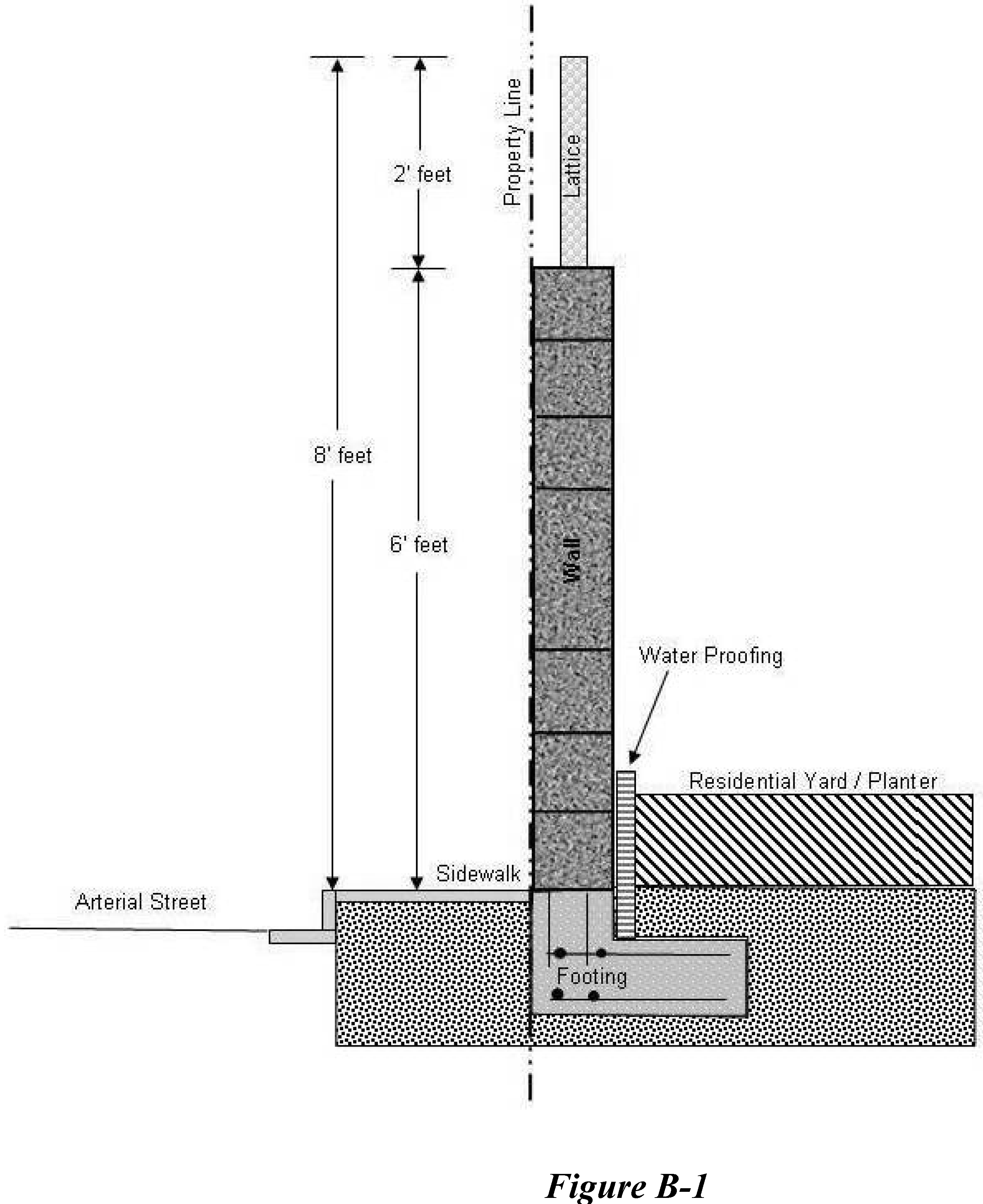
Height. The maximum height of a wall, fence, hedge, or lattice, or any combination of along an arterial highway, a local street, or other public easement shall be eight feet unless otherwise approved by a precise plan.
(3)
Maintenance. A property owner is responsible for the maintenance and repair of any fence, wall, hedge or lattice extension exhibiting damage or a worn out appearance.
(4)
Painting of wall. Painting or changing the surface of any block wall facing an arterial highway, local street, or other public right-of-way is permitted with only the approved color as designated by the City Council.
(5)
Location. No fence, wall or hedge shall be located within the public right-of-way without approval of an encroachment permit from the Community Services Department.
(6)
Joint ownership of a wall. Any modification, repair or construction of a joint ownership (common) wall shall be subject to prior written approval of all joint owners.
(7)
Water barrier. Any modification, repair or construction of a wall that abuts a planter area will require a waterproof barrier located on the inside of the wall between the surface of the wall and the soil in the planter.
(8)
Residential use adjacent to nonresidential use. A decorative block wall of at least eight feet in height, and using at a minimum a six-inch-wide block, shall be constructed adjacent to all side and rear yard property lines, where a residential district or use is adjacent to a nonresidential district or use.
(9)
Commercial property abutting residential property. A decorative block wall of three feet in height shall be constructed where a commercial property line abuts the side of the front yard setback of a residential property.
(10)
Permits required. All block walls over three feet high and any extension to existing block walls shall require building permits from the Community Development Department. A height extension using lattice to a block wall shall require Community Development Director Approval and a building permit.
(11)
Access to rights-of-way. Gate openings from private property to any public right-of-way or street must be approved by the Community Development Director, based on the following criteria:
a.
The gate opening shall not be located less than 30 feet from an intersection.
b.
The gate opening shall not impact the vehicular or pedestrian traffic on the public right-of-way.
c.
There shall be no modifications to the public right-of-way (e.g., curb cuts or drive approaches). Any gate openings that would require modifications to the public right-of-way will require a precise plan amendment.
d.
All gate openings shall slide from side-to-side on the private side of the gate or shall be inward opening.
e.
Southern California Edison shall approve all requests, in writing, for a gate opening onto its right-of-way.
(c)
Lattice height extensions.
(1)
A lattice extension to a wall is only permitted in the Single Family Residential (R-1) zone.
(2)
A lattice extension must be made of pressure-treated wood, vinyl or similar synthetic material.
(3)
A lattice extension of a wall shall be no higher than the lesser of two feet in height, or a total height for the wall plus lattice extension of eight feet, centered and mounted securely onto the top course of a wall as shown in figure B-1.
(4)
A lattice extension shall not project above the maximum height of a wall allowed under Table III-1 in this section.
(5)
A lattice extension shall be white in color, unless the wall it is attached to is painted. In such circumstances, the lattice may be painted to match the wall color at the City's discretion.
(6)
A lattice extension is not permitted within the front setback area.
(7)
A lattice extension to a wall facing an arterial highway, local street or the public right-of-way does not have to be a complete section of wall. The lattice extension can be installed solely on an individual property basis and result in a "stair-stepping" effect at the property line.
(8)
If a lattice extension includes trained vegetation growing onto the lattice, then such vegetation shall not include thorns or other features that would cause injury to the public passing by the lattice.
(9)
A lattice extension shall be a framework made up of one and one-quarter-inch wide strips of pressure-treated wood or solid synthetic material that is overlapped in a 3D diagonal pattern. A lattice extension shall also feature cap and divider moldings.
(10)
A lattice extension shall have openings in a diagonal pattern that are no less than one-inch square and no greater than two inches square.
(d)
Block height extensions.
(1)
A block extension shall not be of a different style, type or color of material used in the existing wall. If the block extension is on a painted wall, then the block extension shall be painted to match the wall color at the City's discretion.
(2)
Any existing cap on a wall must be removed prior to an extension.
(e)
Residential provisions.
(1)
Maximum heights. The maximum height of a wall, fence, or hedge shall be as follows:
1 A height extension to a wall shall not exceed the maxi-mum height identified in Table III-1.
(2)
Required residential walls. For all new developments, a decorative masonry block wall of at least six feet in height and six inches thick shall be constructed so as to be centered on all side and rear property lines. Replacement of existing residential walls between lots may be of any fencing type, except chain link.
(3)
Required points of extension. Required walls along side yard property lines of corner lots shall extend to a point perpendicular to the front elevation closest to the street. When side and rear yards abut, the wall shall extend the entire length of the rear property line.
(4)
No chain link. No chain link fencing shall be permitted in any residential yard where it is visible from the public right-of-way.
(Ord. No. 2015-01, § 3, 5-5-2015)
Sec. 44-263. - Glare.
All lighting, both exterior and interior, shall be designed and located so as to confine direct light rays to the subject premises and to minimize the effects of reflected light on adjacent or nearby properties.
(Ord. No. 2015-01, § 3, 5-5-2015)
Sec. 44-264. - Hours of operation.
The operation of permitted uses located within 300 feet of any property zoned R-1 or R-3 shall be limited to the hours between 6:00 a.m. and 11:00 p.m., except as approved by a precise plan or a conditional use permit.
(Ord. No. 2015-01, § 3, 5-5-2015)
Sec. 44-265. - Irregular lots.
This section provides standards for the establishment and measurement of setbacks on irregular lots.
(1)
Perimeter setbacks. Perimeter setbacks shall be measured from the property line or the ultimate street right-of-way line, whichever results in the larger setback.
(2)
Flag lots.
a.
Setbacks. All perimeter setbacks shall be measured from property lines, except that the property line adjacent and most perpendicular to the "panhandle" portion of the lot shall be extended across that portion and serve as the basis for measuring setbacks in that area.
b.
No structures in panhandle. Structures shall not be allowed in the "panhandle" portion of the lot, nor shall that portion be credited to minimum lot area requirements.
(3)
Determination of property lines. Where a building site is situated so that any of the property lines are not readily determinable, required setbacks shall be as determined by the Community Development Director in compliance with the following criterion: required setbacks shall not allow the placement of buildings on the site in a manner that will constitute a grant of special privileges inconsistent with the limitations placed on other properties in the vicinity and incompatible with surrounding uses.
(4)
Setbacks from easements. Where a surface easement for street, vehicular access, bikeway, recreation trail, or similar purposes has been granted across a lot, the building setback shall be measured from the property line or from the edge of the easement, whichever is closer to the building.
(Ord. No. 2015-01, § 3, 5-5-2015)
Sec. 44-266. - Measurements, projections, and encroachments.
(a)
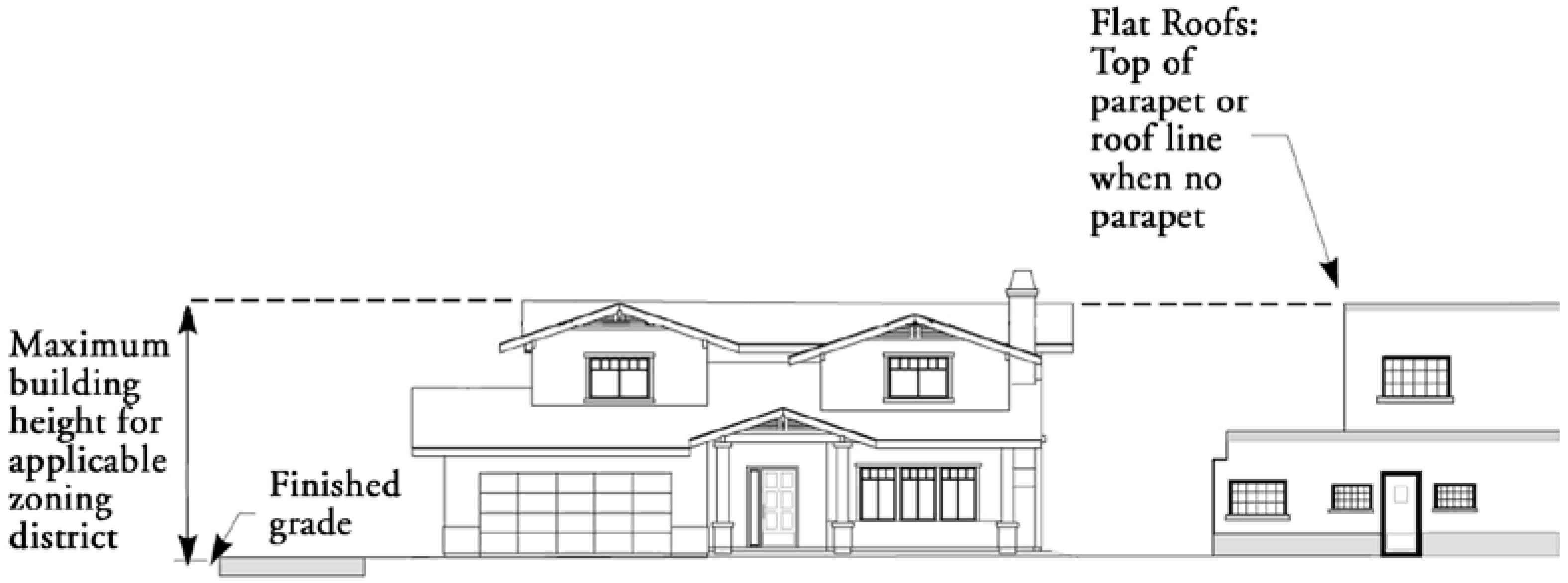
Measuring building height. The maximum height of buildings and other structures shall be defined as the vertical distance from finish grade to an imaginary plane above the building site. The imaginary plane shall be established above and parallel to the finish grade adjacent to the exterior walls at a vertical distance equal to the specified maximum height as established for the corresponding district.
(b)
Allowable height projections. Architectural features not containing usable floor space, such as chimneys, towers, gables, and spires, are permitted to extend five feet above the maximum structure height as established for the corresponding district, if approved as part of a precise plan or conditional use permit. The aggregate floor or "footprint" area of such architectural features shall not encompass more than ten percent of the ground floor area of the structure. Chimneys shall comply with building code regulations.
(c)
Determining lot frontage. The Community Development Director shall determine which property lines shall be considered the lot frontage for the purpose of complying with setback requirements. On all irregular and nonrectangular lots, the Community Development Director shall determine the location of front, side, and rear yard areas.
(d)
Allowable encroachments. The following structures may encroach a maximum of two feet into any required setbacks established for the corresponding district, provided the projections do not extend over the property line:
(1)
Eaves, buttresses, cornices, sills, or other similar architectural features.
(2)
Fireplace structures not wider than eight feet.
(3)
Awnings or open patio covers.
(4)
Guard railings for safety protection around ramps.
(5)
Bay windows, without a foundation, located in the front or rear setback area.
(e)
Prohibited encroachments. Bay windows not meeting the allowable encroachment criteria identified above, balconies, pop outs, and similar features shall not encroach into the required setbacks established for the corresponding zoning district.
(Ord. No. 2015-01, § 3, 5-5-2015)
Sec. 44-267. - Noise.
(a)
Excessive noise prohibited. A person shall not willfully make or continue, or willfully cause to be made or continued, any loud, unnecessary, or unusual noise that disturbs the peace or quiet of any neighborhood or zoning district or constitutes a public nuisance.
(b)
Exterior noise standards. Property owners/business operators/tenants shall be responsible for the attenuation/mitigation of noise. The following noise levels are the maximums permitted in the City, unless otherwise stated in a precise plan or conditional use permit.
* Noise shall be measured at a position or positions at any point on the receiver's property. In general, the microphone shall be located four to five feet above the ground; ten feet or more from the nearest reflective surface, where possible. However, in those cases where another elevation is deemed appropriate, the latter shall be utilized.
It shall be unlawful for any person at any location within the City to create any noise, or to allow the creation of any noise on property owned, leased, occupied or otherwise controlled by such person, when the foregoing causes the noise level, when measured on any other property, to exceed:
(1)
The noise standard for a cumulative period of more than thirty (30) minutes in any hour; or
(2)
The noise standard plus five dB(A) for a cumulative period of more than fifteen (15) minutes in any hour; or
(3)
The noise standard plus ten dB(A) for a cumulative period of more than five (5) minutes in any hour; or
(4)
The noise standard plus fifteen (15) dB(A) for a cumulative period of more than one minute in any hour; or
(5)
The noise standard plus twenty (20) dB(A) for any period of time.
(c)
Noise measurement. Noise measurements shall be made with a sound level meter using the "A" weighted network (scale). Calibration of the measurement equipment, utilizing an acoustic calibrator, shall be performed immediately prior to recording any noise data.
(d)
General regulations to control noise.
(1)
Loading and unloading. Loading, unloading, opening, closing, or other handling of boxes, crates, containers, building materials, garbage cans, or similar objects shall not occur between the hours of 10:00 p.m. and 7:00 a.m. in a manner that would cause a noise disturbance to a residential zoning district. Loading, unloading, opening, closing, or other handling of boxes, crates, containers, building materials, garbage cans, or similar objects shall not occur in commercial or industrial areas abutting residential zoning districts between the hours of 7:00 p.m. and 7:00 a.m.
(2)
Vehicle repairs and testing. Repairs, rebuilding, modifying, or testing of motor vehicles, motorcycles, motorboats, or other motorized vehicles shall not occur between the hours of 7:00 p.m. and 7:00 a.m. in a manner that would cause a noise disturbance to a residential zoning district.
(3)
Maintenance activities. Maintenance activities in landscape and parking areas (i.e., mechanical sweeping, mechanical grass cutting, mechanical blowing) shall not occur between the hours of 8:00 p.m. and 8:00 a.m. in a manner that would cause a noise disturbance to a residential zoning district.
(4)
Construction activities. Construction activities shall include noise generated at the site during site preparation and construction, which includes utilizing various types of machinery and equipment. Construction activity also includes the transport of workers and export of debris and import of construction materials from the site. Construction activity shall be limited to the following:
* Modification of construction hours may be granted for temporary uses per Section 44-1007(7).
Note— Section 26-202(g) provides for modification of hours for temporary uses.
(e)
Exceptions. Short-term or temporary intermittent bursts of noise may exceed maximum noise levels for approved construction projects, emergency vehicles and equipment, and other short-term incidents with City approval. Such short-term or temporary intermittent noises shall not exceed 30 seconds of constant sound above the established levels nor occur more frequently than one incident of noise level excession every five minutes over a period of not more than three hours.
(f)
Residential design requirements. New residential development shall be consistent with Title 24 of the California Code of Regulations in order to ensure an adequate interior noise environment for residential uses.
(Ord. No. 2015-01, § 3, 5-5-2015; Ord. No. 2021-01, §§ 4, 5, 8-3-2021)
Sec. 44-268. - Outdoor display, advertisement, and sales of merchandise.
There shall be no outdoor display, storage, or sales of merchandise, except where specifically permitted by Section 44-139 or by a conditional use permit or by an outdoor display and seating permit.
(Ord. No. 2015-01, § 3, 5-5-2015)
Sec. 44-269. - Outdoor work.
(a)
Outdoor work such as assembling, repairing, dismantling, and manufacturing of merchandise shall not be allowed unless approved by a conditional use permit.
(b)
Gardening, permitted construction activities, and loading and unloading of merchandise from vehicles shall not be considered outdoor work.
(Ord. No. 2015-01, § 3, 5-5-2015)
Sec. 44-270. - Items in the public right-of-way.
No person shall store, place, locate, or display any item in the public right-of-way other than operational vehicles, emergency equipment, or items approved by the City with an encroachment permit.
(Ord. No. 2015-01, § 3, 5-5-2015)
Sec. 44-271. - Stormwater runoff.
All new development shall comply with the County of Orange Areawide Urban Storm Water Runoff Guidelines and any additional standards or guidelines that may be adopted by the City.
(Ord. No. 2015-01, § 3, 5-5-2015)
Sec. 44-272. - Screening of equipment.
All mechanical equipment, including heating, ventilating, and air conditioning equipment, shall be screened from view of a public street or adjacent property in a manner approved by the Community Development Director, whether such equipment is located within a building, behind a roof parapet, or on the ground.
(Ord. No. 2015-01, § 3, 5-5-2015)
Sec. 44-273. - Swimming pools, fish ponds, and fountains.
(a)
Compliance with codes. Swimming pools, fish ponds, or other bodies of water 12 or more inches in depth at any point shall be developed in compliance with any applicable standards and codes as required by the City, County, and State.
(b)
Required setbacks.
(c)
Front yard. Fish ponds, fountains, and other water features located in the front yard of a residence shall not exceed 12 inches in depth or 50 square feet in area.
(d)
Mosquito abatement. All fish ponds, fountains, or other water features shall contain mosquito fish or other mosquito abatement measures recommended by the Orange County Vector Control District.
(Ord. No. 2015-01, § 3, 5-5-2015)
Sec. 44-274. - Trash and recyclable materials storage.
(a)
Provisions for trash required. Adequate, accessible, and convenient areas for collecting and loading trash and recyclable materials shall be provided in compliance with State law.
(1)
Multifamily uses. The following are minimum requirements for common refuse and recyclable material storage areas for multifamily developments with five or more units. Storage areas may be located indoors or outdoors as long as they are readily accessible to all residents. Areas are measured in square feet. If the trash storage area is located outdoors, a trash enclosure is required.
(2)
Nonresidential uses. Nonresidential uses shall provide refuse areas in compliance with the following requirements. Requirements apply to each individual structure. Areas are measured in square feet.
(b)
Area to be shown on plans. Trash and recyclable materials storage areas shall be included on all applicable plans to be approved by the City. Design specifications shall include space allocation, location, design, and signage, if applicable.
(c)
Enclosure standards. Trash and recyclable materials containers shall be located within an enclosed area. Enclosures for trash and recycling containers shall comply with the following standards.
(1)
Enclosure placement. Trash and recyclable materials enclosures shall be provided as follows:
a.
Located within 250 feet of all businesses served by the enclosure.
b.
Directly available to collection vehicles via alleys or driveways to avoid the necessity of substantial hand carrying of containers or hand pushing of dumpsters.
c.
Located substantially away from public view and pedestrian and vehicle circulation areas unless determined infeasible by the review authority.
d.
Located a minimum of 25 feet away from residentially-zoned property.
(2)
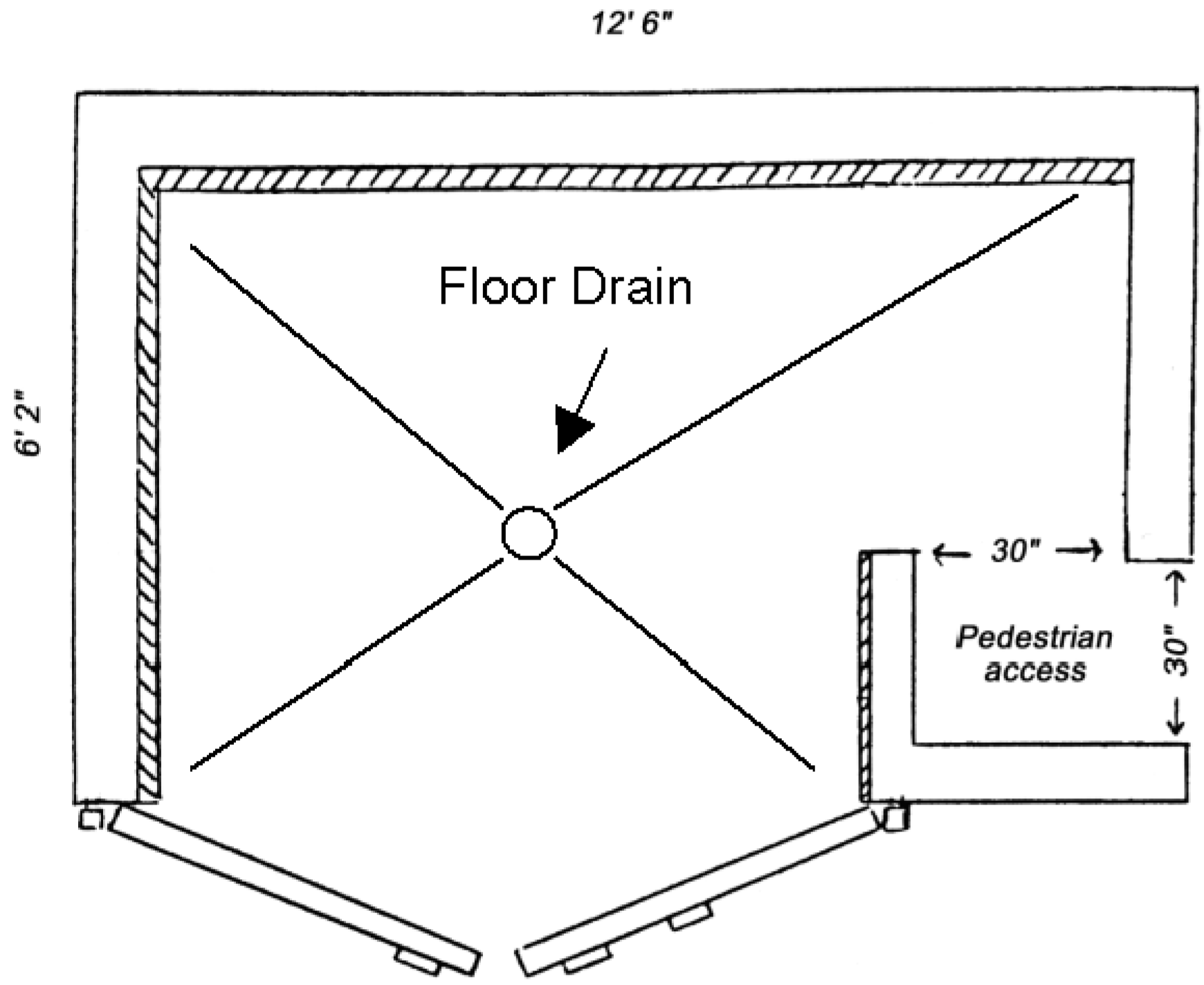
Enclosure design. Enclosures shall be constructed on a concrete pad with a concrete apron and be of an adequate size to accommodate the containers they enclose, per disposal company standards. Access to the containers for collection shall also meet disposal company requirements. Enclosures shall comply with City standards as illustrated below. Walls shall be at least six feet high and shall be made of strong, masonry block, and finished as to match colors and finishes of nearby buildings and be consistent with current City standards. Doors shall be self-latching, metal or metal framed, and of heavy-duty construction sufficient to withstand hard usage. Trash enclosures shall incorporate a drain that carries wastewater to the sanitary sewer. Interior six-inch-high concrete or metal curbs shall be included to prevent damage to the walls from collisions with heavy containers.
(d)
Weather protection. Each enclosure shall be designed and maintained so that deposited materials are contained during windy periods. The trash enclosure shall have a roof and individual containers shall have lids. The roof shall be constructed of a solid, high quality, and durable material, and shall incorporate a design that is architecturally compatible with the building on the property. Enclosures or containers designated for recyclable materials that could be damaged or be rendered unmarketable by rain or other environmental conditions shall provide adequate protection against such conditions.
(e)
Maintenance of trash facilities. It shall be the responsibility of the property owner to ensure that the immediate surroundings and the floor of the enclosures are kept clean and free of debris, that the enclosure gates have operable latches, that the enclosure gates remain closed, and that the container lids remain closed at all times except during periods of depositing trash and emptying the bin.
(Ord. No. 2015-01, § 3, 5-5-2015)
Sec. 44-275. - Underground utilities.
(a)
Underground installation. Utilities, including electrical, telephone, cable television, and similar service wires or cables that provide direct service to the development on the property shall be installed underground unless otherwise approved by the City Council when approving a precise plan. The developer or owner is responsible for complying with the requirements of this section and making the necessary arrangements with the utility companies for installation of facilities. Freestanding electrical boxes are not permitted in residential zones.
(b)
Aboveground exceptions. For the purpose of this section, appurtenances and associated equipment such as surface-mounted transformers, pedestal-mounted terminal boxes and meter cabinets, and concealed ducts in an underground system may be placed aboveground with approval of the Community Services Department. Such exceptions shall not be placed in required front or side yard setbacks and shall be adequately screened so as not to be visible from the street.
(Ord. No. 2015-01, § 3, 5-5-2015; Ord. No. 2016-06, § 16, 5-3-2016)
Sec. 44-276. - Traffic safety triangle.
(a)
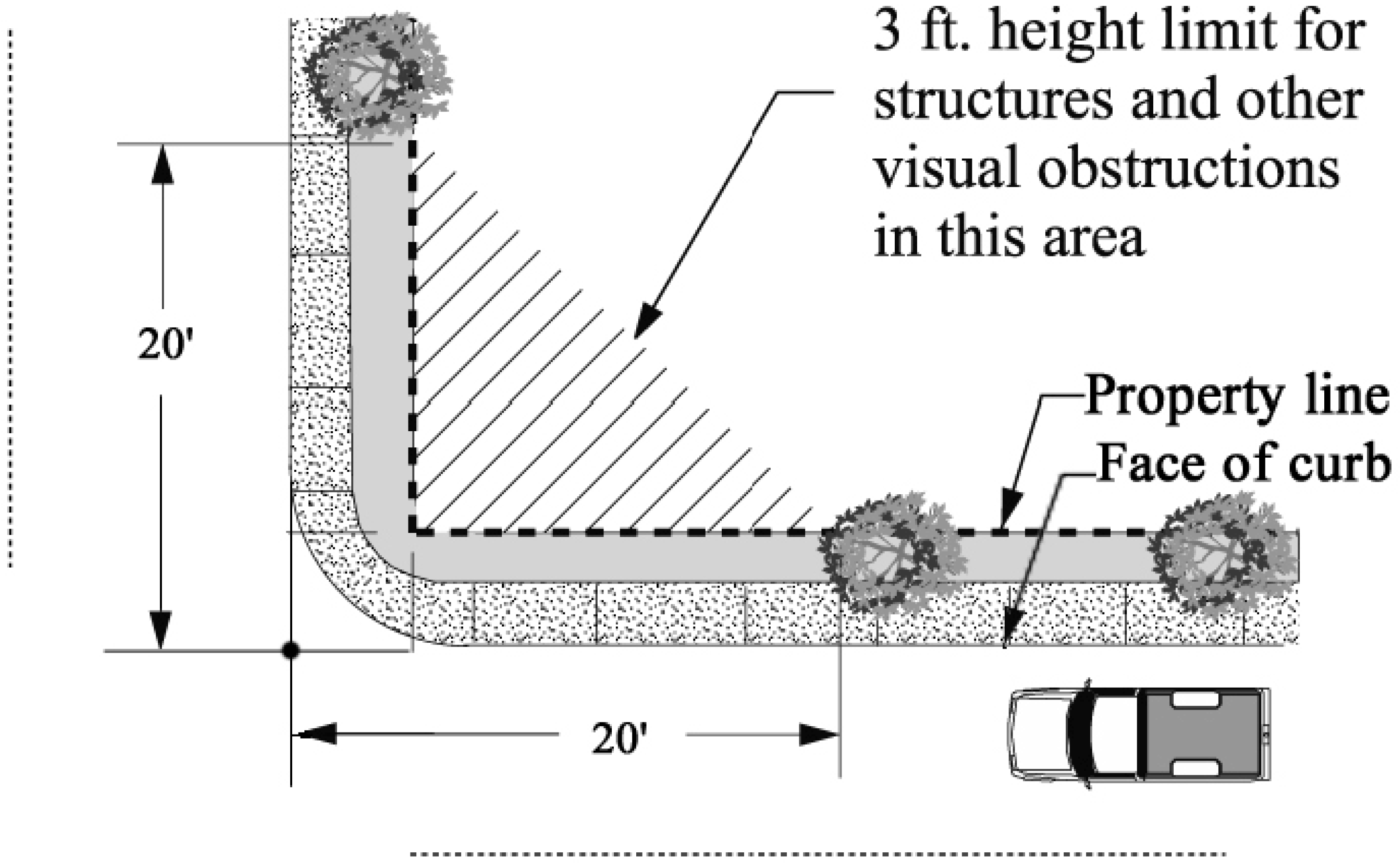
Corner parcels. Traffic safety triangles shall be developed in a manner that ensures visibility across the corners of the intersecting streets, alleys, and private driveways. The traffic safety triangle shall be described as a triangular shaped area on a corner parcel formed by 20 feet from the intersection of lines tangent to the face of the curb, and connecting the lines diagonally across the property making a 90-degree triangle as shown in the figure below.
(b)
Height of obstructions. The maximum height of any object (i.e., fence, landscaping, signs, or walls) located in the traffic safety triangle area shall be three feet, measured from the adjoining top of curb. The three-foot height limit shall not apply to traffic safety devices, trees trimmed to eight feet above the adjacent top of curb, utility poles, and other government or utility installed devices.
(Ord. No. 2015-01, § 3, 5-5-2015)
Sec. 44-277. - Address numerals.
Street address numerals shall be provided pursuant to the following:
(1)
Single-family units. Street addresses shall be visible from the public street and may be displayed either on the front door, on the fascia adjacent to the main entrance, or on another prominent location. Numerals shall be a minimum four inches in height with not less than one-fourth-inch stroke and shall contrast sharply with the background.
(2)
Multifamily units. Street addresses shall be visible from the public street and shall be displayed on the complex identification sign. If there is no complex identification sign, the street address may be displayed on the fascia adjacent to the main entrance or on another prominent location. When the property has alley access, address numerals shall be displayed in a prominent location visible from the alley. Street address numerals shall be a minimum six inches in height with not less than one-half-inch stroke and shall contrast sharply with the background. Identification of individual units shall be provided adjacent to the unit entrances. Letters or numerals of individual units shall be a minimum of four inches in height with not less than one-fourth-inch stroke and shall contrast sharply with the background.
(3)
Nonresidential properties. Street addresses shall be visible from the public street. Street addresses shall be displayed on a freestanding sign, on the fascia adjacent to the main entrance, or on another prominent location on the building. When the property has alley access, address numerals shall be displayed in a prominent location visible from the alley. Numerals shall be a minimum six inches in height with not less than one-half-inch stroke and shall contrast sharply with the background. Identification of individual units shall be provided adjacent to the unit entrances. Letters or numerals for the individual units shall be four inches in height with not less than one-fourth-inch stroke and shall contrast sharply with the background.
(Ord. No. 2015-01, § 3, 5-5-2015)
Sec. 44-278. - Outdoor and exterior lighting standards.
Where applicable all outdoor and exterior lighting standards shall meet the recommended illumination levels as published by the then-current edition of the Illuminating Engineer Society of North America (IESNA or IES) Lighting Handbook.
(Ord. No. 2015-01, § 3, 5-5-2015)
Sec. 44-303. - Purpose.
The purpose of this division is to implement the provisions of California Government Code § 65915, and the City's Housing Element, regarding the provision of density bonuses and other regulatory incentives for affordable and senior housing projects.
(Ord. No. 2015-01, § 3, 5-5-2015)
Sec. 44-304. - Applicability.
The provisions of this division shall apply to projects qualifying for density bonuses provided for by California Government Code § 65915.
(Ord. No. 2015-01, § 3, 5-5-2015)
Sec. 44-305. - Government Code § 65915 adopted by reference.
California Government Code § 65915, a copy of which shall remain on file in the office of the La Palma City Clerk for use and examination by the public, is adopted and incorporated herein by reference as if fully set forth, and shall constitute the affordable housing density bonus regulations of the City.
(Ord. No. 2015-01, § 3, 5-5-2015)
Sec. 44-306. - Supportive housing.
(a)
Purpose. The purpose of this section is to establish development standards for supportive housing and to ensure the supportive housing is constructed and operated in a manner that is consistent with the requirements and allowances of state law, specifically Article 11 of Chapter 3 of Division 1 of Planning and Zoning Law commencing with Government Code Section 65650.
(b)
Applicability. The provisions of this section shall apply to all supportive housing projects.
(c)
Planning approval required. An application to establish any supportive housing project shall be submitted to the Director of Community Development for review and approval. The decision to approve or deny the application shall be a ministerial in nature, without any discretionary review or a hearing. A decision by the Community Development Director shall be taken within 60 days of a complete application being filed.
(1)
Supportive housing projects shall be a use permitted by right in all zones where multifamily and mixed uses are permitted, including non-residential zones permitting multifamily uses. Supportive housing projects are permitted where all the following requirements are met:
a.
Units within the development are subject to a recorded affordability restriction for 55 years.
b.
One hundred percent of the units, excluding the manager unit(s), within the development are dedicated to lower income households and are receiving public funding to ensure affordability of the housing to lower income Californians.
c.
At least 25 percent of the units in the development or 12 units, whichever is greater, are restricted to residents in supportive housing who meet criteria of the target population. If the development consists of fewer than 12 units, then 100 percent of the units, excluding manager unit(s), in the development shall be restricted to residents in supportive housing.
d.
Non-residential floor area shall be used for on-site supportive services in the following amounts:
1.
For a development with 20 or fewer total units, at least 90 square feet shall be provided for onsite supportive services.
2.
For a development with more than 20 units, at least three percent of the total nonresidential floor area shall be provided for onsite supportive services that are limited to tenant use, including, but not limited to, community rooms, case management offices, computer rooms, and community kitchens.
e.
The developer replaces any dwelling units on the site of the supportive housing development to ensure that any change to the occupancy of the supportive housing units is made in a manner that minimizes tenant disruption and only upon the vacancy of any supportive housing units.
f.
Units within the development, excluding manager unit(s), include at least one bathroom and a kitchen or other cooking facilities, including, at minimum, a stovetop, a sink, and a refrigerator.
(d)
Development and operational standards. Supportive housing projects shall comply with all the following standards:
(1)
The project shall comply with all development standards and any written objective standards or policies required of multifamily developments in the same zone.
(2)
The applicant shall submit a plan for providing supportive services, to include all the following items:
a.
Documentation that supportive services will be provided on-site.
b.
The name of the proposed entities that will provide supportive services.
c.
The proposed funding sources for the services provided.
d.
Proposed staffing levels
(3)
No minimum parking requirements shall be required for the units occupied by supportive housing residents for projects located within one-half mile of a public transit stop.
(e)
Definitions. This section includes the definition of terms and phrases used in this section that are technical or specialized, or that may not reflect common usage. If any of the definitions in this section conflict with definitions in other provisions of the Municipal Code, these definitions shall supersede for the purposes of this section. If a word is not defined in this section or is defined and conflicts with another definition of the Municipal Code, the director shall determine the most appropriate definition.
(1)
Lower income households shall have the same meaning as defined in Section 50079.5 of the Health and Safety Code.
(2)
Supportive housing shall mean housing with no limit on length of stay, that is occupied by the target population, and that is linked to on-site or off-site services that assist the supportive housing resident in retaining the housing, improving his or her health status, and maximizing his or her ability to live and, when possible, work in the community.
(3)
Supportive services shall include, but are not limited to, a combination of subsidized, permanent housing, intensive case management, medical and mental health care, substance abuse treatment, employment services, and benefits advocacy.
(4)
Target population shall mean persons, including persons with disabilities, and families who are homeless, as that term is defined by Section 11302 of Title 42 of the United States Code, or who are homeless youth, as that term is defined by paragraph (2) of subdivision (e) of Section 11139.3 of the Government Code.
(Ord. No. 2024-04, § 4, 12-10-2024)
Sec. 44-307. - Low-barrier navigation centers.
(a)
Purpose. The purpose of this section is to establish development standards for low-barrier navigation centers and to ensure this use is constructed and operated in a manner that is consistent with the requirements and allowances of state law, specifically Article 12 of Chapter 3 of Division 1 of Planning and Zoning Law commencing with California Government Code Section 65660. This section shall be repealed as of January 1, 2027.
(b)
Applicability. The provisions of this section shall apply to all low-barrier navigation center projects.
(c)
Planning approval required. An application to establish a low-barrier navigation shall be submitted to the Director of Community Development for review and approval. The decision to approve or deny an application shall be ministerial in nature, without any discretionary review or a hearing. The City shall notify a developer whether the developer's application is complete within 30 days, pursuant to California Government Code Section 65943. A decision by the Community Development Director shall be taken within 60 days of a complete application being filed.
(d)
Development and operational standards. A low-barrier navigation center development shall be deemed a use that is permitted by-right in areas zoned for mixed-use and nonresidential zones permitting multifamily uses, if it meets the following requirements:
(1)
Connected services. It offers services to connect people to permanent housing through a services plan that identifies services staffing.
(2)
Coordinated entry system. It is linked to a coordinated entry system, so that staff in the interim facility or staff who co-locate in the facility may conduct assessments and provide services to connect people to permanent housing. "Coordinated entry system" means a centralized or coordinated assessment system developed pursuant to Section 576.400(d) or Section 578.7(a)(8), as applicable, of Title 24 of the Code of Federal Regulations, as those sections read on January 1, 2020, and any related requirements, designed to coordinate program participant intake, assessment, and referrals.
(3)
Code compliant. It complies with Chapter 6.5 (commencing with Section 8255) of Division 8 of the Welfare and Institutions Code.
(4)
Homeless management information system. It has a system for entering information regarding client stays, client demographics, client income, and exit destination through the local homeless management information system, as defined by Section 578.3 of Title 24 of the Code of Federal Regulations.
(e)
Definitions. This section includes the definition of terms and phrases used in this section that are technical or specialized, or that may not reflect common usage. If any of the definitions in this section conflict with definitions in other provisions of the Municipal Code, these definitions shall supersede for the purposes of this section. If a word is not defined in this section or is defined and conflicts with another definition of the Municipal Code, the Director shall determine the most appropriate definition.
(1)
Low-barrier navigation centers shall mean a housing-first, low-barrier, service-enriched shelter focused on moving people into permanent housing that provides temporary living facilities while case managers connect individuals experiencing homelessness to income, public benefits, health services, shelter, and housing. "Low barrier" means best practices to reduce barriers to entry, and may include, but is not limited to, the following:
a.
The presence of partners if it is not a population-specific site, such as for survivors of domestic violence or sexual assault, women, or youth.
b.
Pets.
c.
The storage of possessions.
d.
Privacy, such as partitions around beds in a dormitory setting or in larger rooms containing more than two beds, or private rooms.
(2)
Use by right has the meaning defined in subdivision (i) of Section 65583.2. Division 13 (commencing with Section 21000) of the California Public Resources Code shall not apply to actions taken by a public agency to lease, convey, or encumber land owned by a public agency, or to facilitate the lease, conveyance, or encumbrance of land owned by a public agency, or to provide financial assistance to, or otherwise approve, a low-barrier navigation center constructed or allowed by this section.
(Ord. No. 2024-04, § 4, 12-10-2024)
Sec. 44-335. - Residential landscape standards.
(a)
Applicability. This section provides landscaping requirements for residential uses that shall apply to:
(1)
All proposed new residential developments.
(2)
All existing residential developments.
(3)
All existing landscape and irrigation systems.
(b)
General provisions.
(1)
All residentially zoned properties and nonresidential zoned properties developed with residential uses shall provide landscaping as required under this section.
(2)
Landscape design may emphasize water conservation through minimal irrigation and the use of plant materials that are drought tolerant and well adapted to the local climate and soil conditions.
(3)
New development. All new development shall require approval of a landscape and irrigation plan pursuant to Section 44-77.
(4)
Should any provision of this chapter conflict with other any other provisions of this Code or any adopted specific plan, the Community Development Director shall clarify the spirit and intent of the Code.
(5)
All landscaping shall be maintained in an attractive and healthy condition. Attractive and healthy condition shall include the proper pruning, mowing of live turf areas, weeding, litter removal, replacement of all dead and deceased plants, and the regular application of appropriate quantities of water to all landscaped areas. Indoor/outdoor plastic or nylon carpeting and similar materials that do not resemble thriving, live, green grass shall not be permitted as a substitute for artificial turf and/or live turf.
(6)
Irrigation systems shall be maintained in a proper operating condition. Water line breaks, head/emitter ruptures, overspray or runoff conditions and other irrigation system failures shall be repaired immediately.
(7)
Restrictions for traffic safety. In compliance with Section 44-276, landscaping in the traffic safety triangle shall not exceed a height of three feet.
(c)
Artificial turf standards.
(1)
Artificial turf shall have polyethylene monofilament fiber with a minimum grass zone pile height of one and one-half inches.
(2)
A minimum face weight of 42 ounces per square yard of unfilled artificial turf.
(3)
Nylon, polypropylene, and similar fibers can be permitted in the thatch zone provided that the thatch zone is a minimum one-quarter inches lower than the grass zone pile height.
(4)
Artificial turf installations requiring infill materials shall use infill of the silica sand variety. Rubber infill made from old tires is not acceptable for use as infill for artificial turf.
(5)
All electric, water, gas, and irrigation lines and conduits shall be run outside the perimeter of an artificial turf installation with the exception of those that provide direct service to the residence.
(6)
An appropriate solid barrier device (i.e., concrete mow strip) is required to separate artificial turf from soil and live vegetation.
(7)
Artificial turf shall be lead free.
(8)
Artificial turf shall be trimmed to fit against all regular and irregular edges to resemble a natural look.
(9)
Artificial turf shall be designed to allow water to percolate through the synthetic grass at a minimum drain rate of 30 inches per hour to an adequate drainage system installed underneath the artificial turf to prevent run-off, pooling, and flooding.
(10)
All artificial turf shall have a warranty that protects against color fading and a decrease in pile height. A minimum four-year manufacturer's warranty is required for a "do it yourself" homeowner's installation, and a minimum eight-year manufacturer's warranty is required for an installation certified by the manufacturer.
(11)
Installation shall be done at minimum to the manufacturer's specifications, and include the following: removal of all sod or existing groundcover, a synthetic porous filter fabric shall be installed, compacted and porous decomposed crushed granite and/or road base material (minimum three inches), all edges and seams of the artificial turf are to be anchored with nails and glue, all seams shall be nailed and glued, not sewn, and artificial turf shall be visually level with the grain pointing in a single direction.
(d)
Maintenance.
(1)
All landscaping, including parkway landscaping, plant materials, and live turf areas shall be maintained by the property owner, in a healthy, neat, and orderly condition that is free of weeds, trash, and debris.
(2)
Artificial turf shall be maintained by the property owner in an effective manner which includes cleaning, brushing, debris removal; repairing of depressions and ruts to maintain a level visual surface; elimination of any odors, flat or matted areas, weeds, evasive roots, looseness at edges, seams; and the replacement of the artificial turf when maintenance or repair is unable to simulate a natural thriving, green, grass appearance.
(3)
Dead or diseased plants and/or any damaged or worn-out artificial turf areas shall be removed and appropriately replaced by the property owner. Repaired artificial turf areas shall be done so with like for like materials from the same manufacturer and done so in a manner that results in a repair that blends in with the existing artificial turf.
(e)
Single-family development landscaping.
(1)
Landscaped yards. Landscaping shall illustrate a concern for aesthetic elements such as balance, scale, texture, form, water conservation, and unity. Yards visible from the public right-of-way, excluding driveways, shall be landscaped. Seventy percent of the yard area visible from the public right-of-way, excluding the driveway, shall be landscaped with plant materials, and/or live turf or artificial turf.
(2)
Period for landscape installation. Minimal landscaping shall be installed prior to initial occupancy of a residential dwelling. Full landscaping shall be installed within six months of initial occupancy.
(3)
Landscaping should encourage the use of drought-tolerant plant materials, drip irrigation systems, and minimal use of turf and artificial turf, where feasible. Landscape design should encourage the implementation of landscape maintenance practices that foster long-term water conservation.
(4)
A permit shall be required for the installation of artificial turf in the single family residential (R-1) zoning district.
(f)
Multiple-family development landscaping. The following features shall be incorporated into the design of the proposed landscape and shown on the required landscape plans for multiple-family developments:
(1)
Landscaping shall be required in all setback areas except for driveways and walkways;
(2)
Landscaping adjacent to the driveways and parking areas shall be protected from vehicle damage through the provision of a minimum of six-inch-high concrete curbs or other types of barriers as approved by the Community Development Director;
(3)
Landscaping planter areas shall have a minimum inside width of three feet where trees and/or shrubs are provided and six feet where turf is provided;
(4)
All landscaped areas shall incorporate an irrigation system and comply with the commercial irrigation standards in Section 44-336(f);
(5)
Plant materials shall be selected and installed to comply with the provisions for plant materials in the commercial landscaping requirements in Section 44-336(e);
(6)
Common open area. At least 200 square feet of recreational open space shall be required for each dwelling unit.
a.
Recreational open space shall be lawn, garden, or other natural landscaping, and may include paved surfaces for walking/jogging, swimming pools, BBQ grills, play areas, and places to sit down.
b.
Common open area shall not include setback areas or walkways providing access to buildings and/or other parts of the site.
(7)
Private open area. At least 200 square feet on ground level shall be provided for each first floor unit. Second floor units may be exempt from providing private open area.
a.
Private usable open space shall be provided for each dwelling unit immediately adjacent to, accessible to, and private to the unit it is designated to serve. Private open area shall not be permitted to be located in setback areas, driveway or parking areas and shall be distinguished from adjacent areas by a retaining wall, fence, or landscaping.
b.
The space shall not be less than ten feet in any horizontal distance.
(8)
Three percent landscape in parking areas and three percent in non-parking areas. A minimum landscaping area of three percent in the parking areas and three percent in the non-parking areas of all remaining areas of the site where no building will be located shall be provided.
a.
The method of calculating the three percent parking and three percent non-parking landscaping shall not include setback areas, private open areas, or the common open area.
b.
The three percent non-parking landscaping requirement shall be distributed evenly throughout the project site and located immediately adjacent to each building on the site and is not permitted to be located in the setback areas, private open space areas, or the common open area.
(9)
A permit shall be required for the installation of artificial turf in the multiple-family residential (R-3) zoning district.
(Ord. No. 2015-01, § 3, 5-5-2015; Ord. No. 2022-01, § 13, 5-3-2022)
Sec. 44-336. - Commercial landscape provisions.
(a)
Applicability. This section provides landscaping and irrigation requirements for new construction on vacant property and for new construction increasing an existing development by 50 percent or more.
(b)
Required landscaping. Landscaping shall be provided for all setback areas adjacent to public rights-of-way, plus a minimum of three percent in the parking areas and three percent in the non-parking areas of all remaining areas of the site where no building will be located.
(c)
Exceptions. The approval authority may approve exceptions to the above requirements for plans that demonstrate exceptional creativity.
(d)
General design standards. The following features shall be incorporated into the design of the proposed landscape and shown on the required landscape plans:
(1)
Landscaping shall be planned as an integral part of the overall project design considering the benefits of cooling, reduced evaporation, special continuity, and aesthetics. Landscaping shall not simply be located in excess space left over after parking areas and structures have been planned.
(2)
Pedestrian access, solar access, and shading of window areas shall be considered in the design of landscaped areas.
(3)
Landscaping adjacent to driveways and parking areas shall be protected from vehicle damage through the provision of minimum six-inch high concrete curbs or other types of barriers as approved by Community Development Director.
(4)
Landscaped planter areas shall have a minimum inside width of three feet where trees and/or shrubs are provided and six feet where turf is provided.
(5)
Landscaping within traffic safety triangles on corner lots shall be provided in compliance with Section 44-276.
(6)
Re-circulating water shall be used for all decorative water features.
(e)
Plant materials. Plant materials shall be selected and installed to comply with the following requirements:
(1)
A mix of plant materials and sizes shall be planted. Plant type variety is required to be attractive and to reduce the chance of landscape failure due to disease infestation. In addition, it is recommended that plant container sizes vary in order to further provide visual interest during initial project planting.
(2)
Trees and shrubs shall be planted and maintained so that at maturity they do not interfere with utilities and traffic safety sight areas.
(3)
Trees and shrubs shall be planted and maintained in a manner that protects the basic rights of adjacent property owners.
(4)
Trees planted near public sidewalks or curbs shall be planted and maintained in a manner that prevents physical damage to sidewalks, curbs, gutters, and other public improvements.
(5)
Ground cover shall be of live plant material, although limited quantities (ten percent maximum) of gravel, bark, or similar materials may be used in combination with a living ground cover.
(6)
The landscape design plan shall provide for water-efficient landscaping.
(7)
Turf areas shall not exceed 50 percent of the landscaped area with the following exceptions:
a.
Public parks.
b.
Child day care facilities.
(8)
A two-inch layer of bark mulch shall be installed in areas where lawn or other ground cover material is not provided.
(9)
A permit shall be required for the installation of artificial turf in any non-residential zoning district.
(f)
Irrigation design standards.
(1)
Water efficiency. The irrigation design plan shall provide for a permanent water-efficient irrigation system (i.e., drip systems, bubblers, or soakers).
(2)
Runoff and overspray. Soil types and infiltration rates shall be considered when designing irrigation systems. Irrigation systems shall be designed to avoid runoff, low head drainage, overspray, and other similar conditions. Appropriate irrigation equipment and schedules shall be used to closely match application rates to rates of infiltration. Special attention shall be given to avoid runoff on slopes and overspray in narrow planting areas and median strips.
(3)
Equipment.
a.
Controllers. Automatic controllers are required for all irrigation systems and shall be able to accommodate all aspects of the design.
b.
Sprinkler heads. Heads and emitters shall have consistently matched precipitation rates within each control valve circuit. Sprinkler heads shall be selected for proper area coverage, application rate, adjustment capability, operating pressure, and ease of maintenance.
c.
Rain-sensing override devices. Rain-sensing override devices are encouraged on all irrigation systems.
(g)
Maintenance. Landscaping shall be maintained in an orderly and healthy condition. This shall include proper pruning, mowing of turf, weeding, removal of litter, fertilizing, replacement of plants when necessary, and application of appropriate quantities of water to all landscaped areas. Practices may include performing routine irrigation system repair and adjustments, scheduling irrigation based on CIMIS (California Irrigation Management Information System), using moisture-sensing or rain shut-off devices, conducting water audits, and prescribing the amount of water to be applied per landscaped area.
(Ord. No. 2015-01, § 3, 5-5-2015; Ord. No. 2022-01, § 14, 5-3-2022)
Sec. 44-361. - General parking standards.
(a)
Spaces accessible and usable. Off-street parking spaces, whether in a garage, carport, or open area, shall be located so as to be accessible and usable for the parking of motor vehicles at all times.
(b)
Parking purposes only. Required parking shall be maintained exclusively for parking purposes and shall not be used for storage or other purposes. Outdoor storage of any kind is prohibited on driveways, drive aisles, and parking lots (e.g. containers, repair work, dismantling, or servicing of any motor vehicle, inoperable vehicles, commercial trucks, trailers, airplane, boat, construction equipment, loose rubbish, garbage, junk, or their receptacles, or building materials).
(c)
Provided on same lot. Parking spaces shall be located on the same lot as the use they are intended to serve unless a reciprocal parking agreement is approved by the City Council. Said reciprocal parking agreement shall be recorded on the title of all properties subject to the agreement in the County Clerk-Recorder's office, a copy of which agreement shall be given to the City.
(d)
Multiple uses on a lot. Where there is more than one type of use on a lot, the parking requirements shall be the sum total of the requirements for the individual uses. A reduction in this parking requirement may be supported by a site-specific parking study and a parking management plan subject to review and approval of a minor conditional use permit.
(e)
Alternatives to parking and loading standards. The City recognizes that many uses and sites are unique and that certain components of parking and loading may be tailored to better comply with these standards based on factors such as irregular site shape and unique types or combinations of uses. As such, the City may consider shared parking, joint use of parking, and modifications to certain provisions of the parking and loading standards to achieve safe and adequate parking and loading facilities, subject to review and approval of a minor conditional use permit.
(Ord. No. 2015-01, § 3, 5-5-2015; Ord. No. 2016-06, § 17, 5-3-2016; Ord. No. 2022-01, § 15, 5-3-2022; Ord. No. 2024-04, § 4, 12-10-2024)
Sec. 44-362. - Nonresidential parking standards.
(a)
Dimensions. Parking spaces may include a two-foot overhang into landscape areas provided that concrete barriers (wheel stops) are provided and the landscaping is appropriately designed to accommodate the overhang.
(b)
Clearly marked. Parking spaces shall be clearly marked, maintained in an easily discernible manner, and conform to the adopted striping requirements of the City.
(c)
Surface and parking area. The thickness of paving and base material shall be established by a recognized soils engineer. However, the minimum thickness shall be two inches asphaltic concrete or three and one-half inches Portland cement concrete.
(d)
Border barricades. Every parking area that is not separated by a wall from a street or alley shall be provided with a concrete barrier not less than six inches in height. No portion of the barrier shall be closer to the back of the sidewalk or the required yard line than two feet. Barriers shall be securely installed and maintained.
(e)
Lighting. Lighting shall be provided to illuminate parking areas for safety and security. Illumination levels shall comply with Section 44-278. Lighting shall be arranged to reflect light away from adjoining or nearby residential properties.
(Ord. No. 2015-01, § 3, 5-5-2015)
Sec. 44-363. - Residential parking standards.
(a)
Garage dimensions. When an enclosed garage is required, the minimum interior dimension for each parking space shall be ten feet wide by 20 feet deep.
(b)
Doorway width. Parking spaces within a garage or carport shall have a doorway not less than eight feet in width.
(c)
Required driveway. Parking spaces within a garage or carport shall be provided with an unobstructed driveway area of at least 20 feet in length paved with Portland cement concrete. The driveway shall have a vertical clearance of not less than eight feet.
(d)
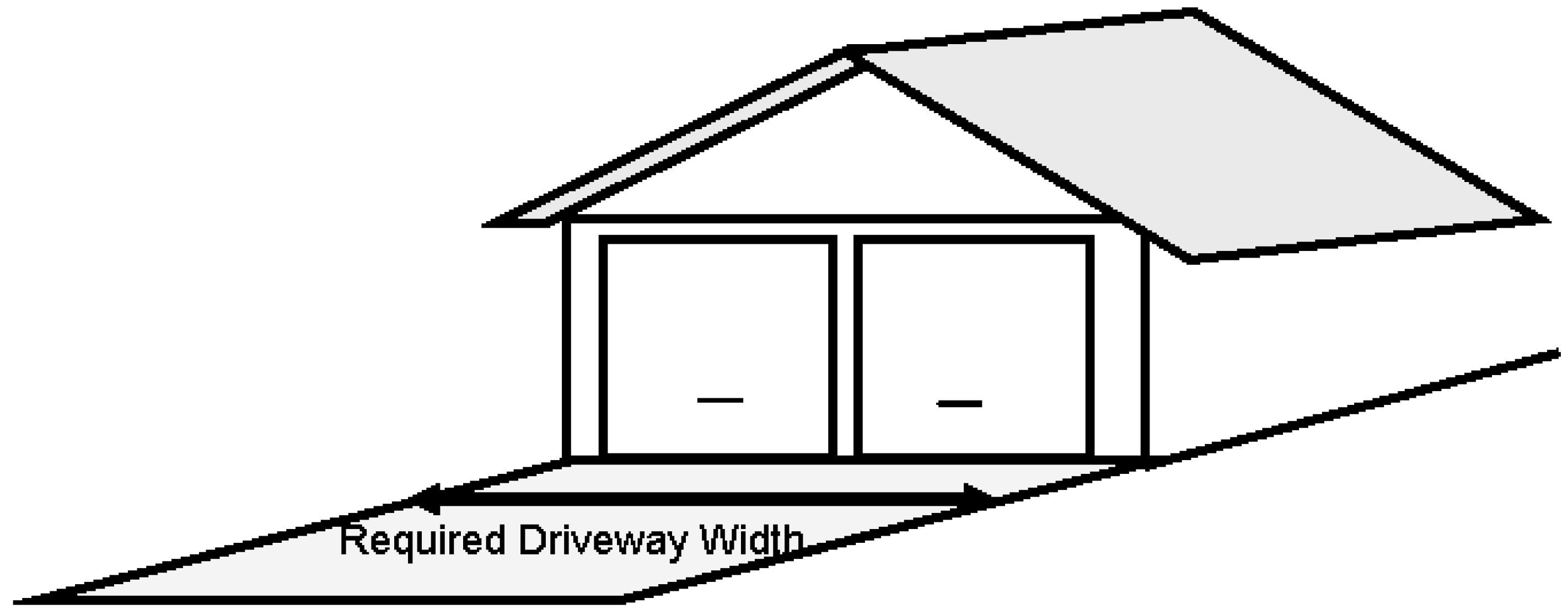
Driveway width. The entire length of a driveway shall extend the full width of the garage or carport entry. The entire driveway in a residential district shall be paved with Portland cement concrete or other comparable nonasphaltic material as approved by the City Engineer. The width of a driveway shall not be in excess of that specified by a precise plan or by a conditional use permit except that the Community Development Director may issue a permit for a paved ancillary parking area.
(e)
Paved ancillary parking area.
(1)
Paved ancillary parking areas must be designed and constructed to the specifications required by this Code for driveways. All material utilized for the paved ancillary parking area shall be consistent with the driveway material.
(2)
Paved ancillary parking areas shall not exceed ten feet in width and may extend from the front of the garage to the back of the right-of-way providing access to the driveway.
(3)
Paved ancillary parking areas shall be located on the side of the original driveway that is closest to an adjacent property line. Where it is not obvious which side of the driveway is the closest to an adjacent property line, the Community Development Director shall make the determination.
(4)
The proposed widening shall not be detrimental to the adjacent property by creating conditions that would result in an appreciable diminution of adjoining property values or a potential traffic hazard.
(5)
Modifications to the public right-of-way are not permitted unless an encroachment permit is obtained from the Community Services Department.
(6)
Paved ancillary parking areas shall have the same parking and storage standards as driveways.
(f)
Drive aisles. If the driveway does not connect directly to a street or alley, a drive aisle paved with Portland cement concrete shall be provided. For drive aisles not exceeding 100 feet in length, the width shall be not less than ten feet. For drive aisles over 100 feet in length, the width shall be at least 15 feet.
(Ord. No. 2015-01, § 3, 5-5-2015; Ord. No. 2018-03, § 7, 5-15-2018; Ord. No. 2022-01, § 16, 5-3-2022)
Sec. 44-364. - Parking calculations.
Parking calculations for all zoning districts shall be determined by use, as identified in the following table.
1 ADUs that are created through the conversion of a garage, carport or covered parking structure are not required to provide replacement off-street parking spaces.
2 Off-street parking shall be permitted in setback areas in locations determined by the City or through tandem parking, unless specific findings are made that parking in setback areas or tandem parking is not feasible based upon specific site or regional topographical or fire and life safety conditions.
(Ord. No. 2015-01, § 3, 5-5-2015; Ord. No. 2018-03, § 7, 5-15-2018; Ord. No. 2020-03, § 7, 6-2-2020; Ord. No. 2022-01, § 17, 5-3-2022; Ord. No. 2023-03, § 6, 3-7-2023; Ord. No. 2024-04, § 4, 12-10-2024)
Sec. 44-365. - Minimum dimensions for angled parking layouts.
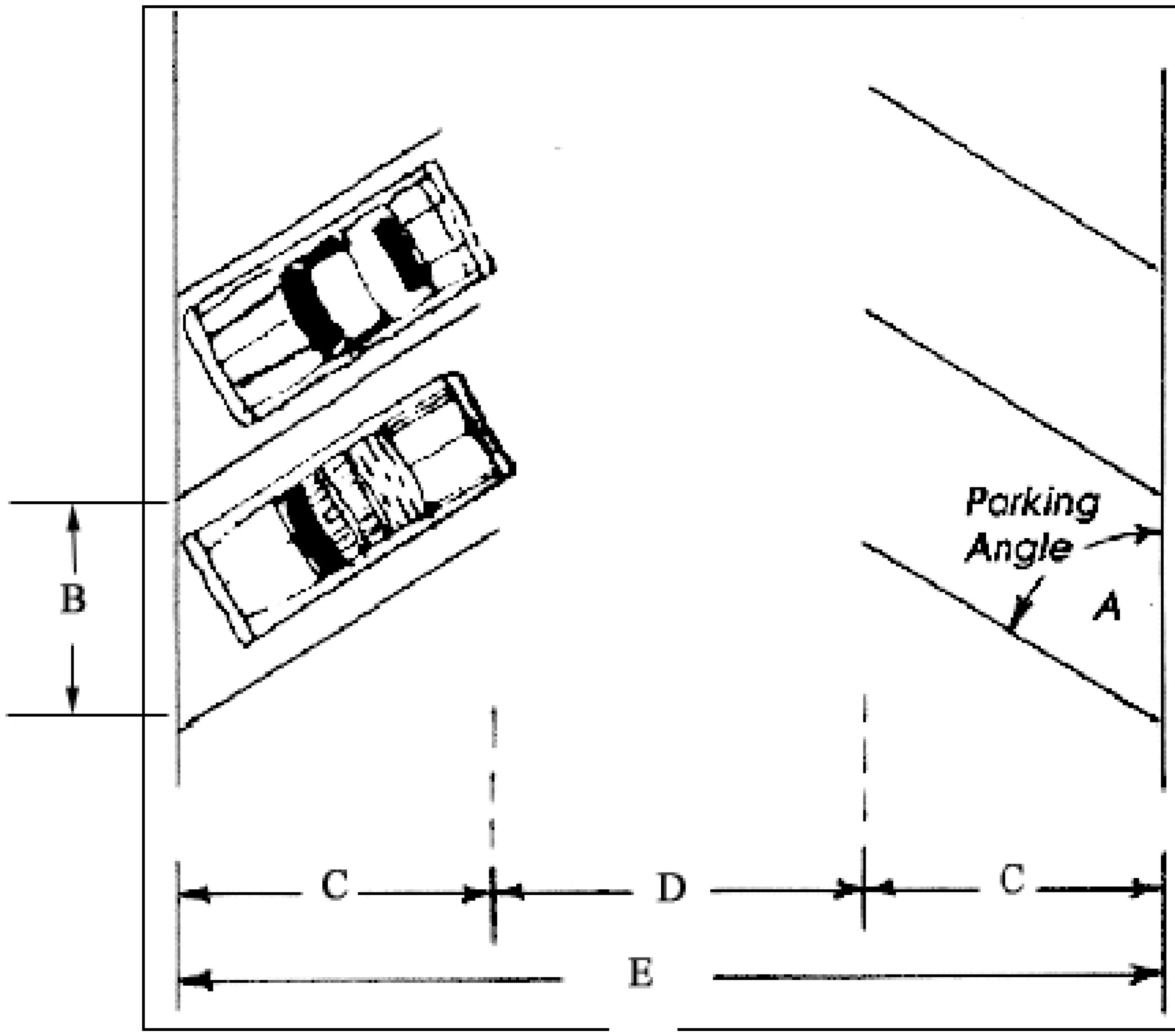
The following table depicts the minimum parking space dimensions for all parking areas:
For parallel parking, the dimensions of the parking stall shall be not less than ten feet in width and 23 feet in depth.
Where two-way traffic is desired, the aisle width shall be a minimum of 25 feet.
The location of bumpers or wheel stops shall depend on the angle of parking, ranging from at least two feet from the property line for 90-degree parking to one foot from the property line for 30-degree parking.
(Ord. No. 2015-01, § 3, 5-5-2015)
Sec. 44-366. - Loading.
(a)
Every hospital, institution, hotel, commercial, or industrial building shall have and maintain off-street loading spaces in addition to required off-street parking requirements as follows:
(b)
Loading areas shall be clearly marked with striping and lettering to indicate that such areas are for loading purposes only. Parking and circulation areas shall not be used for loading purposes.
(c)
Loading areas may be used for truck parking when the associated facility is closed.
(d)
Loading, unloading, opening, closing, or other handling of boxes, crates, containers, building materials, garbage cans, or similar objects shall not occur in commercial or industrial areas abutting residential zoning districts between the hours of 7:00 p.m. and 7:00 a.m.
(Ord. No. 2015-01, § 3, 5-5-2015; Ord. No. 2021-01, § 6, 8-3-2021)
Sec. 44-367. - Electric vehicle charging stations.
Sections 44-367 through 44-373 of this Code is and may be cited as the "City of La Palma's Electric Vehicle Charging Station Permitting Process." The electric vehicle charging station permitting process is enacted pursuant to Government Code §§ 65850.7 and 65850.71 as established by Assembly Bill 1236(2015) and Assembly Bill 970(2021).
(Ord. No. 2023-02, § 7, 2-7-2023)
Sec. 44-368. - Purpose.
The purpose of this section is to promote and encourage the use of the electric vehicles in accordance with Government Code §§ 65850.7 and 65850.71 by providing an expedited, streamlined permitting process for electric vehicle charging stations for residential and non-residential uses. The intent is to remove unreasonable regulatory barriers and minimize permit processing costs to achieve timely and cost-effective installations and to help achieve Governor's Executive Order N-79-20. This section helps the City to achieve those goals, prevents adverse impacts in the installation and use of electric vehicle charging stations, and maintains the Building Official's authority to protect the public health and safety and to identify and address higher priority life-safety situations, where applicable.
(Ord. No. 2023-02, § 7, 2-7-2023)
Sec. 44-369. - Applicability.
This electric vehicle charging station permitting process applies to the administrative permitting of all electric vehicle charging stations in the City. No discretionary permit is required by the City for an electric vehicle charging station. An association approval is not required for the administrative permitting of an electric vehicle charging station.
Electric vehicle charging stations legally established or permitted prior to the Building Official's implementation of an expedited permitting process are not subject to the requirements of this electric vehicle charging station permitting process unless physical modifications or alterations are undertaken that materially change the size, type, or components of an electric vehicle charging station in such a way as to require new permitting. Routine operation and maintenance or like-kind replacements may not require a building permit but a job site visit may be required at the discretion of the Building Official.
(Ord. No. 2023-02, § 7, 2-7-2023)
Sec. 44-370. - General requirements.
(a)
All electric vehicle charging stations shall meet applicable health and safety standards and requirements of local, State, and federal law, including the disabled access codes.
(b)
Electric vehicle charging stations shall meet all applicable safety and performance standards established by the California Electrical Code, the Society of Automotive Engineers, the National Electrical Manufacturers Association, and accredited testing laboratories such as Underwriters Laboratories and, where applicable, rules of the Public Utilities Commission regarding safety and reliability.
(c)
Installation of electric vehicle charging stations and associated wiring, bonding, disconnecting means and overcurrent protective devices shall meet the requirements of article 625 and all applicable provisions of the California Electrical Code.
(d)
Installation of electric vehicle charging stations shall be incorporated into the load calculations of all new or existing electrical services and shall meet the requirements of the California Electrical Code. Electric vehicle charging equipment shall be considered a continuous load.
(e)
Anchorage of either floor-mounted or wall-mounted electric vehicle charging stations shall meet the requirements of the California Building or Residential Code as applicable per occupancy, and the provisions of the manufacturer's installation instructions. Mounting of charging stations shall not adversely affect building elements.
(f)
An electric vehicle charging station (EVCS) shall be subject to all applicable City Municipal Code requirements in addition to the following:
(1)
The EVCS shall be protected as necessary to prevent damage by automobiles which may include the installation of bollards, if necessary.
(2)
The EVCS shall be designed to:
a.
Be safe for use during inclement weather.
b.
Be tamper-resistant to prevent injury particularly to children.
c.
Be resistant to potential damage by vandalism.
d.
Be equipped with a mechanism to prevent the theft of electricity by an unauthorized user.
(3)
The electric vehicle charging station shall have complete instructions and appropriate warnings posted in an unobstructed location next to each electric vehicle charging station.
(4)
One standard nonilluminated sign, not to exceed six square feet in area and ten feet in height, may be posted for the purpose of identifying the location of each cluster of electric vehicle charging stations.
(5)
Charging station shall not be placed within any portion of the required parking space area and reduce the minimum required off-street parking spot size.
(6)
Charging station outlets and connector devices shall contain a retraction device and/or a place to hang permanent cords and connectors sufficiently above the ground or paved surface in a neat and organized manner.
(Ord. No. 2023-02, § 7, 2-7-2023)
Sec. 44-371. - Application standards.
(a)
The City Building Official or his/her designee shall implement an expedited permitting process, that will allow the Building Official to administratively approve an application to install electric vehicle charging stations through the issuance of a building permit or similar non-discretionary permit.
(b)
The Building Official shall adopt a checklist of all requirements with which electric vehicle charging stations shall comply to be eligible for expedited review. The checklist and all required permitting documentation shall be published on the City Building and Safety Division's internet website.
(c)
In developing the expedited permitting process and checklist, the Building Official may refer to the recommendations contained in the most recent version of the "Plug-In Electric Vehicle Infrastructure Permitting Checklist" of the "Zero-Emission Vehicles in California: Community Readiness Guidebook" published by the State of California's Office of Planning and Research. The Building Official may modify the checklists and standards found in the guidebook due to unique climactic, geological, seismological, or topographical conditions.
(d)
Electronic submittal of the required permit application and supporting documents shall be made available for all electric vehicle charging station permit applications. The method of electronic submittal shall be at the City's discretion.
(Ord. No. 2023-02, § 7, 2-7-2023)
Sec. 44-372. - Expedited permitting process.
(a)
The applicant may submit the permit application and supporting documents to the City's Building and Safety Division by electronic submittal. In the case of electronic submittal, the electronic signature of the applicant on all forms, applications, and other documents may be used in lieu of a wet signature. If at the time of a permit application, the City's supporting technology does not facilitate electronic signatures, the City, at its discretion, may authorize the acceptance of either electronic signature or wet signature.
(b)
Prior to submitting an application for processing, the applicant shall verify that the installation of an electric vehicle charging station will not have specific, adverse impact to public health and safety and building occupants. Verification by the applicant includes but is not limited to: electrical system capacity and loads; electrical system wiring, bonding and overcurrent protection; building infrastructure affected by charging station equipment and associated conduits; areas of charging station equipment and vehicle parking.
(c)
A permit application that satisfies the information requirements in the City's checklist shall be deemed complete and be promptly processed. Upon confirmation by the Building Official that the permit application and supporting documents meets the requirements of the City checklist, and is consistent with all applicable laws and health and safety standards, the Building Official shall, consistent with Government Code §§ 65850.7 and 65850.71 approve the application and issue all necessary permits. Such approval does not authorize an applicant to energize or utilize the electric vehicle charging station until approval is granted by the City. If the Building Official determines that the permit application is incomplete, he or she shall issue a written correction notice to the applicant, detailing all deficiencies in the application and any additional information required to be eligible for expedited permit issuance.
(d)
Upon confirmation by the building official that the application is complete and meets the requirements of the checklist, and is consistent with this division, the City Building Official shall administratively approve the application and issue all required permits or authorizations within the following timeframes:
(1)
EVCS Projects with one to 25 stations: a maximum of five business days to deem an application complete or incomplete, once application is complete, and a maximum of 20 business days to issue an approval to build.
(2)
EVCS Projects with 26 or more stations: a maximum of ten business days to deem an application in/complete, and a maximum of 40 business days to issue an approval to build.
(3)
The City Building Official may establish a process to prioritize competing applications for expedited permits.
(e)
If the City Building Official makes a finding, based on substantial evidence, that the electric vehicle charging station could have a specific adverse impact upon the public health or safety, the City may require the applicant to apply for a conditional use permit.
(f)
The City may withhold issuance of the administrative building permit for electric vehicle charging station if there is a violation on record for any structure associated with the electric vehicle charging station application under Building Official review.
(g)
The City shall not condition approval for any electric vehicle charging station administrative building permit on the approval of an electric vehicle charging station by an association, as that term is defined in Civil Code § 4080.
(h)
The City shall not deny an application for a conditional use permit to install an electric vehicle charging station unless it makes written findings of denial based upon substantial evidence in the record that the proposed electric vehicle charging station installation would have a specific adverse impact upon the public health or safety, and there is no feasible method to satisfactorily mitigate or avoid the specific adverse impact. The findings shall include the basis for the rejection of potential feasible alternatives of preventing the adverse impact.
(i)
Any conditions imposed on an application to install an electric vehicle charging station shall be designed to mitigate the specific adverse impact upon the public health or safety at the lowest cost possible.
(j)
This expedited permitting process is intended to apply only to applications for permits for electric vehicle charging stations, and will not expedite the review of any other permit applications.
(Ord. No. 2023-02, § 7, 2-7-2023)
Sec. 44-373. - Technical review.
(a)
It is the intent of the City's electric vehicle charging station permitting process to encourage the installation of electric vehicle charging stations by removing obstacles to permitting for charging stations so long as the action does not supersede the Building Official's authority to address higher priority life-safety situations. If the Building Official makes a finding based on substantial evidence that the electric vehicle charging station could have a specific adverse impact upon the public health or safety, as defined in this Code, the City may require the applicant to apply for a conditional use permit.
(b)
In the technical review of a charging station, consistent with Government Code §§ 65850.7 and 65850.71, the Building Official shall not condition the approval for any electric vehicle charging station permit on the approval of such a system by an association, as that term is defined by Civil Code § 4080.
(c)
If an electric vehicle charging station and any associated equipment interfere with, reduce, eliminate, or in any way impact the required parking spaces for existing uses, the City shall administratively reduce the number of required parking spaces for the existing uses by the amount necessary to accommodate the electric vehicle charging station and any associated equipment.
(Ord. No. 2023-02, § 7, 2-7-2023)
Sec. 44-391. - Purpose.
This division is intended to guarantee the rights of persons to use their properties for private gain under reasonable limits, while also protecting the public interest as it relates to signs. Installation or continued use of signs that unduly distract the attention of motorists from driving, create traffic hazards, constitute a danger to vehicular or pedestrian traffic, or constitute an obstacle to effective fire and police protection are prohibited. Recognizing the rights of businesses and the importance of proper design, placement, and maintenance of signs to the appearance of the community, it is the intent of these sections to ensure that:
(1)
Sign design. Signs shall be designed, erected, and maintained in a manner that enhances the appearance of the community.
(2)
Sign maintenance. Signs erected within the City shall be properly maintained and kept in an attractive and clean condition.
(3)
Sign removal. Failure to properly maintain a sign shall be reason for the City to revoke the permit and cause the sign to be removed. Cost of such removal shall be charged against the owner of the property upon which the sign is located (see section 44-638).
(4)
Sign materials. Signs must be made of a durable material. With the exception of political signs, cardboard or paper signs shall not be allowed.
(Ord. No. 2021-03, § 4, 12-7-2021)
Sec. 44-392. - Definitions.
The following words, terms and phrases, when used in this division, shall have the meanings ascribed to them in this section, except where the context clearly indicates a different meaning:
Billboard shall mean an advertising sign structure which advertises goods, products, services or facilities that are not, or only incidentally, sold, produced, manufactured or furnished on the premises on which the sign structure is located (also known as outdoor advertising, off-premises sign or off-site sign).
Digital display billboard means a billboard with an electronic "message center" advertising display that is located at the top of a monopole structure where the message is changed more than once every two minutes, but no more than once every six seconds.
Official sign means a sign installed by governmental jurisdiction when acting in its governmental capacity.
Pole sign means a sign located at the top of a monopole structure or pylon that promotes or advertises a business, goods, products, services and/or facilities sold, produced, manufactured or furnished on the premises on which the sign structure is located. Pole signs may not use a digital display.
Sign means any medium of visual communication, including copy, structure, component parts, and humans which is used or intended to be used to attract attention to and identify an establishment, product, service, activity, location, or to provide information.
Signboard means a pole sign or digital display billboard oriented toward motorists on SR 91 freeway within the FO district.
Temporary sign means a sign not permanently attached to the ground, a wall or a building, and not designed or intended for permanent display.
Traffic safety triangle means a triangular shaped area on a corner parcel as defined in section 44-276.
Window sign means a sign posted, painted, placed, or affixed in, on, or within five feet of the interior window face of a window exposed to public view. Merchandise used in a window display is not considered a window sign.
(Ord. No. 2021-03, § 4, 12-7-2021)
Sec. 44-393. - Sign permits.
(a)
Required. A sign permit is required for all signs.
(b)
Application. An application for a sign permit shall be made to the Community Development Department upon a form provided by the Community Development Department in conformance with section 44-876.
(Ord. No. 2021-03, § 4, 12-7-2021)
Sec. 44-394. - Temporary sign permit.
(a)
Required. Unless specifically exempted, a permit shall be obtained from the Community Development Department for temporary signs, subject to the limitations provided in this section.
(b)
Approval authority. The Community Development Department shall examine and approve each temporary sign for which a permit is required as to materials, method of construction, attachment, and location, before it may be placed or erected within the City.
(c)
Temporary sign on non-residential property. Temporary signs on non-residential property, such as commercial or industrial property, require a permit from the Community Development Department and must comply with the following standards:
(1)
Duration. Temporary signs (including banners and flags) may be displayed for a total of 63 days within a calendar year. If the sign relates to an event, it must be taken down no later than ten days after the event.
(2)
Size. Temporary sign size shall not be greater than the size permitted for permanent building-mounted signage contained in table III-10.
(3)
Location. The location of temporary signs shall be the same general area as permitted for permanent signs. Temporary signs over three feet high shall not be located within the traffic safety triangle.
(4)
Exempt. Temporary signs of six square feet or less are exempt from the requirement to obtain a permit, but must not be located within the traffic safety triangle and the maximum height shall not be more than three feet above grade. A maximum of three such temporary signs are permitted at any given time on any non-residential property.
(d)
Temporary sign on residential property. Temporary signs on residential property do not require a permit, but must comply with the following standards:
(1)
Duration. Temporary signs (including banners and flags) may be displayed for a total of 63 days within a calendar year. If the sign relates to an event, it must be taken down no later than ten days after the event.
(2)
Size. Temporary sign size shall not be greater than ten square feet and the maximum height shall not be more than three feet above grade.
(e)
Temporary sign on public right-of-way. Temporary signs on the public right-of-way do not require a permit, but must comply with the following standards:
(1)
Duration. Temporary signs (including banners and flags) may be displayed for a total of 63 days within a calendar year. If the sign relates to an event, it must be taken down no later than ten days after the event. Temporary signs are not permitted between September 1 and November 10 in years when an election is held.
(2)
Size. Temporary sign size shall not be greater than six square feet and the maximum height shall not be more than three feet above grade.
(3)
Location. Placement shall be prohibited on all median strips, center dividers, roadway islands or safety zones. Placement cannot reduce in size, or interfere with, the required disabled access path of travel or impede pedestrian, bicycle, or vehicular travel; and, the sign shall not be affixed to traffic control devices, government signs, light standards, utility poles, bus shelters, or other structures, posts, fences, shrubs or trees.
(Ord. No. 2021-03, § 4, 12-7-2021; Ord. No. 2024-04, § 4, 12-10-2024)
Sec. 44-395. - Master sign plan.
(a)
Purpose. The purpose of a master sign plan is to integrate a project's signs with the structure's design into a unified architectural statement of high quality. It is expected that the design quality of signs proposed under a master sign plan will be of a superior quality and creativity as those that might result through the normal sign permit process.
(b)
Applicability. The approval of a master sign plan in accordance with article V, division 7 shall be required whenever any of the following circumstances exist:
(1)
Whenever three or more separate nonresidential tenant spaces are created on the same parcel.
(2)
Whenever three or more signs are proposed for a single use.
(3)
Whenever a pole sign is proposed on a parcel in the freeway overlay district.
(4)
Whenever the Community Development Department or the Development and Circulation Committee determines that a master sign plan is needed because of special project characteristics (e.g. the size of proposed signs, limited site visibility, a business within a business, or the location of the site relative to major transportation routes).
(c)
Modification of regulations. A variance pursuant to article V, division 11 shall be obtained for any deviations from the regulations of this section.
(Ord. No. 2021-03, § 4, 12-7-2021)
Sec. 44-396. - Prohibited signs.
The following signs are inconsistent with the purposes and standards of this division and are prohibited in all zoning districts:
(1)
Signs erected or maintained without the consent of the owner of the land upon which the sign is located.
(2)
Tract directional signs that advertise property developed outside of the City.
(3)
Signs placed, attached, or hung from any vehicle to advertise goods or services, except signs on common carriers or names, trademarks, and addresses permanently placed on business vehicles.
(4)
Abandoned signs that advertise goods or services that have not been available for a period of 60 days or more.
(5)
Permanent signs not made of durable materials or not appropriately constructed, such as the following:
a.
Signs made of cloth, paper, or plywood.
b.
Sandwich, A-frame, freestanding, or movable signs.
c.
Signs placed on the ground or propped against a vehicle or object in the public right-of-way or in a parking lot.
d.
Signs attached to light standards, trees, and similar items.
e.
Signs painted directly on a wall of a building or structure.
(6)
Projecting signs, roof signs, electronic signs, and animated signs. Electronic signs are conditionally permitted in the public/institutional zone only and digital display billboards and pole signs are permitted in the freeway overlay district as specified in this division.
(7)
Subdivision or tract directional signs within 500 feet of the following: Valley View Street, Walker Street, Moody Street, Orangethorpe Avenue, La Palma Avenue, Crescent Avenue, or the SR 91 freeway.
(8)
Signs that may obstruct fire escapes or stairways or interfere in any way with public or private safety enforcement.
(9)
Signs related to outdoor merchandising or display unless explicitly approved by an outdoor display and incidental seating permit.
(10)
Signs may not be placed in City parks, City Hall property, or other City property (with the exception of temporary signs in the public right-of-way (PROW) and any City of La Palma signs).
(11)
Signs that are attached to, placed on, draped over, or otherwise affixed to a block wall and facing the PROW. For purposes of this paragraph, a block wall shall mean a free-standing masonry wall constructed of cinder or concrete blocks along the perimeter of a property.
(Ord. No. 2021-03, § 4, 12-7-2021; Ord. No. 2023-05, § 4, 12-12-2023)
Sec. 44-397. - Sign standards.
The sign standards provided in table III-10 are intended to apply to signs in all zoning districts, unless otherwise approved pursuant to a master sign plan in accordance with section 44-39. Only signs authorized by this section shall be allowed unless otherwise expressly provided in this chapter or by an approved master sign plan. Refer to the regulations for specific types of signs (e.g. monument and wall) that follow table III-10.
a.
Monument signs are allowed only for frontages adjoining a public street and shall be located in compliance with the traffic safety triangle requirements of section 44-276.
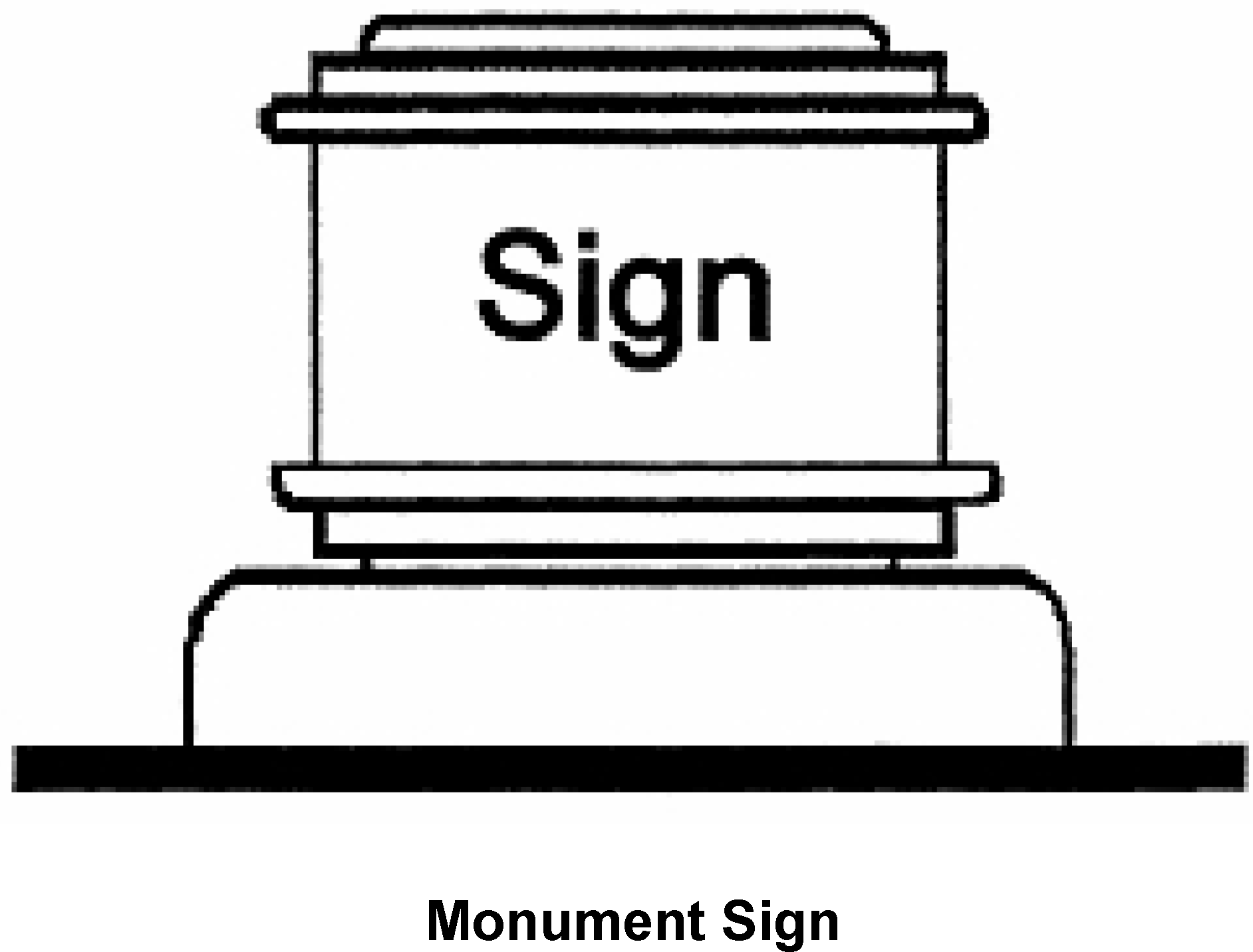
b.
There shall be a minimum ten feet between a monument sign and any other structure that exceeds ten feet in height.
c.
Landscaping shall be provided at the base of the supporting structure equal to twice the area of one face of the sign or 75 square feet, whichever is greater. For example, 40 square feet of sign area equals 80 square feet of landscaped area.
d.
Signs shall contain an address plate identifying the project or use by specific street address or range of addresses. Numbers shall be a minimum of six inches in height and shall be clearly visible from the adjacent street. Address plates shall not be calculated against the allowed sign area.
e.
The height of monument signs shall be measured from the nearest sidewalk grade.
f.
Electronic monument signs in the public/institutional zoning district shall also comply with the following:
1.
Sign shall not contain content that creates a distraction or confusion to vehicular traffic, with such words as "stop," "go," "look," "danger," etc.
2.
Message content shall not blink, flash, or continuously scroll.
(2)
Wall signs.
a.
Signs shall be located only on a building frontage and shall not extend above an eave or parapet or above or below a fascia on which they are located, unless approved by a precise plan, conditional use permit or master sign plan.
b.
Can or cabinet signs are not allowed. Signs shall use channel letters or have the appearance of channel letters.
c.
Signs shall be placed flat against the wall and shall not project from the wall more than required for normal construction purposes and in no case more than 12 inches. The Community Development Department may waive this requirement in special circumstances when an especially creative and unique sign design is proposed.
(3)
Directional signs.
a.
On-site directional signs are intended to aid vehicle and pedestrian traffic to maneuver safely onto and within the site. Copy shall relate only to the provision of directions for motorists and pedestrians.
b.
Directional signs shall not exceed two square feet in area and three feet in height.
(4)
Flags.
a.
A building permit must be obtained prior to erecting a freestanding flagpole.
b.
Flags shall be displayed only on flagpoles or staffs designed and constructed specifically and exclusively for flag display. No flag shall be displayed or attached in any manner to light poles, sign poles, trees, or similar structures or objects.
c.
The vertical length of a permitted flag on a flagpole shall not exceed 30 percent of the length of the pole upon which the flag is hung. For single-family residential use, the gross surface area of a flag shall not exceed 24 square feet.
d.
No portion of a flag shall project over any property line or contact any other structure when fully extended. For the purposes of this section, a structure shall include trees, shrubs, and landscaping.
e.
Flags shall not be mounted on roofs. Wall-mounted flags shall be displayed from flag poles not to exceed ten feet in length, and such poles shall not extend above the roof line. In a single-family residential zone, building-mounted flagpoles shall not exceed five feet in length.
f.
Official flags should be displayed in accordance with the Flag Code, 36 U.S.C. Ch. 10, as amended by P.L. 344, 94th Congress, approved July 7, 1976, or as amended from time to time.
g.
Flags shall be maintained in an orderly fashion and in good condition. Tattered or torn flags shall be removed or replaced.
(Ord. No. 2021-03, § 4, 12-7-2021; Ord. No. 2024-04, § 4, 12-10-2024)
Sec. 44-398. - Signboards, purpose.
These regulations in this division concerning signboards are established to permit larger on-site and off-site signage on properties within the freeway overlay district (FO) in a manner that furthers the following:
(1)
Promotion of the economic advantage of the SR 91 freeway within the city while ensuring an attractive business climate for businesses and agencies along the SR 91 freeway corridor;
(2)
Protection of La Palma rights-of-way street views by strategically limiting pole and billboard signs to the parcels within the FO district;
(3)
Limitation of visual clutter by providing regulations as to the number, size and location of signboards;
(4)
Provision of clear development standards pursuant to which allowable signboards may be designed and installed within the FO district;
(5)
Support of revenue generating commercial uses and activities that add economic benefit to the City and its residents without causing the City to incur municipal expenses that exceed the tax revenue attributable to those uses;
(6)
Promotion of the public's health, safety and welfare.
(Ord. No. 2021-03, § 4, 12-7-2021)
Sec. 44-399. - Signboards; general provisions.
The regulations applicable to the land use designations underlying the FO district shall apply to property within the FO district with the exception of the subject matters regulated in sections 44-399 through 44-402, which shall be known as the La Palma Signboard Code. Signboards in the FO district shall comply with all applicable provisions of the Federal Highway Beautification Act of 1965, the California Outdoor Advertising Act, the California Vehicle Code, all other applicable laws and regulations, and all of the following:
(1)
No signboard shall imitate or resemble any official traffic sign, signal, or device.
(2)
No signboard shall obstruct or interfere with an official sign, as that term is defined in this chapter.
(3)
No signboard shall be larger than 25 feet in height and 60 feet in width, excluding border, trip, and supports.
(4)
Signboards shall not include flashing, intermittent lights, moving lights, and shall not emit light that could obstruct or impair the vision of a driver.
(5)
Signboards shall not display any statements, words or depictions of an obscene, indecent, or immoral nature, as provided for in the California Business and Professions Code and the California Code of Regulations.
(Ord. No. 2021-03, § 4, 12-7-2021)
Sec. 44-400. - Application.
Applications for new signboard permits in the FO district shall be filed in compliance with article V, division 6 (sign permits), and shall contain the additional information listed below, based on the type of signboard being requested.
(1)
Applications for a pole sign shall include all of the following:
a.
Lot survey with topographic data that extends to the centerline of the abutting SR 91 right-of-way.
b.
View simulations of the area of the project site and surrounding area.
c.
A vicinity map showing where in the FO district the project is located. Map must show the project is located in compliance with all applicable California Department of Transportation (Caltrans) regulations, the California Outdoor Advertising Act and the federal Highway Beautification Act if project is located within 660 feet of the SR 91 right-of-way.
d.
A master sign plan package for all existing and proposed signage at the site.
e.
Elevation drawings of the site that include any building(s) and proposed structures, with the lowest and highest points identified for height measurement purposes.
f.
Title report for the parcel on which the pole sign is proposed to be erected.
g.
Any other information reasonably requested by the Community Development Department.
(2)
Applications for a digital billboard shall include all of the following:
a.
Lot survey with topographic data that extends to the centerline of the abutting SR 91 right-of-way.
b.
View simulations of the area of the project site and surrounding area.
c.
A vicinity map showing where in the FO district the project is located. Map must show the project is located in compliance with all applicable Caltrans regulations, the California Outdoor Advertising Act and the federal Highway Beautification Act. Map must show the project is located within 660 feet of the SR 91 right-of-way.
d.
Elevation drawings of the site that include any building(s) and proposed structures, with the following identified:
1.
The lowest adjacent grade to the billboard support (datum point),
2.
The finished grade elevation of the SR 91 right-of-way perpendicular to the billboard support, and
3.
The elevation of the highest point of the billboard.
e.
Luminance documentation demonstrating compliance with Caltrans luminance standards.
f.
Title report for the parcel on which the billboard is proposed to be erected.
g.
Any other information reasonably requested by the Community Development Department.
(Ord. No. 2021-03, § 4, 12-7-2021)
Sec. 44-401. - Regulations for signboards in the FO district.
(a)
Pole signs.
(1)
Pole signs shall only be allowed on parcels in the FO district occupied by a commercial retail establishment.
(2)
The allowable sign area for the face of a pole sign shall be a maximum of 160 square foot for each sign face, with a total aggregate area not to exceed 320 square feet for each double-sided pole sign.
(3)
No more than one pole sign per parcel in the FO district.
(4)
Each pole sign shall utilize only one support post which shall be clad with an architectural finish.
(b)
Billboard signs. Only digital display billboards are permitted in the FO district, subject to approval of a conditional use permit and development agreement (or other similar type of agreement with the City), and subject to the following standards:
(1)
Quantity. The number of billboards located within the FO district shall not exceed a total of four, with a maximum of two faces per billboard.
(2)
Spacing. No digital display billboard may be located within 1,000 feet of another digital display billboard on the same side of the SR 91 right-of-way.
(3)
Height. The maximum height of each digital billboard shall be 55 feet above the adjacent pavement level of the SR 91 freeway to the bottom of the digital display.
(4)
Size. The maximum size of each digital billboard face display area shall be 25 feet in height and 60 feet in width, with the area of each face not to exceed an overall maximum of 1,500 square feet, including border and trim.
(5)
Location.
a.
Digital display billboards may be free-standing or located on the wall or roof of another structure.
b.
Digital display billboards shall not be erected on properties zoned as:
R-1—Single-family district residential;
R-3—Multiple family residential districts;
VO—Village residential overlay district; or
OS—Open-space/recreation district.
(6)
Design.
a.
Each digital display billboard shall utilize only one support post which shall be clad with an architectural finish.
b.
All digital display billboards shall either be double faced or include covered backs or facings.
(7)
Brightness. Digital display billboards must comply with all applicable laws and regulations concerning brightness and illumination, including, without limitation, California Vehicle Code § 21466.5.
(Ord. No. 2021-03, § 4, 12-7-2021)
Sec. 44-402. - Interpretation.
(a)
The provisions of this division are not intended to nullify any easements, covenants or other existing agreements which are more restrictive than the provisions of this division.
(b)
Subject to the property owner's consent, a non-commercial message of any type may be substituted in whole or in part for the message displayed on any sign authorized pursuant to this division, without consideration of message content. This paragraph is intended to prevent any inadvertent favoring of commercial speech over noncommercial speech, or favoring of any particular noncommercial message over any other noncommercial message. This does not allow for the substitution of an off-premises commercial message in the place of an on-premises commercial message, or the substitution of a commercial message for a noncommercial message.
(c)
Whenever the application of this division is uncertain due to ambiguity of its provisions, the question shall be referred to the Community Development Department for a determination. This decision may be appealed to the City Council. The Community Development Department shall then authorize signs which best fulfill the intent of this ordinance.
(Ord. No. 2021-03, § 4, 12-7-2021)
Sec. 44-423. - Purpose.
The purpose of this division is to:
(1)
Meet the requirements of Orange County's Measure M Growth Management Program.
(2)
Mitigate the impacts that development projects may have on transit mobility and air quality and to promote transportation demand management strategies that encourage employers to more efficiently utilize the existing and planned transportation system.
(3)
Specify the responsibilities of public and private developers proposing nonresidential development within the City to consider transportation demand management strategies in conjunction with development application submittal and to incorporate design standards during project review that facilitate the reduction of single-occupant vehicle trips and support trip reduction activities of employers on the site.
(4)
Support the development of physical facilities that would promote and encourage the use of alternative and energy-conserving transportation modes.
(5)
Encourage the development of safe and secure transportation facilities at worksites.
(6)
Achieve related reductions in vehicle trips, traffic congestion, and air pollution through utilization of existing local mechanisms and procedures for project review and permit processing.
(7)
Promote coordinated implementation of transportation demand management strategies that may reduce transportation demand and achieve the most efficient use of local resources.
(Ord. No. 2015-01, § 3, 5-5-2015)
Sec. 44-424. - Definitions.
The following words, terms and phrases, when used in this division, shall have the meanings ascribed to them in this section, except where the context clearly indicates a different meaning:
Alternative transportation mode means any mode of travel that serves as an alternative to the single occupant vehicle. This can include all forms of ridesharing such as carpooling or vanpooling, as well as public transit, bicycling, or walking.
Applicable project means a development project that is determined to meet or exceed a 100-employee threshold.
Carpool means two to six persons traveling together in a single vehicle.
Development project means a nonresidential project being processed by the City that requires discretionary action.
Employee means a person employed by a firm, person, business, educational institution, non-profit agency or corporation, government agency, or other entity that collectively employs 100 or more persons at a single worksite. The term "employee" shall include persons employed on a full-time, part-time, or temporary basis.
Employer means a person, firm, business, educational institution, government agency, non-profit agency or corporation, or other entity that employs or houses tenants and that collectively employs 100 or more employees at a single worksite within the City on a full-time, and/or part-time or temporary basis, and may either be a property owner or tenant of an applicable development project.
Improvement plans means plans submitted to the City as part of an application for a building permit for a new or an enlarged or expanded existing nonresidential building or use, or change of use (as defined by the Uniform Building Code) of a nonresidential building.
Minimum building size means the total gross floor area measured in square feet of a building or group of buildings at a common work location (includes the total floor area of both new and existing facilities).
Mixed-use development means the development of a parcels or structures with two or more different land uses such as, a combination of residential, office, commercial retail, public, or entertainment in a single or physically integrated group of structures.
Property owner means the legal owner of the applicable development project who serves as lessor to an employer or tenant. The property owner shall be responsible for complying with the provisions of this division either directly or by delegating such responsibility as appropriate to an employer or tenant.
Tenant means the lessee of facility space at an applicable development project who may also serve as an employer.
Transportation demand management (TDM) means the implementation of programs, plans, or policies designed to encourage changes in individual travel behavior. TDM can include an emphasis on:
(1)
Alternative travel modes to the single occupant vehicle such as carpools, vanpools, and transit;
(2)
Reduction or elimination of the number of vehicle trips; or
(3)
Shifts in the time of vehicle commutes to other than the peak period.
Trip reduction means a reduction in the number of work-related trips taken during peak period hours in single occupant vehicles.
Vanpool means a van or similar vehicle occupied by seven or more persons traveling together.
Worksite means a building or group of buildings that is in actual physical contact or separated solely by a private or public roadway or other private or public right-of-way, owned or operated by the same employer (or by employers under common control), and includes the place of employment, base of operation, or predominate location of an employee.
(Ord. No. 2015-01, § 3, 5-5-2015)
Sec. 44-425. - Applicability to development projects; exemptions.
(a)
Applicability. The provisions of this division shall apply to all development projects as follows:
(1)
New commercial, office/professional, business park/industrial, mixed-use, institutional, or other nonresidential use or combination thereof, at a worksite that is expected to employ 100 or more persons, as determined by employee projections or by employee generation factors established by the City.
(2)
An existing or approved facility or development for which the property owner/tenant submits subsequent discretionary application to change the proposed use, project design, or development intensity, and which will employ 100 or more persons as determined as stated in subsection (a)(1).
(b)
Exemptions. Notwithstanding any other provisions of this chapter, the following uses and activities shall be specifically exempt from the provisions of this division:
(1)
Development projects expected to employ fewer than 100 persons.
(2)
Temporary construction activities on any affected project, including activities performed by engineers, architects, contract subcontractors, and construction workers.
(3)
Other temporary activities, authorized by the City, when such temporary activities shall discontinue at the end of the designated time period.
(c)
Applicable development size. For purposes of determining whether an applicable development project, as set forth in this section, is subject to this division, either of the following options shall apply:
(1)
Employment projections developed by the project applicant, subject to approval by the Community Development Director.
(2)
The following minimum building sizes that shall be considered equivalent to the 100-employee threshold:
(Ord. No. 2015-01, § 3, 5-5-2015)
Sec. 44-426. - TDM facility provisions.
(a)
Development projects subject to the provisions of this division shall, during project review and City action, incorporate consideration of TDM facility design opportunities, which shall be identified on project plans.
(b)
It is the intent of this section to provide a menu of mandatory and optional facility standards that can be incorporated into project design to encourage increased ridesharing and alternative transportation modes. In conjunction with project action by the project approval body, the approval body shall identify TDM facility standards that shall be applied to project design as conditions of approval, based upon review of the proposed use, project design characteristics, and other project considerations.
(c)
Nothing in this division shall prevent a project applicant from incorporating additional TDM facility strategies into the project proposal to encourage and facilitate TDM opportunities or related air quality requirements.
(1)
Carpool/vanpool parking.
a.
A percentage of parking spaces, located as close as is practical to the entrance of the use or at other preferential locations within the employee parking area, shall be reserved for use by carpool and vanpool vehicles, as determined by the approval body reviewing the development project.
b.
These spaces shall be reserved and designated for carpool/vanpool parking by marking such spaces "carpool only."
(2)
Bicycle parking. The site shall provide bicycle racks in a designated area for use by employees and tenants who commute to the site by bicycle. The bicycle parking area shall be established in a secure location and be in close proximity to employee entrances.
(3)
Transit waiting shelters. Transit waiting shelters, including bus pullouts, bus pads and right-of-way for bus shelters, may be required by the City in consultation with the Orange County Transportation Authority for development projects located along high traffic volume streets and established or proposed bus routes. The applicability of this provision shall be determined in conformance with standard traffic engineering principals including, the frequency and relative impact of blocked traffic due to stopped buses and the level of transit ridership at the location.
(4)
Pedestrian access.
a.
Sidewalks and other paved pathways shall be provided onsite to connect off site pedestrian circulation systems (planned or existing) to the building site.
b.
Sidewalk locations shall connect existing and planned transit waiting shelters with building entrances.
(5)
Bicycle access. Implementation of the City's master plan of bike trails shall be integrated with project review to provide continuity and transition of bike trail access from the development site to existing and planned on-street and off-street bike trails.
(6)
Joint access and shared parking. For multi-building developments designed as a "worksite" as defined in this division, provision of joint access and shared parking across multiple parcels shall be incorporated into project design to facilitate integration of TDM facility strategies.
(7)
Additional TDM mechanisms. It is the intent of this subsection to identify additional TDM mechanisms that the project applicant may elect to consider with project design, taking into consideration project use, size, and building site layout:
a.
A commuter information area, located within the central building, to provide employees with information on alternative transportation modes. This area shall be centrally located and accessible to all employees or tenants and shall be of sufficient size to provide and display information on alternative transportation modes, such as current maps, routes, and schedules for public transit.
b.
Shower and locker facilities onsite for use by employees or tenants who commute to the site by bicycling or walking.
c.
Rideshare vehicle passenger loading and unloading areas to provide employees who vanpool or carpool a location to embark and disembark from rideshare vehicles to and from the building site. The design and location of such loading areas shall consider onsite circulation characteristics, pedestrian access, and building site entrances to provide for employee access.
d.
Onsite day care facilities.
e.
Onsite lunch rooms/cafeterias.
f.
Onsite commercial services such as banks, restaurants, and small retail uses.
g.
Parking spaces designated for park-and-ride users.
(Ord. No. 2015-01, § 3, 5-5-2015)
Sec. 44-427. - Enforcement and appeals.
Policies and procedures set forth in this division are enforceable under the provisions of Article IV, Division 6.
(Ord. No. 2015-01, § 3, 5-5-2015)
Sec. 44-460. - Applicability.
This division shall apply to all areas identified as flood-prone within the jurisdiction of the City.
(Ord. No. 2016-01, § 5, 5-5-2015)
Sec. 44-461. - Basis for establishing flood-prone areas.
The Floodplain Administrator shall obtain, review, and reasonably utilize any base flood data available from other Federal or state agencies or other source to identify flood-prone areas within the jurisdiction of the City. This data will be on file with the Community Development Department, Planning Division, at La Palma City Hall.
(Ord. No. 2016-01, § 5, 5-5-2015)
Sec. 44-462. - Compliance.
No structure or land shall hereafter be constructed, located, extended, converted, or altered without full compliance with the term of this chapter and other applicable regulations. Violation of the requirements (including violations of conditions and safeguards established in connection with conditions) shall constitute a misdemeanor. Nothing herein shall prevent the City from taking such lawful action as is necessary to prevent or remedy any violation.
(Ord. No. 2016-01, § 5, 5-5-2015)
Sec. 44-463. - Abrogation and greater restrictions.
This division is not intended to repeal, abrogate, or impair any existing easements, covenants, or deed restrictions. However, where this division, and an easement, covenant, or deed restriction conflict or overlap, whichever imposes the more stringent restrictions shall prevail.
(Ord. No. 2016-01, § 5, 5-5-2015)
Sec. 44-464. - Interpretation.
In the interpretation and application of this division, all provisions shall be:
(1)
Considered as minimum requirements;
(2)
Liberally construed in favor of the City; and
(3)
Deemed neither to limit nor repeal any other powers granted under State statutes.
(Ord. No. 2016-01, § 5, 5-5-2015)
Sec. 44-465. - Warning and disclaimer of liability.
The degree of flood protection required by this division is considered reasonable for regulatory purposes and is based on scientific and engineering considerations. Larger floods can and will occur on rare occasions. Flood heights may be increased by man-made or natural causes. This division does not imply that land outside the areas of special flood hazards or uses permitted within such areas will be free from flooding or flood damages. This division shall not create liability on the part of the City, any officer or employee thereof, the State of California, or the Federal Insurance Administration, Federal Emergency Management Agency, for any flood damages that result from reliance on this division or any administrative decision lawfully made hereunder.
(Ord. No. 2016-01, § 5, 5-5-2015)
Sec. 44-466. - Precise plan required.
A precise plan or precise plan amendment shall be obtained for all proposed construction or other development in the City, including the placement of manufactured homes, so that it may be determined whether such construction or other development is within a flood-prone area.
(Ord. No. 2016-01, § 5, 5-5-2015)
Sec. 44-467. - Designation of the floodplain administrator.
The Community Development Director is hereby appointed to administer, implement, and enforce this division by processing precise plan permits for development in accord with this chapter.
(Ord. No. 2016-01, § 5, 5-5-2015)
Sec. 44-468. - Duties and responsibilities of the floodplain administrator.
The duties and responsibilities of the Floodplain Administrator shall include, but not be limited to the following:
(1)
Permit review. Review all development permit applications to determine whether:
a.
Permit requirements of this division have been satisfied;
b.
All other required state and federal permits have been obtained; and
c.
The site is reasonably safe from flooding.
(2)
Review and use of any other base flood data. The Floodplain Administrator shall obtain, review, and reasonably utilize any base flood data available from other Federal or state agency or other source.
(Ord. No. 2016-01, § 5, 5-5-2015)
Sec. 44-469. - Standards of construction.
If a proposed building site is in a flood-prone area, all new construction and substantial improvements, including manufactured homes, shall:
(1)
Be designed (or modified) and adequately anchored to prevent flotation, collapse, or lateral movement of the structure resulting from hydrodynamic and hydrostatic loads, including the effects of buoyancy.
(2)
Be constructed:
a.
With materials and utility equipment resistant to flood damage;
b.
Using methods and practices that minimize flood damage;
c.
With electrical, heating, ventilation, plumbing and air conditioning equipment and other service facilities that are designed and/or located so as to prevent water from entering or accumulating within the components during conditions of flooding.
(Ord. No. 2016-01, § 5, 5-5-2015)
Sec. 44-470. - Standards for subdivisions or other new development.
If a subdivision proposal or other proposed new development, including manufactured home parks or subdivisions, is in a flood-prone area, any such proposals shall be reviewed to assure that:
(1)
All such proposals are consistent with the need to minimize flood damage within the flood prone area;
(2)
All public utilities and facilities such as sewer, gas, electrical, and water systems are located and constructed to minimize or eliminate flood damage; and
(3)
Adequate drainage is provided to reduce exposure to flood hazards.
(Ord. No. 2016-01, § 5, 5-5-2015)
Sec. 44-471. - Standards for utilities.
(a)
All new and replacement water supply and sanitary sewage systems shall be designed to minimize or eliminate:
(1)
Infiltration of flood waters into the systems, and
(2)
Discharge from the systems into flood waters.
(b)
On-site waste disposal systems shall be located to avoid impairment to them, or contamination from them during flooding.
(Ord. No. 2016-01, § 5, 5-5-2015)

