
Labelle City Zoning Code
ARTICLE V
- SUPPLEMENTARY DISTRICT REGULATIONS
Sec. 4-78. - PUD (Planned Unit Development) district.
4-78.1. Intent and purpose. The intent and purpose of the planned unit development (PUD) district is to enable the innovative development of land for residential, commercial, industrial or mixed use (commercial and residential) projects and provide an opportunity for flexible and site-specific development regulations to support specialized and unique design.
The PUD district is hereby established to provide a process for unified planning and coordination of development and for the creation of new neighborhoods or community areas which, by virtue of their specialized nature and unique design, are not adaptable to regulation by the other zoning district classifications set forth in this chapter.
It is intended that the regulations and requirements applying to a PUD zoning district shall be sufficiently flexible so as to encourage creative and imaginative design in planning and development.
Where there are conflicts between the requirements set forth herein for a PUD district and the general provisions of this chapter or other applicable codes of the City of LaBelle, the requirements of the PUD shall govern.
The regulations are intended to promote desirable development by addressing aesthetically pleasing design, protection of sensitive natural environments and native vegetation, safety, neighborhood compatibility, and recreational opportunities. The site development standards allow flexibility of development while maintaining compatibility within the city's various neighborhoods. In addition, the regulations provide clarity to property owners, developers, and neighbors about the limits of what is allowed.
4-78.2. PUD development approval procedures.
A.
Preapplication conference. Prior to filing an application for PUD development, the applicant or his authorized representative shall confer with the Superintendent of Public Works, Planning Department, Building Official or designee, Code Enforcement Official, and the LaBelle Fire Department as well as other city officials and representatives of other agencies as may be requested by them to participate. The purpose of this conference shall be to permit the applicant to present his initial concept of the proposed PUD, to permit the city officials to make preliminary comments on the proposal, and to provide a detailed explanation of application requirements and review procedures.
B.
[Submission of petition.] A petition for PUD zoning shall be submitted in accordance with the general requirements for amendments as set forth in Chapter 3 of the Land Development Code. In addition to the required application package, the application shall include the following:
(1)
Evidence of unified control. The title to all land within a proposed site for a planned unit development (PUD) shall be owned or controlled by the developer submitting the applications. Developer shall have the written consent of all owners of property within the proposed site not wholly owned by the developer. Consent shall contain a statement that developer is authorized to represent owners in the submission of an application [owners shall agree to be bound by the decision of the city commissioners in the event application is approved]. Together with a statement that shall include:
(a)
A statement identifying the owners of all property within the area abutting, adjoining and across the street from the proposed development. If application is submitted by other than the current owner(s) of the property, the statement shall be accompanied by satisfactory evidence of the existence of purchase or lease agreement or other appropriate instrument(s) as identified above to indicate current or future unified control of the property.
(b)
That the proposed development shall be in accordance with the provisions of the application and all materials submitted therewith and supplied upon request, and in accordance with specified modifications thereof as may be required by the city commission.
(c)
To bind all successors of the applicant to the agreement.
(2)
A master concept plan (MCP) at an appropriate scale showing the proposed land uses and approximate area of each land use (i.e. single-family areas, multifamily areas, recreational areas and non-residential areas) as well as the PUD perimeter buffer areas where required or proposed, shall be submitted with and incorporated by reference with the PUD.
(3)
An itemization of the number of dwelling units of different types (i.e. fifteen (15) single-family units, twenty-five (25) multifamily units) and of the quantity (floor area) of space devoted to nonresidential uses (i.e. twenty thousand (20,000) square feet of commercial or industrial uses) and, if applicable, a schedule showing the expected phasing plan (including the starting and end dates of each phase) and the number of units and/or quantity of space to be included in each phase.
(4)
An estimate of trip volumes (peak hour) of traffic on collector, local and arterial roads adjacent to the site and at all entrances to the site.
(5)
A statement indicating how the proposed development will conform to the adopted Comprehensive Plan.
(6)
Other materials as may be determined by the building official or his designee as being necessary for the review of the development based on its unique location, character of or extent. Where appropriate, materials shall include an identification of areas on the site characterized by floodplains, archaeological and historical sites, habitats for threatened or endangered species of special concern.
(7)
Any deviations from the Land Development Code (i.e. parking, buffering, etc.) that may be needed.
(8)
Property development regulations for the development.
(9)
A schedule of uses that are requested within the PUD. Reference to the uses in a specific zoning district may suffice.
C.
Review by city staff. After a PUD application is submitted, the building official or designee will review the application for completeness. If an application is deemed incomplete, or additional information is required for review, the building official shall send a request for additional information within fifteen (15) working days. Upon receipt of an application that is deemed to be complete, the building official or designee, as well as other officials from whom comments are requested shall review the application and supporting materials. The staff report on the proposal shall include recommended findings as to compliance of the application with the adopted Comprehensive Plan and the standards of this code, and shall include recommended conditions of approval.
D.
Review by local planning agency. In addition to the requirements of the Chapter 4, review by the local planning agency shall include recommended findings as to compliance of the application with the adopted Comprehensive Plan and the standards of this code, and shall include recommended conditions of approval.
E.
Action by city commission. In addition to the requirements of Chapter 3 of the Land Development Code, review and action by the city commission shall include findings as to the compliance of the application with the adopted Comprehensive Plan and the standards of this code, and shall include recommended conditions of approval as may be necessary to ensure full compliance with all requirements and to further ensure compatibility of the proposed development with the surrounding area.
4-78.3. Standards for PUD developments.
A.
All PUD developments shall conform to the provisions of the adopted Comprehensive Plan of the City of LaBelle and the Land Development Code (LDC). Where standards exist in the plan and comparable standards do not exist in this code, the standards and procedures set out in the plan shall apply in addition to the standards herein.
B.
Permitted uses.
(1)
No specific principal uses or structures are designated as permitted. Uses permitted within a particular PUD district shall be those uses specified in a list of uses submitted as part of the PUD application and approved by the city commission. Permitted uses must be consistent with the LaBelle Comprehensive Plan and the LaBelle Future Land Use Map. The master concept plan (MCP) shall clearly designate the type, general location, and extent of proposed uses and approval of uses or types of uses as part of rezoning ordinance shall constitute the permitted land use requirement of a particular PUD district to the same extent and degree as were permitted uses specifically included in the context of this chapter. Any proposed change of approved land usage shall require a rehearing and approval in accordance with the procedures for original approval, except the necessary refinements in size, configuration, or location may be required in the preparation of detailed plans.
(2)
Accessory uses shall be permitted as set forth within the approved master concept plan (MCP) or as found by the city commission to be compatible with an approved plan.
C.
Minimum dimensional and density requirements. A matrix including the proposed uses, type of units, density or intensity for each use, and minimum dimensional and density requirements as follows:
(1)
A PUD development shall be of proportions as to properly accommodate all proposed uses in keeping with the general requirements of the city and the established objectives and policies of the adopted Comprehensive Plan.
(2)
Reserved.
(3)
The maximum residential density shall be as established as part of the individual PUD ordinance. Residential, commercial and industrial density/intensity shall not exceed the maximums established in the future land use element of the LaBelle Comprehensive Plan.
(4)
The maximum height of structures within a PUD development shall be specifically identified on the matrix and approved by the city commission.
(5)
Approved PUDs must comply with all sections of the City of LaBelle Land Development Code, unless granted a deviation by the City Commission for a specific section of the Land Development Code, or otherwise specified within the PUD ordinance.
D.
Off-street parking and loading area. Off-street parking and loading area shall be as set forth in Chapter 4 of the Land Development Code (LDC) unless a justified deviation from the LDC is granted by the city commission.
4-78.4. Effect of approval. Approval of the proposed PUD development shall be interpreted as including approval of all maps, diagrams, tables and reports attached by the applicant. Unless otherwise autnorized py the city commission in the conditions of the zoning ordinance, the PUD zoning district shall expire five (5) years following approval unless vertical construction has commenced. Upon expiration, the zoning of the property will revert back to the zoning district in place prior to PUD approval.
4.78.5 Amendments to approved PUDs. Amendments to an approved master concept plan or conditions, development regulations, permitted uses or other information contained in the approval ordinance may be requested at any time during the development of or useful life of a PUD.
A.
Administrative Amendments. The City Planner may administratively approve an amendment to a planned development if the below criteria is met by the request;
a.
The request does not increase height, density or intensity of the development, i.e. no increase the number of dwelling units or non-residential square footage.
b.
The request does not decrease the amount of indigenous native vegetation preservation or open space areas below the amount required by the Code;
c.
The request does not modify the buffer or landscaping areas unless an alternate design is proposed that is equivalent or better (by comparison with the approved master concept plan) in terms of the level of opacity and screening achieved by the originally approved buffer;
d.
The request does not adversely impact surrounding land uses: and
e.
The request is consistent with all applicable provisions of the Comprehensive Plan and land development regulations in effect at the time of the amendment request.
f.
The request does not result in the impact of significant oak trees that were not specifically approved for removal by the City Commission in accordance with LDC Section 4-80.16.4.2.
g.
The request does not modify zoning conditions of approval explicitly set forth by the City Commission, unless an alternate is proposed is deemed equivalent or better in satisfying the intent of the original condition, as determined by the City Planner, or their designee.
B.
Amendments Requiring City Commission Approval. Any request that does not meet the above criteria must be processed as a PUD Amendment requiring review and approval by the Local Planning Agency and City Commission consistent with the process for a new planned development rezoning. Submittal materials may be waived where the request does not trigger the requirement for additional information.
C.
Notice of Amendment. Notice of an amendment to a master concept plan must be recorded in the same manner as the approved master concept plan itself.
(Ord. No. 2003-21, § i, 8-7-03; Ord. No. 2003-29, § i, 10-9-03; Ord. No. 2005-20, § i, 11-10-05; Ord. No. 2006-20, § i, 11-10-05; Ord. No. 2020-16, § 2, 1-14-2021)
Sec. 4-79. - Public service (PS) district.
4-79.1. Intent and purpose.
A.
Purpose. The PS district is established for the purpose of identifying and providing suitable locations for the necessary public and private utility and recreation activities that serve and are used directly by the public for their own benefit and are necessary to the normal conduct of the community's activities. This district may be isolated and surrounded by any other zoning district compatible with the intended use of the facility.
B.
Objectives. The provisions of this district are intended to:
(1)
Accommodate utilities, recreation and public facilities, at appropriate locations, necessary to serve the public;
(2)
Ensure public awareness of the location of existing or potential utilities, recreation and public facilities;
(3)
Allow, through the rezoning process, public review of specific utility, recreation and public facility uses to ensure locations compatible with surrounding activities; that the uses are designed to minimize negative impacts on surrounding properties.
C.
Advisory. The City of LaBelle adopted the historic oak tree ordinance and a landscape ordinance both of these codes are applicable in all zoning classifications.
4-79.2. Permitted uses. The specific use(s) permitted on the subject property shall be specified as a part of the ordinance, which places this classification on a particular area of ground and may include:
(1)
Public boat launching and docking areas.
(2)
Public utilities.
(3)
Public recreation areas or facilities.
(4)
Schools, public and private, vocational schools and colleges, technical and academic.
(5)
Community assembly buildings, such as civic centers, public historic properties (i.e. Capt. Hendry House).
(6)
Public parking.
(7)
Public administration buildings.
(8)
Hospitals.
(9)
Libraries.
(10)
Accessory uses and structures which are incidental to and customarily associated with the permitted uses in this district listed.
4-79.3. Special exceptions.
A.
Provided that a special exception application has been processed and approved, no building or structure shall be erected, altered or used, or land or water used, in whole or in part, in the PS district, that is not in substantial compliance with the approved special exception and for other than the following:
(1)
Cultural facilities, including libraries, community theaters or museums, and publicly owned buildings.
(2)
Private recreation areas or facilities.
(3)
Private boat docking, storage and launching areas.
(4)
Public golf courses.
(5)
Commercial sports.
(6)
Public lands designated for open space or conservation.
B.
The city commission may by special exception permit other uses, which are similar to and no more intense than those enumerated in this section.
_____
4-79.4. Design and constructions standards.
A.
Dimensional requirements. All principal and accessory structures shall be located and constructed in accordance with the following requirements:
Minimum Lot Size, Setbacks and Maximum Building Area Requirements for PS Districts
* Refer to appropriate section below for more information.
(1)
Office, administrative, low intensity cultural (community theater or museum) activities:
a.
Minimum lot area: Ten thousand (10,000) square feet.
b.
Minimum lot width at minimum building front yard setback: One hundred (100) feet.
c.
Minimum yard setbacks:
1.
Front: Ten (10) feet.
2.
Side, street: Ten (10) feet.
3.
Side, interior: Zero (0) feet.
Except where the side yard abuts property which is in a residential district or which is shown for residential use on the future land use map of the comprehensive plan: Twenty (20) feet.
4.
Rear: Zero (0) feet.
Except where the rear yard abuts property which is in a residential district or which is shown for residential use on the future land use map of the comprehensive plan: Twenty-five (25) feet.
(2)
All intensive recreation uses (community assembly buildings, performing arts halls, arenas, etc.):
a.
Minimum lot size: One (1) acre.
b.
Minimum yard setbacks:
1.
Front: Twenty-five (25) feet.
Except where the front yard is across from property which is in a residential district or which is shown for residential use on the future land use map of the comprehensive plan: Fifty (50) feet.
2.
Side, interior: Twenty (20) feet.
Except where the side yard abuts property which is in a residential district or which is shown for residential use on the future land use map of the comprehensive plan: Fifty (50) feet.
3.
Side, street: Twenty (20) feet.
4.
Rear: Twenty-five (25) feet.
Except where the rear yard abuts property which is in a residential district or which is shown for residential use on the future land use map of the comprehensive plan: Fifty (50) feet.
(3)
All other uses: As specified in the rezoning ordinance.
(4)
A "front" is defined as any portion of the property adjacent to a street, including lots that are contiguous in the rear and run from street to street. A corner lot will have two (2) fronts. For the purpose of setbacks, if there are two (2) front setbacks there will be one (1) side and one (1) rear setback. The rear shall be opposite the front entrance of the building, except for duplex(es). The "front yard" is the portion adjacent to the street. A "side yard" is defined as that portion of the yard along the side of the building extending to the rear lot line. A "rear yard" is the portion of the yard along the rear face to the side setback lines.
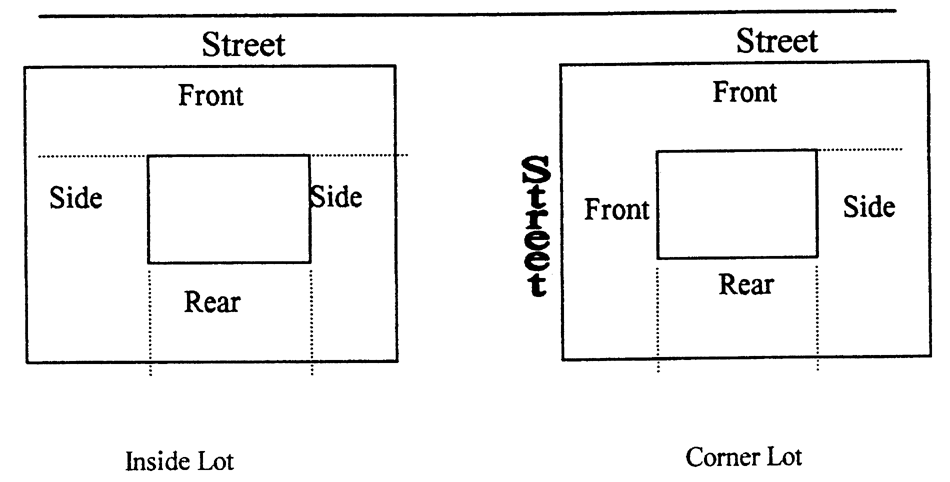
Lot Examples
B.
Building design.
(1)
Front entrance shall be a covered entry a minimum of twenty (20) square feet and five (5) feet in depth or proportional and appropriate to the structure which ever is greater.
(2)
Trim is required on all faces of the exterior. For example: shutters, stucco trim around windows or stucco band around the building.
(3)
For all new construction roof pitch must be a minimum of 5:12 and minimum overhang of twenty-four (24) inches, except gable ends shall have a minimum of twelve (12) inches, provided however this shall not apply to porch or patios.
C.
Site design.
(1)
Building scale and massing shall relate to that of adjacent buildings to the extent practical.
(2)
Public developments shall be exemplary in their use of signage and landscaping and in the preservation of existing trees.
(3)
Pedestrian areas shall be separated from vehicular areas wherever possible. Traffic circulation should be safe, convenient and designed according to sound engineering practices.
(4)
The design of the site and facilities shall promote energy conservation through proper solar access, shading and other measures, where appropriate.
(5)
Appropriate access for emergency vehicles, garbage trucks and other service vehicles shall be provided.
(6)
All site elements shall be designed to protect natural and community resources, such as wildlife habitats, historic structures and ecologically sensitive areas.
D.
External compatibility.
(1)
Buffering and screening of public service facilities shall be provided commensurate with the facility's degree of impact and incompatibility with surrounding developments.
(2)
Electrical transformers and other utility equipment shall be screened from public view.
(3)
Site illumination and public address systems, particularly for recreation areas, shall be designed so as to create no interference with the privacy of adjoining properties.
(4)
Adverse impacts on adjacent properties, such as noise, smoke, glare and odor, shall be mitigated through site design. Where necessary, building construction methods or mechanical equipment should also be utilized to mitigate these adverse impacts.
(Ord. No. 2003-01, § 1, 2-13-03; Ord. No. 2003-15, § 1, 4-24-03; Ord. No. 2003-31, § i, 11-13-03; Ord. No. 2022-05, § 2, 7-14-22)
Sec. 4-80. - Landscaping.
4-80.1. Purpose and intent. The purpose and intent of the landscape code is to:
(1)
Promote and protect the health, safety and welfare of the citizens of LaBelle by creating an environment that is aesthetically pleasing and promotes economic development through enhanced quality of life.
(2)
Improve the aesthetic appearance of the community through landscaping that compliments the natural and built environment;
(3)
Promote preservation of natural resources, trees and native plants;
(4)
Reduce the negative environmental effects of development while protecting and enhancing the value of developed properties and the surrounding area;
(5)
Provide the necessary screening and buffering between incompatible uses.
(6)
Mitigate air, dust, noise, heat, glare and other adverse environmental effects of development;
(7)
Promote water conservation and xeriscape principals through proper plant selection and irrigation, and
(8)
Reduce soil erosion and increase infiltration in permeable land areas essential to stormwater management and aquifer recharge.
4-80.2. Definitions. Defined terms contained in this section are provided in section 2-4 of this Code.
4-80.3. City tree board.
4-80.3.1. Purpose. To establish an advisory board as a means of involving the public in urban forestry management.
4-80.3.2. Creation and establishment. The board shall consist of three (3) members and one (1) board liason for a total of four (4) members, chosen and confirmed by the city commission. Members of the board shall serve without compensation. The term of the board shall be one (1) year.
4-80.3.3. Duties and responsibilities. It will be the responsibility of the board to study, investigate and council for the care, preservation, trimming, planting, replanting, removal or disposition of trees and shrubs citywide. The board shall review and make recommendations to the City of LaBelle's landscape ordinance, as needed. When requested by the city commission, the board will investigate, make findings, report and recommend upon any special matter of question within the scope of its work.
4-80.3.4. Operation. The board shall choose its own officers, make its own rules and regulations and keep a journal of its proceedings. A majority of the members shall be a quorum for the transaction of business.
4-80.4. Landscape areas, generally.
4.80.4.1. Applicability. Landscape areas include buffers, streetscape landscaping, building landscaping, parking lot landscaping, stormwater planting area and tree preservation sections of this chapter. This division applies to the applications described in Table 4-80-L2.
4.80.4.2. Expansion or modification.
A.
When a building or parking lot is enlarged, the requirements of this division apply on an incremental basis. This means that landscaping is required in the same proportion that the enlarged area or vehicular use area has to the existing development (e.g., a ten (10) percent increase requires ten (10) percent of all required landscaping).
B.
Any change of use of an existing, conforming structure located in a commercial, industrial, or institutional zoning district, where internal building modifications require a building permit, shall require landscaping based on the Table 4-80.L1, below. Section 4-80.6.2, using a multiplier of ten (10) percent, substitute tree plantings (credits) may be used to fulfill this requirement.
Buffer requirements of Section 4-80.9 shall remain applicable to any change of use as described above.
Table 4-80.L1
Change of Use Tree Calculation Table
The minimum number of street trees shall be determined in accordance with the following formula:
(A x B)/C = D
Where:
A = 10%
B = square feet of property
C = area per tree (Table L1)
D = total number of street trees required (rounded up)
Example:
.10 x 21,780 (½ acre)/1,500(large tree area) = 1.4 large trees (or 2 trees)
OR
.10 x 21,780 (½ acre)/650 (med. tree area) = 3.3 medium trees (4 trees)
A combination of large and medium trees may be used to meet the ten (10) percent requirement.
4.80.4.3. Exemptions. This section does not apply to the following:
A.
Residential single-family dwellings located in a residential zoning district;
B.
Agricultural uses;
C.
The reconstruction of an existing conforming building of which fifty (50) percent or less of the floor area was destroyed or ruined by flooding, fire, wind storm or act of God (see Nonconformimg Structures, Appendix B, section 4-109).
D.
Single-family dwelling located on an existing lot of record.
4-80.4.4. Applicability of general standards.
A.
All appropriate efforts shall be made to utilize existing areas of native vegetation to satisfy the requirements of this section.
B.
Landscaping may extend into rights-of-way and/or easements subject to permission of the agency or other entity holding title to the right-of-way or easement. Such landscaping shall not be used to meet the minimum requirements under this chapter unless approved by the city commission.
C.
Table 4-80-L2 indicates the applicability of the chapter regulations based on zoning district.
Table 4-80-L2
Applicability of General Standards
4-80.4.5. Interpretation of terms. Where the precise meaning of technical landscaping terms used in this division is necessary, reference shall be made to the "American Standard for Nursery Stock."
4-80.5. Landscape plan.
4-80.5.1. Submission of a landscape plan.
A.
The landscape plan shall be submitted and approved as part of the underlying construction application.
B.
For properties greater than one-half (½) acre, landscape plans for new development and/or planned unit developments shall bear the seal of a landscape architect.
C.
The fire inspector shall review all landscape plans for construction of two (2) or more duplexes, multifamily developments, commercial, industrial, institutional and public development. The fire inspector shall approve, request revision, or reject landscaping plans only on the basis of health, safety and welfare as it pertains to emergency services.
D.
The plan must designate the botanical name (genus and species) and location of all plant materials to be installed.
E.
The plan shall be at a minimum scale of 1" = 40'0".
4-80.6. Acceptable landscape materials and practices.
A.
Plant materials required by this section shall comply with the minimum size requirements of Table 4-80.L4 at the time of installation. Plant height shall be measured from the average grade level of the immediate planting area to the top horizontal plane of the shrub at planting; for single trunk trees, the measurement shall be taken at DBH; for multi-trunk trees, the tree shall be measured from the average grade level of the immediate planting area to the top of the tree.
B.
Plant materials used to meet the requirements of this division must meet the standards for Florida No. 1 or better, as set out in Grades and Standards for Nursery Plants, Parts I and II, Department of Agriculture, State of Florida (as amended).
C.
Planting areas will consist of permeable surface areas only.
4-80.6.1. Prohibited species.
A.
Prior to issuance of a Certificate of Occupancy, all Category I plants from the Florida Exotic Pest Plant Council's Most Current Invasive List shall be removed and may not be planted. See http://www.fleppc.org/list/list.htm for additional information.
B.
No artificial plant materials shall be used to satisfy the requirements of this section.
4-80.6.2. Substitute tree plantings (credits).
4-80.6.2.1. Intent. LaBelle, the City of Oaks, wishes to reward citizens and developers for the preservation of oak trees, the oak canopy and native trees and vegetation.
4-80.6.2.2. Applicability. Existing native trees to be preserved larger than two (2) inches caliper at DBH may be credited, to reduce the number of required new tree plantings.
Credits will be given at a ratio of required trees per existing trees to remain, as outlined in Table 4-80.L3, below. Only live oak trees may be credited for the required live oak trees. At the discretion of the building official or designee, these trees shall be inspected by an ISA certified arborist or urban forester for their appropriateness with regard to health and safety.
Table 4-80.L3
Example: The preservation of one (1), 22-inch dbh tree will reduce the required tree plantings by ten (10) trees.
4-80.6.3. Installation.
A.
Plant materials must be installed in soil conditions that are conducive to the proper growth of the plant material. Limerock located within planting areas must be removed and replaced with native or growing quality soil before planting.
B.
A plant's growth habit must be considered in advance of conflicts that might be created (e.g., views, signage, overhead power lines, lighting, circulation). Trees may not be placed where they interfere with site drainage, subsurface utilities, or overhead utility lines, or where they will require frequent pruning in order to avoid interference with infrastructure. All landscape materials must be installed in a recognized horticulturally correct manner.
C.
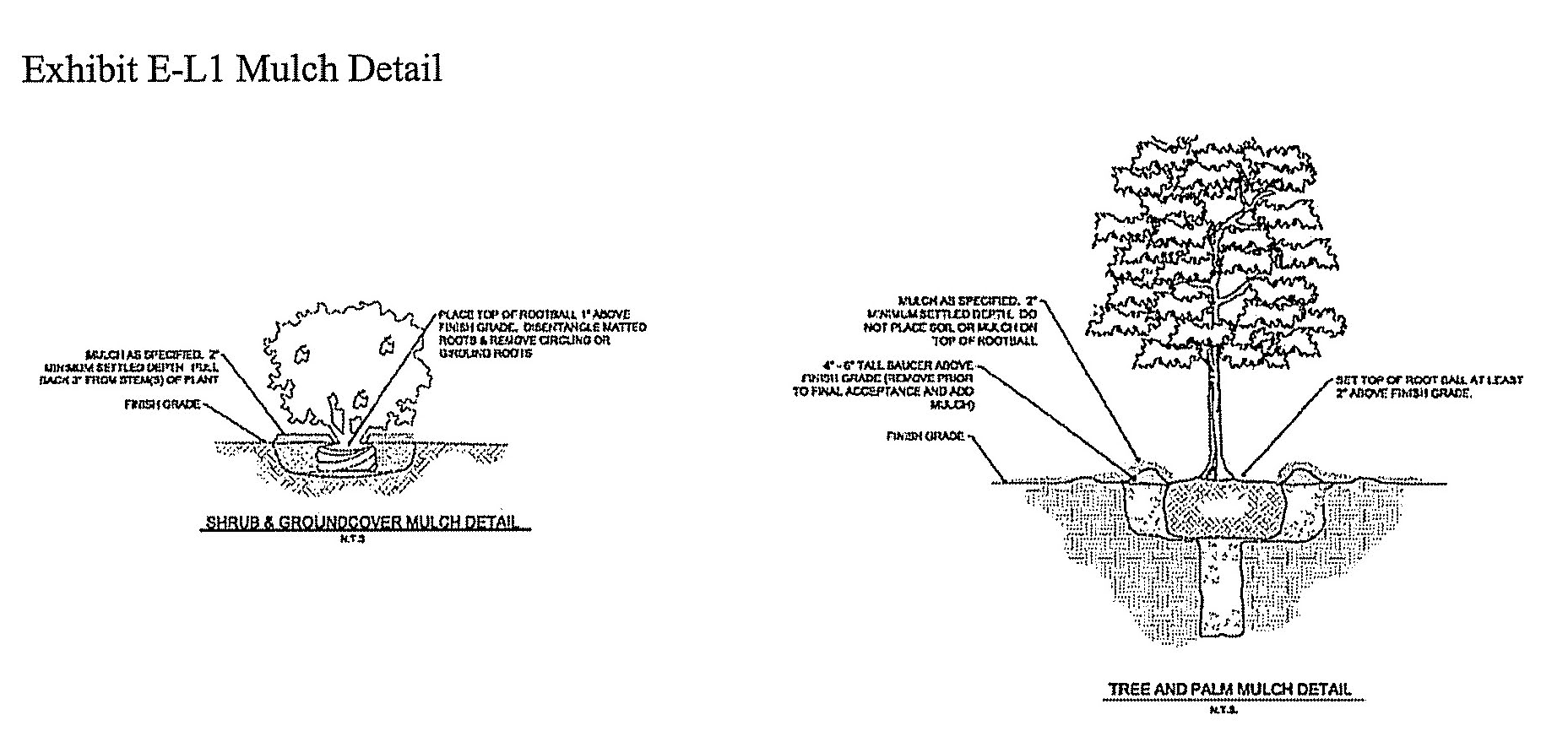
A two-inch minimum layer, after watering-in, of mulch, rock or other recycled materials shall be placed and maintained around all newly installed trees, shrubs, and ground cover plantings. Each tree shall have a ring of mulch no less than twenty-four (24) inches beyond its trunk in all directions. The use of cypress mulch is strongly discouraged (Florimulch or pine needles are preferred). Mulch shall not be applied directly against newly installed and existing plant materials stems and/or trunks.
Exhibit E-L1 Mulch Detail
D.
Plantings shall meet the visibility triangle requirements for safe vehicular and pedestrian movement, as established in Appendix B, Chapter 4, section 4-85.2.
4-80.6.4. Minimum landscape planting specifications.
A.
At least fifty (50) percent of the required trees and shrubs used to fulfill the requirements of this chapter must be native Florida species.
B.
At least thirty (30) percent of the required trees must be Live Oaks (Quercus Virginiana).
C.
Two (2) cabbage palms (Sabal Palms) shall equal one (1) required tree except within parking lot areas where three (3) cabbage palms shall equal one (1) required tree.
D.
Large trees and medium trees shall be planted a minimum of sixty (60) inches from the edge of any paved surface, unless root barrier is applied to protect the paved surface.
E.
Small trees or large shrubs shall be planted a minimum of thirty-six (36) inches from the edge of any paved surface, whenever possible.
Table 4-80.L4
Minimum Planting Specifications
4-80.7. Landscape betterment plan. Landscape betterment plans may be proposed where strict application of the requirements in this section would prohibit reasonable development of a property, or causes noncompliance with other sections of the land development code. The city commission, through the special exception process may consider the topography, shape, size or other natural features of the property or design features of the development when considering the suitability of a proposed landscape betterment plan.
Approval shall be granted upon findings by the city commission that the proposed plan meets or exceeds the intent of the minimum requirements of the landscape code.
4-80.7.1. Minimum requirements.
A.
The applicant must clearly identify the hardship causing the need for a landscape betterment plan.
B.
The plan shall identify the code section proposed for deviation. An explanation describing why the deviation is necessary and how the intent of this section is being met via the landscape betterment plan shall be included.
C.
The plan must be labeled as landscape betterment plan.
D.
A minimum of fifty (50) percent of the trees proposed shall be Florida native species.
E.
The plan must designate the botanical name (genus and species) and location of all plant materials to be installed.
F.
The plan shall be at a scale of l" = 40'0" or smaller.
4-80.8. Protection of plant areas.
4-80.8.1. Generally. Plant areas shall be protected from vehicular traffic through the use of concrete curbs, wheel stops or other permanent barriers.
4-80.8.2. Maintenance.
A.
Required plants shall be maintained in a healthy condition at all times. The property owner shall provide weeding, mowing of grass, irrigation, fertilization, prevention of pests, pruning and other maintenance of all plantings as needed.
B.
Any required plantings that die within the first three hundred sixty-five (365) days following issuance of the certificate of completion (CC) shall be replaced with plant material as specified in the approved landscape plan. Replacement shall occur within 90 days of notification by the City of LaBelle, or enforcement shall proceed as outlined in Code of Ordinances Part II, Chapter 2, Article 3.
C.
Debris (trash, etc.) shall be removed regularly.
D.
Tree and palm staking shall be adjusted periodically to allow for growth and shall be removed within twelve (12) months after installation or up to twenty-four (24) months for trees greater than four-inch caliper DBH.
E.
Perpetual maintenance to prohibit the establishment of invasive exotic species is required.
F.
Pruning to promote healthy, uniform, natural growth of vegetation and ensure public safety, pruning shall be in accordance with The International Society of Arboriculture (ISA) standard practices, http://www.treesaregood.org/treecare/treecareinfo.aspx
1.
Pruning must not interfere with the design intent of the original installation or natural growth habit of the tree as defined in the Florida Department of Agriculture Grades and Standards, http://www.freshfromflorida.com/pi/pubs.html
2.
Trees shall not be severely pruned to permanently maintain growth at a reduced height or spread. The property owner shall replace severely pruned trees.
4-80.8.3. Irrigation.
A.
Required landscape areas shall be irrigated with a permanent system that is suitable for the type of plantings installed. All irrigation installations shall be in accordance with standards set forth by the irrigation association. Low volume irrigation is encouraged.
B.
An irrigation plan shall be submitted and approved accompanying the required landscape plan. The irrigation plans shall be submitted by a qualified professional.
4-80.9. Buffers and screening.
4-80.9.1. Intent. This section provides for:
A.
Landscaped separation between residential and nonresidential uses where appropriate;
B.
Screening from view certain land uses that may create visual clutter and distraction; and
C.
Increased width and opacity of the buffer yard as the land-use intensity increases.
4-80.9.2. Applicability. This section applies to any of the following, except where exempted by section 4-80.9.3 of this chapter.
A.
The construction or erection of any new building or structure for which a building permit is required;
B.
Any enlargement exceeding five hundred (500) square feet or ten (10) percent in development area, whichever is greater, of the exterior dimensions of an existing building for which a building permit is required;
C.
Any construction of a new parking lot or expansion of an existing parking lot by ten (10) percent or more in area;
D.
Installment of a portable or temporary building exceeding five hundred (500) square feet in size;
E.
A change in zoning district requiring compliance with Table 4-80.L5; or
F.
A change in use requiring compliance with Table 4-80.L5.
4-80.9.3. Exemptions. This section does not apply to the following:
A.
Residential single-family dwellings on an existing lot of record;
B.
Residential single-family dwellings located in a residential zoning district;
C.
Agricultural uses;
D.
Commercial or industrial uses that abut other commercial or industrial uses of the same zoning district;
E.
Interior finish work or remodeling in a portion of a building unless the work results in an increase in a paved parking area within the front yard or an enlargement of the exterior dimensions of an existing building, as described in section 4-80.9.2;
F.
Contiguous commercial or industrial parcels or land areas under common ownership.
4-80.9.4. Reduction in required buffer yards. The buffer yard requirements shall be reduced where special exception is granted that allows for such reduction.
4-80.9.5. Buffers required. Table 4-80.L5 shows when a buffer yard is required for an abutting zoning district.
Table 4-80.L5
Required Buffers
* Downtown Walking District is a Future Land Use designation that will be treated as a separate category for buffer purposes.
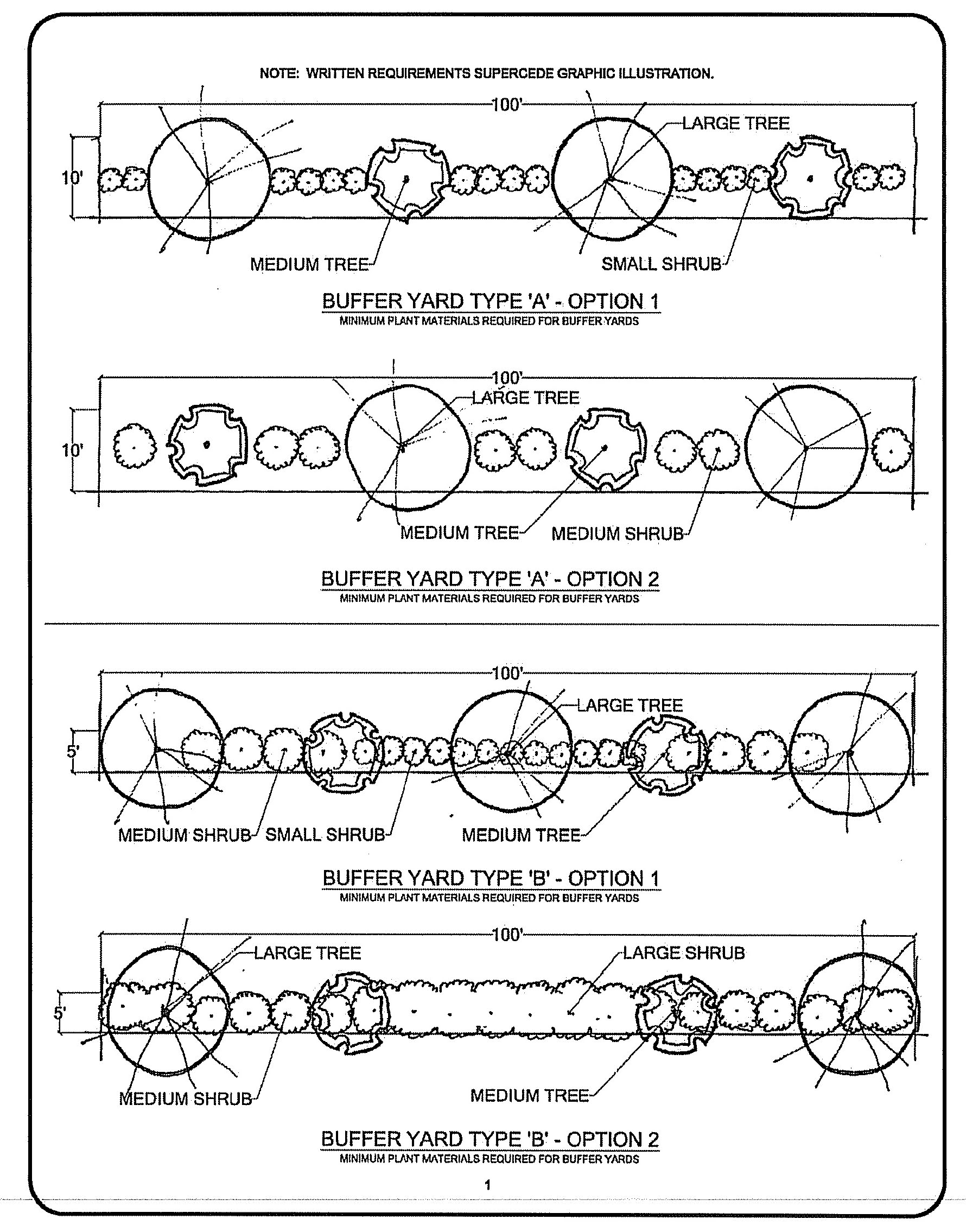
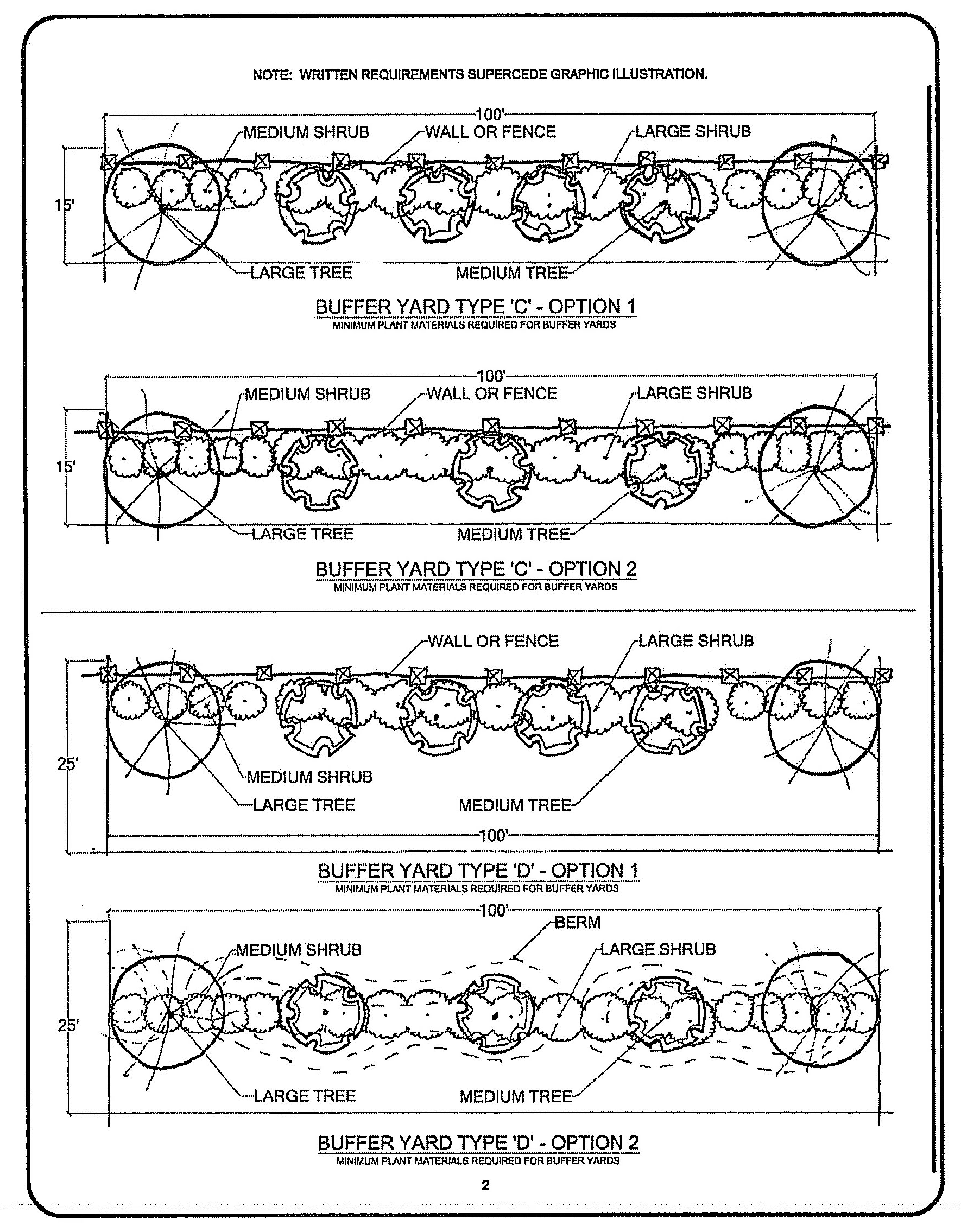
4-80.9.6. Description of buffer yards. There are five (5) types of buffer yards. Tables 4-80.L6 and 4-80.L7, Options 1 and 2 illustrate a typical buffer yard and shows the minimum width and number of trees and/or shrubs required for each one hundred (100) lineal feet of each buffer yard. This table also illustrates the requirement for fences, walls and berms. The applicant may either plant new trees and shrubs or preserve existing native trees and shrubs within the required buffer that meet the requirements of this section. This table is a graphic representation and guideline for buffer yards only. All buffers shall meet the intent of the code.
Table 4-80-L6
Table 4-80.L7
Typical Buffer Yards Graphic Illustration
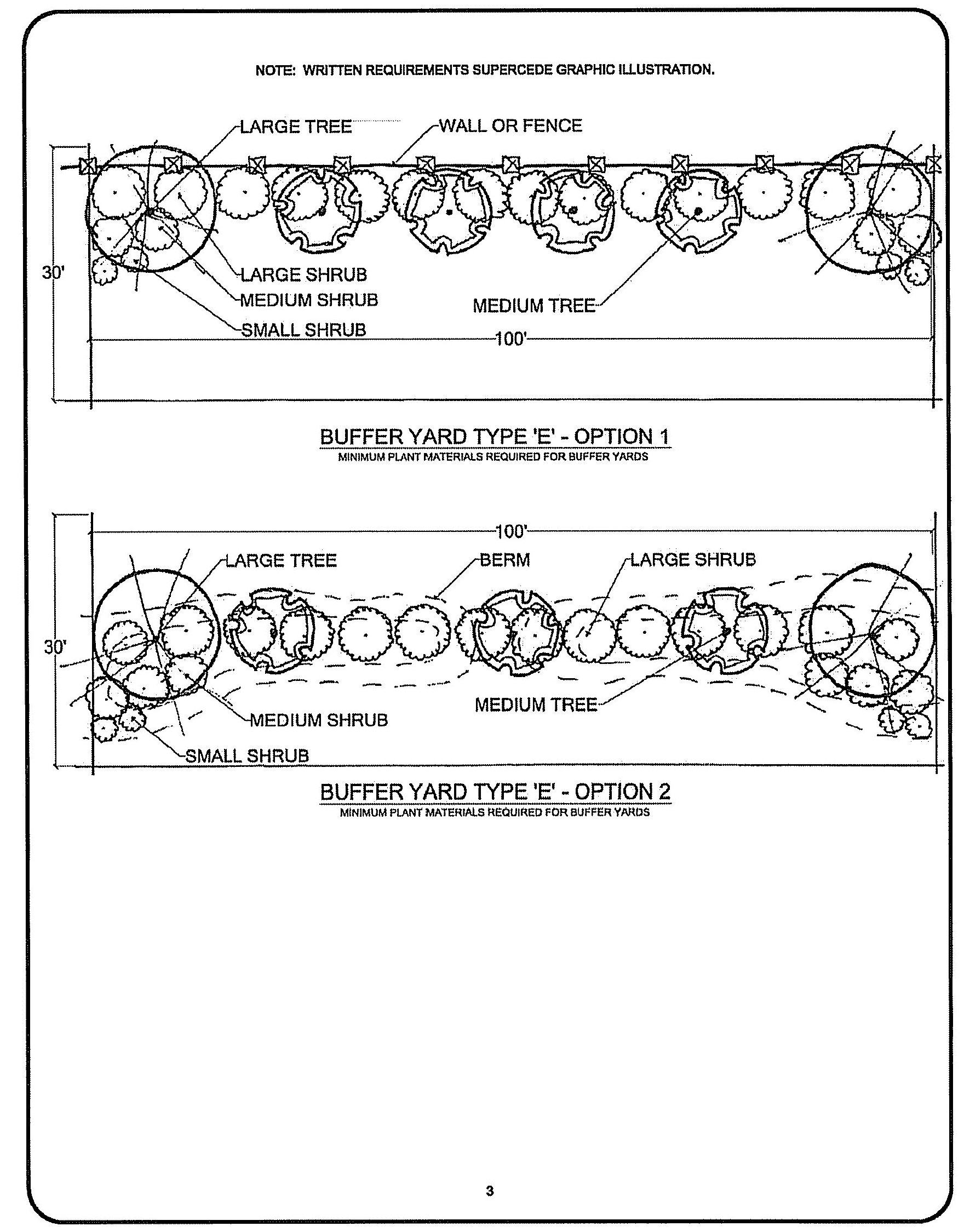
4-80.9.7. Size and type of buffer plant material. Plant materials for buffer yards shall meet the minimum requirements as outlined in section 4.80.6.4, Minimum landscape planting specifications.
A.
Large trees. Large trees required for Type D and E buffers shall be at a minimum, canopy shade trees with a mature height of at least forty (40) feet. See additional criteria in section 4-80.14, Rights-of-way and protection of infrastructure.
B.
Shrubs. At a minimum, fifty (50) percent of the shrubs for Type D and E buffers shall be evergreen.
4-80.9.8. Existing vegetation within buffer yards. Natural areas with native vegetation may be used to meet any of the above buffer yard requirements if the criteria of Table 4-80.L6 can be met.
4-80.9.9. Buffer yard width reduction. The width of a buffer yard may be reduced by thirty (30) percent if the intent of this section is met, provided that the minimum buffer yard width shall be at least five (5) feet.
4-80.9.10. Location of a buffer yard.
A.
A buffer yard required by this section shall be provided along the side or rear lot lines of abutting uses.
B.
Buffer yards are not required along a street frontage property line.
4-80.9.11. Permitted uses within a buffer yard.
A.
No active recreation area (excluding bike and pedestrian paths so long as they do not exceed thirty (30) percent of the total buffer width), storage of materials, parking or structures, except for necessary utility boxes and equipment, shall be located within a buffer yard.
B.
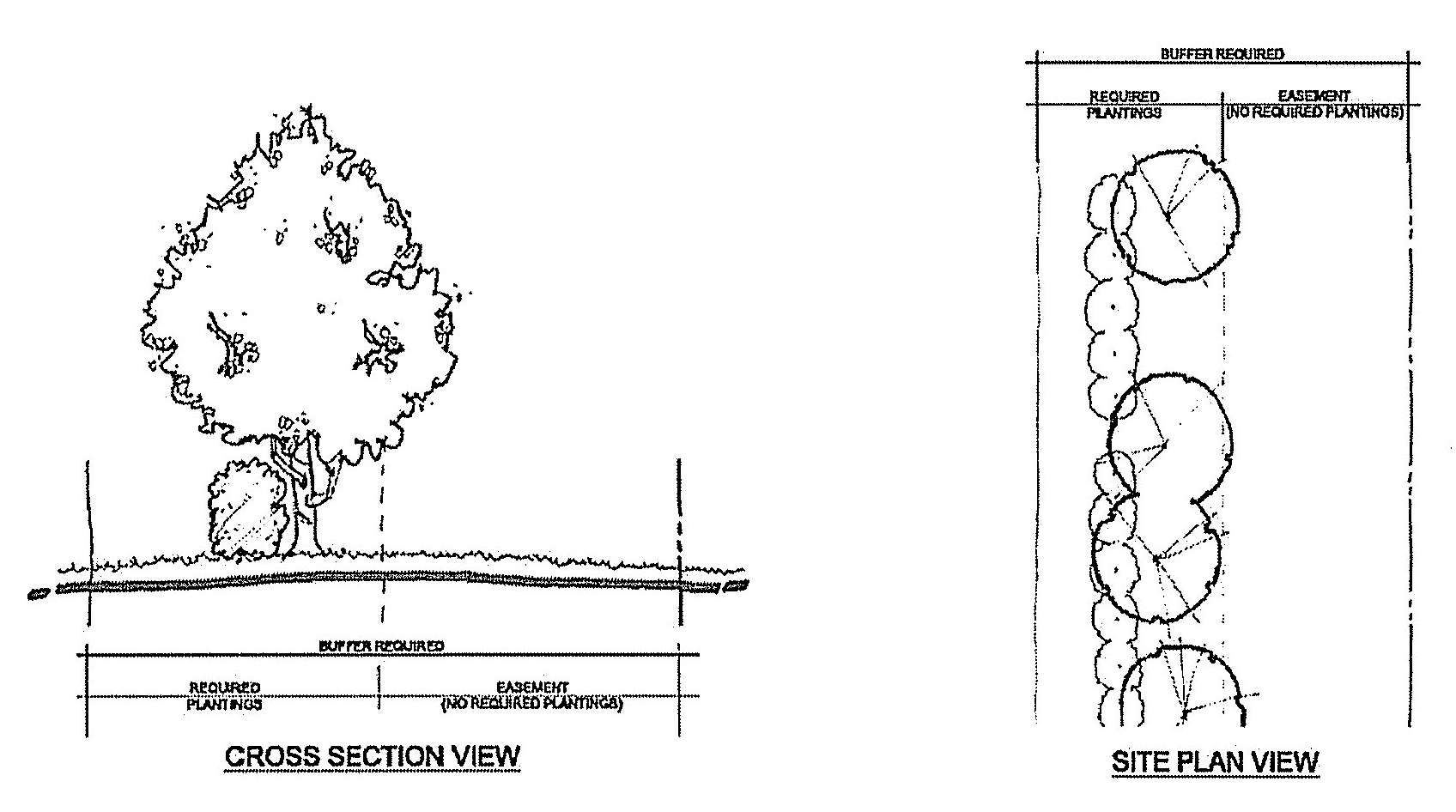
Required buffers may overlap utility or drainage easements up to fifty (50) percent; however, no trees or shrubs may be located in any utility or street easement or right-of-way.
_____
Exhibit E-L2
Planting in Easement
_____
C.
The buffer yard may be included in the building setback.
D.
Buffer yards may be used to satisfy open space requirements.
4-80.9.12. Required walls and fences.
A.
Walls and fences shall be a minimum height of six (6) feet when used in Type C, D or E buffer yards.
B.
No wall or fence is required if an existing wall or fence on an abutting property meets the requirements of this section.
C.
Walls and fences that are required by this section to meet the minimum landscape buffer standards shall be solid and one hundred (100) percent opaque, except where otherwise required.
D.
Required landscaping shall be placed on the external side of the required wall or fence and abutting the adjacent property or right-of-way. The property owner shall provide sufficient width of the planting area and/or landscape buffer easement for plant sizes at the time of maturity, and for access for maintenance activities. .
E.
Fences, walls, gates, and all other landscaping improvements shall be placed so as not to block any fire department appliances (fire hydrants and fire department connections), when constructed/planted and at maturity. The minimum clearance around all fire department appliances shall be seven and one - half (7½) feet on each side, seven and one - half (7½)feet in front, and four (4) feet in the rear.
F.
Please also refer to section 4-84 for wall and fence design standards, including regulations for optional walls and fences not required by Sec. 4-80.
4-80.9.13. Berms. Berms shall have a slope no greater than 3:1 (three horizontal feet with a one-foot vertical rise). The surface of the berm that is not planted with trees and shrubs shall be covered with turf, groundcover, vines or perennials with mulch, and shall be maintained in accordance with section 4-80.8, Protection of plant areas. Where possible, berms shall be undulating in nature and tie into any required stormwater berms as appropriate.
4-80.9.14. Screening. Off-street loading areas, refuse and outdoor storage areas and mechanical equipment shall be screened from public streets. Screening shall be sufficient to obscure the area of equipment through the use of a fence, wall, or vegetative hedge or combination thereof, not less than six (6) feet high and no greater than ten (10) feet high.
4-80.9.15. Utilities.
A.
Utility companies shall provide a plant buffer within the street yard of electrical substations, telephone and cable substations, water pumping/storage sites and wastewater treatment facilities. The buffer shall comply with the requirements of a Type E buffer as described in Table 4-80.L6.
B.
All developments shall make every effort to avoid placing proposed utilities within plantable areas, parking lot islands, buffer yards, building perimeter planting spaces, etc.
4-80.10. Streetscape landscaping. The following are subject to the streetscape planting standards (see Table 4-80-L2):
A.
All developments providing three (3) or more parking spaces, and/or
B.
All developments requiring subdivision review.
C.
Applies to all zoning districts (see Table 4-80-L2).
4-80.10.1. Exemptions. If existing site conditions and/or existing development of a property render the planting of street trees impractical, the applicant may submit a written request to waive or modify this requirement. The request must clearly demonstrate the inability to meet the requirements of this section. Approval shall be determined by the building official or designee.
4-80.10.2. Planting materials.
A.
Where no existing or proposed overhead utility lines exist, street trees shall be large trees. If overhead utility lines exist or are proposed, refer to the Florida Power & Light publication "Plant the Right Tree in the Right Place" for tree placement guidelines. Efforts shall be made to plant Live Oak trees where possible and appropriate.
B.
Preservation of existing native trees to meet this requirement is permissible and recommended. Waivers for spacing and alignment may be given to allow existing trees to fulfill therequirements for street tree plantings. Waivers shall be determined by the building official or designee.
4-80.10.3. Location. Street trees shall be planted as close to the property line as possible.
4-80.10.4. Spacing. Street tree plantings shall include one (1) of the following:
A.
Large trees shall be planted at a minimum ratio of one (1) for every fifty (50) linear feet of street frontage;
B.
Medium trees shall be planted at a minimum ratio of one (1) for every thirty (30) linear feet of street frontage;
C.
Small trees shall be planted at a minimum ratio of one (1) for every twenty (20) linear feet of street frontage; or
D.
A combination of tree sizes (section 4-80.10.4.A—C) may be used to satisfy this requirement.
E.
The spacing requirements are measured as an average of the street frontage along a particular street. In no instance shall the distance between street trees exceed one hundred (100) feet on center. Street trees shall be planted in even, linear spacing. If shifts to the linear spacing not exceeding fifteen (15) feet are required due to the location of existing infrastructure, development, or required sight distance, these shifts shall require approval by the building official or designee. Shifts greater than fifteen (15) feet shall require approval through a landscape betterment plan.
4-80.10.5. Additional plantings required. This section applies to all properties located in a business, industrial or public zoning district with street frontage on a local street (see definitions section 4-80.2). Where properties across the local street are zoned single-family residential, a continuous hedge row shall be provided along such frontage and shall conform to the planting specifications established in Table 4-80.L4. Such plantings shall provide for pedestrian access to public sidewalks, where applicable. Exemptions to this requirement are limited to parks, public and/or private schools, and places of worship.
4-80.11. Building landscaping.
4-80.11.1. Applicability. This section applies to all duplex, multifamily, commercial, industrial, public, or institutional buildings (see Table 4-80-L2) that have a building footprint greater than one thousand (1,000) square feet.
4-80.11.2. Standards.
A.
Landscaping area must be the equivalent of a minimum of ten (10) percent of the proposed building gross ground level floor area.
B.
Landscaping may be comprised of shrubs or ornamental plants and trees in any combination, provided that at least fifty (50) percent of the total required materials are native.
C.
Landscaping may be planted in groupings, as long as the minimum number of required plants is provided.
D.
Landscaping shall abut the building and shall be used or installed in such a manner as to screen mechanical equipment attached to or adjacent to the building, provide direction to and enhance entrances, enhance walkways, and provide visual breaks along blank building facades.
E.
Planting areas must be at least five (5) feet in width and located adjacent to all sides of the building to the maximum extent possible.
4-80.12. Parking lot area landscaping.
4-80.12.1. Intent. Parking lot area landscaping serves the purpose of providing relief from the amount of radiant heat generated from large expanses of paved area. The planting of trees in parking lots adds a vertical component to these paved areas, creating interest, visual appeal and increased comfort.
4-80.12.2. Applicability.
A.
Landscaping is required for all parking lot areas (see definition section 4-80.2) associated with residential subdivisions, multifamily, commercial, industrial, public, or institutional development, and applies to all zoning districts (see Table 4-80-L2). A parking lot used exclusively for the display of motor vehicles for sale or storage as part of a motor vehicle dealership shall comply with this section.
B.
Trees shall provide shade for a minimum of twenty-five (25) percent of a parking lot. Medium and large trees may be used. Small trees do not count toward meeting the requirements of this section.
C.
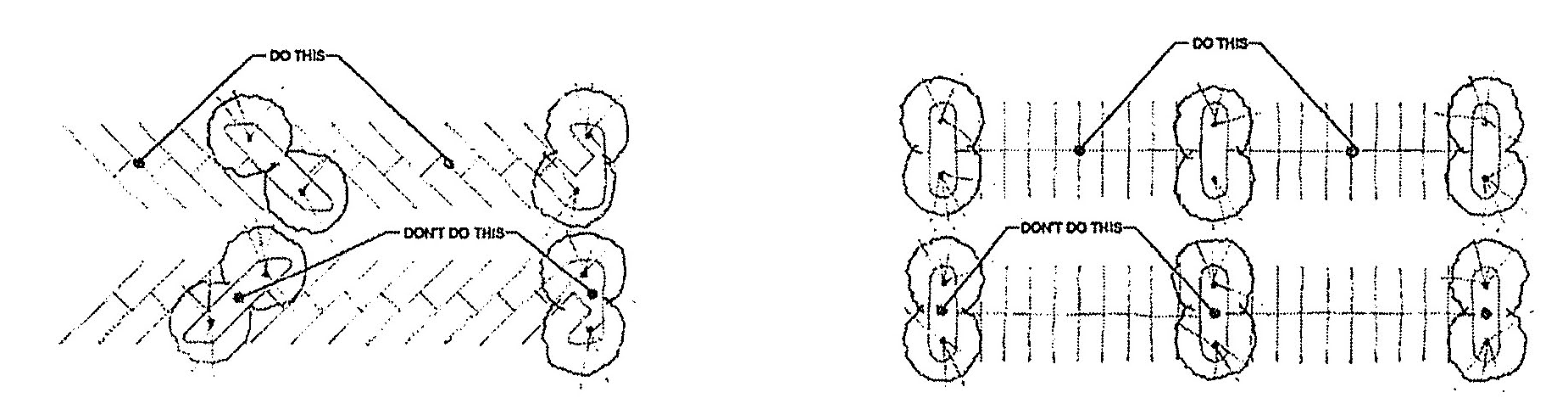
Parking lot lighting shall not be placed within parking lot islands and shall be located at a minimum, fifteen (15) feet from an island.
_____
Exhibit E-L3
Compatible Parking Lot Tree and Lighting Design
_____
4-80.12.3. Calculation of shaded area.
A.
Table 4-80.L8 provides the calculation for each of the tree sizes as required to create the minimum shade coverage.
Table 4-80.L8
B.
The minimum shade coverage shall be determined in accordance with the following formula:
A x B = C
Where:
A = percent of site requiring coverage (25 percent)
B = square feet of parking lot area, and
C = total number of square feet needed
Example:
Large trees required: 2,500/1,500 = 1.6, or 2 trees (round up)
Medium trees required: 2,500/650 = 3.8, or 4 trees (round up)
A combination of large and medium trees may be used to meet the twenty-five (25) percent requirement.
4-80.12.4. Landscape area required.
A.
Landscaped areas on the parking area perimeter or internal islands must equal or exceed a minimum of ten (10) percent of the total parking lot area.
B.
If terminal islands are used for required canopy trees, the islands must be a minimum of ten (10) feet in width.
C.
The front of a vehicle may overhang any landscaped area a maximum of two (2) feet, provided the landscaped area is protected by motor vehicle wheel stops or curbing.
4-80.13. Stormwater management areas.
4-80.13.1. Intent. The planting of stormwater ponds and dry detention areas serve the purpose of further treating stormwater runoff prior to discharging from a site or percolating into aquifers. Additionally, planting of these areas improve their aesthetic quality and provides habitat for local animal species.
4-80.13.2. Applicability.
A.
Stormwater plantings are required for all stormwater ponds and dry detention areas associated with residential subdivisions, multifamily, commercial, industrial, public or institutional development, and applies to all zoning districts (see Table 4-80-L2).
B.
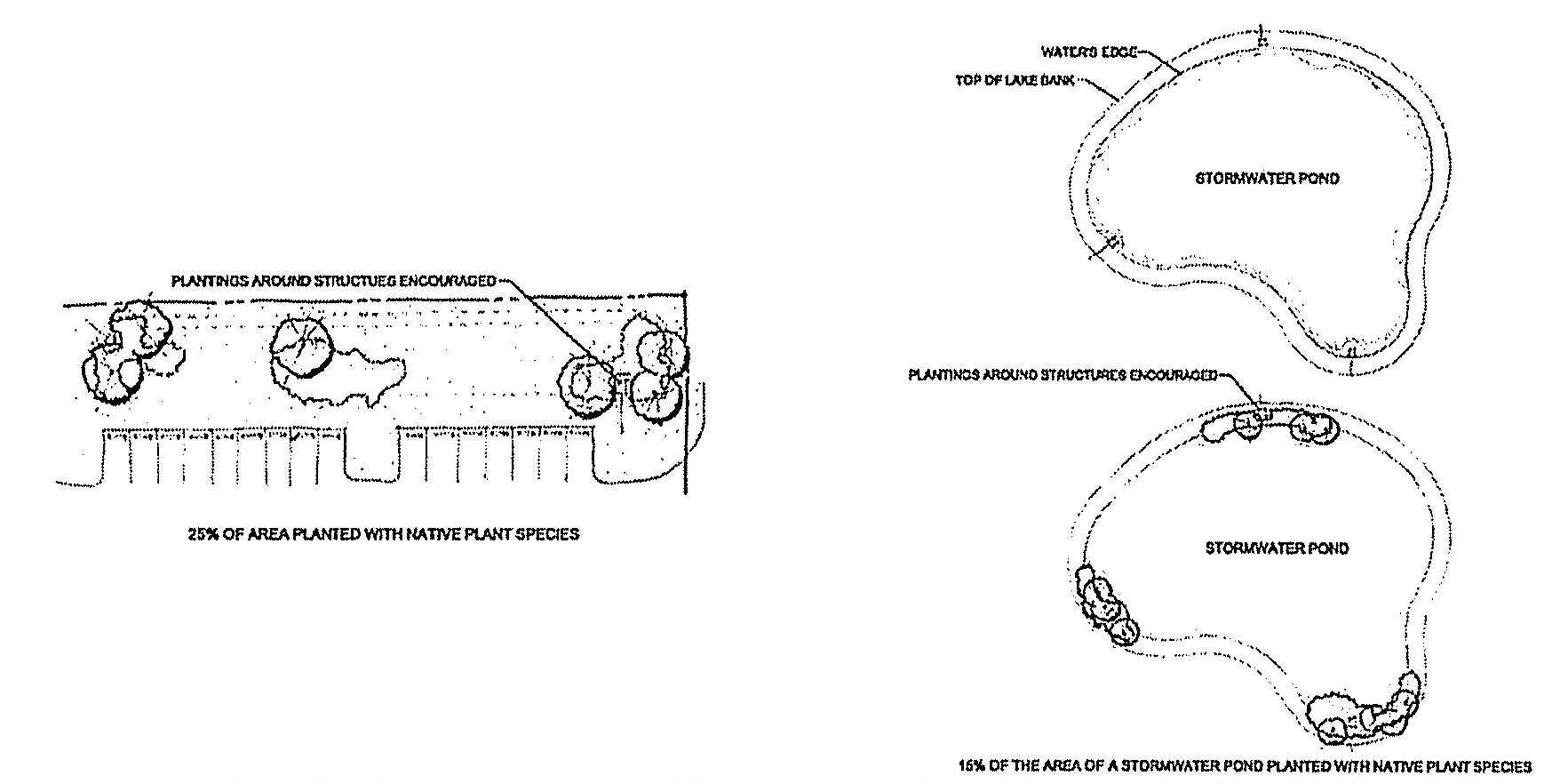
A minimum of twenty-five (25) percent of the area utilized as dry detention shall be planted with native plant species capable of withstanding long periods of water inundation. A minimum of fifteen (15) percent of the area for a stormwater pond shall be utilized for plantings. These areas may be pond side slopes and littoral shelves.
C.
Plant quantities will be calculated based on placement of three (3) feet on center for the total area. Minimum plant size at installation shall be four-inch container or greater.
D.
Plantings around structures (outfall pipes, inlets, control structures, etc.) are strongly encouraged.
Exhibit E-L4
Stormwater Area Plantings
4-80.14. Rights-of-way and protection of infrastructure.
A.
All trees of species whose roots are known to cause damage to public roadways, sidewalks and other public infrastructure shall be planted no closer than ten (10) feet to the existing or proposed infrastructure.
B.
Appropriate setbacks of trees from power lines shall be required, as provided in section 4-80.10.2.A.
C.
Utility or drainage easements may overlap required buffers; however, no required plantings may be located in any utility or street easement or right-of-way (see Exhibit E-L2). Variances or deviations from the requirements of this subsection are permitted via a landscape betterment plan.
4-80.15. Tree preservation.
4-80.15.1. Applicability.
A.
This section applies to any application for development approval except as otherwise provided in this section. This section applies to all real property involved with the erection, repair, alteration, or removal of any building or structure, as well as grading and earth moving in anticipation of such development.
B.
This section does not apply to the harvesting of trees. For purposes of this section, "harvesting" shall mean the cutting or clearing of trees for purposes relating to forestry, as defined by state law. "Harvesting" does not include the clearing of land for purposes of development, even where trees are sold for purposes of creating lumber or other related uses.
C.
This section does not apply to the issuance of a development approval for a single-family residence on an existing lot of record.
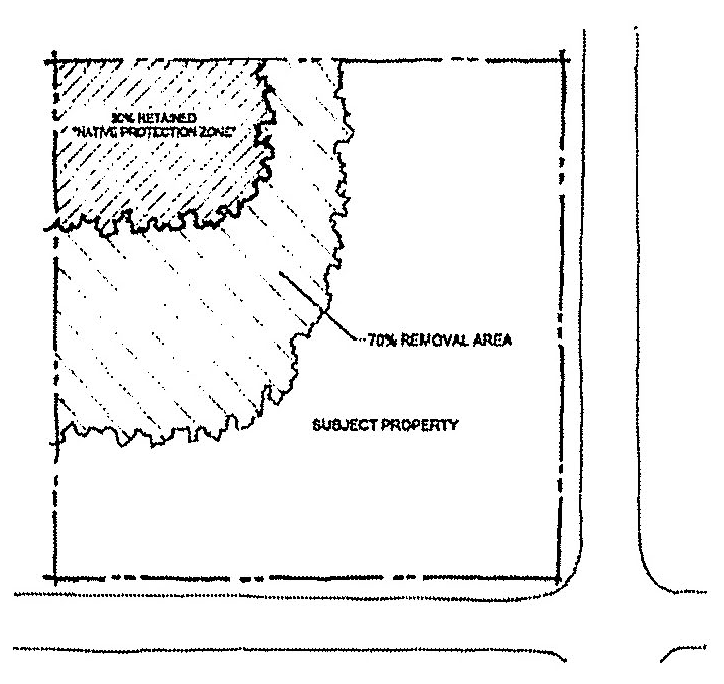
4-80.15.2. Native protection zone. For purposes of this section, a "native protection zone" is established for any lot or parcel having "significant natural area" coverage (as defined in section 4-80.2). The native protection zone includes all significant naturalareas of a property. The percentage of both significant natural area and the native trees within this area that must be preserved within the tree protection zone is established in Table 4-80.L9.
Table 4-80.L9
* Preserved Native Protection Zones shall count towards open space.
Exhibit E-L5
Native Protection Zone
4-80.15.3. Preservation standards. No grading, demolition, trenching, or other activity (including the operation and storage of equipment and materials) that may adversely affect trees and shrubs may proceed prior to approval and issuance of necessary development approvals by the City of LaBelle.
4-80.15.4. Protective barriers. Prior to any development activity as described in section 4-80.15.1, the applicant shall erect protective barriers as follows:
A.
Protective barriers shall be installed around each protected tree, group of protected trees or native protection zone that is designated for protection.
B.
Protective barriers shall not be supported by plants they are protecting but shall be self-supporting.
C.
Protective barriers shall be a minimum of three (3) feet high and constructed of a durable material that will last until the construction is completed.
D.
Protective barriers shall be installed at a minimum of two-thirds (⅔) of the drip line or native protection zone, whichever is applicable.
4-80.15.5. Irreparable damage. Where the building official or designee determines that irreparable damage has occurred to a protected tree or trees within a native protection zone, the tree(s) shall be removed and replaced as described in section 4-80.16 and protective fencing shall be installed as provided for in this section.
4-80.16. Tree protection.
4-80.16.1. Intent. It is the intent of the city commission to protect and preserve mature, native trees, particularly significant oak trees as defined in Sec. 2-4 of this Code, within the city. The city commission has determined that the protection and preservation of the oak tree canopy provided by the native oak trees. commonly known as Live Oaks, Laurel Oaks and Water Oaks is important to the health, safety and welfare of the residents of the city, and recognizes the importance of maintaining and renewing the canopy for future generations. The canopy also provides an ambiance that has been a factor in attracting visitors and new residents. Loss of this significant canopy will negatively affect the city, both physically and fiscally. Therefore, the city commission has determined that preservation and replacement of these trees is in the best interest of the city to protect its vision as the "The City Under the Oaks".
While the priority of the city is to preserve and protect significant oaks, it is not the city's intent to restrict the reasonable development of property. Through application, an applicant may propose an alternative to the requirements of the land development code in an effort to preserve significant oak trees. The city commission will determine whether the preservation of such trees meets the intent of this Code with regard to health, safety and welfare.
4-80.16.2. Applicability. This section applies to all development and redevelopment of land within the city, including the development and redevelopment of single-family dwellings on existing lots of record.
4-80.16.3. Exceptions. Exceptions to the requirement for a tree removal permit are as follows:
A.
Natural emergencies or disasters. Upon declaration of a state of emergency by the city mayor or city commission, issuances of permits for the removal of damaged trees may be waived by the city superintendent of public works. Such waiver may not be for an indefinite period and shall expire when the mayor or city commission determines that emergency conditions have ended.
B.
Dead oak trees. If the superintendent of public works or his designee determines that a tree is dead, then no permit shall be required. Replacement trees shall not be required if the oaks on the subject property meet or exceed the current tree requirement of the landscape code.
4-80.16.4. Tree removal/relocation permit required. A significant oak tree may not be removed or relocate without a tree removal permit. Tree removal permits may be issued by the building official or designee, or by application to the city commission, as set forth in this section.
4-80.16.4.1. Administrative tree removal permit.
a.
Administrative approval criteria. Removal or relocation of significant oak trees may be approved administratively by the Superintendent of Public Works or their assigns, upon a finding that the oak tree(s) satisfies at least one (1) of the following in addition to required mitigation per 4-80.16.5:
1.
Poses a safety hazard due to structural damage to the property, or due to health of the tree.
2.
Has been weakened by disease, age, storm, fire or other injury; is determined dead; or is in such a significant state of decline that death is imminent based.
3.
Is so disfigured that it no longer represents a healthy specimen.
4.
Is required in order to obtain property insurance. Proof in writing shall be required.
b.
Administrative tree removal application requirements.
Administrative applications shall be initiated by submittal of an administrative tree removal application and the associated application materials and will include the following additional information:
1.
The location and type of significant oak tree(s) proposed for removal or relocation;
2.
Administrative applications requesting removal due to structural damage shall include verification from a certified engineer in the State of Florida that the significant oak tree(s) is currently or will in the near future cause structural damage to existing structures. Verification will include identification of the tree(s) causing structural problems, and will provide an explanation of the concern. Written verification will be sealed by the engineer of record.
3.
Administrative applications requesting removal of a significant oak tree(s) due to a decline in health require verification of claim(s) from a qualified tree. An expert shall be an individual, in the State of Florida, that is: an official horticulturalist with IFAS, a certified horticulturalist, a master gardener, a licensed landscape architect certified in the State of Florida, certified arborist, or an urban forester. The verification letter shall identify the weakened tree(s) and shall provide an explanation of the problem, and state the qualifications of the tree expert.
4.
Description of method of removal or relocation to be used; and
5.
Planting plan and narrative describing required mitigation in accordance with Sec. 4-80.16.5.
4-80.16.4.2. Tree removal permit requiring city commission approval. Through application to the city commission, an applicant may request the removal or relocation of significant oak trees that do not meet the criteria for administrative approval pursuant to this section.
a.
Criteria for permits requiring city commission approval.
The criteria provided below must be met for consideration of approval of a tree removal application by the city commission:
1.
The applicant shall demonstrate that the significant oak tree(s) prevents the reasonable development of the site; and
2.
That relief from other land development code requirements, such as reduced setbacks or parking lot layout, are not reasonable alternatives for tree preservation; and
3.
That any approval for significant oak tree removal or relocation granted by the city commission does not adversely impact adjacent properties.
4.
Demonstration of the required mitigation in accordance with this in accordance with Sec. 4-80.16.5.
b.
Application requirements for permits requiring city commission approval.
Application shall be initiated by submittal of a public hearing tree removal application and the associated application materials and will include the following additional information:
1.
The location and type of significant oak tree(s) proposed for removal or relocation;
2.
A statement (narrative) addressing the following:
a.
Why the significant oak tree(s) prevents reasonable development, and
b.
What alternatives the applicant has considered and why these alternatives cannot be used:
3.
Demonstration of consideration of relief from other land development code requirements that might enable development to proceed and avoid tree removal:
4.
Description of method of removal or relocation to be used; and
5.
Description of how other significant oak trees or groups of trees will be protected during any approved tree removal or relocation and any associated construction or clearing, where applicable.
6.
Planting plan and narrative describing required mitigation.
4-80.16.4.3. Removal or relocation approval in conjunction with public hearing development approval. When tree removal or relocation is contemplated in conjunction with development requiring public hearing approval, including but not limited to a special exception, rezoning (including Planned Unit Development rezonings), development plan or subdivision plat, such removal or relocation shall be considered by the city commission as part of the development review process and a separate tree removal application is not necessary. Consideration by the city commission shall be based upon the criteria established in section 4-80.16.2.2. Development plans and/or plats must include tree removal application materials as described in section 4-80.16.3.
4-80.16.5 Required mitigation. Where significant oak tree(s) are approved for removal under this section, including administrative approval and tree removal permits requiring city commission approval, mitigation must be provided as follows:
1.
Replacement tree(s) must be a Live Oak specimen.
2.
The replacement Live Oak tree must be at minimum: ten (10) feet in height, contain a four-foot spread, and have four (4) inch caliper, DBH, at time of planting. All significant oak tree(s) approved for removal shall be replaced on a DBH inch for DBH inch basis.
3.
All replacement tree(s) shall be balled and burlapped, tree spaded or containerized.
4.
Replacement tree(s) shall be located in approximately the same location as the significant tree, unless such location would be unreasonable under the circumstances, or in locations readily visible by the public from adjacent rights-of-way.
5.
Where replacement tree(s) are proposed to be planted off-site, the request must be approved by the city commission.
6.
Where the applicant proposes a payment-in-lieu of replanting oak tree(s) in accordance with this section (either on-site or off-site), the request must be approved by the city commission. The mitigation fee is hereby established at one hundred fifty dollars ($150.00) per inch of significant oak tree removed, measured DBH.
7.
The superintendent of public works or their designee shall inspect the property upon completion of all mitigation permitted pursuant to this article to determine compliance. The enforcing official shall then reinspect the property approximately one (1) month thereafter and then at four-month intervals to ensure compliance. If at any time the enforcing official determines that the corrective action is not successful, he/she shall notify the owner and/or resident of the property as provided in this section.
4-80.16.6. Attachments to trees prohibited. No attachments or wires other than those of a protective and nondamaging nature shall be attached to any tree.
4-80.16.7. Enforcement.
4-80.16.7.1. Enforcing officials. The city superintendent of public works shall designate such person or persons as may be necessary to administer and enforce the provisions of this chapter.
4-80.16.7.2. Authority to enter on private property. Those persons designated to administer and enforce the provisions of this chapter may, in the performance of such functions and duties, enter upon any land and make such inspections, examinations and surveys as are required for the proper administration and enforcement hereof and may obtain any necessary search warrants therefore.
4-80.16.7.3. Violations deemed public nuisance. The provisions of this chapter are deemed to be necessary for the protection of the public health, safety and welfare and for the protection of the peaceful use and enjoyment of any lands by the owners thereof, and any violation of the terms of this chapter is declared by the city commission to constitute a public nuisance.
4-80.16.7.4. Whenever the enforcing official finds any violation of the provisions of this ordinance, he/she shall institute enforcement proceedings as follows:
1.
Notice. The enforcing official shall issue a code violation to the owner of the property which shall be given either by personal delivery or by deposit in the United States mail in an envelope marked certified mail (certificate of mailing), postage prepaid, addressed to the owner as listed on the current tax assessor's tax roll. The notice of code violation shall include:
a.
A location of the property either by street address or legal description.
b.
A statement indicating the nature of the violation and the reason or reasons why the notice of violation is issued.
c.
A specification of the subsection or subsections on which violation is based.
d.
If corrective action will bring the violation into compliance with these sections, a statement of the nature and extent of such action, repairs or alterations necessary to remedy the violation in accordance with the performance standards provided herein. The city shall specify the time for performing such actions, such time not to be less than ten (10) nor more than thirty (30) days.
e.
The name or names of persons upon whom the notice of violation is served.
f.
A statement advising that the city may institute legal proceedings as provided herein.
4-80.16.7.5. Appeals and variances. An appeal to the city commission of the decision of the enforcing official or a petition for special exception as provided in the city Code, if applicable, stay further proceedings by the enforcing official until final disposition by the city commission.
4-80.16.7.6. Failure to comply. If corrective action is not taken within the time specified in the notice of violation, or if an appeal is taken and corrective action is not taken in accordance with the decision of the city commission, then the enforcing official may institute further proceedings as provided by the enforcement provisions of this chapter.
(Ord. No. 2003-01; § 1, 2-13-03; Ord. No. 2003-15, § 1, 4-24-03; Ord. No. 2003-33, § 1, 2-12-04; Ord. No. 2004-23, § I, 1-13-05; Ord. No. 2011-04, § 2(exh. A), 1-12-12; Ord. No. 2017-1, § 2, 2-9-17; Ord. No. 2019-07, § 2, 5-9-2019; Ord. No. 2019-12, § 2, 8-8-2019; Ord. No. 2021-01, § 2, 3-11-21)
Sec. 4-81. - Signs.
4-81.1. Purpose.
A.
General. The sign regulations of this chapter are intended to ensure that signs throughout the community meet the City of LaBelle's standards for appearance, quality, and safety, while also allowing consumers to locate goods and services.
B.
Intent. The general purpose of this sign code is to promote the health, safety, convenience, aesthetics and overall welfare of the community. This is to be achieved by coordinating the types, placement and physical dimensions of signs, and by the use of sound planning and architectural principles as follows:
(1)
By providing each sign user an opportunity for effective identification by controlling the number and area of signs permitted on all sites;
(2)
By providing an opportunity for individual establishment identity and creativity;
(3)
By controlling off-premises signs in order to maintain the legibility of on-premises signs;
(4)
By maintaining and enhancing the quality of the city's appearance and the safety of its citizens by avoiding clutter, promoting proper maintenance, and requiring removal of abandoned signs;
(5)
By enabling consumers to identify establishments offering goods and services to meet their needs;
(6)
By regulating the design, construction, installation and maintenance in a manner which does not endanger the public.
4-81.2. Definitions. Defined terms contained in this section are provided in section 2-4 of this Code.
4-81.3. General provision.
A.
Permit required. Except as otherwise expressly provided in the chapter, all persons erecting, hanging, painting, installing, or otherwise placing signs in the city, must first obtain a sign permit in accordance with the procedures of chapter 5, article II.
It shall be unlawful for any sign requiring a permit to be erected or modified without first obtaining a sign permit, if such permit is required by the City of LaBelle.
Prior to issuance of a permit, any sign not prepared by a licensed sign contractor must be reviewed by the code review board for aesthetic approval.
B.
License issuance/renewal and property owner's responsibility. Except as expressly provided in this section, each property owner shall be responsible for proper permitting, installation and maintenance of all signs on their property.
C.
Alterations of signs.
(1)
Except for message and graphics changes, no sign shall be altered unless a sign permit is reissued. The planning manager or designee may authorize minor message changes, such as corrections in telephone numbers or subdivision phase numbers, or other similar minor text or maintenance items. The term "minor change," for this purpose, does not include changes in project or developer name or redesigning the fundamental message or graphics of the sign.
(2)
Except for message changes authorized by this section, no nonconforming sign shall be altered unless a sign permit to do so is issued and the sign is brought into conformance with the requirements of this section at the time of alteration.
(3)
Except for message changes, no sign included in a master sign plan shall be altered except as prescribed in its approved master sign plan.
D.
The city shall inspect each sign for which a new sign or modification sign permit has been issued on or before six (6) months from the date of issuance of such permit. If construction of the sign is eighty (80) percent complete, the city shall give the applicant notice of deficiencies and shall allow an additional thirty (30) days from the date of inspection for the deficiencies to be corrected. If such deficiencies are not corrected by such date, the permit shall lapse and become void. If the construction is complete and in conformance, the city shall affix a permanent symbol identifying the sign(s) and the applicable permit by permit number.
4-81.4. Exempt signs. The following signs shall be exempt from the regulations of this section:
(1)
Signs required to be maintained or posted by law or governmental order, rule or regulation, and "welcome to LaBelle" type community signs.
(2)
Temporary on-premises directional/informational signs not exceeding two (2) square feet in area and four (4) feet in height. Limited to two (2) signs per entrance.
(3)
Wall signs displaying the name of the occupant, profession/specialty and street address, not to exceed two (2) square feet and placed flush against a building face or mailbox side. Residential property identification signs on parcels two and one-quarter (2.25) acres or greater may not exceed four (4) square feet.
(4)
Memorial plaques, cornerstones, historical tablets and similar types of commemorative signs that are an integral part of the structure.
(5)
"No trespassing", "no dumping" or other prohibitory or safety type signs, provided each sign does not exceed three (3) square feet in size.
(6)
On-site real estate signs stating "for sale", "for rent", "open house", or similar message, not exceeding sixteen (16) square feet for residential use and thirty-two (32) square feet for nonresidential uses. Maximum number of signs per site shall not exceed one (1) sign per two hundred (200) linear feet of frontage along a public right-of-way.
(7)
On-premises bulletin boards and identification signs for public, charitable, education or religious institutions no greater than twelve (12) square feet.
(8)
Signs located on fences or walls surrounding athletic fields or within sports arenas, stadiums, etc., no greater than thirty-two (32) square feet and oriented away from adjacent properties or roadways.
(9)
Window merchandise displays which change no less than every thirty (30) days.
(10)
Nonelectrical, nonilluminated window signs less than fifty (50) percent of each interior window area.
(11)
Construction signs containing project information, not greater than three (3) square feet for residential use and thirty-two (32) square feet for nonresidential use. Maximum number of signs per site shall not exceed one (1) sign per two hundred (200) linear feet of frontage along a public right-of-way. Signs shall be removed within three (3) days of received certificate of occupancy.
(12)
Signs manufactured as a standard, integral part of a mass-produced product accessory to a commercial, public or semipublic use, including vending machines, automated teller machines and gasoline pumps.
(13)
Notices posted by a utility or other quasipublic agent in performance of a public duty or by any person giving due legal notice.
(14)
Official notices of any court, public body or officer.
(15)
A-frame or sandwich boards, limited to eighteen (18) square feet, taken in and out daily.
4-81.5. Prohibited signs. Unless otherwise provided in this section, the following signs are prohibited:
(1)
Abandoned signs;
(2)
Banners, pennants, wind signs, beacons and searchlights. See also "temporary signs";
(3)
Any sign which employs motion or gives the illusion of motion, including animation, rotation, and flashing signs. For reader boards, see subsection 4-81.10.B.;
(4)
Billboards;
(5)
Roof-mounted signs and signs projecting above a parapet;
(6)
Portable signs;
(7)
Signs imitating official traffic or government signs and signals;
(8)
Signs or posters attached in any way to a utility pole, tree, fence, post or stake, or any other object located on public or private property except as otherwise expressly allowed by this Code;
(9)
Off-premises signs unless otherwise provided for in subsection 4-81.12;
(10)
Signs which emit audible sound, vapor, smoke or gaseous matter;
(11)
Any nongovernmental sign which uses words such as "stop", "look", "danger", or any other words, phrases or symbols which may interfere or confuse vehicular or pedestrian traffic;
(12)
Signs that describe, suggest or represent nudity, sexual conduct or sexual excitement, when it:
(a)
Is offensive to contemporary standards in the adult community as a whole with respect to what is suitable sexual material for minors; and
(b)
Taken as a whole, lacks serious literary, artistic, political or scientific value;
(13)
Illegal signs;
(14)
Murals, unless approved by the city commission;
(15)
Nonmaintained signs as per subsection 4-81.16;
(16)
Nonpermitted signs;
(17)
Inflatable signs;
(18)
No sign shall be placed or permitted as a principal use on any property except for "u-pick" or political signs pursuant to the time limitations set forth within the Code.
4-81.6. Nonconforming signs.
A.
Determination of legal nonconformity. Existing signs that do not conform to the specific provisions of this section upon its adoption shall be considered "legal nonconforming" signs and may be permitted to remain for a maximum of ten (10) years.
B.
Loss of legal nonconforming status. A legal, nonconforming sign may lose its designation and must be removed or otherwise brought into conformance with the development code if:
(1)
The sign is relocated or replaced;
(2)
The structure or size of the sign is altered in any way except toward compliance with this section. This does not refer to normal maintenance or changes of copy otherwise allowed by this section. If any nonconforming sign requires change, repair, or maintenance which would constitute an expense of more than fifty (50) percent of the replacement cost of the sign, such sign must either be removed or brought into conformance with this sign code;
(3)
Existing nonconforming nostalgic signs may remain if approved through the special exception process. Nostalgic shall mean a sign that is reflective of a special person, place or theme as determined by the city commission.
4-81.7. Master signage plan.
A.
Purpose. A master sign plan is required by this Code to ensure an appropriate balance between building architecture, signage and neighborhood aesthetics. An effective master sign plan should reduce visual screening of neighbors' signs and buildings. An effective master sign plan should avoid clutter by providing a hierarchy of signage that encourages signs on buildings and utilizes central identification signs rather than multiple freestanding signs along roadways. Master sign plans offer thematic design opportunities, and by reducing clutter, allow consumers to more readily identify the establishments offering goods and services that they are seeking. At the same time, a master sign plan addresses the community's need for attractive architecture and graphics.
B.
Applicability. A master sign plan is required for all multitenant buildings, planned unit developments and all multibuilding or multioccupant commercial or industrial developments. All owners and tenants within the development shall comply with the approved master signage plan for the development. No permit shall be issued for an individual sign that is part of a required master sign plan unless and until a master sign plan has been submitted and approved by the city.
C.
Exceptions to the master signage plan. The master signage plan may be approved with elements that exceed the permitted height, area and/or number of signs specified in this sign code if the following criteria can be demonstrated:
(1)
The development site contains unique or unusual physical conditions that would limit normal sign visibility;
(2)
The proposed or existing development exhibits unique characteristics with regard to land use, architectural style, site location, or other distinguishing features that represent clear variations from conventional development;
(3)
The proposed signage incorporates special design features such as logos, emblems or statuaries, that are integrated into the building architecture.
Exceptions to the master signage requirements shall be considered by the local planning agency (LPA) and shall require the same permitting process as for a standard sign permit as described in subsection 4-81.3.
[D., E. Reserved.]
F.
Existing signs not conforming to master signage plan. When a master signage plan is filed for a property on which existing signs are located, it shall include a schedule for bringing into conformance all signs not conforming to the proposed amendment plan or to the requirements of this ordinance in effect on the date of submission.
G.
Binding effect. After approval of a master signage plan, no sign shall be erected, placed, painted, or maintained, except in conformance with such plan, and such plan may be enforced in the same way as any provision of this section. In case of any conflict between the provisions of such plan and any other provision of this section, the section shall control.
H.
Amendment. A master signage plan may be amended by filing a new master signage plan that conforms with all requirements of this section.
4-81.8. Computations. The following principles shall control the computation of sign area and sign height.
A.
Sign area.
(1)
Sign square footage shall be calculated as two (2) square feet of sign area per linear foot of building facade facing the applicable street frontage.
(2)
A sign with two (2) identical sign faces shall be considered as one (1) sign.
(3)
Maximum allowable square footage shall be:
(a)
One hundred fifty (150) square feet per street frontage for buildings less than one hundred thousand (100,000) square feet.
(b)
Two hundred (200) square feet per street frontage for buildings greater than one hundred thousand (100,000) square feet.
(4)
Directional signs (permanent):
(a)
Directional signs are not counted in the total square footage of permanent signage allowed on a site.
(b)
Freestanding and fascia directional signs may be up to six (6) square feet in area.
(c)
Directional signs may include a company logo no greater than one-third (⅓) the directional signage size.
(d)
One (1) directional sign per entrance to a development or business is allowed.
(e)
See also subsection 4-81.11, Temporary signs.
(5)
Projecting signs:
(a)
Maximum area for each projecting sign shall be six (6) square feet.
(6)
Marquee, awning and canopy signs:
(a)
The sign area is determined by computing the area of an imaginary rectangle drawn around the sign face.
(b)
When the ends of awnings or marquees are parallel and contain sign faces, only one (1) side is counted in addition to the sign face area on the front.
(7)
Diagonal corner signs: Diagonal corner signs that face more than one (1) street must apply fifty (50) percent of the diagonal sign square footage toward the allowable square footage for each street frontage. The sign must meet all standards for the street and building frontage to which it is assigned.
B.
Sign height.
(1)
The height of a sign shall be considered to be the vertical distance measured from the adjacent street grade or upper surface of the nearest street curb, whichever is higher.
On elevated streets such as interchange overpasses, height shall be measured from the street grade of the adjacent street providing access to the property.
(a)
Freestanding/monument signs:
1.
Maximum height of twenty (20) feet if proposed signage abuts an arterial or collector roadway.
2.
Maximum height of twelve (12) feet for all other roadway abutments.
3.
Automobile service stations: maximum height of twelve (12) feet.
4.
Directional signs:
a.
Freestanding: Thirty-six (36) inches.
b.
Fascia: Eight (8) feet.
(b)
Groundmounted signs:
1.
Maximum height of twenty (20) feet if proposed signage abuts an arterial or collector roadway.
2.
Maximum height of twelve (12) feet for all other roadway abutments.
3.
Automobile service stations: maximum height of twelve (12) feet.
4.
The height of the base must not exceed twenty-four (24) inches above the adjacent ground.
5.
Unless otherwise provided for in this section, the average width of the sign structure must exceed the total height of the sign structure.
6.
The width of the top of the sign structure must not exceed one hundred twenty (120) percent of the width of its base.
7.
The face of the sign area is measured as a rectangle enclosing the entire width and height of the sign structure.
8.
Groundmounted signs shall have no less than twenty (20) percent of the width of the base of the sign incorporated into architectural design elements that complement the proposed building design. Such cover shall include elements such as color, materials used and any architectural features that ensure compatibility.
(c)
Projecting signs:
1.
The face of a projecting sign may not extend above the roof line.
2.
Placement. The edge of the projecting sign may not be more than one (1) foot from the building wall. Projecting signs are not allowed on rooftops or on pitched roofs.
3.
When located over a walkway or sidewalk, the projecting sign shall be at least eight (8) feet above the surface of the walkway or sidewalk.
4.
Projecting signs shall not extend into the right-of-way.
C.
Maximum number of signs and setback.
(1)
Groundmounted or freestanding signs:
a.
A total of one (1) sign, either groundmounted or freestanding per street frontage is allowed.
b.
If the cumulative building square footage per project site is greater than one hundred thousand (100,000) square feet, an additional groundmounted or freestanding sign shall be allowed for each additional entrance to the project which provides direct access from an external public roadway.
(2)
Additional signs as per b. above, shall not exceed one hundred (100) square feet of copy area per face and a maximum height of eight (8) feet and are limited to placement along the qualifying frontage.
4-81.9. Locational criteria.
A.
Groundmounted and freestanding signs shall have a minimum setback from any property line of ten (10) feet.
B.
All other signage shall meet the visibility triangle requirements of subsection 4-85.2.
C.
Except for official signs, in no instance shall a sign encroach into public right-of-way.
4-81.10. Special design criteria.
A.
Neon.
(1)
One (1) neon sign per site (property, suite, or unit) shall be allowed.
(2)
Maximum size shall be three (3) square feet.
(3)
Placement shall be limited to an interior building location.
B.
Readerboard.
(1)
Readerboards are considered a part of the total allowable square footage of signage.
(2)
The readerboard shall be part of an overall sign structure and shall be designed to architecturally complement the structure to which it is associated.
(3)
Readerboard sign text shall not flash but roll onto the screen. Furthermore, no chasing, scintillation, rotation or blinking lights shall be permitted. Graphics are limited to text only. No animation of any kind is permitted.
(4)
During a public emergency, readerboards may be used as a source of public communication and are not limited to the requirements herein.
4-81.11. Temporary signs. Temporary signs are limited to directional, event, and promotional signage, that serve the shortterm directing and information needs of a respective development, business or activity. Temporary signs shall require a sign permit. [See also subsections 4-81.7 and 4-81.9.]
A.
Directional signs.
(1)
Temporary directional signs shall meet the criteria established in subsection 4-81.8.A(4) for permanent directional signs.
(2)
Permits shall expire one hundred eighty (180) days from date of issuance but may be renewed for up to one (1) year or until certificate of occupancy or permanent signage is in place, whichever occurs first.
B.
Special event signs.
(1)
A maximum of six (6) off-premises signs for each special event is permitted.
(2)
No signs shall be greater than thirty-two (32) square feet.
(3)
Event signs shall not be installed prior to sixty (60) days before the event and shall be removed within seventy-two (72) hours after the event.
(4)
Request for permit shall include a description of the event, including place and duration, a depiction of the signs and their placement in relation to pedestrian and vehicular traffic, and a map showing all proposed sign locations.
(5)
Banners and windsocks are permitted as special event signs.
C.
Development signs. Development signs are designed and intended to advertise and promote the sale or lease of improved residential, commercial or industrial projects.
(1)
Signage is limited to one (1) sign per the first twenty (20) building sites, plus an additional sign for every fifty (50) building sites thereafter, not to exceed the number of entrances into the development.
(2)
No sign shall be greater than thirty-two (32) square feet.
(3)
Permits shall expire one (1) year from the date of issuance but may be renewed for up to one (1) year or until certificate of occupancy or permanent signage is in place, whichever occurs first.
D.
New business signs.
(1)
Temporary new business signs shall be permitted only if permanent business signs do not exist.
(2)
Total sign area per business shall not exceed thirty-two (32) square feet.
(3)
Permits shall expire sixty (60) days from date of issuance or installation of permanent signs, whichever is less.
4-81.12. Off-premises signs. The following regulations shall be applicable to off-premises signs as defined in subsection 4-81.2.
A.
Off-premises signs are limited to directional signs only to those parcels not located on a collector street as defined in appendix B, section 5-1 of the Land Development Code.
B.
All directional off-premises signs require a sign permit in accordance with the provisions of subsection 4-81.3 of the Sign Code.
C.
Directional off-premises signs shall meet the computation and height requirements for directional signs as provided in subsection 4-81.8.A(4).
D.
No off-premises sign shall be located closer than fifty (50) feet from any on-premises sign.
E.
No off-premises sign shall be located closer than five hundred (500) feet from any other off-premises sign.
4-81.13. Required landscape. All ground-mounted and freestanding signs, including directional signs shall provide a minimum one hundred (100) square-foot planting area around the base of the sign. The required planting area may be a part of and count toward any landscape requirements of the Land Development Code.
4-81.14. Construction standards.
A.
All sign fabrication, erection, and attachment shall conform to the requirements of the building and fire codes and all other applicable codes.
B.
Lighting fixtures and wiring shall conform to the requirements of the latest edition of the National Electrical Code and other applicable codes and regulations.
C.
Transformers, wires and similar items shall be concealed.
D.
All wiring to freestanding signs shall be underground.
4-81.15. Lighting.
A.
Indirect lighting sources shall be shielded to direct light onto the sign and minimize light spillage onto adjacent properties and rights-of-way.
B.
Direct lighting sources shall be designed to ensure no exposed lighting source.
C.
Signs shall not emit more than one thousand eight hundred (1,800) lumens per allowable sign face.
D.
The applicant shall provide a signed certification from the sign manufacturer declaring that the illumination meets the limits as established herein.
4-81.16. Sign maintenance. All signage, braces, poles, wires and other appurtenances of signs or sign structures, shall be kept in good repair, maintained in safe condition, and shall conform to the standards of this section. Maintenance carried out in accordance with this section, and not the result of damage or destruction, shall not require a sign permit, provided the sign is not enlarged, moved or altered in any manner which would create or increase a nonconforming condition.
A.
A sign shall be in a state of disrepair when more than twenty (20) percent of its total surface area is covered with disfigured, cracked, ripped or peeling paint or poster paper, or appears wornout and faded, or any combination of these conditions. Any sign in a state of disrepair shall be considered a violation of this section.
B.
No sign shall be allowed to stand with bent or broken sign facing, broken support, loose appendages or struts, or leaning more than fifteen (15) degrees from the perpendicular.
C.
No sign or structure shall be allowed to have weeds, vines, or other vegetation growing on it and obscuring it from the street from which it is intended to be viewed.
D.
No illuminated sign shall be allowed to operate with partial illumination.
4-81.17. Enforcement and appeals.
A.
Enforcement. Violation of the provisions of this ordinance shall be enforceable as set forth below:
(1)
Notice. The code enforcement division or city official designated by the city commission shall have the authority to issue a violation notice for any violation of this ordinance. A violation notice shall be delivered by certified mail, return receipt requested, or by such other method as allowed by law. Said notice shall be delivered to the owner of record of the real property whereon the sign is located. The time period provided herein shall commence upon receipt of such violation notice. The violation notice shall identify the sign and shall describe the nature of the violation, refer to the section of the chapter violated, and specify what action must be taken to correct the violation.
(2)
Time to remedy violation. All violations shall be remedied within thirty (30) days commencing upon the service of the violation notice as set forth above. The board of adjustment shall have the authority to grant one (1), thirty-day extension of time within which to remedy the violation. The extension shall be based upon a written request which demonstrates valid reasons for not complying within the original thirty-day period.
B.
Violations not resolved within the time period set forth above shall be subject to part II, chapter 1, section 1-17, General penalty and procedures; continuing violations.
C.
Appeals of the enforcement of these regulations by the building official or designee, shall be handled pursuant to appendix B, chapter 3, article III, section 3-23, entitled "Administrative appeals to planning, zoning and appeals board."
4-81.18. Variance from structural requirements. In cases where the strict application of the provisions of this chapter would deprive a property of privileges commonly enjoyed by other properties in the same zone, a variance may be requested.
4-81.19. Special sign districts. Reserved.
(Ord. No. 2007-19, § I, 2-14-08; Ord. No. 2015-06, § 4, 3-12-15; Ord. No. 2019-07, § 2, 5-9-2019)
Sec. 4-82. - Medical marijuana treatment center dispensing facilities.
(a)
Prohibition. Medical marijuana treatment center dispensing facilities are prohibited within the boundaries of the city. The city will not accept, process or approve any request or application for a development order, building permit or other approval associated with a proposed medical marijuana treatment center dispensing facility.
(b)
Definition. For the purposes of this section, the term "medical marijuana treatment center dispensing facility" means any facility where medical marijuana or any product derived therefrom is dispensed.
(c)
Interpretation. This section and the terms used herein shall be interpreted in accordance with F.S. § 381.986 and chapter 64-4 of the Florida Administrative Code. The intent of this section is to ban medical marijuana treatment center dispensing facilities from being located within the boundaries of the city as authorized by F.S. § 381.986(11).
(Ord. No. 2018-08, § 2, 3, 6-14-18)
Note— Moratorium contingency. In the event that F.S. § 381.986 is amended or interpreted by a court of competent jurisdiction in a way as to eliminate or prevent the city's ability to ban or prohibit marijuana treatment center dispensing facilities within the city's boundaries, upon the effective date of such, an automatic one-year moratorium will go into place on the acceptance, processing and approval of marijuana treatment center facilities (including by way of acceptance, proceeding and approval of applications for development orders and permits) within the city boundaries in order to give the city time to evaluate changes in the applicable law, the city's ability to regulate such uses and activities and potentially enact local legislation regarding the same. Such one-year moratorium may be terminated early through superseding resolution or ordinance of the city commission.
Sec. 4-83. - Temporary uses.
4-83.1. Purpose and intent. The purpose of this section is to specify regulations applicable to certain temporary uses, which vary in terms of type, degrees and duration, and because of their potential impact on public infrastructure, services, and surrounding land uses, require a temporary use permit. Unless otherwise specified in these zoning regulations, the following regulations shall govern temporary uses. No temporary use identified herein shall be exempt from the permit requirement except in accordance with this section.
4-83.2. Applicability. Any person or entity that desires to conduct any temporary use described in this section, or as determined to require a temporary use permit by the superintendent of public works or their assigns, shall be required to submit an application for a permit, and obtain the permit before conducting the use. A permit issued to a corporation, organization, or entity shall suffice for the persons engaging in the use on the site on behalf of the corporation, organization, or entity. The owner(s) of the property upon which the temporary use is to be conducted shall be bound by the terms of the permit and shall signify consent to the permit by signing the permit application before it is filed with the city.
(a)
Examples of temporary uses regulated by this section may include, but are not limited to, the following:
1.
Outdoor sales, parking lot sales or tent sales of merchandise, products, services or other commercial activities.
2.
Event uses, such as fairs, carnivals, circuses, and expositions or fair associations chartered in accordance with F.S. ch. 616.
3.
Fund raising events conducted offsite by charitable organizations, nonprofit corporations, or school groups, as well as promotions, sales and other activities by charitable organizations, nonprofit corporations, or school groups.
4.
Seasonal and holiday related promotions and sales, including Christmas tree sales, pumpkin sales, fireworks sales, and the like.
5.
Neighborhood and community-wide yard sales and garage sales.
6.
Any other temporary use similar in nature to the ones listed above, as determined by the superintendent of public works or their assigns.
(b)
Exemptions: The permit requirement of this section shall not apply to the following types of uses, provided that such uses shall be required to meet all other requirements of law, including but not limited to obtaining building or sign permits for temporary structures or signage:
1.
Yard or garage sales conducted on residential parcels; provided that the use does not exceed two (2) consecutive calendar days in length and no more than three (3) events or sales per year.
2.
Grand opening sales by resident merchants connected with the grand opening of a permanent use at the premises, including outside food and beverage vending; provided such use does not exceed five (5) consecutive calendar days.
3.
Temporary outdoor storage in residential districts, incidental to and exclusively in association with the construction of a principal structure and only while a valid building permit is in effect.
4.
Such temporary uses which are extensions of the principal permitted use(s) on-site, and which are to be conducted on the premises but outside the principal structure in which those uses are permitted to occur; provided such use does not exceed five (5) consecutive calendar days.
5.
Temporary religious or revival activities conducted on-site, but outside the structures of the place of worship, such as vacation bible school and other church festivals and activities conducted no more than once per month.
6.
Sidewalk sales, clearance, or tent sales conducted on-site by a resident merchant but outside the principle permitted structures for such use.
7.
School events conducted on-site but outside the principal permitted structures for such use.
8.
Events on city-owned property which are not in conjunction with an alcoholic beverage permit.
9.
Events conducted by non-profit civic or fraternal organizations occurring no more than six (6) times per year.
10.
Events that have a duration less than six (6) hours, not occurring more than once a month, and not in conjunction with an alcoholic beverage permit, such as ribbon cuttings, car washes, company events or other similar uses, are not required to obtain a temporary use permit.
11.
Notwithstanding the above, the city commission may waive the requirement to file a temporary use permit by a majority vote during a regularly scheduled meeting.
4-83.3. Minimum standards. The following minimum standards apply to all temporary uses subject to this section.
(a)
Location. Temporary uses are allowed as permitted in all zoning districts subject to the following regulations:
1.
Temporary use permits shall only be issued within the zoning districts for which the use is allowed by right or for those uses which have been permitted by special exception. For example, temporary use permits for commercial, sales, or services uses shall not be issued in residential districts. Carnivals, and other intensive temporary uses that are not permitted in any zoning district, may be permitted in accordance with this section on city-owned properties, and B-2, B-3 and industrially-zoned properties.
2.
Temporary uses are permitted on vacant lots, or in the parking lots or grassed areas of developed properties when the temporary use is ancillary to the principal use. However, a temporary use cannot occupy on-site parking required by these land development regulations to accommodate the ordinary parking requirements of the existing structures and principal uses on the property unless approved by the Superintendent of Public Works, or their assigns.
3.
No activity, temporary tent, mechanical device, temporary sanitary facility, or animal associated with any outdoor temporary use shall be closer than one hundred (100) feet from any residentially-zoned property.
4.
The area of the lot where the temporary use will be located must be clearly defined on the site plan, and must not obstruct pedestrian and vehicular movements or interfere with any preserve or water management areas.
(b)
Hours of operation. Hours of operation must be confined to those specified in the permit, and unless otherwise specified shall be limited to 8:00 a.m. to 7:00 p.m., Monday through Thursday; 8:00 a.m. to 9:00 p.m. on Friday and Saturday; and 10:00 a.m. to 6:00 p.m. on Sundays. With the exception of outdoor display of vehicles and similar large commodities, all merchandise for sale must be moved indoors when outside the hours of operation.
(c)
Signage. Temporary signage advertising the event may be erected on the property in compliance with the standards set forth in Section 4-81 of the Land Development Code.
(d)
Structural improvements. Any temporary structures or exhibits to be constructed must be permitted in conjunction with the temporary use permit and subject to all other permit and inspection requirements of applicable city codes and state law.
(e)
Lighting. No permanent or temporary lighting may be installed without approval from the Building Official and any electrical permitting required at their discretion. Temporary lighting used to illuminate the outdoor event after dusk shall be designed and arranged to reflect away from adjacent properties and oncoming traffic.
(f)
Cleanup. The site must be cleared of all debris at the end of the temporary use and all temporary structures must be removed within forty-eight (48) hours after termination of the use.
(g)
Traffic control. Traffic control as may be required by the Hendry County Sheriff's Department and/or the Superintendent of Public Works. If required, provision of traffic control must be arranged and paid for by the applicant.
(h)
Noise. All activities must conform with the noise control regulations set forth in chapter 12 of the Code of Ordinances, unless a special waiver or variance is granted in accordance with chapter 12, article II. Such special waiver or variance application may be submitted concurrently with the temporary use permit.
4-83.4. Application requirements and procedures. Temporary use permits are restricted to those activities and locations listed on the application and all temporary uses shall be confined to the dates and times specified in the permit. A separate temporary use permit is required for each temporary use.
(a)
All applications for a temporary use permit shall be submitted to the superintendent of public works. Applications will be reviewed within thirty (30) days of submittal to the city. The superintendent of public works shall grant or deny a temporary use permit or may grant a temporary use permit subject to suitable conditions, safeguards, and stipulations within seven (7) working days. If denied, a letter will be provided to the Applicants stating the reasons in writing.
(1)
Application form. The applicant shall ensure that the application is accurate and complete. Any intentional misrepresentations on the application by the applicant shall be grounds for denying the permit. The application shall be made on a form provided by the city with the following information:
i.
The name, address and telephone number of the applicant; and
ii.
The address and legal description of the property where the temporary use will be held. If the property is not owned by the applicant, the name, address and telephone number of the owner(s) of the property and notarized authorization of all property owner(s) of record or their authorized agents, for use of the property; and
iii.
The date(s) of the event and hours of operation; and
iv.
The nature of the existing uses on the property along with the proposed temporary use; and calculation of required parking for existing use as well as anticipated parking needs, including overflow; and
v.
The business tax receipt (BTR) of the applicant, if applicable.
vi.
Certificate of insurance and hold harmless agreement acceptable to the city attorney.
(2)
A legible site plan indicating the following:
i.
Vehicular access onto the property; and
ii.
Location and use of any existing structures on the property; and
iii.
Location of any sanitary facilities; and
iv.
Location and amount of current and anticipated parking areas, including overflow.
(3)
For all permits, at the discretion of the superintendent of public works, the following additional application requirements shall be provided:
i.
A letter from the Hendry County Sheriff's Office setting forth the Sheriff's or their designee's determination whether any additional security or police service is necessary and the arrangement that has been made to accommodate that need; and
ii.
Letters from the Hendry County EMS and City of LaBelle Fire Department setting forth determinations on whether any additional fire or rescue service is necessary and whether an arrangement has been made to accommodate that need;
iii.
Before any temporary use permit is issued for motor vehicle or recreational vehicle sales, the applicant must furnish the city with a copy of a current motor vehicle dealer or recreational dealer's license as required by F.S. ch. 320.
4-83.5. Time limits. All uses must be confined to the dates specified on the temporary use permit and any restrictions of timeframe contained in this section. Where provisions in this section are more restrictive for specific temporary uses, such as mobile food vending trailers and carts, the most restrictive time limits will apply. A temporary use will not be permitted for more than thirty (30) contiguous days. A temporary use permit may not be renewed or reissued to the same applicant or on the same premises for a similar use more than four (4) times in a calendar year or within forty-five (45) days from the date of expiration of the previous temporary use permit, unless otherwise specified in the permit.
4-83.6. Decision-making criteria. In reviewing an application, the superintendent of public works or their assigns shall take the following factors into account:
(a)
Ensure that the proposed temporary use complies with all the requirements of this section; and
(b)
Review the compatibility of any proposed use with surrounding uses, ensuring that any anticipated nuisances or incompatible features involved are suitably separated from adjacent uses; and
(c)
Ensure that the proposed temporary use will not create any vehicular parking or circulation problems or will result in excessive vehicular traffic being generate or diverted onto residential streets.
4-83.7. Supplementary standards specific uses.
(a)
Temporary contractor's office and equipment storage shed. Contractor's office or construction equipment shed may be permitted in any district where use is incidental to an ongoing construction project with an active building permit or development order, and may be permitted for periods longer than two (2) weeks. Such office or shed shall not contain sleeping or cooking accommodations, not including ancillary appliances such as microwave, refrigerator or coffee maker. The contractor's office and construction shed shall be removed within thirty (30) days of the date of final inspection for the project.
(b)
Horse shows and exhibitions.
i.
A horse show or exhibition may be permitted at a boarding or commercial stable for special occasions, including, but not limited to, dressage shows, exhibitions and contests.
ii.
A temporary use permit shall be required for those horse shows and exhibitions, at commercial stables, where more than fifteen (15) horses (outside entrants) participate at any one (1) time.
iii.
The maximum length of time for such use shall not exceed fifteen (15) days.
(c)
Temporary use of mobile home.
i.
Rehabilitation or construction of residence following disaster.
a.
If fire or other emergency as defined in F.S. § 252.34 renders a single-family residence unfit for human habitation, the temporary use of a mobile home, travel trailer or park-trailer located on the single-family lot during rehabilitation of the original residence or construction of a new residence may be permitted subject to the regulations set out in this section.
b.
The maximum duration of the use is eighteen (18) months or five hundred forty (540) days after the date the President of the United States issues a disaster declaration. If no disaster declaration is issued, then the maximum duration of the use is six (6) months. The superintendent of public works, or their assigns, may extend the permit once for a period not to exceed sixty (60) days in the event of circumstances beyond the owner's control. Application for an extension must be made prior to expiration of the original permit. Additional extensions may be granted only by the city commission approval.
ii.
Rehabilitation or construction of a damaged business, commercial or industrial uses following disaster.
a.
Business, commercial or industrial uses, damaged by a major or catastrophic disaster necessary for the public health and safety or that will aid in restoring the community's economic base, may be permitted to use a mobile home or similar type structure to carry out their activities until the damaged structure is rebuilt or replaced according to applicable development or redevelopment regulations.
b.
The maximum duration of the temporary use is nine (9) months or two hundred seventy (270) days after the date the President of the United States or Governor of the State of Florida issues a disaster declaration. If no disaster declaration is issued, then the maximum duration of the use is six (6) months. The Ssuperintendent of public works, or their assigns, may extend the permit once for a period not to exceed sixty (60) days in the event of circumstances beyond the owner's control. Application for an extension must be made prior to expiration of the original permit. Additional extensions may be granted only by city commission approval.
iii.
Construction of residence in AG district.
a.
A temporary mobile home may be permitted to be emplaced on a lot during construction of a conventional single-family dwelling in the agricultural district.
b.
The mobile home must be removed from the property within ten (10) days of the issuance of the certificate of occupancy, or expiration of the building permit for the conventional dwelling, whichever occurs first.
c.
Required water and sanitary facilities must be provided.
d.
The mobile home, travel trailer or park trailer must be removed from the property within ten (10) days after the certificate of occupancy is issued for the new or rehabilitated residence, business, commercial or industrial use or upon expiration of the temporary use permit, whichever occurs first.
e.
Placement or setting of the mobile home, travel trailer or park trailer must comply with chapter 6, article IV, pertaining to floodplain management.
(d)
Temporary telephone distribution equipment. Telephone distribution equipment may be granted a temporary permit during planning and construction of permanent facilities, provided that:
i.
The equipment is less than six (6) feet in height and three hundred (300) cubic feet in volume; and
ii.
The maximum length of the use shall be six (6) months, but the superintendent of public works, or their assigns, may extend the permit for a period not to exceed six (6) additional months in the event of circumstances beyond the control of the telephone company. Application for an extension shall be made at least fifteen (15) days prior to expiration of the original permit.
(e)
Temporary parking lots. Temporary parking lots may be permitted in commercial and industrial zoning districts, provided that they are in compliance with section 4-1732.
(f)
Mobile food vending trailers and carts. Mobile food vending trailers and carts may be permitted to conduct business as part of a special event subject to obtaining a Temporary Use Permit in accordance with this section.
i.
The duration of mobile food vending from trailer(s) or cart(s) is limited to six (6) hours per day.
ii.
For multi-day events, the mobile food vending from trailer(s) or cart(s) is limited to three (3) contiguous days.
iii.
A temporary use permit may not be renewed or reissued to the same applicant or on the same premises for a similar use more than four (4) times in a calendar year, or within forty-five (45) days from the date of expiration of the previous temporary use permit.
(Ord. No. 2019-10, § 2, 8-8-19; Ord. No. 2020-09, § 2, 7-9-20)
Sec. 4-84. - Fences and walls.
4-84.1. Purpose and intent. The purpose of this section is to specify minimum design standards applicable to all walls and fences to mitigate their visual impact on surrounding land uses and provide for consistent regulations.
4-84.2. Applicability. Fences and walls are permitted in the required yards of all zoning districts in accordance with the following regulations. Fences for agricultural uses qualifying for the exemption from regulations in F.S. § 604.50 shall not be subject to requirements set forth herein.
4-84.3. General fence and wall standards. The following standards are applicable to all fences and walls, regardless of the underlying zoning district. All walls and fences must obtain a building permit prior to installation. Existing fence and wall structures installed without a permit must obtain a permit and pay a penalty equal to three (3) times the price of the permit fee at the time of permit submittal. Fences and walls constructed prior to April 11, 2024 are deemed legal non-conforming in accordance with LDC Section 4-109.
A.
All fences and walls shall be maintained in sound condition and good repair no matter when they were constructed. Any fence or privacy wall found to be in disrepair must be repaired or removed within 14 days of written notification to the property owner.
B.
All fences and walls on each property shall be of uniform materials, design and color. Fence and walls may consist of natural wood, neutral, black or white colors. Galvanized/metallic, green and black coated chain link fences are also permitted Neon and multi-colored fences or walls are prohibited.
C.
The use of unfinished or bare wood, hog or chicken wire or agricultural grade fence material is specifically prohibited for primary fences unless exempt from these regulations pursuant to F.S. § 604.50. A primary fence is any fence located on the property, visible from the property line, and serving as the main boundary marker. A secondary fence is any additional fence located within the boundary established by the primary fence, not serving as the main boundary marker. All secondary fencing must be shown and approved on a fence permit, located entirely within the boundaries of the primary fence, at a height not to exceed the primary fence, and the design and materials of the secondary fence should be complementary to the primary fence and surrounding structures to maintain aesthetic consistency. Secondary fencing must be:
1.
Screened by vegetation, structures, or other approved methods that provide a visual barrier, or
2.
Permanently affixed to the primary fence.
D.
Fences along front, side, and street yards shall be finished wood, metal, vinyl or similar material. All wood fencing shall be constructed using decay-resistant or pressure-treated material and shall be maintained without discolored or rotting wood.
E.
Walls may be constructed brick, stucco, stone, pre-cast concrete, or similar combination.
F.
Chain link fences are only permitted in side and rear yards which may be located in the front yard to attach to the dwelling but may not extend beyond the dwelling unit, except for schools, playgrounds and/or outdoor recreation areas where chain link fencing is permitted in the front yards. Fences for recreation areas which exceed four (4) feet in height must be set back a minimum of twenty-five (25) feet from the property line.
G.
Except for decorative post and split rail, fences and walls shall be installed with the structural supports facing inside the subject property and the finished surface facing adjacent properties and public rights-of-way.
H.
Non-traditional materials are prohibited, including but not limited to tires, wood pallets, plywood, hubcaps, etc. Fabric sheets or nets, or plastic, metal or vinyl sheets may not be used as part of the fence, except in industrial zoning districts (I-1, I-1A and I-2 and industrial PUDs) for the purpose of required screening only.
I.
Fences and walls shall not be placed in a manner that obstructs the sight distance triangle, as defined in chapter 2.
4-84.4. Residential fence and wall standards. Walls and fences are permitted in the required yards in residential zoning districts and residential portions of Planned Unit Developments districts in accordance with the following regulations.
A.
The maximum height for residential fences and walls shall be four (4) feet along waterways and within front/street yards; and eight (8) feet in side and rear yards. Fences which are six (6) feet in height or higher shall not extend beyond the architectural front of the principal structure in the front yard.
B.
For corner lots within residential zoning districts, fences along the secondary street frontage shall be permitted to a height of eight (8) feet. In no case shall a fence eight (8) feet in height extend beyond the architectural front of the principal structure. For the purposes of this subsection, the primary street frontage shall be defined as the side of the structure that is the architectural front of the house. The secondary street frontage shall be defined as the architectural side of the house.
C.
Any fence or wall being used as a residential swimming pool barrier in accordance with State law shall be permitted to meet the minimum barrier requirements required by the "Residential Swimming Pool Safety Act" codified as F.S. ch. 515, and sections 454.2.17.1.1 through 454.2.17.14, Florida Building Code.
4-84.5. Non-residential fence and wall standards. Walls and fences are permitted in the required yards in non-residential zoning districts, for non-residential uses permitted in residential zoning districts, and non-residential portions of Planned Unit Developments in accordance with the following regulations.
A.
The maximum height for non-residential fences and walls shall be eight (8) feet unless a variance is approved by the Board of Adjustments.
B.
Security fencing, when required by the Fire Code, State or Federal laws, may be chain link, vinyl or finished wood solid panel, welded wire, metal mesh or metal picket and may be up to eight (8) feet in height in any yard. Electrically charged and barbed wire fencing are specifically prohibited.
C.
Barbed wire fencing is permitted only on industrial zoned properties.
4-84.6 Measurements. Walls and fences will be measured by the following standards:
A.
The height of a fence or wall shall be measured from the contour of existing ground at the fence or wall location. However, if the Building Official, or their assigns, determines that the ground level has been altered so as to provide for a higher fence or wall, the Building Official, or their assigns, shall determine the ground level for purposes of measuring the fence or wall height.
B.
In determining whether the ground level has been altered for the purpose of increasing the height of the fence or wall, the Superintendent of Public Works, or their assigns, may consider, but is not limited to, consideration of the following facts:
(1)
General ground elevation of the entire lot.
(2)
In the case of a lot with varying ground elevations, the ground elevation at the fence, hedge or privacy wall location and at points in the vicinity of the fence, hedge or privacy wall location.
(3)
The ground elevation on both sides of the fence, hedge or privacy wall location.
C.
In measuring the fence or wall height, the ground elevation on the side of the fence, hedge or privacy wall location that is at the lowest elevation shall be used as the point from which the fence, hedge or privacy wall height is to be measured.
D.
No fence, hedge or privacy wall shall be constructed or installed in such a manner as to interfere with drainage on the parcel. Fences, hedges and privacy walls shall not be installed in curbing running the length of any property line.
4-84.7. Landscaping. When landscaping is required by section 4-80.9.5 and 4-80.9.6, all required landscaping shall be placed on the external side of the fence or wall to abut the adjacent property and/or right-of-way. Landscaping must be placed on the subject parcel containing the fence or wall in a manner that allows for long-term maintenance of the landscaping and fence or wall by the property owner. This provision does not apply to the landscaping of optional fences and walls, which are not required by section 4-80.9.5 and 4-80.9.6.
(Ord. No. 2019-12, § 2, 8-8-2019; Ord. No. 2024-05, § 2(Exh. A), 8-8-24)
Sec. 4-85. - Supplemental regulations.
The following regulations supplement the general regulations above as applied to specific uses and activities.
4-85.1. Accessory uses.
(1)
In general. Accessory uses and structures are permitted in any zoning district where such uses or structures are allowed as set forth in the section or as provided within in the regulations for a district.
(2)
Uses allowed. Where applicable, allowed accessory uses include:
(a)
Antenna structures for residential television and radio.
(b)
Childrens' playhouses, not to exceed one hundred (100) square feet of gross floor area, and juvenile play equipment.
(c)
Fallout shelters.
(d)
Private garages and carports, except that no garage or carport, when used as an accessory to a multiple-family residence, shall be designed for more than two (2) vehicles per dwelling and not more than one (1) commercial vehicle (and no truck-tractor or truck-trailer) may be parked in a private enclosed garage.
4.85.1.1 Solar energy system.
(1)
Purpose. The purpose of this regulation is to promote the safe, effective and efficient use of installed solar energy systems that reduce on-site consumption of utility-supplied energy while protecting the health, safety and welfare of adjacent and surrounding properties. These provisions seek to integrate alternative energy systems into the city's neighborhoods and landscapes without diminishing quality of life, and to provide property owners with flexibility in satisfying their on-site energy needs, reducing overall energy demands, thereby promoting energy efficiency.
(2)
Definitions. Defined terms contained in this section are provided in section 2-4 of this Code.
(3)
Applicability.
A.
This ordinance applies to the construction of any new SES within the jurisdiction of the City of LaBelle.
B.
An SES established prior to the effective date of this ordinance shall remain exempt except as described below:
Exception: Modifications to an existing SES that increases the SES area by more than five (5) percent of the original footprint or changes the solar panel type (e.g. photovoltaic to solar thermal) shall be subjected to this ordinance.
C.
Maintenance and repair are not subject to this ordinance.
D.
This ordinance does not supersede regulations from local, state, or federal agencies. including but not limited to building, electrical and fire permits.
E.
Historic districts. Nothing in this ordinance modifies established state historic preservation office requirements. Additional permitting (certificates of appropriateness) to install solar in historic districts may be required.
(4)
Permits required.
A.
The type of planning permit required for an SES is displayed in Table 1: Permit Requirements.
Table 1: Permit Requirements
P = Permitted, no planning permit required: SE = Special Exception permit required
B.
Building permits.
a.
Building permits are required for installation of all SES structures.
b.
Required building permit applications for all SES's systems over one-half (½) acre in size will include demonstration of compliance with applicable airport operations.
c.
SES's and equipment will be permitted only if they are determined by the building official not to present any unreasonable safety risks, including but not limited to:
• Weight load
• Wind resistance
• Emergency ingress or egress
(5)
Parcel line setbacks. Table 2 provides the parcel line setback to ground-mounted SES equipment, excluding any security fencing, poles, and wires necessary to connect to facilities of the electric utility.
Table 2: Parcel Line Setbacks
(6)
Height limitations. Table 3 establishes height limitations for SES's. The height of systems will be measured from the highest natural grade below each solar panel.
Table 3: Height Limitations*
* Excludes utility poles and antennas constructed as part of the SES.
(7)
Additional SES requirements.
A.
Level 1 solar energy system. Level 1 SESs are a permitted use provided they meet the applicable height, setback, aviation notification, and related district standards.
B.
Levels 2 and 3 solar energy systems. In addition to meeting the planning permit requirements established in Table 1 and applicable height, setback, aviation and other related district standards. Level 2 and 3 SES's will:
1.
Be located in a manner to reasonably minimize view blockage for surrounding properties.
2.
Freestanding SES's will be screened when possible and practicable through the use of architectural features, landscaping, or other screening which will harmonize with the character of the property and the surrounding area.
(8)
Safety.
A.
All SES installations must be performed by a qualified solar installer and will meet the applicable Florida Building and Fire Code standards.
B.
SES's will be maintained in good working order.
C.
If solar storage batteries are a part of the SES, they must be placed in a secure container or enclosure meeting the Florida Building Code requirements and when no longer in use. will be disposed in accordance with the laws and regulations of the City of LaBelle and other applicable laws and regulations.
D.
If an SES ceases to perform its originally intended function for more than twelve (12) consecutive months. the property owner will remove the collector, mount, and associated equipment by no later than ninety (90) days after the end of the twelve-month period.
4-85.2. Visibility triangle.
(1)
Visibility triangle—Residential. On a corner lot in any residential district, nothing shall be erected, placed, planted, or allowed to grow in such a manner as materially to impede vision between a height of two and one-half (2½) and ten (10) feet above the centerline grades of the intersecting streets in the area bounded by the street lines of such corner lots and a line joining points along said street lines fifty (50) feet from the point of the intersection.
(2)
Visibility triangle—Nonresidential. Corner lots at intersecting right-of-way lines shall be the long chord of a twenty-five-foot radius or of a greater radius where deemed necessary. Corner lots (nonresidential) shall be designed to facilitate a safe intersection with respect to sight distance and restrictions shall be placed on a lot, defined on the plat or in a development plan, prohibiting construction or plantings over three (3) feet high with the site plan established in the design of the lot or adjacent street, based on the crown elevation of the street.
Furthermore, driveways intersecting street right-of-way shall be designed to meet the above requirements of the above described visibility triangle.
4-85.3. Fences, walls and hedges. See section 4-84 for supplemental standards for fences and walls.
4-85.4. Accessory buildings. No accessory building shall be erected in any required yard setback, and no separate accessory building shall be erected within five (5) feet of any other building.
4-85.5. Erection of more than one principal structure on a lot. In any district, more than one (1) structure housing a permitted or permissible principal use may be erected on a single lot, provided that yard and other requirements of this chapter shall be met for each structure as though it were on an individual lot.
4-85.6. Exceptions to height regulations. The height limitations contained in the schedule of district regulations do not apply to spires, belfries, cupolas, antennas, water tanks, ventilators, chimneys, or other appurtenances usually required to be placed above the roof level and not intended for human occupancy.
4-85.7. Structures to have access. Every building hereafter erected or moved shall be on a lot adjacent to an approved private street, and all structures shall be so located on lots so as to provide safe and convenient access for servicing, fire protection, and required off-street parking.
4-85.8. Parking, storage, or use of major recreational equipment. For purposes of these regulations, major recreational equipment is defined as including boats and boat trailers, travel trailers, pickup campers or coaches (designed to be mounted on automotive vehicles), motorized dwellings, tent trailers, and the like, and cases or boxes used for transporting recreational equipment, whether occupied by such equipment or not. No major recreational equipment may be parked anywhere on residential premises for not to exceed twenty-four (24) hours during loading or unloading. No such equipment shall be used for living, sleeping, or housekeeping purposes when parked or stored on a residential lot, or in any location not approved for such use.
4-85.9. Parking and storage of certain vehicles. Automotive vehicles or trailers of any kind or type without current license plates shall not be parked or stored on any residentially zoned property other than in completely enclosed buildings.
4-85.10. Off-street parking, loading and unloading regulations.
A.
Area and dimensions. For the purposes of this regulation, an "off-street parking space" shall have dimensions of nine (9) feet in width and nineteen (19) feet in depth, exclusive of the area required for access drives or aisles. Up to ten percent (10%) of required parking spaces may be "compact" parking spaces, with minimum dimensions of eight (8) feet in width and sixteen (16). All spaces must be clearly designated for exclusive use of compact vehicles through the use of signage and pavement identification, and clustered in the same general area of the parking lot.
A "parallel parking space" shall have dimensions of seven (7) feet in width and nineteen (19) feet in depth. Each parking space shall have four (4) feet of additional depth for maneuvering purposes. These areas are exclusive of the area required for access drives or aisles.
Exclusions. For the purpose of this section any building which is to be expanded by less than an additional thirty (30) percent of its existing size or two thousand (2,000) square feet, whichever is smaller, shall be exempt from the application of this provision. This exemption shall extend for only one (1) expansion. If there are any further expansions of the building, the provisions of this paragraph will then apply.
B.
General requirements and specifications.
(1)
Entrance and exits: Each parking space shall be directly accessible from a street, alley, or other public right-of-way. Except for one-family or two-family dwellings, all off-street parking facilities shall be so arranged that no automobile shall have to back into any street. No entrance and exit driveways shall be permitted closer than twenty-five (25) feet from a street intersection, and no parking area containing more than ten (10) spaces shall have more than one (1) access way to any adjacent street for every one hundred (100) total linear feet of the boundary line (adjacent to said street) with a maximum of two (2) driveways per street frontage.
(2)
Adequate traffic areas for vehicles entering from or waiting to exit to adjacent streets: Each off-street parking area shall provide adequate traffic areas for vehicles entering from or waiting to exit adjacent streets and adequate storage areas for any drive-in facilities located on the premises. The traffic and storage areas provided herein shall be so designed that vehicles waiting or maneuvering in these areas will not interfere with or hinder traffic into or out of the area or vehicles pulling into or out of spaces within the area.
Aisle widths: All off-street parking areas providing four (4) or more parking spaces shall be constructed
with aisle widths with the following minimum dimensions, based upon the angle of the
parking stall to the access aisle.
Aisles shall be twenty-four (24) feet in width when not designed to serve a particular parking configuration or when designed to serve parallel parking. The minimum width for a one-way driveway aisle within the parking area shall be eleven (11) feet, and twenty-four (24) feet for a two-way driveway aisle.
(3)
Surface material and drainage: Except for one-family and two-family dwellings and nonpublic areas of industrial sites, all off-street parking facilities including access aisles, driveways, and maneuvering areas shall be either paved. Such surfacing shall be maintained in good condition at all times. All off-street parking facilities shall be suitable sloped and drained. The Superintendent of Public Works may approve alternative surfaces for low-turnover parking lots, so long as they are comprised of a hard, dustless material.
(4)
Location: The following locational standards shall be used in providing required off-street parking facilities:
a.
Parking spaces: Located on the same site it serves or on land within three hundred (300) feet from the site as measured along the nearest pedestrian route. Where spaces are located off-site the evidence must be provided to the Superintendent of Public Works confirming legal use of the parking spaces by the adjoining property owner.
b.
Loading and unloading spaces: Located in the building or on same site as principal structure.
(5)
Setbacks: All off-street parking areas shall be set back a minimum of ten (10) feet from the front property line and two (2) feet from the side and rear property lines.
(6)
Handicap parking space requirements: Handicap parking spaces shall be reserved and posted in all commercial and professional districts and in any other district which has a principal, accessory or special exception of a building or structure open to the public. Handicap parking spaces shall be conveniently located with respect to main and secondary entrances, and ramps to sidewalks shall be provided and conveniently located in relationship to the handicap spaces. Handicap parking spaces shall be properly maintained to ensure that such spaces are clearly identified to the public. The required number of handicap spaces, with respect to the total number of spaces required, shall be:
a.
Zero (0) to twenty (20) required spaces: One (1) handicap space.
b.
Twenty-one (21) to fifty (50) required spaces: Two (2) handicap spaces.
c.
More than fifty (50) required spaces: Four (4) percent as handicap spaces.
4-85.10.1. Exceptions or modifications.
(1)
Mixed uses: In case of mixed uses, the total requirements for off-street parking shall be the sum of the requirements of the various uses computed separately and off-street parking for use shall not be considered as providing the required off-street parking for any other use. Where a greater number is not elsewhere required in this regulation, each and every separate and individual store, office or other business shall be provided with at least one (1) off-street parking space.
4-85.10.2. Requirements for off-street parking. There shall be provided at the time of construction, enlargement or increase in capacity, minimum off-street parking spaces in accordance with the following requirements. The Superintendent of Public Works or designee may determine the minimum parking requirements for a use which is not specifically referenced below.
Notes:
(1) Accessory or ancillary uses must be calculated separately and in compliance with this division.
(2) In addition to the minimum parking requirement for day care centers, adequate and safe provisions for loading and unloading clients must be provided.
(3) An additional one (1) space for every six (6) seats must be provided when public use of an auditorium or other place of assembly within the school.
(4) Parking for a clubhouse with a restaurant will be six (6) spaces per hole or twelve and a half (12.5) spaces per
(5) Where occupants utilize benches, pews or other similar seating arrangements, each twenty-four (24) lineal inches of seating facilities will be counted as one (1) seat for the purpose of computing off-street parking requirements.
The inclusion of on-street parking spaces shall not be allowed in meeting the parking space requirements for the uses listed in this section unless the site is located in the Downtown Business District.
4-85.11. Landscaping code.
4-85.11.1. Short title. This section of Chapter 4 shall be known and may be cited as the "City of LaBelle Landscape Code".
4-85.11.2. Purpose. The purpose of this section shall be to promote the health, safety and welfare of the present and future residents of the City of LaBelle by establishing minimum standards for the provision and maintenance of landscaping and buffers within the city. Landscaping and buffering improves the appearance and value of land within the city, promotes better environmental quality and water conservation, improves the design and efficiency of land development projects, preserves native plant species and promotes the removal of nuisance exotic plant species, and provides physical and psychological benefits to those who live, work and recreate within the city.
4-85.11.3. Intent. It is the intent of this chapter that it be interpreted strictly and in favor of maximum compliance with the requirements and standards herein consistent with the practical limitations or the need to compromise competing public purposes, as determined by the city commission.
4-85.12. Procedure.
4-85.12.1. Landscaping plans.
(a)
Prior to approval of a site plan and/or issuance of a building permit, a landscaping plan shall be submitted and reviewed by the city building official. Procedures for submission and review, including application forms and contents, shall be as required by the city building official. Application fees shall be as provided by resolution of the city commission. Submission of the landscaping plan shall coincide with the submission of the application for site plan or building permit approval (where site plan approval is not required).
(b)
The application and supporting proposed landscaping plan shall be reviewed in the same manner as is required for a site plan under chapter 5.
4-85.13. Landscaping standards.
4-85.13.1. General standards. All exterior areas of any site shall be landscaped.
(1)
The minimum requirements for landscaping and buffering are intended to be cumulative, such that the total requirement for landscaping shall be the aggregate of the requirements for the individual areas separately, with the following exceptions:
(a)
Where adjoining uses each have an individual requirement for provision of a buffer between them, only one (1) buffer shall actually be required. The standards for such buffer shall be the higher of the standards for the individual buffers.
(b)
Where a buffer is required in addition to perimeter landscaping (such as around a parking lot), only one (1) landscaped area shall be required, and shall meet the higher of the two (2) applicable standards.
(2)
Where buffering or landscaping is required, all appropriate efforts should be made to utilize existing areas of native vegetation to satisfy the requirement. Where such areas are used, they should be left undisturbed to the maximum extent possible. Where additional opacity is required to reduce visual penetration, walls or fences of a compatible material and color should be used to supplement the natural vegetation, and should be located and installed in such a way as to minimize damage to the existing native vegetation.
(3)
Landscaping may extend into rights-of-way and/or easements subject to permission of the agency or other entity holding title to the right-of-way or easement. Such landscaping shall not be used to meet the minimum requirements under this chapter unless approved by the city commission.
4-85.13.2. Vehicular use areas. The following landscape standards shall apply to vehicular use areas:
(1)
Off-street parking areas shall include eight (8) square feet of landscaping for each parking space. Such landscaping shall consist of terminal islands at the end of each row of parking, interior islands within each row of parking and landscaped divider strips.
(a)
Landscaping shall be provided around the perimeter of a parking area so as to create a buffer from adjoining different land uses, streets, and properties.
(2)
Vehicular use areas other than parking areas shall be provided with landscaped areas equal to ten (10) percent of the total paved surface.
(a)
Landscaped areas shall be arranged and designed to provide adequate buffering of vehicular use areas from adjacent streets and properties.
4-85.13.3. Nonvehicular use areas. Other areas adjacent to public streets or other properties shall be landscaped in addition to the specific requirements for vehicular use areas. A perimeter landscaping area at least as wide as the applicable setbacks as established in this chapter shall be provided along any boundary other than along a public alley. Such area shall include existing vegetation to the maximum extent feasible.
4-85.13.4. [Building expansions.] For the purpose of this section any building which is to be expanded by less than an additional thirty (30) percent of its existing size or two thousand (2,000) square feet, whichever is small, shall be exempt from the application of this provision. This exemption shall extend for only one (1) expansion. If there are any further expansions of the building the provisions of this paragraph will then apply.
4-85.14. Required buffers.
4-85.14.1. Exceptions. Exceptions to the LaBelle landscape code can only be made by the city commission.
The provisions of the landscape code shall not apply to single-family residential dwelling, duplexes or triplexes. Those residential dwellings are specifically exempted from the requirements of the landscape code. All other residential dwellings including, but not limited to, condominiums, apartments and the like, shall not be exempted from these requirements.
(Code 1967, § 25-7; Ord. No. 91-8, § 1, 9-19-91; Ord. No. 92-2, §§ 1—3, 3-12-92; Ord. No. 92-3, §§ 1—3, 3-12-92; Ord. No. 2003-21, § ii, 8-7-03; Ord. No. 2003-31, 11-13-03; Ord. No. 2017-17, § 2, 7-13-17; Ord. No. 2019-12, § 2, 8-8-2019; Ord. No. 2022-05, § 2, 7-14-22; Ord. No. 2023-03, § 2(Exh. A), 5-4-23)
Sec. 4-86. - Tattoo regulation.
4-86.1. General provisions.
(a)
Purpose. The purpose of this section is to regulate the business of tattooing in order to protect the health, safety, and welfare of the general public. The principal objectives of this section are:
(1)
To prevent disease transmission;
(2)
To correct and prevent conditions that may adversely affect persons utilizing tattoo establishments;
(3)
To provide standards for the design, construction, operation, and maintenance of tattoo establishments;
(4)
To meet consumer expectations of the safety of tattoo establishments, and
(5)
To ensure compatibility of land uses.
(b)
Scope. This section shall apply to all persons performing tattooing procedures and all establishments where tattooing is conducted.
(c)
Exemptions. Board-certified medical or dental personnel that tattoo as part of a medical or dental procedure are exempt from this section.
(d)
Prohibitions. No person shall:
(1)
Conduct branding, cutting, implantation, suspension, or scarification of another person;
(2)
Operate a tattoo establishment or perform tattooing procedures as described in this section without valid permitting and licensure.
4-86.2. Definitions. Defined terms contained in this section are provided in section 2-4 of this Code.
4-86.3. Licensure.
(a)
[Establishment requirements.] A tattoo establishment shall require:
(1)
Valid licensure and inspection by the State of Florida for each practicing tattoo artist, whether a permanent, temporary or guest technician.
(2)
A valid and current occupational license from the City of LaBelle for each practicing tattoo artist whether a permanent, temporary or guest technician.
(3)
No transfer of occupational license from place-to-place or person-to-person is permitted.
(b)
Display. Every license required under this section shall at all times be conspicuously displayed in the place of business for which it was issued.
(c)
License suspension or revocation. No person shall solicit business or offer to perform tattooing while under license suspension or revocation by the State of Florida.
(d)
Temporary establishment. A temporary establishment license shall not exceed fourteen (14) consecutive days. [F.S. § 381.00777(5)(c)]
4-86.4. Operational requirements.
(a)
Hours of operation shall be between the hours of 7:00 a.m. and 11:00 p.m. seven (7) days per week.
(b)
During business hours, the licensee shall be responsible for the conduct of the business and its associates and shall at all times maintain conditions of order.
(c)
The tattoo establishment shall at a minimum, meet and maintain the State of Florida operational requirements for tattoo establishments, including but not limited to recordkeeping, sanitation, lighting, sterilization and disposal of biomedical waste.
(d)
At least one (1) work area shall provide complete privacy for clients by means of doors, nonabsorbent curtains, or similar approved partitions.
4-86.5. Tattoo establishment as accessory use.
(a)
Tattoo establishments as an accessory use may be located within, or share premises designed for other retail or personal service uses.
(b)
Accessory tattoo establishments shall require licensing and permitting requirements as established in the section.
(c)
Accessory tattoo establishments shall comply with the operation requirements as described in subsection 4-86.4.
4-86.6. Grounds for emergency closure.
(a)
If any of the following conditions exist, the operator(s) or tattoo artist(s) may be ordered to discontinue all operations of the tattoo establishment.
(1)
Failure to possess a license or permit, as required by this section;
(2)
Evidence of a sewage backup in an area of the establishment where tattooing activities are conducted;
(3)
Lack of potable, plumbed, hot or cold water to the extent that hand washing, or toilet facilities are not operational;
(4)
Lack of electricity or gas service to the extent that hand washing, lighting, or toilet facilities are not operational;
(5)
Significant damage to the tattoo establishment due to tornado, fire, flood, or other disasters;
(6)
Evidence of an infestation of rodents or other vermin;
(7)
Evidence of contamination, filthy conditions, untrained staff or poor personal hygiene;
(8)
Any time a public health nuisance exists;
(9)
Using instruments or jewelry that is not sterile;
(10)
Failure to maintain required records;
(11)
Failure to use gloves as required;
(12)
Failure to properly dispose of sharps, blood or body fluids, or blood or body fluid contaminated items;
(13)
Failure to report complaints of potential blood-borne pathogen transmission to the health authority;
(14)
Evidence of violations to any applicable section of the City of LaBelle Code of Ordinances; or
(15)
Evidence of a positive spore test on the sterilizer or an inoperable sterilizer.
(b)
Upon satisfaction by the acting authority that the violation(s) causing the emergency closure have been addressed, and finding no other compliance issues for operation as a tattoo establishment, the establishment may commence in the business of tattooing.
4-86.7. Issuance of temporary tattoo artist special event permit.
(a)
Special event permits for guest tattoo artists shall be limited to local licensed and permitted tattoo artists and/or their affiliated guest artists.
(Ord. No. 2012-01, § 2(Exh. A), 2-9-12; Ord. No. 2019-07, § 2, 5-9-2019)
Sec. 4-87. - State Road 80 overlay district.
4-87.1. Purpose and intent. The purpose and intent of the State Road 80 Overlay District code is to:
(1)
Guide future growth and redevelopment along SR 80 in a manner that maintains and enhances the sense of place and aesthetic/visual quality of the corridor, makes efficient use of public infrastructure, protects existing neighborhoods, and balances automobile-oriented development patterns with multi-modal transportation choices.
(2)
Prevent the expansion of a "strip" commercial development pattern, and create a physically attractive, and functionally integrated built environment through cohesive and complimentary site development and design standards provided for herein.
4-87.2. Applicability.
(1)
The State Road 80 Overlay District all property with frontage on the SR 80 right-of-way.
(2)
Provisions of this subsection shall apply to all development and redevelopment (as defined in 4-80.9.2.) of property with frontage on SR 80.
(3)
Existing PUDs may voluntarily bring a master concept plan into compliance with the regulations contained in this section administratively. Uses that are prohibited, or subject to special exception approval (in accordance with subsection 4-82.4), and are approved as part of an existing PUD, must comply with this section unless subject to a building permit approval.
(4)
If a parcel is in one (1) or more overlay districts, the more restrictive overlay standards shall apply.
4-87.3. Permitted uses. Uses within the State Road 80 Overlay District shall be permitted in accordance with the underlying zoning district, except as provided for herein.
4-87.3.1. Special exception approval required. The following uses require Special Exception approval:
A.
Auto repair
B.
Animal Sales and Services
C.
Bus station/depot
D.
Car washes
E.
Convenience Stores with Gas Pumps
F.
Food and Beverage Sales/Establishments: Bars, Night clubs
G.
Fast Food Restaurants
H.
Gas stations
I.
Institutional Housing
J.
Laboratories
K.
Maintenance and Repair Services
L.
Mini-warehouse
M.
Outdoor Sales Area
N.
Retail Sales/Rental Establishments
O.
Pawnshops
P.
Vehicle/Equipment Sales and Service
4-87.3.2. Approval criteria. The following criteria will be utilized to evaluate special exception requests in the State Road 80 Overlay District in addition to criteria established in section 4-41:
A.
Consistency with the intent of the State Road 80 Overlay District in protecting and enhancing viewsheds from SR 80 and other public roadways.
B.
The request addresses the balance between auto-oriented design and multi-modal access, particularly pedestrian access, through enhanced design standards.
C.
The site design standards incorporate innovative techniques to address the project's visual impact on the SR 80 corridor and demonstrate enhancements to the minimum standards.
D.
The request demonstrates compliance with the locational criteria set forth in the Comprehensive Plan, relating the siting of intensive uses in areas with direct access to arterials roadways, connection to public utilities and infrastructure, and mitigation of impacts to residential neighborhoods.
E.
Conditions exist which warrant the proposed use, including but not limited to demonstrated market demand and minimum spatial separation of 500 feet from a similar use.
F.
The request will not be injurious to the neighborhood or otherwise detrimental to the public welfare.
G.
The request will be compatible with existing or planned uses.
H.
The request will not cause damage, hazard, nuisance or other detriment to persons or property.
I.
The request will protect, conserve or preserve environmentally critical areas and natural resources.
J.
The request is consistent with the goals, objectives, policies and intent of the LaBelle Comprehensive Plan.
K.
The request is in compliance with all general zoning provisions, supplemental regulations and performance standards pertaining to the use set forth in this chapter.
4-87.3.3 Prohibited uses. The following uses are prohibited within the SR 80 Overlay District:
A.
Agricultural uses specified in section 4-77 (a) and (c)
B.
Contractor, construction, or equipment yard
C.
Manufacturing and Fabrication
D.
Off-site advertising signs
E.
Outdoor storage (principal or accessory use)
F.
Salvage/Junkyards/Recycling
G.
Sanitary land fill
H.
Toxic waste site
I.
Wholesale warehouse, processing or storage establishments
J.
Vehicle/Equipment Sales and Service - Mobile Homes
K.
Uses similar in character to any of the above uses
4-87.4. Development Standards.
(1)
State Road 80 Right-of-Way Buffer. Developments on property included in the overlay must provide the following buffer in addition to the requirements for streetscape landscaping in section 4-80.10:
A.
Standards. A SR 80 right-of-way landscape buffer shall be a minimum of fifteen feet (15') in width with five (5) trees per one hundred (100) linear feet and shrubs to form a hedge row. Clustering of trees and plant material is encouraged to promote healthy growth of vegetation, screen parking areas from public view, and generally uphold the view corridors along SR 80. The buffer must be designed in a manner that does not block signage.
B.
Required trees. The required trees and palms shall be clustered in double rows with a minimum of three (3) trees per cluster.
1.
The maximum spacing between canopy trees and/or palm clusters is fifty feet (50').
2.
Canopy/shade trees shall be planted a minimum of thirty feet (30') on center within a cluster.
3.
Palms shall be planted in staggered heights, a minimum of three (3) palms per cluster, spaced at a maximum of eight feet (8') on center, with a minimum of three feet (3') in difference in height between each tree.
C.
Height. All canopy trees must be a minimum of twelve feet (12') in height and palms a minimum eight feet (8') at the time of installation. Shrubs must be a minimum of two feet (2') in height at time of installation. D. Required hedges. A hedge row provides a reduction in ambient light from parking and drive isles of thee uses along SR 80. The shrubs installed to form a hedge row must be planted and maintained so as to form a 36-inch high continuous visual screen within one (1) year after time of planting.
D.
Required hedges. A hedge row provides a reduction in ambient light from parking and drive isles of thee uses along SR 80. The shrubs installed to form a hedge row must be planted and maintained so as to form a 36-inch high continuous visual screen within one (1) year after time of planting.
E.
Pedestrian access. The buffer must be designed in a manner that facilitates pedestrian access to the development. Where perimeter fences and walls are incorporated into the perimeter buffer design of the site, the pedestrian access point(s) must be visible from the adjacent rights-of-way.
F.
Building location. Where buildings are located a maximum of twenty-five feet (25') from the SR 80 right-of-way line an alternative buffer may be permitted through submitting a landscape betterment plan.
(2)
Off-street parking screening. An enhanced right-of-way buffer will be required where off-street parking areas abut SR 80 and exceed one (1) double row of parking. The buffer shall meet the minimum requirements of this subsection and section 40-80.10 with the following changes along the entire length of the landscape buffer:
A.
The buffer width increases to twenty-five feet (25') in width.
B.
The tree requirements shall be increased to six (6) trees per one hundred lineal feet (100').
C.
The hedge row becomes a double staggered row.
D.
Additionally, an undulating berm with a maximum slope of 3:1 a minimum average height of two feet (2') shall be constructed.
4-87.5. Parking and circulation.
(1)
Vehicular interconnections required. Developments are required to provide vehicular, interconnections to the adjacent property, regardless of existing or proposed land use, unless one of the following criteria are met:
A.
It is not physically possible to provide the interconnection.
B.
The cost associated with the shared access or interconnection is unreasonable. For this application unreasonable will be considered when the cost exceeds the cost of a typical local road section or is above ten (10) percent of the value of the improvements being made to the development.
C.
The location of environmentally sensitive lands, either on-site or off-site precludes it and mitigation is not possible.
D.
The abutting use is found to be incompatible with the existing or proposed use.
E.
All developments required to provide interconnections to existing and future developments must dedicate sufficient right-of-way or easement for all required roads, sidewalks, and bike lanes. Bike lane and sidewalk interconnections must be constructed concurrently with the required vehicular interconnection.
(2)
Pedestrian interconnections required. Sidewalks and crosswalks must be provided to separate pedestrians from vehicular traffic both internal and external to the site. Pedestrians will only share pavement with vehicular traffic in marked crosswalks.
A.
Sidewalks must be a minimum of five feet (5') wide.
B.
Sidewalks and crosswalks must be provided internal to the site and connect pedestrians from parking areas to all principle building(s), including outparcels.
C.
External sidewalk connections must be provided at a ratio of one (1) sidewalk for each vehicular entrance to a project. Drive aisles leading to main entrances must provide a sidewalk on one (1) side of the drive aisle, at a minimum.
D.
Internal sidewalks must connect to external sidewalk infrastructure on adjacent properties.
4-87.6. Signage.
(1)
Signage restrictions. Signage for properties within the SR 80 Overlay District will be restricted as follows in addition to the criteria established in section 4-81:
A.
Prohibition on pole signs. To maintain and enhances the sense of place and aesthetic/visual quality of the corridor, pole signs will not be permitted. All signs must be freestanding/ground mounted or monument signs.
B.
Height. The maximum height of the freestanding/monument and ground mounted signs are restricted to ten feet (10').
(Ord. No. 2019-03, § 2, 3-14-2019)
Sec. 4-88. - Open space and native vegetation preservation.
(a)
Open space requirements. Open space and usable open space for developments must be provided in developments and redevelopment projects in accordance with this section, unless a lesser amount is permitted by conditions of a Planned Unit Development zoning ordinance.
(i)
Open space shall be required for any residential or non-residential development or redevelopment, excluding the following: agricultural activities: single-family dwelling(s) on either lawfully platted or recorded lot(s); and duplex residential structure(s) on either lawfully platted or recorded lot(s).
(ii)
For the purposes of this section, small projects are those developments under two (2) acres in size. Large projects are those projects two (2) acres in size or greater.
(iii)
The percentage of required open space and usable open space will be based upon the total gross site acreage.
(iv)
Usable open space areas may include impervious areas for recreational uses such as sports courts, gazebos, plazas/seating areas, so long as impervious areas do not comprise more than 25% of the required usable open space area.
(v)
Where developments contain significant natural area as defined in Section 4-80.2. native protection zones must be protected in accordance Section 4-80.15.2
Table 4-88. Open space requirements.
(Ord. No. 2020-07, § 2, 7-9-20)
Sec. 4-89. - Mobile homes in Pinewood, Englewood, Ford Park and Sunset Park.
(a)
Mobile homes in the R-1 and R-3 zoning districts for Pinewood Subdivision and Englewood Subdivision, and RNU district for Ford Park and Sunset Park Subdivisions. Within R-1 and R-3 zoning districts in Pinewood and Englewood Subdivisions only, and the RNU zoning district for Ford Park Sunset Park only, current owners may install a new mobile home or replace their existing mobile home(s) subject to approval of a building permit, and subject to compliance with the following criteria:
(1)
Current owner is defined as an owner of both the property and the attached mobile home existing as of the date of adoption of this ordinance.
(2)
A current owner in the eligible subdivisions may install a mobile home on vacant property or replace the mobile home attached to their property in accordance with all of the following:
a.
Both the mobile home and the land are owned by the same entity.
b.
The manufactured home will be sited in accordance with the minimum setbacks as follows: 20-foot front/street setback: 20-foot rear yard setback: and 7.5-foot side yard setback, except in RNU zoning districts, where 5-foot side yard setbacks are permitted.
c.
All manufactured homes shall be skirted. Examples of acceptable skirtine materials are: concrete block, provided it has a finished surface, brick, hardi-board, vinyl lattice and other types of materials manufactured specifically for home skirting. Wood products, aluminum skirting, wire fencing or mesh is not permissible as skirting.
d.
Minimum square footage of the manufactured home must comply with the minimum living area requirements for the underlying zoning district, as set forth in Section 4-76(a) of this Code.
e.
Minimum roof pitch shall be 3:12.
f.
Front entrance shall be a entry/porch. a minimum of thirty-six (36) square feet total, and six (6) feet in depth. Raised structures must have a raised front entrance with railings. Steps must be permanently installed with railings along both sides. The steps may be wood, block, brick or appropriate building material. Portable steps are not acceptable for the front entrance.
g.
Rear entrance steps are required for raised structures. The top platform (top landing) must be a minimum of forty (40) inches wide by thirty-seven (37) inches deep with railings.
h.
If the manufactured home has been previously titled, a structural inspection is required prior to the issuance of a permit.
i.
At the time of permit application, the hurricane wind zone determination must be provided by the applicant verifying the wind zone code, square footage, length, width and age of the mobile home.
j.
No manufactured home, park model or recreational vehicle with recreational seals may be used as a residence, unless located in an RV park (i.e. Aqua Isles and LaBelle Woods).
k.
A manufactured home moved to a new location installed or setup within the city must be no more than five (5) years old.
l.
A certificate of occupancy shall not be issued until the building inspector has inspected the skirting to verify the use of proper materials and correct installation.
(Ord. No. 2020-15, § 2, 11-12-2020)
Sec. 4-90. - Helms Road Overlay District.
4-90.1. Purpose and intent. The purpose and intent of the Helms Road Overlay District code is to:
(1)
Guide future growth and redevelopment along Helms Road in a manner that protects the health, safety and general welfare of the public by the prevention or reduction of traffic congestion, avoidance of distracting visual clutter, and preservation of the aesthetic and rural character along the corridor;
(2)
Create an enhanced visual gateway to the City and South LaBelle Village;
(3)
Support the development of sustainable and resilient neighborhoods, both existing and planned;
(4)
Encourage unified design elements, including architecture, signage, and landscaping; and
(5)
Enhance the built and natural environment of the City.
4-90.2. Applicability.
(1)
The Helms Road Overlay District all property with frontage on the Helms Road right-of-way.
(2)
Provisions of this subsection shall apply to all development and redevelopment (as defined in 4-80.9.2.) of property with frontage on Helms Road.
(3)
Existing PUDs may voluntarily bring a master concept plan into compliance with the regulations contained in this section administratively. Uses that are prohibited, or subject to special exception approval (in accordance with subsection 4-82.4), and are approved as part of an existing PUD, must comply with this section unless subject to a building permit approval.
4-90.3. Permitted uses. Uses within the Helms Road Overlay District shall be permitted in accordance with the underlying zoning district, except as provided for herein.
4-90.3.1. Special exception approval required. The following uses require Special Exception approval:
A.
Auto repair
B.
Animal Sales and Services
C.
Car washes
D.
Convenience Stores with Gas Pumps
E.
Contractor, construction, or equipment yard
F.
Food and Beverage Sales/Establishments: Bars, Night clubs
G.
Fast Food Restaurants
H.
Gas stations
I.
Institutional Housing
J.
Laboratories
K.
Maintenance and Repair Services
L.
Manufacturing and Fabrication
M.
Off-site advertising signs
N.
Outdoor Sales Area
O.
Outdoor storage (principal or accessory use)
P.
Retail Sales/Rental Establishments
Q.
Pawnshops
R.
Vehicle/Equipment Sales and Service, including Mobile Homes
S.
Wholesale warehouse, processing, or storage establishments
4-90.3.2. Approval criteria.
The following criteria will be utilized to evaluate special exception requests in the Helms Road Overlay District in addition to criteria established in section 4-41:
A.
Consistency with the intent of the Helms Road Overlay District in protecting and enhancing viewsheds from Helms Road and other public roadways.
B.
The request addresses the balance between auto-oriented design and multi-modal access, particularly pedestrian access, through enhanced design standards.
C.
The site design standards incorporate innovative techniques to address the project's visual impact on the Helms Road corridor and demonstrate enhancements to the minimum standards.
D.
The request demonstrates compliance with the locational criteria set forth in the Comprehensive Plan, relating the siting of intensive uses in areas with direct access to arterials roadways, connection to public utilities and infrastructure, and mitigation of impacts to residential neighborhoods.
E.
Conditions exist which warrant the proposed use, including, but not limited to, demonstrated market demand and minimum spatial separation of 500 feet from a similar use.
F.
The request will not be injurious to the neighborhood or otherwise detrimental to the public welfare.
G.
The request will be compatible with existing or planned uses.
H.
The request will not cause damage, hazard, nuisance or other detriment to persons or property.
I.
The request will protect, conserve or preserve environmentally critical areas and natural resources.
J.
The request is consistent with the goals, objectives, policies and intent of the LaBelle Comprehensive Plan.
K.
The request is in compliance with all general zoning provisions, supplemental regulations and performance standards pertaining to the use set forth in this chapter.
4-90.3.3 Prohibited uses. The following uses are permitted in the Helms Road Overlay District:
A.
Salvage/Junkyards/Recycling including horticultural recycling facilities
B.
Sanitary land fill
C.
Toxic waste site
D.
Uses similar in character to any of the above uses
4-90.4. Helms Road Landscaping Standards.
(1)
Landscape buffers. Developments on property included in the overlay must provide the following buffer in addition to the requirements for streetscape landscaping in section 4-80.10:
A.
Minimum standards. A Helms Road right-of-way landscape buffer shall be a minimum of twenty (20') in width with six (6) trees per one hundred (100) linear feet and shrubs to form a hedge row. Clustering of trees and plant material is encouraged to promote healthy growth of vegetation, screen parking areas from public view, and generally uphold the view corridors along Helms Road. The buffer must be designed in a manner that does not block signage.
B.
Required trees.
1.
The maximum spacing between canopy trees is thirty feet (30').
2.
Native canopy trees required. Live Oak, Turkey Oak, Black Olive, and Geiger trees are the desired canopy tree species to be planted along the street frontage of Helms Road. Palms and palm clusters are not permitted. A combination of decorative tree specimen, such as crepe myrtle and magnolia trees, may be interspaced between the canopy trees to meet the minimum tree requirements and addressing spacing needs of certain canopy trees. A maximum of two (2) decorative trees per 100 linear feet may be provided to meet the minimum tree requirements.
3.
Height. All canopy trees must be a minimum of twelve feet (12') in height and decorative trees at a minimum eight feet (8') at the time of installation. Shrubs must be a minimum of two feet (2') in height at time of installation.
C.
Required hedges. A hedge row provides a reduction in ambient light from parking and drive isles of thee uses along Helms Road. The shrubs installed to form a hedge row must be planted and maintained so as to form a 36-inch-high continuous visual screen within one (1) year after time of planting.
D.
Off-street parking screening. An enhanced right-of-way buffer will be required where off-street parking areas abut Helms Road and exceed one (1) double row of parking. The buffer shall meet the minimum requirements of this subsection and section 40-80.10 with the following changes along the entire length of the landscape buffer:
1.
The buffer width increases to twenty-five feet (25') in width.
2.
The hedge row becomes a double staggered row.
3.
Additionally, an undulating berm with a maximum slope of 3:1 a minimum average height of two feet (2') shall be constructed.
(2)
Pedestrian access. The buffer must be designed in a manner that facilitates pedestrian access to the development. Where perimeter fences and walls are incorporated into the perimeter buffer design of the site, the pedestrian access point(s) must be visible from the adjacent rights-of-way.
4-90.5. Building design.
(1)
Building height transition. Buildings within 100 feet of the Helms Road right-of-way are limited to 35 feet in height, except that buildings within the 100-foot-setback may be constructed to a maximum height of 45 feet, where the additional height is recessed 20 feet from the primary facade of the building, thereby creating a transition.
(2)
Non-residential buildings shall demonstrate an "Old Florida" architectural vernacular.
(3)
Service and loading areas.
A.
Dumpsters, recycling facilities and service areas must be located internal to the site and screened from all public rights-of-way and adjacent residential uses by an opaque wall or fence.
B.
Screening materials shall be consistent, and design shall be consistent with design treatment of the principal building and landscape plan.
C.
Loading and other services elements shall be placed to the sides or rear of the building.
4-90.6. Parking and circulation.
(1)
Vehicular interconnections required. Developments are required to provide vehicular, interconnections to all adjacent properties, regardless of existing or proposed land use, unless one (1) of the following criteria are met:
A.
It is not physically possible to provide the interconnection.
B.
The location of environmentally sensitive lands, either on-site or off-site precludes it and mitigation is not possible.
C.
The abutting use is found to be incompatible with the existing or proposed use.
D.
All developments required to provide interconnections to existing and future developments must dedicate sufficient right-of-way or easement for all required roads, sidewalks, and bike lanes. Bike lane and sidewalk interconnections must be constructed concurrently with the required vehicular interconnection.
(2)
Pedestrian interconnections/sidewalks required. Sidewalks and crosswalks must be provided to separate pedestrians from vehicular traffic both internal and external to the site. Pedestrians will only share pavement with vehicular traffic in marked crosswalks.
A.
Sidewalks must be a minimum of five feet (5') wide and provided on both sides of all roadways.
B.
Sidewalks and crosswalks must be provided internal to the site and connect pedestrians from parking areas to all principal building(s), including outparcels.
C.
External sidewalk connections must be provided at a ratio of one (1) sidewalk for each vehicular entrance to a project. Drive aisles leading to main entrances must provide a sidewalk on one (1) side of the drive aisle, at a minimum.
D.
External sidewalks are required along the entire frontage of the development along existing or planned public roads.
E.
Internal sidewalks must connect to external sidewalk infrastructure on adjacent properties.
4-90.7. Signage.
(1)
Signage restrictions. Signage for properties within the Helms Road Overlay District will be restricted as follows in addition to the criteria established in section 4-81:
A.
Prohibition on pole signs. To maintain and enhance the sense of place and aesthetic/visual quality of the corridor, pole signs will not be permitted. All signs must be freestanding/ground mounted or monument signs.
B.
Height. The maximum height of the freestanding/monument and ground mounted signs are restricted to ten feet (10').
4-90.8. Open space.
(1)
Open space requirements. Open space requirements for properties within the Helms Road Overlay District will be as follows in addition to the criteria established in section 4-88.
(2)
Residential requirements. All multifamily developments or platted residential subdivisions of fifty-one (51) units or more shall provide amenities designed for passive or active recreational activities within the development as described in the table below. Recreational facilities shall include but are not limited to playgrounds, swimming pools, sports courts, parks and walking trails. At minimum the development shall include a playground, except for age restricted communities which may incorporate another appropriate Amenity.
(3)
Non-residential requirements. Non-residential developments of forty thousand (40,000) square feet or more shall be required to provide no less than ten (10) percent of land area developed to publicly accessible civic space.
A.
Civic space shall be located in an area that is visible and accessible to the public via pedestrian interconnections to the existing multi-use path along the Helms Road right-of-way.
B.
Street furniture shall be incorporated within the civic space by providing a minimum of three (3) amenities for every two thousand (2,000) square feet of required civic space and identified at the time of Site Construction Permit submittal.
1.
Street furniture amenities shall include fixed elements such as outdoor seating or benches, kiosks, art pieces (murals, sculptures and statues, etc.) trash receptacles, water features, railings, and planters.
2.
Street furniture must complement the building design, be located and designed in a manner that does not constitute a public safety hazard or is otherwise detrimental to public welfare.
3.
Street furniture must be maintained in good condition and fully repaired in the case of vandalism or accidental destruction.
C.
Wet and Dry Detention Areas: Wet and dry detention areas exceeding twenty thousand (20,000) square feet in cumulative area adjacent to the Helms Road right-of-way shall contain a one (1) of the following design elements:
1.
A decorative and functional water feature, such as a fountain.
2.
A continuous pedestrian walkway around the waterbody.
3.
Seating or shelter/structure.
These improvements can be used to meet street furniture requirements.
(Ord. No. 2023-21, § 2, 12-14-23)
Sec. 4-91. - Mini-warehouse design standards.
4-91.1. Purpose and intent. The purpose and intent of this section is to provide standards for the design, operation and construction of mini-warehouse facilities to protect the aesthetic appearance and visual quality of the community and to mitigate for potential noise, glare, and other adverse impacts on surrounding land uses.
4-91.2. Applicability of these regulations and conflicts. Whenever the requirements of this subsection impose a different standard than the provisions of the Land Development Code, the requirements of this subsection shall govern. Except where specifically modified by the provisions of this article, all other requirements of the Land Development Code will apply.
4-91.3 General Provisions.
(1)
No business activity other than the rental of storage units and accessory retail shall be conducted on the premises.
(2)
No services or sales shall be conducted from any storage unit.
(3)
Facilities shall not be used for practice rooms, meeting rooms, or residence.
(4)
The storage of hazardous, toxic, explosive substances or any other substance is prohibited.
(5)
Facilities shall be used only for dead storage of materials or articles and shall not be used for assembly, fabrication, processing, or repair.
(6)
The maintenance, washing or repair of recreational vehicles, boats and moving trucks shall not be permitted in the mini-warehouse facility.
(7)
Outdoor storage is limited to accessory only and must comply with the standards set forth in this section.
(8)
All recreational vehicles, boats and moving trucks stored on the property shall be in operable condition.
4-91.3. Building Design Standards.
a.
Building standards.
i.
Mini-warehouse uses are subject to Article V.5 Commercial Design Standards, expect where below standards are more stringent.
ii.
Mini-warehouse uses must incorporate design elements listed in 4-91(c).
iii.
In addition, buildings shall employ vertical and horizontal relief on the exterior surfaces that delineate the bottom, middle, and top of the structure.
iv.
Buildings shall incorporate facade articulations and varied roof planes and pitches in order to minimize visual impact onto surrounding communities.
1.
Structures greater than five thousand (5,000) square feet in floor area shall provide a minimum of two (2) roof-edge or parapet line changes for all primary facades. Thereafter, one (1) additional roof change is required every one hundred (100) linear feet around the perimeter of the building.
a.
If a vertical change is used, each vertical change from the dominant roof condition must be a minimum of ten (10) percent of building height, but no less than three (3) feet.
b.
If a horizontal change is used, each horizontal change from the dominant roof condition must be a minimum of twenty (20) percent of the facade length, but no less than three (3) feet.
c.
Roofs, other than mansard roofs, with the slope ratio of 3:12 or higher are exempt from the above requirements for vertical change for the facades that are less than two hundred (200) feet. One (1) roof edge, or parapet line change must be provided for every two hundred (200) linear feet of the facade length.
v.
Buildings shall have clearly defined main entries. Building entries must include a recessed or covered public entry with a minimum roof area of eighty (80) square feet and no dimension less than eight (8) feet, or a covered walkway at least six (6) feet wide with a total length measuring no less than fifty (50) percent of the length of the façade.
vi.
Primary facades should include ornamental or structural details, such as decorative masonry, surface textures, and/or trellises with climbing plants.
vii.
All primary and secondary facades shall include at least two (2) of the following architectural features:
a.
Awnings or Canopies;
b.
Decorative cornice banding;
c.
Recessed panels reminiscent of windows;
d.
Architectural Trellis;
viii.
All façades of a building must be designed with consistent architectural style, colors, and trim features.
b.
Window standards.
i.
When window openings allow views of storage units or corridors used to access the storage units from adjacent right-of ways or properties, translucent material (e.g., glass that lets light pass through but objects on the other side cannot be seen clearly) must be used.
c.
Overhead doors.
i.
Overhead doors are prohibited along the primary facade of the building.
ii.
Overhead doors are permitted on secondary facades shall be screened from views from all adjacent properties by a solid wall or building, except for necessary opening and gates subject to the following standards:
1.
The wall shall be a minimum six (6) feet high and buffered as required by the landscape regulations.
2.
The wall shall be constructed of material similar and complementary to the primary building material and architecture.
3.
The length of the wall shall be broken into sections no longer than fifty (50) feet and designed to avoid monotony by use of architectural elements such as pillars or decorative insets.
4-91.4. Site design standards.
a.
Accessory outdoor storage.
i.
At the time of site construction permit submittal any proposed designated vehicle and boat storage area shall be identified and mark on the site plan.
ii.
Vehicles and boats shall not be stored in areas that interfere with traffic circulation.
iii.
Vehicles or boats shall not be stored in the areas closer than ten (10) feet from the property line, or the required parking areas;
iv.
The total square footage of the designated outdoor storage area shall not exceed twenty (20) percent of the developed square footage for the enclosed portions of the mini-warehouse facility.
v.
The designated outdoor storage area shall be internal to the project itself and screened by buildings or solid wall, so that no portion of any recreational vehicle, boat or moving truck is visible from off-site. Required wall shall meet design standards identified in Section 4-90.3b)(ii).
b.
Loading and service areas.
i.
All loading and service areas shall be provided along the interior side or rear of the building.
ii.
Storage of solid waste containers is encouraged to be provided within the building, where possible. Solid waste containers shall be screened from view in accordance with Section 4-80.9.14 with a masonry enclosure that is architecturally consistent with the principal structure.
c.
Circulation and parking.
i.
Customer parking spaces should be oriented towards the buildings.
ii.
Well-defined, accessible, and protected pedestrian routes to storage, offices and customer parking shall be provided.
d.
Signs.
i.
Poles signs shall be prohibited.
e.
All signage, dumpster enclosures, walls, and accessory structures must demonstrate a common design and architectural theme and color palette at the time of building permit review.
(Ord. No. 2023-26, § 2(Exh. A), 2-8-24)

