
Lake County Unincorporated
City Zoning Code
City Zoning Code
CHAPTER III
ZONING DISTRICT REGULATIONS1
Editor's note— Ord. No. 2003-85, § 2, adopted Oct. 7, 2003, amended Ch. III, in its entirety, to read as herein set out. Prior to inclusion of said ordinance, Ch. III pertained to similar subject matter. See also the Code Comparative Table.
3.00.00 - Zoning Districts.
3.00.01 Zoning Districts Established. In order to implement the Lake County Comprehensive Plan, and the other purposes and provisions of these regulations, the following districts are hereby established. The zoning districts may be referenced in these regulations by the letters or group of letters and numbers preceding the district name.
A.
Wekiva River Protection Area Districts:
1.
"A-1-40" Wekiva River Protection Area Overlay District 1.
2.
"A-1-20" Wekiva River Protection Area Overlay District 2.
B.
Agriculture Districts:
1.
"A" Agriculture District.
C.
Residential Districts:
1.
"RA" Ranchette District.
2.
"AR" Agricultural Residential.
3.
"R-1" Rural Residential.
4.
"R-2" Estate Residential.
5.
"R-3" Medium Residential District.
6.
"R-4" Medium Suburban Residential District.
7.
"R-6" Urban Residential District.
8.
"R-7" Mixed Residential District.
9.
"R-10" Multifamily Residential.
10.
"RP" Residential Professional.
11.
"RMRP" Mobile Home Rental Park District.
12.
"RM" Mixed Home Residential.
13.
"RV" Recreational Vehicle Park District.
D.
Commercial Districts:
1.
"C-1" Neighborhood Commercial.
2.
"C-2" Community Commercial District.
3.
"C-3" Employment Center District.
4.
"CP" Planned Commercial District.
E.
Industrial Districts:
1.
"LM" Light Industrial District.
2.
"HM" Heavy Industrial District.
3.
"MP" Planned Industrial District.
F.
Community Facility Districts:
1.
"CFD" Community Facility District.
G.
Special Districts:
1.
Airport Zones.
2.
Rural Village Districts.
3.
Planned Unit Developments (PUD).
4.
Mixed Use Quality Developments (MUQD).
H.
Overlay Districts (Reserved).
3.00.02 Purpose and Intent of Districts.
A.
"A-1-40" Wekiva River Protection Area Overlay District 1. The purpose and intent of the district is to provide an area where low-Density rural Development can occur while preserving Environmentally Sensitive areas. The continued use of the Land for traditional agricultural purposes is maintained where consistent with Best Management Practices and policies of the Lake County Comprehensive Plan. This overlay district will protect Environmentally Sensitive areas while encouraging rural uses which prevent further Encroachment by urban uses. All applicable Density, use and bulk standards for the A-1-40 district are set forth in Section 3.02.00 of these regulations.
B.
"A-1-20" Wekiva River Protection Area Overlay District 2. The purpose of the district is to provide an area where low-Density rural Development can occur while preserving Environmentally Sensitive areas. The continued use of the Land for traditional agricultural purposes is maintained where consistent with Best Management Practices and policies of the Lake County Comprehensive Plan. This overlay district will protect Environmentally Sensitive areas while encouraging rural uses which prevent further Encroachment by urban uses. To further conserve agricultural uses of the Land, Clustering of units is encouraged to maintain usable open space for agricultural, Conservation and recreation purposes. All applicable Density, use and bulk standards for the A-1-20 district are set forth in Section 3.02.00 of these regulations.
C.
"A" Agriculture District. The purpose of the district is to provide a method whereby parcels of Land which are most suited to agricultural usage may be classified and preserved for this purpose. Agriculture is a major industry of the County; therefore it is the intent of this district to: Provide long term means for preventing further Encroachment upon agricultural enterprises; to encourage agricultural pursuits by preserving good soils and agricultural areas from subdivision Development or commercial and industrial Construction.
D.
"RA" Ranchette District. The purpose of this district is to provide an outdoor, farm or rural atmosphere in which to reside, thus encouraging the growing of supplemental food supplies for the families living on the Land. It is also intended to protect prime agricultural areas from urban Encroachment and prevent undue taxing of public facilities such as schools, Roads, etc.
E.
"AR" Agricultural Residential. The purpose of this district is to protect and enhance the rural lifestyle and quality of life of single family dwelling units designated for agricultural residential. It Permits a variety of activities which require rural locations, but which do not operate to the detriment of adjacent Lands devoted to residential purposes.
F.
Agricultural Industrial (Reserved).
G.
"R-1" Rural Residential. The purpose of this district is to provide a transition between agricultural and Conservation Areas and the more urban residential communities. It is intended to Permit the Development of single-family homes in an environment that is compatible with the surrounding natural resources.
H.
"R-2" Estate Residential. The purpose of this district is to encourage the retention and Development of suitable areas for select types of residential Development at a low Density, such as detached high and medium value country estates for single-family use; and discourage the Creation or continuation of conditions which could detract from the function, operation and appearances of rural areas by Permitting uses of Land and densities of population which more properly belong in urban places.
I.
"R-3" Medium Residential District. The purpose of the district is to provide for low and medium Intensity single-family residential usage in an urban area.
J.
"R-4" Medium Suburban Residential District. The purpose of this district is to provide for a medium Density single-family usage in a suburban or rapidly urbanizing area.
K.
"R-6" Urban Residential District. The purpose of this district is to provide for medium Density single-family residential and multifamily housing usage in the Urban Future Land Use Category.
L.
"R-7" Mixed Residential District. The purpose of this district is to provide for single-family and multifamily housing within the Urban Future Land Use Category, along the boundaries of any municipality which might logically be expected to expand and annex, or be able to provide urban conveniences and facilities.
M.
"R-10" Multifamily Residential. The purpose of this district is to provide for the Development of duplex and multifamily housing in an urban area.
N.
"RP" Residential Professional. The purpose of this district is to provide single-family, duplex and multifamily housing in an urban area where needed and where urban conveniences and facilities can be provided; also to provide for those professional services not in direct conflict with the residential usage and which do not generate traffic of such a nature as to require commercial or industrial zoning.
O.
"RMRP" Mobile Home Rental Park District. The purpose of this district is to provide for a mobile home urban environment in a rental park where the Dwelling Unit may or may not be owned by the tenant residing within, provided however, that the real property for the entire mobile home community is under single ownership.
P.
"RM" Mixed Home Residential. The purpose of this district is to provide for a single-family residential home district in an urban area, along the boundaries of any municipality which might logically be expected to expand and annex, or be able to provide urban convenience and facilities.
Q.
"RV" Recreational Vehicle Park. The purpose of this district is to provide for the location and Development of parks for recreational vehicles.
R.
"C-1" Neighborhood Commercial. The purpose of this district is to provide limited retail services of a convenience nature, serving a rural community or residential neighborhood.
S.
"C-2" Community Commercial District. The purpose of this district is to provide full-scale retail and professional services to serve several small communities.
T.
"C-3" Employment Center District. The purpose of this district is to provide an environment which would Permit the Development of light industrial, wholesale, manufacturing and assembly uses, warehousing, offices, and combinations of the above uses. Commercial and residential uses are Permitted within Employment Centers when the alternate use results in a reduction in Density or Intensity. Residential densities Shall comply with all applicable provisions of the Comprehensive Plan. Rezonings of Land immediately adjacent to an existing employment center Shall be allowed without a Comprehensive Plan amendment so long as the Density and Intensity does not exceed that of the adjacent employment center.
U.
"CP" Planned Commercial District. The purpose of the "CP" planned commercial district is to provide for any commercial Land Use currently available in any other commercial district and to provide for any commercial Land Use for which no provision is made elsewhere in these regulations. The intent of this zoning district is to establish "CP" districts individually under approved site plans, submitted either at the initial rezoning stage or prior to the actual Development of the property, and conditions necessary to promote the general welfare and to secure economic and coordinated Land Use.
V.
"LM" Light Industrial District. The purpose of this district is to provide a method whereby industries engaged in the manufacturing and/or sale of products may locate in a clean environment; the regulations of this district are intended to encourage the betterment of industrial Development and effect a greater degree of compatibility with more restrictive districts.
W.
"HM" Heavy Industrial District. The purpose of this district is to provide a method whereby industries necessary to the area, but with inherent characteristics which could prove obnoxious or detrimental to a different type of industrial operation, may locate in the most suitable and advantageous spots to minimize inconvenience to the general public. This district also offers greater economy and freedom to the industrial Developer by the relaxation of certain standards and screening and requirements within the district itself.
X.
"MP" Planned Industrial District. The purpose of the "MP" planned industrial district is to provide for any industrial Land Use currently available in any other industrial district and to provide for any industrial Land Use for which no provision is made elsewhere in these regulations. The intent of this zoning district is to establish "MP" districts individually under approved site plans, submitted either at the initial rezoning stage or prior to the actual Development of the property, and conditions necessary to promote the general welfare and to secure economic and coordinated Land Use.
Y.
"CFD" Community Facility District. The purpose of this section is to allow for the Creation of "CFD" community facility districts in those areas where special or substantial community interest uses and activities are necessary and desirable. It is further the intent, to establish CFD districts individually under site plans and conditions necessary to promote general welfare and to secure economic and coordinated Land Use.
Z.
Airport Zones. The purpose of this district is to ensure that certain Airports, as well as Development adjacent to certain Airports, are compatible with public safety and safe operation of airborne craft.
AA.
Planned Unit Development District. The purpose of this section is provided in section 4.03.01.
BB.
Mixed Use Quality Developments. The purpose of this district is provided in section 4.04.01.
3.00.03 Consistency of Zoning Districts With Land Use Classifications. The Land Use classifications for Lake County are established in the Lake County Comprehensive Plan, including the Future Land Use Map Series. Table 3.00.03 indicates which zoning districts are allowable in the Land Use classifications established in the Comprehensive Plan. While the zoning districts are allowable, this approval is not automatic. All zoning changes must be granted through the process established in Chapter XIV of these regulations.*
3.00.04 Renaming of Zoning Districts.
A.
The following zoning districts existing as of May 31, 1992, Shall be renamed as follows.
B.
A Lot which met the Lot size requirements of the old zoning districts on May 31, 1992, Shall be deemed to comply with the Lot size requirements of the new zoning districts. For example, a Lot created on or before May 31, 1992, which contained five thousand (5,000) square feet in the R-1-5 zoning district, Shall be deem to comply with the R-7 zoning district Lot size requirement of five thousand four hundred forty-five (5,445) square feet.
(Ord. No. 2003-85, § 2, 10-7-03; Ord. No. 2009-29, § 2, 6-2-09)
3.01.00 - Zoning District Use Regulations.
3.01.01 Generally. The purpose of this section is to describe the specific uses and restrictions that apply to the zoning districts established in these regulations. These regulations are intended to allow Development and use of property only in compliance with the goals, objectives and policies of Lake County as expressed in the Lake County Comprehensive Plan. Permitted uses and conditional uses are listed in the 3.01.03 Schedule of Permitted and Conditional Uses. A use or structure not identified as a permitted use or conditional use under the applicable zoning district listed in the Schedule of Permitted and Conditional Uses, shall be prohibited.
3.01.02 Classification of Uses.
A.
Residential Uses:
1.
Single-Family Dwelling Unit. One (1) Dwelling Unit, including modular and mobile homes, that may be detached from any other Dwelling Unit or may be attached to another single-family Dwelling Unit on an adjacent Lot by a common party wall.
a.
A solid foundation or Permanent skirting shall be required around the perimeter of the unit.
b.
Any wheels, tongue or any transportation apparatus must be removed or enclosed.
2.
Duplex or Two-Family Dwelling. A single Building containing two (2) Dwelling Units.
3.
Multifamily Dwelling. Three (3) or more Dwelling Units within a single Building. Typical uses include Apartments, residential Condominiums, and townhouses.
4.
Mobile Home Dwelling. One (1) Dwelling Unit within a mobile home.
5.
Recreational Vehicle Park. A parcel of Land under unified ownership and Management which is planned, designed and constructed for the placement of recreational vehicles and tents for short-term occupancy of spaces rented from the owner for recreational purposes.
B.
Agricultural Uses.
1.
General Agriculture. Establishments for the keeping, grazing or feeding of livestock and animals; feedlots; croplands; aquaculture; silviculture; apiaries; honey extracting; and buildings which are an accessory use to these agricultural uses. This category of uses does not include processing or distribution plants for agricultural products and supplies when not an accessory use in conjunction with the agricultural operation. Exotic animals are not included in this classification.
2.
Non-intensive Agriculture. The milking, feeding, or sheltering of farm animals or growing of supplemental food supplies for the domestic, noncommercial use of the families living on the land. Exotic animals are not included in this classification.
3.
Family Garden. A private garden that is the principal use of the property, and that is planted for the cultivation, harvesting and personal use or consumption of fruits, flowers, vegetables or ornamental plants by one (1) person, family or subdivision community.
a.
A Family Garden:
(1)
Shall be limited to a maximum area of one-half (½) acre, or twenty-one thousand, seven hundred eighty (21,780) square feet; and
(2)
Shall be located no closer than sixty-two (62) feet from the center line of adjacent roads and no closer than ten (10) feet from any other property line.
b.
The following is prohibited on the property where a Family Garden is located:
(1)
Sales of produce or other agricultural products;
(2)
Outdoor storage of farm machinery, gardening equipment or containers of pesticides or fertilizers, other than composting bins with a maximum size of one hundred (100) square feet which shall be centered within the boundaries of the property; and
(3)
Structures of any kind, other than composting bins.
4.
Agricultural Housing/Camps. Housing for farmworkers where the occupants of such housing perform work either on or off the premises where such camp is located.
5.
Greyhound Dog Farms. The keeping of greyhound dogs for sale, breeding, or racing purposes.
6.
Kennel. The keeping of dogs and/or cats as defined in Chapter II, Definitions, except in a veterinary clinic or hospital.
7.
Mills. Milling of natural resources, together with structures, machinery, equipment, and facilities incidental to the development thereof, including, but not limited to mills and sawmills, wood fiber mills, wood processing mills, turpentine stills.
8.
Mining and Quarrying. Extraction of natural resources, together with structures, machinery, equipment, and facilities incidental to the development thereof, including, but not limited to extracting, processing, storing, selling and distribution of sand, clay, gravel, etc. and peat and muck recovery and processing.
9.
Plant Nurseries. The cultivation for sale of horticultural specialties such as flowers, shrubs, and trees, intended for ornamental or landscaping purposes. Greenhouses are included in this classification.
10.
Roadside Farm Stands. Stands that are used to show and sell products all of which are raised or produced on the land on which they are located.
11.
Veterinary Clinic or Hospital. An establishment providing medical care, treatment, grooming, or boarding services for animals.
12.
Agriculture Industry (Reserved).
13.
Pigeon Husbandry. The hobby of breeding, raising, and showing pigeons for racing and show purposes only. The breeding, raising, and slaughtering pigeons as squab is excluded from this definition.
14.
Exotic Animals. Those animals classified as either Class I or Class II captive wildlife as set forth in Rule 68A-6.002, Florida Administrative Code.
C.
Commercial Uses.
1.
Adult Use. The following types of establishments: Adult Bookstores, Adult Motion Picture Theaters, Cabarets, massage parlors, Adult Motels, model studios, adult restaurants, sexual encounter centers, and establishments for the consumption of intoxicating liquor or alcohol on the premises which do not hold an alcoholic beverage license (excluding residential uses and establishments where alcohol is not consumed more than twelve (12) times per calendar year.)
2.
Amusements, Commercial. Predominantly spectator activities that attract large crowds or have a high degree of impact on adjacent properties. Typical uses include amusement parks, auditoriums, convention centers, circuses, zoos, race tracks, sports arenas, and drive-in theaters.
3.
Automotive Repair. Includes major repair or painting of motor vehicles, including body work and installation of major Accessories.
4.
Automotive Service Station/Convenience Store. Includes the sale, from the premises, of goods and the provision of services which are generally required in the operation and Maintenance of automotive vehicles and the fulfilling of motorist needs, including the sale of petroleum products together with the sale and servicing of tires, batteries, automotive Accessories, lubricating services, and the performance of minor repairs. May include groceries, convenience goods, Lottery sales, or other similar uses found in a convenience store.
5.
Banking. Establishments engaged in deposit banking. Typical uses include commercial banks, savings institutions, and credit unions.
6.
Bar or Tavern. An establishment primarily engaged in the preparation and retail sale of alcoholic beverages for consumption on the premises, and which may also provide entertainment.
7.
Consumer Services and Repair. An establishment engaged in the cleaning or repair of personal apparel and household appliances, furniture and similar items, excluding repair of motor vehicles. Typical uses include apparel repair and Alterations, appliance repair, bicycle repair, carpet cleaning, clock and watch repair, diaper service, furniture repair and reupholstery, laundry or dry-cleaning plants, and shoe repair.
8.
Hotel or Motel. A Building, or part thereof, in which sleeping accommodations are offered to the public, which may or may not offer cooking facilities for use by the Occupants, and in which there may be a public dining room for the convenience of the guests. This term may also include Boardinghouses, lodging houses, rooming houses, bed and breakfasts, or Apartment Hotels.
9.
Marina. A facility located on a public navigable waterway which is Accessible and adjacent to the shore, and which is provided with slips and moorings for securing, servicing, or repairing of yachts, cruisers, motor and outboard motorboats, sailboats, and charter fishing boats, but specifically excluding industrial and commercial fishing craft.
10.
Medical Service. An establishment providing therapeutic, preventive, or corrective personal treatment services on an out-patient basis by physicians, dentists, and other practitioners, as well as the provision of medical testing and analysis services. Typical uses include medical and dental offices and clinics, blood banks, and medical laboratories.
11.
Personal Care Services. An establishment primarily engaged in the provision of frequently or recurrently needed services of a personal nature. Typical uses include beauty and barber shops, electrolysis studios, shoe-shining operations, self-service Laundromats and laundry pick-up and drop-off stations.
12.
Professional Office. An establishment providing executive, Management, administrative, or professional services, but not involving medical or dental services or the sale of merchandise, except as incidental to a Permitted use. Typical uses include offices for: accountants, economic consultants and stock brokers; attorneys; Engineers, Architects, surveyors, draftsmen, industrial designing, model making, planners, sculptors and artists, editorial and general designing, ceramic arts, and photographers; advertising agencies; insurance, real estate and/or escrow or abstract offices; secretarial and telephone answering services; and mortuaries and funeral homes.
13.
Recreation Commercial. Establishments including skating and roller rinks, bowling Alleys, pool halls, miniature golf courses and driving ranges, and public swimming pools.
14.
Research Service. An establishment engaged in research of an industrial or scientific nature, other than medical testing and analysis and routine product testing, which is offered as a service or which is conducted by and for a private, profit-oriented firm.
15.
Restaurant, Fast Food. An establishment where the principal business is the sale of food and non-alcoholic beverages to the consumer in a ready-to-consume state and where the design or principal method of operation is that of a fast-food or drive-in restaurant offering quick food service, where orders are generally not taken at the customer's table, where food is generally served in disposable wrapping or containers, and where food and beverages may be served directly to the consumer in a motor vehicle.
16.
Restaurant, General. An establishment where the principal business is the sale of food and beverages in a ready-to-consume state and where the design or principal method of operation consists of one (1) or more of the following:
A sit-down restaurant where customers, normally provided with an individual menu, are generally served food and beverages in non-disposable containers by a restaurant employee at the same table or counter at which said items are consumed; or
A cafeteria or cafeteria-type operation where foods and beverages are generally served in non-disposable containers and consumed within the restaurant; or
Small specialty restaurants having Floor area exclusively within a shopping or office center, sharing common parking facilities with other businesses within the center, and having common Access to a common interior pedestrian Accessway.
17.
Retail, Convenience. An establishment serving a limited market area and engaged in the retail sale or rental, from the premises, of frequently or recurrently needed items for household use. Typical uses include drugstores, apparel and cosmetic stores, bookstores, newsstands, flower shops, video tape rental stores, retail bakeries, gift shops, hardware stores, and convenience food stores, including Accessory gasoline sales.
18.
Retail, General. An establishment providing general retail sales, services or rental from the premises of goods and/or services not specifically classified in another commercial activity type. Typical uses include auto parts stores, apparel stores, business machine sales, clothing rental stores, computer stores, department stores, discount stores, drug stores, furniture stores, food stores, garden supply stores, hardware stores, office supply stores, pest control service, toy stores, and variety stores.
19.
Self-Service Laundry. An establishment providing facilities for self-service or drop off service laundry, including Laundromats, self-service dry cleaning establishments, and pick-up stations for receiving and delivery of dry-cleaning which Shall be cleaned elsewhere.
20.
Self-Service Storage. An establishment renting or leasing small storage units for the purpose of storing personal property, where no other commercial uses are allowed within the establishment.
21.
Theater. A movie theater establishment that is operated in an enclosed Building.
22.
Truckyard. The storage of vehicles, equipment and materials, together with related facilities Accessory to the use.
23.
Vehicular Sales. An establishment engaged in the retail or wholesale sale or rental, from the premises, of motorized vehicles or equipment, along with incidental service or Maintenance. Typical uses include new and used automobile sales, boat sales, moving trailer rental, and farm equipment and machinery sales and rental.
24.
Wholesale and Warehouse. An establishment offering wholesaling, storage or warehousing services. Typical uses include wholesale distributors, storage warehouses, moving and storage firms, and trucking and shipping operations. This activity does not include self-service storage facilities.
D.
Industrial Uses.
1.
Industrial Use, Light. An Industrial Use engaged in the processing, manufacturing, compounding, assembly, packaging, treatment, or fabrication of materials and products, from processed or previously manufactured materials, generally within an enclosed Building. Light Industrial uses include, but are not limited to: Publishing plants, medical/biomedical operations, warehousing, automotive/mechanical repair, paint and body shops. These examples are not intended to be comprehensive and may not include all light industrial uses. If a use is not specifically listed herein and exhibits similar characteristics to those listed, the County Manager, or designee, Shall make a written interpretation that the proposed use exhibits similar characteristics to a listed use, in which case the use Shall be permitted in the same manner as the use with similar characteristics. This category also includes crematories.
2.
Industrial Use, Heavy. An Industrial Use that has significant potential impacts on the environment or adjacent uses including but not limited to noise, vibrations, emissions, hazards and odors, where more than twenty (20) percent of the use takes place outside of an enclosed Building or where exterior storage equals or exceeds building floor area. Heavy Industrial uses include, but are not limited to: junkyards, rail-yards, bulk petroleum storage, concrete batch plants, asphalt plants, resource extraction, incinerators (A facility in which Solid Waste or Recovered Materials are disposed of through a burn process.), fabrication facilities (involving open air grit blasting or open air painting), fiberglass products manufacturing facility, explosive storage and or manufacturing facility, pesticide formulation facility, soil remediation facility, bulk solvent chemical storage/processing facility, and secondary metals recovery/manufacturing facility. Heavy Industrial uses also include agriculturally related industry or processes. These examples are not intended to be comprehensive and may not include all heavy industrial uses. If a use is not specifically listed herein and exhibits similar characteristics to those listed, the County Manager, or designee, Shall make a written interpretation that the proposed use exhibits similar characteristics to a listed use, in which case the use Shall be permitted in the same manner as the use with similar characteristics.
3.
Recycling Center. A facility used for the processing and temporary storage of small recyclable items such as, but not limited to, food and beverage containers, fabrics, and paper.
4.
Junkyard. An establishment engaged in the storage and sale, from the premises, of used or waste material or other items, except where such activities are incidental to a manufacturing operation. Uses include automobile salvage yards.
E.
Community Facility Uses.
1.
Cemetery. Land Used or intended to be used for the burial of the dead, whether human or animal, including a mausoleum or columbarium.
2.
College or University. An institution of higher education offering undergraduate or graduate degrees including community colleges.
3.
Church. A Building used for nonprofit purposes by a recognized and legally established sect solely for the purpose of worship.
4.
Community Residential Home. A Dwelling Unit licensed to serve clients of the Department of Health and Rehabilitative Services, which provides a living environment for seven (7) to fourteen (14) unrelated residents, including such supervision and care by supportive staff as may be necessary to meet the physical, emotional, and social needs of the residents.
5.
Cultural Institution. A public or private nonprofit facility providing cultural services to the public. Typical uses include museums, libraries, and observatories.
6.
Day Care Center. A facility that cares for seven (7) or more children, not related to the operator by blood, marriage, adoption, or foster care responsibility, away from the client's own home, for periods of less than twenty-four (24) hours per day.
7.
Dormitory. A facility providing group living quarters for a student body, religious order, or other group as an associated use to a college, university, Boarding school, orphanage, convent, monastery or other similar use.
8.
Family Day Care Home. A facility that cares for six (6) or fewer children, not related to the operator by blood, marriage, adoption, or foster care responsibility, away from the client's own home, for periods of less than twenty-four (24) hours per day.
9.
Family Residential Home. A Dwelling Unit licensed to serve clients of the Department of Health and Rehabilitative Services, which provides a living environment for up to six (6) unrelated residents, who operate as the functional equivalent of a family, including such supervision and care by supportive staff as may be necessary to meet the physical, emotional, and social needs of the residents.
10.
Primary or Secondary School. An organization formed and chartered for instructional purposes at a primary or secondary level, approved under the regulations of the State of Florida.
11.
Comprehensive Transitional Education Facility. A group of jointly operating centers or units which provide educational care, training, treatment, habilitation, and rehabilitation services to Persons who have Developmental disabilities.
12.
Landfill. A Solid Waste Land disposal area that receives Solid Waste, including residue from an incinerator, for disposal in or upon Land other than Land-spreading site, injection well, or a surface impoundment.
13.
Nursing Home. An establishment providing bed-care and in-patient services for Persons needing regular medical attention, but excluding surgical or emergency medical services or providing care for alcoholism, drug addiction, mental disease, or communicable disease.
14.
Utilities, Limited. Essential utility facilities, such as utility Rights-of-Way, electricity substations serving less than two hundred thirty (230) KV and associated with the local distribution of electricity, and private water and wastewater treatment plants provided that they are for the sole use of the particular private Development, and are not intended to serve a sub-regional or regional system.
15.
Utilities, Major. This group of activities includes those uses which provide essential or important public services and utilities. Uses include the following, and substantially similar activities, based upon similarity of characteristics: utility facilities, such as water plants, wastewater treatment plants, power plants, electricity substations; and Maintenance facilities and storage yards for schools, government agencies, and telephone and cable companies. This section does not include telecommunications towers.
16.
Public Safety Service. A benefit provided by a Governmental or Public Agency, or an entity owned or operated by a Governmental or Public Agency, for the protection of the health, safety, or general welfare of the residents of Lake County, Florida. This includes but is not limited to law enforcement, firefighting, emergency medical assistance or transport, search and rescue, and hazardous material cleanup.
F.
Recreation Uses.
1.
Club, Private or Country. An establishment providing meeting, recreation, or social facilities for a private or non-profit organization, primarily for the use of members and their guests.
2.
Riding Stable or Academy. A stable, other than a private stable, used for the care of horses, ponies or other livestock to be used for instruction, recreation, renting or hiring or for Boarding such animals.
3.
Hunting and Fishing Resort. An establishment, operated in association with a hunting or fishing reserve or resource, that offers accommodations and Accessory sale and rental of hunting and fishing equipment. This use classification does not include Hotels or motels.
4.
Parks and Recreation. An outdoor recreational use with a low Intensity of Development. Typical uses include parks, playgrounds, biking and nature trails, picnic grounds, golf courses, and ball fields.
G.
Mixed-Use Residential District. This district is established to identify areas within the County that are transitioning from conventional single use areas and are appropriate for the development of low intensity commercial, office, service, educational, institutional, and residential uses. The purpose of this district is to provide a mechanism which can contribute to the diversification of the area and support the economic base of an area in a manner consistent with the County's Comprehensive Plan.
(Ord. No. 2023-50, § 4, 8-8-23; Ord. No. 2023-60, § 2, 9-26-23; Ord. No. 2024-4, § 2, 2-13-24)
3.01.03 Schedule of Permitted and Conditional Uses.
Note 1. Only rental mobile home dwelling units are allowed in RMRP.
Note 2. Residences permitted with site plan approval when used in conjunction with business.
Note 3. Agricultural uses in these use classifications are limited to hay production.
Note 4. Reserved.
Note 5. Active Recreation Uses as defined by the Comprehensive Plan permitted with site plan approval.
Note 6. Uses shown as "P" under the CP, MP, and CFD district are only permitted to the extent the use is specifically identified in an approved zoning ordinance for a particular property.
Note 7. Uses shown as "P" under the CP and MP districts are only permitted to the extent they are specifically identified, or specifically not excluded, in an approved zoning ordinance for a particular property.
Note 8. Multi-family uses are permitted in LM and HM districts, and Mixed-Use Residential uses are permitted in C-1, C-2, C-3, LM and HM, only if the proposed Multi-family or Mixed-Use Residential developments comply with the requirements of Section 125.01055(7)(a), Florida Statutes, and Section 11-40, Lake County Code. Otherwise, Multi-family uses are not permitted in LM and HM districts, and Mixed-Use Residential is only permitted as otherwise allowed under these regulations.
(Ord. No. 2012-4, § 2, 1-24-12; Ord. No. 2012-70, § 4, 11-6-12; Ord. No. 2018-15, § 3, 4-24-18; Ord. No. 2020-57, § 2, 10-27-20; Ord. No. 2022-20, § 2, 4-12-22; Ord. No. 2024-4, § 3, 2-13-24; Ord. No. 2024-19, § 3, 6-25-24; Ord. No. 2024-29, § 2, 8-13-24; Ord. No. 2025-15, § 3, 3-25-25)
P = Permitted Use C = Conditional Use PLEASE SPEAK WITH A PLANNER FOR ANY COMMERCIAL USES.
3.01.04 Key to Conditions in Table of Permitted and Conditional Uses.
1.
Keeping of Livestock for General Agriculture and Non-Intensive Agriculture. These uses Shall only be Permitted as shown in Table 3.01.03 Schedule of Permitted and Conditional Uses and Shall adhere to the following setbacks:
a.
A Livestock Building should maintain a two hundred (200) foot setback from the property line. In the event that a Livestock Building cannot be constructed because of the two hundred (200) feet setback, then the Livestock Building Shall be as closely centered as possible between the property lines AND Shall maintain a fifty (50) foot setback from the property line.
b.
If the Lot Width or Length is equal to or less than one hundred fifty (150) feet, then the Livestock Building Shall be as closely centered as possible between the property lines AND Shall maintain a fifty (50) foot setback from the property line.
2.
Adult Uses. Adult Uses must comply with the provisions of Section 3.07.
3.
Single-Family and Multifamily Dwelling Units in the C-1, C-2 Zones and RMRP.
a.
Single-family and multifamily Dwelling Units are Permitted in the C-1 and C-2 zones, with Site Plan approval by the County Manager or designee when used in conjunction with the operation of a business on the premises. Such single-family and multifamily Dwelling Units Shall be an integral part of the principle business structure and located behind or above that portion of the business structure devoted to service to the public.
b.
Only rental single family dwelling units are permitted in RMRP.
4.
Riding Stables or Academies.
a.
Public or private riding stables or academies, where Permitted, Shall not be located on a tract of Land less than ten (10) acres in size.
b.
No structure housing the animals Shall be less than two hundred (200) feet from the nearest Right-of-Way line of any Public Road, County Road, state or federal Road or highway or the adjacent boundary of property owned by others. This two hundred-foot setback may be reduced to one hundred (100) feet if the adjacent property is under common ownership.
5.
Retail, Convenience Uses in the RMRP Zone. Retail, Convenience uses are allowed in the RMRP zone with site plan approval and when integrated into the rental park specifically for the purpose of serving the residents of the park and where total site area is less than or equal to 2% of the overall area in the rental park.
6.
Self-Service Laundry in the RMRP Zone. Self-Service Laundry uses are allowed in the RMRP zone provided that use is situated to be equally convenient to all residents of the park and also provided that it is intended for use of the residents of the park only.
7.
Recreational vehicles Shall not be occupied as a residence permanently or temporarily in any zoning district except for the RV zoning district or as a temporary use under Section 10.02.02.
8.
Airports.
a.
Applicants Shall secure preliminary approval from the state and federal aviation agencies prior to filing for a conditional use Permit.
b.
Runways Shall be not less than eight hundred (800) feet from the nearest existing off-site Dwelling or farm Building, and on-site structures Shall comply with FAA regulations.
9.
Junkyards. Junkyards to include disposal and/or sanitary Landfill operations which Shall meet the following provisions:
a.
The minimum area of Land to be used Shall not be less than forty thousand (40,000) square feet.
b.
No junkyard, Automobile Graveyards and disposal and or sanitary Landfill operations Shall be operated or maintained within one thousand (1,000) feet of any state or federal highway Right-of-Way provided however that a Person who was operating or maintaining a legally established junkyard, Automobile Graveyard and disposal and or sanitary Landfill operation less than one thousand (1,000) feet from any highway prior to July 1965 may be Permitted to operate and maintain his junkyard, Automobile Graveyard, and disposal and or sanitary Landfill operation if the view from such highway is screened by such fences on his property line as set forth above.
Provided further that the provisions herein Shall not be constructed to prohibit and Person who operates or maintains a junkyard, Automobile Graveyard, and disposal and or sanitary Landfill operation less than one thousand (1,000) feet from any highway prior to July 1, 1965 to enlarge, expand or increase the size of said junkyard, Automobile Graveyard and disposal and/or sanitary Landfill operation.
10.
Cemeteries.
a.
Shall provide adequate means of ingress and egress for vehicles so that traffic along adjacent Public Roads or highways is not Blocked or unduly congested while funeral processions are entering or leaving the cemetery.
b.
Setbacks for grave Lots from the nearest property line adjacent to the Right-of-Way line of any Public Road, secondary or primary state or federal Road or highway Shall be fifty (50) feet.
c.
Setbacks for grave Lots Shall be five (5) feet from any property not within the approved boundaries of the cemetery.
d.
A Landscaped Buffer strip five (5) feet in depth Shall be provided around all sides of the cemetery not fronting a Public Road, Road or highway and the requirements thereof Shall be made as a condition of approval.
11.
Churches. Where such Church property requires that the minister's single family dwelling unit be placed on Church premises, the area occupied by such residence Shall be considered a Lot and Shall conform to the general requirements for single-family Dwelling Units. The area occupied by such single family dwelling unit Shall be calculated separately from the Lot Area of the Church Building.
12.
Veterinary Clinics in the RP, C-2, LM, HM and MP Districts. All animal service and confinement areas Shall be in an air conditioned and sound attenuated Building. Facilities for housing of not less than five (5) animals Shall be maintained on premises.
Under the RP District, no Boarding of animals Shall be Permitted.
13.
Truckyards in the A District. In the Agriculture district, only truckyards for citrus and produce transporting operation are allowed.
14.
Clubs, Private. Where such private club required the caretaker's single family dwelling unit to be placed on the property of the private club's premises, the area occupied by such residence Shall be considered a Lot and Shall conform to the general requirements for a residence. The area occupied by such single family dwelling unit Shall be computed separately from the Lot Area of the private club Building.
15.
Marinas. Marinas, public or private, in Addition to the requirements set forth in these regulations, Shall secure a Permit from the water Management district in which it is to be located and other Permits as required by state or federal agencies.
16.
Plant Nurseries.
a.
Plant nurseries and greenhouses, where Permitted in R-1, RA and AR, Shall store all cans or containers, of whatever nature, and other equipment incidental thereto, inside Buildings or screened areas so that they are hidden from view of all property owned by others, or from any Public Road, County Road, secondary or primary state or federal Road or highway.
b.
Retail sales may be conducted from the property where located in zoning districts C-1, C-2 and CP. For the Agriculture, AR, and RA zoning districts, retail sales may be conducted from the property only where such sales are incidental to the production of the plants and not as the primary usage of the property.
c.
In R-1, Plant Nurseries Shall be Permitted if the Land Area is less than five (5) acres. In R-1, Plant Nurseries Shall require a Conditional Use Permit if the Land Area is equal to or greater than five (5) acres.
17.
Recreational Vehicle Parks.
A.
Requirements for New Development
1.
Special Accessory Use. Upon review by the Board of County Commissioners Accessory uses such as retail stores, laundries and other tourist oriented retail Developments may be Permitted subject to the following limitations:
a.
Such uses Shall be conducted solely for the convenience of the Occupants.
b.
Such retail establishments Shall be oriented to the interior of the park.
2.
Master Park Plan Permit Required. A Master Park Plan Permit is required prior to any Construction, extension, Alteration or disturbance of the Land or its natural features and vegetation; nor Shall any Building Permit be issued prior to the review of a master park plan by the Lake County Planning Department.
18.
Kennel or Cattery. Any conditional use Permit issued for a Kennel or Cattery Shall address the maximum number of animals to be Permitted in the Kennel or Cattery, required setbacks, the impact which animal noise and odor may have upon adjacent property owned by others, and provision for removal of animal waste and sewage.
19.
Wireless Antennas, Towers, and Equipment Facilities. See Section 3.13.00 Wireless Antennas, Towers, and Equipment Facilities.
20.
Greyhound Dog Farms. Any run, pen, Building, or structure used for such purpose Shall maintain a two hundred (200) foot setback from the nearest Right-of-Way line of any Road, highway, or adjacent boundary of property owned by others. Any conditional use Permit issued for a greyhound dog farm Shall address the maximum number of animals to be Permitted in the greyhound dog farm, required setbacks, the impact which animal noise and odor may have upon adjacent property owned by others, and provision for removal of animal waste and sewage.
21.
Incinerators and Landfills. A Final Site Plan Shall be submitted to the Board of County Commissioners for consideration.
22.
Pigeon Lofts and Aviaries. The non-commercial breeding and husbandry of pigeons, as a hobby, may be conducted with the following restrictions:
a.
Pigeon Lofts Shall be used for the breeding and husbandry of pigeons.
1.
All Pigeons Shall be confined in a loft, except for limited periods necessary for exercise, training, and competitions. At no time Shall Pigeons be allowed to perch or use the Buildings or Property of others.
2.
All Pigeons Shall be fed within the confines of the loft.
3.
No commercial activities such as sales, shows, exhibits, and/or races Shall be staged on the Property. However, the Property may be used as a receiving area for racing homers, Pigeons or carrier Pigeons.
4.
Lofts Shall be of such sufficient size and design, and constructed of such material, that it can be maintained in a clean and sanitary condition.
5.
Feed for said Pigeons Shall be stored in such containers as to protect against intrusion by rodents and other vermin.
6.
The loft Shall be kept dry and maintained in a sanitary condition.
b.
The loft(s) Shall only be permitted as shown in Table 3.01.03 Schedule of Permitted and Conditional Uses and Shall adhere to the following Building Setbacks:
1.
A permanent Pigeon Loft Shall maintain a structural setback of twenty-five (25) feet.
2.
A Portable Loft, less than thirty-two (32) square feet in size, specifically built to hold less than twelve (12) live birds in confinement and not permanently affixed to the ground or any other Structure is exempt from permitting and setback requirements.
c.
The number of Pigeons and maximum size of the loft is limited as follows:
1.
Parcels ¼ acre or less, no more than fifty (50) Pigeons, maximum pigeon loft size Shall be eighty (80) square feet.
2.
Parcels ¼ to ½ acre, no more than sixty (60) Pigeons, maximum pigeon loft(s) size Shall be two hundred (200) square feet.
3.
Parcels ½ acre to one (1) acre, no more than one hundred (100) Pigeons, maximum loft(s) size Shall be three hundred (300) square feet.
4.
Parcels over one (1) acre, no more than two hundred (200) Pigeons, maximum loft(s) size four hundred (400) square feet.
5.
There Shall be at least (1) square foot of floor space in any loft for each Pigeon six (6) months of age or older kept therein.
6.
Husbandry of fewer than twelve (12) birds Shall be exempt from minimum loft size in this Section, but Shall not be exempt from minimum Building Setbacks in Section 3.01.04.22.b.1 if larger than thirty-two (32) square feet in size.
d.
Special precautions Shall be taken for the removal or storage of Pigeon excrement:
1.
Compost piles Shall not be located within fifty (50) feet of any well.
2.
Compost piles or storage containers Shall be covered at all times.
3.
Reasonable precautions Shall be taken to prevent an environment suitable for pathogens that cause public health hazards such as psittacosis, cryptococcosis, and histoplasmosis. Occurrence of any the aforementioned illnesses to the Property owner or a member of his/her family Shall be reported to the Lake County Health Department.
e.
Pursuant to Section 9.07.00 of the Lake County Land Development Regulations, the Property owner Shall be subject to the general requirements and construction standards regarding placement of a Pigeon Loft within a Special Flood Hazard Area.
f.
Pigeon Lofts are prohibited on Property within runway clear zones or on Property adjacent to active local and regional airports and airstrips.
g.
The construction and location of the loft Shall comply with all applicable County, state, and federal laws.
h.
A Portable Pigeon Loft as defined in this Code Shall be exempt from Building permitting requirements.
23.
Exotic Animals. All appropriate federal and state permits shall be required in addition to the Conditional Use Permit.
24.
Heavy Industrial Uses. Heavy Industrial Uses Shall only be Permitted as shown in Table 3.01.03 Schedule of Permitted and Conditional Uses. Conditional Use approval Shall be required where properties used for Heavy Industrial Uses are located within five hundred (500) feet of the property line of a residential area. The following conditions Shall apply to Heavy Industrial Uses in these locations:
a.
A minimum setback of one hundred (100) feet Shall be required for all Buildings, Structures, outdoor storage areas, and areas for operation of vehicles and equipment from the property line of adjacent Residential and PUD Zoning District.
b.
All development Shall comply with the Lake County Noise Ordinance.
c.
Hours of Operation may be limited where properties used for Heavy Industrial Uses are located within five hundred (500) feet of the property line of a Residential or PUD Zoning District, based upon the nature of the proposed use and its relationship to surrounding Residential Land uses.
d.
Outside storage of materials Shall be screened so they are not visible from rights-of-way or adjacent Parcels, unless it is another industrial use in accordance with Section 3.05.00. Soil-like materials that can generate dust shall be located in three-sided walled enclosures that are a minimum of ten (10) feet in height. The opening of the enclosure Shall not be visible from rights-of-way or adjacent parcels.
e.
The following standards Shall be maintained:
i)
All on-site travel ways and maneuvering lanes must be paved, watered, and swept as necessary to achieve maximum control of dust emissions.
ii)
During operations, all stockpiles of materials with the potential of generating dust must be sprayed with water, oil or other solution meeting Best Management Practices, as necessary to achieve maximum control of particulate emissions.
iii)
Measures to clean up spilled materials must begin within thirty (30) minutes of spillage to contain or dampen the material so that disturbance from wind, erosion and/or vehicle traffic are minimized.
f.
Lighting. Lighting shall conform with the requirements of Section 3.09.00.
3.01.05 Similar uses. Other similar uses, not specifically listed and not more obnoxious or detrimental than the uses listed in Subsection 3.01.03, may be Permitted in the Commercial, Industrial, Agricultural, and Community Facility Zoning Districts after review and approval by the County Manager or designee.
3.01.06 Prohibited uses. Nothing within these Land Development Regulations shall authorize any activity or use of property that has been declared as prohibited or illegal under the laws of the State of Florida. No development approvals, development orders, or development permits shall be issued for activities or uses declared as prohibited or illegal under the laws of the State of Florida.
(Ord. No. 2003-85, § 2, 10-7-03; Ord. No. 2004-1, §§ 3—5, 1-6-04; Ord. No. 2004-39, § 1, 6-15-04; Ord. No. 2005-104, § 2, 12-6-05; Ord. No. 2006-104, § 2, 10-3-06; Ord. No. 2007-62, § 2, 12-18-07; Ord. No. 2008-16, §§ 3—5, 4-15-08; Ord. No. 2009-29, § 2, 6-2-09; Ord. No. 2012-70, § 3, 11-6-12; Ord. No. 2017-52, § 4, 10-24-17; Ord. No. 2018-38, § 3, 9-11-18; Ord. No. 2024-29, § 3, 8-13-24)
Editor's note— Ord. No. 2012-70, § 3, adopted Nov. 6, 2012, amended App. E, § 3.01.02 B. to include a new subsection B.3. and to renumber subsections B.3.—B.13. as B.4.—B.14.
3.02.00 - Bulk Regulations.
3.02.01 Reserved. Ord. No. 2013-25, § 4, adopted May 21, 2013, repealed subsection 3.02.01, lot of record, in its entirety.
3.02.02 Density.
A.
Generally. The Density is the relationship between the number of Dwelling Units on a site and the Base Site Area. Table 3.02.06 sets forth the maximum Density for each zoning district.
B.
Septic Tanks. Septic Tanks Shall be approved in accordance with Chapter 64E-6, Florida Administrative Code.
C.
Sanitary Facilities. All water supply and sewerage disposal facilities Shall conform to the regulations of the State of Florida, Department of Health, Lake County Health Department and/or Florida Sanitary Codes.
3.02.03 Floor Area Ratio.
A.
Generally. A Floor area ratio is a measurement of the Intensity of Development on a site. For purposes of these regulations, Floor area ratios (FAR) are provided only for non-residential Development.
B.
Calculating Floor Area Ratio. The Floor area ratio is the relationship between the total Floor area on a site and the Base Site Area. The FAR is calculated by adding together all Floor areas of all Floors and dividing this total by the Base Site Area. Table 3.02.06 sets forth the maximum Floor area ratio for nonresidential Development within each zoning district.
3.02.04 Impervious Surface Ratio.
A.
Generally. An Impervious Surface ratio is a measurement of the amount of the Base Site Area that is covered by any material that substantially reduces or prevents the infiltration of stormwater into previously undeveloped Land. Impervious Surfaces include, but are not limited to roofs and Roads, sidewalks and parking Lots paved with asphalt, concrete, compacted sand, limerock or clay. The Impervious Surface ratios (ISR) in Table 3.02.06 are applicable to both residential and nonresidential Development.
3.02.05 Setbacks.
A.
Required Setbacks. The Zoning District Regulations establish the required setbacks.
B.
Minimum Setbacks on Side and Rear Yards.
1.
If the distance from the exterior wall to the property line is less than five (5) feet, the Applicant must show evidence of a Maintenance Easement granted by adjacent property owners.
2.
The structure may be built on the property line provided the Owner Shall grant an Attachment Easement to the adjacent property owner(s).
3.
Impervious surfaces may be allowed to be placed within the setback, if the requirements of subsection 9.11.00.C.6 are met.
C.
Minimum Setbacks Between Buildings.
1.
Distance Shall be measured at the narrowest space between structures, whether a Principal Structure, an allowable attachment, or an Accessory structure, and Shall not include the roof overhang (eave).
2.
The maximum distance that a roof overhang Shall be Permitted to extend into a setback is the lesser of the following.
a.
Four (4) feet.
b.
Fifty percent (50%) of the distance between a structure and the property line.
D.
Average Front Setbacks. Existing structures may be used to establish an average setback in areas where existing structures do not conform to front setbacks established elsewhere in this Section. Once established by the County Manager or designee, the average front setback Shall be used as the minimum front setback on the side of the street from which existing structures were used to establish the average setback. Average front setbacks may also apply to Corner Lots. Information pertaining to existing structures, within a relevant distance from a proposed structure, Shall be provided by the Applicant, as required by the County Manager or designee, and reviewed for an appropriate fee.
E.
Surface Water Bodies and Wetlands. Setbacks from surface water bodies and Wetlands are subject to regulations under Chapter VI, Resource Protection Standards.
F.
Docks. The applicable setbacks Shall apply as set out in Chapter X.
G.
Livestock Buildings. See the section on the Keeping of Livestock elsewhere in Chapter III.
H.
Visibility Triangle.
1.
In order to provide clear view of intersecting streets to the motorist in all zoning districts established by this ordinance, there Shall be a triangular area of clear vision formed by two (2) intersecting streets.
2.
On any portion of a Lot that lies within the triangular area described in Subsection 3.02.05.H.3, nothing Shall be erected, placed, planted or allowed to grow in such a manner as to materially impede vision between a height of three (3) feet and eight (8) feet above the Grade at the two (2) street centerlines.
3.
The triangular area Shall be formed by a point on each street centerline located seventy-five (75), one hundred (100) or one hundred fifty (150) feet from the intersection of the street centerlines, as indicated below, and a third line connecting the two (2) points.
Distance from Street Centerline Intersection
I.
Fences, walls, landscaping, agricultural crops, silvicultural crops, Building appurtenances not within the Visibility Triangle described in Subsection 3.02.05.H, may be placed on the property line with the following restrictions:
1.
Fences, walls, landscaping, agricultural crops, silvicultural crops and Building appurtenances Shall have a minimum setback from the outside edge of a clay or dirt road a distance of 15 feet.
2.
Fences, walls, landscaping, agricultural crops, silvicultural crops and Building appurtenances Shall have a minimum setback from the centerline of a traveled Roadway of one-half of the Right-Of-Way width required for the classification of the Road. Minimum Right-Of-Way widths Shall be based upon the classification of the Road, and Shall be in accordance with the following tables (Right-Of-Way widths on State Arterial Roads may vary depending upon FDOT standards):
a.
Arterials:
b.
Collector Roads:
c.
Local Roads:
3.
Fences, walls, landscaping, agricultural crops, silvicultural crops, Building appurtenances Shall be prohibited from encroaching into a Right-of-Way or Easement for Roads, or drainage, unless specifically required as a condition of a government-issued Permit. The County Manager or designee may allow fences, walls, landscaping, agricultural crops, silvicultural crops, Building appurtenances to be placed temporarily in a Right-of-Way, or Road or drainage easement with a Right-of-Way Utilization Permit, subject to the terms and conditions as approved as approved by the County Manager or designee.
4.
Fences, walls, landscaping, agricultural crops, silvicultural crops, Building appurtenances may be placed in utility easements with the understanding that the temporary removal and replacement may be necessary during servicing of the utilities located within said easement.
5.
Fences, walls, landscaping, agricultural crops, silvicultural crops, Building appurtenances Shall have an Additional setbacks beyond the setback required in Subsection 3.02.05.E.1 when the County Manager or designee determines that the Public's health, safety, and welfare are threatened.
J.
Buildings, runs, pens, or other Structures used for the purpose of a Kennel or Cattery, or to house, feed, exercise or otherwise maintain a total of five (5) or more cats or dogs Shall maintain a two hundred (200) foot Setback from the nearest Right-of-Way line of any Road, Highway, or adjacent boundary or Property owned by others.
SF — Single family
AB — Accessory Building
Note 1. All setbacks for structures Shall be measured from the exterior wall of the structure or structural component, excluding eaves or overhangs.
Note 2. The Building Line from any rear or side property line Shall be:
(a)
For any Building not exceeding two (2) stories, ten (10) feet.
(b)
For any Building exceeding two (2) stories in height, ten (10) feet plus fifteen (15) feet for each story in excess of two (2).
Note 3. A secondary front yard setback Shall be established for Corner Lots and Double Frontage Lots. The following setbacks Shall apply:
(a)
Ongoing Development - Lots less than seventy-five (75) feet in width Shall maintain a secondary front yard setback of fifteen (15) feet. For Lots of seventy-five (75) feet and greater, a secondary front yard setback Shall be established at twenty-five (25) feet.
(b)
New Development Shall maintain a secondary front yard setback of fifteen (15) feet.
Note 4. The applicable setbacks Shall apply to common private docks as set out in Subsection 10.04.01.
(Ord. No. 2023-48, § 2, 7-25-23)
3.02.06 Density, Impervious Surface, Floor Area, and Height Requirements. The minimum Lot size Shall be in accordance with gross acreage requirements for each zoning district listed in Table 3.02.06.
Note 1. Maximum allowable Density refers to Base Site Area. Lot size can be smaller than the density requirements if developed as a rural conservation subdivision as set forth in Chapter XVII of these regulations.
Note 2. FAR: Floor Area Ratio. FAR applies only to non-residential Development.
Note 3. ISR: Impervious Surface Ratio. ISR applies to both residential and nonresidential Development. Development approved after September 22, 2011 shall adhere to the ISR of its zoning district or Future Land Use Category, whichever is more stringent.
(Ord. No. 2019-02, § 3, 1-15-19; Ord. No. 2023-9, § 4, 1-24-23)
3.02.07 Bulk Regulations for the RMRP District.
A.
Minimum Land Area.
1.
All mobile or modular home Lots Shall have a minimum Base Site Area of five thousand (5,000) square feet per Lot.
2.
When special design techniques, such as Clustering, are utilized, each mobile or modular home Lot Shall contain a minimum gross Base Site Area of two thousand four hundred (2,400) square feet, and Shall not be placed closer than ten (10) feet to any adjacent mobile home, modular home or Accessory structure or from the edge of the pavement on interior Roads.
B.
Setbacks
1.
Property adjacent to any federal, state, or County highway, or private Roads, ROW Easements, or Roads Shall maintain a minimum setback of fifty (50) feet from the ROW for any structure.
2.
On interior Roads within the park, setbacks for all structural Improvements including, but not limited to fences, trees, shrubbery, etc., Shall not be closer than ten (10) feet from the edge of the pavement.
3.
For Master Park Plans approved on or after June 1, 1992, all mobile or modular homes Shall maintain a minimum setback of ten (10) feet from the pavement edge of the interior Roads.
4.
For Master Park Plans approved prior to June 1, 1992, all mobile or modular homes Shall maintain a minimum setback of twenty (20) feet from the pavement edge of the interior Roads.
C.
Mobile Homes and Modular Buildings in the RMRP zoning district do not have to adhere to the architectural standards set forth under Section 3.01.02.
3.02.08 Bulk Regulations for the RV District.
A.
Minimum Land Area: Campgrounds and Recreational Parks Shall contain a minimum of ten (10) acres.
B.
Setbacks.
1.
There Shall be a setback of one hundred fifty (150) feet from any Road or highway for any commercial Building or Accessory Building.
2.
Property adjacent to federal, state or County highways Shall maintain a minimum setback of fifty (50) feet from the highway Right-of-Way for any structure or recreational vehicle space.
3.
All recreational vehicles and Additions must maintain a ten-foot setback from other Additions and recreational vehicles open adjacent spaces.
C.
Screening: The entire park Shall be enclosed by a fence five (5) feet in height, with the exception of that portion fronting on the County or state highway; a Landscaped Buffer zone of five (5) feet in depth Shall be maintained on all sides except Road Frontage.
D.
Space size: Each space Shall contain a minimum of two thousand four hundred (2,400) square feet in area. The Gross Density of existing and future recreational vehicle parks Shall not exceed 8.71 spaces per acre of Land.
E.
Roadways: Each space Shall abut at least twenty (20) feet on a Roadway which Shall have an unobstructed width of twenty (20) feet for two-way drives and twelve (12) feet for one-way drives.
F.
Trash disposal: Adequate trash disposal facilities Shall be provided within easy Access of each site.
G.
Space markers: Each campsite Shall be identified by a marker clearly visible at a minimum distance of twenty (20) feet.
H.
Additions: All Additions on individual spaces must be constructed to Standard Building Codes. Additions are limited to screen rooms, awnings, vinyl windows, and storage sheds.
I.
Building Permits for Additions Shall only be issued to a licensed contractor who has written permission from the owner or manager of the recreational vehicle parking authorizing the Construction or placement of the Addition.
J.
Electricity: Each site Shall meet the County adopted National Electric Code.
K.
Dwelling Units. A maximum of one (1) single-family Dwelling Unit per two hundred fifty (250) RV spaces Shall be Permitted for use by the recreational vehicle park's owner, operator, or Maintenance personnel.
(Ord. No. 2003-85, § 2, 10-7-03; Ord. No. 2003-86, § 2, 10-7-03; Ord. No. 2006-92, § 2, 9-5-06; Ord. No. 2007-3, § 2, 1-16-07; Ord. No. 2013-25, § 4, 5-21-13; Ord. No. 2013-26, § 2, 5-21-13; Ord. No. 2016-18, § 4, 5-17-16; Ord. No. 2017-52, § 5, 10-24-17; Ord. No. 2017-52, § 6, 10-24-17)
3.03.00 - Reserved.
Editor's note— Ord. No. 2017-52, § 7, adopted October 24, 2017, repealed § 3.03.03, in its entirety. Former § 3.03.03 pertained to "Urban Area Residential Density Point System and Timeliness," and was derived from Ord. No. 2003-85, § 2, adopted October 7, 2003.
3.05.00 - Screening for Commercial and Industrial Uses.
All commercial and industrial uses shall screen their parking area, loading facilities, and storage areas in the following manner:
A.
Non-structural equipment, loading facilities and storage areas Shall be screened on all sides having frontage on Streets, Roads, highways, and easements used for ingress and egress. Parking areas for automotive vehicles other than passenger cars utilized in the operation of the enterprise located thereon Shall be screened in a like manner.
B.
Parking areas, non-structural equipment loading facilities, and storage areas Shall be screened on all sides abutting a Residential Zoning District.
C.
Screening Shall include a continuous and consistent Fence or Wall constructed of a substantial and durable material such as concrete blocks, preformed concrete, wood, or similar type material of up to twelve (12) feet, of sufficient height and design so as to effectively hide from view any material or vehicles located behind such fence or enclosure. Such views, however, Shall not be considered as applying to the overview portion of elevated Highways, airplanes, helicopters, etc.
D.
Screening Shall be required between heavy industrial uses and residential uses at a height of eight (8) to twelve (12) feet along the property line between the uses.
E.
The display of goods such as automobiles, furniture, mobile homes, and similar uses, are exempted from screening along the road right-of-way.
(Ord. No. 2003-85, § 2, 10-7-03; Ord. No. 2008-16, § 6, 4-15-08)
3.06.00 - Regulations for the parking, storing, or keeping of vehicles, vessels, buses, trailers, trucks, and commercial vehicles.
3.06.01
Purpose and Intent. This Section Shall apply to the following zoning districts:
•
"A" Agriculture District
•
"RA" Ranchette District
•
"AR" Agricultural Residential
•
"R-1" Rural Residential
•
"R-2" Estate Residential
•
"R-3" Medium Residential District
•
"R-4" Medium Suburban Residential District
•
"R-6" Urban Residential District
•
"R-7" Mixed Residential District
•
"R-10" Multifamily Residential
•
"RP" Residential Professional
•
"RMRP" Mobile Home Rental Park District
•
"RM" Mixed Home Residential
•
"RV" Recreational Vehicle Park Districts
The intent of this Section is to provide regulations specifying the types of vehicles that may be parked, stored, or kept in zoning districts that are primarily residential districts. No vehicle Shall be parked, stored, or kept on any lot or parcel or on any public street, avenue, alley, or other thoroughfare or any Right-of-Way therewith, within any of the zoning districts listed herein unless authorized by this Section. No vehicle Shall be parked on any vacant lot or parcel of land within any of the zoning districts listed herein, except in cases in which such lot or parcel is contiguous to the residence of the owner or user of such vehicle, or as otherwise allowed as a nonconforming use under Section 1.08.00 of these regulations. In such case the lot containing the residence and the vacant lot Shall be considered one parcel for purposes of this Section.
3.06.02
Classification of Vehicles. In case of doubt to proper classification of a specific vehicle, the determination by the Motor Vehicle Department of the State of Florida Shall be used to make the final determination. The body description and classification on the motor vehicle certificate of title Shall be "prima facie" evidence of such determinations. In case of doubt as to the "Gross Vehicle Weight Rating" (GVWR) of any vehicle, the manufacturer's specifications Shall be used to make the final determination.
3.06.03
Permitted Parking. The following types of vehicles and vessels are permitted to be parked, stored, or kept in the zoning districts listed in Subsection 3.06.01, provided they meet the specific conditions of any one or more of the paragraphs listed herein:
A.
Vehicles with a "Gross Vehicle Weight Rating" (GVWR) of 12,000 lbs., or less.
1.
Any number of vehicles that are operable and currently licensed and registered.
2.
Any number of vehicles stored in a completely enclosed building. If stored in a completely enclosed building, vehicles are not required to be operable or currently licensed and registered.
3.
No more than three (3) operable vehicles that are not currently licensed and registered.
B.
Trailers.
1.
Shall not be parked on any public street, avenue, alley, or other thoroughfare or any right-of-way therewith; and
2.
Shall be parked in such a way to meet the single-family front and secondary front yard setbacks established by Chapter 3 of the Land Development Regulations.
C.
In cases where a lot or parcel is five (5) acres or greater in size, one (1) operable and currently licensed and registered vehicle which exceeds 12,000 lbs. GVWR may be parked on such lot or parcel if it is used by the resident of the lot or parcel. If such vehicle is a trailer, the vehicle which is used to transport such trailer may also be parked on such lot or parcel, even if it exceeds 12,000 lbs. GVWR. Unless permitted by another Section of this Code, no vehicle with a GVWR of 12,000 lbs. or more Shall be parked, stored, or kept on any public street, avenue, alley, or other thoroughfare or any right-of-way therewith, within any of the zoning districts listed in Subsection 3.06.01 above.
D.
Any vehicle which is temporarily parked on a lot or parcel, or road or right of way adjacent thereto, whereon construction is underway for which a current and valid building permit or other development order has been issued by Lake County where such vehicle is being used in such construction.
E.
Any vehicle which is making routine deliveries to or pickups from a residence or occupant of a lot or parcel, or a vehicle which is making a legitimate service call to a residence or occupant of a lot or parcel.
F.
Any vehicle which becomes disabled during operation Shall be removed within twenty-four (24) hours, regardless of the nature of the breakdown.
G.
Any vehicle owned by government or a public utility such as electric, telephone, gas, or cable television company that is being used for service or repair on construction projects.
H.
Any vehicle owned by government or a public utility such as electric, telephone, gas, or cable television company, that is required by the government or utility company to be driven home by an employee of such government or utility company because such vehicle may be needed for after-hours emergencies.
I.
Any vehicle involved in ongoing, bona fide agricultural operations on such lot or parcel, such as the harvesting of citrus.
J.
Vessels or recreational vehicles may be parked, stored, or kept on a lot or parcel, subject to the following restrictions and conditions:
1.
Such vessel or recreational vehicle must be owned by or used by a resident of the lot or parcel.
2.
A single vessel or recreational vehicle must be parked in such a way to meet the single-family front and secondary front yard setbacks established by Chapter 3 of the Land Development Regulations. All other vessels or recreational vehicles must be screened from view from right-of-way and screened from neighboring properties. The screening requirement does not apply for properties larger than two (2) acres in size.
3.
For the purposes of this Section, personal watercraft parked, stored, or kept on a single trailer will count as a single vessel.
4.
Any abandoned or derelict vessel or recreational vehicle must be stored in an enclosed permitted structure.
K.
Vessels or recreational vehicles may be parked on a lot or parcel other than pursuant to subparagraph J above for a twenty-four (24) hour period for loading or unloading purposes. Such parking for unloading and loading on any lot or parcel Shall not occur more than four (4) times in any one (1) calendar month.
L.
Recreational vehicles, and vehicles normally used to tow recreational vehicles, may be parked in the "RV" Recreational Vehicle zoning district.
(Ord. No. 2023-67, § 2, 11-28-23)
Editor's note— Ord. No. 2023-67, § 2, adopted Nov. 28, 2023, amended § 3.06.00 in its entirety to read as herein set out. Former § 3.06.00, pertained to regulations for the parking, storing, or keeping of vehicles, vessels, buses, trailers, trucks, and commercial vehicles in the "A" agriculture, "RA" ranchette, "AR" agricultural residential, "R-1" rural residential, "R-2" estate residential, "R-3" medium residential, "R-4" medium suburban residential, "R-6" urban residential, "R-7" mixed residential, "R-10" multifamily residential, "RP" residential professional, "RMRP" mobile home rental park, "RM" mobile home residential, and "RV" recreational vehicle zoning districts, and derived from Ord. No. 2003-85, § 2, Oct. 7, 2003; Ord. No. 2014-2, § 4, Jan. 28, 2014; Ord. No. 2018-29, § 3, July 24, 2018.
3.07.00 - Adult Entertainment Establishments.
3.07.01 Locational Criteria. In addition to those requirements for Adult Entertainment Establishments set forth in Article IV, Chapter 3, of the Lake County Code, Adult Entertainment Establishments Shall comply with the following locational criteria:
1.
Zoning. Notwithstanding any other provision herein, or any other provision of the County Code or Land Development Regulations, no person Shall propose, cause or permit the operation of, or enlargement of (except when required by law), an Adult Entertainment Establishment, as defined in Article I, Chapter 3, of the Lake County Code, unless the establishment would or will be located in a C-2 or CP zoned district where Adult Entertainment Establishments are allowed with a Conditional Use Permit.
2.
Distance Minimums. In addition to the zoning requirements set forth in above, an adult entertainment establishment Shall not be allowed to open, operate, or be enlarged (except when required by law) within any of the following distances:
a.
One thousand five hundred (1,500) hundred feet of a preexisting religious institution;
b.
One thousand five hundred (1,500) hundred feet of a preexisting educational facility;
c.
One thousand five hundred (1,500) hundred feet of an area zoned within the County or municipality as a residential district as defined by each governmental entities respective zoning Code;
d.
One thousand five hundred (1,500) hundred feet of the property line of a preexisting residential use; or
e.
One thousand five hundred (1,500) hundred feet of a preexisting park.
3.
Enlargement. In this subsection the term "enlargement" includes, but is not limited to, increasing the floor size of the establishment by more than ten (10) percent.
4.
Supplemental to Alcoholic Beverage Regulations. The zoning and distance requirements of this section are independent of and do not supersede the distance requirements for alcoholic beverage establishments which may be contained in other laws, rules, ordinances or regulations.
3.07.02 Measurement of Distance. The distance from a proposed Adult Entertainment Establishment to a preexisting Adult Entertainment Establishment, a preexisting religious instituting, a preexisting educational institution, an area zoned for Residential Use, a preexisting residential unit, a preexisting park, or a preexisting commercial establishment that sells or dispenses alcohol for on-premises consumption Shall be measured by drawing a straight line between the closest Property lines of the proposed Adult Entertainment Establishment and the preexisting Adult Entertainment Establishment, the preexisting religious instituting, the preexisting educational institution, an area zoned for residential use, an area designated on the future land use map as residential, the preexisting single family dwelling unit, the preexisting park, or the preexisting commercial establishment that sells or dispenses alcohol for on-premises consumption.
3.07.03 Reserved. Ord. No. 2013-25, § 5, adopted May 21, 2013, repealed subsection 3.07.03, nonconforming uses, in its entirety.
(Ord. No. 2003-85, § 2, 10-7-03; Ord. No. 2013-25, § 5, 5-21-13)
3.08.00 - Cemeteries.
A.
Adequate means of ingress and egress Shall be provided for vehicles so that traffic along adjacent Roads is not Blocked or unduly congested while funeral processions are entering or leaving the cemetery.
B.
Setbacks for grave Lots from the nearest property line adjacent to the Right-of-Way line of any public street, County Road, secondary or primary state or federal Road or highway Shall be one hundred (100) feet.
C.
Setbacks for grave Lots Shall be five (5) feet from any property not within the approved boundaries of the cemetery.
D.
A Landscaped Buffer strip five (5) feet in depth Shall be provided around all sides of the cemetery not fronting a Road.
E.
Section 3.08 Shall only apply to new cemeteries and new sections of existing cemeteries Permitted after February 15, 1993.
(Ord. No. 2003-85, § 2, 10-7-03)
3.09.00 - Lighting Standards.
3.09.01 Purpose and Intent. Lighting design shall be designed to provide safe, convenient, and efficient lighting for pedestrians and vehicles. Lighting shall be designed in a consistent and coordinated manner for the entire site. The lighting and lighting fixtures shall be integrated and designed to enhance the visual impact on the community and/or blends into the landscape.
3.09.02 General Provisions. Outdoor lighting for any development approved for construction shall follow the standards as outlined below. Product documentation and lighting plans shall be required for review and approval with all projects requiring a building permit for a final site plan approval.
3.09.03 Street Lighting. Street Lighting applies to all common lighting within subdivisions. All lighting fixtures shall be designed and arranged so as not to interfere with the enjoyment of neighboring properties, residents, or the safety of neighboring roads. The amount of light which radiates from a street lighting source and crosses an adjacent lot, parcel or property lot line shall not exceed two tenths (0.2) of one (1) foot candle as measured from five (5) feet the parcel or property Lot Line of the adjacent residential lot. The following standards apply:
A.
Lighting shall be decorative and blend with the architectural style of the development.
B.
Lighting shall be cutoff fixtures designed and located to minimize glare and overhead sky glow.
C.
Lighting shall be spaced no greater than three hundred (300) feet apart and shall be top shielded, downward directional lighting.
D.
Canopy and overhead lighting shall be recessed or shielded in a manner that prevents lighting of the horizontal axis.
E.
Lighting controls shall be provided that will automatically extinguish all outdoor lighting when sufficient daylight is available.
3.09.04 Nonresidential Lighting. Nonresidential development, including parking areas and outparcels, shall be designed to provide safe, convenient, and efficient lighting for pedestrians and vehicles. Lighting shall be designed in a consistent and coordinated manner for the entire site. The lighting and lighting fixtures shall be integrated and designed to enhance the visual impact of the development on the community and/or blends into the landscape. The following standards apply:
A.
Lighting shall be designed to prevent direct glare, light spillage and hazardous interference with automotive and pedestrian traffic on adjacent streets and all adjacent properties.
B.
Lighting fixtures shall be a maximum of thirty (30) feet in height within the parking lot and shall be a maximum of fifteen (15) feet in height within non-vehicular pedestrian areas.
C.
Lighting shall be used to provide safety while accenting key architectural elements and/or to emphasize landscape features. Light fixtures shall be designed as an integral design element that complements the design or the project through style, material or color and shall be designed to blend into the landscape using dark colors. Mill finish is not permitted.
D.
Parking lots that are to be used after dark shall be adequately lighted. The lighting shall not shine directly upon any adjacent residence or street and shall not produce excessive glare.
E.
Lighting controls shall be provided that will automatically extinguish all outdoor lighting when sufficient daylight is available.
For purposes of this subsection, nonresidential development includes agricultural uses, commercial uses, industrial uses, community facility uses and recreational uses as those classifications are defined in Section 3.01.00 of these regulations.
3.09.05 Residential Lighting. All outside residential lighting fixtures shall be designed and arranged so as not to interfere with the enjoyment of neighboring properties, residents, or the safety of neighboring roads. The amount of light which radiates from a source and crosses an adjacent residential or agricultural lot line shall not exceed two tenths (0.2) of one (1) foot candle as measured at the residential or agricultural lot line. Lighting shall be provided that will automatically extinguish all outdoor lighting when sufficient daylight is available.
3.09.06 Exemptions. The following shall be exempt from the provisions of this Section:
A.
Lighting within a public right-of-way or easement for the principal purpose of illuminating streets or roads other than those within new subdivisions.
B.
Lighting of public monuments and statuary.
C.
Lighting for signs.
D.
Temporary lighting for construction sites.
E.
Seasonal lighting.
F.
Lighting for emergency purposes.
G.
Lighting on property owned or under the control of any municipality, county, state or federal government.
(Ord. No. 2017-52, § 8, 10-24-17; Ord. No. 2019-34, § 3, 6-11-19)
Editor's note— Ord. No. 2017-52, § 8, adopted October 24, 2017, repealed and replaced § 3.09.00, in its entirety. Former § 3.09.00 pertained to "Lighting," and was derived from Ord. No. 2003-85, § 2, adopted October 7, 2003.
3.10.00 - Road Frontage.
All Lots created pursuant to Subsections 14.11.01 and 14.11.02 Shall have the minimum Frontage at both the Road and Building Setback Line as specified in Table 3.10.00.
(Ord. No. 2003-85, § 2, 10-7-03; Ord. No. 2007-2, § 2, 1-16-07; Ord. No. 2017-52, § 9, 10-24-17)
3.11.00 - Reserved.
Editor's note— Ord. No. 2009-62, § 2, adopted December 1, 2009, repealed § 3.11.00, which pertained to Nonconforming Uses and Development. See also the Code Comparative Table.
3.12.00 - Bed and Breakfast Establishments.
3.12.01 Purpose. The purpose of this Section is [to] provide criteria for Bed and Breakfast Establishments in specified zoning districts.
3.12.02 Bed and Breakfast Inn Standards. A Site and Development Plan Shall be required for the approval of all Bed and Breakfast Inns, and said Site and Development Plan Shall address and conform to the following standards.
A.
Parking.
1.
Adequate off-street parking Shall be provided for each guest room as well as the host accommodations.
2.
Parking areas may be lighted for security purposes; however, all lighting Shall be directed away from adjacent properties;
3.
Guest parking areas Shall be located to be screened from view of adjacent properties as well as view from the Roadway providing Access.
B.
Signage. All signs Shall comply with Chapter XI of the Land Development Regulations.
C.
Structure Design.
1.
Guest rooms Shall be part of the primary structure or the Principal Accessory Structure with primary Access from an interior hallway or room of the Building, unless other Access is required for emergency egress.
2.
When rehabilitation or expansion is sought, the exterior appearance of the primary structure Shall maintain a character consistent with the character of the surrounding properties.
3.
An interior kitchen and dining facility Shall be utilized, and cooking Shall not be allowed in any of the guest rooms.
4.
Any room Additions or primary structure expansions Shall be compatible with the existing architectural style of the Building.
D.
Site Design.
1.
The Site Shall be designed with adequate ingress and egress to accommodate traffic generated by the guests and host.
2.
The Site Shall be designed to maintain appearance, character, and integrity of the property consistent with the surrounding property.
3.
Adequate screening and buffering Shall be required to minimize any adverse effects to adjacent properties.
E.
Compliance with Other Laws.
1.
Compliance with the Lake County Comprehensive Plan and Land Development Regulations Shall be required.
2.
Compliance with all fire safety code, Building codes, state energy codes and state accessibility codes Shall be required.
3.
Compliance with the requirements of the State of Florida, Department of Health and Rehabilitative Services, Shall be required.
4.
The property Owner Shall obtain all required business tax receipts prior to commencing operation.
3.12.03 Bed and Breakfast Home Standards. A Site and Development Plan Shall be required for the approval of all Bed and Breakfast Homes, and said Site and Development Plan Shall address and conform to the following standards.
A.
Parking.
1.
Adequate off-street parking Shall be provided for each guest room as well as the host accommodations.
2.
Parking areas may be lighted for security purposes; however, all lighting Shall be directed away from adjacent properties.
3.
Guest parking areas Shall be located to be screened from view of adjacent properties as well as view from the Roadway providing Access.
B.
Signage. All signs Shall comply with Chapter XI of the Land Development Regulations.
C.
Structure Design.
1.
Guest rooms Shall be part of the primary structure with primary Access from an interior hallway or room of the Building, unless other Access is required for emergency egress.
2.
When rehabilitation or expansion is sought, the exterior appearance of the primary structure Shall maintain a residential character consistent with the character of the surrounding properties.
3.
Kitchen and dining facilities used by the primary resident Shall be utilized by the guests, and cooking Shall not be allowed in any of the guest room.
4.
Any room Additions or primary structure expansions Shall be compatible with the existing architectural style of the Building.
D.
Site Design.
1.
The Site Shall be designed with adequate ingress and egress to accommodate traffic generated by the guests and host.
2.
The Site Shall be designed to maintain appearance, character, and integrity of the property consistent with the surrounding property.
3.
Adequate screening and buffering Shall be required to minimize any adverse effects to adjacent properties.
E.
Compliance with Other Laws.
1.
Compliance with the Lake County Comprehensive Plan and Land Development Regulations Shall be required.
2.
Compliance with all fire safety code, Building codes, state energy codes and state accessibility codes Shall be required.
3.
Compliance with the requirements of the State of Florida, Department of Health and Rehabilitative Services, Shall be required.
4.
The property Owner Shall obtain all required business tax receipts prior to commencing operation.
(Ord. No. 2003-85, § 2, 10-7-03; Ord. No. 2007-27, §§ 14, 15, 6-5-07)
3.13.00 - Wireless Antennas, Towers, and Equipment Facilities.
3.13.01 Purpose and Intent. The purpose and intent of these regulations is to:
A.
Adapt to the growing need for wireless communication antennas and towers by being able to act upon requests to place, construct and modify any Wireless Communications Antenna and/or Tower within a reasonable amount of time.
B.
Reasonably accommodate amateur Communications, and to represent the minimum practicable Regulation thereof.
C.
Protect existing Land Uses from potential adverse visual impacts through sound planning, careful review of applications, proper permitting and adherence to appropriate Regulations.
D.
Allow for Wireless Communications competition following the adoption of the Federal Telecommunications Act of 1996.
E.
Preserve and enhance radio communications throughout Lake County in times of emergencies that threaten the life, safety and welfare of Lake County residents, businesses and properties to include the establishment of easements, covenants and agreements necessary to address issues, such as fiber-optic cabling, associated with the provisions of emergency communication(s).
These Regulations are intended to accomplish this goal through careful design, Siting, Landscape Screening and the encouragement of innovative camouflaging techniques.
(Ord. No. 2013-20, § 2, 4-23-13)
3.13.02 Compliance with County, State and Federal Regulations. All Communications Towers, Antennas, and Equipment Shall comply with:
A.
The Lake County Comprehensive Plan and Land Development Regulations.
B.
All applicable fire safety codes, building codes, and technical codes adopted by Lake County.
C.
All applicable Federal and State Regulations.
(Ord. No. 2013-20, § 2, 4-23-13)
3.13.03 Structural Design.
A.
All Communications Towers must be designed so that in the event a Communications Tower falls, it Shall collapse only within the property lines of the Lot on which the Communications Tower is located. No Building Permit Shall be issued unless the applicant provides verification of compliance from an engineer registered by the State of Florida.
B.
To ensure the structural integrity of Wireless Communications Towers, the owner of a Wireless Communications Antenna and/or Tower Shall ensure that it is constructed and maintained according to TIA/EIA-Standard 222, as amended from time to time, ASCE-7, as amended from time to time, and all County adopted construction/ building codes. No building permit Shall be issued unless the applicant submits site plans sealed and verified by an engineer licensed in the State of Florida that proves compliance with the adopted structural codes in effect at the time of said improvement or addition.
C.
Applicants for new communication towers are encouraged, but not required, to reserve space to accommodate the placement of any needed emergency communication apparatus and/or device(s) on the structure or the ground compound as requested by the Lake County Public Safety Department.
D.
Camouflaged Wireless Communications Structures.
1.
Camouflaged Wireless Communications Structures designed to blend in with the existing built or Natural Environment are exempt from the Fencing and Landscaping requirements of this Section.
2.
Camouflaged Wireless Communications Structures Shall comply with all other Regulations and standards. In making the determination that a Wireless Communications Structure is considered to be camouflaged, the County Manager or designee Shall consider:
a.
Logic of design.
b.
Height in relationship to the height of nearby Structures.
c.
Scale in relationship to the size and proportions of nearby Structures.
d.
Structure materials and color selection.
e.
Compatibility with surrounding Uses.
3.
There are numerous ways to camouflage a wireless communication tower. [These] are two (2) examples:
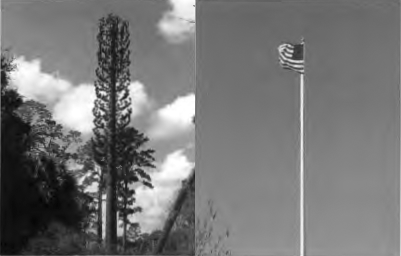
(Ord. No. 2013-20, § 2, 4-23-13)
3.13.04 Radiation Emission Standards. The Communications Tower and Communication Antennae must meet the radiation emission standards set by the FCC. The applicant Shall provide evidence that the Communications Tower and Communication Antennae meet the FCC standards where applicable.
(Ord. No. 2013-20, § 2, 4-23-13)
3.13.05 Towers within the Ferndale Community. Communication towers within the Ferndale Community shall be camouflaged or housed within traditional structures, such as church steeples or flag poles, or otherwise disguised to protect viewscapes, where possible, as determined by the County Manager or designee.
(Ord. No. 2013-20, § 2, 4-23-13)
3.13.06 Towers and Antennas within the Pinecastle Military Operation Area. The U.S. Navy Pinecastle Range Complex (Range) Military Operations Area (MOA) is the special use airspace designated by the Federal Aviation Administration and utilized by the U.S. Military for training and exercises overlying parts of northern Lake County and administered by the United States Navy. A map showing the location of the MOA is located at the end of this section (Tower Map - Pinecastle Military Operation Area). The following shall apply within the MOA:
A.
Towers within the Pinecastle Operation Area shall be limited to self-supporting towers; and
B.
The County shall coordinate with the Navy when an application to place a tower or antenna within the MOA is submitted; and
C.
Written evidence from the Range that the location, height and operation of the tower or antenna does not adversely affect the operations and mission of the Range will be required; and
D.
A tower or antenna shall not be approved by the County if the Range certifies that the tower or antenna would constitute an unacceptable encroachment or interference with safe operations related to the mission of the facility.
(Ord. No. 2013-20, § 2, 4-23-13)
3.13.07 Amateur Radio Station Operators/Receive Only Towers/Antennas and Wireless (Wi-Fi) Towers.
A.
Wireless (Wi-Fi) Towers, or Wireless Communications Towers, Antennas and Equipment Facilities owned and operated by a federally-licensed amateur radio station operator or which are used exclusively for receive only antennas shall be permitted as follows:
1.
Towers/Antennas up to one hundred (100) feet in height Shall be permitted in all Zoning Districts.
2.
Towers/Antennas up to two hundred (200) feet in height Shall be permitted on lots containing a minimum of five (5) acres in the Rural, Rural Transition, A-1-20 Receiving/Sending Areas, A-1-40 Sending Area and in the Green Swamp Area of Critical State Concern Rural, Rural/Conservation and Core/Conservation Future Land Use Categories. The maximum height permitted is subject to FAA review and approval.
B.
Setbacks Shall be measured from the base of the Wireless Communications Tower to the property line of the parcel on which it is located. Normal Zoning District setbacks Shall apply.
C.
Anti-climbing devices Shall be installed on each tower.
D.
No other provisions of Section 3.13.00 Shall apply to Wi-Fi or Amateur Radio Station operators/receive only antennas with the exception of 3.13.02, Compliance with county, state and federal Regulations, 3.13.04, Radiation Emission Standards, 3.13.05 Towers Within the Ferndale Community and 3.13.06 Towers and Antennas within the Pinecastle Military Operation Area.
(Ord. No. 2013-20, § 2, 4-23-13)
3.13.08 Measurement and Lot Size.
A.
Measurement. For purposes of measurement, tower setbacks and separation distances Shall be calculated and applied to Facilities located in Lake County regardless of Municipal and County jurisdictional boundaries.
B.
Lot Size. For purposes of determining whether the installation of a Tower or Antenna complies with development regulations, including but not limited to Setback Requirements, lot-coverage Requirements, and other such requirements, the dimensions of the entire lot Shall control, even though the antennas or towers may be located on leased parcels within such lot.
(Ord. No. 2013-20, § 2, 4-23-13)
3.13.09 Setbacks.
A.
Equipment facility and guyed support structures shall meet a setback of twenty-five (25) feet from property lines or the Zoning District setback, whichever is greater.
B.
Towers Shall be:
1.
Centered within the boundaries of the Property recognized as the parent parcel on the official zoning map;
2.
Maintain a minimum setback of one hundred (100) feet from the Property Line;
3.
Be measured and reported using Global Position System coordinates for the center of the Tower; and
4.
Shall meet the requirements in Table 1:
If the Owner of the Property where the Tower is to be located owns Residential units thereon or on surrounding properties (or if such properties are owned by his or her parents or children and they have consented in writing), those units Shall not be taken into consideration when calculating the Setback requirements of this section.
(Ord. No. 2013-20, § 2, 4-23-13)
3.13.10 Separation between Towers.
A.
Wireless Communications Tower separation Shall be measured using Global Position System (GPS) coordinates for the center of the Tower. Wireless Communications Towers Shall meet the following separation requirements:
Exempt from this requirement are Towers that are recognized camouflaged structures and Amateur Radio Station Operators/Receive Only Antennas.
Typical Lattice Tower Typical Mono-Pole Tower Typical Guyed Wire Tower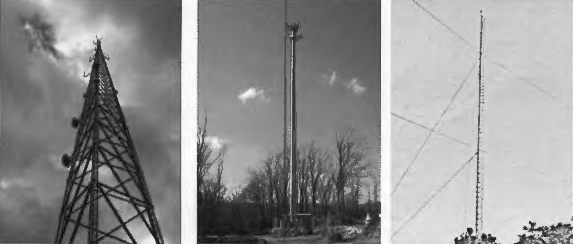
B.
Wireless Communications Towers designed to accommodate four (4) or more service providers Shall be granted a reduction in the separation distances between Communications Towers as shown below:
Prior to issuance of building permit, the owner/operator Shall submit executed co-location agreements for each additional co-location in a form acceptable to the County Manager or designee that Shall provide that each of the additional Users will be utilizing the Tower upon its completion.
(Ord. No. 2013-20, § 2, 4-23-13)
3.13.11 Communication Antenna Co-location.
A.
Use of Existing Conforming Structures. Wireless Communication Antenna placement is Permitted with Site Plan Review and approval by the County Manager or designee on any existing conforming non-residential Structure other than Communication Towers if the Communication Antenna does not cause the combined height of the Structure and Antenna to exceed one hundred fifty (150) percent of the height of the Structure. A CUP is not required for this type of placement.
B.
Use of Existing Towers. Lake County encourages the use of existing Towers for the location of additional antennas. Additional Antennas, including emergency communication(s) antennas, may be placed on existing conforming towers, excluding Amateur Radio Towers and Receive Only Antennas, without Site Plan Review provided there is not an increase in height. Applications for co-location Shall include written permission from the Tower owner accompanied by sealed and verified testimony by an engineer licensed in the State of Florida that the Tower can hold the additional equipment and maintain compliance with the adopted Structural codes in effect at the time of said improvement or addition. Additional Antennas placed on camouflaged towers shall be placed so as to match with the existing camouflaged structure.
3.13.12 Fencing. A chain link fence or wall not less than six (6) feet from finished grade Shall be provided around each communications Tower and support facilities. In commercial and industrial Zoning District, barbed wire or other appropriate anti-climbing device Shall be used along the top of the fence or wall. The area to be fenced Shall surround and enclose as a single entity or individually, the tower, all supporting Structures including guyed grounding points, and equipment facilities. Access to the Communications Tower Shall be through a locked gate.
(Ord. No. 2013-20, § 2, 4-23-13)
3.13.13 Landscaping.
A.
The visual impact of a communications tower Shall be mitigated for nearby viewers through landscaping at the base of the Communications Tower and ancillary structures. Landscaping Shall be installed on the outside of fences or walls except on agricultural zoned lands as follows:
1.
A Type A Buffer (Section 9.01.06.B, Table 2) shall be used: the existing vegetation Shall be preserved to the maximum extent practicable and may be used as a substitute of or in supplement toward meeting the Type A Buffer requirements.
B.
At the public hearing at which the CFD zoning or Conditional Use Permit is approved, the Board of County Commissioners may waive all or part of the landscaping requirements if the Board finds it is not necessary to mitigate the visual impact for nearby viewers.
(Ord. No. 2013-20, § 2, 4-23-13)
3.13.14 Modification or Rebuilding. Existing conforming Communications Towers, excluding Amateur Radio Towers and Receive Only Antennas, may be modified or rebuilt to accommodate co-location of additional communications Antennas without a public hearing provided there is not an increase in height. The modified or rebuilt tower must be the same type as the previously existing tower and there must be an executed written agreement showing there will be at least one (1) additional user utilizing the Tower upon rebuild or modification.
(Ord. No. 2013-20, § 2, 4-23-13)
3.13.15 Illumination. Communications Towers Shall not be artificially lighted except to assure human safety or as required by the Federal Aviation Administration.
(Ord. No. 2013-20, § 2, 4-23-13)
3.13.16 Finished Color. Communications Towers not requiring FAA painting/marking Shall have a galvanized finish or be painted in a neutral color.
(Ord. No. 2013-20, § 2, 4-23-13)
3.13.17 Signage.
1.
Signage unless otherwise required by law on perimeter fences Shall be limited to:
a.
Federal Communications Commission (FCC) registration.
b.
Trespassing, danger/warning, or emergency directions.
c.
One sign not to exceed four (4) square feet in size providing Tower owner and leasing information.
2.
Each User Shall be permitted two (2) square feet of signage on equipment facilities providing ownership information and/or emergency directions.
3.
No signage Shall be Permitted on Towers or Antennas.
(Ord. No. 2013-20, § 2, 4-23-13)
3.13.18 Removal of Abandoned Antennas and Towers. Any Antenna or Tower that is not operated (all users cease using the tower) for a continuous period of twelve (12) months Shall be considered abandoned, and the owner of such antenna or tower Shall remove the same within ninety (90) days of receipt of notice from Lake County notifying the owner of such abandonment. Failure to remove an abandoned Antenna or Tower within said ninety (90) days Shall be grounds to remove the Tower or Antenna at the owner's expense.
(Ord. No. 2013-20, § 2, 4-23-13)
3.13.19 Conditional Use and Community Facility District (CFD) Criteria. In determining a Conditional Use or CFD request for a Communication Tower in addition to those criteria set forth in Lake County Code, the Board of County Commissioners Shall take into consideration whether or not the proposed Tower will have a substantial adverse aesthetic impact on neighboring Residential lands and compatibility of a camouflaged Tower in a given area. The Board of County Commissioners' determination Shall be based on relevant and competent evidence, documentation, and testimony received at the public hearing from the staff, the applicant and any party in support or opposition, or their respective representatives. The Board of County Commissioners Shall utilize the following criteria:
A.
The following non-comprehensive list of items shall be considered when reviewing for Aesthetic impacts: the amount of the Tower that can be viewed from surrounding Residential Zones in conjunction with its proximity (distance) to the residential zone, landscaping, existing character of surrounding area and any other visual options proposed by the applicant. The tower may be placed, designed or camouflaged to assist with mitigating the overall aesthetic impact.
B.
The degree to which a Tower is designed and located in order to be compatible with the nature and character of Land Uses and/or the environment within which the Tower is proposed to be located. The tower may be placed, designed or camouflaged to assist with compatibility. A camouflaged tower Shall be designed to be compatible with the surrounding Land Uses and the environment.
C.
The minimum performance standards with respect to separation between Towers, separation between residential uses and Towers, etc., as referenced in Section 3.13.00, Shall be met. The Board of County Commissioners may impose more restrictive Conditions to a Conditional Use Permit or CFD request in order to achieve the desired protection with respect to aesthetic impact and harmony and compatibility with the surrounding community. The determination by the Board of County Commissioners to impose more restrictive conditions Shall be based on substantial competent evidence.
Tower Map — Pinecastle Military Operation Area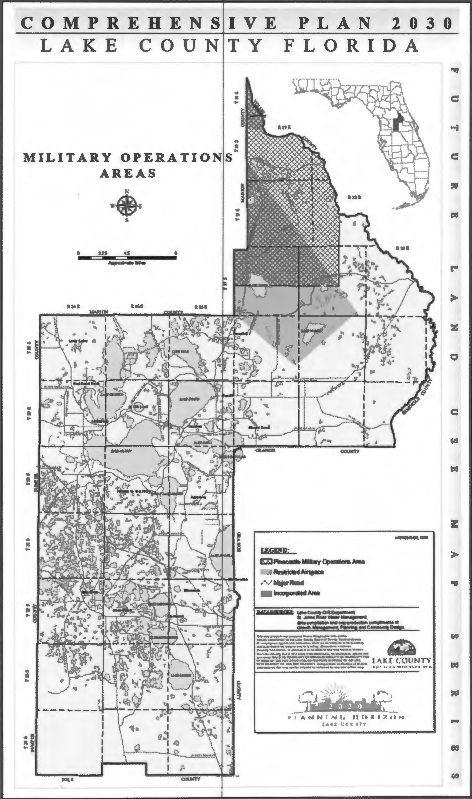
(Ord. No. 2003-85, § 2, 10-7-03; Ord. No. 2009-21, §§ 3, 4, 4-21-09; Ord. No. 2013-20, § 2, 4-23-13; Ord. No. 2013-20, § 2, 4-23-13)
3.14.00 - Reserved.
Editor's note— Ord. No. 2020-12, § 4, adopted March 10, 2020 renumbered §§ 3.14.00—3.14.04 as 10.04.00—10.04.04, respectively.
3.15.00 - Medical Marijuana Treatment Center Dispensing Facilities.
Medical Marijuana Treatment Center Dispensing Facilities are prohibited from being located in or operated in the unincorporated boundaries of Lake County.
(Ord. No. 2017-53, § 4, 10-24-17)

