
Lake Helen City Zoning Code
ARTICLE 11
- TRANSPORTATION AND IMPROVEMENT STANDARDS
11.01.00 - Transportation Systems.
This section establishes minimum standards to be met in the development of transportation systems, including public and private streets, bikeways, pedestrian ways, parking and loading areas, and access control to and from public streets. The requirements set out in this section are designed to minimize the traffic impacts of development and to assure that all developments adequately and safely provide for the storage and movement of vehicles.
Where no parking standards are listed for a use, the appropriate number of spaces shall be determined by the City Administrator or his/her designee based on the parking standard of the most similar use codified.
11.01.01 - Relationship to the Comprehensive Plan.
The Transportation and Improvement Standards Article implements the following goals, objectives, and policies of the City of Lake Helen 2035 Comprehensive Plan:
1.
Objective III-I: to provide a safe, convenient, and effective multimodal transportation system through the establishment of minimum level of service standards and the joint provision of non-motorized transportation facilities with proposed road improvements, and to provide high volume, multi-lane facilities with access controls, as needed, to preserve the through carrying capacity of the facilities;
2.
Objective III-4, Policy 4.1: Adequate Parking. The City of Lake Helen shall continue to develop enact and implement land development regulations that ensure the provision of adequate parking areas to accommodate all vehicular traffic, both motorized and non-motorized;
3.
Objective III-4, Policy 4.2: Parking Needs. The City of Lake Helen shall review all development for accommodation of vehicular traffic parking needs, both motorized and non-motorized;
4.
Objective III-5, Development review. The City of Lake Helen shall review all development for accommodation of bicycle and pedestrian transportation needs.
11.02.00 - Streets.
This section establishes minimum standards to be met in the development of transportation systems, including public and private streets, bikeways, pedestrian ways, parking and loading areas, and access control to and from public streets. The requirements set out in this section are designed to minimize the traffic impacts of development and to assure that all developments adequately and safely provide for the storage and movement of vehicles.
1.
Street Classification System.
a.
Table 11B indicates three categories of roadways as described in the Comprehensive Plan.
b.
Private streets and streets that are to be dedicated to the City are classified in a street hierarchy system with design tailored to function. The street hierarchy system shall be defined by road function and average daily traffic (ADT), calculated by trip generation rates prepared by the Institute of Transportation Engineers. The following streets hierarchy is established: local, collector, and arterial.
2.
Official Streets.
Table 11A lists all existing roadways within the jurisdiction of the City. All public streets and roads, existing and new, shall be identified on this table in accordance with the streets hierarchy scheme. The table shall be the basis for all decisions regarding required road improvements, reservation or dedication of rights-of-way for required road improvements, or access of proposed uses to existing or proposed roadways.
Table 11A: Inventory of Streets and Roads
NOTE: Cat = Category. Cat 1 = Opened, paved. Cat 2 = Opened, unpaved. Cat 3 = Private. Cat 4 = Unopened, dedicated.
Source: City of Lake Helen, and LPG Urban and Regional Planners, Inc. (2015).
Table 11B Street Classification Standards.
Table 11B specifies the number of lanes and pavement and right-of-way widths for local, collector, and arterial streets.
TABLE 11B: Street Classifications; Lane and Right-of-Way Requirements
11.03.01 - Right-of-Way Reservation.
Right-of-way requirements shall be as specified in Table 11B of this Code. The right-of-way shall be measured from lot line to lot line. Where roadway construction, improvement, or reconstruction is not required to serve the needs of the proposed project, future rights-of-way shall nevertheless be reserved for future use. No part of the reserved area shall be used to satisfy other minimum requirements of this Code.
11.03.02 - Protection and Use of Rights-of-Way.
1.
No encroachment shall be permitted into existing rights-of-way, except for temporary use authorized by the City.
2.
Use of the right-of-way for public or private utilities, including, but not limited to, sanitary sewer, potable water, telephone wires, cable television wires, gas lines, or electricity transmission, shall be allowed subject to the approval by the City.
3.
Sidewalks and bicycle ways may be placed within the right-of-way subject to the approval by the City.
4.
Setbacks shall not include right-of-way.
11.03.03 - Vacations of Rights-of-Way.
Applications to vacate a right-of-way may be approved upon a finding that all of the following requirements are met:
1.
The requested vacation is consistent with the Transportation Circulation Element of the City Comprehensive Plan.
2.
The right-of-way does not provide the sole access to any property.
3.
Remaining access shall not be by easement.
4.
The vacation would not jeopardize the current or future location of any utility.
5.
The proposed vacation is not detrimental to the public interest, and provides a positive benefit to the City.
11.03.04 - Street Design Standards.
1.
Streets shall be dedicated to the City upon completion, inspection, and acceptance by the City.
2.
Street names. Proposed streets, which are in alignment with others existing and named, shall bear the assigned name of the existing streets, with the same spelling. In no case shall the name for a proposed street duplicate or be phonetically similar to existing street names, and the street shall also be designated the same as the existing streets, such as street, avenue, boulevard, etc. Street names shall require the approval of the City Commission, E-911 addressing for Volusia County, and the postmaster of the U.S. Postal Office.
3.
Private streets may be allowed only within developments where all streets remain under common ownership.
4.
The street system of the proposed development shall, to the extent practicable, mirror the existing historic grid network, conform to the natural topography of the site, preserve existing hydrological and vegetative patterns, and minimize erosion potential, runoff, and the need for site alteration.
5.
Streets shall be laid out to avoid environmentally sensitive areas.
6.
The street layout in all new development shall be coordinated with and interconnected to the street system (existing and projected) of the surrounding area. All streets shall terminate at other streets on at least one end.
7.
Streets in proposed developments shall be connected to rights-of-way in adjacent areas to allow for proper inter-neighborhood traffic flow. If adjacent lands are un-platted, stub outs in the new development shall be provided for future connection to the adjacent un-platted land.
8.
Streets shall intersect as nearly as possible at right angles and shall not create an intersection of streets of less than 75 degrees.
9.
New intersections along one side of an existing street shall coincide with existing intersections on the opposite side, where possible. Where an offset (jog) is necessary at an intersection, the distance between center lines of the intersecting streets shall be no less than 150 feet.
11.03.05 - Collector and Arterial Streets.
Specifications for construction and paving of collector and arterial streets shall be in accordance with Volusia County and FDOT standards.
11.03.06 - Curbing Requirements.
Curbing shall not be required unless it is determined to be needed for drainage or safety reasons during the development review process.
11.03.07 - Shoulders.
Shoulders, where required by the Florida Department of Transportation or Volusia County, shall meet their respective standards.
11.03.08 - Acceleration, Deceleration, and Turning Lanes.
Acceleration, deceleration or turning lanes may be required by the City along roads with a functional classification of collector or arterial, or a design speed of 35 miles per hour or greater. Requirements will be based upon a traffic impact study required of the developer or other information available to the City that indicates a need.
11.03.09 - Cul-de-sacs.
An unobstructed twelve (12) foot wide moving lane with a minimum outside turning radius of thirty-eight (38) feet shall be provided at the terminus of every permanent cul-de-sac.
11.03.10 - Stub Streets.
Stub streets are required as necessary to allow connection to future development on existing un-platted land adjacent to the development. The location and alignment of the stub streets shall ensure that the resulting street system will conform to the general design standards of this Article. Stub streets shall terminate with a temporary cul-de-sac meeting the dimensions of this Article.
11.03.11 - Clear Visibility Triangle.
In order to provide clear view of intersecting streets to the motorist, there shall be a triangular area of clear visibility formed by two (2) intersecting streets or the intersection of a driveway and a street. The following standards shall be met:
1.
Nothing shall be erected, placed, parked, planted, or allowed to grow in such a manner as to materially impede vision between a height of three (3) feet and six (6) feet above the grade, measured at the centerline of the intersection.
2.
The clear visibility triangle of the intersection of any streets shall be formed by the intersection of the edge of the road traveled way with two sides of each triangle being equal in length from the point of the intersection and the third side being a line connecting the ends of the two other sides as indicated below.
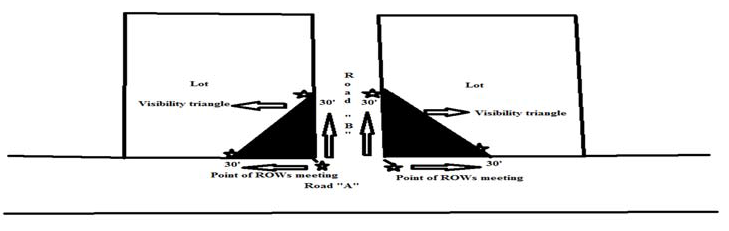
3.
The distance from the intersection of the edge of the road traveled way shall be thirty (30) feet.
11.03.12 - Signage and Signalization.
Sufficient funds shall be deposited with the City to provide all necessary roadway signs and traffic signalization as may be required by the City or County, based upon City, county or state traffic standards. At least two street name signs shall be placed at each four-way street intersection, and one at each "T" intersection. Signs shall be installed under light standards and free of visual obstruction. The design of street name signs shall be consistent with the style established by the City and of a uniform size and color.
11.04.00 - Street Trees.
Street trees shall be provided in accordance with the standards established in Article 8.09 of this Code.
No development shall be approved without reserving an easement authorizing the City to plant trees within five feet (5') of the required right-of-way boundary. No street shall be accepted for dedication until such an easement is granted.
11.05.00 - Sidewalks and Bikeways.
1.
Projects abutting collector or arterial facilities shall provide sidewalks adjacent to the collector or arterial roadway. Location of sidewalks shall be consistent with any planned roadway improvements.
2.
Sidewalks shall be provided where recommended by the Downtown Master Plan and/or Bicycle/Pedestrian Study and/or Transportation Study. The City Commission may grant exceptions to this requirement when finding a sidewalk is not practicable. Improvements or new construction of collector or arterial roadways shall include provision for sidewalks and bikeways within the right-of-way.
3.
Repair. When a public sidewalk exists, the landowner is responsible for any repair or replacement of sidewalk or bike path which is damaged by the landowner or builder.
4.
Reserved.
5.
When acceleration, deceleration and/or turning lanes are incorporated into a street with on-road bicycle facilities, the extra land width, paved shoulder, or bike lane should be incorporated into the right-hand through lane, with FDOT design standards being met.
6.
Sidewalks shall be required to be constructed on any new or redeveloped, individual or subdivided, residential or non-residential development site. The developer may have an alternative of paying an "in lieu of' fee for sidewalk construction if it is determined by the City Commission that a public purpose will be served by applying said fee to an existing, or planned, sidewalk linkage rather than constructing the sidewalk on the development site. The City of Lake Helen shall prioritize street segments with sidewalk gaps. The following criteria shall be used in prioritizing sidewalk gap improvements:
a.
Proximity to schools.
b.
Proximity to major public parks or cultural facilities.
c.
Proximity to residential and commercial areas, or any area exhibiting a high volume of walking.
d.
Arterial and collector streets.
11.05.01 - Sidewalks and Bikeways Design and Construction Standards.
All sidewalks and bikeways shall conform to the latest design and construction standards approved by the Florida Department of Transportation and outlined in the FDOT's Bicycle Facilities Planning and Design Manual. If curbs are constructed as part of a sidewalk, inclined curb approaches or curb cuts having a gradient of not more than one foot in twelve feet and a width of not less than four feet shall be provided for access by wheelchairs.
11.06.00 - Golf Carts.
The City Commission has determined that the City-maintained streets are uniformly configured by platting and right-of-way designation; that golf carts are currently an accepted mode of limited destination travel; that traffic counts do not generate negative results germane to restricted golf cart use and legislation; that use of golf carts has been reviewed, investigated, and analyzed by the police department and no negative findings were generated; and the City of Lake Helen has found it operationally and economically feasible to implement F.S. § 316.212.
It is the intent of the City Commission of the City of Lake Helen to protect the public health, safety and welfare and to ensure the protection of the travelling public and the citizens of the City of Lake Helen by this legislative enactment.
11.06.01 - Use of Golf Carts within City of Lake Helen.
1.
In accordance with the provisions of F.S. § 316.212, relating to the operation of golf carts on roadways, the operation of a golf cart upon the streets of the City is permitted on streets within the municipal limits of Lake Helen with posted speed limits of 30 m.p.h. or less. The City Commission has determined that golf carts may safely travel on and/or cross the public roads and/or streets of Lake Helen, considering the facts of speed, volume, and the character of pedestrian, non-motorized travel and all motor vehicle traffic, using the streets of the City of Lake Helen.
2.
Upon a determination that golf carts may be safely operated on a designated road or street, the City Administrator or his/her designee, shall post appropriate signs to indicate that such operation is authorized and allowed. With regard to the streets where the operation of golf carts is prohibited, the City Commission has, and shall be deemed for all purposes to have, determined that such prohibition is necessary in the interest of public safety in accordance with subsection 1 hereof.
3.
A golf cart may be operated at any time, day or night, on public roads or streets with a posted speed limit of 30 m.p.h. or less provided the golf cart is equipped with headlights, brake lights, turn signals, a windshield, and such other equipment as is required in subsection 5 hereof. The City Administrator or his/her designee, shall post appropriate informational signage within the City upon specific direction from the City Commission.
4.
No golf cart shall be driven, operated, or controlled on the public roads or streets of the City of Lake Helen unless the golf cart has a visible City of Lake Helen permit tag on the golf cart that is current and unrevoked indicating compliance with all necessary laws. An administrative fee as set by Resolution by the City Commission for the permit shall be issued only to a specific golf cart. The Chief of Police or his/her authorized designee, upon compliance with this Article and all other applicable state and federal law, shall inspect each golf cart for compliance, issue and install required permits. Each permit issued shall be renewed on an annual basis by the last day of the month issued. Further, any permit issued is subject to administrative revocation by the City for non-compliance with any local, state, or federal law or regulation germane to the operation of golf carts. The Chief of Police or his/her designee, shall issue a letter of revocation to the permittee and the golf cart permit shall be returned to the issuing authority of the City immediately.
5.
In accordance with the provisions of State law, a golf cart must be equipped with efficient brakes, reliable steering apparatus, safe tires, a rearview mirror, and red reflectorized warning devices in both the front and rear to the satisfaction of the Chief of Police or his/her designee in accordance with the requirements hereof.
6.
All operators of golf carts on public streets within the city limits of Lake Helen must possess a valid operator's license and it is prohibited and unlawful for a golf cart to be operated at any time on public streets by any person who does not possess a valid operator's license.
11.06.02 - Use of Golf Carts by City Personnel.
City of Lake Helen personnel, who have been issued a valid Florida operator's license, are hereby authorized to operate golf carts and utility vehicles on City maintained roads located within the City limits of the City of Lake Helen if the golf carts and utility vehicles comply with the operational and safety requirements of State law and this section and are solely operated by City employees for City purposes including, but not limited to, police patrol, traffic enforcement, and inspection of public facilities, and golf carts and utility vehicles may only be operated on City maintained roadways, pursuant to Section 316.2126, Florida Statutes.
11.06.03 - Penalties.
The City may enforce the provisions of this section in accordance with any legal remedy permitted by State law and violations hereof shall carry the maximum penalty authorized by State law under F.S. ch. 316. A violation of this section is a noncriminal traffic violation infraction, punishable pursuant to F.S. chs. 318 and 322.
11.07.00 - Access.
All proposed development shall meet the following standards for vehicular access and circulation:
A.
Number of Access Points.
1.
Every lot or parcel shall have direct access from a public street (or private street where permitted under Article 11.01.05).
2.
Where a development site comprises more than one building site, the building sites shall not be considered as separate properties for the purpose of the standards associated with access points.
3.
The number of access points shall be kept to the minimum required to adequately serve the development. Table 11C shows the number of access points by type of development.
TABLE 11C: Number of Access Points and Preferred Type of Access
4.
The City Commission may approve access points in excess of those allowed in Table 11C based upon study results and recommendations of the Traffic Engineer.
5.
Adjacent users may share a common driveway provided that appropriate access easements are granted between or among the property owners.
B.
Separation of Access Points.
1.
Access points to adjacent properties for which site plans are required shall be separated by at least three hundred (300) feet. The City may allow variance from this requirement in the interest of traffic safety.
2.
All vehicular access points shall be located one hundred feet (100'), or two-thirds (2/3) the length of the parcel frontage on the street, whichever is less, from the intersection of any right-of-way lines of streets or a street and a railroad.
11.08.00 - Off-Street Parking and Loading.
This section implements the Transportation Element goals of ensuring an efficient flow of on-site traffic and providing for adequate parking, loading and fire lane facilities.
11.08.01 - Off-Street Parking Design Standards.
1.
Parking areas shall be surfaced with acceptable materials, shall be constructed in compliance with the City's stormwater management regulations, shall contain wheel stops for individual vehicle parking space delineation and shall be constructed in compliance with the City's landscaping regulations.
2.
Acceptable materials means a durable all-weather surface composed of concrete, brick, asphalt, permanent porous grating, or other permanent dust-free surfaces. The aforesaid notwithstanding, the City may, during the development review process, and on an individual project specific basis, consider approval of the use of alternate parking area surface materials. Such consideration shall weigh such factors as surface materials proposed, site location, site topography, environmental benefits, size of parking area, maintenance requirements, site aesthetics, potential impacts on surrounding properties, potential impacts on City rights-of-way and facilities, and hours and days of use of the parking area.
11.08.02 - Off-Street Parking Requirements.
1.
The following matrix Table 11E specifies the required minimum number of off-street automobile and bicycle parking spaces for a specific land use.
2.
A plan showing off-street parking and delineating traffic flow within shall be submitted to and approved by the City Administrator or his/her designee before a permit is issued for the construction or use of the building, structure or facility being considered, except for single-family residences. This plan shall show the location and accurately designate the number and size of spaces, access aisles, drive-thru window(s) location and associated drive-thru queue parking, driveways/access points, loading zones, fire lanes, and dumpster locations. The off-street parking plan shall be included in the site plan submittal requirements.
3.
The number of parking spaces for uses not specifically listed in the matrix shall be determined by the City Administrator or his/her designee. They shall consider requirements for similar uses and appropriate traffic engineering and planning data, and shall establish a minimum number of spaces based upon the principles of this Code.
4.
For several uses listed in the matrix the parking requirement is to be determined by the City Administrator or his/her designee. These uses have a large variability in parking demand, making it impossible to specify a single parking requirement. A developer proposing to develop or expand one of these uses must submit a parking study that provides justification for the requirement proposed. The City Administrator or his/her designee will review this study along with any traffic engineering and planning data that are appropriate to the establishment of a parking requirement for the use proposed.
5.
For the purpose of computing the number of off-street parking spaces, the gross floor area (GFA) of a building is the sum of the gross horizontal area of all floors of a building measured from the exterior faces of exterior walls. Seating capacity is the total number of seats or chairs permitted for a use. For the purposes of this section, one (1) seat shall mean one seating area which can accommodate one (1) person sitting, such as one (1) chair or one (1) such area on a church pew or bench. The applicant is encouraged to develop a parking plan which can prove the number of actually needed spaces for a site and use, and based on the supporting evidence the City Administrator or his/her designee can approve the applicant's parking plan.
6.
When computing the number of required parking spaces, round to the nearest whole number.
7.
Excessive parking spaces beyond that required are not encouraged. If requested by the applicant and approved by the City Administrator or his/her designee, excessive parking shall not be located as part of the required principle parking facility or area.
8.
A reduction in the number of parking spaces may be granted by the City Administrator or his/her designee if the applicant can demonstrate that a reasonable number of trips to the site will be generated by transportation not requiring parking; or joint use with another site that has different temporal parking demands will satisfy parking space requirements.
9.
Any parking area to be used by the general public shall provide suitable, marked parking spaces for handicapped persons. The number, design and location of these spaces shall be consistent with the requirements of Sections 316.1955 and 316.1956, Florida Statutes, or succeeding provisions. Parking space required for the handicapped shall be counted as a parking space to comply with the minimum requirements of this Code. All spaces for the handicapped shall be paved.
10.
Compact car parking spaces may satisfy no more than twenty-five (25%) percent of required parking spaces. These spaces shall use appropriate signage and shall be located no more or no less conveniently than standard size car spaces.
11.
For the purposes of this section, a compact vehicle is defined as any vehicle less than fifteen feet (180 inches) in length. A standard vehicle is any vehicle that is fifteen feet or larger.
12.
Off-street parking shall be available for use prior to the issuance of any Certificate of Occupancy.
13.
A permit shall be required for any temporary use of right-of-way. Permanent use of right-of-way is prohibited.
11.08.03 - Shared Parking Provisions.
Shared parking may be applied when land uses have different parking demand patterns and can use the same parking spaces/areas throughout the day or night. Shared parking may also be applied when an existing development can demonstrate excess parking. Factors evaluated to establish shared parking arrangements shall include operating hours, seasonal/weekly/daily peaks in parking demand, the site's orientation, location of access driveways, accessibility to other nearby parking areas, pedestrian connections, distance to parking area, and availability of parking spaces.
Shared parking is subject to an agreement that addresses the following:
1.
The agreement is valid only as long as the conditions described in the application for the shared parking exist. The City must be a party identified in the agreement requiring a signature from the City Administrator or his/her designee, and the agreement must be in a form acceptable to the City Attorney recorded with the Volusia County Clerk of Courts.
2.
A copy of the recorded agreement shall be submitted to the City Clerk within ten (10) days of its recording.
11.08.04 - Off-Site Parking.
Up to 75% of the overall required parking may be met in off-site parking areas through a shared parking agreement. A pedestrian connection providing a safe, well lighted walking environment shall be required.
Table 11 E Matrix for Land Use and Required Parking Spaces.
Residential Required Parking Spaces.
Conventional Detached:
1—3 Bedrooms: Two (2) Spaces.
4 or more Bedrooms: Three (3) Spaces.
Residential Accessory Dwelling Unit: One (1) Space (per Article 4.01.01).
Cluster/Multi-Family Development:
1 Bedroom: One and a half (1.5) Spaces per Unit.
2 to 4 Bedroom: Two (2) Spaces per Unit.
Visitor Parking: One-half (1/2) the total number of required spaces for dwellings, may be located in a common parking facility not more than two hundred (200) feet distant from the nearest boundary of the site.
Mobile Home Park (MHC Zoning):
Resident Parking: Two (2) Spaces per Unit.
Visitor Parking: One-half (1/2) the total number of required spaces for dwellings, may be located in a common parking facility not more than two hundred (200) feet distant from the nearest boundary of the site.
Commercial Required Parking Spaces.
Amusement arcades and centers: One (1) space for each six hundred (600) square feet of GFA.
Auditoriums, bowling alleys, convention halls, theaters, or other places of assembly: One (1) space for each six (6) seats, or where viewing booths or compartments without seats exist, one (1) space for each four (4) booths or compartments.
Automobile rental agency: One (1) space for each four hundred (400) square feet of GFA, plus one (1) space for each automobile to be rented.
Automotive maintenance facility: Two (2) spaces for each stall, bay, rack or pit, plus a six-foot screened storage area, to accommodate two (2) additional spaces for each stall, bay, rack or pit to store vehicles left on the premises longer than forty-eight (48) hours.
Banks and financial institutions: One (1) space for each three hundred (300) square feet of GFA.
Barber shops and beauty salons: Two (2) spaces for every beauty or barber chair.
Bed and Breakfast Inn: One (1) space for each sleeping unit, two (2) spaces for owner/operator, plus one (1) space for each one and one-half (1½) employees.
Car wash: One (1) space for each auto washing machine or bay.
Churches or places of worship: One (1) space for each six (6) seats.
Clubs (including health clubs) or lodges: One (1) space for each four hundred (400) square feet of the principle area(s) of assembly, plus one (1) space for every two (2) employees.
Contractor, service business and communication media and offices: One (1) space for each six hundred (600) square feet of GFA, plus one (1) space for each vehicle stored on site.
Daycare, Pre-School, Nursery Schools: One (1) space for each employee plus one (1) space for every seven (7) children.
Dwelling units: Two (2) spaces for each dwelling unit. For multiple-family dwellings the parking facilities one-half (1/2) the total number of required spaces for multiple-family dwellings, may be located in a common parking facility not more than two hundred (200) feet distant from the nearest boundary of the site.
Grocery stores and convenience marts: One (1) space for every one hundred fifty (150) square feet of floor sales area, which only the patrons are permitted to access.
Hospitals and sanitariums: One and one-half (1.5) spaces for every bed in the facility.
Hotels, motels, lodging facilities:
a.
One (1) space for each sleeping unit, plus one (1) space for each one and one-half (1½) employees.
b.
The required number of spaces for affiliated accessory uses of restaurants, lounges, banquet, meeting rooms, convention facilities and retail sales may be reduced by up to sixty percent (60%) as approved by the City Administrator or his/her designee.
Laundromat: One (1) space for every two (2) washing machines installed.
Medical and dental clinics or laboratories: Five (5) spaces, plus one (1) space for each five hundred (500) square feet of GFA.
Medical and dental offices: One space for each two hundred fifty (250) square feet of GFA.
Mini-storage or self-storage: Five (5) spaces, or one (1) for every fifty (50) storage bays, whichever is greater.
Mortuaries and funeral homes: One (1) space for every four (4) seats, plus spaces needed for funeral vehicles per each establishment's needs.
Nursing, convalescent or community residential homes: One (1) space for every two (2) patient beds.
Office—Professional buildings: One (1) space for each three hundred (300) square feet of GFA.
Outdoor recreation facilities: The number of needed spaces shall be as determined by a parking study, which shall be reviewed and approved by the city engineer and City Administrator or his/her designee, since no two (2) outdoor facilities are the same and they each have individual and specific parking needs.
Personal service establishments: A minimum of two (2) spaces, or one (1) space for each five hundred (500) square feet of GFA, whichever is greater.
Public libraries and museums: One (1) space for each eight hundred (800) square feet of GFA.
Restaurants, bars, cocktail lounges: Four (4) spaces, plus one (1) space for every four (4) seats approved for the service area.
Restaurants with no seating: One (1) space for every two hundred (200) square feet of GFA.
Retail sales: Three (3), plus one (1) space for every six hundred (600) square feet of GFA.
Schools:Junior high and elementary schools: Twenty (20) spaces, plus two (2) spaces per classroom.
High school: One (1) space for each employee, plus one (1) for every six (6) students.
Special exception uses: The number of spaces needed for special exception uses shall be based on the supporting evidence provided by the applicant, for the amount of needed parking for said use, which must be authorized by the City Administrator or his/her designee.
Technical, trade and vocational schools:
a.
Classrooms, planetarium: One (1) space for each five (5) seats.
b.
Gymnasium, natatorium, auditorium, theater, amphitheater, and other places of public assembly: One (1) space for each four (4) seats.
c.
Stadium: One (1) space for each four (4) seats.
d.
Infirmary, libraries, computer center, laboratories, greenhouses, radio/TV stations, cafeteria, bookstores, retail facilities, post office, student military building, administrative offices, teacher's offices, etc.: One (1) space for each six hundred (600) square feet of GFA.
Tourist homes and guest cottages: One (1) space for every two (2) sleeping rooms.
The number of parking spaces for uses not specifically listed in the above matrix shall be determined by the City Administrator or his/her designee. They shall consider requirements for similar uses and appropriate traffic engineering and planning data, and shall establish a minimum number of spaces based upon the principles of this Code.
11.08.05 - Fractional Measurements.
Where units or measurements determining the number of required off-street parking spaces result in the requirement of a fractional space, a fraction equal to or greater than one-half (.5) space shall be rounded up to include an additional full parking space (i.e. 7.5 calculation would require 8 parking spaces).
11.08.06 - Mixed Uses.
In the case of mixed uses, the total requirement for off-street parking shall be the sum of the requirements of the various uses computed separately, and the off-street parking for one (1) use shall not be considered as providing the required off-street parking for another use.
11.08.07 - Required Bicycle Spaces for Specified Uses.
Bicycle parking shall be provided at multi-family developments on two (2) or more acres, parks and recreation facilities, and commercial establishments according to the following standards:
The number of bicycle spaces required is as follows:
Table 11F Required bicycle spaces for specified uses.
Bicycle parking spaces may be provided as either bicycle racks or other storage facilities, provided that the following standards are met:
1.
Facilities shall be designed to allow each bicycle to be secured against theft;
2.
Facilities shall be installed to resist removal;
3.
Facilities shall be installed to resist damage by rust, corrosion, or vandalism;
4.
Facilities shall accommodate a range of bicycle shapes and sizes and allow easy locking without interfering with adjacent bicycles; and
5.
Facilities shall be located not to interfere with pedestrian or vehicular movement.
11.08.08 - Location of Off-Street Parking Spaces.
1.
Parking areas may be within the rear or side yards. Standard parking spaces shall be a minimum size of ten feet (10') x twenty feet (20'). Up to ten percent (10%) of the required number of parking spaces may be designated for compact vehicles and reduced in size to nine feet (9') x eighteen feet (18'). Parking areas shall be located, designed and visually screened/landscaped so as to minimize potential aesthetic impacts on adjacent property owners. Parking areas shall be located and designed so as to maximize traffic circulation patterns and minimize traffic hazards.
2.
No parking spaces shall be arranged so as to permit a vehicle to back onto a publicly dedicated right-of-way.
3.
In no case shall any parking space in any district be located within ten (10) feet of any property line.
4.
Accessory parking may be located in a rear or side yard for single-family dwellings.
5.
Parking spaces for all dwellings shall be located on the same property with the main building, except that one-half (1/2) the total number of required spaces for multiple-family dwellings, may be located in a common parking facility not more than two hundred (200) feet distant from the nearest boundary of the site.
6.
When off-site parking is allowed, the owner of the site receiving parking shall submit to the City Clerk a restrictive covenant in recordable form reserving the off-street parking site for off-street parking for the building for as long as the parking shall be required.
7.
Off-street parking requirements for commercial and industrial land uses shall be located on site, except where off-site parking is allowed and utilized.
8.
Required off-street parking areas for three (3) or more automobiles shall have individual spaces marked, and shall be so designed, maintained, and regulated in such a manner that no parking or maneuvering incidental to parking shall be on any area, public street, walk or alley, and so that any automobile may be parked and moved without moving another.
11.08.09 - Off-Street Parking Layout.
1.
Pedestrian circulation facilities, roadways, driveways, and off-street parking and loading areas shall be designed to be safe and convenient.
2.
Parking and loading areas, aisles, pedestrian walks, landscaping, and open space shall be designed as integral parts of an overall development plan and shall be properly related to existing and proposed buildings.
3.
Buildings, parking and loading areas, landscaping and open spaces shall be designed so that pedestrians moving from parking areas to buildings and between buildings are not unreasonably exposed to vehicular traffic.
4.
Landscaped, paved, and gradually inclined or flat pedestrian walks shall be provided along the lines of the most intense use, particularly from building entrances to streets, parking areas, and adjacent buildings. Pedestrian walks should be designed to discourage incursions into landscaped areas except at designated crossings.
5.
Each off-street parking space shall open directly onto an aisle or driveway that, except for single-family, two-family and multi-family residences, is not a public street.
6.
Aisles and driveways shall not be used for parking vehicles, except that the driveway of a single-family or two-family residence shall be counted as a parking space for the dwelling unit, or as a number of parking spaces as determined by the appropriate City official based on the size and accessibility of the driveway.
7.
The design shall be based on a definite and logical system of drive lanes to serve the parking and loading spaces. A physical separation or barrier, such as vertical curbs, may be required to separate parking spaces from travel lanes.
8.
Parking spaces for all uses, except single-family and two-family residences, shall be designed to permit entry and exit without moving any other motor vehicle.
9.
No parking space shall be located so as to block access by emergency vehicles.
10.
Single- and two-family residences abutting arterial and collector roads shall not be allowed to have single driveways entering said roadways.
11.08.10 - Loading.
1.
Schools, hospitals, nursing homes and other similar institutional uses and multi-family residential uses shall provide one (1) loading space for the first fifty thousand (50,000) square feet of gross floor area or fraction thereof, and one (1) space for each additional fifty thousand (50,000) square feet or fraction thereof.
2.
Auditoriums, gymnasiums, stadiums, theaters, and other buildings for public assembly shall provide one (1) space for the first twenty thousand (20,000) square feet of gross floor area or fraction thereof, and one (1) space for each additional fifty thousand (50,000) square feet.
3.
Commercial centers, commercial uses, hotels, hospitals, and institutional uses with less than 10,000 square feet of gross floor area shall provide one (1) off-street loading space.
4.
Commercial centers, commercial uses, hotels, hospitals, and institutional uses with 10,000 square feet or more of gross floor area shall provide one (1) space for the first 10,000 square feet of gross floor area, plus one (1) space for each additional 20,000 square feet, or fraction thereof.
5.
Industrial uses shall provide one (1) space for each 10,000 square feet of gross floor area.
6.
Offices shall provide one (1) space for each 20,000 square feet of gross floor area.
7.
Off-street loading spaces shall meet the following design requirements:
•
Loading spaces shall not block streets, alleys, or sidewalks. Loading spaces shall not impair the movement of vehicles or pedestrians on streets, alleys, or sidewalks.
•
Every loading space shall meet the following minimum dimensions:
11.08.11 - Handicapped Access.
Handicapped shall be provided in accordance with the Florida Statutes (F.S. § 553.5041) and the American Disabilities Act, particularly in relation to space size/marking, signage, location, and access.
11.08.12 - Emergency Vehicle Lane.
All commercial and industrial developments shall provide a minimum twelve (12) foot wide emergency vehicle lane, with the inner edge of the lane no closer than ten (10) feet and no further than thirty (30) feet from the building, with the zone extending thirty (30) feet on either side from the main entrance to the building. The emergency vehicle lane shall be constructed to accommodate fire trucks with a minimum weight of thirty-two (32) tons.
11.08.13 - Emergency Vehicle Lane Signage.
1.
Signs required. Fire lanes shall be marked with freestanding signs with the wording "NO PARKING-FIRE LANE-BY ORDER OF THE FIRE DEPARTMENT." Said signs shall be twelve (12) inches by eighteen (18) inches with a white background and red letters.
2.
Demarcation of emergency vehicle lanes. All fire lanes shall have a minimum width of twelve (12) feet, and be marked as follows:
a.
All fire lanes shall be completely outlined with yellow traffic paint striped eight (8) inches minimum in width; also diagonal striping a minimum of three (3) inches wide at least five feet (5') on center, to the curb line.
b.
The curb, or the line of the curb, shall be painted yellow for the entire length of the fire lane.
c.
Within the diagonal striping shall be the words "FIRE LANE-NO PARKING" in block letters no less than twelve (12) inches in height with a minimum three (3) inch stroke, directly in front of the primary entry/exit doors.
d.
All of the above referenced markings shall be ninety (90) mil thermoplastic or of City approved material and shall be maintained by the property owner.
3.
Open access area for fire department connections. All non-residential buildings with fire department connections (FDC) shall provide a twelve (12) foot by twenty (20) foot open access area adjacent to each FDC. Such access areas shall be accessible by emergency equipment, and be centered fifteen (15) on either side of the connection.
4.
The curb, or the line of the curb, shall be painted with yellow stripes for the entire length of the FDC open access area. Within the stripes shall be the words "NO PARKING-FIRE" in block letters no less than twelve (12) inches in height with a minimum three (3) inch stroke.
5.
All markings shall be ninety (90) mil thermoplastic.
11.08.14 - Design Standards for Off-Street Parking and Loading Areas.
1.
Standard and compact car parking spaces shall be sized according to the most recent design standards recommended by the Institute of Transportation Engineers (IT).
2.
Handicapped parking requirements contained in F.S. § 316.1955, shall be followed in identifying spacing needs.
3.
Parking spaces shall be designed to accommodate emergency vehicles down main aisles.
11.09.00 - Lighting for Parking Areas.
1.
For businesses and facilities open during evening hours, all parking areas shall provide illumination which meets the safety standards as outlined in Article 9.05.00.
2.
Mounting height and spacing of luminaries should be sufficient to distribute adequate lighting for safety purposes to the entire facility.
3.
Lighting shall be designed, arranged and constructed such that no source of such lighting is visible from any adjoining or nearby property including residential areas, public streets, or other adjacent land uses.
4.
All lighting shall be designed, arranged, and constructed to shield public roadways and all other adjacent properties from direct illumination.
5.
Lighting shall be in place before a Certificate of Occupancy is issued.
11.10.00 - Landscaping for Parking Lots.
Article 8.07.11 outlines requirements for Landscaping in parking areas.
11.11.00 - Drive-Thru and Stacking Lane Standards.
1.
All uses and facilities providing drive-up or drive-through service shall provide stacking lanes in compliance with the standards of this section.
2.
Restaurants with drive-up or drive-through facilities shall provide a minimum stacking space to accommodate eight (8) vehicles. A by-pass lane shall be required.
3.
Banks and financial institutions shall provide stacking spaces according to Table 11 G.
4.
A by-pass lane shall be provided.
Table 11G. Stacking Lane Requirements
1.
A solid wall or fence shall be provided when a drive-thru window and/or stacking lane is located parallel to a property line abutting lots or parcels zoned for residential purposes in order to block lights from vehicles using said facility(s).
2.
Stacking lanes shall not be located within a designated delivery area, loading spaces, or emergency vehicle lanes.
11.12.00 - Restricted Parking.
There shall be no parking at any time on arterial streets i.e., Lakeview Drive, New York Avenue, Summit Avenue, Church Street, Main Street, Ohio, Cassadaga Road and South High Street.
11.13.00 - Large Vehicles.
1.
No tractor (bob-tail), tractor trailers, automobile delivery units, refrigerated units (compressors running overnight) or any truck larger than one (1) ton, buses or similar vehicles will be permitted to park on any street, municipal right-of-way or any area zoned residential within the city limits.
2.
Only commercial vehicles meeting all of the following standards shall be permitted to be parked within residential districts:
a.
Gross vehicle weight not over 10,000 pounds;
b.
Not over 2 axles nor more than 6 tires;
c.
Total sign area on the vehicle not over 4 sq. ft.;
d.
The parking of all other commercial vehicles exceeding the standard above is prohibited on the public streets or on or within privately owned driveways or property within all residential districts, except for loading or unloading purposes or when parked within a completely enclosed private garage.
11.14.00 - Residential Parking.
In the residential zoned area, motor vehicles shall not be parked anywhere within that portion of the lot lying across the full width of the lot between the front lot line and the front most part of the principal structure, except driveways. All such vehicles shall bear a current license plate or validation sticker.
11.15.00 - Vehicles Exceeding Thirteen Feet in a Residential Zoning District.
1.
Any recreational vehicle, whether wheeled, motorized, or in an unassembled state, including trailers, boats and boat trailers separately or in combination, exceeding thirteen (13) feet in length shall not be permanently parked, stored or located on private property in a residential zoning district unless parked in an enclosed garage, or as otherwise provided herein.
2.
The length of the vehicle shall be the (registered hull length for boats) length of the vehicle without accessories, not including hitches, masts, outboard motors, trailers, nor any vehicle temporarily attached to it.
3.
Recreational vehicles including trailers, boats and boat trailers exceeding thirteen (13) feet in length may be parked at owner's property subject to the following parking and use regulations:
a.
The vehicle may be parked in the side or rear yard, if accessible, or in the front yard if space is available to meet the following regulations.
b.
Such vehicle may not be parked closer than two (2) feet to any abutting property line.
c.
Such vehicle in the front yard must be parked perpendicular to the front curb.
d.
Such vehicle shall be parked on a driveway or other prepared surface.
e.
The vehicle must be at least eight (8) feet from the face of a curb or edge of pavement on a street and no part of the vehicle may extend over a public sidewalk or bike path.
f.
Such vehicle shall not obstruct the visibility triangle at intersections as defined in section 4.08.00.
g.
If parked within ten (10) feet of an adjacent property, a minimum four-foot wall, fence, or vegetative hedge providing opacity of eighty percent (80%) or greater must be provided to screen the vehicle from the adjacent property.
h.
Such vehicle shall not be used as a residential detached dwelling unit, or be connected to any public utilities, or used for storage, or as an office for business purposes.
i.
Such vehicle must be operable, in good visible condition, in regular use, and have a current license and registration.
4.
Any vehicle that cannot comply with the parking regulations in [subsection 3] above, may park at the owner's property home a maximum of three (3) days in any calendar week for the purposes of loading, unloading, trip preparation or repairs/maintenance.
11.16.00 - Truck Routes.
1.
There is hereby established within the City a system of truck routes, pursuant to State statutory law, as shown on the map on file in the office of the City Administrator or his/her designee or of the City of Lake Helen (See Truck Route Map attached to this Article).
2.
Non-regulated motor vehicles may operate anywhere within the City Limits.
3.
The streets indicated as truck routes on the map and no others may be used by regulated motor vehicles, except when making deliveries within the City Limits of the City. It is unlawful for a regulated motor vehicle to use any street within the City Limits of the City for any purpose except for the purpose of making a delivery to a location within the City Limits of the City unless the street is designated a truck route.
4.
All amendments to Truck Route Map may be made by means of adoption of a resolution by the City Commission of the City of Lake Helen.
5.
All motor vehicles, regardless of size or type, that display or are required to display hazardous material warning placards shall travel on a street designated as a truck route except when making a delivery to a location within the City Limits of the City. It is unlawful for a motor vehicle displaying a hazardous material warning placard on any street except a street designated as a truck route or when making a delivery within the City Limits of the City.
6.
This Section shall not prohibit:
a.
Operation of a motor vehicle on streets of destination, but only if authorized truck routes are used until reaching the intersection nearest to the destination point, which destination must be proven upon request by a law enforcement officer, through possession of a valid and current delivery ticket or other dispatch order to the destination address. This exception shall relate to all provisions of this section pertaining to deliveries within the City Limits of the City.
b.
Official government and emergency motor vehicles.
c.
Detoured motor vehicles, on an officially established detour, if such motor vehicles could lawfully be operated upon the street for which the detour is established.

