
Lake Helen City Zoning Code
ARTICLE 4
- ACCESSORY USES AND STRUCTURES1
Article 4 outlines the minimum Lake Helen standards. Overlay districts including but not limited to the Gateway Overlay or the Historic District may have additional guidelines. Please reference Article 5 and the Lake Helen Pattern Book for properties located within an overlay district. A Certificate of Appropriateness (COA) will be required for any accessory uses and structures within those areas.
4.00.00 - Accessory Uses and Structures.
An accessory use and structure shall be incidental and subordinate to the principal building on the property. Accessory uses and structures must be on the same property as the building or use to which they are accessory.
The intent of this section is to allow accessory uses while not creating adverse impacts on surrounding lands.
4.01.00 - Accessory Dwelling Units.
The purpose of this section is to further the City's goal to provide affordable housing without changing the low-density, predominantly single-family character of the City. Providing the opportunity for and encouragement of small, rental housing units will help meet the housing needs of single persons and couples, as well as ease the financial burden of homeowners. Such units can allow elderly persons who might otherwise have difficulty finding homes to age in the community they call home. This section is also intended to protect the property values and residential character of neighborhoods where accessory dwelling units are located.
4.01.01 - Accessory Dwelling Units Development Standards.
Accessory Dwelling Units shall be allowed in residential areas provided that all of the following requirements shall be met:
1.
No more than one (1) Accessory Dwelling Unit shall be permitted on any residential lot.
2.
The Accessory Dwelling Unit may be established through:
a.
conversion of existing floor space in a single-family structure;
b.
an addition to an existing accessory structure, provided it is located within the area of the lot allowed for principal dwellings;
c.
a new structure constructed within the area of the lot allowed for principal dwellings.
3.
The Accessory Dwelling Unit may not be constructed within the front yard of any lot.
4.
The Accessory Dwelling Unit shall be clearly subordinate to the principal dwelling and shall not exceed twenty-five percent (25%) of the total floor space of the original dwelling plus any additional space required to meet the 300 square foot minimum. The exterior appearance and character shall be compatible with the existing principal dwelling and neighborhood.
5.
Each Accessory Dwelling Unit shall contain its own private and separate bathroom and kitchen and have separate access to the outside.
6.
One additional off-street parking space shall be provided for the Accessory Dwelling Unit.
7.
The Accessory Dwelling Unit shall be a minimum of 300 square feet.
8.
The owner shall reside in one of the two dwelling units, which shall be his/her principal residence.
10.
Outdoor storage of the property of the Accessory Dwelling Unit, excluding bicycles, shall be prohibited.
11.
The permit process for an Accessory Dwelling Unit shall require that the unit meets all building code standards.
12.
Accessory dwelling units shall meet the setback standards for accessory structures under these zoning regulations.
13.
Accessory dwelling units must register with the City Clerk.
4.02.00 - Bed and Breakfast Inn Facilities.
Bed and Breakfast Inn facilities are a special exception use and is subject to the following requirements:
1.
Not more than ten (10) rooms for lodging shall be offered to the public for overnight accommodations unless, upon application, a larger number is approved by the City Commission upon a finding of land use compatibility with land uses located on adjacent and proximate parcels and that the necessary and adequate public facilities and parking areas will be available.
2.
The owner must ensure that all state and local fire, water, sanitation, and food service provisions and licenses are met.
3.
A bed and breakfast shall be subject to all applicable licenses and all applicable state and local business taxes.
4.
The rooms for lodging of guests in a bed and breakfast facility shall not occupy more than seventy-five percent (75%) of the gross habitable floor area of the building.
5.
The external appearance of the building site shall be residential in character and appearance and shall be compatible with the structures adjacent to and proximate to the site. The use of the structure as a bed and breakfast homestay shall be subordinate to its residential purposes and shall not change the character thereof.
6.
No more than one parking space per room is permissible and the applicant must demonstrate sufficient parking allowances prior to approval. If parking will be provided in the rear of the home, this must be included in the site plan and adhere to buffering requirements as noted in the parking section.
7.
Only a nameplate placed in a logical and appropriate location on the property, tastefully displayed and adequately lighted for guests arriving after dusk shall be permitted as signage for the site unless, upon application, the City Commission finds that additional signage is necessary and would be appropriate and in accordance with sound and generally accepted planning and land use practices and principles and will maintain compatibility with adjacent and proximate uses. Any additional signage permitted must be consistent with the provisions of this Code.
8.
Outdoor lighting may not exceed permissible residential lighting including an entry lighting over doors, walkway and garden lighting, and non-obtrusive lighting in the rear of the home.
9.
No traffic shall be generated by any bed and breakfast homestay in greater volumes than would normally be expected in a residential neighborhood, unless licensed and permitted to conducted special functions. Parking limitations as specified in the permit shall be adhered to.
10.
Each bed and breakfast facility must be operated by an on-premises owner-occupier of the main building. If the establishment is owned by a legal entity other than a natural person, it must maintain an operator on premises at the establishment at all times.
11.
Food and related services may only be offered to registered guests of the bed and breakfast facility, unless the facility is also licensed and permitted as a restaurant and/or retail sales establishment, and is located in a mixed-use or commercial area.
12.
A yearly permit may be obtained by the owner at the time of development plan, building permit, or business licensing, as applicable, that parking and other necessary public services are available to accommodate such events and that activities such as special functions, such as weddings, receptions and other short term events are compatible with land uses occurring on adjacent and proximate parcels. Annual renewal of this permit will be permitted subject to no property changes and continued compatibility with surrounding land uses.
13.
In strictly assigned residential areas as determined in the zoning code, if a yearly permit is not obtained, special permits are required for special functions, such as weddings, receptions and other short-term events. Determination of adequate parking must be demonstrated.
14.
Adding additional buildings to the property for the purpose of increasing rooms is allowable and shall be clearly subordinate to the primary residence structure and shall have indoor plumbing and comply with this code.
15.
Alterations to existing building to accommodate additional room will only be permitted if all regulations set forth by the City are adhered to and the additional square footage is permissible under current regulations.
16.
A Certificate of Appropriateness issued pursuant to procedures in [Articles] 5.05.08 through 5.05.14 is required prior to final approval of a building permit for properties located within the Gateway Overlay.
4.02.01 - Short-term Vacation Rentals.
This section shall apply to short-term vacation rental as a commercial business of a single-family dwelling and a two-family dwelling for fewer than 30 consecutive days. This section shall not apply to short-term vacation rentals within a multi-family residential building, or a group of multi-family residential buildings, which includes three (3) or more individual dwelling units within such building or group of buildings.
Short-term vacation rental minimum requirements. Short-term vacation rentals shall be permitted in all residential zoning districts provided they are in compliance with this section. No person shall rent or lease all or any portion of a dwelling unit as a short-term vacation rental without initially and then on a continuing basis:
1.
Obtaining a short-term vacation rental Local Business Tax Receipt from the City of Lake Helen;
2.
Obtaining a Florida Department of Revenue certificate of registration for purposes of collecting and remitting tourist development taxes, sales surtaxes, and transient rental taxes;
3.
Obtaining a Florida Department of Business and Professional Regulation license as a transient public lodging establishment; and
4.
As demonstrated through an affidavit, maintaining initial and ongoing compliance with the Short-term Vacation Rental Standards contained herein, plus any other applicable local, state, and federal laws, regulations, and standards to include, but not be limited to, Chapter 509, Florida Statutes, and Rule Chapters 61C and 69A, Florida Administrative Code or such successor statutes or Rules as may be applicable.
Short-Term Vacation Rental Standards. The following Standards shall govern the use of any short-term vacation rental as a permitted use. An inspection will be held prior to issuance of the Local Business Tax Receipt and annual inspections shall be required.
1.
Minimum life/safety requirements:
a.
Swimming pool, spa and hot tub safety. A swimming pool, spa or hot tub shall comply with the current standards of the Residential Swimming Pool Safety Act, Chapter 515, Florida Statutes.
b.
Sleeping rooms. All sleeping rooms shall meet the single- and two-family dwelling minimum requirements of the Florida Building Code.
c.
Smoke and carbon monoxide (CO) detection and notification system. If an interconnected and hard-wired smoke and carbon monoxide (CO) detection and notification system is not in place within the short-term vacation rental unit, then an interconnected, hard-wired smoke alarm and carbon monoxide (CO) alarm system shall be required to be installed and maintained on a continuing basis consistent with the requirements of Section R314, Smoke Alarms, and Section R315, Carbon Monoxide Alarms, of the Florida Building Code — Residential.
d.
Fire extinguisher. A portable, multi-purpose dry chemical 2A:10B:C fire extinguisher shall be installed, inspected and maintained in accordance with NFPA 10 on each floor/level of the unit. The extinguisher(s) shall be installed on the wall in an open common area or in an enclosed space with appropriate markings visibly showing the location.
e.
Battery powered emergency lighting of primary exit. Battery powered emergency lighting which provides illumination automatically in the event of any interruption of normal lighting shall be provided for a period of not less than one (1) hour to illuminate the primary exit.
2.
Maximum occupancy. The following specific site considerations in subsections a., b., and c. shall limit any short-term vacation rental occupancy to whichever is less, but not to exceed the permitted maximums provided in subsections d. or e., as applicable, below:
a.
One (1) person per one hundred fifty (150) gross square feet of permitted, conditioned living space;
b.
The maximum number of occupants allowed shall be restricted in accordance with any septic tank permit and the assumed occupancy/conditions the permit was issued under by the Volusia County Health Department;
c.
Two (2) persons per sleeping room, meeting the requirements for a sleeping room, plus two (2) additional persons that may sleep in a common area; or
d.
The maximum occupancy shall be limited to ten (10) occupants per short-term vacation rental unit.
3.
Parking standard. Based on the maximum short-term transient occupancy permitted, minimum off-street parking shall be provided as one (1) space per three (3) transient occupants. Garage spaces shall count if the space is open and available and the transient occupants are given vehicular access to the garage. On-street parking shall not be permitted.
4.
Minimum short-term vacation rental information required postings. The short-term vacation rental shall be provided with posted material as required by the City of Lake Helen.
On the back of or next to the main entrance door or on the refrigerator there shall be provided as a single page the following information:
a.
The name, address and phone number of the short-term vacation rental responsible party;
b.
The maximum occupancy of the unit;
c.
Notice that quiet hours are to be observed between 10:00 p.m. and 8:00 a.m. daily or as superseded by any City noise regulation;
d.
The maximum number of vehicles that can be parked at the unit, along with a sketch of the location of the off-street parking spaces;
e.
The days of trash pickup and recycling;
f.
The location of the nearest hospital.
If the short-term vacation rental unit includes three (3) or more occupied floors, on the third floor above ground level and higher floors there shall be posted, next to the interior door of each bedroom a legible copy of the building evacuation map — Minimum 8½" by 11" in size.
5.
Septic tank wastewater disposal. If wastewater service is provided through a private home septic system, then the owner shall provide Volusia County a valid Health Department septic permit and the application it is based upon for the property, demonstrating the capacity for the short-term vacation rental occupancy requested.
6.
Other standards. Any other standards contained within the City of Lake Helen Land Development Code to include but not be limited to: noise, setbacks, stormwater, and similar provisions.
7.
Duties of the Owner/Agent. The duties of the short-term vacation rental responsible party whether the property owner or an agent are to:
a.
Be available by landline or mobile telephone at the listed phone number twenty-four (24) hours a day, seven (7) days a week and capable of handling any issues arising from the short-term vacation rental use;
b.
If necessary, be willing and able to come to the short-term vacation rental unit within two (2) hours following notification from an occupant, the owner, or City of Lake Helen to address issues related to the short-term vacation rental;
c.
Authorized to receive service of any legal notice on behalf of the owner for violations of this section; and
d.
Otherwise monitor the short-term vacation rental unit at least once weekly to assure continued compliance with the requirements of this section.
4.03.00 - Accessory Structures.
Accessory structures shall be designed and constructed so as to be compatible with the architectural design of the principal building(s) and/or surrounding properties. Exterior finishes, colors and materials on accessory structures shall be similar to those used on the principal building(s).
However, these provisions shall not apply to any accessory structure that is used for agricultural purposes on property that (all must apply):
1.
is classified as agricultural by the Volusia County Property Appraiser in accordance with Section 193.461 of the Florida Statutes;
2.
is greater than five (5) acres in area;
3.
maintains a setback of at least one hundred feet (100') from any property line; and,
4.
is not clearly visible from a public right-of-way.
4.03.01 - General Standards and Requirements for Accessory Structures.
Accessory structures may be located on a parcel, providing that the following requirements are met:
1.
There shall be a permitted principal development on the parcel, located in full compliance with all standards and requirements of this Code.
2.
Temporary accessory uses such as storage sheds related to construction sites are exempt from these requirements, but they shall require a permit and shall be removed from the site within 30 days after the issuance of a Certificate of Occupancy.
3.
All accessory structures shall comply with standards pertaining to the principal use.
4.
No accessory buildings used for industrial storage of hazardous, incendiary, noxious, or pernicious materials shall be located nearer than one hundred feet (100') from any property line.
5.
All accessory structures shall be permitted only in side and rear yards, and shall be permitted only in compliance with standards for distance between buildings, and setbacks, if any, from property lines.
6.
All accessory structures shall be included in calculations for impervious surface, stormwater runoff, floor area ratio, or any other site design requirements applying to the principal use of the lot.
7.
Vehicles, including manufactured housing and mobile homes, shall not be used as storage buildings, utility buildings, dwellings, or other such uses.
8.
Accessory structures shall be shown on any concept development plan with full supporting documentation.
9.
Except as stated elsewhere, the building footprint of accessory structures shall not exceed fifty percent (50%) of the footprint of the principle building(s).
4.03.02 - Residential Accessory Structures.
General requirements.
For Parcels less than 1¼ acre in size:
1.
Accessory buildings shall be set back a minimum of seven feet (7') from any property line. Accessory buildings that do not exceed one hundred fifty (150) square feet in size can be set back a minimum of five feet (5') from property lines.
2.
Accessory buildings shall be set back a minimum of ten feet (10') from any structure.
3.
Accessory structures shall require permission to occupy easements, with the same occupation requirements for principle structures applying.
4.
When an accessory structure is attached to a principal building by a breezeway, roofed passage or similar structure, it must meet the setback requirements of the principal building.
5.
The accessory structure shall be clearly subordinate to the principal dwelling, and shall not exceed fifty percent (50%) of the total floor space of the original dwelling. The exterior appearance and character shall be compatible with the existing principal dwelling and neighborhood.
6.
The maximum height of an accessory building shall not exceed fifteen feet (15'), unless a deviation to said height limitation is granted by the City. This height limitation shall not apply to accessory structures added as a second story to garages or other existing structures.
A.
Height deviations of up to ten feet (10') may be granted administratively. Height deviations greater than ten feet (10') shall require approval by the City Commission. Factors to be considered when determining whether or not a height deviation will be granted shall include:
(a)
the specific need for the deviation;
(b)
architectural design enhancements facilitated by the deviation;
(c)
compatibility with adjacent and nearby structures;
(d)
distance of the proposed accessory building from adjacent property lines; and
(e)
topographic features in and around the location of the proposed accessory building.
For Parcels 1¼ acre or more in size:
1.
Accessory buildings shall be set back a minimum of twenty feet (20') from any property line. Accessory buildings that do not exceed one hundred fifty (150) square feet in size can be set back a minimum of ten feet (10') from property lines.
2.
Accessory buildings shall be set back a minimum of ten feet (10') from any structure.
3.
When an accessory structure is attached to a principal building by a breezeway, roofed passage or similar structure, it must meet the setback requirements of the principal building.
4.
The exterior appearance and character of the accessory structure shall be compatible with the existing principal dwelling and neighborhood.
5.
The maximum height of an accessory building shall not exceed twenty-five feet (25') unless a deviation to said height limitation is granted by the City.
A.
Height deviations of up to ten feet (10') may be granted administratively. Height deviations greater than ten feet (10') shall require approval by the City Commission. Factors to be considered when determining whether or not a height deviation will be granted shall include:
(a)
the specific need for the deviation;
(b)
architectural design enhancements facilitated by the deviation;
(c)
compatibility with adjacent and nearby structures;
(d)
distance of the proposed accessory building from adjacent property lines; and
(e)
topographic features in and around the location of the proposed accessory building.
4.03.03 - Commercial Accessory Structures.
1.
Accessory buildings shall be set back a minimum of fifteen feet (15') from any property line. Accessory buildings that do not exceed one hundred fifty (150) square feet in size can be set back a minimum of ten feet (10') from property lines.
2.
Accessory buildings shall be set back a minimum of ten feet (10') from any structure.
3.
When an accessory structure is attached to a principal building by a breezeway, roofed passage or similar structure, it must meet the setback requirements of the principal building.
4.
The exterior appearance and character shall be compatible with the existing principal building(s) and neighborhood.
5.
The maximum height of an accessory building shall not exceed twenty-five feet (25'), unless a deviation to said height limitation is granted by the City.
A.
Height deviations of up to ten feet (10') may be granted administratively. Height deviations greater than ten feet (10') shall require approval by the City Commission. Factors to be considered when determining whether or not a height deviation will be granted shall include:
(a)
the specific need for the deviation;
(b)
architectural design enhancements facilitated by the deviation;
(c)
compatibility with adjacent and nearby structures;
(d)
distance of the proposed accessory building from adjacent property lines; and,
(e)
topographic features in and around the location of the proposed accessory building.
A Certificate of Appropriateness issued pursuant to procedures in [Articles] 5.05.08 through 5.05.14 is required prior to final approval of a building permit for properties located within the Gateway Overlay.
4.03.04 - Storage Buildings.
Buildings for the storage of materials used in conjunction with commercial uses are permitted, provided they meet the height, size, and setback requirements for accessory structures herein (Articles 4.03.02 and 4.03.03) as well as Gateway Overlay review process. PODS, quonset huts, shipping containers, and other such structures shall not be permitted. Storage buildings shall mirror the primary building, or be in appearance like traditional commercial buildings.
A Certificate of Appropriateness issued pursuant to procedures in [Articles] 5.05.08 through 5.05.14 is required prior to final approval of a building permit for a commercial storage building within the Gateway Overlay.
4.03.05 - Detached Garages.
Detached garages shall be permitted, but must meet the size, appearance, and setback limitation for accessory structures herein.
Residential garages shall accommodate at least two (2) cars and be constructed as a side entrance garage, or shall be constructed as a detached garage and located to the rear of the principal building, in order to minimize the negative aesthetic appearance of garage door openings as they face parallel to the public street.
Quonset huts, pole barns, and other similar structures not compatible with a residential home appearance shall be prohibited. Detached Garages must meet the requirements for accessory structures herein (Articles 4.03.02 and 4.03.03).
4.03.06 - Barns.
Barns shall be permitted in all residential zones, and shall meet all size and setback requirements for accessory structures herein. Additionally, the size of the barn shall be adequate to humanely contain any animals contained within. The adequacy of the barn size shall be determined by the Volusia County Animal Control Department. Barns shall mirror the architectural characteristics of the primary structure on the property, and fit it well with the surrounding neighborhood. Barns must meet the requirements for accessory structures herein (Articles 4.03.02 and 4.03.03).
4.03.07 - Outdoor Storage.
1.
The outdoor storage of things commonly stored within households shall be permitted, assuming the storage quantity is found to be typical for a household. The determination of the typical nature of the storage shall be made by the City Administrator or his/her designee. Said stored material shall meet all setback requirements of this article. If the storage is found to be atypical, it must be stored within a fully enclosed building or surrounded by a fence or wall meeting the city's fence/wall requirements, and the stored material shall not be visible from adjoining properties. Shipping containers or POD-like containers, or similar structures, shall not be considered a building for storage purposes, and are prohibited except as a temporary use as outlined in [Article] 4.03.11.
2.
No storage of materials from an off-site business shall be permitted on residential properties, whether within an enclosed building or behind a wall or fence.
4.03.08 - Forts/Treehouses and Play Areas.
Forts and tree houses for children shall be permitted, provided they meet the setback requirements for accessory structures herein (Articles 4.03.02 and 4.03.03). They shall only be located within side or rear yards. Neutral, cool, or earth tone colors are permitted (Green, Blue and Brown) and must complement the colors used on the structure(s) and project as a whole.
a.
Fluorescent colors shall be prohibited on all exterior surfaces.
b.
Colors that are deemed loud, clashing or garish shall be prohibited.
4.03.09 - Skateboard Ramps.
Skateboard ramps shall only be permitted in the PLI, SFR-1, SFR-R, and SFR-RE zoning districts. They shall be subject to the height limitations of an accessory structure as outlined in article 4.03, shall only be permitted in side and rear yards, and shall be set back a minimum of one hundred feet (100') from the closest property line.
4.03.10 - Automated Car Wash.
Automated car washes are permitted as an accessory use to a convenience store/gas stations, provided they meet all setback and building height requirements and mirror the architectural style of the principal building.
A Certificate of Appropriateness issued pursuant to procedures in [Articles] 5.05.08 through 5.05.14 is required prior to final approval of a building permit for properties located within the Gateway Overlay.
4.03.11 - Movable Module Storage Units.
Movable module storage units (called "storage pod") are permissible temporary accessory structures, provided that such structures are located in compliance with the following standards:
1.
A temporary use permit shall be obtained.
2.
The duration of the temporary use permit shall be limited to fourteen (14) days per lot per year. One (1) renewal of the temporary use permit may be granted for an additional fourteen (14) days.
3.
The storage pod may be placed on a paved or unpaved surface. When the temporary use permit authorizes location of the storage pod on an unpaved surface, the permit shall be conditioned upon the requirement that grass, sod, or landscaping shall be restored after removal of the storage pod.
4.
The storage pod may be placed in a front, side or rear yard.
5.
The storage pod shall not be placed within an easement, stormwater area, or required buffer.
6.
The storage pod shall meet the setback standards accessory structures herein (Articles 4.03.02 and 4.03.03).
7.
The storage pod shall not obstruct pedestrian access.
8.
The storage pod shall not be located within the clear visibility area at street intersections as set forth in Section 4.08.00, Visibility Triangle.
4.03.12 - Temporary Canopies.
Temporary Canopies consist of a temporary covering, which is mounted on a rigid frame and is supported in full or part by posts attached to the ground, a deck or a concrete slab. Attached canopies shall be supported, in part by the wall of a permanent structure. Freestanding shall refer to canopies supported entirely by posts.
Carport Canopy is a temporary shelter intended to cover a vehicle and which is mounted on a rigid frame and supported by posts attached to the ground.
Tent is a canopy that is a portable shelter comprised of canvas or other cloth supported by a rigid frame or by poles, stakes and ropes or both, and not attached to any building and are less than 144 square feet.
The following requirements pertain to canopies and tents:
1.
Tent canopies that equal to or less than 144 square feet can be set up for up to 48 hours for temporary use.
2.
Canopies over 144 square feet shall require a permit for use for a specified time period.
3.
All canopies must be at least ten (10) feet back from the property line.
4.
New Carport Canopies are prohibited.
5.
Canopies over 144 square feet in size must be permitted for events and are limited to the following:
a.
Social events or approved special events on private property;
b.
Special events on public property approved by the city;
c.
Special events on property owned by a nonprofit organization;
d.
New and used car lots for special sales events;
e.
Seasonal permitted business such as Christmas Tree Sales.
6.
Additionally, the size and location of canopies shall be subject to review and approval based on consideration of parking, obstruction of traffic, interference with landscaping and similar issues. All tents must be removed within seven days unless extended by the City Administrator or his/her designee. No property may erect a tent more often than once in any three-month period unless a waiver is granted by the City Administrator or his/her designee. Prior to the erection of a tent, a permit must be obtained and compliance with the city building and fire codes is required.
7.
All materials must be composed of nonflammable materials.
4.03.13 - Dumpsters.
Commercial businesses shall be required to have a dumpster. The dumpster shall be on a pad of concrete or other material sufficient to support the weight of the dumpster. The dumpster shall be surrounded on three sides by a solid wall. The fourth side shall have a gate made of opaque material to hide view of the dumpster, with the gate remaining closed when the dumpster is not in use. Fences shall meet fence height requirements, and be of sufficient height to hide the dumpster from view. The City may require dumpsters from the designated Franchise Service Provider.
4.03.14 - Other Accessory Structures, Areas and Uses.
1.
Miscellaneous structures such as coin-operated rides and other amusement devices shall only be permitted within the principle building.
2.
Outdoor garden supply areas shall be screened from view and shall be incorporated into the building architecture of the interior principle building.
3.
Outdoor display shall be structurally integrated into the architectural design of the principle building and located to the side or rear of the building. Displays and sales in these areas shall not be of a permanent nature and shall not impede the flow of pedestrian or vehicular traffic. Outdoor display areas shall be sufficiently screened to not be a visual nuisance to those on the property outside of the building.
4.
Site furnishings such as benches, bicycle racks, newspaper racks, trash receptacles and similar devices shall be compatible with the architectural design of the principle building.
5.
The outdoor storage or display of retail merchandise for advertising or sale purposes is prohibited except in Downtown Commercial District (DCD) Zoning or unless specifically allowed through Agreement by the City Commission.
6.
Tent sales, boat sales, car sales, recreational vehicle sales and similar activities shall not be permitted as an accessory use on either a temporary, seasonal or permanent basis, unless permitted by the City Commission as a special event found to provide a specific public benefit.
4.04.00 - Outdoor Display of Merchandise.
The outdoor storage or display of retail merchandise for advertising or sale purposes is prohibited except in Downtown Commercial Zoning or unless specifically allowed through Agreement by the City Commission.
Downtown requirements. Outdoor display of equipment, supplies, merchandise, or personal property uses are permitted in the Downtown Commercial District (DCD) zoning district if they meet the following criteria:
1.
All outdoor business displays shall be temporary and easily moved. The displays shall be placed outside during business hours only. Outdoor displays shall be permitted within the public sidewalk or right-of-way only as provided for herein.
2.
All outdoor business displays shall be continuously maintained in a state of order, security, safety and repair. The display surface shall be kept clean, neatly painted, and free of rust, corrosion, protruding tacks, nails and/or wires. Any cracked, broken surfaces or other unmaintained or damaged portion of a display shall be repaired/replaced or removed.
3.
All outdoor business displays shall be neat, orderly and otherwise conducive to creating a top quality shopping environment. No display shall contain obscene, indecent or immoral matter.
4.
The outdoor business displays must be self-supporting, stable and of sufficient weight or constructed to withstand overturning by wind or contact. The display shall not be permanently affixed to any object, structure or the ground including, but not limited to, utility poles, light poles, and trees.
5.
Each individual business within the Downtown Commercial District (DCD) zoning district shall be allowed a business display area to be located outside the walls of the subject business building. This display may include, but is not limited to:
a.
Racks of items;
b.
Display carts;
c.
Individual items such as pieces of furniture, or sculpture, that are too large to place on or in a rack, table or cart;
d.
Display tables with various business-related items sold within the building, such as that used for a "sidewalk sale."
6.
The display area may be broken into clusters so long as the total length of all outdoor business display areas does not exceed fifty percent (50%) of the building front facade measured in linear feet. The total display area may be as much as eight (8) feet in length when fifty percent (50%) of the front facade would be less than eight (8) feet.
7.
These business displays shall not contain any information which would routinely be placed on a business sign located on the building such as the name or type of business, hours of business operation, business logo, brand name information, etc. The business display may include a sign which indicates the price of the display item(s) or simply indicates a "sale" on the item(s).
8.
The outdoor business display shall be placed adjacent to and parallel to the subject business building. These displays shall not be placed adjacent to the street curb or perpendicular to the subject business building. A clear area of at least five feet in width must be maintained for pedestrian use between the street curb and the outer edge of the business display. A clear area of five feet (5') in width must also be maintained to building entries. An outdoor business display shall not encroach upon the building frontage of an adjacent business.
9.
The overall height of the display shall be limited to four feet (4'); however, individual items, racks or display areas may exceed this limit so long as they comprise no more than twenty-five percent (25%) of the maximum permissible display length for the building, are less than seven feet in height, and do not obscure view of the sales area from the building windows.
10.
If a business has outdoor tables or seats for public use located within the public sidewalk or right-of-way, no additional business display shall be permitted. If a business has a sandwich board sign in front of the business the business display area shall be reduced in size equal to the size of the sandwich board sign.
11.
All outdoor business displays shall be temporary. The displays shall be placed outside only while the primary business is open. No permanent outdoor displays shall be permitted within the public sidewalk or right-of-way. Nothing herein is intended to be an abandonment of any dedicated or prescriptive sidewalk or rights-of-way and the temporary displays on the public sidewalk or right-of-way may be removed at the discretion of the City Administrator or his/her designee if he/she determines that the display interferes with pedestrian traffic or otherwise determines that the display creates a safety hazard.
12.
Any person who wishes to place outdoor tables and seating must conform with section 4.05.00, Sidewalk/Outdoor cafes, of the Code of Ordinances.
13.
Outdoor storage within the DCD district is only allowed as an accessory use to a hardware store, feed or plant and landscape store and may only occur providing all materials are stored on the lot with the principal structure and are landscaped or screened.
14.
Outdoor storage within the DCD district is only allowed as an accessory use to a hardware store, feed or plant and landscape store and may only occur providing all materials are stored on the lot with the principal structure and not within more than two parking spaces of the off-street parking area. Materials may not be stored in the landscape buffer or right-of-way. Unless approved as part of the site plan by the city commission, materials to be stored must be located adjacent to and parallel to the front plane of the primary building and may not exceed seven feet in height and five feet in width.
4.04.01 - Shopping Carts.
1.
Shopping cart retention systems are required for any business providing shopping carts and must be reviewed and approved by the City Administrator or his/her designee. The following methods are listed as acceptable components of a shopping cart retention system:
a.
A bollard system to keep shopping carts within the front sidewalk or designated approved areas of the retail site.
b.
Arms on shopping carts preventing their removal from the interior of the store through exit doors.
c.
Systems requiring a deposit sufficient enough to encourage use of the cart while discouraging its removal, which is refundable upon on-site return of the cart.
d.
An electronic barrier system which immobilizes shopping carts when going beyond a designated perimeter area on-site.
2.
Permanent shopping cart storage shall be contained within the principle building or within an enclosed area that is architecturally integrated into the design of the principle and accessory building(s).
3.
Shopping cart "corrals" for the dropping off of shopping carts may be allowed within parking lots provided the area is architecturally integrated into the design and landscape features of the parking area.
4.05.00 - Sidewalk/Outdoor Cafes.
Commercial areas that exhibit high amounts of pedestrian activity can support the vitality of the Commercial District by incorporating an outside area into selected commercial activities.
Minimum criteria. The following minimum criteria must be met to establish a sidewalk/outdoor cafe:
1.
The sidewalk/outdoor cafe must be an extension of a restaurant or other establishment which lawfully sells food and/or beverages as a primary function of its business.
2.
No additional parking is required if the outdoor seating area does not exceed thirty percent (30%) of the establishment's gross floor area.
Design criteria. The following design criteria must be met to establish a sidewalk/outdoor cafe:
1.
The design of the sidewalk/outdoor cafe shall provide for a free flow of pedestrian traffic around the sidewalk/outdoor cafe area. A minimum clear pedestrian area of five feet shall be maintained for sidewalks on streets and non-vehicular alleyways where sidewalk/outdoor cafes are located.
2.
The sidewalk/outdoor cafe area may be contiguous to the restaurant building or opposite the building. If the cafe area is provided opposite the building (adjacent to the curb), adequate safeguards must be provided to protect the patrons from vehicles.
3.
The sidewalk/outdoor cafe area must be clearly delineated from the area to remain open for pedestrian traffic.
4.
Umbrellas shall be allowed, provided that the umbrellas are contained within the sidewalk/outdoor cafe area and do not impede pedestrian traffic or vision at intersections.
5.
Additional signs are limited to one additional sign on an outdoor menu board and the restaurant name or advertising on any umbrellas. The outdoor menu board may be two-sided, not to exceed four square feet per side.
6.
Outdoor lighting, if provided, must be permanently installed in accordance with this code and be approved as part of the local business tax receipt application. The owner/operator shall take necessary precautions, including illumination, for protection of the public with particular emphasis on the period from sunset to sunrise.
Operating standards. The following operating standards shall be complied with in the operation and maintenance of all sidewalk/outdoor cafes:
1.
Food preparation within the sidewalk/outdoor cafe area is permissible if properly permitted, and in compliance with all fire and safety codes and all other relevant local and state regulations regarding outdoor food preparation.
2.
Alcoholic beverages may be served within the sidewalk/outdoor cafe area only after the license holder has obtained, for the restaurant to which the sidewalk/outdoor cafe is connected, either a 1COP or 2COP alcoholic beverage license and a permit for food service (from either the Department of Business and Professional Regulation, Division of Hotels and Restaurants or Department of Agriculture and Consumer Services, Division of Food Safety) or when the license holder has obtained an SRX (special restaurant license) suffix in conjunction with the premise's 4COP license. The license holder shall be required to provide proof that the aforesaid liquor license permits service of alcoholic beverages in the sidewalk/outdoor cafe area.
3.
The hours of operation for the sidewalk/outdoor cafe may not exceed the operating hours of the restaurant to which the sidewalk/outdoor cafe is connected.
4.
Tables, chairs and other furniture shall be brought inside when the sidewalk/outdoor cafe is not in operation unless otherwise prescribed through the agreement as approved by the city commission.
5.
The sidewalk/outdoor cafe area shall be kept in a clean condition (including regular removal of trash and debris) and the sidewalk/outdoor cafe area shall be periodically cleaned to remove any stains or other dirt resulting from the sidewalk/outdoor cafe operation by the license holder.
4.06.00 - Swimming Pools, Hot Tubs and Similar Structures Along With Their Required Enclosures.
Swimming pools, hot tubs and similar structures along with their required enclosures are considered as an accessory use that shall require a permit and conform to the specific requirements of this section and the requirements of the Florida Building Code.
1.
Residential Swimming pools, hot tubs and similar structures along with their required enclosures may be constructed, with setbacks varying based upon whether as enclosure is provided. Pools or hot tubs without enclosures shall be set back a minimum of fifteen (15) feet measured from water's edge of the pool to the side and rear property lines. Screen Enclosures shall meet a minimum setback of ten (10) feet from the side and rear property lines. Pools shall not encroach into any utility easements, while enclosures may do so with city permission.
2.
Swimming pools shall not be constructed in any front yard.
3.
Swimming pools shall always be located wholly within fencing of a permanent nature, not less than four feet (4') high. This is to which prevents access to the pool through the enclosure walls or gate structure by any persons, especially young children, who may attempt to gain access from outside of the pool enclosure. All gates, doorways or entranceways into the pool area shall be equipped with a permanent locking mechanism which prevents any unauthorized persons from gaining access into the pool enclosure. All requirements shall comply with the Florida Building Code and as approved by the City's Building Inspector.
4.
The enclosure must include opaque screening (including solid walls, fencing of a mesh type, wood, screen wire or any other material of a like nature) and approved by the City Administrator or his/her designee and Building Inspector. The enclosure shall not be constructed to provide any foot-holds that would permit the enclosure or gate to be easily climbed over. Landscaping in lieu of opaque screening may be permitted with a three-foot wide (3') landscaping buffer if approved by the City Administrator or his/her designee.
4.07.00 - Fences.
1.
Fences and walls shall be designed to be consistent and compatible with the principal structure(s). Such design shall include the use of similar materials, colors and finishes as the principal structure. This requirement may be modified upon application to the City Commission where the applicant demonstrates and the City Commission, or its designee, determines that a change in materials, colors or finishes will result in enhanced City aesthetics.
2.
The height of fences, walls, and hedges shall be measured from the natural grade of the site.
3.
In areas where the property faces two (2) or more roadways or is located in any other area construed to be a corner lot, no fence or hedge shall be located in the visibility triangle ([Article] 4.08.00).
4.
In areas where the property faces two (2) or more roadways the front yard shall mean the street frontage with the lesser amount of linear feet. If the street frontage dimensions are equal, the City Administrator or his/her designee shall designate the "front yard."
5.
Any fence located adjacent to a public right-of-way or private road shall be placed with the finished side facing that right-of-way. These fences shall not have electric wire or any other items affixed to them that may pose a safety hazard unless properly marked and approved by the City Administrator or his/her designee.
6.
All fences shall be built with the finished side facing adjoining properties.
7.
A fence required for safety and protection of hazard by another public agency may not be subject to height limitations above. Approval to exceed minimum height standards may be given by the City Administrator or his/her designee upon receipt of satisfactory evidence of the need to exceed height standards.
8.
No fence, hedge or wall shall be constructed or installed in such a manner as to interfere with drainage on the site.
9.
Fences and walls shall be architecturally designed with offsets, raised elements and landscape pockets to avoid an expansive monolithic or monotonous appearance.
10.
Where chain link fencing is required or approved, such fencing, shall be of the black or green vinyl type. Posts and rails shall also be black or green. This requirement may be modified upon application to the City Commission where the applicant demonstrates and the City Commission, or its designee, determines that design or location warrants the use of other colors or finishes.
11.
Landscaped berms may be utilized in lieu of a fence or wall where the applicant demonstrates and the City Commission, or its designee, finds that berms will result in an equivalent aesthetic appearance.
4.07.01 - Residential Fences.
1.
On a Corner Lot under 1¼ acre in size as long as Visibility Triangle is not compromised, fences, walls, and hedges may be erected on the side yard (street facing) to a maximum height of six (6) feet above grade. Fences (as long as they are not opaque) in the front yard may be up to six (6) feet in height above grade as long as a setback of twenty-five (25') feet in addition to visibility triangle ([Article] 4.08.00) requirements.
2.
For Properties 1¼ acre or greater in size allow for (as long as they are not opaque) fences, walls, and hedges may be erected to a maximum height of six (6) feet above grade. Fences (as long as they are not opaque) may be built in the front yard, as long as a setback of twenty-five (25') feet from the front property line is met, in addition to visibility triangle ([Article] 4.08.00) requirements.
3.
Fences, walls, and hedges eight (8) feet in height may be erected along any side or rear residential property line which abuts commercial property.
4.
A Certificate of Appropriateness issued pursuant to procedures in [Articles] 5.05.08 through 5.05.14 is required prior to final approval of a building permit for a fence within the Gateway Overlay or Historic District or on a property with a historic building(s).
4.07.02 - Commercial Fences.
1.
In commercial districts fences, walls, and hedges eight (8) feet in height may be erected, but not within the required front yard setback or the visibility triangle.
2.
On a Corner Lot under 1¼ acre in size as long as Visibility Triangle is not compromised, fences are permitted (up to 6 feet in height) with a setback of twenty-five (25') feet within the front yard.
3.
For Properties 1¼ acre or greater in size fences are allowed in front of primary structure up to six (6) feet high with a setback of twenty-five (25') feet.
4.
Fences with screening and landscaping shall be allowed in lieu of a fully enclosed structure with approval from the City Administrator or his/her designee.
5.
Fences, walls, and hedges eight (8) feet in height may be erected along any side or rear residential property line which abuts commercial property.
6.
A Certificate of Appropriateness issued pursuant to procedures in [Articles] 5.05.08 through 5.05.14 is required prior to final approval of a building permit for properties located within the Gateway Overlay.
4.08.00 - Clear Visibility Triangle.
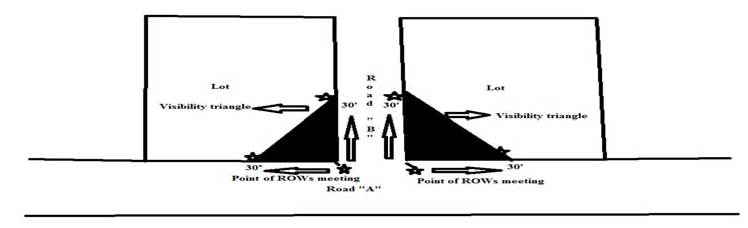
In order to provide clear view of intersecting streets to the motorist, there shall be a triangular area of clear visibility formed by two (2) intersecting streets or the intersection of a driveway and a street. The following standards shall be met:
1.
Nothing shall be erected, placed, parked, planted, or allowed to grow in such a manner as to materially impede vision between a height of three (3) feet and six (6) feet above the grade, measured at the centerline of the intersection.
2.
The clear visibility triangle of the intersection of any streets shall be formed by the intersection of the edge of the road traveled way with two sides of each triangle being equal in length from the point of the intersection and the third side being a line connecting the ends of the two other sides as indicated below:
3.
The distance from the intersection of the edge of the road traveled way shall be thirty (30) feet.
4.09.00 - Private Event Facilities.
1.
As permitted by Special Exception, Private Event Facilities include farm and residential land and structures that are used for for-profit, paid events such as weddings, tastings, special or seasonal celebrations, rodeos, and other gatherings, and may include tasting rooms. City facilities are excluded from the provisions of this section.
2.
Where allowed per Article 2 and permitted by Special Exception, a private event facility located on a parcel that is five (5) acres or larger and generates less than 150 vehicle trips or fewer than 300 attendees per event, whichever is less, is allowed by Special Exception.
3.
A Special Exception is required as outlined in Article 13.
4.
A Site Plan Review is required as outlined in Article 14.
5.
Any structures used by the public, i.e., barns, indoor riding arenas, etc., are required to be fully permitted, and shall be classified with respect to the occupancy group and the listed use, as determined by the City Building Inspector. Agriculturally exempt structures shall not be used by the public.
6.
Primary Structure must be fully enclosed.
7.
Private Event Facilities facility shall not be permitted if it will be located within two thousand six hundred twenty-five feet (2,625') of an existing Special Event facility. Such distance shall be measured from the nearest property lines of each parcel. This provision can be waived at by the City Commission.
8.
A Special Event Use Permit shall be required if the project involves noise generating activities after 10:00 p.m. during the weekday and 11:00 p.m. on weekends and holidays.
9.
Private event facilities shall provide adequate on-site parking for all attendee's vehicles, including service providers. Permanent parking spaces, either of gravel or other permeable surface, shall be provided for all sales, gift, handicraft and food service areas. Paved handicapped spaces shall be provided as required. Parking for special events, weddings, marketing promotional events, and similar functions may utilize temporary, overflow parking areas. Limitations on the number of guests may be based on availability of off-street parking. Overflow parking areas may be of dirt, decomposed granite, gravel or other permeable surface, provided that the parking area is fire safe. On-street parking shall not be permitted.
10.
Access shall be connected directly to a public road. Where a facility is located on a private road, access shall be subject to the review and approval of the City Administrator or his/her designee, Police Chief and local Fire District.
11.
The project must be designed to be compatible with any adjoining agricultural operations and single-family residences, including appropriate setbacks, landscaping, and parking. Adequate land area must be available for the provision of on-site services, e.g., leachfields, to accommodate the projected number of attendees.
12.
Signage shall follow the requirements of Article 4.10.15, Individual Commercial, Office, and Industrial Signage.
4.10.01 - General Provisions.
Signage is an integral part of the urban landscape. Effective and coordinated management of signage can enhance the aesthetics of a community, improve pedestrian and vehicular traffic safety, promote quality development and minimize the adverse effects of signage on adjacent and nearby public and private property. The regulations for signs have the following specific objectives:
✓
To ensure that signs are designed, constructed, installed and maintained according to minimum standards to safeguard life, health, property and public welfare;
✓
To allow and promote positive conditions for sign communication;
✓
To reflect and support the desired ambience and development patterns of the various zones, overlay zones, and plan districts and promote an attractive environment;
✓
To allow for adequate and effective signs whose dimensional characteristics further the interests of public safety and the needs of the motorist, where signs are viewed from a street or roadway;
✓
To ensure that the constitutionally guaranteed right of free expression is protected.
4.10.02 - Types of Signs Permitted.
The following types of signs are permitted:
⇒
Ground Signs. A sign erected on a freestanding frame, mast or pole that extends from the ground.
⇒
Projecting Signs. A sign erected as an integral part of a building or structure that extends more than twelve (12) inches and less than four feet (4') beyond such building or structure.
⇒
Temporary Signs. A sign that is intended to be displayed for a limited period of time.
⇒
Wall Signs. A sign erected to the wall of any building, structure or retaining wall that extends twelve (12) inches or less beyond such wall.
⇒
Window Signs. A sign painted, attached or hanging on the inside of a window or other opening which is visible from outside. This does not include merchandise which is normally stored or shelved inside a window for sale. Signs on windows shall not exceed twenty-five percent (25%) of the total glass area square footage, or the area as specified by the zoning district where the business is located.
4.10.03 - Exempted Signs.
The following signs are exempt from the provisions of this article:
1.
Signs not exceeding two (2) square feet in area that only display property numbers, post office box numbers, or the names of the occupants of the premises.
2.
Signs of governmental units or agencies on public property or public right-of-way which are erected for the public health, safety and welfare.
3.
Signs that direct and guide traffic and parking.
4.
National flags, flags of political subdivisions, and symbolic flags of an institution.
5.
Historical markers, integral decoration or architectural features of buildings except letters, trademarks, moving parts, or moving lights.
6.
Danger, poison, precautionary, safety, or signs of similar nature.
7.
No trespassing, no hunting or signs of a similar nature.
8.
Signs advertising sale of agricultural products grown on the premises as long as such signs do not exceed four and a half (4.5) square feet of copy area.
4.10.04 - Prohibited Signs and Displays.
1.
Signs on public utility poles and trees. No sign of any type, except signs posted by the utility to their poles, shall in any way be attached to any public utility poles or trees. Paper and cardboard signs are prohibited to be used as any type of sign throughout the city.
2.
Sign over public property. No sign shall extend over public property or public right-of-way.
3.
Banner signs. Banner, balloons, pendants, streamers, or other types of attention getting devices, except temporary signs and as approved by the City Administrator or his/her designee. Banner signs may not be placed across any street or thoroughfare without the approval of the City Administrator or his/her designee and the Florida Department of Transportation (FDOT), where appropriate.
4.
Illumination features. No sign shall be located where it can be seen from any street or highway that in any way resembles a traffic signal or emergency vehicle light. This includes any rotating and/or flashing signal lamps of any color, similar to those used on emergency vehicles.
5.
Off-site signs. Off-site advertising, which promotes or advertises a business off of the property where the business is physically located, except signage permanently affixed to a trailer or vehicle or billboards as outlined in [Article] 4.10.26, is prohibited within the city limits. This excludes business names and trademarked symbols which are located on equipment, gear, clothing or other personal items or effects which are manufactured, produced and/or sold by said business.
6.
General. The following signs, sign features, or attention getting devices are prohibited:
a.
Bullseye, spiral, divergent, sequential, flashing or intermittent lights or messages designed to draw and focus attention to a single point.
b.
Spectacular signs, with the exception of changeable message boards and/or electronic reader board signs, are allowed in accordance with this code.
c.
Signs which are held by a person and twirled, and any type of rotating paddle signs which change the displayed message when the paddles are rotated.
d.
No sign of any kind shall be located, to in any way interfere with, block the view of, resemble or look similar enough to be confused with any authorized traffic signal, sign or device.
e.
No sign shall use words of warning, such as "STOP," "LOOK," "DANGER," or any word, phrase, symbol or character that in any way interferes with, distracts or confuses motorists.
f.
No sign of any kind shall be located to interfere with the clear line-of-sight for motor vehicle, bicycle or pedestrian traffic. Any signs found to be in violation will be immediately removed at the sole discretion of the city code compliance officer or city official.
7.
Signs on glass visible from a public right-of-way shall not exceed twenty-five percent (25%) of the total square footage of the glass area on which the sign is located.
8.
A trailer or vehicle sign, when not permanently affixed to the trailer or vehicle, which is parked for the intended purpose of adding additional signage beyond that which is allowed by this Code. This provision does not apply to a trailer or motor vehicle which has a business identification sign permanently affixed to it, which is operable, properly licensed, and regularly used for the daily operation of the business, which does not remain parked on the business property for any extended or excessive period of time as determined by the code compliance officer, or when it is parked temporarily at any other location, such as the operator's residence, or while the operator of the vehicle is conducting business.
9.
No illuminated sign or display shall be located as to violate City Code.
10.
Any other signs not specifically identified as being allowed are classified as being prohibited.
11.
Signage placed within the public rights-of-way unless approved by City Administrator or his/her designee in advance.
12.
No temporary signage shall be placed on city owned property unless approved by the City Administrator or his/her designee in advance.
4.10.05 - Address Signage for Public Safety.
Each property owner must mark their property using numerals that identify the address of the property so that public safety departments can easily identify the address from the public street. The size and location of the identifying numerals and letters if any must be proportional to the size of the building and the distance from the street to the building and in no case larger than two (2) square feet in sign copy area for parcels in residential use and four (4) square feet in sign copy area for parcels in nonresidential use. In cases where the building is not located within view of the public street, the identifier must be located on the mailbox or other suitable device such that it is visible from the street.
4.10.06 - Residential Signage.
Single-family residential uses shall be permitted to have a maximum of one and a half (1½) square feet of signage.
4.10.07 - Multi-family Residential.
Multi-family residential uses consisting of two to four residential units shall be permitted to have a maximum of one and a half (1½) square feet of signage per residential unit for the sole use of each individual residential unit. Signage shall be affixed to the wall adjacent to the entrance to each individual residential unit.
Multi-family residential uses consisting of greater than four residential units shall be permitted to have a maximum of one and a half (1½) square feet of signage per residential unit for the sole use of each individual residential unit. In addition, multi-family residential uses consisting of greater than four residential units shall be permitted to have a monument sign, or "period" sign, no larger than sixteen (16) square feet in area, or four feet (4') in height, at the entrance to the residential complex.
4.10.08 - Temporary Signs.
The following standards and criteria shall apply to all temporary signs located and placed within the city limits:
1.
These signs shall all be freestanding signs, constructed of sturdy, all-weather materials such as hard plastic, vinyl, masonite or wood of a sufficient thickness to withstand the local weather conditions commonly experienced. (Paper and cardboard signs are strictly prohibited.)
2.
No temporary signage shall be placed within the public rights-of-way or on city owned property unless approved by the City Administrator or his/her designee in advance.
3.
No part of any temporary sign shall be located closer than five (5) feet from the front property line or a public right-of-way and ten (10) feet from adjacent property lines, and in no instance shall any temporary sign obstruct the visibility of any motorist, bicyclist or pedestrian from seeing oncoming pedestrians, bicyclists or vehicular traffic.
4.
These signs may be double-faced, with messages on the front and back sides of the same sign, and only the sign area of one (1) side shall be used for the sign area calculations.
5.
No single sign (except for during construction as described in number 7 below) shall exceed six (6) square feet in sign area. During November 16 through July 14 and September 1 through September 14 a total of three (3) temporary signs are permitted on any one (1) property. During July 15 through August 31 and September 15 through November 15 a total of six (6) temporary signs are permitted on any one (1) property. Temporary signs may not exceed a maximum height of four (4) feet for all signs. The initial three (3) temporary signs shall be permitted for up to ninety (90) calendar days and any additional temporary signs shall only be allowed during the time periods outlined above.
6.
The initial three (3) temporary signs shall be removed within three (3) calendar days from the date the scheduled event has concluded, if applicable, or by the ninety (90) day deadline defined in subsection 5 above, whichever occurs first. Any additional temporary signs shall be removed within three (3) days of the end date outlined subsection 5 above.
7.
Temporary signs during construction of a new principle structure on a vacant lot up to five (5) acres are permitted but shall not exceed fifteen (15) square feet in sign area with a maximum of one (1) sign per property.
Temporary signs during construction of a new principle structure on a vacant lot five (5) acres or larger are permitted but each sign shall not exceed thirty-two (32) square feet in sign area with a maximum of two (2) signs per property.
All temporary signs during construction signs must be removed the earlier of before final inspection or for residential zoned properties within fifteen (15) months of erection and for commercial/industrial zoned properties within twenty-four (24) months of erection. A Certificate of Occupancy will not be issued until all temporary signs are removed from the property.
(Ord. No. 2020-09, § 2, 10-8-2020)
4.10.09 - Directional Signs.
Used to control vehicle traffic circulation, ground directional signs may be located on commercial properties at points of ingress and egress up to the property line or in other locations as approved by the City Administrator or his/her designee. No directional sign shall be erected within any required parking space. Directional signs will be limited to three (3) square feet in area, with lettering eight (8) inches or less in height and it may display the names and/or symbol of the establishment provided that such name or symbol shall not exceed fifty percent (50%) of total sign area. Ground private directional signs are limited to four (4) feet in height. These signs do not require a sign permit or fee.
4.10.10 - Reader Boards or Signs With Interchangeable Letters.
No reader board or sign that allows interchangeable letters or messages shall be larger than thirty-two (32) square feet.
4.10.11 - Portable Sidewalk or Sandwich Sign, Menu Boards.
Used to draw pedestrian traffic, these types of signs shall be allowed in Downtown Commercial District (DCD) zoning. One (1) sign shall be allowed per properly licensed business, which must comply with the following requirements:
1.
Signs require a permit and fee, as approved by resolution of the City Commission, and they shall not exceed nine (9) square feet in size.
2.
Signs shall be placed no closer than five (5) feet from any property line or public right-of-way, and they shall not be placed in any vehicular circulation areas, parking spaces, or on any public or private walkway, sidewalk or bike path.
3.
Signs shall be removed at the close of each business day and in the event of an emergency or impending natural disaster.
4.
Signs shall be of stable construction and secured or weighted to prevent their movement.
4.10.12 - Calculating Sign Area.
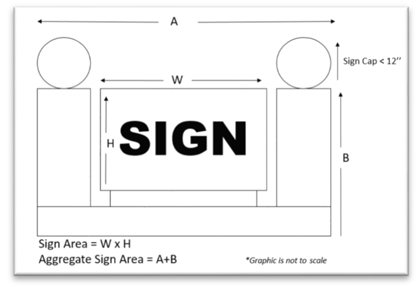
In computing sign area, standard geometry formulas for common shapes shall be used. Common shapes shall include squares, rectangles, trapezoids, circles, and triangles. In the case of irregular shapes, the total sign area will be the area of the smallest common shape that encompasses the various components of the sign (see graphic below).
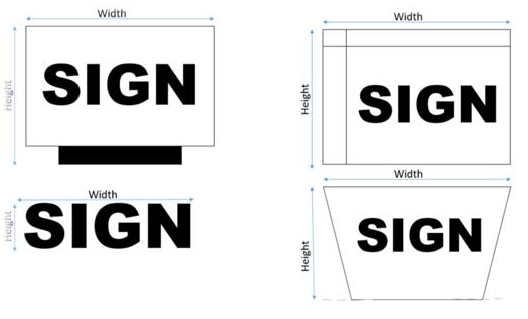
All words and components of a sign, including the support base of freestanding signs, shall be deemed to be part of a single sign. Individual words or components may be considered separate signs only if they are obviously disassociated from other components. When signs are enclosed in a border (not to include the cabinet) or highlighted by background graphics, the perimeter of such border (not to include the cabinet) or background will be used to compute sign area. Double face signs that meet the definition contained in this article shall be considered one sign.
4.10.13 - Measuring Sign Height/Clearance.
1.
Ground sign height shall be measured from the ground elevation at the base of the sign to the highest point of the sign structure. Decorative column caps may extend up to 12 inches above the maximum height permitted.
2.
The clearance of a projecting sign shall be measured from the bottom of the area to the ground below.
3.
The height of a wall sign shall be measured from the grade level of the base of the building below the sign to the top of the sign. The top of the area shall be no higher than the roof eave line.
4.10.14 - Construction and Maintenance Requirements.
1.
Except for banners, flags, temporary signs, and window signs conforming in all respects with the requirements of this Code, all signs shall be constructed of durable materials and shall be permanently attached to the ground, a building, or another structure by direct attachment to a rigid wall, frame, or structure.
2.
All signs and their supports, braces, guys, and anchors; electrical parts and lighting fixtures; and all painted and display areas shall be maintained in good structural condition, in compliance with all building and electrical codes and in conformance with this Code at all times. Damaged faces or structural members shall be promptly replaced.
3.
Vegetation around, in front of, behind, and at the base of any sign shall be maintained and neatly trimmed to conform to City landscape maintenance standards.
4.
All signs shall maintain a minimum clearance from electric power lines of ten feet horizontally and 15 feet vertically or as otherwise directed by the utility provider.
5.
No sign structure or framework may be exposed by removal of sign faces for a period in excess of 15 days.
4.10.15 - Individual Commercial, Office, and Industrial Signage (signage for individual businesses that are not located within a shopping center, business park, industrial park or multi-building development).
1.
One (1) ground sign, no greater in area than twenty (20) square feet and no greater than five feet (5') in height, shall be permitted for business identification purposes along roadways. There shall be no more than two (2) ground signs per property.
2.
Directional signs will be limited to three (3) square feet in area, with lettering eight (8) inches or less in height and it may display the names and/or symbol of the establishment provided that such name or symbol shall not exceed fifty percent (50%) of total sign area. Ground private directional signs are limited to four feet (4') in height. These signs do not require a sign permit or fee.
3.
Wall signage not to exceed one and a half (1½) square feet per linear foot of building front footage, up to a maximum of eighty (80) square feet, shall be permitted. Maximum wall sign vertical dimension shall not exceed twenty-five percent (25%) of the height of the lowest wall of the building, or a maximum of four feet (4') whichever is less.
4.
Signage shall be set back a minimum of five feet (5') from the nearest edge of the sign to the road right-of-way and twenty-five feet (25') to the adjacent property line.
5.
Signs on windows shall not exceed twenty-five percent (25%) of the total glass area square footage, or the area as specified by the zoning district where the business is located. The remaining required open space of windows shall remain unencumbered or blocked by any objects or items which are not either affixed to, or part of the window, such as shades, blinds or curtains.
4.10.16 - Commercial, Office, Shopping Center and Multi-tenant Building Signage.
1.
One (1) ground sign, no greater in area than forty-eight (48) square feet on arterial roadways or thirty-two (32) square feet on all other roadways, and no greater than six feet (6') in height, shall be permitted for building and tenant identification purposes. There shall be no more than two (2) ground signs per property.
2.
Directional signs will be limited to three (3) square feet in area, with lettering eight (8) inches or less in height and it may display the names and/or symbol of the establishment provided that such name or symbol shall not exceed fifty percent (50%) of total sign area. Ground private directional signs are limited to four feet (4') in height. These signs do not require a sign permit or fee.
3.
Wall signage not to exceed one and a half (1½) square feet per linear foot of building front footage, up to a maximum of eighty (80) square feet, shall be permitted for building and tenant identification purposes. Tenant wall signage shall not exceed ten (10) square feet per tenant. Maximum vertical dimension of building identification wall signage shall not exceed twenty-five percent (25%) of the height of the lowest wall of the building, or four feet (4'), whichever is less. Maximum vertical dimension of tenant wall signage shall not exceed a maximum of one and a half (1½) feet.
4.
All tenant wall signage shall be uniform across the exterior of the building.
5.
One (1) ground or wall directory sign shall be permitted for each multi-tenant building. Such sign shall not exceed twenty (20) square feet in area, nor four feet (4') in height.
6.
Signage shall be set back a minimum of five feet (5') from the nearest edge of the sign to the right-of-way and twenty-five feet (25') to the adjacent property line.
7.
Signs on windows shall not exceed twenty-five percent (25%) of the total glass area square footage, or the area as specified by the zoning district where the business is located. The remaining required open space of windows shall remain unencumbered or blocked by any objects or items which are not either affixed to, or part of the window, such as shades, blinds or curtains.
4.10.17 - Business and Industrial Park Signage.
1.
One (1) ground sign for park identification purposes shall be permitted for each public right-of-way entrance to the park. Maximum sign area shall not exceed forty-eight (48) square feet and maximum sign height shall not exceed six feet (6').
2.
Directional signs will be limited to three (3) square feet in area, with lettering eight (8) inches or less in height and it may display the names and/or symbol of the establishment provided that such name or symbol shall not exceed fifty percent (50%) of total sign area. Ground private directional signs are limited to four feet (4') in height. These signs do not require a sign permit or fee.
3.
Individual buildings within the parks shall be permitted to have one (1) ground sign to identify the name and location of the business. Such signage shall not exceed a maximum area of forty-eight (48) square feet or a maximum height of six feet (6').
4.
Wall signage for identification of individual principal buildings within the park shall be permitted. Signage for individual principal buildings shall not exceed one and a half (1½) square feet per linear foot of the front of the building, up to a maximum of one hundred fifty (150) square feet. Maximum vertical dimension of wall signage shall not exceed twenty-five percent (25%) of the height of the lowest wall of the building, up to a maximum vertical dimension of four feet (4').
5.
All signage within the park shall be uniform from building to building.
6.
Signage shall be set back a minimum of five feet (5') from the nearest edge of the sign to the right-of-way and twenty-five feet (25') to the adjacent property line.
7.
Signs on windows shall not exceed twenty-five percent (25%) of the total glass area square footage, or the area as specified by the zoning district where the business is located. The remaining required open space of windows shall remain unencumbered or blocked by any objects or items which are not either affixed to, or part of the window, such as shades, blinds or curtains.
4.10.18 - Public Lands and Institutions.
1.
One (1) ground sign, no greater in area than forty-eight (48) square feet on arterial roadways or thirty-two (32) square feet on all other roadways, and no greater than six feet (6') in height, shall be permitted for identification purposes. There shall be no more than two (2) ground signs per property.
2.
Directional signs will be limited to three (3) square feet in area, with lettering eight (8) inches or less in height and it may display the names and/or symbol of the establishment provided that such name or symbol shall not exceed fifty percent (50%) of total sign area. Ground private directional signs are limited to four feet (4') in height. These signs do not require a sign permit or fee.
3.
Wall signage for identification of individual buildings within the property shall be permitted. Signage for the principal building, or accessory buildings, shall not exceed one and a half (1½) square feet per linear front footage of such building, up to a maximum of eighty (80) square feet. Signage for all other individual buildings shall not exceed a maximum of twenty (20) square feet. Maximum vertical dimension of wall signage shall not exceed two feet (2').
4.
One (1) ground or wall directory sign shall be permitted for property that contains multiple buildings. Such sign shall not exceed twenty (20) square feet in area, nor four feet (4') in height.
5.
Signage shall be set back a minimum of five feet (5') from the nearest edge of the sign to the right-of-way and twenty-five feet (25') to the adjacent property line.
6.
Signs on windows shall not exceed twenty-five percent (25%) of the total glass area square footage, or the area as specified by the zoning district where the business is located. The remaining required open space of windows shall remain unencumbered or blocked by any objects or items which are not either affixed to, or part of the window, such as shades, blinds or curtains.
4.10.19 - Nonconforming Signs.
All signs lawfully in existence which do not conform to the provisions of this article are declared nonconforming signs. It is the intent of this article to eliminate nonconforming signs expeditiously and fairly, and to avoid any unreasonable invasion of property rights. No nonconforming sign shall be changed, expanded or altered in any manner which would increase the degree of its nonconformity, or be structurally altered to prolong its useful life, or be moved in whole or in part to any other location where it would remain nonconforming.
1.
Termination by abandonment or close of business: Any nonconforming sign structure determined to have been abandoned due to the business closing down or relocating shall be presumed to be abandoned and cannot be reestablished except in compliance with this article, excluding any such period caused by actions or events not caused by the property owner, such as natural disaster, government actions, or other acts of God. Signs related to a business which has closed or relocated shall be terminated on the date the business moves out. In the case of multi-tenant signs advertising more than one (1) business, the property administrator or owner shall work with the City Administrator or his/her designee to make any changes to the messages on said signage, and a sign permit shall be required.
2.
Termination by damage or destruction: Any nonconforming sign damaged or destroyed, by any means, to the extent of more than fifty percent (50%) of its current replacement cost, as determined by a cost estimate provided by the sign contractor at the time of application, and as approved by the City Administrator or his/her designee, shall be terminated and shall not be restored, except in compliance with this article.
3.
Termination by redevelopment, maintenance or repairs: Whenever any revisions, modifications, maintenance or repairs are made which affects the signage on a building or a site, to the extent of more than fifty percent (50%) of the signs' current replacement cost, as determined by a cost estimate provided by a sign contractor licensed to do said work at the time of application, and as approved by the City Administrator or his/her designee, then all affected signs and sign structures shall be brought into compliance with the current city and building codes, or be removed.
4.10.20 - Lighting of Signs.
1.
Any lighting used to illuminate signs shall be shielded such that the light source cannot be seen from abutting roads or properties.
2.
No unshielded light source may be visible from the edge of the public right-of-way at a height of three feet.
3.
Sign lighting shall not be designed or located to cause confusion with traffic lights.
4.
Illumination by floodlights or spotlights is permissible if none of the light emitted shines directly onto an adjoining property or into the eyes of the motorist using or entering public streets.
5.
Illuminated signs shall have luminance no greater than 300 foot candles.
6.
Illuminated signs shall not have lighting mechanisms that project more than 18 inches perpendicularly from any surface of the sign over public space.
7.
Backlit awnings are prohibited.
4.10.21 - Master Signage Plans.
A Master Sign Plan approved by the City Commission is required for all residential subdivisions, multi-family and townhouse developments, planned developments, non-residential subdivisions, and all multi-building or multi-occupant commercial developments before any permanent signs for such development may be erected. All owners, tenants, subtenants and purchasers of individual units within the development shall comply with the approved Master Sign Plan. Residential developments that only have one (1) entrance monument and have no other signage requests shall not be required to submit a Master Sign Plan.
Requirements of the Master Sign Plan may be more restrictive, but not less restrictive, than the applicable requirements of this article.
The master sign plan shall at a minimum address sign location, materials, size, color and illumination.
(a)
The Master Sign Plan may include any type of wall sign permitted by this article.
(b)
Consistent sign types, color patterns and materials shall be used on buildings with a uniform façade. Font styles may vary, subject to property owner's approval.
(c)
Two (2) sign style and/or color options may be introduced on buildings with architecturally-distinct building segments. Signs within each sign style shall be constructed of similar materials.
Principal Ground Signs and Directory Signs within a multi-occupant development plan project shall be consistent in style, illumination, colors and materials.
Allocation of Sign Area in Multi-Tenant Developments Unless specified otherwise in the Master Sign Plan, permanent sign area for a multitenant development shall be allocated in proportion to the frontage each tenant controls on the applicable wall.
4.10.22 - Amendment Procedures for Master Sign Plans.
A Master Sign Plan may be amended by filing a new master plan and application with the City Administrator or his/her designee.
(a)
The application may be filed only by the owner of the land affected by the proposed change, or an agent, lessee or contract purchaser specifically authorized by the owner. Before filing the application, all land owners affected by the proposed change must give written authorization. If a governing board for the property affected exists, then the governing board may provide written authorization for all landowners affected.
(b)
Any new or amended Master Sign Plan for non-residential developments (including those for planned developments) shall include a schedule that requires bringing all permanent signs not conforming to the proposed plan into conformance within ninety (90) days. This shall apply to all properties governed by said plan.
(c)
Unless restricted by a zoning condition or area plan, residential neighborhoods or institutions within Planned Developments (PDs) may submit an application to amend the Master Sign Plan for their individual subdivision entry feature or principal ground signs by proposing new criteria that calls for masonry material for structural supports, foundations and/or background material or by proposing criteria that meets the requirement for architectural compatibility between the principal ground sign and the principal building.
After approval of an amendment to a Master Sign Plan, no permanent sign shall be erected, placed, painted or maintained except in accordance with such plan, and such plan may be enforced in the same way as any provision of this article. In the case of any conflict between a provision of a lawfully-approved Master Sign Plan and one (1) or more provisions of this article, the Master Sign Plan shall control.
4.10.23 - Sign Colors.
1.
Neutral, cool, or earth tone colored signs are permitted (Green, Blue and Brown) and must complement the colors used on the structure(s) and project as a whole.
a.
Fluorescent colors shall be prohibited on all exterior surfaces.
b.
Colors that are deemed loud, clashing or garish shall be prohibited.
2.
The total number of colors used in any one sign should be limited in order to avoid confusing and/or negating the sign message and its readability.
3.
Signs should always strive to provide a contrast in lettering to insure legibility; with light letters utilized for dark sign backgrounds, or dark letters on a light background.
4.
Colors or color combinations that interfere with legibility of the sign copy, or that interfere with viewer identification of other signs, should be avoided.
4.10.24 - Electronic Message Centers.
Electronic Message Centers are permitted by Special Exception Only.
1.
An EMC sign may be a portion of a building sign or freestanding sign, or may comprise the entire sign area.
2.
All EMC signs shall have automatic dimming controls, either by photocell (hardwired) or via software settings.
3.
EMC signs shall have a minimum display time of twelve (12) seconds. The transition time between messages and/or message frames is limited to three (3) seconds and these transitions may employ fade, dissolve, and or other transition effects.
4.
The following EMC display features and functions are prohibited: continuous scrolling and/or traveling, flashing, spinning, rotating, and similar moving effects, and all dynamic frame effects or patterns of illusionary movement or simulating movement.
4.10.25 - Sign Permits.
1.
It is prohibited and unlawful for any person to erect, construct, alter, or relocate within the corporate City, any sign without first obtaining a sign permit, except as otherwise specified in this article. Applications shall be filed in accordance with City standards.
2.
When considering the placement of freestanding signs, the City Administrator or his/her designee shall consider the location of public utilities, sidewalks, and future street widening.
3.
The sign permit application shall be reviewed for a determination of whether the proposed sign meets the applicable requirements of this section and any applicable zoning law.
4.
Modifications to signs shall not result in a sign that violates the requirements of this Code. The modification of sign height or size requires sign permit approval.
5.
Permits shall be required for changing the copy of a sign, even if no changes are made to the sign's height, size, location, or structure.
6.
For properties located within the Gateway Overlay, prior to final approval of a sign permit the plans and renditions shall be presented to both the Historic Preservation Board and the City Commission for a Certificate of Designation as outlined in Article 5.
Signs shall require a permit fee as approved by resolution of the City Commission.
4.10.26 - Billboards.
Billboards adjacent to Interstate 4 may be permitted to the extent allowed under applicable regulations promulgated by the Florida Department of Transportation and approved by the City Commission.
4.10.27 - Content Neutrality as to Sign Message (Viewpoint).
Notwithstanding anything in this article or Code to the contrary, no sign or sign structure shall be subject to any limitation based upon the content (viewpoint) of the message contained on such sign or displayed on such sign structure.
4.11.00 - Donation Collection Bins.
A donation collection bin is hereby defined as a receptacle designed with a door, slot or other opening and which is intended to accept and store donated items. It shall be unlawful to deposit, store, keep or maintain or to permit to be deposited, stored, kept or maintain a donation collection bin in or on any lot, parcel or tract of land or body of water in any zoning district unless it is enclosed within a building, or except as provided in this section.
Donation Collection Bins must comply with the following criteria:
1.
For each donation collection bin the property owner shall submit a no-fee permit application prior to placement. The donation collection bin shall meet the foregoing conditions:
a.
There shall be a permitted principal development on the parcel, located in full compliance with all standards and requirements of this Code.
b.
No more than one such donation collection bin may be located on a site/parcel.
c.
The donation collection bin shall be buffered from view from any location off of the property and shall be permitted only in side and rear yards.
d.
The donation collection bin shall not be closer than 20 feet from any right-of-way line and 20 feet from any other property line.
e.
Donation collection bins shall have a maximum floor area of 20 square feet and shall not exceed a height of 7 feet. Donation collection bins must be shown on site plans and require an administrative site plan review. Said bins shall not be required to comply with the windborne debris impact standards of the Florida Building Code. Electrical connections to the bins shall be prohibited.
f.
Donation collection bins shall be secured indoors for the duration of the following National Weather Service Advisories, Watches, and Warnings for Lake Helen/Volusia County: Wind Advisory; Severe Thunderstorm Watch; High Wind Watch; Tornado Watch; High Wind Warning; Severe Thunderstorm Warning; Tornado Warning; Tropical Storm Warning; Hurricane Watch; and Hurricane Warning.
g.
Permit Application will require the submittal of the lease and/or letter of authorization from the property owner.
h.
Donation collection bins shall be maintained in a safe, clean, neat, and presentable manner, free of graffiti, and shall be in a usable condition at all times. The applicant shall be responsible for the removal of any donated items left outside of the collection bin.
i.
No major repairs or overhaul work on such collection bin shall be made or performed on the site, (or any other work performed thereon which would constitute a nuisance under existing ordinances);
j.
Donation collection bins shall not be used for living or sleeping quarters or for housekeeping or storage purposes and shall not have attached thereto any service connection lines;
k.
Donation collection bins shall display prominently the name of and contact information for the organization responsible for the bin;
i.
Bins must be placed on an improved surface. If being placed in a parking place, a waiver from the Planning and Land Development Regulation Commission or City Administrator or his/her designee must be obtained for the reduction of parking.
4.11.01 - Illegal Donation Collection Bins.
Enforcement. The City Code Compliance Officer/Police Department shall be responsible for the enforcement of this Code.
1.
Notification. Whenever the Code Compliance Officer or City Official ascertains that an illegal donation collection bin is present on any property within corporate limits of the City of Lake Helen, the officer shall cause a notice to be placed on such bin in substantially the following form:
NOTICE: This donation collection bin is unlawfully upon property known as (setting forth brief description of location) and must be removed within seventy-two (72) hours from the time of this notice. Failure to remove the bin shall result in the removal and destruction of the bin by order of City of Lake Helen.
Dated this: (setting forth the date, time of posting of the notice.)
Signed: (setting forth name, with the address and telephone number of the Code Compliance Officer or City Official.)
Such notice shall be not less than eight (8) inches by ten (10) inches and shall be sufficiently weatherproof to withstand normal exposure to the elements.
2.
Removal of donation collection bin. If at the end of seventy-two (72) hours after posting of such notice, the donation collection bin has not been removed from the property, the Code Compliance Officer shall cause the bin to be removed. In an emergency event of a natural disaster, the City may remove and store the bins at the owners' expense.
3.
Obstructing an officer or city official in the performance of duties. Whoever opposes, obstructs or resists the Compliance Officer or city official in the discharge of duties as provided in this section, upon conviction, shall be guilty of a misdemeanor of the second degree and shall be subject to punishment as provided by law.
4.
Destruction of donation collection bin. Whenever a donation collection bin remains unclaimed as provided in subsection (2) above, it shall be destroyed by order of City of Lake Helen. The contents of the bin may be destroyed or donated to charity.
5.
Recovery of costs. All costs incurred pursuant to this section shall be paid by the owner of the donation collection bin. The compliance officer may institute a suit to recover such expenses against the bin owner.
6.
Responsibility for compliance. The owner of the donation collection bin and the tenant and/or owner of the property on which the bin is maintained shall be responsible for compliance with this article.
4.12.00 - Home Occupations.
The intent of this section is to allow a person to engage in a home occupation, or to establish a home office, within a residential dwelling in which the person resides, or within an accessory building on the parcel on which the residential dwelling is located, so long as the character and integrity of the residential neighborhood is preserved and protected from possible adverse impacts associated with said occupation or office.
Any lawful home occupation use shall be permitted, which is clearly incidental and secondary to dwelling purposes, which is conducted entirely within the property and it does not change the residential character thereof; and provided that all of the following conditions are met:
1.
No unauthorized employees or persons other than the dwelling residents and employees pre-approved by the City Administrator or his/her designee shall be engaged in such occupations.
2.
The home occupation business may employ additional employees who are not members of the family unit residing on the property. Additional employees must be approved by the City Administrator or his/her designee as long as neighboring properties are not negatively impacted through the addition of those employees.
3.
Home occupations must be clearly accessory to the principal residential use.
4.
There shall be no visible change in the outside appearance of the dwelling or accessory structure to conduct such occupations.
5.
There shall be no signs advertising the home occupation located on the property, on other residentially zoned properties, or within public right-of-ways.
6.
There shall be no outside storage of materials, equipment or products on the premises visible from the property boundaries. Materials shall be stored in a fully enclosed structure or be properly screened in the side or rear yards of the property. No toxic, noxious, or flammable chemicals or materials may be stored in amounts in excess of those normally found in a residential dwelling. No additional and separate entrance will be constructed to conduct the occupation.
7.
Only commodities approved to be made and/or sold on premises can only be sold from within the building; and, no display of such products will be permitted which is visible from outside the building.
8.
The home occupation may serve the customers of only one business transaction at any one (1) time on premises.
9.
Off-street parking for the home occupation may be used or permitted, unless off-street parking is otherwise prohibited. Parking for the home occupation shall consist of no more than one (1) client/customer parking space and no more than one (1) non-family member employee parking space per pre-approved employee(s). None of said parking spaces may be located in grassed or otherwise naturally covered areas of the front yard of the premises.
10.
Signage for the home occupation shall not be permitted. Signage on motor vehicles shall not be considered signage limited under the provisions of this section. However, vehicle signage must be compliant with any other regulations regarding to signs on vehicles advertising businesses.
11.
The appearance of the structure within which the home occupation is conducted shall not be altered in any respect so as to cause the structure to appear in any way disparate or distinct from a residential structure.
12.
It is unlawful for the activities conducted in pursuit of a home occupation to disturb the peace, quiet and tranquility of the residences located in the area of the structure at which the home occupation is being pursued and it is unlawful for the activities conducted in pursuit of the home occupation to detract from the residential character of the neighborhood in which the residential or accessory structure is located. The proprietor of the home occupation shall allow city personnel on the property and to conduct any inspection necessary to ensure the home occupation's compliance.
13.
It is unlawful for the activities conducted in pursuit of a home occupation to create dust, vibration, smell, odors, smoke, glare, electrical interference, fire hazard, excessive traffic, noise, or any other nuisance or activity that is not generally conducted in a residential or accessory structure.
14.
It is unlawful for the activities conducted in pursuit of a home occupation to generate traffic that exceeds the number or intensity of trips that would normally occur in a residential area in which business activity did not exist.
15.
If the property on which a home occupation is proposed to be conducted is a rental property, notarized written approval to conduct said occupation shall be obtained from the owner of the property.
16.
Authority to conduct a home occupation shall not be transferable:
a.
To another person at the same location except to a family member living on the premises intending to continue the existing home occupation without interruption at the same location;
b.
To any occupation other than the one for which the home occupation use has been granted a permit to be conducted on the property;
c.
From one property to another; or
d.
The home occupation shall not run with the land, but only be applicable to the approved applicant.
17.
Additional driveways or paved areas to serve such occupations shall not be permitted.
18.
A reasonable number of occupation-related product deliveries shall be permitted, but in no instance shall there be more than three (3) deliveries per day. No occupations shall be permitted to interfere with, or share a driveway or off-street parking space with an adjoining property.
19.
On properties over one and one-quarter acres (1¼) light industrial type home occupations will be reviewed by the City Administrator or his/her designee and may be permitted as long as the business does not cause objectional noise, vibration, glare, fumes, odors, or heat, or other similar negative impact which is detectable to the normal human senses from any adjacent or abutting lot, or which are harmful in any way to persons, animals, flora or fauna on or off the premises.
4.12.01 - Home Occupation Permit.
1.
A person desiring to conduct a home occupation in a district where it is permitted shall first pay the non-refundable application fee as approved by resolution of the City Commission and complete the home occupation application which shall include, but not be limited to, the following information:
a.
Name of applicant, property owner and/or entity, and any requested employees.
b.
Notarized statement of approval of home occupation use from property owner or entity.
c.
Property address, parcel number and zoning.
d.
Home occupation name and telephone number.
e.
Type of business or service to be provided by the home occupation in the form of a written narrative.
f.
Days and hours of operation for the home occupation.
g.
Signature of applicant, property owner and/or entity.
2.
Upon compliance with these regulations, the City Clerk shall issue a permit for such home occupation. Any home occupation permit may be revoked by the City Clerk or City Administrator or his/her designee after being noticed that the home occupation has become a public nuisance and/or is not in compliance with the City Codes. Applicant shall have ten-days to either cure the violation(s) or shut down their home occupation.
3.
The fact that an applicant has paid the business license tax shall not vest the applicant with any rights to receive or maintain a home occupation.
4.
Appeal of any final action taken by the City Clerk, City Administrator, City Commission, or subsequent applicable governing body shall be conducted in accordance with the provisions of Article 15 of the Code of Ordinances of the City of Lake Helen.
5.
A home occupation license is only valid for a period of one (1) year, and must be renewed by the business tax receipt (BTR) annual deadline date of September 30. Renewal requests and applicable fees not made prior to the annual BTR deadline date shall require completion of a new application and payment of the approved non-refundable application fee. Annual renewal fees are set forth in the schedule of fees as adopted by Resolution set by the City Commission.
6.
Home occupations shall in no case be construed to mean or include tea rooms, food processing, restaurants, tourist homes, animal hospitals, nursing homes, retail stores, dancing instruction, Adult Entertainment, Clubs (Private), Modeling of Clothing, Escort Services, Tattoo and Piercing, Vehicle Sales or Rental, Non-State Licensed Massage, commercial kennels, facilities for the breeding and/or sale of pets, or businesses with similar traffic, noise, visual or similar impacts on neighboring properties. Home occupations shall be limited to uses that have minimal to no impact on residential zoning districts and neighborhoods.
4.13.00 - Licensed Community Residential Facilities.
Licensed Community Residential Facilities with less than seven (7) residents, group homes, and foster Care Facilities with less than six (6) residents are permitted in all residential zoned areas designed.
Licensed Community Residential Facilities with more than seven (7) residents, group homes and foster Care Facilities with more than six (6) residents are allowed as a special exception use as outlined in Article 13 provided that the facility meets required criteria, including but not limited to:
1.
the proposed facility being compatible with the neighborhood in its physical size;
2.
the proposed facility is not within 1,200 feet of an existing facility;
3.
the proposed structure would not alter the character of the neighborhood; and
4.
adequate parking will be provided.
The development review process shall require applicants of group home and community residential home developments to provide evidence of appropriate licenses prior to the issuance of a development order or permit. Residential care of family members (related by blood or marriage) shall be exempt from this policy.
4.14.00 - Low Intensity Agricultural Use.
Low intensity agricultural use including the raising of row crops, fruit trees, nursery plants and vegetables; and the keeping of animals, including poultry, aquaculture, apiaries and livestock is permitted provided that all of the following conditions are met:
1.
There shall be a permitted primary use on the parcel, located in full compliance with all standards and requirements of this Code.
2.
Row crops shall not be taller than 12' feet in size.
3.
There is at least a buffer of twenty feet (20') between the area where said animals are kept and the property line.
4.
There is at least ten thousand (10,000) square feet of grazing area for each grazing animal.
Grazing Animal shall include all animals of the equine, bovine or swine class including, but not limited to, goats, sheep, mules, horses, hogs, cattle and other grazing animals.
5.
Grazing Animals and Poultry (chickens, turkeys, ducks, guineas, geese and pigeons) shall be kept in pens or fenced areas at least twenty feet (20') between the area where said animals are kept and the property line.
6.
The storage of animal waste shall be located at least fifty feet (50') from neighboring residential property lines.
7.
Dead birds and swine shall be disposed of in accordance with applicable health regulations.
8.
Manure and other wastes shall be disposed of in accordance with applicable health regulations.
9.
Flies and insects shall be controlled in accordance with applicable health department regulations.
10.
Do not create conditions that create a public nuisance as listed below or is incompatible with neighboring uses.
4.14.01 - Exemptions.
1.
Domestic pot-belly pigs shall not be considered to be livestock if no more than one (1) said pig resides at a household or on parcel of land and the weight of said pig does not exceed one hundred (100) pounds.
2.
Miniature horses shall not be considered to be livestock if no more than one (1) said horse resides at a household or on a parcel of land and the height of said horse does not exceed thirty-three inches (33") measured from the withers to the ground.
3.
Show animals and educational projects shall be exempt from the requirements for pens in Section 4.14.00 provided the manure setback requirement of fifty feet (50') can be met and each animal would reside no longer than nine (9) months on the property.
4.14.02 - Reserved.
Editor's note— Ord. No. 2020-04, § 2, adopted August 13, 2020, repealed § 4.14.02, which pertained to public nuisance animals and derived from Ord. No. 2017-05, adopted December 14, 2017.
4.14.03 - Farm Stands.
A farm stand is allowed as an accessory use subject to the following conditions:
1.
The farm stand shall only sell products cultivated by the same producer within the city limits.
2.
The operation of the farm stand shall not exceed a duration of seventy-five (75) days in one calendar year.
3.
Sales shall be limited to between the hours of 7:00 a.m. and sunset.
4.
The farm stand must be removed from the premises or stored inside a structure when not in operation.
5.
Only one farm stand is permitted per parcel.
6.
The farm stand shall not use the public right-of-way for its operations, including in regards to the placement of its signage or for customer or employee parking.
7.
One temporary sign not exceeding twenty (20) square foot in copy area may be displayed to advertise the farm stand operations. Such sign must be removed from the premises or stored inside a structure at other times of the year when the farm stand is not in operation.
8.
A farm stand permit is required from the city and must be displayed on the farm stand property for the duration of the sale(s).
4.15.00 - Recreational Vehicles Exceeding Thirteen Feet in a Residential Zoning District.
1.
Any recreational vehicle, whether wheeled, motorized, or in an unassembled state, including trailers, boats and boat trailers separately or in combination, exceeding thirteen (13) feet in length shall not be permanently parked, stored or located on private property in a residential zoning district unless parked in an enclosed garage, or as otherwise provided herein.
2.
The length of the vehicle shall be the (registered hull length for boats) length of the vehicle without accessories, not including hitches, masts, outboard motors, trailers, nor any vehicle temporarily attached to it.
3.
Recreational vehicles including trailers, boats and boat trailers exceeding thirteen (13) feet in length may be parked at owner's property subject to the following parking and use regulations:
a.
The vehicle may be parked in the side or rear yard, if accessible, or in the front yard if space is available to meet the following regulations.
b.
Such vehicle may not be parked closer than two feet (2') to any abutting property line.
c.
Such vehicle in the front yard must be parked perpendicular to the front curb.
d.
Such vehicle shall be parked on a driveway or other prepared surface.
e.
The vehicle must be at least eight feet (8') from the face of a curb or edge of pavement on a street and no part of the vehicle may extend over a public sidewalk or bike path.
f.
Such vehicle shall not obstruct the sight triangle at intersections as defined in Article 4.08.00.
g.
If parked within ten feet (10') of an adjacent property, a minimum four-foot wall, fence, or vegetative hedge providing opacity of 80 percent (80%) or greater must be provided to screen the vehicle from the adjacent property.
h.
Such vehicle shall not be used as a residential detached dwelling unit, or be connected to any public utilities, or used for storage, or as an office for business purposes.
i.
Such vehicle must be operable, in good visible condition, in regular use, and have a current license and registration.
4.
Any vehicle that cannot comply with the parking regulations in [subsection 3] above, may park at the owner's property home a maximum of three (3) days in any calendar week for the purposes of loading, unloading, trip preparation or repairs/maintenance.
4.16.00 - Mobile Recreational Shelters for Temporary Living Quarters.
The City may grant permission to allow temporary use of the mobile recreational shelters and vehicles, shelters, and trailers for living quarters for a period of two (2) weeks upon application to the City Clerk for the temporary use.
1.
Any extension of such period shall also be by the approval of the City Commission.
2.
A property owner requesting the temporary use of the mobile recreational shelters and vehicles shelters, and trailers for living quarters may do so up to two (2) fourteen (14) consecutive-day periods per calendar year.
3.
Any allowance of the above shall only allow a safe electrical hookup and a safe and sanitary water hookup to an outside or exposed water faucet.
4.
There shall be no hookup to any septic tank, reservoir or holding area for any waste material, nor shall there be any waste material discharged on the surface of any grounds.
4.17.00 - Open Air Sales.
For purposes of this section, the phrase "open air sales" shall mean the outside sale of food, goods and services, including, but not limited to, temporary markets; sidewalk vending and sales; fruit and vegetable stands, temporary amusement or recreational activities; and the sale of seasonal merchandise such as, by way of example only, Christmas trees.
1.
Prohibited areas. Open air sales are prohibited in areas assigned a residential zoning district.
2.
Permitted areas; requirements. Open air sales shall follow [Article] 4.04.00 Outdoor display of merchandise or [Article] 4.05.00 Sidewalk/Outdoor Café or may permitted by means of a special event permit subject to the following:
a.
Open air sales may be conducted as special events upon approval of a special event permit by the City Commission subsequent to a determination that the required event furthers the public interest.
b.
The applicant shall provide a written authorization from the property owner, which authorization shall be duly sworn and notarized on a form approved by the City.
c.
Prior to obtaining a City special event permit, the applicant must obtain a permit or authorization from the Florida Department of Health, if applicable, and any other agencies of government having regulatory responsibility over event activities, and shall pay all applicable taxes to include, but not be limited to, the applicable local business tax.
d.
Open air sales activities which require the use of existing parking spaces shall not obstruct any parking spaces which are required as part of the minimum parking requirements for that property, as prescribed by the City's Land Development Regulations (Article 11).
e.
The applicant shall observe the existing setback requirements for the site of the open air sales set forth in Article 2.
f.
The applicant shall provide proper ingress and egress for the site of the open air sales as set forth in the City's Land Development Regulations (Article 11).
g.
The City Commission shall, by adoption of a resolution, establish fees relating to applications for open air sales special event permits. In appropriate circumstances, the City Commission may require insurance coverage and/or bonding.
h.
The provisions of this section are intended to regulate and authorize special events which include sales transactions which occur in open air areas that are not located within structures located on properties assigned a commercial zoning district classification with all of the sales occurring being related to special events or seasonal sales, and not ongoing commercial enterprises. Said time periods shall include "set up" and "take down" periods. Properties shall be clean and in good order at the conclusion of the event.
3.
Governmental uses; not for profit organizations.
a.
The City Commission may permit governmentally sponsored events that occur on Federal, State, County or City property that do not specifically comply with all of the requirements of this section and without any fee payment.
b.
Upon showing of a hardship, the City Commission may exempt not-for-profit charitable organizations from payment of the fees required in this section and/or waive any other requirements provided by this section.
4.18.00 - Garage Sales.
"Garage sales" as hereinafter defined are permitted in all residentially zoned land use classifications; provided, however, such garage sales are subject to the following conditions:
1.
"Garage sales" shall mean the sale of old, used or unwanted personal household items, articles and effects on a residential lot by the property owner or occupant. Said garage sales shall not include any new or used items, articles or effects which have been purchased for the purpose of resale at the garage sale. Nothing in this section shall be construed or interpreted to mean that the property owner or occupant cannot sell their isolated personal property, such as a family vehicle, a piano, an appliance, and other similar isolated household items typically found in a residential dwelling, without first obtaining a garage sale permit. A garage sale permit is not required for the sale of these isolated personal items, which are typically noticed to the public for sale through the newspaper or other media. An estate sale is considered a garage sale, and it does require a garage sale permit.
2.
Garage sale shall not be carried on for more than two (2) consecutive days and no more than two (2) such sales shall be permitted within one (1) calendar year from any single lot. Garage sales shall only be conducted by and the items sold shall be owned by the residential property owner/occupant.
3.
At the conclusion of such garage sales, all unsold articles and items shall be removed so as not to be visible from any public streets or abutting property.
4.
A garage sale permit is required from the city for all garage or estate sales, and it must be displayed on the garage sale property for the duration of the sale.
5.
The property owner shall be allowed to install one (1) sign advertising the garage sale, meeting the requirements for such signs under the city's Sign article. Said signs shall be removed by the conclusion of the sale on its final day.
4.19.00 - Vehicle Sales.
The intent of this regulation is to allow a private citizen to sell privately-owned motor vehicles for private sales. It is not the intent of this section to allow for any form of commercial vehicle sales which are otherwise prohibited by law in the City of Lake Helen. For the purposes of these regulations, the word "motor vehicle" includes any motorized automobile, motorcycle, scooter, golf cart, pickup truck, boat, jet ski, watercraft, aircraft, recreational vehicle, and/or any trailer used to haul vehicles.
1.
The display of a privately-owned motor vehicle for private sale is allowed only on improved and occupied residential property when the private vehicle to be sold is owned by the residential property owner or occupant.
2.
No motor vehicles offered for private sale shall be displayed on any vacant, unimproved, or undeveloped property.
3.
The owner of the private motor vehicle for private sale must have a residential occupancy interest on the property where the motor vehicle is displayed for sale. If the motor vehicle for sale is displayed at a commercial location for a period greater than four (4) hours, the motor vehicle may be displayed only when the owner of the motor vehicle is on the property, and during normal operating hours of the business.
4.
Any motor vehicle for sale must be properly licensed, registered and operable.
5.
Only one (1) motor vehicle offered for sale is allowed on any one (1) parcel at any one (1) time, and there shall be no more than one (1) motor vehicle for sale on any one (1) parcel within any six-month period.
6.
Motor vehicles offered for sale must be displayed in a parking area, and must not be located on any public right-of-way, landscape area or buffer, or any other non-parking development feature.
7.
Signage advertising the motor vehicle for sale shall not be greater than four (4) square feet in total area, and it must be affixed inside the motor vehicle, or in the case of motorcycles, boats, and trailers, securely affixed to the motor vehicle.
4.20.00 - Television, Radio and Satellite Antenna Requirements.
Antenna support structures and satellite television receiving antennas located in residentially zoned areas shall be governed by the following restrictions:
1.
Height limitations. The height of noncommercial television and radio antennas excluding satellite receiving dishes shall be limited to thirty-five feet (35'), or as may be further restricted by other law, charter or regulations.
2.
Size limitations. Satellite and similar types of noncommercial microwave receiving antennas of parabolic-"like" construction shall be limited in size to eighteen inches (18") in diameter, unless one of a larger size is approved through a Building Permit. No roof mounting of satellite dish antennas is permitted.
3.
Locations of antenna, antenna support structures, and satellite receiving antennas. Antennas and support structures shall be located within the established side and rear setback lines. No antenna element or supporting structure shall be located closer than eight feet (8') from any overhead power line.
4.
Structural integrity requirements. All antennas and their support structures, rotors, equipment and positioners shall be designed to withstand minimum horizontal wind pressures and be corrosion-proof in accordance with the city building codes.
5.
Commercial and multifamily installation. Each installation of antenna towers to be used by commercial establishments, including multifamily dwellings and condominiums must receive approval of the development services department.
6.
Permit requirements. A building permit shall be obtained prior to the installation or modification of any antenna or supporting structure in excess of twenty feet (20') in height or a satellite antenna or supporting structure in excess of eighteen inches (18") in diameter or fifty (50) pounds in weight within a residentially zoned district.
Application for a building permit to install, construct or increase the height of a television or radio antenna or satellite receiving antenna shall include the following with the application:
1.
A location plan for the antenna support structure or the satellite-receiving antenna.
2.
Manufacturer's specifications for the antenna support structure, the required guy wire system, corrosion-proofing and details for the required footings and or other structures required to support or assist in the support of the antenna structure or the satellite dish.
4.20.01 - Telecommunications or Wireless Telecommunications Facility (WTF).
The purpose and intent is to minimize the negative impact of a wireless telecommunications facility (WTF), establish a fair, expedient and efficient process for review and approval of all applications, protect the health, safety and welfare of the citizens, utilize stealth technology on any new or reconstructed WTF, and insure all new and reconstructed facilities are built to accommodate future projected growth demands and needs.
Exclusions; the following shall be exempt from this section:
1.
The fire, police, and other public service facilities owned and operated by the local, county, state, or federal government.
2.
Any facilities expressly exempt for the city's citing, building, and permitting authority.
3.
Over-the-air reception devices including the reception antennas for direct broadcast satellites (DBS), multi-channel, multipoint distribution (wireless cable) providers (MMDS), television broadcast stations (TVBS) and other customer-end antennas that receive and transmit fixed wireless signals and are primarily used for reception.
4.
Facilities exclusively for private, non-commercial radio and television reception and private citizen's bands, and other similar non-commercial telecommunications.
5.
FCC licensed amateur radio facilities require administrator approval and are exempt from all aspects of this section except logical screening, setback, placement, construction, height and health and safety standards in accordance with state and local building codes.
6.
Facilities exclusively for providing unlicensed spread spectrum technologies (such as IEEE 802.11a, b, g {WiFi and Bluetooth}) where the facility does not require a new tower.
4.20.02 - WTF Permit Application Process and Other Requirements.
Applicants for a new, reconstructed or replacement WTF permit shall comply with the requirements set forth herein. The City Commission designates that applications shall be submitted to the City Administrator or his/her designee, who is authorized to review, analyze, evaluate and make decisions with respect to granting, not granting, or revoking permits. Denied applications and permits may be appealed by the applicant to the City Clerk as outlined in Article 15 of these regulations.
1.
The applicant shall do the following to assist the City Administrator or his/her designee in expediting the process:
a.
Obtain and review this WTF section and discuss any questions regarding the requirements with City Administrator or his/her designee before making application.
b.
Determine the best potential location for the WTF facility, taking into consideration the city's defined priorities that meet the applicant's requirements for service. The application requires an explanation for a selected location not using the highest priority available to the applicant. The city's priorities (listed from highest to lowest) are: on existing towers or structures without increasing their height; on city-owned properties; on commercially zoned properties; and finally, on residentially zoned properties.
c.
Attend the pre-application meeting to address issues to help expedite the review and permitting process, which shall also include a site visit. The pre-application meeting will: determine the types of applications being made; define information required to support the proposed location; and, define the specific application requirements for what is needed for review and consideration by the city. Requirements will vary based on the specific location, type of facility selected and its potential impact to the city and its citizens.
d.
Determine if application falls under the Spectrum Act, Section 6409 requirements for review and approvals, with supporting documentation being provided by the applicant upon submission of the application. If the application does fall under Section 6409, the "shot-clock" deadline for review and approval of the application is sixty (60) days. If the application does not fall under Section 6409, the "shot-clock" deadline for review and approval of site modification and colocation applications of ninety (90) days shall apply, and one hundred fifty (150) days for new cell site applications, unless otherwise agreed upon by the applicant and city.
e.
Submit three (3) copies of applications to the City Administrator or his/her designee and officially begin the sixty-day, ninety-day or one-hundred-fifty-day "shot-clock" deadline for approval time period, as determined by subsection C.2.d. above, on the day the application is received by the city development services department. Incomplete applications will not be accepted.
2.
The City Administrator or his/her designee will review the application to verify completeness and that it meets the requirements of these regulations. Based on the review the City Administrator or his/her designee may:
a.
The city has twenty (20) days from the date-stamped date of submission of the application to request any and all missing information needed to make the application complete. When the applicant resubmits the application package, the city then has ten (10) days to identify which previously requested pieces of information are still missing, and the city shall not request new and/or additional information outside the scope of the original request.
b.
Approve, approve with conditions or deny a WTF permit within the "shot-clock" deadline period, or the application is deemed approved, after written notice to the city that the approval time period has elapsed. The decision shall be in writing and supported by any evidence contained in a written record. The burden of proof for the granting of the permit shall always be on the applicant.
c.
Based on the agreed upon location for a new tower, if it is located in a zone other than a commercial zone, or if any variance is required, this application may require a public hearing through the board of adjustment.
3.
The city's approval/denial of an application shall be provided to the applicant in writing within the "shot-clock" period agreed to by the applicant and city, prior to submission of the application.
4.
The city and applicant agree to communicate during the tolling and notice period for incomplete applications to ensure the application is not held up any longer than is absolutely necessary, on the part of either party, while proper information needed for a complete application is acquired.
5.
Anyone can appeal the decision of the City Administrator or his/her designee by submitting written notification to the City Clerk. The appeal process as outlined in Article 15 of these regulations shall be followed.
6.
Limitations. A proposed rezoning, special exception or variance which has been denied by the city on a particular tract of land for a particular purpose cannot again be applied for within one (1) year from the date of denial, unless the new request is determined by the City Administrator or his/her designee to be substantially different from the original request (i.e., applying for a different but not necessarily more restrictive zoning district, use, distance, area, height, use of stealth technology, etc.).
7.
An applicant that receives an approved permit may proceed to the construction phase of the project by applying for the building permit for the tower and any additional and required support buildings. The city will conduct its normal building inspection process during construction.
8.
When the city has verified that the site is constructed in accordance with the approved application, and the applicant has paid all monies due to the city, the city will issue a certificate of occupancy to the applicant that allows operational use of the site.
4.20.03 - Permit Application Contents and Other Requirements.
All applications shall demonstrate how the proposed facility will utilize stealth technology and be sited so as to be the least visually intrusive as reasonably possible, and contain the information herein set forth.
The application requirements may vary based on the type of facility and its location. Final determination of the specific information to be included with each application will be defined in the pre-application meeting, but will generally follow the established guidelines set forth below:
1.
An application to co-locate on an existing structure or modify an existing structure without increasing its height shall include:
a.
Application including:
i.
the names, addresses, and phone numbers of the person preparing application;
ii.
the applicant;
iii.
the WTF facility owner;
iv.
the property owner;
v.
the building contractors;
vi.
the postal address and legal description of the property and its zoning designation.
b.
Written verification that the facility complies with state and federal rules and regulations; a copy of the state license; and, documentation that verifies the ownership of the site, and all lease or sublease agreements.
c.
The applicant shall furnish a visual impact assessment, which includes: a narrative and pictorial representation of how the tower will utilize stealth technology to blend in with the surroundings; a "zone of visibility map" to determine locations from which the tower may be seen; and, pictorial "before and after" representations of proposed facility.
d.
A certified site plan which shall include: the location, size, and height of all structures on the property to scale; landscaping, irrigation, and fencing; a description of the proposed tower/antenna for aesthetics; grounding; parking and turn around facilities; signage; and, demonstrate how it will efficiently screen from view the base and all related structures.
e.
A copy of the geotechnical sub-surface soils investigation, evaluation report, drainage report and foundation recommendation for a proposed or existing tower site.
f.
Certification that the WTF facility, foundation and attachments are designed and will be constructed to meet all local building code requirements for structural and wind loads.
g.
Verification that proposed facility complies with current FCC RF emissions guidelines.
h.
Documentation that satisfies the liability insurance requirements.
i.
Documentation that satisfies the performance bond requirements.
2.
Applications to co-locate on or modify an existing structure where an increase in height is requested requires items (a) through (d) above, and: documentation demonstrating the need for the proposed height of the facility; propagation studies of the proposed site and all adjoining proposed and existing sites; certified structural drawings verifying structure can handle the load of additional antennas and/or structure; supporting documents showing actual intended transmission and the maximum effective radiated power of the antenna(s); and, equipment specification sheets for the proposed radio, combiner, isolator, and antennas planned for the proposed and adjoining sites.
3.
An application to install a new or replacement tower or facility will include the above information, and: the number, type, and design of the tower(s)/antenna(s) proposed and the basis for the calculations of the tower's capacity to accommodate multiple users; and, the applicant shall submit documentation demonstrating its meaningful efforts to secure shared use of existing tower(s) or other structures within the city. Copies of written requests and responses for shared use shall be provided to the city in the application.
4.20.04 - WTF Application Fee.
At the time a person submits an application for a WTF permit for a new tower or requires an increase in height to an existing tower, such applicant shall pay a non-refundable application fee of four thousand five hundred dollars ($4,500.00) to the city. If the application is for a WTF permit for co-locating on an existing tower or other suitable structure, where no increase in height of the tower or structure is required, the non-refundable fee shall be two thousand five hundred dollars ($2,500.00).
4.20.05 - Visibility of Wireless Telecommunications Facilities.
1.
WTFs shall not be lighted or marked, except as required by law.
2.
Towers shall be galvanized and at a minimum, use stealth technology of an approved color and design to best allow the WTF to harmonize and blend in with the surroundings and it shall be maintained for the life of the tower.
3.
If lighting of the tower is required by FAA or other agency requirements, applicant shall provide a detailed plan for sufficient lighting as inoffensive as permissible under state and federal regulations.
Security of wireless telecommunications facilities; all WTF, towers and antennas shall be located, fenced, or otherwise secured in a manner that prevents unauthorized access.
4.20.06 - WTF Signage.
1.
WTFs shall contain signs no larger than four (4) square feet to notify persons of the presence of RF radiation or to control exposure to RF radiation and a sign with the I.D. number and emergency phone number(s) located on the equipment shelter or cabinet and visible from the access point of the site. On tower sites, an FCC registration site shall also be present. The signs shall not be lighted, unless required by law, rule, or regulation. No other signage shall be permitted, such as advertising.
2.
The applicant or future owner of the site shall update the site identification number and emergency phone numbers of the WTF as displayed on the required sign within six (6) months of any sale, assignment, or transfer.
4.20.07 - Parameters of WTF Permits.
1.
Permit shall not be assigned, transferred, or conveyed without written notice to and approval from the city within six (6) months.
2.
Such permit may, following a code enforcement special magistrate and/or board hearing upon due prior notice of violation being provided to the applicant, be revoked, canceled, or terminated for violation of the conditions and provisions of the WTF permit or for a material violation of this section after notice and the applicant is given an opportunity to cure the same.
4.20.08 - WTF Insurance Requirements.
1.
Liability insurance. A holder of a permit for a WTF shall secure and at all times maintain public liability insurance for personal injuries, death, and property damage and umbrella insurance coverage for the duration of the permit in amounts as set forth below:
a.
Commercial general liability and automobile coverage: one million dollars ($1,000,000.00)/occurrence and two million dollars ($2,000,000.00) aggregate.
b.
Workers compensation and disability: statutory amounts.
2.
The commercial general liability insurance policy shall specifically include the city and its officers, employees, agents, and consultants as additional named insured's.
3.
The insurance policies shall be issued by an agent or representative of an insurance company licensed to do business in the state and with a "best's" rating of at least A.
4.
The insurance policies shall contain an endorsement obligating the insurance company to furnish the city with at least thirty (30) days' prior written notice of the cancellation of the insurance.
5.
Renewal or replacement policies or certificates shall be delivered to the city at least fifteen (15) days before the expiration of the insurance that such policies are to renew or replace.
6.
Provide the city the policies/certificates before construction, but in no instance later than fifteen (15) days after the granting of the permit.
4.20.09 - Indemnification.
Any application for WTF that is proposed on city property, pursuant to these regulations, shall contain a provision with respect to indemnification. Such provision shall require the applicant, to the extent permitted by the law, to at all times defend, indemnify, protect, save, hold harmless, and exempt the city, and its officers, employees, commission members, attorneys, agents, and consultants from any and all penalties, damages, costs, or charges, arising out of any and all claims, suits, demands, causes of action, or award of damages, whether compensatory or punitive, or expenses arising therein, either from law or inequity, which might arise out of, or are caused by, the placement, construction, erection, modification, location, products performance, use, operation, maintenance, repair, installation, replacement, removal, or restoration of said facility, exempting, however, any portion of such claims, suits, demands, causes of action or award of damages as may be attributable to the negligent or intentional acts or omissions of the city, or its servants or agents. With respect to the penalties, damages, or charges referenced herein, reasonable attorneys' fees, consultants' fees, and expert witness fees are included in those costs that are recoverable by the city.
4.20.10 - WTF Default and/or Revocation.
If WTF are repaired, rebuilt, placed, moved, relocated, modified, or maintained in a way not in compliance with these regulations or the WTF permit, then the city shall notify the permit holder in writing of such violation. After receiving written notice of violation, a permit holder has sixty (60) days to cure said violations. The city shall consider extensions to the cure period as necessary upon the permit holder demonstrating that despite its good faith efforts, such default cannot be reasonably cured within the provided time. A permit holder still in violation after the expiration of the cure period may be considered in default, subject to fines as set forth in these and other city regulations, and the permit is subject to revocation.
4.20.11 - Temporary Tower Facilities, Such as Communications on Wheels (COW) for Emergency Use.
1.
If a COW or other type of temporary tower facility becomes inoperable due to force majeure or acts of God, it must be removed from the site within thirty (30) days.
2.
If a COW or other type of temporary tower facility must be used, it must be removed from the site within forty-eight (48) hours of the conclusion of the event.
3.
In the event of an emergency or natural disaster which renders other forms of communication nonviable, thus necessitating a COW or other temporary tower facility, the city and the telecommunications provider shall agree to special terms and conditions as required to meet the needs of both entities, and the general public at large.
4.20.12 - WTF Relief.
Any applicant desiring relief, waiver or exemption from any requirement of these regulations may request such at the pre-application meeting. The burden of proving the need for the request lies solely with the applicant. The applicant shall bear all costs to the city in considering the request, which may or may not require approval from the City Administrator or his/her designee, depending upon the nature of the request. No request shall be approved unless the applicant provides convincing evidence that the request will have no significant effect on the health, safety and welfare of the city or its residents.
4.20.13 - Removal/Replacement of Nonconforming Wireless Telecommunications Facilities (WTF).
A wireless telecommunication facility (WTF) which is lawfully in existence or which was lawfully installed prior to the adoption of these LDC regulations, which does not conform to the provisions of this section are declared to be a nonconforming WTF. It is the intent of this section to recognize that the eventual elimination of nonconforming WTFs as expeditiously and fairly as possible is as much a subject of health, safety, and aesthetics as is the prohibition of a new WTF that would violate the provisions of this section. It is also the intent of this section that the elimination of a nonconforming WTF shall be effected so as to avoid any unreasonable invasion of established property rights. No nonconforming WTF shall be changed, expanded or altered in any manner which would increase the degree of its nonconformity, or be structurally altered to prolong its useful life, or be moved in whole or in part to any other location where it would remain nonconforming.

