
Lake Helen City Zoning Code
ARTICLE 5
- BUILDING PERMITS, NEW CONSTRUCTION DESIGN SPECIFICATIONS, HISTORIC PRESERVATION AND GATEWAY OVERLAY
5.01.00 - Building Permit; Certificate of Occupancy Administration and Enforcement.
The Chief Building Official (CBO) or his/her designee shall be designated as the administrative official to administer and enforce building permits, certificates of occupancy and other such certificates, as required by the Florida Building Code or other city codes. For these regulations, the Chief Building Official (CBO) or his/her designee may also mean the building inspector/plans examiner/building official, as the case may be, and vice-versa. The Florida Building Codes are the controlling authority for building permits issued in the City of Lake Helen.
If the Chief Building Official (CBO) or his/her designee finds that any provisions of this article are being violated, he shall notify the person responsible for such violation, and if deemed necessary, have the Code Compliance Officer (CCO) provide the property owner with written notification of violation, indicating the nature of the violation and ordering the action necessary to correct it. He or she shall order discontinuance of illegal use of land, buildings, or structures or of additions, alterations or structural changes thereto; removal of illegal buildings or structures; discontinuance of any illegal work being done; or shall take any other action authorized by this article to insure compliance with or to prevent violation of its provisions.
The Chief Building Official (CBO) or his/her designee shall review and approve such plans and specifications, issue such permits and certificates, make such inspections, and maintain such records of his actions as are necessary to enforce the provisions of this article.
5.01.01 - Building Permits Required.
No fence, building or other structure shall be erected, moved, added to, or altered in any way which affects the structural load-bearing or supporting mechanisms or apparatuses of a building or structure, without a building permit therefore issued by the Chief Building Official (CBO) or his/her designee. Starting construction without a valid building permit in hand, is a violation of this article. No building permit shall be issued except in conformity with the provisions of this article.
After a building permit has been issued, only the work depicted on the approved site plan and building permit may be performed, and no other or additional work is permitted without prior written authorization from the Chief Building Official (CBO) or his/her designee and/or City Administrator or his/her designee, or as the case may require, the Historic Preservation Board, Planning and Land Development Regulation Commission and City Commission, depending on the scope of additional work requested to be done. Any work done outside of or beyond the scope of work approved on the site plan and/or building permit shall be deemed a violation of these regulations.
5.01.02 - Application for Building Permit.
All applications for building permits shall be made in conformity with this Land Development Code, all other applicable city codes and ordinances, Florida Statute, Florida Administrative Code, and Florida Building Code. All applications shall be accompanied by either a site plan, plans for construction and/or project descriptions which depict the actual work to be done, which may include dimensions and the shape of the lot; the exact sizes and locations of any existing buildings; and, the size, shape, and location of the building or alteration, including any accessory buildings or structures. The application shall include such other information as may be required by the Chief Building Official (CBO) or his/her designee and/or City Administrator or his/her designee, including existing or proposed building and/or zoning and land uses; the number of families, housekeeping units or rental units the building is to accommodate; conditions existing on the lot; and such other matters as may be necessary to determine conformance with and provide for the enforcement of this article.
5.01.03 - Certificates of Occupancy (CO).
It shall be unlawful to use, occupy or permit the use or occupancy of any building, premises, or both, or any part thereof hereafter created, erected, changed, converted or wholly or partly altered or enlarged in its use or structure until a temporary certificate of occupancy (TCO) or a certificate of occupancy (CO) has been issued by the Chief Building Official (CBO) or his/her designee for the work completed.
No nonconforming structures or use shall be maintained, renewed, changed or extended until a certificate of occupancy (CO) has been issued by the Chief Building Official (CBO) or his or her designee, after receiving approval from the City Administrator or his/her designee. The certificate of occupancy (CO) shall state where the nonconforming use differs from the provisions of this article, provided that, upon enactment or amendment of this article, owners or occupants of nonconforming uses or structures shall have three (3) months to apply for a certificate of occupancy (CO).
A temporary certificate of occupancy (TCO) may be issued by the Chief Building Official (CBO) or his/her designee for the temporary occupancy of a building when all but the final inspection has been performed and upon request of the applicant, should the Chief Building Official (CBO) or his/her designee deem the building to be safe to occupy, for the purposes of allowing the applicant or future tenant to receive temporary utility services for building maintenance, repair or buildout for system and utility testing purposes, or for stocking of inventory and doing other types of preparatory work needed prior to opening for business. Such temporary certificate of occupancy (TCO) may require such other conditions and/or safeguards as will protect the safety of occupants and the public, as determined by the Chief Building Official (CBO).
The Chief Building Official (CBO) or his/her designee is also authorized to issue other certificates as specified in the adopted building code or as may be required by other City Codes or regulations.
5.01.04 - Expiration of Building Permit.
If the work described in any building permit has not started within six (6) months from the date of issuance, said permit shall expire; it shall be marked expired by the Chief Building Official (CBO) or his/her designee and work shall not proceed unless and until a new building permit has been obtained. An applicant may request the Chief Building Official (CBO) or his/her designee grant an extension of the building permit prior to expiration. This provision shall apply to building permits outstanding at time of adoption of these regulations.
5.01.05 - Right of Entry.
For the purpose of enforcing this article, the Chief Building Official (CBO) or his/her authorized representatives shall have the right to enter onto private property and into private buildings, while construction is in progress, at any reasonable time. Any person refusing or obstructing such entry shall be guilty of a violation of these regulations.
5.01.06 - Site Improvement Acceptance.
When deemed necessary to ensure compliance with other city codes or regulations, the Chief Building Official (CBO) or his/her designee may require a statement under the seal of the professional engineer of record, licensed by the State of Florida, certifying that, based on their inspection, the site construction has been done in accordance with the approved site plan, building permit and all applicable city codes and regulations. The Chief Building Official (CBO) or his/her designee may also require statements of acceptance from other city departments or outside agencies having jurisdiction.
5.01.07 - Appeals and Interpretations.
Any appeal of a decision or interpretation made by the Chief Building Official (CBO) or his/her designee or City Administrator and/or his/her designees in administering or enforcing this chapter or the adopted building code, shall be processed in accordance with procedures for such appeals as set forth in Article 15 or as defined by State Law.
5.01.08 - Grounds for Revocation; Effect.
The Chief Building Official (CBO) or his/her designee shall have the authority to revoke a Certificate of Occupancy (CO) for any building which is occupied, in whole, or in part, for any use not authorized or changed to a classification where such occupancy does not comply with the building code and all other ordinances and law applicable thereto, or for any building where the live loads imposed on any floor or the number of persons permitted to assemble therein or thereon exceed those authorized in said certificate. The revoking of a Certificate of Occupancy (CO) shall have the effect of nullifying any occupational license or local business tax receipt issued in connection with such building or the affected part of such building.
5.01.09 - Public Utility Service Restricted.
It shall be unlawful for any public utility service corporation or agency to begin service to a building, except temporary service for use during building operations, testing purposes, or stocking inventory, until either a Temporary Certificate of Occupancy (TCO) or a Certificate of Occupancy (CO) has been issued and posted on the premises by the Chief Building Official (CBO).
5.02.00 - Administration and Assignment of Numbers.
1.
The City Clerk shall be responsible for coordinating and maintaining the numbering system established by this article and shall issue building numbers in conformity with the uniform numbering system. Should an existing building have, exhibit or be addressed by a number in conflict with the uniform numbering system, the City Clerk shall give notice to those owners or occupants whose building number is in conflict with the uniform numbering system. Such, notice shall be delivered to the owner and occupant by 1) certified mail, return receipt requested, 2) by posting same in a conspicuous place on the building or 3) by hand delivery. The notice shall include a notification of a change of address which shall contain the new building number(s) assigned to the building in accordance with the provisions of this article and shall direct the owner or the occupant to post the new number on said building or property in accordance with Section 5.02.01 of this article.
2.
The assignment by the City Clerk and posting by the owner or occupant of the assigned number shall be a condition precedent to the issuance of a building permit for any such building.
3.
The City Clerk shall duly record and keep records of all numbers assigned under this section.
5.02.01 - Posting of Numbers.
All buildings shall have its assigned building number properly displayed whether or not mail is delivered to such building or property. It shall be the duty of the owners and occupants of each building to post the assigned building number on the property in the following manner as described in Article 4.10.05:
1.
Each property owner must mark their property using numerals that identify the address of the property so that public safety departments can easily identify the address from the public street. The size and location of the identifying numerals and letters if any must be proportional to the size of the building and the distance from the street to the building and in no case larger than two (2) square feet in sign copy area for parcels in residential use and four (4) square feet in sign copy area for parcels in nonresidential use. The numerals shall be of a contrasting color with the immediate background of the building or structure on which such numerals are affixed.
In cases where the building is not located within view of the public street, the identifier must be located on the mailbox or other suitable device such that it is visible from the street.
5.03.00 - New Construction Design Specifications.
In order to create a multidimensional streetscape, streets shall consist of a mix of many architectural styles, rather than consisting of only one (1) or two (2) styles. Architectural styles shall be interspersed throughout a street and subdivision and shall not be placed together in a concentrated manner.
The minimum living area square footage for a single-family residence is listed in Article 2—Zoning and Land Use, except when:
1.
Construction of an infill residence on a nonconforming buildable lot of less than one-third acre in size, the City Commission determines that the construction of a residence smaller than the minimum square feet for the Zoning Category is not adverse to the public health, safety and welfare of the City, and will serve to meet the costs of infrastructure and City services. When making said determination, factors to be considered include lot size, lot width, and depth, size of adjacent residences, and type of residence proposed for construction.
2.
Construction of residential units for very-low, low and moderate income families, the city will reduce the minimum floor area requirement by twenty percent (20%) for all residential units meeting the designated criteria. Residential units must be constructed for and occupied by very-low, low and moderate income.
5.03.01 - Building Orientation and Design Specifications.
Buildings shall be oriented so as to enhance the appearance of the city's streetscape. This requirement shall be met by incorporating the techniques set forth herein into the project design.
1.
The building's entrance shall face parallel to the public road as determined by the city. In the event that access is provided by two (2) or more roads, the building's entrance shall face parallel to the road that is determined by the city to be the major road.
2.
The architectural treatment requirements of this article shall also be applied to any building exterior unless completely blocked by fence, wall or natural vegetation or the city approves the use of increased landscaping as an alternative to the required architectural treatments.
3.
Building orientation, other than for single-family residences, shall ensure that service areas are placed out of view from public rights-of-way, parking areas and adjacent properties. Where, because of site constraints or other factors, service areas cannot be so located, such areas shall be screened from view by vegetative or structural means. Structural screening shall be architecturally compatible with the building in terms, style, colors, construction materials and finish. Landscape screening shall be compatible with and integrated into the project's landscape plan.
4.
In order to create a multidimensional, attractive exterior, new residential structures in all single-family residential zoning districts are required:
a.
To incorporate a minimum of seven (7) corners on the exterior street facing façade walls, excluding roof. A corner shall be at least a ninety (90) degree change of direction. Wall offset needs to be a min of six (6) feet and be proportionate to the front façade walls at a minimum one-third (⅓) the width of the overall front facade. This excludes bay windows and other similar pop out type architectural treatments; or
b.
To incorporate an open front porch that is a min of six (6) feet deep and ten (10) feet wide or be proportionate to the front facade walls at a minimum one-third (⅓) the width of the overall front façade, whichever is greater.
(Ord. No. 2020-02, § 2, 6-11-2020; Ord. No. 2021-03, § 2, 4-8-2021)
5.04.00 - Gateway Overlay.
Lake Helen's Gateway Overlay serve as primary entrances to the city and, as such, provide the first impressions of the city for visitors and maintain the cultural and historical ambiance desired by the citizens of the City of Lake Helen. The purpose of the standards and guidelines set forth in this article is to contribute to the development of a well-planned urban environment by fostering the creation of visually compatible and harmonious development within the City's Gateway Overlay the benefits of which will be spread over the city as a whole and be shared by existing and future residents of the city. It is, therefore, the intent of this article to:
1.
promote, protect and maintain the city's historic character and small-town atmosphere;
2.
create and maintain a strong community image, identity and sense of place;
3.
create and maintain a positive visual ambiance for the community;
4.
provide for well-landscaped, scenic gateways to the city;
5.
enhance and sustain property values;
6.
promote a high degree of compatibility between surrounding structures and land uses;
7.
establish and promote a standard for quality design and enduring quality development;
8.
provide for traffic circulation patterns that enhance public safety, roadway capacity, vehicular and non-vehicular movement functions; and
9.
foster civic pride and community spirit by maximizing the positive impact of quality development.
5.04.01 - Gateway Overlay Boundary Area.
The boundary area described below and illustrated on the attached geographical location map (Gateway Overlay Map) hereby establishes the Gateway Overlay of the City of Lake Helen, Florida.
The Gateway Overlay shall encompass:
Entire parcels within Commercial Areas in the city including: GCD (Gateway Commercial District), NRC (Non-Retail Commercial District), NCS (Neighborhood Convenience Services), DCD (Downtown Commercial District).
Entire Residential parcels abutting the following streets: N. Summit Avenue (from Jennings Avenue to City Line), W. Main Street (from Summit Avenue to Lakeview Drive), N. Lakeview Drive (from W. Main Street to Lake Pearl), Macy Avenue (from W. Ohio Avenue to City Line), W. Ohio Avenue (from Orange Avenue to Prevatt Avenue), Lemon Avenue (from S. Orange Avenue to Prevatt Avenue), Prevatt Avenue (from Tangerine to Kicklighter Road). The Woods of Lake Helen and Edgewood Estates Subdivisions are incorporated into the Gateway Overlay by reference per recorded Subdivision Development Orders and Article of Incorporation.
This boundary shall also incorporate to any development of property which is contiguous to property within a Gateway Overlay that is under common ownership, partial common ownership, or was under common or partial common ownership in the property's chain of title with the owner or owners of the contiguous property located within the Gateway Overlay.
(Ord. No. 2020-02, § 2, 6-11-2020)
5.04.02 - The Lake Helen Pattern Book.
The Lake Helen Pattern Book is hereby adopted as a reference guide for designers, architects, owners, builders and developers in preparing architectural plans and elevations that are submitted to the city for approval. The Lake Helen Pattern Book is only a guide and does not require strict compliance nor dictate the only acceptable architectural design. Architectural designs approved by the city, and not ordered by a court, for construction in the overlay districts may be added to the Lake Helen Pattern book as examples of the corresponding New Traditional style. The Pattern Book may be modified and expanded with new technology, best practices and recommendations.
(Ord. No. 2020-02, § 2, 6-11-2020)
Editor's note— Ord. No. 2020-02, § 2, adopted June 11, 2020, repealed the former §§ 5.04.02, and renumbered the former §§ 5.04.03—5.04.020 as §§ 5.04.02—5.04.19. The former § 5.04.02 pertained to exemptions and derived from Ord. No 2017-05, adopted December 14, 2017.
5.04.03 - Procedure for Review.
Prior to final approval of a building permit for a new structure or modification of an existing structure which changes the architectural design within the overlay districts, a Certificate of Appropriateness issued pursuant to procedures in Articles 5.05.08 through 5.05.20 is required.
If the proposed work is ordinary maintenance, then said work can proceed without further action required by this article. Ordinary maintenance or repair shall include improvements which do not involve a change of design, appearance or material, or to prevent ordinary maintenance of landscape features where such work will not adversely affect the exterior appearance of the resource.
Submission and approval of development plans and building permit applications for construction within Gateway Overlay shall conform to procedures for a Certificate of Appropriateness pursuant to Articles 5.05.08 through 5.05.20 of the Code of Ordinances of the City of Lake Helen including the specification in this article. Additionally, architectural drawings (complete front, sides and rear elevations rendered in color and overhead view of roof on landscape/site plan) of all structures shall be submitted for review. Such drawings shall include building height elevations, roof type, colors, landscaping, building orientation, exterior construction material specifications, a detailed finish wall section(s) through a window and a porch sections through posts, color charts, structure overall dimensions, service area and mechanical equipment locations, outdoor storage area locations, screening devices, master signage plan, master lighting plan, and any other information as determined necessary by the city to ensure consistency with the provisions of this article as well as other articles with this Land Development Code. A Certificate of Appropriateness issued pursuant to procedures in Articles 5.05.08 through 5.05.20 is required prior to approval of a building permit.
(Ord. No. 2020-02, § 2, 6-11-2020)
Editor's note— See editor's note as § 5.04.02.
5.04.04 - Architectural Style and Application.
Gateway Design Intent Principles. These fundamental principles to be followed in designing all structures on the Gateway Overlay in Lake Helen.
Design Integrity. Assuring that the design of the architecture has integrity, that the structures are pleasing as well as appropriate to the area in which they exist and that they always communicate a sense of place.
Timeless Architecture. Applying the principles of classical architecture to create a sense of timelessness and ensure that communities in Lake Helen will age gracefully.
Four-sided Architecture. Using the same material on all four (4) sides of a structure so that, no matter what vantage point it is viewed from, the design is never interrupted, and all the parts are perceived as part of a unified whole.
1.
Building design and construction including, but not limited to, massing and composition, individual elements, such as windows, doors, and porches, and exterior building materials specifications, shall conform to the Bungalow, Neo-Classical Revival, Colonial Revival, Frame Vernacular, Gothic Revival, Italianate, Mediterranean Revival, Queen Anne and/or Shingle architectural styles and application of such and shall conform to a historical style.
2.
Other historical styles may be permitted upon application to the Historic Preservation Board who will present a recommendation to the City Commission where the applicant demonstrates, and the City Commission or its designee determines, that the utilization of such style contributes positively to the historic character of the city and is consistent with the intent of this article.
3.
Selection of the appropriate historical architectural style for any building shall consider compatibility of such style with surrounding and nearby buildings. In locations where there is no established architectural pattern between adjacent structures, or where a change in established patterns will result in improved aesthetics, the city shall determine the appropriate style, exterior construction materials and colors for a proposed building.
4.
Vehicular activity is to be secondary to the buildings primary function. Garages and parking areas shall be located in the rear or side areas of the lot.
5.
Four-sided architecture: All sides of the building shall be designed with full architectural treatment. Such treatment shall be consistent with the design requirements of this article and shall incorporate door and window placements, exterior architectural details, roof design and building materials applications.
6.
Buildings massing shall conform to the architectural style selected. The height, volume, proportions and relationship between doors and windows, rhythm of solids and voids created by openings in the façade, materials used in the façade, the texture inherent in the façade, the pattern and trim used in the façade, and the roof design. The use of long areas of blank walls shall be avoided. Exterior walls shall contain periodic architectural features creating visual interest.
7.
Windows shall be provided on all building façades.
8.
New primary structures shall incorporate a minimum of six (6) corners on the exterior walls, excluding roof. A corner shall be at least a ninety (90) degree change of direction.
9.
For renovations and additions, proportions of existing facades, such as horizontal and vertical expression, should be in the new façade; and architectural details should be incorporated as necessary to relate the new with the old and to preserve and enhance the inherent architectural characteristics of the area.
The City Commission may consider approval of commercial subdivisions that propose utilization of a more limited number of architectural styles where the applicant demonstrates and the City Commission, or its designee, finds that such development is consistent with and furthers the intent of this article.
(Ord. No. 2020-02, § 2, 6-11-2020)
Editor's note— See editor's note as § 5.04.02.
5.04.05 - Building Orientation.
Buildings shall be oriented on the lot so as to enhance the appearance of the city's streetscape. This requirement shall be met by incorporating the techniques set forth herein into the project design.
1.
Building orientation should have a primary front entrance to the major street and comply with the setbacks outlined in Article 2 of this Code.
a.
In the event that access is provided by two (2) or more roads, the building's entrance shall face parallel to the road that is determined by the city to be the major road.
2.
The architectural treatment requirements of this article shall also be applied to all of the building exterior unless the city approves the use of landscaping as an alternative to the required architectural treatments.
3.
New residential garages.
a.
New residential garages shall accommodate at least two (2) cars.
b.
The garage design shall have a lower plate height then the main house and appear as a separate structure.
c.
Garages may contain a bonus room or upper living area, only if the main house is a two-story home.
d.
Lot placement of garages and garage doors:
i.
In order to minimize the negative aesthetic appearance of garage door openings and vehicular activity, garage doors may not face a street unless designed as a detached garage placed in the rear of the lot.
ii.
Side or rear entry garage must be located to the rear of the principal structure and must be compatible with the chosen architectural style and massing. These must be designed to have the appearance of a detached garage that has been attached with a smaller additional living space connection a minimum of a ten-foot by twelve-foot connection separation and be placed in the rear of the home. (See Illustration)
The rear is determined to be more than halfway behind the front façade wall. The front façade wall is defined as the wall that the main entry door is located in which faces the street of the primary address.
iii.
A detached garage must be located behind the main structure, at the rear of the lot, on the interior side of the lot. This building may be connected to the main house by a breezeway. A breezeway is hereby defined as a roofed open-air structure that will remain open and not be allowed to be enclosed by screen or additional living area in the future. The breezeway must be at least six (6) feet by eight (8) feet. (See Illustration)
iv.
Porte-cochere, a single car open air, vehicle porch placed on the side of the home. The front corner of the car porch shall be minimum of eight (8) feet from the front façade wall. The design must be compatible with the chosen architectural style and massing. (See Illustration)
Exceptions based on site restrictions may be considered and added to the Certificate of Appropriateness.
Driveways and parking spaces should be in the rear and/or interior side of the lot.
Garage Locations Illustrated: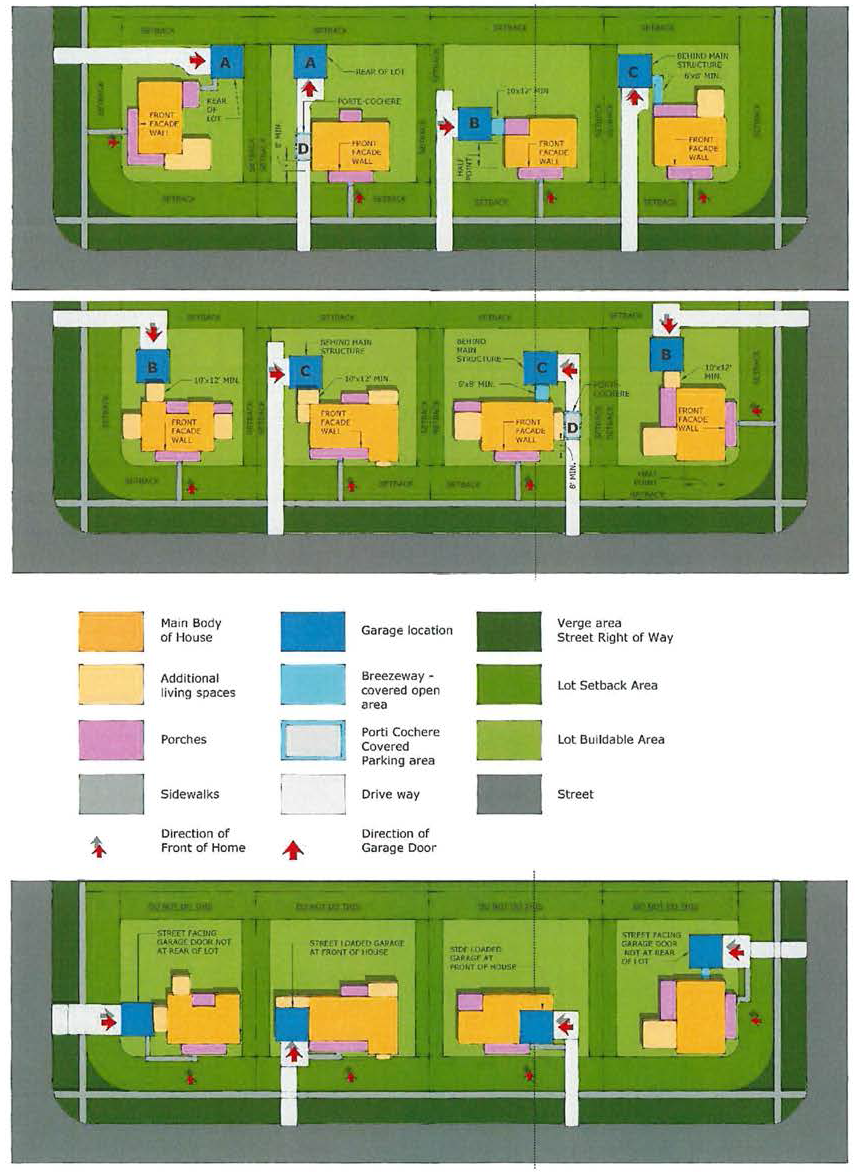
4.
New residential primary structures are required to appear to have a raised floor pier foundation with house skirting treatments, if appropriate to the historic style.
5.
Consistent setbacks created by existing building masses and spaces between them should be preserved.
6.
Site plans should be compatible with the buildings and environment to which it relates to the streetscape.
7.
Building orientation shall ensure that service areas, vehicular activity and mechanical equipment are placed out of view from public rights-of-way, and adjacent properties. Where, because of site constraints or other factors, service areas and mechanical equipment cannot be so located, such areas shall be screened from view by vegetative or structural means. Structural screening with enhanced landscaping shall be architecturally compatible with the building in terms, style, colors, construction materials and finish. Landscape screening shall be compatible with and integrated into the project's landscape plan with adequate screening (height and width) at planting.
(Ord. No. 2020-02, § 2, 6-11-2020; Ord. No. 2020-05, § 2, 8-13-2020)
Editor's note— See editor's note as § 5.04.02.
5.04.06 - Exterior Materials and Colors.
Exterior building materials and colors contribute significantly to the visual impact of a building on a community, which, in turn, reflects upon the visual character and quality of a community. In order to project an image of high-quality city aesthetics, exterior building materials and colors shall conform to the following requirements:
1.
All buildings shall be faced with materials that exhibit a durable, high quality appearance.
2.
Materials shall be of a low maintenance type, retaining a consistent, clean appearance.
3.
Exterior building construction materials, to include, but not be limited to, materials used in the construction of walls, windows, roofs and doors, shall be consistent with the architectural style of the building and shall also be consistent on all exterior surfaces.
4.
Exterior colors shall be consistent with colors that are historically consistent with the architectural style of building. Colors that are deemed loud, clashing or garish shall be prohibited. Referenced in the Lake Helen Pattern Book.
5.
Building materials and colors shall be consistent around the entire building.
6.
For a non-residential development, once final development plan approval and/or a Certificate of Appropriateness has been granted by the City Commission, no subsequent change in the colors or materials approved for the principle and/or accessory structure(s) shall be made without application to, and the approval of, the City Commission.
(Ord. No. 2020-02, § 2, 6-11-2020)
Editor's note— See editor's note as § 5.04.02.
5.04.07 - Roof Design and Materials.
Roofs are an integral part of building design and, as such, shall be designed and constructed to complement the character of the building. Roof design and construction shall conform to the following requirements:
1.
Roofs shall be constructed of durable, high quality materials in order to enhance the appearance and attractiveness of the community. Roofing materials shall be similar in appearance with materials that are historically consistent with the architectural style of the building.
2.
The design of roof structures shall be consistent with the architectural style of the building and shall be extended to all sides of the structure.
3.
Roofs shall be designed to be of such height, bulk and mass to comply with the architectural style selected.
(Ord. No. 2020-02, § 2, 6-11-2020)
Editor's note— See editor's note as § 5.04.02.
5.04.08 - Outdoor Living Areas, Fencing and Sidewalks.
Porches: Front porches, verandas, breezeways, gazebos, lanais, trellis[es], etc. are an integral part of the Lake Helen pedestrian friendly, neighborhood design.
The architectural styles within the community shall be designed and constructed to complement the character of the building. Porch design and construction shall conform to the following requirements:
1.
These outdoor living areas shall be constructed of durable, high quality materials in order to enhance the appearance and attractiveness of the community. Materials shall be similar in appearance with materials that are historically consistent with the architectural style of the building.
2.
Front porches are encouraged for most styles with an eight-foot minimum. Site constraints and architectural style will dictate the depth and width of the porch.
3.
The design of porch roof structures shall be consistent with the architectural style of the building and shall be extended to all sides of the porch structure.
4.
Minimum porch, massing, eave, details and depth shall be architectural style specific.
Fencing: Design and construction quality of fence, screen, privacy, and garden walls are important visual reflections of community character and quality. Fence and wall design shall conform to the following requirements:
1.
Fence, screen, privacy, and garden walls shall be designed to be consistent with the principal structure(s). Such design shall include the use of similar materials, colors and finishes as the principal structure. This requirement may be modified upon application to the City Commission where the applicant demonstrates and the City Commission, or its designee, determines that a change in materials, colors or finishes will result in enhanced city aesthetics.
2.
Fence, screen, privacy, and garden walls shall be architecturally designed with offsets, raised elements and landscape pockets to avoid an expansive monolithic or monotonous appearance.
3.
For privacy fences adjacent to a roadway, it shall have one (1) landscape pocket within each fifty (50) linear feet. The landscape pocket must be a minimum of one (1) full panel length wide and fifty percent (50%) panel length depth. (Example: An eight-foot panel would create and eight-foot by four-foot pocket.)
4.
Pocket landscaping must be shown on site plan and canopy trees are encouraged within the landscape pockets.
5.
Where chain link fencing is required or approved, such fencing, shall be of the black or green vinyl type. Posts and rails shall also be black or green vinyl. This requirement may be modified upon application to the City Commission where the applicant demonstrates and the City Commission, or its designee, determines that design or location warrants the use of other colors or finishes.
6.
Landscaped berms may be utilized in lieu of a fence or wall where the applicant demonstrates and the City Commission, or its designee, finds that berms will result in an equivalent aesthetic appearance.
Sidewalks: New construction connecting to a new or existing street sidewalk shall have a four-foot sidewalk from the street sidewalk to the entry porch.
(Ord. No. 2020-02, § 2, 6-11-2020)
Editor's note— See editor's note as § 5.04.02.
5.04.09 - Landscaping.
Landscaping enhances site aesthetics, increases green space and increases oxygen output. Landscaping shall conform to Article 8: Landscaping and Tree Protection.
For new construction:
1.
A landscaping design plan must be approved with the Certificate of Appropriateness.
2.
Preservation shall take precedence and existing established landscaping shall be preserved to the maximum extent possible.
a.
A silt fence must be utilized to preserve existing trees and landscape buffers. The silt fence shall be installed at the drip line for each tree.
3.
A tree survey must be submitted.
4.
A site inspection approved by an arborist certified by the International Society of Arboriculture will be required prior to building permit issuance.
5.
Any modifications during construction must be reviewed/approved by the designated city arborist.
6.
Landscaping is required to be installed before a Certificate of Occupancy is granted. Final approval by the designated city arborist is required prior to scheduling the Certificate of Occupancy inspection.
7.
In order to enhance and protect the city's tree canopy, each new construction applicant must consult with the designated city arborist to establish on a plan to enhance the city's canopy tree on their site. The plan will be included in the new construction permit package and must meet at least one (1) of the following:
a.
Retain existing landscaping/trees which will contribute the city tree canopy.
b.
Plant landscaping/trees to contribute to the city tree canopy.
i.
At least one (1) tree for every forty (40) linear feet of lot street frontage planted in the canopy zone (fifteen (15) feet within the front lot).
ii.
New trees shall be at a minimum of four (4) inches DBH.
c.
When site restrictions prevent retaining or planting:
i.
A recommendation from the designated city arborist will be presented to the City Administrator or his/her designee for approval.
ii.
The applicant will be assessed a fee in lieu of tree retainment or replacement (as set forth in the schedule of fees as adopted by Resolution by the City Commission).
iii.
The city will use said fees for tree planting.
(Ord. No. 2020-02, § 2, 6-11-2020)
Editor's note— See editor's note as § 5.04.02.
5.04.10 - Screening of Service Areas and Mechanical Equipment.
Lack of screening or inadequate screening of service areas and mechanical equipment can have negative visual impacts on the city's streetscape, ambient landscape or community image. Such impacts shall be minimized through compliance with the following requirements:
1.
Structures such as dumpster enclosures, mechanical equipment, backflow preventers, wells, pumps, tanks, buffer walls, HVAC units, transformers, lift stations, utility cabinets, electrical panels, or cable television equipment shall be wholly enclosed within either a natural or manmade enclosure on three (3) sides, with an opaque gate on the access side, so as not to interfere with the ability to access said equipment and/or empty the dumpster. Said access gate shall remain closed when not in use. Screening shall, at a minimum, be at the same height as the equipment to be screened. Structural screening shall be architecturally integrated into the overall project design and shall be compatible, in terms of style, exterior construction materials, colors, and finish with the principle and accessory building(s). Landscaping may be substituted for structural screening if plantings are compatible with the landscape plan for the project and are of such size and maturity as to be able to provide a fully opaque screen at time of planting.
2.
All commercial trash dumpsters shall have lids which shall remain closed at all times, except when being filled or dumped.
3.
If natural plantings substituted for structural screening plantings shall be compatible with the landscape plan for the project and are of such size and maturity as to be able to provide full height and width opaque screen at time of planting.
4.
Reserved.
5.
Equipment and appurtenances mounted on rooftops shall be kept to a minimum. All exposed rooftop mounted equipment and appurtenances shall be fully screened from view from any public right-of-way. All screening shall, at a minimum, be at the same height as the equipment and appurtenances to be screened. Screening shall be an integral part of the design of the building(s) and shall be architecturally consistent with the style, colors, exterior construction materials and finish of the building(s).
6.
All residential equipment (such as but not limited to mechanical, pool, wells) shall be placed in the rear of the lot or screened and maintained.
(Ord. No. 2020-02, § 2, 6-11-2020)
Editor's note— See editor's note as § 5.04.02.
5.04.11 - Lighting.
Lighting fixture design and placement are important components of an attractive urban environment as well as important to public safety. In order to enhance site aesthetics and minimize visual distraction, yet maintain adequate public safety, project lighting shall comply with the following requirements:
An exterior building and site lighting master plan detailing areas and structures requiring illumination, lighting fixture styles, light source and light levels shall be included as part of a project's site plan submittal as outlined in [Article] 9.05.
Lighting fixtures shall be compatible with the architectural style of the principle and accessory building(s).
Sign Lighting shall comply with [Article] 4.10.20.
Lighting of parking areas, access drives and vehicular circulation areas shall comply with [Article] 9.05 and the following:
1.
Lighting shall be consistent with historical styles (i.e., exhibit a "gas" lamp, coach light, or similar "look") rather than contemporary styles. Light poles and fixtures shall not exceed twenty feet (20') in height and shall be anodized bronze or black in color. Should a pole other than a metal pole be used for the mounting of lights, such pole shall be constructed so that the exterior finish color is consistent throughout the pole.
2.
Light poles shall be located in, or immediately adjacent to, landscaped strips, buffers or plant islands.
3.
The minimum setback of the light pole from public rights-of-way shall be a horizontal distance of twenty (20) feet .
4.
Ground level light fixtures shall be of the burial vault type or shall be fully screened by landscaping materials.
(Ord. No. 2020-02, § 2, 6-11-2020)
Editor's note— See editor's note as § 5.04.02.
5.04.12 - Utilities.
The location and aesthetic treatment of utilities is an important factor in creating an attractive urban environment. In order to enhance and maintain the image of quality in the Gateway Overlay, utilities construction and placement shall comply with the following requirements:
1.
All utility lines, whether new or relocated, shall be installed underground.
2.
Utility conduit and utility panels/boxes shall be painted to match the color of the building on which they are placed.
3.
Water and sewer lift stations, pump houses and similar features shall be located at the rear of the development site and shall be fully screened from view by structural or vegetative means. Where screening is accomplished by structural means, such screening shall be compatible in design and color with the principle building.
(Ord. No. 2020-02, § 2, 6-11-2020)
Editor's note— See editor's note as § 5.04.02.
5.04.13 - Outdoor Storage.
Outdoor storage areas shall be located behind the front façade of the main building and shall be fully screened from view by structural means, vegetative means, or a combination of earthen berms and vegetation. Where screening is accomplished by structural means, the structure shall be compatible in design and color with the principle and accessory building(s).
(Ord. No. 2020-02, § 2, 6-11-2020)
Editor's note— See editor's note as § 5.04.02.
5.04.14 - Accessory Structures.
Structures and uses accessory to principal structures shall be integrated into site design in a manner such that they will not detract from site aesthetics. Such structures and uses shall comply with the requirements listed below:
1.
Accessory structures shall be designed and constructed so as to be compatible with the architectural design of the principal building. Exterior finishes, overhangs, roof pitch, window styles, colors and materials on accessory structures shall be similar to those used on the principal building. However, these provisions shall not apply to any accessory structure that is:
a.
Used for agricultural purposes on property that:
i.
Is classified as agricultural by the Volusia County Property Appraiser in accordance with F.S. § 193.461;
ii.
Is greater than five (5) acres in area;
iii.
Maintains a setback of at least one hundred (100) feet from any property line; and
iv.
Is not clearly visible from a public right-of-way; or
b.
Approved by the City in accordance with the provisions of this article.
2.
Miscellaneous structures such as coin-operated rides and other amusement devices shall only be permitted within the principle building.
3.
Outdoor garden supply areas shall be screened from view and shall be incorporated into the building architecture of the principle building.
4.
Outdoor display shall be structurally integrated into the architectural design of the principle building and located to the side or rear of the building. Displays and sales in these areas shall not be of a permanent nature and shall not impede the flow of pedestrian or vehicular traffic as specified in Article 4.04.
5.
Site furnishings such as benches, bicycle racks, newspaper racks, trash receptacles and similar devices shall be compatible with the architectural design of the principle building. Permanent shopping cart storage shall be contained within the principle building or within an enclosed area that is architecturally integrated into the design of the principle and accessory building(s) as outlined in Article 4.04.
6.
Tent sales, boat sales, car sales, recreational vehicle sales and similar activities shall not be permitted as an accessory use on either a temporary, seasonal or permanent basis, unless permitted by the City Commission as a special event found to provide a specific public benefit.
(Ord. No. 2020-02, § 2, 6-11-2020)
Editor's note— See editor's note as § 5.04.02.
5.04.15 - Special Building Design Considerations.
Gas stations, power supply facilities, commercial convenience stores, auto repair facilities and similar uses require additional special design considerations to integrate them into a quality community design fabric. Such facilities shall comply with the following requirements, in addition to the other requirements of this article:
1.
Gas stations and convenience stores shall be constructed with a gable or hip roof design.
2.
Gas station canopies shall be constructed with the same roof design and materials as the main building and shall be attached to the main building. Canopy facing and support poles shall be constructed of the same material, or of a material that is similar in appearance, as that of the main building facade. Canopy lighting shall be in fully enclosed, fully recessed fixtures and shall be designed to provide for subdued or diffused lighting under the canopy rather than overly bright lighting designed to draw attention to the site. Acceptability of site lighting shall be determined by the city. Lighting from canopies shall not spill over onto surrounding properties.
3.
Power supply facilities shall, to the fullest practical extent, be screened from public view through use of structural or vegetative means.
4.
Auto repair facilities shall be oriented on a site in such a fashion that open bays are not located parallel to the primary public road on which they are located. Facility site design shall utilize landscaping to maximize the screening of open bays.
5.
Projects that contain attached buildings with multiple owners or tenants shall provide at a minimum of five (5) feet in width to facilitate pedestrian travel between businesses.
(Ord. No. 2020-02, § 2, 6-11-2020)
Editor's note— See editor's note as § 5.04.02.
5.04.16 - Special Building Size Considerations.
In order to maintain the small-town atmosphere prevalent in the city, it is necessary to place a limitation of the square footage of buildings located within the Gateway Overlay. The maximum square footage of any commercial building, or series of commercial buildings under common ownership, constructed within a Gateway Overlay east of Interstate Highway 4 shall be fifty thousand (50,000) square feet. In the Gateway Commercial District (GCD) retail is restricted to five thousand (5,000) square feet. Where Retail is combined with another use, the retail area shall be less than five thousand (5,000) square feet.
(Ord. No. 2020-02, § 2, 6-11-2020)
Editor's note— See editor's note as § 5.04.02.
5.04.17 - Signage.
Shall conform with Article 4.10, Signs.
(Ord. No. 2020-02, § 2, 6-11-2020)
Editor's note— See editor's note as § 5.04.02.
5.04.18 - Access Management.
Access management design is important to maintaining adequate roadway capacity, providing for public safety and enhancing vehicular and non-vehicular movement. Access management in the designated Gateway Overlay shall conform to the following criteria:
1.
Location and design of parking areas. Parking areas may be within the rear or side yards. Standard parking spaces shall comply with Article 11.08.08. Parking areas shall be located and designed so as to maximize traffic circulation patterns and minimize traffic hazards.
2.
In order to provide adequate pedestrian access, sidewalks shall be provided along the rights-of-way adjacent to any road, subdivision or principle building construction within the Gateway Overlay. In addition, for commercial developments, a clear, safe and convenient hard surfaced pedestrian path shall be provided from the sidewalk along the corridor right-of-way to the main entry door of each principal building. The pedestrian path shall be functionally delineated by using construction materials that are different than the materials used for the construction of the parking area (e.g., use of brick or concrete for the pedestrian access when the parking lot is an asphalt surface). Sidewalks shall be five (5) feet in width within Gateway Overlay.
3.
Curb cuts/driveway entrances along Prevatt Avenue shall be a minimum of three hundred (300) feet apart.
(Ord. No. 2020-02, § 2, 6-11-2020)
Editor's note— See editor's note as § 5.04.02.
5.04.19 - Gateway Overlay Requirements Variance Procedure.
A variance may be requested pursuant to Article 13.
(Ord. No. 2020-02, § 2, 6-11-2020)
Editor's note— See editor's note as § 5.04.02.
5.04.20 - Overlay Districts Permit and Certificate of Occupancy Procedure.
1.
Prior to the issuance of a building permit with the Gateway Overlay, a Certificate of Appropriateness (COA) must be obtained. The city shall conduct a review of construction plans submitted to verify compliance with the issued Certificate of Appropriateness (COA) which includes exterior finish details, sections, etc.
2.
During construction any field modifications deemed as major will need to be resubmitted for a new Certificate of Appropriateness (COA). The city shall conduct periodic on-site inspections to determine the compliance to the Certificate of Appropriateness (COA). A stop work order may be issued if major deviations are found.
3.
Prior to the issuance of a Certificate of Occupancy, the city shall conduct a final on-site inspection to determine the compliance to the Certificate of Appropriateness (COA).
(Ord. No. 2020-02, § 2, 6-11-2020)
5.04.21 - Certificate of Appropriateness Minor Amendments.
Minor amendments include the following:
1.
Changes in the types and locations of landscaping materials, provided that:
a.
Such changes do not reduce total amount of landscaping material;
b.
Any required buffer area complies with the standards of this LDC; and
c.
The proposed landscaping materials comply with the specifications of this LDC.
2.
A minor adjustment in the location of dumpsters, sidewalks, bicycle facilities, sheds, or other accessory buildings, provided that:
a.
The adjustment does not deviate from the approved location more than ten (10) feet in any direction;
b.
Such adjustment does not encroach into any required buffer or stormwater management area;
c.
Such adjustment does not increase the approved impervious surface ratio for the project; and
d.
The location continues to comply with all standards of this LDC, including, but not limited to, setbacks, landscaping, and buffer requirements.
3.
A minor adjustment in the location and design of parking lots and access drives, provided that:
a.
Such adjustment does not encroach into any required buffer or other landscaped area;
b.
Such adjustment does not increase the approved impervious surface ratio for the project;
c.
Such adjustment does not reduce the number of parking spaces; and
d.
Such adjustment continues to comply with all standards of this Land Development Code and the Public Works Manual.
4.
Minor changes that are appropriate to the historical style:
a.
Color changes;
b.
Shutters;
c.
Finish materials;
d.
Hardware for shutters and garage doors and trim features;
e.
Banisters and porch details.
(Ord. No. 2020-02, § 2, 6-11-2020)
5.04.22 - Certificate of Appropriateness (COA) Procedures for Minor Amendments.
The applicant shall submit one (1) copy of the approved site plan, or subdivision plat indicating the proposed minor amendments.
The City Administrator or his/her designee shall determine that the amendment is consistent with:
1.
The requirements of Section 5.04.22; and
2.
The standards and criteria of the LDC.
When an application is proposed to be approved or approved with conditions, a notice of intent shall be provided as set forth in Section 11.02.01(C) and (F).
The City Administrator or his/her designee shall approve or deny the application for a minor amendment and approve an addendum to the building permit file.
(Ord. No. 2020-02, § 2, 6-11-2020)
5.04.23 - Certificate of Appropriateness (COA) Major Amendments.
Any proposed change to the approved Certificate of Appropriateness (COA) that is not a minor amendment as described in Section 5.04.22 shall be considered a major amendment. Major amendments are processed in the same manner as the original application in Section 5.05.08.
(Ord. No. 2020-02, § 2, 6-11-2020)
5.04.24 - Deviations from Certificate of Appropriateness (COA).
Deviations from an approved Certificate of Appropriateness (COA) will result in issuance of a stop work order by the City Administrator or his/her designee, Chief of Police or Building Official. The stop work order may only allow work necessary to secure investments and/or remedy the violation.
(Ord. No. 2020-02, § 2, 6-11-2020)
5.05.00 - Designation of the Historic District.
The City of Lake Helen Historic District shall be applied to all properties in the City Historic District Map so listed at the time of adoption of this article. All provisions outlined in this article shall be effective immediately after adoption and all properties so assigned shall conform with the Certificate of Appropriateness process outlined herein.
The City of Lake Helen Historic District Regulations shall be applied to all additional appropriate properties in the City listed on the City of Lake Helen Historic District Map, by way of the Certificate of Designation process outlined herein.
The City of Lake Helen Historic Preservation Board shall create a process for recognizing Historic homes and properties not adjacent or contiguous to the Historic District.
5.05.01 - Creation of Historic District.
A map is attached to this article of the designated properties that constitute the City of Lake Helen Historic District.
5.05.02 - Amendment of Historic District.
Any properties seeking a Certificate of Designation shall be either located adjacent to or contiguous with the boundary of the Historic District. The Historic Preservation Board shall make recommendations for additions or deletions to the City of Lake Helen Historic District by way of the Certificate of Designation process, as outlined herein to the City Commission for consideration and/or approval. Applicants requesting modifications to the Historic District will be responsible for the associated costs including but not limited to cost of consultants, advertising, amendments to the Comprehensive Plan and the Land Development Code.
5.05.03 - Certificate of Designation.
The process for designation of historic resources may be initiated by the filing of a completed application for a Certificate of Designation by the property owner. The subject property must be either located adjacent to or contiguous with the boundary of the Historic District or the application will not be accepted.
Applicants requesting a Certificate of Designation will be responsible for the associated costs including but not limited to cost of consultants, advertising, amendments to the Comprehensive Plan and the Land Development Code.
5.05.04 - Application for Certificate of Designation.
Prior to the designation of any historic resource or historic district pursuant to this article, an application for a Certificate of Designation shall be submitted to the Historic Preservation Board. This application shall contain, as a minimum, the following information:
1.
For individual historic building, structures and objects:
a.
The name and address of the property owner.
b.
A physical description of the building, structure or object and its character-defining features, accompanied by photographs.
c.
A description of the existing condition of the building, structure or object, including any potential threats or other circumstances that may affect the integrity of the building, structure or object.
d.
A statement of the historical, architectural or other significance of the building, structure or object as defined by the criteria for designation established by this article.
e.
The name of the building, if any, structure or object, and the Florida Site File number, if applicable.
f.
Any other appropriate information requested by the board.
2.
For individual archaeological or historic sites:
a.
The name and address of the property owner.
b.
The name of the site, and the Florida Site File number, if applicable.
c.
Culture or historic periods represented at the site.
d.
The type of site and a list of any artifacts associated with the site.
e.
A list of any references to human remains discovered at the site.
f.
Photographs showing at least one general view of the site and photographs of diagnostic artifacts found at the site.
g.
A statement of the historical and/or scientific significance of the site as defined by the criteria for designation established by this article.
h.
A description of the physical condition of the site, including any potential threats or other threats that may affect the integrity of the site.
i.
Any other appropriate information requested by the board.
5.05.05 - Procedure for Issuance of Certificate of Designation.
Application. A person seeking a Certificate of Designation shall file an application and supporting documents with the City Clerk or his/her designee. The application form shall be provided by the City Clerk. Applicants shall be responsible for the associated costs including but not limited to cost of consultants, advertising, amendments to the Comprehensive Plan and the Land Development Code.
Upon receipt of a completed application, along with the required filing fee the City Clerk shall place the application on the next available regularly scheduled meeting of the Historic Preservation Board. Applications for Certificates of Designation may be heard at specially called meetings of the Historic Preservation Board. Upon mutual agreement between the applicant and the City Clerk, the application may be set for a meeting later than the next regularly scheduled meeting.
Decision. The recommendation of the Historic Preservation Board shall be presented to the City Commission. The application may be continued to another meeting for the purpose of gathering additional information. The Historic Preservation Board shall:
1.
Consider whether or not the building, structure or object is eligible for designation pursuant to this article and provide a listing of those features of the building, structure or object which require specific historic preservation treatments.
2.
Consider whether or not the site is eligible for designation pursuant to this article, which shall include a location map showing site boundaries, justification for such boundaries, relevant land use information and any proposed development.
The Historic Preservation Board shall recommend approval, denial or approval with conditions, for a proposed Certificate of Designation, pursuant to this article, based on the criteria outlined herein. The Historic Preservation Board shall make written findings and conclusions that specifically relate to the criteria for review of Certificates of Designation and send to the City Commission for action.
Issuance of certificate; recommendation of amendments to comprehensive plan. If a recommendation for designation is made, the Board shall recommend issuance of the Certificate of Designation to the City Commission, who after their approval, shall direct amendments to appropriate elements of the City comprehensive plan, to show such designation.
5.05.06 - Criteria for Issuance of Certificate of Designation.
The historic resources considered for issuance of a Certificate of Designation by the Historic Preservation Board shall possess integrity of location, design, setting, materials and workmanship, and shall meet at least one criterion in one of the three significant categories listed in this section:
1.
A historic resource shall be considered historically significant if it is:
a.
Associated with the life or activities of a person of importance in local, state or national history;
b.
The site of a historic event with a significant effect upon the city, state or nation;
c.
A prime historical example of the political, cultural, economic or social trends, successes or failures of the people of the city;
d.
Associated with a past or continuing institution which has contributed substantially to the life of the people in the city;
e.
A building or structure, site, object or district if its location, landscape setting or environment exemplifies a specific historical context; or
f.
Is an example of material of local historic significance such as the Lake Helen Florida Pine or materials milled or manufactured locally (i.e. Bond Brick).
2.
A historic resource shall be considered architecturally significant if it is:
a.
A building, structure or district that embodies distinctive characteristics of an architectural style, type, form, period or method of construction;
b.
A building, structure or district that is the work of a prominent architect, builder or other design professional;
c.
A building, structure or district possessing elements of design, detail, material or craftsmanship which are of outstanding quality;
d.
A building, structure or district which represented, in its time, a significant technological innovation, or an adaptation to the state environment; or
e.
An exceptional or unique example of a utilitarian structure, building or district.
3.
A historic resource shall be considered archaeologically significant if it is:
a.
A site associated with an important historical event or person and which contains intact archaeological deposits;
b.
A site of such condition that data recoverable from the site may provide unique or representative information on past human activities and behavior; or
c.
A site that has in the past revealed information vital in developing well-established and widely accepted models and theories about past cultures and/or activities.
5.05.07 - Revocation of Certificate of Designation.
A property owner may request revocation of Certificate of Designation. Applicants requesting revocation of the Certificate of Designation will be responsible for the associated costs including but not limited to cost of consultants, advertising, amendments to the Comprehensive Plan and the Land Development Code. A notarized letter must be submitted to the City Clerk and shall be forwarded to the Historic Preservation Board and the City Commission. Notice of Withdraw from the District shall be forwarded to the City Commission. The City Commission shall direct amendment of the appropriate elements of the comprehensive plan.
After revocation of a Certificate of Designation, the owner cannot re-apply for a certificate of designation for five (5) years unless a change of ownership occurs.
5.05.08 - Certificate of Appropriateness.
A Certificate of Appropriateness shall be required for any of the following activities on properties located within the Lake Helen Historic District:
1.
Demolition of any building or structure.
2.
The movement or relocation of any building or structure.
3.
Construction of any new buildings, or accessory buildings or structures.
4.
Any material change, addition or alteration in the exterior appearance of any buildings or structures.
A Certificate of Appropriateness shall not be required for any work that can be deemed as ordinary maintenance or repair. Ordinary Maintenance or repair shall include improvements which do not involve a change of design, appearance or material, or ordinary maintenance of landscape features where such work will not adversely affect the exterior appearance of the resource. Any work not satisfying all of the above requirements shall not be considered ordinary maintenance and must receive a Certificate of Appropriateness issued by the City Commission prior to the commencement of said work.
A Certificate of Appropriateness shall be a prerequisite to the issuance of any other permits required by law. The issuance of a Certificate of Appropriateness shall not relieve the applicant from obtaining other permits or approvals required by the City of Lake Helen. A building permit or other city permit shall be invalid if it is obtained without a Certificate of Appropriateness required for the proposed work.
Temporary emergency repairs to a building or structure are permitted provided the Certificate of Appropriateness process has been properly initiated.
5.05.09 - Criteria for Issuing Certificates of Appropriateness.
The decision on all Certificates of Appropriateness shall be guided by specific criteria set forth by the Historic Preservation Board in adopted written guidelines and by the following general historic preservation principles. Recommendations will be made to the City Commission who issues the Certificate of Appropriateness.
5.05.10 - For Alterations in Exterior Appearance of Buildings and Structures, Within the Lake Helen Historic District.
1.
The distinguishing original qualities or character of a building, structure, or site and its environment shall not be destroyed. The removal or alteration of any historic material or distinctive architectural features should be avoided when possible.
2.
All buildings, structures, and sites shall be recognized as products of their own time. Alterations that have no historic basis and which seek to create an earlier appearance shall be discouraged.
3.
Changes which may have taken place in the course of time are evidence of the history and development of a building, structure, or site and its environment. These changes may have acquired significance in their own right, and this significance shall be recognized and respected.
4.
Distinctive stylistic features or examples of skilled craftsmanship which characterize a building, structure, or site shall be maintained when reasonably possible.
5.
Deteriorated architectural features shall be repaired rather than replaced, wherever possible. In the event replacement is necessary, the new material should match the material being replaced in composition, design, texture, and other visual qualities. Repair or replacement of missing architectural features should be based on accurate duplication of features, substantiated by historic, physical, or pictorial evidence rather than on conjectural designs or the availability of different architectural elements from other buildings or structures.
6.
The surface cleaning of a building or structure shall be undertaken with the least destructive cleaning process reasonably available. Sandblasting and other cleaning methods that will damage the historic building materials shall not be undertaken.
5.05.11 - New Construction, Renovation and Alteration Within the Lake Helen Historic District.
1.
Development, including new construction, renovation, alteration and additions shall be consistent with the provisions established in Land Development Code of the City of Lake Helen. Notwithstanding the foregoing, contemporary design for renovations, alterations and additions to existing contemporary properties shall be allowed when such renovations, alterations and additions do not damage or destroy significant historic, architectural or cultural material, and such design is compatible with the size, scale, material, and character of the property, neighborhood or environment.
2.
Wherever reasonably possible, new additions or alteration to structures shall be done in such a manner that if such additions or alterations were to be removed in the future, the essential form and integrity of the structure would be unimpaired.
3.
The height, volume, proportions and relationship between doors and windows, rhythm of solids and voids created by openings in the façade, materials used in the façade, the texture inherent in the façade, the pattern and trim used in the façade, and the design of the roof should be compatible with existing historic buildings.
4.
Rhythm and setbacks created by existing building masses and spaces between them should be preserved.
5.
Site plans should be compatible with the buildings and environment to which it is visually related.
6.
Proportions of existing facades, such as horizontal and vertical expression, should be in the new façade.
7.
Architectural details should be incorporated as necessary to relate the new with the old and to preserve and enhance the inherent architectural characteristics of the area.
5.05.12 - For Relocation of Buildings and Structures Within the Lake Helen Historic District.
A Certificate of Appropriateness is required for any relocation of buildings and structures within the Lake Helen Historic District.
1.
The moving of buildings and structures designated as contributing properties in historic districts out of said districts is prohibited unless property owner establishes by evidence that the relocation is the only alternative for the preservation of such a building or structure;
2.
The moving of mobile homes and noncontributing properties into the Lake Helen Historic District is prohibited.
3.
The moving of a contributing property in the Lake Helen Historic District should not lessen its presence and contribution to the historic character and aesthetic interest of the neighborhood;
4.
If definite plans are available for new construction on the property to be vacated, the proposed new construction should not have a negative impact on the character of the surrounding area; and
5.
If the building or structure to be moved is a contributing property it should be demonstrated that said building or structure can be moved without significant damage to its physical integrity.
(Ord. No. 2021-03, § 4, 4-8-2021)
5.05.13 - For Demolition of Buildings and Structures Within the Lake Helen Historic District.
Demolition of a structure or property constitutes an irreplaceable loss to the history and character of the City of Lake Helen. No Certificate of Appropriateness shall be issued for the demolition of a contributing structure or property unless all reasonable measures to save the building or structure have been explored.
Applications for a certificate of appropriateness for demolition of designated properties and properties located within designated historic districts shall be denied if:
1.
The structure is of such interest or quality that it would reasonably meet national, state or local criteria for designation as a historic landmark.
2.
The structure is of such design, craftsmanship or material that it could be reproduced only with great difficulty and/or expense.
3.
The structure is one of the last remaining examples of its kind in the city, the county or the region.
4.
The structure contributes to the historic character of a designated district.
5.
Retention of the structure promotes the general welfare of the city by providing an opportunity for study of local history, architecture, and design, or by developing an understanding of the importance and value of a particular culture and heritage.
6.
There are definite plans for reuse of the property if the proposed demolition is carried out, and there is an explanation of what the effect of those plans will be on the character of the surrounding area.
The Historic Preservation Board may require architectural drawings, financial plans, expert testimony or other information necessary to make determinations.
5.05.14 - Procedure for Certificate of Appropriateness Review.
1.
A person wishing to apply for a Certificate of Appropriateness shall file an application for a Certificate of Appropriateness and supporting documents, with the City Clerk or his/her designee.
2.
If the proposed work is ordinary maintenance, then said work can proceed without further action required by this article. Ordinary Maintenance or repair shall include improvements which do not involve a change of design, appearance or material, or to prevent ordinary maintenance of landscape features where such work will not adversely affect the exterior appearance of the resource.
3.
If the proposed work is not ordinary maintenance, then the City Clerk or his/her designee shall advise the applicant of the nature and detail of exhibits required to be submitted with the application. Such advice shall not preclude the Historic Preservation Board from requiring additional material prior to making its determination in the case. Following the conference with the City Clerk or his/her designee, a pre-application conference may be held with the Historic Preservation Board at the next regularly scheduled meeting if requested by the applicant.
4.
Upon receipt of a completed application and any required submittals and fees, the City Clerk or his/her designee shall place the application on the next available regularly scheduled meeting of the Historic Preservation Board allowing for public notice. Applications for Certificates of Appropriateness may be heard at specially called meetings of the Historic Preservation Board provided all notice requirements are met. Upon mutual agreement between the applicant and the City Clerk or his/her designee, the application may be set for hearing at a meeting later than the next regularly scheduled meeting.
5.
Public Notice for an application for a Certificate of Appropriateness shall be posted by the applicant on the proposed premises in a prominent location and in a manner which is clearly visible from the street using a sign provided by the city. Such notice shall be posted within five (5) working days prior to the scheduled meeting.
6.
The recommendation of the Historic Preservation Board to the City Commission shall be prepared at the meeting unless the application is continued to another meeting for the purpose of gathering additional information. Special Meetings of the Historic Preservation Board may be called to review an application for a Certificate of Appropriateness.
7.
The Historic Preservation Board shall use the criteria set forth in this article to review the completed application and accompanying submittal. After completing the review of the application, the Board shall take one of the following actions:
a.
Recommend that the City Commission grant the Certificate of Appropriateness with an immediate effective date;
b.
Recommend that the City Commission grant the Certificate of Appropriateness with modifications and conditions;
i.
When the Historic Preservation Board recommends modifications and conditions, applicant will submit revised elevations (these can be colored or non-colored) reflecting the modifications and conditions for verification prior to submission to City Commission meeting. The City Clerk or his/her designee shall verify these have been implemented prior to placing item on agenda for City Commission meeting.
c.
Recommend that the City Commission deny the Certificate of Appropriateness because of listed reasons.
8.
The Historic Preservation Board shall make a recommendation to the City Commission after review of Certificate of Appropriateness. All parties shall be given the opportunity to present evidence through documents, exhibits, testimony, or other means. All parties shall be given the opportunity to rebut evidence through cross-examination or other means. The Historic Preservation Board reserves the right to solicit expert testimony. The recommendation will be forwarded for the City Commission to review at the next regularly scheduled City Commission meeting unless mutually agreed upon between the City Clerk or his/her designee and the applicant.
9.
The City Clerk or his/her designee shall record and keep records of all meetings. The records shall include all official actions of the Historic Preservation Board, and the findings and conclusions of the Board.
(Ord. No. 2020-02, § 2, 6-11-2020)
5.05.15 - Demolition by Neglect.
Every owner of a property within a designated historic district shall keep in good repair all of the exterior portions of such buildings or structures.
In the event the Board determines that a property within the City of Lake Helen Historic District is in the course of being "demolished by neglect," the Board shall notify the City Code Compliance Office to institute proceedings under authority of applicable laws and regulations as outlined in Article 15.
5.05.16 - Variances.
The City Commission may grant variances as outline in Article 13.
Variances to achieve the design review standards for historic preservation may be granted provided the variance does not negatively affect the character of the area and with good cause shown. These variances may include those for building height, side, rear and front setbacks, building coverage, floor area ratio, impervious coverage, storm water retention, and walls and fences. Building code exemptions may be granted subject to the guidelines of the Florida Building Code for qualified historic buildings or structures. Additional information to justify variances and exemptions may be needed.
5.05.17 - Appeals of Board Decisions.
Any appeal of a decision or interpretation made by the Historic Preservation Board administering or enforcing this article shall be processed in accordance with procedures for such appeals as set forth in Article 15 or as defined by State Law.
5.05.18 - Stop Work Orders.
Any work conducted contrary to the provisions of this article shall be immediately stopped upon notice from the Code Compliance Officer, Chief Building Official (CBO) or his/her designee, City Administrator or his/her designee that the work does not conform to the terms of this article or is noted to be a deviation from the Certificate of Appropriateness that was previously granted. Notice shall be in writing and shall be given to the property owner, agent, or to the person doing the work. If none of these persons are immediately available on the construction site to receive the required notice, it shall be posted on the property. The notice shall state all conditions under which work may be resumed. In emergencies, the Building Inspector or designee shall not be required to furnish written notice of the stop work order. The stop work order may only allow work necessary to secure investments and/or remedy the violation.
(Ord. No. 2020-02, § 2, 6-11-2020)

